EP0566018B1 - Benzoxazinone and benzothiazinone derivatives endowed with cardiovascular activity - Google Patents
Benzoxazinone and benzothiazinone derivatives endowed with cardiovascular activity Download PDFInfo
- Publication number
- EP0566018B1 EP0566018B1 EP93105752A EP93105752A EP0566018B1 EP 0566018 B1 EP0566018 B1 EP 0566018B1 EP 93105752 A EP93105752 A EP 93105752A EP 93105752 A EP93105752 A EP 93105752A EP 0566018 B1 EP0566018 B1 EP 0566018B1
- Authority
- EP
- European Patent Office
- Prior art keywords
- formula
- hydrogen
- compound
- dihydro
- defined above
- Prior art date
- Legal status (The legal status is an assumption and is not a legal conclusion. Google has not performed a legal analysis and makes no representation as to the accuracy of the status listed.)
- Expired - Lifetime
Links
- 0 CC(CC1)(CC(*C(*2)P)C(C3)C2=O)C(CCC2)CCCCCC*2C13N Chemical compound CC(CC1)(CC(*C(*2)P)C(C3)C2=O)C(CCC2)CCCCCC*2C13N 0.000 description 9
Classifications
-
- C—CHEMISTRY; METALLURGY
- C07—ORGANIC CHEMISTRY
- C07D—HETEROCYCLIC COMPOUNDS
- C07D265/00—Heterocyclic compounds containing six-membered rings having one nitrogen atom and one oxygen atom as the only ring hetero atoms
- C07D265/04—1,3-Oxazines; Hydrogenated 1,3-oxazines
- C07D265/12—1,3-Oxazines; Hydrogenated 1,3-oxazines condensed with carbocyclic rings or ring systems
- C07D265/14—1,3-Oxazines; Hydrogenated 1,3-oxazines condensed with carbocyclic rings or ring systems condensed with one six-membered ring
- C07D265/20—1,3-Oxazines; Hydrogenated 1,3-oxazines condensed with carbocyclic rings or ring systems condensed with one six-membered ring with hetero atoms directly attached in position 4
- C07D265/22—Oxygen atoms
-
- A—HUMAN NECESSITIES
- A61—MEDICAL OR VETERINARY SCIENCE; HYGIENE
- A61P—SPECIFIC THERAPEUTIC ACTIVITY OF CHEMICAL COMPOUNDS OR MEDICINAL PREPARATIONS
- A61P9/00—Drugs for disorders of the cardiovascular system
-
- A—HUMAN NECESSITIES
- A61—MEDICAL OR VETERINARY SCIENCE; HYGIENE
- A61P—SPECIFIC THERAPEUTIC ACTIVITY OF CHEMICAL COMPOUNDS OR MEDICINAL PREPARATIONS
- A61P9/00—Drugs for disorders of the cardiovascular system
- A61P9/08—Vasodilators for multiple indications
-
- A—HUMAN NECESSITIES
- A61—MEDICAL OR VETERINARY SCIENCE; HYGIENE
- A61P—SPECIFIC THERAPEUTIC ACTIVITY OF CHEMICAL COMPOUNDS OR MEDICINAL PREPARATIONS
- A61P9/00—Drugs for disorders of the cardiovascular system
- A61P9/10—Drugs for disorders of the cardiovascular system for treating ischaemic or atherosclerotic diseases, e.g. antianginal drugs, coronary vasodilators, drugs for myocardial infarction, retinopathy, cerebrovascula insufficiency, renal arteriosclerosis
-
- C—CHEMISTRY; METALLURGY
- C07—ORGANIC CHEMISTRY
- C07D—HETEROCYCLIC COMPOUNDS
- C07D279/00—Heterocyclic compounds containing six-membered rings having one nitrogen atom and one sulfur atom as the only ring hetero atoms
- C07D279/04—1,3-Thiazines; Hydrogenated 1,3-thiazines
- C07D279/08—1,3-Thiazines; Hydrogenated 1,3-thiazines condensed with carbocyclic rings or ring systems
Definitions
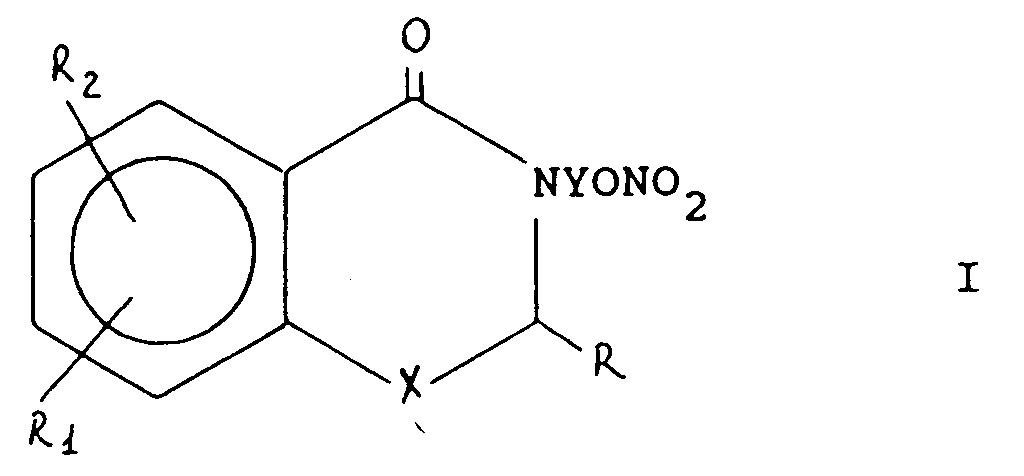
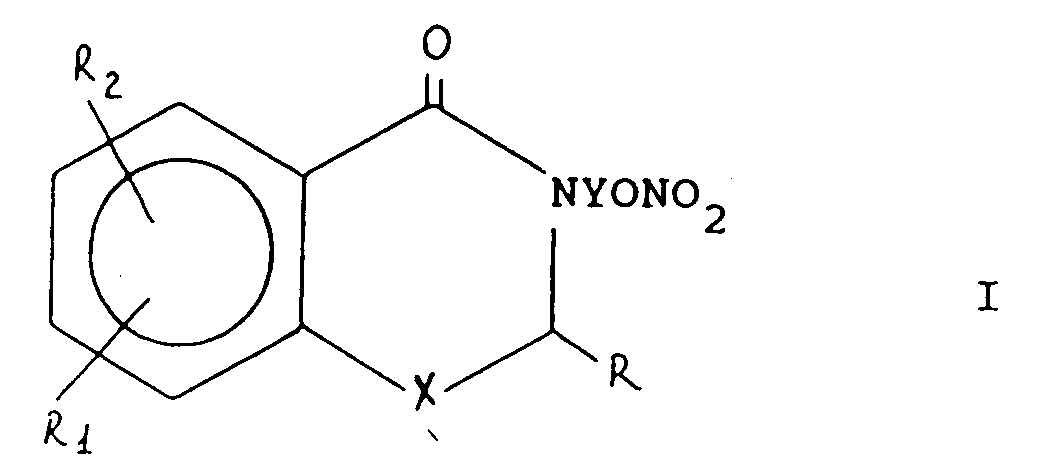
- the present invention relates to 2,3-dihydro-4H-1,3-benzoxazin-4-ones and 2,3-dihydro-4H-1,3-benzothiazin-4-ones of general formula I wherein
- N-unsubstituted 2,3-dihydro-4H-1,3-benzoxazin-4-ones are described by B.W. Horrom et al., J. Org. Chem. 72 , 721, 1950, which discloses 2,3-dihydro-2-phenyl-4H-1,3-benzoxazin-4-one as endowed with analgesic activity.
- Other 2,3-dihydro-4H-1,3-benzoxazin-4-ones are described by R.B. Gammill, J. Org. Chem., 46 , 3340, 1981.
- N-substituted derivatives of the same heterocycle were disclosed by J. Finkelstein et al., J. Med. Chem.
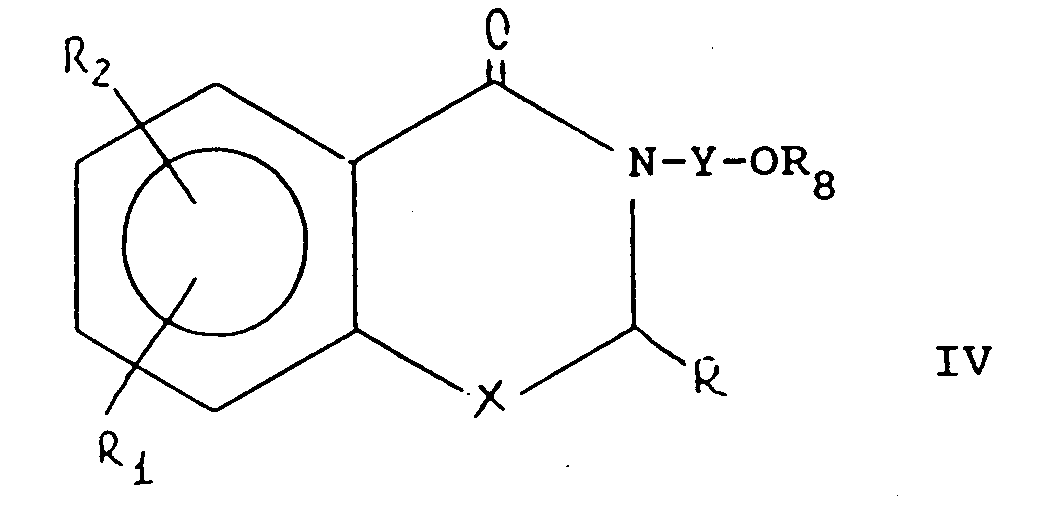
- the compounds of the invention are prepared according to a process comprising, as the first step, the formation of a 2,3-dihydro-1,3-benzoxazine o 2,3-dihydro-1,3-benzothiazine derivative of formula IV wherein R, R 1 , R 2 , X and Y have the above meanings, and R 8 is hydrogen or a (C 2-4 )acyl group, by condensing a salicylamide of formula II wherein R 1 , R 2 , X and Y are as defined above, with an aldehyde of formula III R-CHO wherein R has the above meanings, or a derivative or precursor thereof.
- the condensation generally occurs in acid medium, e.g.
- the condensation is carried out in the presence of an organic solvent, preferably an inert organic solvent such as, for example, ethyl acetate, acetonitrile, benzene, toluene, nitrobenzene or chlorobenzene, halogenated aliphatic hydrocarbons such as methylene chloride, chloroform, 1,2-dichloroethane or 1,1,2-trichloroethylene, cyclohexane, tetrahydrofurane, tetrahydropirane, dimethylformamide, dimethylacetamide.
- the reaction temperature may vary within quite wide limits without prejudice for the reaction course, the preferred range of temperature being comprised between about -10°C and the reflux temperature of the reaction mixture, and the reaction is completed in a time period varying from about 2 to about 30 hours.
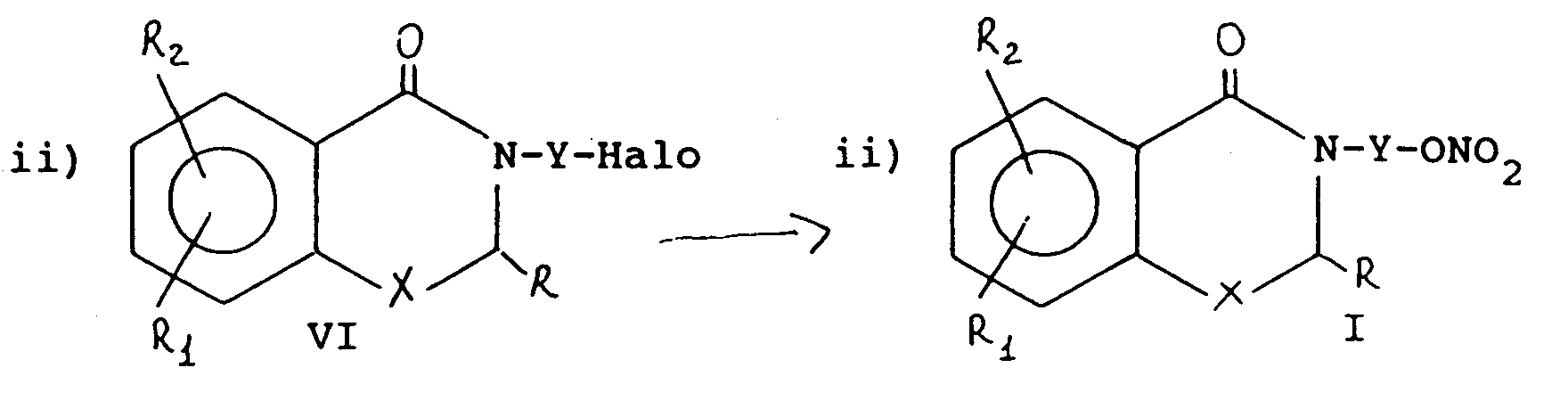
- step i) of Scheme 1 the compound of formula IV is transformed into the compound V through hydrolysis in alkaline aqueous, alcoholic or aqueous/alcoholic medium, for example, by treatment with an alkali or earth-alkaline metal carbonate or hydrocarbonate in methanol or ethanol, at room temperature for about 10-15 hours.
- the free OH group of the compounds of formula V is then replaced with a halogen atom by means of common halogenating agents such as, for example, thionyl chloride, sulphuryl chloride, phosphorous trichloride, phosphorous pentachloride, phosphorous oxytrichloride, phosphorous tribromide, sulphuryl bromide and the like.
- halogenating agents such as, for example, thionyl chloride, sulphuryl chloride, phosphorous trichloride, phosphorous pentachloride, phosphorous oxytrichloride, phosphorous tribromide, sulphuryl bromide and the like.
- the reaction proceeds in an organic solvent, preferably in an inert organic solvent selected from those employed in the formation of the heterocycle of formula IV, at a temperature varying between the room temperature and the reflux temperature of the reaction mixture.
- a specific alternative relates to the compounds of formula I monosubstituted in 6-position, which can be obtained starting from a compound of formula VII wherein R, X and Y are as defined above, and R 9 represents hydrogen or a nitro group, which is reacted with fuming nitric acid at a temperature ranging from about -20°C and about 0°C for a time period varying between about 10 minutes and about 2 hours, whereby obtaining a compound of formula I wherein R, X and Y are as defined above, R 1 is hydrogen, and R 2 represents a nitro group in 6-position.
- This compound may be then catalitically hydrogenated at a temperature of 10-40°C, in an alcohol solvent, for from about 30 minutes to some hours, by employing a common catalizer such as, for example, palladium or platinum sponge, and by this way a compound of formula V wherein R, X and Y are as defined above, R 1 is hydrogen, and R 2 is a primary amine group in 6-position, is obtained, which can be transformed in the corresponding compound of formula I by substituting the OH group with a -ONO 2 through the nitration procedure described above and shown in steps ii) and iii) of Scheme 1.
- a common catalizer such as, for example, palladium or platinum sponge
- compound of formula V may be converted into another compound of formula I by means of suitable procedures of modification of the amine residue in 6-position, such procedures being quite familiar to the skilled in the art.
- suitable procedures of modification of the amine residue in 6-position such procedures being quite familiar to the skilled in the art.
- the diazonium salt thus formed is submitted to a substitution reaction in the presence of a copper(I) salt, and the diazonium cation is replaced by a group selected from the group consisting of OH, NO 2 , CN, SR 3 , wherein R 3 is as defined above, thus yielding a compound of formula V wherein R, X and Y are as defined above, R 1 is hydrogen and R 2 is one of the above cited groups coming from the substitution reaction and it is in 6-position.
- This intermediate is then converted into the relevant compound of formula I through the just described nitration.
- the conversion of one of R 1 and R 2 into another of R 1 and R 2 having meanings encompassed by the formula I may occur according to procedure commonly known by the skilled in the art. These procedures fall within the scope of the invention, as well as the obvious modification of the preparation methods of the compounds of the invention just disclosed.
- the compounds of the invention are endowed with cardiovascular activity.
- they showed noticeable vasodilative properties in vitro , and a remarkable antianginal activity in the laboratory animal.
- These favourable biological properties are accompanied by a negligible hypotensive effect, whereas it is known that this is one of the undesired side-effects of the known nitroderivatives used in therapy.
- the compounds of the invention may be considered as potential drugs with specific anti-anginal activity.
- they showed to possess anti-arrhythmic activity, and this is a further favourable property as the angine attacks are often accompanied by arrhythmias more or less marked.
- the vasodilative activity was determined by the test of the rabbit aorta strip contracted with noradrenaline.
- IC 50 values i.e. the micromolar ( ⁇ M) concentrations of active substances causing a 50% inhibition of the contraction of the aorta strip.
- IC 50 values i.e. the micromolar ( ⁇ M) concentrations of active substances causing a 50% inhibition of the contraction of the aorta strip.
- Table 1 Compound of Example Vasodilative activity in vitro IC 50 ( ⁇ M) 1 0.021 2 0.27 3 0.64 4 0.071 5 0.096 6 0.057
- the in vivo antianginal activity was determined on anaesthetized Sprague Dawley rats of weight 350-400 g, operating according to the method of M. Leitold et al., Arzeim. Forsch., 36 , 1454 , (1986).
- the test was carried out by intravenously administering the animals with one I.U./Kg, equivalent to 3 mg/Kg of Arg-vasopressin, thus inducing a coronaric spasm that is reproducible and may be electrocardiographically monitored by an increase of the T-wave.
- the animals were intravenously administered with 4 increasing doses of the compounds of the invention to measure their ED 50 , i.e. the dose yielding the 50% inhibition of the increase of the T-wave.
- the results obtained for some compounds representative of the invention are set forth in Table 2.
- Compound of Example Antianginal activity in vivo ED 50 ( ⁇ g/Kg) 1 63.7 2 21.0 3 9.7 4 11.5
- Object of the present invention is also the use of the new compounds as antianginal agents, in connection with the industrially applicable acts and aspects of said use, comprising their incorporation into pharmaceutical compositions.
- pharmaceutical compositions are tablets, sugar and film coated tablets, syrups and vials, the latter being suitable both for oral and intramuscular or intravenous administration.
- They contain the active substance alone or in combination with the usual pharmaceutically acceptable carriers and excipients.
- the dosages of active substance employed to combat the anginal attacks may vary within wide limits according to the kind of compound used and they are chosen to ensure the most effective therapeutic coverage along the 24 hours.
- the starting amides of formula II are known substances or may be prepared through methods obvious to the skilled in the art, from the corresponding salicylates or thiosalicylates of formula VIII wherein R 1 , R 2 and X have the above meanings, and R 9 is a (C 1-4 )-alkyl, preferably methyl.
- the compounds of formula VIII are known from the literature or are synthetized according to procedures well known to the skilled artisan, starting from the corresponding salicylic and thiosalicylic acids.
- the aldehydes of formula III, the derivatives and precursors thereof, are commercial products, or are prepared according to methods known from the literature.
- the compound of formula VII may be prepared through one or more of the reactions described in the above Scheme 1.
- the 1 H-NMR spectra were recorded in dimethylsulphoxide (DMSO) with a VARIAN GEMINI 200 spectrometer.
- the 13 C-NMR spectra were recorded by using a VARIAN GEMINI 200 spectrometer , taking the dimethylsulphoxide (DMSO) 39.5 ppm peak as the reference peak.
Landscapes
- Chemical & Material Sciences (AREA)
- Organic Chemistry (AREA)
- Health & Medical Sciences (AREA)
- Engineering & Computer Science (AREA)
- Bioinformatics & Cheminformatics (AREA)
- Life Sciences & Earth Sciences (AREA)
- Veterinary Medicine (AREA)
- General Chemical & Material Sciences (AREA)
- Medicinal Chemistry (AREA)
- Nuclear Medicine, Radiotherapy & Molecular Imaging (AREA)
- Heart & Thoracic Surgery (AREA)
- Pharmacology & Pharmacy (AREA)
- Cardiology (AREA)
- Animal Behavior & Ethology (AREA)
- General Health & Medical Sciences (AREA)
- Public Health (AREA)
- Chemical Kinetics & Catalysis (AREA)
- Urology & Nephrology (AREA)
- Vascular Medicine (AREA)
- Pharmaceuticals Containing Other Organic And Inorganic Compounds (AREA)
- Heterocyclic Carbon Compounds Containing A Hetero Ring Having Nitrogen And Oxygen As The Only Ring Hetero Atoms (AREA)
- Nitrogen- Or Sulfur-Containing Heterocyclic Ring Compounds With Rings Of Six Or More Members (AREA)
- Plural Heterocyclic Compounds (AREA)
- Acyclic And Carbocyclic Compounds In Medicinal Compositions (AREA)
- Control Of Transmission Device (AREA)
- Optical Filters (AREA)
- Solid-Sorbent Or Filter-Aiding Compositions (AREA)
Abstract
Description


N-substituted derivatives of the same heterocycle were disclosed by J. Finkelstein et al., J. Med. Chem. 11, 1038, 1968, and they seem to possess anti-inflammatory activity. Finally analogous derivatives bearing an amine group in 6-position and having anti-inflammatory activity were disclosed by F. Fontanini et al., Riv, Farmacol. Ter., 4(1), 119, 1973 (Chem. Abs. 73745n, Vol. 79, Page 40, 1973).


The condensation generally occurs in acid medium, e.g. in strong mineral acid plus acetic acid, whereby compounds of formula IV wherein R8 is acetyl are obtained, or by means of molecular sieves in the presence of sulphonic acids, e.g. p-toluensulphonic acid, metansulphonic acid, α- and β-naphthalensulphonic acids, phosphoric acids, esters and analogues thereof. The condensation is carried out in the presence of an organic solvent, preferably an inert organic solvent such as, for example, ethyl acetate, acetonitrile, benzene, toluene, nitrobenzene or chlorobenzene, halogenated aliphatic hydrocarbons such as methylene chloride, chloroform, 1,2-dichloroethane or 1,1,2-trichloroethylene, cyclohexane, tetrahydrofurane, tetrahydropirane, dimethylformamide, dimethylacetamide.
The reaction temperature may vary within quite wide limits without prejudice for the reaction course, the preferred range of temperature being comprised between about -10°C and the reflux temperature of the reaction mixture, and the reaction is completed in a time period varying from about 2 to about 30 hours.
When 2,3-dihydro-4H-1,3-benzoxazinones or -benzothiazinones wherein R is hydrogen or methyl are desired, a precursor of the compound of formula III, such as paraformaldehyde and paraldehyde is preferably employed.
The 2,3-dihydro-1,3-benzoxazine or -benzothiazine derivatives of formula IV wherein R8 is (C2-4)acyl are then transformed into the desired compounds of formula I as shown in the following reaction scheme.


A specific alternative relates to the compounds of formula I monosubstituted in 6-position, which can be obtained starting from a compound of formula VII


This compound may be then catalitically hydrogenated at a temperature of 10-40°C, in an alcohol solvent, for from about 30 minutes to some hours, by employing a common catalizer such as, for example, palladium or platinum sponge, and by this way a compound of formula V

Alternatively, compound of formula V may be converted into another compound of formula I by means of suitable procedures of modification of the amine residue in 6-position, such procedures being quite familiar to the skilled in the art.
Thus, for example, it is possible to transform the amine group in 6-position into -NR3COR7 group, wherein R3 and R7 are as defined above, by reacting compounds of formula V with a suitable acyl halide R7-CO-Halo, wherein Halo is an halogen atom, or an anhydride (R7CO)2O.
The transformation of said amine group of the compound of formula V into -NR3-CO-NR4R5 group, wherein R4 and R5 are as defined above, may be effected by a suitable carbamoyl halide of formula R4R5N-CO-Halo, wherein Halo is an halogen atom. On the other hand the preparation of compounds of V where R, X and Y are as defined above, R1 is hydrogen and R2 è -N=CH-NR4R5, is effected by reacting the amino group in 6-position with a formamide of formula CHO-NR4R5, wherein R4 and R5 are as defined above, in the presence of thionyl chloride.
These modifications are followed by the just described nitration by which OH group is replaced with -ONO2 group.
The insertion of OH, NO2, CN and SR3, wherein R3 is as defined above, in 6-position may be effected by diazotizing a compound of formula V as just cited above, with an alkali nitrate, in the presence of a mineral acid such as hydrochloric, nitric, and sulphuric acid, according to methods well known by the skilled in the art. The diazonium salt thus formed is submitted to a substitution reaction in the presence of a copper(I) salt, and the diazonium cation is replaced by a group selected from the group consisting of OH, NO2, CN, SR3, wherein R3 is as defined above, thus yielding a compound of formula V

Anyway, the conversion of one of R1 and R2 into another of R1 and R2 having meanings encompassed by the formula I, may occur according to procedure commonly known by the skilled in the art. These procedures fall within the scope of the invention, as well as the obvious modification of the preparation methods of the compounds of the invention just disclosed.
These favourable biological properties are accompanied by a negligible hypotensive effect, whereas it is known that this is one of the undesired side-effects of the known nitroderivatives used in therapy.
Thus, the compounds of the invention may be considered as potential drugs with specific anti-anginal activity. Also, they showed to possess anti-arrhythmic activity, and this is a further favourable property as the angine attacks are often accompanied by arrhythmias more or less marked.
The vasodilative activity was determined by the test of the rabbit aorta strip contracted with noradrenaline. The test was carried out according to the method described by K. Murakami et al. Eur. J. Pharmacol., 141, 195, 1987. IC50 values, i.e. the micromolar (µM) concentrations of active substances causing a 50% inhibition of the contraction of the aorta strip, were determined.
The results obtained with some compounds representative of the invention are set forth in the following Table 1.
| Compound of Example | Vasodilative activity in vitro IC50 (µM) |
| 1 | 0.021 |
| 2 | 0.27 |
| 3 | 0.64 |
| 4 | 0.071 |
| 5 | 0.096 |
| 6 | 0.057 |
The results obtained for some compounds representative of the invention are set forth in Table 2.
| Compound of Example | Antianginal activity in vivo ED50 (µg/Kg) |
| 1 | 63.7 |
| 2 | 21.0 |
| 3 | 9.7 |
| 4 | 11.5 |
The dosages of active substance employed to combat the anginal attacks may vary within wide limits according to the kind of compound used and they are chosen to ensure the most effective therapeutic coverage along the 24 hours.
The starting amides of formula II are known substances or may be prepared through methods obvious to the skilled in the art, from the corresponding salicylates or thiosalicylates of formula VIII

The aldehydes of formula III, the derivatives and precursors thereof, are commercial products, or are prepared according to methods known from the literature.
The compound of formula VII may be prepared through one or more of the reactions described in the above Scheme 1.
The 1H-NMR spectra were recorded in dimethylsulphoxide (DMSO) with a VARIAN GEMINI 200 spectrometer. The 13C-NMR spectra were recorded by using a VARIAN GEMINI 200 spectrometer , taking the dimethylsulphoxide (DMSO) 39.5 ppm peak as the reference peak.
- 1H-NMR
- 8.54 (d, 1H); 8.40 (dd, 1H); 7.58 (d, 1H); 5.55 (s, 2H); 4.74 (t, 2H); 3.90 (t, 2H)
- 13C-NMR
- 162.39; 160.48; 142.64; 129.69; 123.70; 118.83; 118.57; 78.89; 71.54; 41.73
- 1H-NMR
- 10.03 (s, 1H); 8.07 (d, 1H); 7.70 (dd, 1H); 7.03 (d, 1H); 5.33 (s, 2H); 4.71 (t, 2H); 4.28 (t, 2H); 2.05 (s, 2H)
- 13C-NMR
- 168.41; 161.90; 153.44; 134.50; 125.53; 118.55; 117.99; 116.88; 78.42; 71.72; 41.49; 24.11
- 1H-NMR
- 12.03 (s, 1H); 8.79 (s, 1H); 7.99 (d, 1H); 7.84 (dd, 1H); 7.19 (d, 1H); 5.41 (s, 2H); 4.74 (t, 2H); 3.89 (t, 2H); 3.37 (s, 6H) 13C-NMR 161.40; 155.62; 153.95; 133.07; 126.07; 119.17; 118.44; 117.86; 78.48; 71.67; 43.59: 41.59; 38.27
- 1H-NMR
- 8.21 (d, 1H); 8.01 (dd, 1H); 7.30 (d, 1H); 5.50 (s, 2H); 4.73 (t, 2H); 3.88 (t, 2H)
- 13C-NMR
- 160.96; 160.41; 138.13; 132.72; 119.45; 118.59; 118.32; 105.52; 78.68; 71.57: 41.67
- 1H-NMR
- 9.49 (s, 1H); 7.17 (d, 1H); 6.94 (m, 2H); 5.27 (s, 2H); 4.70 (t, 2H); 3.83 (t, 2H)
- 13C-NMR
- 162.03; 152.74; 150.72; 121.92; 119.15; 117.57; 112.74; 78.39; 71.72; 41.43
- 1H-NMR
- 10.42 (s, 1H); 7.64 (d, 1H); 6.58 (dd, 1H); 6.38 (d, 1H); 5.30 (s, 2H); 4.69 (t, 2H); 3.81 (t, 2H)
- 13C-NMR
- 163.13; 162.23; 159.70; 129.79; 111.02; 102.24; 78.49; 71.87; 41.21
- 1H-NMR
- 7.85 (d, 1H); 6.95 (m, 2H); 5.41 (s, 2H); 4.72 (t, 2H); 3.86 (t, 2H); 2.48 (m, 1H); 1.25 (d, 6H)
- 13C-NMR
- 174.75; 161.51; 158.77; 155.15; 129.78; 116.40; 110.34; 78.71; 71.71; 41.42; 33.60; 18.79 (2C)
- 1H-NMR
- 7.86 (d, 1H); 7.08 (s, 1H); 7.06 (d, 1H); 5.42 (s, 2H); 4.72 (t, 2H); 4.04 (d, 2H); 3.86 (t, 2H); 2.00 (m, 1H); 0.96 (d, 6H)
- 13C-NMR
- 161.41; 158.76; 155.00; 152.59; 129.47; 116.66; 116.21; 109.93; 78.74; 74.76; 71.70; 41.35; 27.43; 18.90 (2C)
- 1H-NMR
- 7.92 (t, 1H); 7.80 (d, 1H); 6.92 (dd, 1H); 6.88 (d, 1H); 5.39 (s, 2H); 4.72 (t, 2H); 3.85 (t, 2H); 3.11 (m, 2H); 1.10 (t, 3H)
- 13C-NMR
- 161.64; 158.72; 155.84; 153.44; 129.13; 116.48; 115.45; 109.73; 78.67; 71.73; 41.37; 35.64; 15.03
- 1H-NMR
- 9.71 (s, 1H); 7.96 (d, 1H); 7.58 (dd, 1H); 7.03 (d, 1H); 5.32 (s, 2H); 4.71 (t, 2H); 3.89 (d, 2H); 3.85 (m, 2H); 1.94 (m, 1H); 0.95 (d, 6H)
- 13C-NMR
- 161.90; 154.02; 153.10; 135.40; 124.81; 118.68; 117.01 (2C); 78.41; 71.73; 70.43; 41.49; 27.84; 19.18 (2C)
- 1H-NMR
- 8.51 (s, 1H); 7.86 (d, 1H); 7.51 (dd, 1H); 6.96 (d, 1H); 6.08 (t, 1H); 5.30 (s, 2H); 4.71 (t, 2H); 3.84 (t, 2H); 3.11 (m, 2H); 1.06 (t, 3H)
- 13C-NMR
- 162.06; 155.41; 152.18; 135.87; 124.45; 118.58; 116.73; 116.45; 78.37; 71.75; 41.45; 34.28; 15.74
Claims (4)
- A process for preparing a compound of the general formulawherein
 R represents hydrogen (C1-6)alkyl, cyclopentyl, cyclohexyl, cycloheptyl, phenyl, phenyl substituted with 1 or 2 groups independently selected from hydroxy, halogen, nitro, (C1-6)alkyl or (C1-6)alkoxy, methylenedioxy;R1 and R2 independently represent hydrogen, COOR3, -CONR4R5,-OCONR4R5, -OCOR3, -NR4R5, -OCOOR6, -NR3COR7, -NR3CONR4R5, -N=CH-NR4R5, NO2, CN, OH, SR3, wherein R3 is hydrogen or (C1-4)alkyl, R4 and R5 are independently hydrogen or (C1-4)alkyl, R6 is (C1-4)alkyl, and R7 is hydrogen, (C1-4)alkyl or (C1-4)alkoxy, with the proviso that R1 and R2 cannot be hydrogen at the same time;
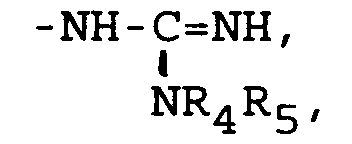 X is an oxygen or a sulphur atom;Y represents a (C2-6)alkylene chain or a cyclopentylene, cyclohexylene or cycloheptylene group; and the pharmaceutically acceptable acid or basic salts thereof; which comprises forming a 2,3-dihydro-1,3-benzoxazine or a 2,3-dihydro-1,3-benzothiazine derivative of formula IVwherein R, R1, R2, X and Y have the above meanings, and R8 is hydrogen or a (C2-4)acyl group, by condensing a salicylamide of formula II
 wherein R1, R2, X and Y are as defined above, with an aldehyde of formula III
 wherein R, R1, R2, R8, X and Y are as defined above, and Halo is an halogen atom; or which comprises reacting a compound of formula VII
 wherein R, X and Y are as defined above, and R9 represents hydrogen or a nitro group, with fuming nitric acid at a temperature ranging from about -20°C and about 0°C for a time period varying between about 10 minutes and about 2 hours, whereby a compound of formula I
 wherein R, X and Y are as defined above, R1 is hydrogen and R2 represents a nitro group in 6-position, is obtained, catalytically hydrogenating this compound at a temperature of 10-40°C, in an alcohol solvent, for from about 30 minutes to some hours, by employing a common catalyzer to obtain a compound of formula V
 wherein R, X and Y are as defined above, R1 is hydrogen, and R2 is a primary amine group in 6-position, and substituting the OH group with a -ONO2 through a nitration procedure as known per se.
- A process for preparing a compound of formula Vwherein R represents hydrogen, (C1-6)alkyl, cyclopentyl, cyclohexyl, cycloheptyl, phenyl, phenyl substituted with 1 or 2 groups independently selected from hydroxy, halogen, nitro, (C1-4)alkyl or (C1-4)alkoxy, methylenedioxy; R1 is hydrogen and R2 is a primary amine group in 6-position; X is an oxygen or a sulphur atom; Y represents a (C2-6)alkylene chain or a cyclopentylene, cyclohexylene or cycloheptylene group;

and the pharmaceutically acceptable acid or basic salts thereof, which comprises forming a 2,3-dihydro-1,3-benzoxazine or a 2,3-dihydro-1,3-benzothiazine derivative of formula IVwherein R, R1, R2, X and Y have the above meanings, and R8 is a hydrogen or a (C2-4)acyl group, by condensing a salicylamide of formula II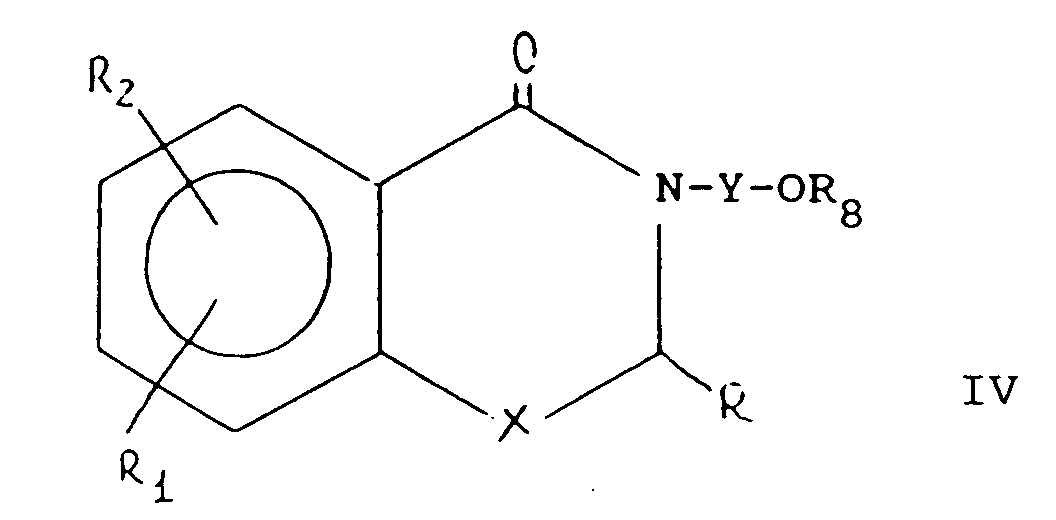 wherein R1, R2, X and Y are as defined above, with an aldehyde of formula III
 wherein R, R1, R2, R8, X and Y are as defined above, and Halo is an halogen atom, or which comprises reacting a compound of formula VII
 wherein R, X and Y are as defined above, and R9 represents hydrogen or a nitro group, with fuming nitric acid at a temperature ranging from about -20°C and about 0°C for a time period varying between about 10 minutes and about 2 hours, whereby a compound of formula I
 wherein R, X and Y are as defined above, R1 is hydrogen, and R2 represents a nitro group in 6-position is obtained, catalytically hydrogenating this compound at a temperature of 10-40°C, in an alcohol solvent, for from about 30 minutes to some hours, by employing a common catalyzer to obtain a compound of formula V
 wherein R, X and Y are as defined above, R1 is hydrogen, and R2 is a primary amine group in 6-position.
Applications Claiming Priority (2)
| Application Number | Priority Date | Filing Date | Title |
|---|---|---|---|
| ITMI920940A IT1254884B (en) | 1992-04-16 | 1992-04-16 | BENZOSSAZINONI AND BENZOTIAZINONI WITH CARDIOVASCULAR ACTIVITY |
| ITMI920940 | 1992-04-16 |
Publications (3)
| Publication Number | Publication Date |
|---|---|
| EP0566018A2 EP0566018A2 (en) | 1993-10-20 |
| EP0566018A3 EP0566018A3 (en) | 1994-06-01 |
| EP0566018B1 true EP0566018B1 (en) | 1998-08-05 |
Family
ID=11362985
Family Applications (1)
| Application Number | Title | Priority Date | Filing Date |
|---|---|---|---|
| EP93105752A Expired - Lifetime EP0566018B1 (en) | 1992-04-16 | 1993-04-07 | Benzoxazinone and benzothiazinone derivatives endowed with cardiovascular activity |
Country Status (17)
| Country | Link |
|---|---|
| US (1) | US5480882A (en) |
| EP (1) | EP0566018B1 (en) |
| JP (1) | JP3257716B2 (en) |
| CN (1) | CN1078466A (en) |
| AT (1) | ATE169293T1 (en) |
| AU (1) | AU655540B2 (en) |
| CA (1) | CA2092342A1 (en) |
| DE (1) | DE69320087T2 (en) |
| FI (1) | FI931688A7 (en) |
| HU (1) | HUT68605A (en) |
| IL (1) | IL105158A (en) |
| IT (1) | IT1254884B (en) |
| MX (1) | MX9302165A (en) |
| NO (1) | NO931225L (en) |
| NZ (1) | NZ247249A (en) |
| TW (1) | TW288013B (en) |
| ZA (1) | ZA932030B (en) |
Families Citing this family (8)
| Publication number | Priority date | Publication date | Assignee | Title |
|---|---|---|---|---|
| IT1264812B1 (en) * | 1993-07-28 | 1996-10-10 | Italfarmaco Spa | THERAPEUTICALLY ACTIVE BENZOSSAZINONIC AND BENZOTHIAZINONIC DERIVATIVES |
| WO2001004103A1 (en) | 1999-07-13 | 2001-01-18 | F. Hoffmann-La Roche Ag | Benzazepinones and quinazolines |
| US6794383B2 (en) | 2000-08-31 | 2004-09-21 | Takeda Chemical Industries, Ltd. | Heart muscular cell apoptosis inhibitors and remedies/preventives for heart diseases |
| JP5700547B2 (en) | 2011-05-30 | 2015-04-15 | 国立大学法人京都大学 | Photosensitive resin composition for biochip formation and biochip |
| CN102367239B (en) * | 2011-07-20 | 2015-10-28 | 沈阳药科大学 | 2-aryl-2, 3-dihydro-4H-1, 3-benzothiazin-4-one derivatives and application thereof |
| CN103012188A (en) * | 2011-09-20 | 2013-04-03 | 北京京卫信康医药科技发展有限公司 | 2,5-dihydroxy-N-(2-hydroxyethyl)benzamide preparation method |
| CN102631108A (en) * | 2012-04-25 | 2012-08-15 | 张家港市立达金属制品有限公司 | Hat show shelf |
| ITMI20122221A1 (en) * | 2012-12-21 | 2014-06-22 | C4T S C A R L | NEW COMPOUNDS OF 2,3-DIIDRO-4H-1,3-BENZOSSAZIN-4-ONE, METHOD FOR PREPARING THEM AND PHARMACEUTICAL FORM THAT INCLUDES THEM |
Family Cites Families (4)
| Publication number | Priority date | Publication date | Assignee | Title |
|---|---|---|---|---|
| US3539563A (en) * | 1965-09-27 | 1970-11-10 | Istituto Chemioterapico | Tetracycline: 6-amino-4-oxo-2-(beta-chloroethyl) - 2,3 - dihydrobenzene - 1,3-oxazine double salt dihydrate |
| US3459748A (en) * | 1967-04-28 | 1969-08-05 | Squibb & Sons Inc | Hydroxyalkylene-substituted benzoxazines and benzothiazines |
| FR2636065B1 (en) * | 1988-09-08 | 1993-05-07 | Fabre Sa Pierre | NOVEL 2,3-DIHYDRO ARYLACOYLAMINOALCOYL-3 4H-BENZOXAZINE-1,3 ONES-4 DERIVATIVES, THEIR PREPARATION AND THEIR APPLICATION AS MEDICAMENTS USEFUL IN THERAPEUTICS |
| IT1244472B (en) * | 1990-12-14 | 1994-07-15 | Italfarmaco Spa | BENZOSSAZINONI AND BENZOTIAZINONI WITH CARDIOVASCULAR ACTIVITY |
-
1992
- 1992-04-16 IT ITMI920940A patent/IT1254884B/en active IP Right Grant
-
1993
- 1993-03-22 ZA ZA932030A patent/ZA932030B/en unknown
- 1993-03-24 CA CA002092342A patent/CA2092342A1/en not_active Abandoned
- 1993-03-24 IL IL10515893A patent/IL105158A/en not_active IP Right Cessation
- 1993-03-25 NZ NZ247249A patent/NZ247249A/en unknown
- 1993-03-30 AU AU35617/93A patent/AU655540B2/en not_active Ceased
- 1993-03-31 NO NO93931225A patent/NO931225L/en unknown
- 1993-04-07 EP EP93105752A patent/EP0566018B1/en not_active Expired - Lifetime
- 1993-04-07 DE DE69320087T patent/DE69320087T2/en not_active Expired - Fee Related
- 1993-04-07 AT AT93105752T patent/ATE169293T1/en active
- 1993-04-14 TW TW082102853A patent/TW288013B/zh active
- 1993-04-14 FI FI931688A patent/FI931688A7/en not_active Application Discontinuation
- 1993-04-14 MX MX9302165A patent/MX9302165A/en unknown
- 1993-04-15 HU HU9301106A patent/HUT68605A/en unknown
- 1993-04-15 JP JP11214993A patent/JP3257716B2/en not_active Expired - Fee Related
- 1993-04-16 CN CN 93104624 patent/CN1078466A/en active Pending
-
1994
- 1994-11-23 US US08/347,217 patent/US5480882A/en not_active Expired - Fee Related
Also Published As
| Publication number | Publication date |
|---|---|
| JP3257716B2 (en) | 2002-02-18 |
| AU655540B2 (en) | 1994-12-22 |
| ZA932030B (en) | 1993-10-19 |
| TW288013B (en) | 1996-10-11 |
| IT1254884B (en) | 1995-10-11 |
| US5480882A (en) | 1996-01-02 |
| DE69320087T2 (en) | 1998-12-10 |
| MX9302165A (en) | 1993-10-01 |
| NO931225L (en) | 1993-10-18 |
| CA2092342A1 (en) | 1993-10-17 |
| JPH0625194A (en) | 1994-02-01 |
| FI931688L (en) | 1993-10-17 |
| AU3561793A (en) | 1993-10-21 |
| ATE169293T1 (en) | 1998-08-15 |
| NZ247249A (en) | 1995-01-27 |
| FI931688A0 (en) | 1993-04-14 |
| EP0566018A2 (en) | 1993-10-20 |
| EP0566018A3 (en) | 1994-06-01 |
| CN1078466A (en) | 1993-11-17 |
| FI931688A7 (en) | 1993-10-17 |
| ITMI920940A1 (en) | 1993-10-16 |
| DE69320087D1 (en) | 1998-09-10 |
| ITMI920940A0 (en) | 1992-04-16 |
| HU9301106D0 (en) | 1993-07-28 |
| IL105158A (en) | 1996-10-31 |
| HUT68605A (en) | 1995-06-28 |
| NO931225D0 (en) | 1993-03-31 |
Similar Documents
| Publication | Publication Date | Title |
|---|---|---|
| US4296126A (en) | 3-Aryloxy-3-aryl-propaneamines and their method of use | |
| US6603006B2 (en) | Intermediate for the synthesis of amlodipine, a process for the preparation thereof and corresponding use | |
| US5480882A (en) | Benzoxazinone and benzothiazinone derivatives having cardiovascular activity | |
| EP0490183B1 (en) | Benzoxazinone and benzothiazinone derivatives endowed with cardiovascular activity | |
| US3819628A (en) | 2-phenyl-4-substituted amino-quinazolines and nitrates thereof | |
| US3337563A (en) | 2-amino-2, 3-dihydro-3-substituted-naphtho[1, 2-b]furan-5-ols | |
| EP0711286A1 (en) | Benzoxazinones and benzothiazinones endowed with therapeutic activity | |
| EP0015065B1 (en) | Pyrazolo (5,1-b) quinazolin-9(4h)-one derivatives, process for their preparation and pharmaceutical compositions containing them | |
| PL172906B1 (en) | The method of obtaining indobufen in a pharmaceutically preferred crystalline form | |
| CA1219264A (en) | Benzobisoxazinetetrones | |
| EP0035619A1 (en) | Derivatives of 3-amino-(1H,3H)-2,4-quinazolin-diones | |
| CH620906A5 (en) | Processes for the preparation of new propylenediamines | |
| FR2531957A1 (en) | ||
| ITMI952522A1 (en) | BENZOSSAZINONI WITH ANTI-THROMBOTIC ACTIVITY | |
| ITMI942219A1 (en) | "CARDIOVASCULAR ACTIVITY COMPOUNDS" | |
| FI56530C (en) | PROCEDURE FOR FRAMSTAELLNING AV 6-SULFAMYL-1,2,3,4-TETRAHYDRO-4-QUINAZOLINONER | |
| ITMI942220A1 (en) | "BENZOSSAZINONIC AND BENZOTHIAZINONIC DERIVATIVES AND THEIR THERAPEUTIC USE" | |
| WO1993021163A1 (en) | Quinazolones having cardiovascular activity | |
| ITMI941008A1 (en) | BENZAMIDIC DERIVATIVES USEFUL AS ANTIARRHYTHMIC, ANTI-SCHEMIC AND ANTI-ANGLYOUS AGENTS | |
| JPH064567B2 (en) | Process for producing optically active α-aminoketone and acid addition salt thereof |
Legal Events
| Date | Code | Title | Description |
|---|---|---|---|
| PUAI | Public reference made under article 153(3) epc to a published international application that has entered the european phase |
Free format text: ORIGINAL CODE: 0009012 |
|
| AK | Designated contracting states |
Kind code of ref document: A2 Designated state(s): AT BE CH DE DK ES FR GB GR IE IT LI LU MC NL PT SE |
|
| PUAL | Search report despatched |
Free format text: ORIGINAL CODE: 0009013 |
|
| AK | Designated contracting states |
Kind code of ref document: A3 Designated state(s): AT BE CH DE DK ES FR GB GR IE IT LI LU MC NL PT SE |
|
| 17P | Request for examination filed |
Effective date: 19940628 |
|
| GRAG | Despatch of communication of intention to grant |
Free format text: ORIGINAL CODE: EPIDOS AGRA |
|
| 17Q | First examination report despatched |
Effective date: 19971007 |
|
| GRAG | Despatch of communication of intention to grant |
Free format text: ORIGINAL CODE: EPIDOS AGRA |
|
| GRAG | Despatch of communication of intention to grant |
Free format text: ORIGINAL CODE: EPIDOS AGRA |
|
| GRAH | Despatch of communication of intention to grant a patent |
Free format text: ORIGINAL CODE: EPIDOS IGRA |
|
| GRAH | Despatch of communication of intention to grant a patent |
Free format text: ORIGINAL CODE: EPIDOS IGRA |
|
| GRAA | (expected) grant |
Free format text: ORIGINAL CODE: 0009210 |
|
| AK | Designated contracting states |
Kind code of ref document: B1 Designated state(s): AT BE CH DE DK ES FR GB GR IE IT LI LU MC NL PT SE |
|
| PG25 | Lapsed in a contracting state [announced via postgrant information from national office to epo] |
Ref country code: NL Free format text: LAPSE BECAUSE OF FAILURE TO SUBMIT A TRANSLATION OF THE DESCRIPTION OR TO PAY THE FEE WITHIN THE PRESCRIBED TIME-LIMIT Effective date: 19980805 Ref country code: LI Free format text: LAPSE BECAUSE OF FAILURE TO SUBMIT A TRANSLATION OF THE DESCRIPTION OR TO PAY THE FEE WITHIN THE PRESCRIBED TIME-LIMIT Effective date: 19980805 Ref country code: IT Free format text: LAPSE BECAUSE OF FAILURE TO SUBMIT A TRANSLATION OF THE DESCRIPTION OR TO PAY THE FEE WITHIN THE PRESCRIBED TIME-LIMIT;WARNING: LAPSES OF ITALIAN PATENTS WITH EFFECTIVE DATE BEFORE 2007 MAY HAVE OCCURRED AT ANY TIME BEFORE 2007. THE CORRECT EFFECTIVE DATE MAY BE DIFFERENT FROM THE ONE RECORDED. Effective date: 19980805 Ref country code: GR Free format text: LAPSE BECAUSE OF NON-PAYMENT OF DUE FEES Effective date: 19980805 Ref country code: ES Free format text: THE PATENT HAS BEEN ANNULLED BY A DECISION OF A NATIONAL AUTHORITY Effective date: 19980805 Ref country code: CH Free format text: LAPSE BECAUSE OF FAILURE TO SUBMIT A TRANSLATION OF THE DESCRIPTION OR TO PAY THE FEE WITHIN THE PRESCRIBED TIME-LIMIT Effective date: 19980805 Ref country code: AT Free format text: LAPSE BECAUSE OF FAILURE TO SUBMIT A TRANSLATION OF THE DESCRIPTION OR TO PAY THE FEE WITHIN THE PRESCRIBED TIME-LIMIT Effective date: 19980805 |
|
| REF | Corresponds to: |
Ref document number: 169293 Country of ref document: AT Date of ref document: 19980815 Kind code of ref document: T |
|
| REG | Reference to a national code |
Ref country code: CH Ref legal event code: EP |
|
| REF | Corresponds to: |
Ref document number: 69320087 Country of ref document: DE Date of ref document: 19980910 |
|
| ET | Fr: translation filed | ||
| REG | Reference to a national code |
Ref country code: IE Ref legal event code: FG4D |
|
| PG25 | Lapsed in a contracting state [announced via postgrant information from national office to epo] |
Ref country code: SE Free format text: LAPSE BECAUSE OF FAILURE TO SUBMIT A TRANSLATION OF THE DESCRIPTION OR TO PAY THE FEE WITHIN THE PRESCRIBED TIME-LIMIT Effective date: 19981105 Ref country code: PT Free format text: LAPSE BECAUSE OF FAILURE TO SUBMIT A TRANSLATION OF THE DESCRIPTION OR TO PAY THE FEE WITHIN THE PRESCRIBED TIME-LIMIT Effective date: 19981105 Ref country code: DK Free format text: LAPSE BECAUSE OF FAILURE TO SUBMIT A TRANSLATION OF THE DESCRIPTION OR TO PAY THE FEE WITHIN THE PRESCRIBED TIME-LIMIT Effective date: 19981105 |
|
| NLV1 | Nl: lapsed or annulled due to failure to fulfill the requirements of art. 29p and 29m of the patents act | ||
| REG | Reference to a national code |
Ref country code: CH Ref legal event code: PL |
|
| PG25 | Lapsed in a contracting state [announced via postgrant information from national office to epo] |
Ref country code: LU Free format text: LAPSE BECAUSE OF NON-PAYMENT OF DUE FEES Effective date: 19990407 Ref country code: IE Free format text: LAPSE BECAUSE OF NON-PAYMENT OF DUE FEES Effective date: 19990407 |
|
| PLBE | No opposition filed within time limit |
Free format text: ORIGINAL CODE: 0009261 |
|
| 26N | No opposition filed | ||
| PG25 | Lapsed in a contracting state [announced via postgrant information from national office to epo] |
Ref country code: MC Free format text: LAPSE BECAUSE OF NON-PAYMENT OF DUE FEES Effective date: 19991031 |
|
| REG | Reference to a national code |
Ref country code: IE Ref legal event code: MM4A |
|
| PGFP | Annual fee paid to national office [announced via postgrant information from national office to epo] |
Ref country code: GB Payment date: 20000330 Year of fee payment: 8 Ref country code: FR Payment date: 20000330 Year of fee payment: 8 |
|
| PGFP | Annual fee paid to national office [announced via postgrant information from national office to epo] |
Ref country code: BE Payment date: 20000403 Year of fee payment: 8 |
|
| PGFP | Annual fee paid to national office [announced via postgrant information from national office to epo] |
Ref country code: DE Payment date: 20000427 Year of fee payment: 8 |
|
| PG25 | Lapsed in a contracting state [announced via postgrant information from national office to epo] |
Ref country code: GB Free format text: LAPSE BECAUSE OF NON-PAYMENT OF DUE FEES Effective date: 20010407 |
|
| PG25 | Lapsed in a contracting state [announced via postgrant information from national office to epo] |
Ref country code: FR Free format text: THE PATENT HAS BEEN ANNULLED BY A DECISION OF A NATIONAL AUTHORITY Effective date: 20010430 Ref country code: BE Free format text: LAPSE BECAUSE OF NON-PAYMENT OF DUE FEES Effective date: 20010430 |
|
| BERE | Be: lapsed |
Owner name: ITALFARMACO S.P.A. Effective date: 20010430 |
|
| GBPC | Gb: european patent ceased through non-payment of renewal fee |
Effective date: 20010407 |
|
| PG25 | Lapsed in a contracting state [announced via postgrant information from national office to epo] |
Ref country code: DE Free format text: LAPSE BECAUSE OF NON-PAYMENT OF DUE FEES Effective date: 20020201 |
|
| REG | Reference to a national code |
Ref country code: FR Ref legal event code: ST |