EP0563401B1 - Process for producing halomethyl ester of aliphatic carboxylic acid - Google Patents
Process for producing halomethyl ester of aliphatic carboxylic acid Download PDFInfo
- Publication number
- EP0563401B1 EP0563401B1 EP92921479A EP92921479A EP0563401B1 EP 0563401 B1 EP0563401 B1 EP 0563401B1 EP 92921479 A EP92921479 A EP 92921479A EP 92921479 A EP92921479 A EP 92921479A EP 0563401 B1 EP0563401 B1 EP 0563401B1
- Authority
- EP
- European Patent Office
- Prior art keywords
- aliphatic carboxylic
- carboxylic acid
- reaction
- acid
- halomethyl
- Prior art date
- Legal status (The legal status is an assumption and is not a legal conclusion. Google has not performed a legal analysis and makes no representation as to the accuracy of the status listed.)
- Expired - Lifetime
Links
Classifications
-
- C—CHEMISTRY; METALLURGY
- C07—ORGANIC CHEMISTRY
- C07C—ACYCLIC OR CARBOCYCLIC COMPOUNDS
- C07C69/00—Esters of carboxylic acids; Esters of carbonic or haloformic acids
- C07C69/62—Halogen-containing esters
- C07C69/63—Halogen-containing esters of saturated acids
-
- C—CHEMISTRY; METALLURGY
- C07—ORGANIC CHEMISTRY
- C07C—ACYCLIC OR CARBOCYCLIC COMPOUNDS
- C07C67/00—Preparation of carboxylic acid esters
- C07C67/10—Preparation of carboxylic acid esters by reacting carboxylic acids or symmetrical anhydrides with ester groups or with a carbon-halogen bond
- C07C67/11—Preparation of carboxylic acid esters by reacting carboxylic acids or symmetrical anhydrides with ester groups or with a carbon-halogen bond being mineral ester groups
Definitions
- the present invention relates to a process for producing a halomethyl ester of an aliphatic carboxylic acid safely and economically in industry.
- Halomethyl esters of aliphatic carboxylic acids are useful as raw materials for medicines, agricultural chemicals, etc., for example, as raw materials for oral beta lactam antibiotics such as Pivampicillin, Pivmecillinam, Seftelam, Pivoxyl and the like.
- EPC discloses a process for the preparation of a halomethyl pivalate by reaction between a salt of pivalic acid in aqueous solution with a dihalomethane in the presence of a phase transfer catalyst. This document does, however, not disclose the conduction of a reaction in non-aqueous conditions.
- JP-A-3 188 044 discloses a process for the preparation of haloalcyl esters of carboxylic acids by reaction between a dihalogeneted hydrocarbon and the salt of a carboxylic acid in alkyl acetate as solvent in the presence of a phase transfer catalyst.
- the process according to this document requires the presence of a solvent. As the consistency of such a solvent has to be monitored, the provision of such a solvent is considered disadvantageous in industrial application.
- the present invention has been made with the aim of providing a process for producing a halomethyl ester of an aliphatic carboxylic acid, which forms no halomethyl ether as by-product (this is highly toxic and highly carcinogenic) and which is advantageous in industrial application.
- the present inventors conducted a research on a process for producing a halomethyl ester of an aliphatic carboxylic acid, which forms no halomethyl ether and which is advantageous in industrial application.
- the present inventors found that the object can be achieved by using, in particular, a phase transfer catalyst in the reaction of a metal salt of an aliphatic carboxylic acid with a dihalomethane. The finding has led to the completion of the present invention.
- the present invention provides a process for producing a halomethyl ester of an aliphatic carboxylic acid according to claim 1.
- the metal salt of an aliphatic carboxylic acid used as a raw material there are used, for example, alkali metal or alkaline earth metal salts of C 1-10 straight-chain, branched-chain or cyclic aliphatic carboxylic acids.
- alkali metal or alkaline earth metal salts of C 1-10 straight-chain, branched-chain or cyclic aliphatic carboxylic acids there can be mentioned, for example, formic acid, acetic acid, propionic acid, n-butyric acid, isobutyric acid, pivalic acid, cyclohexanecarboxylic acid, cyclopentaneacetic acid, caprylic acid, n-nonanoic acid and octanoic acid.
- metal salts there can be used, for example, sodium salts, potassium salts, magnesium salts, calcium salts and barium salts of aliphatic carboxylic acids.
- These metal salts of aliphatic carboxylic acids can be easily produced by reacting an aliphatic carboxylic acid with a hydroxide, carbonate or hydrogencarbonate of an alkali metal or alkaline earth metal. Each of the resulting salts of aliphatic carboxylic acids may be used as it is, without being isolated.
- dihalomethane there can be used dihalomethanes obtained by subjecting methane to substitution with halogen atoms of chlorine, bromine, iodine, etc.
- the two halogen atoms in dihalomethane are preferably different from each other.
- preferable are bromochloromethane, chloroiodomethane, bromoiodomethane, etc.
- the dihalomethane is used in an amount of 1-100 moles, preferably 3-50 moles per mole of the metal salt of an aliphatic carboxylic acid, and the excess amount of the dihalomethane can be easily recovered after the reaction and reused.
- phase transfer catalyst there may be used any substance ordinarily called "phase transfer catalyst".
- phase transfer catalyst there are generally used quaternary onium salts such as quaternary ammonium salt, quaternary pyridinium salt, quaternary phosphonium salt and the like; inclusion compounds such as crown ether, cryptand, polyethylene glycol and the like; and so forth.
- quaternary onium salts such as quaternary ammonium salt, quaternary pyridinium salt, quaternary phosphonium salt and the like; inclusion compounds such as crown ether, cryptand, polyethylene glycol and the like; and so forth.
- tertiary amines which react with the dihalomethane in the reaction system to form a quaternary onium salt.
- phase transfer catalyst examples include tetrabutylammonium bromide, tetrabutylammonium chloride, tetrabutylammonium hydrogensulfate, tetrabutylammonium hydroxide, tetrabutylammonium tetrafluoroborate, tetrabutylammonium perchlorate, trioctylmethylammonium chloride, trioctylmethylammonium bromide, tetraphenylphosphonium bromide, tetraphenylphosphonium chloride, benzyltriphenylphosphonium chloride, tetrabutylphosphonium bromide, tetrabutylphosphonium chloride, 18-crown-6, dibenzo-18-crown-6, polyethylene glycol, 1-laurylpyridinium chloride, tris(3,6-dioxaheptane, tetrabutylammonium bromide, t
- the preferable amount of the phase transfer catalyst is at least 0.01 mole %, preferably at least 0.05 mole % based on the metal salt of an aliphatic carboxylic acid.
- a phase transfer catalyst, a metal salt of an aliphatic carboxylic acid and a dihalomethane are mixed in given proportions and reacted.
- the metal salt of an aliphatic carboxylic acid or, an aliphatic carboxylic acid and a corresponding base
- the dihalomethane and the phase transfer catalyst.
- the reaction temperature has no particular restriction and is generally appropriate to be in the range of 0°C and the reflux temperature of the reaction system.
- the reaction time depends upon the kinds of raw materials used, the reaction temperature, the catalyst, etc. but is generally about 15 minutes to 20 hours.
- the reaction should be conducted using no solvent such as alkyl acetate.
- the reaction pressure may be normal pressure or applied pressure.
- the reaction should be conducted in nonaqueous condition, however, when a metal salt of an aliphatic carboxylic acid is formed in the reaction system, water of a corresponding amount is generated in the reaction system; but the presence of this amount of water may cause no problem. This water may be removed out of the reaction system by azeotropic distillation or the like; or may not be removed to conduct the reaction of the present invention. When the water is removed, improvement in selectivity, etc. is expected.
- a bis(aliphatic carbonyloxy)methane (hereinafter referred also to as bis compound) is obtained as a by-product from a distillation residue.
- This bis compound by being hydrolyzed with an alkali or an acid, can be recovered as an aliphatic carboxylic acid substantially quantitatively for reuse as said acid. Therefore, the aliphatic carboxylic acid used as a raw material is consumed only by the amount used for the formation of its halomethyl ester, which is efficient.
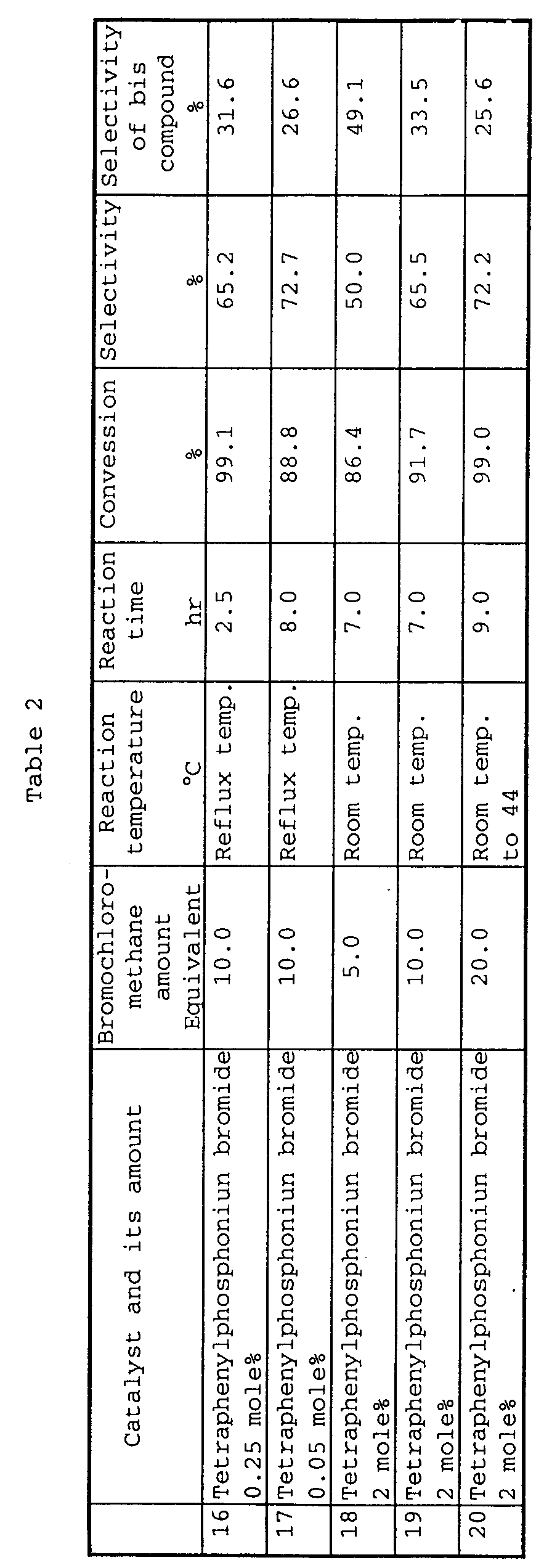
- the reaction temperature was 64-65°C; the conversion was 98.6%; the selectivity of chloromethyl pivalate was 65.4%; and the selectivity of a bis compound was 32.9% [neither chloromethyl methyl ether nor bis(chloromethyl) ether was detected in the reaction mixture].
- the conversion, etc. were obtained by acidifying the reaction mixture, subjecting the extract to gas chromatography, and using the resulting chart to make calculation by the total area method.
- selectivity and the selectivity of bis compound were calculated as follows.
- Selectivity (%) [(yield (%) of desired product)/(conversion (%) of aliphatic carboxylic acid)] x 100
- Selectivity of bis compound (%) [(yield (%) of bis compound)/(conversion (%) of aliphatic carboxylic acid)] x 100
- the reaction temperature was 40°C to the reflux temperature.
- the conversion was 91.9%; the selectivity was 49.7%; and the selectivity of bis compound was 49.1%.
- the reaction temperature was the reflux temperature.
- the conversion was 96.7%; the selectivity was 61.0%; and the selectivity of bis compound was 37.4%.
- reaction temperature was room temperature to 49°C.
- selectivity was 60.4% and the selectivity of bis compound was 36.3%.
- the reaction temperature was room temperature to the reflux temperature.
- the conversion was 94.2%; the selectivity was 2.0%; and the selectivity of bis compound was 97.3%.
- most of the reaction products was a bis compound.
- the reaction temperature was 50°C to the reflux temperature. In the reaction, the conversion was 80.2%; the selectivity was 3.39%; and the selectivity of bis compound was 96.1%.
- the reaction temperature was 50°C to 85°C. In the reaction, the conversion was 93.4%; the selectivity was 1.57%; and the selectivity of bis compound was 96.7%.
- a metal salt of an aliphatic carboxylic acid is reacted with a dihalomethane in the presence of a phase transfer catalyst; no halomethyl ether is formed as a by-product; and a halomethyl ester of an aliphatic carboxylic acid can be produced at a high yield.
- the bis compound [bis(aliphatic carbonyloxy)methane], which is obtained as a by-product, is hydrolyzed to enable the quantitative recovery of an aliphatic carboxylic acid and its reuse.
- the present invention is preferable as a process for industrial production of a halomethyl ester of an aliphatic carboxylic acid.
Landscapes
- Chemical & Material Sciences (AREA)
- Organic Chemistry (AREA)
- Organic Low-Molecular-Weight Compounds And Preparation Thereof (AREA)
- Low-Molecular Organic Synthesis Reactions Using Catalysts (AREA)
Abstract
Description

| Aliphatic carboxylic acid | Reaction temperature °C | Reaction time hr | Convession % | Selectivity % | Selectivity of bis compound % | |
| 23 | Isobutyric acid | Room temp. | 8.0 | 94.3 | 57.0 | 41.9 |
| 24 | Caprylic acid | Room temp. to 50 | 6.0 | 93.3 | 40.8 | 55.9 |
| 25 | n-Nonanoic acid | Room temp. to reflux temp. | 7.0 | 99.0 | 31.9 | 51.5 |
| 26 | Acetic acid | 40 to 50 | 3.5 | 98.3 | 48.8 | 45.5 |
Claims (3)
- A process for producing a halomethyl ester of an aliphatic carboxylic acid, which is characterized byreacting a metal salt of an aliphatic carboxylic acid with a dihalomethane in the presence of a phase transfer catalyst in almost nonaqueous condition,using said dihalomethane in an amount of at least 3 moles per mole of said metal salt,using no additional solvent.
- A process for producing a halomethyl ester of an aliphatic carboxylic acid according to claim 1, wherein the dihalomethane is used in an amount of 3-50 moles per mole of said metal salt.
- A process for producing a halomethyl ester of an aliphatic carboxylic acid according to claim claim 1 or claim 2, wherein the dihalomethane is used in an amount of 10 moles per mole of said metal salt.
Applications Claiming Priority (3)
| Application Number | Priority Date | Filing Date | Title |
|---|---|---|---|
| JP03297913A JP3120292B2 (en) | 1991-10-18 | 1991-10-18 | Process for producing aliphatic carboxylic acid halomethyl esters |
| JP297913/91 | 1991-10-18 | ||
| PCT/JP1992/001350 WO1993008152A1 (en) | 1991-10-18 | 1992-10-16 | Process for producing halomethyl ester of aliphatic carboxylic acid |
Publications (3)
| Publication Number | Publication Date |
|---|---|
| EP0563401A1 EP0563401A1 (en) | 1993-10-06 |
| EP0563401A4 EP0563401A4 (en) | 1994-03-23 |
| EP0563401B1 true EP0563401B1 (en) | 1998-05-13 |
Family
ID=17852717
Family Applications (1)
| Application Number | Title | Priority Date | Filing Date |
|---|---|---|---|
| EP92921479A Expired - Lifetime EP0563401B1 (en) | 1991-10-18 | 1992-10-16 | Process for producing halomethyl ester of aliphatic carboxylic acid |
Country Status (10)
| Country | Link |
|---|---|
| US (1) | US5319132A (en) |
| EP (1) | EP0563401B1 (en) |
| JP (1) | JP3120292B2 (en) |
| KR (1) | KR100222369B1 (en) |
| AT (1) | ATE166044T1 (en) |
| DE (1) | DE69225468T2 (en) |
| DK (1) | DK0563401T3 (en) |
| ES (1) | ES2115678T3 (en) |
| TW (1) | TW233295B (en) |
| WO (1) | WO1993008152A1 (en) |
Families Citing this family (24)
| Publication number | Priority date | Publication date | Assignee | Title |
|---|---|---|---|---|
| CZ282973B6 (en) * | 1993-03-09 | 1997-11-12 | Elf Atochem S.A. | Process for preparing halogenated esters of carboxylic or dicarboxylic acids |
| US7838708B2 (en) | 2001-06-20 | 2010-11-23 | Grt, Inc. | Hydrocarbon conversion process improvements |
| EP1323717A1 (en) * | 2001-12-27 | 2003-07-02 | Dsm N.V. | Process for the preparation of 2-(6-Substituted-1,3-Dioxane-4-yL) acetic acid derivatives |
| US20050171393A1 (en) | 2003-07-15 | 2005-08-04 | Lorkovic Ivan M. | Hydrocarbon synthesis |
| MXPA06000470A (en) | 2003-07-15 | 2006-08-23 | Grt Inc | Hydrocarbon synthesis. |
| US7244867B2 (en) | 2004-04-16 | 2007-07-17 | Marathon Oil Company | Process for converting gaseous alkanes to liquid hydrocarbons |
| US20080275284A1 (en) | 2004-04-16 | 2008-11-06 | Marathon Oil Company | Process for converting gaseous alkanes to liquid hydrocarbons |
| US8173851B2 (en) | 2004-04-16 | 2012-05-08 | Marathon Gtf Technology, Ltd. | Processes for converting gaseous alkanes to liquid hydrocarbons |
| US8642822B2 (en) | 2004-04-16 | 2014-02-04 | Marathon Gtf Technology, Ltd. | Processes for converting gaseous alkanes to liquid hydrocarbons using microchannel reactor |
| US20060100469A1 (en) | 2004-04-16 | 2006-05-11 | Waycuilis John J | Process for converting gaseous alkanes to olefins and liquid hydrocarbons |
| US7674941B2 (en) | 2004-04-16 | 2010-03-09 | Marathon Gtf Technology, Ltd. | Processes for converting gaseous alkanes to liquid hydrocarbons |
| EP1993951B1 (en) | 2006-02-03 | 2014-07-30 | GRT, Inc. | Separation of light gases from bromine |
| CN101817720A (en) | 2006-02-03 | 2010-09-01 | Grt公司 | Continuous process for converting natural gas to liquid hydrocarbons |
| AU2008256606A1 (en) | 2007-05-24 | 2008-12-04 | Grt, Inc. | Zone reactor incorporating reversible hydrogen halide capture and release |
| US8282810B2 (en) | 2008-06-13 | 2012-10-09 | Marathon Gtf Technology, Ltd. | Bromine-based method and system for converting gaseous alkanes to liquid hydrocarbons using electrolysis for bromine recovery |
| NZ591207A (en) | 2008-07-18 | 2013-03-28 | Grt Inc | Continuous process for converting natural gas to liquid hydrocarbons |
| US8367884B2 (en) | 2010-03-02 | 2013-02-05 | Marathon Gtf Technology, Ltd. | Processes and systems for the staged synthesis of alkyl bromides |
| US8198495B2 (en) | 2010-03-02 | 2012-06-12 | Marathon Gtf Technology, Ltd. | Processes and systems for the staged synthesis of alkyl bromides |
| US8815050B2 (en) | 2011-03-22 | 2014-08-26 | Marathon Gtf Technology, Ltd. | Processes and systems for drying liquid bromine |
| US8436220B2 (en) | 2011-06-10 | 2013-05-07 | Marathon Gtf Technology, Ltd. | Processes and systems for demethanization of brominated hydrocarbons |
| US8829256B2 (en) | 2011-06-30 | 2014-09-09 | Gtc Technology Us, Llc | Processes and systems for fractionation of brominated hydrocarbons in the conversion of natural gas to liquid hydrocarbons |
| US8802908B2 (en) | 2011-10-21 | 2014-08-12 | Marathon Gtf Technology, Ltd. | Processes and systems for separate, parallel methane and higher alkanes' bromination |
| US9193641B2 (en) | 2011-12-16 | 2015-11-24 | Gtc Technology Us, Llc | Processes and systems for conversion of alkyl bromides to higher molecular weight hydrocarbons in circulating catalyst reactor-regenerator systems |
| CN104725223A (en) * | 2015-03-24 | 2015-06-24 | 常熟市常吉化工有限公司 | Preparation method for methylene diacetate |
Family Cites Families (6)
| Publication number | Priority date | Publication date | Assignee | Title |
|---|---|---|---|---|
| US4182902A (en) * | 1973-12-27 | 1980-01-08 | Siegfried Aktiengesellschaft | Novel cholesterol-lowering compounds |
| JPH0639450B2 (en) * | 1986-08-21 | 1994-05-25 | 徳山曹達株式会社 | Method for producing acyloxyhalogenated hydrocarbon |
| US5240836A (en) * | 1988-05-25 | 1993-08-31 | The Queens University Of Belfast | Methylation of organic compounds |
| JPH0341052A (en) * | 1989-07-07 | 1991-02-21 | Shionogi & Co Ltd | Preparation of alkanoic acid hald alkyl ester |
| JPH03188044A (en) * | 1989-12-18 | 1991-08-16 | Tousoo Yuki Kagaku Kk | Production of acyloxyaliphatic hydrocarbon |
| JP2934776B2 (en) * | 1990-04-20 | 1999-08-16 | イハラケミカル工業株式会社 | Process for producing halomethyl esters of pivalic acid |
-
1991
- 1991-10-18 JP JP03297913A patent/JP3120292B2/en not_active Expired - Fee Related
-
1992
- 1992-10-16 EP EP92921479A patent/EP0563401B1/en not_active Expired - Lifetime
- 1992-10-16 ES ES92921479T patent/ES2115678T3/en not_active Expired - Lifetime
- 1992-10-16 DK DK92921479T patent/DK0563401T3/en active
- 1992-10-16 WO PCT/JP1992/001350 patent/WO1993008152A1/en not_active Ceased
- 1992-10-16 KR KR1019930701781A patent/KR100222369B1/en not_active Expired - Fee Related
- 1992-10-16 US US08/074,813 patent/US5319132A/en not_active Expired - Lifetime
- 1992-10-16 DE DE69225468T patent/DE69225468T2/en not_active Expired - Fee Related
- 1992-10-16 AT AT92921479T patent/ATE166044T1/en not_active IP Right Cessation
- 1992-10-19 TW TW081108309A patent/TW233295B/zh active
Also Published As
| Publication number | Publication date |
|---|---|
| JP3120292B2 (en) | 2000-12-25 |
| KR100222369B1 (en) | 1999-10-01 |
| KR930703233A (en) | 1993-11-29 |
| WO1993008152A1 (en) | 1993-04-29 |
| DK0563401T3 (en) | 1998-10-07 |
| JPH05112492A (en) | 1993-05-07 |
| EP0563401A4 (en) | 1994-03-23 |
| US5319132A (en) | 1994-06-07 |
| TW233295B (en) | 1994-11-01 |
| DE69225468T2 (en) | 1998-09-03 |
| EP0563401A1 (en) | 1993-10-06 |
| ATE166044T1 (en) | 1998-05-15 |
| DE69225468D1 (en) | 1998-06-18 |
| ES2115678T3 (en) | 1998-07-01 |
Similar Documents
| Publication | Publication Date | Title |
|---|---|---|
| US5319132A (en) | Process for producing halomethyl ester of aliphatic carboxylic acid | |
| EP0487853B1 (en) | Process for producing methacrylic acid | |
| US4283565A (en) | Process for preparing benzylalcohols | |
| EP0101526B1 (en) | Process for the preparation of trifluoroethanol | |
| CA1156257A (en) | Process for the preparation of an alkyl 2-chloropropionate | |
| EP0192849B1 (en) | Process for preparing optically active 2-(4-hydroxyphenoxy)propionic acid compounds | |
| US2530348A (en) | Halogenated derivatives of aliphatic acids, lactones and method of making same | |
| US4273934A (en) | Preparation of 3-hydroxy-2,2,4-trimethylpentyl isobutyrate | |
| GB2219292A (en) | Process of preparing 1,2,2,2-tetrafluoroethyl-difluoromethyl ether | |
| HU175042B (en) | Process for preparing substituted vinyl-cyclopropane-carboxylic acid benzyl esters | |
| KR910006002B1 (en) | Hydrolysis process of dialkyl carbonate | |
| EP0202838B1 (en) | Process for production of m-phenoxybenzyl alcohol | |
| EP0453993B1 (en) | Process for producing a halomethyl pivalate | |
| US3769338A (en) | Process for synthesizing citric acid | |
| US6395920B1 (en) | Process for preparing substituted acetals of malondialdehyde | |
| HU204749B (en) | Process for producing fluorophenols | |
| JP3014417B2 (en) | Method for producing 4-methylenetetrahydropyran | |
| CA1142957A (en) | PROCESS FOR PREPARING .alpha.-ARYL PROPIONIC ACIDS | |
| US6894197B2 (en) | Process for producing fluorinated alcohol | |
| US5202462A (en) | Process for producing a halomethyl pivalate | |
| JPS6323187B2 (en) | ||
| EP0943600B1 (en) | Processes for the preparation of dicarboxylic acid monoesters | |
| JPH07584B2 (en) | Method for producing halogenated carboxylic acid ester | |
| JP3823385B2 (en) | Process for producing 2,4,5-trifluoro-3-iodobenzoic acid and esters thereof | |
| JP2720934B2 (en) | Process for producing 3- (2-chloro-2- (4-chlorophenyl) -vinyl) -2,2-dimethylcyclopropanecarboxylic acid |
Legal Events
| Date | Code | Title | Description |
|---|---|---|---|
| PUAI | Public reference made under article 153(3) epc to a published international application that has entered the european phase |
Free format text: ORIGINAL CODE: 0009012 |
|
| 17P | Request for examination filed |
Effective date: 19930604 |
|
| AK | Designated contracting states |
Kind code of ref document: A1 Designated state(s): AT BE CH DE DK ES FR GB IT LI NL |
|
| A4 | Supplementary search report drawn up and despatched |
Effective date: 19940202 |
|
| AK | Designated contracting states |
Kind code of ref document: A4 Designated state(s): AT BE CH DE DK ES FR GB IT LI NL |
|
| 17Q | First examination report despatched |
Effective date: 19950804 |
|
| GRAG | Despatch of communication of intention to grant |
Free format text: ORIGINAL CODE: EPIDOS AGRA |
|
| GRAG | Despatch of communication of intention to grant |
Free format text: ORIGINAL CODE: EPIDOS AGRA |
|
| GRAH | Despatch of communication of intention to grant a patent |
Free format text: ORIGINAL CODE: EPIDOS IGRA |
|
| GRAH | Despatch of communication of intention to grant a patent |
Free format text: ORIGINAL CODE: EPIDOS IGRA |
|
| GRAA | (expected) grant |
Free format text: ORIGINAL CODE: 0009210 |
|
| AK | Designated contracting states |
Kind code of ref document: B1 Designated state(s): AT BE CH DE DK ES FR GB IT LI NL |
|
| REF | Corresponds to: |
Ref document number: 166044 Country of ref document: AT Date of ref document: 19980515 Kind code of ref document: T |
|
| REG | Reference to a national code |
Ref country code: CH Ref legal event code: EP |
|
| ITF | It: translation for a ep patent filed | ||
| REF | Corresponds to: |
Ref document number: 69225468 Country of ref document: DE Date of ref document: 19980618 |
|
| REG | Reference to a national code |
Ref country code: ES Ref legal event code: FG2A Ref document number: 2115678 Country of ref document: ES Kind code of ref document: T3 |
|
| ET | Fr: translation filed | ||
| REG | Reference to a national code |
Ref country code: DK Ref legal event code: T3 |
|
| PLBE | No opposition filed within time limit |
Free format text: ORIGINAL CODE: 0009261 |
|
| STAA | Information on the status of an ep patent application or granted ep patent |
Free format text: STATUS: NO OPPOSITION FILED WITHIN TIME LIMIT |
|
| 26N | No opposition filed | ||
| REG | Reference to a national code |
Ref country code: GB Ref legal event code: IF02 |
|
| PGFP | Annual fee paid to national office [announced via postgrant information from national office to epo] |
Ref country code: GB Payment date: 20050923 Year of fee payment: 14 |
|
| PGFP | Annual fee paid to national office [announced via postgrant information from national office to epo] |
Ref country code: ES Payment date: 20051006 Year of fee payment: 14 |
|
| PGFP | Annual fee paid to national office [announced via postgrant information from national office to epo] |
Ref country code: AT Payment date: 20051020 Year of fee payment: 14 |
|
| PGFP | Annual fee paid to national office [announced via postgrant information from national office to epo] |
Ref country code: CH Payment date: 20051024 Year of fee payment: 14 Ref country code: BE Payment date: 20051024 Year of fee payment: 14 |
|
| PGFP | Annual fee paid to national office [announced via postgrant information from national office to epo] |
Ref country code: DK Payment date: 20051025 Year of fee payment: 14 |
|
| PGFP | Annual fee paid to national office [announced via postgrant information from national office to epo] |
Ref country code: DE Payment date: 20051028 Year of fee payment: 14 |
|
| PGFP | Annual fee paid to national office [announced via postgrant information from national office to epo] |
Ref country code: NL Payment date: 20061015 Year of fee payment: 15 |
|
| PG25 | Lapsed in a contracting state [announced via postgrant information from national office to epo] |
Ref country code: AT Free format text: LAPSE BECAUSE OF NON-PAYMENT OF DUE FEES Effective date: 20061016 |
|
| PG25 | Lapsed in a contracting state [announced via postgrant information from national office to epo] |
Ref country code: LI Free format text: LAPSE BECAUSE OF NON-PAYMENT OF DUE FEES Effective date: 20061031 Ref country code: DK Free format text: LAPSE BECAUSE OF NON-PAYMENT OF DUE FEES Effective date: 20061031 Ref country code: CH Free format text: LAPSE BECAUSE OF NON-PAYMENT OF DUE FEES Effective date: 20061031 |
|
| PGFP | Annual fee paid to national office [announced via postgrant information from national office to epo] |
Ref country code: IT Payment date: 20061031 Year of fee payment: 15 |
|
| PG25 | Lapsed in a contracting state [announced via postgrant information from national office to epo] |
Ref country code: DE Free format text: LAPSE BECAUSE OF NON-PAYMENT OF DUE FEES Effective date: 20070501 |
|
| REG | Reference to a national code |
Ref country code: CH Ref legal event code: PL |
|
| GBPC | Gb: european patent ceased through non-payment of renewal fee |
Effective date: 20061016 |
|
| PG25 | Lapsed in a contracting state [announced via postgrant information from national office to epo] |
Ref country code: GB Free format text: LAPSE BECAUSE OF NON-PAYMENT OF DUE FEES Effective date: 20061016 |
|
| BERE | Be: lapsed |
Owner name: *IHARA CHEMICAL INDUSTRY CO. LTD Effective date: 20061031 |
|
| REG | Reference to a national code |
Ref country code: ES Ref legal event code: FD2A Effective date: 20061017 |
|
| PG25 | Lapsed in a contracting state [announced via postgrant information from national office to epo] |
Ref country code: ES Free format text: LAPSE BECAUSE OF NON-PAYMENT OF DUE FEES Effective date: 20061017 |
|
| NLV4 | Nl: lapsed or anulled due to non-payment of the annual fee |
Effective date: 20080501 |
|
| REG | Reference to a national code |
Ref country code: FR Ref legal event code: ST Effective date: 20080630 |
|
| PG25 | Lapsed in a contracting state [announced via postgrant information from national office to epo] |
Ref country code: NL Free format text: LAPSE BECAUSE OF NON-PAYMENT OF DUE FEES Effective date: 20080501 |
|
| PGFP | Annual fee paid to national office [announced via postgrant information from national office to epo] |
Ref country code: FR Payment date: 20061010 Year of fee payment: 15 |
|
| PG25 | Lapsed in a contracting state [announced via postgrant information from national office to epo] |
Ref country code: FR Free format text: LAPSE BECAUSE OF NON-PAYMENT OF DUE FEES Effective date: 20071031 |
|
| PG25 | Lapsed in a contracting state [announced via postgrant information from national office to epo] |
Ref country code: IT Free format text: LAPSE BECAUSE OF NON-PAYMENT OF DUE FEES Effective date: 20071016 Ref country code: BE Free format text: LAPSE BECAUSE OF FAILURE TO SUBMIT A TRANSLATION OF THE DESCRIPTION OR TO PAY THE FEE WITHIN THE PRESCRIBED TIME-LIMIT Effective date: 20061031 |