EP0563393B1 - Bis(ethylenedithiolo)tetrathiafulvalene/metal cyanide complex - Google Patents
Bis(ethylenedithiolo)tetrathiafulvalene/metal cyanide complex Download PDFInfo
- Publication number
- EP0563393B1 EP0563393B1 EP92920107A EP92920107A EP0563393B1 EP 0563393 B1 EP0563393 B1 EP 0563393B1 EP 92920107 A EP92920107 A EP 92920107A EP 92920107 A EP92920107 A EP 92920107A EP 0563393 B1 EP0563393 B1 EP 0563393B1
- Authority
- EP
- European Patent Office
- Prior art keywords
- bedt
- ttf
- tetrathiafulvalene
- bis
- ethylenedithiolo
- Prior art date
- Legal status (The legal status is an assumption and is not a legal conclusion. Google has not performed a legal analysis and makes no representation as to the accuracy of the status listed.)
- Expired - Lifetime
Links
Images






Classifications
-
- C—CHEMISTRY; METALLURGY
- C07—ORGANIC CHEMISTRY
- C07D—HETEROCYCLIC COMPOUNDS
- C07D519/00—Heterocyclic compounds containing more than one system of two or more relevant hetero rings condensed among themselves or condensed with a common carbocyclic ring system not provided for in groups C07D453/00 or C07D455/00
-
- C—CHEMISTRY; METALLURGY
- C07—ORGANIC CHEMISTRY
- C07F—ACYCLIC, CARBOCYCLIC OR HETEROCYCLIC COMPOUNDS CONTAINING ELEMENTS OTHER THAN CARBON, HYDROGEN, HALOGEN, OXYGEN, NITROGEN, SULFUR, SELENIUM OR TELLURIUM
- C07F15/00—Compounds containing elements of Groups 8, 9, 10 or 18 of the Periodic Table
- C07F15/0006—Compounds containing elements of Groups 8, 9, 10 or 18 of the Periodic Table compounds of the platinum group
- C07F15/006—Palladium compounds
-
- C—CHEMISTRY; METALLURGY
- C07—ORGANIC CHEMISTRY
- C07F—ACYCLIC, CARBOCYCLIC OR HETEROCYCLIC COMPOUNDS CONTAINING ELEMENTS OTHER THAN CARBON, HYDROGEN, HALOGEN, OXYGEN, NITROGEN, SULFUR, SELENIUM OR TELLURIUM
- C07F15/00—Compounds containing elements of Groups 8, 9, 10 or 18 of the Periodic Table
- C07F15/0006—Compounds containing elements of Groups 8, 9, 10 or 18 of the Periodic Table compounds of the platinum group
- C07F15/006—Palladium compounds
- C07F15/0066—Palladium compounds without a metal-carbon linkage
-
- C—CHEMISTRY; METALLURGY
- C07—ORGANIC CHEMISTRY
- C07F—ACYCLIC, CARBOCYCLIC OR HETEROCYCLIC COMPOUNDS CONTAINING ELEMENTS OTHER THAN CARBON, HYDROGEN, HALOGEN, OXYGEN, NITROGEN, SULFUR, SELENIUM OR TELLURIUM
- C07F15/00—Compounds containing elements of Groups 8, 9, 10 or 18 of the Periodic Table
- C07F15/0006—Compounds containing elements of Groups 8, 9, 10 or 18 of the Periodic Table compounds of the platinum group
- C07F15/0086—Platinum compounds
-
- C—CHEMISTRY; METALLURGY
- C07—ORGANIC CHEMISTRY
- C07F—ACYCLIC, CARBOCYCLIC OR HETEROCYCLIC COMPOUNDS CONTAINING ELEMENTS OTHER THAN CARBON, HYDROGEN, HALOGEN, OXYGEN, NITROGEN, SULFUR, SELENIUM OR TELLURIUM
- C07F15/00—Compounds containing elements of Groups 8, 9, 10 or 18 of the Periodic Table
- C07F15/0006—Compounds containing elements of Groups 8, 9, 10 or 18 of the Periodic Table compounds of the platinum group
- C07F15/0086—Platinum compounds
- C07F15/0093—Platinum compounds without a metal-carbon linkage
-
- C—CHEMISTRY; METALLURGY
- C07—ORGANIC CHEMISTRY
- C07F—ACYCLIC, CARBOCYCLIC OR HETEROCYCLIC COMPOUNDS CONTAINING ELEMENTS OTHER THAN CARBON, HYDROGEN, HALOGEN, OXYGEN, NITROGEN, SULFUR, SELENIUM OR TELLURIUM
- C07F15/00—Compounds containing elements of Groups 8, 9, 10 or 18 of the Periodic Table
- C07F15/04—Nickel compounds
-
- C—CHEMISTRY; METALLURGY
- C07—ORGANIC CHEMISTRY
- C07F—ACYCLIC, CARBOCYCLIC OR HETEROCYCLIC COMPOUNDS CONTAINING ELEMENTS OTHER THAN CARBON, HYDROGEN, HALOGEN, OXYGEN, NITROGEN, SULFUR, SELENIUM OR TELLURIUM
- C07F15/00—Compounds containing elements of Groups 8, 9, 10 or 18 of the Periodic Table
- C07F15/04—Nickel compounds
- C07F15/045—Nickel compounds without a metal-carbon linkage
-
- H—ELECTRICITY
- H10—SEMICONDUCTOR DEVICES; ELECTRIC SOLID-STATE DEVICES NOT OTHERWISE PROVIDED FOR
- H10N—ELECTRIC SOLID-STATE DEVICES NOT OTHERWISE PROVIDED FOR
- H10N60/00—Superconducting devices
- H10N60/80—Constructional details
- H10N60/85—Superconducting active materials
- H10N60/851—Organic superconductors
-
- Y—GENERAL TAGGING OF NEW TECHNOLOGICAL DEVELOPMENTS; GENERAL TAGGING OF CROSS-SECTIONAL TECHNOLOGIES SPANNING OVER SEVERAL SECTIONS OF THE IPC; TECHNICAL SUBJECTS COVERED BY FORMER USPC CROSS-REFERENCE ART COLLECTIONS [XRACs] AND DIGESTS
- Y10—TECHNICAL SUBJECTS COVERED BY FORMER USPC
- Y10S—TECHNICAL SUBJECTS COVERED BY FORMER USPC CROSS-REFERENCE ART COLLECTIONS [XRACs] AND DIGESTS
- Y10S505/00—Superconductor technology: apparatus, material, process
- Y10S505/80—Material per se process of making same
- Y10S505/81—Compound
- Y10S505/811—Organic
Definitions
- This invention relates to the organic compound of bis (ethylenedithio) tetrathiafulvalene (henceforth called BEDT-TTF) and especially relates to a novel substance that forms an insulator, a metal and a superconductor with BEDT-TTF participating as the common constituent. It also relates to a new substance of BEDT-TTF ⁇ cyanometalate complex, where cyanometalate anions are compounded with BEDT-TTF that has a high potential for forming structures with superconducting states.
- BEDT-TTF organic compound of bis (ethylenedithio) tetrathiafulvalene
- BEDT-TTF Even among the organic compounds, the compound BEDT-TTF attracts much attention for the reason that BEDT-TTF can act as a common constituent in preparing various complexes of insulators, metals and superconductors.
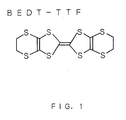
- the structural formula for BEDT-TTF is shown in Fig. 1.
- the molecular arrangement of BEDT-TTF is determined by the framework of anions X - , which determine the electronic state of the compounds. These anions that set up the framework for BEDT-TTF are the key to controlling the electronic state, or in other words, they are the key to the discovery of superconductors. It can be predicted that there exist substances that are superconducting and that are the compounds of cyanometalate or thiocyanometalate anions with BEDT-TTF, which have the tendency to form a cluster or polymer so that the effective volumes are large.
- the cyanate anions Similar to thiocyanometalate anions that are contained in BEDT-TTF complexes that show superconducting transition, the cyanate anions have the nature of forming coordination bond with transition metals or forming hydrogen bonds with molecules of water.
- the BEDT-TTF compounds there are instances of the BEDT-TTF arrangement being controlled by pseudo-halogenate anions, which form anion clusters or polymers. The electronic state attained as a result of this BEDT-TTF arrangement provides several superconductors.
- the present invention has the objective of obtaining a novel BEDT-TTF type organic material, because it is considered that BEDT-TTF is an effective multi-purpose material that develops superconductivity.
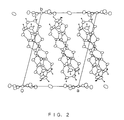
- FIG. 2 is the crystal structure of Tetracyano platinum acid bis (ethylenedithio) tetrathiafulvalene salt ⁇ hydrate represented by (BEDT-TTF) 4 [Pt(CN) 4 ] ⁇ H 2 O.
- Figure 3 is the crystal structure of tetracyano palladium acid bis (ethylenedithio) tetrathiafulvalene salt hydrate represented by (BEDT-TTF) 4 [Pd(CN) 4 ] ⁇ H 2 O.
- conduction and insulating layers are stacked alternately in the direction of b axis: in Fig. 2.
- the conduction layer is BEDT-TTF and the insulating layer is anions containing [Pt(CN) 4 ] 2- and H 2 O; in Fig. 3, the conduction layer is BEDT-TTF and the insulating layer is anions containing [Pd(CN) 4 ] 2- and H 2 O.
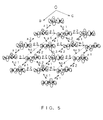
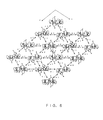
- Figures 5 and 6 show the molecular arrangements of BEDT-TTF, which is the common constituent in the crystal structures of Figures 2 and 3.
- the interactions between BEDT-TTF molecules in Figures 5 and 6 act not only in the direction in which the molecules stack, but also in two other directions lateral to the stacking direction. Though in Figures 5 and 6, the molecular arrangements look almost alike, the angle between the anion and the donor planes slightly differs.
- Figures 8 and 9 are those drawn for the anion arrangement of the crystal structures in Figures 2 and 3, respectively.
- [Pt(CN) 4 ] 2- has the planar square shape and [Pt(CN) 4 ] 2- is located on the inversion centre.
- H 2 O has a disorder in its spatial packing and the oxygen is located at two sites 0.6 ⁇ from the centre of symmetry each with an existence probability of 0.5.
- [Pt(CN) 4 ] 2- and H 2 O forms the structure for the spatial packing of BEDT-TTF arrays, the arrays being formed by maintaining the symmetry with an anomalous anion polymer.
- Figure 1 is a diagram showing the molecular structure of BEDT-TTF.
- Figure 2 is the diagram showing the crystal structure of the organic substance of the present invention.
- Figure 3 is the diagram showing the crystal structure of the organic substance of the present invention, (BEDT-TTF) 4 [Pd(CN) 4 ⁇ H 2 O.
- Figure 5 is the diagram showing the crystal structure of the organic substance of the present invention, (BEDT-TTF) 4 [Pt(CN) 4 ] ⁇ H 2 O.
- Figure 6 is the diagram showing the crystal structure of the organic substance of the present invention, (BEDT-TTF) 4 [Pd(CN) 4 ] ⁇ H 2 O.
- Figure 8 is the diagram showing the crystal structure of the organic substance of the present invention, (BEDT-TTF) 4 [Pt(CN) 4 ] ⁇ H 2 O
- Figure 9 is the diagram showing the crystal structure of the organic substance of the present invention, (BEDT-TTF) 4 [Pd(CN) 4 ] ⁇ H 2 O.
- Figure 11 is a table showing the analytical results of the organic substance of the present invention compared with (BEDT-TTF) 4 [NiCN 4 ] ⁇ H 2 O, (BEDT-TTF)-[Pd(CN) 2 ] and (BEDT-TTF) 4 [Pd(CN) 4 ].
- Figure 12 is the plot showing the temperature dependence of the electrical resistance under pressure of the organic substance of the present invention, (BEDT-TTF) 4 Pt(CN) 4 ⁇ H 2 O.
- Figure 13 is a phase diagram of behaviour of the electrical resistance of the present invention, (BEDT-TTF) 4 [Pt(CN) 4 ] ⁇ H 2 O.
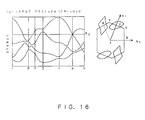
- Figure 16 shows the band structure of the organic substance of the present invention, (BEDT-TTF) 4 [Pd(CN) 4 ] ⁇ H 2 O.
- Figure 18 is the plot showing the temperature dependence of the electrical resistance under pressure of the organic substance of the present invention, (BEDT-TTF) 4 [Pd(CN) 4 ] ⁇ H 2 O.
- Figure 19 is the plot showing the temperature dependence of the electrical resistance under pressure of the organic substance of the present invention, (BEDT-TTF)4[Pd(CN)4] ⁇ H 2 O.
- Figure 11 shows the physical and chemical properties investigated by a single crystal of the following organic compounds; (1) (BEDT-TTF) 4 [Pt(CN) 4 ⁇ H 2 O, (2) (BEDT-TTF) 4 Ni(CN) 4 ⁇ H 2 O, (3) (BEDT-TTF)-[Pd(CN) 2 ], (4) (BEDT-TTF) 4 [Pd(CN) 4 ] ⁇ H 2 O and (BEDT-TTF) 4 [Pd(CN) 4 ].
- Atomic coordinates in the chart were obtained by a structural analysis in which Patterson method was used and the convergence was made by the Block-diagonal least-square method.
- the electrochemical oxidation of BEDT-TTF was carried out by using BaPt(CN) 4 , KCN and 18-crown-6 ether as the electrolytes to make single crystals under the above conditions.
- This effon produced single crystals which have platelike shapes and which are black in color.
- Measurements with an Electron-probe X-ray micro-analyzer (EPMA) confirmed that Pt is contained in the single crystal.
- Analysis showed that the composition of the crystal is (BEDT-TTF) 4 [Pt(CN) 4 ] ⁇ H 2 O and that the crystal system is triclinic and the space group belongs to P 1 ⁇ .
- Measurements of the electrical conductivity showed that the electrical conductivity is 130 to 280 Scm -1 at room temperature. This conductivity is larger compared to other metallic complex salts of BEDT-TTF.
- Figure 12 shows the graph of the temperature dependence of electrical resistance of (BEDT-TTF) 4 [Pt(CN) 4 ] ⁇ H 2 O under pressure. Measurements on temperature dependence of the electrical resistance at the pressures, 5 kbar. 6 kbar and 6.5 kbar showed that the resistance rapidly decreased at 2K in each case, and that it was possible to observe superconducting state by observing the elimination of the resistive drop in a magnetic field.
- Figure 13 shows these results by way of a phase diagram. When being cooled under normal pressure. transition from metal to insulator occured around 120K, while under pressurized state at 6.5 kbar. cooling produced a superconducting state with a critical temperature of 2K. (4) (BEDT-TTF) 4 [Pd(CN) 4 ] ⁇ H 2 O
- Electrochemical oxidation of BEDT-TTF was done by using Pd(CN)2, KCN and 18-crown-6 ether as electrolytes to make single crystals under the above mentioned conditions.
- (BEDT-TTF) 4 [Pd(CN) 4 ] ⁇ H 2 O was obtained when 10% ethanol was added to the solution.
- the crystal system was triclinic and the space group belonged to P 1 ⁇ .
- Figure 16 shows the band structure of (BEDT-TTF) 4 [Pd(CN) 4 ] ⁇ H 2 O. As shown in Figure 16, the band structure is semi-metallic, and its Fermi surfaces have become a pocket of both electrons and holes.
- Figure 21 shows the temperature dependence of electronic spin resonance (ESR) of (BEDT-TTF) 4 [Pd(CN) 4 ] ⁇ H 2 O.
- ESR electronic spin resonance
- the magnetic susceptibility of (BEDT-TTF) 4 [Pd(CN) 4 ] ⁇ H 2 O of Figure 21 is not zero even at low temperatures showing the fact that carriers are still present. It thus became clear that (BEDT-TTF) 4 [Pd(CN) 4 ] ⁇ H 2 O is semi-metallic even at low temperatures.
Landscapes
- Chemical & Material Sciences (AREA)
- Organic Chemistry (AREA)
- Organic Low-Molecular-Weight Compounds And Preparation Thereof (AREA)
- Heterocyclic Carbon Compounds Containing A Hetero Ring Having Oxygen Or Sulfur (AREA)
- Superconductors And Manufacturing Methods Therefor (AREA)
- Inorganic Compounds Of Heavy Metals (AREA)
Abstract
Description
- This invention relates to the organic compound of bis (ethylenedithio) tetrathiafulvalene (henceforth called BEDT-TTF) and especially relates to a novel substance that forms an insulator, a metal and a superconductor with BEDT-TTF participating as the common constituent. It also relates to a new substance of BEDT-TTF ·cyanometalate complex, where cyanometalate anions are compounded with BEDT-TTF that has a high potential for forming structures with superconducting states.
- Present day research and development activities on superconductors have given much attention to the fact that there are peculiarities in the behavior of a superconductor with respect to the electrical resistance and magnetization. These researches, starting from metallic superconductors of alloys and chemical compounds, have expanded its limits to include organic compounds as well. As at present, there are about 50 kinds of organic compounds that show superconducting transition, their critical temperatures being at the most about 45K.
- Even among the organic compounds, the compound BEDT-TTF attracts much attention for the reason that BEDT-TTF can act as a common constituent in preparing various complexes of insulators, metals and superconductors. The structural formula for BEDT-TTF is shown in Fig. 1.
- A BEDT-TTF compound of the form (BEDT-TTF)2X shows several superconducting phenomena, and the critical temperatures for such phenomena have a positive correlation to the volume( or rather the effective volume) occupied by the conduction layers that contain BEDT-TTF. In order to increase the effective volume, now it has come to the stage of searching for anions. which constitute a large frame work for conduction layers.
- Research and development efforts on preparation and observation of cyanometalates and thiocyanometalate compounds of BEDT-TTF have produced substances such as k-(BEDT-TTF)2[Cu(NCS)2], (BEDT-TTF)2[NH4Hg(SCN)4], k-(BEDT-TTF)2[Ag(CN)2]H2O, which are known to show superconductivity.
- The molecular arrangement of BEDT-TTF is determined by the framework of anions X-, which determine the electronic state of the compounds. These anions that set up the framework for BEDT-TTF are the key to controlling the electronic state, or in other words, they are the key to the discovery of superconductors. It can be predicted that there exist substances that are superconducting and that are the compounds of cyanometalate or thiocyanometalate anions with BEDT-TTF, which have the tendency to form a cluster or polymer so that the effective volumes are large.
- Similar to thiocyanometalate anions that are contained in BEDT-TTF complexes that show superconducting transition, the cyanate anions have the nature of forming coordination bond with transition metals or forming hydrogen bonds with molecules of water. In BEDT-TTF compounds, there are instances of the BEDT-TTF arrangement being controlled by pseudo-halogenate anions, which form anion clusters or polymers. The electronic state attained as a result of this BEDT-TTF arrangement provides several superconductors.
- Ouahab, L. et al, (J.Chem.Soc., Chem. Common, (1989), pages 1038-41) disclose charge transfer salts obtained with BEDT-TTF as an organic donor and Ni(CN)4 2- as a tetracyanometallate Planar dianion. Gärtner, S. and Heinen, I. (Zeitschrift für Naturforschung, (1990), vol. 45, No. 6, pages 763-774) disclose the compound [BEDT-TTF]4 [Pt(CN)4].Tanaka, M. et al, (Bull.Chem. Soc. Jpn., (1989), vol. 62, pages 1432-1435) disclose the electrical and mechanical properties of (BEDT-TTF)4 Ni(CN4) complex.
- The present invention has the objective of obtaining a novel BEDT-TTF type organic material, because it is considered that BEDT-TTF is an effective multi-purpose material that develops superconductivity.
- The crystal structure of the substance of the present invention is illustrated by giving examples of a few types of substances. Figure 2 is the crystal structure of Tetracyano platinum acid bis (ethylenedithio) tetrathiafulvalene salt · hydrate represented by (BEDT-TTF)4 [Pt(CN)4] · H2O. Figure 3 is the crystal structure of tetracyano palladium acid bis (ethylenedithio) tetrathiafulvalene salt hydrate represented by (BEDT-TTF)4 [Pd(CN)4] · H2O.
- It can be understood from these figures that conduction and insulating layers are stacked alternately in the direction of b axis: in Fig. 2. the conduction layer is BEDT-TTF and the insulating layer is anions containing [Pt(CN)4]2- and H2O; in Fig. 3, the conduction layer is BEDT-TTF and the insulating layer is anions containing [Pd(CN)4]2- and H2O.
- Figures 5 and 6 show the molecular arrangements of BEDT-TTF, which is the common constituent in the crystal structures of Figures 2 and 3. The interactions between BEDT-TTF molecules in Figures 5 and 6 act not only in the direction in which the molecules stack, but also in two other directions lateral to the stacking direction. Though in Figures 5 and 6, the molecular arrangements look almost alike, the angle between the anion and the donor planes slightly differs.
- Figures 8 and 9 are those drawn for the anion arrangement of the crystal structures in Figures 2 and 3, respectively. As shown in Figure 8, [Pt(CN)4]2- has the planar square shape and [Pt(CN)4]2- is located on the inversion centre. On the other hand, H2O has a disorder in its spatial packing and the oxygen is located at two sites 0.6 Å from the centre of symmetry each with an existence probability of 0.5. [Pt(CN)4]2- and H2O forms the structure for the spatial packing of BEDT-TTF arrays, the arrays being formed by maintaining the symmetry with an anomalous anion polymer.
- As in Fig. 9, [Pd(CN)4]2- forms the planar square structure and it is located on the inversion center. As for H2O. similar to Platinum salts, spatial arrangement of H2O is disordered and oxygen molecules are located at two sites 0.6 Å from the center of symmetry each with an existence probability of 0.5. CN constitutes with hydrogen molecules of water a hydrogen bond of the type H-O-H... N-C to form the cluster, ([Pd(CN)4]H2O)2-.
- Substances having a structure such as above undergoes on cooling at normal pressure a transition from metal to insulator. On cooling under pressure. they will show superconducting transition. The substance of the present invention is a novel organic material, and is expected to find many applications that make use of these properties.
- Figure 1 is a diagram showing the molecular structure of BEDT-TTF.
- Figure 2 is the diagram showing the crystal structure of the organic substance of the present invention. (BEDT-TTF)4 [Pt(CN)4]·H2O. Figure 3 is the diagram showing the crystal structure of the organic substance of the present invention, (BEDT-TTF)4 [Pd(CN)4·H2O.
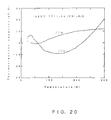
- Figure 5 is the diagram showing the crystal structure of the organic substance of the present invention, (BEDT-TTF)4 [Pt(CN)4]·H2O. Figure 6 is the diagram showing the crystal structure of the organic substance of the present invention, (BEDT-TTF)4 [Pd(CN)4]·H2O. Figure 8 is the diagram showing the crystal structure of the organic substance of the present invention, (BEDT-TTF)4 [Pt(CN)4]·H2O, Figure 9 is the diagram showing the crystal structure of the organic substance of the present invention, (BEDT-TTF)4 [Pd(CN)4]·H2O. Figure 11 is a table showing the analytical results of the organic substance of the present invention compared with (BEDT-TTF)4 [NiCN4]·H2O, (BEDT-TTF)-[Pd(CN)2] and (BEDT-TTF)4 [Pd(CN)4]. Figure 12 is the plot showing the temperature dependence of the electrical resistance under pressure of the organic substance of the present invention, (BEDT-TTF)4 Pt(CN)4·H2O. Figure 13 is a phase diagram of behaviour of the electrical resistance of the present invention, (BEDT-TTF)4 [Pt(CN)4]·H2O. Figure 16 shows the band structure of the organic substance of the present invention, (BEDT-TTF)4 [Pd(CN)4]·H2O. Figure 18 is the plot showing the temperature dependence of the electrical resistance under pressure of the organic substance of the present invention, (BEDT-TTF)4[Pd(CN)4]·H2O. Figure 19 is the plot showing the temperature dependence of the electrical resistance under pressure of the organic substance of the present invention, (BEDT-TTF)4[Pd(CN)4]·H2O. Figure 20 is the plot showing the temperature dependence of the thermoelectric power of the organic substance of the present invention, (BEDT-TTF)4[Pd(CN)4]·H2O, Figure 21 is the plot showing the temperature dependence of ESR of the organic substance of the present invention, (BEDT-TTF)4 [Pd(CN)4]·H2O.
- Figure 11 shows the physical and chemical properties investigated by a single crystal of the following organic compounds; (1) (BEDT-TTF)4[Pt(CN)4·H2O, (2) (BEDT-TTF)4 Ni(CN)4·H2O, (3) (BEDT-TTF)-[Pd(CN)2], (4) (BEDT-TTF)4 [Pd(CN)4]·H2O and (BEDT-TTF)4 [Pd(CN)4]. Atomic coordinates in the chart were obtained by a structural analysis in which Patterson method was used and the convergence was made by the Block-diagonal least-square method. Electrical conductivity was measured in the standard four-wire configuration in which a 100Hz alternating current was passed in a gold wire of 25mm diameter that was pasted to the single crystal. Each of the single crystal was prepared by a standard electrochemical method where a low-level current of 0.5 µA is passed through a reasonably electrolytic mixture in 1,1,2-trichloroethane and 10% enthanol in volume.
- The present invention is described below based on the physical and chemical properties of some of the organic compounds shown in Figure 11.
(1) (BEDT-TTF)4 [Pt(CN)4]·H2O
- The electrochemical oxidation of BEDT-TTF was carried out by using BaPt(CN)4, KCN and 18-crown-6 ether as the electrolytes to make single crystals under the above conditions. This effon produced single crystals which have platelike shapes and which are black in color. Measurements with an Electron-probe X-ray micro-analyzer (EPMA) confirmed that Pt is contained in the single crystal. Analysis showed that the composition of the crystal is (BEDT-TTF)4 [Pt(CN)4]·H2O and that the crystal system is triclinic and the space group belongs to
P 
As for the molecular arrangements of anions and water molecules in the present substance shown in Fig. 8, it can be seen that they form an anion cluster strongly bonded by hydrogen bonds. - Figure 12 shows the graph of the temperature dependence of electrical resistance of (BEDT-TTF)4 [Pt(CN)4]·H2O under pressure. Measurements on temperature dependence of the electrical resistance at the pressures, 5 kbar. 6 kbar and 6.5 kbar showed that the resistance rapidly decreased at 2K in each case, and that it was possible to observe superconducting state by observing the elimination of the resistive drop in a magnetic field. Figure 13 shows these results by way of a phase diagram. When being cooled under normal pressure. transition from metal to insulator occured around 120K, while under pressurized state at 6.5 kbar. cooling produced a superconducting state with a critical temperature of 2K.
(4) (BEDT-TTF)4 [Pd(CN)4]·H2O
- Electrochemical oxidation of BEDT-TTF was done by using Pd(CN)2, KCN and 18-crown-6 ether as electrolytes to make single crystals under the above mentioned conditions. (BEDT-TTF)4 [Pd(CN)4]·H2O was obtained when 10% ethanol was added to the solution. The crystal system was triclinic and the space group belonged to
P 
- Figure 16 shows the band structure of (BEDT-TTF)4 [Pd(CN)4]·H2O. As shown in Figure 16, the band structure is semi-metallic, and its Fermi surfaces have become a pocket of both electrons and holes.
- Superconducting phenomenon was observed in (BEDT-TTF)4 [Pd(CN)4]·H2O. These results are shown graphically in Figs. 18 and 19. When the crystal was cooled under normal pressure, it showed transition from metal to insulator around100K. However, when the crystal was cooled subjected to a pressure, superconducting transition took place with a critical temperature of 1.2K at a pressure of 7 kbar.
- Figure 20 shows the temperature dependence of thermoelectric power of (BEDT-TTF)4[Pd(CN)4]·H2O. The values along the c-axis take up 0 twice at 220 K and 60 K. This is a consequence of the band structure having a semi-metallic structure, and it shows that the electrical resistance increase at low temperature is not owing to the type of behavior of semi-conductor having a true energy gap.
- Figure 21 shows the temperature dependence of electronic spin resonance (ESR) of (BEDT-TTF)4[Pd(CN)4]·H2O. The magnetic susceptibility of (BEDT-TTF)4[Pd(CN)4]·H2O of Figure 21 is not zero even at low temperatures showing the fact that carriers are still present. It thus became clear that (BEDT-TTF)4[Pd(CN)4]·H2O is semi-metallic even at low temperatures.
Claims (2)
- Superconductive Tetracyano Platinum acid Bis(Ethylenedithio) Tetrathiafulvalene salt •hydrate, which is represented by (BEDT-TTF)4[Pt(CN)4]·H2O.
- Superconductive Tetracyano Palladium acid Bis(Ethylenedithio) Tetrathiafulvalene salt •hydrate, which is represented by (BEDT-TTF)4 [Pd(CN)4]·H2O.
Applications Claiming Priority (5)
| Application Number | Priority Date | Filing Date | Title |
|---|---|---|---|
| JP268268/91 | 1991-09-19 | ||
| JP3268268A JP2655372B2 (en) | 1991-09-19 | 1991-09-19 | Bis (ethylenedithiolo) tetrathiafulvalene / metal cyanide complex |
| JP4186133A JPH06166695A (en) | 1992-06-19 | 1992-06-19 | Bis@(3754/24)ethylenedithiolo)tetrathiafulvalene-palladium cyanide complex |
| JP186133/92 | 1992-06-19 | ||
| PCT/JP1992/001185 WO1993006113A1 (en) | 1991-09-19 | 1992-09-17 | Bis(ethylenedithiolo)tetrathiafulvalene/metal cyanide complex |
Publications (3)
| Publication Number | Publication Date |
|---|---|
| EP0563393A1 EP0563393A1 (en) | 1993-10-06 |
| EP0563393A4 EP0563393A4 (en) | 1993-11-03 |
| EP0563393B1 true EP0563393B1 (en) | 1997-12-29 |
Family
ID=26503558
Family Applications (1)
| Application Number | Title | Priority Date | Filing Date |
|---|---|---|---|
| EP92920107A Expired - Lifetime EP0563393B1 (en) | 1991-09-19 | 1992-09-17 | Bis(ethylenedithiolo)tetrathiafulvalene/metal cyanide complex |
Country Status (5)
| Country | Link |
|---|---|
| US (1) | US5534638A (en) |
| EP (1) | EP0563393B1 (en) |
| AT (1) | ATE161539T1 (en) |
| DE (1) | DE69223766T2 (en) |
| WO (1) | WO1993006113A1 (en) |
Families Citing this family (2)
| Publication number | Priority date | Publication date | Assignee | Title |
|---|---|---|---|---|
| US5852817A (en) * | 1991-08-14 | 1998-12-22 | Kabushiki Kaisha Toshiba | Intelligent control apparatus |
| WO2001032645A1 (en) * | 1999-11-04 | 2001-05-10 | Tubitak-Marmara Research Center | The synthesis of extended bis(ethylenedithio)tetrathiafulvalene derivatives and their dihydroxyl analogues |
Family Cites Families (2)
| Publication number | Priority date | Publication date | Assignee | Title |
|---|---|---|---|---|
| US4675415A (en) * | 1985-05-29 | 1987-06-23 | The United States Of America As Represented By The United States Department Of Energy | Ambient-temperature superconductor symetrical metal-dihalide bis-(ethylenedithio)-tetrathiafulvalene compounds |
| JPS63246383A (en) * | 1987-04-02 | 1988-10-13 | Toray Ind Inc | Organic superconductive compound |
-
1992
- 1992-09-17 WO PCT/JP1992/001185 patent/WO1993006113A1/en not_active Ceased
- 1992-09-17 EP EP92920107A patent/EP0563393B1/en not_active Expired - Lifetime
- 1992-09-17 DE DE69223766T patent/DE69223766T2/en not_active Expired - Fee Related
- 1992-09-17 AT AT92920107T patent/ATE161539T1/en not_active IP Right Cessation
-
1995
- 1995-04-26 US US08/429,009 patent/US5534638A/en not_active Expired - Fee Related
Also Published As
| Publication number | Publication date |
|---|---|
| EP0563393A1 (en) | 1993-10-06 |
| WO1993006113A1 (en) | 1993-04-01 |
| US5534638A (en) | 1996-07-09 |
| DE69223766D1 (en) | 1998-02-05 |
| ATE161539T1 (en) | 1998-01-15 |
| EP0563393A4 (en) | 1993-11-03 |
| DE69223766T2 (en) | 1998-05-28 |
Similar Documents
| Publication | Publication Date | Title |
|---|---|---|
| Kobayashi et al. | New organic metals based on BETS compounds with MX4− anions (BETS= bis (ethylenedithio) tetraselenafulvalene; M= Ga, Fe, In; X= Cl, Br) | |
| Vance et al. | Coordination chemistry of new sulfur containing ligands. 27. Synthesis and coordination chemistry of a new 1, 2-dithiolene containing the tetrathioethylene unit | |
| Hasegawa et al. | A highly conducting partially oxidized salt of axially substituted phthalocyanine. Structure and physical properties of TPP [Co (Pc)(CN) 2] 2 {TPP= tetraphenylphosphonium,[Co (Pc)(CN) 2]= dicyano (phthalocyaninato) cobalt (III)} | |
| Beno et al. | Crystal and band electronic structures of a new class of 2: 1 organic conducting salts α'−(BEDT-TTF) 2X, X−= Ag (CN) 2−, Au (CN) 2− and AuBr2− | |
| Zhou et al. | Single-component molecular conductor [Cu (dmdt) 2] with three-dimensionally arranged magnetic moments exhibiting a coupled electric and magnetic transition | |
| Kato et al. | A new molecular superconductor β′-Et2Me2P [Pd (dmit) 2] 2 (dmit= 2-thioxo-1, 3-dithiole-4, 5-dithiolate) | |
| Li et al. | Controllable phase transition for layered β-FeSe superconductor synthesized by solution chemistry | |
| Matsuda et al. | Structure and electrical and magnetic properties of (PTMA) x [M (Pc)(CN) 2]· y (solvent)(PTMA= phenyltrimethylammonium and [M (Pc)(CN) 2]= dicyano (phthalocyaninato) MIII with M= Co and Fe). Partial oxidation by partial solvent occupation of the cationic site | |
| Henning et al. | Cs8Ga11, a new isolated cluster in a binary gallium compound. A family of valence analogues A8Tr11X: A= Cs, Rb; Tr= Ga, In, Tl; X= Cl, Br, I | |
| Fourmigué | Solid-solution (alloying) strategies in crystalline molecular conductors | |
| Nakajima et al. | Superconductors with structural chirality | |
| Zhou et al. | Single-component molecular conductor [Cu (tmdt) 2] containing an antiferromagnetic heisenberg chain | |
| Blundell et al. | Enantiopure and racemic radical-cation salts of B (mandelate) 2− and B (2-chloromandelate) 2− anions with BEDT-TTF | |
| Schlueter et al. | Seven new organic superconductors in the system (ET) 2M (CF3) 4 (solvent)(M= Cu, Ag): effect of solvent replacement | |
| Buravov et al. | Synthesis, structure and pressure effect on conducting properties of the organic superconductor (BEDO-TTF) 2ReO4. H2O | |
| US5534638A (en) | Bis(ethylenedithio)tetrathiafulvalene.cyanometalate complex | |
| HauáWang et al. | The first organic cation-radical salt superconductor (T c= 4 K) with an organometallic anion: superconductivity, synthesis and structure of κ L-(BEDT-TTF) 2 Cu (CF 3) 4 ĚTCE | |
| Morimachi et al. | An organic superconductor,(TEA)(HEDO-TTF-dc) 2· 2 (H 2 C 2 O 4), coupled with strong hydrogen-bonding interactions | |
| US4632776A (en) | Ambient-pressure organic superconductor | |
| Day | Humphry Davy Lecture. Halides magnetic, halides superconducting | |
| US4675415A (en) | Ambient-temperature superconductor symetrical metal-dihalide bis-(ethylenedithio)-tetrathiafulvalene compounds | |
| JP2655372B2 (en) | Bis (ethylenedithiolo) tetrathiafulvalene / metal cyanide complex | |
| US3408310A (en) | Metal-organic alloy composition and process of making same | |
| JPH06166695A (en) | Bis@(3754/24)ethylenedithiolo)tetrathiafulvalene-palladium cyanide complex | |
| Kawamoto et al. | Organic superconductors with an incommensurate anion structure |
Legal Events
| Date | Code | Title | Description |
|---|---|---|---|
| PUAI | Public reference made under article 153(3) epc to a published international application that has entered the european phase |
Free format text: ORIGINAL CODE: 0009012 |
|
| 17P | Request for examination filed |
Effective date: 19930609 |
|
| AK | Designated contracting states |
Kind code of ref document: A1 Designated state(s): AT BE CH DE DK ES FR GB GR IE IT LI LU MC NL SE |
|
| A4 | Supplementary search report drawn up and despatched |
Effective date: 19930916 |
|
| AK | Designated contracting states |
Kind code of ref document: A4 Designated state(s): AT BE CH DE DK ES FR GB GR IE IT LI LU MC NL SE |
|
| 17Q | First examination report despatched |
Effective date: 19951108 |
|
| GRAG | Despatch of communication of intention to grant |
Free format text: ORIGINAL CODE: EPIDOS AGRA |
|
| GRAH | Despatch of communication of intention to grant a patent |
Free format text: ORIGINAL CODE: EPIDOS IGRA |
|
| GRAH | Despatch of communication of intention to grant a patent |
Free format text: ORIGINAL CODE: EPIDOS IGRA |
|
| GRAA | (expected) grant |
Free format text: ORIGINAL CODE: 0009210 |
|
| AK | Designated contracting states |
Kind code of ref document: B1 Designated state(s): AT BE CH DE DK ES FR GB GR IE IT LI LU MC NL SE |
|
| PG25 | Lapsed in a contracting state [announced via postgrant information from national office to epo] |
Ref country code: NL Free format text: LAPSE BECAUSE OF FAILURE TO SUBMIT A TRANSLATION OF THE DESCRIPTION OR TO PAY THE FEE WITHIN THE PRESCRIBED TIME-LIMIT Effective date: 19971229 Ref country code: LI Free format text: LAPSE BECAUSE OF FAILURE TO SUBMIT A TRANSLATION OF THE DESCRIPTION OR TO PAY THE FEE WITHIN THE PRESCRIBED TIME-LIMIT Effective date: 19971229 Ref country code: IT Free format text: LAPSE BECAUSE OF FAILURE TO SUBMIT A TRANSLATION OF THE DESCRIPTION OR TO PAY THE FEE WITHIN THE PRESCRIBED TIME-LIMIT;WARNING: LAPSES OF ITALIAN PATENTS WITH EFFECTIVE DATE BEFORE 2007 MAY HAVE OCCURRED AT ANY TIME BEFORE 2007. THE CORRECT EFFECTIVE DATE MAY BE DIFFERENT FROM THE ONE RECORDED. Effective date: 19971229 Ref country code: GR Free format text: LAPSE BECAUSE OF FAILURE TO SUBMIT A TRANSLATION OF THE DESCRIPTION OR TO PAY THE FEE WITHIN THE PRESCRIBED TIME-LIMIT Effective date: 19971229 Ref country code: ES Free format text: THE PATENT HAS BEEN ANNULLED BY A DECISION OF A NATIONAL AUTHORITY Effective date: 19971229 Ref country code: DK Free format text: LAPSE BECAUSE OF NON-PAYMENT OF DUE FEES Effective date: 19971229 Ref country code: CH Free format text: LAPSE BECAUSE OF FAILURE TO SUBMIT A TRANSLATION OF THE DESCRIPTION OR TO PAY THE FEE WITHIN THE PRESCRIBED TIME-LIMIT Effective date: 19971229 Ref country code: BE Free format text: LAPSE BECAUSE OF FAILURE TO SUBMIT A TRANSLATION OF THE DESCRIPTION OR TO PAY THE FEE WITHIN THE PRESCRIBED TIME-LIMIT Effective date: 19971229 Ref country code: AT Free format text: LAPSE BECAUSE OF FAILURE TO SUBMIT A TRANSLATION OF THE DESCRIPTION OR TO PAY THE FEE WITHIN THE PRESCRIBED TIME-LIMIT Effective date: 19971229 |
|
| REF | Corresponds to: |
Ref document number: 161539 Country of ref document: AT Date of ref document: 19980115 Kind code of ref document: T |
|
| REG | Reference to a national code |
Ref country code: CH Ref legal event code: EP |
|
| REF | Corresponds to: |
Ref document number: 69223766 Country of ref document: DE Date of ref document: 19980205 |
|
| ET | Fr: translation filed | ||
| PG25 | Lapsed in a contracting state [announced via postgrant information from national office to epo] |
Ref country code: SE Free format text: LAPSE BECAUSE OF FAILURE TO SUBMIT A TRANSLATION OF THE DESCRIPTION OR TO PAY THE FEE WITHIN THE PRESCRIBED TIME-LIMIT Effective date: 19980329 |
|
| NLV1 | Nl: lapsed or annulled due to failure to fulfill the requirements of art. 29p and 29m of the patents act | ||
| REG | Reference to a national code |
Ref country code: IE Ref legal event code: FG4D Free format text: 78027 |
|
| REG | Reference to a national code |
Ref country code: CH Ref legal event code: PL |
|
| PG25 | Lapsed in a contracting state [announced via postgrant information from national office to epo] |
Ref country code: LU Free format text: LAPSE BECAUSE OF NON-PAYMENT OF DUE FEES Effective date: 19980917 Ref country code: IE Free format text: LAPSE BECAUSE OF NON-PAYMENT OF DUE FEES Effective date: 19980917 |
|
| PLBE | No opposition filed within time limit |
Free format text: ORIGINAL CODE: 0009261 |
|
| STAA | Information on the status of an ep patent application or granted ep patent |
Free format text: STATUS: NO OPPOSITION FILED WITHIN TIME LIMIT |
|
| 26N | No opposition filed | ||
| PG25 | Lapsed in a contracting state [announced via postgrant information from national office to epo] |
Ref country code: MC Free format text: LAPSE BECAUSE OF NON-PAYMENT OF DUE FEES Effective date: 19990331 |
|
| PGFP | Annual fee paid to national office [announced via postgrant information from national office to epo] |
Ref country code: GB Payment date: 20010911 Year of fee payment: 10 |
|
| PGFP | Annual fee paid to national office [announced via postgrant information from national office to epo] |
Ref country code: DE Payment date: 20010914 Year of fee payment: 10 |
|
| PGFP | Annual fee paid to national office [announced via postgrant information from national office to epo] |
Ref country code: FR Payment date: 20010928 Year of fee payment: 10 |
|
| REG | Reference to a national code |
Ref country code: GB Ref legal event code: IF02 |
|
| PG25 | Lapsed in a contracting state [announced via postgrant information from national office to epo] |
Ref country code: GB Free format text: LAPSE BECAUSE OF NON-PAYMENT OF DUE FEES Effective date: 20020917 |
|
| PG25 | Lapsed in a contracting state [announced via postgrant information from national office to epo] |
Ref country code: DE Free format text: LAPSE BECAUSE OF NON-PAYMENT OF DUE FEES Effective date: 20030401 |
|
| GBPC | Gb: european patent ceased through non-payment of renewal fee |
Effective date: 20020917 |
|
| PG25 | Lapsed in a contracting state [announced via postgrant information from national office to epo] |
Ref country code: FR Free format text: LAPSE BECAUSE OF NON-PAYMENT OF DUE FEES Effective date: 20030603 |
|
| REG | Reference to a national code |
Ref country code: FR Ref legal event code: ST |