EP0561850B1 - 7-substituted-6-fluoro-1,4-dihydro-4-oxo-quinoline-3-carboxylic acid compounds useful as antibacterial agents - Google Patents
7-substituted-6-fluoro-1,4-dihydro-4-oxo-quinoline-3-carboxylic acid compounds useful as antibacterial agents Download PDFInfo
- Publication number
- EP0561850B1 EP0561850B1 EP91920890A EP91920890A EP0561850B1 EP 0561850 B1 EP0561850 B1 EP 0561850B1 EP 91920890 A EP91920890 A EP 91920890A EP 91920890 A EP91920890 A EP 91920890A EP 0561850 B1 EP0561850 B1 EP 0561850B1
- Authority
- EP
- European Patent Office
- Prior art keywords
- triazol
- group
- dihydro
- oxo
- amino
- Prior art date
- Legal status (The legal status is an assumption and is not a legal conclusion. Google has not performed a legal analysis and makes no representation as to the accuracy of the status listed.)
- Expired - Lifetime
Links
- -1 7-substituted-6-fluoro-1,4-dihydro-4-oxo-quinoline-3-carboxylic acid compounds Chemical class 0.000 title claims abstract description 24
- 239000003242 anti bacterial agent Substances 0.000 title abstract description 7
- 238000000034 method Methods 0.000 claims abstract description 27
- 125000001997 phenyl group Chemical group [H]C1=C([H])C([H])=C(*)C([H])=C1[H] 0.000 claims abstract description 14
- 125000002924 primary amino group Chemical group [H]N([H])* 0.000 claims abstract description 14
- 229910052739 hydrogen Inorganic materials 0.000 claims abstract description 12
- 239000001257 hydrogen Substances 0.000 claims abstract description 12
- 125000004435 hydrogen atom Chemical class [H]* 0.000 claims abstract description 10
- 125000002887 hydroxy group Chemical group [H]O* 0.000 claims abstract description 9
- 125000000956 methoxy group Chemical group [H]C([H])([H])O* 0.000 claims abstract description 9
- 125000005843 halogen group Chemical group 0.000 claims abstract description 8
- 125000003277 amino group Chemical group 0.000 claims abstract description 6
- 125000001607 1,2,3-triazol-1-yl group Chemical group [*]N1N=NC([H])=C1[H] 0.000 claims abstract description 4
- 125000003626 1,2,4-triazol-1-yl group Chemical group [*]N1N=C([H])N=C1[H] 0.000 claims abstract description 4
- XXJGBENTLXFVFI-UHFFFAOYSA-N 1-amino-methylene Chemical group N[CH2] XXJGBENTLXFVFI-UHFFFAOYSA-N 0.000 claims abstract description 4
- 125000000896 monocarboxylic acid group Chemical group 0.000 claims abstract description 4
- 125000001424 substituent group Chemical group 0.000 claims abstract description 4
- 150000001875 compounds Chemical class 0.000 claims description 83
- 239000000203 mixture Substances 0.000 claims description 38
- RWRDLPDLKQPQOW-UHFFFAOYSA-N Pyrrolidine Chemical group C1CCNC1 RWRDLPDLKQPQOW-UHFFFAOYSA-N 0.000 claims description 21
- 150000003839 salts Chemical class 0.000 claims description 11
- 125000004178 (C1-C4) alkyl group Chemical group 0.000 claims description 9
- 239000000460 chlorine Substances 0.000 claims description 7
- 230000000844 anti-bacterial effect Effects 0.000 claims description 5
- 229910052801 chlorine Inorganic materials 0.000 claims description 5
- 229910052731 fluorine Inorganic materials 0.000 claims description 5
- 125000005913 (C3-C6) cycloalkyl group Chemical group 0.000 claims description 4
- PXGOKWXKJXAPGV-UHFFFAOYSA-N Fluorine Chemical compound FF PXGOKWXKJXAPGV-UHFFFAOYSA-N 0.000 claims description 4
- 125000004432 carbon atom Chemical group C* 0.000 claims description 4
- 239000011737 fluorine Substances 0.000 claims description 4
- 208000035143 Bacterial infection Diseases 0.000 claims description 3
- ZAMOUSCENKQFHK-UHFFFAOYSA-N Chlorine atom Chemical compound [Cl] ZAMOUSCENKQFHK-UHFFFAOYSA-N 0.000 claims description 3
- 208000022362 bacterial infectious disease Diseases 0.000 claims description 3
- 239000003937 drug carrier Substances 0.000 claims description 3
- RAHZWNYVWXNFOC-UHFFFAOYSA-N sulfur dioxide Inorganic materials O=S=O RAHZWNYVWXNFOC-UHFFFAOYSA-N 0.000 claims description 3
- 125000004215 2,4-difluorophenyl group Chemical group [H]C1=C([H])C(*)=C(F)C([H])=C1F 0.000 claims description 2
- 125000001255 4-fluorophenyl group Chemical group [H]C1=C([H])C(*)=C([H])C([H])=C1F 0.000 claims description 2
- 229910052799 carbon Inorganic materials 0.000 claims description 2
- UKJLNMAFNRKWGR-UHFFFAOYSA-N cyclohexatrienamine Chemical group NC1=CC=C=C[CH]1 UKJLNMAFNRKWGR-UHFFFAOYSA-N 0.000 claims description 2
- 239000003814 drug Substances 0.000 claims description 2
- 238000004519 manufacturing process Methods 0.000 claims 2
- 230000000249 desinfective effect Effects 0.000 claims 1
- 239000008194 pharmaceutical composition Substances 0.000 claims 1
- 238000002360 preparation method Methods 0.000 abstract description 7
- 125000000217 alkyl group Chemical group 0.000 abstract 2
- ZMDQWHCTODNNLT-UHFFFAOYSA-N 2h-1,2-benzoxazine-3-carboxylic acid Chemical class C1=CC=C2ONC(C(=O)O)=CC2=C1 ZMDQWHCTODNNLT-UHFFFAOYSA-N 0.000 abstract 1
- 125000000753 cycloalkyl group Chemical group 0.000 abstract 1
- OKKJLVBELUTLKV-UHFFFAOYSA-N Methanol Chemical compound OC OKKJLVBELUTLKV-UHFFFAOYSA-N 0.000 description 157
- 229910001868 water Inorganic materials 0.000 description 87
- WEVYAHXRMPXWCK-UHFFFAOYSA-N Acetonitrile Chemical compound CC#N WEVYAHXRMPXWCK-UHFFFAOYSA-N 0.000 description 83
- XLYOFNOQVPJJNP-UHFFFAOYSA-N water Substances O XLYOFNOQVPJJNP-UHFFFAOYSA-N 0.000 description 83
- 238000005160 1H NMR spectroscopy Methods 0.000 description 75
- 239000007787 solid Substances 0.000 description 74
- 239000000243 solution Substances 0.000 description 52
- JUJWROOIHBZHMG-UHFFFAOYSA-N Pyridine Chemical compound C1=CC=NC=C1 JUJWROOIHBZHMG-UHFFFAOYSA-N 0.000 description 46
- HEDRZPFGACZZDS-UHFFFAOYSA-N Chloroform Chemical compound ClC(Cl)Cl HEDRZPFGACZZDS-UHFFFAOYSA-N 0.000 description 44
- HEDRZPFGACZZDS-MICDWDOJSA-N Trichloro(2H)methane Chemical compound [2H]C(Cl)(Cl)Cl HEDRZPFGACZZDS-MICDWDOJSA-N 0.000 description 44
- DTQVDTLACAAQTR-UHFFFAOYSA-N Trifluoroacetic acid Chemical compound OC(=O)C(F)(F)F DTQVDTLACAAQTR-UHFFFAOYSA-N 0.000 description 41
- VZAWCLCJGSBATP-UHFFFAOYSA-N 1-cycloundecyl-1,2-diazacycloundecane Chemical compound C1CCCCCCCCCC1N1NCCCCCCCCC1 VZAWCLCJGSBATP-UHFFFAOYSA-N 0.000 description 38
- 238000006243 chemical reaction Methods 0.000 description 34
- RTZKZFJDLAIYFH-UHFFFAOYSA-N Diethyl ether Chemical compound CCOCC RTZKZFJDLAIYFH-UHFFFAOYSA-N 0.000 description 32
- 239000000047 product Substances 0.000 description 29
- 239000011541 reaction mixture Substances 0.000 description 28
- 239000002904 solvent Substances 0.000 description 25
- 239000000725 suspension Substances 0.000 description 24
- LFQSCWFLJHTTHZ-UHFFFAOYSA-N Ethanol Chemical compound CCO LFQSCWFLJHTTHZ-UHFFFAOYSA-N 0.000 description 23
- UMJSCPRVCHMLSP-UHFFFAOYSA-N pyridine Natural products COC1=CC=CN=C1 UMJSCPRVCHMLSP-UHFFFAOYSA-N 0.000 description 23
- XEKOWRVHYACXOJ-UHFFFAOYSA-N Ethyl acetate Chemical compound CCOC(C)=O XEKOWRVHYACXOJ-UHFFFAOYSA-N 0.000 description 21
- VEXZGXHMUGYJMC-UHFFFAOYSA-N Hydrochloric acid Chemical compound Cl VEXZGXHMUGYJMC-UHFFFAOYSA-N 0.000 description 21
- IJGRMHOSHXDMSA-UHFFFAOYSA-N nitrogen Substances N#N IJGRMHOSHXDMSA-UHFFFAOYSA-N 0.000 description 19
- CSCPPACGZOOCGX-UHFFFAOYSA-N Acetone Chemical compound CC(C)=O CSCPPACGZOOCGX-UHFFFAOYSA-N 0.000 description 18
- HEMHJVSKTPXQMS-UHFFFAOYSA-M Sodium hydroxide Chemical compound [OH-].[Na+] HEMHJVSKTPXQMS-UHFFFAOYSA-M 0.000 description 18
- ZMXDDKWLCZADIW-UHFFFAOYSA-N N,N-Dimethylformamide Chemical compound CN(C)C=O ZMXDDKWLCZADIW-UHFFFAOYSA-N 0.000 description 15
- VYPSYNLAJGMNEJ-UHFFFAOYSA-N Silicium dioxide Chemical compound O=[Si]=O VYPSYNLAJGMNEJ-UHFFFAOYSA-N 0.000 description 15
- XLYOFNOQVPJJNP-ZSJDYOACSA-N heavy water Substances [2H]O[2H] XLYOFNOQVPJJNP-ZSJDYOACSA-N 0.000 description 15
- OKKJLVBELUTLKV-MZCSYVLQSA-N Deuterated methanol Chemical compound [2H]OC([2H])([2H])[2H] OKKJLVBELUTLKV-MZCSYVLQSA-N 0.000 description 14
- YMWUJEATGCHHMB-UHFFFAOYSA-N Dichloromethane Chemical compound ClCCl YMWUJEATGCHHMB-UHFFFAOYSA-N 0.000 description 14
- KDLHZDBZIXYQEI-UHFFFAOYSA-N palladium Substances [Pd] KDLHZDBZIXYQEI-UHFFFAOYSA-N 0.000 description 14
- UHOVQNZJYSORNB-UHFFFAOYSA-N Benzene Chemical compound C1=CC=CC=C1 UHOVQNZJYSORNB-UHFFFAOYSA-N 0.000 description 12
- WYURNTSHIVDZCO-UHFFFAOYSA-N Tetrahydrofuran Chemical compound C1CCOC1 WYURNTSHIVDZCO-UHFFFAOYSA-N 0.000 description 12
- ZMANZCXQSJIPKH-UHFFFAOYSA-N Triethylamine Chemical compound CCN(CC)CC ZMANZCXQSJIPKH-UHFFFAOYSA-N 0.000 description 12
- VLKZOEOYAKHREP-UHFFFAOYSA-N n-Hexane Chemical compound CCCCCC VLKZOEOYAKHREP-UHFFFAOYSA-N 0.000 description 12
- YPNLWZODFWQDNS-UHFFFAOYSA-N 1-pyrrolidin-3-yltriazole;hydrochloride Chemical compound Cl.C1NCCC1N1N=NC=C1 YPNLWZODFWQDNS-UHFFFAOYSA-N 0.000 description 11
- IAZDPXIOMUYVGZ-UHFFFAOYSA-N Dimethylsulphoxide Chemical compound CS(C)=O IAZDPXIOMUYVGZ-UHFFFAOYSA-N 0.000 description 11
- 229910052757 nitrogen Inorganic materials 0.000 description 11
- 239000000741 silica gel Substances 0.000 description 11
- 229910002027 silica gel Inorganic materials 0.000 description 11
- NMASXYCNDJMMFR-UHFFFAOYSA-N 1-cyclopropyl-6,7,8-trifluoro-4-oxoquinoline-3-carboxylic acid Chemical compound C12=C(F)C(F)=C(F)C=C2C(=O)C(C(=O)O)=CN1C1CC1 NMASXYCNDJMMFR-UHFFFAOYSA-N 0.000 description 10
- 238000005481 NMR spectroscopy Methods 0.000 description 10
- 125000002534 ethynyl group Chemical group [H]C#C* 0.000 description 10
- 230000002829 reductive effect Effects 0.000 description 10
- 238000010992 reflux Methods 0.000 description 10
- CQPUZLMNORVQPG-UHFFFAOYSA-N 5-amino-1-cyclopropyl-6,7,8-trifluoro-4-oxoquinoline-3-carboxylic acid Chemical compound C1=C(C(O)=O)C(=O)C=2C(N)=C(F)C(F)=C(F)C=2N1C1CC1 CQPUZLMNORVQPG-UHFFFAOYSA-N 0.000 description 9
- 239000006228 supernatant Substances 0.000 description 9
- QTBSBXVTEAMEQO-UHFFFAOYSA-N Acetic acid Chemical compound CC(O)=O QTBSBXVTEAMEQO-UHFFFAOYSA-N 0.000 description 8
- 238000001035 drying Methods 0.000 description 8
- 125000004214 1-pyrrolidinyl group Chemical group [H]C1([H])N(*)C([H])([H])C([H])([H])C1([H])[H] 0.000 description 7
- PMZURENOXWZQFD-UHFFFAOYSA-L Sodium Sulfate Chemical compound [Na+].[Na+].[O-]S([O-])(=O)=O PMZURENOXWZQFD-UHFFFAOYSA-L 0.000 description 7
- 239000002253 acid Substances 0.000 description 7
- HSFWRNGVRCDJHI-UHFFFAOYSA-N alpha-acetylene Natural products C#C HSFWRNGVRCDJHI-UHFFFAOYSA-N 0.000 description 7
- 239000012043 crude product Substances 0.000 description 7
- MDKXBBPLEGPIRI-UHFFFAOYSA-N ethoxyethane;methanol Chemical compound OC.CCOCC MDKXBBPLEGPIRI-UHFFFAOYSA-N 0.000 description 7
- 229940093499 ethyl acetate Drugs 0.000 description 7
- 235000019439 ethyl acetate Nutrition 0.000 description 7
- 238000001914 filtration Methods 0.000 description 7
- 229910052938 sodium sulfate Inorganic materials 0.000 description 7
- 239000007858 starting material Substances 0.000 description 7
- FCLZCOCSZQNREK-UHFFFAOYSA-N Pyrrolidine, hydrochloride Chemical compound Cl.C1CCNC1 FCLZCOCSZQNREK-UHFFFAOYSA-N 0.000 description 6
- PXIPVTKHYLBLMZ-UHFFFAOYSA-N Sodium azide Chemical compound [Na+].[N-]=[N+]=[N-] PXIPVTKHYLBLMZ-UHFFFAOYSA-N 0.000 description 6
- YXFVVABEGXRONW-UHFFFAOYSA-N Toluene Chemical compound CC1=CC=CC=C1 YXFVVABEGXRONW-UHFFFAOYSA-N 0.000 description 6
- 238000000746 purification Methods 0.000 description 6
- YLQBMQCUIZJEEH-UHFFFAOYSA-N tetrahydrofuran Natural products C=1C=COC=1 YLQBMQCUIZJEEH-UHFFFAOYSA-N 0.000 description 6
- PASOUXNWUCOTSU-UHFFFAOYSA-N 1-pyrrolidin-3-yl-1,2,4-triazole;hydrochloride Chemical compound Cl.C1NCCC1N1N=CN=C1 PASOUXNWUCOTSU-UHFFFAOYSA-N 0.000 description 5
- KPXBMEKTAFSEQX-UHFFFAOYSA-N 3-azido-1-benzylpyrrolidine Chemical compound C1C(N=[N+]=[N-])CCN1CC1=CC=CC=C1 KPXBMEKTAFSEQX-UHFFFAOYSA-N 0.000 description 5
- OHVKTELXINJQMB-UHFFFAOYSA-N 4-methyl-1-pyrrolidin-3-yltriazole;hydrochloride Chemical compound Cl.N1=NC(C)=CN1C1CNCC1 OHVKTELXINJQMB-UHFFFAOYSA-N 0.000 description 5
- 239000007832 Na2SO4 Substances 0.000 description 5
- 230000000694 effects Effects 0.000 description 5
- 229910052751 metal Inorganic materials 0.000 description 5
- 239000002184 metal Substances 0.000 description 5
- RZXRGJSSPXYHIG-UHFFFAOYSA-N 1-cyclopropyl-6,7,8-trifluoro-5-methyl-4-oxoquinoline-3-carboxylic acid Chemical compound C1=C(C(O)=O)C(=O)C=2C(C)=C(F)C(F)=C(F)C=2N1C1CC1 RZXRGJSSPXYHIG-UHFFFAOYSA-N 0.000 description 4
- HZAXFHJVJLSVMW-UHFFFAOYSA-N 2-Aminoethan-1-ol Chemical compound NCCO HZAXFHJVJLSVMW-UHFFFAOYSA-N 0.000 description 4
- CKKNUXSQJNRWJE-UHFFFAOYSA-N 4-phenyl-1-pyrrolidin-3-yltriazole;hydrochloride Chemical compound Cl.C1NCCC1N1N=NC(C=2C=CC=CC=2)=C1 CKKNUXSQJNRWJE-UHFFFAOYSA-N 0.000 description 4
- KDGIWKSNVXJPFG-UHFFFAOYSA-N 5-amino-1-(2,4-difluorophenyl)-6,7,8-trifluoro-4-oxoquinoline-3-carboxylic acid Chemical compound C1=C(C(O)=O)C(=O)C=2C(N)=C(F)C(F)=C(F)C=2N1C1=CC=C(F)C=C1F KDGIWKSNVXJPFG-UHFFFAOYSA-N 0.000 description 4
- SMWDFEZZVXVKRB-UHFFFAOYSA-N Quinoline Chemical compound N1=CC=CC2=CC=CC=C21 SMWDFEZZVXVKRB-UHFFFAOYSA-N 0.000 description 4
- UIIMBOGNXHQVGW-UHFFFAOYSA-M Sodium bicarbonate Chemical compound [Na+].OC([O-])=O UIIMBOGNXHQVGW-UHFFFAOYSA-M 0.000 description 4
- 241000191967 Staphylococcus aureus Species 0.000 description 4
- 229910000831 Steel Inorganic materials 0.000 description 4
- 230000000845 anti-microbial effect Effects 0.000 description 4
- 239000007864 aqueous solution Substances 0.000 description 4
- 150000001540 azides Chemical class 0.000 description 4
- UORVGPXVDQYIDP-UHFFFAOYSA-N borane Chemical compound B UORVGPXVDQYIDP-UHFFFAOYSA-N 0.000 description 4
- MYSWGUAQZAJSOK-UHFFFAOYSA-N ciprofloxacin Chemical compound C12=CC(N3CCNCC3)=C(F)C=C2C(=O)C(C(=O)O)=CN1C1CC1 MYSWGUAQZAJSOK-UHFFFAOYSA-N 0.000 description 4
- NLFBCYMMUAKCPC-KQQUZDAGSA-N ethyl (e)-3-[3-amino-2-cyano-1-[(e)-3-ethoxy-3-oxoprop-1-enyl]sulfanyl-3-oxoprop-1-enyl]sulfanylprop-2-enoate Chemical compound CCOC(=O)\C=C\SC(=C(C#N)C(N)=O)S\C=C\C(=O)OCC NLFBCYMMUAKCPC-KQQUZDAGSA-N 0.000 description 4
- QCYXDKSGKUBKFA-UHFFFAOYSA-N ethyl 1-(1-benzylpyrrolidin-3-yl)triazole-4-carboxylate Chemical compound N1=NC(C(=O)OCC)=CN1C1CN(CC=2C=CC=CC=2)CC1 QCYXDKSGKUBKFA-UHFFFAOYSA-N 0.000 description 4
- 125000001495 ethyl group Chemical group [H]C([H])([H])C([H])([H])* 0.000 description 4
- 238000005984 hydrogenation reaction Methods 0.000 description 4
- 239000002054 inoculum Substances 0.000 description 4
- 239000007788 liquid Substances 0.000 description 4
- QARBMVPHQWIHKH-UHFFFAOYSA-N methanesulfonyl chloride Chemical compound CS(Cl)(=O)=O QARBMVPHQWIHKH-UHFFFAOYSA-N 0.000 description 4
- 125000002496 methyl group Chemical group [H]C([H])([H])* 0.000 description 4
- 239000012044 organic layer Substances 0.000 description 4
- 230000035484 reaction time Effects 0.000 description 4
- 239000010959 steel Substances 0.000 description 4
- NZIDTDIDEPGKHB-UHFFFAOYSA-N (1-benzylpyrrolidin-3-yl) methanesulfonate Chemical compound C1C(OS(=O)(=O)C)CCN1CC1=CC=CC=C1 NZIDTDIDEPGKHB-UHFFFAOYSA-N 0.000 description 3
- SOMQKHNEZQUXMZ-UHFFFAOYSA-N 1-(1-benzylpyrrolidin-3-yl)tetrazole Chemical compound C=1C=CC=CC=1CN(C1)CCC1N1C=NN=N1 SOMQKHNEZQUXMZ-UHFFFAOYSA-N 0.000 description 3
- NPJHROCOOBLKOH-UHFFFAOYSA-N 1-cyclopropyl-6,8-difluoro-4-oxo-7-[3-(1,2,4-triazol-1-yl)pyrrolidin-1-yl]quinoline-3-carboxylic acid Chemical compound C12=C(F)C(N3CC(CC3)N3N=CN=C3)=C(F)C=C2C(=O)C(C(=O)O)=CN1C1CC1 NPJHROCOOBLKOH-UHFFFAOYSA-N 0.000 description 3
- DTSCQRGCYWRFSR-UHFFFAOYSA-N 1-cyclopropyl-6,8-difluoro-7-[3-(4-methyltriazol-1-yl)pyrrolidin-1-yl]-4-oxoquinoline-3-carboxylic acid Chemical compound N1=NC(C)=CN1C1CN(C=2C(=C3C(C(C(C(O)=O)=CN3C3CC3)=O)=CC=2F)F)CC1 DTSCQRGCYWRFSR-UHFFFAOYSA-N 0.000 description 3
- MLQQUSYCLOWBQQ-UHFFFAOYSA-N 2-(1-benzylpyrrolidin-3-yl)tetrazole Chemical compound C=1C=CC=CC=1CN(C1)CCC1N1N=CN=N1 MLQQUSYCLOWBQQ-UHFFFAOYSA-N 0.000 description 3
- OBTZDIRUQWFRFZ-UHFFFAOYSA-N 2-(5-methylfuran-2-yl)-n-(4-methylphenyl)quinoline-4-carboxamide Chemical compound O1C(C)=CC=C1C1=CC(C(=O)NC=2C=CC(C)=CC=2)=C(C=CC=C2)C2=N1 OBTZDIRUQWFRFZ-UHFFFAOYSA-N 0.000 description 3
- BXBQRMOPERLBTD-UHFFFAOYSA-N 4-(triazol-1-yl)pyrrolidin-3-amine Chemical compound NC1CNCC1N1N=NC=C1 BXBQRMOPERLBTD-UHFFFAOYSA-N 0.000 description 3
- XVMSFILGAMDHEY-UHFFFAOYSA-N 6-(4-aminophenyl)sulfonylpyridin-3-amine Chemical compound C1=CC(N)=CC=C1S(=O)(=O)C1=CC=C(N)C=N1 XVMSFILGAMDHEY-UHFFFAOYSA-N 0.000 description 3
- KLSJWNVTNUYHDU-UHFFFAOYSA-N Amitrole Chemical group NC1=NC=NN1 KLSJWNVTNUYHDU-UHFFFAOYSA-N 0.000 description 3
- WKBOTKDWSSQWDR-UHFFFAOYSA-N Bromine atom Chemical group [Br] WKBOTKDWSSQWDR-UHFFFAOYSA-N 0.000 description 3
- GSNUFIFRDBKVIE-UHFFFAOYSA-N DMF Natural products CC1=CC=C(C)O1 GSNUFIFRDBKVIE-UHFFFAOYSA-N 0.000 description 3
- 239000012359 Methanesulfonyl chloride Substances 0.000 description 3
- NVKWWNNJFKZNJO-YFKPBYRVSA-N Ofloxacin impurity a Chemical compound N1([C@@H](C)CO2)C=C(C(O)=O)C(=O)C3=C1C2=C(F)C(F)=C3 NVKWWNNJFKZNJO-YFKPBYRVSA-N 0.000 description 3
- PNEYBMLMFCGWSK-UHFFFAOYSA-N aluminium oxide Inorganic materials [O-2].[O-2].[O-2].[Al+3].[Al+3] PNEYBMLMFCGWSK-UHFFFAOYSA-N 0.000 description 3
- 239000002585 base Substances 0.000 description 3
- GDTBXPJZTBHREO-UHFFFAOYSA-N bromine Chemical group BrBr GDTBXPJZTBHREO-UHFFFAOYSA-N 0.000 description 3
- 229910052794 bromium Inorganic materials 0.000 description 3
- 125000001559 cyclopropyl group Chemical group [H]C1([H])C([H])([H])C1([H])* 0.000 description 3
- XPAOPAPDCRLMTR-UHFFFAOYSA-N ethyl 1-cyclopropyl-6,7-difluoro-8-methoxy-4-oxoquinoline-3-carboxylate Chemical compound C12=C(OC)C(F)=C(F)C=C2C(=O)C(C(=O)OCC)=CN1C1CC1 XPAOPAPDCRLMTR-UHFFFAOYSA-N 0.000 description 3
- 238000001704 evaporation Methods 0.000 description 3
- 230000008020 evaporation Effects 0.000 description 3
- 230000007062 hydrolysis Effects 0.000 description 3
- 238000006460 hydrolysis reaction Methods 0.000 description 3
- 238000000338 in vitro Methods 0.000 description 3
- 239000000543 intermediate Substances 0.000 description 3
- 239000010410 layer Substances 0.000 description 3
- 244000005700 microbiome Species 0.000 description 3
- 230000007935 neutral effect Effects 0.000 description 3
- 229910052763 palladium Inorganic materials 0.000 description 3
- LMBFAGIMSUYTBN-MPZNNTNKSA-N teixobactin Chemical compound C([C@H](C(=O)N[C@@H]([C@@H](C)CC)C(=O)N[C@@H](CO)C(=O)N[C@H](CCC(N)=O)C(=O)N[C@H]([C@@H](C)CC)C(=O)N[C@@H]([C@@H](C)CC)C(=O)N[C@@H](CO)C(=O)N[C@H]1C(N[C@@H](C)C(=O)N[C@@H](C[C@@H]2NC(=N)NC2)C(=O)N[C@H](C(=O)O[C@H]1C)[C@@H](C)CC)=O)NC)C1=CC=CC=C1 LMBFAGIMSUYTBN-MPZNNTNKSA-N 0.000 description 3
- QABQEKYVWANGIO-RKDXNWHRSA-N tert-butyl (3r,4r)-3-hydroxy-4-(triazol-1-yl)pyrrolidine-1-carboxylate Chemical compound C1N(C(=O)OC(C)(C)C)C[C@@H](O)[C@@H]1N1N=NC=C1 QABQEKYVWANGIO-RKDXNWHRSA-N 0.000 description 3
- QPOPOZYGTWDBTI-KGZKBUQUSA-N (3r,4r)-4-(triazol-1-yl)pyrrolidin-3-ol;hydrochloride Chemical compound Cl.O[C@@H]1CNC[C@H]1N1N=NC=C1 QPOPOZYGTWDBTI-KGZKBUQUSA-N 0.000 description 2
- PEQLAAWIAQATIJ-UHFFFAOYSA-N 1-(1-benzylpyrrolidin-3-yl)-1,2,4-triazole Chemical compound C=1C=CC=CC=1CN(C1)CCC1N1C=NC=N1 PEQLAAWIAQATIJ-UHFFFAOYSA-N 0.000 description 2
- DLLXIBZLZNVIEX-UHFFFAOYSA-N 1-(1-benzylpyrrolidin-3-yl)-4,5-dimethyltriazole Chemical compound CC1=C(C)N=NN1C1CN(CC=2C=CC=CC=2)CC1 DLLXIBZLZNVIEX-UHFFFAOYSA-N 0.000 description 2
- VNEMPKAMUCVDLH-UHFFFAOYSA-N 1-(1-benzylpyrrolidin-3-yl)-4-methyltriazole Chemical compound N1=NC(C)=CN1C1CN(CC=2C=CC=CC=2)CC1 VNEMPKAMUCVDLH-UHFFFAOYSA-N 0.000 description 2
- LIYDVWVZTHTTQC-UHFFFAOYSA-N 1-(1-benzylpyrrolidin-3-yl)-4-phenyltriazole Chemical compound C=1C=CC=CC=1CN(C1)CCC1N(N=N1)C=C1C1=CC=CC=C1 LIYDVWVZTHTTQC-UHFFFAOYSA-N 0.000 description 2
- BBNWCWZCRNTIEU-UHFFFAOYSA-N 1-(1-benzylpyrrolidin-3-yl)-5-methyltriazole Chemical compound CC1=CN=NN1C1CN(CC=2C=CC=CC=2)CC1 BBNWCWZCRNTIEU-UHFFFAOYSA-N 0.000 description 2
- LHUHCSKWTYBVRJ-UHFFFAOYSA-N 1-(1-benzylpyrrolidin-3-yl)-5-phenyltriazole Chemical compound C=1C=CC=CC=1CN(C1)CCC1N1N=NC=C1C1=CC=CC=C1 LHUHCSKWTYBVRJ-UHFFFAOYSA-N 0.000 description 2
- HGOHDFUEYAZWKS-UHFFFAOYSA-N 1-(1-benzylpyrrolidin-3-yl)triazole Chemical compound C=1C=CC=CC=1CN(C1)CCC1N1C=CN=N1 HGOHDFUEYAZWKS-UHFFFAOYSA-N 0.000 description 2
- HBYKOIFXNUMIAX-UHFFFAOYSA-N 1-(1-benzylpyrrolidin-3-yl)triazole-4-carbohydrazide Chemical compound N1=NC(C(=O)NN)=CN1C1CN(CC=2C=CC=CC=2)CC1 HBYKOIFXNUMIAX-UHFFFAOYSA-N 0.000 description 2
- ROSHPCZWXPFIAW-UHFFFAOYSA-N 1-(1-benzylpyrrolidin-3-yl)triazole-4-carbonyl azide Chemical compound N1=NC(C(=O)N=[N+]=[N-])=CN1C1CN(CC=2C=CC=CC=2)CC1 ROSHPCZWXPFIAW-UHFFFAOYSA-N 0.000 description 2
- ZKTRGWOPHPDDOP-UHFFFAOYSA-N 1-(1-benzylpyrrolidin-3-yl)triazole-4-carboxylic acid;hydrochloride Chemical compound Cl.N1=NC(C(=O)O)=CN1C1CN(CC=2C=CC=CC=2)CC1 ZKTRGWOPHPDDOP-UHFFFAOYSA-N 0.000 description 2
- NLESODNLOYYLBL-UHFFFAOYSA-N 1-pyrrolidin-3-yltetrazole;hydrochloride Chemical compound Cl.C1NCCC1N1N=NN=C1 NLESODNLOYYLBL-UHFFFAOYSA-N 0.000 description 2
- DYORTJKCIDGKJP-UHFFFAOYSA-N 1-pyrrolidin-3-yltriazol-4-amine;dihydrochloride Chemical compound Cl.Cl.N1=NC(N)=CN1C1CNCC1 DYORTJKCIDGKJP-UHFFFAOYSA-N 0.000 description 2
- HASFMVYYMSTNCU-UHFFFAOYSA-N 1-pyrrolidin-3-yltriazole-4-carboxylic acid;hydrochloride Chemical compound Cl.N1=NC(C(=O)O)=CN1C1CNCC1 HASFMVYYMSTNCU-UHFFFAOYSA-N 0.000 description 2
- RILZRCJGXSFXNE-UHFFFAOYSA-N 2-[4-(trifluoromethoxy)phenyl]ethanol Chemical compound OCCC1=CC=C(OC(F)(F)F)C=C1 RILZRCJGXSFXNE-UHFFFAOYSA-N 0.000 description 2
- BSKHPKMHTQYZBB-UHFFFAOYSA-N 2-methylpyridine Chemical compound CC1=CC=CC=N1 BSKHPKMHTQYZBB-UHFFFAOYSA-N 0.000 description 2
- DSMJSCKYNNKGMW-UHFFFAOYSA-N 2-pyrrolidin-3-yltetrazole;hydrochloride Chemical compound Cl.C1NCCC1N1N=NC=N1 DSMJSCKYNNKGMW-UHFFFAOYSA-N 0.000 description 2
- QDEJGQKJMKXYLM-UHFFFAOYSA-N 2h-pyrido[2,3-h][1,2]benzoxazine Chemical class C1=CC2=NC=CC=C2C2=C1C=CNO2 QDEJGQKJMKXYLM-UHFFFAOYSA-N 0.000 description 2
- JDTDWEQXYDVMST-UHFFFAOYSA-N 4,5-dimethyl-1-pyrrolidin-3-yltriazole;hydrochloride Chemical compound Cl.CC1=C(C)N=NN1C1CNCC1 JDTDWEQXYDVMST-UHFFFAOYSA-N 0.000 description 2
- QCQCHGYLTSGIGX-GHXANHINSA-N 4-[[(3ar,5ar,5br,7ar,9s,11ar,11br,13as)-5a,5b,8,8,11a-pentamethyl-3a-[(5-methylpyridine-3-carbonyl)amino]-2-oxo-1-propan-2-yl-4,5,6,7,7a,9,10,11,11b,12,13,13a-dodecahydro-3h-cyclopenta[a]chrysen-9-yl]oxy]-2,2-dimethyl-4-oxobutanoic acid Chemical compound N([C@@]12CC[C@@]3(C)[C@]4(C)CC[C@H]5C(C)(C)[C@@H](OC(=O)CC(C)(C)C(O)=O)CC[C@]5(C)[C@H]4CC[C@@H]3C1=C(C(C2)=O)C(C)C)C(=O)C1=CN=CC(C)=C1 QCQCHGYLTSGIGX-GHXANHINSA-N 0.000 description 2
- MQVZDEZNENGSPE-UHFFFAOYSA-N 5-methyl-1-pyrrolidin-3-yltriazole;hydrochloride Chemical compound Cl.CC1=CN=NN1C1CNCC1 MQVZDEZNENGSPE-UHFFFAOYSA-N 0.000 description 2
- 229920001817 Agar Polymers 0.000 description 2
- 241000894006 Bacteria Species 0.000 description 2
- 0 CC(C)C(*)CN(C)C(C(C)C)*(C)C Chemical compound CC(C)C(*)CN(C)C(C(C)C)*(C)C 0.000 description 2
- 125000006519 CCH3 Chemical group 0.000 description 2
- 108010035947 CPLX inhibitor Proteins 0.000 description 2
- CURLTUGMZLYLDI-UHFFFAOYSA-N Carbon dioxide Chemical compound O=C=O CURLTUGMZLYLDI-UHFFFAOYSA-N 0.000 description 2
- 229920000742 Cotton Polymers 0.000 description 2
- UEXCJVNBTNXOEH-UHFFFAOYSA-N Ethynylbenzene Chemical group C#CC1=CC=CC=C1 UEXCJVNBTNXOEH-UHFFFAOYSA-N 0.000 description 2
- AFVFQIVMOAPDHO-UHFFFAOYSA-N Methanesulfonic acid Chemical compound CS(O)(=O)=O AFVFQIVMOAPDHO-UHFFFAOYSA-N 0.000 description 2
- SECXISVLQFMRJM-UHFFFAOYSA-N N-Methylpyrrolidone Chemical compound CN1CCCC1=O SECXISVLQFMRJM-UHFFFAOYSA-N 0.000 description 2
- DKGAVHZHDRPRBM-UHFFFAOYSA-N Tert-Butanol Chemical compound CC(C)(C)O DKGAVHZHDRPRBM-UHFFFAOYSA-N 0.000 description 2
- ZHQZXQZXLGWVLC-UHFFFAOYSA-N [K+].C1=N[C-]=NN1 Chemical compound [K+].C1=N[C-]=NN1 ZHQZXQZXLGWVLC-UHFFFAOYSA-N 0.000 description 2
- DPXJVFZANSGRMM-UHFFFAOYSA-N acetic acid;2,3,4,5,6-pentahydroxyhexanal;sodium Chemical compound [Na].CC(O)=O.OCC(O)C(O)C(O)C(O)C=O DPXJVFZANSGRMM-UHFFFAOYSA-N 0.000 description 2
- 239000011149 active material Substances 0.000 description 2
- 239000008272 agar Substances 0.000 description 2
- 229910052784 alkaline earth metal Inorganic materials 0.000 description 2
- 150000001412 amines Chemical class 0.000 description 2
- 239000004599 antimicrobial Substances 0.000 description 2
- 239000011230 binding agent Substances 0.000 description 2
- 229910000085 borane Inorganic materials 0.000 description 2
- 239000012267 brine Substances 0.000 description 2
- 238000002815 broth microdilution Methods 0.000 description 2
- KDKYADYSIPSCCQ-UHFFFAOYSA-N but-1-yne Chemical compound CCC#C KDKYADYSIPSCCQ-UHFFFAOYSA-N 0.000 description 2
- 235000011089 carbon dioxide Nutrition 0.000 description 2
- 239000001768 carboxy methyl cellulose Substances 0.000 description 2
- 150000001768 cations Chemical class 0.000 description 2
- 238000002512 chemotherapy Methods 0.000 description 2
- OEYIOHPDSNJKLS-UHFFFAOYSA-N choline Chemical compound C[N+](C)(C)CCO OEYIOHPDSNJKLS-UHFFFAOYSA-N 0.000 description 2
- 229960001231 choline Drugs 0.000 description 2
- 229960003405 ciprofloxacin Drugs 0.000 description 2
- 238000004440 column chromatography Methods 0.000 description 2
- 238000002425 crystallisation Methods 0.000 description 2
- 230000008025 crystallization Effects 0.000 description 2
- 238000010511 deprotection reaction Methods 0.000 description 2
- 239000003085 diluting agent Substances 0.000 description 2
- 238000010790 dilution Methods 0.000 description 2
- 239000012895 dilution Substances 0.000 description 2
- 238000010828 elution Methods 0.000 description 2
- 150000002148 esters Chemical class 0.000 description 2
- UZWHBUPWTHDNIC-ZDUSSCGKSA-N ethyl 1-cyclopropyl-6-fluoro-4-oxo-7-[(3s)-3-(triazol-1-yl)pyrrolidin-1-yl]-1,8-naphthyridine-3-carboxylate Chemical compound C12=NC(N3C[C@H](CC3)N3N=NC=C3)=C(F)C=C2C(=O)C(C(=O)OCC)=CN1C1CC1 UZWHBUPWTHDNIC-ZDUSSCGKSA-N 0.000 description 2
- ZXDQJQDCPRZRKU-UHFFFAOYSA-N ethyl 3-(1-benzylpyrrolidin-3-yl)triazole-4-carboxylate Chemical compound CCOC(=O)C1=CN=NN1C1CN(CC=2C=CC=CC=2)CC1 ZXDQJQDCPRZRKU-UHFFFAOYSA-N 0.000 description 2
- URWOTHGOPLFKMS-CVEARBPZSA-N ethyl 7-[(3r,4s)-3-amino-4-(triazol-1-yl)pyrrolidin-1-yl]-1-cyclopropyl-6-fluoro-4-oxo-1,8-naphthyridine-3-carboxylate Chemical compound C12=NC(N3C[C@@H]([C@H](N)C3)N3N=NC=C3)=C(F)C=C2C(=O)C(C(=O)OCC)=CN1C1CC1 URWOTHGOPLFKMS-CVEARBPZSA-N 0.000 description 2
- RWCZOVMOKFTUAD-UHFFFAOYSA-N ethyl 7-chloro-1-cyclopropyl-6-fluoro-4-oxo-1,8-naphthyridine-3-carboxylate Chemical compound C12=NC(Cl)=C(F)C=C2C(=O)C(C(=O)OCC)=CN1C1CC1 RWCZOVMOKFTUAD-UHFFFAOYSA-N 0.000 description 2
- UREBWPXBXRYXRJ-UHFFFAOYSA-N ethyl acetate;methanol Chemical compound OC.CCOC(C)=O UREBWPXBXRYXRJ-UHFFFAOYSA-N 0.000 description 2
- 239000000796 flavoring agent Substances 0.000 description 2
- 238000011534 incubation Methods 0.000 description 2
- 230000002401 inhibitory effect Effects 0.000 description 2
- 125000000959 isobutyl group Chemical group [H]C([H])([H])C([H])(C([H])([H])[H])C([H])([H])* 0.000 description 2
- HQKMJHAJHXVSDF-UHFFFAOYSA-L magnesium stearate Chemical compound [Mg+2].CCCCCCCCCCCCCCCCCC([O-])=O.CCCCCCCCCCCCCCCCCC([O-])=O HQKMJHAJHXVSDF-UHFFFAOYSA-L 0.000 description 2
- 239000000463 material Substances 0.000 description 2
- NIQQIJXGUZVEBB-UHFFFAOYSA-N methanol;propan-2-one Chemical compound OC.CC(C)=O NIQQIJXGUZVEBB-UHFFFAOYSA-N 0.000 description 2
- 229920000609 methyl cellulose Polymers 0.000 description 2
- 239000001923 methylcellulose Substances 0.000 description 2
- 235000010981 methylcellulose Nutrition 0.000 description 2
- 229960003085 meticillin Drugs 0.000 description 2
- 239000012299 nitrogen atmosphere Substances 0.000 description 2
- OGJPXUAPXNRGGI-UHFFFAOYSA-N norfloxacin Chemical compound C1=C2N(CC)C=C(C(O)=O)C(=O)C2=CC(F)=C1N1CCNCC1 OGJPXUAPXNRGGI-UHFFFAOYSA-N 0.000 description 2
- 229960001180 norfloxacin Drugs 0.000 description 2
- 239000003444 phase transfer catalyst Substances 0.000 description 2
- 125000004193 piperazinyl group Chemical group 0.000 description 2
- BWHMMNNQKKPAPP-UHFFFAOYSA-L potassium carbonate Chemical compound [K+].[K+].[O-]C([O-])=O BWHMMNNQKKPAPP-UHFFFAOYSA-L 0.000 description 2
- 125000000719 pyrrolidinyl group Chemical group 0.000 description 2
- 239000011347 resin Substances 0.000 description 2
- 229920005989 resin Polymers 0.000 description 2
- 229910052708 sodium Inorganic materials 0.000 description 2
- 239000011734 sodium Substances 0.000 description 2
- 235000019812 sodium carboxymethyl cellulose Nutrition 0.000 description 2
- 229920001027 sodium carboxymethylcellulose Polymers 0.000 description 2
- LPXPTNMVRIOKMN-UHFFFAOYSA-M sodium nitrite Chemical compound [Na+].[O-]N=O LPXPTNMVRIOKMN-UHFFFAOYSA-M 0.000 description 2
- 235000011152 sodium sulphate Nutrition 0.000 description 2
- HPALAKNZSZLMCH-UHFFFAOYSA-M sodium;chloride;hydrate Chemical compound O.[Na+].[Cl-] HPALAKNZSZLMCH-UHFFFAOYSA-M 0.000 description 2
- VZGDMQKNWNREIO-UHFFFAOYSA-N tetrachloromethane Chemical compound ClC(Cl)(Cl)Cl VZGDMQKNWNREIO-UHFFFAOYSA-N 0.000 description 2
- AFCNKLVMTJSOKN-VUWPPUDQSA-N (-)-9-fluoro-3 (s)-methyl-10-[3-(1,2,3-triazol-1-yl) pyrrolidin-1-yl]- 7-oxo-2,3-dihydro-7h-pyrido-[1,2,3de]-1,4-benzoxazine-6-carboxylic acid Chemical compound C([C@@H](N1C2=C(C(C(C(O)=O)=C1)=O)C=C1F)C)OC2=C1N(C1)CCC1N1C=CN=N1 AFCNKLVMTJSOKN-VUWPPUDQSA-N 0.000 description 1
- FQKDEYGSHWZTRB-PXYINDEMSA-N (-)-9-fluoro-3(s)-methyl-10-[3-(4-methyl-1,2,3-triazol-1-yl)pyrrolidin-1-yl]-7-oxo-2,3-dihydro-7h-pyrido-[1,2,3-de]-1,4-benzoxazine-6-carboxylic acid Chemical compound C([C@@H](N1C2=C(C(C(C(O)=O)=C1)=O)C=C1F)C)OC2=C1N(C1)CCC1N1C=C(C)N=N1 FQKDEYGSHWZTRB-PXYINDEMSA-N 0.000 description 1
- FMCAFXHLMUOIGG-IWFBPKFRSA-N (2s)-2-[[(2s)-2-[[(2s)-2-[[(2r)-2-formamido-3-sulfanylpropanoyl]amino]-3-methylbutanoyl]amino]-3-(4-hydroxy-2,5-dimethylphenyl)propanoyl]amino]-4-methylsulfanylbutanoic acid Chemical compound O=CN[C@@H](CS)C(=O)N[C@@H](C(C)C)C(=O)N[C@H](C(=O)N[C@@H](CCSC)C(O)=O)CC1=CC(C)=C(O)C=C1C FMCAFXHLMUOIGG-IWFBPKFRSA-N 0.000 description 1
- ZSDGRVYXBKWHEU-UHFFFAOYSA-N (3-pyrrolidin-3-yltriazol-4-yl)methanamine;dihydrochloride Chemical compound Cl.Cl.NCC1=CN=NN1C1CNCC1 ZSDGRVYXBKWHEU-UHFFFAOYSA-N 0.000 description 1
- RMVZXJHWSFWLNO-UHFFFAOYSA-N 1-(1-benzylpyrrolidin-2-yl)triazol-4-amine;hydrochloride Chemical compound Cl.N1=NC(N)=CN1C1N(CC=2C=CC=CC=2)CCC1 RMVZXJHWSFWLNO-UHFFFAOYSA-N 0.000 description 1
- IGZWLZXXYSUGLW-UHFFFAOYSA-N 1-(1-benzylpyrrolidin-3-yl)-4-methyltriazole;1-(1-benzylpyrrolidin-3-yl)-5-methyltriazole Chemical compound N1=NC(C)=CN1C1CN(CC=2C=CC=CC=2)CC1.CC1=CN=NN1C1CN(CC=2C=CC=CC=2)CC1 IGZWLZXXYSUGLW-UHFFFAOYSA-N 0.000 description 1
- GMTKDTXSWYYVDI-UHFFFAOYSA-N 1-(1-benzylpyrrolidin-3-yl)triazol-4-amine;dihydrochloride Chemical compound Cl.Cl.N1=NC(N)=CN1C1CN(CC=2C=CC=CC=2)CC1 GMTKDTXSWYYVDI-UHFFFAOYSA-N 0.000 description 1
- NGRJCBQUNZBZRW-UHFFFAOYSA-N 1-(1-chloropyrrolidin-3-yl)-1,2,4-triazole Chemical compound C1N(Cl)CCC1N1N=CN=C1 NGRJCBQUNZBZRW-UHFFFAOYSA-N 0.000 description 1
- TXWCWOKQNNGTGE-UHFFFAOYSA-N 1-(2,4-difluorophenyl)-6-fluoro-4-oxo-7-[3-(triazol-1-yl)pyrrolidin-1-yl]-1,8-naphthyridine-3-carboxylic acid Chemical compound C12=NC(N3CC(CC3)N3N=NC=C3)=C(F)C=C2C(=O)C(C(=O)O)=CN1C1=CC=C(F)C=C1F TXWCWOKQNNGTGE-UHFFFAOYSA-N 0.000 description 1
- ZZSKPXUQOYKGOP-UHFFFAOYSA-N 1-cyclopropyl-5,6,8-trifluoro-4-oxo-7-[3-(triazol-1-yl)pyrrolidin-1-yl]quinoline-3-carboxylic acid Chemical compound C12=C(F)C(N3CC(CC3)N3N=NC=C3)=C(F)C(F)=C2C(=O)C(C(=O)O)=CN1C1CC1 ZZSKPXUQOYKGOP-UHFFFAOYSA-N 0.000 description 1
- PBFDVVOKYIOWJC-UHFFFAOYSA-N 1-cyclopropyl-6,7,8-trifluoro-2-oxoquinoline-3-carboxylic acid Chemical compound O=C1C(C(=O)O)=CC2=CC(F)=C(F)C(F)=C2N1C1CC1 PBFDVVOKYIOWJC-UHFFFAOYSA-N 0.000 description 1
- GOYXHNRHIDOJSG-UHFFFAOYSA-N 1-cyclopropyl-6,7,8-trifluoroquinolin-4-one Chemical compound FC1=C(F)C(F)=CC(C(C=C2)=O)=C1N2C1CC1 GOYXHNRHIDOJSG-UHFFFAOYSA-N 0.000 description 1
- KNEXGVPHPGXAGF-UHFFFAOYSA-N 1-cyclopropyl-6,7-difluoro-4-oxoquinoline-3-carboxylic acid Chemical compound C12=CC(F)=C(F)C=C2C(=O)C(C(=O)O)=CN1C1CC1 KNEXGVPHPGXAGF-UHFFFAOYSA-N 0.000 description 1
- WASXPXAJUBXSQR-UHFFFAOYSA-M 1-cyclopropyl-6,8-difluoro-4-oxo-7-[3-(1,2,4-triazol-1-yl)pyrrolidin-1-yl]quinoline-3-carboxylate;2-hydroxyethyl(trimethyl)azanium Chemical compound C[N+](C)(C)CCO.C12=C(F)C(N3CC(CC3)N3N=CN=C3)=C(F)C=C2C(=O)C(C(=O)[O-])=CN1C1CC1 WASXPXAJUBXSQR-UHFFFAOYSA-M 0.000 description 1
- QMJWMWOUJUNFDP-UHFFFAOYSA-N 1-cyclopropyl-6,8-difluoro-4-oxo-7-[3-(4-phenyltriazol-1-yl)pyrrolidin-1-yl]quinoline-3-carboxylic acid Chemical compound C12=C(F)C(N3CC(CC3)N3N=NC(=C3)C=3C=CC=CC=3)=C(F)C=C2C(=O)C(C(=O)O)=CN1C1CC1 QMJWMWOUJUNFDP-UHFFFAOYSA-N 0.000 description 1
- SQORNXZBKZQRHF-UHFFFAOYSA-N 1-cyclopropyl-6,8-difluoro-4-oxo-7-[3-(tetrazol-2-yl)pyrrolidin-1-yl]quinoline-3-carboxylic acid Chemical compound C12=C(F)C(N3CC(CC3)N3N=NC=N3)=C(F)C=C2C(=O)C(C(=O)O)=CN1C1CC1 SQORNXZBKZQRHF-UHFFFAOYSA-N 0.000 description 1
- PAKBAEIWKRQGDO-UHFFFAOYSA-N 1-cyclopropyl-6,8-difluoro-4-oxo-7-[3-(triazol-1-yl)pyrrolidin-1-yl]quinoline-3-carboxylic acid Chemical compound C12=C(F)C(N3CC(CC3)N3N=NC=C3)=C(F)C=C2C(=O)C(C(=O)O)=CN1C1CC1 PAKBAEIWKRQGDO-UHFFFAOYSA-N 0.000 description 1
- VLUGKZRDPXUYMC-UHFFFAOYSA-N 1-cyclopropyl-6,8-difluoro-5-hydroxy-4-oxo-7-[3-(triazol-1-yl)pyrrolidin-1-yl]quinoline-3-carboxylic acid Chemical compound C12=C(F)C(N3CC(CC3)N3N=NC=C3)=C(F)C(O)=C2C(=O)C(C(=O)O)=CN1C1CC1 VLUGKZRDPXUYMC-UHFFFAOYSA-N 0.000 description 1
- XKAUJZQXKYICDY-UHFFFAOYSA-N 1-cyclopropyl-6,8-difluoro-5-methyl-4-oxo-7-[3-(1,2,4-triazol-1-yl)pyrrolidin-1-yl]quinoline-3-carboxylic acid Chemical compound FC=1C=2N(C3CC3)C=C(C(O)=O)C(=O)C=2C(C)=C(F)C=1N(C1)CCC1N1C=NC=N1 XKAUJZQXKYICDY-UHFFFAOYSA-N 0.000 description 1
- WMDDOEXEEDHQAU-UHFFFAOYSA-N 1-cyclopropyl-6,8-difluoro-5-methyl-4-oxo-7-[3-(4-phenyltriazol-1-yl)pyrrolidin-1-yl]quinoline-3-carboxylic acid Chemical compound FC=1C=2N(C3CC3)C=C(C(O)=O)C(=O)C=2C(C)=C(F)C=1N(C1)CCC1N(N=N1)C=C1C1=CC=CC=C1 WMDDOEXEEDHQAU-UHFFFAOYSA-N 0.000 description 1
- FEVRQFYSSYKSEB-UHFFFAOYSA-N 1-cyclopropyl-6,8-difluoro-5-methyl-4-oxo-7-[3-(triazol-1-yl)pyrrolidin-1-yl]quinoline-3-carboxylic acid Chemical compound FC=1C=2N(C3CC3)C=C(C(O)=O)C(=O)C=2C(C)=C(F)C=1N(C1)CCC1N1C=CN=N1 FEVRQFYSSYKSEB-UHFFFAOYSA-N 0.000 description 1
- QJXYIKQQZNELIG-UHFFFAOYSA-N 1-cyclopropyl-6,8-difluoro-5-methyl-7-[3-(4-methyltriazol-1-yl)pyrrolidin-1-yl]-4-oxoquinoline-3-carboxylic acid Chemical compound N1=NC(C)=CN1C1CN(C=2C(=C3C(C(C(C(O)=O)=CN3C3CC3)=O)=C(C)C=2F)F)CC1 QJXYIKQQZNELIG-UHFFFAOYSA-N 0.000 description 1
- NATQYMRQDUOPNE-UHFFFAOYSA-M 1-cyclopropyl-6,8-difluoro-7-[3-(4-methyltriazol-1-yl)pyrrolidin-1-yl]-4-oxoquinoline-3-carboxylate;2-hydroxyethyl(trimethyl)azanium Chemical compound C[N+](C)(C)CCO.N1=NC(C)=CN1C1CN(C=2C(=C3C(C(C(C([O-])=O)=CN3C3CC3)=O)=CC=2F)F)CC1 NATQYMRQDUOPNE-UHFFFAOYSA-M 0.000 description 1
- IURRUSXAJQTRAV-UHFFFAOYSA-N 1-cyclopropyl-6,8-difluoro-7-[3-(4-methyltriazol-1-yl)pyrrolidin-1-yl]-4-oxoquinoline-3-carboxylate;2-hydroxyethylazanium Chemical compound [NH3+]CCO.N1=NC(C)=CN1C1CN(C=2C(=C3C(C(C(C([O-])=O)=CN3C3CC3)=O)=CC=2F)F)CC1 IURRUSXAJQTRAV-UHFFFAOYSA-N 0.000 description 1
- OYVFNXRHDPPWSM-UHFFFAOYSA-N 1-cyclopropyl-6,8-difluoro-7-[3-(5-methyltriazol-1-yl)pyrrolidin-1-yl]-4-oxoquinoline-3-carboxylic acid Chemical compound CC1=CN=NN1C1CN(C=2C(=C3C(C(C(C(O)=O)=CN3C3CC3)=O)=CC=2F)F)CC1 OYVFNXRHDPPWSM-UHFFFAOYSA-N 0.000 description 1
- TXELXOKFKIALST-UHFFFAOYSA-N 1-cyclopropyl-6-fluoro-4-oxo-7-[3-(triazol-1-yl)pyrrolidin-1-yl]quinoline-3-carboxylic acid Chemical compound C12=CC(N3CC(CC3)N3N=NC=C3)=C(F)C=C2C(=O)C(C(=O)O)=CN1C1CC1 TXELXOKFKIALST-UHFFFAOYSA-N 0.000 description 1
- SEIVXCPAYBMTNJ-UHFFFAOYSA-N 1-cyclopropyl-6-fluoro-8-methoxy-4-oxo-7-[3-(1,2,4-triazol-1-yl)pyrrolidin-1-yl]quinoline-3-carboxylic acid Chemical compound FC1=CC(C(C(C(O)=O)=CN2C3CC3)=O)=C2C(OC)=C1N(C1)CCC1N1C=NC=N1 SEIVXCPAYBMTNJ-UHFFFAOYSA-N 0.000 description 1
- TVXONVWWGIXZKT-UHFFFAOYSA-N 1-cyclopropyl-6-fluoro-8-methoxy-4-oxo-7-[3-(triazol-1-yl)pyrrolidin-1-yl]quinoline-3-carboxylic acid Chemical compound FC1=CC(C(C(C(O)=O)=CN2C3CC3)=O)=C2C(OC)=C1N(C1)CCC1N1C=CN=N1 TVXONVWWGIXZKT-UHFFFAOYSA-N 0.000 description 1
- ZDQJHPDPAURFIP-UHFFFAOYSA-N 1-cyclopropyl-7-[3-(4,5-dimethyltriazol-1-yl)pyrrolidin-1-yl]-6,8-difluoro-4-oxoquinoline-3-carboxylic acid Chemical compound CC1=C(C)N=NN1C1CN(C=2C(=C3C(C(C(C(O)=O)=CN3C3CC3)=O)=CC=2F)F)CC1 ZDQJHPDPAURFIP-UHFFFAOYSA-N 0.000 description 1
- BFYGKULCURHGAO-UHFFFAOYSA-N 1-cyclopropyl-7-piperazin-1-yl-3,4-dihydro-2h-quinoline-2-carboxylic acid Chemical class OC(=O)C1CCC2=CC=C(N3CCNCC3)C=C2N1C1CC1 BFYGKULCURHGAO-UHFFFAOYSA-N 0.000 description 1
- HJCFGCCSPICGSF-UHFFFAOYSA-N 1-pyrrolidin-3-yltriazol-4-amine Chemical compound N1=NC(N)=CN1C1CNCC1 HJCFGCCSPICGSF-UHFFFAOYSA-N 0.000 description 1
- WKTIBPHCHGGVEN-UHFFFAOYSA-N 1-pyrrolidin-3-yltriazole Chemical compound C1NCCC1N1N=NC=C1 WKTIBPHCHGGVEN-UHFFFAOYSA-N 0.000 description 1
- QWENRTYMTSOGBR-UHFFFAOYSA-N 1H-1,2,3-Triazole Chemical compound C=1C=NNN=1 QWENRTYMTSOGBR-UHFFFAOYSA-N 0.000 description 1
- KJUGUADJHNHALS-UHFFFAOYSA-N 1H-tetrazole Chemical group C=1N=NNN=1 KJUGUADJHNHALS-UHFFFAOYSA-N 0.000 description 1
- KIZQNNOULOCVDM-UHFFFAOYSA-M 2-hydroxyethyl(trimethyl)azanium;hydroxide Chemical compound [OH-].C[N+](C)(C)CCO KIZQNNOULOCVDM-UHFFFAOYSA-M 0.000 description 1
- HXDVDJASCLYPOK-UHFFFAOYSA-N 4-methyl-1-pyrrolidin-3-yltriazole Chemical compound N1=NC(C)=CN1C1CNCC1 HXDVDJASCLYPOK-UHFFFAOYSA-N 0.000 description 1
- ILNJBIQQAIIMEY-UHFFFAOYSA-N 4-oxo-1h-quinoline-3-carboxylic acid Chemical group C1=CC=CC2=C(O)C(C(=O)O)=CN=C21 ILNJBIQQAIIMEY-UHFFFAOYSA-N 0.000 description 1
- NSPMIYGKQJPBQR-UHFFFAOYSA-N 4H-1,2,4-triazole Chemical compound C=1N=CNN=1 NSPMIYGKQJPBQR-UHFFFAOYSA-N 0.000 description 1
- AGHVKOQAWBVLAZ-LLVKDONJSA-N 5-amino-1-(2,4-difluorophenyl)-6,8-difluoro-4-oxo-7-[(3r)-3-(triazol-1-yl)pyrrolidin-1-yl]quinoline-3-carboxylic acid Chemical compound N1([C@@H]2CCN(C2)C=2C(F)=C(C=3C(=O)C(C(O)=O)=CN(C=3C=2F)C=2C(=CC(F)=CC=2)F)N)C=CN=N1 AGHVKOQAWBVLAZ-LLVKDONJSA-N 0.000 description 1
- AGHVKOQAWBVLAZ-UHFFFAOYSA-N 5-amino-1-(2,4-difluorophenyl)-6,8-difluoro-4-oxo-7-[3-(triazol-1-yl)pyrrolidin-1-yl]quinoline-3-carboxylic acid Chemical compound FC=1C=2N(C=3C(=CC(F)=CC=3)F)C=C(C(O)=O)C(=O)C=2C(N)=C(F)C=1N(C1)CCC1N1C=CN=N1 AGHVKOQAWBVLAZ-UHFFFAOYSA-N 0.000 description 1
- PONMNEFWUUHERR-UHFFFAOYSA-N 5-amino-1-cyclopropyl-6,8-difluoro-4-oxo-7-[3-(1,2,4-triazol-1-yl)pyrrolidin-1-yl]quinoline-3-carboxylic acid Chemical compound FC=1C=2N(C3CC3)C=C(C(O)=O)C(=O)C=2C(N)=C(F)C=1N(C1)CCC1N1C=NC=N1 PONMNEFWUUHERR-UHFFFAOYSA-N 0.000 description 1
- IOCJGDLDHFTBSV-UHFFFAOYSA-N 5-amino-1-cyclopropyl-6,8-difluoro-4-oxo-7-[3-(4-phenyltriazol-1-yl)pyrrolidin-1-yl]quinoline-3-carboxylic acid Chemical compound FC=1C=2N(C3CC3)C=C(C(O)=O)C(=O)C=2C(N)=C(F)C=1N(C1)CCC1N(N=N1)C=C1C1=CC=CC=C1 IOCJGDLDHFTBSV-UHFFFAOYSA-N 0.000 description 1
- VTNJFSSLVQOXCY-UHFFFAOYSA-N 5-amino-1-cyclopropyl-6,8-difluoro-4-oxo-7-[3-(triazol-1-yl)pyrrolidin-1-yl]quinoline-3-carboxylic acid Chemical compound FC=1C=2N(C3CC3)C=C(C(O)=O)C(=O)C=2C(N)=C(F)C=1N(C1)CCC1N1C=CN=N1 VTNJFSSLVQOXCY-UHFFFAOYSA-N 0.000 description 1
- YXFWFIMAFROIDU-GHMZBOCLSA-N 5-amino-1-cyclopropyl-6,8-difluoro-7-[(3r,4r)-3-hydroxy-4-(triazol-1-yl)pyrrolidin-1-yl]-4-oxoquinoline-3-carboxylic acid Chemical compound N1([C@H]2[C@H](O)CN(C2)C=2C(F)=C(C=3C(=O)C(C(O)=O)=CN(C=3C=2F)C2CC2)N)C=CN=N1 YXFWFIMAFROIDU-GHMZBOCLSA-N 0.000 description 1
- BTSBEJQVOVJJEW-UHFFFAOYSA-N 5-amino-1-cyclopropyl-6,8-difluoro-7-[3-(4-methyltriazol-1-yl)pyrrolidin-1-yl]-4-oxoquinoline-3-carboxylic acid Chemical compound N1=NC(C)=CN1C1CN(C=2C(=C3C(C(C(C(O)=O)=CN3C3CC3)=O)=C(N)C=2F)F)CC1 BTSBEJQVOVJJEW-UHFFFAOYSA-N 0.000 description 1
- OEJNPQAZZHHWEC-OCCSQVGLSA-N 5-amino-7-[(3r,4s)-3-amino-4-(triazol-1-yl)pyrrolidin-1-yl]-1-(2,4-difluorophenyl)-6,8-difluoro-4-oxoquinoline-3-carboxylic acid Chemical compound N1([C@H]2CN(C[C@H]2N)C=2C(=C3C(C(C(C(O)=O)=CN3C=3C(=CC(F)=CC=3)F)=O)=C(N)C=2F)F)C=CN=N1 OEJNPQAZZHHWEC-OCCSQVGLSA-N 0.000 description 1
- HGWGABLBDVAOSY-MNOVXSKESA-N 5-amino-7-[(3r,4s)-3-amino-4-(triazol-1-yl)pyrrolidin-1-yl]-1-cyclopropyl-6,8-difluoro-4-oxoquinoline-3-carboxylic acid Chemical compound N1([C@H]2CN(C[C@H]2N)C=2C(=C3C(C(C(C(O)=O)=CN3C3CC3)=O)=C(N)C=2F)F)C=CN=N1 HGWGABLBDVAOSY-MNOVXSKESA-N 0.000 description 1
- HDZUHHQZRUYPSY-UHFFFAOYSA-N 5-amino-7-[3-(4-aminotriazol-1-yl)pyrrolidin-1-yl]-1-cyclopropyl-6,8-difluoro-4-oxoquinoline-3-carboxylic acid Chemical compound N1=NC(N)=CN1C1CN(C=2C(=C3C(C(C(C(O)=O)=CN3C3CC3)=O)=C(N)C=2F)F)CC1 HDZUHHQZRUYPSY-UHFFFAOYSA-N 0.000 description 1
- DIGDIUXOLDHZGC-UHFFFAOYSA-N 6,8-difluoro-1-(4-fluorophenyl)-4-oxo-7-[3-(triazol-1-yl)pyrrolidin-1-yl]quinoline-3-carboxylic acid Chemical compound C12=C(F)C(N3CC(CC3)N3N=NC=C3)=C(F)C=C2C(=O)C(C(=O)O)=CN1C1=CC=C(F)C=C1 DIGDIUXOLDHZGC-UHFFFAOYSA-N 0.000 description 1
- CBCANCIULZGYGS-KGLIPLIRSA-N 7-[(3r,4s)-3-amino-4-(triazol-1-yl)pyrrolidin-1-yl]-1-cyclopropyl-6,8-difluoro-4-oxoquinoline-3-carboxylic acid Chemical compound N1([C@H]2CN(C[C@H]2N)C=2C(=C3C(C(C(C(O)=O)=CN3C3CC3)=O)=CC=2F)F)C=CN=N1 CBCANCIULZGYGS-KGLIPLIRSA-N 0.000 description 1
- FBYRQTOUIOEFQR-UHFFFAOYSA-N 7-[3-(4-aminotriazol-1-yl)pyrrolidin-1-yl]-1-cyclopropyl-6,8-difluoro-4-oxoquinoline-3-carboxylic acid Chemical compound N1=NC(N)=CN1C1CN(C=2C(=C3C(C(C(C(O)=O)=CN3C3CC3)=O)=CC=2F)F)CC1 FBYRQTOUIOEFQR-UHFFFAOYSA-N 0.000 description 1
- ZQCVTMVMGOBIDG-UHFFFAOYSA-N 7-[3-(4-carboxytriazol-1-yl)pyrrolidin-1-yl]-1-cyclopropyl-6,8-difluoro-4-oxoquinoline-3-carboxylic acid Chemical compound N1=NC(C(=O)O)=CN1C1CN(C=2C(=C3C(C(C(C(O)=O)=CN3C3CC3)=O)=CC=2F)F)CC1 ZQCVTMVMGOBIDG-UHFFFAOYSA-N 0.000 description 1
- VIWBYGOYIGKNGD-UHFFFAOYSA-N 7-[3-(5-carboxytriazol-1-yl)pyrrolidin-1-yl]-1-cyclopropyl-6,8-difluoro-4-oxoquinoline-3-carboxylic acid Chemical compound OC(=O)C1=CN=NN1C1CN(C=2C(=C3C(C(C(C(O)=O)=CN3C3CC3)=O)=CC=2F)F)CC1 VIWBYGOYIGKNGD-UHFFFAOYSA-N 0.000 description 1
- QTBSBXVTEAMEQO-UHFFFAOYSA-M Acetate Chemical compound CC([O-])=O QTBSBXVTEAMEQO-UHFFFAOYSA-M 0.000 description 1
- NLXLAEXVIDQMFP-UHFFFAOYSA-N Ammonia chloride Chemical compound [NH4+].[Cl-] NLXLAEXVIDQMFP-UHFFFAOYSA-N 0.000 description 1
- 241000416162 Astragalus gummifer Species 0.000 description 1
- COVZYZSDYWQREU-UHFFFAOYSA-N Busulfan Chemical compound CS(=O)(=O)OCCCCOS(C)(=O)=O COVZYZSDYWQREU-UHFFFAOYSA-N 0.000 description 1
- DRSHXJFUUPIBHX-UHFFFAOYSA-N COc1ccc(cc1)N1N=CC2C=NC(Nc3cc(OC)c(OC)c(OCCCN4CCN(C)CC4)c3)=NC12 Chemical compound COc1ccc(cc1)N1N=CC2C=NC(Nc3cc(OC)c(OC)c(OCCCN4CCN(C)CC4)c3)=NC12 DRSHXJFUUPIBHX-UHFFFAOYSA-N 0.000 description 1
- OYPRJOBELJOOCE-UHFFFAOYSA-N Calcium Chemical compound [Ca] OYPRJOBELJOOCE-UHFFFAOYSA-N 0.000 description 1
- 229910052684 Cerium Inorganic materials 0.000 description 1
- 239000004381 Choline salt Substances 0.000 description 1
- 239000004375 Dextrin Substances 0.000 description 1
- 229920001353 Dextrin Polymers 0.000 description 1
- 241000588697 Enterobacter cloacae Species 0.000 description 1
- 241000194031 Enterococcus faecium Species 0.000 description 1
- 241000588724 Escherichia coli Species 0.000 description 1
- 241000192125 Firmicutes Species 0.000 description 1
- 108010010803 Gelatin Proteins 0.000 description 1
- UFHFLCQGNIYNRP-UHFFFAOYSA-N Hydrogen Chemical compound [H][H] UFHFLCQGNIYNRP-UHFFFAOYSA-N 0.000 description 1
- DGAQECJNVWCQMB-PUAWFVPOSA-M Ilexoside XXIX Chemical compound C[C@@H]1CC[C@@]2(CC[C@@]3(C(=CC[C@H]4[C@]3(CC[C@@H]5[C@@]4(CC[C@@H](C5(C)C)OS(=O)(=O)[O-])C)C)[C@@H]2[C@]1(C)O)C)C(=O)O[C@H]6[C@@H]([C@H]([C@@H]([C@H](O6)CO)O)O)O.[Na+] DGAQECJNVWCQMB-PUAWFVPOSA-M 0.000 description 1
- 241000588747 Klebsiella pneumoniae Species 0.000 description 1
- GUBGYTABKSRVRQ-QKKXKWKRSA-N Lactose Natural products OC[C@H]1O[C@@H](O[C@H]2[C@H](O)[C@@H](O)C(O)O[C@@H]2CO)[C@H](O)[C@@H](O)[C@H]1O GUBGYTABKSRVRQ-QKKXKWKRSA-N 0.000 description 1
- KDXKERNSBIXSRK-UHFFFAOYSA-N Lysine Natural products NCCCCC(N)C(O)=O KDXKERNSBIXSRK-UHFFFAOYSA-N 0.000 description 1
- 239000004472 Lysine Substances 0.000 description 1
- FYYHWMGAXLPEAU-UHFFFAOYSA-N Magnesium Chemical compound [Mg] FYYHWMGAXLPEAU-UHFFFAOYSA-N 0.000 description 1
- RJQXTJLFIWVMTO-TYNCELHUSA-N Methicillin Chemical compound COC1=CC=CC(OC)=C1C(=O)N[C@@H]1C(=O)N2[C@@H](C(O)=O)C(C)(C)S[C@@H]21 RJQXTJLFIWVMTO-TYNCELHUSA-N 0.000 description 1
- FIWILGQIZHDAQG-UHFFFAOYSA-N NC1=C(C(=O)NCC2=CC=C(C=C2)OCC(F)(F)F)C=C(C(=N1)N)N1N=C(N=C1)C1(CC1)C(F)(F)F Chemical compound NC1=C(C(=O)NCC2=CC=C(C=C2)OCC(F)(F)F)C=C(C(=N1)N)N1N=C(N=C1)C1(CC1)C(F)(F)F FIWILGQIZHDAQG-UHFFFAOYSA-N 0.000 description 1
- 229910017909 NH2NH2H2O Inorganic materials 0.000 description 1
- GRYLNZFGIOXLOG-UHFFFAOYSA-N Nitric acid Chemical compound O[N+]([O-])=O GRYLNZFGIOXLOG-UHFFFAOYSA-N 0.000 description 1
- CTQNGGLPUBDAKN-UHFFFAOYSA-N O-Xylene Chemical compound CC1=CC=CC=C1C CTQNGGLPUBDAKN-UHFFFAOYSA-N 0.000 description 1
- 239000002202 Polyethylene glycol Substances 0.000 description 1
- ZLMJMSJWJFRBEC-UHFFFAOYSA-N Potassium Chemical compound [K] ZLMJMSJWJFRBEC-UHFFFAOYSA-N 0.000 description 1
- 241000588777 Providencia rettgeri Species 0.000 description 1
- 241000589517 Pseudomonas aeruginosa Species 0.000 description 1
- BQCADISMDOOEFD-UHFFFAOYSA-N Silver Chemical compound [Ag] BQCADISMDOOEFD-UHFFFAOYSA-N 0.000 description 1
- WQDUMFSSJAZKTM-UHFFFAOYSA-N Sodium methoxide Chemical compound [Na+].[O-]C WQDUMFSSJAZKTM-UHFFFAOYSA-N 0.000 description 1
- 241001147691 Staphylococcus saprophyticus Species 0.000 description 1
- 229920002472 Starch Polymers 0.000 description 1
- 241000193996 Streptococcus pyogenes Species 0.000 description 1
- QAOWNCQODCNURD-UHFFFAOYSA-N Sulfuric acid Chemical compound OS(O)(=O)=O QAOWNCQODCNURD-UHFFFAOYSA-N 0.000 description 1
- 229920001615 Tragacanth Polymers 0.000 description 1
- HCHKCACWOHOZIP-UHFFFAOYSA-N Zinc Chemical compound [Zn] HCHKCACWOHOZIP-UHFFFAOYSA-N 0.000 description 1
- APKBWDHKVJVMHV-UHFFFAOYSA-N [Na+].[C-]=1N=NNN=1 Chemical compound [Na+].[C-]=1N=NNN=1 APKBWDHKVJVMHV-UHFFFAOYSA-N 0.000 description 1
- 239000004480 active ingredient Substances 0.000 description 1
- 230000002411 adverse Effects 0.000 description 1
- 238000002814 agar dilution Methods 0.000 description 1
- 239000003513 alkali Substances 0.000 description 1
- 150000001342 alkaline earth metals Chemical class 0.000 description 1
- 125000001118 alkylidene group Chemical group 0.000 description 1
- 229940088710 antibiotic agent Drugs 0.000 description 1
- 239000007900 aqueous suspension Substances 0.000 description 1
- 239000012298 atmosphere Substances 0.000 description 1
- 125000004429 atom Chemical group 0.000 description 1
- 150000003851 azoles Chemical class 0.000 description 1
- 230000001580 bacterial effect Effects 0.000 description 1
- 125000001797 benzyl group Chemical group [H]C1=C([H])C([H])=C(C([H])=C1[H])C([H])([H])* 0.000 description 1
- 230000015572 biosynthetic process Effects 0.000 description 1
- 230000037396 body weight Effects 0.000 description 1
- 125000000484 butyl group Chemical group [H]C([*])([H])C([H])([H])C([H])([H])C([H])([H])[H] 0.000 description 1
- 229910052791 calcium Inorganic materials 0.000 description 1
- 239000011575 calcium Substances 0.000 description 1
- 239000002775 capsule Substances 0.000 description 1
- 125000003178 carboxy group Chemical group [H]OC(*)=O 0.000 description 1
- 239000003054 catalyst Substances 0.000 description 1
- 238000009903 catalytic hydrogenation reaction Methods 0.000 description 1
- ZMIGMASIKSOYAM-UHFFFAOYSA-N cerium Chemical compound [Ce][Ce][Ce][Ce][Ce][Ce][Ce][Ce][Ce][Ce][Ce][Ce][Ce][Ce][Ce][Ce][Ce][Ce][Ce][Ce][Ce][Ce][Ce][Ce][Ce][Ce][Ce][Ce][Ce][Ce][Ce][Ce][Ce][Ce][Ce][Ce][Ce][Ce] ZMIGMASIKSOYAM-UHFFFAOYSA-N 0.000 description 1
- 239000003795 chemical substances by application Substances 0.000 description 1
- 125000001309 chloro group Chemical group Cl* 0.000 description 1
- 235000019417 choline salt Nutrition 0.000 description 1
- 238000004587 chromatography analysis Methods 0.000 description 1
- 229910017052 cobalt Inorganic materials 0.000 description 1
- 239000010941 cobalt Substances 0.000 description 1
- GUTLYIVDDKVIGB-UHFFFAOYSA-N cobalt atom Chemical compound [Co] GUTLYIVDDKVIGB-UHFFFAOYSA-N 0.000 description 1
- 229940110456 cocoa butter Drugs 0.000 description 1
- 235000019868 cocoa butter Nutrition 0.000 description 1
- 239000003086 colorant Substances 0.000 description 1
- 125000001995 cyclobutyl group Chemical group [H]C1([H])C([H])([H])C([H])(*)C1([H])[H] 0.000 description 1
- 125000000113 cyclohexyl group Chemical group [H]C1([H])C([H])([H])C([H])([H])C([H])(*)C([H])([H])C1([H])[H] 0.000 description 1
- 125000001511 cyclopentyl group Chemical group [H]C1([H])C([H])([H])C([H])([H])C([H])(*)C1([H])[H] 0.000 description 1
- 235000019425 dextrin Nutrition 0.000 description 1
- 238000004821 distillation Methods 0.000 description 1
- 239000000839 emulsion Substances 0.000 description 1
- DWRCTAHXVCFLPH-UHFFFAOYSA-N ethyl 1-(2,4-difluorophenyl)-6-fluoro-4-oxo-7-[3-(triazol-1-yl)pyrrolidin-1-yl]-1,8-naphthyridine-3-carboxylate Chemical compound C12=NC(N3CC(CC3)N3N=NC=C3)=C(F)C=C2C(=O)C(C(=O)OCC)=CN1C1=CC=C(F)C=C1F DWRCTAHXVCFLPH-UHFFFAOYSA-N 0.000 description 1
- HHBWJFABYNBJCG-UHFFFAOYSA-N ethyl 1-cyclopropyl-5,6,7,8-tetrafluoro-4-oxoquinoline-3-carboxylate Chemical compound C12=C(F)C(F)=C(F)C(F)=C2C(=O)C(C(=O)OCC)=CN1C1CC1 HHBWJFABYNBJCG-UHFFFAOYSA-N 0.000 description 1
- XTBUJJUFDXHLMX-UHFFFAOYSA-N ethyl 1-cyclopropyl-6,7,8-trifluoro-5-hydroxy-4-oxoquinoline-3-carboxylate Chemical compound C12=C(F)C(F)=C(F)C(O)=C2C(=O)C(C(=O)OCC)=CN1C1CC1 XTBUJJUFDXHLMX-UHFFFAOYSA-N 0.000 description 1
- LLQSLEYAYAWHNC-UHFFFAOYSA-N ethyl 3-pyrrolidin-3-yltriazole-4-carboxylate;hydrochloride Chemical compound Cl.CCOC(=O)C1=CN=NN1C1CNCC1 LLQSLEYAYAWHNC-UHFFFAOYSA-N 0.000 description 1
- VZQVDYOFYAVYKB-UHFFFAOYSA-N ethyl 6,7,8-trifluoro-1-(4-fluorophenyl)-4-oxoquinoline-3-carboxylate Chemical compound C12=C(F)C(F)=C(F)C=C2C(=O)C(C(=O)OCC)=CN1C1=CC=C(F)C=C1 VZQVDYOFYAVYKB-UHFFFAOYSA-N 0.000 description 1
- MFYFKFFNOHUHIN-UHFFFAOYSA-N ethyl 6,8-difluoro-1-(4-fluorophenyl)-4-oxo-7-[3-(triazol-1-yl)pyrrolidin-1-yl]quinoline-3-carboxylate Chemical compound C12=C(F)C(N3CC(CC3)N3N=NC=C3)=C(F)C=C2C(=O)C(C(=O)OCC)=CN1C1=CC=C(F)C=C1 MFYFKFFNOHUHIN-UHFFFAOYSA-N 0.000 description 1
- JLSXYCZRMYCIMY-UHFFFAOYSA-N ethyl 7-chloro-1-(2,4-difluorophenyl)-6-fluoro-4-oxo-1,8-naphthyridine-3-carboxylate Chemical compound C12=NC(Cl)=C(F)C=C2C(=O)C(C(=O)OCC)=CN1C1=CC=C(F)C=C1F JLSXYCZRMYCIMY-UHFFFAOYSA-N 0.000 description 1
- 239000002024 ethyl acetate extract Substances 0.000 description 1
- OAYLNYINCPYISS-UHFFFAOYSA-N ethyl acetate;hexane Chemical compound CCCCCC.CCOC(C)=O OAYLNYINCPYISS-UHFFFAOYSA-N 0.000 description 1
- FMVJYQGSRWVMQV-UHFFFAOYSA-N ethyl propiolate Chemical compound CCOC(=O)C#C FMVJYQGSRWVMQV-UHFFFAOYSA-N 0.000 description 1
- 239000000284 extract Substances 0.000 description 1
- 238000000605 extraction Methods 0.000 description 1
- 239000000706 filtrate Substances 0.000 description 1
- 235000019634 flavors Nutrition 0.000 description 1
- 229940124307 fluoroquinolone Drugs 0.000 description 1
- 235000013305 food Nutrition 0.000 description 1
- 235000013355 food flavoring agent Nutrition 0.000 description 1
- 239000012458 free base Substances 0.000 description 1
- 229920000159 gelatin Polymers 0.000 description 1
- 239000008273 gelatin Substances 0.000 description 1
- 235000019322 gelatine Nutrition 0.000 description 1
- 235000011852 gelatine desserts Nutrition 0.000 description 1
- 239000008187 granular material Substances 0.000 description 1
- 229920000591 gum Polymers 0.000 description 1
- 238000010438 heat treatment Methods 0.000 description 1
- 229910001385 heavy metal Inorganic materials 0.000 description 1
- 125000004356 hydroxy functional group Chemical group O* 0.000 description 1
- 238000002347 injection Methods 0.000 description 1
- 239000007924 injection Substances 0.000 description 1
- 229910052500 inorganic mineral Inorganic materials 0.000 description 1
- 125000001449 isopropyl group Chemical group [H]C([H])([H])C([H])(*)C([H])([H])[H] 0.000 description 1
- 239000008101 lactose Substances 0.000 description 1
- 239000000314 lubricant Substances 0.000 description 1
- 239000011777 magnesium Substances 0.000 description 1
- 229910052749 magnesium Inorganic materials 0.000 description 1
- ZLNQQNXFFQJAID-UHFFFAOYSA-L magnesium carbonate Chemical compound [Mg+2].[O-]C([O-])=O ZLNQQNXFFQJAID-UHFFFAOYSA-L 0.000 description 1
- 239000001095 magnesium carbonate Substances 0.000 description 1
- 229910000021 magnesium carbonate Inorganic materials 0.000 description 1
- 235000019359 magnesium stearate Nutrition 0.000 description 1
- 230000008018 melting Effects 0.000 description 1
- 238000002844 melting Methods 0.000 description 1
- 229940098779 methanesulfonic acid Drugs 0.000 description 1
- GBMDVOWEEQVZKZ-UHFFFAOYSA-N methanol;hydrate Chemical compound O.OC GBMDVOWEEQVZKZ-UHFFFAOYSA-N 0.000 description 1
- PGXWDLGWMQIXDT-UHFFFAOYSA-N methylsulfinylmethane;hydrate Chemical compound O.CS(C)=O PGXWDLGWMQIXDT-UHFFFAOYSA-N 0.000 description 1
- 230000000813 microbial effect Effects 0.000 description 1
- 239000011707 mineral Substances 0.000 description 1
- 150000007522 mineralic acids Chemical class 0.000 description 1
- IDIIJJHBXUESQI-DFIJPDEKSA-N moxifloxacin hydrochloride Chemical compound Cl.COC1=C(N2C[C@H]3NCCC[C@H]3C2)C(F)=CC(C(C(C(O)=O)=C2)=O)=C1N2C1CC1 IDIIJJHBXUESQI-DFIJPDEKSA-N 0.000 description 1
- WHQSYGRFZMUQGQ-UHFFFAOYSA-N n,n-dimethylformamide;hydrate Chemical compound O.CN(C)C=O WHQSYGRFZMUQGQ-UHFFFAOYSA-N 0.000 description 1
- 229910017604 nitric acid Inorganic materials 0.000 description 1
- QJGQUHMNIGDVPM-UHFFFAOYSA-N nitrogen group Chemical group [N] QJGQUHMNIGDVPM-UHFFFAOYSA-N 0.000 description 1
- 239000002674 ointment Substances 0.000 description 1
- 150000007524 organic acids Chemical class 0.000 description 1
- 239000002245 particle Substances 0.000 description 1
- 244000052769 pathogen Species 0.000 description 1
- 239000001814 pectin Substances 0.000 description 1
- 235000010987 pectin Nutrition 0.000 description 1
- 229920001277 pectin Polymers 0.000 description 1
- 239000000825 pharmaceutical preparation Substances 0.000 description 1
- 229910052697 platinum Inorganic materials 0.000 description 1
- 239000002798 polar solvent Substances 0.000 description 1
- 229920001223 polyethylene glycol Polymers 0.000 description 1
- 229910052700 potassium Inorganic materials 0.000 description 1
- 239000011591 potassium Substances 0.000 description 1
- 229910000027 potassium carbonate Inorganic materials 0.000 description 1
- LPNYRYFBWFDTMA-UHFFFAOYSA-N potassium tert-butoxide Chemical compound [K+].CC(C)(C)[O-] LPNYRYFBWFDTMA-UHFFFAOYSA-N 0.000 description 1
- 230000003389 potentiating effect Effects 0.000 description 1
- 239000000843 powder Substances 0.000 description 1
- 239000002244 precipitate Substances 0.000 description 1
- ALDITMKAAPLVJK-UHFFFAOYSA-N prop-1-ene;hydrate Chemical group O.CC=C ALDITMKAAPLVJK-UHFFFAOYSA-N 0.000 description 1
- BDERNNFJNOPAEC-UHFFFAOYSA-N propan-1-ol Chemical compound CCCO BDERNNFJNOPAEC-UHFFFAOYSA-N 0.000 description 1
- 125000001436 propyl group Chemical group [H]C([*])([H])C([H])([H])C([H])([H])[H] 0.000 description 1
- DNIAPMSPPWPWGF-UHFFFAOYSA-N propylene glycol Substances CC(O)CO DNIAPMSPPWPWGF-UHFFFAOYSA-N 0.000 description 1
- MWWATHDPGQKSAR-UHFFFAOYSA-N propyne Chemical compound CC#C MWWATHDPGQKSAR-UHFFFAOYSA-N 0.000 description 1
- 150000003248 quinolines Chemical class 0.000 description 1
- 150000007660 quinolones Chemical class 0.000 description 1
- 239000000376 reactant Substances 0.000 description 1
- 230000009257 reactivity Effects 0.000 description 1
- 229910052703 rhodium Inorganic materials 0.000 description 1
- 210000002966 serum Anatomy 0.000 description 1
- 239000000377 silicon dioxide Substances 0.000 description 1
- 229910052709 silver Inorganic materials 0.000 description 1
- 239000004332 silver Substances 0.000 description 1
- 229910000030 sodium bicarbonate Inorganic materials 0.000 description 1
- QDRKDTQENPPHOJ-UHFFFAOYSA-N sodium ethoxide Chemical compound [Na+].CC[O-] QDRKDTQENPPHOJ-UHFFFAOYSA-N 0.000 description 1
- 229960004954 sparfloxacin Drugs 0.000 description 1
- 230000003595 spectral effect Effects 0.000 description 1
- 239000003381 stabilizer Substances 0.000 description 1
- 230000000087 stabilizing effect Effects 0.000 description 1
- 238000010561 standard procedure Methods 0.000 description 1
- 235000019698 starch Nutrition 0.000 description 1
- 239000008107 starch Substances 0.000 description 1
- 238000003756 stirring Methods 0.000 description 1
- 239000000126 substance Substances 0.000 description 1
- 238000006467 substitution reaction Methods 0.000 description 1
- 239000013589 supplement Substances 0.000 description 1
- 239000000829 suppository Substances 0.000 description 1
- 239000000375 suspending agent Substances 0.000 description 1
- 238000003786 synthesis reaction Methods 0.000 description 1
- 239000003826 tablet Substances 0.000 description 1
- 239000000454 talc Substances 0.000 description 1
- 229910052623 talc Inorganic materials 0.000 description 1
- MIZDSUBDFIKNDK-SECBINFHSA-N tert-butyl (3r)-3-(triazol-1-yl)pyrrolidine-1-carboxylate Chemical compound C1N(C(=O)OC(C)(C)C)CC[C@H]1N1N=NC=C1 MIZDSUBDFIKNDK-SECBINFHSA-N 0.000 description 1
- BRNQETRAMMATCR-SSDOTTSWSA-N tert-butyl (3r)-3-azidopyrrolidine-1-carboxylate Chemical compound CC(C)(C)OC(=O)N1CC[C@@H](N=[N+]=[N-])C1 BRNQETRAMMATCR-SSDOTTSWSA-N 0.000 description 1
- CSWBTQKOSPXYIE-RNFRBKRXSA-N tert-butyl (3r,4r)-3-azido-4-hydroxypyrrolidine-1-carboxylate Chemical compound CC(C)(C)OC(=O)N1C[C@@H](O)[C@H](N=[N+]=[N-])C1 CSWBTQKOSPXYIE-RNFRBKRXSA-N 0.000 description 1
- ITIORIPVFICSAH-NXEZZACHSA-N tert-butyl (3r,4r)-3-methylsulfonyloxy-4-(triazol-1-yl)pyrrolidine-1-carboxylate Chemical compound C1N(C(=O)OC(C)(C)C)C[C@@H](OS(C)(=O)=O)[C@@H]1N1N=NC=C1 ITIORIPVFICSAH-NXEZZACHSA-N 0.000 description 1
- ULZNGNSUUVUKGF-UHFFFAOYSA-N tert-butyl 3-amino-4-(triazol-1-yl)pyrrolidine-1-carboxylate Chemical compound C1N(C(=O)OC(C)(C)C)CC(N)C1N1N=NC=C1 ULZNGNSUUVUKGF-UHFFFAOYSA-N 0.000 description 1
- DUOPBOHQLBFUTP-UHFFFAOYSA-N tert-butyl 3-azido-4-(triazol-1-yl)pyrrolidine-1-carboxylate Chemical compound C1N(C(=O)OC(C)(C)C)CC(N=[N+]=[N-])C1N1N=NC=C1 DUOPBOHQLBFUTP-UHFFFAOYSA-N 0.000 description 1
- JAAPTYGRCPOJOI-UHFFFAOYSA-N tert-butyl 5-amino-1-(1-benzylpyrrolidin-3-yl)triazole-4-carboxylate Chemical compound NC1=C(C(=O)OC(C)(C)C)N=NN1C1CN(CC=2C=CC=CC=2)CC1 JAAPTYGRCPOJOI-UHFFFAOYSA-N 0.000 description 1
- 125000000999 tert-butyl group Chemical group [H]C([H])([H])C(*)(C([H])([H])[H])C([H])([H])[H] 0.000 description 1
- XDYWWBOJJMKDPW-UHFFFAOYSA-N tert-butyl n-[1-(1-benzylpyrrolidin-2-yl)triazol-4-yl]carbamate;dihydrochloride Chemical compound Cl.Cl.N1=NC(NC(=O)OC(C)(C)C)=CN1C1N(CC=2C=CC=CC=2)CCC1 XDYWWBOJJMKDPW-UHFFFAOYSA-N 0.000 description 1
- USKVSAZODVIPJR-UHFFFAOYSA-N tert-butyl n-[1-(1-benzylpyrrolidin-3-yl)triazol-4-yl]carbamate Chemical compound N1=NC(NC(=O)OC(C)(C)C)=CN1C1CN(CC=2C=CC=CC=2)CC1 USKVSAZODVIPJR-UHFFFAOYSA-N 0.000 description 1
- 238000010998 test method Methods 0.000 description 1
- 239000002562 thickening agent Substances 0.000 description 1
- 150000003852 triazoles Chemical class 0.000 description 1
- 239000011345 viscous material Substances 0.000 description 1
- 239000008096 xylene Substances 0.000 description 1
- 229910052725 zinc Inorganic materials 0.000 description 1
- 239000011701 zinc Substances 0.000 description 1
Classifications
-
- C—CHEMISTRY; METALLURGY
- C07—ORGANIC CHEMISTRY
- C07D—HETEROCYCLIC COMPOUNDS
- C07D231/00—Heterocyclic compounds containing 1,2-diazole or hydrogenated 1,2-diazole rings
- C07D231/02—Heterocyclic compounds containing 1,2-diazole or hydrogenated 1,2-diazole rings not condensed with other rings
- C07D231/10—Heterocyclic compounds containing 1,2-diazole or hydrogenated 1,2-diazole rings not condensed with other rings having two or three double bonds between ring members or between ring members and non-ring members
- C07D231/12—Heterocyclic compounds containing 1,2-diazole or hydrogenated 1,2-diazole rings not condensed with other rings having two or three double bonds between ring members or between ring members and non-ring members with only hydrogen atoms, hydrocarbon or substituted hydrocarbon radicals, directly attached to ring carbon atoms
-
- A—HUMAN NECESSITIES
- A61—MEDICAL OR VETERINARY SCIENCE; HYGIENE
- A61P—SPECIFIC THERAPEUTIC ACTIVITY OF CHEMICAL COMPOUNDS OR MEDICINAL PREPARATIONS
- A61P31/00—Antiinfectives, i.e. antibiotics, antiseptics, chemotherapeutics
- A61P31/04—Antibacterial agents
-
- C—CHEMISTRY; METALLURGY
- C07—ORGANIC CHEMISTRY
- C07D—HETEROCYCLIC COMPOUNDS
- C07D233/00—Heterocyclic compounds containing 1,3-diazole or hydrogenated 1,3-diazole rings, not condensed with other rings
- C07D233/54—Heterocyclic compounds containing 1,3-diazole or hydrogenated 1,3-diazole rings, not condensed with other rings having two double bonds between ring members or between ring members and non-ring members
- C07D233/56—Heterocyclic compounds containing 1,3-diazole or hydrogenated 1,3-diazole rings, not condensed with other rings having two double bonds between ring members or between ring members and non-ring members with only hydrogen atoms or radicals containing only hydrogen and carbon atoms, attached to ring carbon atoms
-
- C—CHEMISTRY; METALLURGY
- C07—ORGANIC CHEMISTRY
- C07D—HETEROCYCLIC COMPOUNDS
- C07D249/00—Heterocyclic compounds containing five-membered rings having three nitrogen atoms as the only ring hetero atoms
- C07D249/02—Heterocyclic compounds containing five-membered rings having three nitrogen atoms as the only ring hetero atoms not condensed with other rings
- C07D249/08—1,2,4-Triazoles; Hydrogenated 1,2,4-triazoles
-
- C—CHEMISTRY; METALLURGY
- C07—ORGANIC CHEMISTRY
- C07D—HETEROCYCLIC COMPOUNDS
- C07D401/00—Heterocyclic compounds containing two or more hetero rings, having nitrogen atoms as the only ring hetero atoms, at least one ring being a six-membered ring with only one nitrogen atom
- C07D401/14—Heterocyclic compounds containing two or more hetero rings, having nitrogen atoms as the only ring hetero atoms, at least one ring being a six-membered ring with only one nitrogen atom containing three or more hetero rings
-
- C—CHEMISTRY; METALLURGY
- C07—ORGANIC CHEMISTRY
- C07D—HETEROCYCLIC COMPOUNDS
- C07D471/00—Heterocyclic compounds containing nitrogen atoms as the only ring hetero atoms in the condensed system, at least one ring being a six-membered ring with one nitrogen atom, not provided for by groups C07D451/00 - C07D463/00
- C07D471/02—Heterocyclic compounds containing nitrogen atoms as the only ring hetero atoms in the condensed system, at least one ring being a six-membered ring with one nitrogen atom, not provided for by groups C07D451/00 - C07D463/00 in which the condensed system contains two hetero rings
- C07D471/04—Ortho-condensed systems
Definitions
- J. Med. Chem. 1988, 31 (1598-1611) discloses compounds of the general formula
- the reference discloses a compound according to this general formula in which A is X is CH and X 1 is F.
- J. Med. Chem. 1990, 33 (849-854) discloses compounds of the general formula
- the reference discloses a compound according to this general formula in which X is N, R 1 is cyclopropyl and R 7 is
- European Patent No. 347,851 discloses quinoline compounds which have NH 2 or F at the 5-position.
- European Patent No. 362,759 discloses compounds having the general formula in which W is C 1 -C 3 alkylidene.
- the present invention is based on the discovery that certain 7-substituted-6-fluoro-1,4-dihydro-4-oxo-quinoline-3-carboxylic acid compounds exhibit excellent activity against sensitive and resistant Gram-positive and moderate activity against Gram-negative bacteria.
- R 1 is a C 3 -C 6 cycloalkyl group or a phenyl group which may be substituted by methoxy or amino or by one or two halogen atoms
- R 2 is hydrogen, a halogen atom, a C 1 -C 4 alkyl group, a hydroxy group or an amino group
- R 3 is hydrogen, hydroxy or amino
- R 4 is a 1,2,3-triazol-1-yl group, a 1,2,4-triazol-1-yl group, a 1,2,3,4-tetrazol-1-yl group or a 1,2,3,4-tetrazol-2-yl group, each of which may have 1 to 2 substituents selected from the group consisting of C 1 -C 4 alkyl, -COOH, -CH 2 NH 2
- the C 1 -C 4 alkyl group is selected from methyl, ethyl, propyl, isopropyl, butyl, isobutyl or t-butyl; the C 3 -C 6 cycloalkyl group is selected from cyclopropyl, cyclobutyl, cyclopentyl or cyclohexyl and the optionally substituted phenyl is selected from phenyl, 4-fluorophenyl, 2,4 -difluorophenyl, 2,4 -dimethoxyphenyl and 4-aminophenyl.
- the groups which may be substituted, as discussed above, may suitably be substituted with chlorine, bromine, fluorine, methoxy or amino.
- the compounds of the invention include those wherein the pyrrolidine moiety at the 7-position has an asymmetric carbon atom or atoms and can be in optically active forms.
- this invention includes the R isomer, the S isomer and mixtures thereof.
- Some of the compounds of this invention have two asymmetric carbon atoms on the pyrrolidine moiety and therefore exist as stereoisomers having different configurations (i.e., cis-and transconfigurations). Such stereoisomers and their mixtures are also included within the compounds of this invention.
- the compounds of this invention exhibit excellent antimicrobial activity against both sensitive and resistant Gram-positive bacteria.
- Compounds of formula I may be utilised as antibacterial active compounds in medicaments formulated with pharmaceutically acceptable carriers.
- L is a suitable leaving group and may be chlorine, bromine, fluorine, SO 2 R 7 , wherein R 7 is a C 1 -C 4 alkyl group or an unsubstituted or substituted phenyl group.
- the starting compounds having the formula II can be prepared from known starting materials using standard procedures or variations thereof within the skill of the art. Various starting compounds of formula II are known and are shown below in association with a reference citation: wherein X is nitrogen, or C-F or CH or C-CH 3 or C-CF 3 or C-OCH 3 .
- reaction of compound IV and a substituted acetylene as shown is carried out in a suitable solvent such as acetone, methanol, ethanol, benzene, toluene or xylene, either in a high pressure vessel or at normal pressure.
- a suitable solvent such as acetone, methanol, ethanol, benzene, toluene or xylene
- the reaction is usually carried out at temperature from room temperature to 150°C, preferably from 60° C to 140° C, for 2 to 96 hours.
- Substituted acetylenes are usually used in an amount of at least 1 mole, preferably 1 to 15 moles, for every one mole of compound IV.
- Deprotection of the N-protective group of compound V is carried out either by hydrogenation in presence of an acid such as hydrochloric acid, or acetic acid or by hydrolysis with mineral acid such as HC1, HNO 3 , H 2 SO 4 , CF 3 COOH or CH 3 COOH in a solvent such as methanol, ethanol or propanol.
- the deprotection reaction is usually carried out at a temperature from 0° C to 100° C, usually at O° C to 40° C, for 10 minutes to 48 hours.
- the hydrogenation reaction is usually carried out in presence of metal catalyst such as Pd, Pt or Rh under normal pressure to high pressure.
- reaction of compound V and methane sulfonyl chloride is carried in a suitable solvent, for example, dichloromethane, chloroform, carbon tetrachloride, benzene, toluene, DMF or DMSO in the presence of a base such as triethylamine, NaHCO 3 , K 2 CO 3 , CsCO 3 , sodium alkoxide (NaOCH 3 or NaOC 2 H 5 ), potassium tert-butoxide or pyridine.
- the reaction temperature is in the range from 0° C to 100° C, preferably 0° C to 35° C, and reaction times vary from 1 hour to 48 hours.
- the methanesulfonyl chloride is usually used in an amount of at least 1 mole preferably 1 to 5 moles per mole of compound V.
- phase transfer catalyst such as NH 4 C1, (NH 4 ) 2 CO 3 , (Bu) 4 NBr
- a polar solvent such as DMF or DMSO
- a mixture of solvents such as DMF-H 2 O, DMSO-H 2 O in a ratio of 4:1.
- the reaction temperature ranges from room temperature to 180° C, preferably from 40° to 100°C.
- the reaction time ranges from 1 hour to 48 hours, and a molar ratio of from 1 to 5 moles of metal azide per mole of compound VI is preferred.
- the phase transfer catalysts are used in same ratio as the metal azide ratio.
- reaction condition for conversion of compound VII to compound III is the same as described for conversion of compound V to compound III.
- the starting compounds II and III are reacted together in the presence of solvents at elevated or reduced temperatures for a sufficient time to allow the reaction to proceed to completion. Reaction conditions will depend upon the nature of the leaving group L of the compounds of formula II and the degree of the reactivity of compound III.
- the reaction is preferably carried out in the presence of a proton acceptor such as pyridine, diazabicycloundecane (DBU), N-methyl pyrrolidine-2-one or picoline.
- a proton acceptor such as pyridine, diazabicycloundecane (DBU), N-methyl pyrrolidine-2-one or picoline.
- the solvents of choice for this reaction are nonreactive solvents such as acetonitrile, tetrahydrofuran (THF), ethanol, methanol, chloroform, methylene chloride, pyridine, picoline, N-methylpyrrolidine-2-one, water, dimethyl sulfoxide and dimethylformamide. Mixtures of these solvents may also be utilised.
- nonreactive solvents such as acetonitrile, tetrahydrofuran (THF), ethanol, methanol, chloroform, methylene chloride, pyridine, picoline, N-methylpyrrolidine-2-one, water, dimethyl sulfoxide and dimethylformamide. Mixtures of these solvents may also be utilised.
- Reaction temperatures will generally range from between about 50°C to 150°C.
- the preferred molar ratio of compounds II and III are 1:2.5 to 5.0.
- the reaction times generally range from 4 to 50 hours depending on the reactants.
- Another method for preparing compounds of formula I is by reacting a compound of the general formula II with a compound of formula VIII to form a compound of formula IX followed by substitution of leaving group L 1 in IX with the appropriately substituted azoles as shown below.
- R 1 , R 2 , R 3 , X and L 1 are the same as defined above.
- L 1 is the suitable leaving group selected from chlorine, bromine, fluorine or SO 2 CH 3 or SO 2 C 6 H 4 CH 3 (p).
- reaction temperature, time, molar ratio and solvent used for the reaction of compound IX with triazoles are the same as described above for the reaction of compound VI with metal azides NaN 3 or (C 4 H 9 ) 4 NN 3 .
- reaction temperature, times, molar ratio and solvent used for the reaction of compound XII with substituted acetylenes are the same as described for the conversion of compound IV to compound V.
- the pyrido-benzoxazine compounds of the invention are prepared as illustrated in Examples 38, 39 and 40 using the procedure described by Mitscher et al, J. Med. Chem. 30 , 2283-2286 (1987) to prepare the pyrido-benzoxazine intermediate compounds of formula II.
- Base salts are formed with alkali and alkaline earth metals such as sodium, potassium, magnesium and calcium and heavy metal salts such as silver, zinc, cobalt, and cerium, and with organic amines such as choline and lysine, either directly or in combination with a physiologically acceptable carrier.
- Pharmaceutically acceptable acid addition salts are formed with organic and inorganic acids such as hydrochloric, sulphuric, phosphoric, acetic, citric, oxalic, malonic, salicylic, malic, gluconic, fumaric, succinic, ascorbic, maleic, methanesulfonic and p-toluenesulfonc acid.
- the salts are prepared by contacting the free base form with a sufficient amount of the desired acid or amine to produce, for example, the mono or di salt in a conventional manner.
- the compounds of the invention can exist in unsolvated as well as solvated forms including hydrated forms.
- the solvated forms, including hydrated forms are equivalent to the unsolvated forms for purpose of the invention.
- the compounds of formula I are useful as antibacterial agents. They were found to be very potent in vitro against various sensitive and quinoline resistant Gram positive microbes such as E. faecium. S. aureus Cog. -ve, S, epidermidis, S. saprophyticus, and S . pyogenes . Further studies on some of the compounds of this invention revealed that their in vitro MIC values against Gram-positive and Gram-negative organisms are negligibly affected by inoculum size, cations (Mg ++ , Ca ++ ), and serum.
- Human patients suffering from bacterial infections can be treated by administering to the patient a pharmaceutically effective amount of one or more of the present compounds optionally, but preferably, in the presence of a pharmaceutically acceptable carrier or diluent.
- a pharmaceutically acceptable carrier or diluent There may also be included a pharmaceutically compatible binding agent, and/or ajuvant materials.
- the active materials can also be mixed with other active materials which do not impair the desired action and/or supplement the desired action.
- the above materials according to the present invention can be administered by any route, for example, orally, parenterally, intravenously, intradermally, subcutaneously or topically in solid or liquid form.
- the solid form preparation includes powders, tablet, dispensable granules, capsules, cachets, suppositories and ointments.
- a solid carrier can be one or more substances which may also act as diluents, flavoring agents, solubilizers, lubricants, suspending agents, binders, or tablet disintegrating agents, including magnesium carbonate, magnesium stearate, talc, sugar, lactose, pectin, dextrin, starch, gelatin, gum tragacanth, methyl cellulose, sodium carboxymethyl cellulose, low melting wax and cocoa butter.
- Liquid form preparations include solutions, suspensions and emulsions.
- the liquid preparation for parenteral injection may be water or water-propylene glycol solution or water-polyethylene glycol solution, the-like so long as it is acceptable to biological systems (isotonicity, pH etc.).
- Aqueous solutions suitable for oral use can be prepared by dissolving the active component in water and adding suitable colorant, flavors, stabilizing and thickening agents as desired.
- Aqueous suspensions suitable for oral use can be made by dispersing the finely divided active component in water with viscous material, i.e. natural or synthetic gum, resins, methyl cellulose or sodium carboxymethyl cellulose.
- the quantities of active compound in a unit dose of a preparation may be varied depending on the particular application and the potency of the active ingredient. Determination of the proper dosage for a particular situation is within the skill of the art.
- the dosage of the pharmaceutical preparation is generally in the range of 0.2 to 100 mg of the compound of formula I and salts thereof per kilogram of body weight of the patient per day. Preferably this daily dose is administered 2 - 4 times per day in fractions of the daily dose.
- Ethyl 7-chloro-1-cyclopropyl-6-fluoro-1,4-dihydro-4-oxo-1,8-naphthyridine-3-carboxylate (250 mg, 0.8 mmole) was reacted with 350 mg (2 mmole) of 3(S)-(1,2,3-triazol-1-yl)pyrrolidine hydrochloride in 8 ml of pyridine in the presence of 305 mg (2 mmol) of DBU at 80-90°C for 6 hrs. The reaction was then stirred at room temperature for 4 days. The solvent was then evaporated under reduced pressure and to the residue, water was added and extracted with chloroform. The organic layer was dried and evaporated to dryness.
- Ethyl 1-cyclopropyl-6-fluoro-7-[3(S)-(1,2,3-triazol-1-yl)pyrrolidin-1-yl]-1,4-dihydro-4-oxo-1,8-naphthyridine-3-carboxylate (80 mg, 0.19 mmol) was heated in 16 ml of 6N HCl at 100-110°C for 18 hrs. This was then concentrated to dryness and methanol-ether was added and the formed solid was collected to yield 55 mg (73%) of the desired product after drying, m.p. 268-270° C.
- Ethyl 7-chloro-1-cyclopropyl-6-fluoro-1,4-dihydro-4-oxo-1,8-naphthyridine-3-carboxylate 243 mg, 0.78 mmole
- cis-3-amino-4-(1,2,3-triazol-1-yl) pyrrolidine 300 mg, 1.96 mmole
- the solvent was then evaporated, water was added to the residue and was extracted with chloroform.
- reaction mixture was cooled to room temperature and water was added and solid collected. This solid was dissolved in 8 ml of 80% methanol and 0.25 ml of triethylamine was added and refluxed for 4 hrs. The solution was cooled and the few particles were filtered. The supernatant was evaporated to dryness, and to the ethanol was added to the residue, the solid collected, washed with ether and dried to yield 10 mg of the desired product, m.p. 195-197°C.
- Ethyl 6,7-difluoro-1-cyclopropyl-8-methoxy-1,4-dihydro-4-oxo-quinoline-3-carboxylate was complexed with fluoroboric acid according to the procedure described in Example 31, and then reacted with 3-(1,2,3-triazol-1-yl)pyrrolidine under the same reaction conditions, followed by hydrolysis to yield the desired product, m.p. 200-201°C.
- N-benzyl-3-(1,2,4-triazol-1-yl) pyrrolidine (1.3g) was hydrogenated at 3.44 10 5 Pa (50 psi) for 3 days to yield after crystallization from methanol-ether 1.08 g of white solid.
- N-benzyl-3-azido-pyrrolidine (5 g. 0.024 mmol) and ethylpropiolate (5 g, 0.051 mmol)in benzene (50 ml) heated under reflux for 48 hrs. Reaction solution was evaporated to dark brown oil, purified on silica gel column using ethylacetate, CHCl 3 and methanol to get N-benzyl-3-(5-ethoxycarbonyl-1,2,3-triazol-1-yl)pyrrolidine (1.5 g, 20.6%).
- N-benzyl-3-azido pyrrolidine (3 g, 0.0148 mol) and phenyl-acetylene (3 g, 0.0292 mol) in benzene (30 ml) was heated under reflux for 48 hrs.
- the reaction mixture was concentrated to oil from which the title compounds were isolated by column chromatography using silica gel and a mixture of CHCl 3 , hexane, MeOH (4:4:1) as eluant.
- N-benzyl-3-(5-phenyl-1,2,3-triazol-1-yl)pyrrolidine was obtained as oil.
- N-benzyl-3-(4-hydrazinocarbonyl-1,2,3-triazol-1-yl)pyrrolidine (3.6 g, 0.0125 mol) was dissolved in hot water (40 ml) and then cooled to 0°C.
- NaNO 2 950 mg, 0.0137 mol in 3 ml of H 2 O
- glacial AcOH 7 ml
- Reaction mixture was then neutralized by the addition of saturated NaHCO 3 .
- the separated white solid was filtered and washed with water, dried in vacuum oven. Yield 3.73 g (100%), m.p. 160°C.
- N-benzyl-(4-t-butoxycarbonylamino-1,2,3-triazol-1-yl)-pyrrolidine-dihydrochloride 700 mg
- Pd/C 200 mg
- the suspension was hydrogenated at r.t. and 3.44.10 5 P (50 psi) pressure over 30 hrs.
- the Pd/c was removed by filtration and the solution was concentrated.
- the residue was crystallized from methanol/ether to a white solid. Yield : 440 mg (95.8%).
- the compounds of the invention display antibacterial activity when tested by the broth microdilution method as described in the NCCLS publications M7-A, M11-A and M17-P of the year 1985.
- a cation supplemented Mueller Hinton Broth BBL
- Anaerobe Broth MIC Difco
- An agar Dilution method was employed for certain aerobic microorganisms using Mueller Hinton II Agar (BBL) and a Cathra multipoint inoculating device which delivered 10 4 cfu/spot of the inoculum on the agar surface.
- MICs were read after 16-18 hours and 48 hours of incubation in case of microbes growing aerobically and anaerobically respectively.
- the compounds of the present invention showed antibacterial activity when tested by the standard broth microdilution method as described in the NCCLS document M7-A2.
- Approved standard Method for Dilution Antimicrobial Susceptability Tests for Bacteria that Grow Aerobically - Second Edition, 1990.
- the test organisms were obtained from ATCC and clinical laboratories.
- the 96-well microtitre plates containing 100 ml of serially diluted test compounds in Mueller Hinton Broth (MHB) (conc. range 64-0.03 ⁇ g/ml) were inoculated with 100 ml of bacterial suspension in MHB so that an inoculum size of 5 x 10 5 cfu/ml was achieved.
- the plates were shaken gently and incubated at 35°C for 18 hr after which the minimum inhibitory concentrations (MIC, ⁇ g/ml) at which no visible microbial growth occurred were recorded.
- the compounds disclosed and described could be used in compositions to disinfect surfaces in environments where food is prepared.
Landscapes
- Chemical & Material Sciences (AREA)
- Organic Chemistry (AREA)
- Health & Medical Sciences (AREA)
- Life Sciences & Earth Sciences (AREA)
- General Health & Medical Sciences (AREA)
- General Chemical & Material Sciences (AREA)
- Medicinal Chemistry (AREA)
- Nuclear Medicine, Radiotherapy & Molecular Imaging (AREA)
- Oncology (AREA)
- Pharmacology & Pharmacy (AREA)
- Communicable Diseases (AREA)
- Animal Behavior & Ethology (AREA)
- Chemical Kinetics & Catalysis (AREA)
- Public Health (AREA)
- Veterinary Medicine (AREA)
- Pharmaceuticals Containing Other Organic And Inorganic Compounds (AREA)
- Nitrogen And Oxygen Or Sulfur-Condensed Heterocyclic Ring Systems (AREA)
- Nitrogen Condensed Heterocyclic Rings (AREA)
- Plural Heterocyclic Compounds (AREA)
- Agricultural Chemicals And Associated Chemicals (AREA)
Abstract
Description
- Many clinically important antibacterial agents, collectively known as fluoroquinolones, have been discovered. Quinolones which possess a substituted 1,4-dihydro-4-oxo-quinoline-3-carboxylic acid moiety and which have the general structural formula given below are described in J. Med. Chem. 23,1358 (1980.).wherein N) may be piperazinyl or the like. Belgian Patent 899399 discloses 1-cyclopropyl-7-piperazinyldihydroquinoline carboxylic acid compounds of the formula
 wherein R7 is H or CH3 and Y is Cl, F or CH3. Japanese Patent No. 174367/1983, South African Patent No. 8502369, European Patent Nos. 172651 and 221463, 119087, U.S. Patent No. 4556658, 1985 and J. Med. Chem. 1990, 33 (1645-1656), disclose compounds represented by the following general formula having an amino group at position 5.
 wherein R1 is ethyl, cyclopropyl; X is CH, CF, C-CH3; and N) is piperazinyl or the like.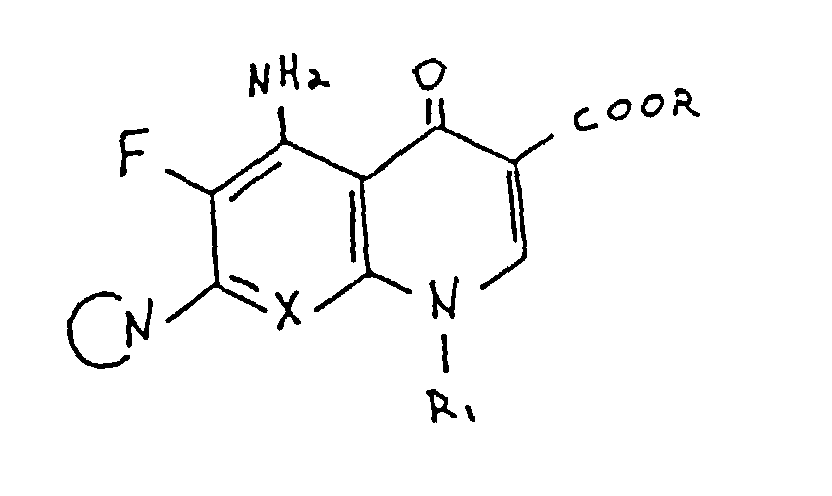
- J. Med. Chem. 1988, 31 (1598-1611) discloses compounds of the general formulaThe reference discloses a compound according to this general formula in which A is
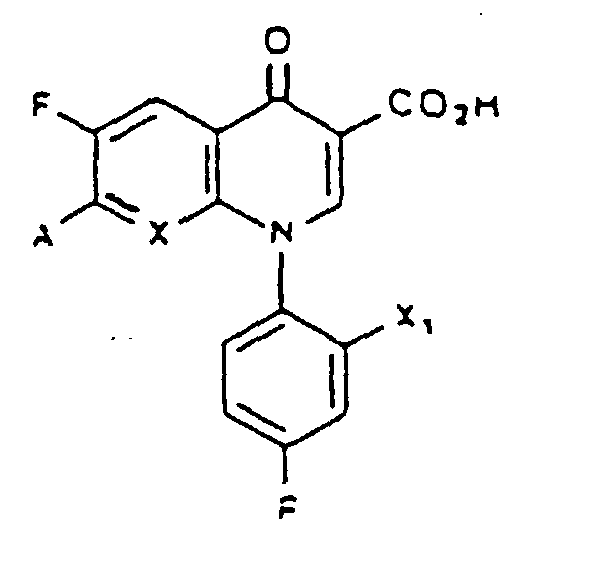 X is CH and X1 is F.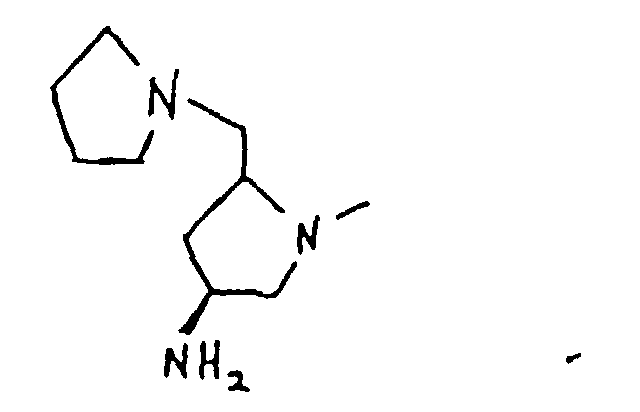
- J. Med. Chem. 1990, 33 (849-854) discloses compounds of the general formulaThe reference discloses a compound according to this general formula in which X is N, R1 is cyclopropyl and R7 is


- European Patent No. 347,851 discloses quinoline compounds which have NH2 or F at the 5-position.
- European Patent No. 362,759 discloses compounds having the general formulain which W is C1-C3 alkylidene.
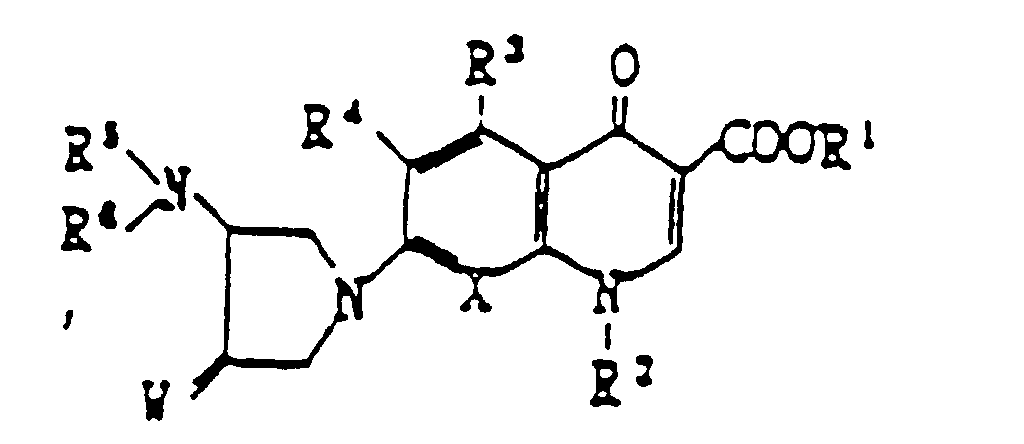
- Abstracts of the 30th Interscience Conference on Antimicrobial Agents and Chemotherapy, Atlanta, October 21-24, 1990, Abstract No. 395 discloses compounds having the formulain which X is CH or N and in which Z is
 Abstracts of the 30th Interscience Conference on Antimicrobial Agents and Chemotherapy also discloses compounds having the formula
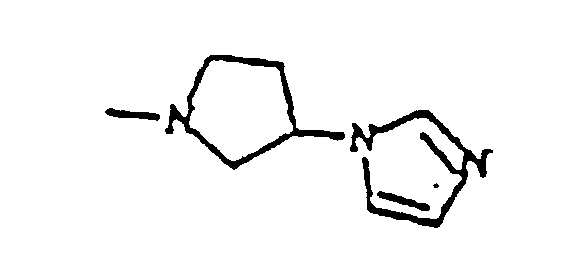 in which X is CH or N and Z is

- Some of the above disclosed compounds are clinically useful. However, there exists a continuing need to develop new antibacterial agents because the effectiveness of existing antibacterial agents diminishes as strains of pathogens develop resistance. In addition, certain antibiotics exhibit unsuitable pharmaceutical properties and exert serious adverse side effects in humans.
- The present invention is based on the discovery that certain 7-substituted-6-fluoro-1,4-dihydro-4-oxo-quinoline-3-carboxylic acid compounds exhibit excellent activity against sensitive and resistant Gram-positive and moderate activity against Gram-negative bacteria.
- In accordance with the present invention there is provided 7-substituted-6-fluoro-1,4-dihydro-4-oxo-quinoline-3-carboxylic acid compounds of the formula:wherein R1 is a C3-C6 cycloalkyl group or a phenyl group which may be substituted by methoxy or amino or by one or two halogen atoms; R2 is hydrogen, a halogen atom, a C1-C4 alkyl group, a hydroxy group or an amino group; R3 is hydrogen, hydroxy or amino; R4 is a 1,2,3-triazol-1-yl group, a 1,2,4-triazol-1-yl group, a 1,2,3,4-tetrazol-1-yl group or a 1,2,3,4-tetrazol-2-yl group, each of which may have 1 to 2 substituents selected from the group consisting of C1-C4 alkyl, -COOH, -CH2NH2, amino and phenyl groups; and X is N, CH, C-F or C-OCH3; n is 1; or
 and pharmaceutically acceptable salts thereof.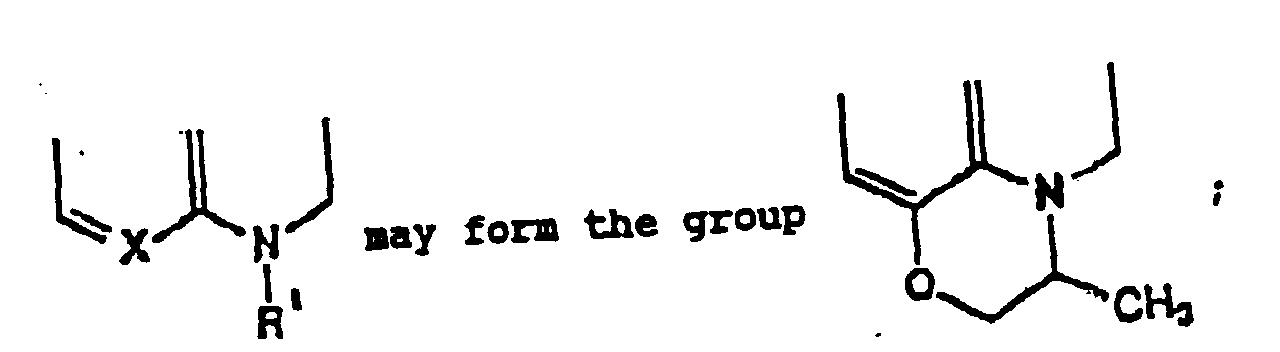
- Preferably the C1-C4 alkyl group is selected from methyl, ethyl, propyl, isopropyl, butyl, isobutyl or t-butyl; the C3-C6 cycloalkyl group is selected from cyclopropyl, cyclobutyl, cyclopentyl or cyclohexyl and the optionally substituted phenyl is selected from phenyl, 4-fluorophenyl, 2,4 -difluorophenyl, 2,4 -dimethoxyphenyl and 4-aminophenyl. The groups which may be substituted, as discussed above, may suitably be substituted with chlorine, bromine, fluorine, methoxy or amino.
- The compounds of the invention include those wherein the pyrrolidine moiety at the 7-position has an asymmetric carbon atom or atoms and can be in optically active forms. Hence, this invention includes the R isomer, the S isomer and mixtures thereof. Some of the compounds of this invention have two asymmetric carbon atoms on the pyrrolidine moiety and therefore exist as stereoisomers having different configurations (i.e., cis-and transconfigurations). Such stereoisomers and their mixtures are also included within the compounds of this invention.
- The compounds of this invention exhibit excellent antimicrobial activity against both sensitive and resistant Gram-positive bacteria. Compounds of formula I may be utilised as antibacterial active compounds in medicaments formulated with pharmaceutically acceptable carriers.
- In general, the 7-substituted-6-fluoro-1,4-dihydro-4-oxo-quinoline-3-carboxylic acid compounds of formula I are prepared as follows:
- Compounds having the general formula II are reacted with compounds having the general formula III under the conditions described hereinafter.L is a suitable leaving group and may be chlorine, bromine, fluorine, SO2R7, wherein R7 is a C1-C4 alkyl group or an unsubstituted or substituted phenyl group. The starting compounds having the formula II can be prepared from known starting materials using standard procedures or variations thereof within the skill of the art. Various starting compounds of formula II are known and are shown below in association with a reference citation:
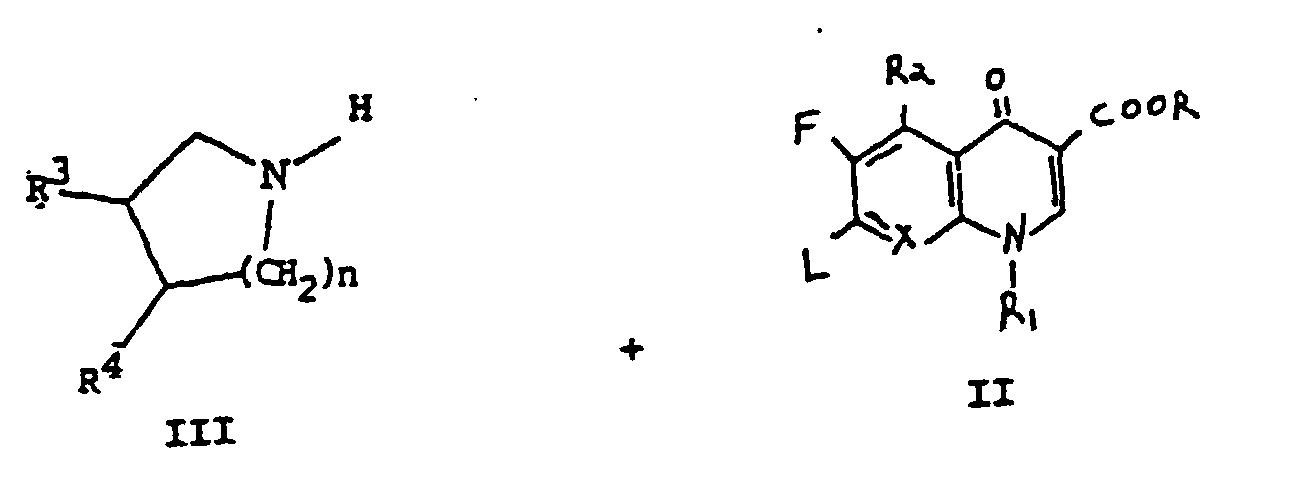
 wherein X is nitrogen, or C-F or CH or C-CH3 or C-CF3 or C-OCH3.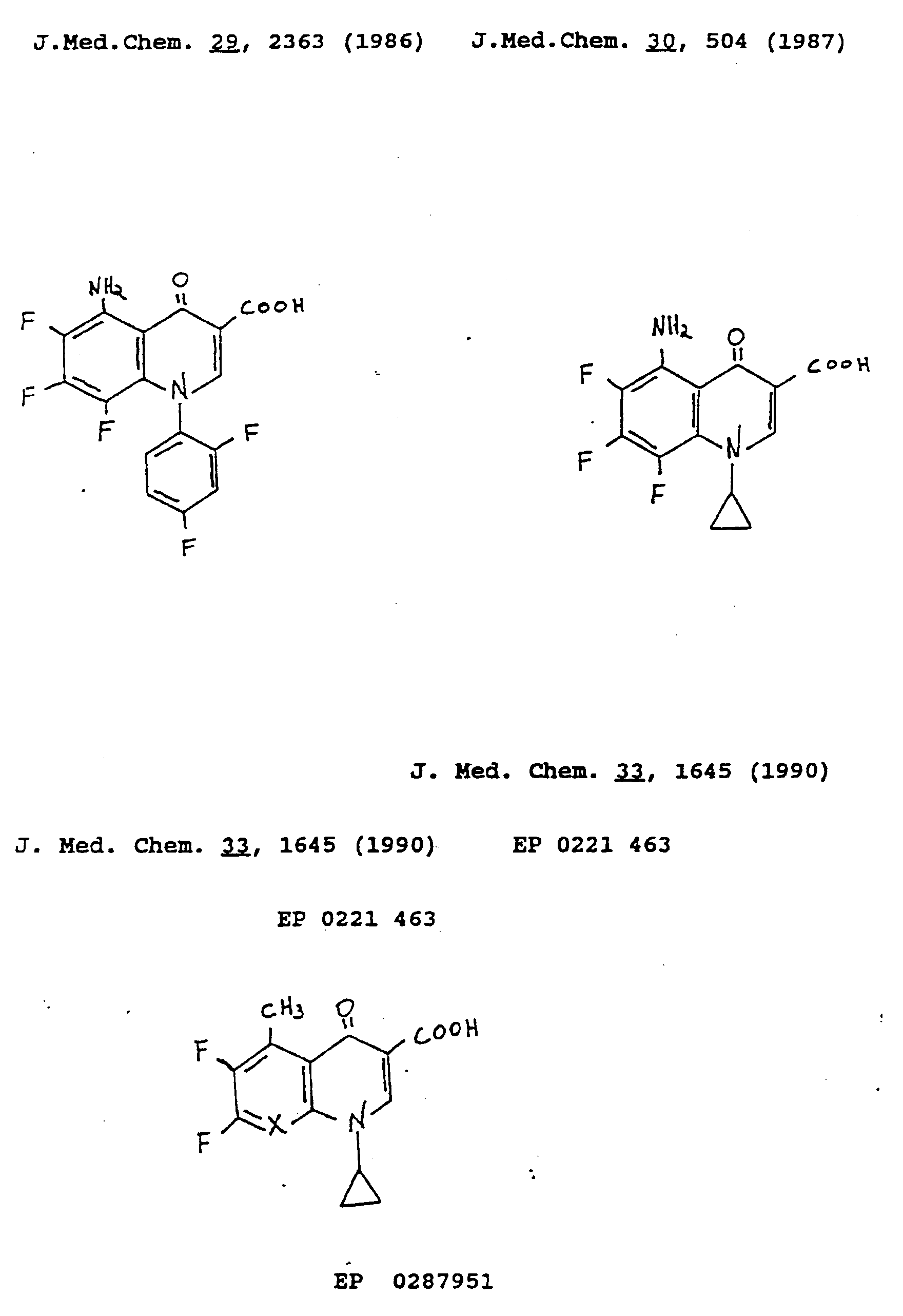
- A schematic route for the preparation of compounds of formula III wherein the azole ring is a 1,2,3-triazole is given below:wherein X1 is hydrogen or hydroxy,

- R3 is a hydrogen or hydroxy or amino group,
- R8 and R9 are hydrogen C1-C4 alkyl, COOH, CH2NH2, amino or phenyl,
- R10 is a benzyl or t-BOC protective group.
-
- The reaction of compound IV and a substituted acetylene as shown is carried out in a suitable solvent such as acetone, methanol, ethanol, benzene, toluene or xylene, either in a high pressure vessel or at normal pressure. The reaction is usually carried out at temperature from room temperature to 150°C, preferably from 60° C to 140° C, for 2 to 96 hours. Substituted acetylenes are usually used in an amount of at least 1 mole, preferably 1 to 15 moles, for every one mole of compound IV.
- Deprotection of the N-protective group of compound V is carried out either by hydrogenation in presence of an acid such as hydrochloric acid, or acetic acid or by hydrolysis with mineral acid such as HC1, HNO3, H2SO4, CF3COOH or CH3COOH in a solvent such as methanol, ethanol or propanol. The deprotection reaction is usually carried out at a temperature from 0° C to 100° C, usually at O° C to 40° C, for 10 minutes to 48 hours. The hydrogenation reaction is usually carried out in presence of metal catalyst such as Pd, Pt or Rh under normal pressure to high pressure.
- The reaction of compound V and methane sulfonyl chloride (MSCl) is carried in a suitable solvent, for example, dichloromethane, chloroform, carbon tetrachloride, benzene, toluene, DMF or DMSO in the presence of a base such as triethylamine, NaHCO3, K2CO3, CsCO3, sodium alkoxide (NaOCH3 or NaOC2H5), potassium tert-butoxide or pyridine. The reaction temperature is in the range from 0° C to 100° C, preferably 0° C to 35° C, and reaction times vary from 1 hour to 48 hours. The methanesulfonyl chloride is usually used in an amount of at least 1 mole preferably 1 to 5 moles per mole of compound V.
- The reaction of compound VI and a metal azide such as NaN3 in the presence of phase transfer catalyst such as NH4C1, (NH4)2CO3, (Bu)4NBr is carried out in a polar solvent such as DMF or DMSO, or in a mixture of solvents such as DMF-H2O, DMSO-H2O in a ratio of 4:1. The reaction temperature ranges from room temperature to 180° C, preferably from 40° to 100°C. The reaction time ranges from 1 hour to 48 hours, and a molar ratio of from 1 to 5 moles of metal azide per mole of compound VI is preferred. The phase transfer catalysts are used in same ratio as the metal azide ratio.
- The reaction condition for conversion of compound VII to compound III is the same as described for conversion of compound V to compound III.
- Compounds of the formula III wherein the azole ring is a 1,2,4-triazole can be prepared by the reaction of potassium-1,2,4-triazolide with N-benzyl-3-mesyloxypyrrolidine. The N-blocking groups are then removed are in the usual manner by catalytic hydrogenation with palladium on charcoal, as illustrated in Examples R and S.
- Compounds of the formula III wherein the azole ring is a 1,2,3,4-tetrazole moiety are prepared in an analogous manner as illustrated in Examples DD, EE and FF.
- The starting compounds II and III are reacted together in the presence of solvents at elevated or reduced temperatures for a sufficient time to allow the reaction to proceed to completion. Reaction conditions will depend upon the nature of the leaving group L of the compounds of formula II and the degree of the reactivity of compound III.
- The reaction is preferably carried out in the presence of a proton acceptor such as pyridine, diazabicycloundecane (DBU), N-methyl pyrrolidine-2-one or picoline.
- The solvents of choice for this reaction are nonreactive solvents such as acetonitrile, tetrahydrofuran (THF), ethanol, methanol, chloroform, methylene chloride, pyridine, picoline, N-methylpyrrolidine-2-one, water, dimethyl sulfoxide and dimethylformamide. Mixtures of these solvents may also be utilised.
- Reaction temperatures will generally range from between about 50°C to 150°C. The preferred molar ratio of compounds II and III are 1:2.5 to 5.0. The reaction times generally range from 4 to 50 hours depending on the reactants.
- Another method for preparing compounds of formula I is by reacting a compound of the general formula II with a compound of formula VIII to form a compound of formula IX followed by substitution of leaving group L1 in IX with the appropriately substituted azoles as shown below.R1, R2, R3, X and L1 are the same as defined above. L1 is the suitable leaving group selected from chlorine, bromine, fluorine or SO2CH3 or SO2C6H4 CH3(p).

- An alternate process can also be used for preparing the compound of formula I by reacting the compound of formula II with compound of formula XI followed by reaction with substituted acetylenes as shown in the following scheme:R1, R2, R3, R8, Rq, X and L are as defined above. The reaction time, temperature, molar ratio and solvent for the reaction of the compound of formula II with the compound of formula VIII or reaction of compound of formula II with compound of formula XI are the same as defined for the reaction of compound II with compound III, as described above.

- The reaction temperature, time, molar ratio and solvent used for the reaction of compound IX with triazoles are the same as described above for the reaction of compound VI with metal azides NaN3 or (C4H9)4NN3. The reaction temperature, times, molar ratio and solvent used for the reaction of compound XII with substituted acetylenes are the same as described for the conversion of compound IV to compound V.
- The pyrido-benzoxazine compounds of the invention are prepared as illustrated in Examples 38, 39 and 40 using the procedure described by Mitscher et al, J. Med. Chem. 30, 2283-2286 (1987) to prepare the pyrido-benzoxazine intermediate compounds of formula II.
- The compounds of the invention are capable of forming both pharmaceutically acceptable acid addition and/or base salts. Base salts are formed with alkali and alkaline earth metals such as sodium, potassium, magnesium and calcium and heavy metal salts such as silver, zinc, cobalt, and cerium, and with organic amines such as choline and lysine, either directly or in combination with a physiologically acceptable carrier.
- Pharmaceutically acceptable acid addition salts are formed with organic and inorganic acids such as hydrochloric, sulphuric, phosphoric, acetic, citric, oxalic, malonic, salicylic, malic, gluconic, fumaric, succinic, ascorbic, maleic, methanesulfonic and p-toluenesulfonc acid. The salts are prepared by contacting the free base form with a sufficient amount of the desired acid or amine to produce, for example, the mono or di salt in a conventional manner.
- The compounds of the invention can exist in unsolvated as well as solvated forms including hydrated forms. In general, the solvated forms, including hydrated forms, are equivalent to the unsolvated forms for purpose of the invention.
- The compounds of formula I are useful as antibacterial agents. They were found to be very potent in vitro against various sensitive and quinoline resistant Gram positive microbes such as E. faecium. S. aureus Cog. -ve, S, epidermidis, S. saprophyticus, and S. pyogenes. Further studies on some of the compounds of this invention revealed that their in vitro MIC values against Gram-positive and Gram-negative organisms are negligibly affected by inoculum size, cations (Mg++, Ca++), and serum.
- Human patients suffering from bacterial infections can be treated by administering to the patient a pharmaceutically effective amount of one or more of the present compounds optionally, but preferably, in the presence of a pharmaceutically acceptable carrier or diluent. There may also be included a pharmaceutically compatible binding agent, and/or ajuvant materials. The active materials can also be mixed with other active materials which do not impair the desired action and/or supplement the desired action. The above materials according to the present invention can be administered by any route, for example, orally, parenterally, intravenously, intradermally, subcutaneously or topically in solid or liquid form.
- The solid form preparation includes powders, tablet, dispensable granules, capsules, cachets, suppositories and ointments. A solid carrier can be one or more substances which may also act as diluents, flavoring agents, solubilizers, lubricants, suspending agents, binders, or tablet disintegrating agents, including magnesium carbonate, magnesium stearate, talc, sugar, lactose, pectin, dextrin, starch, gelatin, gum tragacanth, methyl cellulose, sodium carboxymethyl cellulose, low melting wax and cocoa butter.
- Liquid form preparations include solutions, suspensions and emulsions. The liquid preparation for parenteral injection may be water or water-propylene glycol solution or water-polyethylene glycol solution, the-like so long as it is acceptable to biological systems (isotonicity, pH etc.). Aqueous solutions suitable for oral use can be prepared by dissolving the active component in water and adding suitable colorant, flavors, stabilizing and thickening agents as desired. Aqueous suspensions suitable for oral use can be made by dispersing the finely divided active component in water with viscous material, i.e. natural or synthetic gum, resins, methyl cellulose or sodium carboxymethyl cellulose.
- The quantities of active compound in a unit dose of a preparation may be varied depending on the particular application and the potency of the active ingredient. Determination of the proper dosage for a particular situation is within the skill of the art. The dosage of the pharmaceutical preparation is generally in the range of 0.2 to 100 mg of the compound of formula I and salts thereof per kilogram of body weight of the patient per day. Preferably this daily dose is administered 2 - 4 times per day in fractions of the daily dose.
- Our invention is further illustrated by means of the following examples:
- A solution of ethyl 1-(4-fluorophenyl)-6,7,8-trifluoro-1,4-dihydro-4-oxo-quinoline-3-carboxylate (180 mg, 0.5 mmol), 3-(1,2,3-triazol-1-yl)-pyrrolidine hydrochloride (259 mg, 1.4 mmol) and DBU (384 mg, 2.5 mmol) in acetonitrile (20 ml) was heated at 75°C for 3 h. Cooled to r.t. and stirred for another 15 h. The separated solid was filtered, successively washed with acetonitrile and ether. The white crystalline solid thus obtained was dried in vac-oven at 40°C. Yield: 135 mg. 56.7%. 1H NMR (CDCl3) δ: 1.35 (t, 3H), 2.50 (m, 2H), 3.70 (m, 1H), 3.85 (m, 2H), 4.10 (m, 1H), 4.35 (q, 2H), 5.25 (m, 1H), 7.20 (m, 2H), 7.40 (m, 2H), 7.63 (d, 1H), 7.72 (d, 1H), 7.90 (dd, 1H), 8.25 (S, 1H).
- A suspension of ethyl 6,8-difluoro-1-(4-fluorophenyl-7-[3-(1,2,3-triazol-1-yl)-pyrrolidin-1-yl]-1,4-dihydro-4-oxo-quinoline-3-carboxylate (180 mg, 0.37 mmol) in 20 ml NaOH solution (containing 15 mg NaOH) and THF (20 ml) was heated at 90° C for 3.5 h. The THF was evaporated and the separated solid redissolved in water layer by heating and acidified to pH 6.0. The precipitate was filtered, washed with water and dried in vac-oven at 40° C to obtain the title compound as a light yellow solid. Yield: 89 mg, 52.66%; m.p. 303° C. 1H NMR (TFA) δ: 2.82 (m, 2H), 4.14-4.64 (m, 4H), 5.74 (m, 1H), 7.37 (m, 2H), 7.60 (m, 2H), 8.20 (dd, 1H), 8.54 (d, 1H), 8.65 (d, 1H), 9.03 (S, 1H).
- A mixture of ethyl 1-(2,4-difluorophenyl)-7-chloro-6-fluoro-1,4-dihydro-4-oxo-1,8-naphthyridine-3-carboxylate (91 mg, 0.5 mmol), 3-(1,2,3-triazol-1-yl)-pyrrolidine hydrochloride (259 mg, 1.5 mmol), and DBU (380 mg, 2.5 mmol) in CH3CN (20 ml) was heated under reflux for 2 h, cooled to r.t. and stirred further for 18 h, diluted with water. Unreacted starting materials were removed by extraction with chloroform. The water layer was concentrated to give a yellow oil. Yield: 150 mg, (62%). 1H NMR (CDCL3) δ: 1.3 (t, 3H), 2.5 (m, 2H), 3.9 (m, 4H), 4.4 (q, 2H), 5.3 (m, 1H), 7.3 (m, 4H), 7.8 (d, 1H), 8.0 (d, 1H), 8.4 (s, 1H).
- Ethyl 7-chloro-1-cyclopropyl-6-fluoro-1,4-dihydro-4-oxo-1,8-naphthyridine-3-carboxylate (250 mg, 0.8 mmole) was reacted with 350 mg (2 mmole) of 3(S)-(1,2,3-triazol-1-yl)pyrrolidine hydrochloride in 8 ml of pyridine in the presence of 305 mg (2 mmol) of DBU at 80-90°C for 6 hrs. The reaction was then stirred at room temperature for 4 days. The solvent was then evaporated under reduced pressure and to the residue, water was added and extracted with chloroform. The organic layer was dried and evaporated to dryness. The residue was then chromatographed over alumina (neutral, activity III) using chloroform as solvent to yield 80 mg (24%) of the desired product. 1H NMR (CDCL3) δ: 8.48 (s, 1H), 8.05 (d, 1H), 7.76 (d, 1H), 7.71 (d, 1H), 5.46-5.32 (m, 1H), 4.46-4.26 (m, 4H), 4.15-4.0 (m, 2H), 3.56-3.42 (m, 1H), 2.71-2.57 (m, 2H), 1.4 (t, 3H), 1.26-0.95 (m, 4H).
- Ethyl 1-cyclopropyl-6-fluoro-7-[3(S)-(1,2,3-triazol-1-yl)pyrrolidin-1-yl]-1,4-dihydro-4-oxo-1,8-naphthyridine-3-carboxylate (80 mg, 0.19 mmol) was heated in 16 ml of 6N HCl at 100-110°C for 18 hrs. This was then concentrated to dryness and methanol-ether was added and the formed solid was collected to yield 55 mg (73%) of the desired product after drying, m.p. 268-270° C. 1H NMR (TFA) δ : 9.21 (s, 1H), 8.74 (s, 1H), 8.58 (s, 1H), 8.20 (d, 11.4 Hz, 1H), 6.14-5.84 (m, 1H), 4.94-4.3 (m, 4H), 4.18-3.95 (m, 1H), 3.18-2.8 (m, 2H), 1.68-1.18 (m, 4H).
Anal. calcd. for C18H17FN6O3·1/2H2O; C, 54.96; H, 4.61; N, 21.35. Found; C, 54.66; H, 4.51; N, 20.85. - Ethyl 7-chloro-1-cyclopropyl-6-fluoro-1,4-dihydro-4-oxo-1,8-naphthyridine-3-carboxylate (243 mg, 0.78 mmole) and cis-3-amino-4-(1,2,3-triazol-1-yl) pyrrolidine (300 mg, 1.96 mmole) were reacted together in 8 ml of pyrridine at room temperature for 5 days. The solvent was then evaporated, water was added to the residue and was extracted with chloroform. The organic layer was then dried (Na2SO4) and evaporated to yield 0.23 g of the crude product which upon purification over neutral alumina (activity III) using 4% methanol/chloroform as solvent yielded 200 mg (60%) of the desired product. 1H NMR (CDCl3) δ: 8.5 (s, 1H), 8.12 (d, 1H), 7.82 (s, 1H), 7.76 (s, 1H), 5.3-5.15 (s, 1H), 4.55-4.00 (m, 6H), 3.85-3.62 (m, 1H), 3.58-3.4 (m, 1H), 1.43 (t, 3H), 1.32-0.94 (m, 4H).
- Ethyl 7-[cis-3-amino-4-(1,2,3-triazol-1-yl)pyrrolidin-1-yl] -1-cyclopropyl-6-fluoro-1,4-dihydro-4-oxo-1,8-naphthyridine-3-carboxylate (200 mg, 0.47 mmole) was heated with 8 ml of 6N hydrochloric acid at 110°C for 18 hrs. The solution was then evaporated to dryness and the residue was crystallized from methanol-ether to yield 160 mg (85%) of the desired hydrochloride, m.p. 240° C (dec). 1H NMR (TFA) δ : 9.27 (s, 1H), 9.01 (s, 1H), 8.66 (s, 1H), 8.3 (d, 11.6 Hz, 1H), 6.64-6.45 (m, 1H), 5.35-4.66 (m, 5H), 4.20-4.02 (m, 1H), 1.7-1.2 (m, 4H).Anal. calcd. for C18H19ClFN7O3.1½H2O C, 46.76; H, 4.80; N, 21.2; Cl, 7.67. Found; C, 46.85; H, 4.31; N, 20.62; Cl, 8.36.
- A mixture of crude ethyl 1-(2,4-difluorophenyl)-6-fluoro-7-[3-(1,2,3-triazoi-1-yl)-pyrrolidin-1-yl]-1,4-dihydro-4-oxo-1,8-naphthyridine-3-carboxylate (150mg, 0.31 mmol), THF (15 ml), NaOH (20 mg, 1.5 mmol) and water 15 ml was heated under reflux for 3 h, cooled and the THF evaporated. The aqueous solution was acidified and the precipitated yellow solid washed with water, dried in vac-oven at 50° C to obtain 80 mg (solid). This solid was washed with ether to get the pure of compound. Yield: 50 mg (35.7%) m.p.: 253° C (dec.). 1H NMR (TFA) δ: 2.85 (m, 2H), 3.70-4.50 (m, 4H), 5.80 (m, 1H), 7.20 (m, 2H), 7.60 (m, 1H), 8.25 (s, 1H), 8.57 (S, 1H), 8.62 (S, 1H), 9.20 (S, 1H).
- A mixture of 1-cyclopropyl-6,7-difluoro-1,4-dihydro-4-oxo-quinoline-3-carboxylic acid (120 mg, 0.486 mmol), DBU (190 mg, 1.25 mmol),3-(1,2,3-triazol-1-yl)pyrrolidine hydrochloride (216 mg, 1.25 mmol) in pyridine (8 ml) was heated at 80° C for 18 h. The reaction mixture was concentrated and treated with water. The separated solid was collected by filtration, washed with water and acetonitrile to give light brown solid. Yield: 71 mg (38%), m.p. 284° C (dec). 1H NMR (TFA) δ: 1.5 (m, 4H), 3.0 (m, 2H), 4.0 (m, 4H), 4.65 (bs, 1H), 5.9 (bs, 1H), 7.5 (d, 1H), 8.20 (d, 1H), 8.6 (s, 1H), 8.7 (s, 1H), 9.2 (s, 1H).
- A mixture of 1-cyclopropyl-6,7,8-trifluoro-1,4-dihydro-4-oxo-quinoline-3-carboxylic acid (138.5 mg, 0.486 mmol), DBU (190 mg, 1.25 mmol), and 3-(1,2,3-triazol-1-yl)-pyrrolidine hydrochloride (216 mg, 1.25 mmol) in pyridine (8 ml) was heated for 20 h at 75-80° C and then pyridine removed under vacuum. The residue was diluted with acetonitrile. The precipitated solid was washed with acetonitrile, ether and dried at 40° C. Yield: 65 mg (33%) m.p. 244-246° C (dec.). 1H NMR 25 (TFA) δ:1.5 (m, 4H), 2.8 (m, 2H), 4.5 (m, 4H), 4.75 (bs, 1H), 5.8 (bs, 1H), 8.15 (d, 1H), 8.6 (s, 1H), 8.7 (s, 1H), 9.25 (s, 1H).
- A mixture of 5-amino-1-cyclopropyl-6,7,8-trifluoro-1,4-dihydro-4-oxo-quinoline-3-carboxylic acid (190 mg, 0.64 mmol),3-(1,2,3-triazol-1-yl)-pyrrolidine hydrochloride (290 mg, 1.67 mmol), and DBU (255 mg, 1.70 mmol) in pyridine (5 ml) was heated at 110° C for 20 h. The reaction mixture was then cooled and diluted with methanol, the separated solid was collected and washed successively with methanol, water and acetonitrile. The title compound was obtained upon drying in oven at 40° C. Yield: 168 mg (63%) m.p.: 273.5-275° C. 1H NMR (TFA) δ: 1.40 (m, 4H), 2.90 (m, 1H), 4.40 (m, 4H), 4.75 (m, 1H), 5.70 (m, 1H), 8.55 (d, 1H), 8.68 (d, 1H), 9.15 (S, 1H).
- A mixture of 5-amino-1-cyclopropyl-6,7,8-trifluoro-1,4-dihydro-4-oxo-quinoline-3-carboxylic acid (200 mg, 0.67 mmol, 3S-(1,2,3-triazol-1-yl)pyrrolidine hydrochloride (293 mg,1.68 mmole) and diazabicycloundecane (256 mg, 1.60 mmol) in pyridine (20 ml) was heated at 110° C for 20 hrs. The reaction mixture was cooled, diluted with methanol, the separated solid was filtered and washed with H20 and CH3CN, dried to give title product. Yield: 120 mg (43%), m.p. 277-78° C. 1H NMR (TFA) δ: 1.31-1.58 (m, 4H), 2.90 (m, 2H), 4.15-4.54 (m, 4H), 4.75 (m, 1H), 5.86 (m, 1H), 8.55 (d, 1H), 8.69 (d, 1H), 9.15 (S, 1H).
- Prepared by the same procedure as described in Example 12 by using 5-amino-1-cyclopropyl-6,7,8-trifluoro-1,4-dihydro-4-oxo-quinoline-3-carboxylic acid and 3R-(1,2,3-triazol-1-yl) pyrrolidine hydrochloride. Yield 41%, m.p. 279-280° C. 1H NMR (TFA) δ: 1.31-1.49 (m, 4H), 2.92 (m, 2H), 4.2-5.1(m, 4H), 4.73 (m, 1H), 5.82 (m, 1H), 8.56 (d, 1H), 8.68 (d, 1H), 9.10 (s, 1H).
- A mixture of 5-amino-1-(2,4-difluorophenyl)-6,7,8-trifluoro-1,4-dihydro-4-oxo-quinoline-3-carboxylic acid (200 mg, 0.54 mmol), 3-(1,2,3-triazol-1-yl)pyrrolidine hydrochloride (231 mg, 1.25 mmol) and diazabicycloundecane (200 mg, 1.31 mmol) in acetonitrile (25 ml) was refluxed for 45 hrs. The separated solid was filtered, washed with acetonitrile and ether to give 150 mg (57%) of desired product, m.p. 307.5-309° C. 1H NMR (TFA) δ: 2.81 (m, 2H), 4.06-4.53 (m, 4H), 5.73 (m, 1H), 7.15-7.23 (m, 2H), 7.59-7.66 (m, 1H), 8.52 (d, 1H), 8.62 (d, 1H), 8.82 (d, 1H).
- A mixture of 5-amino-1-(2,4-difluorophenyl)-6,7,8-trifluoro-1,4-dihydro-4-oxo-quinoline-3-carboxylic acid (100 mg, 0.27 mmol), 3S-(1,2,3-triazol-1-yl)pyrrolidine hydrochloride (117 mg, 0.67 mmol) and diazabicycloundecane (102 mg, 0.67 mmol) in pyridine (10 ml) was heated at 110° C for 40 hrs. The reaction mixture was concentrated and the residue was triturated with water. The separated solid was filtered, washed with water, acetonitrile and dried under vacuum at 40° C. Yield: 88 mg (67%); m.p. 302-304° C. 1H NMR (TFA) δ: 2.82 (m, 2H), 4.0-4.53 (m, 4H), 5.73 (m, 1H), 7.10-7.23 (m, 2H), 7.55-7.70 (m, 1H)8.52 (d, 1H), 8.62 (d, 1H), 8.82 (d, 1H).
- Prepared by following the procedure as described in Example 15 by using 5-amino-1-(2,4-difluorophenyl)-6,7,8-trifluoro-1,4-dihydro-4-oxo-quinoline-3-carboxylic acid and 3R-(1, 2, 3-triazol-1-yl) pyrrolidine hydrochloride. Yield: 57%, m.p. 302.5-304°C. 1H NMR (TFA) δ: 2.80-2.90 (m, 2H), 4.05-4.35 (m, 3H), 4.55 (m, 1H), 5.73 (m, 1H), 7.09-7.23 (m, 2H), 7.55-7.70 (m, 1H), 8.53 (d, 1H), 8.62 (d, 1H), 8.82 (d, 1H).
- A mixture of 1-cyclopropyl-6,7,8-trifluoro-1,4-dihydro-4-oxo-quinoline-3-carboxylic acid (44 mg, 0.156 mmol) and cis-3-amino-4-(1,2,3-triazol-1-yl)pyrrolidine (60 mg, 0.39 mmol) in pyridine (5 ml) was heated at 110° C for 2-3 hrs under N2 and then stirred at room temperature for 20 hrs. The reaction mixture was concentrated and the residue was washed with water and acetonitrile. The solid was dried under vacuum at 40° C. Yield: 43 mg (66%), m.p. 245-47° C. 1H NMR (TFA) δ: 1.3-1.8 (m, 4H), 4.4-5.25 (m, 6H), 6.40 (m, 1H), 8.15 (d, 1H), 8.62 (S, 1H), 8.90 (S, 1H), 9.40 (S, 1H).
- Prepared by following the same procedure as described for Example 17 by using 5-amino-1-cyclopropyl-6,7,8-trifluoro-1,4-dihydro-4-oxo-quinoline-3-carboxylic acid and cis 3-amino-4-(1,2,3-triazol-1-yl) pyrrolidine. Yield: 65%, m.p. 275-277° C. 1H NMR (TFA) δ: 1.33-1.50 (m, 4H), 4.32-5.12 (m, 6H), 6.34 (m, 1H), 8.64 (S, 1H), 8.89 (S, 1H), 9.16 (S, 1H).
- Prepared by following the same procedure as described for example 13 by using 5-amino-1-(2,4-difluorophenyl)-6,7,8-trifluoro-1,4-dihydro-4-oxo-quinoline-3-carboxylic acid and cis 3-amino-4-(1,2,3-triazol-1-yl)-pyrrolidine. Yield: 66%, m.p. 279-281° C. 1H NMR (TFA) δ: 4.48-4.82 (m, 4H), 5.02 (m, 1H), 6.26 (m, 1H), 7.17 (m, 2H), 7.62 (m, 1H), 8.6 (S, 1H), 8.82 (2d, 2H).
- A mixture of 5-amino-1-cyclopropyl-6,7,8-trifluoro-1,4-dihydro-4-oxo-quinoline-3-carboxylic acid (63 mg, 0.21 mmol) trans 3-hydroxy-4-(1,2,3-triazol-1-yl)-pyrrolidine hydrochloride (100 mg, 0.52 mmol) and diazabicycloundecane (79 mg, 0.52 mmol) in pyridine was heated at 110°C for 20 hrs. The reaction mixture was concentrated and the residue was triturated with water. The separated solid was filtered, washed with water and acetonitrile and dried under vacuum at 40°C. Yield: 35 mg (40%); m.p. 261-165.5°C. 1H NMR (TFA) δ : 1.33-1.51 (m, 4H) , 4.24 (m, 2H) , 4.60 (m, 2H), 4.92 (m, 1H) , 5.20 (m, 1H), 5.79 (m, 1H), 8.59 (d, 1H), 8.78 (s, 1H), 9.15 (s, 1H).
- To the suspension of 50 mg (0.168 mmole) of 1-cyclopropyl-5-methyl-6,7,8-trifluoro-1,4-dihydro-4-oxo-quinoline-3-carboxylic acid and 3-(4-methyl-1,2,3-triazol-1-yl)pyrrolidine hydrochloride (79 mg, 0.421 mmole) in dry acetonitrile (5 ml) was added 64 mg (0.421 mmole) of DBU (diazabicycloundecane) and the solution was refluxed under nitrogen for 46 hrs. The yellow solution was concentrated to dryness and the residue was then suspended in acetonitrile and filtered. The supernatant was evaporated to dryness and to the residue water was added and solid collected (30 mg, 43%), m.p. 232-234°C. 1H NMR (TFA): 9.26 (s, 1H), 8.37 (s, 1H), 5.78-5.58 (m, 1H), 4.85-4.1 (m, 5H), 3.0-2.7 (m, 5H), 2.68 (s, 3H), 1.65-1.15 (m, 4H). Anal. calcd. for C21H21F2N5O3: C, 58.74; H, 4.93; N, 16.31. Found: C, 58.14; H, 5.06; N, 16.08.
- To 100 mg (0.36 mmole) of 1-cyclopropyl-6,7,8-trifluoro-1,4-dihydro-4-oxo-quinoline-3-carboxylic acid and 166 mg (0.9 mmole) of 3-(5-methyl-1,2,3-triazol-1-yl) pyrrolidine hydrochloride in 10 ml of pyridine was added 134 mg (0.9 mmole) of DBU and the resulting solution was heated under nitrogen at 120°C for 3 days. The very fine suspension was then filtered and evaporation of the supernatant afforded a residue which was crystallized upon addition of water. The solid was collected (117 mg), m.p. 199-200°C. 1H NMR (CDCl3) : 8.73 (s, 1H), 7.83 (d, 13.7 Hz, 1H), 7.5 (s, 1H), 5.1-4.9 (m, 1H), 4.48-3.88 (m, 5H), 2.77-2.45 (m, 2H), 2.4 (s, 3H), 1.4-1.1 (m, 4H). Anal. calcd. for C20H19F2N5O3H20; C, 55.42; H, 4.88; N, 16.16; Found; C, 55.64; H, 4.49; N, 15.73.
- 1-Cyclopropyl-5-methyl-6,7,8-trifluoro-1,4-dihydro-4-oxo-quinoline-3-carboxylic acid (30 mg, 0.1 mmole) was reacted with 40 mg (0.2 mmole) of 3-(1,2,4-triazol-1-yl)pyrrolidine hydrochloride in 2 ml of pyridine in the presence of 70 mg (0.45 mmole) of DBU at 95°C overnight. The orange solution was evaporated to dryness and to the residue water was added. The orange solid was collected and washed with methanol to yield 19 mg of the crude product, which upon further purification from methanol yielded 12 mg of the desired product, m.p. 207-210°C. 1H NMR (TFA) : 9.81 (s, 1H), 9.27 (s, 1H), 8.78 (s, 1H), 5.75-5.55 (m, 1H), 4.83-4.12 (m, 5H), 3-2.7 (m, 5H), 1.7-1.2 (m, 4H). Anal. calcd. for C20H19F2N5O3·H2O; C, 55.43; H, 4.88; N, 16.16; Found; C, 55.72; H, 4.73; N, 15.65.
- 1-Cyclopropyl-5-methyl-6,7,8-trifluoro-1,4-dihydro-4-oxo-quinoline-3-carboxylic acid (30 mg, 0.1 mmole) was reacted with 35 mg (0.2 mmole) of 3-(1,2,3-triazol-1-yl)pyrrolidine hydrochloride in 2 ml of dry pyridine under nitrogen in the presence of 30.4 mg (0.2 mmole) of DBU under reflux conditions. The solvent was removed under reduced pressure and to the orange viscous oil water was added and the solid was collected which was further purified from methanol to yield 20 mg of the desired product, m.p. 228-230°C. 1H NMR (TFA) : 9.28 (s, 1H), 8.68 (s, 1H), 8.57 (d, 1.4 Hz, 1H), 5.9-5.75 (m, 1H), 4.88-4.14 (m, 5H), 3.1-2.72 (m, 5H), 1.7-1.2 (m, 4H).
- 5-Amino-1-cyclopropyl-6,7,8-trifluoro-1,4-dihydro-4-oxo-quinoline-3-carboxylic acid (298 mg, 1 mmole) was reacted with 470 mg (2.5 mmole) of 3-(4-methyl-1,2,3-triazol-1-yl)pyrrolidine hydrochloride in the presence of 380 mg (2.5 mmole) of DBU in 20 ml of dry acetonitrile for two days under reflux conditions under the atmosphere of nitrogen. The yellow suspension was then evaporated to dryness and to the residue water was added. The yellow solid was filtered and crystallized repeatedly (3x) with acetonitrile to free the product from the unreacted starting material. After drying, 200mg of the desired product was obtained, m.p. 271-272.5°C. 1H NMR (TFA) : 9.15 (s, 1H), 8.4 (s, 1H), 5.8-5.6 (m, 1H), 4.8-4.05 (m, 5H), 3.0-2.7 (m, 2H), 2.67 (s, 3H), 1.65-1.2 (m, 4H). Anal. calcd. for C20H20F2N6O3·1/2 H2O; C, 54.67; H, 4.82; N, 19.12; Found; C, 54.91; H, 4.69; N, 18.76.
- 1-Cyclopropyl-6,7,8-trifluoro-1,4-dihydro-4-oxo-quinoline-3-carboxylic acid (100 mg, 0.36 mmole) was reacted with 3-(4,5-dimethyl-1,2,3-triazol-1-yl)pyrrolidine hydrochloride (182 mg, 0.9 mole) in 8 ml of dry pyridine in the presence of 137 mg (0.9 mmole) of DBU at 115°C for five days. The small amounts of the solid was filtered off and the supernatant was evaporated to dryness. To the residue water and few drops of acetonitrile was added. The solid was collected to afford after drying 125 mg (81%) of the desired product as a gray solid, m.p. 230-232°C (dec). 1H NMR (CDCl3) : 8.74 (s, 1H), 7.84 (d, J=13.2 Hz, 1H), 5.07-4.8 (m, 1H), 4.4-3.85 (m, 5H), 2.8-2.14 (m, 8H, singlet at 2.29, 6H), 1.4-1.0 (m, 4H).
Anal Calcd. for C21H21F2N5O3·1/2 H2O; C, 57.52; H, 4.83; N, 15.97; Found; C, 57.68; H, 4.81; 15.68. - 1-Cyclopropyl-6,7,8-trifluoro-1,4-dihydro-4-oxo-quinoline-3-carboxylic acid (150 mg, 0.53 mole) was reacted with 249 mg (1.33 mmole) of 3-(4-methyl-1,2,3-triazol-1-yl)pyrrolidine hydrochloride in the presence 201 mg (1.33 mmole) of DBU in 15 ml of dry pyridine under nitrogen at 120°C for 3 days. Small amounts of the solid present were removed by filtration, and the supernatant was concentrated under reduced pressure. Water and small amounts of acetonitrile were added to the residue and the grey solid was collected and dried to afford 180 mg (82%) of the desired product, m.p. 219-220°C. 1H NMR (CDCl3) : 8.73 (s, 1H), 7.85 (dd, J=13.7, 1.9 Hz, 1H), 7.42 (s, 1H), 5.4-5.3 (m, 1H), 4.4-3.7 (m, 5H), 2.7-2.5 (m, 2H), 2.37 (s, 3H), 1.4-1.05 (m, 4H). Anal. calcd. for C20H19F2N5O3; C, 57.83; H, 4.57; N, 16.86; Found; C, 57.81; H, 4.60; N, 16.31.
- To a suspension of 60 mg (0.2 mmole) of 5-amino-1-cyclopropyl-6,7,8-trifluoro-1,4-dihydro-4-oxo-quinoiline-3-carboxylic acid and 80 mg of 3-(1,2,4-triazol-1-yl)pyrrolidine hydrochloride in 3 ml of dry pyridine under N2 was added 140 mg (0.9 mmole) of DBU, and the suspension was heated at 95°C for 22 hrs. The resulting orange solution was then evaporated to dryness, water was added to the residue, and the orange solid was collected and washed with methanol to give after drying 50 mg (60%) of yellowish solid, m.p. 240.3-242.3°C. 1H NMR (TFA) : 9.8 (s, 1H), 9.14 (s, 1H), 8.77 (s, 1H), 5.78-5.55 (m, 1H), 4.76-4.12 (m, 5H), 2.9-2.65 (m, 2H), 1.65-1.2 (m, 4H).
Anal. calcd. for C19H18F2N6O3; C, 54.81; H, 4.36; N, 20.17; Found; C, 54.52; H, 4.44; N, 20.00. - To a solution of 1-cyclopropyl-6,7,8-trifluoro-1,4-dihydro-4-oxoquinoline-3-carboxylic acid (70.75 mg, 0.25 mmole) and 3-(1,2,4-triazol-1-yl)pyrrolidin-1-yl hydrochloride (100 mg) in 3 ml of dry pyridine under N2 was added 152 mg (1 mmole) of DBU and the solution was heated at 95°C overnight. The orange solution was then concentrated under reduced pressure and water was added to the residue and the solid was collected and dried to yield 50 mg (50%) of a gray solid, m.p. 219.7-220.7°C. 1H NMR (TFA) : 9.8 (s, 1H), 9.29 (s, 1H), 8.78 (s, 1H), 8.11 (d, J=12.5, 1H), 5.85-5.58 (m, 1H), 4.9-4.2 (m, 5H), 3.00-2.7 (m, 2H), 1.75-1.3 (m, 4H).
Anal. calcd. for C19H17F2N5O3; C, 56.86; H, 4.27; N, 17.45. Found; C, 56.80; H, 4.41; N, 17.48. - 1-Cyclopropyl-6,8-difluoro-7-[3-(1,2,4-triazol-1-yl)pyrrolidin-1-yl]-1,4-dihydro-4-oxo-quinoline-3-carboxylic acid (20 mg, 0.05 mmole) was dissolved in 2 ml of chloroform and to this was added 4 ml of methanesulfonic acid in chloroform. The suspension formed was stirred at room temperature for five hrs. The solid was collected to yield 12 mg of white solid after drying very well in the oven, m.p. 208.5-210°C. 1H NMR (CD3OD) : 9.54 (s, 1H), 8.78 (s, 1H), 8.64 (s, 1H), 7.81 (dd, 13.8, 2.3 Hz, 1H), 5.47-5.3 (m, 1H, 4.5-3.8 (m, 5H), 2.88-2.5 (m, 5H, singlet at 2.7), 1.4-1.1 (m, 4H).
Anal. calcd. for C20H21F2N5O6S·H2O; C, 46.60; H, 4.50; N, 13.59. Found; C, 46.75; H, 4.38; N, 13.51. - To 50 mg (0.15 mmole) of ethyl 6,7-difluoro-1-cyclopropyl-8-methoxy-1,4-dihydro-4-oxo-quinoline-3-carboxylate was added 1ml of fluoroboric acid (50% in water) and the mixture was heated at 90-100°C for 3 hrs. The solution was then poured into water and solid collected (60 mg). The white solid was dissolved in 1 ml of DMSO and to this solution was added 52 mg (0.3 mmol) of 3S-(1,2,3-triazol-1-yl)pyrrolidine hyrochloride and 46 mg (0.3 mmol) of DBU. The mixture was then heated at 90°C for 42 hrs. The reaction mixture was cooled to room temperature and water was added and solid collected. This solid was dissolved in 8 ml of 80% methanol and 0.25 ml of triethylamine was added and refluxed for 4 hrs. The solution was cooled and the few particles were filtered. The supernatant was evaporated to dryness, and to the ethanol was added to the residue, the solid collected, washed with ether and dried to yield 10 mg of the desired product, m.p. 195-197°C. 1H NMR (TFA) : 9.34 (s, 1H), 8.68 (s, 1H) 8.57 (d, 1H),8.09 (d, 13.2 Hz, 1H), 5.95-5.8 (m, 1H), 4.85-4.3 (m, 4H), 4.2-4.0 (m, 1H), 3.79 (s, 3H), 3.1-2.7 (m, 2H), 1.7-1.1 (m, 4H).
- Ethyl 6,7-difluoro-1-cyclopropyl-8-methoxy-1,4-dihydro-4-oxo-quinoline-3-carboxylate was complexed with fluoroboric acid according to the procedure described in Example 31, and then reacted with 3-(1,2,3-triazol-1-yl)pyrrolidine under the same reaction conditions, followed by hydrolysis to yield the desired product, m.p. 200-201°C. 1H NMR (TFA): 9.34 (s, 1H), 8.69 (d, 1H), 8.58 (d, 1H), 8.09 (d, 13.3 Hz, 1H), 5.93-5.8 (m, 1H), 4.83-4.34 (m, 4H), 4.2-4.0 (m, 2H), 3.79 (s,3H), 3.05-2.75 (m, 2H), 1.7-1.1 (m, 4H). Anal. calcd, for C20H20FN5O4 1/2 H2O; C, 56.87; H, 5.01; N, 16.58; Found; C, 56.86; H, 4.68; N, 16.24
- The borane complex prepared according to the Example 31 is reacted with 3-(4-methyl-1,2,3-triazol-1-yl)pyrrolidine and the resulting conjugated product was subjected to the same hydrolysis procedure to yield 10 mg of the desired product, m.p. 174-176°C. 1H NMR (TFA): 9.34 (s, 1H), 8.39 (s, 1H), 8.08 (d, 13.4 Hz, 1H), 5.84-5.16 (m, 1H), 4.78-4.18 (m, 4H), 4.2-4.0 (m, 1H), 3.78 (s, 3H), 3.08-2.7 (m, 2H), 2.67 (s, 3H), 1.75-1.05 (m, 4H). Anal. calcd. for C21H22FN5O4, 1 1/2 H2O; C, 55.50; H, 5.54; N, 15.41. Found; C, 55.73; H, 4.95; N, 14.63.
- The borane complex of ethyl 6,7-difluoro-1-cyclopropyl-8-methoxy-1,4-dihydro-4-oxo-quinoline-3-carboxylate (50 mg) was formed according to the procedure described for Example 31, and reacted in the same manner with 3-(1,2,4-triazol-1-yl)pyrrolidine hydrochloride. The product from this reaction was then hydrolyzed using triethylamine as described in example 31 to yield the desired product, m.p.221-222°C. 1H NMR (TFA) : 9.82 (s, 1H) , 9.34 (s, 1H), 8.79 (s, 1H), 8.08 (d, 13.3 Hz, 1H), 5.85-5.64 (m, 1H), 4.8-4.3 (m, 4H), 4.25-4.0 (m, 1H), 3.81 (s, 3H), 3.0-2.7 (m, 2H), 1.7-1.1 (m, 4H).
- To a suspension of 1-cyclopropyl-6,8-difluoro-7-[3-(4-methyl-1,2,3-triazol-1-yl)pyrrolidin-1-yl]-1,4-dihydro-4- oxo-quinoline-3-carboxylic acid (415.4 mg, 1 mmole) in 2.5 ml of methanol and 0.8 ml water at room temperature was added slowly 0.31 ml of 45% N,N,N-trimethyl-2-hydroxyethyl-ammonium hydroxide in methanol (1 mmole). The solution was stirred at room temperature for an additional hour. This was filtered through the small amount of cotton and the supernatant was evaporated under reduced pressure at 30°C. The residue was crystallized from acetone-methanol to yield after drying 420 mg of off-white solid, m.p. 188.7-190.7°C. 1H NMR (D2O) : 8.44 (s, 1H), 7.84 (bs, 1H), 7.62 (bd, 13.9Hz, 1H), 5.43-5.22 (m, 1H), 4.35-3.62 (m, 7H), 3.52 (t, 2H), 3.21 (s, 9H), 2.73-2.16 (m, 2H) 2.29 (s, 3H), 1.74-0.9 (m, 4H). Anal. calcd. for C25H32F2N6O4·1/2 H2O: C, 56.98; H, 6.31; N, 15.94. Found: C, 56.76; H, 6.26; N, 15.43.
- A suspension of 20 mg (0.05 mmole) of 1-cyclopropyl-6,8-difluoro-7-[3-(4-methyl-1,2,3-triazol-1-yl )pyrrolidin-1-yl]-1,4-dihydro-4-oxoquinoline-3-carboxylic acid in 2 ml of ethanol was reacted with 3.054 mg (0.05 mole) of the ethanolamine at room temperature for 2 hrs. Additional equivalent of ethanolamine was added and the reaction mixture was stirred overnight. The solid was then collected, m.p. 215.1-216.8°C. 1H NMR (D2O) : 8.46 (s, 1H), 7.86 (bs, 1H), 7.68 (bd, 14Hz, 1H), 5.46-5.25 (m, 1H), 4.4-3.7 (m, 7H), 3.17-3.07 (m, 2H), 2.76-2.2 (m, 5H, singlet at 2.31), 1.3-1. (m, 4H). Anal. calcd. for C22H26F2N6O4 · H2O: C, 53.44; H, 5.71; N, 16.99. Found: C, 53.68; H, 5.93; N, 16.48.
- To a suspension of 76 mg (0.27 mmole) of (-)-9,10-difluoro-3(S)-methyl-7-oxo-2,3-dihydro-7H-pyrido[1,2,3-de]-1,4-benzoxazine-6-carboxylic acid and 118 mg (0.675 mmole) of 3-(1,2,3-triazol-1-yl)pyrrolidine hydrochloride in 10 ml of dry acetonitrile was added 121 mg (0.81 mmole)of DBU. The reddish brown solution was refluxed for 31 hrs. The solvent was then removed under reduced pressure. To the residue water was added and extracted with chloroform. The organic layer was then evaporated to dryness, and to the residue water was added and solid collected to yield 10 mg of the desired product, m.p. 225-229°C. 1H NMR (TFA) : 9.17 (s, 1H), 8.67 (s, 1H), 8.57 (s, 1H), 7.99 (d, 13.3 Hz, 1H), 5.9-5.18 (m, 1H), 5.22-4.97 (m, 7H), 3.13-2.63 (m, 2H), 1.82 (s, 3H), 1.79 (s, 3H).
Anal. calcd for C19H18N5O4F 1/2 H2O; C, 55.86; H,4.69; N, 17.16. Found; C, 55.93; H, 4.59; N, 16.37. - A solution of 70.25 mg (0.25 mmole) of (-)-9,10-difluoro-3(S)-methyl-7-oxo-2,3-dihydro-7H-pyrido[1,2,3-de]-1,4-benzoxazine-6-carboxylic acid and 141 mg (0.75 mmole) of 3-(4-methyl-1,2,3-triazol-1-yl)pyrrolidine hydrochloride in 3 ml of acetonitrile in the presence of 152.24 mg (1 mmole) of DBU was refluxed for 3 days under nitrogen atmosphere. The suspension was then evaporated and water was added to the residue and solid collected and washed with methanol to yield after drying 50 mg of the desired product, m.p. 241-242°C. 1H NMR (TFA) : 9.16 (s, 1H), 8.37 (s, 1H), 7.99 (d, 13.3 Hz, 1H), 5.75-5.6 (m, 1H), 5.15-4.1 (m, 7H), 3-2.6 (m, 5H, singlet at 2.67), 1.8 (d, 6.8 Hz, 3H). Anal. calcd. for C20H20FN5O4 · 1/2 H2O; C, 56.87; H, 5.01; N, 16.58. Found; C, 57.30; H, 4.77; N, 16.75.
- A suspension of 70.25 mg (0.25 mmole) of (-)-9,10-difluoro-3(S)-methyl-7-oxo-2,3-dihydro-7H-pyrido[1,2,3-de]-1,4-benzoxazine-6-carboxylic acid and 87 mg (0.5 mmole) of 3-(1,2,4-triazol-1-yl)pyrrolidine hydrochloride in 3 ml of acetonitrile in the presence of 76 mg (0.5 mmole) DBU was stirred under nitrogen at reflux condition overnight. The yellow solution was then evaporated to dryness and to the residue water was added and solid collected. The off-white solid was dissolved in chloroform and the small amounts of the suspension were filtered off. The supernatant was evaporated and to the residue water was added and solid collected (60 mg), m.p. 229-231°C. 1H NMR (CDCl3) : 8.59 (s, 1H) , 8.26 (s, 1H), 7.98 (s, 1H), 7.7 (d, 13.5 Hz, 1H), 5.17-5.00 (m, 1H), 4.6-3.73 (m, 7H), 2.67-2.4 (m, 2H), 1.61 (d, 6.7 Hz, 3H).
- A mixture of 5-amino-1-cyclopropyl-6,7,8-trifluoro-1,4-dihydro-4-oxo-quinoline-3-carboxylic acid (100 mg, 0.67 mmol), 3-(4-amino-1,2,3-triazol-1-yl)pyrrolidine dihydrochloride (185 mg, 0.83 mmol) and diazabicycloundecane (127 mg, 0.83 mmol) in pyridine (3 ml) was heated at 110°C for 24 hrs. Reaction mixture was concentrated to dryness under vacuum and the solid residue was dissolved in water, extracted with methylene chloride, dried over sodium sulfate and concentrated to dryness. The solid residue thus obtained was crystallized from chloroform to brown solid. Yield 15 mg (10.4%) m.p. 210-213°C. 1H NMR (TFA) : 1.22-1.58 (m, 4H), 2.70-2.90 ((m, 2H), 4.06-4.54 (m, 5H), 5.48-5.60 (m, 1H), 7.79 (s, 1H), 9.14 (s, 1H) ppm.
- A mixture of 1-cyclopropyl-6,7,8-trifluoro quinolone-3-carboxylic acid (75 mg, 0.26 mmol), 3-(4-amino-1,2,3-triazol-1-yl)pyrrolidine (145 mg, 0.65 mmol) and diazabicycloundecane (198 mg, 1.30 mmol) in acetonitrile (5 ml) heated for 3 days at 110°C. Separated light brown solid was filtered, washed with water and then crystallized from methanol to 55 mg (50.9%) of title compound. m.p. 221°C, NMR (TFA) : 1.38-1.72 (m, 4H), 2.66-2.98 (m, 2H), 4.10-4.80 (m, 5H), 5.42-5.64 (m, 1H), 7.7-7.9 (m, 1H), 9.28 (s, 1H).
- A mixture of 5-amino-1-cyclopropyl 6,7,8-trifluoro-1,4-dihydro-4-oxo-quinoline-3-carboxylic acid (100 mg, 0.33 mmol), 3-(5-ethoxy-carbonyl-1,2,3-triazol-1-yl)-pyrrolidine hydrochloride (178 mg, 0.83 mmol) and diazabicycloundecane (127 mg, 0.83 mmol) was heated at 110°C for 24 hrs., concentrated, diluted with water and the separated solid was washed with water and acetronitrile. The solid was dried in air and redissolved in methanol (5 ml) and to it NaOH (20 mg) in water (5 ml) was added. The solution was heated to 90°C for 6 hrs, cooled and pH lowered using 1N HCl to 4. The separated solid was filtered, recrystallized from methanol/ether, yield 20 mg (13.98%), m.p. 214°C, NMR : 1.30-1.62 (m, 4H), 2.70-3.0 (m, 2H), 3.74-4.80 (m, 5H), 5.60-5.70 (m, 1H), 8.86 (s, 1H), 9.14 (s, 1H).
- A mixture of 1-cyclopropyl-6,7,8-trifluoro-1,4-dihydro-4-oxo-quinoline (200 mg, 0.706 mmol) and 3-(5-aminomethyl-1,2,3-triazol-1-yl)-pyrrolidine dihydrochloride (585 mg, 2.46 mmol) and diazabicycloundecane (325 mg, 2.48 mmol)in pyridine (8 ml) was heated at 110°C for 20 hrs, concentrated and the residue washed repeatedly with acetronitrile. The solid thus obtained was redissolved in chloroform and then washed with water, brine and dried using anhyd. sodium sulfate. Evaporation of chloroform yielded 120 mg (40.33%) of desired product, m.p. 138°C. (TFA) : 1.30-1.70 (m, 4H), 2.72-3.05 (m, 2H), 4.20-4.67 (m, 5H), 4.73-4.95 (m, 1H), 5.15 (s, 2H), 5.93-6.17 (m, 1H), 8.12 (d, 1H), 8.88-9.30 (s, 1H).
- A mixture of 1-cyclopropyl-6,7,8-trifluoro-1,4-dihydro-4-oxo-quinoline-3-carboxylic acid (140 mg, 0.49 mmol), 3-(4 carboxy-1,2,3-triazol-1-yl)pyrrolidine hydrochloride (269 mg, 1.23 mmol) and diazabicycloundecane (187 mg, 1.23 mmol) in acetonitrile 5 ml was heated at 80-90°C. for four days. The reaction mixture was concentrated diluted with water (10 ml) and pH brought down to 4.0 using 1M HCl. The separated solid was filtered and washed with water and crystallized from MeOH/ether to yellow solid. Yield 29 mg (13.2%), m.p. 222-225°C. 1H NMR (CDCl3 + CD3OD) : 1.11-1.42 (m, 4H), 3.88-4.30 (m, 4H), 4.40-4.48 (m, 1H), 5.35-5.55 (m, 1H), 7.8 (d, 1H), 8.41 (s, 1H), 8.79 (s, 1H).
- A mixture of 1-cyclopropyl-6,7,8-trifluoro-1,4-dihydro-4-oxo-quinoline-3-carboxylic acid (150 mg, 0.53 mmol), 3-(4 phenyl-1,2,3-triazol-1-yl) pyrrolidine hydrochloride (252 mg, 1.05 mmol) and diazabicycloundecane (160 mg, 1.05 mmol) in pyridine (5ml) was heated at 110°C for 20 hrs, concentrated, and diluted with water. The separated solid was filtered, washed with water and crystallised from methanol. Yield (55 mg, 22.3%) m.p. 241.5°C. 1H NMR (TFA) : 1.34-1.73 (m, 4H), 2.82-3.09(m, 2H), 4.20-4.95 (m, 5H), 5.73-5.92 (m, 1H), 7.5-7.92 (m, 4H), 8.15 (d, 1H), 8.80 (s, 1H), 9.30 (s, 1H).
- A mixture of 5-amino-1-cyclopropyl-6,7,8-trifluoro-1,4-dihydro-4-oxo-quinoline-3-carboxylic acid (100mg, 0.33mmol), 3-(4-phenyl-1,2,3-triazol-1-yl)pyrrolidine hydrochloride (160mg, 0.42mmol) and diazabicycloundecane (102mg, 0.67mmol) in pyridine (5 ml) was heated at 90°C for 20 hrs. The reaction mixture was concentrated and the residue was diluted with water. The separated solid was filtered, washed with water, methanol and then with CHCl3 followed by acetonitrile to get 16 mg (10%) of title compound. m.p. 265°C. 1H NMR (TFA) : 0.92-1.43 (m, 4H), 2.51-2.80 (m, 2H), 3.57-4.59 (m, 5H), 5.43-5.62 (m, 1H), 7.44 (dd, 5H), 8.50 (s, 1H), 8.84 (s, 1H).
- A mixture of 1-cyclopropyl-6,7,8-trifluoro-5-methyl-1,4-dihydro-4-oxo-quinoline-3-carboxylic acid (100 mg, 0.37 mmol), 3-(-4-phenyl-1,2,3-triazol-1-yl)-pyrrolidine hydrochloride (160 mg, 0.67 mmol) and diazabicycloundecane (102 mg, 0.67 mmol) in (5ml) pyridine was heated at 90°C for 24 hrs. The reaction mixture was concentrated and diluted with water. The separated solid was filtered and washed with water followed by ether and was crystallized from methanol. Yield 89 mg (55%), m.p. 221.4°C. 1H NMR (TFA) : 1.20-1.70 (m, 4H), 2.76-3.80 (m, 2H), 4.20-4.96 (m, 5H), 5.74-5.90 (m, 1H), 7.52 (dd, 5H), 8.70 (s, 1H), 9.27 (s, 1H).
- A mixture of ethyl-1-cyclopropyl-5,6,7,8-tetrafluoro-1,4-dihydro-4-oxo-quinoline-3-carboxylate (150 mg, 0.45 mmol), 3-(1, 2, 3-triazol-1-yl) -pyrrolidine hydrochloride (216 mg, 1.24 mmol) and diazabicycloundecane (189 mg, 1.24 mmol) in pyridine (5 ml) was heated at 100°C for 24 hrs. The reaction mixture was concentrated and water added to it. The separated solid was filtered, dried and crystallized from CHCl3/EtOH mixture. The 50 mg of ester thus obtained was dissolved in methanol (10 ml) and aqueous NaOH (10 mg in 7 ml water) was added. The mixture was heated under reflux for 4 hrs. The methanol was evaporated and the remaining aqueous solution was acidified to pH 5, the separated white solid filtered, washed with water and dried in air. Yield 22 mg (11%), m.p. 250-253°C. 1H NMR (TFA) : 1.25-1.70 (m, 4H), 2.75-3.10 (m, 2H), 4.18-4.95 (m, 5H), 5.72-5.95 (m, 1H), 8.56 (s, 1H), 8.70 (s, 1H), 9.27 (s, 1H).
- A mixture of ethyl-1-cyclopropyl-5-hydroxy-6,7,8-trifluoro-1,4-dihydro-4-oxo-quinoline-3-carboxylate (100 mg, 0.30 mmol), 3-(1,2,3-triazol-1-yl)-pyrrolidine hydrochloride (106.42 mg, 0.61 mmol) and diazabicycloundecane (97 mg, 0.63 mmol) in pyridine (3 ml) was heated at 100°C for 24 hrs. The reaction mixture was concentrated to dryness and the residue diluted with water. The separated yellow solid was filtered and purified on silica column using CHCl3 as eluant. The purified ester (30 mg) was dissolved in methanol (20 ml) and to it aqueous NaOH (10 mg in 7 ml H2O) was added. The solution was heated under reflux for 4 hrs. Methanol was evaporated by distillation and the aqueous solution was acidified using 1N HCl. The precipitated solid was collected by filtration, washed with water and dried at 40°C under vacuum. Yield 22 mg (17.25%), 1H NMR (TFA) : 1.25-1.62 (m, 4H), 2.72-3.03 (m, 2H), 4.10-4.86 (m, 5H), 5.72-5.88 (m, 1H), 8.55 (s, 1H), 8.67 (s, 1H), 9.14 (s, 1H).
- A solution of 1-cyclopropyl-6,7,8-trifluoro-1,4-dihydro-4-oxo-quinoline-3-carboxylic acid (28.3 mg, 0.1 mmol), 3-(1,2,3,4-tetrazol-2-yl)pyrrolidine hydrochloride (35.1 mg, 0.2 mmol) and DBU (45.6 mg, 0.3 mmol) in acetonitrile (2 ml) was refluxed under nitrogen for 23 hrs. The solvent was then evaporated to dryness. The residue was diluted with water and extracted with chloroform. The organic extract was dried over Na2SO4, concentrated and the residue was crystallized from methanol-water.
Yield: 12 mg, m.p. 192-199°C, 1N NMR (CDCl3) : 8.7 (s, 1H), 8.5 (s, 1H), 7.8 (dd. 1H), 5.6-5.4 (m, 1H), 4.46-3.76 (m, 5H), 2.9-2.45 (m, 2H), 1.35-1.02 (m, 4H). - A solution of 1-cyclopropyl-6,7,8-trifluoro-1,4-dihydro-4-oxo-quinoline-3-carboxylic acid (42.3 mg, 0.15 mmol), 3-(1,2,3,4-tetrazol-1-yl)pyrrolidine hydrochloride (53 mg, 0.3 mmol) and DBU (68 mg) in acetonitrile (5 ml) was refluxed under nitrogen and stirring for 23 hrs. The reaction mixture was concentrated and the residue was triturated with water. The separated solid was filtered, washed with acetonitrile and dried to yield 28 mg of the product. m.p. 268-270°C. 1H NMR (TFA) : 9.65 (bs, 1H), 9.28 (s, 1H), 8.1 (d, 1H), 5.85-5.65 (m, 1H), 4.9-4.15 (m, 5H), 3.0-2.7 (m, 2H), 1.70-1.25 (m, 4H), Anal. calcd. for C18H16F2N6O3 · 1/2 H2O: C, 52.56; N, 4.17; N, 20.44; Found C, 52.91; H, 3.84; N, 20.01.
- A solution of N-benzyl-3-azido-pyrrolidine (1.5 g, 0.0074 mol) in acetone was taken in a steel bomb and cooled in dry ice/acetone bath. To this cold solution acetylene (2.5 mg, 0.096 mol) was added under N2 atmosphere. The sealed steel bomb was then heated in an oil bath at 75°C for 20 hrs. The vessel was cooled again in dry ice/acetone bath and excess of acetylene released slowly, while the temperature rose to the room temperature (r.t.). The reaction mixture was concentrated to yellow-brown oil. Crude yield: 2.02 g. Crude compound was purified on silica gel column to obtain the title compound as a light yellow-brown oil. Yield : 1.02 g (60%). 1H MNR (CDCL3): 2.0-3.3 (m, 6H), 3.7 (S, 2H), 5.3 (m, 1H), 7.45 (S, 5H), 7.8 (S, 1H), 7.95 (S, 1H).
- To a solution of N-benzyl-3-(1,2,3-triazol-1-yl)pyrrolidine (1 g, 0.0044 mol), in methanol (50 ml) was added 10% Pd/C (100 mg) and conc. HCl (1 ml). The suspension was hydrogenated at r.t. and 3.44. 105 Pa (50 psi) pressure for 20 hrs. The Pd/c was removed by filtration and the solution was concentrated. The residue was recrystallized from methanol/ether to obtain white crystalline title compound. Yield: 680 mg (89.46%). 1H NMR (D2O) : 2.40 - 2.80 (m,2H), 3.58-3.66 (m,2H), 3.90-3.92 (d, 2H), 5.58-5.67 (m, 1H), 8.02 (d, 1H), 8.26 (d, 1h).
- A solution of N-(tert-butoxycarbonyl)-3S-azido pyrrolidine (9.1 g, .043 mmol,[α]24 D = +40°, MeoH) and acetylene (27 g/mmol) in dry acetone (100 ml) was heated at 75°C for 24 hrs in a pressure reaction vessel. After release of an excess of acetylene, the reaction mixture was concentrated to give 10.1 g of crude oily product. The crude product was purified over silica gel using ethylacetate-hexane (4:1) as eluant. Yield 9.0 g (88%); [α]24 D = + 25° (MeOH) 1H NMR (CDCL3) : 1.53 (S, 9H) , 2.53 (m, 2H) , 3.80 (m, 4H), 5.26 (m, 1H), 7.70 (S, 1H), 7.80 (S, 1H).
- Prepared by the same procedure as described in Example C from reaction of N-(tert-butoxycarbonyl)-3R-azido pyrrolidine ([α]24 D = 37°, MeOH) and acetylene. Yield 91%, [α]D 24 =25° (MeOH), 1H NMR (CDCl3) : 1.50 (S, 9H), 2.50 (m, 2H), 3.80 (m, 4H), 5.26 (m, 1H), 7.63 (S, 1H), 7.76 (S, 1H).
- A solution of N-(tert-butoxycarbonyl)-3S-(1,2,3-triazol-1-yl)pyrrolidine (1.0 g, 4.2 mmol) in 20 ml methanol and 2.5 ml of conc. HCl was stirred at room temperature for 30 minutes. The reaction mixture was concentrated and the residue was crystallized from methanol : ether to give 800 mg of the title compound as hydrochloride. [α]24 D = + 8° (MeOH), m.p. 189-92°C; 1H NMR (CD3OD) : 2.23 (m, 2H), 3.20 (t, 2H), 3.50 (d, 2H), 5.30 (m, 1H), 7.93 (S, 1H), 8.23 (S, 1H).
- Prepared by following the same procedure as described in example E from N-(tert. butoxycarbonyl)-3R-(1,2,3-triazol-1-yl)-pyrrolidine. [α]24 D - 8° (MeOH), m.p. 190-193°C; 1H NMR(CD3OD) δ : 2.20 (m, 2H), 3.18 (t, 2H), 3.48 (d, 2H), 5.28 (m, 1H), 7.57 (S, 1H), 7.80 (S, 1H).
- A solution of trans 3-hydroxy-4-azido-1-N-(tert.-butoxycarbonyl) pyrrolidine (3.8 g, 17 mmol) in dry acetone (50 ml) was heated at 75-80° for 40 hrs. After releasing the excess of acetylene, the reaction mixture was concentrated and the residue was purified on silica gel using ethyl acetate as eluant. Yield 3.66 g (87%) m.p. 91-93°,1H NMR(CDCl3) δ : 1.46 (S, 9H), 3.25-4.25 (m, 5H), 4.83 (m, 1H), 7.63 (S, 1H), 7.70 (S, 1H).
- Prepared by following the same procedure as described in example E from trans 3-hydroxy-4-(1,2,3-triazol-1-yl)-1-N-(tert-butoxycarbonyl) pyrrolidine. Yield 89%, m.p.170-173°C; 1H NMR(CD3OD) δ : 3.00-3.80 (m, 4H), 4.33 (m, 1H), 5.00 (m,1H), 7.66 (S, 1H), 7.96 (S, 1H).
- Methane sulfonyl choride (2.84 g, 24.8 mmole) was added slowly to an ice cooled solution of trans 3-hydroxy-4-(1,2,3-triazol-1-yl)-1-N-(tert. butoxycarbonyl) pyrrolidine (3.16 g, 12.4 mmol) and triethylamine (4.36 ml, 31.3 mmol) in dry CH2Cl2 (10 ml). The reaction mixture was stirred under N2 at room temperature for 22 hrs and washed with saturated NaHCO3 and brine solution. The dichloromethane layer was dried over Na2SO4 and concentrated to give the title product. Yield 4.0 g (97%). 1H NMR (CDCL3) δ : 1.5 (S, 9H), 3.07 (s, 3H), 4.07 (m, 4H), 5.43 (m, 2H), 7.70 (S, 1H), 7.90 (S, 1H).
- A mixture of compound of example I (4.0 g, 0.012 mol), NH4Cl (0.86 g, 0.016 mol), and sodium azide (4.69 g, 0.072 mole) in a mixture of DMF (32 ml) and water (3.8 mol) was heated at 100°C for 6 hrs. The reaction mixture was diluted with water and extracted with ethylacetate. The ethyl acetate extract was dried over Na2SO4 and concentrated. The residue was purified over silica gel using ethyl acetate: hexane (2:1) as eluant. Yield 2.85 (85%). 1H NMR (CDCl3) : 1.48 (S, 9H), 3.90 (m, 4H), 4.45 (m, 1H), 5.36 (m, 1H), 7.70 (S, 1H), 7.80 (S, 1H).
- A solution of compound of example J (2.85 g) in methanol (75 ml) was hydrogenated under 3.44.105Pa (50 psi) hydrogen pressure over 10% Pd/c (1.1 g) at room temperature for 18 hrs. The mixture was filtered through CELITE (a registered trade mark) and concentrated to give the title compound. Yield 2.6 g (86%) 1H NMR (CDCl3): 1.5 (S, 9H), 3.30 (m, 1H), 4.0 (m, 4H), 5.13 (m, 1H), 7.70 (S, 1H), 7.83 (S, 1H).
- A solution of compound of example K (1.0 g) in trifluoroacetic acid (4 ml) was stirred at room temperature under nitrogen for 10 minutes and concentrated. The residue was dissolved in methanol and treated with basic resin (ANGA-316) and filtered. The filtrate was concentrated and purified by column chromatography over neutral alumina using methanol/CHCl3 mixture as solvent. Yield 670 mg. 1H NMR (CD3OD) : 2.80 (m, 1H), 3.20-3.80 (m, 5H), 5.10 (m, 1H), 7.75 (s, 1H), 8.0 (S, 1H).
- To a solution of N-benzyl-3-azidopyrrolidine (2.02 g, 0.01 mole) in 30 ml of 98% ethanol was added 15 ml of butyne and heated in a sealed steel reaction vessel at 105-110°C for 24 hrs. Removal of the solvent under reduced pressure afforded 2.55 g of the crude product which contained 50% starting material. Chromatography over silica gel using hexane/ethyl acetate (1:1) as solvent yielded 0.88 g of the desired product. 1H NMR (CDCl3) : 7.36-7.2 (m, 5H), 4.95-4.8 (m, 1H), 3.7 (S, 2H), 3.2-3.1 (m, 1H), 2.93-2.76 (m, 3H), 2.48-2.3 (m, 2H), 2.24 (s, 3H), 2.21 (s, 3H).
- To a solution of 0.86 g of N-benzyl-3-(4,5-dimethyl-1,2,3-triazol-1-yl)pyrrolidine in 50 ml of methanol and 2 ml of 1N hydrochloric acid was added 0.5 ml of concentrated hydrochloric acid followed by the addition of 10% Pd/c (.05 g). The suspension was then hydrogenated at 3.44 .105 Pa (50 psi) pressure overnight. The Pd/C was removed by filtration through CELITE (a registered trade mark) and the supernatant was evaporated to dryness and crystallized from methanol-ether to yield 0.5 g of the desired product. 1H NMR (D2O) : 5.75-5.6 (m, 1H), 4.14-3.9 (m, 2H), 3.8-3.6 (m, 2H), 2.86-2.4 (m, 8H, two singlets at 2.49 and 2.4).
- A solution of 2.02 g (0.01 mole) of N-benzyl-3-azidopyrrolidine and 30 ml of 98% ethanol in a steel reaction vessel was cooled to -78°C and into this was bubbled 17 g of the propyne. The sealed reaction vessel was then heated at 110°C for 2.5 days. Removal of the solvent at reduced pressure resulted in 3 g of the crude product. Purification over silica gel (5% methanol ethyl acetate) afforded in the order of elution, 1.47 g of N-benzyl-3-(4-methyl-1,2,3-triazol-1-yl)pyrrolidine. 1H NMR (CDCl3) : 7.54 (s, 1H), 7.42-7.2 (m, 5H), 5.3-5.1 (m, 1H), 3.68 (s, 2H), 3.15-2.75 (m, 3H), 2.65-2.4 (m, 5H, singlet at 2.35) and 0.87 g of N-benzyl-3-(5-methyl-1,2,3-triazol-1-yl)pyrrolidine. 1H NMR (CDCl3) : 7.43 (s, 1H), 7.36-7.22 (m, 5H), 5.02-4.85 (m, 1H), 3.71 (s, 2H), 3.24-3.12 (s, 2H), 3.24-3.12 (m, 1H), 2.95-2.8 (m, 3H), 2.5-2.35 (m, 2H), 2.31 (s, 3H).
- Prepared using the same procedure described in Example N by hydrogenating 1 g of N-benzyl-3-(4-methyl-1,2,3-triazol-1-yl) pyrrolidine. The yellow viscous liquid obtained after evaporation was crystallized from methanol ether to yield 0.82 g of white solid. 1H NMR (D2O): 8.12 (S, 1H), 5.67-5.55 (m, 1H), 3.95 (d, 5.3 Hz, 2H), 3.67 (d, 6.26 Hz, 1H), 3.63 (d, 6.1 Hz, 1H). 2.85-2.45 (m, 2H), 2.42 (S, 3H).
- Hydrogenation of 0.87 g of the N-benzyl-3-(5-methyl-1,2,3-triazol-1-yl) pyrrolidine according to the procedure described for Example N afforded 0.708 g of the desired product as a white salt after purification from methanol-ether. 1H NMR (D2O): 7.63 (S, 1H), 5.7-5.5 (m,1H), 4.25-3.6 (m, 4H), 2.87-2.37 (m, 5H, singlet at 2.51).
- To a solution of 2.55 g (10 mmole) of N-benzyl-3-[(methylsulfonyl)oxy] pyrrolidine in 100 ml of dimethylformamide was added 3.21 g of potassium-1,2,4-triazolide and the reaction mixture was heated at 85-90°C overnight. To this, water (200 ml) was added and extracted with ethyl acetate. The combined organic layers were washed with water, dried (Na2SO4) and evaporated to yield the crude product which upon purification over silica gel using acetate as solvent yielded 1.32 g (15% methanol-ethyl acetate as solvent) of the title product. 1H NMR (CDCl3): 8.3 (s, 1H), 7.93 (s, 1H), 7.6-7.1 (M, 5H), 5.2-4.6 (M, 1H), 3.67 (s, 2H), 3.23-2 (m, 6H).
- The N-benzyl-3-(1,2,4-triazol-1-yl) pyrrolidine (1.3g) was hydrogenated at 3.44 105 Pa (50 psi) for 3 days to yield after crystallization from methanol-ether 1.08 g of white solid. 1H MNR (D2O): 9.24 (s, 1H), 8.51 (s, 1H), 5.68-5.5 (m, 1H), 3.97-3.5 (m, 4H), 2.86-2.4 (m, 2H).
- A mixture of N-benzyl-3-azido-pyrrolidine (5 g. 0.024 mmol) and ethylpropiolate (5 g, 0.051 mmol)in benzene (50 ml) heated under reflux for 48 hrs. Reaction solution was evaporated to dark brown oil, purified on silica gel column using ethylacetate, CHCl3 and methanol to get N-benzyl-3-(5-ethoxycarbonyl-1,2,3-triazol-1-yl)pyrrolidine (1.5 g, 20.6%). NMR (CDCL3): 1.37 (t, 3H), 2.42-2.58 (M, 2H), 2.71-3.01 (m, 3H), 3.20-3.32 (m, 1H), 3.73 (s, 2H), 4.35 (q, 2H), 5.72-5.88 (m, 1H), 7.2-7.4 (m, 5H), 8.12 (s, 1H). N-benzyl-3-(4-ethoxylcarbonyl-1,2,3-triazol-1-yl) pyrrolidine (5 g, 68.7%). NMR (CDCL3): 1.40 (t, 3H), 1.8-3.20 (m, 6H), 3.70 (s, 2H), 4.40 (q, 2H), 5.06-5.48 (m, 1H), 7.33 (s, 5H), 8.43 (s, 1H).
- A solution of N-benzyl-3-(4-ethoxycarbonyl-1,2,3-triazol-1-yl)-pyrrolidine (5 g) in 5N HCl (200 ml) was heated under reflux at 110°C for 16 hrs. The solution was evaporated under vacuum to dryness and the residue was crystallised from methanol/ether. Yield 3.6 g, 70.17%). NMR (D2O): 2.11-2.72 (m, 2H), 3.30-3.90 (m, 4H), 4.27 (s, 2H), 5.18-5.48 (m, 1H), 7.30 (s, 5H), 8.30 (s, 1H)
- To a solution of N-benzyl-3-(4-carboxy-1,2,3-triazol-1-yl)pyrrolidine hydrochloride (1 g, 0.0033 mol) in methanol (50 ml) was added 10% Pd/C (100 mg) and conc. HCl (0.5 ml). The suspension was hydrogenated at r.t. and 3.44. 105Pa (50 psi) pressure for 20 hrs. The Pd/c was removed by filtration and the solution was concentrated. The residue was recrystallised from methanol/ether to obtain white crystalline title compound. Yield 650 mg (93.25%) MNR (D2O) : 2.51-3.56 (m, 2H), 3.62-3.75 (m, 2H), 3.92-4.00 (m, 2H), 5.52-5.67
- A solution of N-benzyl-3-azido pyrrolidine (3 g, 0.0148 mol) and phenyl-acetylene (3 g, 0.0292 mol) in benzene (30 ml) was heated under reflux for 48 hrs. The reaction mixture was concentrated to oil from which the title compounds were isolated by column chromatography using silica gel and a mixture of CHCl3, hexane, MeOH (4:4:1) as eluant. N-benzyl-3-(5-phenyl-1,2,3-triazol-1-yl)pyrrolidine was obtained as oil. Yield 1 g (22.17%) 1H NMR (CDCl3) : 2.32-2.51 (m, 2H), 2.88-3.13 (m, 2H), 3.80 (s, 2H), 5.00 (p, 1H), 7.20-7.53 (m, 10H), 7.67 (s, 1N). N-benzyl-3-(4-phenyl-1,2,3-triazol-1-yl)-pyrrolidine, oil, yield 3.0g 1H NMR (CDCl3): 2.05-2.22 (m, 1H), 2.30-2.69 (m, 2H), 2.75-3.25 (m, 3H), 5.20-5.33 (m, 1H), 7.23-7.51 (m, 8H), 7.81-7.92 (m, 2H), 8.06 (s, 1H).
- A suspension of N-benzyl-3-(4-phenyl-1,2,3-triazol)pyrrolidine (2.0 g), concentrated HCl (0.5 ml) and 10% Pd/C (200 mg) in methanol was hydrogenated following the procedure given in example 50. Yield 1.32 g 1H NMR (D2O): 2.35-2.72 (m, 2H), 3.57 (z, 2H), 3.84 (d, 2H), 5.35-5.45 (m, 1H), 7.35-7.65 (m, 5H), 8.23 (s, 1H).
- A suspension of N-benzyl-3-(4-ethoxycarbonyl-1,2,3-triazol-1-yl)pyrrolidine (5.6 g, 0.0186 mol) and NH2NH2H2O (2.36 g, 0.067 mol) in water (1.6 ml) was heated to 120°C for 10 hrs. The reaction mixture was then cooled to r.t. and stirred with 15 ml of ether. The separated solid was filtered and washed with water. The white solid thus obtained was dried in oven at 40°C. Yield 3.8 g (71.29%), m.p. =122.6°C. 1H NMR : 1.96-2.14 (m, 1H), 2.36-3.15 (m,5H), 3.7 (s, 2H), 4.05 (bs, 2H), 5.20-5.34 (m, 1H), 7.3 (s, 5H), 8.24 (s, 1H), 8.39 (s, 1H).
- N-benzyl-3-(4-hydrazinocarbonyl-1,2,3-triazol-1-yl)pyrrolidine (3.6 g, 0.0125 mol) was dissolved in hot water (40 ml) and then cooled to 0°C. To the cooled suspension NaNO2 (950 mg, 0.0137 mol in 3 ml of H2O) was added dropwise and then glacial AcOH (7 ml) added to the reaction mixture was stirred at 0°C for 15 mm. Reaction mixture was then neutralized by the addition of saturated NaHCO3. The separated white solid was filtered and washed with water, dried in vacuum oven. Yield 3.73 g (100%), m.p. 160°C. 1H NMR (CDCl3) : 1.95-2.15 (m, 1H), 2.37-2.83 (m, 3H), 2.94-3.22 (m, 2H), 3.70 (d, 2H), 5.75-5.87 (m, 1H), 7.30 (s, 5H), 8.47 (s, 1H).
- A solution of N-benzyl-3-(4-azidocarbonyl-1,2,3-triazol-1-yl)pyrrolidine (1 g, 2.91 mmol) in t-butanol (15 ml) was refluxed for 15 hrs. The reaction mixture was evaporated to dryness. Pure title compound was obtained as oil by purification on silica gel column using CHCl3/MeOH as eluant. Yield 700 mg (60.86%). 1H NMR (CDCl3) : 1.52 (s, 9H), 2.41-2.65 (m, 2H), 2.77-3.11 (m, 4H), 3.70 (s, 2H), 3.56-3.73 (m, 1H), 7.30 (s, 5H), 7.94 (s, 1H).
- A solution of N-benzyl-3-(4-t-butoxycarbonylamino-1,2,3-triazol-1-yl)pyrrolidine (100 mg, 0.291 mmol) and conc. HCl (0.5 ml) in methanol (5 ml) was stirred at r.t for 30 min. The solution was evaporated to dryness and the residue was crystallized from methanol/ether to obtain title compound as a solid. Yield: 90 mg (98.9%). NMR (D2O) : 2.52-3.0 (m, 2H), 3.55-4.70 (m, 4H), 4.60 (s, 2H), 5.50-5.76 (m, 1H), 7.60 (s, 1H), 8.03 (s, 1H).
- To a solution of N-benzyl-(4-t-butoxycarbonylamino-1,2,3-triazol-1-yl)-pyrrolidine-dihydrochloride (700 mg) in methanol 5% Pd/C (200 mg) was added. The suspension was hydrogenated at r.t. and 3.44.105 P (50 psi) pressure over 30 hrs. The Pd/c was removed by filtration and the solution was concentrated. The residue was crystallized from methanol/ether to a white solid. Yield : 440 mg (95.8%). NMR (TFA) : 2.70-3.16 (m, 2H), 3.8-4.50 (m, 4H), 5.60-6.15 (m, 1H), 8.12 (s, 1H). The title compound was also obtained by hydrogenation of N-benzyl-(4-amino-1,2,3-triazol-1-yl)pyrrolidine hydrochloride in a yield of 92% following the procedure as given above.
- A suspension of N-benzyl-3-[(methylsulphonyl)oxy] pyrrolidine (2.2 g, 9.87 mmol) and sodium 1,2,3,4-tetrazolide (1.8 g, 19.6 mmol) in 50 ml of dimethylformamide was heated at 85-90°C overnight. The reaction mixture was worked up the same as described in Example I. The crude product was purified over silica gel using hexane, ether and ethyl acetate as eluant to afford in order of elution 0.413 g of N-benzyl-3-(1,2,3,4-tetrazol-2-yl)pyrrolidine as an oil. 1H NMR (CDCl3) : 8.51 (s, 1H), 7.37-7.17 (m, 5H), 5.51-5.35 (m, 1H), 3.8-3.65 (q, 2H), 3.3-2.4 (m, 6H); and .26 g of N-benzyl-3-(1,2,3,4-tetrazol-1-yl)pyrrolidine as an oil. H NMR (CDCl3) : 8.88 (s, 1H), 7.4-7.2 (m, 5H), 5.35-5.2 (m, 1H), 3.83-3.6 (q, 2H), 3.2-2.3 (m, 5H), 2.15-2.00 (m, 1H).
- The N-benzyl-3-(1,2,3,4-tetrazol-2-yl)pyrrolidine (0.4 g) was hydrogenated under similar conditions as described for Example J for 21 hrs to yield 280 mg of title product as hydrochloride salt after crystallization with methanol ether. 1H NMR (D2O) : 8.84 (s, 1H), 6.05-5.86 (m, 1H), 4.18-3.87 (m, 2H), 3.8-3.6 (m, 2H), 2.94-2.55 (m, 2H).
- The N-benzyl-3-(1,2,3,4-tetrazol-1-yl)pyrrolidine (0.214 g) was hydrogenated under similar conditions as described for Example J for 21 hrs to yield 80 mg of title product as hydrochloride salt. 1H NMR (D2O) : 9.31 (s, 1H), 5.82-5.63 (m, 1H), 4.02-3.85 (m, 2H), 3.8-3.56 (m, 2H), 2.88-2.44 (m, 4H).
- The structures of the intermediates and of compounds of the invention were established by the modes of synthesis and by extensive high field nuclear magnetic resonance spectral techniques.
- The compounds of the invention display antibacterial activity when tested by the broth microdilution method as described in the NCCLS publications M7-A, M11-A and M17-P of the year 1985. For aerobic microorganisms, a cation supplemented Mueller Hinton Broth (BBL) was used whereas the Anaerobe Broth MIC (Difco) was used for anaerobic microorganisms. An agar Dilution method was employed for certain aerobic microorganisms using Mueller Hinton II Agar (BBL) and a Cathra multipoint inoculating device which delivered 104 cfu/spot of the inoculum on the agar surface. MICs were read after 16-18 hours and 48 hours of incubation in case of microbes growing aerobically and anaerobically respectively.
- By use of the above method, the following minimum inhibitory concentration values (MICs in µg/ml) were obtained: Table 1, against microbes growing aerobically; Table 2, against microbes growing anaerobically; Table 3, against methicillin resistant Staphylococcus aureus and quinoline resistant-methicillin resistant Staphylococcus aureus.
In vitro Antimicrobial Activity Against Aerobes MIC (µg/ml) Example No. Staphylococcus aureus S-127 2 ≤.06 4 ≤.06 5 ≤.03 6 ≤.03 7 .008 12 .008 13 .008 14 ≤.015 15 .015 16 .015 17 1 18 .5 19 .5 20 - Sparfloxacin .06 Ciprofloxacin .25 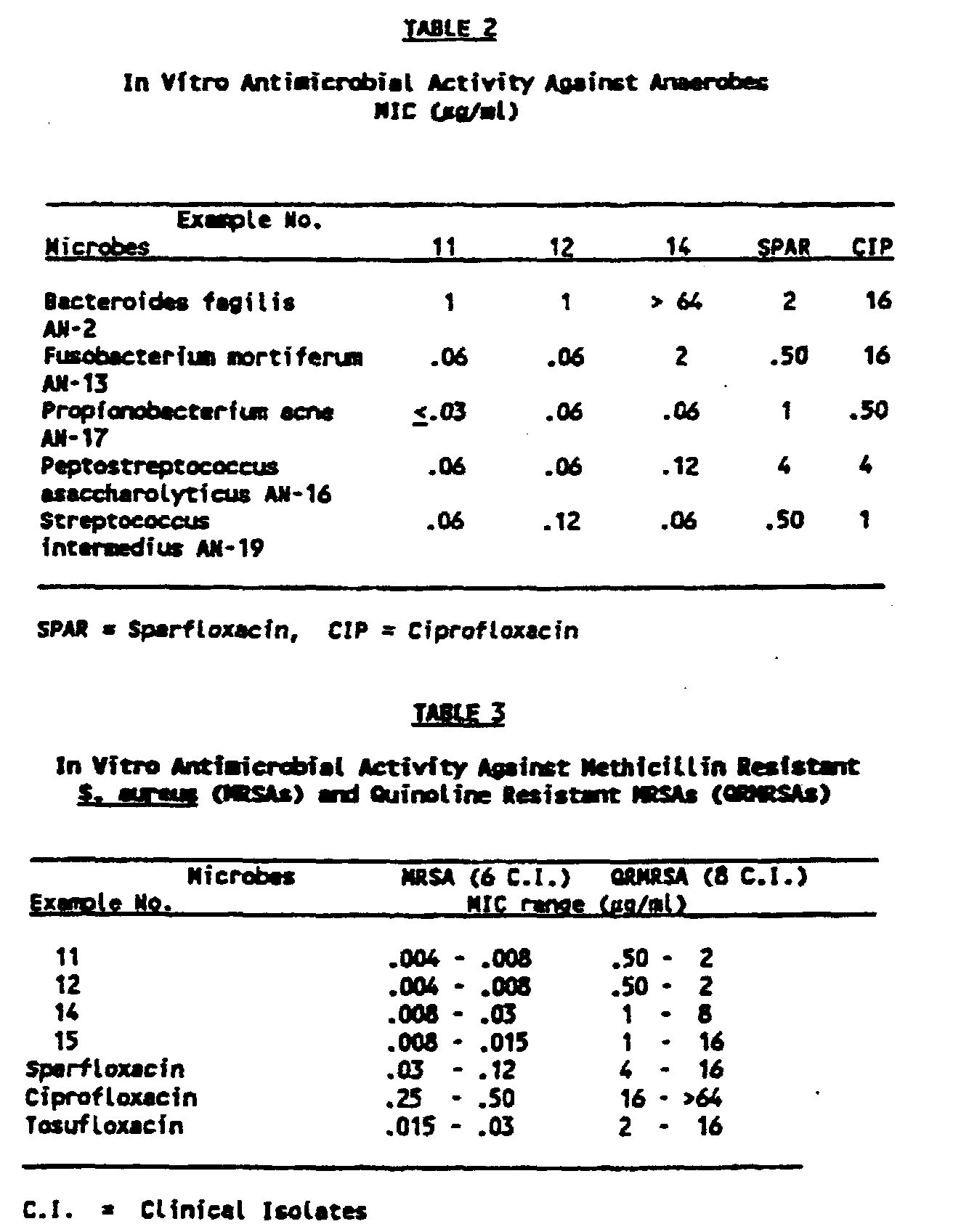
- In another test procedure, the compounds of the present invention showed antibacterial activity when tested by the standard broth microdilution method as described in the NCCLS document M7-A2. Approved standard: Method for Dilution Antimicrobial Susceptability Tests for Bacteria that Grow Aerobically - Second Edition, 1990. The test organisms were obtained from ATCC and clinical laboratories. The 96-well microtitre plates containing 100 ml of serially diluted test compounds in Mueller Hinton Broth (MHB) (conc. range 64-0.03 µg/ml) were inoculated with 100 ml of bacterial suspension in MHB so that an inoculum size of 5 x 10⁵ cfu/ml was achieved. The plates were shaken gently and incubated at 35°C for 18 hr after which the minimum inhibitory concentrations (MIC, µg/ml) at which no visible microbial growth occurred were recorded.
-
- EC. (S- 63):
- Eschericia coli
- Ecl. (S- 130):
- Enterobacter cloacae
- Pa. (S- 67):
- Pseudomonas aeruginosa
- Kp. (S- 80):
- Klebsiella pneumoniae
- Pr. (S- 121):
- Providencia rettgeri
- Sa. (S- 127):
- Staphylococcus aureus
-
Example No. Ec S-63 Ecl S-130 Pa S-67 Kp S-80 Pr S-121 Sa S-127 Sa 127M 21 .06 .25 2 .25 .12 .015 .015 22 .25 .25 4 .5 .25 ≤.015 .12 23 .12 .25 4 .5 .5 ≤.015 ≤.015 24 .12 .25 4 .5 .5 ≤.015 ≤.015 25 .06 .25 2 .25 .25 ≤.015 .03 26 .25 2 8 1 1 .03 .06 27 .25 1 4 .5 2 .125 .25 28 .12 ≤.015 29 .12 .25 4 .5 .25 .03 .06 31 .12 .5 2 .25 .5 ≤.015 ≤.015 32 .12 .5 4 .25 .12 ≤.03 ≤.03 33 .12 1 8 1 2 ≤.015 ≤.015 34 .5 .5 8 .5 .5 .5 35 .25 .5 4 .25 .25 ≤.015 .03 37 .5 2 8 1 1 .06 .25 38 .25 1 8 1 1 .12 .5 39 .25 1 8 1 1 .03 .12 40 1 1 8 1 .5 1 .5 39 .25 1 8 1 1 .03 .12 40 1 1 8 1 .5 1 .5 41 .12 - - - - .03 - 42 .5 1 4 1 1 .25 1 43 16 32 >32 32 32 8 8 44 .5 .25 8 1 1 25 - 45 .25 - - - - - 1 46 .25 1 32 1 .015 .015 .015 47 .25 16 >32 .5 .015 .015 .015 48 1 4 16 4 .015 .015 .015 49 .5 .50 8 .5 .12 .25 .25 50 1 2 16 1 .06 .25 .25 51 .06 - 2 .12 .12 ≤.03 ≤.03 52 .06 - 2 .25 .12 .06 - CPLX ≤.008 .03 .25 .015 .015 .25 8 MFLX .06 .12 1 .12 1 1 16 MFLX- .06 .25 1 .25 .12 2 16 CPLX = Ciprofloxacin
NFLX = Norfloxacin
NFLX-ch - Norfloxacin - choline salt - The compounds disclosed and described could be used in compositions to disinfect surfaces in environments where food is prepared.
Claims (9)
- A 7-substituted-6-fluoro-1,4-dihydro-4-oxo-quinoline-3-carboxylic acid compound of the formula:wherein R1 is a C3-C6 cycloalkyl group or a phenyl group which may be substituted by methoxy or amino or by one or two halogen atoms; R2 is hydrogen, a halogen atom, a C1-C4 alkyl group, a hydroxy group or an amino group;
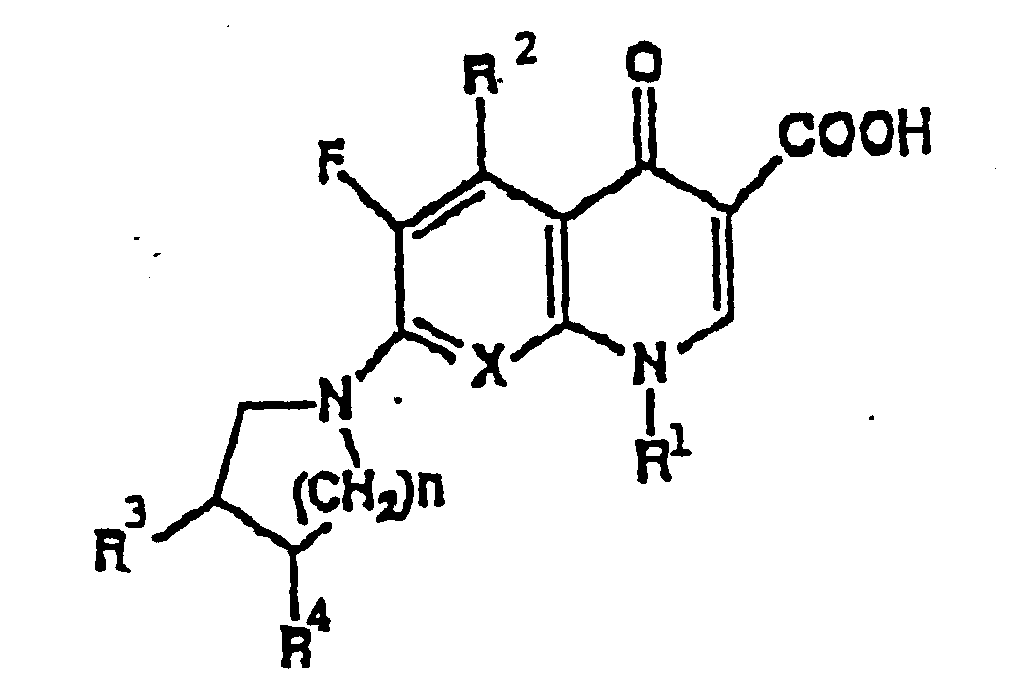 R3 is hydrogen, hydroxy or amino;R4 is a 1,2,3-triazol-1-yl group, a 1,2,4-triazol-1-yl group, a 1,2,3,4-tetrazol-1-yl or a 1,2,3,4-tetrazol-2-yl group, each of which may have 1 to 2 substituents selected from the group consisting of C1-C4 alkyl, COOH, CH2NH2, amino and phenyl groups; and X is N, CH, C-F or C-OCH3; n is 1; oror a pharmaceutically acceptable salt thereof.
- A compound according to claim 1, wherein R1 is phenyl, 4-fluorophenyl, 2,4-difluorophenyl, 2,4-dimethoxyphenyl or 4-aminophenyl.
- A compound according to claim 1, wherein R1 is optionally substituted by chloro, fluoro, bromo, methoxy or amino.
- A compound according to claim 1, wherein the compound has an asymmetric carbon atom on the pyrrolidine ring, and the compound is the R isomer, the S isomer or mixtures thereof.
- A compound according to claim 1, wherein the compound has two asymmetric carbon atoms on the pyrrolidine ring, and the compound is a stereoisomer of the cis or trans configuration, or mixtures thereof.
- A process for preparing a 7-substituted-6-fluoro-1, 4-dihydro-4-oxo-quinoline-3-carboxylic acid compound of the formula:wherein R1 is a C3-C6 cycloalkyl group or a phenyl group which may be substituted by methoxy or amino or by one or two halogen atoms; R2 is hydrogen, a halogen atom, a C1-C4 alkyl group, a hydroxy group or an amino group;
 R3 is hydrogen, hydroxy or amino;R4 is a 1,2,3-triazol-1-yl group, a 1,2,4-triazol-1-yl group, a 1,2,3,4-tetrazol-1-yl or a 1,2,3,4-tetrazol-2-yl group, each of which may have 1 to 2 substituents selected from the group consisting of C1-C4 alkyl, COOH, CH2NH2, amino and phenyl groups; andX is N, CH, C-F or C-OCH3;n is 1; oror a pharmaceutically acceptable salt thereof, said process comprising reacting a compound of the formula
 with a compound of the formula
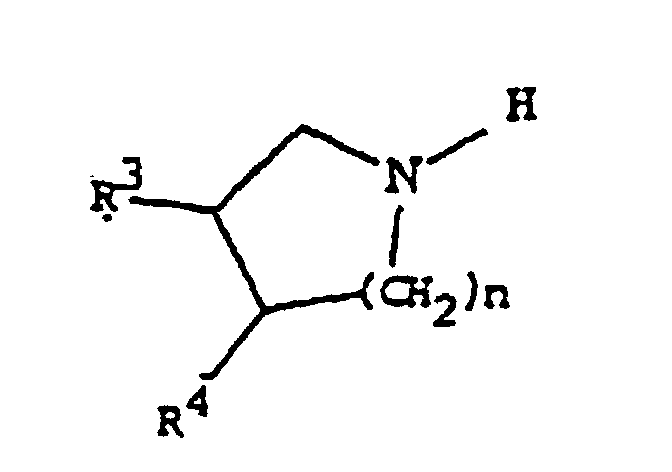 wherein R1, R2, R3, R4, n and X are as defined above; L is a leaving group selected from chlorine, fluorine and SO2R7, wherein R7 is a C1-C4 alkyl group or an unsubstituted or substituted phenyl group.
- A pharmaceutical composition suitable for treating bacterial infections comprising an antibacterial amount of a compound of claim 1 and a pharmaceutically acceptable carrier.
- A method for disinfecting a surface to be disinfected which comprises treating the surface with a composition containing an antibacterial effective amount of a compound of claim 1.
- Use of a compound according to claim 1 in the manufacture of a medicament for treatment of a human suffering from a bacterial infection.
Applications Claiming Priority (3)
| Application Number | Priority Date | Filing Date | Title |
|---|---|---|---|
| US62171690A | 1990-12-05 | 1990-12-05 | |
| US621716 | 1990-12-05 | ||
| PCT/CA1991/000435 WO1992010492A1 (en) | 1990-12-05 | 1991-12-05 | 7-substituted-6-fluoro-1,4-dihydro-4-oxo-quinoline-3-carboxylic acid compounds useful as antibacterial agents |
Publications (2)
| Publication Number | Publication Date |
|---|---|
| EP0561850A1 EP0561850A1 (en) | 1993-09-29 |
| EP0561850B1 true EP0561850B1 (en) | 2000-07-12 |
Family
ID=24491336
Family Applications (1)
| Application Number | Title | Priority Date | Filing Date |
|---|---|---|---|
| EP91920890A Expired - Lifetime EP0561850B1 (en) | 1990-12-05 | 1991-12-05 | 7-substituted-6-fluoro-1,4-dihydro-4-oxo-quinoline-3-carboxylic acid compounds useful as antibacterial agents |
Country Status (12)
| Country | Link |
|---|---|
| EP (1) | EP0561850B1 (en) |
| JP (1) | JPH06507149A (en) |
| KR (1) | KR100196440B1 (en) |
| AT (1) | ATE194612T1 (en) |
| CA (1) | CA2099591C (en) |
| DE (1) | DE69132314T2 (en) |
| FI (1) | FI932596A7 (en) |
| HU (2) | HUT64058A (en) |
| NO (1) | NO305479B1 (en) |
| NZ (1) | NZ240883A (en) |
| WO (1) | WO1992010492A1 (en) |
| ZA (1) | ZA919601B (en) |
Families Citing this family (12)
| Publication number | Priority date | Publication date | Assignee | Title |
|---|---|---|---|---|
| US5342846A (en) * | 1990-12-05 | 1994-08-30 | Synphar Laboratories, Inc. | 7-substituted-6-fluoro-1,4-dihydro-4-oxo-quinoline-3-carboxylic acid compounds and 7-(substituted triazolyl pyrrolidin-1-yl) 4-oxoquinoline-3-carboxylic acid derivatives useful as antibacterial agents |
| US5221676A (en) * | 1992-02-06 | 1993-06-22 | Warner-Lambert Company | 7-substituted quinolones and naphthyridones as antibacterial agents |
| KR960003616B1 (en) * | 1992-07-23 | 1996-03-20 | 재단법인 한국화학연구소 | Novel pyridone carboxylic acid derivative having excellent antibacterial activity and preparation method thereof |
| TW252107B (en) * | 1993-08-27 | 1995-07-21 | Hokuriku Pharmacetical Co Ltd | |
| KR19980701625A (en) * | 1995-01-24 | 1998-06-25 | 이토 마사노리 | Quinolinecarboxylic acid derivative |
| ES2185591T3 (en) * | 1999-06-02 | 2003-05-01 | Warner Lambert Co | AMINO HEREROCICLES USEFUL AS PHARMACEUTICAL AGENTS. |
| US6821969B2 (en) * | 2001-02-13 | 2004-11-23 | Pharmacia & Upjohn Company | Thioxazinoquinolones as antiviral agents |
| KR102001364B1 (en) * | 2011-05-13 | 2019-07-22 | 어레이 바이오파마 인크. | Pyrrolidinyl urea and pyrrolidinyl thiourea compounds as trka kinase inhibitors |
| MY165004A (en) | 2011-08-31 | 2018-02-28 | Otsuka Pharma Co Ltd | Quinolone compound |
| EP3110794A1 (en) | 2014-02-27 | 2017-01-04 | Merck Patent GmbH | Heterocyclic compounds as nav channel inhibitors and uses thereof |
| GB201708606D0 (en) | 2017-05-30 | 2017-07-12 | King S College London | Antibiotic resistance breakers |
| EP3886854A4 (en) | 2018-11-30 | 2022-07-06 | Nuvation Bio Inc. | PYRROLE AND PYRAZOLE COMPOUNDS AND METHODS OF USE THEREOF |
Family Cites Families (5)
| Publication number | Priority date | Publication date | Assignee | Title |
|---|---|---|---|---|
| IE58742B1 (en) * | 1984-07-20 | 1993-11-05 | Warner Lambert Co | Substituted-9-fluoro-3-methyl-7-oxo-2,3-dihydro-7h-pyrido[1,2,3-de] [1,4]benzoxauine-6-carboxylic acids; sibstituted-5-amino-6-6fluoro-4-oxo.1,4-dihydroquinoline-3 carboxylic acids; substituted-5-amino-6-fluoro-1,4-dihydro-4-oxo-1.8-naphthyridine-3-carboxylic acids; derivatives thereof; pharmaceutical compositions comprising the compounds; and processes for producing the compounds |
| DE3519286A1 (en) * | 1985-05-30 | 1986-12-04 | Bayer Ag, 5090 Leverkusen | 7-AZOLYL-1-CYCLOPROPYL-1,4-DIHYDRO-4-OXO-3-CHINOLINE CARBONIC ACIDS AND -1,8-NAPHTHYRIDINE-3-CARBONIC ACIDS, METHOD FOR THE PRODUCTION THEREOF AND THEIR ANTIBACTERS CONTAINING THEM |
| DE3906365A1 (en) * | 1988-07-15 | 1990-01-18 | Bayer Ag | 7- (1-PYRROLIDINYL) -3-CHINOLONE AND NAPHTHYRIDONE CARBOXYLIC ACID DERIVATIVES, METHOD AND SUBSTITUTED (OXA) DIAZABICYCLOOCTANES AND NONANESE AS INTERMEDIATE PRODUCTS, AND ANTIBACTERIAL AGENTS AND FOOD ADDITIVES CONTAINING THEM |
| AU5123690A (en) * | 1989-03-13 | 1990-09-13 | Bristol-Myers Squibb Company | 5-substituted-1,4-dihydro-4-oxo-nephthyridine-3-carboxylate antibacterial agents |
| NO177302C (en) * | 1989-03-16 | 1995-08-23 | Esteve Labor Dr | Analogous Process for Preparing Therapeutically Active Substituted Azetidinyl Quinolone (Naphthyridone) Carboxylic Acid Derivatives |
-
1991
- 1991-12-05 NZ NZ240883A patent/NZ240883A/en unknown
- 1991-12-05 HU HU931648D patent/HUT64058A/en unknown
- 1991-12-05 ZA ZA919601A patent/ZA919601B/en unknown
- 1991-12-05 WO PCT/CA1991/000435 patent/WO1992010492A1/en not_active Ceased
- 1991-12-05 KR KR1019930701694A patent/KR100196440B1/en not_active Expired - Fee Related
- 1991-12-05 HU HU931648A patent/HU9301648D0/en unknown
- 1991-12-05 JP JP4500232A patent/JPH06507149A/en active Pending
- 1991-12-05 EP EP91920890A patent/EP0561850B1/en not_active Expired - Lifetime
- 1991-12-05 DE DE69132314T patent/DE69132314T2/en not_active Expired - Fee Related
- 1991-12-05 CA CA002099591A patent/CA2099591C/en not_active Expired - Fee Related
- 1991-12-05 AT AT91920890T patent/ATE194612T1/en not_active IP Right Cessation
-
1993
- 1993-06-03 NO NO932033A patent/NO305479B1/en unknown
- 1993-06-07 FI FI932596A patent/FI932596A7/en unknown
Non-Patent Citations (1)
| Title |
|---|
| Abstracts of the 30th Interscience Conference on Antimicrobial Agents and Chemotherapy, Atlanta, October 21-24, 1990, Abstract No. 395 * |
Also Published As
| Publication number | Publication date |
|---|---|
| HUT64058A (en) | 1993-11-29 |
| AU666296B2 (en) | 1996-02-08 |
| KR100196440B1 (en) | 1999-06-15 |
| EP0561850A1 (en) | 1993-09-29 |
| DE69132314D1 (en) | 2000-08-17 |
| DE69132314T2 (en) | 2000-12-14 |
| NO932033L (en) | 1993-06-03 |
| ATE194612T1 (en) | 2000-07-15 |
| JPH06507149A (en) | 1994-08-11 |
| NZ240883A (en) | 1994-09-27 |
| FI932596A0 (en) | 1993-06-07 |
| WO1992010492A1 (en) | 1992-06-25 |
| ZA919601B (en) | 1992-10-28 |
| HU9301648D0 (en) | 1993-09-28 |
| CA2099591A1 (en) | 1992-06-06 |
| AU9021091A (en) | 1992-07-08 |
| NO305479B1 (en) | 1999-06-07 |
| FI932596A7 (en) | 1993-08-04 |
| CA2099591C (en) | 2002-11-12 |
| NO932033D0 (en) | 1993-06-03 |
Similar Documents
| Publication | Publication Date | Title |
|---|---|---|
| US5342846A (en) | 7-substituted-6-fluoro-1,4-dihydro-4-oxo-quinoline-3-carboxylic acid compounds and 7-(substituted triazolyl pyrrolidin-1-yl) 4-oxoquinoline-3-carboxylic acid derivatives useful as antibacterial agents | |
| US4880806A (en) | 1-Cyclopropyl-6-fluoro-7-piperazinyl-1,4-Dihydro-4-oxo-quinoline-3-carboxylic acid derivatives | |
| AU623757B2 (en) | Novel quinolone derivatives, preparation processes thereof, and antibacterial agents containing the same | |
| EP0140116B1 (en) | A 6-fluoro-1,4-dihydro-4-oxo-7-substituted piperazinyl-quinoline-3-carboxylic acid derivative and the method for preparing the same | |
| EP0241206A2 (en) | Quinoline-3-carboxylic acid derivatives, their preparation and use | |
| EP0208210A1 (en) | Pyridonecarboxylic acid derivatives and process for their preparation | |
| US5153203A (en) | Quinolone derivatives and salts thereof, preparation processes thereof, and antibacterial agents containing the same | |
| US5254685A (en) | Tricyclic compound or salts thereof, method for producing the same and antimicrobial agent containing the same | |
| DE69132314T2 (en) | 7-SUBSTITUTED-6-FLUOR-1,4-DIHYDRO-4-OXO-CHINOLIN-3-CARBONIC ACID DERIVATIVES AS AN ANTIBACTERIAL ACTIVE SUBSTANCES | |
| AU2002361493A1 (en) | New generation triple-targeting, chiral, broad-spectrum antimicrobial 7-substituted piperidino-quinolone carboxylic acid derivatives, their preparation, compositions and use as medicaments | |
| US5045549A (en) | Substituted 4-pyridone 3-carboxylic acid derivatives, method for their production and their pharmaceutical compositions | |
| CA2011939A1 (en) | 5-substituted-1,4-dihydro-4-oxo-naphthyridine-3-carboxylate antibacterial agents | |
| DE69020199T2 (en) | Derivatives of pyridone carboxylic acid substituted by azetidines, their preparation and use as medicines. | |
| US5399553A (en) | Tricyclic compound or salts thereof, method for producing the same and anti-microbial agent containing the same | |
| IE61624B1 (en) | Tricyclic compounds | |
| US5668147A (en) | Quinolinecarboxylic acid derivatives and salts thereof | |
| JPS61189281A (en) | Pyridonecarboxylic acid derivative, and ester and salt thereof | |
| US5990106A (en) | Bicyclic amino group-substituted pyridonecarboxylic acid derivatives, esters thereof and salts thereof, and bicyclic amines useful as intermediates thereof | |
| AU666296C (en) | 7-substituted-6-fluoro-1,4-dihydro-4-oxo-quinoline-3- carboxylic acid compounds useful as antibacterial agents | |
| AU617181B2 (en) | Quinolonecarboxylic acids | |
| EP0500835B1 (en) | A novel quinolone carboxylic acid derivative | |
| US6017911A (en) | Pyridonecarboxylic acid derivatives and intermediates for the synthesis thereof | |
| EP0339406A1 (en) | Quinoline-3-carboxylic acid derivatives, process for preparing the same, and composition exhibiting excellent antibacterial effect containing the same | |
| Miyamoto et al. | Synthesis and biological properties of substituted 1, 4-dihydro-5-methyl-4-oxo-3-quinolinecarboxylic acids | |
| EP0311948A2 (en) | Quinolonecarboxylic acid compounds and pharmaceutical use thereof |
Legal Events
| Date | Code | Title | Description |
|---|---|---|---|
| PUAI | Public reference made under article 153(3) epc to a published international application that has entered the european phase |
Free format text: ORIGINAL CODE: 0009012 |
|
| 17P | Request for examination filed |
Effective date: 19930615 |
|
| AK | Designated contracting states |
Kind code of ref document: A1 Designated state(s): AT BE CH DE DK ES FR GB GR IT LI LU MC NL |
|
| RIN1 | Information on inventor provided before grant (corrected) |
Inventor name: DOERKSEN, THOMAS, ROGER Inventor name: MICETICH, RONALD GEORGE Inventor name: SINGH, RAJESHWAR Inventor name: SINGH, MAYA PRAKASH Inventor name: THOMAS, GEORGE Inventor name: FAHTI-AFSHAR, RAKHSHANDEH Inventor name: SINGH, INDER PAL |
|
| 17Q | First examination report despatched |
Effective date: 19950315 |
|
| GRAG | Despatch of communication of intention to grant |
Free format text: ORIGINAL CODE: EPIDOS AGRA |
|
| GRAG | Despatch of communication of intention to grant |
Free format text: ORIGINAL CODE: EPIDOS AGRA |
|
| GRAH | Despatch of communication of intention to grant a patent |
Free format text: ORIGINAL CODE: EPIDOS IGRA |
|
| GRAH | Despatch of communication of intention to grant a patent |
Free format text: ORIGINAL CODE: EPIDOS IGRA |
|
| RAP1 | Party data changed (applicant data changed or rights of an application transferred) |
Owner name: NAEJA PHARMACEUTICAL INC. |
|
| GRAA | (expected) grant |
Free format text: ORIGINAL CODE: 0009210 |
|
| AK | Designated contracting states |
Kind code of ref document: B1 Designated state(s): AT BE CH DE DK ES FR GB GR IT LI LU MC NL |
|
| PG25 | Lapsed in a contracting state [announced via postgrant information from national office to epo] |
Ref country code: IT Free format text: LAPSE BECAUSE OF FAILURE TO SUBMIT A TRANSLATION OF THE DESCRIPTION OR TO PAY THE FEE WITHIN THE PRESCRIBED TIME-LIMIT;WARNING: LAPSES OF ITALIAN PATENTS WITH EFFECTIVE DATE BEFORE 2007 MAY HAVE OCCURRED AT ANY TIME BEFORE 2007. THE CORRECT EFFECTIVE DATE MAY BE DIFFERENT FROM THE ONE RECORDED. Effective date: 20000712 Ref country code: CH Free format text: LAPSE BECAUSE OF FAILURE TO SUBMIT A TRANSLATION OF THE DESCRIPTION OR TO PAY THE FEE WITHIN THE PRESCRIBED TIME-LIMIT Effective date: 20000712 Ref country code: GR Free format text: LAPSE BECAUSE OF NON-PAYMENT OF DUE FEES Effective date: 20000712 Ref country code: FR Free format text: LAPSE BECAUSE OF FAILURE TO SUBMIT A TRANSLATION OF THE DESCRIPTION OR TO PAY THE FEE WITHIN THE PRESCRIBED TIME-LIMIT Effective date: 20000712 Ref country code: ES Free format text: THE PATENT HAS BEEN ANNULLED BY A DECISION OF A NATIONAL AUTHORITY Effective date: 20000712 Ref country code: AT Free format text: LAPSE BECAUSE OF FAILURE TO SUBMIT A TRANSLATION OF THE DESCRIPTION OR TO PAY THE FEE WITHIN THE PRESCRIBED TIME-LIMIT Effective date: 20000712 Ref country code: LI Free format text: LAPSE BECAUSE OF FAILURE TO SUBMIT A TRANSLATION OF THE DESCRIPTION OR TO PAY THE FEE WITHIN THE PRESCRIBED TIME-LIMIT Effective date: 20000712 Ref country code: NL Free format text: LAPSE BECAUSE OF FAILURE TO SUBMIT A TRANSLATION OF THE DESCRIPTION OR TO PAY THE FEE WITHIN THE PRESCRIBED TIME-LIMIT Effective date: 20000712 Ref country code: BE Free format text: LAPSE BECAUSE OF FAILURE TO SUBMIT A TRANSLATION OF THE DESCRIPTION OR TO PAY THE FEE WITHIN THE PRESCRIBED TIME-LIMIT Effective date: 20000712 |
|
| REF | Corresponds to: |
Ref document number: 194612 Country of ref document: AT Date of ref document: 20000715 Kind code of ref document: T |
|
| REG | Reference to a national code |
Ref country code: CH Ref legal event code: EP |
|
| REF | Corresponds to: |
Ref document number: 69132314 Country of ref document: DE Date of ref document: 20000817 |
|
| PG25 | Lapsed in a contracting state [announced via postgrant information from national office to epo] |
Ref country code: DK Free format text: LAPSE BECAUSE OF FAILURE TO SUBMIT A TRANSLATION OF THE DESCRIPTION OR TO PAY THE FEE WITHIN THE PRESCRIBED TIME-LIMIT Effective date: 20001012 |
|
| NLV1 | Nl: lapsed or annulled due to failure to fulfill the requirements of art. 29p and 29m of the patents act | ||
| PG25 | Lapsed in a contracting state [announced via postgrant information from national office to epo] |
Ref country code: LU Free format text: LAPSE BECAUSE OF NON-PAYMENT OF DUE FEES Effective date: 20001205 |
|
| EN | Fr: translation not filed | ||
| PG25 | Lapsed in a contracting state [announced via postgrant information from national office to epo] |
Ref country code: MC Free format text: THE PATENT HAS BEEN ANNULLED BY A DECISION OF A NATIONAL AUTHORITY Effective date: 20001231 |
|
| REG | Reference to a national code |
Ref country code: CH Ref legal event code: PL |
|
| PLBE | No opposition filed within time limit |
Free format text: ORIGINAL CODE: 0009261 |
|
| STAA | Information on the status of an ep patent application or granted ep patent |
Free format text: STATUS: NO OPPOSITION FILED WITHIN TIME LIMIT |
|
| 26N | No opposition filed | ||
| REG | Reference to a national code |
Ref country code: GB Ref legal event code: IF02 |
|
| PGFP | Annual fee paid to national office [announced via postgrant information from national office to epo] |
Ref country code: GB Payment date: 20021210 Year of fee payment: 12 |
|
| PGFP | Annual fee paid to national office [announced via postgrant information from national office to epo] |
Ref country code: DE Payment date: 20030130 Year of fee payment: 12 |
|
| PG25 | Lapsed in a contracting state [announced via postgrant information from national office to epo] |
Ref country code: GB Free format text: LAPSE BECAUSE OF NON-PAYMENT OF DUE FEES Effective date: 20031205 |
|
| PG25 | Lapsed in a contracting state [announced via postgrant information from national office to epo] |
Ref country code: DE Free format text: LAPSE BECAUSE OF NON-PAYMENT OF DUE FEES Effective date: 20040701 |
|
| GBPC | Gb: european patent ceased through non-payment of renewal fee |
Effective date: 20031205 |