EP0561789B1 - Determination of aromatics in hydrocarbons by near infrared spectroscopy - Google Patents
Determination of aromatics in hydrocarbons by near infrared spectroscopy Download PDFInfo
- Publication number
- EP0561789B1 EP0561789B1 EP91917609A EP91917609A EP0561789B1 EP 0561789 B1 EP0561789 B1 EP 0561789B1 EP 91917609 A EP91917609 A EP 91917609A EP 91917609 A EP91917609 A EP 91917609A EP 0561789 B1 EP0561789 B1 EP 0561789B1
- Authority
- EP
- European Patent Office
- Prior art keywords
- aromatic
- mixture
- aromatics
- feedstock
- absorbance
- Prior art date
- Legal status (The legal status is an assumption and is not a legal conclusion. Google has not performed a legal analysis and makes no representation as to the accuracy of the status listed.)
- Expired - Lifetime
Links
- 150000002430 hydrocarbons Chemical class 0.000 title claims abstract description 18
- 229930195733 hydrocarbon Natural products 0.000 title claims abstract description 17
- 238000004497 NIR spectroscopy Methods 0.000 title description 7
- 125000003118 aryl group Chemical group 0.000 claims abstract description 37
- 238000002835 absorbance Methods 0.000 claims abstract description 28
- 239000004215 Carbon black (E152) Substances 0.000 claims abstract description 13
- 238000000034 method Methods 0.000 claims description 37
- 239000000203 mixture Substances 0.000 claims description 35
- 239000002283 diesel fuel Substances 0.000 claims description 18
- 238000004458 analytical method Methods 0.000 claims description 11
- 239000007788 liquid Substances 0.000 claims description 8
- CIWBSHSKHKDKBQ-JLAZNSOCSA-N Ascorbic acid Chemical compound OC[C@H](O)[C@H]1OC(=O)C(O)=C1O CIWBSHSKHKDKBQ-JLAZNSOCSA-N 0.000 claims description 7
- 238000004128 high performance liquid chromatography Methods 0.000 claims description 6
- 238000005259 measurement Methods 0.000 claims description 4
- 238000011481 absorbance measurement Methods 0.000 claims 1
- 238000012544 monitoring process Methods 0.000 claims 1
- 238000005070 sampling Methods 0.000 claims 1
- 239000000446 fuel Substances 0.000 abstract description 8
- 238000009835 boiling Methods 0.000 abstract description 2
- 238000002953 preparative HPLC Methods 0.000 abstract description 2
- 239000000523 sample Substances 0.000 description 18
- VLKZOEOYAKHREP-UHFFFAOYSA-N n-Hexane Chemical compound CCCCCC VLKZOEOYAKHREP-UHFFFAOYSA-N 0.000 description 6
- 239000003921 oil Substances 0.000 description 6
- UFHFLCQGNIYNRP-UHFFFAOYSA-N Hydrogen Chemical compound [H][H] UFHFLCQGNIYNRP-UHFFFAOYSA-N 0.000 description 4
- 238000010521 absorption reaction Methods 0.000 description 4
- 238000000862 absorption spectrum Methods 0.000 description 4
- 239000001257 hydrogen Substances 0.000 description 4
- 229910052739 hydrogen Inorganic materials 0.000 description 4
- 239000003208 petroleum Substances 0.000 description 4
- 239000002904 solvent Substances 0.000 description 4
- YMWUJEATGCHHMB-UHFFFAOYSA-N Dichloromethane Chemical group ClCCl YMWUJEATGCHHMB-UHFFFAOYSA-N 0.000 description 3
- 150000001336 alkenes Chemical class 0.000 description 3
- 239000000470 constituent Substances 0.000 description 3
- 239000000835 fiber Substances 0.000 description 3
- 239000003502 gasoline Substances 0.000 description 3
- 238000004886 process control Methods 0.000 description 3
- 238000010923 batch production Methods 0.000 description 2
- 238000006243 chemical reaction Methods 0.000 description 2
- 150000001875 compounds Chemical class 0.000 description 2
- 238000010438 heat treatment Methods 0.000 description 2
- 239000003350 kerosene Substances 0.000 description 2
- 238000004519 manufacturing process Methods 0.000 description 2
- 238000004949 mass spectrometry Methods 0.000 description 2
- 239000010743 number 2 fuel oil Substances 0.000 description 2
- TVMXDCGIABBOFY-UHFFFAOYSA-N octane Chemical compound CCCCCCCC TVMXDCGIABBOFY-UHFFFAOYSA-N 0.000 description 2
- 238000002390 rotary evaporation Methods 0.000 description 2
- 238000000926 separation method Methods 0.000 description 2
- VYPSYNLAJGMNEJ-UHFFFAOYSA-N silicon dioxide Inorganic materials O=[Si]=O VYPSYNLAJGMNEJ-UHFFFAOYSA-N 0.000 description 2
- 230000003595 spectral effect Effects 0.000 description 2
- NINIDFKCEFEMDL-UHFFFAOYSA-N Sulfur Chemical compound [S] NINIDFKCEFEMDL-UHFFFAOYSA-N 0.000 description 1
- 239000005864 Sulphur Substances 0.000 description 1
- 150000004945 aromatic hydrocarbons Chemical class 0.000 description 1
- 238000010504 bond cleavage reaction Methods 0.000 description 1
- 238000004587 chromatography analysis Methods 0.000 description 1
- 238000012937 correction Methods 0.000 description 1
- 230000006378 damage Effects 0.000 description 1
- 230000009849 deactivation Effects 0.000 description 1
- 230000003247 decreasing effect Effects 0.000 description 1
- 238000010586 diagram Methods 0.000 description 1
- 239000003480 eluent Substances 0.000 description 1
- 230000007613 environmental effect Effects 0.000 description 1
- 239000012530 fluid Substances 0.000 description 1
- 239000003269 fluorescent indicator Substances 0.000 description 1
- 239000000295 fuel oil Substances 0.000 description 1
- 238000004817 gas chromatography Methods 0.000 description 1
- 238000003987 high-resolution gas chromatography Methods 0.000 description 1
- 238000005984 hydrogenation reaction Methods 0.000 description 1
- 230000003116 impacting effect Effects 0.000 description 1
- 238000011835 investigation Methods 0.000 description 1
- 238000007620 mathematical function Methods 0.000 description 1
- 238000002156 mixing Methods 0.000 description 1
- 238000000491 multivariate analysis Methods 0.000 description 1
- 150000002790 naphthalenes Chemical class 0.000 description 1
- 230000003287 optical effect Effects 0.000 description 1
- 239000012188 paraffin wax Substances 0.000 description 1
- 238000004445 quantitative analysis Methods 0.000 description 1
- 238000011160 research Methods 0.000 description 1
- 229920006395 saturated elastomer Polymers 0.000 description 1
- 230000007017 scission Effects 0.000 description 1
- -1 silica diamine Chemical class 0.000 description 1
- 239000000741 silica gel Substances 0.000 description 1
- 229910002027 silica gel Inorganic materials 0.000 description 1
- 239000000377 silicon dioxide Substances 0.000 description 1
- 238000004611 spectroscopical analysis Methods 0.000 description 1
- 239000000126 substance Substances 0.000 description 1
- 238000012360 testing method Methods 0.000 description 1
- XLYOFNOQVPJJNP-UHFFFAOYSA-N water Substances O XLYOFNOQVPJJNP-UHFFFAOYSA-N 0.000 description 1
- 239000003643 water by type Substances 0.000 description 1
Images



Classifications
-
- G—PHYSICS
- G01—MEASURING; TESTING
- G01N—INVESTIGATING OR ANALYSING MATERIALS BY DETERMINING THEIR CHEMICAL OR PHYSICAL PROPERTIES
- G01N21/00—Investigating or analysing materials by the use of optical means, i.e. using sub-millimetre waves, infrared, visible or ultraviolet light
- G01N21/17—Systems in which incident light is modified in accordance with the properties of the material investigated
- G01N21/25—Colour; Spectral properties, i.e. comparison of effect of material on the light at two or more different wavelengths or wavelength bands
- G01N21/31—Investigating relative effect of material at wavelengths characteristic of specific elements or molecules, e.g. atomic absorption spectrometry
- G01N21/35—Investigating relative effect of material at wavelengths characteristic of specific elements or molecules, e.g. atomic absorption spectrometry using infrared light
- G01N21/359—Investigating relative effect of material at wavelengths characteristic of specific elements or molecules, e.g. atomic absorption spectrometry using infrared light using near infrared light
-
- G—PHYSICS
- G01—MEASURING; TESTING
- G01N—INVESTIGATING OR ANALYSING MATERIALS BY DETERMINING THEIR CHEMICAL OR PHYSICAL PROPERTIES
- G01N21/00—Investigating or analysing materials by the use of optical means, i.e. using sub-millimetre waves, infrared, visible or ultraviolet light
- G01N21/17—Systems in which incident light is modified in accordance with the properties of the material investigated
- G01N21/25—Colour; Spectral properties, i.e. comparison of effect of material on the light at two or more different wavelengths or wavelength bands
- G01N21/31—Investigating relative effect of material at wavelengths characteristic of specific elements or molecules, e.g. atomic absorption spectrometry
- G01N21/35—Investigating relative effect of material at wavelengths characteristic of specific elements or molecules, e.g. atomic absorption spectrometry using infrared light
- G01N21/3577—Investigating relative effect of material at wavelengths characteristic of specific elements or molecules, e.g. atomic absorption spectrometry using infrared light for analysing liquids, e.g. polluted water
-
- G—PHYSICS
- G01—MEASURING; TESTING
- G01N—INVESTIGATING OR ANALYSING MATERIALS BY DETERMINING THEIR CHEMICAL OR PHYSICAL PROPERTIES
- G01N33/00—Investigating or analysing materials by specific methods not covered by groups G01N1/00 - G01N31/00
- G01N33/26—Oils; Viscous liquids; Paints; Inks
- G01N33/28—Oils, i.e. hydrocarbon liquids
- G01N33/2835—Specific substances contained in the oils or fuels
- G01N33/287—Sulfur content
-
- Y—GENERAL TAGGING OF NEW TECHNOLOGICAL DEVELOPMENTS; GENERAL TAGGING OF CROSS-SECTIONAL TECHNOLOGIES SPANNING OVER SEVERAL SECTIONS OF THE IPC; TECHNICAL SUBJECTS COVERED BY FORMER USPC CROSS-REFERENCE ART COLLECTIONS [XRACs] AND DIGESTS
- Y10—TECHNICAL SUBJECTS COVERED BY FORMER USPC
- Y10S—TECHNICAL SUBJECTS COVERED BY FORMER USPC CROSS-REFERENCE ART COLLECTIONS [XRACs] AND DIGESTS
- Y10S208/00—Mineral oils: processes and products
- Y10S208/01—Automatic control
-
- Y—GENERAL TAGGING OF NEW TECHNOLOGICAL DEVELOPMENTS; GENERAL TAGGING OF CROSS-SECTIONAL TECHNOLOGIES SPANNING OVER SEVERAL SECTIONS OF THE IPC; TECHNICAL SUBJECTS COVERED BY FORMER USPC CROSS-REFERENCE ART COLLECTIONS [XRACs] AND DIGESTS
- Y10—TECHNICAL SUBJECTS COVERED BY FORMER USPC
- Y10T—TECHNICAL SUBJECTS COVERED BY FORMER US CLASSIFICATION
- Y10T436/00—Chemistry: analytical and immunological testing
- Y10T436/10—Composition for standardization, calibration, simulation, stabilization, preparation or preservation; processes of use in preparation for chemical testing
-
- Y—GENERAL TAGGING OF NEW TECHNOLOGICAL DEVELOPMENTS; GENERAL TAGGING OF CROSS-SECTIONAL TECHNOLOGIES SPANNING OVER SEVERAL SECTIONS OF THE IPC; TECHNICAL SUBJECTS COVERED BY FORMER USPC CROSS-REFERENCE ART COLLECTIONS [XRACs] AND DIGESTS
- Y10—TECHNICAL SUBJECTS COVERED BY FORMER USPC
- Y10T—TECHNICAL SUBJECTS COVERED BY FORMER US CLASSIFICATION
- Y10T436/00—Chemistry: analytical and immunological testing
- Y10T436/11—Automated chemical analysis
- Y10T436/117497—Automated chemical analysis with a continuously flowing sample or carrier stream
-
- Y—GENERAL TAGGING OF NEW TECHNOLOGICAL DEVELOPMENTS; GENERAL TAGGING OF CROSS-SECTIONAL TECHNOLOGIES SPANNING OVER SEVERAL SECTIONS OF THE IPC; TECHNICAL SUBJECTS COVERED BY FORMER USPC CROSS-REFERENCE ART COLLECTIONS [XRACs] AND DIGESTS
- Y10—TECHNICAL SUBJECTS COVERED BY FORMER USPC
- Y10T—TECHNICAL SUBJECTS COVERED BY FORMER US CLASSIFICATION
- Y10T436/00—Chemistry: analytical and immunological testing
- Y10T436/12—Condition responsive control
-
- Y—GENERAL TAGGING OF NEW TECHNOLOGICAL DEVELOPMENTS; GENERAL TAGGING OF CROSS-SECTIONAL TECHNOLOGIES SPANNING OVER SEVERAL SECTIONS OF THE IPC; TECHNICAL SUBJECTS COVERED BY FORMER USPC CROSS-REFERENCE ART COLLECTIONS [XRACs] AND DIGESTS
- Y10—TECHNICAL SUBJECTS COVERED BY FORMER USPC
- Y10T—TECHNICAL SUBJECTS COVERED BY FORMER US CLASSIFICATION
- Y10T436/00—Chemistry: analytical and immunological testing
- Y10T436/21—Hydrocarbon
- Y10T436/212—Aromatic
Definitions
- the present invention relates to the determination of aromatic constituents in hydrocarbons by near infrared (NIR) spectroscopy.
- NIR near infrared
- NIR spectroscopy is used to determine a variety of petrophysical and petrochemical properties of hydrocarbon mixtures, and more particularly teaches the use of the NIR absorbances measured at three different wavelengths as a secondary calibration technique to correlate the NIR absorption of a test sample to a primary standard and using multivariate analysis of the absorbance data, as taught, for example, in "Near Infrared Reflectance Analysis by Gauss-Jordan Linear Algebra", D.E. Honigs, J.M. Freelin, G.M. Hieftje, T.B. Hirschfeld, Applied Spectroscopy, vol. 37, no. 6, 1983, pp 491-497.
- NIR analysis techniques for other purposes are taught, for example, in J. Prakt. Chem., 317(1), 1-16 where NIR is used to perform structural group analysis of mixtures of saturated and aromatic hydrocarbons, and in Leimer and Schmidt in Chem. Tech. (Leipzig), 25(2), 99-100, where NIR is used in the quantitative analysis of benzene-toluene-paraffin mixtures.
- NIR spectroscopy has also been used in the determination of hydrocarbon functional groups such as CH3 and CH2, see Tosi and Tinto, Spectrochim ACTA, Part A, 28(3), 585-97.
- NIR spectroscopy is used to determine the absolute concentration of aromatics in hydrocarbon mixtures especially diesel fuel, kerosene, fuel oils at all grades such as light cycle oil, light vacuum oil, heating oils and vacuum oils as known in the petroleum industry. More particularly by measuring the absorption at a selected frequency or frequencies in the range 1650-1700 or 2120-2256 nm, and correcting for the absorption due to non-aromatics in the sample at that frequency, the absolute value of (or percent) aromatics in the sample can be determined.
- the establishment of the standard by which the NIR absorbance at those selected wavelengths is compared in order to derive the aromatic content of the mixture from those measurements is an important feature of the present invention and is accomplished by preliminarily separating the aromatics from the non-aromatics in the sample or a sample of similar composition by use of well-known preparative high performance liquid chromatography, e.g. as described in Petroleum Derived Hydrocarbons, John D. Bacha, John W. Newman, and J.L. White, ACS Symposium series 303, Chapter 6.
- Y MX + b + e
- the invention as described above, can be utilised for most fuels, preferably for diesel fuel, especially in the diesel No. 2 fuel oil boiling range and preferably by measuring absorbance at a selected frequency or frequencies in the range 1650-1700 nm or 2120-2256 nm.
- the invention can be utilised as a batch process, in a flow-through cell, by the use of fibreoptic probes either bundled or single fibre, and the process control can be either feed-back or feed-forward based on the samples absorbance in the near-infrared, or optionally the first derivative of the samples absorbance or some other mathematical function of absorbance, being employed e.g. to operate a control valve.
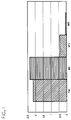
- Figure 1 is a comparison of the repeatability error (% by absolute error) of four analytical methods for determining aromatics in diesel fuels (no. 2 fuel oil).
- the methods compared are fluorescent indicator absorption (FIA) by ASTM D-1319; mass spectroscopy (MS); super fluid chromatography (SFC) in which CO2 above its critical pressure and temperature is used as the eluent; and near infrared according to the techniques of the present invention (NIR) for sets of 6 identical samples.
- FIA fluorescent indicator absorption
- MS mass spectroscopy
- SFC super fluid chromatography
- NIR near infrared according to the techniques of the present invention
- Figure 2 is a comparison of the percent aromatics determined in identical sets of 4 samples by heated FIA (a), heated FIA plus water deactivation of the chromatographic column (b), SFC (C); HPLC/DCD (high performance liquid chromatograph using a dielectric constant-measuring detector) (d); and the NIR of the present invention (e). Note that results are expressed in volume percent for the two FIA methods and the HPLC/DCD method, whereas SFC and NIR results are expressed in weight percent. Note that NIR (except in sample no. 2) is closest to the average of all methods combined.
- Figure 3 is a schematic diagram of a control system utilizing the NIR techniques of the present invention to control a refinery hydrogenation unit in which sufficient hydrogen is added not only to combine with the sulphur, but also sufficient to cause scission and destruction of aromatics in diesel fuel.
- Figure 4 is a near infrared absorbance spectrum of the aromatic fraction of a diesel fuel which was obtained by HPLC.
- Figure 5 shows a schematic control system as detailed in Example 4.
- Figure 6 is a near infrared absorbance spectrum of a typical diesel fuel.
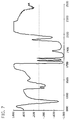
- Figure 7 is a plot showing the correlation observed at each wavelength from 1100 to 2500 nm for the aromatic content of diesel fuels using the techniques of the current invention. Note the superior correlation discovered at 1650 to 1700 nm and at 2120 to 2256 nm, most preferably 1654 to 1696 nm, or 2124 to 2252 nm, or both.
- Figure 8 is a near infrared absorbance spectrum of the non-aromatic fraction of diesel fuel which was obtained by HPLC. The method of this invention, and several of its applications, are described in the following Examples.
- a diesel fuel sample (6 grams) is separated into its aromatic and non-aromatic fractions by passing (@ 500 ml/minute) the fuel down a silica diamine column connected in series to a silica gel column using hexane as the solvent on a Waters Div. Millipore, Milford, Massachusetts, Model 500A high performance liquid chromatograph.
- the saturate fraction is collected off the end of the column and the hexane mobile phase is removed by rotary evaporation.
- the aromatics are then back flushed from the column by reversing the flow and substituting methylene chloride as the solvent.
- the solvent is again removed by rotary evaporation.
- the near infrared absorbance spectra of the non-aromatic and aromatic fractions are measured on an NIR Systems, Inc. Model 6500 spectrophotometer at 1672 nm and assigned concentrations of 0% and 100% aromatics by weight, respectively.
- Fibre optical probes preferably use the NIR range of 1650 to 1700 nm because of the cost and difficulty in obtaining non-absorbing fibre probes which transmit in the range of 2124 to 2252 nm.
- FIG 3 schematically shows an important process control application of this invention.
- New diesel fuel regulations require that highway fuel produced after October 1993 met a minimum cetane number specification. Cetane number and aromatics are closely related, as shown for Example in Figure 4.
- NIR instrument calibrated as according to this invention very close control of hydrotreater operation can be attained at minimum severity and hydrogen consumption.
- Raw feed, stream 300 flows through fired heater 310, fwel/effluent exchanger 340, is admixed with hydrogen stream 320, through an adiabatic hydrotreating reactor 330, to tankage.
- Aromatic content of the stream is measured by NIR probe 350, and this information provided to the process control computer 360. Conversion of aromatics content to estimated cetane number is made by the computer, and the flow of fuel stream 370 to the fired heater is adjusted as necessary by control valve 380. For instance, aromatics levels are higher and cetane number is lower in the fired heater and at lower reactor temperature. This lower temperature reduces the aromatics saturation reaction rate, increasing the aromatic content (decreasing the cetane number) of the diesel product. This results in a savings in hydrogen consumption, fuel, and other utilities. In the case of measured cetane number less than 40, a similar chain of events results in higher hydrotreating severity and reduced in the effluent product aromatics. This on-line control allows rapid, very lose control of product quality and eliminates present problems with production of off-spec finished products in quantities because corrections are implemented much sooner. This also results in a close-specification diesel fuel which is in much demand in today's marketplace.
- LOBS Low Odor Base Solvent
- compositions, methods and embodiments described herein are intended to be merely illustrative of the invention disclosed by this specification. Variation on these compositions, methods, or embodiments will be readily apparent to a person of skill in the art, based upon these teachings, and are therefore to be included as within the scope of the invention hereinbefore described, and hereinafter claimed.
Landscapes
- Physics & Mathematics (AREA)
- Chemical & Material Sciences (AREA)
- Spectroscopy & Molecular Physics (AREA)
- Health & Medical Sciences (AREA)
- Life Sciences & Earth Sciences (AREA)
- General Physics & Mathematics (AREA)
- Biochemistry (AREA)
- General Health & Medical Sciences (AREA)
- Analytical Chemistry (AREA)
- Immunology (AREA)
- Pathology (AREA)
- Engineering & Computer Science (AREA)
- Chemical Kinetics & Catalysis (AREA)
- General Chemical & Material Sciences (AREA)
- Oil, Petroleum & Natural Gas (AREA)
- Food Science & Technology (AREA)
- Medicinal Chemistry (AREA)
- Investigating Or Analysing Materials By Optical Means (AREA)
- Production Of Liquid Hydrocarbon Mixture For Refining Petroleum (AREA)
Abstract
Description
- The present invention relates to the determination of aromatic constituents in hydrocarbons by near infrared (NIR) spectroscopy.
- Hydrocarbon analysis by NIR spectroscopy is known and is used for a variety of different purposes. For example US-A-4,963,745 discloses the use of NIR spectroscopy to measure the octane rating of gasoline. See also "Prediction of Gasoline Octane Numbers from Near Infrared Spectral Features in the Range 660-1215 nm" by J.J. Kelly et al., Analytical Chemistry, vol. 61, no. 4, February 15, 1989, pp 313-320, and "Nondestructive Analytical Procedure for Simultaneous Estimation of the Major Classes of Hydrocarbon Constituents of Finished Gasolines", Analytical Chemistry, vol. 62, no. 14, July 15, 1990, pp 1444-1451.
- Also, in GB-A-2,217,838 NIR spectroscopy is used to determine a variety of petrophysical and petrochemical properties of hydrocarbon mixtures, and more particularly teaches the use of the NIR absorbances measured at three different wavelengths as a secondary calibration technique to correlate the NIR absorption of a test sample to a primary standard and using multivariate analysis of the absorbance data, as taught, for example, in "Near Infrared Reflectance Analysis by Gauss-Jordan Linear Algebra", D.E. Honigs, J.M. Freelin, G.M. Hieftje, T.B. Hirschfeld, Applied Spectroscopy, vol. 37, no. 6, 1983, pp 491-497.
- Other NIR analysis techniques for other purposes are taught, for example, in J. Prakt. Chem., 317(1), 1-16 where NIR is used to perform structural group analysis of mixtures of saturated and aromatic hydrocarbons, and in Leimer and Schmidt in Chem. Tech. (Leipzig), 25(2), 99-100, where NIR is used in the quantitative analysis of benzene-toluene-paraffin mixtures.
- NIR spectroscopy has also been used in the determination of hydrocarbon functional groups such as CH₃ and CH₂, see Tosi and Tinto, Spectrochim ACTA, Part A, 28(3), 585-97.
- Ultraviolet and near-infrared analysis of mixtures of aromatics is also taught by schmidt in Erdoelkohle, Erdgas, Petrochem., 21(6), 334-40, who sought to determine concentrations of specific compounds.
- Each of the above references teach as a correlation between the NIR absorbance and some physical or chemical property of the mixture under investigation but none of them teach as an absolute aromatic determination for a very complex mixture such as diesel fuel as is involved in the present invention.
- Also none of the references teach the determination of aromatics in a hydrocarbon mixture where GC separation is not possible due to coelution, GC separation being one of the more commonly used techniques in the analysis of hydrocarbons and where the percents of each of the individual compounds of a hydrocarbon mixture and as detected by gas chromatography are grouped under their respective generic classifications in the Paraffins, Isoparaffins, Aromatics, Naphthalenes, Olefins (PIANO) classification system, and the relative percentage of each of the components paraffins through olefins is determined in weight percent, volume percent, or mole percent as required. An example of this procedure is that taught by Analytical Automation Specialists, Inc., "The Detailed Analysis of Petroleum Naphthas, Reformates, Gasoline and Condensates by High-Resolution Gas Chromatography", Operators Manual, P.O. Box 80653, Baton Rouge, Louisiana 70898. Also available is AAS (Analytical Automated Systems) PIANO Software Package, Sievers Research PIANO Software Package.
- Increasing governmental regulation and environmental laws are impacting the permissible percentage of aromatics tolerated in diesel fuels, turbine fuels, kerosene, heating oils, and other oils.
- Therefore the need for accurate, absolute determinations of the present invention, particularly for on-line control of aromatics in fuels is increasing rapidly.
- According to the present invention NIR spectroscopy is used to determine the absolute concentration of aromatics in hydrocarbon mixtures especially diesel fuel, kerosene, fuel oils at all grades such as light cycle oil, light vacuum oil, heating oils and vacuum oils as known in the petroleum industry. More particularly by measuring the absorption at a selected frequency or frequencies in the range 1650-1700 or 2120-2256 nm, and correcting for the absorption due to non-aromatics in the sample at that frequency, the absolute value of (or percent) aromatics in the sample can be determined.
- The establishment of the standard by which the NIR absorbance at those selected wavelengths is compared in order to derive the aromatic content of the mixture from those measurements is an important feature of the present invention and is accomplished by preliminarily separating the aromatics from the non-aromatics in the sample or a sample of similar composition by use of well-known preparative high performance liquid chromatography, e.g. as described in Petroleum Derived Hydrocarbons, John D. Bacha, John W. Newman, and J.L. White, ACS Symposium series 303, Chapter 6.
- The NIR absorbance of each of the two portions is measured at the selected frequency or frequencies (e.g. 1672 nm), and the absorbances of those two fractions are used to determine the equation to be used in deriving the aromatic content of the original mixture, or of similar mixtures to be analysed subsequently. Thereafter the solution of the equation:

- In the above equation:
- M =
- the slope of the line (by the standard)
- X =
- the absorbance of the aromatics
- b =
- a constant which is determined by the fitting of the absorbance against the absolute weight values obtained above
- Y =
- percent aromatics
- e =
- any error in the determination
- Therefore the characteristic elements of the invention may be stated as:
- (a) separating the aromatics from the non-aromatics (saturates and olefins) in a representative sample to be used as a calibrating standard, preferably by preparatory high performance liquid chromatograph ("prep.HPLC"), said sample being taken from the mixture to be analysed, or one of similar composition;
- (b) measuring NIR absorbance of the resulting non-aromatics and aromatic portions derived from the above sample;
- (c) using the absorbances measured in (b) to derive the calibration equation and its constants by Beer-Lambert's Law or other well-known spectral data resolution techniques;
- (d) measuring the NIR absorbance of a mixture to be analysed; and
- (e) using the calibration equation, as determined in (a) and the NIR absorbance as determined in (d) to determine the aromatic content of the mixture (or conversely the non-aromatic content).
- The invention as described above, can be utilised for most fuels, preferably for diesel fuel, especially in the diesel No. 2 fuel oil boiling range and preferably by measuring absorbance at a selected frequency or frequencies in the range 1650-1700 nm or 2120-2256 nm. The invention can be utilised as a batch process, in a flow-through cell, by the use of fibreoptic probes either bundled or single fibre, and the process control can be either feed-back or feed-forward based on the samples absorbance in the near-infrared, or optionally the first derivative of the samples absorbance or some other mathematical function of absorbance, being employed e.g. to operate a control valve.
- In the drawings:
- Figure 1 is a comparison of the repeatability error (% by absolute error) of four analytical methods for determining aromatics in diesel fuels (no. 2 fuel oil). The methods compared are fluorescent indicator absorption (FIA) by ASTM D-1319; mass spectroscopy (MS); super fluid chromatography (SFC) in which CO2 above its critical pressure and temperature is used as the eluent; and near infrared according to the techniques of the present invention (NIR) for sets of 6 identical samples. This figures shows the excellent repeatability of the techniques of the present invention. (All determinations are in wt. % except FIA is in vol.%.).
- Figure 2 is a comparison of the percent aromatics determined in identical sets of 4 samples by heated FIA (a), heated FIA plus water deactivation of the chromatographic column (b), SFC (C); HPLC/DCD (high performance liquid chromatograph using a dielectric constant-measuring detector) (d); and the NIR of the present invention (e). Note that results are expressed in volume percent for the two FIA methods and the HPLC/DCD method, whereas SFC and NIR results are expressed in weight percent. Note that NIR (except in sample no. 2) is closest to the average of all methods combined.
- Figure 3 is a schematic diagram of a control system utilizing the NIR techniques of the present invention to control a refinery hydrogenation unit in which sufficient hydrogen is added not only to combine with the sulphur, but also sufficient to cause scission and destruction of aromatics in diesel fuel.
- Figure 4 is a near infrared absorbance spectrum of the aromatic fraction of a diesel fuel which was obtained by HPLC.
- Figure 5 shows a schematic control system as detailed in Example 4.
- Figure 6 is a near infrared absorbance spectrum of a typical diesel fuel.
- Figure 7 is a plot showing the correlation observed at each wavelength from 1100 to 2500 nm for the aromatic content of diesel fuels using the techniques of the current invention. Note the superior correlation discovered at 1650 to 1700 nm and at 2120 to 2256 nm, most preferably 1654 to 1696 nm, or 2124 to 2252 nm, or both.
- Figure 8 is a near infrared absorbance spectrum of the non-aromatic fraction of diesel fuel which was obtained by HPLC. The method of this invention, and several of its applications, are described in the following Examples.
- A diesel fuel sample (6 grams) is separated into its aromatic and non-aromatic fractions by passing (@ 500 ml/minute) the fuel down a silica diamine column connected in series to a silica gel column using hexane as the solvent on a Waters Div. Millipore, Milford, Massachusetts, Model 500A high performance liquid chromatograph. The saturate fraction is collected off the end of the column and the hexane mobile phase is removed by rotary evaporation. The aromatics are then back flushed from the column by reversing the flow and substituting methylene chloride as the solvent. The solvent is again removed by rotary evaporation.
- The near infrared absorbance spectra of the non-aromatic and aromatic fractions (or known proportions thereof) are measured on an NIR Systems, Inc. Model 6500 spectrophotometer at 1672 nm and assigned concentrations of 0% and 100% aromatics by weight, respectively.
- An equation of the form Y = mX + b is calculated from Beer-Lambert Law, where Y is the aromatic concentration, X is the absorbance, m is the slope of the regression line, and b is its Y-intercept.
- The absorbances of a series of five unknown diesel fuel samples are measured and, using the above equation and the sample's absorbance at 1672 nm, aromatic concentration of each sample is calculated and the correlations are plotted together as Figure 7. Note the near perfect correlation in the preferred bands of the invention.
- When the techniques of Example 1 are employed using fibreoptic probes to measure flowing streams and side streams in a refinery diesel fuel stream, accuracy approximately as good as obtained in the batch-process of Example 1 is achieved. Fibre optical probes preferably use the NIR range of 1650 to 1700 nm because of the cost and difficulty in obtaining non-absorbing fibre probes which transmit in the range of 2124 to 2252 nm.
- Figure 3 schematically shows an important process control application of this invention. New diesel fuel regulations require that highway fuel produced after October 1993 met a minimum cetane number specification. Cetane number and aromatics are closely related, as shown for Example in Figure 4. "Reduction of Aromatics in Diesel Fuel", A.J. Suchanek, in National Petroleum Refiners Association, AM-90-21, 1990. By use of this or similar relations, and an NIR instrument calibrated as according to this invention, very close control of hydrotreater operation can be attained at minimum severity and hydrogen consumption. Raw feed,
stream 300, flows through firedheater 310, fwel/effluent exchanger 340, is admixed withhydrogen stream 320, through anadiabatic hydrotreating reactor 330, to tankage. Aromatic content of the stream is measured byNIR probe 350, and this information provided to theprocess control computer 360. Conversion of aromatics content to estimated cetane number is made by the computer, and the flow offuel stream 370 to the fired heater is adjusted as necessary bycontrol valve 380. For instance, aromatics levels are higher and cetane number is lower in the fired heater and at lower reactor temperature. This lower temperature reduces the aromatics saturation reaction rate, increasing the aromatic content (decreasing the cetane number) of the diesel product. This results in a savings in hydrogen consumption, fuel, and other utilities. In the case of measured cetane number less than 40, a similar chain of events results in higher hydrotreating severity and reduced in the effluent product aromatics. This on-line control allows rapid, very lose control of product quality and eliminates present problems with production of off-spec finished products in quantities because corrections are implemented much sooner. This also results in a close-specification diesel fuel which is in much demand in today's marketplace. - Manufacture of Low Odor Base Solvent (LOBS) is accomplished by the control schematic of Figure 3. An NIR probe, properly calibrated for 0 to 5% aromatics, is used to directly control product quality (low aromatic content) to meet the specification level, by hydrotreatment. Blending also can be controlled by NIR, preferably using feed-forward of the aromatics content of the feed as measured by NIR.
- The specific compositions, methods and embodiments described herein are intended to be merely illustrative of the invention disclosed by this specification. Variation on these compositions, methods, or embodiments will be readily apparent to a person of skill in the art, based upon these teachings, and are therefore to be included as within the scope of the invention hereinbefore described, and hereinafter claimed.
Claims (11)
- A process for the measurement of the aromatics content of a liquid hydrocarbon mixture containing both aromatic and non-aromatic components, which comprises the steps of a) measuring the near infrared absorbance of the mixture at a selected wavelength or wavelengths, and b) utilising the absorbance value or values obtained in a) to generate an output signal indicative of the aromatic content of the mixture, characterised by the steps ofi) obtaining a preliminary sample having the same composition as the mixture to be analyzed, or a composition similar thereto;ii) separating that preliminary sample into an aromatic fraction and a non-aromatic fraction;iii) measuring the infrared absorbance of those fractions, each at the same selected wavelength or wavelengths in the range 1650 to 1700 nm or 2120 to 2256 nm;iv) using the absorbance values measured in iii), to derive the calibration equation to be used in the subsequent analysis;v) measuring the infrared absorbance of the mixture to be analyzed at the same selected wavelength or wavelengths; andvi) using the calibration equation derived in step iv) to determine the aromatic content of that mixture.
- A method according to claim 1, wherein, in step i) of the pre-calibration process, the said sample is of the same composition as the mixture to be analyzed and is obtained by pre-sampling of that mixture.
- A process according to claim 1, wherein the pre-calibration process is effected using a sample taken from a different hydrocarbon mixture from the mixture that is to be analyzed but nevertheless being of a similar composition.
- A process according to any one of claims 1 to 3, wherein, in step iv), the absorbance values obtained in step iii) are used to derive the calibration equation by the application of Beer-Lambert's law.
- A process according to any one of claims 1 to 4, wherein, in step a) of the measurement process and step iii) of the pre-calibration process, the absorbances are measured at a single wavelength within said ranges 1650 to 1700 nm and 2120 to 2256 nm.
- A process according to claim 5, wherein that single wavelength is 1672 nm.
- A process according to any one of claims 1 to 6, wherein, in step ii) of the calibration process, the said sample is separated into said aromatic and non-aromatic fractions by high performance liquid chromatography.
- A process according to any one of claims 1 to 7, wherein the absorbance measurement of step a) is carried out on a substantially continuous basis whilst the hydrocarbon mixture to be analyzed, or a portion thereof, is flowing through a through flow cell designed to permit infrared absorbances to be measured on a liquid flowing through that cell, the signal generated in step b) thus being a substantially instantaneous aromatic content of the liquid hydrocarbon mixture as it flows through that cell.
- A method of treating a liquid hydrocarbon feedstock which involves treating the feedstock in a manner to affect the aromatic content of that feedstock, wherein the aromatic content of the feedstock, before or after the said treatment, is monitored by means of a process claimed in claim 8, and wherein one or more process parameters affecting the aromatic content of the feedstock, after treatment, is adjusted in response to the output signal indicative of the instantaneous aromatic content of the feedstock at the point of measurement.
- A method according to claim 9 which involves hydrotreating a liquid hydrocarbon feedstock in order to reduce its aromatic content, and wherein the said monitoring is effected on the effluent from the hydrotreater, the output signal indicative of the aromatic content of that effluent being used to adjust one or more of the parameters affecting the hydrotreatment and thereby to control the hydrotreatment process.
- A method according to claim 10 as applied to the control of the cetane number of a diesel fuel, being produced by the hydrotreatment of a diesel fuel feedstock.
Applications Claiming Priority (5)
| Application Number | Priority Date | Filing Date | Title |
|---|---|---|---|
| US07/626,132 US5145785A (en) | 1990-12-11 | 1990-12-11 | Determination of aromatics in hydrocarbons by near infrared spectroscopy and calibration therefor |
| US626132 | 1990-12-11 | ||
| PCT/US1991/006193 WO1992010738A1 (en) | 1990-12-11 | 1991-08-29 | Determination of aromatics in hydrocarbons by near infrared spectroscopy |
| CA002069392A CA2069392C (en) | 1990-04-09 | 1992-05-25 | Process and apparatus for analysis of hydrocarbons by near-infrared spectroscopy |
| PCT/US1994/007192 WO1996000380A1 (en) | 1990-12-11 | 1994-06-27 | Determination of sulfur in hydrocarbons by near infrared spectroscopy |
Publications (2)
| Publication Number | Publication Date |
|---|---|
| EP0561789A1 EP0561789A1 (en) | 1993-09-29 |
| EP0561789B1 true EP0561789B1 (en) | 1996-04-17 |
Family
ID=25675155
Family Applications (1)
| Application Number | Title | Priority Date | Filing Date |
|---|---|---|---|
| EP91917609A Expired - Lifetime EP0561789B1 (en) | 1990-12-11 | 1991-08-29 | Determination of aromatics in hydrocarbons by near infrared spectroscopy |
Country Status (7)
| Country | Link |
|---|---|
| US (3) | US5145785A (en) |
| EP (1) | EP0561789B1 (en) |
| AU (2) | AU8655491A (en) |
| CA (1) | CA2089096A1 (en) |
| DE (1) | DE69118912T2 (en) |
| MX (1) | MX9101740A (en) |
| WO (1) | WO1992010738A1 (en) |
Families Citing this family (78)
| Publication number | Priority date | Publication date | Assignee | Title |
|---|---|---|---|---|
| US5712481A (en) * | 1990-04-09 | 1998-01-27 | Ashland Inc | Process and apparatus for analysis of hydrocarbon species by near infrared spectroscopy |
| US5145785A (en) * | 1990-12-11 | 1992-09-08 | Ashland Oil, Inc. | Determination of aromatics in hydrocarbons by near infrared spectroscopy and calibration therefor |
| WO1996000380A1 (en) * | 1990-12-11 | 1996-01-04 | Ashland Oil, Inc. | Determination of sulfur in hydrocarbons by near infrared spectroscopy |
| US6395228B1 (en) * | 1991-11-27 | 2002-05-28 | Marathon Ashland Petroleum Llc | Sampling and analysis system |
| US5412581A (en) * | 1992-11-05 | 1995-05-02 | Marathon Oil Company | Method for measuring physical properties of hydrocarbons |
| US5426053A (en) * | 1993-09-21 | 1995-06-20 | Exxon Research And Engineering Company | Optimization of acid strength and total organic carbon in acid processes (C-2644) |
| US5424542A (en) * | 1993-09-21 | 1995-06-13 | Exxon Research And Engineering Company | Method to optimize process to remove normal paraffins from kerosine |
| US5404015A (en) * | 1993-09-21 | 1995-04-04 | Exxon Research & Engineering Co. | Method and system for controlling and optimizing isomerization processes |
| US5656810A (en) * | 1993-11-22 | 1997-08-12 | The Research Foundation Of City College Of New York | Method and apparatus for evaluating the composition of an oil sample |
| US5407830A (en) * | 1993-12-01 | 1995-04-18 | Mobil Oil Corporation | Control of low inventory alkylation unit |
| GB2303918B (en) * | 1994-06-27 | 1998-09-09 | Ashland Inc | Determination of sulfur in hydrocarbons by near infrared spectroscopy |
| US5573952A (en) * | 1994-08-12 | 1996-11-12 | E. I. Du Pont De Nemours And Company | Process for controlling concentration of a solution of a solvent and polymer |
| US5504332A (en) * | 1994-08-26 | 1996-04-02 | Merck & Co., Inc. | Method and system for determining the homogeneity of tablets |
| ES2187570T3 (en) * | 1994-09-01 | 2003-06-16 | Du Pont | PROCESS OF NEUTRALIZATION OF ACIDS IN A POLYMER SOLUTION. |
| US5604132A (en) * | 1995-01-23 | 1997-02-18 | Olin Corporation | Process flow injection analyzer and method |
| CA2168384C (en) * | 1995-02-08 | 2007-05-15 | Bruce Nelson Perry | Method for characterizing feeds to catalytic cracking process units |
| US5684580A (en) * | 1995-05-01 | 1997-11-04 | Ashland Inc. | Hydrocarbon analysis and control by raman spectroscopy |
| US5596196A (en) * | 1995-05-24 | 1997-01-21 | Ashland Inc. | Oxygenate analysis and control by Raman spectroscopy |
| US5717209A (en) * | 1996-04-29 | 1998-02-10 | Petrometrix Ltd. | System for remote transmission of spectral information through communication optical fibers for real-time on-line hydrocarbons process analysis by near infra red spectroscopy |
| US5751415A (en) * | 1996-05-13 | 1998-05-12 | Process Instruments, Inc. | Raman spectroscopy apparatus and method for continuous chemical analysis of fluid streams |
| US6028667A (en) * | 1996-05-13 | 2000-02-22 | Process Instruments, Inc. | Compact and robust spectrograph |
| US6100975A (en) * | 1996-05-13 | 2000-08-08 | Process Instruments, Inc. | Raman spectroscopy apparatus and method using external cavity laser for continuous chemical analysis of sample streams |
| US6512156B1 (en) * | 1996-10-22 | 2003-01-28 | The Dow Chemical Company | Method and apparatus for controlling severity of cracking operations by near infrared analysis in the gas phase using fiber optics |
| US5822058A (en) * | 1997-01-21 | 1998-10-13 | Spectral Sciences, Inc. | Systems and methods for optically measuring properties of hydrocarbon fuel gases |
| US5982484A (en) * | 1998-02-26 | 1999-11-09 | Clarke; Richard H. | Sample analysis using low resolution Raman spectroscopy |
| US6307201B1 (en) | 1998-11-30 | 2001-10-23 | Envirotest Systems Corp. | Method and apparatus for selecting a filter for a remote sensing device |
| US6121628A (en) * | 1999-03-31 | 2000-09-19 | Siemens Westinghouse Power Corporation | Method, gas turbine, and combustor apparatus for sensing fuel quality |
| US6507401B1 (en) | 1999-12-02 | 2003-01-14 | Aps Technology, Inc. | Apparatus and method for analyzing fluids |
| US6794650B2 (en) * | 2001-05-10 | 2004-09-21 | Ensco, Inc. | Method and apparatus for monitoring surface condition of a bowling lane |
| US7238847B2 (en) * | 2002-12-23 | 2007-07-03 | Shell Oil Company | Apparatus and method for determining and controlling the hydrogen-to-carbon ratio of a pyrolysis product liquid fraction |
| US6992768B2 (en) * | 2003-05-22 | 2006-01-31 | Schlumberger Technology Corporation | Optical fluid analysis signal refinement |
| US7904251B2 (en) * | 2005-01-19 | 2011-03-08 | Exxonmobil Research And Engineering Company | Method for modification of a synthetically generated assay using measured whole crude properties |
| US7404411B2 (en) * | 2005-03-23 | 2008-07-29 | Marathon Ashland Petroleum Llc | Method and apparatus for analysis of relative levels of biodiesel in fuels by near-infrared spectroscopy |
| US8645079B2 (en) | 2005-09-01 | 2014-02-04 | Kuwait University | Method for measuring the properties of petroleum fuels by distillation |
| US20070050154A1 (en) * | 2005-09-01 | 2007-03-01 | Albahri Tareq A | Method and apparatus for measuring the properties of petroleum fuels by distillation |
| TWI285261B (en) * | 2005-12-29 | 2007-08-11 | Ind Tech Res Inst | Mobile oil-analyzing apparatus and analyzing method thereof |
| EP1818666A1 (en) * | 2006-02-13 | 2007-08-15 | FOSS Analytical A/S | Determination of Sulphur in Marine Fuel Oils |
| US20070212790A1 (en) * | 2006-03-13 | 2007-09-13 | Marathon Petroleum Company Llc | Method for monitoring feeds to catalytic cracking units by near-infrared spectroscopy |
| US20080078695A1 (en) * | 2006-09-29 | 2008-04-03 | Marathon Petroleum Company, Llc | Method and apparatus for controlling catalytic cracking by near-infrared spectroscopy |
| US20080078694A1 (en) * | 2006-09-29 | 2008-04-03 | Marathon Petroleum Company Llc | Method and apparatus for controlling FCC effluent with near-infrared spectroscopy |
| US20080078693A1 (en) * | 2006-09-29 | 2008-04-03 | Marathon Petroleum Company Llc | Method and apparatus for controlling FCC hydrotreating by near-infrared spectroscopy |
| DE102008021899A1 (en) * | 2007-09-19 | 2009-04-09 | Siemens Aktiengesellschaft | Fuel system for a floating device and method of operation thereof |
| US8080426B1 (en) * | 2007-11-15 | 2011-12-20 | Marathon Petroleum Company Lp | Method and apparatus for controlling hydroprocessing on-line |
| FR2926887B1 (en) * | 2008-01-30 | 2014-08-29 | Topnir Systems | METHOD AND DEVICE FOR ANALYSIS AUTOMATICALLY OF A SAMPLE |
| US9244052B2 (en) | 2011-12-22 | 2016-01-26 | Exxonmobil Research And Engineering Company | Global crude oil quality monitoring using direct measurement and advanced analytic techniques for raw material valuation |
| US8911512B2 (en) | 2012-09-20 | 2014-12-16 | Kior, Inc. | Use of NIR spectra for property prediction of bio-oils and fractions thereof |
| DE102012020913A1 (en) * | 2012-10-24 | 2014-05-08 | Hochschule Für Angewandte Wissenschaften Coburg | Arrangement and method for a motor vehicle for detecting a fuel grade and / or fuel characteristic |
| CA2834980C (en) | 2012-11-30 | 2021-08-03 | Suncor Energy Inc. | Measurement and control of bitumen-containing process streams |
| CN103809171B (en) * | 2014-03-03 | 2016-08-17 | 中北大学 | High speed passive ranging method based on oxygen absorption and multiple regression |
| JP2018509594A (en) * | 2015-01-05 | 2018-04-05 | サウジ アラビアン オイル カンパニー | Relative evaluation method of naphtha flow |
| US11035839B2 (en) | 2015-06-08 | 2021-06-15 | Schlumberger Technology Corporation | Automated method and apparatus for measuring saturate, aromatic, resin, and asphaltene fractions using microfluidics and spectroscopy |
| US9709545B2 (en) | 2015-07-23 | 2017-07-18 | Tesoro Refining & Marketing Company LLC | Methods and apparatuses for spectral qualification of fuel properties |
| BR112019012178B1 (en) | 2016-12-16 | 2023-04-04 | Farmers Edge Inc | CLASSIFICATION OF SOIL TEXTURE AND CONTENT BY NEAR INFRARED SPECTROSCOPY |
| CN107492582B (en) * | 2017-07-28 | 2019-01-04 | 山西潞安太阳能科技有限责任公司 | A method of reducing solar battery sheet crack, sliver |
| US10696906B2 (en) | 2017-09-29 | 2020-06-30 | Marathon Petroleum Company Lp | Tower bottoms coke catching device |
| US10704347B2 (en) | 2018-06-25 | 2020-07-07 | Schlumberger Technology Corporation | Method and apparatus for analyzing gas from drilling fluids |
| US12000720B2 (en) | 2018-09-10 | 2024-06-04 | Marathon Petroleum Company Lp | Product inventory monitoring |
| US20200209213A1 (en) * | 2018-12-27 | 2020-07-02 | Saudi Arabian Oil Company | Method for determining the composition and properties of hydrocarbon fractions by spectroscopy or spectrometry |
| US12031676B2 (en) | 2019-03-25 | 2024-07-09 | Marathon Petroleum Company Lp | Insulation securement system and associated methods |
| CN111829976A (en) * | 2019-04-18 | 2020-10-27 | 中国石油化工股份有限公司 | A method for predicting the hydrocarbon composition of gasoline fractions from crude oil near-infrared spectroscopy |
| US11975316B2 (en) | 2019-05-09 | 2024-05-07 | Marathon Petroleum Company Lp | Methods and reforming systems for re-dispersing platinum on reforming catalyst |
| CA3212048A1 (en) | 2019-05-30 | 2020-11-30 | Marathon Petroleum Company Lp | Methods and systems for minimizing nox and co emissions in natural draft heaters |
| CA3109606C (en) | 2020-02-19 | 2022-12-06 | Marathon Petroleum Company Lp | Low sulfur fuel oil blends for paraffinic resid stability and associated methods |
| US11906500B1 (en) | 2020-09-28 | 2024-02-20 | The Government Of The United States Of America As Represented By The Secretary Of The Air Force | Apparatus for measuring fuel thermal stability, deposit formation rate, and in-situ reactivity via optical methods |
| US11702600B2 (en) | 2021-02-25 | 2023-07-18 | Marathon Petroleum Company Lp | Assemblies and methods for enhancing fluid catalytic cracking (FCC) processes during the FCC process using spectroscopic analyzers |
| US11898109B2 (en) | 2021-02-25 | 2024-02-13 | Marathon Petroleum Company Lp | Assemblies and methods for enhancing control of hydrotreating and fluid catalytic cracking (FCC) processes using spectroscopic analyzers |
| US12473500B2 (en) | 2021-02-25 | 2025-11-18 | Marathon Petroleum Company Lp | Assemblies and methods for enhancing control of fluid catalytic cracking (FCC) processes using spectroscopic analyzers |
| US11905468B2 (en) | 2021-02-25 | 2024-02-20 | Marathon Petroleum Company Lp | Assemblies and methods for enhancing control of fluid catalytic cracking (FCC) processes using spectroscopic analyzers |
| US12461022B2 (en) | 2021-02-25 | 2025-11-04 | Marathon Petroleum Company Lp | Methods and assemblies for determining and using standardized spectral responses for calibration of spectroscopic analyzers |
| US20250012744A1 (en) | 2021-02-25 | 2025-01-09 | Marathon Petroleum Company Lp | Methods and assemblies for enhancing control of refining processes using spectroscopic analyzers |
| CN113324945A (en) * | 2021-05-28 | 2021-08-31 | 中国石油化工股份有限公司 | Method for predicting aromatic hydrocarbon content in industrial white oil by near infrared spectrum |
| US11692141B2 (en) | 2021-10-10 | 2023-07-04 | Marathon Petroleum Company Lp | Methods and systems for enhancing processing of hydrocarbons in a fluid catalytic cracking unit using a renewable additive |
| US11802257B2 (en) | 2022-01-31 | 2023-10-31 | Marathon Petroleum Company Lp | Systems and methods for reducing rendered fats pour point |
| US12311305B2 (en) | 2022-12-08 | 2025-05-27 | Marathon Petroleum Company Lp | Removable flue gas strainer and associated methods |
| CA3238046A1 (en) | 2023-05-12 | 2025-07-07 | Marathon Petroleum Company Lp | Systems, apparatuses, and methods for sample cylinder inspection, pressurization, and sample disposal |
| US12533615B2 (en) | 2023-06-02 | 2026-01-27 | Marathon Petroleum Company Lp | Methods and systems for reducing contaminants in a feed stream |
| US12415962B2 (en) | 2023-11-10 | 2025-09-16 | Marathon Petroleum Company Lp | Systems and methods for producing aviation fuel |
| US12599848B2 (en) | 2024-06-03 | 2026-04-14 | Marathon Petroleum Company Lp | Systems, analyzers, controllers, and associated methods to enhance fluid separation for distillation operations |
Family Cites Families (17)
| Publication number | Priority date | Publication date | Assignee | Title |
|---|---|---|---|---|
| US4277326A (en) * | 1979-11-19 | 1981-07-07 | Exxon Research & Engineering Co. | Oxygen alkylation of phenol-containing hydrocarbonaceous streams |
| US4323777A (en) * | 1980-05-19 | 1982-04-06 | Infrared Industries, Inc. | Hydrocarbon gas analyzer |
| US4433239A (en) * | 1981-02-12 | 1984-02-21 | Petro-Canada Exploration Inc. | Method and apparatus for on-line monitoring of bitumen content in tar sand |
| US4591718A (en) * | 1983-10-25 | 1986-05-27 | The United States Of America As Represented By The United States Department Of Energy | Photothermal method for in situ microanalysis of the chemical composition of coal samples |
| US4800279A (en) * | 1985-09-13 | 1989-01-24 | Indiana University Foundation | Methods and devices for near-infrared evaluation of physical properties of samples |
| FR2611911B1 (en) * | 1987-02-27 | 1989-06-23 | Bp France | METHOD OF DIRECT DETERMINATION OF AN OCTANE INDEX |
| US5145783A (en) * | 1987-05-26 | 1992-09-08 | Monsanto Company | Glyphosate-tolerant 5-endolpyruvyl-3-phosphoshikimate synthase |
| EP0305090B1 (en) * | 1987-08-18 | 1993-08-04 | Bp Oil International Limited | Method for the direct determination of physical properties of hydrocarbon products |
| DE3855720T2 (en) * | 1987-08-18 | 1997-05-22 | Bp Oil Int | Method for the direct determination of the physical properties of hydrocarbon products |
| US4920792A (en) * | 1988-03-04 | 1990-05-01 | Shell Oil Company | Method for determining the amount of fluid in a core |
| US4866983A (en) * | 1988-04-14 | 1989-09-19 | Shell Oil Company | Analytical methods and apparatus for measuring the oil content of sponge core |
| GB2217838A (en) * | 1988-04-15 | 1989-11-01 | Shell Int Research | Near infrared determination of petrophysical and petrochemical properties |
| IE65900B1 (en) * | 1988-10-15 | 1995-11-29 | Satake Eng Co Ltd | Apparatus for evaluating quality of raw coffee beans |
| US4963745A (en) * | 1989-09-01 | 1990-10-16 | Ashland Oil, Inc. | Octane measuring process and device |
| US5171691A (en) * | 1990-03-02 | 1992-12-15 | Chevron Research And Technology Company | Method for controlling multistage reforming process to give high octane barrel per calendar day throughput |
| US5145785A (en) * | 1990-12-11 | 1992-09-08 | Ashland Oil, Inc. | Determination of aromatics in hydrocarbons by near infrared spectroscopy and calibration therefor |
| US5062976A (en) * | 1990-06-28 | 1991-11-05 | Mobil Oil Corporation | Process for preparing an extreme pressure lubricating oil additive |
-
1990
- 1990-12-11 US US07/626,132 patent/US5145785A/en not_active Expired - Lifetime
-
1991
- 1991-08-29 CA CA002089096A patent/CA2089096A1/en not_active Abandoned
- 1991-08-29 EP EP91917609A patent/EP0561789B1/en not_active Expired - Lifetime
- 1991-08-29 DE DE69118912T patent/DE69118912T2/en not_active Expired - Fee Related
- 1991-08-29 AU AU86554/91A patent/AU8655491A/en not_active Abandoned
- 1991-08-29 WO PCT/US1991/006193 patent/WO1992010738A1/en not_active Ceased
- 1991-10-24 MX MX9101740A patent/MX9101740A/en not_active IP Right Cessation
-
1992
- 1992-02-20 US US07/839,982 patent/US5370790A/en not_active Expired - Lifetime
- 1992-09-08 US US07/942,117 patent/US5348645A/en not_active Expired - Lifetime
-
1994
- 1994-06-27 AU AU73174/94A patent/AU7317494A/en not_active Abandoned
Also Published As
| Publication number | Publication date |
|---|---|
| US5348645A (en) | 1994-09-20 |
| AU7317494A (en) | 1996-01-19 |
| CA2089096A1 (en) | 1992-06-12 |
| AU8655491A (en) | 1992-07-08 |
| WO1992010738A1 (en) | 1992-06-25 |
| DE69118912D1 (en) | 1996-05-23 |
| US5370790A (en) | 1994-12-06 |
| DE69118912T2 (en) | 1996-09-19 |
| EP0561789A1 (en) | 1993-09-29 |
| MX9101740A (en) | 1992-06-01 |
| US5145785A (en) | 1992-09-08 |
Similar Documents
| Publication | Publication Date | Title |
|---|---|---|
| US5145785A (en) | Determination of aromatics in hydrocarbons by near infrared spectroscopy and calibration therefor | |
| AU669080B2 (en) | Process and apparatus for analysis of hydrocarbons by near- infrared spectroscopy | |
| CA2168384C (en) | Method for characterizing feeds to catalytic cracking process units | |
| CA2467147C (en) | Method for analyzing an unknown material as a blend of known materials calculated so as to match certain analytical data and predicting properties of the unknown based on the calculated blend | |
| US5452232A (en) | Method and apparatus for determining a property or yield of a hydrocarbon product based on NIRA of the feedstock | |
| CA2028822A1 (en) | Method and apparatus for spectroscopic comparison of compositions | |
| US6281499B1 (en) | Method for analyzing measured value by on-line spectral analyzer | |
| AU5971994A (en) | Method for prediction of physical property data of hydrocarbon products | |
| WO1996000380A1 (en) | Determination of sulfur in hydrocarbons by near infrared spectroscopy | |
| Finch | Near-infrared online analysis of octane number testing | |
| Xiaoli et al. | In-line monitoring of several pilot scale catalytic reforming units using a short-wavelength near infrared analyser | |
| US9915606B2 (en) | Method for transferring between spectrometers | |
| EP0801298B1 (en) | Control of process |
Legal Events
| Date | Code | Title | Description |
|---|---|---|---|
| PUAI | Public reference made under article 153(3) epc to a published international application that has entered the european phase |
Free format text: ORIGINAL CODE: 0009012 |
|
| 17P | Request for examination filed |
Effective date: 19930204 |
|
| AK | Designated contracting states |
Kind code of ref document: A1 Designated state(s): DE FR GB IT |
|
| 17Q | First examination report despatched |
Effective date: 19940628 |
|
| GRAA | (expected) grant |
Free format text: ORIGINAL CODE: 0009210 |
|
| AK | Designated contracting states |
Kind code of ref document: B1 Designated state(s): DE FR GB IT |
|
| REF | Corresponds to: |
Ref document number: 69118912 Country of ref document: DE Date of ref document: 19960523 |
|
| RAP2 | Party data changed (patent owner data changed or rights of a patent transferred) |
Owner name: ASHLAND INC. |
|
| ET | Fr: translation filed | ||
| ITF | It: translation for a ep patent filed | ||
| PLBE | No opposition filed within time limit |
Free format text: ORIGINAL CODE: 0009261 |
|
| STAA | Information on the status of an ep patent application or granted ep patent |
Free format text: STATUS: NO OPPOSITION FILED WITHIN TIME LIMIT |
|
| 26N | No opposition filed | ||
| PGFP | Annual fee paid to national office [announced via postgrant information from national office to epo] |
Ref country code: FR Payment date: 20000624 Year of fee payment: 10 |
|
| PGFP | Annual fee paid to national office [announced via postgrant information from national office to epo] |
Ref country code: GB Payment date: 20000801 Year of fee payment: 10 |
|
| PGFP | Annual fee paid to national office [announced via postgrant information from national office to epo] |
Ref country code: DE Payment date: 20000929 Year of fee payment: 10 |
|
| PG25 | Lapsed in a contracting state [announced via postgrant information from national office to epo] |
Ref country code: GB Free format text: LAPSE BECAUSE OF NON-PAYMENT OF DUE FEES Effective date: 20010829 |
|
| PG25 | Lapsed in a contracting state [announced via postgrant information from national office to epo] |
Ref country code: FR Free format text: LAPSE BECAUSE OF NON-PAYMENT OF DUE FEES Effective date: 20020430 |
|
| PG25 | Lapsed in a contracting state [announced via postgrant information from national office to epo] |
Ref country code: DE Free format text: LAPSE BECAUSE OF NON-PAYMENT OF DUE FEES Effective date: 20020501 |
|
| REG | Reference to a national code |
Ref country code: FR Ref legal event code: ST |
|
| PG25 | Lapsed in a contracting state [announced via postgrant information from national office to epo] |
Ref country code: IT Free format text: LAPSE BECAUSE OF NON-PAYMENT OF DUE FEES;WARNING: LAPSES OF ITALIAN PATENTS WITH EFFECTIVE DATE BEFORE 2007 MAY HAVE OCCURRED AT ANY TIME BEFORE 2007. THE CORRECT EFFECTIVE DATE MAY BE DIFFERENT FROM THE ONE RECORDED. Effective date: 20050829 |