EP0560482A1 - 4-Benzoyl isoxazoles derivatives and their use as herbicides - Google Patents
4-Benzoyl isoxazoles derivatives and their use as herbicides Download PDFInfo
- Publication number
- EP0560482A1 EP0560482A1 EP93300816A EP93300816A EP0560482A1 EP 0560482 A1 EP0560482 A1 EP 0560482A1 EP 93300816 A EP93300816 A EP 93300816A EP 93300816 A EP93300816 A EP 93300816A EP 0560482 A1 EP0560482 A1 EP 0560482A1
- Authority
- EP
- European Patent Office
- Prior art keywords
- benzoyl
- chloro
- cyclopropylisoxazole
- methyl
- general formula
- Prior art date
- Legal status (The legal status is an assumption and is not a legal conclusion. Google has not performed a legal analysis and makes no representation as to the accuracy of the status listed.)
- Granted
Links
- 0 *c1cccc(C2*C2)c1* Chemical compound *c1cccc(C2*C2)c1* 0.000 description 3
Classifications
-
- A—HUMAN NECESSITIES
- A01—AGRICULTURE; FORESTRY; ANIMAL HUSBANDRY; HUNTING; TRAPPING; FISHING
- A01N—PRESERVATION OF BODIES OF HUMANS OR ANIMALS OR PLANTS OR PARTS THEREOF; BIOCIDES, e.g. AS DISINFECTANTS, AS PESTICIDES OR AS HERBICIDES; PEST REPELLANTS OR ATTRACTANTS; PLANT GROWTH REGULATORS
- A01N43/00—Biocides, pest repellants or attractants, or plant growth regulators containing heterocyclic compounds
- A01N43/72—Biocides, pest repellants or attractants, or plant growth regulators containing heterocyclic compounds having rings with nitrogen atoms and oxygen or sulfur atoms as ring hetero atoms
- A01N43/80—Biocides, pest repellants or attractants, or plant growth regulators containing heterocyclic compounds having rings with nitrogen atoms and oxygen or sulfur atoms as ring hetero atoms five-membered rings with one nitrogen atom and either one oxygen atom or one sulfur atom in positions 1,2
-
- C—CHEMISTRY; METALLURGY
- C07—ORGANIC CHEMISTRY
- C07D—HETEROCYCLIC COMPOUNDS
- C07D261/00—Heterocyclic compounds containing 1,2-oxazole or hydrogenated 1,2-oxazole rings
- C07D261/02—Heterocyclic compounds containing 1,2-oxazole or hydrogenated 1,2-oxazole rings not condensed with other rings
- C07D261/06—Heterocyclic compounds containing 1,2-oxazole or hydrogenated 1,2-oxazole rings not condensed with other rings having two or more double bonds between ring members or between ring members and non-ring members
- C07D261/08—Heterocyclic compounds containing 1,2-oxazole or hydrogenated 1,2-oxazole rings not condensed with other rings having two or more double bonds between ring members or between ring members and non-ring members with only hydrogen atoms, hydrocarbon or substituted hydrocarbon radicals, directly attached to ring carbon atoms
-
- C—CHEMISTRY; METALLURGY
- C07—ORGANIC CHEMISTRY
- C07D—HETEROCYCLIC COMPOUNDS
- C07D261/00—Heterocyclic compounds containing 1,2-oxazole or hydrogenated 1,2-oxazole rings
- C07D261/02—Heterocyclic compounds containing 1,2-oxazole or hydrogenated 1,2-oxazole rings not condensed with other rings
- C07D261/06—Heterocyclic compounds containing 1,2-oxazole or hydrogenated 1,2-oxazole rings not condensed with other rings having two or more double bonds between ring members or between ring members and non-ring members
- C07D261/10—Heterocyclic compounds containing 1,2-oxazole or hydrogenated 1,2-oxazole rings not condensed with other rings having two or more double bonds between ring members or between ring members and non-ring members with hetero atoms or with carbon atoms having three bonds to hetero atoms with at the most one bond to halogen, e.g. ester or nitrile radicals, directly attached to ring carbon atoms
- C07D261/18—Carbon atoms having three bonds to hetero atoms, with at the most one bond to halogen
Definitions
- This invention relates to novel 4-benzoylisoxazole derivatives, compositions containing them and their use as herbicides.
- Herbicidally active 4-benzoylisoxazoles are described in European Patent Publication No. 0418175.
- the present invention provides 4-benzoylisoxazole derivatives of general formula (I): wherein
- the compounds of the invention show unexpected and remarkably high herbicidal activity in comparison with known compounds against important weed species including foxtail (Setaria viridis and Setaria faberii), barnyard grass (Echinochloa crus-galli), crabgrass (Digitaria sanguinalis) and shattercane (Sorghum bicolor).
- R 5 is preferably methyl or ethyl.
- R 1 represents a cyclopropyl group.
- R 3 represents an alkenyl group
- the alkenyl group preferably contains from two to four carbon atoms, more preferably two or three carbon atoms.
- R 3 represents -C0 2 R 52
- R 52 is preferably methyl.
- R 3 represents a halogen-substituted alkyl group, preferably R 3 is not trifluoromethyl; preferred halogen-substituted alkyl groups include for example difluoromethyl, 2,2,2-trifluoroethyl, fluoromethyl and dichlorofluoromethyl.
- Preferred compounds include those wherein R 3 represents an optionally halogen-substituted alkoxy group containing one or two carbon atoms, more preferably ethoxy or most preferably methoxy.
- R 4 represents -S(O)pR 53 , preferably p is zero and/or R 53 is ethyl or most preferably methyl.
- a preferred class of compounds of general formula (I) are those wherein:
- a further preferred class of compounds of general formula (I) are those wherein:
- a further preferred class of compounds of general formula (I) are those wherein:
- a further preferred class of compounds of general formula (I) are those wherein:
- a further preferred class of compounds of general formula (I) are those wherein:
- Compounds of particular interest because of their herbicidal activity include the following:
- compounds of general formula (I) in which R represents hydrogen may be prepared by the reaction of a compound of general formula (II): wherein R l , R 2 , R 3 and R 4 are as hereinbefore defined and L is a leaving group, with a salt of hydroxylamine.
- Hydroxylamine hydrochloride is generally preferred.
- the reaction is generally carried out in a solvent such as ethanol or acetonitrile, optionally in the presence of a base or acid acceptor such as triethylamine or sodium acetate.
- compounds of general formula (I) in which R 2 represents a group -SR 5 ', R represents hydrogen and R 4 represents a group R 41 which is as hereinbefore defined for R 4 provided that p is zero may be prepared by the reaction of a compound of general formula (III): wherein R 1 is as hereinbefore defined, with a compound of general formula (IV): in which R 3 and R 41 are as hereinbefore defined and R 2 represents -SR 51 .
- the reaction is generally carried out in the presence of a Lewis acid catalyst such as aluminium chloride at a temperature between room temperature and 100°C.
- compounds of general formula (I) in which R represents hydrogen may be prepared by the reaction of a compound of general formula (V): wherein R 1 is as hereinbefore defined and Y represents a carboxy group or a reactive derivative thereof (such as a carboxylic acid chloride or carboxylic ester), or a guano group, with an appropriate organometallic reagent such as a Grignard reagent or an organolithium reagent.
- the reaction is generally carried out in an inert solvent such as ether or tetrahydrofuran at a temperature from 0°C to the reflux temperature of the mixture.
- the reaction is generally performed in an inert solvent such as toluene or dichloromethane either in the presence of a base such as triethylamine or a catalyst such as a 4 Angstrom molecular sieve or fluoride ion.
- a base such as triethylamine or a catalyst such as a 4 Angstrom molecular sieve or fluoride ion.
- the reaction is generally performed in an inert solvent such as toluene or dichloromethane optionally in the presence of a base such as triethylamine or a catalyst such as a 4 Angstrom molecular sieve or fluoride ion.
- a base such as triethylamine or a catalyst such as a 4 Angstrom molecular sieve or fluoride ion.
- the reaction can be carried out at a temperature between room temperature and the reflux temperature of the mixture.
- Preferred salts include sodium or magnesium salts.
- the reaction may be performed in an inert solvent such as dichloromethane or acetonitrile at a temperature between room temperature and the reflux temperature of the mixture.
- Compounds of general formula (II) may be prepared by the reaction of compounds of general formula (VIII) with either a trialkyl orthoformate such as triethyl orthoformate or a dimethylformamide dialkylacetal such as dimethylformamide dimethyl acetal.
- a trialkyl orthoformate such as triethyl orthoformate
- a dimethylformamide dialkylacetal such as dimethylformamide dimethyl acetal.
- the reaction with triethyl orthoformate is generally carried out in the presence of acetic anhydride at the reflux temperature of the mixture and the reaction with dimethylformamidedialkyl acetal is carried out optionally in the presence of an inert solvent at a temperature from room temperature to the reflux temperature of the mixture.
- the reaction is generally carried out in the presence of an organic base such as triethylamine in an inert solvent such as toluene or dichloromethane at a temperature between -20°C and room temperature.
- organic base such as triethylamine
- inert solvent such as toluene or dichloromethane
- Compounds of general formula (VII) may be prepared by the metallation of the appropriate acetylene of general formula (XI): wherein R 1 is as hereinbefore defined, followed by reaction of the metal salt thus obtained with a benzoyl chloride of general formula (X).
- the metallation is generally performed using n-butyl lithium in an inert solvent such as ether or tetrahydrofuran at a temperature from -78°C to 0°C.
- the subsequent reaction with the benzoyl chloride is carried out in the same solvent at a temperature between -78°C and room temperature.
- compounds in which n is one or two and/or p is one or two may be prepared by the oxidation of the sulphur atom of compounds in which n is zero or one and/or p is zero or one .
- the oxidation of the sulphur atom is generally carried out using for example 3-chloroperoxybenzoic acid in an inert solvent such as dichloromethane at a temperature from -40°C to room temperature, or hydrogen peroxide in acetic acid in the presence of acetic anhydride or concentrated sulphuric acid.
- Benzoic acids required as intermediates in the preparation of compounds of general formula I may be prepared according to a number of processes for example as hereinafter described.
- Benzoic acids or esters of general formula XII may be prepared by diazotization of compounds of general formula XIII followed by treatment with a dialkyl disulphide, R 51 S-SR 51 : wherein R 3 , R 4 and R 51 are as hereinbefore defined and X 1 represents hydrogen, methyl or ethyl.
- Diazotization may be performed using an alkyl nitrite such as t-butyl nitrite in the presence of a dialkyl disulphide in an inert solvent such as chloroform at a temperature from room temperature to the reflux temperature of the mixture.
- diazotization may be carried out using sodium nitrite followed by treatment with a dialkyl disulphide in the presence of a catalyst such as copper.
- benzoic acids or esters of general formula XII may be prepared from compounds of general formula XIV: wherein R 3 , R 4 and X 1 are as hereinbefore described and Y is a halogen atom (e.g. chlorine, fluorine or bromine) or a nitro group, with an alkyl mercaptan of formula R 51 -SH wherein R 51 is as hereinbefore defined, in the presence of a base.
- Typical bases used in the above reaction include lithium hydroxide and potassium carbonate and the reaction may be carried out in a solvent such as dimethyl formamide or acetone at a temperature from room temperature to the reflux temperature of the mixture.
- benzoic acids of general formula XII in which R 3 represents a halogen atom may be prepared by lithiation of compounds of general formula XV to give the lithiated intermediate XVa: wherein R 4 is as hereinbefore defined and R 3 represents a halogen atom, which is treated with a dialkyl disulphide, R 51 S-SR 51 , wherein R 51 is as hereinbefore defined.
- the lithiation is typically carried out using alkyl lithium compounds such as n-butyl lithium or lithium diisopropylamide in an inert solvent such as tetrahydrofuran at a temperature from -70°C to -40°C.
- the reaction is preferably performed under an inert atmosphere.
- This reaction, giving the lithiated intermediate (XVa) is novel and as such constitutes a further feature of the present invention.
- the benzoic acids of general formula (XII) may also be prepared from benzoic acids of general formula (XV) by first protecting the benzoic acid function as a 4,4-dimethyloxazoline to give a compound of general formula (XVI): wherein R 3 and R 4 are as hereinbefore defined, which is then lithiated using for example n-butyllithium or lithium diisopropyl amide followed by treatment with a dialkyl disulphide of formula R 51 S-SR 51 , wherein R 51 is as hereinbefore defined.
- Compounds of formula XVI are described in the literature, for example byA Metikian et al, Eur. J. Med. Chem. 25 (1990) 267-270.
- the oxazoline of general formula XVII is then converted to the benzoic acid as described for example by A.I. Meyers J.Org.Chem.40 (1975) 3158-3159.
- Benzoyl chlorides were prepared by heating the appropriately substituted benzoic acids at reflux with thionyl chloride for 3 hours. The excess thionyl chloride was removed by evaporation and the benzoyl chlorides were used directly without further purification.
- n-Butyllithium (2.5m in hexane, 35mi) was added with cooling to a solution of 3,4-difluorobenzoic acid (5.5g) in dry tetrahydrofuran while maintaining the temperature below-70°C. The mixture was stirred for 2 hours at -70°C. A solution of dimethyl disulphide (19.8g) in tetrahydrofuran was added and the mixture was stirred at -70°C for 1.5 hours. It was allowed to warm to room temperature, diluted with ether and washed with water. The aqueous layer was acidified to pH 1 and extracted with ether, washed with water, dried (anhydrous MgS0 4 ) and filtered.
- a solution of sodium nitrite (4.53g) in water was added to a stirred suspension of 3,4-dichloroanthranillic acid (15g) in acetic acid and concentrated hydrochloric acid while maintaining the temperature below 5°C.
- the mixture was stirred at below 5°C for 2 hours then poured into a solution of dimethyl disulphide (8.4g) and copper powder (0.1g) in acetic acid.
- the mixture was stirred at room temperature for 1 hour and poured into water.
- n-Butyllithium (2.5M in hexane, 54ml) was added with cooling to a stirred solution of 2-(4-chloro-3-methoxyphenyl)-4,4-dimethyloxazoline (27.0g) in tetrahydrofuran while maintaining the temperature below - 40°C. The mixture was stirred at -78°C overnight. A solution of dimethyl disulphide (26.5g) in tetrahydrofuran was added dropwise and the mixture was stirred at -40°C overnight. After allowing to warm to room temperature the mixture was treated with hydrochloric acid (2M). The organic layer was washed with water, dried (MgS0 4 ) and filtered.
- n-Butyllithium (2.5M in hexane, 63ml) was added to a solution of diisopropylamine in dry tetrahydrofuran while maintaining the temperature at 0°C. Once addition was complete the cooling bath was removed and the mixture stirred for 30 minutes at room temperature. The resulting solution of lithium di-isopropylamide (LDA) was then added to a solution of4-bromo-3-fluorobenzoic acid (14.6g) in tetrahydrofuran while maintaining the temperature at -50°C. The mixture was then stirred for 5 hours at -30°C.
- LDA lithium di-isopropylamide
- Lithium hydroxide monohydrate (1.87 g) was added to a solution of methyl 3-methoxycarbonyl-2-(methylsulphenyl)-4-trifluoromethylbenzoate (13.71 g) in methanol and water. The mixture was stirred at room temperature overnight and the methanol was removed by evaporation. The residual aqueous solution was acidified to pH 1 and extracted with ether, washed with water, dried (MgS0 4 ) and filtered.
- a solution of lithium diisopropyl amide in dry tetrahydrofuran (prepared from diisopropylamine (17.0 ml) and n-butylithium (48.4 ml) in dry tetrahydrofuran) was added to a solution of methyl 2-fluoro-6-trifluoromethylbenzoate (22.39 g) in dry tetrahydrofuran while maintaining the temperature below-70°C.
- the mixture was stirred at -78°C for 3 hours.
- the solution was poured onto solid carbon dioxide pellets and stirred until it had warmed to room temperature.
- the mixture was evaporated and treated with hydrochloric acid (2M).
- n-Butyllithium (2.5 M in hexane, 100 ml) was added to a cooled solution of 2-chloro-6-fluorotoluene (36.1 g) in dry tetrahydrofuran while maintaining the temperature below-60°C. The mixture was stirred at-78°C over- night then poured onto solid carbon dioxide pellets. The mixture was stirred and allowed to warm to room temperature. It was acidified to pH 1 and extracted with ether. The organic layer was extracted into aqueous sodium hydroxide solution (2M) and water.
- a method for controlling the growth of weeds i.e. undesired vegetation
- a method for controlling the growth of weeds i.e. undesired vegetation
- the isoxazole derivatives are normally used in the form of herbicidal compositions (i.e. in association with compatible diluents or carriers and/or surface active agents suitable for use in herbicidal compositions), for example as hereinafter described.
- the compounds of general formula (I) show herbicidal activity against dicotyledonous (i.e. broad-leafed) and monocotyledonous (i.e. grass) weeds by pre- and/or post-emergence application.
- pre-emergence application application to the soil in which the weed seeds or seedlings are present before emergence of the weeds above the surface of the soil.
- post-emergence application application to the aerial or exposed portions of the weeds which have emerged above the surface of the soil.
- the compounds of general formula (I) may be used to control the growth of:
- the amounts of compounds of general formula (I) applied vary with the nature of the weeds, the compositions used, the time of application, the climatic and edaphic conditions and (when used to control the growth of weeds in crop-growing areas) the nature of the crops.
- the rate of application should be sufficient to control the growth of weeds without causing substantial permanent damage to the crop.
- application rates between 0.01kg and 5kg of active material per hectare give good results. However, it is to be understood that higher or lower application rates may be used, depending upon the particular problem of weed control encountered.
- the compounds of general formula (I) may be used to control selectively the growth of weeds, for example to control the growth of those species hereinbefore mentioned, by pre- or post-emergence application in a directional or non-directional fashion, e.g. by directional or non-directional spraying, to a locus of weed infestation which is an area used, or to be used, for growing crops, for example cereals, e.g. wheat, barley, oats, maize and rice, soya beans, field and dwarf beans, peas, lucerne, cotton, peanuts, flax onions, carrots, cabbage, oilseed rape, sunflower, sugar beet, and permanent or sown grassland before or after sowing of the crop or before or after emergence of the crop.
- cereals e.g. wheat, barley, oats, maize and rice, soya beans, field and dwarf beans, peas, lucerne, cotton, peanuts, flax onions, carrots, cabbage, oilseed rape, sunflower
- the compounds of general formula (I) may also be used to control the growth of weeds, especially those indicated above, by pre- or post-emergence application in established orchards and other tree-growing areas, for example forests, woods and parks, and plantations, e.g. sugar cane, oil palm and rubber plantations.
- plantations e.g. sugar cane, oil palm and rubber plantations.
- they may be applied in a directional or non-directional fashion (e.g. by directional or non-directional spraying) to the weeds or to the soil in which they are expected to appear, before or after planting of the trees or plantations at application rates between 0.25kg and 5.0kg, and preferably between 0.5kg and 4.0kg of active material per hectare.
- the compounds of general formula (I) may also be used to control the growth of weeds, especially those indicated above, at loci which are not crop-growing areas but in which the control of weeds is nevertheless desirable.
- non-crop-growing areas include airfields, industrial sites, railways, roadside verges, the verges of rivers, irrigation and other waterways, scrublands and fallow or uncultivated land, in particular where it is desired to control the growth of weeds in order to reduce fire risks.
- the active compounds When used for such purposes in which a total herbicidal effect is frequently desired, the active compounds are normally applied at dosage rates higher than those used in crop-growing areas as hereinbefore described. The precise dosage will depend upon the nature of the vegetation treated and the effect sought.
- the compounds of general formula (I) When used to control the growth of weeds by pre-emergence application, the compounds of general formula (I) may be incorporated into the soil in which the weeds are expected to emerge. It will be appreciated that when the compounds of general formula (I) are used to control the growth of weeds by post-emergence application, i.e. by application to the aerial or exposed portions of emerged weeds, the compounds of general formula (I) will also normally come into contact with the soil and may also then exercise a pre-emergence control on later-germinating weeds in the soil.
- compositions suitable for herbicidal use comprising one or more of the isoxazole derivatives of general formula (I), in association with, and preferably homogeneously dispersed in, one or more compatible agriculturally- acceptable diluents or carriers and/or surface active agents [i.e. diluents or carriers and/or surface active agents of the type generally accepted in the art as being suitable for use in herbicidal compositions and which are compatible with compounds of general formula (I)].
- the term "homogeneously dispersed” is used to include compositions in which the compounds of general formula (I) are dissolved in other components.
- compositions are used in a broad sense to include not only compositions which are ready for use as herbicides but also concentrates which must be diluted before use.
- the compositions contain from 0.05 to 90% by weight of one or more compounds of general formula (I).
- the herbicidal compositions may contain both a diluent or carrier and surface-active (e.g. wetting, dispersing, or emulsifying) agent.
- Surface-active agents which may be present in herbicidal compositions of the present invention may be of the ionic or non-ionic types, for example sulphoricinoleates, quaternary ammonium derivatives, products based on condensates of ethylene oxide with alkyl and polyaryl phenols, e.g.
- nonyl- or octyl-phenols or carboxylic acid esters of anhydrosorbitols which have been rendered soluble by etherification of the free hydroxy groups by condensation with ethylene oxide, alkali and alkaline earth metal salts of sulphuric acid esters and sulphonic acids such as dinonyl- and dioctyl-sodium sulphonosuccinates and alkali and alkaline earth metal salts of high molecular weight sulphonic acid derivatives such as sodium and calcium lignosulphonates and sodium and calcium alkylbenzene sulphonates.
- the herbicidal compositions according to the present invention may comprise up to 10% by weight, e.g. from 0.05% to 10% by weight, of surface-active agent but, if desired; herbicidal compositions according to the present invention may comprise higher proportions of surface-active agent, for example up to 15% by weight in liquid emulsifiable suspension concentrates and up to 25% by weight in liquid water soluble concentrates.
- suitable solid diluents or carriers are aluminium silicate, talc, calcined magnesia, kieselguhr, tricalcium phosphate, powdered cork, adsorbent carbon black and clays such as kaolin and bentonite.
- the solid compositions (which may take the form of dusts, granules or wettable powders) are preferably prepared by grinding the compounds of general formula (I) with solid diluents or by impregnating the solid diluents or carriers with solutions of the compounds of general formula (I) in volatile solvents, evaporating the solvents and, if necessary, grinding the products so as to obtain powders.
- Granular formulations may be prepared by absorbing the compounds of general formula (I) (dissolved in suitable solvents, which may, if desired, be volatile) onto the solid diluents or carriers in granular form and, if desired, evaporating the solvents, or by granulating compositions in powder form obtained as described above.
- Solid herbicidal compositions, particularly wettable powders and granules may contain wetting or dispersing agents (for example of the types described above), which may also, when solid, serve as diluents or carriers.
- Liquid compositions according to the invention may take the form of aqueous, organic or aqueous-organic solutions, suspensions and emulsions which may incorporate a surface-active agent.
- Suitable liquid diluents for incorporation in the liquid compositions include water, glycols, tetrahydrofurfuryl alcohol, acetophenone, cyclohexanone, isophorone, toluene, xylene, mineral, animal and vegetable oils and light aromatic and naphthenic fractions of petroleum (and mixtures of these diluents).
- Surface-active agents, which may be present in the liquid compositions may be ionic or non-ionic (for example of the types described above) and may, when liquid, also serve as diluents or carriers.
- Powders, dispersible granules and liquid compositions in the form of concentrates may be diluted with water or other suitable diluents, for example mineral or vegetable oils, particularly in the case of liquid concentrates in which the diluent or carrier is an oil, to give compositions ready for use.
- suitable diluents for example mineral or vegetable oils, particularly in the case of liquid concentrates in which the diluent or carrier is an oil, to give compositions ready for use.
- liquid compositions of the compound of general formula (I) may be used in the form of self- emulsifying concentrates containing the active substances dissolved in the emulsifying agents or in solvents containing emulsifying agents compatible with the active substances, the simple addition of water to such concentrates producing compositions ready for use.
- Liquid concentrates in which the diluent or carrier is an oil may be used without further dilution using the electrostatic spray technique.
- Herbicidal compositions according to the present invention may also contain, if desired, conventional adjuvants such as adhesives, protective colloids, thickeners, penetrating agents, stabilisers, sequestering agents, anti-caking agents, colouring agents and corrosion inhibitors. These adjuvants may also serve as carriers or diluents.
- aqueous suspension concentrates which comprise from 10 to 70% of one or more compounds of general formula (I), from 2 to 10% of surface-active agent, from 0.1 to 5% of thickener and from 15 to 87.9% of water;
- Herbicidal compositions according to the present invention may also comprise the compounds of general formula (I) in association with, and preferably homogeneously dispersed in, one or more other pesticidally active compounds and, if desired, one or more compatible pesticidally acceptable diluents or carriers, surface-active agents and conventional adjuvants as hereinbefore described.
- synthetic pyrethroids e.g. permethrin and cypermethrin
- fungicides e.g. carbamates, e.g. methyl N-(1-butyl-carbamoyl- benzimidazol-2-yl)carbamate
- triazoles e.g. 1-(4-chloro- phenoxy)-3,3- dimethyi-1-(1,2,4-triazoi-1-yi)-butan-2-one.
- Pesticidally active compounds and other biologically active materials which may be included in, or used in conjunction with, the herbicidal compositions of the present invention, for example those hereinbefore mentioned, and which are acids, may, if desired, be utilized in the form of conventional derivatives,.for example alkali metal and amine salts and esters.
- an article of manufacture comprising at least one of the isoxazole derivatives of general formula (I) or, as is preferred, a herbicidal composition as hereinbefore described, and preferably a herbicidal concentrate which must be diluted before use, comprising at least one of the isoxazole derivatives of general formula (I) within a container for the aforesaid derivative or derivatives of general formula (I), or a said herbicidal composition, and instructions physically associated with the aforesaid container setting out the manner in which the aforesaid derivative or derivatives of general formula (I) or herbicidal composition contained therein is to be used to control the growth of weeds.
- the containers will normally be of the types conventionally used for the storage of chemical substances which are solid at normal ambient temperatures and herbicidal compositions particularly in the form of concentrates, for example cans and drums of metal, which may be internally lacquered, and plastics materials, bottles or glass and plastics materials and, when the contents of the container is a solid, for example granular, herbicidal compositions, boxes, for example of cardboard, plastics materials and metal, or sacks.
- the containers will normally be of sufficient capacity to contain amounts of the isoxazole derivative or herbicidal compositions sufficient to treat at least one acre of ground to control the growth of weeds therein but will not exceed a size which is convenient for conventional methods of handling.
- the instructions will be physically associated with the container, for example by being printed directly thereon or on a label or tag affixed thereto.
- the directions will normally indicate that the contents of the container, after dilution if necessary, are to be applied to control the growth of weeds at rates of application between 0.01 kg and 20kg of active material per hectare in the manner and for the purposes hereinbefore described.
- a soluble concentrate is formed from by stirring THFA, active ingredient (compound 1) and 90% volume of water and slowly adding the potassium hydroxide solution until a steady pH 7-8 is obtained then making up to volume with water.
- a wettable powder is formed from: by blending the above ingredients together and grinding the mixture in an air jet mill.
- a water soluble powder is formed from: by mixing the above ingredients and grinding the above mixture in a hammer mill.
- the compounds of the invention have been used in herbicidal applications according to the following procedures.
- the seeds were sown in 70 mm square, 75 mm deep plastic pots in non-sterile soil .
- the quantities of seed per pot were as follows:-
- the compounds of the invention were applied to the soil surface, containing the seeds, as described in (a). A single pot of each crop and each weed was allocated to each treatment, with unsprayed controls and controls sprayed with acetone alone.
- the weeds and crops were sown directly into John Innes potting compost in 75 mm deep, 70 mm square pots except for Amaranthus which was pricked out at the seedling stage and transferred to the pots one week before spraying. The plants were then grown in the greenhouse until ready for spraying with the compounds used to treat the plants. The number of plants per pot were as follows:-
- the compounds used to treat the plants were applied to the plants as described in (a). A single pot of each crop and weed species was allocated to each treatment, with unsprayed controls and controls sprayed with acetone alone.
- the compounds of the invention have shown an excellent level of herbicidal activity together with crop tolerance on the weeds used in the foregoing experiments.
Landscapes
- Chemical & Material Sciences (AREA)
- Organic Chemistry (AREA)
- Life Sciences & Earth Sciences (AREA)
- Dentistry (AREA)
- Wood Science & Technology (AREA)
- Plant Pathology (AREA)
- Health & Medical Sciences (AREA)
- Engineering & Computer Science (AREA)
- Agronomy & Crop Science (AREA)
- General Health & Medical Sciences (AREA)
- Pest Control & Pesticides (AREA)
- Zoology (AREA)
- Environmental Sciences (AREA)
- Heterocyclic Carbon Compounds Containing A Hetero Ring Having Nitrogen And Oxygen As The Only Ring Hetero Atoms (AREA)
- Agricultural Chemicals And Associated Chemicals (AREA)
- Plural Heterocyclic Compounds (AREA)
- Organic Low-Molecular-Weight Compounds And Preparation Thereof (AREA)
- Hydrogenated Pyridines (AREA)
Abstract

- R represents a hydrogen atom or a group -CO2R5 ;
- R1 represents methyl, isopropyl, cyclopropyl or 1-methylcyclopropyl ;
- R2 represents -S(O)nR51 ;
- R3 represents a chlorine, bromine or fluorine atom, a straight- or branched- chain alkyl, alkoxy, haloalkyl or haloalkoxy group, an alkenyl group or a methyl or ethyl ester group ;
- R4 represents a chlorine, bromine or fluorine atom ; an alkyl, alkoxy haloalkyl, haloalkoxy, -S(O)pR53 or cyano group ;
- R5 represents an alkyl or haloalkyl group ;
- R51 and R53 independently represent an alkyl group, and
- n and p independently represent zero, one or two,
- and their use as herbicides is described.
Description
- This invention relates to novel 4-benzoylisoxazole derivatives, compositions containing them and their use as herbicides. Herbicidally active 4-benzoylisoxazoles are described in European Patent Publication No. 0418175. The present invention provides 4-benzoylisoxazole derivatives of general formula (I):

- R represents a hydrogen atom or a group -CO2R5;
- R1 represents methyl, isopropyl, cyclopropyl or 1-methylcyclopropyl;
- R2 represents -S(O)nR5';
- R3 represents:
- a chlorine, bromine or fluorine atom;
- a straight- or branched- chain alkyl or alkoxy group containing up to four carbon atoms optionally substituted by one or more halogen atoms;
- a straight- or branched chain alkenyl group containing up to six carbon atoms; or
- a group -C02R52;
- R4 represents:
- a chlorine, bromine or fluorine atom;
- a straight- or branched- chain alkyl group containing up to four carbon atoms optionally substituted by one or more halogen atoms;
- an alkoxy group containing up to four carbon atoms substituted by one or more halogen atoms;
- -S(O)pR53 or cyano;
- R5 represents a straight- or branched- chain alkyl group containing up to six carbon atoms optionally substituted by one or more halogen atoms;
- R51 and R53, which may be the same or different, each represents a straight- or branched- chain alkyl group containing up to four carbon atoms;
- R52 represents methyl or ethyl;
- n represents zero, one or two; and
- p represents zero, one or two.
- In certain cases the substituents R1, R2 R3, R4, R5, R51 and R53 contribute to optical and/or stereoisomerism. All such forms are embraced by the present invention.
- The compounds of the invention show unexpected and remarkably high herbicidal activity in comparison with known compounds against important weed species including foxtail (Setaria viridis and Setaria faberii), barnyard grass (Echinochloa crus-galli), crabgrass (Digitaria sanguinalis) and shattercane (Sorghum bicolor).
- Where R represents -C02R5, R5 is preferably methyl or ethyl.
- Preferably R1 represents a cyclopropyl group.
- Where R3 represents an alkenyl group, the alkenyl group preferably contains from two to four carbon atoms, more preferably two or three carbon atoms. Where R3 represents -C02R52, R52 is preferably methyl. Where R3 represents a halogen-substituted alkyl group, preferably R3 is not trifluoromethyl; preferred halogen-substituted alkyl groups include for example difluoromethyl, 2,2,2-trifluoroethyl, fluoromethyl and dichlorofluoromethyl. Preferred compounds include those wherein R3 represents an optionally halogen-substituted alkoxy group containing one or two carbon atoms, more preferably ethoxy or most preferably methoxy.
- Where R4 represents -S(O)pR53, preferably p is zero and/or R53 is ethyl or most preferably methyl.
- Compounds in which R51 represents ethyl or methyl are also preferred, methyl being particularly preferred.
- A preferred class of compounds of general formula (I) are those wherein:
- R3 represents a fluorine, chlorine or bromine atom; a methyl or ethyl group; an alkoxy group containing one or two carbon atoms optionally substituted by one or more halogen atoms; an alkenyl group containing from two to four carbon atoms; or -C02R52;
- R4 represents a fluorine, chlorine or bromine atom; an alkyl group containing one or two carbon atoms substituted by one or more halogen atoms; an alkoxy group containing one or two carbon atoms substituted by one or more halogen atoms; or -S(O)pR53, wherein p represents zero and R53 is a methyl or ethyl group; and
- R51 represents a methyl or ethyl group.
- A further preferred class of compounds of general formula (I) are those wherein:
- R3 represents a fluorine, chlorine or bromine atom; a methyl, methoxy orethoxy group; an alkenyl group containing two or three carbon atoms; or -C02R52 wherein R52 is methyl;
- R4 represents a fluorine, chlorine or bromine atom or a group selected from trifluoromethyl, trifluorome- thoxy and -S(O)pMe wherein p is zero;
- R5 represents a methyl or ethyl group; and
- R51 represents a methyl or ethyl group.
- A further preferred class of compounds of general formula (I) are those wherein:
- R3 is fluorine, chlorine, bromine, methyl or methoxy;
- R4 is fluorine, chlorine, bromine or trifluoromethyl;
- R5 is methyl or ethyl.
- A further preferred class of compounds of general formula (I) are those wherein:
- R3 is fluorine, chlorine, bromine or methoxy;
- R4 is fluorine, chlorine, bromine or trifluoromethyl;
- R5 is methyl or ethyl; and
- R51 is methyl.
- A further preferred class of compounds of general formula (I) are those wherein:
- R3 represents a chlorine, bromine or fluorine atom;
- R4 represents fluorine, chlorine, bromine or trifluoromethyl;
- R5 represents methyl or ethyl; and
- R51 represents methyl.
- Compounds of particular interest because of their herbicidal activity include the following:
- 1. 5-cyclopropyl-4-[3,4-difluoro-2-(methylsulphonyl)benzoyl]isoxazole;
- 2. 5-cyclopropyl-4-[3,4-dichloro-2-(methylsulphenyl)benzoyl]isoxazole;
- 3. 5-cyclopropyl-4-[3,4-dichloro-2-(methylsulphinyl)benzoyl]isoxazole;
- 4. 5-cyclopropyl-4-[3,4-dichloro-2-(methylsulphonyl)benzoyl]isoxazole;
- 5. 5-cyclopropyl-4-[4-bromo-3-methoxy-2-(methylsulphenyl)benzoyl]isoxazole;
- 6. 5-cyclopropyl-4-[4-bromo-3-methoxy-2-(methylsulphonyl)benzoyl]isoxazole;
- 7. 5-cyclopropyl-4-[4-bromo-3-methoxy-2-(methylsulphinyl)benzoyl]isoxazole;
- 8. ethyl 5-cyclopropyl-4-[3,4-dichloro-2-(methylsulphenyl)benzoyl]isoxazole-3-carboxylate;
- 9. ethyl 5-cyclopropyl-4-[3,4-dichloro-2-(methylsulphinyl)benzoyl]isoxazole-3-carboxylate;
- 10. 4-[4-chloro-3-methoxy-2-(methylsulphenyl)benzoyl]-5-cyclopropylisoxazole;
- 11. ethyl 5-cyclopropyl-4-[3,4-dichloro-2-(methylsulphonyl)benzoyl]isoxazole-3-carboxylate;
- 12. 4-[4-chloro-3-methoxy-2-(methylsulphinyl)benzoyl]-5-cyclopropylisoxazole;
- 13. 4-[4-chloro-3-methoxy--(methylsulphonyl)benzoyl]-5-cyclopropylisoxazole;
- 14. 4-[4-chloro-3-methyl-2-(methylsulphenyl)benzoyl]-5-cyclopropylisoxazole;
- 15. 4-[4-chloro-3-fluoro-2-(methylsulphenyl)benzoyl]-5-cyclopropylisoxazole;
- 16. 4-[4-chloro-3-fluoro-2-(methylsulphinyl)benzoyl]-5-cyclopropylisoxazole;
- 17. 4-[4-chloro-3-fluoro-2-(methylsulphonyl)benzoyl]-5-cyclopropylisoxazole;
- 18. 4-[4-chloro-3-methyl-2-(methylsulphinyl)benzoyl]-5-cyclopropylisoxazole;
- 19. 4-[4-chloro-3-methyl-2-(methylsulphonyl)benzoyl]-5-cyclopropylisoxazole;
- 20. 5-cyclopropyl-4-[3-methoxycarbonyl-2-(methylsulphenyl)-4-trifluoromethylbenzoyl]isoxazole;
- 21. 4-[4-chloro-3-methoxycarbonyl-2-(methylsulphenyl)benzoyl]-5-cyclopropylisoxazole;
- 22. 4-[4-bromo-3-chloro-2-(methylsulphenyl)benzoyl]-5-cyclopropylisoxazole;
- 23. 4-[4-bromo-3-chloro-2-(methylsulphinyl)benzoyl]-5-cyclopropylisoxazole;
- 24. 4-[4-bromo-3-chloro-2-(methylsulphonyl)benzoyl]-5-cyclopropylisoxazole;
- 25. 4-[4-chloro-3-methoxycarbonyl-2-(methylsulphinyl)benzoyl]-5-cyclopropylisoxazole;
- 26. 4-[4-chloro-3-methoxycarbonyl-2-(methylsulphonyl)benzoyl]-5-cyclopropylisoxazole;
- 27. 4-[3-chloro-2-(methylsulphenyl)-4-trifluoromethylbenzoyl]-5-cyclopropylisoxazole;
- 28. 4-[3-chloro-2-(methylsulphonyl)-4-trifluoromethylbenzoyl]-5-cyclopropylisoxazole;
- 29. 4-[4-bromo-3-fluoro-2-(methylsulphenyl)benzoyl]-5-cyclopropylisoxazole;
- 30. 4-[4-bromo-3-fluoro-2-(methylsulphinyl)benzoyl]-5-cyclopropylisoxazole;
- 31. 4-[4-bromo-3-fluoro-2-(methylsulphonyl)benzoyl]-5-cyclopropylisoxazole;
- 32. 4-[4-chloro-3-isopropenyl-2-(methylsulphenyl)benzoyl]-5-cyclopropylisoxazole;
- 33. 5-cyclopropyl-4-[3-methyl-2,4-bis(methylsulphenyl)benzoyl]isoxazole;
- 34. 4-[4-chloro-3-isopropenyl-2-(methylsulphinyl)-benzoyl]-5-cyclopropylisoxazole; and
- 35. 4-[4-chloro-3-isopropenyl-2-(methylsulphonyl)benzoyl]-5-cyclopropylisoxazole.
- The numbers 1 to 35 are assigned to these compounds for reference and identification hereinafter.
- Of the above, compounds 3, 4, 6, 8, 13, 16, 17, 22, 23 and 24 are particularly preferred.
- Compounds of general formula (I) may be prepared by the application or adaptation of known methods (i.e. methods heretofore used or described in the literature), for example as hereinafter described.
- In the following description where symbols appearing in formulae are not specifically defined, it is to be understood that they are "as hereinbefore defined" in accordance with the first definition of each symbol in the specification.
- It is to be understood that in the descriptions of the following processes the sequences may be performed in different orders, and that suitable protecting groups may be required to achieve the compounds sought.
- According to a feature of the present invention compounds of general formula (I) in which R represents hydrogen may be prepared by the reaction of a compound of general formula (II):

- According to a further feature of the present invention compounds of general formula (I) in which R2 represents a group -SR5', R represents hydrogen and R4 represents a group R41 which is as hereinbefore defined for R4 provided that p is zero, may be prepared by the reaction of a compound of general formula (III):


- According to a further feature of the present invention compounds of general formula (I) in which R represents hydrogen may be prepared by the reaction of a compound of general formula (V):

- According to a further feature of the invention compounds of formula (I) wherein R represents a group - C02R5, n is 0 or 2 and R4 represents a group R42 which is as hereinbefore defined for R4 provided that p is 0 or 2, may be prepared by the reaction of a compound of general formula (VI):

- According to a further feature of the present invention compounds of general formula I in which R represents a group -C02R5, n is 0 or 2 and R4 represents a group R42 as hereinbefore defined, may be prepared by the reaction of a compound of general formula (VII):

- According to a further feature of the present invention compounds of general formula (I) wherein R represents -C02R5, n is 0 or 2 and R4 represents a group R42 as hereinbefore defined, may be prepared by the reaction of a salt of a compound of general formula (VIII):

- Intermediates in the preparation of compounds of general formula (I) may be prepared by the application or adaptation of known methods.
- Compounds of general formula (II) may be prepared by the reaction of compounds of general formula (VIII) with either a trialkyl orthoformate such as triethyl orthoformate or a dimethylformamide dialkylacetal such as dimethylformamide dimethyl acetal.
- The reaction with triethyl orthoformate is generally carried out in the presence of acetic anhydride at the reflux temperature of the mixture and the reaction with dimethylformamidedialkyl acetal is carried out optionally in the presence of an inert solvent at a temperature from room temperature to the reflux temperature of the mixture.
- Compounds of general formula (VI) may be prepared by the reaction of a compound of general formula (IX) wherein R1 and P are as hereinbefore defined with a benzoyl chloride of general formula (X) wherein R2, R3 and R42 are as hereinbefore defined:
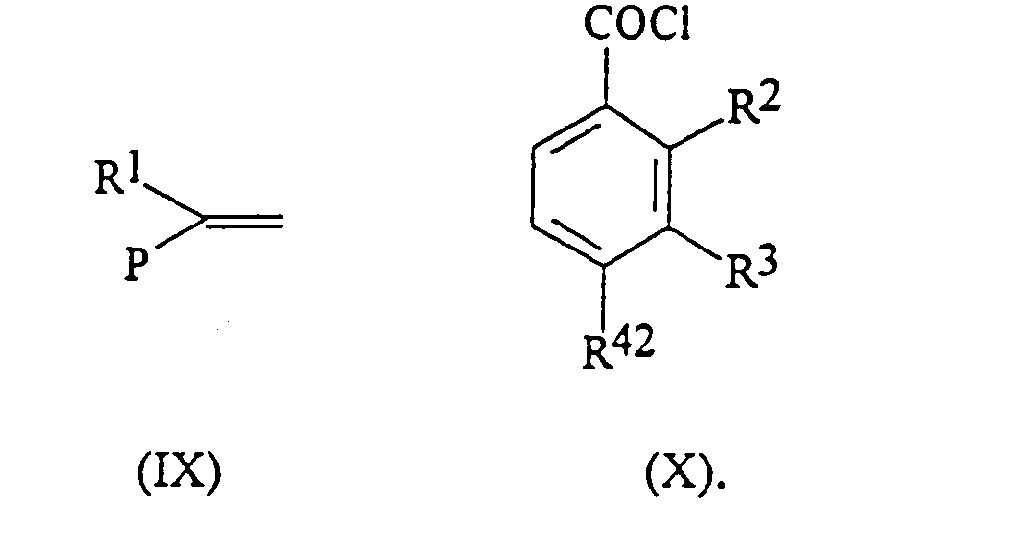
- The reaction is generally carried out in the presence of an organic base such as triethylamine in an inert solvent such as toluene or dichloromethane at a temperature between -20°C and room temperature.
- Compounds of general formula (VII) may be prepared by the metallation of the appropriate acetylene of general formula (XI):

- Those skilled in the art will appreciate that some compounds of general formula (I) may be prepared by the interconversion of other compounds of general formula (I) and such interconversions constitute yet more features of the present invention. Examples of such interconversions are hereafter described.
- According to a further feature of the present invention compounds in which n is one or two and/or p is one or two may be prepared by the oxidation of the sulphur atom of compounds in which n is zero or one and/or p is zero or one . The oxidation of the sulphur atom is generally carried out using for example 3-chloroperoxybenzoic acid in an inert solvent such as dichloromethane at a temperature from -40°C to room temperature, or hydrogen peroxide in acetic acid in the presence of acetic anhydride or concentrated sulphuric acid.
- Benzoic acids required as intermediates in the preparation of compounds of general formula I may be prepared according to a number of processes for example as hereinafter described.
- Benzoic acids or esters of general formula XII may be prepared by diazotization of compounds of general formula XIII followed by treatment with a dialkyl disulphide, R51S-SR51:

- Alternatively benzoic acids or esters of general formula XII may be prepared from compounds of general formula XIV:

- Alternatively benzoic acids of general formula XII in which R3 represents a halogen atom may be prepared by lithiation of compounds of general formula XV to give the lithiated intermediate XVa:

- The benzoic acids of general formula (XII) may also be prepared from benzoic acids of general formula (XV) by first protecting the benzoic acid function as a 4,4-dimethyloxazoline to give a compound of general formula (XVI):

- Intermediates of general formula (III), (IV), (V), (VIII), (IX), (X), (XI), (XIII), (XIV) and (XV) are known or may be prepared by the application or adaptation of known methods.
- The following examples illustrate the preparation of compounds of general formula (I) and the following reference examples illustrate the preparation of intermediates of the invention. In the present specification b.p. means boiling point; m.p. means melting point. Where the letters NMR appear the characteristics of the proton nuclear magnetic resonance spectrum follow.
- Sodium acetate (0.31g) was added with stirring to a mixture of 3-cyclopropyl-1-[3,4-difluoro-2-(methylsulphonyl)phenyl]-2-ethoxymethylenepropane- 1,3-dione (1.1g) and hydroxylamine hydrochloride (0.26g) in ethanol. The mixture was stirred for 2.5 hours. The mixture was evaporated to dryness and the residue was suspended in ethyl acetate, washed with water, dried (anhydrous MgS04) and altered. The titrate was evaporated to dryness. The residue was triturated with n-hexane and filtered to give 5-cyclopropyl-4-[3,4-difluoro-2-(methylsulphonyl)benzoyl]isoxazole (compound 1) (0.59g) as an orange solid, m.p.115-118°C.
- By proceeding in a similar manner the following compounds of general formula (I) were prepared from the appropriately substituted starting materials.


- A mixture of magnesium (0.17g) and methanol containing approximately 0.1 ml of carbon tetrachloride was heated at reflux for 0.5 hours, cooled and 3-cyclopropyl-1-[3,4-dichloro-2-(methylsulphenyl)phenyl]propane-1,3-dione (2.0g) was added. The mixture was stirred and heated at reflux for 2 hours. It was cooled and evaporated to dryness. The residue was dissolved in dichloromethane and a solution of ethyl chloro-oximidoacetate (1.37g) in dichloromethane was added. The mixture was stirred at room temperature overnight. Hydrochloric acid (2M) was added and the layers were separated. The organic layer was washed with water, dried (anhydrous Na2SO4) and filtered. The filtrate was evaporated to dryness and the residue was purified by dry column flash chromatography eluted with a mixture of ethyl acetate and n-hexane (1:9) to give ethyl 5-cyclopropyl-4-[3,4-dichloro-2-(methylsulphenyl) benzoyl]isoxazole-3-carboxylate (compound 8) (2.19g) as an orange oil NMR: (CDCI3) 1.15-1.3(m,5H), 1.4(m,2H), 2.4(s,3H), 2.45(m,1H), 4.1(q,2H), 7.2(d,1H), 7.5(d,1H).
- 3-Chloroperoxybenzoic acid (2.0g) was added to a solution of 5-cyclopropyl-4-[3,4-dichloro-2-(methylsulphenyl)benzoyl]isoxazole ( 1.86g) in dichloromethane while maintaining the temperature around - 15°C. The mixture was stirred at -15°C for 1 hour and at room temperature for 1 hour. It was recooled to -15°C and filtered. The filtrate was evaporated to dryness and the residue was purified by dry column flash chromatography eluted with a mixture of ethyl acetate and n-hexane. The product was recrystallized from a mixture of ethyl acetate and n-hexane to give 5-cyclopropyl-4-[3,4-dichloro-2-(methylsulphinyl)benzoyl]isoxazole (compound 3) (0.3g) as a white solid, m.p. 110-112°C.
- By proceeding in a similar manner the following compounds were prepared from the appropriately substituted starting materials:


- Hydrogen peroxide (30%; 1.3 ml) was added dropwise to a solution of 4-[4-bromo-3-fluoro-2-(methylsulphenyl)benzoyl]-5-cyclopropylisoxazole (1.2 g) in a mixture of acetic acid and acetic anhydride. The resultant mixture was heated at 70°C for 4 hours. It was cooled, poured into water and extracted with ethyl acetate. The organic extract was washed with aqueous sodium bisulphite, aqueous ferrous sulphate and water, dried (MgS04) and filtered. The filtrate was evaporated to dryness and the residue was triturated with ether and altered to give 4-[4-bromo-3-fluoro-2-(methylsulphonyl)-benzoyl]-5-cyclopropylisoxazole (compound 31, 0.85 g) as a white solid, m.p. 144-145°C.
- A mixture of 3-cyclopropyl-1-[3,4-difluoro-2-(methylsulphonyl) phenyl]propane-1,3-dione (0.85g) and triethyl orthoformate (1.04g) in acetic anhydride was stirred and heated at reflux for 4 hours. It was evaporated to dryness and the residue was treated with toluene and re-evaporated to give 3-cyclopropyl-1-[3,4-difluoro-2-(methylsulphonyl)phenyl]-2-ethoxymethylenepropane-1,3-dione (1.13g) as a brown oil which was not purified further.
- By proceeding in a similar manner the following compounds were prepared from the appropriately substituted starting materials;

- Magnesium (0.17g) was suspended in methanol containing carbon tetrachloride (approximately 0.1 ml) and the mixture was warmed to initiate the reaction. t-Butyl 3-cyclopropyl-3-oxopropionate (1.32g) was added and the mixture was stirred for 1 hour. The mixture was evaporated to dryness and the residue was dissolved in toluene and re-evaporated. The residue was dissolved in acetonitrile and 3,4-difluoro-2-(methylsulphonyl)benzoyl chloride (1.83g) was added. The mixture was stirred at room temperature for 4 hours and left to stand overnight. The mixture was evaporated to dryness and the residue was partitioned between toluene and hydrochloric acid (2M). The layers were separated and the organic layer was washed with water then dried by azeotropic removal of water. 4-Toluene sulphonic acid (0.5g) was added to the mixture which was heated at reflux for 4 hours. After cooling it was washed with water, dried (anhydrous MgS04) and filtered. The filtrate was evaporated to dryness to give 3-cyclopropyl-1-[3,4-difluoro-2-(methylsulphonyl)phenyl]propane- 1,3-dione (0.86g) as a brown solid which was not purified further.
- By proceeding in a similar manner the following compounds were prepared from the appropriately substituted starting materials. In all cases the acetonitrile is replaced by toluene

- A mixture of methyl 4-chloro-3-methyl-2-(methylsulphenyl)benzoate (19.5g) and cyclopropyl methyl ketone (13.4 g) in dry tetrahydrofuran was added to a stirred heated suspension of sodium hydride (80% oil dispersion, 4.8 g) in dry tetrahydrofuran. The mixture was stirred and heated at reflux for 2 hours. It was cooled and hydrochloric acid (2ml) was added. The layers were separated and the aqueous layer was extracted with ether. The combined organic layers were washed with water, saturated aqueous sodium bicarbonate, water, dried (Na2SO4) and altered. The filtrate was evaporated to dryness to give 1-[4-chloro-3-methyl-2-(methylsulphenyl)phenyl]-3-cyclopropylpropan-1,3-dione (20.19 g) as a yellow oil, NMR(CDCI3) 0.9(m,2H), 1.2 (m,2H), 1.7(m,1H), 2.3(s,3H), 2.65(s,3H), 5,85 (s,1H), 7.15(d,1H), 7.3(d,1H), 15.7-16.0(bs,1H).
- By proceeding in a similar manner the following compound was prepared from the appropriately substituted starting material;

- Benzoyl chlorides were prepared by heating the appropriately substituted benzoic acids at reflux with thionyl chloride for 3 hours. The excess thionyl chloride was removed by evaporation and the benzoyl chlorides were used directly without further purification.
- Hydrogen peroxide (11ml) was added with stirring to a cooled solution of 3,4-difluoro-2-(methylsulphenyl)benzoic acid (3.0g) and acetic anhydride (2.1ml) in acetic acid while maintaining the temperature below 5°C. The mixture was stirred at 0°C for 0.5 hours then warmed to room temperature. Further acetic acid was added and the mixture was stirred at room temperature for 0.5 hours and at 65°C for 2.5 hours. After cooling to room temperature water was added and the mixture was extracted with ethyl acetate, washed with water, aqueous ferrous sulphate solution and water, dried (anhydrous MgS04) and filtered. The filtrate was evaporated to dryness and the residue was recrystallised from a mixture of cyclohexane and ether to give 3,4-di- fluoro-2-(methylsulphonyl)benzoic acid (2.0g) as a white solid, m.p. 194°C.
- n-Butyllithium (2.5m in hexane, 35mi) was added with cooling to a solution of 3,4-difluorobenzoic acid (5.5g) in dry tetrahydrofuran while maintaining the temperature below-70°C. The mixture was stirred for 2 hours at -70°C. A solution of dimethyl disulphide (19.8g) in tetrahydrofuran was added and the mixture was stirred at -70°C for 1.5 hours. It was allowed to warm to room temperature, diluted with ether and washed with water. The aqueous layer was acidified to pH 1 and extracted with ether, washed with water, dried (anhydrous MgS04) and filtered. The filtrate was evaporated to dryness and the residue was recrystallised from a mixture of cyclohexane and ether to give 3,4-difluoro-2-(methylsulphenyl)benzoic acid (5.9g) as a white solid, m.p. 149.2-149.6°C.
- By proceeding in a similar manner the following compounds were prepared from the appropriately substituted starting materials;


- A solution of sodium nitrite (4.53g) in water was added to a stirred suspension of 3,4-dichloroanthranillic acid (15g) in acetic acid and concentrated hydrochloric acid while maintaining the temperature below 5°C. The mixture was stirred at below 5°C for 2 hours then poured into a solution of dimethyl disulphide (8.4g) and copper powder (0.1g) in acetic acid. The mixture was stirred at room temperature for 1 hour and poured into water. The solid was filtered off, dried and recrystallized from cyclohexane to give 3,4-dichloro-2-(methylsulphenyl)benzoic acid (12.02g) as a pale yellow solid, NMR (DMSO- D6) 2.4(s,3H), 7.5(d, H), 7.7(d,1H), 13.5(bs,1H).
- A solution of potassium hydroxide (2.0g) in water was added to a solution of ethyl 4-bromo-3-methoxy-2-(methylsulphenyl)benzoate (4.5g) in ethanol. The resulting solution was stirred and heated at reflux for 3 hours. After cooling, the mixture was evaporated to dryness and the residue was dissolved in water and washed with ethyl acetate. The aqueous solution was acidified to pH 1 and extracted with ethyl acetate, dried (anhydrous MgS04) and filtered. The filtrate was evaporated to dryness to give 4-bromo-3-methoxy-2-(methylsulphenyl)benzoic acid as a white solid, NMR (CDCI3) 2.5(s,3H), 3.9(s,3H), 7.4(s,2H), 10.9(bs,1H).
- By proceeding in a similar manner the following compound was prepared from the appropriately substituted starting material:
- 4-Bromo-3-methoxy-2-(methylsulphonyl)benzoic acid NMR (CDCI3) 3.3(s,3H), 4.1(s,3H), 7.1(d,1H), 7.75(d,1H), 8.2(bs,1 H).
- A solution of methanethiol (47ml) in dimethyl formamide was added to a mixture of ethyl 2,4-dibromo-3-methoxybenzoate (105g) and potassium carbonate (131g) in dimethyl formamide and the resultant suspension was stirred at room temperature overnight. Waterwas added and the mixture was extracted into ether, washed with water, dried (MgS04) and altered. The filtrate was evaporated to dryness and the residue was purified by column chromatography eluted with a mixture of ethyl acetate and cyclohexane to give as the minor component ethyl 4-bromo-3-methoxy-2-(methylsulphenyl)benzoate (4.5g) as a white solid, NMR (CDCI3) 1.5(t,3H), 2.6(s,3H), 4.05(s,3H), 4.5(q,2H), 7.35 (m,2H).
- Hydrogen peroxide (11.3ml) was added to a cooled solution of ethyl 4-bromo-3-methoxy-2-(methylsulphenyl)benzoate (3.7g) and acetic anhydride (2.0ml) in acetic acid at 0°C. The mixture was stirred at 0°C for 1 hour then warmed to room temperature and heated at 85°C for 3 hours. After cooling to room temperature the mixture was diluted with ethyl acetate and washed with water, aqueous ferrous sulphate solution, water, dried (MgS04) and altered. The filtrate was evaporated to dryness to give ethyl 4-bromo-3-methoxy-2-(methylsulphonyl)benzoate (3.6g) as a yellow oil, NMR (CDCI3) 1.6(t,3H), 3.5(s,3H), 4.3(s,3H), 4.55(q,2H), 7.2(d,1 H), 7.95(d,1 H).
- A mixture of 2-[4-chloro-3-methoxy-2-(methylsulphenyl)phenyl]-4,4-dimethyloxazoline (9.0g) and hydrochloric acid (5M) was stirred and heated at reflux for 5 hours. After cooling, the mixture was diluted with water and extracted with dichloromethane. It was dried (MgS04) filtered and the filtrate was evaporated to dryness to give 4-chloro-3-methoxy-2-(methylsulphenyl) benzoic acid as a white solid, m.p. 98-99°C.
- n-Butyllithium (2.5M in hexane, 54ml) was added with cooling to a stirred solution of 2-(4-chloro-3-methoxyphenyl)-4,4-dimethyloxazoline (27.0g) in tetrahydrofuran while maintaining the temperature below - 40°C. The mixture was stirred at -78°C overnight. A solution of dimethyl disulphide (26.5g) in tetrahydrofuran was added dropwise and the mixture was stirred at -40°C overnight. After allowing to warm to room temperature the mixture was treated with hydrochloric acid (2M). The organic layer was washed with water, dried (MgS04) and filtered. The filtrate was evaporated to dryness and the residue was purified by dry column flash chromatography eluted with a mixture of ethyl acetate and n-hexane to give 2-[4-chloro-3-methoxy-2-(methylsulphenyl) phenyl]-4,4-dimethyloxazoline (11.1g) as a white solid, m.p. 50-52°C.
- n-Butyllithium (2.5M in hexane, 63ml) was added to a solution of diisopropylamine in dry tetrahydrofuran while maintaining the temperature at 0°C. Once addition was complete the cooling bath was removed and the mixture stirred for 30 minutes at room temperature. The resulting solution of lithium di-isopropylamide (LDA) was then added to a solution of4-bromo-3-fluorobenzoic acid (14.6g) in tetrahydrofuran while maintaining the temperature at -50°C. The mixture was then stirred for 5 hours at -30°C. Asolution of dimethyl disulphide (21 g) in tetrahydrofuran was then added and the cooling bath was removed and the mixture allowed to stir at room temperature overnight. The mixture was diluted with ether and washed with water. The aqueous layer was acidified to pH 1 with 2M hydrochloric acid and extracted with ether, washed with water, dried (MeS04) and filtered. The filtrate was evaporated to dryness and the residue triturated with petroleum spirit (b.p. 60-80°C) to give 4-bromo-3-fluoro-2-(methylsulphenyl)benzoic acid (14g) as a white solid, m.p. 152-154°C.
- By proceeding in a similar manner from the appropriately substituted starting material 4-bromo-3-chloro-2-(methylsulphenyl)benzoic acid was prepared, m.p. 126-129°C.
- A solution of 4-bromo-3-fluorotoluene (35g) and sodium hydroxide (7.7g) in pyridine and water was stirred and heated to reflux. Potassium permanganate (123g) was added to the mixture over 2 hours. The resulting suspension was heated at reflux for a further 3 hours. The mixture was filtered hot through hyflo. The hyflo was washed with boiling water, followed by ethyl acetate. The cooled aqueous layer was acidified to pH 1 with concentrated hydrochloric acid and extracted with ethyl acetate. The organic extract was washed with water, dried (MgS04) and filtered. The filtrate was evaporated to dryness and the residue triturated with petroleum spirit (bp 60-80°C) to give 4-bromo-3-fluorobenzoic acid as a white solid (21.25g), m.p. 213-215°C.
- Lithium hydroxide monohydrate (1.87 g) was added to a solution of methyl 3-methoxycarbonyl-2-(methylsulphenyl)-4-trifluoromethylbenzoate (13.71 g) in methanol and water. The mixture was stirred at room temperature overnight and the methanol was removed by evaporation. The residual aqueous solution was acidified to pH 1 and extracted with ether, washed with water, dried (MgS04) and filtered. The filtrate was evaporated to dryness to give 3-methoxycarbonyl-2-(methylsulphenyl)-4-trifluoromethylbenzoic acid (10.85 g) as an off-white solid, NMR (CDCI3) 2.45(s,3H), 3.95(s,3H), 5.45-6.1(bs,1H), 7.2(d,1H), 7.95(d,1H).
- By proceeding in a similar manner the following compound was prepared from the appropriately substituted starting material:
- 4-chloro-3-methoxycarbonyl-2-(methylsulphenyl)benzoic acid, NMR (CDCI3) 2.5 (s,3H), 4.0 (s,3H), 7.55(d,1 H), 8.0(d,1 H).
- Sodium thiomethoxide (6.83 g) was added to a solution of methyl 2-fluoro-3-methoxycarbonyl-4-trifluoromethylbenzoate (24.85 g) in xylene. After stirring for 0.5 hours lithium hydroxide monohydrate (4.10 g) was added and the mixture was stirred for 48 hours. Hydrochloric acid (2M) was added. It was extracted with ether, washed with water, dried (MgS04) and filtered. The filtrate was evaporated to dryness and the residue was triturated with cyclohexane. The solid was filtered off and the filtrate was evaporated to dryness to give methyl 3-methoxycarbonyl-2-(methylsulphenyl)-4-trifluoromethylbenzoate (13.71g) as a yellow oil NMR (CDCI3) 2.4(s,3H), 3.95 (s,6H), 7.65 (s,2H).
- By proceeding in a similar manner methyl 4-chloro-3-methoxycarbonyl-2-(methylsulphenyl)benzoate was prepared from the appropriately substituted starting material.
- A solution of 2-fluoro-3-methoxycarbonyl-4-trifluoromethylbenzoic acid (23.43 g) in thionyl chloride was stirred and heated at reflux for 2 hours, cooled and evaporated to dryness. The residue was dissolved in methanol and the resultant solution was stirred and heated at reflux overnight. It was cooled and evaporated to dryness. The residue was purified by chromatography eluted with a mixture of ether and cyclohexane to give methyl 2-fluoro-3-methoxycarbonyl-4-trifluoromethylbenzoate (25.85 g) as a yellow oil, NMR (CDCI3) 4.0(s,6H), 7.55(d,1H), 8. 15(t,1H).
- By proceeding in a similar manner the following compounds were prepared from the appropriately substituted starting material:
- methyl 4-chloro-2-fluoro-3-methoxycarbonylbenzoate NMR (CDCI3) 3.9(s,3H), 4.0(s,3H), 7.3(d,1H), 7.95(t,1 H); methyl 4-chloro-2-fluoro-3-methylbenzoate NMR (CDCI3) 2.35(d,3H), 3.95(s,3H), 7.2(d,1 H) 7.7(t.1 H);
- methyl 4-chloro-2-fluoro-3-isopropenylbenzoate NMR (CDCI3) 2.1(s,3H), 3.95(s,3H), 5.0(s,1H) 5.45(s,1 H) 7.3(d,1H) 7.8(t,1H).
- A solution of lithium diisopropyl amide in dry tetrahydrofuran (prepared from diisopropylamine (17.0 ml) and n-butylithium (48.4 ml) in dry tetrahydrofuran)was added to a solution of methyl 2-fluoro-6-trifluoromethylbenzoate (22.39 g) in dry tetrahydrofuran while maintaining the temperature below-70°C. The mixture was stirred at -78°C for 3 hours. The solution was poured onto solid carbon dioxide pellets and stirred until it had warmed to room temperature. The mixture was evaporated and treated with hydrochloric acid (2M). It was extracted with ether, washed with water, dried (MgS04) and altered. The filtrate was evaporated to dryness to give 2-fluoro-3-methoxycarbonyl-4-trifluoromethylbenzoic acid (24.43 g) as an off-white solid NMR (CDCI3) 3.95(s,3H), 7.15(d,1H), 8. 15(t,1H).
- By proceeding in a similar manner the following compound was prepared from the appropriately substituted starting material:
- 4-chloro-2-fluoro-3-methoxycarbonylbenzoic acid NMR (CDCI3) 4.0(s,3H), 7.4(d,1H), 8.1(t,1H).
- Potassium carbonate (48.37 g) was added to a solution of methanethiol (16.84 g) in dry dimethyl formamide. Methyl 4-chloro-2-fluoro-3-methylbenzoate (35.45 g) was added to the resulting suspension. The mixture was stirred for 60 hours. It was poured into water, extracted with ether, washed with water, dried (Na2SO4) and filtered. The filtrate was evaporated to dryness and the residue was separated by chromatography eluted with a mixture of ether and hexane to give methyl 4-chloro-3-methyl-2-(methylsulphenyl)benzoate (19.53 g) as a clear oil, NMR (CDCI3) 2.35(s,3H), 2.7(s,3H), 3.95(s,3H), 7.25(d,1H), 7.4(d,1 H), and methyl 3-methyl-2,4- bis(methylsulphenyl)benzoate (9.29 g) as a yellow solid NMR (CDCI3) 2.3 (s,3H), 2.5 (s,3H), 2.6 (s,3H), 3.95 (s,3H), 7.1 (d,1H), 7.4 (d,1H).
- n-Butyllithium (2.5 M in hexane, 100 ml) was added to a cooled solution of 2-chloro-6-fluorotoluene (36.1 g) in dry tetrahydrofuran while maintaining the temperature below-60°C. The mixture was stirred at-78°C over- night then poured onto solid carbon dioxide pellets. The mixture was stirred and allowed to warm to room temperature. It was acidified to pH 1 and extracted with ether. The organic layer was extracted into aqueous sodium hydroxide solution (2M) and water. The combined aqueous extracts were acidified to pH 1 and the solid formed was filtered off and washed with water and n-hexane to give 4-chloro-2-fluoro-3-methylbenzoic acid (40.35 g) as a white solid, NMR (DMSO-ds) 2.3(d,3H), 7.4(d,1 H) 7.7(t,1H).
- By proceeding in a similar manner the following compound was prepared from the appropriately substituted starting material:
- 4-chloro-2-fluoro-3-isopropenylbenzoic acid m.p. 201-202°C.
- A solution of sodium hydroxide (7.0 g) in water was added to methyl 4-chloro-3-isopropenyl-2-(methylsulphenyl)benzoate (7.3 g) and the resulting mixture was heated at reflux for 2 hours. Ethanol was added and the mixture was heated at reflux for 1 hour. The ethanol was removed by evaporation and the aqueous residue was acidified to pH 1. It was extracted with ethyl acetate, washed with water, dried (MgS04) and filtered. The titrate was evaporated to dryness to give 4-chloro-3-isopropenyl-2-(methylsulphenyl)benzoic acid (6.15 g) NMR (CDCI3) 2.05 (s,3H), 2.4 (s,3H), 4.85 (s,1H), 5.35 (s,1H), 7.45 (d,1H), 7.85 (d,1H).
- A mixture of methyl 4-chloro-2-fluoro-3-isopropenylbenzoate (8.6 g) and sodium thiomethoxide (3.15 g) in dimethyl formamide was heated at 50°C for 3 hours and stirred at room temperature over-night. Ether was added and the mixture was washed with water, dried (MgS04) and filtered. The filtrate was evaporated to dryness and the residue was purified by chromatography eluted with a mixture of ethyl acetate and hexane to give methyl 4-chloro-3-isopropenyl-2-(methylsulphenyl)benzoate (5.95 g) as a clear oil NMR (CDCI3) 2.1(s,3H), 2.35(s,3H), 3.95(s,3H), 4.9(s,1H), 5.4(s,1H), 7.45(s,2H).
- A mixture of 2-(2-chloro-6-fluorophenyl)propan-2-ol (19.0g), concentrated sulphuric acid and water was heated at reflux for 2 hours. It was cooled and extracted with ether, washed with water, dried (MgS04) and filtered. The filtrate was evaporated to dryness and the residue was purified by chromatography eluted with hexane to give 2-(2-chloro-6-fluorophenyl)propene (11.6 g) as a clear oil, NMR (CDCI3) 1.95(s,3H) 4.95(s,1 H), 5.85(s,1H), 6.85-7.0(m,1H), 7.05-7.2(m,2H).
- A solution of methyl 2-chloro-6-fluorobenzoate (40.0g) in ether was added to a solution of methyl magnesium iodide in ether (prepared from methyl iodide (120.0g) and magnesium turnings (20.6g) in ether). The resulting solution was stirred and heated at reflux for 5 hours, poured onto a mixture of ice and concentrated sulphuric acid and the layers separated. The organic layer was washed with water, saturated aqueous sodium bisulphite, water, dried (anhydrous magnesium sulphate) and filtered. The filtrate was evaporated to dryness to give 2-(2-chloro-6-fluorophenyl)propan-2-ol (36.8g) as an orange oil, NMR (CDCI3) 1.8(d,6H), 3.5-3.7(bs,1H), 6.9-7.05(m,1H), 7.1-7.25(m,2H).
- According to a feature of the present invention, there is provided a method for controlling the growth of weeds (i.e. undesired vegetation) at a locus which comprises applying to the locus a herbicidally effective amount of at least one isoxazole derivative of general formula (I). For this purpose, the isoxazole derivatives are normally used in the form of herbicidal compositions (i.e. in association with compatible diluents or carriers and/or surface active agents suitable for use in herbicidal compositions), for example as hereinafter described.
- The compounds of general formula (I) show herbicidal activity against dicotyledonous (i.e. broad-leafed) and monocotyledonous (i.e. grass) weeds by pre- and/or post-emergence application.
- By the term "pre-emergence application" is meant application to the soil in which the weed seeds or seedlings are present before emergence of the weeds above the surface of the soil. By the term "post-emergence application" is meant application to the aerial or exposed portions of the weeds which have emerged above the surface of the soil. For example, the compounds of general formula (I) may be used to control the growth of:
- broad-leafed weeds, for example, Abutilon theophrasti, Amaranthus retroflexus, Bidens pilosa, Cheno- podium album, Galium aparine, Ipomoea spp. e.g. Ipomoea purpurea, Sesbania exaltata, Sinapis arvensis, Solanum nigrum and Xanthium strumarium, and
- grass weeds, for example Alopecurus myosuroides, Avena fatua, Digitaria sanguinalis, Echinochloa crus-gaiii, Sorghum bicolor, Eleusine indica and Setaria spp, e.g. Setaria faberii or Setaria viridis, and
- sedges, for example, Cyperus esculentus.
- The amounts of compounds of general formula (I) applied vary with the nature of the weeds, the compositions used, the time of application, the climatic and edaphic conditions and (when used to control the growth of weeds in crop-growing areas) the nature of the crops. When applied to a crop-growing area, the rate of application should be sufficient to control the growth of weeds without causing substantial permanent damage to the crop. In general, taking these factors into account, application rates between 0.01kg and 5kg of active material per hectare give good results. However, it is to be understood that higher or lower application rates may be used, depending upon the particular problem of weed control encountered.
- The compounds of general formula (I) may be used to control selectively the growth of weeds, for example to control the growth of those species hereinbefore mentioned, by pre- or post-emergence application in a directional or non-directional fashion, e.g. by directional or non-directional spraying, to a locus of weed infestation which is an area used, or to be used, for growing crops, for example cereals, e.g. wheat, barley, oats, maize and rice, soya beans, field and dwarf beans, peas, lucerne, cotton, peanuts, flax onions, carrots, cabbage, oilseed rape, sunflower, sugar beet, and permanent or sown grassland before or after sowing of the crop or before or after emergence of the crop. For the selective control of weeds at a locus of weed infestation which is an area used, or to be used, for growing of crops, e.g. the crops hereinbefore mentioned, application rates between 0.01kg and 4.0kg, and preferably between 0.01kg and 2.0kg, of active material per hectare are particularly suitable.
- The compounds of general formula (I) may also be used to control the growth of weeds, especially those indicated above, by pre- or post-emergence application in established orchards and other tree-growing areas, for example forests, woods and parks, and plantations, e.g. sugar cane, oil palm and rubber plantations. For this purpose they may be applied in a directional or non-directional fashion (e.g. by directional or non-directional spraying) to the weeds or to the soil in which they are expected to appear, before or after planting of the trees or plantations at application rates between 0.25kg and 5.0kg, and preferably between 0.5kg and 4.0kg of active material per hectare.
- The compounds of general formula (I) may also be used to control the growth of weeds, especially those indicated above, at loci which are not crop-growing areas but in which the control of weeds is nevertheless desirable.
- Examples of such non-crop-growing areas include airfields, industrial sites, railways, roadside verges, the verges of rivers, irrigation and other waterways, scrublands and fallow or uncultivated land, in particular where it is desired to control the growth of weeds in order to reduce fire risks. When used for such purposes in which a total herbicidal effect is frequently desired, the active compounds are normally applied at dosage rates higher than those used in crop-growing areas as hereinbefore described. The precise dosage will depend upon the nature of the vegetation treated and the effect sought.
- Pre- or post-emergence application, and preferably pre-emergence application, in a directional or non-directional fashion (e.g. by directional or non-directional spraying) at application rates between 1.Okg and 20.0kg, and preferably between 5.0 and 10.0kg, of active material per hectare are particularly suitable for this purpose.
- When used to control the growth of weeds by pre-emergence application, the compounds of general formula (I) may be incorporated into the soil in which the weeds are expected to emerge. It will be appreciated that when the compounds of general formula (I) are used to control the growth of weeds by post-emergence application, i.e. by application to the aerial or exposed portions of emerged weeds, the compounds of general formula (I) will also normally come into contact with the soil and may also then exercise a pre-emergence control on later-germinating weeds in the soil.
- Where especially prolonged weed control is required, the application of the compounds of general formula (I) may be repeated if required.
- According to a further feature of the present invention, there are provided compositions suitable for herbicidal use comprising one or more of the isoxazole derivatives of general formula (I), in association with, and preferably homogeneously dispersed in, one or more compatible agriculturally- acceptable diluents or carriers and/or surface active agents [i.e. diluents or carriers and/or surface active agents of the type generally accepted in the art as being suitable for use in herbicidal compositions and which are compatible with compounds of general formula (I)]. The term "homogeneously dispersed" is used to include compositions in which the compounds of general formula (I) are dissolved in other components. The term "herbicidal compositions" is used in a broad sense to include not only compositions which are ready for use as herbicides but also concentrates which must be diluted before use. Preferably, the compositions contain from 0.05 to 90% by weight of one or more compounds of general formula (I).
- The herbicidal compositions may contain both a diluent or carrier and surface-active (e.g. wetting, dispersing, or emulsifying) agent. Surface-active agents which may be present in herbicidal compositions of the present invention may be of the ionic or non-ionic types, for example sulphoricinoleates, quaternary ammonium derivatives, products based on condensates of ethylene oxide with alkyl and polyaryl phenols, e.g. nonyl- or octyl-phenols, or carboxylic acid esters of anhydrosorbitols which have been rendered soluble by etherification of the free hydroxy groups by condensation with ethylene oxide, alkali and alkaline earth metal salts of sulphuric acid esters and sulphonic acids such as dinonyl- and dioctyl-sodium sulphonosuccinates and alkali and alkaline earth metal salts of high molecular weight sulphonic acid derivatives such as sodium and calcium lignosulphonates and sodium and calcium alkylbenzene sulphonates.
- Suitably, the herbicidal compositions according to the present invention may comprise up to 10% by weight, e.g. from 0.05% to 10% by weight, of surface-active agent but, if desired; herbicidal compositions according to the present invention may comprise higher proportions of surface-active agent, for example up to 15% by weight in liquid emulsifiable suspension concentrates and up to 25% by weight in liquid water soluble concentrates.
- Examples of suitable solid diluents or carriers are aluminium silicate, talc, calcined magnesia, kieselguhr, tricalcium phosphate, powdered cork, adsorbent carbon black and clays such as kaolin and bentonite. The solid compositions (which may take the form of dusts, granules or wettable powders) are preferably prepared by grinding the compounds of general formula (I) with solid diluents or by impregnating the solid diluents or carriers with solutions of the compounds of general formula (I) in volatile solvents, evaporating the solvents and, if necessary, grinding the products so as to obtain powders. Granular formulations may be prepared by absorbing the compounds of general formula (I) (dissolved in suitable solvents, which may, if desired, be volatile) onto the solid diluents or carriers in granular form and, if desired, evaporating the solvents, or by granulating compositions in powder form obtained as described above. Solid herbicidal compositions, particularly wettable powders and granules, may contain wetting or dispersing agents (for example of the types described above), which may also, when solid, serve as diluents or carriers.
- Liquid compositions according to the invention may take the form of aqueous, organic or aqueous-organic solutions, suspensions and emulsions which may incorporate a surface-active agent. Suitable liquid diluents for incorporation in the liquid compositions include water, glycols, tetrahydrofurfuryl alcohol, acetophenone, cyclohexanone, isophorone, toluene, xylene, mineral, animal and vegetable oils and light aromatic and naphthenic fractions of petroleum (and mixtures of these diluents). Surface-active agents, which may be present in the liquid compositions, may be ionic or non-ionic (for example of the types described above) and may, when liquid, also serve as diluents or carriers.
- Powders, dispersible granules and liquid compositions in the form of concentrates may be diluted with water or other suitable diluents, for example mineral or vegetable oils, particularly in the case of liquid concentrates in which the diluent or carrier is an oil, to give compositions ready for use.
- When desired, liquid compositions of the compound of general formula (I) may be used in the form of self- emulsifying concentrates containing the active substances dissolved in the emulsifying agents or in solvents containing emulsifying agents compatible with the active substances, the simple addition of water to such concentrates producing compositions ready for use.
- Liquid concentrates in which the diluent or carrier is an oil may be used without further dilution using the electrostatic spray technique.
- Herbicidal compositions according to the present invention may also contain, if desired, conventional adjuvants such as adhesives, protective colloids, thickeners, penetrating agents, stabilisers, sequestering agents, anti-caking agents, colouring agents and corrosion inhibitors. These adjuvants may also serve as carriers or diluents.
- Unless otherwise specified, the following percentages are by weight. Preferred herbicidal compositions according to the present invention are
- aqueous suspension concentrates which comprise from 10 to 70% of one or more compounds of general formula (I), from 2 to 10% of surface-active agent, from 0.1 to 5% of thickener and from 15 to 87.9% of water;
- wettable powders which comprise from 10 to 90% of one or more compounds of general formula (I), from 2 to 10% of surface-active agent and from 8 to 88% of solid diluent or carrier;
- water soluble or water dispersible powders which comprise from 10 to 90% of one or more compounds of general formula (I), from 2 to 40% of sodium carbonate and from 0 to 88% of solid diluent;
- liquid water soluble concentrates which comprise from 5 to 50%, e.g. 10 to 30%, of one or more compounds of general formula (I), from 5 to 25% of surface-active agent and from 25 to 90%, e.g. 45 to 85%, of water miscible solvent, e.g. dimethylformamide, or a mixture of water-miscible solvent and water;
- liquid emulsifiable suspension concentrates which comprise from 10 to 70% of one or more compounds of general formula (I), from 5 to 15% of surface-active agent, from 0.1 to 5% of thickener and from 10 to 84.9% of organic solvent;
- granules which comprise from 1 to 90%, e.g. 2 to 10% of one or more compounds of general formula (I), from 0.5 to 7%, e.g. 0.5 to 2%, of surface-active agent and from 3 to 98.5%, e.g. 88 to 97.5%, of granular carrier and
- emulsifiable concentrates which comprise 0.05 to 90%, and preferably from 1 to 60% of one or more compounds of general formula (I), from 0.01 to 10%, and preferably from 1 to 10%, of surface-active agent and from 9.99 to 99.94%, and preferably from 39 to 98.99%, of organic solvent.
- Herbicidal compositions according to the present invention may also comprise the compounds of general formula (I) in association with, and preferably homogeneously dispersed in, one or more other pesticidally active compounds and, if desired, one or more compatible pesticidally acceptable diluents or carriers, surface-active agents and conventional adjuvants as hereinbefore described. Examples of other pesticidally active compounds which may be included in, or used in conjunction with, the herbicidal compositions of the present invention include herbicides, for example to increase the range of weed species controlled for example alachlor [2-chloro-2,6'-diethyl-N-(methoxy-methyl)-acetanilide], atrazine [2-chloro-4-ethylamino-6-isopropylamino-1,3,5-triazine], bromoxynil [3,5-dibromo-4-hydroxybenzonitriie], chlortoluron [N'-(3-chloro-4-methylphenyl)-N,N-dimethylurea], cyanazine [2-chloro-4-(1-cyano-1-methylethylamino)-6-ethylamino-1,3,5-triazine], 2,4-D [2,4-dichlorophenoxy-acetic acid], dicamba [3,6-dichloro-2-methoxybenzoic acid], difenzoquat [1,2- dimethyl-3,5-diphenylpyrazolium salts], flampropmethyl [methyl N-2-(N- benzoyl-3-chloro-4-fluoroanilino)-propionate], fluometuron [N'-(3-trifluoro- methylphenyl)-N,N-dimethylurea], isoproturon [N'-(4-isopropylphenyl)-N,N-dime- thylurea], insecticides, e.g. synthetic pyrethroids, e.g. permethrin and cypermethrin, and fungicides, e.g. carbamates, e.g. methyl N-(1-butyl-carbamoyl- benzimidazol-2-yl)carbamate, and triazoles e.g. 1-(4-chloro- phenoxy)-3,3- dimethyi-1-(1,2,4-triazoi-1-yi)-butan-2-one.
- Pesticidally active compounds and other biologically active materials which may be included in, or used in conjunction with, the herbicidal compositions of the present invention, for example those hereinbefore mentioned, and which are acids, may, if desired, be utilized in the form of conventional derivatives,.for example alkali metal and amine salts and esters.
- According to a further feature of the present invention there is provided an article of manufacture comprising at least one of the isoxazole derivatives of general formula (I) or, as is preferred, a herbicidal composition as hereinbefore described, and preferably a herbicidal concentrate which must be diluted before use, comprising at least one of the isoxazole derivatives of general formula (I) within a container for the aforesaid derivative or derivatives of general formula (I), or a said herbicidal composition, and instructions physically associated with the aforesaid container setting out the manner in which the aforesaid derivative or derivatives of general formula (I) or herbicidal composition contained therein is to be used to control the growth of weeds. The containers will normally be of the types conventionally used for the storage of chemical substances which are solid at normal ambient temperatures and herbicidal compositions particularly in the form of concentrates, for example cans and drums of metal, which may be internally lacquered, and plastics materials, bottles or glass and plastics materials and, when the contents of the container is a solid, for example granular, herbicidal compositions, boxes, for example of cardboard, plastics materials and metal, or sacks. The containers will normally be of sufficient capacity to contain amounts of the isoxazole derivative or herbicidal compositions sufficient to treat at least one acre of ground to control the growth of weeds therein but will not exceed a size which is convenient for conventional methods of handling. The instructions will be physically associated with the container, for example by being printed directly thereon or on a label or tag affixed thereto. The directions will normally indicate that the contents of the container, after dilution if necessary, are to be applied to control the growth of weeds at rates of application between 0.01 kg and 20kg of active material per hectare in the manner and for the purposes hereinbefore described.
- The following Examples illustrate herbicidal compositions according to the present invention:
- A soluble concentrate is formed from

- Similar soluble concentrates may be prepared as described above by replacing the isoxazole (compound 1) with other compounds of general formula (I).
- A wettable powder is formed from:

- Similar wettable powders may be prepared as described above by replacing the isoxazole (compound 1) with other compounds of general formula (I).
- A water soluble powder is formed from:

- Similar water soluble powders may be prepared as described above by replacing the isoxazole (compound 1) with other compounds of general formula (I).
- The compounds of the invention have been used in herbicidal applications according to the following procedures.
- Appropriate quantities of the compounds used to treat the plants were dissolved in acetone to give solutions equivalent to application rates of up to 4000g test compound per hectare (g/ha). These solutions were applied from a standard laboratory herbicide sprayer delivering the equivalent of 290 litres of spray fluid per hectare.
- The seeds were sown in 70 mm square, 75 mm deep plastic pots in non-sterile soil . The quantities of seed per pot were as follows:-


- The compounds of the invention were applied to the soil surface, containing the seeds, as described in (a). A single pot of each crop and each weed was allocated to each treatment, with unsprayed controls and controls sprayed with acetone alone.
- After treatment the pots were placed on capillary matting kept in a glass house, and watered overhead. Visual assessment of crop damage was made 20-24 days after spraying. The results were expressed as the percentage reduction in growth or damage to the crop or weeds, in comparison with the plants in the control pots.
- The weeds and crops were sown directly into John Innes potting compost in 75 mm deep, 70 mm square pots except for Amaranthus which was pricked out at the seedling stage and transferred to the pots one week before spraying. The plants were then grown in the greenhouse until ready for spraying with the compounds used to treat the plants. The number of plants per pot were as follows:-
- 1) Broad leafed weeds

- 2) Grass weeds

- 3) Sedges

- 1) Broad leafed

- 2) Grass

- The compounds used to treat the plants were applied to the plants as described in (a). A single pot of each crop and weed species was allocated to each treatment, with unsprayed controls and controls sprayed with acetone alone.
- After treatment the pots were placed on capillary matting in a glass house, and watered overhead once after 24 hours and then by controlled sub-irrigation. Visual assessment of crop damage and weed control was made 20-24 days after spraying. The results were expressed as the percentage reduction in growth or damage to the crop or weeds, in comparison with the plants in the control pots.
- The compounds of the invention have shown an excellent level of herbicidal activity together with crop tolerance on the weeds used in the foregoing experiments.
- When applied pre- or post-emergence at 1000g/ha compounds 1 to 35 gave at least 90% reduction in growth of one or more of the weed species.
Claims (16)


Priority Applications (1)
| Application Number | Priority Date | Filing Date | Title |
|---|---|---|---|
| US08/458,817 US5650533A (en) | 1989-09-11 | 1995-06-02 | Intermediates to herbicidal 4-substituted isoxazoles |
Applications Claiming Priority (2)
| Application Number | Priority Date | Filing Date | Title |
|---|---|---|---|
| US85012892A | 1992-03-12 | 1992-03-12 | |
| US850128 | 1992-03-12 |
Publications (2)
| Publication Number | Publication Date |
|---|---|
| EP0560482A1 true EP0560482A1 (en) | 1993-09-15 |
| EP0560482B1 EP0560482B1 (en) | 1997-08-06 |
Family
ID=25307335
Family Applications (1)
| Application Number | Title | Priority Date | Filing Date |
|---|---|---|---|
| EP93300816A Expired - Lifetime EP0560482B1 (en) | 1989-09-11 | 1993-02-04 | 4-Benzoyl isoxazole derivatives and their use as herbicides |
Country Status (32)
| Country | Link |
|---|---|
| US (1) | US5334753A (en) |
| EP (1) | EP0560482B1 (en) |
| JP (1) | JP3310039B2 (en) |
| KR (1) | KR100278704B1 (en) |
| CN (1) | CN1057524C (en) |
| AT (1) | ATE156483T1 (en) |
| AU (1) | AU664229B2 (en) |
| BG (1) | BG62151B1 (en) |
| BR (1) | BR9300324A (en) |
| CA (1) | CA2088840C (en) |
| CZ (1) | CZ282051B6 (en) |
| DE (1) | DE69312769T2 (en) |
| DK (1) | DK0560482T3 (en) |
| ES (1) | ES2105098T3 (en) |
| FI (1) | FI930496A7 (en) |
| GR (1) | GR3024373T3 (en) |
| HR (1) | HRP930106B1 (en) |
| HU (1) | HU217562B (en) |
| IL (1) | IL104614A (en) |
| MA (1) | MA22920A1 (en) |
| MX (1) | MX9300627A (en) |
| NZ (1) | NZ245844A (en) |
| PL (1) | PL172002B1 (en) |
| RO (1) | RO112029B1 (en) |
| RU (1) | RU2105761C1 (en) |
| SI (1) | SI9300063B (en) |
| SK (1) | SK280521B6 (en) |
| TR (1) | TR27630A (en) |
| TW (1) | TW250426B (en) |
| YU (1) | YU48749B (en) |
| ZA (1) | ZA93769B (en) |
| ZW (1) | ZW2293A1 (en) |
Cited By (44)
| Publication number | Priority date | Publication date | Assignee | Title |
|---|---|---|---|---|
| GB2284547A (en) * | 1993-12-10 | 1995-06-14 | Rhone Poulenc Agriculture | Synergistic herbicides containing triazine and 4-benzoylisoxazole derivatives |
| WO1996015673A1 (en) * | 1994-11-18 | 1996-05-30 | Rhone-Poulenc Agriculture Limited | New synergistic herbicidal compositions comprising 4-benzoylisoxazoles and 2,6-dinitroaniline compounds |
| WO1997000014A1 (en) * | 1995-06-19 | 1997-01-03 | Rhone-Poulenc Agrochimie | Use of 4-benzoylisoxazoles for the protection of turfgrass |
| US5658858A (en) * | 1993-12-15 | 1997-08-19 | Rhone-Poulenc Argriculture Limited | 4-benzoylisoxazoles and their use as herbicides |
| WO1997030037A1 (en) * | 1996-02-16 | 1997-08-21 | Rhone Poulenc Agro | New intermediates to pesticides |
| WO1997034486A1 (en) * | 1996-03-15 | 1997-09-25 | Rhone-Poulenc Agrochimie | Herbicidal compositions |
| WO1997028122A3 (en) * | 1996-02-01 | 1997-10-02 | Rhone Poulenc Agrochimie | Process for preparing diketone compounds |
| US5795846A (en) * | 1994-08-01 | 1998-08-18 | Rhone-Poulenc Agriculture Limited | Herbicidal compositions |
| US5837652A (en) * | 1995-12-20 | 1998-11-17 | Rhone-Poulenc Agriculture Limited | Herbicidal compositions |
| WO1998051153A1 (en) * | 1997-05-15 | 1998-11-19 | Rhone-Poulenc Agriculture Ltd. | Herbicidal methods and derivatives |
| US5849928A (en) * | 1996-03-22 | 1998-12-15 | Rhone-Poulenc Agriculture Limited | Herbicidal isoxazole and 2-cyano-1,3-dione compounds |
| WO1999002476A1 (en) * | 1997-07-07 | 1999-01-21 | Rhone Poulenc Agro | Process for the preparation of 1-aryl-3-cyclopropyl-1,3-propanediones |
| WO1999002489A1 (en) * | 1997-07-07 | 1999-01-21 | Rhone Poulenc Agro | Process for the preparation of 2-alkylthio benzoic acid derivatives |
| US5905057A (en) * | 1997-11-06 | 1999-05-18 | Rhone-Poulenc Agrochimie | Herbicidal 4-benzoylisoxazole-3-carboxylate liquid compositions comprising N-alkylpyrrolidinone stabilizer |
| US5912206A (en) * | 1994-12-09 | 1999-06-15 | Rhone-Poulenc Agrochimie | Herbicidal compositions |
| US5945381A (en) * | 1996-04-16 | 1999-08-31 | Basf Aktiengesellschaft | Herbicidal heterocyclically annulated benzoylisothiazoles |
| US5962370A (en) * | 1993-12-10 | 1999-10-05 | Rhone-Poulenc Agriculture Ltd | Herbicidal compositions comprising a 4-benzoylisoxazole and a triazine herbicide |
| US6013839A (en) * | 1996-02-15 | 2000-01-11 | Rhone-Poulenc Agriculture Limited | Process for preparing 2-(thiosubstituted)-4-haloacetophenones |
| US6043267A (en) * | 1995-06-19 | 2000-03-28 | Rhone-Poulenc Agrochimie | Fungicidal compositions and the use thereof |
| US6046137A (en) * | 1996-04-16 | 2000-04-04 | Basf Aktiengesellschaft | Herbicidal heterocyclically substituted benzoylisothiazoles |
| US6083879A (en) * | 1996-04-16 | 2000-07-04 | Basf Aktiengesellschaft | Herbicidal benzoylisothiazoles |
| US6214770B1 (en) | 1998-03-09 | 2001-04-10 | Rhone-Poulenc Agro | Herbicidal compositions |
| US6239070B1 (en) | 1997-06-10 | 2001-05-29 | Rhone-Poulenc Inc. | Herbicidal mixtures |
| US6297198B1 (en) | 1996-05-14 | 2001-10-02 | Syngenta Participations Ag | Isoxazole derivatives and their use as herbicides |
| US6369276B1 (en) | 1998-11-19 | 2002-04-09 | Eagleview Technologies, Inc. | Catalyst structure for ketone production and method of making and using the same |
| WO2002036787A2 (en) | 2000-10-30 | 2002-05-10 | Bayer Cropscience S.A. | Herbicide-tolerant plants through bypassing metabolic pathway |
| US6392099B1 (en) | 1998-11-19 | 2002-05-21 | Eagleview Technologies, Inc. | Method and apparatus for the preparation of ketones |
| US6545185B1 (en) | 2001-03-29 | 2003-04-08 | Eagleview Technologies, Inc. | Preparation of ketones from aldehydes |
| WO2010079117A2 (en) | 2009-01-07 | 2010-07-15 | Bayer Cropscience Ag | Transplastomic plants free of the selectable marker |
| WO2011053557A1 (en) | 2009-10-30 | 2011-05-05 | Ms Technologies, Llc | Antibodies immunoreactive with mutant hydroxypenylpyruvate dioxygenase |
| WO2011095460A1 (en) | 2010-02-02 | 2011-08-11 | Bayer Cropscience Ag | Soybean transformation using hppd inhibitors as selection agents |
| WO2012074868A2 (en) | 2010-12-03 | 2012-06-07 | Ms Technologies, Llc | Optimized expression of glyphosate resistance encoding nucleic acid molecules in plant cells |
| WO2012128946A1 (en) | 2011-03-18 | 2012-09-27 | Ms Technologies Llc | Regulatory regions preferentially expressing in non-pollen plant tissue |
| DE112011101566T5 (en) | 2010-05-04 | 2013-05-08 | Basf Se | PLANTS WITH INCREASED HERBICID TOLERANCE |
| WO2013116700A1 (en) | 2012-02-01 | 2013-08-08 | Dow Agrosciences Llc | Glyphosate resistant plants and associated methods |
| WO2015066638A2 (en) | 2013-11-04 | 2015-05-07 | Dow Agrosciences Llc | Optimal maize loci |
| WO2015066636A2 (en) | 2013-11-04 | 2015-05-07 | Dow Agrosciences Llc | Optimal maize loci |
| WO2015066643A1 (en) | 2013-11-04 | 2015-05-07 | Dow Agrosciences Llc | Optimal soybean loci |
| WO2015130931A1 (en) | 2014-02-28 | 2015-09-03 | Dow Agrosciences Llc | Root specific expression conferred by chimeric gene regulatory elements |
| US9725730B2 (en) | 2013-12-31 | 2017-08-08 | Dow Agrosciences Llc | Maize ubiquitin promoters |
| US10030246B2 (en) | 2013-12-31 | 2018-07-24 | Dow Agrosciences Llc | Maize ubiquitin promoters |
| US10030247B2 (en) | 2013-12-31 | 2018-07-24 | Dow Agrosciences Llc | Maize ubiquitin promoters |
| US10036028B2 (en) | 2013-12-31 | 2018-07-31 | Dow Agrosciences Llc | Maize ubiquitin promoters |
| US10138490B2 (en) | 2002-09-11 | 2018-11-27 | Michel Matringe | Transformed plants tolerant to herbicides due to overexpression of prephenate dehydrogenase and p-hydroxyphenylpyruvate dioxygenase |
Families Citing this family (7)
| Publication number | Priority date | Publication date | Assignee | Title |
|---|---|---|---|---|
| GB9115377D0 (en) * | 1991-07-17 | 1991-09-04 | Rhone Poulenc Agriculture | New compositions of matter |
| US5530028A (en) * | 1992-11-23 | 1996-06-25 | Rohm And Haas Company | Insecticidal N'-substituted-N,N'-diacylhydrazines |
| GB9302072D0 (en) * | 1993-02-03 | 1993-03-24 | Rhone Poulenc Agriculture | New compositions of matter |
| DE19853827A1 (en) | 1998-11-21 | 2000-05-25 | Aventis Cropscience Gmbh | Selective herbicidal composition for use in e.g. cereals, cotton or soya, comprises p-hydroxyphenyl pyruvate dioxygenase inhibiting benzoyl compound herbicide and safener, e.g. fenclorim or dicamba |
| UA72496C2 (en) * | 1999-02-01 | 2005-03-15 | Авентіс Агрікалче Лімітед | Method of inhibiting the growth of weeds and a composition with slow release of herbicide |
| HU230234B1 (en) * | 1999-09-08 | 2015-10-28 | Aventis Cropscience Uk Ltd. | New herbicidal compositions |
| SE0201937D0 (en) * | 2002-06-20 | 2002-06-20 | Astrazeneca Ab | Therapeutic agents |
Citations (1)
| Publication number | Priority date | Publication date | Assignee | Title |
|---|---|---|---|---|
| EP0418175A2 (en) * | 1989-09-11 | 1991-03-20 | Rhone Poulenc Agriculture Ltd. | Isoxazoles herbicides |
Family Cites Families (5)
| Publication number | Priority date | Publication date | Assignee | Title |
|---|---|---|---|---|
| US4323692A (en) * | 1978-08-04 | 1982-04-06 | Rohm And Haas Company | Process for preparing phenoxybenzoic acids |
| GB9025469D0 (en) * | 1990-11-22 | 1991-01-09 | Rhone Poulenc Agriculture | New compositions of matter |
| GB9017539D0 (en) * | 1990-08-10 | 1990-09-26 | Rhone Poulenc Agriculture | New compositions of matter |
| GB9116834D0 (en) * | 1991-08-05 | 1991-09-18 | Rhone Poulenc Agriculture | Compositions of new matter |
| IL102674A (en) * | 1991-08-05 | 1996-11-14 | Rhone Poulenc Agriculture | 4-Benzoyl isoxazole derivatives process for their preparation and herbicidal compositions containing them |
-
1992
- 1992-12-23 US US07/996,046 patent/US5334753A/en not_active Expired - Lifetime
-
1993
- 1993-02-03 TR TR00116/93A patent/TR27630A/en unknown
- 1993-02-03 HR HR07/850,128A patent/HRP930106B1/en not_active IP Right Cessation
- 1993-02-04 EP EP93300816A patent/EP0560482B1/en not_active Expired - Lifetime
- 1993-02-04 KR KR1019930001500A patent/KR100278704B1/en not_active Expired - Fee Related
- 1993-02-04 SK SK64-93A patent/SK280521B6/en unknown
- 1993-02-04 PL PL93297644A patent/PL172002B1/en unknown
- 1993-02-04 CN CN93101488A patent/CN1057524C/en not_active Expired - Fee Related
- 1993-02-04 SI SI9300063A patent/SI9300063B/en unknown
- 1993-02-04 FI FI930496A patent/FI930496A7/en unknown
- 1993-02-04 DK DK93300816.1T patent/DK0560482T3/en active
- 1993-02-04 CA CA002088840A patent/CA2088840C/en not_active Expired - Fee Related
- 1993-02-04 ZW ZW22/93A patent/ZW2293A1/en unknown
- 1993-02-04 RO RO93-00120A patent/RO112029B1/en unknown
- 1993-02-04 BG BG97402A patent/BG62151B1/en unknown
- 1993-02-04 JP JP01761193A patent/JP3310039B2/en not_active Expired - Fee Related
- 1993-02-04 IL IL104614A patent/IL104614A/en not_active IP Right Cessation
- 1993-02-04 AU AU32819/93A patent/AU664229B2/en not_active Ceased
- 1993-02-04 RU RU93004513A patent/RU2105761C1/en active
- 1993-02-04 CZ CZ93132A patent/CZ282051B6/en not_active IP Right Cessation
- 1993-02-04 ES ES93300816T patent/ES2105098T3/en not_active Expired - Lifetime
- 1993-02-04 NZ NZ245844A patent/NZ245844A/en unknown
- 1993-02-04 AT AT93300816T patent/ATE156483T1/en not_active IP Right Cessation
- 1993-02-04 DE DE69312769T patent/DE69312769T2/en not_active Expired - Fee Related
- 1993-02-04 BR BR9300324A patent/BR9300324A/en not_active IP Right Cessation
- 1993-02-04 YU YU6593A patent/YU48749B/en unknown
- 1993-02-04 HU HU9300293A patent/HU217562B/en not_active IP Right Cessation
- 1993-02-04 ZA ZA93769A patent/ZA93769B/en unknown
- 1993-02-04 MA MA23074A patent/MA22920A1/en unknown
- 1993-02-04 MX MX9300627A patent/MX9300627A/en not_active IP Right Cessation
- 1993-02-06 TW TW082100807A patent/TW250426B/zh active
-
1997
- 1997-08-07 GR GR970401067T patent/GR3024373T3/en unknown
Patent Citations (1)
| Publication number | Priority date | Publication date | Assignee | Title |
|---|---|---|---|---|
| EP0418175A2 (en) * | 1989-09-11 | 1991-03-20 | Rhone Poulenc Agriculture Ltd. | Isoxazoles herbicides |
Cited By (72)
| Publication number | Priority date | Publication date | Assignee | Title |
|---|---|---|---|---|
| AU678670B2 (en) * | 1993-12-10 | 1997-06-05 | Rhone-Poulenc Agriculture Limited | Herbicidal compositions |
| WO1995015691A1 (en) * | 1993-12-10 | 1995-06-15 | Rhone Poulenc Agriculture Ltd. | Herbicidal compositions |
| GB2284547B (en) * | 1993-12-10 | 1998-01-14 | Rhone Poulenc Agriculture | Herbicidal compositions |
| GB2284547A (en) * | 1993-12-10 | 1995-06-14 | Rhone Poulenc Agriculture | Synergistic herbicides containing triazine and 4-benzoylisoxazole derivatives |
| US5962370A (en) * | 1993-12-10 | 1999-10-05 | Rhone-Poulenc Agriculture Ltd | Herbicidal compositions comprising a 4-benzoylisoxazole and a triazine herbicide |
| US5658858A (en) * | 1993-12-15 | 1997-08-19 | Rhone-Poulenc Argriculture Limited | 4-benzoylisoxazoles and their use as herbicides |
| US5998653A (en) * | 1993-12-15 | 1999-12-07 | Rhone Poulenc Agriculture Limited | 1-(substituted phenyl)-2,3-disubstituted propane-1,3-diones as intermediates to 4-benzoylisoxazoles |
| US6114538A (en) * | 1993-12-15 | 2000-09-05 | Rhone Poulenc Agriculture Limited | 4-Benzoylisoxazole intermediates to herbicides |
| US6369270B1 (en) | 1993-12-15 | 2002-04-09 | Rhone Poulenc Agriculture Limited | Benzoic acid intermediates to 4-benzoylisoxazole herbicides |
| US5795846A (en) * | 1994-08-01 | 1998-08-18 | Rhone-Poulenc Agriculture Limited | Herbicidal compositions |
| CN1071538C (en) * | 1994-11-18 | 2001-09-26 | 罗纳-普朗克农业有限公司 | New synergistic herbicidal compositions comprising 4-benzoylisoxazoles and 2,6-dinitroaniline compounds |
| US5552367A (en) * | 1994-11-18 | 1996-09-03 | Rhone-Poulenc Agriculture Ltd. | Synergistic herbicidal compositions comprising 4-benzoylisoxazole and dinitroaniline herbicides |
| WO1996015673A1 (en) * | 1994-11-18 | 1996-05-30 | Rhone-Poulenc Agriculture Limited | New synergistic herbicidal compositions comprising 4-benzoylisoxazoles and 2,6-dinitroaniline compounds |
| US5912206A (en) * | 1994-12-09 | 1999-06-15 | Rhone-Poulenc Agrochimie | Herbicidal compositions |
| US6043267A (en) * | 1995-06-19 | 2000-03-28 | Rhone-Poulenc Agrochimie | Fungicidal compositions and the use thereof |
| US6004904A (en) * | 1995-06-19 | 1999-12-21 | Rhone-Poulenc Inc. | Use of 4-benzoylisoxazoles for the protection of turfgrass |
| WO1997000014A1 (en) * | 1995-06-19 | 1997-01-03 | Rhone-Poulenc Agrochimie | Use of 4-benzoylisoxazoles for the protection of turfgrass |
| US5837652A (en) * | 1995-12-20 | 1998-11-17 | Rhone-Poulenc Agriculture Limited | Herbicidal compositions |
| US6696613B2 (en) | 1996-02-01 | 2004-02-24 | Rhone Poulenc Agrochimie | Process for preparing diketone compounds and precursors thereto |
| US6525225B2 (en) | 1996-02-01 | 2003-02-25 | Rhone Poulenc Agrochimie | Process for preparing diketone compounds and precursors thereto |
| WO1997028122A3 (en) * | 1996-02-01 | 1997-10-02 | Rhone Poulenc Agrochimie | Process for preparing diketone compounds |
| AU727325B2 (en) * | 1996-02-01 | 2000-12-07 | Rhone-Poulenc Agro | Process for preparing diketone compounds |
| US6235942B1 (en) | 1996-02-01 | 2001-05-22 | Rhone-Poulenc Agrochimie | Process for preparing diketone compounds |
| US6013839A (en) * | 1996-02-15 | 2000-01-11 | Rhone-Poulenc Agriculture Limited | Process for preparing 2-(thiosubstituted)-4-haloacetophenones |
| WO1997030037A1 (en) * | 1996-02-16 | 1997-08-21 | Rhone Poulenc Agro | New intermediates to pesticides |
| WO1997034486A1 (en) * | 1996-03-15 | 1997-09-25 | Rhone-Poulenc Agrochimie | Herbicidal compositions |
| US6013805A (en) * | 1996-03-22 | 2000-01-11 | Rhone-Poulenc Agriculture Ltd | Pentafluorothio-substituted isoxazoles |
| US6140528A (en) * | 1996-03-22 | 2000-10-31 | Rhone-Poulenc Agriculture Ltd | Intermediates to herbicidal isoxazole and 2-cyano-1,3-dione compounds |
| US5849928A (en) * | 1996-03-22 | 1998-12-15 | Rhone-Poulenc Agriculture Limited | Herbicidal isoxazole and 2-cyano-1,3-dione compounds |
| US6046137A (en) * | 1996-04-16 | 2000-04-04 | Basf Aktiengesellschaft | Herbicidal heterocyclically substituted benzoylisothiazoles |
| US6083879A (en) * | 1996-04-16 | 2000-07-04 | Basf Aktiengesellschaft | Herbicidal benzoylisothiazoles |
| US5945381A (en) * | 1996-04-16 | 1999-08-31 | Basf Aktiengesellschaft | Herbicidal heterocyclically annulated benzoylisothiazoles |
| US6297198B1 (en) | 1996-05-14 | 2001-10-02 | Syngenta Participations Ag | Isoxazole derivatives and their use as herbicides |
| WO1998051153A1 (en) * | 1997-05-15 | 1998-11-19 | Rhone-Poulenc Agriculture Ltd. | Herbicidal methods and derivatives |
| US6239070B1 (en) | 1997-06-10 | 2001-05-29 | Rhone-Poulenc Inc. | Herbicidal mixtures |
| AU748477B2 (en) * | 1997-07-07 | 2002-06-06 | Rhone-Poulenc Agro | Process for the preparation of 2-alkylthio benzoic acid derivatives |
| WO1999002476A1 (en) * | 1997-07-07 | 1999-01-21 | Rhone Poulenc Agro | Process for the preparation of 1-aryl-3-cyclopropyl-1,3-propanediones |
| WO1999002489A1 (en) * | 1997-07-07 | 1999-01-21 | Rhone Poulenc Agro | Process for the preparation of 2-alkylthio benzoic acid derivatives |
| KR100585308B1 (en) * | 1997-07-07 | 2006-06-01 | 바이엘 크롭사이언스 소시에떼아노님 | Method for preparing 1-aryl-3-cyclopropyl-1,3-propanedione |
| US6777575B2 (en) | 1997-07-07 | 2004-08-17 | Rhone-Poulenc Agro | Process for the preparation of 2-alkylthio benzoic acid derivatives |
| AU748503B2 (en) * | 1997-07-07 | 2002-06-06 | Rhone-Poulenc Agro | Process for the preparation of 1-aryl-3-cyclopropyl-1,3-propanediones |
| US6486356B2 (en) | 1997-07-07 | 2002-11-26 | Rhone-Poulenc Agro | Process for the preparation of 1-aryl-3-cyclopropyl-1,3-propanediones |
| US5905057A (en) * | 1997-11-06 | 1999-05-18 | Rhone-Poulenc Agrochimie | Herbicidal 4-benzoylisoxazole-3-carboxylate liquid compositions comprising N-alkylpyrrolidinone stabilizer |
| US6713434B2 (en) | 1998-03-09 | 2004-03-30 | Rhone-Poulenc Agro | Herbicidal compositions |
| US6214770B1 (en) | 1998-03-09 | 2001-04-10 | Rhone-Poulenc Agro | Herbicidal compositions |
| US6495696B1 (en) | 1998-11-19 | 2002-12-17 | Eagleview Technologies, Inc. | Method and apparatus for the preparation of ketones |
| US6369276B1 (en) | 1998-11-19 | 2002-04-09 | Eagleview Technologies, Inc. | Catalyst structure for ketone production and method of making and using the same |
| US6392099B1 (en) | 1998-11-19 | 2002-05-21 | Eagleview Technologies, Inc. | Method and apparatus for the preparation of ketones |
| WO2002036787A2 (en) | 2000-10-30 | 2002-05-10 | Bayer Cropscience S.A. | Herbicide-tolerant plants through bypassing metabolic pathway |
| EP2141240A2 (en) | 2000-10-30 | 2010-01-06 | Bayer CropScience SA | Plants that can tolerate herbicides by bypassing the metabolic route |
| US6545185B1 (en) | 2001-03-29 | 2003-04-08 | Eagleview Technologies, Inc. | Preparation of ketones from aldehydes |
| US10138490B2 (en) | 2002-09-11 | 2018-11-27 | Michel Matringe | Transformed plants tolerant to herbicides due to overexpression of prephenate dehydrogenase and p-hydroxyphenylpyruvate dioxygenase |
| WO2010079117A2 (en) | 2009-01-07 | 2010-07-15 | Bayer Cropscience Ag | Transplastomic plants free of the selectable marker |
| WO2011053557A1 (en) | 2009-10-30 | 2011-05-05 | Ms Technologies, Llc | Antibodies immunoreactive with mutant hydroxypenylpyruvate dioxygenase |
| WO2011095460A1 (en) | 2010-02-02 | 2011-08-11 | Bayer Cropscience Ag | Soybean transformation using hppd inhibitors as selection agents |
| DE112011101566T5 (en) | 2010-05-04 | 2013-05-08 | Basf Se | PLANTS WITH INCREASED HERBICID TOLERANCE |
| WO2012074868A2 (en) | 2010-12-03 | 2012-06-07 | Ms Technologies, Llc | Optimized expression of glyphosate resistance encoding nucleic acid molecules in plant cells |
| WO2012128946A1 (en) | 2011-03-18 | 2012-09-27 | Ms Technologies Llc | Regulatory regions preferentially expressing in non-pollen plant tissue |
| EP3219200A1 (en) | 2012-02-01 | 2017-09-20 | Dow Agrosciences Llc | Glyphosate resistant plants and associated methods |
| WO2013116700A1 (en) | 2012-02-01 | 2013-08-08 | Dow Agrosciences Llc | Glyphosate resistant plants and associated methods |
| WO2013116782A1 (en) | 2012-02-01 | 2013-08-08 | Dow Agrosciences Llc | Novel class of glyphosate resistance genes |
| EP3470522A2 (en) | 2012-02-01 | 2019-04-17 | Dow AgroSciences LLC | Novel class of glyphosate resistance genes |
| WO2015066643A1 (en) | 2013-11-04 | 2015-05-07 | Dow Agrosciences Llc | Optimal soybean loci |
| WO2015066636A2 (en) | 2013-11-04 | 2015-05-07 | Dow Agrosciences Llc | Optimal maize loci |
| WO2015066638A2 (en) | 2013-11-04 | 2015-05-07 | Dow Agrosciences Llc | Optimal maize loci |
| EP3862434A1 (en) | 2013-11-04 | 2021-08-11 | Dow AgroSciences LLC | Optimal soybean loci |
| US9725730B2 (en) | 2013-12-31 | 2017-08-08 | Dow Agrosciences Llc | Maize ubiquitin promoters |
| US9885054B2 (en) | 2013-12-31 | 2018-02-06 | Dow Agrosciences Llc | Maize ubiquitin promoters |
| US10030246B2 (en) | 2013-12-31 | 2018-07-24 | Dow Agrosciences Llc | Maize ubiquitin promoters |
| US10030247B2 (en) | 2013-12-31 | 2018-07-24 | Dow Agrosciences Llc | Maize ubiquitin promoters |
| US10036028B2 (en) | 2013-12-31 | 2018-07-31 | Dow Agrosciences Llc | Maize ubiquitin promoters |
| WO2015130931A1 (en) | 2014-02-28 | 2015-09-03 | Dow Agrosciences Llc | Root specific expression conferred by chimeric gene regulatory elements |
Also Published As
Similar Documents
| Publication | Publication Date | Title |
|---|---|---|
| EP0560482B1 (en) | 4-Benzoyl isoxazole derivatives and their use as herbicides | |
| CA2075348C (en) | 4-benzoyl isoxazole herbicides | |
| EP0524018B1 (en) | Isoxazole herbicides | |
| US5856274A (en) | 4-benzoyl isoxazoles and their use as herbicides | |
| EP0527037B1 (en) | 4-Benzoylisoxazole derivatives and their use as herbicides | |
| EP0609798B1 (en) | 4-Benzoyl isoxazoles and their use as herbicides | |
| US5371064A (en) | Herbicidal 4-benzoylisoxazole derivatives | |
| US5371063A (en) | Herbicidal 4-benzoylisoxazoles | |
| EP0588357B1 (en) | Isoxazoles derivatives and their use as herbicides | |
| WO1994014782A1 (en) | 4-benzoyl isoxazoles derivatives and their use as herbicides | |
| AU658044B2 (en) | New herbicides | |
| WO1995031446A1 (en) | 4-benzoylisoxazole derivatives and their use as herbicides | |
| HK1003790B (en) | 4-benzoylisoxazole derivatives and their use as herbicides |
Legal Events
| Date | Code | Title | Description |
|---|---|---|---|
| PUAI | Public reference made under article 153(3) epc to a published international application that has entered the european phase |
Free format text: ORIGINAL CODE: 0009012 |
|
| AK | Designated contracting states |
Kind code of ref document: A1 Designated state(s): AT BE CH DE DK ES FR GB GR IE IT LI LU NL PT SE |
|
| 17P | Request for examination filed |
Effective date: 19940216 |
|
| 17Q | First examination report despatched |
Effective date: 19940923 |
|
| GRAG | Despatch of communication of intention to grant |
Free format text: ORIGINAL CODE: EPIDOS AGRA |
|
| GRAH | Despatch of communication of intention to grant a patent |
Free format text: ORIGINAL CODE: EPIDOS IGRA |
|
| GRAH | Despatch of communication of intention to grant a patent |
Free format text: ORIGINAL CODE: EPIDOS IGRA |
|
| GRAA | (expected) grant |
Free format text: ORIGINAL CODE: 0009210 |
|
| AK | Designated contracting states |
Kind code of ref document: B1 Designated state(s): AT BE CH DE DK ES FR GB GR IE IT LI LU NL PT SE |
|
| REF | Corresponds to: |
Ref document number: 156483 Country of ref document: AT Date of ref document: 19970815 Kind code of ref document: T |
|
| REG | Reference to a national code |
Ref country code: CH Ref legal event code: NV Representative=s name: BOVARD AG PATENTANWAELTE Ref country code: CH Ref legal event code: EP |
|
| ET | Fr: translation filed | ||
| REF | Corresponds to: |
Ref document number: 69312769 Country of ref document: DE Date of ref document: 19970911 |
|
| ITF | It: translation for a ep patent filed | ||
| REG | Reference to a national code |
Ref country code: ES Ref legal event code: FG2A Ref document number: 2105098 Country of ref document: ES Kind code of ref document: T3 |
|
| REG | Reference to a national code |
Ref country code: GR Ref legal event code: FG4A Free format text: 3024373 |
|
| REG | Reference to a national code |
Ref country code: PT Ref legal event code: SC4A Free format text: AVAILABILITY OF NATIONAL TRANSLATION Effective date: 19971001 |
|
| REG | Reference to a national code |
Ref country code: DK Ref legal event code: T3 |
|
| PLBE | No opposition filed within time limit |
Free format text: ORIGINAL CODE: 0009261 |
|
| 26N | No opposition filed | ||
| PGFP | Annual fee paid to national office [announced via postgrant information from national office to epo] |
Ref country code: LU Payment date: 20010213 Year of fee payment: 9 |
|
| PGFP | Annual fee paid to national office [announced via postgrant information from national office to epo] |
Ref country code: CH Payment date: 20010219 Year of fee payment: 9 |
|
| PGFP | Annual fee paid to national office [announced via postgrant information from national office to epo] |
Ref country code: SE Payment date: 20010223 Year of fee payment: 9 |
|
| PGFP | Annual fee paid to national office [announced via postgrant information from national office to epo] |
Ref country code: BE Payment date: 20010313 Year of fee payment: 9 |
|
| REG | Reference to a national code |
Ref country code: GB Ref legal event code: IF02 |
|
| PGFP | Annual fee paid to national office [announced via postgrant information from national office to epo] |
Ref country code: PT Payment date: 20020123 Year of fee payment: 10 |
|
| PG25 | Lapsed in a contracting state [announced via postgrant information from national office to epo] |
Ref country code: LU Free format text: LAPSE BECAUSE OF NON-PAYMENT OF DUE FEES Effective date: 20020204 |
|
| PG25 | Lapsed in a contracting state [announced via postgrant information from national office to epo] |
Ref country code: SE Free format text: LAPSE BECAUSE OF NON-PAYMENT OF DUE FEES Effective date: 20020205 |
|
| PG25 | Lapsed in a contracting state [announced via postgrant information from national office to epo] |
Ref country code: LI Free format text: LAPSE BECAUSE OF NON-PAYMENT OF DUE FEES Effective date: 20020228 Ref country code: CH Free format text: LAPSE BECAUSE OF NON-PAYMENT OF DUE FEES Effective date: 20020228 Ref country code: BE Free format text: LAPSE BECAUSE OF NON-PAYMENT OF DUE FEES Effective date: 20020228 |
|
| PGFP | Annual fee paid to national office [announced via postgrant information from national office to epo] |
Ref country code: IE Payment date: 20020326 Year of fee payment: 10 |
|
| PGFP | Annual fee paid to national office [announced via postgrant information from national office to epo] |
Ref country code: GB Payment date: 20020327 Year of fee payment: 10 Ref country code: DK Payment date: 20020327 Year of fee payment: 10 Ref country code: AT Payment date: 20020327 Year of fee payment: 10 |
|
| PGFP | Annual fee paid to national office [announced via postgrant information from national office to epo] |
Ref country code: NL Payment date: 20020328 Year of fee payment: 10 |
|
| PGFP | Annual fee paid to national office [announced via postgrant information from national office to epo] |
Ref country code: GR Payment date: 20020329 Year of fee payment: 10 |
|
| BERE | Be: lapsed |
Owner name: RHONE-POULENC AGRICULTURE LTD Effective date: 20020228 |
|
| EUG | Se: european patent has lapsed |
Ref document number: 93300816.1 |
|
| REG | Reference to a national code |
Ref country code: CH Ref legal event code: PL |
|
| PG25 | Lapsed in a contracting state [announced via postgrant information from national office to epo] |
Ref country code: IE Free format text: LAPSE BECAUSE OF NON-PAYMENT OF DUE FEES Effective date: 20030204 Ref country code: GB Free format text: LAPSE BECAUSE OF NON-PAYMENT OF DUE FEES Effective date: 20030204 Ref country code: AT Free format text: LAPSE BECAUSE OF NON-PAYMENT OF DUE FEES Effective date: 20030204 |
|
| PG25 | Lapsed in a contracting state [announced via postgrant information from national office to epo] |
Ref country code: DK Free format text: LAPSE BECAUSE OF NON-PAYMENT OF DUE FEES Effective date: 20030228 |
|
| PG25 | Lapsed in a contracting state [announced via postgrant information from national office to epo] |
Ref country code: PT Free format text: LAPSE BECAUSE OF NON-PAYMENT OF DUE FEES Effective date: 20030831 |
|
| PG25 | Lapsed in a contracting state [announced via postgrant information from national office to epo] |
Ref country code: NL Free format text: LAPSE BECAUSE OF NON-PAYMENT OF DUE FEES Effective date: 20030901 |
|
| PG25 | Lapsed in a contracting state [announced via postgrant information from national office to epo] |
Ref country code: GR Free format text: LAPSE BECAUSE OF NON-PAYMENT OF DUE FEES Effective date: 20030904 |
|
| GBPC | Gb: european patent ceased through non-payment of renewal fee | ||
| REG | Reference to a national code |
Ref country code: DK Ref legal event code: EBP |
|
| NLV4 | Nl: lapsed or anulled due to non-payment of the annual fee |
Effective date: 20030901 |
|
| REG | Reference to a national code |
Ref country code: IE Ref legal event code: MM4A |
|
| PGFP | Annual fee paid to national office [announced via postgrant information from national office to epo] |
Ref country code: ES Payment date: 20080324 Year of fee payment: 16 |
|
| PGFP | Annual fee paid to national office [announced via postgrant information from national office to epo] |
Ref country code: IT Payment date: 20080226 Year of fee payment: 16 Ref country code: DE Payment date: 20071206 Year of fee payment: 16 |
|
| PGFP | Annual fee paid to national office [announced via postgrant information from national office to epo] |
Ref country code: FR Payment date: 20080208 Year of fee payment: 16 |
|
| REG | Reference to a national code |
Ref country code: FR Ref legal event code: ST Effective date: 20091030 |
|
| PG25 | Lapsed in a contracting state [announced via postgrant information from national office to epo] |
Ref country code: DE Free format text: LAPSE BECAUSE OF NON-PAYMENT OF DUE FEES Effective date: 20090901 |
|
| REG | Reference to a national code |
Ref country code: ES Ref legal event code: FD2A Effective date: 20090205 |
|
| PG25 | Lapsed in a contracting state [announced via postgrant information from national office to epo] |
Ref country code: FR Free format text: LAPSE BECAUSE OF NON-PAYMENT OF DUE FEES Effective date: 20090302 |
|
| PG25 | Lapsed in a contracting state [announced via postgrant information from national office to epo] |
Ref country code: ES Free format text: LAPSE BECAUSE OF NON-PAYMENT OF DUE FEES Effective date: 20090205 |
|
| PG25 | Lapsed in a contracting state [announced via postgrant information from national office to epo] |
Ref country code: IT Free format text: LAPSE BECAUSE OF NON-PAYMENT OF DUE FEES Effective date: 20090204 |