EP0560231B1 - Pyrazolo(3,4-a)acridine derivatives as analgesics - Google Patents
Pyrazolo(3,4-a)acridine derivatives as analgesics Download PDFInfo
- Publication number
- EP0560231B1 EP0560231B1 EP93103604A EP93103604A EP0560231B1 EP 0560231 B1 EP0560231 B1 EP 0560231B1 EP 93103604 A EP93103604 A EP 93103604A EP 93103604 A EP93103604 A EP 93103604A EP 0560231 B1 EP0560231 B1 EP 0560231B1
- Authority
- EP
- European Patent Office
- Prior art keywords
- compound
- hydrogen
- formula
- alkyl
- phenyl
- Prior art date
- Legal status (The legal status is an assumption and is not a legal conclusion. Google has not performed a legal analysis and makes no representation as to the accuracy of the status listed.)
- Expired - Lifetime
Links
- 0 CC1(*)C=Cc2nc(CCCC3=O)c3c(N)c2C=C1 Chemical compound CC1(*)C=Cc2nc(CCCC3=O)c3c(N)c2C=C1 0.000 description 3
Classifications
-
- C—CHEMISTRY; METALLURGY
- C07—ORGANIC CHEMISTRY
- C07D—HETEROCYCLIC COMPOUNDS
- C07D471/00—Heterocyclic compounds containing nitrogen atoms as the only ring hetero atoms in the condensed system, at least one ring being a six-membered ring with one nitrogen atom, not provided for by groups C07D451/00 - C07D463/00
- C07D471/02—Heterocyclic compounds containing nitrogen atoms as the only ring hetero atoms in the condensed system, at least one ring being a six-membered ring with one nitrogen atom, not provided for by groups C07D451/00 - C07D463/00 in which the condensed system contains two hetero rings
- C07D471/04—Ortho-condensed systems
-
- A—HUMAN NECESSITIES
- A61—MEDICAL OR VETERINARY SCIENCE; HYGIENE
- A61P—SPECIFIC THERAPEUTIC ACTIVITY OF CHEMICAL COMPOUNDS OR MEDICINAL PREPARATIONS
- A61P25/00—Drugs for disorders of the nervous system
- A61P25/04—Centrally acting analgesics, e.g. opioids
Definitions
- the present invention relates to 4,5-dihydropyrazolo[3,4-a]acridines, a process for their preparation and their use as medicaments.
- EP 411 534 discloses 1,2,3,4-tetrahydro-9-acridinamines, specifically N-(1,2,3,4-tetrahydro-9-acridinyl)decanamide and octyl(1,2,3,4-tetrahydro-9-acridinyl)carbamate, useful as analgesic agents.
- (C 1 -C 6 )alkyl shall mean a straight or branched alkyl group having from 1 to 6 carbon atoms.
- Examples of said (C 1 -C 6 )alkyl include methyl, ethyl, n-propyl, isopropyl, iso-butyl, sec-butyl and straight- and branched-chain pentyl and hexyl.
- halogen shall mean fluorine, chlorine, bromine or iodine.
- the compounds of this invention can be prepared by utilizing one or more of the synthetic steps described below.
- the compound of Formula III where R 1 is hydrogen can be prepared by conducting the reaction depicted below. Typically it is convenient to conduct this reaction in the present of a suitable acid such as benzesulfonic acid and a suitable solvent such as toluene at a temperature of about 100 to 150°.
- a suitable acid such as benzesulfonic acid
- a suitable solvent such as toluene
- This reaction is typically conducted in a suitable solvent such as ethanol at a temperature of about 50 to 100°.
- Compound V is allowed to react with a chloro or bromo compound of the formula, R 9 -Hal where Hal is chlorine or bromine and R 9 is (C 1 -C 6 )alkyl, up to C 6 alkenyl, phenyl(C 1 -C 6 )alkyl, where the phenyl is optionally mono-substituted with (C 1 -C 6 )-alkyl, (C 1 -C 6 )alkoxy, halogen, or trifluoromethyl, cyano(C 1 -C 6 )alkyl, or -C n H 2n NR 7 R 8 to afford a compound of Formula VI.
- R 9 -Hal where Hal is chlorine or bromine and R 9 is (C 1 -C 6 )alkyl, up to C 6 alkenyl, phenyl(C 1 -C 6 )alkyl, where the phenyl is optionally mono-substituted with (C 1 -C 6
- This reaction is typically conducted with the aid of a strong base such as sodium hydride to obtain the corresponding anion of compound V which then reacts with the halogen compound to afford compound VI.
- This reaction is typically conducted in a suitable medium such as dimethylformamide at the temperature of about 0 to 50°.
- a compound of Formula VIa which is obtained from Step C above is hydrolyzed in a routine manner known to the art to afford a compound of Formula VII. Typically this reaction is conducted with the aid of potassium hydroxide.
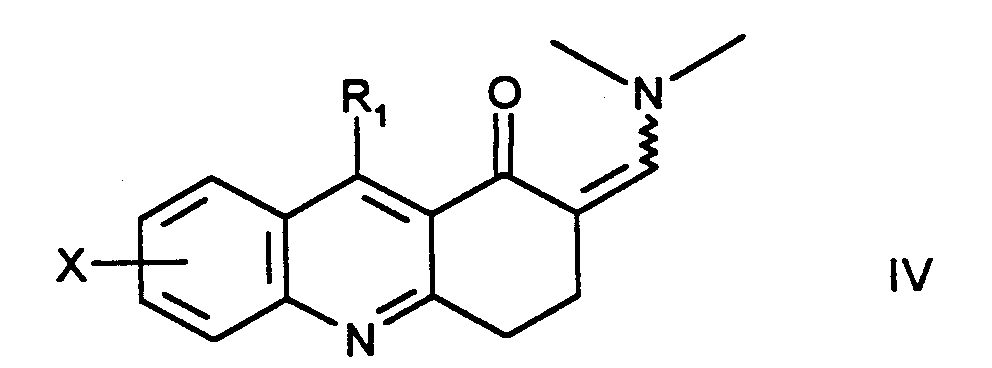
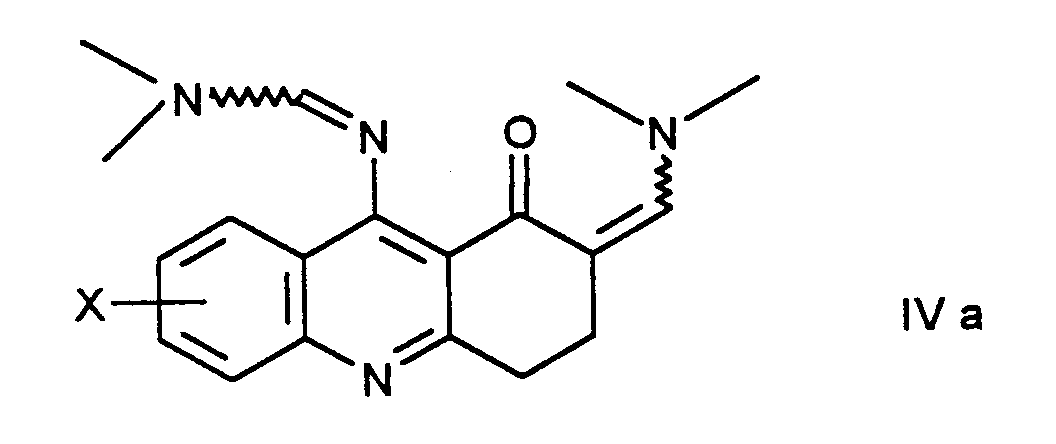
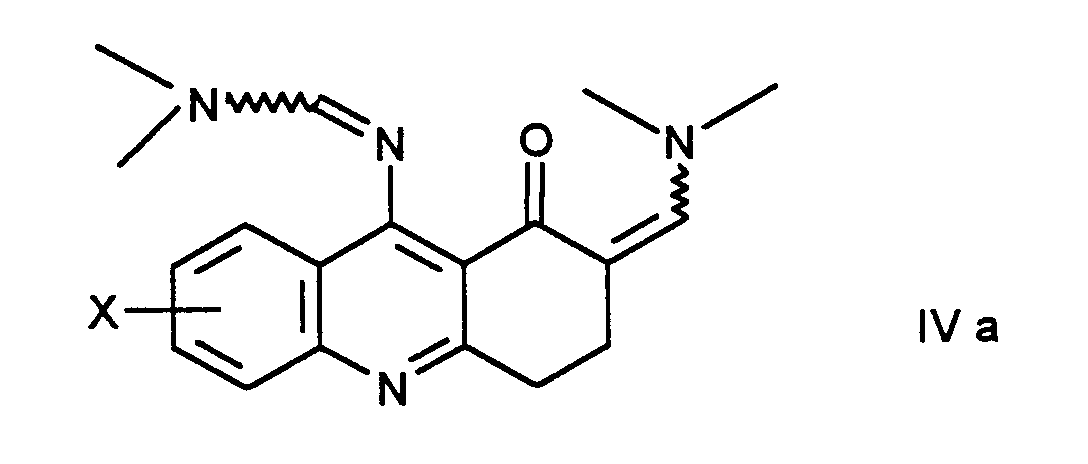
- Compound IV or IVa is allowed to react with a hydrazine compound of the formula where R 10 is (C 1 -C 6 )alkyl, up to C 6 alkenyl, phenyl, phenyl(C 1 -C 6 )alkyl or cyano(C 1 -C 6 )alkyl, where phenyl in each case is optionally mono-substituted with (C 1 -C 6 )alkyl, (C 1 -C 6 )alkoxy, halogen, or trifluoromethyl, to afford compounds of Formula VIII and IX.
- the two products can be separated from each other by methods known to the art. This reaction is conducted typically in the presence of a suitable solvent such as ethanol at a temperature of about 50 to 100°.
- Compound V is allowed to react with hydroxylamine-O-sulfonic acid to afford a compound of Formula X.
- This reaction is typically conducted with the aid of aqueous sodium hydroxide in a suitable medium such as ethanol at a temperature of 50 to 100°.
- aqueous sodium hydroxide in a suitable medium such as ethanol at a temperature of 50 to 100°.
- R 1 is hydrogen
- this reaction affords both a compound of Formula Xa and a compound of Formula Xb.
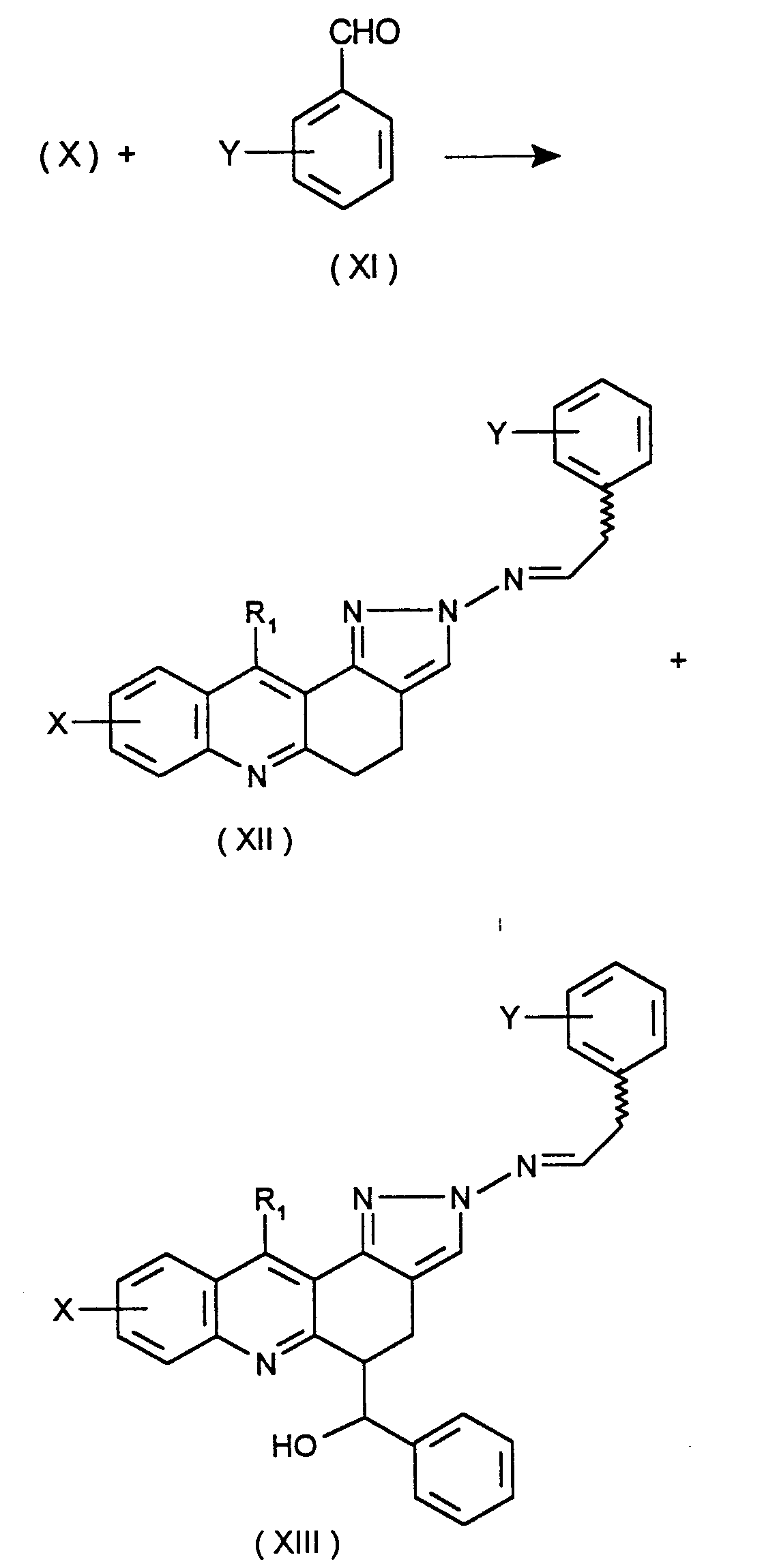
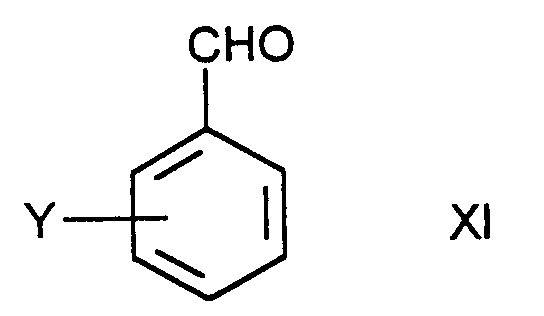
- Compound X is allowed to react with a benzaldehyde compound of Formula XI where Y is hydrogen, (C 1 -C 6 )alkyl, (C 1 -C 6 )alkoxy, halogen or trifluoromethyl to afford compounds of Formula XII and XIII.
- the two compounds XII and XIII can be separated from each other by methods known to the art. This reaction is typically conducted in an excess of compound XI at the temperature of about 20 to 50°.
- the compounds of Formula I of the present invention are useful as analgesic agents due to their ability to alleviate pain in mammals.
- the activity of the compounds is demonstrated in the 2-phenyl-1,4-benzoquinone-induced writhing test in mice, a standard assay for analgesia [Proc.Soc.Exptl.Biol.Med.,95,729(1957)].
- Table 1 shows results of the test for some of the compounds of this invention along with a result for a reference compound. The tests were conducted at the subcutaneous dose of 20 mg/kg.
- Effective quantities of the compounds of the invention may be administered to a patient by any of the various methods, for example, orally as in capsule or tablets, parenterally in the form of sterile solutions or suspensions, and in some cases intravenously in the form of sterile solutions.
- the free base final products while effective themselves, may be formulated and administered in the form of their pharmaceutically acceptable acid addition salts for purposes of stability, convenience of crystallization, increased solubility and the like.
- Acids useful for preparing the pharmaceutically acceptable acid addition salts of the invention include inorganic acids such as hydrochloric, hydrobromic, sulfuric, nitric, phosphoric and perchloric acids, as well as organic acids such as tartaric, citric, acetic, succinic, maleic, fumaric, 2-naphthalenesulfonic and oxalic acids.
- inorganic acids such as hydrochloric, hydrobromic, sulfuric, nitric, phosphoric and perchloric acids
- organic acids such as tartaric, citric, acetic, succinic, maleic, fumaric, 2-naphthalenesulfonic and oxalic acids.
- the active compounds of the present invention may be orally administered, for example, with an inert diluent or with an edible carrier, or they may be enclosed in gelatin capsules, or they may be compressed into tablets.
- the active compounds of the invention may be incorporated with excipients and used in the form of tablets, troches, capsules, elixirs, suspensions, syrups, wafers, chewing gum and the like. These preparations should contain at least 0.5% of active compounds, but may be varied depending upon the particular form and may conveniently be between 4% to about 70% of the weight of the unit. The amount of active compound in such compositions is such that a suitable dosage will be obtained.
- Preferred compositions and preparations according to the present invention are prepared so that an oral dosage unit form contains between 1.0 - 300 milligrams of active compound.
- the tablets, pills, capsules, troches and the like may also contain the following ingredients: a binder such as micro-crystalline cellulose, gum tragacanth or gelatin; an excipient such as starch or lactose, a disintegrating agent such as alginic acid, Primogel, cornstarch and the like; a lubricant such as magnesium stearate or Sterotex; a glidant such as colloidal silicon dioxide; and a sweeting agent such as sucrose or saccharin may be added or a flavoring agent such as peppermint, methyl salicylate, or orange flavoring.
- a binder such as micro-crystalline cellulose, gum tragacanth or gelatin
- an excipient such as starch or lactose, a disintegrating agent such as alginic acid, Primogel, cornstarch and the like
- a lubricant such as magnesium stearate or Sterotex
- a glidant such as colloidal silicon dioxide
- a sweeting agent such
- dosage unit forms may contain other various materials which modify the physical form of the dosage unit, for example, as coatings.
- tablets or pills may be coated with sugar, shellac, or other enteric coating agents.
- a syrup may contain, in addition to the active compounds, sucrose as a sweetening agent and certain preservatives, dyes, coloring and flavors. Materials used in preparing these various compositions should be pharmaceutically pure and non-toxic in the amounts used.
- the active compounds of the invention may be incorporated into a solution or suspension. These preparations should contain at least 0.1% of active compound, but may be varied between 0.5 and about 30% of the weight thereof. The amount of active compound in such compositions is such that a suitable dosage will be obtained. Preferred compositions and preparations according to the present inventions are prepared so that a parenteral dosage unit contains between 0.5 to 100 milligrams of active compound.
- the solutions or suspensions may also include the following components: a sterile diluent such as water for injection, saline solution, fixed oils, polyethylene glycols, glycerine, propylene glycol or other synthetic solvents; antibacterial agents such as benzyl alcohol or methyl parabens; antioxidants such as ascorbic acid or sodium bisulfite; chelating agents such as ethylenediaminetetraacetic acid; buffers such as acetates, citrates or phosphates and agents for the adjustment of tonicity such as sodium chloride or dextrose.
- a sterile diluent such as water for injection, saline solution, fixed oils, polyethylene glycols, glycerine, propylene glycol or other synthetic solvents
- antibacterial agents such as benzyl alcohol or methyl parabens
- antioxidants such as ascorbic acid or sodium bisulfite
- chelating agents such as ethylenediaminetetraacetic acid
- Examples of the compounds of this invention include:
- reaction mixture was refluxed for 1.5 hours, concentrated, adhered to silica (107g), flash chromatographed (1.5% Et 3 N/EtOAc) and triturated (pentane/ethanol) to yield 7.82g of 11-formamido-4,5-dihydro-1-phenyl-1H-pyrazolo[3,4-a]acridine.
- This was stirred in a solution of KOH (6.5g) in methanol (189ml) overnight. The solid was filtered, washed with methanol and air dried to yield 6.94 of product.
- 3,4-Dihydroacridin-1(2H)-one (19.43g) was refluxed in N,N-dimethylformamide dimethyl acetal (48.57 ml) and triethylamine (13.76 ml) for 10 hours.
- the reaction was concentrated and thereafter, triturated first with diethyl ether/pentane and then with diethyl ether, to yield 22.43 g of 2-(dimethylaminomethylene)-3,4-dihydroacridin-1(2H)-one. This was combined with an additional 1.07 g of compound and refluxed in hydrazine (12.68 ml) and ethanol (372 ml) for 2.5 hours.
Landscapes
- Chemical & Material Sciences (AREA)
- Organic Chemistry (AREA)
- Health & Medical Sciences (AREA)
- General Chemical & Material Sciences (AREA)
- Nuclear Medicine, Radiotherapy & Molecular Imaging (AREA)
- Bioinformatics & Cheminformatics (AREA)
- Biomedical Technology (AREA)
- Neurology (AREA)
- Neurosurgery (AREA)
- Chemical Kinetics & Catalysis (AREA)
- Pain & Pain Management (AREA)
- Medicinal Chemistry (AREA)
- Engineering & Computer Science (AREA)
- Pharmacology & Pharmacy (AREA)
- Life Sciences & Earth Sciences (AREA)
- Animal Behavior & Ethology (AREA)
- General Health & Medical Sciences (AREA)
- Public Health (AREA)
- Veterinary Medicine (AREA)
- Pharmaceuticals Containing Other Organic And Inorganic Compounds (AREA)
- Nitrogen Condensed Heterocyclic Rings (AREA)
Abstract
Description


| PQW Activity | |
| Compound | % Inhibition |
| 11-amino-4,5-dihydro-2-methyl-2H-pyrazolo[3,4-a]acridine | 54% |
| 11-amino-4,5-dihydro-2-ethyl-2H-pyrazolo[3,4-a]acridine | 67% |
| 11-amino-4,5-dihydro-1-phenyl-1H-pyrazolo[3,4-a]acridine | 48% |
| 11-amino-4,5-dihydro-2H-pyrazolo [3,4-a]acridine-2-acetic acid hydrochloride hemihydrate | 58% |
| 11-amino-4,5-dihydro-2-(2-dimethyl-aminoethyl)-2H-pyrazolo[3,4-a]acridine | 59% |
| 11-amino-4,5-dihydro-2H-pyrazolo [3,4-a]acridine-2-acetonitrile | 47% |
| (Reference Compound) | |
| Aspirin at 33 mg/kg, s.c. | 50% |
| Analysis: | |||
| Calculated for C14H12N4·HC1·O.25H2O: | 60.65%C | 4.74%H | 20.21%N |
| Found: | 60.77%C | 4.74%H | 20.24%N |
| Analysis: | |||
| Calculated for C16H16N4: | 72.70%C | 6.10%H | 21.20%N |
| Found: | 72.28%C | 5.98%H | 20.97%N |
| Analysis: | |||
| Calculated for C17H18N4: | 73.35%C | 6.52%H | 20.13%N |
| Found: | 73.09%C | 6.52%H | 19.96%N |
| Analysis: | |||
| Calculated for C22H20N4: | 77.62%C | 5.92%H | 16.46%N |
| Found: | 77.51%C | 5.95%H | 16.51%N |
| Analysis: | |||
| Calculated for C18H18N4O2: | 67.07%C | 5.63%H | 17.38%N |
| Found: | 67.21%C | 5.54%H | 17.35%N |
| Analysis: | |||
| Calculated for C16H14N4O2·HC1·0.5H2O: | 56.55%C | 4.75%H | 16.50%N |
| Found: | 56.66%C | 4.85%H | 16.43%N |
| Analysis: | |||
| Calculated for C18H21N5: | 70.33%C | 6.89%H | 22.78%N |
| Found: | 70.31%C | 6.86%H | 22.92%N |
| Analysis: | |||
| Calculated for C21H18N4: | 77.27%C | 5.56%H | 17.17%N |
| Found: | 77.01%C | 5.58%H | 17.22%N |
| Analysis: | |||
| Calculated for C16H13N5: | 69.80%C | 4.76%H | 25.44%N |
| Found: | 69.76%C | 4.74%H | 25.31%N |
| Analysis: | |||
| Calculated for C17H16N4: | 73.89%C | 5.84%H | 20.27%N |
| Found: | 73.66%C | 5.77%H | 20.19%N |
| Analysis: | |||
| Calculated for C15H14N4: | 71.98%C | 5.63%H | 22.39%N |
| Found: | 71.95%C | 5.63%H | 22.09%N |
| Analysis: | |||
| Calculated for C15H14N4: | 71.98%C | 5.63%H | 22.39%N |
| Found: | 71.89%C | 5.75%H | 22.39%N |
| Analysis: | |||
| Calculated for C20H16N4: | 76.90%C | 5.16%H | 17.94%N |
| Found: | 76.54%C | 5.21%H | 17.88%N |
| Analysis: | |||
| Calculated for C14H13N5: | 66.92%C | 5.21%H | 27.87%N |
| Found: | 66.70%C | 5.18%H | 27.79%N |
| Analysis: | |||
| Calculated for C28H23N5O: | 75.49%C | 5.20%H | 15.72%N |
| Found: | 75.20%C | 5.23%H | 15.61%N |
| Analysis: | |||
| Calculated for C14H11N3: | 76.00%C | 5.01%H | 18.99%N |
| Found: | 76.12% | 4.99%H | 19.02%N |
| Analysis: | |||
| Calculated for C14H12N4: | 71.17%C | 5.12%H | 23.71%N |
| Found: | 71.07%C | 5.12%H | 23.61%N |
| Analysis: | |||
| Calculated for C14H12N4: | 71.17%C | 5.12%H | 23.71%N |
| Found: | 70.89%C | 4.96%H | 23.57%N |
Claims (10)
- A compound of the formula I,where,
 X is hydrogen, (C1-C6)alkyl, (C1-C6)alkoxy, halogen or trifluoromethyl;R1 is hydrogen or -NR4R5, each of R4 and R5 being independently hydrogen, (C1-C6)alkyl or phenyl(C1-C6)alkyl, where phenyl is optionally mono-substituted with (C1-C6)alkyl, (C1-C6)alkoxy halogen, or trifluoromethyl;R2, which is a substituent on one of the two nitrogen atoms of the pyrazole ring, is hydrogen, (C1-C6)alkyl, up to C6 alkenyl, phenyl, phenyl(C1-C6)alkyl, cyano(C1-C6)alkyl, -CmH2mCOOR6, -NR7R8, -CnH2nNR7R8 or -N=CH-phenyl, where phenyl in each case is optionally mono substituted with (C1-C6)alkyl, (C1-C6)alkoxy, halogen or trifluoromethyl, R6 being hydrogen or (C1-C6)alkyl, m being an integer of 1 to 3, each of R7 and R8 being independentlyflydrogen or (C1-C6)alkyl, and n being an integer of 2 to 4; andR3 is hydrogen or -CHOH-phenyl, where phenyl is optionally mono-substituted with (C1-C6)alkyl, (C1-C6)alkoxy, halogen or trifluoromethyl,or a pharmaceutically acceptable acid addition salt thereof.
 - A compound as defined in claim 1 where X is hydrogen, R1 is hydrogen or -NR4R5, R4 and R5 being hydrogen, and R3 is hydrogen.
- A compound as defined in claim 2, where the substituent R2 is in the 2-position of the pyrazole ring.
- The compound as defined in claim 1, which is 11-amino-4,5-dihydro-2-methyl-2H-pyrazolo[3,4-a]acridine or a pharmaceutically acceptable acid addition salt thereof.
- The compound as defined in claim 1, which is 11-amino-4,5-dihydro-2-ethyl-2H-pyrazolo[3,4-a]acridine or a phramaceutically acceptable acid addition salt thereof.
- The compound as defined in claim 1, which is 11-amino-4,5-dihydro-2H-pyrazolo[3,4-a]acridine-2-acetic acid or a pharmaceutically acceptable acid addition salt thereof.
- The compound as defined in claim 1, which is 11-amino-4,5-dihydro-2-(2-dimethyl-aminomethyl)-2H-pyrazolo[3,4-a]acridine or a pharmaceutically acceptable acid addition salt thereof.
- A pharmaceutical composition which comprises as the active ingredient a compound of the formula I as defined in claim 1 and a suitable carrier therefor.
- Use of a compound of the formula I as defined in claim 1 for the preparation of an analgesic medicament.
- A process for the preparation of a compound of the formula I as defined in claim 1, which comprisesa) reacting a compound of the formula IVwherein X and R1 are as defined in claim 1 but R1 is not NH2, or of the formula IVa
 with hydrazine to afford a compound of the formula I, wherein X and R1 are as defined in claim 1, and R2 and R3 are each hydrogen,
 b) optionally reacting a compound of the formula I, wherein R2 and R3 are hydrogen, with a compound of the formula R9-Hal, where Hal is chlorine or bromine and R9 is (C1-C6)alkyl, up to C6 alkenyl, phenyl(C1-C6)alkyl, cyano(C1-C6)alkyl, CmH2m-COO-(C1-C6)alkyl or CnH2nNR7R8 to afford a compound of the formula I, wherein X and R1 are as defined in claim 1, R3 is hydrogen and R2 is as defined for R9 above,c) optionally hydrolyzing a compound of the formula I, wherein X and R1 are as defined in claim 1, R3 is hydrogen and R2 is the group CmH2m-COO-(C1-C6)alkyl, to afford a compound of the formula I, wherein X and R1 are as defined in claim 1, R3 is hydrogen and R2 is the group CmH2mCOOH,d) optionally reacting a compound of the formula I, wherein X and R1 are as defined in claim 1, and R2 and R3 are hydrogen, with hydroxylamine-O-sulfonic acid to afford a compound of the formula I, wherein X and R1 are as defined in claim 1, R3 is hydrogen and R2 is NH2,e) optionally reacting a compound of the formula I, wherein X and R1 are as defined in claim 1, R2 is NH2 and R3 is hydrogen, with a benzaldehyde of the formula XIwherein Y is hydrogen,(C1-C6)alkyl, (C1-C6)alkoxy, halogen or trifluoromethyl, to afford a mixture of a compound of the formula I, wherein X and R1 are as defined in claim 1, R2 is in the 2-position and is the group
 where Y is as defined, and R3 is hydrogen, and of a compound of the formula I, wherein X and R1 are as defined in claim 1, R2 is in the 2-position and is the group
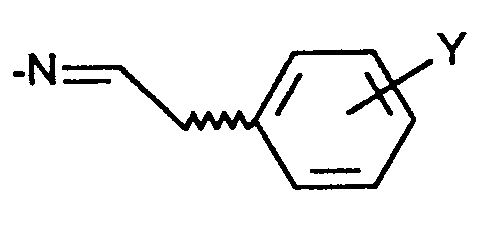 where Y is as defined, and R3 is the group
 and separating the compounds from each other by methods known in the art,
 f) or reacting a compound of the formula IVwherein X and R1 are as defined in claim 1 but R1 is not NH2, or of the formula IV a
 with a hydrazine derivative of the formula
 where R10 is (C1-C6)alkyl, up to C6 alkenyl, phenyl, phenyl(C1-C6)alkyl or cyano(C1-C6)alkyl where phenyl is optionally mono-substituted with (C1-C6)alkyl, (C1-C6)alkoxy, halogen, or trifluoromethyl; to afford a mixture of compounds of the formula I wherein X and R1 are as defined in claim 1, R3 is hydrogen and R2 is either in the 1- or in the 2-position and has the meaning of R10 above, and separating the compounds from each other by methods known in the art.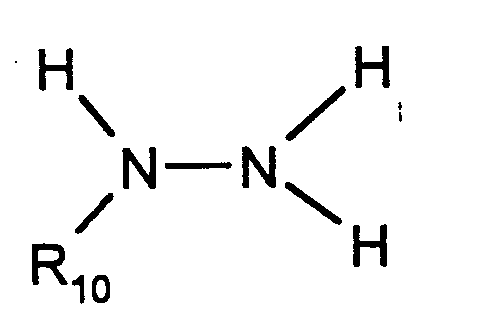
Applications Claiming Priority (2)
| Application Number | Priority Date | Filing Date | Title |
|---|---|---|---|
| US07/848,558 US5179100A (en) | 1992-03-09 | 1992-03-09 | 4,5-dihydropyrazolo[3,4-a]acridines |
| US848558 | 1992-03-09 |
Publications (2)
| Publication Number | Publication Date |
|---|---|
| EP0560231A1 EP0560231A1 (en) | 1993-09-15 |
| EP0560231B1 true EP0560231B1 (en) | 1998-06-03 |
Family
ID=25303626
Family Applications (1)
| Application Number | Title | Priority Date | Filing Date |
|---|---|---|---|
| EP93103604A Expired - Lifetime EP0560231B1 (en) | 1992-03-09 | 1993-03-05 | Pyrazolo(3,4-a)acridine derivatives as analgesics |
Country Status (7)
| Country | Link |
|---|---|
| US (1) | US5179100A (en) |
| EP (1) | EP0560231B1 (en) |
| JP (1) | JP2656201B2 (en) |
| AT (1) | ATE166874T1 (en) |
| DE (1) | DE69318869T2 (en) |
| DK (1) | DK0560231T3 (en) |
| ES (1) | ES2118151T3 (en) |
Families Citing this family (2)
| Publication number | Priority date | Publication date | Assignee | Title |
|---|---|---|---|---|
| US5179100A (en) * | 1992-03-09 | 1993-01-12 | Hoechst-Roussel Pharmaceuticals Inc. | 4,5-dihydropyrazolo[3,4-a]acridines |
| US5428040A (en) * | 1993-08-31 | 1995-06-27 | The Du Pont Merck Pharmaceutical Company | Carbocyclic fused-ring quinolinecarboxylic acids useful as immunosuppressive agents |
Family Cites Families (2)
| Publication number | Priority date | Publication date | Assignee | Title |
|---|---|---|---|---|
| US4999430A (en) * | 1989-07-31 | 1991-03-12 | Warner-Lambert Company | Derivatives of 1,2,3,4-tetrahydro-9-acrisinamine |
| US5179100A (en) * | 1992-03-09 | 1993-01-12 | Hoechst-Roussel Pharmaceuticals Inc. | 4,5-dihydropyrazolo[3,4-a]acridines |
-
1992
- 1992-03-09 US US07/848,558 patent/US5179100A/en not_active Expired - Lifetime
-
1993
- 1993-03-05 EP EP93103604A patent/EP0560231B1/en not_active Expired - Lifetime
- 1993-03-05 AT AT93103604T patent/ATE166874T1/en not_active IP Right Cessation
- 1993-03-05 ES ES93103604T patent/ES2118151T3/en not_active Expired - Lifetime
- 1993-03-05 DK DK93103604T patent/DK0560231T3/en active
- 1993-03-05 DE DE69318869T patent/DE69318869T2/en not_active Expired - Fee Related
- 1993-03-08 JP JP5046183A patent/JP2656201B2/en not_active Expired - Fee Related
Also Published As
| Publication number | Publication date |
|---|---|
| DE69318869D1 (en) | 1998-07-09 |
| JPH0649067A (en) | 1994-02-22 |
| ES2118151T3 (en) | 1998-09-16 |
| DK0560231T3 (en) | 1999-03-22 |
| DE69318869T2 (en) | 1998-11-12 |
| US5179100A (en) | 1993-01-12 |
| EP0560231A1 (en) | 1993-09-15 |
| JP2656201B2 (en) | 1997-09-24 |
| ATE166874T1 (en) | 1998-06-15 |
Similar Documents
| Publication | Publication Date | Title |
|---|---|---|
| US4438128A (en) | Cardioactive aryloxypropanolamines | |
| AU751486B2 (en) | Fused pyridine inhibitors of cGMP phosphodiesterase | |
| KR100225720B1 (en) | A pharmaceutical composition comprising pyrazolopyrimidines as crf antagonists | |
| US3995039A (en) | Pyrazolo [1,5-a] [1,3,5] triazines | |
| JPH0256484A (en) | Fused pyrimidine compound and its production | |
| SK280822B6 (en) | Imidazopyridines, methods of their preparation, pharmaceuticals them containing, and their use | |
| JPH11501925A (en) | Substituted N-arylmethyl and heterocyclylmethyl-1H-pyrazolo [3,4-b] quinolin-4-amines and compositions containing them | |
| CZ20023945A3 (en) | Substituted pyrrolopyridine derivatives intended for use as phosphodiesterase inhibitors | |
| CZ9797A3 (en) | Triazole derivative, process of its preparation and pharmaceutical composition containing thereof | |
| EP0415102B1 (en) | 1,3-Dihydro-1-(pyridinylamino)-2H-indol-2-ones, a process for their preparation and their use as medicaments | |
| IL85741A (en) | Substituted tetrahydroacridines a process for their preparation and pharmaceutical compositions containing substituted alpha-amino-tetrahydroacridines | |
| IL93073A (en) | cis-2,7- disubstituted-octahydro-1h- pyrido (1,2-a) pyrazines and anxiolytic and antidepressant pharmaceutical compositions containing them | |
| JP2000281654A (en) | Isoquinoline derivatives | |
| HK1005592B (en) | Benzimidazole derivatives, process for their preparation and therapeutic application | |
| PL176424B1 (en) | Alkoxyalkyl carbamates of imidazo /1,2-a/ pyrimidines | |
| HUP9904623A2 (en) | 1h-pyrido[3,4-b]indole-4-carboxamide derivatives,preparation and application thereof in therapeutics | |
| US6077841A (en) | 5-heterocyclyl pyrazolo[4,3-d]pyrimidin-7-ones for the treatment of male erectile dysfunction | |
| HU197749B (en) | Process for producing /3,4-d/pyrimidine derivatives and pharmaceutical compositions comprising these compounds as active ingredient | |
| EP0415103B1 (en) | 2,3-Dihydro-1-(pyridinylamino)-indoles, a process for their preparation and their use as medicaments | |
| US5635511A (en) | Treatment of heart rhythm disorders by administration of 3-phenylsulfonyl-3,7-diazabicyclo[3.3.1]nonane compounds. | |
| WO1989002432A1 (en) | Thienopyrimidine derivatives | |
| US4497814A (en) | 2-(Pyridinyl)-1,2,4-triazolo[1,5-a]pyrimidines and derivatives useful in increasing cardiac contractility | |
| US5179100A (en) | 4,5-dihydropyrazolo[3,4-a]acridines | |
| US4942143A (en) | Imidazothiadiazine derivatives, and their use as medicaments | |
| IE912851A1 (en) | 3-(1,2-Benzisoxazol-3-yl)-4-pyridinamines and derivatives |
Legal Events
| Date | Code | Title | Description |
|---|---|---|---|
| PUAI | Public reference made under article 153(3) epc to a published international application that has entered the european phase |
Free format text: ORIGINAL CODE: 0009012 |
|
| AK | Designated contracting states |
Kind code of ref document: A1 Designated state(s): AT BE CH DE DK ES FR GB GR IE IT LI LU NL PT SE |
|
| 17P | Request for examination filed |
Effective date: 19940303 |
|
| RAP1 | Party data changed (applicant data changed or rights of an application transferred) |
Owner name: HOECHST MARION ROUSSEL, INC. |
|
| 17Q | First examination report despatched |
Effective date: 19961210 |
|
| GRAG | Despatch of communication of intention to grant |
Free format text: ORIGINAL CODE: EPIDOS AGRA |
|
| GRAG | Despatch of communication of intention to grant |
Free format text: ORIGINAL CODE: EPIDOS AGRA |
|
| GRAH | Despatch of communication of intention to grant a patent |
Free format text: ORIGINAL CODE: EPIDOS IGRA |
|
| GRAH | Despatch of communication of intention to grant a patent |
Free format text: ORIGINAL CODE: EPIDOS IGRA |
|
| GRAA | (expected) grant |
Free format text: ORIGINAL CODE: 0009210 |
|
| AK | Designated contracting states |
Kind code of ref document: B1 Designated state(s): AT BE CH DE DK ES FR GB GR IE IT LI LU NL PT SE |
|
| REF | Corresponds to: |
Ref document number: 166874 Country of ref document: AT Date of ref document: 19980615 Kind code of ref document: T |
|
| REG | Reference to a national code |
Ref country code: CH Ref legal event code: EP |
|
| REF | Corresponds to: |
Ref document number: 69318869 Country of ref document: DE Date of ref document: 19980709 |
|
| ITF | It: translation for a ep patent filed | ||
| ET | Fr: translation filed | ||
| REG | Reference to a national code |
Ref country code: IE Ref legal event code: FG4D |
|
| REG | Reference to a national code |
Ref country code: ES Ref legal event code: FG2A Ref document number: 2118151 Country of ref document: ES Kind code of ref document: T3 |
|
| REG | Reference to a national code |
Ref country code: PT Ref legal event code: SC4A Free format text: AVAILABILITY OF NATIONAL TRANSLATION Effective date: 19980728 |
|
| REG | Reference to a national code |
Ref country code: DK Ref legal event code: T3 |
|
| PLBE | No opposition filed within time limit |
Free format text: ORIGINAL CODE: 0009261 |
|
| 26N | No opposition filed | ||
| REG | Reference to a national code |
Ref country code: GB Ref legal event code: IF02 |
|
| PGFP | Annual fee paid to national office [announced via postgrant information from national office to epo] |
Ref country code: FR Payment date: 20030213 Year of fee payment: 11 |
|
| PGFP | Annual fee paid to national office [announced via postgrant information from national office to epo] |
Ref country code: DE Payment date: 20030217 Year of fee payment: 11 |
|
| PGFP | Annual fee paid to national office [announced via postgrant information from national office to epo] |
Ref country code: AT Payment date: 20030219 Year of fee payment: 11 |
|
| PGFP | Annual fee paid to national office [announced via postgrant information from national office to epo] |
Ref country code: NL Payment date: 20030220 Year of fee payment: 11 Ref country code: SE Payment date: 20030220 Year of fee payment: 11 Ref country code: GB Payment date: 20030220 Year of fee payment: 11 |
|
| PGFP | Annual fee paid to national office [announced via postgrant information from national office to epo] |
Ref country code: CH Payment date: 20030221 Year of fee payment: 11 |
|
| PGFP | Annual fee paid to national office [announced via postgrant information from national office to epo] |
Ref country code: DK Payment date: 20030224 Year of fee payment: 11 |
|
| PGFP | Annual fee paid to national office [announced via postgrant information from national office to epo] |
Ref country code: PT Payment date: 20030225 Year of fee payment: 11 |
|
| PGFP | Annual fee paid to national office [announced via postgrant information from national office to epo] |
Ref country code: IE Payment date: 20030305 Year of fee payment: 11 |
|
| PGFP | Annual fee paid to national office [announced via postgrant information from national office to epo] |
Ref country code: GR Payment date: 20030306 Year of fee payment: 11 |
|
| PGFP | Annual fee paid to national office [announced via postgrant information from national office to epo] |
Ref country code: BE Payment date: 20030311 Year of fee payment: 11 |
|
| PGFP | Annual fee paid to national office [announced via postgrant information from national office to epo] |
Ref country code: LU Payment date: 20030312 Year of fee payment: 11 |
|
| PGFP | Annual fee paid to national office [announced via postgrant information from national office to epo] |
Ref country code: ES Payment date: 20030331 Year of fee payment: 11 |
|
| PG25 | Lapsed in a contracting state [announced via postgrant information from national office to epo] |
Ref country code: LU Free format text: LAPSE BECAUSE OF NON-PAYMENT OF DUE FEES Effective date: 20040305 Ref country code: IE Free format text: LAPSE BECAUSE OF NON-PAYMENT OF DUE FEES Effective date: 20040305 Ref country code: GB Free format text: LAPSE BECAUSE OF NON-PAYMENT OF DUE FEES Effective date: 20040305 Ref country code: AT Free format text: LAPSE BECAUSE OF NON-PAYMENT OF DUE FEES Effective date: 20040305 |
|
| PG25 | Lapsed in a contracting state [announced via postgrant information from national office to epo] |
Ref country code: SE Free format text: LAPSE BECAUSE OF NON-PAYMENT OF DUE FEES Effective date: 20040306 Ref country code: ES Free format text: LAPSE BECAUSE OF NON-PAYMENT OF DUE FEES Effective date: 20040306 |
|
| PG25 | Lapsed in a contracting state [announced via postgrant information from national office to epo] |
Ref country code: LI Free format text: LAPSE BECAUSE OF NON-PAYMENT OF DUE FEES Effective date: 20040331 Ref country code: DK Free format text: LAPSE BECAUSE OF NON-PAYMENT OF DUE FEES Effective date: 20040331 Ref country code: CH Free format text: LAPSE BECAUSE OF NON-PAYMENT OF DUE FEES Effective date: 20040331 Ref country code: BE Free format text: LAPSE BECAUSE OF NON-PAYMENT OF DUE FEES Effective date: 20040331 |
|
| BERE | Be: lapsed |
Owner name: *HOECHST MARION ROUSSEL INC. Effective date: 20040331 |
|
| PG25 | Lapsed in a contracting state [announced via postgrant information from national office to epo] |
Ref country code: NL Free format text: LAPSE BECAUSE OF NON-PAYMENT OF DUE FEES Effective date: 20041001 Ref country code: DE Free format text: LAPSE BECAUSE OF NON-PAYMENT OF DUE FEES Effective date: 20041001 |
|
| PG25 | Lapsed in a contracting state [announced via postgrant information from national office to epo] |
Ref country code: GR Free format text: LAPSE BECAUSE OF NON-PAYMENT OF DUE FEES Effective date: 20041006 |
|
| PG25 | Lapsed in a contracting state [announced via postgrant information from national office to epo] |
Ref country code: PT Free format text: LAPSE BECAUSE OF NON-PAYMENT OF DUE FEES Effective date: 20041015 |
|
| GBPC | Gb: european patent ceased through non-payment of renewal fee | ||
| EUG | Se: european patent has lapsed | ||
| REG | Reference to a national code |
Ref country code: CH Ref legal event code: PL |
|
| PG25 | Lapsed in a contracting state [announced via postgrant information from national office to epo] |
Ref country code: FR Free format text: LAPSE BECAUSE OF NON-PAYMENT OF DUE FEES Effective date: 20041130 |
|
| REG | Reference to a national code |
Ref country code: PT Ref legal event code: MM4A Free format text: LAPSE DUE TO NON-PAYMENT OF FEES Effective date: 20040930 |
|
| NLV4 | Nl: lapsed or anulled due to non-payment of the annual fee |
Effective date: 20041001 |
|
| REG | Reference to a national code |
Ref country code: IE Ref legal event code: MM4A |
|
| REG | Reference to a national code |
Ref country code: FR Ref legal event code: ST |
|
| PG25 | Lapsed in a contracting state [announced via postgrant information from national office to epo] |
Ref country code: IT Free format text: LAPSE BECAUSE OF NON-PAYMENT OF DUE FEES;WARNING: LAPSES OF ITALIAN PATENTS WITH EFFECTIVE DATE BEFORE 2007 MAY HAVE OCCURRED AT ANY TIME BEFORE 2007. THE CORRECT EFFECTIVE DATE MAY BE DIFFERENT FROM THE ONE RECORDED. Effective date: 20050305 |
|
| REG | Reference to a national code |
Ref country code: ES Ref legal event code: FD2A Effective date: 20040306 |
|
| PG25 | Lapsed in a contracting state [announced via postgrant information from national office to epo] |
Ref country code: PT Free format text: LAPSE BECAUSE OF NON-PAYMENT OF DUE FEES Effective date: 20040305 |