EP0559331A1 - Compositions and aqueous solutions of reactive azo dyes - Google Patents
Compositions and aqueous solutions of reactive azo dyes Download PDFInfo
- Publication number
- EP0559331A1 EP0559331A1 EP93300859A EP93300859A EP0559331A1 EP 0559331 A1 EP0559331 A1 EP 0559331A1 EP 93300859 A EP93300859 A EP 93300859A EP 93300859 A EP93300859 A EP 93300859A EP 0559331 A1 EP0559331 A1 EP 0559331A1
- Authority
- EP
- European Patent Office
- Prior art keywords
- dye
- alkyl
- formula
- compound
- solution
- Prior art date
- Legal status (The legal status is an assumption and is not a legal conclusion. Google has not performed a legal analysis and makes no representation as to the accuracy of the status listed.)
- Granted
Links
- ZWYIBCBHRZWKGC-UHFFFAOYSA-N Cc(ccc(S(O)(=O)=O)c1)c1N(C)c1nc(N)nc(Cl)n1 Chemical compound Cc(ccc(S(O)(=O)=O)c1)c1N(C)c1nc(N)nc(Cl)n1 ZWYIBCBHRZWKGC-UHFFFAOYSA-N 0.000 description 1
Classifications
-
- C—CHEMISTRY; METALLURGY
- C09—DYES; PAINTS; POLISHES; NATURAL RESINS; ADHESIVES; COMPOSITIONS NOT OTHERWISE PROVIDED FOR; APPLICATIONS OF MATERIALS NOT OTHERWISE PROVIDED FOR
- C09B—ORGANIC DYES OR CLOSELY-RELATED COMPOUNDS FOR PRODUCING DYES, e.g. PIGMENTS; MORDANTS; LAKES
- C09B62/00—Reactive dyes, i.e. dyes which form covalent bonds with the substrates or which polymerise with themselves
- C09B62/02—Reactive dyes, i.e. dyes which form covalent bonds with the substrates or which polymerise with themselves with the reactive group directly attached to a heterocyclic ring
- C09B62/04—Reactive dyes, i.e. dyes which form covalent bonds with the substrates or which polymerise with themselves with the reactive group directly attached to a heterocyclic ring to a triazine ring
- C09B62/08—Azo dyes
- C09B62/085—Monoazo dyes
-
- C—CHEMISTRY; METALLURGY
- C09—DYES; PAINTS; POLISHES; NATURAL RESINS; ADHESIVES; COMPOSITIONS NOT OTHERWISE PROVIDED FOR; APPLICATIONS OF MATERIALS NOT OTHERWISE PROVIDED FOR
- C09B—ORGANIC DYES OR CLOSELY-RELATED COMPOUNDS FOR PRODUCING DYES, e.g. PIGMENTS; MORDANTS; LAKES
- C09B29/00—Monoazo dyes prepared by diazotising and coupling
- C09B29/34—Monoazo dyes prepared by diazotising and coupling from other coupling components
- C09B29/36—Monoazo dyes prepared by diazotising and coupling from other coupling components from heterocyclic compounds
-
- C—CHEMISTRY; METALLURGY
- C09—DYES; PAINTS; POLISHES; NATURAL RESINS; ADHESIVES; COMPOSITIONS NOT OTHERWISE PROVIDED FOR; APPLICATIONS OF MATERIALS NOT OTHERWISE PROVIDED FOR
- C09B—ORGANIC DYES OR CLOSELY-RELATED COMPOUNDS FOR PRODUCING DYES, e.g. PIGMENTS; MORDANTS; LAKES
- C09B67/00—Influencing the physical, e.g. the dyeing or printing properties of dyestuffs without chemical reactions, e.g. by treating with solvents grinding or grinding assistants, coating of pigments or dyes; Process features in the making of dyestuff preparations; Dyestuff preparations of a special physical nature, e.g. tablets, films
- C09B67/0033—Blends of pigments; Mixtured crystals; Solid solutions
- C09B67/0046—Mixtures of two or more azo dyes
- C09B67/0051—Mixtures of two or more azo dyes mixture of two or more monoazo dyes
- C09B67/0052—Mixtures of two or more reactive monoazo dyes
- C09B67/0053—Mixtures of two or more reactive monoazo dyes all the reactive groups being directly attached to a heterocyclic system
-
- C—CHEMISTRY; METALLURGY
- C09—DYES; PAINTS; POLISHES; NATURAL RESINS; ADHESIVES; COMPOSITIONS NOT OTHERWISE PROVIDED FOR; APPLICATIONS OF MATERIALS NOT OTHERWISE PROVIDED FOR
- C09B—ORGANIC DYES OR CLOSELY-RELATED COMPOUNDS FOR PRODUCING DYES, e.g. PIGMENTS; MORDANTS; LAKES
- C09B67/00—Influencing the physical, e.g. the dyeing or printing properties of dyestuffs without chemical reactions, e.g. by treating with solvents grinding or grinding assistants, coating of pigments or dyes; Process features in the making of dyestuff preparations; Dyestuff preparations of a special physical nature, e.g. tablets, films
- C09B67/0071—Process features in the making of dyestuff preparations; Dehydrating agents; Dispersing agents; Dustfree compositions
- C09B67/0072—Preparations with anionic dyes or reactive dyes
- C09B67/0073—Preparations of acid or reactive dyes in liquid form
Definitions
- This invention relates to dye solutions and compositions, dyes, their preparation and use.
- Reactive dyes suitable for the coloration of cellulosic materials such as cotton have been known for many years.
- reactive dyes having good solubility in water to meet a demand for high strength liquid brands of such dyes.
- solubility of a dye increases more dye can be stored in solution and this leads to a reduction in storage space and transport costs for high strength liquid brands.
- High solubility reactive dyes are also desirable because solubility is a limiting factor in the quantity of dye which can be manufactured in a given vessel at any one time. A high solubility reactive dye which also possesses good wash off properties would be particularly valuable.
- a high strength aqueous solution comprising a first and second dye each of which, in the free acid form, is of Formula (1): wherein:
- the solution contains less than 1%, more preferably less than 0.5% by weight of inorganic compounds.
- the solution contains less than 20%, more preferably less than 10%, especially less than 5% by weight of urea and it is especially preferred that the solution is free from urea.
- said first and second dye are identical in every respect except for the identity of the group represented by A
- the high strength aqueous solution is preferably contained in a sealed container, for example a water-proof drum.
- the high strength aqueous solution contains a total amount of first and second dye of at least 20%, more preferably at least 30%, especially at least 40% and preferably below 60% by weight.
- the aqueous solution is preferably water.
- R1 is alkyl it preferably contains from 1 to 4 carbon atoms, and more preferably is C1 ⁇ 3-alkyl, especially methyl.
- R1 is NH2.
- W is preferably C1 ⁇ 4-alkyl, especially methyl; C1 ⁇ 4-alkoxy, especially methoxy; or H.
- the proviso which states that the groups defined by A in the first and second dye are different to one another means that A in each dye is different and both A groups fall within the definition given for A.
- a labile atom or group it is meant an atom or group which is bound directly to the triazine nucleus, which atom or group is readily replaceable by a hydroxy group in mildly alkaline aqueous conditions.
- a halogen atom for example for Cl
- a sulphonic acid group for example
- a thiocyano group for example
- a quaternary ammonium group for example a trialkyl ammonium group or an optionally substituted pyridinium group, for example 3- or 4-carboxy pyridinium.
- X is Cl, 3-carboxypyridinium or 4-carboxypyridinium.
- n preferably has a value of 2, more preferably 3, especially where this results in a 1,5-disulphonaphthyl or 3,6,8-trisulphonaphthyl group.
- Y is preferably H or C1 ⁇ 4-alkyl, more preferably propyl or ethyl because this leads to dyes having particularly good solubility.
- Z is preferably a phenyl group having one ortho halo or alkyl substituent, a sulpho substituent, or both an ortho halo or alkyl substituent and a sulpho substituent.
- the preference for Z having a sulpho substituent arises from the surprising finding that such dyes have particularly good wash off properties and solubility in water.
- Z has an ortho halo or alkyl substituent it is preferably Cl or C1 ⁇ 4-alkyl, especially methyl.
- groups represented by Z there may be mentioned phenyl, 2-sulphophenyl, 3-sulphophenyl, 4-sulphophenyl, 2-methyl-4-sulphophenyl and 2-methyl-5-sulphophenyl.
- groups represented by A there may be mentioned 4-sulpho-2-methyl-N-methylanilinyl and 5-sulpho-2-methyl-N-methylanilinyl.
- compositions for the preparation of high strength liquid brands or for use directly by a dyer.
- Such compositions preferably have good solubility in water and good wash-off properties when applied to a cellulosic material.
- composition comprising a first and second dye each of which, in the free acid form, is of Formula (1) wherein R1, W, X, A, Y, Z and n are as hereinbefore define and provided that the groups defined by A in the first and second dye are different to one another and provided that R1 is NH2 when W is H.
- the first and second dye are identical in every respect except for the identity of A.
- the composition contains less than 10%, more preferably less than 3%, especially less than 1% by weight of inorganic compounds.
- inorganic compound' means a salt consisting of a metal cation and inorganic anion.
- inorganic compounds include inorganic alkali or alkali earth metal salts such as are found in a dye after synthesis, more particularly sodium or potassium chloride, nitrite, nitrate, sulphate carbonate or bicarbonate.
- the amount of inorganic compounds present in the solutions and compositions of the invention may be adjusted to the desired level by methods known per se , for example filtration, reverse osmosis, ultrafiltration, dialysis or combinations thereof.
- the high strength aqueous solution and composition preferably contain the first and second dye in a weight ratio of 90:10 to 10:90, more preferably 80:20 to 20:80, especially 75:25 to 25:75. If desired the composition may include further dyes to produce variations in colour.
- Examples of preferred groups of Formula (2) include N-isopropyl-4-sulphophenylamino and N-ethyl-4-sulphophenylamino.
- the compound according to the third aspect of the present invention is notable for its good build-up, solubility and good wash off properties when applied to cellulosic fibres such as cotton.
- B and Y1 contain a total of three carbon atoms, for example B is methyl and Y1 is ethyl or B is H and Y1 is isopropyl.
- Dyes and compounds of or used in the invention may be prepared by a process comprising condensation of a compound of Formula (3) and a compound of Formula (4), preferably in the presence of an acid binding agent:
- the condensation preferably is performed in an aqueous solvent, especially water, at a temperature of 20°C to 60°C.
- the function of the acid binding agent is to neutralise any hydrogen halide formed during the condensation, accordingly any acid binding agent may be used, especially sodium carbonate, bicarbonate or hydroxide.
- a compound of Formula (3) may be prepared by condensation of a cyanuric halide with a compound of Formula (5):
- a cyanuric halide may be condensed with a compound of Formula (4) and the resultant dichlorotriazine condensed with a compound of Formula (5).
- the compound of Formula (5) may be prepared by diazotising an appropriate sulphonated 2-naphthylamine and coupling with an appropriate aniline derivative substituted at the 2-position by W and at the 5-position by -NHCOR1.
- n, R1, W, X, Y and Z are as hereinbefore defined.
- a composition according to the second aspect of the present invention may be prepared by mixing two or more dyes of Formula (1) or alternatively by following the above process in which a compound of Formula (3) is condensed with a mixture of Formula (4) in place of a compound of Formula (4).
- the present invention also provides a process for the coloration of a cellulosic material, especially cotton, by applying thereto a solution, composition or compound according to the invention.
- the solution, composition or compound of the invention may be applied to cellulosic materials by any of the techniques used for coloration thereof with a reactive dye, for example by a known exhaust dyeing, pad batch dyeing or printing technique, preferably in conjunction with an acid binding agent.
- the diazonium salt was added to 3-ureidoaniline (10g, 0.05M) over one hour and the temperature maintained below 10°C.
- the pH was raised to 6 by addition of sodium hydroxide and the solution was stirred overnight at room temperature to give a dyebase which was filtered off and dried.
- aqueous suspension of cyanuric chloride was prepared by adding cyanuric chloride (9.2g, 0.05M) in acetone (50ml) to ice-water (100ml). The suspension was added to a solution of the dyebase in water (250ml) and stirring at 0-5°C and pH 6.5 was continued for 30 minutes resulting in the formation of a dichlorotriazine dye.
- N-ethyl- o -toluidine-5-sulphonic acid (11g, 0.05M) was dissolved in water (50ml) by addition of sodium carbonate, added to the dichlorotriazine dye and warmed to 40°C at pH 6.5 before stirring overnight. The resultant solution was screened to remove insoluble matter and reduced in volume by rotary evaporation to give a concentrated solution of dye.
- the concentrated solution was desalinated in a visking tubing placed in distilled water and the water replaced periodically until no further chloride ions could be detected using silver nitrite and the product precipitated by addition of ethanol to give 46g of the title product (80% yield) having a lambda max at 417nm and very high solubility in water.
- the title dye was incorporated into an alginate print paste and printed on cotton and viscose to give a print having an attractive golden-yellow shade.
- the print showed excellent wash-off properties and little cross-staining of adjacent fibres.
- Example 1 The product of Example 1 (23g, 0.02M) was dissolved in water (250ml) to give a dye solution. Isonicotinic acid (10g, 0.08M) was dissolved in water (50ml) by addition of sodium carbonate, added to the dye solution and heated at 90°C pH 6.5 for 6 hours. The title product was desalinated and isolated by reducing the volume of liquid using a rotary evaporator and precipitation by addition of ethanol.
- the title dye was printed on cotton and viscose to give a print having an attractive golden-yellow shade.
- the prints showed excellent wash-off properties and little cross-staining in the standard simulated continuous wash-off (SCWOT) test.
- Example 1 The method of Example 1 was followed except that in place of N-ethyl- o -toluidine-5-sulphonic acid there was used N-isopropyl metanilic acid (11g, 0.05M).
- the title product was obtained in a yield of 60% (34g) and found to have a lambda max at 414nm.
- the title product had high solubility in water and its prints on cotton were found to have good wash-off with little cross-staining of adjacent fibres.
- Example 1 The method of Example 1 was followed except that in place of N-ethyl- o -toluidine-5-sulphonic acid there was used N-isopropyl sulphanilic acid (11g, 0.05M) to give 39g (80% yield) of the title product having a lambda max at 416nm.
- the title product was found to have very high solubility in water at 20°C and good wash-off when printed on cotton.
- 2-Naphthylamine-4,8-disulphonic acid (20g, 0.05M) was dissolved in water (250ml) by addition of sodium carbonate. The solution was cooled to below 10°C and concentrated HCl (30ml) added, followed by 2N sodium nitrite (25ml, 0.05M). The resulting suspension was stirred for 60 minutes after which the excess nitrous acid was destroyed by adding sulphamic acid, to give a diazonium salt.
- the diazonium salt was added to a solution of 3-amino-4-methoxy acetanilide (10g, 0.05M) in water (100ml) over one hour and the temperature maintained below 10°C.
- the pH was raised to 6 by adding sodium hydroxide solution and the mixture stirred overnight at room temperature to give a dyebase.
- aqueous suspension of cyanuric chloride was prepared by adding cyanuric chloride (9.2g, 0.05M) in acetone (50ml) to ice-water (100ml). The suspension was added to the dyebase at a temperature of 0-5°C and about pH 6. After 30 min condensation of the dyebase and cyanuric chloride was complete and the resultant dichlorotriazine product was precipitated by adding salt solution (20% wt/vol), washed with acetone and dried.
- N-ethyl- o -toluidine-5-sulphonic acid (11g, 0.05M) was dissolved in water (50ml) by adding sodium carbonate and condensed with the above dichlorotriazine product at 40°C, pH 6.5, overnight.
- the resultant solution was desalinated, concentrated by rotary evaporation and the title product (lambda max 408nm) was precipitated in 90% yield (55g) by addition of ethanol.
- the title dye had good solubility in water at 25°C and when printed on cotton gave a print having an attractive golden-yellow shade.
- the print showed excellent wash-off properties and little cross-staining in the standard SCWOT test.
- a first compound (D1) of Formula (6) was prepared in which X is Cl, Y1 is methyl and Z is 3-sulphophenyl by the method described in Example 1 except that in place of N-ethyl- o -toluidine-sulphonic acid there was used 3-sulpho-N-methylaniline.
- a second compound (D2) of Formula (6) was prepared in which X is Cl, Y1 is methyl and Z is 4-sulphophenyl by the method described in Example 1 except that in place of N-ethyl- o -toluidine-5-sulphonic acid there was used 4-sulpho-N-methylaniline.
- first and second compound are identical in every respect except for the identity of the group represented by Z.
- a composition (C1) was prepared comprising the first and second compound by following the method described in Example 1 except that in place of N-ethyl- o -toluidine-5-sulphonic acid there was used a mixture of 3-sulpho-N-methylaniline and 4-sulpho-N-methylaniline. C1 was formed in 80% yield (45g) and had a lambda max at 411nm. C1 was found to contain D1 and D2 in a weight ratio of 2:3.
- the solubility of C1 in water at 25°C was found to be higher than that of D1 and D2.
- the higher solubility of C1 compared with D1 and D2 means that more C1 can be prepared in a given vessel than for D1 or D2.
- C1 prepared as in Example 6 was converted into the corresponding composition wherein X is a 4-carboxypyridinium group by heating 0.02M of C1 for 6 hours at 90°C, pH 6.5, in water (50ml) with isonicotinic acid (10g, 0.08M) and sodium carbonate (23g, 0.02M).
- the product was desalinated and isolated by removal of water on a rotary evaporator and precipitation with ethanol.
- composition analogous to C1 except that X is 4-carboxypyridinium was formed in a yield of 21g.
- a first compound (D3) of Formula (6) was prepared in which X is C1, Y1 is ethyl and Z is 3-sulphophenyl by the method described in Example 1 except that in place of N-ethyl- o -toluidine-5-sulphonic acid there was used 3-sulpho-N-ethylaniline.
- a second compound (D4) of Formula (6) was prepared in which X is C1, Y1 is ethyl and Z is 4-sulphophenyl by the method described in Example 1 except that in place of N-ethyl- o -toluidine-5-sulphonic acid there was used 4-sulpho-Nethylaniline.
- first and second compound are identical in every respect except for the identity of the group represented by Z.
- composition (C2) was prepared comprising the first and second compound by following the method described in Example 1 except that in place of N-ethyl- o -toluidine-5-sulphonic acid there was used 3-sulpho-N-ethylaniline and 4-sulpho-N-ethylaniline. C2 resulted in 80% yield (40g) and had a lambda max at 417nm.
- C2 was found to contain D3 and D4 in a weight ratio of approximately 3:1. C2 was found to have very high solubility in water at 25°C.
- a first compound (D5) was prepared according to Example 5 except that in place of N-ethyl- o -toluidine-5-sulphonic acid there was used metanilic acid. D5 was formed in 90% yield (43g) and had a lambda max at 406nm.
- a second compound (D6) was prepared according to Example 6 except that in place of N-ethyl- o -toluidine-5-sulphonic acid there was used N-isopropylmetanilic acid. D6 was formed in 75% yield (36g) and had a lambda max at 408nm.
- a composition (C3) was prepared by mixing D5 and D6 in a weight ratio of 1:1. C3 was found to have very high solubility in water.
- a first compound (D7) of Formula (6) was prepared in which X is Cl, Y1 is H and Z is 3,5-disulphophenyl by the method described in Example 1 except that in place of N-ethyl- o -toluidine-5-sulphonic acid there was used aniline-3,5-disulphonic acid. D7 was formed in 80% yield and had a lambda max at 414nm.
- a second compound (D8) of Formula (6) was prepared in which X is Cl, Y1 is H and Z is 2,4-disulphophenyl by the method described in Example 1 except that in place of N-ethyl- o -toluidine-5-sulphonic acid there was used aniline-2,4-disulphonic acid. D8 was formed in 50% yield and had a lambda max at 410nm.
- a composition (C4) was prepared by mixing D7 and D8 in a weight ratio of 1:1.
- a first compound (D9) was prepared using method of Example 1.
- a second compound (D10) of Formula (6) was prepared in which X is Cl, Y1 is H and Z is 2-methyl-5-sulphophenyl by the method described in Example 1 except that in place of N-ethyl- o -toluidine-5-sulphonic acid there was used o -toluidine-5-sulphonic acid.
- D10 was formed in 80% yield and had a lambda max at 415nm.
- the first and second compound are identical in every respect except for the identity of the group represented in Formula (6) by Y1.
- a composition (C5) was prepared by mixing D9 and D10 in a weight ratio of 2:1 and had a lambda max at 415nm.
- Example 1 The method of Example 1 may be repeated except that in place of 3-ureido aniline there is used 0.05M of 3-acetamido aniline.
- High strength aqueous solutions may be prepared according to the formulations described in Table I below wherein the second column identifies the composition and amount (in brackets), and the third and fourth columns show respectively the amount of water and salt. All amounts are parts by weight.
- Table I Example Composition Water Salt 13 C1 (35) 100 ⁇ 1 14 C2 (40) 100 ⁇ 1 15 C3 (45) 100 ⁇ 1 16 C4 (30) 100 ⁇ 2 17 C5 (45) 100 ⁇ 1
Landscapes
- Chemical & Material Sciences (AREA)
- Organic Chemistry (AREA)
- Chemical Kinetics & Catalysis (AREA)
- Coloring (AREA)
- Organic Low-Molecular-Weight Compounds And Preparation Thereof (AREA)
- Agricultural Chemicals And Associated Chemicals (AREA)
Abstract

wherein:
- R¹
- is NH₂ or alkyl;
- W
- is H, alkyl or alkoxy;
- X
- is a labile atom or group;
- A
- is

- Y
- is H or alkyl;
- Z
- is an optionally substituted phenyl group; and
- n
- has a value of 1 to 3;
- (i) the groups defined by A in the first and second dye are different to one another; and
- (ii) the solution contains less than 5% by weight of inorganic compounds.
Description
- This invention relates to dye solutions and compositions, dyes, their preparation and use.
- Reactive dyes suitable for the coloration of cellulosic materials such as cotton have been known for many years. However, there is a growing need for reactive dyes having good solubility in water to meet a demand for high strength liquid brands of such dyes. As the solubility of a dye increases more dye can be stored in solution and this leads to a reduction in storage space and transport costs for high strength liquid brands.
- High solubility reactive dyes are also desirable because solubility is a limiting factor in the quantity of dye which can be manufactured in a given vessel at any one time. A high solubility reactive dye which also possesses good wash off properties would be particularly valuable.
- We have surprisingly found that high strength solutions of certain triazinyl reactive dyes can be prepared by mixing two or more dyes which differ in the nature of one of the triazine substituents.
- According to the present invention there is provided a high strength aqueous solution comprising a first and second dye each of which, in the free acid form, is of Formula (1):

wherein: - R¹
- is NH₂ or alkyl;
- W
- is H, alkyl or alkoxy;
- X
- is a labile atom or group;
- A
- is
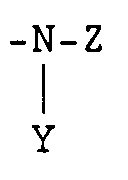
- Y
- is H or alkyl;
- Z
- is an optionally substituted phenyl group; and
- n
- has a value of 1 to 3;
- (i) the groups defined by A in the first and second dye are different to one another; and
- (ii) the solution contains less than 5% by weight of inorganic compounds.
- It is preferred that the solution contains less than 1%, more preferably less than 0.5% by weight of inorganic compounds. Preferably the solution contains less than 20%, more preferably less than 10%, especially less than 5% by weight of urea and it is especially preferred that the solution is free from urea.
- Preferably said first and second dye are identical in every respect except for the identity of the group represented by A
- The high strength aqueous solution is preferably contained in a sealed container, for example a water-proof drum.
- It is preferred that the high strength aqueous solution contains a total amount of first and second dye of at least 20%, more preferably at least 30%, especially at least 40% and preferably below 60% by weight. The aqueous solution is preferably water.
- When R¹ is alkyl it preferably contains from 1 to 4 carbon atoms, and more preferably is C₁₋₃-alkyl, especially methyl. Preferably R¹ is NH₂.
- W is preferably C₁₋₄-alkyl, especially methyl; C₁₋₄-alkoxy, especially methoxy; or H.
- The proviso which states that the groups defined by A in the first and second dye are different to one another means that A in each dye is different and both A groups fall within the definition given for A.
- By a labile atom or group it is meant an atom or group which is bound directly to the triazine nucleus, which atom or group is readily replaceable by a hydroxy group in mildly alkaline aqueous conditions. As examples of such an atom or group there may be mentioned a halogen atom, for example for Cl; a sulphonic acid group; a thiocyano group; a quaternary ammonium group, for example a trialkyl ammonium group or an optionally substituted pyridinium group, for example 3- or 4-carboxy pyridinium. It is preferred that X is Cl, 3-carboxypyridinium or 4-carboxypyridinium.
- n preferably has a value of 2, more preferably 3, especially where this results in a 1,5-disulphonaphthyl or 3,6,8-trisulphonaphthyl group.
- Y is preferably H or C₁₋₄-alkyl, more preferably propyl or ethyl because this leads to dyes having particularly good solubility.
- Z is preferably a phenyl group having one ortho halo or alkyl substituent, a sulpho substituent, or both an ortho halo or alkyl substituent and a sulpho substituent. The preference for Z having a sulpho substituent arises from the surprising finding that such dyes have particularly good wash off properties and solubility in water.
- When Z has an ortho halo or alkyl substituent it is preferably Cl or C₁₋₄-alkyl, especially methyl.
- As examples of groups represented by Z there may be mentioned phenyl, 2-sulphophenyl, 3-sulphophenyl, 4-sulphophenyl, 2-methyl-4-sulphophenyl and 2-methyl-5-sulphophenyl.
- As particular examples of groups represented by A there may be mentioned 4-sulpho-2-methyl-N-methylanilinyl and 5-sulpho-2-methyl-N-methylanilinyl.
- There is also a demand for solid dye compositions for the preparation of high strength liquid brands or for use directly by a dyer. Such compositions preferably have good solubility in water and good wash-off properties when applied to a cellulosic material.
- According to a second aspect of the present invention there is provided a composition comprising a first and second dye each of which, in the free acid form, is of Formula (1) wherein R¹, W, X, A, Y, Z and n are as hereinbefore define and provided that the groups defined by A in the first and second dye are different to one another and provided that R¹ is NH₂ when W is H.
- In the composition according to the present invention it is preferred that the first and second dye are identical in every respect except for the identity of A.
- It is preferred that the composition contains less than 10%, more preferably less than 3%, especially less than 1% by weight of inorganic compounds.
- The term 'inorganic compound' means a salt consisting of a metal cation and inorganic anion. Examples of inorganic compounds include inorganic alkali or alkali earth metal salts such as are found in a dye after synthesis, more particularly sodium or potassium chloride, nitrite, nitrate, sulphate carbonate or bicarbonate. The amount of inorganic compounds present in the solutions and compositions of the invention may be adjusted to the desired level by methods known per se, for example filtration, reverse osmosis, ultrafiltration, dialysis or combinations thereof.
- The high strength aqueous solution and composition preferably contain the first and second dye in a weight ratio of 90:10 to 10:90, more preferably 80:20 to 20:80, especially 75:25 to 25:75. If desired the composition may include further dyes to produce variations in colour.
- According to a third aspect of the present invention there is provided a compound which, in the free acid form, is of Formula (1) wherein R¹, W, X and n are as hereinbefore defined and A is of Formula (2):

wherein: - Y¹
- is C₁₋₄-alkyl, preferably C₁₋₃-alkyl, especially ethyl or isopropyl;
- B
- is H, Cl or C₁₋₄-alkyl, especially methyl; and
- m
- has a value of 1 or 2, preferably 1; provided that Y¹ is ethyl or isopropyl when B is H.
- Examples of preferred groups of Formula (2) include N-isopropyl-4-sulphophenylamino and N-ethyl-4-sulphophenylamino.
- The compound according to the third aspect of the present invention is notable for its good build-up, solubility and good wash off properties when applied to cellulosic fibres such as cotton.
- In a preferred embodiment B and Y¹ contain a total of three carbon atoms, for example B is methyl and Y¹ is ethyl or B is H and Y¹ is isopropyl.
- Dyes and compounds of or used in the invention may be prepared by a process comprising condensation of a compound of Formula (3) and a compound of Formula (4), preferably in the presence of an acid binding agent:

The condensation preferably is performed in an aqueous solvent, especially water, at a temperature of 20°C to 60°C. The function of the acid binding agent is to neutralise any hydrogen halide formed during the condensation, accordingly any acid binding agent may be used, especially sodium carbonate, bicarbonate or hydroxide. - A compound of Formula (3) may be prepared by condensation of a cyanuric halide with a compound of Formula (5):

Alternatively a cyanuric halide may be condensed with a compound of Formula (4) and the resultant dichlorotriazine condensed with a compound of Formula (5). - The compound of Formula (5) may be prepared by diazotising an appropriate sulphonated 2-naphthylamine and coupling with an appropriate aniline derivative substituted at the 2-position by W and at the 5-position by -NHCOR¹. In the above process n, R¹, W, X, Y and Z are as hereinbefore defined.
- A composition according to the second aspect of the present invention may be prepared by mixing two or more dyes of Formula (1) or alternatively by following the above process in which a compound of Formula (3) is condensed with a mixture of Formula (4) in place of a compound of Formula (4).
- The present invention also provides a process for the coloration of a cellulosic material, especially cotton, by applying thereto a solution, composition or compound according to the invention. The solution, composition or compound of the invention may be applied to cellulosic materials by any of the techniques used for coloration thereof with a reactive dye, for example by a known exhaust dyeing, pad batch dyeing or printing technique, preferably in conjunction with an acid binding agent.
- The invention is illustrated but not limited by the following Examples in which all parts are by weight unless stated otherwise.
- Preparation of the compound of Formula (6) wherein X is Cl, Y¹ is ethyl and Z is 2-methyl-5-sulphophenyl

2-Naphthylamine-3,6,8-trisulphonic acid (24.3g, 0. 05M) was dissolved in water (250ml) by addition of 2N sodium carbonate and 2N-sodium nitrite (25ml, 0.05M) was added. The resultant solution was converted to a diazonium salt by adding ice (70g) and cooling to below 10°C in an ice-bath, adding concentrated hydrochloric acid (30ml), stirring for 30 minutes and destroying excess nitrous acid by addition of a small amount of sulphamic acid. The diazonium salt was added to 3-ureidoaniline (10g, 0.05M) over one hour and the temperature maintained below 10°C. The pH was raised to 6 by addition of sodium hydroxide and the solution was stirred overnight at room temperature to give a dyebase which was filtered off and dried. - An aqueous suspension of cyanuric chloride was prepared by adding cyanuric chloride (9.2g, 0.05M) in acetone (50ml) to ice-water (100ml). The suspension was added to a solution of the dyebase in water (250ml) and stirring at 0-5°C and pH 6.5 was continued for 30 minutes resulting in the formation of a dichlorotriazine dye. N-ethyl-o-toluidine-5-sulphonic acid (11g, 0.05M) was dissolved in water (50ml) by addition of sodium carbonate, added to the dichlorotriazine dye and warmed to 40°C at pH 6.5 before stirring overnight. The resultant solution was screened to remove insoluble matter and reduced in volume by rotary evaporation to give a concentrated solution of dye.
- The concentrated solution was desalinated in a visking tubing placed in distilled water and the water replaced periodically until no further chloride ions could be detected using silver nitrite and the product precipitated by addition of ethanol to give 46g of the title product (80% yield) having a lambda max at 417nm and very high solubility in water.
- The title dye was incorporated into an alginate print paste and printed on cotton and viscose to give a print having an attractive golden-yellow shade. The print showed excellent wash-off properties and little cross-staining of adjacent fibres.
- The product of Example 1 (23g, 0.02M) was dissolved in water (250ml) to give a dye solution. Isonicotinic acid (10g, 0.08M) was dissolved in water (50ml) by addition of sodium carbonate, added to the dye solution and heated at 90°C pH 6.5 for 6 hours. The title product was desalinated and isolated by reducing the volume of liquid using a rotary evaporator and precipitation by addition of ethanol.
- 22g of the title product was obtained (90% yield) and was found to have a lambda max at 416nm and very high solubility in water.
- The title dye was printed on cotton and viscose to give a print having an attractive golden-yellow shade. The prints showed excellent wash-off properties and little cross-staining in the standard simulated continuous wash-off (SCWOT) test.
- In addition the title compound was found to fix rapidly and efficiently when steamed at atmospheric pressure.
- The method of Example 1 was followed except that in place of N-ethyl-o-toluidine-5-sulphonic acid there was used N-isopropyl metanilic acid (11g, 0.05M).
- The title product was obtained in a yield of 60% (34g) and found to have a lambda max at 414nm. The title product had high solubility in water and its prints on cotton were found to have good wash-off with little cross-staining of adjacent fibres.
- The method of Example 1 was followed except that in place of N-ethyl-o-toluidine-5-sulphonic acid there was used N-isopropyl sulphanilic acid (11g, 0.05M) to give 39g (80% yield) of the title product having a lambda max at 416nm.
- The title product was found to have very high solubility in water at 20°C and good wash-off when printed on cotton.
-

2-Naphthylamine-4,8-disulphonic acid (20g, 0.05M) was dissolved in water (250ml) by addition of sodium carbonate. The solution was cooled to below 10°C and concentrated HCl (30ml) added, followed by 2N sodium nitrite (25ml, 0.05M). The resulting suspension was stirred for 60 minutes after which the excess nitrous acid was destroyed by adding sulphamic acid, to give a diazonium salt. - The diazonium salt was added to a solution of 3-amino-4-methoxy acetanilide (10g, 0.05M) in water (100ml) over one hour and the temperature maintained below 10°C. The pH was raised to 6 by adding sodium hydroxide solution and the mixture stirred overnight at room temperature to give a dyebase.
- An aqueous suspension of cyanuric chloride was prepared by adding cyanuric chloride (9.2g, 0.05M) in acetone (50ml) to ice-water (100ml). The suspension was added to the dyebase at a temperature of 0-5°C and about pH 6. After 30 min condensation of the dyebase and cyanuric chloride was complete and the resultant dichlorotriazine product was precipitated by adding salt solution (20% wt/vol), washed with acetone and dried.
- N-ethyl-o-toluidine-5-sulphonic acid (11g, 0.05M) was dissolved in water (50ml) by adding sodium carbonate and condensed with the above dichlorotriazine product at 40°C, pH 6.5, overnight. The resultant solution was desalinated, concentrated by rotary evaporation and the title product (lambda max 408nm) was precipitated in 90% yield (55g) by addition of ethanol.
- The title dye had good solubility in water at 25°C and when printed on cotton gave a print having an attractive golden-yellow shade. The print showed excellent wash-off properties and little cross-staining in the standard SCWOT test.
- A first compound (D1) of Formula (6) was prepared in which X is Cl, Y¹ is methyl and Z is 3-sulphophenyl by the method described in Example 1 except that in place of N-ethyl-o-toluidine-sulphonic acid there was used 3-sulpho-N-methylaniline.
- A second compound (D2) of Formula (6) was prepared in which X is Cl, Y¹ is methyl and Z is 4-sulphophenyl by the method described in Example 1 except that in place of N-ethyl-o-toluidine-5-sulphonic acid there was used 4-sulpho-N-methylaniline.
- As will be understood, the first and second compound are identical in every respect except for the identity of the group represented by Z.
- A composition (C1) was prepared comprising the first and second compound by following the method described in Example 1 except that in place of N-ethyl-o-toluidine-5-sulphonic acid there was used a mixture of 3-sulpho-N-methylaniline and 4-sulpho-N-methylaniline. C1 was formed in 80% yield (45g) and had a lambda max at 411nm. C1 was found to contain D1 and D2 in a weight ratio of 2:3.
- The solubility of C1 in water at 25°C was found to be higher than that of D1 and D2. The higher solubility of C1 compared with D1 and D2 means that more C1 can be prepared in a given vessel than for D1 or D2.
- C1 prepared as in Example 6 was converted into the corresponding composition wherein X is a 4-carboxypyridinium group by heating 0.02M of C1 for 6 hours at 90°C, pH 6.5, in water (50ml) with isonicotinic acid (10g, 0.08M) and sodium carbonate (23g, 0.02M). The product was desalinated and isolated by removal of water on a rotary evaporator and precipitation with ethanol.
- A composition analogous to C1 except that X is 4-carboxypyridinium was formed in a yield of 21g.
- A first compound (D3) of Formula (6) was prepared in which X is C1, Y¹ is ethyl and Z is 3-sulphophenyl by the method described in Example 1 except that in place of N-ethyl-o-toluidine-5-sulphonic acid there was used 3-sulpho-N-ethylaniline.
- A second compound (D4) of Formula (6) was prepared in which X is C1, Y¹ is ethyl and Z is 4-sulphophenyl by the method described in Example 1 except that in place of N-ethyl-o-toluidine-5-sulphonic acid there was used 4-sulpho-Nethylaniline.
- As will be understood, the first and second compound are identical in every respect except for the identity of the group represented by Z.
- A composition (C2) was prepared comprising the first and second compound by following the method described in Example 1 except that in place of N-ethyl-o-toluidine-5-sulphonic acid there was used 3-sulpho-N-ethylaniline and 4-sulpho-N-ethylaniline. C2 resulted in 80% yield (40g) and had a lambda max at 417nm.
- C2 was found to contain D3 and D4 in a weight ratio of approximately 3:1. C2 was found to have very high solubility in water at 25°C.
- A first compound (D5) was prepared according to Example 5 except that in place of N-ethyl-o-toluidine-5-sulphonic acid there was used metanilic acid. D5 was formed in 90% yield (43g) and had a lambda max at 406nm.
- A second compound (D6) was prepared according to Example 6 except that in place of N-ethyl-o-toluidine-5-sulphonic acid there was used N-isopropylmetanilic acid. D6 was formed in 75% yield (36g) and had a lambda max at 408nm.
- A composition (C3) was prepared by mixing D5 and D6 in a weight ratio of 1:1. C3 was found to have very high solubility in water.
- A first compound (D7) of Formula (6) was prepared in which X is Cl, Y¹ is H and Z is 3,5-disulphophenyl by the method described in Example 1 except that in place of N-ethyl-o-toluidine-5-sulphonic acid there was used aniline-3,5-disulphonic acid. D7 was formed in 80% yield and had a lambda max at 414nm.
- A second compound (D8) of Formula (6) was prepared in which X is Cl, Y¹ is H and Z is 2,4-disulphophenyl by the method described in Example 1 except that in place of N-ethyl-o-toluidine-5-sulphonic acid there was used aniline-2,4-disulphonic acid. D8 was formed in 50% yield and had a lambda max at 410nm.
- A composition (C4) was prepared by mixing D7 and D8 in a weight ratio of 1:1.
- The solubility of C4 in water at 25°C was found to be higher than that of D7 and D8.
- A first compound (D9) was prepared using method of Example 1.
- A second compound (D10) of Formula (6) was prepared in which X is Cl, Y¹ is H and Z is 2-methyl-5-sulphophenyl by the method described in Example 1 except that in place of N-ethyl-o-toluidine-5-sulphonic acid there was used o-toluidine-5-sulphonic acid. D10 was formed in 80% yield and had a lambda max at 415nm.
- As will be understood, the first and second compound are identical in every respect except for the identity of the group represented in Formula (6) by Y¹.
- A composition (C5) was prepared by mixing D9 and D10 in a weight ratio of 2:1 and had a lambda max at 415nm.
- The solubility of C5 in water at 25°C was found to be higher than that of D9 and D10.
- The method of Example 1 may be repeated except that in place of 3-ureido aniline there is used 0.05M of 3-acetamido aniline.
- High strength aqueous solutions may be prepared according to the formulations described in Table I below wherein the second column identifies the composition and amount (in brackets), and the third and fourth columns show respectively the amount of water and salt. All amounts are parts by weight.
Table I Example Composition Water Salt 13 C1 (35) 100 <1 14 C2 (40) 100 <1 15 C3 (45) 100 <1 16 C4 (30) 100 <2 17 C5 (45) 100 <1
Claims (13)
- A high strength aqueous solution comprising a first and second dye each of which, in the free acid form, is of Formula (1):
 R¹ is NH₂ or alkyl;W is H, alkyl or alkoxy;X is a labile atom or group;A is
 Y is H or alkyl;Z is an optionally substituted phenyl group; andn has a value of 1 to 3;provided that(i) the groups defined by A in the first and second dye are different to one another; and(ii) the solution contains less than 5% by weight of inorganic compounds.
 - A solution according to Claim 1 wherein Y is alkyl.
- A solution according to any one of the preceding claims wherein the total amount of first and second dye is at least 20% by weight.
- A solution according to any one of the preceding claims which contains less than 20% by weight of urea.
- A composition comprising a first and second dye each of which, in the free acid form, is of Formula (1):
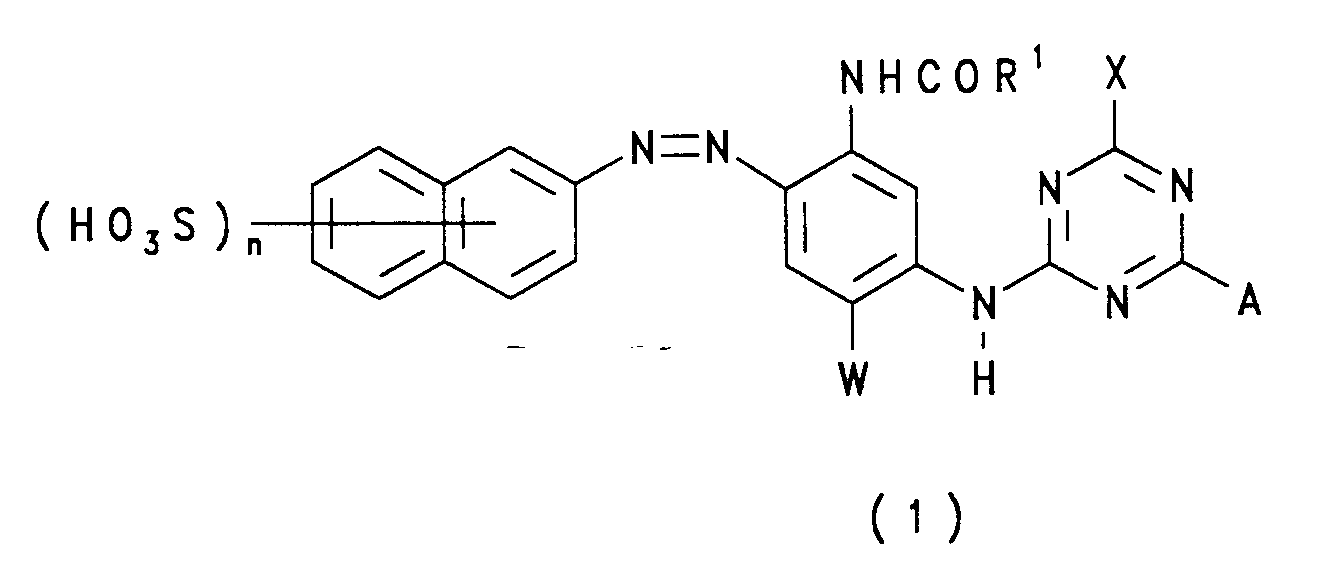
R¹, W, X, A and n are as defined in Claim 1 and provided that the groups defined by A in the first and second dye are different to one another and provided that R¹ is NH₂ when W is H. - A composition according to Claim 5 wherein the first and second dye are identical to one another in every respect except for the identity of A.
- A composition according to Claim 5 which contains less than 10% by weight of inorganic compounds.
- A composition according to Claim 5, 6 or 7 wherein Y is alkyl.
- A composition according to Claim 5, 6, 7 or 8 wherein the first and second dye are present in a weight ratio of 90:10 to 10:90.
- A compound which, in the free acid form, is of Formula (1):

R¹, W, X and n are as defined in Claim 1 and A is of the Formula (2): Y¹ is C₁₋₄-alkyl;B is H, C1 or C₁₋₄-alky1; andm has a value of 1 or 2;provided that Y¹ is ethyl or isopropyl when B is H.
 - A compound according to Claim 10 wherein Y¹ is ethyl or isopropyl.
- A compound according to Claim 10 or 11 wherein B is Cl or C₁₋₄-alkyl.
- A process for the coloration of a cellulosic material by applying thereto a solution according to any one of Claims 1 to 4, a composition according to any one of Claims 5 to 9 or a compound according to Claim 10, 11 or 12.
Applications Claiming Priority (2)
| Application Number | Priority Date | Filing Date | Title |
|---|---|---|---|
| GB929204905A GB9204905D0 (en) | 1992-03-06 | 1992-03-06 | Compositions and compounds |
| GB9204905 | 1992-03-06 |
Publications (2)
| Publication Number | Publication Date |
|---|---|
| EP0559331A1 true EP0559331A1 (en) | 1993-09-08 |
| EP0559331B1 EP0559331B1 (en) | 1997-06-11 |
Family
ID=10711627
Family Applications (1)
| Application Number | Title | Priority Date | Filing Date |
|---|---|---|---|
| EP93300859A Expired - Lifetime EP0559331B1 (en) | 1992-03-06 | 1993-02-05 | Compositions and aqueous solutions of reactive azo dyes |
Country Status (14)
| Country | Link |
|---|---|
| US (1) | US5516897A (en) |
| EP (1) | EP0559331B1 (en) |
| JP (1) | JP3599756B2 (en) |
| KR (1) | KR100260049B1 (en) |
| CN (1) | CN1043652C (en) |
| AT (1) | ATE154378T1 (en) |
| AU (1) | AU651267B2 (en) |
| CA (1) | CA2089606A1 (en) |
| DE (1) | DE69311402T2 (en) |
| GB (2) | GB9204905D0 (en) |
| IN (1) | IN186092B (en) |
| NZ (1) | NZ245873A (en) |
| TW (1) | TW259809B (en) |
| ZA (1) | ZA931154B (en) |
Cited By (2)
| Publication number | Priority date | Publication date | Assignee | Title |
|---|---|---|---|---|
| WO1996024635A1 (en) * | 1995-02-07 | 1996-08-15 | Ilford Ag | Dyes for ink jet printing |
| EP1568738A3 (en) * | 2004-02-25 | 2006-12-13 | Everlight USA, Inc. | Dye composition and the use thereof |
Families Citing this family (7)
| Publication number | Priority date | Publication date | Assignee | Title |
|---|---|---|---|---|
| CN1056636C (en) * | 1993-10-15 | 2000-09-20 | 双星日本株式会社 | Dye composition and dyeing method using the same |
| DE102004017977A1 (en) * | 2004-04-14 | 2005-11-10 | Dystar Textilfarben Gmbh & Co. Deutschland Kg | Mixtures of fiber-reactive azo dyes, their preparation and use |
| CN102977638A (en) * | 2012-11-30 | 2013-03-20 | 浙江瑞华化工有限公司 | Composition, preparation method and application thereof, textile and textile product |
| CN107964258A (en) * | 2017-12-05 | 2018-04-27 | 湖北丽源科技股份有限公司 | A kind of Yellow fluorine-containing reactive dye mixture and its preparation method and application |
| CN110387143B (en) * | 2019-07-22 | 2020-12-15 | 浙江瑞华化工有限公司 | Yellow reactive dye composition and preparation method and application thereof |
| CN110396306A (en) * | 2019-07-22 | 2019-11-01 | 浙江瑞华化工有限公司 | A kind of azo reactive dye and preparation method thereof and purposes |
| CN110511594B (en) * | 2019-08-30 | 2021-06-01 | 泰兴锦云染料有限公司 | Reactive yellow dye for ink-jet printing and preparation method and application thereof |
Citations (7)
| Publication number | Priority date | Publication date | Assignee | Title |
|---|---|---|---|---|
| GB2003910A (en) * | 1977-09-06 | 1979-03-21 | Ciba Geigy Ag | Dyes processes for their production and use thereof |
| FR2436166A1 (en) * | 1978-09-16 | 1980-04-11 | Bayer Ag | AZO DYES REACTIVE TO FIBER, THEIR PRODUCTION PROCESS AND THEIR TINCTORIAL APPLICATIONS |
| EP0053750A1 (en) * | 1980-12-04 | 1982-06-16 | Bayer Ag | Reactive azodyestuffs, process for their preparation and their use in dyeing and printing fibrous materials containing hydroxyl groups and/or nitrogen |
| EP0217217A2 (en) * | 1985-09-28 | 1987-04-08 | Bayer Ag | Aqueous, liquid preparations of reactive dyes |
| EP0422237A1 (en) * | 1989-03-16 | 1991-04-17 | Nippon Kayaku Kabushiki Kaisha | Liquid composition and method of dyeing therewith |
| EP0426616A1 (en) * | 1989-11-01 | 1991-05-08 | Ciba-Geigy Ag | Reactive dyes, their preparation and their use |
| GB2250297A (en) * | 1990-11-27 | 1992-06-03 | Sumitomo Chemical Co | Fibre reactive dye composition |
Family Cites Families (21)
| Publication number | Priority date | Publication date | Assignee | Title |
|---|---|---|---|---|
| US2820785A (en) * | 1953-08-19 | 1958-01-21 | Ciba Ltd | Monoazo-dyestuffs |
| US2903442A (en) * | 1956-09-06 | 1959-09-08 | Ciba Ltd | Triazine monoazo-dyestuffs |
| US2945022A (en) * | 1956-09-14 | 1960-07-12 | Ciba Ltd | Monoazo and disazo triazine dyes |
| US2951836A (en) * | 1957-06-05 | 1960-09-06 | Ici Ltd | New monoazo dyestuffs |
| GB837953A (en) * | 1957-08-23 | 1960-06-15 | Ici Ltd | New monoazo triazine dyestuffs |
| US2951072A (en) * | 1959-02-27 | 1960-08-30 | Ici Ltd | Monoazo dyestuffs of the azo naphthalene series containing a monohalogeno-s-triazinenucleus |
| GB970475A (en) * | 1961-03-24 | 1964-09-23 | Ici Ltd | New reactive monoazo dyestuffs |
| FR1327016A (en) * | 1961-08-18 | 1963-05-17 | Ciba Geigy | Novel dyes, their preparation process and uses |
| US3206451A (en) * | 1961-12-01 | 1965-09-14 | Sandoz Ltd | Water-soluble reactive dyes |
| US3413077A (en) * | 1963-10-03 | 1968-11-26 | Acna | Process of dyeing cellulose and polyamide fabrics with reactive dyestuffs |
| CH447433A (en) * | 1965-08-09 | 1967-11-30 | Acna | Process for the preparation of quaternized triazine reactive dyes |
| GB1272119A (en) * | 1968-10-01 | 1972-04-26 | Interquim Sa Ind Y Com | New fibre-reactive halotriazine dyes, process for obtaining the same and process for dyeing textile fibres with said dyes |
| LU78115A1 (en) * | 1977-09-12 | 1979-05-23 | Ciba Geigy Ag | AZO DYES, THEIR PRODUCTION AND USE |
| DE2945058A1 (en) * | 1979-11-08 | 1981-06-04 | Bayer Ag, 5090 Leverkusen | FIBER REACTIVE MONOAZO DYES, THEIR PRODUCTION AND USE |
| CH655735A5 (en) * | 1982-09-17 | 1986-05-15 | Sandoz Ag | REACTIVE MONOAZO CONNECTIONS. |
| CH671232A5 (en) * | 1985-11-21 | 1989-08-15 | Sandoz Ag | |
| CH669389A5 (en) * | 1986-02-07 | 1989-03-15 | Basf Ag | |
| WO1989000184A1 (en) * | 1987-06-30 | 1989-01-12 | Mitsubishi Chemical Industries Limited | Water-soluble reactive dye mixture and process for dyeing cellulose fibers using same |
| US5032140A (en) * | 1989-10-24 | 1991-07-16 | Nippon Kayaku Kabushiki Kaisha | Aqueous liquid composition of naphthalene sulfonate reactive dye with at least one lithium or tri-ethanol ammonium cation |
| JP2953074B2 (en) * | 1991-02-15 | 1999-09-27 | 住友化学工業株式会社 | Reactive dye composition and method for dyeing or printing fiber material using the same |
| JP2548510B2 (en) * | 1993-12-08 | 1996-10-30 | 松下電器産業株式会社 | Tape recorder |
-
1992
- 1992-03-06 GB GB929204905A patent/GB9204905D0/en active Pending
-
1993
- 1993-02-05 EP EP93300859A patent/EP0559331B1/en not_active Expired - Lifetime
- 1993-02-05 AT AT93300859T patent/ATE154378T1/en not_active IP Right Cessation
- 1993-02-05 DE DE69311402T patent/DE69311402T2/en not_active Expired - Fee Related
- 1993-02-05 GB GB939302334A patent/GB9302334D0/en active Pending
- 1993-02-09 IN IN108DE1993 patent/IN186092B/en unknown
- 1993-02-10 AU AU32930/93A patent/AU651267B2/en not_active Ceased
- 1993-02-10 NZ NZ245873A patent/NZ245873A/en unknown
- 1993-02-11 TW TW082100962A patent/TW259809B/zh active
- 1993-02-16 CA CA002089606A patent/CA2089606A1/en not_active Abandoned
- 1993-02-18 ZA ZA931154A patent/ZA931154B/en unknown
- 1993-03-05 JP JP4484093A patent/JP3599756B2/en not_active Expired - Fee Related
- 1993-03-06 CN CN93104486A patent/CN1043652C/en not_active Expired - Fee Related
- 1993-03-06 KR KR1019930003397A patent/KR100260049B1/en not_active Expired - Fee Related
-
1995
- 1995-03-07 US US08/400,450 patent/US5516897A/en not_active Expired - Lifetime
Patent Citations (7)
| Publication number | Priority date | Publication date | Assignee | Title |
|---|---|---|---|---|
| GB2003910A (en) * | 1977-09-06 | 1979-03-21 | Ciba Geigy Ag | Dyes processes for their production and use thereof |
| FR2436166A1 (en) * | 1978-09-16 | 1980-04-11 | Bayer Ag | AZO DYES REACTIVE TO FIBER, THEIR PRODUCTION PROCESS AND THEIR TINCTORIAL APPLICATIONS |
| EP0053750A1 (en) * | 1980-12-04 | 1982-06-16 | Bayer Ag | Reactive azodyestuffs, process for their preparation and their use in dyeing and printing fibrous materials containing hydroxyl groups and/or nitrogen |
| EP0217217A2 (en) * | 1985-09-28 | 1987-04-08 | Bayer Ag | Aqueous, liquid preparations of reactive dyes |
| EP0422237A1 (en) * | 1989-03-16 | 1991-04-17 | Nippon Kayaku Kabushiki Kaisha | Liquid composition and method of dyeing therewith |
| EP0426616A1 (en) * | 1989-11-01 | 1991-05-08 | Ciba-Geigy Ag | Reactive dyes, their preparation and their use |
| GB2250297A (en) * | 1990-11-27 | 1992-06-03 | Sumitomo Chemical Co | Fibre reactive dye composition |
Non-Patent Citations (3)
| Title |
|---|
| CHEMICAL ABSTRACTS, vol. 104, no. 26, June 1986, Columbus, Ohio, US; abstract no. 226328, K. BANDO ET.AL. 'Reactive dye mixtures' page 77 ;column 2 ; * |
| CHEMICAL ABSTRACTS, vol. 110, no. 6, 6 February 1989, Columbus, Ohio, US; abstract no. 40444u, N. YAMANAKA ET. AL. 'Reactive dye liquid compositions with good storage stability and drying resistance' * |
| CHEMICAL ABSTRACTS, vol. 74, no. 22, 31 May 1971, Columbus, Ohio, US; abstract no. 113219z, J. JARKOVSKY ET. AL. 'Fiber-reactive azo dyes' page 53 ;column 2 ; * |
Cited By (3)
| Publication number | Priority date | Publication date | Assignee | Title |
|---|---|---|---|---|
| WO1996024635A1 (en) * | 1995-02-07 | 1996-08-15 | Ilford Ag | Dyes for ink jet printing |
| US5684140A (en) * | 1995-02-07 | 1997-11-04 | Ilford A.G. | Dyes for ink jet printing |
| EP1568738A3 (en) * | 2004-02-25 | 2006-12-13 | Everlight USA, Inc. | Dye composition and the use thereof |
Also Published As
| Publication number | Publication date |
|---|---|
| JPH06136282A (en) | 1994-05-17 |
| CN1076706A (en) | 1993-09-29 |
| CA2089606A1 (en) | 1993-09-07 |
| GB9302334D0 (en) | 1993-03-24 |
| NZ245873A (en) | 1994-12-22 |
| IN186092B (en) | 2001-06-16 |
| KR100260049B1 (en) | 2000-07-01 |
| KR930019774A (en) | 1993-10-18 |
| CN1043652C (en) | 1999-06-16 |
| EP0559331B1 (en) | 1997-06-11 |
| DE69311402T2 (en) | 1997-09-25 |
| GB9204905D0 (en) | 1992-04-22 |
| DE69311402D1 (en) | 1997-07-17 |
| AU651267B2 (en) | 1994-07-14 |
| JP3599756B2 (en) | 2004-12-08 |
| ATE154378T1 (en) | 1997-06-15 |
| TW259809B (en) | 1995-10-11 |
| ZA931154B (en) | 1993-10-25 |
| US5516897A (en) | 1996-05-14 |
| AU3293093A (en) | 1993-09-09 |
Similar Documents
| Publication | Publication Date | Title |
|---|---|---|
| EP0559331B1 (en) | Compositions and aqueous solutions of reactive azo dyes | |
| US4875903A (en) | Monoazo compounds containing a 2-sulfophenyl diazo component radical and a 1-hydroxy-naphthalene-sulfonic or disulfonic acid coupling component radical and two substituted 1,3,5-triazine rings | |
| US5149790A (en) | Bis chlorotriazine reactive dyes containing a benzylamine linking group | |
| US5059681A (en) | Bis-azotriazinyl reactive dyes having an n-alkyl-phenylenediamine link | |
| US5149791A (en) | Chlorotriazine reactive dyes having a 4-methoxy-2-sulfoaniline diazo component and 2-amino-5-naphthol-7-sulfonic acid coupling component | |
| US4578457A (en) | Reactive mono-azo dyes and the preparation and use thereof | |
| KR100294995B1 (en) | Fiber reactive azo dyes | |
| US4855410A (en) | Process for the preparation of fibre-reactive azo compounds containing a phenylenediamine diazo component | |
| EP0692003B1 (en) | Monoazo reactive dyes | |
| ZA200303513B (en) | Use of disazo compounds. | |
| JPH02228367A (en) | Reactive dye | |
| US2951836A (en) | New monoazo dyestuffs | |
| US5607481A (en) | Fiber-reactive anthraquinone dyes | |
| EP0135381B1 (en) | Reactive dyes | |
| JP2773888B2 (en) | Reactive dyes, their preparation and their use | |
| US5373094A (en) | Reactive dyes containing a 2,6-difluoro-3,5-dichloropyridine group | |
| JPS58168659A (en) | Reactive dye | |
| EP1332181A2 (en) | Fibre-reactive copper complexes of monoazo dyes | |
| US5420257A (en) | Reactive triazine dyes, their preparation and use | |
| US5196033A (en) | BIS-azotriazinyl reactive dyes having an N-alkyl-phenylenediamine link for cellulose textiles | |
| WO1997027249A1 (en) | Heteropolyfunctional reactive disaro dyes | |
| US5371200A (en) | Fibre-reactive formazan dyes, processes for their preparation and their use | |
| GB2172896A (en) | Reactive formazan dye mixtures | |
| KR100352808B1 (en) | Fibrous reactive disazo dyes | |
| US5269816A (en) | Process for coloring textile materials |
Legal Events
| Date | Code | Title | Description |
|---|---|---|---|
| PUAI | Public reference made under article 153(3) epc to a published international application that has entered the european phase |
Free format text: ORIGINAL CODE: 0009012 |
|
| AK | Designated contracting states |
Kind code of ref document: A1 Designated state(s): AT BE CH DE DK ES FR GB GR IE IT LI LU MC NL PT SE |
|
| 17P | Request for examination filed |
Effective date: 19940202 |
|
| 17Q | First examination report despatched |
Effective date: 19960201 |
|
| GRAG | Despatch of communication of intention to grant |
Free format text: ORIGINAL CODE: EPIDOS AGRA |
|
| GRAH | Despatch of communication of intention to grant a patent |
Free format text: ORIGINAL CODE: EPIDOS IGRA |
|
| GRAH | Despatch of communication of intention to grant a patent |
Free format text: ORIGINAL CODE: EPIDOS IGRA |
|
| GRAA | (expected) grant |
Free format text: ORIGINAL CODE: 0009210 |
|
| AK | Designated contracting states |
Kind code of ref document: B1 Designated state(s): AT BE CH DE DK ES FR GB GR IE IT LI LU MC NL PT SE |
|
| PG25 | Lapsed in a contracting state [announced via postgrant information from national office to epo] |
Ref country code: GR Free format text: LAPSE BECAUSE OF FAILURE TO SUBMIT A TRANSLATION OF THE DESCRIPTION OR TO PAY THE FEE WITHIN THE PRESCRIBED TIME-LIMIT Effective date: 19970611 Ref country code: ES Free format text: THE PATENT HAS BEEN ANNULLED BY A DECISION OF A NATIONAL AUTHORITY Effective date: 19970611 Ref country code: DK Effective date: 19970611 Ref country code: BE Effective date: 19970611 Ref country code: AT Effective date: 19970611 |
|
| REF | Corresponds to: |
Ref document number: 154378 Country of ref document: AT Date of ref document: 19970615 Kind code of ref document: T |
|
| REG | Reference to a national code |
Ref country code: CH Ref legal event code: NV Representative=s name: A. BRAUN, BRAUN, HERITIER, ESCHMANN AG PATENTANWAE Ref country code: CH Ref legal event code: EP |
|
| REF | Corresponds to: |
Ref document number: 69311402 Country of ref document: DE Date of ref document: 19970717 |
|
| PG25 | Lapsed in a contracting state [announced via postgrant information from national office to epo] |
Ref country code: SE Effective date: 19970911 Ref country code: PT Effective date: 19970911 |
|
| ET | Fr: translation filed | ||
| PG25 | Lapsed in a contracting state [announced via postgrant information from national office to epo] |
Ref country code: LU Free format text: LAPSE BECAUSE OF NON-PAYMENT OF DUE FEES Effective date: 19980205 Ref country code: IE Free format text: LAPSE BECAUSE OF NON-PAYMENT OF DUE FEES Effective date: 19980205 |
|
| PGFP | Annual fee paid to national office [announced via postgrant information from national office to epo] |
Ref country code: FR Payment date: 19980226 Year of fee payment: 6 |
|
| PLBE | No opposition filed within time limit |
Free format text: ORIGINAL CODE: 0009261 |
|
| STAA | Information on the status of an ep patent application or granted ep patent |
Free format text: STATUS: NO OPPOSITION FILED WITHIN TIME LIMIT |
|
| 26N | No opposition filed | ||
| PG25 | Lapsed in a contracting state [announced via postgrant information from national office to epo] |
Ref country code: MC Free format text: LAPSE BECAUSE OF NON-PAYMENT OF DUE FEES Effective date: 19980831 |
|
| PG25 | Lapsed in a contracting state [announced via postgrant information from national office to epo] |
Ref country code: FR Free format text: LAPSE BECAUSE OF NON-PAYMENT OF DUE FEES Effective date: 19991029 |
|
| REG | Reference to a national code |
Ref country code: GB Ref legal event code: 732E |
|
| REG | Reference to a national code |
Ref country code: FR Ref legal event code: ST |
|
| REG | Reference to a national code |
Ref country code: CH Ref legal event code: PUE Owner name: SYNGENTA LIMITED TRANSFER- AVECIA LIMITED Ref country code: CH Ref legal event code: PFA Free format text: ZENECA LIMITED TRANSFER- SYNGENTA LIMITED |
|
| REG | Reference to a national code |
Ref country code: GB Ref legal event code: IF02 |
|
| NLS | Nl: assignments of ep-patents |
Owner name: AVECIA LIMITED |
|
| NLT1 | Nl: modifications of names registered in virtue of documents presented to the patent office pursuant to art. 16 a, paragraph 1 |
Owner name: SYNGENTA LIMITED |
|
| REG | Reference to a national code |
Ref country code: GB Ref legal event code: 732E |
|
| REG | Reference to a national code |
Ref country code: CH Ref legal event code: PUE Owner name: AVECIA INKJET LIMITED Free format text: AVECIA LIMITED#PO BOX 42 HEXAGON HOUSE#BLACKLEY, MANCHESTER M9 8ZS (GB) -TRANSFER TO- AVECIA INKJET LIMITED#P.O. BOX 42, HEXAGON TOWER#BLACKLEY, MANCHESTER M9 8ZS (GB) Ref country code: CH Ref legal event code: PFA Owner name: FUJIFILM IMAGING COLORANTS LIMITED Free format text: AVECIA INKJET LIMITED#P.O. BOX 42, HEXAGON TOWER#BLACKLEY, MANCHESTER M9 8ZS (GB) -TRANSFER TO- FUJIFILM IMAGING COLORANTS LIMITED#P.O. BOX 42, HEXAGON TOWER#BLACKLEY, MANCHESTER M9 8ZS (GB) |
|
| NLS | Nl: assignments of ep-patents |
Owner name: FUJIFILM IMAGING COLORANTS LIMITED Effective date: 20060529 |
|
| REG | Reference to a national code |
Ref country code: CH Ref legal event code: PFA Owner name: FUJIFILM IMAGING COLORANTS LIMITED Free format text: FUJIFILM IMAGING COLORANTS LIMITED#P.O. BOX 42, HEXAGON TOWER#BLACKLEY, MANCHESTER M9 8ZS (GB) -TRANSFER TO- FUJIFILM IMAGING COLORANTS LIMITED#P.O. BOX 42, HEXAGON TOWER#BLACKLEY, MANCHESTER M9 8ZS (GB) |
|
| PGFP | Annual fee paid to national office [announced via postgrant information from national office to epo] |
Ref country code: NL Payment date: 20090203 Year of fee payment: 17 Ref country code: DE Payment date: 20090129 Year of fee payment: 17 |
|
| PGFP | Annual fee paid to national office [announced via postgrant information from national office to epo] |
Ref country code: GB Payment date: 20090204 Year of fee payment: 17 Ref country code: CH Payment date: 20090213 Year of fee payment: 17 |
|
| PGFP | Annual fee paid to national office [announced via postgrant information from national office to epo] |
Ref country code: IT Payment date: 20100416 Year of fee payment: 18 |
|
| REG | Reference to a national code |
Ref country code: NL Ref legal event code: V1 Effective date: 20100901 |
|
| REG | Reference to a national code |
Ref country code: CH Ref legal event code: PL |
|
| GBPC | Gb: european patent ceased through non-payment of renewal fee |
Effective date: 20100205 |
|
| PG25 | Lapsed in a contracting state [announced via postgrant information from national office to epo] |
Ref country code: LI Free format text: LAPSE BECAUSE OF NON-PAYMENT OF DUE FEES Effective date: 20100228 Ref country code: CH Free format text: LAPSE BECAUSE OF NON-PAYMENT OF DUE FEES Effective date: 20100228 |
|
| PG25 | Lapsed in a contracting state [announced via postgrant information from national office to epo] |
Ref country code: NL Free format text: LAPSE BECAUSE OF NON-PAYMENT OF DUE FEES Effective date: 20100901 |
|
| PG25 | Lapsed in a contracting state [announced via postgrant information from national office to epo] |
Ref country code: DE Free format text: LAPSE BECAUSE OF NON-PAYMENT OF DUE FEES Effective date: 20100901 |
|
| PG25 | Lapsed in a contracting state [announced via postgrant information from national office to epo] |
Ref country code: GB Free format text: LAPSE BECAUSE OF NON-PAYMENT OF DUE FEES Effective date: 20100205 |
|
| PG25 | Lapsed in a contracting state [announced via postgrant information from national office to epo] |
Ref country code: IT Free format text: LAPSE BECAUSE OF NON-PAYMENT OF DUE FEES Effective date: 20110205 |