EP0557479B1 - Gadolinium photoionization process - Google Patents
Gadolinium photoionization process Download PDFInfo
- Publication number
- EP0557479B1 EP0557479B1 EP92917972A EP92917972A EP0557479B1 EP 0557479 B1 EP0557479 B1 EP 0557479B1 EP 92917972 A EP92917972 A EP 92917972A EP 92917972 A EP92917972 A EP 92917972A EP 0557479 B1 EP0557479 B1 EP 0557479B1
- Authority
- EP
- European Patent Office
- Prior art keywords
- state
- gadolinium
- excited state
- isotopes
- vapor
- Prior art date
- Legal status (The legal status is an assumption and is not a legal conclusion. Google has not performed a legal analysis and makes no representation as to the accuracy of the status listed.)
- Expired - Lifetime
Links
Images

Classifications
-
- B—PERFORMING OPERATIONS; TRANSPORTING
- B01—PHYSICAL OR CHEMICAL PROCESSES OR APPARATUS IN GENERAL
- B01D—SEPARATION
- B01D59/00—Separation of different isotopes of the same chemical element
- B01D59/34—Separation by photochemical methods
-
- B—PERFORMING OPERATIONS; TRANSPORTING
- B01—PHYSICAL OR CHEMICAL PROCESSES OR APPARATUS IN GENERAL
- B01D—SEPARATION
- B01D59/00—Separation of different isotopes of the same chemical element
Definitions
- the present invention relates to a method for isotope enrichment of gadolinium isotopes of odd numbered atomic mass and, in particular, to a method for isotope enrichment of gadolinium-157 by selective photoionization.
- Gadolinium enriched in its odd numbered atomic mass isotopes, Gd 157 and Gd 155 is of commercial interest, particularly for use as burnable poisons in light water nuclear power reactors.
- gadolinium enriched in the Gd 157 isotope is useful in fuel cycle design. It would therefore be desirable to enrich gadolinium in its 157 and 155 isotopes and in particular in its 157 isotope.
- Enrichment of an atomic vapor in one or more isotopes may be achieved through separation processes which operate on very small differences between the chemical or physical properties of the isotopes, such as by selectively exciting energy states of one or more isotopes (without corresponding excitation and ionization of the other isotopes) whereby the selectively ionized isotopes may be separated from the neutral atoms by an electrical field.
- separation processes which operate on very small differences between the chemical or physical properties of the isotopes, such as by selectively exciting energy states of one or more isotopes (without corresponding excitation and ionization of the other isotopes) whereby the selectively ionized isotopes may be separated from the neutral atoms by an electrical field.
- the present invention provides a method for isotope enrichment by isotopically selective ionization of odd numbered atomic mass isotopes of gadolinium in an atomic vapor containing a plurality of isotopes of gadolinium, comprising the steps of applying to the vapor a photon of circularly or linearly parallel polarized radiant energy sufficient to excite the odd numbered atomic mass gadolinium isotopes from the ground state, in which the odd isotopes occupying the ground state have an orbital angular momentum, J, value of 2 or 1, to a first excited state at 16923 cm -1 or 17380 cm-1;
- Applicants have found three-step photoionization sequences for selectively photoionizing the nonzero spin isotopes of gadolinium and moreover have found that it can be done using either circularly polarized or parallel linearly polarized lasers. Furthermore, applicants have found that for gadolinium the sequence must occur so that the final autoionized state has an orbital angular momentum of (J) 0 and so that the immediately preceding excited state in the photoionization scheme has an orbital angular momentum of 1.
- the general apparatus utilized for the separation of the ions may be that similar to that described in connection with atomic vapor laser isotope separation techniques (AVLIS) wherein a collimated stream of atomic vapor is generated in an enclosed chamber by, for example, electron gun evaporation from a trough of liquid gadolinium metal, and the stream of vapor is passed through an area of exposure to the polarized laser beams of requisite energy and frequency. The photoions formed by the laser beams are then withdrawn from the vapor stream in an applied electric field while the neutral atoms continue in the collimated vapor stream to a separate condensation area.
- AVLIS atomic vapor laser isotope separation techniques
- the ions as they are collected on a charged surface, are neutralized and form a mixture of gadolinium atoms enriched in the particular photoionized isotope or isotopes.
- the general techniques and apparatus for conducting isotope separation or enrichment by AVLIS are known.
- transitions which are to be effective in the photoionization schemes according to the present invention preferably lie in the spectral region accessible by copper vapor pumped dye lasers.
- the excited states achieved by this transition are those (assuming that the energy of the ground state is zero) having energy of 16923 cm -1 or 17380 cm -1 .
- the second laser will provide a photon of linearly or circularly polarized radiant energy sufficient to excite the atoms in the first excited state to a second excited state in which the atoms have an angular momentum value (J) of 1.
- the second excited state are the ones occurring at 32660 cm -1 and 34586 cm -1 , the former of which has been previously identified by others.
- the third transition will be effected by a photon which causes the gadolinium 157 and 155 isotopes to be excited from the second excited state to a level wherein the angular orbital momentum (J) is 0, and which is above the energy level of the ionization for gadolinium, which occurs at 49603 cm -1 .
- Preferred transitions for the third and final autoionization are transitions which require 17963 cm -1 or 16038 cm -1 of energy.
- FIG. 1 there are shown the allowed transitions among all the possible Gd 157 atoms due to hyperfine splitting.
- the possibilities for nuclear spin among the atoms are given at the bottom the chart.
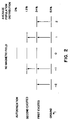
- FIG. 2 there is shown an average population distribution of the even numbered isotopes from gadolinium given the same transition series 2 to 2 to 1 to 0 using parallel polarization.
- the even numbered atoms have possible nuclear spins m j and 53% of the atoms at any point in time will occupy the ground state while 34% of the atoms have allowed transitions to the first excited state, but only 13% of the even numbered atoms (relative to the ground state) have allowed transitions to the second excited state.
- none of the even numbered isotopes have allowed transitions to the autoionization state.
- a resistively heated crucible containing gadolinium was heated to produce an atomic gadolinium vapor.
- the vapor was collimated and illuminated with laser light in a photo zone free of a magnetic field, then passed through a quadrupole mass spectrometer.
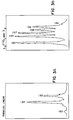
- the mass spectrographs are shown in FIG. 3 in two instances where, on the left (FIG. 3A), the third-step laser was linearly polarized parallel to the first two lasers.
- the spectrograph on the right FIG.
- FIG. 3B shows the results when the third-step laser was not linearly polarized parallel to the first two lasers.
- the photoplasma was accelerated into the mass spectrometer and the relative abundance of each of the isotopes comprising the photoplasma was assayed.
- the polarization selectivity is shown in FIG. 3A wherein the photoplasma is enriched in Gd 157 and Gd 155 . It appears that small residual magnetic fields from the resistively heated crucible or small deviations from linear polarization allow a small fraction of the even numbered atomic mass isotopes to also ionize to a slight degree.
- FIG. 3A shows the results when the third-step laser was not linearly polarized parallel to the first two lasers.
Landscapes
- Chemical & Material Sciences (AREA)
- Chemical Kinetics & Catalysis (AREA)
- Life Sciences & Earth Sciences (AREA)
- Biophysics (AREA)
- Lasers (AREA)
- Magnetic Resonance Imaging Apparatus (AREA)
Abstract
Description
- The present invention relates to a method for isotope enrichment of gadolinium isotopes of odd numbered atomic mass and, in particular, to a method for isotope enrichment of gadolinium-157 by selective photoionization.
- Gadolinium enriched in its odd numbered atomic mass isotopes, Gd157 and Gd155, is of commercial interest, particularly for use as burnable poisons in light water nuclear power reactors. In particular, gadolinium enriched in the Gd157 isotope is useful in fuel cycle design. It would therefore be desirable to enrich gadolinium in its 157 and 155 isotopes and in particular in its 157 isotope.
- Enrichment of an atomic vapor in one or more isotopes may be achieved through separation processes which operate on very small differences between the chemical or physical properties of the isotopes, such as by selectively exciting energy states of one or more isotopes (without corresponding excitation and ionization of the other isotopes) whereby the selectively ionized isotopes may be separated from the neutral atoms by an electrical field. Le Guyadec et al., 'Effect of a magnetic field on the resonant multistep selective photoionization of gadolinium isotopes', Optics Communication, vol.76, No.1, 1990, Elsevier Science Publishers B.V. (North Holland), discloses a method for the photoionization of gadolinium, involving a three-stage transition scheme. However, designing a scheme for selective ionization of the desired isotope in an efficient manner, including not only the atomic transitions utilized in the isolation scheme, but also the particular sources of photon energy required for overall efficiency of the process, are not readily apparent. The discovery, cataloging and design of the particular energy levels for a photoionization scheme are critical in determining the proper pathways which will result in an advantageous, efficient and commercially usable photoionization scheme.
- It is an object of the present invention to provide a method of isotope enrichment of Gd157 and Gd155 in naturally-occurring gadolinium vapor by selective photoionization.
- It is a further object of the present invention to provide a method for isotope enrichment of Gd157 and Gd155 in naturally occurring gadolinium vapor using copper vapor lasers or combinations of copper vapor lasers with dye lasers by using polarization selectivity.
- Briefly, the present invention provides a method for isotope enrichment by isotopically selective ionization of odd numbered atomic mass isotopes of gadolinium in an atomic vapor containing a plurality of isotopes of gadolinium, comprising the steps of applying to the vapor a photon of circularly or linearly parallel polarized radiant energy sufficient to excite the odd numbered atomic mass gadolinium isotopes from the ground state, in which the odd isotopes occupying the ground state have an orbital angular momentum, J, value of 2 or 1, to a first excited state at 16923 cm-1 or 17380 cm-1;
- further applying a photon of radiant energy, similarly polarized with the first source of radiant energy, sufficient to excite the atoms from the first excited state to a second excited state at 32660 cm-1 or 34586 cm-1, respectively, in which the odd isotopes occupying the second excited state have the J value of 1;
- and finally applying to the vapor a photon of radiant energy, similarly polarized with the first and second sources of radiant energy, sufficient to excite the atoms from the second excited state to an autoionized state in which the odd isotopes have a J value of 0. Energy levels and transition frequencies are sometimes provided herein within 1 wave number or 0.1 wave number for convenience.
- Additional objects, advantages and novel features of the present invention will be set forth in part in the following description and in part will become apparent from those skilled in the art upon examination of the following description, or may be learned by practice of the invention. The objects and advantages of the invention may be realized and obtained by means of the instrumentalities and combinations particularly pointed out in the appended claims.
- In the accompanying drawings, which are incorporated in and form a part of the specification:
- FIG. 1 is a scheme showing the various ionization pathways of Gd157 atoms in a three-step photoionization scheme wherein the J value changes, correspondingly, from the ground state to the autoionization state, in the
sequence 2 to 2 to 1 and to 0; - FIG. 2 is a diagram showing the average population distribution of flow of even atomic mass isotopes of gadolinium in a photoionization scheme for the odd isotopes wherein the J values change, ground state to the autoionization state, respectively, in the
sequence 2 to 2 to 1 to 0; - FIG. 3 demonstrates isotope selectivity as a result of polarization selectivity on gadolinium using parallel linear lasers (FIG. 3A) as opposed to utilizing a photoionization scheme where the third photoionization laser is not polarized parallel to the other two photoionization lasers (FIG. 3B).
- Together with the following detailed description, the above-described figures serve to explain the principles of the invention.
- A two-step scheme for isotope-selective laser excitation of isotopes having nonzero nuclear spin, leaving isotopes with zero nuclear spin unexcited, was proposed by L. C. Balling and J. J. Wright, App. Phys. Lett., 29 (7), 411 (1976), using circularly polarized light. However, they proposed no specific physical method for separating the two different atomic species (those of zero spin and those of nonzero spin) and the excitation scheme consisted of changes of orbital angular momentum (J) in a sequence of J = 0 to 1 to 0 wherein only circularly polarized light may be used in separation of the zero spin atoms from the nonzero spin atoms. Among the atoms proposed to be separated by the scheme, gadolinium isotopes were not disclosed.
- Applicants have found three-step photoionization sequences for selectively photoionizing the nonzero spin isotopes of gadolinium and moreover have found that it can be done using either circularly polarized or parallel linearly polarized lasers. Furthermore, applicants have found that for gadolinium the sequence must occur so that the final autoionized state has an orbital angular momentum of (J) 0 and so that the immediately preceding excited state in the photoionization scheme has an orbital angular momentum of 1. The first excited state may produce a J value of either 2 or 1 for odd atomic mass isotopes of gadolinium excited from their ground state in which J = 2.
- Moreover, applicants have found efficient photoionization pathways following the above generalizations for gadolinium which allow for efficient production of ions of the odd numbered isotopes. By efficiency it is meant that a significantly large photoionization fraction of the desired isotope is produced, i.e., greater than about 50% of the atoms of the desired isotope are selectively photoionized.
- The general apparatus utilized for the separation of the ions may be that similar to that described in connection with atomic vapor laser isotope separation techniques (AVLIS) wherein a collimated stream of atomic vapor is generated in an enclosed chamber by, for example, electron gun evaporation from a trough of liquid gadolinium metal, and the stream of vapor is passed through an area of exposure to the polarized laser beams of requisite energy and frequency. The photoions formed by the laser beams are then withdrawn from the vapor stream in an applied electric field while the neutral atoms continue in the collimated vapor stream to a separate condensation area. The ions, as they are collected on a charged surface, are neutralized and form a mixture of gadolinium atoms enriched in the particular photoionized isotope or isotopes. The general techniques and apparatus for conducting isotope separation or enrichment by AVLIS are known.
- While isotope separation by selective photoionization of the even mass numbered isotopes of gadolinium is possible due to relatively broad isotope absorption frequency shifts, the two dominant isotopes of gadolinium with the nonzero nuclear spin (I) of 3/2,
gadolinium 157 andgadolinium 155, have complicating hyperfine structure. For example, theisotope gadolinium 157 has hyperfine components which effectively straddle the transition frequency ofgadolinium 156. Therefore the selective photoionization ofgadolinium 157 poses a particularly difficult problem. - The transitions which are to be effective in the photoionization schemes according to the present invention preferably lie in the spectral region accessible by copper vapor pumped dye lasers.
- In accordance with the present invention the gadolinium vapor containing a plurality of gadolinium isotopes is first exposed to a photon of linearly or circularly polarized radiant energy, preferably from a first copper vapor pumped dye laser, sufficient to excite the
gadolinium angular momentum value - The second laser will provide a photon of linearly or circularly polarized radiant energy sufficient to excite the atoms in the first excited state to a second excited state in which the atoms have an angular momentum value (J) of 1. The second excited state are the ones occurring at 32660 cm-1 and 34586 cm-1, the former of which has been previously identified by others.
- Finally, the third transition will be effected by a photon which causes the
gadolinium - Two photoionization schemes for
gadolinium 

- Referring to FIG. 1, there are shown the allowed transitions among all the possible Gd157 atoms due to hyperfine splitting. The possibilities for nuclear spin among the atoms are given at the bottom the chart. The vertical and diagonal lines show the respective allowed transitions to the first excited state (from the ground state J = 2 to the first excited state wherein J = 2), and then to the succeeding second excited state (J = 2 to J = 1) and finally to the autoionization state where J = 0. Statistically, among the Gd157 atoms of all possible nuclear spins, 87% of the atoms have allowed transitions to the first excited state, 74% (relative to all the atoms in the ground state) have allowed transitions to the second excited state and 70% of all atoms (relative to the ground state) have allowed transitions to the autoionization state. Thus the three-stage transition defined by angular momentum changes of 2 to 2 to 1 to 0 make it possible to photoionize 70% of the Gd157 atoms.
- Referring to FIG. 2, there is shown an average population distribution of the even numbered isotopes from gadolinium given the
same transition series 2 to 2 to 1 to 0 using parallel polarization. As can be seen from FIG 2, the even numbered atoms have possible nuclear spins mj and 53% of the atoms at any point in time will occupy the ground state while 34% of the atoms have allowed transitions to the first excited state, but only 13% of the even numbered atoms (relative to the ground state) have allowed transitions to the second excited state. However, none of the even numbered isotopes have allowed transitions to the autoionization state. - The following example is provided to illustrate the invention, but is not intended to limit the invention in any way.
- A resistively heated crucible containing gadolinium was heated to produce an atomic gadolinium vapor. The vapor was collimated and illuminated with laser light in a photo zone free of a magnetic field, then passed through a quadrupole mass spectrometer. In the photo zone, three broad-band lasers (having band width of 5-10 GHz) were tuned to frequencies to allow excitation from ground level (J = 2) of gadolinium to a J = 0 autoionization level. The mass spectrographs are shown in FIG. 3 in two instances where, on the left (FIG. 3A), the third-step laser was linearly polarized parallel to the first two lasers. The spectrograph on the right (FIG. 3B) shows the results when the third-step laser was not linearly polarized parallel to the first two lasers. The photoplasma was accelerated into the mass spectrometer and the relative abundance of each of the isotopes comprising the photoplasma was assayed. When the lasers are all linearly parallel polarized, the polarization selectivity is shown in FIG. 3A wherein the photoplasma is enriched in Gd157 and Gd155. It appears that small residual magnetic fields from the resistively heated crucible or small deviations from linear polarization allow a small fraction of the even numbered atomic mass isotopes to also ionize to a slight degree. In the spectrogram on the right (FIG. 3B), where linear parallel polarization is not utilized, it can be seen that the odd and even numbered atomic mass isotopes are ionized. This test shows that polarization selectivity alone allows the odd numbered isotopes to be separated from the even gadolinium. Isotope shifts can allow for the two odd-numbered isotopes to be then subsequently separated from one another.
- The foregoing description of the preferred embodiments of the invention is provided for purposes of illustration and description. It is not intended to be exhaustive or to limit the invention to the precise forms disclosed and obviously many modifications and variations are possible in light of the above teachings. The embodiments were chosen and described in order to best explain the principles of the invention and their practical application to thereby enable others skilled in the art to best utilize the invention in the various embodiments and the various modifications as are suited to the particular use contemplated. It is intended that the scope of the invention be defined by the claims appended hereto.
Claims (6)
- A method for isotopically selective ionization of an isotope of gadolinium having odd-numbered atomic mass in an atomic vapor containing a plurality of isotopes of gadolinium comprising the steps of applying to said vapor a photon of linearly or circularly polarized radiant energy sufficient to excite said odd-numbered atomic mass isotope of gadolinium from the ground state having an orbital angular momentum, J, value of 2, to a first excited state at an energy level of 16923 cm-1, relative to the zero energy of said ground state;applying a photon of similarly polarized radiant energy sufficient to excite atoms in said first excited state to a second metastable excited state at an energy level of 32660 cm-1, relative to the zero energy of said ground state having an orbital angular momentum value, J, of 1; andapplying a photon of similarly polarized radiant energy sufficient to excite the atoms in said second excited state to an autoionized state having an orbital angular momentum value, J, of 0.
- A method according to Claim 1 wherein said autoionized state is at an energy level of 50624.7 cm-1 relative to said ground state.
- A method according to Claim 2 wherein the transition to said first excited state is effected by a copper vapor pumped dye laser tuned to a frequency of 16923 cm-1, said transition from said first excited state to said second excited state is effected by a copper vapor pumped dye laser tuned to a frequency of 15737 cm-1, and the transition from said second excited state to said autoionization state is effected by a copper vapor pumped dye laser tuned to a frequency of 17963.8 cm-1.
- A method for isotopically selective ionization of an isotope of gadolinium having odd-numbered atomic mass in an atomic vapor containing a plurality of isotopes of gadolinium comprising the steps of applying to said vapor a photon of linearly or circularly polarized radiant energy sufficient to excite said odd-numbered atomic mass isotope of gadolinium from the ground state having an orbital angular momentum, J, value of 2, to a first excited state at an energy level of 17380 cm-1, relative to the zero energy of said ground state;a photon of similarly polarized radiant energy sufficient to excite atoms in said first excited state to a second metastable excited state at an energy level of 34586 cm-1, relative to the zero energy of said ground state, having an orbital angular momentum value, J, of 1; anda photon of similarly polarized radiant energy sufficient to excite the atoms in said second excited state to an autoionized state having an orbital angular momentum value, J, of 0.
- A method according to Claim 4 wherein said autoionization state is at an energy level of 50624.7 cm-1 relative to said ground state.
- A method according to Claim 5 wherein the transition from the ground state to said first excited state is effected by a copper vapor laser pumped dye laser tuned to a frequency of 17380 cm-1, the transltion from said first excited state to said second excited state is effected by a copper vapor laser pumped dye laser tuned to the frequency of 17205 cm-1, and the transition from said second excited state to said autoionization state is effected by a copper vapor pumped dye laser tuned to a frequency of 16038.0 cm-1.
Applications Claiming Priority (3)
| Application Number | Priority Date | Filing Date | Title |
|---|---|---|---|
| US07/744,748 US5202005A (en) | 1991-08-14 | 1991-08-14 | Gadolinium photoionization process |
| US744748 | 1991-08-14 | ||
| PCT/US1992/006624 WO1993003826A1 (en) | 1991-08-14 | 1992-08-14 | Gadolinium photoionization process |
Publications (3)
| Publication Number | Publication Date |
|---|---|
| EP0557479A4 EP0557479A4 (en) | 1993-06-25 |
| EP0557479A1 EP0557479A1 (en) | 1993-09-01 |
| EP0557479B1 true EP0557479B1 (en) | 1997-12-29 |
Family
ID=24993843
Family Applications (1)
| Application Number | Title | Priority Date | Filing Date |
|---|---|---|---|
| EP92917972A Expired - Lifetime EP0557479B1 (en) | 1991-08-14 | 1992-08-14 | Gadolinium photoionization process |
Country Status (7)
| Country | Link |
|---|---|
| US (1) | US5202005A (en) |
| EP (1) | EP0557479B1 (en) |
| JP (1) | JPH06502348A (en) |
| KR (1) | KR100221796B1 (en) |
| CA (1) | CA2093207A1 (en) |
| WO (1) | WO1993003826A1 (en) |
| ZA (1) | ZA926048B (en) |
Families Citing this family (9)
| Publication number | Priority date | Publication date | Assignee | Title |
|---|---|---|---|---|
| US5250231A (en) * | 1991-09-18 | 1993-10-05 | Combustion Engineering, Inc. | Nuclear fuel with isotopically depleted burnable absorber |
| US5316635A (en) * | 1992-05-22 | 1994-05-31 | Atomic Energy Of Canada Limited/Energie Atomique Du Canada Limitee | Zirconium isotope separation using tuned laser beams |
| US5376246A (en) * | 1992-12-02 | 1994-12-27 | The United States Of America As Represented By The United States Department Of Energy | Efficient mass-selective three-photon ionization of zirconium atoms |
| US5443702A (en) * | 1993-06-22 | 1995-08-22 | Haynam; Christopher A. | Laser isotope separation of erbium and other isotopes |
| US5527437A (en) * | 1994-08-19 | 1996-06-18 | Atomic Energy Of Canada Limited/Energie Atomique Du Canada Limitee | Selective two-color resonant ionization of zirconium-91 |
| US5617860A (en) * | 1995-06-07 | 1997-04-08 | Smithsonian Astrophysical Observatory | Method and system for producing polarized 129 Xe gas |
| KR100478533B1 (en) * | 2002-07-30 | 2005-03-28 | 한국수력원자력 주식회사 | A METHOD OF SEPARATlNG THALLIUM ISOTOPES USING LASER SYSTEM |
| KR100927466B1 (en) * | 2005-09-08 | 2009-11-19 | 한국원자력연구원 | Ytterbium Isotope Separation Method |
| CN108697981B (en) * | 2015-12-17 | 2021-05-18 | 国立研究开发法人理化学研究所 | Odd-even separation ionization method and device for palladium isotope |
Family Cites Families (5)
| Publication number | Priority date | Publication date | Assignee | Title |
|---|---|---|---|---|
| US3708392A (en) * | 1970-12-22 | 1973-01-02 | Atomic Energy Commission | Isotope enrichment process for lanthanide and actinide elements |
| US4020350A (en) * | 1975-06-23 | 1977-04-26 | Massachusetts Institute Of Technology | Isotope selective excitation and separation method and apparatus utilizing circularly polarized pulsed radiation |
| US4711768A (en) * | 1984-08-06 | 1987-12-08 | Westinghouse Electric Corp. | Process for the separation of gadolinium isotopes |
| US4793907A (en) * | 1986-08-20 | 1988-12-27 | The United States Of America As Represented By The United States Department Of Energy | Method for isotope enrichment of mercury-196 by selective photoionization |
| NL8802160A (en) * | 1988-09-01 | 1990-04-02 | Ultra Centrifuge Nederland Nv | METHOD AND DEVICE FOR SEPARATING ISOTOPES |
-
1991
- 1991-08-14 US US07/744,748 patent/US5202005A/en not_active Expired - Lifetime
-
1992
- 1992-08-12 ZA ZA926048A patent/ZA926048B/en unknown
- 1992-08-14 CA CA002093207A patent/CA2093207A1/en not_active Abandoned
- 1992-08-14 EP EP92917972A patent/EP0557479B1/en not_active Expired - Lifetime
- 1992-08-14 JP JP5504357A patent/JPH06502348A/en active Pending
- 1992-08-14 KR KR1019930701120A patent/KR100221796B1/en not_active Expired - Fee Related
- 1992-08-14 WO PCT/US1992/006624 patent/WO1993003826A1/en not_active Ceased
Also Published As
| Publication number | Publication date |
|---|---|
| ZA926048B (en) | 1993-04-28 |
| CA2093207A1 (en) | 1993-12-09 |
| US5202005A (en) | 1993-04-13 |
| EP0557479A1 (en) | 1993-09-01 |
| KR930703060A (en) | 1993-11-29 |
| JPH06502348A (en) | 1994-03-17 |
| KR100221796B1 (en) | 1999-09-15 |
| EP0557479A4 (en) | 1993-06-25 |
| WO1993003826A1 (en) | 1993-03-04 |
Similar Documents
| Publication | Publication Date | Title |
|---|---|---|
| US3772519A (en) | Method of and apparatus for the separation of isotopes | |
| US3443087A (en) | Isotopic separation process | |
| Köster | Resonance ionization laser ion sources | |
| CA1061476A (en) | Selective excitation of atoms or molecules to high-lying states | |
| US4786478A (en) | Method and apparatus for isotope separation | |
| US5202005A (en) | Gadolinium photoionization process | |
| US4514363A (en) | Method for isotope enrichment by photoinduced chemiionization | |
| US4793907A (en) | Method for isotope enrichment of mercury-196 by selective photoionization | |
| US4023038A (en) | Increased ionization rate in laser enrichment | |
| US3959649A (en) | Collection of ions in a plasma by magnetic field acceleration with selective polarization | |
| US5948214A (en) | Isotope separation | |
| US4110182A (en) | Isotope separation by photoselective dissociative electron capture | |
| US4101396A (en) | Isotope enrichment by resonance trapping | |
| US4584072A (en) | Process for separating an isotope from a mixture of different isotopes by using a single laser beam | |
| US4031389A (en) | Isotope separation using metallic vapor lasers | |
| US5443702A (en) | Laser isotope separation of erbium and other isotopes | |
| US4704197A (en) | Isotope separation using tuned laser and electron beam | |
| US4658135A (en) | Method and apparatus for sensitive atom counting with high isotopic selectivity | |
| US4451437A (en) | Method for separating different isotopes in compounds by means of laser radiation | |
| US4197093A (en) | Method and apparatus for separating isotopes using state selection | |
| Tsuji et al. | Electronic state distributions of Kr+* formed by excitation transfer from He (2 3 S) to Kr+ (2 P 3/2) and Kr+ (2 P 1/2) at thermal energy | |
| Velikhov et al. | Isotope separation by multiphoton dissociation of molecules with high-power CO2 laser radiation. I. Practical methods | |
| US5945649A (en) | Atomic vapor laser isotope separation of lead-210 isotope | |
| Arisawa et al. | The influence of the laser linewidth on the selectivity in laser isotope separation | |
| EP0444336B1 (en) | Laserisotope separation apparatus |
Legal Events
| Date | Code | Title | Description |
|---|---|---|---|
| PUAI | Public reference made under article 153(3) epc to a published international application that has entered the european phase |
Free format text: ORIGINAL CODE: 0009012 |
|
| 17P | Request for examination filed |
Effective date: 19930615 |
|
| AK | Designated contracting states |
Kind code of ref document: A1 Designated state(s): AT BE CH DE DK ES FR GB GR IE IT LI LU MC NL SE |
|
| RBV | Designated contracting states (corrected) |
Designated state(s): FR GB |
|
| REG | Reference to a national code |
Ref country code: DE Ref legal event code: 8566 |
|
| 17Q | First examination report despatched |
Effective date: 19950427 |
|
| GRAG | Despatch of communication of intention to grant |
Free format text: ORIGINAL CODE: EPIDOS AGRA |
|
| GRAH | Despatch of communication of intention to grant a patent |
Free format text: ORIGINAL CODE: EPIDOS IGRA |
|
| GRAH | Despatch of communication of intention to grant a patent |
Free format text: ORIGINAL CODE: EPIDOS IGRA |
|
| GRAA | (expected) grant |
Free format text: ORIGINAL CODE: 0009210 |
|
| AK | Designated contracting states |
Kind code of ref document: B1 Designated state(s): FR GB |
|
| ET | Fr: translation filed | ||
| PLBE | No opposition filed within time limit |
Free format text: ORIGINAL CODE: 0009261 |
|
| 26N | No opposition filed | ||
| REG | Reference to a national code |
Ref country code: GB Ref legal event code: 732E |
|
| REG | Reference to a national code |
Ref country code: FR Ref legal event code: TP |
|
| PGFP | Annual fee paid to national office [announced via postgrant information from national office to epo] |
Ref country code: GB Payment date: 20000517 Year of fee payment: 9 |
|
| PGFP | Annual fee paid to national office [announced via postgrant information from national office to epo] |
Ref country code: FR Payment date: 20000519 Year of fee payment: 9 |
|
| PG25 | Lapsed in a contracting state [announced via postgrant information from national office to epo] |
Ref country code: GB Free format text: LAPSE BECAUSE OF NON-PAYMENT OF DUE FEES Effective date: 20010814 |
|
| GBPC | Gb: european patent ceased through non-payment of renewal fee |
Effective date: 20010814 |
|
| PG25 | Lapsed in a contracting state [announced via postgrant information from national office to epo] |
Ref country code: FR Free format text: LAPSE BECAUSE OF NON-PAYMENT OF DUE FEES Effective date: 20020430 |
|
| REG | Reference to a national code |
Ref country code: FR Ref legal event code: ST |