EP0556319B1 - Sampangine derivatives useful as antifungal agents - Google Patents
Sampangine derivatives useful as antifungal agents Download PDFInfo
- Publication number
- EP0556319B1 EP0556319B1 EP92900905A EP92900905A EP0556319B1 EP 0556319 B1 EP0556319 B1 EP 0556319B1 EP 92900905 A EP92900905 A EP 92900905A EP 92900905 A EP92900905 A EP 92900905A EP 0556319 B1 EP0556319 B1 EP 0556319B1
- Authority
- EP
- European Patent Office
- Prior art keywords
- compound
- sampangine
- methoxysampangine
- composition
- bromosampangine
- Prior art date
- Legal status (The legal status is an assumption and is not a legal conclusion. Google has not performed a legal analysis and makes no representation as to the accuracy of the status listed.)
- Expired - Lifetime
Links
- 229940121375 antifungal agent Drugs 0.000 title abstract description 7
- 239000003429 antifungal agent Substances 0.000 title abstract description 5
- BWQKHOMAOVUASZ-UHFFFAOYSA-N sampangine Chemical class C1=NC(C(=O)C=2C3=CC=CC=2)=C2C3=NC=CC2=C1 BWQKHOMAOVUASZ-UHFFFAOYSA-N 0.000 title description 25
- 150000001875 compounds Chemical class 0.000 claims abstract description 28
- 239000000203 mixture Substances 0.000 claims abstract description 16
- 241000222122 Candida albicans Species 0.000 claims abstract description 12
- 229940095731 candida albicans Drugs 0.000 claims abstract description 12
- 241001225321 Aspergillus fumigatus Species 0.000 claims abstract description 11
- 229940091771 aspergillus fumigatus Drugs 0.000 claims abstract description 11
- 201000007336 Cryptococcosis Diseases 0.000 claims abstract description 10
- 241000221204 Cryptococcus neoformans Species 0.000 claims abstract description 10
- PMNDIQAJNAFXTJ-UHFFFAOYSA-N eupomatidine 2 Natural products O=C1C2=CC=CC=C2C2=NC=CC3=C2C1=NC=C3OC PMNDIQAJNAFXTJ-UHFFFAOYSA-N 0.000 claims description 13
- CTRDVMKPNWVMDH-UHFFFAOYSA-N chembl133067 Chemical compound O=C1C2=CC=CC=C2C2=NC=CC3=C2C1=NC=C3Br CTRDVMKPNWVMDH-UHFFFAOYSA-N 0.000 claims description 12
- 238000002360 preparation method Methods 0.000 claims description 11
- SGZVAGOBRALNLJ-UHFFFAOYSA-N 9h-benzo[b]pyrido[4,3,2-mn]acridin-9-one Chemical compound C1=CC=CC2=NC(C(=O)C=3C4=CC=CC=3)=C3C4=NC=CC3=C21 SGZVAGOBRALNLJ-UHFFFAOYSA-N 0.000 claims description 7
- 230000002538 fungal effect Effects 0.000 claims description 6
- 239000003814 drug Substances 0.000 claims description 5
- 241000124008 Mammalia Species 0.000 claims description 3
- 229910052794 bromium Inorganic materials 0.000 claims description 3
- 239000003937 drug carrier Substances 0.000 claims description 3
- 231100000252 nontoxic Toxicity 0.000 claims description 3
- 230000003000 nontoxic effect Effects 0.000 claims description 3
- 230000001575 pathological effect Effects 0.000 claims description 3
- 239000012871 anti-fungal composition Substances 0.000 claims 3
- 125000003545 alkoxy group Chemical group 0.000 claims 2
- 125000004432 carbon atom Chemical group C* 0.000 claims 2
- FBVVMYZYZXYLIA-UHFFFAOYSA-N 3-methoxysampangine Chemical compound C12=CC=CC=C2C(=O)C2=NC=CC3=C2C1=NC=C3OC FBVVMYZYZXYLIA-UHFFFAOYSA-N 0.000 abstract description 14
- 238000000034 method Methods 0.000 abstract description 8
- XEKOWRVHYACXOJ-UHFFFAOYSA-N Ethyl acetate Chemical compound CCOC(C)=O XEKOWRVHYACXOJ-UHFFFAOYSA-N 0.000 description 18
- HEDRZPFGACZZDS-MICDWDOJSA-N Trichloro(2H)methane Chemical compound [2H]C(Cl)(Cl)Cl HEDRZPFGACZZDS-MICDWDOJSA-N 0.000 description 18
- GVRYUHXXENMGEV-UHFFFAOYSA-N 4-methylbenzo[g]quinoline-5,10-dione Chemical compound O=C1C2=CC=CC=C2C(=O)C2=C1N=CC=C2C GVRYUHXXENMGEV-UHFFFAOYSA-N 0.000 description 17
- 239000000243 solution Substances 0.000 description 15
- XLYOFNOQVPJJNP-UHFFFAOYSA-N water Substances O XLYOFNOQVPJJNP-UHFFFAOYSA-N 0.000 description 15
- QTBSBXVTEAMEQO-UHFFFAOYSA-N Acetic acid Chemical compound CC(O)=O QTBSBXVTEAMEQO-UHFFFAOYSA-N 0.000 description 11
- HEDRZPFGACZZDS-UHFFFAOYSA-N Chloroform Chemical compound ClC(Cl)Cl HEDRZPFGACZZDS-UHFFFAOYSA-N 0.000 description 10
- BWHMMNNQKKPAPP-UHFFFAOYSA-L potassium carbonate Chemical compound [K+].[K+].[O-]C([O-])=O BWHMMNNQKKPAPP-UHFFFAOYSA-L 0.000 description 10
- ZMXDDKWLCZADIW-UHFFFAOYSA-N N,N-Dimethylformamide Chemical compound CN(C)C=O ZMXDDKWLCZADIW-UHFFFAOYSA-N 0.000 description 9
- YMWUJEATGCHHMB-UHFFFAOYSA-N Dichloromethane Chemical compound ClCCl YMWUJEATGCHHMB-UHFFFAOYSA-N 0.000 description 8
- LFQSCWFLJHTTHZ-UHFFFAOYSA-N Ethanol Chemical compound CCO LFQSCWFLJHTTHZ-UHFFFAOYSA-N 0.000 description 8
- 239000000725 suspension Substances 0.000 description 8
- 238000005160 1H NMR spectroscopy Methods 0.000 description 7
- 230000000843 anti-fungal effect Effects 0.000 description 7
- 238000001644 13C nuclear magnetic resonance spectroscopy Methods 0.000 description 6
- KJOHPBJYGGFYBJ-UHFFFAOYSA-N 2-bromonaphthalene-1,4-dione Chemical compound C1=CC=C2C(=O)C(Br)=CC(=O)C2=C1 KJOHPBJYGGFYBJ-UHFFFAOYSA-N 0.000 description 6
- KIVUUVOREYMMFE-UHFFFAOYSA-N Eupolauridine Chemical compound C1=NC(C2=CC=CC=C22)=C3C2=NC=CC3=C1 KIVUUVOREYMMFE-UHFFFAOYSA-N 0.000 description 6
- OKKJLVBELUTLKV-UHFFFAOYSA-N Methanol Chemical compound OC OKKJLVBELUTLKV-UHFFFAOYSA-N 0.000 description 6
- VYPSYNLAJGMNEJ-UHFFFAOYSA-N Silicium dioxide Chemical compound O=[Si]=O VYPSYNLAJGMNEJ-UHFFFAOYSA-N 0.000 description 6
- 239000000741 silica gel Substances 0.000 description 6
- 229910002027 silica gel Inorganic materials 0.000 description 6
- 239000007787 solid Substances 0.000 description 6
- 229920001817 Agar Polymers 0.000 description 5
- 229960000583 acetic acid Drugs 0.000 description 5
- 239000008272 agar Substances 0.000 description 5
- TWFZGCMQGLPBSX-UHFFFAOYSA-N carbendazim Chemical compound C1=CC=C2NC(NC(=O)OC)=NC2=C1 TWFZGCMQGLPBSX-UHFFFAOYSA-N 0.000 description 5
- 238000006243 chemical reaction Methods 0.000 description 5
- 229910000027 potassium carbonate Inorganic materials 0.000 description 5
- 239000011541 reaction mixture Substances 0.000 description 5
- 238000012360 testing method Methods 0.000 description 5
- APKFDSVGJQXUKY-KKGHZKTASA-N Amphotericin-B Natural products O[C@H]1[C@@H](N)[C@H](O)[C@@H](C)O[C@H]1O[C@H]1C=CC=CC=CC=CC=CC=CC=C[C@H](C)[C@@H](O)[C@@H](C)[C@H](C)OC(=O)C[C@H](O)C[C@H](O)CC[C@@H](O)[C@H](O)C[C@H](O)C[C@](O)(C[C@H](O)[C@H]2C(O)=O)O[C@H]2C1 APKFDSVGJQXUKY-KKGHZKTASA-N 0.000 description 4
- IAZDPXIOMUYVGZ-UHFFFAOYSA-N Dimethylsulphoxide Chemical compound CS(C)=O IAZDPXIOMUYVGZ-UHFFFAOYSA-N 0.000 description 4
- UIIMBOGNXHQVGW-UHFFFAOYSA-M Sodium bicarbonate Chemical class [Na+].OC([O-])=O UIIMBOGNXHQVGW-UHFFFAOYSA-M 0.000 description 4
- APKFDSVGJQXUKY-INPOYWNPSA-N amphotericin B Chemical compound O[C@H]1[C@@H](N)[C@H](O)[C@@H](C)O[C@H]1O[C@H]1/C=C/C=C/C=C/C=C/C=C/C=C/C=C/[C@H](C)[C@@H](O)[C@@H](C)[C@H](C)OC(=O)C[C@H](O)C[C@H](O)CC[C@@H](O)[C@H](O)C[C@H](O)C[C@](O)(C[C@H](O)[C@H]2C(O)=O)O[C@H]2C1 APKFDSVGJQXUKY-INPOYWNPSA-N 0.000 description 4
- 229960003942 amphotericin b Drugs 0.000 description 4
- 238000003556 assay Methods 0.000 description 4
- 239000012362 glacial acetic acid Substances 0.000 description 4
- 239000010410 layer Substances 0.000 description 4
- 239000007788 liquid Substances 0.000 description 4
- 239000012044 organic layer Substances 0.000 description 4
- 239000002904 solvent Substances 0.000 description 4
- CSCPPACGZOOCGX-UHFFFAOYSA-N Acetone Chemical compound CC(C)=O CSCPPACGZOOCGX-UHFFFAOYSA-N 0.000 description 3
- NLXLAEXVIDQMFP-UHFFFAOYSA-N Ammonia chloride Chemical compound [NH4+].[Cl-] NLXLAEXVIDQMFP-UHFFFAOYSA-N 0.000 description 3
- HEMHJVSKTPXQMS-UHFFFAOYSA-M Sodium hydroxide Chemical compound [OH-].[Na+] HEMHJVSKTPXQMS-UHFFFAOYSA-M 0.000 description 3
- QAOWNCQODCNURD-UHFFFAOYSA-N Sulfuric acid Chemical compound OS(O)(=O)=O QAOWNCQODCNURD-UHFFFAOYSA-N 0.000 description 3
- 239000003795 chemical substances by application Substances 0.000 description 3
- 229940079593 drug Drugs 0.000 description 3
- 238000002451 electron ionisation mass spectrometry Methods 0.000 description 3
- 239000000469 ethanolic extract Substances 0.000 description 3
- 238000011156 evaluation Methods 0.000 description 3
- 239000000284 extract Substances 0.000 description 3
- KVKJBRFOURXWON-DBYMJTHYSA-N n-[[(e)-but-2-enylidene]amino]-n-methylmethanamine Chemical compound C\C=C\C=NN(C)C KVKJBRFOURXWON-DBYMJTHYSA-N 0.000 description 3
- 238000010992 reflux Methods 0.000 description 3
- RHUYHJGZWVXEHW-UHFFFAOYSA-N 1,1-Dimethyhydrazine Chemical compound CN(C)N RHUYHJGZWVXEHW-UHFFFAOYSA-N 0.000 description 2
- FRASJONUBLZVQX-UHFFFAOYSA-N 1,4-naphthoquinone Chemical compound C1=CC=C2C(=O)C=CC(=O)C2=C1 FRASJONUBLZVQX-UHFFFAOYSA-N 0.000 description 2
- KJCVRFUGPWSIIH-UHFFFAOYSA-N 1-naphthol Chemical compound C1=CC=C2C(O)=CC=CC2=C1 KJCVRFUGPWSIIH-UHFFFAOYSA-N 0.000 description 2
- 208000030507 AIDS Diseases 0.000 description 2
- 241001081440 Annonaceae Species 0.000 description 2
- IJGRMHOSHXDMSA-UHFFFAOYSA-N Atomic nitrogen Chemical compound N#N IJGRMHOSHXDMSA-UHFFFAOYSA-N 0.000 description 2
- 241000950465 Cleistopholis Species 0.000 description 2
- CSNNHWWHGAXBCP-UHFFFAOYSA-L Magnesium sulfate Chemical compound [Mg+2].[O-][S+2]([O-])([O-])[O-] CSNNHWWHGAXBCP-UHFFFAOYSA-L 0.000 description 2
- ZSXGLVDWWRXATF-UHFFFAOYSA-N N,N-dimethylformamide dimethyl acetal Chemical compound COC(OC)N(C)C ZSXGLVDWWRXATF-UHFFFAOYSA-N 0.000 description 2
- PCLIMKBDDGJMGD-UHFFFAOYSA-N N-bromosuccinimide Chemical compound BrN1C(=O)CCC1=O PCLIMKBDDGJMGD-UHFFFAOYSA-N 0.000 description 2
- CTQNGGLPUBDAKN-UHFFFAOYSA-N O-Xylene Chemical compound CC1=CC=CC=C1C CTQNGGLPUBDAKN-UHFFFAOYSA-N 0.000 description 2
- JUJWROOIHBZHMG-UHFFFAOYSA-N Pyridine Chemical compound C1=CC=NC=C1 JUJWROOIHBZHMG-UHFFFAOYSA-N 0.000 description 2
- 240000004808 Saccharomyces cerevisiae Species 0.000 description 2
- WQDUMFSSJAZKTM-UHFFFAOYSA-N Sodium methoxide Chemical compound [Na+].[O-]C WQDUMFSSJAZKTM-UHFFFAOYSA-N 0.000 description 2
- 239000002253 acid Substances 0.000 description 2
- 238000004458 analytical method Methods 0.000 description 2
- 239000003242 anti bacterial agent Substances 0.000 description 2
- 230000001032 anti-candidal effect Effects 0.000 description 2
- 229940088710 antibiotic agent Drugs 0.000 description 2
- 125000004429 atom Chemical group 0.000 description 2
- 125000005605 benzo group Chemical group 0.000 description 2
- 239000000969 carrier Substances 0.000 description 2
- 238000005119 centrifugation Methods 0.000 description 2
- 238000005100 correlation spectroscopy Methods 0.000 description 2
- MLUCVPSAIODCQM-NSCUHMNNSA-N crotonaldehyde Chemical compound C\C=C\C=O MLUCVPSAIODCQM-NSCUHMNNSA-N 0.000 description 2
- 239000008121 dextrose Substances 0.000 description 2
- 239000003085 diluting agent Substances 0.000 description 2
- 238000000605 extraction Methods 0.000 description 2
- 238000000338 in vitro Methods 0.000 description 2
- 238000011534 incubation Methods 0.000 description 2
- HQKMJHAJHXVSDF-UHFFFAOYSA-L magnesium stearate Chemical compound [Mg+2].CCCCCCCCCCCCCCCCCC([O-])=O.CCCCCCCCCCCCCCCCCC([O-])=O HQKMJHAJHXVSDF-UHFFFAOYSA-L 0.000 description 2
- 230000004048 modification Effects 0.000 description 2
- VDCLSGXZVUDARN-UHFFFAOYSA-N molecular bromine;pyridine;hydrobromide Chemical compound Br.BrBr.C1=CC=NC=C1 VDCLSGXZVUDARN-UHFFFAOYSA-N 0.000 description 2
- 239000013641 positive control Substances 0.000 description 2
- 239000002244 precipitate Substances 0.000 description 2
- 239000000047 product Substances 0.000 description 2
- 239000000126 substance Substances 0.000 description 2
- 231100000419 toxicity Toxicity 0.000 description 2
- 230000001988 toxicity Effects 0.000 description 2
- 239000008096 xylene Substances 0.000 description 2
- XMAYWYJOQHXEEK-OZXSUGGESA-N (2R,4S)-ketoconazole Chemical compound C1CN(C(=O)C)CCN1C(C=C1)=CC=C1OC[C@@H]1O[C@@](CN2C=NC=C2)(C=2C(=CC(Cl)=CC=2)Cl)OC1 XMAYWYJOQHXEEK-OZXSUGGESA-N 0.000 description 1
- BWKAYBPLDRWMCJ-UHFFFAOYSA-N 1,1-diethoxy-n,n-dimethylmethanamine Chemical compound CCOC(N(C)C)OCC BWKAYBPLDRWMCJ-UHFFFAOYSA-N 0.000 description 1
- 240000002470 Amphicarpaea bracteata Species 0.000 description 1
- WKBOTKDWSSQWDR-UHFFFAOYSA-N Bromine atom Chemical compound [Br] WKBOTKDWSSQWDR-UHFFFAOYSA-N 0.000 description 1
- UXVMQQNJUSDDNG-UHFFFAOYSA-L Calcium chloride Chemical compound [Cl-].[Cl-].[Ca+2] UXVMQQNJUSDDNG-UHFFFAOYSA-L 0.000 description 1
- 229920000742 Cotton Polymers 0.000 description 1
- 206010017533 Fungal infection Diseases 0.000 description 1
- 241000233866 Fungi Species 0.000 description 1
- 108010010803 Gelatin Proteins 0.000 description 1
- GUBGYTABKSRVRQ-QKKXKWKRSA-N Lactose Natural products OC[C@H]1O[C@@H](O[C@H]2[C@H](O)[C@@H](O)C(O)O[C@@H]2CO)[C@H](O)[C@@H](O)[C@H]1O GUBGYTABKSRVRQ-QKKXKWKRSA-N 0.000 description 1
- 240000007472 Leucaena leucocephala Species 0.000 description 1
- 235000010643 Leucaena leucocephala Nutrition 0.000 description 1
- 238000005481 NMR spectroscopy Methods 0.000 description 1
- 206010034133 Pathogen resistance Diseases 0.000 description 1
- FAPWRFPIFSIZLT-UHFFFAOYSA-M Sodium chloride Chemical compound [Na+].[Cl-] FAPWRFPIFSIZLT-UHFFFAOYSA-M 0.000 description 1
- 206010042938 Systemic candida Diseases 0.000 description 1
- 240000008042 Zea mays Species 0.000 description 1
- 235000005824 Zea mays ssp. parviglumis Nutrition 0.000 description 1
- 235000002017 Zea mays subsp mays Nutrition 0.000 description 1
- 150000001299 aldehydes Chemical class 0.000 description 1
- 229930013930 alkaloid Natural products 0.000 description 1
- 235000019270 ammonium chloride Nutrition 0.000 description 1
- 230000003466 anti-cipated effect Effects 0.000 description 1
- 238000013459 approach Methods 0.000 description 1
- 239000008346 aqueous phase Substances 0.000 description 1
- 238000012455 bioassay technique Methods 0.000 description 1
- 230000037396 body weight Effects 0.000 description 1
- 238000009835 boiling Methods 0.000 description 1
- 230000031709 bromination Effects 0.000 description 1
- 238000005893 bromination reaction Methods 0.000 description 1
- GDTBXPJZTBHREO-UHFFFAOYSA-N bromine Substances BrBr GDTBXPJZTBHREO-UHFFFAOYSA-N 0.000 description 1
- 238000002815 broth microdilution Methods 0.000 description 1
- 239000011575 calcium Substances 0.000 description 1
- 239000001110 calcium chloride Substances 0.000 description 1
- 229910001628 calcium chloride Inorganic materials 0.000 description 1
- 201000003984 candidiasis Diseases 0.000 description 1
- 239000002775 capsule Substances 0.000 description 1
- 125000002915 carbonyl group Chemical group [*:2]C([*:1])=O 0.000 description 1
- 238000007385 chemical modification Methods 0.000 description 1
- 238000004587 chromatography analysis Methods 0.000 description 1
- 239000011248 coating agent Substances 0.000 description 1
- 238000000576 coating method Methods 0.000 description 1
- 230000001332 colony forming effect Effects 0.000 description 1
- 238000009833 condensation Methods 0.000 description 1
- 230000005494 condensation Effects 0.000 description 1
- 238000001816 cooling Methods 0.000 description 1
- 239000007799 cork Substances 0.000 description 1
- 235000005822 corn Nutrition 0.000 description 1
- MLUCVPSAIODCQM-UHFFFAOYSA-N crotonaldehyde Natural products CC=CC=O MLUCVPSAIODCQM-UHFFFAOYSA-N 0.000 description 1
- 239000000287 crude extract Substances 0.000 description 1
- 230000001419 dependent effect Effects 0.000 description 1
- 238000009792 diffusion process Methods 0.000 description 1
- 208000019164 disseminated candidiasis Diseases 0.000 description 1
- 238000002651 drug therapy Methods 0.000 description 1
- 238000001035 drying Methods 0.000 description 1
- 239000008157 edible vegetable oil Substances 0.000 description 1
- 230000000694 effects Effects 0.000 description 1
- 230000008030 elimination Effects 0.000 description 1
- 238000003379 elimination reaction Methods 0.000 description 1
- UREBWPXBXRYXRJ-UHFFFAOYSA-N ethyl acetate;methanol Chemical compound OC.CCOC(C)=O UREBWPXBXRYXRJ-UHFFFAOYSA-N 0.000 description 1
- 239000000706 filtrate Substances 0.000 description 1
- 238000001914 filtration Methods 0.000 description 1
- 208000024386 fungal infectious disease Diseases 0.000 description 1
- 244000053095 fungal pathogen Species 0.000 description 1
- 239000008273 gelatin Substances 0.000 description 1
- 229920000159 gelatin Polymers 0.000 description 1
- 235000019322 gelatine Nutrition 0.000 description 1
- 235000011852 gelatine desserts Nutrition 0.000 description 1
- 238000010438 heat treatment Methods 0.000 description 1
- 238000006077 hetero Diels-Alder cycloaddition reaction Methods 0.000 description 1
- 238000004896 high resolution mass spectrometry Methods 0.000 description 1
- 239000005457 ice water Substances 0.000 description 1
- 238000011065 in-situ storage Methods 0.000 description 1
- 208000015181 infectious disease Diseases 0.000 description 1
- 230000002401 inhibitory effect Effects 0.000 description 1
- 230000005764 inhibitory process Effects 0.000 description 1
- 239000002054 inoculum Substances 0.000 description 1
- 238000007918 intramuscular administration Methods 0.000 description 1
- 238000001990 intravenous administration Methods 0.000 description 1
- 238000002955 isolation Methods 0.000 description 1
- 229960004125 ketoconazole Drugs 0.000 description 1
- 239000008101 lactose Substances 0.000 description 1
- 231100001231 less toxic Toxicity 0.000 description 1
- 239000007937 lozenge Substances 0.000 description 1
- 235000019359 magnesium stearate Nutrition 0.000 description 1
- 229910052943 magnesium sulfate Inorganic materials 0.000 description 1
- 235000019341 magnesium sulphate Nutrition 0.000 description 1
- 239000000463 material Substances 0.000 description 1
- 238000006140 methanolysis reaction Methods 0.000 description 1
- 238000012986 modification Methods 0.000 description 1
- FFJMLWSZNCJCSZ-UHFFFAOYSA-N n-methylmethanamine;hydrobromide Chemical compound Br.CNC FFJMLWSZNCJCSZ-UHFFFAOYSA-N 0.000 description 1
- 229930014626 natural product Natural products 0.000 description 1
- 229910052757 nitrogen Inorganic materials 0.000 description 1
- 239000012299 nitrogen atmosphere Substances 0.000 description 1
- 238000000655 nuclear magnetic resonance spectrum Methods 0.000 description 1
- 239000003921 oil Substances 0.000 description 1
- 239000012074 organic phase Substances 0.000 description 1
- 230000036515 potency Effects 0.000 description 1
- 239000000843 powder Substances 0.000 description 1
- UMJSCPRVCHMLSP-UHFFFAOYSA-N pyridine Natural products COC1=CC=CN=C1 UMJSCPRVCHMLSP-UHFFFAOYSA-N 0.000 description 1
- 238000012205 qualitative assay Methods 0.000 description 1
- 238000002390 rotary evaporation Methods 0.000 description 1
- 239000012449 sabouraud dextrose agar Substances 0.000 description 1
- 230000003595 spectral effect Effects 0.000 description 1
- 238000001228 spectrum Methods 0.000 description 1
- 238000003756 stirring Methods 0.000 description 1
- 239000000829 suppository Substances 0.000 description 1
- 208000011580 syndromic disease Diseases 0.000 description 1
- 238000003786 synthesis reaction Methods 0.000 description 1
- 230000009885 systemic effect Effects 0.000 description 1
- 239000003826 tablet Substances 0.000 description 1
- KPZSTOVTJYRDIO-UHFFFAOYSA-K trichlorocerium;heptahydrate Chemical compound O.O.O.O.O.O.O.Cl[Ce](Cl)Cl KPZSTOVTJYRDIO-UHFFFAOYSA-K 0.000 description 1
- 238000005406 washing Methods 0.000 description 1
Classifications
-
- C—CHEMISTRY; METALLURGY
- C07—ORGANIC CHEMISTRY
- C07D—HETEROCYCLIC COMPOUNDS
- C07D471/00—Heterocyclic compounds containing nitrogen atoms as the only ring hetero atoms in the condensed system, at least one ring being a six-membered ring with one nitrogen atom, not provided for by groups C07D451/00 - C07D463/00
- C07D471/02—Heterocyclic compounds containing nitrogen atoms as the only ring hetero atoms in the condensed system, at least one ring being a six-membered ring with one nitrogen atom, not provided for by groups C07D451/00 - C07D463/00 in which the condensed system contains two hetero rings
- C07D471/06—Peri-condensed systems
-
- A—HUMAN NECESSITIES
- A61—MEDICAL OR VETERINARY SCIENCE; HYGIENE
- A61P—SPECIFIC THERAPEUTIC ACTIVITY OF CHEMICAL COMPOUNDS OR MEDICINAL PREPARATIONS
- A61P31/00—Antiinfectives, i.e. antibiotics, antiseptics, chemotherapeutics
- A61P31/04—Antibacterial agents
-
- A—HUMAN NECESSITIES
- A61—MEDICAL OR VETERINARY SCIENCE; HYGIENE
- A61P—SPECIFIC THERAPEUTIC ACTIVITY OF CHEMICAL COMPOUNDS OR MEDICINAL PREPARATIONS
- A61P31/00—Antiinfectives, i.e. antibiotics, antiseptics, chemotherapeutics
- A61P31/10—Antimycotics
Definitions
- This invention is directed to a new composition, compounds and its use for the preparation of a medicament for providing effective protection against pathological fungal conditions in mammals particularly those caused by Candida albicans, Aspergillus fumigatus, and Cryptococcus neoformans .
- the novel compound and compositions of the invention provide in one case a simple, practical readily extracted drug occuring naturally in the root bark of the West African tree, Cleistopholis patens (Benth) Engl. and Diels (Annonaceae).
- the compound of the invention may also be synthesized using known techniques.
- the invention is the new composition according to claim 1.
- the use of the inventive composition is defined in claim 4.
- Administration of the compound may be by any of the conventional routes of administration, for example, oral, intramuscular, intravenous, or rectally.
- the compound is administrable in combination with a pharmaceutically-acceptable carrier which may be solid or liquid, dependent upon choice and route of administration.
- acceptable carriers include, lactose, gelatin, agar, searic acid, magnesium stearate, acacia, and similar carriers.
- liquids include water, edible oils, e.g. peanut and corn.
- the compound and diluent carrier When administered in solid form, the compound and diluent carrier may be in the form of tablets, capsules, powders, lozenges, suppositories prepared by any of the well known methods.
- the mixture of active compound and liquid diluent carrier When given as a liquid preparation, the mixture of active compound and liquid diluent carrier may be in the form of a suspension administrable as such.
- the compound is administrable in a non-toxic dosage concentration sufficient to inhibit the growth and/or destroy the Candida albicans, Aspergillus fumigatus and Crytococcus neoformans organisms.
- the actual dosage unit will be determined by such generally recognized factors as body weight of the patient and/or severity and type of pathological condition the patient might be suffering with prior to becoming infected with any of the fungal organisms. With these considerations in mind, the dosage unit for a particular patient can be readily determined by the medical practitioner in accordance with the techniques known in the medical arts.
- the antifungal activity of the compounds was determined by in vitro evaluation against Candida albicans NIH B311, Cryptococcus neoformans ATCC 32264, and Aspergillus fumigatus ATCC 26934 using the known agar-well diffusion assay techniques with the following modifications.
- Candida albicans NIH B311 used to induce experimental disseminated candidiasis was used for the initial qualitative evaluation of anticandidal activity.
- the organism was grown in Sabouraud-dextrose broth (SDB) for 24 hours at 37°, at which time the cells were harvested by centrifugation at (4°, 2000 rpm, 3 min.). After centrifugation, the cells were washed and suspended in sterile 0.9% saline to give a final concentration of 10 6 colony forming units (CFU) per ml (adjusted using a hemocytometer).
- SDB Sabouraud-dextrose broth
- Inocula of Cryptococcus neoformans and Aspergillus fumigatus were prepared by suspension of the surface growth of stock agar slants in sterile H 2 O.
- Culture plates (15 x 100 mm) for the qualitative assay were prepared from 25 ml of Sabouraud-dextrose agar for Candida albicans , and MycophilTM agar for Cryptococcus neoformans and Aspergillus fumigatus .
- sterile cotton swabs the plates were streaked with the suspension of appropriate test organism. Cylindrical plugs were removed from the agar plates by means of sterile cork borer to produce wells with a diameter of approximately 11 mm.
- Antifungal activity was recorded as the width (in mm) of the zone of inhibition, measured from the edge of the agar well to the edge of the zone, following incubation of the plates for 24 hours (37° for Candida albicans , 30° for Aspergillus fumigatus and 26° for Cryptococcus neoformans ).
- the antifungal agents amphotericin B and ketoconazole were included as positive controls in each assay.
- the method used to determined the minimum inhibitory concentration (MIC) was the twofold serial broth dilution assay in one or more of the following broth media: yeast nitrogen broth, MycophilTM broth and Saboraud-dextrose broth (SDB).
- the inoculum for the MIC determination was prepared as described above for the qualitative evaluation. Using a calibrated sterile wire loop, each tube was inoculated with 10 ⁇ l of the suspension. The MIC value was taken as the lowest concentration of compound that inhibited the growth of the test organisms after an appropriate incubation period (37° for 24 hours for Candida albicans ; 30° for 48 hours for Aspergillus fumigatus ; 26° for 48 hours for Cryptococcus neoformans ).
- the antifungal agent amphotericin B was included as positive control in each assay.
- the results of the test utilizing 3-Methoxysampangine, Sampangine, 4-Bromosampangine, and 4-Methoxysampangine demonstrating significant antifungal activity against both yeasts, C andida albicans and Cryptococcus neoformans and the filamentous fungus, Aspergillus fumigatus are illustrated in Table I.
- Table I clearly demonstrate that the compound and its analogs exhibit in vitro activity against one or more fungal pathogens at potencies comparable to, and in many cases better than, a current drug of choice, amphotericin B.
- Electrophilic bromination of sampangine with pyridinium bromide perbromide or bromine/pyridine complex delivered exclusively 4-bromosampangine ( 5 ,64%), rather than the anticipated 3-bromo analog. Methanolysis of 4-bromosampangine subsequently led to 4-methoxysampangine ( 6 ) in 55% yield.
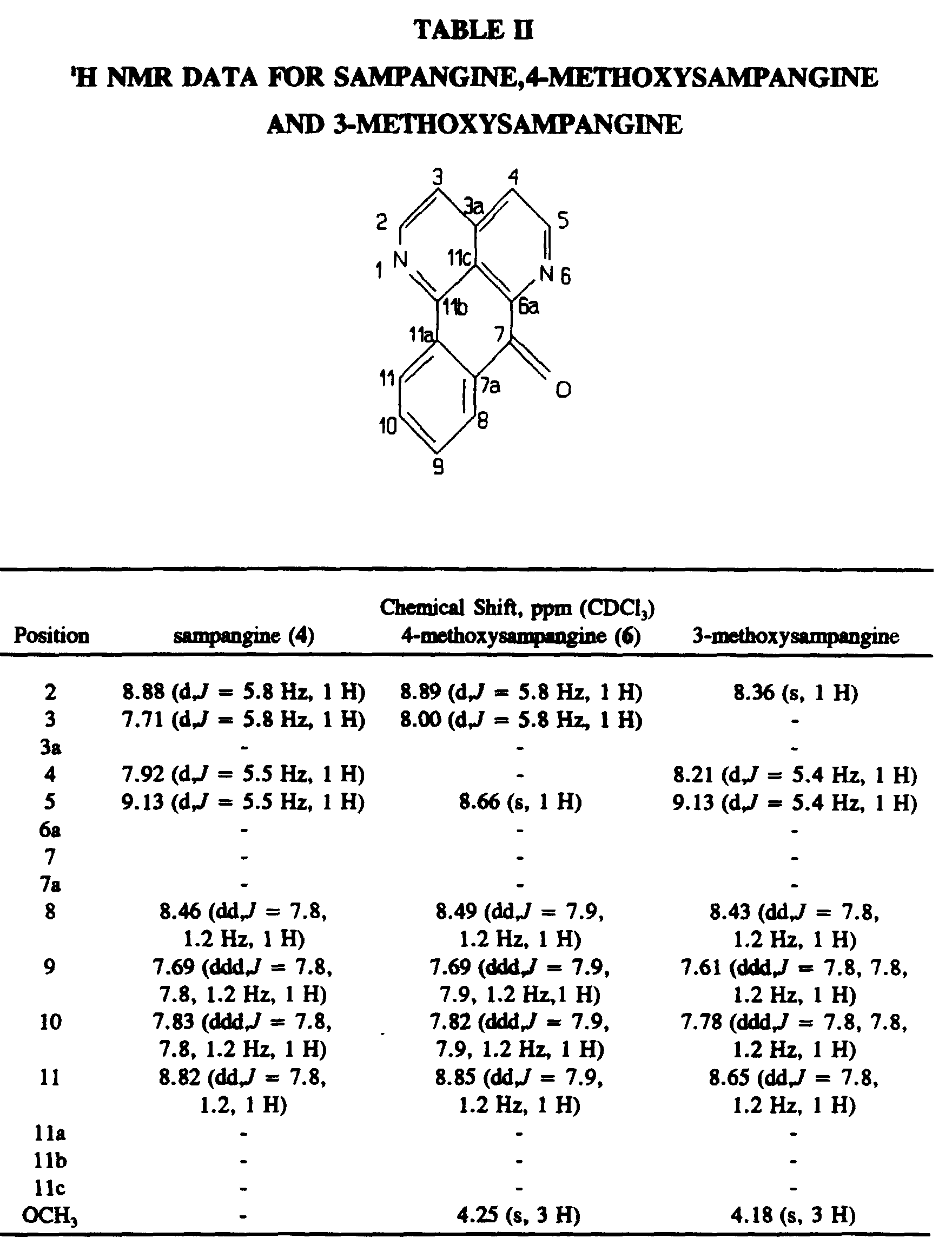
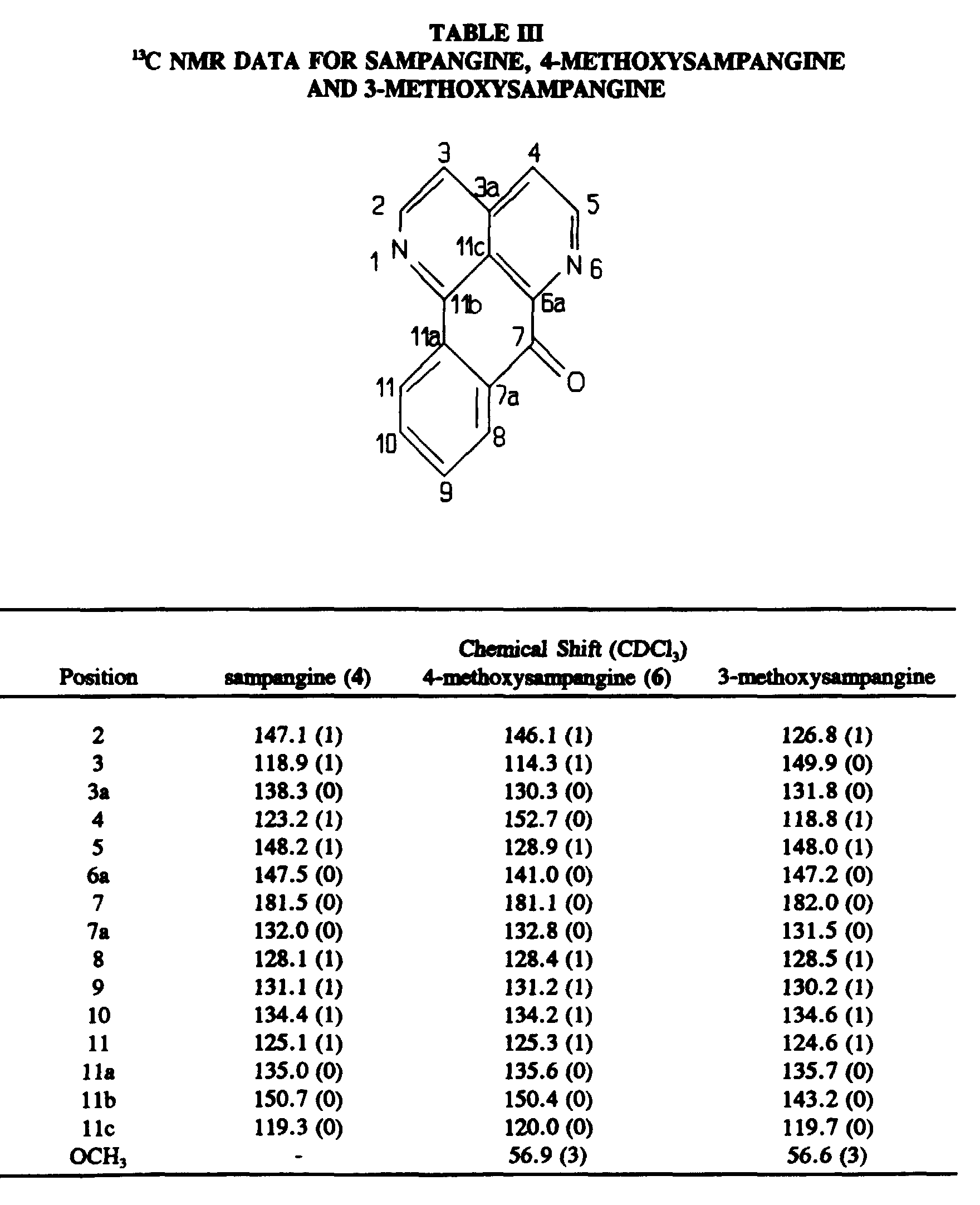
- the NMR spectral data for sampangine and 4-methoxysampangine are compared with that for 3-methoxysampangine in Tables II and III.
Landscapes
- Chemical & Material Sciences (AREA)
- Organic Chemistry (AREA)
- Health & Medical Sciences (AREA)
- Life Sciences & Earth Sciences (AREA)
- General Health & Medical Sciences (AREA)
- General Chemical & Material Sciences (AREA)
- Medicinal Chemistry (AREA)
- Nuclear Medicine, Radiotherapy & Molecular Imaging (AREA)
- Oncology (AREA)
- Pharmacology & Pharmacy (AREA)
- Communicable Diseases (AREA)
- Animal Behavior & Ethology (AREA)
- Chemical Kinetics & Catalysis (AREA)
- Public Health (AREA)
- Veterinary Medicine (AREA)
- Pharmaceuticals Containing Other Organic And Inorganic Compounds (AREA)
- Agricultural Chemicals And Associated Chemicals (AREA)
- Heterocyclic Carbon Compounds Containing A Hetero Ring Having Oxygen Or Sulfur (AREA)
- Nitrogen Condensed Heterocyclic Rings (AREA)
- Medicines Containing Antibodies Or Antigens For Use As Internal Diagnostic Agents (AREA)
- Preparation Of Compounds By Using Micro-Organisms (AREA)
- Plural Heterocyclic Compounds (AREA)
Abstract
Description
- This invention is directed to a new composition, compounds and its use for the preparation of a medicament for providing effective protection against pathological fungal conditions in mammals particularly those caused by Candida albicans, Aspergillus fumigatus, and Cryptococcus neoformans. The novel compound and compositions of the invention provide in one case a simple, practical readily extracted drug occuring naturally in the root bark of the West African tree, Cleistopholis patens (Benth) Engl. and Diels (Annonaceae). The compound of the invention may also be synthesized using known techniques.
- The need for new, more effective, and less toxic antifungal antibiotics for the treatment of disseminated mycotic infections is urgent in view of the significant toxicities and failure rates of the currently available systemic antifungal agents. The problem has become particularly relevant in view of the fact that opportunistic disseminated mycosis is a common complication of Acquired Immune Deficiency Syndrome (AIDS). The discovery of new antibiotics has in the past successfully relied primarily upon the isolation of such agents from natural sources. The principal advantage of this approach over chemical synthesis or modification of existing agents is the probability of discovering new prototype drugs with quite different chemical structures and, therefore, dissimilar toxicities and cross-resistance with present drug therapies.
- The discovery and extraction of an antifungal alkoloid eupolauridine from the stem and root bark of the tree Cleistopholis patens (Benth) Engl. and Diels (Annonaceae) and useful against Candida Albicans is the subject of U.S. patent no. 4,965,372. The discovery of eupolauridine from the ethanolic extract of the root bark of the tree which is found throughout West Africa and its possibly remarkable anticandidal properties was reported in the Journal of Natural Products, Vol. 50, No. 5, pp. 961-964, Sept.-Oct. 1987 by Hufford et al. Subsequent to the discovery of eupolauridine in the ethanolic extract and its unexpected antifungal properties, the ethanolic extract was subjected to further examination using different bioassay techniques which resulted in the unexpected discovery of the compound, 3-Methoxysampangine, which exhibits remarkable antifungal properties against Candida albicans, Aspergillus fumigatus, and Cryptococcus neoformans. The preparation and the use of 3-Methoxysampangine is known from Lin S. et al., Antimicrob. Agents and Chemother., 34, 529 (1990).
- The invention is the new composition according to claim 1. The use of the inventive composition is defined in claim 4.
- Administration of the compound may be by any of the conventional routes of administration, for example, oral, intramuscular, intravenous, or rectally. In the preferred embodiment, the compound is administrable in combination with a pharmaceutically-acceptable carrier which may be solid or liquid, dependent upon choice and route of administration. Examples of acceptable carriers include, lactose, gelatin, agar, searic acid, magnesium stearate, acacia, and similar carriers. Examples of liquids include water, edible oils, e.g. peanut and corn.
- When administered in solid form, the compound and diluent carrier may be in the form of tablets, capsules, powders, lozenges, suppositories prepared by any of the well known methods. When given as a liquid preparation, the mixture of active compound and liquid diluent carrier may be in the form of a suspension administrable as such. The compound is administrable in a non-toxic dosage concentration sufficient to inhibit the growth and/or destroy the Candida albicans, Aspergillus fumigatus and Crytococcus neoformans organisms. The actual dosage unit will be determined by such generally recognized factors as body weight of the patient and/or severity and type of pathological condition the patient might be suffering with prior to becoming infected with any of the fungal organisms. With these considerations in mind, the dosage unit for a particular patient can be readily determined by the medical practitioner in accordance with the techniques known in the medical arts.
- The antifungal activity of the compounds was determined by in vitro evaluation against Candida albicans NIH B311, Cryptococcus neoformans ATCC 32264, and Aspergillus fumigatus ATCC 26934 using the known agar-well diffusion assay techniques with the following modifications.
- Candida albicans NIH B311 used to induce experimental disseminated candidiasis was used for the initial qualitative evaluation of anticandidal activity. The organism was grown in Sabouraud-dextrose broth (SDB) for 24 hours at 37°, at which time the cells were harvested by centrifugation at (4°, 2000 rpm, 3 min.). After centrifugation, the cells were washed and suspended in sterile 0.9% saline to give a final concentration of 106 colony forming units (CFU) per ml (adjusted using a hemocytometer). Inocula of Cryptococcus neoformans and Aspergillus fumigatus were prepared by suspension of the surface growth of stock agar slants in sterile H2O. Culture plates (15 x 100 mm) for the qualitative assay were prepared from 25 ml of Sabouraud-dextrose agar for Candida albicans, and Mycophil™ agar for Cryptococcus neoformans and Aspergillus fumigatus. Using sterile cotton swabs, the plates were streaked with the suspension of appropriate test organism. Cylindrical plugs were removed from the agar plates by means of sterile cork borer to produce wells with a diameter of approximately 11 mm. To the well was added 100 µl of solution or suspension of an extract, fraction, or pure compound. Crude extracts and fractions were tested at a concentration of 20 mg/ml, whereas pure compounds were tested at 1 mg/ml. When solvents other than water, ethanol, methanol, dimethylsulfoxide (DMSO), dimethylformamide (DMF), or acetone were required to dissolve extracts or compounds, solvent blanks were included. Antifungal activity was recorded as the width (in mm) of the zone of inhibition, measured from the edge of the agar well to the edge of the zone, following incubation of the plates for 24 hours (37° for Candida albicans, 30° for Aspergillus fumigatus and 26° for Cryptococcus neoformans). The antifungal agents amphotericin B and ketoconazole were included as positive controls in each assay.
- The method used to determined the minimum inhibitory concentration (MIC) was the twofold serial broth dilution assay in one or more of the following broth media: yeast nitrogen broth, Mycophil™ broth and Saboraud-dextrose broth (SDB). The inoculum for the MIC determination was prepared as described above for the qualitative evaluation. Using a calibrated sterile wire loop, each tube was inoculated with 10 µl of the suspension. The MIC value was taken as the lowest concentration of compound that inhibited the growth of the test organisms after an appropriate incubation period (37° for 24 hours for Candida albicans; 30° for 48 hours for Aspergillus fumigatus; 26° for 48 hours for Cryptococcus neoformans). The antifungal agent amphotericin B was included as positive control in each assay. The results of the test utilizing 3-Methoxysampangine, Sampangine, 4-Bromosampangine, and 4-Methoxysampangine demonstrating significant antifungal activity against both yeasts, Candida albicans and Cryptococcus neoformans and the filamentous fungus, Aspergillus fumigatus are illustrated in Table I. The data in Table I clearly demonstrate that the compound and its analogs exhibit in vitro activity against one or more fungal pathogens at potencies comparable to, and in many cases better than, a current drug of choice, amphotericin B.
Sample Name Media Ca B311 MIC (µg/mL) Cn Af Sampangine YNB(original) 1.56 <0.005 NT Sampangine YNB 0.78 <0.20 NT Sampangine SDB 6.25 <0.20 NT Sampangine MYCO 12.5 0.78 1.56 3-Methoxysampangine SDB 3.12 0.20 3.12 4-Bromosampangine YNB 12.5 <0.20 NT 4-Bromosampangine SDB 25 0.39 NT 4-Bromosampangine MYCO 25 <0.20 50 4-Methoxysampangine YNB 3.12 12.5 NT 4-Methoxysampangine SDB 100 3.12 NT 4-Methoxysampangine MYCO 100 1.56 NT Benzo[4,5]sampangine YNB 3.12 1.56 NT Benzo[4,5]sampangine SDB 1.56 <0.20 NT Benzo[4,5]sampangine MYCO 50 <0.20 0.39 Amphotericin B MYCO 0.20 0.20 3.12 - The compounds were synthesized according to the method shown in Scheme I. Cleistopholine (3) was obtained in a single step (57% yield) through the hetero Diels-Alder reaction of 2-bromo-1,4-naphthoquinone (1) with (E)-2-butenal N,N-dimethylhydrazone (2), followed by in situ elimination of dimethylammonium bromide. The condensation of cleistopholine with dimethylformamide dimethyl acetal provided sampangine (4) in 79% yield. Electrophilic bromination of sampangine with pyridinium bromide perbromide or bromine/pyridine complex delivered exclusively 4-bromosampangine (5,64%), rather than the anticipated 3-bromo analog. Methanolysis of 4-bromosampangine subsequently led to 4-methoxysampangine (6) in 55% yield. The NMR spectral data for sampangine and 4-methoxysampangine are compared with that for 3-methoxysampangine in Tables II and III. These assignments are based on a careful analysis of the 1H, attached proton test (APT), correlated spectroscopy (COSY), and short and long range (J = 5 and 10 Hz) heterocorrelated (HETCOR) NMR spectra for each compound. The unambiguous C-7 carbonyl resonance allows for a clear recognition of certain key atoms through HETCOR three-bond connections (eg. H-8, C-10, etc.) and thence the remaining atoms by correlation with the other spectra. Consistent with these assignments are significant chemical shift changes for C-4, C-5, C-6a, H-3 and H-5 of 4-methoxysampangine and C-2, C-3, C-11b, H-2 and H-4 of 3-methoxysampangine relative to sampangine.
- Preparation of 2-Bromo-1,4-napthoquinone (1). A 3-L, three-necked, round-bottomed flask fitted with a mechanical stirrer, a 500-mL addition funnel and a thermometer was charged with glacial acetic acid (500 mL), water (1000 mL) and N-bromosuccinimide (71.2g, 0.40 mol). The mixture was warmed to 45°C during which time a yellow solution was obtained. An acetic acid (500 mL) solution of 1-naphthol (14.4g, 0.10 mol) was then added dropwise over a period of 75 min so as to give a red solution, the latter of which was stirred an additional 30 min at 45°C before cooling to room temperature. The resulting mixture was diluted with water (1500 mL) and extracted with methylene chloride (6 x 400 mL). The combined organic extracts were in turn washed with water (4 x 400 mL) and saturated sodium bicarbonate solution (4 x 300 mL). Rotary evaporation of the solvent following drying over magnesium sulfate yielded a yellow solid that was recrystallized from 95% ethanol to yield pure 2-Bromo-1,4-napthoquinone (18.50 g, 78%); mp 130.5 - 132°C (lit. mp 131-132°C). IR(KBr) 3050, 1675, 1655, 1585, 1570, 1330, 1310, 1295, 1270, 1245, 1220, 1120, 1060, 910, 890, 820, 790, 775, 670, 665 cm-1; 1H NMR (CDCl3) δ 8.21-8.14 (m, 1H), 8.11 - 8.05 (m, 1H), 7.80-7.73 (m, 2H), 7.52 (s, 1H), 13C NMR (CDCl3) 182.4(0), 177.8(0), 140.3(1), 140.1(0), 134.4(1), 134.1(1), 131.7(0), 130.9(0), 127.8(0), 126.9(1) ppm.
- Preparation of ( E )-2-Butenal N,N-Dimethylhydrazone (2). A 250-mL, round-bottomed flask equipped with 60-mL addition funnel was charged with crotonaldehyde (74.7 mL, 0.90 mol) and cooled in an ice-water bath. 1,1-Dimethylhydrazine (75.3 mL, 0.99 mol) was then added dropwise to the cold aldehyde over a period of 15 min. The layers were separated after allowing the reaction to stir at ambient temperature for 45 min. The organic layer was dried over calcium chloride, decanted, and distilled through a Vigreaux column. Collection of the fraction boiling at 53-58°C, 15-18 mm Hg (water aspirator) gave 58.8 g (58%) of pure (E)-2-Butenal N,N-dimethylhydrazone. 1H NMR (CDCl3) δ 6.98 (d,J = 8.9 Hz, 1 H), 6.18 (ddq, J = 15.5, 8.9, 1.7 Hz, 1H), 5.78 (dq, J = 15.5, 6.8 Hz, 1 H), 2.78 (s, 6H), 1.78 (dd, J = 6.8, 1.7 Hz, 3H).

- Preparation of Cleistopholine (4). (E)-2-Butenal N,N-diemthylhydrazone, (3.70 g, 0.033 mol) in dry xylene (10 mL, Fisher) was added to a xylene solution (50 mL) of 2-bromo-1,4-naphthoquinone, (6.00 g, 0.025 mol) in a 200-mL, round-bottomed flask fitted with a condensor. The dark mixture was then heated at reflux for 6 h under a nitrogen atmosphere before decanting the solution into a 500-mL separatory funnel. The solids coating the wall of the flask were washed thoroughly with ethyl acetate (6 x 25 mL) and these washings added to the separatory funnel. The combined organic solutions were extracted with 2N sulfuric acid solution (1 x 100 mL followed by 2 x 75 mL). The acid layers were then combined, chilled in ice, and made basic (∼pH 10 test paper) with sodium hydroxide before extracting with ethyl acetate (4 x 100 mL). The latter organic layers were dried over potassium carbonate and concentrated to dryness on a rotary evaporator. This material was applied to a 4 x 70 cm column of Silica gel (Merck 230-400 mesh) and the product eluted with ethyl acetate. Concentration of the appropriate column fractions yielded pure cleistopholine (3.20 g, 57%); mp 202-204°C (lit. mp 198-201°C). IR(KBr) 1680, 1660, 1590, 1300, 980, 720, cm-1; 1H NMR (CDCl3)δ 8.86 (d, J = 4.9 Hz, 1 H), 8.34-8.30 (m, 1 H), 8.24-8.19 (m, 1H), 7.82-7.76 (m, 2H), 7.47 (dd, J = 4.9, 0.7 Hz, 1 H), 2.88 (br s, 3 H); 13C NMR (CDCl3) 184.7 (0), 181.9 (0), 153.4 (1), 151.5 (0), 150.0 (0), 134.5 (1), 134.1 (1), 133.8 (0), 132.5 (0), 131.2 (1), 129.1 (0), 127.3 (1), 127.1 (1), 2.28 (3) ppm.
- Preparation of Sampangine (4). Dimethylformamide dimethyl acetal (1.50 mL, 11.34 mmol, Aldrich) was added to a solution of cleistopholine, (1.95 g, 8.73 mmol) in dimethylformadmide (5 mL). The mixture was then heated for 30 min by submerging the reaction vessel into an oil bath preheated to 120°C. At this point, ammonium chloride (4.5 g) and glacial acetic acid (15 mL) were added to the reaction and the heating (120°C) continued for an additional 30 min. After allowing to cool, the reaction was poured onto water (200 mL) and partitioned with methylene chloride (5 x 100 mL). The combined organic phases were washed with saturated sodium bicarbonate solution (3 x 100 mL), water (3 x 100 mL), dried over potassium carbonate, and concentrated to dryness. The residual dark brown solids were chromatographed on silica gel (4 x 70 cm column, Merck 230-400 mesh) while eluting with ethyl acetate. Concentration of the appropriate column fractions provided pure sampangine (1.60 g, 79%), mp 220-222 (lit. mp 216-218°C). IR 1670, 1615, 1590, 1400, 1380, 1320, 1275, 1225, 760, 725 cm-1, 1H and 13C NMR (see Tables II and III).
- Preparation of 4-Bromosampangine (5). A mixture of pyridinium bromide perbromide (390 mg, 1.2 mmol) and sampangine, (232 mg, 1.0 mmol) in chloroform (12 mL) was heated at reflux for 15 h. Saturated sodium bicarbonate solution (100 mL) was added to the cooled reaction and the mixture stirred vigorously for 30 min. The two layers were separated and the aqueous phase extracted with chloroform (2 x 30 mL). The combined organic layers were dried over potassium carbonate and concentrated to dryness. The residual solid was applied to a 2 x 40 cm column of silica gel (Merck 230-400 mesh) and the pure product (200 mg, 64%) eluted with chloroform, mp 180°C dec. IR (KBr) 1670, 1590, 1400, 1320, 1310, 1275, 1230, 980, 790, 755, 720 cm-1; 1H NMR (CDCl3) δ 9.28 (s, 1 H), 8.99 (d,J = 5.9 Hz, 1 H), 8.85 (dd,J = 7.9, 1.4 Hz, 1 H), 8.46 (dd,J = 7.9, 1.4 Hz, 1 H), 7.96 (d,J = 5.9 Hz, 1 H), 7.86 (ddd,J = 7.7. 7.9, 1.4 Hz, 1 H), 7.72 (ddd,J = 7.9, 7.9, 1.4 Hz, 1 H); 13C NMR (CDCl3) 181.6 (0), 151.7 (0), 150.2 (1), 148.6 (1), 146.7 (0), 138.6 (0), 135.1 (0), 135.0 (1), 132.3 (0), 131.8 (1), 128.7 (1), 125.8 (1), 123.7 (0), 120.5 (0), 118.3 (1) ppm; HR MS calc. for C15H7BrN2O 309.9741, found 309.9747.
- Preparation of 4-Methoxysampangine (6). A dry methanol (6 mL) solution of sodium methoxide (80 mg, 1.48 mmol) and 4-bromosampangine, (80 mg, 0.26 mmol) was heated to reflux for 20 h. The cooled solution was transfered to a separatory funnel, diluted with chloroform (50 mL), and washed with water (2 x 60 mL). The chloroform layer was subsequently dried over potassium carbonate and concentrated to dryness. TLC analysis of the residue (silica gel, ethyl acetate eluant) revealed only one spot (Rf = 0.15) that was substantially more polar than 4-methoxysampangine. Chromatography of this residue on silica gel (1 x 25 cm column, Merck 230-400 mesh) while eluting with ethyl acetate-methanol (4:1) provided pure 4-methoxysampangine (37 mg, 55%), mp 258°C dec. IR (KBr) 1670, 1595, 1570, 1500, 1405, 1375, 1320, 1295, 1240, 1100, 1040, 1030, 985, 920, 790, 720, 615 cm-1; 1H and 13C NMR (see Tables II and III).
- Preparation of Benzo[4,5]sampangine (9). As illustrated in Scheme II, a suspension of 4.47 g (0.03 mol) of 1,4-naphthoquinone (7) in 600 ml of absolute ethanol, containing 3.37 g (0.03 mol) of 1-aminoacetophenone (8) and 1.66 g (0.003 mol) of cerium trichloride heptahydrate was warmed to dissolve, then allowed to stand at room temperature and a steady current of air was continuously blown into the reaction mixture for 24 h. A red precipitate was formed and collected by filtration, then washed with a small amount of absolute ethanol. The filtrate was repeated above procedure twice, and a total of 7.26 g (60.4%) of 2-[o-acetyl]-anilino-1,4-naphthoquinone (9) was obtained as red needles, mp. 177-179°C. EIMS m/z 291 (M+), 1H-nmr, δ (CDCl3) 2.66 (3H,s), 6.99 (1H,s), 7.06 (1H,d,J = 9.0 Hz), 7.14 (1H, ddd,J = 6.0, 6.0, 1.0 Hz), 7.55 (1H, ddd,J = 9.0, 6.0, 1.0 Hz), 7.65 (1H, ddd,J = 8.0, 8.0, 1.5 Hz), 7.73 (1H, ddd, J = 8.0, 8.0, 1.5 Hz), 7.93 (1H, dd,J = 6.0, 1.0 Hz), 8.05 (1H, dd,J = 9.0, 1.0 Hz), 8.13 (1H, dd,J = 9.0, 1.0 Hz).

- To a cold, stirred suspension of 4 g (15.7 m mols) of 2-[o-acetyl]-anilino-1,4-naphthoquinone (9) in 13.2 mL of glacial acetic acid was slowly added 13.2 ml of concentrated H2SO4. The reaction mixture was then gently refluxed for 15 min., cooled, and poured into 2 liters of ice-H2O. The yellow precipitate was collected and washed with a small amount of ice cold H2O to give 3.23 g (99.5%) of dirty greenish yellow fine needles of Benzo[2,3]cleistopholine (10) mp. 237-239°(d). EIMS M/z 273 (M+), IRνmax(KBr), 1680, 1655, 1590, 1495, 1375, 1260, 1080, 943, 770, 720 cm-1. 1H-nmr, δ(CDCl3) 3.22 (3H, s, CH3-13), 7.69 (1H, ddd,J = 6.7, 6.7, 1.3 Hz), 7.70 (1H, m), 7.78 (1H, m), 7.84 (1H, ddd,J = 6.7, 6.7, 1.3 Hz), 8.25 (1H, dd,J = 6.0, 2.5 Hz), 8.29 (1H, brd,J = 6.7 Hz), 8.34 (1H, dd,J = 6.0, 2.5 Hz), 8.39 (1H, brd,J = 6.7 Hz).
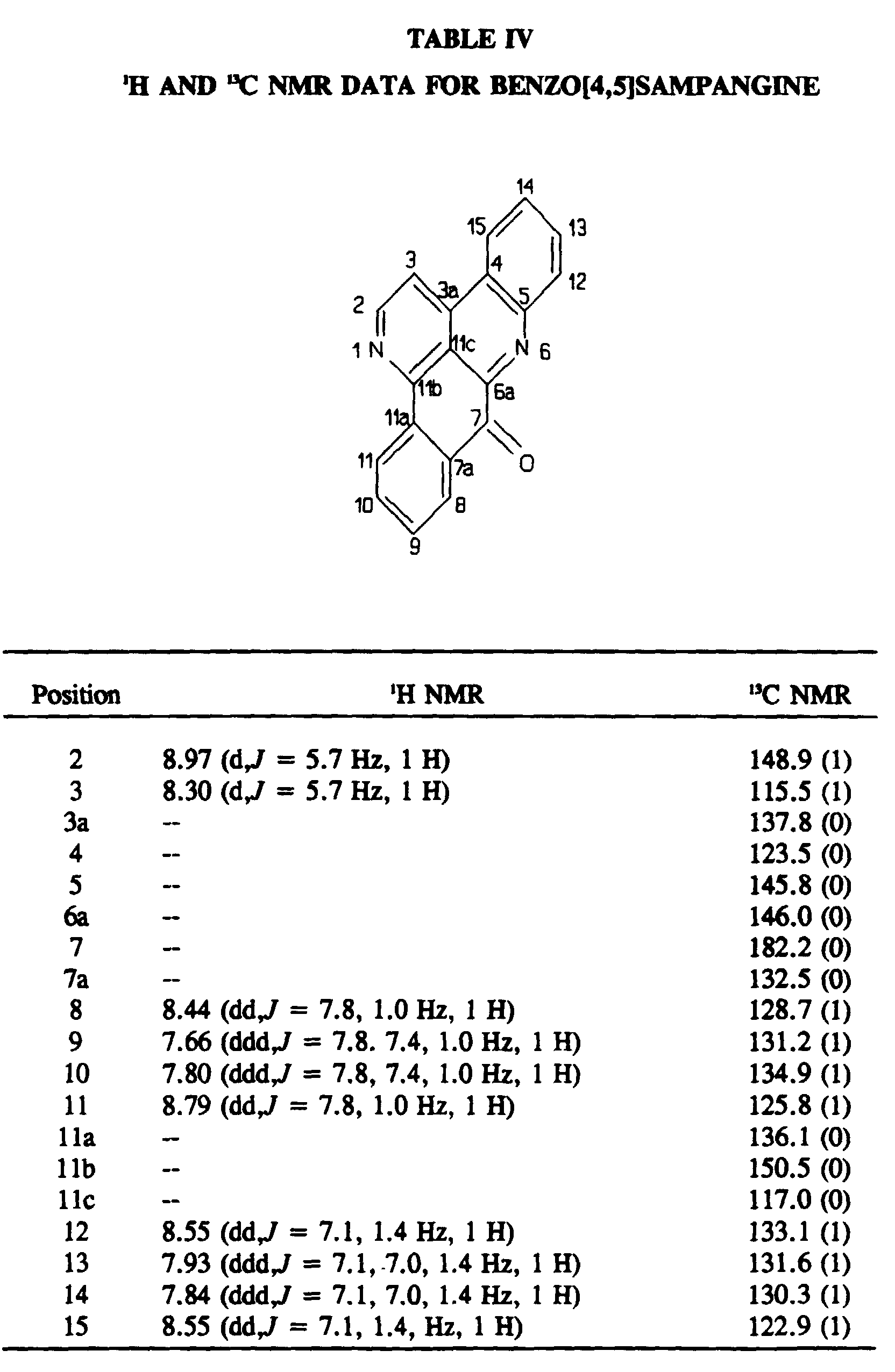
- A suspension of 2.38 g (8.73 m mol) of Benzo[2,3]cleistopholine in 3 ml of DMF and 1.67 g of dimethyl formamide-diethylacetal was stirred under N2 and heated at 120°C for 1 h. The reaction mixture was cooled and 15 ml of glacial acetic acid and 4.5 g of NH4Cl was added carefully and the reaction mixture was refluxed for another hour. Water (300 mL) was added to the reaction mixture, followed by extraction with CH2Cl2 (150 ml x 4). The total organic layer was washed with 150 ml of saturated NaHCO3 solution, then with 150 ml of H2O, and dried over anhydrous K2CO3. After removal of solvent, the resulting residue was chromatographed over silica gel (400 g) and eluted with ethyl acetate to give 1.824 (56.3%) of Benzo[4,5]sampangine (11), as bright yellow needles, mp. 260-262°C. EIMS m/z 282(M+), IRνmax(KBr) 1680, 1590, 1442, 1390, 1300, 1262, 1060, 950, 767, 740 cm-1. 1H and 13C NMR (see Table IV).
Claims (13)
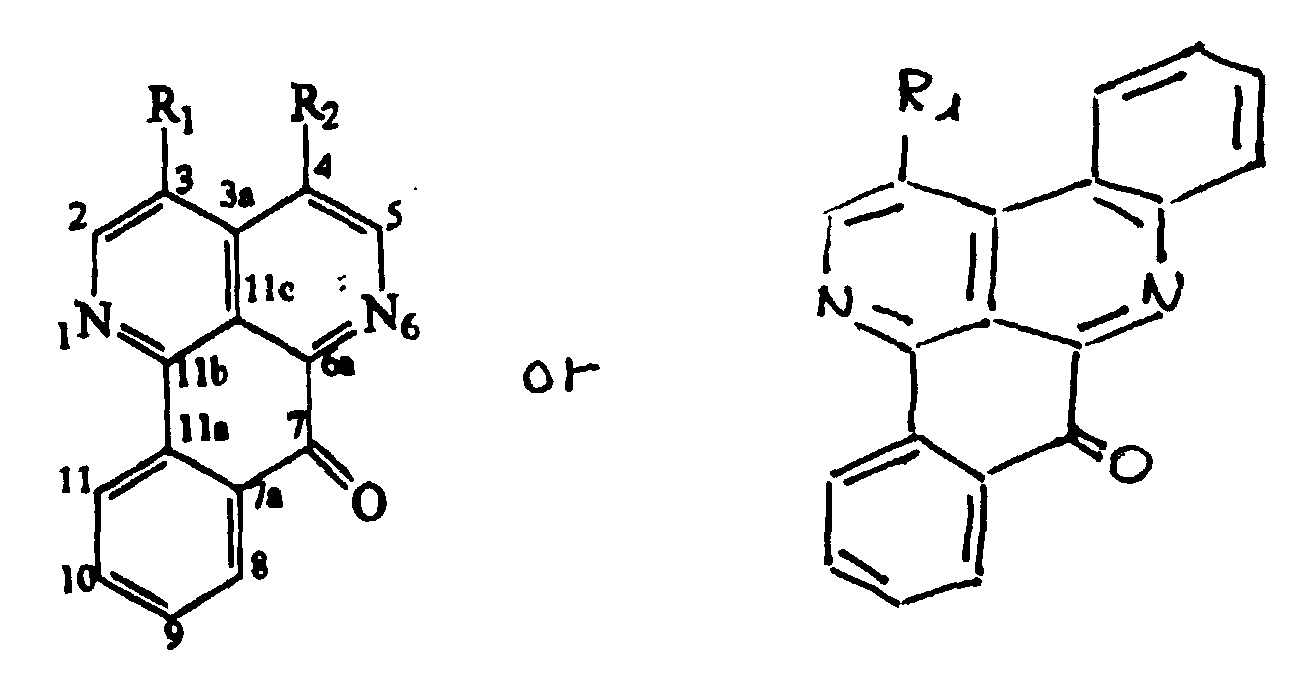
- An antifungal composition consisting essentially of a compound having the formulawherein R1 is H; R2 is selected from Br, Cl, F, I and an alkoxy group having 1-6 carbon atoms; in the therapeutically-effective concentration and a non-toxic, pharmaceutically-acceptable carrier.
- The antifungal composition of Claim 1 wherein said compound is 4-Methoxysampangine.
- The antifungal composition of Claim 1 wherein said compound is 4-Bromosampangine.
- Use of a composition consisting essentially of a compound having the formulawherein R1 is H, and wherein R2 is selected from Br, Cl, F, I and an alkoxy group having 1-6 carbon atoms; and a non-toxic, pharmaceutically acceptable carrier for preparation of a medicament for preventing pathological conditions in mammals brought about by the presence of a fungal organism when administered to said mammals in a therapeutically-effective concentration.

- The use in accordance with Claim 4 wherein said fungal organism is Candida albicans.
- The use in accordance with Claim 4 wherein said fungal organism is Cryptococcus neoformans.
- The use in accordance with Claim 4 wherein said fungal organism is Aspergillus fumigatus.
- The composition of Claim 1, wherein the compound is 4-Bromosampangine.
- The composition of Claim 1, wherein the compound is 4-Methoxysampangine.
- The composition of Claim 1 wherein said compound is benzo[4,5]sampangine.
- The use in accordance with Claim 4 wherein said compound is benzo[4,5]sampangine.
- The use of Claim 4, wherein the compound is 4-Bromosampangine.
- The use of Claim 4, wherein the compound is 4-Methoxysampangine.
Applications Claiming Priority (3)
| Application Number | Priority Date | Filing Date | Title |
|---|---|---|---|
| US07/609,610 US5128344A (en) | 1990-11-06 | 1990-11-06 | Sampangine and derivatives useful as an antifungal agent |
| US609610 | 1990-11-06 | ||
| PCT/US1991/008232 WO1992007565A1 (en) | 1990-11-06 | 1991-11-05 | Sampangine and derivatives useful as antifungal agents |
Publications (3)
| Publication Number | Publication Date |
|---|---|
| EP0556319A1 EP0556319A1 (en) | 1993-08-25 |
| EP0556319A4 EP0556319A4 (en) | 1994-01-19 |
| EP0556319B1 true EP0556319B1 (en) | 2000-07-26 |
Family
ID=24441534
Family Applications (1)
| Application Number | Title | Priority Date | Filing Date |
|---|---|---|---|
| EP92900905A Expired - Lifetime EP0556319B1 (en) | 1990-11-06 | 1991-11-05 | Sampangine derivatives useful as antifungal agents |
Country Status (10)
| Country | Link |
|---|---|
| US (1) | US5128344A (en) |
| EP (1) | EP0556319B1 (en) |
| JP (1) | JP3236291B2 (en) |
| AT (1) | ATE194914T1 (en) |
| CA (1) | CA2095526C (en) |
| DE (1) | DE69132339T2 (en) |
| DK (1) | DK0556319T3 (en) |
| ES (1) | ES2150420T3 (en) |
| GR (1) | GR3034687T3 (en) |
| WO (1) | WO1992007565A1 (en) |
Families Citing this family (6)
| Publication number | Priority date | Publication date | Assignee | Title |
|---|---|---|---|---|
| US5227383A (en) * | 1991-06-14 | 1993-07-13 | The University Of Mississippi | Compounds and compositions useful as antifungal and antimycobacterial agents |
| CA2127058A1 (en) * | 1994-06-29 | 1995-12-30 | Jacobus N. Hanemaayer | Viewing and storage system for a television set or the like |
| DE10036630C1 (en) * | 2000-07-26 | 2002-01-24 | Webasto Vehicle Sys Int Gmbh | Production of foam sealing strip around edges of glass car roof, comprises using foam-producing tool to apply foam as two fronts with a junction area, thickness of foam is less on deaerating side of the tool than opposite side of junction |
| US6844353B2 (en) * | 2003-03-27 | 2005-01-18 | The United States Of America As Represented By The Secretary Of Agriculture | Fungicidal properties of sampangine and its analogs to agriculturally important fungal plant pathogens |
| CN106905317B (en) * | 2017-01-24 | 2019-03-22 | 广西师范大学 | 4-Substituted Sampangine alkaloid derivatives and their synthetic methods and applications |
| CN113461506A (en) * | 2021-06-23 | 2021-10-01 | 苏州求索生物科技有限公司 | Preparation process of 2-bromo-1, 4-naphthoquinone |
Family Cites Families (2)
| Publication number | Priority date | Publication date | Assignee | Title |
|---|---|---|---|---|
| US4080456A (en) * | 1971-10-26 | 1978-03-21 | Schering Aktiengesellschaft | Diacylapomorphines |
| US4965272A (en) * | 1988-07-14 | 1990-10-23 | Hufford Charles D | Antimicrobial compound and compositions particularly effective against candida albicans |
-
1990
- 1990-11-06 US US07/609,610 patent/US5128344A/en not_active Expired - Lifetime
-
1991
- 1991-11-05 CA CA002095526A patent/CA2095526C/en not_active Expired - Fee Related
- 1991-11-05 ES ES92900905T patent/ES2150420T3/en not_active Expired - Lifetime
- 1991-11-05 EP EP92900905A patent/EP0556319B1/en not_active Expired - Lifetime
- 1991-11-05 AT AT92900905T patent/ATE194914T1/en not_active IP Right Cessation
- 1991-11-05 JP JP50225192A patent/JP3236291B2/en not_active Expired - Fee Related
- 1991-11-05 DK DK92900905T patent/DK0556319T3/en active
- 1991-11-05 DE DE69132339T patent/DE69132339T2/en not_active Expired - Fee Related
- 1991-11-05 WO PCT/US1991/008232 patent/WO1992007565A1/en not_active Ceased
-
2000
- 2000-10-26 GR GR20000402374T patent/GR3034687T3/en not_active IP Right Cessation
Also Published As
| Publication number | Publication date |
|---|---|
| EP0556319A1 (en) | 1993-08-25 |
| US5128344A (en) | 1992-07-07 |
| DK0556319T3 (en) | 2000-11-06 |
| EP0556319A4 (en) | 1994-01-19 |
| JP3236291B2 (en) | 2001-12-10 |
| CA2095526C (en) | 2002-08-13 |
| WO1992007565A1 (en) | 1992-05-14 |
| GR3034687T3 (en) | 2001-01-31 |
| DE69132339T2 (en) | 2001-02-22 |
| DE69132339D1 (en) | 2000-08-31 |
| ES2150420T3 (en) | 2000-12-01 |
| JPH06510518A (en) | 1994-11-24 |
| ATE194914T1 (en) | 2000-08-15 |
| CA2095526A1 (en) | 1992-05-07 |
Similar Documents
| Publication | Publication Date | Title |
|---|---|---|
| Wu et al. | Two new natural azafluorene alkaloids and a cytotoxic aporphine alkaloid from Polyalthia longifolia | |
| Tahara et al. | Prenylated flavonoids in the roots of yellow lupin | |
| EP0588796B1 (en) | Sampangine derivatives useful as antifungal and antimycobacterial agents | |
| Fukui et al. | A new isoflavone with antifungal activity from immature fruits of Lupinus luteus | |
| Wu et al. | Cytotoxic alkaloids of Annona montana | |
| US5414001A (en) | Antineoplastic pyrrolo[4,3,2-de]quinolin-8(1H)-ones | |
| Roby et al. | Pyrrolizidine and pyridine monoterpene alkaloids from two Castilleja plant hosts of the plume moth, Platyptilia pica | |
| EP0926242A1 (en) | Gliotoxin derivatives and anticancer agent comprising the same | |
| US5128344A (en) | Sampangine and derivatives useful as an antifungal agent | |
| Arens et al. | Antiinflammatory compounds from Plagiorhegma dubium cell culture1 | |
| US4859782A (en) | Misakinolide compositions and their derivatives | |
| WO2001007034A1 (en) | Multidrug resistance pump inhibitors and uses thereof | |
| SEKIZAKI et al. | Studies on zoospore-attracting activity. I. Synthesis of isoflavones and their attracting activity to Aphanomyces euteiches zoospore | |
| US5747502A (en) | Process for preparing benzo c!phenanthridinium derivatives, novel compounds prepared by said process, and antitumor agents | |
| Hamdi et al. | Expedious synthesis for α, β-unsaturated coumarin derivatives using boran chelates: A novel class of potential antibacterial and antioxidant agents | |
| CN108485987B (en) | Dibenzoxepanone compounds and preparation method and use thereof | |
| Ayer et al. | Anthraquinones and a 10-hydroxyanthrone from Phialophora alba | |
| US4731459A (en) | Novel anti-ulcer agents and quassinoids | |
| Zarga et al. | A spectral method for the determination of the position of a phenolic group on ring A of an aporphine. Four new aporphines from Polyalthia acuminata | |
| US3452051A (en) | Deoxyfrenolicins | |
| EP0487930B1 (en) | Benzo[C]phenanthridinium derivatives | |
| US4895844A (en) | Indole alkaloid compositions and their methods of use | |
| US6844353B2 (en) | Fungicidal properties of sampangine and its analogs to agriculturally important fungal plant pathogens | |
| US4965272A (en) | Antimicrobial compound and compositions particularly effective against candida albicans | |
| US20040110847A1 (en) | Compounds extracted from Sap of Rhus succedanea |
Legal Events
| Date | Code | Title | Description |
|---|---|---|---|
| PUAI | Public reference made under article 153(3) epc to a published international application that has entered the european phase |
Free format text: ORIGINAL CODE: 0009012 |
|
| 17P | Request for examination filed |
Effective date: 19930503 |
|
| AK | Designated contracting states |
Kind code of ref document: A1 Designated state(s): AT BE CH DE DK ES FR GB GR IT LI LU NL SE |
|
| A4 | Supplementary search report drawn up and despatched |
Effective date: 19931130 |
|
| AK | Designated contracting states |
Kind code of ref document: A4 Designated state(s): AT BE CH DE DK ES FR GB GR IT LI LU NL SE |
|
| 17Q | First examination report despatched |
Effective date: 19980115 |
|
| GRAG | Despatch of communication of intention to grant |
Free format text: ORIGINAL CODE: EPIDOS AGRA |
|
| RTI1 | Title (correction) |
Free format text: SAMPANGINE DERIVATIVES USEFUL AS ANTIFUNGAL AGENTS |
|
| RTI1 | Title (correction) |
Free format text: SAMPANGINE DERIVATIVES USEFUL AS ANTIFUNGAL AGENTS |
|
| GRAG | Despatch of communication of intention to grant |
Free format text: ORIGINAL CODE: EPIDOS AGRA |
|
| GRAH | Despatch of communication of intention to grant a patent |
Free format text: ORIGINAL CODE: EPIDOS IGRA |
|
| GRAH | Despatch of communication of intention to grant a patent |
Free format text: ORIGINAL CODE: EPIDOS IGRA |
|
| GRAA | (expected) grant |
Free format text: ORIGINAL CODE: 0009210 |
|
| AK | Designated contracting states |
Kind code of ref document: B1 Designated state(s): AT BE CH DE DK ES FR GB GR IT LI LU NL SE |
|
| REF | Corresponds to: |
Ref document number: 194914 Country of ref document: AT Date of ref document: 20000815 Kind code of ref document: T |
|
| REG | Reference to a national code |
Ref country code: CH Ref legal event code: EP |
|
| REF | Corresponds to: |
Ref document number: 69132339 Country of ref document: DE Date of ref document: 20000831 |
|
| RAP4 | Party data changed (patent owner data changed or rights of a patent transferred) |
Owner name: THE UNIVERSITY OF MISSISSIPPI |
|
| ITF | It: translation for a ep patent filed | ||
| REG | Reference to a national code |
Ref country code: DK Ref legal event code: T3 |
|
| REG | Reference to a national code |
Ref country code: CH Ref legal event code: NV Representative=s name: BOVARD AG PATENTANWAELTE |
|
| ET | Fr: translation filed | ||
| REG | Reference to a national code |
Ref country code: ES Ref legal event code: FG2A Ref document number: 2150420 Country of ref document: ES Kind code of ref document: T3 |
|
| PLBE | No opposition filed within time limit |
Free format text: ORIGINAL CODE: 0009261 |
|
| STAA | Information on the status of an ep patent application or granted ep patent |
Free format text: STATUS: NO OPPOSITION FILED WITHIN TIME LIMIT |
|
| 26N | No opposition filed | ||
| REG | Reference to a national code |
Ref country code: GB Ref legal event code: IF02 |
|
| PGFP | Annual fee paid to national office [announced via postgrant information from national office to epo] |
Ref country code: GB Payment date: 20021113 Year of fee payment: 12 |
|
| PGFP | Annual fee paid to national office [announced via postgrant information from national office to epo] |
Ref country code: CH Payment date: 20021118 Year of fee payment: 12 |
|
| PGFP | Annual fee paid to national office [announced via postgrant information from national office to epo] |
Ref country code: SE Payment date: 20021119 Year of fee payment: 12 |
|
| PGFP | Annual fee paid to national office [announced via postgrant information from national office to epo] |
Ref country code: NL Payment date: 20021121 Year of fee payment: 12 Ref country code: AT Payment date: 20021121 Year of fee payment: 12 |
|
| PGFP | Annual fee paid to national office [announced via postgrant information from national office to epo] |
Ref country code: ES Payment date: 20021122 Year of fee payment: 12 Ref country code: DK Payment date: 20021122 Year of fee payment: 12 |
|
| PGFP | Annual fee paid to national office [announced via postgrant information from national office to epo] |
Ref country code: DE Payment date: 20021126 Year of fee payment: 12 |
|
| PGFP | Annual fee paid to national office [announced via postgrant information from national office to epo] |
Ref country code: GR Payment date: 20021128 Year of fee payment: 12 Ref country code: FR Payment date: 20021128 Year of fee payment: 12 |
|
| PGFP | Annual fee paid to national office [announced via postgrant information from national office to epo] |
Ref country code: LU Payment date: 20021216 Year of fee payment: 12 |
|
| PGFP | Annual fee paid to national office [announced via postgrant information from national office to epo] |
Ref country code: BE Payment date: 20030102 Year of fee payment: 12 |
|
| PG25 | Lapsed in a contracting state [announced via postgrant information from national office to epo] |
Ref country code: LU Free format text: LAPSE BECAUSE OF NON-PAYMENT OF DUE FEES Effective date: 20031105 Ref country code: GB Free format text: LAPSE BECAUSE OF NON-PAYMENT OF DUE FEES Effective date: 20031105 Ref country code: AT Free format text: LAPSE BECAUSE OF NON-PAYMENT OF DUE FEES Effective date: 20031105 |
|
| PG25 | Lapsed in a contracting state [announced via postgrant information from national office to epo] |
Ref country code: SE Free format text: LAPSE BECAUSE OF NON-PAYMENT OF DUE FEES Effective date: 20031106 Ref country code: ES Free format text: LAPSE BECAUSE OF NON-PAYMENT OF DUE FEES Effective date: 20031106 |
|
| PG25 | Lapsed in a contracting state [announced via postgrant information from national office to epo] |
Ref country code: LI Free format text: LAPSE BECAUSE OF NON-PAYMENT OF DUE FEES Effective date: 20031130 Ref country code: CH Free format text: LAPSE BECAUSE OF NON-PAYMENT OF DUE FEES Effective date: 20031130 Ref country code: BE Free format text: LAPSE BECAUSE OF NON-PAYMENT OF DUE FEES Effective date: 20031130 |
|
| PG25 | Lapsed in a contracting state [announced via postgrant information from national office to epo] |
Ref country code: DK Free format text: LAPSE BECAUSE OF NON-PAYMENT OF DUE FEES Effective date: 20031201 |
|
| BERE | Be: lapsed |
Owner name: THE *UNIVERSITY OF MISSISSIPPI RESEARCH INSTITUTE Effective date: 20031130 |
|
| PG25 | Lapsed in a contracting state [announced via postgrant information from national office to epo] |
Ref country code: NL Free format text: LAPSE BECAUSE OF NON-PAYMENT OF DUE FEES Effective date: 20040601 |
|
| PG25 | Lapsed in a contracting state [announced via postgrant information from national office to epo] |
Ref country code: DE Free format text: LAPSE BECAUSE OF NON-PAYMENT OF DUE FEES Effective date: 20040602 |
|
| PG25 | Lapsed in a contracting state [announced via postgrant information from national office to epo] |
Ref country code: GR Free format text: LAPSE BECAUSE OF NON-PAYMENT OF DUE FEES Effective date: 20040603 |
|
| GBPC | Gb: european patent ceased through non-payment of renewal fee |
Effective date: 20031105 |
|
| EUG | Se: european patent has lapsed | ||
| REG | Reference to a national code |
Ref country code: DK Ref legal event code: EBP |
|
| REG | Reference to a national code |
Ref country code: CH Ref legal event code: PL |
|
| PG25 | Lapsed in a contracting state [announced via postgrant information from national office to epo] |
Ref country code: FR Free format text: LAPSE BECAUSE OF NON-PAYMENT OF DUE FEES Effective date: 20040730 |
|
| NLV4 | Nl: lapsed or anulled due to non-payment of the annual fee |
Effective date: 20040601 |
|
| REG | Reference to a national code |
Ref country code: FR Ref legal event code: ST |
|
| REG | Reference to a national code |
Ref country code: ES Ref legal event code: FD2A Effective date: 20031106 |
|
| PG25 | Lapsed in a contracting state [announced via postgrant information from national office to epo] |
Ref country code: IT Free format text: LAPSE BECAUSE OF NON-PAYMENT OF DUE FEES Effective date: 20051105 |