EP0556008B1 - Condensed imidazopyridine derivatives with psychotropic activity - Google Patents
Condensed imidazopyridine derivatives with psychotropic activity Download PDFInfo
- Publication number
- EP0556008B1 EP0556008B1 EP93300901A EP93300901A EP0556008B1 EP 0556008 B1 EP0556008 B1 EP 0556008B1 EP 93300901 A EP93300901 A EP 93300901A EP 93300901 A EP93300901 A EP 93300901A EP 0556008 B1 EP0556008 B1 EP 0556008B1
- Authority
- EP
- European Patent Office
- Prior art keywords
- compound
- substituted
- nmr
- isoxazolyl
- ring
- Prior art date
- Legal status (The legal status is an assumption and is not a legal conclusion. Google has not performed a legal analysis and makes no representation as to the accuracy of the status listed.)
- Expired - Lifetime
Links
- 230000000506 psychotropic effect Effects 0.000 title claims description 3
- 125000004857 imidazopyridinyl group Chemical class N1C(=NC2=C1C=CC=N2)* 0.000 title description 3
- 150000001875 compounds Chemical class 0.000 claims abstract description 165
- 125000002252 acyl group Chemical group 0.000 claims abstract description 19
- 125000000217 alkyl group Chemical group 0.000 claims abstract description 16
- 239000003795 chemical substances by application Substances 0.000 claims abstract description 12
- 125000002723 alicyclic group Chemical group 0.000 claims abstract description 9
- 239000002249 anxiolytic agent Substances 0.000 claims abstract description 8
- 150000003839 salts Chemical class 0.000 claims abstract description 8
- 125000001424 substituent group Chemical group 0.000 claims abstract description 8
- 230000003042 antagnostic effect Effects 0.000 claims abstract description 7
- 206010002091 Anaesthesia Diseases 0.000 claims abstract description 6
- 238000001949 anaesthesia Methods 0.000 claims abstract description 6
- 230000037005 anaesthesia Effects 0.000 claims abstract description 6
- 125000003178 carboxy group Chemical group [H]OC(*)=O 0.000 claims abstract description 5
- 230000002490 cerebral effect Effects 0.000 claims abstract description 5
- 239000012190 activator Substances 0.000 claims abstract description 4
- 125000003118 aryl group Chemical group 0.000 claims abstract description 4
- 229910052739 hydrogen Inorganic materials 0.000 claims abstract description 4
- 239000001257 hydrogen Substances 0.000 claims abstract description 4
- 125000003917 carbamoyl group Chemical group [H]N([H])C(*)=O 0.000 claims abstract description 3
- 125000004435 hydrogen atom Chemical class [H]* 0.000 claims abstract description 3
- -1 cyano, amino Chemical group 0.000 claims description 63
- 239000000460 chlorine Substances 0.000 claims description 60
- 125000002496 methyl group Chemical group [H]C([H])([H])* 0.000 claims description 9
- 125000004453 alkoxycarbonyl group Chemical group 0.000 claims description 6
- 125000006615 aromatic heterocyclic group Chemical group 0.000 claims description 5
- 150000002148 esters Chemical class 0.000 claims description 5
- LSNNMFCWUKXFEE-UHFFFAOYSA-M Bisulfite Chemical compound OS([O-])=O LSNNMFCWUKXFEE-UHFFFAOYSA-M 0.000 claims description 4
- 125000005041 acyloxyalkyl group Chemical group 0.000 claims description 4
- 125000004183 alkoxy alkyl group Chemical group 0.000 claims description 4
- 125000003545 alkoxy group Chemical group 0.000 claims description 4
- 125000000033 alkoxyamino group Chemical group 0.000 claims description 4
- 125000004103 aminoalkyl group Chemical group 0.000 claims description 4
- 125000004181 carboxyalkyl group Chemical group 0.000 claims description 4
- 125000004966 cyanoalkyl group Chemical group 0.000 claims description 4
- 125000001495 ethyl group Chemical group [H]C([H])([H])C([H])([H])* 0.000 claims description 4
- 125000001188 haloalkyl group Chemical group 0.000 claims description 4
- 229910052736 halogen Inorganic materials 0.000 claims description 4
- 150000002367 halogens Chemical class 0.000 claims description 4
- 125000002887 hydroxy group Chemical group [H]O* 0.000 claims description 4
- 125000002768 hydroxyalkyl group Chemical group 0.000 claims description 4
- 125000000842 isoxazolyl group Chemical group 0.000 claims description 4
- 125000004971 nitroalkyl group Chemical group 0.000 claims description 4
- 125000001997 phenyl group Chemical group [H]C1=C([H])C([H])=C(*)C([H])=C1[H] 0.000 claims description 4
- 125000004423 acyloxy group Chemical group 0.000 claims description 3
- 208000037265 diseases, disorders, signs and symptoms Diseases 0.000 claims description 3
- 125000002541 furyl group Chemical group 0.000 claims description 3
- 125000004076 pyridyl group Chemical group 0.000 claims description 3
- NHJBRUGVXOIGSY-UHFFFAOYSA-N sulfamoylthiourea Chemical compound NC(=S)NS(N)(=O)=O NHJBRUGVXOIGSY-UHFFFAOYSA-N 0.000 claims description 3
- 125000001544 thienyl group Chemical group 0.000 claims description 3
- ZAMOUSCENKQFHK-UHFFFAOYSA-N Chlorine atom Chemical compound [Cl] ZAMOUSCENKQFHK-UHFFFAOYSA-N 0.000 claims description 2
- 125000004104 aryloxy group Chemical group 0.000 claims description 2
- 229910052801 chlorine Inorganic materials 0.000 claims description 2
- 125000000956 methoxy group Chemical group [H]C([H])([H])O* 0.000 claims description 2
- 125000000587 piperidin-1-yl group Chemical group [H]C1([H])N(*)C([H])([H])C([H])([H])C([H])([H])C1([H])[H] 0.000 claims description 2
- 125000002112 pyrrolidino group Chemical group [*]N1C([H])([H])C([H])([H])C([H])([H])C1([H])[H] 0.000 claims description 2
- 239000008194 pharmaceutical composition Substances 0.000 claims 5
- ITPFSYAYHHPKRT-UHFFFAOYSA-N 4-(1,2-oxazol-3-yl)-12-oxa-3,5,8-triazatricyclo[7.4.0.02,6]trideca-1,3,6,8-tetraene Chemical compound N1C2=C3COCCC3=NC=C2N=C1C=1C=CON=1 ITPFSYAYHHPKRT-UHFFFAOYSA-N 0.000 claims 1
- 239000000546 pharmaceutical excipient Substances 0.000 claims 1
- 125000004432 carbon atom Chemical group C* 0.000 abstract description 5
- 229910052760 oxygen Inorganic materials 0.000 abstract description 4
- 239000004089 psychotropic agent Substances 0.000 abstract description 4
- 229910052717 sulfur Inorganic materials 0.000 abstract description 4
- 125000000623 heterocyclic group Chemical group 0.000 abstract description 2
- 125000003107 substituted aryl group Chemical group 0.000 abstract description 2
- YMWUJEATGCHHMB-UHFFFAOYSA-N Dichloromethane Chemical compound ClCCl YMWUJEATGCHHMB-UHFFFAOYSA-N 0.000 description 120
- OKKJLVBELUTLKV-UHFFFAOYSA-N Methanol Chemical compound OC OKKJLVBELUTLKV-UHFFFAOYSA-N 0.000 description 81
- 239000013078 crystal Substances 0.000 description 63
- 238000000921 elemental analysis Methods 0.000 description 45
- 239000002904 solvent Substances 0.000 description 43
- HEDRZPFGACZZDS-MICDWDOJSA-N Trichloro(2H)methane Chemical compound [2H]C(Cl)(Cl)Cl HEDRZPFGACZZDS-MICDWDOJSA-N 0.000 description 42
- HEDRZPFGACZZDS-UHFFFAOYSA-N Chloroform Chemical compound ClC(Cl)Cl HEDRZPFGACZZDS-UHFFFAOYSA-N 0.000 description 36
- 239000000243 solution Substances 0.000 description 35
- XLYOFNOQVPJJNP-UHFFFAOYSA-N water Substances O XLYOFNOQVPJJNP-UHFFFAOYSA-N 0.000 description 33
- 238000006243 chemical reaction Methods 0.000 description 31
- ZMANZCXQSJIPKH-UHFFFAOYSA-N Triethylamine Chemical compound CCN(CC)CC ZMANZCXQSJIPKH-UHFFFAOYSA-N 0.000 description 30
- 239000000203 mixture Substances 0.000 description 29
- 239000011541 reaction mixture Substances 0.000 description 26
- LFQSCWFLJHTTHZ-UHFFFAOYSA-N Ethanol Chemical compound CCO LFQSCWFLJHTTHZ-UHFFFAOYSA-N 0.000 description 24
- ZMXDDKWLCZADIW-UHFFFAOYSA-N N,N-Dimethylformamide Chemical compound CN(C)C=O ZMXDDKWLCZADIW-UHFFFAOYSA-N 0.000 description 24
- RTZKZFJDLAIYFH-UHFFFAOYSA-N Diethyl ether Chemical compound CCOCC RTZKZFJDLAIYFH-UHFFFAOYSA-N 0.000 description 23
- 238000000034 method Methods 0.000 description 22
- QTBSBXVTEAMEQO-UHFFFAOYSA-N Acetic acid Chemical compound CC(O)=O QTBSBXVTEAMEQO-UHFFFAOYSA-N 0.000 description 21
- VEXZGXHMUGYJMC-UHFFFAOYSA-N Hydrochloric acid Chemical compound Cl VEXZGXHMUGYJMC-UHFFFAOYSA-N 0.000 description 20
- XLYOFNOQVPJJNP-ZSJDYOACSA-N heavy water Substances [2H]O[2H] XLYOFNOQVPJJNP-ZSJDYOACSA-N 0.000 description 20
- 239000000047 product Substances 0.000 description 20
- JUJWROOIHBZHMG-UHFFFAOYSA-N Pyridine Chemical group C1=CC=NC=C1 JUJWROOIHBZHMG-UHFFFAOYSA-N 0.000 description 19
- IAZDPXIOMUYVGZ-UHFFFAOYSA-N dimethyl sulfoxide Natural products CS(C)=O IAZDPXIOMUYVGZ-UHFFFAOYSA-N 0.000 description 19
- 238000002844 melting Methods 0.000 description 19
- 230000008018 melting Effects 0.000 description 19
- 239000011369 resultant mixture Substances 0.000 description 19
- WEVYAHXRMPXWCK-UHFFFAOYSA-N Acetonitrile Chemical compound CC#N WEVYAHXRMPXWCK-UHFFFAOYSA-N 0.000 description 18
- LYCAIKOWRPUZTN-UHFFFAOYSA-N Ethylene glycol Chemical compound OCCO LYCAIKOWRPUZTN-UHFFFAOYSA-N 0.000 description 18
- IAZDPXIOMUYVGZ-WFGJKAKNSA-N Dimethyl sulfoxide Chemical compound [2H]C([2H])([2H])S(=O)C([2H])([2H])[2H] IAZDPXIOMUYVGZ-WFGJKAKNSA-N 0.000 description 17
- WYURNTSHIVDZCO-UHFFFAOYSA-N Tetrahydrofuran Chemical compound C1CCOC1 WYURNTSHIVDZCO-UHFFFAOYSA-N 0.000 description 16
- QGZKDVFQNNGYKY-UHFFFAOYSA-N ammonia Natural products N QGZKDVFQNNGYKY-UHFFFAOYSA-N 0.000 description 16
- XEKOWRVHYACXOJ-UHFFFAOYSA-N Ethyl acetate Chemical compound CCOC(C)=O XEKOWRVHYACXOJ-UHFFFAOYSA-N 0.000 description 15
- HEMHJVSKTPXQMS-UHFFFAOYSA-M Sodium hydroxide Chemical compound [OH-].[Na+] HEMHJVSKTPXQMS-UHFFFAOYSA-M 0.000 description 15
- 230000008569 process Effects 0.000 description 15
- KWYUFKZDYYNOTN-UHFFFAOYSA-M Potassium hydroxide Chemical compound [OH-].[K+] KWYUFKZDYYNOTN-UHFFFAOYSA-M 0.000 description 13
- 229940049706 benzodiazepine Drugs 0.000 description 13
- 239000000284 extract Substances 0.000 description 13
- KFZMGEQAYNKOFK-UHFFFAOYSA-N Isopropanol Chemical compound CC(C)O KFZMGEQAYNKOFK-UHFFFAOYSA-N 0.000 description 12
- UIIMBOGNXHQVGW-UHFFFAOYSA-M Sodium bicarbonate Chemical compound [Na+].OC([O-])=O UIIMBOGNXHQVGW-UHFFFAOYSA-M 0.000 description 12
- 238000002360 preparation method Methods 0.000 description 12
- 238000001816 cooling Methods 0.000 description 11
- 239000005457 ice water Substances 0.000 description 11
- VHUUQVKOLVNVRT-UHFFFAOYSA-N Ammonium hydroxide Chemical compound [NH4+].[OH-] VHUUQVKOLVNVRT-UHFFFAOYSA-N 0.000 description 10
- VYPSYNLAJGMNEJ-UHFFFAOYSA-N Silicium dioxide Chemical compound O=[Si]=O VYPSYNLAJGMNEJ-UHFFFAOYSA-N 0.000 description 10
- QAOWNCQODCNURD-UHFFFAOYSA-N Sulfuric acid Chemical compound OS(O)(=O)=O QAOWNCQODCNURD-UHFFFAOYSA-N 0.000 description 10
- 239000003054 catalyst Substances 0.000 description 10
- 102000005962 receptors Human genes 0.000 description 10
- 108020003175 receptors Proteins 0.000 description 10
- 239000000741 silica gel Substances 0.000 description 10
- 229910002027 silica gel Inorganic materials 0.000 description 10
- WFDIJRYMOXRFFG-UHFFFAOYSA-N Acetic anhydride Chemical compound CC(=O)OC(C)=O WFDIJRYMOXRFFG-UHFFFAOYSA-N 0.000 description 9
- CSCPPACGZOOCGX-UHFFFAOYSA-N Acetone Chemical compound CC(C)=O CSCPPACGZOOCGX-UHFFFAOYSA-N 0.000 description 9
- 239000002585 base Substances 0.000 description 9
- UMJSCPRVCHMLSP-UHFFFAOYSA-N pyridine Natural products COC1=CC=CN=C1 UMJSCPRVCHMLSP-UHFFFAOYSA-N 0.000 description 9
- 239000007858 starting material Substances 0.000 description 9
- GRYLNZFGIOXLOG-UHFFFAOYSA-N Nitric acid Chemical compound O[N+]([O-])=O GRYLNZFGIOXLOG-UHFFFAOYSA-N 0.000 description 8
- NBIIXXVUZAFLBC-UHFFFAOYSA-N Phosphoric acid Chemical compound OP(O)(O)=O NBIIXXVUZAFLBC-UHFFFAOYSA-N 0.000 description 8
- FAPWRFPIFSIZLT-UHFFFAOYSA-M Sodium chloride Chemical class [Na+].[Cl-] FAPWRFPIFSIZLT-UHFFFAOYSA-M 0.000 description 8
- XHXFXVLFKHQFAL-UHFFFAOYSA-N phosphoryl trichloride Chemical compound ClP(Cl)(Cl)=O XHXFXVLFKHQFAL-UHFFFAOYSA-N 0.000 description 8
- 230000009467 reduction Effects 0.000 description 8
- YLQBMQCUIZJEEH-UHFFFAOYSA-N tetrahydrofuran Natural products C=1C=COC=1 YLQBMQCUIZJEEH-UHFFFAOYSA-N 0.000 description 8
- FYSNRJHAOHDILO-UHFFFAOYSA-N thionyl chloride Chemical compound ClS(Cl)=O FYSNRJHAOHDILO-UHFFFAOYSA-N 0.000 description 8
- SVUOLADPCWQTTE-UHFFFAOYSA-N 1h-1,2-benzodiazepine Chemical compound N1N=CC=CC2=CC=CC=C12 SVUOLADPCWQTTE-UHFFFAOYSA-N 0.000 description 7
- RMDFJPZSIHHQRG-UHFFFAOYSA-N 5h-pyrano[4,3-b]pyridine Chemical compound C1=CC=C2COC=CC2=N1 RMDFJPZSIHHQRG-UHFFFAOYSA-N 0.000 description 7
- 239000000556 agonist Substances 0.000 description 7
- PNEYBMLMFCGWSK-UHFFFAOYSA-N aluminium oxide Inorganic materials [O-2].[O-2].[O-2].[Al+3].[Al+3] PNEYBMLMFCGWSK-UHFFFAOYSA-N 0.000 description 7
- 125000003310 benzodiazepinyl group Chemical class N1N=C(C=CC2=C1C=CC=C2)* 0.000 description 7
- 239000000706 filtrate Substances 0.000 description 7
- 238000004519 manufacturing process Methods 0.000 description 7
- UHOVQNZJYSORNB-UHFFFAOYSA-N Benzene Chemical compound C1=CC=CC=C1 UHOVQNZJYSORNB-UHFFFAOYSA-N 0.000 description 6
- ZAFNJMIOTHYJRJ-UHFFFAOYSA-N Diisopropyl ether Chemical compound CC(C)OC(C)C ZAFNJMIOTHYJRJ-UHFFFAOYSA-N 0.000 description 6
- SECXISVLQFMRJM-UHFFFAOYSA-N N-Methylpyrrolidone Chemical compound CN1CCCC1=O SECXISVLQFMRJM-UHFFFAOYSA-N 0.000 description 6
- CDBYLPFSWZWCQE-UHFFFAOYSA-L Sodium Carbonate Chemical compound [Na+].[Na+].[O-]C([O-])=O CDBYLPFSWZWCQE-UHFFFAOYSA-L 0.000 description 6
- YXFVVABEGXRONW-UHFFFAOYSA-N Toluene Chemical compound CC1=CC=CC=C1 YXFVVABEGXRONW-UHFFFAOYSA-N 0.000 description 6
- 230000002378 acidificating effect Effects 0.000 description 6
- RVDZQXGLWJSUIK-UHFFFAOYSA-N chembl316964 Chemical compound C1CCCC(C=2N3)=C1N=CC=2N=C3C=1C=CON=1 RVDZQXGLWJSUIK-UHFFFAOYSA-N 0.000 description 6
- WGLUMOCWFMKWIL-UHFFFAOYSA-N dichloromethane;methanol Chemical compound OC.ClCCl WGLUMOCWFMKWIL-UHFFFAOYSA-N 0.000 description 6
- 230000000694 effects Effects 0.000 description 6
- 238000002474 experimental method Methods 0.000 description 6
- 229940125425 inverse agonist Drugs 0.000 description 6
- 125000001449 isopropyl group Chemical group [H]C([H])([H])C([H])(*)C([H])([H])[H] 0.000 description 6
- 239000010410 layer Substances 0.000 description 6
- BWHMMNNQKKPAPP-UHFFFAOYSA-L potassium carbonate Chemical compound [K+].[K+].[O-]C([O-])=O BWHMMNNQKKPAPP-UHFFFAOYSA-L 0.000 description 6
- 229910000030 sodium bicarbonate Inorganic materials 0.000 description 6
- 235000017557 sodium bicarbonate Nutrition 0.000 description 6
- NHQDETIJWKXCTC-UHFFFAOYSA-N 3-chloroperbenzoic acid Chemical compound OOC(=O)C1=CC=CC(Cl)=C1 NHQDETIJWKXCTC-UHFFFAOYSA-N 0.000 description 5
- 206010010904 Convulsion Diseases 0.000 description 5
- 230000001270 agonistic effect Effects 0.000 description 5
- 239000005557 antagonist Substances 0.000 description 5
- 239000003638 chemical reducing agent Substances 0.000 description 5
- 230000036461 convulsion Effects 0.000 description 5
- AAOVKJBEBIDNHE-UHFFFAOYSA-N diazepam Chemical compound N=1CC(=O)N(C)C2=CC=C(Cl)C=C2C=1C1=CC=CC=C1 AAOVKJBEBIDNHE-UHFFFAOYSA-N 0.000 description 5
- 229960003529 diazepam Drugs 0.000 description 5
- 239000012442 inert solvent Substances 0.000 description 5
- 230000002401 inhibitory effect Effects 0.000 description 5
- UKVIEHSSVKSQBA-UHFFFAOYSA-N methane;palladium Chemical compound C.[Pd] UKVIEHSSVKSQBA-UHFFFAOYSA-N 0.000 description 5
- 239000012044 organic layer Substances 0.000 description 5
- 238000000746 purification Methods 0.000 description 5
- RYHBNJHYFVUHQT-UHFFFAOYSA-N 1,4-Dioxane Chemical compound C1COCCO1 RYHBNJHYFVUHQT-UHFFFAOYSA-N 0.000 description 4
- DEOTVCXTEKZJDP-UHFFFAOYSA-N 4-(1,2-oxazol-3-yl)-12lambda4-thia-3,5,8-triazatricyclo[7.4.0.02,6]trideca-1,3,6,8-tetraene 12-oxide Chemical compound O1N=C(C=C1)C1=NC=2C(=C3C(=NC2)CCS(C3)=O)N1 DEOTVCXTEKZJDP-UHFFFAOYSA-N 0.000 description 4
- 102000004300 GABA-A Receptors Human genes 0.000 description 4
- 108090000839 GABA-A Receptors Proteins 0.000 description 4
- CSNNHWWHGAXBCP-UHFFFAOYSA-L Magnesium sulfate Chemical compound [Mg+2].[O-][S+2]([O-])([O-])[O-] CSNNHWWHGAXBCP-UHFFFAOYSA-L 0.000 description 4
- 241000699670 Mus sp. Species 0.000 description 4
- 239000007868 Raney catalyst Substances 0.000 description 4
- NPXOKRUENSOPAO-UHFFFAOYSA-N Raney nickel Chemical compound [Al].[Ni] NPXOKRUENSOPAO-UHFFFAOYSA-N 0.000 description 4
- 229910000564 Raney nickel Inorganic materials 0.000 description 4
- VMHLLURERBWHNL-UHFFFAOYSA-M Sodium acetate Chemical compound [Na+].CC([O-])=O VMHLLURERBWHNL-UHFFFAOYSA-M 0.000 description 4
- PXIPVTKHYLBLMZ-UHFFFAOYSA-N Sodium azide Chemical compound [Na+].[N-]=[N+]=[N-] PXIPVTKHYLBLMZ-UHFFFAOYSA-N 0.000 description 4
- DKGAVHZHDRPRBM-UHFFFAOYSA-N Tert-Butanol Chemical compound CC(C)(C)O DKGAVHZHDRPRBM-UHFFFAOYSA-N 0.000 description 4
- DTQVDTLACAAQTR-UHFFFAOYSA-N Trifluoroacetic acid Chemical compound OC(=O)C(F)(F)F DTQVDTLACAAQTR-UHFFFAOYSA-N 0.000 description 4
- 238000010438 heat treatment Methods 0.000 description 4
- 235000011007 phosphoric acid Nutrition 0.000 description 4
- 229920000137 polyphosphoric acid Polymers 0.000 description 4
- 239000001632 sodium acetate Substances 0.000 description 4
- 235000017281 sodium acetate Nutrition 0.000 description 4
- 239000007787 solid Substances 0.000 description 4
- 125000002941 2-furyl group Chemical group O1C([*])=C([H])C([H])=C1[H] 0.000 description 3
- SCPQIGDPTRDDBH-UHFFFAOYSA-N 2-phenyl-6,7,8,9-tetrahydro-3h-imidazo[4,5-c]quinoline Chemical compound C1CCCC(C=2N3)=C1N=CC=2N=C3C1=CC=CC=C1 SCPQIGDPTRDDBH-UHFFFAOYSA-N 0.000 description 3
- 125000000175 2-thienyl group Chemical group S1C([*])=C([H])C([H])=C1[H] 0.000 description 3
- LWZLMYYSYLLXCX-UHFFFAOYSA-N 3-(12-thia-3,5,8-triazatricyclo[7.4.0.02,6]trideca-1,3,6,8-tetraen-4-yl)-1,2-oxazole Chemical compound N1C2=C3CSCCC3=NC=C2N=C1C=1C=CON=1 LWZLMYYSYLLXCX-UHFFFAOYSA-N 0.000 description 3
- BMYNFMYTOJXKLE-UHFFFAOYSA-N 3-azaniumyl-2-hydroxypropanoate Chemical compound NCC(O)C(O)=O BMYNFMYTOJXKLE-UHFFFAOYSA-N 0.000 description 3
- AJRGDQWFWJDYDP-UHFFFAOYSA-N 3-chloro-1,2-oxazole Chemical compound ClC=1C=CON=1 AJRGDQWFWJDYDP-UHFFFAOYSA-N 0.000 description 3
- 125000001541 3-thienyl group Chemical group S1C([H])=C([*])C([H])=C1[H] 0.000 description 3
- XDXPMACLPAIZPX-UHFFFAOYSA-N 4-(1,2-oxazol-3-yl)-12lambda6-thia-3,5,8-triazatricyclo[7.4.0.02,6]trideca-1,3,6,8-tetraene 12,12-dioxide hydrochloride Chemical compound Cl.N1C2=C3CS(=O)(=O)CCC3=NC=C2N=C1C=1C=CON=1 XDXPMACLPAIZPX-UHFFFAOYSA-N 0.000 description 3
- PQSMHFLMBUGVDA-UHFFFAOYSA-N 4-(1,2-oxazol-5-yl)-12-oxa-3,5,8-triazatricyclo[7.4.0.02,6]trideca-1,3,6,8-tetraene Chemical compound O1N=CC=C1C1=NC=2C(=C3C(=NC2)CCOC3)N1 PQSMHFLMBUGVDA-UHFFFAOYSA-N 0.000 description 3
- BKZFAIYIAGITSG-UHFFFAOYSA-N 5,6,7,8-tetrahydroquinoline-3,4-diamine Chemical compound C1CCCC2=C(N)C(N)=CN=C21 BKZFAIYIAGITSG-UHFFFAOYSA-N 0.000 description 3
- OKTJSMMVPCPJKN-UHFFFAOYSA-N Carbon Chemical group [C] OKTJSMMVPCPJKN-UHFFFAOYSA-N 0.000 description 3
- 241001465754 Metazoa Species 0.000 description 3
- AFVFQIVMOAPDHO-UHFFFAOYSA-N Methanesulfonic acid Chemical compound CS(O)(=O)=O AFVFQIVMOAPDHO-UHFFFAOYSA-N 0.000 description 3
- PHSPJQZRQAJPPF-UHFFFAOYSA-N N-alpha-Methylhistamine Chemical compound CNCCC1=CN=CN1 PHSPJQZRQAJPPF-UHFFFAOYSA-N 0.000 description 3
- KFNNFDHMYQNDQD-UHFFFAOYSA-N N1C2=C3COCCC3=NC=C2N=C1C1=CC=CC=C1 Chemical compound N1C2=C3COCCC3=NC=C2N=C1C1=CC=CC=C1 KFNNFDHMYQNDQD-UHFFFAOYSA-N 0.000 description 3
- MUBZPKHOEPUJKR-UHFFFAOYSA-N Oxalic acid Chemical compound OC(=O)C(O)=O MUBZPKHOEPUJKR-UHFFFAOYSA-N 0.000 description 3
- CWRVKFFCRWGWCS-UHFFFAOYSA-N Pentrazole Chemical compound C1CCCCC2=NN=NN21 CWRVKFFCRWGWCS-UHFFFAOYSA-N 0.000 description 3
- 150000008065 acid anhydrides Chemical class 0.000 description 3
- 125000001931 aliphatic group Chemical group 0.000 description 3
- 229910021529 ammonia Inorganic materials 0.000 description 3
- 230000008485 antagonism Effects 0.000 description 3
- 150000001540 azides Chemical class 0.000 description 3
- PASDCCFISLVPSO-UHFFFAOYSA-N benzoyl chloride Chemical compound ClC(=O)C1=CC=CC=C1 PASDCCFISLVPSO-UHFFFAOYSA-N 0.000 description 3
- 230000027455 binding Effects 0.000 description 3
- 210000003169 central nervous system Anatomy 0.000 description 3
- 239000012043 crude product Substances 0.000 description 3
- MTHSVFCYNBDYFN-UHFFFAOYSA-N diethylene glycol Chemical compound OCCOCCO MTHSVFCYNBDYFN-UHFFFAOYSA-N 0.000 description 3
- 229940079593 drug Drugs 0.000 description 3
- 239000003814 drug Substances 0.000 description 3
- 230000006870 function Effects 0.000 description 3
- GNOIPBMMFNIUFM-UHFFFAOYSA-N hexamethylphosphoric triamide Chemical compound CN(C)P(=O)(N(C)C)N(C)C GNOIPBMMFNIUFM-UHFFFAOYSA-N 0.000 description 3
- 125000000325 methylidene group Chemical group [H]C([H])=* 0.000 description 3
- 150000007522 mineralic acids Chemical class 0.000 description 3
- VLKZOEOYAKHREP-UHFFFAOYSA-N n-Hexane Chemical compound CCCCCC VLKZOEOYAKHREP-UHFFFAOYSA-N 0.000 description 3
- 239000002664 nootropic agent Substances 0.000 description 3
- 125000003854 p-chlorophenyl group Chemical group [H]C1=C([H])C(*)=C([H])C([H])=C1Cl 0.000 description 3
- 229960005152 pentetrazol Drugs 0.000 description 3
- 230000000144 pharmacologic effect Effects 0.000 description 3
- UHZYTMXLRWXGPK-UHFFFAOYSA-N phosphorus pentachloride Chemical compound ClP(Cl)(Cl)(Cl)Cl UHZYTMXLRWXGPK-UHFFFAOYSA-N 0.000 description 3
- 229910000027 potassium carbonate Inorganic materials 0.000 description 3
- 229910000029 sodium carbonate Inorganic materials 0.000 description 3
- 235000017550 sodium carbonate Nutrition 0.000 description 3
- 238000003756 stirring Methods 0.000 description 3
- 239000000725 suspension Substances 0.000 description 3
- VZCYOOQTPOCHFL-UHFFFAOYSA-N trans-butenedioic acid Natural products OC(=O)C=CC(O)=O VZCYOOQTPOCHFL-UHFFFAOYSA-N 0.000 description 3
- TXUICONDJPYNPY-UHFFFAOYSA-N (1,10,13-trimethyl-3-oxo-4,5,6,7,8,9,11,12,14,15,16,17-dodecahydrocyclopenta[a]phenanthren-17-yl) heptanoate Chemical compound C1CC2CC(=O)C=C(C)C2(C)C2C1C1CCC(OC(=O)CCCCCC)C1(C)CC2 TXUICONDJPYNPY-UHFFFAOYSA-N 0.000 description 2
- 0 *C1=Nc2cnc(CCC3)c3c2[N+]1 Chemical compound *C1=Nc2cnc(CCC3)c3c2[N+]1 0.000 description 2
- METIWKXXPOVGFE-UHFFFAOYSA-N 1,2-oxazole-3-carbonyl chloride Chemical compound ClC(=O)C=1C=CON=1 METIWKXXPOVGFE-UHFFFAOYSA-N 0.000 description 2
- 125000004105 2-pyridyl group Chemical group N1=C([*])C([H])=C([H])C([H])=C1[H] 0.000 description 2
- SCNFBMSLVUHLPR-UHFFFAOYSA-N 3-(11,11-dimethyl-3,5,8-triazatricyclo[7.3.0.02,6]dodeca-1(12),2(6),3,7,9-pentaen-4-yl)-1,2-oxazole Chemical compound N1C=2C3=CC(C)(C)C=C3N=CC=2N=C1C=1C=CON=1 SCNFBMSLVUHLPR-UHFFFAOYSA-N 0.000 description 2
- OOCGYJYCPUERSR-UHFFFAOYSA-N 3-methyl-5-(12-thia-3,5,8-triazatricyclo[7.4.0.02,6]trideca-1,3,6,8-tetraen-4-yl)-1,2-oxazole hydrochloride Chemical compound Cl.O1N=C(C)C=C1C1=NC2=CN=C(CCSC3)C3=C2N1 OOCGYJYCPUERSR-UHFFFAOYSA-N 0.000 description 2
- VHYFNPMBLIVWCW-UHFFFAOYSA-N 4-Dimethylaminopyridine Chemical compound CN(C)C1=CC=NC=C1 VHYFNPMBLIVWCW-UHFFFAOYSA-N 0.000 description 2
- QHFOJENASUVKQL-UHFFFAOYSA-N 4-chloro-5,6,7,8-tetrahydroquinolin-3-amine Chemical compound C1CCCC2=C(Cl)C(N)=CN=C21 QHFOJENASUVKQL-UHFFFAOYSA-N 0.000 description 2
- PFTXQZWORMCHLJ-UHFFFAOYSA-N 6,6-dimethyl-3-n-(1,2-oxazol-3-yl)cyclopenta[b]pyridine-3,4-diamine Chemical compound NC=1C2=CC(C)(C)C=C2N=CC=1NC=1C=CON=1 PFTXQZWORMCHLJ-UHFFFAOYSA-N 0.000 description 2
- VEXZGXHMUGYJMC-UHFFFAOYSA-M Chloride anion Chemical compound [Cl-] VEXZGXHMUGYJMC-UHFFFAOYSA-M 0.000 description 2
- VZCYOOQTPOCHFL-OWOJBTEDSA-N Fumaric acid Chemical compound OC(=O)\C=C\C(O)=O VZCYOOQTPOCHFL-OWOJBTEDSA-N 0.000 description 2
- MHAJPDPJQMAIIY-UHFFFAOYSA-N Hydrogen peroxide Chemical compound OO MHAJPDPJQMAIIY-UHFFFAOYSA-N 0.000 description 2
- BVGISJHRRRWBLY-UHFFFAOYSA-N N1=C2C=NC3=CC=CC3=C2NC1C=1C=CON=1 Chemical compound N1=C2C=NC3=CC=CC3=C2NC1C=1C=CON=1 BVGISJHRRRWBLY-UHFFFAOYSA-N 0.000 description 2
- 206010043994 Tonic convulsion Diseases 0.000 description 2
- WGPAQYSVWYWZKT-UHFFFAOYSA-N [C].[Ra] Chemical compound [C].[Ra] WGPAQYSVWYWZKT-UHFFFAOYSA-N 0.000 description 2
- 125000002777 acetyl group Chemical group [H]C([H])([H])C(*)=O 0.000 description 2
- 230000009471 action Effects 0.000 description 2
- 150000001266 acyl halides Chemical class 0.000 description 2
- 230000010933 acylation Effects 0.000 description 2
- 238000005917 acylation reaction Methods 0.000 description 2
- 229910000147 aluminium phosphate Inorganic materials 0.000 description 2
- 235000001014 amino acid Nutrition 0.000 description 2
- 150000001413 amino acids Chemical class 0.000 description 2
- 230000000049 anti-anxiety effect Effects 0.000 description 2
- 125000003435 aroyl group Chemical group 0.000 description 2
- WPYMKLBDIGXBTP-UHFFFAOYSA-N benzoic acid Chemical compound OC(=O)C1=CC=CC=C1 WPYMKLBDIGXBTP-UHFFFAOYSA-N 0.000 description 2
- 244000309464 bull Species 0.000 description 2
- 125000001589 carboacyl group Chemical group 0.000 description 2
- 150000001732 carboxylic acid derivatives Chemical class 0.000 description 2
- 239000012320 chlorinating reagent Substances 0.000 description 2
- 229940125782 compound 2 Drugs 0.000 description 2
- 229940126214 compound 3 Drugs 0.000 description 2
- 229940125898 compound 5 Drugs 0.000 description 2
- WBKFWQBXFREOFH-UHFFFAOYSA-N dichloromethane;ethyl acetate Chemical compound ClCCl.CCOC(C)=O WBKFWQBXFREOFH-UHFFFAOYSA-N 0.000 description 2
- BLEBFDYUDVZRFG-UHFFFAOYSA-N dichloromethane;propan-2-ol Chemical compound ClCCl.CC(C)O BLEBFDYUDVZRFG-UHFFFAOYSA-N 0.000 description 2
- ZUOUZKKEUPVFJK-UHFFFAOYSA-N diphenyl Chemical compound C1=CC=CC=C1C1=CC=CC=C1 ZUOUZKKEUPVFJK-UHFFFAOYSA-N 0.000 description 2
- 125000003754 ethoxycarbonyl group Chemical group C(=O)(OCC)* 0.000 description 2
- UREBWPXBXRYXRJ-UHFFFAOYSA-N ethyl acetate;methanol Chemical compound OC.CCOC(C)=O UREBWPXBXRYXRJ-UHFFFAOYSA-N 0.000 description 2
- RIFGWPKJUGCATF-UHFFFAOYSA-N ethyl chloroformate Chemical compound CCOC(Cl)=O RIFGWPKJUGCATF-UHFFFAOYSA-N 0.000 description 2
- 238000009472 formulation Methods 0.000 description 2
- 238000005984 hydrogenation reaction Methods 0.000 description 2
- 238000010253 intravenous injection Methods 0.000 description 2
- 239000012280 lithium aluminium hydride Substances 0.000 description 2
- VZCYOOQTPOCHFL-UPHRSURJSA-N maleic acid Chemical compound OC(=O)\C=C/C(O)=O VZCYOOQTPOCHFL-UPHRSURJSA-N 0.000 description 2
- 229910052751 metal Inorganic materials 0.000 description 2
- 239000002184 metal Substances 0.000 description 2
- BDAGIHXWWSANSR-UHFFFAOYSA-N methanoic acid Natural products OC=O BDAGIHXWWSANSR-UHFFFAOYSA-N 0.000 description 2
- 229910017604 nitric acid Inorganic materials 0.000 description 2
- 239000012454 non-polar solvent Substances 0.000 description 2
- 150000007524 organic acids Chemical class 0.000 description 2
- 235000005985 organic acids Nutrition 0.000 description 2
- 230000003647 oxidation Effects 0.000 description 2
- 238000007254 oxidation reaction Methods 0.000 description 2
- XYFCBTPGUUZFHI-UHFFFAOYSA-N phosphine group Chemical group P XYFCBTPGUUZFHI-UHFFFAOYSA-N 0.000 description 2
- FAIAAWCVCHQXDN-UHFFFAOYSA-N phosphorus trichloride Chemical compound ClP(Cl)Cl FAIAAWCVCHQXDN-UHFFFAOYSA-N 0.000 description 2
- BASFCYQUMIYNBI-UHFFFAOYSA-N platinum Chemical compound [Pt] BASFCYQUMIYNBI-UHFFFAOYSA-N 0.000 description 2
- 235000011118 potassium hydroxide Nutrition 0.000 description 2
- 239000002244 precipitate Substances 0.000 description 2
- 230000003014 reinforcing effect Effects 0.000 description 2
- 238000007363 ring formation reaction Methods 0.000 description 2
- JQWHASGSAFIOCM-UHFFFAOYSA-M sodium periodate Chemical compound [Na+].[O-]I(=O)(=O)=O JQWHASGSAFIOCM-UHFFFAOYSA-M 0.000 description 2
- 238000001228 spectrum Methods 0.000 description 2
- 239000000126 substance Substances 0.000 description 2
- 125000000446 sulfanediyl group Chemical group *S* 0.000 description 2
- 238000010189 synthetic method Methods 0.000 description 2
- VZGDMQKNWNREIO-UHFFFAOYSA-N tetrachloromethane Chemical compound ClC(Cl)(Cl)Cl VZGDMQKNWNREIO-UHFFFAOYSA-N 0.000 description 2
- JOXIMZWYDAKGHI-UHFFFAOYSA-N toluene-4-sulfonic acid Chemical compound CC1=CC=C(S(O)(=O)=O)C=C1 JOXIMZWYDAKGHI-UHFFFAOYSA-N 0.000 description 2
- PVFOMCVHYWHZJE-UHFFFAOYSA-N trichloroacetyl chloride Chemical compound ClC(=O)C(Cl)(Cl)Cl PVFOMCVHYWHZJE-UHFFFAOYSA-N 0.000 description 2
- QAEDZJGFFMLHHQ-UHFFFAOYSA-N trifluoroacetic anhydride Chemical compound FC(F)(F)C(=O)OC(=O)C(F)(F)F QAEDZJGFFMLHHQ-UHFFFAOYSA-N 0.000 description 2
- RIOQSEWOXXDEQQ-UHFFFAOYSA-N triphenylphosphine Chemical compound C1=CC=CC=C1P(C=1C=CC=CC=1)C1=CC=CC=C1 RIOQSEWOXXDEQQ-UHFFFAOYSA-N 0.000 description 2
- SCYULBFZEHDVBN-UHFFFAOYSA-N 1,1-Dichloroethane Chemical compound CC(Cl)Cl SCYULBFZEHDVBN-UHFFFAOYSA-N 0.000 description 1
- 125000004502 1,2,3-oxadiazolyl group Chemical group 0.000 description 1
- 125000004511 1,2,3-thiadiazolyl group Chemical group 0.000 description 1
- 125000004529 1,2,3-triazinyl group Chemical group N1=NN=C(C=C1)* 0.000 description 1
- 125000004504 1,2,4-oxadiazolyl group Chemical group 0.000 description 1
- 125000004514 1,2,4-thiadiazolyl group Chemical group 0.000 description 1
- 125000004530 1,2,4-triazinyl group Chemical group N1=NC(=NC=C1)* 0.000 description 1
- 125000004506 1,2,5-oxadiazolyl group Chemical group 0.000 description 1
- 125000004517 1,2,5-thiadiazolyl group Chemical group 0.000 description 1
- UXYRXGFUANQKTA-UHFFFAOYSA-N 1,2-oxazole-3-carboxylic acid Chemical compound OC(=O)C=1C=CON=1 UXYRXGFUANQKTA-UHFFFAOYSA-N 0.000 description 1
- MIIQJAUWHSUTIT-UHFFFAOYSA-N 1,2-oxazole-5-carboxylic acid Chemical compound OC(=O)C1=CC=NO1 MIIQJAUWHSUTIT-UHFFFAOYSA-N 0.000 description 1
- 125000001781 1,3,4-oxadiazolyl group Chemical group 0.000 description 1
- 125000004520 1,3,4-thiadiazolyl group Chemical group 0.000 description 1
- 125000003363 1,3,5-triazinyl group Chemical group N1=C(N=CN=C1)* 0.000 description 1
- NGFZXAZEBSSXCM-UHFFFAOYSA-N 2,2,2-trichloro-n-(1-oxido-5,6,7,8-tetrahydroquinolin-1-ium-3-yl)acetamide Chemical compound C1CCCC2=C1C=C(NC(=O)C(Cl)(Cl)Cl)C=[N+]2[O-] NGFZXAZEBSSXCM-UHFFFAOYSA-N 0.000 description 1
- XXMGYOSLVZRTHM-UHFFFAOYSA-N 2,2,2-trichloro-n-(5,6,7,8-tetrahydroquinolin-3-yl)acetamide Chemical compound C1CCCC2=CC(NC(=O)C(Cl)(Cl)Cl)=CN=C21 XXMGYOSLVZRTHM-UHFFFAOYSA-N 0.000 description 1
- IGPIBBITAUUORY-UHFFFAOYSA-N 2,2,2-trifluoro-n-(1-oxido-7,8-dihydro-5h-pyrano[4,3-b]pyridin-1-ium-3-yl)acetamide Chemical compound C1OCCC2=C1C=C(NC(=O)C(F)(F)F)C=[N+]2[O-] IGPIBBITAUUORY-UHFFFAOYSA-N 0.000 description 1
- NGNBDVOYPDDBFK-UHFFFAOYSA-N 2-[2,4-di(pentan-2-yl)phenoxy]acetyl chloride Chemical compound CCCC(C)C1=CC=C(OCC(Cl)=O)C(C(C)CCC)=C1 NGNBDVOYPDDBFK-UHFFFAOYSA-N 0.000 description 1
- PKUVXFJUVTUFFR-UHFFFAOYSA-N 2-methyl-5-[4-(5-methyl-1,3,4-oxadiazol-2-yl)phenyl]-1,3,4-oxadiazole Chemical compound O1C(C)=NN=C1C1=CC=C(C=2OC(C)=NN=2)C=C1 PKUVXFJUVTUFFR-UHFFFAOYSA-N 0.000 description 1
- 125000004493 2-methylbut-1-yl group Chemical group CC(C*)CC 0.000 description 1
- KEVPWZKUSMRQFB-UHFFFAOYSA-N 3-n-(1,2-oxazol-3-yl)-7,8-dihydro-5h-pyrano[4,3-b]pyridine-3,4-diamine Chemical compound C1=NC=2CCOCC=2C(N)=C1NC=1C=CON=1 KEVPWZKUSMRQFB-UHFFFAOYSA-N 0.000 description 1
- GQPSFIPYXLQPIE-UHFFFAOYSA-N 3-nitro-1-oxido-7,8-dihydro-5h-pyrano[4,3-b]pyridin-1-ium Chemical compound C1OCCC2=C1C=C([N+](=O)[O-])C=[N+]2[O-] GQPSFIPYXLQPIE-UHFFFAOYSA-N 0.000 description 1
- HBFBJEXFVBHLIC-UHFFFAOYSA-N 3-nitro-5,6,7,8-tetrahydroquinoline Chemical compound C1CCCC2=CC([N+](=O)[O-])=CN=C21 HBFBJEXFVBHLIC-UHFFFAOYSA-N 0.000 description 1
- RRQVHWNQYYFQPN-UHFFFAOYSA-N 3-nitro-7,8-dihydro-5h-pyrano[4,3-b]pyridine Chemical compound C1COCC2=CC([N+](=O)[O-])=CN=C21 RRQVHWNQYYFQPN-UHFFFAOYSA-N 0.000 description 1
- OSWFIVFLDKOXQC-UHFFFAOYSA-N 4-(3-methoxyphenyl)aniline Chemical compound COC1=CC=CC(C=2C=CC(N)=CC=2)=C1 OSWFIVFLDKOXQC-UHFFFAOYSA-N 0.000 description 1
- JTLBOLSIPFGKTJ-UHFFFAOYSA-N 4-(aminomethylidene)-2-phenyl-1,3-oxazol-5-one Chemical compound O1C(=O)C(=CN)N=C1C1=CC=CC=C1 JTLBOLSIPFGKTJ-UHFFFAOYSA-N 0.000 description 1
- IIQFBBQJYPGOHJ-UHFFFAOYSA-N 4-(cyclohexen-1-yl)morpholine Chemical compound C1CCCC(N2CCOCC2)=C1 IIQFBBQJYPGOHJ-UHFFFAOYSA-N 0.000 description 1
- 125000004172 4-methoxyphenyl group Chemical group [H]C1=C([H])C(OC([H])([H])[H])=C([H])C([H])=C1* 0.000 description 1
- YCGBOLMHJWHYDM-UHFFFAOYSA-N 4-methyl-6,7-dihydro-5h-cyclopenta[d]pyrimidin-2-amine Chemical compound CC1=NC(N)=NC2=C1CCC2 YCGBOLMHJWHYDM-UHFFFAOYSA-N 0.000 description 1
- UCZJMRIBRUMNDF-UHFFFAOYSA-N 4-nitro-1-oxido-5,6,7,8-tetrahydroquinolin-1-ium-3-amine Chemical compound C1CCCC2=C([N+]([O-])=O)C(N)=C[N+]([O-])=C21 UCZJMRIBRUMNDF-UHFFFAOYSA-N 0.000 description 1
- HILXMIHHWMKIKS-UHFFFAOYSA-N 4-nitro-1-oxido-7,8-dihydro-5h-pyrano[4,3-b]pyridin-1-ium-3-amine Chemical compound C1COCC2=C([N+]([O-])=O)C(N)=C[N+]([O-])=C21 HILXMIHHWMKIKS-UHFFFAOYSA-N 0.000 description 1
- XJZBAHPATKZHRY-UHFFFAOYSA-N 4-nitro-n-(1,2-oxazol-3-yl)-1-oxido-7,8-dihydro-5h-pyrano[4,3-b]pyridin-1-ium-3-amine Chemical compound C1=[N+]([O-])C=2CCOCC=2C([N+](=O)[O-])=C1NC=1C=CON=1 XJZBAHPATKZHRY-UHFFFAOYSA-N 0.000 description 1
- PYAVXOHAEPNPFR-UHFFFAOYSA-N 4-nitro-n-(1,2-oxazol-3-yl)-7,8-dihydro-5h-pyrano[4,3-b]pyridin-3-amine Chemical compound C1=NC=2CCOCC=2C([N+](=O)[O-])=C1NC=1C=CON=1 PYAVXOHAEPNPFR-UHFFFAOYSA-N 0.000 description 1
- KGDGPIKXAQPEMP-UHFFFAOYSA-N 4-nitro-n-[2-[(4-nitrobenzoyl)amino]ethyl]benzamide Chemical compound C1=CC([N+](=O)[O-])=CC=C1C(=O)NCCNC(=O)C1=CC=C([N+]([O-])=O)C=C1 KGDGPIKXAQPEMP-UHFFFAOYSA-N 0.000 description 1
- YAUWAMCOBNCBCD-UHFFFAOYSA-N 5,6,7,8-tetrahydroquinolin-3-amine Chemical compound C1CCCC2=CC(N)=CN=C21 YAUWAMCOBNCBCD-UHFFFAOYSA-N 0.000 description 1
- QPWUAWHJVBKPKS-UHFFFAOYSA-N 6,6-dimethyl-3-nitrocyclopenta[b]pyridine Chemical compound C1=C([N+]([O-])=O)C=NC2=CC(C)(C)C=C21 QPWUAWHJVBKPKS-UHFFFAOYSA-N 0.000 description 1
- XVMSFILGAMDHEY-UHFFFAOYSA-N 6-(4-aminophenyl)sulfonylpyridin-3-amine Chemical compound C1=CC(N)=CC=C1S(=O)(=O)C1=CC=C(N)C=N1 XVMSFILGAMDHEY-UHFFFAOYSA-N 0.000 description 1
- MDASSZXVCIBITR-UHFFFAOYSA-N 7,8-dihydro-5h-pyrano[4,3-b]pyridin-3-amine Chemical compound C1COCC2=CC(N)=CN=C21 MDASSZXVCIBITR-UHFFFAOYSA-N 0.000 description 1
- ASRQWPUZFAVCMB-UHFFFAOYSA-N 7,8-dihydro-5h-pyrano[4,3-b]pyridine-3,4-diamine Chemical compound C1COCC2=C(N)C(N)=CN=C21 ASRQWPUZFAVCMB-UHFFFAOYSA-N 0.000 description 1
- UKHFPVCOXBJPIN-UHFFFAOYSA-N 9H-pyrido[3,4-b]indole-3-carboxylic acid methyl ester Chemical compound N1C2=CC=CC=C2C2=C1C=NC(C(=O)OC)=C2 UKHFPVCOXBJPIN-UHFFFAOYSA-N 0.000 description 1
- 208000019901 Anxiety disease Diseases 0.000 description 1
- 239000005711 Benzoic acid Substances 0.000 description 1
- AKDOJZBDZWZIGV-UHFFFAOYSA-N C1CSCC2=C1NC=C(C(=O)O)C2=O Chemical compound C1CSCC2=C1NC=C(C(=O)O)C2=O AKDOJZBDZWZIGV-UHFFFAOYSA-N 0.000 description 1
- FEWJPZIEWOKRBE-JCYAYHJZSA-N Dextrotartaric acid Chemical compound OC(=O)[C@H](O)[C@@H](O)C(O)=O FEWJPZIEWOKRBE-JCYAYHJZSA-N 0.000 description 1
- XTHFKEDIFFGKHM-UHFFFAOYSA-N Dimethoxyethane Chemical compound COCCOC XTHFKEDIFFGKHM-UHFFFAOYSA-N 0.000 description 1
- WHUUTDBJXJRKMK-UHFFFAOYSA-N Glutamic acid Natural products OC(=O)C(N)CCC(O)=O WHUUTDBJXJRKMK-UHFFFAOYSA-N 0.000 description 1
- UFHFLCQGNIYNRP-UHFFFAOYSA-N Hydrogen Chemical compound [H][H] UFHFLCQGNIYNRP-UHFFFAOYSA-N 0.000 description 1
- AHLPHDHHMVZTML-BYPYZUCNSA-N L-Ornithine Chemical compound NCCC[C@H](N)C(O)=O AHLPHDHHMVZTML-BYPYZUCNSA-N 0.000 description 1
- CKLJMWTZIZZHCS-REOHCLBHSA-N L-aspartic acid Chemical compound OC(=O)[C@@H](N)CC(O)=O CKLJMWTZIZZHCS-REOHCLBHSA-N 0.000 description 1
- WHUUTDBJXJRKMK-VKHMYHEASA-N L-glutamic acid Chemical compound OC(=O)[C@@H](N)CCC(O)=O WHUUTDBJXJRKMK-VKHMYHEASA-N 0.000 description 1
- 239000012448 Lithium borohydride Substances 0.000 description 1
- UEHZWXHOFWQYCU-UHFFFAOYSA-N Nc1cnc(CCC2)c2c1N Chemical compound Nc1cnc(CCC2)c2c1N UEHZWXHOFWQYCU-UHFFFAOYSA-N 0.000 description 1
- AHLPHDHHMVZTML-UHFFFAOYSA-N Orn-delta-NH2 Natural products NCCCC(N)C(O)=O AHLPHDHHMVZTML-UHFFFAOYSA-N 0.000 description 1
- UTJLXEIPEHZYQJ-UHFFFAOYSA-N Ornithine Natural products OC(=O)C(C)CCCN UTJLXEIPEHZYQJ-UHFFFAOYSA-N 0.000 description 1
- 229910019142 PO4 Inorganic materials 0.000 description 1
- OFOBLEOULBTSOW-UHFFFAOYSA-N Propanedioic acid Natural products OC(=O)CC(O)=O OFOBLEOULBTSOW-UHFFFAOYSA-N 0.000 description 1
- 241000700157 Rattus norvegicus Species 0.000 description 1
- 208000032140 Sleepiness Diseases 0.000 description 1
- UIIMBOGNXHQVGW-DEQYMQKBSA-M Sodium bicarbonate-14C Chemical compound [Na+].O[14C]([O-])=O UIIMBOGNXHQVGW-DEQYMQKBSA-M 0.000 description 1
- 206010041349 Somnolence Diseases 0.000 description 1
- NINIDFKCEFEMDL-UHFFFAOYSA-N Sulfur Chemical compound [S] NINIDFKCEFEMDL-UHFFFAOYSA-N 0.000 description 1
- FEWJPZIEWOKRBE-UHFFFAOYSA-N Tartaric acid Natural products [H+].[H+].[O-]C(=O)C(O)C(O)C([O-])=O FEWJPZIEWOKRBE-UHFFFAOYSA-N 0.000 description 1
- 229910021626 Tin(II) chloride Inorganic materials 0.000 description 1
- DSVGQVZAZSZEEX-UHFFFAOYSA-N [C].[Pt] Chemical compound [C].[Pt] DSVGQVZAZSZEEX-UHFFFAOYSA-N 0.000 description 1
- JEDZLBFUGJTJGQ-UHFFFAOYSA-N [Na].COCCO[AlH]OCCOC Chemical compound [Na].COCCO[AlH]OCCOC JEDZLBFUGJTJGQ-UHFFFAOYSA-N 0.000 description 1
- 238000010521 absorption reaction Methods 0.000 description 1
- 230000001133 acceleration Effects 0.000 description 1
- WETWJCDKMRHUPV-UHFFFAOYSA-N acetyl chloride Chemical compound CC(Cl)=O WETWJCDKMRHUPV-UHFFFAOYSA-N 0.000 description 1
- 239000012346 acetyl chloride Substances 0.000 description 1
- 239000002671 adjuvant Substances 0.000 description 1
- 150000001298 alcohols Chemical class 0.000 description 1
- 125000005428 anthryl group Chemical group [H]C1=C([H])C([H])=C2C([H])=C3C(*)=C([H])C([H])=C([H])C3=C([H])C2=C1[H] 0.000 description 1
- 230000001773 anti-convulsant effect Effects 0.000 description 1
- 230000002082 anti-convulsion Effects 0.000 description 1
- 229940125681 anticonvulsant agent Drugs 0.000 description 1
- 239000001961 anticonvulsive agent Substances 0.000 description 1
- 230000036506 anxiety Effects 0.000 description 1
- 239000007864 aqueous solution Substances 0.000 description 1
- 239000003125 aqueous solvent Substances 0.000 description 1
- 125000005333 aroyloxy group Chemical group 0.000 description 1
- 235000003704 aspartic acid Nutrition 0.000 description 1
- 125000004429 atom Chemical group 0.000 description 1
- QVGXLLKOCUKJST-UHFFFAOYSA-N atomic oxygen Chemical compound [O] QVGXLLKOCUKJST-UHFFFAOYSA-N 0.000 description 1
- 230000006399 behavior Effects 0.000 description 1
- SRSXLGNVWSONIS-UHFFFAOYSA-N benzenesulfonic acid Chemical compound OS(=O)(=O)C1=CC=CC=C1 SRSXLGNVWSONIS-UHFFFAOYSA-N 0.000 description 1
- 229940092714 benzenesulfonic acid Drugs 0.000 description 1
- 125000003785 benzimidazolyl group Chemical group N1=C(NC2=C1C=CC=C2)* 0.000 description 1
- 125000004604 benzisothiazolyl group Chemical group S1N=C(C2=C1C=CC=C2)* 0.000 description 1
- 125000004603 benzisoxazolyl group Chemical group O1N=C(C2=C1C=CC=C2)* 0.000 description 1
- 235000010233 benzoic acid Nutrition 0.000 description 1
- 125000001164 benzothiazolyl group Chemical group S1C(=NC2=C1C=CC=C2)* 0.000 description 1
- 125000004541 benzoxazolyl group Chemical group O1C(=NC2=C1C=CC=C2)* 0.000 description 1
- 125000003236 benzoyl group Chemical group [H]C1=C([H])C([H])=C(C([H])=C1[H])C(*)=O 0.000 description 1
- 125000001584 benzyloxycarbonyl group Chemical group C(=O)(OCC1=CC=CC=C1)* 0.000 description 1
- OQFSQFPPLPISGP-UHFFFAOYSA-N beta-carboxyaspartic acid Natural products OC(=O)C(N)C(C(O)=O)C(O)=O OQFSQFPPLPISGP-UHFFFAOYSA-N 0.000 description 1
- 239000011230 binding agent Substances 0.000 description 1
- 239000004305 biphenyl Substances 0.000 description 1
- 235000010290 biphenyl Nutrition 0.000 description 1
- ZCILODAAHLISPY-UHFFFAOYSA-N biphenyl ether Natural products C1=C(CC=C)C(O)=CC(OC=2C(=CC(CC=C)=CC=2)O)=C1 ZCILODAAHLISPY-UHFFFAOYSA-N 0.000 description 1
- 230000037396 body weight Effects 0.000 description 1
- 238000009835 boiling Methods 0.000 description 1
- 125000004063 butyryl group Chemical group O=C([*])C([H])([H])C([H])([H])C([H])([H])[H] 0.000 description 1
- 239000006227 byproduct Substances 0.000 description 1
- 239000002775 capsule Substances 0.000 description 1
- 125000000609 carbazolyl group Chemical group C1(=CC=CC=2C3=CC=CC=C3NC12)* 0.000 description 1
- 229910052799 carbon Inorganic materials 0.000 description 1
- 210000003710 cerebral cortex Anatomy 0.000 description 1
- UXTMROKLAAOEQO-UHFFFAOYSA-N chloroform;ethanol Chemical compound CCO.ClC(Cl)Cl UXTMROKLAAOEQO-UHFFFAOYSA-N 0.000 description 1
- WGXZDYPGLJYBJW-UHFFFAOYSA-N chloroform;propan-2-ol Chemical compound CC(C)O.ClC(Cl)Cl WGXZDYPGLJYBJW-UHFFFAOYSA-N 0.000 description 1
- 125000005390 cinnolyl group Chemical group N1=NC(=CC2=CC=CC=C12)* 0.000 description 1
- 229940125904 compound 1 Drugs 0.000 description 1
- 125000004122 cyclic group Chemical group 0.000 description 1
- 230000003635 deoxygenating effect Effects 0.000 description 1
- 238000006392 deoxygenation reaction Methods 0.000 description 1
- 238000010511 deprotection reaction Methods 0.000 description 1
- SBZXBUIDTXKZTM-UHFFFAOYSA-N diglyme Chemical compound COCCOCCOC SBZXBUIDTXKZTM-UHFFFAOYSA-N 0.000 description 1
- 150000004683 dihydrates Chemical class 0.000 description 1
- 125000000118 dimethyl group Chemical group [H]C([H])([H])* 0.000 description 1
- YWEUIGNSBFLMFL-UHFFFAOYSA-N diphosphonate Chemical compound O=P(=O)OP(=O)=O YWEUIGNSBFLMFL-UHFFFAOYSA-N 0.000 description 1
- 201000010099 disease Diseases 0.000 description 1
- BNIILDVGGAEEIG-UHFFFAOYSA-L disodium hydrogen phosphate Chemical compound [Na+].[Na+].OP([O-])([O-])=O BNIILDVGGAEEIG-UHFFFAOYSA-L 0.000 description 1
- 208000035475 disorder Diseases 0.000 description 1
- 238000010494 dissociation reaction Methods 0.000 description 1
- 230000005593 dissociations Effects 0.000 description 1
- 208000002173 dizziness Diseases 0.000 description 1
- 231100000673 dose–response relationship Toxicity 0.000 description 1
- 239000003995 emulsifying agent Substances 0.000 description 1
- 150000002081 enamines Chemical class 0.000 description 1
- CDOCWOASIDJRLW-UHFFFAOYSA-N ethyl 4-oxo-1,5,7,8-tetrahydropyrano[4,3-b]pyridine-3-carboxylate Chemical compound C1COCC2=C(O)C(C(=O)OCC)=CN=C21 CDOCWOASIDJRLW-UHFFFAOYSA-N 0.000 description 1
- 238000001704 evaporation Methods 0.000 description 1
- 230000008020 evaporation Effects 0.000 description 1
- 235000019253 formic acid Nutrition 0.000 description 1
- 125000002485 formyl group Chemical group [H]C(*)=O 0.000 description 1
- 239000012458 free base Substances 0.000 description 1
- 239000001530 fumaric acid Substances 0.000 description 1
- 235000011087 fumaric acid Nutrition 0.000 description 1
- 235000013922 glutamic acid Nutrition 0.000 description 1
- 239000004220 glutamic acid Substances 0.000 description 1
- 239000008187 granular material Substances 0.000 description 1
- 125000005842 heteroatom Chemical group 0.000 description 1
- 150000004678 hydrides Chemical class 0.000 description 1
- 235000011167 hydrochloric acid Nutrition 0.000 description 1
- 230000007062 hydrolysis Effects 0.000 description 1
- 238000006460 hydrolysis reaction Methods 0.000 description 1
- 125000002883 imidazolyl group Chemical group 0.000 description 1
- 125000001041 indolyl group Chemical group 0.000 description 1
- 239000000411 inducer Substances 0.000 description 1
- 230000006698 induction Effects 0.000 description 1
- 230000005764 inhibitory process Effects 0.000 description 1
- 238000002347 injection Methods 0.000 description 1
- 239000007924 injection Substances 0.000 description 1
- 125000000959 isobutyl group Chemical group [H]C([H])([H])C([H])(C([H])([H])[H])C([H])([H])* 0.000 description 1
- 125000004491 isohexyl group Chemical group C(CCC(C)C)* 0.000 description 1
- 238000002955 isolation Methods 0.000 description 1
- 125000001972 isopentyl group Chemical group [H]C([H])([H])C([H])(C([H])([H])[H])C([H])([H])C([H])([H])* 0.000 description 1
- 125000005956 isoquinolyl group Chemical group 0.000 description 1
- 125000001786 isothiazolyl group Chemical group 0.000 description 1
- 239000007788 liquid Substances 0.000 description 1
- 239000000314 lubricant Substances 0.000 description 1
- 239000011976 maleic acid Substances 0.000 description 1
- 229940098779 methanesulfonic acid Drugs 0.000 description 1
- DGEYTDCFMQMLTH-UHFFFAOYSA-N methanol;propan-2-ol Chemical compound OC.CC(C)O DGEYTDCFMQMLTH-UHFFFAOYSA-N 0.000 description 1
- 125000001160 methoxycarbonyl group Chemical group [H]C([H])([H])OC(*)=O 0.000 description 1
- JQNQPRLWKVBSDQ-UHFFFAOYSA-N n'-(4-chloro-5,6,7,8-tetrahydroquinolin-3-yl)-1,2-oxazole-3-carboximidamide Chemical compound C=1N=C2CCCCC2=C(Cl)C=1N=C(N)C=1C=CON=1 JQNQPRLWKVBSDQ-UHFFFAOYSA-N 0.000 description 1
- WWECJGLXBSQKRF-UHFFFAOYSA-N n,n-dimethylformamide;methanol Chemical compound OC.CN(C)C=O WWECJGLXBSQKRF-UHFFFAOYSA-N 0.000 description 1
- HNXVOCYRPFFRHM-UHFFFAOYSA-N n-(1,2-oxazol-3-yl)-1-oxido-7,8-dihydro-5h-pyrano[4,3-b]pyridin-1-ium-3-amine Chemical compound C=1C=2COCCC=2[N+]([O-])=CC=1NC=1C=CON=1 HNXVOCYRPFFRHM-UHFFFAOYSA-N 0.000 description 1
- DCVXUSVWUWDUQF-UHFFFAOYSA-N n-(4-chloro-5,6,7,8-tetrahydroquinolin-3-yl)-1,2-oxazole-3-carboxamide Chemical compound C1=NC=2CCCCC=2C(Cl)=C1NC(=O)C=1C=CON=1 DCVXUSVWUWDUQF-UHFFFAOYSA-N 0.000 description 1
- KDIVHZJZRUIRKN-UHFFFAOYSA-N n-(7,8-dihydro-5h-pyrano[4,3-b]pyridin-3-yl)-2,2,2-trifluoroacetamide Chemical compound C1COCC2=CC(NC(=O)C(F)(F)F)=CN=C21 KDIVHZJZRUIRKN-UHFFFAOYSA-N 0.000 description 1
- 125000004108 n-butyl group Chemical group [H]C([H])([H])C([H])([H])C([H])([H])C([H])([H])* 0.000 description 1
- 125000001280 n-hexyl group Chemical group C(CCCCC)* 0.000 description 1
- 125000000740 n-pentyl group Chemical group [H]C([H])([H])C([H])([H])C([H])([H])C([H])([H])C([H])([H])* 0.000 description 1
- 125000004123 n-propyl group Chemical group [H]C([H])([H])C([H])([H])C([H])([H])* 0.000 description 1
- HLUSOLSIIQWQST-UHFFFAOYSA-N n-pyridin-2-yl-1,2-oxazol-3-amine Chemical compound C=1C=CC=NC=1NC=1C=CON=1 HLUSOLSIIQWQST-UHFFFAOYSA-N 0.000 description 1
- 125000001624 naphthyl group Chemical group 0.000 description 1
- 125000001971 neopentyl group Chemical group [H]C([*])([H])C(C([H])([H])[H])(C([H])([H])[H])C([H])([H])[H] 0.000 description 1
- 210000005036 nerve Anatomy 0.000 description 1
- 230000007935 neutral effect Effects 0.000 description 1
- 230000003472 neutralizing effect Effects 0.000 description 1
- 230000000802 nitrating effect Effects 0.000 description 1
- 238000006396 nitration reaction Methods 0.000 description 1
- 125000004433 nitrogen atom Chemical group N* 0.000 description 1
- 239000012053 oil suspension Substances 0.000 description 1
- 239000003960 organic solvent Substances 0.000 description 1
- 229960003104 ornithine Drugs 0.000 description 1
- 235000006408 oxalic acid Nutrition 0.000 description 1
- AICOOMRHRUFYCM-ZRRPKQBOSA-N oxazine, 1 Chemical compound C([C@@H]1[C@H](C(C[C@]2(C)[C@@H]([C@H](C)N(C)C)[C@H](O)C[C@]21C)=O)CC1=CC2)C[C@H]1[C@@]1(C)[C@H]2N=C(C(C)C)OC1 AICOOMRHRUFYCM-ZRRPKQBOSA-N 0.000 description 1
- 125000002971 oxazolyl group Chemical group 0.000 description 1
- 230000001590 oxidative effect Effects 0.000 description 1
- 239000001301 oxygen Substances 0.000 description 1
- 125000003232 p-nitrobenzoyl group Chemical group [N+](=O)([O-])C1=CC=C(C(=O)*)C=C1 0.000 description 1
- 125000001037 p-tolyl group Chemical group [H]C1=C([H])C(=C([H])C([H])=C1*)C([H])([H])[H] 0.000 description 1
- 238000007911 parenteral administration Methods 0.000 description 1
- 239000004031 partial agonist Substances 0.000 description 1
- 125000005561 phenanthryl group Chemical group 0.000 description 1
- 125000003170 phenylsulfonyl group Chemical group C1(=CC=CC=C1)S(=O)(=O)* 0.000 description 1
- NBIIXXVUZAFLBC-UHFFFAOYSA-K phosphate Chemical compound [O-]P([O-])([O-])=O NBIIXXVUZAFLBC-UHFFFAOYSA-K 0.000 description 1
- 239000010452 phosphate Substances 0.000 description 1
- 229910000073 phosphorus hydride Inorganic materials 0.000 description 1
- DLYUQMMRRRQYAE-UHFFFAOYSA-N phosphorus pentoxide Inorganic materials O1P(O2)(=O)OP3(=O)OP1(=O)OP2(=O)O3 DLYUQMMRRRQYAE-UHFFFAOYSA-N 0.000 description 1
- 229910052697 platinum Inorganic materials 0.000 description 1
- 239000000843 powder Substances 0.000 description 1
- 239000003755 preservative agent Substances 0.000 description 1
- 125000002924 primary amino group Chemical group [H]N([H])* 0.000 description 1
- AAZYNPCMLRQUHI-UHFFFAOYSA-N propan-2-one;2-propan-2-yloxypropane Chemical compound CC(C)=O.CC(C)OC(C)C AAZYNPCMLRQUHI-UHFFFAOYSA-N 0.000 description 1
- 125000001501 propionyl group Chemical group O=C([*])C([H])([H])C([H])([H])[H] 0.000 description 1
- 239000012264 purified product Substances 0.000 description 1
- 125000003373 pyrazinyl group Chemical group 0.000 description 1
- 150000005229 pyrazolopyridines Chemical class 0.000 description 1
- 125000003226 pyrazolyl group Chemical group 0.000 description 1
- 125000002098 pyridazinyl group Chemical group 0.000 description 1
- 150000003222 pyridines Chemical class 0.000 description 1
- 125000000714 pyrimidinyl group Chemical group 0.000 description 1
- 125000000168 pyrrolyl group Chemical group 0.000 description 1
- 125000002294 quinazolinyl group Chemical group N1=C(N=CC2=CC=CC=C12)* 0.000 description 1
- 125000005493 quinolyl group Chemical group 0.000 description 1
- 125000001567 quinoxalinyl group Chemical group N1=C(C=NC2=CC=CC=C12)* 0.000 description 1
- 125000002914 sec-butyl group Chemical group [H]C([H])([H])C([H])([H])C([H])(*)C([H])([H])[H] 0.000 description 1
- 230000007958 sleep Effects 0.000 description 1
- 230000037321 sleepiness Effects 0.000 description 1
- ODZPKZBBUMBTMG-UHFFFAOYSA-N sodium amide Chemical compound [NH2-].[Na+] ODZPKZBBUMBTMG-UHFFFAOYSA-N 0.000 description 1
- 239000012419 sodium bis(2-methoxyethoxy)aluminum hydride Substances 0.000 description 1
- 239000012279 sodium borohydride Substances 0.000 description 1
- 229910000033 sodium borohydride Inorganic materials 0.000 description 1
- 239000011780 sodium chloride Substances 0.000 description 1
- 230000009870 specific binding Effects 0.000 description 1
- 239000003381 stabilizer Substances 0.000 description 1
- 239000001119 stannous chloride Substances 0.000 description 1
- 235000011150 stannous chloride Nutrition 0.000 description 1
- 229940124530 sulfonamide Drugs 0.000 description 1
- 150000003456 sulfonamides Chemical class 0.000 description 1
- 239000011593 sulfur Substances 0.000 description 1
- 235000020357 syrup Nutrition 0.000 description 1
- 239000006188 syrup Substances 0.000 description 1
- 239000003826 tablet Substances 0.000 description 1
- 239000011975 tartaric acid Substances 0.000 description 1
- 235000002906 tartaric acid Nutrition 0.000 description 1
- 125000000999 tert-butyl group Chemical group [H]C([H])([H])C(*)(C([H])([H])[H])C([H])([H])[H] 0.000 description 1
- 125000005931 tert-butyloxycarbonyl group Chemical group [H]C([H])([H])C(OC(*)=O)(C([H])([H])[H])C([H])([H])[H] 0.000 description 1
- 125000001973 tert-pentyl group Chemical group [H]C([H])([H])C([H])([H])C(*)(C([H])([H])[H])C([H])([H])[H] 0.000 description 1
- 125000000335 thiazolyl group Chemical group 0.000 description 1
- AXZWODMDQAVCJE-UHFFFAOYSA-L tin(II) chloride (anhydrous) Chemical compound [Cl-].[Cl-].[Sn+2] AXZWODMDQAVCJE-UHFFFAOYSA-L 0.000 description 1
- 125000005147 toluenesulfonyl group Chemical group C=1(C(=CC=CC1)S(=O)(=O)*)C 0.000 description 1
- ZIBGPFATKBEMQZ-UHFFFAOYSA-N triethylene glycol Chemical compound OCCOCCOCCO ZIBGPFATKBEMQZ-UHFFFAOYSA-N 0.000 description 1
- 125000003774 valeryl group Chemical group O=C([*])C([H])([H])C([H])([H])C([H])([H])C([H])([H])[H] 0.000 description 1
Classifications
-
- C—CHEMISTRY; METALLURGY
- C07—ORGANIC CHEMISTRY
- C07D—HETEROCYCLIC COMPOUNDS
- C07D471/00—Heterocyclic compounds containing nitrogen atoms as the only ring hetero atoms in the condensed system, at least one ring being a six-membered ring with one nitrogen atom, not provided for by groups C07D451/00 - C07D463/00
- C07D471/02—Heterocyclic compounds containing nitrogen atoms as the only ring hetero atoms in the condensed system, at least one ring being a six-membered ring with one nitrogen atom, not provided for by groups C07D451/00 - C07D463/00 in which the condensed system contains two hetero rings
- C07D471/04—Ortho-condensed systems
-
- A—HUMAN NECESSITIES
- A61—MEDICAL OR VETERINARY SCIENCE; HYGIENE
- A61K—PREPARATIONS FOR MEDICAL, DENTAL OR TOILETRY PURPOSES
- A61K31/00—Medicinal preparations containing organic active ingredients
- A61K31/33—Heterocyclic compounds
- A61K31/395—Heterocyclic compounds having nitrogen as a ring hetero atom, e.g. guanethidine or rifamycins
- A61K31/435—Heterocyclic compounds having nitrogen as a ring hetero atom, e.g. guanethidine or rifamycins having six-membered rings with one nitrogen as the only ring hetero atom
-
- A—HUMAN NECESSITIES
- A61—MEDICAL OR VETERINARY SCIENCE; HYGIENE
- A61P—SPECIFIC THERAPEUTIC ACTIVITY OF CHEMICAL COMPOUNDS OR MEDICINAL PREPARATIONS
- A61P25/00—Drugs for disorders of the nervous system
- A61P25/20—Hypnotics; Sedatives
-
- A—HUMAN NECESSITIES
- A61—MEDICAL OR VETERINARY SCIENCE; HYGIENE
- A61P—SPECIFIC THERAPEUTIC ACTIVITY OF CHEMICAL COMPOUNDS OR MEDICINAL PREPARATIONS
- A61P25/00—Drugs for disorders of the nervous system
- A61P25/26—Psychostimulants, e.g. nicotine, cocaine
-
- A—HUMAN NECESSITIES
- A61—MEDICAL OR VETERINARY SCIENCE; HYGIENE
- A61P—SPECIFIC THERAPEUTIC ACTIVITY OF CHEMICAL COMPOUNDS OR MEDICINAL PREPARATIONS
- A61P25/00—Drugs for disorders of the nervous system
- A61P25/28—Drugs for disorders of the nervous system for treating neurodegenerative disorders of the central nervous system, e.g. nootropic agents, cognition enhancers, drugs for treating Alzheimer's disease or other forms of dementia
-
- C—CHEMISTRY; METALLURGY
- C07—ORGANIC CHEMISTRY
- C07D—HETEROCYCLIC COMPOUNDS
- C07D471/00—Heterocyclic compounds containing nitrogen atoms as the only ring hetero atoms in the condensed system, at least one ring being a six-membered ring with one nitrogen atom, not provided for by groups C07D451/00 - C07D463/00
- C07D471/12—Heterocyclic compounds containing nitrogen atoms as the only ring hetero atoms in the condensed system, at least one ring being a six-membered ring with one nitrogen atom, not provided for by groups C07D451/00 - C07D463/00 in which the condensed system contains three hetero rings
- C07D471/14—Ortho-condensed systems
-
- C—CHEMISTRY; METALLURGY
- C07—ORGANIC CHEMISTRY
- C07D—HETEROCYCLIC COMPOUNDS
- C07D491/00—Heterocyclic compounds containing in the condensed ring system both one or more rings having oxygen atoms as the only ring hetero atoms and one or more rings having nitrogen atoms as the only ring hetero atoms, not provided for by groups C07D451/00 - C07D459/00, C07D463/00, C07D477/00 or C07D489/00
- C07D491/12—Heterocyclic compounds containing in the condensed ring system both one or more rings having oxygen atoms as the only ring hetero atoms and one or more rings having nitrogen atoms as the only ring hetero atoms, not provided for by groups C07D451/00 - C07D459/00, C07D463/00, C07D477/00 or C07D489/00 in which the condensed system contains three hetero rings
- C07D491/14—Ortho-condensed systems
-
- C—CHEMISTRY; METALLURGY
- C07—ORGANIC CHEMISTRY
- C07D—HETEROCYCLIC COMPOUNDS
- C07D495/00—Heterocyclic compounds containing in the condensed system at least one hetero ring having sulfur atoms as the only ring hetero atoms
- C07D495/12—Heterocyclic compounds containing in the condensed system at least one hetero ring having sulfur atoms as the only ring hetero atoms in which the condensed system contains three hetero rings
- C07D495/14—Ortho-condensed systems
Definitions
- the present invention relates to novel condensed imidazopyridine derivatives having high affinity to benzodiazepine receptor, and, useful as psychotropic agents such as an antianxiety agent, anaesthesia antagonistic agent and cerebral function activator.
- BDZ Benzodiazepine
- diazepam Benzodiazepine (BDZ) derivatives represented by diazepam
- BDZ agonists which are structurally different from BDZ but show high affinity to BDZ receptor and BDZ-like activity
- BDZ inverse agonists which show high affinity to BDZ receptor but show a reversed action to BDZ
- BDZ antagonists which show high affinity to BDZ receptor but show no pharmacological activity and exhibit antagonistic action to the BDZ agonists or inverse agonists.
- R represents an optionally substituted aryl group or an optionally substituted aromatic heterocyclic group
- ring A represents a 5 to 9 membered optionally alkyl substituted alicyclic group, in which one or more carbon atoms constituting said ring A may be replaced by O, S, SO, SO 2 and/or NR 1 (in which R 1 means hydrogen, alkyl, alkoxycarbonyl, carbamoyl or an acyl group), or its salt, can meet the above-mentioned requirements.
- R 1 means hydrogen, alkyl, alkoxycarbonyl, carbamoyl or an acyl group
- the compounds of the present invention represented by the formula (I) exhibit agonistic activity, inverse agonistic activity, or antagonistic activity after binding to BDZ receptor.
- Those having agonistic activity are expected to be useful as sleep inducers or antianxiety agents, those having antagonistic activity useful as anaesthesia antagonists, and those having inverse agonistic activity useful as cerebral function activators.
- the aryl group includes phenyl, naphthyl, anthryl and phenanthryl. These groups may have one or more substituents selected from alkyl, hydroxy, alkoxy, aryloxy, acyloxy (e.g. alkanoyloxy or aroyloxy), carboxy, ester (e.g. alkoxycarbonyl or aralkoxycarbonyl), cyano, amino, mono- or di-(substituted)amino, hydrazino, hydroxyamino, alkoxyamino, halogen, nitro, formyl, acyl (e.g.
- alkanoyl, aroyl alkanoyl, aroyl), (thio)carbamoyl, (thio)carbomoyloxy, (thio) ureido, sulfonamide, mono- or di-(substituted)-sulfonamide, sulfonic acid, halogenoalkyl, hydroxyalkyl, alkoxyalkyl, acyloxyalkyl, nitroalkyl, (acyl)aminoalkyl, cyanoalkyl and carboxyalkyl.
- the aromatic heterocyclic group means a 5 to 6 membered carbon ring containing one or more atoms or groups selected from oxygen, sulfur and nitrogen atoms within the ring and may be optionally condensed with a carbon ring or other heterocyclic ring.
- aromatic heterocyclic rings are pyrrolyl, indolyl, carbazolyl, imidazolyl, pyrazolyl, benzimidazolyl, pyridyl, quinolyl, isoquinolyl, pyridazinyl, pyrimidinyl, pyrazinyl, cinnolyl, phthaladinyl, quinazolinyl, naphthylidinyl, quinoxalinyl, phenadinyl, 1,3,5-triazinyl, 1,2,4-triazinyl, 1,2,3-triazinyl, isoxazolyl, benzisoxazolyl, oxazolyl, benzoxazolyl, 1,2,3-oxadiazolyl, 1,2,4-oxadiazolyl, 1,2,5-oxadiazolyl, 1,3,4-oxadiazolyl, benzoxadiazolyl, isothiazolyl, benzis
- these cyclic groups may optionally have one or more substituents selected from alkyl, hydroxy, alkoxy, carboxy, ester (e.g. alkoxycarbonyl and aralkoxycarbonyl), cyano, amino, mono- or di-(substituted)amino, hydrazino, hydroxyamino, alkoxyamino, halogen, nitro, formyl, acyl (e.g.
- alkanoyl and aroyl alkanoyl and aroyl
- the 5 to 9 membered alicyclic group is condensed with the adjacent pyridine ring.
- Specific examples of the alicyclic group include a cyclopenteno ring, cyclohexeno ring, cyclohepteno ring, cycloocteno ring and cyclononeno ring, and a 5 to 7 membered alicyclic ring is preferred.
- one or more of carbon atoms constituting said alicyclic ring may be replaced by O, S, SO, SO 2 and/or NR 1 (in which R 1 has the same significance as defined above).
- Such an alicyclic ring containing hetero atoms includes pyrrolidino, pyrrolino, imidazolidino, imidazolino, pyrazolidino, dihydrothiopheno, dihydrofurano, thiazolino, dihydropyrano, dihydrothiopyrano, piperidino, piperazino, morpholino, thiomorpholino, tetrahydropyridino and tetrahydropyrimidino.
- Preferred groups are dihydropyrano, dihydrothiopyrano and piperidino.
- said alicyclic group may have alkyl groups as substituents, and 1 to 2 methyl or ethyl groups are preferred.
- alkyl generally means a straight or branched alkyl having 1 to 10 carbon atoms, and lower alkyl having 1 to 6 carbon atoms are preferred. It illustratively includes methyl, ethyl, n-propyl, isopropyl, n-butyl, isobutyl, sec-butyl, tert-butyl, n-pentyl, isopentyl, neopentyl, tert-pentyl, 2-methylbutyl, n-hexyl and isohexyl.
- the alkoxycarbonyl illustratively includes a methoxycarbonyl group, ethoxycarbonyl group, tertbutoxycarbonyl and benzyloxycarbonyl group, and ethoxycarbonyl group is particularly preferred.
- the acyl group means aromatic acyl and aliphatic acyl groups.
- the aromatic acyl group includes benzoyl, 4-nitrobenzoyl, 4-tert-butylbenzoyl, benzenesulfonyl and toluenesulfonyl, and the aliphatic acyl group includes formyl, acetyl, propionyl, butyryl and valeryl groups. Above all, acetyl is preferred as the aliphatic acyl group.
- the compounds of the present invention include other tautomers, namely compounds (I') having a double bond in (1-2, 3a-3b and 4-5 positions) and compounds (I'') having a double bond in (1-3b, 2-3 and 3a-4 positions).
- the compounds of the present invention include all the pharmaceutically acceptable salts of the compounds (I). In general, they can form a salt with inorganic acids, organic acids or acidic amino acids.
- the inorganic acids include hydrochloric acid, hydrobromic acid, sulfuric acid, phosphoric acid and orthophosphoric acid.
- the organic acids include formic acid, acetic acid, trifluoroacetic acid, oxalic acid, tartaric acid, fumaric acid, maleic acid, methanesulfonic acid, benzenesulfonic acid and p-toluenesulfonic acid.
- the acidic amino acids include ornithine, aspartic acid and glutamic acid.
- preferable are salts with an inorganic acid e.g. hydrochloric acid, phosphoric acid and orthophosphoric acid).
- R and A each have the same significance as defined above.
- This reaction is generally effected by reacting a compound (II1) with an acylating agent corresponding to the desired acyl group in an appropriate solvent.
- the reaction is carried out at a temperature from -10 to 50°C, preferably 0°C to around room temperature for 10 minutes to 5 hours, preferably for 30 minutes or 1 hour.
- the solvent to be used includes triethylamine, pyridine, benzene, toluene, ether, methylene chloride, tetrahydrofuran, acetonitrile, dimethylformamide, chloroform, hexamethyltriamide, hexamethylphosphoric triamide, or a mixture thereof.
- the acylating agent includes an acyl halide (e.g. benzoyl chloride), isoxazolyl chloride or a mixture of carboxylic acid and thionyl chloride.
- a condensing agent such as DCC or polyphosphoric acid may be used together.
- the resultant compound (II2) can be used for the present step with or without isolation.
- the compound (I) can be obtained by heating the compound (II2) in an appropriate solvent at a temperature from about 50 to 400°C, preferably 100 to 250°C for 30 minutes to 10 hours, preferably for 1 to 5 hours.
- This reaction is accelerated by neutralizing with a base, and the reaction is effected at comparatively low temperature, namely 50 to 200°C, preferably 100 to 150°C on an oil bath in the presence of a ring-closing agent.
- an alcohol solvent such as diethylene glycol or triethylene glycol
- an ethereal solvent such as 2-methoxyethyl ether
- the base includes sodium hydrogencarbonate, potassium hydroxide, sodium carbonate, sodium acetate, triethylamine and pyridine.
- the ring-closing agent includes polyphosphoric acid, polyphosphoric acid ester, sulfuric acid, acetic acid, or phosphorus pentoxide.
- the product can be obtained by subjecting the resultant alkoxycarbonyl compound to hydrolysis preferably in the presence of a catalyst in an appropriate solvent in a conventional manner.
- the reaction is carried out at temperature from room temperature to 200°C, preferably 50 to 80°C, for 1 to 20 hours, preferably 4 to 6 hours.
- the catalyst includes hydrobromic acid, hydrochloric acid, sulfuric acid, sodium hydroxide and potassium hydroxide.
- the appropriate solvent includes acetic acid, methanol, ethanol, acetonitrile, or a mixture thereof. These solvents are used preferably in hydrous conditions.
- Step (a) The compound obtained in Step (a) is subjected to acylation with an acylating agent such as acetic anhydride or acetyl chloride in a conventional manner, preferably in the presence of a base.
- an acylating agent such as acetic anhydride or acetyl chloride
- the reaction is carried out at a temperature from 0 to 100°C, preferably 10 to 30°C, for 30 minutes to 5 hours, preferably 1 to 3 hours.
- the base includes pyridine, triethylamine, or 4-dimethylaminopyridine.
- the product can be obtained by subjecting the alkoxycarbonyl compound to reduction, preferably in the presence of a reducing agent in an appropriate organic solvent.
- the appropriate solvent includes tetrahydrofuran, diethyl ether or dimethoxyethane.
- any reducing agent ordinarily usable for the reduction can be used herein, and preferable examples of the reducing agent are lithium aluminium hydride, sodium bis(2-methoxyethoxy)aluminium hydride, diisobutylalluminum hydride, sodium borohydride and lithium borohydride.
- the compound (II1) usable as a starting material in said preparation can be synthesized in the following Process A and Process B. Further, the compound (II2) can be prepared directly according to Process C.
- the inert solvent includes water, acetic acid, methanol, ethanol or dioxane.
- the hydrogenating catalyst includes Raney nickel, Platinum-carbon, palladium-carbon or radium-carbon, and, in particular, Raney nickel is preferred.
- R 2 and R 3 each mean a lower alkyl group, and A has the same significance as previously defined.
- the compounds of the present invention can be prepared by adopting the alternative process as shown in the following Reaction Scheme 2.
- R and A each have the same significance as previously defined.
- This step includes a process for preparing Compound (III2) which comprises acylating Compound (III1) with an acyl halide of R-COC1.
- This reaction is generally carried out at a temperature from -20 to 60°C, preferably at from -10 to 10°C for a period of several minutes to several hours.
- a solvent there can be used, for example, methylene chloride, dimethylformamide, chloroform or tetrahydrofuran.
- This step includes a process for preparing Compound (III3) which comprises reacting Compound (III2) with a chlorinating agent and subsequently with ammonia.
- the reaction is carried out using a chlorinating agent such as phosphorus pentachloride and phosphorus oxychloride, and a base such as pyridine and triethylamine at a temperature from 0 to 60°C, preferably from 30 to 50°C over a period of several minutes to several hours, and then treating the resulting product with ammonia.
- a solvent there can be employed, for example, methylene chloride or chloroform, tetrahydrofuran.
- Compound (I) is obtained by subjecting Compound (III3) to cyclization under heating.
- a solvent there can be used an inert solvent having a high boiling point, such as N-methyl-2-pyrrolidone, a mixture of biphenylether or biphenyl.
- the reaction is ordinarily carried out at a temperature from 50 to 250°C over a period of several minutes to several hours.
- the compounds of the present invention can be orally or parenterally administered.
- the compounds of the present invention can be formulated in conventional formulations, for example, solid forms such as tablets, powders, granules or capsules; liquid forms such as solutions; oil suspensions; or syrups or elixirs.
- the compounds of the present invention can be formulated in aqueous or oily suspended injections.
- the formulations may contain ordinary disintegrators, binders, lubricants, aqueous solvents, oily solvents, emulsifiers or suspenders. Other adjuvants such as preservatives or stabilizers may be included therein.
- Appropriate dosages of the compounds of the present invention vary depending upon administration routes, ages, body weights, conditions of the particular patient and types of diseases.
- an appropriate daily dosage for the oral route is 0.05 to 500 mg, preferably 0.1 to 200 mg
- an appropriate daily dosage for the parenteral route is 0.01 to 300 mg, preferably 0.05 to 100 mg.
- the dosage may be administered after division into two to five portions.
- the reaction mixture is diluted with ice water, neutralized with sodium bicarbonate and extracted with methylene chloride, the extract is dissolved in 15 ml of ethylene glycol and heated at 150°C for 4 hours.
- the solvent is evaporated in vacuo, and the residue is chromatographed on a column of silica gel, eluting with methylene chloride-methanol (50 : 1).
- the product is recrystallized from methanol/ethyl acetate to give 410 mg of Compound (Ig-1).
- the fuming nitric acid is evaporated in vacuo, and the residue is neutralized with aqueous ammonia and heated at 60°C on an oil bath for 2 hours.
- the reaction mixture containing crystals is mixed with 10 ml of 50% isopropyl ether/isopropanol, and the resulting precipitate is filtered. The filtrate is concentrated in vacuo and extracted with 10% methanol/chloroform.
- the reaction mixture is mixed with 50 ml of ether, and the precipitated crystals are filtered to give 1.58 g of 3-trifluoroacetylamino-7,8-dihydro-5H-pyrano[4,3-b]pyridine-1-oxide as crystals. Yield: 96%.
- the reaction mixture is concentrated in vacuo, made alkaline with aqueous ammonia, allowed to stand at room temperature overnight and shaken with 10% methanol/ chloroform.
- Example 38 The reaction is effected in the same manner as in Example 37 to give Compound (Ia-6) (Example 38), Compound (Ib-7) (Example 39), Compound (Ic-6) (Example 40) and Compound (If-1) (Example 41) from Compound (III3a-2) (obtained in Reference Example 16), Compound (III3b-1) (obtained in Reference Example 17), Compound (III3c-1) (obtained in Reference Example 18) and Compound (III3f-1) (obtained in Reference Example 19), respectively.
- Physico-chemical data of these compounds were identical with those of the compounds obtained in Examples 16, 25, 19 and 31, respectively.
- the compounds of the present invention show high affinity to cerebral benzodiazepine receptor, and are useful for treating various psychotropic disorders.
- the study of various drugs having an ability of binding to this receptor has revealed that these drugs can be classified in the following five groups according to their functions (aggressive or suppressive) and their potency (strong or weak) in the central nervous system: 1) Full agonist (central nerve inhibition, antianxiety, anticonvulsion), 2) partial agonist (selective antianxiety), 3) antagonist (antagonism to both aggressive and suppressive actions), 4) partial inverse agonist (central nervous acceleration, convulsion or recognition reinforcing activity, anaesthesia antagonism), 5) full inverse agonist (induction of convulsion or anxiety).
- a partial inverse agonist can be nootropic agent or cognition enhancer, in view of the fact that methyl ⁇ -carboline-3-carboxylic acid ( ⁇ -CCM), a kind of inverse agonist, can reinforce the memorial and learning behavior of an animal, or that diazepam, a kind of agonist, inhibits human memory.
- ⁇ -CCM methyl ⁇ -carboline-3-carboxylic acid
- those showing agonist activity are expected to be useful as antianxiety agents or anti convulsants
- those showing antagonistic activity are expected to be useful as antagonists against overdosage of benzodiazepines
- those showing inverse agonist activity are expected to be useful as psychotropic agents, nootropic agents or anaesthesia antagonists.
- the compounds of the present invention were subjected to the following pharmacological experiments.
- the numbers of the test compounds listed in the tables correspond to those used in the foregoing Examples.
- Ki IC 50 ö (1 + L/Kd) Table 1 Test Compound Ki (nM) Ia-1 13.7 Ia-3 1.90 Ia-5 3.46 Ia-6 2.19 Ia-7 1.30 Ib-5 6.97 Ib-7 2.09 Ic-3 6.06 Ic-6 2.29 Ic-7 9.47 Id-1 2.55 Id-2 8.94 Ie-1 7.20 If-1 0.44 Ig-1 2.80
- Pentylenetetrazole was subcutaneously administered male mice (a group of 8-16 male mice was employed in each test) at a dose of 125 mg/kg immediately after intravenous injection of the test compound.
- the dose (ED 50 ) required to prevent tonic convulsion and death in 50% of the animals during subsequent 2-hour observation period was calculated by the probit method.
- Table 2 shows the experimental results.
- the compounds of the present invention show high affinity to benzodiazepine receptor and exhibit inhibitory or accelerating activity to the central nervous system.
Landscapes
- Chemical & Material Sciences (AREA)
- Organic Chemistry (AREA)
- Health & Medical Sciences (AREA)
- Public Health (AREA)
- Veterinary Medicine (AREA)
- Biomedical Technology (AREA)
- Bioinformatics & Cheminformatics (AREA)
- Neurology (AREA)
- Neurosurgery (AREA)
- Engineering & Computer Science (AREA)
- General Health & Medical Sciences (AREA)
- Animal Behavior & Ethology (AREA)
- Medicinal Chemistry (AREA)
- Life Sciences & Earth Sciences (AREA)
- Pharmacology & Pharmacy (AREA)
- Nuclear Medicine, Radiotherapy & Molecular Imaging (AREA)
- General Chemical & Material Sciences (AREA)
- Chemical Kinetics & Catalysis (AREA)
- Psychiatry (AREA)
- Hospice & Palliative Care (AREA)
- Anesthesiology (AREA)
- Epidemiology (AREA)
- Pharmaceuticals Containing Other Organic And Inorganic Compounds (AREA)
- Nitrogen Condensed Heterocyclic Rings (AREA)
- Heterocyclic Carbon Compounds Containing A Hetero Ring Having Oxygen Or Sulfur (AREA)
- Plural Heterocyclic Compounds (AREA)
Abstract
Description
- The present invention relates to novel condensed imidazopyridine derivatives having high affinity to benzodiazepine receptor, and, useful as psychotropic agents such as an antianxiety agent, anaesthesia antagonistic agent and cerebral function activator.
- Benzodiazepine (BDZ) derivatives represented by diazepam have been used as an antianxiety agent for a long time. According to recent pharmacological studies, it has been found that a receptor showing an affinity specific to BDZ derivatives exists in the central nervous system. Then, as the result of extended studies, there have been developed BDZ agonists which are structurally different from BDZ but show high affinity to BDZ receptor and BDZ-like activity, BDZ inverse agonists which show high affinity to BDZ receptor but show a reversed action to BDZ, and BDZ antagonists which show high affinity to BDZ receptor but show no pharmacological activity and exhibit antagonistic action to the BDZ agonists or inverse agonists. On the other hand, various non-BDZ compounds are nowadays studied, and imidazopyridine derivatives disclosed in Japanese Patent Publication (Kokai) Sho 63-99069 and pyrazolopyridine derivatives disclosed in U.S. Pat. 4,826,854 and U.S. Pat. 4,740,512 are reported to show high affinity to BDZ receptor and useful as psychotropic agents.
- However, said BDZ derivatives show sometimes various side effects such as dizziness and sleepiness. On the other hand, non-BDZ compounds nowadays under development also have drawbacks such as poor solubility and absorption. Accordingly, there has been a strong desire for development of novel non-BDZ compounds which are free of said drawbacks.
- As the result of extensive study, the present inventors have found that compounds of the following formula (I):

- The compounds of the present invention represented by the formula (I) exhibit agonistic activity, inverse agonistic activity, or antagonistic activity after binding to BDZ receptor. Those having agonistic activity are expected to be useful as sleep inducers or antianxiety agents, those having antagonistic activity useful as anaesthesia antagonists, and those having inverse agonistic activity useful as cerebral function activators.
- In the present specification, the aryl group includes phenyl, naphthyl, anthryl and phenanthryl. These groups may have one or more substituents selected from alkyl, hydroxy, alkoxy, aryloxy, acyloxy (e.g. alkanoyloxy or aroyloxy), carboxy, ester (e.g. alkoxycarbonyl or aralkoxycarbonyl), cyano, amino, mono- or di-(substituted)amino, hydrazino, hydroxyamino, alkoxyamino, halogen, nitro, formyl, acyl (e.g. alkanoyl, aroyl), (thio)carbamoyl, (thio)carbomoyloxy, (thio) ureido, sulfonamide, mono- or di-(substituted)-sulfonamide, sulfonic acid, halogenoalkyl, hydroxyalkyl, alkoxyalkyl, acyloxyalkyl, nitroalkyl, (acyl)aminoalkyl, cyanoalkyl and carboxyalkyl. Preferred are phenyl optionally substituted by one or more substituents selected from methyl, methoxy and chlorine.
- The aromatic heterocyclic group means a 5 to 6 membered carbon ring containing one or more atoms or groups selected from oxygen, sulfur and nitrogen atoms within the ring and may be optionally condensed with a carbon ring or other heterocyclic ring.
- Examples of said aromatic heterocyclic rings are pyrrolyl, indolyl, carbazolyl, imidazolyl, pyrazolyl, benzimidazolyl, pyridyl, quinolyl, isoquinolyl, pyridazinyl, pyrimidinyl, pyrazinyl, cinnolyl, phthaladinyl, quinazolinyl, naphthylidinyl, quinoxalinyl, phenadinyl, 1,3,5-triazinyl, 1,2,4-triazinyl, 1,2,3-triazinyl, isoxazolyl, benzisoxazolyl, oxazolyl, benzoxazolyl, 1,2,3-oxadiazolyl, 1,2,4-oxadiazolyl, 1,2,5-oxadiazolyl, 1,3,4-oxadiazolyl, benzoxadiazolyl, isothiazolyl, benzisothiazolyl, thiazolyl, benzthiazolyl, 1,2,3-thiadiazolyl, 1,2,4-thiadiazolyl, 1,2,5-thiadiazolyl, 1,3,4-thiadiazolyl, benzthiadiazolyl, furyl, benzfuryl, thienyl and benzthienyl. Further, these cyclic groups may optionally have one or more substituents selected from alkyl, hydroxy, alkoxy, carboxy, ester (e.g. alkoxycarbonyl and aralkoxycarbonyl), cyano, amino, mono- or di-(substituted)amino, hydrazino, hydroxyamino, alkoxyamino, halogen, nitro, formyl, acyl (e.g. alkanoyl and aroyl) (thio)carbamoyl, (thio)carbomoyloxy, (thio)ureido, sulfonamide, mono- or di-(substituted)sulfonamide, sulfonic acid, halogenoalkyl, hydroxyalkyl, alkoxyalkyl, acyloxyalkyl, nitroalkyl, (acyl)aminoalkyl, cyanoalkyl and carboxyalkyl. Preferred are thienyl, furyl, isoxazolyl and pyridyl optionally substituted, for example, by methyl.
- The 5 to 9 membered alicyclic group is condensed with the adjacent pyridine ring. Specific examples of the alicyclic group include a cyclopenteno ring, cyclohexeno ring, cyclohepteno ring, cycloocteno ring and cyclononeno ring, and a 5 to 7 membered alicyclic ring is preferred. Further, one or more of carbon atoms constituting said alicyclic ring may be replaced by O, S, SO, SO2 and/or NR1 (in which R1 has the same significance as defined above). Such an alicyclic ring containing hetero atoms includes pyrrolidino, pyrrolino, imidazolidino, imidazolino, pyrazolidino, dihydrothiopheno, dihydrofurano, thiazolino, dihydropyrano, dihydrothiopyrano, piperidino, piperazino, morpholino, thiomorpholino, tetrahydropyridino and tetrahydropyrimidino. Preferred groups are dihydropyrano, dihydrothiopyrano and piperidino. Further, said alicyclic group may have alkyl groups as substituents, and 1 to 2 methyl or ethyl groups are preferred.
- The term "alkyl" generally means a straight or branched alkyl having 1 to 10 carbon atoms, and lower alkyl having 1 to 6 carbon atoms are preferred. It illustratively includes methyl, ethyl, n-propyl, isopropyl, n-butyl, isobutyl, sec-butyl, tert-butyl, n-pentyl, isopentyl, neopentyl, tert-pentyl, 2-methylbutyl, n-hexyl and isohexyl.
- The alkoxycarbonyl illustratively includes a methoxycarbonyl group, ethoxycarbonyl group, tertbutoxycarbonyl and benzyloxycarbonyl group, and ethoxycarbonyl group is particularly preferred.
- The acyl group means aromatic acyl and aliphatic acyl groups. The aromatic acyl group includes benzoyl, 4-nitrobenzoyl, 4-tert-butylbenzoyl, benzenesulfonyl and toluenesulfonyl, and the aliphatic acyl group includes formyl, acetyl, propionyl, butyryl and valeryl groups. Above all, acetyl is preferred as the aliphatic acyl group.
- Three tautomers can exist with respect to the compounds of the present invention, and the following formula (I) is only shown as its representative example. Thus, the compounds of the present invention include other tautomers, namely compounds (I') having a double bond in (1-2, 3a-3b and 4-5 positions) and compounds (I'') having a double bond in (1-3b, 2-3 and 3a-4 positions).

- The compounds of the present invention include all the pharmaceutically acceptable salts of the compounds (I). In general, they can form a salt with inorganic acids, organic acids or acidic amino acids. The inorganic acids include hydrochloric acid, hydrobromic acid, sulfuric acid, phosphoric acid and orthophosphoric acid. The organic acids include formic acid, acetic acid, trifluoroacetic acid, oxalic acid, tartaric acid, fumaric acid, maleic acid, methanesulfonic acid, benzenesulfonic acid and p-toluenesulfonic acid. The acidic amino acids include ornithine, aspartic acid and glutamic acid. In particular, preferable are salts with an inorganic acid (e.g. hydrochloric acid, phosphoric acid and orthophosphoric acid).
- A typical process for the preparation of the compounds of the present invention is shown below.

- In the above formulae, R and A each have the same significance as defined above.
- This reaction is generally effected by reacting a compound (II1) with an acylating agent corresponding to the desired acyl group in an appropriate solvent. The reaction is carried out at a temperature from -10 to 50°C, preferably 0°C to around room temperature for 10 minutes to 5 hours, preferably for 30 minutes or 1 hour.
- The solvent to be used includes triethylamine, pyridine, benzene, toluene, ether, methylene chloride, tetrahydrofuran, acetonitrile, dimethylformamide, chloroform, hexamethyltriamide, hexamethylphosphoric triamide, or a mixture thereof.
- The acylating agent includes an acyl halide (e.g. benzoyl chloride), isoxazolyl chloride or a mixture of carboxylic acid and thionyl chloride. A condensing agent such as DCC or polyphosphoric acid may be used together.
- The resultant compound (II2) can be used for the present step with or without isolation. The compound (I) can be obtained by heating the compound (II2) in an appropriate solvent at a temperature from about 50 to 400°C, preferably 100 to 250°C for 30 minutes to 10 hours, preferably for 1 to 5 hours.
- This reaction is accelerated by neutralizing with a base, and the reaction is effected at comparatively low temperature, namely 50 to 200°C, preferably 100 to 150°C on an oil bath in the presence of a ring-closing agent.
- As the solvent used herein there are exemplified an alcohol solvent such as diethylene glycol or triethylene glycol and an ethereal solvent such as 2-methoxyethyl ether.
- The base includes sodium hydrogencarbonate, potassium hydroxide, sodium carbonate, sodium acetate, triethylamine and pyridine.
- The ring-closing agent includes polyphosphoric acid, polyphosphoric acid ester, sulfuric acid, acetic acid, or phosphorus pentoxide.
- Where the resultant compound (I) has NR1 on the ring A (wherein R1' means an alkoxycarbonyl group), it can be subjected to the following step, if necessary.
- The product can be obtained by subjecting the resultant alkoxycarbonyl compound to hydrolysis preferably in the presence of a catalyst in an appropriate solvent in a conventional manner.
- The reaction is carried out at temperature from room temperature to 200°C, preferably 50 to 80°C, for 1 to 20 hours, preferably 4 to 6 hours.
- The catalyst includes hydrobromic acid, hydrochloric acid, sulfuric acid, sodium hydroxide and potassium hydroxide.
- The appropriate solvent includes acetic acid, methanol, ethanol, acetonitrile, or a mixture thereof. These solvents are used preferably in hydrous conditions.
- The compound obtained in Step (a) is subjected to acylation with an acylating agent such as acetic anhydride or acetyl chloride in a conventional manner, preferably in the presence of a base.
- The reaction is carried out at a temperature from 0 to 100°C, preferably 10 to 30°C, for 30 minutes to 5 hours, preferably 1 to 3 hours.
- The base includes pyridine, triethylamine, or 4-dimethylaminopyridine.
- The product can be obtained by subjecting the alkoxycarbonyl compound to reduction, preferably in the presence of a reducing agent in an appropriate organic solvent.
- The appropriate solvent includes tetrahydrofuran, diethyl ether or dimethoxyethane.
- Any reducing agent ordinarily usable for the reduction can be used herein, and preferable examples of the reducing agent are lithium aluminium hydride, sodium bis(2-methoxyethoxy)aluminium hydride, diisobutylalluminum hydride, sodium borohydride and lithium borohydride.
- The compound (II1) usable as a starting material in said preparation can be synthesized in the following Process A and Process B. Further, the compound (II2) can be prepared directly according to Process C.
-

- In the above formulae, A has the same significance as previously defined.
- (1) Compound b can be prepared by subjecting Compound a to hydrogenation.
This hydrogenation is carried out by using a hydrogenating catalyst in an appropriate inert solvent at a temperature from 10 to 50°C, preferably around room temperature for 30 minutes to 10 hours, preferably 5 to 7 hours.
The inert solvent usable herein includes water, acetic acid, methanol, ethanol and dioxane.
The hydrogenating catalyst includes platinum, palladium-carbon, radium-carbon or Raney nickel. - (2) Compound c can be prepared by reacting Compound b with trichloroacetyl chloride in an appropriate solvent, preferably in the presence of a base.
The appropriate solvent illustratively includes a halogenohydrocarbon (e.g. methylene chloride or chloroform) and an ether (e.g. tetrahydrofuran, dioxane, diethyl ether, diethyl ether or isopropyl ether.
The base includes triethylamine, sodium hydrogencarbonate, potassium hydroxide, sodium carbonate, sodium acetate or pyridine.
The reaction is effected at a temperature from 0 to 80°C, preferably around room temperature, for 10 minutes to 5 hours, preferably 20 minutes to 2 hours. - (3) Compound d can be prepared by oxidizing Compound c. Thus, the reaction is effected by reacting Compound c with m-chloroperbenzoic acid under mild conditions in a nonpolar solvent or by reacting Compound c with hydrogen peroxide in an acidic solvent such as acetic acid.
The nonpolar solvent includes methylene chloride, benzene, chloroform, hexane, or carbon tetrachloride. - (4) Compound e can be prepared by nitrating Compound d and deprotecting the resulting compound.
The nitration is carried out by the use of fuming nitric acid or nitric acid, preferably in the presence of an acidic solvent, preferably, for example, sulfuric acid, at temperature from 10 to 200°C, preferably 30 to about 80°C over a period of 1 to 10 hours, preferably 3 to 6 hours. Higher temperatures may be required when nitric acid is used.
Deprotection is carried out in a conventional manner, for example, by treating with alkaline medium such as aqueous ammonia or sodium hydroxide. - (5) Compound (II1) can be prepared by hydrogenating Compound e by the use of a hydrogenating catalyst in an appropriate inert solvent at temperature from 10 to 50°C, preferably around room temperature over a period of 30 minutes to 10 hours, preferably 5 to 7 hours.
- The inert solvent includes water, acetic acid, methanol, ethanol or dioxane.
- The hydrogenating catalyst includes Raney nickel, Platinum-carbon, palladium-carbon or radium-carbon, and, in particular, Raney nickel is preferred.
-

- In the above formulae, R2 and R3 each mean a lower alkyl group, and A has the same significance as previously defined.
- (1) Compound f is allowed to react with phosphorus trichloride, phosphorous pentachloride, or phosphorus oxychloride (e.g. metaphosphoryl chloride) to give the 3-chloro compound. Then, the 3-azido compound g is obtained by treating the 3-chloro compound with a metal azide such as sodium azide, lead azide or ferrous azide.
- (2) Compound g is allowed to react with ethyl chloroformate, preferably in the presence of a base, in an appropriate solvent to give an acid anhydride. Then, the acid anhydride is allowed to react with a metal azide to give an azide carbonyl, CON3, which is refluxed with an appropriate alcohol to give Compound h.
The solvent for the reaction may include tetrahydrofuran, dioxane, diethyl ether, toluene or acetonitrile.
The base to be used may be triethylamine, sodium bicarbonate, potassium hydroxide, sodium carbonate or pyridine.
The alcohol includes alcohols having a branched alkyl chain such as isopropanol or tert-butanol. - (3) Compound h is subjected to reduction in a conventional manner and then deacylated at the 3 position to give Compound (II1).
All the reducing agents ordinarily used for reduction can be used herein, and stannous chloride hydrate is most preferred for this reaction. -

- In the above formulae, A and R have the same significance as previously defined.
- (1) Compound i is obtained by subjecting Compound a to oxidation, and then reduction, and reacting the resulting amino/oxide with an acylating agent.
Oxidation can be carried out in the same manner as in Process A (3) for the production of Compound (II1).
Reduction can be carried out in the same manner as in Process A (1) for the production of Compound (II1).
The acylating agent includes various agents containing the desired acyl group and illustratively includes a chloride (e.g. isoxazolyl chloride), aroyl chloride (e.g. benzoyl chloride), acid chloride, acid anhydride, or a combination of carboxylic acid and thionyl chloride. - (2) Compound i is nitrated with fuming nitric acid, and the resulting nitrated oxide is subjected to ordinary deoxygenation in the presence of a tertiary phosphine type deoxygenating reducing agent such as phosphorus tribromide, phosphorus trichloride or triphenylphosphine to give Compound j.
- (3) Compound (II2) is obtained by reducing Compound j.
- Reduction is carried out in the same manner as in Process A (1) for the production of Compound (II1).
- Further, the compounds of the present invention can be prepared by adopting the alternative process as shown in the following Reaction Scheme 2.
-

- In the above formulae, R and A each have the same significance as previously defined.
- This step includes a process for preparing Compound (III2) which comprises acylating Compound (III1) with an acyl halide of R-COC1. This reaction is generally carried out at a temperature from -20 to 60°C, preferably at from -10 to 10°C for a period of several minutes to several hours. As a solvent, there can be used, for example, methylene chloride, dimethylformamide, chloroform or tetrahydrofuran.
- This step includes a process for preparing Compound (III3) which comprises reacting Compound (III2) with a chlorinating agent and subsequently with ammonia. In general, the reaction is carried out using a chlorinating agent such as phosphorus pentachloride and phosphorus oxychloride, and a base such as pyridine and triethylamine at a temperature from 0 to 60°C, preferably from 30 to 50°C over a period of several minutes to several hours, and then treating the resulting product with ammonia. As a solvent, there can be employed, for example, methylene chloride or chloroform, tetrahydrofuran.
- Compound (I) is obtained by subjecting Compound (III3) to cyclization under heating. As a solvent there can be used an inert solvent having a high boiling point, such as N-methyl-2-pyrrolidone, a mixture of biphenylether or biphenyl. The reaction is ordinarily carried out at a temperature from 50 to 250°C over a period of several minutes to several hours.
- The starting materials used in the above-mentioned alternative process as shown in Reaction Scheme 2 can be prepared by methods hereinafter described in Reference Example 5.
- The compounds of the present invention can be orally or parenterally administered. For oral administration, the compounds of the present invention can be formulated in conventional formulations, for example, solid forms such as tablets, powders, granules or capsules; liquid forms such as solutions; oil suspensions; or syrups or elixirs. For parenteral administration, the compounds of the present invention can be formulated in aqueous or oily suspended injections. The formulations may contain ordinary disintegrators, binders, lubricants, aqueous solvents, oily solvents, emulsifiers or suspenders. Other adjuvants such as preservatives or stabilizers may be included therein.
- Appropriate dosages of the compounds of the present invention vary depending upon administration routes, ages, body weights, conditions of the particular patient and types of diseases. In general, an appropriate daily dosage for the oral route is 0.05 to 500 mg, preferably 0.1 to 200 mg, and an appropriate daily dosage for the parenteral route is 0.01 to 300 mg, preferably 0.05 to 100 mg. The dosage may be administered after division into two to five portions.
- The following working examples will explain the present invention in more detail, but the scope of the present invention should not be limited thereto. The production of the compounds of the present invention based on Reaction Scheme 1 is illustrated by Examples 1 to 36, and the production of the compounds based on Reaction Scheme 2 is illustrated by Examples 37 to 44, respectively.
- The abbreviations used in the Examples have the following meanings.
- Me
- : Methyl
- Et
- : Ethyl
- iPr
- : Isopropyl
- t-Bu
- : tert-Butyl
- DMSO
- : Dimethyl sulphurised
-

- To a solution of 400 mg of 3,4-diamino-5,6,7,8-tetrahydroquinoline (II1a) (synthesized in Reference Example 1 below) in 5 ml of pyridine is added 380 mg of benzoyl chloride with ice cooling, and the resultant mixture is stirred at room temperature for 30 minutes. The mixture is admixed with 261 mg of sodium acetate and 8 ml of ethylene glycol, and the mixture is heated at 150°C (oil bath temperature) for 3.5 hours. After the mixture is concentrated in vacuo to remove the solvent, the residue is chromatographed on a silica gel column, and the purified product is mixed with conc. hydrochloric acid to give the hydrochloride as crude crystals. The crude product is recrystallized from methanol-isopropanol to give 595 mg of the titled product (Ia-1) as colorless crystals melting at 292 to 299°C.
Yield: 85%Elemental Analysis (%) C16H16N3Cl Calculated: C, 67.24; H, 5.64; N, 14.70; Cl, 12.41 Found: C, 67.11; H, 5,83; N, 14.63; Cl, 12.33 -

- The following compounds are obtained by the use of Compound (II1a) as a starting compound in the same manner as in Example 1.
- Ia-2 (R = 4-chlorophenyl): (Example 2)
mp.: 312 to 319°C (dec.)
NMR (D2O) δ: 1.91 (4H, m); 2.68 (2H, m); 2.95 (2H, m); 6.83 (2H, m); 7.19 (2H, m); 8.37 (1H, s) - Ia-3 (R = 2-thienyl): (Example 3)
mp.: 334 to 337°C (dec.)
NMR (D2O) δ: 1.86 (4H, m); 2.70 (2H, m); 2.78 (2H, m); 7.03 (1H, m); 7.34 (1H, m); 7.64 (1H, m); 8.30 (1H, s) - Ia-4 (R = 3-thienyl): (Example 4)
mp.: 331 to 334°C (dec.)
NMR (D2O) δ: 1.88 (4H, m); 2.76 (4H, m); 7.13 (1H, m); 7.47 (1H, m); 7.79 (1H, m); 8.35 (1H, s) - Ia-5 (R = 2-furyl): (Example 5)
mp.: 288 to 292°C (dec.)
NMR (D2O) δ: 1.92 (4H, m); 2.78 (2H, m); 2.85 (2H, m); 6.69 (1H, m); 7.03 (1H, m); 7.75 (1H, m); 8.51 (1H, s) - Ia-6 (R = 3-methyl-5-isoxazolyl): (Example 6)
mp.: 272 to 280°C (dec.)
NMR (DMSO) δ: 1.91 (4H, br.s); 2.41 (3H, s); 3.11 (4H, br.s); 3.42 (1H, br.s, NH); 7.57 (1H, s); 9.29 (1H, s) -
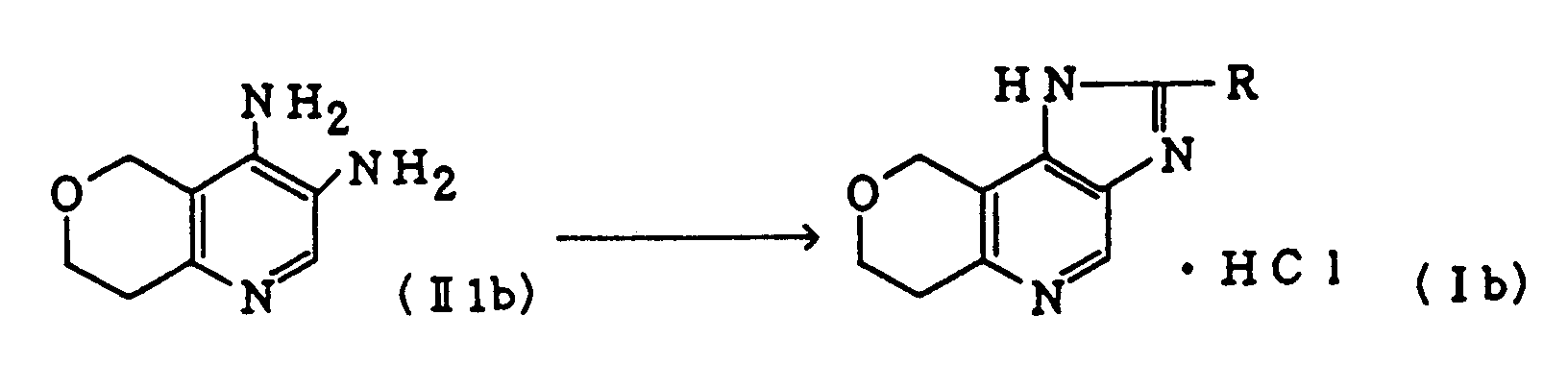
- The following compounds are obtained by the use of Compound (II1b) as a starting compound in the same manner as in Example 1.
- Ib-1 (R = 4-chlorophenyl): (Example 7)
mp.: 291 to 297°C (dec.)
NMR (D2O) δ: 3.17 (2H, m); 4.20 (2H, m); 4.86 (2H, s); 6.99 (2H, d); 7.34 (2H, d); 8.63 (1H, s) - Ib-2 (R = 2-thienyl): (Example 8)
mp.: 285 to 288°C (dec.)
NMR (DMSO) δ: 3.16 (2H, t); 3.40 (1H, br.s); 4.08 (2H, t); 5.12 (2H, s); 7.34 (1H, m); 7.97 (1H, m); 8.39 (1H, m); 9.16 (1H, s) - Ib-3 (R: 3-thienyl): (Example 9)
mp.: 300 to 306°C (dec.)
NMR (D2O) δ: 3.06 (2H, t); 4.16 (2H, t); 4.92 (2H, s); 7.28 (1H, m); 7.51 (1H, m); 7.95 (1H, m); 8.63 (1H, s) - Ib-4 (R = 2-furyl): (Example 10)
mp.: 270 to 274°C (dec.)
NMR (D2O) δ: 3.13 (2H, m); 4.19 (2H, t); 4.98 (2H, s); 6.72 (1H, m); 7.20 (1H, m); 7.97 (1H, s); 8.77 (1H, s) - Ib-5 (R = 3-methyl-5-isoxazolyl): (Example 11)
mp.: 266 to 272°C (dec.)
NMR (D2O) δ: 2.42 (3H, s); 3.24 (2H, t); 4.24 (2H, t); 5.10 (2H, s); 7.11 (1H, s); 9.05 (1H, s) - Ib-6 (R = 2-pyridyl) (dihydrochloride): (Example 12)
mp.: 265 to 281°C (dec.)
NMR (D2O) δ: 3.13 (2H, t); 4.19 (2H, t); 5.00 (2H, s); 7.58 (1H, m); 7.95 to 7.97 (2H, m); 8.63 (1H, d); 8.68 (1H, s) -

- The following compounds are obtained by the use of Compound (II1c) as a starting compound in the same manner as in Example 1.
- Ic-1 (R = phenyl): (Example 13)
mp.: 253 to 258°C (dec.)
NMR (DMSO) δ: 1.72 to 1.96 (6H, m); 3.01 (4H, m); 7.31 to 7.59 (5H, m); 8.30 (1H, s) - Ic-2 (R = 4-chlorophenyl): (Example 14)
mp.: 298 to 320°C (dec.)
NMR (DMSO) δ: 1.68 to 1.92 (6H, m); 3.33 (4H, m); 7.72 (2H, d); 8.44 (2H, d); 9.06 (1H, s) - Ic-3 (R = 2-thienyl): (Example 15)
mp.: 271 to 274 °C
NMR (D2O) δ: 1.72 to 1.96 (6H, m); 3.03 (4H, m); 7.07 (1H, t); 7.52 (1H, d); 7.66 (1H, d); 8.23 (1H, s) - Ic-4 (R = 3-thienyl): (Example 16)
mp.: 264 to 271°C
NMR (D2O) δ: 1.74 to 1.99 (6H, m); 3.07 (4H, m); 7.37 (1H, m); 7.52 (1H, m); 8.03 (1H, m); 8.40 (1H, s) - Ic-5 (R = 2-furyl): (Example 17)
mp.: 250 to 261°C (dec.)
NMR (D2O) δ: 1.75 to 1.99 (6H, m); 3.10 (4H, m); 6.74 (1H, m), 7.24 (1H, m); 7.82 (1H, d); 8.52 (1H, s) - Ic-6 (R = 3-isoxazolyl): (Example 18)
mp.: 191 to 193°C (dec.)
NMR (D2O) δ: 1.78 to 2.02 (6H, m); 3.24 (4H, m); 7.15 (1H, m); 8.86 (1H, s); 8.96 (1H, m) - Ic-7 (R = 3-methyl-5-isoxazolyl): (Example 19)
mp.: 243 to 260°C (dec.)
NMR (D2O) δ: 1.77 to 2.03 (6H, m); 2.43 (3H, s); 3.23 (4H, m); 7.14 (1H, s); 8.84 (1H, s) -

- The following compounds are obtained by the use of Compound (II1d) as a starting compound in the same manner as in Example 1.
- Id-1 (R = 3-isoxazolyl): (Example 20)
mp.: 252 to 256°C (dec.)
NMR (D2O) δ: 2.46 (2H, m); 3.27 (2H, t); 3.31 (2H, t); 7.09 (1H, m) 8.94 (1H, m); 8.95 (1H, s) - Id-2 (R = 3-methyl-5-isoxazolyl): (Example 21)
mp.: 290 to 293°C (dec.)
NMR (D2O) δ: 2.42 (3H, s); 2.45 (2H, m); 3.25 (2H, m); 3.30 (2H, m); 7.05 (1H, s); 8.91 (1H, m) - Id-3 (R = 2-pyridyl): (Example 22)
mp.: 242 to 256°C (dec.)
NMR (D2O) δ: 2.38 (2H, m); 3.17 (4H, t); 7.67 (1H, m); 8.00 to 8.12 (2H, m); 8.67 (1H, m); 8.76 (1H, s) - Id-4 (R = 4-methoxyphenyl): (Example 23)
mp.: 309 to 316°C (dec.)
NMR (D2O) δ: 2.45 (2H, m); 2.86 to 2.99 (4H, m); 3.69 (3H, s); 6.54 (2H, d); 7.19 (2H, d); 8.30 (1H, s) - Id-5 (R = 4-methylphenyl): (Example 24)
mp.: 330°C (dec.)
NMR (D2O) δ: 2.18 (3H, s); 2.22 (2H, m); 2.88 (4H, m); 6.92 (2H, d); 7.19 (2H, d); 8.25 (1H, s) -

- To a solution of 5.88 g of 3,4-diamino-7,8-dihydro-5H-pyrano[4,3-b]pyridine (II1b) (synthesized in Reference Example 1) in 50 ml of dimethylformamide is added a solution of 4.43 g of 3-isoxazolyl chloride in 4.7 ml of methylene chloride with ice cooling, and the resultant mixture is stirred at room temperature for 45 minutes, mixed with 4.7 ml of triethylamine and stirred for 1 hour. The reaction mixture is filtered, and the resultant crystals are mixed with 500 mg of sodium acetate and 79 ml of ethylene glycol and heated at 150°C (on an oil bath) for 5 hours. The solvent is evaporated in vacuo to dryness, and the resulting residue is chromatographed on a silica gel column, eluting with 10% methanol/chloroform. The product is recrystallized from chloroform-isopropanol to give 5.76 g of Compound (Ib-7) as white crystals melting at 345 to 347°C (dec.). Yield: 74%
Elemental Analysis (%) C12H12N4O2 Calculated: C, 59.50; H, 4.16; N, 23.12 Found: C, 59.33; H, 4.23; N, 22.91 -

- To a solution of 264 mg of 5-isoxazolecarboxylic acid in a mixture of 3.5 ml of hexamethylphosphoric triamide and 0.4 ml of acetonitrile is dropwise added 272 mg of thionyl chloride at 0°C. The resultant mixture is stirred at the same temperature for 30 minutes, mixed with 350 mg of Compound (II1b) and stirred for 4 hours. The reaction mixture is diluted with ice water and neutralized with sodium bicarbonate. The precipitated crystals are dissolved in 14 ml of ethylene glycol, heated at 150°C for 3.5 hours and the solvent is evaporated in vacuo. The residue is chromatographed on a silica gel column, eluting with methylene chloride-methanol (30 : 1). The product is recrystallized from methanol-ethyl acetate to give 170 mg of Compound (Ib-8) as colorless crystals melting at 329 to 333°C (dec.). Yield: 33%
Elemental Analysis (%) C12H10N4O2·1/3H2O Calculated: C, 58.06; H, 4.33; N, 22.57 Found: C, 58.06; H, 4.35; N, 22.42 -

- To 6 g of polyphosphoric acid are added 400 mg of Compound (II1b) and 347 mg of benzoic acid, and the mixture is heated on an oil bath at 130°C for 5 hours. After cooling, the reaction mixture is mixed with ice water, made alkaline with aqueous ammonia and the precipitated crystals are filtered. The filtrate is extracted with 10% methanol/chloroform. The crystals are combined with the extract and chromatographed on a silica gel column, eluting with 5% methanol/chloroform. The product is converted into the hydrochloride in a conventional manner and recrystallized from methanol/isopropanol to give 559 mg of the titled Compound (Ib-9) as white crystals. Yield: 89%
mp.: 269 to 286°C (dec.)
NMR (DMSO) δ: 3.17 (2H, t); 3.42 (1H, br.s); 4.90 (2H, t); 5.16 (2H, s); 7.62 to 7.66 (3H, m); 8.35 to 8.44 (2H, m); 9.24 (1H, s)Elemental Analysis (%) C15H13ON3·HCl Calculated: C, 62.61; H, 4.90; N, 14.60; Cl, 12.32 Found: C, 62.67; H, 5.01; N, 14.80; Cl, 12.38 -
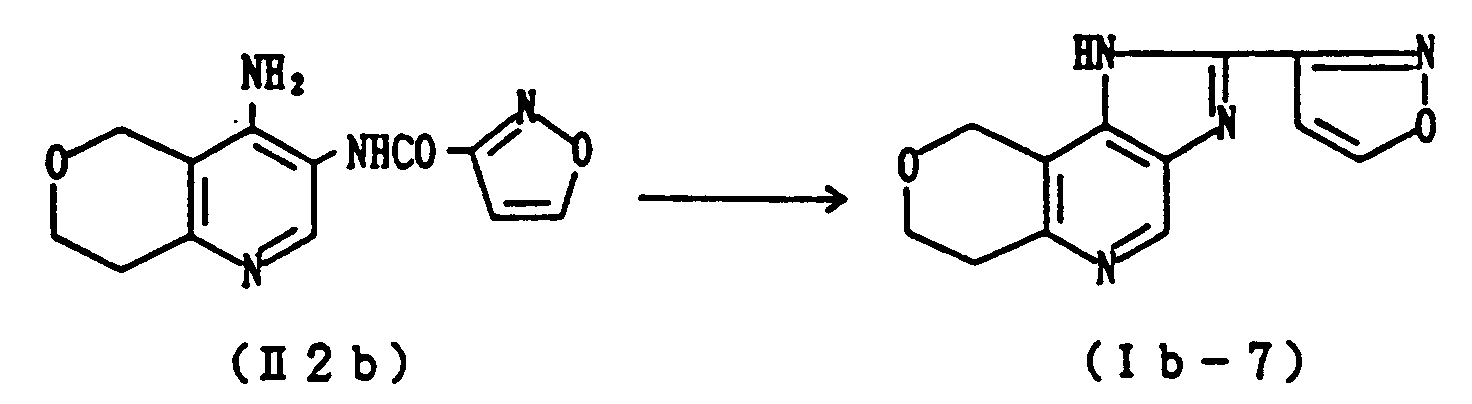
- A mixture of 260 mg of isoxazolylaminopyridine (II2b) (synthesized in Reference Example 2) and 4 ml of ethylene glycol is heated at 150°C for 3 hours. The solvent is evaporated in vacuo, and the residue is dissolved while heated in aqueous ethanol and decolored over active carbon. The precipitated solid is filtered to give 206 mg of Compound (Ib-7) as colorless crystals. Yield: 85%. The crystals were identified as the compound obtained in Example 25 by comparing the melting point and spectra. Further, the following salts of Compound (Ib-7) are synthesized in a conventional manner.
(1) Hydrochloride: mp. 321 to 325°C (dec.)Elemental Analysis (%) C12H11N4O2Cl·1/4H2O Calculated: C, 50.89; H, 4.09; N, 19.78; Cl, 12.52 Found: C, 50.90; H, 4.13; N, 19.50; Cl, 12.38
(2) Phosphate: mp. 239 to 241°C (dec.)Elemental Analysis (%) C12H13N4O6P·H2O Calculated: C, 40.23; H, 4.22; N, 15.63 Found: C, 40,05; H, 4.19; N, 15.39
(3) Methanesulfonate: mp. 219 to 222°C (dec.)Elemental Analysis (%) C13H14N4O5S·1/3H2O Calculated: C, 45.35; H, 4.29; N, 16.21; S, 9.31 Found: C, 45.17; H, 4.16; N, 16.19; S, 9.56
(4) Maleate: mp. 331 to 336°C (dec.)Elemental Analysis (%) C16H14N4O6 Calculated: C, 53.63; H, 3.93; N, 15.63 Found: C, 53.73; H, 3.93; N, 15.62 -
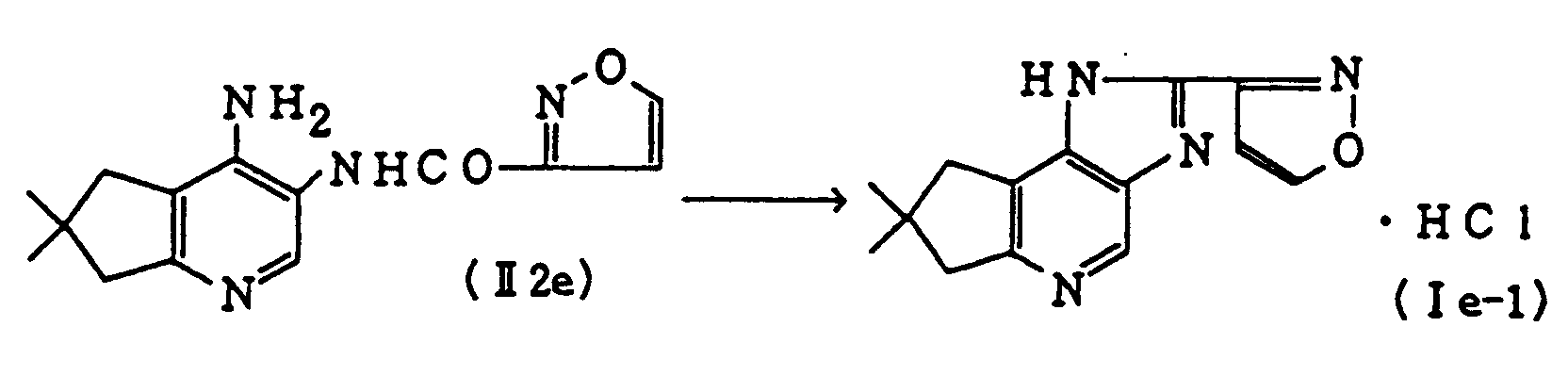
- A mixture of 2.05 g of 4-amino-3-(3-isoxazolylamino)-6,6-dimethylcyclopenta[b]pyridine (II2e) and 21 ml of ethylene glycol is heated at 150°C for 3.5 hours, and the solvent is evaporated in vacuo. The residue is chromatographed on a silica gel column, eluting with methylene chloride-methanol (30/1). The product is dissolved in methanol and mixed with methanolic hydrochloric acid to give 1.90 g of Compound (Ie-1).
Yield: 82%
mp.: 270 to 272°CElemental Analysts (%) C14H15N4OCl Calculated: C, 57.83; H, 5.19; N, 19.26; Cl, 12.19 Found: C, 57.53; H, 5.31; N, 19.09; Cl, 12.31 -

- To a solution of 274 mg of 3-isoxazolecarboxylic acid in a mixture of 3.5 ml of hexamethyl phosphotriamide and 0.5 ml of acetonitrile is dropwise added 288 mg of thionyl chloride at 0°C, and the resultant mixture is stirred at the same temperature for 30 minutes. To the mixture is added 520 mg of 3,4-diamino-6-ethoxycarbonyl-5,6,7,8-tetrahydro[1,6]naphthylidine (II1g) (synthesized in Reference Example 3), and the mixture is stirred for 4 hours. The reaction mixture is diluted with ice water, neutralized with sodium bicarbonate and extracted with methylene chloride, the extract is dissolved in 15 ml of ethylene glycol and heated at 150°C for 4 hours. The solvent is evaporated in vacuo, and the residue is chromatographed on a column of silica gel, eluting with methylene chloride-methanol (50 : 1). The product is recrystallized from methanol/ethyl acetate to give 410 mg of Compound (Ig-1). Yield: 60%
mp.: 271 to 273°C (dec.)Elemental Analysis (%) C15H15N5O3 Calculated: C, 57.50; H, 4.82; N, 22.35 Found: C, 57.47; H, 5.02; N, 22.25 -

- Compound (II1f) is used as a starting compound in the same manner as in Example 26 to give Compound (If-1).
mp.: 253 to 255°C (dec.)Elemental Analysis (%) C12H10N4OS·1/6H2O Calculated figure: C, 55.16; H, 3.99; N, 21.44; S, 12.27 Measured figure : C, 55.17; H, 4.21; N, 21.23; S, 12.05 -

- Compound (II1a) is used as a starting compound in the same manner as in Example 26 to give Compound (Ia-7).
mp.: 222 to 225°CElemental Analysis (%) C13H12N4O Calculated: C, 63.41; H, 5.18; N, 22.75 Found: C, 63.42; H, 5.18; N, 22.48 - Compound (II1d) is used as a starting compound in the same manner as in Example 26 to give Compound (Id-1).
mp.: 250 to 255°CElemental Analysis (%) C12H10N4O·1/3H2O Calculated: C, 62.06; H, 4.63; N, 24.12 Found: C, 61.97; H, 4.61; N, 23.97 -

- A mixture of 490 mg of Compound (Ig-1) obtained in Example 30 and 25% hydrobromic acid/acetic acid (25 ml) was stirred at 70°C for 5 hours. After the solvent is evaporated in vacuo, the residue is neutralized with aqueous sodium bicarbonate and concentrated in vacuo to dryness. The residue is shaken with chloroform/methanol and the resultant solution is concentrated. The residue is chromatographed on an alumina column, eluting with methylene chloride-methanol (10 : 1). The product is recrystallized from methanol-ethyl acetate to give 335 mg of Compound (Ig-2) as crystals melting at 278 to 281°C (dec.). Yield: 89%
Elemental Analysis (%) C12H11N5O Calculated: C, 59.74; H, 4.59; N, 29.02 Found: C, 59.54; H, 4.71; N, 29.31 - To a mixture of 95 mg of Compound (Ig-2) obtained in the foregoing Example and 5 ml of methylene chloride are added 160 mg of triethylamine and 160 mg of acetic anhydride and the resultant mixture is stirred at room temperature for 1 hour. After the solvent is evaporated in vacuo, the residue is recrystallized from ethyl acetate-methylene chloride to give 68 mg of the acetylate (Ig-3).
Yield: 61%
mp.: 236 to 240°CElemental Analysis (%) C14H13N5O2·1/4H2O Calculated: C, 58.43; H, 4.73; N, 24.33 Found: C, 58.52; H, 4.62; N, 24.20 - To a solution of 680 mg of Compound (Ig-1) obtained in Example 30 is added 330 mg of lithium aluminum hydride, and the resultant mixture is refluxed for 6 hours. After the reaction mixture is chilled with ice, the mixture is mixed with 0.5 ml of 2N aqueous sodium hydroxide and stirred at room temperature for 30 minutes. The precipitate is filtered and the filtrate is concentrated. The residue is chromatographed on an alumina column, eluting with methylene chloride-methanol (50/1). The product is treated with hydrochloric acid to give 340 mg of Compound (Ig-4) hydrochloride. Yield: 53%
mp.: 243 to 247°C (dec.)Elemental Analysis (%) C13H15N5OCl·H2O Calculated: C, 45.09; H, 4.94; N, 20.22; Cl, 24.48 Found: C, 45.07; H, 5.07; N, 19.95; Cl, 20.75 - A suspension of 15.8 g of 3-nitro-5,6,7,8-tetrahydroquinoline [synthesized according to the method as described in Bull. Chem. Soc. Jpn. Vol. 63 (1990), 2820] and 1.6 g of 5% palladium carbon in 300 ml of methanol is hydrogenerated at ordinary temperature under atmospheric pressure. The catalyst is filtered off, and the filtrate is concentrated in vacuo to remove the solvent. The resultant crude product is recrystallized from methylene chloride-isopropyl ether to give 12.76 g of the titled compound 1. Yield: 97%
mp.: 97 to 98°C - To 130 ml of methylene chloride are added 12.69 g of Compound 1 obtained in the above step (1) and 2.4 ml of triethylamine, and a solution of 10.5 ml of trichloroacetyl chloride in 30 ml of methylene chloride is dropwise added with ice cooling and under stirring over a period of 7 minutes. The reaction mixture is stirred at room temperature for 20 minutes, mixed with saturated saline, made weakly alkaline with aqueous ammonia and the organic layer is separated. The aqueous layer is shaken with methylene chloride. The organic layers are combined, washed with saturated saline, dried over anhydrous magnesium sulfate and concentrated to remove the solvent. The residue is chromatographed on a silica gel column, eluting with 10% methanol/methylene chloride. The product is recrystallized from ethyl acetate to give 24.21 g of the titled compound 2. Yield: 96%
mp.: 157 to 159°C
- To a solution of 24.03 g of Compound 2 obtained in the above step (2) in 40 ml of methylene chloride is added 21.2 g of 80% m-chloroperbenzoic acid at room temperature, and the resultant mixture is stirred for 45 minutes. The reaction mixture is mixed with isopropyl ether and the crystals are filtered to give 25.06 g of the titled compound 3 as crystals. Yield: 99%
mp.: 244 to 246°C (dec.) - A mixture of 1.00 g of Compound 3 obtained in the above step (3) and 5.0 ml of fuming nitric acid (d = 1.52) is stirred at 55°C on an oil bath for 5 hours. The fuming nitric acid is evaporated in vacuo, and the residue is neutralized with aqueous ammonia and heated at 60°C on an oil bath for 2 hours. The reaction mixture containing crystals is mixed with 10 ml of 50% isopropyl ether/isopropanol, and the resulting precipitate is filtered. The filtrate is concentrated in vacuo and extracted with 10% methanol/chloroform. The crystals are combined with the residue and chromatographed on an alumina column, eluting with 2% methanol/chloroform. The product is recrystallized from methylene chloride-isopropanol to give 525 mg of the titled compound 4 as brownish red crystals.
Yield: 78%
mp.: 199 to 201°C - A mixture of 5.00 g of Compound 4 obtained in the above step (4) and 12.9 g of Raney nickel in methanol is hydrogenated at ordinary temperature under atmospheric pressure. The catalyst is filtered off, and the filtrate is concentrated in vacuo to remove the solvent. The residue is chromatographed on an alumina column, eluting with 5% methanol/chloroform. The product is recrystallized from methylene chloride-ethyl acetate to give 3.37 g of the titled compound (II1a) as crystals. Yield: 86%
mp.: 169 to 170°C (dec.)
Elemental Analysis (%) C9H13N3 Calculated: C, 66.22; H, 8.03; N, 25.75 Found: C, 65.93; H, 8.00; N, 25.50 - The reaction is effected in the same manner as above to give Compounds (II1b) (II1c) and (II1d).
(II1b): mp. 196 to 200°C (dec.)Elemental Analysis C8H11N3O·H2O Calculated: C, 52.45; H, 7.15; N, 22.94 Found: C, 52.18; H, 7.08; N, 22.71
(II1c): mp. 167 to 168°CElemental Analysis (%) C10H15N3 Calculated: C, 67.76; H, 8.53; N, 23.71 Found: C, 67.76; H, 8.48; N, 23.47
(II1d): mp. 190 to 193°CElemental Analysis (%) C8H11N3 Calculated: C, 64.40; H, 7.43; N, 28.17 Found: C, 64.43; H, 7.37; N, 28.02 - To a solution of 2.00 g of 3-nitro-7,8-dihydro-5H-pyrano[4,3-b]pyridine [prepared according to the method as described in Bull. Chem. Soc. Jpn. Vol. 63 (1990), 2820] in 40 ml of methylene chloride is added 2.63 g of m-chloroperbenzoic acid, and the resultant mixture is stirred overnight. The reaction mixture is washed with aqueous potassium carbonate, dried over anhydrous magnesium sulfate and the solvent is evaporated. The crude product is recrystallized from ethanol-chloroform to give 1.82 g of 3-nitro-7,8-dihydro-5H-pyrano[4,3-b]pyridine-1-oxide as colorless crystals. Yield: 84%. To a solution of 1.47 g of the product in 75 ml of methanol-dimethylformamide (1 : 1) is added 100 mg of 10% palladium carbon, and the resultant mixture is hydrogenated at ordinary temperature under atmospheric pressure. After the reduction is completed in about 3 hours, the catalyst is filtered off. The resultant crude crystals are washed with ethanol to give 1.08 g of 3-amino-1-oxide as colorless crystals. Yield: 86%. To a solution of 690 mg of 3-isoxazolylcarbonyl chloride in 20 ml of dimethylformamide is added 414 mg of pyridine under ice cooling, and then 830 mg of 3-amino-1-oxide as crystals is added. The resultant mixture is stirred under ice cooling for 30 minutes and at room temperature for 1 hour, chilled again with ice, and mixed with 4 ml of water. The suspension is neutralized with sodium bicarbonate. The precipitated solid is filtered, washed with water and ethanol in this order and dried to give 1.13 g of the titled compound 5 as colorless crystals.
Yield: 86%.
ml.: 260 to 265°C (dec.) - A solution of 653 mg of Compound 5 obtained in the above step (1) as crystals in 3.2 ml of fuming nitric acid is stirred at 55°C for 3 hours. The reaction mixture is chilled, poured onto ice water and shaken with chloroform. The extract is washed with water, aqueous disodium hydrogen phosphate and saturated saline in this order, dried over anhydrous magnesium sulfate and concentrated to remove the solvent. The resultant residue is washed with methanol to give 551 mg of the titled compound 6 as light yellow crystals.
Yield: 70%
mp.: 174 to 176°C (dec.) - To a solution of 473 mg of Compound 6 obtained in the above step (2) in 30 ml of methylene chloride is added a solution of 935 mg of phosphorus tribromide in 1 ml of methylene chloride under ice cooling. The reaction mixture is stirred for 2 hours, mixed with ice water and neutralized with aqueous potassium carbonate under ice cooling. The organic layer is separated, and the aqueous layer is extracted with methylene chloride. The organic layers are combined, washed with saturated saline, dried over anhydrous magnesium sulfate and the solvent is evaporated. The residue is recrystallized from methylene chloride-isopropanol to give 407 mg of the titled compound 7 as yellow crystals.
Yield: 93%
mp.: 143 to 145°C - To a solution of 435 mg of Compound 7 obtained in (3) above in 95% aqueous methanol is added 10% palladium carbon (40 mg) as catalyst, and the resultant mixture is hydrogenated at ordinary temperature under atmospheric pressure. The reaction mixture is filtered, and the hardly soluble solid is washed out with dimethylformamide. The filtrate is concentrated in vacuo, and the residue is recrystallized from methanol-methylene chloride to give 280 mg of the titled compound (II2b) as light brown crystals.
Yield: 72%
mp.: 209 to 211°CElemental Analysis (%) C12H12N4O3 Calculated: C, 55.38; H, 4.65; N, 21.53 Found: C, 55.08; H, 4.54; N, 21.24 - 3-Nitro-6,6-dimethylcyclopenta[b]pyridine is used in the same manner as above to give 4-amino-3-(3-isoxazolylamino)-6,6-dimethylcyclopenta[b]pyridine (II2e).
mp.: 171 to 174°C (dec.)Elemental Analysis (%) C14H16N4O2 Calculated: C, 61.75; H, 5.92; N, 20.57 Found: C, 61.41; H, 6.05; N, 20.13 - A mixture of 3 g of ethyl 6-ethoxycarbonyl-4-hydroxy-5,6,7,8-tetrahydro[1,6]naphthylidine-3-carboxylate and 21 ml of phosphorus oxychloride is refluxed under heating for 90 minutes. The reaction mixture is concentrated in vacuo to dryness, and the residue is mixed with ice water and shaken with methylene chloride. The extract is chromatographed on a silica gel column to give oily 4-chloro compound. This compound is dissolved in 70 ml of dimethylformamide, mixed with 1.72 g of sodium amide and stirred at 70°C for 3 hours. After the solvent is evaporated in vacuo, the residue is mixed with water and extracted with chloroform. The extract is chromatographed on a silica gel column to give crystalline 4-azido compound. This compound is dissolved in 30 ml of methanol, mixed with 4N aqueous potasium hydroxide, stirred at room temperature for 1 hour and the methanol is evaporated in vacuo. The residue is made weakly acidic with dilute hydrochloric acid, and the precipitated crystals are filtered and washed to give 1.89 g of 4-azido-3-carboxylic acid 8 as crystals. Yield: 64%
mp.: 171 to 175°C (dec.) - To a solution of 3.4 g of Compound 8 obtained in the above step (1) in 100 ml of tetrahydrofuran is added 1.42 g of triethylamine, and 1.52 g of ethyl chloroformate is dropwise added at -10 to -5°C. After stirring is continued at the same temperature for 1 hour, a solution of 3.81 g of sodium azide in 15 ml of water is dropwise added to the mixture, which is stirred at 0°C for 1 hour. The reaction mixture is concentrated in vacuo, and the residue is mixed with water and shaken with methylene chloride. The extract is dissolved in a mixture of 80 ml of dichloroethane and 40 ml of t-butanol, and the resultant solution is refluxed for 1 hour. The solvent is evaporated, and the residue is chromatographed on a silica gel column to give 3.38 g of 3-t-butoxycarbonylamino compound 9 as crystals.
Yield: 79%
mp.: 144 to 145°C - To a solution of 3.30 g of Compound 9 obtained in the above step (2) in 100 ml of tetrahydrofuran/ethanol (1 : 1) is dropwise added a solution of 3.15 g of stannous chloride (II) dihydrate in a mixture of 40 ml of 5N aqueous sodium hydroxide and 50 ml of water at -10°C over a period of 30 minutes, and the resultant mixture is stirred at 0°C for 20 minutes. The solvent is evaporated in vacuo, and the residue is mixed with water and shaken with ethyl acetate. The extract is dissolved in 130 ml of methylene chloride, mixed with 26 ml of trifluoroacetic acid, and stirred at room temperature for 1 hour. The reaction is concentrated in vacuo, and the residue is mixed with saturated saline and neutralized with 5N aqueous sodium hydroxide. The precipitated crystals are filtered, dissolved in methanol, and the resultant solution is concentrated to give 1.98 g of the titled compound (II1g) as crystals. Yield: 90% mp.: 171 to 174°C (dec.)
Elemental Analysis (%) C11H16N4O2 Calculated: C, 55.91; H, 6.82; N, 23.71 Found: C, 55.68; H, 6.59; N, 23.79 - Ethyl 4-hydroxy-7,8-dihydro-5H-pyrano[4,3-b]pyridine-3-carboxylate and 4-hydroxy-7,8-dihydro-5H-thiopyrano[4,3-b]pyridine-3-carboxylate are reacted in the same manner as in the above steps (1) to (3) to give Compounds (II1b) and (II1f), respectively.
(II1b): The same physico-chemical data were obtained as in the compound (II1b) prepared in Reference Example 1.
(II1f): mp.: 66 to 67°C
NMR (CDCl3) δ: 2.90 (2H, t); 3.06 (2H, s, NH); 3.13 (2H, t); 3.57 (2H, s); 4.03 (2H, s, NH); 7.85 (1H, s) - To a solution of 1.50 g of 3-amino-7,8-dihydro-5H-pyrano[4,3-b]pyridine in 45 ml of methylene chloride is added 1.55 ml of trifluoroacetic anhydride with ice cooling and under stirring, and the resultant mixture is stirred at the same temperature for 15 minutes. The reaction mixture is mixed with ice water, made weakly alkaline with aqueous ammonia and extracted with methylene chloride. The extract is washed with saturated saline and the solvent is evaporated. The resultant crude crystals are recrystallized from acetone-isopropyl ether to give 2.14 g of 3-trifluoroacetylamino-7,8-dihydro-5H-pyrano[4,3-b]pyridine as crystals. Yield: 87%. The product (1.55 g) is dissolved in 30 ml of methylene chloride, and 1.63 g of 80% m-chloroperbenzoic acid is added to the solution, which is stirred at room temperature for 2.5 hours. The reaction mixture is mixed with 50 ml of ether, and the precipitated crystals are filtered to give 1.58 g of 3-trifluoroacetylamino-7,8-dihydro-5H-pyrano[4,3-b]pyridine-1-oxide as crystals. Yield: 96%. The product (1.568 g) is mixed with 9.4 ml of fuming nitric acid (d = 1.52) and stirred at 55°C for 6 hours. The reaction mixture is concentrated in vacuo, made alkaline with aqueous ammonia, allowed to stand at room temperature overnight and shaken with 10% methanol/ chloroform. The resultant crude crystals are recrystallized from acetone to give 0.85 g of 3-amino-4-nitro-7,8-dihydro-5H-pyrano[4,3-b]pyridine-1-oxide (II1b) as brown crystals. Yield: 67%. Melting point and spectra data confirmed that the product is the same as the compound (II1b) obtained in Reference Example 1.
-

- To 58.5 g of acetic anhydride are added 36.8 g of 1-morpholino-1-cyclohexene and 36 g of 4-aminomethylene-2-phenyl-5(4H)-oxazolone, and the resultant mixture is heated at about 65°C (bath temperature) for 1.5 hours. The reaction mixture is allowed to cool to room temperature, mixed with 90 ml of isopropyl ether and chilled with ice. The precipitated crystals are filtered to give 39.8 g of Compound (10) as yellow crystals melting at 155 to 157°C (dec.). Yield: 78%. The crystals can be used for the subsequent reaction without purification, but a small portion is recrystallized from isopropanol/isopropyl ether to give yellow crystals (10) melting at 156 to 158°C (dec.).
Elemental Analysis (%) C16H16N2O2 Calculated: C, 71.62; H, 6.01; N, 10.44 Found: C, 71.34; H, 6.05; N, 10.30 - A mixture of 36.8 g of Compound (10) and 55 ml of N-methyl-2-pyrrolidone is stirred with heating at 205°C (bath temperature) for 30 minutes. After allowing to cool, the reaction mixture is mixed with acetone and chilled with ice. The precipitated crystals are filtered to give 33.6 g of Compound (11). Yield: 91%. This product can be used for the subsequent reaction without purification, but a small portion is recrystallized from chloroform/methanol to give colorless crystals melting at 408 to 410°C.
Elemental Analysis (%) C16H16N2O2 Calculated: C, 71.62; H, 6.01; N, 10.44 Found: C, 71.58; H, 6.01; N, 10.49 - To a suspension of 5.36 g of Compound (11) in 26 ml of dimethylformamide is dropwise added a solution of 2.8 ml of phosphorus oxychloride in 8 ml of dimethylformamide at temperature from -10 to -5°C, and the temperature is gradually raised up to room temperature. The reaction mixture is stirred overnight, chilled with ice, poured onto ice water and extracted with methylene chloride to remove the acidic and neutral by-products. The aqueous layer is made alkaline with conc. aqueous ammonia under ice cooling and shaken with ethyl acetate. The extract is washed with saturated saline, dried and concentrated in vacuo. The residue is chromatographed on an alumina column, eluting with methylene chloride/acetonitrile (40 : 1) to give 3.73 g of Compound (12) as colorless crystals melting at 62 to 64°C. Yield: 79%.
Elemental Analysis (%) C12H16N3Cl Calculated: C, 60.62; H, 6.79; N, 17.68; Cl, 14.92 Found: C, 60.70; H, 6.83; N, 17.75; Cl, 14.77 - A solution of 3.60 g of Compound (12) in 25 ml of 3N sulfuric acid is stirred at 100°C (bath temperature) for 1.5 hours. The reaction mixture is made alkaline with aqueous ammonia, mixed with saline and extracted with methylene chloride. The extract is dried and concentrated to give 2.61 g of Compound (III1a) as colorless crystals melting at 114 to 117°C (dec.). Yield: 94%. The crystals can be used for the subsequent reaction without purification, but a small portion is recrystallized from methylene chloride/isopropyl ether to give colorless crystals melting at 115 to 117°C (dec.).
Elemental Analysis (%) C9H11N2Cl Calculated: C, 59.18; H, 6.07; N, 15.34; Cl, 19.41 Found: C, 59.05; H, 6.03; N, 15.30; Cl, 19.32 -

- Using the corresponding enamines, the reaction is effected in the same manner as in Reference Example 5 to give the following compounds.
III1b (X = O): (Reference Example 6)
mp.: 125 to 127°CElemental Analysis (%) C8H9N2OCl Calculated: C, 52.04; H, 4.91; N, 15.18; Cl, 19.20 Found: C, 52.08; H, 4.88; N, 15.12; Cl, 19.44
III1c (X = -CH2CH2-): (Reference Example 7)
mp.: 144 to 146°CElemental Analysis (%) C10H13N2Cl Calculated: C, 61.06; H, 6.66; N, 14.24; Cl, 18.02 Found: C, 61.06; H, 6.63; N, 14.25; Cl, 18.14
III1f (X = S): (Reference Example 8)
mp.: 129 to 132°CElemental Analysis (%) C8H9N2SCl Calculated: C, 47.87; H, 4.51; N, 13.95; S, 15.97; Cl, 17.66 Found: C, 47.79; H, 4.52; N, 13.93; S, 16.10; Cl, 17.52 -

- To a solution of 4.20 g of 3-amino-4-chloro-5,6,7,8-tetrahydroquinoline (III1a) and 1.96 g of pyridine in 80 ml of methylene chloride is added a solution of 3.24 g of isoxazole-3-carbonyl chloride in 4 ml of methylene chloride, and the resultant mixture is stirred at room temperature for 2 hours. The reaction mixture is mixed with ice water, adjusted to pH 10 with conc. aqueous ammonia to pH 10, and stirred at room temperature for 10 minutes. The organic layer is separated, and the aqueous layer is extracted with methylene chloride. The combined extracts are washed with water, dried and the solvent is evaporated to give 5.9 g of Compound (III2a-1) as crystals melting at 150 to 153°C (dec.). Yield is 92%. The crystals can be used for the subsequent reaction without purification, but a small portion is recrystallized from isopropyl ether/methylene chloride to give colorless crystals melting at 151 to 153°C (dec.).
Elemental Analysis (%) C13H12N3O2Cl Calculated: C, 56.22; H, 4.35; N, 15.13; Cl, 12.76 Found: C, 56.12; H, 4.41; N, 15.26; Cl, 12.91 -
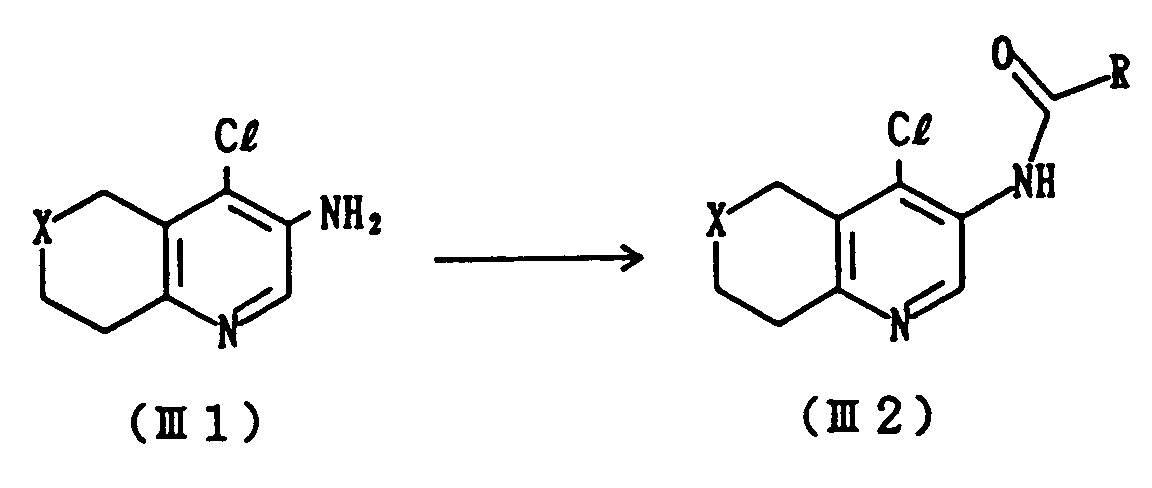
- Using the corresponding pyridine derivatives (III1a), (III1b), (III1c) and (III1f), the reaction is effected as in Reference Example 9 to give the following compounds.
III2a-2 (X = CH2 ; R = 3-methyl-5-isoxazolyl): (Reference Example 10)
mp.: 138 to 139°C
Elemental Analysis (%) C14H14N3O2Cl Calculated: C, 57.64; H, 4.84; N, 14.40; Cl, 12.15 Found: C, 57.53; H, 4.82; N, 14.46; Cl, 12.37
III2b-1 (X = 0 ; R = 3-Isoxazolyl): (Reference Example 11)
mp.: 180 to 181°cElemental Analysis (%) C12H10N3O3Cl Calculated: C, 51.53, H, 3.60; N, 15.02; Cl, 12.68 Found: C, 51.60; H, 3.60; N, 14.97; Cl, 12.93
III2c-1 (X = -CH2CH2- ; R = 3-isoxazolyl): (Reference Example 12)
mp.: 115 to 116°CElemental Analysis (%) C14H14N3O2Cl Calculated: C, 57.63; H, 4.83; N, 14.40; Cl, 12.15 Found: C, 57.93; H, 4.98; N, 14.38; Cl, 11.89
III2f-1 (X = S ; R = 3-isoxazolyl): (Reference Example 13) mp.: 155 to 156°CElemental Analysis (%) C12H10N3O2SCl Calculated: C, 48.73; H, 3.40; N, 14.20; S, 10.84; Cl, 11.98 Found: C, 48.58; H, 3.48; N, 14.22; S, 10.75; Cl, 11.99
III2f-2 (X = S ; R = 3-methyl-5-isoxazolyl): (Reference Example 14)
mp.: 172 to 173°CElemental Analysis (%) C13H12N3O2SCl Calculated: C, 50.40; H, 3.90; N, 13.56; S, 10.35; Cl, 11.44 Found: C, 50.58; H, 4.01; N, 13.47; S, 10.35; Cl, 11.52 -

- To 60 ml of methylene chloride are added 5.55 g of Compound (III2a-1) and 6.97 g of phosphorus pentachloride, and 1.60 g of pyridine is dropwise added. The resultant mixture is refluxed for 4.5 hours. To a previously chilled about 3.6N ammonia/isopropanol solution (140 ml) is added the above reaction mixture chilled with ice under keeping at temperature from -30 to -15°C. Temperature is raised up to room temperature, and the mixture is stirred for 18 hours. The solvent is evaporated in vacuo, and the residue is mixed with 50 ml of ice water and 100 ml of methylene chloride and adjusted to pH 10 with conc. aqueous ammonia. The mixture is stirred at room temperature for 15 minutes and the methylene chloride layer is separated. The aqueous layer is further extracted with methylene chloride. The extract is washed with water, dried and concentrated for evaporation of the solvent to give 5.1 g of the titled compound (III3a-1) as crystals melting at 160 to 163°C. Yield: 92%. The crystals can be used for the subsequent reaction without purification, but a small portion is recrystallized from methylene chloride/isopropyl ether to give colorless crystals.
Elemental Analysis (%) C13H13N4OCl Calculated: C, 56.42; H, 4.73; N, 20.24; Cl, 12.81 Found: C, 56.53; H, 4.91; N, 20.27; Cl, 12.72 -
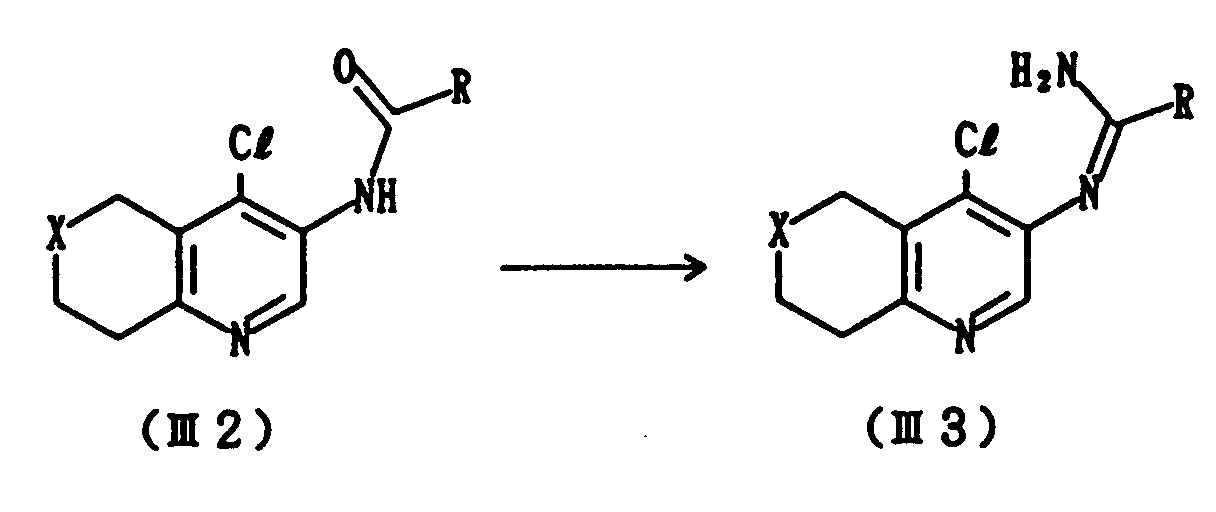
- Using the corresponding isoxazolecarbonylamino derivatives (III2a), (III2b), (III2c), (III2f-1) and (III2f-2), the reaction is effected in the same manner as in Reference Example 15, whereby the following compounds are prepared.
III3a-2 (X = CH2 ; R = 3-methyl-5-isoxazolyl): (Reference Example 16)
mp.: 206 to 208°CElemental Analysis (%) C14H15N4OCl Calculated: C, 57.83; H, 5.20; N, 19.27; Cl, 12.20 Found: C, 57.80; H, 5.22; N, 19.16; Cl, 11.91
III3b-1 (X = O ; R = 3-isoxazolyl): (Reference Example 17)
mp.: 195 to 196°CElemental Analysis (%) C12H11N4O2Cl Calculated: C, 51.71; H, 3.98; N, 20.10; Cl, 12.72 Found: C, 51.49; H, 4.03; N, 19.95; Cl, 12.66
III3c-1 (X = -CH2CH2- ; R = 3-isoxazolyl): (Reference Example 18)
mp.: 197 to 199°CElemental Analysis (%) C14H15N4OCl Calculated: C, 57.83; H, 5.19; N, 19.26; Cl, 12.19 Found: C, 57.57; H, 5.28; N, 19.11; Cl, 11.91
III3f-1 (X = S ; R = 3-isoxazolyl): (Reference Example 19)
mp.: 190 to 192°CElemental Analysis (%) C12H11N4OSCl Calculated: C, 48.89; H, 3.76; N, 19.00; S, 10.87; Cl, 12.02 Found: C, 48.73; H, 3.75; N, 18.74; S, 10.85; Cl, 12.32
III3f-2 (X = S ; R = 3-methyl-5-isoxazolyl): (Reference Example 20)
mp.: 194 to 196°CElemental Analysis (%) C13H13N4OSCl Calculated: C, 50.56; H, 4.24; N, 18.14 Found: C, 50.63; H, 4.13; N, 18.07 -

- A mixture of 2.00 g of Compound (III3a-1) (obtained in Reference Example 15) and 18 ml of N-methyl-2-pyrrolidone is heated at 205°C (bath temperature) for 1 hour. The solvent is evaporated in vacuo, and the residue is mixed with acetone and chilled. The precipitated crystals are filtered to give 1.83 g of Compound (Ia-7) hydrochloride. Yield: 91%. mp.: 263 to 267°C (dec.). This product is recrystallized from methanol/isopropanol to give colorless crystals melting at 265 to 269°C (dec.).
Elemental Analysis (%) C13H13N4OCl·1/2H2O Calculated: C, 54.65; H, 4.94; N, 19.61; Cl, 12.41 Found: C, 54.64; H, 5.14; N, 19.67; Cl, 12.71 - The above hydrochloride is converted into free base in a conventional manner to give the compound identified as Compound (Ia-7) obtained in Example 32.
-

- The reaction is effected in the same manner as in Example 37 to give Compound (Ia-6) (Example 38), Compound (Ib-7) (Example 39), Compound (Ic-6) (Example 40) and Compound (If-1) (Example 41) from Compound (III3a-2) (obtained in Reference Example 16), Compound (III3b-1) (obtained in Reference Example 17), Compound (III3c-1) (obtained in Reference Example 18) and Compound (III3f-1) (obtained in Reference Example 19), respectively. Physico-chemical data of these compounds were identical with those of the compounds obtained in Examples 16, 25, 19 and 31, respectively.
- Further, the reaction is effected in the same manner as in Example 37 to give 2-(3-methyl-5-isoxazolyl)-1,6,7,9-tetrahydroimidazo [4,5-d]thiopyrano[4,3-b]pyridine hydrochloride (If-2) (X = S ; R = 3-methyl-5-isoxazolyl, Example 42) from Compound (III3f-2) (obtained in Reference Example 20).
mp.: 244 to 246°C (dec.)Elemental Analysis (%) C13H13N4OSCl Calculated: C, 50.56; H, 4.24; N, 18.14; S, 10.38; Cl, 11.48 Found: C, 50.39; H, 4.35; N, 17.85; S, 10.33; Cl, 11.37 -

- To a solution of 323 mg of Compound (If-1) in 30 ml of methanol is added a solution of 289 mg of sodium metaperiodate in 3 ml of water, and the resultant mixture is stirred at room temperature for 4 hours. The crystals in the reaction mixture are filtered off, and the filtrate is concentrated in vacuo. The residue is chromatographed on an alumina column, eluting with chloroform/methanol (15 : 1) to give 326 mg of Compound (If-3) as colorless crystals. Yield: 95%. The crystals are recrystallized from ethyl acetate/methanol to give Compound (If-3) as crystals melting at 210 to 212°C (dec.)
Elemental Analysis (%) C12H10N4O2S Calculated: C, 52.54; H, 3.67; N, 20.42; S, 11.68 Found: C, 52.45; H, 3.90; N, 20.18; S, 11.43 -
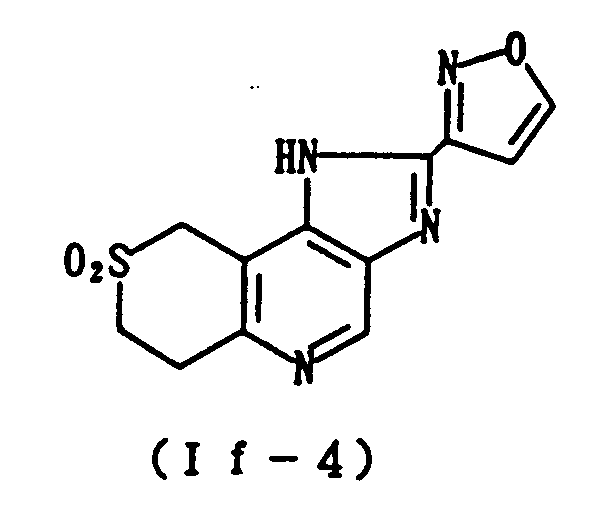
- To a solution of 592 mg of Compound (III2f-1) (obtained in Reference Example 13) in 35 ml of methylene chloride is added 1.42 g of m-chloroperbenzoic acid under ice cooling, and the resultant mixture is stirred at room temperature for 6 hours. The reaction mixture is concentrated in vacuo, and the crystalline residue is washed well with isopropyl ether to give 670 mg of 4-chloro-3-(isoxazole-3-carbonylamino)-1,6,6-trioxo-7,8-dihydro-5H-thiopyrano[4,3-b]pyridine as crystals melting at 218 to 220°C (dec.). Yield: 98%.
- To a solution of 460 mg of the crystals in 92 ml of methylene chloride is dropwise added a solution of 0.26 ml of phosphorus tribromide in 0.3 ml of methylene chloride at temperature from -10 to -5°C, and the resultant mixture is stirred at temperature from 0 to 5°C for 5 hours. The reaction mixture is mixed with ice water, neutralized with potassium carbonate and shaken with chloroform. The extract is dried and concentrated to remove the solvent. The residue is chromatographed on an alumina column, eluting with methylene chloride/isopropyl ether (30 : 1) to give 330 mg of 4-chloro-3-(isoxazolyl-3-carbonylamino)-6,6-dioxo-7,8-dihydro-5H-thiopyrano[4,3-b]pyridine as crystals melting at 200 to 202°C. Yield: 75%.
- Using this compound, the reaction is effected in the same manner as in the method used for converting Compound (III2a-1) (obtained in Reference 9) into Compound (Ia-7), whereby Compound (If-4) is obtained.
mp.: 199 to 202°CElemental Analysis (%) C12H11N4O3SCl·H2O Calculated: C, 41.80; H, 3.80; N, 16.25; S, 9.29; Cl, 10.28 Found: C, 41.53; H, 3.74; N, 16.16; S. 9.12; Cl, 9.99 - The compounds of the present invention show high affinity to cerebral benzodiazepine receptor, and are useful for treating various psychotropic disorders. The study of various drugs having an ability of binding to this receptor has revealed that these drugs can be classified in the following five groups according to their functions (aggressive or suppressive) and their potency (strong or weak) in the central nervous system: 1) Full agonist (central nerve inhibition, antianxiety, anticonvulsion), 2) partial agonist (selective antianxiety), 3) antagonist (antagonism to both aggressive and suppressive actions), 4) partial inverse agonist (central nervous acceleration, convulsion or recognition reinforcing activity, anaesthesia antagonism), 5) full inverse agonist (induction of convulsion or anxiety). Further, it is also known that to which group a particular drug belongs can be determined by measuring the strength of inhibitory or reinforcing activity on the convulsion induced by the administration of pentylenetetrazole [C, Braestrup et al., Biochem. Pharmacol. 33, 859 (1984)]. It is pointed out by M. Sarter et al., TINS 11, 13 (1988), that a partial inverse agonist can be nootropic agent or cognition enhancer, in view of the fact that methyl β-carboline-3-carboxylic acid (β-CCM), a kind of inverse agonist, can reinforce the memorial and learning behavior of an animal, or that diazepam, a kind of agonist, inhibits human memory. Accordingly, of the compounds of the present invention, those showing agonist activity are expected to be useful as antianxiety agents or anti convulsants, those showing antagonistic activity are expected to be useful as antagonists against overdosage of benzodiazepines, and those showing inverse agonist activity are expected to be useful as psychotropic agents, nootropic agents or anaesthesia antagonists.
- The compounds of the present invention were subjected to the following pharmacological experiments. The numbers of the test compounds listed in the tables correspond to those used in the foregoing Examples.
- This test was carried out modifying partially a method of Moehler & Okada, Science, 198, 849-851 (1977). Receptor preparation was provided from the cerebral cortex of male Wistar rats (11-13 weeks age). Inhibitory action of the test compound on the specific binding of tritium-labelled diazepam to the receptor was evaluated as follows: 2nM tritium-labelled diazepam and an aqueous solution of the test compound in 5 or 6 different concentrations were incubated with the receptor preparation at 0°C for 60 minutes. The 50% inhibitory concentration (IC50) was measured by the concentration-response curve. In addition, the inhibitory constant (Ki) of the test compound was calculated by dissociation constant (Kd) and concentration (L) of tritium-labelled diazepam. Table l shows the experimental results.

Table 1 Test Compound Ki (nM) Ia-1 13.7 Ia-3 1.90 Ia-5 3.46 Ia-6 2.19 Ia-7 1.30 Ib-5 6.97 Ib-7 2.09 Ic-3 6.06 Ic-6 2.29 Ic-7 9.47 Id-1 2.55 Id-2 8.94 Ie-1 7.20 If-1 0.44 Ig-1 2.80 - Agonistic activity was evaluated in this Experiment. Pentylenetetrazole was subcutaneously administered male mice (a group of 8-16 male mice was employed in each test) at a dose of 125 mg/kg immediately after intravenous injection of the test compound. The dose (ED50) required to prevent tonic convulsion and death in 50% of the animals during subsequent 2-hour observation period was calculated by the probit method. Table 2 shows the experimental results.
Table 2 Test Compound ED50 (mg/kg) Ia-1 7.85 Ia-6 0.17 Ib-5 0.80 Ic-7 1.05 Id-2 0.74 Ig-1 3.69 - Inverse agonist activity was evaluated in this Experiment. Pentylenetetrazole was subcutaneously administered to male mice (a group of 8-16 male mice was employed in each test) at a dose of 90 mg/kg immediately after intravenous injection of the test compound. The dose (ED50) required to produce tonic convulsion and death in 50% of the animals during the subsequent 2-hour observation period was calculated by the probit method. Table 3 shows the experimental results.
Table 3 Test Compound ED50 (mg/kg) Ib-7 1.27 Id-1 0.40 Ie-1 0.25 If-1 0.96 - As shown above, the compounds of the present invention show high affinity to benzodiazepine receptor and exhibit inhibitory or accelerating activity to the central nervous system.
Claims (12)
- A compound of the formula(I):
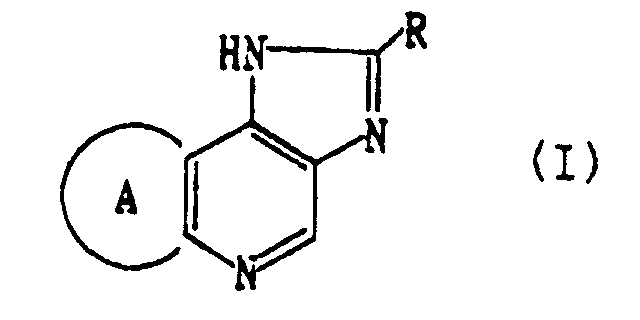 ring A represents a 5 to 9 membered optionally alkyl-substituted alicyclic group or a 5 to 9 membered optionally alkyl-substituted non-aromatic heterocyclic group containing 0, S, SO, SO2, and/or NR1 in which R1 means hydrogen, alkyl, alkoxycarbonyl, carbamoyl or an acyl group; or its salt.
 - A compound as claimed in Claim 1 wherein ring A represents optionally alkyl-substituted cyclopenteno, cyclohexeno, cyclohepteno, cycloocteno, cyclononeno, pyrrolidino, pyrrolino, imidazolidino, imidazolino, pyrazolidino, dihydrothiopheno, dihydrofurano, thiazolino, dihydropyrano, dihydrothiopyrano, piperidino, piperazino, morpholino, thiomorpholino, tetrahydropyridino or tetrahydropyrimidino.
- A compound as claimed in Claim 2 wherein ring A represents cyclopenteno, cyclohexeno, cyclohepteno, dihydropyrano, dihydrothiopyrano or piperidino optionally substituted by 1 to 2 methyl or ethyl groups.
- A compound as claimed in Claims 1, 2 or 3 wherein R represents phenyl optionally substituted by one or more substituents selected from methyl, methoxy and chlorine, or thienyl, furyl, isoxazolyl or pyridyl optionally substituted by methyl.
- A compound as claimed in Claim 4 wherein R represents isoxazolyl optionally substituted by methyl.
- A compound as claimed in Claim 3 wherein the ring A is a dihydrothiopyrano, cyclohexeno, or dihydropyrano ring.
- A compound as claimed in Claim 1, which is 2-(3-isoxazolyl)-1,6,7,9-tetrahydroimidazo[4,5-d]pyrano-[4,3-b]pyridine or its salt.
- A pharmaceutical composition comprising a compound as claimed in any one of the preceding claims together with a carrier or excipient therefor.
- A pharmaceutical composition as claimed in Claim 8 for use in the treatment of a psychotropic disorder.
- A pharmaceutical composition as claimed in Claim 8 for use as an antianxiety agent.
- A pharmaceutical composition as claimed in Claim 8 for use as an anaesthesia antagonistic agent.
- A pharmaceutical composition as claimed in Claim 8 for use as a cerebral function activator.
Applications Claiming Priority (2)
| Application Number | Priority Date | Filing Date | Title |
|---|---|---|---|
| JP59347/92 | 1992-02-12 | ||
| JP5934792 | 1992-02-12 |
Publications (2)
| Publication Number | Publication Date |
|---|---|
| EP0556008A1 EP0556008A1 (en) | 1993-08-18 |
| EP0556008B1 true EP0556008B1 (en) | 1997-05-14 |
Family
ID=13110672
Family Applications (1)
| Application Number | Title | Priority Date | Filing Date |
|---|---|---|---|
| EP93300901A Expired - Lifetime EP0556008B1 (en) | 1992-02-12 | 1993-02-08 | Condensed imidazopyridine derivatives with psychotropic activity |
Country Status (12)
| Country | Link |
|---|---|
| US (2) | US5378848A (en) |
| EP (1) | EP0556008B1 (en) |
| JP (1) | JP2863396B2 (en) |
| KR (1) | KR100242398B1 (en) |
| AT (1) | ATE153023T1 (en) |
| CA (1) | CA2088798C (en) |
| DE (1) | DE69310563T2 (en) |
| DK (1) | DK0556008T3 (en) |
| ES (1) | ES2105099T3 (en) |
| GR (1) | GR3023498T3 (en) |
| HU (1) | HU218950B (en) |
| TW (1) | TW221435B (en) |
Cited By (1)
| Publication number | Priority date | Publication date | Assignee | Title |
|---|---|---|---|---|
| US7049437B2 (en) | 2000-03-30 | 2006-05-23 | Shionogi & Co., Ltd. | Synthetic process and crystal form of condensed imidazopyridine derivatives |
Families Citing this family (47)
| Publication number | Priority date | Publication date | Assignee | Title |
|---|---|---|---|---|
| GB9711257D0 (en) * | 1997-05-30 | 1997-07-30 | Smithkline Beecham Plc | Novel compounds |
| GB9720052D0 (en) * | 1997-09-19 | 1997-11-19 | Smithkline Beecham Plc | Novel compounds |
| TW550080B (en) | 1998-11-17 | 2003-09-01 | Shionogi & Co | Transdermic preparation comprising cerebral function activating agent |
| US6756382B2 (en) | 1999-06-10 | 2004-06-29 | 3M Innovative Properties Company | Amide substituted imidazoquinolines |
| US6573273B1 (en) | 1999-06-10 | 2003-06-03 | 3M Innovative Properties Company | Urea substituted imidazoquinolines |
| US6541485B1 (en) | 1999-06-10 | 2003-04-01 | 3M Innovative Properties Company | Urea substituted imidazoquinolines |
| MXPA04000449A (en) | 2001-07-16 | 2004-03-18 | Shionogi & Co | Process for preparation of amidine derivatives. |
| CA2450073C (en) | 2001-07-25 | 2017-08-29 | Biomarin Pharmaceutical Inc. | Compositions and methods for modulating blood-brain barrier transport |
| WO2003028723A1 (en) * | 2001-09-27 | 2003-04-10 | Saitama Daiichi Pharmaceutical Co., Ltd. | Pharmaceutical compositions for percutaneous absorption containing fused imidazopyridine derivatives |
| US6677349B1 (en) | 2001-12-21 | 2004-01-13 | 3M Innovative Properties Company | Sulfonamide and sulfamide substituted imidazoquinolines |
| JPWO2004078173A1 (en) * | 2003-02-05 | 2006-06-08 | 塩野義製薬株式会社 | Tablets with improved dissolution |
| WO2004096144A2 (en) * | 2003-04-28 | 2004-11-11 | 3M Innovative Properties Company | Compositions and methods for induction of opioid receptors |
| US7176214B2 (en) | 2003-05-21 | 2007-02-13 | Bristol-Myers Squibb Company | Imidazo-fused oxazolo[4,5-β]pyridine and imidazo-fused thiazolo[4,5-β]pyridine based tricyclic compounds and pharmaceutical compositions comprising same |
| WO2005018556A2 (en) * | 2003-08-12 | 2005-03-03 | 3M Innovative Properties Company | Hydroxylamine substituted imidazo-containing compounds |
| RU2006105101A (en) * | 2003-08-27 | 2007-10-10 | 3М Инновейтив Пропертиз Компани (US) | Aryloxy and arylalkylene-substituted substituted imidazoquinolines |
| WO2005023190A2 (en) * | 2003-09-05 | 2005-03-17 | 3M Innovative Properties Company | Treatment for cd5+ b cell lymphoma |
| US8871782B2 (en) * | 2003-10-03 | 2014-10-28 | 3M Innovative Properties Company | Alkoxy substituted imidazoquinolines |
| US20090075980A1 (en) * | 2003-10-03 | 2009-03-19 | Coley Pharmaceutical Group, Inc. | Pyrazolopyridines and Analogs Thereof |
| US7544697B2 (en) * | 2003-10-03 | 2009-06-09 | Coley Pharmaceutical Group, Inc. | Pyrazolopyridines and analogs thereof |
| CA2545774A1 (en) | 2003-11-14 | 2005-06-02 | 3M Innovative Properties Company | Oxime substituted imidazo ring compounds |
| US8598192B2 (en) * | 2003-11-14 | 2013-12-03 | 3M Innovative Properties Company | Hydroxylamine substituted imidazoquinolines |
| AR046781A1 (en) * | 2003-11-25 | 2005-12-21 | 3M Innovative Properties Co | IMIDAZOQUINOLINE DERIVATIVES. PHARMACEUTICAL COMPOSITIONS. |
| WO2005066170A1 (en) * | 2003-12-29 | 2005-07-21 | 3M Innovative Properties Company | Arylalkenyl and arylalkynyl substituted imidazoquinolines |
| CA2551399A1 (en) * | 2003-12-30 | 2005-07-21 | 3M Innovative Properties Company | Imidazoquinolinyl, imidazopyridinyl, and imidazonaphthyridinyl sulfonamides |
| AU2005228150A1 (en) * | 2004-03-24 | 2005-10-13 | 3M Innovative Properties Company | Amide substituted imidazopyridines, imidazoquinolines, and imidazonaphthyridines |
| WO2005123080A2 (en) * | 2004-06-15 | 2005-12-29 | 3M Innovative Properties Company | Nitrogen-containing heterocyclyl substituted imidazoquinolines and imidazonaphthyridines |
| WO2006009832A1 (en) * | 2004-06-18 | 2006-01-26 | 3M Innovative Properties Company | Substituted imidazo ring systems and methods |
| US8026366B2 (en) * | 2004-06-18 | 2011-09-27 | 3M Innovative Properties Company | Aryloxy and arylalkyleneoxy substituted thiazoloquinolines and thiazolonaphthyridines |
| WO2006038923A2 (en) * | 2004-06-18 | 2006-04-13 | 3M Innovative Properties Company | Aryl substituted imidazonaphthyridines |
| WO2006065280A2 (en) * | 2004-06-18 | 2006-06-22 | 3M Innovative Properties Company | Isoxazole, dihydroisoxazole, and oxadiazole substituted imidazo ring compounds and methods |
| US20090270443A1 (en) * | 2004-09-02 | 2009-10-29 | Doris Stoermer | 1-amino imidazo-containing compounds and methods |
| EP1819364A4 (en) * | 2004-12-08 | 2010-12-29 | 3M Innovative Properties Co | Immunomodulatory compositions, combinations and methods |
| EP1831226B1 (en) * | 2004-12-30 | 2012-08-08 | 3M Innovative Properties Company | Chiral tetracyclic compounds inducing interferon biosynthesis |
| AU2005326708C1 (en) | 2004-12-30 | 2012-08-30 | 3M Innovative Properties Company | Substituted chiral fused [1,2]imidazo[4,5-c] ring compounds |
| AU2006210392A1 (en) * | 2005-02-04 | 2006-08-10 | Coley Pharmaceutical Group, Inc. | Aqueous gel formulations containing immune response modifiers |
| CA2597587A1 (en) | 2005-02-11 | 2006-08-17 | Coley Pharmaceutical Group, Inc. | Oxime and hydroxylamine substituted imidazo[4,5-c] ring compounds and methods |
| US7943636B2 (en) | 2005-04-01 | 2011-05-17 | 3M Innovative Properties Company | 1-substituted pyrazolo (3,4-C) ring compounds as modulators of cytokine biosynthesis for the treatment of viral infections and neoplastic diseases |
| WO2006107853A2 (en) | 2005-04-01 | 2006-10-12 | Coley Pharmaceutical Group, Inc. | Pyrazolopyridine-1,4-diamines and analogs thereof |
| EP2671508B1 (en) | 2005-04-28 | 2020-09-16 | Proteus Digital Health, Inc. | Pharma-informatics system |
| BRPI0616338A2 (en) * | 2005-09-23 | 2011-06-14 | Coley Pharm Group Inc | Method for 1h-imidazo [4,5-c] pyridines and analogs thereof |
| US7906506B2 (en) * | 2006-07-12 | 2011-03-15 | 3M Innovative Properties Company | Substituted chiral fused [1,2] imidazo [4,5-c] ring compounds and methods |
| JP2010503710A (en) | 2006-09-18 | 2010-02-04 | ラプトール ファーマシューティカル インコーポレイテッド | Treatment of liver damage by administration of receptor-related protein (RAP) conjugates |
| TWI321503B (en) | 2007-06-15 | 2010-03-11 | Univ Nat Taiwan Science Tech | The analytical method of the effective polishing frequency and number of times towards the polishing pads having different grooves and profiles |
| ES2919563T3 (en) | 2009-02-20 | 2022-07-27 | Enhanx Biopharm Inc | Glutathione-based drug delivery system |
| KR20180114970A (en) | 2009-05-06 | 2018-10-19 | 라보라토리 스킨 케어, 인크. | Dermal delivery compositions comprising active agent-calcium phosphate particle complexes and methods of using the same |
| CN102712640A (en) * | 2010-01-12 | 2012-10-03 | 弗·哈夫曼-拉罗切有限公司 | Tricyclic heterocyclic compounds, compositions and methods of use thereof |
| US20120077778A1 (en) | 2010-09-29 | 2012-03-29 | Andrea Bourdelais | Ladder-Frame Polyether Conjugates |
Family Cites Families (2)
| Publication number | Priority date | Publication date | Assignee | Title |
|---|---|---|---|---|
| CA1263651A (en) * | 1984-07-09 | 1989-12-05 | Ciba-Geigy Ag | Certain ring-fused pyrazolo ¬3,4-d|-pyridin-3-one derivatives |
| CA1306260C (en) * | 1985-10-18 | 1992-08-11 | Shionogi & Co., Ltd. | Condensed imidazopyridine derivatives |
-
1993
- 1993-02-02 US US08/012,424 patent/US5378848A/en not_active Expired - Lifetime
- 1993-02-04 CA CA002088798A patent/CA2088798C/en not_active Expired - Fee Related
- 1993-02-04 TW TW082100759A patent/TW221435B/zh active
- 1993-02-08 EP EP93300901A patent/EP0556008B1/en not_active Expired - Lifetime
- 1993-02-08 DE DE69310563T patent/DE69310563T2/en not_active Expired - Fee Related
- 1993-02-08 ES ES93300901T patent/ES2105099T3/en not_active Expired - Lifetime
- 1993-02-08 AT AT93300901T patent/ATE153023T1/en not_active IP Right Cessation
- 1993-02-08 DK DK93300901.1T patent/DK0556008T3/en active
- 1993-02-10 JP JP5022444A patent/JP2863396B2/en not_active Expired - Fee Related
- 1993-02-11 KR KR1019930001859A patent/KR100242398B1/en not_active Expired - Fee Related
- 1993-02-12 HU HU9300376A patent/HU218950B/en not_active IP Right Cessation
-
1994
- 1994-08-30 US US08/297,885 patent/US5461062A/en not_active Expired - Lifetime
-
1997
- 1997-05-20 GR GR970401147T patent/GR3023498T3/en unknown
Cited By (1)
| Publication number | Priority date | Publication date | Assignee | Title |
|---|---|---|---|---|
| US7049437B2 (en) | 2000-03-30 | 2006-05-23 | Shionogi & Co., Ltd. | Synthetic process and crystal form of condensed imidazopyridine derivatives |
Also Published As
| Publication number | Publication date |
|---|---|
| GR3023498T3 (en) | 1997-08-29 |
| HUT70035A (en) | 1995-09-28 |
| ES2105099T3 (en) | 1997-10-16 |
| DE69310563D1 (en) | 1997-06-19 |
| DE69310563T2 (en) | 1997-11-13 |
| JPH05286973A (en) | 1993-11-02 |
| US5461062A (en) | 1995-10-24 |
| HU218950B (en) | 2001-01-29 |
| CA2088798C (en) | 2003-08-05 |
| KR100242398B1 (en) | 2000-03-02 |
| EP0556008A1 (en) | 1993-08-18 |
| CA2088798A1 (en) | 1993-08-23 |
| US5378848A (en) | 1995-01-03 |
| TW221435B (en) | 1994-03-01 |
| HU9300376D0 (en) | 1993-04-28 |
| KR930017904A (en) | 1993-09-20 |
| JP2863396B2 (en) | 1999-03-03 |
| DK0556008T3 (en) | 1997-06-09 |
| ATE153023T1 (en) | 1997-05-15 |
Similar Documents
| Publication | Publication Date | Title |
|---|---|---|
| US5461062A (en) | Condensed imidazopyridine derivatives | |
| KR910001136B1 (en) | Process for the preparation of condensed imidazo pyridine derivatives | |
| AU659027B2 (en) | Substituted thienyl- or pyrrolylcarboxyclic acid derivatives, their preparation and medicines containing them | |
| EP0971922B1 (en) | Tetrahydropyrido compounds | |
| Althuis et al. | Development of ethyl 3, 4-dihydro-4-oxopyrimido [4, 5-b] quinoline-2-carboxylate, a new prototype with oral antiallergy activity | |
| PL175932B1 (en) | Novel imidazopyridines | |
| KR100523422B1 (en) | Tetrahydropyrido compounds | |
| EP1408041A1 (en) | Process for preparation of amidine derivatives | |
| JPS59130882A (en) | Heterocyclic fused pyrazolo[3,4-d]pyridin-3-one | |
| EP0459505A1 (en) | Imidazonaphthyridine derivatives | |
| EP0417790B1 (en) | S-triazolo[3,4-i]purine derivatives | |
| US4239887A (en) | Pyridothienotriazines | |
| NZ248841A (en) | Pyrido[4,3-b]carbazole derivatives (or ellipticines) and medicaments | |
| US4447361A (en) | Aryl substituted pyrido[1,4]benzodiazepines | |
| US4400382A (en) | Thiazoloquinoxalin-1,4-diones for treating allergy | |
| US4668678A (en) | Triazoloquinoxalin-1,4-diones | |
| EP0526840B1 (en) | Condensed naphthyridine derivatives | |
| AU705938B2 (en) | Pyridazino quinoline compounds | |
| US4507300A (en) | Pyridotriazolopyrazine-diones for treating allergy | |
| JP2531678B2 (en) | Triazolopyridazine derivative | |
| EP0177065B1 (en) | Thienotriazines | |
| EP0039920A2 (en) | Triazaloquinoxalin-1,4-diones | |
| EP0076017B1 (en) | Phenyl substituted pyrido(1,4)benzodiazepines and intermediates therefor | |
| US4668675A (en) | 2-[(amino-pyridinyl)amine]phenyl]aryl methanones, their thioxomethyl, ketal or thioketal analogs | |
| Shehata | Synthesis of some fused quinoline derivatives |
Legal Events
| Date | Code | Title | Description |
|---|---|---|---|
| PUAI | Public reference made under article 153(3) epc to a published international application that has entered the european phase |
Free format text: ORIGINAL CODE: 0009012 |
|
| AK | Designated contracting states |
Kind code of ref document: A1 Designated state(s): AT BE CH DE DK ES FR GB GR IE IT LI LU MC NL PT SE |
|
| 17P | Request for examination filed |
Effective date: 19930813 |
|
| RAP3 | Party data changed (applicant data changed or rights of an application transferred) |
Owner name: SHIONOGI & CO., LTD. |
|
| 17Q | First examination report despatched |
Effective date: 19950406 |
|
| GRAG | Despatch of communication of intention to grant |
Free format text: ORIGINAL CODE: EPIDOS AGRA |
|
| GRAH | Despatch of communication of intention to grant a patent |
Free format text: ORIGINAL CODE: EPIDOS IGRA |
|
| GRAH | Despatch of communication of intention to grant a patent |
Free format text: ORIGINAL CODE: EPIDOS IGRA |
|
| GRAA | (expected) grant |
Free format text: ORIGINAL CODE: 0009210 |
|
| AK | Designated contracting states |
Kind code of ref document: B1 Designated state(s): AT BE CH DE DK ES FR GB GR IE IT LI LU MC NL PT SE |
|
| REF | Corresponds to: |
Ref document number: 153023 Country of ref document: AT Date of ref document: 19970515 Kind code of ref document: T |
|
| REG | Reference to a national code |
Ref country code: CH Ref legal event code: NV Representative=s name: A. BRAUN, BRAUN, HERITIER, ESCHMANN AG PATENTANWAE Ref country code: CH Ref legal event code: EP |
|
| REG | Reference to a national code |
Ref country code: DK Ref legal event code: T3 |
|
| REF | Corresponds to: |
Ref document number: 69310563 Country of ref document: DE Date of ref document: 19970619 |
|
| ET | Fr: translation filed | ||
| REG | Reference to a national code |
Ref country code: GR Ref legal event code: FG4A Free format text: 3023498 |
|
| REG | Reference to a national code |
Ref country code: ES Ref legal event code: FG2A Ref document number: 2105099 Country of ref document: ES Kind code of ref document: T3 |
|
| REG | Reference to a national code |
Ref country code: PT Ref legal event code: SC4A Free format text: AVAILABILITY OF NATIONAL TRANSLATION Effective date: 19970813 |
|
| PLBE | No opposition filed within time limit |
Free format text: ORIGINAL CODE: 0009261 |
|
| STAA | Information on the status of an ep patent application or granted ep patent |
Free format text: STATUS: NO OPPOSITION FILED WITHIN TIME LIMIT |
|
| 26N | No opposition filed | ||
| PG25 | Lapsed in a contracting state [announced via postgrant information from national office to epo] |
Ref country code: MC Free format text: LAPSE BECAUSE OF NON-PAYMENT OF DUE FEES Effective date: 19980831 |
|
| REG | Reference to a national code |
Ref country code: GB Ref legal event code: IF02 |
|
| PGFP | Annual fee paid to national office [announced via postgrant information from national office to epo] |
Ref country code: DE Payment date: 20070201 Year of fee payment: 15 |
|
| PGFP | Annual fee paid to national office [announced via postgrant information from national office to epo] |
Ref country code: SE Payment date: 20070206 Year of fee payment: 15 |
|
| PGFP | Annual fee paid to national office [announced via postgrant information from national office to epo] |
Ref country code: PT Payment date: 20070207 Year of fee payment: 15 Ref country code: GB Payment date: 20070207 Year of fee payment: 15 |
|
| PGFP | Annual fee paid to national office [announced via postgrant information from national office to epo] |
Ref country code: AT Payment date: 20070213 Year of fee payment: 15 |
|
| PGFP | Annual fee paid to national office [announced via postgrant information from national office to epo] |
Ref country code: LU Payment date: 20070214 Year of fee payment: 15 Ref country code: CH Payment date: 20070214 Year of fee payment: 15 |
|
| PGFP | Annual fee paid to national office [announced via postgrant information from national office to epo] |
Ref country code: NL Payment date: 20070215 Year of fee payment: 15 Ref country code: DK Payment date: 20070215 Year of fee payment: 15 |
|
| PGFP | Annual fee paid to national office [announced via postgrant information from national office to epo] |
Ref country code: IE Payment date: 20070220 Year of fee payment: 15 |
|
| PGFP | Annual fee paid to national office [announced via postgrant information from national office to epo] |
Ref country code: ES Payment date: 20070228 Year of fee payment: 15 |
|
| PGFP | Annual fee paid to national office [announced via postgrant information from national office to epo] |
Ref country code: IT Payment date: 20070622 Year of fee payment: 15 Ref country code: BE Payment date: 20070413 Year of fee payment: 15 |
|
| PGFP | Annual fee paid to national office [announced via postgrant information from national office to epo] |
Ref country code: GR Payment date: 20070118 Year of fee payment: 15 |
|
| PGFP | Annual fee paid to national office [announced via postgrant information from national office to epo] |
Ref country code: FR Payment date: 20070208 Year of fee payment: 15 |
|
| REG | Reference to a national code |
Ref country code: CH Ref legal event code: PFA Owner name: SHIONOGI & CO., LTD. Free format text: SHIONOGI & CO., LTD.#1-8, DOSHOMACHI 3-CHOME, CHUO-KU#OSAKA 541 (JP) -TRANSFER TO- SHIONOGI & CO., LTD.#1-8, DOSHOMACHI 3-CHOME, CHUO-KU#OSAKA 541 (JP) |
|
| REG | Reference to a national code |
Ref country code: PT Ref legal event code: MM4A Free format text: LAPSE DUE TO NON-PAYMENT OF FEES Effective date: 20080808 |
|
| BERE | Be: lapsed |
Owner name: *SHIONOGI & CO. LTD Effective date: 20080228 |
|
| REG | Reference to a national code |
Ref country code: DK Ref legal event code: EBP |
|
| REG | Reference to a national code |
Ref country code: CH Ref legal event code: PL |
|
| EUG | Se: european patent has lapsed | ||
| GBPC | Gb: european patent ceased through non-payment of renewal fee |
Effective date: 20080208 |
|
| PG25 | Lapsed in a contracting state [announced via postgrant information from national office to epo] |
Ref country code: PT Free format text: LAPSE BECAUSE OF NON-PAYMENT OF DUE FEES Effective date: 20080808 Ref country code: LI Free format text: LAPSE BECAUSE OF NON-PAYMENT OF DUE FEES Effective date: 20080229 Ref country code: CH Free format text: LAPSE BECAUSE OF NON-PAYMENT OF DUE FEES Effective date: 20080229 |
|
| NLV4 | Nl: lapsed or anulled due to non-payment of the annual fee |
Effective date: 20080901 |
|
| REG | Reference to a national code |
Ref country code: IE Ref legal event code: MM4A |
|
| PG25 | Lapsed in a contracting state [announced via postgrant information from national office to epo] |
Ref country code: NL Free format text: LAPSE BECAUSE OF NON-PAYMENT OF DUE FEES Effective date: 20080901 Ref country code: AT Free format text: LAPSE BECAUSE OF NON-PAYMENT OF DUE FEES Effective date: 20080208 |
|
| REG | Reference to a national code |
Ref country code: FR Ref legal event code: ST Effective date: 20081031 |
|
| PG25 | Lapsed in a contracting state [announced via postgrant information from national office to epo] |
Ref country code: SE Free format text: LAPSE BECAUSE OF NON-PAYMENT OF DUE FEES Effective date: 20080209 Ref country code: IE Free format text: LAPSE BECAUSE OF NON-PAYMENT OF DUE FEES Effective date: 20080208 Ref country code: DK Free format text: LAPSE BECAUSE OF NON-PAYMENT OF DUE FEES Effective date: 20080229 Ref country code: DE Free format text: LAPSE BECAUSE OF NON-PAYMENT OF DUE FEES Effective date: 20080902 |
|
| PG25 | Lapsed in a contracting state [announced via postgrant information from national office to epo] |
Ref country code: BE Free format text: LAPSE BECAUSE OF NON-PAYMENT OF DUE FEES Effective date: 20080228 |
|
| PG25 | Lapsed in a contracting state [announced via postgrant information from national office to epo] |
Ref country code: FR Free format text: LAPSE BECAUSE OF NON-PAYMENT OF DUE FEES Effective date: 20080229 |
|
| REG | Reference to a national code |
Ref country code: ES Ref legal event code: FD2A Effective date: 20080209 |
|
| PG25 | Lapsed in a contracting state [announced via postgrant information from national office to epo] |
Ref country code: GR Free format text: LAPSE BECAUSE OF NON-PAYMENT OF DUE FEES Effective date: 20080903 Ref country code: GB Free format text: LAPSE BECAUSE OF NON-PAYMENT OF DUE FEES Effective date: 20080208 |
|
| PG25 | Lapsed in a contracting state [announced via postgrant information from national office to epo] |
Ref country code: ES Free format text: LAPSE BECAUSE OF NON-PAYMENT OF DUE FEES Effective date: 20080209 |
|
| PG25 | Lapsed in a contracting state [announced via postgrant information from national office to epo] |
Ref country code: IT Free format text: LAPSE BECAUSE OF NON-PAYMENT OF DUE FEES Effective date: 20080208 |
|
| PG25 | Lapsed in a contracting state [announced via postgrant information from national office to epo] |
Ref country code: LU Free format text: LAPSE BECAUSE OF NON-PAYMENT OF DUE FEES Effective date: 20080208 |