EP0555587B1 - Computer system with multiple data format and cryptographic module - Google Patents
Computer system with multiple data format and cryptographic module Download PDFInfo
- Publication number
- EP0555587B1 EP0555587B1 EP92310897A EP92310897A EP0555587B1 EP 0555587 B1 EP0555587 B1 EP 0555587B1 EP 92310897 A EP92310897 A EP 92310897A EP 92310897 A EP92310897 A EP 92310897A EP 0555587 B1 EP0555587 B1 EP 0555587B1
- Authority
- EP
- European Patent Office
- Prior art keywords
- character
- data
- functional module
- bits
- service
- Prior art date
- Legal status (The legal status is an assumption and is not a legal conclusion. Google has not performed a legal analysis and makes no representation as to the accuracy of the status listed.)
- Expired - Lifetime
Links
Images


Classifications
-
- G—PHYSICS
- G06—COMPUTING OR CALCULATING; COUNTING
- G06F—ELECTRIC DIGITAL DATA PROCESSING
- G06F21/00—Security arrangements for protecting computers, components thereof, programs or data against unauthorised activity
- G06F21/60—Protecting data
- G06F21/606—Protecting data by securing the transmission between two devices or processes
Definitions
- This invention relates to computer systems.
- the invention is concerned with a mechanism for interfacing between different functional modules in a computer system.
- the invention is particularly, although not exclusively, concerned with providing a mechanism for interfacing between client application modules and cryptographic modules.
- Cryptographic modules view the data they process as bit strings.
- Client applications generally view the data in terms of a character representation, optimised for the underlying hardware of the host machine (eg 8, 9 or 16 bits). This normally means that an implementation of a cryptographic module has to be aware of how bits are encoded in the character representation, and thus different implementations would be required for different machine environments.
- data which is to be transferred to a different machine environment will normally conform to some agreed transfer format (eg 8 bit ASCII, ASN.1 Basic Encoding Rules).
- some agreed transfer format eg 8 bit ASCII, ASN.1 Basic Encoding Rules
- data being transferred from a 9-bit character machine to a 8-bit character machine could be encoded as 8-bit ASCII, the most significant bit not being used on the 9-bit machine. If this data is to be cryptographically processed prior to transfer, the implementation of the cryptographic module would normally need to be aware of this so it does not encrypt the unused bits.
- the object of the present invention is to provide a novel way of solving the problem of interfacing between functional modules where those modules handle data in different formats.
- a computer system including a first functional module which handles data in character format, a second functional module which handles data in bit-string format, and a data block holding data in character format for passing to or from the first functional module; characterised in that said data block is encapsulated as an object comprising:
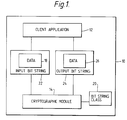
- FIG. 1 is a block schematic diagram of a computer system embodying an interface mechanism in accordance with the invention.
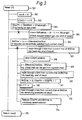
- Figures 2 - 4 are flow diagrams illustrating the operation of the interface mechanism.
- the system comprises a host computer 10 which may for example, be an ICL DRS 6000 system.
- the host computer 10 runs a number of software modules including a client application 12 and a cryptographic module 14. It is assumed that the client application 12 requires to use the services of the cryptographic module 14 to encrypt a specified block of data 18. It is also assumed that the client application 12 views the data in terms of a character representation, while the cryptographic module 14 views the data in terms of a bit string.
- the present system is implemented using a technique known as object oriented design, using the C programming language.
- object oriented design For further details of object oriented design reference is made to "Object-Oriented Analysis”, P Coad & E Yourdan, Prentice Hall (1991), and "Object-Oriented Design”, P Coad & E Yourdan, Prentice Hall, 1991.
- OOD Object-Oriented Design
- An object Central to OOD is the concept of an 'object'.
- An object embodies an abstraction of information which is meaningful to its clients. It has the following properties:
- 'operator' or method' are sometimes used instead of 'service'. Clients do not generally directly access the data in an object; they send 'messages' to the object requesting services to be carried out to access or manipulate the actual data in the object.
- the term 'request' is sometimes used instead of 'message'.
- a service may be classified as:
- objects provide information-hiding by data encapsulation.
- a system can guarantee certain integrity constraints of the object. It is also possible to change the object implementation without affecting the clients, unless there is a change in the nature of the services provided.
- bit string class 20 can be used to create instances of objects referred to herein as bit string objects, which encapsulate data. More specifically, an input bit string object 22 is created to encapsulate a data block passed from the client application to the cryptographic module, and an output bit string object 24 is created to encapsulate a data block passed from the cryptographic module back to the client application. Bit string objects are also created to encapsulate initialisation vectors and key values used by the cryptographic module.
- Each bit string object includes the following data values which represent the state of the object:
- Each bit string object also includes the following services:
- each bit string object also includes various access functions.
- the client application when it has a block of data 18 to be processed by the cryptographic module, it calls the cryptographic module and passes it the data block.
- the cryptographic module then uses the bit string class 20 to create an input bit string object 22, encapsulating the input data block. It also uses the bit string class 20 to create an output bit string object 24, encapsulating an output data block 26 of sufficient size to hold the data that will be produced by the cryptographic module.
- the cryptographic module then uses the services provided by the input bit string object 22 to read the data from the input data block 18, treating it as a bit string. As the data is read, the cryptographic module processes the data, to generate an output bit string, and uses the services provided by the output bit string object 24 to write this bit string into the output data block 26 as a string of characters.
- the cryptographic module When the cryptographic module has completed its processing, it returns the output data block 26 to the client application.
- both the bit string objects 22, 24 can be destroyed, using the destructor service of the bit string class object 20.
- this service moves the current position to an absolute bit or octet position within the data.
- a call to the GoTo service contains two parameters, n and option.
- the option parameter has one of four values, indicating whether the current position is to be moved to a bit position, an octet position, or to the last octet or bit of the data.
- the parameter n indicates which bit or octet position.
- n is set to indicate the required position in terms of bits. A return is then made from the GoTo service. Otherwise, the operation continues as follows.
- n is divided by m, and the integral part (n div m) of the result is used to position the character pointer, while the remainder (n mod m) is used to determine the bit position within this character. A return is then made from the GoTo service. Otherwise, the operation continues as follows.
- a check is made to ensure that n is less than the bit length of the data. If so, n is divided by the effective character size. The integral part of the result is used to position the character pointer, while the remainder determines the bit position within his character (boxes 214, 215). A return (box 216) is then made from the GoTo service.
- a call (box 301) to the Read service contains a parameter n which specifies the number of bits to be fetched.
- n specifies the number of bits to be fetched.
- the maximum value of n is 8, ie up to 8 bits can be fetched in each Read call.
- a result output bit string is initialised to zero, and a check is made that n is less than or equal to the maximum value 8. If it exceeds this value, a return is made with an error message.
- a check (box 306) is then made to determine whether the current request can be satisfied entirely from within the current character. If so, then as shown in box 307 the next n bits are taken from the current character and placed in the least significant end of the result bit string. A return is then made.
- the current position is saved.
- the number (x) of bits that can be obtained from the current character is then determined, and these x bits are taken from the current character and placed in the least significant end of the result bit string.
- the character pointer is then advanced by one, and the bit position within the character reset to zero.
- the number y of bits still required is then determined, and these y bits are then taken from the new character position and placed into the remaining positions of the result bit string.
- the previously saved position is restored, and a return (box 317) is made.
- a call (box 401) to the Write service contains a parameter n which specifies the number of bits to be written, where n is less than or equal to 8.
- the call also includes a bit string outbits which contains the bits to be written.
- a check (box 402) is made to ensure that n does not exceed the permitted maximum value 8. If it does exceed this value, a return is made with an error message.
- a check (box 405) is then made to determine whether the request can be entirely satisfied by writing to the current character. If so, then as shown in box 406 n bits from the outbits string are written to the data at the current bit position. A return is then made (box 414).
- the current position is saved.
- the number of bits x that can be written to the current character is then determined, and the first x bits of the outbits string are written to the data at the current position.
- the character pointer is then advanced by one and the bit position within the character is reset to zero.
- the number of remaining bits y is then determined, and the y remaining bits of the outbits string are written to the new current position.
- the previously saved position is restored, and a return (box 416) is made.
- the Forward and Back services simply adjust the positions of the various pointers, and need not be described herein in further detail.
Landscapes
- Engineering & Computer Science (AREA)
- Theoretical Computer Science (AREA)
- Health & Medical Sciences (AREA)
- Bioethics (AREA)
- General Health & Medical Sciences (AREA)
- Computer Hardware Design (AREA)
- Computer Security & Cryptography (AREA)
- Software Systems (AREA)
- Physics & Mathematics (AREA)
- General Engineering & Computer Science (AREA)
- General Physics & Mathematics (AREA)
- Communication Control (AREA)
Description
characterised in that said data block is encapsulated as an object comprising:
- Modifier -
- alters the state of an object;
- Selector -
- accesses the state of an object without modifying it;
- Iterator -
- permits the parts of an object to be visited;
- Constructor -
- creates an object initialising its state;
- Destructor -
- destroys the object freeing its state.
- DataStart -
- a pointer to the start of the data;
- CharLength -
- the length of the data in the machine's character representation;
- BitLength -
- the length of the data in bits usable by the algorithm;
- EffectiveCharSize -
- the number of used bits within a character;
- BufferDeletion -
- a flag which indicates whether the data is freed when the object is deleted;
- CharPtr -
- a pointer to the current character position;
- BitPosition -
- the current bit position relative to the start of the data;
- BitChar -
- the current bit position within the current character.
- GoTo -
- move current position to an absolute bit or octet position;
- Read -
- fetch the next n bits or octets from the current position;
- Write -
- write n bits to the current position;
- Forward -
- move current position forward by n bits or octets;
- Back -
- move current position back by n bits or octets;
- Create -
- constructor function for creating a bit string object;
- Release -
- destructor function for releasing a bit string object.
Claims (7)
- A computer system including a first functional module (12) which handles data in character format, a second functional module (14) which handles data in bit-string format, and a data block (18; 26) holding data in character format for passing to or from the first functional module;
characterised in that said data block is encapsulated as an object (22; 24) comprising:first (CharPtr) and second (BitChar) pointers, respectively indicating a current character position and a current bit-within-character position, thereby defining a current bit position (BitPosition) within the data block;an effective-character-size value (EffectiveCharSize), indicating the number of used bits within each character; anda data accessing service, responsive to a call from the second functional module, for accessing a specified number of bits in the data block, starting from the current bit position as defined by said first and second pointers and taking account of said effective-character-size value. - A system according to Claim 1 wherein said data accessing service comprises a "Read" service, responsive to a call from the second functional module, for reading a specified number of bits from the data block, starting from the current bit position as defined by said first and second pointers and taking account of said effective-character-size value.
- A system according to Claim 1 or 2 wherein said data accessing service comprises a "Write" service, responsive to a call from the second functional module, for writing a specified number of bits to the data block, starting from the current bit position as defined by said first and second pointers and taking account of said effective-character-size value.
- A system according to any preceding claim wherein said object (22; 24) further includes a "Goto" service, responsive to a call from the second functional module, for setting said first and second pointers to values corresponding to a specified bit position in the data when viewed as a bit string, taking account of said effective-character-size value.
- A system according to any preceding claim wherein the first functional module is a client application module (12) and the second functional module is a cryptographic services module (14).
- A system according to any preceding claim wherein the system further includes means for creating an instance of said object (22; 24) from a generalised class object (20).
- A system according to any preceding claim wherein the said object (22; 24) further includes a "Release" service for releasing that object after use.
Applications Claiming Priority (2)
| Application Number | Priority Date | Filing Date | Title |
|---|---|---|---|
| GB929203236A GB9203236D0 (en) | 1992-02-13 | 1992-02-13 | Computer systems |
| GB9203236 | 1992-02-13 |
Publications (2)
| Publication Number | Publication Date |
|---|---|
| EP0555587A1 EP0555587A1 (en) | 1993-08-18 |
| EP0555587B1 true EP0555587B1 (en) | 1998-06-17 |
Family
ID=10710450
Family Applications (1)
| Application Number | Title | Priority Date | Filing Date |
|---|---|---|---|
| EP92310897A Expired - Lifetime EP0555587B1 (en) | 1992-02-13 | 1992-11-30 | Computer system with multiple data format and cryptographic module |
Country Status (5)
| Country | Link |
|---|---|
| EP (1) | EP0555587B1 (en) |
| AU (1) | AU3301193A (en) |
| DE (1) | DE69225950T2 (en) |
| GB (1) | GB9203236D0 (en) |
| ZA (1) | ZA929481B (en) |
-
1992
- 1992-02-13 GB GB929203236A patent/GB9203236D0/en active Pending
- 1992-11-30 EP EP92310897A patent/EP0555587B1/en not_active Expired - Lifetime
- 1992-11-30 DE DE69225950T patent/DE69225950T2/en not_active Expired - Fee Related
- 1992-12-07 ZA ZA929481A patent/ZA929481B/en unknown
-
1993
- 1993-02-12 AU AU33011/93A patent/AU3301193A/en not_active Abandoned
Also Published As
| Publication number | Publication date |
|---|---|
| DE69225950T2 (en) | 1999-01-21 |
| ZA929481B (en) | 1993-06-10 |
| EP0555587A1 (en) | 1993-08-18 |
| DE69225950D1 (en) | 1998-07-23 |
| AU3301193A (en) | 1993-08-19 |
| GB9203236D0 (en) | 1992-04-01 |
Similar Documents
| Publication | Publication Date | Title |
|---|---|---|
| US6397336B2 (en) | Integrated network security access control system | |
| US6813640B1 (en) | System and method for controlling the editing by user action of digital objects created in a document server application | |
| US5944781A (en) | Persistent executable object system and method | |
| EP0325776B1 (en) | A trusted path mechanism for an operating system | |
| KR940003325B1 (en) | Inverter and method of virtual input / output command | |
| US4882674A (en) | Apparatus and method for control of one computer system by another computer system | |
| US8924928B1 (en) | Rule-based, run-time-alterable, client-agnostic client-server system | |
| RU2334268C2 (en) | Commands supporting processing of encoded message | |
| US20020073324A1 (en) | System and method for efficiently performing a data encryption operation | |
| US7171546B2 (en) | CPU life-extension apparatus and method | |
| US20020112158A1 (en) | Executable file protection | |
| US6360244B1 (en) | System and method for multi-level memory domain protection | |
| US12511124B2 (en) | Static identifications in object-based memory access | |
| US6754819B1 (en) | Method and system for providing cryptographic services in a distributed application | |
| JP3329394B2 (en) | Data processing system with cryptographic facilities | |
| US5802276A (en) | Information handling system, method, and article of manufacture including a vault object for encapsulation of object security credentials | |
| CN114416773A (en) | Data processing method, device, storage medium and server | |
| CN1307563C (en) | Encryption device, encryption system, decryption device and a semiconductor system | |
| KR100288843B1 (en) | Object-oriented programming environment that provides object encapsulation via encryption | |
| WO2000034856A2 (en) | System and method for controlling the usage of digital objects | |
| US20060235876A1 (en) | System and method for sharing an object between applications | |
| Viles et al. | Enabling Flexibility in the Legion Run-Time Library. | |
| EP0555587A1 (en) | Computer system with multiple data format and cryptographic module | |
| GB2259590A (en) | Modifying a cryptographic facility of a data processing system | |
| JPH08212139A (en) | Equipment and method for data protection |
Legal Events
| Date | Code | Title | Description |
|---|---|---|---|
| PUAI | Public reference made under article 153(3) epc to a published international application that has entered the european phase |
Free format text: ORIGINAL CODE: 0009012 |
|
| AK | Designated contracting states |
Kind code of ref document: A1 Designated state(s): BE DE FR GB IT |
|
| 17P | Request for examination filed |
Effective date: 19930813 |
|
| 17Q | First examination report despatched |
Effective date: 19970616 |
|
| GRAG | Despatch of communication of intention to grant |
Free format text: ORIGINAL CODE: EPIDOS AGRA |
|
| GRAG | Despatch of communication of intention to grant |
Free format text: ORIGINAL CODE: EPIDOS AGRA |
|
| GRAH | Despatch of communication of intention to grant a patent |
Free format text: ORIGINAL CODE: EPIDOS IGRA |
|
| GRAH | Despatch of communication of intention to grant a patent |
Free format text: ORIGINAL CODE: EPIDOS IGRA |
|
| ITF | It: translation for a ep patent filed | ||
| GRAA | (expected) grant |
Free format text: ORIGINAL CODE: 0009210 |
|
| AK | Designated contracting states |
Kind code of ref document: B1 Designated state(s): BE DE FR GB IT |
|
| REF | Corresponds to: |
Ref document number: 69225950 Country of ref document: DE Date of ref document: 19980723 |
|
| ET | Fr: translation filed | ||
| PLBE | No opposition filed within time limit |
Free format text: ORIGINAL CODE: 0009261 |
|
| 26N | No opposition filed | ||
| REG | Reference to a national code |
Ref country code: GB Ref legal event code: IF02 |
|
| PGFP | Annual fee paid to national office [announced via postgrant information from national office to epo] |
Ref country code: BE Payment date: 20021122 Year of fee payment: 11 |
|
| PG25 | Lapsed in a contracting state [announced via postgrant information from national office to epo] |
Ref country code: BE Free format text: LAPSE BECAUSE OF NON-PAYMENT OF DUE FEES Effective date: 20031130 |
|
| BERE | Be: lapsed |
Owner name: *INTERNATIONAL COMPUTERS LTD Effective date: 20031130 |
|
| PGFP | Annual fee paid to national office [announced via postgrant information from national office to epo] |
Ref country code: FR Payment date: 20041010 Year of fee payment: 13 |
|
| PGFP | Annual fee paid to national office [announced via postgrant information from national office to epo] |
Ref country code: DE Payment date: 20041020 Year of fee payment: 13 |
|
| PG25 | Lapsed in a contracting state [announced via postgrant information from national office to epo] |
Ref country code: IT Free format text: LAPSE BECAUSE OF NON-PAYMENT OF DUE FEES;WARNING: LAPSES OF ITALIAN PATENTS WITH EFFECTIVE DATE BEFORE 2007 MAY HAVE OCCURRED AT ANY TIME BEFORE 2007. THE CORRECT EFFECTIVE DATE MAY BE DIFFERENT FROM THE ONE RECORDED. Effective date: 20051130 |
|
| PG25 | Lapsed in a contracting state [announced via postgrant information from national office to epo] |
Ref country code: DE Free format text: LAPSE BECAUSE OF NON-PAYMENT OF DUE FEES Effective date: 20060601 |
|
| PG25 | Lapsed in a contracting state [announced via postgrant information from national office to epo] |
Ref country code: FR Free format text: LAPSE BECAUSE OF NON-PAYMENT OF DUE FEES Effective date: 20060731 |
|
| REG | Reference to a national code |
Ref country code: FR Ref legal event code: ST Effective date: 20060731 |
|
| PGFP | Annual fee paid to national office [announced via postgrant information from national office to epo] |
Ref country code: GB Payment date: 20081022 Year of fee payment: 17 |
|
| GBPC | Gb: european patent ceased through non-payment of renewal fee |
Effective date: 20091130 |
|
| PG25 | Lapsed in a contracting state [announced via postgrant information from national office to epo] |
Ref country code: GB Free format text: LAPSE BECAUSE OF NON-PAYMENT OF DUE FEES Effective date: 20091130 |