EP0554801B1 - Side opener - Google Patents
Side opener Download PDFInfo
- Publication number
- EP0554801B1 EP0554801B1 EP93101374A EP93101374A EP0554801B1 EP 0554801 B1 EP0554801 B1 EP 0554801B1 EP 93101374 A EP93101374 A EP 93101374A EP 93101374 A EP93101374 A EP 93101374A EP 0554801 B1 EP0554801 B1 EP 0554801B1
- Authority
- EP
- European Patent Office
- Prior art keywords
- wall
- retainer
- product
- edge
- divider
- Prior art date
- Legal status (The legal status is an assumption and is not a legal conclusion. Google has not performed a legal analysis and makes no representation as to the accuracy of the status listed.)
- Expired - Lifetime
Links
Images

Classifications
-
- B—PERFORMING OPERATIONS; TRANSPORTING
- B65—CONVEYING; PACKING; STORING; HANDLING THIN OR FILAMENTARY MATERIAL
- B65H—HANDLING THIN OR FILAMENTARY MATERIAL, e.g. SHEETS, WEBS, CABLES
- B65H5/00—Feeding articles separated from piles; Feeding articles to machines
- B65H5/30—Opening devices for folded sheets or signatures
-
- B—PERFORMING OPERATIONS; TRANSPORTING
- B65—CONVEYING; PACKING; STORING; HANDLING THIN OR FILAMENTARY MATERIAL
- B65H—HANDLING THIN OR FILAMENTARY MATERIAL, e.g. SHEETS, WEBS, CABLES
- B65H2301/00—Handling processes for sheets or webs
- B65H2301/40—Type of handling process
- B65H2301/43—Gathering; Associating; Assembling
- B65H2301/432—Gathering; Associating; Assembling in pockets, i.e. vertically
Definitions
- the present invention is directed to a device and method for separating a plurality of folded sheets into substantially equal portions; more specifically, it is intended to be used to divide newspaper jackets into such portions so that additional sections may be inserted therein. It is of particular advantage when used to divide tabloids, which are notoriously difficult in this regard. While the present invention is described as being used in connection with newspaper copies, this is for convenience only, as the invention is of substantially broader application.
- newspapers consist of an outer jacket and one or more sections which must be inserted therein. In order to accomplish this, it is necessary to open the jacket so that the additional portions may be readily received.
- Devices for carrying out this insertion have been known for some time. Basically, they comprise a plurality of pockets which are capable of opening and closing. In their open position, the jacket of the newspaper is inserted, the walls of the pocket are closed, vacuum is applied, and the walls are then opened. The vacuum retains a portion of the paper against each of the two walls. In this position, the additional sections are inserted.
- Such newspapers present additional and special problems with regard to opening the jackets to permit insertion of additional materials.
- the vacuum applied to assist opening does not penetrate more than a few pages; thus, there is a substantial tendency for the inner pages in particular to curl downward toward the spine. This interferes with or prevents proper insertion of additional sections.
- a device for separating a plurality of folded sheets into substantially equal portions is described in European patent application no. 91307832.5 (EP-A-0 476 859) which is also comprised in the state of the art under Art. 54 (3) EPC.
- the flexible sheets superposed on each other and folded form a substantially planar flexible product.
- a first and a second wall form a closable pocket which receives the product when in an open position.
- An outer and an inner retainer on the first wall have gripping positions, wherein they hold one of the portions against the first wall and clear positions wherein they are out of contact with the product.
- a divider moves parallel to the fold of the product to form an opening therebetween.
- the present invention comprises a series of moving pockets composed of a first wall and a second wall.
- the walls are movable toward and away from each other so that the pocket can be opened and closed.
- Each pocket is also provided with both outer and inner retainers which are located adjacent the upper outer corner and the upper inner corner of the first wall, respectively.
- the first and second walls are separated and the jacket is inserted therein.
- the walls are then moved to a closed position wherein the jacket is held therebetween with the edge remote from the fold extending above the upper edge of the pocket wall.
- the outer retainer is then moved to a position at which it contacts the surface of the extending portion of the jacket adjacent the wall and thereby prevents the pages from curling.
- a divider moves into the outer edge of the jacket, dividing the jacket into two substantially equal portions.
- the outer retainer then moves into a gripping position holding the upper outer corner of one portion of the jacket against the corresponding corner of the first wall.
- the opening is extended across the entire width of the jacket and, as this is being accomplished, the inner retainer grips the upper inner corner the jacket and holds it against the corresponding corner of the first wall. In this way, the jacket is split evenly, the flexible pages are retained in position, and there is no interference with the subsequent insertion of additional sections.
- a method of separation into two substantially equal portions, a plurality of flexible sheets superposed on each other and folded to form a substantially planar, flexible product with a bottom fold, an inner edge and spaced apart horizontally therefrom, an outer edge, each perpendicular to said fold, and an open edge parallel to said fold and spaced apart vertically therefrom.
- Steps of said method comprising retaining said product between a first wall provided with an outer retainer and an inner retainer and a second wall of a pocket assembly forming a closable pocket with a part of the product extending above said walls.
- the outer retainer being in a support position wherein the part of the product rests against an end of the outer retainer and the first and second wall being in a closed position when moving a divider parallel to the fold into the product to form an opening adjacent the outer edge, thereby dividing the product into the two portions.
- the method according to the invention further comprises supporting the part to restrain the sheets from curling toward the first wall at a point adjacent the outer edges during the moving of the divider, and releasing the part as the opening is created by the divider.
- the present invention comprises pocket assembly 1 (see Figure 1) which comprises stationary wall 2 and movable wall 3. As can be seen in Figures 1 and 2, newspaper jacket 4 is held between movable wall 3 and stationary wall 2. Stationary wall 2 is provided with outer retainer 5 and inner retainer 6. The desired split is at 9.
- Jacket 4 is inserted into pocket assembly 1 when movable wall 3 and stationary wall 2 are separated (not shown).
- Outer retainer 5 is in its closed or gripping position, but, as shown in Figure 1, no part of jacket 4 is retained thereby.
- outer retainer 5 rotates counter clockwise (as seen in Figures 1 and 2) and assumes the position shown in Figure 2.
- Outer retainer 5 has end 15 which, at this point, bears against outer corner 16 of portion 10 of jacket 4. This prevents the pages of portion 10 closest to stationary wall 2 from curling undesirably.
- Divider 7 is moved in the direction of arrow 13 and penetrates jacket 4 at split 9, thereby dividing jacket 4 into equal portions 10 and 11. Most advantageously, divider 7 should enter split 9 very close to, but slightly above, the upper edge of wall 3. This helps to insure that nose 8 enters jacket 4 as close to the middle as possible. Since walls 2 and 3 hold jacket 4 securely, there is little opportunity for the flexible part 16 to bend or droop and thereby be out of alignment with nose 8. As opening 12 is created by divider 7, outer retainer 5 moves to a receiving position wherein it is no longer supporting portion 10 and is out of contact with jacket 4 entirely. This permits portion 10 to move toward wall 2 as shown in Figure 3. Outer retainer 5 then rotates counter clockwise to its gripping position, holding the corner of portion 10 securely against the corresponding corner of wall 2 (see Figure 4).
Landscapes
- Engineering & Computer Science (AREA)
- Mechanical Engineering (AREA)
- Glass Compositions (AREA)
- Control And Other Processes For Unpacking Of Materials (AREA)
- Discharge Heating (AREA)
- Folding Of Thin Sheet-Like Materials, Special Discharging Devices, And Others (AREA)
- Sheet Holders (AREA)
- Saccharide Compounds (AREA)
- Medicines Containing Antibodies Or Antigens For Use As Internal Diagnostic Agents (AREA)
- Prostheses (AREA)
Abstract
Description
- The present invention is directed to a device and method for separating a plurality of folded sheets into substantially equal portions; more specifically, it is intended to be used to divide newspaper jackets into such portions so that additional sections may be inserted therein. It is of particular advantage when used to divide tabloids, which are notoriously difficult in this regard. While the present invention is described as being used in connection with newspaper copies, this is for convenience only, as the invention is of substantially broader application.
- It is well known that newspapers consist of an outer jacket and one or more sections which must be inserted therein. In order to accomplish this, it is necessary to open the jacket so that the additional portions may be readily received. Devices for carrying out this insertion have been known for some time. Basically, they comprise a plurality of pockets which are capable of opening and closing. In their open position, the jacket of the newspaper is inserted, the walls of the pocket are closed, vacuum is applied, and the walls are then opened. The vacuum retains a portion of the paper against each of the two walls. In this position, the additional sections are inserted.
- For the most part, devices of this kind are satisfactory for full sized newspapers or broad-sheets. Such papers, when folded in the usual manner, have only two open edges. Both the fold and the spine are closed. Tabloids, on the other hand, have three open edges, as they are folded only at the spine.
- Such newspapers present additional and special problems with regard to opening the jackets to permit insertion of additional materials. The vacuum applied to assist opening does not penetrate more than a few pages; thus, there is a substantial tendency for the inner pages in particular to curl downward toward the spine. This interferes with or prevents proper insertion of additional sections.
- Even if opening is successfully achieved with a minimum of curled pages, it is common to find that the opening is created at either the first or last two pages of the jacket. As a result, the insertions are likely to tear the pages, rendering the copy unusable.
- The problem also exists (although to a lesser degree) in the case of broad-sheets. It is not practical to maintain the spines of such newspapers oriented in the same way in all copies. The spines are somewhat thicker than the open edges and, if no reorientation takes place, stacks of these newspapers will become higher on the spine side than on the open side. Therefore, when they are placed in the pockets for insertion, some have the spine on one side and others have the spine located on the other side. This tends to even the stacks so that they remain horizontal. In some cases, the broad-sheets are alternated, in others a series are inserted in one direction, followed by an equal series oriented in the other direction.
- In such cases, similar problems can arise when the division of the newspaper is to be accomplished from the open edges. The problem is, of course, not as serious as it is with tabloids, but it does exist. The present invention is invention is intended to be used with both types of newspapers.
- A device for separating a plurality of folded sheets into substantially equal portions is described in European patent application no. 91307832.5 (EP-A-0 476 859) which is also comprised in the state of the art under Art. 54 (3) EPC. The flexible sheets superposed on each other and folded form a substantially planar flexible product. In this device a first and a second wall form a closable pocket which receives the product when in an open position. An outer and an inner retainer on the first wall have gripping positions, wherein they hold one of the portions against the first wall and clear positions wherein they are out of contact with the product. A divider moves parallel to the fold of the product to form an opening therebetween.
- It is, therefore, among the objects of the present invention to provide a device and method which will assist in preventing the undesired curling of the newspapers, even in the case of tabloids. It is also among the objects of the invention to provide a device and method for dividing the newspaper substantially at the center thereof so that each divided portion contains approximately the same number of pages.
- According to the present invention there is provided a device for separating, into two substantially equal portions, a plurality of flexible sheets superposed on each other and folded to form a substantially planar, flexible product, said product having a bottom fold, an inner edge and, spaced apart horizontally therefrom, an outer edge, each perpendicular to said fold and an open edge parallel to said folded edge and spaced apart vertically therefrom, said device comprising
- a pocket assembly having a first wall and a second wall forming a closable pocket, said first wall and said second wall adapted for movement between an open position, wherein said first wall is spaced apart from said second wall, and a closed position, wherein said first wall is adjacent said second wall and said product is secured therebetween,
- said pocket having a lower edge, an inner side and an outer side, both perpendicular to said lower edge, and spaced apart horizontally from each other, and upper edges parallel to said lower edge and vertically spaced apart therefrom,
- said pocket, when in said open position, adapted to receive said product with said fold adjacent said lower edge,
- an outer retainer on said first wall and adjacent said outer side and one of said upper edges, an inner retainer on said first wall and adjacent said inner side and one of said upper edges, said outer retainer having a gripping position, wherein said outer retainer holds one of said portions against said first wall; a clear position, wherein said outer retainer is out of contact with said product; and a supporting position, wherein a part of one of said portions rests against an end of said outer retainer; said inner retainer having a gripping position, wherein said inner retainer holds said one of said portions against said first wall, and a release position, wherein said inner retainer is out of contact with said product,
- a divider adapted for movement parallel to said fold at an outer point vertically spaced therefrom, between an entry position, wherein said divider has entered said product at said outer edge and divided said product into said two portions adjacent said outer edge to form an opening therebetween, and withdrawn position, wherein said divider is out of contact with said product, said outer retainer being in said supporting position, said inner retainer being in said release position, and said first wall and said second wall being in said closed position when said device enters said product; said outer retainer moves into said clear position as said opening is created by said divider.
- The present invention comprises a series of moving pockets composed of a first wall and a second wall. The walls are movable toward and away from each other so that the pocket can be opened and closed. Each pocket is also provided with both outer and inner retainers which are located adjacent the upper outer corner and the upper inner corner of the first wall, respectively.
- In operation, the first and second walls are separated and the jacket is inserted therein. The walls are then moved to a closed position wherein the jacket is held therebetween with the edge remote from the fold extending above the upper edge of the pocket wall. The outer retainer is then moved to a position at which it contacts the surface of the extending portion of the jacket adjacent the wall and thereby prevents the pages from curling. At this point, a divider moves into the outer edge of the jacket, dividing the jacket into two substantially equal portions. The outer retainer then moves into a gripping position holding the upper outer corner of one portion of the jacket against the corresponding corner of the first wall. The opening is extended across the entire width of the jacket and, as this is being accomplished, the inner retainer grips the upper inner corner the jacket and holds it against the corresponding corner of the first wall. In this way, the jacket is split evenly, the flexible pages are retained in position, and there is no interference with the subsequent insertion of additional sections.
- According to the present invention there is also provided a method of separation, into two substantially equal portions, a plurality of flexible sheets superposed on each other and folded to form a substantially planar, flexible product with a bottom fold, an inner edge and spaced apart horizontally therefrom, an outer edge, each perpendicular to said fold, and an open edge parallel to said fold and spaced apart vertically therefrom. Steps of said method comprising retaining said product between a first wall provided with an outer retainer and an inner retainer and a second wall of a pocket assembly forming a closable pocket with a part of the product extending above said walls. The outer retainer being in a support position wherein the part of the product rests against an end of the outer retainer and the first and second wall being in a closed position when moving a divider parallel to the fold into the product to form an opening adjacent the outer edge, thereby dividing the product into the two portions. The method according to the invention further comprises supporting the part to restrain the sheets from curling toward the first wall at a point adjacent the outer edges during the moving of the divider, and releasing the part as the opening is created by the divider.
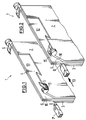
- In the accompanying drawings, constituting a part hereof, in which like reference characters indicate like parts,
- Figure 1
- is a schematic view, with parts omitted for clarity, of the present invention with the jacket in the pocket and the walls in closed position;
- Figure 2
- is similar to Figure 1 and shows the divider beginning to split the jacket;
- Figure 3
- is a view similar to that of Figure 2 showing the divider entering the jacket and splitting it into two equal portions;
- Figure 4
- is similar to Figure 3 and shows the outer retainer holding a portion of the jacket against the first wall; and
- Figure 5
- is similar to Figure 4 and shows both retainers gripping the jacket and the divider withdrawing.
- The present invention comprises pocket assembly 1 (see Figure 1) which comprises
stationary wall 2 andmovable wall 3. As can be seen in Figures 1 and 2, newspaper jacket 4 is held betweenmovable wall 3 andstationary wall 2.Stationary wall 2 is provided withouter retainer 5 andinner retainer 6. The desired split is at 9. - Jacket 4 is inserted into pocket assembly 1 when
movable wall 3 andstationary wall 2 are separated (not shown).Outer retainer 5 is in its closed or gripping position, but, as shown in Figure 1, no part of jacket 4 is retained thereby. - As
divider 7 carryingnose 8 approaches split 9,outer retainer 5 rotates counter clockwise (as seen in Figures 1 and 2) and assumes the position shown in Figure 2.Outer retainer 5 hasend 15 which, at this point, bears againstouter corner 16 ofportion 10 of jacket 4. This prevents the pages ofportion 10 closest tostationary wall 2 from curling undesirably. -
Divider 7 is moved in the direction ofarrow 13 and penetrates jacket 4 atsplit 9, thereby dividing jacket 4 intoequal portions divider 7 should enter split 9 very close to, but slightly above, the upper edge ofwall 3. This helps to insure thatnose 8 enters jacket 4 as close to the middle as possible. Sincewalls flexible part 16 to bend or droop and thereby be out of alignment withnose 8. As opening 12 is created bydivider 7,outer retainer 5 moves to a receiving position wherein it is no longer supportingportion 10 and is out of contact with jacket 4 entirely. This permitsportion 10 to move towardwall 2 as shown in Figure 3.Outer retainer 5 then rotates counter clockwise to its gripping position, holding the corner ofportion 10 securely against the corresponding corner of wall 2 (see Figure 4). - As a result of the tilt of pocket assembly 1, the force of gravity causes opening 12 to extend across the entire width of jacket 4 as
portion 11 falls away fromportion 10 andwall 3 separates fromwall 2. At this point,inner retainer 6 rotates counter clockwise into its gripping position, securingportion 10 against the upper inner corner ofwall 2.Divider 7 moves in the direction ofarrow 14 to withdraw entirely from jacket 4. In this position, jacket 4 is now ready for the insertion of additional sections. - While only a limited number of specific embodiments of the present invention have been expressly disclosed, it is, nonetheless, to be broadly construed, and not to be limited except by the character of the claims appended hereto.
Claims (12)
- A device for separating, into two substantially equal portions (10, 11), a plurality of flexible sheets superposed on each other and folded to form a substantially planar, flexible product (4), said product having a bottom fold, an inner edge and, spaced apart horizontally therefrom, an outer edge, each perpendicular to said fold and an open edge parallel to said folded edge and spaced apart vertically therefrom, said device comprisinga pocket assembly (1) having a first wall (2) and a second wall (3) forming a closable pocked, said first wall and said second wall adapted for movement between an open position, wherein said first wall (2) is spaced apart from said second wall (3), and a closed position, wherein said first wall (2) is adjacent said second wall (3) and said product (4) is secured therebetween.said pocket (1) having a lower edge, an inner side and an outer side, both perpendicular to said lower edge, and spaced apart horizontally from each other, and upper edges parallel to said lower edge and vertically spaced apart therefrom,said pocket (1), when in said open position, adapted to receive said product with said fold adjacent said lower edge,an outer retainer (5) on said first wall (2) and adjacent said outer side and one of said upper edges, an inner retainer (6) on said first wall (2) and adjacent said inner side and one of said upper edges, said outer retainer (5) having a gripping position, wherein said outer retainer (5) holds one of said portions (10, 11) against said first wall; a clear position, wherein said outer retainer is out of contact with said product (4); and a supporting position, wherein a part (16) of one of said portions (10) rests against an end (15) of said outer retainer (5), said inner retainer (6) having a gripping position, wherein said inner retainer (6) holds said one of said portions (10) against said first wall (2), and a release position, wherein said inner retainer (6) is out of contact with said product (4),a divider (7) adapted for movement parallel to said fold at an outer point vertically spaced therefrom, between an entry position, wherein said divider (7) has entered said product (4) at said outer edge and divided said product (4) into said two portions (10, 11) adjacent said outer edge to form an opening therebetween, and withdrawn position, wherein said divider (7) is out of contact with said product (4), said outer retainer (5) being in said supporting position, said inner retainer (6) being in said release position, and said first wall (2) and said second wall (3) being in said closed position when said divider (7) enters said product (4); said outer retainer (5) moves into said clear position as said opening is created by said divider (7).
- The device of Claim 1 wherein, after formation of said opening, said outer retainer (5) is in said gripping position to permit extension of said opening toward said inner retainer (6).
- The device of Claim 2 wherein said inner retainer (6) is in said gripping position when said opening reaches said inner retainer (6).
- The device of Claim 1 wherein said divider (7) is provided with a nose (8) having a point tapering toward said outer edge.
- The device of Claim 1 wherin said divider (7) is adjacent one of said upper edges.
- The device of Claim 1 wherein said first wall (2) is fixed and said second wall (3) is movable toward and away from said first wall (2).
- A method for separating, into two substantially equal portions (10, 11), a plurality of flexible sheets superposed on each other and folded to form a substantially planar, flexible product (4) with a bottom fold, an inner edge and, spaced apart horizontally therefrom, an outer edge, each perpendicular to said fold, and an open edge parallel to said fold and spaced apart vertically therefrom, said method comprisingretaining said product (4) between a first wall (2) provided with an outer retainer (5) and an inner retainer (6) and a second wall (3) of a pocket assembly (1) forming a closable pocket with a part (16) of said product (4) extending above said walls (2, 3);said outer retainer (5) being in a support position wherein said part of said product (4) rests against an end (15) of said outer retainer (5) and said first wall (2) and said second wall (3) being in a closed position when moving a divider (7) parallel to said fold into said product (4) at said outer edge at a point vertically spaced from said fold to form an opening adjacent said outer edge, thereby dividing said product (4) into said portions (10, 11);supporting said part (16) to restrain said sheets in said part (16) from curling towards said first wall (2) at a point adjacent said outer edges during said moving of said divider (7) and releasing said part (16) as said opening is created by said divider (7).
- The method of Claim 7 comprising retaining said part (16) against said first wall (2) at said outer point adjacent said outer edge and said upper edge after formation of said opening.
- The method of Claim 7 comprising extending said opening to an inner point adjacent said inner edge and said upper edge.
- The method of Claim 9 comprising retaining said part (16) against said first wall (2) and said inner point.
- The method of Claim 7, wherein said divider (7) is withdrawn from said product (4) after said opening is formed.
- The method of Claim 7 wherein said outer point is adjacent an upper edge of said first wall (2) and/or said second wall (3).
Applications Claiming Priority (2)
| Application Number | Priority Date | Filing Date | Title |
|---|---|---|---|
| US831695 | 1992-02-05 | ||
| US07/831,695 US5265915A (en) | 1992-02-05 | 1992-02-05 | Opener for folded products |
Publications (2)
| Publication Number | Publication Date |
|---|---|
| EP0554801A1 EP0554801A1 (en) | 1993-08-11 |
| EP0554801B1 true EP0554801B1 (en) | 1997-04-02 |
Family
ID=25259645
Family Applications (1)
| Application Number | Title | Priority Date | Filing Date |
|---|---|---|---|
| EP93101374A Expired - Lifetime EP0554801B1 (en) | 1992-02-05 | 1993-01-29 | Side opener |
Country Status (5)
| Country | Link |
|---|---|
| US (1) | US5265915A (en) |
| EP (1) | EP0554801B1 (en) |
| AT (1) | ATE151051T1 (en) |
| DE (1) | DE69309330T2 (en) |
| DK (1) | DK0554801T3 (en) |
Families Citing this family (3)
| Publication number | Priority date | Publication date | Assignee | Title |
|---|---|---|---|---|
| DE502005009715D1 (en) * | 2004-09-15 | 2010-07-22 | Ferag Ag | Process for the production of printed matter |
| EP1712503B1 (en) * | 2005-04-14 | 2012-03-21 | Müller Martini Holding AG | Method for manufacturing of multi-part printed products |
| ATE469085T1 (en) * | 2006-12-29 | 2010-06-15 | Ferag Ag | DEVICE FOR EQUIPPING PRINTED PRODUCTS WITH INSERTS |
Family Cites Families (7)
| Publication number | Priority date | Publication date | Assignee | Title |
|---|---|---|---|---|
| CH461547A (en) * | 1968-02-02 | 1968-08-31 | Ferag Ag | Device for opening multi-sheet, folded printed matter, in particular newspapers |
| US4486032A (en) * | 1982-06-14 | 1984-12-04 | Dennison Manufacturing Company | Cover folders |
| US4496141A (en) * | 1982-12-17 | 1985-01-29 | Rockwell International Corporation | Method and apparatus for opening folded newspapers |
| EP0160740B1 (en) * | 1983-11-14 | 1989-07-05 | Manuel Ferreira-Godinho | Filing device for paper sheets or the like |
| US4743135A (en) * | 1987-05-04 | 1988-05-10 | Gauntlett James E | Catalog and magazine holder |
| US5112036A (en) * | 1990-08-27 | 1992-05-12 | Graphic Management Associates, Inc. | Opener for folder printed products |
| US5065994A (en) * | 1991-02-13 | 1991-11-19 | Graphic Management Associates, Inc. | Non-lap opener |
-
1992
- 1992-02-05 US US07/831,695 patent/US5265915A/en not_active Expired - Lifetime
-
1993
- 1993-01-29 AT AT93101374T patent/ATE151051T1/en not_active IP Right Cessation
- 1993-01-29 DE DE69309330T patent/DE69309330T2/en not_active Expired - Fee Related
- 1993-01-29 DK DK93101374.2T patent/DK0554801T3/en active
- 1993-01-29 EP EP93101374A patent/EP0554801B1/en not_active Expired - Lifetime
Also Published As
| Publication number | Publication date |
|---|---|
| ATE151051T1 (en) | 1997-04-15 |
| EP0554801A1 (en) | 1993-08-11 |
| DE69309330T2 (en) | 1997-10-30 |
| US5265915A (en) | 1993-11-30 |
| DK0554801T3 (en) | 1997-10-13 |
| DE69309330D1 (en) | 1997-05-07 |
Similar Documents
| Publication | Publication Date | Title |
|---|---|---|
| EP0476859B1 (en) | Opener for folded printed products | |
| JPH06329327A (en) | Thin sheet loading and receiving device | |
| US20020033570A1 (en) | System and method for supplying stacked material to a utilization device | |
| US3727823A (en) | Container | |
| EP0498935B1 (en) | Non-lap opener | |
| GB2249755A (en) | Blank for both a loose-leaf folder and box file | |
| US5265915A (en) | Opener for folded products | |
| WO1991017096A1 (en) | Document and file organizer | |
| US6626602B1 (en) | Hanging file system | |
| US4609112A (en) | Filing apparatus | |
| US5348526A (en) | Hand held paper sheet folding device | |
| US4775136A (en) | Sheet folding and transport system, particularly for printed paper copy sheets, and folded sheet element separating method | |
| US5535998A (en) | Sheet separation method and apparatus | |
| US4871159A (en) | Sheet insertion apparatus | |
| US4185745A (en) | Sheet packaging arrangement | |
| EP0638440A1 (en) | Stationery | |
| JPS61111248A (en) | Separating feel for feeding medium | |
| EP0182721A2 (en) | A case for a tape cassette | |
| EP1075965A2 (en) | File divider | |
| EP0523977A1 (en) | A device for folding a sheet of paper for insertion into an envelope | |
| US4031647A (en) | Title protector | |
| JPS636118Y2 (en) | ||
| JPS62218341A (en) | Paper sheet gap forming device | |
| JP2586719Y2 (en) | Paper feeder | |
| US4750725A (en) | Printed products having a center fold and containing a product break structure, and method and apparatus for opening such printed products |
Legal Events
| Date | Code | Title | Description |
|---|---|---|---|
| PUAI | Public reference made under article 153(3) epc to a published international application that has entered the european phase |
Free format text: ORIGINAL CODE: 0009012 |
|
| AK | Designated contracting states |
Kind code of ref document: A1 Designated state(s): AT BE CH DE DK ES FR GB GR IE IT LI LU MC NL PT SE |
|
| 17P | Request for examination filed |
Effective date: 19931214 |
|
| 17Q | First examination report despatched |
Effective date: 19941216 |
|
| GRAG | Despatch of communication of intention to grant |
Free format text: ORIGINAL CODE: EPIDOS AGRA |
|
| GRAH | Despatch of communication of intention to grant a patent |
Free format text: ORIGINAL CODE: EPIDOS IGRA |
|
| GRAH | Despatch of communication of intention to grant a patent |
Free format text: ORIGINAL CODE: EPIDOS IGRA |
|
| GRAA | (expected) grant |
Free format text: ORIGINAL CODE: 0009210 |
|
| AK | Designated contracting states |
Kind code of ref document: B1 Designated state(s): AT BE CH DE DK ES FR GB GR IE IT LI LU MC NL PT SE |
|
| PG25 | Lapsed in a contracting state [announced via postgrant information from national office to epo] |
Ref country code: NL Effective date: 19970402 Ref country code: IT Free format text: LAPSE BECAUSE OF FAILURE TO SUBMIT A TRANSLATION OF THE DESCRIPTION OR TO PAY THE FEE WITHIN THE PRE;WARNING: LAPSES OF ITALIAN PATENTS WITH EFFECTIVE DATE BEFORE 2007 MAY HAVE OCCURRED AT ANY TIME BEFORE 2007. THE CORRECT EFFECTIVE DATE MAY BE DIFFERENT FROM THE ONE RECORDED.SCRIBED TIME-LIMIT Effective date: 19970402 Ref country code: GR Free format text: LAPSE BECAUSE OF FAILURE TO SUBMIT A TRANSLATION OF THE DESCRIPTION OR TO PAY THE FEE WITHIN THE PRESCRIBED TIME-LIMIT Effective date: 19970402 Ref country code: FR Effective date: 19970402 Ref country code: ES Free format text: THE PATENT HAS BEEN ANNULLED BY A DECISION OF A NATIONAL AUTHORITY Effective date: 19970402 Ref country code: BE Effective date: 19970402 Ref country code: AT Effective date: 19970402 |
|
| REF | Corresponds to: |
Ref document number: 151051 Country of ref document: AT Date of ref document: 19970415 Kind code of ref document: T |
|
| REG | Reference to a national code |
Ref country code: CH Ref legal event code: EP |
|
| REF | Corresponds to: |
Ref document number: 69309330 Country of ref document: DE Date of ref document: 19970507 |
|
| PG25 | Lapsed in a contracting state [announced via postgrant information from national office to epo] |
Ref country code: PT Effective date: 19970702 |
|
| REG | Reference to a national code |
Ref country code: IE Ref legal event code: FG4D Free format text: 72985 |
|
| REG | Reference to a national code |
Ref country code: CH Ref legal event code: NV Representative=s name: LUCHS & PARTNER PATENTANWAELTE Ref country code: CH Ref legal event code: AEN Free format text: DAS PATENT IST AUFGRUND DES WEITERBEHANDLUNGSANTRAGS VOM 10.07.1997 REAKTIVIERT WORDEN. |
|
| EN | Fr: translation not filed | ||
| NLV1 | Nl: lapsed or annulled due to failure to fulfill the requirements of art. 29p and 29m of the patents act | ||
| REG | Reference to a national code |
Ref country code: DK Ref legal event code: T3 |
|
| PG25 | Lapsed in a contracting state [announced via postgrant information from national office to epo] |
Ref country code: LU Free format text: LAPSE BECAUSE OF NON-PAYMENT OF DUE FEES Effective date: 19980129 Ref country code: IE Free format text: LAPSE BECAUSE OF NON-PAYMENT OF DUE FEES Effective date: 19980129 |
|
| PLBE | No opposition filed within time limit |
Free format text: ORIGINAL CODE: 0009261 |
|
| STAA | Information on the status of an ep patent application or granted ep patent |
Free format text: STATUS: NO OPPOSITION FILED WITHIN TIME LIMIT |
|
| 26N | No opposition filed | ||
| PG25 | Lapsed in a contracting state [announced via postgrant information from national office to epo] |
Ref country code: MC Free format text: LAPSE BECAUSE OF NON-PAYMENT OF DUE FEES Effective date: 19980731 |
|
| PG25 | Lapsed in a contracting state [announced via postgrant information from national office to epo] |
Ref country code: DE Free format text: LAPSE BECAUSE OF NON-PAYMENT OF DUE FEES Effective date: 19981001 |
|
| REG | Reference to a national code |
Ref country code: GB Ref legal event code: IF02 |
|
| PGFP | Annual fee paid to national office [announced via postgrant information from national office to epo] |
Ref country code: DK Payment date: 20100114 Year of fee payment: 18 Ref country code: CH Payment date: 20100113 Year of fee payment: 18 |
|
| PGFP | Annual fee paid to national office [announced via postgrant information from national office to epo] |
Ref country code: GB Payment date: 20100202 Year of fee payment: 18 |
|
| PGFP | Annual fee paid to national office [announced via postgrant information from national office to epo] |
Ref country code: SE Payment date: 20100108 Year of fee payment: 18 |
|
| REG | Reference to a national code |
Ref country code: DK Ref legal event code: EBP |
|
| REG | Reference to a national code |
Ref country code: CH Ref legal event code: PL |
|
| REG | Reference to a national code |
Ref country code: SE Ref legal event code: EUG |
|
| GBPC | Gb: european patent ceased through non-payment of renewal fee |
Effective date: 20110129 |
|
| PG25 | Lapsed in a contracting state [announced via postgrant information from national office to epo] |
Ref country code: CH Free format text: LAPSE BECAUSE OF NON-PAYMENT OF DUE FEES Effective date: 20110131 Ref country code: LI Free format text: LAPSE BECAUSE OF NON-PAYMENT OF DUE FEES Effective date: 20110131 |
|
| PG25 | Lapsed in a contracting state [announced via postgrant information from national office to epo] |
Ref country code: GB Free format text: LAPSE BECAUSE OF NON-PAYMENT OF DUE FEES Effective date: 20110129 |
|
| PG25 | Lapsed in a contracting state [announced via postgrant information from national office to epo] |
Ref country code: SE Free format text: LAPSE BECAUSE OF NON-PAYMENT OF DUE FEES Effective date: 20110130 |