EP0554308B1 - Method and apparatus for continuous heating of powdered starch - Google Patents
Method and apparatus for continuous heating of powdered starch Download PDFInfo
- Publication number
- EP0554308B1 EP0554308B1 EP91918566A EP91918566A EP0554308B1 EP 0554308 B1 EP0554308 B1 EP 0554308B1 EP 91918566 A EP91918566 A EP 91918566A EP 91918566 A EP91918566 A EP 91918566A EP 0554308 B1 EP0554308 B1 EP 0554308B1
- Authority
- EP
- European Patent Office
- Prior art keywords
- air
- powdered starch
- starch
- conduit
- powdered
- Prior art date
- Legal status (The legal status is an assumption and is not a legal conclusion. Google has not performed a legal analysis and makes no representation as to the accuracy of the status listed.)
- Expired - Lifetime
Links
Images

Classifications
-
- C—CHEMISTRY; METALLURGY
- C08—ORGANIC MACROMOLECULAR COMPOUNDS; THEIR PREPARATION OR CHEMICAL WORKING-UP; COMPOSITIONS BASED THEREON
- C08B—POLYSACCHARIDES; DERIVATIVES THEREOF
- C08B30/00—Preparation of starch, degraded or non-chemically modified starch, amylose, or amylopectin
- C08B30/12—Degraded, destructured or non-chemically modified starch, e.g. mechanically, enzymatically or by irradiation; Bleaching of starch
- C08B30/16—Apparatus therefor
-
- C—CHEMISTRY; METALLURGY
- C08—ORGANIC MACROMOLECULAR COMPOUNDS; THEIR PREPARATION OR CHEMICAL WORKING-UP; COMPOSITIONS BASED THEREON
- C08B—POLYSACCHARIDES; DERIVATIVES THEREOF
- C08B30/00—Preparation of starch, degraded or non-chemically modified starch, amylose, or amylopectin
- C08B30/12—Degraded, destructured or non-chemically modified starch, e.g. mechanically, enzymatically or by irradiation; Bleaching of starch
Definitions
- the present invention relates to a method and an apparatus for continuous heating of powdered starch. More specifically, the invention concerns a method and an apparatus for continuous preheating without simultaneous drying of powdered starch, used in the making of modified starch.
- Starch is widely used as starting material in the making of modified starch by reaction with different reagents.
- powdered starch is first prepared from a raw material, such as cereal starch from maize, wheat, barley, rye, sorghum and rice, or root starch from potato, tapioca and arrowroot.
- the powdered starch is then modified by reaction with different reagents which may be gaseous, solid or, preferably, liquid.
- reagents which may be gaseous, solid or, preferably, liquid.
- An example of starch modification is the making of cationic starch, used inter alia in the paper industry, by reacting powdered starch with a cationising reagent, e.g. 1-chlorine-2-hydroxypropyl trimethyl ammonium chloride.
- the starch must have a temperature of about 30-45°C, preferably about 35-40°C.
- the starting material in the form of starch is, as a rule, kept in a silo where it is stored at ambient temperature, i.e. about 5-30°C, and has a moisture content of about 19-21% by weight, preferably about 19.5-20.5% by weight.
- the powdered starch normally has to be preheated before it is mixed with the modification reagent preparatory to the modification reaction. Preheating was formerly carried out with simultaneous drying of the powdered starch, since the modification reagent normally is a diluted aqueous solution. Drying was carried out in such a manner that the quantity of water dried up essentially corresponded to the quantity supplied with the reagent solution.
- the present invention aims at meeting these demands and providing a method and an apparatus for continuous heating of powdered starch, in which the starch is heated without drying, such that its moisture content is kept substantially constant.
- the invention thus provides a method for continuous heating of powdered starch, which is characterised in that the powdered starch is fed through an inlet opening into a conduit where it is mixed with a hot air flow which heats the powdered starch and conveys it in the conduit, and that the powdered starch, when having reached the requisite temperature, is separated from the air, whereupon the separated air, after removal of any excess air, is reheated and recycled to the inlet opening of the conduit to form a substantially closed circuit.
- the invention further provides an apparatus for continuous heating of powdered starch, which is characterised in that it comprises a substantially closed circuit which includes an inlet opening for powdered starch in a conduit for conveying powdered starch by means of a hot air flow; a device for separating the powdered starch from the air; a fan for feeding the air; optionally, a closable exhaust pipe for excess air; and a device for heating the air.
- the powdered starch is heated in a closed circuit with circulating hot air which heats the powdered starch to the desired temperature and at the same time pneumatically conveys the starch from its inlet in the circuit to its outlet.
- the powdered starch is fed into and out of the circuit substantially without any simultaneous feeding, in or out, of air, and the circuit thus is completely closed except for the feeding in and out of the powdered starch.
- the circuit only emits energy in the form of the heat that has been absorbed by the powdered starch. This heat is retained in the total system for starch modification and is utilised in the modification reaction.
- the heat absorbed by the powdered starch and thus emitted from the heating circuit is replaced by reheating of the air in the circuit by means of a heating device, such as a heat exchanger.
- the powdered starch is blown into the circuit by means of air, and the excess air supplied together with the powdered starch is removed in order to maintain a constant quantity of air in the circuit.
- the excess air is, however, not discharged to the surrounding atmosphere but to the system for starch modification, more precisely to a low-pressure conduit which by suction conveys powdered starch mixed with a modification reagent to a reactor for implementing the modification reaction.
- the energy content of the excess air is utilised, at the same time there is no discharge to the surroundings.
- powdered starch 1 is fed from a silo (not shown) and introduced through an inlet opening 2 into a conduit 3.
- the feeding and introduction of the powdered starch are conveniently carried out in pneumatic manner by means of air, and the powdered starch is fed into the conduit together with the carrier air.
- the powdered starch from the silo has a temperature which roughly is equivalent to the ambient temperature and thus may vary, depending on the season and the weather, from one or two degrees above 0°C to about 30°C, e.g. 5-30°C.
- the powdered starch further has a moisture content of about 19-21% by weight, preferably about 19.5-20.5% by weight.
- the powdered starch 1 encounters hot air with a temperature of about 55-85°C, depending on the temperature of the powdered starch supplied and the desired final temperature thereof.
- the powdered starch 1 is pneumatically conveyed by the hot air in the conduit 3 and is heated simultaneously, and when the powdered starch has reached the desired temperature, it is separated from the then cooled air.
- the separation conveniently takes place in a cyclone 4, and the mixture of powdered starch and air is tangentially supplied at the circumference of the cyclone.
- the separated air departs upwards to a conduit 5, and the heated powdered starch is discharged from the lower part of the cyclone.
- the starch is discharged in convenient manner, e.g. by a rotary vane feeder or, as indicated in Fig. 1, by a screw feeder 6.
- the heated powdered starch thus discharged has a temperature of about 30-45°C, preferably about 35-40°C, and a substantially unaltered moisture content.
- the preheated powdered starch is fed from the screw feeder 6 to a preparator 7 where it is mixed with liquid and dry modification reagent. Then, the mixture of powdered starch and modification reagent is fed from the preparator 7 to a reactor (not shown) for realisation of the modification reaction.
- This feeding operationg is suitably carried out by suction in a low-pressure conduit 8, the mixture being conveniently transferred from the preparator 7 to the low-pressure conduit 8 by means of a rotary vane feeder or, as indicated in Fig. 1, a screw feeder 9.
- the air separated from the powdered starch is recycled in the preheating circuit from the cyclone 4, via a conduit 5 and a fan 10, to a distribution box 11 where excess air is removed, via a conduit 12, to the low-pressure conduit 8.
- the quantity of excess air conveyed to the low-pressure conduit 8 is equivalent to the quantity of air fed into the preheating circuit together with the powdered starch through the inlet opening 2.
- the quantity of air in the preheating circuit is maintained essentially constant.
- the air is fed, via a conduit 13, to a means for reheating the air to a temperature of about 55-85°C.
- This heating means may be designed in any suitable known manner, for instance as a heat exchanger 14, as illustrated in Fig. 1.
- the hot side of the heat exchanger may, for instance, be supplied with hot water from a boiler (not shown).
- the heat exchanger 14 the reheated air is fed to the inlet opening 2 for conveying and heating a fresh quantity of powdered starch.
- Fig. 1 further shows a conduit 15 which is equipped with a shut-off valve 16 and ends in the distribution box 11.
- This conduit is optional, and is intended to be used for the supply, if any, of supplementary air to the preheating circuit. Normally, there is no need of any such supply, since the quantity of air in the preheating circuit is adjusted by removing excess air through the conduit 12. It will be appreciated that the optional conduit 15 need not end in the distribution box 11, but may end elsewhere between the cyclone 4 and the heat exchanger 14.
- Fig. 2 illustrates an alternative embodiment of the apparatus shown in Fig. 1.
- the apparatus in Fig. 2 differs from the one in Fig. 1 primarily in that the powdered starch 1, before it is fed into the conduit 3, is separated from accompanying air in a cyclone 17. The thus-separated air departs at 18, while the powdered starch is fed through the inlet opening 2 by a screw conveyor 19. Since no air is fed into the preheating circuit together with the powdered starch, there is no need for excess air removal, and Fig. 2 consequently does not include a distribution box with associated exhaust pipe to the low-pressure conduit 8. In practice, however, the circuit may comprise such equipment, in which case the conduit 12 is maintained shut by a valve (not shown). Like the apparatus in Fig. 1, the apparatus in Fig. 2 may also be equipped with a conduit 15 for supplementary air, but, as indicated above, there is normally no need for this.
- FIG. 2 corresponds to that in Fig. 1, and like elements have like reference numbers in both Figures. Since also the function of the apparatus in Fig. 2 is identical to that of the apparatus in Fig. 1, it will not be described in more detail here but reference is instead made to the description which bears upon Fig. 1.
- the dimensions of the preheating circuit according to the invention are suitably adapted to the total starch-modification plant, i.e. to the amount of starch modified in the reactor per unit of time.
- the preheating circuit i.e. to the amount of starch modified in the reactor per unit of time.
- it has been found suitable to feed in about 4-6 ton powdered starch/h, either together with about 600 m3 air/h (the embodiment of Fig. 1) or without air (the embodiment of Fig. 2).
- the fan 10 then is dimensioned to feed about 5500 m3 air/h in the circuit, and the velocity of the air flow in the circuit is about 8-15 m/s, normally about 10-14 m/s.
- the conduit 3 is conveniently dimensioned so as to have a slightly larger cross-section than the return conduit 5; the conduit 3 may, for instance, have an inner diameter of about 400 mm, while the conduit 5 has an inner diameter of about 300 mm.
- Powdered potato starch with a moisture content of about 20% by weight and a temperature of about 10°C was stored in a silo.
- the starch was used for making modified cationic starch.
- the starch was preheated to a desired predetermined temperature of about 35°C, in accordance with the invention, as follows.
- 6 ton powdered starch per h was pneumatically fed from the silo by means of an air current and supplied through the inlet opening of a preheating circuit of the type described above in relation to Fig. 1.
- the circuit included a conduit which had a diameter of about 400 mm and in which air that had been preheated to a temperature of about 75°C and had a moisture content of about 20% by weight flowed at a speed of about 12 m/s.
- the powdered starch fed through the inlet opening by the air was conveyed by the heated air in the conduit and was heated simultaneously.
- the powdered starch When having reached a temperature of about 35°C and a moisture content of about 20% by weight, which was achieved after a distance of about 20 m, the powdered starch was separated from the cooled carrier air in a cyclone.
- the powdered starch was withdrawn from the lower part of the cyclone and fed by a screw feeder to a preparator in which the powdered starch was mixed with a cationising reagent in the form of an 80% aqueous solution of 1-chlorine-2-hydroxypropyl trimethyl ammonium chloride. After admixture of the cationising reagent, the mixture was drawn through a low-pressure conduit to a reaction tower where the cationisation reaction was carried out.
- the cooled air separated from the powdered starch in the cyclone was then led in the preheating circuit through a return conduit with a diameter of about 300 mm, to the suction side of a fan which circulated about 5500 m3/h in the circuit. After the fan, excess air was removed from the circuit (about 600 m3/h) via an exhaust pipe to the low-pressure conduit which fed the mixture of powdered starch and cationising reagent from the preparator to the reaction tower. The quantity of air thus removed was equivalent to the quantity of air supplied to the circuit when the powdered starch was pneumatically fed into the circuit.
- the air was fed in the preheating circuit to a heat exchanger where it was reheated to about 75°C.
- the heat exchanger was supplied with hot water with a temperature of about 85°C from a boiler. After being reheated in the heat exchanger, the air was fed to the inlet opening of the circuit for conveying and preheating more powdered starch.
- the preheating circuit was essentially closed and, apart from the feeding in and out of starch, only excess air was removed from the circuit to the surroundings, i.e. to the low-pressure conduit. This removal was, however, comparatively insignificant, and the heat content of the removed air was utilised in the total system. Since the circuit is substantially closed, the moisture content in the system is maintained at an essentially constant level corresponding to the moisture content of the powdered starch, and the powdered starch may thus be heated to the desired temperature without any drying effect, i.e. without any reduction of the moisture content.
- Example 2 It was proceeded as in Example 1, but, instead of pneumatically blowing powdered starch from the silo through the inlet opening into the circuit, the powdered starch was fed through the inlet opening by a screw feeder after having been separated in a cyclone from the air used for conveying the powdered starch from the silo. Thus, the powdered starch was fed into the circuit without any simultaneous air supply, which obviated the need for excess air removal to the suction conduit.
- the preheating of the powdered starch was carried out in the manner described with reference to Fig. 2. The temperatures and flows corresponded to those of Example 1.
Landscapes
- Chemical & Material Sciences (AREA)
- Crystallography & Structural Chemistry (AREA)
- Life Sciences & Earth Sciences (AREA)
- Engineering & Computer Science (AREA)
- Biochemistry (AREA)
- Materials Engineering (AREA)
- Health & Medical Sciences (AREA)
- Chemical Kinetics & Catalysis (AREA)
- Medicinal Chemistry (AREA)
- Polymers & Plastics (AREA)
- Organic Chemistry (AREA)
- Polysaccharides And Polysaccharide Derivatives (AREA)
- Packages (AREA)
- Closures For Containers (AREA)
- Containers And Packaging Bodies Having A Special Means To Remove Contents (AREA)
- Grain Derivatives (AREA)
Abstract
Description
- The present invention relates to a method and an apparatus for continuous heating of powdered starch. More specifically, the invention concerns a method and an apparatus for continuous preheating without simultaneous drying of powdered starch, used in the making of modified starch.
- Starch is widely used as starting material in the making of modified starch by reaction with different reagents. Generally, powdered starch is first prepared from a raw material, such as cereal starch from maize, wheat, barley, rye, sorghum and rice, or root starch from potato, tapioca and arrowroot. The powdered starch is then modified by reaction with different reagents which may be gaseous, solid or, preferably, liquid. An example of starch modification is the making of cationic starch, used inter alia in the paper industry, by reacting powdered starch with a cationising reagent, e.g. 1-chlorine-2-hydroxypropyl trimethyl ammonium chloride.
- To make the modification reaction proceed at a reasonable rate, the starch must have a temperature of about 30-45°C, preferably about 35-40°C. The starting material in the form of starch is, as a rule, kept in a silo where it is stored at ambient temperature, i.e. about 5-30°C, and has a moisture content of about 19-21% by weight, preferably about 19.5-20.5% by weight. This means that the powdered starch normally has to be preheated before it is mixed with the modification reagent preparatory to the modification reaction. Preheating was formerly carried out with simultaneous drying of the powdered starch, since the modification reagent normally is a diluted aqueous solution. Drying was carried out in such a manner that the quantity of water dried up essentially corresponded to the quantity supplied with the reagent solution.
- However, the introduction of new highly concentrated modification reagents has, on the whole, obviated the need for drying the powdered starch, and instead one wishes to preheat the powdered starch without any simultaneous drying. At the same time, rising energy prices and an increased environmental consciousness have led to demands for maximum utilisation of energy and elimination of discharges in the processes, i.e. that the processes be closed. Further, it is desirable that the process be continuous, contrary to prior-art batchwise processes.
- The present invention aims at meeting these demands and providing a method and an apparatus for continuous heating of powdered starch, in which the starch is heated without drying, such that its moisture content is kept substantially constant.
- The invention thus provides a method for continuous heating of powdered starch, which is characterised in that the powdered starch is fed through an inlet opening into a conduit where it is mixed with a hot air flow which heats the powdered starch and conveys it in the conduit, and that the powdered starch, when having reached the requisite temperature, is separated from the air, whereupon the separated air, after removal of any excess air, is reheated and recycled to the inlet opening of the conduit to form a substantially closed circuit.
- The invention further provides an apparatus for continuous heating of powdered starch, which is characterised in that it comprises a substantially closed circuit which includes an inlet opening for powdered starch in a conduit for conveying powdered starch by means of a hot air flow; a device for separating the powdered starch from the air; a fan for feeding the air; optionally, a closable exhaust pipe for excess air; and a device for heating the air.
- Further distinctive features and advantages of the invention appear from the following description and the appended claims.
- According to the invention, the powdered starch is heated in a closed circuit with circulating hot air which heats the powdered starch to the desired temperature and at the same time pneumatically conveys the starch from its inlet in the circuit to its outlet.
- In one embodiment of the invention, the powdered starch is fed into and out of the circuit substantially without any simultaneous feeding, in or out, of air, and the circuit thus is completely closed except for the feeding in and out of the powdered starch. The circuit only emits energy in the form of the heat that has been absorbed by the powdered starch. This heat is retained in the total system for starch modification and is utilised in the modification reaction. The heat absorbed by the powdered starch and thus emitted from the heating circuit is replaced by reheating of the air in the circuit by means of a heating device, such as a heat exchanger.
- In another embodiment of the invention, the powdered starch is blown into the circuit by means of air, and the excess air supplied together with the powdered starch is removed in order to maintain a constant quantity of air in the circuit. The excess air is, however, not discharged to the surrounding atmosphere but to the system for starch modification, more precisely to a low-pressure conduit which by suction conveys powdered starch mixed with a modification reagent to a reactor for implementing the modification reaction. Thus, the energy content of the excess air is utilised, at the same time there is no discharge to the surroundings.
- The invention will be described in more detail below, reference being had to the accompanying drawings, in which
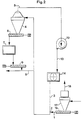
- Fig. 1 illustrates a currently preferred apparatus for continuous preheating of powdered starch, and
- Fig. 2 illustrates a modified embodiment of the apparatus in Fig. 1.
- As shown in Fig. 1, powdered starch 1 is fed from a silo (not shown) and introduced through an inlet opening 2 into a
conduit 3. The feeding and introduction of the powdered starch are conveniently carried out in pneumatic manner by means of air, and the powdered starch is fed into the conduit together with the carrier air. The powdered starch from the silo has a temperature which roughly is equivalent to the ambient temperature and thus may vary, depending on the season and the weather, from one or two degrees above 0°C to about 30°C, e.g. 5-30°C. The powdered starch further has a moisture content of about 19-21% by weight, preferably about 19.5-20.5% by weight. - In the
conduit 3, the powdered starch 1 encounters hot air with a temperature of about 55-85°C, depending on the temperature of the powdered starch supplied and the desired final temperature thereof. The powdered starch 1 is pneumatically conveyed by the hot air in theconduit 3 and is heated simultaneously, and when the powdered starch has reached the desired temperature, it is separated from the then cooled air. The separation conveniently takes place in acyclone 4, and the mixture of powdered starch and air is tangentially supplied at the circumference of the cyclone. The separated air departs upwards to aconduit 5, and the heated powdered starch is discharged from the lower part of the cyclone. The starch is discharged in convenient manner, e.g. by a rotary vane feeder or, as indicated in Fig. 1, by a screw feeder 6. The heated powdered starch thus discharged has a temperature of about 30-45°C, preferably about 35-40°C, and a substantially unaltered moisture content. - After having left the preheating circuit, the preheated powdered starch is fed from the screw feeder 6 to a preparator 7 where it is mixed with liquid and dry modification reagent. Then, the mixture of powdered starch and modification reagent is fed from the preparator 7 to a reactor (not shown) for realisation of the modification reaction. This feeding operationg is suitably carried out by suction in a low-
pressure conduit 8, the mixture being conveniently transferred from the preparator 7 to the low-pressure conduit 8 by means of a rotary vane feeder or, as indicated in Fig. 1, ascrew feeder 9. - The air separated from the powdered starch is recycled in the preheating circuit from the
cyclone 4, via aconduit 5 and afan 10, to adistribution box 11 where excess air is removed, via aconduit 12, to the low-pressure conduit 8. The quantity of excess air conveyed to the low-pressure conduit 8 is equivalent to the quantity of air fed into the preheating circuit together with the powdered starch through the inlet opening 2. Thus, the quantity of air in the preheating circuit is maintained essentially constant. From thedistribution box 11, the air is fed, via aconduit 13, to a means for reheating the air to a temperature of about 55-85°C. This heating means may be designed in any suitable known manner, for instance as aheat exchanger 14, as illustrated in Fig. 1. The hot side of the heat exchanger may, for instance, be supplied with hot water from a boiler (not shown). From theheat exchanger 14, the reheated air is fed to the inlet opening 2 for conveying and heating a fresh quantity of powdered starch. - Fig. 1 further shows a
conduit 15 which is equipped with a shut-offvalve 16 and ends in thedistribution box 11. This conduit is optional, and is intended to be used for the supply, if any, of supplementary air to the preheating circuit. Normally, there is no need of any such supply, since the quantity of air in the preheating circuit is adjusted by removing excess air through theconduit 12. It will be appreciated that theoptional conduit 15 need not end in thedistribution box 11, but may end elsewhere between thecyclone 4 and theheat exchanger 14. - Fig. 2 illustrates an alternative embodiment of the apparatus shown in Fig. 1. The apparatus in Fig. 2 differs from the one in Fig. 1 primarily in that the powdered starch 1, before it is fed into the
conduit 3, is separated from accompanying air in acyclone 17. The thus-separated air departs at 18, while the powdered starch is fed through the inlet opening 2 by a screw conveyor 19. Since no air is fed into the preheating circuit together with the powdered starch, there is no need for excess air removal, and Fig. 2 consequently does not include a distribution box with associated exhaust pipe to the low-pressure conduit 8. In practice, however, the circuit may comprise such equipment, in which case theconduit 12 is maintained shut by a valve (not shown). Like the apparatus in Fig. 1, the apparatus in Fig. 2 may also be equipped with aconduit 15 for supplementary air, but, as indicated above, there is normally no need for this. - Otherwise, the apparatus in Fig. 2 corresponds to that in Fig. 1, and like elements have like reference numbers in both Figures. Since also the function of the apparatus in Fig. 2 is identical to that of the apparatus in Fig. 1, it will not be described in more detail here but reference is instead made to the description which bears upon Fig. 1.
- The dimensions of the preheating circuit according to the invention are suitably adapted to the total starch-modification plant, i.e. to the amount of starch modified in the reactor per unit of time. In an existing plant, it has been found suitable to feed in about 4-6 ton powdered starch/h, either together with about 600 m³ air/h (the embodiment of Fig. 1) or without air (the embodiment of Fig. 2). The
fan 10 then is dimensioned to feed about 5500 m³ air/h in the circuit, and the velocity of the air flow in the circuit is about 8-15 m/s, normally about 10-14 m/s. Further, theconduit 3 is conveniently dimensioned so as to have a slightly larger cross-section than thereturn conduit 5; theconduit 3 may, for instance, have an inner diameter of about 400 mm, while theconduit 5 has an inner diameter of about 300 mm. - The invention will be further illustrated below by two non-restricting Examples.
- Powdered potato starch with a moisture content of about 20% by weight and a temperature of about 10°C was stored in a silo. The starch was used for making modified cationic starch. Before being reacted with a cationising reagent, the starch was preheated to a desired predetermined temperature of about 35°C, in accordance with the invention, as follows.
- Thus, 6 ton powdered starch per h was pneumatically fed from the silo by means of an air current and supplied through the inlet opening of a preheating circuit of the type described above in relation to Fig. 1. The circuit included a conduit which had a diameter of about 400 mm and in which air that had been preheated to a temperature of about 75°C and had a moisture content of about 20% by weight flowed at a speed of about 12 m/s. The powdered starch fed through the inlet opening by the air was conveyed by the heated air in the conduit and was heated simultaneously. When having reached a temperature of about 35°C and a moisture content of about 20% by weight, which was achieved after a distance of about 20 m, the powdered starch was separated from the cooled carrier air in a cyclone. The powdered starch was withdrawn from the lower part of the cyclone and fed by a screw feeder to a preparator in which the powdered starch was mixed with a cationising reagent in the form of an 80% aqueous solution of 1-chlorine-2-hydroxypropyl trimethyl ammonium chloride. After admixture of the cationising reagent, the mixture was drawn through a low-pressure conduit to a reaction tower where the cationisation reaction was carried out.
- The cooled air separated from the powdered starch in the cyclone was then led in the preheating circuit through a return conduit with a diameter of about 300 mm, to the suction side of a fan which circulated about 5500 m³/h in the circuit. After the fan, excess air was removed from the circuit (about 600 m³/h) via an exhaust pipe to the low-pressure conduit which fed the mixture of powdered starch and cationising reagent from the preparator to the reaction tower. The quantity of air thus removed was equivalent to the quantity of air supplied to the circuit when the powdered starch was pneumatically fed into the circuit.
- After removal of excess air, the air was fed in the preheating circuit to a heat exchanger where it was reheated to about 75°C. To heat the air, the heat exchanger was supplied with hot water with a temperature of about 85°C from a boiler. After being reheated in the heat exchanger, the air was fed to the inlet opening of the circuit for conveying and preheating more powdered starch.
- As is apparent from the foregoing, the preheating circuit was essentially closed and, apart from the feeding in and out of starch, only excess air was removed from the circuit to the surroundings, i.e. to the low-pressure conduit. This removal was, however, comparatively insignificant, and the heat content of the removed air was utilised in the total system. Since the circuit is substantially closed, the moisture content in the system is maintained at an essentially constant level corresponding to the moisture content of the powdered starch, and the powdered starch may thus be heated to the desired temperature without any drying effect, i.e. without any reduction of the moisture content.
- It was proceeded as in Example 1, but, instead of pneumatically blowing powdered starch from the silo through the inlet opening into the circuit, the powdered starch was fed through the inlet opening by a screw feeder after having been separated in a cyclone from the air used for conveying the powdered starch from the silo. Thus, the powdered starch was fed into the circuit without any simultaneous air supply, which obviated the need for excess air removal to the suction conduit. In this Example, the preheating of the powdered starch was carried out in the manner described with reference to Fig. 2. The temperatures and flows corresponded to those of Example 1.
Claims (10)
- Method for continuous heating of powdered starch, characterised in that the powdered starch is fed through an inlet opening into a conduit where it is mixed with a hot air flow which heats the powdered starch and conveys it in the conduit, and that the powdered starch, when having reached the requisite temperature, is separated from the air, whereupon the separated air, after removal of any excess air, is reheated and recycled to the inlet opening of the conduit to form a substantially closed circuit.
- The method of claim 1, characterised in that the powdered starch is blown through the inlet opening into the conduit by means of air.
- The method of claim 1, characterised in that air is separated from the powdered starch, and that the powdered starch then is fed into the conduit by a feeding screw.
- The method of claims 1 and 2, characterised in that excess air is removed from the conduit and fed to a suction pipe for conveying a mixture of powdered starch and reagent to a reactor.
- The method of any one of the preceding claims, characterised in that the hot air flow has a temperature of 55-85°C at the inlet opening.
- The method of any one of the preceding claims, characterised in that the powdered starch is heated to a temperature of 30-45°C, preferably 35-40°C.
- Apparatus for continuous heating of powdered starch, characterised in that it comprises a substantially closed circuit which includes an inlet opening (2) for powdered starch (1) in a conduit (3) for conveying powdered starch by means of a hot air flow; a device (4) for separating the powdered starch from the air; a fan (10) for feeding the air; optionally, a closable exhaust pipe for excess air; and a device (14) for heating the air.
- The apparatus of claim 7, characterised in that the inlet opening (2) is connected to a feeding screw (19) for powdered starch (1).
- The apparatus of claim 7 or 8, characterised in that the device (4) for separating the powdered starch from the air is a cyclone.
- The apparatus of claim 7, characterised in that the circuit includes a closable exhaust pipe (12) for excess air.
Applications Claiming Priority (3)
| Application Number | Priority Date | Filing Date | Title |
|---|---|---|---|
| SE9003338A SE467876B (en) | 1990-10-19 | 1990-10-19 | SET AND APPLIANCE TO CONTINUOUSLY HEAT STARCH POWDER |
| SE9003338 | 1990-10-19 | ||
| PCT/SE1991/000573 WO1992007007A1 (en) | 1990-10-19 | 1991-09-03 | Method and apparatus for continuous heating of powdered starch |
Publications (2)
| Publication Number | Publication Date |
|---|---|
| EP0554308A1 EP0554308A1 (en) | 1993-08-11 |
| EP0554308B1 true EP0554308B1 (en) | 1996-01-03 |
Family
ID=20380686
Family Applications (1)
| Application Number | Title | Priority Date | Filing Date |
|---|---|---|---|
| EP91918566A Expired - Lifetime EP0554308B1 (en) | 1990-10-19 | 1991-09-03 | Method and apparatus for continuous heating of powdered starch |
Country Status (9)
| Country | Link |
|---|---|
| US (1) | US5492567A (en) |
| EP (1) | EP0554308B1 (en) |
| AT (1) | ATE132505T1 (en) |
| AU (1) | AU8758491A (en) |
| DE (1) | DE69116163T2 (en) |
| DK (1) | DK0554308T3 (en) |
| FI (1) | FI104556B (en) |
| SE (1) | SE467876B (en) |
| WO (1) | WO1992007007A1 (en) |
Families Citing this family (1)
| Publication number | Priority date | Publication date | Assignee | Title |
|---|---|---|---|---|
| CN118599018B (en) * | 2024-06-26 | 2025-03-18 | 山东众友生物科技有限公司 | Modified starch gelatinization device and method |
Family Cites Families (8)
| Publication number | Priority date | Publication date | Assignee | Title |
|---|---|---|---|---|
| US2098293A (en) * | 1934-07-18 | 1937-11-09 | Int Patents Dev Co | Dustless grits, and method of making same |
| US3285523A (en) * | 1964-02-17 | 1966-11-15 | Slick Ind Company | Comminuting apparatus |
| DE2602454C3 (en) * | 1976-01-23 | 1988-09-29 | Luco-Sprühmisch-Technic GmbH, 6474 Ortenberg | Device for carrying out the method according to patent 26 60 533 |
| SE452327B (en) * | 1979-08-28 | 1987-11-23 | St Lawrence Tech Ltd | CHEMICAL REACTOR FOR PREPARING MODIFIED SIZE AND STARCH DERIVATIVES IN HOMOGENIC FLUID FORM |
| JPS5943216B2 (en) * | 1981-06-23 | 1984-10-20 | 株式会社奈良機械製作所 | Mixing/granulating/drying machine |
| JPH08186B2 (en) * | 1985-06-21 | 1996-01-10 | ゲルゲリイ、ゲルハルト | METHOD AND APPARATUS FOR PRODUCING REACTION PRODUCT FROM PROCESS MATERIAL |
| US4667654A (en) * | 1985-07-10 | 1987-05-26 | National Starch And Chemical Corporation | Pulse combustion process for the preparation of pregelatinized starches |
| JP2996707B2 (en) * | 1990-09-21 | 2000-01-11 | 三和興産株式会社 | Efficient production of moist heat-treated starch |
-
1990
- 1990-10-19 SE SE9003338A patent/SE467876B/en not_active IP Right Cessation
-
1991
- 1991-09-01 US US08/074,856 patent/US5492567A/en not_active Expired - Fee Related
- 1991-09-03 EP EP91918566A patent/EP0554308B1/en not_active Expired - Lifetime
- 1991-09-03 AU AU87584/91A patent/AU8758491A/en not_active Abandoned
- 1991-09-03 AT AT91918566T patent/ATE132505T1/en not_active IP Right Cessation
- 1991-09-03 DK DK91918566.0T patent/DK0554308T3/en active
- 1991-09-03 WO PCT/SE1991/000573 patent/WO1992007007A1/en not_active Ceased
- 1991-09-03 DE DE69116163T patent/DE69116163T2/en not_active Expired - Fee Related
-
1993
- 1993-04-19 FI FI931764A patent/FI104556B/en active
Also Published As
| Publication number | Publication date |
|---|---|
| ATE132505T1 (en) | 1996-01-15 |
| SE9003338D0 (en) | 1990-10-19 |
| DE69116163D1 (en) | 1996-02-15 |
| FI104556B (en) | 2000-02-29 |
| FI931764A7 (en) | 1993-05-19 |
| FI931764A0 (en) | 1993-04-19 |
| SE9003338L (en) | 1992-04-20 |
| WO1992007007A1 (en) | 1992-04-30 |
| SE467876B (en) | 1992-09-28 |
| US5492567A (en) | 1996-02-20 |
| DE69116163T2 (en) | 1996-08-01 |
| EP0554308A1 (en) | 1993-08-11 |
| AU8758491A (en) | 1992-05-20 |
| DK0554308T3 (en) | 1996-02-05 |
Similar Documents
| Publication | Publication Date | Title |
|---|---|---|
| CA1062006A (en) | System for handling high sulfur materials | |
| WO1992000252A1 (en) | Fluidized calcining process | |
| GB1461353A (en) | Method of coating the interior of a pipe | |
| CA2175803C (en) | Heat treatment of lime sludge | |
| US5492567A (en) | Method and apparatus for continuous heating of powdered starch | |
| US5960559A (en) | Process and apparatus for drying material | |
| US3986886A (en) | Manufacture of cement clinker from raw slurry | |
| GB2146748A (en) | Plant for burning fine-grained material | |
| US4366000A (en) | Method and apparatus for preheating dry raw meal prior to introduction of the meal into a suspension cyclone preheater system supplying a rotary kiln | |
| GB2218256A (en) | Method and apparatus for processing feed sludge. | |
| US3785063A (en) | Process and apparatus for dehydrating moisture containing material | |
| CA1063344A (en) | Drying apparatus and method | |
| JPS596875A (en) | Air conveying type tobacco drying apparatus | |
| US5263817A (en) | Apparatus for pelletizing coarsely ground particulate feed material | |
| EP0249481A1 (en) | Venturi apparatus for feeding particulate material | |
| US4713893A (en) | Thermal dryer control system | |
| US4878949A (en) | Method for the production of cement clinker from semi-wet raw material | |
| JP2001246624A (en) | Waste plastic drying method and apparatus | |
| EP0549137B1 (en) | Method for grinding of material | |
| US4699773A (en) | Process and apparatus for the preparation of ammonium nitrate | |
| US4440578A (en) | Method and apparatus for processing raw meal having a high alkali chloride and/or sulfate content | |
| AU644263B2 (en) | Process and apparatus for the heat treatment of minerals in the form of powders | |
| US4392890A (en) | Cement clinker production | |
| CN216566541U (en) | Spiral pump type pneumatic efficient conveying device | |
| JPS57145908A (en) | Drying method for pulverized coal for blowing into blast furnace |
Legal Events
| Date | Code | Title | Description |
|---|---|---|---|
| PUAI | Public reference made under article 153(3) epc to a published international application that has entered the european phase |
Free format text: ORIGINAL CODE: 0009012 |
|
| 17P | Request for examination filed |
Effective date: 19930423 |
|
| AK | Designated contracting states |
Kind code of ref document: A1 Designated state(s): AT BE DE DK FR NL SE |
|
| 17Q | First examination report despatched |
Effective date: 19950428 |
|
| GRAA | (expected) grant |
Free format text: ORIGINAL CODE: 0009210 |
|
| AK | Designated contracting states |
Kind code of ref document: B1 Designated state(s): AT BE DE DK FR NL SE |
|
| REF | Corresponds to: |
Ref document number: 132505 Country of ref document: AT Date of ref document: 19960115 Kind code of ref document: T |
|
| REG | Reference to a national code |
Ref country code: DK Ref legal event code: T3 |
|
| REF | Corresponds to: |
Ref document number: 69116163 Country of ref document: DE Date of ref document: 19960215 |
|
| ET | Fr: translation filed | ||
| PLBE | No opposition filed within time limit |
Free format text: ORIGINAL CODE: 0009261 |
|
| STAA | Information on the status of an ep patent application or granted ep patent |
Free format text: STATUS: NO OPPOSITION FILED WITHIN TIME LIMIT |
|
| 26N | No opposition filed | ||
| PGFP | Annual fee paid to national office [announced via postgrant information from national office to epo] |
Ref country code: FR Payment date: 20050830 Year of fee payment: 15 |
|
| PGFP | Annual fee paid to national office [announced via postgrant information from national office to epo] |
Ref country code: BE Payment date: 20050905 Year of fee payment: 15 Ref country code: DK Payment date: 20050905 Year of fee payment: 15 Ref country code: NL Payment date: 20050905 Year of fee payment: 15 Ref country code: AT Payment date: 20050905 Year of fee payment: 15 Ref country code: DE Payment date: 20050905 Year of fee payment: 15 |
|
| PGFP | Annual fee paid to national office [announced via postgrant information from national office to epo] |
Ref country code: SE Payment date: 20050916 Year of fee payment: 15 |
|
| PG25 | Lapsed in a contracting state [announced via postgrant information from national office to epo] |
Ref country code: AT Free format text: LAPSE BECAUSE OF NON-PAYMENT OF DUE FEES Effective date: 20060903 |
|
| PG25 | Lapsed in a contracting state [announced via postgrant information from national office to epo] |
Ref country code: SE Free format text: LAPSE BECAUSE OF NON-PAYMENT OF DUE FEES Effective date: 20060904 |
|
| PG25 | Lapsed in a contracting state [announced via postgrant information from national office to epo] |
Ref country code: BE Free format text: LAPSE BECAUSE OF NON-PAYMENT OF DUE FEES Effective date: 20060930 |
|
| PG25 | Lapsed in a contracting state [announced via postgrant information from national office to epo] |
Ref country code: DK Free format text: LAPSE BECAUSE OF NON-PAYMENT OF DUE FEES Effective date: 20061002 |
|
| PG25 | Lapsed in a contracting state [announced via postgrant information from national office to epo] |
Ref country code: NL Free format text: LAPSE BECAUSE OF NON-PAYMENT OF DUE FEES Effective date: 20070401 |
|
| PG25 | Lapsed in a contracting state [announced via postgrant information from national office to epo] |
Ref country code: DE Free format text: LAPSE BECAUSE OF NON-PAYMENT OF DUE FEES Effective date: 20070403 |
|
| REG | Reference to a national code |
Ref country code: DK Ref legal event code: EBP |
|
| EUG | Se: european patent has lapsed | ||
| NLV4 | Nl: lapsed or anulled due to non-payment of the annual fee |
Effective date: 20070401 |
|
| REG | Reference to a national code |
Ref country code: FR Ref legal event code: ST Effective date: 20070531 |
|
| BERE | Be: lapsed |
Owner name: *SVERIGES STARKELSEPRODUCENTER FORENING UPA Effective date: 20060930 |
|
| PG25 | Lapsed in a contracting state [announced via postgrant information from national office to epo] |
Ref country code: FR Free format text: LAPSE BECAUSE OF NON-PAYMENT OF DUE FEES Effective date: 20061002 |