EP0554006B1 - Polyunsaturated diazonium compounds - Google Patents
Polyunsaturated diazonium compounds Download PDFInfo
- Publication number
- EP0554006B1 EP0554006B1 EP19930300423 EP93300423A EP0554006B1 EP 0554006 B1 EP0554006 B1 EP 0554006B1 EP 19930300423 EP19930300423 EP 19930300423 EP 93300423 A EP93300423 A EP 93300423A EP 0554006 B1 EP0554006 B1 EP 0554006B1
- Authority
- EP
- European Patent Office
- Prior art keywords
- compound
- formula
- sulphonate
- ethylenically unsaturated
- process according
- Prior art date
- Legal status (The legal status is an assumption and is not a legal conclusion. Google has not performed a legal analysis and makes no representation as to the accuracy of the status listed.)
- Expired - Lifetime
Links
- 0 CC(*)(C1)C(O)=CC(*(c(cc(c(*I)c2)O)c2O)I)=C1O Chemical compound CC(*)(C1)C(O)=CC(*(c(cc(c(*I)c2)O)c2O)I)=C1O 0.000 description 5
Classifications
-
- G—PHYSICS
- G03—PHOTOGRAPHY; CINEMATOGRAPHY; ANALOGOUS TECHNIQUES USING WAVES OTHER THAN OPTICAL WAVES; ELECTROGRAPHY; HOLOGRAPHY
- G03F—PHOTOMECHANICAL PRODUCTION OF TEXTURED OR PATTERNED SURFACES, e.g. FOR PRINTING, FOR PROCESSING OF SEMICONDUCTOR DEVICES; MATERIALS THEREFOR; ORIGINALS THEREFOR; APPARATUS SPECIALLY ADAPTED THEREFOR
- G03F7/00—Photomechanical, e.g. photolithographic, production of textured or patterned surfaces, e.g. printing surfaces; Materials therefor, e.g. comprising photoresists; Apparatus specially adapted therefor
- G03F7/004—Photosensitive materials
- G03F7/016—Diazonium salts or compounds
-
- C—CHEMISTRY; METALLURGY
- C07—ORGANIC CHEMISTRY
- C07C—ACYCLIC OR CARBOCYCLIC COMPOUNDS
- C07C271/00—Derivatives of carbamic acids, i.e. compounds containing any of the groups, the nitrogen atom not being part of nitro or nitroso groups
- C07C271/06—Esters of carbamic acids
- C07C271/08—Esters of carbamic acids having oxygen atoms of carbamate groups bound to acyclic carbon atoms
- C07C271/26—Esters of carbamic acids having oxygen atoms of carbamate groups bound to acyclic carbon atoms with the nitrogen atom of at least one of the carbamate groups bound to a carbon atom of a six-membered aromatic ring
-
- C—CHEMISTRY; METALLURGY
- C07—ORGANIC CHEMISTRY
- C07D—HETEROCYCLIC COMPOUNDS
- C07D277/00—Heterocyclic compounds containing 1,3-thiazole or hydrogenated 1,3-thiazole rings
- C07D277/60—Heterocyclic compounds containing 1,3-thiazole or hydrogenated 1,3-thiazole rings condensed with carbocyclic rings or ring systems
- C07D277/62—Benzothiazoles
- C07D277/68—Benzothiazoles with hetero atoms or with carbon atoms having three bonds to hetero atoms with at the most one bond to halogen, e.g. ester or nitrile radicals, directly attached in position 2
- C07D277/82—Nitrogen atoms
-
- G—PHYSICS
- G03—PHOTOGRAPHY; CINEMATOGRAPHY; ANALOGOUS TECHNIQUES USING WAVES OTHER THAN OPTICAL WAVES; ELECTROGRAPHY; HOLOGRAPHY
- G03F—PHOTOMECHANICAL PRODUCTION OF TEXTURED OR PATTERNED SURFACES, e.g. FOR PRINTING, FOR PROCESSING OF SEMICONDUCTOR DEVICES; MATERIALS THEREFOR; ORIGINALS THEREFOR; APPARATUS SPECIALLY ADAPTED THEREFOR
- G03F7/00—Photomechanical, e.g. photolithographic, production of textured or patterned surfaces, e.g. printing surfaces; Materials therefor, e.g. comprising photoresists; Apparatus specially adapted therefor
- G03F7/004—Photosensitive materials
- G03F7/027—Non-macromolecular photopolymerisable compounds having carbon-to-carbon double bonds, e.g. ethylenic compounds
Definitions
- This invention relates to polyunsaturated diazonium compounds and is concerned with such compounds suitable for use in negative-working radiation sensitive compositions for the preparation of lithographic printing plates.
- Radiation sensitive plates for use in the production of lithographic printing plates comprise a substrate e.g. of suitably treated aluminium, coated with a radiation sensitive composition.
- the composition is image-wise exposed to actinic radiation which changes the solubility of the areas struck by the radiation.
- the radiation-struck parts become less soluble in developer liquids. Thereafter, the more soluble areas i.e. the non-radiation struck areas are selectively removed by means of developer liquid to leave an image constituted by the less soluble radiation-struck areas.
- Photopolymerisable compositions have been widely employed as the radiation-sensitive compositions in negative-working lithographic printing plates. Generally, such printing plates have high durability enabling very long print runs to be completed. Also such printing plates often have high sensitivity allowing very short exposure times to be employed. However, in the case where the photopolymerisable composition depends on a free-radical polymerisation mechanism to cause insolubilisation of radiation-struck areas, a reduction in atmospheric oxygen inhibition of polymerisation must be achieved.
- photopolymerisable compositions for use in lithographic plate coatings that they contain a compound having at least two, preferably three or more, ethylenically unsaturated groups per molecule in order to achieve efficient polymerisation and crosslinking of areas exposed to radiation in short exposure times. It is also desirable to incorporate groups which confer aqueous solubility on the composition so that the developer liquids need not contain organic solvents. In order to coat the composition satisfactorily and safely, it is necessary for the compounds to have high solubility in a wide range of organic solvents including solvents of low toxicity.
- a polyunsaturated diazonium compound having the general formula 1: where p and q are integers ranging from 1 to 5 and r is an integer ranging from 1 to 10; and in which Ar represents a substituted or unsubstituted divalent or polyvalent radical derived from an aromatic or heteroaromatic compound; X represents O, S or a secondary or tertiary amino group; R represents a single bond or a substituted or unsubstituted divalent or other polyvalent radical and may be the same or different when q is greater than 1; A - represents an anion; Z represents the residue of a polyisocyanate OCN-Z-(NCO)n where n is 1 or 2; and Y is the residue of a monohydroxy compound of the formula YOH where Y contains at least two ethylenically unsaturated double bonds.
- Ar represents a substituted or unsubstituted divalent or polyvalent radical derived from an aromatic or heteroaromatic compound
- X represents O,
- Ar may be, for example, phenylene, naphthylene or heteroaromatic radicals such as benzothiazolylene, benzopyrazolylene, or dibenzo-thiazolylene.
- Ar may also include substituents such as alkyl, aryl, alkoxy, aryloxy, dialkylamino, arylamino, arylamido, arylmercapto, alkylmercapto or styryl groups.
- Advantages in terms of stability and light sensitivity are conferred by a substituent amino or arylmercapto group in the para position to the diazonium group.
- the stability may be further increased by the introduction of additional substituents such as alkoxy groups, preferably ortho to the diazonium group.
- the radical R may be, for example, a substituted or unsubstituted alkylene, arylene or a combination thereof.
- the radical R may contain one or more hetoroatoms so as have a structure such as those shown by formulae 2 to 11.
- the anion A- may be, for example p-toluene sulphonate, naphthalene sulphonate, dodecyl benzene sulphonate, dicyclohexylsulphosuccinate, triisopropyl naphthalene sulphonate, diisobutyl naphthalene sulphonate, 2-hydroxy-4-methoxy benzophenone-5-sulphonate, mesitylene sulphonate, octyl phenyl sulphonate, naphthoate, cinnamate, tetrafluroroborate, hexafluorophosphate, or hexafluroroarsenate.
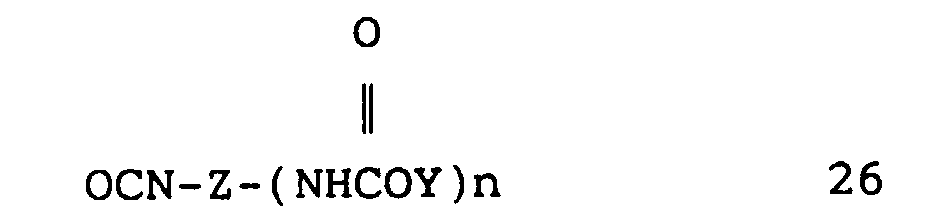
- a preferred process for producing a polyunsaturated diazonium compound as defined in formula 1 which comprises reacting an aromatic diazonium compound of the formula. (A - N 2 + )p - Ar - (R)q - (XH)r with a polyethylenically unsaturated mono isocyanate compound of the formula: to obtain the ethylenically unsaturated diazonium compound of the present invention wherein p, q, Ar, R, X, r, Z, Y and n have the aforesaid meanings.
- the aromatic diazonium compound 12 may be, for example a p-phenylene diamine derivative, an o-phenylene diamine derivative, a compound having a diazo diphenylamine type of structure, or a derivative of a compound containing a primary amine group.
- Preferred aromatic diazonium compounds are shown by formulae 13 to 25.
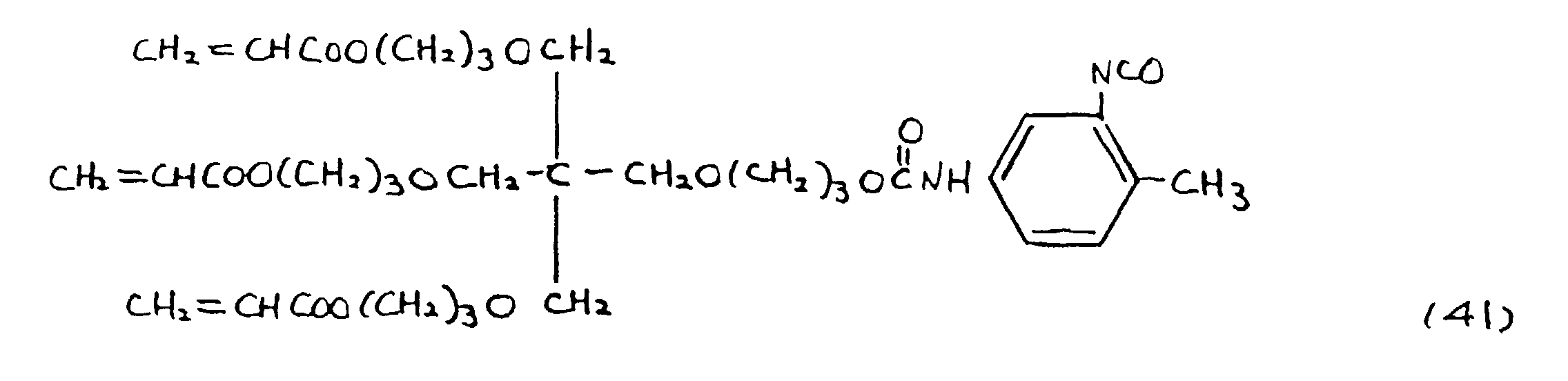
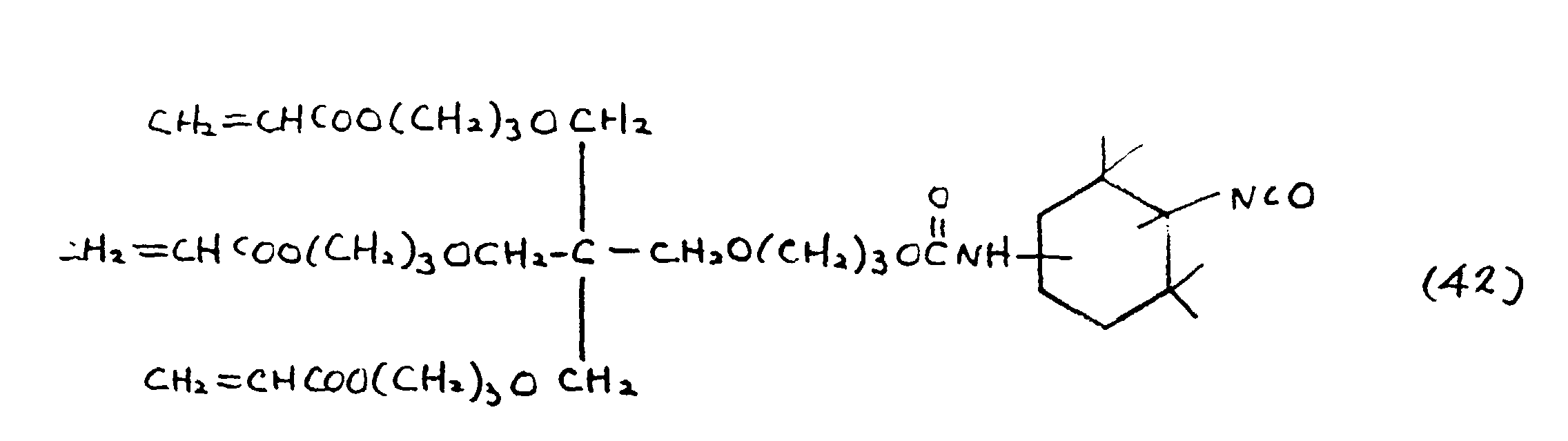
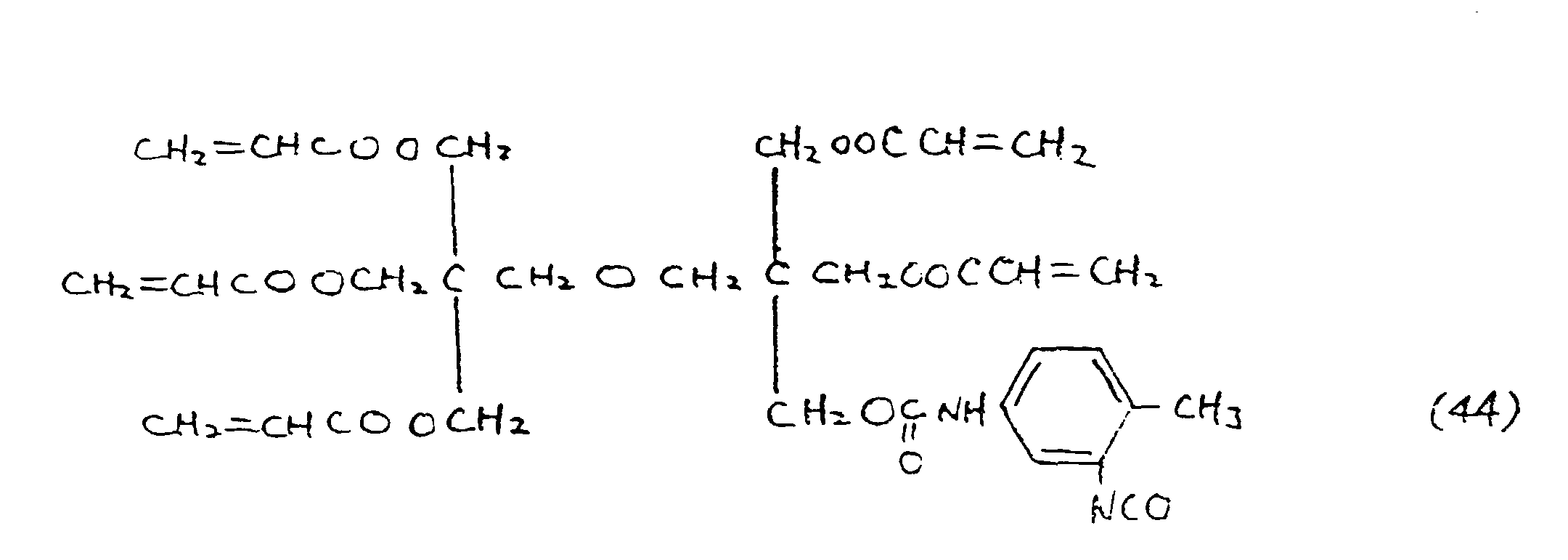
- the polyethylenically unsaturated mono isocyanate compound of formula 26 is the reaction product of a polyisocyanate of the formula OCN-Z-(NCO)n where n may be 1 or 2, and an ethylenically unsaturated monohydroxy compound of the formula YOH carrying at least two ethylenically unsaturated double bonds.
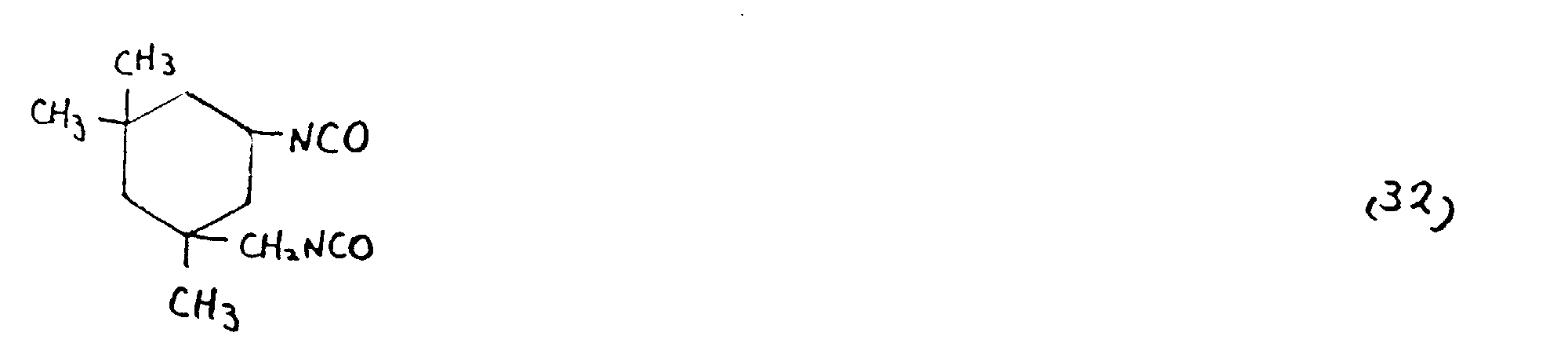
- Z may be, for example, an aromatic, an alicyclic, or a heterocyclic ring. It may also be an alkylene group. Examples of such polyisocyanates are shown by formulae 28-38.
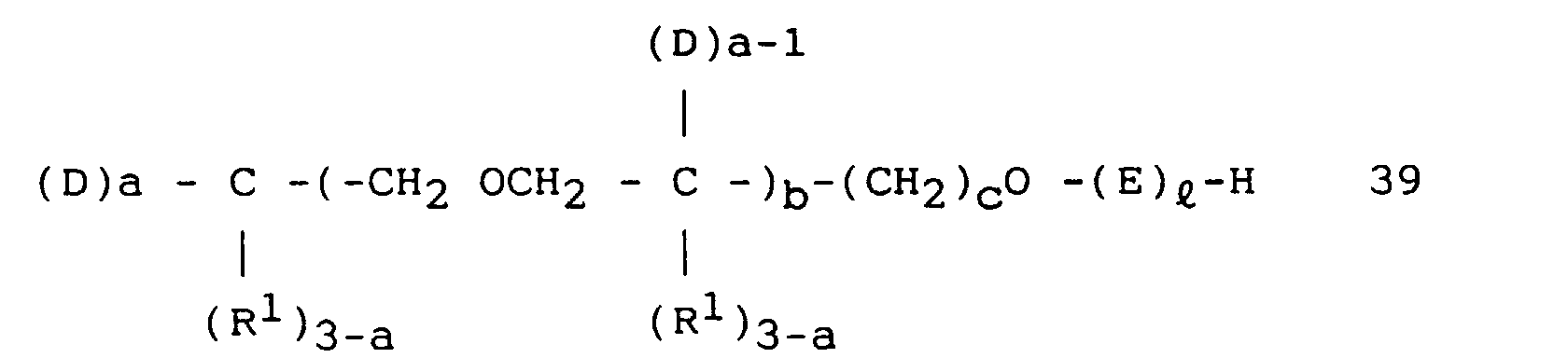
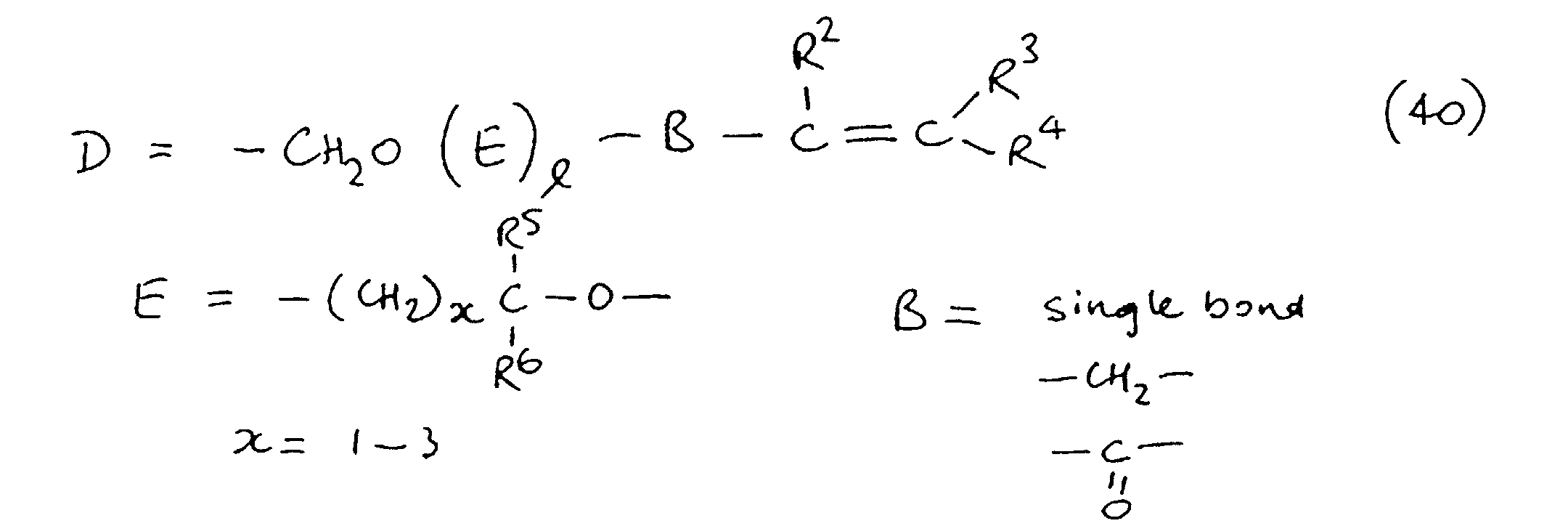
- the polyethylenically unsaturated monohydroxy compound of the formula YOH may be of the following detailed general formula:
- Suitable poly ethylenically unsaturated monohydroxy compounds are glycerol diacrylate, trimethylolpropane diacrylate, pentaerythritol triacrylate, ditrimethylolpropane triacrylate, tetra(hydroxypropyl) pentaerythritol triacrylate, dipentaerythritol pentaacrylate and pentaerythritol triallyl ether.
- the ethylenically unsaturated monohydroxy compound of formula 39 is preferably prepared from a saturated polyol by reacting all except one of the hydroxy groups with an ethylenically unsaturated compound including a functional group capable of reacting with a hydroxy group.
- a saturated polyol by reacting all except one of the hydroxy groups with an ethylenically unsaturated compound including a functional group capable of reacting with a hydroxy group.
- Such polyols are abundant and suitable examples are glycerol, trimethylolethane, trimethylolpropane, pentaerythritol, dipentaerythritol or polyhydroxyl compounds resulting from the oxyalkylation of polyols with alkylene oxide, in particular ethylene oxide or propylene oxide.
- the reaction between the polyisocyanate of formula 27 and the polyunsaturated mono hydroxy compound of formula YOH is effected in such a way that the ethylenically unsaturated mono isocyanate compound of formula 26 is produced in a manner such as to avoid the formation of the large amount of by-products which are ordinarily produced when polyisocyanates are reacted with reactive hydrogen-containing compounds.
- the reaction is carried out in a medium in which the reactants are miscible but in which the ethylenically unsaturated mono isocyanate compound is immiscible.
- the selective formation of the ethylenically unsaturated mono isocyanate of the invention can be assisted by using, as the polyisocyanate, an isocyanate having isocyanate groups of differing reactivities such as tolylene diisocyanate or isophorone diisocyanate.
- the polyunsaturated diazonium compound is synthesized in accordance with an 'in-situ' process.
- the polyunsaturated monohydroxy compound of formula 39 is first reacted with a polyisocyanate of the formula 27 in an inert solvent, preferably, with the addition of a suitable catalyst such as dibutyltin dilaurate and a free-radical polymerisation inhibitor such as hydroquinone; then when the designated percentage of the total isocyanate groups have been reacted, without isolating the intermediate, the aromatic diazonium compound of formula 12 is reacted to afford the polyunsaturated diazonium compound of the invention as a viscous liquid.
- a suitable catalyst such as dibutyltin dilaurate
- a free-radical polymerisation inhibitor such as hydroquinone
- Compound 41 (a polyacrylate mono isocyanate compound derived from tetra(hydroxypropyl) pentaerythritol triacrylate (THPT) and tolylene-2,4-diisocyanate (TDI))
- a liquid chromatographic method was used to determine the residual tolylene diisocyanate, and the total isocyanate content of the product was analyzed by titration. A total isocyanate content of 6.3% w/w was found against a theoretical value of 6.4% w/w. Therefore, the purity of the product was 98%.
- dipentaerythritol pentaacrylate (OH value 110) was reacted with TDI (20 g, 0.12 mole, 20% excess) in a mixture of petroleum ether (b.p. 40-60°C) and diethyl ether according to the method of Example 1.
- TDI dipentaerythritol pentaacrylate
- a total isocyanate value of 5.8% w/w was found against a theoretical value of 6.1% w.w. Therefore, the purity of the product was 95%.
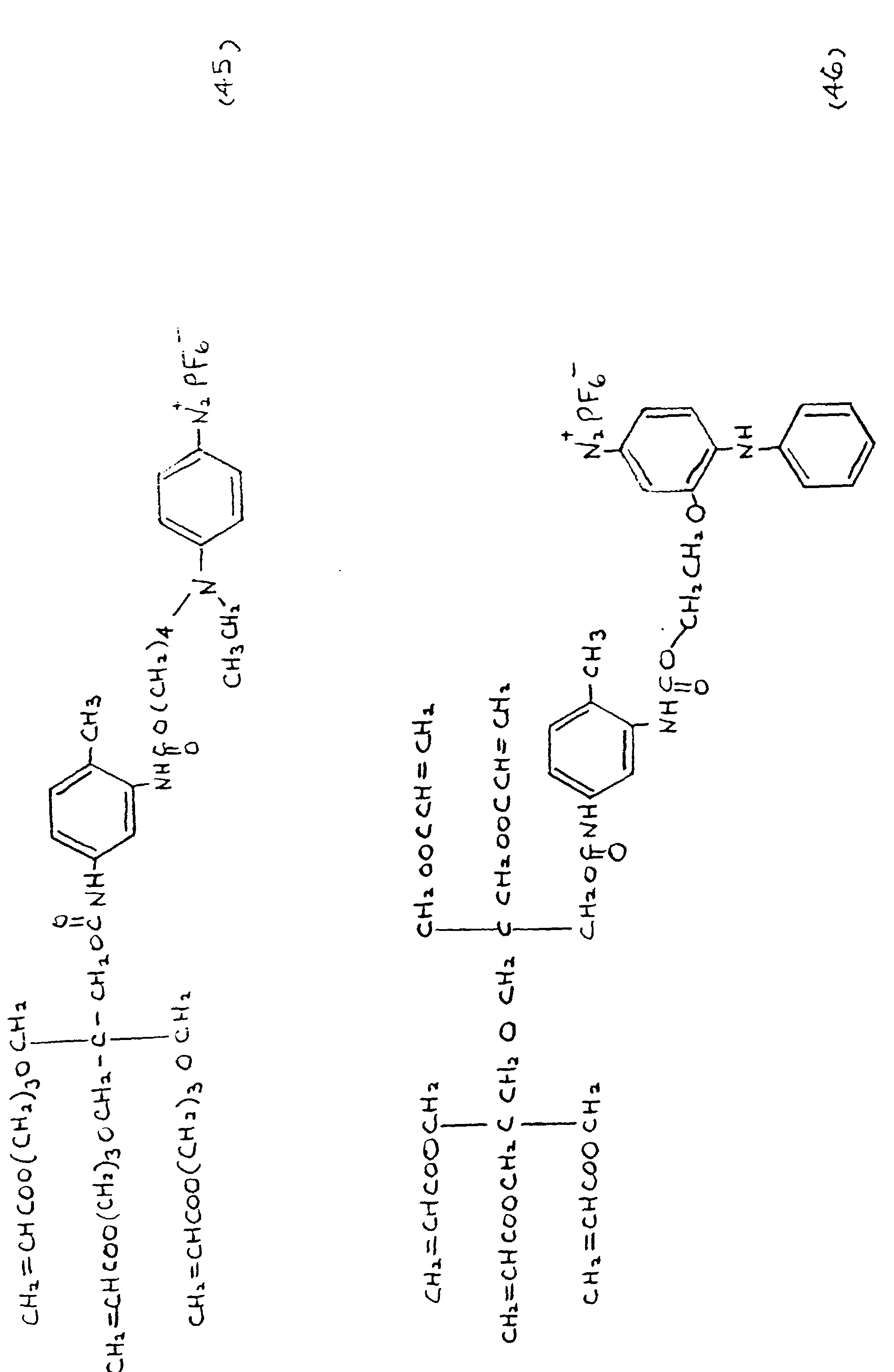
- compound 45 (a polyacrylate diazonium compound derived from compound 41 and diazo -4(N-ethyl-N-hydroxy butyl) phenylene diamine hexafluorophosphate.
- Diazo-4(N-ethyl-N-hydroxybutyl)phenylene diamine hexafluorophosphate (7.3g, 0.02 mole) was dissolved in 50 mls of dry methyl ethyl ketone with the addition of hydroquinone (0.01g) and a catalytic amount of dibutyltin dilaurate. 13.5g, 0.02 mole, of compound 41 were dissolved in 20mls of dry methyl ethyl ketone and added dropwise to the solution over a period of 30 minutes. The mixture was then stirred at 25°C until IR monitoring showed the residual isocyanate was all reacted. Methanol (5 mls) was added and the mixture further stirred for 2 hours. The solvent was then removed in vacuo to produce a viscous liquid.
- UV spectroscopy and IR were employed to confirm the structure of the final product.
- a solution in methyl ethyl ketone comprising: 2.55 parts of Compound 45; 0.85 parts of poly(vinyl butyral) hydrogen phthalate ester having an acid value of 85; 0.125 parts of 2-(p-methoxyphenyl)-4,6-bistrichloromethyl-s-triazine; and 0.2 parts of Victoria Pure Blue FGA was whirler coated onto a sheet of electrograined and anodised aluminium to give a coating weight of 1.0 gm -2 .
- the resultant radiation sensitive plate was exposed through a continuous tone Stouffer stepwedge to ultraviolet light (200 mJcm -2 in a Berkey-Ascor frame) and then developed with an aqueous solution containing sodium propanoate, sodium benzoate and a surfactant.
- a solid step 5 was reproduced on the stepwedge.
- a second exposure was carried out in a similar way but without contact vacuum being applied.
- Example 7 The method of Example 7 was repeated except that tetra(hydroxy propyl)pentaerythritol triacrylate (THPT) was used instead of Compound 45. After a similar vacuum exposure and development process, a solid step 4, tail 7 was reproduced. However, the same exposure without contact vacuum gave no image.
- THPT tetra(hydroxy propyl)pentaerythritol triacrylate
- a solution in methyl ethyl ketone comprising: 1.3 parts of Compound 45; 1.0 parts of poly(vinylbutyral)hydrogenphthalate ester of Example 7; 0.1 parts of 2-(p-methoxyphenyl)-4,6-bistrichloromethyl-s-triazine; and 0.07 parts of Victoria Pure Blue FGA was whirler coated onto a sheet of electrograined and anodised aluminum to give a coated weight of 1.2 gm -2 .
- the resultant radiation sensitive plate was exposed through a continuous tone Stouffer stepwedge to UV light (200 mJcm -2 in a Berkey-Ascor frame), and then developed with an aqueous solution containing sodium propanoate, sodium benzoate and a surfactant. A solid step 5, tail 8 was reproduced. A similar exposure without contact vacuum gave the same stepwedge reading. When placed on a printing press, the plate produced 200,000 satisfactory impressions. Samples of plate were subjected to accelerated ageing tests in a humidity cabinet at 30°C and 95% relative humidity. After five weeks storage, the plate still developed to leave a clean unstained background.
- a solution in 2-methoxy ethanol comprising: 1.0 parts of dipentaerythritol pentaacrylate; 1.0 parts of the poly(vinylbutyral)hydrogen phthalate of Example 7; 0.3 parts of 4-diazodiphenylamine-formaldehyde hexafluorophosphate condensation polymer; 0.1 parts of 2(p-methoxyphenyl)4,6-bistrichloromethyl-s-triazine; and 0.07 parts of Victoria Pure Blue FGA was whirler coated onto electrograined and anodised aluminium to give a coating weight of 1.2 gm -2 .
- Example 11 12 13 Compound 46 1.0 -- -- Poly(vinylbutyral)hydrogen phthalate 1.5 1.5 1.4 DPEPA -- 1.0 0.9 4-DDP -- -- 0.3 MPT 0.08 0.08 0.08 Victoria Pure Blue FGA 0.08 0.08 0.08 Example Vacuum Stepwedge (200 mJcm -2 ) Background Number of impressions 11 Yes 5,10 Clean 200,000 No 4,10 Clean - 12 Yes 4,8 Clean 140,000 No No image Clean - 13 Yes 5,11 Heavy stain 180,000 No 4,9 Heavy stain -
- a solution in methylethylketone comprising:
- Example 16 was repeated except that the binder was replaced by the same amount of a copolymer of styrene, methacrylic acid, ethyl acrylate and methylmethacrylate, acid value 70.
- the plate was exposed and developed as described in Example 16 and gave similar results when placed on a printing press.
Landscapes
- Chemical & Material Sciences (AREA)
- Organic Chemistry (AREA)
- Physics & Mathematics (AREA)
- General Physics & Mathematics (AREA)
- Spectroscopy & Molecular Physics (AREA)
- Organic Low-Molecular-Weight Compounds And Preparation Thereof (AREA)
- Polyurethanes Or Polyureas (AREA)
- Photosensitive Polymer And Photoresist Processing (AREA)
- Thiazole And Isothizaole Compounds (AREA)
- Paints Or Removers (AREA)
Description


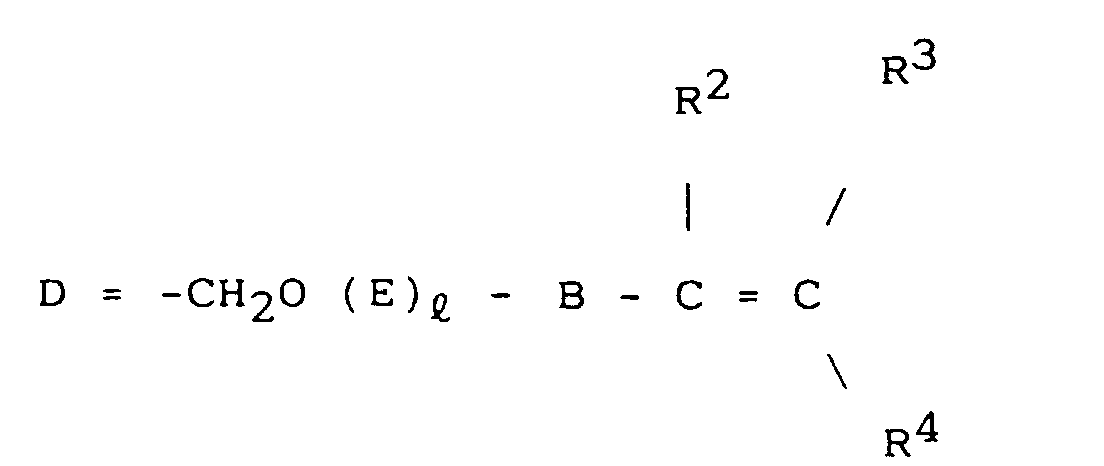

- R2 = H or CH3
- R3 = H or CH3
- R4 = H or CH3
- R5 = H or CH3
- R6 = H or CH3
| 2.55 parts of | Compound 45; |
| 0.85 parts of | poly(vinyl butyral) hydrogen phthalate ester having an acid value of 85; |
| 0.125 parts of | 2-(p-methoxyphenyl)-4,6-bistrichloromethyl-s-triazine; and |
| 0.2 parts of | Victoria Pure Blue FGA |
| 1.3 parts of | Compound 45; |
| 1.0 parts of | poly(vinylbutyral)hydrogenphthalate ester of Example 7; |
| 0.1 parts of | 2-(p-methoxyphenyl)-4,6-bistrichloromethyl-s-triazine; and |
| 0.07 parts of | Victoria Pure Blue FGA |
| 1.0 parts of | dipentaerythritol pentaacrylate; |
| 1.0 parts of | the poly(vinylbutyral)hydrogen phthalate of Example 7; |
| 0.3 parts of | 4-diazodiphenylamine-formaldehyde hexafluorophosphate condensation polymer; |
| 0.1 parts of | 2(p-methoxyphenyl)4,6-bistrichloromethyl-s-triazine; and |
| 0.07 parts of | Victoria Pure Blue FGA |
| Component | Example | ||
| 11 | 12 | 13 | |
| Compound 46 | 1.0 | -- | -- |
| Poly(vinylbutyral)hydrogen phthalate | 1.5 | 1.5 | 1.4 |
| DPEPA | -- | 1.0 | 0.9 |
| 4-DDP | -- | -- | 0.3 |
| MPT | 0.08 | 0.08 | 0.08 |
| Victoria Pure Blue FGA | 0.08 | 0.08 | 0.08 |
| Example | Vacuum | Stepwedge (200 mJcm-2) | Background | Number of impressions |
| 11 | Yes | 5,10 | Clean | 200,000 |
| No | 4,10 | Clean | - | |
| 12 | Yes | 4,8 | Clean | 140,000 |
| No | No image | Clean | - | |
| 13 | Yes | 5,11 | Heavy stain | 180,000 |
| No | 4,9 | Heavy stain | - |































Claims (11)
- A polyunsaturated diazonium compound having the general formula:where p and q are integers ranging from 1 to 5 and r is an integer ranging from 1 to 10; and in which Ar represents a substituted or unsubstituted divalent or polyvalent radical derived from an aromatic or heteroaromatic compound; X represents O, S or a secondary or tertiary amino group; R represents a single bond or a substituted or unsubstituted divalent or other polyvalent radical and may be the same or different when q is greater than 1; A- represents an anion; Z represents the residue of a polyisocyanate OCN-Z-(NCO)n where n is 1 or 2; and Y is the residue of a monohydroxy compound of the formula YOH where Y contains at least two ethylenically unsaturated double bonds.

- A polyunsaturated diazonium compound as claimed in claim 1 wherein Ar represents a phenylene, naphthylene, benzothiazolylene, benzopyrazolylene, or dibenzothiazolylene radical.
- A polyunsaturated diazonium compound as claimed in claim 1 or 2 wherein R represents an optionally substituted alkylene, arylene or an aralkylene radical optionally containing one or more heteroatoms.
- A polyunsaturated diazonium compound as claimed in claim 1, 2 or 3 wherein anion A- is a p-toluene sulphonate, naphthalene sulphonate, dodecyl benzene sulphonate, dicyclohexylsulphosuccinate, triisopropyl naphthalene sulphonate, diisobutyl naphthalene sulphonate, 2-hydroxy-4-methoxy benzophenone-5-sulphonate, mesitylene sulphonate, octyl phenyl sulphonate, naphthoate, cinnamate, tetrafluoroborate, hexafluorophosphate, or hexafluoroarsenate ion.
- A process for producing a polyunsaturated diazonium compound which comprises reacting an aromatic diazonium compound of the formula.wherein p, q, Ar, R, X, r, Z, Y and n have the aforesaid meanings.
- A process according to claim 5 wherein the aromatic diazonium compound 12 is a p-phenylene diamine derivative, an o-phenylene diamine derivative, a diazo diphenylamine derivative, or a primary aromatic or heterocyclic amine derivative.
- A process according to claim 5 or 6 wherein the polyethylenically unsaturated mono isocyanate compound is obtained from the reaction of a polyisocyanate of the formula
- A process according to claim 7 wherein the polyisocyanate is tolylene diisocyanate or isophorone diisocyanate.
- A process according to claim 7 or 8 wherein the ethylenically unsaturated monohydroxy compound has the detailed formula:
 a = 2 or 3b = 0 or 1c = 0 or 1R1 = H or alkylℓ = 0 or 1
 R2 = H or CH3R3 = H or CH3R4 = H or CH3R5 = H or CH3R6 = H or CH3
 - A process according to claim 7, 8 or 9 wherein the ethylenically unsaturated monohydroxy compound is glycerol diacrylate, trimethylolpropane diacrylate, pentaerythritol triacrylate, ditrimethylolpropane triacrylate, tetra(hydroxypropyl) pentaerythritol triacrylate, dipentaerythritol pentaacrylate or pentaerythritol triallyl ether.
- A process according to claim 7, 8, 9 or 10 wherein the reaction medium is such that the polyisocynate and the ethylenically unsaturated monohydroxy compound are miscible therein but the polyethylenically unsaturated monoisocypate compound is immiscible therein.
Applications Claiming Priority (2)
| Application Number | Priority Date | Filing Date | Title |
|---|---|---|---|
| GB9201237A GB2263906B (en) | 1992-01-21 | 1992-01-21 | Improvements in or relating to polyunsaturated diazonium compounds |
| GB9201237 | 1992-01-21 |
Publications (2)
| Publication Number | Publication Date |
|---|---|
| EP0554006A1 EP0554006A1 (en) | 1993-08-04 |
| EP0554006B1 true EP0554006B1 (en) | 1999-04-28 |
Family
ID=10708964
Family Applications (1)
| Application Number | Title | Priority Date | Filing Date |
|---|---|---|---|
| EP19930300423 Expired - Lifetime EP0554006B1 (en) | 1992-01-21 | 1993-01-21 | Polyunsaturated diazonium compounds |
Country Status (5)
| Country | Link |
|---|---|
| EP (1) | EP0554006B1 (en) |
| JP (1) | JPH0687817A (en) |
| CA (1) | CA2083545A1 (en) |
| DE (1) | DE69324616T2 (en) |
| GB (1) | GB2263906B (en) |
Families Citing this family (2)
| Publication number | Priority date | Publication date | Assignee | Title |
|---|---|---|---|---|
| JP4705135B2 (en) * | 2001-10-31 | 2011-06-22 | 三菱製紙株式会社 | Photosensitive composition |
| JP2005200335A (en) * | 2004-01-15 | 2005-07-28 | Fuji Photo Film Co Ltd | Diazonium salt and recording material |
Family Cites Families (4)
| Publication number | Priority date | Publication date | Assignee | Title |
|---|---|---|---|---|
| IT1000315B (en) * | 1972-12-14 | 1976-03-30 | Polychrome Corp | IMPROVEMENT IN POTOSENSITIVE UNSATURATED DIAZOIC MONOMERE COMPOSITIONS |
| US4316949A (en) * | 1979-12-14 | 1982-02-23 | Minnesota Mining And Manufacturing Company | Photoreactive oligomer composition and printing plate |
| FI71845C (en) * | 1979-12-18 | 1987-02-09 | Vickers Ltd | FOERBAETTRINGAR ANGAOENDE STRAOLNINGSKAENSLIGA MATERIAL. |
| DE3605717A1 (en) * | 1985-02-28 | 1986-08-28 | Hoechst Celanese Corp., Somerville, N.J. | POLYMERIZABLE MIXTURE BY RADIATION |
-
1992
- 1992-01-21 GB GB9201237A patent/GB2263906B/en not_active Expired - Fee Related
-
1993
- 1993-01-20 CA CA 2083545 patent/CA2083545A1/en not_active Abandoned
- 1993-01-21 DE DE1993624616 patent/DE69324616T2/en not_active Expired - Fee Related
- 1993-01-21 JP JP5008664A patent/JPH0687817A/en active Pending
- 1993-01-21 EP EP19930300423 patent/EP0554006B1/en not_active Expired - Lifetime
Also Published As
| Publication number | Publication date |
|---|---|
| JPH0687817A (en) | 1994-03-29 |
| GB2263906A (en) | 1993-08-11 |
| DE69324616D1 (en) | 1999-06-02 |
| EP0554006A1 (en) | 1993-08-04 |
| CA2083545A1 (en) | 1993-07-22 |
| GB9201237D0 (en) | 1992-03-11 |
| DE69324616T2 (en) | 1999-10-28 |
| GB2263906B (en) | 1995-11-08 |
Similar Documents
| Publication | Publication Date | Title |
|---|---|---|
| US4458007A (en) | Radiation polymerizable mixture containing reaction products of glycerol acrylates and polyisocyanates | |
| US5085974A (en) | Photopolymerizable mixture, and a recording material produced therefrom | |
| JP2509288B2 (en) | Polymerizable compound, radiation-polymerizable mixture containing the same, and radiation-polymerizable recording material | |
| EP0529896B1 (en) | Light-sensitive article containing migration-resistant halomethyl-1,3,5-triazine photoinitiator | |
| US4316949A (en) | Photoreactive oligomer composition and printing plate | |
| CA1161294A (en) | Light-sensitive composition including a diazonium saltpolycondensation product and a branched polyurethane binder | |
| US4933452A (en) | Radiation sensitive isocyanurate compounds | |
| US5710193A (en) | Photopolymerisable components of radiation sensitive compositions | |
| EP0414099A2 (en) | Reaction product, process for its preparation and the radiation sensitive material obtained in this way | |
| US5534623A (en) | Process for preparing a polyunsaturated diazonium compounds | |
| US5466789A (en) | Polyunsaturated diazonium compounds | |
| US4522913A (en) | Monoacrylate or diacrylate of 2-methyl-propylene glycol and photosensitive composition containing the diacrylate | |
| EP0554006A1 (en) | Polyunsaturated diazonium compounds | |
| JPH0426687A (en) | Thioxanthone-based compound and photosensitive composition | |
| JP2755743B2 (en) | Radiation-polymerizable mixtures and copy materials produced therefrom | |
| EP0985165A1 (en) | Ionic halomethyl-1,3,5-triazine photoinitiators | |
| JPH11286475A (en) | Optically active material applicable to image-forming system | |
| JP2805802B2 (en) | Method for producing polyurethane resin for photosensitive composition | |
| US4994530A (en) | Polymeric compounds | |
| US5939148A (en) | Visible laser-curable composition | |
| US6093518A (en) | Visible laser-curable composition | |
| EP0763779A2 (en) | Unsaturated group-containing urethane compound, photopolymerizable composition containing it, and photosensitive lithographic printing plate | |
| JP4320076B2 (en) | Visible light laser curable composition | |
| JPH0429147A (en) | Photosensitive composition | |
| EP0414100A2 (en) | Photosensitive positive working mixture |
Legal Events
| Date | Code | Title | Description |
|---|---|---|---|
| PUAI | Public reference made under article 153(3) epc to a published international application that has entered the european phase |
Free format text: ORIGINAL CODE: 0009012 |
|
| AK | Designated contracting states |
Kind code of ref document: A1 Designated state(s): DE ES FR GB IT NL |
|
| 17P | Request for examination filed |
Effective date: 19940118 |
|
| 17Q | First examination report despatched |
Effective date: 19970701 |
|
| GRAG | Despatch of communication of intention to grant |
Free format text: ORIGINAL CODE: EPIDOS AGRA |
|
| GRAG | Despatch of communication of intention to grant |
Free format text: ORIGINAL CODE: EPIDOS AGRA |
|
| GRAH | Despatch of communication of intention to grant a patent |
Free format text: ORIGINAL CODE: EPIDOS IGRA |
|
| RBV | Designated contracting states (corrected) |
Designated state(s): DE ES FR IT NL |
|
| RAP1 | Party data changed (applicant data changed or rights of an application transferred) |
Owner name: AGFA-GEVAERT N.V. |
|
| GRAH | Despatch of communication of intention to grant a patent |
Free format text: ORIGINAL CODE: EPIDOS IGRA |
|
| GRAA | (expected) grant |
Free format text: ORIGINAL CODE: 0009210 |
|
| AK | Designated contracting states |
Kind code of ref document: B1 Designated state(s): DE ES FR IT NL |
|
| PG25 | Lapsed in a contracting state [announced via postgrant information from national office to epo] |
Ref country code: ES Free format text: THE PATENT HAS BEEN ANNULLED BY A DECISION OF A NATIONAL AUTHORITY Effective date: 19990428 |
|
| REF | Corresponds to: |
Ref document number: 69324616 Country of ref document: DE Date of ref document: 19990602 |
|
| ET | Fr: translation filed | ||
| PGFP | Annual fee paid to national office [announced via postgrant information from national office to epo] |
Ref country code: FR Payment date: 20000106 Year of fee payment: 8 |
|
| PGFP | Annual fee paid to national office [announced via postgrant information from national office to epo] |
Ref country code: NL Payment date: 20000110 Year of fee payment: 8 |
|
| PLBE | No opposition filed within time limit |
Free format text: ORIGINAL CODE: 0009261 |
|
| 26N | No opposition filed | ||
| PG25 | Lapsed in a contracting state [announced via postgrant information from national office to epo] |
Ref country code: DE Free format text: LAPSE BECAUSE OF NON-PAYMENT OF DUE FEES Effective date: 20001003 |
|
| PG25 | Lapsed in a contracting state [announced via postgrant information from national office to epo] |
Ref country code: NL Free format text: LAPSE BECAUSE OF NON-PAYMENT OF DUE FEES Effective date: 20010801 |
|
| PG25 | Lapsed in a contracting state [announced via postgrant information from national office to epo] |
Ref country code: FR Free format text: LAPSE BECAUSE OF NON-PAYMENT OF DUE FEES Effective date: 20010928 |
|
| NLV4 | Nl: lapsed or anulled due to non-payment of the annual fee |
Effective date: 20010801 |
|
| REG | Reference to a national code |
Ref country code: FR Ref legal event code: ST |
|
| PG25 | Lapsed in a contracting state [announced via postgrant information from national office to epo] |
Ref country code: IT Free format text: LAPSE BECAUSE OF NON-PAYMENT OF DUE FEES Effective date: 20050121 |