EP0553932A1 - Plastic container which is stackable and nestable - Google Patents
Plastic container which is stackable and nestable Download PDFInfo
- Publication number
- EP0553932A1 EP0553932A1 EP93200232A EP93200232A EP0553932A1 EP 0553932 A1 EP0553932 A1 EP 0553932A1 EP 93200232 A EP93200232 A EP 93200232A EP 93200232 A EP93200232 A EP 93200232A EP 0553932 A1 EP0553932 A1 EP 0553932A1
- Authority
- EP
- European Patent Office
- Prior art keywords
- container
- supporting
- stacking bracket
- rear wall
- container according
- Prior art date
- Legal status (The legal status is an assumption and is not a legal conclusion. Google has not performed a legal analysis and makes no representation as to the accuracy of the status listed.)
- Granted
Links
- 210000002105 tongue Anatomy 0.000 description 3
- 230000004308 accommodation Effects 0.000 description 1
- 235000008429 bread Nutrition 0.000 description 1
- 235000012180 bread and bread product Nutrition 0.000 description 1
Images

Classifications
-
- B—PERFORMING OPERATIONS; TRANSPORTING
- B65—CONVEYING; PACKING; STORING; HANDLING THIN OR FILAMENTARY MATERIAL
- B65D—CONTAINERS FOR STORAGE OR TRANSPORT OF ARTICLES OR MATERIALS, e.g. BAGS, BARRELS, BOTTLES, BOXES, CANS, CARTONS, CRATES, DRUMS, JARS, TANKS, HOPPERS, FORWARDING CONTAINERS; ACCESSORIES, CLOSURES, OR FITTINGS THEREFOR; PACKAGING ELEMENTS; PACKAGES
- B65D21/00—Nestable, stackable or joinable containers; Containers of variable capacity
- B65D21/02—Containers specially shaped, or provided with fittings or attachments, to facilitate nesting, stacking, or joining together
- B65D21/04—Open-ended containers shaped to be nested when empty and to be superposed when full
- B65D21/041—Identical multi-level containers, i.e. having at least three levels
-
- B—PERFORMING OPERATIONS; TRANSPORTING
- B65—CONVEYING; PACKING; STORING; HANDLING THIN OR FILAMENTARY MATERIAL
- B65D—CONTAINERS FOR STORAGE OR TRANSPORT OF ARTICLES OR MATERIALS, e.g. BAGS, BARRELS, BOTTLES, BOXES, CANS, CARTONS, CRATES, DRUMS, JARS, TANKS, HOPPERS, FORWARDING CONTAINERS; ACCESSORIES, CLOSURES, OR FITTINGS THEREFOR; PACKAGING ELEMENTS; PACKAGES
- B65D21/00—Nestable, stackable or joinable containers; Containers of variable capacity
- B65D21/02—Containers specially shaped, or provided with fittings or attachments, to facilitate nesting, stacking, or joining together
- B65D21/06—Containers specially shaped, or provided with fittings or attachments, to facilitate nesting, stacking, or joining together with movable parts adapted to be placed in alternative positions for nesting the containers when empty and for stacking them when full
- B65D21/062—Containers specially shaped, or provided with fittings or attachments, to facilitate nesting, stacking, or joining together with movable parts adapted to be placed in alternative positions for nesting the containers when empty and for stacking them when full the movable parts being attached or integral and displaceable into a position overlying the top of the container, e.g. bails, corner plates
Definitions
- the invention relates to a plastic container which is stackable and nestable, with an open front and top, comprising a bottom, a rear wall, two side walls lying opposite each other, and a movable first stacking bracket placed near the front, for supporting a similar type of container stacked on the container, the rear wall and the side walls being directed outwards at an angle starting at the bottom, the rear wall being provided with one or more first bearing elements which in the stacked position rest on a container below, the rear wall also being provided with one or more recesses which in the nested position accommodate the first bearing elements of one or more containers above, and the container being provided with laterally outward directed second bearing elements, for supporting the container on a container below when in the nested position.
- Such a container is known from EP-B-0 140 459.
- a container of the same type can be stacked on said known container by pivoting upwards the hinged stacking bracket, which is U-shaped and bridges the side walls, with the result that the container above is supported near the front by the stacking bracket and at the rear wall by projections.
- the containers In the downwards pivoted position of the stacking bracket the containers can be nested, so that they take up as little space as possible.
- Such containers are often used for displaying goods in shops, for example bread.
- the filled containers are transported from the bakery to the shop in the stacked position, the containers are emptied by the customers, and the empty containers are then returned in the nested position.
- the object of the invention is to eliminate the abovementioned drawback by providing a container of the type mentioned in the introduction which can be stacked also at one or more intermediate heights.
- a container which is characterised in that near the front the container is provided with supporting means, and the rear wall is provided with one or more supporting projections and corresponding bearing apertures for supporting a container of the same type in at least one intermediate position between the nested position and the stacked position.
- the supporting means comprise supporting elements which are provided on the edge of each side wall situated at the front, and the container is provided at each side wall with a laterally outward directed third bearing element, such that a third bearing element can rest in an intermediate position on a supporting element of a container below.
- Each side wall of the container is advantageously provided with a recess extending from the front of the container, for the accommodation of a third bearing element of a container above in the nested position. This means that the containers can be placed in vertical alignment above one another in the nested position.
- the supporting means comprise supporting elements which are provided on the edge of each side wall situated at the front and can support the movable first stacking bracket in at least one intermediate position. This means that a container above also rests in an intermediate position on the first stacking bracket, with the result that it is always firmly supported.
- Each side wall of the container is advantageously provided with a slot-shaped guide element for guiding the first stacking bracket.
- the supporting means comprise a movable second stacking bracket which is hinged to the container and has a working position in the intermediate position.
- first stacking bracket is hinged to the container, and the second stacking bracket is hinged to the first stacking bracket.
- a container which is simple to stack in an intermediate position is obtained in this way.
- the supporting projections at the rear wall of the container are preferably formed by the first bearing elements which in an intermediate position rest in correspondingly positioned bearing apertures in the rear wall of the container below.
- the second bearing elements near the front of the container with a downward-directed wall part lying at a distance from the side wall, which wall part in the nested position falls over a part of the container below. This ensures that in a stack of nested containers the side walls of the containers cannot bulge out excessively, particularly near the front, where they are relatively weak. In this way the nested containers are prevented from becoming jammed in each other.
- the positioning can be obtained by, for example, a specially bent shape of the stacking bracket or projections provided on the stacking bracket.
- Fig. 1 shows a container which is indicated in its entirety by reference number 1, with a bottom 2, two side walls 3 and 4, a rear wall 5 and a low front edge 6.
- the container has a top edge 8 and a rib 9 running parallel thereto.
- a similar container above rests with its bottom 2 on a U-shaped stacking bracket 15 (see Fig. 2), which is pivoted upwards.
- the hinge point of the stacking bracket is formed by apertures 10.
- the stacking bracket lies in recesses 11 in the top edge 8.
- Recesses 12 engage on the stacking bracket 15, for the purpose of preventing shifting of the container.
- the container above rests with supporting projections 13 (see Fig. 2) in recesses 14 in the top edge 8.
- the container For stacking in an intermediate position, the container is provided with supporting elements 20. Flanges 21 of a container above (not shown) then lie on the supporting elements 20, while tongues 22 fall into recesses 23.
- the supporting projections 13 rest here on the bottom edges of bearing apertures 24 in the rear wall 4. In case of the nesting of several containers these bearing apertures 24 also serve to accommodate supporting projections 13 of a container above. In the nested position the flanges 21 fall into recesses 25 in the side walls 3, 4.
- FIG. 2 It can be seen in Fig. 2 how the container from Fig. 1 when stacked can also be placed further back relative to a container below (not shown).
- the recesses 23 in this case fall over the stacking bracket 15 of the container below, and a channel 28 in the bottom 2 engages in the recesses 14 in the top edge 8.
- the stacking bracket 15 is provided with projections 26 which fall in between the side walls of the container above.
- a container above both in the intermediate position and in the stacked position can rest on a stacking bracket 30, which then rests on supporting tongues 32 and 33, respectively.
- the stacking bracket 30 lies in the flapped down position.
- the stacking bracket 30 slides with its ends 34 in a guide slot 35.
- Fig. 4 shows an embodiment in which a container above (not shown) in the stacked position rests on a first stacking bracket 40 of the container 1, and in the intermediate position on a second stacking bracket 42.
- the likewise U-shaped stacking bracket 42 lies inside the stacking bracket 40, so that they can be moved independently of each other.
- Stacking bracket 42 has ends 43 which are directed outward and fall into hinge apertures 44. Ends 45 of the stacking bracket 40 are directed inward and fall into hinge apertures 46.
- Fig. 5 shows another embodiment of the container 1, in which a first stacking bracket 50 is fixed in a hinge point 51 to the container 1.
- a second stacking bracket 52 has a hinge point 53, which is fixed to the first stacking bracket 50. In the stacked position the two brackets 50, 52 pivot upwards together, while in the intermediate position only the second stacking bracket 52 does so.
- the containers certainly in the case of containers for bread products, to be provided with recesses in the bottom and the walls, in order to reduce the weight and to increase the air circulation in a stack of containers.
Landscapes
- Engineering & Computer Science (AREA)
- Mechanical Engineering (AREA)
- Stackable Containers (AREA)
- Containers Having Bodies Formed In One Piece (AREA)
Abstract
Description
- The invention relates to a plastic container which is stackable and nestable, with an open front and top, comprising a bottom, a rear wall, two side walls lying opposite each other, and a movable first stacking bracket placed near the front, for supporting a similar type of container stacked on the container, the rear wall and the side walls being directed outwards at an angle starting at the bottom, the rear wall being provided with one or more first bearing elements which in the stacked position rest on a container below, the rear wall also being provided with one or more recesses which in the nested position accommodate the first bearing elements of one or more containers above, and the container being provided with laterally outward directed second bearing elements, for supporting the container on a container below when in the nested position.
- Such a container is known from EP-B-0 140 459. A container of the same type can be stacked on said known container by pivoting upwards the hinged stacking bracket, which is U-shaped and bridges the side walls, with the result that the container above is supported near the front by the stacking bracket and at the rear wall by projections. In the downwards pivoted position of the stacking bracket the containers can be nested, so that they take up as little space as possible.
- Such containers are often used for displaying goods in shops, for example bread. In this case the filled containers are transported from the bakery to the shop in the stacked position, the containers are emptied by the customers, and the empty containers are then returned in the nested position.
- The disadvantage of these known containers is that they are stackable only in one height, with the result that in the case of products of different heights one either has to work with partially filled containers, or separate containers have to be kept in stock for each product height.
- The latter possibility must be rejected for logistical reasons, so that the first solution is chosen and the loss of space accepted.
- The object of the invention is to eliminate the abovementioned drawback by providing a container of the type mentioned in the introduction which can be stacked also at one or more intermediate heights.
- This object is achieved by a container which is characterised in that near the front the container is provided with supporting means, and the rear wall is provided with one or more supporting projections and corresponding bearing apertures for supporting a container of the same type in at least one intermediate position between the nested position and the stacked position.
- In a first embodiment the supporting means comprise supporting elements which are provided on the edge of each side wall situated at the front, and the container is provided at each side wall with a laterally outward directed third bearing element, such that a third bearing element can rest in an intermediate position on a supporting element of a container below.
- Each side wall of the container is advantageously provided with a recess extending from the front of the container, for the accommodation of a third bearing element of a container above in the nested position. This means that the containers can be placed in vertical alignment above one another in the nested position.
- By providing the third bearing elements and the supporting elements with positioning means which can interlock positively, it is ensured that the containers cannot shift relative to each other when they are in an intermediate position.
- In a second embodiment the supporting means comprise supporting elements which are provided on the edge of each side wall situated at the front and can support the movable first stacking bracket in at least one intermediate position. This means that a container above also rests in an intermediate position on the first stacking bracket, with the result that it is always firmly supported.
- Each side wall of the container is advantageously provided with a slot-shaped guide element for guiding the first stacking bracket.
- In a third embodiment the supporting means comprise a movable second stacking bracket which is hinged to the container and has a working position in the intermediate position.
- In a fourth embodiment the first stacking bracket is hinged to the container, and the second stacking bracket is hinged to the first stacking bracket. A container which is simple to stack in an intermediate position is obtained in this way.
- The supporting projections at the rear wall of the container are preferably formed by the first bearing elements which in an intermediate position rest in correspondingly positioned bearing apertures in the rear wall of the container below.
- It is also advantageous to provide the second bearing elements near the front of the container with a downward-directed wall part lying at a distance from the side wall, which wall part in the nested position falls over a part of the container below. This ensures that in a stack of nested containers the side walls of the containers cannot bulge out excessively, particularly near the front, where they are relatively weak. In this way the nested containers are prevented from becoming jammed in each other.
- Providing the first stacking bracket and/or the second stacking bracket with positioning means ensures that a container above is held in place. In the case of high stacks in particular, the lateral freedom of movement of a container on a stacking bracket leads to undesirable shifting and loss of shape of the stack. The positioning can be obtained by, for example, a specially bent shape of the stacking bracket or projections provided on the stacking bracket.
- The invention will be explained below with reference to examples of embodiments of the container shown in the drawing, in which:
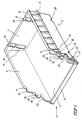
- Fig. 1 shows a view in perspective of a first embodiment of a container according to the invention;
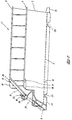
- Fig. 2 shows a side view of the container from Fig. 1;
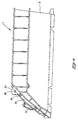
- Fig. 3 shows a side view of a second embodiment of the container according to the invention;
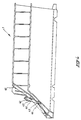
- Fig. 4 shows a side view of a third embodiment of the container according to the invention; and
- Fig. 5 shows a side view of a fourth embodiment of the container according to the invention.
- Fig. 1 shows a container which is indicated in its entirety by reference number 1, with a
bottom 2, twoside walls rear wall 5 and alow front edge 6. The container has atop edge 8 and arib 9 running parallel thereto. - In the stacked position a similar container above (not shown) rests with its
bottom 2 on a U-shaped stacking bracket 15 (see Fig. 2), which is pivoted upwards. The hinge point of the stacking bracket is formed byapertures 10. Here the stacking bracket lies inrecesses 11 in thetop edge 8.Recesses 12 engage on thestacking bracket 15, for the purpose of preventing shifting of the container. At the rear side the container above rests with supporting projections 13 (see Fig. 2) inrecesses 14 in thetop edge 8. - In the nested position the container rests with
rib 9 on thetop edge 8 of a container below (not shown). Lockingtongues 17 in this case engage in therecesses 11, with the result that the containers are secured against shifting. Awall part 18 also falls over apart 19 of the container below, so that lateral bulging of the side walls is limited. - For stacking in an intermediate position, the container is provided with supporting
elements 20.Flanges 21 of a container above (not shown) then lie on the supportingelements 20, whiletongues 22 fall intorecesses 23. The supportingprojections 13 rest here on the bottom edges ofbearing apertures 24 in therear wall 4. In case of the nesting of several containers these bearingapertures 24 also serve to accommodate supportingprojections 13 of a container above. In the nested position theflanges 21 fall intorecesses 25 in theside walls - It can be seen in Fig. 2 how the container from Fig. 1 when stacked can also be placed further back relative to a container below (not shown). The
recesses 23 in this case fall over thestacking bracket 15 of the container below, and achannel 28 in thebottom 2 engages in therecesses 14 in thetop edge 8. - In order to limit the lateral freedom of movement of a container above when stacked, the
stacking bracket 15 is provided withprojections 26 which fall in between the side walls of the container above. - In the embodiment of the container 1 in Fig. 3 a container above (not shown) both in the intermediate position and in the stacked position can rest on a
stacking bracket 30, which then rests on supportingtongues stacking bracket 30 lies in the flapped down position. Thestacking bracket 30 slides with itsends 34 in aguide slot 35. - Fig. 4 shows an embodiment in which a container above (not shown) in the stacked position rests on a
first stacking bracket 40 of the container 1, and in the intermediate position on asecond stacking bracket 42. The likewise U-shapedstacking bracket 42 lies inside thestacking bracket 40, so that they can be moved independently of each other. Stackingbracket 42 hasends 43 which are directed outward and fall intohinge apertures 44. Ends 45 of thestacking bracket 40 are directed inward and fall intohinge apertures 46. - Fig. 5 shows another embodiment of the container 1, in which a
first stacking bracket 50 is fixed in ahinge point 51 to the container 1. Asecond stacking bracket 52 has ahinge point 53, which is fixed to thefirst stacking bracket 50. In the stacked position the twobrackets second stacking bracket 52 does so. - It is usual for the containers, certainly in the case of containers for bread products, to be provided with recesses in the bottom and the walls, in order to reduce the weight and to increase the air circulation in a stack of containers.
Claims (12)
- Plastic container (1) which is stackable and nestable, with an open front and top, comprising a bottom (2), a rear wall (5), two side walls (3, 4) lying opposite each other, and a movable first stacking bracket (15, 30, 40, 50) placed near the front, for supporting a similar type of container stacked on the container, the rear wall and the side walls being directed outwards at an angle starting at the bottom, the rear wall being provided with one or more first bearing elements (13) which in the stacked position rest on a container below, the rear wall also being provided with one or more recesses (24) which in the nested position accommodate the first bearing elements of one or more containers above, and the container being provided with laterally outward directed second bearing elements, for supporting the container on a container below when in the nested position, characterised in that near the front the container (1) is provided with supporting means (20, 21; 32; 42; 52), and the rear wall (5) is provided with one or more supporting projections (13) and corresponding bearing apertures (24) for supporting a container of the same type in at least one intermediate position between the nested position and the stacked position.
- Container according to Claim 1, characterised in that the supporting means comprise supporting elements (20) which are provided on the edge of each side wall (3, 4) situated at the front, and third bearing elements (21) which are provided on each side wall (3, 4) and are directed laterally outwards, such that the third bearing elements (21) can rest in an intermediate position on the supporting elements (20) of a container below.
- Container according to Claim 2, characterised in that each side wall (3, 4) is provided with a recess (25) which extends from the front of the container (1), for accommodating a third bearing element (21) of a container above in the nested position.
- Container according to Claim 2 or 3, characterised in that the third bearing elements (21) are provided with positioning means (23), and the supporting elements (20) are provided with positioning means (22), in such a way that they can interlock positively.
- Container according to Claim 1, characterised in that the supporting means comprise supporting elements (32) which are provided on the edge of each side wall (3, 4) situated at the front and can support the movable first stacking bracket (30) in at least one intermediate position.
- Container according to Claim 5, characterised in that each side wall (3, 4) of the container (1) is provided with a slot-shaped guide element (35) for guiding the first stacking bracket (30).
- Container according to Claim 1, characterised in that the supporting means comprise a movable second stacking bracket (42; 52) which has a working position in at least one intermediate position.
- Container according to Claim 7, characterised in that the second stacking bracket (42) is hinged to the container (1).
- Container according to Claim 7, characterised in that the first stacking bracket (50) is hinged to the container (1), and the second stacking bracket (52) is hinged to the first stacking bracket (50).
- Container according to one or more of the preceding claims, characterised in that the supporting projections (13) are formed by the first bearing elements, which in an intermediate position rest in the correspondingly positioned bearing apertures (24) in the rear wall (5) of the container below.
- Container according to one or more of the preceding claims, characterised in that the second bearing elements (9) near the front of the container (1) are provided with a downward-directed wall part (18) lying at a distance from the side wall (3, 4), which wall part in the nested position falls over a part (19) of the container below.
- Container according to one or more of the preceding claims, characterised in that the first stacking bracket (15; 30; 30; 50) and/or the second stacking bracket (42; 52) is provided with positioning means for holding a container above in place relative to the stacking bracket (15; 30; 40; 42; 50, 52).
Applications Claiming Priority (2)
| Application Number | Priority Date | Filing Date | Title |
|---|---|---|---|
| NL9200159 | 1992-01-29 | ||
| NL9200159A NL9200159A (en) | 1992-01-29 | 1992-01-29 | HOLDER OF PLASTIC, WHICH IS STACKABLE AND NESTABLE. |
Publications (2)
| Publication Number | Publication Date |
|---|---|
| EP0553932A1 true EP0553932A1 (en) | 1993-08-04 |
| EP0553932B1 EP0553932B1 (en) | 1995-06-28 |
Family
ID=19860367
Family Applications (1)
| Application Number | Title | Priority Date | Filing Date |
|---|---|---|---|
| EP93200232A Expired - Lifetime EP0553932B1 (en) | 1992-01-29 | 1993-01-28 | Plastic container which is stackable and nestable |
Country Status (5)
| Country | Link |
|---|---|
| EP (1) | EP0553932B1 (en) |
| AT (1) | ATE124360T1 (en) |
| DE (1) | DE69300209T2 (en) |
| DK (1) | DK0553932T3 (en) |
| NL (1) | NL9200159A (en) |
Cited By (2)
| Publication number | Priority date | Publication date | Assignee | Title |
|---|---|---|---|---|
| EP1157934A1 (en) | 2000-05-26 | 2001-11-28 | Ötting Kunststoffentwicklungs GmbH & Co. KG | Stackable transport container |
| NL1016493C2 (en) * | 2000-10-27 | 2002-05-01 | Wavin Bv | Assembly of nestable and stackable bins. |
Citations (4)
| Publication number | Priority date | Publication date | Assignee | Title |
|---|---|---|---|---|
| US3219232A (en) * | 1964-03-09 | 1965-11-23 | Banner Metals Inc | Receptacle |
| GB2067167A (en) * | 1979-12-13 | 1981-07-22 | Engineered Plastics Systems In | Stackable or nestable containers |
| GB2104486A (en) * | 1981-08-31 | 1983-03-09 | Pinckney Molded Plastics | Four-level stacking container |
| EP0140459A2 (en) * | 1983-11-03 | 1985-05-08 | Koninklijke Zeelandia H.J. Doeleman B.V. | Nestable and stackable box |
-
1992
- 1992-01-29 NL NL9200159A patent/NL9200159A/en not_active Application Discontinuation
-
1993
- 1993-01-28 DE DE69300209T patent/DE69300209T2/en not_active Expired - Lifetime
- 1993-01-28 EP EP93200232A patent/EP0553932B1/en not_active Expired - Lifetime
- 1993-01-28 DK DK93200232.2T patent/DK0553932T3/en active
- 1993-01-28 AT AT93200232T patent/ATE124360T1/en not_active IP Right Cessation
Patent Citations (4)
| Publication number | Priority date | Publication date | Assignee | Title |
|---|---|---|---|---|
| US3219232A (en) * | 1964-03-09 | 1965-11-23 | Banner Metals Inc | Receptacle |
| GB2067167A (en) * | 1979-12-13 | 1981-07-22 | Engineered Plastics Systems In | Stackable or nestable containers |
| GB2104486A (en) * | 1981-08-31 | 1983-03-09 | Pinckney Molded Plastics | Four-level stacking container |
| EP0140459A2 (en) * | 1983-11-03 | 1985-05-08 | Koninklijke Zeelandia H.J. Doeleman B.V. | Nestable and stackable box |
Cited By (6)
| Publication number | Priority date | Publication date | Assignee | Title |
|---|---|---|---|---|
| EP1157934A1 (en) | 2000-05-26 | 2001-11-28 | Ötting Kunststoffentwicklungs GmbH & Co. KG | Stackable transport container |
| WO2001089944A1 (en) * | 2000-05-26 | 2001-11-29 | Ötting Kunststoffentwicklungs GmbH & Co. KG | Stackable container |
| WO2001092123A1 (en) | 2000-05-26 | 2001-12-06 | Ötting Kunststoffentwicklungs GmbH & Co. KG | Stackable transport container |
| DE10026149C2 (en) * | 2000-05-26 | 2003-02-20 | Oetting Kunststoffentwicklungs | Stackable transport container |
| US6880705B2 (en) | 2000-05-26 | 2005-04-19 | Otting Kunststoffentwicklungs Gmbh & Co. Kg | Stackable container |
| NL1016493C2 (en) * | 2000-10-27 | 2002-05-01 | Wavin Bv | Assembly of nestable and stackable bins. |
Also Published As
| Publication number | Publication date |
|---|---|
| DE69300209D1 (en) | 1995-08-03 |
| DE69300209T2 (en) | 1996-01-04 |
| NL9200159A (en) | 1993-08-16 |
| ATE124360T1 (en) | 1995-07-15 |
| DK0553932T3 (en) | 1995-08-28 |
| EP0553932B1 (en) | 1995-06-28 |
Similar Documents
| Publication | Publication Date | Title |
|---|---|---|
| US4577759A (en) | Three-level stacking container | |
| US6193340B1 (en) | Snap-together file storage system | |
| US5076457A (en) | Folding crate for holding packages | |
| US5896992A (en) | Nestable bakery tray | |
| US4391369A (en) | Four-level stacking container | |
| US5372257A (en) | Stackable load bearing tray | |
| CA2389010C (en) | Multi-purpose tray | |
| US4423813A (en) | Multilevel stacking container | |
| US4441615A (en) | Stackable tray | |
| USRE32223E (en) | Multilevel stacking container | |
| US3219232A (en) | Receptacle | |
| US5392915A (en) | Crate apparatus with adjustable lid | |
| US7637373B2 (en) | Stackable container | |
| USRE26350E (en) | Receptacle | |
| US2950825A (en) | Stacking crates or receptacles | |
| US4003611A (en) | Containers | |
| US4236664A (en) | Stackable transport container | |
| GB2069977A (en) | Nestable-stackable receptacle | |
| EP2426059B1 (en) | Nestable and stackable container | |
| EP0553932B1 (en) | Plastic container which is stackable and nestable | |
| US20050161457A1 (en) | Box-like container for flat mailings | |
| EP2426060A1 (en) | Nestable and stackable container | |
| GB2090227A (en) | Container | |
| EP4461666A1 (en) | Stackable and/or nestable box | |
| EP0030456A1 (en) | Improvements in or relating to crates |
Legal Events
| Date | Code | Title | Description |
|---|---|---|---|
| PUAI | Public reference made under article 153(3) epc to a published international application that has entered the european phase |
Free format text: ORIGINAL CODE: 0009012 |
|
| AK | Designated contracting states |
Kind code of ref document: A1 Designated state(s): AT BE CH DE DK ES FR GB GR IE IT LI LU MC NL PT SE |
|
| 17P | Request for examination filed |
Effective date: 19940114 |
|
| 17Q | First examination report despatched |
Effective date: 19940214 |
|
| RAP3 | Party data changed (applicant data changed or rights of an application transferred) |
Owner name: STICHTING BEHEER BROBAN-KRAT |
|
| GRAA | (expected) grant |
Free format text: ORIGINAL CODE: 0009210 |
|
| AK | Designated contracting states |
Kind code of ref document: B1 Designated state(s): AT BE CH DE DK ES FR GB GR IE IT LI LU MC NL PT SE |
|
| PG25 | Lapsed in a contracting state [announced via postgrant information from national office to epo] |
Ref country code: MC Free format text: LAPSE BECAUSE OF NON-PAYMENT OF DUE FEES Effective date: 19950628 Ref country code: LI Effective date: 19950628 Ref country code: IT Free format text: LAPSE BECAUSE OF FAILURE TO SUBMIT A TRANSLATION OF THE DESCRIPTION OR TO PAY THE FEE WITHIN THE PRESCRIBED TIME-LIMIT;WARNING: LAPSES OF ITALIAN PATENTS WITH EFFECTIVE DATE BEFORE 2007 MAY HAVE OCCURRED AT ANY TIME BEFORE 2007. THE CORRECT EFFECTIVE DATE MAY BE DIFFERENT FROM THE ONE RECORDED. Effective date: 19950628 Ref country code: GR Free format text: LAPSE BECAUSE OF FAILURE TO SUBMIT A TRANSLATION OF THE DESCRIPTION OR TO PAY THE FEE WITHIN THE PRESCRIBED TIME-LIMIT Effective date: 19950628 Ref country code: FR Effective date: 19950628 Ref country code: ES Free format text: THE PATENT HAS BEEN ANNULLED BY A DECISION OF A NATIONAL AUTHORITY Effective date: 19950628 Ref country code: CH Effective date: 19950628 Ref country code: AT Effective date: 19950628 |
|
| REF | Corresponds to: |
Ref document number: 124360 Country of ref document: AT Date of ref document: 19950715 Kind code of ref document: T |
|
| REG | Reference to a national code |
Ref country code: IE Ref legal event code: FG4D Free format text: 64336 |
|
| REF | Corresponds to: |
Ref document number: 69300209 Country of ref document: DE Date of ref document: 19950803 |
|
| REG | Reference to a national code |
Ref country code: DK Ref legal event code: T3 |
|
| PG25 | Lapsed in a contracting state [announced via postgrant information from national office to epo] |
Ref country code: PT Effective date: 19950928 |
|
| REG | Reference to a national code |
Ref country code: CH Ref legal event code: PL |
|
| EN | Fr: translation not filed | ||
| PG25 | Lapsed in a contracting state [announced via postgrant information from national office to epo] |
Ref country code: IE Free format text: LAPSE BECAUSE OF NON-PAYMENT OF DUE FEES Effective date: 19960128 |
|
| PLBE | No opposition filed within time limit |
Free format text: ORIGINAL CODE: 0009261 |
|
| STAA | Information on the status of an ep patent application or granted ep patent |
Free format text: STATUS: NO OPPOSITION FILED WITHIN TIME LIMIT |
|
| 26N | No opposition filed | ||
| REG | Reference to a national code |
Ref country code: GB Ref legal event code: IF02 |
|
| PGFP | Annual fee paid to national office [announced via postgrant information from national office to epo] |
Ref country code: LU Payment date: 20110126 Year of fee payment: 19 |
|
| PGFP | Annual fee paid to national office [announced via postgrant information from national office to epo] |
Ref country code: GB Payment date: 20110127 Year of fee payment: 19 |
|
| PGFP | Annual fee paid to national office [announced via postgrant information from national office to epo] |
Ref country code: DE Payment date: 20120125 Year of fee payment: 20 |
|
| PGFP | Annual fee paid to national office [announced via postgrant information from national office to epo] |
Ref country code: BE Payment date: 20120124 Year of fee payment: 20 Ref country code: SE Payment date: 20120124 Year of fee payment: 20 Ref country code: DK Payment date: 20120123 Year of fee payment: 20 |
|
| PGFP | Annual fee paid to national office [announced via postgrant information from national office to epo] |
Ref country code: NL Payment date: 20120201 Year of fee payment: 20 |
|
| REG | Reference to a national code |
Ref country code: DE Ref legal event code: R071 Ref document number: 69300209 Country of ref document: DE |
|
| REG | Reference to a national code |
Ref country code: DE Ref legal event code: R071 Ref document number: 69300209 Country of ref document: DE |
|
| BE20 | Be: patent expired |
Owner name: *STICHTING BEHEER BROBAN-KRAT Effective date: 20130128 |
|
| REG | Reference to a national code |
Ref country code: DK Ref legal event code: EUP |
|
| REG | Reference to a national code |
Ref country code: NL Ref legal event code: V4 Effective date: 20130128 |
|
| REG | Reference to a national code |
Ref country code: GB Ref legal event code: PE20 Expiry date: 20130127 |
|
| REG | Reference to a national code |
Ref country code: SE Ref legal event code: EUG |
|
| PG25 | Lapsed in a contracting state [announced via postgrant information from national office to epo] |
Ref country code: DE Free format text: LAPSE BECAUSE OF EXPIRATION OF PROTECTION Effective date: 20130129 Ref country code: GB Free format text: LAPSE BECAUSE OF EXPIRATION OF PROTECTION Effective date: 20130127 |