EP0552010B1 - Silver halide imaging materials - Google Patents
Silver halide imaging materials Download PDFInfo
- Publication number
- EP0552010B1 EP0552010B1 EP93300168A EP93300168A EP0552010B1 EP 0552010 B1 EP0552010 B1 EP 0552010B1 EP 93300168 A EP93300168 A EP 93300168A EP 93300168 A EP93300168 A EP 93300168A EP 0552010 B1 EP0552010 B1 EP 0552010B1
- Authority
- EP
- European Patent Office
- Prior art keywords
- groups
- group
- compound
- silver halide
- carbon atoms
- Prior art date
- Legal status (The legal status is an assumption and is not a legal conclusion. Google has not performed a legal analysis and makes no representation as to the accuracy of the status listed.)
- Expired - Lifetime
Links
- 0 CC(CC1)C(*)CCC1C=C(C(*)=NN1*)C1=O Chemical compound CC(CC1)C(*)CCC1C=C(C(*)=NN1*)C1=O 0.000 description 3
- HMPIBEPQBZHDAI-XSFVSMFZSA-N Cc(cc1)ccc1N(CCC(C)=C(C)/C1=C\c(c(OC)cc(O)c2)c2OC)C1=O Chemical compound Cc(cc1)ccc1N(CCC(C)=C(C)/C1=C\c(c(OC)cc(O)c2)c2OC)C1=O HMPIBEPQBZHDAI-XSFVSMFZSA-N 0.000 description 1
Classifications
-
- G—PHYSICS
- G03—PHOTOGRAPHY; CINEMATOGRAPHY; ANALOGOUS TECHNIQUES USING WAVES OTHER THAN OPTICAL WAVES; ELECTROGRAPHY; HOLOGRAPHY
- G03C—PHOTOSENSITIVE MATERIALS FOR PHOTOGRAPHIC PURPOSES; PHOTOGRAPHIC PROCESSES, e.g. CINE, X-RAY, COLOUR, STEREO-PHOTOGRAPHIC PROCESSES; AUXILIARY PROCESSES IN PHOTOGRAPHY
- G03C1/00—Photosensitive materials
- G03C1/76—Photosensitive materials characterised by the base or auxiliary layers
- G03C1/825—Photosensitive materials characterised by the base or auxiliary layers characterised by antireflection means or visible-light filtering means, e.g. antihalation
- G03C1/83—Organic dyestuffs therefor
- G03C1/832—Methine or polymethine dyes
-
- C—CHEMISTRY; METALLURGY
- C07—ORGANIC CHEMISTRY
- C07D—HETEROCYCLIC COMPOUNDS
- C07D213/00—Heterocyclic compounds containing six-membered rings, not condensed with other rings, with one nitrogen atom as the only ring hetero atom and three or more double bonds between ring members or between ring members and non-ring members
- C07D213/90—Heterocyclic compounds containing six-membered rings, not condensed with other rings, with one nitrogen atom as the only ring hetero atom and three or more double bonds between ring members or between ring members and non-ring members having more than three double bonds between ring members or between ring members and non-ring members
-
- C—CHEMISTRY; METALLURGY
- C07—ORGANIC CHEMISTRY
- C07D—HETEROCYCLIC COMPOUNDS
- C07D231/00—Heterocyclic compounds containing 1,2-diazole or hydrogenated 1,2-diazole rings
- C07D231/02—Heterocyclic compounds containing 1,2-diazole or hydrogenated 1,2-diazole rings not condensed with other rings
- C07D231/10—Heterocyclic compounds containing 1,2-diazole or hydrogenated 1,2-diazole rings not condensed with other rings having two or three double bonds between ring members or between ring members and non-ring members
- C07D231/14—Heterocyclic compounds containing 1,2-diazole or hydrogenated 1,2-diazole rings not condensed with other rings having two or three double bonds between ring members or between ring members and non-ring members with hetero atoms or with carbon atoms having three bonds to hetero atoms with at the most one bond to halogen, e.g. ester or nitrile radicals, directly attached to ring carbon atoms
- C07D231/18—One oxygen or sulfur atom
- C07D231/20—One oxygen atom attached in position 3 or 5
- C07D231/22—One oxygen atom attached in position 3 or 5 with aryl radicals attached to ring nitrogen atoms
-
- C—CHEMISTRY; METALLURGY
- C09—DYES; PAINTS; POLISHES; NATURAL RESINS; ADHESIVES; COMPOSITIONS NOT OTHERWISE PROVIDED FOR; APPLICATIONS OF MATERIALS NOT OTHERWISE PROVIDED FOR
- C09B—ORGANIC DYES OR CLOSELY-RELATED COMPOUNDS FOR PRODUCING DYES, e.g. PIGMENTS; MORDANTS; LAKES
- C09B23/00—Methine or polymethine dyes, e.g. cyanine dyes
- C09B23/0075—Methine or polymethine dyes, e.g. cyanine dyes the polymethine chain being part of an heterocyclic ring
-
- C—CHEMISTRY; METALLURGY
- C09—DYES; PAINTS; POLISHES; NATURAL RESINS; ADHESIVES; COMPOSITIONS NOT OTHERWISE PROVIDED FOR; APPLICATIONS OF MATERIALS NOT OTHERWISE PROVIDED FOR
- C09B—ORGANIC DYES OR CLOSELY-RELATED COMPOUNDS FOR PRODUCING DYES, e.g. PIGMENTS; MORDANTS; LAKES
- C09B23/00—Methine or polymethine dyes, e.g. cyanine dyes
- C09B23/0091—Methine or polymethine dyes, e.g. cyanine dyes having only one heterocyclic ring at one end of the methine chain, e.g. hemicyamines, hemioxonol
Definitions
- This invention relates to silver halide imaging materials and is particular to a class of compounds which are suitable for use as acutance, antihalation and filter dyes for such materials.
- the invention also relates to a method of preparing the aforesaid compounds.
- a coloured layer known as a "filter layer” can be interposed between the emulsion layer and the exposure source.
- the filter layer may be interposed between successive emulsion layers.
- a coloured layer may also be interposed between the photographic emulsion and the support to prevent halation.
- Halation which is the spreading or blurring of the photographic image in regions of intense exposure due to the formation of a halo around the image, is caused by light reflected from an interface between two layers, such as the emulsion layer and support, the light being scattered back into the emulsion layer.
- the coloured layer may also be present on the reverse, uncoated side of the support to prevent the reflection of light from the surface thereof. These coloured layers are collectively referred to as "antihalation layers". Where the photographic material comprises a plurality of emulsion layers, an antihalation layer may be interposed between every adjacent plurality of layers.
- the photographic emulsion layer itself may be coloured to present any reduction in image sharpness caused by light scattering in the emulsion layer.
- the dyes used to colour the emulsion layer are known as "acutance dyes”.
- the photosensitive emulsion and other hydrophilic colloid layers are normally coloured by the addition of a dye to the coating formulation.
- a dye desirably exhibits the following characteristics.
- the dye should not diffuse from the coloured layer to adjacent layers. Otherwise, not only are those other layers subject to an adverse spectral effect, but the performance of the coloured layer itself may be markedly affected.
- a number of dyes said to be suitable for use in photographic materials are known in the art, including: oxonol dyes, such as those disclosed in British Patent No. 506385 and 1278621 and US Patent Nos. 3247127, 2533472 and 3379533; hemioxonol dyes, such as those disclosed in British Patent No. 584509; styryl dyes, such as those disclosed in US Patent No. 2298733; merocyanine dyes, such as those disclosed in US Patent No. 2493747; cyanine dyes, such as those disclosed in US Patent No. 2843486, and pyrazolone dyes, such as those disclosed in US Patent Nos. 3002837, 3389994 and 4925782.
- oxonol dyes such as those disclosed in British Patent No. 506385 and 1278621 and US Patent Nos. 3247127, 2533472 and 3379533
- hemioxonol dyes such as those disclosed in British Patent No
- the dyes are decolourised during processing of the exposed photographic material, typically by reaction with sulphite (or acid sulphite) contained in the developer solution and/or alkaline conditions in combination therewith, as disclosed, for example, in British Patent No. 506385.
- EP-A-0460550 discloses a photographic light-sensitive material containing in the form of finely divided solid grains a dye which is designed to dye a specific hydrophilic colloidal layer, prevent itself from being diffused and decolour rapidly during development without exerting photographically adverse effects after being eluted and decomposed in the photographic processing solution, the dye being represented by the general formula: in which;
- a class of compounds has now been found which are particularly suitable for use as acutance, antihalation and filter dyes in silver halide imaging materials.
- a compound comprising a nucleus represented by one of the following general formulae (I) and (II): in which;
- the class of compounds represented by general formulae (I) and (II) absorb light in the UV/VIS (blue) region of the spectrum, particularly at wavelengths between 360 and 450 mm (inclusive). They may be incorporated into conventional silver halide photographic materials to selectively colour one or more layers of the material for acutance, antihalation and filter purposes, but without adversely affecting the photographic characteristics, especially the spectral sensitisation, of the photographic emulsion.
- the compounds of formulae (I) and (II) are substantive, having a reduced tendency to diffuse into adjacent layers, and are decolourisable by conventional photographic processing.
- the compounds of formulae (I) and (II) also show good stability and are resistant to bleaching on storage.
- a light-sensitive silver halide photographic material comprising a support having coated thereon in one or more layers a photographic silver halide emulsion, which photographic material comprises in either the silver halide emulsion layer(s) and/or an auxiliary layer as an acutance, antihalation or filter dye, a compound of formula (I) or (II).
- the groups completed by A and B are generally 5, 6 or 7-membered heterocyclic rings, the constituent atoms of which are normally selected from C,N,O,S and Se, but with the proviso that at least one ring atom is nitrogen.
- the heterocyclic rings may optionally possess, in addition to the solubilising group(s) one or more substituents selected from alkyl groups (e.g., methyl, ethyl, isopropyl etc.), halogen atoms (e.g., fluorine, chlorine, bromine and iodine), a hydroxy group, alkoxy groups (e.g., methoxy, ethoxy etc.), aryloxy groups (e.g., phenoxy, hydroxyphenoxy etc.), amino groups (e.g., amino, methylamino, dimethylamino etc.), a cyano group, acylamino groups (e.g., acetylamino, benzoylamino etc.
- alkoxyalkyl groups e.g., methoxyethyl, methoxypropyl etc.
- mercapto groups alkylthio groups, arylthio groups, alkylsulphonyl groups, arylsulphonyl groups, acyl groups, aralkyl groups, alkyl groups containing a carboxyl group (e.g., carboxymethyl, carboxyethyl etc.), each of which groups may, where appropriate comprise up to 14, preferably up to 10 carbon atoms, and those non-metallic atoms necessary to complete a fused ring substituent incorporating at least two ring atoms of the heterocyclic ring and generally comprising up to 14 ring atoms in toto.
- group and “moiety” are used to differentiate between chemical species that allow for substitution or which may be substituted and those which do not or may not be so substituted.
- alkyl group is intended to include not only pure hydrocarbon alkyl chains, such as methyl, ethyl, octyl, cyclo-hexyl, isooctyl, tertbutyl and the like, but also alkyl chains bearing conventional substituents known in the art, such as hydroxyl, alkoxy, phenyl, halogen atoms (F, C1, Br and I), cyano, nitro, amino etc.
- alkyl moiety on the other hand is limited to the inclusion of only pure hydrocarbon alkyl chains, such as methyl, ethyl, propyl, cyclohexyl, iso-octyl, t-butyl and the like.
- a and B complete identical groups and examples of preferred muclei include: isoxazolone, pyridone barbituric acid, thiobarbituric acid, 2-pyrazolin-5-one, oxazolidinedione, 2-thio-oxazolidinedione, oxindole, rhodanine, hydantoin, 2-thiohydantoin etc.
- one or both of the heterocyclic rings completed by A and B contain one or more water-solubilising groups, selected from sulphonic acid and sulphonic acid salts (with an associated cation, e.g., alkali metal cations, ⁇ NH(C 2 H 5 ) 3 , etc.).
- the water-solubilising moieties may be attached directly to the rings completed by A & B, but are preferably present as substituents on alkyl or aryl groups that are attached to the rings.
- Preferred water-solubilising groups are sulphonic acid groups and alkyl sulphonates, generally comprising up to 5 carbon atoms, and aryl sulphonates, generally comprising up to 10 carbon atoms.
- a and B preferably represent those non-metallic atoms necessary to complete a nucleus represented by one of the following heterocyclic ring structures: in which;
- Each phenyl ring of the structures represented by: may optionally possess one or more substituents as defined for A and B previously.
- Preferred substituents include halogen atoms, hydroxy, alkyl groups, alkoxy groups, amino groups and carbonyl groups, each of which groups may comprise up to 5 carbon atoms, and water-solubilising groups as defined previously.
- Preferred compounds of general formulae (I) and (II) have a structure represented by general formula (III) or (IV) : and in which;
- the linking group may optionally possess one or more substituents, such as halogen atoms, alkyl groups comprising up to 5 carbon atoms, alkoxy groups comprising up to 5 carbon atoms, aryl groups comprising of up to 10 carbon atoms etc.
- substituents such as halogen atoms, alkyl groups comprising up to 5 carbon atoms, alkoxy groups comprising up to 5 carbon atoms, aryl groups comprising of up to 10 carbon atoms etc.
- the linking group may also include a bridging or rigidising group of the type well known in the art.
- Such groups generally comprise a 5, 6 or 7-membered heterocyclic or carbocyclic ring or a heterocyclic or carbocylic fused ring system comprising up to 14 ring atoms.
- Each ring or fused ring system incorporates at least one carbon atom of the linking group within its ring structure with the remainder of the ring atoms being selected from C,N,O,S and Se.
- bridging groups include: cyclopentane, cyclohexane, cyclopentene, cyclohexene etc.
- R generally represents hydrogen or an alkyl group comprising up to 10 carbon atoms, preferably up to 5 carbon atoms, and which may be substituted in a similar manner to groups represented by R 1 and R 2 .
- the dyes of general formulae (I) and (II) are prepared by condensing a dimeric aldehyde of formula (V) or (VI) with the appropriate heterocycle precusors represented by (VII) and (VIII).
- A, B, R and Y are as defined previously.
- the aforesaid reaction is advantageously conducted in a solvent which is able to dissolve all of the starting materials.
- suitable solvents include: alcohols, acetonitrile, amides and ethers. These solvents may be used individually or in combination with each other to improve the solubility of the starting materials.
- the reaction is advantageously conducted in the presence of an amine, e.g., triethylamine, to promote the reaction.
- the reaction is preferably conducted at a temperature of from 50 to 90°C over a period of about 5 to 24 hours.
- the photographic materials of the invention may comprise any suitable silver halide based imaging material including: colour papers, colour negative films, colour reversal films (either with or without couplers), photosensitive materials for printing plates (e.g., lith films), photosensitive materials for use with cathode ray tubes (CRTs) (e.g., x-ray emulsions), photosensitive materials for dye transfer processes (inhibition transfer processes), photosensitive materials for colour diffusion transfer processes, photosensitive materials for silver salt diffusion transfer processes, photographic emulsion for silver dye-bleach processes, photosensitive materials for thermal development (i.e., photothermographic materials) and photosensitive materials for physical development.
- Such materials generally comprise a support having coated thereon one or more layers of a photographic silver halide emulsion, typically a gelatino silver emulsion.
- the compounds of general formulae (I) and (II) can be incorporated directly into the silver halide emulsion or any auxiliary hydrophilic colloid layer by dissolving the compound into the precoating formulation thereof.
- they may be dissolved in a suitable aqueous solvent, such as an alcohol, e.g., ethanol, propanol etc., a halogenated alcohol/water mixture, pyridine and mixtures thereof, and the resulting solution added to the precoating formulation or the coated layer(s) as a coating final.
- the compounds of formulae (I) and (II) When used as an acutance, antihalation or filter dye, it is preferred to incorporate the compounds of formulae (I) and (II) in an amount sufficient to provide an optical density of from 0.05 to 3.0 absorbance units.
- the coating weight of the dye is generally from 0.001 to 1 g/m 2 , preferably 0.001 to 0.05 g/m 2 .
- the dye When used for antihalation purposes the dye must be present in a layer separate from the silver halide emulsion layer(s).
- the antihalation layer may be positioned either above or below the silver halide emulsion layer(s) and if the support is transparent, the antihalation layer may be positioned on the surface of the support opposite the silver halide emulsion.
- the compounds of formulae (I) and (II) are incorporated within the silver halide emulsion layer(s).
- the compounds of formulae (I) and (II) are normally incorporated in a layer separate from and positioned above the silver halide emulsion layer(s).
- the compounds of formula I and II When used for filter purposes in conventional colour negative or reversal films comprising one or more outer layers sensitive to blue light and one or more inner layers sensitised to green and/or red light, the compounds of formula I and II and advantageously incorporated in a layer situated between the blue-sensitive layer(s) and the green - and red - sensitive layers.
- ultraviolet and blue light can be prevented from causing unwanted exposure of the green - red - sensitive layers due to the native sensitivity of the silver halide grains to light of those wavelengths.
- the silver halide photographic emulsion may be any of silver bromide, silver iodobromide, silver iodochlorobromide, silver chlorobromide, silver chloride and silver iodochloride.
- the silver halide emulsion is a silver bromide, silver chlorobromide, silver iodobromide or silver iodochlorobromide emulsion.
- the silver iodide content is preferably not more than 10 mol%, and more desirably is in the range of from 0.1 to 5 mol%.
- the silver halide grains in the photographic emulsion may comprise regular crystals of cubic, orthorhombic, tabular, octahedral or tetrahedral habit, or irregular crystals, such as spherical or composite grains.
- Each of the silver halide grains may be made up of a uniform phase through its core and surface layer, or it may be dissimilar in phase between the core and the surface. It is also possible to use two or more independently prepared silver halide emulsions as a mixture.
- the silver halide particles may be of the surface latent image type or of the internal latent image type. In the former, the latent image is formed on the surface of the grains, and in the latter, the image is formed inside the grains.
- the surface latent image type of grain is used for negative-type emulsions and the internal latent image type for internal latent image type emulsions and prefogged direct reversal type emulsions.
- the average grain size of the silver halide emulsion fine grains, e.g., 1 ⁇ m (micrometer) or less, are preferred and very fine grains not larger than 0.5 ⁇ m are particularly preferable. While the grain size distribution is optional, a monodispersion is preferable for printing plate and graphic art applications.
- the term "monodispersion” as used herein means that, whether by in weight or number, at least 95% of grains are sized within ⁇ 40% of the mean grain size.
- One preferred silver halide emulsion comprises plate grains having a thickness of 0.5 ⁇ m or less, preferably 0.3 ⁇ m or less, and a diameter of 0.6 ⁇ m or greater and in which plate grains having an average aspect ratio of 5 or more, account for more than 50% of their total projected area.
- the silver halide emulsions used in this invention can be prepared according to the processes described, for example, in "Chimie et Physique Photographique” by P. Glafkides (Paul Montel, 1967), “Photographic Emulsion Chemistry” by G.F. Duffin (Focal Press, 1966) and “Making and Coating Photographic Emulsion” by V.L. Zelikman (Focal Press 1964).
- the growth of grains may be controlled by adding a silver halide solvent, such as ammonia, potassium thiocyanate, ammonium thiocyanate and thioether compounds, as disclosed in US Patent Nos. 3271157, 3574628, 3704130, 4297439 and 4276374.
- a silver halide solvent such as ammonia, potassium thiocyanate, ammonium thiocyanate and thioether compounds
- the formation or physical ripening of the silver halide crystals may be carried out in the presence of a cadmium salt, a zinc salt, a lead salt, a thallium salt, an iridium salt or complex salt thereof, a rhodium salt or complex salt thereof or a ruthenuim salt or complex salt thereof, or mixtures thereof.
- Gelatin is preferably used as the binder or protective colloid for the silver halide emulsion, but other hydrophilic colloids and extenders can also be employed.
- other useful materials might include gelatin derivatives, graft copolymers of gelatin to other high polymers, proteins, such as albumin and casein, cellulose derivatives, such as hydroxyethyl cellulose, carboxymethyl cellulose, cellulose sulphate esters, etc., sugar derivatives, such as sodium alginate, starch derivatives etc., and synthetic homo- or copolymers such as polyvinyl alcohol, poly-N-vinyl pyrrolidone, polyacrylic acid, polymethacrylic acid, polyacrylamide, polyvinyl imidazole and polyvinyl pyrazole.
- the silver halide emulsion is usually chemically sensitised.
- the chemical sensitisation may be accomplished by sulphur sensitisation that employs a sulphur-containing compound (e.g., stannous salts, amines, hydrazine derivatives, formamidinesulphinic acid and silane compounds), or noble metal sensitisation that employs a noble metal compound (e.g., a gold complex or complex salts of group VIII metals, such as iridium, platinum, palladium and rhodium).
- a sulphur-containing compound e.g., stannous salts, amines, hydrazine derivatives, formamidinesulphinic acid and silane compounds
- noble metal sensitisation e.g., a gold complex or complex salts of group VIII metals, such as iridium, platinum, palladium and rhodium.
- the sensitisation methods may be applied individually or in combination with one another.
- Supersensitisers may also be employed.
- the photographic emulsions may be high contrast, e.g., lith films, containing a hydrazine compound or other additives known in the art.
- lith films containing a hydrazine compound or other additives known in the art.
- Such materials are disclosed, for example, in US Patent Specification Nos. 2322027, 2419974, 2419975, 4166742, 4168977, 4211857, 4224401, 4743739, 4272606, 4272614, 4311781 and 4323643.
- the silver halide emulsion may contain a variety of compounds for the prevention of fog that would otherwise occur during the manufacturing process, preservation or photographic processing and for the stabilisation of photographic performance.
- antifoggants and stabilisers include: azoles, such as benzothiazolium salts, nitroimidazoles, nitroindazoles, triazoles, benzotriazoles, benzimidazoles (particularly the nitro-or halogen-substituted benzimidazoles, e.g., bromobenzimidazoles, chlorobenzimidazoles etc.); heterocyclic mercapto compounds, such as mercaptothiazoles, mercaptobenzothiazoles, mercaptobenzimidazoles, mercaptothiadiazoles, mercaptotetrazoles (particularly 1-phenyl-5-mercaptotetrazole), and mercaptopyrimidines; thioketo compounds (e.g., oxazolinethione
- the photographic materials may also contain inorganic or organic hardening agents in the photographic emulsion layer or other hydrophilic colloid layer.
- chromium salts chrome alum, chromium acetate etc.
- aldehydes formaldehyde, glyoxal, glutaraldehyde etc.
- N-methylol compounds dimethylolurea, methyloldimethylhydantoin etc.
- dioxane derivatives (2,3-dihydroxydioxane etc.)
- active vinyl compounds (1,3,5-triacryloyl-hexahydro-s-triazines, 1,3-vinyl vinyl-sulphonyl-2-propanol etc.
- active halogen compounds (2,4-dichloro-6-hydroxy-s-triazine etc.
- mucohalogenic acids mucochloric acid, mucophenoxy-chloric acid etc.
- the silver halide emulsion or other hydrophilic colloid layer may also contain a variety of surface active agents for purposes, such as the improvement of coating properties, antistatic properties, slip properties, emulsion dispersibility, anti-adhesion properties and photographic properties (e.g., development acceleration, increase in contrast, sensitisation etc.).
- Non-ionic surfactants may be employed such as saponin (steroidal) polyethylene glycol, polyethylene glycol/polypropylene glycol condensate, polyethylene glycol alkyl ethers, polyethylene glycol alkyl aryl ethers, polyethylene glycol esters, polyethylene glycol sorbitan esters, polyalkylene glycol alkylamines or alkylamides, silicone polyethylene oxide adducts), glycidol derivatives (e.g., alkenylsuccinic acid polyglyceride, alkylphenol polyglyceride), polyhydric alcohol-fatty acid esters, sugar alkyl esters etc.
- saponin steroidal polyethylene glycol
- polyethylene glycol/polypropylene glycol condensate polyethylene glycol alkyl ethers
- polyethylene glycol alkyl aryl ethers polyethylene glycol esters
- polyethylene glycol sorbitan esters polyalkylene glycol alkylamines or
- Anionic surfactants containing acid groups such as a carboxyl group, a sulpho group, a phospho group, a sulphuric acid ester group, a phosphoric acid ester group etc., for example, alkylcarboxylate, alkylsulphonates, alkylbenzenesulphonates, alkylnaphthalenesulphonates, alkylsulphuric acid esters, alkylphosphoric acid esters, n-acyl-n-alkyltaurines, sulphosuccinic acid esters, sulphoalkylpolyoxyethylene alkylphenyl ether, polyoxyethylene alkylphosphoric acid esters etc., may also be used.
- acid groups such as a carboxyl group, a sulpho group, a phospho group, a sulphuric acid ester group, a phosphoric acid ester group etc.
- alkylcarboxylate alkylsulphonates,
- Amphoteric surfactants such as amino acids, aminoalkylsulphonic acids, aminoalkylsulphuric or phosphoric acid esters, alkylbetaines, amine oxides etc.; and cationic surfactant, such as alkylamines, aliphatic or aromatic quaternary ammonium salts, heterocyclic quaternary ammonium salts, such as pyridinium salts, imidazolium salts etc., aliphatic or heterocyclic ring-containing phosphonium or sulphonium salts etc. may be used.
- the photographic emulsion layer and/or the hydrophilic colloid layer may also include a matting agent, such as silica, magnesium oxide, polymethyl methacrylate etc., for the purpose of preventing adhesion.
- a matting agent such as silica, magnesium oxide, polymethyl methacrylate etc.
- the silver halide emulsion may contain a discolouration prevention agent, hardening agent, colour-fog preventing agent, UV light absorber, protective colloid, such as gelatin, and other additives. Detailed description of these additives will be found in Research Disclosure Vol. 176 (1978, XII) RD-17643.
- the finished emulsion is applied to a support which may be made of an opaque material, such as baryta paper, resin-coated paper, synthetic paper or a transparent material, such as glass or a plastics film, e.g., cellulose triacetate; cellulose diacetate, nitrocellulose, polystyrene, polyethylene terephthalate (polyester) etc.
- an opaque material such as baryta paper, resin-coated paper, synthetic paper or a transparent material, such as glass or a plastics film, e.g., cellulose triacetate; cellulose diacetate, nitrocellulose, polystyrene, polyethylene terephthalate (polyester) etc.
- the photographic material of the invention can be exposed using conventional sources, such as natural light (sunlight), tungsten lamps, fluorescent lamps, mercury lamps, xenon arc lamps, carbon arc lamps, xenon flash lamps and CRT spots.
- the exposure time is not limited to that for ordinary cameras (1/1000 sec to 1 sec) and exposures as short as 1/10 4 to 1/10 7 by a xenon flash lamp or laser scanner are also possible. Exposures longer than 1 second are also possible. If necessary, it is possible to control the spectral energy distribution of the light for exposure by means of a proper colour filter.
- the light-sensitive material of the invention can be exposed with laser light or light emitted by the fluorescent material excited by electron ray, X-ray, ⁇ -ray, or ⁇ -ray.
- the light-sensitive material of the invention may be processed by any known method with any known processing solution, such as those disclosed in Research Disclosure No. 176, pp. 28-30 (RD-17643).
- any known processing solution such as those disclosed in Research Disclosure No. 176, pp. 28-30 (RD-17643).
- dihydroxybenzenes e.g., hydroquinone
- 3-pyrazolidones e.g., 1-phenyl-3-pyrazolidone and 4,4-dimethyl-1-phenyl-3-pyrazolidone
- aminophenols e.g., 4-methylaminophenol
- This Example demonstrates the use of Compound A as an antihalation dye for conventional silver halide photographic materials.
- aqueous gelatin solution was prepared according to the following formation: Compound A 1.136g gelatin 15.6g deionised water 120ml TRITON X-200 4ml (a surfactant commercially available from Rohm & Haas; 4% solution) formaldehyde 4ml (4% solution)
- the gelatin solution was coated onto samples of a conventional clear polyester support to give an optical density of 0.48 at 361 nm ( ⁇ max).
- a silver chlorobromide emulsion (96 Cl:4Br, 0.1 ⁇ m grain size) with a conventional gelatin top coat was then coated onto the support either (a) on top of the gelatin antihalation layer (Element I) or (b) onto the rear side of the support opposite that bearing the antihalation layer (Element II).
- the silver chlorobromide emulsion layer and gelatin top coat were also coated onto samples of the support bearing no antihalation layer as a control (Control Element). Once dry, each Element was then exposed through a 0 to 2.6 graduated filter to a SPEKTRAPROOF U.V.
- the films were then tested for their dry etching characteristics by contacting the films with a test dot screen and subjecting them to a variety of exposures to determine how easily dot exposures could be altered by overexposure while maintaining the integrity of the shadow (e.g., 90%) dots. It was found that superior dry etching characteristics were obtained using the dye underlayer construction of Element I when compared with dye backing layer construction of Element II.
- gelatin 16 g
- HOSTAPUR SAS a surfactant commercially available from Hoechst 1% solution
- formaldehyde (10% solution) 10 ml
- water 190 g
- Processing conditions I and II test the substantivity of the dyes, i.e., their resistance to leaching from the layer in which they are coated, conditions II being the more severe test. The results show that all the dyes are substantive at 20°, and most are substantive at 45°, thereby indicating that the dyes would not migrate to adjacent layers during the coating of multi-layer photographic elements.
- Processing conditions III test the ability of the dyes to bleach on treatment with conventional photographic developer. This is important because the final photographic image should not be contaminated by dye stain. All the dyes tested show good bleaching characteristics.
- the gelatin solution was coated onto a clear polyester base (175 ⁇ m) using a wire wound bar.
- the coatings were allowed to harden at room temperature for at least 24 hours.
- the hardened gelatin coating showed a maximum absorbance at 364 nm, and testing gave the following results: Test conditions Absorbance at 364 nm Reference 100 % A 97 % B 1 % C ⁇ 1 % A : 30 seconds at 30°C in a large volume of water, B : 30 seconds at 30°C in Agfa G386b fixer, C : processed through a Rapid Access processor containing 3M RDCV developer and 3M FIX ROLL fixer (70 cm and 35°C per bath).
Landscapes
- Chemical & Material Sciences (AREA)
- Organic Chemistry (AREA)
- Engineering & Computer Science (AREA)
- Materials Engineering (AREA)
- Physics & Mathematics (AREA)
- General Physics & Mathematics (AREA)
- Silver Salt Photography Or Processing Solution Therefor (AREA)
- Pyridine Compounds (AREA)
Description
- This invention relates to silver halide imaging materials and is particular to a class of compounds which are suitable for use as acutance, antihalation and filter dyes for such materials. The invention also relates to a method of preparing the aforesaid compounds.
- It is a common practice with silver halide imaging materials to colour the light sensitive photographic emulsion and/or other hydrophilic colloid layers so as to absorb light of a specified wavelength or wavelengths. For example, where it is necessary or desirable to control the spectral energy distribution of light entering the emulsion layer, a coloured layer known as a "filter layer" can be interposed between the emulsion layer and the exposure source. Where the photographic material comprises a plurality of such photographic emulsion layers, the filter layer may be interposed between successive emulsion layers.
- A coloured layer may also be interposed between the photographic emulsion and the support to prevent halation. Halation, which is the spreading or blurring of the photographic image in regions of intense exposure due to the formation of a halo around the image, is caused by light reflected from an interface between two layers, such as the emulsion layer and support, the light being scattered back into the emulsion layer. The coloured layer may also be present on the reverse, uncoated side of the support to prevent the reflection of light from the surface thereof. These coloured layers are collectively referred to as "antihalation layers". Where the photographic material comprises a plurality of emulsion layers, an antihalation layer may be interposed between every adjacent plurality of layers.
- The photographic emulsion layer itself may be coloured to present any reduction in image sharpness caused by light scattering in the emulsion layer. The dyes used to colour the emulsion layer are known as "acutance dyes".
- The photosensitive emulsion and other hydrophilic colloid layers are normally coloured by the addition of a dye to the coating formulation. Such a dye desirably exhibits the following characteristics.
- (1) It should have adequate spectral absorption in compliance with the intended use.
- (2) It should be photochemically inert. In other words, it should not produce chemically adverse effects (e.g., decrease of sensitivity, fading of latent image and fogging) on the performance of the silver halide photographic emulsion layer.
- (3) It should decolourise or dissolve in the processing solution (or water) during photographic processing and should not leave undesirable colours in the photographic light-sensitive material after being processed.
- (4) It should not diffuse from the coloured layer to the other layers.
- (5) It should be stable and resistant to discolouration in solution and the photographic material for extended periods of time.
- It is particularly important that the dye should not diffuse from the coloured layer to adjacent layers. Otherwise, not only are those other layers subject to an adverse spectral effect, but the performance of the coloured layer itself may be markedly affected.
- A number of dyes said to be suitable for use in photographic materials are known in the art, including: oxonol dyes, such as those disclosed in British Patent No. 506385 and 1278621 and US Patent Nos. 3247127, 2533472 and 3379533; hemioxonol dyes, such as those disclosed in British Patent No. 584509; styryl dyes, such as those disclosed in US Patent No. 2298733; merocyanine dyes, such as those disclosed in US Patent No. 2493747; cyanine dyes, such as those disclosed in US Patent No. 2843486, and pyrazolone dyes, such as those disclosed in US Patent Nos. 3002837, 3389994 and 4925782. The dyes are decolourised during processing of the exposed photographic material, typically by reaction with sulphite (or acid sulphite) contained in the developer solution and/or alkaline conditions in combination therewith, as disclosed, for example, in British Patent No. 506385.
- EP-A-0460550 discloses a photographic light-sensitive material containing in the form of finely divided solid grains a dye which is designed to dye a specific hydrophilic colloidal layer, prevent itself from being diffused and decolour rapidly during development without exerting photographically adverse effects after being eluted and decomposed in the photographic processing solution, the dye being represented by the general formula:

- X represents a hydrogen atom, an alkyl group, an aryl group, a hydroxyl group,
COOR1 or CONR1R2,
- Y represents a carboxyphenyl group or a group containing an aliphatic carboxylic acid,
- Z represents a hydrogen atom, an alkyl group, a cyano group, CONR3R4, COOR3, COR3, SO2R3,

- L1, L2 and L3 each represents a methine group,
- Q represents a phenyl group or a heterocyclic group,
- n represents O or 1, and
- R1, R2, R3 and R4 each represents a hydrogen atom, an alkyl group or an aryl group.
- Other dyes for use in photographic layers having heterocyclic groups are disclosed in DE-A-1961866 and DE-A-2711450.
- However, as many known dyes do not generally exhibit all of the above five characteristics, there is a continuing need for dye compounds that can satisfy the aforesaid criteria.
- A class of compounds has now been found which are particularly suitable for use as acutance, antihalation and filter dyes in silver halide imaging materials.
- According to one aspect of the present invention there is provided a compound comprising a nucleus represented by one of the following general formulae (I) and (II):


- A and B independently represent those non-metallic atoms necessary to complete a neutral (i.e., non-charged) heterocyclic ring in which at least one ring atom is nitrogen, providing A and/or B possess one or more water-solubilising groups selected from sulphonic acid and sulphonic acid salts,
- R represents hydrogen or a possibly substituted alkyl group, and
- Y represents a divalent aliphatic linking group which is possibly substituted or interrupted by a bridging or rigidising group
- The class of compounds represented by general formulae (I) and (II) absorb light in the UV/VIS (blue) region of the spectrum, particularly at wavelengths between 360 and 450 mm (inclusive). They may be incorporated into conventional silver halide photographic materials to selectively colour one or more layers of the material for acutance, antihalation and filter purposes, but without adversely affecting the photographic characteristics, especially the spectral sensitisation, of the photographic emulsion. The compounds of formulae (I) and (II) are substantive, having a reduced tendency to diffuse into adjacent layers, and are decolourisable by conventional photographic processing. The compounds of formulae (I) and (II) also show good stability and are resistant to bleaching on storage.
- Therefore, according to a further aspect of the present invention there is provided a light-sensitive silver halide photographic material comprising a support having coated thereon in one or more layers a photographic silver halide emulsion, which photographic material comprises in either the silver halide emulsion layer(s) and/or an auxiliary layer as an acutance, antihalation or filter dye, a compound of formula (I) or (II).
- The groups completed by A and B are generally 5, 6 or 7-membered heterocyclic rings, the constituent atoms of which are normally selected from C,N,O,S and Se, but with the proviso that at least one ring atom is nitrogen. The heterocyclic rings may optionally possess, in addition to the solubilising group(s) one or more substituents selected from alkyl groups (e.g., methyl, ethyl, isopropyl etc.), halogen atoms (e.g., fluorine, chlorine, bromine and iodine), a hydroxy group, alkoxy groups (e.g., methoxy, ethoxy etc.), aryloxy groups (e.g., phenoxy, hydroxyphenoxy etc.), amino groups (e.g., amino, methylamino, dimethylamino etc.), a cyano group, acylamino groups (e.g., acetylamino, benzoylamino etc.), diacylamino groups (e.g., succinimido etc.), ureido groups (e.g., methylureido etc.) sulphonamido groups (e.g., methanesulphonamide etc.), acyloxy groups (e.g., acetyloxy etc.), sulphamoyl groups (e.g., N-ethylsulphamoyl etc.), alkylcarbonyl groups, arylcarbonyl groups, alkoxycarbonyl groups (e.g., methoxycarbonyl, ethoxycarbonyl etc.), aryloxycarbonyl groups (e.g., phenoxycarbonyl etc.), alkoxycarbonyl amino groups (e.g., ethoxycarbonylamino etc.), carbamoyl groups (e.g., N-ethylcarbamoyl etc.), aryl groups (e.g., phenyl, tolyl etc.), hydroxyalkyl groups (e.g. hydroxyethyl, hydroxypropyl etc.), alkoxyalkyl groups (e.g., methoxyethyl, methoxypropyl etc.), mercapto groups, alkylthio groups, arylthio groups, alkylsulphonyl groups, arylsulphonyl groups, acyl groups, aralkyl groups, alkyl groups containing a carboxyl group (e.g., carboxymethyl, carboxyethyl etc.), each of which groups may, where appropriate comprise up to 14, preferably up to 10 carbon atoms, and those non-metallic atoms necessary to complete a fused ring substituent incorporating at least two ring atoms of the heterocyclic ring and generally comprising up to 14 ring atoms in toto.
- As is well understood in this technical area, a large degree of substitution is not only tolerated, but is often advisable. As a means of simplifying the discussion and recitation of these groups, the terms "group" and "moiety" are used to differentiate between chemical species that allow for substitution or which may be substituted and those which do not or may not be so substituted. For example, the phrase "alkyl group" is intended to include not only pure hydrocarbon alkyl chains, such as methyl, ethyl, octyl, cyclo-hexyl, isooctyl, tertbutyl and the like, but also alkyl chains bearing conventional substituents known in the art, such as hydroxyl, alkoxy, phenyl, halogen atoms (F, C1, Br and I), cyano, nitro, amino etc. The phrase "alkyl moiety" on the other hand is limited to the inclusion of only pure hydrocarbon alkyl chains, such as methyl, ethyl, propyl, cyclohexyl, iso-octyl, t-butyl and the like.
- Generally, A and B complete identical groups and examples of preferred muclei include: isoxazolone, pyridone barbituric acid, thiobarbituric acid, 2-pyrazolin-5-one, oxazolidinedione, 2-thio-oxazolidinedione, oxindole, rhodanine, hydantoin, 2-thiohydantoin etc.
- In order to incorporate the compounds of general formulae (I) or (II) into the largely hydrophilic colloid layers of silver halide photographic materials, one or both of the heterocyclic rings completed by A and B contain one or more water-solubilising groups, selected from sulphonic acid and sulphonic acid salts (with an associated cation, e.g., alkali metal cations, ⊕NH(C2H5)3,

- A and B preferably represent those non-metallic atoms necessary to complete a nucleus represented by one of the following heterocyclic ring structures:

- Q represents 0 or S,
- R1 and R2 independently represent hydrogen, an alkyl group comprising up to 10 carbon atoms, an alkoxy group comprising up to 10 carbon atoms, a cycloalkyl group comprising up to 14, preferably up to 10 carbon atoms, or an aryl group comprising up to 14, preferably up to 10 carbon atoms, each of which groups may possess one or more substituents, such as halogen atoms, alkoxy groups comprising up to 5 carbon atoms, aryl groups comprising up to 10 carbon atoms, amide, cyano or a water solubilising group as defined previously; and
- R3 represents H or any of the substituents defined for A and B previously, but preferably represents an electron-attracting group such as cyano. Examples of groups represented by R1 and R2 include -CH3, -CH(CH3)2, -C(CH3)3,

- Each phenyl ring of the structures represented by:

- Preferred compounds of general formulae (I) and (II) have a structure represented by general formula (III) or (IV) :


- each m is independently 0, 1 or 2,
- each X independently represents an alkoxy group, e.g., methoxy, comprising up to 5 and preferably no more than 3 carbon atoms, and
- R, R1, R2 and Y are as defined previously.
- Y may represent any suitable divalent aliphatic linking group known in the art of dye synthesis including groups represented by:

- in which; n has integral values of from 1 to 10, and

- Y preferably represents (CH2)n where n has values of 1, 2 or 3.
- The linking group may optionally possess one or more substituents, such as halogen atoms, alkyl groups comprising up to 5 carbon atoms, alkoxy groups comprising up to 5 carbon atoms, aryl groups comprising of up to 10 carbon atoms etc.
- The linking group may also include a bridging or rigidising group of the type well known in the art. Such groups generally comprise a 5, 6 or 7-membered heterocyclic or carbocyclic ring or a heterocyclic or carbocylic fused ring system comprising up to 14 ring atoms. Each ring or fused ring system incorporates at least one carbon atom of the linking group within its ring structure with the remainder of the ring atoms being selected from C,N,O,S and Se. Examples of bridging groups include: cyclopentane, cyclohexane, cyclopentene, cyclohexene etc.
- R generally represents hydrogen or an alkyl group comprising up to 10 carbon atoms, preferably up to 5 carbon atoms, and which may be substituted in a similar manner to groups represented by R1 and R2.
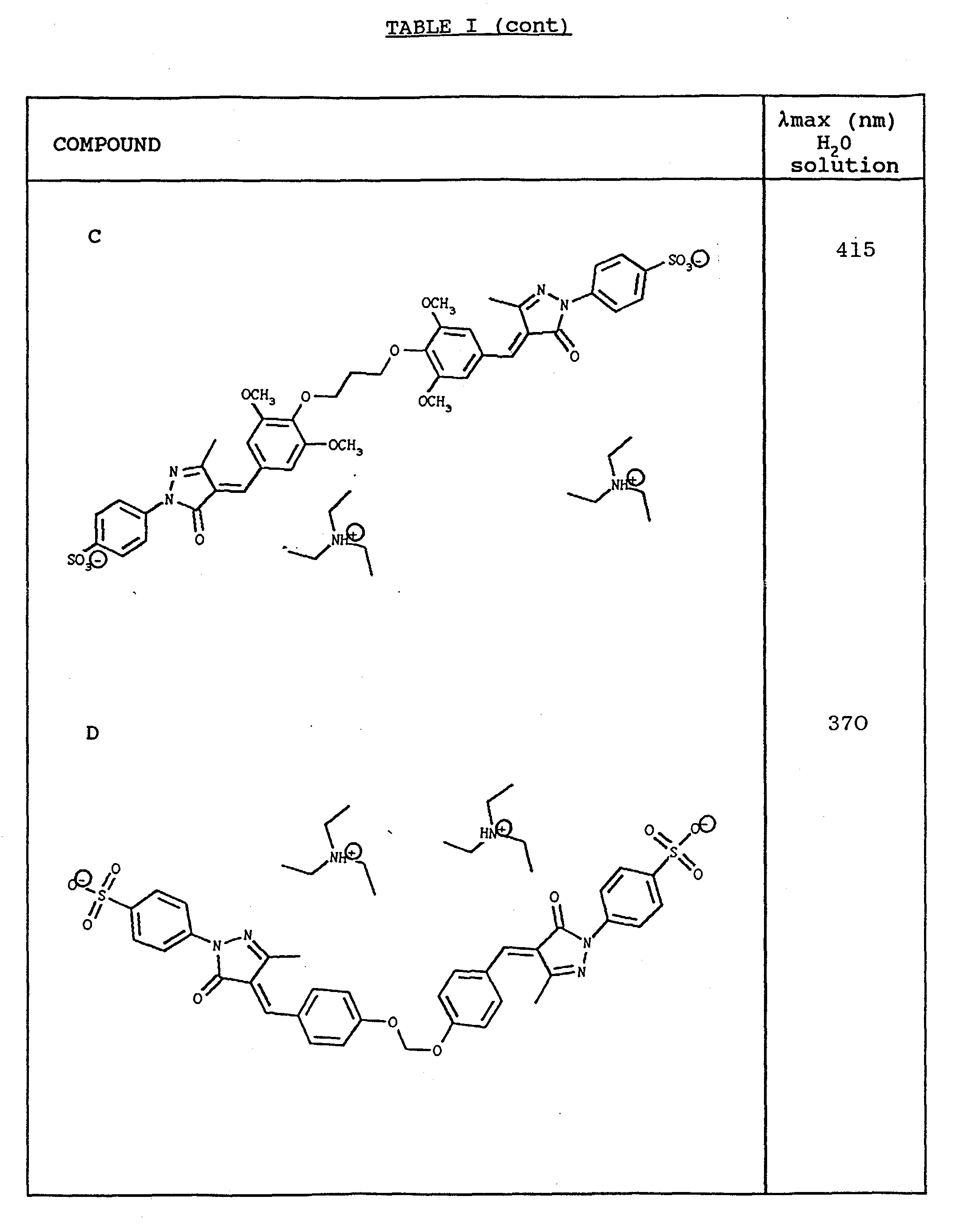
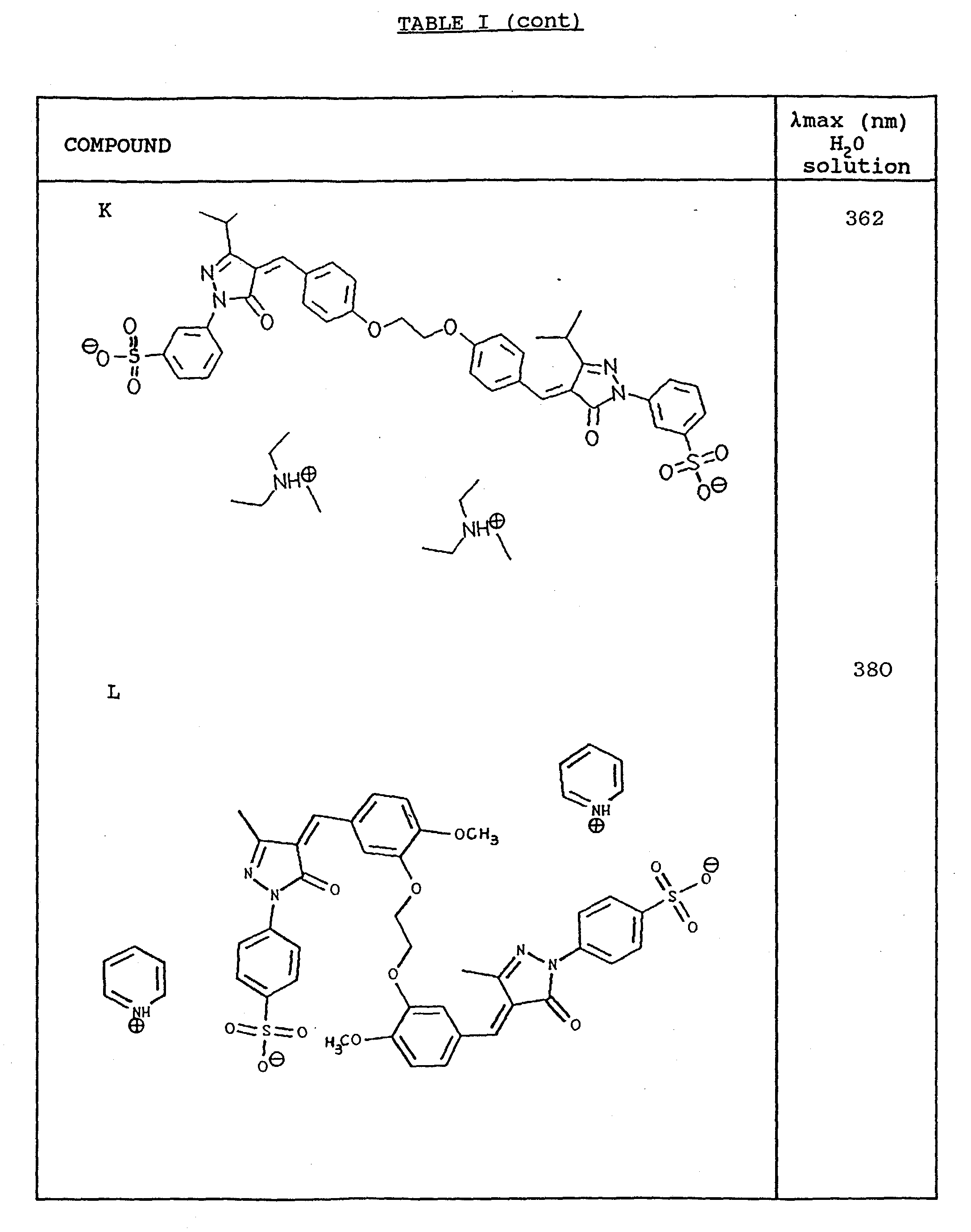
- Examples of preferred compounds prepared in accordance with the present invention are shown in TABLE I hereinafter.
- The dyes of general formulae (I) and (II) are prepared by condensing a dimeric aldehyde of formula (V) or (VI) with the appropriate heterocycle precusors represented by (VII) and (VIII). Thus:

A, B, R and Y are as defined previously. The aforesaid reaction is advantageously conducted in a solvent which is able to dissolve all of the starting materials. Examples of suitable solvents include: alcohols, acetonitrile, amides and ethers. These solvents may be used individually or in combination with each other to improve the solubility of the starting materials. The reaction is advantageously conducted in the presence of an amine, e.g., triethylamine, to promote the reaction. The reaction is preferably conducted at a temperature of from 50 to 90°C over a period of about 5 to 24 hours. - The photographic materials of the invention may comprise any suitable silver halide based imaging material including: colour papers, colour negative films, colour reversal films (either with or without couplers), photosensitive materials for printing plates (e.g., lith films), photosensitive materials for use with cathode ray tubes (CRTs) (e.g., x-ray emulsions), photosensitive materials for dye transfer processes (inhibition transfer processes), photosensitive materials for colour diffusion transfer processes, photosensitive materials for silver salt diffusion transfer processes, photographic emulsion for silver dye-bleach processes, photosensitive materials for thermal development (i.e., photothermographic materials) and photosensitive materials for physical development. Such materials generally comprise a support having coated thereon one or more layers of a photographic silver halide emulsion, typically a gelatino silver emulsion.
- The compounds of general formulae (I) and (II) can be incorporated directly into the silver halide emulsion or any auxiliary hydrophilic colloid layer by dissolving the compound into the precoating formulation thereof. Alternatively, they may be dissolved in a suitable aqueous solvent, such as an alcohol, e.g., ethanol, propanol etc., a halogenated alcohol/water mixture, pyridine and mixtures thereof, and the resulting solution added to the precoating formulation or the coated layer(s) as a coating final.
- When used as an acutance, antihalation or filter dye, it is preferred to incorporate the compounds of formulae (I) and (II) in an amount sufficient to provide an optical density of from 0.05 to 3.0 absorbance units. The coating weight of the dye is generally from 0.001 to 1 g/m2, preferably 0.001 to 0.05 g/m2. When used for antihalation purposes the dye must be present in a layer separate from the silver halide emulsion layer(s). The antihalation layer may be positioned either above or below the silver halide emulsion layer(s) and if the support is transparent, the antihalation layer may be positioned on the surface of the support opposite the silver halide emulsion. For acutance purposes, the compounds of formulae (I) and (II) are incorporated within the silver halide emulsion layer(s). When used for filter purposes, the compounds of formulae (I) and (II) are normally incorporated in a layer separate from and positioned above the silver halide emulsion layer(s).
- When used for filter purposes in conventional colour negative or reversal films comprising one or more outer layers sensitive to blue light and one or more inner layers sensitised to green and/or red light, the compounds of formula I and II and advantageously incorporated in a layer situated between the blue-sensitive layer(s) and the green - and red - sensitive layers. By this means, ultraviolet and blue light can be prevented from causing unwanted exposure of the green - red - sensitive layers due to the native sensitivity of the silver halide grains to light of those wavelengths.
- The silver halide photographic emulsion may be any of silver bromide, silver iodobromide, silver iodochlorobromide, silver chlorobromide, silver chloride and silver iodochloride. Preferably, the silver halide emulsion is a silver bromide, silver chlorobromide, silver iodobromide or silver iodochlorobromide emulsion. The silver iodide content is preferably not more than 10 mol%, and more desirably is in the range of from 0.1 to 5 mol%.
- The silver halide grains in the photographic emulsion may comprise regular crystals of cubic, orthorhombic, tabular, octahedral or tetrahedral habit, or irregular crystals, such as spherical or composite grains.
- Each of the silver halide grains may be made up of a uniform phase through its core and surface layer, or it may be dissimilar in phase between the core and the surface. It is also possible to use two or more independently prepared silver halide emulsions as a mixture. In addition, the silver halide particles may be of the surface latent image type or of the internal latent image type. In the former, the latent image is formed on the surface of the grains, and in the latter, the image is formed inside the grains. The surface latent image type of grain is used for negative-type emulsions and the internal latent image type for internal latent image type emulsions and prefogged direct reversal type emulsions.
- As regards the average grain size of the silver halide emulsion, fine grains, e.g., 1µm (micrometer) or less, are preferred and very fine grains not larger than 0.5µm are particularly preferable. While the grain size distribution is optional, a monodispersion is preferable for printing plate and graphic art applications. The term "monodispersion" as used herein means that, whether by in weight or number, at least 95% of grains are sized within ± 40% of the mean grain size.
- One preferred silver halide emulsion comprises plate grains having a thickness of 0.5µm or less, preferably 0.3µm or less, and a diameter of 0.6µm or greater and in which plate grains having an average aspect ratio of 5 or more, account for more than 50% of their total projected area.
- The silver halide emulsions used in this invention can be prepared according to the processes described, for example, in "Chimie et Physique Photographique" by P. Glafkides (Paul Montel, 1967), "Photographic Emulsion Chemistry" by G.F. Duffin (Focal Press, 1966) and "Making and Coating Photographic Emulsion" by V.L. Zelikman (Focal Press 1964).
- When the silver halide grains used in this invention are formed, the growth of grains may be controlled by adding a silver halide solvent, such as ammonia, potassium thiocyanate, ammonium thiocyanate and thioether compounds, as disclosed in US Patent Nos. 3271157, 3574628, 3704130, 4297439 and 4276374.
- The formation or physical ripening of the silver halide crystals may be carried out in the presence of a cadmium salt, a zinc salt, a lead salt, a thallium salt, an iridium salt or complex salt thereof, a rhodium salt or complex salt thereof or a ruthenuim salt or complex salt thereof, or mixtures thereof.
- Gelatin is preferably used as the binder or protective colloid for the silver halide emulsion, but other hydrophilic colloids and extenders can also be employed. For example, other useful materials might include gelatin derivatives, graft copolymers of gelatin to other high polymers, proteins, such as albumin and casein, cellulose derivatives, such as hydroxyethyl cellulose, carboxymethyl cellulose, cellulose sulphate esters, etc., sugar derivatives, such as sodium alginate, starch derivatives etc., and synthetic homo- or copolymers such as polyvinyl alcohol, poly-N-vinyl pyrrolidone, polyacrylic acid, polymethacrylic acid, polyacrylamide, polyvinyl imidazole and polyvinyl pyrazole.
- The silver halide emulsion is usually chemically sensitised. The chemical sensitisation may be accomplished by sulphur sensitisation that employs a sulphur-containing compound (e.g., stannous salts, amines, hydrazine derivatives, formamidinesulphinic acid and silane compounds), or noble metal sensitisation that employs a noble metal compound (e.g., a gold complex or complex salts of group VIII metals, such as iridium, platinum, palladium and rhodium). The sensitisation methods may be applied individually or in combination with one another.
- Supersensitisers may also be employed.
- The photographic emulsions may be high contrast, e.g., lith films, containing a hydrazine compound or other additives known in the art. Such materials are disclosed, for example, in US Patent Specification Nos. 2322027, 2419974, 2419975, 4166742, 4168977, 4211857, 4224401, 4743739, 4272606, 4272614, 4311781 and 4323643.
- The silver halide emulsion may contain a variety of compounds for the prevention of fog that would otherwise occur during the manufacturing process, preservation or photographic processing and for the stabilisation of photographic performance. Examples of such antifoggants and stabilisers include: azoles, such as benzothiazolium salts, nitroimidazoles, nitroindazoles, triazoles, benzotriazoles, benzimidazoles (particularly the nitro-or halogen-substituted benzimidazoles, e.g., bromobenzimidazoles, chlorobenzimidazoles etc.); heterocyclic mercapto compounds, such as mercaptothiazoles, mercaptobenzothiazoles, mercaptobenzimidazoles, mercaptothiadiazoles, mercaptotetrazoles (particularly 1-phenyl-5-mercaptotetrazole), and mercaptopyrimidines; thioketo compounds (e.g., oxazolinethione); azaindenes, such as triazaindenes, tetraazaindenes (particularly 4-hydroxy-substituted -(1,3,3a,7)-tetraazaindenes); benzenethiosulphonic acids; benzenethiosulphinic acids and benzenesulphonamide. Amongst these compounds, benzotriazoles (e.g., 5-methylbenzo-triazole and nitroindazoles (e.g., 5-nitroindazole) are preferred. These compounds may also be incorporated in the processing solution.
- The photographic materials may also contain inorganic or organic hardening agents in the photographic emulsion layer or other hydrophilic colloid layer. For this purpose chromium salts (chrome alum, chromium acetate etc.), aldehydes (formaldehyde, glyoxal, glutaraldehyde etc.), N-methylol compounds (dimethylolurea, methyloldimethylhydantoin etc.), dioxane derivatives (2,3-dihydroxydioxane etc.), active vinyl compounds (1,3,5-triacryloyl-hexahydro-s-triazines, 1,3-vinyl vinyl-sulphonyl-2-propanol etc.), active halogen compounds (2,4-dichloro-6-hydroxy-s-triazine etc.), mucohalogenic acids (mucochloric acid, mucophenoxy-chloric acid etc.), and the like may be used. These hardening agents may be incorporated alone or in combination.
- The silver halide emulsion or other hydrophilic colloid layer may also contain a variety of surface active agents for purposes, such as the improvement of coating properties, antistatic properties, slip properties, emulsion dispersibility, anti-adhesion properties and photographic properties (e.g., development acceleration, increase in contrast, sensitisation etc.).
- Non-ionic surfactants may be employed such as saponin (steroidal) polyethylene glycol, polyethylene glycol/polypropylene glycol condensate, polyethylene glycol alkyl ethers, polyethylene glycol alkyl aryl ethers, polyethylene glycol esters, polyethylene glycol sorbitan esters, polyalkylene glycol alkylamines or alkylamides, silicone polyethylene oxide adducts), glycidol derivatives (e.g., alkenylsuccinic acid polyglyceride, alkylphenol polyglyceride), polyhydric alcohol-fatty acid esters, sugar alkyl esters etc.
- Anionic surfactants containing acid groups, such as a carboxyl group, a sulpho group, a phospho group, a sulphuric acid ester group, a phosphoric acid ester group etc., for example, alkylcarboxylate, alkylsulphonates, alkylbenzenesulphonates, alkylnaphthalenesulphonates, alkylsulphuric acid esters, alkylphosphoric acid esters, n-acyl-n-alkyltaurines, sulphosuccinic acid esters, sulphoalkylpolyoxyethylene alkylphenyl ether, polyoxyethylene alkylphosphoric acid esters etc., may also be used.
- Amphoteric surfactants such as amino acids, aminoalkylsulphonic acids, aminoalkylsulphuric or phosphoric acid esters, alkylbetaines, amine oxides etc.; and cationic surfactant, such as alkylamines, aliphatic or aromatic quaternary ammonium salts, heterocyclic quaternary ammonium salts, such as pyridinium salts, imidazolium salts etc., aliphatic or heterocyclic ring-containing phosphonium or sulphonium salts etc. may be used.
- The photographic emulsion layer and/or the hydrophilic colloid layer may also include a matting agent, such as silica, magnesium oxide, polymethyl methacrylate etc., for the purpose of preventing adhesion.
- The silver halide emulsion may contain a discolouration prevention agent, hardening agent, colour-fog preventing agent, UV light absorber, protective colloid, such as gelatin, and other additives. Detailed description of these additives will be found in Research Disclosure Vol. 176 (1978, XII) RD-17643.
- The finished emulsion is applied to a support which may be made of an opaque material, such as baryta paper, resin-coated paper, synthetic paper or a transparent material, such as glass or a plastics film, e.g., cellulose triacetate; cellulose diacetate, nitrocellulose, polystyrene, polyethylene terephthalate (polyester) etc.
- The photographic material of the invention can be exposed using conventional sources, such as natural light (sunlight), tungsten lamps, fluorescent lamps, mercury lamps, xenon arc lamps, carbon arc lamps, xenon flash lamps and CRT spots. The exposure time is not limited to that for ordinary cameras (1/1000 sec to 1 sec) and exposures as short as 1/104 to 1/107 by a xenon flash lamp or laser scanner are also possible. Exposures longer than 1 second are also possible. If necessary, it is possible to control the spectral energy distribution of the light for exposure by means of a proper colour filter. The light-sensitive material of the invention can be exposed with laser light or light emitted by the fluorescent material excited by electron ray, X-ray, γ-ray, or α-ray.
- The light-sensitive material of the invention may be processed by any known method with any known processing solution, such as those disclosed in Research Disclosure No. 176, pp. 28-30 (RD-17643). Thus, for example, dihydroxybenzenes (e.g., hydroquinone), 3-pyrazolidones (e.g., 1-phenyl-3-pyrazolidone and 4,4-dimethyl-1-phenyl-3-pyrazolidone), aminophenols (e.g., 4-methylaminophenol) etc., can be used alone or in combination.
- This invention will now be described with reference to the following Examples.
- Compound A was synthesised according to the following protocol:
- 4,4'-diformyl-1,2-diphenoxyethane (1g) and 3-methyl-1,4-sulphophenyl-5-pyrazolone (1.9g) were refluxed in ethanol (100ml) containing triethyl amine (0.79g) for 14 hours. On cooling a solid precipitate was collected by filtration and washed with ethanol. Yield=1.8g of a yellow solid (λmax 375nm).
- Compounds B to M were prepared using a similar procedure but starting from the appropriate precursors.
- Compounds N and 0 were prepared by reaction of the appropriate dialdehydes with the sodium salt of 1-ethyl-3-cyano-4-sulphomethylpyridine-2,6-dione (prepared as described in British Patent No. 1448096). The reactions were carried out in refluxing ethanol.




- This Example demonstrates the use of Compound A as an antihalation dye for conventional silver halide photographic materials.
- An aqueous gelatin solution was prepared according to the following formation:
Compound A 1.136g gelatin 15.6g deionised water 120ml TRITON X-200 4ml (a surfactant commercially available from Rohm & Haas; 4% solution) formaldehyde 4ml (4% solution) - The gelatin solution was coated onto samples of a conventional clear polyester support to give an optical density of 0.48 at 361 nm (λmax). A silver chlorobromide emulsion (96 Cl:4Br, 0.1 µm grain size) with a conventional gelatin top coat was then coated onto the support either (a) on top of the gelatin antihalation layer (Element I) or (b) onto the rear side of the support opposite that bearing the antihalation layer (Element II). The silver chlorobromide emulsion layer and gelatin top coat were also coated onto samples of the support bearing no antihalation layer as a control (Control Element). Once dry, each Element was then exposed through a 0 to 2.6 graduated filter to a SPEKTRAPROOF U.V. source (4 units of full power exposure). The exposed elements were processed using conventional 3M RDCII Chemistry (35 seconds at 30°C.) and 3M FIX ROLL fixer, both of which are commercially available from Minnesota Mining and Manufacturing Co. The sensitometry obtained is given in TABLE II below.
TABLE II Element Dmin Speed (log ) -1 -2 -3 Dmax I 0.05 1.06 2.4 4.2 10.1 1.3 II 0.04 1.13 1.8 4.9 12.2 4.3 - The films were then tested for their dry etching characteristics by contacting the films with a test dot screen and subjecting them to a variety of exposures to determine how easily dot exposures could be altered by overexposure while maintaining the integrity of the shadow (e.g., 90%) dots. It was found that superior dry etching characteristics were obtained using the dye underlayer construction of Element I when compared with dye backing layer construction of Element II.
- In order to test the mobility and bleaching characteristics of the compounds of the invention, a small amount of each of Compounds A to D and F to L was dissolved in an appropriate solvent e.g., water, methanol, ethanol or a combination thereof. The resulting solution (Solution I) was then added to a gelatin preparation (Solution II) containing a high level of a cross-linking agent and surfactant and the mixture warmed to 45°C before coating onto clear subbed polyester using a wire wound bar. The coatings were allowed to dry and left for 24 hours at room temperature to harden.
- Typically the following procedure was used:
-
Compound = 50 mg Solvent = 10 ml -
gelatin = 16 g; HOSTAPUR SAS (a surfactant commercially available from Hoechst 1% solution ) = 2 ml; formaldehyde (10% solution) = 10 ml, and water = 190 g - Individual samples of each coating were then processed as follows:
- I Processed through an Agfa COPY PROOF WD37 washer/drier at room temperature to test mobility of dye at 20°C.
- II Processed by agitating in a large volume of water at 45°C for 30 seconds.
- III Processed through a photographic rapid access processor containing 3M RDCV developer and 3M FIX ROLL fixer (70 cm and 35°C per bath) respectively.
- Transmission absorption spectra were then run to obtain peak positions and absorption values compared to the unprocessed material. The results are shown in TABLE III below.
TABLE III Element Compound Absorbance Maximum Wavelength* (nm) I II III III A 97 40 < 2 360 IV B 66 <3 < 2 390 V C 96 60 < 2 380 VI D 90 57 < 2 367 VII F 95 75 < 2 365 VIII G 97 94 < 2 360 IX H 97 92 < 2 360 X I 97 78 < 2 387 XI J 97 91 < 2 409 XII K 96 87 30 362 XIII L 95 68 < 2 380 * as recorded for the gelatin coating. Some values are shifted from the values recorded for aqueous solutions in TABLE I. - Processing conditions I and II test the substantivity of the dyes, i.e., their resistance to leaching from the layer in which they are coated, conditions II being the more severe test. The results show that all the dyes are substantive at 20°, and most are substantive at 45°, thereby indicating that the dyes would not migrate to adjacent layers during the coating of multi-layer photographic elements.
- Processing conditions III test the ability of the dyes to bleach on treatment with conventional photographic developer. This is important because the final photographic image should not be contaminated by dye stain. All the dyes tested show good bleaching characteristics.
- The mobility and bleachability of Compound M of TABLE I was tested in the following way. An aqueous gelatin solution of Compound M was prepared as follows at 40°C:
gelatin 1.0 g water 19 g HOSTAPUR SAS 2.0 ml (1% solution) Compound M 0.1 g formaldehyde 2.0 ml (10% solution) - The gelatin solution was coated onto a clear polyester base (175µm) using a wire wound bar. The coatings were allowed to harden at room temperature for at least 24 hours. The hardened gelatin coating showed a maximum absorbance at 364 nm, and testing gave the following results:
Test conditions Absorbance at 364 nm Reference 100 % A 97 % B 1 % C < 1 % A : 30 seconds at 30°C in a large volume of water, B : 30 seconds at 30°C in Agfa G386b fixer, C : processed through a Rapid Access processor containing 3M RDCV developer and 3M FIX ROLL fixer (70 cm and 35°C per bath). - "TRITON X-200" (Rohm & Haas), "3M RDCII", "3M FIX ROLL" and "3M RDCV" (Minnesota Mining & Manufacturing Co.), "SPEKTRAPROOF" and "HOSTAPUR SAS" (Heochst) are all trade names/designations.
Claims (11)
- A compound comprising a nucleus represented by one of the following general formulae (I) and (II):

 A and B independently represent those non-metallic atoms necessary to complete a neutral heterocyclic ring in which at least one ring atom is nitrogen, providing A and/or B possess one or more water-solubilising groups selected from sulphonic acid and sulphonic acid salts,R represents hydrogen or a possibly substituted alkyl group, andY represents a divalent aliphatic linking group which is possibly substituted or interrupted by a bridging or rigidising group.
 - A compound as claimed in Claim 1 in which A and B independently represent those non-metallic atoms necessary to complete a 5, 6 or 7-membered heterocyclic ring which may possess in addition to said solubilising group(s) one or more substituents selected from alkyl groups, halogen atoms, a hydroxy group, alkoxy groups, aryloxy groups, amino groups, ureido groups, sulphonamide groups, acyloxy groups, sulphamoyl groups, alkylcarbonyl groups, aryloxycarbonyl groups, alkoxycarbonyl amino groups, carbamoyl groups, aryl groups, hydroxyalkyl groups, alkoxyalkyl groups, a mercapto group, alkylthio groups, alkylsulphonyl groups, arylsulphonyl groups, acyl groups, aralkyl groups, alkyl groups containing a carbonyl group and those non-metallic atoms necessary to complete a fused ring substituent incorporating at least two ring atoms of the heterocyclic ring and comprising up to 14 ring atoms in toto.
- A compound as claimed in Claim 1 or Claim 2 in which A and/or B represents those non-metallic atoms necessary to complete a heterocyclic ring selected from isoxazolone, barbituric acid, thiobarbituric acid, 2-pyrazolin-5-one, oxazolidinedione, 2-thio-oxazolidinedione, oxindole, rhodanine, hydantoin and 2-thiohydantoin.
- A compound as claimed in any preceding Claim in which A and B independently represent those non-metallic atoms necessary to complete a nucleus represented by one of the following heterocyclic ring structures:
 Q represents O or S, andR1 and R2 independently represent hydrogen, an alkyl group comprising up to 10 carbon atoms, an alkoxy group comprising up to 10 carbon atoms, a cycloalkyl group comprising up to 14 carbon atoms or an aryl group comprising up to 14 carbon atoms, each of which groups may possess one or more substituents selected from halogen atoms, alkoxy groups comprising up to 5 carbon atoms, aryl groups comprising up to 10 carbon atoms, amide, cyano or a water-solubilising group selected from sulphonic acid and sulphonic acid salts, andR3 represents H or any of the substituents defined for A and B previously.
 - A compound as claimed in Claim 4 comprising a nucleus represented by one of general formula (III) and (IV) :

 m is 0, 1 or 2, andeach X independently represents an alkoxy group comprising up to 5 carbon atoms.R and Y are as defined in Claim 1, andR1 and R2 are as defined in Claim 4.
 - A compound as claimed in any preceding Claim in which Y represents (CH2)n where n has integral values of from 1 to 10, or

- A compound as claimed in any preceding Claim comprising a nucleus represented by one of the following structures:


- A method of preparing a compound as claimed in any one of Claims 1 to 7 which comprises the following reaction scheme:

A, B, R and Y are as defined in Claim 1. - A method as claimed in Claim 8 in which the reaction is conducted in solution at a temperature of from 50 to 90°C.
- A light-sensitive silver halide photographic material comprising a support having coated thereon in one or more layers a photographic silver halide emulsion, which photographic material comprises in either the silver halide emulsion layer(s) and/or an auxiliary layer, as an acutance, antihalation or filter dye, a compound as claimed in any one of Claims 1 to 7.
- A photographic material as claimed in Claim 10 comprising one or more outer layers sensitive to blue light and one or more inner layers sensitive to green and/or red light and a layer containing a compound as claimed in any one of Claims 1 to 7 positioned between said inner and outer layers.
Applications Claiming Priority (2)
| Application Number | Priority Date | Filing Date | Title |
|---|---|---|---|
| GB9200632 | 1992-01-13 | ||
| GB929200632A GB9200632D0 (en) | 1992-01-13 | 1992-01-13 | Silver halide imaging materials |
Publications (2)
| Publication Number | Publication Date |
|---|---|
| EP0552010A1 EP0552010A1 (en) | 1993-07-21 |
| EP0552010B1 true EP0552010B1 (en) | 1997-09-17 |
Family
ID=10708503
Family Applications (1)
| Application Number | Title | Priority Date | Filing Date |
|---|---|---|---|
| EP93300168A Expired - Lifetime EP0552010B1 (en) | 1992-01-13 | 1993-01-12 | Silver halide imaging materials |
Country Status (5)
| Country | Link |
|---|---|
| US (1) | US6399290B1 (en) |
| EP (1) | EP0552010B1 (en) |
| JP (1) | JPH05271195A (en) |
| DE (1) | DE69313880T2 (en) |
| GB (1) | GB9200632D0 (en) |
Families Citing this family (1)
| Publication number | Priority date | Publication date | Assignee | Title |
|---|---|---|---|---|
| EP0921435B1 (en) * | 1997-12-02 | 2002-07-24 | Tulalip Consultoria Comercial Sociedade Unipessoal S.A. | Light-sensitive silver halide photographic elements containing yellow filter dyes |
Family Cites Families (7)
| Publication number | Priority date | Publication date | Assignee | Title |
|---|---|---|---|---|
| US3379533A (en) * | 1963-06-10 | 1968-04-23 | Eastman Kodak Co | Dyes derived from 1, 2-disubstituted-3, 5-pyrazolidinediones and photographic elements containing such dyes |
| CH428434A (en) * | 1963-12-20 | 1967-01-15 | Ciba Geigy | Photographic light-sensitive material |
| GB1298335A (en) * | 1968-12-11 | 1972-11-29 | Agfa Gevaert | Light-sensitive silver halide emulsions with high resolving power |
| JPS5110927A (en) * | 1974-07-17 | 1976-01-28 | Fuji Photo Film Co Ltd | Senryooganjusuru harogenkaginshashinkankozairyo |
| JPS52111717A (en) * | 1976-03-16 | 1977-09-19 | Fuji Photo Film Co Ltd | Silver halide photographic photosensitive material containing dyes |
| WO1986004694A1 (en) * | 1985-02-06 | 1986-08-14 | Fuji Photo Film Co., Ltd. | Silver halide photographic photo-sensitive material |
| JPH0437841A (en) * | 1990-06-04 | 1992-02-07 | Fuji Photo Film Co Ltd | Silver halide photographic sensitive material |
-
1992
- 1992-01-13 GB GB929200632A patent/GB9200632D0/en active Pending
-
1993
- 1993-01-12 DE DE69313880T patent/DE69313880T2/en not_active Expired - Fee Related
- 1993-01-12 EP EP93300168A patent/EP0552010B1/en not_active Expired - Lifetime
- 1993-01-13 JP JP5004219A patent/JPH05271195A/en active Pending
-
1999
- 1999-09-14 US US09/396,187 patent/US6399290B1/en not_active Expired - Fee Related
Also Published As
| Publication number | Publication date |
|---|---|
| DE69313880D1 (en) | 1997-10-23 |
| US6399290B1 (en) | 2002-06-04 |
| JPH05271195A (en) | 1993-10-19 |
| DE69313880T2 (en) | 1998-01-15 |
| GB9200632D0 (en) | 1992-03-11 |
| EP0552010A1 (en) | 1993-07-21 |
Similar Documents
| Publication | Publication Date | Title |
|---|---|---|
| EP0427892B2 (en) | Method of forming a silver image | |
| JPH0425832A (en) | Silver halide photographic sensitive material | |
| JPH0456967B2 (en) | ||
| US4607003A (en) | Photographic element | |
| JPH04296848A (en) | Silver halide photosensitive material | |
| EP0280252A2 (en) | Silver halide photographic material and method for forming super high contrast image therewith | |
| US6399290B1 (en) | Silver halide imaging materials | |
| US4917995A (en) | Silver halide photographic material | |
| JPS61277947A (en) | Silver halide photographic sensitive material | |
| US5216166A (en) | Infra-red sensitive photographic materials | |
| JP2601297B2 (en) | Silver halide photographic material | |
| JP3934183B2 (en) | Streptocyanine compound and silver halide emulsion containing the compound | |
| EP0460550B1 (en) | Silver halide photographic material | |
| JPH0693095B2 (en) | Silver halide photographic light-sensitive material | |
| US5863714A (en) | Silver halide light-sensitive material | |
| JP2632398B2 (en) | Silver halide photographic material | |
| JP2890277B2 (en) | Silver halide photographic material | |
| JPH08179467A (en) | Silver halide photographic sensitive material and its development processing method | |
| JP3790940B2 (en) | Silver halide photosensitive material | |
| US5523197A (en) | Multilayer direct-positive photographic material and process for preparing the same | |
| JPH10197979A (en) | Silver halide photosensitive material | |
| EP0675403A1 (en) | Photograhic material with effeciently used non-sensitizing dyes | |
| JPS61205934A (en) | Silver halide photographic sensitive material | |
| JPH021835A (en) | Silver halide photographic sensitive material | |
| JPS5953531B2 (en) | Silver halide photographic material containing dye |
Legal Events
| Date | Code | Title | Description |
|---|---|---|---|
| PUAI | Public reference made under article 153(3) epc to a published international application that has entered the european phase |
Free format text: ORIGINAL CODE: 0009012 |
|
| AK | Designated contracting states |
Kind code of ref document: A1 Designated state(s): DE FR GB IT |
|
| 17P | Request for examination filed |
Effective date: 19931118 |
|
| 17Q | First examination report despatched |
Effective date: 19960117 |
|
| GRAG | Despatch of communication of intention to grant |
Free format text: ORIGINAL CODE: EPIDOS AGRA |
|
| GRAH | Despatch of communication of intention to grant a patent |
Free format text: ORIGINAL CODE: EPIDOS IGRA |
|
| GRAH | Despatch of communication of intention to grant a patent |
Free format text: ORIGINAL CODE: EPIDOS IGRA |
|
| GRAA | (expected) grant |
Free format text: ORIGINAL CODE: 0009210 |
|
| AK | Designated contracting states |
Kind code of ref document: B1 Designated state(s): DE FR GB IT |
|
| REF | Corresponds to: |
Ref document number: 69313880 Country of ref document: DE Date of ref document: 19971023 |
|
| ET | Fr: translation filed | ||
| ITF | It: translation for a ep patent filed | ||
| PLBE | No opposition filed within time limit |
Free format text: ORIGINAL CODE: 0009261 |
|
| 26N | No opposition filed | ||
| PGFP | Annual fee paid to national office [announced via postgrant information from national office to epo] |
Ref country code: GB Payment date: 19991202 Year of fee payment: 8 |
|
| PGFP | Annual fee paid to national office [announced via postgrant information from national office to epo] |
Ref country code: FR Payment date: 19991217 Year of fee payment: 8 |
|
| PGFP | Annual fee paid to national office [announced via postgrant information from national office to epo] |
Ref country code: DE Payment date: 19991229 Year of fee payment: 8 |
|
| REG | Reference to a national code |
Ref country code: FR Ref legal event code: TP |
|
| PG25 | Lapsed in a contracting state [announced via postgrant information from national office to epo] |
Ref country code: GB Free format text: LAPSE BECAUSE OF NON-PAYMENT OF DUE FEES Effective date: 20010112 |
|
| GBPC | Gb: european patent ceased through non-payment of renewal fee |
Effective date: 20010112 |
|
| PG25 | Lapsed in a contracting state [announced via postgrant information from national office to epo] |
Ref country code: FR Free format text: LAPSE BECAUSE OF NON-PAYMENT OF DUE FEES Effective date: 20010928 |
|
| PG25 | Lapsed in a contracting state [announced via postgrant information from national office to epo] |
Ref country code: DE Free format text: LAPSE BECAUSE OF NON-PAYMENT OF DUE FEES Effective date: 20011101 |
|
| REG | Reference to a national code |
Ref country code: FR Ref legal event code: ST |
|
| PG25 | Lapsed in a contracting state [announced via postgrant information from national office to epo] |
Ref country code: IT Free format text: LAPSE BECAUSE OF NON-PAYMENT OF DUE FEES Effective date: 20050112 |