EP0548947A1 - Optically active fluorine-containing compounds - Google Patents
Optically active fluorine-containing compounds Download PDFInfo
- Publication number
- EP0548947A1 EP0548947A1 EP92121895A EP92121895A EP0548947A1 EP 0548947 A1 EP0548947 A1 EP 0548947A1 EP 92121895 A EP92121895 A EP 92121895A EP 92121895 A EP92121895 A EP 92121895A EP 0548947 A1 EP0548947 A1 EP 0548947A1
- Authority
- EP
- European Patent Office
- Prior art keywords
- group
- reaction
- carbon atoms
- general formula
- compound
- Prior art date
- Legal status (The legal status is an assumption and is not a legal conclusion. Google has not performed a legal analysis and makes no representation as to the accuracy of the status listed.)
- Granted
Links
- 0 *C1OCCC1 Chemical compound *C1OCCC1 0.000 description 17
Classifications
-
- C—CHEMISTRY; METALLURGY
- C09—DYES; PAINTS; POLISHES; NATURAL RESINS; ADHESIVES; COMPOSITIONS NOT OTHERWISE PROVIDED FOR; APPLICATIONS OF MATERIALS NOT OTHERWISE PROVIDED FOR
- C09K—MATERIALS FOR MISCELLANEOUS APPLICATIONS, NOT PROVIDED FOR ELSEWHERE
- C09K19/00—Liquid crystal materials
- C09K19/04—Liquid crystal materials characterised by the chemical structure of the liquid crystal components, e.g. by a specific unit
- C09K19/06—Non-steroidal liquid crystal compounds
- C09K19/34—Non-steroidal liquid crystal compounds containing at least one heterocyclic ring
- C09K19/3402—Non-steroidal liquid crystal compounds containing at least one heterocyclic ring having oxygen as hetero atom
-
- A—HUMAN NECESSITIES
- A61—MEDICAL OR VETERINARY SCIENCE; HYGIENE
- A61P—SPECIFIC THERAPEUTIC ACTIVITY OF CHEMICAL COMPOUNDS OR MEDICINAL PREPARATIONS
- A61P35/00—Antineoplastic agents
-
- C—CHEMISTRY; METALLURGY
- C07—ORGANIC CHEMISTRY
- C07D—HETEROCYCLIC COMPOUNDS
- C07D309/00—Heterocyclic compounds containing six-membered rings having one oxygen atom as the only ring hetero atom, not condensed with other rings
- C07D309/02—Heterocyclic compounds containing six-membered rings having one oxygen atom as the only ring hetero atom, not condensed with other rings having no double bonds between ring members or between ring members and non-ring members
- C07D309/08—Heterocyclic compounds containing six-membered rings having one oxygen atom as the only ring hetero atom, not condensed with other rings having no double bonds between ring members or between ring members and non-ring members with hetero atoms or with carbon atoms having three bonds to hetero atoms with at the most one bond to halogen, e.g. ester or nitrile radicals, directly attached to ring carbon atoms
- C07D309/10—Oxygen atoms
-
- C—CHEMISTRY; METALLURGY
- C09—DYES; PAINTS; POLISHES; NATURAL RESINS; ADHESIVES; COMPOSITIONS NOT OTHERWISE PROVIDED FOR; APPLICATIONS OF MATERIALS NOT OTHERWISE PROVIDED FOR
- C09K—MATERIALS FOR MISCELLANEOUS APPLICATIONS, NOT PROVIDED FOR ELSEWHERE
- C09K19/00—Liquid crystal materials
- C09K19/02—Liquid crystal materials characterised by optical, electrical or physical properties of the components, in general
- C09K19/0225—Ferroelectric
-
- C—CHEMISTRY; METALLURGY
- C09—DYES; PAINTS; POLISHES; NATURAL RESINS; ADHESIVES; COMPOSITIONS NOT OTHERWISE PROVIDED FOR; APPLICATIONS OF MATERIALS NOT OTHERWISE PROVIDED FOR
- C09K—MATERIALS FOR MISCELLANEOUS APPLICATIONS, NOT PROVIDED FOR ELSEWHERE
- C09K19/00—Liquid crystal materials
- C09K19/04—Liquid crystal materials characterised by the chemical structure of the liquid crystal components, e.g. by a specific unit
- C09K19/06—Non-steroidal liquid crystal compounds
- C09K19/34—Non-steroidal liquid crystal compounds containing at least one heterocyclic ring
- C09K19/3402—Non-steroidal liquid crystal compounds containing at least one heterocyclic ring having oxygen as hetero atom
- C09K2019/3422—Non-steroidal liquid crystal compounds containing at least one heterocyclic ring having oxygen as hetero atom the heterocyclic ring being a six-membered ring
Definitions
- the present invention relates to optically active fluorine-containing compounds. More particularly, it pertains to optically active fluorine-containing compounds useful as raw materials for various chemical agents, industrial chemicals, ferroelectric liquid crystals and the like.
- the research group of the present inventors has hitherto succeeded in the development of a variety of optically active fluorine-containing compounds that are utilizable as the liquid crystals (refer to JP-A-83074/1989, 163143/1989, 233243/1989, 233244/1989, 49743/1990, 167252/1990, 232208/1990, 232209/1990).
- the object of the present invention is to develop novel optically active compounds having a tetrahydropyran ring and a group with a remarkable electron-attracting property in itself at an asymmetric carbon atom in said tetrahydropyran ring which are useful for e.g. a new type of liquid crystals.
- the present invention provides optically active fluorine-containing compounds represented by the general formula (I) wherein Rf is a fluoroalkyl group having 1 or 2 carbon atoms; R1, R2 and R3 are each independently a hydrogen atom, a straight or branched chain alkyl group having 1 to 15 carbon atoms, an alkenyl group having 2 to 15 carbon atoms or an aralkyl group having 7 to 10 carbon atoms; and * denotes possible asymmetric carbon atoms.
- Rf is a fluoroalkyl group having 1 or 2 carbon atoms
- R1, R2 and R3 are each independently a hydrogen atom, a straight or branched chain alkyl group having 1 to 15 carbon atoms, an alkenyl group having 2 to 15 carbon atoms or an aralkyl group having 7 to 10 carbon atoms
- * denotes possible asymmetric carbon atoms.
- Rf stands for a fluoroalkyl group having 1 or 2 carbon atoms and is specifically exemplified by a trifluoromethyl group, a difluoromethyl group, a chlorodifluoromethyl group and a pentafluoroethyl group, of which the trifluoromethyl group is preferred.
- R1, R2 and R3, independently of one another, are each a hydrogen atom; a straight or branched chain alkyl group having 1 to 15 carbon atoms, an alkenyl group having 2 to 15 carbon atoms or an aralkyl group having 7 to 10 carbon atoms.
- Examples of the straight or branched chain alkyl group having 1 to 15 carbon atoms include methyl, ethyl, n-propyl, isopropyl, n-butyl, sec-butyl, tert-butyl, n-pentyl, isopentyl, 1-methylbutyl, n-hexyl, n-heptyl, 1-methylheptyl, n-octyl, 1-ethylheptyl, 1-methyloctyl, n-nonyl, 1-ethyloctyl, 1-methylnonyl, n-decyl, n-undecyl, n-dodecyl, n-tridecyl, n-tetradecyl and n-pentadecyl groups.
- alkenyl group having 2 to 15 carbon atoms examples include vinyl, allyl, 1-propenyl, isopropenyl, 1-butenyl, 2-butenyl, 2-methylallyl, 1-pentenyl, 1-hexenyl, 1-heptenyl, 1-octenyl, 2-octenyl, 1-nonenyl, 2-nonenyl, 1-decenyl, 2-decenyl, 1-undecenyl, 2-undecenyl, 1-dodecenyl, 2-dodecenyl, 1-tridecenyl, 2-tridecenyl, 1-tetradecenyl, 2-tetradecenyl, 1-pentadecenyl and 2-pentadecenyl groups.
- Examples of the aralkyl group having 7 to 10 carbon atoms include benzyl, phenethyl, phenylpropyl and phenylbutyl groups.
- the compound of the general formula (I) according to the present invention can be produced by any of the various processes that are exemplified by the following steps:
- Furan is silylated into the compound represented by the general formula (II). wherein TMS denotes a trimethylsilyl group, and the compound thus produced is trifluoroacetylated into the compound represented by the general formula (III).
- the above-mentioned reaction can be carried out at a temperature of -78 to 0°C by silylating furan using an organolithium compound such as n-butyllithium and trimethylsilyl chloride in a solvent such as tetrahydrofuran and diethyl ether and thereafter trifluoroacetylating the reaction product by the use of the aforementioned n-butyllithium and ethyl trifluoroacetate.
- the compound represented by the general formula (III) thus produced is reduced into the compound represented by the general formula (IV) wherein TMS is as defined above.
- the above-mentioned reaction can be put into practice by using, for example, sodium borohydride, lithium aluminum hydride and stannic chloride.
- the obtained compound represented by the general formula (IV) is acylated by reacting it with an acid chloride.
- an acid chloride usable as an acylating agent include acetyl chloride, propionyl chloride, isobutyloyl chloride, octanoyl chloride and benzoyl chloride.
- the obtained compound represented by the general formula (V) wherein R'CO denotes an acyl group is subjected to asymmetric hydrolysis by the use of an enzyme to produce an optically active alcohol represented by the general formula (VI) wherein TMS and * are as defined above and an optically active ester represented by the general formula (VIa) wherein R'CO, TMS and * are as defined above.
- an enzyme to be used in the aforesaid reaction there may be used a variety of enzymes insofar as they are each a so called hydrolysis enzyme, which are exemplified by lipase PS, lipase MY, lipase OF and cellulase.
- the ester represented by the general formula (VIa) is convertible to an optically active alcohol having a mirror image relation with the alcohol represented by the general formula (VI) by means of chemical hydrolysis or asymmetric hydrolysis with another enzyme.
- the alcohol represented by the general formula (VI) thus obtained is silylated to produce the compound represented by the general formula (VII) wherein TBDMS designates a tert-butyldimethylsilyl group, and TMS and * are as defined above.
- the reaction can be conducted by the use of tert-butyldimethylsilyl chloride as a silylating agent.
- the silylated derivative represented by the general formula (VII) thus obtained is oxidized to afford the compound represented by the general formula (VIII) wherein TBDMS and * are as defined above.
- the aforesaid reaction can be carried out by the use of an oxidizing agent such as monoperoxyphthalic acid-magnesium salt and hydrogen peroxide in the presence of a solvent such as acetic acid and chloroform.
- an oxidizing agent such as monoperoxyphthalic acid-magnesium salt and hydrogen peroxide
- a solvent such as acetic acid and chloroform.
- a mixture of diastereomers is also produced but can be easily separated from each other by means of silica-gel column chromatography.
- the compound represented by the general formula (VIII) thus obtained is hydrogenated by the conventional method to afford the compound represented by the general formula (IX) wherein TBDMS and * are as defined above.
- the hydrogenation can be performed in a solvent such as ethanol, methanol, hexane, ethyl acetate, benzene and toluene by the use of palladium charcoal in an atmosphere of hydrogen.
- the lactone derivative represented by the general formula (IX) thus obtained is reduced to afford the compound represented by the general formula (X) wherein TBDMS and * are as defined above.
- the reaction can be accomplished by the use of, for example, diisobutyaluminum hydride as the reducing agent at a temperature of -20°C to -78°C in a solvent such as diethyl ether and tetrahydrofuran.
- the ⁇ -lactol represented by the general formula (X) thus obtained is treated with a base to afford the compound represented by the general formula (XI) wherein TBDMS and * are as defined above.
- the reaction can be carried out by the use of potassium tert-butoxide as the base at a temperature of -20°C to -78°C in a solvent such as diethyl ether and tetrahydrofuran.
- the ⁇ -lactol represented by the general formula (XI) thus obtained is reacted with the alcohol represented by the general formula R1OH wherein R1 is as defined above to afford the compound represented by the general formula (XII) wherein R1, TBDMS and * are as defined above.
- the reaction can be conducted by the use of an acid catalyst such as p-toluenesulfonic acid at a temperature of 0 to 50°C in an alcohol as the solvent.
- the compound represented by the general formula (XII) thus obtained is subjected to desilylation to afford the objective optically active fluorine-containing compound represented by the general formula (XIII) wherein R1 and * are as defined above.
- the desilylation reaction can be put into practice by the use of tetra-n-butylammonium fluoride as the catalyst at a temperature of 0 to 50°C in a solvent such as tetrahydrofuran.
- the two types of diastereomers that are formed in the reaction producing the compound represented by the general formula (X) can be easily separated from the objective compound in the reaction J by means of silica-gel column chromatography.
- the compound represented by the general formula (IX) obtained by the above-mentioned reaction F in the preceding item (1) is reacted with an alkyl halide, an aralkyl halide, an alkenyl halide or the like each represented by the general formula R2X wherein R2 is as defined above and X stands for a halogen to afford the compound represented by the general formula (XIV) wherein R2, TBDMS and * are as defined above.
- the reaction can be carried out at -78°C by the use of n-butyllithium and an organic base such as hexamethyldisilazane and diisopropylamine in a solvent such as tetrahydrofuran and an ether.
- the compound represented by the general formula (VIII) obtained by the above-mentioned reaction E in the preceding item (1) is reacted with an alkyl halide, an aralkyl halide, an alkenyl halide or the like each represented by the general formula R3X wherein R3 is as defined above and X stands for a halogen to afford the compound represented by the general formula (XVI) wherein R3, TBDMS and * are as defined above.
- the reaction can be conducted at -78°C by the use of an organocopper reagent such as di-n-butylcopper lithium. In the above reaction, a mixture of diastereomers is not obtained but only anti-form compounds are produced.
- Typical examples of the compounds represented by the general formula (I) according to the present invention include According to the present invention, there are obtained novel compounds having a fluoroalkyl group with a remarkable electron-attracting property in itself at an asymmetric carbon atom in the tetrahydropyran ring. Accordingly, the optically active fluorine-containing compound of the present invention is expected to find a wide variety of applications as raw materials for an enzyme inhibitor, a bioactive substance, a carcinostatic, a ferroelectric liquid crystal and the like.
Landscapes
- Chemical & Material Sciences (AREA)
- Organic Chemistry (AREA)
- Materials Engineering (AREA)
- Engineering & Computer Science (AREA)
- Crystallography & Structural Chemistry (AREA)
- Health & Medical Sciences (AREA)
- Nuclear Medicine, Radiotherapy & Molecular Imaging (AREA)
- Medicinal Chemistry (AREA)
- Life Sciences & Earth Sciences (AREA)
- Animal Behavior & Ethology (AREA)
- General Health & Medical Sciences (AREA)
- Public Health (AREA)
- Veterinary Medicine (AREA)
- Pharmacology & Pharmacy (AREA)
- General Chemical & Material Sciences (AREA)
- Chemical Kinetics & Catalysis (AREA)
- Pharmaceuticals Containing Other Organic And Inorganic Compounds (AREA)
- Pyrane Compounds (AREA)
- Liquid Crystal Substances (AREA)
- Organic Low-Molecular-Weight Compounds And Preparation Thereof (AREA)
Abstract

wherein Rf is a fluoroalkyl group having 1 or 2 carbon atoms; R¹, R² and R³, independently of one another, are each a hydrogen atom, a straight or branched chain alkyl group having 1 to 15 carbon atoms, an alkenyl group having 2 to 15 carbon atoms or an aralkyl group having 7 to 10 carbon atoms; and * denotes possible asymmetric carbon atoms. The above compound has a fluoroalkyl group with a remarkable electron-attracting property at an asymmetric carbon atom in the tetrahydropyran ring. It is exemplified by tetrahydro-6-trifluoromethyl-2-hexyloxy-4-methyl-5-hydroxypyran and has a wide variety of useful applications such as raw materials for an enzyme inhibitor, a bioactive substance, a carcinostatic, and a ferroelectric liquid crystal.
Description
- The present invention relates to optically active fluorine-containing compounds. More particularly, it pertains to optically active fluorine-containing compounds useful as raw materials for various chemical agents, industrial chemicals, ferroelectric liquid crystals and the like.
- As there has been a steady rise in the utilization of liquid crystals in recent years, the development of a liquid crystal having novel structure has been desired.
- The research group of the present inventors has hitherto succeeded in the development of a variety of optically active fluorine-containing compounds that are utilizable as the liquid crystals (refer to JP-A-83074/1989, 163143/1989, 233243/1989, 233244/1989, 49743/1990, 167252/1990, 232208/1990, 232209/1990).
- The object of the present invention is to develop novel optically active compounds having a tetrahydropyran ring and a group with a remarkable electron-attracting property in itself at an asymmetric carbon atom in said tetrahydropyran ring which are useful for e.g. a new type of liquid crystals.
- This object has been achieved by the provision of certain tetrahydropyran compounds having a fluoralkyl group. These compounds show unexpected suitability for a variety of different applications.
- In particular, the present invention provides optically active fluorine-containing compounds represented by the general formula (I)

wherein Rf is a fluoroalkyl group having 1 or 2 carbon atoms; R¹, R² and R³ are each independently a hydrogen atom, a straight or branched chain alkyl group having 1 to 15 carbon atoms, an alkenyl group having 2 to 15 carbon atoms or an aralkyl group having 7 to 10 carbon atoms; and * denotes possible asymmetric carbon atoms. - As mentioned hereinbefore, in the general formula (I) Rf stands for a fluoroalkyl group having 1 or 2 carbon atoms and is specifically exemplified by a trifluoromethyl group, a difluoromethyl group, a chlorodifluoromethyl group and a pentafluoroethyl group, of which the trifluoromethyl group is preferred.
- R¹, R² and R³, independently of one another, are each a hydrogen atom; a straight or branched chain alkyl group having 1 to 15 carbon atoms, an alkenyl group having 2 to 15 carbon atoms or an aralkyl group having 7 to 10 carbon atoms. Examples of the straight or branched chain alkyl group having 1 to 15 carbon atoms include methyl, ethyl, n-propyl, isopropyl, n-butyl, sec-butyl, tert-butyl, n-pentyl, isopentyl, 1-methylbutyl, n-hexyl, n-heptyl, 1-methylheptyl, n-octyl, 1-ethylheptyl, 1-methyloctyl, n-nonyl, 1-ethyloctyl, 1-methylnonyl, n-decyl, n-undecyl, n-dodecyl, n-tridecyl, n-tetradecyl and n-pentadecyl groups.
- Examples of the alkenyl group having 2 to 15 carbon atoms include vinyl, allyl, 1-propenyl, isopropenyl, 1-butenyl, 2-butenyl, 2-methylallyl, 1-pentenyl, 1-hexenyl, 1-heptenyl, 1-octenyl, 2-octenyl, 1-nonenyl, 2-nonenyl, 1-decenyl, 2-decenyl, 1-undecenyl, 2-undecenyl, 1-dodecenyl, 2-dodecenyl, 1-tridecenyl, 2-tridecenyl, 1-tetradecenyl, 2-tetradecenyl, 1-pentadecenyl and 2-pentadecenyl groups.
- Examples of the aralkyl group having 7 to 10 carbon atoms include benzyl, phenethyl, phenylpropyl and phenylbutyl groups.
- The compound of the general formula (I) according to the present invention can be produced by any of the various processes that are exemplified by the following steps:
- Furan is silylated into the compound represented by the general formula (II).

wherein TMS denotes a trimethylsilyl group, and the compound thus produced is trifluoroacetylated into the compound represented by the general formula (III).
The above-mentioned reaction can be carried out at a temperature of -78 to 0°C by silylating furan using an organolithium compound such as n-butyllithium and trimethylsilyl chloride in a solvent such as tetrahydrofuran and diethyl ether and thereafter trifluoroacetylating the reaction product by the use of the aforementioned n-butyllithium and ethyl trifluoroacetate. - The compound represented by the general formula (III) thus produced is reduced into the compound represented by the general formula (IV)

wherein TMS is as defined above. The above-mentioned reaction can be put into practice by using, for example, sodium borohydride, lithium aluminum hydride and stannic chloride. - The obtained compound represented by the general formula (IV) is acylated by reacting it with an acid chloride. Specific examples of the acid chloride usable as an acylating agent include acetyl chloride, propionyl chloride, isobutyloyl chloride, octanoyl chloride and benzoyl chloride.
- The obtained compound represented by the general formula (V)

wherein R'CO denotes an acyl group, is subjected to asymmetric hydrolysis by the use of an enzyme to produce an optically active alcohol represented by the general formula (VI)
wherein TMS and * are as defined above and an optically active ester represented by the general formula (VIa)
wherein R'CO, TMS and * are as defined above. As the enzyme to be used in the aforesaid reaction, there may be used a variety of enzymes insofar as they are each a so called hydrolysis enzyme, which are exemplified by lipase PS, lipase MY, lipase OF and cellulase. The ester represented by the general formula (VIa) is convertible to an optically active alcohol having a mirror image relation with the alcohol represented by the general formula (VI) by means of chemical hydrolysis or asymmetric hydrolysis with another enzyme. - The alcohol represented by the general formula (VI) thus obtained is silylated to produce the compound represented by the general formula (VII)

wherein TBDMS designates a tert-butyldimethylsilyl group, and TMS and * are as defined above. The reaction can be conducted by the use of tert-butyldimethylsilyl chloride as a silylating agent. - The silylated derivative represented by the general formula (VII) thus obtained is oxidized to afford the compound represented by the general formula (VIII)

wherein TBDMS and * are as defined above. The aforesaid reaction can be carried out by the use of an oxidizing agent such as monoperoxyphthalic acid-magnesium salt and hydrogen peroxide in the presence of a solvent such as acetic acid and chloroform. In the above reaction, a mixture of diastereomers is also produced but can be easily separated from each other by means of silica-gel column chromatography. - The compound represented by the general formula (VIII) thus obtained is hydrogenated by the conventional method to afford the compound represented by the general formula (IX)
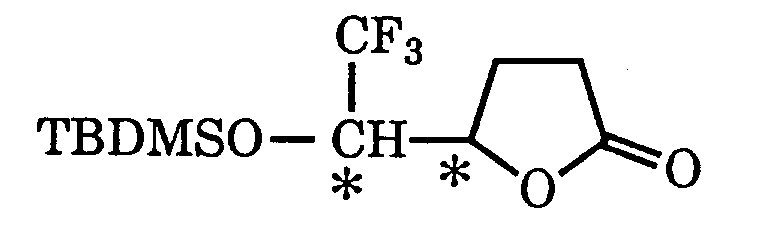
wherein TBDMS and * are as defined above. The hydrogenation can be performed in a solvent such as ethanol, methanol, hexane, ethyl acetate, benzene and toluene by the use of palladium charcoal in an atmosphere of hydrogen. - The lactone derivative represented by the general formula (IX) thus obtained is reduced to afford the compound represented by the general formula (X)

wherein TBDMS and * are as defined above. The reaction can be accomplished by the use of, for example, diisobutyaluminum hydride as the reducing agent at a temperature of -20°C to -78°C in a solvent such as diethyl ether and tetrahydrofuran. - The γ-lactol represented by the general formula (X) thus obtained is treated with a base to afford the compound represented by the general formula (XI)

wherein TBDMS and * are as defined above. The reaction can be carried out by the use of potassium tert-butoxide as the base at a temperature of -20°C to -78°C in a solvent such as diethyl ether and tetrahydrofuran. - The δ-lactol represented by the general formula (XI) thus obtained is reacted with the alcohol represented by the general formula R¹OH wherein R¹ is as defined above to afford the compound represented by the general formula (XII)

wherein R¹, TBDMS and * are as defined above. The reaction can be conducted by the use of an acid catalyst such as p-toluenesulfonic acid at a temperature of 0 to 50°C in an alcohol as the solvent. - The compound represented by the general formula (XII) thus obtained is subjected to desilylation to afford the objective optically active fluorine-containing compound represented by the general formula (XIII)

wherein R¹ and * are as defined above. The desilylation reaction can be put into practice by the use of tetra-n-butylammonium fluoride as the catalyst at a temperature of 0 to 50°C in a solvent such as tetrahydrofuran. The two types of diastereomers that are formed in the reaction producing the compound represented by the general formula (X) can be easily separated from the objective compound in the reaction J by means of silica-gel column chromatography. - The compound represented by the general formula (IX) obtained by the above-mentioned reaction F in the preceding item (1) is reacted with an alkyl halide, an aralkyl halide, an alkenyl halide or the like each represented by the general formula R²X wherein R² is as defined above and X stands for a halogen to afford the compound represented by the general formula (XIV)

wherein R², TBDMS and * are as defined above. The reaction can be carried out at -78°C by the use of n-butyllithium and an organic base such as hexamethyldisilazane and diisopropylamine in a solvent such as tetrahydrofuran and an ether. - Subsequently the compound represented by the general formula (XIV) thus obtained is incorporated in the above reactions G to J of the preceding item (1) to afford the objective optically active fluorine-containing compound represented by the general formula (XV)

wherein R¹, R² and * are as defined above. -
- The compound represented by the general formula (VIII) obtained by the above-mentioned reaction E in the preceding item (1) is reacted with an alkyl halide, an aralkyl halide, an alkenyl halide or the like each represented by the general formula R³X wherein R³ is as defined above and X stands for a halogen to afford the compound represented by the general formula (XVI)

wherein R³, TBDMS and * are as defined above. The reaction can be conducted at -78°C by the use of an organocopper reagent such as di-n-butylcopper lithium. In the above reaction, a mixture of diastereomers is not obtained but only anti-form compounds are produced. - Subsequently the compound represented by the general formula (XVI) thus obtained is incorporated in the above-mentioned reactions G to J of the preceding item (1) to afford the objective optically active fluorine-containing compound represented by the general formula (XVII)

wherein R¹, R³ and * are as defined above. - Typical examples of the compounds represented by the general formula (I) according to the present invention include


According to the present invention, there are obtained novel compounds having a fluoroalkyl group with a remarkable electron-attracting property in itself at an asymmetric carbon atom in the tetrahydropyran ring. Accordingly, the optically active fluorine-containing compound of the present invention is expected to find a wide variety of applications as raw materials for an enzyme inhibitor, a bioactive substance, a carcinostatic, a ferroelectric liquid crystal and the like. - In the following, the present invention will be described in more detail with reference to the examples, but the present invention is not limited thereto. In each of the examples, the representations of R and S for the optically active compound represented by the general formula (I) are based on the position numbers in the following formula:

-

- (a) In an atmosphere of nitrogen, 13.6 g (200 mmol) of furan was added to 150 ml of tetrahydrofuran, and 133 ml (200 mmol) of a solution of n-butyllithium in hexane in a concentration of 1.5 mol/liter at -20°C was added dropwise to the above mixture to proceed with reaction for one hour. Then 21.7 g (200 mmol) of trimethylsilyl chloride was added dropwise to the mixture with stirring at -20°C for one hour. Subsequently 133 ml (200 mmol) of a solution of n-butyllithium in hexane in a concentration of 1.5 mol/liter was added to the mixture to proceed with reaction at -20°C for one hour and thereafter 28.4 g (200 mmol) of ethyl trifluoroacetate at -78°C was added dropwise to the resultant mixture to proceed with reaction at -78°C for one hour and at room temperature for further one hour. The reaction solution was incorporated with 3N hydrochloric acid to arrest the reaction, and the reaction product was extracted with ethyl acetate. Then the extract was washed successively with a saturated solution of sodium hydrogencarbonate and brine and was dried with magnesium sulfate anhydride. The ethyl acetate was distilled off in vacuo to give a crude furan-derivative product.
- (b) Sodium borohydride in an amount of 2.3 g (60 mmol) was added to 100 ml of dry ethanol, and the crude furan-derivative product as obtained by the above-mentioned reaction was added dropwise to the above ethanol solution at 0°C over a period of 30 minutes to proceed with reaction at room temperature for 2 hours. Thereafter the ethanol was distilled off in vacuo,3N hydrochloric acid was added to the reaction product to arrest the reaction, and the reaction product was washed successively with a saturated solution of sodium hydrogencarbonate and brine and dried with magnesium sulfate anhydride. The ethyl acetate was distilled off in vacuo,and the residue was subjected to vacuum distillation to afford 40.5 g (170 mmol) of an alcoholic compound.
- (c) Methylene chloride in an amount of 200 ml was incorporated with 23.8 g (100 mmol) of the alcoholic compound as obtained by the reaction in the preceding step (b) and 8.9 ml (110 mmol) of pyridine. Then 8.6 g (110 mmol) of acetyl chloride at 0°C was added dropwise to the above mixture to proceed with the reaction at room temperature for 12 hours. Subsequently 3N hydrochloric acid was added to the reaction product to stop the reaction, and the reaction product was extracted with methylene chloride. Thereafter the extract was washed successively with a saturated solution of sodium hydrogencarbonate and distilled water and was dried with magnesium sulfate anhydride. The methylene chloride was distilled off in vacuo, and the residue was subjected to vacuum distillation to provide 27.5 g (98 mmol) of an esterified compound.
- (d) To 1000 ml of distilled water was added 28.0 g (100 mmol) of the esterified compound as obtained by the above-mentioned reaction, and the resultant mixture was stirred at 40°C in a mini-jar type fermenter. Then 20 g of lipase PS was added thereto to proceed with the reaction for 20 hours, which was stopped by the addition of 3N hydrochloric acid and cooling to 0°C. The reaction product was filtered with Celite®, the product in the filtrate was extracted with ethyl acetate, washed with brine and dried with magnesium sulfate anhydride, and the ethyl acetate was distilled off in vacuo. Subsequently, the resultant reaction product was purified by separation by means of silica-gel column chromatography to give 11.7 g (49 mmol) of an optically active alcoholic compound and 13.2 g (47 mmol) of an optically active esterified compound. The alcoholic compound thus obtained had an optical purity of 97.5% e.e.
- (e) In 100 ml of methylene chloride was dissolved 11.7 g (49 mmol) of the optically active alcoholic compound obtained by the above-mentioned reaction,and to the resultant solution were added 4.0 g (59 mmol) of imidazole and 8.9 g (59 mmol) of tert-butyldimethylsilyl chloride at 0°C while stirring for 15 minutes to proceed with reaction at room temperature for 16 hours. The reaction was stopped by the addition of distilled water. The reaction product was extracted with methylene chloride, then washed with distilled water and dried with magnesium sulfate anhydride. After the methylene chloride was distilled off in vacuo, the resultant reaction product was purified by separation by means of column chromatography to afford 16.6 g (47 mmol) of a silyl ether compound.
- (f) In an atmosphere of nitrogen, to 120 ml of acetic acid were added 14.1 g (40 mmol) of the silyl ether compound as obtained by the above-mentioned reaction and 23.2 g (60 mmol) of magnesium monoperoxyphthalate to proceed with reaction at 80°C for 12 hours. After the acetic acid was distilled off in vacuo, a saturated solution of sodium hydrogencarbonate was added to the reaction product, which was extracted with ethyl acetate. Then the extract was washed with brine and dried with magnesium sulfate anhydride. After the ethyl acetate was distilled off in vacuo, the resultant reaction product was purified by separation by means of column chromatography to provide 4.7 g (16 mmol) of (4S, 1'S) butenolide compound and 3.0 g (10 mmol) of (4R, 1'S) butenolide compound. In addition, the raw material in an amount of 4.2 g (12 mmol) was recovered.
- (g) In 40 ml of ethanol was dissolved 13.7 g (46 mmol) of the mixture of (4S, 1'S)-and (4R, 1'S)-butenolide compound as obtained by the above-mentioned reaction without separation from each other. To the resultant solution was added 1.4 g of 10% Pd/C (containing 10% by weight of Pd) to proceed with the reaction in an atmosphere of hydrogen at room temperature for 15 hours. After the resultant reaction solution was filtered and the solvent (ethanol) was distilled off in vacuo, the resultant reaction product was purified by separation by means of silica-gel column chromatography to give 8.2 g (29 mmol) of (4S, 1'S)butanolide compound and 3.6 g (12 mmol) of (4R, 1'S)butanolide compound.
- (h) In an atmosphere of nitrogen, to 40 ml of diethyl ether was added 7.5 g (25 mmol) of the (4S, 1'S)butanolide compound as obtained by the above-mentioned reaction and added dropwise 32 ml (30 mmol) of a solution of diisobutylaluminum hydride in n-hexane having a concentration of 0.93 mol/liter at -78°C to proceed with reaction for 3 hours. The reaction was stopped by the addition of distilled water, and the resultant reaction product was neutralized with 1 N hydrochloric acid and extracted with diethyl ether. Then the extract was washed with brine, and dried with magnesium sulfate anhydride, and the diethyl ether was distilled off in vacuo. Subsequently the resultant reaction product was purified by separation by means of silica-gel column chromatography to provide 7.3 g (24 mmol) of a lactol compound.
- (i) In an atmosphere of nitrogen, to 50 ml of tetrahydrofuran was added 7.3 g (24 mmol) of the lactol compound as obtained by the aforestated reaction and added dropwise a solution of 3.0 g (27 mmol) of potassium tertbutoxide in 10 ml of tetrahydrofuran at -78°C to proceed with reaction for 3 hours. The reaction was stopped by the addition of distilled water, and the resultant reaction product was neutralized with 1 N hydrochloric acid and extracted with diethyl ether. Then the extract was washed with brine, and dried with magnesium sulfate anhydride, and the diethyl ether was distilled off in vacuo. Subsequently the resultant reaction product was purified by separation by means of silica-gel column chromatography to afford 6.4 g (21 mmol) of a pyranose compound.
- (j) In 40 ml of hexane was dissolved 6.4 g (21 mmol) of the pyranose compound as obtained by the above-mentioned reaction. To the solution thus formed was added 0.1 g of p-toluenesulfonic acid to proceed with the reaction at room temperature for 18 hours. The reaction solution as such was purified by separation by means of silica-gel column chromatography to give 8.0 g (21 mmol) of an acetal compound. The compound thus obtained was a mixture of diastereomers, which was used in the following reaction without being separated from each other.
- (k) In 20 ml of tetrahydrofuran was dissolved 8.0 g (21 mmol) of the acetal compound as obtained by the aforementioned reaction. To the resultant solution was added 10 ml of a solution of tetra-n-butylammonium fluoride in tetrahydrofuran in 1.0 mol/liter concentration to proceed with reaction at 0°C for one hour and at room temperature for further 40 hours. The reaction was stopped by the addition of distilled water, and the reaction product was extracted with diethyl ether. Then the extract was washed with brine and dried with magnesium sulfate anhydride. After the diethyl ether was distilled off in vacuo, the resultant reaction product was purified by separation by means of silica-gel column chromatography to give the objective compounds comprising 3.0 g (11 mmol) of (2R, 5S, 6S)-tetrahydro-6-trifluoromethyl-2-hexyloxy-5-hydroxypyran and 2.3 g (8 mmol) of (2S, 5S, 6S)-tetrahydro-6-trifulromethyl-2-hexyloxy-5-hydroxypyran.
- The physical properties of the compounds obtained in the aforestated procedures are give hereunder.
- Molecular formula : C₁₂H₂₁F₃O₃
¹H-NMR (proton nuclear magnetic resonance); δ (ppm)
0.88 (t, J=6.5Hz, 3H)
1.20 to 1.39 (m, 6H)
1.50 to 1.71 (m, 4H)
1.83 to 2.04 (m, 2H)
2.13 to 2.22 (m, 1H)
3.46 (dt, J=9.4, 6.9Hz, 1H)
3.66 (dq, J=8.9, 6.3Hz, 1H)
3.81 to 3.93 (m, 2H)
4.52 (dd, J=2.0, 8.7Hz, 1H)
¹⁹F-NMR (fluorine nuclear magnetic resonance, reference : CFCl₃) ; δ (ppm)
-75.13 (d, J=6.3Hz)
IR (infrared absorption : cm⁻¹) 3450, 1275, 1170, 1145, 1090, 940 -
Calculated 271.1521 Found 271.1512
[α]D²⁵=-36.0° (C (concentration) =1.05, solvent : methanol) - Molecular formula : C₁₂H₂₁F₃O₃
¹N-NMR ; δ (ppm)
0.90 (t, J=7.3Hz, 3H)
1.23 to 1.45 (m, 6H)
1.52 to 1.67 (m, 2H)
1.76 to 2.00 (m, 5H)
3.42 (dt, J=9.7, 6.4Hz, 1H)
3.68 (dt, J=9.7, 6.8Hz, 1H)
3.79 to 3.98 (m, 2H)
4.86 (m, 1H)
¹⁹F-NMR (reference : CFCl₃) ; δ (ppm)
-75.17 (d, J=6.2Hz)
IR (cm⁻¹)
3400, 1270, 1175, 1130, 1045, 945 -
Calculated 271.1521 Found 271.1493
[α]D²⁵=+86.5° (C (concentration) =1.08, solvent : methanol) -

- (a) The pyranose compound as obtained in Example 1 (i) in an amount of 1.7 g (5.7 mmol) was dissolved in 15 ml of butanol and the procedure in Example 1 (j) was repeated to afford 1.9 g (5.3 mmol) of an acetal compound, which was a mixture of diastereomers and used for the reaction described hereunder without being separated from one another.
- (b) By the use of 1.9 g (5.3 mmol) of the acetal compound as obtained by the above-mentioned reaction, the procedure in Example 1 (k) was repeated to provide the objective compounds comprising 0.64 g (2.6 mmol) of (2R, 5S, 6S)-tetrahydro-2-butoxy-6-trifluoromethyl-5-hydroxypyran and 0.59 g (2.4 mmol) of (2S, 5S, 6S)-tetrahydro-2-butoxy-6-trifluoromethyl-5-hydroxypyran.
- The physical properties of the compounds obtained in the above-mentioned procedures are given hereunder.
- Molecular formula : C₁₀H₁₇F₃O₃
¹N-NMR ; δ (ppm)
0.92 (t, J=7.3Hz, 3H)
1.30 to 1.45 (m, 2H)
1.52 to 1.65 (m, 4H)
1.88 to 2.22 (m, 3H)
3.47 (dt, J=9.5, 6.8Hz, 1H)
3.67 (dq, J=9.0, 6.2Hz, 1H)
3.79 to 3.96 (m, 2H)
4.52 (dd, J=2.0, 8.6Hz, 1H)
¹⁹F-NMR (reference : CFCl₃) ; δ (ppm)
-75.17 (d, J=6.3Hz)
IR (cm⁻¹)
3450, 1270, 1170, 1145, 1090, 940 -
Calculated 243.1208 Found 243.1204
[α]D²⁶=-40.8° (C (concentration) =1.07, solvent : methanol) - Molecular formula : C₁₀H₁₇F₃O₃
¹H-NMR ; δ (ppm)
0.94 (t, J=7.3Hz, 3H)
1.32 to 1.47 (m, 2H)
1.53 to 1.66 (m, 2H)
1.77 to 2.03 (m, 5H)
3.43 (dt, J=9.7, 6.3Hz, 1H)
3.69 (dt, J=9.7, 6.7Hz, 1H)
3.82 to 3.93 (m, 2H)
4.86 (m, 1H)
¹⁹F-NMR (reference : CFCl₃) ; δ (ppm)
-75.20 (d, J=6.2Hz)
IR (cm⁻¹)
3400, 1270, 1175, 1135, 1050, 945 -
Calculated 243.1208 Found 243.1237
[α]D²⁵=+101.8° (C (concentration) =1.06, solvent : methanol) -

- (a) In an atmosphere of nitrogen, 1.9 ml (9.3 mmol) of hexamethyldisilazane was added to 10 ml of tetrahydrofuran, and 5.2 ml (8.5 mmol) of a solution of n-butyllithium in hexane in a concentration of 1.6 mol/liter at -78°C was added dropwise to the above mixture while stirring for 30 minutes. Then a solution of 2.3 g (7.7 mmol) of the (4S, 1'S)butanolide compound as obtained in Example 1 (g) in 10 ml of tetrahydrofuran was added to the resultant mixture to proceed with reaction at -78°C for one hour. Thereafter 0.5 ml (8.5 mmol) of methyl iodide was added dropwise to the mixture thus formed to proceed with reaction for 30 minutes. The reaction was stopped with 3N hydrochloric acid, and the resultant reaction product was extracted with ethyl acetate. The extract was washed successively with a saturated solution of sodium hydrogencarbonate and brine, and dried with magnesium sulfate anhydride. After the ethyl acetate was distilled off in vacuo, the reaction product was purified by separation by means of silica-gel column chromatography to afford 1.7 g (5.5 mmol) of a methylated compound. In the aforesaid reaction only the anti-form compound was identified and the syn-form compound was not identified.
- (b) By the use of the methylated compound as obtained by the above-mentioned reaction, the procedures in Example 1 (h) to (k) were repeated to produce the objective compounds comprising 0.12 g (0.4 mmol) of (2S, 4S, 5S, 6S)-tetrahydro-6-trifluoromethyl-2-hexyloxy-4-methyl-5-hydroxypyran and 0.12 g (0.4 mmol) of (2R, 4S, 5S, 6S)-tetrahydro-6-trifluoromethyl-2-hexyloxy-4-methyl-5-hydroxypyran.
- The physical properties of the above-obtained compounds are given hereunder.
- Molecular formula : C₁₃H₂₃F₃O₃
¹H-NMR ; δ (ppm)
0.89 (t, J=6.5Hz, 3H)
1.10 (d, J=6.9Hz, 3H)
1.20 to 1.45 (m, 6H)
1.48 to 1.67 (m, 3H)
1.85 to 2.23 (m, 3H)
3.42 (dt, J=9.6, 6.5Hz, 1H)
3.73 (dt, J=9.6, 6.7Hz, 1H)
3.93 (dd, J=4.6, 5.7Hz, 1H)
4.07 (dg, J=6.0, 7.4Hz, 1H)
4.91 (dd, J=4.7, 4.9Hz, 1H)
¹⁹F-NMR (reference : CFCl₃) ; δ (ppm)
-76.01 (d, J=7.4Hz)
[α]D²⁷=+83.9° (C (concentration) =0.76, solvent : methanol) - Molecular formula : C₁₃H₂₃F₃O₃
¹H-NMR ; δ (ppm)
0.88 (t, J=6.7Hz, 3H)
0.99 (d, J=7.1Hz, 3H)
1.22 to 1.41 (m, 6H)
1.49 to 1.88 (m, 5H)
2.27 to 2.42 (m, 1H)
3.41 (dt, J=9.5, 6.9Hz, 1H)
3.84 (dt, J=9.5, 6.8Hz, 1H)
3.85 to 4.05 (m, 2H)
4.80 (dd, J=3.4, 5.8Hz, 1H)
¹⁹F-NMR (reference : CFCl₃) ; δ (ppm)
-74.69 (d, J=7.4Hz)
[α]D²⁸=-51.1° (C (concentration) =0.74, solvent : methanol) -

- (a) In an atmosphere of nitrogen, 2.7 g (14 mmol) of cuprous iodide was added to 10 ml of tetrahydrofuran, and 28 ml (28 mmol) of a solution of methyllithium in ether having a concentration of 1.0 mol/liter at -78°C was slowly added dropwise to the above mixture to proceed with reaction at -78°C for 30 minutes, at room temperature for 5 minutes and further at -78°C for 30 minutes. Then 3.5 ml (14 mmol) of trifluoroborane-ether complex was added to the mixture while stirring at -78°C for 30 minutes. Next, a solution of 2.1 g (7.0 mmol) of the (4S, 1'S)butenolide compound as obtained in Example 1 (f) in 5 ml of tetrahydrofuran was added to the mixture to proceed with reaction at -78°C for 3 hours. The reaction was stopped with dilute aqueous ammonia, and the resultant reaction product was extracted with ethyl acetate. The extract was washed successively with a sodium thiosulfate solution and brine and dried with magnesium sulfate anhydride. The ethyl acetate was distilled off in vacuo, and the reaction product was purified by separation by means of silica-gel column chromatography to give 1.7 g (5.5 mmol) of a methylated compound.
- (b) By the use of the methylated compound as obtained by the aforestated reaction, the procedures in Example 1 (h) to (k) were repeated to produce the objective compounds comprising 0.19 g (0.7 mmol) of (2S, 3R, 5S, 6S)-tetrahydro-6-trifluoromethyl-2-hexyloxy-3-methyl-5-hydroxypyran and 0.19 g (0.7 mmol) of (2R, 3R, 5S, 6S)-tetrahydro-6-trifluoromethyl-2-hexyloxy-3-methyl-5-hydroxypyran.
- The physical properties of the above-obtained compounds are give hereunder.
- Molecular formula : C₁₃H₂₃F₃O₃
¹H-NMR ; δ (ppm)
0.90 (t, J=6.8Hz, 3H)
0.93 (d, J=6.6Hz, 3H)
1.18 to 1.44 (m, 6H)
1.52 to 1.71 (m, 3H)
1.82 to 1.99 (m, 3H)
3.39 (dt, J=9.7, 6.5Hz, 1H)
3.70 (dt, J=9.7, 6.5Hz, 1H)
3.79 to 3.92 (m, 2H)
4.62 (d, J=3.0Hz, 1H)
¹⁹F-NMR (reference : CFCl₃) ; δ (ppm)
-75.10 (d, J=5.8Hz)
IR (cm⁻¹)
3400, 1270, 1180, 1130
[α]D²⁵=+97.4° (C (concentration) =0.79, solvent : methanol) - Molecular formula : C₁₃H₂₃F₃O₃
¹H-NMR ; δ (ppm)
0.89 (t, J=6.7Hz, 3H)
0.96 (d, J=6.6Hz, 3H)
1.19 to 1.46 (m, 6H)
1.52 to 1.86 (m, 3H)
1.90 to 1.99 (m, 1H)
2.08 to 2.19 (m, 1H)
3.44 (dt, J=9.6, 6.8Hz, 1H)
3.63 (dq, J=9.2, 6.1Hz, 1H)
3.84 to 3.93 (m, 2H)
4.09 (d, J=8.4Hz, 1H)
¹⁹F-NMR (reference : CFCl₃) ; δ (ppm)
-75.10 (d, J=6.1Hz)
IR (cm⁻¹)
3400, 1275, 1170, 1010
[α]D²⁷=-47.9° (C (concentration) =0.74, solvent : methanol)
Claims (10)
- An optically active fluorine-containing compound represented by the general formula (I)

- The compound according to claim 1 wherein Rf is a trifluoromethyl group, a difluoromethyl group, a chlorodifluoromethyl group or a pentafluoroethyl group.
- The compound according to claim 2 wherein Rf is a trifluoromethyl group.
- The compound according to any of claims 1 to 3 wherein R² and/or R³ are each a hydrogen atom.
- Compounds according to claim 1, namely tetrahydro-6-trifluoromethyl-2-hexyloxy-5-hydroxypyran, tetrahydro-2-butoxy-6-trifluoromethyl-5-hydroxypyran, tetrahydro-6-trifluoromethyl-2-hexyloxy-4-methyl-5-hydroxypyran, and tetrahydro-6-trifluoromethyl-2-hexyloxy-3-methyl-5-hydroxypyran.
- Process for the preparation of a compound represented by the general formula (I) as defined in claim 1, comprising the desilylation of a compound represented by the general formula (XII')

- Use of the compounds according to any of claims 1 to 5 as a raw material for an enzyme inhibitor.
- Use of the compounds according to any of claims 1 to 5 as a bioactive substance.
- Use of the compounds according to any of claims 1 to 5 as a carcinostatic.
- Use of the compounds according to any of claims 1 to 5 as a ferroelectric liquid crystal.
Applications Claiming Priority (2)
| Application Number | Priority Date | Filing Date | Title |
|---|---|---|---|
| JP3344802A JP2786768B2 (en) | 1991-12-26 | 1991-12-26 | Optically active fluorine-containing compound |
| JP344802/91 | 1991-12-26 |
Publications (2)
| Publication Number | Publication Date |
|---|---|
| EP0548947A1 true EP0548947A1 (en) | 1993-06-30 |
| EP0548947B1 EP0548947B1 (en) | 1997-03-19 |
Family
ID=18372103
Family Applications (1)
| Application Number | Title | Priority Date | Filing Date |
|---|---|---|---|
| EP92121895A Expired - Lifetime EP0548947B1 (en) | 1991-12-26 | 1992-12-23 | Optically active fluorine-containing compounds |
Country Status (6)
| Country | Link |
|---|---|
| US (1) | US5296616A (en) |
| EP (1) | EP0548947B1 (en) |
| JP (1) | JP2786768B2 (en) |
| KR (1) | KR970011461B1 (en) |
| DE (1) | DE69218372T2 (en) |
| TW (1) | TW226017B (en) |
Cited By (1)
| Publication number | Priority date | Publication date | Assignee | Title |
|---|---|---|---|---|
| EP0630892A1 (en) * | 1993-05-19 | 1994-12-28 | BASF Aktiengesellschaft | Chiral compounds |
Families Citing this family (10)
| Publication number | Priority date | Publication date | Assignee | Title |
|---|---|---|---|---|
| US5443755A (en) * | 1991-12-26 | 1995-08-22 | Kashima Oil Company | Optically active tetrahydropyrane derivatives, liquid crystal composition and liquid crystal device containing the same |
| JP2977410B2 (en) * | 1993-04-26 | 1999-11-15 | シャープ株式会社 | Ferroelectric liquid crystal composition and device using the same |
| US5595684A (en) * | 1994-04-11 | 1997-01-21 | Kashima Oil Company | Optically active tetrahydropyran derivative, liquid crystal composition, and liquid crystal device containing the same |
| US20050096665A1 (en) * | 2003-10-30 | 2005-05-05 | Scimed Life Systems, Inc. | Guidewire having a helically contoured portion |
| CN103333870A (en) | 2003-12-03 | 2013-10-02 | 丹尼斯科美国公司 | Perhydrolase enzyme |
| US7754460B2 (en) * | 2003-12-03 | 2010-07-13 | Danisco Us Inc. | Enzyme for the production of long chain peracid |
| US8476052B2 (en) * | 2003-12-03 | 2013-07-02 | Danisco Us Inc. | Enzyme for the production of long chain peracid |
| US8871722B2 (en) * | 2005-12-06 | 2014-10-28 | Danisco Us Inc. | Perhydrolase epitopes |
| WO2007133263A2 (en) * | 2005-12-09 | 2007-11-22 | Genencor International, Inc. | Acyl transferase useful for decontamination |
| BRPI0708504A8 (en) * | 2006-03-02 | 2017-03-01 | Danisco Us Inc Genecor Div | surface active bleach and dynamic ph |
-
1991
- 1991-12-26 JP JP3344802A patent/JP2786768B2/en not_active Expired - Fee Related
-
1992
- 1992-12-11 US US07/989,541 patent/US5296616A/en not_active Expired - Fee Related
- 1992-12-23 DE DE69218372T patent/DE69218372T2/en not_active Expired - Fee Related
- 1992-12-23 EP EP92121895A patent/EP0548947B1/en not_active Expired - Lifetime
- 1992-12-23 KR KR1019920025150A patent/KR970011461B1/en not_active Expired - Fee Related
- 1992-12-23 TW TW081110320A patent/TW226017B/zh active
Non-Patent Citations (1)
| Title |
|---|
| GAZZETTA CHIMICA ITALIANA, vol. 115, no. 2, February 1985, Rome, IT, pages 85 - 90 G. BERTI, ET AL.: 'Ring contractions in the conversion of unhindered racemic pyranoside 4-O-mesylates into furanoside 5-O-benzoates' * |
Cited By (1)
| Publication number | Priority date | Publication date | Assignee | Title |
|---|---|---|---|---|
| EP0630892A1 (en) * | 1993-05-19 | 1994-12-28 | BASF Aktiengesellschaft | Chiral compounds |
Also Published As
| Publication number | Publication date |
|---|---|
| KR970011461B1 (en) | 1997-07-11 |
| DE69218372T2 (en) | 1997-06-26 |
| US5296616A (en) | 1994-03-22 |
| EP0548947B1 (en) | 1997-03-19 |
| TW226017B (en) | 1994-07-01 |
| DE69218372D1 (en) | 1997-04-24 |
| JPH05178849A (en) | 1993-07-20 |
| JP2786768B2 (en) | 1998-08-13 |
| KR930012742A (en) | 1993-07-21 |
Similar Documents
| Publication | Publication Date | Title |
|---|---|---|
| CA1199322A (en) | Antihypercholesterolemic compounds | |
| EP0548947B1 (en) | Optically active fluorine-containing compounds | |
| HU207288B (en) | Process for enenthioselective producing phenyl-isoserine derivatives | |
| EP0464817B1 (en) | 2,4-Dihydroxyadipic acid derivative | |
| EP0287340B1 (en) | Novel acylation process for the synthesis of hmg-coa reductase inhibitors | |
| JP2896946B2 (en) | Production method of neocardilines | |
| JP2821038B2 (en) | Optically active fluorine-containing compound | |
| US5304670A (en) | Process for the enantioselective preparation of phenylisoserine derivatives | |
| US4618690A (en) | Process for the preparation of (1S, 4R)-4-hydroxy-2-cyclopentenyl esters | |
| JP2869215B2 (en) | Optically active fluorine-containing compound | |
| US5047346A (en) | Optically active 3-(2-trifluoro-1-hydroxyethyl)propenyl benzyl ether, derivatives thereof, method for preparing the same and use thereof for liquid crystal compound | |
| US6114544A (en) | Optically active fluorinated compounds | |
| JP2667911B2 (en) | Optically active fluorine-containing benzoic acid derivative | |
| US7265229B2 (en) | Method for synthesizing macrosphelides | |
| JPH05208969A (en) | Optically active fluorine-containing compound | |
| JP2821031B2 (en) | Optically active γ-lactone derivative | |
| WO1997042194A1 (en) | Process for the preparation of an indacene compound | |
| KR100466371B1 (en) | Methods for the Preparation of Tetrasubstitued Pyrazins by Utilizing Baker's Yeast | |
| KR0163156B1 (en) | Optically active 2-acyloxymethylglycidol and its preparation method | |
| JP2869214B2 (en) | Optically active tetrahydrofuran derivative | |
| JP2952487B2 (en) | Optically active olefin lactone derivative and method for producing the same | |
| JPS61275272A (en) | Production of gamma-butyrolactone derivative | |
| JPH06335398A (en) | Cyclohexenediol derivative | |
| JPS59162894A (en) | Novel beta-methyl alpha-hydroxyester and its preparation | |
| JPH0578269A (en) | Optically active fluorine-containing alcohol |
Legal Events
| Date | Code | Title | Description |
|---|---|---|---|
| PUAI | Public reference made under article 153(3) epc to a published international application that has entered the european phase |
Free format text: ORIGINAL CODE: 0009012 |
|
| AK | Designated contracting states |
Kind code of ref document: A1 Designated state(s): CH DE GB LI |
|
| 17P | Request for examination filed |
Effective date: 19930729 |
|
| 17Q | First examination report despatched |
Effective date: 19950607 |
|
| GRAH | Despatch of communication of intention to grant a patent |
Free format text: ORIGINAL CODE: EPIDOS IGRA |
|
| GRAH | Despatch of communication of intention to grant a patent |
Free format text: ORIGINAL CODE: EPIDOS IGRA |
|
| GRAA | (expected) grant |
Free format text: ORIGINAL CODE: 0009210 |
|
| AK | Designated contracting states |
Kind code of ref document: B1 Designated state(s): CH DE GB LI |
|
| REG | Reference to a national code |
Ref country code: CH Ref legal event code: NV Representative=s name: E. BLUM & CO. PATENTANWAELTE Ref country code: CH Ref legal event code: EP |
|
| REF | Corresponds to: |
Ref document number: 69218372 Country of ref document: DE Date of ref document: 19970424 |
|
| PLBE | No opposition filed within time limit |
Free format text: ORIGINAL CODE: 0009261 |
|
| STAA | Information on the status of an ep patent application or granted ep patent |
Free format text: STATUS: NO OPPOSITION FILED WITHIN TIME LIMIT |
|
| 26N | No opposition filed | ||
| REG | Reference to a national code |
Ref country code: GB Ref legal event code: IF02 |
|
| PGFP | Annual fee paid to national office [announced via postgrant information from national office to epo] |
Ref country code: GB Payment date: 20021218 Year of fee payment: 11 |
|
| PGFP | Annual fee paid to national office [announced via postgrant information from national office to epo] |
Ref country code: DE Payment date: 20021231 Year of fee payment: 11 |
|
| PGFP | Annual fee paid to national office [announced via postgrant information from national office to epo] |
Ref country code: CH Payment date: 20030108 Year of fee payment: 11 |
|
| PG25 | Lapsed in a contracting state [announced via postgrant information from national office to epo] |
Ref country code: GB Free format text: LAPSE BECAUSE OF NON-PAYMENT OF DUE FEES Effective date: 20031223 |
|
| PG25 | Lapsed in a contracting state [announced via postgrant information from national office to epo] |
Ref country code: LI Free format text: LAPSE BECAUSE OF NON-PAYMENT OF DUE FEES Effective date: 20031231 Ref country code: CH Free format text: LAPSE BECAUSE OF NON-PAYMENT OF DUE FEES Effective date: 20031231 |
|
| PG25 | Lapsed in a contracting state [announced via postgrant information from national office to epo] |
Ref country code: DE Free format text: LAPSE BECAUSE OF NON-PAYMENT OF DUE FEES Effective date: 20040701 |
|
| GBPC | Gb: european patent ceased through non-payment of renewal fee |
Effective date: 20031223 |
|
| REG | Reference to a national code |
Ref country code: CH Ref legal event code: PL |