EP0546082B1 - Herbicidal pyrrolesulfonylureas - Google Patents
Herbicidal pyrrolesulfonylureas Download PDFInfo
- Publication number
- EP0546082B1 EP0546082B1 EP91916709A EP91916709A EP0546082B1 EP 0546082 B1 EP0546082 B1 EP 0546082B1 EP 91916709 A EP91916709 A EP 91916709A EP 91916709 A EP91916709 A EP 91916709A EP 0546082 B1 EP0546082 B1 EP 0546082B1
- Authority
- EP
- European Patent Office
- Prior art keywords
- alkyl
- och
- alkoxy
- compounds
- sch
- Prior art date
- Legal status (The legal status is an assumption and is not a legal conclusion. Google has not performed a legal analysis and makes no representation as to the accuracy of the status listed.)
- Expired - Lifetime
Links
- 230000002363 herbicidal effect Effects 0.000 title abstract description 10
- 238000000034 method Methods 0.000 claims abstract description 59
- 239000000203 mixture Substances 0.000 claims abstract description 29
- 125000002496 methyl group Chemical group [H]C([H])([H])* 0.000 claims description 126
- 150000001875 compounds Chemical class 0.000 claims description 117
- 125000000217 alkyl group Chemical group 0.000 claims description 76
- 125000000956 methoxy group Chemical group [H]C([H])([H])O* 0.000 claims description 52
- -1 4-chloro-6-methoxypyrimidin-2-yl Chemical group 0.000 claims description 47
- 229910052736 halogen Inorganic materials 0.000 claims description 46
- 150000002367 halogens Chemical class 0.000 claims description 44
- 239000007787 solid Substances 0.000 claims description 37
- 125000004178 (C1-C4) alkyl group Chemical group 0.000 claims description 34
- 125000003545 alkoxy group Chemical group 0.000 claims description 31
- 125000006273 (C1-C3) alkyl group Chemical group 0.000 claims description 27
- 125000002147 dimethylamino group Chemical group [H]C([H])([H])N(*)C([H])([H])[H] 0.000 claims description 26
- 125000001495 ethyl group Chemical group [H]C([H])([H])C([H])([H])* 0.000 claims description 24
- 125000004414 alkyl thio group Chemical group 0.000 claims description 23
- 125000004092 methylthiomethyl group Chemical group [H]C([H])([H])SC([H])([H])* 0.000 claims description 20
- 125000005842 heteroatom Chemical group 0.000 claims description 18
- 229910052760 oxygen Inorganic materials 0.000 claims description 18
- 125000003342 alkenyl group Chemical group 0.000 claims description 17
- 229910052794 bromium Inorganic materials 0.000 claims description 17
- 229910052717 sulfur Inorganic materials 0.000 claims description 17
- DBTDEFJAFBUGPP-UHFFFAOYSA-N Methanethial Chemical compound S=C DBTDEFJAFBUGPP-UHFFFAOYSA-N 0.000 claims description 16
- 229910052801 chlorine Inorganic materials 0.000 claims description 16
- 125000000623 heterocyclic group Chemical group 0.000 claims description 16
- 125000002924 primary amino group Chemical group [H]N([H])* 0.000 claims description 16
- 150000003839 salts Chemical class 0.000 claims description 15
- 229910052799 carbon Inorganic materials 0.000 claims description 14
- 125000001449 isopropyl group Chemical group [H]C([H])([H])C([H])(*)C([H])([H])[H] 0.000 claims description 14
- OKTJSMMVPCPJKN-UHFFFAOYSA-N Carbon Chemical compound [C] OKTJSMMVPCPJKN-UHFFFAOYSA-N 0.000 claims description 13
- 229910052740 iodine Inorganic materials 0.000 claims description 13
- 125000001997 phenyl group Chemical group [H]C1=C([H])C([H])=C(*)C([H])=C1[H] 0.000 claims description 13
- 229910052731 fluorine Inorganic materials 0.000 claims description 11
- 125000002023 trifluoromethyl group Chemical group FC(F)(F)* 0.000 claims description 11
- 125000000229 (C1-C4)alkoxy group Chemical group 0.000 claims description 10
- 239000004094 surface-active agent Substances 0.000 claims description 9
- 125000004070 6 membered heterocyclic group Chemical group 0.000 claims description 8
- 239000003085 diluting agent Substances 0.000 claims description 8
- 125000006274 (C1-C3)alkoxy group Chemical group 0.000 claims description 7
- 125000003903 2-propenyl group Chemical group [H]C([*])([H])C([H])=C([H])[H] 0.000 claims description 7
- 125000002373 5 membered heterocyclic group Chemical group 0.000 claims description 7
- 125000001559 cyclopropyl group Chemical group [H]C1([H])C([H])([H])C1([H])* 0.000 claims description 7
- 230000012010 growth Effects 0.000 claims description 7
- 229910052739 hydrogen Inorganic materials 0.000 claims description 7
- 125000004390 alkyl sulfonyl group Chemical group 0.000 claims description 6
- 125000001188 haloalkyl group Chemical group 0.000 claims description 6
- XSXHWVKGUXMUQE-UHFFFAOYSA-N osmium dioxide Inorganic materials O=[Os]=O XSXHWVKGUXMUQE-UHFFFAOYSA-N 0.000 claims description 6
- 125000004765 (C1-C4) haloalkyl group Chemical group 0.000 claims description 5
- 125000004183 alkoxy alkyl group Chemical group 0.000 claims description 5
- 125000000999 tert-butyl group Chemical group [H]C([H])([H])C(*)(C([H])([H])[H])C([H])([H])[H] 0.000 claims description 5
- 125000006559 (C1-C3) alkylamino group Chemical group 0.000 claims description 4
- 125000004455 (C1-C3) alkylthio group Chemical group 0.000 claims description 4
- 125000004169 (C1-C6) alkyl group Chemical group 0.000 claims description 4
- 125000006656 (C2-C4) alkenyl group Chemical group 0.000 claims description 4
- 125000005913 (C3-C6) cycloalkyl group Chemical group 0.000 claims description 4
- 125000004511 1,2,3-thiadiazolyl group Chemical group 0.000 claims description 4
- 125000001376 1,2,4-triazolyl group Chemical group N1N=C(N=C1)* 0.000 claims description 4
- 125000001494 2-propynyl group Chemical group [H]C#CC([H])([H])* 0.000 claims description 4
- 125000005108 alkenylthio group Chemical group 0.000 claims description 4
- 125000005083 alkoxyalkoxy group Chemical group 0.000 claims description 4
- 125000004448 alkyl carbonyl group Chemical group 0.000 claims description 4
- 125000004093 cyano group Chemical group *C#N 0.000 claims description 4
- 125000000753 cycloalkyl group Chemical group 0.000 claims description 4
- 125000002541 furyl group Chemical group 0.000 claims description 4
- 125000004995 haloalkylthio group Chemical group 0.000 claims description 4
- 125000002883 imidazolyl group Chemical group 0.000 claims description 4
- 239000007788 liquid Substances 0.000 claims description 4
- 125000001160 methoxycarbonyl group Chemical group [H]C([H])([H])OC(*)=O 0.000 claims description 4
- 125000002971 oxazolyl group Chemical group 0.000 claims description 4
- 125000004076 pyridyl group Chemical group 0.000 claims description 4
- 125000000714 pyrimidinyl group Chemical group 0.000 claims description 4
- 125000003831 tetrazolyl group Chemical group 0.000 claims description 4
- 125000000335 thiazolyl group Chemical group 0.000 claims description 4
- 125000001544 thienyl group Chemical group 0.000 claims description 4
- 125000004432 carbon atom Chemical group C* 0.000 claims description 3
- 125000004438 haloalkoxy group Chemical group 0.000 claims description 3
- 125000005843 halogen group Chemical group 0.000 claims description 3
- 125000006650 (C2-C4) alkynyl group Chemical group 0.000 claims description 2
- 125000006528 (C2-C6) alkyl group Chemical group 0.000 claims description 2
- IGERFAHWSHDDHX-UHFFFAOYSA-N 1,3-dioxanyl Chemical group [CH]1OCCCO1 IGERFAHWSHDDHX-UHFFFAOYSA-N 0.000 claims description 2
- JPRPJUMQRZTTED-UHFFFAOYSA-N 1,3-dioxolanyl Chemical group [CH]1OCCO1 JPRPJUMQRZTTED-UHFFFAOYSA-N 0.000 claims description 2
- 125000004206 2,2,2-trifluoroethyl group Chemical group [H]C([H])(*)C(F)(F)F 0.000 claims description 2
- 125000004105 2-pyridyl group Chemical group N1=C([*])C([H])=C([H])C([H])=C1[H] 0.000 claims description 2
- 125000003349 3-pyridyl group Chemical group N1=C([H])C([*])=C([H])C([H])=C1[H] 0.000 claims description 2
- 125000000339 4-pyridyl group Chemical group N1=C([H])C([H])=C([*])C([H])=C1[H] 0.000 claims description 2
- 125000006519 CCH3 Chemical group 0.000 claims description 2
- 125000003302 alkenyloxy group Chemical group 0.000 claims description 2
- 125000004687 alkyl sulfinyl alkyl group Chemical group 0.000 claims description 2
- 125000004688 alkyl sulfonyl alkyl group Chemical group 0.000 claims description 2
- 125000006350 alkyl thio alkyl group Chemical group 0.000 claims description 2
- 125000005133 alkynyloxy group Chemical group 0.000 claims description 2
- 125000000852 azido group Chemical group *N=[N+]=[N-] 0.000 claims description 2
- AOJDZKCUAATBGE-UHFFFAOYSA-N bromomethane Chemical compound Br[CH2] AOJDZKCUAATBGE-UHFFFAOYSA-N 0.000 claims description 2
- 150000001721 carbon Chemical group 0.000 claims description 2
- WBLIXGSTEMXDSM-UHFFFAOYSA-N chloromethane Chemical compound Cl[CH2] WBLIXGSTEMXDSM-UHFFFAOYSA-N 0.000 claims description 2
- 125000004186 cyclopropylmethyl group Chemical group [H]C([H])(*)C1([H])C([H])([H])C1([H])[H] 0.000 claims description 2
- VUWZPRWSIVNGKG-UHFFFAOYSA-N fluoromethane Chemical compound F[CH2] VUWZPRWSIVNGKG-UHFFFAOYSA-N 0.000 claims description 2
- 125000000262 haloalkenyl group Chemical group 0.000 claims description 2
- 125000000168 pyrrolyl group Chemical group 0.000 claims description 2
- LRJLLHSFAPYDDZ-UHFFFAOYSA-N 1-(1-ethyl-3-ethylsulfonylpyrrol-2-yl)sulfonyl-3-(4-methoxy-6-methylpyrimidin-2-yl)urea Chemical compound CCN1C=CC(S(=O)(=O)CC)=C1S(=O)(=O)NC(=O)NC1=NC(C)=CC(OC)=N1 LRJLLHSFAPYDDZ-UHFFFAOYSA-N 0.000 claims 1
- 125000003917 carbamoyl group Chemical group [H]N([H])C(*)=O 0.000 claims 1
- WWMKSIONHFIVGD-UHFFFAOYSA-N propan-2-yl 2-[(4-methoxy-6-methyl-1,3,5-triazin-2-yl)carbamoylsulfamoyl]-1-methylpyrrole-3-carboxylate Chemical compound COC1=NC(C)=NC(NC(=O)NS(=O)(=O)C=2N(C=CC=2C(=O)OC(C)C)C)=N1 WWMKSIONHFIVGD-UHFFFAOYSA-N 0.000 claims 1
- 239000004009 herbicide Substances 0.000 abstract description 11
- 230000008635 plant growth Effects 0.000 abstract description 5
- WYURNTSHIVDZCO-UHFFFAOYSA-N Tetrahydrofuran Chemical compound C1CCOC1 WYURNTSHIVDZCO-UHFFFAOYSA-N 0.000 description 82
- RTZKZFJDLAIYFH-UHFFFAOYSA-N Diethyl ether Chemical compound CCOCC RTZKZFJDLAIYFH-UHFFFAOYSA-N 0.000 description 79
- 229940124530 sulfonamide Drugs 0.000 description 76
- 150000003456 sulfonamides Chemical class 0.000 description 74
- MZRVEZGGRBJDDB-UHFFFAOYSA-N N-Butyllithium Chemical compound [Li]CCCC MZRVEZGGRBJDDB-UHFFFAOYSA-N 0.000 description 71
- 239000000243 solution Substances 0.000 description 51
- YMWUJEATGCHHMB-UHFFFAOYSA-N Dichloromethane Chemical compound ClCCl YMWUJEATGCHHMB-UHFFFAOYSA-N 0.000 description 45
- 239000011541 reaction mixture Substances 0.000 description 41
- YLQBMQCUIZJEEH-UHFFFAOYSA-N tetrahydrofuran Natural products C=1C=COC=1 YLQBMQCUIZJEEH-UHFFFAOYSA-N 0.000 description 41
- VLKZOEOYAKHREP-UHFFFAOYSA-N n-Hexane Chemical class CCCCCC VLKZOEOYAKHREP-UHFFFAOYSA-N 0.000 description 38
- XEKOWRVHYACXOJ-UHFFFAOYSA-N Ethyl acetate Chemical compound CCOC(C)=O XEKOWRVHYACXOJ-UHFFFAOYSA-N 0.000 description 36
- 241000196324 Embryophyta Species 0.000 description 34
- XLYOFNOQVPJJNP-UHFFFAOYSA-N water Chemical compound O XLYOFNOQVPJJNP-UHFFFAOYSA-N 0.000 description 34
- 0 CCCCC(C*C1)C(C2)C12C1C*CCCC1 Chemical compound CCCCC(C*C1)C(C2)C12C1C*CCCC1 0.000 description 30
- DTQVDTLACAAQTR-UHFFFAOYSA-N Trifluoroacetic acid Chemical compound OC(=O)C(F)(F)F DTQVDTLACAAQTR-UHFFFAOYSA-N 0.000 description 30
- 239000003153 chemical reaction reagent Substances 0.000 description 29
- RAHZWNYVWXNFOC-UHFFFAOYSA-N sulfur dioxide Inorganic materials O=S=O RAHZWNYVWXNFOC-UHFFFAOYSA-N 0.000 description 29
- 238000012360 testing method Methods 0.000 description 29
- CSNNHWWHGAXBCP-UHFFFAOYSA-L Magnesium sulfate Chemical compound [Mg+2].[O-][S+2]([O-])([O-])[O-] CSNNHWWHGAXBCP-UHFFFAOYSA-L 0.000 description 28
- HEDRZPFGACZZDS-MICDWDOJSA-N Trichloro(2H)methane Chemical compound [2H]C(Cl)(Cl)Cl HEDRZPFGACZZDS-MICDWDOJSA-N 0.000 description 26
- ZMXDDKWLCZADIW-UHFFFAOYSA-N N,N-Dimethylformamide Chemical compound CN(C)C=O ZMXDDKWLCZADIW-UHFFFAOYSA-N 0.000 description 25
- 239000002585 base Substances 0.000 description 25
- 238000005160 1H NMR spectroscopy Methods 0.000 description 23
- 239000012442 inert solvent Substances 0.000 description 23
- 241000894007 species Species 0.000 description 23
- 238000011282 treatment Methods 0.000 description 23
- VYPSYNLAJGMNEJ-UHFFFAOYSA-N Silicium dioxide Chemical compound O=[Si]=O VYPSYNLAJGMNEJ-UHFFFAOYSA-N 0.000 description 22
- ZCSHNCUQKCANBX-UHFFFAOYSA-N lithium diisopropylamide Chemical compound [Li+].CC(C)[N-]C(C)C ZCSHNCUQKCANBX-UHFFFAOYSA-N 0.000 description 22
- WEVYAHXRMPXWCK-UHFFFAOYSA-N Acetonitrile Chemical compound CC#N WEVYAHXRMPXWCK-UHFFFAOYSA-N 0.000 description 21
- 239000000460 chlorine Substances 0.000 description 19
- 238000003756 stirring Methods 0.000 description 19
- QTBSBXVTEAMEQO-UHFFFAOYSA-N Acetic acid Chemical compound CC(O)=O QTBSBXVTEAMEQO-UHFFFAOYSA-N 0.000 description 18
- XTHFKEDIFFGKHM-UHFFFAOYSA-N Dimethoxyethane Chemical compound COCCOC XTHFKEDIFFGKHM-UHFFFAOYSA-N 0.000 description 18
- KWYHDKDOAIKMQN-UHFFFAOYSA-N N,N,N',N'-tetramethylethylenediamine Chemical compound CN(C)CCN(C)C KWYHDKDOAIKMQN-UHFFFAOYSA-N 0.000 description 18
- 230000015572 biosynthetic process Effects 0.000 description 17
- 238000006243 chemical reaction Methods 0.000 description 17
- 239000012299 nitrogen atmosphere Substances 0.000 description 17
- 238000003786 synthesis reaction Methods 0.000 description 16
- VEXZGXHMUGYJMC-UHFFFAOYSA-N Hydrochloric acid Chemical compound Cl VEXZGXHMUGYJMC-UHFFFAOYSA-N 0.000 description 15
- GQHTUMJGOHRCHB-UHFFFAOYSA-N 2,3,4,6,7,8,9,10-octahydropyrimido[1,2-a]azepine Chemical compound C1CCCCN2CCCN=C21 GQHTUMJGOHRCHB-UHFFFAOYSA-N 0.000 description 14
- JRNVZBWKYDBUCA-UHFFFAOYSA-N N-chlorosuccinimide Chemical compound ClN1C(=O)CCC1=O JRNVZBWKYDBUCA-UHFFFAOYSA-N 0.000 description 14
- 239000004615 ingredient Substances 0.000 description 14
- 239000000543 intermediate Substances 0.000 description 14
- 229910052943 magnesium sulfate Inorganic materials 0.000 description 14
- 125000002524 organometallic group Chemical group 0.000 description 14
- 239000003921 oil Substances 0.000 description 13
- 235000019198 oils Nutrition 0.000 description 13
- 239000002689 soil Substances 0.000 description 11
- 239000012267 brine Substances 0.000 description 10
- 125000001979 organolithium group Chemical group 0.000 description 10
- HPALAKNZSZLMCH-UHFFFAOYSA-M sodium;chloride;hydrate Chemical compound O.[Na+].[Cl-] HPALAKNZSZLMCH-UHFFFAOYSA-M 0.000 description 10
- 240000007594 Oryza sativa Species 0.000 description 9
- 235000007164 Oryza sativa Nutrition 0.000 description 9
- 238000009472 formulation Methods 0.000 description 9
- 239000002245 particle Substances 0.000 description 9
- 125000006239 protecting group Chemical group 0.000 description 9
- 240000006122 Chenopodium album Species 0.000 description 8
- 235000009344 Chenopodium album Nutrition 0.000 description 8
- 240000005979 Hordeum vulgare Species 0.000 description 8
- 235000007340 Hordeum vulgare Nutrition 0.000 description 8
- 229940100389 Sulfonylurea Drugs 0.000 description 8
- DOUHZFSGSXMPIE-UHFFFAOYSA-N hydroxidooxidosulfur(.) Chemical class [O]SO DOUHZFSGSXMPIE-UHFFFAOYSA-N 0.000 description 8
- XFVURMYIYQRDBN-UHFFFAOYSA-N n-tert-butyl-1-methylpyrrole-3-sulfonamide Chemical compound CN1C=CC(S(=O)(=O)NC(C)(C)C)=C1 XFVURMYIYQRDBN-UHFFFAOYSA-N 0.000 description 8
- 238000010791 quenching Methods 0.000 description 8
- 230000000171 quenching effect Effects 0.000 description 8
- 230000004044 response Effects 0.000 description 8
- 241001621841 Alopecurus myosuroides Species 0.000 description 7
- 240000005702 Galium aparine Species 0.000 description 7
- 235000014820 Galium aparine Nutrition 0.000 description 7
- 244000299507 Gossypium hirsutum Species 0.000 description 7
- JCXJVPUVTGWSNB-UHFFFAOYSA-N Nitrogen dioxide Chemical compound O=[N]=O JCXJVPUVTGWSNB-UHFFFAOYSA-N 0.000 description 7
- 229960000583 acetic acid Drugs 0.000 description 7
- 239000004480 active ingredient Substances 0.000 description 7
- 239000008187 granular material Substances 0.000 description 7
- 239000000047 product Substances 0.000 description 7
- 150000003233 pyrroles Chemical class 0.000 description 7
- 239000000377 silicon dioxide Substances 0.000 description 7
- 239000002904 solvent Substances 0.000 description 7
- 241000209764 Avena fatua Species 0.000 description 6
- 235000007320 Avena fatua Nutrition 0.000 description 6
- 244000058871 Echinochloa crus-galli Species 0.000 description 6
- OKKJLVBELUTLKV-UHFFFAOYSA-N Methanol Chemical compound OC OKKJLVBELUTLKV-UHFFFAOYSA-N 0.000 description 6
- KDLHZDBZIXYQEI-UHFFFAOYSA-N Palladium Chemical compound [Pd] KDLHZDBZIXYQEI-UHFFFAOYSA-N 0.000 description 6
- UIIMBOGNXHQVGW-UHFFFAOYSA-M Sodium bicarbonate Chemical compound [Na+].OC([O-])=O UIIMBOGNXHQVGW-UHFFFAOYSA-M 0.000 description 6
- 240000006694 Stellaria media Species 0.000 description 6
- 241000209140 Triticum Species 0.000 description 6
- 235000021307 Triticum Nutrition 0.000 description 6
- 238000001704 evaporation Methods 0.000 description 6
- 230000008020 evaporation Effects 0.000 description 6
- PCHJSUWPFVWCPO-UHFFFAOYSA-N gold Chemical compound [Au] PCHJSUWPFVWCPO-UHFFFAOYSA-N 0.000 description 6
- 239000010931 gold Substances 0.000 description 6
- 229910052737 gold Inorganic materials 0.000 description 6
- 239000000463 material Substances 0.000 description 6
- 238000006263 metalation reaction Methods 0.000 description 6
- SXXUELVTXYMHEC-UHFFFAOYSA-N methyl 3-[(4,6-dimethoxypyrimidin-2-yl)carbamoylsulfamoyl]-1-methylpyrrole-2-carboxylate Chemical compound C1=CN(C)C(C(=O)OC)=C1S(=O)(=O)NC(=O)NC1=NC(OC)=CC(OC)=N1 SXXUELVTXYMHEC-UHFFFAOYSA-N 0.000 description 6
- WYNAXHWFVFYONM-UHFFFAOYSA-N methyl 3-[[4-ethoxy-6-(methylamino)-1,3,5-triazin-2-yl]carbamoylsulfamoyl]-1-methylpyrrole-2-carboxylate Chemical compound CCOC1=NC(NC)=NC(NC(=O)NS(=O)(=O)C2=C(N(C)C=C2)C(=O)OC)=N1 WYNAXHWFVFYONM-UHFFFAOYSA-N 0.000 description 6
- 239000008188 pellet Substances 0.000 description 6
- 239000012071 phase Substances 0.000 description 6
- 239000000725 suspension Substances 0.000 description 6
- RYHBNJHYFVUHQT-UHFFFAOYSA-N 1,4-Dioxane Chemical compound C1COCCO1 RYHBNJHYFVUHQT-UHFFFAOYSA-N 0.000 description 5
- 241001148727 Bromus tectorum Species 0.000 description 5
- 235000010469 Glycine max Nutrition 0.000 description 5
- 244000068988 Glycine max Species 0.000 description 5
- 244000098338 Triticum aestivum Species 0.000 description 5
- 240000008042 Zea mays Species 0.000 description 5
- 239000012141 concentrate Substances 0.000 description 5
- 239000003880 polar aprotic solvent Substances 0.000 description 5
- 239000002244 precipitate Substances 0.000 description 5
- 239000002243 precursor Substances 0.000 description 5
- 235000009566 rice Nutrition 0.000 description 5
- 239000000126 substance Substances 0.000 description 5
- 125000004665 trialkylsilyl group Chemical group 0.000 description 5
- 239000004563 wettable powder Substances 0.000 description 5
- 238000010626 work up procedure Methods 0.000 description 5
- USZKOIUIZMUMSE-UHFFFAOYSA-N 1h-pyrrole-2-sulfonamide Chemical class NS(=O)(=O)C1=CC=CN1 USZKOIUIZMUMSE-UHFFFAOYSA-N 0.000 description 4
- 240000006995 Abutilon theophrasti Species 0.000 description 4
- 235000004535 Avena sterilis Nutrition 0.000 description 4
- 240000002791 Brassica napus Species 0.000 description 4
- 235000011293 Brassica napus Nutrition 0.000 description 4
- 229920000742 Cotton Polymers 0.000 description 4
- 235000002848 Cyperus flabelliformis Nutrition 0.000 description 4
- 241001290571 Fuirena Species 0.000 description 4
- 241000169130 Heteranthera limosa Species 0.000 description 4
- DGAQECJNVWCQMB-PUAWFVPOSA-M Ilexoside XXIX Chemical compound C[C@@H]1CC[C@@]2(CC[C@@]3(C(=CC[C@H]4[C@]3(CC[C@@H]5[C@@]4(CC[C@@H](C5(C)C)OS(=O)(=O)[O-])C)C)[C@@H]2[C@]1(C)O)C)C(=O)O[C@H]6[C@@H]([C@H]([C@@H]([C@H](O6)CO)O)O)O.[Na+] DGAQECJNVWCQMB-PUAWFVPOSA-M 0.000 description 4
- 238000005481 NMR spectroscopy Methods 0.000 description 4
- KAESVJOAVNADME-UHFFFAOYSA-N Pyrrole Chemical compound C=1C=CNC=1 KAESVJOAVNADME-UHFFFAOYSA-N 0.000 description 4
- 241001355178 Setaria faberi Species 0.000 description 4
- 240000006394 Sorghum bicolor Species 0.000 description 4
- CSCPPACGZOOCGX-WFGJKAKNSA-N acetone d6 Chemical compound [2H]C([2H])([2H])C(=O)C([2H])([2H])[2H] CSCPPACGZOOCGX-WFGJKAKNSA-N 0.000 description 4
- 239000003513 alkali Substances 0.000 description 4
- 229910052783 alkali metal Inorganic materials 0.000 description 4
- 238000005576 amination reaction Methods 0.000 description 4
- 150000001412 amines Chemical class 0.000 description 4
- 125000001246 bromo group Chemical group Br* 0.000 description 4
- 150000001768 cations Chemical class 0.000 description 4
- 238000001914 filtration Methods 0.000 description 4
- 150000002391 heterocyclic compounds Chemical class 0.000 description 4
- 125000002346 iodo group Chemical group I* 0.000 description 4
- 230000004048 modification Effects 0.000 description 4
- 238000012986 modification Methods 0.000 description 4
- 125000004123 n-propyl group Chemical group [H]C([H])([H])C([H])([H])C([H])([H])* 0.000 description 4
- 239000011734 sodium Substances 0.000 description 4
- 229910052708 sodium Inorganic materials 0.000 description 4
- JIAARYAFYJHUJI-UHFFFAOYSA-L zinc dichloride Chemical compound [Cl-].[Cl-].[Zn+2] JIAARYAFYJHUJI-UHFFFAOYSA-L 0.000 description 4
- VFWCMGCRMGJXDK-UHFFFAOYSA-N 1-chlorobutane Chemical compound CCCCCl VFWCMGCRMGJXDK-UHFFFAOYSA-N 0.000 description 3
- OVSKIKFHRZPJSS-UHFFFAOYSA-N 2,4-D Chemical compound OC(=O)COC1=CC=C(Cl)C=C1Cl OVSKIKFHRZPJSS-UHFFFAOYSA-N 0.000 description 3
- CSCPPACGZOOCGX-UHFFFAOYSA-N Acetone Chemical compound CC(C)=O CSCPPACGZOOCGX-UHFFFAOYSA-N 0.000 description 3
- 235000021533 Beta vulgaris Nutrition 0.000 description 3
- 241000335053 Beta vulgaris Species 0.000 description 3
- 241000219310 Beta vulgaris subsp. vulgaris Species 0.000 description 3
- WKBOTKDWSSQWDR-UHFFFAOYSA-N Bromine atom Chemical compound [Br] WKBOTKDWSSQWDR-UHFFFAOYSA-N 0.000 description 3
- 244000152970 Digitaria sanguinalis Species 0.000 description 3
- 235000010823 Digitaria sanguinalis Nutrition 0.000 description 3
- 244000248416 Fagopyrum cymosum Species 0.000 description 3
- 241001289540 Fallopia convolvulus Species 0.000 description 3
- 235000009432 Gossypium hirsutum Nutrition 0.000 description 3
- 150000001422 N-substituted pyrroles Chemical class 0.000 description 3
- 235000011999 Panicum crusgalli Nutrition 0.000 description 3
- 235000021536 Sugar beet Nutrition 0.000 description 3
- YXFVVABEGXRONW-UHFFFAOYSA-N Toluene Chemical compound CC1=CC=CC=C1 YXFVVABEGXRONW-UHFFFAOYSA-N 0.000 description 3
- 241000990144 Veronica persica Species 0.000 description 3
- 235000005824 Zea mays ssp. parviglumis Nutrition 0.000 description 3
- 235000002017 Zea mays subsp mays Nutrition 0.000 description 3
- 239000002253 acid Substances 0.000 description 3
- 125000005227 alkyl sulfonate group Chemical group 0.000 description 3
- 239000011260 aqueous acid Substances 0.000 description 3
- 239000007900 aqueous suspension Substances 0.000 description 3
- 125000003118 aryl group Chemical group 0.000 description 3
- 125000005228 aryl sulfonate group Chemical group 0.000 description 3
- 125000001797 benzyl group Chemical group [H]C1=C([H])C([H])=C(C([H])=C1[H])C([H])([H])* 0.000 description 3
- 239000003054 catalyst Substances 0.000 description 3
- 235000005822 corn Nutrition 0.000 description 3
- 125000001995 cyclobutyl group Chemical group [H]C1([H])C([H])([H])C([H])(*)C1([H])[H] 0.000 description 3
- MTHSVFCYNBDYFN-UHFFFAOYSA-N diethylene glycol Chemical compound OCCOCCO MTHSVFCYNBDYFN-UHFFFAOYSA-N 0.000 description 3
- YDEXUEFDPVHGHE-GGMCWBHBSA-L disodium;(2r)-3-(2-hydroxy-3-methoxyphenyl)-2-[2-methoxy-4-(3-sulfonatopropyl)phenoxy]propane-1-sulfonate Chemical compound [Na+].[Na+].COC1=CC=CC(C[C@H](CS([O-])(=O)=O)OC=2C(=CC(CCCS([O-])(=O)=O)=CC=2)OC)=C1O YDEXUEFDPVHGHE-GGMCWBHBSA-L 0.000 description 3
- 230000000694 effects Effects 0.000 description 3
- 239000012362 glacial acetic acid Substances 0.000 description 3
- 150000004678 hydrides Chemical class 0.000 description 3
- MWPJMFKQSPUSFT-UHFFFAOYSA-N methyl 1-methyl-2-sulfamoylpyrrole-3-carboxylate Chemical compound COC(=O)C=1C=CN(C)C=1S(N)(=O)=O MWPJMFKQSPUSFT-UHFFFAOYSA-N 0.000 description 3
- XMJHPCRAQCTCFT-UHFFFAOYSA-N methyl chloroformate Chemical compound COC(Cl)=O XMJHPCRAQCTCFT-UHFFFAOYSA-N 0.000 description 3
- 238000002156 mixing Methods 0.000 description 3
- 229910052757 nitrogen Inorganic materials 0.000 description 3
- 239000012053 oil suspension Substances 0.000 description 3
- 238000004806 packaging method and process Methods 0.000 description 3
- 229910052763 palladium Inorganic materials 0.000 description 3
- 239000000843 powder Substances 0.000 description 3
- 238000010992 reflux Methods 0.000 description 3
- 239000004576 sand Substances 0.000 description 3
- 229910000030 sodium bicarbonate Inorganic materials 0.000 description 3
- 238000003860 storage Methods 0.000 description 3
- YROXIXLRRCOBKF-UHFFFAOYSA-N sulfonylurea Chemical class OC(=N)N=S(=O)=O YROXIXLRRCOBKF-UHFFFAOYSA-N 0.000 description 3
- 150000003512 tertiary amines Chemical class 0.000 description 3
- SAQAERNKMHATDZ-UHFFFAOYSA-N 2-bromo-1h-pyrrole Chemical class BrC1=CC=CN1 SAQAERNKMHATDZ-UHFFFAOYSA-N 0.000 description 2
- ZSJWEWGNKZRUEO-UHFFFAOYSA-N 2-bromo-n-tert-butyl-1-methylpyrrole-3-sulfonamide Chemical compound CN1C=CC(S(=O)(=O)NC(C)(C)C)=C1Br ZSJWEWGNKZRUEO-UHFFFAOYSA-N 0.000 description 2
- IMRWILPUOVGIMU-UHFFFAOYSA-N 2-bromopyridine Chemical compound BrC1=CC=CC=N1 IMRWILPUOVGIMU-UHFFFAOYSA-N 0.000 description 2
- CYEJMVLDXAUOPN-UHFFFAOYSA-N 2-dodecylphenol Chemical compound CCCCCCCCCCCCC1=CC=CC=C1O CYEJMVLDXAUOPN-UHFFFAOYSA-N 0.000 description 2
- AUULQXANNWFAGS-UHFFFAOYSA-N 2-n,2-n,1-trimethylpyrrole-2,3-disulfonamide Chemical compound CN(C)S(=O)(=O)C1=C(S(N)(=O)=O)C=CN1C AUULQXANNWFAGS-UHFFFAOYSA-N 0.000 description 2
- SHHRQVJITLYCAH-UHFFFAOYSA-N 3-(tert-butylsulfamoyl)-n,n,1-trimethylpyrrole-2-carboxamide Chemical compound CN(C)C(=O)C1=C(S(=O)(=O)NC(C)(C)C)C=CN1C SHHRQVJITLYCAH-UHFFFAOYSA-N 0.000 description 2
- 235000013479 Amaranthus retroflexus Nutrition 0.000 description 2
- NLXLAEXVIDQMFP-UHFFFAOYSA-N Ammonia chloride Chemical compound [NH4+].[Cl-] NLXLAEXVIDQMFP-UHFFFAOYSA-N 0.000 description 2
- IJGRMHOSHXDMSA-UHFFFAOYSA-N Atomic nitrogen Chemical compound N#N IJGRMHOSHXDMSA-UHFFFAOYSA-N 0.000 description 2
- 244000024671 Brassica kaber Species 0.000 description 2
- 235000004977 Brassica sinapistrum Nutrition 0.000 description 2
- 244000025254 Cannabis sativa Species 0.000 description 2
- CURLTUGMZLYLDI-UHFFFAOYSA-N Carbon dioxide Chemical compound O=C=O CURLTUGMZLYLDI-UHFFFAOYSA-N 0.000 description 2
- HEDRZPFGACZZDS-UHFFFAOYSA-N Chloroform Chemical compound ClC(Cl)Cl HEDRZPFGACZZDS-UHFFFAOYSA-N 0.000 description 2
- 241000207199 Citrus Species 0.000 description 2
- 244000108484 Cyperus difformis Species 0.000 description 2
- 244000075634 Cyperus rotundus Species 0.000 description 2
- 235000001602 Digitaria X umfolozi Nutrition 0.000 description 2
- 235000017898 Digitaria ciliaris Nutrition 0.000 description 2
- 235000005476 Digitaria cruciata Nutrition 0.000 description 2
- 235000006830 Digitaria didactyla Nutrition 0.000 description 2
- 235000005804 Digitaria eriantha ssp. eriantha Nutrition 0.000 description 2
- ROSDSFDQCJNGOL-UHFFFAOYSA-N Dimethylamine Chemical compound CNC ROSDSFDQCJNGOL-UHFFFAOYSA-N 0.000 description 2
- 235000014716 Eleusine indica Nutrition 0.000 description 2
- LFQSCWFLJHTTHZ-UHFFFAOYSA-N Ethanol Chemical compound CCO LFQSCWFLJHTTHZ-UHFFFAOYSA-N 0.000 description 2
- KRHYYFGTRYWZRS-UHFFFAOYSA-M Fluoride anion Chemical compound [F-] KRHYYFGTRYWZRS-UHFFFAOYSA-M 0.000 description 2
- 244000020551 Helianthus annuus Species 0.000 description 2
- 235000003222 Helianthus annuus Nutrition 0.000 description 2
- MHAJPDPJQMAIIY-UHFFFAOYSA-N Hydrogen peroxide Chemical compound OO MHAJPDPJQMAIIY-UHFFFAOYSA-N 0.000 description 2
- 240000001549 Ipomoea eriocarpa Species 0.000 description 2
- 235000005146 Ipomoea eriocarpa Nutrition 0.000 description 2
- 240000007218 Ipomoea hederacea Species 0.000 description 2
- 235000003403 Limnocharis flava Nutrition 0.000 description 2
- 241000209082 Lolium Species 0.000 description 2
- 244000100545 Lolium multiflorum Species 0.000 description 2
- PCLIMKBDDGJMGD-UHFFFAOYSA-N N-bromosuccinimide Chemical compound BrN1C(=O)CCC1=O PCLIMKBDDGJMGD-UHFFFAOYSA-N 0.000 description 2
- PALHZRIZBPHDMT-UHFFFAOYSA-N N-tert-butyl-2-(methoxyiminomethyl)-1H-pyrrole-3-sulfonamide Chemical compound CON=CC=1NC=CC=1S(=O)(=O)NC(C)(C)C PALHZRIZBPHDMT-UHFFFAOYSA-N 0.000 description 2
- CTQNGGLPUBDAKN-UHFFFAOYSA-N O-Xylene Chemical compound CC1=CC=CC=C1C CTQNGGLPUBDAKN-UHFFFAOYSA-N 0.000 description 2
- 239000002202 Polyethylene glycol Substances 0.000 description 2
- 235000017016 Setaria faberi Nutrition 0.000 description 2
- 240000003461 Setaria viridis Species 0.000 description 2
- 235000002248 Setaria viridis Nutrition 0.000 description 2
- CDBYLPFSWZWCQE-UHFFFAOYSA-L Sodium Carbonate Chemical compound [Na+].[Na+].[O-]C([O-])=O CDBYLPFSWZWCQE-UHFFFAOYSA-L 0.000 description 2
- PMZURENOXWZQFD-UHFFFAOYSA-L Sodium Sulfate Chemical compound [Na+].[Na+].[O-]S([O-])(=O)=O PMZURENOXWZQFD-UHFFFAOYSA-L 0.000 description 2
- VMHLLURERBWHNL-UHFFFAOYSA-M Sodium acetate Chemical compound [Na+].CC([O-])=O VMHLLURERBWHNL-UHFFFAOYSA-M 0.000 description 2
- FAPWRFPIFSIZLT-UHFFFAOYSA-M Sodium chloride Chemical compound [Na+].[Cl-] FAPWRFPIFSIZLT-UHFFFAOYSA-M 0.000 description 2
- 235000007230 Sorghum bicolor Nutrition 0.000 description 2
- 235000011684 Sorghum saccharatum Nutrition 0.000 description 2
- 241000394440 Viola arvensis Species 0.000 description 2
- 208000027418 Wounds and injury Diseases 0.000 description 2
- 244000067505 Xanthium strumarium Species 0.000 description 2
- 235000007244 Zea mays Nutrition 0.000 description 2
- 230000010933 acylation Effects 0.000 description 2
- 238000005917 acylation reaction Methods 0.000 description 2
- 238000005054 agglomeration Methods 0.000 description 2
- 230000002776 aggregation Effects 0.000 description 2
- 150000001299 aldehydes Chemical class 0.000 description 2
- 229910052784 alkaline earth metal Inorganic materials 0.000 description 2
- 125000004453 alkoxycarbonyl group Chemical group 0.000 description 2
- 230000029936 alkylation Effects 0.000 description 2
- 238000005804 alkylation reaction Methods 0.000 description 2
- 150000001408 amides Chemical class 0.000 description 2
- 239000007864 aqueous solution Substances 0.000 description 2
- 150000001502 aryl halides Chemical class 0.000 description 2
- 229960000892 attapulgite Drugs 0.000 description 2
- 150000005347 biaryls Chemical group 0.000 description 2
- GDTBXPJZTBHREO-UHFFFAOYSA-N bromine Substances BrBr GDTBXPJZTBHREO-UHFFFAOYSA-N 0.000 description 2
- RYAGRZNBULDMBW-UHFFFAOYSA-L calcium;3-(2-hydroxy-3-methoxyphenyl)-2-[2-methoxy-4-(3-sulfonatopropyl)phenoxy]propane-1-sulfonate Chemical compound [Ca+2].COC1=CC=CC(CC(CS([O-])(=O)=O)OC=2C(=CC(CCCS([O-])(=O)=O)=CC=2)OC)=C1O RYAGRZNBULDMBW-UHFFFAOYSA-L 0.000 description 2
- 229910002092 carbon dioxide Inorganic materials 0.000 description 2
- 125000002915 carbonyl group Chemical group [*:2]C([*:1])=O 0.000 description 2
- 125000003178 carboxy group Chemical group [H]OC(*)=O 0.000 description 2
- 239000000969 carrier Substances 0.000 description 2
- 239000003795 chemical substances by application Substances 0.000 description 2
- 125000001309 chloro group Chemical group Cl* 0.000 description 2
- 238000004587 chromatography analysis Methods 0.000 description 2
- 235000020971 citrus fruits Nutrition 0.000 description 2
- 239000013058 crude material Substances 0.000 description 2
- 239000012043 crude product Substances 0.000 description 2
- 125000004966 cyanoalkyl group Chemical group 0.000 description 2
- 125000000113 cyclohexyl group Chemical group [H]C1([H])C([H])([H])C([H])([H])C([H])(*)C([H])([H])C1([H])[H] 0.000 description 2
- 125000001511 cyclopentyl group Chemical group [H]C1([H])C([H])([H])C([H])([H])C([H])(*)C1([H])[H] 0.000 description 2
- 230000006378 damage Effects 0.000 description 2
- WQOXQRCZOLPYPM-UHFFFAOYSA-N dimethyl disulfide Chemical compound CSSC WQOXQRCZOLPYPM-UHFFFAOYSA-N 0.000 description 2
- 239000004495 emulsifiable concentrate Substances 0.000 description 2
- 239000000839 emulsion Substances 0.000 description 2
- 125000006125 ethylsulfonyl group Chemical group 0.000 description 2
- 238000000227 grinding Methods 0.000 description 2
- XNXVOSBNFZWHBV-UHFFFAOYSA-N hydron;o-methylhydroxylamine;chloride Chemical compound Cl.CON XNXVOSBNFZWHBV-UHFFFAOYSA-N 0.000 description 2
- 208000014674 injury Diseases 0.000 description 2
- 239000002917 insecticide Substances 0.000 description 2
- ANYSGBYRTLOUPO-UHFFFAOYSA-N lithium tetramethylpiperidide Chemical compound [Li]N1C(C)(C)CCCC1(C)C ANYSGBYRTLOUPO-UHFFFAOYSA-N 0.000 description 2
- 229910052751 metal Inorganic materials 0.000 description 2
- 239000002184 metal Substances 0.000 description 2
- CMILNJQSVPKTHL-UHFFFAOYSA-N methyl 1-methyl-3-sulfamoylpyrrole-2-carboxylate Chemical compound COC(=O)C1=C(S(N)(=O)=O)C=CN1C CMILNJQSVPKTHL-UHFFFAOYSA-N 0.000 description 2
- DHKGPPCNDHYCOL-UHFFFAOYSA-N methyl 2-(tert-butylsulfamoyl)-1-methylpyrrole-3-carboxylate Chemical compound COC(=O)C=1C=CN(C)C=1S(=O)(=O)NC(C)(C)C DHKGPPCNDHYCOL-UHFFFAOYSA-N 0.000 description 2
- FYILIIREVPFQBS-UHFFFAOYSA-N methyl 3-(tert-butylsulfamoyl)-1-methylpyrrole-2-carboxylate Chemical compound COC(=O)C1=C(S(=O)(=O)NC(C)(C)C)C=CN1C FYILIIREVPFQBS-UHFFFAOYSA-N 0.000 description 2
- 229920000609 methyl cellulose Polymers 0.000 description 2
- 239000001923 methylcellulose Substances 0.000 description 2
- 235000010981 methylcellulose Nutrition 0.000 description 2
- 125000004170 methylsulfonyl group Chemical group [H]C([H])([H])S(*)(=O)=O 0.000 description 2
- 229910000403 monosodium phosphate Inorganic materials 0.000 description 2
- 235000019799 monosodium phosphate Nutrition 0.000 description 2
- 125000004108 n-butyl group Chemical group [H]C([H])([H])C([H])([H])C([H])([H])C([H])([H])* 0.000 description 2
- ZEKBPTBZWCJGGJ-UHFFFAOYSA-N n-tert-butyl-1-methyl-2-methylsulfanylpyrrole-3-sulfonamide Chemical compound CSC1=C(S(=O)(=O)NC(C)(C)C)C=CN1C ZEKBPTBZWCJGGJ-UHFFFAOYSA-N 0.000 description 2
- ZTDSKJRWCQWNHW-UHFFFAOYSA-N n-tert-butyl-1-methylpyrrole-2-sulfonamide Chemical compound CN1C=CC=C1S(=O)(=O)NC(C)(C)C ZTDSKJRWCQWNHW-UHFFFAOYSA-N 0.000 description 2
- MWCTXEUTLOPYGD-UHFFFAOYSA-N n-tert-butyl-1h-pyrrole-3-sulfonamide Chemical compound CC(C)(C)NS(=O)(=O)C=1C=CNC=1 MWCTXEUTLOPYGD-UHFFFAOYSA-N 0.000 description 2
- ANVIJOUKQGEPNP-UHFFFAOYSA-N n-tert-butyl-2-formyl-1-methylpyrrole-3-sulfonamide Chemical compound CN1C=CC(S(=O)(=O)NC(C)(C)C)=C1C=O ANVIJOUKQGEPNP-UHFFFAOYSA-N 0.000 description 2
- 231100001184 nonphytotoxic Toxicity 0.000 description 2
- 239000007800 oxidant agent Substances 0.000 description 2
- NFHFRUOZVGFOOS-UHFFFAOYSA-N palladium;triphenylphosphane Chemical compound [Pd].C1=CC=CC=C1P(C=1C=CC=CC=1)C1=CC=CC=C1.C1=CC=CC=C1P(C=1C=CC=CC=1)C1=CC=CC=C1.C1=CC=CC=C1P(C=1C=CC=CC=1)C1=CC=CC=C1.C1=CC=CC=C1P(C=1C=CC=CC=1)C1=CC=CC=C1 NFHFRUOZVGFOOS-UHFFFAOYSA-N 0.000 description 2
- 229910052625 palygorskite Inorganic materials 0.000 description 2
- MESPVSMSORHLAX-UHFFFAOYSA-N phenyl n-(4,6-dimethoxypyrimidin-2-yl)carbamate Chemical compound COC1=CC(OC)=NC(NC(=O)OC=2C=CC=CC=2)=N1 MESPVSMSORHLAX-UHFFFAOYSA-N 0.000 description 2
- 229920001223 polyethylene glycol Polymers 0.000 description 2
- 238000002360 preparation method Methods 0.000 description 2
- 150000003141 primary amines Chemical class 0.000 description 2
- ZSKGQVFRTSEPJT-UHFFFAOYSA-N pyrrole-2-carboxaldehyde Chemical compound O=CC1=CC=CN1 ZSKGQVFRTSEPJT-UHFFFAOYSA-N 0.000 description 2
- 125000001453 quaternary ammonium group Chemical group 0.000 description 2
- 238000012552 review Methods 0.000 description 2
- 229920006395 saturated elastomer Polymers 0.000 description 2
- 229910002027 silica gel Inorganic materials 0.000 description 2
- 239000000741 silica gel Substances 0.000 description 2
- 239000001632 sodium acetate Substances 0.000 description 2
- 235000017281 sodium acetate Nutrition 0.000 description 2
- AJPJDKMHJJGVTQ-UHFFFAOYSA-M sodium dihydrogen phosphate Chemical compound [Na+].OP(O)([O-])=O AJPJDKMHJJGVTQ-UHFFFAOYSA-M 0.000 description 2
- 239000001488 sodium phosphate Substances 0.000 description 2
- 238000005507 spraying Methods 0.000 description 2
- 239000000758 substrate Substances 0.000 description 2
- WZHRJGWXUCLILI-UHFFFAOYSA-N sulfonylcarbamic acid Chemical compound OC(=O)N=S(=O)=O WZHRJGWXUCLILI-UHFFFAOYSA-N 0.000 description 2
- YBRBMKDOPFTVDT-UHFFFAOYSA-N tert-butylamine Chemical compound CC(C)(C)N YBRBMKDOPFTVDT-UHFFFAOYSA-N 0.000 description 2
- VZGDMQKNWNREIO-UHFFFAOYSA-N tetrachloromethane Chemical compound ClC(Cl)(Cl)Cl VZGDMQKNWNREIO-UHFFFAOYSA-N 0.000 description 2
- 150000003568 thioethers Chemical class 0.000 description 2
- FYSNRJHAOHDILO-UHFFFAOYSA-N thionyl chloride Chemical compound ClS(Cl)=O FYSNRJHAOHDILO-UHFFFAOYSA-N 0.000 description 2
- JOXIMZWYDAKGHI-UHFFFAOYSA-N toluene-4-sulfonic acid Chemical compound CC1=CC=C(S(O)(=O)=O)C=C1 JOXIMZWYDAKGHI-UHFFFAOYSA-N 0.000 description 2
- 125000000025 triisopropylsilyl group Chemical group C(C)(C)[Si](C(C)C)(C(C)C)* 0.000 description 2
- RIOQSEWOXXDEQQ-UHFFFAOYSA-N triphenylphosphine Chemical compound C1=CC=CC=C1P(C=1C=CC=CC=1)C1=CC=CC=C1 RIOQSEWOXXDEQQ-UHFFFAOYSA-N 0.000 description 2
- 239000011592 zinc chloride Substances 0.000 description 2
- 235000005074 zinc chloride Nutrition 0.000 description 2
- CNAUTMPRKBSDLH-UHFFFAOYSA-N (3-bromopyrrol-1-yl)-tri(propan-2-yl)silane Chemical compound CC(C)[Si](C(C)C)(C(C)C)N1C=CC(Br)=C1 CNAUTMPRKBSDLH-UHFFFAOYSA-N 0.000 description 1
- MPDDTAJMJCESGV-CTUHWIOQSA-M (3r,5r)-7-[2-(4-fluorophenyl)-5-[methyl-[(1r)-1-phenylethyl]carbamoyl]-4-propan-2-ylpyrazol-3-yl]-3,5-dihydroxyheptanoate Chemical compound C1([C@@H](C)N(C)C(=O)C2=NN(C(CC[C@@H](O)C[C@@H](O)CC([O-])=O)=C2C(C)C)C=2C=CC(F)=CC=2)=CC=CC=C1 MPDDTAJMJCESGV-CTUHWIOQSA-M 0.000 description 1
- 125000004768 (C1-C4) alkylsulfinyl group Chemical group 0.000 description 1
- 125000004769 (C1-C4) alkylsulfonyl group Chemical group 0.000 description 1
- 125000004767 (C1-C4) haloalkoxy group Chemical group 0.000 description 1
- WSLDOOZREJYCGB-UHFFFAOYSA-N 1,2-Dichloroethane Chemical compound ClCCCl WSLDOOZREJYCGB-UHFFFAOYSA-N 0.000 description 1
- NWUYHJFMYQTDRP-UHFFFAOYSA-N 1,2-bis(ethenyl)benzene;1-ethenyl-2-ethylbenzene;styrene Chemical compound C=CC1=CC=CC=C1.CCC1=CC=CC=C1C=C.C=CC1=CC=CC=C1C=C NWUYHJFMYQTDRP-UHFFFAOYSA-N 0.000 description 1
- BIJDBCKOPBMTKL-UHFFFAOYSA-N 1-(2-ethylsulfonyl-1-methylpyrrol-3-yl)sulfonyl-3-(4-methoxy-6-methyl-1,3,5-triazin-2-yl)urea Chemical compound C1=CN(C)C(S(=O)(=O)CC)=C1S(=O)(=O)NC(=O)NC1=NC(C)=NC(OC)=N1 BIJDBCKOPBMTKL-UHFFFAOYSA-N 0.000 description 1
- IWXCYJSLPNAAHH-UHFFFAOYSA-N 1-(4,6-dimethoxypyrimidin-2-yl)-3-[2-(dimethylsulfamoyl)-1-methylpyrrol-3-yl]sulfonylurea Chemical compound COC1=CC(OC)=NC(NC(=O)NS(=O)(=O)C2=C(N(C)C=C2)S(=O)(=O)N(C)C)=N1 IWXCYJSLPNAAHH-UHFFFAOYSA-N 0.000 description 1
- OXHNLMTVIGZXSG-UHFFFAOYSA-N 1-Methylpyrrole Chemical compound CN1C=CC=C1 OXHNLMTVIGZXSG-UHFFFAOYSA-N 0.000 description 1
- OCODHFPZYOLJHQ-UHFFFAOYSA-N 1-[2-(dimethylsulfamoyl)-1-methylpyrrol-3-yl]sulfonyl-3-(4-ethyl-6-methoxy-1,3,5-triazin-2-yl)urea Chemical compound COC1=NC(CC)=NC(NC(=O)NS(=O)(=O)C2=C(N(C)C=C2)S(=O)(=O)N(C)C)=N1 OCODHFPZYOLJHQ-UHFFFAOYSA-N 0.000 description 1
- JHSCTYILLPFXID-UHFFFAOYSA-N 1-methyl-2-methylsulfanylpyrrole-3-sulfonamide Chemical compound CSC1=C(S(N)(=O)=O)C=CN1C JHSCTYILLPFXID-UHFFFAOYSA-N 0.000 description 1
- 125000006017 1-propenyl group Chemical group 0.000 description 1
- SSKNVFBNMYLIHB-UHFFFAOYSA-N 1h-pyrrole-3-sulfonamide Chemical compound NS(=O)(=O)C=1C=CNC=1 SSKNVFBNMYLIHB-UHFFFAOYSA-N 0.000 description 1
- GFISDBXSWQMOND-UHFFFAOYSA-N 2,5-dimethoxyoxolane Chemical compound COC1CCC(OC)O1 GFISDBXSWQMOND-UHFFFAOYSA-N 0.000 description 1
- NPHCCKAEUKGPPK-UHFFFAOYSA-N 2-(methoxyiminomethyl)-1-methylpyrrole-3-sulfonamide Chemical compound CON=CC1=C(S(N)(=O)=O)C=CN1C NPHCCKAEUKGPPK-UHFFFAOYSA-N 0.000 description 1
- XWOLYFQRIKJHGZ-UHFFFAOYSA-N 2-[(4,6-dimethoxypyrimidin-2-yl)carbamoylsulfamoyl]-n,n,1-trimethylpyrrole-3-carboxamide Chemical compound COC1=CC(OC)=NC(NC(=O)NS(=O)(=O)C=2N(C=CC=2C(=O)N(C)C)C)=N1 XWOLYFQRIKJHGZ-UHFFFAOYSA-N 0.000 description 1
- NGNBDVOYPDDBFK-UHFFFAOYSA-N 2-[2,4-di(pentan-2-yl)phenoxy]acetyl chloride Chemical compound CCCC(C)C1=CC=C(OCC(Cl)=O)C(C(C)CCC)=C1 NGNBDVOYPDDBFK-UHFFFAOYSA-N 0.000 description 1
- UOKXGMJQLKQZMH-UHFFFAOYSA-N 2-bromo-1-methylpyrrole-3-sulfonamide Chemical compound CN1C=CC(S(N)(=O)=O)=C1Br UOKXGMJQLKQZMH-UHFFFAOYSA-N 0.000 description 1
- 125000001731 2-cyanoethyl group Chemical group [H]C([H])(*)C([H])([H])C#N 0.000 description 1
- ZZHFDFIWLDELCX-UHFFFAOYSA-N 3-bromo-1h-pyrrole Chemical class BrC=1C=CNC=1 ZZHFDFIWLDELCX-UHFFFAOYSA-N 0.000 description 1
- MZHRHCJTASKFPF-UHFFFAOYSA-N 3-bromo-1h-pyrrole-2-sulfonamide Chemical class NS(=O)(=O)C=1NC=CC=1Br MZHRHCJTASKFPF-UHFFFAOYSA-N 0.000 description 1
- CDOUZKKFHVEKRI-UHFFFAOYSA-N 3-bromo-n-[(prop-2-enoylamino)methyl]propanamide Chemical compound BrCCC(=O)NCNC(=O)C=C CDOUZKKFHVEKRI-UHFFFAOYSA-N 0.000 description 1
- KXIOUFRDPDAYBT-UHFFFAOYSA-N 3-n-tert-butyl-2-n,2-n,1-trimethylpyrrole-2,3-disulfonamide Chemical compound CN(C)S(=O)(=O)C1=C(S(=O)(=O)NC(C)(C)C)C=CN1C KXIOUFRDPDAYBT-UHFFFAOYSA-N 0.000 description 1
- ZCYVEMRRCGMTRW-UHFFFAOYSA-N 7553-56-2 Chemical compound [I] ZCYVEMRRCGMTRW-UHFFFAOYSA-N 0.000 description 1
- 244000237956 Amaranthus retroflexus Species 0.000 description 1
- 235000004135 Amaranthus viridis Nutrition 0.000 description 1
- 241001645380 Bassia scoparia Species 0.000 description 1
- 235000008427 Brassica arvensis Nutrition 0.000 description 1
- 235000011292 Brassica rapa Nutrition 0.000 description 1
- 241000209200 Bromus Species 0.000 description 1
- 241000209202 Bromus secalinus Species 0.000 description 1
- 125000004399 C1-C4 alkenyl group Chemical group 0.000 description 1
- OYPRJOBELJOOCE-UHFFFAOYSA-N Calcium Chemical compound [Ca] OYPRJOBELJOOCE-UHFFFAOYSA-N 0.000 description 1
- KXDHJXZQYSOELW-UHFFFAOYSA-M Carbamate Chemical compound NC([O-])=O KXDHJXZQYSOELW-UHFFFAOYSA-M 0.000 description 1
- BVKZGUZCCUSVTD-UHFFFAOYSA-L Carbonate Chemical compound [O-]C([O-])=O BVKZGUZCCUSVTD-UHFFFAOYSA-L 0.000 description 1
- 241000219312 Chenopodium Species 0.000 description 1
- 235000005484 Chenopodium berlandieri Nutrition 0.000 description 1
- 235000009332 Chenopodium rubrum Nutrition 0.000 description 1
- ZAMOUSCENKQFHK-UHFFFAOYSA-N Chlorine atom Chemical compound [Cl] ZAMOUSCENKQFHK-UHFFFAOYSA-N 0.000 description 1
- 240000007154 Coffea arabica Species 0.000 description 1
- XFXPMWWXUTWYJX-UHFFFAOYSA-N Cyanide Chemical compound N#[C-] XFXPMWWXUTWYJX-UHFFFAOYSA-N 0.000 description 1
- 241000234653 Cyperus Species 0.000 description 1
- 235000016854 Cyperus rotundus Nutrition 0.000 description 1
- 235000017896 Digitaria Nutrition 0.000 description 1
- 241001303487 Digitaria <clam> Species 0.000 description 1
- BWGNESOTFCXPMA-UHFFFAOYSA-N Dihydrogen disulfide Chemical compound SS BWGNESOTFCXPMA-UHFFFAOYSA-N 0.000 description 1
- YIIMEMSDCNDGTB-UHFFFAOYSA-N Dimethylcarbamoyl chloride Chemical compound CN(C)C(Cl)=O YIIMEMSDCNDGTB-UHFFFAOYSA-N 0.000 description 1
- 235000001950 Elaeis guineensis Nutrition 0.000 description 1
- 244000127993 Elaeis melanococca Species 0.000 description 1
- 241000202829 Eleocharis Species 0.000 description 1
- PXGOKWXKJXAPGV-UHFFFAOYSA-N Fluorine Chemical compound FF PXGOKWXKJXAPGV-UHFFFAOYSA-N 0.000 description 1
- 241001101998 Galium Species 0.000 description 1
- 239000005909 Kieselgur Substances 0.000 description 1
- 241000110847 Kochia Species 0.000 description 1
- FYYHWMGAXLPEAU-UHFFFAOYSA-N Magnesium Chemical compound [Mg] FYYHWMGAXLPEAU-UHFFFAOYSA-N 0.000 description 1
- 240000005561 Musa balbisiana Species 0.000 description 1
- 235000018290 Musa x paradisiaca Nutrition 0.000 description 1
- LFTLOKWAGJYHHR-UHFFFAOYSA-N N-methylmorpholine N-oxide Chemical compound CN1(=O)CCOCC1 LFTLOKWAGJYHHR-UHFFFAOYSA-N 0.000 description 1
- 239000007832 Na2SO4 Substances 0.000 description 1
- MIDDQCOVPCMASF-UHFFFAOYSA-N OBO.C=1C=CNC=1 Chemical compound OBO.C=1C=CNC=1 MIDDQCOVPCMASF-UHFFFAOYSA-N 0.000 description 1
- 235000019502 Orange oil Nutrition 0.000 description 1
- 240000008467 Oryza sativa Japonica Group Species 0.000 description 1
- 235000003283 Pachira macrocarpa Nutrition 0.000 description 1
- 229920003171 Poly (ethylene oxide) Polymers 0.000 description 1
- 239000004698 Polyethylene Substances 0.000 description 1
- 239000004372 Polyvinyl alcohol Substances 0.000 description 1
- ZLMJMSJWJFRBEC-UHFFFAOYSA-N Potassium Chemical compound [K] ZLMJMSJWJFRBEC-UHFFFAOYSA-N 0.000 description 1
- 244000286177 Raphanus raphanistrum Species 0.000 description 1
- 235000000241 Raphanus raphanistrum Nutrition 0.000 description 1
- 235000000245 Raphanus raphanistrum subsp raphanistrum Nutrition 0.000 description 1
- 244000088415 Raphanus sativus Species 0.000 description 1
- 235000011380 Raphanus sativus Nutrition 0.000 description 1
- 235000010086 Setaria viridis var. viridis Nutrition 0.000 description 1
- 239000004965 Silica aerogel Substances 0.000 description 1
- DWAQJAXMDSEUJJ-UHFFFAOYSA-M Sodium bisulfite Chemical compound [Na+].OS([O-])=O DWAQJAXMDSEUJJ-UHFFFAOYSA-M 0.000 description 1
- 229920002125 Sokalan® Polymers 0.000 description 1
- 235000014364 Trapa natans Nutrition 0.000 description 1
- 240000001085 Trapa natans Species 0.000 description 1
- 235000005545 Veronica americana Nutrition 0.000 description 1
- 240000005592 Veronica officinalis Species 0.000 description 1
- RKZXQQPEDGMHBJ-LIGJGSPWSA-N [(2s,3r,4r,5r)-2,3,4,5,6-pentakis[[(z)-octadec-9-enoyl]oxy]hexyl] (z)-octadec-9-enoate Chemical compound CCCCCCCC\C=C/CCCCCCCC(=O)OC[C@@H](OC(=O)CCCCCCC\C=C/CCCCCCCC)[C@@H](OC(=O)CCCCCCC\C=C/CCCCCCCC)[C@H](OC(=O)CCCCCCC\C=C/CCCCCCCC)[C@@H](OC(=O)CCCCCCC\C=C/CCCCCCCC)COC(=O)CCCCCCC\C=C/CCCCCCCC RKZXQQPEDGMHBJ-LIGJGSPWSA-N 0.000 description 1
- 230000006578 abscission Effects 0.000 description 1
- 125000002777 acetyl group Chemical group [H]C([H])([H])C(*)=O 0.000 description 1
- 239000011149 active material Substances 0.000 description 1
- 239000000654 additive Substances 0.000 description 1
- 230000009418 agronomic effect Effects 0.000 description 1
- 150000001338 aliphatic hydrocarbons Chemical class 0.000 description 1
- 150000001340 alkali metals Chemical class 0.000 description 1
- 150000001336 alkenes Chemical class 0.000 description 1
- 150000004703 alkoxides Chemical class 0.000 description 1
- 125000005262 alkoxyamine group Chemical group 0.000 description 1
- 125000003282 alkyl amino group Chemical group 0.000 description 1
- 150000001350 alkyl halides Chemical class 0.000 description 1
- 125000000304 alkynyl group Chemical group 0.000 description 1
- DQPBABKTKYNPMH-UHFFFAOYSA-N amino hydrogen sulfate Chemical compound NOS(O)(=O)=O DQPBABKTKYNPMH-UHFFFAOYSA-N 0.000 description 1
- MDFFNEOEWAXZRQ-UHFFFAOYSA-N aminyl Chemical group [NH2] MDFFNEOEWAXZRQ-UHFFFAOYSA-N 0.000 description 1
- 235000019270 ammonium chloride Nutrition 0.000 description 1
- QGZKDVFQNNGYKY-UHFFFAOYSA-O ammonium group Chemical group [NH4+] QGZKDVFQNNGYKY-UHFFFAOYSA-O 0.000 description 1
- 150000001450 anions Chemical class 0.000 description 1
- 239000012736 aqueous medium Substances 0.000 description 1
- 239000008346 aqueous phase Substances 0.000 description 1
- 150000001543 aryl boronic acids Chemical class 0.000 description 1
- QVGXLLKOCUKJST-UHFFFAOYSA-N atomic oxygen Chemical compound [O] QVGXLLKOCUKJST-UHFFFAOYSA-N 0.000 description 1
- 239000000440 bentonite Substances 0.000 description 1
- 229910000278 bentonite Inorganic materials 0.000 description 1
- SVPXDRXYRYOSEX-UHFFFAOYSA-N bentoquatam Chemical compound O.O=[Si]=O.O=[Al]O[Al]=O SVPXDRXYRYOSEX-UHFFFAOYSA-N 0.000 description 1
- 125000004369 butenyl group Chemical group C(=CCC)* 0.000 description 1
- 125000004106 butoxy group Chemical group [*]OC([H])([H])C([H])([H])C(C([H])([H])[H])([H])[H] 0.000 description 1
- 125000000484 butyl group Chemical group [H]C([*])([H])C([H])([H])C([H])([H])C([H])([H])[H] 0.000 description 1
- 239000011575 calcium Substances 0.000 description 1
- 229910052791 calcium Inorganic materials 0.000 description 1
- 159000000007 calcium salts Chemical class 0.000 description 1
- 239000001569 carbon dioxide Substances 0.000 description 1
- 150000001733 carboxylic acid esters Chemical class 0.000 description 1
- 239000003729 cation exchange resin Substances 0.000 description 1
- 125000002091 cationic group Chemical group 0.000 description 1
- 238000003889 chemical engineering Methods 0.000 description 1
- 239000007795 chemical reaction product Substances 0.000 description 1
- 235000016213 coffee Nutrition 0.000 description 1
- 235000013353 coffee beverage Nutrition 0.000 description 1
- 238000004891 communication Methods 0.000 description 1
- 230000007797 corrosion Effects 0.000 description 1
- 238000005260 corrosion Methods 0.000 description 1
- 239000006071 cream Substances 0.000 description 1
- 150000003983 crown ethers Chemical class 0.000 description 1
- 239000013078 crystal Substances 0.000 description 1
- 230000018044 dehydration Effects 0.000 description 1
- 238000006297 dehydration reaction Methods 0.000 description 1
- 239000003599 detergent Substances 0.000 description 1
- 125000004663 dialkyl amino group Chemical group 0.000 description 1
- GUJOJGAPFQRJSV-UHFFFAOYSA-N dialuminum;dioxosilane;oxygen(2-);hydrate Chemical compound O.[O-2].[O-2].[O-2].[Al+3].[Al+3].O=[Si]=O.O=[Si]=O.O=[Si]=O.O=[Si]=O GUJOJGAPFQRJSV-UHFFFAOYSA-N 0.000 description 1
- JYIMWRSJCRRYNK-UHFFFAOYSA-N dialuminum;disodium;oxygen(2-);silicon(4+);hydrate Chemical compound O.[O-2].[O-2].[O-2].[O-2].[O-2].[O-2].[Na+].[Na+].[Al+3].[Al+3].[Si+4] JYIMWRSJCRRYNK-UHFFFAOYSA-N 0.000 description 1
- ZHXTWWCDMUWMDI-UHFFFAOYSA-N dihydroxyboron Chemical compound O[B]O ZHXTWWCDMUWMDI-UHFFFAOYSA-N 0.000 description 1
- 238000010790 dilution Methods 0.000 description 1
- 239000012895 dilution Substances 0.000 description 1
- 235000019329 dioctyl sodium sulphosuccinate Nutrition 0.000 description 1
- BNIILDVGGAEEIG-UHFFFAOYSA-L disodium hydrogen phosphate Chemical compound [Na+].[Na+].OP([O-])([O-])=O BNIILDVGGAEEIG-UHFFFAOYSA-L 0.000 description 1
- 229910000397 disodium phosphate Inorganic materials 0.000 description 1
- 235000019800 disodium phosphate Nutrition 0.000 description 1
- 238000001035 drying Methods 0.000 description 1
- 239000000428 dust Substances 0.000 description 1
- 229920001971 elastomer Polymers 0.000 description 1
- 239000003995 emulsifying agent Substances 0.000 description 1
- 150000002148 esters Chemical class 0.000 description 1
- 125000001301 ethoxy group Chemical group [H]C([H])([H])C([H])([H])O* 0.000 description 1
- 239000002024 ethyl acetate extract Substances 0.000 description 1
- 238000011156 evaluation Methods 0.000 description 1
- 239000000284 extract Substances 0.000 description 1
- 239000000706 filtrate Substances 0.000 description 1
- 239000012530 fluid Substances 0.000 description 1
- 239000012025 fluorinating agent Substances 0.000 description 1
- 239000011737 fluorine Substances 0.000 description 1
- 125000001153 fluoro group Chemical group F* 0.000 description 1
- UHCBBWUQDAVSMS-UHFFFAOYSA-N fluoroethane Chemical compound CCF UHCBBWUQDAVSMS-UHFFFAOYSA-N 0.000 description 1
- 238000005187 foaming Methods 0.000 description 1
- 125000002485 formyl group Chemical group [H]C(*)=O 0.000 description 1
- 125000000524 functional group Chemical class 0.000 description 1
- 239000000417 fungicide Substances 0.000 description 1
- 238000005469 granulation Methods 0.000 description 1
- 230000003179 granulation Effects 0.000 description 1
- 239000010440 gypsum Substances 0.000 description 1
- 229910052602 gypsum Inorganic materials 0.000 description 1
- 230000002140 halogenating effect Effects 0.000 description 1
- 125000001072 heteroaryl group Chemical group 0.000 description 1
- 239000001257 hydrogen Substances 0.000 description 1
- 125000004435 hydrogen atom Chemical group [H]* 0.000 description 1
- 230000007062 hydrolysis Effects 0.000 description 1
- 238000006460 hydrolysis reaction Methods 0.000 description 1
- XLYOFNOQVPJJNP-UHFFFAOYSA-M hydroxide Chemical compound [OH-] XLYOFNOQVPJJNP-UHFFFAOYSA-M 0.000 description 1
- 150000004679 hydroxides Chemical class 0.000 description 1
- 238000010348 incorporation Methods 0.000 description 1
- 239000003701 inert diluent Substances 0.000 description 1
- 150000007529 inorganic bases Chemical class 0.000 description 1
- 239000011630 iodine Substances 0.000 description 1
- INQOMBQAUSQDDS-UHFFFAOYSA-N iodomethane Chemical compound IC INQOMBQAUSQDDS-UHFFFAOYSA-N 0.000 description 1
- CYPPCCJJKNISFK-UHFFFAOYSA-J kaolinite Chemical compound [OH-].[OH-].[OH-].[OH-].[Al+3].[Al+3].[O-][Si](=O)O[Si]([O-])=O CYPPCCJJKNISFK-UHFFFAOYSA-J 0.000 description 1
- 229910052622 kaolinite Inorganic materials 0.000 description 1
- 150000002576 ketones Chemical class 0.000 description 1
- 239000010410 layer Substances 0.000 description 1
- AFRJJFRNGGLMDW-UHFFFAOYSA-N lithium amide Chemical class [Li+].[NH2-] AFRJJFRNGGLMDW-UHFFFAOYSA-N 0.000 description 1
- 239000011777 magnesium Substances 0.000 description 1
- 229910052749 magnesium Inorganic materials 0.000 description 1
- 238000004519 manufacturing process Methods 0.000 description 1
- JZZCVBLUKVYWFR-UHFFFAOYSA-N methyl 1-ethyl-2-[(4-methoxy-6-methyl-1,3,5-triazin-2-yl)carbamoylsulfamoyl]pyrrole-3-carboxylate Chemical compound CCN1C=CC(C(=O)OC)=C1S(=O)(=O)NC(=O)NC1=NC(C)=NC(OC)=N1 JZZCVBLUKVYWFR-UHFFFAOYSA-N 0.000 description 1
- YPSSGAQHDFICNH-UHFFFAOYSA-N methyl 3-[[4-ethoxy-6-(methylamino)-1,3,5-triazin-2-yl]carbamoylsulfamoyl]-1-methylpyrrole-2-carboxylate;sodium Chemical compound [Na].CCOC1=NC(NC)=NC(NC(=O)NS(=O)(=O)C2=C(N(C)C=C2)C(=O)OC)=N1 YPSSGAQHDFICNH-UHFFFAOYSA-N 0.000 description 1
- 230000002906 microbiologic effect Effects 0.000 description 1
- 229910052901 montmorillonite Inorganic materials 0.000 description 1
- HWTZSSCSPNYFDW-UHFFFAOYSA-N n,n,1-trimethyl-3-sulfamoylpyrrole-2-carboxamide Chemical compound CN(C)C(=O)C1=C(S(N)(=O)=O)C=CN1C HWTZSSCSPNYFDW-UHFFFAOYSA-N 0.000 description 1
- VXMGBSXIKBWFBU-UHFFFAOYSA-N n-methyl-1,3,5-triazin-2-amine Chemical class CNC1=NC=NC=N1 VXMGBSXIKBWFBU-UHFFFAOYSA-N 0.000 description 1
- BQNXHDSGGRTFNX-UHFFFAOYSA-N n-methylpyrimidin-2-amine Chemical class CNC1=NC=CC=N1 BQNXHDSGGRTFNX-UHFFFAOYSA-N 0.000 description 1
- 150000002825 nitriles Chemical class 0.000 description 1
- 125000004433 nitrogen atom Chemical group N* 0.000 description 1
- 239000010502 orange oil Substances 0.000 description 1
- 239000012044 organic layer Substances 0.000 description 1
- 239000001301 oxygen Substances 0.000 description 1
- 125000006340 pentafluoro ethyl group Chemical group FC(F)(F)C(F)(F)* 0.000 description 1
- 150000004965 peroxy acids Chemical class 0.000 description 1
- 235000020030 perry Nutrition 0.000 description 1
- 239000003208 petroleum Substances 0.000 description 1
- 238000005191 phase separation Methods 0.000 description 1
- 239000003444 phase transfer catalyst Substances 0.000 description 1
- KJYKABTWCXRMTA-UHFFFAOYSA-N phenyl n-(4-methoxy-6-methyl-1,3,5-triazin-2-yl)carbamate Chemical compound COC1=NC(C)=NC(NC(=O)OC=2C=CC=CC=2)=N1 KJYKABTWCXRMTA-UHFFFAOYSA-N 0.000 description 1
- 230000000704 physical effect Effects 0.000 description 1
- 239000004033 plastic Substances 0.000 description 1
- 229920003023 plastic Polymers 0.000 description 1
- 239000004584 polyacrylic acid Substances 0.000 description 1
- 229920000573 polyethylene Polymers 0.000 description 1
- 229920002451 polyvinyl alcohol Polymers 0.000 description 1
- 229910052700 potassium Inorganic materials 0.000 description 1
- 239000011591 potassium Substances 0.000 description 1
- OTYBMLCTZGSZBG-UHFFFAOYSA-L potassium sulfate Chemical compound [K+].[K+].[O-]S([O-])(=O)=O OTYBMLCTZGSZBG-UHFFFAOYSA-L 0.000 description 1
- 229910052939 potassium sulfate Inorganic materials 0.000 description 1
- 235000011151 potassium sulphates Nutrition 0.000 description 1
- LPNYRYFBWFDTMA-UHFFFAOYSA-N potassium tert-butoxide Chemical compound [K+].CC(C)(C)[O-] LPNYRYFBWFDTMA-UHFFFAOYSA-N 0.000 description 1
- 230000003389 potentiating effect Effects 0.000 description 1
- 238000004382 potting Methods 0.000 description 1
- 230000008569 process Effects 0.000 description 1
- 150000003230 pyrimidines Chemical class 0.000 description 1
- 235000009165 saligot Nutrition 0.000 description 1
- 229910000029 sodium carbonate Inorganic materials 0.000 description 1
- 239000011780 sodium chloride Substances 0.000 description 1
- 229910052938 sodium sulfate Inorganic materials 0.000 description 1
- 239000008247 solid mixture Substances 0.000 description 1
- 239000007921 spray Substances 0.000 description 1
- 239000007858 starting material Substances 0.000 description 1
- 239000012258 stirred mixture Substances 0.000 description 1
- 125000001424 substituent group Chemical group 0.000 description 1
- 150000005846 sugar alcohols Polymers 0.000 description 1
- 125000001273 sulfonato group Chemical class [O-]S(*)(=O)=O 0.000 description 1
- 150000003457 sulfones Chemical class 0.000 description 1
- 125000000472 sulfonyl group Chemical group *S(*)(=O)=O 0.000 description 1
- 150000003462 sulfoxides Chemical class 0.000 description 1
- QHMQWEPBXSHHLH-UHFFFAOYSA-N sulfur tetrafluoride Chemical compound FS(F)(F)F QHMQWEPBXSHHLH-UHFFFAOYSA-N 0.000 description 1
- BUXTXUBQAKIQKS-UHFFFAOYSA-N sulfuryl diisocyanate Chemical compound O=C=NS(=O)(=O)N=C=O BUXTXUBQAKIQKS-UHFFFAOYSA-N 0.000 description 1
- 239000004546 suspension concentrate Substances 0.000 description 1
- 229910002029 synthetic silica gel Inorganic materials 0.000 description 1
- BCNZYOJHNLTNEZ-UHFFFAOYSA-N tert-butyldimethylsilyl chloride Chemical compound CC(C)(C)[Si](C)(C)Cl BCNZYOJHNLTNEZ-UHFFFAOYSA-N 0.000 description 1
- 238000010998 test method Methods 0.000 description 1
- UQCWXKSHRQJGPH-UHFFFAOYSA-M tetrabutylazanium;fluoride;hydrate Chemical compound O.[F-].CCCC[N+](CCCC)(CCCC)CCCC UQCWXKSHRQJGPH-UHFFFAOYSA-M 0.000 description 1
- CZDYPVPMEAXLPK-UHFFFAOYSA-N tetramethylsilane Chemical compound C[Si](C)(C)C CZDYPVPMEAXLPK-UHFFFAOYSA-N 0.000 description 1
- WROMPOXWARCANT-UHFFFAOYSA-N tfa trifluoroacetic acid Chemical compound OC(=O)C(F)(F)F.OC(=O)C(F)(F)F WROMPOXWARCANT-UHFFFAOYSA-N 0.000 description 1
- 239000002562 thickening agent Substances 0.000 description 1
- 230000009466 transformation Effects 0.000 description 1
- 238000000844 transformation Methods 0.000 description 1
- YNJBWRMUSHSURL-UHFFFAOYSA-N trichloroacetic acid Chemical compound OC(=O)C(Cl)(Cl)Cl YNJBWRMUSHSURL-UHFFFAOYSA-N 0.000 description 1
- ZBZJXHCVGLJWFG-UHFFFAOYSA-N trichloromethyl(.) Chemical compound Cl[C](Cl)Cl ZBZJXHCVGLJWFG-UHFFFAOYSA-N 0.000 description 1
- WRECIMRULFAWHA-UHFFFAOYSA-N trimethyl borate Chemical compound COB(OC)OC WRECIMRULFAWHA-UHFFFAOYSA-N 0.000 description 1
- 230000000007 visual effect Effects 0.000 description 1
- 238000001238 wet grinding Methods 0.000 description 1
- 239000002023 wood Substances 0.000 description 1
- 239000008096 xylene Substances 0.000 description 1
Classifications
-
- C—CHEMISTRY; METALLURGY
- C07—ORGANIC CHEMISTRY
- C07D—HETEROCYCLIC COMPOUNDS
- C07D521/00—Heterocyclic compounds containing unspecified hetero rings
-
- A—HUMAN NECESSITIES
- A01—AGRICULTURE; FORESTRY; ANIMAL HUSBANDRY; HUNTING; TRAPPING; FISHING
- A01N—PRESERVATION OF BODIES OF HUMANS OR ANIMALS OR PLANTS OR PARTS THEREOF; BIOCIDES, e.g. AS DISINFECTANTS, AS PESTICIDES OR AS HERBICIDES; PEST REPELLANTS OR ATTRACTANTS; PLANT GROWTH REGULATORS
- A01N47/00—Biocides, pest repellants or attractants, or plant growth regulators containing organic compounds containing a carbon atom not being member of a ring and having no bond to a carbon or hydrogen atom, e.g. derivatives of carbonic acid
- A01N47/08—Biocides, pest repellants or attractants, or plant growth regulators containing organic compounds containing a carbon atom not being member of a ring and having no bond to a carbon or hydrogen atom, e.g. derivatives of carbonic acid the carbon atom having one or more single bonds to nitrogen atoms
- A01N47/28—Ureas or thioureas containing the groups >N—CO—N< or >N—CS—N<
- A01N47/36—Ureas or thioureas containing the groups >N—CO—N< or >N—CS—N< containing the group >N—CO—N< directly attached to at least one heterocyclic ring; Thio analogues thereof
-
- C—CHEMISTRY; METALLURGY
- C07—ORGANIC CHEMISTRY
- C07D—HETEROCYCLIC COMPOUNDS
- C07D207/00—Heterocyclic compounds containing five-membered rings not condensed with other rings, with one nitrogen atom as the only ring hetero atom
- C07D207/02—Heterocyclic compounds containing five-membered rings not condensed with other rings, with one nitrogen atom as the only ring hetero atom with only hydrogen or carbon atoms directly attached to the ring nitrogen atom
- C07D207/30—Heterocyclic compounds containing five-membered rings not condensed with other rings, with one nitrogen atom as the only ring hetero atom with only hydrogen or carbon atoms directly attached to the ring nitrogen atom having two double bonds between ring members or between ring members and non-ring members
- C07D207/34—Heterocyclic compounds containing five-membered rings not condensed with other rings, with one nitrogen atom as the only ring hetero atom with only hydrogen or carbon atoms directly attached to the ring nitrogen atom having two double bonds between ring members or between ring members and non-ring members with hetero atoms or with carbon atoms having three bonds to hetero atoms with at the most one bond to halogen, e.g. ester or nitrile radicals, directly attached to ring carbon atoms
- C07D207/36—Oxygen or sulfur atoms
Definitions
- the present invention relates to herbicidal pyrrolesulfonylureas, compositions thereof and a method for their use as preemergence and/or postemergence herbicides or plant growth regulants.
- New compounds effective for controlling the growth of undesired vegetation are in constant demand.
- such compounds are sought to selectively control the growth of weeds in useful crops such as cotton, rice, corn, wheat and soybeans, to name a few.
- Unchecked weed growth in such crops can cause significant losses, reducing profit to the farmer and increasing costs to the consumer.
- herbicides are desired which will control all plant growth. Examples of areas in which complete control of all vegetation is desired are areas around railroad tracks, storage tanks and industrial storage areas. There are many products commercially available for these purposes, but the search continues for products which are more effective, less costly and environmentally safe.
- sulfonylurea herbicides are an extremely potent class of herbicides discovered within the last few years which generally consist of a sulfonylurea bridge, -SO 2 NHCONH-, linking two aromatic or heteroaromatic rings.
- U.S. 4,368,067 discloses herbicidal sulfonylureas of the formula wherein:
- U.S. 4,549,898 discloses herbicidal sulfonamides of the formula wherein:
- EP-A-126,711 discloses herbicidal sulfonamides of the formula wherein:
- EP-A-161,211 discloses herbicidal sulfonamides of the formula wherein:
- the invention comprises compounds of Formula I, agriculturally suitable compositions thereof and a method of use as preemergence and/or postemergence herbicides or plant growth regulants.
- alkyl used either alone or in compound words such as “alkylthio” or “haloalkyl”, includes straight chain and branched alkyl, e.g., methyl, ethyl, n-propyl, isopropyl and the different butyl isomers.
- Alkoxy includes methoxy, ethoxy, n-propyloxy, isopropyloxy and the different butoxy isomers.
- Alkenyl includes straight chain and branched alkenes, e.g., 1-propenyl, 2-propenyl, 3-propenyl and the different butenyl isomers.
- Alkylsulfonyl includes methylsulfonyl and ethylsulfonyl.
- Alkylthio, etc. are used analogously to the above examples.
- Cycloalkyl includes cyclopropyl, cyclobutyl, cyclopentyl and cyclohexyl.
- halogen either alone or in compound words such as “haloalkyl”, means fluorine, chlorine, bromine or iodine. Further, when used in compound words such as “haloalkyl” said alkyl may be partially or fully substituted with halogen atoms, which may be the same or different. Examples of haloalkyl include CH 2 CH 2 F, CF 2 CF 3 and CH 2 CHFCl.
- C i -C j The total number of carbon atoms in a substituent group is indicated by the C i -C j prefix where i and j are numbers from 1 to 6.
- C 1 -C 2 alkylsulfonyl would designate methylsulfonyl through ethylsulfonyl
- C 2 -C 3 alkoxycarbonyl would designate methoxy and ethoxy attached through a carbonyl radical.
- the invention also comprises novel compounds, such as the bromopyrrolesulfonamides of Formula II, useful as intermediates to the compounds of Formula I. wherein:
- Another embodiment of the invention is the process for preparing any of the above compounds, said process comprising reacting
- the sulfonylureas of Formula I can be prepared by a number of methods. These methods are described below along with the appropriate references for greater detail.
- Equation 1 One of the methods of synthesis of sulfonylureas of Formula I is depicted in Equation 1 where J, R, and A are as defined above.
- a sulfonylisocyanate of Formula 2 is contacted with a heterocyclic amine of Formula 3 in an inert polar aprotic solvent, such as acetonitrile, dichloromethane, etc. for periods of several minutes to 24 hours or more, preferably at a temperature in the range of 20° to 80°C to afford a sulfonylurea of Formula I.
- an inert polar aprotic solvent such as acetonitrile, dichloromethane, etc.
- Equation 2 Another method of synthesis of compounds of Formula I is depicted in Equation 2 where J, R, and A are as defined previously and R 68 is lower alkyl such as methyl or ethyl.
- a sulfonamide of Formula 4 is contacted with an alkyl carbamate of Formula 5 in the presence of a trialkylaluminum in an inert solvent such as dichloromethane, 1,2-dichloroethane, etc., and subsequently treated with aqueous acid to afford a sulfonylurea of Formula I.
- This reaction is taught in European Patent Publication EP-A-83,975 (published July, 20 1983).
- compounds of Formula I can be prepared by the method shown in Equation 3 where A, J, and R are as defined previously and Ar represents an aryl group, for example a phenyl group.
- a sulfonylcarbamate of Formula 6 is contacted with a heterocyclic amine of Formula 3 in an inert solvent such as p -dioxane for a period of 0.5 to 24 hours, as taught in European Patent Publication EP-A-44,807.
- a fourth method of preparation for compounds of Formula I is depicted in Equation 4 where A, R, and J are as defined previously and Ar represents an aryl group, for example a phenyl or substituted phenyl group.
- a sulfonamide of Formula 4 is contacted with a heterocyclic carbamate of Formula 7 in an inert solvent such as p -dioxane or acetonitrile preferably at temperatures in the range of from 20° to 80°C for periods of 0.5 to 24 hours in the presence of 1 to 1.4 equivalents of a base such as 1,8-diazabicyclo[5.4.0]undec-7-ene (DBU).
- DBU 1,8-diazabicyclo[5.4.0]undec-7-ene
- Heterocyclic sulfonyl isocyanates of Formula 2 can be prepared by treatment of sulfonamides of Formula 4 by the procedures taught in U.S. 4,127,405.
- Heterocyclic carbamates of Formula 5 are prepared by procedures taught in European Patent Publication EP-A-83,975.
- the sulfonylcarbamates of Formula 6 and heterocyclic carbamates of Formula 7 can be prepared by procedures taught in European Patent Publications EP-A-44,807, EP-A-72,347, EP-A-173,498 and U.S. Patent 4,666,506 and references cited therein.
- the intermediate pyrrole sulfonamides of Formula 4 can be prepared by a variety of methods, some of which are described in the sequence of reactions shown in Equations 5 through 24.
- the sulfonamides of Formula 4 of this invention where J is J-1, J-2 or J-3 as defined above can be synthesized from the precursor sulfonamides of Formula 8 where J is as defined above and R 69 is a suitable protecting group such as tert-alkyl or trialkylsilyl, by appropriate methods known to one skilled in the art, as depicted in Equation 5.
- a sulfonamide of Formula 9 can be metalated on carbon using an excess of an organometallic base, preferably an organolithium reagent such as n -butyllithium, n -butyllithium/tetramethylethylenediamine (TMEDA) or lithium diisopropylamide in an inert solvent such as diethyl ether, dimethoxyethane (DME) or tetrahydrofuran (THF), under anhydrous conditions, preferably at a temperature in the range of -100° to -70°C, followed by quenching with the appropriate electrophilic reagent (R 4 -X 5 ) affording sulfonamide of Formula 8 after standard aqueous workup.
- an organolithium reagent such as n -butyllithium, n -butyllithium/tetramethylethylenediamine (TMEDA) or lithium diisopropylamide in an inert solvent such as dieth
- a sulfonamide of Formula 10 can be metalated on carbon using an excess of organometallic base, as described in J. Org. Chem., vol. 50, p. 4362-4368, (1985) and J. Chem Soc. Perkin Trans., I, p.
- an organolithium reagent such as n -butyllithium, n -butyllithium/tetramethylethylenediamine (TMEDA) or lithium diisopropylamide
- an inert solvent such as diethyl ether, dimethoxyethane (DME) or tetrahydrofuran (THF)
- DME dimethoxyethane
- THF tetrahydrofuran
- a sulfonamide of Formula 11 can be treated with a base such as an alkali metal alkoxide, hydride or tertiary amine and an appropriate electrophilic reagent (R 1 -X 5 ) as shown in an inert solvent, preferably a polar aprotic solvent such as dimethylformamide (DMF) to afford a sulfonamide of Formula 9 .
- a base such as an alkali metal alkoxide, hydride or tertiary amine
- an appropriate electrophilic reagent R 1 -X 5
- an inert solvent preferably a polar aprotic solvent such as dimethylformamide (DMF)
- Sulfonamides of Formula 10 where J is J-2, R 1 , R 69 and X 5 are as previously defined, can be prepared by methods similar to those depicted in Equation 9.
- a sulfonamide of Formula 12 is treated with a base such as an alkali metal alkoxide, hydride or tertiary amine and an appropriate electrophilic reagent (R 1 -X 5 ) as shown in an inert solvent, preferably a polar aprotic solvent such as dimethylformamide (DMF), at a temperature in the range of 20° to 80°C, for a period of 1 to 24 hours to afford a sulfonamide of Formula 10 .
- a base such as an alkali metal alkoxide, hydride or tertiary amine
- an appropriate electrophilic reagent R 1 -X 5
- an inert solvent preferably a polar aprotic solvent such as dimethylformamide (DMF)
- Pyrrole sulfonamides of Formula 12 where R 69 is a suitable protecting group as defined above are available from the corresponding bromopyrroles 13 as outlined in Equation 10, where R 70 is lower alkyl, such as isopropyl.
- N-Silyl-protected pyrrole 13 where R 70 is preferably an isopropyl group is treated with an alkyllithium reagent such as n -butyllithium as described in Chem.Ber. , Vol 122 p.169 (1989), and references cited therein.
- the resultant metalated species is treated with sulfur dioxide to afford sulfinate salt 14 which can be converted to sulfonamide 15 by any of several known methods, for example treatment with N-chlorosuccinimide followed by amination with an appropriate primary amine as disclosed in U.S. Patent 4,481,029.
- the N-silyl group is then removed, most conveniently with an alkali fluoride or quaternary ammonium fluoride salt to afford pyrrole-3-sulfonamide 12 .
- Sulfonamides of Formula 11 where J is J-3, R 2 , R 69 and X 5 are as previously defined, can be prepared by methods similar to those depicted in Equation 11, where R 70 is lower alkyl, such as isopropyl.
- a sulfonamide of Formula 16 undergoes metal-halogen exchange on carbon using an excess of organometallic base, as described in J.Org. Chem., vol. 50, p. 4362-4368, (1985) and J. Chem Soc. Perkin Trans. , I, p.
- an organolithium reagent such as n -butyllithium, n -butyllithium/tetramethylethylenediamine (TMEDA) in an inert solvent such as diethyl ether, dimethoxyethane (DME) or tetrahydrofuran (THF), under anhydrous conditions, preferably at a temperature in the range of -100° to -70°C, followed by quenching with an appropriate electrophilic reagent (R 2 -X 5 ) affording intermediate sulfonamide of Formula 17 .
- the N-silyl group is then removed, most conveniently with an alkali fluoride or quaternary ammonium fluoride salt to afford sulfonamide 11 .
- a pyrrole sulfonamide of Formula 16 where R 69 is a suitable protecting group as defined above can be prepared from the corresponding bromopyrrole 13 as outlined in Equation 12, where R 70 is lower alkyl, such as isopropyl.
- N-silyl-protected pyrrole 13 where R 70 is preferably an isopropyl group is treated with an alkyllithium reagent such as n -butyllithium as described in Chem.Ber. , Vol. 122, p. 169 (1989), and references cited therein.
- an alkyllithium reagent such as n -butyllithium as described in Chem.Ber. , Vol. 122, p. 169 (1989), and references cited therein.
- the resultant metalated species is treated with sulfur dioxide to afford sulfinate salt 18 which can be converted to sulfonamide 19 by any of several known methods, for example treatment with N-chlorosuccinimide in a solvent such as acetic acid, methylene chloride/H 2 O, 1,1,2-trichlorotrifluoroethene/H 2 O at a temperature from 0°C to ambient temperature followed by amination with an appropriate primary amine as disclosed in U.S. Patent 4,481,029.
- a solvent such as acetic acid, methylene chloride/H 2 O, 1,1,2-trichlorotrifluoroethene/H 2 O at a temperature from 0°C to ambient temperature
- Sulfonamide 19 can be converted to a compound of Formula 16 by treatment with N-bromosuccinimide in an inert solvent such as tetrahydrofuran (THF), under anhydrous conditions, preferably at a temperature in the range of -100 to -70°C as described in J. Org. Chem., Vol. 55, No. 26, pp. 637-28 (1990) and the references cited therein.
- THF tetrahydrofuran
- the desired compounds can be obtained through a series of functional group transformations known to one skilled in the art.
- the general methodology described for the instance when J is J-2 is directly applicable to the instances where J is J-1 or J-3 with modifications known to one skilled in the art. Therefore, only the instances where J is J-2,
- Equation 13 depicts a sequence of reactions whereby one can obtain a sulfonamide of Formula 21 where J is J-2, R 1 and R 69 are as previously defined and R 2 is -S(O) 2 NR 18 R 19 wherein R 18 and R 19 are as defined above.
- a precursor sulfonamide of Formula 10 can be metalated on carbon using an excess of organometallic base, similar to that described in J. Org. Chem. , vol. 50, p. 4362-4368, (1985) and J. Chem Soc. Perkin Trans., I, p.
- an organolithium reagent such as n -butyllithium, n -butyllithium/tetramethylethylenediamine (TMEDA) or lithium diisopropylamide
- an inert solvent such as diethyl ether, dimethoxyethane (DME) or tetrahydrofuran (THF)
- DME dimethoxyethane
- THF tetrahydrofuran
- sulfinate salt 20 which can be converted to sulfonamide 21 by any of several known methods, for example treatment with N-chlorosuccinimide followed by amination with an appropriate amine in an analogous manner to that disclosed in U.S. Patent 4,481,029.
- Equation 14 outlines a sequence wherein one can prepare a sulfonamide of Formula 22 where J is J-2, R 1 and R 69 are as previously defined and R 2 is -C(O)NR 10 R 11 .
- a precursor sulfonamide of Formula 9 where R 2 is defined for example as -C(O)OR 9 where R 9 is preferably methyl or ethyl, can be converted to amide 22 by any of several known methods, for example contacting the ester with an appropriate amine in the presence of an organometallic base in an analogous manner to that disclosed in Tetrahedron Letters, No. 21, p. 1791, (1970).
- Equation 15 outlines a sequence whereby one can prepare a sulfonamide of Formula 23 where J is J-2, R 1 and R 69 are as previously defined and R 2 is -CN.
- a precursor sulfonamide of Formula 9 where R 2 is defined for example as -CONH 2 can be converted to nitrile 23 by any of several known methods, for example contacting the amide with triphenylphosphine and CCl 4 in an inert solvent, in an analogous manner to that disclosed in Tetrahedron Letters, No. 21, p. 4383, (1970), or by dehydration with thionyl chloride as described in Org. Syn. , coll. vol. IV, p. 436, (1963).
- Equation 16 depicts a sequence whereby one can prepare a sulfonamide of Formula 25 where J is J-2, R 1 and R 69 are as previously defined, R 2 is (CH 2 ) m -Q 2 , Q 2 is Q 2 -1, Q 2 -4, Q 2 -5, Q 2 -6, Q 2 -7, Q 2 -8, Q 2 -9, Q 2 -10 or Q 2 -11, r is 0, m is 0 and M is ZnCl x , ZnBr x , or B(OH) 2 .
- a sulfonamide of Formula 10 can be metalated on carbon using an excess of organometallic base, similar to that described in J. Org. Chem., vol. 50, p. 4362-4368, (1985) and J. Chem Soc. Perkin Trans., I, p.
- an organolithium reagent such as n -butyllithium, n -butyllithium/tetramethylethylenediamine (TMEDA) or lithium diisopropylamide
- an inert solvent such as diethyl ether, dimethoxyethane (DME) or tetrahydrofuran (THF)
- DME dimethoxyethane
- THF tetrahydrofuran
- the metalated species can be transmetalated with anhydrous zinc chloride, by methods similar to those described in Tetrahedron Letters, Vol.29, No.39, pp. 5013-5016, (1988).
- the transmetalated species 24 can be coupled to an arylhalide substrate, for instance 2-bromopyridine, in the presence of excess zinc chloride and a palladium catalyst to afford the biaryl species of Formula 25 .
- the metalated species can be quenched with an alkyl borate, for instance trimethylborate affording the corresponding 2-boronic acid species 24 upon hydrolysis.
- the pyrrole boronic acid species can be coupled to an arylhalide substrate by methods similar to those described in Tetrahedron Letters, vol. 26, No. 49, pp. 5997-6000, (1985) and Tetrahedron Letters, vol. 29, No. 43, p.
- a sulfonamide of Formula 10 can be metalated on carbon using an excess of organometallic base, similar to that described in J. Org. Chem., vol. 50, p. 4362-4368, (1985) and J. Chem Soc. Perkin Trans., I, p.
- an organolithium reagent such as n -butyllithium, -butyllithium/tetramethylethylenediamine (TMEDA) or lithium diisopropylamide
- an inert solvent such as diethyl ether, dimethoxyethane (DME) or tetrahydrofuran (THF)
- DME dimethoxyethane
- THF tetrahydrofuran
- the aldehyde species 26 is contacted with an alkoxy amine (H 2 N-OR 13 ), for instance methoxylamine hydrochloride in the presence of a base, for example sodium acetate, in an inert solvent such as acetone, tetrahydrofuran, dioxane or methanol.
- a base for example sodium acetate
- an inert solvent such as acetone, tetrahydrofuran, dioxane or methanol.
- the reaction is carried out at temperatures in the range of 20°C to reflux for a period of 1 to 24 hours and optionally in the presence of a phase transfer catalyst such as a crown ether.
- Equation 18 depicts a sequence whereby one can prepare a sulfonamide of Formula 29 where J is J-2, R 1 and R 69 are as previously defined and R 2 is -C(O)R 8 where R 8 is as defined above.
- a sulfonamide of Formula 10 can be metalated on carbon using an excess of organometallic base, similar to that described in J. Org. Chem., vol. 50, p. 4362-4368, (1985) and J. Chem Soc. Perkin Trans., I, p.
- an organolithium reagent such as n -butyllithium, n -butyllithium/tetramethylethylenediamine (TMEDA) or lithium diisopropylamide
- an inert solvent such as diethyl ether, dimethoxyethane (DME) or tetrahydrofuran (THF)
- DME dimethoxyethane
- THF tetrahydrofuran
- Alcohol 28 can be oxidized to a ketone of Formula 29 by contact with one of several oxidants known to one skilled in the art, for example tetra-n-propylammonium perruthenate/ N-methylmorpholine N-oxide as described in Aldrichimica Acta, Vol. 23, No. 1, p. 13-17, (1990) and the references cited therein.
- oxidants known to one skilled in the art, for example tetra-n-propylammonium perruthenate/ N-methylmorpholine N-oxide as described in Aldrichimica Acta, Vol. 23, No. 1, p. 13-17, (1990) and the references cited therein.
- Equation 19 outlines a sequence whereby one can prepare a sulfonamide of Formula 31 where J is J-2, R 1 and R 69 are as previously defined and R 2 is -S(O) n -R 17 , where R 17 is as defined above and n is 1 or 2.
- a sulfonamide of Formula 10 can be metalated on carbon using an excess of organometallic base, similar to that described in J. Org. Chem., vol. 50, p. 4362-4368, (1985) and J. Chem Soc. Perkin Trans., I, p.
- an organolithium reagent such as n -butyllithium, n -butyllithium/tetramethylethylenediamine (TMEDA) or lithium diisopropylamide
- an inert solvent such as diethyl ether, dimethoxyethane (DME) or tetrahydrofuran (THF)
- DME dimethoxyethane
- THF tetrahydrofuran
- the metalated species, quenched with an appropriate disulfide (R 17 -S-S-R 17 ) affords thioether 30 following aqueous workup.
- the thioether can be oxidized selectively to the corresponding sulfoxide or sulfone of Formula 31 by contact with one of several suitable oxidants such as a peroxy acid or hydrogen peroxide.
- Pyrrole sulfonamide precursors of Formula 36 where J is J-1, R 3 is H or alkyl and R 69 is a trialkylsilyl protecting group can be prepared from the corresponding N-substituted pyrrole 32 as outlined in Equation 20.
- Pyrroles of Formula 32 are generally known in the art or can be prepared by a variety of known alkylation or acylation procedures such as those reviewed in "Pyrroles", R. Alan Jones, Ed., “The Chemistry of Heterocyclic Compounds", Vol. 48, Part 1 (John Wiley & Sons, Inc., 1990, New York) p. 397. Metalation of pyrroles 32 is likewise known to produce reactive 2-lithio intermediates as described in Synthetic Communications , Vol. 12, p. 231 (1982) and in J. Org. Chem., Vol. 46, p. 157 (1981) and references cited therein. Treatment of these reactive metalated species with sulfur dioxide affords sulfinate salts 33 .
- sulfonamides 34 can be converted to sulfonamides 34 by methods described above, or directly by treatment with hydroxylamine-O-sulfonic acid in aqueous media as described in Synthesis , p. 1031 (1986). Treatment of sulfonamides 34 with a base and a trialkylsilyl chloride such as t-butyldimethylsilyl chloride affords the protected sulfonamides 35 .
- a base and a trialkylsilyl chloride such as t-butyldimethylsilyl chloride
- R 1 groups that are incompatible with strongly basic conditions of the subsequent reactions, such as when R 1 is CO 2 CH 3 or C(O)CH 3
- a suitable protecting group in place of R 1 can be substituted such as those described in J. Org. Chem., Vol 46, p. 157 (1981), ibid., p. 3760, and in Tetrahedron , Vol. 42, p. 3723 (1986).
- This protecting group can be removed at a suitable point in the synthesis, such as after the synthesis of sulfonamide 36 , and replaced with the appropriate R 1 group by standard alkylation or acylation methods as described above.
- Intermediates 34 or 35 where R 3 is hydrogen can be directly halogenated to afford the corresponding substituted sulfonamides 34 or 35 where R 3 is halogen.
- Conversion of these intermediates to sulfonamides of Formula 36 where R 3 is halogen is best carried out using a substituted lithium amide base, such as lithium diisopropylamide, followed by treatment with an electrophillic reagent as described above.
- sulfonamides 36 Treatment of sulfonamides 36 with a halogenating agent affords sulfonamides 37 where X 6 is chloro, bromo, or iodo. Further treatment of 37 where X 6 is bromo or iodo with an alkyllithium in an inert solvent followed by an alkyl halide affords sulfonamides 38 where R 71 is lower alkyl. Likewise treatment of 37 with an alkyllithium reagent and subsequently with a mild fluorinating agent such as that described in J. Am. Chem. Soc., Vol. 106, p. 452 (1984) affords sulfonamides 38 wherein R 71 is a fluoro substituent.
- Compounds of 37 where X 6 is bromo or iodo to 38 where R 71 is CF 3 can be accomplished by first treatment with an alkyllithium reagent followed by quenching with carbon dioxide to afford an intermediate acid 37 where R 71 is COOH, and subsequent reaction with sulfur tetrafluoride or the like.
- An intermediate pyrrole of Formula 40 where R 1 is defined as Q 1 above, can be prepared by the method outlined in Equation 22.
- Amine 39 can be condensed with 2,5-dimethoxy tetrahydrofuran by the method described in Org. Syn. , coll. vol. V, pp. 716-717, affording pyrrole 40 .
- Pyrroles of Formula 40 can be metalated on carbon using an organometallic base, as described in Org. React. , vol. 26, p. 21 (1979) and the references cited therein, preferably using an organolithium reagent such as n-butyllithium, lithium diisopropyl amide, or n-butyllithium/tetramethylethylenediamine.
- organolithium reagent such as n-butyllithium, lithium diisopropyl amide, or n-butyllithium/tetramethylethylenediamine.
- Treatment of the metalated species with sulfur dioxide affords the sulfinate salts 41 . These can be converted to sulfonamides 42 by methods described above.
- Treatment of 42 with a base and a trialkylsilyl chloride affords protected sulfonamides 43 .
- Pyrroles of Formula 40 can be brominated by methods similar to those reviewed in "Pyrroles," R. Alan Jones, Ed., “The Chemistry of Heterocyclic Compounds,” vol. 48, Prt. 1 (John Wiley & Sons, Inc., 1990, New York) p. 372, affording 3-bromo pyrroles of Formula 45 .
- Pyrroles of Formula 45 can undergo metal halogen exchange by the methods described above with an organometallic base, preferably an organolithium reagent. Treatment of the metalated species with sulfur dioxide affords sulfinite salts 46 . These salts can be converted to sulfonamides 47 by methods described above.
- Compound 50 prepared by the method described in J. Org. Chem. , 55 , 6317 (1990), is treated with 1 equivalent of an alkyllithium reagent such as n-butyllithium, and the resulting metalated species is treated with sulfur dioxide to obtain sulfinate salt 51 which can be converted to sulfonamide 52 by any of several known methods. For example treatment with N-chlorosuccinimide in acetic acid, followed by amination.
- the sulfonamide 52 is treated with a base such as an alkali metal alkoxide, hydride or tertiary amine and an appropriate electrophilic reagent (R 1 -X 5 ) as shown in an inert solvent, to give a sulfonamide of Formula 53 .
- a base such as an alkali metal alkoxide, hydride or tertiary amine and an appropriate electrophilic reagent (R 1 -X 5 ) as shown in an inert solvent, to give a sulfonamide of Formula 53 .
- Sulfonamides of Formula 54 or 55 can be prepared by methods similar to those depicted in Equation 26.
- Sulfonamide 53 can be treated with cupric cyanide in a polar aprotic solvent preferably DMF, at a temperature in the range of 100° to 155°C. For a period of 6 to 28 hours to afford a sulfonamide of Formula 54 .
- a polar aprotic solvent preferably DMF
- Sulfonamide 53 can be treated with cupric cyanide in a polar aprotic solvent preferably DMF, at a temperature in the range of 100° to 155°C.
- a sulfonamide of Formula 54 Treatment of sulfonamide 53 with an aryl boronic acid in the presence of a palladium (O) catalyst, such as tetrakis (triphenylphosphine) palladium, and an inorganic base, such as sodium carbonate, by methods similar to those described in Synthetic Comm ., 11 513 (1981), affords sulfonamides of Formula 55 .
- Sulfonamides of Formula 11 may also be prepared by the method depicted in Equation 27.
- N-Silyl-protected pyrrole 50 where R 70 is preferably an isopropyl group is treated with an alkyllithium reagent such as n-butyllithium, and the resulting metalated species is treated with an appropriate electrophilic reagent (R 2 -X 5 ) as shown in an inert solvent to afford compound 56 .
- an alkyllithium reagent such as n-butyllithium
- quenching of the metalated species thus formed with sulfur dioxide affords the sulfinate salt 57 which can be converted to sulfonamide 11 by any of several known methods as described above.
- heterocyclic amine derivatives such as those depicted in Formulas 3 , 5 and 7 are either known, or can be prepared by obvious methods known to one skilled in the art.
- 2-amino- and 2-methylaminopyrimidines see The Chemistry of Heterocyclic Compounds , vol 16, Wiley-Interscience, New York (1962).
- 2-amino-and 2-methylamino-s-triazines see The Chemistry of Heterocyclic Compounds , vol 13, Wiley-Interscience, New York (1959), F.C. Schaefer U.S. Patent 3,154,537 and F.C. Schaefer and KR. Huffman J.Org.
- amines of Formula A where X 1 is OCF 2 H can be prepared by methods taught in EP-A-72,347, or by suitable modifications that would be obvious to one skilled in the art.
- Agricultural suitable salts of compounds of Formula I are also useful herbicides and can be prepared in a number of ways known to the art.
- metal salts can be made by contacting compounds of Formula I with a solution of an alkali or alkaline earth metal salt having a sufficiently basic anion (e.g., hydroxide, alkoxide, carbonate or hydroxides).
- Quaternary amine salts can be made by similar techniques.
- Salts of compounds of Formula I can also be prepared by exchange of one cation for another.
- Cationic exchange can be effected by direct contact of an aqueous solution of a salt of a compound of Formula I (e.g., alkali or quaternary amine salt) with a solution containing the cation to be exchanged. This method is most effective when the desired salt containing the exchanged cation is insoluble in water and can be separated by filtration.
- a salt of a compound of Formula I e.g., alkali or quaternary amine salt
- Exchange may also be effected by passing an aqueous solution of a salt of a compound of Formula I (e.g., alkali metal or quaternary amine salt) through a column packed with a cation exchange resin containing the cation to be exchanged for that of the original salt and the desired product is eluted from the column.
- a salt of a compound of Formula I e.g., alkali metal or quaternary amine salt
- a cation exchange resin containing the cation to be exchanged for that of the original salt and the desired product is eluted from the column.
- Acid addition salts useful in this invention can be obtained by reacting a compound of Formula I with a suitable acid, e.g., p -toluenesulfonic acid, trichloroacetic acid or the like.
- a suitable acid e.g., p -toluenesulfonic acid, trichloroacetic acid or the like.
- NMR nuclear magnetic resonance
- s singlet
- bs broad singlet
- d doublet
- t triplet
- m multiplet
- q quartet
- peak positions are reported as parts per million downfield from internal tetramethylsilane.
- Infrared (IR) peak positions are given in reciprocal centimeters (cm -1 ) and sh denotes shoulder.
- the resulting amber oil was dissolved in 500 mL glacial acetic acid, cooled to 20°C and then treated with 13.35 g (0.1 mol) of N-chlorosuccinimide. After ca. 1 hour at room temperature the acetic acid was evaporated at reduced pressure and the residue was dissolved in ethyl acetate. This solution was washed successively with water, NaHCO 3 solution, brine, then dried (MgSO 4 ) and evaporated in vacuo . The resulting amber oil residue was dissolved in methylene chloride 500 mL cooled to -20°C and treated with t-butylamine. The resulting dark brown turbid solution was allowed to warm to room temperature and stir overnight ca. 16 hours.
- N-(1,1-dimethylethyl)-1H-pyrrole-3-sulfonamide 9 g (0.044 mol) in 90 mL N,N-dimethylforamide was cooled to 15°C under a nitrogen atmosphere.
- the gold reaction mixture was cooled to 0°C and acidified with 1N HCl.
- the THF phase was separated washed with brine, dried (MgSO 4 ) and concentrated to an amber oil.
- the NMR of the crude reaction product was consistent with the title compound, additionally the NMR indicated that a trace of the starting material was also present.
- the crude material was combined with the product from a similar reaction run on the scale described below and chromatographed to give the title compound.
- the residue was dissolved in 150 mL glacial acetic acid, cooled to 20°C and then treated with 31 mmol of N-chlorosuccinimide. After ca. 1 hour at room temperature the acetic acid was evaporated at reduced pressure and the residue was dissolved in ethyl acetate. This solution was washed successively with water, NaHCO 3 solution, brine, dried (MgSO 4 ) and evaporated invacuo . The residue was dissolved in methylene chloride (150 mL), cooled to -20°C and treated with 75 mmol of liquified dimethylamine. The reaction mixture was allowed to warm to room temperature and stir overnight ca. 16 hours.
- Methyl 2-(aminosulfonyl)-1-methyl-1H-pyrrole-3-carboxylate (0.10 g, 0.46 mmol) and 0.13 g (0.50 mmol) of phenyl (4-methoxy-6-methyl-1,3,5-triazin-2-yl)carbamate were combined in 2 mL of acetonitrile and 0.075 mL of DBU was added and the resulting amber solution was stirred at ambient temperature for 30 min.
- Useful formulations of the compounds of Formula I can be prepared in conventional ways. They include dusts, granules, pellets, solutions, suspensions, emulsions, wettable powders, emulsifiable concentrates and the like. Many of these may be applied directly. Sprayable formulations can be extended in suitable media and used at spray volumes of from a few liters to several hundred liters per hectare. High strength compositions are primarily used as intermediates for further formulation.
- the formulations broadly, contain about 0.1% to 99% by weight of active ingredient(s) and at least one of (a) about 0.1% to 20% surfactant(s) and (b) about 1% to 99.9% solid or liquid inert diluent(s).
- Weight Percent* Active Ingredient Diluent(s) Surfactant(s) Wettable Powders 20-90 0-74 1-10 Oil Suspensions, Emulsions, Solutions, (including Emulsifiable Concentrates) 3-50 40-95 0-15 Aqueous Suspension 10-50 40-84 1-20 Dusts 1-25 70-99 0-5 Granules and Pellets 0.1-95 5-99.9 1-15 High Strength Compositions 90-99 0-10 0-2 * Active ingredient plus at least one of a Surfactant or a Diluent equals 100 weight percent.
- Typical solid diluents are described in Watkins, et al., "Handbook of Insecticide Dust Diluents and Carriers", 2nd Ed., Dorland Books, Caldwell, New Jersey, but other solids, either mined or manufac- tured, may be used. The more absorptive diluents are preferred for wettable powders and the denser ones for dusts.
- Typical liquid diluents and solvents are described in Marsden, “Solvents Guide,” 2nd Ed., Interscience, New York, 1950. Solubility under 0.1% is preferred for suspension concentrates; solution concentrates are preferably stable against phase separation at 0°C.
- compositions are well known. Solutions are prepared by simply mixing the ingredients. Fine solid compositions are made by blending and, usually, grinding as in a hammer or fluid energy mill. Suspensions are prepared by wet milling (see, for example, Littler, U.S. Patent 3,060,084). Granules and pellets may be made by spraying the active material upon preformed granular carriers or by agglomeration techniques. See J. E. Browning, "Agglomeration”, Chemical Engineering, December 4, 1967, pp. 147ff. and “Perry's Chemical Engineer's Handbook", 5th Ed., McGraw-Hill, New York, 1963, pp. 8-57ff.
- the surfactant is sprayed upon the active ingredient in a blender and the mixture sifted through a U. S. S. no. 40 sieve (0.42 mm openings) prior to packaging.
- the concentrate may be formulated further for practical use.
- the ingredients are thoroughly blended.
- the liquid surfactant is added by spraying upon the solid ingredients in the blender. After grinding in a hammer mill to produce particles essentially all below 100 microns, the material is reblended and sifted through a U.S.S. No. 50 sieve (0.3 mm opening) and packaged.
- the ingredients are blended and ground together in a sand mill to produce particles essentially all under 5 microns in size.
- Oil Suspension methyl 3[[[[[[4-ethoxy-6-(methylamino)-1,3,5-triazin-2-yl]amino]carbonyl]amino]sulfonyl]-1-methyl-1H-pyrrole-2-carboxylate 35% blend of polyalcohol carboxylic esters and oil soluble petroleum sulfonates 6% xylene 59%
- the ingredients are combined and ground together in a sand mill to produce particles essentially all below 3 microns.
- the product can be used directly, extended with oils, or emulsified in water.
- the ingredients are ground together in a sand mill until the solid particles have been reduced to under about 5 microns.
- the resulting thick suspension may be applied directly, but preferably after being extended with oils or emulsified in water.
- the ingredients are ground together in a ball or roller mill until the solid particles have been reduced to diameters under 10 microns.
- the ingredients are thoroughly blended, passed through an air mill, to produce an average particle size under 15 microns, reblended, and sifted through a U.S.S. No. 50 sieve (0.3 mm opening) before packaging.
- the ingredients are blended in a rotating mixer and water sprayed on to accomplish granulation. When most of the material has reached the desired range of 1.0 to 0.42 cm (U.S.S.#18 to 40 sieves), the granules are removed, dried, and screened. Oversized material is crushed to produce additional material in the desired range. These granules contain % active ingredient.
- the ingredients are blended, coarsely hammer-milled and the air milled to produce particles of active essentially all below 10 microns in diameter.
- the product is reblended before packaging.
- the ingredients are blended, hammer-milled and then moistened with about 12% water.
- the mixture is extruded as cylinders about 3 mm diameter which are cut to produce pellets about 3 mm long. These may be used directly after drying, or the dried pellets may be crushed to pass a U.S.S. No. 20 sieve (0.84 mm openings).
- the granules held on a U.S.S. No. 40 sieve (0.42 mm openings) may be packaged for use and the fines recycled.
- the ingredients are blended and then ground in ahammermill to produce particles with an average particle size less than 25 microns in diameter.
- the material is reblended and sifted through a U.S.S. No. 50 sieve (0.3 mm opening) before being packaged.
- the ingredients are blended and ground in a hammer mill to produce a high strength concentrate essentially all passing a U.S.S. No. 50 sieve (0.3 mm openings). This material may then be formulated in a variety of ways.
- the salt is added directly to the water with stirring to produce the solution, which may then be packaged for use.
- the salt is added directly to the water with stirring to produce the solution, which may then be packaged for use.
- Compounds in this invention are useful for the control of selected grass and broadleaf weeds with tolerance to important agronomic crops which include, but are not limited to barley ( Hordeum vulgare ), cotton ( Gossypium hirsutum ), rape ( Brassica napus ), rice ( Oryza sativa ), and wheat ( Triticum aestivum ).
- Grass and broadleaf weed species controlled include, but are not limited to, bedstraw ( Galium spp.), brome ( Bromus spp.), lambsquarters ( Chenopodium spp.), and umbrella sedge ( Cyperus spp.).
- a few compounds in this invention are useful for the control of selected broadleaf weeds such as umbrella sedge in upland and paddy rice.
- These compounds also have utility for control of vegetation in specified areas such as around storage tanks, parking lots, highways, and railways; in fallow crop areas; and in citrus and plantation crops such as banana, coffee, oil palm, and rubber.
- these compounds are useful to modify plant growth or as citrus abscission agents.
- a herbicidally effective amount of the compounds of this invention is determined by a number of factors. These factors include: formulation selected, method of application, amount and type of vegetation present, growing conditions, etc. In general, a herbicidally effective amount of the subject compounds is applied at rates from 0.001 to 20 kg/ha with a preferred rate range of 0.004 to 0.25 kg/ha. One skilled in the art can easily determine application rates necessary for the desired level of weed control.
- Compounds of this invention may be used alone or in combination with other commercial herbicides, insecticides, or fungicides.
- the following list exemplifies some of the herbicides suitable for use in mixtures.
- a combination of a compound from this invention with one or more of the following herbicides may be particularly useful for weed control.
- Herbicidal properties of the subject compounds were discovered in a number of greenhouse tests. Test procedures and results follow.
- Plants ranged in height from two to eighteen cm (one to four leaf stage) for postemergence treatments. Treated plants and controls were maintained in a greenhouse for twelve to sixteen days, after which all species were compared to controls and visually evaluated. Plant response ratings, summarized in Table A, are based on a scale of 0 to 10 where 0 is no effect and 10 is complete control. A dash (-) response means no test result.
- the compounds evaluated in this test were formulated in a non-phytoxic solvent and applied to the soil surface before plant seedlings emerged (preemergence application), to water that covered the soil surface (paddy application), and to plants that were in the one-to-four leaf stage (postemergence application).
- preemergence application to water that covered the soil surface
- postemergence application to plants that were in the one-to-four leaf stage
- a sandy loam soil was used for the preemergence and postemergence tests, while a silt loam soil was used in the paddy test. Water depth was approximately 2.5 cm for the paddy test and was maintained at this level for the duration of the test.
- Plant species in the preemergence and postemergence tests consisted of barley ( Hordeum vulgare ), bedstraw ( Galium aparine ), blackgrass ( Alopecurus myosuroides ), chickweed ( Stellaria media ), corn ( Zea mays ), cotton ( Gossypium hirsutum ), crabgrass ( Digitaria sanguinalis ), downy brome ( Bromus tectorum ), duck salad ( Heteranthera limosa ), giant foxtail ( Setaria faberii ), lambsquarters ( Chenopodium album ), morningglory ( Ipomoea hederacea ), pigweed ( Amaranthus retroflexus ), rape ( Brassica napus ), ryegrass ( Lolium multiflorum ), sorghum ( Sorghum bicolor ), soybean ( Glycine max ), speedwell ( Veronica persica ), sugar beet ( Beta vulgaris ), velvetleaf ( Abutilon theophrasti ), wheat ( Tri
- Plant species in the paddy test consisted of barnyardgrass ( Echinochloa crus-galli ), rice ( Oryza sativa ), and umbrella sedge ( Cyperus difformis ).
- Plastic pots were partially filled with silt loam soil. The soil was then saturated with water.
- Japonica rice Oryza sativa ) seedlings at the 2.0 and 2.5 leaf stage, seeds selected from barnyardgrass ( Echinochloa crus-galli ), duck salad ( Heteranthera limosa ), umbrella sedge ( Cyperus difformis ), and tubers selected from arrowhead ( Safittaria spp.), waterchestnut ( Eleocharis spp.), were planted into this soil. After planting, water levels were raised to 3 cm above the soil surface and maintained at this level throughout the test. Chemical treatments were formulated in a non-phytotoxic solvent and applied directly to the paddy water.
- Treated plants and untreated controls were maintained in a greenhouse for approximately 21 to 28 days, after which all treated plants were compared to untreated controls and visually evaluated. Plant response ratings, summarized in Table D, are based upon a 0 to 10 scale where 0 is no effect and 10 is complete control. A dash response (-) means no test result.
Landscapes
- Organic Chemistry (AREA)
- Chemical & Material Sciences (AREA)
- Life Sciences & Earth Sciences (AREA)
- Health & Medical Sciences (AREA)
- Plant Pathology (AREA)
- Engineering & Computer Science (AREA)
- Dentistry (AREA)
- General Health & Medical Sciences (AREA)
- Wood Science & Technology (AREA)
- Zoology (AREA)
- Environmental Sciences (AREA)
- Pest Control & Pesticides (AREA)
- Agronomy & Crop Science (AREA)
- Agricultural Chemicals And Associated Chemicals (AREA)
- Plural Heterocyclic Compounds (AREA)
- Pyrrole Compounds (AREA)
Abstract
Description
- The present invention relates to herbicidal pyrrolesulfonylureas, compositions thereof and a method for their use as preemergence and/or postemergence herbicides or plant growth regulants.
- New compounds effective for controlling the growth of undesired vegetation are in constant demand. In the most common situation, such compounds are sought to selectively control the growth of weeds in useful crops such as cotton, rice, corn, wheat and soybeans, to name a few. Unchecked weed growth in such crops can cause significant losses, reducing profit to the farmer and increasing costs to the consumer. In other situations, herbicides are desired which will control all plant growth. Examples of areas in which complete control of all vegetation is desired are areas around railroad tracks, storage tanks and industrial storage areas. There are many products commercially available for these purposes, but the search continues for products which are more effective, less costly and environmentally safe.
- The "sulfonylurea" herbicides are an extremely potent class of herbicides discovered within the last few years which generally consist of a sulfonylurea bridge, -SO2NHCONH-, linking two aromatic or heteroaromatic rings.
- U.S. 4,368,067 discloses herbicidal sulfonylureas of the formula

- R1 is H, C1-C4 alkyl, NO2, CN, C(O)CCl3, SO2R11, C(O)R5 or CO2H;
- R2 is H or C1-C4 alkyl;
- R3 is H, C1-C4 alkyl, Cl or Br;
- R4 is H, C1-C4 alkyl, cyanoethyl, C5-C6 cycloalkyl, benzyl, phenyl substituted with Cl or NO2, or C(O)R6;
- R5 is C1-C4 alkyl or C1-C4 alkoxy;
- R6 is C1-C4 alkyl, C1-C4 alkoxy or NR7R8; and
- R7 and R8 are independently C1-C2 alkyl.
- U.S. 4,549,898 discloses herbicidal sulfonamides of the formula

- X is O, S, NR4 or -C(R5)=N-;
- R2 is H, C1-C3 alkyl, C1-C3 haloalkyl, halogen, NO2, C1-C3 alkoxy, C(W)R8, SO2NR6R7, S(O)n-C1-C3 alkyl or C(O)R9;
- R4 is H, C1-C4 alkyl, C1-C4 cyanoalkyl, C3-C6 cycloalkyl, benzyl, C(O)C1-C4 alkoxy, C(O)NR6R7 or C(O)C1-C4 alkyl which is unsubstituted or substituted by 1 to 3 halogen atoms;
- R6 is H, C1-C6 alkyl, C1-C4 cyanoalkyl, OCH3 or OCH2CH3;
- R7 is H, C1-C6 alkyl or C3-C6 alkenyl; or
- R6 and R7, together with the nitrogen atom to which they are attached, form a 5- or 6-membered saturated heterocyclic ring which may contain an oxygen; and
- Y is O or S.
- EP-A-126,711 discloses herbicidal sulfonamides of the formula

- Q is halogen, C1-C4 alkyl, C1-C4 haloalkyl, C1-C4 alkoxy, C1-C4 haloalkoxy, NO2, NH2, C1-C4 alkylamino, C1-C4 dialkylamino, CN, C1-C4 alkoxycarbonyl, CHO, C2-C4 alkoxyalkyl, C1-C4 alkylthio, C1-C4 alkylsulfinyl, C1-C4 alkylsulfonyl, C1-C4 alkenyl or C1-C4 alkynyl;
- R1 is H, halogen, NO2, CR6(OC1-C4 alkyl)2,

- X is O, S, NR5, C(R5)=N, CH=CH or

- R5 is H, C1-C4 alkyl or C3-C4 alkenyl.
- EP-A-161,211 discloses herbicidal sulfonamides of the formula

- G is

- R2 is

- Q is O, S or NR7;
- A is O, S, SO, SO2 or -(CR10R11)m-;
- m is 0, 1 or 2;
- R7 is H, C1-C4 alkyl, C3-C6 cycloalkyl, benzyl or phenyl; and
- R10 and R11 are independently H or C1-C4 alkyl.
- The invention comprises compounds of Formula I, agriculturally suitable compositions thereof and a method of use as preemergence and/or postemergence herbicides or plant growth regulants.

- J is

- W is O or S;
- R is H or CH3;
- R1 is H; CH3; CH2OCH3; CH2OC2H5; CH2CN; CH2SCH3, CH2SC2H5; C2-C6 alkyl optionally substituted with one C1-C2 alkoxy, C1-C2 alkylthio, CN or one or more halogens; C3-C4 alkenyl; C3-C4 haloalkenyl; C3-C6 cycloalkyl; C(O)R5; N(CH3)2; or Q1;
- R2 is C1-C4 alkyl optionally substituted with one CN, C2-C3 alkylcarbonyl, methoxycarbonyl, C1-C2 alkoxy, C1-C2 alkylthio, C1-C2 alkylsulfonyl, S(O)2NR6R7, OH or one or more halogens; C2-C4 alkenyl optionally substituted with one C1-C2 alkoxy, C1-C2 alkylthio, CN or one or more halogens; (CH2)mQ2; CN; C(O)R8; C(O)OR9; C(O)NR10R11; C(R12)=NOR13; C(R14)(OR15)(OR16); S(O)nR17; S(O)2NR18R19; NO2; halogen or OR73;
- R3 is H, halogen or C1-C4 alkyl;
- R4 is H, C1-C4 alkyl optionally substituted with one CN, C2-C3 alkylcarbonyl, methoxycarbonyl, C1-C2 alkoxy, C1-C2 alkylthio, C1-C2 alkylsulfonyl, S(O)2NR6R7, OH or one or more halogens; C2-C4 alkenyl optionally substituted with one C1-C2 alkoxy, C1-C2 alkylthio, CN or one or more halogens; CN; C(O)R8; C(O)OR9; C(O)NR10R11; C(R12)=NOR13; S(O)nR17; S(O)2NR18R19; or halogen;
- R5 is C1-C4 alkyl, C1-C4 alkoxy or NR20R21;
- R6 is H, C1-C2 alkyl or OCH3;
- R7 is C1-C2 alkyl; or
- R6 and R7 can be taken together as -(CH2)3- or- (CH2)4-;
- R8 is H, C1-C3 alkyl or cyclopropyl;
- R9 is CH3; C2-C3 alkyl optionally substituted with one C1-C2 alkoxy, OH, CN or one or more halogens; C3-C4 alkenyl; or propargyl;
- R10 is H, C1-C3 alkyl or OCH3;
- R11 is C1-C3 alkyl; or
- R10 and R11 can be taken together as -(CH2)3-, -(CH2)4-, -(CH2)5- or -(CH2)2O(CH2)2-;
- R12 is H, C1-C3 alkyl, allyl, halogen, CN, N3, C1-C2 alkoxy, C1-C2 alkylthio or SCN;
- R13 is C1-C3 alkyl or allyl;
- R14 is H or C1-C3 alkyl;
- R15 and R16 are independently C1-C2 alkyl;
- R17 is C1-C4 alkyl, optionally substituted with one C1-C2 alkoxy, C1-C2 alkylthio, CN or one or more halogens; C3-C4 alkenyl; or cyclopropylmethyl;
- R18 is H, C1-C3 alkyl or OCH3;
- R19 is H or C1-C2 alkyl; or
- R18 and R19 can be taken together as -(CH2)3-, -(CH2)4- or -(CH2)5-;
- R20 and R21 are independently C1-C2 alkyl; or
- R20 and R21 can be taken together as -(CH2)3-, -(CH2)4-, -(CH2)5- or -(CH2)2O(CH2)2-;
- R71 is H, halogen or CF3;
- R73 is C1-C4 alkyl optionally substituted with one or more halogens, CN, C1-C2 alkoxy, or C1-C2 alkylthio; C(O)R74; SO2R75; C3-C4 alkenyl; or propargyl;
- R74 is C1-C4 alkyl optionally substituted with C1-C2 alkoxy, one or more halogens, or CN; C3-C4 alkenyl; or C1-C3 alkoxy;
- R75 is C1-C3 alkyl or CF3;
- m is 0 or 1;
- n is 0, 1 or 2;
- Q1 is phenyl, phenyl substituted with one to two groups selected from halogen and CH3, a fully unsaturated 6- or 6-membered heterocyclic ring containing 1 to 4 heteroatoms selected from 0-1 S, 0-1 O and 0-4 N or a fully unsaturated 5- or 6-membered heterocyclic ring substituted with one to two groups selected from C1-C4 alkyl, C3-C4 alkenyl, halogen, C1-C3 alkoxy, C1-C2 haloalkoxy, C1-C3 alkylthio, C3-C4 alkenylthio and C1-C2 haloalkylthio, said Q1 bound through a carbon atom;
- Q2 is phenyl, a saturated heterocyclic ring containing 1 to 2 heteroatoms selected from 0-2 O and 0-2 S, a partially saturated heterocyclic ring containing 1 to 2 heteroatoms selected from 0-2 O, 0-2 S and 0-2 N, a fully unsaturated 5- or 6-membered heterocyclic ring containing 1 to 4 heteroatoms selected from 0-1 S, 0-1 O and 0-4 N, phenyl substituted with one to two groups selected from halogen and CH3, a saturated heterocyclic ring containing 1 to 2 heteroatoms selected from 0-2 O and 0-2 S substituted with one to two C1-C3 alkyl groups, a partially saturated heterocyclic ring containing 1 to 2 heteroatoms selected from 0-2 O, 0-2 S and 0-2 N substituted with one to two C1-C3 alkyl groups, or an unsaturated 5- or 6-membered heterocyclic ring containing 1 to 4 heteroatoms selected from 0-1 S, 0-1 O and 0-4 N substituted with one to two groups selected from C1-C4 alkyl, C3-C4 alkenyl, halogen, C1-C3 alkoxy, C1-C2 haloalkoxy, C1-C3 alkylthio, C3-C4 alkenylthio and C1-C2 haloalkylthio;
- A is


- X is H, C1-C4 alkyl, C1-C4 alkoxy, C1-C4 haloalkyl, C1-C4 alkylthio, halogen, C2-C5 alkoxyalkyl, C2-C5 alkoxyalkoxy, amino, C1-C3 alkylamino or di(C1-C3 alkyl)amino;
- Y is H, C1-C4 alkyl, C1-C4 alkoxy, C1-C4 alkylthio, C2-C5 alkoxyalkyl, C2-C5 alkoxyalkoxy, amino, C1-C3 alkylamino, di(C1-C3 alkyl)amino, C3-C4 alkenyloxy, C3-C4 alkynyloxy, C2-C5 alkylthioalkyl, C2-C5 alkylsulfinylalkyl, C2-C5 alkylsulfonylalkyl, C1-C4 haloalkyl, C2-C4 alkynyl, C3-C5 cycloalkyl, azido, cyano,

- p is 2 or 3;
- Q3 and Q4 are independently O or S;
- R22 is H or C1-C3 alkyl;
- R23 and R24 are independently C1-C3 alkyl;
- Z is CH or N;
- Z1 is CH or N;
- Y1 is O or CH2;
- X1 is CH3, OCH3 or OCF2H;
- X2 is CH3, CH2CH3 or CH2CF3;
- Y2 is OCH3, OCH2CH3, SCH3, SCH2CH3, CH3 or CH2CH3;
- X3 is CH3 or OCH3;
- Y3 is H or CH3;
- X4 is CH3, OCH3, OCH2CH3, CH2OCH3 or Cl; and
- Y4 is CH3, OCH3, OCH2CH3 or Cl;
- (a) when m is zero, Q2 is bound through carbon to the pyrrole ring in J;
- (b) when X is F, Cl, Br or I, then Z is CH and Y is OCH3, OCH2CH3, N(OCH3)CH3, NHCH3 or N(CH3)2;
- (c) when W is S, then R is H, A is A-1 and Y is CH3, OCH3, OCH2CH3, CH2OCH3, CH2CH3, CF3, SCH3, OCH2CH=CH2, OCH2C≡CH, OCH2CH2OCH3, CH(OCH3)2 or

- (d) when the total number of carbon atoms of X and Y is greater than four, then the number of carbons of Q1 and Q2 for each is less than or equal to eight;
- (e) when A is A-2, A-3, A-4, A-5, A-6 or A-7, then R is H;
- (f) when J is J-1, A is A-1 and X and/or Y is alkyl, then R2 is other than CN or NO2;
- (g) when J is J-1, A is A-2, A-3 or A-4 and R1 is C(O)R5, then R2 is other than alkyl.
- In the above definitions, the term "alkyl", used either alone or in compound words such as "alkylthio" or "haloalkyl", includes straight chain and branched alkyl, e.g., methyl, ethyl, n-propyl, isopropyl and the different butyl isomers.
- Alkoxy includes methoxy, ethoxy, n-propyloxy, isopropyloxy and the different butoxy isomers.
- Alkenyl includes straight chain and branched alkenes, e.g., 1-propenyl, 2-propenyl, 3-propenyl and the different butenyl isomers.
- Alkylsulfonyl includes methylsulfonyl and ethylsulfonyl.
- Alkylthio, etc. are used analogously to the above examples.
- Cycloalkyl includes cyclopropyl, cyclobutyl, cyclopentyl and cyclohexyl.
- The term "halogen", either alone or in compound words such as "haloalkyl", means fluorine, chlorine, bromine or iodine. Further, when used in compound words such as "haloalkyl" said alkyl may be partially or fully substituted with halogen atoms, which may be the same or different. Examples of haloalkyl include CH2CH2F, CF2CF3 and CH2CHFCl.
- The total number of carbon atoms in a substituent group is indicated by the Ci-Cj prefix where i and j are numbers from 1 to 6. For example, C1-C2 alkylsulfonyl would designate methylsulfonyl through ethylsulfonyl; C2-C3 alkoxycarbonyl would designate methoxy and ethoxy attached through a carbonyl radical.
- Compounds of the invention preferred for reasons including ease of synthesis and/or greater herbicidal efficacy are:
- 1. Compounds of Formula I wherein Q1 is the fully unsaturated substituted or unsubstituted heterocyclic ring, and Q1 is selected from pyridinyl, pyrimidinyl, thienyl, furanyl, 1,2,4-triazolyl, 1,2,3-thiadiazolyl, oxazolyl, thiazolyl, imidazolyl or tetrazolyl, and Q2 is the substituted or unsubstituted heterocyclic ring containing 1 to 2 heteroatoms or the substituted or unsubstituted partially saturated heterocyclic ring containing 1 to 2 heteroatoms and Q2 is elected from 1,3-dioxolanyl, 1,3-dioxanyl, pyridinyl, pyrimidinyl, thienyl, furanyl, 1,2,4-triazolyl, 1,2,3-thiadiazolyl, oxazolyl, thiazolyl, imidazolyl or tetrazolyl.
- 2. Compounds of Preferred 1 wherein:
Q1 is


- q is 0 or 1;
- R25 and R26 are independently H, CH3 or Cl;
- R27 and R28 are independently H, F, or CH3;
- R29 is H, CH3 or OCH3;
- R30 is H or CH3;
- R31, R32 and R33 are independently H, CH3 or OCH3;
- R34, R35 and R36 are independently H, CH3, CH2CH3, Cl, Br, OCH3 or OCH2CH3;
- R37 is H or C1-C2 alkyl;
- R38 is CH3;
- R39 is H, C1-C2 alkyl, OCH3 or SCH3;
- R40 is H, CH3 or CH2CH3;
- R41 and R42 are independently H or CH3;
- R43 is H, CH3, CH2CH3 or C3H7;
- W1 is O or S;
- W2 is O, S or NR44;
- R44 is H or CH3;
- Q2 is


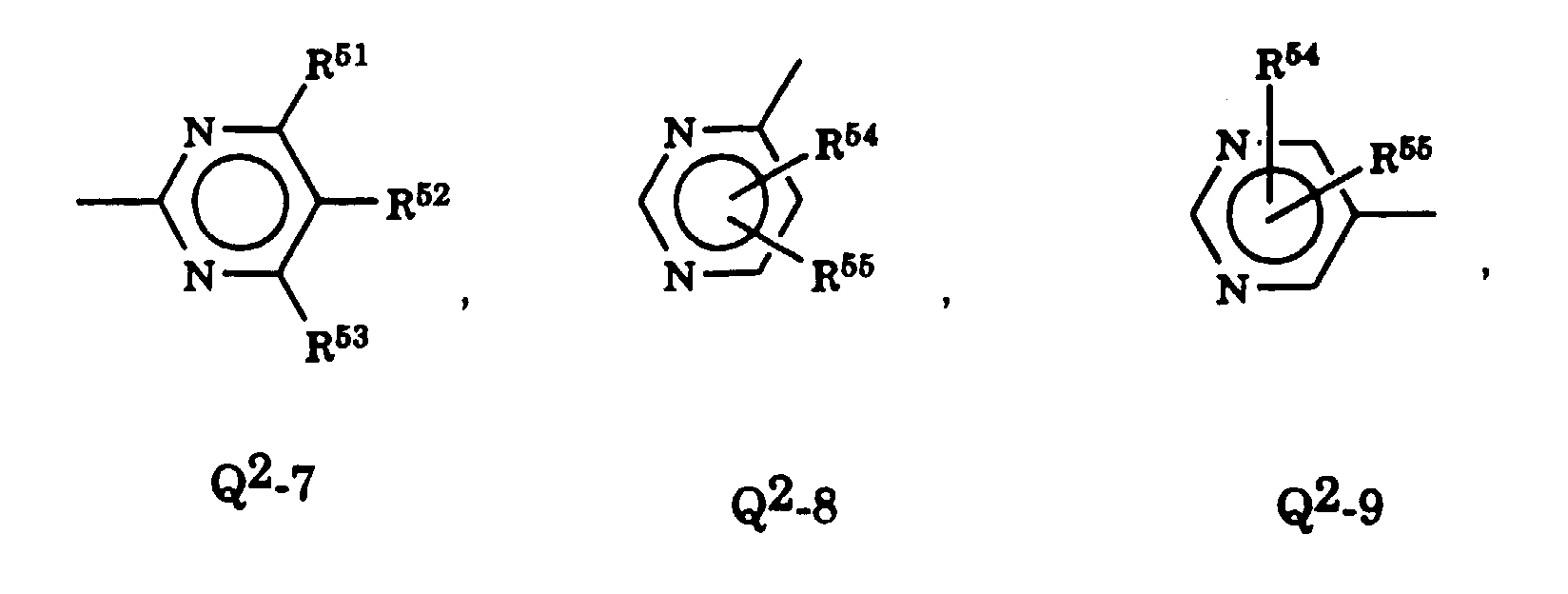

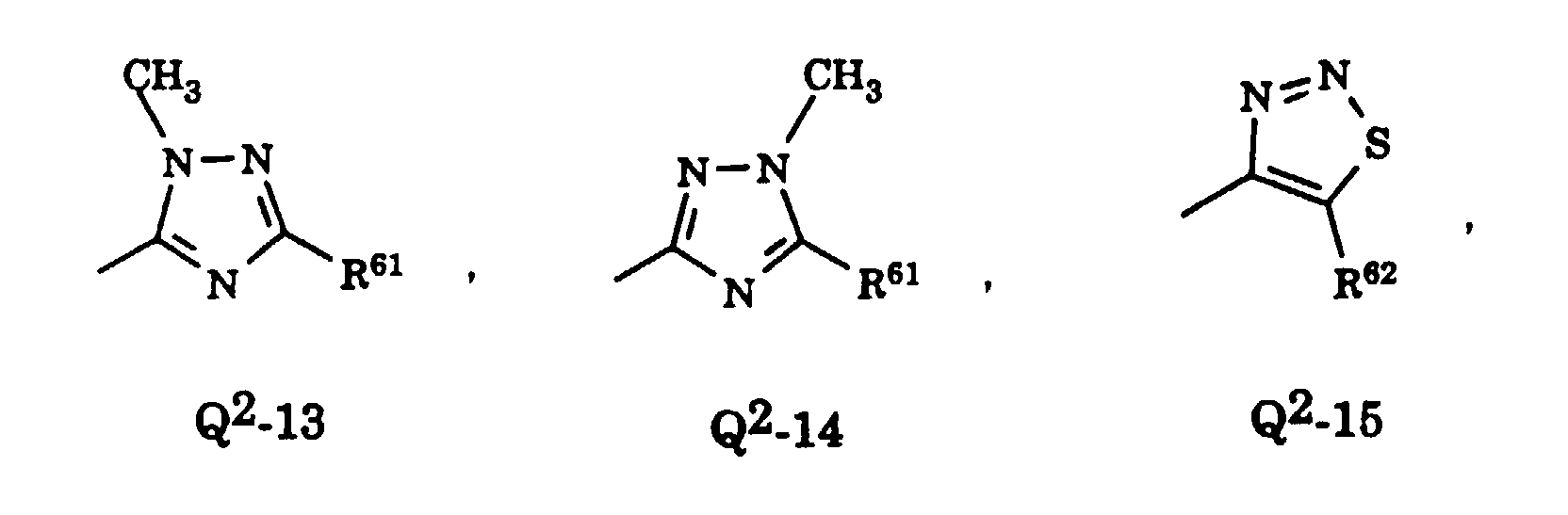


- r is 0 or 1;
- R45 and R46 are independently H, CH3 or Cl;
- R47 is H or C1-C3 alkyl;
- R48 is H or CH3;
- R49 and R50 are independently H or CH3;
- R51 is H, CH3 or OCH3;
- R52 is H or CH3;
- R53, R54 and R55 are independently H, CH3 or OCH3;
- R56, R57 and R58 are independently H, CH3, CH2CH3, Cl, Br, OCH3 or OCH2CH3;
- R59 is H or C1-C2 alkyl;
- R60 is CH3;
- R61 is H, C1-C2 alkyl, OCH3 or SCH3;
- R62 is H, CH3 or CH2CH3;
- R63 and R64 are independently H or CH3;
- R65 is H, CH3, CH2CH3 or C3H7;
- W3 is O or S;
- W4 is O, S or NR66; and
- R66 is H or CH3.
- 3. Compounds of Preferred 2 wherein:
- W is O;
- R1 is H, C1-C6 alkyl, allyl, CH2OCH3, CH2OC2H5, CH2SCH3 phenyl, 2-pyridyl, 3-pyridyl, 4-pyridyl, C(O)OCH3 or C(O)N(CH3)2;
- X is C1-C2 alkyl, C1-C2 alkoxy, F, Cl, Br, I, CH2F, CF3, CH2Cl or CH2Br; and
- Y is H, C1-C2 alkyl, C1-C2 alkoxy, CH2OCH3, CH2OCH2CH3, NHCH3, N(OCH3)CH3, N(CH3)2, CF3, SCH3, OCH2CH=CH2, OCH2C≡CH, OCH2CH2OCH3, CH2SCH3, C(O)R22,

- 4. Compounds of Preferred 3 wherein:
- R3 is H, CH3, Cl or Br; and
- R4 is H, C1-C2 alkyl, CH2CN, CH2OCH3, CH2SCH3, CH2S(O)2CH3, Q2, C(O)R8, C(O)OR9, C(O)NR10R11, C(R12)=NOR13, C(R14)(OR15)(OR16), S(O)nR17, S(O)2NR18R19, F, Cl or Br;
- R8 is H or C1-C2 alkyl;
- R9 is C1-C2 alkyl or CH2CH2Cl;
- R10 is H or CH3;
- R11 is CH3;
- R12 is H, CH3, C2H5 or Cl;
- R13 is CH3;
- R14 is H or C1-C2 alkyl;
- R15 and R16 are CH3;
- R17 is C1-C2 alkyl;
- R18 is H or CH3;
- R19 is CH3; and
- n is 0 or 2.
- 5. Compounds of Preferred 4 wherein:
R2 is C1-C2 alkyl, CH2CN, CH2OCH3, CH2SCH3, CH2S(O)2CH3, Q2, C(O)R8, C(O)OR9, C(O)NR10R11, C(R12)=NOR13, C(R14)(OR15)(OR16), S(O)nR17, S(O)2NR18R19, F, Cl, Br or OR73. - 6. Compounds of Preferred 5 wherein:
- R is H; and
- R71 is H.
- 7. Compounds of Preferred 6 wherein:
J is J-1. - 8. Compounds of Preferred 6 wherein:
J is J-2. - 9. Compounds of Preferred 6 wherein:
J is J-3. - 10. Compounds of Preferred 7 wherein:
- R2 is C1-C2 alkyl, CH2CN, CH2OCH3, CH2SCH3, CH2S(O)2CH3, Q2, C(O)R8, C(O)OR9, C(O)N(CH3)2, S(O)2CH3, S(O)2C2H5, S(O)2N(CH3)2, C1-C2 alkoxy, OC(O)CH3, or OSO2CH3;
- R4 is H, C1-C2 alkyl, CH2CN, CH2OCH3, CH2SCH3, CH2S(O)2CH3, Q2, C(O)R8, C(O)OR9, C(O)N(CH3)2, S(O)2CH3, S(O)2C2H5 or S(O)2N(CH3)2;
- R8 is C1-C2 alkyl;
- R9 is C1-C2 alkyl;
- Q2 is Q2-1, Q2-4, Q2-5, Q2-6, Q2-10, Q2-11, Q2-20 or Q2-21;
- R45, R46, R49, R50, R56, R57 and R58 are H;
- R65 is CH3;
- W3 is S; and
- r is 0.
- 11. Compounds of Preferred 8 wherein:
- R2 is C1-C2 alkyl, CH2CN, CH2OCH3, CH2SCH3, CH2S(O)2CH3, Q2, C(O)R8, C(O)OR9, C(O)N(CH3)2, S(O)2CH3 S(O)2C2H5, S(O)2N(CH3)2, C1-C2 alkoxy, OC(O)CH3, or OSO2CH3;
- R4 is H, C1-C2 alkyl, CH2CN, CH2OCH3, CH2SCH3, CH2S(O)2CH3, Q2, C(O)R8, C(O)OR9, C(O)N(CH3)2, S(O)2CH3 or S(O)2N(CH3)2;
- R8 is C1-C2 alkyl;
- R9 is C1-C2 alkyl;
- Q2 is Q2-1, Q2-4, Q2-5, Q2-6, Q2-10, Q2-11, Q2-20 or Q2-21;
- R45, R46, R49, R50, R56, R57 and R58 are H;
- R65 is CH3;
- W3 is S; and
- r is 0.
- 12. Compounds of Preferred 9 wherein:
- R2 is C1-C2 alkyl, CH2CN, CH2OCH3, CH2SCH3, CH2S(O)2CH3, Q2, C(O)R8, C(O)OR9, C(O)N(CH3)2, S(O)2CH3, S(O)2C2H5, S(O)2N(CH3)2, C1-C2 alkoxy, OC(O)CH3, or OSO2CH3;
- R4 is H, C1-C2 alkyl, CH2CN, CH2OCH3, CH2SCH3, CH2S(O)2CH3, Q2, C(O)R8, C(O)OR9, C(O)N(CH3)2, S(O)2CH3 or S(O)2N(CH3)2;
- R8 is C1-C2 alkyl;
- R9 is C1-C2 alkyl;
- Q2 is Q2-1, Q2-4, Q2-5, Q2-6, Q2-10, Q2-11, Q2-20 or Q2-21;
- R45, R46, R49, R50, R56, R57 and R58 are H;
- R65 is CH3;
- W3 is S; and
- r is 0.
- 13. Compounds of Preferred 10 wherein:
- A is A-1;
- X is CH3, OCH3, OCH2CH3 or Cl; and
- Y is CH3, OCH3, NHCH3 or N(CH3)2.
- 14. Compounds of Preferred 11 wherein:
- A is A-1;
- X is CH3, OCH3, OCH2CH3 or Cl; and
- Y is CH3, OCH3, NHCH3 or N(CH3)2.
- 15. Compounds of Preferred 12 wherein
- A is A-1;
- X is CH3, OCH3, OCH2CH3 or Cl; and
- Y is CH3, OCH3, NHCH3 or N(CH3)2.
- Compounds of the invention specifically preferred for reasons of greatest ease of synthesis and/or greatest herbicidal efficacy are:
- Methyl 3-[[[[(4,6-dimethoxy-2-pyrimidinyl)amino]carbonyl]-amino]sulfonyl]-1-methyl-1H-pyrrole-2-carboxylate;
- Methyl 3-[[[[[4-ethoxy-6-(methylamino)-1,3,5-triazin-2-yl]-amino]carbonyl]amino]-sulfonyl]-1-methyl-1H-pyrrole-2-carboxylate;
- N3-[[(4-ethyl-6-methoxy-1,3,5-triazin-2-yl)-amino]carbonyl]-N2,N2,1-trimethyl-1H-pyrrole-2 ,3-disulfonamide;
- N3-[[(4,6-dimethoxy-2-pyrimidinyl)amino]carbonyl]-N2,N2,1-trimethyl-1H-pyrrole-2,3-disulfonamide;
- Methyl 1-ethyl-2-[[[[(4-methoxy-6-methyl-1,3,5-triazin-2-yl)-amino]-carbonyl]amino]sulfonyl]-1H-pyrrole-3-carboxylate;
- 2-(ethylsulfonyl)-N-[[(4-methoxy-6-methyl-1,3,5-triazin-2-yl)amino]-carbonyl]-1-methyl-1H-pyrrole-3-sulfonamide; and
- 2-[[[[(4,6-dimethoxy-2 pyrimidinyl)amino]carbonyl]-amino]sulfonyl]-N,N,1-trimethyl-1H-pyrrole-3-carboxamide.
- The invention also comprises novel compounds, such as the bromopyrrolesulfonamides of Formula II, useful as intermediates to the compounds of Formula I.

- R67 is H, C(CH3)3 or Si(CH3)2C(CH3)3; and
- R72 is H or Si(CH(CH3)2)3.
- Another embodiment of the invention is the process for preparing any of the above compounds, said process comprising reacting
- (a) the compounds of Equation 1 in an inert polar aprotic solvent for 5 minutes to 24 hours or more at 20° to 80°C

- (b) the compounds of Equation 2 in an inert solvent followed by treatment with aqueous acid

- (c) the compounds of Equation 3 in an inert solvent for 0.5 to 24 hours

- (d) the compounds of Equation 4 in an inert solvent at 20° to 80°C for 0.5 to 24 hours and in the presence of 1 to 1.4 equivalents of a base

- The sulfonylureas of Formula I can be prepared by a number of methods. These methods are described below along with the appropriate references for greater detail.

- One of the methods of synthesis of sulfonylureas of Formula I is depicted in Equation 1 where J, R, and A are as defined above. A sulfonylisocyanate of Formula 2 is contacted with a heterocyclic amine of Formula 3 in an inert polar aprotic solvent, such as acetonitrile, dichloromethane, etc. for periods of several minutes to 24 hours or more, preferably at a temperature in the range of 20° to 80°C to afford a sulfonylurea of Formula I.
- U.S. Patents Nos. 4,127,405; 4,257,802; and 4,221,585 disclose this equation and are herein incorporated by reference.

- Another method of synthesis of compounds of Formula I is depicted in Equation 2 where J, R, and A are as defined previously and R68 is lower alkyl such as methyl or ethyl. A sulfonamide of Formula 4 is contacted with an alkyl carbamate of Formula 5 in the presence of a trialkylaluminum in an inert solvent such as dichloromethane, 1,2-dichloroethane, etc., and subsequently treated with aqueous acid to afford a sulfonylurea of Formula I. This reaction is taught in European Patent Publication EP-A-83,975 (published July, 20 1983).

- Alternatively, compounds of Formula I can be prepared by the method shown in Equation 3 where A, J, and R are as defined previously and Ar represents an aryl group, for example a phenyl group. In this reaction, a sulfonylcarbamate of Formula 6 is contacted with a heterocyclic amine of Formula 3 in an inert solvent such as p-dioxane for a period of 0.5 to 24 hours, as taught in European Patent Publication EP-A-44,807.

- A fourth method of preparation for compounds of Formula I is depicted in Equation 4 where A, R, and J are as defined previously and Ar represents an aryl group, for example a phenyl or substituted phenyl group. In this reaction, a sulfonamide of Formula 4 is contacted with a heterocyclic carbamate of Formula 7 in an inert solvent such as p-dioxane or acetonitrile preferably at temperatures in the range of from 20° to 80°C for periods of 0.5 to 24 hours in the presence of 1 to 1.4 equivalents of a base such as 1,8-diazabicyclo[5.4.0]undec-7-ene (DBU). The resultant products are isolated by dilution of the reaction mixture with aqueous acid to afford sulfonylureas of Formula I. The reaction is taught in European Patent Publications EP-A-44,807, and EP-A-85,028.
- Heterocyclic sulfonyl isocyanates of Formula 2 can be prepared by treatment of sulfonamides of Formula 4 by the procedures taught in U.S. 4,127,405. Heterocyclic carbamates of Formula 5 are prepared by procedures taught in European Patent Publication EP-A-83,975.
- The sulfonylcarbamates of Formula 6 and heterocyclic carbamates of Formula 7 can be prepared by procedures taught in European Patent Publications EP-A-44,807, EP-A-72,347, EP-A-173,498 and U.S. Patent 4,666,506 and references cited therein.
- The intermediate pyrrole sulfonamides of Formula 4 can be prepared by a variety of methods, some of which are described in the sequence of reactions shown in Equations 5 through 24.
- The sulfonamides of Formula 4 of this invention where J is J-1, J-2 or J-3 as defined above can be synthesized from the precursor sulfonamides of Formula 8 where J is as defined above and R69 is a suitable protecting group such as tert-alkyl or trialkylsilyl, by appropriate methods known to one skilled in the art, as depicted in Equation 5.

- Sulfonamides of Formula 8 where J is J-2 or J-3, R1 is as defined above or is a masked synthon thereof, R2 is as defined above or is a masked synthon thereof, R69 is as previously defined and R4 is other than H, X5 is a suitable leaving group such as but not limited to chloro, bromo, iodo, alkyl- or arylsulfonate, may be prepared by methods similar to the depiction in Equation 6. The general methodology described for the instance when J is J-2 is directly applicable to the instances where J is J-3. Further, the synthetic necessity, and selection of specific masked synthons for specific definitions of R1 and R2 are known to one skilled in the art, for the introduction of R4 into the sulfonamide of Formula 9.

- A sulfonamide of Formula 9 can be metalated on carbon using an excess of an organometallic base, preferably an organolithium reagent such as n-butyllithium, n-butyllithium/tetramethylethylenediamine (TMEDA) or lithium diisopropylamide in an inert solvent such as diethyl ether, dimethoxyethane (DME) or tetrahydrofuran (THF), under anhydrous conditions, preferably at a temperature in the range of -100° to -70°C, followed by quenching with the appropriate electrophilic reagent (R4-X5) affording sulfonamide of Formula 8 after standard aqueous workup.
- A sulfonamide of Formula 9 where J is J-2, R1, R2 and R69 are as previously defined, X5 is a suitable leaving group such as but not limited to chloro, bromo, iodo, alkyl- or arylsulfonate, acid chloride or N,N-dialkylamide, can be prepared by methods similar to those depicted in Equation 7.

- A sulfonamide of Formula 10 can be metalated on carbon using an excess of organometallic base, as described in J. Org. Chem., vol. 50, p. 4362-4368, (1985) and J. Chem Soc. Perkin Trans., I, p. 1343, (1982) and the references cited therein, preferably an organolithium reagent such as n-butyllithium, n-butyllithium/tetramethylethylenediamine (TMEDA) or lithium diisopropylamide, in an inert solvent such as diethyl ether, dimethoxyethane (DME) or tetrahydrofuran (THF), under anhydrous conditions, preferably at a temperature in the range of -100° to -70°C, followed by quenching with an appropriate electrophilic reagent (R2-X5) affording sulfonamide of Formula 8 after standard aqueous workup. A sulfonamide of Formula 9 where J is J-3, R1, R2 and R69 are as previously defined, X5 is a suitable leaving group such as but not limited to chloro, bromo, iodo, alkyl- or arylsulfonate, can be prepared by methods similar to those depicted in Equation 8.

- A sulfonamide of Formula 11 can be treated with a base such as an alkali metal alkoxide, hydride or tertiary amine and an appropriate electrophilic reagent (R1-X5) as shown in an inert solvent, preferably a polar aprotic solvent such as dimethylformamide (DMF) to afford a sulfonamide of Formula 9.
- Sulfonamides of Formula 10, where J is J-2, R1, R69 and X5 are as previously defined, can be prepared by methods similar to those depicted in Equation 9.
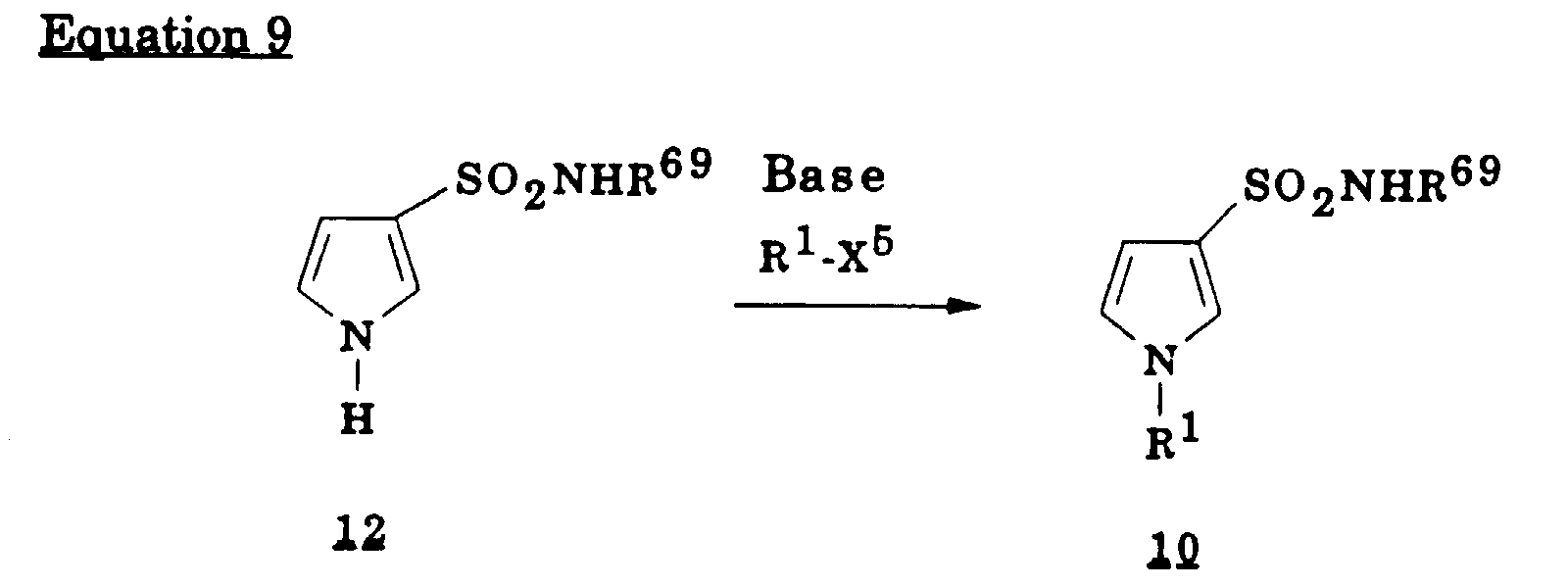
- A sulfonamide of Formula 12 is treated with a base such as an alkali metal alkoxide, hydride or tertiary amine and an appropriate electrophilic reagent (R1-X5) as shown in an inert solvent, preferably a polar aprotic solvent such as dimethylformamide (DMF), at a temperature in the range of 20° to 80°C, for a period of 1 to 24 hours to afford a sulfonamide of Formula 10.
- Pyrrole sulfonamides of Formula 12, where R69 is a suitable protecting group as defined above are available from the corresponding bromopyrroles 13 as outlined in Equation 10, where R70 is lower alkyl, such as isopropyl.

- N-Silyl-protected pyrrole 13 where R70 is preferably an isopropyl group, is treated with an alkyllithium reagent such as n-butyllithium as described in Chem.Ber., Vol 122 p.169 (1989), and references cited therein. The resultant metalated species is treated with sulfur dioxide to afford sulfinate salt 14 which can be converted to sulfonamide 15 by any of several known methods, for example treatment with N-chlorosuccinimide followed by amination with an appropriate primary amine as disclosed in U.S. Patent 4,481,029. The N-silyl group is then removed, most conveniently with an alkali fluoride or quaternary ammonium fluoride salt to afford pyrrole-3-sulfonamide 12.
- Sulfonamides of Formula 11, where J is J-3, R2, R69 and X5 are as previously defined, can be prepared by methods similar to those depicted in Equation 11, where R70 is lower alkyl, such as isopropyl.

- A sulfonamide of Formula 16 undergoes metal-halogen exchange on carbon using an excess of organometallic base, as described in J.Org. Chem., vol. 50, p. 4362-4368, (1985) and J. Chem Soc. Perkin Trans., I, p. 1343, (1982) and the references cited therein, preferably an organolithium reagent such as n-butyllithium, n-butyllithium/tetramethylethylenediamine (TMEDA) in an inert solvent such as diethyl ether, dimethoxyethane (DME) or tetrahydrofuran (THF), under anhydrous conditions, preferably at a temperature in the range of -100° to -70°C, followed by quenching with an appropriate electrophilic reagent (R2-X5) affording intermediate sulfonamide of Formula 17. The N-silyl group is then removed, most conveniently with an alkali fluoride or quaternary ammonium fluoride salt to afford sulfonamide 11.
- A pyrrole sulfonamide of Formula 16, where R69 is a suitable protecting group as defined above can be prepared from the corresponding bromopyrrole 13 as outlined in Equation 12, where R70 is lower alkyl, such as isopropyl.
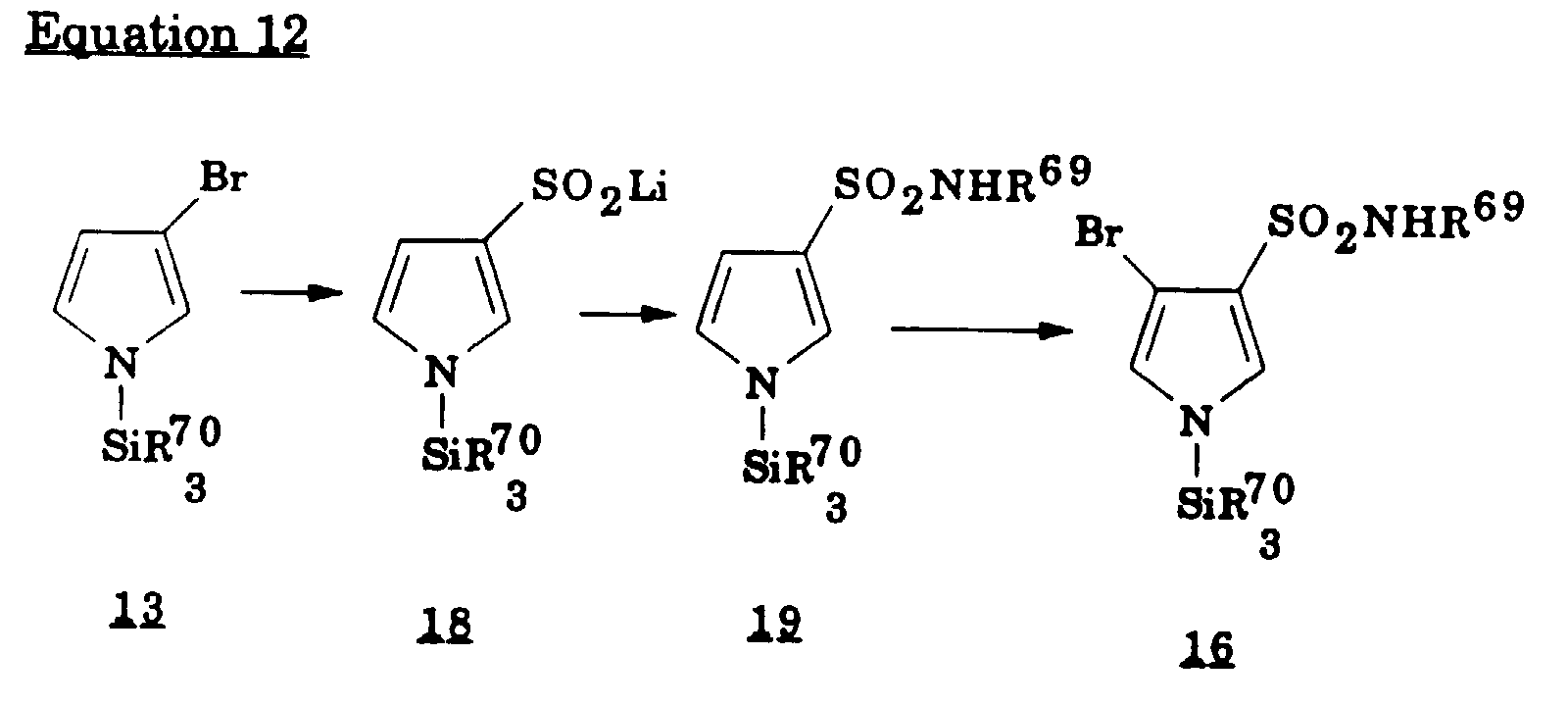
- N-silyl-protected pyrrole 13 where R70 is preferably an isopropyl group, is treated with an alkyllithium reagent such as n-butyllithium as described in Chem.Ber., Vol. 122, p. 169 (1989), and references cited therein. The resultant metalated species is treated with sulfur dioxide to afford sulfinate salt 18 which can be converted to sulfonamide 19 by any of several known methods, for example treatment with N-chlorosuccinimide in a solvent such as acetic acid, methylene chloride/H2O, 1,1,2-trichlorotrifluoroethene/H2O at a temperature from 0°C to ambient temperature followed by amination with an appropriate primary amine as disclosed in U.S. Patent 4,481,029. Sulfonamide 19 can be converted to a compound of Formula 16 by treatment with N-bromosuccinimide in an inert solvent such as tetrahydrofuran (THF), under anhydrous conditions, preferably at a temperature in the range of -100 to -70°C as described in J. Org. Chem., Vol. 55, No. 26, pp. 637-28 (1990) and the references cited therein.
- In the cases where R2 is not directly obtainable as an electrophilic reagent (R2-X5), wherein R2 is defined as -S(O)2NR18R19, -CONR10R11, C(R12)=NOR13, -S(O)n-R17, C(O)R8, (CH2)m-Q2 or -CN the desired compounds can be obtained through a series of functional group transformations known to one skilled in the art. The general methodology described for the instance when J is J-2 is directly applicable to the instances where J is J-1 or J-3 with modifications known to one skilled in the art. Therefore, only the instances where J is J-2, R1 is CH3 and R69 is a suitable protecting group such as tert-alkyl or trialkylsilyl will be described in Equations 13 to 19.
- Equation 13 depicts a sequence of reactions whereby one can obtain a sulfonamide of Formula 21 where J is J-2, R1 and R69 are as previously defined and R2 is -S(O)2NR18R19 wherein R18 and R19 are as defined above.

- A precursor sulfonamide of Formula 10 can be metalated on carbon using an excess of organometallic base, similar to that described in J. Org. Chem., vol. 50, p. 4362-4368, (1985) and J. Chem Soc. Perkin Trans., I, p. 1343, (1982) and the references cited therein, preferably an organolithium reagent such as n-butyllithium, n-butyllithium/tetramethylethylenediamine (TMEDA) or lithium diisopropylamide, in an inert solvent such as diethyl ether, dimethoxyethane (DME) or tetrahydrofuran (THF), under anhydrous conditions, preferably at a temperature in the range of -100° to -70°C. The resultant metalated species is treated with sulfur dioxide to afford sulfinate salt 20 which can be converted to sulfonamide 21 by any of several known methods, for example treatment with N-chlorosuccinimide followed by amination with an appropriate amine in an analogous manner to that disclosed in U.S. Patent 4,481,029.
- In an analogous manner Equation 14 outlines a sequence wherein one can prepare a sulfonamide of Formula 22 where J is J-2, R1 and R69 are as previously defined and R2 is -C(O)NR10R11.

- A precursor sulfonamide of Formula 9 where R2 is defined for example as -C(O)OR9 where R9 is preferably methyl or ethyl, can be converted to amide 22 by any of several known methods, for example contacting the ester with an appropriate amine in the presence of an organometallic base in an analogous manner to that disclosed in Tetrahedron Letters, No. 21, p. 1791, (1970).
- Equation 15 outlines a sequence whereby one can prepare a sulfonamide of Formula 23 where J is J-2, R1 and R69 are as previously defined and R2 is -CN.

- A precursor sulfonamide of Formula 9 where R2 is defined for example as -CONH2 can be converted to nitrile 23 by any of several known methods, for example contacting the amide with triphenylphosphine and CCl4 in an inert solvent, in an analogous manner to that disclosed in Tetrahedron Letters, No. 21, p. 4383, (1970), or by dehydration with thionyl chloride as described in Org. Syn., coll. vol. IV, p. 436, (1963).
- Equation 16 depicts a sequence whereby one can prepare a sulfonamide of Formula 25 where J is J-2, R1 and R69 are as previously defined, R2 is (CH2)m-Q2, Q2 is Q2-1, Q2-4, Q2-5, Q2-6, Q2-7, Q2-8, Q2-9, Q2-10 or Q2-11, r is 0, m is 0 and M is ZnClx, ZnBrx, or B(OH)2.

- A sulfonamide of Formula 10 can be metalated on carbon using an excess of organometallic base, similar to that described in J. Org. Chem., vol. 50, p. 4362-4368, (1985) and J. Chem Soc. Perkin Trans., I, p. 1343, (1982) and the references cited therein, preferably an organolithium reagent such as n-butyllithium, n-butyllithium/tetramethylethylenediamine (TMEDA) or lithium diisopropylamide, in an inert solvent such as diethyl ether, dimethoxyethane (DME) or tetrahydrofuran (THF), under anhydrous conditions, preferably at a temperature in the range of-100° to -70°C. The metalated species can be transmetalated with anhydrous zinc chloride, by methods similar to those described in Tetrahedron Letters, Vol.29, No.39, pp. 5013-5016, (1988). The transmetalated species 24 can be coupled to an arylhalide substrate, for instance 2-bromopyridine, in the presence of excess zinc chloride and a palladium catalyst to afford the biaryl species of Formula 25. Alternatively, the metalated species can be quenched with an alkyl borate, for instance trimethylborate affording the corresponding 2-boronic acid species 24 upon hydrolysis. The pyrrole boronic acid species can be coupled to an arylhalide substrate by methods similar to those described in Tetrahedron Letters, vol. 26, No. 49, pp. 5997-6000, (1985) and Tetrahedron Letters, vol. 29, No. 43, p. 5459-5462, (1988) and the references cited therein, for instance 2-bromopyridine in the presence of a palladium catalyst and a base, in an inert solvent such as toluene or dimethoxyethane (DME), at reflux temperature for periods of 1 to 24 hours affording the biaryl species of Formula 25.
- Equation 17 outlines a sequence whereby one can prepare a sulfonamide of Formula 27 where J is J-2, R1 and R69 are as previously defined, R2 is -C(R12)=NOR13, R12 is H and R13 is as previously defined.

- A sulfonamide of Formula 10 can be metalated on carbon using an excess of organometallic base, similar to that described in J. Org. Chem., vol. 50, p. 4362-4368, (1985) and J. Chem Soc. Perkin Trans., I, p. 1343, (1982) and the references cited therein, preferably an organolithium reagent such as n-butyllithium, -butyllithium/tetramethylethylenediamine (TMEDA) or lithium diisopropylamide, in an inert solvent such as diethyl ether, dimethoxyethane (DME) or tetrahydrofuran (THF), under anhydrous conditions, preferably at a temperature in the range of-100° to -70°C. The metalated species, quenched with dimethylformamide (DMF) affords the corresponding pyrrole-2-aldehyde 26 following aqueous workup. The aldehyde species 26 is contacted with an alkoxy amine (H2N-OR13), for instance methoxylamine hydrochloride in the presence of a base, for example sodium acetate, in an inert solvent such as acetone, tetrahydrofuran, dioxane or methanol. The reaction is carried out at temperatures in the range of 20°C to reflux for a period of 1 to 24 hours and optionally in the presence of a phase transfer catalyst such as a crown ether.
- Equation 18 depicts a sequence whereby one can prepare a sulfonamide of Formula 29 where J is J-2, R1 and R69 are as previously defined and R2 is -C(O)R8 where R8 is as defined above.

- A sulfonamide of Formula 10 can be metalated on carbon using an excess of organometallic base, similar to that described in J. Org. Chem., vol. 50, p. 4362-4368, (1985) and J. Chem Soc. Perkin Trans., I, p. 1343, (1982) and the references cited therein, preferably an organolithium reagent such as n-butyllithium, n-butyllithium/tetramethylethylenediamine (TMEDA) or lithium diisopropylamide, in an inert solvent such as diethyl ether, dimethoxyethane (DME) or tetrahydrofuran (THF), under anhydrous conditions, preferably at a temperature in the range of -100° to -70°C. The metalated species, quenched with an aldehyde (R8-CHO) affords the alcohol 28 following aqueous workup. Alcohol 28 can be oxidized to a ketone of Formula 29 by contact with one of several oxidants known to one skilled in the art, for example tetra-n-propylammonium perruthenate/ N-methylmorpholine N-oxide as described in Aldrichimica Acta, Vol. 23, No. 1, p. 13-17, (1990) and the references cited therein.
- Equation 19 outlines a sequence whereby one can prepare a sulfonamide of Formula 31 where J is J-2, R1 and R69 are as previously defined and R2 is -S(O)n-R17, where R17 is as defined above and n is 1 or 2.

- A sulfonamide of Formula 10 can be metalated on carbon using an excess of organometallic base, similar to that described in J. Org. Chem., vol. 50, p. 4362-4368, (1985) and J. Chem Soc. Perkin Trans., I, p. 1343, (1982) and the references cited therein, preferably an organolithium reagent such as n-butyllithium, n-butyllithium/tetramethylethylenediamine (TMEDA) or lithium diisopropylamide, in an inert solvent such as diethyl ether, dimethoxyethane (DME) or tetrahydrofuran (THF), under anhydrous conditions, preferably at a temperature in the range of -100° to -70°C. The metalated species, quenched with an appropriate disulfide (R17-S-S-R17) affords thioether 30 following aqueous workup. The thioether can be oxidized selectively to the corresponding sulfoxide or sulfone of Formula 31 by contact with one of several suitable oxidants such as a peroxy acid or hydrogen peroxide.
- Pyrrole sulfonamide precursors of Formula 36 where J is J-1, R3 is H or alkyl and R69 is a trialkylsilyl protecting group can be prepared from the corresponding N-substituted pyrrole 32 as outlined in Equation 20.
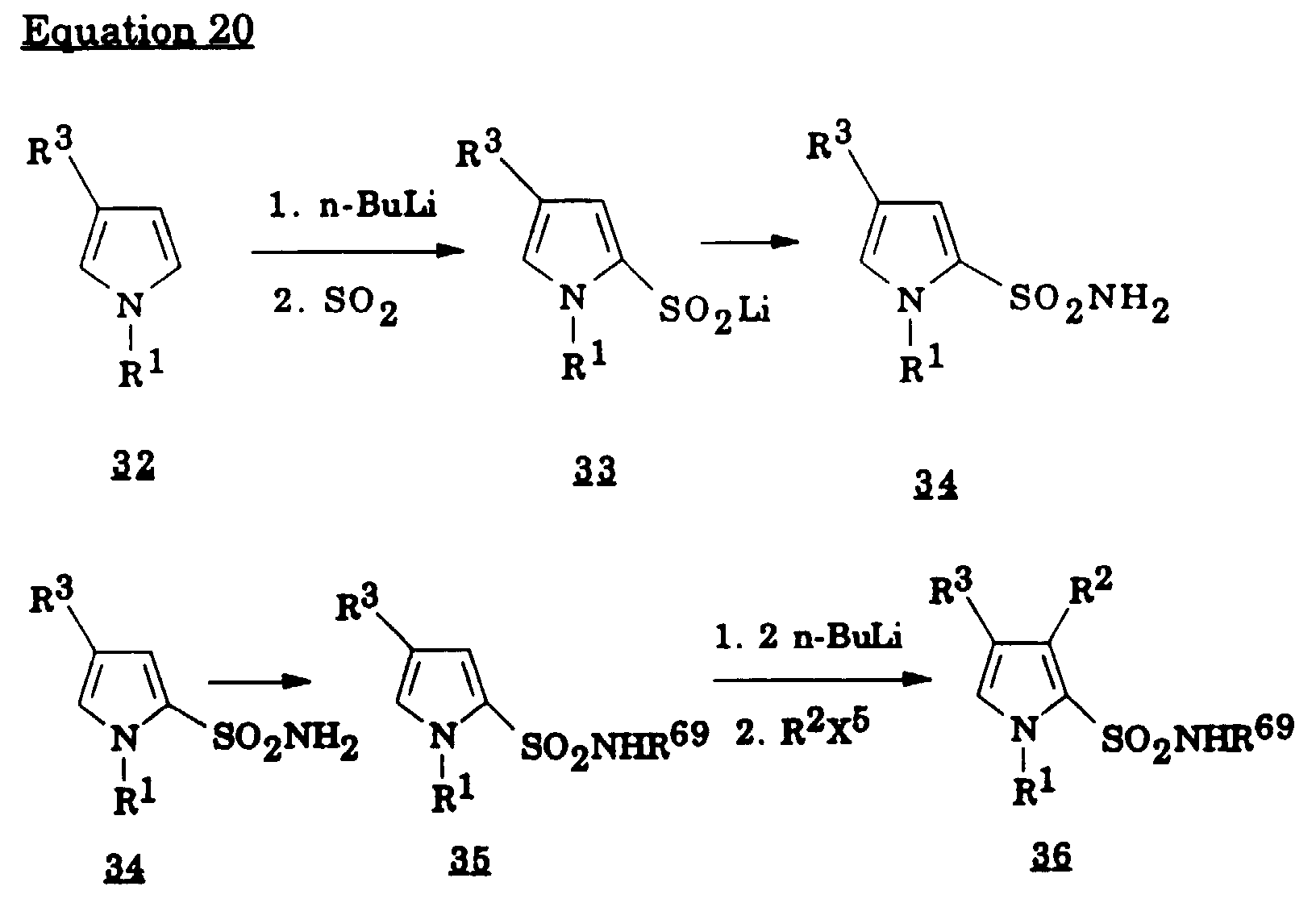
- Pyrroles of Formula 32 are generally known in the art or can be prepared by a variety of known alkylation or acylation procedures such as those reviewed in "Pyrroles", R. Alan Jones, Ed., "The Chemistry of Heterocyclic Compounds", Vol. 48, Part 1 (John Wiley & Sons, Inc., 1990, New York) p. 397. Metalation of pyrroles 32 is likewise known to produce reactive 2-lithio intermediates as described in Synthetic Communications, Vol. 12, p. 231 (1982) and in J. Org. Chem., Vol. 46, p. 157 (1981) and references cited therein. Treatment of these reactive metalated species with sulfur dioxide affords sulfinate salts 33. These can be converted to sulfonamides 34 by methods described above, or directly by treatment with hydroxylamine-O-sulfonic acid in aqueous media as described in Synthesis, p. 1031 (1986). Treatment of sulfonamides 34 with a base and a trialkylsilyl chloride such as t-butyldimethylsilyl chloride affords the protected sulfonamides 35. Metalation of 35 with two equivalents of an organometallic base such as n-butyllithium, lithium diisopropylamide or lithium 2,2,6,6-tetramethylpiperidide (LTMP) and quenching with an appropriate electrophilic reagent R2X5 affords substituted sulfonamides 36. Directed metalations of this type on 1,2-disubstituted pyrroles have been described in J. Org. Chem., Vol. 50, p. 4362 (1985) and J. Chem. Soc. Perkin Trans. I, p. 1343 (1982) and references cited therein. When 32 contains R1 groups that are incompatible with strongly basic conditions of the subsequent reactions, such as when R1 is CO2CH3 or C(O)CH3, a suitable protecting group in place of R1 can be substituted such as those described in J. Org. Chem., Vol 46, p. 157 (1981), ibid., p. 3760, and in Tetrahedron, Vol. 42, p. 3723 (1986). This protecting group can be removed at a suitable point in the synthesis, such as after the synthesis of sulfonamide 36, and replaced with the appropriate R1 group by standard alkylation or acylation methods as described above. Intermediates 34 or 35 where R3 is hydrogen can be directly halogenated to afford the corresponding substituted sulfonamides 34 or 35 where R3 is halogen. Conversion of these intermediates to sulfonamides of Formula 36 where R3 is halogen is best carried out using a substituted lithium amide base, such as lithium diisopropylamide, followed by treatment with an electrophillic reagent as described above.
- Intermediate sulfonamides of Formula 38 where J is J-1 and R71 is other than H can be prepared as depicted in Equation 21 from the corresponding sulfonamides 36, where X6 is chloro, bromo or iodo.
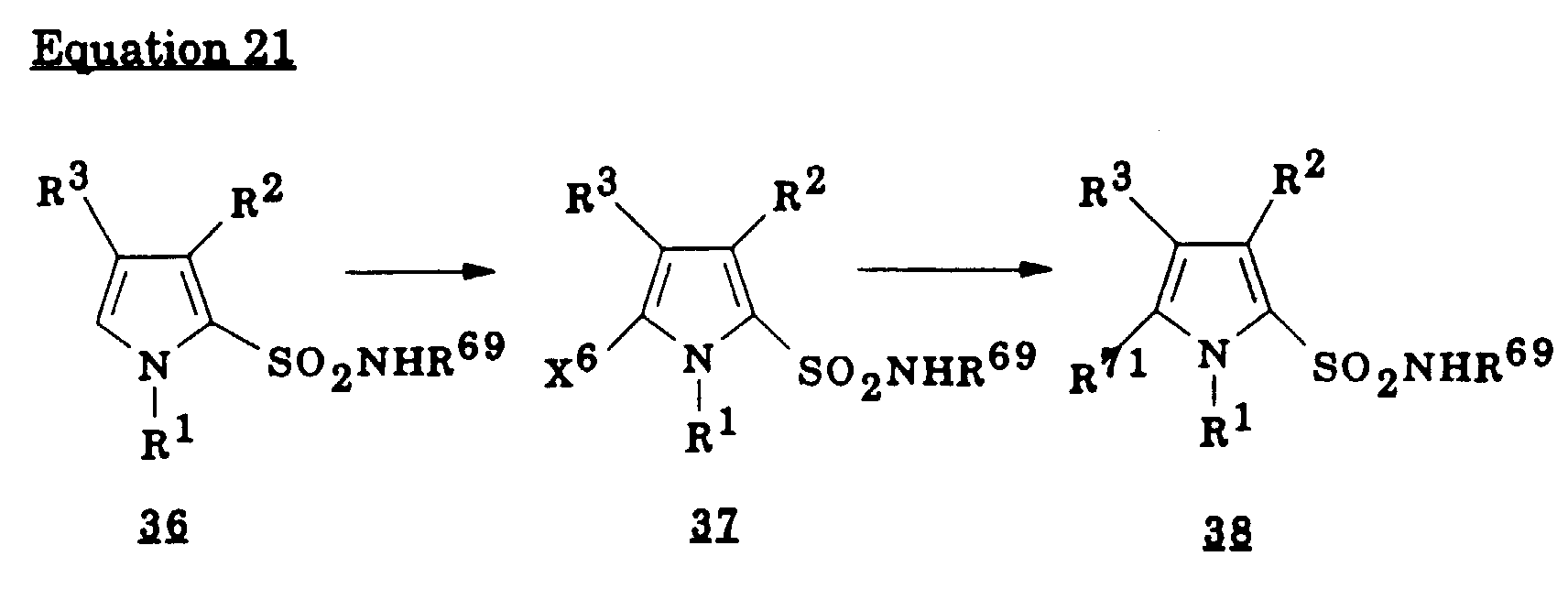
- Treatment of sulfonamides 36 with a halogenating agent affords sulfonamides 37 where X6 is chloro, bromo, or iodo. Further treatment of 37 where X6 is bromo or iodo with an alkyllithium in an inert solvent followed by an alkyl halide affords sulfonamides 38 where R71 is lower alkyl. Likewise treatment of 37 with an alkyllithium reagent and subsequently with a mild fluorinating agent such as that described in J. Am. Chem. Soc., Vol. 106, p. 452 (1984) affords sulfonamides 38 wherein R71 is a fluoro substituent. Compounds of 37 where X6 is bromo or iodo to 38 where R71 is CF3 can be accomplished by first treatment with an alkyllithium reagent followed by quenching with carbon dioxide to afford an intermediate acid 37 where R71 is COOH, and subsequent reaction with sulfur tetrafluoride or the like.
- An intermediate pyrrole of Formula 40 where R1 is defined as Q1 above, can be prepared by the method outlined in Equation 22.

- Amine 39 can be condensed with 2,5-dimethoxy tetrahydrofuran by the method described in Org. Syn., coll. vol. V, pp. 716-717, affording pyrrole 40.
- Intermediate sulfonamides of Formula 44 where J is J-1, R3 is H, R1 is Q1 and R69 is a trialkylsilyl protective group can be prepared from the corresponding N-substituted pyrrole 40 as depicted in Equation 23.

- Pyrroles of Formula 40 can be metalated on carbon using an organometallic base, as described in Org. React., vol. 26, p. 21 (1979) and the references cited therein, preferably using an organolithium reagent such as n-butyllithium, lithium diisopropyl amide, or n-butyllithium/tetramethylethylenediamine. Treatment of the metalated species with sulfur dioxide affords the sulfinate salts 41. These can be converted to sulfonamides 42 by methods described above. Treatment of 42 with a base and a trialkylsilyl chloride affords protected sulfonamides 43. Metalation of 43 with two equivalents of an organometallic base as described above, and quenching with an appropriate electrophilic reagent R2X5 affords substituted sulfonamides 44.
- Intermediate sulfonamides of Formula 49 where J is J-2, R4 is H, R1 is Q1 and R69 is a trialkylsilyl protecting group can be prepared from the corresponding N-substituted pyrrole 40 as outlined in Equation 24.

- Pyrroles of Formula 40 can be brominated by methods similar to those reviewed in "Pyrroles," R. Alan Jones, Ed., "The Chemistry of Heterocyclic Compounds," vol. 48, Prt. 1 (John Wiley & Sons, Inc., 1990, New York) p. 372, affording 3-bromo pyrroles of Formula 45. Pyrroles of Formula 45 can undergo metal halogen exchange by the methods described above with an organometallic base, preferably an organolithium reagent. Treatment of the metalated species with sulfur dioxide affords sulfinite salts 46. These salts can be converted to sulfonamides 47 by methods described above. Treatment of 47 with a base and a trialkylsilyl chloride affords protected sulfonamides 48. Metalation of 48 with two equivalents of an organometallic base such as n-butyllithium, lithium diisopropyl amide or n-butyllithium/tetramethylethylenediamine and quenching with an appropriate electrophilic reagent R2X5 affords substituted sulfonamides 49. Directed metalation of 1,3-disubstituted pyrroles is described above.
- Compounds of Formula 53 can be prepared by the method outlined in Equation 25.

- Compound 50, prepared by the method described in J. Org. Chem., 55, 6317 (1990), is treated with 1 equivalent of an alkyllithium reagent such as n-butyllithium, and the resulting metalated species is treated with sulfur dioxide to obtain sulfinate salt 51 which can be converted to sulfonamide 52 by any of several known methods. For example treatment with N-chlorosuccinimide in acetic acid, followed by amination. The sulfonamide 52 is treated with a base such as an alkali metal alkoxide, hydride or tertiary amine and an appropriate electrophilic reagent (R1-X5) as shown in an inert solvent, to give a sulfonamide of Formula 53.
- Sulfonamides of Formula 54 or 55 can be prepared by methods similar to those depicted in Equation 26.


- Sulfonamide 53 can be treated with cupric cyanide in a polar aprotic solvent preferably DMF, at a temperature in the range of 100° to 155°C. For a period of 6 to 28 hours to afford a sulfonamide of Formula 54. Treatment of sulfonamide 53 with an aryl boronic acid in the presence of a palladium (O) catalyst, such as tetrakis (triphenylphosphine) palladium, and an inorganic base, such as sodium carbonate, by methods similar to those described in Synthetic Comm., 11 513 (1981), affords sulfonamides of Formula 55.
- Sulfonamides of Formula 11 may also be prepared by the method depicted in Equation 27.

- N-Silyl-protected pyrrole 50 where R70 is preferably an isopropyl group, is treated with an alkyllithium reagent such as n-butyllithium, and the resulting metalated species is treated with an appropriate electrophilic reagent (R2-X5) as shown in an inert solvent to afford compound 56. Similar treatment of compound 56 with an alkyllithium reagent such as n-butyllithium and quenching of the metalated species thus formed with sulfur dioxide affords the sulfinate salt 57 which can be converted to sulfonamide 11 by any of several known methods as described above.
- The synthesis of heterocyclic amine derivatives such as those depicted in Formulas 3, 5 and 7 are either known, or can be prepared by obvious methods known to one skilled in the art. For a review of the synthesis and reactions of 2-amino- and 2-methylaminopyrimidines see The Chemistry of Heterocyclic Compounds, vol 16, Wiley-Interscience, New York (1962). For a review of the synthesis and reactions of 2-amino-and 2-methylamino-s-triazines, see The Chemistry of Heterocyclic Compounds, vol 13, Wiley-Interscience, New York (1959), F.C. Schaefer U.S. Patent 3,154,537 and F.C. Schaefer and KR. Huffman J.Org. Chem., 28, 1812 (1963). J. Chem. Soc., 2031 (1966), EP-A-173,498 and U.S. Patent No. 4,666,506 describes further methods. The synthesis of the bicyclic amines of Formula 3 where A is A-2 and A-3 is taught in U.S. Patent No. 4,339,267. The synthesis of bicyclic amines of Formula 3, where A is A-4 is taught in European Patent Publication EP-A-46,667.
- The synthesis of compounds of Formula 3 where A is A-5 are described European Patent Publication EP-A-73,562. The synthesis of compounds of Formula 3 where A is A-6 are described European Patent Publication EP-A-94,260.
- The compounds of Formula 3 where A is A-7 can be prepared by methods taught in EP-A-125,864 (published 11/21/84) or by suitable modifications that would be obvious to one skilled in the art.
- The amines of Formula A where X1 is OCF2H can be prepared by methods taught in EP-A-72,347, or by suitable modifications that would be obvious to one skilled in the art.
- The pyrimidines of Formula 3 where A is A-1 (Z=CH) and where Y is

- Agricultural suitable salts of compounds of Formula I are also useful herbicides and can be prepared in a number of ways known to the art. For example, metal salts can be made by contacting compounds of Formula I with a solution of an alkali or alkaline earth metal salt having a sufficiently basic anion ( e.g., hydroxide, alkoxide, carbonate or hydroxides). Quaternary amine salts can be made by similar techniques.
- Salts of compounds of Formula I can also be prepared by exchange of one cation for another. Cationic exchange can be effected by direct contact of an aqueous solution of a salt of a compound of Formula I (e.g., alkali or quaternary amine salt) with a solution containing the cation to be exchanged. This method is most effective when the desired salt containing the exchanged cation is insoluble in water and can be separated by filtration.
- Exchange may also be effected by passing an aqueous solution of a salt of a compound of Formula I (e.g., alkali metal or quaternary amine salt) through a column packed with a cation exchange resin containing the cation to be exchanged for that of the original salt and the desired product is eluted from the column. This method is particularly useful when the desired salt is water-soluble, e.g., potassium, sodium or calcium salt.
- Acid addition salts useful in this invention, can be obtained by reacting a compound of Formula I with a suitable acid, e.g., p-toluenesulfonic acid, trichloroacetic acid or the like.
- The preparation of the compounds of this invention is further illustrated by the following specific examples. Abbreviations for nuclear magnetic resonance (NMR) signals are: s = singlet, bs = broad singlet, d = doublet, t = triplet, m = multiplet, q = quartet, and peak positions are reported as parts per million downfield from internal tetramethylsilane. Infrared (IR) peak positions are given in reciprocal centimeters (cm-1) and sh denotes shoulder.
- A solution of 30.25 g (0.10 mol) of 3-bromo-N-triisopropylsilylpyrrole in 500 mL of anhydrous tetrahydrofuran (THF) under nitrogen atmosphere was cooled to -78°C. The colorless solution was treated with 44 mL of 2.38 M n-butyllithium in hexanes (0.105 mol) dropwise at such a rate as to keep the temperature below -65°C. After ca. 1 hour at -78°C, liquified sulfur dioxide was added (25.8 ml, 0.6 mol). The amber solution was warmed to room temperature and stirred for ca. 1 hour. The THF was removed under reduced pressure. The resulting amber oil was dissolved in 500 mL glacial acetic acid, cooled to 20°C and then treated with 13.35 g (0.1 mol) of N-chlorosuccinimide. After ca. 1 hour at room temperature the acetic acid was evaporated at reduced pressure and the residue was dissolved in ethyl acetate. This solution was washed successively with water, NaHCO3 solution, brine, then dried (MgSO4) and evaporated in vacuo. The resulting amber oil residue was dissolved in methylene chloride 500 mL cooled to -20°C and treated with t-butylamine. The resulting dark brown turbid solution was allowed to warm to room temperature and stir overnight ca. 16 hours. The solution was washed with 1N HCl, dried (MgSO4) and evaporated to a dark oil. Chromatography on silica gel (20% ethyl acetate/80% hexanes) afforded 10.48 g of the title compound as a cream colored solid, m.p. 103-104°C.
1H NMR (CDCl3, 200 MHz.) δ : 7.28 (d,1H), 6.74(m,1H), 6.56(bs,1H), 4.39(bs,1H), 1.45(m,3H), 1.23(s,9H), 1.08(d,18H). - A solution of N-(1,1-dimethylethyl)-1-[tris-(1-methylethyl)silyl]-1H-3-sulfonamide (10.48 g, 0.0293 mol) in 100 mL diethyl ether under a nitrogen atmosphere was treated with tetrabutylammoniumfluoridehydrate 10.16 g (0.0388 mol) followed by 1.8 mL of glacial acetic acid. After stirring ca. 1.5 hours at room temperature, the reaction mixture was filtered through silica with diethyl ether rinse. The filtrate was concentrated in vacuo affording 4.1 g of the title compound as a white solid, m.p. 146-148°C.
1H NMR (CDCl3, 200 MHz.) δ : 8.58(bs,1H), 7.32(s,1H), 6.79(d,1H), 6.52(d,1H), 4.34(bs,1H), 1.26(s,9H). - A solution of N-(1,1-dimethylethyl)-1H-pyrrole-3-sulfonamide 9 g (0.044 mol) in 90 mL N,N-dimethylforamide was cooled to 15°C under a nitrogen atmosphere. To this was added 3.2 mL (0.053 mol) of methyl iodide followed by 5.43 g (0.048 mol) of potassium t-butoxide. The mixture was warmed at ca. 60°C for 2 hours then allowed to cool to room temperature and stirred for ca. 2 hours. The reaction mixture was diluted with ethyl acetate, washed three times with 1N HCl, once with brine, dried (MgSO4) and evaporated to an oily solid which was triturated with 5% diethyl ether/95% hexanes affording 6 g of the title compound as a beige solid, m.p. 134-135°C.
1H NMR (CDCl3, 200 MHz.) δ: 7.11(s,1H), 6.59(d,1H), 6.41(d,1H), 4.32(bs,1H), 3.67(s,3H), 1.26(s,9H). - To a solution of 1 g (4.62 mmol) of N-(1,1-dimethylethyl)-1-methyl-1H-pyrrole-3-sulfonamide in 150 mL THF under a nitrogen atmosphere cooled to -78°C was added dropwise at such a rate as to keep the temperature below -65°C 4.1 mL (9.48 mmol) 2.32 M n-butyllithium in hexanes. The resulting amber turbid solution was stirred at -78°C for ca. 30 minutes. Methyl chloroformate (0.37 mL, 4.86 mmol) was added in one portion and the resulting gold reaction mixture was allowed to warm to room temperature and stirred for ca. 1.5 hours. The gold reaction mixture was cooled to 0°C and acidified with 1N HCl. The THF phase was separated washed with brine, dried (MgSO4) and concentrated to an amber oil. The NMR of the crude reaction product was consistent with the title compound, additionally the NMR indicated that a trace of the starting material was also present. The crude material was combined with the product from a similar reaction run on the scale described below and chromatographed to give the title compound.
- To a solution of 5 g (23 mmol) of N-(1,1-dimethylethyl)-1-methyl-1H-pyrrole-3-sulfonamide in 150 mL THF under nitrogen atmosphere cooled to -78°C was added dropwise, at such a rate as to keep the temperature below -65°C, 20 mL (47.4 mmol) 2.32 M n-butyllithium in hexanes. The resulting amber turbid solution was stirred at -78°C for ca. 30 minutes. 1.87 mL (24.3 mmol) of methyl chloroformate was add in one portion and the resulting gold reaction mixture was allowed to warm to room temperature and stir for ca. 1.5 hours. The gold reaction mixture was cooled to 0°C and acidified with 1N HCl. The THF phase was separated, washed with brine, dried (MgSO4) and concentrated to an amber oil. The oil was combined with the crude product from the previous example and chromatographed on silica (30% ethyl acetate/70% hexanes) affording 3.53 g of the title compound as a solid.
1H NMR (CDCl3, 200 MHz.) δ: 6.71(dd,2H), 5.72(bs,1H), 3.95(s,3H), 3.91(s,3H), 1.24(s,9H). - To a solution of 3.53 g of methyl 3-[[(1,1-dimethylethyl)amino]-sulfonyl]-1-methyl-1H-pyrrole-2-carboxylate in 40 mL of methylene chloride under an nitrogen atmosphere was added 80 mL of trifluoroacetic acid (TFA). The gold solution was stirred at room temperature overnight ca. 16 hours. The gold solution was concentrated to an oily residue. Diethyl ether was added to the residue and removed by evaporation to remove residual TFA. The resulting solid was suspended in diethyl ether and filtered affording the title compound as a tan solid, m.p. 105-107°C.
1H NMR (Acetone-d6, 200 MHz.) δ: 7.01(d,1H), 6.51(d,1H), 6.28(bs,2H), 3.95(s,3H), 3.93(s,3H). - 0.22 g (1 mmol) of methyl 3-(aminosulfonyl)-1-methyl-1H-pyrrole-2-carboxylate and 0.28 g (1 mmol) of phenyl (4,6-dimethoxy-2-pyrimidinyl) carbamate were combined in 4 mL of acetonitrile, 0.2 mL (1.33 mmol) of 1,8-diazabicyclo[5.4.0]undec-7-ene (DBU) was added and the resulting amber reaction mixture was allowed to stand at room temperature overnight ca. 16 hours. The reaction mixture was diluted with 6 mL of water and ca. 2 mL of shaved ice, acidified with conc. HCl (ca. 8 drops) to pH 4. The resulting precipitate was filtered washed with water followed by diethyl ether and air dried affording 0.2 g of the title compound as a solid m.p. 182.5-186.5°C.
1H NMR (Me2SO-d6, 200 MHz.) δ: 12.45(bs,1H), 10.45(bs,1H), 7.21(d,1H), 6.65(d,1H), 6.01(s,1H), 3.93(s,6H), 3.85(s,3H), 3.7(s,3H). - To a solution of 6.48 g (30 mmol) of N-(1,1-dimethylethyl)-1-methyl-1H-pyrrole-3-sulfonamide in 150 mL THF under nitrogen atmosphere cooled to -78°C was added dropwise at such a rate as to keep the temperature below -65°C 25.52 mL (61.5 mmol) 2.41 M n-butyllithium in hexanes. The reaction was stirred at -78°C for ca. 30 minutes. To the reaction mixture was added 2.97 mL (33 mmol) of dimethyldisulfide in one portion and the resulting reaction mixture was allowed to warm to room temperature and stir for ca. 1.5 hours. The reaction mixture was cooled to 0°C and acidified with 1N HCl. The THF phase was separated washed with brine, dried (MgSO4) and concentrated in vacuo. The crude residue was chromatographed on silica (20% ethyl acetate/80% hexanes) affording 4.63 g of the title compound as an off white solid, m.p. 116-119°C.
1H NMR (CDCl3, 200 MHz.) δ: 6.72(d,1H), 6.58(d,1H), 4.96(bs,1H), 3.74(s,3H), 2.35(s,3H), 1.23(s,9H). - To a solution of 4.63 g (17.66 mmol) N-(1,1-dimethylethyl)-1-methyl-2-(methylthio)-1H-pyrrole-3-sulfonamide in 50 mL of methylene chloride was added 50 mL of trifluoroacetic acid (TFA) under a nitrogen atmosphere. The orange reaction mixture was stirred at room temperature overnight ca. 16 hours. The reaction mixture was concentrated to a tan solid. Diethyl ether was added to the tan solid and was removed by evaporation to remove residual TFA. The solid was suspended in diethyl ether and filtered giving 2.9 g of the title compound as a solid, m.p. 135-137°C.
1H NMR (Acetone-d6, 200 MHz.) δ: 6.93(d,1H), 6.45(d,1H), 6.19(bs,2H), 3.78(s,3H), 2.33(s,3H). - To a solution of 8.85 g (41 mmol) of N-(1,1-dimethylethyl)-1-methyl-1H-pyrrole-3-sulfonamide in 200 mL diethyl ether under a nitrogen atmosphere cooled to -78°C was added dropwise, at such a rate as to keep the temperature below -65°C, 36.0 mL (85 mmol) 2.41 M n-butyllithium in hexanes. The reaction was stirred at -78°C for ca. 15 minutes. To the reaction mixture was added 2.2 mL (41 mmol) of bromine dropwise. The light orange reaction mixture was allowed to warm to room temperature and stir for ca. 2 hours. The reaction mixture darkened as it stirred at room temperature. The reaction mixture was cooled to 0°C and acidified with 1N HCl. The ether phase was separated, washed with brine, dried (MgSO4) and concentrated in vacuo. The crude residue was chromatographed on silica (25% ethyl acetate/80% hexanes) affording 7.11 g of the title compound as an orange oil.
1H NMR (CDCl3, 200 MHz.) δ: 6.73(d,1H), 6.62(d,1H), 3.63(s,3H), 1.24(s,9H). - To a solution of 7.11 g (24 mmol) of 2-bromo-N-(1,1-dimethylethyl)-1-methyl-1H-pyrrole-3-sulfonamide in 50 mL methylene chloride under a nitrogen atmosphere was added 50 mL of TFA. The reaction mixture was allowed to stir at room temperature overnight ca. 16 hours. The reaction mixture was concentrated in vacuo. Three portions of diethyl ether were added to the crude residue and was removed by evaporation to remove residual TFA, which yielded 1.23 g of the title compound as a light brown solid.
1H NMR (Acetone-d6, 200 MHz.) δ: 7.36(d,1H), 6.49(d,1H), 6.3(bs,2H) 3.68(s,3H). - To a solution of 12.96 g (60 mmol) of N-(1,1-dimethylethyl)-1-methyl-1H-pyrrole-3-sulfonamide in 300 mL THF under a nitrogen atmosphere cooled to -78°C was added dropwise, at such a rate as to keep the temperature below -65°C, 52.35 mL (123 mmol) 2.35 M n-butyllithium in hexanes. The reaction was stirred at -78°C for ca. 30 minutes. To the reaction mixture was added 4.64 mL (60 mmol) of N,N-dimethylformamide dropwise. The reaction mixture was allowed to warm to room temperature and stir for ca. 2 hours. The reaction mixture was cooled to 0°C and acidified with 1N HCl. The THF phase was separated, washed with brine, dried (MgSO4) and concentrated in vacuo. The crude residue was chromatographed on silica (25% ethyl acetate/80% hexanes) affording 5.72 g of the title compound as a white solid, m.p. 101.5-103°C.
1H NMR (CDCl3, 200 MHz.) δ: 10.25(s,1H), 6.81(d,1H), 6.6(d,1H), 4.93(bs,1H), 3.98(s,3H), 1.27(s,9H). - To a suspension of 3.91 g (46.8 mmol) of methoxyamine hydrochloride in 60 mL of methanol was added 3.84 g (46.8 mmol) of sodium acetate. After stirring the white suspension for ca. 15 minutes 5.72 g (23 mmol) of N-(1,1-dimethylethyl)-2-formyl-1-methyl-1H-pyrrole-3-sulfonamide was added in one portion. The white suspension was heated at a gentle reflux overnight ca. 16 hours. The reaction mixture was cooled to room temperature and poured into 500 mL of water. The aqueous mixture was extracted with four 100 mL portions of methylene chloride. The combined extracts were washed with water, dried (MgSO4) and concentrated in vacuo yielding 5.74 g of the title compound as a white solid, m.p. 99-101°C.
1H NMR (CDCl3, 200 MHz.) δ: 8.51(s,1H), 6.66(d,1H), 6.54(d,1H), 4.82(bs,1H), 3.97(s,3H), 3.82(s,3H), 1.24(s,9H). - To a solution of 5.74 g (21.9 mmol) of N-(1,1-dimethylethyl)-2-[(methoxyimino)-methyl]-1H-pyrrole-3-sulfonamide in 75 mL methylene chloride under a nitrogen atmosphere was add 75 mL of TFA. The clear orange reaction mixture was allowed to stir at room temperature overnight ca. 16 hours. The orange reaction mixture was concentrated in vacuo. Three portions of diethyl ether were added to the residue and removed by evaporation to remove residual TFA, affording 3.49 g of the title compound as a gray solid, m.p. 120-122°C.
1H NMR (CDCl3, 200 MHz.) δ: 8.43(s,1H), 6.66(d,1H), 6.54(d,1H), 6.1-6.7(bs,2H), 3.96(s,3H), 3.79(s,3H). - A solution of 6.48 g (30 mmol) of N-(1,1-dimethylethyl)-1-methyl-1H-pyrrole-3-sulfonamide in 150 mL of anhydrous tetrahydrofuran (THF) under nitrogen atmosphere was cooled to -78°C. The colorless reaction was treated with 61.5 mmol of 2.38 M n-butyllithium in hexanes dropwise at such a rate as to keep the temperature below -65°C. After ca. 1 hour at -78°C, liquified sulfur dioxide was added (180 mmol). The amber solution was warmed to room temperature and stirred for ca. 1 hour. The THF was removed under reduced pressure. The residue was dissolved in 150 mL glacial acetic acid, cooled to 20°C and then treated with 31 mmol of N-chlorosuccinimide. After ca. 1 hour at room temperature the acetic acid was evaporated at reduced pressure and the residue was dissolved in ethyl acetate. This solution was washed successively with water, NaHCO3 solution, brine, dried (MgSO4) and evaporated invacuo. The residue was dissolved in methylene chloride (150 mL), cooled to -20°C and treated with 75 mmol of liquified dimethylamine. The reaction mixture was allowed to warm to room temperature and stir overnight ca. 16 hours. The solution was washed with 1N HCl, dried (MgSO4) and evaporated. The crude material was dissolved in acetonitrile and treated with activated charcoal, filtered and concentrated. The residue was triturated with hexanes/n-butyl chloride to yield 6.95 g of the title compound as a light brown solid, m.p. 98-101°C.
1H NMR (CDCl3, 200 MHz.) δ: 6.79(d,1H), 6.69(d,1H), 5.77(bs,1H), 3.89(s,3H), 2.92(s,6H), 1.23(s,9H). - To a solution of 6.95 g (21 mmol) of N3-(1,1-dimethylethyl)-N2,N2,1-trimethyl-1H-pyrrole-2,3-disulfonamide in 75 mL of methylene chloride under a nitrogen atmosphere was added 75 mL of TFA. The reaction mixture was allowed to stir at room temperature overnight ca. 16 hours. The reaction mixture was concentrated in vacuo. Three portions of diethyl ether were added to the solid residue and removed by evaporation to remove residual TFA. The solids were suspended in diethyl ether and filtered to yield 4.52 g of the title compound as a solid, m.p. 146-148°C.
1H NMR (Acetone-d6, 200 MHz.) δ: 7.1(d,1H), 6.59(d,1H), 6.28(bs,2H), 3.95(s,3H), 2.93(s,6H). - 0.27 g (1 mmol) of N2,N2,1-trimethyl-1H-pyrrole-2,3-disulfonamide and 0.28 g (1 mmol) of phenyl (4-ethyl-6-methoxy-2-triazinyl) carbamate were combined in 4 mL of acetonitrile 0.2 mL (1.33 mmol) of 1,8-diazabicyclo[5.4.0]undec-7-ene was added and the resulting amber reaction mixture was allowed to stand at room temperature overnight ca. 16 hours. The reaction mixture was diluted with 6 mL of water and ca. 2 mL of shaved ice, and was acidified with conc. HCl. The resulting precipitate was filtered, washed with water followed by diethyl ether, and air dried affording 0.19 g of the title compound as a solid, m.p. 159-160.5°C.
1H NMR (Me2SO-d6, 200 MHz.) δ: 12.52(bs,1H), 11.0(s,1H), 7.27(d,1H), 6.75(d,1H), 3.97(s,3H), 3.85(s,3H), 2.80(s,6H), 2.73(q,2H), 1.25(t,3H). - To a solution of 6.48 g (30 mmol) of N-(1,1-dimethylethyl)-1-methyl-1H-pyrrole-3-sulfonamide in 150 mL THF under a nitrogen atmosphere cooled to -78°C was added dropwise, at such a rate as to keep the temperature below -60°C, 25 mL (61.5 mmol) 2.46 M n-butyllithium in hexanes. The reaction mixture was stirred at -78°C for ca. 30 minutes. To the reaction mixture was added dropwise a solution of 3.1 mL (33 mmol) of N,N-dimethylcarbamyl chloride in 10 mL of THF at such a rate as to maintain the temperature below -65°C. The reaction mixture was allowed to warm to room temperature and stir for ca. 1.5 hours. The reaction mixture was cooled to ca. 5°C and 60 mL of 50% ammonium chloride solution was added. The reaction mixture was stirred for ca. 15 minutes. The pH was adjusted to ca. 3 with 1N HCl (ca. 30 mL), and the aqueous phase was separated from the THF phase and extracted with ethyl acetate. The combined THF and ethyl acetate extracts were washed with brine, dried (MgSO4) and concentrated in vacuo to an oil. The oil was chromatographed on silica with (20% ethyl acetate/80% n-butyl chloride) affording 4.33 g of the title compound as a pale yellow solid.
1H NMR(CDCl3, 200 MHz.) δ: 6.61(d,1H), 6.46(d,1H), 4.62(bs,1H), 3.59(s,3H), 3.1(s,3H), 2.95(s,3H), 1.24(s,9H). - To a solution of 5.63 g of 3-[[(1,1-dimethylethyl)amino]sulfonyl]-N,N,1-trimethyl-1H-pyrrole-2-carboxamide in 75 mL of methylene chloride was added 75 mL of TFA. The reaction mixture was allowed to stir at room temperature overnight ca. 16 hours. The reaction mixture was concentrated in vacuo. Three portions of diethyl ether were added to the residue and removed by evaporation to remove residual TFA, affording 4.21 g of the title compound as a gray solid, m.p. 185-190.5°C.
1H NMR(Me2SO-d6, 200 MHz.) δ: 6.99(bs,2H), 6.88(d,1H), 6.34(d,1H), 3.47(s,3H), 2.96(s,3H), 2.81(s,3H). - A solution of 10 g (0.12 mol) of N-methyl-pyrrole in 120 mL of anhydrous THF under nitrogen atmosphere was cooled to below -70°C then treated with 56 mL of 2.4 M n-butyllithium in hexanes (0.13 mol) dropwise at such a rate as to keep the temperature below -60°C. The resulting brown colored mixture was stirred for 16 h at ambient temperature, then recooled to below -70°C at which time liquified sulfur dioxide (9.0 mL, 0.21 mol) was added rapidly, causing an exotherm at-20°C and the formation of a thick golden colored precipitate. After stirring for 1 h at ambient temperature, the THF was removed under reduced pressure. The solids were triturated with ether and collected by filtration with an ether rinse then dried under nitrogen. This intermediate sulfinate salt was added to a well stirred mixture of 350 mL water and 250 mL dichloromethane chilled to 0°C. N-Chlorosuccinimide was then added in portions so as to keep the temperature below 3°C. The mixture was stirred vigorously for 30 min at ambient temperature, after which time, the layers were separated and the organic layer was washed successively with 10% aq NaHSO3, twice with aq NaHCO3, dried (MgSO4) and filtered. This dichloromethane solution was then cooled to 0°C and stirred while 32 mL (0.30 mol) of t-butylamine was added over 2 min. After stirring for 1 h at ambient temperature, solids had precipitated from the brown solution which was then left stirring for 3 days. The mixture was diluted with more dichloromethane then washed three times with 1N HCl, once with saturated aq NaCl, dried (MgSO4) and evaporated. The resulting solid residue was triturated and collected with a mixture of hexanes and n-chlorobutane to afford 7.4 g of the title compound as tan crystals, m.p. 125-126°C.
1H NMR (CDCl3, 200 MHz.) δ: 6.82 (m,1H), 6.78 (m,1H), 6.10 (m,1H), 4.53 (bs,1H), 3.83 (s,3H), 1.23 (s,9H). - To a solution of 2.5 g (11.5 mmol) of N-(1,1-dimethylethyl)-1-methyl-1H-pyrrole-2-sulfonamide in 50 mL THF under nitrogen atmosphere cooled to below -70°C was added dropwise 13 mL (32.5 mmol) of 2.5 M n-butyllithium at such a rate as to keep the temperature below -58°C. After stirring at -20°C to -10°C for 30 min then 1 h at 0°C, the mixture was recooled to -70°C and treated with a solution of 1.63 g (17.3 mmol) of methyl chloroformate in 6 mL THF causing an exotherm to -57°C. The reaction mixture was stirred overnight at ambient temperature then diluted with 200 mL of ethyl acetate. This solution was washed successively with two 60 mL portions of 1N HCl, brine, then dried (Na2SO4) and evaporated to a dark oil. The crude product was purified by chromatography on silica gel (30% ethyl acetate/70% hexanes) then collected from hexanes to afford 0.45 g of the title compound, m.p. 105-108°C.
1H NMR (CDCl3, 200 MHz.) δ: 7.00 (bs,1H), 6.61 (m,2H), 3.94 (s,3H), 3.85 (s,3H), 1.21 (s,9H). - A solution of 0.45 g (1.64 mmol) of methyl 2-[[(1,1-dimethylethyl)amino]sulfonyl]-1-methyl-1H-pyrrole-3-carboxylate in 20 mL TFA was prepared and stirred at ambient temperature for 3 hours. The TFA was then removed under reduced pressure and chloroform added to the residue and evaporated again to remove residual TFA. The resulting solid was suspended in water, filtered, and dried under vacuum to afford 0.25 g of the title compound, m.p. 119-121°C, (dec).
1H NMR (Me2SO-d6, 200 MHz.) δ: 7.40 (bs,2H), 7.02 (d,1H), 6.48 (d,1H), 3.84 (s,3H), 3.76 (s,3H). - Methyl 2-(aminosulfonyl)-1-methyl-1H-pyrrole-3-carboxylate (0.10 g, 0.46 mmol) and 0.13 g (0.50 mmol) of phenyl (4,6-dimethoxy-2-pyrimidinyl)carbamate were combined in 2 mL of acetonitrile and 0.075 mL of DBU was added and the resulting amber solution was stirred at ambient temperature for 30 min. The reaction mixture was diluted with 15 mL of water and acidified with 0.5 mL 1N HCl and the resulting precipitate was collected by filtration and rinsed successively with water and ether, then dried to afford 0.15 g of the title compound as a white solid, m.p. 192-193°C (dec).
1H NMR (Me2SO-d6, 200 MHz.) δ: 12.7 (NH), 10.7 (NH), 7.22 (d,1H), 6.60 (d,1H), 6.02 (s,1H), 3.98 (s,3H), 3.96 (s,6H), 3.68 (s,3H). - Methyl 2-(aminosulfonyl)-1-methyl-1H-pyrrole-3-carboxylate (0.10 g, 0.46 mmol) and 0.13 g (0.50 mmol) of phenyl (4-methoxy-6-methyl-1,3,5-triazin-2-yl)carbamate were combined in 2 mL of acetonitrile and 0.075 mL of DBU was added and the resulting amber solution was stirred at ambient temperature for 30 min. The reaction mixture was diluted with 15 mL of water and acidified with 0.5 mL 1N HCl and the resulting precipitate was collected by filtration and rinsed successively with water and ether, then dried to afford 0.13 g of the title compound as a white solid, m.p. 189-190°C (dec).
1H NMR (Me2SO-d6, 200 MHz.) δ: 12.5 (NH), 11.1 (NH), 7.22 (d,1H), 6.60 (d,1H), 4.01 (s,3H), 3.98 (s,3H), 3.71 (s,3H), 2.49 (s,3H). - By applying the procedures of Examples 1 through 23 and Equations 1 through 24, one skilled in the art can prepare the compounds in Tables 1 through 5. In the following tables, abbreviations for various alkyl chains and rings have been used with the following corresponding definitions.
Et = ethyl = CH2CH3, iPr = isopropyl = CH(CH3)2, nPr = n-propyl = CH2CH2CH3, cPr = cyclopropyl = CH(CH2)2, cBu = cyclobutyl = CH(CH2)3, cC5H9 = cyclopentyl = CH(CH2)4. t-Bu = tert-butyl = C(CH3)3 n-Bu = n-butyl = (CH2)3CH3 cC6H11 = cyclohexyl = CH(CH2)5 


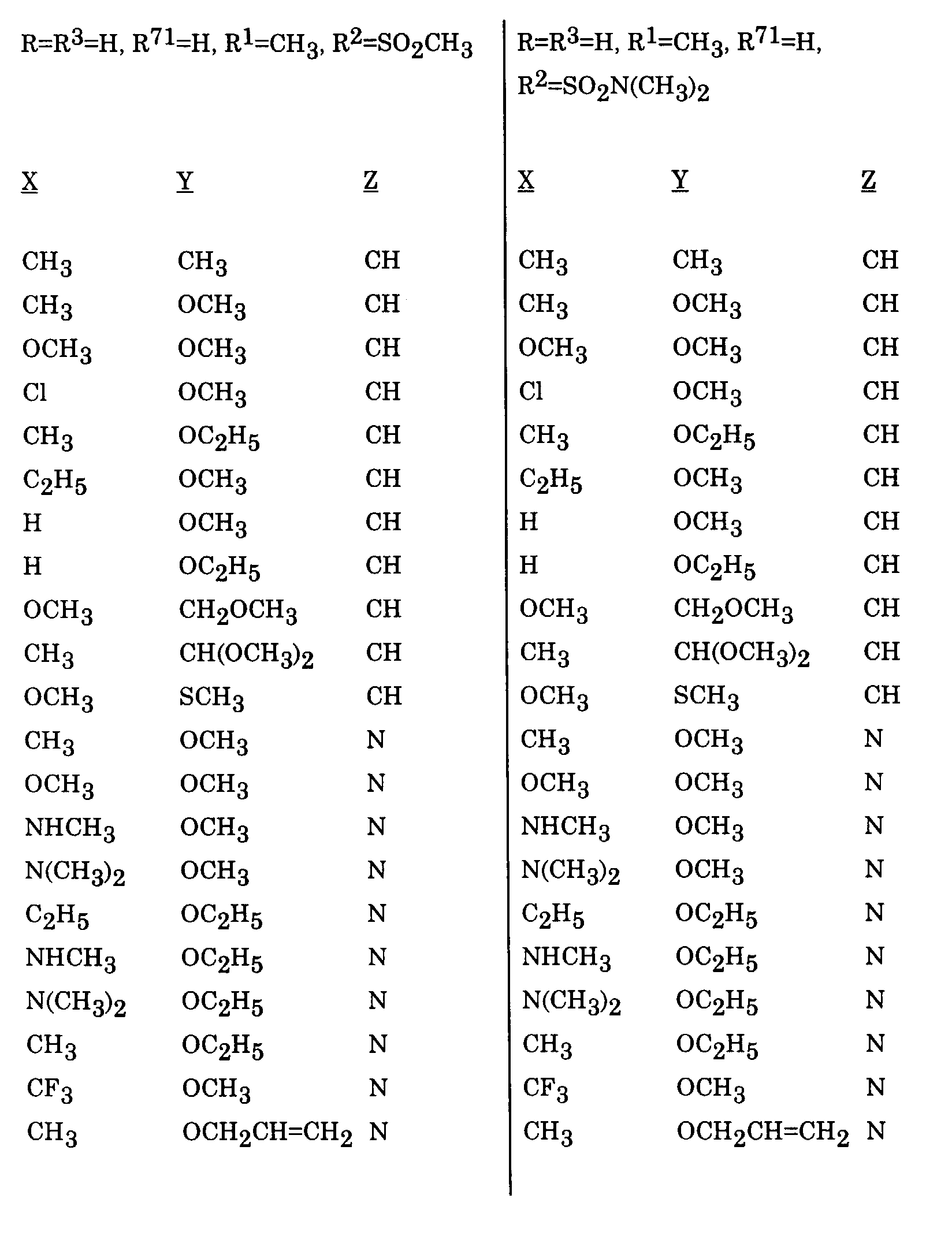


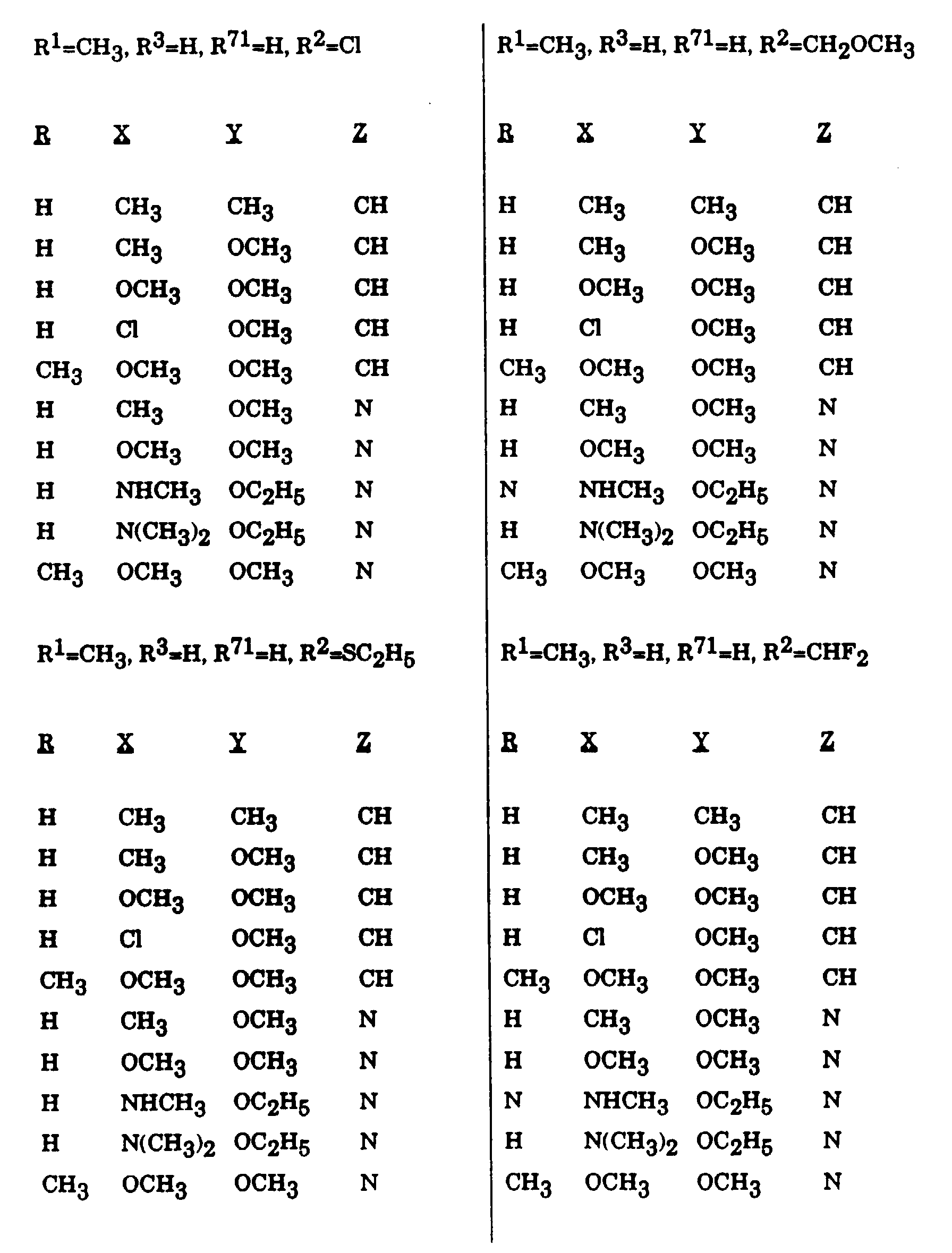


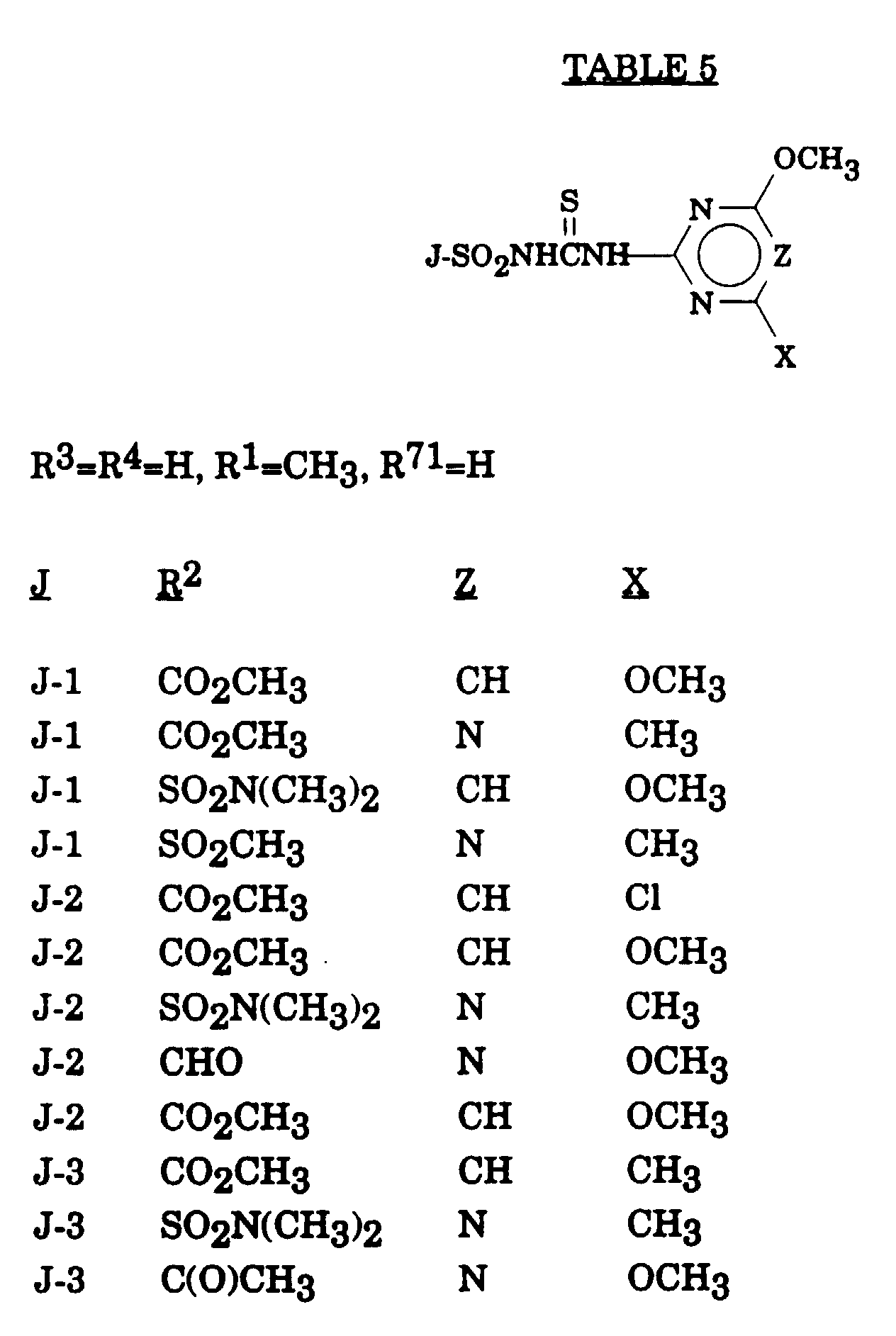
- The procedures of Examples 1 through 18 and Equations 1 through 21 were followed in the synthesis of the following compounds.


- Useful formulations of the compounds of Formula I can be prepared in conventional ways. They include dusts, granules, pellets, solutions, suspensions, emulsions, wettable powders, emulsifiable concentrates and the like. Many of these may be applied directly. Sprayable formulations can be extended in suitable media and used at spray volumes of from a few liters to several hundred liters per hectare. High strength compositions are primarily used as intermediates for further formulation. The formulations, broadly, contain about 0.1% to 99% by weight of active ingredient(s) and at least one of (a) about 0.1% to 20% surfactant(s) and (b) about 1% to 99.9% solid or liquid inert diluent(s). More specifically, they will contain these ingredients in the following approximate proportions:
Weight Percent* Active Ingredient Diluent(s) Surfactant(s) Wettable Powders 20-90 0-74 1-10 Oil Suspensions, Emulsions, Solutions, (including Emulsifiable Concentrates) 3-50 40-95 0-15 Aqueous Suspension 10-50 40-84 1-20 Dusts 1-25 70-99 0-5 Granules and Pellets 0.1-95 5-99.9 1-15 High Strength Compositions 90-99 0-10 0-2 * Active ingredient plus at least one of a Surfactant or a Diluent equals 100 weight percent. - Lower or higher levels of active ingredient can, of course, be present depending on the intended use and the physical properties of the compound. Higher ratios of surfactant to active ingredient are sometimes desirable, and are achieved by incorporation into the formulation or by tank mixing.
- Typical solid diluents are described in Watkins, et al., "Handbook of Insecticide Dust Diluents and Carriers", 2nd Ed., Dorland Books, Caldwell, New Jersey, but other solids, either mined or manufac- tured, may be used. The more absorptive diluents are preferred for wettable powders and the denser ones for dusts. Typical liquid diluents and solvents are described in Marsden, "Solvents Guide," 2nd Ed., Interscience, New York, 1950. Solubility under 0.1% is preferred for suspension concentrates; solution concentrates are preferably stable against phase separation at 0°C. "McCutcheon's Detergents and Emulsifiers Annual", MC Publishing Corp., Ridgewood, New Jersey, as well as Sisely and Wood, "Encyclopedia of Surface Active Agents", Chemical Publishing Co., Inc., New York, 1964, list surfactants and recommended uses. All formulations can contain minor amounts of additives to reduce foaming, caking, corrosion, microbiological growth, etc.
- The methods of making such compositions are well known. Solutions are prepared by simply mixing the ingredients. Fine solid compositions are made by blending and, usually, grinding as in a hammer or fluid energy mill. Suspensions are prepared by wet milling (see, for example, Littler, U.S. Patent 3,060,084). Granules and pellets may be made by spraying the active material upon preformed granular carriers or by agglomeration techniques. See J. E. Browning, "Agglomeration", Chemical Engineering, December 4, 1967, pp. 147ff. and "Perry's Chemical Engineer's Handbook", 5th Ed., McGraw-Hill, New York, 1963, pp. 8-57ff.
- For further information regarding the art of formulation, see for example:
- H. M. Loux, U.S. Patent 3,235,361, February 15, 1966, Col. 6, line 16 through Col. 7, line 19 and Examples 10through 41;
- R. W. Luckenbaugh, U.S. Patent 3,309,192, March14, 1967, Col. 5, line 43 through Col. 7, line 62 and Examples 8, 12, 15, 39, 41, 52, 53, 58, 132, 138-140, 162-164, 166, 167 and 169-182;
- H. Gysin and E. Knusli, U.S. Patent 2,891,855, June 23, 1959, Col. 3, line 66 through Col. 5, line 17 and Examples 1-4;
- G. C. Klingman, "Weed Control as a Science", John Wiley and Sons, Inc., New York, 1961, pp. 81-96; and
- J. D. Fryer and S. A. Evans, "Weed Control Handbook", 5th Ed., Blackwell Scientific Publications, Oxford, 1968, pp. 101-103.
- In the following examples, all parts are by weight unless otherwise indicated.
-
High Strength Concentrate methyl 3-[[[[(4,6-dimethoxy-2-pyrimidinyl)amino]carbonyl]amino]sulfonyl]-1-methyl-1H-pyrrole-2-carboxylate 99% trimethylnonyl polyethylene glycol ether 1% - The surfactant is sprayed upon the active ingredient in a blender and the mixture sifted through a U. S. S. no. 40 sieve (0.42 mm openings) prior to packaging. The concentrate may be formulated further for practical use.
-
Wettable Powder methyl 3[[[[[4-ethoxy-6-(methylamino)-1,3,5-triazin-2-yl]amino]carbonyl]amino]sulfonyl]-1-methyl-1H-pyrrole-2-carboxylate 65% dodecylphenol polyethylene glycol ether 2% sodium ligninsulfonate 4% sodium silicoaluminate 6% montmorillonite (calcined) 23% - The ingredients are thoroughly blended. The liquid surfactant is added by spraying upon the solid ingredients in the blender. After grinding in a hammer mill to produce particles essentially all below 100 microns, the material is reblended and sifted through a U.S.S. No. 50 sieve (0.3 mm opening) and packaged.
-
Aqueous Suspension methyl 3-[[[[(4,6-dimethoxy-2-pyrimidinyl)amino]carbonyl]amino]sulfonyl]-1-methyl-1H-pyrrole-2-carboxylate 50.0% polyacrylic acid thickener 0.3% dodecylphenol polyethylene 0.5% glycol ether disodium phosphate 1% monosodium phosphate 0.5% polyvinyl alcohol 1.0% water 56.7% - The ingredients are blended and ground together in a sand mill to produce particles essentially all under 5 microns in size.
-
Oil Suspension methyl 3[[[[[4-ethoxy-6-(methylamino)-1,3,5-triazin-2-yl]amino]carbonyl]amino]sulfonyl]-1-methyl-1H-pyrrole-2-carboxylate 35% blend of polyalcohol carboxylic esters and oil soluble petroleum sulfonates 6% xylene 59% - The ingredients are combined and ground together in a sand mill to produce particles essentially all below 3 microns. The product can be used directly, extended with oils, or emulsified in water.
-
Oil Suspension methyl3-[[[[(4,6-dimethoxy-2-pyrimidinyl)amino]-carbonyl]amino]sulfonyl]-1-methyl-1H-pyrrole-2-carboxylate 25% polyoxyethylene sorbitol hexaoleate 5% highly aliphatic hydrocarbon oil 70% - The ingredients are ground together in a sand mill until the solid particles have been reduced to under about 5 microns. The resulting thick suspension may be applied directly, but preferably after being extended with oils or emulsified in water.
-
Aqueous Suspension methyl 3[[[[[4-ethoxy-6-(methylamino)-1,3,5-triazin-2-yl]amino]carbonyl]amino]sulfonyl]-1-methyl-1H-pyrrole-2-carboxylate 25% hydrated attapulgite 3% crude calcium ligninsulfonate 10% sodium dihydrogen phosphate 0.5% water 61.5% - The ingredients are ground together in a ball or roller mill until the solid particles have been reduced to diameters under 10 microns.
-
Wettable Powder methyl 3-[[[[(4,6-dimethoxy-2-pyrimidinyl)amino]-carbonyl]amino]sulfonyl]-1-methyl-1H-pyrrole-2-carboxylate 40.0% dioctyl sodium sulfosuccinate 1.5% sodium ligninsulfonate 3% low viscosity methyl cellulose 1.5% attapulgite 54% - The ingredients are thoroughly blended, passed through an air mill, to produce an average particle size under 15 microns, reblended, and sifted through a U.S.S. No. 50 sieve (0.3 mm opening) before packaging.
- All compounds of the invention may be formulated in the same manner.
-
Granule wettable powder of Example G 15% gypsum 69% potassium sulfate 16% - The ingredients are blended in a rotating mixer and water sprayed on to accomplish granulation. When most of the material has reached the desired range of 1.0 to 0.42 cm (U.S.S.#18 to 40 sieves), the granules are removed, dried, and screened. Oversized material is crushed to produce additional material in the desired range. These granules contain % active ingredient.
-
Wettable Powder methyl 3[[[[[4-ethoxy-6-(methylamino)-1,3,5-triazin-2-yl]amino]carbonyl]amino]sulfonyl]-1-methyl-1H-pyrrole-2-carboxylate 50% sodium alkylnaphthalenesulfonate 2% low viscosity methyl cellulose 2% diatomaceous earth 46% - The ingredients are blended, coarsely hammer-milled and the air milled to produce particles of active essentially all below 10 microns in diameter. The product is reblended before packaging.
-
Extruded Pellet methyl 3-[[[(4,6-dimethoxy-2-pyrimidinyl)amino]-carbonyl]amino]sulfonyl]-1-methyl-1H-pyrrole-2-carboxylate 25% anhydrous sodium sulfate 10% crude calcium ligninsulfonate 5% sodium alkylnaphthalenesulfonate 1% calcium/magnesium bentonite 59% - The ingredients are blended, hammer-milled and then moistened with about 12% water. The mixture is extruded as cylinders about 3 mm diameter which are cut to produce pellets about 3 mm long. These may be used directly after drying, or the dried pellets may be crushed to pass a U.S.S. No. 20 sieve (0.84 mm openings). The granules held on a U.S.S. No. 40 sieve (0.42 mm openings) may be packaged for use and the fines recycled.
-
Wettable Powder methyl 3[[[[[4-ethoxy-6-(methylamino)-1,3,5-triazin-2-yl]amino]carbonyl]amino]sulfonyl]-1-methyl-1H-pyrrole-2-carboxylate 80% sodium alkylnaphthalenesulfonate 2% sodium ligninsulfonate 2% synthetic amorphous silica 3% kaolinite 13% - The ingredients are blended and then ground in ahammermill to produce particles with an average particle size less than 25 microns in diameter. The material is reblended and sifted through a U.S.S. No. 50 sieve (0.3 mm opening) before being packaged.
-
High Strength Concentrate methyl 3-[[[[(4,6-dimethoxy-2-pyrimidinyl)amino]-carbonyl]amino]sulfonyl]-1-methyl-1H-pyrrole-2-carboxylate 98.5% silica aerogel 0.5% synthetic amorphous fine silica 1.0% - The ingredients are blended and ground in a hammer mill to produce a high strength concentrate essentially all passing a U.S.S. No. 50 sieve (0.3 mm openings). This material may then be formulated in a variety of ways.
-
Solution methyl 3[[[[[4-ethoxy-6-(methylamino)-1,3,5-triazin-2-yl]amino]carbonyl]amino]sulfonyl]-1-methyl-1H-pyrrole-2-carboxylate sodium salt 5% water 95% - The salt is added directly to the water with stirring to produce the solution, which may then be packaged for use.
-
Solution methyl 3-[[[[(4,6-dimethoxy-2-pyrimidinyl)amino]carbonyl]amino]sulfonyl]-1-methyl-1H-pyrrole-2-carboxylate sodium salt 5% water 95% - The salt is added directly to the water with stirring to produce the solution, which may then be packaged for use.
- Test results indicate compounds of this invention are active postemergence and preemergence herbicides. Compounds in this invention are useful for the control of selected grass and broadleaf weeds with tolerance to important agronomic crops which include, but are not limited to barley (Hordeum vulgare), cotton (Gossypium hirsutum), rape (Brassica napus), rice (Oryza sativa), and wheat (Triticum aestivum). Grass and broadleaf weed species controlled include, but are not limited to, bedstraw (Galium spp.), brome (Bromus spp.), lambsquarters (Chenopodium spp.), and umbrella sedge (Cyperus spp.). A few compounds in this invention are useful for the control of selected broadleaf weeds such as umbrella sedge in upland and paddy rice.
- These compounds also have utility for control of vegetation in specified areas such as around storage tanks, parking lots, highways, and railways; in fallow crop areas; and in citrus and plantation crops such as banana, coffee, oil palm, and rubber. Alternatively, these compounds are useful to modify plant growth or as citrus abscission agents.
- A herbicidally effective amount of the compounds of this invention is determined by a number of factors. These factors include: formulation selected, method of application, amount and type of vegetation present, growing conditions, etc. In general, a herbicidally effective amount of the subject compounds is applied at rates from 0.001 to 20 kg/ha with a preferred rate range of 0.004 to 0.25 kg/ha. One skilled in the art can easily determine application rates necessary for the desired level of weed control.
- Compounds of this invention may be used alone or in combination with other commercial herbicides, insecticides, or fungicides. The following list exemplifies some of the herbicides suitable for use in mixtures. A combination of a compound from this invention with one or more of the following herbicides may be particularly useful for weed control.
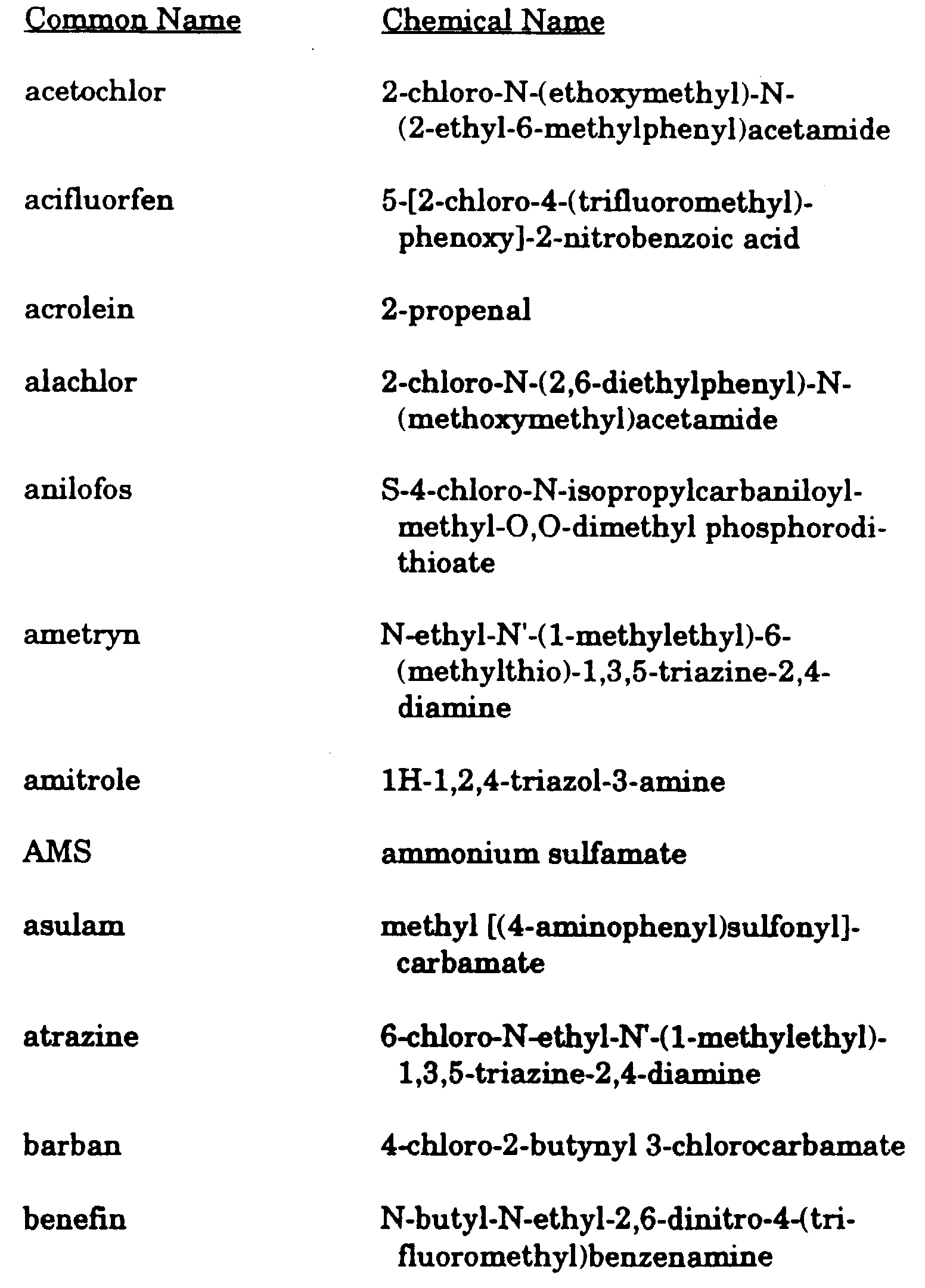

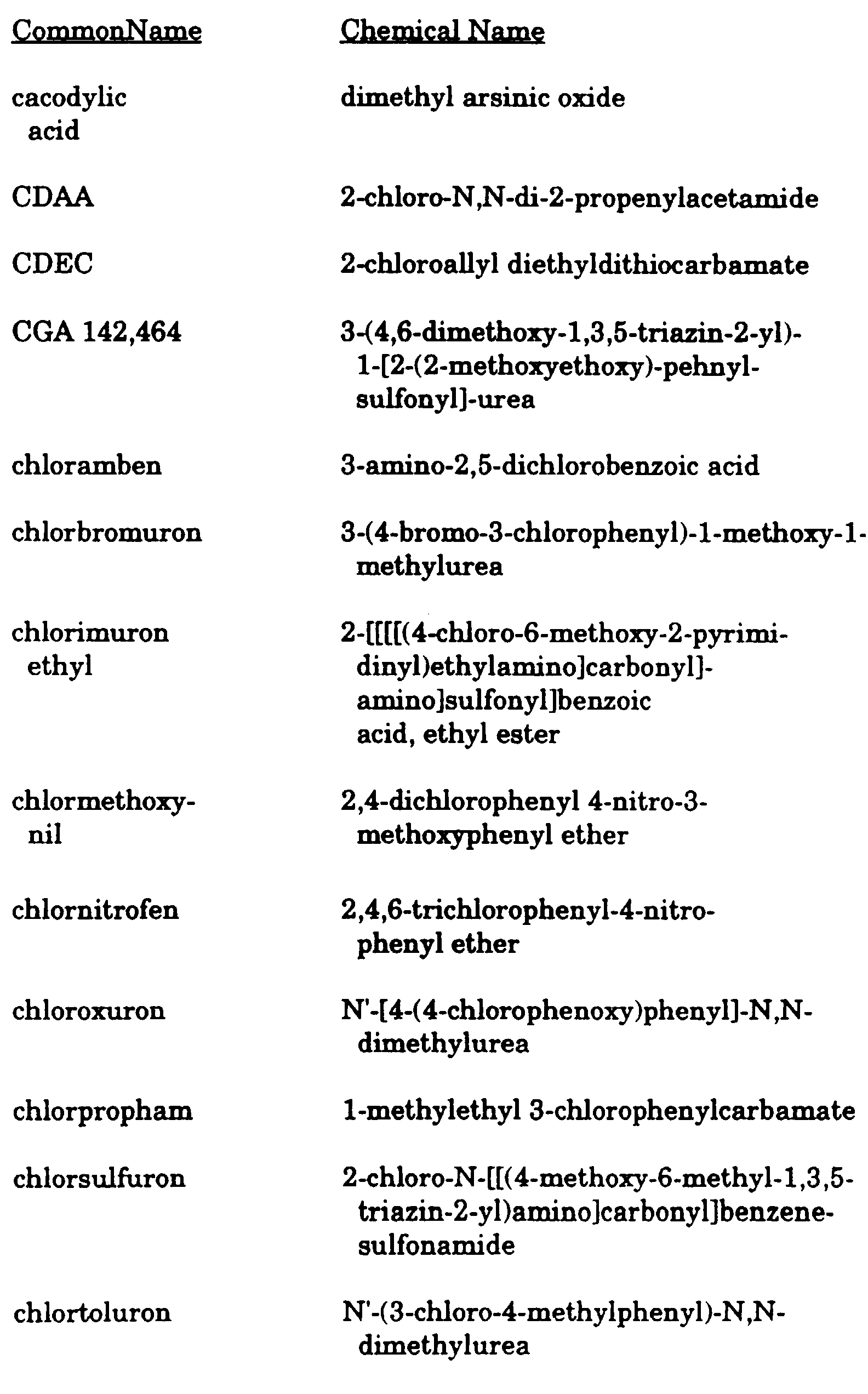


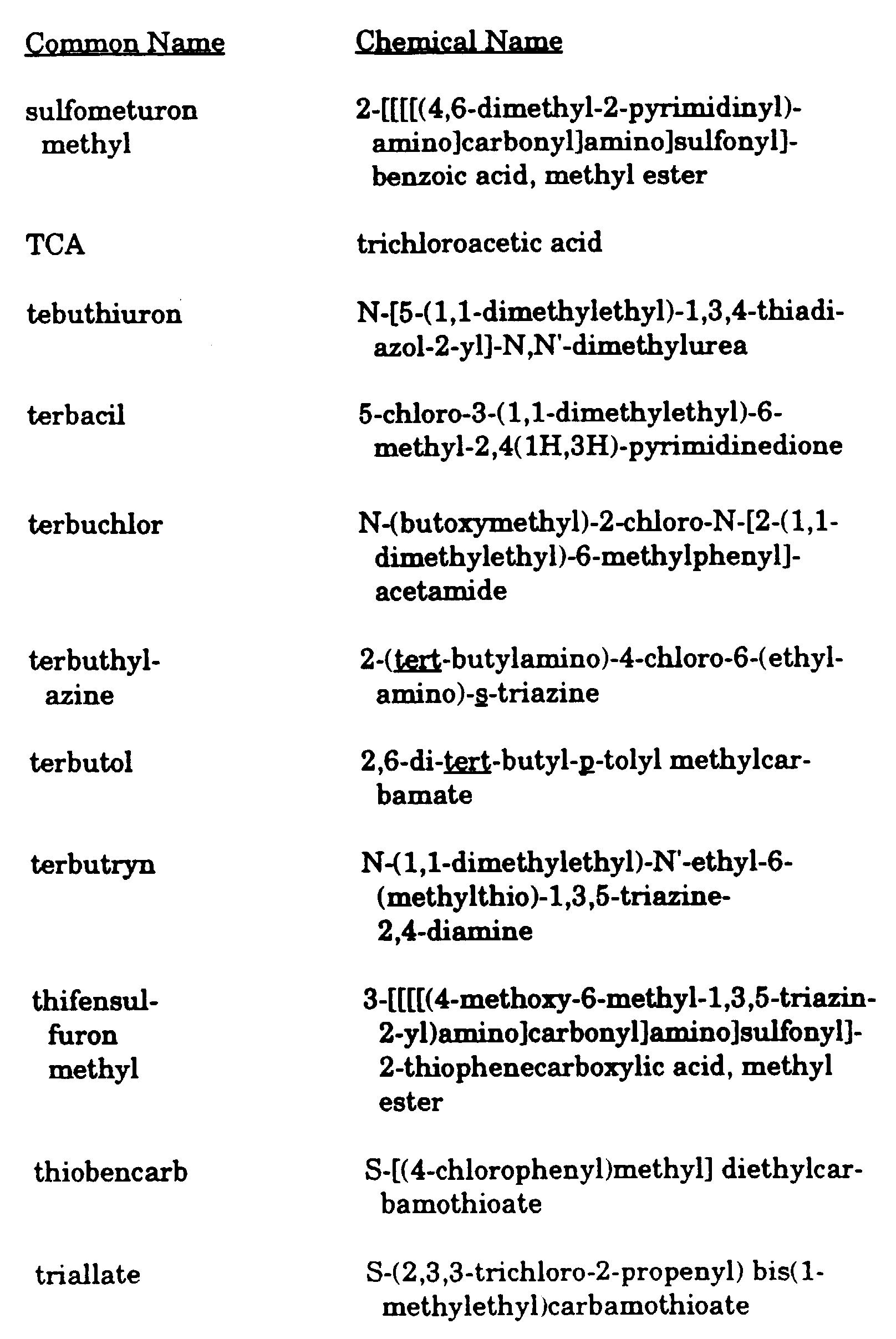

- Herbicidal properties of the subject compounds were discovered in a number of greenhouse tests. Test procedures and results follow.
- Seeds of barley (Hordeum vulgare), barnyardgrass (Echinochloa crus-galli), blackgrass (Alopecurus myosuroides), cheatgrass (Bromus secalinus), chickweed (Stellaria media), cocklebur (Xanthium pensylvanicum), corn (Zea mays), cotton (Gossypium hirsutum), crabgrass (Digitaria spp.), bedstraw (Galium aparine). giant foxtail (Setaria faberii), lambsquarters (Chenopodium album), morningglory (Ipomoea hederacea), rape (Brassica napus), rice (Oryza sativa), sorghum (Sorghum bicolor), soybean (Glycine max), sugar beet (Beta vulgaris), velvetleaf (Abutilon theophrasti), wheat (Triticum aestivum), wild buckwheat (Polygonum convolvulus), and wild oat (Ayena fatua) and purple nutsedge (Cyperus rotundus) tubers were planted and treated preemergence with test chemicals dissolved in a non-phytotoxic solvent. At the same time, these crop and weed species were also treated with postemergence applications of test chemicals. Plants ranged in height from two to eighteen cm (one to four leaf stage) for postemergence treatments. Treated plants and controls were maintained in a greenhouse for twelve to sixteen days, after which all species were compared to controls and visually evaluated. Plant response ratings, summarized in Table A, are based on a scale of 0 to 10 where 0 is no effect and 10 is complete control. A dash (-) response means no test result.


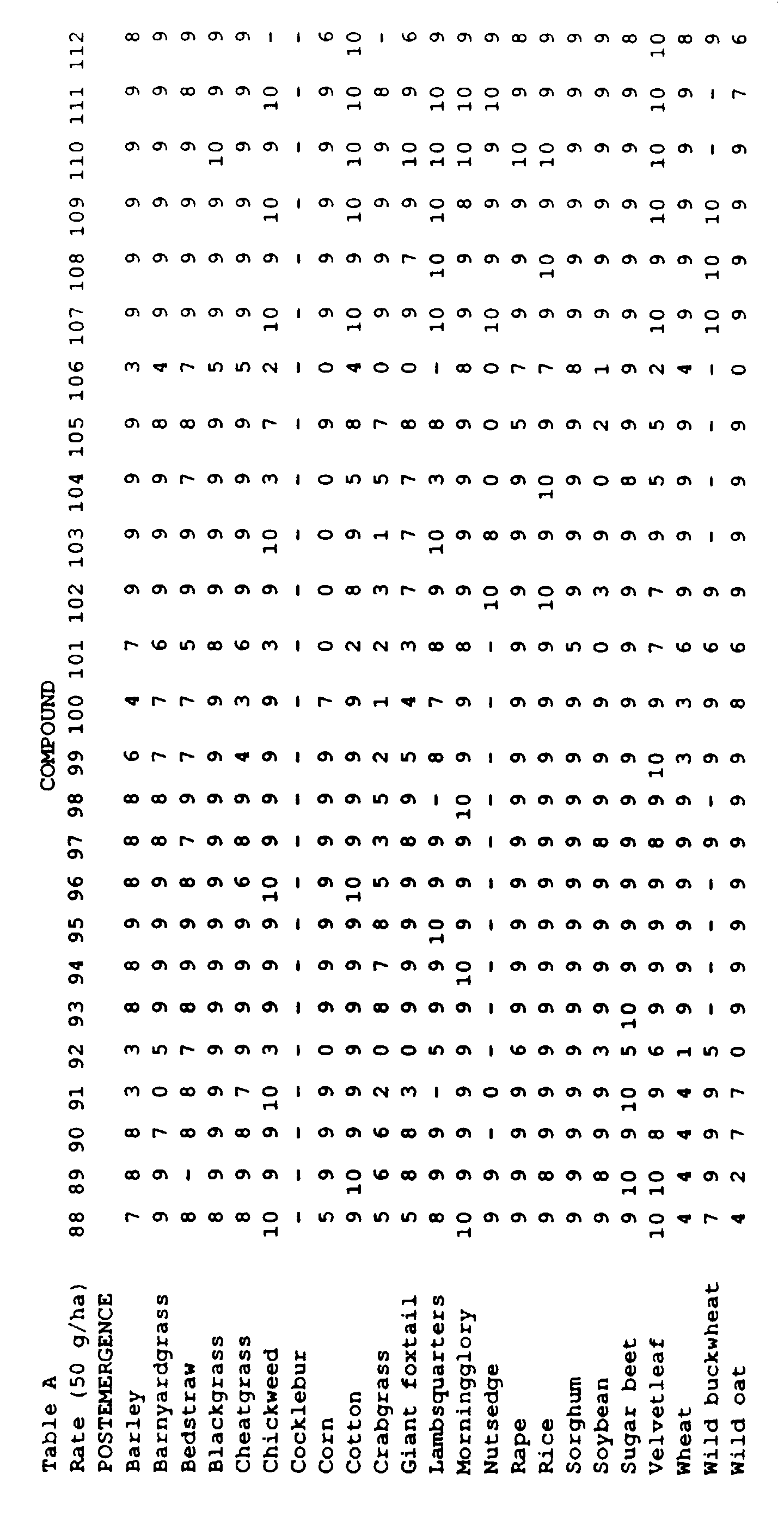


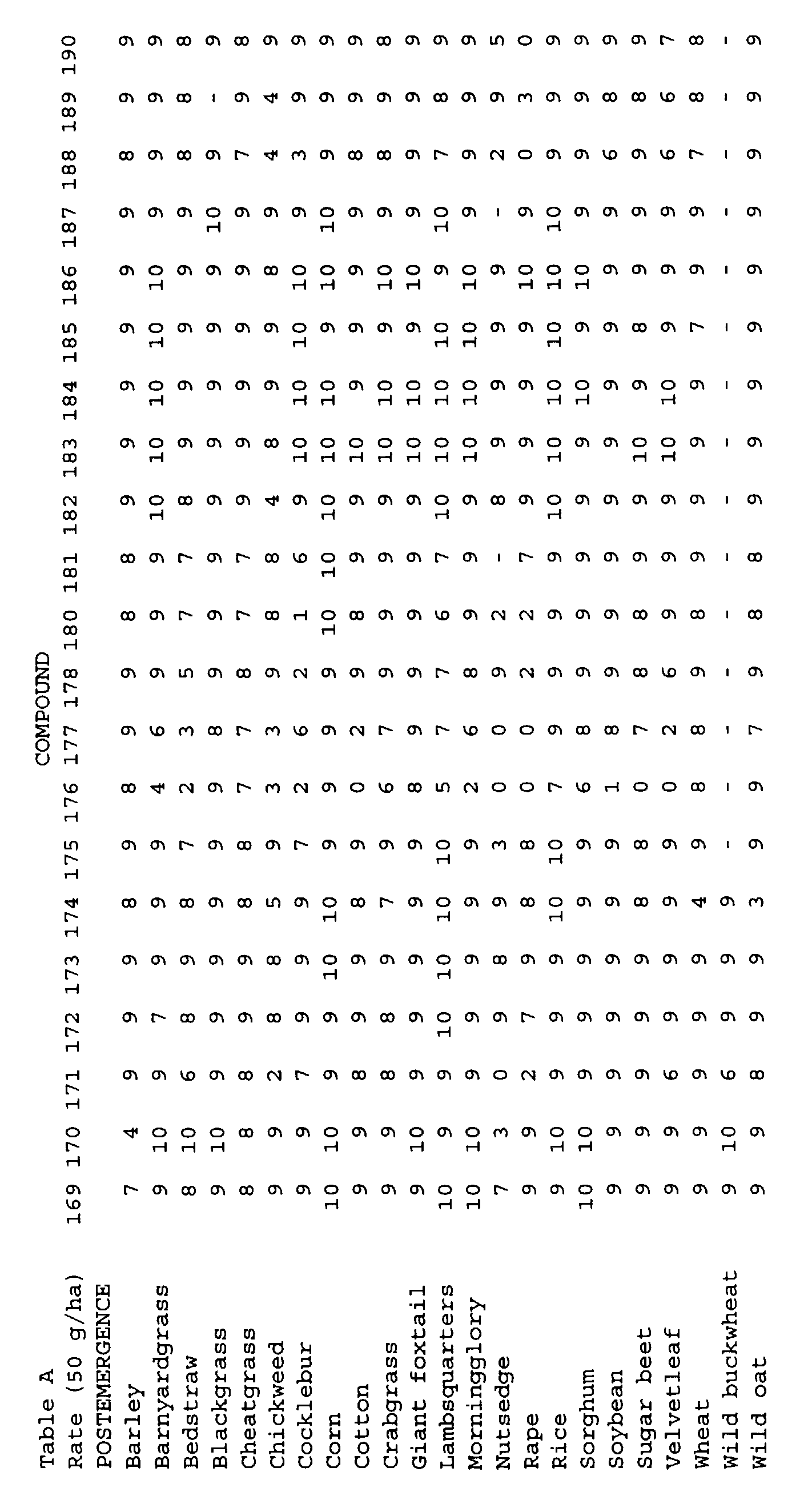
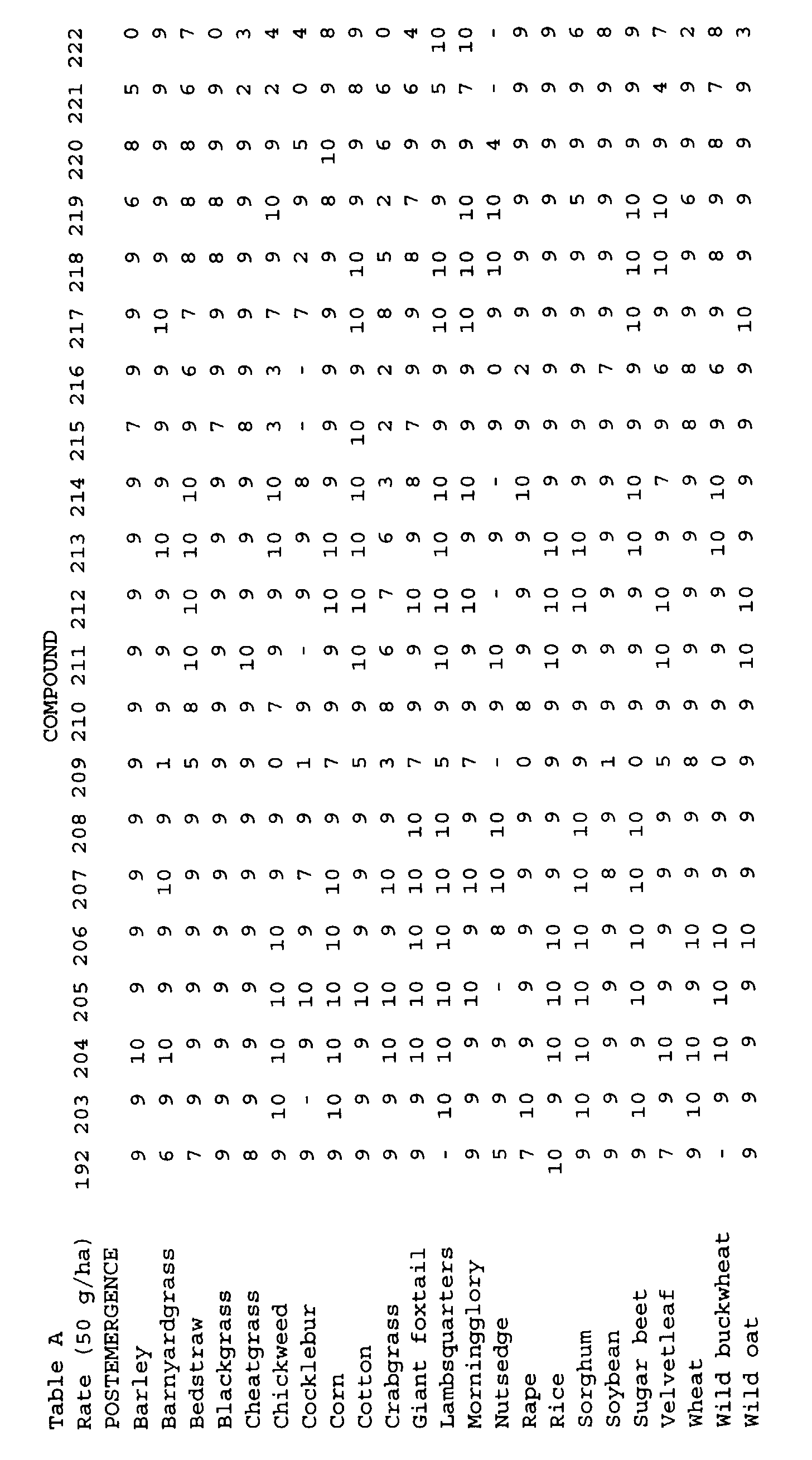

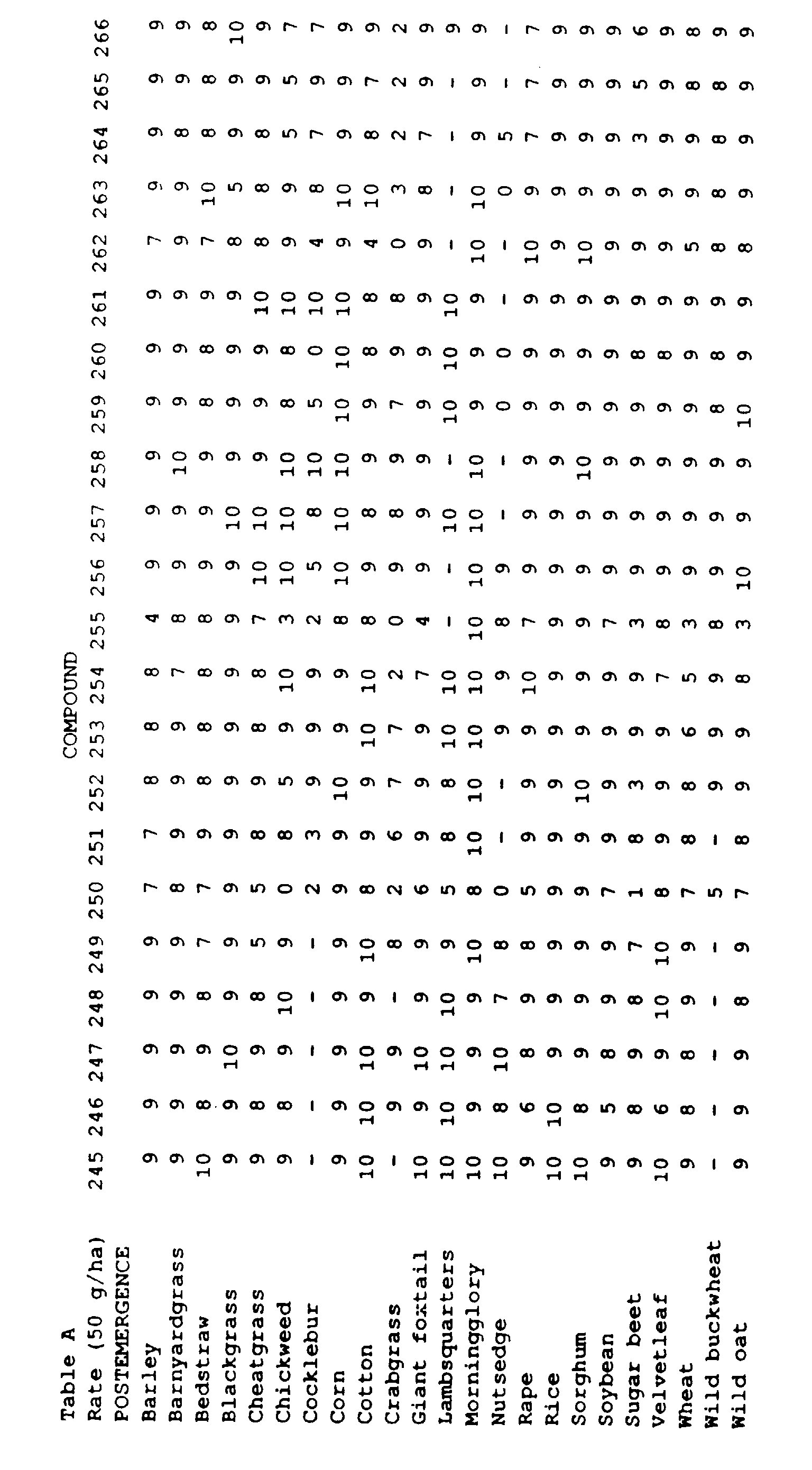


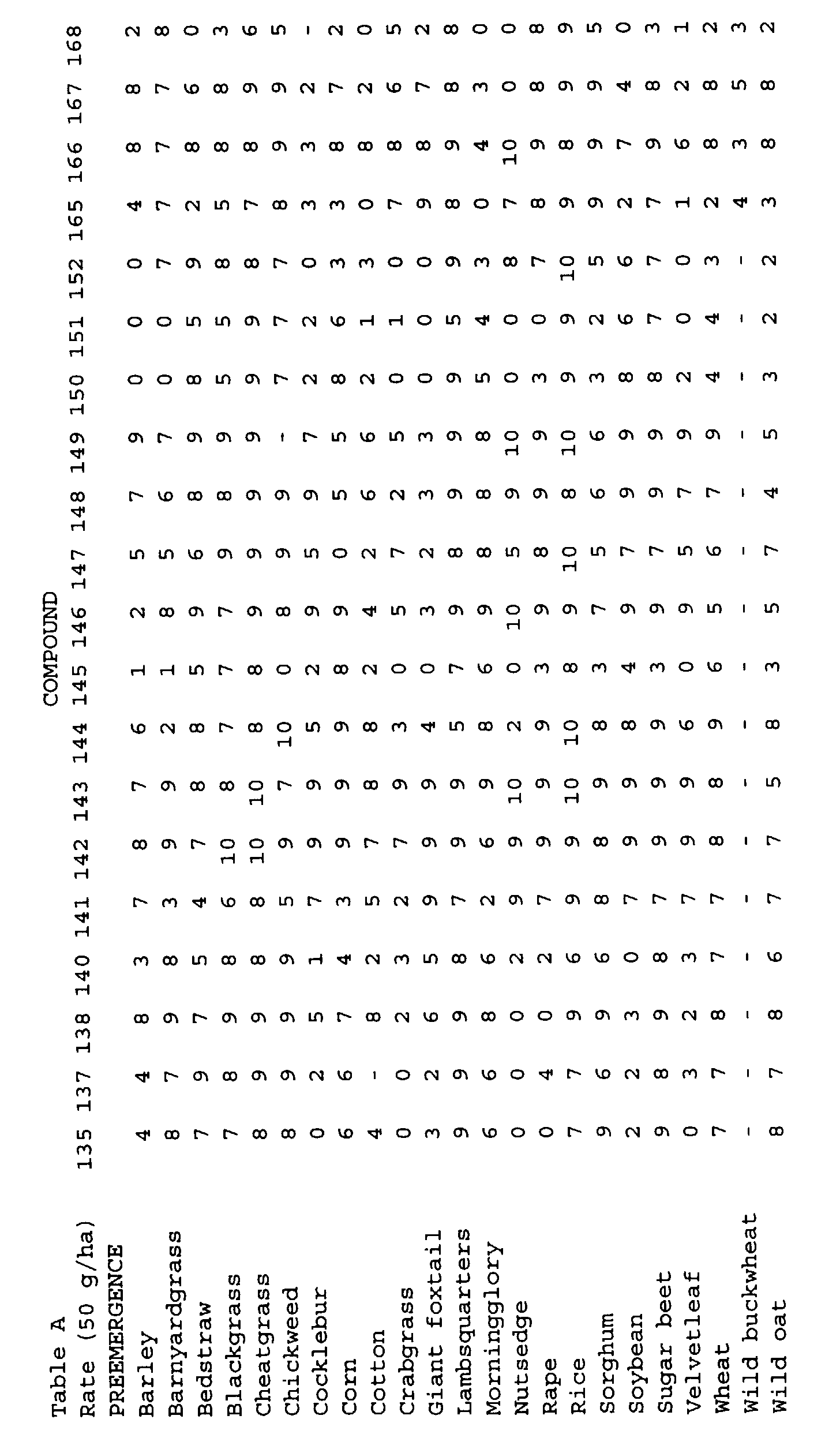


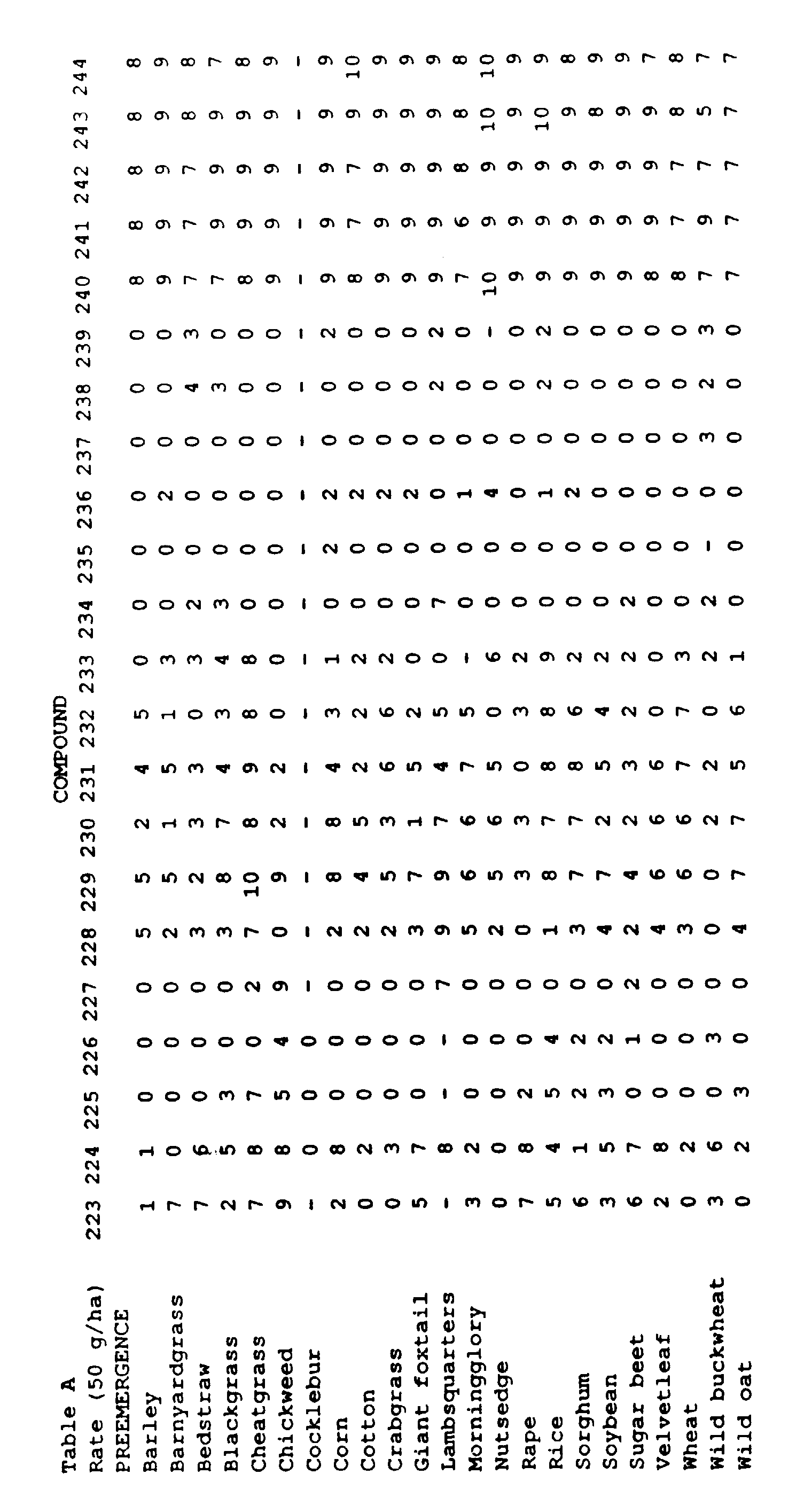


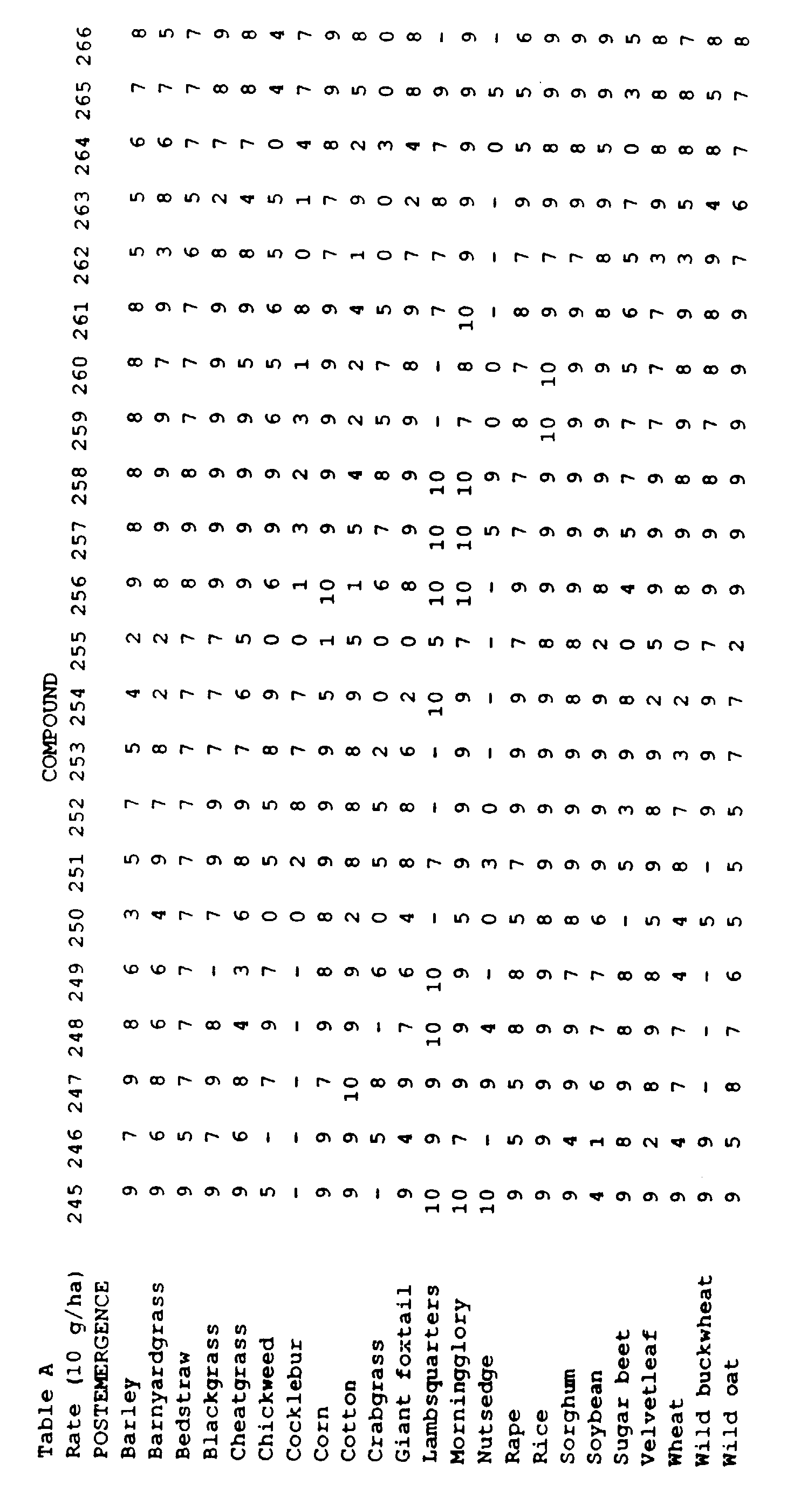


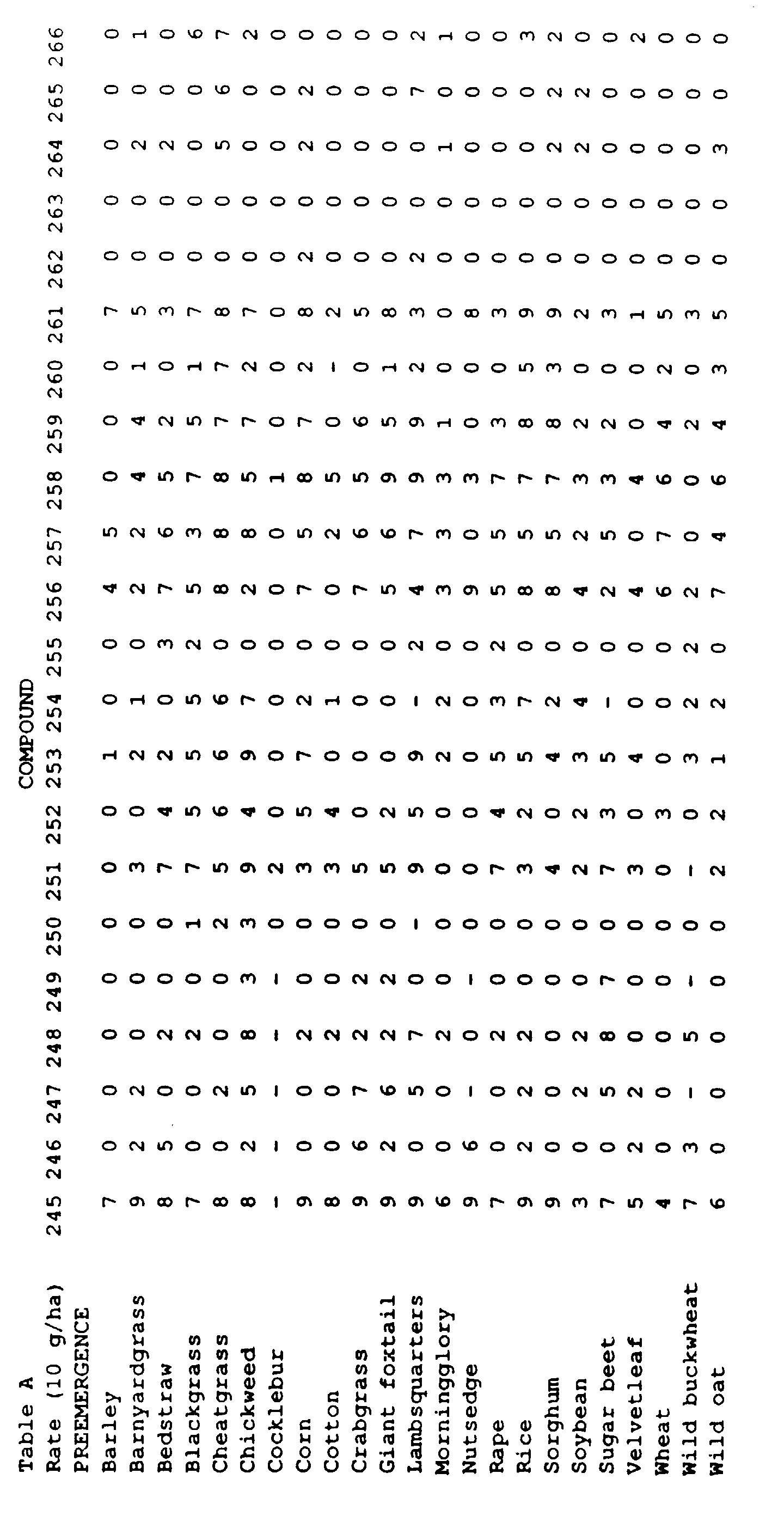


- The compounds evaluated in this test were formulated in a non-phytoxic solvent and applied to the soil surface before plant seedlings emerged (preemergence application), to water that covered the soil surface (paddy application), and to plants that were in the one-to-four leaf stage (postemergence application). A sandy loam soil was used for the preemergence and postemergence tests, while a silt loam soil was used in the paddy test. Water depth was approximately 2.5 cm for the paddy test and was maintained at this level for the duration of the test.
- Plant species in the preemergence and postemergence tests consisted of barley (Hordeum vulgare), bedstraw (Galium aparine), blackgrass (Alopecurus myosuroides), chickweed (Stellaria media), corn (Zea mays), cotton (Gossypium hirsutum), crabgrass (Digitaria sanguinalis), downy brome (Bromus tectorum), duck salad (Heteranthera limosa), giant foxtail (Setaria faberii), lambsquarters (Chenopodium album), morningglory (Ipomoea hederacea), pigweed (Amaranthus retroflexus), rape (Brassica napus), ryegrass (Lolium multiflorum), sorghum (Sorghum bicolor), soybean (Glycine max), speedwell (Veronica persica), sugar beet (Beta vulgaris), velvetleaf (Abutilon theophrasti), wheat (Triticum aestivum), wild buckwheat (Polygonum convolvulus), and wild oat (Avena fatua). All plant species were planted one day before application of the compound for the preemergence portion of this test. Plantings of these species were adjusted to produce plants of appropriate size for the postemergence portion of the test. Plant species in the paddy test consisted of barnyardgrass (Echinochloa crus-galli), rice (Oryza sativa), and umbrella sedge (Cyperus difformis).
- All plant species were grown using normal greenhouse practices. Visual evaluations of injury expressed on treated plants, when compared to untreated controls, were recorded approximately fourteen to twenty-one days after application of test compounds. Plant response ratings, summarized in Table B, are recorded on a o to 10 scale where 0 is no injury and 10 is complete control. A dash (-) response means no test result.


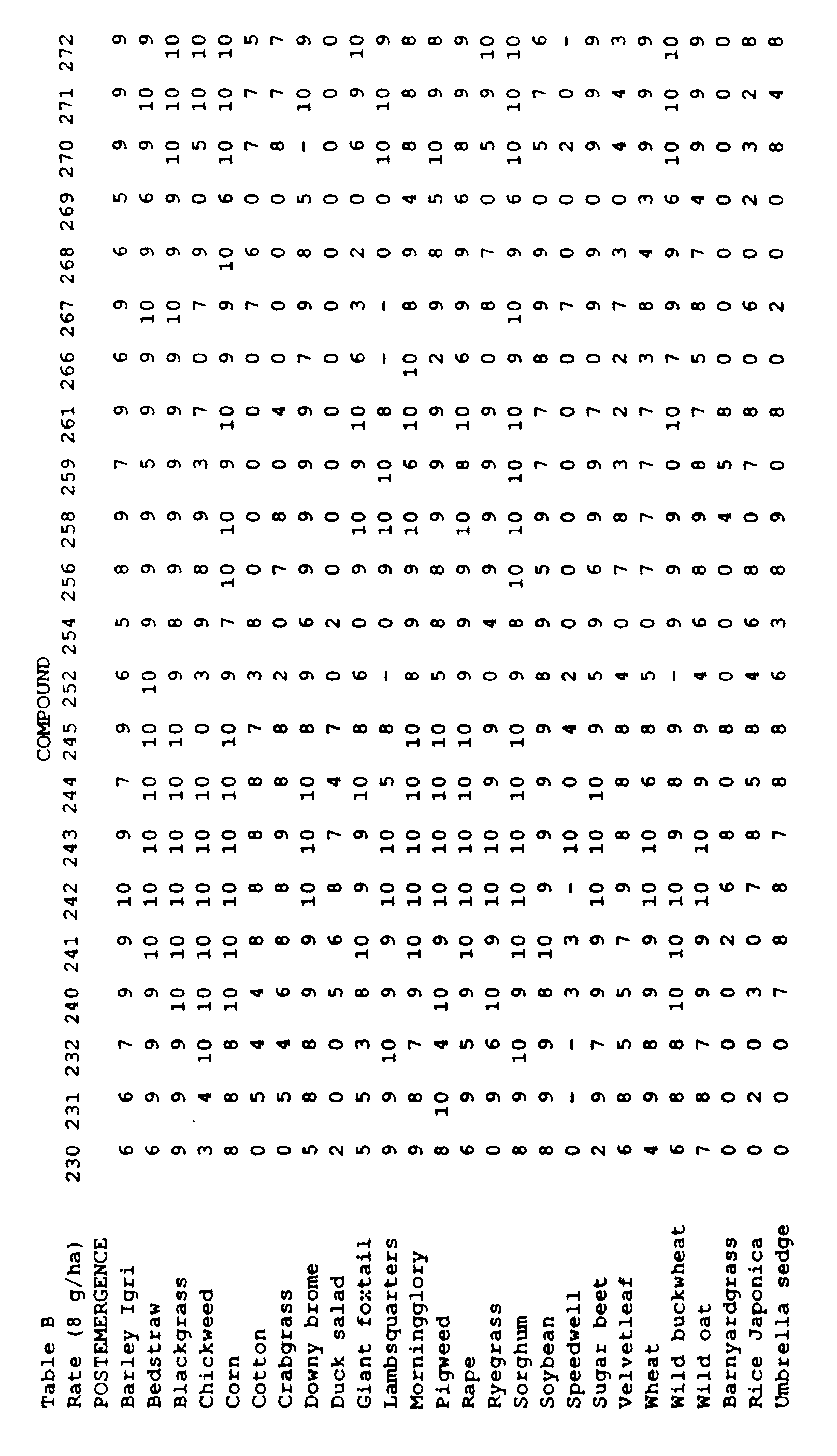


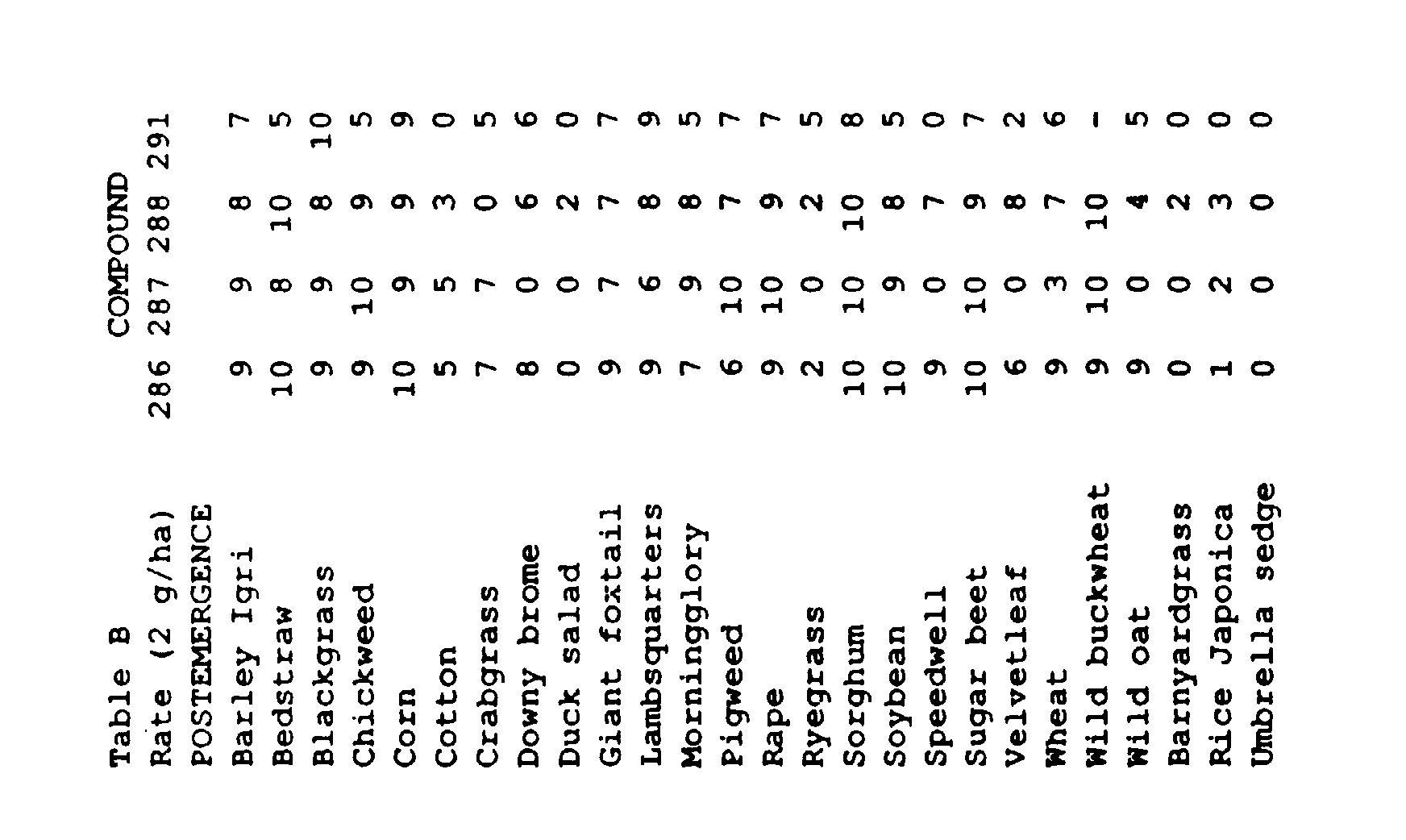


- Plastic pots were partially filled with silt loam soil. The soil was then saturated with water. Japonica rice (Oryza sativa) seedlings at the 2.0 and 2.5 leaf stage, seeds selected from barnyardgrass (Echinochloa crus-galli), duck salad (Heteranthera limosa), umbrella sedge (Cyperus difformis), and tubers selected from arrowhead (Safittaria spp.), waterchestnut (Eleocharis spp.), were planted into this soil. After planting, water levels were raised to 3 cm above the soil surface and maintained at this level throughout the test. Chemical treatments were formulated in a non-phytotoxic solvent and applied directly to the paddy water. Treated plants and controls were maintained in a greenhouse for approximately 21 days, after which all species were compared to controls and visually evaluated. Plant response ratings, summarized in Table C, are reported on a 0 to 10 scale where 0 is no effect and 10 is complete control. A dash (-) response means no test result.

- Compounds evaluated in this test were formulated in a non-phytoxic solvent and applied to the soil surface before plant seedlings emerged (preemergence application) and to plants that were in the one-to-four leaf stage (postemergence application). A sandy loam soil was used for the preemergence test while a mixture of sandy loam soil and greenhouse potting mix in a 60:40 ratio was used for the postemergence test. Test compounds were applied within approximately one day after planting seeds for the preemergence test. Plantings of these crops and weed species were adjusted to produce plants of appropriate size for the postemergence test. All plant species were grown using normal greenhouse practices. Crop and weed species include winter barley (Hordeum vulgare cv. 'Igri'), bedstraw (Galium aparine), blackgrass (Alopecurus myosuroides), chickweed (Stellaria media), downy brome (Bromus tectorum), field violet (Viola arvensis), green foxtail (Setaria viridis), kochia (Kochia scoparia), lambsquarters (Chenopodium album), Persian speedwell (Veronica persica), rape (Brassica napus cv. 'Jet Neuf'), ryegrass (Lolium multiflorum), sugar beet (Beta vulgaris cv. 'US1'), sunflower (Helianthus annuus cv. 'Russian Giant'), spring wheat (Triticum aestivum cv. 'ERA'), winter wheat (Triticum aestivum cv. 'Talent'), wild buckwheat (Polygonum convolvulus), wild mustard (Sinapis arvensis), wild oat (Avena fatua), and wild radish (Raphanus raphanistrum). Blackgrass and wild oat were treated postemergence at two growth stages. The first stage (1) was when the plants had two to three leaves. The second stage (2) was when the plants had approximately four leaves or in the initial stages of tillering. Treated plants and untreated controls were maintained in a greenhouse for approximately 21 to 28 days, after which all treated plants were compared to untreated controls and visually evaluated. Plant response ratings, summarized in Table D, are based upon a 0 to 10 scale where 0 is no effect and 10 is complete control. A dash response (-) means no test result.


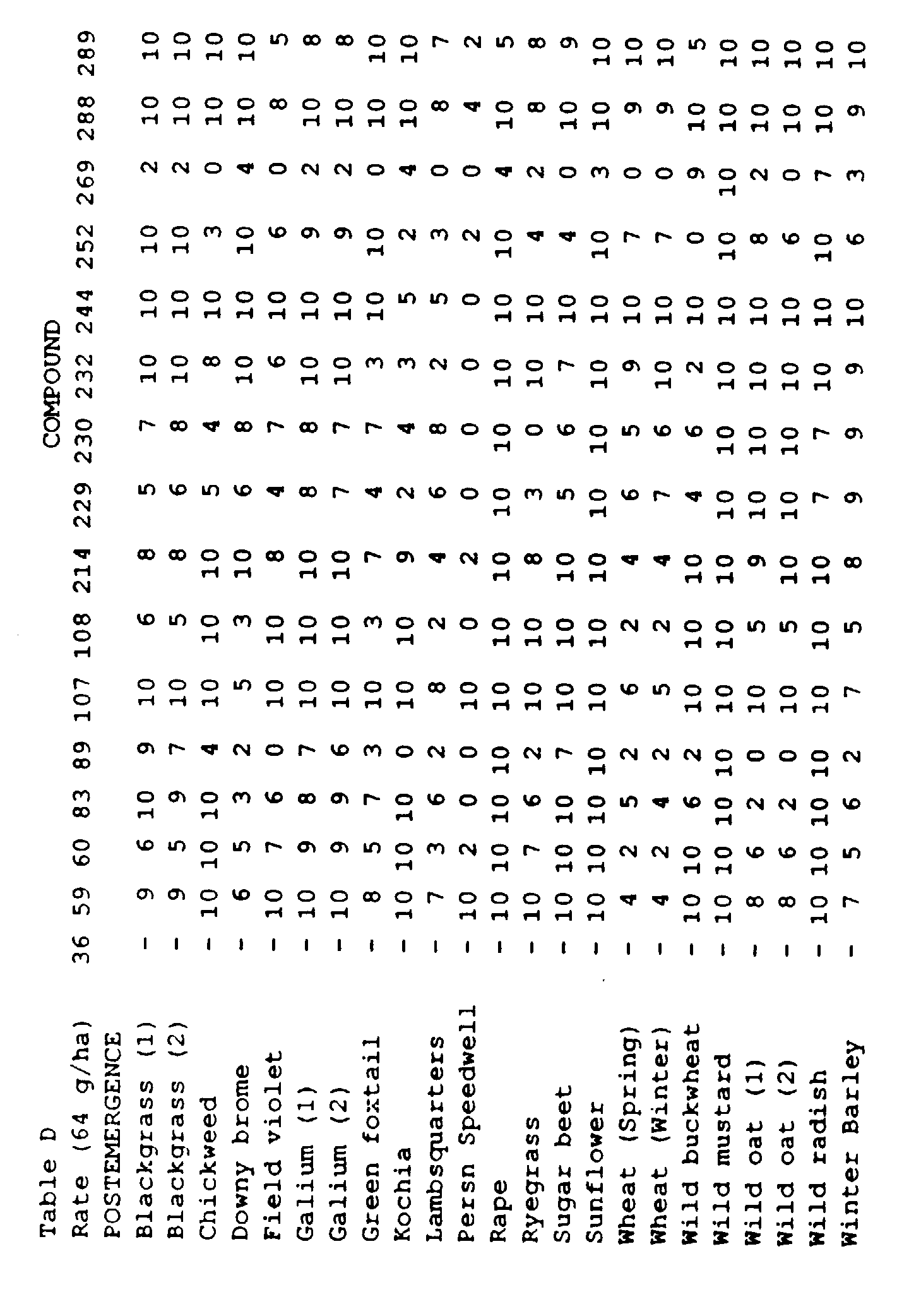

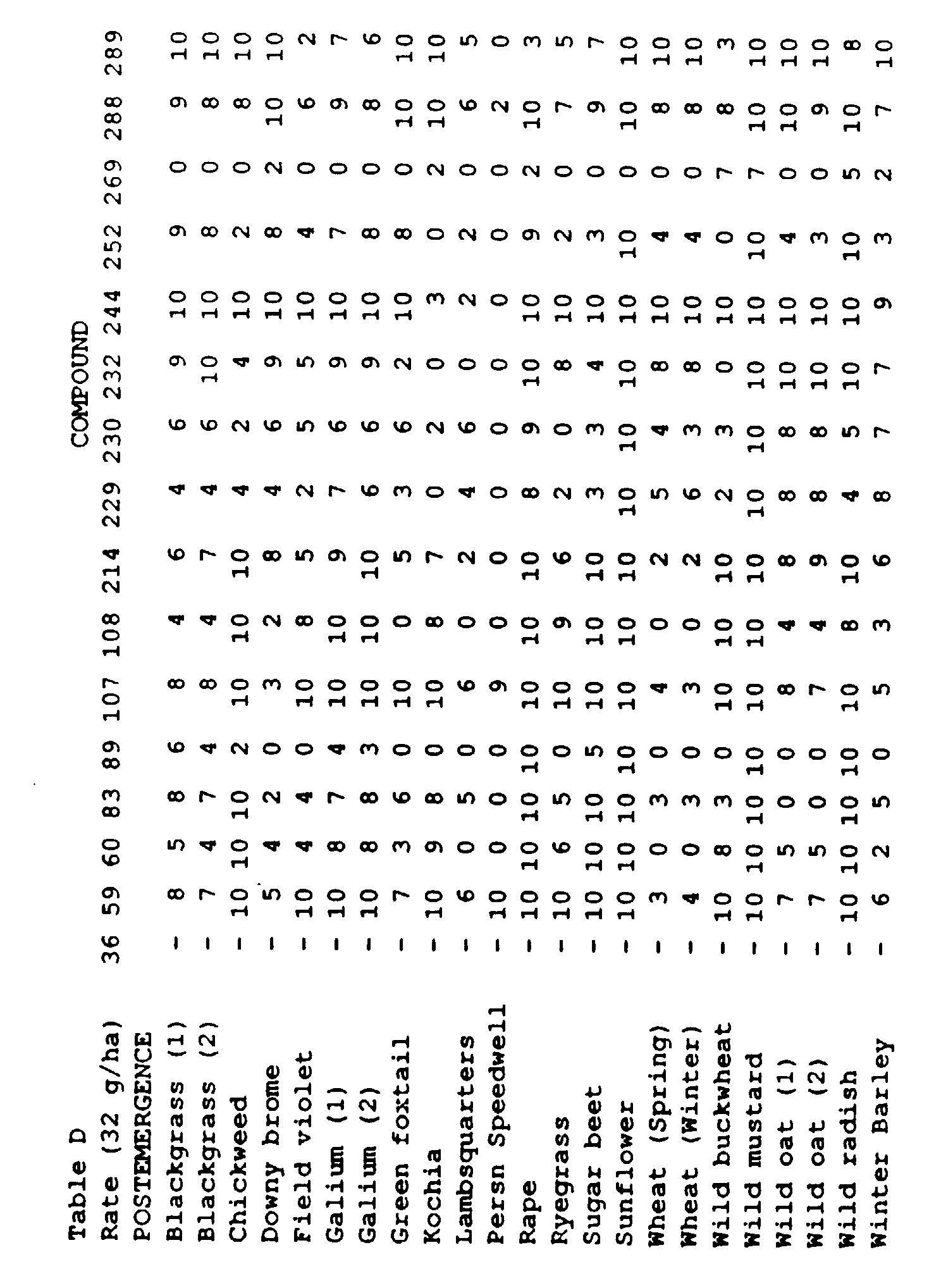


provided that:
Claims (22)
- Compounds of the formula
 J is
J is W is O or S;R is H or CH3;R1 is H; CH3; CH2OCH3; CH2OC2H5; CH2CN; CH2SCH3, CH2SC2H5; C2-C6 alkyl optionally substituted with one C1-C2 alkoxy, C1-C2 alkylthio, CN or one or more halogens; C3-C4 alkenyl; C3-C4 haloalkenyl; C3-C6 cycloalkyl; C(O)R5; N(CH3)2; or Q1;R2 is C1-C4 alkyl optionally substituted with one CN, C2-C3 alkylcarbonyl, methoxycarbonyl, C1-C2 alkoxy, C1-C2 alkylthio, C1-C2 alkylsulfonyl, S(O)2NR6R7, OH or one or more halogens; C2-C4 alkenyl optionally substituted with one C1-C2 alkoxy, C1-C2 alkylthio, CN or one or more halogens; (CH2)mQ2; CN; C(O)R8; C(O)OR9; C(O)NR10R11; C(R12)=NOR13; C(R14)(OR15)(OR16); S(O)nR17; S(O)2NR18R19; NO2; halogen; or OR73;R3 is H, halogen or C1-C4 alkyl;R4 is H, C1-C4 alkyl optionally substituted with one CN, C2-C3 alkylcarbonyl, methoxycarbonyl, C1-C2 alkoxy, C1-C2 alkylthio, C1-C2 alkylsulfonyl, S(O)2NR6R7, OH or one or more halogens; C2-C4 alkenyl optionally substituted with one C1-C2 alkoxy, C1-C2 alkylthio, CN or one or more halogens; CN; C(O)R8; C(O)OR9; C(O)NR10R11; C(R12)=NOR13; S(O)nR17; S(O)2NR18R19; or halogen;R5 is C1-C4 alkyl, C1-C4 alkoxy or NR20R21;R6 is H, C1-C2 alkyl or OCH3;R7 is C1-C2 alkyl; orR6 and R7 can be taken together as -(CH2)3- or- (CH2)4-;R8 is H, C1-C3 alkyl or cyclopropyl;R9 is CH3; C2-C3 alkyl optionally substituted with one C1-C2 alkoxy, OH, CN or one or more halogens; C3-C4 alkenyl; or propargyl;R10 is H, C1-C3 alkyl or OCH3;R11 is C1-C3 alkyl; orR10 and R11 can be taken together as -(CH2)3-, -(CH2)4-, -(CH2)5-or -(CH2)2O(CH2)2-;R12 is H, C1-C3 alkyl, allyl, halogen, CN, N3, C1-C2 alkoxy, C1-C2 alkylthio or SCN;R13 is C1-C3 alkyl or allyl;R14 is H or C1-C3 alkyl;R15 and R16 are independently C1-C2 alkyl;R17 is C1-C4 alkyl, optionally substituted with one C1-C2 alkoxy, C1-C2 alkylthio, CN or one or more halogens; C3-C4 alkenyl; or cyclopropylmethyl;R18 is H, C1-C3 alkyl or OCH3;R19 is H or C1-C2 alkyl; orR18 and R19 can be taken together as -(CH2)3-, -(CH2)4- or -(CH2)5-;R20 and R21 are independently C1-C2 alkyl; orR20 and R21 can be taken together as -(CH2)3-, -(CH2)4-, -(CH2)5- or -(CH2)2O(CH2)2-;R71 is H, halogen or CF3;R73 is C1-C4 alkyl optionally substituted with one or more halogens, CN, C1-C2 alkoxy, or C1-C2 alkylthio; C(O)R74; SO2R75; C3-C4 alkenyl; or propargyl;R74 is C1-C4 alkyl optionally substituted with C1-C2 alkoxy, one or more halogens, or CN; C3-C4 alkenyl; or C1-C3 alkoxy;R75 is C1-C3 alkyl or CF3;m is 0 or 1;n is 0, 1 or 2;Q1 is phenyl, phenyl substituted with one to two groups selected from halogen and CH3, a fully unsaturated 5- or 6-membered heterocyclic ring containing 1 to 4 heteroatoms selected from 0-1 S, 0-1 O and 0-4 N or a fully unsaturated 5- or 6-membered heterocyclic ring substituted with one to two groups selected from C1-C4 alkyl, C3-C4 alkenyl, halogen, C1-C3 alkoxy, C1-C2 haloalkoxy, C1-C3 alkylthio, C3-C4 alkenylthio and C1-C2 haloalkylthio, said Q1 bound through a carbon atom;Q2 is phenyl, a saturated heterocyclic ring containing 1 to 2 heteroatoms selected from 0-2 O and 0-2 S, a partially saturated heterocyclic ring containing 1 to 2 heteroatoms selected from 0-2 O, 0-2 S and 0-2 N, a fully unsaturated 5- or 6-membered heterocyclic ring containing 1 to 4 heteroatoms selected from 0-1 S, 0-1 O and 0-4 N, phenyl substituted with one to two groups selected from halogen and CH3, a saturated heterocyclic ring containing 1 to 2 heteroatoms selected from 0-2 O and 0-2 S substituted with one to two C1-C3 alkyl groups, a partially saturated heterocyclic ring containing 1 to 2 heteroatoms selected from 0-2 O, 0-2 S and 0-2 N substituted with one to two C1-C3 alkyl groups, or an unsaturated 5- or 6-membered heterocyclic ring containing 1 to 4 heteroatoms selected from 0-1 S, 0-1 O and 0-4 N substituted with one to two groups selected from C1-C4 alkyl, C3-C4 alkenyl, halogen, C1-C3 alkoxy, C1-C2 haloalkyl, C1-C3 alkylthio, C3-C4 alkenylthio and C1-C2 haloalkylthio;A is

 X is H, C1-C4 alkyl, C1-C4 alkoxy, C1-C4 haloalkyl, C1-C4 alkylthio, halogen, C2-C5 alkoxyalkyl, C2-C5 alkoxyalkoxy, amino, C1-C3 alkylamino or di(C1-C3 alkyl)amino;Y is H, C1-C4 alkyl, C1-C4 alkoxy, C1-C4 alkylthio, C2-C5 alkoxyalkyl, C2-C5 alkoxyalkoxy, amino, C1-C3 alkylamino, di(C1-C3 alkyl)amino, C3-C4 alkenyloxy, C3-C4 alkynyloxy, C2-C5 alkylthioalkyl, C2-C5 alkylsulfinylalkyl, C2-C5 alkylsulfonylalkyl, C1-C4 haloalkyl, C2-C4 alkynyl, C3-C5 cycloalkyl, azido, cyano,
 p is 2 or 3;Q3 and Q4 are independently O or S;R22 is H or C1-C3 alkyl;R23 and R24 are independently C1-C3 alkyl;Z is CH or N;Z1 is CH or N;Y1 is O or CH2;X1 is CH3, OCH3 or OCF2H;X2 is CH3, CH2CH3 or CH2CF3;Y2 is OCH3, OCH2CH3, SCH3, SCH2CH3, CH3 or CH2CH3;X3 is CH3 or OCH3;Y3 is H or CH3;X4 is CH3, OCH3, OCH2CH3, CH2OCH3 or Cl; andY4 is CH3, OCH3, OCH2CH3 or Cl;and their agriculturally suitable salts;
provided that:(a) when m is zero, Q2 is bound through carbon to the pyrrole ring in J;(b) when X is F, Cl, Br or I, then Z is CH and Y is OCH3, OCH2CH3, N(OCH3)CH3, NHCH3 or N(CH3)2;(c) when W is S, then R is H, A is A-1 and Y is CH3, OCH3, OCH2CH3, CH2OCH3, CH2CH3, CF3, SCH3, OCH2CH=CH2, OCH2C≡CH, OCH2CH2OCH3, CH(OCH3)2 or (d) when the total number of carbon atoms of X and Y is greater than four, then the number of carbons of Q1 and Q2 for each is less than or equal to eight;(e) when A is A-2, A-3, A-4, A-5, A-6 or A-7, then R is H;(f) when J is J-1, A is A-1 and X and/or Y is alkyl, then R2 is other than CN or NO2;(g) when J is J-1, A is A-2, A-3 or A-4 and R1 is C(O)R5, then R2 is other than alkyl.
 - Compounds of Claim 1 wherein Q1 is the fully unsaturated substituted or unsubstituted heterocyclic ring, and Q1 is selected from pyridinyl, pyrimidinyl, thienyl, furanyl, 1,2,4-triazolyl, 1,2,3-thiadiazolyl, oxazolyl, thiazolyl, imidazolyl or tetrazolyl, and Q2 is the substituted or unsubstituted heterocyclic ring containing 1 to 2 heteroatoms or the substituted or unsubstituted partially saturated heterocyclic ring containing 1 to 2 heteroatoms and Q2 is elected from 1,3-dioxolanyl, 1,3-dioxanyl, pyridinyl, pyrimidinyl, thienyl, furanyl, 1,2,4-triazolyl, 1,2,3-thiadiazolyl, oxazolyl, thiazolyl, imidazolyl or tetrazolyl.
- Compounds of Claim 1 wherein:Q1 is


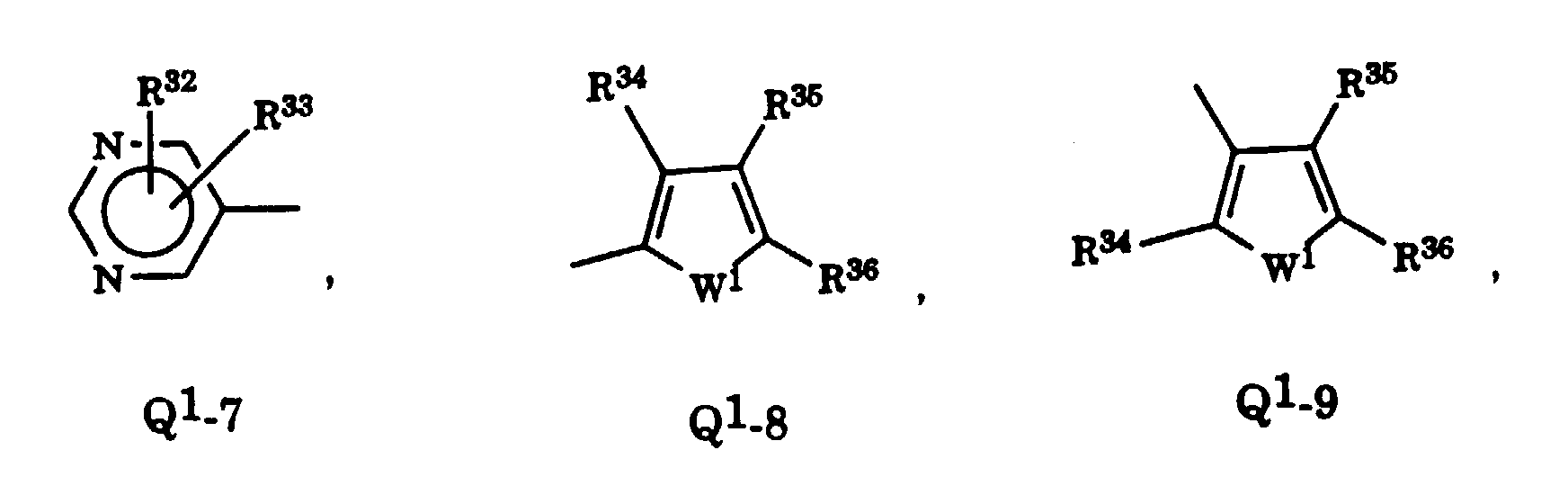


 q is 0 or 1;R25 and R26 are independently H, CH3 or Cl;R27 and R28 are independently H, F, or CH3;R29 is H, CH3 or OCH3;R30 is H or CH3;R31, R32 and R33 are independently H, CH3 or OCH3;R34, R35 and R36 are independently H, CH3, CH2CH3, Cl, Br, OCH3 or OCH2CH3;R37 is H or C1-C2 alkyl;R38 is CH3;R39 is H, C1-C2 alkyl, OCH3 or SCH3;R40 is H, CH3 or CH2CH3;R41 and R42 are independently H or CH3;R43 is H, CH3, CH2CH3 or C3H7;W1 is O or S;W2 is O, S or NR44;R44 is H or CH3;Q2 is


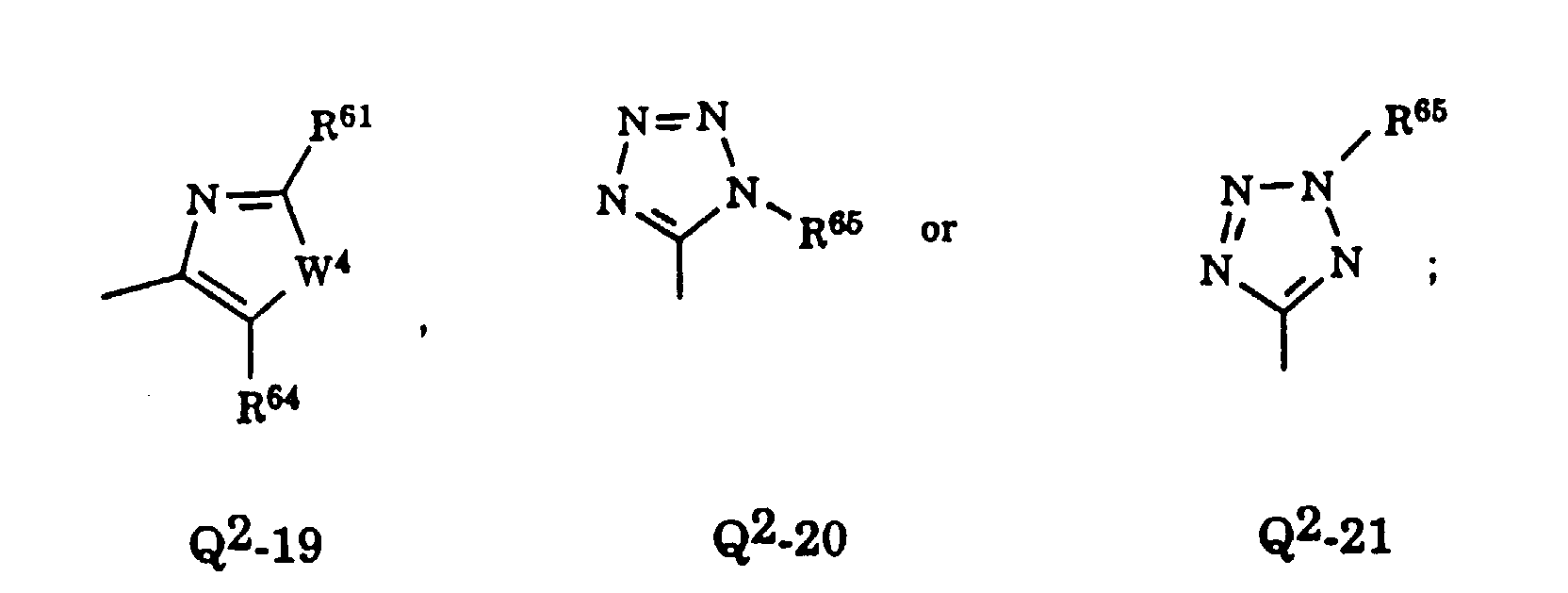 r is 0 or 1;R45 and R46 are independently H, CH3 or Cl;R47 is H or C1-C3 alkyl;R48 is H or CH3;R49 and R50 are independently H or CH3;R51 is H, CH3 or OCH3;R52 is H or CH3;R53, R54 and R55 are independently H, CH3 or OCH3;R56, R57 and R58 are independently H, CH3, CH2CH3, Cl, Br, OCH3 or OCH2CH3;R59 is H or C1-C2 alkyl;R60 is CH3;R61 is H, C1-C2 alkyl, OCH3 or SCH3;R62 is H, CH3 or CH2CH3;R63 and R64 are independently H or CH3;R65 is H, CH3, CH2CH3 or C3H7;W3 is O or S;W4 is O, S or NR66; andR66 is H or CH3.
 - Compounds of Claim 3 wherein:W is O;R1 is H, C1-C6 alkyl, allyl, CH2OCH3, CH2OC2H5, CH2SCH3 phenyl, 2-pyridyl, 3-pyridyl, 4-pyridyl, C(O)OCH3 or C(O)N(CH3)2;X is C1-C2 alkyl, C1-C2 alkoxy, F, Cl, Br, I, CH2F, CF3, CH2Cl or CH2Br; andY is H, C1-C2 alkyl, C1-C2 alkoxy, CH2OCH3, CH2OCH2CH3, NHCH3, N(OCH3)CH3, N(CH3)2, CF3, SCH3, OCH2CH=CH2, OCH2C≡CH, OCH2CH2OCH3, CH2SCH3, C(O)R22,

- Compounds of Claim 4 wherein:R3 is H, CH3, Cl or Br; andR4 is H, C1-C2 alkyl, CH2CN, CH2OCH3, CH2SCH3, CH2S(O)2CH3, Q2, C(O)R8, C(O)OR9, C(O)NR10R11, C(R12)=NOR13, C(R14)(OR15)(OR16), S(O)nR17, S(O)2NR18R19, F, Cl or Br;R8 is H or C1-C2 alkyl;R9 is C1-C2 alkyl or CH2CH2Cl;R10 is H or CH3;R11 is CH3;R12 is H, CH3, C2H5 or Cl;R13 is CH3;R14 is H or C1-C2 alkyl;R15 and R16 are CH3;R17 is C1-C2 alkyl;R18 is H or CH3;R19 is CH3; andn is 0 or 2.
- Compounds of Claim 5 wherein:
R2 is C1-C2 alkyl, CH2CN, CH2OCH3, CH2SCH3, CH2S(O)2CH3, Q2, C(O)R8, C(O)OR9, C(O)NR10R11, C(R12)=NOR13, C(R14)(OR15)(OR16), S(O)nR17, S(O)2NR18R19, F, Cl, Br, or OR73. - Compounds of Claim 6 wherein:R is H; andR71 is H.
- Compounds of Claim 7 wherein:
J is J-1. - Compounds of Claim 7 wherein:
J is J-2. - Compounds of Claim 7 wherein:
J is J-3. - Compounds of Claim 8 wherein:R2 is C1-C2 alkyl, CH2CN, CH2OCH3, CH2SCH3, CH2S(O)2CH3, Q2, C(O)R8, C(O)OR9, C(O)N(CH3)2, S(O)2CH3, S(O)2C2H5, S(O)2N(CH3)2, C1-C2 alkoxy, OC(O)CH3, or OSO2CH3;R4 is H, C1-C2 alkyl, CH2CN, CH2OCH3, CH2SCH3, CH2S(O)2CH3, Q2, C(O)R8, C(O)OR9, C(O)N(CH3)2, S(O)2CH3, S(O)2C2H5 or S(O)2N(CH3)2;R8 is C1-C2 alkyl;R9 is C1-C2 alkyl;Q2 is Q2-1, Q2-4, Q2-5, Q2-6, Q2-10, Q2-11, Q2-20 or Q2-21;R45, R46, R49, R50, R56, R57 and R58 are H;R65 is CH3;W3 is S; andr is 0.
- Compounds of Claim 9 wherein:R2 is C1-C2 alkyl, CH2CN, CH2OCH3, CH2SCH3, CH2S(O)2CH3, Q2, C(O)R8, C(O)OR9, C(O)N(CH3)2, S(O)2CH3, S(O)2C2H5, S(O)2N(CH3)2, C1-C2 alkoxy, OC(O)CH3, or OSO2CH3;R4 is H, C1-C2 alkyl, CH2CN, CH2OCH3, CH2SCH3, CH2S(O)2CH3, Q2, C(O)R8, C(O)OR9, C(O)N(CH3)2, S(O)2CH3 or S(O)2N(CH3)2;R8 is C1-C2 alkyl;R9 is C1-C2 alkyl;Q2 is Q2-1, Q2-4, Q2-5, Q2-6, Q2-10, Q2-11, Q2-20 or Q2-21;R45, R46, R49, R50, R56, R57 and R58 are H;R65 is CH3;W3 is S; andr is 0.
- Compounds of Claim 10 wherein:R2 is C1-C2 alkyl, CH2CN, CH2OCH3, CH2SCH3, CH2S(O)2CH3, Q2, C(O)R8, C(O)OR9, C(O)N(CH3)2, S(O)2CH3, S(O)2C2H5, S(O)2N(CH3)2, C1-C2 alkoxy, OC(O)CH3, or OSO2CH3;R4 is H, C1-C2 alkyl, CH2CN, CH2OCH3, CH2SCH3, CH2S(O)2CH3, Q2, C(O)R8, C(O)OR9, C(O)N(CH3)2, S(O)2CH3 or S(O)2N(CH3)2;R8 is C1-C2 alkyl;R9 is C1-C2 alkyl;Q2 is Q2-1, Q2-4, Q2-5, Q2-6, Q2-10, Q2-11, Q2-20 or Q2-21;R45, R46, R49, R50, R56, R57 and R58 are H;R65 is CH3;W3 is S; andr is 0.
- Compounds of Claim 11 wherein:A is A-1;X is CH3, OCH3, OCH2CH3, or Cl; andY is CH3, OCH3, NHCH3 or N(CH3)2.
- Compounds of Claim 12 wherein:A is A-1;X is CH3, OCH3, OCH2CH3, or Cl; andY is CH3, OCH3, NHCH3 or N(CH3)2.
- Compounds of Claim 13 wherein:A is A-1;X is CH3, OCH3, OCH2CH3, or Cl; andY is CH3, OCH3, NHCH3 or N(CH3)2.
- The compound of Claim 1 which is:
(1-methylethyl)2-[[(4-methoxy-6-methyl-1,3,5-triazin-2-yl)-aminocarbonyl]aminosulfonyl]-1-methyl-1H-pyrrole-3-carboxylate. - The compound of Claim 1 which is:
ethyl 2-[[(4-chloro-6-methoxypyrimidin-2-yl)]aminocarbonyl]-aminosulfonyl]-1-ethyl-1H-pyrrole-3-carboxylate. - The compound of Claim 1 which is:
1-ethyl-3-(ethylsulfonyl)-N-[(4-methoxy-6-methylpyrimidin-2-yl)aminocarbonyl]-1H-pyrrole-2-sulfonamide. - Compounds of Formula II
 R67 is H, C(CH3)3 or Si(CH3)2C(CH3)3; andR72 is H or Si(CH(CH3)2)3.
 - An agriculturally suitable composition for controlling the growth of undesired vegetation comprising a herbicidally effective amount of a compound in any of Claims 1, 2, 3, 4, 5, 6 or 7 and at least one of the following: surfactants, solid diluent or liquid diluent.
- A method for controlling the growth of undesired vegetation which comprises applying to the locus to be protected a herbicidally effective amount of a compound in any of Claims 1, 2, 3, 4, 5, 6 or 7.
Applications Claiming Priority (3)
| Application Number | Priority Date | Filing Date | Title |
|---|---|---|---|
| US57307490A | 1990-08-29 | 1990-08-29 | |
| US573074 | 1990-08-29 | ||
| PCT/US1991/005822 WO1992004319A1 (en) | 1990-08-29 | 1991-08-22 | Herbicidal pyrrolesulfonylureas |
Publications (2)
| Publication Number | Publication Date |
|---|---|
| EP0546082A1 EP0546082A1 (en) | 1993-06-16 |
| EP0546082B1 true EP0546082B1 (en) | 1996-12-18 |
Family
ID=24290534
Family Applications (1)
| Application Number | Title | Priority Date | Filing Date |
|---|---|---|---|
| EP91916709A Expired - Lifetime EP0546082B1 (en) | 1990-08-29 | 1991-08-22 | Herbicidal pyrrolesulfonylureas |
Country Status (8)
| Country | Link |
|---|---|
| US (3) | US5472933A (en) |
| EP (1) | EP0546082B1 (en) |
| AU (1) | AU647830B2 (en) |
| CA (1) | CA2089765A1 (en) |
| DE (1) | DE69123741T2 (en) |
| ES (1) | ES2095955T3 (en) |
| WO (1) | WO1992004319A1 (en) |
| ZA (1) | ZA916854B (en) |
Families Citing this family (14)
| Publication number | Priority date | Publication date | Assignee | Title |
|---|---|---|---|---|
| DE102004036550A1 (en) * | 2004-07-28 | 2006-03-23 | Bayer Cropscience Ag | Aminocarbonyl-substituted thienylsulfonylureas |
| DE102006002093B4 (en) * | 2006-01-17 | 2010-11-25 | Airbus Deutschland Gmbh | Device for detecting contour deviations of a flexible component taking into account the component weight and method |
| EP2736514B1 (en) * | 2011-07-28 | 2017-10-18 | Nerviano Medical Sciences S.r.l. | Alkynyl substituted pyrimidinyl-pyrroles active as kinases inhibitors |
| JP6929792B2 (en) | 2015-02-16 | 2021-09-01 | ザ ユニバーシティ オブ クィーンズランド | Sulfonylureas and related compounds and their use |
| US11142497B2 (en) | 2017-02-07 | 2021-10-12 | National University Corporation Kumamoto University | Plant growth inhibiting agent, and plant growth inhibiting method using same |
| US11840543B2 (en) | 2017-05-24 | 2023-12-12 | The University Of Queensland | Compounds and uses |
| CN110914256A (en) | 2017-07-07 | 2020-03-24 | 英夫拉索姆有限公司 | Novel sulfonamide carboxamide compounds |
| TW201910317A (en) | 2017-08-15 | 2019-03-16 | 愛爾蘭商英弗雷佐姆有限公司 | Novel compound |
| WO2019034693A1 (en) | 2017-08-15 | 2019-02-21 | Inflazome Limited | Sulfonylureas and sulfonylthioureas as nlrp3 inhibitors |
| MX2020001776A (en) | 2017-08-15 | 2020-03-24 | Inflazome Ltd | SULFONYLUREAS AND SULFONYLTHIOUREAS AS NLRP<sub>3</sub> INHIBITORS. |
| AU2018347537A1 (en) | 2017-10-13 | 2020-04-02 | Scholl's Wellness Company Llc | Footcare product dispensing kiosk |
| WO2019092171A1 (en) | 2017-11-09 | 2019-05-16 | Inflazome Limited | Novel sulfonamide carboxamide compounds |
| CN111315733A (en) | 2017-11-09 | 2020-06-19 | 英夫拉索姆有限公司 | Novel sulfonamide carboxamide compounds |
| WO2019166619A1 (en) | 2018-03-02 | 2019-09-06 | Inflazome Limited | Novel compounds |
Family Cites Families (13)
| Publication number | Priority date | Publication date | Assignee | Title |
|---|---|---|---|---|
| US4401816A (en) * | 1980-04-29 | 1983-08-30 | E. I. Du Pont De Nemours And Company | Sulfamoyl chlorides |
| US4368067A (en) * | 1980-04-29 | 1983-01-11 | E. I. Du Pont De Nemours And Company | Herbicidal sulfonamides |
| BR8102529A (en) * | 1980-04-29 | 1982-01-05 | Du Pont | COMPOUNDS AND COMPOSITIONS HERBICIDES OR SUITABLE FOR THE CONTROL OF THE UNDESIRABLE VEGETATION GROWTH AND ITS PREPARATION PROCESSES; PROCESS FOR THE CONTROL OF THE UNDESIRABLE VEGETATION GROWTH |
| MA19797A1 (en) * | 1982-06-14 | 1983-12-31 | Ciba Geigy Ag | N-HETEROCYCLOSULFONYL -N- PYRIMIDINYL AND TRIAZINYLUREES. |
| US4518776A (en) * | 1982-07-19 | 1985-05-21 | Ciba Geigy Corporation | Process for producing sulfonylureas |
| DE3375916D1 (en) * | 1982-08-23 | 1988-04-14 | Ciba Geigy Ag | Process for the preparation of herbicides and plant growth regulating sulfonyl ureas |
| DE3479213D1 (en) * | 1983-05-16 | 1989-09-07 | Ciba Geigy Ag | Herbicidally active and plant growth regulating pyrimidine derivatives, their preparation and use |
| US4639264A (en) * | 1983-08-26 | 1987-01-27 | Ciga-Geigy Corporation | Herbicidal N-arylsulfonyl-N'-(4-mercaptomethylpyrimdinyl)-ureas |
| US4685961A (en) * | 1984-02-14 | 1987-08-11 | Ciba-Geigy Corporation | Herbicidal sulfonylureas |
| DE3578933D1 (en) * | 1984-04-11 | 1990-09-06 | Ciba Geigy Ag | N-HETEROCYCLOSULFONYL-N'-PYRIMIDINYL AND TRIAZINYL UREAS. |
| US4756742A (en) * | 1984-11-15 | 1988-07-12 | E. I. Du Pont De Nemours And Company | Herbicidal ortho-heterocyclic thiophenesulfonamides |
| US4737184A (en) * | 1984-10-17 | 1988-04-12 | E. I. Du Pont De Nemours And Company | Herbicidal sulfonamides |
| AU7165591A (en) * | 1990-01-22 | 1991-08-05 | E.I. Du Pont De Nemours And Company | Herbicidal sulfonylureas |
-
1991
- 1991-08-22 US US07/974,581 patent/US5472933A/en not_active Expired - Fee Related
- 1991-08-22 ES ES91916709T patent/ES2095955T3/en not_active Expired - Lifetime
- 1991-08-22 DE DE69123741T patent/DE69123741T2/en not_active Expired - Fee Related
- 1991-08-22 AU AU85498/91A patent/AU647830B2/en not_active Ceased
- 1991-08-22 WO PCT/US1991/005822 patent/WO1992004319A1/en not_active Ceased
- 1991-08-22 EP EP91916709A patent/EP0546082B1/en not_active Expired - Lifetime
- 1991-08-22 CA CA002089765A patent/CA2089765A1/en not_active Abandoned
- 1991-08-29 ZA ZA916854A patent/ZA916854B/en unknown
-
1995
- 1995-09-12 US US08/527,053 patent/US5585328A/en not_active Expired - Fee Related
-
1996
- 1996-08-02 US US08/691,618 patent/US5723410A/en not_active Expired - Fee Related
Also Published As
| Publication number | Publication date |
|---|---|
| ES2095955T3 (en) | 1997-03-01 |
| AU8549891A (en) | 1992-03-30 |
| EP0546082A1 (en) | 1993-06-16 |
| US5585328A (en) | 1996-12-17 |
| AU647830B2 (en) | 1994-03-31 |
| ZA916854B (en) | 1993-03-01 |
| WO1992004319A1 (en) | 1992-03-19 |
| DE69123741D1 (en) | 1997-01-30 |
| US5472933A (en) | 1995-12-05 |
| US5723410A (en) | 1998-03-03 |
| DE69123741T2 (en) | 1997-07-10 |
| CA2089765A1 (en) | 1992-03-01 |
Similar Documents
| Publication | Publication Date | Title |
|---|---|---|
| EP0502740B1 (en) | Herbicidal pyridine sulfonamide | |
| EP0204513B1 (en) | Herbicidal sulfonamides | |
| US4595407A (en) | Triazinyl-amino-carbonyl-1,3-benzohetero- or -1,4-benzohetero-sulfonamides | |
| EP0039239B1 (en) | Herbicidal pyrrole sulfonamides | |
| AU647830B2 (en) | Herbicidal pyrrolesulfonylureas | |
| US4723991A (en) | Lower alkyl 2-[[N-(3-cyano-pyridin-2-yl)aminocarbonyl]aminosulphonyl]benzoate derivatives having herbicidal activity | |
| US4786314A (en) | Herbicidal sulfonamides | |
| US4690705A (en) | Herbicidal sulfonamides | |
| US4699649A (en) | Herbicidal heterocyclicbenzylsulfonamides | |
| EP0135332A1 (en) | Herbicidal benzenesulfonamides, benzylsulfonamides and benzenesulfamates | |
| US4502882A (en) | Substituted sulfonamides 1,3-benzodioxole | |
| US4662933A (en) | Herbicidal sulfonamides | |
| USH386H (en) | Herbicidal sulfonamides | |
| EP0207609B1 (en) | Herbicidal thiophenesulfonamides | |
| WO1988004655A2 (en) | Herbicidal pyridine sulfonamides | |
| US4778512A (en) | Herbicidal heterocyclic sulfonamides | |
| US4659361A (en) | Herbicidal iodopyrimidines | |
| US4333760A (en) | Herbicidal sulfonamides | |
| EP0333770A1 (en) | Thiophenesulfonamide herbicides | |
| US4662932A (en) | Herbicidal sulfonamides | |
| US4741757A (en) | Thiophenesulfonamides | |
| US4604130A (en) | Herbicidal N-[pyrimidine aminocarbonyl]isothiazole sulfonamides | |
| US4759790A (en) | Herbicidal sulfonamides | |
| US4718938A (en) | Herbicidal sulfonamides | |
| US4889550A (en) | Herbicidal sulfonamides |
Legal Events
| Date | Code | Title | Description |
|---|---|---|---|
| PUAI | Public reference made under article 153(3) epc to a published international application that has entered the european phase |
Free format text: ORIGINAL CODE: 0009012 |
|
| 17P | Request for examination filed |
Effective date: 19930217 |
|
| AK | Designated contracting states |
Kind code of ref document: A1 Designated state(s): DE ES FR GB IT |
|
| 17Q | First examination report despatched |
Effective date: 19931227 |
|
| GRAG | Despatch of communication of intention to grant |
Free format text: ORIGINAL CODE: EPIDOS AGRA |
|
| GRAH | Despatch of communication of intention to grant a patent |
Free format text: ORIGINAL CODE: EPIDOS IGRA |
|
| GRAH | Despatch of communication of intention to grant a patent |
Free format text: ORIGINAL CODE: EPIDOS IGRA |
|
| GRAA | (expected) grant |
Free format text: ORIGINAL CODE: 0009210 |
|
| AK | Designated contracting states |
Kind code of ref document: B1 Designated state(s): DE ES FR GB IT |
|
| REF | Corresponds to: |
Ref document number: 69123741 Country of ref document: DE Date of ref document: 19970130 |
|
| ITF | It: translation for a ep patent filed | ||
| REG | Reference to a national code |
Ref country code: ES Ref legal event code: FG2A Ref document number: 2095955 Country of ref document: ES Kind code of ref document: T3 |
|
| ET | Fr: translation filed | ||
| PLBE | No opposition filed within time limit |
Free format text: ORIGINAL CODE: 0009261 |
|
| STAA | Information on the status of an ep patent application or granted ep patent |
Free format text: STATUS: NO OPPOSITION FILED WITHIN TIME LIMIT |
|
| 26N | No opposition filed | ||
| PGFP | Annual fee paid to national office [announced via postgrant information from national office to epo] |
Ref country code: FR Payment date: 20000606 Year of fee payment: 10 |
|
| PGFP | Annual fee paid to national office [announced via postgrant information from national office to epo] |
Ref country code: DE Payment date: 20000608 Year of fee payment: 10 |
|
| PGFP | Annual fee paid to national office [announced via postgrant information from national office to epo] |
Ref country code: GB Payment date: 20000612 Year of fee payment: 10 |
|
| PGFP | Annual fee paid to national office [announced via postgrant information from national office to epo] |
Ref country code: ES Payment date: 20000823 Year of fee payment: 10 |
|
| PG25 | Lapsed in a contracting state [announced via postgrant information from national office to epo] |
Ref country code: GB Free format text: LAPSE BECAUSE OF NON-PAYMENT OF DUE FEES Effective date: 20010822 |
|
| PG25 | Lapsed in a contracting state [announced via postgrant information from national office to epo] |
Ref country code: ES Free format text: LAPSE BECAUSE OF NON-PAYMENT OF DUE FEES Effective date: 20010823 |
|
| GBPC | Gb: european patent ceased through non-payment of renewal fee |
Effective date: 20010822 |
|
| PG25 | Lapsed in a contracting state [announced via postgrant information from national office to epo] |
Ref country code: FR Free format text: LAPSE BECAUSE OF NON-PAYMENT OF DUE FEES Effective date: 20020430 |
|
| PG25 | Lapsed in a contracting state [announced via postgrant information from national office to epo] |
Ref country code: DE Free format text: LAPSE BECAUSE OF NON-PAYMENT OF DUE FEES Effective date: 20020501 |
|
| REG | Reference to a national code |
Ref country code: FR Ref legal event code: ST |
|
| REG | Reference to a national code |
Ref country code: ES Ref legal event code: FD2A Effective date: 20020911 |
|
| PG25 | Lapsed in a contracting state [announced via postgrant information from national office to epo] |
Ref country code: IT Free format text: LAPSE BECAUSE OF NON-PAYMENT OF DUE FEES;WARNING: LAPSES OF ITALIAN PATENTS WITH EFFECTIVE DATE BEFORE 2007 MAY HAVE OCCURRED AT ANY TIME BEFORE 2007. THE CORRECT EFFECTIVE DATE MAY BE DIFFERENT FROM THE ONE RECORDED. Effective date: 20050822 |