EP0545997B1 - Carbonylation of methanol using a novel transition metal catalyst precursor - Google Patents
Carbonylation of methanol using a novel transition metal catalyst precursor Download PDFInfo
- Publication number
- EP0545997B1 EP0545997B1 EP91915178A EP91915178A EP0545997B1 EP 0545997 B1 EP0545997 B1 EP 0545997B1 EP 91915178 A EP91915178 A EP 91915178A EP 91915178 A EP91915178 A EP 91915178A EP 0545997 B1 EP0545997 B1 EP 0545997B1
- Authority
- EP
- European Patent Office
- Prior art keywords
- formula
- catalyst precursor
- phenyl
- sime3
- mmol
- Prior art date
- Legal status (The legal status is an assumption and is not a legal conclusion. Google has not performed a legal analysis and makes no representation as to the accuracy of the status listed.)
- Expired - Lifetime
Links
Classifications
-
- B—PERFORMING OPERATIONS; TRANSPORTING
- B01—PHYSICAL OR CHEMICAL PROCESSES OR APPARATUS IN GENERAL
- B01J—CHEMICAL OR PHYSICAL PROCESSES, e.g. CATALYSIS OR COLLOID CHEMISTRY; THEIR RELEVANT APPARATUS
- B01J31/00—Catalysts comprising hydrides, coordination complexes or organic compounds
- B01J31/16—Catalysts comprising hydrides, coordination complexes or organic compounds containing coordination complexes
- B01J31/18—Catalysts comprising hydrides, coordination complexes or organic compounds containing coordination complexes containing nitrogen, phosphorus, arsenic or antimony as complexing atoms, e.g. in pyridine ligands, or in resonance therewith, e.g. in isocyanide ligands C=N-R or as complexed central atoms
- B01J31/1805—Catalysts comprising hydrides, coordination complexes or organic compounds containing coordination complexes containing nitrogen, phosphorus, arsenic or antimony as complexing atoms, e.g. in pyridine ligands, or in resonance therewith, e.g. in isocyanide ligands C=N-R or as complexed central atoms the ligands containing nitrogen
-
- B—PERFORMING OPERATIONS; TRANSPORTING
- B01—PHYSICAL OR CHEMICAL PROCESSES OR APPARATUS IN GENERAL
- B01J—CHEMICAL OR PHYSICAL PROCESSES, e.g. CATALYSIS OR COLLOID CHEMISTRY; THEIR RELEVANT APPARATUS
- B01J31/00—Catalysts comprising hydrides, coordination complexes or organic compounds
- B01J31/16—Catalysts comprising hydrides, coordination complexes or organic compounds containing coordination complexes
- B01J31/18—Catalysts comprising hydrides, coordination complexes or organic compounds containing coordination complexes containing nitrogen, phosphorus, arsenic or antimony as complexing atoms, e.g. in pyridine ligands, or in resonance therewith, e.g. in isocyanide ligands C=N-R or as complexed central atoms
-
- B—PERFORMING OPERATIONS; TRANSPORTING
- B01—PHYSICAL OR CHEMICAL PROCESSES OR APPARATUS IN GENERAL
- B01J—CHEMICAL OR PHYSICAL PROCESSES, e.g. CATALYSIS OR COLLOID CHEMISTRY; THEIR RELEVANT APPARATUS
- B01J31/00—Catalysts comprising hydrides, coordination complexes or organic compounds
- B01J31/16—Catalysts comprising hydrides, coordination complexes or organic compounds containing coordination complexes
- B01J31/18—Catalysts comprising hydrides, coordination complexes or organic compounds containing coordination complexes containing nitrogen, phosphorus, arsenic or antimony as complexing atoms, e.g. in pyridine ligands, or in resonance therewith, e.g. in isocyanide ligands C=N-R or as complexed central atoms
- B01J31/189—Catalysts comprising hydrides, coordination complexes or organic compounds containing coordination complexes containing nitrogen, phosphorus, arsenic or antimony as complexing atoms, e.g. in pyridine ligands, or in resonance therewith, e.g. in isocyanide ligands C=N-R or as complexed central atoms containing both nitrogen and phosphorus as complexing atoms, including e.g. phosphino moieties, in one at least bidentate or bridging ligand
-
- B—PERFORMING OPERATIONS; TRANSPORTING
- B01—PHYSICAL OR CHEMICAL PROCESSES OR APPARATUS IN GENERAL
- B01J—CHEMICAL OR PHYSICAL PROCESSES, e.g. CATALYSIS OR COLLOID CHEMISTRY; THEIR RELEVANT APPARATUS
- B01J31/00—Catalysts comprising hydrides, coordination complexes or organic compounds
- B01J31/16—Catalysts comprising hydrides, coordination complexes or organic compounds containing coordination complexes
- B01J31/18—Catalysts comprising hydrides, coordination complexes or organic compounds containing coordination complexes containing nitrogen, phosphorus, arsenic or antimony as complexing atoms, e.g. in pyridine ligands, or in resonance therewith, e.g. in isocyanide ligands C=N-R or as complexed central atoms
- B01J31/1895—Catalysts comprising hydrides, coordination complexes or organic compounds containing coordination complexes containing nitrogen, phosphorus, arsenic or antimony as complexing atoms, e.g. in pyridine ligands, or in resonance therewith, e.g. in isocyanide ligands C=N-R or as complexed central atoms the ligands containing arsenic or antimony
-
- B—PERFORMING OPERATIONS; TRANSPORTING
- B01—PHYSICAL OR CHEMICAL PROCESSES OR APPARATUS IN GENERAL
- B01J—CHEMICAL OR PHYSICAL PROCESSES, e.g. CATALYSIS OR COLLOID CHEMISTRY; THEIR RELEVANT APPARATUS
- B01J31/00—Catalysts comprising hydrides, coordination complexes or organic compounds
- B01J31/16—Catalysts comprising hydrides, coordination complexes or organic compounds containing coordination complexes
- B01J31/22—Organic complexes
- B01J31/2204—Organic complexes the ligands containing oxygen or sulfur as complexing atoms
- B01J31/226—Sulfur, e.g. thiocarbamates
-
- B—PERFORMING OPERATIONS; TRANSPORTING
- B01—PHYSICAL OR CHEMICAL PROCESSES OR APPARATUS IN GENERAL
- B01J—CHEMICAL OR PHYSICAL PROCESSES, e.g. CATALYSIS OR COLLOID CHEMISTRY; THEIR RELEVANT APPARATUS
- B01J31/00—Catalysts comprising hydrides, coordination complexes or organic compounds
- B01J31/16—Catalysts comprising hydrides, coordination complexes or organic compounds containing coordination complexes
- B01J31/22—Organic complexes
- B01J31/2282—Unsaturated compounds used as ligands
- B01J31/2291—Olefins
-
- B—PERFORMING OPERATIONS; TRANSPORTING
- B01—PHYSICAL OR CHEMICAL PROCESSES OR APPARATUS IN GENERAL
- B01J—CHEMICAL OR PHYSICAL PROCESSES, e.g. CATALYSIS OR COLLOID CHEMISTRY; THEIR RELEVANT APPARATUS
- B01J31/00—Catalysts comprising hydrides, coordination complexes or organic compounds
- B01J31/16—Catalysts comprising hydrides, coordination complexes or organic compounds containing coordination complexes
- B01J31/24—Phosphines, i.e. phosphorus bonded to only carbon atoms, or to both carbon and hydrogen atoms, including e.g. sp2-hybridised phosphorus compounds such as phosphabenzene, phosphole or anionic phospholide ligands
-
- B—PERFORMING OPERATIONS; TRANSPORTING
- B01—PHYSICAL OR CHEMICAL PROCESSES OR APPARATUS IN GENERAL
- B01J—CHEMICAL OR PHYSICAL PROCESSES, e.g. CATALYSIS OR COLLOID CHEMISTRY; THEIR RELEVANT APPARATUS
- B01J31/00—Catalysts comprising hydrides, coordination complexes or organic compounds
- B01J31/16—Catalysts comprising hydrides, coordination complexes or organic compounds containing coordination complexes
- B01J31/24—Phosphines, i.e. phosphorus bonded to only carbon atoms, or to both carbon and hydrogen atoms, including e.g. sp2-hybridised phosphorus compounds such as phosphabenzene, phosphole or anionic phospholide ligands
- B01J31/2495—Ligands comprising a phosphine-P atom and one or more further complexing phosphorus atoms covered by groups B01J31/1845 - B01J31/1885, e.g. phosphine/phosphinate or phospholyl/phosphonate ligands
-
- C—CHEMISTRY; METALLURGY
- C07—ORGANIC CHEMISTRY
- C07C—ACYCLIC OR CARBOCYCLIC COMPOUNDS
- C07C51/00—Preparation of carboxylic acids or their salts, halides or anhydrides
- C07C51/10—Preparation of carboxylic acids or their salts, halides or anhydrides by reaction with carbon monoxide
- C07C51/12—Preparation of carboxylic acids or their salts, halides or anhydrides by reaction with carbon monoxide on an oxygen-containing group in organic compounds, e.g. alcohols
-
- C—CHEMISTRY; METALLURGY
- C07—ORGANIC CHEMISTRY
- C07C—ACYCLIC OR CARBOCYCLIC COMPOUNDS
- C07C67/00—Preparation of carboxylic acid esters
- C07C67/36—Preparation of carboxylic acid esters by reaction with carbon monoxide or formates
-
- B—PERFORMING OPERATIONS; TRANSPORTING
- B01—PHYSICAL OR CHEMICAL PROCESSES OR APPARATUS IN GENERAL
- B01J—CHEMICAL OR PHYSICAL PROCESSES, e.g. CATALYSIS OR COLLOID CHEMISTRY; THEIR RELEVANT APPARATUS
- B01J2531/00—Additional information regarding catalytic systems classified in B01J31/00
- B01J2531/80—Complexes comprising metals of Group VIII as the central metal
-
- B—PERFORMING OPERATIONS; TRANSPORTING
- B01—PHYSICAL OR CHEMICAL PROCESSES OR APPARATUS IN GENERAL
- B01J—CHEMICAL OR PHYSICAL PROCESSES, e.g. CATALYSIS OR COLLOID CHEMISTRY; THEIR RELEVANT APPARATUS
- B01J2531/00—Additional information regarding catalytic systems classified in B01J31/00
- B01J2531/80—Complexes comprising metals of Group VIII as the central metal
- B01J2531/82—Metals of the platinum group
- B01J2531/822—Rhodium
-
- B—PERFORMING OPERATIONS; TRANSPORTING
- B01—PHYSICAL OR CHEMICAL PROCESSES OR APPARATUS IN GENERAL
- B01J—CHEMICAL OR PHYSICAL PROCESSES, e.g. CATALYSIS OR COLLOID CHEMISTRY; THEIR RELEVANT APPARATUS
- B01J2531/00—Additional information regarding catalytic systems classified in B01J31/00
- B01J2531/80—Complexes comprising metals of Group VIII as the central metal
- B01J2531/84—Metals of the iron group
- B01J2531/845—Cobalt
-
- B—PERFORMING OPERATIONS; TRANSPORTING
- B01—PHYSICAL OR CHEMICAL PROCESSES OR APPARATUS IN GENERAL
- B01J—CHEMICAL OR PHYSICAL PROCESSES, e.g. CATALYSIS OR COLLOID CHEMISTRY; THEIR RELEVANT APPARATUS
- B01J2531/00—Additional information regarding catalytic systems classified in B01J31/00
- B01J2531/80—Complexes comprising metals of Group VIII as the central metal
- B01J2531/84—Metals of the iron group
- B01J2531/847—Nickel
Definitions
- the invention relates to transition metal catalyst precursors having a heterodifunctional bidentate phosphorus-nitrogen ligand attached to the metal. It further relates to the use of such precursors in the carbonylation of methanol, typically to produce methyl acetate, acetic acid and acetic anhydride.
- the homologation reaction is exemplified by the reaction of methanol with synthesis gas (a mixture of carbon monoxide and hydrogen) to produce ethanol namely: CH3OH + CO + 2H2 ⁇ CH3CH2OH + H2O
- synthesis gas a mixture of carbon monoxide and hydrogen
- the reaction typically is conducted in the presence of a Co/Ru-I catalyst, at elevated temperatures and pressures (up to 10,000 p.s.i.g.).
- hydroformylation (or reductive carbonylation) reaction is exemplified by the reaction of methanol with synthesis gas to form acetaldehyde: CH3OH + CO + H2 ⁇ CH3CHO + H2O
- a Co-I or Rh-I-PR3 catalyst is utilized, again at elevated temperatures and pressures.
- Tertiary polyphosphine monoxide ligands are used in the hydroformylation processes described in the following patents: U.S. Patent 4,429,165: U.S. Patent 4,400,548 U.S. Patent 4,522,933 and U.S. Patent 4,593,011 U.S. Patent 4,491,675 Additionally, the use of phosphite ligands in hydroformylation processes is taught in the followings patents: U.S. Patent 4,599,206 U.S. Patent 4,717,775 U.S. Patent 4,737,588 U.S. Patent 4,789,753 U.S. Patent 4,668,651 U.S. Patent 4,769,498 and U.S. Patent 4,748,261 Further hydroformylation processes using sulphonated tertiary phosphine ligands are described in U.S. Patents 4,716,250 and 4,731,486.
- the carbonylation reaction is exemplified by the reaction of methanol with carbon monoxide to form acetic acid or methyl acetate, depending on the solvent used.
- U.S. Patent 3,769,329 issued to F.E. Paulik et al. there is disclosed a carbonylation process which comprises reacting methanol with carbon monoxide at 175°C and 1000 p.s.i.g. to form acetic acid. This process is illustrative of existing industrial conditions for conducting the reaction.
- the catalyst comprises: Rh(CO)X(R'R''PGZ) wherein Z is selected from the group consisting of: and G represents one of the following two groups :
- the Wegman reaction conditions are mild, typically involving reaction temperatures less than about 130°C and a reaction pressure less than about 250 p.s.i.g.
- novel transition metal catalyst precursors having a phosphorus-nitrogen chelated ligand attached to the metal.
- the metal is a Group VIII B transition metal, most preferably one of Rh, Ni or Co.
- the chelated ligand comprises a substantially unreactive connecting backbone structure which links two different dative centers or a donor with an anionic site.
- the connecting backbone structure comprises an unsaturated entity such as a benzene ring connected in the o-positions to the phosphine or arsine and the phosphorus of the iminatophosphorane.
- the backbone is an olefin connected across the olefin bond to the phosphine or arsine and the phosphorus of the iminatophosphorane.
- transition metal catalyst precursor is of the general formulae I, II or III as defined in the accompanying claims.
- the transition metal M in the catalyst precursor is Rh, Co or Ni and preferably the substituents R1 ⁇ 4 and R6 ⁇ 12 are substituted or unsubstituted aryl groups.
- Preferred catalyst precursors of the formula II are those in which R5 is phenyl or methyl and S* is S, Se or NR where R is as defined above.
- Preferred catalyst precursors of the formula III are those in which R10 ⁇ 12 are selected from hydrogen, phenyl or substituted phenyl groups.
- the heterodifunctional character of the bidentate phosphorus-nitrogen ligand provides a complex in which the unequal binding of the phosphorus and the nitrogen to the metal results in the preferential dissociation of the more weakly bound coordinating atom, so as to provide a reactive site at the metal.
- the unreactive backbone of the ligand keeps the dissociated element readily available for recombination, so as to facilitate the cyclical nature of the catalytic process.
- Rh(I) catalysis it is believed that the Rh(I) centre is oxidatively converted to a Rh(III) complex and that the adduct provides the vehicle for catalytic transformation. Dissociation of the nitrogen substituent and coordination of free CO in this case forms a complex which appears to subsequently undergo internal rearrangement to an acyl substituted Rh complex. Upon removal of the acyl substituent, the uncoordinated nitrogen, which is held to the metal compound by the coordinated phosphorus and the backbone structure of the ligand molecule, is in a suitable position to coordinate to the Rh centre and stabilize the catalytic unit so that the cycle may be continued.
- the above-described catalyst precursors are active as catalysts in the known carbonylation reaction to methanol.
- the carbonylation reaction catalyzed with the catalyst precursors of this invention takes place under very much milder conditions than had heretofore been reported. Conditions comprising temperatures of 25 - 200°C, and pressures of 1 to 5000 p.s.i.g. are operative. More specifically, the reaction may be conducted at a temperature as low as about 50 - 120 °C, preferably about 80°C and a pressure of about 40 - 400 p.s.i.g., preferably about 40 p.s.i.g.
- the carbonylation of methanol with carbon monoxide can further be promoted using a reagent that enhances the oxidative addition of methyl iodide to the metal center, thereby accelerating the reaction.
- promotors are lithium acetate, sodium tetraphenyl borate, Ph4AsCl, LiCl, LiI, KPF6, Et3N, pyridine, quinoline, morpholine, the Bezman salt and similar compounds.
- the invention comprises a transition metal catalyst precursor of the general formulae I, II and III, having a phosphorus-nitrogen chelated ligand attached to the metal.
- the invention is an improvement in a catalytic process for carbonylation of methanol to acetic acid and/or its derivatives.
- the improvement comprises reacting the methanol and carbon monoxide using a transition metal catalyst precursor having a phosphorus-nitrogen chelated ligand attached to the metal as a catalyst.
- a process which uses a novel rhodium complex catalyst precursor for the carbonylation reaction of methanol to form acetic acid and its derivatives such as methylacetate.
- Ni, Co and Ir have also been shown to work.
- the transition metal M in the catalyst precursor is preferably selected from the Group VIII B transition metals Fe, Co, Ni, Ru, Rh, Pd, Os, Ir and Pt. In using the catalyst precursor it is possible to conduct the carbonylation reaction under particularly mild and hence more energy efficient conditions.
- the reaction conditions for carrying out the carbonylation process of this invention can be those heretofore conventionally used and may comprise a reaction temperature from about 25°C to 200°C and pressure from about 1 to 5000 p.s.i.g.
- the preferred carbonylation process will be that which is most efficient in producing methyl acetate and/or acetic acid from CH3OH.
- the optimization of the reaction conditions needed to achieve the best conversion, efficiency and catalyst life will be within the knowledge of one skilled in the art and easily assessed by following the preferred embodiments of this invention as described in detail below or in the experimental section.
- the reaction temperature may range between 25°C and 200°C.
- the preferred temperature is in the range between 50°C to 120°C.
- the CO pressure will range from 1 p.s.i.g. to 5,000 p.s.i.g.
- the preferred pressure is between 40 to 400 p.s.i.g.
- the reaction time will range from 30 minutes to several hours.
- Exemplary ligands employable are those having the general formulae: and the like.
- the phenyl groups in the above compounds are generally illustrative of substituted or unsubstituted aryl groups which may be used as the R1 ⁇ 4 and R6 ⁇ 12 substituents in the catalyst precursors.
- the substituents Y,Y' in the catalyst precursor depend on the form in which the transition metal is included in the catalyst precursor synthesis or on the form in which the transition metal is added in the carbonylation reaction.
- Y and Y' will be co-ordinating neutral molecules such as CO, phosphine or olefins such as cyclooctadiene, or bound anions such as halides (Cl ⁇ being the preferred halide) and acetate.
- the excess ligand can be the heterodifunctional ligand or a suitable phosphine, such as triphenylphosphine. It has been observed that the use of excess heterodifunctional ligand provides better turnover numbers compared to when a phosphine is used as the excess ligand, proving the superiority of the difunctional ligands.
- the catalytic precursor can be added to the system either in the form of a metal complex prepared by the procedures described in detail in the experimental section or can be added as the transition metal precursor and the ligand, thus preparing the complex in-situ.
- the Rh metal can be added in any of several forms including [Rh(CO)2Cl]2, [Rh(Cod)Cl]2 (Cod is 1,5-cyclopentadiene), and the Co and Ni in the form of acetates or as other suitable salts.
- concentrations of the catalyst provide higher turnover-numbers. However adjustment of the reaction conditions should yield higher turnover numbers and good reaction rates at higher concentrations of the catalyst.
- concentration may range from 25 to 2,000 ppm transition metal and more preferably from about 50 to 1,000 ppm calculated as free metal.
- Ph2PN(Ph)PPh2 (2.5 g, 5.4 mmol) and selenium powder (0.43g, 5.4 mmol) in a mixture of n -hexane (30ml) and toluene (10ml) was heated under reflux for 8 hours then cooled to 25°C and filtered. The clear solution was cooled to 0°C to give white crystalline analytically pure Ph2PN(Ph)P(Se)Ph2 in 86% yield; mp : 135-137°C.
- the reactor was then placed in an oil bath maintained at 80-85°C and pressurized with CO to 40 p.s.i.g.
- the reaction was followed by taking samples at determined intervals of time by momentarily stopping the reaction and removing a sample with a syringe.
- the reactor was then placed in an oil bath maintained at 85 - 90°C and pressurized with CO to 40 p.s.i.g. At the end of 20 hours the reaction mixture contained 5% of CH3COOCH3, indicating a lower catalytic activity by the cobalt complex, compared to the Rh complex.
- Nickel acetate tetrahydrate (0.145g, 0.6 mmol) was added to methanol (5 ml) in a 50 ml pop bottle reactor maintained under an argon atmosphere.
- the mixture was stirred for 10 minutes.
- Ph3P (0.198g, 0.76 mmol), lithium acetate (0.467g), CH3I (1 ml, 16 mmol) and methanol (5 ml) were added.
- the tube was flushed with carbon monoxide and sealed.
- the reactor was then placed in an oil bath maintained at 84 - 90°C and pressurized with CO to 40 p.s.i.g. At the end of 20 hours the reaction mixture contained 5.9% of CH3COOCH3, indicating a lower catalytic activity by the nickel complex compared to the Rh complex.
Landscapes
- Chemical & Material Sciences (AREA)
- Organic Chemistry (AREA)
- Chemical Kinetics & Catalysis (AREA)
- Engineering & Computer Science (AREA)
- Inorganic Chemistry (AREA)
- Materials Engineering (AREA)
- Oil, Petroleum & Natural Gas (AREA)
- Organic Low-Molecular-Weight Compounds And Preparation Thereof (AREA)
- Catalysts (AREA)
Abstract
Description
- The invention relates to transition metal catalyst precursors having a heterodifunctional bidentate phosphorus-nitrogen ligand attached to the metal. It further relates to the use of such precursors in the carbonylation of methanol, typically to produce methyl acetate, acetic acid and acetic anhydride.
- The homologation, hydroformylation and carbonylation reactions of methanol to produce carbon oxygenates are well documented.
- The homologation reaction is exemplified by the reaction of methanol with synthesis gas (a mixture of carbon monoxide and hydrogen) to produce ethanol namely:
CH₃OH + CO + 2H₂ → CH₃CH₂OH + H₂O
The reaction typically is conducted in the presence of a Co/Ru-I catalyst, at elevated temperatures and pressures (up to 10,000 p.s.i.g.). - However, in U.S. Patent 4,727,200 there is disclosed an alcohol homologation reaction wherein methanol is reacted with synthesis gas in contact with a rhodium/ruthenium, iodine, diphosphine catalyst system.
- The hydroformylation (or reductive carbonylation) reaction is exemplified by the reaction of methanol with synthesis gas to form acetaldehyde:
CH₃OH + CO + H₂ → CH₃CHO + H₂O
Typically, a Co-I or Rh-I-PR₃ catalyst is utilized, again at elevated temperatures and pressures. - Tertiary polyphosphine monoxide ligands are used in the hydroformylation processes described in the following patents:
U.S. Patent 4,429,165:
U.S. Patent 4,400,548
U.S. Patent 4,522,933
and
U.S. Patent 4,593,011
U.S. Patent 4,491,675
Additionally, the use of phosphite ligands in hydroformylation processes is taught in the followings patents:
U.S. Patent 4,599,206
U.S. Patent 4,717,775
U.S. Patent 4,737,588
U.S. Patent 4,789,753
U.S. Patent 4,668,651
U.S. Patent 4,769,498
and
U.S. Patent 4,748,261
Further hydroformylation processes using sulphonated tertiary phosphine ligands are described in U.S. Patents 4,716,250 and 4,731,486. - The carbonylation reaction is exemplified by the reaction of methanol with carbon monoxide to form acetic acid or methyl acetate, depending on the solvent used.

In U.S. Patent 3,769,329, issued to F.E. Paulik et al. there is disclosed a carbonylation process which comprises reacting methanol with carbon monoxide at 175°C and 1000 p.s.i.g. to form acetic acid. This process is illustrative of existing industrial conditions for conducting the reaction. - U.S. Patent 4,670,570, issued to Wegman et. al. details a process for the production of carboxylic acids from alcohols using rhodium complex catalysts.
- More specifically, the catalyst comprises:
Rh(CO)X(R'R''PGZ)
wherein
Z is selected from the group consisting of:
and G represents one of the following two groups :
The Wegman reaction conditions are mild, typically involving reaction temperatures less than about 130°C and a reaction pressure less than about 250 p.s.i.g. - In accordance with one aspect of the present invention, there is provided novel transition metal catalyst precursors having a phosphorus-nitrogen chelated ligand attached to the metal.
- Preferably the metal is a Group VIII B transition metal, most preferably one of Rh, Ni or Co.
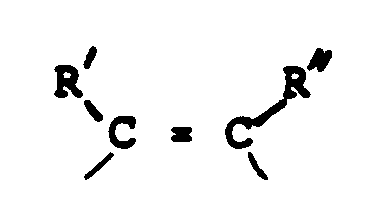
- The chelated ligand comprises a substantially unreactive connecting backbone structure which links two different dative centers or a donor with an anionic site. In one preferred embodiment, the connecting backbone structure comprises a saturated hydrocarbon entity (CH₂)n, wherein n = 1 - 5, or a branched alkyl such as (CH₃)CH, connected between a phosphine or an arsine and a pentavalent phosphorous of an iminatophosphorane. Alternatively, the connecting backbone structure comprises an unsaturated entity such as a benzene ring connected in the o-positions to the phosphine or arsine and the phosphorus of the iminatophosphorane. In another alternative, the backbone is an olefin
connected across the olefin bond to the phosphine or arsine and the phosphorus of the iminatophosphorane. - Preferably the transition metal catalyst precursor is of the general formulae I, II or III as defined in the accompanying claims.
- Most preferably, the transition metal M in the catalyst precursor is Rh, Co or Ni and preferably the substituents R₁₋₄ and R₆₋₁₂ are substituted or unsubstituted aryl groups. Preferred catalyst precursors of the formula I are those in which X is P, R is the substituent wherein A, B, C and D are selected from F and NO₂ and Q is (CH₂)n, a benzene ring, the olefin R'C = CR'' (R',R'' = H,CH₃, or other alkyl), or (CH₃)CH. Preferred catalyst precursors of the formula II are those in which R₅ is phenyl or methyl and S* is S, Se or NR where R is as defined above. Preferred catalyst precursors of the formula III are those in which R₁₀₋₁₂ are selected from hydrogen, phenyl or substituted phenyl groups.
- The combination of the specific elements in the catalyst precursor results in an efficacious catalyst system which has been found to be active under mild conditions for catalysis of the carbonylation of methanol to acetic acid and its derivatives.
- Without being bound by the following, it is believed that the heterodifunctional character of the bidentate phosphorus-nitrogen ligand provides a complex in which the unequal binding of the phosphorus and the nitrogen to the metal results in the preferential dissociation of the more weakly bound coordinating atom, so as to provide a reactive site at the metal. The unreactive backbone of the ligand keeps the dissociated element readily available for recombination, so as to facilitate the cyclical nature of the catalytic process. Thus in the case of the Rh(I) complex, catalytic carbonylation of methanol to acetic acid and/or its derivatives proceeds under mild conditions of temperature and pressure because the facile dissociation of nitrogen appears to allow coordination of molecular CO to the rhodium centre to form the reactive species.
- In the specific case of Rh(I) catalysis, it is believed that the Rh(I) centre is oxidatively converted to a Rh(III) complex and that the adduct provides the vehicle for catalytic transformation. Dissociation of the nitrogen substituent and coordination of free CO in this case forms a complex which appears to subsequently undergo internal rearrangement to an acyl substituted Rh complex. Upon removal of the acyl substituent, the uncoordinated nitrogen, which is held to the metal compound by the coordinated phosphorus and the backbone structure of the ligand molecule, is in a suitable position to coordinate to the Rh centre and stabilize the catalytic unit so that the cycle may be continued.
- In a second broad aspect of the invention it has been discovered that the above-described catalyst precursors are active as catalysts in the known carbonylation reaction to methanol. Surprisingly, the carbonylation reaction catalyzed with the catalyst precursors of this invention takes place under very much milder conditions than had heretofore been reported. Conditions comprising temperatures of 25 - 200°C, and pressures of 1 to 5000 p.s.i.g. are operative. More specifically, the reaction may be conducted at a temperature as low as about 50 - 120 °C, preferably about 80°C and a pressure of about 40 - 400 p.s.i.g., preferably about 40 p.s.i.g.
- Without being bound by same it is believed that, in respect of catalyst precursors of the formula I, the choice of an activated R-substituent bound to nitrogen, particularly a fluoroaromatic compound, allows one to 'fine tune' the catalyst so as to selectively control the carbonylation reaction.
- In another aspect of the invention, it has been discovered that the carbonylation of methanol with carbon monoxide can further be promoted using a reagent that enhances the oxidative addition of methyl iodide to the metal center, thereby accelerating the reaction. Examples of such promotors are lithium acetate, sodium tetraphenyl borate, Ph₄AsCl, LiCl, LiI, KPF₆, Et₃N, pyridine, quinoline, morpholine, the Bezman salt

and similar compounds. - Broadly stated then, in a catalyst aspect, the invention comprises a transition metal catalyst precursor of the general formulae I, II and III, having a phosphorus-nitrogen chelated ligand attached to the metal.
- Broadly stated, in a process aspect the invention is an improvement in a catalytic process for carbonylation of methanol to acetic acid and/or its derivatives. The improvement comprises reacting the methanol and carbon monoxide using a transition metal catalyst precursor having a phosphorus-nitrogen chelated ligand attached to the metal as a catalyst.
- In accordance with the best mode of the present invention, a process is provided which uses a novel rhodium complex catalyst precursor for the carbonylation reaction of methanol to form acetic acid and its derivatives such as methylacetate. However Ni, Co and Ir have also been shown to work. Thus the transition metal M in the catalyst precursor is preferably selected from the Group VIII B transition metals Fe, Co, Ni, Ru, Rh, Pd, Os, Ir and Pt. In using the catalyst precursor it is possible to conduct the carbonylation reaction under particularly mild and hence more energy efficient conditions.
- The reaction conditions for carrying out the carbonylation process of this invention can be those heretofore conventionally used and may comprise a reaction temperature from about 25°C to 200°C and pressure from about 1 to 5000 p.s.i.g. However the preferred carbonylation process will be that which is most efficient in producing methyl acetate and/or acetic acid from CH₃OH. The optimization of the reaction conditions needed to achieve the best conversion, efficiency and catalyst life will be within the knowledge of one skilled in the art and easily assessed by following the preferred embodiments of this invention as described in detail below or in the experimental section.
- As stated, the reaction temperature may range between 25°C and 200°C. The preferred temperature is in the range between 50°C to 120°C. The CO pressure will range from 1 p.s.i.g. to 5,000 p.s.i.g. The preferred pressure is between 40 to 400 p.s.i.g. The reaction time will range from 30 minutes to several hours.
- Exemplary ligands employable are those having the general formulae:


and the like. - The phenyl groups in the above compounds are generally illustrative of substituted or unsubstituted aryl groups which may be used as the R₁₋₄ and R₆₋₁₂ substituents in the catalyst precursors.
- The substituents Y,Y' in the catalyst precursor depend on the form in which the transition metal is included in the catalyst precursor synthesis or on the form in which the transition metal is added in the carbonylation reaction. Typically, Y and Y' will be co-ordinating neutral molecules such as CO, phosphine or olefins such as cyclooctadiene, or bound anions such as halides (Cl⁻ being the preferred halide) and acetate.
- In the conversion reaction it is to be noted that an excess of ligand is used. It is possible that the excess ligand can be the heterodifunctional ligand or a suitable phosphine, such as triphenylphosphine. It has been observed that the use of excess heterodifunctional ligand provides better turnover numbers compared to when a phosphine is used as the excess ligand, proving the superiority of the difunctional ligands.
- To effect the conversion of methanol to acetic acid, methyl acetate etc., the catalytic precursor can be added to the system either in the form of a metal complex prepared by the procedures described in detail in the experimental section or can be added as the transition metal precursor and the ligand, thus preparing the complex in-situ. The Rh metal can be added in any of several forms including [Rh(CO)₂Cl]₂, [Rh(Cod)Cl]₂ (Cod is 1,5-cyclopentadiene), and the Co and Ni in the form of acetates or as other suitable salts.
- Most of the reactions have been carried out using methanol itself as the solvent. However other solvents like methyl acetate, which is the product from the carbonylation of methanol, acetophenone or similar solvents can be employed for carrying out the reaction.
- Under the reaction conditions employed, lower concentrations of the catalyst provide higher turnover-numbers. However adjustment of the reaction conditions should yield higher turnover numbers and good reaction rates at higher concentrations of the catalyst. The concentration may range from 25 to 2,000 ppm transition metal and more preferably from about 50 to 1,000 ppm calculated as free metal.
- The following examples ate illustrative of the present invention.
- All experimental manipulations were performed under an atmosphere of dry argon. Solvents were dried and distilled prior to use. Bis(diphenylphosphino)methane (dppm), 1-diphenylphosphino-2-diphenylarsinoethane (ARPHOS), and Me₃SiN₃ were commercial materials obtained from Aldrich. Compound Ia was prepared as previously described in Inorg. Chem. 1989, 28, 413 by Katti, K. V. and Cavell, R.G., as set forth in Example 1.
- ¹H, ¹⁹F, ³¹P, and ²⁹Si NMR spectra were obtained on a Bruker WH 400 instrument (operating at 400.13, 376.40, 161.97, and 79.50 MHz, respectively) using SiMe₄, CFCl₃, 85% H₃PO₄, and SiMe₄, respectively, as the external standards. An INEPT sequence was employed to enhance signals in the ²⁹Si NMR spectra. In all the spectroscopic studies CDCl₃ was used as both the solvent and the internal lock. Positive shifts lie downfield of the standard in all cases. Solution molecular weight measurements were performed in dibromomethane solution with a Mechrolab 301A vapor phase osmometer.
- A slurry of Ph₂P - CH₂ - PPh₂ (5.12 g, 13.33 mmol) in Me₃SiN₃ (1.55 g, 13.4 mmol) placed in a round-bottom flask was heated with stirring in an oil bath maintained at 130°C. At the end of 6 hours the clear melt was cooled to 0°C to give Me₃SiN = PPh₂(CH₂)PPh₂ as a microcrystalline solid (yield 6.10 g, 97% m.p. 85°C). Anal. calculated for C₂₈ H₃₁ N P₂ Si: C, 71.33; H, 6.58; N, 2.97. Found C, 71.16; H 6.56, N 2.81 ³¹P NMR δp III - 28.20 (d,²Jpp = 57.7Hz),
δp V = -1.38 (d, ²Jpp = 57.7Hz) ppm (85% H₃PO₄) ²⁹Si NMR (CDCl₃): δ - 12.78 ppm (d, 1, SiMe₃ ²JSiP = 21.80 Hz) MS (EI m/z):471 (M⁺, 100%). Solution mol wt.: calcd, 471; found 478. - A mixture of Ph₂PN(Ph)PPh₂ (5.0 g, 10.8 mmol) and elemental sulfur (0.35 g, 10.8 mmol) in n-hexane (50ml) was heated under reflux for 8 hours then cooled to 25°C. The analytically pure microcrystalline precipitate of Ph₂PN(Ph)P(S)Ph₂ was separated by filtration and dried under vacuo. The yield is quantative mp: 142-144°C, ³¹P{'H} NMR (CDCl₃) : δP III 54.5 ppm δP V 72.4 ppm (85% H₃PO₄) ²Jpp=104.6 Hz. MS (EI m/z) = 493 (M⁺). Analysis calculated for C₃₀H₂₅NP₂S : C,73.02, H. 5.07, N. 2.84. Found: C, 72.94; H. 5.14; N. 2.78.
- A mixture of Ph₂PN(Ph)PPh₂ (2.5 g, 5.4 mmol) and selenium powder (0.43g, 5.4 mmol) in a mixture of n-hexane (30ml) and toluene (10ml) was heated under reflux for 8 hours then cooled to 25°C and filtered. The clear solution was cooled to 0°C to give white crystalline analytically pure Ph₂PN(Ph)P(Se)Ph₂ in 86% yield; mp : 135-137°C. ³¹P {¹H} CDCl₃: δP III 55.1 ppm; δP V 72.1 ppm (85% H₃PO₄); ²Jpp = 110.3 Hz, ¹JPSe = 766.5Hz. MS (EI m/z) = 540(M⁺). Analysis calculated for C₃₀H₂₅NP₂Se: C, 66.66; H, 4.63; N. 2.59: Found: C, 66.50; H, 4.70; N, 2.59.
- A solution of N₃C₆F₄CN (1.17 g, 5.4mmol) in dry CH₂Cl₂ (15 ml) was added dropwise to a solution of Ph₂PN(Ph)PPh₂ (2.5 g, 5.4 mmol) also in CH₂Cl₂ (25 ml) at -78°C with stirring. The reaction mixture which turns yellow during the course of the addition was warmed to 25°C after the completion of the addition and stirred for 8 hours. The clear yellow solution was filtered and the solvent was removed under vacuum to give microcrystalline Ph₂PN(Ph)P(NC₆F₄CN)Ph₂ in 85% yield, m.p. : 88 - 89 °C, 1R (CH₂Cl₂) : (C=N) = 2228 cm⁻¹. ³¹p {¹H} CDCl₃ : δ P III 56.5 ppm δP V 22.5 ppm (85% H₃PO₄). ²Jpp = 89.0 Hz, ⁴JP V F = 3.5Hz, JP III F = 10Hz, MS (EI m/z = 649 (M⁺)). Analysis calculated for C₃₇H₂₅N₃F₄P₂ : C, 68.41: H, 3.85; N, 6.47, Found: C, 67.40; H, 3.83; N, 6.52.
- In a 500 ml 24/40 round bottom flask was placed N-trimethylsilylbenzalimine (8.82 g, 49.8 mmol) and toluene (150 ml). The reaction flask was cooled to 0°C and chlorodiphenylphosphine (10.99g, 49.84 mmol) in toluene (50 ml) was added dropwise. The reaction mixture was allowed to sit overnight. Removal of the solvent in vacuo (caution: this compound is thermally unstable in solution, avoid exposure to unnecessary heat for higher yield) produces a yellow sticky solid (13.8g, 47.7mmol) which can be carefully recrystallized from acetonitrile. mp=70-73°C, Analysis: C₁₉H₁₆NP Calculated; C=78.88%, H=5.57%, N=4.84%. Found; C=77.53%, H=5.67%, N=4.61%, ¹H NMR (d,CDCl₃,TMS); 8.27ppm,d,1H, ³JHP=22Hz; 7.8 - 7.4ppm, m 15H. ³¹P NMR (d,CDCl₃): 49.4 ppm,s (H₃PO₄).
- To a solution of (Ia) (5.123 g, 10.80 mmol) in dry toluene (100 mL) was injected pentafluorobenzonitrile (3.126 g, 16.20 m moles) by using a syringe. The reaction mixture was refluxed for 12 h before the solvent was removed in vacuo to leave a pale yellow solid. The crude product (Ib) was crystallized from acetonitrile to obtain a pure compound (yield 5.59 g, 89%; pale yellow needle-shaped crystals; mp 188°C). Analysis calculated for C₃₂H₂₂F₄N₂P₂: C, 67.10; H, 3.84; N, 4.89. Found: C, 67.13; H, 3.81; N, 4.87. MS (EI, m/z): 572 (M⁺). ¹H NMR (CDCl₃): δ 7.27, 7.60, 7.85 (m, 20 H)(TMS); PCH₂P methylene δ 3.15 (dd, 2 H, ²JP V H = 12.50, ²JP III H = δ 1.15 Hz)(TMS). ¹⁹F NMR (CDCl₃): AA'BB' spin system δ -99.85 ppm vs CFCl₃ (m, 2 F), -159.25 ppm vs CFCl₃ (m, 2 F).
- To a solution of Me₃SiN=PPh₂CH₂PPh₂ (Ia) (4.532 g, 9.62 mmol) in dry toluene (100 mL) was injected pentafluoropyridine (2.439 g, 14.40 mmol) by using a syringe. The reaction mixture was refluxed for 20 h before the solvent was removed in vacuo to leave a transparent orange crystalline solid. This crude product was crystallized from acetonitrile to obtain pure compound (If) (yield 4.95 g, 94%; orange cubic crystals; mp 60°C). Analysis calculated for C₃₀H₂₂F₄N₂P₂: C, 65.69; H, 4.01; N, 5.10. Found: C, 65.66; H, 4.10; N, 5.08. MS (EI, m/z): 548 (M⁺). ¹H NMR (CDCl₃): δ 7.25, 7.62, 7.87 (m, 20 H); PCH₂P methylene δ 3.17 (dd, 2 H, ²JP V H = 12.65, ²JP III H = 1.15 Hz)(TMS). ¹⁹FNMR (CDCl₃): AA'BB' spin system δ -141.43ppm (m, 2 F), -155.07ppm (m, 2 F)(CFCl₃).
-

- A solution of p-NC-C₆F₄N=PPh₂CH₂PPh₂ (Ib) (0.145 g, 0.25 mmol) in dry dichloromethane (25 mL) was added dropwise at 25°C to a solution of [Rh(CO)₂Cl]₂ (0.049 g, 0.12 mmol) also in the same solvent (25 mL). The mixture was stirred at the same temperature for 4 h before the solvent was removed in vacuo to yield an analytically pure brown crystalline solid product as a dichloromethane solvate (yield, after washing with hexane (5 mL), 0 18 g, 90%; brown microcrystalline; mp 215°C dec). Analysis calculated for C₃₄H₂₄Cl₃F₄N₂OP₂Rh C, 49.55; H, 2.91; N, 3.40; Cl, 12.91. Found: C, 49.53; H, 2.89; N, 3.38; Cl, 12.90. ¹H NMR (CDCl₃): phenyl rings δ 7.27, 7.65, 7.90 (m, 20 H); PCH₂P methylene δ 3.78 (dd, 2 H, ²JHP = 12.0, 8.20 Hz)TMS. ¹⁹F NMR (CDCl₃): AA'BB' spin system δ -137.27ppm (m, 2 F), -142.56ppm (m, 2 F) (CFCl₃).
-

- The reaction of NC₅H₄-N=PPh₂CH₂PPh₂ (If) with [Rh(CO)₂Cl]₂ was carried out under similar experimental conditions to those described in example 8 to obtain the dichloromethane solvate of the Rh complex in 88% yield (yellow microcrystalline; mp 180°C dec). Analysis calculated for C₃₂H₂₄Cl₃F₄N₂OP₂Rh: C, 48.04; H, 1.25; N, 3.50. Found: C, 48.11; H, 1.21; N, 3.47. ¹H NMR (CDCl₃): phenyl rings δ 7.26, 7.60, 7.88 (m, 20 H); PCH₂P methylene δ 3.75 (dd, 2 H, ²JHP = 12.10, 7.50 Hz)(TMS). ¹⁹F NMR (CDCl₃): AA'BB' spin system δ -138.15ppm (m, 2 F), -147.50ppm (m, 2 F)(CFCl₃).
- A solution of Me₃SiN₃ (2.25 g, 19.64 mmol) in toluene (25 mL) was added dropwise at room temperature to a solution of Ph₂P(CH₂)₂AsPh₂ (ARPHOS) (7.55 g, 17.08 mmol) also in toluene (100 mL). The mixture was heated under reflux for 16 h before the solvent was removed in vacuo to yield an off-white crystalline solid which was recrystallized from dry acetonitrile to obtain pure compound (Io) (yield 8.75 g, 96%; mp 131°C). Analysis calculated for C₂₉H₃₃NAsPSi: C, 65.79; H, 6.23; N, 2.64. Found: C, 65.76; H, 6.19; N, 2.63. MS(EI, m/z): 5.28 (M⁺). ³¹P NMR (161.93 MHz in CDCl₃, vs 85% H₃PO₄): δ 1.83 ppm. ²⁹Si NMR (INEPT; 79.5 MHz in CDCl₃, vs Me₄Si): δ-11.33 (d, ²J(²⁹Si-³¹P) = 19.57 Hz).
-
- (a).

- (b). The Metallacycles


- [Rh(CO)₂Cl]₂ (0.031 g, 0.079 m moles) was dissolved in methanol (5 ml) in a 50 ml pop bottle reactor maintained under an argon atmosphere. To the stirred solution the difunctional ligand Ph₂P-(CH₂)₂-Ph₂P=N-SiMe₃ (Ic) (0.0812g, 0.140 mmol) was added. The mixture was stirred for 10 minutes. Then Ph₃P (0.214g, 0.82 mmol) was added followed by lithium acetate (0.412g, 4.0 m moles), CH₃I (1 ml, 15 mmol) and finally methanol (5 ml). Then the tube was flushed with carbon monoxide and sealed. The reactor was then placed in an oil bath maintained at 80-85°C and pressurized with CO to 40 p.s.i.g. The reaction was followed by taking samples at determined intervals of time by momentarily stopping the reaction and removing a sample with a syringe.
- In Table I data is presented for the run along with the data for a similar run with no Ph₃P added. The rates were determined by measuring the amount of methyl acetate formed during the run as determined using gas chromatograph.
TABLE I Ex. No. Rh/Ligand/Ph₃P Ratio Reaction Rate 12 1:2:10 2.0 g mol/1/hr. 13 1:10:0 2.5 g mol/1/hr. - When the difunctional ligand is used as the excess ligand the reaction rate is higher, even though the total Rh:Ligand ratio is lower.
- [Rh(CO)₂Cl]₂ (0.0124g, 0.032 mmol) was dissolved in methanol (5ml) in a 50 ml pop bottle reactor maintained under an argon atmosphere. To the stirred solution the difunctional ligand

(0.134g, 0.234 mmol) was added. The mixture was stirred for 10 minutes. Then lithium acetate (0.244g, 2.4 mmol), CH₃I (1 ml, 16 mmol) and finally methanol (5 ml) were added. Then the tube was flushed with carbon monoxide and sealed. The reactor was then placed in an oil bath maintained at 85-90°C and pressurized with CO to 40 p.s.i.g. The reaction was followed by taking samples at determined intervals of time by momentarily stopping the reaction and removing a sample with a syringe. - In Table II data is presented for the run.
TABLE II Ex. No. Rh/Ligand Molar Ratio Reaction Rate 14 1:7 1.2 g moles/1/hr. - [RhCl(CO)₂]₂ (0.0131g, 0.033 mmol) was dissolved in methyl acetate (5 ml) in a 50 ml pop bottle reactor maintained under an argon atmosphere. To the stirred solution of the difunctional ligand

(0.135g, 0.236 mmol) was added. The mixture was stirred for 10 minutes. Then lithium acetate (0.218g, 2.1 mmol), CH₃I (1 ml, 16 mmol) and methanol (5 ml) were added. The tube was flushed with carbon monoxide and sealed. The reactor was then placed in an oil bath maintained at 85-90°C and pressurized with CO to 40 p.s.i.g. The reaction was followed by taking samples at determined intervals of time by momentarily stopping the reaction and removing a sample with a syringe. - Data for the run is presented in Table III:
TABLE III Ex. No. Rh/Ligand molar ratio Reaction Rate 15 1:7 0.6 g mol/1/hr. - Comparing the rate to example number 14, changing solvent to methyl acetate seems to lower the reaction rate under the experimental conditions employed.
- A series of runs were carried out using [Rh(CO)₂Cl]₂ as the metal source, Ph₂P-(CH₂)₂-PPh₂=N-SiMe₃ (Ic) as the ligand and Ph₃P as the excess ligand, employing conditions as described in examples 12 and 13.
- The results obtained are presented in Table IV:
TABLE IV Turnover Number* As a Function of the Moles Of Rhodium Compound Rhodium Compound** Turnover Number 0.026 x 10⁻³ mol 730 0.097 x 10⁻³ mol 223 0.145 x 10⁻³ mol 200 0.168 x 10⁻³ mol 125 0.195 x 10⁻³ mol 95 * measured for the reaction of methanol with carbon monoxide in the presence of [Rh(CO)₂Cl]₂(x mmol) + Ph₂-CH₂-CH₂-PPh₂=NSiMe₃(2 x mmol) + Ph₃P (0.77 mmol) + Lithium acetate (4 m moles) ** as monomeric species in solution - The data indicate that for lower concentration of the catalyst, the turnover numbers are higher under the experimental conditions employed.
- Cobalt acetate tetrahydrate (0.144g, 0.6 mmol) was added to methanol (5 ml) in a 50 ml pop bottle reactor maintained under an argon atmosphere. To the stirred solution the difunctional ligand Me₃Si-N=PPh₂-CH₂-CH₂-PPh₂=N-SiMe₃ (0.418g, 0.73 mmol) was added. The mixture was stirred for 10 minutes: Then Ph₃P (0.203g, 0.78 m mole) lithium acetate (0.424g, 4.2 mmol), CH₃I (1 ml, 16 mmol) and methanol (5 ml) were added. The tube was flushed with carbon monoxide and sealed. The reactor was then placed in an oil bath maintained at 85 - 90°C and pressurized with CO to 40 p.s.i.g. At the end of 20 hours the reaction mixture contained 5% of CH₃COOCH₃, indicating a lower catalytic activity by the cobalt complex, compared to the Rh complex.
- Nickel acetate tetrahydrate (0.145g, 0.6 mmol) was added to methanol (5 ml) in a 50 ml pop bottle reactor maintained under an argon atmosphere. To the stirred solution the difunctional ligand Me₃Si-N=PPh₂-CH₂-CH₂-PPh₂=N-SiMe₃ (0.453g, 0.79 mmol) was added. The mixture was stirred for 10 minutes. Then Ph₃P (0.198g, 0.76 mmol), lithium acetate (0.467g), CH₃I (1 ml, 16 mmol) and methanol (5 ml) were added. The tube was flushed with carbon monoxide and sealed. The reactor was then placed in an oil bath maintained at 84 - 90°C and pressurized with CO to 40 p.s.i.g. At the end of 20 hours the reaction mixture contained 5.9% of CH₃COOCH₃, indicating a lower catalytic activity by the nickel complex compared to the Rh complex.
- [Rh(CO)₂Cl]₂ (0.030g, 0.08 mmol) was added to methanol (5 ml) in a 50 ml pop bottle reactor maintained under an argon atmosphere. To the stirred solution of the difunctional ligand
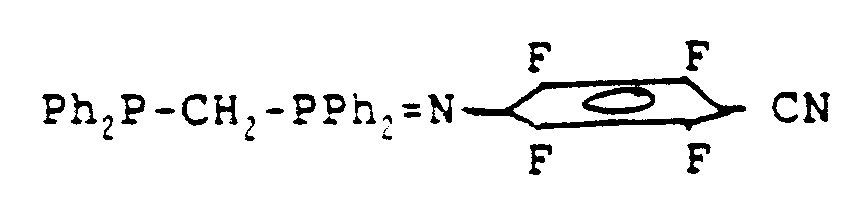
(Ib)(0.253g, 0.44 mmol) was added. The mixture was stirred for 10 minutes. Then the promotor
(1.025g, 2.3 mmol), CH₃I (1 ml, 16 mmol) and methanol (5 ml) were added. The tube was flushed with carbon monoxide and sealed. The reactor was then placed in an oil bath maintained at 84 - 90°C and pressurized to 40 p.s.i.g. with CO. The reaction race was measured by monitoring the concentration of the methyl acetate formed during the run. The initial rate of formation of methyl acetate was found to be 0.9 g mol/1/hr. - [Rh(CO)₂Cl]₂ (0.018g, 0.046 mmol) was added to methanol (5 ml) in a 50 ml pop bottle reactor maintained under an argon atmosphere. To the stirred solution Me₃SiN = PPh₂(CH₂)₅PPh₂ (Il) (0.062g, 0.121 mmol) was added. The mixture was stirred for 10 minutes. Then Ph₃P (0.200g, 0.76mmol), LiOAc (0.206g, 2mmol) and CH₃I (1 ml, 16mmol) and CH₃OH (5 ml) were added. The reator was then flushed with CO and sealed. The reactor was then placed in an oil bath maintained at 90°C and pressurized with CO to 40 p.s.i.g.. After 45 hours the reaction mixture contained 30.9 molar % of CH₃COOCH₃.
- [Rh(CO)₂Cl]₂ (0.013g, 0.033 mmol) was added to methanol (5 ml) in a 50 ml pop bottle reactor maintained under an argon atmosphere. To the stirred solution Me₃SiN = PPh₂ (CH₂)₃ - PPh₂ (Ig) (0.041g, 0.083 mmol) was added. The mixture was stirred for 10 minutes. Then Ph₃P(0.200g, 0.26 mmol), LiOAc (0.206g, 2 mmol), CH₃I (1 ml, 16 mmol), and CH₃OH (5 ml) were added. The tube was then flushed with CO and sealed. The reactor was then placed in an oil bath maintained at 90°C and pressurized with CO to 40 p.s.i.g.. After 52 hours 13 mole % of the reactor mixture was CH₃COOCH₃.
- [Rh (CO)₂Cl]₂ (0.019g, 0.049 mmol) was added to methanol (5 ml) in a 50 ml pop bottle reactor maintained under an argon atmosphere. To the stirred solution Ph₂P(S)-N(Ph)-PPh₂ (IIa) (0.124g, 0.251 mmol) was added. The mixture was stirred for 10 minutes. Then LiOAc (0.240g, 2.6mmol) CH₃I (1 ml, 16mmol) and CH₃OH (5 ml) were added. The reactor was then flushed with CO and sealed The reactor was then placed in an oil bath maintained at 85°C. Then it was pressurized with CO to 40 p.s.i.g. After 24 hours 89.2% of CH₃OH was converted into CH₃COOH and CH₃COOCH₃
- [Rh(CO)₂Cl]₂ (0.016g, 0.04 mmol) were added to methanol (5 ml) in a 50 ml pop bottle reactor maintained under an argon atmosphere. To the stirred solution Ph₂P - N = C(H)Ph (IIIa) (0.124g) was added. The mixture was stirred for 10 minutes. Then pyridine (0.5ml), CH₃I (1 ml, 16 mmol) and CH₃OH (5 ml) were added. The reactor was then placed in an oil bath maintained at 80-85°C. Then it was pressurized with CO to 40 p.s.i.g. After 45 hours, 84% of methanol was converted into methylactetate and acetic acid.
- (Ph₃P)₃RhCl (0.047g, 0.05 mmol) was added to methanol (5 ml) in a 50 ml pop bottle reactor maintained under an argon atmosphere. To the stirred solution Ph₂P-N = C(H)Ph (0.208g, 0.72 mmol) was added. The mixture was stirred for 10 minutes. Then LiOAc (0.208g, 2.0 mmol), CH₃I (1 ml, 16 mmol) and CH₃OH were added. The reactor was then flushed with CO and sealed. The reactor was then placed in an oil bath maintained at 85°C and pressurized with CO to 40 p.s.i.g. After 44.5 hours 37.5 mole % of CH₃OH was converted into CH₃COOCH₃ and CH₃OCH₃.
- [Rh(CO)₂Cl]₂ (0.032g, 0.08 mmol) was added to methanol (5 ml) in a 50 ml pop bottle reactor maintained under an argon atmosphere. To the stirred solution

(0.320g, 0.46 mmol) was added. The mixture was stirred for 10 minutes. Then LiOAc (0.432g, 4.2 mmol), CH₃I (1 ml, 16 mmol) and CH₃OH (5 ml) were added. The reactor was then flushed with CO and sealed. The reactor was then placed in an oil bath maintained at 90°C and pressurized with CO to 40 p.s.i.g. After 41 hours 27.6 mole % of CH₃OH was converted into CH₃ COOCH₃. - [Rh(CO)₂Cl]₂ (0.017g, 0.04 mmol) was added to methanol (5 ml) in a 50 ml pop bottle reactor maintained under an argon atmosphere. To the stirred solution Ph₂P - N = C(H)Ph (0.237g, 0.82 mmol) was added. The mixture was stirred for 10 minutes. Then morpholine (0.5 ml, 5.7 mmol), CH₃I (1 ml, 16 mmol) and CH₃OH (5 ml) were added. The reactor was then flushed with CO and sealed. The reactor was then placed in an oil bath maintained at 85°C and pressurized with CO to 40 p.s.i.g. After 55 hours 96 mole % of methanol was converted into CH₃COOCH₃ (56%) CH₃COOH (41%) and CH₃-O-CH₃ (3%).
- [Rh(COD)Cl]₂ (0.024g, 0.049 mmol) was added to methanol (5 ml) in a 50 ml pop bottle reactor maintained under an argon atmosphere. To the stirred solution PPh₂ - N(Ph) - P(S)Ph₂ (0.116g, 0.251 mmol) was added. Then the mixture was stirred for 10 minutes. Then LiOAc (0.249g, 2.4 mmol), CH₃I (1 ml, 16 mmol) and CH₃OH (5 ml) were added. The reactor was then flushed with CO and sealed. The reactor was then placed in an oil bath maintained at 90°C and pressurized with CO to 40 p.s.i.g. After 24 hours 89 mole % of the CH₃OH was converted into CH₃COOCH₃ (74%), CH₃COOH (23%) and CH₃OCH₃ (3%)
Claims (13)
- A catalytic process for the carbonylation of methanol to one or more of acetic acid and its esters, comprising:
reacting methanol and carbon monoxide using a transition metal catalyst precursor having a phosphorus-nitrogen chelated ligand attached to the metal as a catalyst, the catalyst precursor having the general formula: M is a Group VIII B transition metal, preferably Rh, Co or Ni,Y,Y' are same or different, selected from CO, Cl⁻, phosphines and olefinic hydrocarbonsR₁₋₄, R₆₋₁₂ are same or different non-reactive substituents, preferably substituted or unsubstituted aryl groups,Q is selected from a benzene ring connected to P and X
in the o-positions, an olefin connected to P and X across the double bond, (CH₃)CH and (CH₂)n where n = 1-5X is P or AsR = a substituted aromatic ring R₅ is aryl or alkyl, andS* is S, Se, O or N-R. R being as defined hereinabove;with the proviso that in Formula I, Q is not (CH₂)n where n = 1 when R = SiMe₃ and with the proviso that in Formula I, Q is not (CH₂)n, where n = 2 when R = SiMe₃ and X = As.
and wherein optionally the carbonylation is conducted at a temperature between about 25-200°C and at a pressure of about 40 - 50,000 p.s.i.g. (0.28 - 345 MN/m²), most preferably at a temperature between about 50 and 120° and at a pressure between about 40 and 400 p.s.i.g. (0.28 - 2.8 MN/m²). - The process of claim 1, wherein M is selected from Rh, Co and Ni and wherein R₁₋₄ and R₆₋₁₂ are substituted or unsubstituted aryl groups.
- The process of claim 1, wherein the catalyst precursor has the formula I wherein M is selected from Rh, Co and Ni. R₁₋₄ are phenyl groups and R is a substituted aromatic ring.

- The process of claim 1 or claim 2, and(a) wherein the catalyst has the formula I in which X is P; R is the substituted aromatic ring wherein A, B, C and D are selected from F and NO₂; and, if Q is an olefin, it has the formula R'C = CR'' (R',R'' = H, CH₃, or other alkyl), or(b) wherein the catalyst precursor has the formula II, wherein R₅ is phenyl or methyl and S* is S, Se or N-R and R is as defined in claim 1, or(c) wherein the catalyst precursor has the formula III, wherein R₁₀₋₁₂ are phenyl.
- The process of any one of claims 1 to 4, wherein a promoter is used selected from lithium acetate, sodium tetraphenyl borate, Ph₄AsCl, LiCl, LiI, KPF₆, Et₃N, pyridine, quinoline, morpholine and a Bezman salt of the formula

- The process of any one of claims 1 to 5, wherein the catalyst precursor is of the formula II or III.
- A transition metal complex catalyst precursor having a phosphorous - nitrogen chelated ligand attached to the metal and having the general formula
 M is a Group VIII B transition metal, preferably Rh, Co or NiY,Y' are same or different, selected from CO, Cl⁻, phosphines and olefinic hydrocarbonsR₁₋₄, R₆₋₁₂ are same or different non-reactive substituents, preferably substituted or unsubstituted aryl groups,Q is selected from a benzene ring connected to P and X in the o-positions, an olefin connected to P and X across the double bond, (CH₃)CH, and (CH₂)n where n = 1-5X is P or AsR = is a substituted aromatic ring,
 R₅ is aryl or alkyl, andS* is S, Se, O or N-R, where R is as defined hereinabove with the proviso that in formula I, Q is not (CH₂)n where n = 1 when R = SiMe₃, TiCl₂Cp, p(N≡C)C₆F₄, p- NC₅H₄ or p-NC₅F₄ and with the proviso that in Formula I, Q is not (CH₂)n where n = 2 when R = SiMe₃ and X = As.
 - A catalyst precursor of claim 7, wherein M is selected from Rh, Co and Ni, and wherein R₁₋₄ and R₆₋₁₂ are substituted or unsubstituted aryl groups.
- A catalyst precursor of claim 7 which has the formula I, wherein M is selected from Rh, Co and Ni, R₁₋₄ are phenyl groups and R is a substituted aromatic ring,

- A catalyst precursor of claim 7 or claim 8:(a) which is of the formula I and in which X is P; R is a substituted aromatic ring,
 (b) which is of the formula II, wherein R₅ is phenyl or methyl R₆₋₉ are phenyl and S* is S, Se or NR, where R is a substituted aromatic ring,
 (c) which is of the formula III, wherein R₁₀₋₁₂ are selected from hydrogen, phenyl or substituted phenyl.
 - A catalyst precursor as claimed in any one of claims 7 to 10, which is of the general formula II or III.
- A phosphorous-nitrogen chelating ligand having the general formula
 R₁₋₄, R₆₋₁₂ are same or different substituted or unsubstituted aryl groupsQ is selected from a benzene ring connected to P and X in the o-positions, an olefin connected to P and X across the double bond, (CH₃)CH, and (CH₂)n where n = 1-5X is P or AsR is a substitute aromatic ring,
 R₅ is aryl or alkyl, andS* is S, Se, O or N-R, R being as defined hereinabove,with the proviso that in formula I, Q is not (CH₂)n where n = 1 when R = SiMe₃, TiCl₂Cp, p-(N≡C)C₆F₄ , p-NC₅H₄ or p-NC₅F₄ and with the proviso that in formula I, Q is not (CH₂)n where n = 2 when R = SiMe₃ and X = As
which ligand preferably having the general formulae:


- A ligand as claimed in claim 12, which is of the general formula II a' - II c' or III a' - III c'.
Applications Claiming Priority (3)
| Application Number | Priority Date | Filing Date | Title |
|---|---|---|---|
| US57590390A | 1990-08-31 | 1990-08-31 | |
| PCT/CA1991/000309 WO1992004118A1 (en) | 1990-08-31 | 1991-08-30 | Carbonylation of methanol using a novel transition metal catalyst precursor |
| US575903 | 2004-06-01 |
Publications (2)
| Publication Number | Publication Date |
|---|---|
| EP0545997A1 EP0545997A1 (en) | 1993-06-16 |
| EP0545997B1 true EP0545997B1 (en) | 1995-11-02 |
Family
ID=24302163
Family Applications (1)
| Application Number | Title | Priority Date | Filing Date |
|---|---|---|---|
| EP91915178A Expired - Lifetime EP0545997B1 (en) | 1990-08-31 | 1991-08-30 | Carbonylation of methanol using a novel transition metal catalyst precursor |
Country Status (8)
| Country | Link |
|---|---|
| US (1) | US5352813A (en) |
| EP (1) | EP0545997B1 (en) |
| JP (1) | JPH06503808A (en) |
| AU (1) | AU8431391A (en) |
| CA (1) | CA2090402A1 (en) |
| DE (1) | DE69114297T2 (en) |
| MX (1) | MX9100909A (en) |
| WO (1) | WO1992004118A1 (en) |
Families Citing this family (12)
| Publication number | Priority date | Publication date | Assignee | Title |
|---|---|---|---|---|
| NO942248L (en) * | 1993-06-30 | 1995-01-02 | Bp Chem Int Ltd | Process for carbonylation of methanol or a reactive derivative thereof |
| WO1997037765A1 (en) * | 1996-04-04 | 1997-10-16 | Bp Chemicals Limited | Novel catalyst composition |
| JP2987121B2 (en) * | 1997-04-18 | 1999-12-06 | 京浜精密工業株式会社 | Power shifter control device |
| US6013745A (en) * | 1997-08-04 | 2000-01-11 | The Governors Of The University Of Alberta | Phosphorus based catalysts for the polymerization of olefins |
| US6235673B1 (en) * | 2000-04-05 | 2001-05-22 | Eastman Chemical Company | Carbonylation catalyst supported on a carbonized polysulfonated divinylbenzene-styrene copolymer |
| EP1575705A2 (en) | 2002-12-23 | 2005-09-21 | Eastman Chemical Company | Process for the recovery of phosphorus and iodine containing catalyst components |
| GB0311091D0 (en) * | 2003-05-14 | 2003-06-18 | Bp Chem Int Ltd | Process |
| GB0311092D0 (en) * | 2003-05-14 | 2003-06-18 | Bp Chem Int Ltd | Process |
| CN101921172B (en) * | 2010-08-27 | 2013-04-10 | 中国科学院上海有机化学研究所 | Preparation of vinylidene fluoride from 1,1,1-trifluoro-chloroethane by liquid phase method |
| TWI576434B (en) * | 2010-10-22 | 2017-04-01 | 藍瑟科技紐西蘭有限公司 | Method and system for producing alcohol and/or acid |
| US20150025280A1 (en) * | 2011-12-23 | 2015-01-22 | Dow Global Technologies Llc | Ligands for rhodium catalyzed reductive carbonylation of alcohols |
| CN111558395B (en) * | 2020-04-27 | 2023-09-08 | 江苏索普化工股份有限公司 | Bimetallic catalyst for methanol carbonylation reaction, and preparation method and application thereof |
Family Cites Families (19)
| Publication number | Priority date | Publication date | Assignee | Title |
|---|---|---|---|---|
| US3769329A (en) * | 1970-03-12 | 1973-10-30 | Monsanto Co | Production of carboxylic acids and esters |
| US3951857A (en) * | 1973-11-05 | 1976-04-20 | Texaco Inc. | Alkylation catalyst additive |
| US4593011A (en) * | 1981-08-17 | 1986-06-03 | Union Carbide Corporation | Hydroformylation process using triarylphosphine and bisphosphine monooxide ligands |
| US4491675A (en) * | 1981-08-17 | 1985-01-01 | Union Carbide Corporation | Hydroformylation process using triarylphosphine and bisphosphine monooxide ligands |
| US4400548A (en) * | 1981-08-17 | 1983-08-23 | Union Carbide Corporation | Hydroformylation process using bisphosphine monooxide ligands |
| US4522933A (en) * | 1981-08-17 | 1985-06-11 | Union Carbide Corporation | Hydroformylation catalyst containing bisphosphine monooxide ligands |
| US4429165A (en) * | 1982-06-24 | 1984-01-31 | Union Carbide Corporation | Hydroformylation process |
| EP0124160B1 (en) * | 1983-05-02 | 1986-09-17 | Shell Internationale Researchmaatschappij B.V. | A process for the preparation of carboxylic acids and/or esters |
| US4789753A (en) * | 1984-02-17 | 1988-12-06 | Union Carbide Corporation | Phosphite ligands |
| US4599206A (en) * | 1984-02-17 | 1986-07-08 | Union Carbide Corporation | Transition metal complex catalyzed reactions |
| CA1237728A (en) * | 1984-07-20 | 1988-06-07 | Anthony G. Abatjoglou | Production of carboxylic acids from alcohols using rhodium complex catalysts |
| DE3446303A1 (en) * | 1984-12-19 | 1986-06-19 | Degussa Ag, 6000 Frankfurt | METHOD FOR PRODUCING OPTICALLY ACTIVE 1-BENZYL-3,4-BIS (DIPHENYLPHOSPHINO) PYRROLIDINE |
| US4737588A (en) * | 1984-12-28 | 1988-04-12 | Union Carbide Corporation | Transition metal complex catalyzed reactions |
| US4668651A (en) * | 1985-09-05 | 1987-05-26 | Union Carbide Corporation | Transition metal complex catalyzed processes |
| US4748261A (en) * | 1985-09-05 | 1988-05-31 | Union Carbide Corporation | Bis-phosphite compounds |
| US4716250A (en) * | 1986-07-10 | 1987-12-29 | Union Carbide Corporation | Hydroformylation using low volatile/organic soluble phosphine ligands |
| US4731486A (en) * | 1986-11-18 | 1988-03-15 | Union Carbide Corporation | Hydroformylation using low volatile phosphine ligands |
| US4727200A (en) * | 1987-03-27 | 1988-02-23 | Union Carbide Corporation | Alcohol homologation |
| FR2629367B1 (en) * | 1988-03-30 | 1990-11-23 | Norsolor Sa | CATALYTIC SYSTEM, PREPARATION METHOD THEREOF, AND APPLICATION TO THE MANUFACTURE OF ALDEHYDES |
-
1991
- 1991-08-30 DE DE69114297T patent/DE69114297T2/en not_active Expired - Fee Related
- 1991-08-30 EP EP91915178A patent/EP0545997B1/en not_active Expired - Lifetime
- 1991-08-30 AU AU84313/91A patent/AU8431391A/en not_active Abandoned
- 1991-08-30 WO PCT/CA1991/000309 patent/WO1992004118A1/en not_active Ceased
- 1991-08-30 JP JP3514567A patent/JPH06503808A/en active Pending
- 1991-08-30 CA CA002090402A patent/CA2090402A1/en not_active Abandoned
- 1991-09-02 MX MX9100909A patent/MX9100909A/en not_active IP Right Cessation
- 1991-09-03 US US07/752,348 patent/US5352813A/en not_active Expired - Fee Related
Also Published As
| Publication number | Publication date |
|---|---|
| US5352813A (en) | 1994-10-04 |
| EP0545997A1 (en) | 1993-06-16 |
| JPH06503808A (en) | 1994-04-28 |
| DE69114297D1 (en) | 1995-12-07 |
| MX9100909A (en) | 1992-06-05 |
| AU8431391A (en) | 1992-03-30 |
| CA2090402A1 (en) | 1992-03-01 |
| WO1992004118A1 (en) | 1992-03-19 |
| DE69114297T2 (en) | 1996-05-15 |
Similar Documents
| Publication | Publication Date | Title |
|---|---|---|
| US4169861A (en) | Hydroformylation process | |
| US4201714A (en) | Stabilized catalyst complex of rhodium metal, bidentate ligand and monodentate ligand | |
| SU1678201A3 (en) | Method of preparation of @@@ aldehydes | |
| US4193943A (en) | Hydroformylation catalysts | |
| US4201728A (en) | Hydroformylation catalyst and process | |
| US5773661A (en) | Synthesis of and hydroformylation with fluoro-substituted bidentate phosphine ligands | |
| US4138420A (en) | Hydroformylation catalysts | |
| US5352813A (en) | Carbonylation of methanol using a novel transition metal catalyst | |
| US4469886A (en) | Selective hydrocarboxylation of propylene to isobutyric acid | |
| EP0030434B1 (en) | Methanol homologation using cobalt-ruthenium catalysts | |
| US5360939A (en) | Homogeneous bimetallic hydroformylation catalysts, and processes utilizing these catalysts for conducting hydroformylation reactions | |
| CN115819234B (en) | A method for olefin carbonylation reaction | |
| US4315867A (en) | Secondary and tertiary 2-carboxyethyl- and carboxymethylphosphines and the salts thereof, as well as their preparation and use | |
| EP0090443A2 (en) | A process for carbonylating methanol to acetic acid and/or methyl acetate | |
| US4328163A (en) | Process for the preparation of secondary and tertiary 2-carboxyethyl- and carboxymethylphosphines and their salts, as well as the use thereof | |
| RU2129539C1 (en) | Method of preparing methanol or reactive derivative thereof, catalyst system and rhodium complex for carrying out method into effect | |
| WO2004054946A1 (en) | Hydroformylation process for the conversion of an ethylenically unsaturated compound to an alcohol | |
| US5770684A (en) | Catalyst compositions | |
| US4124647A (en) | Process for the preparation of ethers | |
| CN113980052A (en) | Monophosphate ligand, preparation method thereof and application thereof in hydroformylation reaction | |
| CA2024284A1 (en) | Carbonylation of methanol using a novel transition metal catalyst precursor | |
| US4532325A (en) | Carbonylation process | |
| Milani et al. | Structural Aspects of Palladium Systems Used as Catalyst Precursors in CO/olefins co-and ter-Polymerisation Reactions | |
| EP0089697B1 (en) | Rhodium compounds and process for producing them | |
| CN1778468A (en) | Catalyst system and application of catalyzing the synthesis of acetic anhydride from methyl acetate or dimethyl ether |
Legal Events
| Date | Code | Title | Description |
|---|---|---|---|
| PUAI | Public reference made under article 153(3) epc to a published international application that has entered the european phase |
Free format text: ORIGINAL CODE: 0009012 |
|
| 17P | Request for examination filed |
Effective date: 19930311 |
|
| AK | Designated contracting states |
Kind code of ref document: A1 Designated state(s): DE FR GB IT NL |
|
| 17Q | First examination report despatched |
Effective date: 19931130 |
|
| RAP1 | Party data changed (applicant data changed or rights of an application transferred) |
Owner name: THE GOVERNORS OF THE UNIVERSITY OF ALBERTA |
|
| GRAA | (expected) grant |
Free format text: ORIGINAL CODE: 0009210 |
|
| AK | Designated contracting states |
Kind code of ref document: B1 Designated state(s): DE FR GB IT NL |
|
| REF | Corresponds to: |
Ref document number: 69114297 Country of ref document: DE Date of ref document: 19951207 |
|
| ITF | It: translation for a ep patent filed | ||
| ET | Fr: translation filed | ||
| PLBE | No opposition filed within time limit |
Free format text: ORIGINAL CODE: 0009261 |
|
| STAA | Information on the status of an ep patent application or granted ep patent |
Free format text: STATUS: NO OPPOSITION FILED WITHIN TIME LIMIT |
|
| 26N | No opposition filed | ||
| PGFP | Annual fee paid to national office [announced via postgrant information from national office to epo] |
Ref country code: GB Payment date: 19970828 Year of fee payment: 7 Ref country code: FR Payment date: 19970828 Year of fee payment: 7 |
|
| PGFP | Annual fee paid to national office [announced via postgrant information from national office to epo] |
Ref country code: NL Payment date: 19970829 Year of fee payment: 7 Ref country code: DE Payment date: 19970829 Year of fee payment: 7 |
|
| PG25 | Lapsed in a contracting state [announced via postgrant information from national office to epo] |
Ref country code: GB Free format text: LAPSE BECAUSE OF NON-PAYMENT OF DUE FEES Effective date: 19980830 |
|
| PG25 | Lapsed in a contracting state [announced via postgrant information from national office to epo] |
Ref country code: NL Free format text: LAPSE BECAUSE OF NON-PAYMENT OF DUE FEES Effective date: 19990301 |
|
| GBPC | Gb: european patent ceased through non-payment of renewal fee |
Effective date: 19980830 |
|
| PG25 | Lapsed in a contracting state [announced via postgrant information from national office to epo] |
Ref country code: FR Free format text: LAPSE BECAUSE OF NON-PAYMENT OF DUE FEES Effective date: 19990430 |
|
| NLV4 | Nl: lapsed or anulled due to non-payment of the annual fee |
Effective date: 19990301 |
|
| PG25 | Lapsed in a contracting state [announced via postgrant information from national office to epo] |
Ref country code: DE Free format text: LAPSE BECAUSE OF NON-PAYMENT OF DUE FEES Effective date: 19990601 |
|
| REG | Reference to a national code |
Ref country code: FR Ref legal event code: ST |
|
| PG25 | Lapsed in a contracting state [announced via postgrant information from national office to epo] |
Ref country code: IT Free format text: LAPSE BECAUSE OF NON-PAYMENT OF DUE FEES;WARNING: LAPSES OF ITALIAN PATENTS WITH EFFECTIVE DATE BEFORE 2007 MAY HAVE OCCURRED AT ANY TIME BEFORE 2007. THE CORRECT EFFECTIVE DATE MAY BE DIFFERENT FROM THE ONE RECORDED. Effective date: 20050830 |