EP0544361B1 - Collapsible caravan - Google Patents
Collapsible caravan Download PDFInfo
- Publication number
- EP0544361B1 EP0544361B1 EP19920203551 EP92203551A EP0544361B1 EP 0544361 B1 EP0544361 B1 EP 0544361B1 EP 19920203551 EP19920203551 EP 19920203551 EP 92203551 A EP92203551 A EP 92203551A EP 0544361 B1 EP0544361 B1 EP 0544361B1
- Authority
- EP
- European Patent Office
- Prior art keywords
- cloth
- profiles
- tubes
- caravan
- frame
- Prior art date
- Legal status (The legal status is an assumption and is not a legal conclusion. Google has not performed a legal analysis and makes no representation as to the accuracy of the status listed.)
- Expired - Lifetime
Links
Images


Classifications
-
- B—PERFORMING OPERATIONS; TRANSPORTING
- B60—VEHICLES IN GENERAL
- B60P—VEHICLES ADAPTED FOR LOAD TRANSPORTATION OR TO TRANSPORT, TO CARRY, OR TO COMPRISE SPECIAL LOADS OR OBJECTS
- B60P3/00—Vehicles adapted to transport, to carry or to comprise special loads or objects
- B60P3/32—Vehicles adapted to transport, to carry or to comprise special loads or objects comprising living accommodation for people, e.g. caravans, camping, or like vehicles
- B60P3/34—Vehicles adapted to transport, to carry or to comprise special loads or objects comprising living accommodation for people, e.g. caravans, camping, or like vehicles the living accommodation being expansible, collapsible or capable of rearrangement
- B60P3/341—Vehicles adapted to transport, to carry or to comprise special loads or objects comprising living accommodation for people, e.g. caravans, camping, or like vehicles the living accommodation being expansible, collapsible or capable of rearrangement comprising flexible elements
Definitions
- the invention relates to a caravan comprising a chassis provided with a drawbar and wheels and a body mounted on the chassis which body has a frame of tubes and/or profiles and a suitable cloth which is at least partly fastened to the frame in a detachable manner for forming closed body surfaces, the body in use being mounted on the chassis in a detachable manner.
- Such caravans are known in many different constructions, both as an ordinary, non-collapsible caravan, and as a folding caravan.
- the body consists of a box adapted to accommodate an assembly of tent cloth and tent poles folded up in the box, which assembly can be unfolded for forming a camping shelter.
- applicant's folding caravans known by the name of Holtkamper and described in Dutch patent application No. 7710669.
- FR-A-1241233 discloses a caravan of the above described type having a chassis and a body wherein a part of the body is detachably mounted on the chassis. Another part of the body is also part of the chassis and is welded to the chassis. The detachably mounted upper part of the body has a frame covered with suitable cloth. The frame, even when detached from the chassis is still rather bulky. This is also true for the chassis including the lower part of the body.
- a folding caravan which can be collapsed to a greater extent than the known folding caravans, or for a collapsible caravan.
- the object of the invention is to provide for the need outlined.
- a caravan of the type described above is characterized in that the frame is constructed from tubes and/or profiles which are detachably connected so as to form a frame which can be disassembled.
- FIG 1 schematically shows in side view a practical example of a folding caravan 1 according to the invention, having a chassis 2 comprising a drawbar 3, a wheel axle 4 and wheels 5.
- the folding caravan shown further has a box 6, which, contrary to the conventional boxes of caravans, is not constructed of rigid panels, but of a framework of tubes, which has been covered with a suitable sail canvas.
- the framework in the example shown comprises two tubes 8,9, extending in the longitudinal direction of the chassis and two tubes 10,11 extending in transverse direction. Both in longitudinal direction and in transverse direction, a different number of tubes can be used.
- the cloth is not shown in Figure 2.
- Each of tubes 8-11 has upwardly bent ends, forming substantially vertical sections, all terminating at substantially the same distance above the chassis.
- vertical sections 12,13 of tube 9 are visible, as well as the vertical sections of tubes 10 and 11.
- frame 14 Mounted on the free ends of the vertical sections is a circumferential tubular frame 14, forming the edge of the box.
- frame 14 has a rectangular shape with rounded corners.
- Frame 14 further comprises a tub 15, formed from suitable cloth, having such dimensions that the tub snugly fits into the space enclosed by tubes 8-11 and the upwardly bent ends thereof.
- the edges of the cloth which forms the tub are fastened to the tubes of frame 14.
- the edges could for instance be provided with loops through which extend the tubes. It is also possible to fold the edges over the tubes of frame 14 throughout the length thereof and subsequently fasten them to the cloth again, for instance by means of a number of press-studs or one or more zippers, or by sewing or welding.
- a heavy-quality sail canvas is used, as is also conventional for tarpaulins of trucks.
- Such tarpaulins are at least partly made of synthetic material and very strong.
- Such a cloth can also be welded.
- the tubes, forming the box of the folding caravan together with the cloth, can each consist of a number of telescopic sections in the manner conventional for tent poles.
- the conventional fittings can be used for detachably joining the intersecting tubes together.
- a joint by means of a through bolt with a nut can be used.
- tubes 10 and 11 are detachably mounted on chassis beams 17,18 by means of clips 16 and bolts or screws.
- Figure 3 schematically shows a cross-section taken on the line III-III in Figure 2, in which the wheel axle and the wheels have been omitted.
- tub 15 is suspended within the framework formed by the tubes.
- the tub can be fixed to the framework at a number of places by means of straps, loops or the like, as is shown by way of example at 19 in Figure 3.
- FIG. 3 shows a cover 20 with which the box can be covered.
- cover 20 is constructed of a framework formed by tubes and cloth.
- the framework only comprises a circumferential tubular frame 21, which can be identical to tubular frame 14 forming the edge of the box.
- the tubular frame can for instance be constructed of two straight, longitudinally extending tubes and two straight, transversely extending tubes and four bent corner pieces.
- Frame 21 can be attached to a substantially flat cloth 23 by means of loops, as shown at 22, straps or by means of a flap folded over one of the tubes and subsequently fixed by means of zippers or press-studs or the like.
- cloth 23 has a circumferential edge 24, depending over frame 21.
- Cover 20 in Figure 3 is drawn slightly above the completely closed position, and can be moved downwards somewhat, as indicated by arrows 25, so as to close the box properly.
- frame 21 of the cover rests on edge 14 of the box in this example. It is also possible to have frame 21 fit around the edge of the box.
- Figures 4 and 5 schematically show, by way of example, how edge 14 of the box could be mounted on the ends of the vertical sections of the longitudinally and transversely extending tubes.
- Figures 4 and 5 show a portion of tube 14 forming the edge and a portion of a vertical section 30 of one of the tubes forming the framework of the box. Further, a portion of sidewall 31 of tub 15 is shown.
- sidewall 31 is folded around tube 14 by an upper edge section 32.
- the sidewall is provided with a sewn or welded flap 33 at some distance below the upper edge, provided with one half of a zipper 34 or Velcro fastener or the like, of which the other half is attached to the free end of the upper edge. Consequently, tube 14 is disposed in a closed sleeve of cloth, as it were.
- Vertical section 30 comprises at the top thereof a transversely extending, horizontal support 35 with a surface facing tube 14, curved approximately concentrically with tube 14.
- the support can for instance be formed from a wall portion of a tube of a suitable diameter and mounted on the end of vertical section 30 by means of welding or in a different suitable manner.
- support 35 is screwed to tube 14 by means of screws, for instance self-tapping screws, as indicated at 36.
- cloth 31 Located between the support and tube 14 in the example shown is cloth 31 and the screws extend through the cloth. If so desired, it is also possible to make holes in the cloth at the position of the supports.
- the conventional T-pieces could also be used. In that case, a suitable hole must be present in the cloth.
- a plate material (not shown) may be arranged as a bottom, for instance a plywood plate.
- the foldable tent (not shown) of the folding caravan can be attached to edge 14 of the box in a conventional manner.
- the box of a folding caravan according to the invention can be detached from the chassis in a simple manner and subsequently be disassembled in the manner of a tent, so that only a number of tube sections, a foldable packet of canvas and some fittings remain.
- cover 20 the box of a folding caravan according to the invention can be detached from the chassis in a simple manner and subsequently be disassembled in the manner of a tent, so that only a number of tube sections, a foldable packet of canvas and some fittings remain.
- cover 20 the box of a folding caravan according to the invention can be detached from the chassis in a simple manner and subsequently be disassembled in the manner of a tent, so that only a number of tube sections, a foldable packet of canvas and some fittings remain. The same applies to cover 20.
- the space required can be reduced still further, for instance by detachably or foldably mounting drawbar 3 on the chassis.
- the connection indicated in Figure 2 at 7 could for instance be detachable.
- axle 4 can be detachably mounted on the chassis, but in itself this is not uncommon.
- the wheels are detachable as well.
- the above-described normally fixed and rigid construction of a tubular frame and cloth can be used not only for folding caravans but also for "ordinary" caravans.
- the body of an "ordinary” caravan i.e. a caravan not intended to be coupled to a car in collapsed condition like a folding caravan so as to be conveyed to a holiday destination, can also be constructed of tubes and suitable cloth.
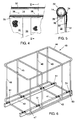
- Figure 6 shows a tubular frame 40 for the body of a caravan.
- the tubular frame again constructed of tube sections the ends of which can be slid into each other or otherwise adapted to be interconnected and of fittings, in a manner conventional for tents and the like, comprises two substantially rectangular horizontal frames 43,44, positioned one above the other.
- two vertical frames 45,46 Provided between the horizontal frames are two vertical frames 45,46, likewise approximately rectangular.
- the horizontal and vertical frames in the example shown have rounded corners. Further, near the corners of the horizontal frames in this example uprights 47-50 are provided.
- the lower horizontal frame and the bottom portions of the vertical frames are mounted on the chassis beams by means of clips 51.
- a heavy-quality canvas is used, and the cloth may comprise a heat-insulating layer.
- windows and an entrance door can be provided in a manner conventional for tents. It is also possible to provide windows and doors as are conventional in a caravan between vertical frames, such as for instance 45 and 46.
- windows and doors use can be made of frames, aluminium profiles or Velcro fasteners.
- the bottom can be formed by one or more detachable pieces of plate material. Accessories, cupboards and the like can be attached to the tubular frame and/or rest on the bottom.
- the body of such a caravan can be disassembled again completely for transport over long distances or for storage for a longer time, so that only a packet of canvas and a packet of tubes and fittings remain.
- Particular parts of a (folding) caravan according to the invention could optionally be constructed such that normally the cloth and the tubes remain interconnected, also when the (folding) caravan is disassembled.
- transverse or longitudinal tubes can be chosen or a different number of horizontal or vertical frames.
- the tubes could also at least partly constitute the chassis on which the axle with wheels is mounted.
- the vertical frames could extend in the longitudinal direction of the caravan.
- the vertical frames or the standards could have a slightly bent shape.
- a combination is possible of fixed wall parts and wall parts constructed according to the invention.
- a trailer for transporting luggage for instance, could be made in the manner described.
- the part of a folding caravan shown in Figures 1 and 2 is usable as a (luggage) trailer without any problem.
- the cover of such a trailer or folding caravan can be a loose cover or can be hingedly mounted on the edge of the box.
- FIG. 7 shows, by way of example, two arches 60,61 formed from profile material, between which a panel 62 of pliable plate material is fitted.
- the panel can have its longitudinal edges mounted in slots 63 of the profiles, as shown in Figure 8 by way of example.
- the plate material is already partly fixed to profiles 60,61 by means of transverse ribs 64, but the top part is not yet fixed to the profiles.
- FIG 8 shows, by way of example, how the transverse ribs 64 can be secured to the profiles.
- Transverse ribs 64 have a T-shaped end, snugly fitting into a T-shaped slot 65 in the profiles.
- the T-shaped slot is positioned such that the transverse ribs keep plate 62 in the desired shape.
- the plate can be detached.
- Other methods of attaching a pliable plate are conceivable.
- the plate can be provided with an insulating layer 66.
- the profiles can be made partly or wholly of synthetic material, as schematically indicated at 67, so as to avoid cold bridges.
- a caravan according to the invention and in particular a folding caravan or a trailer according to the invention can also be constructed of loose panels which may or may not be made up of tubes or profiles and cloth or plate material. Accordingly, the loose panels are detachably interconnected and can simply be detached and stored as plates.
Landscapes
- Engineering & Computer Science (AREA)
- Health & Medical Sciences (AREA)
- Public Health (AREA)
- Transportation (AREA)
- Mechanical Engineering (AREA)
- Tents Or Canopies (AREA)
Description
- The invention relates to a caravan comprising a chassis provided with a drawbar and wheels and a body mounted on the chassis which body has a frame of tubes and/or profiles and a suitable cloth which is at least partly fastened to the frame in a detachable manner for forming closed body surfaces, the body in use being mounted on the chassis in a detachable manner.
- Such caravans are known in many different constructions, both as an ordinary, non-collapsible caravan, and as a folding caravan. In a folding caravan, the body consists of a box adapted to accommodate an assembly of tent cloth and tent poles folded up in the box, which assembly can be unfolded for forming a camping shelter. As an example reference can be made to applicant's folding caravans known by the name of Holtkamper and described in Dutch patent application No. 7710669.
- Although in practice the known caravans are generally satisfactory, all caravans, whether or not of the folding type, present the problem that storing or otherwise putting away the (folding) caravan requires considerable space. A similar problem occurs in the transportation of (folding) caravans from the manufacturer to his buyers.
- FR-A-1241233 discloses a caravan of the above described type having a chassis and a body wherein a part of the body is detachably mounted on the chassis. Another part of the body is also part of the chassis and is welded to the chassis. The detachably mounted upper part of the body has a frame covered with suitable cloth. The frame, even when detached from the chassis is still rather bulky. This is also true for the chassis including the lower part of the body.
- Hence, there is a need for a folding caravan which can be collapsed to a greater extent than the known folding caravans, or for a collapsible caravan. The object of the invention is to provide for the need outlined. To that end, according to the invention, a caravan of the type described above is characterized in that the frame is constructed from tubes and/or profiles which are detachably connected so as to form a frame which can be disassembled.
- The invention will be further described hereinafter with reference to the accompanying drawings of an exemplary embodiment.
- Figure 1 schematically shows in side view a practical example of a folding caravan according to the invention;
- Figure 2 schematically shows in top view a practical example of a folding caravan according to the invention;
- Figure 3 shows a cross-section taken on the line III-III in Figure 2;
- Figure 4 shows in side view a detail of a folding caravan according to the invention;
- Figure 5 shows a section taken on the line V-V in Figure 4;
- Figure 6 schematically shows a view of a touring caravan constructed according to the invention; and
- Figure 7 and Figure 8 schematically show a variant of the invention.
- Figure 1 schematically shows in side view a practical example of a folding
caravan 1 according to the invention, having achassis 2 comprising adrawbar 3, awheel axle 4 andwheels 5. The folding caravan shown further has abox 6, which, contrary to the conventional boxes of caravans, is not constructed of rigid panels, but of a framework of tubes, which has been covered with a suitable sail canvas. As is clearly shown in the top view of Figure 2, the framework in the example shown comprises twotubes tubes - Each of tubes 8-11 has upwardly bent ends, forming substantially vertical sections, all terminating at substantially the same distance above the chassis. In Figure 1
vertical sections tube 9 are visible, as well as the vertical sections oftubes - Mounted on the free ends of the vertical sections is a circumferential
tubular frame 14, forming the edge of the box. In the example shownframe 14 has a rectangular shape with rounded corners.Frame 14 further comprises atub 15, formed from suitable cloth, having such dimensions that the tub snugly fits into the space enclosed by tubes 8-11 and the upwardly bent ends thereof. The edges of the cloth which forms the tub are fastened to the tubes offrame 14. To this end, the edges could for instance be provided with loops through which extend the tubes. It is also possible to fold the edges over the tubes offrame 14 throughout the length thereof and subsequently fasten them to the cloth again, for instance by means of a number of press-studs or one or more zippers, or by sewing or welding. - As cloth, preferably a heavy-quality sail canvas is used, as is also conventional for tarpaulins of trucks. Such tarpaulins are at least partly made of synthetic material and very strong. Such a cloth can also be welded.
- The tubes, forming the box of the folding caravan together with the cloth, can each consist of a number of telescopic sections in the manner conventional for tent poles. Also, where the longitudinally extending tubes intersect the transversely extending tubes, the conventional fittings can be used for detachably joining the intersecting tubes together. Alternatively, a joint by means of a through bolt with a nut can be used.
- In the example shown
tubes chassis beams clips 16 and bolts or screws. - Figure 3 schematically shows a cross-section taken on the line III-III in Figure 2, in which the wheel axle and the wheels have been omitted. In the example of Figure 3,
tub 15 is suspended within the framework formed by the tubes. In principle, it is also possible to arrange the tub on the outside of the tubes, but this requires the provision of holes through the material of the tub for mounting the framework on the chassis. If it is desired to have a waterproof tub, such holes can be problematic. - Further, if so desired, the tub can be fixed to the framework at a number of places by means of straps, loops or the like, as is shown by way of example at 19 in Figure 3.
- Further, Figure 3 shows a
cover 20 with which the box can be covered. Likebox 6,cover 20 is constructed of a framework formed by tubes and cloth. In the example shown, the framework only comprises a circumferentialtubular frame 21, which can be identical totubular frame 14 forming the edge of the box. The tubular frame can for instance be constructed of two straight, longitudinally extending tubes and two straight, transversely extending tubes and four bent corner pieces.Frame 21 can be attached to a substantiallyflat cloth 23 by means of loops, as shown at 22, straps or by means of a flap folded over one of the tubes and subsequently fixed by means of zippers or press-studs or the like. - Preferably,
cloth 23 has acircumferential edge 24, depending overframe 21.Cover 20 in Figure 3 is drawn slightly above the completely closed position, and can be moved downwards somewhat, as indicated byarrows 25, so as to close the box properly. In closed position,frame 21 of the cover rests onedge 14 of the box in this example. It is also possible to haveframe 21 fit around the edge of the box. - Figures 4 and 5 schematically show, by way of example, how
edge 14 of the box could be mounted on the ends of the vertical sections of the longitudinally and transversely extending tubes. - Figures 4 and 5 show a portion of
tube 14 forming the edge and a portion of avertical section 30 of one of the tubes forming the framework of the box. Further, a portion ofsidewall 31 oftub 15 is shown. In this example,sidewall 31 is folded aroundtube 14 by anupper edge section 32. In this example, the sidewall is provided with a sewn orwelded flap 33 at some distance below the upper edge, provided with one half of azipper 34 or Velcro fastener or the like, of which the other half is attached to the free end of the upper edge. Consequently,tube 14 is disposed in a closed sleeve of cloth, as it were. -
Vertical section 30 comprises at the top thereof a transversely extending,horizontal support 35 with asurface facing tube 14, curved approximately concentrically withtube 14. The support can for instance be formed from a wall portion of a tube of a suitable diameter and mounted on the end ofvertical section 30 by means of welding or in a different suitable manner.
In the example shown,support 35 is screwed totube 14 by means of screws, for instance self-tapping screws, as indicated at 36. Located between the support andtube 14 in the example shown iscloth 31 and the screws extend through the cloth. If so desired, it is also possible to make holes in the cloth at the position of the supports. - Instead of the supports shown, the conventional T-pieces could also be used. In that case, a suitable hole must be present in the cloth. Inside the box, a plate material (not shown) may be arranged as a bottom, for instance a plywood plate. Further, the foldable tent (not shown) of the folding caravan can be attached to edge 14 of the box in a conventional manner.
- As appears from the foregoing, the box of a folding caravan according to the invention can be detached from the chassis in a simple manner and subsequently be disassembled in the manner of a tent, so that only a number of tube sections, a foldable packet of canvas and some fittings remain. The same applies to cover 20.
- Consequently, storing or transporting such a folding caravan requires relatively little space.
- The space required can be reduced still further, for instance by detachably or foldably mounting
drawbar 3 on the chassis. The connection indicated in Figure 2 at 7 could for instance be detachable. Further,axle 4 can be detachably mounted on the chassis, but in itself this is not uncommon. Of course, the wheels are detachable as well. - The above-described normally fixed and rigid construction of a tubular frame and cloth can be used not only for folding caravans but also for "ordinary" caravans. The body of an "ordinary" caravan, i.e. a caravan not intended to be coupled to a car in collapsed condition like a folding caravan so as to be conveyed to a holiday destination, can also be constructed of tubes and suitable cloth.
- By way of example, Figure 6 shows a
tubular frame 40 for the body of a caravan. Of the chassis of the caravan, only two longitudinal chassis beams 41,42 are schematically shown. In the example shown, the tubular frame, again constructed of tube sections the ends of which can be slid into each other or otherwise adapted to be interconnected and of fittings, in a manner conventional for tents and the like, comprises two substantially rectangularhorizontal frames vertical frames - In the example shown, the lower horizontal frame and the bottom portions of the vertical frames are mounted on the chassis beams by means of
clips 51. - As cloth, preferably a heavy-quality canvas is used, and the cloth may comprise a heat-insulating layer. Further, windows and an entrance door can be provided in a manner conventional for tents. It is also possible to provide windows and doors as are conventional in a caravan between vertical frames, such as for
instance - The body of such a caravan can be disassembled again completely for transport over long distances or for storage for a longer time, so that only a packet of canvas and a packet of tubes and fittings remain.
- Particular parts of a (folding) caravan according to the invention could optionally be constructed such that normally the cloth and the tubes remain interconnected, also when the (folding) caravan is disassembled.
- It is observed that after the foregoing, various modifications will readily occur to a person of ordinary skill in the art. For instance, a different number of transverse or longitudinal tubes can be chosen or a different number of horizontal or vertical frames. Further, the tubes could also at least partly constitute the chassis on which the axle with wheels is mounted. Also, for a caravan the vertical frames could extend in the longitudinal direction of the caravan. Further, the vertical frames or the standards could have a slightly bent shape. Furher, a combination is possible of fixed wall parts and wall parts constructed according to the invention. Also, a trailer for transporting luggage, for instance, could be made in the manner described. The part of a folding caravan shown in Figures 1 and 2 is usable as a (luggage) trailer without any problem. The cover of such a trailer or folding caravan can be a loose cover or can be hingedly mounted on the edge of the box.
- Further, instead of tubes, suitable profiles can be used, made of aluminium, for instance. When profiles with a longitudinal slot are used, cloth or even a pliable and/or rollable plate material could be fitted between two profiles to form a wall (part). Figure 7 shows, by way of example, two
arches panel 62 of pliable plate material is fitted. The panel can have its longitudinal edges mounted inslots 63 of the profiles, as shown in Figure 8 by way of example. In Figure 7 the plate material is already partly fixed toprofiles transverse ribs 64, but the top part is not yet fixed to the profiles. - Figure 8 shows, by way of example, how the
transverse ribs 64 can be secured to the profiles.Transverse ribs 64 have a T-shaped end, snugly fitting into a T-shapedslot 65 in the profiles. The T-shaped slot is positioned such that the transverse ribs keepplate 62 in the desired shape. By sliding the transverse ribs fromslot 65 the plate can be detached. Other methods of attaching a pliable plate are conceivable. If so desired, the plate can be provided with an insulatinglayer 66. The profiles can be made partly or wholly of synthetic material, as schematically indicated at 67, so as to avoid cold bridges. - Finally, it is observed that a caravan according to the invention and in particular a folding caravan or a trailer according to the invention can also be constructed of loose panels which may or may not be made up of tubes or profiles and cloth or plate material. Accordingly, the loose panels are detachably interconnected and can simply be detached and stored as plates.
- These and similar modifications are understood to fall within the scope of the invention as defined by the appended claims.
Claims (21)
- A caravan (1) comprising a chassis (2,18,17;41,42) provided with a drawbar (3) and wheels (5) and a body (6;40) mounted on the chassis which body has a frame (8-14;21;40) of tubes and/or profiles and a suitable cloth (23,31) which is at least partly fastened to the frame in a detachable manner for forming closed body surfaces, the body in use being mounted on the chassis in a detachable manner, characterized in that the frame (8-14;21;40) is constructed from tubes and/or profiles which are detachably connected so as to form a frame which can be disassembled.
- A caravan according to claim 1, characterized in that the cloth (23,31) and the tubes or profiles of the frame (8-14;21;40) are at least partly interconnected by means of loops (22) attached to the cloth (23,31), through which loops a tube or profile can be slid.
- A caravan according to claim 1 or 2, characterized in that the cloth (23,31) and the tubes or profiles are at least partly interconnected by straps attached to the cloth.
- A caravan according to any one of the preceding claims, characterized in that the cloth (23,31) and the tubes or profiles are at least partly interconnected in that an edge (32) of the cloth has been folded over a profile portion or tube portion and subsequently fastened to the cloth again by fastening means suitable for that purpose.
- A caravan according to any one of the preceding claims, characterized by at least one T-shaped configuration (14,30) of tubes or profiles, with the free end of a transverse tube (30) or the transverse profile attached to a wall of a longitudinal tube (14) or longitudinal profile, the free end of the transverse tube (30) or transverse profile comprising a support (35) extending transversely thereto along the longitudinal tube (14) or longitudinal profile, said support (35) having a surface facing the longitudinal tube (14) or longitudinal profile, said surface having a bent shape so as to be capable of receiving the longitudinal tube or the longitudinal profile, whilst, at least at the T-shaped configuration, an edge strip (32) of the cloth (31) is folded over the longitudinal tube (14) or the longitudinal profile and cloth material is disposed between the support (35) and the longitudinal tube (14) or the longitudinal profile and the support (35) is fixed by means of screws (36) extending through the cloth material and into the wall of the longitudinal tube (14) or the longitudinal profile.
- A caravan according to any one of the preceding claims, characterized in that the cloth (23,31) is canvas.
- A caravan according to any one of the preceding claims, characterized in that the cloth (23,31) comprises a layer of insulating material.
- A caravan according to any one of the preceding claims, characterized in that the drawbar (3) is detachably or collapsibly mounted on the chassis (2,18,17;41,42).
- A caravan according to any one of the preceding claims, constructed as a folding caravan, wherein the body consists of a box (6) capable of accommodating a folded assembly of tent cloth and tent poles, said assembly being adapted to be unfolded to form a camping shelter, characterized in that the box comprises a plurality of longitudinally extending tubes or profiles (8,9) having upwardly bent ends (12,13) and a plurality of transversely extending tubes or profiles (10,11) having upwardly bent ends, whilst a substantially rectangular circumferential frame (14) is provided, which frame (14) is composed of tubes or profiles, has rounded corners, can be taken apart and is detachably connected to the edges of a tub-shaped cloth (15), the rectangular frame (14) being detachably mounted on the upwardly bent ends (12,13) of the longitudinally and transversely extending tubes or profiles.
- A caravan according to claim 9, characterized in that in mounted condition the tub-shaped cloth (15) is suspended within the longitudinally and transversely extending tubes or profiles (8,9,10,11) and the upwardly bent ends (12,13) thereof.
- A caravan according to claim 9 or 10, characterized by a cover (20) constructed of a substantially rectangular frame (21) with rounded corners, constructed of tubes or profiles, said frame being detachably connected to a cloth (23) for forming a closed panel.
- A caravan according to claim 11, characterized in that the cloth (23) of the cover (20) has an edge (24) depending on the outside along the rectangular frame (21).
- A caravan according to claim 11 or 12, characterized in that the frame (21) of the cover (20) is hingedly mounted on the substantially rectangular frame (14) of the box (6).
- A caravan according to any one of claims 1-8, characterized in that the frame (40) is at least partly constructed of a plurality of profiles, between which cloth can be fixed.
- A caravan according to any one of the preceding claims, characterized in that a pliable plate material (62) is used instead of cloth.
- A caravan according to claim 15, characterized in that the pliable plate material (62) can be rolled up.
- A caravan according to claim 15 or 16, characterized in that the pliable plate material is attached to profiles by at least two longitudinal edges.
- A caravan according to claim 17, characterized in that the plate material (62) is fixed between two profiles (60,61) by means of transverse ribs (64), of which the ends are detachably connected to the profiles (60,61).
- A caravan according to any one of the preceding claims, characterized in that the closed body surfaces are formed by panels detachably connected to each other and to the chassis (2,17,18;41,42).
- A trailer comprising a chassis (2,17,18) and a box (6), characterized in that the box (6) is constructed according to any one of claims 9-13.
- A body, constructed of a demountable frame (8-14;21;40) of tubes and/or profiles and cloth (23,31), or pliable plate material (62) suitable for a caravan or trailer according to any one of the preceding claims.
Applications Claiming Priority (2)
| Application Number | Priority Date | Filing Date | Title |
|---|---|---|---|
| NL9101928 | 1991-11-19 | ||
| NL9101928A NL9101928A (en) | 1991-11-19 | 1991-11-19 | FOLDABLE CARAVAN. |
Publications (2)
| Publication Number | Publication Date |
|---|---|
| EP0544361A1 EP0544361A1 (en) | 1993-06-02 |
| EP0544361B1 true EP0544361B1 (en) | 1996-01-31 |
Family
ID=19859932
Family Applications (1)
| Application Number | Title | Priority Date | Filing Date |
|---|---|---|---|
| EP19920203551 Expired - Lifetime EP0544361B1 (en) | 1991-11-19 | 1992-11-18 | Collapsible caravan |
Country Status (4)
| Country | Link |
|---|---|
| EP (1) | EP0544361B1 (en) |
| DE (1) | DE69208053T2 (en) |
| ES (1) | ES2085556T3 (en) |
| NL (1) | NL9101928A (en) |
Cited By (4)
| Publication number | Priority date | Publication date | Assignee | Title |
|---|---|---|---|---|
| US7353960B2 (en) | 2004-10-05 | 2008-04-08 | Martin Marietta Materials, Inc. | Cargo container with insulated floor |
| US7434520B2 (en) | 2004-04-12 | 2008-10-14 | Martin Marietta Materials, Inc. | Insulated cargo container doors |
| US7587984B2 (en) | 2004-03-05 | 2009-09-15 | Martin Marietta Materials, Inc. | Insulated cargo containers |
| EP2256269A1 (en) | 2009-05-29 | 2010-12-01 | Egbert Berend Holtkamp | Tent roof for a camping vehicle |
Families Citing this family (5)
| Publication number | Priority date | Publication date | Assignee | Title |
|---|---|---|---|---|
| US5785334A (en) * | 1995-11-22 | 1998-07-28 | Robinson; Russell S. | Bicycle towable collapsible cart |
| DE102008045274A1 (en) * | 2008-09-01 | 2010-03-04 | Egbert Berend Holtkamp | Tent or shelter as part of a camping trailer |
| CN105172665A (en) * | 2015-09-30 | 2015-12-23 | 南京际华三五二一特种装备有限公司 | Novel articulated vehicle tent |
| US10980191B2 (en) | 2017-08-15 | 2021-04-20 | Kathleen Lysak | Deer proof garden enclosure and method of making |
| CN113002627B (en) * | 2020-12-15 | 2022-05-13 | 江苏德发房车科技有限公司 | Shock attenuation girder |
Family Cites Families (4)
| Publication number | Priority date | Publication date | Assignee | Title |
|---|---|---|---|---|
| FR1241233A (en) * | 1959-08-04 | 1960-09-16 | Trailer, more particularly intended for camping | |
| US3144150A (en) * | 1962-03-12 | 1964-08-11 | Frederick L Cox | Boat trailer incorporating collapsible sleeping quarter |
| US4133577A (en) * | 1976-09-13 | 1979-01-09 | Pilant Thomas M | Boat trailer convertible to tent shelter |
| NL167636C (en) * | 1977-09-29 | 1982-01-18 | Egbert Berend Holtkamp | CAMPING FOLDING CAR. |
-
1991
- 1991-11-19 NL NL9101928A patent/NL9101928A/en not_active Application Discontinuation
-
1992
- 1992-11-18 EP EP19920203551 patent/EP0544361B1/en not_active Expired - Lifetime
- 1992-11-18 ES ES92203551T patent/ES2085556T3/en not_active Expired - Lifetime
- 1992-11-18 DE DE1992608053 patent/DE69208053T2/en not_active Expired - Lifetime
Cited By (4)
| Publication number | Priority date | Publication date | Assignee | Title |
|---|---|---|---|---|
| US7587984B2 (en) | 2004-03-05 | 2009-09-15 | Martin Marietta Materials, Inc. | Insulated cargo containers |
| US7434520B2 (en) | 2004-04-12 | 2008-10-14 | Martin Marietta Materials, Inc. | Insulated cargo container doors |
| US7353960B2 (en) | 2004-10-05 | 2008-04-08 | Martin Marietta Materials, Inc. | Cargo container with insulated floor |
| EP2256269A1 (en) | 2009-05-29 | 2010-12-01 | Egbert Berend Holtkamp | Tent roof for a camping vehicle |
Also Published As
| Publication number | Publication date |
|---|---|
| NL9101928A (en) | 1993-06-16 |
| DE69208053D1 (en) | 1996-03-14 |
| DE69208053T2 (en) | 1996-09-05 |
| EP0544361A1 (en) | 1993-06-02 |
| ES2085556T3 (en) | 1996-06-01 |
Similar Documents
| Publication | Publication Date | Title |
|---|---|---|
| US5544671A (en) | Lightweight, portable, self-opening, collapsible shelter/camper/storage unit | |
| US5462330A (en) | Folding camping/cargo trailer | |
| US4310194A (en) | Tent camper for pickup truck | |
| US3367347A (en) | Truck bed cover and tent | |
| US6604777B2 (en) | Collapsible camper | |
| EP0366677B1 (en) | An improved annexe | |
| US7942464B2 (en) | Tonneau style pop-up camper for pickup trucks | |
| US5080426A (en) | Collapsible camper tent trailer | |
| US20050108955A1 (en) | Portable, folding storage structures with carrying case and methods therefor | |
| EP0544361B1 (en) | Collapsible caravan | |
| US4802500A (en) | Portable collapsible building system of modular construction | |
| US3359693A (en) | Portable camping unit | |
| US20090065037A1 (en) | Shelter construction and method of erecting same | |
| US5788319A (en) | Camping unit for pick-up trucks, vans, boats and the like | |
| CA2445008C (en) | Collapsible shelter apparatus | |
| US10946785B2 (en) | Edge-stowable tent for trailer system | |
| US4858986A (en) | Automobile-mounted camper | |
| US2640999A (en) | Portable bed and housing structure | |
| US5417469A (en) | Modular system for camping in a sport utility vehicle | |
| US2969074A (en) | Camping shelter | |
| US3785693A (en) | Portable sleeping compartment | |
| US5061006A (en) | Method for expandable sleeping compartments for vehicles | |
| US2957482A (en) | Portable collapsible shelter | |
| US4901745A (en) | Tent assembly for attachment to a van | |
| US3763607A (en) | Foldable camp shelter |
Legal Events
| Date | Code | Title | Description |
|---|---|---|---|
| PUAI | Public reference made under article 153(3) epc to a published international application that has entered the european phase |
Free format text: ORIGINAL CODE: 0009012 |
|
| AK | Designated contracting states |
Kind code of ref document: A1 Designated state(s): DE ES FR GB NL |
|
| 17P | Request for examination filed |
Effective date: 19930908 |
|
| 17Q | First examination report despatched |
Effective date: 19941010 |
|
| GRAA | (expected) grant |
Free format text: ORIGINAL CODE: 0009210 |
|
| AK | Designated contracting states |
Kind code of ref document: B1 Designated state(s): DE ES FR GB NL |
|
| REF | Corresponds to: |
Ref document number: 69208053 Country of ref document: DE Date of ref document: 19960314 |
|
| ET | Fr: translation filed | ||
| REG | Reference to a national code |
Ref country code: ES Ref legal event code: FG2A Ref document number: 2085556 Country of ref document: ES Kind code of ref document: T3 |
|
| PLBE | No opposition filed within time limit |
Free format text: ORIGINAL CODE: 0009261 |
|
| 26N | No opposition filed | ||
| REG | Reference to a national code |
Ref country code: GB Ref legal event code: IF02 |
|
| PGFP | Annual fee paid to national office [announced via postgrant information from national office to epo] |
Ref country code: DE Payment date: 20101119 Year of fee payment: 19 |
|
| PGFP | Annual fee paid to national office [announced via postgrant information from national office to epo] |
Ref country code: GB Payment date: 20101118 Year of fee payment: 19 |
|
| PGFP | Annual fee paid to national office [announced via postgrant information from national office to epo] |
Ref country code: FR Payment date: 20111130 Year of fee payment: 20 Ref country code: NL Payment date: 20111128 Year of fee payment: 20 Ref country code: ES Payment date: 20111115 Year of fee payment: 20 |
|
| REG | Reference to a national code |
Ref country code: DE Ref legal event code: R071 Ref document number: 69208053 Country of ref document: DE |
|
| REG | Reference to a national code |
Ref country code: DE Ref legal event code: R071 Ref document number: 69208053 Country of ref document: DE |
|
| REG | Reference to a national code |
Ref country code: NL Ref legal event code: V4 Effective date: 20121118 |
|
| REG | Reference to a national code |
Ref country code: GB Ref legal event code: PE20 Expiry date: 20121117 |
|
| PG25 | Lapsed in a contracting state [announced via postgrant information from national office to epo] |
Ref country code: GB Free format text: LAPSE BECAUSE OF EXPIRATION OF PROTECTION Effective date: 20121117 |
|
| REG | Reference to a national code |
Ref country code: ES Ref legal event code: FD2A Effective date: 20130729 |
|
| PG25 | Lapsed in a contracting state [announced via postgrant information from national office to epo] |
Ref country code: ES Free format text: LAPSE BECAUSE OF EXPIRATION OF PROTECTION Effective date: 20121119 |