EP0544354B1 - Method for the measurement of precipitation of asphaltene in oil - Google Patents
Method for the measurement of precipitation of asphaltene in oil Download PDFInfo
- Publication number
- EP0544354B1 EP0544354B1 EP92203527A EP92203527A EP0544354B1 EP 0544354 B1 EP0544354 B1 EP 0544354B1 EP 92203527 A EP92203527 A EP 92203527A EP 92203527 A EP92203527 A EP 92203527A EP 0544354 B1 EP0544354 B1 EP 0544354B1
- Authority
- EP
- European Patent Office
- Prior art keywords
- oil
- precipitation
- asphaltene
- conductivity
- flocculant
- Prior art date
- Legal status (The legal status is an assumption and is not a legal conclusion. Google has not performed a legal analysis and makes no representation as to the accuracy of the status listed.)
- Expired - Lifetime
Links
Images



Classifications
-
- G—PHYSICS
- G01—MEASURING; TESTING
- G01N—INVESTIGATING OR ANALYSING MATERIALS BY DETERMINING THEIR CHEMICAL OR PHYSICAL PROPERTIES
- G01N33/00—Investigating or analysing materials by specific methods not covered by groups G01N1/00 - G01N31/00
- G01N33/26—Oils; Viscous liquids; Paints; Inks
- G01N33/28—Oils, i.e. hydrocarbon liquids
- G01N33/2835—Specific substances contained in the oils or fuels
-
- G—PHYSICS
- G01—MEASURING; TESTING
- G01N—INVESTIGATING OR ANALYSING MATERIALS BY DETERMINING THEIR CHEMICAL OR PHYSICAL PROPERTIES
- G01N33/00—Investigating or analysing materials by specific methods not covered by groups G01N1/00 - G01N31/00
- G01N33/26—Oils; Viscous liquids; Paints; Inks
- G01N33/28—Oils, i.e. hydrocarbon liquids
- G01N33/2823—Raw oil, drilling fluid or polyphasic mixtures
-
- G—PHYSICS
- G01—MEASURING; TESTING
- G01N—INVESTIGATING OR ANALYSING MATERIALS BY DETERMINING THEIR CHEMICAL OR PHYSICAL PROPERTIES
- G01N27/00—Investigating or analysing materials by the use of electric, electrochemical, or magnetic means
- G01N27/02—Investigating or analysing materials by the use of electric, electrochemical, or magnetic means by investigating impedance
- G01N27/04—Investigating or analysing materials by the use of electric, electrochemical, or magnetic means by investigating impedance by investigating resistance
- G01N27/06—Investigating or analysing materials by the use of electric, electrochemical, or magnetic means by investigating impedance by investigating resistance of a liquid
-
- G—PHYSICS
- G01—MEASURING; TESTING
- G01N—INVESTIGATING OR ANALYSING MATERIALS BY DETERMINING THEIR CHEMICAL OR PHYSICAL PROPERTIES
- G01N27/00—Investigating or analysing materials by the use of electric, electrochemical, or magnetic means
- G01N27/02—Investigating or analysing materials by the use of electric, electrochemical, or magnetic means by investigating impedance
- G01N27/22—Investigating or analysing materials by the use of electric, electrochemical, or magnetic means by investigating impedance by investigating capacitance
-
- Y—GENERAL TAGGING OF NEW TECHNOLOGICAL DEVELOPMENTS; GENERAL TAGGING OF CROSS-SECTIONAL TECHNOLOGIES SPANNING OVER SEVERAL SECTIONS OF THE IPC; TECHNICAL SUBJECTS COVERED BY FORMER USPC CROSS-REFERENCE ART COLLECTIONS [XRACs] AND DIGESTS
- Y10—TECHNICAL SUBJECTS COVERED BY FORMER USPC
- Y10T—TECHNICAL SUBJECTS COVERED BY FORMER US CLASSIFICATION
- Y10T436/00—Chemistry: analytical and immunological testing
- Y10T436/21—Hydrocarbon
-
- Y—GENERAL TAGGING OF NEW TECHNOLOGICAL DEVELOPMENTS; GENERAL TAGGING OF CROSS-SECTIONAL TECHNOLOGIES SPANNING OVER SEVERAL SECTIONS OF THE IPC; TECHNICAL SUBJECTS COVERED BY FORMER USPC CROSS-REFERENCE ART COLLECTIONS [XRACs] AND DIGESTS
- Y10—TECHNICAL SUBJECTS COVERED BY FORMER USPC
- Y10T—TECHNICAL SUBJECTS COVERED BY FORMER US CLASSIFICATION
- Y10T436/00—Chemistry: analytical and immunological testing
- Y10T436/21—Hydrocarbon
- Y10T436/212—Aromatic
Definitions
- the present invention relates to a method for measuring asphaltene precipitation.
- Asphaltene is definable as the fraction of an oil which is insoluble in N-C 5 and soluble in benzene.
- the definition is in other words operational. There is no stringent physical or chemical definition.
- the structure of asphaltene monomer varies from oil to oil, but is generally supposed to consist of aromatic macromolecules having a significant content of heteroatoms (N,S,O).
- the asphaltenes are presumed to exist in solution partially as monomers and partially as colloidal aggregates with a continuous size dispersion.
- Asphaltenes are deposited in valves, tubing and process equipment. At worst, these deposits lead to complete blockage and production stoppage, with substantial costs as consequences.
- a conventional method uses a source of light in the form of a laser or the like with a light detector. Both are put in an oil sample diluted with a solvent. An injector adds a flocculant (a flocculating agent) to initiate flocculation. The flocculation point (the precipitation point) is determined as the light detector registers a reduction in transmitted light occurring when flocculation occurs. The method determines only the flocculation point (flocculation threshold value) and cannot measure asphaltene precipitate. Besides, the method is not selective and consequently does not indicate if the precipitate is asphaltene or another constituent, like sand, found in the oil.
- a flocculant a flocculating agent
- Another conventional method for detecting the flocculation point for an oil sample is based upon the measurement of the surface tension at the interface between oil and water as a function of added quantities of flocculant. When precipitation occurs, the interfacial surface tension increases and the flocculation point can thereby be determined. However, the quantity of precipitated asphaltene cannot be determined by this method. Also, its accuracy and reproducibility are uncertain. Furthermore, the method is work-intensive and inapplicable for pressure testing.
- This method is used only to determine the quantity of asphaltene precipitate in an oil sample and cannot give the oil's flocculation point without a series of very detailed and time-consuming gravimetric analyses.
- US-A-2 909 483 discloses a method for determining the asphaltic components of petroleum hydrocarbons by measuring the electrical conductivity to obtain a measure of the quantity of asphaltenes present in the sample.
- the present invention was arrived at in the form of a method which could determine the flocculation point for a petroleum product and the quantity of asphaltene precipitate, and could also be used on-line for surveillance and control of processes at the temperature and pressure conditions of petroleum products.
- the invention is a significant technical advance compared with conventional methods and equipment which are useful only in a laboratory context and which generally do not consider the pressure and temperature conditions naturally existing.
- the inventive method is characterised in that the asphaltene precipitate is quantified by measuring the change in the petroleum product's conducting capacity or capacitance, as defined in claim 1.
- Claim 2 define an advantageous feature of the invention.
- FIG. 1 is a sketch of the apparatus for performing the method according to the invention. It includes a container or dilution flask 1 for oil, a pump 2, a measuring cell 3 and an impedance meter 4.
- the container 1, the measuring cell 3 and the pump 2 are coupled together by tubing 9 and are arranged in a heating chamber 5 for temperature control during testing.
- FIG. 2 shows in detail the measuring cell. It has two concentric cylinders, isolated from each other by a quartz tube 8. These cylinders act as electrodes and the testing is done in the space between them.
- the distance between the inner and outer electrode can be for example 1 mm.
- the first cell used for testing was made of brass. It was soon apparent that the brass surface discoloured somewhat while the measurements were unstable. It was therefore necessary to coat the electrodes with a thin layer of gold.
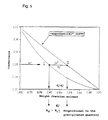
- the upper curve is derived from the lower and shows conductance divided by the weight fraction of oil in the sample over the weight fraction of pentane.
- the background for this data conversion is that the amount of asphaltene in the sample is proportional to the amount of crude oil.
- Conductivity capacity can be expected to be proportional to the amount of asphaltene present.
- concentration dependence emerges more clearly therefore where conductance is normalized with amounts of conductive material.
- the analogous volume is called the molar conductance and is defined as the conductivity divided by the molar concentration. This concept is described in detail in most physical chemistry textbooks.
- the crude oil there is no possibility of determining the molar concentration (molarity) for asphaltenes ; it is therefore necessary to use crude figures like weight fraction of crude oil which is directly proportional to the weight fraction of asphaltenes.
- the precipitation process itself takes time. If oil and pentane are mixed in a proportion giving precipitation, then it takes time before the precipitation is complete.
- the kinetics are easily investigated by measuring conductivity as a function of time after mixing. In conventional standard procedures, the solution stands at least 8 hours before further processing.
- the conductivity capacity is proportional to the amount of asphaltenes in solution.
- the liquid's viscosity changes when adding pentane. Electrical conductive capacity is a property of transport (transport of the charge). In liquids, ions primarily carry this charge by moving in the direction of the field. The liquid's viscosity creates an opposing force of friction. Increasing viscosity therefore leads to decreasing conductivity capacity.
- G n G as read off ( ⁇ solution/ ⁇ flocculant) where ⁇ solution and ⁇ flocculant are respectively the viscosity of the solution and the pure flocculant.
- the size of the conductance G n is now viscosity normalised, i.e. the effect of varying viscosity is eliminated. Such a curve is shown in FIG. 4. It can be seen that the maximum in conductance is no longer found. The conclusion is therefore that this maximum was an effect of the varying viscosity.
- FIG. 4 shows a sketch of the progression of the conductance G with and without precipitation. The drawing also shows the viscosity normalised progression. The interesting part of the curve is the precipitation part. In FIG. 5, this part is enlarged.
- concentration axis is converted from weight fraction to mass/volume, the physically correct basis for comparison. This is done by measuring the density progression in all mixture proportions between oil and flocculant.
- the result can be given in terms of chosen units, e.g. the mass of precipitate per total volume or per quantity of crude oil in the sample, etc.
- chosen units e.g. the mass of precipitate per total volume or per quantity of crude oil in the sample, etc.
- the choice of units depends on the context in which the results will be used.
- the preceding shows and describes a method and an apparatus for measuring asphaltene precipitate in a laboratory context.
- a substantial advantage of the present invention is that it is useful for on-line measurements, e.g. in connection with exploitation of oil and gas in an offshore context.
- the apparatus includes a measuring cell 13, an instrument for measuring conductivity (or capacitance) 15, a viscosimeter 17, a thermometer 14, a manometer 16, together with a container 10 with a cleaning agent and a pump 11.
- the measuring cell 13 is directly connected to the oil/gas production piping 20 by an appropriately-sized tube 21.
- the tube 21 can advantageously extend to a closed outlet via a valve 18.
- the tube 21 can be connected to the production piping 20 such that the oil is conducted back to the piping 20 by means of a pump (not shown).
- the oil is added to the measuring cell 13 via a two-way valve 12 on the tube 21.
- the valve 18 is kept open so that the oil can flow inside.
- the temperature in the cell 13 measured with the thermometer 14 is equal to the temperature in the production piping 20, the valve 18 is closed and the pressure is checked with the manometer 16.
- the pressure reading shall be stable during measurements.
- pressure and temperature are representative for the oil stream in the production piping, the read-off of conductivity (or capacitance), as well as viscosity, are taken respectively by the instruments 15 and 17.
- the closed valve 18 is opened and the two-way valve 12 is turned such that it stops addition of oil, but is open for addition of cleaning agent from container 10 by means of pump 11.
- the conductivity can by means of the apparatus be followed as a function of time. If the conductivity increases over time, then this can indicate that the produced oil is gradually becoming more asphaltene-rich. If on the other hand the conductivity decreases over time, then the oil must be checked for possible asphaltene precipation.
- the quantity of precipitate can be estimated when a calibration curve has been prepared in advance and shows the viscosity normalised conductance as a function of the amount of asphaltenes for this oil. This correlation can be determined in advance in the laboratory. If one has the calibration curve, then the conductance measurements can be read off and directly converted into the concentration of asphaltenes. Any decline in the conductance can then be stated in terms of the quantity of precipitate.
Landscapes
- Chemical & Material Sciences (AREA)
- Health & Medical Sciences (AREA)
- Engineering & Computer Science (AREA)
- Life Sciences & Earth Sciences (AREA)
- Medicinal Chemistry (AREA)
- Biochemistry (AREA)
- General Chemical & Material Sciences (AREA)
- Food Science & Technology (AREA)
- Chemical Kinetics & Catalysis (AREA)
- Physics & Mathematics (AREA)
- Analytical Chemistry (AREA)
- Oil, Petroleum & Natural Gas (AREA)
- General Health & Medical Sciences (AREA)
- General Physics & Mathematics (AREA)
- Immunology (AREA)
- Pathology (AREA)
- Investigating Or Analyzing Materials By The Use Of Electric Means (AREA)
- Investigating Or Analyzing Non-Biological Materials By The Use Of Chemical Means (AREA)
Description
Claims (2)
- A method for measuring asphaltene precipitation in a petroleum product,
characterised in that
the precipitation is determined by measuring changes in the petroleum product's conductivity or capacitance. - The method of claim 1,
characterised in that
the relative quantity of asphaltene precipitate is determined by measuring the difference between a weight fraction of flocculant at factually measured viscosity normalised conductance, and a weight fraction flocculant at viscosity normalised hypothetical conductance.
Applications Claiming Priority (2)
| Application Number | Priority Date | Filing Date | Title |
|---|---|---|---|
| NO914533 | 1991-11-20 | ||
| NO914533A NO179089C (en) | 1991-11-20 | 1991-11-20 | Method and equipment for measuring asphaltene precipitation |
Publications (2)
| Publication Number | Publication Date |
|---|---|
| EP0544354A1 EP0544354A1 (en) | 1993-06-02 |
| EP0544354B1 true EP0544354B1 (en) | 1998-01-21 |
Family
ID=19894608
Family Applications (1)
| Application Number | Title | Priority Date | Filing Date |
|---|---|---|---|
| EP92203527A Expired - Lifetime EP0544354B1 (en) | 1991-11-20 | 1992-11-17 | Method for the measurement of precipitation of asphaltene in oil |
Country Status (5)
| Country | Link |
|---|---|
| US (1) | US5420040A (en) |
| EP (1) | EP0544354B1 (en) |
| CA (1) | CA2083218A1 (en) |
| DE (1) | DE69224162T2 (en) |
| NO (1) | NO179089C (en) |
Families Citing this family (24)
| Publication number | Priority date | Publication date | Assignee | Title |
|---|---|---|---|---|
| FI97083C (en) * | 1993-12-31 | 1996-10-10 | Neste Oy | Method and apparatus for determining the stability of the oil |
| WO1996010618A1 (en) * | 1994-09-30 | 1996-04-11 | Sgi International | Electrodynamic-chemical processing for beneficiation of petroleum residue |
| FR2737780B1 (en) * | 1995-08-11 | 1997-09-19 | Inst Francais Du Petrole | FLUID MIXTURE TEST CELL ADAPTED TO DETECT PHASE CHANGES |
| US5668964A (en) * | 1995-08-24 | 1997-09-16 | Wall Data Incorporated | Graphical user interface for creating a new notebook with a dragged page |
| IT1293728B1 (en) * | 1997-07-18 | 1999-03-10 | Eniricerche S P A Ora Enitecno | METHOD FOR DETERMINING THE FLOCCULATION THRESHOLD OF ASPHALTENES IN OIL |
| US5969237A (en) * | 1997-10-09 | 1999-10-19 | Baker Hughes Incorporated | Measurement and control of asphaltene agglomeration in hydrocarbon Liquids |
| DE19911292A1 (en) * | 1999-03-13 | 2000-11-23 | Andreas Lorenz Hoffmann | Electronic measuring device for concentrations of cooling lubricant uses a fed-back clock generator to oscillate and supply alternating square-wave voltage for a bridge rectifier and an electrode current held in an emulsion. |
| FR2820503B1 (en) * | 2001-02-07 | 2003-04-04 | Inst Francais Du Petrole | METHOD AND DEVICE FOR PREDICTING THE FLOCCULATION THRESHOLD OF ASPHALTENES CONTAINED IN HYDROCARBON MIXTURES |
| US7079242B2 (en) * | 2003-12-19 | 2006-07-18 | Core Laboratories L.P. | Method and apparatus for determining characteristics of particles in a fluid sample |
| US7776930B2 (en) * | 2004-06-16 | 2010-08-17 | Champion Technologies, Inc. | Methods for inhibiting naphthenate salt precipitates and naphthenate-stabilized emulsions |
| US9567509B2 (en) | 2011-05-06 | 2017-02-14 | Ecolab Usa Inc. | Low dosage polymeric naphthenate inhibitors |
| US9360425B2 (en) | 2013-05-02 | 2016-06-07 | Baker Hughes Incorporated | Method for characterizing the stability of foulants and/or efficacy of foulant inhibitors within petroleum-based fluids |
| US9322779B2 (en) | 2013-10-16 | 2016-04-26 | Baker Hughes Incorporated | Methods of measuring the fouling tendency of hydrocarbon fluids |
| US20170082594A1 (en) * | 2014-05-15 | 2017-03-23 | Flint Hills Resources, Lp | Methods for reducing the precipitation propensity of asphaltenes in blended crude oils |
| US10280714B2 (en) | 2015-11-19 | 2019-05-07 | Ecolab Usa Inc. | Solid chemicals injection system for oil field applications |
| US10648939B2 (en) | 2016-07-22 | 2020-05-12 | The Texas A&M University System | Method and system for stability determination of asphaltenes utilizing dielectric constant measurements |
| WO2018017992A1 (en) * | 2016-07-22 | 2018-01-25 | The Texas A&M University System | Method and system for stability determination of asphaltenes utilizing dielectric constant measurements |
| EP3630341A1 (en) | 2017-05-23 | 2020-04-08 | Ecolab USA, Inc. | Dilution skid and injection system for solid/high viscosity liquid chemicals |
| AR112058A1 (en) | 2017-05-23 | 2019-09-18 | Ecolab Usa Inc | INJECTION SYSTEM FOR CONTROLLED ADMINISTRATION OF SOLID CHEMICAL SUBSTANCES FROM OIL FIELDS |
| US11280779B2 (en) | 2017-12-18 | 2022-03-22 | Championx Usa Inc. | Solvency for asphaltene deposit remediation or inhibition |
| WO2020131092A1 (en) * | 2018-12-21 | 2020-06-25 | Bl Technologies, Inc. | Method and sensor system for monitoring asphaltene stability in crude oil |
| US11333650B2 (en) * | 2019-09-17 | 2022-05-17 | Clariant International Ltd. | Determination of asphaltene inhibitor properties and treatment of crude oil with asphaltene inhibitors |
| US11333651B2 (en) * | 2019-09-17 | 2022-05-17 | Clariant International Ltd. | Determination of asphaltene inhibitor properties and treatment of crude oil with asphaltene inhibitors |
| EP3835775A1 (en) * | 2019-12-11 | 2021-06-16 | Clariant International Ltd | Determination of asphaltene inhibitor properties |
Family Cites Families (6)
| Publication number | Priority date | Publication date | Assignee | Title |
|---|---|---|---|---|
| US2909483A (en) * | 1957-11-14 | 1959-10-20 | Exxon Research Engineering Co | Determination of asphaltic components of petroleum hydrocarbons by measuring the electrical conductivity thereof |
| US4434233A (en) * | 1981-03-03 | 1984-02-28 | Carrier Corporation | Method of testing oil for ionic contaminants |
| GB2139766B (en) * | 1983-05-10 | 1986-09-17 | British Petroleum Co Plc | Measurement of water in crude oil |
| FR2578979B1 (en) * | 1985-03-15 | 1987-08-21 | Elf France | PROCESS FOR THE QUICK DETERMINATION OF THE STABILITY OF OIL RESIDUES AND OIL, AS WELL AS APPARATUS FOR THE IMPLEMENTATION OF THIS PROCESS |
| DE3843243C2 (en) * | 1988-12-22 | 1999-04-08 | Fev Motorentech Gmbh & Co Kg | Device for determining the alcohol content of fuels |
| US5156975A (en) * | 1990-07-03 | 1992-10-20 | Nalco Chemical Company | Field dispersant test for determining the fouling tendency of a crude oil process |
-
1991
- 1991-11-20 NO NO914533A patent/NO179089C/en not_active IP Right Cessation
-
1992
- 1992-11-17 DE DE69224162T patent/DE69224162T2/en not_active Expired - Fee Related
- 1992-11-17 EP EP92203527A patent/EP0544354B1/en not_active Expired - Lifetime
- 1992-11-18 CA CA002083218A patent/CA2083218A1/en not_active Abandoned
- 1992-11-20 US US07/979,233 patent/US5420040A/en not_active Expired - Fee Related
Non-Patent Citations (1)
| Title |
|---|
| Journal of Rheology 34, 2, 1990, 207-221 * |
Also Published As
| Publication number | Publication date |
|---|---|
| NO914533L (en) | 1993-05-21 |
| CA2083218A1 (en) | 1993-05-21 |
| EP0544354A1 (en) | 1993-06-02 |
| NO179089B (en) | 1996-04-22 |
| US5420040A (en) | 1995-05-30 |
| NO914533D0 (en) | 1991-11-20 |
| NO179089C (en) | 1996-07-31 |
| DE69224162T2 (en) | 1998-06-10 |
| DE69224162D1 (en) | 1998-02-26 |
Similar Documents
| Publication | Publication Date | Title |
|---|---|---|
| US5420040A (en) | Method for the measurement of precipitation of asphaltene in oil | |
| Fotland et al. | Detection of asphaltene precipitation and amounts precipitated by measurement of electrical conductivity | |
| Escobedo et al. | Viscometric determination of the onset of asphaltene flocculation: A novel method | |
| Kruka et al. | Cloud-point determination for crude oils | |
| Chu et al. | Rheological properties of rodlike polymers in solution. 1. Linear and nonlinear steady-state behavior | |
| Friisø et al. | Complex permittivity of crude oils and solutions of heavy crude oil fractions | |
| Phillies et al. | The ubiquity of stretched-exponential forms in polymer dynamics | |
| WO2019126181A1 (en) | Testing the effect of solvating agents on the stability of asphaltene dispersions | |
| Ahmed et al. | An integrated review on asphaltene: definition, chemical composition, properties, and methods for determining onset precipitation | |
| Nguyen et al. | The effect of shear rate on aggregation and breakage of asphaltenes flocs: Experimental study and model-based analysis | |
| US3222918A (en) | Measurement of specific gravity and basic sediment and water content of oil | |
| Domard et al. | Application of gel permeation chromatography to polyelectrolytes: Salt rejection mechanism and molecular‐weight distribution | |
| Iceri et al. | The yielding behavior of aqueous solutions of Carbopol and triethanolamine and its prediction considering the fractal nature of the formed aggregates | |
| Gutkowski et al. | Critical behavior of a ternary ionic system: A controversy | |
| US6690453B2 (en) | Method and device for predicting the flocculation threshold of asphaltenes contained in hydrocarbon mixtures | |
| Hatfield | The viscosity or pseudo-plastic properties of sewage sludges | |
| Kirkland et al. | Polymer characterization by thermal field flow fractionation with a continuous viscosity detector | |
| Klein et al. | Rheology of unstable mineral suspensions | |
| EP0892268A1 (en) | Method for determining the flocculation of asphaltenes in oil | |
| Alomair et al. | Measurements and Prediction of Heavy and Extra-Heavy Oil Viscosities Considering the Effects of Heat and Solvent Dilution | |
| Baltus | Characterization of asphaltenes and heavy oils using hydrodynamic property measurements | |
| Warren | BS and W Measurement Principles and Practices | |
| US11572780B2 (en) | Paraffin inhibitor performance | |
| Gimenez-Aguirre et al. | Using Focused Beam Laser Reflectance Measurements To Determine Asphaltene Aggregation Stability | |
| CN119914249B (en) | Asphaltene agglomeration deposition particle and deposition thickness testing method and equipment |
Legal Events
| Date | Code | Title | Description |
|---|---|---|---|
| PUAI | Public reference made under article 153(3) epc to a published international application that has entered the european phase |
Free format text: ORIGINAL CODE: 0009012 |
|
| AK | Designated contracting states |
Kind code of ref document: A1 Designated state(s): DE FR GB NL |
|
| 17P | Request for examination filed |
Effective date: 19931119 |
|
| RAP1 | Party data changed (applicant data changed or rights of an application transferred) |
Owner name: NORSK HYDRO A.S. |
|
| 17Q | First examination report despatched |
Effective date: 19951127 |
|
| GRAG | Despatch of communication of intention to grant |
Free format text: ORIGINAL CODE: EPIDOS AGRA |
|
| GRAG | Despatch of communication of intention to grant |
Free format text: ORIGINAL CODE: EPIDOS AGRA |
|
| GRAH | Despatch of communication of intention to grant a patent |
Free format text: ORIGINAL CODE: EPIDOS IGRA |
|
| RAP1 | Party data changed (applicant data changed or rights of an application transferred) |
Owner name: NORSK HYDRO ASA |
|
| GRAH | Despatch of communication of intention to grant a patent |
Free format text: ORIGINAL CODE: EPIDOS IGRA |
|
| GRAA | (expected) grant |
Free format text: ORIGINAL CODE: 0009210 |
|
| AK | Designated contracting states |
Kind code of ref document: B1 Designated state(s): DE FR GB NL |
|
| REF | Corresponds to: |
Ref document number: 69224162 Country of ref document: DE Date of ref document: 19980226 |
|
| ET | Fr: translation filed | ||
| PLBE | No opposition filed within time limit |
Free format text: ORIGINAL CODE: 0009261 |
|
| 26N | No opposition filed | ||
| PGFP | Annual fee paid to national office [announced via postgrant information from national office to epo] |
Ref country code: FR Payment date: 20001110 Year of fee payment: 9 |
|
| PGFP | Annual fee paid to national office [announced via postgrant information from national office to epo] |
Ref country code: DE Payment date: 20001113 Year of fee payment: 9 |
|
| PGFP | Annual fee paid to national office [announced via postgrant information from national office to epo] |
Ref country code: GB Payment date: 20001115 Year of fee payment: 9 |
|
| PGFP | Annual fee paid to national office [announced via postgrant information from national office to epo] |
Ref country code: NL Payment date: 20001130 Year of fee payment: 9 |
|
| PG25 | Lapsed in a contracting state [announced via postgrant information from national office to epo] |
Ref country code: GB Free format text: LAPSE BECAUSE OF NON-PAYMENT OF DUE FEES Effective date: 20011117 |
|
| REG | Reference to a national code |
Ref country code: GB Ref legal event code: IF02 |
|
| PG25 | Lapsed in a contracting state [announced via postgrant information from national office to epo] |
Ref country code: NL Free format text: LAPSE BECAUSE OF NON-PAYMENT OF DUE FEES Effective date: 20020601 |
|
| PG25 | Lapsed in a contracting state [announced via postgrant information from national office to epo] |
Ref country code: DE Free format text: LAPSE BECAUSE OF NON-PAYMENT OF DUE FEES Effective date: 20020702 |
|
| GBPC | Gb: european patent ceased through non-payment of renewal fee |
Effective date: 20011117 |
|
| PG25 | Lapsed in a contracting state [announced via postgrant information from national office to epo] |
Ref country code: FR Free format text: LAPSE BECAUSE OF NON-PAYMENT OF DUE FEES Effective date: 20020730 |
|
| NLV4 | Nl: lapsed or anulled due to non-payment of the annual fee |
Effective date: 20020601 |
|
| REG | Reference to a national code |
Ref country code: FR Ref legal event code: ST |
|
| REG | Reference to a national code |
Ref country code: FR Ref legal event code: ST |