EP0544000B1 - N-acetylcarboxymethylchitosan derivative and production thereof - Google Patents
N-acetylcarboxymethylchitosan derivative and production thereof Download PDFInfo
- Publication number
- EP0544000B1 EP0544000B1 EP91914632A EP91914632A EP0544000B1 EP 0544000 B1 EP0544000 B1 EP 0544000B1 EP 91914632 A EP91914632 A EP 91914632A EP 91914632 A EP91914632 A EP 91914632A EP 0544000 B1 EP0544000 B1 EP 0544000B1
- Authority
- EP
- European Patent Office
- Prior art keywords
- group
- complex
- gly
- compound
- acetylcarboxymethylchitosan
- Prior art date
- Legal status (The legal status is an assumption and is not a legal conclusion. Google has not performed a legal analysis and makes no representation as to the accuracy of the status listed.)
- Expired - Lifetime
Links
- 238000004519 manufacturing process Methods 0.000 title description 5
- 150000001875 compounds Chemical class 0.000 claims abstract description 154
- 108090000765 processed proteins & peptides Proteins 0.000 claims abstract description 114
- 238000002523 gelfiltration Methods 0.000 claims abstract description 24
- 125000002057 carboxymethyl group Chemical group [H]OC(=O)C([H])([H])[*] 0.000 claims abstract description 15
- 125000002887 hydroxy group Chemical group [H]O* 0.000 claims abstract description 14
- 229910052739 hydrogen Inorganic materials 0.000 claims abstract description 13
- 239000001257 hydrogen Substances 0.000 claims abstract description 13
- UFHFLCQGNIYNRP-UHFFFAOYSA-N Hydrogen Chemical compound [H][H] UFHFLCQGNIYNRP-UHFFFAOYSA-N 0.000 claims abstract description 12
- 229960000485 methotrexate Drugs 0.000 claims description 72
- FBOZXECLQNJBKD-ZDUSSCGKSA-N L-methotrexate Chemical compound C=1N=C2N=C(N)N=C(N)C2=NC=1CN(C)C1=CC=C(C(=O)N[C@@H](CCC(O)=O)C(O)=O)C=C1 FBOZXECLQNJBKD-ZDUSSCGKSA-N 0.000 claims description 69
- 229920001223 polyethylene glycol Polymers 0.000 claims description 45
- 239000002202 Polyethylene glycol Substances 0.000 claims description 43
- 238000000034 method Methods 0.000 claims description 37
- 150000001413 amino acids Chemical class 0.000 claims description 29
- -1 p-methoxybenzyloxycarbonyl group Chemical group 0.000 claims description 27
- 125000003277 amino group Chemical group 0.000 claims description 26
- 125000003178 carboxy group Chemical group [H]OC(*)=O 0.000 claims description 16
- 125000006239 protecting group Chemical group 0.000 claims description 13
- 230000008569 process Effects 0.000 claims description 10
- 238000006640 acetylation reaction Methods 0.000 claims description 9
- 238000001838 alkalimetric titration Methods 0.000 claims description 8
- 125000003827 glycol group Chemical group 0.000 claims description 8
- KDYFGRWQOYBRFD-UHFFFAOYSA-N succinic acid Chemical compound OC(=O)CCC(O)=O KDYFGRWQOYBRFD-UHFFFAOYSA-N 0.000 claims description 8
- 238000002360 preparation method Methods 0.000 claims description 7
- 239000000047 product Substances 0.000 claims description 7
- 125000001433 C-terminal amino-acid group Chemical group 0.000 claims description 5
- 125000001429 N-terminal alpha-amino-acid group Chemical group 0.000 claims description 5
- 230000021736 acetylation Effects 0.000 claims description 4
- 239000002253 acid Substances 0.000 claims description 4
- 238000006116 polymerization reaction Methods 0.000 claims description 4
- 239000001384 succinic acid Substances 0.000 claims description 3
- 125000005931 tert-butyloxycarbonyl group Chemical group [H]C([H])([H])C(OC(*)=O)(C([H])([H])[H])C([H])([H])[H] 0.000 claims description 3
- 230000000397 acetylating effect Effects 0.000 claims description 2
- 239000007795 chemical reaction product Substances 0.000 claims description 2
- 229940079593 drug Drugs 0.000 abstract description 41
- 239000003814 drug Substances 0.000 abstract description 41
- 239000000126 substance Substances 0.000 abstract description 29
- 210000000056 organ Anatomy 0.000 abstract description 12
- 150000001732 carboxylic acid derivatives Chemical class 0.000 abstract description 4
- 125000004435 hydrogen atom Chemical group [H]* 0.000 abstract description 4
- 150000001298 alcohols Chemical class 0.000 abstract 1
- 150000001412 amines Chemical class 0.000 abstract 1
- 125000000539 amino acid group Chemical group 0.000 abstract 1
- 239000000243 solution Substances 0.000 description 85
- 238000006243 chemical reaction Methods 0.000 description 62
- UIIMBOGNXHQVGW-UHFFFAOYSA-M Sodium bicarbonate Chemical compound [Na+].OC([O-])=O UIIMBOGNXHQVGW-UHFFFAOYSA-M 0.000 description 58
- 150000002148 esters Chemical class 0.000 description 56
- 238000012360 testing method Methods 0.000 description 41
- WFDIJRYMOXRFFG-UHFFFAOYSA-N Acetic anhydride Chemical compound CC(=O)OC(C)=O WFDIJRYMOXRFFG-UHFFFAOYSA-N 0.000 description 39
- ZMXDDKWLCZADIW-UHFFFAOYSA-N N,N-Dimethylformamide Chemical compound CN(C)C=O ZMXDDKWLCZADIW-UHFFFAOYSA-N 0.000 description 39
- LFQSCWFLJHTTHZ-UHFFFAOYSA-N Ethanol Chemical compound CCO LFQSCWFLJHTTHZ-UHFFFAOYSA-N 0.000 description 34
- 238000010828 elution Methods 0.000 description 31
- 229910000030 sodium bicarbonate Inorganic materials 0.000 description 29
- 238000000862 absorption spectrum Methods 0.000 description 24
- 239000002244 precipitate Substances 0.000 description 22
- 238000010306 acid treatment Methods 0.000 description 18
- 210000004369 blood Anatomy 0.000 description 18
- 239000008280 blood Substances 0.000 description 18
- 206010028980 Neoplasm Diseases 0.000 description 17
- 238000002474 experimental method Methods 0.000 description 17
- XLYOFNOQVPJJNP-UHFFFAOYSA-N water Substances O XLYOFNOQVPJJNP-UHFFFAOYSA-N 0.000 description 17
- 238000010521 absorption reaction Methods 0.000 description 16
- YMWUJEATGCHHMB-UHFFFAOYSA-N Dichloromethane Chemical compound ClCCl YMWUJEATGCHHMB-UHFFFAOYSA-N 0.000 description 15
- 150000004676 glycans Chemical class 0.000 description 15
- 229920001282 polysaccharide Polymers 0.000 description 15
- 239000005017 polysaccharide Substances 0.000 description 15
- 239000002904 solvent Substances 0.000 description 14
- 238000001514 detection method Methods 0.000 description 13
- 150000003077 polyols Chemical group 0.000 description 13
- 238000000870 ultraviolet spectroscopy Methods 0.000 description 13
- QOSSAOTZNIDXMA-UHFFFAOYSA-N Dicylcohexylcarbodiimide Chemical compound C1CCCCC1N=C=NC1CCCCC1 QOSSAOTZNIDXMA-UHFFFAOYSA-N 0.000 description 12
- 102000016943 Muramidase Human genes 0.000 description 12
- 108010014251 Muramidase Proteins 0.000 description 12
- 108010062010 N-Acetylmuramoyl-L-alanine Amidase Proteins 0.000 description 12
- 239000004325 lysozyme Substances 0.000 description 12
- 229960000274 lysozyme Drugs 0.000 description 12
- 235000010335 lysozyme Nutrition 0.000 description 12
- 239000012467 final product Substances 0.000 description 10
- 229920005862 polyol Polymers 0.000 description 10
- GOJUJUVQIVIZAV-UHFFFAOYSA-N 2-amino-4,6-dichloropyrimidine-5-carbaldehyde Chemical group NC1=NC(Cl)=C(C=O)C(Cl)=N1 GOJUJUVQIVIZAV-UHFFFAOYSA-N 0.000 description 9
- 241000700159 Rattus Species 0.000 description 9
- HEMHJVSKTPXQMS-UHFFFAOYSA-M Sodium hydroxide Chemical compound [OH-].[Na+] HEMHJVSKTPXQMS-UHFFFAOYSA-M 0.000 description 9
- 201000011510 cancer Diseases 0.000 description 9
- 239000011541 reaction mixture Substances 0.000 description 8
- 230000036962 time dependent Effects 0.000 description 8
- CTBWFKIXEVMTRA-IANFNVNHSA-N 2-[(3R,4R,5S,6R)-3-amino-2,4,5-trihydroxy-6-(hydroxymethyl)oxan-2-yl]acetic acid Chemical group C(=O)(O)CC1(O)[C@H](N)[C@@H](O)[C@H](O)[C@H](O1)CO CTBWFKIXEVMTRA-IANFNVNHSA-N 0.000 description 7
- QCVGEOXPDFCNHA-UHFFFAOYSA-N 5,5-dimethyl-2,4-dioxo-1,3-oxazolidine-3-carboxamide Chemical compound CC1(C)OC(=O)N(C(N)=O)C1=O QCVGEOXPDFCNHA-UHFFFAOYSA-N 0.000 description 7
- 229920001661 Chitosan Polymers 0.000 description 7
- 102000002322 Egg Proteins Human genes 0.000 description 7
- 108010000912 Egg Proteins Proteins 0.000 description 7
- FAPWRFPIFSIZLT-UHFFFAOYSA-M Sodium chloride Chemical compound [Na+].[Cl-] FAPWRFPIFSIZLT-UHFFFAOYSA-M 0.000 description 7
- 238000004364 calculation method Methods 0.000 description 7
- 235000014103 egg white Nutrition 0.000 description 7
- 210000000969 egg white Anatomy 0.000 description 7
- 238000001727 in vivo Methods 0.000 description 7
- 239000006228 supernatant Substances 0.000 description 7
- CSCPPACGZOOCGX-UHFFFAOYSA-N Acetone Chemical compound CC(C)=O CSCPPACGZOOCGX-UHFFFAOYSA-N 0.000 description 6
- 229920002307 Dextran Polymers 0.000 description 6
- RTZKZFJDLAIYFH-UHFFFAOYSA-N Diethyl ether Chemical compound CCOCC RTZKZFJDLAIYFH-UHFFFAOYSA-N 0.000 description 6
- OKKJLVBELUTLKV-UHFFFAOYSA-N Methanol Chemical compound OC OKKJLVBELUTLKV-UHFFFAOYSA-N 0.000 description 6
- NQTADLQHYWFPDB-UHFFFAOYSA-N N-Hydroxysuccinimide Chemical compound ON1C(=O)CCC1=O NQTADLQHYWFPDB-UHFFFAOYSA-N 0.000 description 6
- 239000003513 alkali Substances 0.000 description 6
- 229920002101 Chitin Polymers 0.000 description 5
- 239000000969 carrier Substances 0.000 description 5
- 230000015556 catabolic process Effects 0.000 description 5
- 238000006731 degradation reaction Methods 0.000 description 5
- 238000005259 measurement Methods 0.000 description 5
- 230000002829 reductive effect Effects 0.000 description 5
- MSWZFWKMSRAUBD-IVMDWMLBSA-N 2-amino-2-deoxy-D-glucopyranose Chemical compound N[C@H]1C(O)O[C@H](CO)[C@@H](O)[C@@H]1O MSWZFWKMSRAUBD-IVMDWMLBSA-N 0.000 description 4
- 241000699670 Mus sp. Species 0.000 description 4
- 125000003047 N-acetyl group Chemical group 0.000 description 4
- JUJWROOIHBZHMG-UHFFFAOYSA-N Pyridine Chemical compound C1=CC=NC=C1 JUJWROOIHBZHMG-UHFFFAOYSA-N 0.000 description 4
- 239000002246 antineoplastic agent Substances 0.000 description 4
- 239000000543 intermediate Substances 0.000 description 4
- 230000014759 maintenance of location Effects 0.000 description 4
- 239000000203 mixture Substances 0.000 description 4
- 239000000843 powder Substances 0.000 description 4
- 210000002966 serum Anatomy 0.000 description 4
- 239000011780 sodium chloride Substances 0.000 description 4
- 239000007858 starting material Substances 0.000 description 4
- 238000010998 test method Methods 0.000 description 4
- 239000012085 test solution Substances 0.000 description 4
- 0 CCC(C)(CC)OCC(C)(C(C)(C(C)(C)O*)N*)OC(C)(C)* Chemical compound CCC(C)(CC)OCC(C)(C(C)(C(C)(C)O*)N*)OC(C)(C)* 0.000 description 3
- 241000238557 Decapoda Species 0.000 description 3
- 239000008351 acetate buffer Substances 0.000 description 3
- 230000001476 alcoholic effect Effects 0.000 description 3
- MSWZFWKMSRAUBD-UHFFFAOYSA-N beta-D-galactosamine Natural products NC1C(O)OC(CO)C(O)C1O MSWZFWKMSRAUBD-UHFFFAOYSA-N 0.000 description 3
- 230000017531 blood circulation Effects 0.000 description 3
- 230000000694 effects Effects 0.000 description 3
- 229960002442 glucosamine Drugs 0.000 description 3
- 230000001965 increasing effect Effects 0.000 description 3
- 239000012046 mixed solvent Substances 0.000 description 3
- 230000003647 oxidation Effects 0.000 description 3
- 238000007254 oxidation reaction Methods 0.000 description 3
- 239000000825 pharmaceutical preparation Substances 0.000 description 3
- 230000035484 reaction time Effects 0.000 description 3
- 229920006395 saturated elastomer Polymers 0.000 description 3
- 230000002194 synthesizing effect Effects 0.000 description 3
- 238000010809 targeting technique Methods 0.000 description 3
- WUBPNOATEITJJC-QNRYFBKSSA-N 2-[(3R,4R,5S,6R)-3-acetamido-2,4,5-trihydroxy-6-(hydroxymethyl)oxan-2-yl]acetic acid Chemical group C(C)(=O)N[C@H]1C(O)(O[C@@H]([C@H]([C@@H]1O)O)CO)CC(=O)O WUBPNOATEITJJC-QNRYFBKSSA-N 0.000 description 2
- GVUGADOWXGKRAE-SRVKXCTJSA-N 4-[[(2s)-1-[[(2s)-1-[[(2s)-1-(4-nitroanilino)-1-oxopropan-2-yl]amino]-1-oxopropan-2-yl]amino]-1-oxopropan-2-yl]amino]-4-oxobutanoic acid Chemical compound OC(=O)CCC(=O)N[C@@H](C)C(=O)N[C@@H](C)C(=O)N[C@@H](C)C(=O)NC1=CC=C([N+]([O-])=O)C=C1 GVUGADOWXGKRAE-SRVKXCTJSA-N 0.000 description 2
- STQGQHZAVUOBTE-UHFFFAOYSA-N 7-Cyan-hept-2t-en-4,6-diinsaeure Natural products C1=2C(O)=C3C(=O)C=4C(OC)=CC=CC=4C(=O)C3=C(O)C=2CC(O)(C(C)=O)CC1OC1CC(N)C(O)C(C)O1 STQGQHZAVUOBTE-UHFFFAOYSA-N 0.000 description 2
- IAZDPXIOMUYVGZ-UHFFFAOYSA-N Dimethylsulphoxide Chemical compound CS(C)=O IAZDPXIOMUYVGZ-UHFFFAOYSA-N 0.000 description 2
- AOJJSUZBOXZQNB-TZSSRYMLSA-N Doxorubicin Chemical compound O([C@H]1C[C@@](O)(CC=2C(O)=C3C(=O)C=4C=CC=C(C=4C(=O)C3=C(O)C=21)OC)C(=O)CO)[C@H]1C[C@H](N)[C@H](O)[C@H](C)O1 AOJJSUZBOXZQNB-TZSSRYMLSA-N 0.000 description 2
- KFZMGEQAYNKOFK-UHFFFAOYSA-N Isopropanol Chemical compound CC(C)O KFZMGEQAYNKOFK-UHFFFAOYSA-N 0.000 description 2
- NWIBSHFKIJFRCO-WUDYKRTCSA-N Mytomycin Chemical compound C1N2C(C(C(C)=C(N)C3=O)=O)=C3[C@@H](COC(N)=O)[C@@]2(OC)[C@@H]2[C@H]1N2 NWIBSHFKIJFRCO-WUDYKRTCSA-N 0.000 description 2
- 239000004698 Polyethylene Substances 0.000 description 2
- WETWJCDKMRHUPV-UHFFFAOYSA-N acetyl chloride Chemical compound CC(Cl)=O WETWJCDKMRHUPV-UHFFFAOYSA-N 0.000 description 2
- 239000012346 acetyl chloride Substances 0.000 description 2
- 125000002777 acetyl group Chemical group [H]C([H])([H])C(*)=O 0.000 description 2
- 239000012345 acetylating agent Substances 0.000 description 2
- 239000008366 buffered solution Substances 0.000 description 2
- 239000001913 cellulose Substances 0.000 description 2
- 229920002678 cellulose Polymers 0.000 description 2
- 238000004587 chromatography analysis Methods 0.000 description 2
- 238000003776 cleavage reaction Methods 0.000 description 2
- 239000000470 constituent Substances 0.000 description 2
- STQGQHZAVUOBTE-VGBVRHCVSA-N daunorubicin Chemical compound O([C@H]1C[C@@](O)(CC=2C(O)=C3C(=O)C=4C=CC=C(C=4C(=O)C3=C(O)C=21)OC)C(C)=O)[C@H]1C[C@H](N)[C@H](O)[C@H](C)O1 STQGQHZAVUOBTE-VGBVRHCVSA-N 0.000 description 2
- 229960000975 daunorubicin Drugs 0.000 description 2
- 238000010511 deprotection reaction Methods 0.000 description 2
- 238000009826 distribution Methods 0.000 description 2
- 230000002708 enhancing effect Effects 0.000 description 2
- 238000010253 intravenous injection Methods 0.000 description 2
- 108091005601 modified peptides Proteins 0.000 description 2
- KHIWWQKSHDUIBK-UHFFFAOYSA-N periodic acid Chemical compound OI(=O)(=O)=O KHIWWQKSHDUIBK-UHFFFAOYSA-N 0.000 description 2
- 229940127557 pharmaceutical product Drugs 0.000 description 2
- 239000002504 physiological saline solution Substances 0.000 description 2
- 229920000573 polyethylene Polymers 0.000 description 2
- 102000004196 processed proteins & peptides Human genes 0.000 description 2
- 150000003214 pyranose derivatives Chemical group 0.000 description 2
- UMJSCPRVCHMLSP-UHFFFAOYSA-N pyridine Natural products COC1=CC=CN=C1 UMJSCPRVCHMLSP-UHFFFAOYSA-N 0.000 description 2
- 238000006722 reduction reaction Methods 0.000 description 2
- 238000010992 reflux Methods 0.000 description 2
- 230000000717 retained effect Effects 0.000 description 2
- 150000003839 salts Chemical class 0.000 description 2
- 230000007017 scission Effects 0.000 description 2
- 235000017557 sodium bicarbonate Nutrition 0.000 description 2
- 229910000033 sodium borohydride Inorganic materials 0.000 description 2
- 239000012279 sodium borohydride Substances 0.000 description 2
- JQWHASGSAFIOCM-UHFFFAOYSA-M sodium periodate Chemical compound [Na+].[O-]I(=O)(=O)=O JQWHASGSAFIOCM-UHFFFAOYSA-M 0.000 description 2
- 238000007920 subcutaneous administration Methods 0.000 description 2
- 238000004448 titration Methods 0.000 description 2
- CBEQULMOCCWAQT-WOJGMQOQSA-N triprolidine Chemical compound C1=CC(C)=CC=C1C(\C=1N=CC=CC=1)=C/CN1CCCC1 CBEQULMOCCWAQT-WOJGMQOQSA-N 0.000 description 2
- 229960001128 triprolidine Drugs 0.000 description 2
- ZYJPUMXJBDHSIF-NSHDSACASA-N (2s)-2-[(2-methylpropan-2-yl)oxycarbonylamino]-3-phenylpropanoic acid Chemical compound CC(C)(C)OC(=O)N[C@H](C(O)=O)CC1=CC=CC=C1 ZYJPUMXJBDHSIF-NSHDSACASA-N 0.000 description 1
- FEOHYDSNGHIXOM-WLDMJGECSA-N (3R,4R,5S,6R)-3-amino-6-(hydroxymethyl)-2-methyloxane-2,4,5-triol Chemical group CC1(O)[C@H](N)[C@@H](O)[C@H](O)[C@H](O1)CO FEOHYDSNGHIXOM-WLDMJGECSA-N 0.000 description 1
- IYHHIHIBYVIDMJ-UHFFFAOYSA-N 4-[[1-[[1-[[3-methyl-1-[[1-(4-nitroanilino)-1-oxopropan-2-yl]amino]-1-oxobutan-2-yl]amino]-1-oxopropan-2-yl]amino]-1-oxopropan-2-yl]amino]-4-oxobutanoic acid Chemical compound OC(=O)CCC(=O)NC(C)C(=O)NC(C)C(=O)NC(C(C)C)C(=O)NC(C)C(=O)NC1=CC=C([N+]([O-])=O)C=C1 IYHHIHIBYVIDMJ-UHFFFAOYSA-N 0.000 description 1
- HOSGXJWQVBHGLT-UHFFFAOYSA-N 6-hydroxy-3,4-dihydro-1h-quinolin-2-one Chemical group N1C(=O)CCC2=CC(O)=CC=C21 HOSGXJWQVBHGLT-UHFFFAOYSA-N 0.000 description 1
- QTBSBXVTEAMEQO-UHFFFAOYSA-M Acetate Chemical compound CC([O-])=O QTBSBXVTEAMEQO-UHFFFAOYSA-M 0.000 description 1
- 206010002091 Anaesthesia Diseases 0.000 description 1
- BTBUEUYNUDRHOZ-UHFFFAOYSA-N Borate Chemical compound [O-]B([O-])[O-] BTBUEUYNUDRHOZ-UHFFFAOYSA-N 0.000 description 1
- 208000014644 Brain disease Diseases 0.000 description 1
- 229920002134 Carboxymethyl cellulose Polymers 0.000 description 1
- 206010015719 Exsanguination Diseases 0.000 description 1
- 241000233866 Fungi Species 0.000 description 1
- FEUPVVCGQLNXNP-IRXDYDNUSA-N Gly-Phe-Phe Chemical compound C([C@H](NC(=O)CN)C(=O)N[C@@H](CC=1C=CC=CC=1)C(O)=O)C1=CC=CC=C1 FEUPVVCGQLNXNP-IRXDYDNUSA-N 0.000 description 1
- 241000238631 Hexapoda Species 0.000 description 1
- 229920002153 Hydroxypropyl cellulose Polymers 0.000 description 1
- DGAQECJNVWCQMB-PUAWFVPOSA-M Ilexoside XXIX Chemical compound C[C@@H]1CC[C@@]2(CC[C@@]3(C(=CC[C@H]4[C@]3(CC[C@@H]5[C@@]4(CC[C@@H](C5(C)C)OS(=O)(=O)[O-])C)C)[C@@H]2[C@]1(C)O)C)C(=O)O[C@H]6[C@@H]([C@H]([C@@H]([C@H](O6)CO)O)O)O.[Na+] DGAQECJNVWCQMB-PUAWFVPOSA-M 0.000 description 1
- ZGEYCCHDTIDZAE-BYPYZUCNSA-N L-glutamic acid 5-methyl ester Chemical compound COC(=O)CC[C@H](N)C(O)=O ZGEYCCHDTIDZAE-BYPYZUCNSA-N 0.000 description 1
- COLNVLDHVKWLRT-QMMMGPOBSA-N L-phenylalanine Chemical compound OC(=O)[C@@H](N)CC1=CC=CC=C1 COLNVLDHVKWLRT-QMMMGPOBSA-N 0.000 description 1
- 241000699666 Mus <mouse, genus> Species 0.000 description 1
- 238000005481 NMR spectroscopy Methods 0.000 description 1
- 229920003171 Poly (ethylene oxide) Polymers 0.000 description 1
- ZLMJMSJWJFRBEC-UHFFFAOYSA-N Potassium Chemical compound [K] ZLMJMSJWJFRBEC-UHFFFAOYSA-N 0.000 description 1
- 241000700157 Rattus norvegicus Species 0.000 description 1
- 208000006268 Sarcoma 180 Diseases 0.000 description 1
- 229920002472 Starch Polymers 0.000 description 1
- 230000009471 action Effects 0.000 description 1
- 239000013543 active substance Substances 0.000 description 1
- 125000002252 acyl group Chemical group 0.000 description 1
- 125000003172 aldehyde group Chemical group 0.000 description 1
- 229910052783 alkali metal Inorganic materials 0.000 description 1
- 125000003545 alkoxy group Chemical group 0.000 description 1
- 125000004453 alkoxycarbonyl group Chemical group 0.000 description 1
- 125000005277 alkyl imino group Chemical group 0.000 description 1
- 150000003863 ammonium salts Chemical class 0.000 description 1
- 230000037005 anaesthesia Effects 0.000 description 1
- 239000007864 aqueous solution Substances 0.000 description 1
- 238000010420 art technique Methods 0.000 description 1
- 125000005098 aryl alkoxy carbonyl group Chemical group 0.000 description 1
- 125000002102 aryl alkyloxo group Chemical group 0.000 description 1
- 125000000051 benzyloxy group Chemical group [H]C1=C([H])C([H])=C(C([H])=C1[H])C([H])([H])O* 0.000 description 1
- 230000000975 bioactive effect Effects 0.000 description 1
- 230000015572 biosynthetic process Effects 0.000 description 1
- 244000309464 bull Species 0.000 description 1
- MAEIEVLCKWDQJH-UHFFFAOYSA-N bumetanide Chemical compound CCCCNC1=CC(C(O)=O)=CC(S(N)(=O)=O)=C1OC1=CC=CC=C1 MAEIEVLCKWDQJH-UHFFFAOYSA-N 0.000 description 1
- 229960004064 bumetanide Drugs 0.000 description 1
- 125000004432 carbon atom Chemical group C* 0.000 description 1
- 125000002915 carbonyl group Chemical group [*:2]C([*:1])=O 0.000 description 1
- 239000001768 carboxy methyl cellulose Substances 0.000 description 1
- 235000010948 carboxy methyl cellulose Nutrition 0.000 description 1
- 239000008112 carboxymethyl-cellulose Substances 0.000 description 1
- 210000004027 cell Anatomy 0.000 description 1
- 210000002421 cell wall Anatomy 0.000 description 1
- 238000005119 centrifugation Methods 0.000 description 1
- 239000003153 chemical reaction reagent Substances 0.000 description 1
- FOCAUTSVDIKZOP-UHFFFAOYSA-N chloroacetic acid Chemical compound OC(=O)CCl FOCAUTSVDIKZOP-UHFFFAOYSA-N 0.000 description 1
- 238000009841 combustion method Methods 0.000 description 1
- 238000002485 combustion reaction Methods 0.000 description 1
- 239000012141 concentrate Substances 0.000 description 1
- 238000013270 controlled release Methods 0.000 description 1
- 238000007796 conventional method Methods 0.000 description 1
- 238000007334 copolymerization reaction Methods 0.000 description 1
- 230000003247 decreasing effect Effects 0.000 description 1
- 238000011161 development Methods 0.000 description 1
- 238000000502 dialysis Methods 0.000 description 1
- 238000007865 diluting Methods 0.000 description 1
- 229960001342 dinoprost Drugs 0.000 description 1
- 229960004679 doxorubicin Drugs 0.000 description 1
- 239000003937 drug carrier Substances 0.000 description 1
- 238000012377 drug delivery Methods 0.000 description 1
- 239000003640 drug residue Substances 0.000 description 1
- 239000003480 eluent Substances 0.000 description 1
- 230000007515 enzymatic degradation Effects 0.000 description 1
- 230000002255 enzymatic effect Effects 0.000 description 1
- 210000001105 femoral artery Anatomy 0.000 description 1
- 210000003191 femoral vein Anatomy 0.000 description 1
- 125000000524 functional group Chemical group 0.000 description 1
- ZZUFCTLCJUWOSV-UHFFFAOYSA-N furosemide Chemical compound C1=C(Cl)C(S(=O)(=O)N)=CC(C(O)=O)=C1NCC1=CC=CO1 ZZUFCTLCJUWOSV-UHFFFAOYSA-N 0.000 description 1
- 229960003883 furosemide Drugs 0.000 description 1
- 238000010438 heat treatment Methods 0.000 description 1
- 239000001863 hydroxypropyl cellulose Substances 0.000 description 1
- 235000010977 hydroxypropyl cellulose Nutrition 0.000 description 1
- 239000001866 hydroxypropyl methyl cellulose Substances 0.000 description 1
- 229920003088 hydroxypropyl methyl cellulose Polymers 0.000 description 1
- 235000010979 hydroxypropyl methyl cellulose Nutrition 0.000 description 1
- UFVKGYZPFZQRLF-UHFFFAOYSA-N hydroxypropyl methyl cellulose Chemical compound OC1C(O)C(OC)OC(CO)C1OC1C(O)C(O)C(OC2C(C(O)C(OC3C(C(O)C(O)C(CO)O3)O)C(CO)O2)O)C(CO)O1 UFVKGYZPFZQRLF-UHFFFAOYSA-N 0.000 description 1
- 238000002513 implantation Methods 0.000 description 1
- 238000000338 in vitro Methods 0.000 description 1
- 238000011534 incubation Methods 0.000 description 1
- 238000011835 investigation Methods 0.000 description 1
- 239000007788 liquid Substances 0.000 description 1
- 229920002521 macromolecule Polymers 0.000 description 1
- 239000000463 material Substances 0.000 description 1
- 229940126601 medicinal product Drugs 0.000 description 1
- 125000000325 methylidene group Chemical group [H]C([H])=* 0.000 description 1
- 229960004857 mitomycin Drugs 0.000 description 1
- 230000004048 modification Effects 0.000 description 1
- 238000012986 modification Methods 0.000 description 1
- 229950006780 n-acetylglucosamine Drugs 0.000 description 1
- VBEGHXKAFSLLGE-UHFFFAOYSA-N n-phenylnitramide Chemical group [O-][N+](=O)NC1=CC=CC=C1 VBEGHXKAFSLLGE-UHFFFAOYSA-N 0.000 description 1
- 230000036961 partial effect Effects 0.000 description 1
- 238000010647 peptide synthesis reaction Methods 0.000 description 1
- COLNVLDHVKWLRT-UHFFFAOYSA-N phenylalanine Natural products OC(=O)C(N)CC1=CC=CC=C1 COLNVLDHVKWLRT-UHFFFAOYSA-N 0.000 description 1
- 229920001184 polypeptide Polymers 0.000 description 1
- 229910052700 potassium Inorganic materials 0.000 description 1
- 239000011591 potassium Substances 0.000 description 1
- PXGPLTODNUVGFL-YNNPMVKQSA-N prostaglandin F2alpha Chemical compound CCCCC[C@H](O)\C=C\[C@H]1[C@H](O)C[C@H](O)[C@@H]1C\C=C/CCCC(O)=O PXGPLTODNUVGFL-YNNPMVKQSA-N 0.000 description 1
- 230000005855 radiation Effects 0.000 description 1
- 230000009467 reduction Effects 0.000 description 1
- 230000001105 regulatory effect Effects 0.000 description 1
- 238000011160 research Methods 0.000 description 1
- 239000011369 resultant mixture Substances 0.000 description 1
- 229910052708 sodium Inorganic materials 0.000 description 1
- 239000011734 sodium Substances 0.000 description 1
- 239000007787 solid Substances 0.000 description 1
- 241000894007 species Species 0.000 description 1
- 239000008107 starch Substances 0.000 description 1
- 235000019698 starch Nutrition 0.000 description 1
- 125000001424 substituent group Chemical group 0.000 description 1
- 238000006467 substitution reaction Methods 0.000 description 1
- 108010067016 succinyl-trialanine-4-nitroanilide Proteins 0.000 description 1
- 150000005846 sugar alcohols Polymers 0.000 description 1
- 238000013268 sustained release Methods 0.000 description 1
- 239000012730 sustained-release form Substances 0.000 description 1
- 230000003407 synthetizing effect Effects 0.000 description 1
- 230000008685 targeting Effects 0.000 description 1
- 238000002054 transplantation Methods 0.000 description 1
- 239000003981 vehicle Substances 0.000 description 1
- 210000003462 vein Anatomy 0.000 description 1
- 238000005303 weighing Methods 0.000 description 1
Images


Classifications
-
- C—CHEMISTRY; METALLURGY
- C08—ORGANIC MACROMOLECULAR COMPOUNDS; THEIR PREPARATION OR CHEMICAL WORKING-UP; COMPOSITIONS BASED THEREON
- C08B—POLYSACCHARIDES; DERIVATIVES THEREOF
- C08B37/00—Preparation of polysaccharides not provided for in groups C08B1/00 - C08B35/00; Derivatives thereof
- C08B37/0006—Homoglycans, i.e. polysaccharides having a main chain consisting of one single sugar, e.g. colominic acid
- C08B37/0024—Homoglycans, i.e. polysaccharides having a main chain consisting of one single sugar, e.g. colominic acid beta-D-Glucans; (beta-1,3)-D-Glucans, e.g. paramylon, coriolan, sclerotan, pachyman, callose, scleroglucan, schizophyllan, laminaran, lentinan or curdlan; (beta-1,6)-D-Glucans, e.g. pustulan; (beta-1,4)-D-Glucans; (beta-1,3)(beta-1,4)-D-Glucans, e.g. lichenan; Derivatives thereof
- C08B37/0027—2-Acetamido-2-deoxy-beta-glucans; Derivatives thereof
- C08B37/003—Chitin, i.e. 2-acetamido-2-deoxy-(beta-1,4)-D-glucan or N-acetyl-beta-1,4-D-glucosamine; Chitosan, i.e. deacetylated product of chitin or (beta-1,4)-D-glucosamine; Derivatives thereof
Definitions
- This invention relates to novel N-acetylcarboxymethylchitosan derivatives or N-acetylated carboxymethylchitosan derivatives and processes for the preparation thereof. More specifically, the present invention is concerned with an in vivo targeting technique for medical or pharmaceutical compounds, and thus concerned with novel N-acetylcarboxymethylchitosan derivatives which are useful as polysaccharide-type of high-molecular carriers utilizable for enhancing the stability of pharmaceutical compounds in blood, the organotropism of pharmaceutical compound and the biodegradability of medicinal product prepared. This invention also pertains to novel N-acetylcarboxymethylchitosan derivatives in the form of complexes as linked to the pharmaceutical compounds.
- water-soluble, high-molecular substances as the carriers for drugs, namely, pharmaceutical compounds has been attempted to date especially in the field of pharmaceutical preparations, and a number of related techniques have been provided.
- These water-soluble, high-molecular substances as the drug carriers are already known widely.
- a cellulose derivative such as carboxymethylcellulose, hydroxypropylcellulose or hydroxypropylmethylcellulose is used.
- these conventional techniques are concerned with so-called sustained release of drugs and have not been developed to techniques for delivery of a drug to a tissue where the drug is required, when necessary, only in an amount as needed. It is the current situation that no satisfactory technique has been developed yet for using a water-soluble, high-molecular substance as a carrier for delivery of the drug.
- the publication 1) discloses use of carboxymethylchitin as a fine particulate carrier of the implanted type
- publication 2 discloses use of carboxylated dextran as a carrier for the formation of its complex with a drug.
- carboxymethylchitin is of the type which is implanted to a particular local site in the body so that this technique does not go beyond the boundary of the controlled release of a drug and is not expected to enhance the organotropism of a drug to a target cancer tissue or a target organ.
- the drug complexes disclosed in the publication 2) suggests the possibility of excellent drug-delivery, but functional groups of said carboxylated dextran which are usable for the molecular modification of drug-complexes to facilitate the delivery of drugs are limited to alcoholic hydroxyl groups.
- a complex of carrier with a drug remains stable in blood after its administration by intravenous injection until its arrival at a target organ, in other words, the drug can be maintained at a necessary concentration in blood
- the carrier is subjected to gradual degradation in the body and consequently the carrier does not remain for a long time in the human body
- the carrier as linked to the drug in the form of the complex exhibits by itself the tendency of an organotropism in vivo. Therefore a carrier must be provided, first of all, as one being capable of meeting these requirements all together.
- N-acetylcarboxymethylchitosan derivatives namely N-acetylated carboxymethylchitosan derivatives
- the present inventors have now succeeded in synthesizing as novel substances certain N-acetylcarboxymethylchitosan derivatives, namely N-acetylated carboxymethylchitosan derivatives, by introducing an N-peptide chain and N-acetyl group into amino groups of such a depolymerised carboxymethylchitosan, which has been obtained by subjecting the aforementioned carboxymethylchitin to enzymatic treatment and alkali treatment.
- N-acetylcarboxymethylchitosan derivatives are useful as carriers capable of satisfying the different requirements described above and also that their use can achieve the above objects. It has also been revealed that the selection of suitable peptide chains as said N-peptide chain to be introduced will enable to broaden the range of applicable pharmaceutical compounds to the wide range of compounds having carboxyl group, compounds having amino group, and alcoholic compounds and, moreover, can provide the resulting complexes with a tendency of the organotropism in vivo to a particular organ. This invention has been completed based on these findings.
- Novel substances according to the present invention are N-acetylcarboxymethylchitosan derivatives represented by a general formula (I) given below.
- These novel derivatives are characterized as one of their features by that the hydrogen atoms of some of the 6-hydroxyl and/or 3-hydroxyl groups of glucosamine, which is the constituent sugar unit of the chitosan of said derivatives, have been replaced by carboxymethyl groups; the hydrogen atoms of the 2-amino groups present in some of the sugar units have been replaced by acetyl groups; and the hydrogen atoms of the 2-amino groups present in other some of the sugar units have been replaced by peptide chains or amino acids.
- a novel N-acetylcarboxymethylchitosan derivative according to the first aspect of the present invention is represented by the following general formula (I):
- R 1 and R 2 individually mean H or carboxymethyl group with the proviso that R 1 and R 2 are not simultaneously hydrogen.
- P denotes a group R 3 CO-, a group R 4 NH- or a group R 5 O-.
- P may be linked to an N-terminal amino acid of an N-peptide chain which is the peptide attached to the 2-amino group of the glucosamine moiety and is represented by X.
- P means the group R 3 CO-.
- P may be linked to a C-terminal amino acid of said N-peptide chain as represented by X, and in this instance P, may mean the group R 4 NH- or the group R 5 O-.
- R 3 CO- denotes the residue of a compound having carboxyl group, that is, a compound of carboxylic acid-type
- R 4 NH- denotes the residue of a compound having amino group
- R 5 O- denotes the residue of a compound having an hydroxyl group.
- the R 3 CO- group can be a protective group for an amino group, or an acyl group originated from a pharmaceutical compound of the carboxylic acid-type.
- amino-protecting groups include alkoxycarbonyl groups such as tert-butoxycarbonyl, and aralkyloxycarbonyl groups such as p-methoxybenzyloxycarbonyl.
- the R 3 CO- group can also be such a group that its corresponding R 3 COOH denotes a pharmaceutical or drug compound of the carboxylic acid-type, for example, methotrexate.
- R 5 O- group examples include lower alkoxyl groups useful as protective groups for carbonyl group, for example, t-butyloxy; and aralkyloxy groups, for example, benzyloxy.
- the R 5 O- group can be such a residue which is formed by removing H from the alcoholic hydroxyl group of an alcohol-type pharmaceutical compound R 5 OH.
- the R 4 NH- group can be a protective group of the amido-type for protecting carboxyl group, for example, a lower alkylimino group such as methylimino.
- the R 4 NH- group can be such a group that its corresponding R 4 NH 2 represents a pharmaceutical compound of the type of compounds having amino group(s), for example, daunorubicin or triprolidine.
- Q stands for H or a group-OH.
- Q may be bonded to the N-terminal amino acid of the N-peptide chain as represented by X.
- Q means H.
- Q may alternatively be bonded to the C-terminal amino acid of the N-peptide chain as represented by X, wherein Q means the group -OH.
- X in the formula (I) represents a peptide chain containing same or different, one to ten amino acid(s).
- a single amino acid is also interpreted as being embraced by the peptides in this specification.
- This "peptide chain” should be interpreted as embracing not only such peptide chains composed of amino acids alone, but also such peptide chains comprising amino acids and containing one or more compounds different from the amino acids in part(s) of the peptide chain.
- the different compound(s) may be a dibasic acid, especially a dibasic carboxylic acid such as succinic acid which can be interposed and connected to an intermediate or terminal amino acid(s) in the peptide chain so that peptide chain(s) containing same or different amino acids is or are constructed as a whole consequence.
- a dibasic carboxylic acid such as succinic acid which can be interposed and connected to an intermediate or terminal amino acid(s) in the peptide chain so that peptide chain(s) containing same or different amino acids is or are constructed as a whole consequence.
- N-acetylcarboxymethylchitosan derivative represented by the formula (I) includes its salts, especially alkali metal salts at the carboxymethyl group of said derivative, for example, the sodium, potassium and ammonium salts.
- the number of amino acids forming the peptide chain X may be generally 1-4 in account of release of the drug compound and antigenicity of the derivative, with 3-4 amino acids being particularly preferred.
- the followings are examples of the moiety XP in such cases where the peptide chain X present in XP in the formula (I) represents a peptide chain composed of 1-4 amino acids alone and P is linked to the N-terminal amino acid of the peptide chain. In such cases, the peptide bond existing in the peptide chain X is in the form of -NHCO- as viewed from the side of the chitosan unit.
- the followings are examples of the moiety XP in such instances where the peptide chain X present in XP represents a peptide chain containing a dibasic acid and 1-4 amino acids and P is linked to the C-terminal amino acid of the peptide chain.
- the peptide bond existing in the peptide chain X is in the form of -CONH- as viewed from the side of the chitosan unit. in which Suc represents the residue of succinic acid.
- amino acid sequences usable for the peptide chain X in accordance with this invention include:
- the followings are illustrative examples of parent drug compounds from which the residue (P-) of the pharmaceutical compound usable in this invention can be derived:- Methotrexate, levadopa, bumetanide, furosemide, dinoprost, daunorubicin, doxorubicin, mitomycin C, triprolidine and acriflavinum.
- the compound of the formula (I) according to the first aspect of this invention is characteristically specified by its carboxymethylation degree, molecular weight (as measured by gel filtration method), values of the ratio a/(a+b) and ratio P/X(molar ratio).
- the carboxymethylation degree is determined by colloidal titration or alkalimetry of the compound of the formula (I) in this invention. with respect to the method for colloidal titration, reference is made to the following publication 3): 3) OKIMASU, Satoru, "Journal of the Society of Agricultural Chemistry", 32 , 303-308, (1958)
- the molecular weight of the compound of the formula (I) according to this invention is determined by gel filtration method with using a dextran as standard substance.
- the molecular weight of the compound of the formula (I) and others was measured using a column of "TSK-gel G4000PW XL " as eluted with aqueous 0.1 M sodium chloride solution fed at a flow rate of 0.8 ml/minute and at a column temperature of 40°C while detecting by means of differential refractometer.
- a/(a+b) is a value which may be called, e.g., "peptide-introducing degree".
- a represents the sum of the number a 1 of sugar units as substituted by -XP plus the number a 2 of sugar units as substituted by -XQ
- b stands for the number of acetyl-substituted sugar units.
- Each of the sugar units of the compound of the formula (I) is substituted either by -XP, or by -XQ or by the acetyl group so that a+b indicates the total number of the sugar units in the molecule of said compound.
- the molar ratio P/X is a value which may be called, for for example, a degree of introducing pharmaceutical compound (P) into the peptide (or termed as degree of substitution with P), and which is corresponding to a value of a 1 /(a 1 +a 2 )
- the molar ratio P/X can be determined in accordance with the following equation (5): A M m ö C M x
- the carboxymethylation degree, molecular weight (as measured by gel filtration method), the a/(a+b) value and the P/X value, which are calculated as described above, are in the ranges of 0.5-1.2, 3,000-300,000, 0.01-1 and 0.1-1, respectively.
- the formula (I) does not indicate anything beyond that, in the molecule of the compound represented by the formula (I), the number of sugar units as substituted by -XP (i.e., glucosamine sugar units) is a 1 , the number of sugar units as substituted by -XQ is a 2 , and the number of sugar units as substituted by -COCH 3 is b.
- the formula (I) indicate neither that the substituted sugar units of each of the aforesaid types are successively bonded together as many as their corresponding number a 1 , a 2 or b, nor that the sugar units of the aforesaid three types are bonded together in the sequence or order as exhibited in the formula (I).
- a partially N-acetylated carboxymethylchitosan derivative which is lacking some of the N-acetyl groups originally present in the compound of formula (I) according to the first aspect of this invention is also a novel substance and has a utility, as will be described subsequently.
- a partially N-acetylated carboxymethylchitosan derivative represented by the following formula (II):
- R 1 , R 2 and X have the same meanings as defined in the formula (I) but P is somewhat broader in its meaning than its definition as given in the formula (I).
- P denotes H, a group -OH, a group R 3 CO-, a group R 4 NH- or a group R 5 O-.
- P may be linked to the N-terminal amino acid of the peptide chain X, in some instances.
- P stands for H or the group R 3 CO- in this case.
- P may also be linked to the C-terminal amino acid of the peptide chain X, in some instances.
- P stands for the group -OH, the group R 4 NH- or the group R 5 O- in this case.
- a, b 1 and b 2 individually represent a positive integer.
- the compound of the formula (II) can also be characterized by its carboxymethylation degree and molecular weight (as measured by gel filtration method) as well as by the a/(a+b) value and the P/X molar ratio which are determined by the same methods as those referred to above with respect to the formula (I).
- b in the value a/(a+b) in the compound of formula (II) is somewhat different in its meaning from b for the compound of the formula (I), and it represents the sum of the number b 1 of acetyl-substituted sugar units plus the number b 2 of sugar units in each of which the 2-amino group remains free without being substituted.
- These characteristic values of the compound of the formula (II) are in the same ranges as those of the compound having the formula (I).
- the formula (II) does not indicate anything beyond that, in the molecule of the compound represented by the formula (II), the number of sugar units as substituted by -XP is a, the number of sugar units as substituted by -COCH 3 is b 1 , and the number of sugar units having the 2-amino groups remaining free and unsubstituted is b 2 .
- the formula (II) indicate neither that the sugar units of each of the aforesaid three types are successively bonded together as many as their corresponding number a, b 1 or b 2 , nor that the sugar units of the three types are bonded together in the sequence or order as shown in the formula (II).
- the compound of the formula (II) may be an intermediate useful for synthetizing and preparing the substance of the formula (I) and, accordingly, has the industrial applicability and principal structure of the compound same as the compound of the formula (I).
- the compound of the formula (II) where P is the residue R 3 CO-, R 4 NH- or R 5 O- derived from a pharmaceutical compound is able to afford the compound of the formula (I) in the form of the complex linked to the pharmaceutical compound, when the amino groups of the former compound (II) as such are acetylated with acetic anhydride or another suitable acetylating agent such as acetyl chloride in an appropriate solvent, for example, pyridine.
- the compound of the formula (I) according to the present invention can also be produced if R 3 COOH, R 4 NH 2 or R 5 OH useful as a pharmaceutical compound is either made to be linked to the compound of the formula (II) after removal of the protective groups from the compound of the formula (II) where Ps have been the protective groups, or if such R 3 COOH, R 4 NH 2 or R 5 OH is made to be linked directly to the compound of formula (II) where Ps are Hs or -OH, followed by acetylation of the remaining amino groups as described above.
- Carboxymethylchitin one of the starting materials for production of the new substance of this invention, can be easily prepared by reacting, in the presence of an alkali, monochloroacetic acid with chitin (namely, ⁇ -1, 4-poly-N-acetylglucosamine) which is found widely in cruschymata such as crabs, shrimps and lobsters, shells of insects, cell walls of fungi, and the like.
- chitin namely, ⁇ -1, 4-poly-N-acetylglucosamine
- carboxymethylchitin can be obtained with varying carboxymethylation degrees.
- Commercial products can also be used.
- carboxymethylchitin is reduced in its molecular weight, namely, degraded or depolymerized.
- the molecular weight of the resulting depolymerized carboxymethylchitin can be regulated, for example, by causing egg white lysozyme to act on a commercially available carboxymethylchitin under controlled reaction conditions upon depolymerization of the commercially available carboxymethylchitin.
- the reaction conditions therefor also can vary depending on the carboxymethylation degree (ds: carboxymethylation degree per sugar residue) of carboxymethylchitin to be employed.
- a depolymerized carboxymethylchitin having a molecular weight reduced to about 1 x 10 5 can be obtained by reacting carboxymethylchitin, whose molecular weight is about 1 x 10 6 or so, with about 1/400 volume of egg white lysozyme at pH 6.0 and 37°C for about 2 hours.
- the carboxymethylchitin so depolymerized is further subjected to de-N-acetylation. This can be achieved by alkali treatment.
- de-N-acetylation can be achieved by alkali treatment.
- the N-acetyl groups are partially removed therefrom so that carboxymethylchitosan having some N-acetyl groups still remaining therein is obtained.
- the carboxymethylchitosan so formed will be called "partially N-acetylated carboxymethylchitosan".
- the partially N-acetylated carboxymethylchitosan is next dissolved, for example, in a mixed solvent of dimethylformamide and 0.5% aq. NaHCO 3 solution, followed by adding thereto an N-hydroxysuccinimido ester of such a peptide which is usable in this invention and which peptide has had a protective group introduced into the amino group of the terminal amino acid of the peptide chain and will hereinafter be called simply the "protected peptide" that can be represented by a formula: "HO-X- protective group”.
- Said N-hydroxysuccinimido ester is an active ester of the protected peptide.
- the active ester of the protected peptide can be obtained in a manner known per se in the field of peptide synthesis, for example, by dissolving the protected peptide in dimethylformamide, adding N-hydroxysuccinimide and N,N'-dicyclohexylcarbodiimide to the solution and then reacting them.
- the concentration of the partially N-acetylated carboxymethylchitosan which is employed in the reaction mixture for the above reaction linking to the active ester of the protected peptide as described above may suitably be 0.1-5% (wt.%).
- the molar ratio of the sugar residues of the polysaccharide (the chitosan) to the active ester of the protected peptide may appropriately range from 20:1 to 1:10.
- the number of amino acids present in the molecule of the protected peptide is in a range of 1-10.
- the compound of the formula (II) provided according to the present invention may embrace three types of the substances as formed and as described above, and are thus the "partially-N-acetylated-carboxymethylchitosan-protected peptide" complex, the “partially-N-acetylated-carboxymethylchitosan-peptide-drug” complex, and the “partially-N-acetylated-carboxymethylchitosan-peptide” complex.
- the compound of the formula (II) according to this invention can be converted to the corresponding compound of the formula (I) according to this invention when the former compound (II) is dissolved in a saturated aqueous solution of NaHCO 3 and is then reacted with acetic anhydride or another suitable acetylating agent, for example, acetyl chloride to acetylate the free amino groups which are remaining in the complex compound of the formula (II).
- a complex of "N-acetylcarboxymethylchitosan-protected peptide”, a complex of "N-acetylcarboxymethylchitosan-peptide-drug” and a complex of "N-acetylcarboxymethylchitosan-peptide” can be produced through the acetylation, respectively.
- the former two complexes can be converted into the last-mentioned complex generally by acid treatment.
- the "N-acetylcarboxymethylchitosan-peptide" complex can be produced by subjecting the corresponding "N-acetylcarboxymethylchitosan-protected peptide” complex to mild acid treatment, for example, by treating the latter complex in 0.5 N HCl at 30°C for 16 hours.
- the "N-acetylcarboxymethylchitosan-peptide-drug” complex can be produced by subsequently dissolving the above described "N-acetylcarboxymethylchitosan-peptide” complex, for example, in 1% aqueous NaHCO 3 solution and then reacting the N-terminal of the peptide chain of the latter complex with a drug compound having the carboxyl group in the form of the N-hydroxysuccinimido ester (active ester) of the drug compound having the carboxyl group.
- methotrexate MTX
- the content of MTX so introduced in the latter complex produced may usually be lower than the content of the peptide chain X in the complex.
- a process for the preparation of a partially N-acetylated carboxymethylchitosan derivative represented by the following formula (II): wherein R 1 and R 2 individually mean H or carboxymethyl group with the proviso that R 1 and R 2 are not simultaneously hydrogen;
- P denotes H, a group -OH, a group R 3 CO-, which is the residue of a compound having a carboxyl group, or a group R 4 NH-, which is the residue of a compound having an amino group, or a group R 5 O-, which is the residue of a compound having an hydroxyl group;
- X represents a peptide chain containing same or different, 1-10 amino acids; and a, b 1 and b 2 individually represent a positive integer; and having the following characteristic values (1)-(4): characterized in that the process comprises reacting a compound having the following formula: PX-OH (IV) wherein P and X have the same meanings as defined above with a partially
- N-acetylcarboxymethylchitosan derivative represented by the following formula (I): wherein R 1 and R 2 individually mean H or carboxymethyl group, with the proviso that R 1 and R 2 are not simultaneously hydrogen; P denotes a group R 3 CO-, which is the residue of a compound having a carboxyl group, or a group R 4 NH-, which is the residue of a compound having an amino group, or a group R 5 O-, which is the residue of a compound having an hydroxyl group; Q stands for H or a group -OH; X represents a peptide chain containing same or different, one to ten amino acids; a 1 and a 2 individually represent zero or a positive integer, provided that both of a 1 and a 2 are not zero at the same time, and b stands for a positive integer; and having the following characteristic values (1)-(4): (1) carboxymethylation degree:(as measured by al), or a group R 4 NH-, which is the residue of a compound having an
- N-acetylcarboxymethylchitosan derivative of formula (I) has also proceeded with research to further improve the properties of the N-acetylcarboxymethylchitosan derivative of formula (I) according to the first aspect of this invention.
- PEG represents a group having the following formula (VI), (VII), (VIII) or (IX): -CO-CH 2 CH 2 -CO-O-(CH 2 CH 2 O) n -CH 3 (VII) -CO-O-(CH 2 CH 2 O) n -CH 3 (VIII) -CO-CH 2 -O-(CH 2 CH 2 O) n -CH 3 (IX) in which n means the average polymerization degree of the polyethylene glycol chain; a 1 and
- the novel N-acetylcarboxymethylchitosan derivative represented by the formula (X) can exhibit a solubility in water as enhanced much than the N-acetylcarboxymethylchitosan derivative of the formula (I) itself, and is usable as a carrier for the delivery of a drug compound and also can reside or remain for a long time in blood after its administration.
- the novel N-acetylcarboxymethylchitosan derivative represented by the formula (XI) can exhibit a solubility in water as enhanced much than the N-acetylcarboxymethylchitosan derivative of the formula (I) itself, and is usable as a carrier for the delivery of a drug compound and can remain and retain for a long time in blood after its administration of the derivative of formula (XI).
- an N-acetylcarboxymethylchitosan derivative represented by the following formula (X) or (XI): wherein R 1 and R 2 individually mean H or carboxymethyl group, with the proviso that R 1 and R 2 are not simultaneously hydrogen; P denotes a group R 3 CO-, which is the residue of a compound having a carboxyl group, or a group R 4 NH-, which is the residue of a compound having an amino group, or a group R 5 O-, which is the residue of a compound having an hydroxyl group; Q stands for H or a group -OH; X represents a peptide chain containing same or different, one to ten amino acids; a 1 and a 2 individually represent zero or a positive integer, provided that both of a 1 and a 2 are not zero at the same time; b and c individually stand for a positive integer, and -PEG represents a group having the following formula (VI), (VII), (
- the derivative of the formula (X) according the fifth aspect of this invention is such an N-acetylcarboxymethylchitosan derivative of the formula (I) where some of the sugar units have been replaced by sugar units of the formula (A) given below.
- the derivative of the formula (XI) according to the fifth aspect of this invention is such an N-acetylcarboxymethylchitosan derivative where some of the sugar units have been replaced likewise by polyol units of the formula (B) given below.
- the sugar derivative of the above formula (A) is such a sugar unit in which the 2-amino group of the carboxymethylglucosamine unit has been substituted by PEG.
- PEG represents one of groups having the following formulae (VI) to (IX) and containing a polyethylene gloycol chain: -CO-CH 2 CH 2 -CO-O-(CH 2 CH 2 O) n -CH 3 (VII) -CO-O-(CH 2 CH 2 O) n -CH 3 (VIII) -CO-CH 2 -O-(CH 2 CH 2 O) n -CH 3 (IX)
- the polyethlene glycol chain contained in each of the groups of the formulae (VI) to (IX) may have various molecular weights, but the polyethylene glycol chain which is preferred from the standpoint of its general availability is such that having an average molecular weight of about 5,000. Accordingly, the preferred average polymerization degree n of the polyethylene glycol chain present in each group of the formulae (VI)-(IX) is about 100-120, to which this invention is not limited, however.
- the content of the polyethylene glycol in the derivative of the formula (X) can be determined by an NMR method from measurement of the area of a peak attributable to methylene protons in the polyethylene glycol chain. Greater contents of the polyethylene glycol are preferred and for example, its contents of 1% (by weight) or higher are satisfactory. However, no particular limitation is imposed on the content of polyethylene glycol in this invention.
- the polyol unit of the formula (B) in the derivative of the formula (XI) according to the fifth aspect of this invention has a chemical structural feature in that the bond between the carbon atoms at the 2-and 3-positions of the carboxymethylglucosamine unit has been cleaved by oxidation and, subsequent to the cleavage, the carboxymethylglucosamine unit has been converted into the form of a polyalcohol by reduction.
- the a/(a+b+c) value in each of the derivatives of the formulae (X) and (XI) according to the fifth aspect of this invention shows the peptide-introducing degree which may be defined similarly to the a/(a+b) value for the formula (I).
- the a/(a+b+c) value can therefore be determined using the above equation (1) as it is. In practice, this value may be calculated in exactly the same manner as for the compound of the formula (I), while using the above equations (2)-(5).
- the ranges of the carboxylmethylation degree and molecular weight (as measured by gel filtration method) of the derivatives of formulae (X) and (XI) can also be same as those of the compound of the formula (I).
- Production of the compound of the formula (X) according to the fifth aspect of this invention is conducted by preparing as a starting material the "partially-N-acetylated-carboxymethylchitosan-protected peptide" complex of the formula (II) and then treating it, as will be described below.
- an active derivative of a PEG chain is reacted with the non-N-acetylated and free 2-amino-group-containing methylglucosamine units existing in the complex of the formula (II) so as to introduce the PEG chain of anyone of the formula (VI)-(IX) as a substituent group into some of the free 2-amino groups of said units.
- any remaining free amino groups of the carboxymethylgluocosamine units of said complex are N-acetylated.
- the protective groups are then removed from the moiety of the protected peptide present in the N-acetylated complex to achieve the deprotection of the latter.
- a reactive derivative of a drug compound is then reacted with the free terminal of the deprotected peptide moiety of the complex so that the drug compound (P) is linked to the terminal of the peptide moiety of the complex.
- the active derivative of the PEG chain can be, for example, an active ester (for example, the N-hydroxysuccinimido ester) of 2-O-mono-methyoxy-polyethylene glycol-3, 5-dichloro-s-triazine or methoxy-polyoxyethylene carboxylic acid.
- an active ester for example, the N-hydroxysuccinimido ester
- the "partially-N-acetylated-carboxymethylchitosan-protected peptide" complex of the formula (II) is prepared at first as a starting material similarly to the production of the compound of the formula (X). The starting material is then treated, as will be described next. Thus, periodic acid, for example, is first reacted with the non-N-acetylated and free amino-group-containing carboxymethylglucosamine units of the starting complex of formula (II) so that the pyranose rings of the glucosamine are cleaved by oxidation.
- the aldehyde groups as formed by the cleavage is then reduced, for example, with sodium borohydride so that the complex of formula (II) is converted into the form of a polyol.
- the protective groups are then removed from the protected peptide moiety of the complex to deprotect the peptide moiety of the complex.
- a reactive derivative of a drug compound is then reacted with the free terminals of the deprotected peptide moiety, whereby the drug compound (P) is linked to the terminals of the peptide moieties of the complex.
- the various intermediate as formed after the conversion of the complex (II) into the polyol and the final product as linked to the drug compound may generically be represented by the formula (XI) above.
- the substances of formulae (X) and (XI) according to the fifth aspect of the present invention have a high solubility in water, and therefore such drug-delivering carriers and their complexes linked to a drug, which have improved water solubility, are provided by the compound of formula (X) or (XI) according to the fifth aspect of this invention.
- the substance of formula (X) for example, is excellent in its property of residing or remaining in blood and exhibits an improved selectivity to be delivered toward the site of cancer(the organotropism)when said substance bears an anticancer agent as a drug compound or pharmaceutical compound.
- the derivatives of the formula (I) and (X) according to this invention can remain stable in blood during the period after their administration by intravenous injection until their arrival at a target organ, and in other words, said derivatives can retain their high level required of the substances of this invention in blood.
- they can undergo gradual enzymatic degradation in vivo, so that there is no problem that the N-acetylcarboxymethylchitosan unit of this derivative would remain objectionably for a long time in the living body.
- all the derivative of the formula (I) and the derivatives of the formulas (X) and (XI) according to this invention can be observed to possess the tendency of organotropism.
- the tendency of organotropism is possessed by the compounds of the formulae (I), (X) and (XI) according to this invention when they are administered, does neither mean anything beyond that said compounds can exhibit a tendency of increasing the concentrations of the present compounds as measured at the site of a particular target organ, in comparison with such cases when there are administered such similar compounds which are prepared not in accordance with this invention, nor it does mean that the present compounds of this invention can selectively be delivered only to the site of the particular target organ.
- the first to fourth aspects of the present invention are illustrated by Examples 1-16, while the fifth aspect of the present invention is illustrated by Examples 17-23.
- the protected peptide and the chemical reagents added were reacted with each other at 4°C for 24 hours to form an active ester of the N- protected peptide.
- the whole reaction mixture was added to the above-mentioned polysaccharide solution, followed by reaction at 4°C for 16 hours.
- the resulting reaction solution was added to ethanol (160 ml).
- the resulting precipitate was collected and then dried in vacuo , thereby to afford 200 mg of a complex of partially-N-acetylated-carboxymethylchitosan ⁇ Gly-Phe-Phe-Boc [as one example of the derivative of the formula (II)].
- Methotrexate (MTX) (182 mg) as a pharmaceutical or drug compound having the carboxyl group was dissolved in dimethylformamide (4 ml), to which N,N'-dicyclohexylcarbodiimide (82 mg) was then added, followed by reaction at 4°C for 17 hours.
- N-Hydroxysuccinimide (46 mg) and pyridine (63 ⁇ l) were added to the resulting reaction solution, and the reaction mixture so formed was then subjected to the reaction at room temperature for 5 hours so that an active ester of MTX was prepared in the resulting reaction solution.
- the partially N-acetylated carboxymethylchitosan (100 mg) obtained in Example 1 above was dissolved in 1% aq. NaHCO 3 solution(10 ml), followed by addition of dimethylformamide (6 ml) into the resulting uniform polysaccharide solution.
- a peptide of which terminal amino group was protected by p-methoxybenzyloxycarbonyl group (pMZ), and which was shown by a formula pMZ-Gly-Gly-Gly-OH,(141 mg) was dissolved in 4 ml of dimethylformamide, to which N-hydroxysuccinimide (46 mg) and N,N'-dicyclohexylcarbodiimide (74 mg) were then added.
- this complex (100 mg) was N-acetylated with acetic anhydride, whereby a complex of N-acetylcarboxymethylchitosan ⁇ Gly-Gly-Gly-pMZ, (97 mg) was obtained.
- Ultraviolet absorption spectrum and GFC elution pattern of the resulting complex as acetylated are shown in FIG. 7 and FIG. 8, respectively.
- the content of the pMZ-peptide in this complex was determined to be 20.1% (wt.%) by ultraviolet absorption spectrophotometry (at 272 nm).
- this complex (89 mg) was subjected to acid treatment to remove pMZ, the protective groups, whereby 78 mg of a complex of N-acetylcarboxymethylchitosan-Gly-Gly-Gly-H were obtained.
- Ultraviolet absorption spectrum of this complex are shown in FIG. 9.
- the content of the peptide chain in this complex was 11.3% (wt.%) as determined in accordance with the calculation equation (3) given hereinbefore.
- the content of MTX in this complex was determined to be 21.4% (wt.%) by ultraviolet absorption spectrophotometry (at 307 nm). Further, the P/X molar ratio of this complex, more specifically, the ratio of MTX/peptide (molar ratio) in said complex was 1.0 as calculated in accordance with the calculation equation (5) described hereinbefore. With respect to said complex, its value of a/(a+b) as defined for the formula (I) was 0.2 as calculated in accordance with the calculation equation (1) given hereinbefore.
- Egg white lysozyme was reacted with 5.0 g of a carboxymethylchitin (its carboxymethylation degree was 1.0 per one sugar residue) in a similar manner to Example 1 to prepare a depolymerised carboxymethylchitin (4.28 g).
- a 4.1 g portion of this depolymerised carboxymethylchitin was subjected to alkali treatment, whereby a partially N-acetylated carboxymethylchitosan (2.22 g) having a molecular weight of about 1 x 10 5 was obtained.
- Example 3 In a similar manner to Example 1, an active ester of an N-protected peptide,N-Boc-Gly-Phe-Gly-Phe-OH, (105 mg) was reacted with the partially N-acetylated carboxymethylchitosan (200 mg) which was obtained in Example 3 above. Thereby, a complex of partially-N-acetylated-carboxymethylchitosan ⁇ Phe-Gly-Phe-Gly-Boc, (199 mg) was produced.
- a 188 mg portion of this complex was N-acetylated so that a complex of N-acetylcarboxymethylchitosan ⁇ Phe-Gly-Phe-Gly-Boc, (191 mg) was prepared.
- the content of the N-Boc-peptide chain in this complex was determined to be 4.9% (wt.%) by ultraviolet absorption spectrophotometry (at 258 nm).
- a 160 mg portion of this complex was deprotected by acid treatment in a similar manner to Example 1 to afford a complex of carboxymethylchitosan-Phe-Gly-Phe-Gly-H, (150 mg, with a peptide content of 4.0%).
- Example 3 In a similar manner to Example 1, an active ester of an N-protected peptide,N-Boc-Phe-Gly-Phe-Gly-OH, (54 mg) was reacted with the partially N-acetylated carboxymethylchitosan (100 mg) as obtained in Example 3. Thus, a complex of partially-N-acetylated-carboxymethylchitosan ⁇ Gly-Phe-Gly-Phe-Boc, (109 mg) was prepared.
- Example 2 In a similar manner to Example 1, an active ester of an N-protected peptide,N-Boc-Ala-Gly-Gly-Gly-OH,(180 mg) was reacted with the partially N-acetylated carboxymethylchitosan (200 mg) as obtained in Example 3, whereby a complex of partially-N-acetylated-carboxymethylchitosan ⁇ Gly-Gly-Gly-Ala-Boc, (218 mg) was prepared. A 150 mg portion of this complex was N-acetylated, affording a complex of N-acetylcarboxymethyl chitosan ⁇ Gly-Gly-Gly-Ala-Boc, (143 mg).
- a modified peptide of a formula N-succinyl-Ala-Ala-Ala- p -nitroanilide (45 mg) was dissolved in dimethylformamide (2 ml), to which were then added N-hydroxysuccinimide (12 mg) and N,N'-dicyclohexylcarbodiimide (41 mg).
- the reaction was made at room temperature for 1 hour and then at 4°C for 18 hours, so that an active ester of said peptide having the nitroanilide bonded thereto was prepared.
- the resulting reaction solution was distilled under reduced pressure to remove the solvent therefrom. The residue was washed with isopropanol and then dissolved in dimethylformamide (0.8 ml).
- the partially N-acetylated carboxymethylchitosan (50 mg) as obtained in Example 1 was dissolved in 0.25% aq. NaHCO 3 solution (7 ml), and into the resulting uniform solution of the polysaccharide was added dimethylformamide (6 ml).
- a phenylalanine having been protected by a protective group Boc and shown by a formula N-Boc-Phe-OH (256 mg) was dissolved in 3 ml of dimethylformamide, followed by addition of N-hydroxysuccinimide (115 mg) and N,N'-dicyclohexylcarbodiimide (190 mg) to the resultant solution.
- the reaction was made at 4°C for 20 hours to prepare an active ester of the N-protected phenylalanine.
- a 1 ml portion of the resultant reaction solution which contained said active ester was added to the above-mentioned polysaccharide solution, followed by the reaction at room temperature for 20 hours.
- the reaction solution obtained was added to ethanol (35 ml).
- the resulting precipitate was collected and then dried in vacuo, whereby 51 mg of a complex of partially-N-acetylated-carboxymethylchitosan ⁇ Phe-Boc were obtained.
- the content of the N-Boc-phenylalanine (Phe-Boc) in this complex was determined to be 14.4% (wt.%) from ultraviolet absorption spectrophotometry (at 258 nm).
- the depolymerized carboxymethylchitin (4.1 g) as prepared in a similar manner to Example 3 was partially de-N-acetylated by alkali treatment and the resulting reaction solution was adjusted to pH 8.5. The reaction solution was then centrifuged and the supernatant was added to 4.4-fold volumes of methanol. The resulting mixture was separated into the supernatant and precipitate. Ethanol (300 ml) was added to the supernatant. The resulting precipitate was collected and then dried in vacuo so that 0.54 g of partially-N-acetylated-carboxymethylchitosan having a molecular weight of about 2 x 10 4 was obtained.
- This chitosan substance (100 mg) was reacted with an N-protected peptide of formula N-Boc-Phe-Gly-Phe-Gly-OH, (217 mg) in a similar manner to Example 1, followed by the N-acetylation with acetic anhydride, whereby a complex of N-acetylcarboxymethylchitosan ⁇ Gly-Phe-Gly-Phe-Boc, (98 mg, with the content of the N-Boc-peptide of 28%) was prepared.
- the active ester of methotrexate (MTX, 69 mg) was reacted with 35 mg of the above complex in a similar manner to Example 1, so that a complex of N-acetylcarboxymethylchitosan ⁇ Gly-Phe-Gly-Phe ⁇ MTX (35 mg, with an MTX content of 19%) was obtained.
- the MTX/peptide molar ratio in the complex and the value a/(a+b) defined for the formula (I) were 0.92 and 0.19, respectively, as calculated in accordance with the aforesaid equations (5) and (1).
- the partially N-acetylated carboxymethylchitosan (50 mg), which had been prepared in a similar manner to Example 10 and have a molecular weight of about 2 x 10 4 , was dissolved in a mixed solvent of water (1.25 ml) and dimethylsulfoxide (1.25 ml).
- Example 2 In a similar manner to Example 1, an active ester of a protected peptide of formula N-succinyl-Gly-Phe-Gly-Lys( ⁇ -N-Boc)-O-tBu (169 mg) was reacted with the chitosan substance, whereby a complex of partially-N-acetylated-carboxymethylchitosan ⁇ Suc-Gly-Phe-Gly-Lys( ⁇ -N-Boc)-O-tBu was prepared.
- This complex was N-acetylated and then, deprotected by acid treatment to produce a complex of N-acetylcarboxymethylchitosan ⁇ Suc-Gly-Phe-Gly-Lys-H, (47 mg).
- Example 2 In a manner similar to Example 1, 25 mg of egg white lysozyme were reacted with 5.0 g of carboxymethylchitin (its carboxymethylation degree was 0.7 per sugar residue) so that a depolymerized carboxymethylchitin (4.37 g) was obtained. 3.7 g portion of this chitin substance was partially de-acetylated by alkali treatment, to give a partially N-acetylated carboxymethylchitosan (2.58 g) having a molecular weight of about 1 x 10 5 (as measured using dextran as a standard substance).
- the active ester (N-hydroxysuccinimido ester) of an N-protected peptide of formula N-Boc-Phe-Phe-Gly-OH, (141 mg) was reacted with the above-mentioned partially N-acetylated carboxymethylchitosan (300 mg) in a similar manner to Example 1 to produce a complex of partially-N-acetylated-carboxymethylchitosan ⁇ Gly-Phe-Phe-Boc, (340 mg).
- Example 2 In a similar manner to Example 1, an active ester of an N-protected peptide of formula N-Boc-Gly-Gly-Gly-OH, (109 mg) was reacted with the partially N-acetylated carboxymethylchitosan (150 mg) as obtained in Example 12, to prepare a complex of partially-N-acetylated-carboxymethylchitosan ⁇ Gly-Gly-Gly-Boc, (167 mg). 150 mg of this complex was N-acetylated with acetic anhydride, so that a complex of N-acetylcarboxymethylchitosan ⁇ Gly-Gly-Gly-Boc; (153 mg) was prepared.
- a 130 mg portion of the latter complex was subjected to acid treatment to remove the Boc groups therefrom and prepare a complex of N-acetylcarboxymethylchitosan ⁇ Gly-Gly-Gly-H, (110 mg).
- This complex (100 mg) was reacted with the active ester of MTX (90 mg), whereby a complex of N-acetylcarboxymethylchitosan ⁇ Gly-Gly-Gly ⁇ MTX (111 mg, with an MTX content of 17.4 wt.%) was obtained.
- Example 2 In a similar manner to Example 1, an active ester of an N-protected peptide of formula N-Boc-Ala-Gly-Gly-Gly-OH (135 mg) was reacted with the partially N-acetylated carboxymethylchitosan (150 mg) as obtained in Example 12, to prepare a complex of partially-N-acetylated-carboxymethylchitosan ⁇ Gly-Gly-Gly-Ala-Boc, (162 mg). 150 mg of this complex was N-acetylated with acetic anhydride so that a complex of N-acetylcarboxymethylchitosan ⁇ Gly-Gly-Gly-Ala-Boc, (157 mg) was produced.
- Example 12 In a similar manner to Example 1, an active ester of an N-protected peptide of formula N-Boc-Gly-Phe-Gly-Gly-OH, (87 mg) was reacted with the partially N-acetylated carboxymethylchitosan (200 mg) as obtained in Example 12, to prepare a complex of partially N-acetylated-carboxymethylchitosan ⁇ Gly-Gly-Phe-Gly-Boc,(206 mg).
- This complex (60 mg) was dissolved in 0.5 N HCl (3.5 ml) and the resulting solution was kept at 30°C for 16 hours to effect the reaction for removal of the Boc groups from said complex.
- the reaction solution obtained was added to a 1:2 mixed solvent (60 ml) of ethanol and ether.
- the resulting precipitate was collected, washed with methylene chloride, and then dried in vacuo , so that a complex of N-acetylcarboxymethylchitosan-(PEG 1 ) ⁇ Gly-Phe-Phe-H (44 mg, with the PEG content of 26%) was obtained.
- a GFC elution pattern of this complex is presented in FIG. 24 of the accompanying drawings.
- Example 12 A 50 mg portion of the partially-N-acetylated-carboxymethylchitosan ⁇ Gly-Phe-Phe-Boc complex (with its carboxymethylation degree of 0.7 and a content of the N-Boc-peptide of 13.2%) which was obtained in Example 12 was dissolved in 0.1% aq. NaHCO 3 solution (2.5 ml), and to the resulting solution was added the PEG 1 (12 mg) as used in Example 17. By effecting the reaction in a similar manner to Example 17, a complex of N-acetylcarboxymethylchitosan- (PEG 1 )-Gly-Phe-Phe-Boc (49 mg, with the PEG content of 8.0%) was prepared.
- a 60 mg portion of the latter complex was subjected to the acid treatment in a similar manner to Example 1 to remove the Boc groups from said complex. Thereby, a complex of N-acetylcarboxymethylchitosan ⁇ Gly-Phe-Phe-Gly-H which was converted into the polyol derivative (36 mg, with a peptide content of 24%) was prepared.
- This complex (30 mg) was reacted with the active ester of MTX (55 mg) to produce a complex of N-acetylcarboxymethylchitosan-Gly-Phe-Phe-Gly ⁇ MTX (22 mg, with an MTX content of 19%) which was converted into the polyol derivative.
- the MTX/peptide molar ratio in said complex and its value of a/(a+b) as defined for the formula (I) were 0.93 and 0.19 as calculated by the aforesaid equations (5) and (1), respectively.
- N-acetylcarboxymethylchitosan ⁇ Gly-Phe-Phe ⁇ MTX complex obtained in Example 1 was taken as test samples and individually dissolved in physiological saline to prepare two solutions of 400 ⁇ g/ml of the sample.
- test solutions were analyzed by gel filtration chromatographic method (using a column of TSK-gel G4000 PW XL , as eluted with 0.1 M NaCl at flow rate of 0.8 ml/min. and and at column temperature of 40°C, while the detection being made by ultraviolet absorption (at 307 nm), so that the percentages of the residual content of MTX, which retained the initial form of its complex within the plasma were evalutated.
- FIG. 16 of the accompanying drawings is a graph showing time-dependent variations in the percentages of the residual content of MTX, which was present in the plasma with retaining the form of the complex represented by the formula (I).
- the broken line with dots ( ⁇ ) indicates the test results obtained with the N-acetylcarboxymethylchitosan ⁇ Gly-Phe-Phe ⁇ MTX complex
- the full line with squares ( ⁇ ) indicates the test results obtained with the N-acetylcarboxymethylchitosan-Gly-Gly-Gly-MTX complex.
- N-acetylcarboxymethylchitosan ⁇ Gly-Phe-Phe ⁇ MTX complex (1 mg) obtained in Example 1, as well as the N-acetylcarboxymethylchitosan ⁇ Gly-Gly-Gly ⁇ MTX complex obtained in Example 2 were taken as test samples and individually reacted in 0.1 M acetate buffer (pH 6.0, 1 ml) at 37°C in the presence or absence of egg white lysozyme (10 ⁇ g). From the reaction mixture at the ends of 1, 3, 6 and 23 hours were taken test solutions, which were then analyzed by gel filtration chromatographic method as described in Experiment 1. In this way, prolongation in the elution time of the complex (upon the gel filtration) as involved by decrease in the molecular weight of the complex dut to the degradation of its N-acetylcarboxymethylchitosan moiety was evaluated.
- FIG. 17 of the accompanying drawings which is a graph showing how the reaciton time was co-related to the elution time at which the elution of a peak of the complex appeared upon the elution of the reaction mixture at the different points of the reaction time.
- the line with circles ( ⁇ ) and the broken line with dots ( ⁇ ) indicate respectively the test results obtained with the N-acetylcarboxymethylchitosan ⁇ Gly-Phe-Phe ⁇ MTX complex tested in the absence of lysozyme and tested in the presence of lysozyme.
- Example 2 The N-acetylcarboxymethylchitosan ⁇ Gly-Gly-Gly ⁇ MTX complex of Example 2, in which the MTX portion had been 3 H-labeled, was used as a test sample compound.
- an 3 H-labeled product of the partially N-acetylated carboxymethylchitosan as obtained in the course of the process of Example 1 was employed as a referential sample.
- mice which had received subcutaneous implantation of Sarcoma 180 and subsequently had been raised for 10 days.
- the test sample compound was dissolved in physiological saline.
- the solution of the test sample compound was administered at a dose of 20 mg/Kg through the caudal vein.
- the femoral artery and femoral vein of the mice of the respective groups were cut to collect blood samples.
- the radioactivity of a serum sample, which had been obtained by centrifuging each of the blood samples, and the radioactivity of a cancer tissue taken from the corresponding mouse were measured by the combustion method. In this way, the concentrations of the test sample compound present in the serum and the cancer tissue were evaluated.
- FIG. 18 is a graph showing time-dependent variations in the concentration of the test sample compound present in the blood serum
- FIG. 19 is a graph showing time-dependent variations in the concentration of the test sample compound present in the cancer tissue.
- the line with squares ( ⁇ ) show the results obtained with the referential sample
- the line with dots ( ⁇ ) show the results obtained with the test sample complex.
- test sample complex would be expected to promptly disappear in the blood circulation because it was in the form of a complex having MTX linked to the polysaccharide (N-acetylcarboxymethylchitosan) via the peptide chain of the complex, but that, contrary to the expectation, however, the retention in blood of the test sample compound having the form of the complex is actually comparable to or longer than the retention of the simple polysaccharide which was used as the referential sample having no MTX and peptide chain thereto, and which is namely the N-acetylcarboxymethylchitosan itself. It is also observed from FIG.
- the test sample complex can be newly imparted with such property that the complex can concentrate in a cancer tissue owing to the possession of the peptide chain by the complex. Therefore, it is feasible that the substance of the formula (I) according to this invention gains the tendency of organotropism by selection of a suitable peptide chain (-X-) to be contained in the substance of the formula (I) according to this invention.
- PEG polyethylene glycol
- the peptide chain which was bonded to the 2-amino group of the carboxymethylglucosamine unit of these tested complexes was Gly-Phe-Phe.
- the PEG portion present in the complexes as Test Samples 1, 2 and 3 was the PEG 1 (molecular weight: 5,000) as described in Example 17.
- test sample was prepared for administration, by suitably diluting the 3 H-labeled test sample complex with a solution of a corresponding non-radioactively labeled complex in physiologicla saline. Using three rats per group, the solution of the test sample was administered into the carotids of rats at a dose of 10 mg/Kg of the complex.
- the radioactivity of the tissues separated was measured in the following manner. After each sample of tissue was collected in a combustion cone and was dried, the sample was combusted in an automatic sample-combusting apparatus ("ASC-113", ALOKA). The resulting 3 H 2 O was added to a scintillator ("AQUASOL-2", NEN) and then measured by liquid scintillation counter ("LSC-3600", ALOKA). The value of radioactivity so measured was calibrated by the external standard radiation source method.
- FIG. 29 is a graph showing time-dependent variations in the concentration of each sample complex present in the plasma as measured up to the end of 24 hours after the administration of the complex.
- FIG. 30 is a graph showing the distributions of each sample complex present in tissues of the rat body which are expressed as the concentration of the complex in term of the percentages on the basis of the dose of the complex.
- Table 1 shows the AUC value of each sample complex as evaluated on the basis of the graph of FIG. 29 and also shows the concentration of each sample complex in the tumor as expressed in percentages relative to the dose of the complex.
- the tested complex samples exhibits that the complex has a better retention in the blood circulation as the proportion of the PEG introduced in the complex becomes greater.
- the retention of the Test Sample complexes in the blood was increased much by about 1.3 times with Test Sample 1 (having the introduced PEG content of 6%) and by about 3 times with Test Sample 2 (having the introduced PEG content of 21%) and also with Test Sample 3 (having the introduced PEG content of 43%).
- the concentrations of the tested complexes present in the tumor can steadily increase with the higher content of the introduced PEG of the complexes, whereas in regard to the organs other than the tumor tissue, the concentrations of the tested complexes in these organs are not distinctly different from each other, depending on the content of the introduced PEG of the complexes. Specifically, this is as revealed from the values of the concentrations of the tested complexes in the tumor shown in Table 1.
- the introduction of the PEG moiety into an N-acetylcarboxymethylchitosan derivative can result in that the complex gains appearance of a tendency of the complex to recognize a cancer tissue.
- Table 1 Sample AUC o- ⁇ in Plasma (% of dose ⁇ hr/ml) Concentration of Sample in Tumor (% of dose/g at end of 24 hrs) Referential Sample 15.83 0.18 Test Sample 1 20.85 0.22 Test Sample 2 46.20 0.35 Test Sample 3 45.52 0.44
- novel N-acetylcarboxymethylchitosan derivatives according to this invention are intended to achieve the in vivo targeting of pharmaceutical compounds.
- the novel derivatives of this invention are useful as high-molecular carriers of polysaccharide-type which are capable of enhancing the stability of such pharmaceutical compounds in blood, the organotropism of such pharmaceutical compounds and the biodegradability of such pharmaceutical products.
- the novel N-acetylcarboxymethylchitosan derivatives of this invention as provided in the form of their complexes having linked to pharmaceutical compounds have organotropism and have also other advantageous properties and hence are useful as pharmaceutical products.
Landscapes
- Chemical & Material Sciences (AREA)
- Life Sciences & Earth Sciences (AREA)
- Health & Medical Sciences (AREA)
- Chemical Kinetics & Catalysis (AREA)
- Polymers & Plastics (AREA)
- Engineering & Computer Science (AREA)
- Biochemistry (AREA)
- Materials Engineering (AREA)
- General Health & Medical Sciences (AREA)
- Medicinal Chemistry (AREA)
- Molecular Biology (AREA)
- Organic Chemistry (AREA)
- Polysaccharides And Polysaccharide Derivatives (AREA)
- Peptides Or Proteins (AREA)
- Medicines That Contain Protein Lipid Enzymes And Other Medicines (AREA)
- Pharmaceuticals Containing Other Organic And Inorganic Compounds (AREA)
- Medicinal Preparation (AREA)
Abstract
Description
- This invention relates to novel N-acetylcarboxymethylchitosan derivatives or N-acetylated carboxymethylchitosan derivatives and processes for the preparation thereof. More specifically, the present invention is concerned with an in vivo targeting technique for medical or pharmaceutical compounds, and thus concerned with novel N-acetylcarboxymethylchitosan derivatives which are useful as polysaccharide-type of high-molecular carriers utilizable for enhancing the stability of pharmaceutical compounds in blood, the organotropism of pharmaceutical compound and the biodegradability of medicinal product prepared. This invention also pertains to novel N-acetylcarboxymethylchitosan derivatives in the form of complexes as linked to the pharmaceutical compounds.
- Use of water-soluble, high-molecular substances as the carriers for drugs, namely, pharmaceutical compounds has been attempted to date especially in the field of pharmaceutical preparations, and a number of related techniques have been provided. These water-soluble, high-molecular substances as the drug carriers are already known widely. In many instances, a cellulose derivative such as carboxymethylcellulose, hydroxypropylcellulose or hydroxypropylmethylcellulose is used. However, these conventional techniques are concerned with so-called sustained release of drugs and have not been developed to techniques for delivery of a drug to a tissue where the drug is required, when necessary, only in an amount as needed. It is the current situation that no satisfactory technique has been developed yet for using a water-soluble, high-molecular substance as a carrier for delivery of the drug. For example, there are the below-described publications 1) and 2). The publication 1) discloses use of carboxymethylchitin as a fine particulate carrier of the implanted type, whereas the publication 2) discloses use of carboxylated dextran as a carrier for the formation of its complex with a drug.
- 1) WATANABE, K. et al., "Chem. Pharm. Bull.," 38, 506-509, (1990), and
- 2) SEZAKI, Hitoshi, "Yakugaku Zasshi,: 109, 611-621, (1989)
- Although the technique disclosed in the publication 1) perceived the gelling ability and the in vivo biodegradability of carboxymethylchitin and makes use of these properties, carboxymethylchitin is of the type which is implanted to a particular local site in the body so that this technique does not go beyond the boundary of the controlled release of a drug and is not expected to enhance the organotropism of a drug to a target cancer tissue or a target organ. On the other hand, the drug complexes disclosed in the publication 2) suggests the possibility of excellent drug-delivery, but functional groups of said carboxylated dextran which are usable for the molecular modification of drug-complexes to facilitate the delivery of drugs are limited to alcoholic hydroxyl groups.
- The state of the art is also illustrated by the two following documents:
- EP 342 557 which discloses total and partial esters of a carboxymethyl derivative of cellulose, starch or chitin or one of its salts alone or as the vehicle for a pharmacologically active substance,
- Macromolecules, 21, 1579-1583 (1988) which is related to chitin derivatives having polypeptide side chains prepared by graft copolymerization of γ-methyl L-glutamate anhydride onto water-soluble chitin. The resulting material is disclosed to be useful as supports for bioactive species.
- Reflecting the development of an increasing number of the anticancer agents, brain disease-curing drugs and the like, there is an outstanding need for the urgent establishment of targeting technology for these drugs with using a water-soluble, high-molecular substance. Nevertheless, the prior art techniques have not brought about any fully satisfactory solution.
- To complete a targeting technique for drugs, namely, pharmaceutical compounds, by using a watersoluble, high-molecular carrier, it is necessary as prerequisites therefor, firstly that a complex of carrier with a drug remains stable in blood after its administration by intravenous injection until its arrival at a target organ, in other words, the drug can be maintained at a necessary concentration in blood, secondly that the carrier is subjected to gradual degradation in the body and consequently the carrier does not remain for a long time in the human body, and thirdly that the carrier as linked to the drug in the form of the complex exhibits by itself the tendency of an organotropism in vivo. Therefore a carrier must be provided, first of all, as one being capable of meeting these requirements all together.
- With a view toward overcoming such problems, the present inventors have proceeded with a variety of investigations. As a result, the present inventors have now succeeded in synthesizing as novel substances certain N-acetylcarboxymethylchitosan derivatives, namely N-acetylated carboxymethylchitosan derivatives, by introducing an N-peptide chain and N-acetyl group into amino groups of such a depolymerised carboxymethylchitosan, which has been obtained by subjecting the aforementioned carboxymethylchitin to enzymatic treatment and alkali treatment. In addition, we, the present inventors, have unexpectedly found that these N-acetylcarboxymethylchitosan derivatives are useful as carriers capable of satisfying the different requirements described above and also that their use can achieve the above objects. It has also been revealed that the selection of suitable peptide chains as said N-peptide chain to be introduced will enable to broaden the range of applicable pharmaceutical compounds to the wide range of compounds having carboxyl group, compounds having amino group, and alcoholic compounds and, moreover, can provide the resulting complexes with a tendency of the organotropism in vivo to a particular organ. This invention has been completed based on these findings.
- The present invention will hereinafter be described in detail.
- Novel substances according to the present invention are N-acetylcarboxymethylchitosan derivatives represented by a general formula (I) given below. These novel derivatives are characterized as one of their features by that the hydrogen atoms of some of the 6-hydroxyl and/or 3-hydroxyl groups of glucosamine, which is the constituent sugar unit of the chitosan of said derivatives, have been replaced by carboxymethyl groups; the hydrogen atoms of the 2-amino groups present in some of the sugar units have been replaced by acetyl groups; and the hydrogen atoms of the 2-amino groups present in other some of the sugar units have been replaced by peptide chains or amino acids.
- A novel N-acetylcarboxymethylchitosan derivative according to the first aspect of the present invention is represented by the following general formula (I):

- In the formula (I), R1 and R2 individually mean H or carboxymethyl group with the proviso that R1 and R2 are not simultaneously hydrogen.
- Further, in the above formula, P denotes a group R3CO-, a group R4NH- or a group R5O-. Here, in an instance, P may be linked to an N-terminal amino acid of an N-peptide chain which is the peptide attached to the 2-amino group of the glucosamine moiety and is represented by X. In this case, P means the group R3CO-. In another instance, P may be linked to a C-terminal amino acid of said N-peptide chain as represented by X, and in this instance P, may mean the group R4NH- or the group R5O-. In the above, it is assumed that R3CO- denotes the residue of a compound having carboxyl group, that is, a compound of carboxylic acid-type, R4NH- denotes the residue of a compound having amino group and R5O- denotes the residue of a compound having an hydroxyl group.
- Described specifically, in many instances, the R3CO- group can be a protective group for an amino group, or an acyl group originated from a pharmaceutical compound of the carboxylic acid-type. Illustrative examples of such amino-protecting groups include alkoxycarbonyl groups such as tert-butoxycarbonyl, and aralkyloxycarbonyl groups such as p-methoxybenzyloxycarbonyl. As an alternative, the R3CO- group can also be such a group that its corresponding R3COOH denotes a pharmaceutical or drug compound of the carboxylic acid-type, for example, methotrexate.
- Examples of the R5O- group include lower alkoxyl groups useful as protective groups for carbonyl group, for example, t-butyloxy; and aralkyloxy groups, for example, benzyloxy. As an alternative, the R5O- group can be such a residue which is formed by removing H from the alcoholic hydroxyl group of an alcohol-type pharmaceutical compound R5OH.
- The R4NH- group can be a protective group of the amido-type for protecting carboxyl group, for example, a lower alkylimino group such as methylimino. As an alternative, the R4NH- group can be such a group that its corresponding R4NH2 represents a pharmaceutical compound of the type of compounds having amino group(s), for example, daunorubicin or triprolidine.
- Q stands for H or a group-OH. Q may be bonded to the N-terminal amino acid of the N-peptide chain as represented by X. In this case, Q means H. In another case, Q may alternatively be bonded to the C-terminal amino acid of the N-peptide chain as represented by X, wherein Q means the group -OH.
- Further, X in the formula (I) represents a peptide chain containing same or different, one to ten amino acid(s). Here, it is to be noted that a single amino acid is also interpreted as being embraced by the peptides in this specification. This "peptide chain" should be interpreted as embracing not only such peptide chains composed of amino acids alone, but also such peptide chains comprising amino acids and containing one or more compounds different from the amino acids in part(s) of the peptide chain. In the latter case, the different compound(s) may be a dibasic acid, especially a dibasic carboxylic acid such as succinic acid which can be interposed and connected to an intermediate or terminal amino acid(s) in the peptide chain so that peptide chain(s) containing same or different amino acids is or are constructed as a whole consequence.
- In addition, the N-acetylcarboxymethylchitosan derivative represented by the formula (I) includes its salts, especially alkali metal salts at the carboxymethyl group of said derivative, for example, the sodium, potassium and ammonium salts.
- In the derivative having the formula (I) according to the first aspect of this invention, the number of amino acids forming the peptide chain X may be generally 1-4 in account of release of the drug compound and antigenicity of the derivative, with 3-4 amino acids being particularly preferred. The followings are examples of the moiety XP in such cases where the peptide chain X present in XP in the formula (I) represents a peptide chain composed of 1-4 amino acids alone and P is linked to the N-terminal amino acid of the peptide chain. In such cases, the peptide bond existing in the peptide chain X is in the form of -NHCO- as viewed from the side of the chitosan unit.

- The followings are examples of the moiety XP in such instances where the peptide chain X present in XP represents a peptide chain containing a dibasic acid and 1-4 amino acids and P is linked to the C-terminal amino acid of the peptide chain. In such instances, the peptide bond existing in the peptide chain X is in the form of -CONH- as viewed from the side of the chitosan unit.in which Suc represents the residue of succinic acid.

- Further, other illustrative examples of the amino acid sequences usable for the peptide chain X in accordance with this invention include:

- The followings are illustrative examples of parent drug compounds from which the residue (P-) of the pharmaceutical compound usable in this invention can be derived:-
Methotrexate, levadopa, bumetanide, furosemide, dinoprost, daunorubicin, doxorubicin, mitomycin C, triprolidine and acriflavinum. - Further, the compound of the formula (I) according to the first aspect of this invention is characteristically specified by its carboxymethylation degree, molecular weight (as measured by gel filtration method), values of the ratio a/(a+b) and ratio P/X(molar ratio).
- The carboxymethylation degree is determined by colloidal titration or alkalimetry of the compound of the formula (I) in this invention. with respect to the method for colloidal titration, reference is made to the following publication 3):
3) OKIMASU, Satoru, "Journal of the Society of Agricultural Chemistry", 32, 303-308, (1958) - In the present invention, the molecular weight of the compound of the formula (I) according to this invention is determined by gel filtration method with using a dextran as standard substance. In Examples given hereinafter, the molecular weight of the compound of the formula (I) and others was measured using a column of "TSK-gel G4000PWXL" as eluted with aqueous 0.1 M sodium chloride solution fed at a flow rate of 0.8 mℓ/minute and at a column temperature of 40°C while detecting by means of differential refractometer.
- The above-mentioned value of a/(a+b) is a value which may be called, e.g., "peptide-introducing degree". In this value, a represents the sum of the number a1 of sugar units as substituted by -XP plus the number a2 of sugar units as substituted by -XQ, and b stands for the number of acetyl-substituted sugar units. Each of the sugar units of the compound of the formula (I) is substituted either by -XP, or by -XQ or by the acetyl group so that a+b indicates the total number of the sugar units in the molecule of said compound.
- Incidentally, a/(a+b) is determined by the following equation (1):




- Next, the molar ratio P/X is a value which may be called, for for example, a degree of introducing pharmaceutical compound (P) into the peptide (or termed as degree of substitution with P), and which is corresponding to a value of a1/(a1+a2) The molar ratio P/X can be determined in accordance with the following equation (5):

- In the compound of formula (I) according to the first aspect of this invention, the carboxymethylation degree, molecular weight (as measured by gel filtration method), the a/(a+b) value and the P/X value, which are calculated as described above, are in the ranges of 0.5-1.2, 3,000-300,000, 0.01-1 and 0.1-1, respectively.
- In the present specification, the formula (I) does not indicate anything beyond that, in the molecule of the compound represented by the formula (I), the number of sugar units as substituted by -XP (i.e., glucosamine sugar units) is a1, the number of sugar units as substituted by -XQ is a2, and the number of sugar units as substituted by -COCH3 is b. The formula (I) indicate neither that the substituted sugar units of each of the aforesaid types are successively bonded together as many as their corresponding number a1, a2 or b, nor that the sugar units of the aforesaid three types are bonded together in the sequence or order as exhibited in the formula (I).
- In addition, a partially N-acetylated carboxymethylchitosan derivative which is lacking some of the N-acetyl groups originally present in the compound of formula (I) according to the first aspect of this invention is also a novel substance and has a utility, as will be described subsequently.
- In a second aspect of this invention, therefore, there is thus provided a partially N-acetylated carboxymethylchitosan derivative represented by the following formula (II):

- Further, the compound of the formula (II) can also be characterized by its carboxymethylation degree and molecular weight (as measured by gel filtration method) as well as by the a/(a+b) value and the P/X molar ratio which are determined by the same methods as those referred to above with respect to the formula (I). However, b in the value a/(a+b) in the compound of formula (II) is somewhat different in its meaning from b for the compound of the formula (I), and it represents the sum of the number b1 of acetyl-substituted sugar units plus the number b2 of sugar units in each of which the 2-amino group remains free without being substituted. These characteristic values of the compound of the formula (II) are in the same ranges as those of the compound having the formula (I).
- In the present specification, the formula (II) does not indicate anything beyond that, in the molecule of the compound represented by the formula (II), the number of sugar units as substituted by -XP is a, the number of sugar units as substituted by -COCH3 is b1, and the number of sugar units having the 2-amino groups remaining free and unsubstituted is b2. The formula (II) indicate neither that the sugar units of each of the aforesaid three types are successively bonded together as many as their corresponding number a, b1 or b2, nor that the sugar units of the three types are bonded together in the sequence or order as shown in the formula (II).
- The compound of the formula (II) may be an intermediate useful for synthetizing and preparing the substance of the formula (I) and, accordingly, has the industrial applicability and principal structure of the compound same as the compound of the formula (I).
- For example, the compound of the formula (II) where P is the residue R3CO-, R4NH- or R5O- derived from a pharmaceutical compound is able to afford the compound of the formula (I) in the form of the complex linked to the pharmaceutical compound, when the amino groups of the former compound (II) as such are acetylated with acetic anhydride or another suitable acetylating agent such as acetyl chloride in an appropriate solvent, for example, pyridine. The compound of the formula (I) according to the present invention can also be produced if R3COOH, R4NH2 or R5OH useful as a pharmaceutical compound is either made to be linked to the compound of the formula (II) after removal of the protective groups from the compound of the formula (II) where Ps have been the protective groups, or if such R3COOH, R4NH2 or R5OH is made to be linked directly to the compound of formula (II) where Ps are Hs or -OH, followed by acetylation of the remaining amino groups as described above.
- A description will next be made of the preparation of the compound of formula (I) according to the first aspect of this invention. Although it can be outlined as will be described below, the present invention is not be limited to the following preparation method.
- Carboxymethylchitin, one of the starting materials for production of the new substance of this invention, can be easily prepared by reacting, in the presence of an alkali, monochloroacetic acid with chitin (namely, β-1, 4-poly-N-acetylglucosamine) which is found widely in cruschymata such as crabs, shrimps and lobsters, shells of insects, cell walls of fungi, and the like. By modifying the reaction conditions, carboxymethylchitin can be obtained with varying carboxymethylation degrees. Commercial products can also be used.
- Next, carboxymethylchitin is reduced in its molecular weight, namely, degraded or depolymerized. The molecular weight of the resulting depolymerized carboxymethylchitin can be regulated, for example, by causing egg white lysozyme to act on a commercially available carboxymethylchitin under controlled reaction conditions upon depolymerization of the commercially available carboxymethylchitin. The reaction conditions therefor also can vary depending on the carboxymethylation degree (ds: carboxymethylation degree per sugar residue) of carboxymethylchitin to be employed. Where the value of ds is 1.0, for example, a depolymerized carboxymethylchitin having a molecular weight reduced to about 1 x 10⁵ can be obtained by reacting carboxymethylchitin, whose molecular weight is about 1 x 10⁶ or so, with about 1/400 volume of egg white lysozyme at pH 6.0 and 37°C for about 2 hours.
- The carboxymethylchitin so depolymerized is further subjected to de-N-acetylation. This can be achieved by alkali treatment. By dissolving the depolymerized carboxymethylchitin, for example, in 1 N NaOH and heating the resulting mixture under reflux at 100°C for several hours to several tens hours, preferably 3-8 hours, the N-acetyl groups are partially removed therefrom so that carboxymethylchitosan having some N-acetyl groups still remaining therein is obtained. The carboxymethylchitosan so formed will be called "partially N-acetylated carboxymethylchitosan".
- The partially N-acetylated carboxymethylchitosan is next dissolved, for example, in a mixed solvent of dimethylformamide and 0.5% aq. NaHCO3 solution, followed by adding thereto an N-hydroxysuccinimido ester of such a peptide which is usable in this invention and which peptide has had a protective group introduced into the amino group of the terminal amino acid of the peptide chain and will hereinafter be called simply the "protected peptide" that can be represented by a formula: "HO-X- protective group". Said N-hydroxysuccinimido ester is an active ester of the protected peptide. They are reacted with each other so that the "protected peptide" can be linked to the free amino groups of the partially N-acetylated carboxymethylchitosan. By changing the amount of the active ester of the "protected peptide" to be added, a complex of "partially-N-acetylated-carboxymethylchitosan-protected peptide" having the protected peptide linked in varying amounts can be formed. If the active ester of the protected peptide is reacted in a large excess, it is possible to obtain a complex where the free amino groups do not exist practically. The active ester of the protected peptide can be obtained in a manner known per se in the field of peptide synthesis, for example, by dissolving the protected peptide in dimethylformamide, adding N-hydroxysuccinimide and N,N'-dicyclohexylcarbodiimide to the solution and then reacting them.
- The concentration of the partially N-acetylated carboxymethylchitosan which is employed in the reaction mixture for the above reaction linking to the active ester of the protected peptide as described above may suitably be 0.1-5% (wt.%). The molar ratio of the sugar residues of the polysaccharide (the chitosan) to the active ester of the protected peptide may appropriately range from 20:1 to 1:10. The number of amino acids present in the molecule of the protected peptide is in a range of 1-10.
- When the above-mentioned linking reaction is made by using a pharmaceutical compound, namely a drug compound in place of the protective groups, that is to say, by adding the N-hydroxysuccinimido ester of such a peptide which is usable in this invention and which peptide has the drug compound introduced therein and is represented by a formula: "HO-X-P" where P denotes the residue R3CO-, the residue R4NH- or the residue R5O-originated from the pharmaceutical or drug compound, there is formed a complex of "partially-N-acetylated-carboxymethylchitosan-peptide-drug".
- Further, subsequent removal of the protective groups or the drug residue (-P) from the complex which has been formed as above will afford a complex of "partially-N-acetylated-carboxymethylchitosan-peptide".
- The compound of the formula (II) provided according to the present invention may embrace three types of the substances as formed and as described above, and are thus the "partially-N-acetylated-carboxymethylchitosan-protected peptide" complex, the "partially-N-acetylated-carboxymethylchitosan-peptide-drug" complex, and the "partially-N-acetylated-carboxymethylchitosan-peptide" complex.
- The compound of the formula (II) according to this invention can be converted to the corresponding compound of the formula (I) according to this invention when the former compound (II) is dissolved in a saturated aqueous solution of NaHCO3 and is then reacted with acetic anhydride or another suitable acetylating agent, for example, acetyl chloride to acetylate the free amino groups which are remaining in the complex compound of the formula (II). However, the compound obtained here is such a compound of the formula (I) where either a = a1 and a2 = 0, or a = a2 and a1 = 0. Corresponding to the above-described three types of the compound of the formula (II), for example, a complex of "N-acetylcarboxymethylchitosan-protected peptide", a complex of "N-acetylcarboxymethylchitosan-peptide-drug" and a complex of "N-acetylcarboxymethylchitosan-peptide" can be produced through the acetylation, respectively. The former two complexes just mentioned above are the corresponding compound of the formula (I) where a = a1 and a2 = 0, whereas the last-mentioned complex is the corresponding compound of the formula (I) where a = a2 and a1 = 0. Further, the former two complexes can be converted into the last-mentioned complex generally by acid treatment. For example, the "N-acetylcarboxymethylchitosan-peptide" complex can be produced by subjecting the corresponding "N-acetylcarboxymethylchitosan-protected peptide" complex to mild acid treatment, for example, by treating the latter complex in 0.5 N HCl at 30°C for 16 hours.
- The "N-acetylcarboxymethylchitosan-peptide-drug" complex can be produced by subsequently dissolving the above described "N-acetylcarboxymethylchitosan-peptide" complex, for example, in 1% aqueous NaHCO3 solution and then reacting the N-terminal of the peptide chain of the latter complex with a drug compound having the carboxyl group in the form of the N-hydroxysuccinimido ester (active ester) of the drug compound having the carboxyl group. It is however to be noted that the compound (I) as produced here is not necessarily limited to the compound of the formula (I) where a = a1 and a2 = 0 but, in practice, may be indicated as such compound of the formula (I) where a = a1 + a2 and a2 ≠ 0. Thus, for instance, if methotrexate (MTX) is chosen as such drug compound here and reacted with the peptide chain of the complex, the "N-acetylcarboxymethylchitosan-peptide-MTX" complex can be produced. The content of MTX so introduced in the latter complex produced may usually be lower than the content of the peptide chain X in the complex.
- In a third aspect of the present invention, therefore, there is provided a process for the preparation of a partially N-acetylated carboxymethylchitosan derivative represented by the following formula (II):
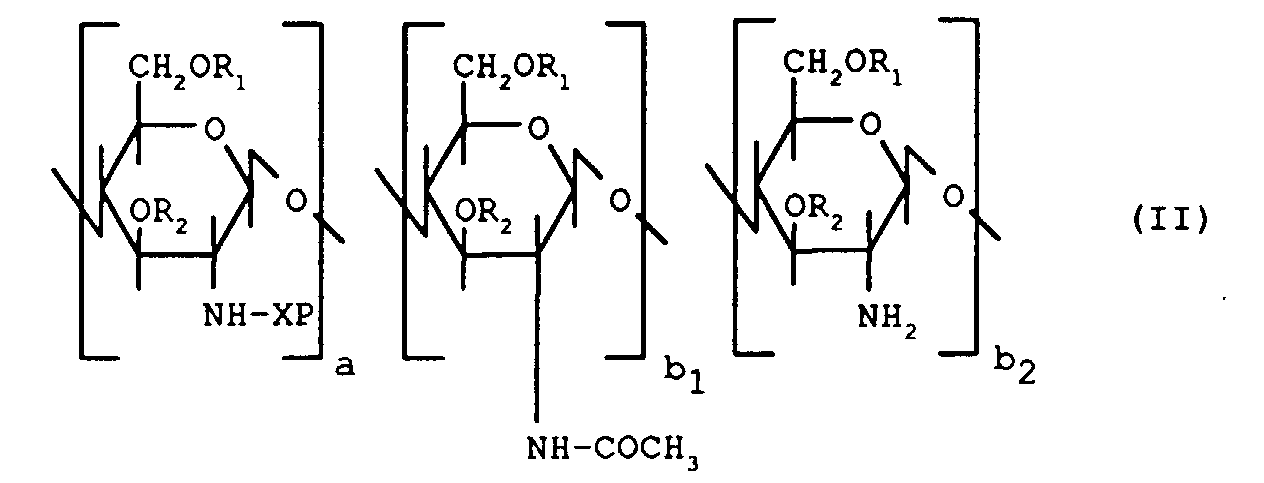


PX-OH (IV)
wherein P and X have the same meanings as defined above with a partially N-acetylated carboxymethylchitosan having the following formula (III):
(1) carboxymethylation degree: 0.5-1.2 (2) molecular weight (as measured by gel filtration method): 3,000-300,000. - In a fourth aspect of the present invention, there is also provided a process for the preparation of an N-acetylcarboxymethylchitosan derivative represented by the following formula (I):

(1) carboxymethylation degree:(as measured by alkalimetry) 0.5-1.2 (2) molecular weight (as measured by gel filtration method): 3,000-300,000 (3) a/(a+b): [provided that a = a1 + a2] 0.01-1 (4) P/X ratio (molar ratio): 0.1-1
acetylating a partially N-acetylated carboxymethylchitosan derivative having the following formula (II') :
(1) carboxymethylation degree:(as measured by alkalimetry) 0.5-1.2 (2) molecular weight (as measured by gel filtration method): 3,000-300,000 (3) a/(a+b): [provided that b = b1 + b2] 0.01-1 (4) P1/X ratio (molar ratio): 0.1-1,
reacting the resulting reaction product having the P1 groups removed, with a compound of the following formula:
P-H or P-OH (V)
wherein P means the group R3CO-, the group R4NH- or the group R5O- as defined above. - We, the present inventors, have also proceeded with research to further improve the properties of the N-acetylcarboxymethylchitosan derivative of formula (I) according to the first aspect of this invention. As a result, we have succeeded in synthesizing as a novel substance such an N-acetylcarboxymethylchitosan derivative represented by the following formula (X):


-CO-CH2CH2-CO-O-(CH2CH2O)n-CH3 (VII)
-CO-O-(CH2CH2O)n-CH3 (VIII)
-CO-CH2-O-(CH2CH2O)n-CH3 (IX)
in which n means the average polymerization degree of the polyethylene glycol chain; a1 and a2 individually represent 0 or a positive integer provided that both of a1 and a2 are not 0 at the same time; b and c individually stand for a positive integer; and having the following characteristic values (1)-(4):(1) carboxymethylation degree: 0.5-1.2 (2) molecular weight (as measured by gel filtration method): 3,000-300,000 (3) a/(a+b+c): [provided that a = a1 + a2] 0.01-1 (4) P/X ratio (molar ratio): 0.1-1 
- We, the present inventors, have also succeeded in synthesizing as a novel substance such an N-acetylcarboxymethylchitosan derivative represented by the following formula (XI):

(1) carboxymethylation degree: 0.5-1.2 (2) molecular weight (as measured by gel filtration method): 3,000-300,000 (3) a/(a+b+c): [provided that a = a1 + a2] 0.01-1 (4) P/X ratio (molar ratio): 0.1-1 
- In a fifth aspect of the present invention, therefore,there is provided an N-acetylcarboxymethylchitosan derivative represented by the following formula (X) or (XI):


-CO-CH2CH2-CO-O-(CH2CH2O)n-CH3 (VII)
-CO-O-(CH2CH2O)n-CH3 (VIII)
-CO-CH2-O-(CH2CH2O)n-CH3 (IX)
in which n means the average polymerization degree of the polyethylene glycol chain; and having the following characteristic values (1)-(4):(1) carboxymethylation degree: 0.5-1.2 (2) molecular weight (as measured by gel filtration method): 3,000-300,000 (3) a/(a+b): [provided that a = a1 + a2] 0.01-1 (4) P/X ratio (molar ratio): 0.1-1 - The derivative of the formula (X) according the fifth aspect of this invention is such an N-acetylcarboxymethylchitosan derivative of the formula (I) where some of the sugar units have been replaced by sugar units of the formula (A) given below. On the other hand, the derivative of the formula (XI) according to the fifth aspect of this invention is such an N-acetylcarboxymethylchitosan derivative where some of the sugar units have been replaced likewise by polyol units of the formula (B) given below. Examples 17-21 and Examples 22-23, which will be descibed hereinafter, demonstrate some examples of the compound of the formula (X) and some examples of the compound of the formula (XI), respectively.

- The sugar derivative of the above formula (A) is such a sugar unit in which the 2-amino group of the carboxymethylglucosamine unit has been substituted by PEG. Specifically, PEG represents one of groups having the following formulae (VI) to (IX) and containing a polyethylene gloycol chain:

-CO-CH2CH2-CO-O-(CH2CH2O)n-CH3 (VII)
-CO-O-(CH2CH2O)n-CH3 (VIII)
-CO-CH2-O-(CH2CH2O)n-CH3 (IX)
- The polyethlene glycol chain contained in each of the groups of the formulae (VI) to (IX) may have various molecular weights, but the polyethylene glycol chain which is preferred from the standpoint of its general availability is such that having an average molecular weight of about 5,000. Accordingly, the preferred average polymerization degree n of the polyethylene glycol chain present in each group of the formulae (VI)-(IX) is about 100-120, to which this invention is not limited, however. The content of the polyethylene glycol in the derivative of the formula (X) can be determined by an NMR method from measurement of the area of a peak attributable to methylene protons in the polyethylene glycol chain. Greater contents of the polyethylene glycol are preferred and for example, its contents of 1% (by weight) or higher are satisfactory. However, no particular limitation is imposed on the content of polyethylene glycol in this invention.
- On the other hand, the polyol unit of the formula (B) in the derivative of the formula (XI) according to the fifth aspect of this invention has a chemical structural feature in that the bond between the carbon atoms at the 2-and 3-positions of the carboxymethylglucosamine unit has been cleaved by oxidation and, subsequent to the cleavage, the carboxymethylglucosamine unit has been converted into the form of a polyalcohol by reduction.
- The a/(a+b+c) value in each of the derivatives of the formulae (X) and (XI) according to the fifth aspect of this invention shows the peptide-introducing degree which may be defined similarly to the a/(a+b) value for the formula (I). The a/(a+b+c) value can therefore be determined using the above equation (1) as it is. In practice, this value may be calculated in exactly the same manner as for the compound of the formula (I), while using the above equations (2)-(5). Similarly, the ranges of the carboxylmethylation degree and molecular weight (as measured by gel filtration method) of the derivatives of formulae (X) and (XI) can also be same as those of the compound of the formula (I).
- Production of the compound of the formula (X) according to the fifth aspect of this invention is conducted by preparing as a starting material the "partially-N-acetylated-carboxymethylchitosan-protected peptide" complex of the formula (II) and then treating it, as will be described below. Thus, first, an active derivative of a PEG chain is reacted with the non-N-acetylated and free 2-amino-group-containing methylglucosamine units existing in the complex of the formula (II) so as to introduce the PEG chain of anyone of the formula (VI)-(IX) as a substituent group into some of the free 2-amino groups of said units. Further, any remaining free amino groups of the carboxymethylgluocosamine units of said complex are N-acetylated. The protective groups are then removed from the moiety of the protected peptide present in the N-acetylated complex to achieve the deprotection of the latter. A reactive derivative of a drug compound is then reacted with the free terminal of the deprotected peptide moiety of the complex so that the drug compound (P) is linked to the terminal of the peptide moiety of the complex.
- In the above reaction steps, the various intermediates as formed after the above N-acetylation and the final product as linked to the drug compound may generically be represented by the formula (X) shown in the above.
- The active derivative of the PEG chain can be, for example, an active ester (for example, the N-hydroxysuccinimido ester) of 2-O-mono-methyoxy-polyethylene glycol-3, 5-dichloro-s-triazine or methoxy-polyoxyethylene carboxylic acid.
- For the production of the compound of the formula (XI) according to the fifth aspect of this invention, the "partially-N-acetylated-carboxymethylchitosan-protected peptide" complex of the formula (II) is prepared at first as a starting material similarly to the production of the compound of the formula (X). The starting material is then treated, as will be described next. Thus, periodic acid, for example, is first reacted with the non-N-acetylated and free amino-group-containing carboxymethylglucosamine units of the starting complex of formula (II) so that the pyranose rings of the glucosamine are cleaved by oxidation. The aldehyde groups as formed by the cleavage is then reduced, for example, with sodium borohydride so that the complex of formula (II) is converted into the form of a polyol. The protective groups are then removed from the protected peptide moiety of the complex to deprotect the peptide moiety of the complex. A reactive derivative of a drug compound is then reacted with the free terminals of the deprotected peptide moiety, whereby the drug compound (P) is linked to the terminals of the peptide moieties of the complex. In the above reaction steps, the various intermediate as formed after the conversion of the complex (II) into the polyol and the final product as linked to the drug compound may generically be represented by the formula (XI) above.
- The substances of formulae (X) and (XI) according to the fifth aspect of the present invention have a high solubility in water, and therefore such drug-delivering carriers and their complexes linked to a drug, which have improved water solubility, are provided by the compound of formula (X) or (XI) according to the fifth aspect of this invention. According to
Experiment 4 to be described hereinafter, it is revealed that the substance of formula (X), for example, is excellent in its property of residing or remaining in blood and exhibits an improved selectivity to be delivered toward the site of cancer(the organotropism)when said substance bears an anticancer agent as a drug compound or pharmaceutical compound. - The derivative of the formula (I) and the dreivatives of the formulae (X) and (XI), all of which pertain to this invention, have advantageous properties, as will be described below.
- As will be demonstrated by the experiments to be described hereinafter, the derivatives of the formula (I) and (X) according to this invention can remain stable in blood during the period after their administration by intravenous injection until their arrival at a target organ, and in other words, said derivatives can retain their high level required of the substances of this invention in blood. On the other hand, they can undergo gradual enzymatic degradation in vivo, so that there is no problem that the N-acetylcarboxymethylchitosan unit of this derivative would remain objectionably for a long time in the living body. Further, all the derivative of the formula (I) and the derivatives of the formulas (X) and (XI) according to this invention, can be observed to possess the tendency of organotropism.
- Incidentally, that the tendency of organotropism is possessed by the compounds of the formulae (I), (X) and (XI) according to this invention when they are administered, does neither mean anything beyond that said compounds can exhibit a tendency of increasing the concentrations of the present compounds as measured at the site of a particular target organ, in comparison with such cases when there are administered such similar compounds which are prepared not in accordance with this invention, nor it does mean that the present compounds of this invention can selectively be delivered only to the site of the particular target organ.
- The present invention will hereinafter be described more specifically by the following Examples.
- The first to fourth aspects of the present invention are illustrated by Examples 1-16, while the fifth aspect of the present invention is illustrated by Examples 17-23.
- In each Example below, the gel filtration was conducted under the following conditions:- a column of TSK-gel G4000PWXL was used with an eluent of 0.1 M NaCl at a flow rate of 0.8 ml/min. and a column temperature of 40°C, and with an amount of the sample injected being about 75 µg.
- 5.0 Grams of carboxymethylchitin (its carboxymethylation degree was 1.0 per one sugar reside, commercially available from Funakoshi Pharmaceutical Co., Ltd.) were dissolved in 0.05 M acetate buffer (having a pH 6.0, 500 ml), to which egg-white lysozyme (12.5 mg) was then added, followed by incubation at 37°C for 2 hours for the reaction. The reaction solution obtained was added to ethanol (2 l). The resulting precipitate was collected and dried in vacuo, whereby 4.25 g of a depolymerised carboxymethylchitin were obtained. This carboxymethylchitin (3.9 g) was dissolved in 1 N aq. NaOH solution (390 ml) and the resultant mixture was then heated under reflux at 100°C for 6 hours. After the pH of the resulting reaction solution was adjusted to 8, the reaction solution was centrifuged to give a supernatant. The supernatant was added to methanol (1.9 l) and the resulting precipitate was collected. The precipitate was dried in vacuo to afford 1.91 g of partially N-acetylated carboxymethylchitosan, which may hereinafter be called simply as a "polysaccharide" and which is one example of the substances of the formula (III). The molecular weight of this polysaccharide was found to be about 1 x 10⁵, as measured by gel filtration method (column: G4000PWXL) while using a dextran as standard substance.
- The above polysaccharide (200 mg) was dissolved in 0.5% aq. NaHCO3 solution (20 ml), followed by addition of dimethylformamide (17.5 ml) into the resultant uniform solution of the polysaccharide. On the other hand, a peptide of which the terminal amino group has been protected by tert-butoxycarbonyl group (namely, Boc), and which was shown by formula N-Boc-Phe-Phe-Gly-OH, (94 mg), was dissolved in 1.5 ml of dimethylformamide, followed by addition of N-hydroxysuccinimide (23 mg) and N,N'-dicyclohexylcarbodiimide (37 mg) to the resulting solution. The protected peptide and the chemical reagents added were reacted with each other at 4°C for 24 hours to form an active ester of the N- protected peptide. The whole reaction mixture was added to the above-mentioned polysaccharide solution, followed by reaction at 4°C for 16 hours. The resulting reaction solution was added to ethanol (160 ml). The resulting precipitate was collected and then dried in vacuo, thereby to afford 200 mg of a complex of partially-N-acetylated-carboxymethylchitosan―Gly-Phe-Phe-Boc [as one example of the derivative of the formula (II)].
- The above complex (150 mg) was dissolved in saturated aq. NaHCO3 solution (15 ml), to which acetic anhydride (0.6 ml) was then added, followed by the N-acetylation of the complex being conducted at room temperature for 17 hours. The resulting reaction solution was neutralized and then poured into ethanol (80 ml). The resulting precipitate was collected and then dried in vacuo, thereby to afford 154 mg of a complex of N-acetylcarboxymethylchitosan-Gly-Phe-Phe-Boc as one example of the derivatives of the formula (I). Ultraviolet absorption spectrum and GFC (gel filtration chromatographic) elution pattern of the above complex as obtained are shown in FIG. 1 and FIG. 2 of the accompanying drawings, respectively. The content of the N-Boc-peptide in this complex was determined to be 14.1%(wt.%), by ultraviolet absorption spectrophotometry (at 258 nm).
- The above complex (130 mg) was dissolved in 0.5 N HCl (13 ml) and then reacted at 30°C for 17 hours, so that the complex was subjected to the deprotecting treatment for removal of the Boc groups from the complex. The reaction solution obtained was neutralized and then poured into ethanol(70 ml). The resulting precipitate was collected and then dried in vacuo, thereby to afford 121 mg of a complex of N-acetylcarboxymethylchitosan― Gly-Phe-Phe-H [as another example of the derivative of the formula (I)]. Ultraviolet absorption spectrum and GFC elution pattern of this complex as afforded are shown in FIG. 3 and FIG. 4 of the accompanying drawings, respectively. The content of the peptide chain in this complex was determined to be 11.3% (wt.%), by ultraviolet absorption spectrophotometry (258 nm).
- Methotrexate (MTX) (182 mg) as a pharmaceutical or drug compound having the carboxyl group was dissolved in dimethylformamide (4 ml), to which N,N'-dicyclohexylcarbodiimide (82 mg) was then added, followed by reaction at 4°C for 17 hours. N-Hydroxysuccinimide (46 mg) and pyridine (63 µl) were added to the resulting reaction solution, and the reaction mixture so formed was then subjected to the reaction at room temperature for 5 hours so that an active ester of MTX was prepared in the resulting reaction solution. On the other hand, the above complex of N-acetylcarboxymethylchitosan―Gly-Phe-Phe-H, (50 mg) was dissolved in 0.5% aq. NaHCO3 solution (10 ml), followed by addition thereto of 0.5 ml of the above-mentioned reaction solution which contained the active ester of MTX. They were reacted with each other at 4°C for 15 hours, whereby MTX was linked to N-terminals of the peptide chain -Gly-Phe-Phe-H of the complex. Then, the reaction solution so obtained was poured into ethanol (40 ml). The resulting precipitate was collected and then dried in vacuo, to obtain 53 mg of a complex of N-acetylcarboxymethylchitosan―Gly-Phe-Phe―MTX [as a further example of the complex of the formula (I)] as yellow powder. Ultraviolet-visible absorption spectrum and GFC elution pattern of this complex are shown in FIG. 5 and FIG. 6 of the accompanying drawings, respectively. The content of MTX in this complex was determined to be 11.5% (wt.%), by ultraviolet absorption spectrophotometry(at 307 nm). Further, the P/X molar ratio of this complex, more specifically, the ratio of MTX/peptide (molar ratio) in this complex was 0.93 as calculated in accordance with the calculation equation (5) described hereinbefore.
- With respect to this complex, the value of a/(a+b) as defined for the formula (I) was approximately 0.09 as calculated in accordance with the calculation equation (1) given before.
- The partially N-acetylated carboxymethylchitosan (100 mg) obtained in Example 1 above was dissolved in 1% aq. NaHCO3 solution(10 ml), followed by addition of dimethylformamide (6 ml) into the resulting uniform polysaccharide solution. A peptide of which terminal amino group was protected by p-methoxybenzyloxycarbonyl group (pMZ), and which was shown by a formula pMZ-Gly-Gly-Gly-OH,(141 mg), was dissolved in 4 ml of dimethylformamide, to which N-hydroxysuccinimide (46 mg) and N,N'-dicyclohexylcarbodiimide (74 mg) were then added. They were reacted at room temperature for 3 hours to form an active ester of the N-protected peptide. The whole reaction solution containing the above active ester was added to the above-mentioned polysaccharide solution, to which dimethylformamide (10 ml) was then added. The whole mixture was subjected to reaction at 4°C for 23 hours. Water (5 ml) was added to the resulting reaction solution, followed by centrifugation to obtain a supernatant. The supernatant was added to ethanol (150 ml) and the resulting precipitate was collected. The precipitate was then dried in vacuo, thereby to afford 120 mg of a complex of partially-N-acetylated-carboxymethylchitosan―Gly-Gly-Gly-pMZ [as one example of the derivatives of the formula (II)].
- In a similar manner to Example 1, this complex (100 mg) was N-acetylated with acetic anhydride, whereby a complex of N-acetylcarboxymethylchitosan― Gly-Gly-Gly-pMZ, (97 mg) was obtained. Ultraviolet absorption spectrum and GFC elution pattern of the resulting complex as acetylated are shown in FIG. 7 and FIG. 8, respectively. The content of the pMZ-peptide in this complex was determined to be 20.1% (wt.%) by ultraviolet absorption spectrophotometry (at 272 nm).
- In a similar manner to Example 1, this complex (89 mg) was subjected to acid treatment to remove pMZ, the protective groups, whereby 78 mg of a complex of N-acetylcarboxymethylchitosan-Gly-Gly-Gly-H were obtained. Ultraviolet absorption spectrum of this complex are shown in FIG. 9. The content of the peptide chain in this complex was 11.3% (wt.%) as determined in accordance with the calculation equation (3) given hereinbefore.
- 50 mg of this complex were dissolved in 1% aq. NaHCO3 solution (5 ml), to which a solution (1 ml) of the active ester of MTX was then added, followed by the reaction at 4°C for 21 hours. The resulting reaction solution was poured into ethanol (25 ml). The resulting precipitate was collected and then dried in vacuo, to afford 52 mg of a complex of N-acetylcarboxymethylchiotosan―Gly-Gly-Gly―MTX [as a further example of the complex of the formula (I)] as yellow powder. Ultraviolet-visible absorption spectrum and GFC elution pattern of this complex are shown in FIG. 10 and FIG. 11, respectively. The content of MTX in this complex was determined to be 21.4% (wt.%) by ultraviolet absorption spectrophotometry (at 307 nm). Further, the P/X molar ratio of this complex, more specifically, the ratio of MTX/peptide (molar ratio) in said complex was 1.0 as calculated in accordance with the calculation equation (5) described hereinbefore. With respect to said complex, its value of a/(a+b) as defined for the formula (I) was 0.2 as calculated in accordance with the calculation equation (1) given hereinbefore.
- Egg white lysozyme was reacted with 5.0 g of a carboxymethylchitin (its carboxymethylation degree was 1.0 per one sugar residue) in a similar manner to Example 1 to prepare a depolymerised carboxymethylchitin (4.28 g). A 4.1 g portion of this depolymerised carboxymethylchitin was subjected to alkali treatment, whereby a partially N-acetylated carboxymethylchitosan (2.22 g) having a molecular weight of about 1 x 10⁵ was obtained.
- An active ester of an N-protected peptide of formula N-Boc-Gly-Phe-Gly-Gly-OH (90 mg) was reacted with the partially N-acetylated carboxymethylchitosan (200 mg) as obtained above, in a similar manner to Example 1 to produce a complex of partially-N-acetylated-carboxymethylchitosan-Gly-Gly-Phe-Gly-Boc, (210 mg). A 200 mg portion of this complex was thereafter N-acetylated to prepare a complex of N-acetylcarboxymethylchitosan-Gly-Gly-Phe-Gly-Boc, (190 mg). The content of the N-Boc-peptide chain in this complex was determined to be 9.8 wt.% (wt.%) by ultraviolet absorption spectrophotometry (at 258 nm).
- A 160 mg portion of this complex was deprotected by acid treatment in a similar manner to Example 1 to obtain a complex of N-acetylcarboxymethylchitosan― Gly-Gly-Phe-Gly-H, (144 mg, with a peptide content of 7.6%).
- An active ester of MTX (55 mg) was reacted with a 120 mg portion of the latter complex, whereby a complex of N-acetylcarboxymethylchitosan―Gly-Gly-Phe-Gly―MTX (127 mg, with an MTX content of 9.5%) was produced. With respect to this complex, the ratio of MTX/peptide (molar ratio) in said complex and its value of a/(a+b) defined for the formula (I) were 1.0 and 0.07, respectively, as calculated in accordance with the aforesaid calculation equations (5) and (1).
- In a similar manner to Example 1, an active ester of an N-protected peptide,N-Boc-Gly-Phe-Gly-Phe-OH, (105 mg) was reacted with the partially N-acetylated carboxymethylchitosan (200 mg) which was obtained in Example 3 above. Thereby, a complex of partially-N-acetylated-carboxymethylchitosan―Phe-Gly-Phe-Gly-Boc, (199 mg) was produced.
- A 188 mg portion of this complex was N-acetylated so that a complex of N-acetylcarboxymethylchitosan― Phe-Gly-Phe-Gly-Boc, (191 mg) was prepared. The content of the N-Boc-peptide chain in this complex was determined to be 4.9% (wt.%) by ultraviolet absorption spectrophotometry (at 258 nm). A 160 mg portion of this complex was deprotected by acid treatment in a similar manner to Example 1 to afford a complex of carboxymethylchitosan-Phe-Gly-Phe-Gly-H, (150 mg, with a peptide content of 4.0%). An active ester of MTX (23 mg) was thereafter reacted with a 50 mg portion of the latter complex, whereby a complex of carboxymethylchitosan-Phe-Gly-Phe-Gly-MTX (46 mg, with an MTX content of 4.5 wt.%) was prepared. With respect to this complex, the MTX/peptide molar ratio in this complex and its value of a/(a+b) defined for the formula (I) were 1.1 and 0.03, respectively, as calculated from the aforesaid calculation equations (5) and (1).
- In a similar manner to Example 1, an active ester of an N-protected peptide,N-Boc-Phe-Gly-Phe-Gly-OH, (54 mg) was reacted with the partially N-acetylated carboxymethylchitosan (100 mg) as obtained in Example 3. Thus, a complex of partially-N-acetylated-carboxymethylchitosan―Gly-Phe-Gly-Phe-Boc, (109 mg) was prepared.
- A 90 mg portion of this complex was N-acetylated, affording a complex of N-acetylcarboxymethylchitosan― Gly-Phe-Gly-Phe-Boc, (85 mg). The content of the N-Boc-peptide chain in this complex was determined to be 12.7% (wt.%) by ultraviolet absorption spectrophotometry (at 258 nm). A 72 mg portion of this complex was deprotected by acid treatment in a similar manner to Example 1 to prepare a complex of carboxymethylchitosan-Gly-Phe-Gly-Phe-H, (63 mg, with a peptide content of 10.4%).
- An active ester of MTX (23 mg) was thereafter reacted with a 50 mg portion of the latter complex, whereby a complex of N-acetylcarboxymethylchitosan― Gly-Phe-Gly-Phe-MTX (49 mg, with an MTX content of 9.4%) was produced. With respect to this complex, the ratio of MTX/peptide (molar ratio) in said complex and its value a/(a+b) defined for the formula (I) were 0.94 and 0.07, respectively, as calculated in accordance with the aforesaid equations (5) and (1).
- In a similar manner to Example 1, an active ester of an N-protected peptide,N-Boc-Ala-Gly-Gly-Gly-OH,(180 mg) was reacted with the partially N-acetylated carboxymethylchitosan (200 mg) as obtained in Example 3, whereby a complex of partially-N-acetylated-carboxymethylchitosan―Gly-Gly-Gly-Ala-Boc, (218 mg) was prepared. A 150 mg portion of this complex was N-acetylated, affording a complex of N-acetylcarboxymethyl chitosan―Gly-Gly-Gly-Ala-Boc, (143 mg). A 130 mg portion of the latter complex was subjected to acid treatment for the deprotection in a similar manner to Example 1 to produce a complex of N-acetylcarboxymethylchitosan― Gly-Gly-Gly-Ala-H, (120 mg).
- The active ester of MTX (46 mg) was thereafter reacted with a 50 mg portion of the last-mentioned complex, whereby a complex of N-acetylcarboxymethylchitosan―Gly-Gly-Gly-Ala―MTX (55 mg, with an MTX content of 21.5%) was obtained. Ultraviolet-visible absorption spectrum and GFC elution pattern of the latter complex are shown in FIG. 12 and FIG. 13 of the accompanying drawings, respectively.
- Partially N-acetylated carboxymethylchitosan (45 mg), which had been prepared from carboxymethylchitin (its carboxymethylation degree was 0.7 per sugar residue) in a similar manner to Example 1 and had a molecular weight of about 1 x 10⁵, was dissolved in a 0.1 M borate buffered solution (pH 8.0, 2 ml) to prepare a solution of the polysaccharide. On the other hand, a modified peptide of a formula N-succinyl-Ala-Ala-Ala-p-nitroanilide, (45 mg) was dissolved in dimethylformamide (2 ml), to which were then added N-hydroxysuccinimide (12 mg) and N,N'-dicyclohexylcarbodiimide (41 mg). The reaction was made at room temperature for 1 hour and then at 4°C for 18 hours, so that an active ester of said peptide having the nitroanilide bonded thereto was prepared. The resulting reaction solution was distilled under reduced pressure to remove the solvent therefrom. The residue was washed with isopropanol and then dissolved in dimethylformamide (0.8 ml). The solution obtained was added to the above-mentioned polysaccharide solution, followed by reaction at room temperature for 40 hours. Ethanol was added to the resulting reaction solution. The precipitate as formed was collected and then dried in vacuo, whereby 46 mg of a complex of partially-N-acetylated-carboxymethylchitosan―Suc-Ala-Ala-Ala―p-nitroanilide were obtained.
- 26 mg of this complex was taken and dissolved in saturated aq. NaHCO3 solution (3 ml),to which acetic anhydride (0.14 ml) was then added, followed by the reaction at 4°C for 24 hours to N-acetylate the complex. After the reaction solution obtained was dialyzed against water, the resulting non-dialysable solution left after dialysis was poured into ethanol. The resulting precipitate was dried in vacuo so that a complex of N-acetylcarboxymethylchitosan-Suc-Ala-Ala-Ala―p-nitroanilide (25 mg) was obtained. Ultraviolet absorption spectrum and GFC elution pattern of this complex are shown in FIG. 14 and FIG. 15 of the accompanying drawings, respectively. The content of the moiety Suc-Ala-Ala-Ala-p-nitroanilide in this complex was found to be 3.9% (wt.%) from its absorption spectrophotometry at 315 nm.
- An active ester of a modified peptide of formula N-succinyl-Ala-Ala-Val-Ala-p-nitroanilide, (55 mg) was reacted with the partially N-acetylated carboxymethylchitosan (45 mg) in a similar manner to Example 7 to prepare a complex of partially-N-acetylated-carboxymethylchitosan―Suc-Ala-Ala-Val-Ala―p-nitroanilide (44 mg).
- 30 mg of this complex was thereafter N-acetylated in a similar manner to Example 7, to give a complex of N-acetylcarboxymethylchitosan―Suc-Ala-Ala-Val-Ala―p-nitroanilide (22 mg). The content of the moiety Suc-Ala-Ala-Val-Ala-p-nitroanilide in the latter complex was found to be 4.5% (wt.%) from its absorption spectrophotometry at 315 nm.
- The partially N-acetylated carboxymethylchitosan (50 mg) as obtained in Example 1 was dissolved in 0.25% aq. NaHCO3 solution (7 ml), and into the resulting uniform solution of the polysaccharide was added dimethylformamide (6 ml). On the other hand, a phenylalanine having been protected by a protective group Boc and shown by a formula N-Boc-Phe-OH (256 mg) was dissolved in 3 ml of dimethylformamide, followed by addition of N-hydroxysuccinimide (115 mg) and N,N'-dicyclohexylcarbodiimide (190 mg) to the resultant solution. The reaction was made at 4°C for 20 hours to prepare an active ester of the N-protected phenylalanine. A 1 ml portion of the resultant reaction solution which contained said active ester was added to the above-mentioned polysaccharide solution, followed by the reaction at room temperature for 20 hours. The reaction solution obtained was added to ethanol (35 ml). The resulting precipitate was collected and then dried in vacuo, whereby 51 mg of a complex of partially-N-acetylated-carboxymethylchitosan―Phe-Boc were obtained. The content of the N-Boc-phenylalanine (Phe-Boc) in this complex was determined to be 14.4% (wt.%) from ultraviolet absorption spectrophotometry (at 258 nm).
- The depolymerized carboxymethylchitin (4.1 g) as prepared in a similar manner to Example 3 was partially de-N-acetylated by alkali treatment and the resulting reaction solution was adjusted to pH 8.5. The reaction solution was then centrifuged and the supernatant was added to 4.4-fold volumes of methanol. The resulting mixture was separated into the supernatant and precipitate. Ethanol (300 ml) was added to the supernatant. The resulting precipitate was collected and then dried in vacuo so that 0.54 g of partially-N-acetylated-carboxymethylchitosan having a molecular weight of about 2 x 10⁴ was obtained.
- This chitosan substance (100 mg) was reacted with an N-protected peptide of formula N-Boc-Phe-Gly-Phe-Gly-OH, (217 mg) in a similar manner to Example 1, followed by the N-acetylation with acetic anhydride, whereby a complex of N-acetylcarboxymethylchitosan―Gly-Phe-Gly-Phe-Boc, (98 mg, with the content of the N-Boc-peptide of 28%) was prepared. This complex (80 mg) was deprotected by acid treatment for removal of the Boc groups in a similar manner to Example 1, to afford a complex of N-acetylcarboxymethylchitosan―Gly-Phe-Gly-Phe-H, (46 mg, with a peptide content of 24%).
- The active ester of methotrexate (MTX, 69 mg) was reacted with 35 mg of the above complex in a similar manner to Example 1, so that a complex of N-acetylcarboxymethylchitosan―Gly-Phe-Gly-Phe―MTX (35 mg, with an MTX content of 19%) was obtained. With respect to this complex, the MTX/peptide molar ratio in the complex and the value a/(a+b) defined for the formula (I) were 0.92 and 0.19, respectively, as calculated in accordance with the aforesaid equations (5) and (1).
- The partially N-acetylated carboxymethylchitosan (50 mg), which had been prepared in a similar manner to Example 10 and have a molecular weight of about 2 x 10⁴, was dissolved in a mixed solvent of water (1.25 ml) and dimethylsulfoxide (1.25 ml). In a similar manner to Example 1, an active ester of a protected peptide of formula N-succinyl-Gly-Phe-Gly-Lys(ε-N-Boc)-O-tBu (169 mg) was reacted with the chitosan substance, whereby a complex of partially-N-acetylated-carboxymethylchitosan― Suc-Gly-Phe-Gly-Lys(ε-N-Boc)-O-tBu was prepared. This complex was N-acetylated and then, deprotected by acid treatment to produce a complex of N-acetylcarboxymethylchitosan―Suc-Gly-Phe-Gly-Lys-H, (47 mg).
- The active ester of methotrexate (MTX) (23 mg) was reacted with 35 mg of the above complex, whereby a complex of N-acetylcarboxymethylchitosan―Suc-Gly-Phe-Gly-Lys―MTX (29 mg, with an MTX content of 1.5 wt.%) was obtained. Ultraviolet-visible absorption spectrum and GFC elution pattern of this complex are shown in FIG. 20 and FIG. 21 of the accompanying drawings, respectively.
- In a manner similar to Example 1, 25 mg of egg white lysozyme were reacted with 5.0 g of carboxymethylchitin (its carboxymethylation degree was 0.7 per sugar residue) so that a depolymerized carboxymethylchitin (4.37 g) was obtained. 3.7 g portion of this chitin substance was partially de-acetylated by alkali treatment, to give a partially N-acetylated carboxymethylchitosan (2.58 g) having a molecular weight of about 1 x 10⁵ (as measured using dextran as a standard substance).
- The active ester (N-hydroxysuccinimido ester) of an N-protected peptide of formula N-Boc-Phe-Phe-Gly-OH, (141 mg) was reacted with the above-mentioned partially N-acetylated carboxymethylchitosan (300 mg) in a similar manner to Example 1 to produce a complex of partially-N-acetylated-carboxymethylchitosan―Gly-Phe-Phe-Boc, (340 mg). 300 mg of this complex was N-acetylated with acetic anhydride so that a complex of N-acetylcarboxymethylchitosan―Gly-Phe-Phe-Boc (298 mg, with a content of the N-Boc-peptide of 12.0%) was obtained.
- A 100 mg portion of the above complex was deprotected by acid treatment (for removal of the Boc groups) in a similar manner to Example 1 to prepare a complex of N-acetylcarboxymethylchitosan-Gly-Phe-Phe-H, (89 mg).
- A 75 mg portion of this complex was dissolved in 1% aq. NaHCO3 solution (7.5 ml), to which was then added the active ester of methotrexate (MTX) (75 mg). The reaction was made at 4°C for 24 hours to link MTX to the N-terminals of the peptide moiety of the complex. The reaction solution obtained was added to ethanol (40 ml). The resulting precipitate was collected and then dried in vacuo, so that a complex of N-acetylcarboxymethylchitosan-Gly-Phe-Phe-MTX (75 mg, with an MTX content of 10.1 wt.%) was obtained as yellow powder. Ultraviolet-visible absorption spectrum and GFC elution pattern of this complex are shown in FIG. 22 and FIG. 23 of the accompanying drawings, respectively.
- 2.0 g of carboxymethylchitin (its carboxymethylation degree was 0.7) were dissolved in 0.05 M acetate buffered solution (pH 6.0, 200 ml), to which egg white lysozyme (2.5 mg) was then added. The resulting solution was kept at 37°C for 1.5 hours for the reaction, whereby a depolymerised carboxymethylchitin was obtained. This depolymerised carboxymethylchitin was then treated with aqueous 1N NaOH in a similar manner to Example 1 to afford 1.72 g of partially N-acetylated carboxymethylchitosan having a molecular weight of about 3 x 10⁵ (as measured using dextran as a standard substance). This partially N-acetylated carboxymethylchitosan (150 mg) was dissolved in 0.5% aq. NaHCO3 solution (15 ml) and then reacted with an active ester of an N-protected peptide of formula N-Boc-Ala-Gly-Gly-Gly-OH, (135 mg) in a similar manner to Example 1, to prepare a complex of N-acetylcarboxymethylchitosan―Gly-Gly-Gly-Ala-Boc, (150 mg). 140 mg portion of this complex was N-acetylated with acetic anhydride to produce a complex of N-acetylcarboxymethylchitosan―Gly-Gly-Gly-Ala-Boc, (154 mg). 130 mg portion of the latter complex was treated with acid to remove the Boc groups therefrom, so that a complex of N-acetylcarboxymethylchitosan―Gly-Gly-Gly-Ala-H (106 mg) was prepared. 95 mg portion of this complex was dissolved in 1% aq. NaHCO3 solution (4.8 ml) and then reacted with the active ester of MTX (86 mg) in the resulting solution, to produce a complex of N-acetylcarboxymethylchitosan― Gly-Gly-Gly-Ala―MTX (88 mg, with an MTX content of 13.7 wt.%).
- In a similar manner to Example 1, an active ester of an N-protected peptide of formula N-Boc-Gly-Gly-Gly-OH, (109 mg) was reacted with the partially N-acetylated carboxymethylchitosan (150 mg) as obtained in Example 12, to prepare a complex of partially-N-acetylated-carboxymethylchitosan―Gly-Gly-Gly-Boc, (167 mg). 150 mg of this complex was N-acetylated with acetic anhydride, so that a complex of N-acetylcarboxymethylchitosan―Gly-Gly-Gly-Boc; (153 mg) was prepared. A 130 mg portion of the latter complex was subjected to acid treatment to remove the Boc groups therefrom and prepare a complex of N-acetylcarboxymethylchitosan―Gly-Gly-Gly-H, (110 mg). This complex (100 mg) was reacted with the active ester of MTX (90 mg), whereby a complex of N-acetylcarboxymethylchitosan―Gly-Gly-Gly―MTX (111 mg, with an MTX content of 17.4 wt.%) was obtained.
- In a similar manner to Example 1, an active ester of an N-protected peptide of formula N-Boc-Ala-Gly-Gly-Gly-OH (135 mg) was reacted with the partially N-acetylated carboxymethylchitosan (150 mg) as obtained in Example 12, to prepare a complex of partially-N-acetylated-carboxymethylchitosan―Gly-Gly-Gly-Ala-Boc, (162 mg). 150 mg of this complex was N-acetylated with acetic anhydride so that a complex of N-acetylcarboxymethylchitosan― Gly-Gly-Gly-Ala-Boc, (157 mg) was produced. 130 mg of the latter complex was subjected to acid treatment to remove the Boc groups therefrom and prepare a complex of N-acetylcarboxymethylchitosan―Gly-Gly-Gly-Ala-H, (114 mg). This complex (100 mg) was reacted with the active ester of MTX (90 mg), whereby a complex of N-acetylcarboxymethylchitosan―Gly-Gly-Gly-Ala―MTX (111 mg, with an MTX content of 17.4%) was obtained.
- In a similar manner to Example 1, an active ester of an N-protected peptide of formula N-Boc-Gly-Phe-Gly-Gly-OH, (87 mg) was reacted with the partially N-acetylated carboxymethylchitosan (200 mg) as obtained in Example 12, to prepare a complex of partially N-acetylated-carboxymethylchitosan―Gly-Gly-Phe-Gly-Boc,(206 mg). 100 mg of this complex was N-acetylated with acetic anhydride so that a complex of N-acetylcarboxymethylchitosan―Gly-Gly-Phe-Gly-Boc (92 mg, with a content of the N-Boc-peptide of 7.4%) was prepared. 80 mg portion of the latter complex was subjected to acid treatment to remove the Boc groups therefrom and give a complex of N-acetylcarboxymethylchitosan―Gly-Gly-Phe-Gly-H, (71 mg). This complex (50 mg) was reacted with the active ester of MTX (45 mg), whereby a complex of N-acetylcarboxymethylchitosan-Gly-Gly-Phe-Gly―MTX complex (50 mg, with an MTX content of 7.0%) was obtained.
- A 50 mg portion of the complex of partially-N-acetylated-carboxymethylchitosan―Gly-Phe-Phe-Boc (with its carboxymethylation degree of 0.7 and a content of the N-Boc-peptide of 13.2%), which was obtained in Example 12, was dissolved in 0.1% aq. NaHCO3 solution (2.5 ml), to which was then added 2-O-mono-methoxypolyethylene glycol-3,5-dichloro-s-triazine(80 mg)(having a molecular weight of 5,000, a product of Sigma Corporation; hereinafter abbreviated as "PEG1"). The reaction was conducted at 0°C for 4 hours. Water (2.5 ml), sodium hydrogen carbonate (500 mg) and acetic anhydride (200 µl) were added to the resulting reaction solution which contained a produced complex of partially-N-acetylated-carboxymethylchitosan-(PEG1)―Gly-Phe-Phe-Boc, followed by reaction at 4°C for 18 hours to complete the N-acetylation of said complex. The reaction solution obtained was dialyzed against water. The resultant non-dialysable solution was concentrated to 3 ml, to which acetone (90 ml) was added. The resulting precipitate was collected, washed with methylene chloride and then dried in vacuo to obtain a complex of N-acetylcarboxymethylchitosan-(PEG1)―Gly-Phe-Phe-Boc (72 mg, with the PEG content of 37%).
- This complex (60 mg) was dissolved in 0.5 N HCl (3.5 ml) and the resulting solution was kept at 30°C for 16 hours to effect the reaction for removal of the Boc groups from said complex. The reaction solution obtained was added to a 1:2 mixed solvent (60 ml) of ethanol and ether. The resulting precipitate was collected, washed with methylene chloride, and then dried in vacuo, so that a complex of N-acetylcarboxymethylchitosan-(PEG1)―Gly-Phe-Phe-H (44 mg, with the PEG content of 26%) was obtained. A GFC elution pattern of this complex is presented in FIG. 24 of the accompanying drawings. This N-acetylcarboxymethylchitosan-(PEG1)―Gly-Phe-Phe-H complex (35 mg) was dissolved in 1% aq. NaHCO3 solution (1.75 ml), to which the active ester of MTX (16 mg) was added. The reaction was conducted at 4°C for 18 hours. The reaction solution obtained was dialyzed against water. The resultant non-dialysable solution was concentrated to 3 ml, followed by the addition of acetone (60 ml) thereto. The resulting precipitate was collected, washed with methylene chloride and then dried in vacuo, whereby a complex of N-acetylcarboxymethylchitosan- (PEG1)―Gly-Phe-Phe―MTX (29 mg, with the PEG content of 21% and an MTX content of 7.9%) was obtained in the form of yellow powder as one example of the derivatives of the formula (X). Ultraviolet-visible absorption spectrum and GFC elution pattern of the latter complex are shown in FIG. 25 and FIG. 26 of the accompanying drawings, respectively.
- A 50 mg portion of the partially-N-acetylated-carboxymethylchitosan―Gly-Phe-Phe-Boc complex (with its carboxymethylation degree of 0.7 and a content of the N-Boc-peptide of 13.2%) which was obtained in Example 12 was dissolved in 0.1% aq. NaHCO3 solution (2.5 ml), and to the resulting solution was added the PEG1 (12 mg) as used in Example 17. By effecting the reaction in a similar manner to Example 17, a complex of N-acetylcarboxymethylchitosan- (PEG1)-Gly-Phe-Phe-Boc (49 mg, with the PEG content of 8.0%) was prepared. 40 mg of this complex was subjected to the deprotecting treatment for removal of the Boc groups therefrom, to afford a complex of N-acetylcarboxymethylchitosan-(PEG1)-Gly-Phe-Phe-H, (33 g). This complex (21 mg) was dissolved in 1% aq. NaHCO3 solution (1.1. ml), to which was then added the active ester of MTX (9.5 mg). The resulting mixture was kept at 4°C for 18 hours for the reaction. The reaction solution obtained was added to ethanol (11 ml). The resulting precipitate was collected, washed with methylene chloride and then dried in vacuo, whereby a complex of N-acetylcarboxymethylchitosan-(PEG1) -Gly-Phe-Phe-MTX (17 mg, with the PEG content of 6.1% and an MTX content of 8.5%) was obtained.
- A 50 mg portion of the partially-N-acetylatedcarboxymethylchitosan- Gly-Phe-Phe-Boc complex (with its carboxymethylation degree of 0.7 and a content of the N-Boc-peptide of 14.8%), which had been prepared according to Example 12 above, was dissolved in 0.1% aq. NaHCO3 solution (5 ml), followed by addition of PEG1 (200 mg) to said solution. By effecting the reaction in a similar manner to Example 17, a complex of N-acetylcarboxymethylchitosan-(PEG1)-Gly-Phe-Phe-Boc (100 mg, with the PEG content of 58%) was prepared. A 90 mg portion of the latter complex was subjected to the acid treatment for removal of the Boc groups, to give a complex of N-acetylcarboxymethylchitosan-(PEG1)-Gly-Phe-Phe-H (67 mg, with the PEG content of 45%). In a similar manner to Example 17, this complex (50 mg) was reacted with the active ester of MTX, whereby a complex of N-acetylcarboxymethylchitosan-(PEG1)-Gly-Phe-Phe-MTX (42 mg, with the PEG content of 43% and an MTX content of 6.3%) was obtained.
- A 25 mg portion of a complex of partially-N-acetylated-carboxymethylchitosan-Gly-Gly-Phe-Gly-Boc (with its carboxymethylation degree of 0.7 and a content of the N-Boc-peptide of 7.9%), which had been prepared in a similar manner to Example 16, was dissolved in 0.1% aq. NaHCO3 solution (1.25 ml), to which was added the PEG1 (50 mg). By effecting the reaction in a similar manner to Example 17, a complex of N-acetylcarboxymethylchitosan-(PEG1)-Gly-Gly-Phe-Gly-Boc (42 mg, with the PEG content of 42%) was prepared. 30 mg of this complex was subjected to the acid treatment for removal of the Boc groups, to afford a complex of N-acetylcarboxymethylchitosan-(PEG1)-Gly-Gly-Phe-Gly-H, (20 mg). The latter complex was reacted with the active ester of MTX in a similar manner to Example 17, so that a complex of N-acetylcarboxymethylchitosan-(PEG1)-Gly-Gly-Phe-Gly-MTX (11 mg, with the PEG content of 27% and an MTX content of 6.1%) was produced.
- A 100 mg portion of the complex of partially-N-acetylated-carboxymethylchitosan-Gly-Phe-Phe-Boc (with its carboxymethylation degree of 0.7 and a content of the N-Boc-peptide of 14.8%), which had been prepared in a similar manner to Example 12, was dissolved in 0.5% aq. NaHCO3 solution (10 ml), to which was then added dimethylformamide (8.5 ml) to give a uniform solution. To this solution was added an active ester (100 mg) of methoxypolyoxyethylene carboxylic acid (with a molecular weight of 5000, a product of Sigma Corporation; hereinafter abbreviated as "PEGco"), and the resulting solution was kept at 4°C for 18 hours to effect the reaction to combine the PEGco chain with the non-N-acetylated amino groups which were present in the sugar units of said complex. The resulting reaction solution was dialyzed against water. Sodium hydrogen carbonate (3.6 g) and acetic anhydride (2.1 ml) were added to the resulting non-dialysable solution (27 ml), followed by effecting the acetylation at 4°C for 20 hours, so that the partially-N-acetylated-carboxymethylchitosan-(PEGco)-Gly-Phe-Phe-Boc complex was N-acetylated. The reaction solution obtained was dialyzed against water. The resultant non-dialysable solution was concentrated to 6 ml, to which acetone (120 ml) was added. The resulting precipitate was collected, washed with methylene chloride and then dried in vacuo, to afford a complex of an N-acetylcarboxymethylchitosan-(PEGco)-Gly-Phe-Phe-Boc (109 mg, with the PEG content of 9.0%). 50 mg portion of the latter complex was subjected to the acid treatment for removal of the Boc groups therefrom, to prepare a complex of N-acetylcarboxymethylchitosan-(PEGco)-Gly-Phe-Phe-H (35 mg, with the PEG content of 4.7%). This complex (25 mg) was reacted with the active ester of MTX in a similar manner to Example 18, whereby a complex of N-acetylcarboxymethylchitosan-(PEGco)-Gly-Phe-Phe-MTX (25 mg, with the PEG content of 4.5% and an MTX content of 9.1%) was produced.
- With a partially N-acetylated carboxymethylchitosan (300 mg) which was prepared as in Example 1, was reacted an active ester of an N-protected peptide of formula N-Boc-Gly-Gly-Gly-OH (289 mg) in a similar mammer to Example 1, to prepare a partially-N-acetylated-carboxymethylchitosan--Gly-Gly-Gly-Boc complex (334 mg).
- A 125 mg portion of this complex was dissolved in water (12 ml), to which was then added 3.3% aq. sodium meta-periodate (5 ml). The reaction was effected at room temperature for 4 hours in the dark. After the resulting reaction solution was dialyzed against water, the resulting non-dialysable solution was concentrated to about 12 ml, to which sodium borohydride (30 mg) was added. The reduction reaction was then effected overnight. The pH of the resulting reaction solution was lowered to 4.5 and thereafter was raised back to 8.0 and then added into ethanol (60 ml). The resulting precipitate was collected and then dried in vacuo, whereby there was prepared a complex of N-acetylcarboxymethylchitosan―Gly-Gly-Gly-Boc (77 mg), of which some pyranose rings had been opened and which was converted into the derivative of a polyol.
- A 60 mg portion of this complex was subjected to the acid treatment in a similar manner to Example 1 to remove the Boc groups from the complex, whereby a complex of N-acetylcarboxymethylchitosan―Gly-Gly-Gly-H as converted into a polyol derivative was prepared (yield: 46 mg). An active ester of MTX (46 mg) was reacted with 35 mg of the latter complex to produce a complex of N-acetylcarboxymethylchitosan―Gly-Gly-Gly―MTX as converted into a polyol derivative (42 mg, with an MTX content of 29%). Ultraviolet-visible absorption spectrum and GFC elution pattern of the last-mentioned complex are shown in FIG. 27 and FIG. 28 of the accompanying drawings respectively.
- With a partially N-acetylated carboxymethylchitosan (250 mg) which was prepared similarly to Example 1, was reacted an active ester of an N-protected peptide of formula N-Boc-Gly-Phe-Phe-Gly-OH (527 mg) in a similar manner to Example 1, to prepare a complex of carboxymethylchitosan-Gly-Phe-Phe-Gly-Boc, (327 mg). A 200 mg portion of this complex was subjected to periodate oxidation and then reduced in a similar manner to Example 22 above. Thus, a complex of N-acetylcarboxymethylchitosan--Gly-Phe-Phe-Gly-Boc which had been converted into the polyol derivative (113 mg, with a content of the N-Boc-peptide of 28%) was prepared.
- A 60 mg portion of the latter complex was subjected to the acid treatment in a similar manner to Example 1 to remove the Boc groups from said complex. Thereby, a complex of N-acetylcarboxymethylchitosan―Gly-Phe-Phe-Gly-H which was converted into the polyol derivative (36 mg, with a peptide content of 24%) was prepared. This complex (30 mg) was reacted with the active ester of MTX (55 mg) to produce a complex of N-acetylcarboxymethylchitosan-Gly-Phe-Phe-Gly―MTX (22 mg, with an MTX content of 19%) which was converted into the polyol derivative. With respect to this complex, the MTX/peptide molar ratio in said complex and its value of a/(a+b) as defined for the formula (I) were 0.93 and 0.19 as calculated by the aforesaid equations (5) and (1), respectively.
- Properties of the derivatives having the formula (I), (X) or (XI) according to this invention were tested by the following Experiments 1-4.
- The N-acetylcarboxymethylchitosan―Gly-Phe-Phe― MTX complex obtained in Example 1, as well as the N-acetylcarboxymethylchitosan―Gly-Gly-Gly―MTX complex obtained in Example 2 were taken as test samples and individually dissolved in physiological saline to prepare two solutions of 400 µg/ml of the sample. To plasma (190 µl) which had been obtained by centrifuging a volume of blood collected from several mice was added a 10 µl portion of each solution of the sample, followed by reaction at 37°C. From the resulting reaction mixture were separated test solutions at intervals of time. After each test solution of the reaction mixture was deproteinized, the test solutions were analyzed by gel filtration chromatographic method (using a column of TSK-gel G4000 PWXL, as eluted with 0.1 M NaCl at flow rate of 0.8 ml/min. and and at column temperature of 40°C, while the detection being made by ultraviolet absorption (at 307 nm), so that the percentages of the residual content of MTX, which retained the initial form of its complex within the plasma were evalutated.
- The test results are plotted in FIG. 16 of the accompanying drawings, which is a graph showing time-dependent variations in the percentages of the residual content of MTX, which was present in the plasma with retaining the form of the complex represented by the formula (I). In this graph, the broken line with dots (●) indicates the test results obtained with the N-acetylcarboxymethylchitosan―Gly-Phe-Phe―MTX complex, while the full line with squares (□) indicates the test results obtained with the N-acetylcarboxymethylchitosan-Gly-Gly-Gly-MTX complex.
- It is observed from FIG. 16 that the above two complexes are practically free from their degradation in the blood circulation and remain stable in the blood.
- The N-acetylcarboxymethylchitosan―Gly-Phe-Phe―MTX complex (1 mg) obtained in Example 1, as well as the N-acetylcarboxymethylchitosan―Gly-Gly-Gly―MTX complex obtained in Example 2 were taken as test samples and individually reacted in 0.1 M acetate buffer (pH 6.0, 1 ml) at 37°C in the presence or absence of egg white lysozyme (10 µg). From the reaction mixture at the ends of 1, 3, 6 and 23 hours were taken test solutions, which were then analyzed by gel filtration chromatographic method as described in
Experiment 1. In this way, prolongation in the elution time of the complex (upon the gel filtration) as involved by decrease in the molecular weight of the complex dut to the degradation of its N-acetylcarboxymethylchitosan moiety was evaluated. - The test results are plotted in FIG. 17 of the accompanying drawings, which which is a graph showing how the reaciton time was co-related to the elution time at which the elution of a peak of the complex appeared upon the elution of the reaction mixture at the different points of the reaction time. In the graph, the line with circles ( ⃝) and the broken line with dots (●) indicate respectively the test results obtained with the N-acetylcarboxymethylchitosan―Gly-Phe-Phe―MTX complex tested in the absence of lysozyme and tested in the presence of lysozyme. While, the line with squares (□) and the broken line with solid squares (■) indicate respectively the test results obtained with the N-acetylcarboxymethylchitosan―Gly-Gly-Gly―MTX complex tested in the absence of lysozyme and tested in the presence of lysozyme.
- It is observed from FIG. 17 that the N-acetylcarboxymethylchitosan moiety of the tested complexes undergone the degradation under the action of lysozyme and, as a result, the complexes were both decreased in their molecular weight. Therefore, it is expected that the complexes cannot remain for a too long time in the body.
- The N-acetylcarboxymethylchitosan―Gly-Gly-Gly― MTX complex of Example 2, in which the MTX portion had been 3H-labeled, was used as a test sample compound. In addition, an 3H-labeled product of the partially N-acetylated carboxymethylchitosan as obtained in the course of the process of Example 1 was employed as a referential sample.
- In the following experiment, there were employed tumor-bearing male ICR mice which had received subcutaneous implantation of Sarcoma 180 and subsequently had been raised for 10 days. The test sample compound was dissolved in physiological saline. Using three mice per group, the solution of the test sample compound was administered at a dose of 20 mg/Kg through the caudal vein. At the ends of 15 minutes, 30 minutes, 1 hour, 2 hours, 6 hours and 24 hours after the administration, the femoral artery and femoral vein of the mice of the respective groups were cut to collect blood samples. The radioactivity of a serum sample, which had been obtained by centrifuging each of the blood samples, and the radioactivity of a cancer tissue taken from the corresponding mouse were measured by the combustion method. In this way, the concentrations of the test sample compound present in the serum and the cancer tissue were evaluated.
- The test results are plotted in FIGS. 18 and 19 of the accompanying drawings. FIG. 18 is a graph showing time-dependent variations in the concentration of the test sample compound present in the blood serum, whereas FIG. 19 is a graph showing time-dependent variations in the concentration of the test sample compound present in the cancer tissue. In both of the graphs, the line with squares (□) show the results obtained with the referential sample, whereas the line with dots (●) show the results obtained with the test sample complex.
- It is understood from FIG. 18 that the test sample complex would be expected to promptly disappear in the blood circulation because it was in the form of a complex having MTX linked to the polysaccharide (N-acetylcarboxymethylchitosan) via the peptide chain of the complex, but that, contrary to the expectation, however, the retention in blood of the test sample compound having the form of the complex is actually comparable to or longer than the retention of the simple polysaccharide which was used as the referential sample having no MTX and peptide chain thereto, and which is namely the N-acetylcarboxymethylchitosan itself. It is also observed from FIG. 19 that, as compared with the above-mentioned simple polysaccharide, the test sample complex can be newly imparted with such property that the complex can concentrate in a cancer tissue owing to the possession of the peptide chain by the complex. Therefore, it is feasible that the substance of the formula (I) according to this invention gains the tendency of organotropism by selection of a suitable peptide chain (-X-) to be contained in the substance of the formula (I) according to this invention.
- In this Experiment, the following experiments were conducted using several examples of the invention substances of the formula (X) as test samples.
- Thus, the complexes which were obtained as the final products of Examples 17, 18 and 19 above and had the polyethylene glycol (PEG) contents of 6%, 21% and 43%, respectively, and of which the MTX portions were labelled with 3H, were prepared and employed as the 3H-labeled test compounds for use as
Test Samples Test Samples Test Samples - In the following experiment, there were employed such tumor-bearing female Wistar rats which had received the subcutaneous transplantation of cancer cells, Walker 256, to an inguinal part and subsequently had been raised for 6 days. Each solution of the test sample was prepared for administration, by suitably diluting the 3H-labeled test sample complex with a solution of a corresponding non-radioactively labeled complex in physiologicla saline. Using three rats per group, the solution of the test sample was administered into the carotids of rats at a dose of 10 mg/Kg of the complex.
- Under ether anesthesia, blood was sampled from the carotid of rats periodically at the ends of 30 minutes, 1 hour, 2 hours, 4 hours and 6 hours after the administration, and the blood was centrifuged to separate the plasma. Upon elapsed time of 24 hours after the administration, blood was collected from rats under ether enesthesia until the rats were sacrificed under exsanguination. Several tissues and organs were separated from the sacrificed rats. After weighing the whole or some parts of the tissues and organs, their radioactivities were measured.
- The radioactivity of the tissues separated was measured in the following manner. After each sample of tissue was collected in a combustion cone and was dried, the sample was combusted in an automatic sample-combusting apparatus ("ASC-113", ALOKA). The resulting 3H2O was added to a scintillator ("AQUASOL-2", NEN) and then measured by liquid scintillation counter ("LSC-3600", ALOKA). The value of radioactivity so measured was calibrated by the external standard radiation source method.
- The test results are presented in FIG. 29 and FIG. 30 of the accompanying drawings as well as in Table 1 given hereinafter. FIG. 29 is a graph showing time-dependent variations in the concentration of each sample complex present in the plasma as measured up to the end of 24 hours after the administration of the complex. FIG. 30 is a graph showing the distributions of each sample complex present in tissues of the rat body which are expressed as the concentration of the complex in term of the percentages on the basis of the dose of the complex. Table 1 shows the AUC value of each sample complex as evaluated on the basis of the graph of FIG. 29 and also shows the concentration of each sample complex in the tumor as expressed in percentages relative to the dose of the complex.
- As is indicated by FIG. 29, the tested complex samples exhibits that the complex has a better retention in the blood circulation as the proportion of the PEG introduced in the complex becomes greater. When this is reviewed with reference to the AUC values of Table 1, it is understood that, as compared with the referential complexes, the retention of the Test Sample complexes in the blood was increased much by about 1.3 times with Test Sample 1 (having the introduced PEG content of 6%) and by about 3 times with Test Sample 2 (having the introduced PEG content of 21%) and also with Test Sample 3 (having the introduced PEG content of 43%).
- As is envisaged from FIG. 30, it is also recognized that, in regard to the tumor tissue, the concentrations of the tested complexes present in the tumor can steadily increase with the higher content of the introduced PEG of the complexes, whereas in regard to the organs other than the tumor tissue, the concentrations of the tested complexes in these organs are not distinctly different from each other, depending on the content of the introduced PEG of the complexes. Specifically, this is as revealed from the values of the concentrations of the tested complexes in the tumor shown in Table 1. Thus, the introduction of the PEG moiety into an N-acetylcarboxymethylchitosan derivative can result in that the complex gains appearance of a tendency of the complex to recognize a cancer tissue. Therefore, use of such complex having an PEG content makes it possible to reduce the required dose of an anticancer agent and hence to reduce undersirable effects of the anticancer agent on other organs.
Table 1 Sample AUCo-∞ in Plasma (% of dose·hr/ml) Concentration of Sample in Tumor (% of dose/g at end of 24 hrs) Referential Sample 15.83 0.18 Test Sample 120.85 0.22 Test Sample 246.20 0.35 Test Sample 345.52 0.44 - In the accompanying drawings,
- FIG. 1 shows an ultraviolet absorption spectrum of the N-acetylcarboxymethylchitosan-Gly-Phe-Phe-Boc complex as obtained in Example 1 of this invention (at a concentration of the complex of 1900 µg/ml in 30% aqueous ethanol as solvent);
- FIG. 2 shows a GFC elution pattern of the N-acetylcarboxymethylchitosan―Gly-Phe-Phe-Boc complex as obtained in Example 1 of this invention (with detection of the complex being made by ultraviolet absorption at 258 nm);
- FIG. 3 shows an ultraviolet absorption spectrum of the N-acetylcarboxymethylchitosan-Gly-Phe-Phe-H complex as obtained in Example 1 of this invention (at a concentration of the complex of 1900 µg/ml in aqueous 30% ethanol as solvent);
- FIG. 4 shows a GFC elution pattern of the N-acetylcarboxymethylchitosan―Gly-Phe-Phe-H complex as obtained in Example 1 of this invention (with detection of the complex being made by ultraviolet absorption at 258 nm);
- FIG. 5 shows an ultraviolet-visible absorption spectrum of the N-acetylcarboxymethylchitosan―Gly-Phe-Phe―MTX complex obtained as the final product in Example 1 of this invention (at a concentration of the complex of 100 µg/ml in aqueous 0.1% NaHCO3 as solvent);
- FIG. 6 depicts a GFC elution pattern of the N-acetylcarboxymethylchitosan―Gly-Phe-Phe―MTX complex obtained as the final product in Example 1 of this invention (with detection of the complex being made by ultraviolet absorption at 307 nm);
- FIG. 7 shows an ultraviolet absorption spectrum of the N-acetylcarboxymethylchitosan―Gly-Gly-Gly-pMZ complex as obtained in Example 2 of this invention (at a concentration of the complex of 500 µg/ml in water as solvent);
- FIG. 8 depicts a GFC elution pattern of the N-acetylcarboxymethylchitosan―Gly-Gly-Gly-pMZ complex as obtained in Example 2 of this invention (with detection of the complex being made by ultraviolet absorption at 272 nm);
- FIG. 9 shows an ultraviolet absorption spectrum of the N-acetylcarboxymethylchitosan―Gly-Gly-Gly-H complex as obtained in Example 2 of this invention (at a concentration of the compelx of 1000 µg/ml in water as solvent);
- FIG. 10 shows an ultraviolet-visible absorption spectrum of the N-acetylcarboxymethylchitosan―Gly-Gly-Gly―MTX complex obtained as the final product in Example 2 of this invention (at a concentration of the complex of 48 µg/ml in aqueous 0.1% NaHCO3 as solvent);
- FIG. 11 depicts a GFC elution pattern of the N-acetylcarboxymethylchitosan―Gly-Gly-Gly―MTX complex obtained as the final product in Example 2 of this invention (with detection of the complex being made by ultraviolet absorption at 307 nm);
- FIG. 12 shows an ultraviolet-visible absorption spectrum of the N-acetylcarboxymethylchitosan―Gly-Gly-Gly-Ala―MTX complex as obtained in Example 6 of this invention (at a concentration of the complex of 50 µg/ml in aqueous 0.1% NaHCO3 as solvent);
- FIG. 13 depicts a GFC elution pattern of the N-acetylcarboxymethylchitosan―Gly-Gly-Gly-Ala―MTX complex as obtained in Example 6 of this invention (with detection of the complex being made by ultraviolet absorption at 307 nm);
- FIG. 14 shows an ultraviolet absorption spectrum of the N-acetylcarboxymethylchitosan―Suc-Ala-Ala-Ala-p-nitroanilide complex obtained as the final product in Example 7 of this invention (at a concentration of the complex of 500 µg/ml in water as solvent);
- FIG. 15 depicts a GFC elution pattern of the N-acetylcarboxymethylchitosan―Suc-Ala-Ala-Ala-p-nitroanilide complex obtained as the final product in Example 7 of this invention (with detection of the complex being made by ultraviolet absorption at 315 nm);
- FIG. 16 is a graph showing time-dependent variations in the percentages of the residual content of the pharmaceutical compound, methotrexate (MTX), having retained the form of its complex with the chitosan within plasma (in vitro), which were measured in
Experiment 1 of this invention; - FIG. 17 is a graph showing how the reaction time of the degradation of the complexes of this invention by reacting with an acetate buffer was co-related to the elution time at which the elution of a peak of the complex appeared upon the elution of the reaction mixture at the different time points of the reaction time when the measurement was done in
Experiment 2 of this invention; - FIG. 18 is a graph showing time-dependent variations in the concentration or level of a test sample compound present in blood serum (in vivo) when the measurement was done in
Experiment 3 of this invention; - FIG. 19 is a graph showing time-dependent variations in the concentration of a test compound present in the cancer tissue when the measurement was done in
Experiment 3 of this invention; - FIG. 20 shows an ultraviolet-visible absorption spectrum of the N-acetylcarboxymethylchitosan―Suc-Gly-Phe-Gly-Lys―MTX complex as obtained in Example 11 of this invention (at a concentration of the complex of 490 µg/ml in aqueous 0.1% NaHCO3 as solvent);
- FIG. 21 depicts a GFC elution pattern of the N-acetylcarboxymethylchitosan―Suc-Gly-Phe-Gly-Lys―MTX complex as obtained in Example 11 of this invention (with detection of the complex being made by ultraviolet absorption at 307 nm);
- FIG. 22 shows an ultraviolet-visible absorption spectrum of the N-acetylcarboxymethylchitosan―Gly-Phe-Phe―MTX complex (with its carboxymethylation degree of 0.7) as obtained in Example 12 of this invention (at a concentration of the complex of 100 µg/ml in aqueous 0.1% NaHCO3 as solvent);
- FIG. 23 depicts a GFC elution pattern of the N-acetylcarboxymethylchitosan―Gly-Phe-Phe―MTX complex (with its carboxymethylation degree of 0.7) as obtained in Example 12 of this invention (with detection of the complex being made by ultraviolet absorption at 307 nm);
- FIG. 24 depicts a GFC elution pattern of the N-acetylcarboxymethylchitosan-(PEG1)―Gly-Phe-Phe-H complex as prepared in Example 17 of this invention (with detection of the complex being made by ultraviolet absorption at 258 nm);
- FIG. 25 shows an ultraviolet-visible absorption spectrum of the N-acetylcarboxymethylchitosan-(PEG1)―Gly-Phe-Phe―MTX complex obtained as the final product in Example 17 of this invention (at a concentration of the complex of 100 µg/ml in aqueous 0.1% NaHCO3 as solvent);
- FIG. 26 depicts a GFC elution pattern of the N-acetylcarboxymethylchitosan-(PEG1)―Gly-Phe-Phe―MTX complex obtained as the final product in Example 17 of this invention (with detection of the complex being made by ultraviolet absorption at 307 nm);
- FIG. 27 shows an ultraviolet-visible absorption spectrum of the N-acetylcarboxymethylchitosan―Gly-Gly-Gly―MTX complex as converted into a polyol derivative which was obtained in Example 22 of the present invention (at a concentration of the complex of 40 µg/ml in aqueous 0.1% NaHCO3 as solvent);
- FIG. 28 depicts a GFC elution pattern of the N-acetylcarboxymethylchitosan―Gly-Gly-Gly―MTX complex as converted into a polyol derivative which was obtained in Example 22 of this invention (with detection of the complex being made by ultraviolet absorption at 307 nm);
- FIG. 29 is a graph showing time-dependent variations in the concentrations of various sample complexes present in plasma of rat as measured up to the end of 24 hours after administration of the complexes when the measurement was done in
Experiment 4 of this invention; and - FIG. 30 is a graph showing the distributions of various sample complexes which were present in different tissues of body of rat, and which were expressed as the concentration of the complex in term of the percentages on the basis of the dose of each complex.
- The novel N-acetylcarboxymethylchitosan derivatives according to this invention are intended to achieve the in vivo targeting of pharmaceutical compounds. The novel derivatives of this invention are useful as high-molecular carriers of polysaccharide-type which are capable of enhancing the stability of such pharmaceutical compounds in blood, the organotropism of such pharmaceutical compounds and the biodegradability of such pharmaceutical products. Further, the novel N-acetylcarboxymethylchitosan derivatives of this invention as provided in the form of their complexes having linked to pharmaceutical compounds have organotropism and have also other advantageous properties and hence are useful as pharmaceutical products.
Claims (12)
- An N-acetylcarboxymethylchitosan derivative represented by the following formula (I):

(1) carboxymethylation degree: (as measured by alkalimetry) 0.5-1.2 (2) molecular weight (as measured by gel filtration method): 3,000-300,000 (3) a/(a+b): [provided that a = a1 + a2] 0.01-1 (4) P/X ratio (molar ratio): 0.1-1. - The N-acetylcarboxymethylchitosan derivative according to claim 1, wherein X present in XP means a peptide chain composed of same or different 1-4 amino acids and P is bonded to an N-terminal amino acid of said peptide chain.
- The N-acetylcarboxymethylchitosan derivative according to claim 2, wherein XP means one of the followings:

- The N-acetylcarboxymethylchitosan derivative according to claim 1, wherein X present in XP means a peptide chain containing a dibasic acid and composed of same or different 1-4 amino acids and P is bonded to a C-terminal amino acid of said peptide chain.
- The N-acetylcarboxymethylchitosan derivative according to claim 4, wherein XP means one of the followings:in which Suc represents the residue of succinic acid.

- The N-acetylcarboxymethylchitosan derivative according to any one of claims 1-5, wherein both the group R3CO- and the group R5O- are protective groups.
- The N-acetylcarboxymethylchitosan derivative according to claim 6, wherein the group R3CO- is tert-butoxycarbonyl group or p-methoxybenzyloxycarbonyl group and the group R5O- is tert-butyloxy group.
- The N-acetylcarboxymethylchitosan derivative according to any one of claims 1-5, wherein the R3CO- denotes the residue of methotrexate.
- A partially N-acetylated carboxymethylchitosan derivative represented by the following formula (II):

(1) carboxymethylation degree: (as measured by alkalimetry) 0.5-1.2 (2) molecular weight (as measured by gel filtration method): 3,000-300,000 (3) a/(a+b): [provided that b = b1 + b2] 0.01-1 (4) P/X ratio (molar ratio): 0.1-1. - A process for the preparation of a partially N-acetylated carboxymethylchitosan derivative represented by the following formula (II):

(1) carboxymethylation degree: (as measured by alkalimetry) 0.5-1.2 (2) molecular weight (as measured by gel filtration method): 3,000-300,000 (3) a/(a+b): [provided that b = b1 + b2] 0.01-1 (4) P/X ratio (molar ratio): 0.1-1
PX-OH (IV)
wherein P and X have the same meanings as defined above with a partially N-acetylated carboxymethylchitosan having the following formula (III):
(1) carboxymethylation degree: 0.5-1.2 (2) molecular weight (as measured by gel filtration method): 3,000-300,000. - A process for the preparation of an N-acetylcarboxymethylchitosan derivative represented by the following formula (I):
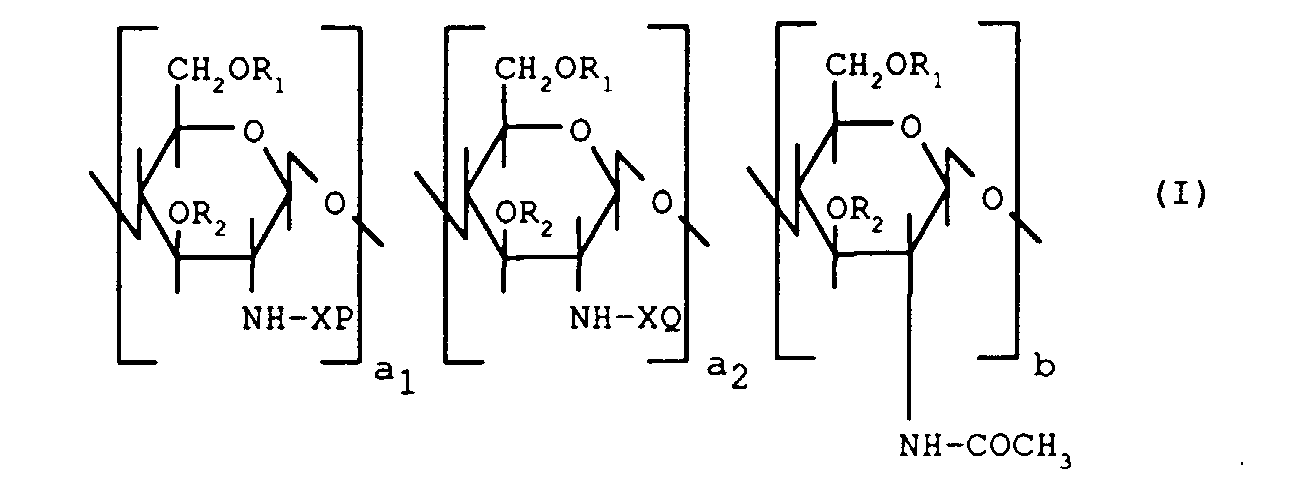
 characterized in that the process comprises:
acetylating a partially N-acetylated carboxymethylchitosan derivative having the following formula (II'):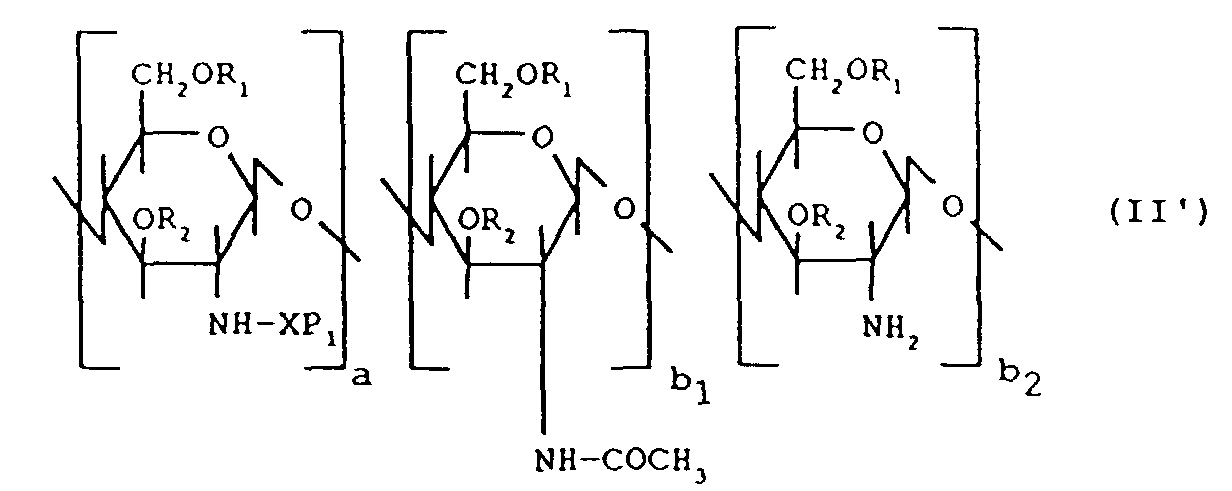
(1) carboxymethylation degree: (as measured by alkalimetry) 0.5-1.2 (2) molecular weight (as measured by gel filtration method): 3,000-300,000 (3) a/(a+b): [provided that b = b1 + b2] 0.01-1 (4) P1/X ratio (molar ratio): 0.1-1,
reacting the resulting reaction product having the P1 groups removed, with a compound of the following formula:
P-H or P-OH (V)
wherein P means the group R3CO-, the group R4NH- or the group R5O- as defined above. - An N-acetylcarboxymethylchitosan derivative represented by the following formula (X) or (XI):
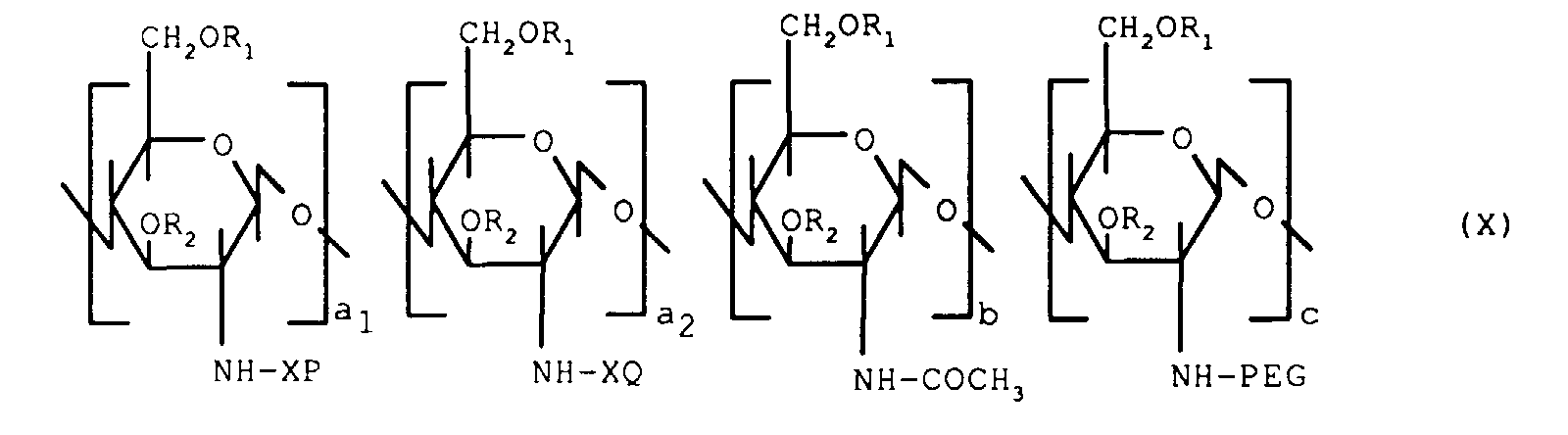


-CO-CH2CH2-CO-O-(CH2CH2O)n-CH3 (VII)
-CO-O-(CH2CH2O)n-CH3 (VIII)
-CO-CH2-O-(CH2CH2O)n-CH3 (IX)
in which n means the average polymerization degree of the polyethylene glycol chain; and having the following characteristic values (1)-(4):(1) carboxymethylation degree:
(as measured by alkalimetry)0.5-1.2 (2) molecular weight (as measured by gel filtration method): 3,000-300,000 (3) a/(a+b):
[provided that a = a1 + a2]0.01-1 (4) P/X ratio (molar ratio): 0.1-1.
Applications Claiming Priority (3)
| Application Number | Priority Date | Filing Date | Title |
|---|---|---|---|
| JP215803/90 | 1990-08-17 | ||
| JP21580390 | 1990-08-17 | ||
| PCT/JP1991/001101 WO1992003480A1 (en) | 1990-08-17 | 1991-08-16 | N-acetylcarboxymethylchitosan derivative and production thereof |
Publications (3)
| Publication Number | Publication Date |
|---|---|
| EP0544000A1 EP0544000A1 (en) | 1993-06-02 |
| EP0544000A4 EP0544000A4 (en) | 1993-08-04 |
| EP0544000B1 true EP0544000B1 (en) | 1997-05-02 |
Family
ID=16678514
Family Applications (1)
| Application Number | Title | Priority Date | Filing Date |
|---|---|---|---|
| EP91914632A Expired - Lifetime EP0544000B1 (en) | 1990-08-17 | 1991-08-16 | N-acetylcarboxymethylchitosan derivative and production thereof |
Country Status (10)
| Country | Link |
|---|---|
| US (1) | US5463022A (en) |
| EP (1) | EP0544000B1 (en) |
| JP (1) | JPH0742324B2 (en) |
| AT (1) | ATE152455T1 (en) |
| CA (1) | CA2089519C (en) |
| DE (1) | DE69125939T2 (en) |
| DK (1) | DK0544000T3 (en) |
| ES (1) | ES2101750T3 (en) |
| GR (1) | GR3023512T3 (en) |
| WO (1) | WO1992003480A1 (en) |
Families Citing this family (27)
| Publication number | Priority date | Publication date | Assignee | Title |
|---|---|---|---|---|
| JP2610792B2 (en) * | 1993-02-26 | 1997-05-14 | 株式会社ディ・ディ・エス研究所 | Polysaccharide derivatives and drug carriers |
| DE4314407A1 (en) * | 1993-05-03 | 1994-11-10 | Zuckerindustrie Verein | 3- (aminoacylamino) saccharides and process for their preparation |
| US5858350A (en) | 1993-12-01 | 1999-01-12 | Marine Polymer Technologies | Methods and compositions for poly-β-1→4-N-acetylglucosamine cell therapy system |
| US6479457B2 (en) | 1995-06-06 | 2002-11-12 | Kinerton Limited | Ionic molecular conjugates of N-acylated derivatives of poly(2-amino-2-deoxy-D-glucose) and polypeptides |
| US5665702A (en) * | 1995-06-06 | 1997-09-09 | Biomeasure Incorporated | Ionic molecular conjugates of N-acylated derivatives of poly(2-amino-2-deoxy-D-glucose) and polypeptides |
| SG50747A1 (en) * | 1995-08-02 | 1998-07-20 | Tanabe Seiyaku Co | Comptothecin derivatives |
| WO1998011903A1 (en) * | 1996-09-18 | 1998-03-26 | Chicura Coöperatie U.A. | Chitosan derivatives for treating malignant tumours |
| US6395255B1 (en) * | 1998-06-15 | 2002-05-28 | Thomas Jefferson University | Radiolabeled vasoactive intestinal peptide analogs for imaging and therapy |
| US8394813B2 (en) | 2000-11-14 | 2013-03-12 | Shire Llc | Active agent delivery systems and methods for protecting and administering active agents |
| TWI306870B (en) * | 2001-07-10 | 2009-03-01 | Kureha Corp | |
| US20060014697A1 (en) | 2001-08-22 | 2006-01-19 | Travis Mickle | Pharmaceutical compositions for prevention of overdose or abuse |
| US7169752B2 (en) | 2003-09-30 | 2007-01-30 | New River Pharmaceuticals Inc. | Compounds and compositions for prevention of overdose of oxycodone |
| WO2003057716A2 (en) * | 2002-01-08 | 2003-07-17 | New River Pharmaceuticals, Inc. | Dendritic encapsulation of active agents |
| GB0221941D0 (en) * | 2002-09-20 | 2002-10-30 | Univ Strathclyde | Polysoaps |
| US8133881B2 (en) | 2003-01-13 | 2012-03-13 | Shire Llc | Carbohydrate conjugates to prevent abuse of controlled substances |
| EP1694712A1 (en) | 2003-12-04 | 2006-08-30 | University of Utah Research Foundation | Modified macromolecules and methods of making and using thereof |
| US20090036553A1 (en) * | 2004-07-08 | 2009-02-05 | Shire Llc | Dendritic encapsulation of active agents |
| CN101137398B (en) * | 2005-01-05 | 2012-07-04 | 得克萨斯大学体系董事会 | Conjugates for Dual Imaging and Chemoradiation: Composition, Production and Applications |
| ES2918452T3 (en) | 2007-02-19 | 2022-07-15 | Marine Polymer Tech Inc | Hemostatic compositions and therapeutic regimens |
| GB0915449D0 (en) * | 2009-09-04 | 2009-10-07 | Univ Robert Gordon | Composition |
| NZ703163A (en) | 2010-04-15 | 2016-06-24 | Marinepolymer Tech Inc | Anti-bacterial applications of poly-n-acetylglucosamine nanofibers |
| EP2696680B1 (en) | 2011-04-15 | 2018-11-28 | Marine Polymer Technologies, Inc. | Treatment of hsv infections with poly-n-acetyl glucosamine nanofibers |
| US10865383B2 (en) | 2011-07-12 | 2020-12-15 | Lineage Cell Therapeutics, Inc. | Methods and formulations for orthopedic cell therapy |
| SG10201510437WA (en) * | 2011-10-03 | 2016-01-28 | Univ Nanyang Tech | Cationic peptidopolysaccharides with excellent broad-spectrum antimicrobial activities and high selectivity |
| JP6026192B2 (en) * | 2012-09-18 | 2016-11-16 | 川研ファインケミカル株式会社 | Carboxymethyl chitosan acetate compound, method for producing the same, and cosmetics |
| EP3006047B1 (en) * | 2013-06-06 | 2019-08-07 | Toppan Printing Co., Ltd. | Needle body |
| WO2025123114A1 (en) * | 2023-12-15 | 2025-06-19 | Chemyunion Ltda | Cosmetic, cosmeceutical and/or pharmaceutical composition, uses and methods |
Family Cites Families (10)
| Publication number | Priority date | Publication date | Assignee | Title |
|---|---|---|---|---|
| DE3223423A1 (en) * | 1982-06-23 | 1983-12-29 | Wella Ag, 6100 Darmstadt | COSMETIC AGENTS BASED ON CHITOSAN DERIVATIVES, NEW CHITOSAN DERIVATIVES AND METHOD FOR PRODUCING THESE DERIVATIVES |
| US4760135A (en) * | 1984-09-06 | 1988-07-26 | University Of Kentucky Research Foundation | Phloretin and phlorizin derivative containing compounds |
| JPS61133232A (en) * | 1984-12-03 | 1986-06-20 | Agency Of Ind Science & Technol | Composite polysaccharide bonded with amino acid polymer and production thereof |
| US4619995A (en) * | 1984-12-24 | 1986-10-28 | Nova Chem Limited | N,O-carboxymethyl chitosan and preparative method therefor |
| JPS6270401A (en) * | 1985-09-24 | 1987-03-31 | Fuji Boseki Kk | Method for producing carboxyalkyl chitosan granules |
| JPH0613453B2 (en) * | 1985-10-03 | 1994-02-23 | 株式会社メニコン | Anterior chamber injection for anterior segment surgery |
| JPH01252604A (en) * | 1988-04-01 | 1989-10-09 | Ihara Chem Ind Co Ltd | 5-fluorouracil carrier |
| JPH01252603A (en) * | 1988-04-01 | 1989-10-09 | Ihara Chem Ind Co Ltd | 5-fluorouracil carrier |
| JPH01252605A (en) * | 1988-04-01 | 1989-10-09 | Ihara Chem Ind Co Ltd | 5-fluorouracil-carrying chitosan |
| IT1219942B (en) * | 1988-05-13 | 1990-05-24 | Fidia Farmaceutici | POLYSACCHARIDIC ESTERS |
-
1991
- 1991-08-16 JP JP3-513498A patent/JPH0742324B2/en not_active Expired - Lifetime
- 1991-08-16 AT AT91914632T patent/ATE152455T1/en not_active IP Right Cessation
- 1991-08-16 EP EP91914632A patent/EP0544000B1/en not_active Expired - Lifetime
- 1991-08-16 US US07/969,307 patent/US5463022A/en not_active Expired - Fee Related
- 1991-08-16 CA CA002089519A patent/CA2089519C/en not_active Expired - Fee Related
- 1991-08-16 ES ES91914632T patent/ES2101750T3/en not_active Expired - Lifetime
- 1991-08-16 DK DK91914632.4T patent/DK0544000T3/en active
- 1991-08-16 WO PCT/JP1991/001101 patent/WO1992003480A1/en not_active Ceased
- 1991-08-16 DE DE69125939T patent/DE69125939T2/en not_active Expired - Fee Related
-
1997
- 1997-05-22 GR GR970401159T patent/GR3023512T3/en unknown
Also Published As
| Publication number | Publication date |
|---|---|
| EP0544000A4 (en) | 1993-08-04 |
| ATE152455T1 (en) | 1997-05-15 |
| JPH0742324B2 (en) | 1995-05-10 |
| WO1992003480A1 (en) | 1992-03-05 |
| DK0544000T3 (en) | 1997-11-03 |
| EP0544000A1 (en) | 1993-06-02 |
| DE69125939D1 (en) | 1997-06-05 |
| US5463022A (en) | 1995-10-31 |
| GR3023512T3 (en) | 1997-08-29 |
| CA2089519C (en) | 2000-01-11 |
| DE69125939T2 (en) | 1997-11-20 |
| CA2089519A1 (en) | 1992-02-18 |
| JPH0742324B1 (en) | 1995-05-10 |
| ES2101750T3 (en) | 1997-07-16 |
Similar Documents
| Publication | Publication Date | Title |
|---|---|---|
| US5463022A (en) | N-acetylcarboxymethylchitosan derivatives and process for preparation thereof | |
| US5688931A (en) | Polysaccharide derivatives and drug carriers | |
| JPWO1992003480A1 (en) | N-acetylcarboxymethyl chitosan derivative and its production method | |
| Pouyani et al. | Novel hydrogels of hyaluronic acid: synthesis, surface morphology, and solid-state NMR | |
| EP1027061B1 (en) | Imine-forming polysaccharides, preparation thereof and the use thereof as adjuvants and immunostimulants | |
| AU717188B2 (en) | Ionic molecular conjugates of n-acylated derivatives of poly (2-amino-2-deoxy-d-glucose) and polypeptides | |
| EP0955064A1 (en) | Process for producing drug complexes | |
| JPWO1994019376A1 (en) | Polysaccharide Derivatives and Drug Carriers | |
| Giammona et al. | Chemical stability and bioavailability of acyclovir coupled to α, β-poly (N-2-hydroxyethyl)-dl-aspartamide | |
| Gürer et al. | Water-based carbodiimide mediated synthesis of polysaccharide-amino acid conjugates: Deprotection, charge and structural analysis | |
| JP2604930B2 (en) | Hyaluronic acid and chondroitin derivatives | |
| ITPD980169A1 (en) | AMIDES OF HYALURONIC ACID AND ITS DERIVATIVES AND PROCESS FOR THEIR PREPARATION. | |
| US5478576A (en) | Arabinogalactan derivatives and uses thereof | |
| US5738864A (en) | Drug delivery agents incorporating mitomycin | |
| JP2017508050A (en) | Hyaluronic acid oligomer complex or salt thereof, preparation method thereof and use thereof | |
| EP0646018A1 (en) | Arabinogalactan derivatives and uses thereof | |
| EP0526649B1 (en) | Carboxymethylmannoglucan and derivative thereof | |
| JPH09188705A (en) | Glycosaminoglycan derivative and method for producing the same | |
| Courtecuisse et al. | Synthesis of linear chitosan-block-dextran copolysaccharides with dihydrazide and dioxyamine linkers | |
| Singh et al. | Pullulan as therapeutic tool in biomedical applications | |
| EP2484699B1 (en) | Active esterified polysaccharide and method for producing same | |
| KR20240055018A (en) | diblock polymer | |
| EP0413248B1 (en) | Substances with heparin-like structure and their method of production | |
| Lapicque et al. | Polysaccharidic prodrugs for enzymatically controlled release | |
| SK9785A3 (en) | Polymeric remedy and preparation method thereof |
Legal Events
| Date | Code | Title | Description |
|---|---|---|---|
| PUAI | Public reference made under article 153(3) epc to a published international application that has entered the european phase |
Free format text: ORIGINAL CODE: 0009012 |
|
| 17P | Request for examination filed |
Effective date: 19930216 |
|
| AK | Designated contracting states |
Kind code of ref document: A1 Designated state(s): AT BE CH DE DK ES FR GB GR IT LI LU NL SE |
|
| A4 | Supplementary search report drawn up and despatched |
Effective date: 19930615 |
|
| AK | Designated contracting states |
Kind code of ref document: A4 Designated state(s): AT BE CH DE DK ES FR GB GR IT LI LU NL SE |
|
| 17Q | First examination report despatched |
Effective date: 19950721 |
|
| GRAG | Despatch of communication of intention to grant |
Free format text: ORIGINAL CODE: EPIDOS AGRA |
|
| GRAG | Despatch of communication of intention to grant |
Free format text: ORIGINAL CODE: EPIDOS AGRA |
|
| GRAH | Despatch of communication of intention to grant a patent |
Free format text: ORIGINAL CODE: EPIDOS IGRA |
|
| GRAH | Despatch of communication of intention to grant a patent |
Free format text: ORIGINAL CODE: EPIDOS IGRA |
|
| RAP3 | Party data changed (applicant data changed or rights of an application transferred) |
Owner name: DRUG DELIVERY SYSTEM INSTITUTE, LTD. |
|
| GRAA | (expected) grant |
Free format text: ORIGINAL CODE: 0009210 |
|
| AK | Designated contracting states |
Kind code of ref document: B1 Designated state(s): AT BE CH DE DK ES FR GB GR IT LI LU NL SE |
|
| REF | Corresponds to: |
Ref document number: 152455 Country of ref document: AT Date of ref document: 19970515 Kind code of ref document: T |
|
| REG | Reference to a national code |
Ref country code: CH Ref legal event code: EP |
|
| REF | Corresponds to: |
Ref document number: 69125939 Country of ref document: DE Date of ref document: 19970605 |
|
| REG | Reference to a national code |
Ref country code: ES Ref legal event code: FG2A Ref document number: 2101750 Country of ref document: ES Kind code of ref document: T3 |
|
| REG | Reference to a national code |
Ref country code: GR Ref legal event code: FG4A Free format text: 3023512 |
|
| REG | Reference to a national code |
Ref country code: CH Ref legal event code: NV Representative=s name: KIRKER & CIE SA |
|
| ET | Fr: translation filed | ||
| REG | Reference to a national code |
Ref country code: DK Ref legal event code: T3 |
|
| PLBE | No opposition filed within time limit |
Free format text: ORIGINAL CODE: 0009261 |
|
| STAA | Information on the status of an ep patent application or granted ep patent |
Free format text: STATUS: NO OPPOSITION FILED WITHIN TIME LIMIT |
|
| 26N | No opposition filed | ||
| PGFP | Annual fee paid to national office [announced via postgrant information from national office to epo] |
Ref country code: FR Payment date: 20010717 Year of fee payment: 11 |
|
| PGFP | Annual fee paid to national office [announced via postgrant information from national office to epo] |
Ref country code: AT Payment date: 20010720 Year of fee payment: 11 |
|
| PGFP | Annual fee paid to national office [announced via postgrant information from national office to epo] |
Ref country code: LU Payment date: 20010725 Year of fee payment: 11 |
|
| PGFP | Annual fee paid to national office [announced via postgrant information from national office to epo] |
Ref country code: ES Payment date: 20010731 Year of fee payment: 11 |
|
| PGFP | Annual fee paid to national office [announced via postgrant information from national office to epo] |
Ref country code: DK Payment date: 20010807 Year of fee payment: 11 |
|
| PGFP | Annual fee paid to national office [announced via postgrant information from national office to epo] |
Ref country code: GR Payment date: 20010809 Year of fee payment: 11 |
|
| PGFP | Annual fee paid to national office [announced via postgrant information from national office to epo] |
Ref country code: GB Payment date: 20010815 Year of fee payment: 11 |
|
| PGFP | Annual fee paid to national office [announced via postgrant information from national office to epo] |
Ref country code: BE Payment date: 20010816 Year of fee payment: 11 |
|
| PGFP | Annual fee paid to national office [announced via postgrant information from national office to epo] |
Ref country code: SE Payment date: 20010817 Year of fee payment: 11 |
|
| PGFP | Annual fee paid to national office [announced via postgrant information from national office to epo] |
Ref country code: NL Payment date: 20010831 Year of fee payment: 11 |
|
| PGFP | Annual fee paid to national office [announced via postgrant information from national office to epo] |
Ref country code: DE Payment date: 20011029 Year of fee payment: 11 |
|
| PGFP | Annual fee paid to national office [announced via postgrant information from national office to epo] |
Ref country code: CH Payment date: 20011101 Year of fee payment: 11 |
|
| REG | Reference to a national code |
Ref country code: GB Ref legal event code: IF02 |
|
| PG25 | Lapsed in a contracting state [announced via postgrant information from national office to epo] |
Ref country code: LU Free format text: LAPSE BECAUSE OF NON-PAYMENT OF DUE FEES Effective date: 20020816 Ref country code: GB Free format text: LAPSE BECAUSE OF NON-PAYMENT OF DUE FEES Effective date: 20020816 Ref country code: AT Free format text: LAPSE BECAUSE OF NON-PAYMENT OF DUE FEES Effective date: 20020816 |
|
| PG25 | Lapsed in a contracting state [announced via postgrant information from national office to epo] |
Ref country code: SE Free format text: LAPSE BECAUSE OF NON-PAYMENT OF DUE FEES Effective date: 20020817 Ref country code: ES Free format text: LAPSE BECAUSE OF NON-PAYMENT OF DUE FEES Effective date: 20020817 |
|
| PG25 | Lapsed in a contracting state [announced via postgrant information from national office to epo] |
Ref country code: LI Free format text: LAPSE BECAUSE OF NON-PAYMENT OF DUE FEES Effective date: 20020831 Ref country code: CH Free format text: LAPSE BECAUSE OF NON-PAYMENT OF DUE FEES Effective date: 20020831 Ref country code: BE Free format text: LAPSE BECAUSE OF NON-PAYMENT OF DUE FEES Effective date: 20020831 |
|
| PG25 | Lapsed in a contracting state [announced via postgrant information from national office to epo] |
Ref country code: DK Free format text: LAPSE BECAUSE OF NON-PAYMENT OF DUE FEES Effective date: 20020930 |
|
| BERE | Be: lapsed |
Owner name: *DRUG DELIVERY SYSTEM INSTITUTE LTD Effective date: 20020831 |
|
| PG25 | Lapsed in a contracting state [announced via postgrant information from national office to epo] |
Ref country code: NL Free format text: LAPSE BECAUSE OF NON-PAYMENT OF DUE FEES Effective date: 20030301 Ref country code: DE Free format text: LAPSE BECAUSE OF NON-PAYMENT OF DUE FEES Effective date: 20030301 |
|
| PG25 | Lapsed in a contracting state [announced via postgrant information from national office to epo] |
Ref country code: GR Free format text: LAPSE BECAUSE OF NON-PAYMENT OF DUE FEES Effective date: 20030305 |
|
| REG | Reference to a national code |
Ref country code: DK Ref legal event code: EBP |
|
| EUG | Se: european patent has lapsed | ||
| GBPC | Gb: european patent ceased through non-payment of renewal fee |
Effective date: 20020816 |
|
| REG | Reference to a national code |
Ref country code: CH Ref legal event code: PL |
|
| PG25 | Lapsed in a contracting state [announced via postgrant information from national office to epo] |
Ref country code: FR Free format text: LAPSE BECAUSE OF NON-PAYMENT OF DUE FEES Effective date: 20030430 |
|
| NLV4 | Nl: lapsed or anulled due to non-payment of the annual fee |
Effective date: 20030301 |
|
| REG | Reference to a national code |
Ref country code: FR Ref legal event code: ST |
|
| REG | Reference to a national code |
Ref country code: ES Ref legal event code: FD2A Effective date: 20030912 |
|
| PG25 | Lapsed in a contracting state [announced via postgrant information from national office to epo] |
Ref country code: IT Free format text: LAPSE BECAUSE OF NON-PAYMENT OF DUE FEES Effective date: 20050816 |