EP0543689A1 - Compositions to simultaneously tan and dye hides and their production process - Google Patents
Compositions to simultaneously tan and dye hides and their production process Download PDFInfo
- Publication number
- EP0543689A1 EP0543689A1 EP92402905A EP92402905A EP0543689A1 EP 0543689 A1 EP0543689 A1 EP 0543689A1 EP 92402905 A EP92402905 A EP 92402905A EP 92402905 A EP92402905 A EP 92402905A EP 0543689 A1 EP0543689 A1 EP 0543689A1
- Authority
- EP
- European Patent Office
- Prior art keywords
- acid
- fact
- compositions
- dye
- aniline
- Prior art date
- Legal status (The legal status is an assumption and is not a legal conclusion. Google has not performed a legal analysis and makes no representation as to the accuracy of the status listed.)
- Withdrawn
Links
- PAYRUJLWNCNPSJ-UHFFFAOYSA-N Aniline Chemical compound NC1=CC=CC=C1 PAYRUJLWNCNPSJ-UHFFFAOYSA-N 0.000 abstract description 18
- WSFSSNUMVMOOMR-UHFFFAOYSA-N Formaldehyde Chemical compound O=C WSFSSNUMVMOOMR-UHFFFAOYSA-N 0.000 abstract description 18
- 239000000203 mixture Substances 0.000 abstract description 18
- 150000001875 compounds Chemical class 0.000 abstract description 17
- IULJSGIJJZZUMF-UHFFFAOYSA-N 2-hydroxybenzenesulfonic acid Chemical compound OC1=CC=CC=C1S(O)(=O)=O IULJSGIJJZZUMF-UHFFFAOYSA-N 0.000 abstract description 10
- HUMNYLRZRPPJDN-UHFFFAOYSA-N benzaldehyde Chemical compound O=CC1=CC=CC=C1 HUMNYLRZRPPJDN-UHFFFAOYSA-N 0.000 abstract description 10
- JLTDJTHDQAWBAV-UHFFFAOYSA-N N,N-dimethylaniline Chemical compound CN(C)C1=CC=CC=C1 JLTDJTHDQAWBAV-UHFFFAOYSA-N 0.000 abstract description 8
- LNTHITQWFMADLM-UHFFFAOYSA-N gallic acid Chemical compound OC(=O)C1=CC(O)=C(O)C(O)=C1 LNTHITQWFMADLM-UHFFFAOYSA-N 0.000 abstract description 8
- 239000002253 acid Substances 0.000 abstract description 7
- TYMLOMAKGOJONV-UHFFFAOYSA-N 4-nitroaniline Chemical compound NC1=CC=C([N+]([O-])=O)C=C1 TYMLOMAKGOJONV-UHFFFAOYSA-N 0.000 abstract description 6
- 235000017399 Caesalpinia tinctoria Nutrition 0.000 abstract description 6
- 241000388430 Tara Species 0.000 abstract description 6
- PSZYNBSKGUBXEH-UHFFFAOYSA-N naphthalene-1-sulfonic acid Chemical compound C1=CC=C2C(S(=O)(=O)O)=CC=CC2=C1 PSZYNBSKGUBXEH-UHFFFAOYSA-N 0.000 abstract description 6
- JRBJSXQPQWSCCF-UHFFFAOYSA-N 3,3'-Dimethoxybenzidine Chemical compound C1=C(N)C(OC)=CC(C=2C=C(OC)C(N)=CC=2)=C1 JRBJSXQPQWSCCF-UHFFFAOYSA-N 0.000 abstract description 5
- HVBSAKJJOYLTQU-UHFFFAOYSA-N 4-aminobenzenesulfonic acid Chemical compound NC1=CC=C(S(O)(=O)=O)C=C1 HVBSAKJJOYLTQU-UHFFFAOYSA-N 0.000 abstract description 5
- QNGNSVIICDLXHT-UHFFFAOYSA-N para-ethylbenzaldehyde Natural products CCC1=CC=C(C=O)C=C1 QNGNSVIICDLXHT-UHFFFAOYSA-N 0.000 abstract description 5
- UFEMBIZQVIDQQM-UHFFFAOYSA-N 1,2-dinitro-2-phenylethenesulfonic acid Chemical compound OS(=O)(=O)C([N+]([O-])=O)=C([N+]([O-])=O)C1=CC=CC=C1 UFEMBIZQVIDQQM-UHFFFAOYSA-N 0.000 abstract description 4
- 235000017343 Quebracho blanco Nutrition 0.000 abstract description 4
- 241000065615 Schinopsis balansae Species 0.000 abstract description 4
- HFACYLZERDEVSX-UHFFFAOYSA-N benzidine Chemical compound C1=CC(N)=CC=C1C1=CC=C(N)C=C1 HFACYLZERDEVSX-UHFFFAOYSA-N 0.000 abstract description 4
- 229940074391 gallic acid Drugs 0.000 abstract description 4
- 235000004515 gallic acid Nutrition 0.000 abstract description 4
- 235000015523 tannic acid Nutrition 0.000 abstract description 4
- 229920002258 tannic acid Polymers 0.000 abstract description 4
- 235000011468 Albizia julibrissin Nutrition 0.000 abstract description 3
- 235000013912 Ceratonia siliqua Nutrition 0.000 abstract description 3
- 240000008886 Ceratonia siliqua Species 0.000 abstract description 3
- WUBBRNOQWQTFEX-UHFFFAOYSA-N 4-aminosalicylic acid Chemical compound NC1=CC=C(C(O)=O)C(O)=C1 WUBBRNOQWQTFEX-UHFFFAOYSA-N 0.000 abstract description 2
- 240000007472 Leucaena leucocephala Species 0.000 abstract description 2
- 235000010643 Leucaena leucocephala Nutrition 0.000 abstract description 2
- 229960004909 aminosalicylic acid Drugs 0.000 abstract description 2
- 240000005852 Mimosa quadrivalvis Species 0.000 abstract 1
- CBYZIWCZNMOEAV-UHFFFAOYSA-N formaldehyde;naphthalene Chemical compound O=C.C1=CC=CC2=CC=CC=C21 CBYZIWCZNMOEAV-UHFFFAOYSA-N 0.000 abstract 1
- XLYOFNOQVPJJNP-UHFFFAOYSA-N water Substances O XLYOFNOQVPJJNP-UHFFFAOYSA-N 0.000 description 44
- 239000000284 extract Substances 0.000 description 36
- 235000019198 oils Nutrition 0.000 description 24
- BDAGIHXWWSANSR-UHFFFAOYSA-N methanoic acid Natural products OC=O BDAGIHXWWSANSR-UHFFFAOYSA-N 0.000 description 14
- 239000000047 product Substances 0.000 description 13
- 239000000243 solution Substances 0.000 description 13
- 238000003756 stirring Methods 0.000 description 13
- 238000004043 dyeing Methods 0.000 description 10
- 239000000975 dye Substances 0.000 description 9
- 239000010985 leather Substances 0.000 description 9
- KCXVZYZYPLLWCC-UHFFFAOYSA-N EDTA Chemical compound OC(=O)CN(CC(O)=O)CCN(CC(O)=O)CC(O)=O KCXVZYZYPLLWCC-UHFFFAOYSA-N 0.000 description 8
- MUBZPKHOEPUJKR-UHFFFAOYSA-N Oxalic acid Chemical compound OC(=O)C(O)=O MUBZPKHOEPUJKR-UHFFFAOYSA-N 0.000 description 8
- 239000003086 colorant Substances 0.000 description 8
- 238000000034 method Methods 0.000 description 8
- 150000003839 salts Chemical class 0.000 description 8
- OSWFIVFLDKOXQC-UHFFFAOYSA-N 4-(3-methoxyphenyl)aniline Chemical compound COC1=CC=CC(C=2C=CC(N)=CC=2)=C1 OSWFIVFLDKOXQC-UHFFFAOYSA-N 0.000 description 7
- 235000008733 Citrus aurantifolia Nutrition 0.000 description 7
- DGAQECJNVWCQMB-PUAWFVPOSA-M Ilexoside XXIX Chemical compound C[C@@H]1CC[C@@]2(CC[C@@]3(C(=CC[C@H]4[C@]3(CC[C@@H]5[C@@]4(CC[C@@H](C5(C)C)OS(=O)(=O)[O-])C)C)[C@@H]2[C@]1(C)O)C)C(=O)O[C@H]6[C@@H]([C@H]([C@@H]([C@H](O6)CO)O)O)O.[Na+] DGAQECJNVWCQMB-PUAWFVPOSA-M 0.000 description 7
- 235000011941 Tilia x europaea Nutrition 0.000 description 7
- 235000019253 formic acid Nutrition 0.000 description 7
- 239000004571 lime Substances 0.000 description 7
- SNQQPOLDUKLAAF-UHFFFAOYSA-N nonylphenol Chemical compound CCCCCCCCCC1=CC=CC=C1O SNQQPOLDUKLAAF-UHFFFAOYSA-N 0.000 description 7
- 239000011734 sodium Substances 0.000 description 7
- 229910052708 sodium Inorganic materials 0.000 description 7
- NLXLAEXVIDQMFP-UHFFFAOYSA-N Ammonia chloride Chemical compound [NH4+].[Cl-] NLXLAEXVIDQMFP-UHFFFAOYSA-N 0.000 description 6
- MHAJPDPJQMAIIY-UHFFFAOYSA-N Hydrogen peroxide Chemical compound OO MHAJPDPJQMAIIY-UHFFFAOYSA-N 0.000 description 6
- XEEYBQQBJWHFJM-UHFFFAOYSA-N Iron Chemical compound [Fe] XEEYBQQBJWHFJM-UHFFFAOYSA-N 0.000 description 6
- 238000004519 manufacturing process Methods 0.000 description 6
- KMUONIBRACKNSN-UHFFFAOYSA-N potassium dichromate Chemical compound [K+].[K+].[O-][Cr](=O)(=O)O[Cr]([O-])(=O)=O KMUONIBRACKNSN-UHFFFAOYSA-N 0.000 description 6
- GEHJYWRUCIMESM-UHFFFAOYSA-L sodium sulfite Chemical compound [Na+].[Na+].[O-]S([O-])=O GEHJYWRUCIMESM-UHFFFAOYSA-L 0.000 description 6
- DWAQJAXMDSEUJJ-UHFFFAOYSA-M Sodium bisulfite Chemical compound [Na+].OS([O-])=O DWAQJAXMDSEUJJ-UHFFFAOYSA-M 0.000 description 5
- 239000003795 chemical substances by application Substances 0.000 description 5
- 229960001484 edetic acid Drugs 0.000 description 5
- 229920000847 nonoxynol Polymers 0.000 description 5
- 230000035515 penetration Effects 0.000 description 5
- 239000003352 sequestering agent Substances 0.000 description 5
- 235000010267 sodium hydrogen sulphite Nutrition 0.000 description 5
- 239000000126 substance Substances 0.000 description 5
- CSNNHWWHGAXBCP-UHFFFAOYSA-L Magnesium sulfate Chemical compound [Mg+2].[O-][S+2]([O-])([O-])[O-] CSNNHWWHGAXBCP-UHFFFAOYSA-L 0.000 description 4
- 229910052782 aluminium Inorganic materials 0.000 description 4
- 230000000855 fungicidal effect Effects 0.000 description 4
- 239000000417 fungicide Substances 0.000 description 4
- RBTARNINKXHZNM-UHFFFAOYSA-K iron trichloride Chemical compound Cl[Fe](Cl)Cl RBTARNINKXHZNM-UHFFFAOYSA-K 0.000 description 4
- 239000000314 lubricant Substances 0.000 description 4
- 229910052751 metal Inorganic materials 0.000 description 4
- 239000002184 metal Substances 0.000 description 4
- SCVFZCLFOSHCOH-UHFFFAOYSA-M potassium acetate Chemical compound [K+].CC([O-])=O SCVFZCLFOSHCOH-UHFFFAOYSA-M 0.000 description 4
- 239000004289 sodium hydrogen sulphite Substances 0.000 description 4
- 235000013311 vegetables Nutrition 0.000 description 4
- RYGMFSIKBFXOCR-UHFFFAOYSA-N Copper Chemical compound [Cu] RYGMFSIKBFXOCR-UHFFFAOYSA-N 0.000 description 3
- 102000035195 Peptidases Human genes 0.000 description 3
- 108091005804 Peptidases Proteins 0.000 description 3
- ZLMJMSJWJFRBEC-UHFFFAOYSA-N Potassium Chemical compound [K] ZLMJMSJWJFRBEC-UHFFFAOYSA-N 0.000 description 3
- HEMHJVSKTPXQMS-UHFFFAOYSA-M Sodium hydroxide Chemical compound [OH-].[Na+] HEMHJVSKTPXQMS-UHFFFAOYSA-M 0.000 description 3
- WLKAMFOFXYCYDK-UHFFFAOYSA-N [5-amino-4-[[3-[(2-amino-4-azaniumyl-5-methylphenyl)diazenyl]-4-methylphenyl]diazenyl]-2-methylphenyl]azanium;dichloride Chemical compound [Cl-].[Cl-].CC1=CC=C(N=NC=2C(=CC([NH3+])=C(C)C=2)N)C=C1N=NC1=CC(C)=C([NH3+])C=C1N WLKAMFOFXYCYDK-UHFFFAOYSA-N 0.000 description 3
- 239000004411 aluminium Substances 0.000 description 3
- XAGFODPZIPBFFR-UHFFFAOYSA-N aluminium Chemical compound [Al] XAGFODPZIPBFFR-UHFFFAOYSA-N 0.000 description 3
- 235000019270 ammonium chloride Nutrition 0.000 description 3
- BFNBIHQBYMNNAN-UHFFFAOYSA-N ammonium sulfate Chemical compound N.N.OS(O)(=O)=O BFNBIHQBYMNNAN-UHFFFAOYSA-N 0.000 description 3
- 229910052921 ammonium sulfate Inorganic materials 0.000 description 3
- 239000001166 ammonium sulphate Substances 0.000 description 3
- 235000011130 ammonium sulphate Nutrition 0.000 description 3
- 235000012730 carminic acid Nutrition 0.000 description 3
- 239000012141 concentrate Substances 0.000 description 3
- 229910052802 copper Inorganic materials 0.000 description 3
- 239000010949 copper Substances 0.000 description 3
- 238000001035 drying Methods 0.000 description 3
- 229910052742 iron Inorganic materials 0.000 description 3
- 235000019833 protease Nutrition 0.000 description 3
- 235000010265 sodium sulphite Nutrition 0.000 description 3
- 239000000979 synthetic dye Substances 0.000 description 3
- JWAZRIHNYRIHIV-UHFFFAOYSA-N 2-naphthol Chemical compound C1=CC=CC2=CC(O)=CC=C21 JWAZRIHNYRIHIV-UHFFFAOYSA-N 0.000 description 2
- 240000007185 Albizia julibrissin Species 0.000 description 2
- 241001070941 Castanea Species 0.000 description 2
- 235000014036 Castanea Nutrition 0.000 description 2
- XTEGARKTQYYJKE-UHFFFAOYSA-M Chlorate Chemical compound [O-]Cl(=O)=O XTEGARKTQYYJKE-UHFFFAOYSA-M 0.000 description 2
- IAYPIBMASNFSPL-UHFFFAOYSA-N Ethylene oxide Chemical compound C1CO1 IAYPIBMASNFSPL-UHFFFAOYSA-N 0.000 description 2
- VEXZGXHMUGYJMC-UHFFFAOYSA-N Hydrochloric acid Chemical compound Cl VEXZGXHMUGYJMC-UHFFFAOYSA-N 0.000 description 2
- 229910021578 Iron(III) chloride Inorganic materials 0.000 description 2
- IGFHQQFPSIBGKE-UHFFFAOYSA-N Nonylphenol Natural products CCCCCCCCCC1=CC=C(O)C=C1 IGFHQQFPSIBGKE-UHFFFAOYSA-N 0.000 description 2
- 235000008331 Pinus X rigitaeda Nutrition 0.000 description 2
- 235000011613 Pinus brutia Nutrition 0.000 description 2
- 241000018646 Pinus brutia Species 0.000 description 2
- PMZURENOXWZQFD-UHFFFAOYSA-L Sodium Sulfate Chemical compound [Na+].[Na+].[O-]S([O-])(=O)=O PMZURENOXWZQFD-UHFFFAOYSA-L 0.000 description 2
- QAOWNCQODCNURD-UHFFFAOYSA-N Sulfuric acid Chemical compound OS(O)(=O)=O QAOWNCQODCNURD-UHFFFAOYSA-N 0.000 description 2
- RTAQQCXQSZGOHL-UHFFFAOYSA-N Titanium Chemical compound [Ti] RTAQQCXQSZGOHL-UHFFFAOYSA-N 0.000 description 2
- HCHKCACWOHOZIP-UHFFFAOYSA-N Zinc Chemical compound [Zn] HCHKCACWOHOZIP-UHFFFAOYSA-N 0.000 description 2
- 238000010521 absorption reaction Methods 0.000 description 2
- CQPFMGBJSMSXLP-UHFFFAOYSA-M acid orange 7 Chemical compound [Na+].OC1=CC=C2C=CC=CC2=C1N=NC1=CC=C(S([O-])(=O)=O)C=C1 CQPFMGBJSMSXLP-UHFFFAOYSA-M 0.000 description 2
- 150000001412 amines Chemical class 0.000 description 2
- 239000007864 aqueous solution Substances 0.000 description 2
- JPIYZTWMUGTEHX-UHFFFAOYSA-N auramine O free base Chemical compound C1=CC(N(C)C)=CC=C1C(=N)C1=CC=C(N(C)C)C=C1 JPIYZTWMUGTEHX-UHFFFAOYSA-N 0.000 description 2
- 125000005337 azoxy group Chemical group [N+]([O-])(=N*)* 0.000 description 2
- KGBXLFKZBHKPEV-UHFFFAOYSA-N boric acid Chemical compound OB(O)O KGBXLFKZBHKPEV-UHFFFAOYSA-N 0.000 description 2
- 239000004327 boric acid Substances 0.000 description 2
- 125000003178 carboxy group Chemical group [H]OC(*)=O 0.000 description 2
- 239000004106 carminic acid Substances 0.000 description 2
- XRPLBRIHZGVJIC-UHFFFAOYSA-L chembl3182776 Chemical compound [Na+].[Na+].NC1=CC(N)=CC=C1N=NC1=CC=C(C=2C=CC(=CC=2)N=NC=2C(=CC3=CC(=C(N=NC=4C=CC=CC=4)C(O)=C3C=2N)S([O-])(=O)=O)S([O-])(=O)=O)C=C1 XRPLBRIHZGVJIC-UHFFFAOYSA-L 0.000 description 2
- 229940080423 cochineal Drugs 0.000 description 2
- 239000000356 contaminant Substances 0.000 description 2
- 230000008878 coupling Effects 0.000 description 2
- 238000010168 coupling process Methods 0.000 description 2
- 238000005859 coupling reaction Methods 0.000 description 2
- AXZAYXJCENRGIM-UHFFFAOYSA-J dipotassium;tetrabromoplatinum(2-) Chemical compound [K+].[K+].[Br-].[Br-].[Br-].[Br-].[Pt+2] AXZAYXJCENRGIM-UHFFFAOYSA-J 0.000 description 2
- SVSHEAJPDAGGCC-UHFFFAOYSA-L disodium 7-hydroxy-8-[[4-[4-[[4-(4-methylphenyl)sulfonyloxyphenyl]diazenyl]phenyl]phenyl]diazenyl]naphthalene-1,3-disulfonate Chemical compound CC1=CC=C(C=C1)S(=O)(=O)OC2=CC=C(C=C2)N=NC3=CC=C(C=C3)C4=CC=C(C=C4)N=NC5=C(C=CC6=CC(=CC(=C65)S(=O)(=O)O)S(=O)(=O)[O-])[O-].[Na+].[Na+] SVSHEAJPDAGGCC-UHFFFAOYSA-L 0.000 description 2
- 229940071106 ethylenediaminetetraacetate Drugs 0.000 description 2
- 238000009499 grossing Methods 0.000 description 2
- 125000002887 hydroxy group Chemical group [H]O* 0.000 description 2
- 229910052943 magnesium sulfate Inorganic materials 0.000 description 2
- 235000019341 magnesium sulphate Nutrition 0.000 description 2
- 229940107698 malachite green Drugs 0.000 description 2
- FDZZZRQASAIRJF-UHFFFAOYSA-M malachite green Chemical compound [Cl-].C1=CC(N(C)C)=CC=C1C(C=1C=CC=CC=1)=C1C=CC(=[N+](C)C)C=C1 FDZZZRQASAIRJF-UHFFFAOYSA-M 0.000 description 2
- WSFSSNUMVMOOMR-NJFSPNSNSA-N methanone Chemical compound O=[14CH2] WSFSSNUMVMOOMR-NJFSPNSNSA-N 0.000 description 2
- -1 nitro, azo Chemical group 0.000 description 2
- GQPLMRYTRLFLPF-UHFFFAOYSA-N nitrous oxide Inorganic materials [O-][N+]#N GQPLMRYTRLFLPF-UHFFFAOYSA-N 0.000 description 2
- 235000006408 oxalic acid Nutrition 0.000 description 2
- 239000007800 oxidant agent Substances 0.000 description 2
- 230000003647 oxidation Effects 0.000 description 2
- 238000007254 oxidation reaction Methods 0.000 description 2
- 235000021110 pickles Nutrition 0.000 description 2
- 238000005554 pickling Methods 0.000 description 2
- 229920001021 polysulfide Polymers 0.000 description 2
- 229910052700 potassium Inorganic materials 0.000 description 2
- 239000011591 potassium Substances 0.000 description 2
- 235000011056 potassium acetate Nutrition 0.000 description 2
- VKJKEPKFPUWCAS-UHFFFAOYSA-M potassium chlorate Chemical compound [K+].[O-]Cl(=O)=O VKJKEPKFPUWCAS-UHFFFAOYSA-M 0.000 description 2
- KWYUFKZDYYNOTN-UHFFFAOYSA-M potassium hydroxide Inorganic materials [OH-].[K+] KWYUFKZDYYNOTN-UHFFFAOYSA-M 0.000 description 2
- 229910001487 potassium perchlorate Inorganic materials 0.000 description 2
- 238000002360 preparation method Methods 0.000 description 2
- 229960004889 salicylic acid Drugs 0.000 description 2
- 238000002791 soaking Methods 0.000 description 2
- LPXPTNMVRIOKMN-UHFFFAOYSA-M sodium nitrite Chemical compound [Na+].[O-]N=O LPXPTNMVRIOKMN-UHFFFAOYSA-M 0.000 description 2
- GRVFOGOEDUUMBP-UHFFFAOYSA-N sodium sulfide (anhydrous) Chemical compound [Na+].[Na+].[S-2] GRVFOGOEDUUMBP-UHFFFAOYSA-N 0.000 description 2
- 239000007787 solid Substances 0.000 description 2
- LSNNMFCWUKXFEE-UHFFFAOYSA-L sulfite Chemical compound [O-]S([O-])=O LSNNMFCWUKXFEE-UHFFFAOYSA-L 0.000 description 2
- 239000001117 sulphuric acid Substances 0.000 description 2
- 235000011149 sulphuric acid Nutrition 0.000 description 2
- 229920001864 tannin Polymers 0.000 description 2
- 239000001648 tannin Substances 0.000 description 2
- 235000018553 tannin Nutrition 0.000 description 2
- 239000010936 titanium Substances 0.000 description 2
- 229910052719 titanium Inorganic materials 0.000 description 2
- RIDBNXZGOXZXEV-UHFFFAOYSA-N triphenylmethanesulfonic acid Chemical compound C=1C=CC=CC=1C(C=1C=CC=CC=1)(S(=O)(=O)O)C1=CC=CC=C1 RIDBNXZGOXZXEV-UHFFFAOYSA-N 0.000 description 2
- JEVGKYBUANQAKG-UHFFFAOYSA-N victoria blue R Chemical compound [Cl-].C12=CC=CC=C2C(=[NH+]CC)C=CC1=C(C=1C=CC(=CC=1)N(C)C)C1=CC=C(N(C)C)C=C1 JEVGKYBUANQAKG-UHFFFAOYSA-N 0.000 description 2
- 239000011701 zinc Substances 0.000 description 2
- 229910052725 zinc Inorganic materials 0.000 description 2
- NWONKYPBYAMBJT-UHFFFAOYSA-L zinc sulfate Chemical compound [Zn+2].[O-]S([O-])(=O)=O NWONKYPBYAMBJT-UHFFFAOYSA-L 0.000 description 2
- 239000011686 zinc sulphate Substances 0.000 description 2
- 235000009529 zinc sulphate Nutrition 0.000 description 2
- BZSXEZOLBIJVQK-UHFFFAOYSA-N 2-methylsulfonylbenzoic acid Chemical compound CS(=O)(=O)C1=CC=CC=C1C(O)=O BZSXEZOLBIJVQK-UHFFFAOYSA-N 0.000 description 1
- MIDXCONKKJTLDX-UHFFFAOYSA-N 3,5-dimethylcyclopentane-1,2-dione Chemical compound CC1CC(C)C(=O)C1=O MIDXCONKKJTLDX-UHFFFAOYSA-N 0.000 description 1
- BMUDPLZKKRQECS-UHFFFAOYSA-K 3-[18-(2-carboxyethyl)-8,13-bis(ethenyl)-3,7,12,17-tetramethylporphyrin-21,24-diid-2-yl]propanoic acid iron(3+) hydroxide Chemical compound [OH-].[Fe+3].[N-]1C2=C(C)C(CCC(O)=O)=C1C=C([N-]1)C(CCC(O)=O)=C(C)C1=CC(C(C)=C1C=C)=NC1=CC(C(C)=C1C=C)=NC1=C2 BMUDPLZKKRQECS-UHFFFAOYSA-K 0.000 description 1
- VHUUQVKOLVNVRT-UHFFFAOYSA-N Ammonium hydroxide Chemical compound [NH4+].[OH-] VHUUQVKOLVNVRT-UHFFFAOYSA-N 0.000 description 1
- FRPHFZCDPYBUAU-UHFFFAOYSA-N Bromocresolgreen Chemical compound CC1=C(Br)C(O)=C(Br)C=C1C1(C=2C(=C(Br)C(O)=C(Br)C=2)C)C2=CC=CC=C2S(=O)(=O)O1 FRPHFZCDPYBUAU-UHFFFAOYSA-N 0.000 description 1
- 235000002687 Caesalpinia echinata Nutrition 0.000 description 1
- 235000014037 Castanea sativa Nutrition 0.000 description 1
- 240000007857 Castanea sativa Species 0.000 description 1
- 208000032544 Cicatrix Diseases 0.000 description 1
- 241001518926 Cladrastis Species 0.000 description 1
- 239000004128 Copper(II) sulphate Substances 0.000 description 1
- 235000014375 Curcuma Nutrition 0.000 description 1
- 244000164480 Curcuma aromatica Species 0.000 description 1
- 235000002918 Fraxinus excelsior Nutrition 0.000 description 1
- WQZGKKKJIJFFOK-GASJEMHNSA-N Glucose Natural products OC[C@H]1OC(O)[C@H](O)[C@@H](O)[C@@H]1O WQZGKKKJIJFFOK-GASJEMHNSA-N 0.000 description 1
- SXRSQZLOMIGNAQ-UHFFFAOYSA-N Glutaraldehyde Chemical compound O=CCCCC=O SXRSQZLOMIGNAQ-UHFFFAOYSA-N 0.000 description 1
- 241001424361 Haematoxylum brasiletto Species 0.000 description 1
- 241001494479 Pecora Species 0.000 description 1
- 229920000473 Phlobaphene Polymers 0.000 description 1
- 239000002202 Polyethylene glycol Substances 0.000 description 1
- CDBYLPFSWZWCQE-UHFFFAOYSA-L Sodium Carbonate Chemical compound [Na+].[Na+].[O-]C([O-])=O CDBYLPFSWZWCQE-UHFFFAOYSA-L 0.000 description 1
- QAOWNCQODCNURD-UHFFFAOYSA-L Sulfate Chemical compound [O-]S([O-])(=O)=O QAOWNCQODCNURD-UHFFFAOYSA-L 0.000 description 1
- GSEJCLTVZPLZKY-UHFFFAOYSA-N Triethanolamine Chemical compound OCCN(CCO)CCO GSEJCLTVZPLZKY-UHFFFAOYSA-N 0.000 description 1
- ZCZKAOXXROZYGH-UHFFFAOYSA-J [Cu+4].[O-]C(=O)CN(CC([O-])=O)CCN(CC([O-])=O)CC([O-])=O Chemical compound [Cu+4].[O-]C(=O)CN(CC([O-])=O)CCN(CC([O-])=O)CC([O-])=O ZCZKAOXXROZYGH-UHFFFAOYSA-J 0.000 description 1
- MCDLETWIOVSGJT-UHFFFAOYSA-N acetic acid;iron Chemical compound [Fe].CC(O)=O.CC(O)=O MCDLETWIOVSGJT-UHFFFAOYSA-N 0.000 description 1
- 230000000172 allergic effect Effects 0.000 description 1
- 159000000013 aluminium salts Chemical class 0.000 description 1
- 239000001164 aluminium sulphate Substances 0.000 description 1
- 235000011128 aluminium sulphate Nutrition 0.000 description 1
- 239000000908 ammonium hydroxide Substances 0.000 description 1
- 125000000129 anionic group Chemical group 0.000 description 1
- 239000002956 ash Substances 0.000 description 1
- 208000010668 atopic eczema Diseases 0.000 description 1
- WQZGKKKJIJFFOK-VFUOTHLCSA-N beta-D-glucose Chemical compound OC[C@H]1O[C@@H](O)[C@H](O)[C@@H](O)[C@@H]1O WQZGKKKJIJFFOK-VFUOTHLCSA-N 0.000 description 1
- 229950011260 betanaphthol Drugs 0.000 description 1
- 238000004061 bleaching Methods 0.000 description 1
- UWHUTZOCTZJUKC-JKSUJKDBSA-N brazilin Chemical compound C12=CC(O)=C(O)C=C2C[C@]2(O)[C@H]1C1=CC=C(O)C=C1OC2 UWHUTZOCTZJUKC-JKSUJKDBSA-N 0.000 description 1
- UWHUTZOCTZJUKC-CVEARBPZSA-N brazilin Natural products C12=CC(O)=C(O)C=C2C[C@@]2(O)[C@@H]1C1=CC=C(O)C=C1OC2 UWHUTZOCTZJUKC-CVEARBPZSA-N 0.000 description 1
- 239000001049 brown dye Substances 0.000 description 1
- 230000000711 cancerogenic effect Effects 0.000 description 1
- 235000013736 caramel Nutrition 0.000 description 1
- 231100000315 carcinogenic Toxicity 0.000 description 1
- 125000002091 cationic group Chemical group 0.000 description 1
- 239000001913 cellulose Substances 0.000 description 1
- 229920002678 cellulose Polymers 0.000 description 1
- 238000006243 chemical reaction Methods 0.000 description 1
- 150000001844 chromium Chemical class 0.000 description 1
- 230000000536 complexating effect Effects 0.000 description 1
- ARUVKPQLZAKDPS-UHFFFAOYSA-L copper(II) sulfate Chemical compound [Cu+2].[O-][S+2]([O-])([O-])[O-] ARUVKPQLZAKDPS-UHFFFAOYSA-L 0.000 description 1
- 239000007822 coupling agent Substances 0.000 description 1
- VFLDPWHFBUODDF-FCXRPNKRSA-N curcumin Chemical compound C1=C(O)C(OC)=CC(\C=C\C(=O)CC(=O)\C=C\C=2C=C(OC)C(O)=CC=2)=C1 VFLDPWHFBUODDF-FCXRPNKRSA-N 0.000 description 1
- 230000006378 damage Effects 0.000 description 1
- 230000007547 defect Effects 0.000 description 1
- BUACSMWVFUNQET-UHFFFAOYSA-H dialuminum;trisulfate;hydrate Chemical compound O.[Al+3].[Al+3].[O-]S([O-])(=O)=O.[O-]S([O-])(=O)=O.[O-]S([O-])(=O)=O BUACSMWVFUNQET-UHFFFAOYSA-H 0.000 description 1
- 238000004090 dissolution Methods 0.000 description 1
- 230000000694 effects Effects 0.000 description 1
- 230000007613 environmental effect Effects 0.000 description 1
- 239000012467 final product Substances 0.000 description 1
- 235000021323 fish oil Nutrition 0.000 description 1
- 230000002538 fungal effect Effects 0.000 description 1
- 239000008103 glucose Substances 0.000 description 1
- 229940109738 hematin Drugs 0.000 description 1
- BAUYGSIQEAFULO-UHFFFAOYSA-L iron(2+) sulfate (anhydrous) Chemical compound [Fe+2].[O-]S([O-])(=O)=O BAUYGSIQEAFULO-UHFFFAOYSA-L 0.000 description 1
- 238000011068 loading method Methods 0.000 description 1
- 230000001050 lubricating effect Effects 0.000 description 1
- 229940049964 oleate Drugs 0.000 description 1
- ZQPPMHVWECSIRJ-KTKRTIGZSA-N oleic acid Chemical compound CCCCCCCC\C=C/CCCCCCCC(O)=O ZQPPMHVWECSIRJ-KTKRTIGZSA-N 0.000 description 1
- 150000007524 organic acids Chemical class 0.000 description 1
- 235000005985 organic acids Nutrition 0.000 description 1
- 230000001590 oxidative effect Effects 0.000 description 1
- OXNIZHLAWKMVMX-UHFFFAOYSA-N picric acid Chemical compound OC1=C([N+]([O-])=O)C=C([N+]([O-])=O)C=C1[N+]([O-])=O OXNIZHLAWKMVMX-UHFFFAOYSA-N 0.000 description 1
- 229920001223 polyethylene glycol Polymers 0.000 description 1
- HHDOORYZQSEMGM-UHFFFAOYSA-L potassium;oxalate;titanium(4+) Chemical compound [K+].[Ti+4].[O-]C(=O)C([O-])=O HHDOORYZQSEMGM-UHFFFAOYSA-L 0.000 description 1
- 229920006395 saturated elastomer Polymers 0.000 description 1
- 231100000241 scar Toxicity 0.000 description 1
- 230000037387 scars Effects 0.000 description 1
- 235000010288 sodium nitrite Nutrition 0.000 description 1
- 235000019830 sodium polyphosphate Nutrition 0.000 description 1
- 229910052938 sodium sulfate Inorganic materials 0.000 description 1
- 235000011152 sodium sulphate Nutrition 0.000 description 1
- 238000005063 solubilization Methods 0.000 description 1
- 230000007928 solubilization Effects 0.000 description 1
- 230000003381 solubilizing effect Effects 0.000 description 1
- 238000005507 spraying Methods 0.000 description 1
- 150000003467 sulfuric acid derivatives Chemical class 0.000 description 1
- 229910021653 sulphate ion Inorganic materials 0.000 description 1
- 231100000331 toxic Toxicity 0.000 description 1
- 230000002588 toxic effect Effects 0.000 description 1
- 238000005406 washing Methods 0.000 description 1
- 239000002023 wood Substances 0.000 description 1
- 235000007063 yellowwood Nutrition 0.000 description 1
Classifications
-
- D—TEXTILES; PAPER
- D06—TREATMENT OF TEXTILES OR THE LIKE; LAUNDERING; FLEXIBLE MATERIALS NOT OTHERWISE PROVIDED FOR
- D06P—DYEING OR PRINTING TEXTILES; DYEING LEATHER, FURS OR SOLID MACROMOLECULAR SUBSTANCES IN ANY FORM
- D06P3/00—Special processes of dyeing or printing textiles, or dyeing leather, furs, or solid macromolecular substances in any form, classified according to the material treated
- D06P3/02—Material containing basic nitrogen
- D06P3/04—Material containing basic nitrogen containing amide groups
- D06P3/32—Material containing basic nitrogen containing amide groups leather skins
- D06P3/328—Material containing basic nitrogen containing amide groups leather skins preparing non-azo dyes on the material
-
- C—CHEMISTRY; METALLURGY
- C14—SKINS; HIDES; PELTS; LEATHER
- C14C—CHEMICAL TREATMENT OF HIDES, SKINS OR LEATHER, e.g. TANNING, IMPREGNATING, FINISHING; APPARATUS THEREFOR; COMPOSITIONS FOR TANNING
- C14C3/00—Tanning; Compositions for tanning
- C14C3/02—Chemical tanning
- C14C3/08—Chemical tanning by organic agents
-
- C—CHEMISTRY; METALLURGY
- C14—SKINS; HIDES; PELTS; LEATHER
- C14C—CHEMICAL TREATMENT OF HIDES, SKINS OR LEATHER, e.g. TANNING, IMPREGNATING, FINISHING; APPARATUS THEREFOR; COMPOSITIONS FOR TANNING
- C14C3/00—Tanning; Compositions for tanning
- C14C3/02—Chemical tanning
- C14C3/08—Chemical tanning by organic agents
- C14C3/10—Vegetable tanning
-
- C—CHEMISTRY; METALLURGY
- C14—SKINS; HIDES; PELTS; LEATHER
- C14C—CHEMICAL TREATMENT OF HIDES, SKINS OR LEATHER, e.g. TANNING, IMPREGNATING, FINISHING; APPARATUS THEREFOR; COMPOSITIONS FOR TANNING
- C14C3/00—Tanning; Compositions for tanning
- C14C3/02—Chemical tanning
- C14C3/08—Chemical tanning by organic agents
- C14C3/18—Chemical tanning by organic agents using polycondensation products or precursors thereof
- C14C3/20—Chemical tanning by organic agents using polycondensation products or precursors thereof sulfonated
-
- D—TEXTILES; PAPER
- D06—TREATMENT OF TEXTILES OR THE LIKE; LAUNDERING; FLEXIBLE MATERIALS NOT OTHERWISE PROVIDED FOR
- D06P—DYEING OR PRINTING TEXTILES; DYEING LEATHER, FURS OR SOLID MACROMOLECULAR SUBSTANCES IN ANY FORM
- D06P1/00—General processes of dyeing or printing textiles, or general processes of dyeing leather, furs, or solid macromolecular substances in any form, classified according to the dyes, pigments, or auxiliary substances employed
- D06P1/34—General processes of dyeing or printing textiles, or general processes of dyeing leather, furs, or solid macromolecular substances in any form, classified according to the dyes, pigments, or auxiliary substances employed using natural dyestuffs
-
- D—TEXTILES; PAPER
- D06—TREATMENT OF TEXTILES OR THE LIKE; LAUNDERING; FLEXIBLE MATERIALS NOT OTHERWISE PROVIDED FOR
- D06P—DYEING OR PRINTING TEXTILES; DYEING LEATHER, FURS OR SOLID MACROMOLECULAR SUBSTANCES IN ANY FORM
- D06P3/00—Special processes of dyeing or printing textiles, or dyeing leather, furs, or solid macromolecular substances in any form, classified according to the material treated
- D06P3/02—Material containing basic nitrogen
- D06P3/04—Material containing basic nitrogen containing amide groups
- D06P3/32—Material containing basic nitrogen containing amide groups leather skins
- D06P3/3206—Material containing basic nitrogen containing amide groups leather skins using acid dyes
-
- D—TEXTILES; PAPER
- D06—TREATMENT OF TEXTILES OR THE LIKE; LAUNDERING; FLEXIBLE MATERIALS NOT OTHERWISE PROVIDED FOR
- D06P—DYEING OR PRINTING TEXTILES; DYEING LEATHER, FURS OR SOLID MACROMOLECULAR SUBSTANCES IN ANY FORM
- D06P3/00—Special processes of dyeing or printing textiles, or dyeing leather, furs, or solid macromolecular substances in any form, classified according to the material treated
- D06P3/02—Material containing basic nitrogen
- D06P3/04—Material containing basic nitrogen containing amide groups
- D06P3/32—Material containing basic nitrogen containing amide groups leather skins
- D06P3/3273—Material containing basic nitrogen containing amide groups leather skins preparing azo dyes on the material
Definitions
- the present invention involves compositions intended to simultaneously tan and dye hides and their production process.
- tanning extracts for certain specific colours, for example: campeach wood extracts which provide colours ranging from red to black; the campeach hematin contained in the same extract provides a wine dregs red colour; the campeach nigrosine which produces a black colour; the chestnut (Castanea Vesca) which provides a brown colour verging on green; the pine and oak which provide a red colour; the taras which provide a grey colour; the tara hematins which provide a black colour; the gall which produces a light tan colour; and the cochineal which produces a red colour.
- campeach wood extracts which provide colours ranging from red to black
- the campeach hematin contained in the same extract provides a wine dregs red colour
- the campeach nigrosine which produces a black colour
- the chestnut which provides a brown colour verging on green
- the pine and oak which provide a red colour
- the taras which provide a grey colour
- tanning techniques they rely on the penetration of the tanning extracts mentioned above, in the hides and their subsequent fixation with organic acids or metal salts enabling the colour to cross the hides while obtaining treated surfaces on the finished leather.
- tanning-dyeing compositions using natural, recyclable, very abundant tanning agents with a heterogenous or indefinite composition that have a non saturated molecular structure, that is, are electronically unstable, which have the function of the chromophore group.
- This market currently uses natural pyrogallic or pyrocatechic extracts, whether modified or not, which tan by giving the finished leather its natural colour.
- the most common are derived from mimosa (light caramel colour), quebracho (reddish-brown colour), chestnut (greenish-brown colour), pine (red colour), oak (red colour) and tara (light tan colour).
- These tanning products give leather their natural colour which does not sufficiently please the user, easily becomes oxidized and requires an anti-economic dyeing process when compared with chrome-aluminium tanning products which provide equivalent results with 75% less.
- tanning-dyeing compositions in the present invention has the following advantages:
- compositions to simultaneously tan and dye hides and obtain directly dyed leathers includes at least one tanning compound, able to form chromophore groups, consisting of at least one member of the group formed by: the natural pyrocatechic derivatives of quebracho, mimosa and acacia and their tannic acids; the natural pyrogallic derivatives of tara, carob and their tannic acids; naphthalene sulphonic acid condensed with formaldehyde; naphthalene-1 sulphonic acid; phenolsulphonic acid; phenolsulphonic acid condensed with formaldehyde; gallic acid and at least one coupler able to provide the final colour with the chromophore groups of the tanning compound, belonging to the group formed by: triphenyl-methane-sulphonic acid; aniline; p-amine-aceto-aniline; urea-1 acid; p-amine-salicylic acid; di-
- Triphenyl-methane-sulphonic acid 0.3 to 1.5% Aniline 0.5 to 9% P-amino-aceto-aniline 0.01 to 1.5% urea-1 acid 3 to 9% P-amine-salicylic acid 2 to 7% Di-nitro-styrene-sulphonic acid 1 to 2% P-sulphanilic acid 0.02 to 9% P-nitro-aniline 0.2 to 10% Phenolsulphonic acid 0.01 to 8% Benzidine H 0.3 to 6% Benzaldehyde 1 to 7% N,N-dimethylaniline 1 to 11% o-dianisidine CH-CH 0.5 to 4%
- the components providing the final touch may be chosen from the group formed by the compounds indicated below. These compounds are present, if necessary, within the following percentage limits: Trinitril-penta-acetate of aluminium, copper, iron and/or zinc 0.01 to 2% Ethylenediamine-tetracetic acid and its iron, copper and aluminium salts 0.07 to 2% Double oxalate of titanium and potassium 1 to 7% Sulphates of aluminum, iron and copper 1 to 6% Diethylenetriamine-pentacetate of zinc or aluminium 0.01 to 3%
- the products providing the colour are chosen from the group of dyes mentioned below which are found within the following percentage limits: Orange II 0.01 to 0.3% Bismarck brown 0.1 to 0.5% EW black (Direct black 38) 0.5 to 3% Victoria blue (Direct blue 12) 0.01 to 3% R red (Acid red 85) 0.5 to 1% Auramine 0.02 to 0.2% Malachite green 0.02 to 0.2%
- oxidizing agents that may possibly be found in the compositions in the invention, it is necessary to indicate that the latter are chosen from the group mentioned below and that those present are within the percentage weights indicated: potassium perchlorate 0.02 to 5% potassium chlorate 0.08 to 2% hydrogen peroxide 1 to 6% chlorate of soda 0.02 to 5%
- auxilliary compounds which form the optional compounds of the compositions in the present invention, they are chosen from the group indicated below and are respectively found within the following percentage limits:
- the different compounds and their percentage in weight are chosen so that the sum of the weight percentages in which all of the compounds in the composition are present is equal to 100%.
- compositions to simultaneously tan and dye hides may be produced according to the process consisting of treating an aqueous solution of a tanning compound belonging to the group indicated above, with derivatives of naphthalene sulphonic acid whether condensed with formaldehyde or not; adding substances which include nitro, azo, nitrous, azoxy, carbonic and/or quinoid groups in their molecule; oxidizing these groups, if necessary, by incorporating air under pressure; coupling the chromophore base obtained by means of the addition of at least one of the couplers mentioned above; incorporating, if necessary, the auxochrome, carboxyl, hydroxy and amine auxilliary compounds; solubilizing the tanning-dyeing extract obtained by sulphitation with sodium sulphite, sodium bisulfite and/or sulphuric acid; concentrating the product obtained until there are approximately 50% solids; graduating, if necessary, with complex metal salts and/or
- the aqueous solution of the tanning compound is 6° Be, and was cooled to a temperature of not more than 5° C while the substances containing the nitro, azo, nitrous, azoxy, carbonic and/or quinoid groups in their molecule, are added at atmospheric pressure.
- the concentration of the product obtained, following the optional addition of auxochrome, carboxyl, hydroxy and amine auxilliary compounds, and the solubilization of the tanning-dyeing extract by sulphitation with sodium sulphite, sodium bisulphite and/or sulphuric acid, is carried out in a vacuum and at a temperature of 10 °C.
- the final drying of the composition obtained is carried out by passage through a drying chamber and spraying, at an admission temperature of 220 °C and an outlet temperature of 90° to 95°C.
- the final product has the following approximate composition: Tannins 50 to 69% Non tannins 21 to 30% Insolubles 0.0 to 2.3% Ashes 5.5 to 10% Water 6.0 to 6.5% pH at 10% 5.6
- compositions provide leathers dyed tan, orange, brown, red, blue, green and black. It should be noted that subsequent oxidation is generally not required in order to obtain green, red and blue colours.
- Base A is thereby prepared. It is used to obtain the following colours by adding the substances indicated and following the method recommended below:
- compositions are obtained as follows according to the invention: Add 7% condensed naphthalene sulphonic acid to 16,000 kg of pyroacechic tannic solution. Stir for 30 minutes and add 10 to 25% sodium acid sulphate. Control the total solubility and dry. This provides a compound called Base B.
- this base In addition to its use in the preparation of synthetic extracts used in dyeing, this base also has a fixing power on other tanning products, either at the end of traditional tanning or for light tan colours.
- the hides When the hides are intended for sale by weight, they are dyed but not oiled, left to rest and covered for 24 hours, then drained and loaded with 1% magnesium sulphate and glucose, kept dry for 30 minutes and treated with 1% phosphated oil, 1% raw neat's foot oil and 10% water at 40°C. Continue the operation until absorption.
- the hides are soaked without stirring with a quantity of water 400% of the dry weight for 5 hours. They are then treated with a solution consisting of: Water 400% Sodium polysulphide 2% Moistener 0.3% for 14 hours. Then incorporate 0.01% fungicide. Complete soaking, wash and shave.
- pancreatic proteinase (15 UW) for 45 minutes and then check the total deliming. Then wash for 30 minutes.
- wash with acidified water at pH 4 unload and allow to rest for 24 hours. Dry and continue according to the rules of the art.
- pre-tan in the same bath by treating with 5% tinctorial extract for 30 minutes and then with 5% of the same type of extract for 90 to 120 minutes with a 2/3 penetration in the hide. Unload, allow to rest while covered for 24 hours, drain and trim to 2 tenths below the desired thickness.
- the tanning is carried out in the same bath. Treat with 10% of the aforementioned extract for 30 minutes. Check the total and regular passage at pH 3.8 and treat with 0.3% formic acid. Then wash with 200% water at 30 °C and pH 3.8. Wash again if necessary.
- Tinctorial extract solution (12 °Be) 150% Tinctorial extract 10%
- Tinctorial extract 10% Sulphited fish oil 1%
- Tinctorial extract 5% Lubricant 0.1% Tinctorial extract 5%
- Then maintain at a temperature of about 30 °C for approximately 10 hours. Open the rammer, leave the door open and allow to rest for 5 hours in this position;
Landscapes
- Chemical & Material Sciences (AREA)
- Engineering & Computer Science (AREA)
- Textile Engineering (AREA)
- Chemical Kinetics & Catalysis (AREA)
- General Chemical & Material Sciences (AREA)
- Organic Chemistry (AREA)
- Treatment And Processing Of Natural Fur Or Leather (AREA)
Abstract
The invention concerns compositions to simultaneously tan and dye hides, characterized by the fact that they contain at least one tanning compound able to form chromophore groups consisting of at least one member of the group including :
natural pyrocatechic derivatives of quebracho, mimosa, acacia and their tannic acids ;
natural pyrogallic derivatives of tara, carob and their tannic acids ;
naphthalene sulphonic acid condensed with formaldehyde ;
naphthalene sulphonic acid ;
phenolsulphonic acid ;
phenolsulphonic acid condensed with formaldehyde ;
gallic acid ;
and at least one coupler able to develop with the chromophore groups of the compound tanning the final colour, this coupler belonging to the group including :
triphenyl-methano-sulphonic acid ;
aniline ;
p-amino-aceto-aniline ;
urea-1 acid ;
p-amino-salicylic acid ;
di-nitro-styrene-sulphonic acid ;
p-sulphanilic acid ;
p-nitro-aniline
phenolsulphonic acid ;
benzidine H ;
benzaldehyde ;
N,N dimethyl-aniline ;
o-dianisidine Ch-CH.
natural pyrocatechic derivatives of quebracho, mimosa, acacia and their tannic acids ;
natural pyrogallic derivatives of tara, carob and their tannic acids ;
naphthalene sulphonic acid condensed with formaldehyde ;
naphthalene sulphonic acid ;
phenolsulphonic acid ;
phenolsulphonic acid condensed with formaldehyde ;
gallic acid ;
and at least one coupler able to develop with the chromophore groups of the compound tanning the final colour, this coupler belonging to the group including :
triphenyl-methano-sulphonic acid ;
aniline ;
p-amino-aceto-aniline ;
urea-1 acid ;
p-amino-salicylic acid ;
di-nitro-styrene-sulphonic acid ;
p-sulphanilic acid ;
p-nitro-aniline
phenolsulphonic acid ;
benzidine H ;
benzaldehyde ;
N,N dimethyl-aniline ;
o-dianisidine Ch-CH.
Description
- The present invention involves compositions intended to simultaneously tan and dye hides and their production process.
- Until a few years ago, tanners only had tanning extracts for certain specific colours, for example: campeach wood extracts which provide colours ranging from red to black; the campeach hematin contained in the same extract provides a wine dregs red colour; the campeach nigrosine which produces a black colour; the chestnut (Castanea Vesca) which provides a brown colour verging on green; the pine and oak which provide a red colour; the taras which provide a grey colour; the tara hematins which provide a black colour; the gall which produces a light tan colour; and the cochineal which produces a red colour.
- Until recently, sufficiently large quantities of different natural dyeing extracts were available on the market to satisfy the demand, such as the campeach extract mentioned above; the Brazil wood which contains brazilin, dyes purple and with chromium salts provides little resistent black colours; the yellow wood which contains an active morine agent colours tan to orange-brown.
- These natural colours may be considered to be anionic posterior treatment products, forming lakes with metal salts. Other natural extracts were also frequently found on the market such as the carmine or cochineal already mentioned which dye red and the curcuma which dyes tan. The high demand which is impossible to satisfy, and the appearance of synthetic dyes has almost eliminated these products from the market. This obliged users to carry out research by combining tanning products from another source with the synthetic dyes.
- As for the tanning techniques, they rely on the penetration of the tanning extracts mentioned above, in the hides and their subsequent fixation with organic acids or metal salts enabling the colour to cross the hides while obtaining treated surfaces on the finished leather.
- The growth of the market, environmental protection, production costs and especially the small supplies of these products have resulted in the fact that current tanning techniques rely on combined systems of preliminary tanning and subsequent tanning. This results in high costs and the production of contaminants, in the residual bath as well as in the production of the dyes, whose use in a great many cases has been forbidden due to their carcinogenic, allergic or toxic effect.
- It is therefore necessary to look for new ways to obtain the same results and reproduce what nature provides. Based on these premisses, according to the present invention, we obtained tanning-dyeing compositions using natural, recyclable, very abundant tanning agents with a heterogenous or indefinite composition that have a non saturated molecular structure, that is, are electronically unstable, which have the function of the chromophore group.
- These groups, found in the tannic bases mentioned below, are large and their molecular weight varies between 2,000 and 5,000, so that when combined with compounds containing auxochrome groups or "complexing" groups, they provide a series of compositions which is more extensive than that found in nature.
- In this way, by adjusting the tinctorial power required to comply with the rules of the art of tanning and dyeing, and without altering the natural tanning conditions, we provide synthetic tanning agents which, in turn, can be advantageously compared, as regards price and quality, with already known products, enabling the unlimited supply of the tanning and dyeing market for hides.
- This market currently uses natural pyrogallic or pyrocatechic extracts, whether modified or not, which tan by giving the finished leather its natural colour. The most common are derived from mimosa (light caramel colour), quebracho (reddish-brown colour), chestnut (greenish-brown colour), pine (red colour), oak (red colour) and tara (light tan colour).
- These tanning products give leather their natural colour which does not sufficiently please the user, easily becomes oxidized and requires an anti-economic dyeing process when compared with chrome-aluminium tanning products which provide equivalent results with 75% less.
- In addition, the possibilities to use and combine these known tanning products are minimal, while the chemical activity of their metal salts is very high, so that it is very difficult to control the production of spots for which much care must be taken.
- However, the use of tanning-dyeing compositions in the present invention has the following advantages:
- a) Excellent penetration, simultaneous dying and tanning of the leather.
- b) Dyeing of the scars and natural defects in the leather.
- c) High level of colour.
- d) Colour intensity (tint) combined with a low consumption of synthetic dyes.
- e) Easier finishing and better quality without shades (snow).
- f) Low cost and increase in the range of articles without a change in equipment.
- g) Non contaminant and easy to use both as regards production and use.
- The compositions to simultaneously tan and dye hides and obtain directly dyed leathers, the object of the present invention, includes at least one tanning compound, able to form chromophore groups, consisting of at least one member of the group formed by:
the natural pyrocatechic derivatives of quebracho, mimosa and acacia and their tannic acids;
the natural pyrogallic derivatives of tara, carob and their tannic acids;
naphthalene sulphonic acid condensed with formaldehyde;
naphthalene-1 sulphonic acid;
phenolsulphonic acid;
phenolsulphonic acid condensed with formaldehyde;
gallic acid and at least one coupler able to provide the final colour with the chromophore groups of the tanning compound, belonging to the group formed by:
triphenyl-methane-sulphonic acid;
aniline;
p-amine-aceto-aniline;
urea-1 acid;
p-amine-salicylic acid;
di-nitro-styrene-sulphonic acid;
p-sulphanilic acid;
p-nitro-aniline;
phenolsulphonic acid;
benzidine H;
benzaldehyde;
N,N-dimethyl-aniline;
o-dianisidine CH-CH.
while, in addition to these compositions, able to contain components providing the final touch and colour, oxidizing agents and auxilliary agents. - The tanning compounds described above are found, respectively, within the following percentage limits as regards weight:

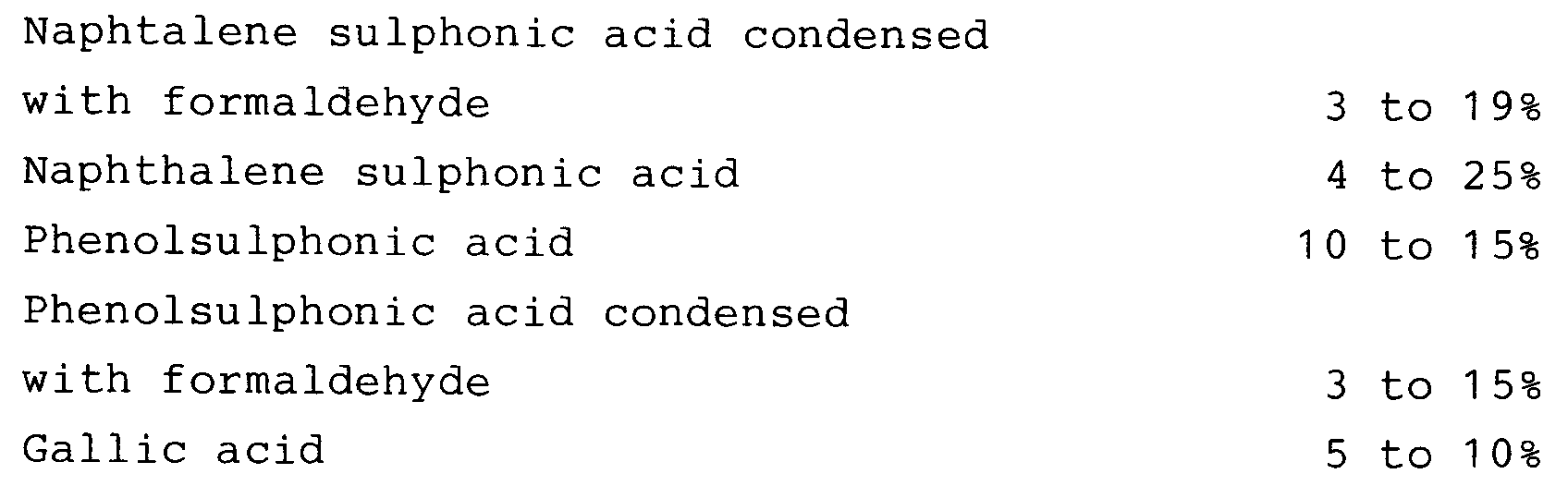
- As regards the coupling agents described above, they are respectively found within the following limits, as a percentage and weight:
Triphenyl-methane-sulphonic acid 0.3 to 1.5% Aniline 0.5 to 9% P-amino-aceto-aniline 0.01 to 1.5% urea-1 acid 3 to 9% P-amine-salicylic acid 2 to 7% Di-nitro-styrene-sulphonic acid 1 to 2% P-sulphanilic acid 0.02 to 9% P-nitro-aniline 0.2 to 10% Phenolsulphonic acid 0.01 to 8% Benzidine H 0.3 to 6% Benzaldehyde 1 to 7% N,N-dimethylaniline 1 to 11% o-dianisidine CH-CH 0.5 to 4% - As regards the components providing the final touch, they may be chosen from the group formed by the compounds indicated below. These compounds are present, if necessary, within the following percentage limits:
Trinitril-penta-acetate of aluminium, copper, iron and/or zinc 0.01 to 2% Ethylenediamine-tetracetic acid and its iron, copper and aluminium salts 0.07 to 2% Double oxalate of titanium and potassium 1 to 7% Sulphates of aluminum, iron and copper 1 to 6% Diethylenetriamine-pentacetate of zinc or aluminium 0.01 to 3% - Similarly, the products providing the colour are chosen from the group of dyes mentioned below which are found within the following percentage limits:
Orange II 0.01 to 0.3% Bismarck brown 0.1 to 0.5% EW black (Direct black 38) 0.5 to 3% Victoria blue (Direct blue 12) 0.01 to 3% R red (Acid red 85) 0.5 to 1% Auramine 0.02 to 0.2% Malachite green 0.02 to 0.2% - As regards the oxidizing agents that may possibly be found in the compositions in the invention, it is necessary to indicate that the latter are chosen from the group mentioned below and that those present are within the percentage weights indicated:
potassium perchlorate 0.02 to 5% potassium chlorate 0.08 to 2% hydrogen peroxide 1 to 6% chlorate of soda 0.02 to 5% - With reference to the auxilliary compounds which form the optional compounds of the compositions in the present invention, they are chosen from the group indicated below and are respectively found within the following percentage limits:


The different compounds and their percentage in weight are chosen so that the sum of the weight percentages in which all of the compounds in the composition are present is equal to 100%. - The compositions to simultaneously tan and dye hides, in accordance with the present invention, may be produced according to the process consisting of treating an aqueous solution of a tanning compound belonging to the group indicated above, with derivatives of naphthalene sulphonic acid whether condensed with formaldehyde or not; adding substances which include nitro, azo, nitrous, azoxy, carbonic and/or quinoid groups in their molecule; oxidizing these groups, if necessary, by incorporating air under pressure; coupling the chromophore base obtained by means of the addition of at least one of the couplers mentioned above; incorporating, if necessary, the auxochrome, carboxyl, hydroxy and amine auxilliary compounds; solubilizing the tanning-dyeing extract obtained by sulphitation with sodium sulphite, sodium bisulfite and/or sulphuric acid; concentrating the product obtained until there are approximately 50% solids; graduating, if necessary, with complex metal salts and/or dyes; standardizing and drying the final composition obtained.
- The aqueous solution of the tanning compound is 6° Be, and was cooled to a temperature of not more than 5° C while the substances containing the nitro, azo, nitrous, azoxy, carbonic and/or quinoid groups in their molecule, are added at atmospheric pressure.
- As regards the coupling of the chromophore base obtained with at least one of the couplers mentioned above, this occurs at a temperature of 10° to 15°C. The concentration of the product obtained, following the optional addition of auxochrome, carboxyl, hydroxy and amine auxilliary compounds, and the solubilization of the tanning-dyeing extract by sulphitation with sodium sulphite, sodium bisulphite and/or sulphuric acid, is carried out in a vacuum and at a temperature of 10 °C.
- The final drying of the composition obtained is carried out by passage through a drying chamber and spraying, at an admission temperature of 220 °C and an outlet temperature of 90° to 95°C.
- The final product has the following approximate composition:
Tannins 50 to 69% Non tannins 21 to 30% Insolubles 0.0 to 2.3% Ashes 5.5 to 10% Water 6.0 to 6.5% pH at 10% 5.6 - The compositions provide leathers dyed tan, orange, brown, red, blue, green and black. It should be noted that subsequent oxidation is generally not required in order to obtain green, red and blue colours.
- Transfer 20,000 kg of pyrocatetic extract at 6° Be (approximately 2,500 kg of solids) to a reactor and cool at 5 °C. Add 80 to 150 kg of naphthalene sulphonic acid which is condensed or not condensed with formaldehyde. Stir for 2 hours and then add 28 kg of sodium nitrite. Again stir for 30 minutes and add 100 to 150 kg of hydrochloric acid. Stir for 1 hour.
- A base (Base A) is thereby prepared. It is used to obtain the following colours by adding the substances indicated and following the method recommended below:
- 1) Brown verging on red: Add 3 to 5% potassium dichromate and 0.7% aniline to Base A. Allow to react for 2 hours. Concentrate and rectify the colour with 0.2% ferric ethylenediamine-tetracetate and 0.2% copper ethylenediaminetetracetate and 1.3% copper (II) sulphate also using 0.2% Bismarck brown dye. The rectification of the colour provides the whole range from brown to dark brown.
- 2) Orange: Add 2% aniline and 3% potassium dichromate to Base A. Allow to react for 1 hour and then add 0.3 to 0.8% titanium potassium oxalate and allow to react for one hour. Then correct. The colour is provided by 0.3% Orange II and fix with 0.5% picric acid.
- 3) Tan: Add 0.5% aniline and 0.6% p-nitro-aniline to Base A. Concentrate and provide the colour with 0.10% auramine. Also add 0.1% aluminous diethylenetriaminepentacetate and 1.2% aluminium sulphate. Bring to the adequate pH with 3% phenosulphonic acid condensed with formaldehyde.
- 4) Red: Add 1% oxalic acid and 5% potassium acetate to Base A. Allow to react for 20 minutes and then add 4% triphenil-methane-sulphonic acid, 0.9% p-amine-acetate aniline and 1% dinitro-styrene-sulphonic acid. Allow to react for 2 hours and then graduate with 0.5% R Red (Acid Red 85) and acidify with 2% boric acid.
- 5) Blue: Add 0.3 to 0.5% zinc sulphate, 1.6 to 2.5% benzidine H, 3% formaldehyde, 2% boric acid and 1.4% o-dianisidine CH-CH to Base A. Provide the colour with 0.02% Victoria blue (Direct Blue 12).
- 6) Green: Incorporate 0.2% p-nitro-aniline, 1 to 4% benzaldehyde, 1 to 4% N,N-dimethyl-aniline and 0.2% cupreous ethylenediamine-tetraacetate to Base A. Provide the colour with 0.04% Malachite Green.
- 7) Black: Take 20,000 kg of pyroacechic tannic solution at 6°Be and add 0.5 to 1% phenolsulphonic acid which has been condensed or not condensed with formaldehyde, 2% beta-naphthol and allow to react for 60 minutes. Then add 3% potassium dichromate and allow to react for 20 minutes. Add 1.3% aniline and allow to react for 60 minutes. Finally incorporate 30 to 50% natural pyrogallic derivatives and 5% gallic acid and allow to react for 2 hours. Concentrate and provide the colour with 0.1 to 2% cupreous ethyldiaminetetraacetate and 0.1 to 2% ferric ethyldiamine-tetraacetate and allow to react for 1 hour. Then incorporate 3% hydrogen peroxide (200 vol.) and allow to react for 2 hours. Acidify with 3% ferrous acetate and provide the colour with 0.5% EW Black (Direct Black 38).
- Another set of compositions is obtained as follows according to the invention:
Add 7% condensed naphthalene sulphonic acid to 16,000 kg of pyroacechic tannic solution. Stir for 30 minutes and add 10 to 25% sodium acid sulphate. Control the total solubility and dry. This provides a compound called Base B. - In addition to its use in the preparation of synthetic extracts used in dyeing, this base also has a fixing power on other tanning products, either at the end of traditional tanning or for light tan colours.
- 8) Light tan: Incorporate 1 to 5% double oxalate of titanium and potassium and 0.3% aluminous ethylenediaminetetraacetate with Base B. Homogenize for 2 or 3 hours. Add 4% urea-1 acid. Shake for 2 hours and provide the colour with 0.2% Bismarck Brown. Neutralize with ammonium hydroxide until pH 7.
- 9) Dark tan: Add 2.5% p-amino-salicylic acid and 12% phenolsulphonic acid to Base B while maintaining the temperature below 5 °C. Add 2 to 5% p-nitro-aniline and 0.1% to 0.3% p-amino-aceto aniline. Couple. Add 5% potassium acetate until pH 5 and then 3% sodium sulphite and 3% sodium bisulphite until total dissolution.
- 10) Light grey: Add 3 to 7% iron (III) chloride and 0.1 to 0.5% cuprous trinitrile-pentaacetate to Base B. After the reaction, maintain the temperature at 5 °C. Add 0.5% o-dianisidine CH-CH and 10 to 15% gallic acid. Finally, provide the colour with 0.5% EW Black and 0.04% Victoria Blue. Bring the pH to 5.5 with triethanolamine and/or potassium and/or sodium hydroxide.
- 11) Dark grey: Add 3% natural carob and/or tara pyrogallic derivatives to Base B. Once homogenized, oxidize with potassium perchlorate (0.3 to 0.6%) and the same quantity of sodium chlorate. Add 1% p-sulphanilic acid. Stir for 30 minutes and add 2% benzaldehyde. Then add between 7 and 10% iron (III) chloride. Allow to react at 5°C and then add p-sulphanilic acid (between 0.3 and 0.9%) or 0.3 to 1.3% phenolsulphonic acid according to the colour desired. Five hours later, complete the oxidation with 200 vol. hydrogen peroxide (up to 3%) or 1 to 2% potassium chlorate. Adjust the final pH between 5 and 5.2 with iron (II) sulphate and/or zinc sulphate according to the colour desired. Rectify the solubility with 3 to 5% sodium polyphosphates.
- Following are several examples of applications of the compositions involved in the present invention to obtain the different types of dyed leathers.
- Begin with 22 kg of leathers salted to a maximum, that are soaked for one hour in a bath containing:
Cold water 150% Nonylphenol condensed with 10 moles of ethylene oxide 0.2% Sodium polysulphide 1% - Stop soaking for 1 hour. Stir for 15 minutes per hour 3 times and then stir for 30 minutes.
- Then remove the hair in the rammer by treating the hides with a solution consisting of:
Water at 27 °C 70% 60% sodium sulphide 1.5% - Allow to react for 30 minutes and then add 1.5% lime. Stir for 15 minutes and allow to rest for 30 minutes. Then add 80% water at 27 °C and 1.5% lime. Allow to rest for 15 minutes and stir 2 times 5 minutes per hour. Then stir for 30 minutes and then 5 minutes per hour all night.
- Then carry out the lime treatment in a bath consisting of 100% water at 27 °C and 2% lime. Continue the treatment until expansion. Then shave by machine and wash for 30 minutes.
- Then delime with a solution of:
Water at 37 °C 100% Ammonium sulphate 1% Ammonium chloride 1% Nonylphenol condensed with 10 moles of ethylene oxide 0.2% - Allow to react for 1 hour and then treat with 2% pancreatic proteinase (15 UW) for 30 minutes. Stop for one hour and turn on again for 1 hour. Then check that the deliming was total and wash for 1 hour with cold water.
- Then proceed with the pickling process by means of a 30 minute treatment with the following solution:
Cold water 80% Salt 6% Fungicide 0.3% - Then incorporate 1.2% sodium hexamethaphosphate. Allow to react for 2 hours at pH 4.6 to 4.8. Verify the penetration of the acidity with bromocresol green, outer tan and inner bluish-green by continuing the operation. Then incorporate 8% quebracho sulphite extract and treat for 120 minutes.
- Then check the total exhaustion and the minimal passage of the extract which should be 1/3. Unload and cut back by smoothing the thickness. If smoothing is not desired, unload, allow to rest during the night and pass through the slowest tanning rammer.
- Then clean with a solution consisting of 100% water at 30 °C and 0.3% sequestering agent (ethylenediaminetetracetic acid) allowing to react for 15 minutes.
- Then proceed with the tanning in the same bath by incorporating formic acid until pH 4.8, if necessary, 0.2% lubricating agent and 10% tinctorial tanning extract. Allow to react for 90 minutes. Then oil in the same bath with 5% phosphated oil and 2% sulphonated oil. Allow to react for 60 minutes and then incorporate the formic acid until obtaining a pH between 4.2 and 4.4. Then leave the treatment for 20 minutes. Treat for 90 to 120 minutes with 0.2% lubricating agent and 15% tinctorial tanning extract. Then check the total passage of the extract through the hide and the exhaustion of the bath. The operation continues for another 60 minutes.
- Then wash once or twice with 200% acidified water at pH 3.8 until perfectly clean.
- When the hides are intended for sale by weight, they are dyed but not oiled, left to rest and covered for 24 hours, then drained and loaded with 1% magnesium sulphate and glucose, kept dry for 30 minutes and treated with 1% phosphated oil, 1% raw neat's foot oil and 10% water at 40°C. Continue the operation until absorption.
- Begin with sleeked off hides and carry out the pickling process and the pre-tanning by treating with the following solution:
Cold water 100% Salt 5% Sodium hexamethaphosphate 1% - Allow to react for 60 minutes and then treat with 5% tinctorial extract for 15 minutes and then again with 5% tinctorial extract for 60 minutes. Then check if the extract penetrated 2/3 of the thickness of the hide. Then drain and rinse with 10% cold water at pH 4 for 10 minutes. Unload, allow to rest and trim to one tenth less than the final thickness.
- Then wash with 200% water at 30 °C and 0.05% sequestering agent for 20 minutes. Carry out the oiling. After draining, add 100% water at 40 °C, 4 to 6% phosphated oil and 1 to 2% sulphochlorinated oil and allow to react for 30 minutes.
- Continue the process by the retanning stage in the same bath with a 10% tinctorial extract. Allow to react for 30 minutes and then for 60 minutes also adding 10% tinctorial extract.
- Then check the exhaustion and the total passage. If this is not the case, continue to turn. Then treat with formic acid until pH 3.8 for 15 minutes. Wash with 100% water at 30 °C and pH 3.8 and 1 to 2% cationic agent for 20 minutes. Unload and allow to rest for 12 hours while covered and dry according to the destination.
- The hides are soaked without stirring with a quantity of water 400% of the dry weight for 5 hours. They are then treated with a solution consisting of:
Water 400% Sodium polysulphide 2% Moistener 0.3%
for 14 hours. Then incorporate 0.01% fungicide. Complete soaking, wash and shave. - Then scrape off the hair using a solution consisting of:
Water at 27 °C 80% Sodium sulphide at 60 °C 3%
This treatment should take 20 minutes. Then treat with 3% lime stirring for 30 minutes. Stop for 60 minutes. Repeat the operation 4 or 5 times. Then check the destruction of the hair and continue the operation when dry for 1 hour (grain). - Then proceed with the lime treatment using:
Water at 27 °C 20% Lime 3% - Continue the treatment for 4 hours and then stop for 1 hour. Then stir 5 times per hour for another 12 hours. Then wash, unload and shave the hides according to the grain. If necessary, clean on a frame.
- Then wash with water at 37 °C for 30 minutes and delime treating with:
Water at 37 °C 100% Ammonium sulphate 1% Ammonium chloride 1% Ethoxylated nonylphenol 0.5%
This treatment should last 45 minutes. - Then drain in the same bath treating with 0.04% pancreatic proteinase (15 UW) for 45 minutes and then check the total deliming. Then wash for 30 minutes.
- Then pickle with the following treatment:
Cold water 80% Salt 6% - Allow to act for 10 minutes and then treat with 1.2% sodium hexamethaphosphate for 90 minutes at pH 4.2 to 4.6. Then treat with 5% tinctorial tanning extract for 60 to 90 minutes. Continue the treatment until total exhaustion and 1/3 passage through the hide. Unload and trim to one tenth less than the desired thickness.
- For retanning, first remove stains with a treatment consisting of the following solution:
Water at 30 °C 100% Ethylenediamine-tetraacetic acid (sequestering agent) 0.3% Ethoxylated nonylphenol 0.2% - Allow to act for 30 minutes and then drain and wash. Then oil with the following treatment:
Water at 30 °C 100% Phosphated oil 3% Sulphonated oil 1% - Carry out the treatment for 40 minutes and then incorporate formic acid until a pH of 4.6 to 4.8 is obtained. Continue the treatment for 10 minutes.
- Then wash with acidified water at pH 4, unload and allow to rest for 24 hours. Dry and continue according to the rules of the art.
- Begin with delimed, sleeked off and washed hides according to the rules of the art.
- Pickle using the following treatment:
Cold water 100% Salt 6% Sodium hexamethaphosphate 1%
Treat for 60 to 90 minutes until penetration of 2/3 of the thickness of the hide. - Then pre-tan in the same bath by treating with 5% tinctorial extract for 30 minutes and then with 5% of the same type of extract for 90 to 120 minutes with a 2/3 penetration in the hide. Unload, allow to rest while covered for 24 hours, drain and trim to 2 tenths below the desired thickness.
- Then remove the spots by treating with the following solution:
Water at 30 °C 100% Oxalic acid 0.3% Ethoxylated nonylphenol 0.2%
Allow to act for 30 minutes and then drain. Wash with 200% water at pH 4.6 and drain.Water at 30 °C 100% Phosphated oil 4% Sulphochlorinated oil 2% Neet's foot oil 1%
The treatment takes 40 minutes. After, treat with 0.1% formic acid at pH 4.6 to 4.8 for 10 minutes and finally with 0.2% of a lubricating product. - The tanning is carried out in the same bath. Treat with 10% of the aforementioned extract for 30 minutes. Check the total and regular passage at pH 3.8 and treat with 0.3% formic acid. Then wash with 200% water at 30 °C and pH 3.8. Wash again if necessary.
- Then oil the surface with:
Water at 37 °C and pH 3.8 100% Phosphated oil 1%
The treatment lasts for 15 minutes. Unload and continue according to the rules of the art. - Begin with pre-tanned leather trimmed to 1 to 1.5 tenths less than the final thickness.
- Carry out a treatment to remove the spots with:
Water at 30 °C 150% Ethylene diamine-tetracetic acid (sequestering agent) 0.3% Ethoxylated nonylphenol 0.2%
for 30 minutes. Then drain and wash for 10 minutes with 200% water at 30 °C and pH 4.8. - Then oil treating with:
Water at 30 °C 100% Phosphated oil 1.5% Sulphochlorinated oil 1.5% Glutaric aldehyde 0.5% - Then retan in the same bath with the following treatment:
Lubricant 0.1% Tinctorial extract 10%
Maintain the treatment for 60 to 90 minutes. Check that the exhaustion is total and rinse once or twice with water at 30°C and pH 3.8. - Finally oil the surface by treating for 5 minutes with 100% water and then with 1.5% polyethyleneglycol oleate 400 for 20 minutes. Unload and continue according to the rules of the art.
- Begin the same removal of spots washing as indicated in example E for the backed leather.
- Then carry out an oiling treatment using:
Water at 30 °C 100% Phosphated oil 4% Sulphochlorinated oil 2% Neet's foot oil 1% Suphited oil 1% Cold water 2%
Continue the treatment for 40 minutes and then continue as in the previous example. - Begin with hides with hair without reliming, shaving and recutting.
- Wash for 30 minutes with water at 37 °C. Then delime treating with:
Water at 37 °C 150% Ammonium sulphate 1% Ammonium chloride 1% Ethoxylated nonylphenol 0.3%
This treatment is carried out for one hour. Then treat with 0.8% fungal proteinase (400 UW) for 1 hour, stop for 1 hour and treat for 30 minutes with 0.5% sodium bisulphite. Then check the total deliming. Wash until pH 7, drain in the rammer itself and add 0.2 to 0.3% formic acid or sodium bisulphite. Treat for 15 minutes and check that the pH is not under 5.5. Drain again if necessary. - Then treat with:
Tinctorial extract 5% Sodium sulphate 6%
Treat for 15 minutes and then treat for 60 to 90 minutes with 7% tinctorial extract. Then check that the bath is exhausted at a temperature which does not exceed 30 °C. Unload and allow to rest on frames, extended and covered for 24 to 48 hours. - Then carry out the tanning in the rammer with:
Tinctorial extract solution (12 °Be) 150% Tinctorial extract 10%
The treatment lasts for 1 hour. Then treat for 2 hours with:Tinctorial extract 10% Sulphited fish oil 1%
Then continue treating with:Tinctorial extract 5% Lubricant 0.1% Tinctorial extract 5%
Then maintain at a temperature of about 30 °C for approximately 10 hours. Open the rammer, leave the door open and allow to rest for 5 hours in this position; - Then carry out a treatment with:
Fungicide 0.3% Water 2%
and check that the pH is between 4 and 4.2. Continue the operation until reaching 12 °Be and a maximum temperature of 34 °C. The time for tanning is 24 to 36 hours.
Then carry out an unloading wash for 10 to 15 minutes with 100% chlorinated solution at 6 °Be of tinctorial extract, unload, drain and equalize the thickness if desired. - Then carry out the bleaching and the dry loading by treating for 15 minutes with:
Ethylenediamine-tetraacetic acid (sequestering agent) 0.3% Water 2%
Then treat for 40 minutes with:Cellulose sulphite 2% Magnesium sulphate 0.5%
Finally treat with:Sulphited oil 2% Fungicide 0.02% Water 2%
Allow to operate until total absorption, unload and continue according to the rules of the art. - An Assessment Table for the physico-chemical results obtained without moisture, with an already familiar rapid system and according to the present invention follows.

Claims (17)
- Compositions to simultaneously tan and dye hides, characterized by the fact that they contain at least one tanning compound able to form chromophore groups consisting of at least one member of the group including:
natural pyrocatechic derivatives of quebracho, mimosa, acacia and their tannic acids;
natural pyrogallic derivatives of tara, carob and their tannic acids;
naphthalene sulphonic acid condensed with formaldehyde;
naphthalene sulphonic acid;
phenolsulphonic acid;
phenolsulphonic acid condensed with formaldehyde;
gallic acid;
and at least one coupler able to develop with the chromophore groups of the compound tanning the final colour, this coupler belonging to the group including:
triphenyl-methano-sulphonic acid;
aniline;
p-amino-aceto-aniline;
urea-1 acid;
p-amino-salicylic acid;
di-nitro-styrene-sulphonic acid;
p-sulphanilic acid;
p-nitro-aniline
phenolsulphonic acid;
benzidine H;
benzaldehyde;
N,N dimethyl-aniline;
o-dianisidine CH-CH. - Compositions to simultaneously tan and dye hides according to claim 1 characterized by the fact that the tanning compounds are respectively found within the following percentage weight limits:the abovementioned tanning compounds and their weight percentages chosen so that the sum of the weight percentages of all of the compounds in the composition equals 100%.

- Compositions to simultaneously tan and dye hides according to claim 1, characterized by the fact that couplers are present, respectively within the following weight percentage limits:
triphenyl-methano-sulphonic acid 0.3 to 1.5% aniline 0.5 to 9% p-amino-aceto-aniline 0.01 to 1.5% urea-1 acid 3 to 9% p-amino-salicylic acid 2 to 7% di-nitro-styrene-sulphonic acid 1 to 2% p-sulphanilic acid 0.02 to 9% p-nitro-aniline 0.2 to 10% phenolsulphonic acid 0.01 to 8% benzidine H 0.03 to 6% benzaldehyde 1 to 7% N,N dimethyl-aniline 1 to 11% o-dianisidine CH-CH 0.5 to 4% - Compositions to simultaneously tan and dye hides according to claim 1, characterized by the fact that the components providing finishing belong to the group formed by:
trinitrile-pentaacetate of aluminium, copper, iron and/or zinc;
ethylenediamine-tetraacetic acid and its iron, copper and aluminium salts;
double oxalate of titanium and potassium;
aluminium, iron (II) and copper (II) sulphates;
diethylenetriamine-pentaacetate of zinc or aluminium. - Compositions to simultaneously tan and dye hides according to claim 4, characterized by the fact the the componants providing the finishing are respectively present within the following weight percentage limits:the abovementioned compounds providing finishing and their percentages being chosen so that the sum of the weight percentages of all of the compounds found in the composition equals 100%.

- Compositions to simultaneously tan and dye hides according to claim 1, characterized by the fact that the colour complexing agents belong to the group formed by:
Orange II;
Bismarck brown;
EW black (Direct black 38);
Victoria blue (Direct blue 12);
R red (Acid red 82);
Auramine;
Malachite green. - Compositions to simultaneously tan and dye hides according to claim 6, characterized by the fact that the colour complexing agents are respectively found within the following weight percentage limits:
Orange II 0.01 to 0.3% Bismarck brown 0.1 to 0.5% EW black (Direct black 38) 0.5 to 3% Victoria blue (Direct blue 12) 0.01 to 3% R red (Acid red 85) 0.2 to 1% Auramine 0.02 to 0.2% Malachite green 0.02 to 0.2% - Compositions to simultaneously tan and dye hides according to claim 1, characterized by the fact the the oxidizing agents are chosen from the group formed by:
potassium perchlorate;
potassium chlorate;
hydrogen peroxide;
sodium chlorate. - Compositions to simultaneously tan and dye hides according to claim 8, characterized by the fact that the oxidizing agents are respectively found within the following weight percentage limits:
potassium perchlorate 0.02 to 5% potassium chlorate 0.08 to 2% hydrogen peroxide 1 to 6% sodium chlorate 0.02 to 5% - Compositions to simultaneously tan and dye hides according to claim 1, characterized by the fact that the auxilliary compounds are chosen from the group formed by:
sodium phosphates and polyphosphates;
bichromate of sodium or potassium dichromate;
oxalic acid;
double oxalate of titanium and potassium;
potassium acetate;
triethanolamine;
sodium acetate;
sodium bisulphite;
sodium sulphite;
sodium hydroxide;
potassium hydroxide;
sodium hydroxide;
picric acid;
beta-naphthol;
zinc sulphate;
iron (III) chloride;
ferrous acetate;
formaldehyde;
sodium nitrite;
sodium acid sulphate;
boric acid;
hydrochloric acid. - Compositions to simultaneously tan and dye hides according to claim 10, characterized by the fact that the auxilliary compounds are respectively found within the following weight percentage limits:
 the abovementioned auxilliary compounds and their weight percentages being chosen so that the sum of the weight percentages of all of the compounds found in the composition equals 100%.
- Process for the production of the compositions to simultaneously tan and dye hides according to claim 1, characterized by the fact that it includes the treatment of an aqueous solution of a tanning compound according to the definition provided above with the derivatives of naphthalene sulphonic acid condensed with formaldehyde and not condensed; the addition of substances with the nitro, azo, nitrous, azoxy, carbonic and/or quinoid groups in their molecule; the oxidation, if necessary, of these groups by means of the incorporation of air under pressure; the coupling of the chromophore base obtained by the addition of at least one of the couplers defined above; the optional incorporation of auxochrome, carboxyl, hydroxy and amine auxilliary compounds; the solubilization of the tanning-dyeing extract obtained by sulfitation with the sulphite of soda, bisulphite of soda and/or sulphuric acid; the concentration of the product obtained with approximately 50% solids; the fact of graduating, if necessary, with complex metal salts and/or colouring agents; the standardization and drying of the final composition obtained.
- Process according to claim 12, characterized by the fact the the aqueous solution of the tanning compound is 6°Be and that it is cooled to not more than 5 °C.
- Process according to claims 12 and 13, characterized by the fact the the substances with nitro, azo, nitrous, azoxy, carbonic and/or quinoid groups are added at a pressure above that of atmospheric pressure.
- Process according to claim 12, characterized by the fact that coupling taks place at a temperature of 10 °C to 15 °C.
- Process according to claim 12, characterized by the fact that the concentration of the product obtained with up to approximately 50% solids is carried out under a vacuum and at a temperature of 10 °C.
- Process according to claim 12, characterized by the fact that the final drying of the composition obtained is carried out by passage in a drying chamber by spraying with an admission temperature of 220 °C and an outlet temperature of 90 °C to 95 °C.
Applications Claiming Priority (2)
| Application Number | Priority Date | Filing Date | Title |
|---|---|---|---|
| AR321045 | 1991-10-30 | ||
| AR32104591 | 1991-10-30 |
Publications (1)
| Publication Number | Publication Date |
|---|---|
| EP0543689A1 true EP0543689A1 (en) | 1993-05-26 |
Family
ID=3478826
Family Applications (1)
| Application Number | Title | Priority Date | Filing Date |
|---|---|---|---|
| EP92402905A Withdrawn EP0543689A1 (en) | 1991-10-30 | 1992-10-26 | Compositions to simultaneously tan and dye hides and their production process |
Country Status (4)
| Country | Link |
|---|---|
| EP (1) | EP0543689A1 (en) |
| BR (1) | BR9204168A (en) |
| ZA (1) | ZA928144B (en) |
| ZW (1) | ZW16892A1 (en) |
Cited By (2)
| Publication number | Priority date | Publication date | Assignee | Title |
|---|---|---|---|---|
| WO2005071118A1 (en) * | 2003-12-25 | 2005-08-04 | Council Of Scientific And Industrial Research | A process for making leather |
| EP2862944A1 (en) | 2013-10-16 | 2015-04-22 | Balenciaga | Ecological tanning and dyeing process and product obtained |
Citations (2)
| Publication number | Priority date | Publication date | Assignee | Title |
|---|---|---|---|---|
| FR2116100A5 (en) * | 1970-11-27 | 1972-07-07 | Sandoz Sa | |
| EP0019846A2 (en) * | 1979-06-01 | 1980-12-10 | Bayer Ag | Tanning agents of the azo series, their preparation and their use in the simultaneous tanning and dyeing of leather, and preparations containing them |
-
1992
- 1992-10-21 ZA ZA928144A patent/ZA928144B/en unknown
- 1992-10-21 ZW ZW168/92A patent/ZW16892A1/en unknown
- 1992-10-26 EP EP92402905A patent/EP0543689A1/en not_active Withdrawn
- 1992-10-27 BR BR929204168A patent/BR9204168A/en not_active IP Right Cessation
Patent Citations (2)
| Publication number | Priority date | Publication date | Assignee | Title |
|---|---|---|---|---|
| FR2116100A5 (en) * | 1970-11-27 | 1972-07-07 | Sandoz Sa | |
| EP0019846A2 (en) * | 1979-06-01 | 1980-12-10 | Bayer Ag | Tanning agents of the azo series, their preparation and their use in the simultaneous tanning and dyeing of leather, and preparations containing them |
Cited By (3)
| Publication number | Priority date | Publication date | Assignee | Title |
|---|---|---|---|---|
| WO2005071118A1 (en) * | 2003-12-25 | 2005-08-04 | Council Of Scientific And Industrial Research | A process for making leather |
| CN100537783C (en) * | 2003-12-25 | 2009-09-09 | 科学与工业研究会 | Process for preparing leather |
| EP2862944A1 (en) | 2013-10-16 | 2015-04-22 | Balenciaga | Ecological tanning and dyeing process and product obtained |
Also Published As
| Publication number | Publication date |
|---|---|
| BR9204168A (en) | 1993-05-04 |
| ZW16892A1 (en) | 1993-02-24 |
| ZA928144B (en) | 1994-02-18 |
Similar Documents
| Publication | Publication Date | Title |
|---|---|---|
| KR102206304B1 (en) | Method for treating a substrate made of animal fibers with solid particles and a chemical formulation | |
| JPH04241174A (en) | Method for dyeing leather | |
| US6540790B2 (en) | Tanning leather | |
| EP0061670B2 (en) | Process for dyeing leather and pelts with dye mixtures | |
| Rao et al. | An eco-friendly option for less-chrome and dye-free leather processing: in situ generation of natural colours in leathers tanned with Cr–Fe complex | |
| US5264000A (en) | Aqueous solutions of synthetic tanning agents | |
| US7033402B2 (en) | Transposed process for making leather | |
| US5466263A (en) | Process for dyeing fur skins with oxidation dyes | |
| US5354341A (en) | Process for dyeing leather with dye mixtures | |
| US7252687B2 (en) | Process for making wet-pink leather | |
| US4379708A (en) | Process for tanning fish skins | |
| US20040237208A1 (en) | Leather production | |
| EP0024014B1 (en) | Method of retanning mineral tanned leather with aromatic sulfonic acids | |
| US4548609A (en) | Method for marking defects in leather | |
| US2071567A (en) | Combination tanning process | |
| GB2192199A (en) | Penetration dyeing of leather with basic dyes | |
| US5352241A (en) | Process for retanning mineral tanned leathers with aromatic sulphonic acids | |
| US20060288494A1 (en) | Process for producing leather | |
| JPH0329910B2 (en) | ||
| US5411556A (en) | Dyeing leather with a red azo dye | |
| CN116806269B (en) | Use of reactive protein cross-linking agents for cross-linking protein-containing substrates and tanning and dyeing processes for leather | |
| EP0138808A4 (en) | Process for tanning fish skins. | |
| Atteaux | Dyeing Leather. | |
| US20030038085A1 (en) | Methods for lowering pH in leather processing solutions | |
| US1541819A (en) | Method of and liquor for producing tanned leather |
Legal Events
| Date | Code | Title | Description |
|---|---|---|---|
| PUAI | Public reference made under article 153(3) epc to a published international application that has entered the european phase |
Free format text: ORIGINAL CODE: 0009012 |
|
| AK | Designated contracting states |
Kind code of ref document: A1 Designated state(s): CH DE FR IT LI |
|
| 17P | Request for examination filed |
Effective date: 19931124 |
|
| 17Q | First examination report despatched |
Effective date: 19950516 |
|
| STAA | Information on the status of an ep patent application or granted ep patent |
Free format text: STATUS: THE APPLICATION IS DEEMED TO BE WITHDRAWN |
|
| 18D | Application deemed to be withdrawn |
Effective date: 19951111 |