EP0537013B1 - Flame retardant silicone composition for thermoplastics - Google Patents
Flame retardant silicone composition for thermoplastics Download PDFInfo
- Publication number
- EP0537013B1 EP0537013B1 EP19920309197 EP92309197A EP0537013B1 EP 0537013 B1 EP0537013 B1 EP 0537013B1 EP 19920309197 EP19920309197 EP 19920309197 EP 92309197 A EP92309197 A EP 92309197A EP 0537013 B1 EP0537013 B1 EP 0537013B1
- Authority
- EP
- European Patent Office
- Prior art keywords
- weight
- flame retardant
- composition
- percent
- sio
- Prior art date
- Legal status (The legal status is an assumption and is not a legal conclusion. Google has not performed a legal analysis and makes no representation as to the accuracy of the status listed.)
- Expired - Lifetime
Links
Images
Classifications
-
- C—CHEMISTRY; METALLURGY
- C08—ORGANIC MACROMOLECULAR COMPOUNDS; THEIR PREPARATION OR CHEMICAL WORKING-UP; COMPOSITIONS BASED THEREON
- C08K—Use of inorganic or non-macromolecular organic substances as compounding ingredients
- C08K5/00—Use of organic ingredients
- C08K5/54—Silicon-containing compounds
-
- C—CHEMISTRY; METALLURGY
- C08—ORGANIC MACROMOLECULAR COMPOUNDS; THEIR PREPARATION OR CHEMICAL WORKING-UP; COMPOSITIONS BASED THEREON
- C08K—Use of inorganic or non-macromolecular organic substances as compounding ingredients
- C08K3/00—Use of inorganic substances as compounding ingredients
- C08K3/18—Oxygen-containing compounds, e.g. metal carbonyls
- C08K3/20—Oxides; Hydroxides
- C08K3/22—Oxides; Hydroxides of metals
-
- C—CHEMISTRY; METALLURGY
- C08—ORGANIC MACROMOLECULAR COMPOUNDS; THEIR PREPARATION OR CHEMICAL WORKING-UP; COMPOSITIONS BASED THEREON
- C08L—COMPOSITIONS OF MACROMOLECULAR COMPOUNDS
- C08L101/00—Compositions of unspecified macromolecular compounds
-
- C—CHEMISTRY; METALLURGY
- C08—ORGANIC MACROMOLECULAR COMPOUNDS; THEIR PREPARATION OR CHEMICAL WORKING-UP; COMPOSITIONS BASED THEREON
- C08L—COMPOSITIONS OF MACROMOLECULAR COMPOUNDS
- C08L23/00—Compositions of homopolymers or copolymers of unsaturated aliphatic hydrocarbons having only one carbon-to-carbon double bond; Compositions of derivatives of such polymers
- C08L23/02—Compositions of homopolymers or copolymers of unsaturated aliphatic hydrocarbons having only one carbon-to-carbon double bond; Compositions of derivatives of such polymers not modified by chemical after-treatment
- C08L23/10—Homopolymers or copolymers of propene
- C08L23/12—Polypropene
-
- C—CHEMISTRY; METALLURGY
- C08—ORGANIC MACROMOLECULAR COMPOUNDS; THEIR PREPARATION OR CHEMICAL WORKING-UP; COMPOSITIONS BASED THEREON
- C08L—COMPOSITIONS OF MACROMOLECULAR COMPOUNDS
- C08L83/00—Compositions of macromolecular compounds obtained by reactions forming in the main chain of the macromolecule a linkage containing silicon with or without sulfur, nitrogen, oxygen or carbon only; Compositions of derivatives of such polymers
- C08L83/04—Polysiloxanes
-
- C—CHEMISTRY; METALLURGY
- C08—ORGANIC MACROMOLECULAR COMPOUNDS; THEIR PREPARATION OR CHEMICAL WORKING-UP; COMPOSITIONS BASED THEREON
- C08G—MACROMOLECULAR COMPOUNDS OBTAINED OTHERWISE THAN BY REACTIONS ONLY INVOLVING UNSATURATED CARBON-TO-CARBON BONDS
- C08G77/00—Macromolecular compounds obtained by reactions forming a linkage containing silicon with or without sulfur, nitrogen, oxygen or carbon in the main chain of the macromolecule
- C08G77/04—Polysiloxanes
- C08G77/12—Polysiloxanes containing silicon bound to hydrogen
-
- C—CHEMISTRY; METALLURGY
- C08—ORGANIC MACROMOLECULAR COMPOUNDS; THEIR PREPARATION OR CHEMICAL WORKING-UP; COMPOSITIONS BASED THEREON
- C08G—MACROMOLECULAR COMPOUNDS OBTAINED OTHERWISE THAN BY REACTIONS ONLY INVOLVING UNSATURATED CARBON-TO-CARBON BONDS
- C08G77/00—Macromolecular compounds obtained by reactions forming a linkage containing silicon with or without sulfur, nitrogen, oxygen or carbon in the main chain of the macromolecule
- C08G77/04—Polysiloxanes
- C08G77/14—Polysiloxanes containing silicon bound to oxygen-containing groups
- C08G77/16—Polysiloxanes containing silicon bound to oxygen-containing groups to hydroxy groups
-
- C—CHEMISTRY; METALLURGY
- C08—ORGANIC MACROMOLECULAR COMPOUNDS; THEIR PREPARATION OR CHEMICAL WORKING-UP; COMPOSITIONS BASED THEREON
- C08G—MACROMOLECULAR COMPOUNDS OBTAINED OTHERWISE THAN BY REACTIONS ONLY INVOLVING UNSATURATED CARBON-TO-CARBON BONDS
- C08G77/00—Macromolecular compounds obtained by reactions forming a linkage containing silicon with or without sulfur, nitrogen, oxygen or carbon in the main chain of the macromolecule
- C08G77/04—Polysiloxanes
- C08G77/14—Polysiloxanes containing silicon bound to oxygen-containing groups
- C08G77/18—Polysiloxanes containing silicon bound to oxygen-containing groups to alkoxy or aryloxy groups
-
- C—CHEMISTRY; METALLURGY
- C08—ORGANIC MACROMOLECULAR COMPOUNDS; THEIR PREPARATION OR CHEMICAL WORKING-UP; COMPOSITIONS BASED THEREON
- C08G—MACROMOLECULAR COMPOUNDS OBTAINED OTHERWISE THAN BY REACTIONS ONLY INVOLVING UNSATURATED CARBON-TO-CARBON BONDS
- C08G77/00—Macromolecular compounds obtained by reactions forming a linkage containing silicon with or without sulfur, nitrogen, oxygen or carbon in the main chain of the macromolecule
- C08G77/04—Polysiloxanes
- C08G77/20—Polysiloxanes containing silicon bound to unsaturated aliphatic groups
-
- C—CHEMISTRY; METALLURGY
- C08—ORGANIC MACROMOLECULAR COMPOUNDS; THEIR PREPARATION OR CHEMICAL WORKING-UP; COMPOSITIONS BASED THEREON
- C08G—MACROMOLECULAR COMPOUNDS OBTAINED OTHERWISE THAN BY REACTIONS ONLY INVOLVING UNSATURATED CARBON-TO-CARBON BONDS
- C08G77/00—Macromolecular compounds obtained by reactions forming a linkage containing silicon with or without sulfur, nitrogen, oxygen or carbon in the main chain of the macromolecule
- C08G77/42—Block-or graft-polymers containing polysiloxane sequences
- C08G77/44—Block-or graft-polymers containing polysiloxane sequences containing only polysiloxane sequences
-
- C—CHEMISTRY; METALLURGY
- C08—ORGANIC MACROMOLECULAR COMPOUNDS; THEIR PREPARATION OR CHEMICAL WORKING-UP; COMPOSITIONS BASED THEREON
- C08G—MACROMOLECULAR COMPOUNDS OBTAINED OTHERWISE THAN BY REACTIONS ONLY INVOLVING UNSATURATED CARBON-TO-CARBON BONDS
- C08G77/00—Macromolecular compounds obtained by reactions forming a linkage containing silicon with or without sulfur, nitrogen, oxygen or carbon in the main chain of the macromolecule
- C08G77/70—Siloxanes defined by use of the MDTQ nomenclature
-
- C—CHEMISTRY; METALLURGY
- C08—ORGANIC MACROMOLECULAR COMPOUNDS; THEIR PREPARATION OR CHEMICAL WORKING-UP; COMPOSITIONS BASED THEREON
- C08G—MACROMOLECULAR COMPOUNDS OBTAINED OTHERWISE THAN BY REACTIONS ONLY INVOLVING UNSATURATED CARBON-TO-CARBON BONDS
- C08G77/00—Macromolecular compounds obtained by reactions forming a linkage containing silicon with or without sulfur, nitrogen, oxygen or carbon in the main chain of the macromolecule
- C08G77/80—Siloxanes having aromatic substituents, e.g. phenyl side groups
-
- C—CHEMISTRY; METALLURGY
- C08—ORGANIC MACROMOLECULAR COMPOUNDS; THEIR PREPARATION OR CHEMICAL WORKING-UP; COMPOSITIONS BASED THEREON
- C08L—COMPOSITIONS OF MACROMOLECULAR COMPOUNDS
- C08L2201/00—Properties
- C08L2201/02—Flame or fire retardant/resistant
-
- Y—GENERAL TAGGING OF NEW TECHNOLOGICAL DEVELOPMENTS; GENERAL TAGGING OF CROSS-SECTIONAL TECHNOLOGIES SPANNING OVER SEVERAL SECTIONS OF THE IPC; TECHNICAL SUBJECTS COVERED BY FORMER USPC CROSS-REFERENCE ART COLLECTIONS [XRACs] AND DIGESTS
- Y10—TECHNICAL SUBJECTS COVERED BY FORMER USPC
- Y10T—TECHNICAL SUBJECTS COVERED BY FORMER US CLASSIFICATION
- Y10T442/00—Fabric [woven, knitted, or nonwoven textile or cloth, etc.]
- Y10T442/60—Nonwoven fabric [i.e., nonwoven strand or fiber material]
- Y10T442/696—Including strand or fiber material which is stated to have specific attributes [e.g., heat or fire resistance, chemical or solvent resistance, high absorption for aqueous compositions, water solubility, heat shrinkability, etc.]
Definitions
- the present invention relates to flame retardant compositions and particularly flame retardant thermoplastics such as polyolefins and others. More particularly the present invention relates to combining thermoplastic resins with silicone treated magnesium hydroxide.
- the present invention provides improved flame retardant compounds which not only improve both flame retardancy and physical properties, but also avoid the necessity for utilizing organic halides and certain metal compounds such as antimony oxide, which may be undesirable in certain applications.
- flame retardant compositions comprising 50 to 97 percent by weight of thermoplastic, 1 to 40 percent by weight of a silicone base, 1 to 20 percent by weight of a metal organic compound and 1 to 20 percent by weight of a silicone resin such as MQ resin which is soluble in the silicone base.
- flame retardant nylons comprising 50 - 90 percent by weight nylon and 10 - 50 percent by weight of a flame retardant additive comprising 20 to 75 percent by weight of low molecular weight siloxanediols wherein all the organo groups bonded to silicon are phenyl, 3 to 30 percent by weight Group IIA metal C 6 - C 20 carboxylic acid salt, 10 to 60 percent by weight aluminum trihydrate and 10 to 50 percent by weight of an organohalide.
- silicone based flame retardants for thermoplastics which comprise (A) 100 parts by weight of a thermoplastic resin and (B) from about 2 to about 30 parts by weight of a flame retardant additive comprising (i) 20 to 60 percent by weight of a silicone oil, (ii) 10 to 40 percent by weight of a silicone resin and (iii) 5 to 60 percent by weight of a phosphorous and nitrogen containing gassing agent.
- the preferred thermoplastic resin (A) is polypropylene.
- the silicone is an essentially linear polydimethylsiloxane copolymer having a viscosity of 90,000 to 150,000 mPa.s (centipoise) at 25°C; and the silicone resin is an MQ silicone resin comprised of monofunctional M units of the average formula R 3 SiO 0.5 and tetrafunctional Q units of the average formula SiO 2 , and having an average ratio of, 0.3 to 4.0 M units per Q unit.
- the compositions of the present invention further comprise (d) from 1 to 10 percent by weight of a Group IIA metal organic salt.
- the preferred Group IIA metal organic salt is magnesium stearate.
- the silicone (a) is present in an amount ranging from 2 to 20 percent by weight based on the weight of the additive composition; the silicone resin (b) is present in an amount ranging from 1 to 10 percent by weight based on the weight of the additive composition; the magnesium hydroxide (c) is present in an amount ranging from 70 to 96 percent by weight based on the weight of the additive composition.
- the flame retardant compositions of the present invention comprise (A) from 45 to 85 percent by weight, of a normally flammable thermoplastic resin based on the weight of the total composition; and from 55 to 15 percent by weight based on the weight of the total composition of a flame retardant additive comprising (a) from 2 to 20 percent by weight based on the weight of the flame retardant additive of a silicone; (b) from 1 to 10 percent by weight based on the weight of the flame retardant additive (B) of a silicone resin; and (c) from 70 to 96 percent by weight based on the weight of the flame retardant additive (B) of magnesium hydroxide.
- a flame retardant additive comprising (a) from 2 to 20 percent by weight based on the weight of the flame retardant additive of a silicone; (b) from 1 to 10 percent by weight based on the weight of the flame retardant additive (B) of a silicone resin; and (c) from 70 to 96 percent by weight based on the weight of the flame retardant additive (B) of magnesium hydroxide.
- the present invention there is provided a method for preparing flame retardant thermoplastic resins having improved impact strength. Also the present invention provides flame retardant articles of manufacture made from the flame retardant compositions of the present invention.
- the present invention provides an additive formulation capable of improving the flame retardant properties of thermoplastics.
- the invention is also directed to novel flame retardant thermoplastic compositions and methods for forming the novel flame retardant thermoplastic compositions of the present invention.
- Component (a) of the flame retardant additive of the present invention are silicones.
- silicone as used herein is generic for a wide range of polysiloxane materials which can advantageously be utilized in the compositions of the present invention. For purposes of the instant specification it is intended that the expression “silicone” be construed as including those effective silicone materials as described by MacLaury and Holub in United States Patent No. 4,273,691 as well as other effective silicone materials, several of which will be described below.
- silicone materials will be those silicone fluids or gums which are organopolysiloxane polymers comprised of chemically combined siloxy units typically selected from the group consisting of R 3 SiO 0.5 , R 2 SiO, R 1 SiO 1.5 , R 1 R 2 SiO 0.5 , RR 1 SiO, (R 1 ) 2 SiO, RSiO 1.5 and SiO 2 units and mixtures thereof wherein each R represents independently a saturated or unsaturated monovalent hydrocarbon radical, R 1 represents a radical such as R or a radical selected from the group consisting of a hydrogen atom, hydroxyl, alkoxy, aryl, vinyl, or allyl radicals etc.
- organopolysiloxane has a viscosity of 600 to 300,000,000 mPa.s (centipoise) at 25°C.
- a preferred silicone material is a polydimethylsiloxane having a viscosity of 90,000 to 150,000 mPa.s (centipoise) at 25°C.
- Such effective silicone materials can be collectively referred to as silicone oils. Such silicone oils are readily available under a wide variety of brand and grade designations.
- the flame retardant additive compositions of the present invention preferably comprise from 2 to 40 percent by weight of the silicone (a) and more preferably from 2 to 20 percent by weight of the silicone (a) based on the total weight of the flame retardant additive composition.
- Component (b) of the flame retardant additive compositions of the present invention are silicone resins.
- Silicone resins are well known materials coming in a variety of forms.
- MQ silicone resins are MQ silicone resins.
- the expression "MQ silicone resin” refers to the fact that such resins are typically comprised primarily of monofunctional M units of the formula R 3 SiO 0.5 and tetrafunctional Q units of the average formula SiO 2 having a specified ratio of M to Q units.
- a notably effective silicone resin for use in the present invention is polytrimethylsilylsilicate which can have a ratio of, 0.3 to 4.0 M units per Q unit.
- An example of a commercially available silicone oil (a) and MQ silicone resin (b) at a 2:1 ratio is SFR 100 additive, a product of General Electric Company.
- silicone oil soluble forms of solid silicone resins may be effective for use in the flame retardant compositions of the present invention.
- MT and TQ silicone resins may also be effective as well as mixtures and copolymers of each of the resins mentioned.
- These silicone resins are well known materials and are readily available. A criteria for suitability is that such effective silicone resinous materials be soluble or dispersible in the silicone oil base.
- the flame retardant additive compositions of the present invention preferably comprise from 1 to 20 percent by weight of the silicone resin (b), and more preferably from 1 to 10 percent by weight of the silicone resin (b) based on the total weight of the flame retardant additive composition.
- Component (c) of the compositions of the present invention is magnesium hydroxide or Mg(OH) 2 .
- Magnesium hydroxide is well described in the literature. See, Modern Plastics Encyclopedia '89, McGraw Hill, Mid-October Issue, pp. 162-64. Magnesium hydroxide is commercially available, e.g., "VERSAMAG UF" from Morton International Company.
- the flame retardant additive compositions of the present invention comprise from 40 to 96 percent by weight of the magnesium hydroxide, and more preferably from 70 to 96 percent by weight of the magnesium hydroxide based on the total weight of the flame retardant additive composition.
- the flame retardant additives of the present invention may also comprise (d) a Group IIA metal organic compound or salt.
- a Group IIA metal organic compound or salt Preferred are Group IIA metal carboxylic acid salts containing at least six carbon atoms.
- magnesium compounds are the preferred Group IIA metal, calcium, barium and strontium compounds are also within the scope of the present invention.
- carboxylic acids from which salts of the Group IIA alkaline-earth metals can be derived it is believed that approximately at least six carbon atoms are required to effectively disperse the Group IIA metal in the silicone resin. It is contemplated that while little advantage would be found by utilizing carboxylic acid salts containing more than about 20 carbon atoms, such salts may well be useful in specific applications. It is to be noted that it is not presently felt that finely divided Group IIA metal per se would be an effective ingredient in the flame retardant additive compositions of the present invention.
- Group IIA metal additives could be effectively complexed with other organic moieties, and therefore find effective use in such compositions by virtue of their ability to readily disperse throughout the silicone resin. It is therefore intended that the Group IIA metal salt represent not only those effective Group IIA metal carboxylic acid salts as described, but also such other organic complexes of such metals as are effective for use in such flame retardant applications. Metal salts of other materials may be equally effective. Salts of the following acids may be suitable: sulfinic, sulfonic, aromatic sulfenic, sulfamic, phosphinic and phosphoric acids.
- Group IIA metal carboxylic acid salts which can be employed in the practice of the present invention are, for example, magnesium stearate, calcium stearate, barium stearate and strontium stearate.
- the carboxylic acid salts include: stearates, isostearates, oleates, palmitates, myristates, laurates, undecylenates, 2-ethylhexanoates, hexanoates, etc.
- the flame retardant additive compositions of the present invention comprise from 1 to 10 percent by weight of the Group IIA metal organic salt (d) based on the total weight of the flame retardant additive composition.
- the present invention is also directed to novel thermoplastic resin compositions having mixed therein the flame retardant additive compositions of the present invention.
- the thermoplastic resins which can be used to make the flame retardant compositions of the present invention are, for example, polyolefins such as low density polyethylene, high density polyethylene, polypropylene, polybutylene, etc., and copolymers of these; crystal and high impact polystyrene; polycarbonates such as "LEXAN” brand from General Electric Company; polyesters such as "VALOX” brand resins manufactured by General Electric Company; polyamides such as nylons; polycaprolactams; ionomers; polyurethanes; co- and terpolymers of acrylonitrile, butadiene and styrene; acrylic polymers; acetal resins; ethylene-vinyl acetate; polymethylpentene; flexible polyvinylchloride; polyphenylene oxide; and polyphenylene oxide-polystyrene blends or cop
- the flame retardant compositions of the present invention comprise (A) from 45 to 85 percent by weight, of a thermoplastic resin based on the total weight of the flame retardant composition; and (B) 10 from 55 to 15 percent of the flame retardant additives of the present invention, based on the total weight of the flame retardant composition.
- compositions of the present invention may comprise additional optional ingredients, such as organic halides.
- organic halide is decabromodiphenyl oxide.
- Dechlorane Plus a chlorinated alicyclic hydrocarbon available from Occidental Chemical Corporation.
- aluminum trihydrate such as Micral 855 from Solem Industries. Those skilled in the art will recognize the temperature constraints of aluminum trihydrate.
- thermoplastic formulations may nonetheless contain 1 to 10 percent by weight of antimony oxide as an additional optional component, should it be so desired.
- compositions of the present invention may contain various fillers, including but not limited to talc, clay, wollastonite, calcium carbonate, additional aluminum trihydrate etc. It is contemplated that excessive amounts of such fillers could have deleterious effects on flame retardancy and individual formulations can be adjusted for particular filler loadings.
- the flame retardant compositions can be made by mixing together the organic polymer with the silicone oil, the silicone resin, the magnesium hydroxide, and, optionally, the Group IIA metal organic salt, hereinafter referred to as the "Group IIA salt" by means of known conventional compounding or blending apparati, such as a Banbury mixer, a 2-roll rubber mill or a twin screw extruder. Order of addition of the particular composition constituents does not appear to be critical; and, those skilled in the art will be able to prepare the flame retardant compositions contemplated herein without undue experimentation.
- a preferred method of providing the flame retardant thermoplastic compositions of the present invention is to premix the silicone component with the MQ resin solution, and thereafter remove the solvent as by distillation, thereby ensuring complete dispersion of the resin in the oil.
- This solution is thereafter combined with the remaining ingredients by any suitable means for providing a substantially homogeneous composition (e.g. twin screw extrusion).
- the proportions of the various ingredients can vary widely depending upon the particular application intended. Reinforcing and nonreinforcing fillers may also be employed, such as those mentioned above, for inclusion in the formulations of the present invention as well as other additives without departing from the practice of the invention.
- Flame retardant thermoplastics can contain such fillers in an amount of, 5 to 70 percent by weight of the total composition.
- the flame retardant composition of the present invention can be extruded onto a conductor such as copper wire and the like, and in particular instances it can be crosslinked depending on whether an organic peroxide curing agent is present.
- a conductor such as copper wire and the like
- Such flame retardant thermoplastic materials may be successfully injection molded, extruded or compressed, etc. to form numerous useful products such as moldings, sheets, webbings and a multitude of other flame retardant thermoplastic products.
- the flame retardant compositions of the present invention also can be utilized in such applications as appliance housings, hairdryers, television cabinets, smoke detectors, automotive interiors, fans, motors, electrical components, coffee makers, pump housings, power tools etc.
- thermoplastics there are several methods for testing and comparing relative flame retardancy of thermoplastics. Among the most well known are limiting oxygen index, horizontal burn times (HBT) and vertical burn times (VBT). Underwriters' Laboratories, Inc. UL-94 describes a "Standard For Test For Flammability Of Plastic Materials For Parts In Devices And Appliances" (hereinafter referred to as UL-94).
- materials so investigated are rated either UL-94 V-0, UL-94 V-1, or UL-94 V-2 based on the results of five specimens.
- the criteria for each V rating per UL-94 is briefly as follows: "UL-94 V-0":average flaming and/or glowing after removal of the igniting flame shall not exceed 10 seconds after either of two applications of the test flame and none of the specimens shall drip particles which ignite absorbent cotton. "UL-94 V-1": average flaming and/or glowing after removal of the igniting flame shall not exceed 30 seconds after either of two applications of the test flame and none of the specimens shall drip particles which ignite absorbent cotton.
- Blend 1 A blend of 11.35 kg (25 pounds) of magnesium hydroxide ("VERSAMAG UF", available from Morton International Company) and 3.76 kg (8.3 pounds) SFR100 additive (a high viscosity blend of MQ resin and silanol stopped methyl polymer available from General Electric Company) were mixed in a 25 liter DRAIS blender. The batch was run at 107 rpm for 3 hours with the side mounted chopper blades on. After 3 hours, the product could be easily removed from the DRAIS blender as a free flowing powder. The bulk density of the powder was increased to 730.60 kg/m 3 (45.61 lbs/ft 3 ) from 349.20 kg/m 3 (21.8 lbs/ft 3 ) for pure "VERSAMAG UF".
- VERSAMAG UF magnesium hydroxide
- SFR100 additive a high viscosity blend of MQ resin and silanol stopped methyl polymer available from General Electric Company
- the blend was then melt extruded in polypropylene by extruding in a twin screw corotating extruder at a melt temperature of 200 to 230°C. It was found to be preferable to add the SFR 100 additive via the powdered flame retardant due to the ease of powder feed. It has been noted that many thermoplastic olefins manufacturers prefer powdered additives over high viscosity liquid additives as the production feed systems are designed to handle powdered additives. An additional blend was also prepared with magnesium stearate added.
- magnesium hydroxide/polypropylene blends with and without magnesium stearate added were also prepared.
- Blend 2 - A first comparative blend (A*) was formulated with 35 percent by weight J.M. Huber Corp. aluminum trihydrate and 65 percent by weight SFR100 additive.
- Blend 3 - Comparative examples B* was formulated by adding additional aluminum trihydrate ("MICRAL 855", available from Solem Industries) to blend A* to obtain 75 percent by weight aluminum trihydrate and 25 percent by weight SFR100 additive.
- MICRAL 855" available from Solem Industries
- compositional data along with flame retardance and Dynatup Impact Performance results are set forth below in Table 1. Also included are data for Comparative Example C* having SFR100 additive and magnesium stearate but no magnesium hydroxide; and Comparative Example D* which is polypropylene only.
- magnesium hydroxide is used with polypropylene alone, without the silicone components, it has been found to have deleterious effects on the process compounding and on the final physical properties.
- the flame retardant additives can be employed with a wide variety of normally flammable thermoplastic resins, such as polyethylene, polyesters, polycarbonates, polyphenylene ethers and polyamides. Further, a wide variety of silicones and silicone resins can be employed in preparing the flame retardant additives of the present invention. It is also contemplated to employ a wide range of Group IIA metal organic salts in the compositions of the present invention, including calcium stearate, barium stearate, strontium stearate, calcium isostearate, magnesium oleate, barium palmitate, magnesium myristate and calcium laurate.
Landscapes
- Chemical & Material Sciences (AREA)
- Health & Medical Sciences (AREA)
- Chemical Kinetics & Catalysis (AREA)
- Medicinal Chemistry (AREA)
- Polymers & Plastics (AREA)
- Organic Chemistry (AREA)
- Compositions Of Macromolecular Compounds (AREA)
Description
- The present invention relates to flame retardant compositions and particularly flame retardant thermoplastics such as polyolefins and others. More particularly the present invention relates to combining thermoplastic resins with silicone treated magnesium hydroxide.
- There have been numerous attempts in the prior art to provide flame retardant thermoplastics. Typically it has been necessary to heavily fill the plastic or thermoplastic material with additives until the desired degree of flame retardancy had been achieved. However, this offered several disadvantages insofar as a large proportion of additives could normally be expected to detract from the physical properties of the plastic base. Furthermore, it was not unusual to find in a single system large quantities of halogen-containing materials as well as metal compounds.
- It will be seen that the present invention provides improved flame retardant compounds which not only improve both flame retardancy and physical properties, but also avoid the necessity for utilizing organic halides and certain metal compounds such as antimony oxide, which may be undesirable in certain applications.
- In Frye, United States Patent No. 4,387,176, there is disclosed flame retardant compositions comprising 50 to 97 percent by weight of thermoplastic, 1 to 40 percent by weight of a silicone base, 1 to 20 percent by weight of a metal organic compound and 1 to 20 percent by weight of a silicone resin such as MQ resin which is soluble in the silicone base.
- In Ashby, United States Patent No. 4,496,680, there is disclosed flame retardant nylons comprising 50 - 90 percent by weight nylon and 10 - 50 percent by weight of a flame retardant additive comprising 20 to 75 percent by weight of low molecular weight siloxanediols wherein all the organo groups bonded to silicon are phenyl, 3 to 30 percent by weight Group IIA metal C6 - C20 carboxylic acid salt, 10 to 60 percent by weight aluminum trihydrate and 10 to 50 percent by weight of an organohalide.
- In Pawar, United States Patent No. 4,871,795, there is disclosed silicone based flame retardants for thermoplastics which comprise (A) 100 parts by weight of a thermoplastic resin and (B) from about 2 to about 30 parts by weight of a flame retardant additive comprising (i) 20 to 60 percent by weight of a silicone oil, (ii) 10 to 40 percent by weight of a silicone resin and (iii) 5 to 60 percent by weight of a phosphorous and nitrogen containing gassing agent.
- In MacLaury et al., United States Patent No. 4,273,691, there is described a flame retardant composition of 70 to 98 percent by weight organic polymer, 1 to 10 percent by weight of silicone and 1 to 20 percent by weight of Group IIA metal C(6-20) carboxylic acid salt.
- In Betts et al., United States Patent No. 4,123,586, there is disclosed preparing flame resistant crosslinked polyolefins by adding thereto a decabromyldiphenyl ether, silicone gum and dibasic lead phthalate.
- Also to be mentioned is Frye et al., United States Patent No. 4,536,529, wherein the patentees teach that small amounts of magnesium hydroxide can be used with stearic acids as a reactive precursor to certain metal soaps, which are then added to certain silicone resins and silicone fluids to produce a flame retardant additive for thermoplastic resins.
- Thus, it can be seen that none of the prior art disclosures teach or suggest a flame retardant additive comprising silicone treated magnesium hydroxide which is surprisingly effective in improving physical properties in addition to flame retardancy. Accordingly, the claimed compositions satisfy a long felt need in the art for a flame retardant agent which is effective at improving both the flame retardancy and physical properties of thermoplastic resins. Applicants have now found that by adding high loadings of silicone treated magnesium hydroxide to thermoplastic resins there is provided a composition which not only has improved flame resistance, but also unexpectedly has improved physical properties.
- According to the present invention there is provided a flame retardant thermoplastic composition comprising :
- (A) from 30 to 90 percent by weight of a normally flammable thermoplastic resin based on the total weight of said flame retardant composition; and
- (B) from 70 to 10 percent by weight of a flame retardant additive composition in powder form based on the total weight of said flame retardant composition prepared by blending :
- (a) from 2 to 40 percent by weight of a silicone oil based on the total weight of said additive composition (B);
- (b) from 1 to 20 percent by weight of a silicone resin soluble in said silicone oil (a) based on the total weight of said additive composition (B); and
- (c) from 40 to 96 percent by weight of magnesium hydroxide based on the total weight of said additive composition (B), until a flowable powder is formed.
- The preferred thermoplastic resin (A) is polypropylene.
- Preferably the silicone is an essentially linear polydimethylsiloxane copolymer having a viscosity of 90,000 to 150,000 mPa.s (centipoise) at 25°C; and the silicone resin is an MQ silicone resin comprised of monofunctional M units of the average formula R3SiO0.5 and tetrafunctional Q units of the average formula SiO2, and having an average ratio of, 0.3 to 4.0 M units per Q unit. In a preferred embodiment of the present invention, the compositions of the present invention further comprise (d) from 1 to 10 percent by weight of a Group IIA metal organic salt. The preferred Group IIA metal organic salt is magnesium stearate.
- Preferably, the silicone (a) is present in an amount ranging from 2 to 20 percent by weight based on the weight of the additive composition; the silicone resin (b) is present in an amount ranging from 1 to 10 percent by weight based on the weight of the additive composition; the magnesium hydroxide (c) is present in an amount ranging from 70 to 96 percent by weight based on the weight of the additive composition.
- Preferably, the flame retardant compositions of the present invention comprise (A) from 45 to 85 percent by weight, of a normally flammable thermoplastic resin based on the weight of the total composition; and from 55 to 15 percent by weight based on the weight of the total composition of a flame retardant additive comprising (a) from 2 to 20 percent by weight based on the weight of the flame retardant additive of a silicone; (b) from 1 to 10 percent by weight based on the weight of the flame retardant additive (B) of a silicone resin; and (c) from 70 to 96 percent by weight based on the weight of the flame retardant additive (B) of magnesium hydroxide.
- Further, according to the present invention, there is provided a method for preparing flame retardant thermoplastic resins having improved impact strength. Also the present invention provides flame retardant articles of manufacture made from the flame retardant compositions of the present invention.
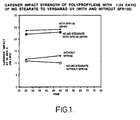
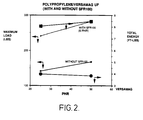
- FIGURES 1 and 2 show the significant improvements in the physical properties of the compositions of the present invention in graphic form.
- The present invention provides an additive formulation capable of improving the flame retardant properties of thermoplastics. The invention is also directed to novel flame retardant thermoplastic compositions and methods for forming the novel flame retardant thermoplastic compositions of the present invention.
- Component (a) of the flame retardant additive of the present invention are silicones. The term "silicone" as used herein is generic for a wide range of polysiloxane materials which can advantageously be utilized in the compositions of the present invention. For purposes of the instant specification it is intended that the expression "silicone" be construed as including those effective silicone materials as described by MacLaury and Holub in United States Patent No. 4,273,691 as well as other effective silicone materials, several of which will be described below. Typically effective silicone materials will be those silicone fluids or gums which are organopolysiloxane polymers comprised of chemically combined siloxy units typically selected from the group consisting of R3SiO0.5, R2SiO, R1SiO1.5, R1R2SiO0.5, RR1SiO, (R1)2SiO, RSiO1.5 and SiO2 units and mixtures thereof wherein each R represents independently a saturated or unsaturated monovalent hydrocarbon radical, R1 represents a radical such as R or a radical selected from the group consisting of a hydrogen atom, hydroxyl, alkoxy, aryl, vinyl, or allyl radicals etc. and wherein said organopolysiloxane has a viscosity of 600 to 300,000,000 mPa.s (centipoise) at 25°C. A preferred silicone material is a polydimethylsiloxane having a viscosity of 90,000 to 150,000 mPa.s (centipoise) at 25°C. Such effective silicone materials can be collectively referred to as silicone oils. Such silicone oils are readily available under a wide variety of brand and grade designations.
- The flame retardant additive compositions of the present invention preferably comprise from 2 to 40 percent by weight of the silicone (a) and more preferably from 2 to 20 percent by weight of the silicone (a) based on the total weight of the flame retardant additive composition.
- Component (b) of the flame retardant additive compositions of the present invention are silicone resins. Silicone resins are well known materials coming in a variety of forms. Among the preferred silicone resins are MQ silicone resins. The expression "MQ silicone resin" refers to the fact that such resins are typically comprised primarily of monofunctional M units of the formula R3SiO0.5 and tetrafunctional Q units of the average formula SiO2 having a specified ratio of M to Q units. A notably effective silicone resin for use in the present invention is polytrimethylsilylsilicate which can have a ratio of, 0.3 to 4.0 M units per Q unit. An example of a commercially available silicone oil (a) and MQ silicone resin (b) at a 2:1 ratio is SFR 100 additive, a product of General Electric Company.
- It is contemplated that other silicone oil soluble forms of solid silicone resins may be effective for use in the flame retardant compositions of the present invention. Indeed, MT and TQ silicone resins (where T represents trifunctional RSiO1.5 units) may also be effective as well as mixtures and copolymers of each of the resins mentioned. These silicone resins are well known materials and are readily available. A criteria for suitability is that such effective silicone resinous materials be soluble or dispersible in the silicone oil base.
- The flame retardant additive compositions of the present invention preferably comprise from 1 to 20 percent by weight of the silicone resin (b), and more preferably from 1 to 10 percent by weight of the silicone resin (b) based on the total weight of the flame retardant additive composition.
- Component (c) of the compositions of the present invention is magnesium hydroxide or Mg(OH)2. Magnesium hydroxide is well described in the literature. See, Modern Plastics Encyclopedia '89, McGraw Hill, Mid-October Issue, pp. 162-64. Magnesium hydroxide is commercially available, e.g., "VERSAMAG UF" from Morton International Company. Preferably, the flame retardant additive compositions of the present invention comprise from 40 to 96 percent by weight of the magnesium hydroxide, and more preferably from 70 to 96 percent by weight of the magnesium hydroxide based on the total weight of the flame retardant additive composition.
- Optionally, the flame retardant additives of the present invention may also comprise (d) a Group IIA metal organic compound or salt. Preferred are Group IIA metal carboxylic acid salts containing at least six carbon atoms. Although magnesium compounds are the preferred Group IIA metal, calcium, barium and strontium compounds are also within the scope of the present invention.
- Among the contemplated carboxylic acids from which salts of the Group IIA alkaline-earth metals can be derived, it is believed that approximately at least six carbon atoms are required to effectively disperse the Group IIA metal in the silicone resin. It is contemplated that while little advantage would be found by utilizing carboxylic acid salts containing more than about 20 carbon atoms, such salts may well be useful in specific applications. It is to be noted that it is not presently felt that finely divided Group IIA metal per se would be an effective ingredient in the flame retardant additive compositions of the present invention. However, it may be possible that such effective Group IIA metal additives could be effectively complexed with other organic moieties, and therefore find effective use in such compositions by virtue of their ability to readily disperse throughout the silicone resin. It is therefore intended that the Group IIA metal salt represent not only those effective Group IIA metal carboxylic acid salts as described, but also such other organic complexes of such metals as are effective for use in such flame retardant applications. Metal salts of other materials may be equally effective. Salts of the following acids may be suitable: sulfinic, sulfonic, aromatic sulfenic, sulfamic, phosphinic and phosphoric acids. Included within the Group IIA metal carboxylic acid salts which can be employed in the practice of the present invention are, for example, magnesium stearate, calcium stearate, barium stearate and strontium stearate. The carboxylic acid salts include: stearates, isostearates, oleates, palmitates, myristates, laurates, undecylenates, 2-ethylhexanoates, hexanoates, etc.
- Preferably the flame retardant additive compositions of the present invention comprise from 1 to 10 percent by weight of the Group IIA metal organic salt (d) based on the total weight of the flame retardant additive composition.
- The present invention is also directed to novel thermoplastic resin compositions having mixed therein the flame retardant additive compositions of the present invention. Included among the thermoplastic resins which can be used to make the flame retardant compositions of the present invention are, for example, polyolefins such as low density polyethylene, high density polyethylene, polypropylene, polybutylene, etc., and copolymers of these; crystal and high impact polystyrene; polycarbonates such as "LEXAN" brand from General Electric Company; polyesters such as "VALOX" brand resins manufactured by General Electric Company; polyamides such as nylons; polycaprolactams; ionomers; polyurethanes; co- and terpolymers of acrylonitrile, butadiene and styrene; acrylic polymers; acetal resins; ethylene-vinyl acetate; polymethylpentene; flexible polyvinylchloride; polyphenylene oxide; and polyphenylene oxide-polystyrene blends or copolymers such as "NORYL" resins from General Electric Company.
- In preferred embodiments, the flame retardant compositions of the present invention comprise (A) from 45 to 85 percent by weight, of a thermoplastic resin based on the total weight of the flame retardant composition; and (B) 10 from 55 to 15 percent of the flame retardant additives of the present invention, based on the total weight of the flame retardant composition.
- In other preferred embodiments, the compositions of the present invention may comprise additional optional ingredients, such as organic halides. An example of such an organic halide is decabromodiphenyl oxide. Another is Dechlorane Plus, a chlorinated alicyclic hydrocarbon available from Occidental Chemical Corporation. Another effective, yet optional ingredient is aluminum trihydrate, such as Micral 855 from Solem Industries. Those skilled in the art will recognize the temperature constraints of aluminum trihydrate.
- Further, although one of the objects of the present invention is to avoid the use of antimony metal, it is contemplated herein that certain thermoplastic formulations may nonetheless contain 1 to 10 percent by weight of antimony oxide as an additional optional component, should it be so desired.
- Additionally, the compositions of the present invention may contain various fillers, including but not limited to talc, clay, wollastonite, calcium carbonate, additional aluminum trihydrate etc. It is contemplated that excessive amounts of such fillers could have deleterious effects on flame retardancy and individual formulations can be adjusted for particular filler loadings.
- In the practice of the present invention, the flame retardant compositions can be made by mixing together the organic polymer with the silicone oil, the silicone resin, the magnesium hydroxide, and, optionally, the Group IIA metal organic salt, hereinafter referred to as the "Group IIA salt" by means of known conventional compounding or blending apparati, such as a Banbury mixer, a 2-roll rubber mill or a twin screw extruder. Order of addition of the particular composition constituents does not appear to be critical; and, those skilled in the art will be able to prepare the flame retardant compositions contemplated herein without undue experimentation.
- A preferred method of providing the flame retardant thermoplastic compositions of the present invention is to premix the silicone component with the MQ resin solution, and thereafter remove the solvent as by distillation, thereby ensuring complete dispersion of the resin in the oil. This solution is thereafter combined with the remaining ingredients by any suitable means for providing a substantially homogeneous composition (e.g. twin screw extrusion).
- The proportions of the various ingredients can vary widely depending upon the particular application intended. Reinforcing and nonreinforcing fillers may also be employed, such as those mentioned above, for inclusion in the formulations of the present invention as well as other additives without departing from the practice of the invention. Flame retardant thermoplastics can contain such fillers in an amount of, 5 to 70 percent by weight of the total composition.
- The flame retardant composition of the present invention can be extruded onto a conductor such as copper wire and the like, and in particular instances it can be crosslinked depending on whether an organic peroxide curing agent is present. Of course, there are numerous other applications where the flame retardant compositions of the present invention may be used to great advantage. Such flame retardant thermoplastic materials may be successfully injection molded, extruded or compressed, etc. to form numerous useful products such as moldings, sheets, webbings and a multitude of other flame retardant thermoplastic products. Thus, the flame retardant compositions of the present invention also can be utilized in such applications as appliance housings, hairdryers, television cabinets, smoke detectors, automotive interiors, fans, motors, electrical components, coffee makers, pump housings, power tools etc.
- Those skilled in the art will appreciate that there are several methods for testing and comparing relative flame retardancy of thermoplastics. Among the most well known are limiting oxygen index, horizontal burn times (HBT) and vertical burn times (VBT). Underwriters' Laboratories, Inc. UL-94 describes a "Standard For Test For Flammability Of Plastic Materials For Parts In Devices And Appliances" (hereinafter referred to as UL-94).
- In accordance with this test procedure, materials so investigated are rated either UL-94 V-0, UL-94 V-1, or UL-94 V-2 based on the results of five specimens. The criteria for each V rating per UL-94 is briefly as follows: "UL-94 V-0":average flaming and/or glowing after removal of the igniting flame shall not exceed 10 seconds after either of two applications of the test flame and none of the specimens shall drip particles which ignite absorbent cotton. "UL-94 V-1": average flaming and/or glowing after removal of the igniting flame shall not exceed 30 seconds after either of two applications of the test flame and none of the specimens shall drip particles which ignite absorbent cotton. "UL-94 V-2": average flaming and/or glowing after removal of the igniting flame shall not exceed 30 seconds after either of two applications of the test flame and the specimens may be permitted to drip flaming particles which ignite absorbent cotton placed 12 inches below the test specimen.
- The criteria for 94HB rating according to the UL94 Horizontal Burning Test for classifying materials is briefly as follows: HB) not have a burning rate exceeding 3.81 cm (1.5 inches) per minute over 7.62 cm (3.0 inch) span or sample must cease to burn before the 10.16 cm (4.0 inch) reference mark on the sample specimen.
- The following examples illustrate the present invention but are not intended to limit the subject matter of the appended claims in any manner whatsoever.
- Blend 1 - A blend of 11.35 kg (25 pounds) of magnesium hydroxide ("VERSAMAG UF", available from Morton International Company) and 3.76 kg (8.3 pounds) SFR100 additive (a high viscosity blend of MQ resin and silanol stopped methyl polymer available from General Electric Company) were mixed in a 25 liter DRAIS blender. The batch was run at 107 rpm for 3 hours with the side mounted chopper blades on. After 3 hours, the product could be easily removed from the DRAIS blender as a free flowing powder. The bulk density of the powder was increased to 730.60 kg/m3 (45.61 lbs/ft3) from 349.20 kg/m3 (21.8 lbs/ft3) for pure "VERSAMAG UF".
- The blend was then melt extruded in polypropylene by extruding in a twin screw corotating extruder at a melt temperature of 200 to 230°C. It was found to be preferable to add the
SFR 100 additive via the powdered flame retardant due to the ease of powder feed. It has been noted that many thermoplastic olefins manufacturers prefer powdered additives over high viscosity liquid additives as the production feed systems are designed to handle powdered additives. An additional blend was also prepared with magnesium stearate added. - For comparative purposes, magnesium hydroxide/polypropylene blends with and without magnesium stearate added were also prepared.
- Blend 2 - A first comparative blend (A*) was formulated with 35 percent by weight J.M. Huber Corp. aluminum trihydrate and 65 percent by weight SFR100 additive.
- Blend 3 - Comparative examples B* was formulated by adding additional aluminum trihydrate ("MICRAL 855", available from Solem Industries) to blend A* to obtain 75 percent by weight aluminum trihydrate and 25 percent by weight SFR100 additive.
- The compositional data, along with flame retardance and Dynatup Impact Performance results are set forth below in Table 1. Also included are data for Comparative Example C* having SFR100 additive and magnesium stearate but no magnesium hydroxide; and Comparative Example D* which is polypropylene only.
TABLE 1 Example 1 2 A* B* C* D* Composition, phr Polypropylene 100 100 100 100 100 100 Blend 1
(75 pbw MgOH2 a
25 pbw SFR100b)100 100 -- -- -- -- Blend 2
(35 pbw ATH
65 pbw SFR100b)-- -- 38.5 -- -- -- Blend 3
(75 pbw ATH
25 pbw SFR100b)-- -- -- 100 -- -- SFR 100b-- -- -- -- 25 -- Mg Stearate -- 4 4 4 4 -- Properties FR Ratingc HB HB HB HB VI X Rate of Burn, (in/min) (0.9) (0.7) (0.8) (0.9) -- (>1.5) cm/min 2.28 1.78 12.03 2.28 >3.81 Gardner Impactd (29.2) (29.6) (21.2) -- (22.0) (20.0) 3.21 3.26 2.33 2.42 2.20 * = Comparative Example a = "VERSAMAG UF", Morton International Company b = high viscosity blend of MQ resin and silanol stopped methyl polymer, General Electric Company, GE Silicones c = UL94 Horizontal Burn rating d = (in-lbs at 25°C) Nm at 25°C
X = consume - Compounds were melt extruded by feeding solid components to the main feed throat of a twin screw corotating extruder with downstream injection of the
high viscosity SFR 100 additive. It was observed that the magnesium hydroxide containing compounds had improved processability over compounds employing other nonhalogenated flame retardant additives which tended to foam, such as aluminum polyphosphate and aluminum trihydrate. It was possible to feed the magnesium hydroxide into the main feed throat of the extruder along with the polypropylene at compounding temperatures of 230°C with no visible foaming of the extrudate. Addition of ammonium polyphosphate or aluminum trihydrate at the main feed throat caused slight foaming at these compounding temperatures. It is believed, although Applicant does not wish to be bound by any particular theory, that the improved processability is due to the higher decomposition temperature of magnesium hydroxide, 350°C, compared to that of other nonhalogenated flame retardants which generally decompose below about 230°C. - Further it was observed that when magnesium hydroxide is used with polypropylene alone, without the silicone components, it has been found to have deleterious effects on the process compounding and on the final physical properties.
- These formulations meet the Horizontal Burning Test for Classifying Materials 94HB, and were not found to meet the criteria for Vertical Burning Test for Classifying Materials 94V-0, 94V-1, or 94V-2 according to Underwriter's Laboratory Bulletin UL94. The results of the flame retardance and impact resistance of these formulations are presented in Table 2. From Table 2 it can easily be seen that the compositions of the present invention containing magnesium hydroxide and silicone/silicone resin components showed marked improvement in impact strength over compositions without the silicone/silicone resin. This significant increase in impact strength is further demonstrated in Figures 1 and 2.

- Many variations of the present invention will suggest themselves to those skilled in the art in light of the above detailed description. The flame retardant additives can be employed with a wide variety of normally flammable thermoplastic resins, such as polyethylene, polyesters, polycarbonates, polyphenylene ethers and polyamides. Further, a wide variety of silicones and silicone resins can be employed in preparing the flame retardant additives of the present invention. It is also contemplated to employ a wide range of Group IIA metal organic salts in the compositions of the present invention, including calcium stearate, barium stearate, strontium stearate, calcium isostearate, magnesium oleate, barium palmitate, magnesium myristate and calcium laurate.
Claims (11)
- A flame retardant thermoplastic composition comprising :(A) from 30 to 90 percent by weight of a normally flammable thermoplastic resin based on the total weight of said flame retardant composition; and(B) from 70 to 10 percent by weight of a flame retardant additive composition in powder form based on the total weight of said flame retardant composition prepared by blending :(a) from 2 to 40 percent by weight of a silicone oil based on the total weight of said additive composition (B);(b) from 1 to 20 percent by weight of a silicone resin soluble in said silicone oil (a) based on the total weight of said additive composition (B); and(c) from 40 to 96 percent by weight of magnesium hydroxide based on the total weight of said additive composition (B), until a flowable powder is formed.
- A composition as defined in Claim 1, wherein said thermoplastic resin (A) is selected from the group consisting of polypropylene, polyethylene, polycarbonate, crystalline polystyrene, high impact modified polystyrene, acrylonitrile-butadiene-styrene terpolymer, polyphenylene oxide-polystyrene blends, acrylic polymer, polyurethane, polyamides and mixtures of any of the foregoing.
- A composition as defined in Claim 1, wherein said flame retardant additive (B) further comprises :
(d) a Group IIA metal organic salt. - A composition as defined in Claim 3, wherein said group II A metal organic salt B(d) is present in an amount ranging from 1 to 10 percent by weight based on the total weight of the additive composition (B).
- A composition as defined in Claim 1, wherein said silicone B(a) is an organopolysiloxane comprised of chemically combined siloxy units selected from the group consisting of R3SiO0.5, R2SiO, RSiO1.5, R1R2SiO0.5, RR1SiO, (R1)2SiO, R1SiO1.5 and SiO2 units and mixtures thereof wherein each R represents independently a saturated or unsaturated monovalent hydrocarbon radical, R1 represents independently a saturated or unsaturated monovalent hydrocarbon radical or a radical selected from the group consisting of a hydrogen atom, hydroxyl, alkoxy, aryl, vinyl or allyl radicals and wherein said organopolysiloxane has a viscosity of 600 to 300,000,000 mPa.s (centipoise) at 25°C.
- A composition as defined in Claim 1, wherein said silicone B(a) is present in an amount ranging from 2 to 20 percent by weight based on the total weight of said additive composition B.
- A composition as defined in Claim 1, wherein said silicone resin B(b) is an MQ silicone resin comprised of monofunctional M units of the average formula R3SiO0.5 and tetrafunctional Q units of the average formula SiO2, and having an average ratio of, 0.3 to 4.0 M units per Q unit.
- A flame retardant additive as defined in Claim 1, wherein said silicone resin B(b) is present in an amount ranging from about 1 to 10 percent by weight based on the total weight of said additive composition (B).
- A composition as defined in Claim 1, wherein said silicone B(a) is an essentially linear polydimethylsiloxane copolymer having a viscosity of 90,000 to 150,000 mPa.s (centipoise) at 25°C, and said silicone resin (b) is an MQ silicone resin comprised of monofunctional M units of the average formula R3SiO0.5 and tetrafunctional Q units of the average formula SiO2, and having an average ratio of, 0.3 to 4.0 M units per Q unit.
- A flame retardant thermoplastic composition consisting essentially of : (A) from 45 to 85 percent by weight of a normally flammable thermoplastic and (B) from 55 to 15 percent by weight of a flame retardant additive in powder form prepared by blending (a) an essentially linear polydimethylsiloxane copolymer having a viscosity of 90,000 to 150,000 mPa.s (centipoise) at 25°C; (b) an MQ silicone resin comprised of monofunctional M units of the average formula R3SiO0.5 and tetrafunctional Q units of the average formula SiO2, and having an average ratio of, 0.3 to 4.0 M units per Q unit; and (c) magnesium hydroxide and optionally (d) magnesium stearate, until a flowable powder is formed.
- A method for preparing a flame retardant thermoplastic composition comprising the steps of blending(a) from 2 to 40 parts by weight of a silicone oil;(b) from 1 to 20 parts by weight of a silicone resin soluble in said silicone oil (a); and(c) from 40 to 96 parts by weight of magnesium hydroxide until a flowable powder is formed and combining from 70 to 10 percent by weight based on the total weight of said flame retardant additive composition of said free flowing powder with from 30 to 90 percent by weight based on the total weight of said flame retardant composition of normally flammable thermoplastic resin to disperse said free flowing powder throughout said thermoplastic resin.
Applications Claiming Priority (2)
| Application Number | Priority Date | Filing Date | Title |
|---|---|---|---|
| US774669 | 1991-10-11 | ||
| US07/774,669 US5242744A (en) | 1991-10-11 | 1991-10-11 | Silicone flame retardants for thermoplastics |
Publications (2)
| Publication Number | Publication Date |
|---|---|
| EP0537013A1 EP0537013A1 (en) | 1993-04-14 |
| EP0537013B1 true EP0537013B1 (en) | 1997-09-17 |
Family
ID=25101905
Family Applications (1)
| Application Number | Title | Priority Date | Filing Date |
|---|---|---|---|
| EP19920309197 Expired - Lifetime EP0537013B1 (en) | 1991-10-11 | 1992-10-08 | Flame retardant silicone composition for thermoplastics |
Country Status (7)
| Country | Link |
|---|---|
| US (1) | US5242744A (en) |
| EP (1) | EP0537013B1 (en) |
| JP (1) | JP3711460B2 (en) |
| KR (1) | KR100258397B1 (en) |
| CA (1) | CA2077831A1 (en) |
| DE (1) | DE69222254T2 (en) |
| ES (1) | ES2107507T3 (en) |
Cited By (1)
| Publication number | Priority date | Publication date | Assignee | Title |
|---|---|---|---|---|
| KR101074733B1 (en) * | 2003-06-02 | 2011-10-18 | 넥쌍 | Mixture for jackets of optical or electric cable |
Families Citing this family (33)
| Publication number | Priority date | Publication date | Assignee | Title |
|---|---|---|---|---|
| DE4436776A1 (en) * | 1994-10-14 | 1996-04-18 | Bayer Ag | Flame retardant, thermoplastic polycarbonate molding compounds |
| DE4437596A1 (en) † | 1994-10-20 | 1996-04-25 | Daetwyler Ag | Flame-resistant composition for the production of electrical cables with insulation and / or functional integrity |
| DE4443164A1 (en) | 1994-12-05 | 1996-06-13 | Bayer Ag | Flame retardant, thermoplastic polycarbonate molding compounds |
| DE19610513B4 (en) | 1996-03-19 | 2006-10-19 | Alcatel Kabel Ag & Co. | Flame retardant, halogen-free mixture |
| US6001437A (en) * | 1997-07-17 | 1999-12-14 | Nu-Chem, Inc. | Method of making high-temperature glass fiber and thermal protective structures |
| DE19959110A1 (en) * | 1999-12-08 | 2001-06-21 | Rehau Ag & Co | Flame retardant composition |
| JP4577736B2 (en) * | 2000-05-15 | 2010-11-10 | 旭化成ケミカルズ株式会社 | Flame retardant resin composition |
| KR100379098B1 (en) * | 2000-12-13 | 2003-04-08 | 삼성종합화학주식회사 | Polypropylene-coated magnesium hydroxide, method for preparing thereof and flame retardant composite polypropylene comprising the same |
| BRPI0403713B1 (en) * | 2004-08-30 | 2021-01-12 | Universidade Estadual De Campinas - Unicamp | manufacturing process of a white pigment based on the synthesis of hollow particles of aluminum orthophosphate or polyphosphate |
| US7763359B2 (en) | 2004-08-30 | 2010-07-27 | Bunge Fertilizantes S.A. | Aluminum phosphate, polyphosphate and metaphosphate particles and their use as pigments in paints and method of making same |
| EP1937454B1 (en) * | 2005-10-21 | 2016-05-25 | Entrotech, Inc. | Protective sheets, articles, and methods |
| US20070190872A1 (en) * | 2006-02-16 | 2007-08-16 | Weber Robert F | Fire retardant silicone textile coating |
| US20070231573A1 (en) * | 2006-03-29 | 2007-10-04 | Chapman Thermal Products, Inc. | Fire retardant and heat resistant yarns and fabrics treated for increased strength and liquid shedding |
| US20100071119A1 (en) * | 2006-03-29 | 2010-03-25 | Chapman Therman Products, Inc. | Yarns and fabrics that shed liquids, gels, sparks and molten metals and methods of manufacture and use |
| US20110145984A1 (en) * | 2009-11-30 | 2011-06-23 | Chapman Thermal Products, Inc. | Methods of protecting a person from hot high heat capacity materials and hot corrosive material |
| US9630031B2 (en) | 2006-03-29 | 2017-04-25 | Chapman Thermal Products, Inc. | Lightweight protective fabrics and clothing for protection against hot or corrosive materials |
| CN103923510A (en) | 2006-08-11 | 2014-07-16 | 鲍吉肥料公司 | Preparation Of Aluminum Phosphate Or Polyphosphate Particles |
| EP2193024A4 (en) | 2007-09-25 | 2013-11-06 | Entrotech Inc | Paint replacement films, composites therefrom, and related methods |
| US10981371B2 (en) | 2008-01-19 | 2021-04-20 | Entrotech, Inc. | Protected graphics and related methods |
| US9023145B2 (en) * | 2008-02-12 | 2015-05-05 | Bunge Amorphic Solutions Llc | Aluminum phosphate or polyphosphate compositions |
| AR075381A1 (en) * | 2009-02-10 | 2011-03-30 | Unicamp | USE OF PARTICLES OF PHOSPHATE, POLYPHOSPHATE AND METAPHOSPHATE, OF ALUMINUM IN PAPER COATING APPLICATIONS. |
| JP5500037B2 (en) * | 2010-10-12 | 2014-05-21 | 信越化学工業株式会社 | Flame retardant organopolysiloxane composition |
| US9005355B2 (en) | 2010-10-15 | 2015-04-14 | Bunge Amorphic Solutions Llc | Coating compositions with anticorrosion properties |
| US9371454B2 (en) | 2010-10-15 | 2016-06-21 | Bunge Amorphic Solutions Llc | Coating compositions with anticorrosion properties |
| ES2685477T3 (en) * | 2012-02-08 | 2018-10-09 | Nexans | Halogen-free polymer blend |
| WO2013121412A1 (en) * | 2012-02-15 | 2013-08-22 | Bromine Compounds Ltd. | Flame-retarded compositions of polyamides |
| US9078445B2 (en) | 2012-04-16 | 2015-07-14 | Bunge Amorphic Solutions Llc | Antimicrobial chemical compositions |
| US9155311B2 (en) | 2013-03-15 | 2015-10-13 | Bunge Amorphic Solutions Llc | Antimicrobial chemical compositions |
| US9611147B2 (en) | 2012-04-16 | 2017-04-04 | Bunge Amorphic Solutions Llc | Aluminum phosphates, compositions comprising aluminum phosphate, and methods for making the same |
| CN105086417B (en) * | 2014-05-06 | 2017-09-12 | 广东生益科技股份有限公司 | A kind of resin combination and its application in high-frequency circuit board |
| EP3419826B1 (en) | 2016-09-20 | 2025-11-05 | PPG Advanced Surface Technologies, LLC | Method of forming paint film appliques, paint film appliques, articles, and use |
| KR102720336B1 (en) * | 2018-06-29 | 2024-10-24 | 다우 글로벌 테크놀로지스 엘엘씨 | Moisture curable flame retardant composition for wire and cable insulation and jacket layers |
| CN110790957B (en) * | 2018-08-03 | 2024-12-24 | 莫门蒂夫性能材料股份有限公司 | Method for preparing resin composition, resin composition and molded product |
Family Cites Families (13)
| Publication number | Priority date | Publication date | Assignee | Title |
|---|---|---|---|---|
| US3711520A (en) * | 1970-09-04 | 1973-01-16 | Gen Electric | Flame retardant compositions |
| ES444945A1 (en) * | 1975-03-03 | 1977-08-16 | Gen Electric | Flame-resistant composition, and electrical product thereof |
| US4273691A (en) * | 1979-10-18 | 1981-06-16 | General Electric Company | Flame retardant compositions and coated article |
| US4288360A (en) * | 1979-12-26 | 1981-09-08 | General Electric Company | Flame resistant silicone rubber compositions and methods |
| US4387176A (en) * | 1982-02-04 | 1983-06-07 | General Electric Company | Silicone flame retardants for plastics |
| JPS59140242A (en) * | 1983-01-31 | 1984-08-11 | Shin Etsu Chem Co Ltd | Flame-retardant rubber composition |
| US4536529A (en) * | 1983-12-20 | 1985-08-20 | General Electric Company | Flame retardant thermoplastic compositions |
| JPS60179436A (en) * | 1984-02-27 | 1985-09-13 | Shin Etsu Chem Co Ltd | Flame-retarding polyolefin rubber composition |
| US4496680A (en) * | 1984-03-14 | 1985-01-29 | General Electric Company | Silicone flame retardants for nylon |
| JPS62191574A (en) * | 1986-02-15 | 1987-08-21 | スミクロス工業株式会社 | Drawing cloth |
| US4871795A (en) * | 1987-05-01 | 1989-10-03 | Pawar Prakash K | Flame retardant additive for thermoplastics |
| JPH02167339A (en) * | 1988-09-09 | 1990-06-27 | Mitsubishi Rayon Co Ltd | Modified rigid polymers and molecular composites |
| US5104920A (en) * | 1989-06-14 | 1992-04-14 | Union Carbide Chemicals & Plastics Technology Corporation | Flame retardant compositions |
-
1991
- 1991-10-11 US US07/774,669 patent/US5242744A/en not_active Expired - Lifetime
-
1992
- 1992-09-09 CA CA 2077831 patent/CA2077831A1/en not_active Abandoned
- 1992-09-29 JP JP25876792A patent/JP3711460B2/en not_active Expired - Fee Related
- 1992-10-08 ES ES92309197T patent/ES2107507T3/en not_active Expired - Lifetime
- 1992-10-08 DE DE69222254T patent/DE69222254T2/en not_active Expired - Fee Related
- 1992-10-08 EP EP19920309197 patent/EP0537013B1/en not_active Expired - Lifetime
- 1992-10-09 KR KR1019920018566A patent/KR100258397B1/en not_active Expired - Fee Related
Cited By (1)
| Publication number | Priority date | Publication date | Assignee | Title |
|---|---|---|---|---|
| KR101074733B1 (en) * | 2003-06-02 | 2011-10-18 | 넥쌍 | Mixture for jackets of optical or electric cable |
Also Published As
| Publication number | Publication date |
|---|---|
| ES2107507T3 (en) | 1997-12-01 |
| DE69222254D1 (en) | 1997-10-23 |
| JPH05295266A (en) | 1993-11-09 |
| KR930008037A (en) | 1993-05-20 |
| EP0537013A1 (en) | 1993-04-14 |
| KR100258397B1 (en) | 2000-06-01 |
| DE69222254T2 (en) | 1998-04-02 |
| CA2077831A1 (en) | 1993-04-12 |
| JP3711460B2 (en) | 2005-11-02 |
| US5242744A (en) | 1993-09-07 |
Similar Documents
| Publication | Publication Date | Title |
|---|---|---|
| US5242744A (en) | Silicone flame retardants for thermoplastics | |
| US4536529A (en) | Flame retardant thermoplastic compositions | |
| US4387176A (en) | Silicone flame retardants for plastics | |
| US4273691A (en) | Flame retardant compositions and coated article | |
| EP0903370B1 (en) | Flame retarded poly (butylene terephthalate) composition | |
| US20110160362A1 (en) | Flame-retarded compositions of styrene-containing polymers | |
| KR100366166B1 (en) | Flame Retardant Silicone Rubber Composition | |
| KR20100098643A (en) | Flame retardant compositions | |
| EP2182031B1 (en) | Flame retardant organoplysiloxane compositon | |
| EP0333694A2 (en) | Polybrominated phenylphosphate flame retardant thermoplastic composition | |
| CN115772303B (en) | High-fluidity flame-retardant polyvinyl chloride injection molding composition and preparation method thereof | |
| WO2001029124A1 (en) | Stabilized flame retardant additives and their use | |
| US20110288226A1 (en) | Compounded masterbatch for carrying flame retardant materials and processer for preparing | |
| WO2013121412A1 (en) | Flame-retarded compositions of polyamides | |
| EP0390291A1 (en) | Flame retardant compositions | |
| EP0156209B1 (en) | Silicone flame retardants for nylon | |
| CA1233592A (en) | Metal salt and silicone fire retardant for thermoplastic polymers | |
| JP2558130B2 (en) | Polyolefin resin composition | |
| JPH04226159A (en) | Fire-retardant thermoplastic composition | |
| JPH10139967A (en) | Low-smoke-generating resin composition | |
| AU1335183A (en) | Metal silicone flame retardants for polyolefins | |
| JPS62100545A (en) | Flame-retardant polyolefin composition | |
| JP3030909B2 (en) | Flame retardant resin composition | |
| CN119161701A (en) | A long-lasting antibacterial, thermally conductive, flame-retardant thermoplastic elastomer composite material based on TPC-ET and preparation method thereof | |
| JP2001152035A (en) | Thermoplastic resin composition excellent in fluidity and mechanical properties |
Legal Events
| Date | Code | Title | Description |
|---|---|---|---|
| PUAI | Public reference made under article 153(3) epc to a published international application that has entered the european phase |
Free format text: ORIGINAL CODE: 0009012 |
|
| AK | Designated contracting states |
Kind code of ref document: A1 Designated state(s): BE DE ES FR GB IT NL SE |
|
| 17P | Request for examination filed |
Effective date: 19930930 |
|
| 17Q | First examination report despatched |
Effective date: 19950404 |
|
| GRAG | Despatch of communication of intention to grant |
Free format text: ORIGINAL CODE: EPIDOS AGRA |
|
| GRAH | Despatch of communication of intention to grant a patent |
Free format text: ORIGINAL CODE: EPIDOS IGRA |
|
| GRAH | Despatch of communication of intention to grant a patent |
Free format text: ORIGINAL CODE: EPIDOS IGRA |
|
| GRAA | (expected) grant |
Free format text: ORIGINAL CODE: 0009210 |
|
| AK | Designated contracting states |
Kind code of ref document: B1 Designated state(s): BE DE ES FR GB IT NL SE |
|
| ET | Fr: translation filed | ||
| REF | Corresponds to: |
Ref document number: 69222254 Country of ref document: DE Date of ref document: 19971023 |
|
| ITF | It: translation for a ep patent filed | ||
| REG | Reference to a national code |
Ref country code: ES Ref legal event code: FG2A Ref document number: 2107507 Country of ref document: ES Kind code of ref document: T3 |
|
| PLBE | No opposition filed within time limit |
Free format text: ORIGINAL CODE: 0009261 |
|
| 26N | No opposition filed | ||
| REG | Reference to a national code |
Ref country code: GB Ref legal event code: IF02 |
|
| PGFP | Annual fee paid to national office [announced via postgrant information from national office to epo] |
Ref country code: NL Payment date: 20050916 Year of fee payment: 14 |
|
| PGFP | Annual fee paid to national office [announced via postgrant information from national office to epo] |
Ref country code: GB Payment date: 20051005 Year of fee payment: 14 |
|
| PGFP | Annual fee paid to national office [announced via postgrant information from national office to epo] |
Ref country code: FR Payment date: 20051017 Year of fee payment: 14 |
|
| PGFP | Annual fee paid to national office [announced via postgrant information from national office to epo] |
Ref country code: ES Payment date: 20051026 Year of fee payment: 14 |
|
| PGFP | Annual fee paid to national office [announced via postgrant information from national office to epo] |
Ref country code: SE Payment date: 20051027 Year of fee payment: 14 |
|
| PGFP | Annual fee paid to national office [announced via postgrant information from national office to epo] |
Ref country code: BE Payment date: 20051122 Year of fee payment: 14 |
|
| PGFP | Annual fee paid to national office [announced via postgrant information from national office to epo] |
Ref country code: DE Payment date: 20051130 Year of fee payment: 14 |
|
| PG25 | Lapsed in a contracting state [announced via postgrant information from national office to epo] |
Ref country code: SE Free format text: LAPSE BECAUSE OF NON-PAYMENT OF DUE FEES Effective date: 20061009 |
|
| PGFP | Annual fee paid to national office [announced via postgrant information from national office to epo] |
Ref country code: IT Payment date: 20061031 Year of fee payment: 15 |
|
| PG25 | Lapsed in a contracting state [announced via postgrant information from national office to epo] |
Ref country code: NL Free format text: LAPSE BECAUSE OF NON-PAYMENT OF DUE FEES Effective date: 20070501 Ref country code: DE Free format text: LAPSE BECAUSE OF NON-PAYMENT OF DUE FEES Effective date: 20070501 |
|
| EUG | Se: european patent has lapsed | ||
| GBPC | Gb: european patent ceased through non-payment of renewal fee |
Effective date: 20061008 |
|
| NLV4 | Nl: lapsed or anulled due to non-payment of the annual fee |
Effective date: 20070501 |
|
| REG | Reference to a national code |
Ref country code: FR Ref legal event code: ST Effective date: 20070629 |
|
| PG25 | Lapsed in a contracting state [announced via postgrant information from national office to epo] |
Ref country code: GB Free format text: LAPSE BECAUSE OF NON-PAYMENT OF DUE FEES Effective date: 20061008 |
|
| BERE | Be: lapsed |
Owner name: *GENERAL ELECTRIC CY Effective date: 20061031 |
|
| REG | Reference to a national code |
Ref country code: ES Ref legal event code: FD2A Effective date: 20061009 |
|
| PG25 | Lapsed in a contracting state [announced via postgrant information from national office to epo] |
Ref country code: FR Free format text: LAPSE BECAUSE OF NON-PAYMENT OF DUE FEES Effective date: 20061031 Ref country code: ES Free format text: LAPSE BECAUSE OF NON-PAYMENT OF DUE FEES Effective date: 20061009 |
|
| PG25 | Lapsed in a contracting state [announced via postgrant information from national office to epo] |
Ref country code: IT Free format text: LAPSE BECAUSE OF NON-PAYMENT OF DUE FEES Effective date: 20071008 Ref country code: BE Free format text: LAPSE BECAUSE OF FAILURE TO SUBMIT A TRANSLATION OF THE DESCRIPTION OR TO PAY THE FEE WITHIN THE PRESCRIBED TIME-LIMIT Effective date: 20061031 |