EP0536352B1 - Therapeutic and preventive vaccines for hiv - Google Patents
Therapeutic and preventive vaccines for hiv Download PDFInfo
- Publication number
- EP0536352B1 EP0536352B1 EP92907420A EP92907420A EP0536352B1 EP 0536352 B1 EP0536352 B1 EP 0536352B1 EP 92907420 A EP92907420 A EP 92907420A EP 92907420 A EP92907420 A EP 92907420A EP 0536352 B1 EP0536352 B1 EP 0536352B1
- Authority
- EP
- European Patent Office
- Prior art keywords
- vaccine
- hiv
- peptide
- none
- peptides
- Prior art date
- Legal status (The legal status is an assumption and is not a legal conclusion. Google has not performed a legal analysis and makes no representation as to the accuracy of the status listed.)
- Expired - Lifetime
Links
Images

Classifications
-
- C—CHEMISTRY; METALLURGY
- C07—ORGANIC CHEMISTRY
- C07K—PEPTIDES
- C07K14/00—Peptides having more than 20 amino acids; Gastrins; Somatostatins; Melanotropins; Derivatives thereof
- C07K14/005—Peptides having more than 20 amino acids; Gastrins; Somatostatins; Melanotropins; Derivatives thereof from viruses
-
- A—HUMAN NECESSITIES
- A61—MEDICAL OR VETERINARY SCIENCE; HYGIENE
- A61K—PREPARATIONS FOR MEDICAL, DENTAL OR TOILETRY PURPOSES
- A61K39/00—Medicinal preparations containing antigens or antibodies
-
- C—CHEMISTRY; METALLURGY
- C12—BIOCHEMISTRY; BEER; SPIRITS; WINE; VINEGAR; MICROBIOLOGY; ENZYMOLOGY; MUTATION OR GENETIC ENGINEERING
- C12N—MICROORGANISMS OR ENZYMES; COMPOSITIONS THEREOF; PROPAGATING, PRESERVING, OR MAINTAINING MICROORGANISMS; MUTATION OR GENETIC ENGINEERING; CULTURE MEDIA
- C12N2740/00—Reverse transcribing RNA viruses
- C12N2740/00011—Details
- C12N2740/10011—Retroviridae
- C12N2740/16011—Human Immunodeficiency Virus, HIV
- C12N2740/16111—Human Immunodeficiency Virus, HIV concerning HIV env
- C12N2740/16122—New viral proteins or individual genes, new structural or functional aspects of known viral proteins or genes
Definitions
- This invention relates to vaccines and immunotherapeutic treatments for use in inhibiting the transmission (transmission prevention) and treatment of HIV. Specifically, it relates to vaccines created by the conjugation of HIV-1 peptides and carriers. These peptides may be either single or repeated, linear or conformational amino acid sequences from the gp120 Principal Neutralizing Domain (PND) of HIV-1.
- PND Principal Neutralizing Domain
- amino acid sequences from the gp120 PND of HIV are KRIHIGPRAFYT, RHIHIGPGRAFYT, RRIHIGPGRAFYT, TRIHIGPGRAFYT, CTRPNYNKRKRIHIGPGRAFYTTKNIIGTIRQAHC, GPGRAFGPGRAFGPGRAFC, IYIGPGRAC, IAIGPGRAC, IHIGPGRAC, KRIHIGPGRAFYT, RSIHIGPGRAFYA, KSITKGPGRVIYA, KGIAIGPGRTLYA and SRVTLGPGRVWYT.
- the most effective amino acid sequences from the gp120 PND of HIV are GPGRAFGPGRAFGPGRAFC, IYIGPGRAC, IAIGPGRAC. IHIGPGRAC, KRIHIGPGRAFYT, RSIHIGPGRAFYA, KSITKGPGRVIYA, KGIAIGPGRTLYA and SRVTLGPGRVWYT.
- the best carrier is Purified Protein Derivative (PPD) of tuberculin from Mycobacterium tuberculosis . Either a single peptide carrier conjugate alone or several different peptide carrier conjugates together in a "cocktail" may be used to vaccinate HIV-1 infected and uninfected individuals.
- PPD Purified Protein Derivative
- antibody-containing fluid from the vaccinated individuals is used in an assay to detect whether high affinity/avidity neutralizing and/or protective HIV-specific antibodies are present in the fluid.
- the assay is an antigen-limited ELISA which contains a thimerosal-containing diluent and is capable of detecting high affinity/avidity neutralizing and/or protective HIV-specific antibodies.
- IL-2 secretion upon incubation with PND and generation of cytotoxic lymphocytes (CTL) maybe used to determine whether the vaccines are effective against HIV.
- CTL cytotoxic lymphocytes
- the purified protein derivative (PPD) of tuberculin from Mycobacterium tuberculosis is a unique immunologic reagent, because virtually everyone in the world with a functional immune response who has been exposed to BCG or M. tuberculosis infections will have a T-cell mediated, delayed-type hypersensitivity response to minute amounts of PPD. Tuberculin-PPD conjugates have been utilized in the past. Mice pre-sensitized or "primed" with BCG can produce high levels of antibodies to peptide or carbohydrate epitopes conjugated to PPD. Of particular interest are studies on the NANP repeating epitope of the P. falciparum circumsporozoite antigen, which is immunogenic in only two strains of mice.
- Pseudomonas aeruginosa exotoxin A (toxin A) has been used effectively as a carrier in conjugate vaccines. Conjugates made with this carrier have higher immunogenicity, especially when coupled with the recombinant protein R32 to create an immune response against the sporozoite stage of Plasmodium falciparum . Pseudomonas aeruginosa exotoxin A may be purified from the supernatant of fermentor-grown cultures of Pseudomonas aeruqinosa PA 103.
- KLH Keyhole Limpet Hemocyanin
- Tetanus and diptheria toxoids have also been used successfully as protein carriers. Diptheria toxoid has been used with a synthetic 31 amino acid N-terminal peptide. Both tetanus toxoid and diptheria toxoid have proved to be effective carriers in humans for the poorly immunogenic carbohydrate antigen of Hemophilus influenza b .
- the recombinant core antigen of hepatitis B has the capability of self-assembling into 27 millimeter particles which are highly immunogenic in experimental animals. These HBV core particles may be conjugated directly with peptides, using recombinant DNA technology. Fusion proteins can be produced between the HBV core antigen and defined sequence peptides with high epitope density, which lead to high titer antibodies, as well as to long lasting neutralizing antiviral immunity. Hepatitis B core antigens and self-assembled HBc-HIV peptide fusion protein may be used as protein carriers.
- BCG cell wall (purified) may be used as a protein carrier. BCG may also be used to prime animals or humans prior to vaccination. BCG priming enhances the humoral and cellular responses induced by vaccination.
- alumina may be used with the conjugates which include the carriers Pseudomonas aeruginosa exotoxin A, KLH, and tetanus and diptheria toxoids.
- Aluminum-based gels such as Al(OH) 3 and AlPO 4 , as well as liposomes may be used as adjuvants with the carrier Pseudomonas aeruginosa exotoxin A in the present invention.
- PPD conjugates can be given in saline with no further adjuvants to tuberculin-positive individuals.
- Ribi adjuvant containing trehalose dimycolate and 2% squalene may be used as an adjuvant.
- these adjuvants may be used.
- Microencapsulation technology using polyactide/polyglycolide biodegradable polymers may also be used as an adjuvant.
- This invention relates to conjugates made up of (1) peptides with amino acid sequences similar to the gp120 Principal Neutralizing Domain (PND) of HIV and (2) carriers which enhance immunogenicity, such conjugates to be used in vaccines for the treatment and transmission prevention of HIV.
- PND Principal Neutralizing Domain
- the peptides are KRIHIGPRAFYT, RHIHIGPGRAFYT, RRIHIGPGRAFYT, TRIHIGPGRAFYT, CTRPNYNKRKRIHIGPGRAFYTTKNIIGTIRQAHC, GPGRAFGPGRAFGPGRAFC, IYIGPGRAC, IAIGPGRAC, IHIGPGRAC, KRIHIGPGRAFYT, RSIHIGPGRAFYA, KSITKGPGRVIYA, KGIAIGPGRTLYA and SRVTLGPGRVWYT.
- the peptides are GPGRAFGPGRAFGPGRAFC, IYIGPGRAC, IAIGPGRAC, IHIGPGRAC, KRIHIGPGRAFYT, RSIHIGPGRAFYA, KSITKGPGRVIYA, KGIAIGPGRTLYA and SRVTLGPGRVWYT.
- the carrier is PPD. Individuals to be vaccinated who are PPD-negative are primed with BCG four to six weeks prior to vaccination with the conjugates in order to enhance the immune reaction induced by vaccination with the peptide carrier conjugates. If an individual is PPD-positive, it is not necessary to prime that individual with BCG.
- the vaccine may comprise either a single peptide carrier conjugate alone, or a cocktail of several different peptide carrier conjugates.
- the vaccine may be administered in liquid form once or several times, or may be administered in a timed-release or pulse-release mechanism.
- antibody-containing fluid is extracted from the vaccinated individual and assayed in an antigen-limited ELISA which contains a thimerosal-containing diluent and selects for high affinity/avidity neutralizing and/or protective HIV-specific antibodies.
- IL-2 secretion upon incubation with PND and generation of cytotoxic lymphocytes (CTL) may be used to determine whether the vaccines are effective against HIV.
- CTL cytotoxic lymphocytes
- This invention is directed to peptide carrier conjugate vaccines to be used in the treatment and transmission prevention of HIV. It comprises the conjugation of peptides with amino acid sequences similar to those of the gp120 PND of HIV and carriers to form vaccines, priming animals with BCG, immunizing animals with the vaccines, extracting antibody-containing fluid from the immunized animals and assaying the antibody-containing fluid in an antigen-limited ELISA which contains a thimerosal-containing diluent and selects for high affinity/avidity neutralizing and/or protective HIV-specific antibodies.
- the vaccines which have induced the production of the high affinity/avidity neutralizing and/or protective HIV-specific antibodies and/or induced proliferative responses and/or IL-2 secretion upon in vitro exposure to PND are useful in the treatment and transmission prevention of HIV.
- Carriers which may be used for conjugation with the peptides of this invention include purified protein derivative (PPD) of tuberculin from Mycobacterium tuberculosis , Pseudomonas aeructinosa exotoxin A, keyhole limpet hemocyanin (KLH), tetanus toxoid, diptheria toxoid, hepatitis B core antigen and Bacillus Calmette-Guerin (BCG) cell wall.
- PPD purified protein derivative
- Pseudomonas aeructinosa exotoxin A Pseudomonas aeructinosa exotoxin A
- KLH keyhole limpet hemocyanin
- tetanus toxoid diptheria toxoid
- BCG Bacillus Calmette-Guerin
- the preferred carrier of this invention is PPD.
- an adjuvant such as alumina,
- the peptides of this invention In order to prepare the peptides of this invention, it is necessary to determine which strains of HIV infect individuals and which peptides of each strain would most effectively induce the production of high affinity/avidity neutralizing and/or protective HIV-specific antibodies. There are many different strains of HIV, and different strains are prevalent in different geographic areas. Therefore, the peptides in the vaccines of this invention may be geographically specific. For example, the MN strain of HIV has a high degree of prevalence in the United States. Therefore, peptides from the MN strain of HIV are effective in conjugates used to vaccinate individuals in the United States.
- peptides and conjugates may not be effective in different geographic areas where other HIV strains are prevalent, and may have to be adjusted according to the most prevalent strains evolving in certain geographic areas.
- Another example is that high affinity/avidity neutralizing and/or protective HIV-specific antibodies against the gp120 PND of the MN strain of HIV have been associated with protection from materno-fetal HIV transmission in the United States. Therefore, peptides from the MN strain of HIV may be used in conjugates to prevent materno-fetal transmission of HIV in the United States.
- the peptides of this invention are from the gp120 PND of HIV.
- the peptides selected may include amino acids 116-131, 307-319 and 470-490 of gp120 of MN-HIV.
- the most effective sequences to induce the production of high affinity/avidity neutralizing and/or protective HIV-specific antibodies, which are the preferred peptide sequences for the conjugates of this invention, are as follows:
- the peptides of this invention are conjugated with different carriers to enhance immunogenicity.
- the methods by which these peptides are conjugated with the carriers include disulfide linkages through a C terminal peptide cysteine linkage, coupling with glutaraldehyde solution for two hours, coupling with tyrosine, or coupling with water soluble carbodiimide.
- PPD-negative individuals should be primed with BCG prior to conjugate vaccination.
- proliferative response testing if an individual exhibits proliferative responses in vitro to peripheral blood lymphocytes to PPD, that individual is PPD-responsive.
- skin testing an individual should be exposed to intradermal 5 TU and if negative to 20 TU of PPD. If an individual is PPD-positive, there is no need to prime with BCG. If an individual is considered PPD-negative, that individual should receive a BCG immunization four to six weeks prior to conjugate vaccination. After BCG immunization, PPD testing should again be performed. If the results of the PPD test are positive, then the conjugate vaccine is administered to the individual.
- BCG priming If individuals are HIV-negative and PPD-negative, there are no limitations on BCG priming. However, if individuals are HIV-positive and PPD-negative, they may be primed with BCG only if they are still asymptomic and/or their CD4 T-cell counts exceed 200. Individuals who are HIV-positive, PPD-negative and exhibit advanced symptoms should not be primed with BCG. In addition, it is recommended that the standard British or Japanese BCG vaccines be used for priming, since these vaccines rarely induce adverse reactions in individuals.
- the peptide-carrier conjugates of this invention may be administered in vaccine form, suppository form, intradermally, subcutaneously, orally, or by any other suitable route.
- the vaccines may comprise either a single peptide carrier conjugate or a cocktail of several different peptide carrier conjugates, and may be administered in liquid form or in timed-release, pulse-release or slow-release mechanisms, such as virosomes. virosomes encase viral-specific antigens in their systems and then react strongly with macrophages.
- Such virosomes may comprise 1-10 ⁇ g of PND peptide coupled to PPD or influenza hemagglutinin (HA), or PND in a free state associated with but not covalently coupled with PPD or HA, 1-10 ⁇ g of HA isolated from a human strain of influenza virus, 0.1-1 ⁇ g neuraminidase (NA) isolated from a human strain of influenza virus, 0.25-0.75 mg kephalin and 100-140 mg lecithin.
- PND peptide coupled to PPD or influenza hemagglutinin (HA), or PND in a free state associated with but not covalently coupled with PPD or HA 1-10 ⁇ g of HA isolated from a human strain of influenza virus, 0.1-1 ⁇ g neuraminidase (NA) isolated from a human strain of influenza virus, 0.25-0.75 mg kephalin and 100-140 mg lecithin.
- Either a single vaccination or multiple vaccinations with the peptide carrier conjugates may be used to induce the production of high affinity/avidity neutralizing and/or protective HIV-specific antibodies.
- the preferred dose range is 50-500 ⁇ g of peptide per conjugate.
- antibody-containing fluid is extracted from the vaccinated individuals. The antibody-containing fluid is then assessed in an assay.
- the assay contains a thimerosal-containing diluent and is an antigen-limited ELISA which selects for high affinity/avidity neutralizing and/or protective HIV-specific antibodies.
- microplate wells are covered with the antigen which the antibodies are reactive to, such as MN-PND, or another PND antigen derived from other seroprevalent HIV strains, in a decreasing coating concentration series as follows: Row A - 500 ng/ml Row B - 100 ng/ml Row C - 50 ng/ml Row D - 10 ng/ml Row E - 5 ng/ml Row F - 1 ng/ml Row G - 0.5 ng/ml Row H - 0 ng/ml
- the vaccine comprises a cocktail of different peptides conjugated to carriers
- all of the wells in the plate are covered with all of the peptides in the vaccine in order to determine whether there was induction of high affinity/avidity neutralizing and/or protective HIV-specific antibody production. If such antibodies were produced, a second ELISA is performed, wherein each row of the plate is covered with a separate peptide from the cocktail.
- antibody-containing fluid is removed from the vaccinated individuals, diluted with antibody-containing fluid diluent to a ratio of 1:21 (sample: diluent) and added to the series of wells.
- the antibody-containing fluid diluent comprises a formulation of additives in a buffered solution containing thimerosal.
- An example of such antibody-containing fluid diluent is 0.1-0.5% caesin in PBS containing 0.05% Tween-20 (pH 7.4), 0.001% rhodamine and thimerosal. Any antibody-containing fluid may be used.
- Examples of antibody-containing fluid are serum, plasma, cerebral fluids and mucosal fluids.
- a negative control such as anti-HIV negative human serum
- a positive control such as anti-HIV positive human serum or anti HIV-MN-PND monoclonal antibody should also be added to wells in the ELISA plate. The plate should then be covered and incubated for 60 minutes at 37°C.
- the plate After incubation, the plate should be washed 5-6 times using diluted plate wash solution (phosphate buffered saline, pH 7.4 with 0.05% Tween-20 diluted with deionized water containing chloracetemide at 1:10). Use of an automatic plate washer is recommended. After washing, 100 ⁇ l per well of anti-human conjugate such as peroxidase-conjugated (goat) Fabl anti-human IgG, anti-human IgA or anti-human secretory component (SC), diluted to 1:100,000 in conjugate diluent is added to the wells. Any conjugate diluent may be used.
- anti-human conjugate such as peroxidase-conjugated (goat) Fabl anti-human IgG, anti-human IgA or anti-human secretory component (SC)
- the conjugate diluent may comprise, for example, a formulation of additives in a buffered solution which is typically added to antibody conjugate solutions by those skilled in the art. Subsequently, the wells are incubated for 60 minutes at 37°C and washed 5-6 times using the diluted plate wash solution. (Again, use of an automatic plate washer is recommended.)
- o-PD O-phenylenediamine
- a citrate buffer 200 ⁇ l of substrate such as O-phenylenediamine (o-PD) tablets, diluted (to 1 tablet per 12 ml of diluent) with hydrogen peroxide in a citrate buffer is added per well.
- the wells are then incubated in the dark for 30 minutes at room temperature.
- the reaction is then stopped by adding 50 ⁇ l per well of 4N sulfuric acid.
- the plate may then be read in a microplate spectrophotometer at an absorbance of 492nm. (Use of a 620 nm reference filter is recommended.)
- the human negative control values should average around 0.050.
- the cutoff should be around 0.100.
- the human positive control should filter out at least to the fifth well (5 ng/ml).
- the absorbance value is greater than the cutoff in the fourth row or less, the antibody in the fluid is low affinity. If the absorbance value is greater than the cutoff in the fifth row or more (5 ng/ml), the antibody is medium affinity. If the absorbance value is greater than the cutoff in the fifth row or more (less than or equal to 5 ng/ml), the antibody is high affinity. A displacement assay may then be set up to ascertain the high affinity antibodies.
- the affinity of the elicited antibodies may be further assessed using the PHARMACIA BIACORI System, which is a biosensor-based technology (Biospecific Interaction Analysis, (BIA) which assesses biomolecular interactions to the picomolar range without the need for labels (radioactive or fluorescent).
- BIA Biospecific Interaction Analysis, (BIA) which assesses biomolecular interactions to the picomolar range without the need for labels (radioactive or fluorescent).
- BIA measures the KA and KD of molecules bound to a surface with molecules in free solutions. By reflecting a beam of light on a miniature sensing surface, it is possible to obtain quantitative kinetic data about antigen/antibody binding (association-dissociation constraints).
- conjugate vaccines which have induced the production of high affinity/avidity neutralizing and/or protective HIV-specific antibodies, such antibodies being selected for by the ELISA, may then be used for the treatment and transmission prevention of HIV.
- mice were immunized with peptide KRIHIGPGRAFYT (MN peptide or MN-PND) coupled to different carriers.
- Five mice were immunized with the MN peptide coupled to Keyhole Limpet Hemocyanin (KLH) as described in Methods Enzymol ., 70:159 (1980).
- KLH Keyhole Limpet Hemocyanin
- the mice were bled and antibody titers directed against MN-PND were determined by an ELISA specific for MN-PND.
- Mouse K4 was sacrificed. Its spleen was harvested and used to develop monoclonal antibodies to MN-PND.
- Monoclonal antibodies recognizing MN-PND were generated, some of which were neutralizing. Other mice were immunized with PPD-MN-PND, avidin-MN-PND and tetanus-MN-PND conjugates. Serum from these mice had no significant activity directed against MN-PND.
- a group of 3 guinea pigs was vaccinated intramusculary on days 0 and 14 with 50 ⁇ g of absorbed conjugate. Serum samples were obtained on days 0, 14 and 28.
- An anti-MN-PND peptide ELISA was performed by coating plates with MN-PND peptide, reacting wells with serial dilutions of antisera, and after washing, reacting plates with an anti-guinea pig IgG antibody. As shown in Table 2 below, this conjugate did not stimulate an anti-MN-PND antibody response.
- mice, rabbits and guinea pigs were immunized with MN-PND coupled to Pseudomonas aeruginosa exotoxin A (toxin A) with a ratio of peptide to carrier of 3:1.
- toxin A Pseudomonas aeruginosa exotoxin A
- the animals were immunized on days 0 and 14. Sera was obtained at days 0, 14, and 28.
- the doses used were 5 and 25 ⁇ g in the guinea pigs, 5, 10 and 50 ⁇ g in the rabbits and 2 and 10 ⁇ g in the mice.
- the immunizations were given as either conjugate alone or in alum. None of the sera obtained from these immunizations had any reactivity to MN-PND. This was probably due to either the immunogenicity of toxin A, coupling problems or the dosage used.
- PPD-RT23 4 mg of MN-PND in 400 ⁇ l of sterile distilled H 2 0 was mixed with 4 ml of sterile PPD-RT23 (1 mg/ml).
- Carrier PPD-RT23 was obtained from Statens Serum Institute, Copenhagen, Denmark.
- Carrier PPD-298 was obtained from Connaught Laboratories, willowdale, Toronto.
- PPD-298-H2O signifies that the conjugation of the PND-MN peptide and the PPD-298 carrier was performed in water.
- PPD-298-PBS signifies that the conjugation of the PND-MN peptide and the PPD-298 carrier was performed in PBS.
- Groups of 5 guinea pigs were primed with 10 6 CFU of BCG or saline.
- the animals were then immunized with 10 or 50 ⁇ g of PPD-MN-PND conjugate in 0.1 ml PBS 14 and 28 days after priming.
- the animals were bled at 14, 28 and 42 days after priming.
- the sera was then assayed in a MN-PND ELISA to determine immunogenicity of the PPD-MN-PND conjugate.
- Dynatech polystytene plates were coated with 100 ⁇ l of a 1.0 ⁇ g/ml of MN-PND (in carbonate buffer, pH 9.6) at 22°C overnight. The solution was removed and then blocked with 100 ⁇ l of a 1 mg/ml solution of Bovine Serum Albumin (BSA) in PBS (pH 7.4) for 1 hour at 22°C. A 100 ⁇ l of 2-fold serial dilutions of sera in PBS-tween (ph 7.4) starting at 1:20 were dispensed into each well and the plates incubated for 3 hours. The plates were washed 3 times with 300 ⁇ l of PBS-tween.
- BSA Bovine Serum Albumin
- priming of the guinea pigs with BCG and subsequent immunization with the PPD-MN-PND conjugate induced the production of high affinity/avidity neutralizing and/or protective HIV-specific antibodies.
- the antibody titers of the guinea pigs primed with BCG were much higher than the titers of the guinea pigs not primed with BCG, indicating that priming with BCG prior to conjugate immunization causes the immune system to respond better to conjugate immunization, thereby more effectively inducing the production of high affinity/avidity neutralizing and/or protective HIV-specific antibodies.
- Guinea pigs and mice were immunized with MN-PND coupled to 2 types of PPD. Some of the PPD-immunized animals were first primed with BCG. Table 4 shows the immunoreactivity of the animals to MN-PND. Table 5 shows the titration of serum reactivity to MN-PND . Table 6 shows the affinity to MN-PND as measured by antigen-limited ELISA. Sample #6474 and Sample #6469 were assayed for neutralization activity. Results obtained indicated that neither of the sera had neutralizing activity to MN-HIV.
- the volunteers were immunized a second time. Serum samples were obtained about 14 days and 28 days after each immunization and prior to immunization. As shown in Table 8 below, after the second immunization, one subject was a very strong responder, one was a "borderline" responder and 2 were non-responders. Assay for reactivity to MN-PND was performed in triplicate on the samples obtained 44 days after immunization.
- Sample #1- .370 ⁇ .057 Sample #2- .063 ⁇ .038 Sample #3- .105 ⁇ .004
- Sample #4- .063 ⁇ .004 Positive .363 + .031
- Negative #1 .084 ⁇ .010 Negative #2 .061 ⁇ .003
- Sample #1 is significantly different from negative controls (p ⁇ .001) and sample #3 may be significantly different from negative control (p ⁇ .05).
- the lymphocytes Upon exposure to MN-PND, the lymphocytes responded in vitro by proliferation and secretion of interleukin-2. This shows that an entire immune response was induced.
- B-cell humoral immunity response was induced, as evidenced by the production of antibodies.
- the other three serum samples showed no significant immunological response. The fact that high affinity/avidity HIV-specific antibodies are found more frequently in HIV infected asymptomatic individuals indicates that such antibodies are protective.
- mice were immunized with each peptide conjugate and boosted 2 months later. Serum was obtained.
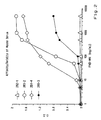
- Figure 1 shows the reactivity to each of the peptides.
- Figure 2 shows the affinity/avidity of the mice with the highest titers of antibody. There was variable immunogenicity of the peptides. 284 was the most highly immunogenic, and 285 was not immunogenic at all.
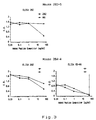
- mice immunized with 283 and 284 had very low reactivity to MN-PND. This was not just an ELISA artifact as evidenced by the fact that when peptide 282 was incubated with serum from mouse 283-5 prior to performing the ELISA, peptide 282 bound to (competed with) the antibodies in the mouse serum, whereas the MN peptide did not compete with the mouse serum antibodies when incubated therewith. In contrast, peptides 282 and MN both were able to compete with (bind to) the antibodies in the serum of mouse 284-4.
- Peptide 282 comprises (GPGRAF) 3 C, and the MN peptide contains GPGRAF enclosed by two flanking sequences (KRIHIGPGRAFYT). This implies that the bulk of reactivity to MN-PND is to the flanking sequences.
- Sample #2434 is difficult to interpret because of high background.
- Sample #2270 has strong reactivity with peptide 282 in a conjugate, but no reactivity with soluble peptide 282.
- adhered peptide 282 may express an epitope recognized by the sera that is not present in soluble peptide 282.
- Another possibility is.that there is a discordance between affinity measured by the antigen-limited ELISA and that measured by competition.
Landscapes
- Chemical & Material Sciences (AREA)
- Organic Chemistry (AREA)
- Health & Medical Sciences (AREA)
- Life Sciences & Earth Sciences (AREA)
- Biophysics (AREA)
- Biochemistry (AREA)
- Gastroenterology & Hepatology (AREA)
- General Health & Medical Sciences (AREA)
- Genetics & Genomics (AREA)
- Medicinal Chemistry (AREA)
- Molecular Biology (AREA)
- Proteomics, Peptides & Aminoacids (AREA)
- Virology (AREA)
- Medicines Containing Antibodies Or Antigens For Use As Internal Diagnostic Agents (AREA)
- Peptides Or Proteins (AREA)
Abstract
Description
- This invention relates to vaccines and immunotherapeutic treatments for use in inhibiting the transmission (transmission prevention) and treatment of HIV. Specifically, it relates to vaccines created by the conjugation of HIV-1 peptides and carriers. These peptides may be either single or repeated, linear or conformational amino acid sequences from the gp120 Principal Neutralizing Domain (PND) of HIV-1. Examples of amino acid sequences from the gp120 PND of HIV are KRIHIGPRAFYT, RHIHIGPGRAFYT, RRIHIGPGRAFYT, TRIHIGPGRAFYT, CTRPNYNKRKRIHIGPGRAFYTTKNIIGTIRQAHC, GPGRAFGPGRAFGPGRAFC, IYIGPGRAC, IAIGPGRAC, IHIGPGRAC, KRIHIGPGRAFYT, RSIHIGPGRAFYA, KSITKGPGRVIYA, KGIAIGPGRTLYA and SRVTLGPGRVWYT.
- The most effective amino acid sequences from the gp120 PND of HIV are GPGRAFGPGRAFGPGRAFC, IYIGPGRAC, IAIGPGRAC. IHIGPGRAC, KRIHIGPGRAFYT, RSIHIGPGRAFYA, KSITKGPGRVIYA, KGIAIGPGRTLYA and SRVTLGPGRVWYT. The best carrier is Purified Protein Derivative (PPD) of tuberculin from Mycobacterium tuberculosis. Either a single peptide carrier conjugate alone or several different peptide carrier conjugates together in a "cocktail" may be used to vaccinate HIV-1 infected and uninfected individuals. After the vaccines are administered to individuals, antibody-containing fluid from the vaccinated individuals is used in an assay to detect whether high affinity/avidity neutralizing and/or protective HIV-specific antibodies are present in the fluid. The assay is an antigen-limited ELISA which contains a thimerosal-containing diluent and is capable of detecting high affinity/avidity neutralizing and/or protective HIV-specific antibodies. In addition, in vitro lymphocyte proliferative responses, IL-2 secretion upon incubation with PND and generation of cytotoxic lymphocytes (CTL) maybe used to determine whether the vaccines are effective against HIV. The conjugates which have induced production of the antibodies and/or induced PND lymphocyte proliferation, IL-2 or CTL are useful in the treatment and transmission prevention of HIV.
- There have been recent advances in the use of retrovirus-derived vaccines for the treatment of HIV. Specifically, a formalin-inactivated whole HIV vaccine has been developed which has conferred protection in Macaques. Immunization with vaccines potentiated with albumin has resulted in the protection from clinical disease in eight out of nine monkeys challenged with infectious doses of HIV. Notably, protection could be achieved even in cases where entry of viruses is not prevented, suggesting that it may not be necessary to completely block infection in order to have a successful vaccine.
- Whole killed HIV vaccines have also been beneficial in the treatment of chimpanzees who were previously infected by HIV. These chimpanzees appear to have cleared the HIV infection in their blood streams following the vaccinations. Post-exposure immunization in humans has also been studied. These tests suggest that immunization may be used to protect humans from HIV infections, and also to treat humans who have already been infected with the virus. However, whole virus vaccines may contain infectious particles. As a result, it may be safer to use essential components of the virus to confer protection. Epitopes of the virus are one example of a safer, essential component of the virus. More recent studies have confirmed that partial protection from infection can be achieved also by gp120 and gp160 derived vaccines. (Desrosiers, R.C. et al. Proc. Nat'l. Acad. Sci. USA, 86:6353 (1989), Kestler, et al. Science, 248:1109 (1990); Murphey-Corb, M. Science, 246:1293 (1989)).
- It has long been recognized that peptide epitopes of amino acids conjugated to immunogenic carriers can elicit high levels of high affinity antipeptide antibodies. (See Talwar, G.P., Bloom, B. et al., "Biological and Clinical Aspects of Reproduction", Exceotor Med. Series 394:2224-2232 (1987), in which the beta chain of human chorionic gonadotropin was conjugated to tetanus toxoid to produce an antifertility vaccine.) The carriers to which the peptides are conjugated in this invention have all been used as immunogenic carriers in animals, and some have been used in humans.
- The purified protein derivative (PPD) of tuberculin from Mycobacterium tuberculosis is a unique immunologic reagent, because virtually everyone in the world with a functional immune response who has been exposed to BCG or M. tuberculosis infections will have a T-cell mediated, delayed-type hypersensitivity response to minute amounts of PPD. Tuberculin-PPD conjugates have been utilized in the past. Mice pre-sensitized or "primed" with BCG can produce high levels of antibodies to peptide or carbohydrate epitopes conjugated to PPD. Of particular interest are studies on the NANP repeating epitope of the P. falciparum circumsporozoite antigen, which is immunogenic in only two strains of mice. Conjugating the NANP repeating peptide to PPD elicits the production of antibody titers greater than 1:1000 in genetically non-responder strains to the NANP epitope. This degree of response is comparable to that seen in responder strains given the peptide conjugate in complete Freund's adjuvant. (See Lussow et al., "Use of Tuberculin Purified Protein Derivative-Asn-Ala-Asn-Pro Conjugate in Bacillus Calmette-Guerin Primed Mice Overcomes H-2 Restriction of the Antibody Response and Avoids the Need for Adjuvants," Proc. Nat'l Acad. Sci. USA 87 (1990)).
- Pseudomonas aeruginosa exotoxin A (toxin A) has been used effectively as a carrier in conjugate vaccines. Conjugates made with this carrier have higher immunogenicity, especially when coupled with the recombinant protein R32 to create an immune response against the sporozoite stage of Plasmodium falciparum. Pseudomonas aeruginosa exotoxin A may be purified from the supernatant of fermentor-grown cultures of Pseudomonas aeruqinosa PA 103.
- Keyhole Limpet Hemocyanin (KLH) is a high molecular weight protein which is purified from megathura crenulata. KLH has many available primary amines from lysine residues which facilitate protein conjugation. KLH is highly immunogenic, and because of its availability of primary amines, is ideal for protein conjugation.
- Tetanus and diptheria toxoids have also been used successfully as protein carriers. Diptheria toxoid has been used with a synthetic 31 amino acid N-terminal peptide. Both tetanus toxoid and diptheria toxoid have proved to be effective carriers in humans for the poorly immunogenic carbohydrate antigen of Hemophilus influenza b.
- The recombinant core antigen of hepatitis B has the capability of self-assembling into 27 millimeter particles which are highly immunogenic in experimental animals. These HBV core particles may be conjugated directly with peptides, using recombinant DNA technology. Fusion proteins can be produced between the HBV core antigen and defined sequence peptides with high epitope density, which lead to high titer antibodies, as well as to long lasting neutralizing antiviral immunity. Hepatitis B core antigens and self-assembled HBc-HIV peptide fusion protein may be used as protein carriers.
- It has been established that the major antigenic component of the mycobacterial cell wall is a protein which consists of a polypeptide monomer of between 10 and 16 Kd, the amino terminal sequence of which reveals that it is related to the GroES heat-shock protein present in many bacteria. It has been indicated that the major antigenic component of mycobacteria recognized by CD4+ T-cells is associated with the cell wall. BCG cell wall (purified) may be used as a protein carrier. BCG may also be used to prime animals or humans prior to vaccination. BCG priming enhances the humoral and cellular responses induced by vaccination.
- Currently, the only adjuvant licensed for use in man is alumina. In the present invention, alumina may be used with the conjugates which include the carriers Pseudomonas aeruginosa exotoxin A, KLH, and tetanus and diptheria toxoids. Aluminum-based gels such as Al(OH)3 and AlPO4, as well as liposomes may be used as adjuvants with the carrier Pseudomonas aeruginosa exotoxin A in the present invention. PPD conjugates can be given in saline with no further adjuvants to tuberculin-positive individuals. For the BCG cell wall and HBc antigen conjugates, it is likely that adjuvants would be required. Ribi adjuvant containing trehalose dimycolate and 2% squalene may be used as an adjuvant. Alternatively, if studies on the long-term safety of incomplete Freund's adjuvant or ISCOM's adjuvant indicate their safety and efficacy in humans, these adjuvants may be used. Microencapsulation technology using polyactide/polyglycolide biodegradable polymers may also be used as an adjuvant.
- None of the methods developed to date, including the use of carriers, have been successful in the treatment and transmission prevention of HIV. It is an object of the present invention to provide peptide carrier conjugate vaccines to treat and inhibit transmission of HIV, and to provide methods for the production of such vaccines.
-
- Figure 1 represents the immunoreactivity of mice vaccinated with conjugates of KLH and five different peptides: 282 (GPGRAFGPGRAFGPGRAFC), 283 (IYIGPGRAC), 284 (IAIGPGRAC), 285 (IHIGPGRAC) and MN (KRIHIGPGRAFYT).
- Figure 2 represents the affinity/avidity of mice with the highest titers of antibody to conjugates of KLH and peptides 282 (GPGRAFGPGRAFGPGRAFC), 283 (IYIGPGRAC), 284 (IAIGPGRAC) and 285 (IHIGPGRAC).
- Figure 3 represents the results of competition between
peptides 282 (GPGRAFGPGRAFGPGRAFC) and MN (KRIHIGPGRAFYT) with
peptide 283 (IYIGPGRAC) in mouse 283-5.
Peptide 282 competed effectively, and peptide MN did not. Figure 3 also represents the results of competition betweenpeptides 282 and MN with peptide 284 (IAIGPGRAC) in mouse 284-4. Bothpeptides 282 and MN competed effectively. -
- This invention relates to conjugates made up of (1) peptides with amino acid sequences similar to the gp120 Principal Neutralizing Domain (PND) of HIV and (2) carriers which enhance immunogenicity, such conjugates to be used in vaccines for the treatment and transmission prevention of HIV. In one embodiment of this invention, the peptides are KRIHIGPRAFYT, RHIHIGPGRAFYT, RRIHIGPGRAFYT, TRIHIGPGRAFYT, CTRPNYNKRKRIHIGPGRAFYTTKNIIGTIRQAHC, GPGRAFGPGRAFGPGRAFC, IYIGPGRAC, IAIGPGRAC, IHIGPGRAC, KRIHIGPGRAFYT, RSIHIGPGRAFYA, KSITKGPGRVIYA, KGIAIGPGRTLYA and SRVTLGPGRVWYT.
- In a preferred embodiment of this invention, the peptides are GPGRAFGPGRAFGPGRAFC, IYIGPGRAC, IAIGPGRAC, IHIGPGRAC, KRIHIGPGRAFYT, RSIHIGPGRAFYA, KSITKGPGRVIYA, KGIAIGPGRTLYA and SRVTLGPGRVWYT.
In another preferred embodiment, the carrier is PPD. Individuals to be vaccinated who are PPD-negative are primed with BCG four to six weeks prior to vaccination with the conjugates in order to enhance the immune reaction induced by vaccination with the peptide carrier conjugates. If an individual is PPD-positive, it is not necessary to prime that individual with BCG. - The vaccine may comprise either a single peptide carrier conjugate alone, or a cocktail of several different peptide carrier conjugates. The vaccine may be administered in liquid form once or several times, or may be administered in a timed-release or pulse-release mechanism. After vaccination with the conjugate, antibody-containing fluid is extracted from the vaccinated individual and assayed in an antigen-limited ELISA which contains a thimerosal-containing diluent and selects for high affinity/avidity neutralizing and/or protective HIV-specific antibodies. Further, in vitro lymphocyte proliferative responses, IL-2 secretion upon incubation with PND and generation of cytotoxic lymphocytes (CTL) may be used to determine whether the vaccines are effective against HIV. The conjugates which have induced the production of such antibodies and/or induced PND lymphocyte proliferation, IL-2 or CTL are useful in the treatment and transmission prevention of HIV.
- This invention is directed to peptide carrier conjugate vaccines to be used in the treatment and transmission prevention of HIV. It comprises the conjugation of peptides with amino acid sequences similar to those of the gp120 PND of HIV and carriers to form vaccines, priming animals with BCG, immunizing animals with the vaccines, extracting antibody-containing fluid from the immunized animals and assaying the antibody-containing fluid in an antigen-limited ELISA which contains a thimerosal-containing diluent and selects for high affinity/avidity neutralizing and/or protective HIV-specific antibodies. The vaccines which have induced the production of the high affinity/avidity neutralizing and/or protective HIV-specific antibodies and/or induced proliferative responses and/or IL-2 secretion upon in vitro exposure to PND are useful in the treatment and transmission prevention of HIV.
- Carriers which may be used for conjugation with the peptides of this invention include purified protein derivative (PPD) of tuberculin from Mycobacterium tuberculosis, Pseudomonas aeructinosa exotoxin A, keyhole limpet hemocyanin (KLH), tetanus toxoid, diptheria toxoid, hepatitis B core antigen and Bacillus Calmette-Guerin (BCG) cell wall. The preferred carrier of this invention is PPD. In addition, an adjuvant, such as alumina, Ribi, Freund's, Iscom's or microencapsulation technology adjuvant may be used with all of these carriers.
- In order to prepare the peptides of this invention, it is necessary to determine which strains of HIV infect individuals and which peptides of each strain would most effectively induce the production of high affinity/avidity neutralizing and/or protective HIV-specific antibodies. There are many different strains of HIV, and different strains are prevalent in different geographic areas. Therefore, the peptides in the vaccines of this invention may be geographically specific. For example, the MN strain of HIV has a high degree of prevalence in the United States. Therefore, peptides from the MN strain of HIV are effective in conjugates used to vaccinate individuals in the United States. These particular peptides and conjugates may not be effective in different geographic areas where other HIV strains are prevalent, and may have to be adjusted according to the most prevalent strains evolving in certain geographic areas. Another example is that high affinity/avidity neutralizing and/or protective HIV-specific antibodies against the gp120 PND of the MN strain of HIV have been associated with protection from materno-fetal HIV transmission in the United States. Therefore, peptides from the MN strain of HIV may be used in conjugates to prevent materno-fetal transmission of HIV in the United States.
- The peptides of this invention are from the gp120 PND of HIV. The peptides selected may include amino acids 116-131, 307-319 and 470-490 of gp120 of MN-HIV. The most effective sequences to induce the production of high affinity/avidity neutralizing and/or protective HIV-specific antibodies, which are the preferred peptide sequences for the conjugates of this invention, are as follows:

- Because soluble peptides are poor immuaogens due to their lack of T and B-cell reactive epitopes and their low molecular weight, the peptides of this invention are conjugated with different carriers to enhance immunogenicity. The methods by which these peptides are conjugated with the carriers include disulfide linkages through a C terminal peptide cysteine linkage, coupling with glutaraldehyde solution for two hours, coupling with tyrosine, or coupling with water soluble carbodiimide.
- Where the carrier is PPD, PPD-negative individuals should be primed with BCG prior to conjugate vaccination. In order to determine whether an individual is PPD-negative or PPD-positive, either proliferative response testing or skin testing may be performed. For proliferative response testing, if an individual exhibits proliferative responses in vitro to peripheral blood lymphocytes to PPD, that individual is PPD-responsive. For skin testing, an individual should be exposed to intradermal 5 TU and if negative to 20 TU of PPD. If an individual is PPD-positive, there is no need to prime with BCG. If an individual is considered PPD-negative, that individual should receive a BCG immunization four to six weeks prior to conjugate vaccination. After BCG immunization, PPD testing should again be performed. If the results of the PPD test are positive, then the conjugate vaccine is administered to the individual.
- If individuals are HIV-negative and PPD-negative, there are no limitations on BCG priming. However, if individuals are HIV-positive and PPD-negative, they may be primed with BCG only if they are still asymptomic and/or their CD4 T-cell counts exceed 200. Individuals who are HIV-positive, PPD-negative and exhibit advanced symptoms should not be primed with BCG. In addition, it is recommended that the standard British or Japanese BCG vaccines be used for priming, since these vaccines rarely induce adverse reactions in individuals.
- The peptide-carrier conjugates of this invention may be administered in vaccine form, suppository form, intradermally, subcutaneously, orally, or by any other suitable route. The vaccines may comprise either a single peptide carrier conjugate or a cocktail of several different peptide carrier conjugates, and may be administered in liquid form or in timed-release, pulse-release or slow-release mechanisms, such as virosomes. virosomes encase viral-specific antigens in their systems and then react strongly with macrophages. Such virosomes may comprise 1-10 µg of PND peptide coupled to PPD or influenza hemagglutinin (HA), or PND in a free state associated with but not covalently coupled with PPD or HA, 1-10 µg of HA isolated from a human strain of influenza virus, 0.1-1 µg neuraminidase (NA) isolated from a human strain of influenza virus, 0.25-0.75 mg kephalin and 100-140 mg lecithin.
- Either a single vaccination or multiple vaccinations with the peptide carrier conjugates may be used to induce the production of high affinity/avidity neutralizing and/or protective HIV-specific antibodies. The preferred dose range is 50-500 µg of peptide per conjugate. At a later date, antibody-containing fluid is extracted from the vaccinated individuals. The antibody-containing fluid is then assessed in an assay. The assay contains a thimerosal-containing diluent and is an antigen-limited ELISA which selects for high affinity/avidity neutralizing and/or protective HIV-specific antibodies.
- In order to produce this assay, microplate wells are covered with the antigen which the antibodies are reactive to, such as MN-PND, or another PND antigen derived from other seroprevalent HIV strains, in a decreasing coating concentration series as follows:
Row A - 500 ng/ml Row B - 100 ng/ml Row C - 50 ng/ml Row D - 10 ng/ml Row E - 5 ng/ml Row F - 1 ng/ml Row G - 0.5 ng/ml Row H - 0 ng/ml - Where the vaccine comprises a cocktail of different peptides conjugated to carriers, all of the wells in the plate are covered with all of the peptides in the vaccine in order to determine whether there was induction of high affinity/avidity neutralizing and/or protective HIV-specific antibody production. If such antibodies were produced, a second ELISA is performed, wherein each row of the plate is covered with a separate peptide from the cocktail.
- Next, antibody-containing fluid is removed from the vaccinated individuals, diluted with antibody-containing fluid diluent to a ratio of 1:21 (sample: diluent) and added to the series of wells. The antibody-containing fluid diluent comprises a formulation of additives in a buffered solution containing thimerosal. An example of such antibody-containing fluid diluent is 0.1-0.5% caesin in PBS containing 0.05% Tween-20 (pH 7.4), 0.001% rhodamine and thimerosal. Any antibody-containing fluid may be used. Examples of antibody-containing fluid are serum, plasma, cerebral fluids and mucosal fluids. A negative control, such as anti-HIV negative human serum, and a positive control, such as anti-HIV positive human serum or anti HIV-MN-PND monoclonal antibody should also be added to wells in the ELISA plate. The plate should then be covered and incubated for 60 minutes at 37°C.
- After incubation, the plate should be washed 5-6 times using diluted plate wash solution (phosphate buffered saline, pH 7.4 with 0.05% Tween-20 diluted with deionized water containing chloracetemide at 1:10). Use of an automatic plate washer is recommended. After washing, 100 µl per well of anti-human conjugate such as peroxidase-conjugated (goat) Fabl anti-human IgG, anti-human IgA or anti-human secretory component (SC), diluted to 1:100,000 in conjugate diluent is added to the wells. Any conjugate diluent may be used. The conjugate diluent may comprise, for example, a formulation of additives in a buffered solution which is typically added to antibody conjugate solutions by those skilled in the art. Subsequently, the wells are incubated for 60 minutes at 37°C and washed 5-6 times using the diluted plate wash solution. (Again, use of an automatic plate washer is recommended.)
- After washing, 200 µl of substrate such as O-phenylenediamine (o-PD) tablets, diluted (to 1 tablet per 12 ml of diluent) with hydrogen peroxide in a citrate buffer is added per well. The wells are then incubated in the dark for 30 minutes at room temperature. The reaction is then stopped by adding 50 µl per well of 4N sulfuric acid. The plate may then be read in a microplate spectrophotometer at an absorbance of 492nm. (Use of a 620 nm reference filter is recommended.)
- For the controls, the human negative control values should average around 0.050. The cutoff should be around 0.100. The human positive control should filter out at least to the fifth well (5 ng/ml).
- For the antibody-containing fluid, if the absorbance value is greater than the cutoff in the fourth row or less, the antibody in the fluid is low affinity. If the absorbance value is greater than the cutoff in the fifth row or more (5 ng/ml), the antibody is medium affinity. If the absorbance value is greater than the cutoff in the fifth row or more (less than or equal to 5 ng/ml), the antibody is high affinity. A displacement assay may then be set up to ascertain the high affinity antibodies.
- The affinity of the elicited antibodies (in vivo and in vitro) may be further assessed using the PHARMACIA BIACORI System, which is a biosensor-based technology (Biospecific Interaction Analysis, (BIA) which assesses biomolecular interactions to the picomolar range without the need for labels (radioactive or fluorescent). BIA measures the KA and KD of molecules bound to a surface with molecules in free solutions. By reflecting a beam of light on a miniature sensing surface, it is possible to obtain quantitative kinetic data about antigen/antibody binding (association-dissociation constraints).
- The conjugate vaccines which have induced the production of high affinity/avidity neutralizing and/or protective HIV-specific antibodies, such antibodies being selected for by the ELISA, may then be used for the treatment and transmission prevention of HIV.
- Mice were immunized with peptide KRIHIGPGRAFYT (MN peptide or MN-PND) coupled to different carriers. Five mice were immunized with the MN peptide coupled to Keyhole Limpet Hemocyanin (KLH) as described in Methods Enzymol., 70:159 (1980). The mice were bled and antibody titers directed against MN-PND were determined by an ELISA specific for MN-PND. Serum at a 1:1400 dilution obtained from mice immunized with the KLH-MN-PND conjugate had optical densities of 3.85 (K0), .598 (K1), 1.762 (K2), .282 (K3), and .356 (K4) with a background of less than 0.1. Four months later, the mice were boosted with KLH-MN-PND and then the sera was assayed for reactivity. This data is outlined in Table 1. All of the mice immunized had high titers and high affinity antibodies to MN-PND. Mouse K4 was sacrificed. Its spleen was harvested and used to develop monoclonal antibodies to MN-PND. Monoclonal antibodies recognizing MN-PND were generated, some of which were neutralizing. Other mice were immunized with PPD-MN-PND, avidin-MN-PND and tetanus-MN-PND conjugates. Serum from these mice had no significant activity directed against MN-PND.

- One gram of solid carbodiimide was added to 100 mg of toxin A derivitized with adipic acid dehydrazide (TA-ADH, 5.9 mg/ml in phosphate buffered saline, pH 7.4; PBS). The pH was adjusted to 4.8 by the addition of 0.3N HCl. To this mixture 50 mg of MN-PND peptide in 2.5 ml of pyrogen-free water was slowly added under constant stirring. The mixture was stirred for 3 hours at ambient temperature. The mixture was filter sterilized using a 0.45 µm filter unit and passed through a Sephadex G75 column to separate the conjugate from reactants. The conjugate-containing fraction which eluted in the void volume was concentrated, dialyzed against PBS and filter sterilized. The conjugate was diluted to 200 µg total protein/ml in PBS and absorbed into Al(OH)3.
- A group of 3 guinea pigs was vaccinated intramusculary on
days 0 and 14 with 50 µg of absorbed conjugate. Serum samples were obtained ondays 0, 14 and 28. An anti-MN-PND peptide ELISA was performed by coating plates with MN-PND peptide, reacting wells with serial dilutions of antisera, and after washing, reacting plates with an anti-guinea pig IgG antibody. As shown in Table 2 below, this conjugate did not stimulate an anti-MN-PND antibody response.Day mean ELISA titer 0 1,4 14 1,8 28 1,0 - Mice, rabbits and guinea pigs were immunized with MN-PND coupled to Pseudomonas aeruginosa exotoxin A (toxin A) with a ratio of peptide to carrier of 3:1. In addition, the MN-PND lacked a tyrosine residue next to the carboxy terminus. The animals were immunized on
days 0 and 14. Sera was obtained atdays 0, 14, and 28. The doses used were 5 and 25 µg in the guinea pigs, 5, 10 and 50 µg in the rabbits and 2 and 10 µg in the mice. The immunizations were given as either conjugate alone or in alum. None of the sera obtained from these immunizations had any reactivity to MN-PND. This was probably due to either the immunogenicity of toxin A, coupling problems or the dosage used. - 4 mg of MN-PND in 400 µl of sterile distilled
H 20 was mixed with 4 ml of sterile PPD-RT23 (1 mg/ml). Carrier PPD-RT23 was obtained from Statens Serum Institute, Copenhagen, Denmark. Carrier PPD-298 was obtained from Connaught Laboratories, willowdale, Toronto. PPD-298-H2O signifies that the conjugation of the PND-MN peptide and the PPD-298 carrier was performed in water. PPD-298-PBS signifies that the conjugation of the PND-MN peptide and the PPD-298 carrier was performed in PBS. 45 µl of 0.2% glutaraldehyde was then added to the PPD-MN-PND solution, mixed by vortexing and incubated in the dark at 22°C for 30 min. An additional 20 µl of 0.2% glutaraldehyde was added and the solution was incubated for 90 min. The solution appeared opalescent at this time. The reaction mixture was transferred asceptically into a sterile dialysis tubing and dialysed against 1 liter of sterile PBS at 4°C for 24 hours. The concentration of PPD was calculated by dividing the total amount of PPD added to the reaction mixture by the final volume of the sample after dialysis. An aliquout of the conjugate was diluted in sterile pyrogen-free PBS to 20 µg of PPD per ml (∼1000E/ml) for determining the sterility and general safety of the vaccine preparation according to the guidelines of European Pharmacopea. The remainder of the sample was kept in undiluted form at 4°C. - Groups of 5 guinea pigs were primed with 106 CFU of BCG or saline. The animals were then immunized with 10 or 50 µg of PPD-MN-PND conjugate in 0.1 ml PBS 14 and 28 days after priming. The animals were bled at 14, 28 and 42 days after priming. The sera was then assayed in a MN-PND ELISA to determine immunogenicity of the PPD-MN-PND conjugate.
- Dynatech polystytene plates were coated with 100 µl of a 1.0 µg/ml of MN-PND (in carbonate buffer, pH 9.6) at 22°C overnight. The solution was removed and then blocked with 100 µl of a 1 mg/ml solution of Bovine Serum Albumin (BSA) in PBS (pH 7.4) for 1 hour at 22°
C. A 100 µl of 2-fold serial dilutions of sera in PBS-tween (ph 7.4) starting at 1:20 were dispensed into each well and the plates incubated for 3 hours. The plates were washed 3 times with 300 µl of PBS-tween. 100 µl of peroxidase-conjugaied rabbit anti-guinea pig IgG (1:2500 in PBS tween, Nordic Immunology, Tilburg, The Netherlands) was added to each well and the plates were incubated for 2 hours. The plates were washed three times in PBS-tween and 100 µl of p-nitrophenyl phosphate (Merck) was added to the wells. The plates were then incubated for 60 min. at 22°C. The absorbances at 405 nm was measured using a Dynatech MR5000 Microtiter Plate Reader (Dynatech, Switzerland). The serum dilution at the linear part of the titration curve (between 0.15 and 0.6) was multiplied by the reciprocal corresponding dilution of the serum and expressed as ELISA units. - As shown in Table 3 below, priming of the guinea pigs with BCG and subsequent immunization with the PPD-MN-PND conjugate induced the production of high affinity/avidity neutralizing and/or protective HIV-specific antibodies. The antibody titers of the guinea pigs primed with BCG were much higher than the titers of the guinea pigs not primed with BCG, indicating that priming with BCG prior to conjugate immunization causes the immune system to respond better to conjugate immunization, thereby more effectively inducing the production of high affinity/avidity neutralizing and/or protective HIV-specific antibodies. The antibody titers of the guinea pigs not primed with BCG (group d) were not statistically higher than guinea pigs not immunized with the PPD-MN-PND conjugate vaccine (group a).
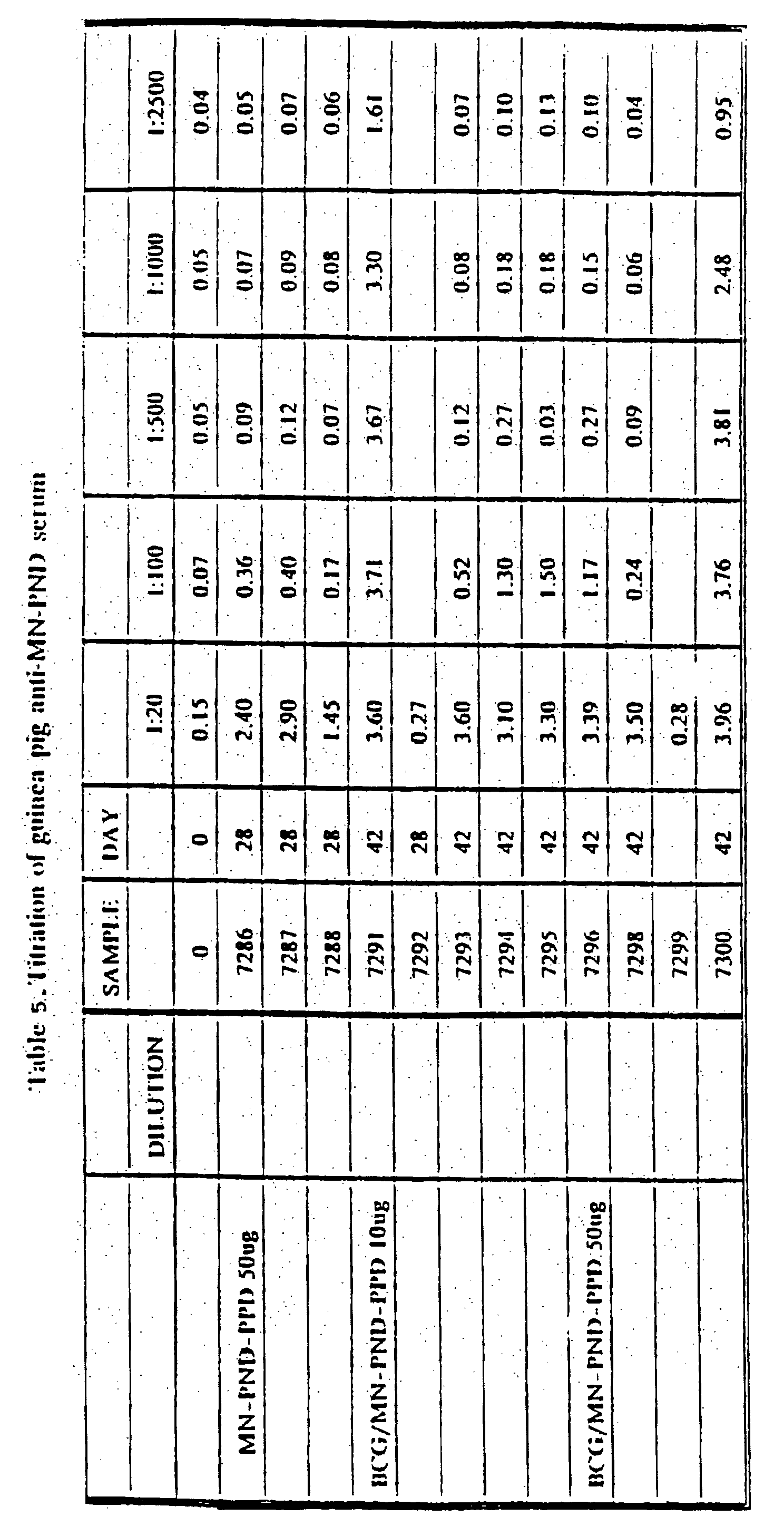
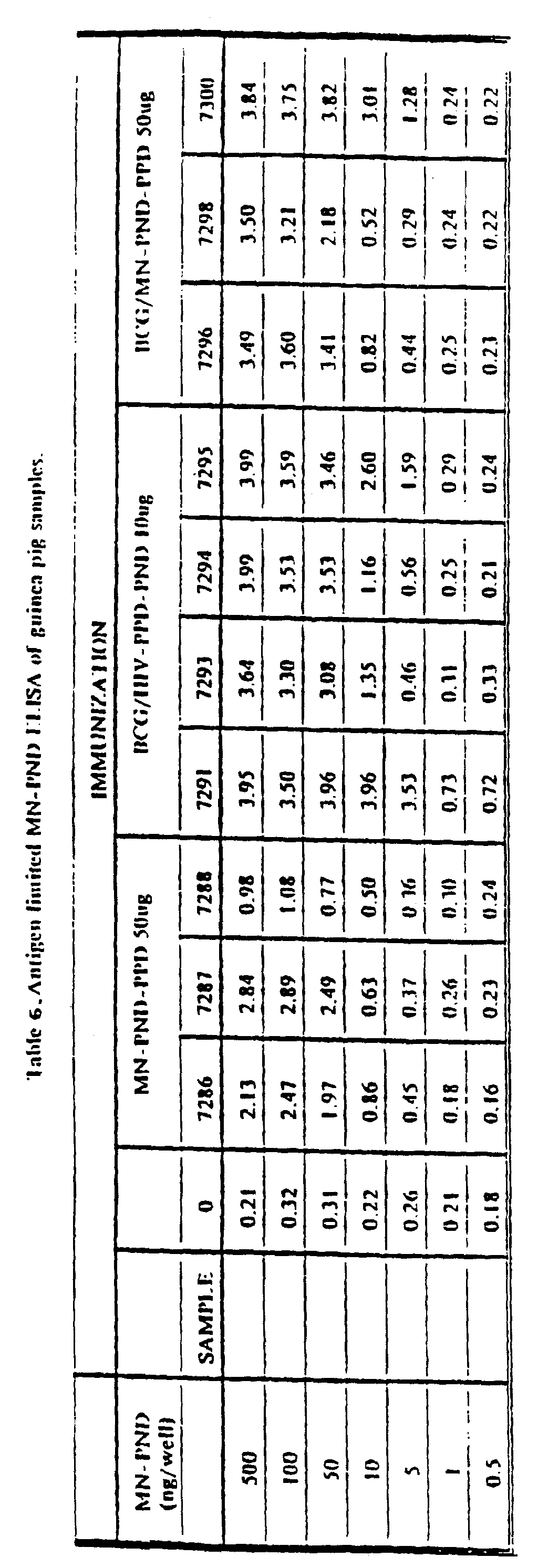
Immunogenicity of PND-MN-PPD Conjugates in BCG Primed and Unprimed Guinea Pigs Vaccine Dose (µg) Geometric Mean Elisa unit (range) -- -- 1.6 (1.2-2.7) PPD-MN- PND 10 2.4 (2.14-2.78) PPD-MN-PND 50 6.0 (5.68-6.12) PPD-MN- PND 10 121.1 (5.40-462.1) PPD-MN-PND 50 14.1 (5.56-25.68) RT23 10 21.0 (6.7-70.8) RT23 50 180.5 (49.4-692.5) PPD-298- H2O 10 31.1 (4.9-181.9) PPD-298-H2O 50 142.2 (31.0-393.0) PPD-298- PBS 10 22.8 (6.3-232.0) PPD-298-PBS 50 63.2 (9.6-858.9) - Guinea pigs and mice were immunized with MN-PND coupled to 2 types of PPD. Some of the PPD-immunized animals were first primed with BCG. Table 4 shows the immunoreactivity of the animals to MN-PND. Table 5 shows the titration of serum reactivity to MN-PND . Table 6 shows the affinity to MN-PND as measured by antigen-limited ELISA. Sample #6474 and Sample #6469 were assayed for neutralization activity. Results obtained indicated that neither of the sera had neutralizing activity to MN-HIV.

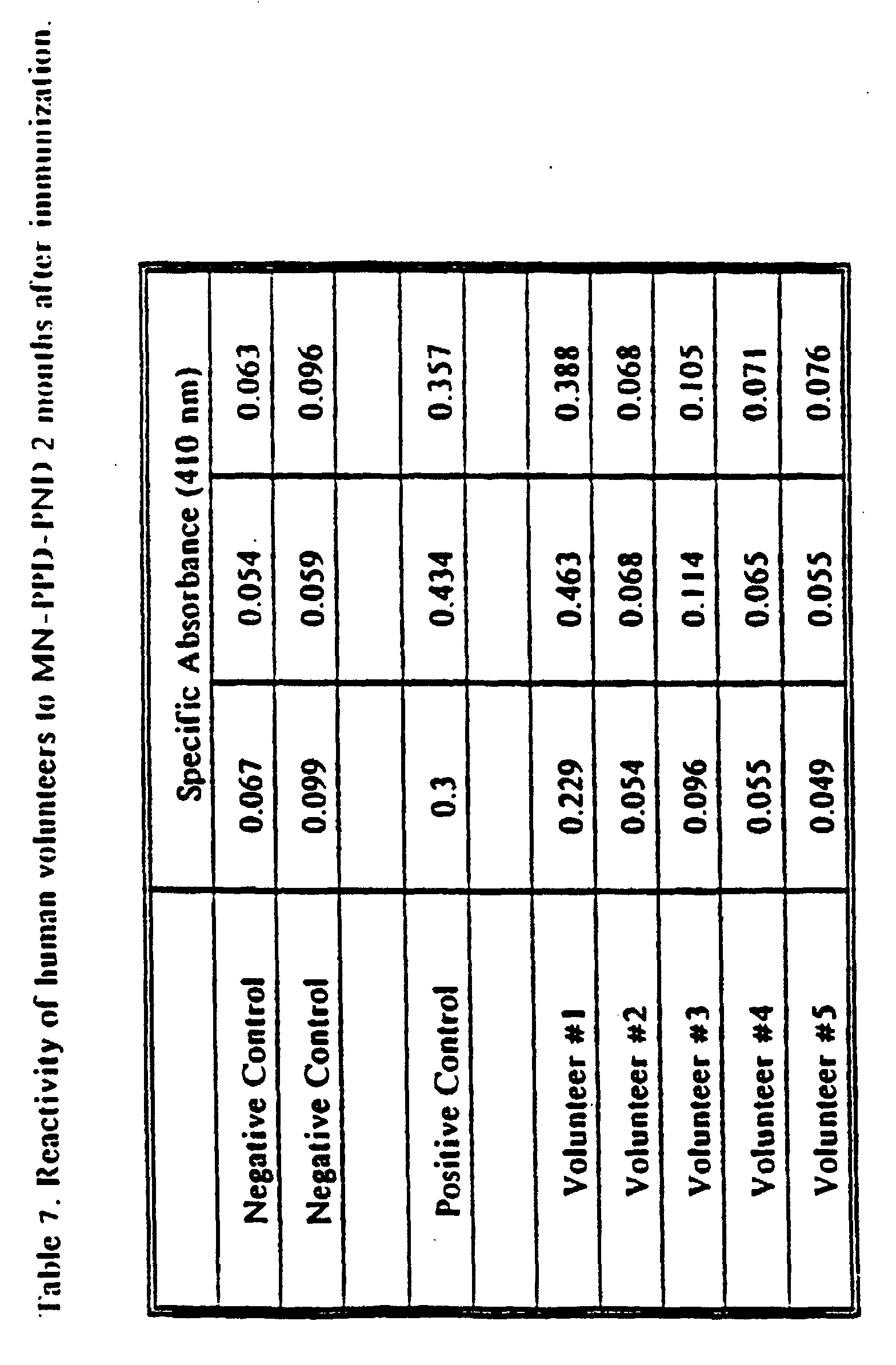
- Based on the immunogenicity of the PPD-MN-PND conjugates in guinea pigs illustrated in EXAMPLE V, five PPD-positive humans were immunized with this conjugate. The reactivity of sera from the 5 human volunteers was assayed one month after immunization with PPD-MN-PND. No significant IgG or IgM to MN-PND was detected. The sera was again assayed two months after immunization. Table 7 shows the results of the assay.
- The volunteers were immunized a second time. Serum samples were obtained about 14 days and 28 days after each immunization and prior to immunization. As shown in Table 8 below, after the second immunization, one subject was a very strong responder, one was a "borderline" responder and 2 were non-responders.
Assay for reactivity to MN-PND was performed in triplicate on the samples obtained 44 days after immunization. Sample #1- .370 ± .057 Sample #2- .063 ± .038 Sample #3- .105 ± .004 Sample #4- .063 ± .004 Positive .363 + .031 Negative # 1.084 ± .010 Negative # 2.061 ± .003 Sample # 1 is significantly different from negative controls (p <.001) and sample #3 may be significantly different from negative control (p <.05). - The volunteers were immunized a third time. After the third immunization with the PPD-MN-PND conjugate, the serum of one volunteer had a high titer of high affinity/avidity HIV-specific antibodies. Upon exposure to MN-PND, the lymphocytes responded in vitro by proliferation and secretion of interleukin-2. This shows that an entire immune response was induced. B-cell humoral immunity response was induced, as evidenced by the production of antibodies. T-cell immunity response was also induced, as shown by the proliferation of T-cells upon exposure to the conjugate, and as shown by the secretion of interleukin-2, which is a mediator of the immune response. The other three serum samples showed no significant immunological response. The fact that high affinity/avidity HIV-specific antibodies are found more frequently in HIV infected asymptomatic individuals indicates that such antibodies are protective.
- The following Examples VII and VIII are not encompassed by the present claims and are maintained for illustrative purposes :
- In addition to MN-PND, four other peptides were synthesized. These peptides are 282 (GPGRAFGPGRAFGPGRAFC), 283 (IYIGPGRAC), 284 (IAIGPGRAC) and 285 (IHIGPGRAC). These peptides were coupled to KLH as described above. Five mice were immunized with each peptide conjugate and boosted 2 months later. Serum was obtained. Figure 1 shows the reactivity to each of the peptides. Figure 2 shows the affinity/avidity of the mice with the highest titers of antibody. There was variable immunogenicity of the peptides. 284 was the most highly immunogenic, and 285 was not immunogenic at all. Some mice immunized with 283 and 284 had very low reactivity to MN-PND. This was not just an ELISA artifact as evidenced by the fact that when
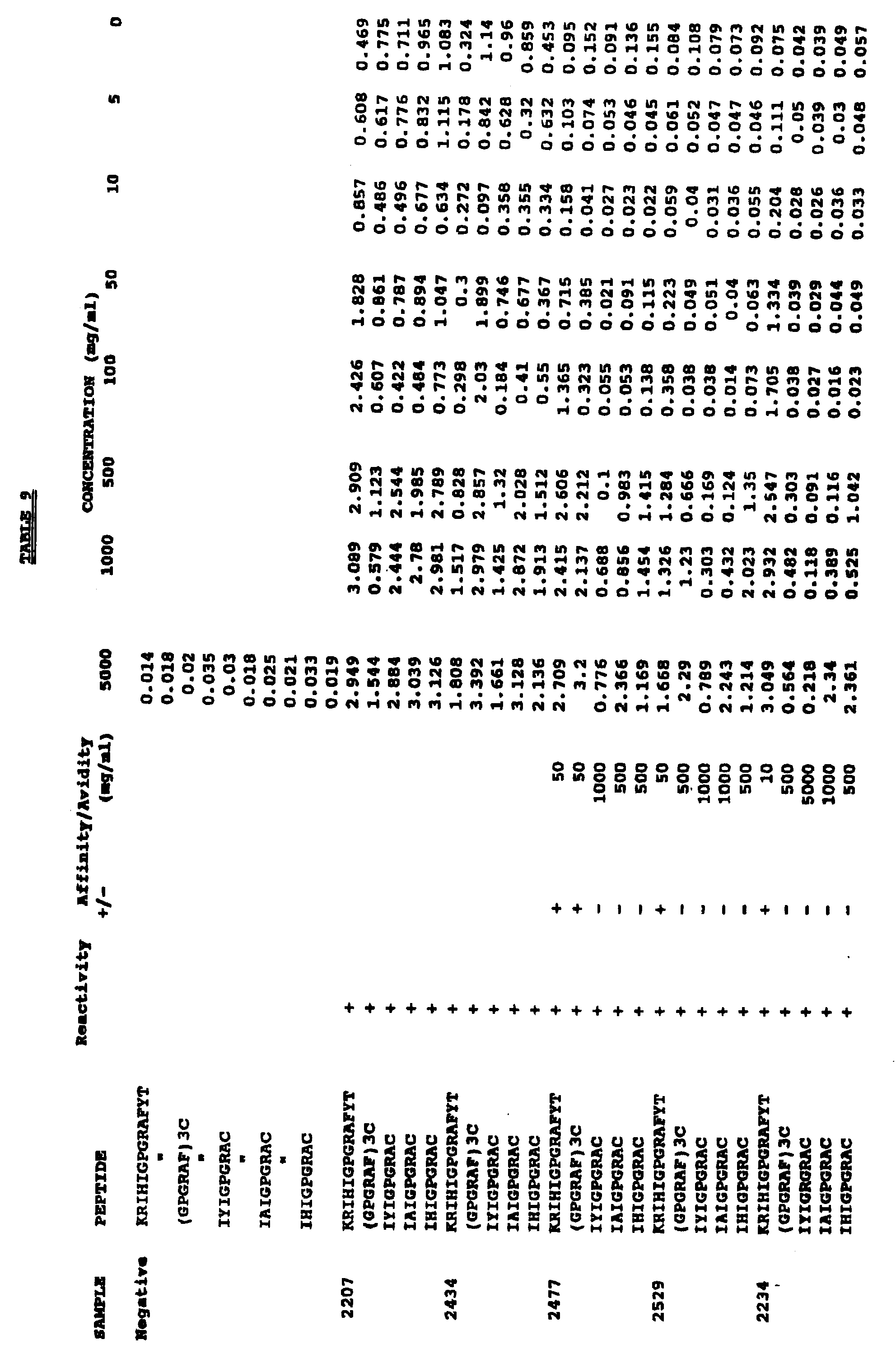
peptide 282 was incubated with serum from mouse 283-5 prior to performing the ELISA,peptide 282 bound to (competed with) the antibodies in the mouse serum, whereas the MN peptide did not compete with the mouse serum antibodies when incubated therewith. In contrast,peptides 282 and MN both were able to compete with (bind to) the antibodies in the serum of mouse 284-4. - Based on the observation of the differential immunogenicity of the PND peptides, sera from 20 HIV-positive individuals was assessed for reactivity with the five indicated peptides. (See Table 9). Eight samples reacted with at least 4 out of 5 peptides, one sample with 3 out of 5, one sample with 2 out of 5 peptides, and six samples with only 1 out of 5 peptides. One sample was negative, and three samples had high backgrounds. Of eight individuals who had high affinity antibodies to MN-PND, two individuals had high affinity antibodies to 282. In addition, of the eight individuals who had high affinity antibodies to MN-PND, 5 recognized 5 out of 5 peptides, one recognized 4 out of 5 peptides, 1 recognized 3 out of 5 peptides and 1 recognized 1 out of 5 peptides. This indicates that within the group of individuals with high affinity/avidity antibodies to MN-PND, there exist subgroups, some of which may be more protective against HIV. In addition this may have clinical prognostic significance which will affect the inclusion of peptides in a multivalent vaccine.


- As shown in Table 10, Sample #2234 bound to MN-PND when incubated with MN-PND prior to ELISA, but not with
peptide 282.Peptide 282 comprises (GPGRAF)3C, and the MN peptide contains GPGRAF enclosed by two flanking sequences (KRIHIGPGRAFYT). This implies that the bulk of reactivity to MN-PND is to the flanking sequences. The inability of Sample #2232 to bind topeptide 282 implies that there is only reactivity to flanking sequences and not to GPGRAF. Sample #2434 is difficult to interpret because of high background. Sample #2270 has strong reactivity withpeptide 282 in a conjugate, but no reactivity withsoluble peptide 282. This suggests the possibility that adheredpeptide 282 may express an epitope recognized by the sera that is not present insoluble peptide 282. Another possibility is.that there is a discordance between affinity measured by the antigen-limited ELISA and that measured by competition.
-
- (1) GENERAL INFORMATION
- (i) APPLICANT:
- Arye Rubinstein
- Barry Bloom
- Yair Devash
- Stanley Cryz
- (ii) TITLE OF INVENTION: Therapeutic and Preventive Vaccines for HIV
- (iii) NUMBER OF SEQUENCES: 9
- (iv) CORRESPONDENCE ADDRESS:
- (A) ADDRESSEE: Amster, Rothstein & Ebenstein
- (B) STREET: 90 Park Avenue
- (C) CITY: New York
- (D) STATE: New York
- (E) COUNTRY: U.S.A.
- (F) ZIP: 10016
- (v) COMPUTER READABLE FORM:
- (A) MEDIUM TYPE: 3.5 inch 1.44 Mb storage diskette
- (B) COMPUTER: IBM PC Compatible
- (C) OPERATING SYSTEM: MS-DOS
- (D) SOFTWARE: Word Processor (ASCII)
- (vi) CURRENT APPLICATION DATA:
- (A) APPLICATION NUMBER: Not Yet Assigned
- (B) FILING DATE: Not Yet Assigned
- (C) CLASSIFICATION: Not Yet Assigned
- (vii) PRIOR APPLICATION DATA: Continuation-In-Part of Application Serial No. 07/681,624 filed April 2, 1991, entitled THERAPEUTIC AND PREVENTIVE VACCINES FOR HIV
- (viii) ATTORNEY/AGENT INFORMATION:
- (A) NAME: Pasqualini, Patricia A.
- (B) REGISTRATION NUMBER: 34,894
- (C) REFERENCE/DOCKET NUMBER: 96700/188
- (ix) TELECOMMUNICATION INFORMATION:
- (A) TELEPHONE: (212) 697-5995
- (B) TELEFAX: (212) 286-0854 or 286-0082
- (C) TELEX: TWX 710-581-4766
- (2) INFORMATION FOR SEQ. ID NO: 1
- (i) SEQUENCE CHARACTERISTICS:
- (A) LENGTH: 19 amino acids
- (B) TYPE: amino acid
- (C) STRANDEDNESS: single
- (D) TOPOLOGY: linear and circular
- (ii) MOLECULE TYPE:
- (A) DESCRIPTION: peptide
- (iii) HYPOTHETICAL: No
- (iv) ANTI-SENSE: No
- (v) FRAGMENT TYPE: internal fragment
- (vi) ORIGINAL SOURCE:
- (A) ORGANISM: HIV
- (B) STRAIN: MN family
- (C) INDIVIDUAL ISOLATE: not applicable
- (D) DEVELOPMENTAL STAGE: not applicable
- (E) HAPLOTYPE: not applicable
- (F) TISSUE TYPE: not applicable
- (G) CELL TYPE: not applicable
- (H) CELL LINE: not applicable
- (I) ORGANELLE: not applicable
- (vii) IMMEDIATE SOURCE: not applicable
- (viii) POSITION IN GENOME:
- (A) CHROMOSOME SEGMENT: part of V3 loop fragment of envelope
- (ix) FEATURE:
- (A) NAME/KEY: peptide
- (B) LOCATION: PND of HIV
- (C) IDENTIFICATION METHOD: not applicable
- (D) OTHER INFORMATION: not applicable
- (x) PUBLICATION INFORMATION: none
- (A) AUTHORS: none
- (B) TITLE: none
- (C) JOURNAL: none
- (D) VOLUME: none
- (F) PAGES: none
- (G) DATE: none
- (H) DOCUMENT NUMBER: none
- (I) FILING DATE: none
- (J) PUBLICATION DATE: none
- (K) RELEVANT RESIDUES: none
- (xi) SEQUENCE DESCRIPTION: SEQUENCE ID NO: 1

- (3) INFORMATION FOR SEQ. ID NO: 2
- (i) SEQUENCE CHARACTERISTICS:
- (A) LENGTH: 9 amino acids
- (B) TYPE: amino acid
- (C) STRANDEDNESS: single
- (D) TOPOLOGY: linear and circular
- (ii) MOLECULE TYPE:
- (A) DESCRIPTION: peptide
- (iii) HYPOTHETICAL: No
- (iv) ANTI-SENSE: No
- (v) FRAGMENT TYPE: internal fragment
- (vi) ORIGINAL SOURCE:
- (A) ORGANISM: HIV
- (B) STRAIN: MN family
- (C) INDIVIDUAL ISOLATE: not applicable
- (D) DEVELOPMENTAL STAGE: not applicable
- (E) HAPLOTYPE: not applicable
- (F) TISSUE TYPE: not applicable
- (G) CELL TYPE: not applicable
- (H) CELL LINE: not applicable
- (I) ORGANELLE: not applicable
- (vii) IMMEDIATE SOURCE: not applicable
- (viii) POSITION IN GENOME:
- (A) CHROMOSOME SEGMENT: part of V3 loop fragment of envelope
- (ix) FEATURE:
- (A) NAME/KEY: peptide
- (B) LOCATION: PND of HIV
- (C) IDENTIFICATION METHOD: not applicable
- (D) OTHER INFORMATION: not applicable
- (x) PUBLICATION INFORMATION: none
- (A) AUTHORS: none
- (B) TITLE: none
- (C) JOURNAL: none
- (D) VOLUME: none
- (F) PAGES: none
- (G) DATE: none
- (H) DOCUMENT NUMBER: none
- (I) FILING DATE: none
- (J) PUBLICATION DATE: none
- (K) RELEVANT RESIDUES: none
- (xi) SEQUENCE DESCRIPTION: SEQUENCE ID NO: 2

- (4) INFORMATION FOR SEQ. ID NO: 3
- (i) SEQUENCE CHARACTERISTICS:
- (A) LENGTH: 9 amino acids
- (B) TYPE: amino acid
- (C) STRANDEDNESS: single
- (D) TOPOLOGY: linear and circular
- (ii) MOLECULE TYPE:
- (A) DESCRIPTION: peptide
- (iii) HYPOTHETICAL: No
- (iv) ANTI-SENSE: No
- (v) FRAGMENT TYPE: internal fragment
- (vi) ORIGINAL SOURCE:
- (A) ORGANISM: HIV
- (B) STRAIN: MN family
- (C) INDIVIDUAL ISOLATE: not applicable
- (D) DEVELOPMENTAL STAGE: not applicable
- (E) HAPLOTYPE: not applicable
- (F) TISSUE TYPE: not applicable
- (G) CELL TYPE: not applicable
- (H) CELL LINE: not applicable
- (I) ORGANELLE: not applicable
- (vii) IMMEDIATE SOURCE: not applicable
- (viii) POSITION IN GENOME:
- (A) CHROMOSOME SEGMENT: part of V3 loop fragment of envelope
- (ix) FEATURE:
- (A) NAME/KEY: peptide
- (B) LOCATION: PND of HIV
- (C) IDENTIFICATION METHOD: not applicable
- (D) OTHER INFORMATION: not applicable
- (x) PUBLICATION INFORMATION: none
- (A) AUTHORS: none
- (B) TITLE: none
- (C) JOURNAL: none
- (D) VOLUME: none
- (F) PAGES: none
- (G) DATE: none
- (H) DOCUMENT NUMBER: none
- (I) FILING DATE: none
- (J) PUBLICATION DATE: none
- (K) RELEVANT RESIDUES: none
- (xi) SEQUENCE DESCRIPTION: SEQUENCE ID NO: 3

- (5) INFORMATION FOR SEQ. ID NO: 4
- (i) SEQUENCE CHARACTERISTICS:
- (A) LENGTH: 9 amino acids
- (B) TYPE: amino acid
- (C) STRANDEDNESS: single
- (D) TOPOLOGY: linear and circular
- (ii) MOLECULE TYPE:
- (A) DESCRIPTION: peptide
- (iii) HYPOTHETICAL: No
- (iv) ANTI-SENSE: No
- (v) FRAGMENT TYPE: internal fragment
- (vi) ORIGINAL SOURCE:
- (A) ORGANISM: HIV
- (B) STRAIN: MN family
- (C) INDIVIDUAL ISOLATE: not applicable
- (D) DEVELOPMENTAL STAGE: not applicable
- (E) HAPLOTYPE: not applicable
- (F) TISSUE TYPE: not applicable
- (G) CELL TYPE: not applicable
- (H) CELL LINE: not applicable
- (I) ORGANELLE: not applicable
- (vii) IMMEDIATE SOURCE: not applicable
- (viii) POSITION IN GENOME:
- (A) CHROMOSOME SEGMENT: part of V3 loop fragment of envelope
- (ix) FEATURE:
- (A) NAME/KEY: peptide
- (B) LOCATION: PND of HIV
- (C) IDENTIFICATION METHOD: not applicable
- (D) OTHER INFORMATION: not applicable
- (x) PUBLICATION INFORMATION: none
- (A) AUTHORS: none
- (B) TITLE: none
- (C) JOURNAL: none
- (D) VOLUME: none
- (F) PAGES: none
- (G) DATE: none
- (H) DOCUMENT NUMBER: none
- (I) FILING DATE: none
- (J) PUBLICATION DATE: none
- (K) RELEVANT RESIDUES: none
- (xi) SEQUENCE DESCRIPTION: SEQUENCE ID NO: 4

- (6) INFORMATION FOR SEQ. ID NO: 5
- (i) SEQUENCE CHARACTERISTICS:
- (A) LENGTH: 13 amino acids
- (B) TYPE: amino acid
- (C) STRANDEDNESS: single
- (D) TOPOLOGY: linear and circular
- (ii) MOLECULE TYPE:
- (A) DESCRIPTION: peptide
- (iii) HYPOTHETICAL: No
- (iv) ANTI-SENSE: No
- (v) FRAGMENT TYPE: internal fragment
- (vi) ORIGINAL SOURCE:
- (A) ORGANISM: HIV
- (B) STRAIN: MN family
- (C) INDIVIDUAL ISOLATE: not applicable
- (D) DEVELOPMENTAL STAGE: not applicable
- (E) HAPLOTYPE: not applicable
- (F) TISSUE TYPE: not applicable
- (G) CELL TYPE: not applicable
- (H) CELL LINE: not applicable
- (I) ORGANELLE: not applicable
- (vii) IMMEDIATE SOURCE: not applicable
- (viii) POSITION IN GENOME:
- (A) CHROMOSOME SEGMENT: part of V3 loop fragment of envelope
- (ix) FEATURE:
- (A) NAME/KEY: peptide
- (B) LOCATION: PND of HIV
- (C) IDENTIFICATION METHOD: not applicable
- (D) OTHER INFORMATION: not applicable
- (x) PUBLICATION INFORMATION: none
- (A) AUTHORS: none
- (B) TITLE: none
- (C) JOURNAL: none
- (D) VOLUME: none
- (F) PAGES: none
- (G) DATE: none
- (H) DOCUMENT NUMBER: none
- (I) FILING DATE: none
- (J) PUBLICATION DATE: none
- (K) RELEVANT RESIDUES: none
- (xi) SEQUENCE DESCRIPTION: SEQUENCE ID NO: 5

- (7) INFORMATION FOR SEQ. ID NO: 6
- (i) SEQUENCE CHARACTERISTICS:
- (A) LENGTH: 13 amino acids
- (B) TYPE: amino acid
- (C) STRANDEDNESS: single
- (D) TOPOLOGY: linear and circular
- (ii) MOLECULE TYPE:
- (A) DESCRIPTION: peptide
- (iii) HYPOTHETICAL: No
- (iv) ANTI-SENSE: No
- (v) FRAGMENT TYPE : internal fragment
- (vi) ORIGINAL SOURCE:
- (A) ORGANISM: HIV
- (B) STRAIN: MN family
- (C) INDIVIDUAL ISOLATE: not applicable
- (D) DEVELOPMENTAL STAGE: not applicable
- (E) HAPLOTYPE: not applicable
- (F) TISSUE TYPE: not applicable
- (G) CELL TYPE: not applicable
- (H) CELL LINE: not applicable
- (I) ORGANELLE: not applicable
- (vii) IMMEDIATE SOURCE: not applicable
- (viii) POSITION IN GENOME:
- (A) CHROMOSOME SEGMENT: part of V3 loop fragment of envelope
- (ix) FEATURE:
- (A) NAME/KEY: peptide
- (B) LOCATION: PND of HIV
- (C) IDENTIFICATION METHOD: not applicable
- (D) OTHER INFORMATION: not applicable
- (x) PUBLICATION INFORMATION: none
- (A) AUTHORS: none
- (B) TITLE: none
- (C) JOURNAL: none
- (D) VOLUME: none
- (F) PAGES: none
- (G) DATE: none
- (H) DOCUMENT NUMBER: none
- (I) FILING DATE: none
- (J) PUBLICATION DATE: none
- (K) RELEVANT RESIDUES: none
- (xi) SEQUENCE DESCRIPTION: SEQUENCE ID NO: 6

- (8) INFORMATION FOR SEQ. ID NO: 7
- (i) SEQUENCE CHARACTERISTICS:
- (A) LENGTH: 13 amino acids
- (B) TYPE: amino acid
- (C) STRANDEDNESS: single
- (D) TOPOLOGY: linear and circular
- (ii) MOLECULE TYPE:
- (A) DESCRIPTION: peptide
- (iii) HYPOTHETICAL: No
- (iv) ANTI-SENSE: No
- (v) FRAGMENT TYPE: internal fragment
- (vi) ORIGINAL SOURCE:
- (A) ORGANISM: HIV
- (B) STRAIN: MN family
- (C) INDIVIDUAL ISOLATE: not applicable
- (D) DEVELOPMENTAL STAGE: not applicable
- (E) HAPLOTYPE: not applicable
- (F) TISSUE TYPE: not applicable
- (G) CELL TYPE: not applicable
- (H) CELL LINE: not applicable
- (I) ORGANELLE: not applicable
- (vii) IMMEDIATE SOURCE: not applicable
- (viii) POSITION IN GENOME:
- (A) CHROMOSOME SEGMENT: part of V3 loop fragment of envelope
- (ix) FEATURE:
- (A) NAME/KEY: peptide
- (B) LOCATION: PND of HIV
- (C) IDENTIFICATION METHOD: not applicable
- (D) OTHER INFORMATION: not applicable
- (x) PUBLICATION INFORMATION: none
- (A) AUTHORS: none
- (B) TITLE: none
- (C) JOURNAL: none
- (D) VOLUME: none
- (F) PAGES: none
- (G) DATE: none
- (H) DOCUMENT NUMBER: none
- (I) FILING DATE: none
- (J) PUBLICATION DATE: none
- (K) RELEVANT RESIDUES: none
- (xi) SEQUENCE DESCRIPTION: SEQUENCE ID NO: 7

- (9) INFORMATION FOR SEQ. ID NO: 8
- (i) SEQUENCE CHARACTERISTICS:
- (A) LENGTH : 13 amino acids
- (B) TYPE: amino acid
- (C) STRANDEDNESS: single
- (D) TOPOLOGY: linear and circular
- (ii) MOLECULE TYPE:
- (A) DESCRIPTION: peptide
- (iii) HYPOTHETICAL: No
- (iv) ANTI-SENSE: No
- (v) FRAGMENT TYPE: internal fragment
- (vi) ORIGINAL SOURCE:
- (A) ORGANISM: HIV
- (B) STRAIN: MN family
- (C) INDIVIDUAL ISOLATE: not applicable
- (D) DEVELOPMENTAL STAGE: not applicable
- (E) HAPLOTYPE: not applicable
- (F) TISSUE TYPE: not applicable
- (G) CELL TYPE: not applicable
- (H) CELL LINE: not applicable
- (I) ORGANELLE: not applicable
- (vii) IMMEDIATE SOURCE: not applicable
- (viii) POSITION IN GENOME:
- (A) CHROMOSOME SEGMENT: fragment of envelope
- (ix) FEATURE:
- (A) NAME/KEY: peptide
- (B) LOCATION: PND of HIV
- (C) IDENTIFICATION METHOD: not applicable
- (D) OTHER INFORMATION: not applicable
- (x) PUBLICATION INFORMATION: none
- (A) AUTHORS: none
- (B) TITLE: none
- (C) JOURNAL: none
- (D) VOLUME: none
- (F) PAGES: none
- (G) DATE: none
- (H) DOCUMENT NUMBER: none
- (I) FILING DATE: none
- (J) PUBLICATION DATE: none
- (K) RELEVANT RESIDUES: none
- (xi) SEQUENCE DESCRIPTION: SEQUENCE ID NO: 8

- (10) INFORMATION FOR SEQ. ID NO: 9
- (i) SEQUENCE CHARACTERISTICS:
- (A) LENGTH: 13 amino acids
- (B) TYPE: amino acid
- (C) STRANDEDNESS: single
- (D) TOPOLOGY: linear and circular
- (ii) MOLECULE TYPE:
- (A) DESCRIPTION: peptide
- (iii) HYPOTHETICAL: No
- (iv) ANTI-SENSE: No
- (v) FRAGMENT TYPE: internal fragment
- (vi) ORIGINAL SOURCE:
- (A) ORGANISM: HIV
- (B) STRAIN: MN family
- (C) INDIVIDUAL ISOLATE: not applicable
- (D) DEVELOPMENTAL STAGE: not applicable
- (E) HAPLOTYPE: not applicable
- (F) TISSUE TYPE: not applicable
- (G) CELL TYPE: not applicable
- (H) CELL LINE: not applicable
- (I) ORGANELLE: not applicable
- (vii) IMMEDIATE SOURCE: not applicable
- (viii) POSITION IN GENOME:
- (A) CHROMOSOME SEGMENT: part of V3 loop fragment of envelope
- (ix) FEATURE:
- (A) NAME/KEY: peptide
- (B) LOCATION: PND of HIV
- (C) IDENTIFICATION METHOD: not applicable
- (D) OTHER INFORMATION: not applicable
- (x) PUBLICATION INFORMATION: none
- (A) AUTHORS: none
- (B) TITLE: none
- (C) JOURNAL: none
- (D) VOLUME: none
- (F) PAGES: none
- (G) DATE: none
- (H) DOCUMENT NUMBER: none
- (I) FILING DATE: none
- (J) PUBLICATION DATE: none
- (K) RELEVANT RESIDUES: none
- (xi) SEQUENCE DESCRIPTION: SEQUENCE ID NO: 9

-
Claims (16)
- A vaccine for use in the treatment of HIV-infected and uninfected individuals and/or for the transmission prevention of HIV wherein said vaccine comprises at least the following peptide being coupled to a carrier:(a) KRIHIGPGRAFYT.
- The vaccine of claim 1, wherein said vaccine comprises a cocktail of several different peptides being coupled to a carrier wherein the peptides of the cocktail are selected from the group consisting of:(a) KRIHIGPRAFYT(b) RHIHIGPGRAFYT(c) RRIHIGPGRAFYT(d) TRIHIGPGRAFYT(e) CTRPNYNKRKRIHIGPGRAFYTTKNIIGTIRQAHC(f) GPGRAFGPGRAFGPGRAFC(g) IYIGPGRAC(h) IAIGPGRAC(i) IHIGPGRAC(j) RSIHIGPGRAFYA(k) KSITKGPGRVIYA(I) KGIAIGPGRTLYA; and(m) SRVTLGPGRVWYT.
- The vaccine of claim 1, wherein the vaccine comprises a cocktail of five or more different peptides coupled to carriers wherein the peptides of the cocktail are selected from the group consisting of:(a) RHIHIGPGRAFYT(b) RRIHIGPGRAFYT(c) TRIHIGPGRAFYT(d) CTRPNYNKRKRIHIGPGRAFYTTKNIIGTIRQAHC(e) GPGRAFGPGRAFGPGRAFC(f) IYIGPGRAC(g) IAIGPGRAC(h) IHIGPGRAC(i) RSIHIGPGRAFYA(j) KSITKGPGRVIYA(k) KGIAIGPGRTLYA; and(I) SRVTLGPGRVWYT.
- The vaccine of claim 2, wherein the peptides of the cocktail are selected from the group consisting of:(a) GPGRAFGPGRAFGPGRAFC(b) IYIGPGRAC(c) IAIGPGRAC(d) IHIGPGRAC(e) RSIHIGPGRAFYA(f) KSITKGPGRVIYA(g) KGIAIGPGRTLYA; and(h) SRVTLGPGRVWYT.
- The vaccine of any one of claims 1 to 4, wherein said carrier is Pseudomonas aeruginosa exotoxin A, KLH, tetanus toxoid, diptheria toxoid, purified protein derivative (PPD) of tuberculin from Mycobacterium tuberculosis, Bacillus Calmette-Guerin (BCG) or hepatitis B core antigen.
- The vaccine of any one of claims 1 to 5, wherein the peptide is conjugated to the carrier protein by(a) a disulfide linkage through a C-terminal peptide cysteine linkage,(b) reaction of peptide and carrier protein in the presence of glutaraldehyde; or(c) reaction of peptide and carrier protein in the presence of a watersoluble carbodiimide with or without a spacer molecule.
- The vaccine of claim 6, wherein the spacer is adipic acid dihydrazide or a bifunctional spacer possessing 2 to 24 carbon atoms between terminal reaction groups.
- The vaccine of any one of claims 1 to 7, wherein said vaccine is combined with an adjuvant.
- The vaccine of claim 8, wherein the adjuvant is alumina, Ribi, preferably monophosphoryl lipid A, Freund's, ISCOM's, a virosome or microencapsulation.
- The vaccine of claim 9, wherein microencapsulation is effected by using polylactide-polyglycolide.
- The vaccine of claim 9, wherein the alumina comprises either AI(OH)3 or AIPO4.
- Use of a peptide or a cocktail of peptides coupled to carriers as defined in any one of claims 1 to 4 for producing a vaccine for use in the treatment of HIV-Infected and uninfected individuals and/or for the transmission prevention of HIV.
- A vaccine kit comprising(a) a vaccine of any one of claims 1 to 11; and(b) a composition for priming the individual in need thereof before administering said vaccine as a combined preparation for sequential use for the prophylaxis, therapy and/or prevention of transmission of HIV.
- The vaccine kit of claim 13, wherein said individual is (i) PPD-negative and HIV-negative, or (ii) PPD-negative and HIV-positive but not exhibiting AIDS symptoms and has a CD4 cell count [cells/µl] exceeding 200.
- The vaccine kit of claim 13, wherein said composition comprises BCG.
- The vaccine kit of any one of claims 13 to 15, wherein said composition is for priming 4 to 6 weeks prior to the vaccination of the individuals with said vaccine.
Applications Claiming Priority (5)
| Application Number | Priority Date | Filing Date | Title |
|---|---|---|---|
| US68162491A | 1991-04-02 | 1991-04-02 | |
| US681624 | 1991-04-02 | ||
| US83778192A | 1992-02-14 | 1992-02-14 | |
| US837781 | 1992-02-14 | ||
| PCT/EP1992/000735 WO1992017590A1 (en) | 1991-04-02 | 1992-04-02 | Therapeutic and preventive vaccines for hiv |
Publications (2)
| Publication Number | Publication Date |
|---|---|
| EP0536352A1 EP0536352A1 (en) | 1993-04-14 |
| EP0536352B1 true EP0536352B1 (en) | 2003-12-17 |
Family
ID=27102688
Family Applications (1)
| Application Number | Title | Priority Date | Filing Date |
|---|---|---|---|
| EP92907420A Expired - Lifetime EP0536352B1 (en) | 1991-04-02 | 1992-04-02 | Therapeutic and preventive vaccines for hiv |
Country Status (7)
| Country | Link |
|---|---|
| EP (1) | EP0536352B1 (en) |
| JP (1) | JPH05508165A (en) |
| AT (1) | ATE256745T1 (en) |
| AU (1) | AU1532392A (en) |
| CA (1) | CA2083949A1 (en) |
| DE (1) | DE69233271T2 (en) |
| WO (1) | WO1992017590A1 (en) |
Families Citing this family (5)
| Publication number | Priority date | Publication date | Assignee | Title |
|---|---|---|---|---|
| US6139843A (en) * | 1991-04-02 | 2000-10-31 | Albert Einstein College Of Medicine Of Yeshiva University | Peptide compositions for the treatment of HIV |
| IL110929A0 (en) * | 1993-09-13 | 1994-11-28 | Armel Sa | Multiple branch peptide constructions and pharmaceutical compositions containing them |
| GB9318901D0 (en) * | 1993-09-13 | 1993-10-27 | Centre Nat Rech Scient | Multiple branch peptide construction |
| US6838553B1 (en) * | 1999-10-05 | 2005-01-04 | Academia Sinica | Peptide repeat immunogens |
| US8915965B2 (en) | 2009-05-07 | 2014-12-23 | Depuy (Ireland) | Anterior stabilized knee implant |
Citations (1)
| Publication number | Priority date | Publication date | Assignee | Title |
|---|---|---|---|---|
| WO1999017789A1 (en) * | 1997-10-07 | 1999-04-15 | Albert Einstein College Of Medicine | Peptide compositions for the treatment and prevention of hiv infection |
Family Cites Families (3)
| Publication number | Priority date | Publication date | Assignee | Title |
|---|---|---|---|---|
| EP0436634A1 (en) * | 1988-10-03 | 1991-07-17 | Repligen Corporation | Hiv proteins and peptides useful in the diagnosis, prophylaxis or therapy of aids |
| IL94558A0 (en) * | 1989-06-06 | 1991-03-10 | Merck & Co Inc | Conjugate immunogen for aids and vaccine and pharmaceutical compositions containing it |
| JPH03271233A (en) * | 1990-03-19 | 1991-12-03 | Inst Pasteur | Induction of protection against viral infection by synergy between viral envelope glycoproteins and peptides corresponding to neutralizing epitopes of the glycoproteins |
-
1992
- 1992-04-02 CA CA002083949A patent/CA2083949A1/en not_active Abandoned
- 1992-04-02 AT AT92907420T patent/ATE256745T1/en not_active IP Right Cessation
- 1992-04-02 DE DE69233271T patent/DE69233271T2/en not_active Expired - Fee Related
- 1992-04-02 JP JP92507125A patent/JPH05508165A/en active Pending
- 1992-04-02 AU AU15323/92A patent/AU1532392A/en not_active Abandoned
- 1992-04-02 EP EP92907420A patent/EP0536352B1/en not_active Expired - Lifetime
- 1992-04-02 WO PCT/EP1992/000735 patent/WO1992017590A1/en not_active Ceased
Patent Citations (1)
| Publication number | Priority date | Publication date | Assignee | Title |
|---|---|---|---|---|
| WO1999017789A1 (en) * | 1997-10-07 | 1999-04-15 | Albert Einstein College Of Medicine | Peptide compositions for the treatment and prevention of hiv infection |
Non-Patent Citations (1)
| Title |
|---|
| LAROSA G.J. ET AL: "Conserved sequence and structural elements in the HIV-1 principal neutralizing determinant", SCIENCE, vol. 249, 24 August 1990 (1990-08-24), pages 932 - 935, XP008062671, DOI: doi:10.1126/science.2392685 * |
Also Published As
| Publication number | Publication date |
|---|---|
| ATE256745T1 (en) | 2004-01-15 |
| EP0536352A1 (en) | 1993-04-14 |
| JPH05508165A (en) | 1993-11-18 |
| CA2083949A1 (en) | 1992-10-03 |
| DE69233271T2 (en) | 2004-09-09 |
| WO1992017590A1 (en) | 1992-10-15 |
| DE69233271D1 (en) | 2004-01-29 |
| AU1532392A (en) | 1992-11-02 |
Similar Documents
| Publication | Publication Date | Title |
|---|---|---|
| AU732809B2 (en) | Compositions and methods for treating viral infections | |
| JPH03173830A (en) | Vaccine composition | |
| US20100121029A1 (en) | Anti-hiv immunogenic formulation and process for preparation thereof | |
| US6139843A (en) | Peptide compositions for the treatment of HIV | |
| WO1987002775A1 (en) | Synthetic peptides and use for diagnosis and vaccination for aids and arc | |
| EP0550599B1 (en) | Peptides for use in vaccination and induction of neutralizing antibodies against human immunodeficiency virus | |
| US20120213811A1 (en) | Chimeric hiv fusion proteins as vaccines | |
| JP2002533125A (en) | Modified HIVENV polypeptide | |
| EP0519986A1 (en) | Synthetic polypeptides | |
| US4956273A (en) | Synthetic peptides and method of use for diagnosis and vaccination for AIDS and ARC | |
| EP0402088A3 (en) | Conjugate immunogen for aids | |
| JPH11515006A (en) | Synthetic vaccine for prevention of human immunodeficiency virus infection | |
| AU1532392A (en) | Therapeutic and preventive vaccines for hiv | |
| US8961987B2 (en) | Immunogen comprising the HIV GP120 V3 loop in a conformation that induces broadly neutralizing antibodies | |
| US5599543A (en) | Immunogenic four amino acid epitope against Plasmodium vivax | |
| AU3960493A (en) | Synthetic polypeptides derived from the HIV envelope glycoprotein | |
| JP4391827B2 (en) | Immunogenic preparation of variable peptide epitope and method for producing the same | |
| AU2006200454B2 (en) | Compositions and methods for treating viral infections | |
| Cryz Jr et al. | Human immunodeficiency virus-1 principal neutralizing domain peptide-toxin A conjugate vaccine | |
| AU2006200455A1 (en) | Compositions and methods for treating viral infections | |
| AU2004201321A1 (en) | Compositions and methods for treating viral infections | |
| AU2004208648A1 (en) | Compositions and methods for treating infections |
Legal Events
| Date | Code | Title | Description |
|---|---|---|---|
| PUAI | Public reference made under article 153(3) epc to a published international application that has entered the european phase |
Free format text: ORIGINAL CODE: 0009012 |
|
| AK | Designated contracting states |
Kind code of ref document: A1 Designated state(s): AT BE CH DE DK ES FR GB GR IT LI LU MC NL SE |
|
| 17P | Request for examination filed |
Effective date: 19930413 |
|
| 17Q | First examination report despatched |
Effective date: 19980415 |
|
| RAP1 | Party data changed (applicant data changed or rights of an application transferred) |
Owner name: ALBERT EINSTEIN COLLEGE OF MEDICINE OF YESHIVA UNI |
|
| GRAH | Despatch of communication of intention to grant a patent |
Free format text: ORIGINAL CODE: EPIDOS IGRA |
|
| GRAS | Grant fee paid |
Free format text: ORIGINAL CODE: EPIDOSNIGR3 |
|
| GRAA | (expected) grant |
Free format text: ORIGINAL CODE: 0009210 |
|
| AK | Designated contracting states |
Kind code of ref document: B1 Designated state(s): AT BE CH DE DK ES FR GB GR IT LI LU MC NL SE |
|
| PG25 | Lapsed in a contracting state [announced via postgrant information from national office to epo] |
Ref country code: NL Free format text: LAPSE BECAUSE OF FAILURE TO SUBMIT A TRANSLATION OF THE DESCRIPTION OR TO PAY THE FEE WITHIN THE PRESCRIBED TIME-LIMIT Effective date: 20031217 Ref country code: IT Free format text: LAPSE BECAUSE OF FAILURE TO SUBMIT A TRANSLATION OF THE DESCRIPTION OR TO PAY THE FEE WITHIN THE PRE;WARNING: LAPSES OF ITALIAN PATENTS WITH EFFECTIVE DATE BEFORE 2007 MAY HAVE OCCURRED AT ANY TIME BEFORE 2007. THE CORRECT EFFECTIVE DATE MAY BE DIFFERENT FROM THE ONE RECORDED.SCRIBED TIME-LIMIT Effective date: 20031217 Ref country code: BE Free format text: LAPSE BECAUSE OF FAILURE TO SUBMIT A TRANSLATION OF THE DESCRIPTION OR TO PAY THE FEE WITHIN THE PRESCRIBED TIME-LIMIT Effective date: 20031217 Ref country code: AT Free format text: LAPSE BECAUSE OF FAILURE TO SUBMIT A TRANSLATION OF THE DESCRIPTION OR TO PAY THE FEE WITHIN THE PRESCRIBED TIME-LIMIT Effective date: 20031217 |
|
| REG | Reference to a national code |
Ref country code: GB Ref legal event code: FG4D |
|
| REG | Reference to a national code |
Ref country code: CH Ref legal event code: EP |
|
| REF | Corresponds to: |
Ref document number: 69233271 Country of ref document: DE Date of ref document: 20040129 Kind code of ref document: P |
|
| PG25 | Lapsed in a contracting state [announced via postgrant information from national office to epo] |
Ref country code: SE Free format text: LAPSE BECAUSE OF FAILURE TO SUBMIT A TRANSLATION OF THE DESCRIPTION OR TO PAY THE FEE WITHIN THE PRESCRIBED TIME-LIMIT Effective date: 20040317 Ref country code: GR Free format text: LAPSE BECAUSE OF FAILURE TO SUBMIT A TRANSLATION OF THE DESCRIPTION OR TO PAY THE FEE WITHIN THE PRESCRIBED TIME-LIMIT Effective date: 20040317 Ref country code: DK Free format text: LAPSE BECAUSE OF FAILURE TO SUBMIT A TRANSLATION OF THE DESCRIPTION OR TO PAY THE FEE WITHIN THE PRESCRIBED TIME-LIMIT Effective date: 20040317 |
|
| PG25 | Lapsed in a contracting state [announced via postgrant information from national office to epo] |
Ref country code: ES Free format text: LAPSE BECAUSE OF FAILURE TO SUBMIT A TRANSLATION OF THE DESCRIPTION OR TO PAY THE FEE WITHIN THE PRESCRIBED TIME-LIMIT Effective date: 20040328 |
|
| REG | Reference to a national code |
Ref country code: CH Ref legal event code: NV Representative=s name: BRAUN & PARTNER PATENT-, MARKEN-, RECHTSANWAELTE |
|
| PG25 | Lapsed in a contracting state [announced via postgrant information from national office to epo] |
Ref country code: LU Free format text: LAPSE BECAUSE OF NON-PAYMENT OF DUE FEES Effective date: 20040402 Ref country code: GB Free format text: LAPSE BECAUSE OF NON-PAYMENT OF DUE FEES Effective date: 20040402 |
|
| PG25 | Lapsed in a contracting state [announced via postgrant information from national office to epo] |
Ref country code: MC Free format text: LAPSE BECAUSE OF NON-PAYMENT OF DUE FEES Effective date: 20040430 Ref country code: LI Free format text: LAPSE BECAUSE OF NON-PAYMENT OF DUE FEES Effective date: 20040430 Ref country code: CH Free format text: LAPSE BECAUSE OF NON-PAYMENT OF DUE FEES Effective date: 20040430 |
|
| NLV1 | Nl: lapsed or annulled due to failure to fulfill the requirements of art. 29p and 29m of the patents act | ||
| ET | Fr: translation filed | ||
| PLBE | No opposition filed within time limit |
Free format text: ORIGINAL CODE: 0009261 |
|
| PG25 | Lapsed in a contracting state [announced via postgrant information from national office to epo] |
Ref country code: DE Free format text: LAPSE BECAUSE OF NON-PAYMENT OF DUE FEES Effective date: 20041103 |
|
| GBPC | Gb: european patent ceased through non-payment of renewal fee | ||
| 26N | No opposition filed |
Effective date: 20040920 |
|
| REG | Reference to a national code |
Ref country code: CH Ref legal event code: PL |
|
| REG | Reference to a national code |
Ref country code: FR Ref legal event code: ST Effective date: 20080229 |
|
| PG25 | Lapsed in a contracting state [announced via postgrant information from national office to epo] |
Ref country code: FR Free format text: LAPSE BECAUSE OF NON-PAYMENT OF DUE FEES Effective date: 20040430 |