EP0533927B1 - Process for producing liquid-crystal cells - Google Patents
Process for producing liquid-crystal cells Download PDFInfo
- Publication number
- EP0533927B1 EP0533927B1 EP91911186A EP91911186A EP0533927B1 EP 0533927 B1 EP0533927 B1 EP 0533927B1 EP 91911186 A EP91911186 A EP 91911186A EP 91911186 A EP91911186 A EP 91911186A EP 0533927 B1 EP0533927 B1 EP 0533927B1
- Authority
- EP
- European Patent Office
- Prior art keywords
- liquid
- composition
- crystal composition
- crystal
- flc
- Prior art date
- Legal status (The legal status is an assumption and is not a legal conclusion. Google has not performed a legal analysis and makes no representation as to the accuracy of the status listed.)
- Expired - Lifetime
Links
- 239000004973 liquid crystal related substance Substances 0.000 title claims abstract description 52
- 238000000034 method Methods 0.000 title claims abstract description 25
- 239000000203 mixture Substances 0.000 claims abstract description 62
- 239000005262 ferroelectric liquid crystals (FLCs) Substances 0.000 claims abstract description 41
- 239000000654 additive Substances 0.000 claims abstract description 22
- 230000000996 additive effect Effects 0.000 claims abstract description 19
- 238000009835 boiling Methods 0.000 claims abstract description 17
- 239000007788 liquid Substances 0.000 claims abstract description 9
- 239000000126 substance Substances 0.000 claims abstract description 9
- 210000004027 cell Anatomy 0.000 claims description 34
- 125000006850 spacer group Chemical group 0.000 claims description 15
- 239000000565 sealant Substances 0.000 claims description 11
- 239000010410 layer Substances 0.000 claims description 9
- 239000011248 coating agent Substances 0.000 claims description 7
- 238000000576 coating method Methods 0.000 claims description 7
- 239000011247 coating layer Substances 0.000 claims description 5
- 238000010438 heat treatment Methods 0.000 claims description 5
- 210000002858 crystal cell Anatomy 0.000 claims description 3
- 238000009499 grossing Methods 0.000 claims 1
- 238000001704 evaporation Methods 0.000 abstract description 2
- 230000008020 evaporation Effects 0.000 abstract 1
- 125000004432 carbon atom Chemical group C* 0.000 description 15
- 150000001875 compounds Chemical class 0.000 description 14
- 239000000758 substrate Substances 0.000 description 13
- 125000000217 alkyl group Chemical group 0.000 description 12
- 239000011521 glass Substances 0.000 description 8
- 239000003795 chemical substances by application Substances 0.000 description 7
- 239000003822 epoxy resin Substances 0.000 description 7
- 229920000647 polyepoxide Polymers 0.000 description 7
- 239000011347 resin Substances 0.000 description 7
- 229920005989 resin Polymers 0.000 description 7
- 125000001997 phenyl group Chemical group [H]C1=C([H])C([H])=C(*)C([H])=C1[H] 0.000 description 6
- VYPSYNLAJGMNEJ-UHFFFAOYSA-N Silicium dioxide Chemical compound O=[Si]=O VYPSYNLAJGMNEJ-UHFFFAOYSA-N 0.000 description 5
- 150000001408 amides Chemical class 0.000 description 5
- 238000002347 injection Methods 0.000 description 5
- 239000007924 injection Substances 0.000 description 5
- 238000007789 sealing Methods 0.000 description 5
- 0 C1C2C1CCC*2 Chemical compound C1C2C1CCC*2 0.000 description 4
- 230000000052 comparative effect Effects 0.000 description 4
- 125000002030 1,2-phenylene group Chemical group [H]C1=C([H])C([*:1])=C([*:2])C([H])=C1[H] 0.000 description 3
- 125000002947 alkylene group Chemical group 0.000 description 3
- 125000001797 benzyl group Chemical group [H]C1=C([H])C([H])=C(C([H])=C1[H])C([H])([H])* 0.000 description 3
- 125000000113 cyclohexyl group Chemical group [H]C1([H])C([H])([H])C([H])([H])C([H])(*)C([H])([H])C1([H])[H] 0.000 description 3
- 239000004642 Polyimide Substances 0.000 description 2
- 239000011324 bead Substances 0.000 description 2
- 125000003236 benzoyl group Chemical group [H]C1=C([H])C([H])=C(C([H])=C1[H])C(*)=O 0.000 description 2
- 125000001589 carboacyl group Chemical group 0.000 description 2
- 229910052681 coesite Inorganic materials 0.000 description 2
- 229910052906 cristobalite Inorganic materials 0.000 description 2
- 230000003247 decreasing effect Effects 0.000 description 2
- 239000006260 foam Substances 0.000 description 2
- LNEPOXFFQSENCJ-UHFFFAOYSA-N haloperidol Chemical compound C1CC(O)(C=2C=CC(Cl)=CC=2)CCN1CCCC(=O)C1=CC=C(F)C=C1 LNEPOXFFQSENCJ-UHFFFAOYSA-N 0.000 description 2
- 125000004435 hydrogen atom Chemical group [H]* 0.000 description 2
- 229920001721 polyimide Polymers 0.000 description 2
- 238000007639 printing Methods 0.000 description 2
- 230000005855 radiation Effects 0.000 description 2
- 239000000377 silicon dioxide Substances 0.000 description 2
- 238000001179 sorption measurement Methods 0.000 description 2
- 229910052682 stishovite Inorganic materials 0.000 description 2
- 229910052905 tridymite Inorganic materials 0.000 description 2
- DSFHXKRFDFROER-UHFFFAOYSA-N 2,5,8,11,14,17-hexaoxabicyclo[16.4.0]docosa-1(22),18,20-triene Chemical compound O1CCOCCOCCOCCOCCOC2=CC=CC=C21 DSFHXKRFDFROER-UHFFFAOYSA-N 0.000 description 1
- HDLXPNDSLDLJHF-UHFFFAOYSA-N 4,7,13,16,21-pentaoxa-1,10-diazabicyclo[8.8.5]tricosane Chemical compound C1COCCOCCN2CCOCCOCCN1CCOCC2 HDLXPNDSLDLJHF-UHFFFAOYSA-N 0.000 description 1
- ZLJPAOAJWQMZKV-UHFFFAOYSA-N 4-[[2-[3-(2-aminoethylamino)propylamino]ethyl-propylamino]methyl]benzoic acid Chemical compound NCCNCCCNCCN(CCC)CC1=CC=C(C(O)=O)C=C1 ZLJPAOAJWQMZKV-UHFFFAOYSA-N 0.000 description 1
- WIZVUNDJHFXMHB-UHFFFAOYSA-N 6,7-didecyl-1,4,10,13-tetraoxa-7,16-diazacyclooctadecane Chemical compound CCCCCCCCCCC1COCCOCCNCCOCCOCCN1CCCCCCCCCC WIZVUNDJHFXMHB-UHFFFAOYSA-N 0.000 description 1
- AYKASNXTQRDUFS-UHFFFAOYSA-N 6-decyl-4,7,13,16,21-pentaoxa-1,10-diazabicyclo[8.8.5]tricosane Chemical compound C1COCCOCCN2CCOC(CCCCCCCCCC)COCCN1CCOCC2 AYKASNXTQRDUFS-UHFFFAOYSA-N 0.000 description 1
- 239000004925 Acrylic resin Substances 0.000 description 1
- 229920000178 Acrylic resin Polymers 0.000 description 1
- ZKTBVPPHEBSROH-UHFFFAOYSA-N CN1CCOCC/[O]=C/CN(C)CCOCCOCC1 Chemical compound CN1CCOCC/[O]=C/CN(C)CCOCCOCC1 ZKTBVPPHEBSROH-UHFFFAOYSA-N 0.000 description 1
- YXFVVABEGXRONW-UHFFFAOYSA-N Cc1ccccc1 Chemical compound Cc1ccccc1 YXFVVABEGXRONW-UHFFFAOYSA-N 0.000 description 1
- XDMCWEGZYPAZLL-UHFFFAOYSA-N NCCOCCOCCNCCOCCO Chemical compound NCCOCCOCCNCCOCCO XDMCWEGZYPAZLL-UHFFFAOYSA-N 0.000 description 1
- 206010047571 Visual impairment Diseases 0.000 description 1
- 239000000853 adhesive Substances 0.000 description 1
- 230000001070 adhesive effect Effects 0.000 description 1
- FNEPSTUXZLEUCK-UHFFFAOYSA-N benzo-15-crown-5 Chemical compound O1CCOCCOCCOCCOC2=CC=CC=C21 FNEPSTUXZLEUCK-UHFFFAOYSA-N 0.000 description 1
- 125000004122 cyclic group Chemical group 0.000 description 1
- BBGKDYHZQOSNMU-UHFFFAOYSA-N dicyclohexano-18-crown-6 Chemical compound O1CCOCCOC2CCCCC2OCCOCCOC2CCCCC21 BBGKDYHZQOSNMU-UHFFFAOYSA-N 0.000 description 1
- QMLGNDFKJAFKGZ-UHFFFAOYSA-N dicyclohexano-24-crown-8 Chemical compound O1CCOCCOCCOC2CCCCC2OCCOCCOCCOC2CCCCC21 QMLGNDFKJAFKGZ-UHFFFAOYSA-N 0.000 description 1
- 238000010410 dusting Methods 0.000 description 1
- 239000007789 gas Substances 0.000 description 1
- 229910010272 inorganic material Inorganic materials 0.000 description 1
- 239000011147 inorganic material Substances 0.000 description 1
- 150000002500 ions Chemical class 0.000 description 1
- 239000003446 ligand Substances 0.000 description 1
- 150000002678 macrocyclic compounds Chemical class 0.000 description 1
- 239000012528 membrane Substances 0.000 description 1
- 229920002120 photoresistant polymer Polymers 0.000 description 1
- 230000010287 polarization Effects 0.000 description 1
- 229920000642 polymer Polymers 0.000 description 1
- 238000003303 reheating Methods 0.000 description 1
- 238000007650 screen-printing Methods 0.000 description 1
- 229910052814 silicon oxide Inorganic materials 0.000 description 1
- 230000002269 spontaneous effect Effects 0.000 description 1
Images

Classifications
-
- C—CHEMISTRY; METALLURGY
- C09—DYES; PAINTS; POLISHES; NATURAL RESINS; ADHESIVES; COMPOSITIONS NOT OTHERWISE PROVIDED FOR; APPLICATIONS OF MATERIALS NOT OTHERWISE PROVIDED FOR
- C09K—MATERIALS FOR MISCELLANEOUS APPLICATIONS, NOT PROVIDED FOR ELSEWHERE
- C09K19/00—Liquid crystal materials
- C09K19/52—Liquid crystal materials characterised by components which are not liquid crystals, e.g. additives with special physical aspect: solvents, solid particles
- C09K19/58—Dopants or charge transfer agents
- C09K19/582—Electrically active dopants, e.g. charge transfer agents
- C09K19/584—Electrically active dopants, e.g. charge transfer agents having a condensed ring system; macrocyclic compounds
-
- G—PHYSICS
- G02—OPTICS
- G02F—OPTICAL DEVICES OR ARRANGEMENTS FOR THE CONTROL OF LIGHT BY MODIFICATION OF THE OPTICAL PROPERTIES OF THE MEDIA OF THE ELEMENTS INVOLVED THEREIN; NON-LINEAR OPTICS; FREQUENCY-CHANGING OF LIGHT; OPTICAL LOGIC ELEMENTS; OPTICAL ANALOGUE/DIGITAL CONVERTERS
- G02F1/00—Devices or arrangements for the control of the intensity, colour, phase, polarisation or direction of light arriving from an independent light source, e.g. switching, gating or modulating; Non-linear optics
- G02F1/01—Devices or arrangements for the control of the intensity, colour, phase, polarisation or direction of light arriving from an independent light source, e.g. switching, gating or modulating; Non-linear optics for the control of the intensity, phase, polarisation or colour
- G02F1/13—Devices or arrangements for the control of the intensity, colour, phase, polarisation or direction of light arriving from an independent light source, e.g. switching, gating or modulating; Non-linear optics for the control of the intensity, phase, polarisation or colour based on liquid crystals, e.g. single liquid crystal display cells
- G02F1/133—Constructional arrangements; Operation of liquid crystal cells; Circuit arrangements
- G02F1/1333—Constructional arrangements; Manufacturing methods
- G02F1/1341—Filling or closing of cells
Definitions
- the present invention relates to a process for producing liquid-crystal cells, more particularly to an improvement of the step of filing a liquid crystal in the process of producing liquid-crystal cells using ferroelectric liquid crystals (FLC) containing a low-boiling point additive.
- FLC ferroelectric liquid crystals
- a liquid-crystal cell using FLC is manufactured by a process that comprises the steps of providing a pair of glass substrates each equipped with and electrode and an alignment film, bonding the periphery of each substrate with a sealant so as to leave a central hollow portion that is to be filled with a liquid crystal, and filling the cell under high-temperature and high-vacuum condition with a liquid crystal that is injected through a preliminarily formed inlet.
- Another way to produce a liquid-crystal cell comprises providing a sealant in the periphery of a glass substrate equipped with an electrode and an alignment film, coating the sealant-surrounded portion with a liquid crystal to a predetermined thickness by a suitable means such as coating or printing, superposing the other glass substrate on the first glass substrate, and compressing them together with the sealant heated to an elevated temperature.
- Example 3 of this European Patent Application for example, a process is described by which a polymeric liquid crystal composition containing a low molecular weight ferroelectric mesomorphic compound was applied on an especially prepared glass substrate. The resulting liquid crystal layer has been processed to form a liquid crystal cell.
- FLC compositions have been made with a view to improving the display capability of liquid-crystal cells.
- the present inventors previously found that satisfactory displays having high contrast and free from afterimage could be obtained by adding to FLC compositions those oleophilic compounds, or compounds that were rendered lipophilic, which were either cyclic or possessed of structures capable of forming cycles or cages, with particularly good results being achieved by adding compounds that worked as complex forming ligands with respect to ions.
- a, b, c, d, e and f are each independently an integer of 0 - 4, provided that a +
- macrocyclic compounds of the general formula (I) where a, b, c, d, e, f, R and R' have the same meanings as defined above, -B-, -C-, -E-, and -Fare each a group -CH 2 , and -A- and -D- which may be the same of different are each a group selected from among and
- olephilic compounds of the general formulas (I) where a, b, c, d, e and f are each independently an integer of 0 - 3; -B-, -C-, -E- and -F- are each a group -CH 2 -; -A- and -D- which may be the same or different are each group a selected from among (where R is an alkyl having 1 - 12 carbon atoms and R' is an alkyl having 1 - 12 carbon atoms or a phenyl).
- groups -A- and -Dare selected from among
- R 1 , R 2 , R 3 and R 4 are each independently an alkyl having 1 - 15 carbon atoms at least one -CH 2 group in which may be substituted by -COO-, -CO- or -O-, a cyclohexyl, a phenyl or a benzyl;
- X is an alkylene having 2 - 9 carbon atoms, with one or two non-adjacent -CH 2 - groups being optionally substituted by -O-, with two adjacent CH 2 groups being optionally substituted by 1,2-phenylene or 1,2-cyclohexylene, with two adjacent -CH 2 - groups being optionally substituted by CH(CH 3 )-CH(CH 3 )-, and with the hydrogen atoms in the groups CH 2 being optionally substituted by R 5 or R 6 , provided that R 5 is an alkyl
- a ferroelectric liquid-crystal mixture containing an amide of the formula (II), where R 1 , R 2 , R 3 and R 4 are each independently an alkyl having 1 - 15 carbon atoms at least one -CH 2 - group in which is optionally substituted by -COO- or -O-, a cyclohexyl or a phenyl;
- X is an alkylene having 2 - 9 carbon atoms, with one or two non-adjacent -CH 2 - groups being optionally substituted by -O-, with two adjacent CH 2 groups being optionally substituted by 1,2-phenylene or 1,2-cyclohexylene, with two adjacent -CH 2 - groups being optionally substituted by CH(CH 3 )-CH(CH 3 )-, and with the hydrogen atoms in the groups CH 2 being optionally substituted by R 5 or R 6 , provided that R 5 and R 6 are each independently an alkyl having 1 - 15 carbon atoms
- R 1 , R 2 , R 3 and R 4 are each independently an alkyl having 1 - 15 carbon atoms, in which one -CH 2 - group is optionally substituted by -COO-, or a cyclohexyl;
- X is an alkylene having 2 - 9 carbon atoms, with one or two non-adjacent -CH 2 - groups being optionally substituted by -O-, with two adjacent CH 2 groups being optionally substituted by 1,2-phenylene, and with two adjacent -CH 2 - groups being optionally substituted by -CH(CH 3 )-CH(CH 3 )-.
- -X- is a group selected from among the following:
- inophores are suitable for use in liquid-crystal mixtures but amides of the formula (II) are particularly suitable for suppressing a twisted state.
- n are each an integer greater than 0, provided that m + n is 2 - 4; -X 1 - and -X 2 - which may be the same or different each represents when -X 1 - and -X 2 - are taken together, ⁇ N-CH 2 (-CH 2 -O-CH 2 ) 1 -CH 2 -N ⁇ (where -R is an alkyl or alkanoyl having 1 - 15 carbon atoms, a phenyl, a benzyl or a benzoyl; and I is 1 or 2).
- the additive compounds are preferably contained in amounts of 0.01 - 10 mol%, more preferably 0.1 - 10 mol%, of the FLC mixture.
- additive compounds When two or more additive compounds are to be present in an FLC mixture, their total amount is in the range of 0.01 - 10 mol%, preferably 1 - 10 mol%.
- the additives described above have low boiling points and hence will evaporate under the high-temperature and high-vacuum conditions that are employed in the already described process for producing liquid-crystal cells. As a result, those additives fail to fulfill their intended function.
- the present invention has been accomplished in order to solve the aforementioned problem encountered with filling liquid-crystal cells with FLC compositions that contain additives having lower boiling points than substances that exhibit liquid crystallinity.
- the process of the present invention is so controlled that the two process conditions, high temperature and high vacuum, for filling with a liquid crystal will not overlap each other, or that any overlap should continue only for a short period that effectively prevents the additive from evaporating (without losing its inherent function while it is contained in the liquid-crystal composition).
- the process of producing a liquid-crystal cell by using a ferroelectric liquid crystal (FLC) composition containing at least one substance that exhibits liquid crystallinity and at least one additive having a lower boiling point than said substance comprising the steps as defined in claim 1.
- FLC ferroelectric liquid crystal
- step (b) the spacer can be provided by one or more of the following methods:
- the purpose of providing the spacer is to provide a cell of uniform thickness.
- Methods i) and iii) may be implemented by either a wet system (using Freon gases as a carrier) or a dry system (dusting air).
- either positive-type or negative-type photoresists can be used as photosensitive resins.
- An example of the positive-type photosensitive resins is AZ 1300 SF of Hoechst AG and an example of the negative-type photosensitive resins is OZATEC NL 143 of Hoechst AG.
- the photosensitive resin is coated in a thickness of 0.5 - 10 ⁇ m, preferably 1.5 - 3 ⁇ m, as measured after development.
- the spacer has a diameter of 0.5 - 10 ⁇ m, preferably 1.5 - 3 ⁇ m, and may be made of an inorganic material such as silicon oxide, or a polymer selected from among acrylic resins and epoxy resins.
- the shape of the spacer is not limited in any particular way and it may be in the form of a true sphere, a rod, a prism, etc., with a true spherical shape being preferred.
- the spacer is used in an amount of 0.1 - 10 wt%, preferably 1 - 5 wt%, of the total amount of the composition.
- curable sealant examples include low-temperature (heat) curable sealants such as epoxy resins that cure at temperatures of ca. 100 - 150°C, and uv curable sealants.
- a comparative example of a method of producing a liquid-crystal cell by using a ferroelectric liquid crystal (FLC) composition containing at least one substance that exhibits liquid crystallinity and at least one additive having lower boiling point than said substance which comprises the steps of placing a pair of electrode plates in such a way that their electrode sides face each other, bonding the periphery of the two electrode plates with an adhesive, thereby forming a cell having a hollow portion to be filled with a liquid crystal and an inlet for injecting the liquid crystal, evacuating the cell to high vacuum, heating the neighborhood of said inlet to an elevated temperature, applying a liquid-crystal composition to close the inlet, immediately lowering the degree of vacuum in the vacuum chamber, heating the whole cell so that it is filled with the liquid crystal, and finally sealing the inlet.
- FLC ferroelectric liquid crystal
- the FLC composition M1 undergoes a phase transfer of and has spontaneous polarization of 30 nC x cm 2 at 20°C.
- oleophilic compounds or compounds that are rendered oleophilic are listed below:
- ITO transparent electrode and polyimide orientation layer were placed on a glass plate 1.
- An ultraviolet-curable epoxy resin (Hoechst AG, Epoxy Resin Beckopox) was applied on the periphery of the orientation membrane by using screen printing at a thickness of 10 ⁇ m without installing an opening for injection of FLC, thereby forming the sealing agent 2 10 ⁇ m thick (refer to Fig. 1(a)).
- FLC composition M 1 containing a lower boiling point additive and incorporating a spacer (SiO 2 as true spherical beads of 2 ⁇ m in diameter) in an amount of 3 wt% of the total composition was coated on the sealant portion in the periphery by intaglio printing in an appropriate and correct amount (say, in a thickness of 2 ⁇ m), thereby forming an FLC coating layer 3 (refer to Fig. 1(b)).
- the plate was placed under vacuum (preferably 10 -2 to 10 -4 Torr). After about 30 minutes, the air in FLC composition M 1 was removed. The plate was removed from the vacuum, and heated (e.g.
- the FLC composition was converted to an isotropic liquid or nematic phase.
- the air which had not been removed even when the plate had been placed under vacuum was completely removed, and the surface of the liquid-crystal composition could be smoothed. Since the plate was not exposed to a high vacuum and a high temperature, the lower boiling point additive in the FLC composition did not evaporate and remained present in a constant amount in the composition. Thereafter, the electrode plate thus treated and the other electrode plate 4 not having a sealing agent and FLC coating, were compressed under vacuum with pressure 5 applied, until the cell gap decreased to about 2 ⁇ m (refer to Fig. 1(c)).
- Example 1 Ultraviolet radiation was applied to the sealing agent while or after compressing the plates, thereby curing the sealing agent to make a cell. Thereafter, the vacuum foam in the liquid crystal composition was removed by heating the cell. None of the low-boiling point additive had been lost from the cell. Further, the liquid-crystal cell fabricated in Example 1 exhibited satisfactory display performance without suffering from the uneven adsorption (chromatographic phenomenon) of the low-boiling point additive onto the alignment film which would have occurred in the prior art injection method on account of such factors as capillarity from the inlet for the injection of liquid crystal.
- a transparent electrode (which may be ITO) 1 and an alignment film of a resin such as polyimide were provided on a substrate 1 (which may be a glass plate).
- An FLC composition M 1 containing a lower boiling point additive and incorporating a spacer (SiO 2 as true spherical beads of 2 ⁇ m in diameter) in an amount of 3 wt% of the total composition was roll-coated onto the alignment film inside the periphery in an apropriate and correct amount (say, in a thickness of 2 ⁇ m), thereby forming a coated layer 3 of FLC composition (see Fig. 2a).
- the substrate was placed under vacuum (preferably ca. 10 -2 to 10 -4 Torr). In ca.
- the substrate was removed from the vacuum and heated (e.g. ca. 70 - 100°C) until the composition M 1 turned to an isotropic liquid or nematic phase. As a result, the air which had not been removed by standing in vacuo was completely removed and the surface of the liquid-crystal composition could be smoothed. Since the substrate was treated neither under high vacuum nor at high temperature, the low-boiling point additive in the composition did not evaporate but instead remained unchanged. Thereafter, the substrate thus treated and the other substrate 4 having no coating of liquid crystal were compressed under vacuum with pressure 5 being applied, until the cell gap decreased to ca. 2 ⁇ m (see Fig. 2b).
- the liquid crystal cell was prepared according to the prior method.
- the FLC composition M 1 containing a lower boiling point additive FLC composition 7
- the FLC composition 7 was heated by passing a current through resistor 8 installed to the portion near inlet 6, whereby the FLC composition 7 was quickly converted to an isotropic liquid or nematic phase (refer to Fig. 3(b)).
- FLC composition 7 started to get into the inlet by capillary action. As soon as the liquid-crystal closed the inlet 6 (see Fig. 3c), the degree of vacuum was lowered to establish low vacuum or achieve reversion to an atmospheric pressure.
- the liquid crystal was continuously injected into the cell until it was filled with the liquid-crystal composition. Thereafter, the inlet was sealed with a two-pack epoxy resin. Since the cell was exposed to high vacuum and high temperature only for a very short period, the lower boiling point additive in the FLC composition did not evaporate and the cell exhibited satisfactory display performance. The period for which the FLC composition M 1 could be exposed to high vacuum and high temperature was within about 10 minutes. The period was only 5 minutes in the comparative example.
Landscapes
- Chemical & Material Sciences (AREA)
- Physics & Mathematics (AREA)
- Crystallography & Structural Chemistry (AREA)
- Nonlinear Science (AREA)
- Engineering & Computer Science (AREA)
- Materials Engineering (AREA)
- Organic Chemistry (AREA)
- Mathematical Physics (AREA)
- General Physics & Mathematics (AREA)
- Optics & Photonics (AREA)
- Liquid Crystal (AREA)
- Liquid Crystal Substances (AREA)
Abstract
Description
- The present invention relates to a process for producing liquid-crystal cells, more particularly to an improvement of the step of filing a liquid crystal in the process of producing liquid-crystal cells using ferroelectric liquid crystals (FLC) containing a low-boiling point additive.
- Liquid-crystal cells using FLC have drawn increasing attention as elements that can be used as displays in watches, hand-held calculators, various OA (office automation) equipment and television sets. A liquid-crystal cell using FLC is manufactured by a process that comprises the steps of providing a pair of glass substrates each equipped with and electrode and an alignment film, bonding the periphery of each substrate with a sealant so as to leave a central hollow portion that is to be filled with a liquid crystal, and filling the cell under high-temperature and high-vacuum condition with a liquid crystal that is injected through a preliminarily formed inlet. Another way to produce a liquid-crystal cell comprises providing a sealant in the periphery of a glass substrate equipped with an electrode and an alignment film, coating the sealant-surrounded portion with a liquid crystal to a predetermined thickness by a suitable means such as coating or printing, superposing the other glass substrate on the first glass substrate, and compressing them together with the sealant heated to an elevated temperature.
- Thus, from EP-A 29 22 44 a polymeric liquid crystal composition and a liquid crystal device are known. In Example 3 of this European Patent Application for example, a process is described by which a polymeric liquid crystal composition containing a low molecular weight ferroelectric mesomorphic compound was applied on an especially prepared glass substrate. The resulting liquid crystal layer has been processed to form a liquid crystal cell.
- Various proposals about FLC compositions have been made with a view to improving the display capability of liquid-crystal cells. The present inventors previously found that satisfactory displays having high contrast and free from afterimage could be obtained by adding to FLC compositions those oleophilic compounds, or compounds that were rendered lipophilic, which were either cyclic or possessed of structures capable of forming cycles or cages, with particularly good results being achieved by adding compounds that worked as complex forming ligands with respect to ions. An example of such compounds is at least one oleophilic compound represented by the general formula (I):


- It is preferred to use macrocyclic compounds of the general formula (I) where a, b, c, d, e, f, R and R' have the same meanings as defined above, -B-, -C-, -E-, and -Fare each a group -CH2, and -A- and -D- which may be the same of different are each a group selected from among


- It is particularly preferred to use olephilic compounds of the general formulas (I) where a, b, c, d, e and f are each independently an integer of 0 - 3; -B-, -C-, -E- and -F- are each a group -CH2-; -A- and -D- which may be the same or different are each group a selected from among


- In a more preferred embodiment, groups -A- and -Dare selected from among


- An amide that serves as an inophore and that is represented by the following general formula (II) can also be added to FLC composition:

- It is preferred to use a ferroelectric liquid-crystal mixture containing an amide of the formula (II), where R1, R2, R3 and R4 are each independently an alkyl having 1 - 15 carbon atoms at least one -CH2- group in which is optionally substituted by -COO- or -O-, a cyclohexyl or a phenyl; X is an alkylene having 2 - 9 carbon atoms, with one or two non-adjacent -CH2- groups being optionally substituted by -O-, with two adjacent CH2 groups being optionally substituted by 1,2-phenylene or 1,2-cyclohexylene, with two adjacent -CH2- groups being optionally substituted by CH(CH3)-CH(CH3)-, and with the hydrogen atoms in the groups CH2 being optionally substituted by R5 or R6, provided that R5 and R6 are each independently an alkyl having 1 - 15 carbon atoms.
- Particularly preferred is an amide of the formula (II), where R1, R2, R3 and R4 are each independently an alkyl having 1 - 15 carbon atoms, in which one -CH2- group is optionally substituted by -COO-, or a cyclohexyl; X is an alkylene having 2 - 9 carbon atoms, with one or two non-adjacent -CH2- groups being optionally substituted by -O-, with two adjacent CH2 groups being optionally substituted by 1,2-phenylene, and with two adjacent -CH2- groups being optionally substituted by -CH(CH3)-CH(CH3)-.
- Particularly preferred is an amide of the formula (II) where -X- is a group selected from among the following:


- Most preferably, -X- is a group selected from among the following:


- In principle, a broad range of inophores are suitable for use in liquid-crystal mixtures but amides of the formula (II) are particularly suitable for suppressing a twisted state.
- Compounds represented by the following general formula (III) or (IV) are also useful:


〉N-CH2(-CH2-Z-CH2)1-CH2-N〈
or
〉N-CO(-CH2-Z-CH2)1-CO-N〈
(where -R is an alkyl or alkanoyl having 1 - 15 carbon atoms, a phenyl, a benzyl or a benzoyl; and I is 1 or 2);


- It is preferred to use a compound of the general formula (III) where m and n are each an integer greater than 0, provided that m + n is 2 - 4; -X1- and -X2- which may be the same or different each represents

〉N-CH2(-CH2-O-CH2)1-CH2-N〈
(where -R is an alkyl or alkanoyl having 1 - 15 carbon atoms, a phenyl, a benzyl or a benzoyl; and I is 1 or 2). - It is also preferred to use a compound of the general formula (II) where


- The additive compounds are preferably contained in amounts of 0.01 - 10 mol%, more preferably 0.1 - 10 mol%, of the FLC mixture.
- When two or more additive compounds are to be present in an FLC mixture, their total amount is in the range of 0.01 - 10 mol%, preferably 1 - 10 mol%.
- However, the additives described above have low boiling points and hence will evaporate under the high-temperature and high-vacuum conditions that are employed in the already described process for producing liquid-crystal cells. As a result, those additives fail to fulfill their intended function.
- The present invention has been accomplished in order to solve the aforementioned problem encountered with filling liquid-crystal cells with FLC compositions that contain additives having lower boiling points than substances that exhibit liquid crystallinity.
- The process of the present invention is so controlled that the two process conditions, high temperature and high vacuum, for filling with a liquid crystal will not overlap each other, or that any overlap should continue only for a short period that effectively prevents the additive from evaporating (without losing its inherent function while it is contained in the liquid-crystal composition). The process of producing a liquid-crystal cell by using a ferroelectric liquid crystal (FLC) composition containing at least one substance that exhibits liquid crystallinity and at least one additive having a lower boiling point than said substance said process comprising the steps as defined in
claim 1. -
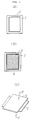
- Figs. 1a - 1c show schematically an example of the process of the present invention, in which Figs. 1a and 1b are plan views and Fig. lc is a perspective view;
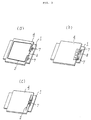
- Figs. 2a - 2c show schematically another example of the process of the present invention, in which Fig. 2a is a plan view and Figs. 2b and 2c are perspective views; and
- Figs. 3a - 3c are perspective views showing schematically a comparative example of a process of producing a liquid-crystal cell.
- 1, 4
- electrode plate
- 2
- sealant portion
- 3
- FLC composition coating layer
- 5
- pressure
- 6
- inlet
- 7
- FLC composition
- 8
- resistor
- In step (b), the spacer can be provided by one or more of the following methods:
- i) the spacer is sprayed before the composition is coated;
- ii) the composition containing the spacer is coated to from a layer that contains it;
- iii) the spacer is sprayed over the coated layer of the composition;
- iv) a photosensitive resin layer is provided on the electrode plate and partially exposed to light, followed by development of the exposed or non-exposed area to form a spacer (directly), which is then coated with the composition (the photosensitive resin may be positive- or negative-type); and
- v) the surface of the substrate which is typically made of glass is partially etched to form a spacer (directly) and the composition is subsequently coated.
- The purpose of providing the spacer is to provide a cell of uniform thickness.
- Methods i) and iii) may be implemented by either a wet system (using Freon gases as a carrier) or a dry system (dusting air).
- In method iv), either positive-type or negative-type photoresists can be used as photosensitive resins. An example of the positive-type photosensitive resins is AZ 1300 SF of Hoechst AG and an example of the negative-type photosensitive resins is OZATEC NL 143 of Hoechst AG. The photosensitive resin is coated in a thickness of 0.5 - 10 µm, preferably 1.5 - 3 µm, as measured after development.
- Except in method iv), the spacer has a diameter of 0.5 - 10 µm, preferably 1.5 - 3 µm, and may be made of an inorganic material such as silicon oxide, or a polymer selected from among acrylic resins and epoxy resins. The shape of the spacer is not limited in any particular way and it may be in the form of a true sphere, a rod, a prism, etc., with a true spherical shape being preferred. The spacer is used in an amount of 0.1 - 10 wt%, preferably 1 - 5 wt%, of the total amount of the composition.
- Examples of the curable sealant that can be used include low-temperature (heat) curable sealants such as epoxy resins that cure at temperatures of ca. 100 - 150°C, and uv curable sealants.
- A comparative example of a method of producing a liquid-crystal cell by using a ferroelectric liquid crystal (FLC) composition containing at least one substance that exhibits liquid crystallinity and at least one additive having lower boiling point than said substance which comprises the steps of placing a pair of electrode plates in such a way that their electrode sides face each other, bonding the periphery of the two electrode plates with an adhesive, thereby forming a cell having a hollow portion to be filled with a liquid crystal and an inlet for injecting the liquid crystal, evacuating the cell to high vacuum, heating the neighborhood of said inlet to an elevated temperature, applying a liquid-crystal composition to close the inlet, immediately lowering the degree of vacuum in the vacuum chamber, heating the whole cell so that it is filled with the liquid crystal, and finally sealing the inlet.
- Examples of the present invention are described below with reference to the accompanying drawings. The FLC composition M1 used in those examples had the following formula:





- The FLC composition M1 undergoes a phase transfer of

- Exemplary oleophilic compounds or compounds that are rendered oleophilic are listed below:


- 1,7,10,16-Tetraoxa-4,13-diazabicyclooctadecane [Kryptofix® 22]:

- 4,3-Didecyl-1,7,10,16-tetraoxa-4,13-diazacyclooctadecane [Kryptofix® 22DD]:

- 5-Decyl-4,7,13,16,21-pentaoxa-1,10-diazabicyclo[8,8,5]-tricosane [Kryptofix® 22D]:

- 4,7,13,16,21-Pentaoxa-1,10-diazabicyclo[8,8,5]-tricosane [Kryptofix® 221]:

- 2,5,8,15,18,21-Hexaoxatricyclo[20.4.0.09,14]hexacosane (dicylohexy-18-crown-6):

- 1,4,7,10,13-Pentaoxa[13]-orthocyclophan(benzo-15-crown-5):

- 1,4,7,10,13,16-Hexaoxa[16]orthocyclophan(benzo-18-crown-6):

- 4,7,13,16,21,24-Hexaoxa-1,10-diazabicyclo[8,8,8]-octacosane [KryptofixR 222]:

- 2,5,8,11,18,21,24,27-Octaoxatricyclo[26.4.0012,17]-dotriacontane
(dicyclohexyl-24-crown-8):
- N,N'-Dibenzyl-1,4,10,13-tetraoxa-7,16-diazabicyclooctadecane:

- N-(4-Carboxybenzyl)-1,4,8,11-tetraazatetradecane:

- ITO transparent electrode and polyimide orientation layer were placed on a
glass plate 1. An ultraviolet-curable epoxy resin (Hoechst AG, Epoxy Resin Beckopox) was applied on the periphery of the orientation membrane by using screen printing at a thickness of 10 µm without installing an opening for injection of FLC, thereby forming the sealingagent 2 10 µm thick (refer to Fig. 1(a)). Thereafter, FLC composition M1 containing a lower boiling point additive and incorporating a spacer (SiO2 as true spherical beads of 2 µm in diameter) in an amount of 3 wt% of the total composition was coated on the sealant portion in the periphery by intaglio printing in an appropriate and correct amount (say, in a thickness of 2 µm), thereby forming an FLC coating layer 3 (refer to Fig. 1(b)). In order to remove air present in the FLC composition M1. the plate was placed under vacuum (preferably 10-2 to 10-4 Torr). After about 30 minutes, the air in FLC composition M1 was removed. The plate was removed from the vacuum, and heated (e.g. at 70 - 100°C) until the FLC composition was converted to an isotropic liquid or nematic phase. As a result, the air which had not been removed even when the plate had been placed under vacuum was completely removed, and the surface of the liquid-crystal composition could be smoothed. Since the plate was not exposed to a high vacuum and a high temperature, the lower boiling point additive in the FLC composition did not evaporate and remained present in a constant amount in the composition. Thereafter, the electrode plate thus treated and theother electrode plate 4 not having a sealing agent and FLC coating, were compressed under vacuum withpressure 5 applied, until the cell gap decreased to about 2 µm (refer to Fig. 1(c)). Ultraviolet radiation was applied to the sealing agent while or after compressing the plates, thereby curing the sealing agent to make a cell. Thereafter, the vacuum foam in the liquid crystal composition was removed by heating the cell. None of the low-boiling point additive had been lost from the cell. Further, the liquid-crystal cell fabricated in Example 1 exhibited satisfactory display performance without suffering from the uneven adsorption (chromatographic phenomenon) of the low-boiling point additive onto the alignment film which would have occurred in the prior art injection method on account of such factors as capillarity from the inlet for the injection of liquid crystal. - A transparent electrode (which may be ITO) 1 and an alignment film of a resin such as polyimide were provided on a substrate 1 (which may be a glass plate). An FLC composition M1 containing a lower boiling point additive and incorporating a spacer (SiO2 as true spherical beads of 2 µm in diameter) in an amount of 3 wt% of the total composition was roll-coated onto the alignment film inside the periphery in an apropriate and correct amount (say, in a thickness of 2 µm), thereby forming a coated layer 3 of FLC composition (see Fig. 2a). In order to remove air present in the composition M1, the substrate was placed under vacuum (preferably ca. 10-2 to 10-4 Torr). In ca. 30 min, almost all air in the composition M1 could be removed. Thereafter, the substrate was removed from the vacuum and heated (e.g. ca. 70 - 100°C) until the composition M1 turned to an isotropic liquid or nematic phase. As a result, the air which had not been removed by standing in vacuo was completely removed and the surface of the liquid-crystal composition could be smoothed. Since the substrate was treated neither under high vacuum nor at high temperature, the low-boiling point additive in the composition did not evaporate but instead remained unchanged. Thereafter, the substrate thus treated and the
other substrate 4 having no coating of liquid crystal were compressed under vacuum withpressure 5 being applied, until the cell gap decreased to ca. 2 µm (see Fig. 2b). An uv curable epoxy resin was coated onto the peripry of the cell, while or after compressing it, to thereby provide asealant portion 2. Subsequently, the applied epoxy resin was cured by exposure to ultraviolet radiation, whereupon the cell was immobilized (see Fig. 2c). Thereafter, the vacuum foam in the liquid-crystal composition was removed by reheating the cell. None of the low-boiling point additive had been lost from the cell. Further, the liquid-crystal cell fabricated in Example 2 exhibited satisfactory display performance without suffering from the uneven adsorption (chromatographic phenomenon) of the low-boiling point additive onto the alignment film which would have occurred in the prior art injection method on account of such factors as capillarity from the inlet for the injection of liquid crystal. - The liquid crystal cell was prepared according to the prior method. The FLC composition M1 containing a lower boiling point additive (FLC composition 7) was applied to the inlet 6 of the cell and the portion adjacent to the inlet. Air was removed from the cell (refer to Fig. 3(a)). The
FLC composition 7 was heated by passing a current through resistor 8 installed to the portion near inlet 6, whereby theFLC composition 7 was quickly converted to an isotropic liquid or nematic phase (refer to Fig. 3(b)).FLC composition 7 started to get into the inlet by capillary action. As soon as the liquid-crystal closed the inlet 6 (see Fig. 3c), the degree of vacuum was lowered to establish low vacuum or achieve reversion to an atmospheric pressure. With the whole cell being heated, the liquid crystal was continuously injected into the cell until it was filled with the liquid-crystal composition. Thereafter, the inlet was sealed with a two-pack epoxy resin. Since the cell was exposed to high vacuum and high temperature only for a very short period, the lower boiling point additive in the FLC composition did not evaporate and the cell exhibited satisfactory display performance. The period for which the FLC composition M1 could be exposed to high vacuum and high temperature was within about 10 minutes. The period was only 5 minutes in the comparative example.
Claims (1)
- A process of producing a liquid crystal cell by using a ferroelectric liquid crystal (FLC) composition containing at least one substance that exhibits liquid crystallinity and at least one additive having a lower boiling point than said substance, said process comprising the steps of:a) providing a sealant portion made of a curable sealant in the periphery of the side of an electrode plate that has an electrode or electrodes;b)(i) coating said liquid-crystal composition on the portion surrounded by the periphery of the electrode plate, with a spacer being preliminary provided in said portion; or(ii) coating said liquid-crystal composition containing a spacer on the portion surrounded by the periphery of the electrode plate; or(iii) coating said liquid-crystal composition on the portion surrounded by the periphery of the electrode plate and thereafter providing a spacer over said composition;c) carrying out the defoaming of the liquid-crystal composition coating layer under vacuum and then lowering the degree of vacuum of the atmosphere surrounding the liquid-crystal composition, or returning the atmosphere to an atmospheric pressure;d) heating the liquid crystal composition coating layer to convert the layer to a nematic phase or isotropic liquid, thereby smoothing the surface of the layer;e) overlapping the other electrode plate on the liquid-crystal composition coating layer of the electrode plate under vacuum and then compressing the two electrode plates together;f) curing said element; andg) heating the liquid-crystal cell under atmospheric pressure to make the layer of the liquid-crystal composition homogeneous,whereby the steps of the process are performed in the order of a, b, c, d, e, f and g or in the order of b, c, d, e, a, f and g.
Applications Claiming Priority (5)
| Application Number | Priority Date | Filing Date | Title |
|---|---|---|---|
| JP15638690 | 1990-06-14 | ||
| JP156386/90 | 1990-06-14 | ||
| JP75345/91 | 1991-04-08 | ||
| JP3075345A JPH04218018A (en) | 1990-06-14 | 1991-04-08 | Manufacture of liquid crystal cells |
| PCT/JP1991/000806 WO1991020012A1 (en) | 1990-06-14 | 1991-06-14 | Process for producing liquid-crystal cells |
Publications (2)
| Publication Number | Publication Date |
|---|---|
| EP0533927A1 EP0533927A1 (en) | 1993-03-31 |
| EP0533927B1 true EP0533927B1 (en) | 1997-01-02 |
Family
ID=26416485
Family Applications (1)
| Application Number | Title | Priority Date | Filing Date |
|---|---|---|---|
| EP91911186A Expired - Lifetime EP0533927B1 (en) | 1990-06-14 | 1991-06-14 | Process for producing liquid-crystal cells |
Country Status (5)
| Country | Link |
|---|---|
| US (1) | US5430564A (en) |
| EP (1) | EP0533927B1 (en) |
| JP (1) | JPH04218018A (en) |
| DE (1) | DE69123965T2 (en) |
| WO (1) | WO1991020012A1 (en) |
Families Citing this family (13)
| Publication number | Priority date | Publication date | Assignee | Title |
|---|---|---|---|---|
| JPH05297375A (en) * | 1992-04-20 | 1993-11-12 | Hoechst Japan Ltd | Ferroelectric liquid crystal mixture and display element constituted by using this mixture |
| US5603157A (en) * | 1994-03-02 | 1997-02-18 | Micron Communications, Inc. | Methods of producing button-type batteries and a plurality of battery terminal housing members |
| JP3260976B2 (en) * | 1994-06-16 | 2002-02-25 | 株式会社半導体エネルギー研究所 | Method for manufacturing liquid crystal electro-optical device |
| US5659377A (en) * | 1995-11-30 | 1997-08-19 | Lucent Technologies Inc. | Apparatus and method for filling liquid crystal display cells |
| US9091843B1 (en) | 2014-03-16 | 2015-07-28 | Hyperion Development, LLC | Optical assembly for a wide field of view point action camera with low track length to focal length ratio |
| US9995910B1 (en) | 2014-03-16 | 2018-06-12 | Navitar Industries, Llc | Optical assembly for a compact wide field of view digital camera with high MTF |
| US9316808B1 (en) | 2014-03-16 | 2016-04-19 | Hyperion Development, LLC | Optical assembly for a wide field of view point action camera with a low sag aspheric lens element |
| US10386604B1 (en) | 2014-03-16 | 2019-08-20 | Navitar Industries, Llc | Compact wide field of view digital camera with stray light impact suppression |
| US9316820B1 (en) | 2014-03-16 | 2016-04-19 | Hyperion Development, LLC | Optical assembly for a wide field of view point action camera with low astigmatism |
| US9494772B1 (en) | 2014-03-16 | 2016-11-15 | Hyperion Development, LLC | Optical assembly for a wide field of view point action camera with low field curvature |
| US10139595B1 (en) | 2014-03-16 | 2018-11-27 | Navitar Industries, Llc | Optical assembly for a compact wide field of view digital camera with low first lens diameter to image diagonal ratio |
| US9726859B1 (en) | 2014-03-16 | 2017-08-08 | Navitar Industries, Llc | Optical assembly for a wide field of view camera with low TV distortion |
| US10545314B1 (en) | 2014-03-16 | 2020-01-28 | Navitar Industries, Llc | Optical assembly for a compact wide field of view digital camera with low lateral chromatic aberration |
Family Cites Families (16)
| Publication number | Priority date | Publication date | Assignee | Title |
|---|---|---|---|---|
| EP0113064A1 (en) * | 1982-12-06 | 1984-07-11 | Tektronix, Inc. | Liquid crystal cell employing surface tension forces to achieve uniform interplate spacing, and method of construction thereof |
| US4634228A (en) * | 1984-05-01 | 1987-01-06 | Hitachi, Ltd. | Ferroelectric liquid crystal cell with rubbed polyimide alignment layer |
| JPS6049889B2 (en) * | 1984-07-04 | 1985-11-05 | 松下電器産業株式会社 | Liquid crystal injection method for liquid crystal display device |
| JPS6143725A (en) * | 1984-08-07 | 1986-03-03 | Seiko Instr & Electronics Ltd | Liquid crystal display element |
| GB2170214A (en) * | 1985-01-26 | 1986-07-30 | Stc Plc | Ferroelectric smectic liquid crystal mixture |
| US5333675C1 (en) * | 1986-02-25 | 2001-05-01 | Perkin Elmer Corp | Apparatus and method for performing automated amplification of nucleic acid sequences and assays using heating and cooling steps |
| JPS638630A (en) * | 1986-06-28 | 1988-01-14 | Toyota Motor Corp | Injecting method for liquid crystal |
| US4922972A (en) * | 1987-03-26 | 1990-05-08 | Semiconductor Energy Laboratory Co., Ltd. | Method of filling a liquid crystal device with liquid crystal |
| US4917473A (en) * | 1987-10-13 | 1990-04-17 | Semiconductor Energy Laboratory Co., Ltd. | Method of manufacturing liquid crystal devices |
| US5069533A (en) * | 1988-06-29 | 1991-12-03 | Idemitsu Kosan Co., Ltd. | Method of orienting liquid crystal optical device |
| US5238523A (en) * | 1989-04-21 | 1993-08-24 | Idemitsu Kosan Co., Ltd. | Apparatus for producing a liquid crystal optical device |
| EP0395957B1 (en) * | 1989-04-21 | 1995-07-05 | Idemitsu Kosan Company Limited | Method of producing a substrate coated with a film of liquid crystal material and method and apparatus of producing a liquid crystal optical device |
| DE4011804A1 (en) * | 1990-04-12 | 1991-10-24 | Hoechst Ag | USE OF MACROCYCLIC COMPOUNDS AS A COMPONENT FOR FERROELECTRIC LIQUID MIXTURES |
| DE4011792A1 (en) * | 1990-04-12 | 1991-10-17 | Hoechst Ag | FERROELECTRIC LIQUID CRYSTAL MIXTURES CONTAINING IONOPHORE |
| JPH0437820A (en) * | 1990-06-04 | 1992-02-07 | Seiko Epson Corp | Production of liquid crystal display element |
| JPH04218027A (en) * | 1990-06-14 | 1992-08-07 | Hoechst Japan Ltd | Manufacture of liquid crystal cells |
-
1991
- 1991-04-08 JP JP3075345A patent/JPH04218018A/en active Pending
- 1991-06-14 EP EP91911186A patent/EP0533927B1/en not_active Expired - Lifetime
- 1991-06-14 WO PCT/JP1991/000806 patent/WO1991020012A1/en not_active Ceased
- 1991-06-14 DE DE69123965T patent/DE69123965T2/en not_active Expired - Fee Related
-
1993
- 1993-02-05 US US07/946,378 patent/US5430564A/en not_active Expired - Fee Related
Also Published As
| Publication number | Publication date |
|---|---|
| DE69123965T2 (en) | 1997-07-17 |
| US5430564A (en) | 1995-07-04 |
| EP0533927A1 (en) | 1993-03-31 |
| WO1991020012A1 (en) | 1991-12-26 |
| JPH04218018A (en) | 1992-08-07 |
| DE69123965D1 (en) | 1997-02-13 |
Similar Documents
| Publication | Publication Date | Title |
|---|---|---|
| US5430564A (en) | Process for producing ferroelectric liquid-crystal cells with oleophilic additive employing heat and low pressure overlapped a short time | |
| EP0575791B1 (en) | Liquid crystal composite layer of dispersion type, production method thereof and liquid crystal material to be used therein | |
| US5361152A (en) | Process for producing ferroelectric liquid-crystal cells | |
| US4626303A (en) | Process for making electro-optic element | |
| US4983023A (en) | Liquid crystal display panel with polymer spacers containing a percentage of epoxy groups | |
| EP0782038B1 (en) | Process for producing liquid crystal device | |
| US5309263A (en) | Liquid crystal electro-optical device and manufacturing method for the same | |
| DE3727605A1 (en) | METHOD FOR ORIENTING LIQUID CRYSTALS | |
| EP0641456B1 (en) | Maleic imide copolymer used as the orientation film for liquid-crystal displays | |
| JPH04168422A (en) | Liquid crystal display device | |
| EP0420670A2 (en) | Liquid-crystal orientating film, method of manufacturing the film, and liquid-crystal element having the film | |
| CA2000210A1 (en) | Liquid crystal device | |
| JP2764997B2 (en) | Liquid crystal display | |
| KR100220537B1 (en) | Liquid crystal display device and its manufacturing method | |
| US6927823B1 (en) | Method for alignment of liquid crystals using irradiated liquid crystal films | |
| KR100321257B1 (en) | Method for fabricating liquid crystal optical device and liquid crystal optical device obtained by the same | |
| US5880804A (en) | Process for producing ferroelectric liquid crystal device | |
| JPS6040606B2 (en) | lcd display panel | |
| JPH06273728A (en) | Production of liquid crystal display device | |
| JPH08245962A (en) | Ferroelectric liquid crystal display element | |
| JPS55101914A (en) | Liquid crystal cell | |
| DE4229194A1 (en) | Maleimide polymers as orientation films for liq. crystal displays | |
| DE19832812A1 (en) | Process for the production of smectic type of liquid crystal display using substrates printed with smectic layer and then bonded together | |
| JP3033636B2 (en) | Polymer dispersed liquid crystal composite film | |
| JPS61203426A (en) | Liquid crystal display device |
Legal Events
| Date | Code | Title | Description |
|---|---|---|---|
| PUAI | Public reference made under article 153(3) epc to a published international application that has entered the european phase |
Free format text: ORIGINAL CODE: 0009012 |
|
| 17P | Request for examination filed |
Effective date: 19921029 |
|
| AK | Designated contracting states |
Kind code of ref document: A1 Designated state(s): BE CH DE DK ES FR GB IT LI NL SE |
|
| 17Q | First examination report despatched |
Effective date: 19950309 |
|
| GRAG | Despatch of communication of intention to grant |
Free format text: ORIGINAL CODE: EPIDOS AGRA |
|
| GRAH | Despatch of communication of intention to grant a patent |
Free format text: ORIGINAL CODE: EPIDOS IGRA |
|
| GRAH | Despatch of communication of intention to grant a patent |
Free format text: ORIGINAL CODE: EPIDOS IGRA |
|
| GRAA | (expected) grant |
Free format text: ORIGINAL CODE: 0009210 |
|
| AK | Designated contracting states |
Kind code of ref document: B1 Designated state(s): BE CH DE DK ES FR GB IT LI NL SE |
|
| PG25 | Lapsed in a contracting state [announced via postgrant information from national office to epo] |
Ref country code: IT Free format text: LAPSE BECAUSE OF FAILURE TO SUBMIT A TRANSLATION OF THE DESCRIPTION OR TO PAY THE FEE WITHIN THE PRE;WARNING: LAPSES OF ITALIAN PATENTS WITH EFFECTIVE DATE BEFORE 2007 MAY HAVE OCCURRED AT ANY TIME BEFORE 2007. THE CORRECT EFFECTIVE DATE MAY BE DIFFERENT FROM THE ONE RECORDED.SCRIBED TIME-LIMIT Effective date: 19970102 Ref country code: CH Effective date: 19970102 Ref country code: DK Effective date: 19970102 Ref country code: LI Effective date: 19970102 Ref country code: BE Effective date: 19970102 Ref country code: FR Effective date: 19970102 Ref country code: NL Free format text: LAPSE BECAUSE OF FAILURE TO SUBMIT A TRANSLATION OF THE DESCRIPTION OR TO PAY THE FEE WITHIN THE PRESCRIBED TIME-LIMIT Effective date: 19970102 Ref country code: ES Free format text: THE PATENT HAS BEEN ANNULLED BY A DECISION OF A NATIONAL AUTHORITY Effective date: 19970102 |
|
| REG | Reference to a national code |
Ref country code: CH Ref legal event code: EP |
|
| REF | Corresponds to: |
Ref document number: 69123965 Country of ref document: DE Date of ref document: 19970213 |
|
| PG25 | Lapsed in a contracting state [announced via postgrant information from national office to epo] |
Ref country code: SE Effective date: 19970402 |
|
| EN | Fr: translation not filed | ||
| NLV1 | Nl: lapsed or annulled due to failure to fulfill the requirements of art. 29p and 29m of the patents act | ||
| PG25 | Lapsed in a contracting state [announced via postgrant information from national office to epo] |
Ref country code: GB Free format text: LAPSE BECAUSE OF NON-PAYMENT OF DUE FEES Effective date: 19970614 |
|
| REG | Reference to a national code |
Ref country code: CH Ref legal event code: PL |
|
| PLBE | No opposition filed within time limit |
Free format text: ORIGINAL CODE: 0009261 |
|
| STAA | Information on the status of an ep patent application or granted ep patent |
Free format text: STATUS: NO OPPOSITION FILED WITHIN TIME LIMIT |
|
| 26N | No opposition filed | ||
| GBPC | Gb: european patent ceased through non-payment of renewal fee |
Effective date: 19970614 |
|
| PGFP | Annual fee paid to national office [announced via postgrant information from national office to epo] |
Ref country code: DE Payment date: 19990511 Year of fee payment: 9 |
|
| PG25 | Lapsed in a contracting state [announced via postgrant information from national office to epo] |
Ref country code: DE Free format text: LAPSE BECAUSE OF NON-PAYMENT OF DUE FEES Effective date: 20010403 |