EP0530732B1 - Method of measuring NADH and NADPH - Google Patents
Method of measuring NADH and NADPH Download PDFInfo
- Publication number
- EP0530732B1 EP0530732B1 EP92114870A EP92114870A EP0530732B1 EP 0530732 B1 EP0530732 B1 EP 0530732B1 EP 92114870 A EP92114870 A EP 92114870A EP 92114870 A EP92114870 A EP 92114870A EP 0530732 B1 EP0530732 B1 EP 0530732B1
- Authority
- EP
- European Patent Office
- Prior art keywords
- nadh
- nadph
- measuring
- reaction
- hydrogen peroxide
- Prior art date
- Legal status (The legal status is an assumption and is not a legal conclusion. Google has not performed a legal analysis and makes no representation as to the accuracy of the status listed.)
- Expired - Lifetime
Links
Images


Classifications
-
- C—CHEMISTRY; METALLURGY
- C12—BIOCHEMISTRY; BEER; SPIRITS; WINE; VINEGAR; MICROBIOLOGY; ENZYMOLOGY; MUTATION OR GENETIC ENGINEERING
- C12Q—MEASURING OR TESTING PROCESSES INVOLVING ENZYMES, NUCLEIC ACIDS OR MICROORGANISMS; COMPOSITIONS OR TEST PAPERS THEREFOR; PROCESSES OF PREPARING SUCH COMPOSITIONS; CONDITION-RESPONSIVE CONTROL IN MICROBIOLOGICAL OR ENZYMOLOGICAL PROCESSES
- C12Q1/00—Measuring or testing processes involving enzymes, nucleic acids or microorganisms; Compositions therefor; Processes of preparing such compositions
- C12Q1/26—Measuring or testing processes involving enzymes, nucleic acids or microorganisms; Compositions therefor; Processes of preparing such compositions involving oxidoreductase
- C12Q1/28—Measuring or testing processes involving enzymes, nucleic acids or microorganisms; Compositions therefor; Processes of preparing such compositions involving oxidoreductase involving peroxidase
-
- C—CHEMISTRY; METALLURGY
- C12—BIOCHEMISTRY; BEER; SPIRITS; WINE; VINEGAR; MICROBIOLOGY; ENZYMOLOGY; MUTATION OR GENETIC ENGINEERING
- C12Q—MEASURING OR TESTING PROCESSES INVOLVING ENZYMES, NUCLEIC ACIDS OR MICROORGANISMS; COMPOSITIONS OR TEST PAPERS THEREFOR; PROCESSES OF PREPARING SUCH COMPOSITIONS; CONDITION-RESPONSIVE CONTROL IN MICROBIOLOGICAL OR ENZYMOLOGICAL PROCESSES
- C12Q1/00—Measuring or testing processes involving enzymes, nucleic acids or microorganisms; Compositions therefor; Processes of preparing such compositions
- C12Q1/008—Measuring or testing processes involving enzymes, nucleic acids or microorganisms; Compositions therefor; Processes of preparing such compositions for determining co-enzymes or co-factors, e.g. NAD, ATP
-
- C—CHEMISTRY; METALLURGY
- C12—BIOCHEMISTRY; BEER; SPIRITS; WINE; VINEGAR; MICROBIOLOGY; ENZYMOLOGY; MUTATION OR GENETIC ENGINEERING
- C12Q—MEASURING OR TESTING PROCESSES INVOLVING ENZYMES, NUCLEIC ACIDS OR MICROORGANISMS; COMPOSITIONS OR TEST PAPERS THEREFOR; PROCESSES OF PREPARING SUCH COMPOSITIONS; CONDITION-RESPONSIVE CONTROL IN MICROBIOLOGICAL OR ENZYMOLOGICAL PROCESSES
- C12Q2326/00—Chromogens for determinations of oxidoreductase enzymes
- C12Q2326/32—3-Methyl-2-benzothiazolinone hydrazone hydrochloride hydrate, i.e. MBTH
Definitions
- the present invention relates to a method of measuring ⁇ - nicotinamide adenine dinucleotide reduced form (hereinafter referred to as "NADH”) or ⁇ -nicotinamide adenine dinucleotide phosphate reduced form (hereinafter referred to as "NADPH”), substantially to a method of measuring hydrogen peroxide to be generated through an enzymatic reaction, and can be utilized for clinical examinations to quantitatively measure various biochemical substances or an activity of enzymes in a sample of body fluid such as urine, serum or the like.
- NADH ⁇ nicotinamide adenine dinucleotide reduced form
- NADPH ⁇ -nicotinamide adenine dinucleotide phosphate reduced form
- Exemples of substances to be quantitatively formed or consumed by the enzymatic reaction are (1) hydrogen peroxide as a product of oxidase reaction, and (2) NADH and NADPH as coenzymes relating to a reaction of a dehydrogenase. If such a substance can be measured with high accuracy, a high accuracy measurement of an amount on specific biochemical substance or enzyme activity as objective target will become possible.
- aniline derivatives N,N-dimethylaniline, N,N-diethylaniline, N-ethyl-N-(2-hydroxyethyl)-m-toluidine, N-ethyl-N-(3-methylphenyl)-N'-acetylethylene-diamine, N,N-dimethyl-m-anisidine, N-substituted aniline due to an alkylsulfonic acid or hydroxyalkylsulfonic acid and the like can be mentioned.
- 3-methyl-2-benzothiazolinone hydrazone MBTH may be employed in lieu of 4-AA.
- the method (a) is not sufficient in sensitivity, in case of utilizing the same for measuring a trace component in a body fluid sample, since both of NADH and NADPH have only a molecular extinction coefficient of about 6200.
- the method (b) has the disadvantage that the formazan to be formed is difficult to dissolve in water to cause a pollution in cells.
- the method (c) can be carried out by using said color developing reagent of oxidative coupling reaction, for instance as disclosed in Jap. Pat. Nos. Sho 63 (A.D. 1988) - 44882(B) and Hei 1 (A.D. 1989) - 257499(A).
- said color developing reagent of oxidative coupling reaction for instance as disclosed in Jap. Pat. Nos. Sho 63 (A.D. 1988) - 44882(B) and Hei 1 (A.D. 1989) - 257499(A).
- each of the methods as disclosed in the Japanese official gazettes is not sufficient, in the case where NADH or NADPH should be measured with high accuracy, on the grounds as stated below.
- the color developing reagent of oxidative coupling reaction namely, 4-AA and phenol or an aniline derivative are employed as the color developing reagent of oxidative coupling reaction, but with this combination, the color developing substance is reduced by NADH or NADPH in a sample solution and does not develop any color, and thus a color reaction should be carried out, after that NADH or NADPH formed by the enzymatic reaction was completely exhausted by NAD(P)H oxidase.
- each of the methods as disclosed in the official gazettes is a 2-stage method and thus can not be seen as an high accuracy method, since there is the possibility that at least a part of the hydrogen peroxide formed by the NAD(P)H oxidase reaction decomposes by reacting with certain component(s) in the sample of body fluid such as serum, urine or the like.
- a principal object of the invention is to provide a method to measure NADH or NADPH with high sensitivity and accuracy.
- An additional object of the invention is to provide a method of measuring NADH or NADPH with an automatical analyzer.
- the inventors have energetically studied and investigated for solving problems in the prior art method of measuring NADH and NADPH, which uses NAD(P)H oxidase, to finally establish the invention.
- a method of measuring NADH or NADPH characterized in that when NADH or NADPH is measured, steps of generating hydrogen peroxide with an action of NAD(P)H oxidase and measuring the hydrogen peroxide by a chromogenic reaction are concurrently carried out. If both steps proceed concurrently, the measuring accuracy of hydrogen peroxide increases, which makes possible the measurement of NADH and NADPH with high sensitivity and accuracy.
- NAD(P)H oxidase there is no restriction of the kind of NAD(P)H oxidase. It should specifically oxidize NADH or NADPH to generate hydrogen peroxide.
- a coupler for the color developing reagent not 4-AA (being widely employed)but MBTH or its derivative is employed, since the latter is not affected by reducing action due to NADH and NAD(P)H.
- the MBTH derivatives those, wherein sulfonyl group, alkyl group, halogen, nitro group, carboxyl group or the like is introduced as a substituent are preferable.
- the inventors have carried out measurements of NADH and NADPH according to the method of invention, as given above to find out that a calibration curve shows not a linear curve but nearly a curve of the second order. Such a phenomenon can not be found in the conventional 2-staged method using NAD(P)H oxidase. Therefore, the inventors further studied for elucidating this matter to find out that NAD(P)H forms not only hydrogen peroxide but also an anion of superoxide. Namely, the calibration curve can be made linear by adding superoxide dismutase (hereinafter referred to as "SOD”) to coexist in reaction system, when the method according to the invention is carried out.
- SOD superoxide dismutase
- the SOD is an enzyme which catalytically acts in the reaction shown below and has an action for converting the superoxide anion into hydrogen peroxide.
- the reaction is a relatively speedy one also as non-enzymatical reaction.
- There is no restriction on the kind of SOD and those derived from bovine erythrocytes and the like can be employed.
- SOD shows a sufficient activity in pH range of about 5 - 10 and good stability and thus it is suitable to use the same for the method of invention. It is preferable to set a concentration of SOD in a range of 10 - 200mg/l in the reaction solution.
- the color reaction (3) is carried out, after previously completing the reactions (1) and (2). Therefore, there is the possibility that a part of hydrogen peroxide formed in the reaction (2) reacts with coexisting substance(s) in the serum sample to cause a decomposition thereof. While, according to the method of the invention, the reactions (1), (2) and (3) proceed concurrently, so that hydrogen peroxide, subsequently NADPH or NADPH and further 3-hydroxybutyric acid can be measured with high accuracy.
- This method according to the invention develops its effectiveness, when the substance to be measured, has an extremely small concentration. Since a single-stage operation is employed for the method of invention, the method is simple. It remarkably reduces the period of time required for the measurement, and scan be applied to a widely employed automatic analyzer to treat samples in large number.
- Each of the reagents employed for the method of invention may be in the form of a solution, a powder or the like which is prepared by lyophilization. Since the method of the invention employs only one stage operation all of the reagents may be adsorbed in an absorbing carrier such as a filter paper and the carrier is dried to make a test piece.
- Reagents a) Reagent 1 NADH 200 ⁇ M Phosphate buffer (pH 7.5) 50mM b) Reagent 2 FAD 0.1mM Phosphate buffer (pH 7.0) 50mM FAD : Flavin adenine dinucleotide c) Reagent 3 Nitrotetrazolium blue 1.2mM NAD(P)H oxidase 2300 U/l Phosphate buffer 50mM (C) Operations To the reagent 1 (40 ⁇ l), the reagent 2 (700 ⁇ l) was added to mix the same and the mixture was incubated for 5 minutes at 37°C.
- the reagent 3 (100 ⁇ l) was added to cause a reaction for 5 minutes at 37°C to measure an absorbance at 550nm.
- the absorbance was 0.096, when compensation was carried out with a result of another measurement on a control, which was carried out similarly to the above but using the phosphate buffer solution only, in lieu of the reagent 1.
- Similar operation was carried out by adding 20mg/l of SOD in the reagent 2 to find out that absorbance was 0.013. From these facts, it was confirmed that NAD(P)H oxidase has an ability of producing not only hydrogen peroxide but also superoxide anion.
- Reagents a) Reagent 1 MBTH 0.5mM SOD 20mg/l FAD 0.1mM Phosphate buffer (pH 7.0) 50mM b) Reagent 2 N-Ethyl-N-sulfopropyl-3,5-dimethylaniline 5.0mM Peroxidase 72000 U/l NAD(P)H oxidase 2300 U/l Phosphate buffer (pH 7.0) 50mM (B) Operations and results The reagent 1 (350 ⁇ l) was added to 20 ⁇ l of NADH solution (0, 20, 50, 100 or 200mM) to incubate for 5 minutes at 37°C.
- the reagent 2 (50 ⁇ l) was added to cause a reaction at 37°C to measure a change in absorbance per 1 minute at 570nm. Further, similar operations were repeated with use of a reagent similar to reagent 1, but containing no SOD to check a relation between the change in absorbance and concentration of NADH, due to the presence or absence of SOD. Results are shown in Fig. 1. As apparently seen therefrom, no linear relation can be recognized between the concentration of NADH and change in absorbance, when SOD is not contained, but the relation becomes linear by adding SOD to coexist in the reaction system.
- Reagents a) Reagent 1 NAD + 0.7mM MBTH 0.5mM SOD 20mg/l FAD 0,1mM Phosphate buffer (pH 7.0) 50mM b) Reagent 2 3-Hydroxybutyrate dehydrogenase 3320 U/l N-Ethyl-N-sulfopropyl-3,5-dimethylaniline 50mM Peroxidase 72000 U/l NAD(P)H oxidase 2300 U/l Phosphate buffer (pH 7.0) 50mM (B) Standard calibration curve The reagent 1 (350 ⁇ l) was added to each of various standard 3-hydroxybutyric acid solutions (20 ⁇ mol) known in concentration thereof to incubate for 5 minutes at 37°C.
- the reagent 2 50 ⁇ l was added to cause a reaction at 37°C to measure a change of absorbance per 1 minute at 570nm and prepare a standard calibration curve from relation between the change of absorbance and concentration of 3-hydroxybutyric acid in the standard solution thereof.
- the standard calibration curve is shown in Fig. 2.
- C Measurement of 3-hydroxybutyric acid in serum Operations similar to those for preparing the standard calibration curve, but by using a sample of serum in lieu of the standard 3-hydroxybutyric acid solution were carried out to measure a change of the absorbance and a level of the change was collated to the standard calibration curve shown in Fig. 2 to determine a concentration of 3-hydroxybutyric acid in the serum sample.
- the measurement according to the method as above was repeated 10 times to find that the method shows good reproducibility as the standard deviation is 0.50 and coefficient of variation is 1.93%, near 20 ⁇ M.
- the method according to the invention can be applied for measuring various biochemical substances and activity of enzymes in a body fluid, as exemplified below.
Landscapes
- Chemical & Material Sciences (AREA)
- Organic Chemistry (AREA)
- Life Sciences & Earth Sciences (AREA)
- Zoology (AREA)
- Wood Science & Technology (AREA)
- Proteomics, Peptides & Aminoacids (AREA)
- Health & Medical Sciences (AREA)
- Engineering & Computer Science (AREA)
- Microbiology (AREA)
- Immunology (AREA)
- Physics & Mathematics (AREA)
- Molecular Biology (AREA)
- Biotechnology (AREA)
- Biophysics (AREA)
- Analytical Chemistry (AREA)
- Biochemistry (AREA)
- Bioinformatics & Cheminformatics (AREA)
- General Engineering & Computer Science (AREA)
- General Health & Medical Sciences (AREA)
- Genetics & Genomics (AREA)
- Measuring Or Testing Involving Enzymes Or Micro-Organisms (AREA)
Abstract
Description
- The present invention relates to a method of measuring β - nicotinamide adenine dinucleotide reduced form (hereinafter referred to as "NADH") or β -nicotinamide adenine dinucleotide phosphate reduced form (hereinafter referred to as "NADPH"), substantially to a method of measuring hydrogen peroxide to be generated through an enzymatic reaction, and can be utilized for clinical examinations to quantitatively measure various biochemical substances or an activity of enzymes in a sample of body fluid such as urine, serum or the like.
- At the present time, a measurement of biochemical substances and activity of enzymes has been carried out by using a body fluid as a sample for studying biochemical properties thereof, clinical examinations and the like. In major cases, however, it is difficult to directly and quantitatively measure the substance and then an indirect quantitative measuring method has been carried out whereby an enzyme is reacted with the substance and another substance, quantitatively formed through the enzymatic reaction, is measured.
- Exemples of substances to be quantitatively formed or consumed by the enzymatic reaction are (1) hydrogen peroxide as a product of oxidase reaction, and (2) NADH and NADPH as coenzymes relating to a reaction of a dehydrogenase. If such a substance can be measured with high accuracy, a high accuracy measurement of an amount on specific biochemical substance or enzyme activity as objective target will become possible.
- As a simple and relatively highly sensitive method through the measurement of hydrogen peroxide to be formed by the reaction of oxidase in said case (1), such a method has generally been carried out with 4-aminoantipyrine (hereinafter referred to as "4-AA") and a phenol or aniline derivative, in the presence of peroxidase, as a color developing reagent of an oxidative coupling reaction. As the phenols, phenol, 2,4-dichlorophenol, 2,4-dibromophenol, 3,5-dichloro-2-hydroxybenzenesulfonic acid and the like can be mentioned. As the aniline derivatives, N,N-dimethylaniline, N,N-diethylaniline, N-ethyl-N-(2-hydroxyethyl)-m-toluidine, N-ethyl-N-(3-methylphenyl)-N'-acetylethylene-diamine, N,N-dimethyl-m-anisidine, N-substituted aniline due to an alkylsulfonic acid or hydroxyalkylsulfonic acid and the like can be mentioned. Further, 3-methyl-2-benzothiazolinone hydrazone (MBTH) may be employed in lieu of 4-AA.
- While, there are several methods for measuring NADH and NADPH to be formed by the reaction of dehydrogenase in said case (2), the following ones have been carried out in view of being simple and inexpensive : (a) Method, wherein an absorbance at 340nm of maximum absorption wave-length of NADH and NADPH is directly measured; (b) Method, wherein diaphorase is acted to NADH or NADPH in a sample in the presence of a tetrazolium salt to form a diformazan to colorimetrically measure; and (c) Method, wherein NADH or NADPH is specifically oxidized with NAD(P)H oxidase, as shown in following reaction formula to measure an amount of formed hydrogen peroxide.

- The method (a) is not sufficient in sensitivity, in case of utilizing the same for measuring a trace component in a body fluid sample, since both of NADH and NADPH have only a molecular extinction coefficient of about 6200. The method (b) has the disadvantage that the formazan to be formed is difficult to dissolve in water to cause a pollution in cells.
- The method (c) can be carried out by using said color developing reagent of oxidative coupling reaction, for instance as disclosed in Jap. Pat. Nos. Sho 63 (A.D. 1988) - 44882(B) and Hei 1 (A.D. 1989) - 257499(A). However, each of the methods as disclosed in the Japanese official gazettes is not sufficient, in the case where NADH or NADPH should be measured with high accuracy, on the grounds as stated below.
- For measuring with high accuracy hydrogen peroxide generated in a sample solution, it is preferable to conduct a chromogenic reaction concurrently with the formation of hydrogen peroxide by the action of NAD(P)H oxidase, since hydrogen peroxide is not so stable. Such an induction method is effective when, particularly, a concentration of substance to be measured is low in the sample. However, the methods disclosed in said official gazettes do not make possible an application of such induction method. According to the disclosures given in the official gazettes, namely, 4-AA and phenol or an aniline derivative are employed as the color developing reagent of oxidative coupling reaction, but with this combination, the color developing substance is reduced by NADH or NADPH in a sample solution and does not develop any color, and thus a color reaction should be carried out, after that NADH or NADPH formed by the enzymatic reaction was completely exhausted by NAD(P)H oxidase. In other words, each of the methods as disclosed in the official gazettes is a 2-stage method and thus can not be seen as an high accuracy method, since there is the possibility that at least a part of the hydrogen peroxide formed by the NAD(P)H oxidase reaction decomposes by reacting with certain component(s) in the sample of body fluid such as serum, urine or the like.
- A principal object of the invention is to provide a method to measure NADH or NADPH with high sensitivity and accuracy.
- An additional object of the invention is to provide a method of measuring NADH or NADPH with an automatical analyzer.
- The inventors have energetically studied and investigated for solving problems in the prior art method of measuring NADH and NADPH, which uses NAD(P)H oxidase, to finally establish the invention.
- According to the invention, a method of measuring NADH or NADPH, characterized in that when NADH or NADPH is measured, steps of generating hydrogen peroxide with an action of NAD(P)H oxidase and measuring the hydrogen peroxide by a chromogenic reaction are concurrently carried out. If both steps proceed concurrently, the measuring accuracy of hydrogen peroxide increases, which makes possible the measurement of NADH and NADPH with high sensitivity and accuracy.
- When the measurement according to the invention is carried out, there is no restriction of the kind of NAD(P)H oxidase. It should specifically oxidize NADH or NADPH to generate hydrogen peroxide. As a coupler for the color developing reagent, not 4-AA (being widely employed)but MBTH or its derivative is employed, since the latter is not affected by reducing action due to NADH and NAD(P)H. As the MBTH derivatives, those, wherein sulfonyl group, alkyl group, halogen, nitro group, carboxyl group or the like is introduced as a substituent are preferable.
- The inventors have carried out measurements of NADH and NADPH according to the method of invention, as given above to find out that a calibration curve shows not a linear curve but nearly a curve of the second order. Such a phenomenon can not be found in the conventional 2-staged method using NAD(P)H oxidase. Therefore, the inventors further studied for elucidating this matter to find out that NAD(P)H forms not only hydrogen peroxide but also an anion of superoxide. Namely, the calibration curve can be made linear by adding superoxide dismutase (hereinafter referred to as "SOD") to coexist in reaction system, when the method according to the invention is carried out.
- The SOD is an enzyme which catalytically acts in the reaction shown below and has an action for converting the superoxide anion into hydrogen peroxide. However, the reaction is a relatively speedy one also as non-enzymatical reaction. There is no restriction on the kind of SOD, and those derived from bovine erythrocytes and the like can be employed. In general, SOD shows a sufficient activity in pH range of about 5 - 10 and good stability and thus it is suitable to use the same for the method of invention. It is preferable to set a concentration of SOD in a range of 10 - 200mg/l in the reaction solution.

- The invention will now be explained, by comparing the same with the conventional method. When serum is selected as a sample to measure 3-hydroxybutyric acid, for instance, the following 3 reactions are utilized in both methods.


- According to the conventional method, the color reaction (3) is carried out, after previously completing the reactions (1) and (2). Therefore, there is the possibility that a part of hydrogen peroxide formed in the reaction (2) reacts with coexisting substance(s) in the serum sample to cause a decomposition thereof. While, according to the method of the invention, the reactions (1), (2) and (3) proceed concurrently, so that hydrogen peroxide, subsequently NADPH or NADPH and further 3-hydroxybutyric acid can be measured with high accuracy. This method according to the invention develops its effectiveness, when the substance to be measured, has an extremely small concentration. Since a single-stage operation is employed for the method of invention, the method is simple. It remarkably reduces the period of time required for the measurement, and scan be applied to a widely employed automatic analyzer to treat samples in large number.
- Each of the reagents employed for the method of invention may be in the form of a solution, a powder or the like which is prepared by lyophilization. Since the method of the invention employs only one stage operation all of the reagents may be adsorbed in an absorbing carrier such as a filter paper and the carrier is dried to make a test piece.
- The invention will now be further explained in more detail and concretely, with reference to Test Examples and Measuring Example, which shall refer to drawings, wherein
- Fig. 1 is a graph showing a relation between a concentration of NADH and absorbance, when SOD co-exists or not; and
- Fig. 2 is a graph as a standard calibration curve for measuring 3-hydroxybutyric acid in accordance with the method of invention.
-
(A) Object
Among oxidases, there are those which produce a superoxide anion, for instance as exemplified by xanthine oxidase. Therefore, whether NAD(P)H oxidase and NADH are acted in the presence of nitrotetrazolium blue, and the production of diformazan is measured to examine whether NAD(P)H oxidase has an ability for producing the superoxide anion or not.
(B) Reagentsa) Reagent 1 NADH 200µM Phosphate buffer (pH 7.5) 50mM b) Reagent 2 FAD 0.1mM Phosphate buffer (pH 7.0) 50mM FAD : Flavin adenine dinucleotide c) Reagent 3Nitrotetrazolium blue 1.2mM NAD(P)H oxidase 2300 U/l Phosphate buffer 50mM
(C) Operations
To the reagent 1 (40µl), the reagent 2 (700µl) was added to mix the same and the mixture was incubated for 5 minutes at 37°C. To the resulting solution, the reagent 3 (100µl) was added to cause a reaction for 5 minutes at 37°C to measure an absorbance at 550nm. The absorbance was 0.096, when compensation was carried out with a result of another measurement on a control, which was carried out similarly to the above but using the phosphate buffer solution only, in lieu of the reagent 1. Further, similar operation was carried out by adding 20mg/l of SOD in the reagent 2 to find out that absorbance was 0.013.
From these facts, it was confirmed that NAD(P)H oxidase has an ability of producing not only hydrogen peroxide but also superoxide anion. -
(A) Reagentsa) Reagent 1 MBTH 0.5mM SOD 20mg/l FAD 0.1mM Phosphate buffer (pH 7.0) 50mM b) Reagent 2 N-Ethyl-N-sulfopropyl-3,5-dimethylaniline 5.0mM Peroxidase 72000 U/l NAD(P)H oxidase 2300 U/l Phosphate buffer (pH 7.0) 50mM
(B) Operations and results
The reagent 1 (350µl) was added to 20µl of NADH solution (0, 20, 50, 100 or 200mM) to incubate for 5 minutes at 37°C. To the resulting solution, the reagent 2 (50µl) was added to cause a reaction at 37°C to measure a change in absorbance per 1 minute at 570nm. Further, similar operations were repeated with use of a reagent similar to reagent 1, but containing no SOD to check a relation between the change in absorbance and concentration of NADH, due to the presence or absence of SOD. Results are shown in Fig. 1. As apparently seen therefrom, no linear relation can be recognized between the concentration of NADH and change in absorbance, when SOD is not contained, but the relation becomes linear by adding SOD to coexist in the reaction system. -
(A) Reagentsa) Reagent 1 NAD+ 0.7mM MBTH 0.5mM SOD 20mg/l FAD 0,1mM Phosphate buffer (pH 7.0) 50mM b) Reagent 2 3-Hydroxybutyrate dehydrogenase 3320 U/l N-Ethyl-N-sulfopropyl-3,5-dimethylaniline 50mM Peroxidase 72000 U/l NAD(P)H oxidase 2300 U/l Phosphate buffer (pH 7.0) 50mM
(B) Standard calibration curve
The reagent 1 (350µl) was added to each of various standard 3-hydroxybutyric acid solutions (20µmol) known in concentration thereof to incubate for 5 minutes at 37°C. To the solution, the reagent 2 (50µl) was added to cause a reaction at 37°C to measure a change of absorbance per 1 minute at 570nm and prepare a standard calibration curve from relation between the change of absorbance and concentration of 3-hydroxybutyric acid in the standard solution thereof. The standard calibration curve is shown in Fig. 2.
(C) Measurement of 3-hydroxybutyric acid in serum
Operations similar to those for preparing the standard calibration curve, but by using a sample of serum in lieu of the standard 3-hydroxybutyric acid solution were carried out to measure a change of the absorbance and a level of the change was collated to the standard calibration curve shown in Fig. 2 to determine a concentration of 3-hydroxybutyric acid in the serum sample.
The measurement according to the method as above was repeated 10 times to find that the method shows good reproducibility as the standard deviation is 0.50 and coefficient of variation is 1.93%, near 20µM.
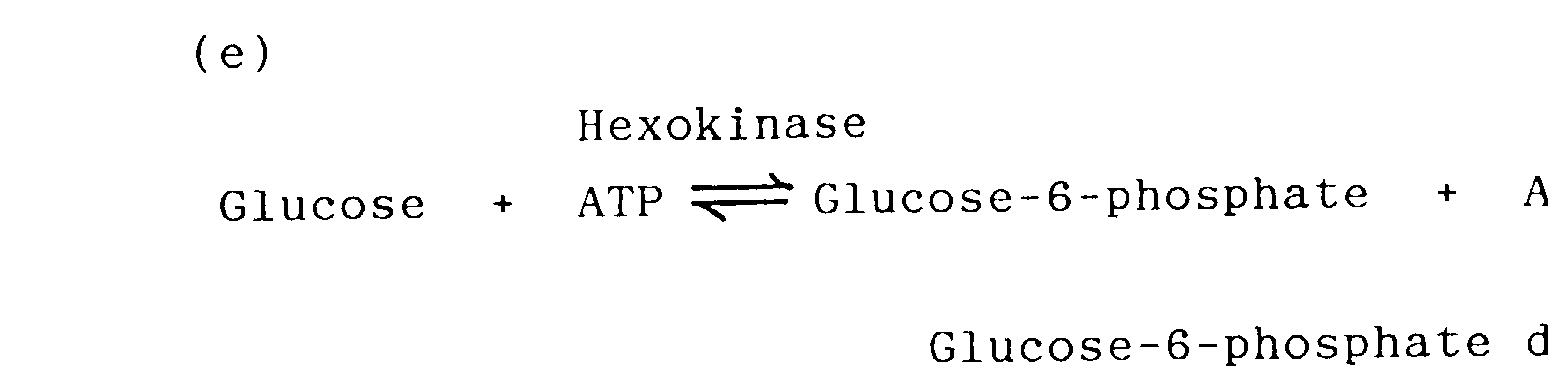
The method according to the invention can be applied for measuring various biochemical substances and activity of enzymes in a body fluid, as exemplified below.




Claims (2)
- A method of measuring NADH or NADPH, characterized in that when NADH or NADPH is measured, steps of generating hydrogen peroxide by an action of NAD(P)H oxidase and of measuring the hydrogen peroxide by an oxidative coupling reaction of chromogenic reagents are concurrently carried out, said chromogenic reagents being a combination of peroxidase, a substance selected from aniline and its derivative, and a substance selected from 3-methyl-2-benzothiazolinone hydrazone and its derivative.
- A method as claimed in Claim 1, wherein an enzyme of superoxide dismutase co-exists in the reaction system.
Applications Claiming Priority (2)
| Application Number | Priority Date | Filing Date | Title |
|---|---|---|---|
| JP3254272A JPH0564598A (en) | 1991-09-06 | 1991-09-06 | Determination of nadh and nadph |
| JP254272/91 | 1991-09-06 |
Publications (2)
| Publication Number | Publication Date |
|---|---|
| EP0530732A1 EP0530732A1 (en) | 1993-03-10 |
| EP0530732B1 true EP0530732B1 (en) | 1996-12-11 |
Family
ID=17262669
Family Applications (1)
| Application Number | Title | Priority Date | Filing Date |
|---|---|---|---|
| EP92114870A Expired - Lifetime EP0530732B1 (en) | 1991-09-06 | 1992-08-31 | Method of measuring NADH and NADPH |
Country Status (5)
| Country | Link |
|---|---|
| EP (1) | EP0530732B1 (en) |
| JP (1) | JPH0564598A (en) |
| AT (1) | ATE146224T1 (en) |
| DE (1) | DE69215797T2 (en) |
| ES (1) | ES2097843T3 (en) |
Family Cites Families (3)
| Publication number | Priority date | Publication date | Assignee | Title |
|---|---|---|---|---|
| DE3236388A1 (en) * | 1982-10-01 | 1984-04-05 | Boehringer Mannheim Gmbh, 6800 Mannheim | METHOD FOR THE SELECTIVE PRODUCTION OF REDUCED OXYGEN SPECIES AND REAGENTS SUITABLE FOR THIS |
| DE3725851A1 (en) * | 1986-08-12 | 1988-02-18 | Takara Shuzo Co | NAD (P) H-OXIDASE, METHOD FOR ITS INSULATION AND APPLICATION |
| JP2719709B2 (en) * | 1988-11-28 | 1998-02-25 | 丸金醤油株式会社 | Bile acid sulfate sulfatase, method for producing the same, and method for determining bile acid |
-
1991
- 1991-09-06 JP JP3254272A patent/JPH0564598A/en active Pending
-
1992
- 1992-08-31 DE DE69215797T patent/DE69215797T2/en not_active Expired - Fee Related
- 1992-08-31 AT AT92114870T patent/ATE146224T1/en not_active IP Right Cessation
- 1992-08-31 EP EP92114870A patent/EP0530732B1/en not_active Expired - Lifetime
- 1992-08-31 ES ES92114870T patent/ES2097843T3/en not_active Expired - Lifetime
Also Published As
| Publication number | Publication date |
|---|---|
| JPH0564598A (en) | 1993-03-19 |
| ES2097843T3 (en) | 1997-04-16 |
| DE69215797D1 (en) | 1997-01-23 |
| EP0530732A1 (en) | 1993-03-10 |
| ATE146224T1 (en) | 1996-12-15 |
| DE69215797T2 (en) | 1997-05-07 |
Similar Documents
| Publication | Publication Date | Title |
|---|---|---|
| US4321397A (en) | 4-Aminoantipyrine dye for the analytic determination of hydrogen peroxide | |
| Paoletti et al. | A sensitive spectrophotometric method for the determination of superoxide dismutase activity in tissue extracts | |
| KR920001449B1 (en) | Colorimetric Measurement Method and Reagents of Specimens by Enzymatic Redox | |
| US4247631A (en) | Reagent and method for the analytic determination of hydrogen peroxide | |
| CA1155737A (en) | Process and diagnostic agents for the detection of redox reactions | |
| US5094943A (en) | Process and reagent for the improved quantitative colorimetic determination of hydrogen peroxide | |
| CN100357449C (en) | Highly stable oxidative coupling dye for spectrophotometric | |
| CS250227B2 (en) | Testing system for substances' determination liquids | |
| EP0133681B1 (en) | Enzymatic urea assay | |
| JP2854995B2 (en) | Uric acid measurement reagent composition | |
| Majkić-Singh et al. | Spectrophotometric assay of xanthine oxidase with 2, 2'-azino-di (3-ethylbenzthiazoline-6-sulphonate)(ABTS) as chromogen | |
| EP0206316B1 (en) | Method and test composition for determination of hydrogen peroxide | |
| EP0285998B1 (en) | Method and reagent for determination of dehydrogenase or its substrate | |
| EP0193204A2 (en) | Process for determining superoxide dismutase activity | |
| EP0530732A1 (en) | Method of measuring NADH and NADPH | |
| US5250420A (en) | Method and reagent for determination of dehydrogenase or its substrate | |
| JPH0771514B2 (en) | Method for quantifying 1,5-anhydroglucitol | |
| CN111575339A (en) | 1, 5-anhydroglucitol enzymatic quantitative method and reagent therefor | |
| EP0411604B1 (en) | Method and kit for determination of components | |
| US5436133A (en) | Enzyme assay of biochemical substances | |
| EP0488244B1 (en) | Method of enzymatically measuring hydrogen peroxide and reagent therefor | |
| Kamoun et al. | Ultramicromethod for determination of plasma uric acid. | |
| CS227331B2 (en) | Method of glycerol determination | |
| EP0386237B1 (en) | Enzyme assay of biological substances | |
| SUGIURA et al. | A new method for the assay of xanthine oxidase activity |
Legal Events
| Date | Code | Title | Description |
|---|---|---|---|
| PUAI | Public reference made under article 153(3) epc to a published international application that has entered the european phase |
Free format text: ORIGINAL CODE: 0009012 |
|
| AK | Designated contracting states |
Kind code of ref document: A1 Designated state(s): AT BE CH DE DK ES FR GB GR IT LI LU MC NL PT SE |
|
| 17P | Request for examination filed |
Effective date: 19930728 |
|
| 17Q | First examination report despatched |
Effective date: 19950703 |
|
| GRAG | Despatch of communication of intention to grant |
Free format text: ORIGINAL CODE: EPIDOS AGRA |
|
| GRAH | Despatch of communication of intention to grant a patent |
Free format text: ORIGINAL CODE: EPIDOS IGRA |
|
| GRAH | Despatch of communication of intention to grant a patent |
Free format text: ORIGINAL CODE: EPIDOS IGRA |
|
| GRAA | (expected) grant |
Free format text: ORIGINAL CODE: 0009210 |
|
| AK | Designated contracting states |
Kind code of ref document: B1 Designated state(s): AT BE CH DE DK ES FR GB GR IT LI LU MC NL PT SE |
|
| PG25 | Lapsed in a contracting state [announced via postgrant information from national office to epo] |
Ref country code: GR Free format text: LAPSE BECAUSE OF FAILURE TO SUBMIT A TRANSLATION OF THE DESCRIPTION OR TO PAY THE FEE WITHIN THE PRESCRIBED TIME-LIMIT Effective date: 19961211 Ref country code: DK Effective date: 19961211 Ref country code: BE Effective date: 19961211 Ref country code: AT Effective date: 19961211 |
|
| REF | Corresponds to: |
Ref document number: 146224 Country of ref document: AT Date of ref document: 19961215 Kind code of ref document: T |
|
| REG | Reference to a national code |
Ref country code: CH Ref legal event code: NV Representative=s name: A. BRAUN, BRAUN, HERITIER, ESCHMANN AG PATENTANWAE |
|
| ITF | It: translation for a ep patent filed | ||
| REF | Corresponds to: |
Ref document number: 69215797 Country of ref document: DE Date of ref document: 19970123 |
|
| ET | Fr: translation filed | ||
| PG25 | Lapsed in a contracting state [announced via postgrant information from national office to epo] |
Ref country code: SE Effective date: 19970311 Ref country code: PT Effective date: 19970311 |
|
| REG | Reference to a national code |
Ref country code: ES Ref legal event code: FG2A Ref document number: 2097843 Country of ref document: ES Kind code of ref document: T3 |
|
| PGFP | Annual fee paid to national office [announced via postgrant information from national office to epo] |
Ref country code: FR Payment date: 19970811 Year of fee payment: 6 |
|
| PGFP | Annual fee paid to national office [announced via postgrant information from national office to epo] |
Ref country code: GB Payment date: 19970822 Year of fee payment: 6 |
|
| PG25 | Lapsed in a contracting state [announced via postgrant information from national office to epo] |
Ref country code: LU Free format text: LAPSE BECAUSE OF NON-PAYMENT OF DUE FEES Effective date: 19970831 |
|
| PG25 | Lapsed in a contracting state [announced via postgrant information from national office to epo] |
Ref country code: ES Free format text: LAPSE BECAUSE OF NON-PAYMENT OF DUE FEES Effective date: 19970901 |
|
| PGFP | Annual fee paid to national office [announced via postgrant information from national office to epo] |
Ref country code: DE Payment date: 19970905 Year of fee payment: 6 |
|
| PGFP | Annual fee paid to national office [announced via postgrant information from national office to epo] |
Ref country code: CH Payment date: 19970911 Year of fee payment: 6 |
|
| PLBE | No opposition filed within time limit |
Free format text: ORIGINAL CODE: 0009261 |
|
| 26N | No opposition filed | ||
| PG25 | Lapsed in a contracting state [announced via postgrant information from national office to epo] |
Ref country code: MC Free format text: LAPSE BECAUSE OF NON-PAYMENT OF DUE FEES Effective date: 19980228 |
|
| PG25 | Lapsed in a contracting state [announced via postgrant information from national office to epo] |
Ref country code: NL Free format text: LAPSE BECAUSE OF NON-PAYMENT OF DUE FEES Effective date: 19980301 |
|
| NLV4 | Nl: lapsed or anulled due to non-payment of the annual fee |
Effective date: 19980301 |
|
| PG25 | Lapsed in a contracting state [announced via postgrant information from national office to epo] |
Ref country code: LI Free format text: LAPSE BECAUSE OF NON-PAYMENT OF DUE FEES Effective date: 19980831 Ref country code: GB Free format text: LAPSE BECAUSE OF NON-PAYMENT OF DUE FEES Effective date: 19980831 Ref country code: CH Free format text: LAPSE BECAUSE OF NON-PAYMENT OF DUE FEES Effective date: 19980831 |
|
| REG | Reference to a national code |
Ref country code: CH Ref legal event code: PL |
|
| GBPC | Gb: european patent ceased through non-payment of renewal fee |
Effective date: 19980831 |
|
| PG25 | Lapsed in a contracting state [announced via postgrant information from national office to epo] |
Ref country code: FR Free format text: LAPSE BECAUSE OF NON-PAYMENT OF DUE FEES Effective date: 19990430 |
|
| PG25 | Lapsed in a contracting state [announced via postgrant information from national office to epo] |
Ref country code: DE Free format text: LAPSE BECAUSE OF NON-PAYMENT OF DUE FEES Effective date: 19990601 |
|
| REG | Reference to a national code |
Ref country code: FR Ref legal event code: ST |
|
| REG | Reference to a national code |
Ref country code: ES Ref legal event code: FD2A Effective date: 19980910 |
|
| PG25 | Lapsed in a contracting state [announced via postgrant information from national office to epo] |
Ref country code: IT Free format text: LAPSE BECAUSE OF NON-PAYMENT OF DUE FEES Effective date: 20050831 |