EP0529002B1 - Fluorescent porphyrin, and fluorescent phthalocyanine - polyethylene glycol, polyol, and saccharide derivatives as fluorescent probes - Google Patents
Fluorescent porphyrin, and fluorescent phthalocyanine - polyethylene glycol, polyol, and saccharide derivatives as fluorescent probes Download PDFInfo
- Publication number
- EP0529002B1 EP0529002B1 EP91912121A EP91912121A EP0529002B1 EP 0529002 B1 EP0529002 B1 EP 0529002B1 EP 91912121 A EP91912121 A EP 91912121A EP 91912121 A EP91912121 A EP 91912121A EP 0529002 B1 EP0529002 B1 EP 0529002B1
- Authority
- EP
- European Patent Office
- Prior art keywords
- derivative
- marker component
- bis
- macrocyclic
- component according
- Prior art date
- Legal status (The legal status is an assumption and is not a legal conclusion. Google has not performed a legal analysis and makes no representation as to the accuracy of the status listed.)
- Expired - Lifetime
Links
- 0 C*C(NCCNC(NCCC[S@@](C)(N1CC1)O)=O)=* Chemical compound C*C(NCCNC(NCCC[S@@](C)(N1CC1)O)=O)=* 0.000 description 1
Images

Classifications
-
- A—HUMAN NECESSITIES
- A61—MEDICAL OR VETERINARY SCIENCE; HYGIENE
- A61K—PREPARATIONS FOR MEDICAL, DENTAL OR TOILETRY PURPOSES
- A61K49/00—Preparations for testing in vivo
- A61K49/001—Preparation for luminescence or biological staining
- A61K49/0013—Luminescence
- A61K49/0017—Fluorescence in vivo
- A61K49/0019—Fluorescence in vivo characterised by the fluorescent group, e.g. oligomeric, polymeric or dendritic molecules
- A61K49/0021—Fluorescence in vivo characterised by the fluorescent group, e.g. oligomeric, polymeric or dendritic molecules the fluorescent group being a small organic molecule
- A61K49/0036—Porphyrins
-
- A—HUMAN NECESSITIES
- A61—MEDICAL OR VETERINARY SCIENCE; HYGIENE
- A61K—PREPARATIONS FOR MEDICAL, DENTAL OR TOILETRY PURPOSES
- A61K41/00—Medicinal preparations obtained by treating materials with wave energy or particle radiation ; Therapies using these preparations
- A61K41/0057—Photodynamic therapy with a photosensitizer, i.e. agent able to produce reactive oxygen species upon exposure to light or radiation, e.g. UV or visible light; photocleavage of nucleic acids with an agent
- A61K41/0071—PDT with porphyrins having exactly 20 ring atoms, i.e. based on the non-expanded tetrapyrrolic ring system, e.g. bacteriochlorin, chlorin-e6, or phthalocyanines
-
- A—HUMAN NECESSITIES
- A61—MEDICAL OR VETERINARY SCIENCE; HYGIENE
- A61K—PREPARATIONS FOR MEDICAL, DENTAL OR TOILETRY PURPOSES
- A61K47/00—Medicinal preparations characterised by the non-active ingredients used, e.g. carriers or inert additives; Targeting or modifying agents chemically bound to the active ingredient
- A61K47/50—Medicinal preparations characterised by the non-active ingredients used, e.g. carriers or inert additives; Targeting or modifying agents chemically bound to the active ingredient the non-active ingredient being chemically bound to the active ingredient, e.g. polymer-drug conjugates
- A61K47/51—Medicinal preparations characterised by the non-active ingredients used, e.g. carriers or inert additives; Targeting or modifying agents chemically bound to the active ingredient the non-active ingredient being chemically bound to the active ingredient, e.g. polymer-drug conjugates the non-active ingredient being a modifying agent
- A61K47/56—Medicinal preparations characterised by the non-active ingredients used, e.g. carriers or inert additives; Targeting or modifying agents chemically bound to the active ingredient the non-active ingredient being chemically bound to the active ingredient, e.g. polymer-drug conjugates the non-active ingredient being a modifying agent the modifying agent being an organic macromolecular compound, e.g. an oligomeric, polymeric or dendrimeric molecule
- A61K47/59—Medicinal preparations characterised by the non-active ingredients used, e.g. carriers or inert additives; Targeting or modifying agents chemically bound to the active ingredient the non-active ingredient being chemically bound to the active ingredient, e.g. polymer-drug conjugates the non-active ingredient being a modifying agent the modifying agent being an organic macromolecular compound, e.g. an oligomeric, polymeric or dendrimeric molecule obtained otherwise than by reactions only involving carbon-to-carbon unsaturated bonds, e.g. polyureas or polyurethanes
- A61K47/60—Medicinal preparations characterised by the non-active ingredients used, e.g. carriers or inert additives; Targeting or modifying agents chemically bound to the active ingredient the non-active ingredient being chemically bound to the active ingredient, e.g. polymer-drug conjugates the non-active ingredient being a modifying agent the modifying agent being an organic macromolecular compound, e.g. an oligomeric, polymeric or dendrimeric molecule obtained otherwise than by reactions only involving carbon-to-carbon unsaturated bonds, e.g. polyureas or polyurethanes the organic macromolecular compound being a polyoxyalkylene oligomer, polymer or dendrimer, e.g. PEG, PPG, PEO or polyglycerol
-
- A—HUMAN NECESSITIES
- A61—MEDICAL OR VETERINARY SCIENCE; HYGIENE
- A61K—PREPARATIONS FOR MEDICAL, DENTAL OR TOILETRY PURPOSES
- A61K49/00—Preparations for testing in vivo
- A61K49/001—Preparation for luminescence or biological staining
- A61K49/0013—Luminescence
- A61K49/0015—Phosphorescence
-
- A—HUMAN NECESSITIES
- A61—MEDICAL OR VETERINARY SCIENCE; HYGIENE
- A61K—PREPARATIONS FOR MEDICAL, DENTAL OR TOILETRY PURPOSES
- A61K49/00—Preparations for testing in vivo
- A61K49/001—Preparation for luminescence or biological staining
- A61K49/0013—Luminescence
- A61K49/0017—Fluorescence in vivo
- A61K49/005—Fluorescence in vivo characterised by the carrier molecule carrying the fluorescent agent
- A61K49/0054—Macromolecular compounds, i.e. oligomers, polymers, dendrimers
-
- A—HUMAN NECESSITIES
- A61—MEDICAL OR VETERINARY SCIENCE; HYGIENE
- A61P—SPECIFIC THERAPEUTIC ACTIVITY OF CHEMICAL COMPOUNDS OR MEDICINAL PREPARATIONS
- A61P35/00—Antineoplastic agents
-
- C—CHEMISTRY; METALLURGY
- C07—ORGANIC CHEMISTRY
- C07J—STEROIDS
- C07J43/00—Normal steroids having a nitrogen-containing hetero ring spiro-condensed or not condensed with the cyclopenta(a)hydrophenanthrene skeleton
- C07J43/003—Normal steroids having a nitrogen-containing hetero ring spiro-condensed or not condensed with the cyclopenta(a)hydrophenanthrene skeleton not condensed
-
- C—CHEMISTRY; METALLURGY
- C07—ORGANIC CHEMISTRY
- C07J—STEROIDS
- C07J51/00—Normal steroids with unmodified cyclopenta(a)hydrophenanthrene skeleton not provided for in groups C07J1/00 - C07J43/00
-
- C—CHEMISTRY; METALLURGY
- C09—DYES; PAINTS; POLISHES; NATURAL RESINS; ADHESIVES; COMPOSITIONS NOT OTHERWISE PROVIDED FOR; APPLICATIONS OF MATERIALS NOT OTHERWISE PROVIDED FOR
- C09B—ORGANIC DYES OR CLOSELY-RELATED COMPOUNDS FOR PRODUCING DYES, e.g. PIGMENTS; MORDANTS; LAKES
- C09B47/00—Porphines; Azaporphines
-
- C—CHEMISTRY; METALLURGY
- C09—DYES; PAINTS; POLISHES; NATURAL RESINS; ADHESIVES; COMPOSITIONS NOT OTHERWISE PROVIDED FOR; APPLICATIONS OF MATERIALS NOT OTHERWISE PROVIDED FOR
- C09B—ORGANIC DYES OR CLOSELY-RELATED COMPOUNDS FOR PRODUCING DYES, e.g. PIGMENTS; MORDANTS; LAKES
- C09B47/00—Porphines; Azaporphines
- C09B47/04—Phthalocyanines abbreviation: Pc
- C09B47/06—Preparation from carboxylic acids or derivatives thereof, e.g. anhydrides, amides, mononitriles, phthalimide, o-cyanobenzamide
- C09B47/073—Preparation from isoindolenines, e.g. pyrrolenines
-
- C—CHEMISTRY; METALLURGY
- C09—DYES; PAINTS; POLISHES; NATURAL RESINS; ADHESIVES; COMPOSITIONS NOT OTHERWISE PROVIDED FOR; APPLICATIONS OF MATERIALS NOT OTHERWISE PROVIDED FOR
- C09B—ORGANIC DYES OR CLOSELY-RELATED COMPOUNDS FOR PRODUCING DYES, e.g. PIGMENTS; MORDANTS; LAKES
- C09B47/00—Porphines; Azaporphines
- C09B47/04—Phthalocyanines abbreviation: Pc
- C09B47/08—Preparation from other phthalocyanine compounds, e.g. cobaltphthalocyanineamine complex
-
- C—CHEMISTRY; METALLURGY
- C09—DYES; PAINTS; POLISHES; NATURAL RESINS; ADHESIVES; COMPOSITIONS NOT OTHERWISE PROVIDED FOR; APPLICATIONS OF MATERIALS NOT OTHERWISE PROVIDED FOR
- C09B—ORGANIC DYES OR CLOSELY-RELATED COMPOUNDS FOR PRODUCING DYES, e.g. PIGMENTS; MORDANTS; LAKES
- C09B47/00—Porphines; Azaporphines
- C09B47/04—Phthalocyanines abbreviation: Pc
- C09B47/08—Preparation from other phthalocyanine compounds, e.g. cobaltphthalocyanineamine complex
- C09B47/24—Obtaining compounds having —COOH or —SO3H radicals, or derivatives thereof, directly bound to the phthalocyanine radical
-
- G—PHYSICS
- G01—MEASURING; TESTING
- G01N—INVESTIGATING OR ANALYSING MATERIALS BY DETERMINING THEIR CHEMICAL OR PHYSICAL PROPERTIES
- G01N33/00—Investigating or analysing materials by specific methods not covered by groups G01N1/00 - G01N31/00
- G01N33/48—Biological material, e.g. blood, urine; Haemocytometers
- G01N33/50—Chemical analysis of biological material, e.g. blood, urine; Testing involving biospecific ligand binding methods; Immunological testing
- G01N33/53—Immunoassay; Biospecific binding assay; Materials therefor
- G01N33/531—Production of immunochemical test materials
- G01N33/532—Production of labelled immunochemicals
- G01N33/533—Production of labelled immunochemicals with fluorescent label
-
- G—PHYSICS
- G01—MEASURING; TESTING
- G01N—INVESTIGATING OR ANALYSING MATERIALS BY DETERMINING THEIR CHEMICAL OR PHYSICAL PROPERTIES
- G01N33/00—Investigating or analysing materials by specific methods not covered by groups G01N1/00 - G01N31/00
- G01N33/48—Biological material, e.g. blood, urine; Haemocytometers
- G01N33/50—Chemical analysis of biological material, e.g. blood, urine; Testing involving biospecific ligand binding methods; Immunological testing
- G01N33/58—Chemical analysis of biological material, e.g. blood, urine; Testing involving biospecific ligand binding methods; Immunological testing involving labelled substances
- G01N33/582—Chemical analysis of biological material, e.g. blood, urine; Testing involving biospecific ligand binding methods; Immunological testing involving labelled substances with fluorescent label
-
- G—PHYSICS
- G01—MEASURING; TESTING
- G01N—INVESTIGATING OR ANALYSING MATERIALS BY DETERMINING THEIR CHEMICAL OR PHYSICAL PROPERTIES
- G01N2333/00—Assays involving biological materials from specific organisms or of a specific nature
- G01N2333/005—Assays involving biological materials from specific organisms or of a specific nature from viruses
- G01N2333/08—RNA viruses
- G01N2333/18—Togaviridae; Flaviviridae
- G01N2333/19—Rubella virus
Definitions
- the present invention is directed to marker components useful as fluorescent labels useful in immunoassays, to fluorescent probes and to the use of such marker components and probes.
- the detection of small quantities of a substance in solution can be accomplished by fluorescence labeling.
- fluorescence labeling For example, the detection of analytes in human serum has been achieved by time-resolved fluoroimmunoassay or fluorescence polarization immunoassay (Ref. 1 to 3).
- Dyes which have been used extensively as fluorescent labels in probes and immunoassays include fluorescein derivatives such as fluorescein isothiocyanate, rhodamine derivatives and derivatives of the chelates of rare earth metals such as europium. (Ref. 5, 7)
- Certain physical and chemical properties of a dye may contribute to determining its overall utility as a fluorescent label, e.g. for homogeneous fluoroimmunoassay and/or probe in the detection of analyte.
- Important properties include fluorescence intensity, fluorescence lifetime, excitation and emission wavelength maxima, polarization and non-specific binding behavior.
- Non-specific binding in immunoassays has always been a troublesome problem, especially if serum samples are involved.
- investigators in the past have resorted to the addition of various surfactants such as sodium dodecyl sulfate and chaotropic ions such as potassium trichloracetate or to the precipitation of the serum proteins with protein precipitants such as sulfosalicylic acid followed by a separation step such as centrifugation or filtration to remove the precipitate.
- serum albumin This protein has several specialized functions among which is the carriage of a variety of organic metabolites such as fatty acids and steroid hormones and in addition it carries other substances ingested orally or received by injection.
- the structure of serum albumin is somehow uniquely suited to this function and when tested in vitro can be shown to bind nearly every type of molecule up to a molecular weight range of a few thousand.
- Organic dyes may have limited solubility in aqueous solutions and may aggregate in aqueous solvents.
- Fluorescent dyes which are hydrophobic can be modified in order to promote solubility in water; for example, by sulfonation of the dye or dye precursors.
- Ref. 6 In general, where an organic molecule has limited solubility in water, improved solubility can be achieved by chemically bonding the organic molecule to one or more water solubilizing groups. Additional examples of such groups are phosphate, carboxylate and quaternary ammonium, and their salts such as sodium and potassium phosphates and ammonium halides.
- Porphyrin and phthalocyanine derivatives are useful as fluorophores and exhibit good fluorescent behavior in organic solvents.
- underivatized porphyrin and phthalocyanine compounds are essentially water insoluble and, thus, are highly aggregated in aqueous solutions and exhibit low fluorescence intensity.
- Modification of porphyrin and phthalocyanine compounds by attaching solubilizing groups such as sulfonate, quaternary ammonium, carboxylate and the like has improved the water solubility of these compounds; however, the derivatized porphyrins and phthalocyanines often exhibit substantially decreased fluorescence intensity in aqueous solution as opposed to in organic solvents.
- the water-soluble derivatives have been found to bind tightly in a non-specific manner to components of human serum which limits their usefulness in immunoassays.
- Phthalocyanine and porphyrin derivatives have found application in the area of tumor therapy (Ref. 8,9). Water soluble derivatives of these compounds have been prepared.
- the metallated and sulfonated phthalocyanine, hydroxyaluminum phthalocyanine tetrasulfonic acid is essentially monomeric in aqueous solutions and efficiently produces fluorescence in water. (Ref. 10, 16). Without exception, however, these previously described fluorophores retain a strong tendency to bind nonspecifically to solution components such as human serum albumin.
- US Patent 5,059,510 discloses a chromophore involving a naphthalocyanine containing a central atom.
- the Phthalocyanine, vol 1, pp 123-127 reports on the general prerequisite to provide a fluorescent porphyrin compound when attached to a central atom.
- Japanese Patent Application JP-A-622 499 86 summarized in Patent Abstracts of Japan, vol 12, no 128, 1988, discloses specific porphyrin derivatives in which polyethylene units are attached to the phorphyrin moiety and which are said to be used in the diagnosis and treatment of cancer.
- US Patent 4,849,207 discloses ether moities and carboxylic moities bearing porphyrin compounds which accumulate in cancer cells.
- European Patent Application 0 336 879 discloses meso-tetraphenylphorphyrin complex compounds and pharmaceutical agents containing them.
- WO-A-9002747 discloses phthalocyanine compounds used as fluorophores which employ short chained moities preferably less than 4 atoms in length linked to the phthalocyanine ring system.
- US Patent 4,440,366 discloses the use for labelling purpose of a fluorophore ⁇ -galactosyl (glycone) dye residue.
- European Patent Application 0 502 723 discloses tetraazaphorphins derivatives and fluorochromes.
- the present invention is directed to detectably labelled marker components which comprise a fluorophore moiety which is linked to at least one solubilizing polyoxyhydrocarbyl moiety.
- the present invention is also directed to detectably labelled probes which use these marker components as fluorescent or phosphorescent labels.
- the marker components of the present invention are particularly suitable as detectable labels for use in assays for detecting an analyte in aqueous solution. These marker components are useful as fluorescent labels for incorporation in fluorescent probes. Some of these marker components are useful as phosphorescent labels. These components are also useful as labels for agents for in vivo imaging and also as labels for agents used for in vivo tumor therapy.
- marker components comprise a fluorophore moiety comprising a luminescent substantially planar macrocyclic multidentate ligand, wherein said luminescent substantially planar macrocyclic multidentate ligand is selected from the group consisting of porphyrin derivative, porphyrin derivative, wherein one or more bridging carbon atoms are replaced by nitrogen, phthalocyanine derivative, corrin derivative, naphthalocyanine derivative and sapphyrin derivative, and which is linked to at least one solubilizing polyoxyhydrocarbyl moiety having a molecular weight of 200-20000 and being selected from the group consisting of non-cyclic polyethyleneglycol, and of non-cyclic polyethyleneglycol derivative, non-cyclic polyether, polyol, water soluble carbohydrate, water soluble carbohydrate derivative, and water soluble polymer, and wherein said macrocyclic ligand is coordinated to a central atom selected from the group consisting of aluminium, silicon, germanium
- these marker components comprise from about 1 to about 18 solubilizing moieties, more preferably from about 2 to about 6 solubilizing moieties.
- These marker components show decreased aggregation in aqueous solution.
- These marker components show diminished non-specific binding to components of human serum such as human serum albumin ("HSA"). Also these marker components exhibit extended measured fluorescence decay times.
- HSA human serum albumin
- marker components are advantageously compatible with aqueous solutions, exhibit favorable fluorescence properties including high fluorescence intensity and exhibit decreased non-specific binding to macromolecules in solution.
- fluorophores which efficiently produce fluorescence upon excitation with light whose wavelength falls within the range of about 200 to about 1000 nanometers, preferably in the range of about 600 to 800 nanometers.
- Suitable fluorophores include those which absorb and/or emit at wavelengths which are distinguishable from the excitation and emission maxima of the other solution components (such as proteins present in a sample) to minimize background fluorescence.
- fluorophores having excitation and/or emission wavelengths of at least about 500 nanometers which reduces interference from the ambient fluorescence of other sample components.
- Preferred fluorophores may also exhibit a high degree of fluorescence polarization, preferably greater than about 10% of the theoretical maximum value for an observable polarization.
- preferred fluorophores are also characterized by measured fluorescence decay times in the range of about 1 nanosecond to about 50 nanoseconds, preferably in the range of about 5 to about 20 nanoseconds.
- fluorophores having even longer decay times may be used.
- One class of preferred fluorophore moieties which is defined in claim 8 and claim 11, respectively comprise a substantially planar multidentate macrocyclic ligand coordinated to a central atom which is preferably in the +3 or +4 oxidation state.
- Preferred elements for the central atom include silicon, aluminum, germanium, tin, phosphorus and the like; particularly preferred are aluminum, silicon, and germanium. Additional coordination sites of this atom or ion may be occupied by at least one solubilizing polyoxyhydrocarbyl moiety.
- Preferred ions include aluminum (III), silicon (IV), and germanium (IV), which are small ions and there for do not detract from the fluorescence of the macrocyclic ligand, i.e. by spin-orbit coupling.
- Particularly preferred atoms are those such as silicon which, in the +4 oxidation state, forms an octahedral coordination complex containing two ligands in addition to the macrocyclic ligand. It has been surprisingly found that marker components having two suitably chosen solubilizing groups acting as axial (trans) ligands of a fluorescent octahedral coordination complex exhibit diminished or undetectable non-specific binding to human serum albumin and other solution components.
- preferred fluorophores which produce fluorescent light efficiently, i.e. which are characterized by high absorbtivity at the appropriate wavelength and high fluorescence quantum yields.
- preferred fluorophores have measured fluorescence decay times on the order of at least 2 nanoseconds and exhibit a high degree of fluorescence polarization.
- Preferred solubilizing polyoxyhydrocarbyl moieties having a molecular weight of 200 to 2000 include water soluble carbohydrates such as glucose, sucrose, maltotriose, and the like; water soluble carbohydrate derivatives such as gluconic acid and mannitol and oligosaccharides; polypeptides such as polylysine and naturally-occurring proteins; and water soluble polymers such as polyvinylpyrrolidone, poly(vinylalcohol), poly(ethylenimine), polyacrylic acid, polyacrylamide, ethylene oxide copolymers such as PluronicTM (a propylene oxide copolymer, available from BASF) and TetronicTM (BASF) polyol surfactants; and polyethers, including water soluble polyoxyalkylene polymers, particularly poly(ethylene glycol) (“PEG”) and poly(ethylene glycol) derivatives such as poly(ethylene glycol) methyl ether, amine-terminated poly(ethylene glycol), poly(ethylene glycol) silicon
- At least one solubilizing polyoxyhydrocarbyl moiety of molecular weight of 200-20000 is attached to the fluorophore moiety, either to a central atom chelated by the macrocycle or directly to the macrocycle itself.
- Preferably one to about 18 solubilizing groups are linked to the fluorophore, more preferably from about 2 to about 6 solubilizing groups are attached to the fluorophore moiety.
- the present invention is directed to marker components wherein the solubilizing polyoxyhydrocarbyl moiety comprises a ligand which occupies a coordination site of a central atom. Additional coordination sites of this atom are occupied by a fluorescent (multidentate) ligand.
- the solubilizing moiety also acts as a ligand, occupying remaining coordination sites of the central atom.
- the solubilizing moiety is orientated so as to be spatially substantially normal to the plane of the macrocycle.
- marker components may be used as labels for labelling an analyte, antigen, antibody or other molecule.
- These marker components may optionally be functionalized so as to include a linker arm which allows the marker component to be linked to the analyte, antigen, antibody or other molecule.
- linker arms which are suited to this purpose have been described. (Ref. 17).
- the present invention provides marker components which serve as fluorescent labels and which are useful in fluorescent probes and which have the advantageous properties of diminished non-specific binding to human serum albumin; decreased solvent sensitivity, including high fluorescence intensity and decreased aggregation in aqueous solution; excitation and/or emission wavelength maxima which minimize interference from ambient fluorescence; and fluorescence lifetimes which minimize interference from background fluorescence and scattering.
- analyte refers to the compound or compound to be measured in an assay which may be any compound for which a receptor naturally exists or can be prepared which is mono- or polyepitopic, antigenic or haptenic, a single or plurality of compounds which share at least one common epitopic site or a receptor.
- axial ligand refers to a substituent which, together with a macrocyclic ligand, forms a coordination complex.
- the axial ligand lies normal to the plane described by the macrocyclic ligand.
- fluorescent probe refers to a marker component comprising a fluorophore moiety which is bonded to or coordinates either directly or via a linker arm to an analyte, antigen, hapten, antibody or other molecule which is used in an assay, such as a fluoroimmunoassay to determine the presence of and/or quantitate a substance of interest.
- solvent sensitivity refers to changes in the fluorescence behavior of a molecule depending on the solvent system in use, most notably referring to differences in fluorescence behavior in aqueous solution in comparison with organic solvents (such as DMF). Many fluorophores which exhibit high fluorescence intensity in organic solvents such as DMF show substantially decreased fluorescence intensity in aqueous solution.
- Fluorescence intensity is related to sample concentration and the intensity of the exciting radiation.
- the fluorescence intensity of a particular dye can be correlated to its characteristic light absorptivity (extinction coefficient) and fluorescence quantum efficiency, as well as environmental factors.
- binding pair refers to two different molecules (or compositions) wherein one of the molecules has an area on the surface or in a cavity which specifically recognizes and binds to a particular spatial and polar organization of the other molecule or molecular complex involving other molecules.
- binding partner refers to a molecule or molecular complex which is capable or specifically recognizing or being recognized by a particular molecule or molecular complex and with that particular molecule or molecular complex forms a specific binding pair.
- FIG. 1 depicts the structures of compounds I to VIII prepared according to the Examples.
- the present invention is directed to marker components wherein the fluorophore moiety comprises a macrocyclic fluorescent dye compound.
- the fluorophore moiety comprises a macrocyclic fluorescent dye compound.
- Preferred are dye compounds having aromatic ⁇ -electron systems. Preferably these dye compounds are substantially planar. These dye compounds act as a multidentate ligand to coordinate a central atom. Suitable central atoms include elements capable of forming stable coordination complexes with such multidentate macrocyclic ligands.
- At least one solubilizing polyoxyhydrocarbyl moiety is linked to the fluorophore moiety directly to the macrocyclic ring.
- marker components from one to about 18 solubilizing moieties, preferably having two or more solubilizing polyoxyhydrocarbyl moieties per fluorophore moiety, especially preferred are those having from about 2 to about 6 solubilizing moieties per fluorophore moiety.
- the macrocycle chelates a central atom
- at least one solubilizing polyoxyhyhydrocarbyl moiety is coordinated to the central atom as an axial ligand.
- marker components having two solubilizing moieties as two axial ligands.
- Preferred fluorophore moieties include fluorescent dyes having (a) a high extinction coefficient, at least about 1000, preferably greater than 50,000; (b) sufficiently long excitation and emission wavelength maxima so that interference from natural fluorescence of the components in the sample to be assayed is minimized; and (c) high fluorescence intensity.
- these fluorophores exhibit (d) a sufficiently long measured fluorescence decay time to allow accurate measurement of emitted light over background fluorescence and scattering (at least about 2, preferably at least about 10 nanoseconds).
- Suitable excitation wavelengths range from about 200 nm to about 1000 nm, preferably from about 500 nm to about 900 nm, more preferably from about 650 nm to about 800 nm. These wavelengths are especially preferred in part due to the physical characteristics of the electrical transducers used to generate and detect fluorescence (i.e. , laser source and photomultiplier tube).
- the fluorophore has a measured fluorescence decay time in the range of from about 2 nanoseconds to about 50 nanoseconds, more preferred about 10 to about 20 nanoseconds. Fluorescence lifetimes of about 20 nanoseconds are especially preferred.
- fluorophores having Stokes shifts of at least about 20 nm, preferably greater than about 50 nm.
- fluorophores include macrocyclic fluorescent dye compounds, especially compounds having aromatic ⁇ -electron systems. These dye compounds act as multidentate macrocyclic ligands to chelate a central complexing atom.
- these fluorophore moieties comprise a substantially planar multidentate macrocyclic ligand coordinated to a complexing central ion or atom.
- Preferred elements include aluminum, phosphorous, and the group IVB elements, e.g. silicon, germanium and tin.
- Such fluorophores include substantially planar multidentate macrocyclic ligands coordinated to a central atom which is able of coordinating with a solubilizing polyoxyhydrocarbyl moiety as an axial ligand.
- Such preferred elements include aluminum, silicon and germanium. Particularly preferred are elements, such as silicon and germanium, which may form octahedral coordination complexes containing two ligands with a trans (axial) orientation, i.e. on either side of and normal to the planar macrocyclic ligand. It has been surprisingly found that marker components having two solubilizing moieties as defined in claim 11 as axial ligands to the central atom of the fluorophore moiety exhibit especially diminished non-specific binding to biological macromolecules.
- the fluorophores include compounds which comprise macrocyclic multidentate nitrogen-containing ligands.
- an especially preferred class of fluorophores comprise porphyrin derivatives and azaporphyrin derivatives with one to four meso-aza bridges ( i.e. wherein at least one of the bridging carbon atoms is replaced by a nitrogen atom).
- Azaporphyrin derivatives include derivatives of mono-, di- and triazaporphyrin and porphyrazine.
- azaporphyrin derivatives may include, for example, phthalocyanine, benzotriazaporphyrin and naphthalocyanine derivatives.
- phthalocyanine phthalocyanine
- benzotriazaporphyrin naphthalocyanine derivatives.
- the preparation and fluorescent qualities of these dyes are known (See e.g. Ref. 11, 12, 15) and many of these compounds are commercially available.
- Preferred porphyrin and azaporphyrin derivatives that can be used for the preparation of the fluorophore moiety include the following and derivatives thereof: hematoporphyrin, deuteroporphyrin, tetra-4-carboxyphenylporphyrin, hydoxyaluminum tetracarboxyphthalocyanine, hydroxyaluminum aminophthalocyanine, hydroxyaluminum tetraaminophthalocyanine, tetrabenzotriazaporphyrin, tetrabenzodiazaporphyrin, tetrabenzomonoazaporphyrin, 1,2-naphthalocyanine, 2,3-naphthalocyanine, tribenzotetraazaporphyrin, chloroaluminum octachlorophthalocyanine, dihydroxysilicon phthalocyanine, dihydroxygermanium phthalocyanine and the like.
- azaporphyrin derivatives which exhibit a high degree of polarization, that is, those which emit strongly polarized light.
- macrocycles having lower degrees of symmetry preferably having lower symmetry than D 4h .
- One preferred group includes macrocycles having at least one fused aromatic ring.
- preferred macrocycles include azaporphyrin derivatives having fused aromatic rings at positions which result in decreased symmetry and unsymmetrically substituted azaporphyrin derivatives such as 2,3-dicyanophthalocyanine.
- Preferred classes of azaporphyrin derivatives comprise monoazaporphyrin, diazaporphyrin and triazaporphyrin derivatives, preferably having lower than D 4h symmetry.
- Preferred solubilizing polyoxyhydrocarbyl having a molecular weight of 200-20000 moieties include water soluble carbohydrates such as glucose, sucrose, maltotriose and the like; water soluble carbohydrate derivatives such as gluconic acid and mannitol, and oligosaccharides; polypeptides such as polylysine and naturally occurring proteins; and water soluble polymers such as polyvinylpyrrolidone, poly(vinyl alcohol), poly(ethylenimine), polyacrylic acid, polyacrylamide, ethylene oxide copolymers such as PluronicTM (a propylene oxide copolymer, available from BASF) and TetronicTM (BASF) polyol surfactants and, in particular, polyethers such as other polyoxyalkylenes including poly(ethylene glycol), or other water soluble mixed oxyalkylene polymers, and the like.
- water soluble carbohydrates such as glucose, sucrose, maltotriose and the like
- water soluble carbohydrate derivatives such
- a particularly preferred class of solubilizing polyoxyhydrocarbyl moieties comprises poly(ethylene glycol) (PEG) and poly(ethylene glycol) derivatives, including poly(ethylene glycol) methyl ethers such as poly(ethylene glycol) monomethyl ether.
- PEG derivatives include PEG-silicon derived ethers, optionally having ureido linkers (See Examples 4 and 6).
- PEG-silicon derived ethers optionally having ureido linkers
- Many of these polymers are commercially available in a variety of molecular weights; others may be conveniently prepared from commercially available materials, such as by coupling of an amino PEG to a functionalized siloxane moiety (See Example 5).
- an amino-terminated PEG may be coupled to an N-(carboxyimidazo)amino-propyl dimethylsilyl ether linked to the central atom of a macrocyclic ligand.
- these solubilizing polyoxyhydrocarbyl moieties When linked to a fluorophore moiety, these solubilizing polyoxyhydrocarbyl moieties impart particularly advantageous qualities of solubility in aqueous solution with improved measured fluorescence decay time, and improved fluorescence intensity.
- the resulting marker components are water soluble and show decreased non-specific binding, especially decreased binding to serum albumin which has heretofore been a problem with certain fluorophores, particularly porphyrin or phthalocyanine dyes which have been functionalized with groups such as sulfonate to impart increased water solubility to the molecule.
- Non-specific binding of fluorophore or marker component impairs the accuracy of the resulting immunoassay.
- These marker components which comprise fluorophore linked to PEG may also exhibit improved fluorescence intensity in aqueous solution.
- Suitable PEGs may vary in molecular weight from 200 to 20,000. Choice of a particular molecular weight may depend on the particular fluorophore chosen and its molecular weight and degree of hydrophobicity, as well as the particular application for which the marker component is to be used.
- the central atom is capable of forming a coordination complex containing both the macrocyclic ligand and at least one additional ligand. Reactions which involve the exchange of groups (or ligands) coordinated to a metal atom are commonly called ligand exchange reactions.
- ligands are defined as groups attached to the central atom of a macrocyclic complex.
- This central atom may be a metal such as aluminum, or an atom capable of forming bonds having highly covalent character such as silicon.
- the central atom may be a nonmetal, even carbon.
- the marker components of the present invention are useful as fluorescent labels for fluorescent probes for uses such as fluorescence immunoassays. These marker components are also useful as labels for separation assays and as phosphorescent labels in immunoassays. These marker probes are also useful as labels for in vivo imaging and in vivo tumor therapy.
- marker components may be advantageously used as fluorescent labels in conventional fluorescence immunoassays, including fluorescence polarization immunoassays.
- these marker components may be linked to one member of a specific binding pair ("labelled binding partner") or an analog of such a member.
- the marker component may be directly attached or conjugated thereto or attached or conjugated via a linker arm.
- labelled binding partners are useful in assays having a variety of formats, such as assays which involve competition for analyte or analyte binding partner (if a labelled analyte or analyte-analog as used) and may be used in either homogeneous or heterogeneous assays.
- these markers are especially suited for use in assays for detecting an analyte in a sample containing a biological fluid such as serum.
- these marker components may be used as labels for fluorescent probes for detecting analytes in solutions where non-specific binding by serum components would severely compromise sensitivity of an assay, affecting both its accuracy and precision.
- these marker components may be used as agents for in vivo imaging.
- these marker components When used as imaging agents, these marker components are conjugated to one member of a specific binding pair to give a labelled binding partner.
- the labelled binding partner is introduced into an animal. If the other member of the specific binding pair is present, the labelled binding partner will bind thereto and the signal produced by the marker component may be measured and its localization identified.
- marker components may also be used in in vivo tumor therapy.
- photodynamic therapy involves using the marker component as a photosensitizing agent.
- the marker component fluorescent label
- the marker component is conjugated to a binding partner which may specifically recognize and bind to a component of a tumor cell.
- the localized fluorescent emission from the bound marker component conjugate after excitation by light, causes selective damage and/or destruction to the tumor cells.
- Deuteroporphyrin IX was purchased from Porphyrin Products (Logan, Utah). Hematoporphyrin, protoporphyrin IX, N,N dimethylformamide (DMF), dicyclohexylcarbidiimide (DCC), 1-hydroxybenzotriazole (HOBT), and 4-dimethylaminopyridine (DMAP) were purchased from Aldrich Chemical Co., Milwaukee, WI. All chemicals used in the synthesis of phthalocyanine derivatives, including the tetrabenzotriazaporphin derivatives, were purchased from Aldrich. Amine-terminated polyethyleneglycol (PEG-NH 2 ) and phthalocyanine derivatives were synthesized according to published procedures. (Ref. 18).
- Measurable polarization can be induced either by the binding of the dye to a very large molecule such as serum albumin or by use of a viscous solvent.
- the polarization factor was measured for various porphyrin derivatives, in the presence of the noted amount of human serum albumin (HSA) solution, in the absence of HSA (in buffer alone) or in glycerol.
- HSA human serum albumin
- Non-specific binding of porphyrin derivatives to HSA will result in increases in the polarization factor over porphyrin in buffer, aqueous saline azide phosphate ("SAP"), alone. No polarization is expected in SAP.
- SAP aqueous saline azide phosphate
- Each sample was present in solution at a concentration of about 1 x 10 -4 mole per liter. Excitation was carried out using a laser source which was continuously adjustable from 350 nm to 820 nm (set to about 625 nm), 600 ps to 5 ns pulse width with 3 different nitrogen pump lasers (10-50 micro joule/pulse). The intensity of the fluorescence was measured as a function of time. Polarization of the perpendicular and parallel components was recorded separately. Polarization was expressed as a quotient which may vary from 0 (not polarized) to about 0.2 for these porphyrin derivatives (when completely polarized), since porphyrin derivatives generally exhibit moderate polarization. The polarization quotient of a molecule in solution exhibiting optimal polarization under conditions which are optimal for producing an observable polarization would be 0.5.
- Hematoporphyrin IX (“HP") and Protoporphyrin IX (“PP”) were obtained from Aldrich.
- Deuteroporphyrin IX disulfonic acid, sodium salt (“DP-(SO 3 ) 2 ") was obtained from Porphyrin Products (Logan, Utah).
- Chloroaluminum phthalocyanine (Aldrich Chemical Co.) and dichlorosilicon phthalocyanine (Aldrich Chemical Co.) were hydrolysed to the corresponding hydroxy compounds: hydroxyaluminum phthalocyanine and dihydroxysilicon phthalocyanine, respectively according to conventional methods. (Ref. 12).
- dihydroxysilicon phthalocyanine 0.02 mmol
- polyethylenegylcol monomethyl ether molecular weight 2000 daltons, 0.02 mmol
- lauric acid 0.2 mmol
- the dark blue reaction mixture was allowed to cool to room temperature, and then was applied directly to a size exclusion chromatography column.
- the highly water soluble bis-polyethylene glycol silicon phthalocyanine was obtained in about 90% yield.
- This product showed optimal fluorescence in water or in a biological or physiological buffer. Its fluorescence polarization and fluorescence intensity in a biological phosphate buffer were not affected by the presence of human serum (3% v/v). Non-specific binding to this product to serum components was not detected.
- hydroxyaluminum phthalocyanine (0.02 mmole), polyethyleneglycol (molecular weight 2000 daltons, 0.4 mmol) and lauric acid (0.02 mmol) were placed. The mixture was heated to about 250-280°C for one hour. After cooling, the reaction mixture was applied to a chromatography column. The yield of polyethyleneglycol aluminum phthalocyanine was approximately 70%.
- This product although highly water soluble, showed some aggregation as evidenced by its visible light absorption and fluorescence spectra.
- the fluorescence intensity of this material (concentration 1X10 -6 M, excitation wavelength 690 nm) in water or a biological buffer increased to greater than 150% of its original value upon addition of human serum (3% v/v). Furthermore, an observable polarization of fluorescence was produced upon addition of human serum to the sample.
- Chloropropyldimethylchlorosilane was purchased from Petrarch Systems.
- Dihydroxysilicon phthalocyanine (0.16 mmol), imidazole (0.7 mmol), and dry DMF (1 ml) were placed in a flask and stirred at 20°C while chloropropyldimethylchlorosilane (0.7 mmol) was added dropwise, taking care to exclude atmospheric moisture. Stirring at 20°C was continued for 20 hours.
- dihydroxysilicon phthalocyanine 100 mg
- imidazole 150 mg
- DMF 2.0 ml
- isocyanatopropyldimethylchlorosilane 0.150 ml
- 1,2,4,5-Tetracyanobenzene (Pfaltz & Bauer, 0.5g, 2.8 mmol) was suspended in methanol (10 ml) in a three-neck round-bottom flask fitted with a reflux condenser and a gas inlet tube. The mixture was stirred at 25°C without external cooling while ammonia gas was rapidly introduced. During the first two minutes of ammonia introduction the temperature of the reaction mixture rose to greater than 50°C and the suspended solid dissolved completely. Within 5 minutes a precipitate began to form. Stirring at 40-50°C with slow introduction of ammonia was continued for 1 hour. The precipitated solid was collected by filtration, washed with methanol, and dried. This product exhibits a very low solubility in methanol.
- dicyanodiiminoisoindoline 350 mg, 1.8 mmol
- diiminoisoindoline 1.0 g, 6.9 mmol
- quinoline Fluka, 20 ml
- the mixture was stirred at 25°C while silicon tetrachloride (Aldrich, 2.0 ml, 18 mmol) was added dropwise over a period of 1 minute.
- the flask was then fitted with a reflux condenser (using teflon tape) and a calcium chloride drying tube and stirred for one minute at 25°C.
- reaction flask was lowered into a large oil bath maintained at 180-185°C and efficient magnetic stirring was continued for 30 minutes. The oil bath was then removed and the contents of the flask were allowed to cool to room temperature.
- step (c) The crude dicyanophthalocyanine from step (c) (1 gram) was placed in a flask with a stir bar and 6 ml of concentrated sulfuric acid and stirred at 50°C overnight. The mixture was then carefully diluted with 4 ml water and heated to 100-100°C for an additional 20 hours. Cooling and dilution with water (20 ml) gave a blue precipitate which was collected by filtration and washed with water. The solid was then transferred to a flask along with a stir bar and 20 ml of a 1.0 M potassium carbonate solution and stirred and heated at reflux for one hour. The suspension was then slowly and carefully acidified with concentrated HCl and then filtered and the resulting solid was washed with water and acetone and dried in a desiccator. This material (0.7 grams) was used without further purification in the next step.
- step (D) The crude silicon phthalocyanine dihydroxide from step (D) (85 mg) was placed in a vial along with a stir bar and imidazole (160 mg, 2.3 mmol) and 1 ml of dry DMF. The mixture was stirred for 5 minutes at 25°C and then 3-isocyanatopropyldimethylchlorosilane (Petrarch, 110 ⁇ l, 0.68 mmol) was added to the stirred mixture over a period of 0.5 minutes. The vial was capped in order to exclude moisture and stirring at 25°C was continued for 20-40 hours. (A 40 hour reaction time appeared to result in an improved yield).
- the vial was then opened and the dark blue mixture was diluted with methanol (4 ml) and filtered through #545 celite to remove solids. The filtrate was concentrated on a rotovap using high vacuum and a water bath maintained at 40°C. The dark residue was then slurried with silica gel (1-3 g) and methanol (5 ml) and the methanol was removed on a rotovap under aspirator pressure. The blue residue was then suspended in toluene and transferred to a silica gel column prepared from 15 ml 23-400 mesh silica gel (EM Science) and toluene. This column had been washed with 50% methanol in toluene.
- silica gel column prepared from 15 ml 23-400 mesh silica gel (EM Science) and toluene. This column had been washed with 50% methanol in toluene.
- Poly(ethylene glycol) monomethyl ether (Aldrich, average M.W. 2000, 10 g, 5 mmol) was placed in a 100 ml round-bottom flask along with a stir bar and 55 ml toluene. The flask was fitted with a short-path distillation apparatus and immersed in a heating bath. Toluene was slowly distilled at 760 mm Hg until the distillate was no longer cloudy. This required the removal of about 15 ml of toluene.
- step (E) Compound VII
- methanol (1 ml) methanol (1 ml).
- amine-terminated PEG product of step (F) was added.
- the resulting deep blue solution was heated to reflux for one hour.
- Example 6 The product of Example 6 (Compound VIII) was placed in a small flask along with 3 ⁇ , ⁇ -aminodigoxigenin (0.5 mg, 1.3 x 10 -6 mol), 1-hydroxybenzotriazole hydrate (Aldrich, 0.5 mg, 5.7 x 10 -6 mol), and 1-(3-dimethylaminopropyl)-3-ethylcarbodiimide hydrochloride (1 mg, 5 x 10 -6 mol). DMF, (Aldrich, HPLC grade, stored over 4A molecular sieves, 100 ⁇ l) was added to the reaction flask and the contents of the flask were thoroughly mixed at 25°C and then allowed to stand at 4°C overnight.
- DMF Aldrich, HPLC grade, stored over 4A molecular sieves, 100 ⁇ l
- Fractions containing this material were combined, brought to pH 7 with a phosphate buffer, and stored as a stock solution in this medium.
Landscapes
- Health & Medical Sciences (AREA)
- Chemical & Material Sciences (AREA)
- Life Sciences & Earth Sciences (AREA)
- Engineering & Computer Science (AREA)
- General Health & Medical Sciences (AREA)
- Organic Chemistry (AREA)
- Immunology (AREA)
- Biomedical Technology (AREA)
- Animal Behavior & Ethology (AREA)
- Public Health (AREA)
- Veterinary Medicine (AREA)
- Medicinal Chemistry (AREA)
- Epidemiology (AREA)
- Molecular Biology (AREA)
- Urology & Nephrology (AREA)
- Hematology (AREA)
- Biochemistry (AREA)
- Pharmacology & Pharmacy (AREA)
- Analytical Chemistry (AREA)
- General Physics & Mathematics (AREA)
- Biotechnology (AREA)
- Cell Biology (AREA)
- Pathology (AREA)
- Microbiology (AREA)
- Food Science & Technology (AREA)
- Physics & Mathematics (AREA)
- Bioinformatics & Cheminformatics (AREA)
- General Chemical & Material Sciences (AREA)
- Chemical Kinetics & Catalysis (AREA)
- Nuclear Medicine, Radiotherapy & Molecular Imaging (AREA)
- Investigating Or Analysing Materials By The Use Of Chemical Reactions (AREA)
- Investigating, Analyzing Materials By Fluorescence Or Luminescence (AREA)
- Investigating Or Analysing Biological Materials (AREA)
- Medicines Containing Antibodies Or Antigens For Use As Internal Diagnostic Agents (AREA)
- Nitrogen Condensed Heterocyclic Rings (AREA)
- Saccharide Compounds (AREA)
- Pharmaceuticals Containing Other Organic And Inorganic Compounds (AREA)
- Luminescent Compositions (AREA)
- Medicinal Preparation (AREA)
Abstract
Description
The nature of the solvent used for the fluorescence measurement may have a significant effect on the intensity of the fluorescence of a given probe. Use of aqueous solvent systems, such as biological buffers is convenient and possibly essential in applications such as immunoassays. Self-aggregation of the probes in these solvents may substantially attenuate their fluorescence intensity.
comprising a luminescent substantially planar macrocyclic multidentate ligand,
wherein said luminescent substantially planar macrocyclic multidentate ligand is selected from the group consisting of porphyrin derivative, porphyrin derivative, wherein one or more bridging carbon atoms are replaced by nitrogen, phthalocyanine derivative, corrin derivative, naphthalocyanine derivative and sapphyrin derivative, and
which is linked to at least one solubilizing polyoxyhydrocarbyl moiety having a molecular weight of 200-20000 and being selected from the group consisting of non-cyclic polyethyleneglycol, and of non-cyclic polyethyleneglycol derivative, non-cyclic polyether, polyol, water soluble carbohydrate, water soluble carbohydrate derivative, and water soluble polymer, and
wherein said macrocyclic ligand is coordinated to a central atom selected from the group consisting of aluminium, silicon, germanium and tin.
δ -2.10(t, 4H), δ -1.10 (m, 4H), δ 1.9 (m, 4H), δ 7.23 (m, 4H), δ 8.02 (s, 2H), δ 8.30 (m, 8H), δ 9.62 (m, 8H).
| Porphyrin Derivative | Solvent (Buffer) | µ 1HSA Soln. | Polarization Faction | Fluorescenc Lifetime (nsec) | |
| | SAP | 0 | 0 | -- | |
| HP | SAP | 2 | 0.2 | -- | |
| HP-(mannitol)2 | SAP | 2 | <0.01 | -- | |
| HP-(mannitol)2 | | 22 | 0.07 | -- | |
| HP-(mannitol)2 | SAP | 50 | 0.14 | -- | |
| HP-(mannitol)2 | SAP | 100 | 0.2 | -- | |
| HP-(sucrose)2 | | 0 | 0 | -- | |
| HP-(sucrose)2 | SAP | 100 | 0.1 | -- | |
| HP-(PEG 750)2 | | 0 | 0 | -- | |
| HP-(PEG 750)2 | SAP | 50 | <0.01 | -- | |
| HP-(PEG 750)2 | SAP | 100 | 0.016 | -- | |
| HP-(PEG 4000)2 | | 0 | 0 | -- | |
| HP-(PEG 4000)2 | SAP | 100 | 0 | -- | |
| HP-(PEG 4000)2 | | 0 | 0.25 | -- | |
| DP-(SO3)2 | | 0 | 0 | 12.2 | |
| DP-(SO3)2 | SAP | 50 | 0.2 | -- | |
| PP-(maltotriose)2 | | 0 | 0 | 14 | |
| PP-(maltotriose)2 | | 0 | 0 | 10.3 | |
| PP-(maltotriose)2 | SAP | 50 | 0.1 | -- | |
| PP-(PEG 2000)2 | | 0 | 0 | 15.6 | |
| PP-(PEG 2000)2 | | 0 | 0 | 17.8 |
Claims (27)
- A detectably labelled marker component which comprises a fluorophore moiety comprising a luminescent substantially planar macrocyclic multidentate ligand,
wherein said luminescent substantially planar macrocyclic multidentate ligand is selected from the group consisting of porphyrin derivative, porphyrin derivative, wherein one or more bridging carbon atoms are replaced by nitrogen, phthalocyanine derivative, corrin derivative, naphthalocyanine derivative and sapphyrin derivative, and
which is linked to at least one solubilizing polyoxyhydrocarbyl moiety having a molecular weight of 200-20000 and being selected from the group consisting of non-cyclic polyethyleneglycol, and of non-cyclic polyethyleneglycol derivative, non-cyclic polyether, polyol, water soluble carbohydrate, water soluble carbohydrate derivative, and water soluble polymer, and
wherein said macrocyclic ligand is coordinated to a central atom selected from the group consisting of aluminium, silicon, germanium and tin. - The marker compound according to claim 1 having two or more solubilizing moieties per fluorophore moiety.
- The marker compound according to claim 1 or 2 having about 2 to about 6 solubilizing moieties per fluorophore moiety.
- A marker component according to claim 3, wherein said macrocyclic multidentate ligand comprises a derivative of monoazaporphyrin, diazaporphyrin or triazaporphyrin.
- A marker component according to claim 3, wherein said macrocyclic multidentate ligand comprises a porphyrin derivative, a porphyrin derivative, wherein one or more bridging carbon atoms are replaced by nitrogen, a corrin derivative, or a sapphyrin derivative, and which has at least one fused aromatic ring.
- A marker component according to any of claims 1-5, wherein said macrocyclic multidentate ligand has a low degree of symmetry so as to enhance the polarization of emission parallel to polarization of absorption.
- A marker component according to any of claims 1-6, wherein said macrocyclic multidentate ligand has a lower symmetry than D4h.
- A monomeric detectably labelled marker component which comprises a fluorophore moiety comprising a luminescent substantially planar macrocyclic multidentate ligand coordinated to a central atom,
wherein said luminescent substantially planar macrocyclic multidentate ligand is selected from the group consisting of porphyrin derivative, porphyrin derivative, wherein one or more bridging carbon atoms are replaced by nitrogen, phthalocyanine derivative, corrin derivative, naphthalocyanine derivative and sapphyrin derivative, and
wherein one solubilizing polyoxyhydrocarbyl moiety coordinates as an axial ligand to the central atom, and
wherein said solubilizing polyoxyhydrocarbyl moiety has a molecular weight of 200 to 20000. - A marker component according to claim 8, wherein said macrocyclic multidentate ligand comprises a derivative of monoazaporphyrin, diazaporphyrin, or triazaporphyrin.
- A marker component according to claim 8 or 9, wherein said macrocyclic multidentate ligand is a porphyrin derivative or a phorphyrin derivative, wherein one or more bridging carbon atoms has/have been replaced by nitrogen, a corrin derivative, or a sapphyrin derivative, and which has at least one fused aromatic ring.
- A monomeric detectably labelled marker component which comprises a fluorophore moiety comprising a luminescent substantially planar macrocyclic multidentate ligand coordinated to a central atom,
wherein said luminescent substantially planar macrocyclic multidentate ligand is selected from the group consisting of a phthalocyanine, a naphthalocyanine or a derivative thereof,
wherein two solubilizing polyoxyhydrocarbyl moieties coordinate as axial ligands to the central atom, and
wherein each said solubilizing polyoxyhydrocarbyl moiety has a molecular weight of 200 to 20000, with the proviso that the following compounds are excluded: bis[methyldi(methoxy-triethyleneoxy)siloxy]-silicon-phthalocyanine, bis[methyl-diisobutoxy-siloxy]-silicon-phthalocyanine, bis[hydroxyheptapropyleneoxydimethylsiloxy]silicon naphthalocyanine and bis[hydroxyheptapropyleneoxydimethylsiloxy]silicon tetrachloronaphthalocyanine. - A marker component according to any of claims 8 to 11 wherein said central atom is selected from the group consisting of aluminium, silicon, germanium, and tin.
- A marker component according to any of claims 8-12, wherein said polyoxyhydrocarbyl moiety comprises polyethylene glycol or a polyethylene glycol derivative.
- A marker component according to any of claims 8-13, wherein said central atom is capable of forming octahedral coordination complexes.
- A marker component according to any of claims 8-14, wherein said macrocyclic ligand has a low degree of symmetry so as to enhance the polarisation of emission parallel to polarization of absorption.
- A marker component according to any of claims 8-15, wherein said macrocyclic ligand has a lower symmetry than D4h.
- A marker component according to claim 11, having the formulawherein
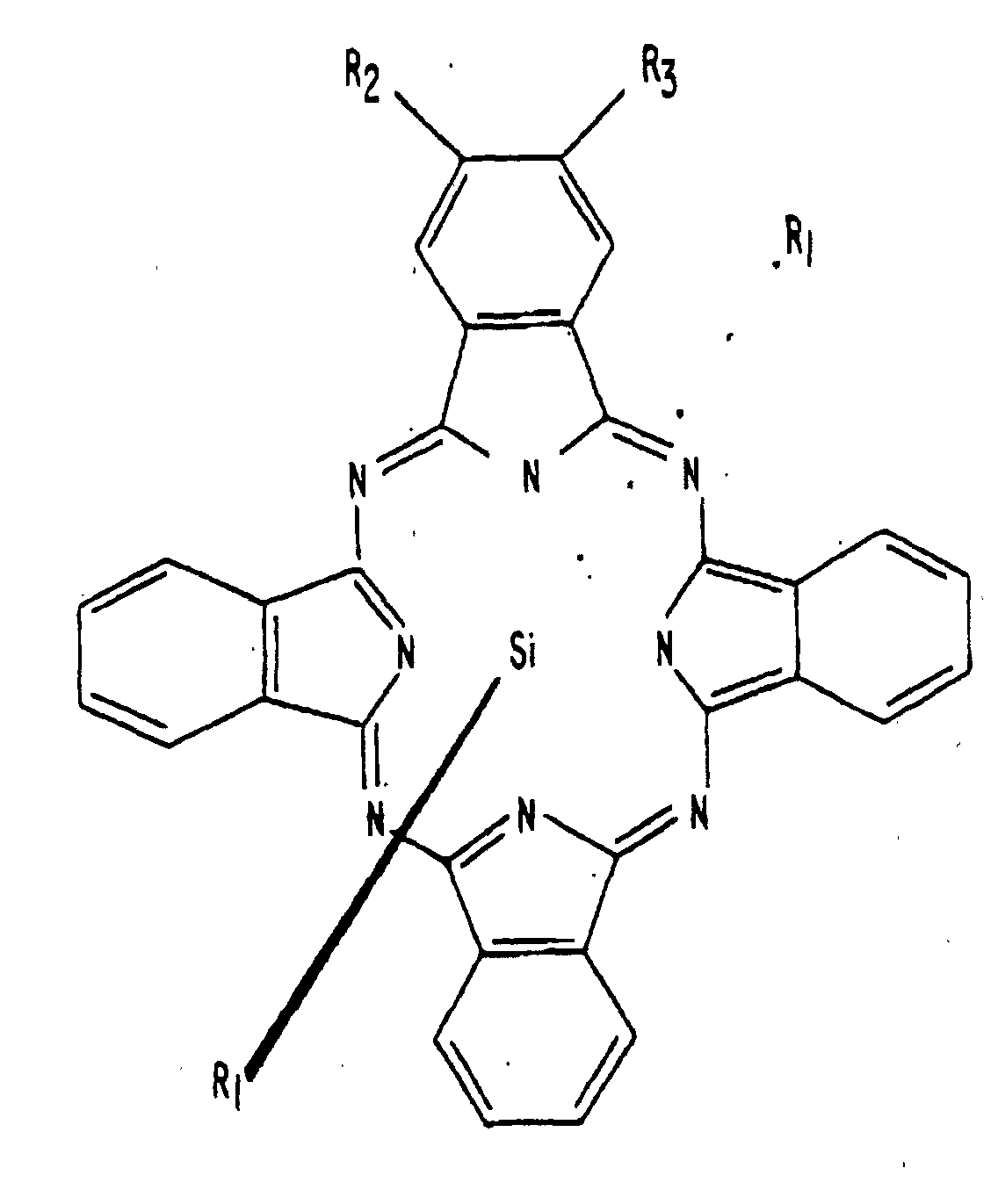
COMPONENT R1 R2•R3 III PEG-Si H VIII PEG-Si COOH 
- A fluorescent probe which comprises a marker component according to any of claims 1 to 17 including the compounds bis[methyldi(methoxy-triethyleneoxy)siloxy]-siliconphthalocyanine, bis[methyl-diisobutoxy-siloxy]-siliconphthalocyanine, bis[hydroxyheptapropyleneoxydimethylsiloxy]silicon naphthalocyanine and bis[hydroxyheptapropyleneoxydimethylsiloxy]silicon tetrachloronaphthalocyanine, being excluded in claim 11, and an analyte, antigen, hapten, or antibody.
- A fluorescent probe according to claim 18 additionally comprising a linker arm wherein said linker arm links said marker component to said analyte, antigen, hapten, or antibody.
- A fluorescent probe which comprises a marker component according to any of claims 1 to 17 linked to one member of a specific binding pair.
- A fluorescent probe according to claim 20, wherein said member of a specific binding pair has at least one sterically tolerant marker component attachment site capable of permitting said probe to form a specific binding pair.
- A fluorescent probe according to claim 20 or 21, wherein said member of a specific binding pair comprises a digoxin derivative.
- A fluorescent probe according to claim 22 which comprises a conjugate of aminodigoxigenin with compound VIII of claim 17.
- The use of a detectably labelled marker component as claimed in any of the claims 1 to 17 including the compounds bis[methyldi(methoxy-triethyleneoxy)siloxy]-siliconphthalocyanine, bis[methyl-diisobutoxy-siloxy]-siliconphthalocyanine, bis[hydroxyheptapropyleneoxydimethylsiloxy]silicon naphthalocyanine and bis[hydroxyheptapropyleneoxydimethylsiloxy]silicon tetrachloronaphthalocyanine, being excluded in claim 11, for detecting an analyte in an aqueous solution.
- The use of a fluorescent probe according to any of claims 18 to 23 for detecting an analyte in aqueous solution.
- The use according to any of claims 24 or 25, wherein said aqueous solution is a biological fluid.
- The use of said marker component according to any of claim 1 to 17 or of said fluorescent probe according to any of claims 18 to 23 in assays selected from the group consisting of immunoassay, fluorescence immunoassay or fluorescence polarization assay.
Applications Claiming Priority (3)
| Application Number | Priority Date | Filing Date | Title |
|---|---|---|---|
| US52360190A | 1990-05-15 | 1990-05-15 | |
| US523601 | 1990-05-15 | ||
| PCT/US1991/003424 WO1991018006A1 (en) | 1990-05-15 | 1991-05-15 | Fluorescent porphyrin, and fluorescent phthalocyanine - polyethylene glycol, polyol, and saccharide derivatives as fluorescent probes |
Publications (3)
| Publication Number | Publication Date |
|---|---|
| EP0529002A1 EP0529002A1 (en) | 1993-03-03 |
| EP0529002A4 EP0529002A4 (en) | 1995-09-13 |
| EP0529002B1 true EP0529002B1 (en) | 2001-10-04 |
Family
ID=24085661
Family Applications (1)
| Application Number | Title | Priority Date | Filing Date |
|---|---|---|---|
| EP91912121A Expired - Lifetime EP0529002B1 (en) | 1990-05-15 | 1991-05-15 | Fluorescent porphyrin, and fluorescent phthalocyanine - polyethylene glycol, polyol, and saccharide derivatives as fluorescent probes |
Country Status (7)
| Country | Link |
|---|---|
| US (1) | US5403928A (en) |
| EP (1) | EP0529002B1 (en) |
| JP (1) | JP3224538B2 (en) |
| AT (1) | ATE206395T1 (en) |
| DE (1) | DE69132750T2 (en) |
| ES (1) | ES2163393T3 (en) |
| WO (1) | WO1991018006A1 (en) |
Cited By (1)
| Publication number | Priority date | Publication date | Assignee | Title |
|---|---|---|---|---|
| CN102757437A (en) * | 2012-06-12 | 2012-10-31 | 中国科学院化学研究所 | Phthalocyanine nano-rod array film and preparation method and application thereof |
Families Citing this family (73)
| Publication number | Priority date | Publication date | Assignee | Title |
|---|---|---|---|---|
| US5648270A (en) * | 1995-02-06 | 1997-07-15 | Molecular Probes, Inc. | Methods of sensing with fluorescent conjugates of metal-chelating nitrogen heterocycles |
| US5880287A (en) * | 1990-05-15 | 1999-03-09 | Hyperion, Inc. | Polyoxyhydrocarbyl related products and methods for fluorescence assays |
| US5641878A (en) * | 1991-05-15 | 1997-06-24 | Diatron Corporation | Porphyrin, azaporphyrin, and related fluorescent dyes free of aggregation and serum binding |
| US5919922A (en) * | 1990-05-15 | 1999-07-06 | Hyperion, Inc. | Fluorescent dyes free of aggregation and serum binding |
| US6060598A (en) * | 1990-05-15 | 2000-05-09 | Hyperion, Inc. | Fluorescence immunoassays using fluorescent dyes free of aggregation and serum binding |
| US5606045A (en) * | 1990-05-15 | 1997-02-25 | Diatron Corporation | Nucleic acid probes and methods |
| US5846703A (en) * | 1990-05-15 | 1998-12-08 | Diatron Corporation | Fluorescence immunoassays using fluorescent dyes free of aggregation and serum binding |
| FR2680787B1 (en) * | 1991-08-30 | 1994-11-04 | Cis Bio Int | MACROCYCLIC RARE EARTH COMPLEXES AND THEIR USE FOR REDUCING INTERFERENCE IN FLUORESCENCE ASSAY. |
| TW235298B (en) * | 1992-02-27 | 1994-12-01 | Ciba Geigy | |
| CA2132708C (en) * | 1992-03-23 | 2005-05-10 | Robert F. Devlin | Fluorescence immunoassays using fluorescent dyes free of aggregation and serum binding |
| US5371199B1 (en) * | 1992-08-14 | 1995-12-26 | Univ Pennsylvania | Substituted porphyrins porphyrin-containing polymers and synthetic methods therefor |
| US5493017A (en) * | 1992-08-14 | 1996-02-20 | The Trustees Of The University Of Pennsylvania | Ring-metalated porphyrins |
| US5599924A (en) * | 1992-08-14 | 1997-02-04 | Trustees Of The University Of Pennsylvania | Electron-deficient porphyrins and processes and intermediates for preparing same |
| US5817830A (en) * | 1992-08-14 | 1998-10-06 | Trustees Of The University Of Pennsylvania | Pyrrolic compounds |
| JP3218770B2 (en) * | 1993-01-14 | 2001-10-15 | 富士ゼロックス株式会社 | Electrophotographic photoreceptor and phthalocyanine pigment and pigment dispersion therefor |
| US6238931B1 (en) * | 1993-09-24 | 2001-05-29 | Biosite Diagnostics, Inc. | Fluorescence energy transfer in particles |
| US7322927B2 (en) | 1993-09-24 | 2008-01-29 | Biosite, Inc. | Hybrid phthalocyanine derivatives and their uses |
| US5824799A (en) * | 1993-09-24 | 1998-10-20 | Biosite Diagnostics Incorporated | Hybrid phthalocyanine derivatives and their uses |
| EP0649667B1 (en) * | 1993-10-20 | 2001-02-28 | Antonella Aprile Carpenter | Quantum energy therapeutic biostimulation apparatus |
| DE4445065A1 (en) * | 1994-12-07 | 1996-06-13 | Diagnostikforschung Inst | Methods for in-vivo diagnostics using NIR radiation |
| US5916481A (en) * | 1995-07-25 | 1999-06-29 | The Procter & Gamble Company | Low hue photobleaches |
| US5679661A (en) * | 1995-07-25 | 1997-10-21 | The Procter & Gamble Company | Low hue photodisinfectants |
| US5763602A (en) * | 1996-10-01 | 1998-06-09 | Li; Ying-Syi | Methods of syntheses of phthalocyanine compounds |
| CA2277820A1 (en) | 1997-01-24 | 1998-07-30 | The Procter & Gamble Company | Photochemical singlet oxygen generators having cationic substantivity modifiers |
| US6413924B2 (en) | 1997-01-24 | 2002-07-02 | Case Western Reserve University | Photobleaching compositions comprising mixed metallocyanines |
| WO1998032832A1 (en) | 1997-01-24 | 1998-07-30 | The Procter & Gamble Company | Low hue photobleaches |
| DE69815064D1 (en) | 1997-01-24 | 2003-07-03 | Univ Case Western Reserve | PHOTO BLEACHING COMPOSITIONS EFFECTING SOILED TISSUE |
| CN1250472A (en) | 1997-01-24 | 2000-04-12 | 普罗格特-甘布尔公司 | Photochemical superoxide generators |
| JP2001511197A (en) | 1997-01-24 | 2001-08-07 | ザ、プロクター、エンド、ギャンブル、カンパニー | Photochemical singlet oxygen generator with improved singlet oxygen yield |
| CA2277819A1 (en) | 1997-01-24 | 1998-07-30 | The Procter & Gamble Company | Singlet oxygen generators having enhanced heavy atom effect |
| US6544797B1 (en) | 1997-04-09 | 2003-04-08 | Biosite Diagnostics, Inc. | Compositions and methods for inhibiting light-induced inactivation of biological reagents |
| US6165741A (en) * | 1997-05-30 | 2000-12-26 | The Trustees Of The University Of Pennsylvania | Method for rapid detection of bacterial growth in cultures |
| US7745142B2 (en) * | 1997-09-15 | 2010-06-29 | Molecular Devices Corporation | Molecular modification assays |
| US7632651B2 (en) * | 1997-09-15 | 2009-12-15 | Mds Analytical Technologies (Us) Inc. | Molecular modification assays |
| US20050227294A1 (en) * | 1997-09-15 | 2005-10-13 | Molecular Devices Corporation | Molecular modification assays involving lipids |
| US7070921B2 (en) | 2000-04-28 | 2006-07-04 | Molecular Devices Corporation | Molecular modification assays |
| US6033918A (en) * | 1997-11-10 | 2000-03-07 | Bayer Corporation | Method and device for the detection of analyte in a fluid sample |
| US5990486A (en) * | 1997-11-21 | 1999-11-23 | University Of Massachusetts | Apparatus and method for measuring components of a solute stream |
| JP4560209B2 (en) * | 1998-04-03 | 2010-10-13 | マリンクロッド・インコーポレイテッド | Non-covalent bioconjugates useful for diagnosis and therapy |
| GB2337523A (en) * | 1998-04-29 | 1999-11-24 | Nycomed Imaging As | Light imaging contrast agents |
| US6083486A (en) * | 1998-05-14 | 2000-07-04 | The General Hospital Corporation | Intramolecularly-quenched near infrared fluorescent probes |
| US6592847B1 (en) * | 1998-05-14 | 2003-07-15 | The General Hospital Corporation | Intramolecularly-quenched near infrared flourescent probes |
| AU765509B2 (en) | 1998-08-28 | 2003-09-18 | Destiny Pharma Limited | Porphyrin derivatives, their use in photodynamic therapy and medical devices containing them |
| US7547721B1 (en) | 1998-09-18 | 2009-06-16 | Bayer Schering Pharma Ag | Near infrared fluorescent contrast agent and fluorescence imaging |
| JP2000095758A (en) | 1998-09-18 | 2000-04-04 | Schering Ag | Near-infrared fluorescent contrast agent and fluorescent contrast method |
| BR9917587A (en) * | 1999-12-15 | 2002-08-06 | Schering Ag | Fluorescent contrast agent near infrared and fluorescence imaging |
| US7383076B2 (en) * | 2000-11-27 | 2008-06-03 | The General Hospital Corporation | Fluorescence-mediated molecular tomography |
| US20030044353A1 (en) * | 2001-01-05 | 2003-03-06 | Ralph Weissleder | Activatable imaging probes |
| EP1412749A4 (en) * | 2001-06-28 | 2006-12-13 | Ia Inc | Fiber-optic sensor array |
| JP5000050B2 (en) | 2001-08-31 | 2012-08-15 | 浩 前田 | Antitumor agent and method for producing the same |
| AU2003225763A1 (en) * | 2002-03-11 | 2003-09-29 | Visen Medical, Inc. | Optical imaging probes |
| US7005518B2 (en) * | 2002-10-25 | 2006-02-28 | Li-Cor, Inc. | Phthalocyanine dyes |
| US7371524B2 (en) * | 2003-06-17 | 2008-05-13 | Hannjorg Hereth | Substituted azaporphyrins as fluorescence labels |
| US20070238921A1 (en) * | 2004-11-01 | 2007-10-11 | Weirich John P | Capsule imaging device using fluorescent light |
| US7601498B2 (en) | 2005-03-17 | 2009-10-13 | Biotium, Inc. | Methods of using dyes in association with nucleic acid staining or detection and associated technology |
| US7776567B2 (en) * | 2005-03-17 | 2010-08-17 | Biotium, Inc. | Dimeric and trimeric nucleic acid dyes, and associated systems and methods |
| CN101203248A (en) * | 2005-06-21 | 2008-06-18 | 马林克罗特公司 | optical imaging contrast agent |
| EP1780213A1 (en) * | 2005-10-27 | 2007-05-02 | 3M Innovative Properties Company | Silicon-urea-azolides, their preparation and use in the preparation of silicones with isocyanate terminal groups |
| WO2007100392A2 (en) | 2005-11-30 | 2007-09-07 | Biotium, Inc. | Enzyme substrate comprising a functional dye and associated technology and methods |
| US20080003694A1 (en) * | 2006-04-18 | 2008-01-03 | Swanson Basil I | Robust, self-assembled, biocompatible films |
| US9193746B2 (en) * | 2006-12-07 | 2015-11-24 | Biotium, Inc. | Luminescent metal complexes and associated technology |
| EP2732826B1 (en) | 2008-01-18 | 2017-11-08 | Visen Medical, Inc. | Fluorescent imaging agents |
| ES2613737T3 (en) * | 2008-02-06 | 2017-05-25 | Barry J. Noar | Method to incorporate compounds in matrices |
| EP2317911B8 (en) | 2008-08-22 | 2019-03-20 | MediBeacon Inc. | Transcutaneous organ function measurement |
| DE102009018688B4 (en) | 2009-04-23 | 2017-03-02 | Knauf Insulation | Mineral wool product |
| US8877437B1 (en) | 2009-12-23 | 2014-11-04 | Biotium, Inc. | Methods of using dyes in association with nucleic acid staining or detection |
| CN102676154B (en) * | 2011-03-11 | 2014-01-29 | 清华大学 | Application of phosphorus phthalocyanine and phosphorus phthalocyanine derivative serving as fluorescence probes |
| CA3051963A1 (en) | 2017-01-30 | 2018-08-02 | Medibeacon Inc. | Method for non-invasive monitoring of fluorescent tracer agent with diffuse reflection corrections |
| AU2021251873A1 (en) | 2020-04-10 | 2022-11-10 | Rakuten Medical, Inc. | Phthalocyanine dye compounds, conjugates and methods of use thereof |
| WO2022216978A1 (en) * | 2021-04-09 | 2022-10-13 | Rakuten Medical, Inc. | Phthalocyanine dye compounds, conjugates and methods of use thereof |
| EP4299761A1 (en) * | 2022-06-30 | 2024-01-03 | betaSENSE GmbH | Surface-functionalized optical element |
| USD1052412S1 (en) | 2023-01-06 | 2024-11-26 | Medibeacon Inc. | Sensor |
| USD1051738S1 (en) | 2023-01-06 | 2024-11-19 | Medibeacon Inc. | Sensor ring |
Family Cites Families (21)
| Publication number | Priority date | Publication date | Assignee | Title |
|---|---|---|---|---|
| US2951797A (en) * | 1957-11-13 | 1960-09-06 | Monsanto Chemicals | Photosensitizers in photoxidation |
| US3116256A (en) * | 1961-08-24 | 1963-12-31 | Lawter Chem Inc | Daylight fluorescent compositions |
| US3287470A (en) * | 1962-07-10 | 1966-11-22 | Geigy Ag J R | Metal phthalocyanine dyestuffs |
| US4104466A (en) * | 1974-03-13 | 1978-08-01 | Eishun Tsuchida | Polymeric metal complex and method of manufacturing the same |
| US4404366A (en) * | 1980-05-06 | 1983-09-13 | Miles Laboratories, Inc. | Beta-galactosyl-umbelliferone-labeled hapten conjugates |
| US4707454A (en) * | 1981-08-10 | 1987-11-17 | Bio-Diagnostics, Inc. | Fluorescent chlorophyll labeled assay reagents |
| EP0127797B1 (en) * | 1983-06-03 | 1987-06-16 | F. HOFFMANN-LA ROCHE & CO. Aktiengesellschaft | Labelled molecules for fluorescence immunoassays and processes and intermediates for their preparation |
| US5059510A (en) * | 1985-02-04 | 1991-10-22 | Hoechst Celanese Corp. | Media for optical information storage comprising an organic macrocyclic chromophore substituted with a film conferring organic substituent |
| US4822733A (en) * | 1985-05-28 | 1989-04-18 | Amoco Corporation | Lifetime-resolved assay procedures |
| US4732570A (en) * | 1985-09-13 | 1988-03-22 | Milliken Research Corporation | Colored thermoplastic resin |
| DE3687399T2 (en) * | 1985-10-23 | 1993-04-29 | Nihon Mediphysics Co Ltd | PORPHYRINE DERIVATIVES, THEIR PRODUCTION AND USE. |
| JPH0645681B2 (en) * | 1986-02-05 | 1994-06-15 | 美浜 久春 | Modified hem |
| JPS62249986A (en) * | 1986-04-21 | 1987-10-30 | Hamari Yakuhin Kogyo Kk | Porphyrin derivative |
| US4877872A (en) * | 1986-06-24 | 1989-10-31 | The University Of Toledo | Production and use of dimers of hematoporophyrin, purpurins, chlorines and purpurin- and chlorin-complexes |
| US4814098A (en) * | 1986-09-06 | 1989-03-21 | Bellex Corporation | Magnetic material-physiologically active substance conjugate |
| US5135717A (en) * | 1986-12-24 | 1992-08-04 | British Technology Group Usa Inc. | Tetrabenztriazaporphyrin reagents and kits containing the same |
| JPH07100714B2 (en) * | 1987-03-03 | 1995-11-01 | 株式会社三和化学研究所 | Lampeloflavin and its manufacturing method |
| JPH0778180B2 (en) * | 1987-04-22 | 1995-08-23 | 東洋インキ製造株式会社 | Pigment composition |
| DE3809671A1 (en) * | 1988-03-18 | 1989-09-28 | Schering Ag | PORPHYRINE COMPLEX COMPOUNDS, METHOD FOR THE PRODUCTION THEREOF AND PHARMACEUTICAL AGENTS CONTAINING THEM |
| US5177200A (en) * | 1989-05-19 | 1993-01-05 | Milliken Research Corporation | Poly(oxyalkylene) modified phthalocyanine colorants |
| US5053423A (en) * | 1990-03-22 | 1991-10-01 | Quadra Logic Technologies Inc. | Compositions for photodynamic therapy |
-
1991
- 1991-05-15 EP EP91912121A patent/EP0529002B1/en not_active Expired - Lifetime
- 1991-05-15 US US07/701,449 patent/US5403928A/en not_active Expired - Lifetime
- 1991-05-15 JP JP51118091A patent/JP3224538B2/en not_active Expired - Fee Related
- 1991-05-15 ES ES91912121T patent/ES2163393T3/en not_active Expired - Lifetime
- 1991-05-15 DE DE69132750T patent/DE69132750T2/en not_active Expired - Fee Related
- 1991-05-15 AT AT91912121T patent/ATE206395T1/en not_active IP Right Cessation
- 1991-05-15 WO PCT/US1991/003424 patent/WO1991018006A1/en not_active Ceased
Cited By (2)
| Publication number | Priority date | Publication date | Assignee | Title |
|---|---|---|---|---|
| CN102757437A (en) * | 2012-06-12 | 2012-10-31 | 中国科学院化学研究所 | Phthalocyanine nano-rod array film and preparation method and application thereof |
| CN102757437B (en) * | 2012-06-12 | 2014-10-15 | 中国科学院化学研究所 | Phthalocyanine nano-rod array film and preparation method and application thereof |
Also Published As
| Publication number | Publication date |
|---|---|
| EP0529002A1 (en) | 1993-03-03 |
| JPH05508015A (en) | 1993-11-11 |
| ATE206395T1 (en) | 2001-10-15 |
| WO1991018006A1 (en) | 1991-11-28 |
| JP3224538B2 (en) | 2001-10-29 |
| DE69132750D1 (en) | 2001-11-08 |
| EP0529002A4 (en) | 1995-09-13 |
| ES2163393T3 (en) | 2002-02-01 |
| US5403928A (en) | 1995-04-04 |
| DE69132750T2 (en) | 2002-06-20 |
Similar Documents
| Publication | Publication Date | Title |
|---|---|---|
| US5403928A (en) | Fluorescent marker components and fluorescent probes | |
| US5677199A (en) | Fluorescent marker components and fluorescent probes | |
| US5641878A (en) | Porphyrin, azaporphyrin, and related fluorescent dyes free of aggregation and serum binding | |
| EP0528991B1 (en) | Detectably labelled marker component comprising a fluorophore moiety , fluorescent probe comprising the marker component and uses thereof. | |
| CA2223418C (en) | Polyoxyhydrocarbyl related products and methods for fluorescence assays | |
| JP4195200B2 (en) | Porphyrin compounds, their conjugates and assay methods based on the use of said conjugates | |
| US5494793A (en) | Monomeric phthalocyanine reagents | |
| JP2866419B2 (en) | Rare earth cryptate, its production method, its synthetic intermediate and its use as a fluorescent tracer | |
| EP0335902B1 (en) | Monomeric phthalocyanine reagents | |
| US5631364A (en) | Labelled boronic acid derivatives | |
| US6060598A (en) | Fluorescence immunoassays using fluorescent dyes free of aggregation and serum binding | |
| JP2002529466A5 (en) | ||
| US20090029349A1 (en) | Novel Applications of Acridinium Compounds and Derivatives in Homogeneous Assays | |
| US6277984B1 (en) | Monomethine cyanines rigidized by a two-carbon chain | |
| US5846703A (en) | Fluorescence immunoassays using fluorescent dyes free of aggregation and serum binding | |
| EP1104761B1 (en) | Fluorescent labelling reagents | |
| US7371524B2 (en) | Substituted azaporphyrins as fluorescence labels | |
| CN116134044B (en) | Compounds and labeled biological substances using these compounds | |
| EP0632893A1 (en) | Fluorescence immunoassays using fluorescent dyes free of aggregation and serum binding | |
| US5919922A (en) | Fluorescent dyes free of aggregation and serum binding | |
| WO2000031187A9 (en) | Water soluble fluorescent dyes free of aggregation and serum binding and related products and methods |
Legal Events
| Date | Code | Title | Description |
|---|---|---|---|
| PUAI | Public reference made under article 153(3) epc to a published international application that has entered the european phase |
Free format text: ORIGINAL CODE: 0009012 |
|
| 17P | Request for examination filed |
Effective date: 19921116 |
|
| AK | Designated contracting states |
Kind code of ref document: A1 Designated state(s): AT BE CH DE DK ES FR GB GR IT LI LU NL SE |
|
| A4 | Supplementary search report drawn up and despatched | ||
| AK | Designated contracting states |
Kind code of ref document: A4 Designated state(s): AT BE CH DE DK ES FR GB GR IT LI LU NL SE |
|
| 17Q | First examination report despatched |
Effective date: 19961018 |
|
| GRAG | Despatch of communication of intention to grant |
Free format text: ORIGINAL CODE: EPIDOS AGRA |
|
| RIC1 | Information provided on ipc code assigned before grant |
Free format text: 7C 07D 209/56 A, 7C 07D 487/22 B, 7C 07H 23/00 B, 7C 07J 51/00 B, 7C 09B 47/08 B, 7G 01N 33/533 B, 7A 61K 47/48 B, 7A 61K 49/00 B |
|
| GRAG | Despatch of communication of intention to grant |
Free format text: ORIGINAL CODE: EPIDOS AGRA |
|
| GRAH | Despatch of communication of intention to grant a patent |
Free format text: ORIGINAL CODE: EPIDOS IGRA |
|
| GRAH | Despatch of communication of intention to grant a patent |
Free format text: ORIGINAL CODE: EPIDOS IGRA |
|
| GRAA | (expected) grant |
Free format text: ORIGINAL CODE: 0009210 |
|
| AK | Designated contracting states |
Kind code of ref document: B1 Designated state(s): AT BE CH DE DK ES FR GB GR IT LI LU NL SE |
|
| PG25 | Lapsed in a contracting state [announced via postgrant information from national office to epo] |
Ref country code: CH Free format text: LAPSE BECAUSE OF FAILURE TO SUBMIT A TRANSLATION OF THE DESCRIPTION OR TO PAY THE FEE WITHIN THE PRESCRIBED TIME-LIMIT Effective date: 20011004 Ref country code: LI Free format text: LAPSE BECAUSE OF FAILURE TO SUBMIT A TRANSLATION OF THE DESCRIPTION OR TO PAY THE FEE WITHIN THE PRESCRIBED TIME-LIMIT Effective date: 20011004 Ref country code: AT Free format text: LAPSE BECAUSE OF FAILURE TO SUBMIT A TRANSLATION OF THE DESCRIPTION OR TO PAY THE FEE WITHIN THE PRESCRIBED TIME-LIMIT Effective date: 20011004 Ref country code: NL Free format text: LAPSE BECAUSE OF FAILURE TO SUBMIT A TRANSLATION OF THE DESCRIPTION OR TO PAY THE FEE WITHIN THE PRESCRIBED TIME-LIMIT Effective date: 20011004 Ref country code: BE Free format text: LAPSE BECAUSE OF FAILURE TO SUBMIT A TRANSLATION OF THE DESCRIPTION OR TO PAY THE FEE WITHIN THE PRESCRIBED TIME-LIMIT Effective date: 20011004 |
|
| RAP1 | Party data changed (applicant data changed or rights of an application transferred) |
Owner name: HYPERION, INC. |
|
| REF | Corresponds to: |
Ref document number: 206395 Country of ref document: AT Date of ref document: 20011015 Kind code of ref document: T |
|
| REG | Reference to a national code |
Ref country code: CH Ref legal event code: EP |
|
| REF | Corresponds to: |
Ref document number: 69132750 Country of ref document: DE Date of ref document: 20011108 |
|
| ET | Fr: translation filed | ||
| REG | Reference to a national code |
Ref country code: GB Ref legal event code: IF02 |
|
| PG25 | Lapsed in a contracting state [announced via postgrant information from national office to epo] |
Ref country code: SE Free format text: LAPSE BECAUSE OF FAILURE TO SUBMIT A TRANSLATION OF THE DESCRIPTION OR TO PAY THE FEE WITHIN THE PRESCRIBED TIME-LIMIT Effective date: 20020104 Ref country code: DK Free format text: LAPSE BECAUSE OF FAILURE TO SUBMIT A TRANSLATION OF THE DESCRIPTION OR TO PAY THE FEE WITHIN THE PRESCRIBED TIME-LIMIT Effective date: 20020104 |
|
| PG25 | Lapsed in a contracting state [announced via postgrant information from national office to epo] |
Ref country code: GR Free format text: LAPSE BECAUSE OF FAILURE TO SUBMIT A TRANSLATION OF THE DESCRIPTION OR TO PAY THE FEE WITHIN THE PRESCRIBED TIME-LIMIT Effective date: 20020105 |
|
| REG | Reference to a national code |
Ref country code: ES Ref legal event code: FG2A Ref document number: 2163393 Country of ref document: ES Kind code of ref document: T3 |
|
| NLV1 | Nl: lapsed or annulled due to failure to fulfill the requirements of art. 29p and 29m of the patents act | ||
| REG | Reference to a national code |
Ref country code: CH Ref legal event code: PL |
|
| PG25 | Lapsed in a contracting state [announced via postgrant information from national office to epo] |
Ref country code: LU Free format text: LAPSE BECAUSE OF NON-PAYMENT OF DUE FEES Effective date: 20020515 |
|
| PLBE | No opposition filed within time limit |
Free format text: ORIGINAL CODE: 0009261 |
|
| STAA | Information on the status of an ep patent application or granted ep patent |
Free format text: STATUS: NO OPPOSITION FILED WITHIN TIME LIMIT |
|
| 26N | No opposition filed | ||
| PGFP | Annual fee paid to national office [announced via postgrant information from national office to epo] |
Ref country code: ES Payment date: 20090526 Year of fee payment: 19 |
|
| PGFP | Annual fee paid to national office [announced via postgrant information from national office to epo] |
Ref country code: IT Payment date: 20090528 Year of fee payment: 19 Ref country code: FR Payment date: 20090518 Year of fee payment: 19 Ref country code: DE Payment date: 20090528 Year of fee payment: 19 |
|
| PGFP | Annual fee paid to national office [announced via postgrant information from national office to epo] |
Ref country code: GB Payment date: 20090528 Year of fee payment: 19 |
|
| GBPC | Gb: european patent ceased through non-payment of renewal fee |
Effective date: 20100515 |
|
| REG | Reference to a national code |
Ref country code: FR Ref legal event code: ST Effective date: 20110131 |
|
| PG25 | Lapsed in a contracting state [announced via postgrant information from national office to epo] |
Ref country code: IT Free format text: LAPSE BECAUSE OF NON-PAYMENT OF DUE FEES Effective date: 20100515 |
|
| PG25 | Lapsed in a contracting state [announced via postgrant information from national office to epo] |
Ref country code: DE Free format text: LAPSE BECAUSE OF NON-PAYMENT OF DUE FEES Effective date: 20101201 |
|
| PG25 | Lapsed in a contracting state [announced via postgrant information from national office to epo] |
Ref country code: FR Free format text: LAPSE BECAUSE OF NON-PAYMENT OF DUE FEES Effective date: 20100531 |
|
| REG | Reference to a national code |
Ref country code: ES Ref legal event code: FD2A Effective date: 20110707 |
|
| PG25 | Lapsed in a contracting state [announced via postgrant information from national office to epo] |
Ref country code: ES Free format text: LAPSE BECAUSE OF NON-PAYMENT OF DUE FEES Effective date: 20110627 Ref country code: GB Free format text: LAPSE BECAUSE OF NON-PAYMENT OF DUE FEES Effective date: 20100515 |
|
| PG25 | Lapsed in a contracting state [announced via postgrant information from national office to epo] |
Ref country code: ES Free format text: LAPSE BECAUSE OF NON-PAYMENT OF DUE FEES Effective date: 20100516 |