EP0528854B1 - Fluorogenic peptides and their use in the determination of enzymatic activities - Google Patents
Fluorogenic peptides and their use in the determination of enzymatic activities Download PDFInfo
- Publication number
- EP0528854B1 EP0528854B1 EP91908699A EP91908699A EP0528854B1 EP 0528854 B1 EP0528854 B1 EP 0528854B1 EP 91908699 A EP91908699 A EP 91908699A EP 91908699 A EP91908699 A EP 91908699A EP 0528854 B1 EP0528854 B1 EP 0528854B1
- Authority
- EP
- European Patent Office
- Prior art keywords
- peptide
- amino acid
- residue
- group
- abz
- Prior art date
- Legal status (The legal status is an assumption and is not a legal conclusion. Google has not performed a legal analysis and makes no representation as to the accuracy of the status listed.)
- Expired - Lifetime
Links
- 108090000765 processed proteins & peptides Proteins 0.000 title claims abstract description 86
- 102000004196 processed proteins & peptides Human genes 0.000 title claims abstract description 42
- 230000002255 enzymatic effect Effects 0.000 title claims abstract description 12
- 239000000758 substrate Substances 0.000 claims abstract description 41
- 238000010791 quenching Methods 0.000 claims abstract description 33
- 230000000171 quenching effect Effects 0.000 claims abstract description 32
- -1 anthraniloyl Chemical group 0.000 claims abstract description 30
- 150000001413 amino acids Chemical class 0.000 claims abstract description 29
- 125000000539 amino acid group Chemical group 0.000 claims abstract description 21
- 125000000449 nitro group Chemical group [O-][N+](*)=O 0.000 claims abstract description 11
- 239000007790 solid phase Substances 0.000 claims abstract description 9
- 210000004899 c-terminal region Anatomy 0.000 claims abstract description 7
- 229910052736 halogen Inorganic materials 0.000 claims abstract description 6
- 150000002367 halogens Chemical group 0.000 claims abstract description 6
- 125000006239 protecting group Chemical group 0.000 claims abstract description 6
- 125000000217 alkyl group Chemical group 0.000 claims abstract description 5
- 230000001747 exhibiting effect Effects 0.000 claims abstract description 5
- 125000003545 alkoxy group Chemical group 0.000 claims abstract description 4
- 125000003710 aryl alkyl group Chemical group 0.000 claims abstract description 4
- 125000003368 amide group Chemical group 0.000 claims abstract description 3
- 230000002349 favourable effect Effects 0.000 claims abstract description 3
- 229910052739 hydrogen Inorganic materials 0.000 claims abstract description 3
- 239000001257 hydrogen Substances 0.000 claims abstract description 3
- 238000011534 incubation Methods 0.000 claims abstract description 3
- 125000004356 hydroxy functional group Chemical group O* 0.000 claims abstract 4
- 150000002431 hydrogen Chemical group 0.000 claims abstract 2
- 238000000034 method Methods 0.000 claims description 13
- 238000002165 resonance energy transfer Methods 0.000 claims description 7
- 230000008569 process Effects 0.000 claims description 5
- 238000001514 detection method Methods 0.000 claims description 3
- 150000002772 monosaccharides Chemical class 0.000 claims description 3
- 150000002482 oligosaccharides Chemical class 0.000 claims description 3
- 238000000862 absorption spectrum Methods 0.000 claims description 2
- 238000000295 emission spectrum Methods 0.000 claims description 2
- 229920001542 oligosaccharide Polymers 0.000 claims description 2
- 125000001433 C-terminal amino-acid group Chemical group 0.000 claims 1
- FBTSQILOGYXGMD-LURJTMIESA-N 3-nitro-L-tyrosine Chemical group OC(=O)[C@@H](N)CC1=CC=C(O)C([N+]([O-])=O)=C1 FBTSQILOGYXGMD-LURJTMIESA-N 0.000 abstract description 14
- 238000010521 absorption reaction Methods 0.000 abstract description 5
- 125000003118 aryl group Chemical group 0.000 abstract description 3
- 125000002924 primary amino group Chemical group [H]N([H])* 0.000 abstract description 3
- 238000010532 solid phase synthesis reaction Methods 0.000 abstract description 3
- ZMXDDKWLCZADIW-UHFFFAOYSA-N N,N-dimethylformamide Substances CN(C)C=O ZMXDDKWLCZADIW-UHFFFAOYSA-N 0.000 description 42
- 229940024606 amino acid Drugs 0.000 description 36
- 235000001014 amino acid Nutrition 0.000 description 35
- 102000004190 Enzymes Human genes 0.000 description 22
- 108090000790 Enzymes Proteins 0.000 description 22
- 229940088598 enzyme Drugs 0.000 description 22
- RTZKZFJDLAIYFH-UHFFFAOYSA-N Diethyl ether Chemical compound CCOCC RTZKZFJDLAIYFH-UHFFFAOYSA-N 0.000 description 18
- 239000000370 acceptor Substances 0.000 description 16
- YMWUJEATGCHHMB-UHFFFAOYSA-N Dichloromethane Chemical compound ClCCl YMWUJEATGCHHMB-UHFFFAOYSA-N 0.000 description 12
- RWZYAGGXGHYGMB-UHFFFAOYSA-N anthranilic acid Chemical compound NC1=CC=CC=C1C(O)=O RWZYAGGXGHYGMB-UHFFFAOYSA-N 0.000 description 12
- 150000001875 compounds Chemical class 0.000 description 12
- 230000007062 hydrolysis Effects 0.000 description 11
- 238000006460 hydrolysis reaction Methods 0.000 description 11
- 239000011347 resin Substances 0.000 description 11
- 229920005989 resin Polymers 0.000 description 11
- NQRYJNQNLNOLGT-UHFFFAOYSA-N Piperidine Chemical compound C1CCNCC1 NQRYJNQNLNOLGT-UHFFFAOYSA-N 0.000 description 10
- 238000003776 cleavage reaction Methods 0.000 description 10
- 125000001295 dansyl group Chemical group [H]C1=C([H])C(N(C([H])([H])[H])C([H])([H])[H])=C2C([H])=C([H])C([H])=C(C2=C1[H])S(*)(=O)=O 0.000 description 10
- 230000007017 scission Effects 0.000 description 10
- XEKOWRVHYACXOJ-UHFFFAOYSA-N Ethyl acetate Chemical compound CCOC(C)=O XEKOWRVHYACXOJ-UHFFFAOYSA-N 0.000 description 9
- 230000015572 biosynthetic process Effects 0.000 description 9
- 239000000243 solution Substances 0.000 description 9
- 238000003786 synthesis reaction Methods 0.000 description 9
- 238000012546 transfer Methods 0.000 description 9
- 102000035195 Peptidases Human genes 0.000 description 8
- 108091005804 Peptidases Proteins 0.000 description 8
- 238000004128 high performance liquid chromatography Methods 0.000 description 8
- 239000000047 product Substances 0.000 description 8
- QOSSAOTZNIDXMA-UHFFFAOYSA-N Dicylcohexylcarbodiimide Chemical compound C1CCCCC1N=C=NC1CCCCC1 QOSSAOTZNIDXMA-UHFFFAOYSA-N 0.000 description 7
- 108010056079 Subtilisins Proteins 0.000 description 7
- 102000005158 Subtilisins Human genes 0.000 description 7
- WYURNTSHIVDZCO-UHFFFAOYSA-N Tetrahydrofuran Chemical compound C1CCOC1 WYURNTSHIVDZCO-UHFFFAOYSA-N 0.000 description 7
- 238000006243 chemical reaction Methods 0.000 description 7
- 238000001914 filtration Methods 0.000 description 7
- 239000000203 mixture Substances 0.000 description 7
- PXBFMLJZNCDSMP-UHFFFAOYSA-N 2-Aminobenzamide Chemical compound NC(=O)C1=CC=CC=C1N PXBFMLJZNCDSMP-UHFFFAOYSA-N 0.000 description 6
- DHMQDGOQFOQNFH-UHFFFAOYSA-N Glycine Natural products NCC(O)=O DHMQDGOQFOQNFH-UHFFFAOYSA-N 0.000 description 6
- 239000004365 Protease Substances 0.000 description 6
- HEDRZPFGACZZDS-MICDWDOJSA-N Trichloro(2H)methane Chemical compound [2H]C(Cl)(Cl)Cl HEDRZPFGACZZDS-MICDWDOJSA-N 0.000 description 6
- ZMANZCXQSJIPKH-UHFFFAOYSA-N Triethylamine Chemical compound CCN(CC)CC ZMANZCXQSJIPKH-UHFFFAOYSA-N 0.000 description 6
- 125000003295 alanine group Chemical group N[C@@H](C)C(=O)* 0.000 description 6
- 150000002148 esters Chemical class 0.000 description 6
- 239000007850 fluorescent dye Substances 0.000 description 6
- 238000010647 peptide synthesis reaction Methods 0.000 description 6
- DTQVDTLACAAQTR-UHFFFAOYSA-N trifluoroacetic acid Substances OC(=O)C(F)(F)F DTQVDTLACAAQTR-UHFFFAOYSA-N 0.000 description 6
- XLYOFNOQVPJJNP-UHFFFAOYSA-N water Substances O XLYOFNOQVPJJNP-UHFFFAOYSA-N 0.000 description 6
- OUYCCCASQSFEME-QMMMGPOBSA-N L-tyrosine Chemical class OC(=O)[C@@H](N)CC1=CC=C(O)C=C1 OUYCCCASQSFEME-QMMMGPOBSA-N 0.000 description 5
- 239000002253 acid Substances 0.000 description 5
- 125000003277 amino group Chemical group 0.000 description 5
- 230000005284 excitation Effects 0.000 description 5
- 230000003993 interaction Effects 0.000 description 5
- 230000003595 spectral effect Effects 0.000 description 5
- RYHBNJHYFVUHQT-UHFFFAOYSA-N 1,4-Dioxane Chemical compound C1COCCO1 RYHBNJHYFVUHQT-UHFFFAOYSA-N 0.000 description 4
- 238000005160 1H NMR spectroscopy Methods 0.000 description 4
- BYGHHEDJDSLEKK-UHFFFAOYSA-N 2-[(2-methylpropan-2-yl)oxycarbonylamino]benzoic acid Chemical compound CC(C)(C)OC(=O)NC1=CC=CC=C1C(O)=O BYGHHEDJDSLEKK-UHFFFAOYSA-N 0.000 description 4
- WCKQPPQRFNHPRJ-UHFFFAOYSA-N 4-[[4-(dimethylamino)phenyl]diazenyl]benzoic acid Chemical compound C1=CC(N(C)C)=CC=C1N=NC1=CC=C(C(O)=O)C=C1 WCKQPPQRFNHPRJ-UHFFFAOYSA-N 0.000 description 4
- CKLJMWTZIZZHCS-REOHCLBHSA-N L-aspartic acid Chemical compound OC(=O)[C@@H](N)CC(O)=O CKLJMWTZIZZHCS-REOHCLBHSA-N 0.000 description 4
- COLNVLDHVKWLRT-QMMMGPOBSA-N L-phenylalanine Chemical compound OC(=O)[C@@H](N)CC1=CC=CC=C1 COLNVLDHVKWLRT-QMMMGPOBSA-N 0.000 description 4
- QIVBCDIJIAJPQS-VIFPVBQESA-N L-tryptophane Chemical compound C1=CC=C2C(C[C@H](N)C(O)=O)=CNC2=C1 QIVBCDIJIAJPQS-VIFPVBQESA-N 0.000 description 4
- KDXKERNSBIXSRK-UHFFFAOYSA-N Lysine Natural products NCCCCC(N)C(O)=O KDXKERNSBIXSRK-UHFFFAOYSA-N 0.000 description 4
- CDBYLPFSWZWCQE-UHFFFAOYSA-L Sodium Carbonate Chemical compound [Na+].[Na+].[O-]C([O-])=O CDBYLPFSWZWCQE-UHFFFAOYSA-L 0.000 description 4
- QIVBCDIJIAJPQS-UHFFFAOYSA-N Tryptophan Natural products C1=CC=C2C(CC(N)C(O)=O)=CNC2=C1 QIVBCDIJIAJPQS-UHFFFAOYSA-N 0.000 description 4
- 125000003275 alpha amino acid group Chemical group 0.000 description 4
- 235000019439 ethyl acetate Nutrition 0.000 description 4
- BTCSSZJGUNDROE-UHFFFAOYSA-N gamma-aminobutyric acid Chemical compound NCCCC(O)=O BTCSSZJGUNDROE-UHFFFAOYSA-N 0.000 description 4
- 239000002904 solvent Substances 0.000 description 4
- DYHSDKLCOJIUFX-UHFFFAOYSA-N tert-butoxycarbonyl anhydride Chemical compound CC(C)(C)OC(=O)OC(=O)OC(C)(C)C DYHSDKLCOJIUFX-UHFFFAOYSA-N 0.000 description 4
- 125000003088 (fluoren-9-ylmethoxy)carbonyl group Chemical group 0.000 description 3
- SJQRQOKXQKVJGJ-UHFFFAOYSA-N 5-(2-aminoethylamino)naphthalene-1-sulfonic acid Chemical compound C1=CC=C2C(NCCN)=CC=CC2=C1S(O)(=O)=O SJQRQOKXQKVJGJ-UHFFFAOYSA-N 0.000 description 3
- WEVYAHXRMPXWCK-UHFFFAOYSA-N Acetonitrile Chemical compound CC#N WEVYAHXRMPXWCK-UHFFFAOYSA-N 0.000 description 3
- LFQSCWFLJHTTHZ-UHFFFAOYSA-N Ethanol Chemical compound CCO LFQSCWFLJHTTHZ-UHFFFAOYSA-N 0.000 description 3
- 239000012317 TBTU Substances 0.000 description 3
- 150000007513 acids Chemical class 0.000 description 3
- 230000010933 acylation Effects 0.000 description 3
- 238000005917 acylation reaction Methods 0.000 description 3
- 125000003178 carboxy group Chemical group [H]OC(*)=O 0.000 description 3
- 230000008859 change Effects 0.000 description 3
- KRKNYBCHXYNGOX-UHFFFAOYSA-N citric acid Chemical compound OC(=O)CC(O)(C(O)=O)CC(O)=O KRKNYBCHXYNGOX-UHFFFAOYSA-N 0.000 description 3
- 229960003692 gamma aminobutyric acid Drugs 0.000 description 3
- 125000002887 hydroxy group Chemical group [H]O* 0.000 description 3
- 239000003208 petroleum Substances 0.000 description 3
- 239000002243 precursor Substances 0.000 description 3
- 239000000523 sample Substances 0.000 description 3
- 238000012216 screening Methods 0.000 description 3
- SWZCTMTWRHEBIN-QFIPXVFZSA-N (2s)-2-(9h-fluoren-9-ylmethoxycarbonylamino)-3-(4-hydroxyphenyl)propanoic acid Chemical compound C([C@@H](C(=O)O)NC(=O)OCC1C2=CC=CC=C2C2=CC=CC=C21)C1=CC=C(O)C=C1 SWZCTMTWRHEBIN-QFIPXVFZSA-N 0.000 description 2
- FUOOLUPWFVMBKG-UHFFFAOYSA-N 2-Aminoisobutyric acid Chemical compound CC(C)(N)C(O)=O FUOOLUPWFVMBKG-UHFFFAOYSA-N 0.000 description 2
- NDTIGNQNVGDTPE-UHFFFAOYSA-N 3-(2-aminoethyl)pyridin-2-amine Chemical compound NCCC1=CC=CN=C1N NDTIGNQNVGDTPE-UHFFFAOYSA-N 0.000 description 2
- JVVRCYWZTJLJSG-UHFFFAOYSA-N 4-dimethylaminophenol Chemical compound CN(C)C1=CC=C(O)C=C1 JVVRCYWZTJLJSG-UHFFFAOYSA-N 0.000 description 2
- 229960000549 4-dimethylaminophenol Drugs 0.000 description 2
- VHYFNPMBLIVWCW-UHFFFAOYSA-N 4-dimethylaminopyridine Substances CN(C)C1=CC=NC=C1 VHYFNPMBLIVWCW-UHFFFAOYSA-N 0.000 description 2
- WHUUTDBJXJRKMK-UHFFFAOYSA-N Glutamic acid Natural products OC(=O)C(N)CCC(O)=O WHUUTDBJXJRKMK-UHFFFAOYSA-N 0.000 description 2
- 239000004471 Glycine Substances 0.000 description 2
- 241000713772 Human immunodeficiency virus 1 Species 0.000 description 2
- 238000004566 IR spectroscopy Methods 0.000 description 2
- DCXYFEDJOCDNAF-REOHCLBHSA-N L-asparagine Chemical compound OC(=O)[C@@H](N)CC(N)=O DCXYFEDJOCDNAF-REOHCLBHSA-N 0.000 description 2
- UKAUYVFTDYCKQA-VKHMYHEASA-N L-homoserine Chemical compound OC(=O)[C@@H](N)CCO UKAUYVFTDYCKQA-VKHMYHEASA-N 0.000 description 2
- ROHFNLRQFUQHCH-YFKPBYRVSA-N L-leucine Chemical compound CC(C)C[C@H](N)C(O)=O ROHFNLRQFUQHCH-YFKPBYRVSA-N 0.000 description 2
- SNDPXSYFESPGGJ-UHFFFAOYSA-N L-norVal-OH Natural products CCCC(N)C(O)=O SNDPXSYFESPGGJ-UHFFFAOYSA-N 0.000 description 2
- JGFZNNIVVJXRND-UHFFFAOYSA-N N,N-Diisopropylethylamine (DIPEA) Chemical compound CCN(C(C)C)C(C)C JGFZNNIVVJXRND-UHFFFAOYSA-N 0.000 description 2
- FSVCELGFZIQNCK-UHFFFAOYSA-N N,N-bis(2-hydroxyethyl)glycine Chemical compound OCCN(CCO)CC(O)=O FSVCELGFZIQNCK-UHFFFAOYSA-N 0.000 description 2
- 125000001429 N-terminal alpha-amino-acid group Chemical group 0.000 description 2
- 102000004142 Trypsin Human genes 0.000 description 2
- 108090000631 Trypsin Proteins 0.000 description 2
- KZSNJWFQEVHDMF-UHFFFAOYSA-N Valine Natural products CC(C)C(N)C(O)=O KZSNJWFQEVHDMF-UHFFFAOYSA-N 0.000 description 2
- CLZISMQKJZCZDN-UHFFFAOYSA-N [benzotriazol-1-yloxy(dimethylamino)methylidene]-dimethylazanium Chemical compound C1=CC=C2N(OC(N(C)C)=[N+](C)C)N=NC2=C1 CLZISMQKJZCZDN-UHFFFAOYSA-N 0.000 description 2
- 238000002835 absorbance Methods 0.000 description 2
- 150000001408 amides Chemical class 0.000 description 2
- MWPLVEDNUUSJAV-UHFFFAOYSA-N anthracene Chemical compound C1=CC=CC2=CC3=CC=CC=C3C=C21 MWPLVEDNUUSJAV-UHFFFAOYSA-N 0.000 description 2
- 235000003704 aspartic acid Nutrition 0.000 description 2
- 230000008901 benefit Effects 0.000 description 2
- WPYMKLBDIGXBTP-UHFFFAOYSA-N benzoic acid Chemical compound OC(=O)C1=CC=CC=C1 WPYMKLBDIGXBTP-UHFFFAOYSA-N 0.000 description 2
- UCMIRNVEIXFBKS-UHFFFAOYSA-N beta-alanine Chemical compound NCCC(O)=O UCMIRNVEIXFBKS-UHFFFAOYSA-N 0.000 description 2
- OQFSQFPPLPISGP-UHFFFAOYSA-N beta-carboxyaspartic acid Natural products OC(=O)C(N)C(C(O)=O)C(O)=O OQFSQFPPLPISGP-UHFFFAOYSA-N 0.000 description 2
- 239000007998 bicine buffer Substances 0.000 description 2
- 239000000872 buffer Substances 0.000 description 2
- 239000003153 chemical reaction reagent Substances 0.000 description 2
- 229940125773 compound 10 Drugs 0.000 description 2
- 238000005859 coupling reaction Methods 0.000 description 2
- 230000007423 decrease Effects 0.000 description 2
- 230000003247 decreasing effect Effects 0.000 description 2
- 230000007071 enzymatic hydrolysis Effects 0.000 description 2
- 238000006047 enzymatic hydrolysis reaction Methods 0.000 description 2
- 229940093499 ethyl acetate Drugs 0.000 description 2
- 238000002474 experimental method Methods 0.000 description 2
- 239000007789 gas Substances 0.000 description 2
- 125000002349 hydroxyamino group Chemical group [H]ON([H])[*] 0.000 description 2
- 238000010348 incorporation Methods 0.000 description 2
- ZLVXBBHTMQJRSX-VMGNSXQWSA-N jdtic Chemical compound C1([C@]2(C)CCN(C[C@@H]2C)C[C@H](C(C)C)NC(=O)[C@@H]2NCC3=CC(O)=CC=C3C2)=CC=CC(O)=C1 ZLVXBBHTMQJRSX-VMGNSXQWSA-N 0.000 description 2
- BDAGIHXWWSANSR-UHFFFAOYSA-N methanoic acid Natural products OC=O BDAGIHXWWSANSR-UHFFFAOYSA-N 0.000 description 2
- VWKNUUOGGLNRNZ-UHFFFAOYSA-N methylbimane Chemical group CC1=C(C)C(=O)N2N1C(C)=C(C)C2=O VWKNUUOGGLNRNZ-UHFFFAOYSA-N 0.000 description 2
- 125000001624 naphthyl group Chemical group 0.000 description 2
- 229940024999 proteolytic enzymes for treatment of wounds and ulcers Drugs 0.000 description 2
- 238000006862 quantum yield reaction Methods 0.000 description 2
- 230000009257 reactivity Effects 0.000 description 2
- 238000000926 separation method Methods 0.000 description 2
- UQDJGEHQDNVPGU-UHFFFAOYSA-N serine phosphoethanolamine Chemical compound [NH3+]CCOP([O-])(=O)OCC([NH3+])C([O-])=O UQDJGEHQDNVPGU-UHFFFAOYSA-N 0.000 description 2
- 229910000029 sodium carbonate Inorganic materials 0.000 description 2
- 125000006850 spacer group Chemical group 0.000 description 2
- 125000001424 substituent group Chemical group 0.000 description 2
- XOAAWQZATWQOTB-UHFFFAOYSA-N taurine Chemical compound NCCS(O)(=O)=O XOAAWQZATWQOTB-UHFFFAOYSA-N 0.000 description 2
- 239000012588 trypsin Substances 0.000 description 2
- OUYCCCASQSFEME-UHFFFAOYSA-N tyrosine Natural products OC(=O)C(N)CC1=CC=C(O)C=C1 OUYCCCASQSFEME-UHFFFAOYSA-N 0.000 description 2
- 125000001493 tyrosinyl group Chemical group [H]OC1=C([H])C([H])=C(C([H])=C1[H])C([H])([H])C([H])(N([H])[H])C(*)=O 0.000 description 2
- 238000005406 washing Methods 0.000 description 2
- OGNSCSPNOLGXSM-UHFFFAOYSA-N (+/-)-DABA Natural products NCCC(N)C(O)=O OGNSCSPNOLGXSM-UHFFFAOYSA-N 0.000 description 1
- GLGNXYJARSMNGJ-VKTIVEEGSA-N (1s,2s,3r,4r)-3-[[5-chloro-2-[(1-ethyl-6-methoxy-2-oxo-4,5-dihydro-3h-1-benzazepin-7-yl)amino]pyrimidin-4-yl]amino]bicyclo[2.2.1]hept-5-ene-2-carboxamide Chemical compound CCN1C(=O)CCCC2=C(OC)C(NC=3N=C(C(=CN=3)Cl)N[C@H]3[C@H]([C@@]4([H])C[C@@]3(C=C4)[H])C(N)=O)=CC=C21 GLGNXYJARSMNGJ-VKTIVEEGSA-N 0.000 description 1
- FODJWPHPWBKDON-IBGZPJMESA-N (2s)-2-(9h-fluoren-9-ylmethoxycarbonylamino)-4-[(2-methylpropan-2-yl)oxy]-4-oxobutanoic acid Chemical compound C1=CC=C2C(COC(=O)N[C@@H](CC(=O)OC(C)(C)C)C(O)=O)C3=CC=CC=C3C2=C1 FODJWPHPWBKDON-IBGZPJMESA-N 0.000 description 1
- KKOONAHNRSCASL-PLDYQYHKSA-N (2s)-2-[[(2s)-2-[[(2s)-1-[(2s)-2-[[(2s)-2-[[(2s)-6-amino-2-[[2-[[5-(dimethylamino)naphthalen-1-yl]sulfonylamino]acetyl]amino]hexanoyl]amino]-3-(4-hydroxyphenyl)propanoyl]amino]propanoyl]pyrrolidine-2-carbonyl]amino]-3-(1h-indol-3-yl)propanoyl]amino]-3-met Chemical compound C([C@@H](C(=O)N[C@@H](C)C(=O)N1CCC[C@H]1C(=O)N[C@@H](CC=1C2=CC=CC=C2NC=1)C(=O)N[C@@H](C(C)C)C(O)=O)NC(=O)[C@H](CCCCN)NC(=O)CNS(=O)(=O)C=1C2=CC=CC(=C2C=CC=1)N(C)C)C1=CC=C(O)C=C1 KKOONAHNRSCASL-PLDYQYHKSA-N 0.000 description 1
- WDWXOGHGEIXJDF-DEOSSOPVSA-N (2s)-2-amino-3-(9h-fluoren-9-ylmethoxy)-2-[(4-hydroxy-3-nitrophenyl)methyl]-3-oxopropanoic acid Chemical compound C([C@](N)(C(O)=O)C(=O)OCC1C2=CC=CC=C2C2=CC=CC=C21)C1=CC=C(O)C([N+]([O-])=O)=C1 WDWXOGHGEIXJDF-DEOSSOPVSA-N 0.000 description 1
- GIANIJCPTPUNBA-QMMMGPOBSA-N (2s)-3-(4-hydroxyphenyl)-2-nitramidopropanoic acid Chemical compound [O-][N+](=O)N[C@H](C(=O)O)CC1=CC=C(O)C=C1 GIANIJCPTPUNBA-QMMMGPOBSA-N 0.000 description 1
- LJRDOKAZOAKLDU-UDXJMMFXSA-N (2s,3s,4r,5r,6r)-5-amino-2-(aminomethyl)-6-[(2r,3s,4r,5s)-5-[(1r,2r,3s,5r,6s)-3,5-diamino-2-[(2s,3r,4r,5s,6r)-3-amino-4,5-dihydroxy-6-(hydroxymethyl)oxan-2-yl]oxy-6-hydroxycyclohexyl]oxy-4-hydroxy-2-(hydroxymethyl)oxolan-3-yl]oxyoxane-3,4-diol;sulfuric ac Chemical compound OS(O)(=O)=O.N[C@@H]1[C@@H](O)[C@H](O)[C@H](CN)O[C@@H]1O[C@H]1[C@@H](O)[C@H](O[C@H]2[C@@H]([C@@H](N)C[C@@H](N)[C@@H]2O)O[C@@H]2[C@@H]([C@@H](O)[C@H](O)[C@@H](CO)O2)N)O[C@@H]1CO LJRDOKAZOAKLDU-UDXJMMFXSA-N 0.000 description 1
- UKAUYVFTDYCKQA-UHFFFAOYSA-N -2-Amino-4-hydroxybutanoic acid Natural products OC(=O)C(N)CCO UKAUYVFTDYCKQA-UHFFFAOYSA-N 0.000 description 1
- ZOBYXAWBGJRPRG-UHFFFAOYSA-N 2-naphthalen-2-ylethanamine Chemical class C1=CC=CC2=CC(CCN)=CC=C21 ZOBYXAWBGJRPRG-UHFFFAOYSA-N 0.000 description 1
- JBIJLHTVPXGSAM-UHFFFAOYSA-N 2-naphthylamine Chemical class C1=CC=CC2=CC(N)=CC=C21 JBIJLHTVPXGSAM-UHFFFAOYSA-N 0.000 description 1
- 125000000094 2-phenylethyl group Chemical group [H]C1=C([H])C([H])=C(C([H])=C1[H])C([H])([H])C([H])([H])* 0.000 description 1
- UUYBFZOXSFQYIM-UHFFFAOYSA-N 2h-benzo[g]isoindole-1-carbonitrile Chemical compound C1=CC=C2C3=C(C#N)NC=C3C=CC2=C1 UUYBFZOXSFQYIM-UHFFFAOYSA-N 0.000 description 1
- HWJNMTWBPYQWKU-UHFFFAOYSA-N 3-hydroxy-2-phenoxypropanoic acid Chemical compound OCC(C(O)=O)OC1=CC=CC=C1 HWJNMTWBPYQWKU-UHFFFAOYSA-N 0.000 description 1
- OSWFIVFLDKOXQC-UHFFFAOYSA-N 4-(3-methoxyphenyl)aniline Chemical compound COC1=CC=CC(C=2C=CC(N)=CC=2)=C1 OSWFIVFLDKOXQC-UHFFFAOYSA-N 0.000 description 1
- TYMLOMAKGOJONV-UHFFFAOYSA-N 4-nitroaniline Chemical compound NC1=CC=C([N+]([O-])=O)C=C1 TYMLOMAKGOJONV-UHFFFAOYSA-N 0.000 description 1
- BTJIUGUIPKRLHP-UHFFFAOYSA-N 4-nitrophenol Chemical compound OC1=CC=C([N+]([O-])=O)C=C1 BTJIUGUIPKRLHP-UHFFFAOYSA-N 0.000 description 1
- CJIJXIFQYOPWTF-UHFFFAOYSA-N 7-hydroxycoumarin Natural products O1C(=O)C=CC2=CC(O)=CC=C21 CJIJXIFQYOPWTF-UHFFFAOYSA-N 0.000 description 1
- 239000004475 Arginine Substances 0.000 description 1
- DCXYFEDJOCDNAF-UHFFFAOYSA-N Asparagine Natural products OC(=O)C(N)CC(N)=O DCXYFEDJOCDNAF-UHFFFAOYSA-N 0.000 description 1
- 241000713838 Avian myeloblastosis virus Species 0.000 description 1
- 102400000107 C-terminal peptide Human genes 0.000 description 1
- UXVMQQNJUSDDNG-UHFFFAOYSA-L Calcium chloride Chemical compound [Cl-].[Cl-].[Ca+2] UXVMQQNJUSDDNG-UHFFFAOYSA-L 0.000 description 1
- 102000005367 Carboxypeptidases Human genes 0.000 description 1
- 108010006303 Carboxypeptidases Proteins 0.000 description 1
- LEVWYRKDKASIDU-QWWZWVQMSA-N D-cystine Chemical compound OC(=O)[C@H](N)CSSC[C@@H](N)C(O)=O LEVWYRKDKASIDU-QWWZWVQMSA-N 0.000 description 1
- 108010002156 Depsipeptides Proteins 0.000 description 1
- PIICEJLVQHRZGT-UHFFFAOYSA-N Ethylenediamine Chemical compound NCCN PIICEJLVQHRZGT-UHFFFAOYSA-N 0.000 description 1
- JZBVBOKASHNXAD-NAKRPEOUSA-N Ile-Val-Ser Chemical compound CC[C@H](C)[C@@H](C(=O)N[C@@H](C(C)C)C(=O)N[C@@H](CO)C(=O)O)N JZBVBOKASHNXAD-NAKRPEOUSA-N 0.000 description 1
- 235000003332 Ilex aquifolium Nutrition 0.000 description 1
- 241000209027 Ilex aquifolium Species 0.000 description 1
- SNDPXSYFESPGGJ-BYPYZUCNSA-N L-2-aminopentanoic acid Chemical compound CCC[C@H](N)C(O)=O SNDPXSYFESPGGJ-BYPYZUCNSA-N 0.000 description 1
- AHLPHDHHMVZTML-BYPYZUCNSA-N L-Ornithine Chemical compound NCCC[C@H](N)C(O)=O AHLPHDHHMVZTML-BYPYZUCNSA-N 0.000 description 1
- QNAYBMKLOCPYGJ-REOHCLBHSA-N L-alanine Chemical compound C[C@H](N)C(O)=O QNAYBMKLOCPYGJ-REOHCLBHSA-N 0.000 description 1
- AGPKZVBTJJNPAG-WHFBIAKZSA-N L-isoleucine Chemical compound CC[C@H](C)[C@H](N)C(O)=O AGPKZVBTJJNPAG-WHFBIAKZSA-N 0.000 description 1
- FFEARJCKVFRZRR-BYPYZUCNSA-N L-methionine Chemical compound CSCC[C@H](N)C(O)=O FFEARJCKVFRZRR-BYPYZUCNSA-N 0.000 description 1
- LRQKBLKVPFOOQJ-YFKPBYRVSA-N L-norleucine Chemical compound CCCC[C@H]([NH3+])C([O-])=O LRQKBLKVPFOOQJ-YFKPBYRVSA-N 0.000 description 1
- KZSNJWFQEVHDMF-BYPYZUCNSA-N L-valine Chemical compound CC(C)[C@H](N)C(O)=O KZSNJWFQEVHDMF-BYPYZUCNSA-N 0.000 description 1
- ROHFNLRQFUQHCH-UHFFFAOYSA-N Leucine Natural products CC(C)CC(N)C(O)=O ROHFNLRQFUQHCH-UHFFFAOYSA-N 0.000 description 1
- 239000004472 Lysine Substances 0.000 description 1
- AHLPHDHHMVZTML-UHFFFAOYSA-N Orn-delta-NH2 Natural products NCCCC(N)C(O)=O AHLPHDHHMVZTML-UHFFFAOYSA-N 0.000 description 1
- UTJLXEIPEHZYQJ-UHFFFAOYSA-N Ornithine Natural products OC(=O)C(C)CCCN UTJLXEIPEHZYQJ-UHFFFAOYSA-N 0.000 description 1
- 102000057297 Pepsin A Human genes 0.000 description 1
- 108090000284 Pepsin A Proteins 0.000 description 1
- 239000004952 Polyamide Substances 0.000 description 1
- 239000004698 Polyethylene Substances 0.000 description 1
- 239000004743 Polypropylene Substances 0.000 description 1
- ONIBWKKTOPOVIA-UHFFFAOYSA-N Proline Natural products OC(=O)C1CCCN1 ONIBWKKTOPOVIA-UHFFFAOYSA-N 0.000 description 1
- 101100008569 Rattus norvegicus Cst4 gene Proteins 0.000 description 1
- 238000003436 Schotten-Baumann reaction Methods 0.000 description 1
- MTCFGRXMJLQNBG-UHFFFAOYSA-N Serine Natural products OCC(N)C(O)=O MTCFGRXMJLQNBG-UHFFFAOYSA-N 0.000 description 1
- 244000191761 Sida cordifolia Species 0.000 description 1
- VYPSYNLAJGMNEJ-UHFFFAOYSA-N Silicium dioxide Chemical compound O=[Si]=O VYPSYNLAJGMNEJ-UHFFFAOYSA-N 0.000 description 1
- PMZURENOXWZQFD-UHFFFAOYSA-L Sodium Sulfate Chemical compound [Na+].[Na+].[O-]S([O-])(=O)=O PMZURENOXWZQFD-UHFFFAOYSA-L 0.000 description 1
- 108090000787 Subtilisin Proteins 0.000 description 1
- NINIDFKCEFEMDL-UHFFFAOYSA-N Sulfur Chemical compound [S] NINIDFKCEFEMDL-UHFFFAOYSA-N 0.000 description 1
- NYTOUQBROMCLBJ-UHFFFAOYSA-N Tetranitromethane Chemical compound [O-][N+](=O)C([N+]([O-])=O)([N+]([O-])=O)[N+]([O-])=O NYTOUQBROMCLBJ-UHFFFAOYSA-N 0.000 description 1
- AYFVYJQAPQTCCC-UHFFFAOYSA-N Threonine Natural products CC(O)C(N)C(O)=O AYFVYJQAPQTCCC-UHFFFAOYSA-N 0.000 description 1
- 239000004473 Threonine Substances 0.000 description 1
- 230000002378 acidificating effect Effects 0.000 description 1
- 230000004913 activation Effects 0.000 description 1
- 230000002411 adverse Effects 0.000 description 1
- 235000004279 alanine Nutrition 0.000 description 1
- WQZGKKKJIJFFOK-DVKNGEFBSA-N alpha-D-glucose Chemical compound OC[C@H]1O[C@H](O)[C@H](O)[C@@H](O)[C@@H]1O WQZGKKKJIJFFOK-DVKNGEFBSA-N 0.000 description 1
- PNEYBMLMFCGWSK-UHFFFAOYSA-N aluminium oxide Inorganic materials [O-2].[O-2].[O-2].[Al+3].[Al+3] PNEYBMLMFCGWSK-UHFFFAOYSA-N 0.000 description 1
- 238000010976 amide bond formation reaction Methods 0.000 description 1
- 238000004458 analytical method Methods 0.000 description 1
- 239000008346 aqueous phase Substances 0.000 description 1
- ODKSFYDXXFIFQN-UHFFFAOYSA-N arginine Natural products OC(=O)C(N)CCCNC(N)=N ODKSFYDXXFIFQN-UHFFFAOYSA-N 0.000 description 1
- 235000009582 asparagine Nutrition 0.000 description 1
- 229960001230 asparagine Drugs 0.000 description 1
- 238000003556 assay Methods 0.000 description 1
- 150000007932 benzotriazole esters Chemical class 0.000 description 1
- 125000001797 benzyl group Chemical group [H]C1=C([H])C([H])=C(C([H])=C1[H])C([H])([H])* 0.000 description 1
- 229940000635 beta-alanine Drugs 0.000 description 1
- 230000023555 blood coagulation Effects 0.000 description 1
- 229910052794 bromium Inorganic materials 0.000 description 1
- 125000000484 butyl group Chemical group [H]C([*])([H])C([H])([H])C([H])([H])C([H])([H])[H] 0.000 description 1
- 239000006227 byproduct Substances 0.000 description 1
- 239000001110 calcium chloride Substances 0.000 description 1
- 229910001628 calcium chloride Inorganic materials 0.000 description 1
- 235000011148 calcium chloride Nutrition 0.000 description 1
- 125000004432 carbon atom Chemical group C* 0.000 description 1
- 150000001732 carboxylic acid derivatives Chemical class 0.000 description 1
- 239000003054 catalyst Substances 0.000 description 1
- 230000003197 catalytic effect Effects 0.000 description 1
- 210000004027 cell Anatomy 0.000 description 1
- 230000001413 cellular effect Effects 0.000 description 1
- 238000012512 characterization method Methods 0.000 description 1
- 239000003610 charcoal Substances 0.000 description 1
- 229910052801 chlorine Inorganic materials 0.000 description 1
- 229930002875 chlorophyll Natural products 0.000 description 1
- 235000019804 chlorophyll Nutrition 0.000 description 1
- ATNHDLDRLWWWCB-AENOIHSZSA-M chlorophyll a Chemical compound C1([C@@H](C(=O)OC)C(=O)C2=C3C)=C2N2C3=CC(C(CC)=C3C)=[N+]4C3=CC3=C(C=C)C(C)=C5N3[Mg-2]42[N+]2=C1[C@@H](CCC(=O)OC\C=C(/C)CCC[C@H](C)CCC[C@H](C)CCCC(C)C)[C@H](C)C2=C5 ATNHDLDRLWWWCB-AENOIHSZSA-M 0.000 description 1
- 229940125758 compound 15 Drugs 0.000 description 1
- 229940126214 compound 3 Drugs 0.000 description 1
- 229940125898 compound 5 Drugs 0.000 description 1
- 238000001816 cooling Methods 0.000 description 1
- 230000008878 coupling Effects 0.000 description 1
- 238000010168 coupling process Methods 0.000 description 1
- 238000012864 cross contamination Methods 0.000 description 1
- 239000013058 crude material Substances 0.000 description 1
- 239000002178 crystalline material Substances 0.000 description 1
- 235000018417 cysteine Nutrition 0.000 description 1
- XUJNEKJLAYXESH-UHFFFAOYSA-N cysteine Natural products SCC(N)C(O)=O XUJNEKJLAYXESH-UHFFFAOYSA-N 0.000 description 1
- 229960003067 cystine Drugs 0.000 description 1
- 108010029374 dansyl-glycyl-lysyl-tyrosyl-alanyl-prolyl-tryptophyl-valine Proteins 0.000 description 1
- 238000010511 deprotection reaction Methods 0.000 description 1
- 238000001212 derivatisation Methods 0.000 description 1
- 230000029087 digestion Effects 0.000 description 1
- 238000001035 drying Methods 0.000 description 1
- 230000000694 effects Effects 0.000 description 1
- 125000001495 ethyl group Chemical group [H]C([H])([H])C([H])([H])* 0.000 description 1
- 125000003916 ethylene diamine group Chemical group 0.000 description 1
- 238000001704 evaporation Methods 0.000 description 1
- 230000008020 evaporation Effects 0.000 description 1
- 238000000605 extraction Methods 0.000 description 1
- 239000012530 fluid Substances 0.000 description 1
- GNBHRKFJIUUOQI-UHFFFAOYSA-N fluorescein Chemical compound O1C(=O)C2=CC=CC=C2C21C1=CC=C(O)C=C1OC1=CC(O)=CC=C21 GNBHRKFJIUUOQI-UHFFFAOYSA-N 0.000 description 1
- 238000001215 fluorescent labelling Methods 0.000 description 1
- 229910052731 fluorine Inorganic materials 0.000 description 1
- 235000019253 formic acid Nutrition 0.000 description 1
- 102000037865 fusion proteins Human genes 0.000 description 1
- 108020001507 fusion proteins Proteins 0.000 description 1
- 235000013922 glutamic acid Nutrition 0.000 description 1
- 239000004220 glutamic acid Substances 0.000 description 1
- ZDXPYRJPNDTMRX-UHFFFAOYSA-N glutamine Natural products OC(=O)C(N)CCC(N)=O ZDXPYRJPNDTMRX-UHFFFAOYSA-N 0.000 description 1
- 230000005283 ground state Effects 0.000 description 1
- 125000004051 hexyl group Chemical group [H]C([H])([H])C([H])([H])C([H])([H])C([H])([H])C([H])([H])C([H])([H])* 0.000 description 1
- HNDVDQJCIGZPNO-UHFFFAOYSA-N histidine Natural products OC(=O)C(N)CC1=CN=CN1 HNDVDQJCIGZPNO-UHFFFAOYSA-N 0.000 description 1
- 239000005556 hormone Substances 0.000 description 1
- 229940088597 hormone Drugs 0.000 description 1
- 125000004435 hydrogen atom Chemical group [H]* 0.000 description 1
- 230000002209 hydrophobic effect Effects 0.000 description 1
- 125000004029 hydroxymethyl group Chemical group [H]OC([H])([H])* 0.000 description 1
- 238000002329 infrared spectrum Methods 0.000 description 1
- 229910052740 iodine Inorganic materials 0.000 description 1
- 125000000959 isobutyl group Chemical group [H]C([H])([H])C([H])(C([H])([H])[H])C([H])([H])* 0.000 description 1
- AGPKZVBTJJNPAG-UHFFFAOYSA-N isoleucine Natural products CCC(C)C(N)C(O)=O AGPKZVBTJJNPAG-UHFFFAOYSA-N 0.000 description 1
- 229960000310 isoleucine Drugs 0.000 description 1
- 125000001449 isopropyl group Chemical group [H]C([H])([H])C([H])(*)C([H])([H])[H] 0.000 description 1
- 238000002372 labelling Methods 0.000 description 1
- 125000003588 lysine group Chemical group [H]N([H])C([H])([H])C([H])([H])C([H])([H])C([H])([H])C([H])(N([H])[H])C(*)=O 0.000 description 1
- 239000000463 material Substances 0.000 description 1
- 230000007246 mechanism Effects 0.000 description 1
- 229930182817 methionine Natural products 0.000 description 1
- 125000002496 methyl group Chemical group [H]C([H])([H])* 0.000 description 1
- 244000005700 microbiome Species 0.000 description 1
- 238000002156 mixing Methods 0.000 description 1
- 238000012544 monitoring process Methods 0.000 description 1
- 125000004108 n-butyl group Chemical group [H]C([H])([H])C([H])([H])C([H])([H])C([H])([H])* 0.000 description 1
- 125000000740 n-pentyl group Chemical group [H]C([H])([H])C([H])([H])C([H])([H])C([H])([H])C([H])([H])* 0.000 description 1
- PSZYNBSKGUBXEH-UHFFFAOYSA-N naphthalene-1-sulfonic acid Chemical compound C1=CC=C2C(S(=O)(=O)O)=CC=CC2=C1 PSZYNBSKGUBXEH-UHFFFAOYSA-N 0.000 description 1
- 229910052757 nitrogen Inorganic materials 0.000 description 1
- 125000006501 nitrophenyl group Chemical group 0.000 description 1
- 239000012074 organic phase Substances 0.000 description 1
- 229960003104 ornithine Drugs 0.000 description 1
- 125000000636 p-nitrophenyl group Chemical group [H]C1=C([H])C(=C([H])C([H])=C1*)[N+]([O-])=O 0.000 description 1
- 229960001639 penicillamine Drugs 0.000 description 1
- 229940111202 pepsin Drugs 0.000 description 1
- 239000012071 phase Substances 0.000 description 1
- ISWSIDIOOBJBQZ-UHFFFAOYSA-N phenol group Chemical group C1(=CC=CC=C1)O ISWSIDIOOBJBQZ-UHFFFAOYSA-N 0.000 description 1
- 150000002989 phenols Chemical class 0.000 description 1
- 125000001997 phenyl group Chemical group [H]C1=C([H])C([H])=C(*)C([H])=C1[H] 0.000 description 1
- COLNVLDHVKWLRT-UHFFFAOYSA-N phenylalanine Natural products OC(=O)C(N)CC1=CC=CC=C1 COLNVLDHVKWLRT-UHFFFAOYSA-N 0.000 description 1
- PTMHPRAIXMAOOB-UHFFFAOYSA-N phosphoramidic acid Chemical class NP(O)(O)=O PTMHPRAIXMAOOB-UHFFFAOYSA-N 0.000 description 1
- 229920002647 polyamide Polymers 0.000 description 1
- 229920000573 polyethylene Polymers 0.000 description 1
- 229920001155 polypropylene Polymers 0.000 description 1
- 239000002244 precipitate Substances 0.000 description 1
- 238000002360 preparation method Methods 0.000 description 1
- 238000002953 preparative HPLC Methods 0.000 description 1
- 238000012545 processing Methods 0.000 description 1
- 125000001436 propyl group Chemical group [H]C([*])([H])C([H])([H])C([H])([H])[H] 0.000 description 1
- 235000018102 proteins Nutrition 0.000 description 1
- 102000004169 proteins and genes Human genes 0.000 description 1
- 108090000623 proteins and genes Proteins 0.000 description 1
- 238000000746 purification Methods 0.000 description 1
- 239000011541 reaction mixture Substances 0.000 description 1
- 230000035945 sensitivity Effects 0.000 description 1
- 108010064927 seryl-glutaminyl-asparaginyl-tyrosyl-prolyl-isoleucyl-valyl-glutamine Proteins 0.000 description 1
- 238000002741 site-directed mutagenesis Methods 0.000 description 1
- 229910052938 sodium sulfate Inorganic materials 0.000 description 1
- 235000011152 sodium sulphate Nutrition 0.000 description 1
- 238000002798 spectrophotometry method Methods 0.000 description 1
- 238000001228 spectrum Methods 0.000 description 1
- 239000011550 stock solution Substances 0.000 description 1
- IIACRCGMVDHOTQ-UHFFFAOYSA-N sulfamic acid Chemical class NS(O)(=O)=O IIACRCGMVDHOTQ-UHFFFAOYSA-N 0.000 description 1
- 229910052717 sulfur Inorganic materials 0.000 description 1
- 239000011593 sulfur Substances 0.000 description 1
- 230000008961 swelling Effects 0.000 description 1
- 229960003080 taurine Drugs 0.000 description 1
- 238000012360 testing method Methods 0.000 description 1
- 238000004809 thin layer chromatography Methods 0.000 description 1
- 230000000699 topical effect Effects 0.000 description 1
- 125000000430 tryptophan group Chemical group [H]N([H])C(C(=O)O*)C([H])([H])C1=C([H])N([H])C2=C([H])C([H])=C([H])C([H])=C12 0.000 description 1
- ORHBXUUXSCNDEV-UHFFFAOYSA-N umbelliferone Chemical compound C1=CC(=O)OC2=CC(O)=CC=C21 ORHBXUUXSCNDEV-UHFFFAOYSA-N 0.000 description 1
- HFTAFOQKODTIJY-UHFFFAOYSA-N umbelliferone Natural products Cc1cc2C=CC(=O)Oc2cc1OCC=CC(C)(C)O HFTAFOQKODTIJY-UHFFFAOYSA-N 0.000 description 1
- 239000004474 valine Substances 0.000 description 1
- 239000003643 water by type Substances 0.000 description 1
Images


Classifications
-
- C—CHEMISTRY; METALLURGY
- C07—ORGANIC CHEMISTRY
- C07K—PEPTIDES
- C07K7/00—Peptides having 5 to 20 amino acids in a fully defined sequence; Derivatives thereof
- C07K7/04—Linear peptides containing only normal peptide links
- C07K7/06—Linear peptides containing only normal peptide links having 5 to 11 amino acids
-
- C—CHEMISTRY; METALLURGY
- C07—ORGANIC CHEMISTRY
- C07K—PEPTIDES
- C07K5/00—Peptides containing up to four amino acids in a fully defined sequence; Derivatives thereof
- C07K5/04—Peptides containing up to four amino acids in a fully defined sequence; Derivatives thereof containing only normal peptide links
- C07K5/10—Tetrapeptides
- C07K5/1002—Tetrapeptides with the first amino acid being neutral
- C07K5/1016—Tetrapeptides with the first amino acid being neutral and aromatic or cycloaliphatic
-
- C—CHEMISTRY; METALLURGY
- C12—BIOCHEMISTRY; BEER; SPIRITS; WINE; VINEGAR; MICROBIOLOGY; ENZYMOLOGY; MUTATION OR GENETIC ENGINEERING
- C12Q—MEASURING OR TESTING PROCESSES INVOLVING ENZYMES, NUCLEIC ACIDS OR MICROORGANISMS; COMPOSITIONS OR TEST PAPERS THEREFOR; PROCESSES OF PREPARING SUCH COMPOSITIONS; CONDITION-RESPONSIVE CONTROL IN MICROBIOLOGICAL OR ENZYMOLOGICAL PROCESSES
- C12Q1/00—Measuring or testing processes involving enzymes, nucleic acids or microorganisms; Compositions therefor; Processes of preparing such compositions
- C12Q1/34—Measuring or testing processes involving enzymes, nucleic acids or microorganisms; Compositions therefor; Processes of preparing such compositions involving hydrolase
- C12Q1/37—Measuring or testing processes involving enzymes, nucleic acids or microorganisms; Compositions therefor; Processes of preparing such compositions involving hydrolase involving peptidase or proteinase
-
- Y—GENERAL TAGGING OF NEW TECHNOLOGICAL DEVELOPMENTS; GENERAL TAGGING OF CROSS-SECTIONAL TECHNOLOGIES SPANNING OVER SEVERAL SECTIONS OF THE IPC; TECHNICAL SUBJECTS COVERED BY FORMER USPC CROSS-REFERENCE ART COLLECTIONS [XRACs] AND DIGESTS
- Y02—TECHNOLOGIES OR APPLICATIONS FOR MITIGATION OR ADAPTATION AGAINST CLIMATE CHANGE
- Y02P—CLIMATE CHANGE MITIGATION TECHNOLOGIES IN THE PRODUCTION OR PROCESSING OF GOODS
- Y02P20/00—Technologies relating to chemical industry
- Y02P20/50—Improvements relating to the production of bulk chemicals
- Y02P20/55—Design of synthesis routes, e.g. reducing the use of auxiliary or protecting groups
Definitions
- the present invention relates to fluorogenic peptides. More particularly it relates to peptides exhibiting the so-called intramolecular or internal quenching of the fluorescence brought about by a fluorescent chromophore (donor group) by another chromophore (acceptor group).
- a fluorescent chromophore donor group
- another chromophore acceptor group
- Such peptides are particularly useful in the determination of enzymatic specificities since enzymatic cleavage of a peptide bond between the chromophore groups will result in an increase in fluorescence. Therefore a series of internally quenched fluorogenic peptides of varying amino acid sequence and chain length would be a valuable tool e.g.in screening programs for the determination of the enzymatic activities of various biological systems.
- Such assays could facilitate the study of biological proteases. e.g. derived from HIV-1 and cellular proteases.
- Proteolytic enzymes usually exhibit a preference for certain peptide bonds in a polypeptide-chain.
- some enzymes e.g. trypsin
- the rate of hydrolysis is primarily determined by the nature of the amino acid residues forming the peptide bond, suggesting that the primary binding sites, i.e. S1 and S1', are the most important for the interaction between the enzyme and the substrate.
- the nature of the amino acids further removed from the scissile bond, interacting with the so-called secondary binding sites, exert a similar or even greater influence on the rate of hydrolysis.
- extreme cases e.g.
- Another type of substrate involves the hydrolysis of the -Phe(NO2)-Phe- peptide bond which may be followed by spectrophotometric detection of the change in nitrophenyl absorbance. This method exhibits very low sensitivity and requires that the -Phe(NO2)- residue is accepted in the P1 subsite. More sensitive substrates can be obtained by incorporation of fluorescent probes. Such peptide substrates have been constructed by attachment of fluorescent groups at the C- or the N-terminus of the peptides. Peptide ⁇ -naphthyl amides are frequently used as sensitive fluorescent substrates. Aminoethyl-2-aminopyridine (AEAP) has been used for C-terminal fluorescence labeling.
- AEAP Aminoethyl-2-aminopyridine
- N-pyridin-2-yl glycine N-pyridin-2-yl glycine and the cyanobenzoisoindole (CBI).
- the dansyl group (1-dimethylaminonaphthalene-5-sulfonyl) is normally attached to the N-terminal, but solid phase synthesis of peptides have been reported in which the dansyl group is attached either to a C-terminal ethylene diamine after cleavage from the resin or to the side chain of a lysine residue.
- Dansyl substrates have been applied to the study of enzyme substrate complexes.
- dansylated (and mansylated) peptides change the intensity of their fluorescence depending on the polarity of the micro environment an increase in fluorescence is observed as the substrate is transferred from water to the more hydrophobic enzyme cavity.
- the proximity of the dansyl group to tryptophan residues in the enzyme results in energy transfer from the tryptophan to the dansyl group, cf. Yaron et al. (1979) Anal. Biochem. 95, 228-235.
- the intramolecularly quenched substrates constitute another group of fluorescent substrates. These substrates in addition to the fluorescent group contain a quenching chromophore, and when a peptide bond situated between these is cleaved by enzymes an increase in fluorescence is observed.
- a quenching chromophore As described by Yaron et. al., op. cit. and US patent No. 4.314.936, both incorporated by reference, two mechanisms are operating in the energy transfer process for internal quenching. Quenching by intramolecular collision requires a short distance between the fluorescent donor and the acceptor so that the necessary formation of a contact complex occurs frequently enough to ensure effective transfer. By contrast, the quenching of fluorescence by long range resonance energy transfer is effective over long distances.
- the dansyl group has also been used for the collision type intramolecularly quenched substrates in combination with -Phe(NO2)-, Fleminger et al. (1981) FEBS Letters 135 , 131-134.
- Other fluorescent probes used for internally quenched collision type substrates are the bimane group (Bim), Sato et al. (1988) Bioorganic Chem. 16 , 298-306, and the naphthyl group, Yaron et al. op. cit..
- the Bim group was incorporated into short peptides containing a Trp residue which quench the Bim fluorescence up to the tripeptide level.
- Peptide 2-naphthylethylamines derivatized at the N-terminal with a anthracen-9-ylcarbonyl group quenching the naphthyl fluorescence has been used for trypsin substrates, cf. Yaron et al.
- the heptapeptide Dns-Gly-Lys-Tyr-Ala-Pro-Trp-Val has been used to explore the protease specificity of a number of enzymes, Ng & Auld, (1989) Anal. Biochem. 183 , 50-56.
- This peptide exhibits intramolecular quenching of the tryptophan fluorescence by the dansyl group, which are separated from Trp by a hexapeptide sequence.
- the straight chain distance between the Dansyl group and the Trp is about 22 ⁇ , which should only lead to a 50% quenching.
- quenching was more than 85% efficient, indicating that the two chromophores may be closer than straight chain calculations predict or fixed in a conformation that is optimal for energy transfer, possibly due to the presence of an intermediate Pro-residue.
- the dansyl containing substrates would be ideal since they can be synthesized on a solid phase and can be prepared by parallel multiple column peptide synthesis, which is compulsory to obtain the large variety of peptides necessary in a screening program on new mutant enzymes.
- Multiple column peptide synthesis is described by Holm, A & Meldal, M (1988) Peptides 1988, Proc. 20'th Eur. Pept. Symp. 208-210 and in application WO 90/02605 both, incorporated by reference.
- Spectroscopically more promising and of the long range energy transfer typs is the combination of the anthraniloyl group and the PNa-group, Bratavanova, E. K. & Petkov, Q. O. (1987) Biochem.
- the octapeptides are derived from HIV-1PR, an 11kd protease encoded by HIV-1 virus, and the related protease derived from avian myeloblastosis virus.
- DABCYL group necessitates the use of a GABA or other spacer to avoid potential steric hindrance of substrate binding.
- EP-A-435845 published July 3, 1991 is prior art under Art. 54(3) for all the designated contracting states. It describes certain fluorogenic hexapeptides exhibiting intramolecular quenching of the collision type.
- a representative example is ABz-Thr-Ile-Nle-Phe(p-NO2)-Gln-Arg-NH2 wherein ABz is the fluorogenic donor and Phe(p-NO2) is a collision type quenching acceptor. Modified Tyr as defined in claim 1 is not disclosed as quencher.
- the object of the present invention is to provide a class of intramolecularly quenched fluorogenic peptides which are not entailed with the abovementioned drawbacks.
- the object of the invention to provide a large variety of peptides which are intramolecularly quenched by long range resonance energy transfer and where the quenching is effective over distances of more than 50 ⁇ , i.e. where the donor and acceptor is separated by up to more than 15 amino acids.
- a further object of the invention is to provide peptides having the above characteristics, which lend themselves to synthesis by simultaneous parallel multiple column synthesis.
- the invention is based on the surprising finding that these objects can be achieved by selection of a special donor/acceptor pair, viz. by using the anthraniloyl (o-aminobenzoyl) group as the fluorescent donor and 3-nitrotyrosine as the quenching acceptor.
- the anthraniloyl group is a small, polar group which has a high quantum yield. It enhances the solubility of the peptide in water as compared to other more lipophilic fluorescent probes, and can be excited at 320 nm, well outside the spectral region of the enzymes and the peptide amino acids.
- the anthranilamide emission exhibits its maximum at 420 nm, far from the excitation wavelength.
- the quencher must therefore absorb in the vicinity of 420 nm with an absorption band of the same width and shape as the emission band of the anthranilamide.
- 3-nitrotyrosine has not earlier been described as a fluorescence quencher, but only for use in the spectroscopical characterization of the position of tyrosine in proteins by derivatization with tetranitromethane, Riordan et al. (1967) Biochemistry 6 , 358-361. Due to its absorption band it can be used not only with anthraniloyl but also with other fluorophores having an emission in the spectral region of 400-460 nm, e.g. 1,8-aminonaphthalene sulfonic acid, anthracene and umbelliferone.
- compounds structurally related to 3-nitrotyrosine may also be used as the quenching acceptors, the only condition being that a fluorescent donor should be used which has a maximum emission within the absorption band for the quenching acceptor, so that the spectral overlap is as complete as possible.
- the present invention relates to fluorogenic peptides exhibiting intramolecular quenching by resonance energy transfer and having the general formula ABz-A-Q-Y1 or Y2-Q-A-ABz wherein ABz designates the anthraniloyl donor chromophore and Q is a fluorescence quenching acceptor chromophore having an absorption spectrum overlapping the emission spectrum of the ABz donor chromophore, being a substituted amino acid residue of the general formula wherein R1, R2, R3, R4 and R5 are independently selected from hydrogen, hydroxy, alkyl, alkoxy, nitro, amido, halogen or aralkyl, with the proviso that at least one of R1 to R5 is hydroxy and at least one is nitro, wherein X is a spacing group which may be absent or selected from any combination of -CO-NH-, -CO-O-, -S-, -S-S-, -O-, -NH
- A is an amino acid residue or preferably a peptide residue, in particular a peptide residue consisting of from 2 to 25, preferably 2 to 15 amino acids.
- alkyl means straight chain or branched alkyl, preferably with 1 to 6 carbon atoms, e.g. methyl, ethyl, propyl, isopropyl, n-butyl, isobutyl, tert.butyl, amyl and hexyl.
- Aryl e.g. encompasses heterocyclic aryl and e.g. phenyl.
- Alkyl e.g. encompasses benzyl and phenethyl.
- the above-mentioned groups may optionally be substituted with inert substituent, e.g. halogen or nitro.
- Halogen denominates F, Cl, Br and I.
- the character of the spacing amino acids are not critical and may include non-amino acid entities, e.g. mono- or oligosaccharides.
- useful amino acids include aliphatic amino acids, such as monoaminomonocarboxylic acids, e.g. glycine (Gly), alanine (Ala), valine (Val), norvaline (Nval), leucine (Leu), isoleucine (iso-Leu) and norleucine (Nleu), hydroxy amino acids, such as serine (Ser), threonine (Thr) and homoserine (homo-Ser), sulfur-containing amino acids, such as methionine (Met) or cystine (CysS) and cysteine (CysH), monoaminodicarboxylic acids, such as aspartic acid (Asp), glutamic acid (Glu) and amides thereof, such as asparagine (Asn) and glutamine (Gln), diaminomonocarboxylic acids, such as ornithine (Orn) and lysine (Lys), arginine (Arg), aromatic amino acids, such as
- amino compounds of a more unusual structure may be mentioned penicillamine (Pen), aminophosphonic acids, such as alanine-phosphonic acid (AlaP), aminosulfonic acids, such as taurine (Tau), ⁇ -amino acids, such as ⁇ -alanine (BAla), iso amino acids, such as ⁇ -methylalanin (Aib), amino acids substituted with inert substituents, e.g. halogen or nitro. They may be included both in D-form where applicable and in L-form.
- the individual amino acids may be side-chain protected in a manner known per se.
- peptides according to the invention are particularly valuable for purposes of screening new enzymes or enzyme containing fluids for their activities, it might be desirable to incorporate more special compounds in the peptide chain.
- peptide residue should be construed broadly as not only covering sequences of amino acids solely linked by peptide bonds, but also encompassing sequences where one or more of the bonds are not peptide bonds, but also e.g. ester bonds such as found in the socalled depsipeptides.
- the spacing entity may also include non-peptide entities, e.g. mono- or oligosaccharide fragments, e.g ( ⁇ -D-Glc(1-4))4.
- anthraniloyl group ABz need not necessarily be bound to an amino acid via an amide or peptide bond.
- ABz may also be bound e.g. via an ester bond.
- the antraniloyl group need not be attached to the ⁇ -amino group.
- the ABz group may well be attached to the ⁇ -amino group.
- the invention also relates to a substrate for determination of enzymatic activities comprising one or more fluorogenic peptides as defined above.
- the invention relates to a process for the detection or determination of enzymatic activities in a sample, wherein the sample is incubated with one or more substrates as defined above under conditions favourable to enzymatic activities, i.a. pH 2-12, determining and comparing the fluorescence emitted before and after the incubation.
- the syntheses of the protected precursors of the preferred chromophores ABz and Tyr(NO2) are outlined in the reaction scheme (Fig. 2) and explained in more detail below.
- the acylation with anthranilic acid requires a high level of activation to ensure complete coupling. It is not sufficient to leave the amino group of anthranilic acid unprotected and activate the carboxyl group as the benzotriazole ester as for synthesis in solution since such compounds exhibit a low reactivity. This may be ascribed to interaction of the unprotected amino group and the carboxyl group, and protection of the amino group should therefore enhance the reactivity. Such a protection has the additional advantage of preventing the incorporation of two or more anthranilic acid residues.
- 3-nitrotyrosine (4) could be converted into Fmoc-Tyr(NO2)-OH (5) in a 91% yield by reaction with Fmoc-O-NSu under the Schotten-Baumann conditions.
- the phenolic hydroxyl group need no protection since any acylation of the activated phenol can be reverted by treatment with weak bases e.g. piperidine.
- compound 5 can be coupled directly to the hydroxymethyl group of resin linkers by reaction with 0.5 eqv. of DCCI and DMAP catalysts.
- one or more amino acids can be coupled to the resin prior to the reaction with Fmoc-Tyr-(NO2)-OH promoted by the TBTU reagent of Knoor.
- the peptides 6-15 shown in table 2 were prepared by parallel multiple column peptide synthesis in a 20 well manual synthesizer, cf. Meldal & Breddam, op. cit. and Holm & Meldal, op. cit..
- the peptides were synthesized by the Dhbt ester method described by Atherton et. al., op. cit..
- the completion of acylations were monitored visually to ensure high purity of all the peptide products, see also Cameron et al. J. Chem. Soc. Perkin Trans 1, 2895-2901, incorporated by reference.
- the peptides were purified by preparative HPLC, and the pure peptides were used for kinetic experiments.
- the endopeptidase subtilisin A was selected as the test enzyme.
- the synthesized substrates were selected on the basis of existing knowledge of the substrate preference of subtilisin A: a) preference for an aromatic amino acid residue in the P1 position, b) preference for a non-bulky residue in the P1' position, c) the presumed ability of the enzyme to accomodate the -Tyr(NO2)- at the P2' and finally d) the enormous influence of interactions between the substrate and the S2, S3 and S4 subsites, see Philipp & Bender, (1983) Mol. Cell. Biochem. 51 , 5-32, i.e. the influence of chainlength on the rate of hydrolysis.
- Aspartic acid was chosen as the C-terminal to enhance the solubility and to protect the peptides against digestion by adventitious carboxypeptidases. On this basis it was predicted that the -Phe-Gly- or -Phe-Ser- bonds were the preferred cleavage points in all the synthetized substrates. The cleavage points of the long peptides were determined by amino acid analysis of the products after separation by HPLC, and the -Phe-Gly- cleavage point was confirmed.
- Microsorb-SPR 250 was purchased from Sterling Organics and was derivatised with ethylene diamine and hydroxymethylphenoxyacetic acid Dhbt ester. 1H-MNR-spectra were recorded on a Brucker AM500 500 MHz spectrometer, IR-spectra were recorded on a Perkin Elmer 157 spectrophotometer, HPLC was performed on a waters gradient HPLC system with a Novapak 5 ⁇ C18 reversed phase column with a buffer A (0.1 % TFA) and a buffer B (0.1 % TFA and 10% water in acetonitrile) with a flow rate of 1 ml/min and the appropriate gradient. Completely deprotected peptides were hydrolysed in 6 N HCl at 110° and analysed on a Durrum amino acid analyzer.
- Boc2 (51.6 g, 236 mmol), anthranilic acid (1) (25.9 g, 189 mmol) and triethylamine (50 ml, 360 mmol) were dissolved in DMF (50 ml). Within a few minutes gas evolution commenced and the mixture was left for a perriod of 24 h at 20° until the gas evolution had ceased. Tlc in EtOAc showed the reaction to be complete and the mixture was treated with charcoal, filtered through celite which was rinsed with DMF.
- the DMF was removed at 30° in vacuo , and the residue was dissolved in dichloromethane (200 ml) and extracted with 10% sodium carbonate solution (100 ml). The dark brown aqueous phase was extracted with dichloromethane and discarded. The combined organic phase was extracted with 3 times 100 ml of water.
- H-Tyr(NO2)-OH (4) (3.39 g, 15 mmol) was dissolved in 50 ml of water containing sodium carbonate (3.98 g, 38 mmol) and dioxane (20 ml) was added.
- Fmoc-O-NSu (5.20 g, 15.5 mmol) was dissolved in dioxane (20 ml) and added dropwise at 0°. The mixture was stirred 1 h at 0° and 3 h at 20°. The dioxane was removed in vacuo , and the residue diluted to 50 ml with water.
- Fmoc-Asp(tBu)-OH 650 mg, 1.625 mmol was dissolved in dichloromethane (15 ml) and the solution was cooled to 0°.
- DCCI 167 mg, 0.812 mmol was added and the mixture was stirred for 15 min at 0°. After filtration and evaporation the residue was dissolved in DMF (5 ml) and added to a preswollen acid labile "Macrosorb SPR-250" resin (650 mg, 0.163 mmol) in a sintered funnel.
- DMAP 20.5 mg, 0.163 mmol was added, and the material was shaken by a rotational motion for 1 h.
- the resin was washed with DMF (20 ml), and piperidine (20% in DMF, 15 ml) was added for deprotection purposes. After 10 min of shaking the piperidine was removed and the resin was washed with 100 ml DMF by the run through mode.
- Fmoc-Tyr(NO2)-OH (219 mg, 489 mmol) and TBTU (157 mg, 489 mmol) was added and dissolved in DMF (15 ml).
- Diisopropyl ethyl amine (0.63 mg, 489 mmol) was added and the mixture was shaken for a period of 2 h. All reagent was removed by washing with DMF, and the DMF was removed with diethyl ether.
- the resin was dried and measured in 90 mg quantities into the 7 wells of the 20 well manual multiple column peptide synthesizer. All solvents were handled with 100 ml polypropylene syringes. After swelling of the resin with DMF the solvent was drained from the resin by vacuum on the chamber beneath the wells, and a slight overpressure of air was established via a flowmeter. The Fmoc group was removed with a 1 min and a 10 min treatment with piperidine (20%) in DMF (500 ⁇ l in each well). The piperidine solution was removed by suction, and the wells were washed with DMF (5 times 1 ml each).
- the Fmoc amino acids Dhbt esters (2.5 eqv.) corresponding to position 3 from the C- terminal end of peptides 6-15 in table 1 below were weighed directly into the respective well in the synthesizer through a hole in a polyethylene cover hindering cross contamination. (In Table 1 the one letter code for the amino acids are used for the sake of simplicity). A slight overpressure was established and DMF (400 ⁇ l) was added to each well. For a period of 2 h the well system was shaken every 30 min. The reaction mixture was removed and the wells were washed with DMF (5 times 1 ml each). The synthesis cycle was repeated until the end of each peptide, 6-15 by application of the respective Fmoc amino acid Dhbt ester (2.5 eqv.).
- the last residue added was Boc-ABz-O-DHBT (2.5 eqv.), and after a wash with DMF and diethyl ether the resins were dried.
- the peptides could directly be cleaved off the resins with aqueous TFA (95%, 1 ml), whereby also the Boc-group was removed from the ABz-group.
- Enzymatic hydrolysis of intramolecularly quenched substrates The peptides 6-15 prepared in example 2 were dissolved in DMF at a concentration of 0.2 - 1.0 mM. This solution (125 ⁇ l) was added to 50 mM Bicine, 2 mM CaCl2, pH 8.5 (2375 ⁇ l), and the initial fluorescence of the solution at 420 nm by excitation at 320 nm was measured. From a stock solution of subtilisin A in the same Bicine buffer the appropriate amount was added to give final enzyme concentrations of 2*10 ⁇ 5 mg/ml - 2 mg/ml. The reactions were followed with time by monitoring the emission at 420 nm upon excitation at 320 nm. The temperature was maintained at 24°C.
- k cat /K m values (table 1) for the hydrolysis of compound 6, 7 and 8 confirm the importance of chain length, as an elongation by one or two alanyl residues causes an increase in k cat /K m of two and five orders of magnitude, respectively. Elongation by another two alanyl residues, i.e. compound 10, has only minor additional influence on k cat /K m .
- k cat /K m is three to four fold lower than for compounds 8 and 10. This is somewhat surprising, and it indicates an influence of the ABz group increasing the preference for compound 8 or decreasing it for compound 9.
- the former possibility is suggested since the aromatic ABz group in this substrate is located in the P4 position, and subtilisin A is known to exhibit a preference for aromatic amino acid residues in this position.
- subtilisin A exhibits equal preference for Gly and Ser in the P1' position, and that Pro in the P2 position has an adverse influence relative to Ala.
- the chain length is further increased in relation to compound 10 by each 3 amino acid residues. It is noteworthy that the k cat /K m stabilizes at about 200.000, and decreases slightly for the very long substrates, while the efficiency of the intramolecular quenching diminishes with increasing chain length between the anthraniloyl group and the 3-nitrotyrosine residue.
- intramolecular quenching may be obtained even if the donor/acceptor pair is separated by a greater number of amino acids as compared to an unordered structure.
- the peptide ABz-Gly-Ala-Ala-Phe-Phe-Tyr(NO2)-Asp-OH (0.5 ⁇ m) prepared as in example 2 was dissolved in 2.5 ml 50 mM formic acid, pH 3.4.
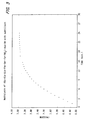
- the peptide was hydrolyzed by addition of pepsin (5 ⁇ l, 0.1 mg/ml) yielding a progress curve with a 10 fold increase in fluorescence following hydrolysis for 1 1/2 hour.
Landscapes
- Chemical & Material Sciences (AREA)
- Organic Chemistry (AREA)
- Life Sciences & Earth Sciences (AREA)
- Health & Medical Sciences (AREA)
- Proteomics, Peptides & Aminoacids (AREA)
- Biochemistry (AREA)
- Biophysics (AREA)
- General Health & Medical Sciences (AREA)
- Genetics & Genomics (AREA)
- Molecular Biology (AREA)
- Zoology (AREA)
- Wood Science & Technology (AREA)
- Medicinal Chemistry (AREA)
- Engineering & Computer Science (AREA)
- Biotechnology (AREA)
- Immunology (AREA)
- Microbiology (AREA)
- Physics & Mathematics (AREA)
- Analytical Chemistry (AREA)
- Bioinformatics & Cheminformatics (AREA)
- General Engineering & Computer Science (AREA)
- Peptides Or Proteins (AREA)
- Measuring Or Testing Involving Enzymes Or Micro-Organisms (AREA)
- Position Input By Displaying (AREA)
- Manufacturing Of Electric Cables (AREA)
- Laminated Bodies (AREA)
Abstract
Description
- The present invention relates to fluorogenic peptides. More particularly it relates to peptides exhibiting the so-called intramolecular or internal quenching of the fluorescence brought about by a fluorescent chromophore (donor group) by another chromophore (acceptor group). Such peptides are particularly useful in the determination of enzymatic specificities since enzymatic cleavage of a peptide bond between the chromophore groups will result in an increase in fluorescence. Therefore a series of internally quenched fluorogenic peptides of varying amino acid sequence and chain length would be a valuable tool e.g.in screening programs for the determination of the enzymatic activities of various biological systems. Such assays could facilitate the study of biological proteases. e.g. derived from HIV-1 and cellular proteases.
- In the present description the usual abbreviations within the peptide chemistry are employed. The amino acid symbols are in accordance with IUPAC-IUB Commission on Biochemical Nomenclature, and the amino acids are in L-form unless otherwise stipulated. The one letter code for the amino acids used in table 1 is as recommended by IUPAC, Eur. J. Biochem. 138, p. 37 (1984). The following additional abbreviations are used:
- ABz
- = o-aminobenzoyl
- HPLC
- = High performance liquid chromatography
- PNa
- = p-nitroanilide
- Np
- = p-nitrophenyl
- AEAP
- = aminoethyl-2-aminopyridine
- CBI
- = cyanobenzoisoindole
- dansyl, dns
- = 5-dimethylaminonaphthylsulphonyl
- Bim
- = bimane
- Boc
- = t-butyloxycarbonyl
- DMF
- = N,N-dimethylformamide
- Dhbt-
- = 3,4-dihydro-4-oxo-1,2,3-benzotriazo-3-yl
- DCCI
- = N,N'-dicyclohexylcarbodiimide
- Fmoc
- = fluoren-9-ylmethyloxycarbonyl
- NSu
- = N-succinimidyl
- IR
- = infrared spectroscopy
- THF
- = tetrahydrofurane
- TFA
- = trifluoroacetic acid
- Tlc
- - thin layer chromatography
- EtOAc
- = ethylacetate
- tBu
- = t-butyl
- TBTU
- =N,N'-tetramethyl-O-benzotriazo-1-yluronium tetrafluoroborate
- Proteolytic enzymes usually exhibit a preference for certain peptide bonds in a polypeptide-chain. With some enzymes. e.g. trypsin, the rate of hydrolysis is primarily determined by the nature of the amino acid residues forming the peptide bond, suggesting that the primary binding sites, i.e. S₁ and S₁', are the most important for the interaction between the enzyme and the substrate. With other enzymes the nature of the amino acids further removed from the scissile bond, interacting with the so-called secondary binding sites, exert a similar or even greater influence on the rate of hydrolysis. In extreme cases, e.g. some of the enzymes involved in hormone processing and blood clotting, cleavage will only take place when the enzyme recognises a defined amino acid sequence around the scissile bond. However, even for enzymes generally accepted to be non-specific such as the subtilisins secondary interactions are known to play a dominant role as well. To understand how such interactions, remote from the catalytic event, influence cleavage rates and to evaluate the consequences of site directed mutagenesis at the binding site, it is necessary to map the preferences of the enzyme with respect to each position of the substrate in a much more detailed way than previously performed. Such studies have furthermore become topical due to the application of proteolytic enzymes for specific cleavage of fusion proteins produced by genetically engineered microorganisms. The utilization of such enzymes for synthesis of peptide bonds, generating highly pure biologically active peptides would benefit from such knowledge as well.
- Information on protease specificity has been obtained using synthetic peptides, four to eight amino acid residues of length, and following the hydrolysis by HPLC or more recently, by proton NMR-spectroscopy (Meldal, M & Breddam, K. the Proceedings of the solid Phase Synthesis Symposium, Oxford 1989, in press). However, such methods are slow, laborious and insensitive, and it is therefore required that the synthetic peptides are suitably derivatised with chromophores such that their hydrolysis can be followed by a change in absorbance or fluorescence.
- The spectrophotometric determination of the release of p-nitroaniline or p-nitrophenol from the C-terminus of peptide-PNa and peptide-ONp substrates, respectively, are among the most commonly employed methods. Unfortunately, these methods are not very sensitive, and the scissile bonds are not natural peptide bonds. Furthermore, only the influence of the substrate positions P₁, P₂, .. Pn and not the positions P₁, P₂', ... Pn' may be studied (c.f. fig. 1). In addition, substrates of this type are base labile and can only be synthesized by elaborate synthesis in solution. Another type of substrate involves the hydrolysis of the -Phe(NO₂)-Phe- peptide bond which may be followed by spectrophotometric detection of the change in nitrophenyl absorbance. This method exhibits very low sensitivity and requires that the -Phe(NO₂)- residue is accepted in the P₁ subsite. More sensitive substrates can be obtained by incorporation of fluorescent probes. Such peptide substrates have been constructed by attachment of fluorescent groups at the C- or the N-terminus of the peptides. Peptide β-naphthyl amides are frequently used as sensitive fluorescent substrates. Aminoethyl-2-aminopyridine (AEAP) has been used for C-terminal fluorescence labeling. Other probes for N-terminal labeling are N-pyridin-2-yl glycine and the cyanobenzoisoindole (CBI). The dansyl group (1-dimethylaminonaphthalene-5-sulfonyl) is normally attached to the N-terminal, but solid phase synthesis of peptides have been reported in which the dansyl group is attached either to a C-terminal ethylene diamine after cleavage from the resin or to the side chain of a lysine residue. Dansyl substrates have been applied to the study of enzyme substrate complexes. Since dansylated (and mansylated) peptides change the intensity of their fluorescence depending on the polarity of the micro environment an increase in fluorescence is observed as the substrate is transferred from water to the more hydrophobic enzyme cavity. The proximity of the dansyl group to tryptophan residues in the enzyme results in energy transfer from the tryptophan to the dansyl group, cf. Yaron et al. (1979) Anal. Biochem. 95, 228-235.
- The intramolecularly quenched substrates constitute another group of fluorescent substrates. These substrates in addition to the fluorescent group contain a quenching chromophore, and when a peptide bond situated between these is cleaved by enzymes an increase in fluorescence is observed. As described by Yaron et. al., op. cit. and US patent No. 4.314.936, both incorporated by reference, two mechanisms are operating in the energy transfer process for internal quenching. Quenching by intramolecular collision requires a short distance between the fluorescent donor and the acceptor so that the necessary formation of a contact complex occurs frequently enough to ensure effective transfer. By contrast, the quenching of fluorescence by long range resonance energy transfer is effective over long distances. Thus transfer from fluorescein to chlorophyll can occur at distances of 80 Å in solution. The consequence of the resonance energy transfer theory, as described by Förster (1948) Ann. Physik 6 (2), 55-75, is that the transfer process is a non radiative parallel process in which the donor returns to its ground state simultaneously with the excitation of the acceptor. The efficiency of the transfer is directly related to the spectral integral overlap of the emission of the donor chromophore with the absorption of the acceptor chromophore. The transfer decreases with the sixth power of the distance between the chromophores and thus, the spectral overlap must be complete to ensure effective quenching.
- Of the internally quenched substrates described in the literature most are of the collision type and only a few amino acids can be inserted between the donor and the acceptor. The anthraniloyl (2-aminobenzoyl or ABz) group, which is a small fluorescent probe with a high quantum yield, has been used in conjunction with the -Phe(NO₂)-group, see e.g. US patent No. 4.314.936 and Yaron et al op. cit., but these substrates are of the collision type as the -Phe(NO₂)- group only functions as quencher when separated by no more than two residues. The dansyl group has also been used for the collision type intramolecularly quenched substrates in combination with -Phe(NO₂)-, Fleminger et al. (1981) FEBS Letters 135, 131-134. Other fluorescent probes used for internally quenched collision type substrates are the bimane group (Bim), Sato et al. (1988) Bioorganic Chem. 16, 298-306, and the naphthyl group, Yaron et al. op. cit.. The Bim group was incorporated into short peptides containing a Trp residue which quench the Bim fluorescence up to the tripeptide level. Peptide 2-naphthylethylamines derivatized at the N-terminal with a anthracen-9-ylcarbonyl group quenching the naphthyl fluorescence has been used for trypsin substrates, cf. Yaron et al.
- Even the tryptophan containing dansyl peptides, which are considered to be of the resonance energy transfer type, has only a 4.5 fold quenching for the tetrapeptide Dns-gly-gly-Gly-Trp and the quenching is decreased with a factor of 5 for each addition of a residue, cf. Yaron et al.
- The heptapeptide Dns-Gly-Lys-Tyr-Ala-Pro-Trp-Val has been used to explore the protease specificity of a number of enzymes, Ng & Auld, (1989) Anal. Biochem. 183, 50-56.
- This peptide exhibits intramolecular quenching of the tryptophan fluorescence by the dansyl group, which are separated from Trp by a hexapeptide sequence.
- The straight chain distance between the Dansyl group and the Trp is about 22 Å, which should only lead to a 50% quenching. However, the results showed that quenching was more than 85% efficient, indicating that the two chromophores may be closer than straight chain calculations predict or fixed in a conformation that is optimal for energy transfer, possibly due to the presence of an intermediate Pro-residue.
- The abovementioned peptide thus represents a special case, and it is fair to say that the Dns/Trp combination is not generally applicable to internal quenching of longer peptides.
- Otherwise, the dansyl containing substrates would be ideal since they can be synthesized on a solid phase and can be prepared by parallel multiple column peptide synthesis, which is compulsory to obtain the large variety of peptides necessary in a screening program on new mutant enzymes. Multiple column peptide synthesis is described by Holm, A & Meldal, M (1988) Peptides 1988, Proc. 20'th Eur. Pept. Symp. 208-210 and in application WO 90/02605 both, incorporated by reference. Spectroscopically more promising and of the long range energy transfer typs is the combination of the anthraniloyl group and the PNa-group, Bratavanova, E. K. & Petkov, Q. O. (1987) Biochem. J. 248, 957-960 and (1987) Anal. Biochem. 162, 213-218, allowing a separation of at least four residues. However, such substrates cannot be prepared by conventional solid phase or multiple column peptide synthesis, and the C-terminal peptide bond is unstable.
- Matayoshi et al., Science, (1990) 247, 954-958), investigated internally quenched fluorogenic substrates based on the DABCYL/EDANS pair.
- They investigated two octapeptides
Ser-Gln-Asn-Tyr-Pro-Ile-Val-Gln and
Ser-Val-Val-Tyr-Pro-Val-Val-Gln
having as the C-terminal fluorescent donor EDANS (5-(2-aminoethyl/amino)naphthalene-1-sulphonic acid and as the quenching acceptor DABCYL (4-(4-dimethylaminophenylazo)benzoic acid linked via a GABA (γ-aminobutyric acid) spacer. - The octapeptides are derived from HIV-1PR, an 11kd protease encoded by HIV-1 virus, and the related protease derived from avian myeloblastosis virus.
- The bulky nature of the DABCYL group necessitates the use of a GABA or other spacer to avoid potential steric hindrance of substrate binding.
- Also these type of substrates cannot be prepared by multiple column peptide synthesis due to the nature of the EDANS group.
- EP-A-435845 published July 3, 1991 is prior art under Art. 54(3) for all the designated contracting states. It describes certain fluorogenic hexapeptides exhibiting intramolecular quenching of the collision type.
- A representative example is
ABz-Thr-Ile-Nle-Phe(p-NO₂)-Gln-Arg-NH₂
wherein ABz is the fluorogenic donor and Phe(p-NO₂) is a collision type quenching acceptor. Modified Tyr as defined inclaim 1 is not disclosed as quencher. - The object of the present invention is to provide a class of intramolecularly quenched fluorogenic peptides which are not entailed with the abovementioned drawbacks.
- More specifically it is the object of the invention to provide a large variety of peptides which are intramolecularly quenched by long range resonance energy transfer and where the quenching is effective over distances of more than 50 Å, i.e. where the donor and acceptor is separated by up to more than 15 amino acids.
- A further object of the invention is to provide peptides having the above characteristics, which lend themselves to synthesis by simultaneous parallel multiple column synthesis.
- The invention is based on the surprising finding that these objects can be achieved by selection of a special donor/acceptor pair, viz. by using the anthraniloyl (o-aminobenzoyl) group as the fluorescent donor and 3-nitrotyrosine as the quenching acceptor.
- The anthraniloyl group is a small, polar group which has a high quantum yield. It enhances the solubility of the peptide in water as compared to other more lipophilic fluorescent probes, and can be excited at 320 nm, well outside the spectral region of the enzymes and the peptide amino acids. The anthranilamide emission exhibits its maximum at 420 nm, far from the excitation wavelength. The quencher must therefore absorb in the vicinity of 420 nm with an absorption band of the same width and shape as the emission band of the anthranilamide. Furthermore, it is preferable that it contains a carboxylic acid for attachment to the solid phase and an amino group for amide bond formation with the peptide. It was found that 3-nitrotyrosine fulfills these requirements, and that it can easily be incorporated into the Fmoc based solid phase peptide synthesis by the continuous flow polyamide method.
- 3-nitrotyrosine has not earlier been described as a fluorescence quencher, but only for use in the spectroscopical characterization of the position of tyrosine in proteins by derivatization with tetranitromethane, Riordan et al. (1967)
Biochemistry 6, 358-361. Due to its absorption band it can be used not only with anthraniloyl but also with other fluorophores having an emission in the spectral region of 400-460 nm, e.g. 1,8-aminonaphthalene sulfonic acid, anthracene and umbelliferone. By the same token, compounds structurally related to 3-nitrotyrosine may also be used as the quenching acceptors, the only condition being that a fluorescent donor should be used which has a maximum emission within the absorption band for the quenching acceptor, so that the spectral overlap is as complete as possible. - Accordingly, the present invention relates to fluorogenic peptides exhibiting intramolecular quenching by resonance energy transfer and having the general formula
ABz-A-Q-Y₁ or Y₂-Q-A-ABz
wherein ABz designates the anthraniloyl donor chromophore and Q is a fluorescence quenching acceptor chromophore having an absorption spectrum overlapping the emission spectrum of the ABz donor chromophore, being a substituted amino acid residue of the general formula
wherein R₁, R₂, R₃, R₄ and R₅ are independently selected from hydrogen, hydroxy, alkyl, alkoxy, nitro, amido, halogen or aralkyl, with the proviso that at least one of R₁ to R₅ is hydroxy and at least one is nitro,
wherein X is a spacing group which may be absent or selected from any combination of -CO-NH-, -CO-O-, -S-, -S-S-, -O-, -NH- or -C₆H₄-, and n and m are integers from 0 to 10,
A is a spacing entity selected from amino acid residues and peptide residues and may include a non-peptide molecular entity, being linked to the fluorescent donor chromophore ABz via an amide bond or ester bond,
Y₁ is OH, NH₂, an amino acid residue, a peptide residue or a C-terminal protective group,
Y₂ is H, an amino acid residue, a peptide residue or an N-terminal protective group. - The preferred quenching acceptor chromophore Q is 3-nitrotyrosine, i.e. n = 1, R₃ = OH and R₄ = NO₂. Accordingly a preferred group of fluorogenic peptides is that having the general formula
ABz-A₁-Tyr(NO₂)-Y₁
wherein A₁ is an amino acid residue or a peptide residue linked to the ABz group via a peptide bond, and Y₁ is as defined above. - As mentioned, A is an amino acid residue or preferably a peptide residue, in particular a peptide residue consisting of from 2 to 25, preferably 2 to 15 amino acids.
- For the sake of clarity it should be noted that the symbols A, Q and Y used in the above formulae should not be confused with the one letter codes for amino acids used below in Table 1.
- In the present context "alkyl" means straight chain or branched alkyl, preferably with 1 to 6 carbon atoms, e.g. methyl, ethyl, propyl, isopropyl, n-butyl, isobutyl, tert.butyl, amyl and hexyl.
- "Alkoxy" is defined analogously.
- "Aryl" e.g. encompasses heterocyclic aryl and e.g. phenyl.
- "Aralkyl" e.g. encompasses benzyl and phenethyl.
- The above-mentioned groups may optionally be substituted with inert substituent, e.g. halogen or nitro.
- "Halogen" denominates F, Cl, Br and I.
- The character of the spacing amino acids are not critical and may include non-amino acid entities, e.g. mono- or oligosaccharides.
- Examples of useful amino acids include aliphatic amino acids, such as monoaminomonocarboxylic acids, e.g. glycine (Gly), alanine (Ala), valine (Val), norvaline (Nval), leucine (Leu), isoleucine (iso-Leu) and norleucine (Nleu), hydroxy amino acids, such as serine (Ser), threonine (Thr) and homoserine (homo-Ser), sulfur-containing amino acids, such as methionine (Met) or cystine (CysS) and cysteine (CysH), monoaminodicarboxylic acids, such as aspartic acid (Asp), glutamic acid (Glu) and amides thereof, such as asparagine (Asn) and glutamine (Gln), diaminomonocarboxylic acids, such as ornithine (Orn) and lysine (Lys), arginine (Arg), aromatic amino acids, such as phenylalanine (Phe) and tyrosine (Tyr), as well as heterocyclic amino acids, such as histidine (His), proline (Pro) and tryptophan (Trp). As examples of useful amino compounds of a more unusual structure may be mentioned penicillamine (Pen), aminophosphonic acids, such as alanine-phosphonic acid (AlaP), aminosulfonic acids, such as taurine (Tau), ω-amino acids, such as β-alanine (BAla), iso amino acids, such as α-methylalanin (Aib), amino acids substituted with inert substituents, e.g. halogen or nitro. They may be included both in D-form where applicable and in L-form.
- If desired, the individual amino acids may be side-chain protected in a manner known per se.
- Since the peptides according to the invention are particularly valuable for purposes of screening new enzymes or enzyme containing fluids for their activities, it might be desirable to incorporate more special compounds in the peptide chain.
- Generally speaking the expression "peptide residue" should be construed broadly as not only covering sequences of amino acids solely linked by peptide bonds, but also encompassing sequences where one or more of the bonds are not peptide bonds, but also e.g. ester bonds such as found in the socalled depsipeptides. The spacing entity may also include non-peptide entities, e.g. mono- or oligosaccharide fragments, e.g (α-D-Glc(1-4))₄.
- In particular the anthraniloyl group ABz need not necessarily be bound to an amino acid via an amide or peptide bond.
- Depending on the character of the amino acid to which it is attached, ABz may also be bound e.g. via an ester bond.
- Thus, in case of the N-terminal amino acid being a hydroxyamino acid like Ser and Thr, both an ester bond and an amide bond is possible.
- Likewise, in case of amino acids containing more than one amino group, the antraniloyl group need not be attached to the α-amino group.
- Thus, e.g. in case of the C- or N-terminal amino acid being Lys, the ABz group may well be attached to the ε-amino group.
- The invention also relates to a substrate for determination of enzymatic activities comprising one or more fluorogenic peptides as defined above.
- In a still further aspect the invention relates to a process for the detection or determination of enzymatic activities in a sample, wherein the sample is incubated with one or more substrates as defined above under conditions favourable to enzymatic activities, i.a. pH 2-12, determining and comparing the fluorescence emitted before and after the incubation.
- The syntheses of the protected precursors of the preferred chromophores ABz and Tyr(NO₂) are outlined in the reaction scheme (Fig. 2) and explained in more detail below. The acylation with anthranilic acid requires a high level of activation to ensure complete coupling. It is not sufficient to leave the amino group of anthranilic acid unprotected and activate the carboxyl group as the benzotriazole ester as for synthesis in solution since such compounds exhibit a low reactivity. This may be ascribed to interaction of the unprotected amino group and the carboxyl group, and protection of the amino group should therefore enhance the reactivity. Such a protection has the additional advantage of preventing the incorporation of two or more anthranilic acid residues. Thus anthranilic acid (1) was reacted with Boc₂O in dry DMF and triethylamine to yield 60% of Boc-ABz-OH (2) and this was transformed into the highly activated Boc-ABz-O-Dhbt (3) in a 97% yield by reaction with DCCI and Dhbt-OH using the procedure of Atherton et. al. (1988) J. Chem. Soc.
Perkin Trans 1, 2887-2894.Compound 3 could be used for fast coupling reactions on the solid phase. - 3-nitrotyrosine (4) could be converted into Fmoc-Tyr(NO₂)-OH (5) in a 91% yield by reaction with Fmoc-O-NSu under the Schotten-Baumann conditions. The phenolic hydroxyl group need no protection since any acylation of the activated phenol can be reverted by treatment with weak bases e.g. piperidine. For solid phase
synthetic purposes compound 5 can be coupled directly to the hydroxymethyl group of resin linkers by reaction with 0.5 eqv. of DCCI and DMAP catalysts. Alternatively, one or more amino acids can be coupled to the resin prior to the reaction with Fmoc-Tyr-(NO₂)-OH promoted by the TBTU reagent of Knoor. - In order to show the versatility of the system the peptides 6-15 shown in table 2 were prepared by parallel multiple column peptide synthesis in a 20 well manual synthesizer, cf. Meldal & Breddam, op. cit. and Holm & Meldal, op. cit.. The peptides were synthesized by the Dhbt ester method described by Atherton et. al., op. cit.. As further explained below, the completion of acylations were monitored visually to ensure high purity of all the peptide products, see also Cameron et al. J. Chem. Soc.
Perkin Trans 1, 2895-2901, incorporated by reference. The peptides were purified by preparative HPLC, and the pure peptides were used for kinetic experiments. The endopeptidase subtilisin A was selected as the test enzyme. - The synthesized substrates were selected on the basis of existing knowledge of the substrate preference of subtilisin A: a) preference for an aromatic amino acid residue in the P₁ position, b) preference for a non-bulky residue in the P₁' position, c) the presumed ability of the enzyme to accomodate the -Tyr(NO₂)- at the P₂' and finally d) the enormous influence of interactions between the substrate and the S₂, S₃ and S₄ subsites, see Philipp & Bender, (1983) Mol. Cell. Biochem. 51, 5-32, i.e. the influence of chainlength on the rate of hydrolysis. Aspartic acid was chosen as the C-terminal to enhance the solubility and to protect the peptides against digestion by adventitious carboxypeptidases. On this basis it was predicted that the -Phe-Gly- or -Phe-Ser- bonds were the preferred cleavage points in all the synthetized substrates. The cleavage points of the long peptides were determined by amino acid analysis of the products after separation by HPLC, and the -Phe-Gly- cleavage point was confirmed.
-
- Fig. 1
- illustrates the subsite specificity for an enzyme (S₃, S₂, S₁, S₁', S₂') with regard to a scissile bond on a peptide substrate and the corresponding binding positions of the substrate (P₃, P₂, P₁, P₁', P₂').
- Fig. 2
- illustrates the synthesis of precursors for the preferred fluorescent and quenching chromophores.
- Fig. 3
- shows the enzymatic hydrolysis of a peptide according to the invention.
- General procedures. Solvents were distilled at the appropriate pressure in a packed column of Raschig rings. DMF was analyzed by mixing with Dhbt-OH prior to use. THF and dioxane were passed over a short column of active alumina for purification and desication. Fmoc amino acids were purchased from Bachem or Milligen and were transformed into active Dhbt esters as described by Atherton et al. op. cit. The purity of the Dhbt esters was checked by HPLC and IR spectroscopy. Fmoc-O-NSu, nitrotyrosine, Dhbt-OH, DCCI and Boc₂O were from Fluka. "Macrosorb-SPR 250" was purchased from Sterling Organics and was derivatised with ethylene diamine and hydroxymethylphenoxyacetic acid Dhbt ester. ¹H-MNR-spectra were recorded on a Brucker AM500 500 MHz spectrometer, IR-spectra were recorded on a Perkin Elmer 157 spectrophotometer, HPLC was performed on a waters gradient HPLC system with a
Novapak 5 µ C₁₈ reversed phase column with a buffer A (0.1 % TFA) and a buffer B (0.1 % TFA and 10% water in acetonitrile) with a flow rate of 1 ml/min and the appropriate gradient. Completely deprotected peptides were hydrolysed in 6 N HCl at 110° and analysed on a Durrum amino acid analyzer. - 2-t-Butyloxycarbonylamino benzoate (2). Boc₂ (51.6 g, 236 mmol), anthranilic acid (1) (25.9 g, 189 mmol) and triethylamine (50 ml, 360 mmol) were dissolved in DMF (50 ml). Within a few minutes gas evolution commenced and the mixture was left for a perriod of 24 h at 20° until the gas evolution had ceased. Tlc in EtOAc showed the reaction to be complete and the mixture was treated with charcoal, filtered through celite which was rinsed with DMF. The DMF was removed at 30° in vacuo, and the residue was dissolved in dichloromethane (200 ml) and extracted with 10% sodium carbonate solution (100 ml). The dark brown aqueous phase was extracted with dichloromethane and discarded. The combined organic phase was extracted with 3 times 100 ml of water.
- The aqueous extractions were acidified to
pH 2 and extracted with diethyl ether (3 x 100 ml). After drying with sodium sulfate and filtration the volume was reduced to 100 ml and petroleum ether was added until the product crystallized. The crude material was recrystallized from 50% aqueous ethanol to give 26 g (60%) of pure Boc-anthranilic acid (2), m.p. 149-150°. Anal. calc. for. C₁₂H₁₅NO₄: C 60.75, H 6.37, N 5.90%. Found: C 60.72, H 6.37, N 6.02%. ¹H-NMR (CDCl₃): δ ppm (J Hz); Boc, 1.54; H3, 8.11 (7.7); H4, 7.57 (7.7, 7.5); H5, 7.04 (7.5, 8.4); H6, 8.48 (8.4); Boc, 1.55; COOH, 10.02. - 3,4-Dihydro-4-oxo-1,2,3-benzotriazol-3-yl-2-t-butyloxycarbonylamino benzoate (3). 2-t-Butyloxycarbonylaminobenzoic acid (2) (2.37 g, 10 mmol) was dissolved in dichloromethane (15 ml) and THF (5 ml). The mixture was cooled to -5° and DCCI (2.06 g, 10 mmol) was added. After 5 min Dhbt-OH (10 mmol, 1.63 g) was added and the mixture was stirred at -5° for 1 h and at 4° for 16 h. After filtration the solvents were removed in vacuo, and the product was crystallized from diethyl ether (30 ml). Filtration afforded 3.7 g (97%) product which was pure according to HPLC. M.p. 155-156°. Anal. calc for C₁₉H₁₈N₄O₅: C 59.68, H 4.75, N 14.65%. Found: C 59.55, H 4.83, N 14.59. ¹H-NMR (CDCl₃): δ ppm (J Hz); H3, 8.48 (7.7); H4, 7.72 (7.7, 7.4); H5, 7.19 (7.4, 7.8); H6, 8.61 (7.8); H5', 8.32 (7.4); H6', 8.10 (7.4, 7.7), 1.2); H7', 7.93 (7.7, 7.8); H8', 8.42 (7.8, 1.2); Boc, 1.52; NH, 9.58.
- N α -Fluoren-9-ylmethyloxycarbonyl-3-nitrotyrosine (5). H-Tyr(NO₂)-OH (4) (3.39 g, 15 mmol) was dissolved in 50 ml of water containing sodium carbonate (3.98 g, 38 mmol) and dioxane (20 ml) was added. Fmoc-O-NSu (5.20 g, 15.5 mmol) was dissolved in dioxane (20 ml) and added dropwise at 0°. The mixture was stirred 1 h at 0° and 3 h at 20°. The dioxane was removed in vacuo, and the residue diluted to 50 ml with water. Byproducts were extracted with ether, and the solution was acidified with citric acid. The precipitate was collected by filtration and dried. The product was extracted with ethyl acetate, and after filtration it was crystallized by addition of 3 volumes petroleum ether (2:7) and cooling. Collection of the crystalline material by filtration and washing with petroleum afforded 6.09 g of product (91% yield). M.p. 145-148. Anal. calc for C₁₉H₁₈N₄O₅: C 64.28, H 4.50, N 6.25. Found: C 63.44, H 4.58, N 6.36. ¹H-NMR (CDCl₃): δ ppm (J Hz); 01-H, 10.52; H2, 4.72 (5.0, 6.0, 7.0 Hz); H3, 3.12 (13.5, 6.0); H3', 3.26 (13.5, 5.0); H5, 7.96; H5', 7.35 (8.0); H6', 7.12 (8.0); Fmoc 4.24 (6.5); 4.45 (6.5, 10.5); 4.54 (6.5, 10.5); 7.37 (7.0); 7.44 (7.5, 7.0); 7.54 (7.5, 7.5); 7.81 (7.5).
-
- Fmoc-Asp(tBu)-OH (650 mg, 1.625 mmol) was dissolved in dichloromethane (15 ml) and the solution was cooled to 0°. DCCI (167 mg, 0.812 mmol) was added and the mixture was stirred for 15 min at 0°. After filtration and evaporation the residue was dissolved in DMF (5 ml) and added to a preswollen acid labile "Macrosorb SPR-250" resin (650 mg, 0.163 mmol) in a sintered funnel. DMAP (20.5 mg, 0.163 mmol) was added, and the material was shaken by a rotational motion for 1 h. The resin was washed with DMF (20 ml), and piperidine (20% in DMF, 15 ml) was added for deprotection purposes. After 10 min of shaking the piperidine was removed and the resin was washed with 100 ml DMF by the run through mode. Fmoc-Tyr(NO₂)-OH (219 mg, 489 mmol) and TBTU (157 mg, 489 mmol) was added and dissolved in DMF (15 ml). Diisopropyl ethyl amine (0.63 mg, 489 mmol) was added and the mixture was shaken for a period of 2 h. All reagent was removed by washing with DMF, and the DMF was removed with diethyl ether.
- The resin was dried and measured in 90 mg quantities into the 7 wells of the 20 well manual multiple column peptide synthesizer. All solvents were handled with 100 ml polypropylene syringes. After swelling of the resin with DMF the solvent was drained from the resin by vacuum on the chamber beneath the wells, and a slight overpressure of air was established via a flowmeter. The Fmoc group was removed with a 1 min and a 10 min treatment with piperidine (20%) in DMF (500 µl in each well). The piperidine solution was removed by suction, and the wells were washed with DMF (5
times 1 ml each). The Fmoc amino acids Dhbt esters (2.5 eqv.) corresponding to position 3 from the C- terminal end of peptides 6-15 in table 1 below were weighed directly into the respective well in the synthesizer through a hole in a polyethylene cover hindering cross contamination. (In Table 1 the one letter code for the amino acids are used for the sake of simplicity). A slight overpressure was established and DMF (400 µl) was added to each well. For a period of 2 h the well system was shaken every 30 min. The reaction mixture was removed and the wells were washed with DMF (5times 1 ml each). The synthesis cycle was repeated until the end of each peptide, 6-15 by application of the respective Fmoc amino acid Dhbt ester (2.5 eqv.). - The last residue added was Boc-ABz-O-DHBT (2.5 eqv.), and after a wash with DMF and diethyl ether the resins were dried. The peptides could directly be cleaved off the resins with aqueous TFA (95%, 1 ml), whereby also the Boc-group was removed from the ABz-group.
- Enzymatic hydrolysis of intramolecularly quenched substrates. The peptides 6-15 prepared in example 2 were dissolved in DMF at a concentration of 0.2 - 1.0 mM. This solution (125 µl) was added to 50 mM Bicine, 2 mM CaCl₂, pH 8.5 (2375 µl), and the initial fluorescence of the solution at 420 nm by excitation at 320 nm was measured. From a stock solution of subtilisin A in the same Bicine buffer the appropriate amount was added to give final enzyme concentrations of 2*10⁻⁵ mg/ml - 2 mg/ml. The reactions were followed with time by monitoring the emission at 420 nm upon excitation at 320 nm. The temperature was maintained at 24°C. The hydrolysis was carried out to completion and the specificity constants, kcat/Km, were determined from the progression curve using the integrated form of the Michaelis-Menten equation as described by Segel (1968) Biochemical Calculations, John Wiley & Sons 393-396.
- When the peptides were dissolved in a 0.4-50 µm concentration only a limited fluorescence could be observed at 420 nm by excitation at 320 nm. With the addition of nM amounts of subtilisin A the fluorescence increased as exemplified for
compound 6 in figure 3. For all the substrates having a chain length below 10, the fluorescence of the substrate was < 3% of the final cleavage product. For the longer peptides a gradual increase of the initial fluorescence was observed. Assuming an average length of each amino acid of 3 Å, the described donor acceptor system is effective over distances of more than 50 Å, and the anthranilamide and 3-nitrotyrosine can be considered an ideal long range resonance energy transfer pair. - The kcat/Km values (table 1) for the hydrolysis of
compound 6, 7 and 8 confirm the importance of chain length, as an elongation by one or two alanyl residues causes an increase in kcat/Km of two and five orders of magnitude, respectively. Elongation by another two alanyl residues, i.e.compound 10, has only minor additional influence on kcat/Km. - However, with the three alanyl residues in
compound 9, kcat/Km is three to four fold lower than forcompounds 8 and 10. This is somewhat surprising, and it indicates an influence of the ABz group increasing the preference for compound 8 or decreasing it forcompound 9. The former possibility is suggested since the aromatic ABz group in this substrate is located in the P₄ position, and subtilisin A is known to exhibit a preference for aromatic amino acid residues in this position. - A comparison of the kcat/Km values for the hydrolysis of compound 8 and 11 and of
compound 8 and 12 shows that subtilisin A exhibits equal preference for Gly and Ser in the P₁' position, and that Pro in the P₂ position has an adverse influence relative to Ala. - For compounds 13 to 15 the chain length is further increased in relation to compound 10 by each 3 amino acid residues. It is noteworthy that the kcat/Km stabilizes at about 200.000, and decreases slightly for the very long substrates, while the efficiency of the intramolecular quenching diminishes with increasing chain length between the anthraniloyl group and the 3-nitrotyrosine residue.
- Thus, for
compound 15 where the distance is 16 amino acids corresponding to about 48 Å, an initial fluorescence of about 15% of the fluorescence after subtilisin cleavage is observed. - For practical screening purposes an upper limit of about 60-80 Å seems reasonable, corresponding to about 20-27 amino acids.
- However, there is no well-defined upper limit for the number of intermediate amino acids. The above examples were deliberately chosen to make a comparison possible, and the amino acid sequences were designed to reduce the influence of the secondary and tertiary structure of the peptides.
- In case of longer peptides e.g. having an α-helical structure intramolecular quenching may be obtained even if the donor/acceptor pair is separated by a greater number of amino acids as compared to an unordered structure.
- In order to further show the versatility of the fluorogenic peptides according to the invention the peptide ABz-Gly-Ala-Ala-Phe-Phe-Tyr(NO₂)-Asp-OH (0.5µm) prepared as in example 2 was dissolved in 2.5 ml 50 mM formic acid, pH 3.4. The peptide was hydrolyzed by addition of pepsin (5µl, 0.1 mg/ml) yielding a progress curve with a 10 fold increase in fluorescence following hydrolysis for 1 1/2 hour.
- For convenience the one-letter codes used in Table 1 below are listed together with the corresponding abbreviations:
A = Ala; F = Phe; G = Gly; D = Asp;
K = Lys; P = Pro; S = Ser; Y = Tyr.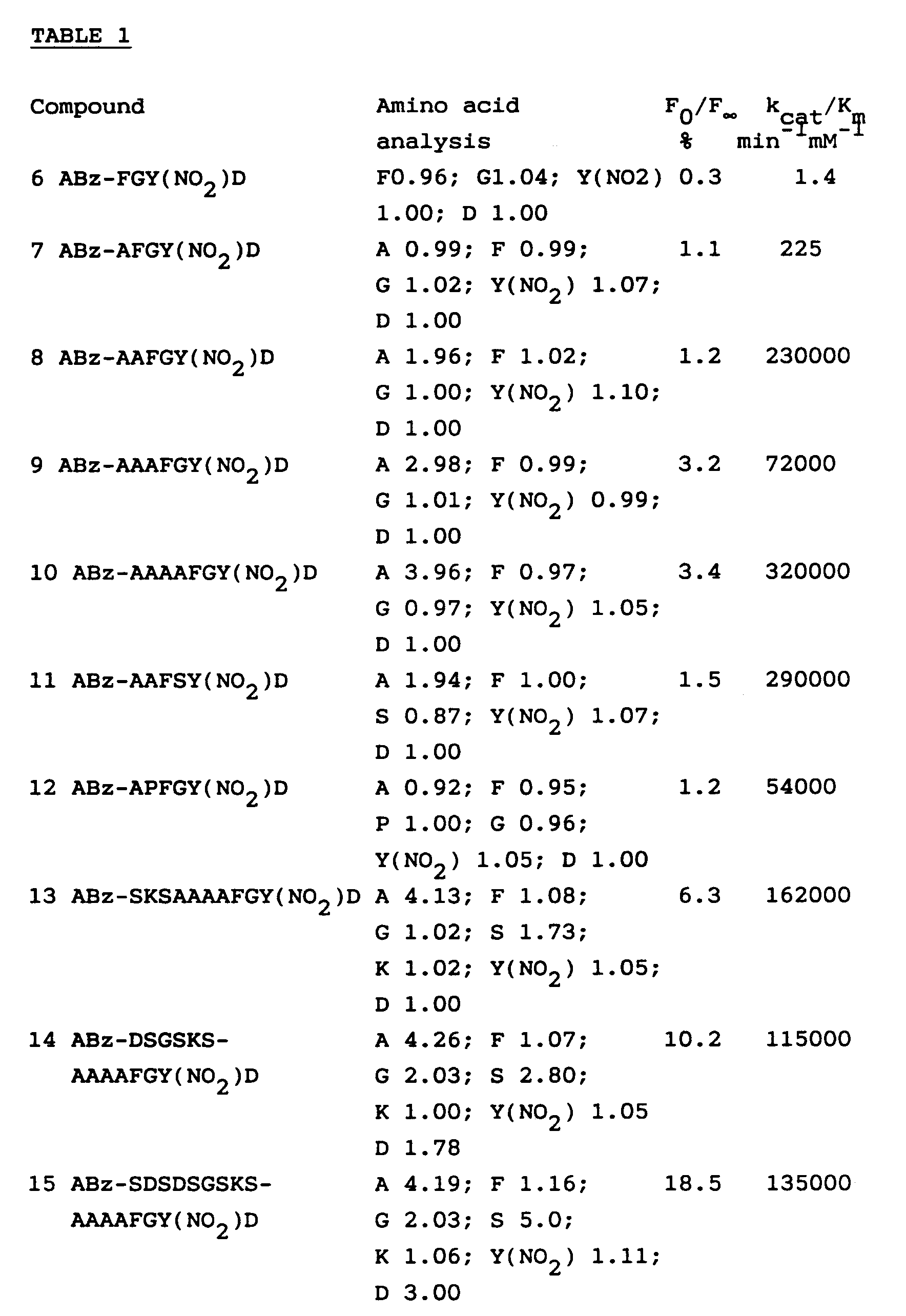
Claims (7)
- A fluorogenic peptide exhibiting intramolecular quenching by resonance energy transfer and having the general formula
ABz-A-Q-Y₁ or Y₂-Q-A-ABz
wherein ABz designates the anthraniloyl donor chromophore and Q is a fluorescence quenching acceptor chromophore having an absorption spectrum overlapping the emission spectrum of the ABz donor chromophore, being a substituted amino acid residue of the general formula
wherein X is a spacing group which may be absent or selected from any combination of -CO-NH-, -CO-O-, -S-, -S-S-, -O-, -NH- or -C₆H₄-, and n and m are integers from 0 to 10,
A is a spacing entity selected from amino acid residues and peptide residues and may include a non-peptide molecular entity, being linked to the fluorescent donor chromophore ABz via an amide bond or ester bond,
Y₁ is OH, NH₂, an amino acid residue, a peptide residue or a C-terminal protective group,
Y₂ is H, an amino acid residue, a peptide residue or an N-terminal protective group. - A peptide according to claim 1 having the general formula
ABz-A₁-Tyr(NO₂)-Y₁
wherein A₁ is an amino acid residue or a peptide residue linked to the group ABz via a peptide bond, and Y₁ is as defined above. - A peptide according to claim 1 or 2, wherein Y₁ is OH or an amino acid residue which is attachable to a solid phase or a peptide residue having a C-terminal amino acid residue which is attachable to a solid phase.
- A peptide according to any of claims 1 to 3, wherein A or A₁ is an amino acid residue or a peptide residue comprising 2-25 amino acids.
- A peptide according to any of claims 1 to 4, wherein A includes a mono- or oligosaccharide entity.
- Substrate for determination of enzymatic activities comprising one or more fluorogenic peptides according to claims 1-5.
- Process for the detection or determination of enzymatic activities in a sample,
characterized by incubating the sample with one or more substrates according to claim 6 under conditions favourable to enzymatic activities, determining and comparing the fluorescence emitted before, during and after the incubation.
Applications Claiming Priority (3)
| Application Number | Priority Date | Filing Date | Title |
|---|---|---|---|
| DK939/90 | 1990-04-17 | ||
| DK093990A DK93990D0 (en) | 1990-04-17 | 1990-04-17 | FLUOROGENEOUS PEPTIDES AND THEIR USE IN DETERMINING ENZYMATIC ACTIVITY |
| PCT/DK1991/000102 WO1991016336A1 (en) | 1990-04-17 | 1991-04-16 | Fluorogenic peptides and their use in the determination of enzymatic activities |
Publications (2)
| Publication Number | Publication Date |
|---|---|
| EP0528854A1 EP0528854A1 (en) | 1993-03-03 |
| EP0528854B1 true EP0528854B1 (en) | 1994-12-28 |
Family
ID=8099218
Family Applications (1)
| Application Number | Title | Priority Date | Filing Date |
|---|---|---|---|
| EP91908699A Expired - Lifetime EP0528854B1 (en) | 1990-04-17 | 1991-04-16 | Fluorogenic peptides and their use in the determination of enzymatic activities |
Country Status (8)
| Country | Link |
|---|---|
| EP (1) | EP0528854B1 (en) |
| JP (1) | JPH05506235A (en) |
| AT (1) | ATE116330T1 (en) |
| AU (1) | AU634395B2 (en) |
| CA (1) | CA2080694A1 (en) |
| DE (1) | DE69106358D1 (en) |
| DK (1) | DK93990D0 (en) |
| WO (1) | WO1991016336A1 (en) |
Families Citing this family (17)
| Publication number | Priority date | Publication date | Assignee | Title |
|---|---|---|---|---|
| AU5957794A (en) * | 1992-12-21 | 1994-07-19 | Uab Research Foundation, The | Compositions and method for the inhibition of phagocytes |
| GB9310978D0 (en) * | 1993-05-27 | 1993-07-14 | Zeneca Ltd | Compounds |
| JP4043535B2 (en) * | 1994-06-21 | 2008-02-06 | サントリー株式会社 | Peptide substrate and method for measuring proteinase A activity and beer foam stability using the same |
| CA2158782C (en) * | 1994-09-23 | 2010-01-12 | Pierrette Gaudreau | Marker for growth hormone-releasing factor receptors |
| US6008373A (en) * | 1995-06-07 | 1999-12-28 | Carnegie Mellon University | Fluorescent labeling complexes with large stokes shift formed by coupling together cyanine and other fluorochromes capable of resonance energy transfer |
| GB9525403D0 (en) * | 1995-12-13 | 1996-02-14 | Univ Sunderland | Method for monitoring enzymes |
| DE69725901T2 (en) * | 1996-01-04 | 2004-09-09 | Nederlandse Organisatie Voor Toegepast-Natuurwetenschappelijk Onderzoek Tno | METHOD FOR DETERMINING PROTEOLYTIC ENZYMES USING FLUORESCENCE-EXTINGUISHED SUBSTRATES |
| EP0906334A1 (en) * | 1996-04-24 | 1999-04-07 | Peptide Therapeutics Limited | Auto-deconvoluting combinatorial libraries |
| DE69731960T2 (en) * | 1996-09-24 | 2005-12-15 | Cadus Pharmaceutical Corp. | METHOD AND COMPOSITIONS FOR IDENTIFYING RECEPTOR EFFECTORS |
| US20030096315A1 (en) | 2000-05-03 | 2003-05-22 | Sanders Mitchell C. | Device for detecting bacterial contamination and method of use |
| DE60122582T2 (en) * | 2000-05-03 | 2007-10-04 | Expressive Constructs, Inc., Worcester | PROCESS FOR DETECTING LISTERIA MONOCYTOGENES |
| WO2003063693A2 (en) | 2002-01-31 | 2003-08-07 | Expressive Constructs, Inc. | Method for detecting microorganisms |
| GB0208989D0 (en) | 2002-04-19 | 2002-05-29 | Amersham Biosciences Uk Ltd | Methods for measuring enzyme activity |
| GB2398123B (en) * | 2002-04-19 | 2005-03-02 | Amersham Biosciences Uk Ltd | Methods for measuring enzyme activity |
| US6821744B2 (en) | 2002-10-29 | 2004-11-23 | Roche Diagnostics Operations, Inc. | Method, assay, and kit for quantifying HIV protease inhibitors |
| CA2557612C (en) | 2003-11-03 | 2014-06-17 | Ethicon, Inc. | Methods, peptides and biosensors useful for detecting a broad spectrum of bacteria |
| JP2006322858A (en) * | 2005-05-19 | 2006-11-30 | Kyushu Univ | Protein fluorescent labeling method |
Family Cites Families (2)
| Publication number | Priority date | Publication date | Assignee | Title |
|---|---|---|---|---|
| IL60888A (en) * | 1978-06-16 | 1984-07-31 | Yeda Res & Dev | Substrates and process for the quantitative assay of enzymes |
| ES2051702T3 (en) * | 1986-04-01 | 1994-07-01 | Wako Pure Chem Ind Ltd | PEPTIDIC DERIVATIVES AND METHOD FOR MEASURING THE ACTIVITY OF PHYSIOLOGICALLY ACTIVE SUBSTANCES USING THEM AS SUBSTRATES. |
-
1990
- 1990-04-17 DK DK093990A patent/DK93990D0/en not_active Application Discontinuation
-
1991
- 1991-04-16 CA CA002080694A patent/CA2080694A1/en not_active Abandoned
- 1991-04-16 WO PCT/DK1991/000102 patent/WO1991016336A1/en not_active Ceased
- 1991-04-16 DE DE69106358T patent/DE69106358D1/en not_active Expired - Lifetime
- 1991-04-16 EP EP91908699A patent/EP0528854B1/en not_active Expired - Lifetime
- 1991-04-16 AT AT91908699T patent/ATE116330T1/en not_active IP Right Cessation
- 1991-04-16 AU AU77513/91A patent/AU634395B2/en not_active Ceased
- 1991-04-16 JP JP91508126A patent/JPH05506235A/en active Pending
Also Published As
| Publication number | Publication date |
|---|---|
| AU7751391A (en) | 1991-11-11 |
| EP0528854A1 (en) | 1993-03-03 |
| DK93990D0 (en) | 1990-04-17 |
| ATE116330T1 (en) | 1995-01-15 |
| WO1991016336A1 (en) | 1991-10-31 |
| CA2080694A1 (en) | 1991-10-18 |
| JPH05506235A (en) | 1993-09-16 |
| DE69106358D1 (en) | 1995-02-09 |
| AU634395B2 (en) | 1993-02-18 |
Similar Documents
| Publication | Publication Date | Title |
|---|---|---|
| Meldal et al. | Anthranilamide and nitrotyrosine as a donor-acceptor pair in internally quenched fluorescent substrates for endopeptidases: multicolumn peptide synthesis of enzyme substrates for subtilisin Carlsberg and pepsin | |
| AU634395B2 (en) | Fluorogenic peptides and their use in the determination of enzymatic activities | |
| Taliani et al. | A continuous assay of hepatitis C virus protease based on resonance energy transfer depsipeptide substrates | |
| EP0017485B1 (en) | A process for enzymatic production of peptides | |
| Isowa et al. | The enzymatic synthesis of protected valine-5 angiotensin II amide-1. | |
| Beyermann et al. | Rapid continuous peptide synthesis via FMOC amino acid chloride coupling and 4-(aminomethyl) piperidine deblocking | |
| EP0906333B1 (en) | Substrates and inhibitors of proteolytic enzymes | |
| Maggiora et al. | A general method for the preparation of internally quenched fluorogenic protease substrates using solid-phase peptide synthesis | |
| Akamatsu et al. | Potent inhibition of protein-tyrosine phosphatase by phosphotyrosine-mimic containing cyclic peptides | |
| US7214769B2 (en) | Method for inverse solid phase synthesis of peptides | |
| Ede et al. | Solid phase synthesis of peptide aldehyde protease inhibitors. Probing the proteolytic sites of hepatitis C virus polyprotein | |
| FI79329B (en) | NYTT FOERFARANDE FOER FRAMSTAELLNING AV PENTAPEPTIDEN H-ARG-X-ASP-Y-TYR-R OCH VID FOERFARANDET ANVAENDA MELLANPRODUKTER. | |
| Steer et al. | Design and synthesis of inhibitors incorporating β‐amino acids of metalloendopeptidase EC 3.4. 24.15 | |
| Radchenko et al. | Confining the χ space of basic natural amino acids: Cyclobutane-derived χ1, χ2-constrained analogues of arginine, lysine and ornithine | |
| Hogenauer et al. | Virtually epimerization-free synthesis of peptide-α-thioesters | |
| Krafft et al. | [6] Synthetic approaches to continuous assays of retroviral proteases | |
| Stachowiak et al. | Fluorogenic peptide substrates for carboxydipeptidase activity of cathepsin B. | |
| Sorg et al. | Progress in the preparation of peptide aldehydes via polymer supported IBX oxidation and scavenging by threonyl resin | |
| Harnois-Pontoni et al. | Hydrosoluble fluorogenic substrates for plasmin | |
| Moroder et al. | Studies on cytochrome c. Part I. Synthesis of the protected hexadecapeptide (sequence 1–16) of Baker's Yeast iso‐1‐cytochrome c | |
| Kowalski et al. | Replacements, insertions, and modifications of amino acid residues in the reactive site of soybean trypsin inhibitor (Kunitz) | |
| AU602527B2 (en) | Chromogenic compounds, a process for their preparation and their use | |
| Basak et al. | Aminoethyl benzenesulfonyl fluoride and its hexapeptide (Ac-VFRSLK) conjugate are both in vitro inhibitors of subtilisin kexin isozyme-1 | |
| Christensen et al. | Solid Phase Combinatorial Library of 1, 3‐Azole Containing Peptides for the Discovery of Matrix Metallo Proteinase Inhibitors | |
| Paschalidou et al. | A general and direct method for the solid phase synthesis of intramolecularly quenched fluorogenic protease substrates using a bifunctional coumarin derivative |
Legal Events
| Date | Code | Title | Description |
|---|---|---|---|
| PUAI | Public reference made under article 153(3) epc to a published international application that has entered the european phase |
Free format text: ORIGINAL CODE: 0009012 |
|
| 17P | Request for examination filed |
Effective date: 19921012 |
|
| AK | Designated contracting states |
Kind code of ref document: A1 Designated state(s): AT BE CH DE DK ES FR GB GR IT LI LU NL SE |
|
| 17Q | First examination report despatched |
Effective date: 19930503 |
|
| GRAA | (expected) grant |
Free format text: ORIGINAL CODE: 0009210 |
|
| PG25 | Lapsed in a contracting state [announced via postgrant information from national office to epo] |
Ref country code: IT Free format text: LAPSE BECAUSE OF FAILURE TO SUBMIT A TRANSLATION OF THE DESCRIPTION OR TO PAY THE FEE WITHIN THE PRE;WARNING: LAPSES OF ITALIAN PATENTS WITH EFFECTIVE DATE BEFORE 2007 MAY HAVE OCCURRED AT ANY TIME BEFORE 2007. THE CORRECT EFFECTIVE DATE MAY BE DIFFERENT FROM THE ONE RECORDED.SCRIBED TIME-LIMIT Effective date: 19941228 Ref country code: NL Effective date: 19941228 Ref country code: AT Effective date: 19941228 Ref country code: FR Effective date: 19941228 Ref country code: DK Effective date: 19941228 Ref country code: BE Effective date: 19941228 Ref country code: CH Effective date: 19941228 Ref country code: ES Free format text: THE PATENT HAS BEEN ANNULLED BY A DECISION OF A NATIONAL AUTHORITY Effective date: 19941228 Ref country code: LI Effective date: 19941228 Ref country code: GR Free format text: LAPSE BECAUSE OF FAILURE TO SUBMIT A TRANSLATION OF THE DESCRIPTION OR TO PAY THE FEE WITHIN THE PRESCRIBED TIME-LIMIT Effective date: 19941228 |
|
| REF | Corresponds to: |
Ref document number: 116330 Country of ref document: AT Date of ref document: 19950115 Kind code of ref document: T |
|
| REF | Corresponds to: |
Ref document number: 69106358 Country of ref document: DE Date of ref document: 19950209 |
|
| PG25 | Lapsed in a contracting state [announced via postgrant information from national office to epo] |
Ref country code: SE Effective date: 19950328 |
|
| PG25 | Lapsed in a contracting state [announced via postgrant information from national office to epo] |
Ref country code: DE Effective date: 19950329 |
|
| REG | Reference to a national code |
Ref country code: CH Ref legal event code: PL |
|
| PG25 | Lapsed in a contracting state [announced via postgrant information from national office to epo] |
Ref country code: GB Effective date: 19950416 |
|
| PG25 | Lapsed in a contracting state [announced via postgrant information from national office to epo] |
Ref country code: LU Free format text: LAPSE BECAUSE OF NON-PAYMENT OF DUE FEES Effective date: 19950430 |
|
| EN | Fr: translation not filed | ||
| NLV1 | Nl: lapsed or annulled due to failure to fulfill the requirements of art. 29p and 29m of the patents act | ||
| PLBE | No opposition filed within time limit |
Free format text: ORIGINAL CODE: 0009261 |
|
| STAA | Information on the status of an ep patent application or granted ep patent |
Free format text: STATUS: NO OPPOSITION FILED WITHIN TIME LIMIT |
|
| GBPC | Gb: european patent ceased through non-payment of renewal fee |
Effective date: 19950416 |
|
| 26N | No opposition filed |