EP0527139B1 - High strength cord - Google Patents
High strength cord Download PDFInfo
- Publication number
- EP0527139B1 EP0527139B1 EP91905695A EP91905695A EP0527139B1 EP 0527139 B1 EP0527139 B1 EP 0527139B1 EP 91905695 A EP91905695 A EP 91905695A EP 91905695 A EP91905695 A EP 91905695A EP 0527139 B1 EP0527139 B1 EP 0527139B1
- Authority
- EP
- European Patent Office
- Prior art keywords
- cord
- filaments
- cords
- steel
- groups
- Prior art date
- Legal status (The legal status is an assumption and is not a legal conclusion. Google has not performed a legal analysis and makes no representation as to the accuracy of the status listed.)
- Expired - Lifetime
Links
- 229910000831 Steel Inorganic materials 0.000 claims abstract description 16
- 239000010959 steel Substances 0.000 claims abstract description 16
- 230000003014 reinforcing effect Effects 0.000 claims abstract description 6
- XEEYBQQBJWHFJM-UHFFFAOYSA-N Iron Chemical compound [Fe] XEEYBQQBJWHFJM-UHFFFAOYSA-N 0.000 claims description 4
- OKTJSMMVPCPJKN-UHFFFAOYSA-N Carbon Chemical compound [C] OKTJSMMVPCPJKN-UHFFFAOYSA-N 0.000 claims description 3
- 229910052799 carbon Inorganic materials 0.000 claims description 3
- 238000005275 alloying Methods 0.000 claims description 2
- 229910052804 chromium Inorganic materials 0.000 claims description 2
- 229910052742 iron Inorganic materials 0.000 claims description 2
- 229910052750 molybdenum Inorganic materials 0.000 claims description 2
- 229910052759 nickel Inorganic materials 0.000 claims description 2
- 229910052758 niobium Inorganic materials 0.000 claims description 2
- 229910052721 tungsten Inorganic materials 0.000 claims description 2
- 229910052720 vanadium Inorganic materials 0.000 claims description 2
- 239000002131 composite material Substances 0.000 description 15
- 238000010276 construction Methods 0.000 description 14
- 229920001971 elastomer Polymers 0.000 description 11
- 230000002787 reinforcement Effects 0.000 description 9
- 229910000851 Alloy steel Inorganic materials 0.000 description 4
- 239000000463 material Substances 0.000 description 3
- 230000032683 aging Effects 0.000 description 2
- 238000003490 calendering Methods 0.000 description 2
- 238000005260 corrosion Methods 0.000 description 2
- 230000007797 corrosion Effects 0.000 description 2
- 239000000806 elastomer Substances 0.000 description 2
- 230000035515 penetration Effects 0.000 description 2
- 239000013585 weight reducing agent Substances 0.000 description 2
- 230000002411 adverse Effects 0.000 description 1
- 230000004323 axial length Effects 0.000 description 1
- 239000011324 bead Substances 0.000 description 1
- 230000018109 developmental process Effects 0.000 description 1
- 239000013536 elastomeric material Substances 0.000 description 1
- 239000000446 fuel Substances 0.000 description 1
- 238000004519 manufacturing process Methods 0.000 description 1
- 238000000034 method Methods 0.000 description 1
- 238000005096 rolling process Methods 0.000 description 1
- 150000003839 salts Chemical class 0.000 description 1
- 238000004326 stimulated echo acquisition mode for imaging Methods 0.000 description 1
Images

Classifications
-
- D—TEXTILES; PAPER
- D07—ROPES; CABLES OTHER THAN ELECTRIC
- D07B—ROPES OR CABLES IN GENERAL
- D07B1/00—Constructional features of ropes or cables
- D07B1/06—Ropes or cables built-up from metal wires, e.g. of section wires around a hemp core
- D07B1/0606—Reinforcing cords for rubber or plastic articles
- D07B1/062—Reinforcing cords for rubber or plastic articles the reinforcing cords being characterised by the strand configuration
-
- D—TEXTILES; PAPER
- D07—ROPES; CABLES OTHER THAN ELECTRIC
- D07B—ROPES OR CABLES IN GENERAL
- D07B1/00—Constructional features of ropes or cables
- D07B1/06—Ropes or cables built-up from metal wires, e.g. of section wires around a hemp core
-
- B—PERFORMING OPERATIONS; TRANSPORTING
- B32—LAYERED PRODUCTS
- B32B—LAYERED PRODUCTS, i.e. PRODUCTS BUILT-UP OF STRATA OF FLAT OR NON-FLAT, e.g. CELLULAR OR HONEYCOMB, FORM
- B32B25/00—Layered products comprising a layer of natural or synthetic rubber
- B32B25/02—Layered products comprising a layer of natural or synthetic rubber with fibres or particles being present as additives in the layer
-
- B—PERFORMING OPERATIONS; TRANSPORTING
- B60—VEHICLES IN GENERAL
- B60C—VEHICLE TYRES; TYRE INFLATION; TYRE CHANGING; CONNECTING VALVES TO INFLATABLE ELASTIC BODIES IN GENERAL; DEVICES OR ARRANGEMENTS RELATED TO TYRES
- B60C9/00—Reinforcements or ply arrangement of pneumatic tyres
- B60C9/0007—Reinforcements made of metallic elements, e.g. cords, yarns, filaments or fibres made from metal
-
- C—CHEMISTRY; METALLURGY
- C22—METALLURGY; FERROUS OR NON-FERROUS ALLOYS; TREATMENT OF ALLOYS OR NON-FERROUS METALS
- C22C—ALLOYS
- C22C38/00—Ferrous alloys, e.g. steel alloys
- C22C38/02—Ferrous alloys, e.g. steel alloys containing silicon
-
- D—TEXTILES; PAPER
- D07—ROPES; CABLES OTHER THAN ELECTRIC
- D07B—ROPES OR CABLES IN GENERAL
- D07B1/00—Constructional features of ropes or cables
- D07B1/06—Ropes or cables built-up from metal wires, e.g. of section wires around a hemp core
- D07B1/0606—Reinforcing cords for rubber or plastic articles
- D07B1/062—Reinforcing cords for rubber or plastic articles the reinforcing cords being characterised by the strand configuration
- D07B1/064—Reinforcing cords for rubber or plastic articles the reinforcing cords being characterised by the strand configuration the reinforcing cords being twisted and with at least one wire exchanging place with another wire
-
- D—TEXTILES; PAPER
- D07—ROPES; CABLES OTHER THAN ELECTRIC
- D07B—ROPES OR CABLES IN GENERAL
- D07B1/00—Constructional features of ropes or cables
- D07B1/06—Ropes or cables built-up from metal wires, e.g. of section wires around a hemp core
- D07B1/0606—Reinforcing cords for rubber or plastic articles
- D07B1/062—Reinforcing cords for rubber or plastic articles the reinforcing cords being characterised by the strand configuration
- D07B1/0626—Reinforcing cords for rubber or plastic articles the reinforcing cords being characterised by the strand configuration the reinforcing cords consisting of three core wires or filaments and at least one layer of outer wires or filaments, i.e. a 3+N configuration
-
- D—TEXTILES; PAPER
- D07—ROPES; CABLES OTHER THAN ELECTRIC
- D07B—ROPES OR CABLES IN GENERAL
- D07B2201/00—Ropes or cables
- D07B2201/20—Rope or cable components
- D07B2201/2015—Strands
- D07B2201/2023—Strands with core
Definitions
- the present invention relates to a cord and a tire reinforced by such a cord according to the preamble of claim 1 and known, for instance from US-A-4 408 444.
- US-A- 4,960,473 discloses steel alloys for reinforcing wires/filaments for rubber products with increased strength and ductility and their process of manufacture.
- US-A- 4,408,444 describes a steel cord for the reinforcement of elastomeric material comprising two equivalent wire groups of at least two wires each.
- the wires of the first group are parallel and the wires of the second group are twisted around each other with a twist pitch of the same sense and the same value as the twist pitch with which the two groups are twisted together.
- Reinforced elastomeric articles are well known in the art for example for conveyor or like type belts, tires etc.
- Cords made of multi twisted filaments of fine wire with two or more filaments in a single strand construction having a wrap filament therearound to reinforce the above structure have also been known.
- multi strand and multi-layer cords such as 2+7x.22+1 have been found necessary to meet the higher demand of durability for composites in tire belts but are more expensive to make.
- the challenge was to determine cord structure which could take advantage of the new cord modulus while not adversely affecting cord volume to rubber volume ratio on lateral reinforcement.
- the present invention provided cords with a substantially reduced number of filaments. While a reduction in the number of filaments would lead one to expect a reduction in weight, this would not necessarily be the case where the filament size was increased. Under such circumstances, cord was found for use by varying the ends per inch (EPI) in the plies of the belt.
- EPI ends per inch
- Other advantages which exist in the present invention include a reduction in the cord gum coat gauge between the cord layers in a belt and a weight reduction due to reduction in weight of reinforcement as well as reduction in an amount of gum gauge. This also results in a reduction in cost for the composite of the present invention.
- the present invention will be shown to have substantially maintained the gross load for a tire belt while reducing weight and cost using stronger filament in cord constructions not useable previously, even with high tensile filaments, and accompanying cord volumes and angles which reduce material in the belt. Similar advantages can be and have been achieved with other composites such as carcass plies as well.
- TS tensile strength
- the steel of the filaments has preferably a content by weight of between 0.78% and 0.86% carbon, 0.3% and 1.0% Si and between 0.1% and 0.5% of an alloying element from a class of the following elements: Cr, Ni, W, Mo, V and Nb and any combination thereof, the balance being iron and residuals.
- CE the cord efficiency, i.e., the difference between the cord break load over the value of the filament break load times the number of filaments in the cord; the values in each case can be measured by breaking each (cord and filament) and the efficiency calculated using the values measured
- D is the filament diameter in millimeters
- N is the number of filaments in the cord.
- the disclosed cords are of a simpler construction over predecessor multi-layer cords, taking the form of 2+2, 3+2, 3+3 and U+T where T and U represent the number of filaments in each group forming the cord.
- T and U represent the number of filaments in each group forming the cord.
- the above cords have the advantages of a 7 to 9% increase in cord breaking load over a predecessor cord of the same construction made of high tensile steel.
- Carcass means the tire structure apart from the belt structure, tread, undertread, and sidewall rubber over the plies, but including the beads.
- Core means one or more of the reinforcement elements, formed by one or more filaments/wires which may or may not be twisted or otherwise formed which may further include strands so formed which strands may or may not be also so formed, of which the plies in the tire are comprised.
- Steel reinforcing cords 36 according to the present invention are characterized by the cords 36 having filaments 38,40,42 and 44 with a tensile strength of at least 3380 N/mm2.
- the cords 36 are comprised of four filaments of finely drawn super tensile steel wire.
- ST super tensile
- the cords 36 used in the working example have a structure of four filaments 38,40,42 and 44 of 0.35 mm diameter super tensile steel wire and a cord 36 break strength of 1258 Newtons plus or minus 70 Newtons.
- Each cord 36 has two filaments 38,40 twisted together with a 16 mm lay length and these two filaments 38,40 are twisted at a 16 mm lay length together with the remaining two filaments 42,44 which are untwisted and parallel to each other when twisted together with the twisted filaments 38,40 all in the same twist direction.
- This cord is designated as 2+2x.35ST.
- the 2+2 construction is known for its openness and good rubber penetration resulting from the openness.
- the 0.35 designates the filament diameter in millimeters and the ST designates the material being super tensile.
- cords produced included 3+2x.35ST and 3+3x.35ST.
- cords have particular application to composites for truck tires when replacing former constructions.
- Table 3 gives a direct comparison between a number of 4 filament cords of high tensile HT and super tensile ST of varying filament diameters showing an increase in strength in all cases. Note that not all the cord samples in Table 3 became candidates noted above.
- the Present Cords are stronger in cord strength allowing for use of fewer cords for equal strength. Those having larger diameter filaments result in substantial reduction in the number of filaments in the cord over former cords making use of U+T type constructions possible where previous strength levels ruled out such type constructions.
- the U+T type constructions are more open resulting in better adhesion and greater resistance to corrosion.
- the new cords lead to reduction in weight of reinforcement in elastomers both from the reinforcement itself as well as from the elastomer.
Landscapes
- Chemical & Material Sciences (AREA)
- Engineering & Computer Science (AREA)
- Mechanical Engineering (AREA)
- Materials Engineering (AREA)
- Metallurgy (AREA)
- Organic Chemistry (AREA)
- Ropes Or Cables (AREA)
- Tires In General (AREA)
- Materials For Medical Uses (AREA)
Abstract
Description
- The present invention relates to a cord and a tire reinforced by such a cord according to the preamble of
claim 1 and known, for instance from US-A-4 408 444. - US-A- 4,960,473 discloses steel alloys for reinforcing wires/filaments for rubber products with increased strength and ductility and their process of manufacture.
- US-A- 4,408,444 describes a steel cord for the reinforcement of elastomeric material comprising two equivalent wire groups of at least two wires each. The wires of the first group are parallel and the wires of the second group are twisted around each other with a twist pitch of the same sense and the same value as the twist pitch with which the two groups are twisted together.
- Reinforced elastomeric articles are well known in the art for example for conveyor or like type belts, tires etc. Cords made of multi twisted filaments of fine wire with two or more filaments in a single strand construction having a wrap filament therearound to reinforce the above structure have also been known. More recently multi strand and multi-layer cords such as 2+7x.22+1 have been found necessary to meet the higher demand of durability for composites in tire belts but are more expensive to make. Even more recently, there has been use of single strand cords of multi filaments which are not twisted about each other but rather twisted altogether as a bundle or bunch of simplify the cord construction and multi-directional cords. Higher fatigue life requirements for composites in tires have resulted in cords with smaller filament diameter requiring more filaments in the cord to obtain the necessary strength.
- Most recently two ply tire belts for passenger and light truck tires have been used having cords of 2x.30HT and 2+2x.30HT, respectively. An example of the 2x cord can be found in Assignee's prior application, now published as EP 0 237462 on September 16, 1987. These cords were made of high tensile (HT) steel of a carbon content by weight greater than 0.80% which was of a lesser strength than the above steel alloys which will be referred to herein as super tensile (ST).
- Many problems have had to be overcome even after development of the above steel alloys and filaments. The higher strength steel alloys resulted in changes in cord modulus giving rise to the possibility of adjusting the parameters of a tire belt gross load described in the above identified 2x cord application as depending upon three factors assuming adequate cord to rubber adhesion. The factors are cord modulus, the ratio of cord volume to rubber volume which is often expressed as the number of cord ends per inch, and the angle of cord reinforcement. An increase in the above-mentioned two other cord related factors generally results in an increase of weight for the belt. Added weight means added cost and higher rolling resistance of a tire. Lighter cords with a lower modulus do not solve the problem because even though they have lower weight they also have a lower cord modulus which must be offset by increasing the ratio of cord to rubber volume. This increase in cord volume is limited by the physical size of the cord and the resulting spacing between the cords which governs the ability of the rubber to penetrate between the cords for good cord to rubber adhesion.
- The challenge was to determine cord structure which could take advantage of the new cord modulus while not adversely affecting cord volume to rubber volume ratio on lateral reinforcement.
- After considerable study, effort, testing and time, the present invention provided cords with a substantially reduced number of filaments. While a reduction in the number of filaments would lead one to expect a reduction in weight, this would not necessarily be the case where the filament size was increased. Under such circumstances, cord was found for use by varying the ends per inch (EPI) in the plies of the belt. Other advantages which exist in the present invention include a reduction in the cord gum coat gauge between the cord layers in a belt and a weight reduction due to reduction in weight of reinforcement as well as reduction in an amount of gum gauge. This also results in a reduction in cost for the composite of the present invention.
- As indicated below, the present invention will be shown to have substantially maintained the gross load for a tire belt while reducing weight and cost using stronger filament in cord constructions not useable previously, even with high tensile filaments, and accompanying cord volumes and angles which reduce material in the belt. Similar advantages can be and have been achieved with other composites such as carcass plies as well.
- The present invention discloses a cord for reinforcing elastomeric structures including two groups of filaments, a first group T being twisted and a second group U being untwisted, the groups U and T being twisted about each other and comprising at least three filaments, all having the same pitch and twist direction, said cord made of steel, wherein the steel of the filaments has at least a tensile strength (TS) defined by the expression:

K₁ = 4080 N/mm²;
K₂ = 2000 N/mm³; and
D is the filament diameter in mm. - The steel of the filaments has preferably a content by weight of between 0.78% and 0.86% carbon, 0.3% and 1.0% Si and between 0.1% and 0.5% of an alloying element from a class of the following elements: Cr, Ni, W, Mo, V and Nb and any combination thereof, the balance being iron and residuals.
- The cord has preferably a cord breaking load (CBL) in pounds (a pound is 2.205 Kg) defined by the expression:

D is the filament diameter in millimeters; and
N is the number of filaments in the cord. - Further preferred embodiments of the invention are defined in claims 4-12. The invention discloses also a tire reinforced by such a cord.
- The disclosed cords are of a simpler construction over predecessor multi-layer cords, taking the form of 2+2, 3+2, 3+3 and U+T where T and U represent the number of filaments in each group forming the cord. By varying the filament size, cord constructions for several tire belts or composites can be obtained.
- The above cords have the advantages of a 7 to 9% increase in cord breaking load over a predecessor cord of the same construction made of high tensile steel.
- Further, all of the above cords result in lower linear density in the reinforcement for which they are used which again results in less weight and lower cost for the reinforcement and its product, be it tire, belt or any other reinforced elastomeric.
- The above advantages of the invention will become readily apparent to one skilled in the art from reading the following detailed description of an embodiment of the invention when considered in the light of the accompanying drawings in which
- Figures 1 - 3 are cross sections through cords in accordance with an embodiment of the present invention;
- Figure 4 is a schematic of a composite in accordance with the present invention; and
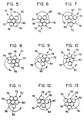
- Figures 5-13 are schematics of cross sections through a cord in accordance with the present invention illustrating an idealized geometric shape taken along the axial length of one twist of the cord..
- As used herein and in the Claims:
"Carcass" means the tire structure apart from the belt structure, tread, undertread, and sidewall rubber over the plies, but including the beads. - "Cord" means one or more of the reinforcement elements, formed by one or more filaments/wires which may or may not be twisted or otherwise formed which may further include strands so formed which strands may or may not be also so formed, of which the plies in the tire are comprised.
- "Super Tensile Steel" (ST) means a steel as defined in the above referenced application Serial Number 07/415948, or a tensile strength of at least

-
Steel reinforcing cords 36 according to the present invention (see Figs. 1-3) are characterized by thecords 36 havingfilaments - Preferably the
cords 36 are comprised of four filaments of finely drawn super tensile steel wire. As noted in the application incorporated by reference above, there are a number of metallurgical embodiments which result in the tensile strength defined above as super tensile (ST). - The
cords 36 used in the working example have a structure of fourfilaments cord 36 break strength of 1258 Newtons plus or minus 70 Newtons. Eachcord 36 has twofilaments filaments filaments twisted filaments - Other cords produced included 3+2x.35ST and 3+3x.35ST.
- These cords have particular application to composites for truck tires when replacing former constructions.
- By comparing the ratio of strength (STR) of the cord divided by the linear density (LD) of the cords (STR/LD) advantages of the cords become apparent:
TABLE 1 STRENGTH (N) LINEAR DENSITY Mg/Meters STR/LD Former Cords 3x.265/9x.245HT+1 1810 +/- 100 4845 .37 3x.20+6x.35HT 1850 +/- 107 5400 .34 3+9+15x.22+1 2750 +/- 150 8470 .32 Present Cords 2+2x.35ST 1254 +/- 67 3018 .42 3+2x.35ST 1568 +/- 80 3773 .42 3+3x.35ST 1881 +/- 100 4527 .42
By comparing the ratio of strength to the linear density of the cords it can be seen that the ratio is always higher for the present cords. It will be shown below how the increased STR/LD of the above constructions can be utilized to make composites that at equal inch strength yield lower total weight. - For example, Former Cord 3x.265/9x.245HT+1 at an EPI of 12 (4.7 ends/cm) and a minimum cord strength of 1708 Newtons yields a composite strength of 8071 Newtons per cm. If the gauge of calendered gum applied to the cords is maintained the same for all cords, the following table results:

- Table 2 above in the last column gives the composite strengths in Newtons per centimeter of all composites with the noted cords and End Counts (ends per cm) all of which are in the 8000 range and considered equal. The Former Cords are listed first and the Present Cords, which are according to the invention, are listed below with the Former Cords replaceable by the Present Cords. The increase in STR/LD of the Present Cords over the former permits flexibility in cord use making the Present Cords interchangeable in composites with the proper end count. In each instance, cord according to the present invention is simpler in construction having fewer filaments. While the cord strength is less than the cord it replaces, the EPI and additional strength of the super tensile filament material allow the composites to have equal strength. However, the present cords can be seen to have less weight with the results that a lighter weight composite is obtained with equal inch strength which can contribute to a more fuel efficient tire. Further, the above weight reduction is amplified by an accompanying reduction in composite cost of up to 18%.
- Table 3, below, gives a direct comparison between a number of 4 filament cords of high tensile HT and super tensile ST of varying filament diameters showing an increase in strength in all cases. Note that not all the cord samples in Table 3 became candidates noted above.

- Another advantage of the Present Cord over the former is that their construction is more open to penetration by the calendered gum resulting in their being more resistant to corrosion propagation. Table 4 below makes a comparison of pull out force and observed gum coverage for various cords initially and after two days of steam aging.
TABLE 4 ORIGINAL STEAM AGED N % Coverage N % Coverage Former Cord 3x.265/9x.245HT+1 829 90 674 80 3+9+15x.22+1 931 90 763 80 Present Cord 3+2x.35ST 739 90 749 90 2+2x.35ST 644 90 638 90 - It can be seen that the Present Cords retain their pull out force and coverage while the former cords drop in strength and coverage. Similar results were achieved with salt and humidity aging.
- The Present Cords are stronger in cord strength allowing for use of fewer cords for equal strength. Those having larger diameter filaments result in substantial reduction in the number of filaments in the cord over former cords making use of U+T type constructions possible where previous strength levels ruled out such type constructions. The U+T type constructions are more open resulting in better adhesion and greater resistance to corrosion. Finally, as noted above, the new cords lead to reduction in weight of reinforcement in elastomers both from the reinforcement itself as well as from the elastomer.
- In accordance with the provisions of the patent statutes, the principle and mode of operation of the cord have been explained and what is considered to represent its best embodiment has been illustrated and described. It should, however, be understood that the invention may be practiced otherwise than as specifically illustrated and described without departing from the scope of the claims.
Claims (12)
- A cord for reinforcing elastomeric structures including two groups of filaments, a first group T being twisted and a second group U being untwisted, the groups U and T being twisted about each other and comprising at least three filaments all having the same pitch and twist direction, said cord being made of steel, characterized in that the steel of the filaments has at least a tensile strength (TS) defined by the expression:

K₁ = 4080 N/mm²
K₂ = 2000 N/mm³ ; and
D is the filament diameter in mm. - The cord defined in claim 1 wherein the steel of the filaments has a content by weight of between 0.78% and 0.86% carbon, 0.3% and 1.0% Si and between 0.1% and 0.5% of an alloying element from a class of the following elements: Cr, Ni, Co, W, Mo, V and Nb and any combination thereof, the balance being iron and residuals.
- The cord defined in claim 1 wherein the steel of the cord has a breaking load (CBL) in pounds (2.205 KG) defined by the expression:


CE is the cord efficiency,
D is the filament diameter in millimeters and
N is the number of filaments in the cord. - The cord defined in claims 1, 2 or 3 wherein said filaments have a diameter range of 0.15 to 0.38 mm.
- The cord defined in claim 4 wherein said filaments have a diameter range of 0.30 to 0.38 mm.
- The cord defined in claims 1, 2 or 3 wherein at least one of said groups of filaments has at least two filaments therein.
- The cord defined in claims 1, 2 or 3 wherein said groups of filaments have at least two filaments therein.
- The cord defined in claims 1, 2 or 3 wherein at least one of said groups of filaments has at least three filaments therein.
- The cord defined in claim 8 wherein the other group of filaments has at least two filaments therein.
- The cord defined in claims 1, 2 or 3 wherein said groups of filaments have at least three filaments therein.
- The cord defined in claim 7, 9 or 10 wherein the filament diameters are 0.35 mm.
- A tire reinforced by a cord according to claim 1.
Applications Claiming Priority (5)
| Application Number | Priority Date | Filing Date | Title |
|---|---|---|---|
| US07/496,759 USH1333H (en) | 1990-03-21 | 1990-03-21 | High strength reinforcement |
| US496759 | 1990-03-21 | ||
| US57502790A | 1990-08-30 | 1990-08-30 | |
| US575027 | 1990-08-30 | ||
| PCT/US1991/001580 WO1991014811A1 (en) | 1990-03-21 | 1991-03-11 | High strength cord |
Publications (3)
| Publication Number | Publication Date |
|---|---|
| EP0527139A1 EP0527139A1 (en) | 1993-02-17 |
| EP0527139A4 EP0527139A4 (en) | 1993-03-10 |
| EP0527139B1 true EP0527139B1 (en) | 1995-10-18 |
Family
ID=27052264
Family Applications (1)
| Application Number | Title | Priority Date | Filing Date |
|---|---|---|---|
| EP91905695A Expired - Lifetime EP0527139B1 (en) | 1990-03-21 | 1991-03-11 | High strength cord |
Country Status (10)
| Country | Link |
|---|---|
| EP (1) | EP0527139B1 (en) |
| JP (2) | JPH05505652A (en) |
| KR (1) | KR0182320B1 (en) |
| AU (1) | AU642996B2 (en) |
| BR (1) | BR9106170A (en) |
| CA (1) | CA2075041C (en) |
| DE (1) | DE69114000T2 (en) |
| ES (1) | ES2080943T3 (en) |
| TR (1) | TR25148A (en) |
| WO (1) | WO1991014811A1 (en) |
Families Citing this family (8)
| Publication number | Priority date | Publication date | Assignee | Title |
|---|---|---|---|---|
| JPH05238202A (en) * | 1992-02-27 | 1993-09-17 | Yokohama Rubber Co Ltd:The | Pneumatic radial tire for passenger car |
| KR940006811A (en) * | 1992-09-18 | 1994-04-25 | 카알 에이취. 크루코우 | Radial tires with monofilaments of steel on carcass ply |
| CA2088307A1 (en) * | 1992-09-18 | 1994-03-19 | Amit Prakash | Radial tires containing steel monofilament in the carcass ply |
| FR2711149A1 (en) * | 1993-10-15 | 1995-04-21 | Michelin & Cie | Stainless steel wire for tire casing carcass. |
| US6247514B1 (en) | 1994-12-20 | 2001-06-19 | The Goodyear Tire & Rubber Company | Tires with high strength reinforcement |
| US5843583A (en) * | 1996-02-15 | 1998-12-01 | N.V. Bekaert S.A. | Cord with high non-structural elongation |
| US5772809A (en) * | 1996-02-23 | 1998-06-30 | Bridgestone Corporation | Pneumatic tires with specified steel belt cords |
| CA2260913A1 (en) * | 1998-02-19 | 1999-08-19 | The Goodyear Tire & Rubber Company | Radial tires containing strands of untwisted steel filaments in the carcass ply |
Family Cites Families (7)
| Publication number | Priority date | Publication date | Assignee | Title |
|---|---|---|---|---|
| NL191315C (en) * | 1981-05-08 | 1995-05-16 | Bekaert Sa Nv | Cable for reinforcing elastomeric material and method for manufacturing such a cable. |
| US4506500A (en) * | 1982-04-10 | 1985-03-26 | Tokusen Kogyo Kabushiki Kaisha | Steel cord for reinforcing a rubber structure |
| LU84845A1 (en) * | 1983-06-03 | 1983-11-17 | Trefilarbed Sa | METAL WIRE ROPE FOR REINFORCING ELASTOMERIC PRODUCTS |
| GB8332395D0 (en) * | 1983-12-05 | 1984-01-11 | Bekaert Sa Nv | Steel wires |
| MY100832A (en) * | 1986-03-06 | 1991-03-15 | Goodyear Tire & Rubber | Reinforced composite structure |
| US4966216A (en) * | 1987-06-08 | 1990-10-30 | Bridgestone Corporation | Heavy duty radial tires with metallic carcass ply |
| US4960473A (en) * | 1989-10-02 | 1990-10-02 | The Goodyear Tire & Rubber Company | Process for manufacturing steel filament |
-
1991
- 1991-03-11 ES ES91905695T patent/ES2080943T3/en not_active Expired - Lifetime
- 1991-03-11 JP JP91506192A patent/JPH05505652A/en active Pending
- 1991-03-11 EP EP91905695A patent/EP0527139B1/en not_active Expired - Lifetime
- 1991-03-11 WO PCT/US1991/001580 patent/WO1991014811A1/en not_active Ceased
- 1991-03-11 AU AU74917/91A patent/AU642996B2/en not_active Ceased
- 1991-03-11 CA CA002075041A patent/CA2075041C/en not_active Expired - Fee Related
- 1991-03-11 BR BR919106170A patent/BR9106170A/en not_active IP Right Cessation
- 1991-03-11 KR KR1019920702263A patent/KR0182320B1/en not_active Expired - Fee Related
- 1991-03-11 DE DE69114000T patent/DE69114000T2/en not_active Expired - Fee Related
- 1991-04-02 TR TR91/0285A patent/TR25148A/en unknown
-
2001
- 2001-03-06 JP JP2001001127U patent/JP2001000033U/en active Pending
Also Published As
| Publication number | Publication date |
|---|---|
| CA2075041C (en) | 2001-04-17 |
| KR0182320B1 (en) | 1999-05-01 |
| BR9106170A (en) | 1993-03-16 |
| TR25148A (en) | 1992-11-01 |
| EP0527139A4 (en) | 1993-03-10 |
| EP0527139A1 (en) | 1993-02-17 |
| JPH05505652A (en) | 1993-08-19 |
| CA2075041A1 (en) | 1991-09-22 |
| WO1991014811A1 (en) | 1991-10-03 |
| AU7491791A (en) | 1991-10-21 |
| DE69114000T2 (en) | 1996-05-30 |
| AU642996B2 (en) | 1993-11-04 |
| ES2080943T3 (en) | 1996-02-16 |
| DE69114000D1 (en) | 1995-11-23 |
| KR930700728A (en) | 1993-03-15 |
| JP2001000033U (en) | 2001-08-31 |
Similar Documents
| Publication | Publication Date | Title |
|---|---|---|
| EP0522058B1 (en) | Cord for tires and tires with high strength reinforcement | |
| AU593070B2 (en) | Reinforced composite structure | |
| EP0849098B1 (en) | Tyres with high strength reinforcement | |
| EP0157716A1 (en) | Flat wire reinforcement in tyre belt and carcass | |
| CN105297502B (en) | Heavy duty tire band beam portion's steel cord for reinforcing and Pneumatic tire for heavy load | |
| AU642996B2 (en) | High strength cord | |
| EP0987128A2 (en) | Tires with high strength reinforcement in the carcass | |
| JPH06235179A (en) | Steel cord and composite rubber material using the steel cord | |
| US6146760A (en) | High strength cord | |
| US6273160B1 (en) | Tires with high strength reinforcement | |
| EP0795425A1 (en) | A metallic cord for the reinforcement of elastomers | |
| EP0553391A1 (en) | High strength reinforcement | |
| JPH06346386A (en) | Metal cord for reinforcing rubber articles | |
| JPH0649784A (en) | Composite cord for reinforcing elastomer good and pneumatic radial tire | |
| JPH1044259A (en) | Composite material of rubber and steel stiffener used for belt part of tire, and pneumatic radial tire using it | |
| JPH1060789A (en) | Steel cord for reinforcing rubber article and pneumatic tire using the same | |
| JPH05294109A (en) | Pneumatic radial tire |
Legal Events
| Date | Code | Title | Description |
|---|---|---|---|
| PUAI | Public reference made under article 153(3) epc to a published international application that has entered the european phase |
Free format text: ORIGINAL CODE: 0009012 |
|
| 17P | Request for examination filed |
Effective date: 19920930 |
|
| AK | Designated contracting states |
Kind code of ref document: A1 Designated state(s): BE DE ES FR GB IT LU |
|
| A4 | Supplementary search report drawn up and despatched |
Effective date: 19930118 |
|
| AK | Designated contracting states |
Kind code of ref document: A4 Designated state(s): BE DE ES FR GB IT LU |
|
| 17Q | First examination report despatched |
Effective date: 19940217 |
|
| GRAA | (expected) grant |
Free format text: ORIGINAL CODE: 0009210 |
|
| AK | Designated contracting states |
Kind code of ref document: B1 Designated state(s): BE DE ES FR GB IT LU |
|
| REF | Corresponds to: |
Ref document number: 69114000 Country of ref document: DE Date of ref document: 19951123 |
|
| ET | Fr: translation filed | ||
| ITF | It: translation for a ep patent filed | ||
| REG | Reference to a national code |
Ref country code: ES Ref legal event code: FG2A Ref document number: 2080943 Country of ref document: ES Kind code of ref document: T3 |
|
| PLBE | No opposition filed within time limit |
Free format text: ORIGINAL CODE: 0009261 |
|
| STAA | Information on the status of an ep patent application or granted ep patent |
Free format text: STATUS: NO OPPOSITION FILED WITHIN TIME LIMIT |
|
| 26N | No opposition filed | ||
| PGFP | Annual fee paid to national office [announced via postgrant information from national office to epo] |
Ref country code: LU Payment date: 20010124 Year of fee payment: 11 |
|
| REG | Reference to a national code |
Ref country code: GB Ref legal event code: IF02 |
|
| PG25 | Lapsed in a contracting state [announced via postgrant information from national office to epo] |
Ref country code: LU Free format text: LAPSE BECAUSE OF NON-PAYMENT OF DUE FEES Effective date: 20020311 |
|
| PGFP | Annual fee paid to national office [announced via postgrant information from national office to epo] |
Ref country code: DE Payment date: 20020327 Year of fee payment: 12 |
|
| PG25 | Lapsed in a contracting state [announced via postgrant information from national office to epo] |
Ref country code: DE Free format text: LAPSE BECAUSE OF NON-PAYMENT OF DUE FEES Effective date: 20031001 |
|
| PGFP | Annual fee paid to national office [announced via postgrant information from national office to epo] |
Ref country code: GB Payment date: 20050207 Year of fee payment: 15 |
|
| PGFP | Annual fee paid to national office [announced via postgrant information from national office to epo] |
Ref country code: FR Payment date: 20050302 Year of fee payment: 15 |
|
| PGFP | Annual fee paid to national office [announced via postgrant information from national office to epo] |
Ref country code: ES Payment date: 20050314 Year of fee payment: 15 |
|
| PG25 | Lapsed in a contracting state [announced via postgrant information from national office to epo] |
Ref country code: GB Free format text: LAPSE BECAUSE OF NON-PAYMENT OF DUE FEES Effective date: 20060311 |
|
| PG25 | Lapsed in a contracting state [announced via postgrant information from national office to epo] |
Ref country code: ES Free format text: LAPSE BECAUSE OF NON-PAYMENT OF DUE FEES Effective date: 20060313 |
|
| GBPC | Gb: european patent ceased through non-payment of renewal fee |
Effective date: 20060311 |
|
| REG | Reference to a national code |
Ref country code: ES Ref legal event code: FD2A Effective date: 20060313 |
|
| PGFP | Annual fee paid to national office [announced via postgrant information from national office to epo] |
Ref country code: IT Payment date: 20070612 Year of fee payment: 17 |
|
| REG | Reference to a national code |
Ref country code: FR Ref legal event code: ST Effective date: 20071130 |
|
| PG25 | Lapsed in a contracting state [announced via postgrant information from national office to epo] |
Ref country code: FR Free format text: LAPSE BECAUSE OF NON-PAYMENT OF DUE FEES Effective date: 20070402 |
|
| PG25 | Lapsed in a contracting state [announced via postgrant information from national office to epo] |
Ref country code: FR Free format text: LAPSE BECAUSE OF NON-PAYMENT OF DUE FEES Effective date: 20060331 |
|
| PGFP | Annual fee paid to national office [announced via postgrant information from national office to epo] |
Ref country code: BE Payment date: 20080403 Year of fee payment: 18 |
|
| PG25 | Lapsed in a contracting state [announced via postgrant information from national office to epo] |
Ref country code: IT Free format text: LAPSE BECAUSE OF NON-PAYMENT OF DUE FEES Effective date: 20080311 |
|
| BERE | Be: lapsed |
Owner name: THE *GOODYEAR TIRE & RUBBER CY Effective date: 20090331 |
|
| PG25 | Lapsed in a contracting state [announced via postgrant information from national office to epo] |
Ref country code: BE Free format text: LAPSE BECAUSE OF NON-PAYMENT OF DUE FEES Effective date: 20090331 |