EP0525977A1 - Fast dry waterborne traffic marking paint - Google Patents
Fast dry waterborne traffic marking paint Download PDFInfo
- Publication number
- EP0525977A1 EP0525977A1 EP92305844A EP92305844A EP0525977A1 EP 0525977 A1 EP0525977 A1 EP 0525977A1 EP 92305844 A EP92305844 A EP 92305844A EP 92305844 A EP92305844 A EP 92305844A EP 0525977 A1 EP0525977 A1 EP 0525977A1
- Authority
- EP
- European Patent Office
- Prior art keywords
- polymer
- emulsion
- acrylic acid
- monomers
- substituted
- Prior art date
- Legal status (The legal status is an assumption and is not a legal conclusion. Google has not performed a legal analysis and makes no representation as to the accuracy of the status listed.)
- Withdrawn
Links
Classifications
-
- C—CHEMISTRY; METALLURGY
- C09—DYES; PAINTS; POLISHES; NATURAL RESINS; ADHESIVES; COMPOSITIONS NOT OTHERWISE PROVIDED FOR; APPLICATIONS OF MATERIALS NOT OTHERWISE PROVIDED FOR
- C09D—COATING COMPOSITIONS, e.g. PAINTS, VARNISHES OR LACQUERS; FILLING PASTES; CHEMICAL PAINT OR INK REMOVERS; INKS; CORRECTING FLUIDS; WOODSTAINS; PASTES OR SOLIDS FOR COLOURING OR PRINTING; USE OF MATERIALS THEREFOR
- C09D133/00—Coating compositions based on homopolymers or copolymers of compounds having one or more unsaturated aliphatic radicals, each having only one carbon-to-carbon double bond, and at least one being terminated by only one carboxyl radical, or of salts, anhydrides, esters, amides, imides, or nitriles thereof; Coating compositions based on derivatives of such polymers
- C09D133/04—Homopolymers or copolymers of esters
- C09D133/06—Homopolymers or copolymers of esters of esters containing only carbon, hydrogen and oxygen, the oxygen atom being present only as part of the carboxyl radical
-
- C—CHEMISTRY; METALLURGY
- C09—DYES; PAINTS; POLISHES; NATURAL RESINS; ADHESIVES; COMPOSITIONS NOT OTHERWISE PROVIDED FOR; APPLICATIONS OF MATERIALS NOT OTHERWISE PROVIDED FOR
- C09D—COATING COMPOSITIONS, e.g. PAINTS, VARNISHES OR LACQUERS; FILLING PASTES; CHEMICAL PAINT OR INK REMOVERS; INKS; CORRECTING FLUIDS; WOODSTAINS; PASTES OR SOLIDS FOR COLOURING OR PRINTING; USE OF MATERIALS THEREFOR
- C09D151/00—Coating compositions based on graft polymers in which the grafted component is obtained by reactions only involving carbon-to-carbon unsaturated bonds; Coating compositions based on derivatives of such polymers
- C09D151/06—Coating compositions based on graft polymers in which the grafted component is obtained by reactions only involving carbon-to-carbon unsaturated bonds; Coating compositions based on derivatives of such polymers grafted on to homopolymers or copolymers of aliphatic hydrocarbons containing only one carbon-to-carbon double bond
-
- C—CHEMISTRY; METALLURGY
- C09—DYES; PAINTS; POLISHES; NATURAL RESINS; ADHESIVES; COMPOSITIONS NOT OTHERWISE PROVIDED FOR; APPLICATIONS OF MATERIALS NOT OTHERWISE PROVIDED FOR
- C09D—COATING COMPOSITIONS, e.g. PAINTS, VARNISHES OR LACQUERS; FILLING PASTES; CHEMICAL PAINT OR INK REMOVERS; INKS; CORRECTING FLUIDS; WOODSTAINS; PASTES OR SOLIDS FOR COLOURING OR PRINTING; USE OF MATERIALS THEREFOR
- C09D5/00—Coating compositions, e.g. paints, varnishes or lacquers, characterised by their physical nature or the effects produced; Filling pastes
- C09D5/004—Reflecting paints; Signal paints
-
- C—CHEMISTRY; METALLURGY
- C08—ORGANIC MACROMOLECULAR COMPOUNDS; THEIR PREPARATION OR CHEMICAL WORKING-UP; COMPOSITIONS BASED THEREON
- C08L—COMPOSITIONS OF MACROMOLECULAR COMPOUNDS
- C08L2205/00—Polymer mixtures characterised by other features
- C08L2205/02—Polymer mixtures characterised by other features containing two or more polymers of the same C08L -group
-
- C—CHEMISTRY; METALLURGY
- C08—ORGANIC MACROMOLECULAR COMPOUNDS; THEIR PREPARATION OR CHEMICAL WORKING-UP; COMPOSITIONS BASED THEREON
- C08L—COMPOSITIONS OF MACROMOLECULAR COMPOUNDS
- C08L33/00—Compositions of homopolymers or copolymers of compounds having one or more unsaturated aliphatic radicals, each having only one carbon-to-carbon double bond, and only one being terminated by only one carboxyl radical, or of salts, anhydrides, esters, amides, imides or nitriles thereof; Compositions of derivatives of such polymers
- C08L33/04—Homopolymers or copolymers of esters
- C08L33/06—Homopolymers or copolymers of esters of esters containing only carbon, hydrogen and oxygen, which oxygen atoms are present only as part of the carboxyl radical
Definitions
- the present invention is directed to traffic marking paint compositions and particularly to waterborne traffic marking paints having rapid dry times.
- the binder in this paint is believed to be an emulsion polymer comprised of monomers of methyl methacrylate, butyl methacrylate, butyl acrylate and styrene.
- a waterborne traffic marking paint with very high pigment levels and with very rapid drying times.
- the paint dries to a very hard, moisture resistant finish which provides excellent durability, even when applied under relatively humid conditions.
- the traffic marking paint of the present invention uses a binder that is an emulsion comprising a support polymer which acts as a surfactant so as to enable micelle formation in an aqueous medium and an emulsion polymerized polymer which is maintained within micelles in a water-borne composition.
- the support polymer is comprised of styrene and acrylic acid monomers and is rendered water-soluble by salt formation with ammonia.
- the emulsion polymer is comprised of acrylic monomers or acrylic and styrene monomers.
- the paint compositions comprise between about 10 and about 15 wt. percent binder and between about 60 and about 75 wt. percent fillers and/or pigments.
- the waterborne paints of the present invention have very rapid dry times, very high solids content including a very high pigment volume concentration (pvc), and water vapor impermeability and hardness in the applied and dried paints which contribute to long-term durability.
- the key to obtaining excellent characteristics appears to lie primarily in the selection of the emulsion binder with appropriate characteristics. It is to be appreciated that traffic marking paints will, at some time or other, be subjected to substantial exposure to water. It is therefore a challenge to provide a water-borne formulation in which the binder must have water compatibility, yet nevertheless, the applied and dried paint must withstand exposure to water over a reasonable life.
- a suitable binder is an emulsion formed of a water-solubilized support polymer and a hydrophobic emulsion polymerized polymer.
- the support polymer is formed from styrene or substituted styrene monomers and acrylic acid or substituted acrylic acid monomers.
- the monomers are selected in such proportion that the support polymer has carboxylic acid functionality so as to provide acid values in about the 50 to 250 range.
- the support polymers may be rendered water-soluble through salt formation with an appropriate base, such as ammonia. While the acid value must be sufficient to provide water solubility to the support polymer and enable the support polymer to act as a surfactant to the emulsion polymerized polymer; with the intent of providing a durable traffic paint, it is desirable that the acid number as low as possible, consistent with the requirements of water-compatibility. This is because common substrates, such as concrete, typically contain basic groups which may tend to resolubilize the support polymer.
- the monomers selected for the support polymer are also selected to provide a hard support polymer.
- the support polymer comprises a substantial portion of the polymeric binder, i.e., between about 20 and about 40 wt. percent, it is necessary that the support polymer provide some of the hardness required of the binder polymer which promotes durability of the traffic marking paint.
- the styrene or substituted styrene monomers contribute to hardness of the support polymer.
- the acrylic acid monomers are also selected to be consistent with polymer hardness, and to this end, acrylic acid, or acrylic acids with short chain substituent groups, e.g., methacrylic acid or ethacrylic acid, are preferably used.
- One support polymer which has been found to be particularly suitable is a terpolymer of styrene, alphamethyl styrene and acrylic acid, with the monomers used in about a 1:1:1 molar ratio. Similar polymers with an even lower acrylic acid content, but still consistent with water-compatibility requirements might prove even more suitable.
- the weight average molecular weight of the support polymer is in the range of about 2000 to about 10,000.
- the support polymer may have a bimodal or multimodal molecular weight distribution. Adjustments in the molecular weight distribution may be made to vary the T g of the support polymer.
- the support polymer may be manufactured by conventional solution polymerization in an organic solvent, the solvent removed, and the polymer solubilized in water through the aid of ammonia or a volatile amine.
- Examples of syntheses of suitable support polymers are found, for rexample, in U.S. Patents Nos. 4,414,370 and 4,529,787, the teachings of which are incorporated herein by reference. It appears to be important that care is taken so as not to esterify any of the acid functionality, particularly with hydrophillic moieties. It is common for solution polymers to be polymerized in a relatively high-boiling glycol ether, such as ethylene glycol monomethyl ether.
- the polymers are much less effective support polymers with respect to water resistance of the applied and dried traffic marking paint. It appears that some glycol ether esterifies with the carboxylic groups of the polymer, resulting in a binder that is much less resistant to water in the applied and dried paint. Instead, it is preferred that the support polymers be synthesized in an alcohol, such as ethanol or methanol. This, of course, makes synthesis somewhat more difficult as it is more difficult to achieve desirably high reaction temperatures with such lower-boiling solvents.
- the solution polymer dissolved in an aqueous ammonia media, provides a support for forming an emulsion of the polymer that is polymerized in situ, acting as a surfactant for the emulsion polymer, whereby micelles may be formed.
- a surfactant for the emulsion polymer, whereby micelles may be formed.
- the monomers used to form the emulsion polymers are selected so as to form a relatively hard polymer. Also, the monomers must form a polymer sufficiently hydrophobic so as to form micelles, rather than be soluble in alkaline aqueous solution.
- the monomers may be all acrylic monomers or may be a mixture of acrylic and styrene monomers.
- the acrylic monomers are substantially all esterified so that the polymer has little or no carboxylic functionality, although a minor portion of the monomer content may be an acrylic acid.
- the acid number of the emulsion polymer should be below about 15.
- the emulsion polymer has a glass transition temperature (T g ) between about -15°C and about 15°C. Sufficient monomer is polymerized such that the emulsion polymer comprises between about 60 and about 80 wt. percent of the total amount of binder polymer.
- between about 20 and about 80 mole percent of the emulsion polymer is an ester of an acrylic acid and an alcohol having at least about 8 carbon atoms.
- examples of such monomers include 2-ethyl-1-hexyl methacrylate, stearyl methacrylate and laural methacrylate. These monomers impart good adhesion, good wetting of the pigment and good water resistance in the applied and dried paint.
- another substantial portion e.g., between about 20 and about 80 mole percent is an ester of an acrylic acid and a short-chain alcohol having about 4 carbon atoms or fewer.
- Examples of these monomers include butyl acrylate, butyl methacrylate, ethyl methacrylate, ethyl acrylate, methyl methacrylate and methyl acrylate.
- One particularly suitable emulsion polymer is a copolymer of 2-ethyl-1-hexyl methacrylate and methyl methacrylate in about equal molar amounts.
- the polymerization is carried out so as to produce micelles of relatively small size, preferably so that the major portion of the micelles are in the range of 0.1-0.2 microns.
- the small size of the micelles is believed to be important in promoting wetting of pigment and filler particles and in promoting cohesion of the binder micelles during drying.
- a small amount of binder polymer is used to bind a high level of filler and/or pigment solids.
- the total amount of binder polymer in the paint formulations of the present invention is lower than that of other waterborne traffic marking paint formulations, i.e., between about 10 and about 15 wt. percent of the total paint formulation (including solids, water and other volatiles)
- the total levels of pigments are quite high, i.e., between about 60 and about 75 wt. percent of the total paint formulations, preferably between about 68 and 75 wt. percent.
- Pigment volume concentrations upward of 70% are achieved using the emulsion binder polymers selected for use in the present invention.
- One of the factors contributing to rapid dry time is the excellent coalescing properties of the binder polymers.
- Another factor contributing to rapid drying is the fact that with the high solids loading achievable by the paint formulations of the present invention, i.e., to between about 75 and about 90 wt. percent of the total paint formulation, preferably upward of about 80 wt. percent, the total level of water used in the present invention is quite low relative to other waterborne traffic marking paint formulations, i.e., between about 9 and about 18 wt. percent relative to the total paint formulation.
- the low level of water in the paint formulation means that substantially less water need be evaporated to achieve dryness. Paint formulations in accordance with the present invention have achieved ASTM D-711 "no pick-up" times of 2 min. at ambient temperatures and “no pick-up" dry times of 30 sec. when applied by hot spray at 120°F (49°C).
- paint formulations of the present invention are "waterborne", they can, and preferably do, contain a small amount of organic solvent.
- the solvent acts to reduce the viscosity of the paint formulation.
- a preferred solvent is methanol, which also forms an azeotrope with water and thereby promotes evaporation of water from the applied paint formulation.
- Other waterborne paint formulations have also contained some organic solvents.
- paint formulations of the present invention contain relatively low levels of the organic solvent, i.e., between about 3 and about 6 wt. percent relative to the total paint formulation.
- the major filler in the paint formulation of the present invention is calcium carbonate.
- This pigment is preferred because of its low oil absorption, whereby a relatively small amount of binder is required to wet the pigment.
- Between about 70 and about 90 wt. percent of total pigment is calcium carbonate.
- calcium carbonate has little or no light refracting ability, it is considered to be an extender pigment or a filler.
- an opaque pigment e.g., TiO2 is added, typically at a level of between about 10 and about 30 wt. percent of total pigment. TiO2 will provide a white color to white marking paints. If other colors are desired, other pigments are added, often organic pigments of specific color. Such additional pigments are typically used between about 3 and about 10 wt. percent of total pigments.
- the pigments be "banded"; that is, predispersed in a dispersing polymer.
- the banded pigment is a solid blend of the pigment in the dispersing polymer.
- Pigments which are desirably banded include inorganic pigments, such as iron oxide and carbon black, and organic pigments such as 75 type yellow, e.g., DCC-1111 sold by Dominium Colour, Inc. and 1249 sold by Englehard; copper phthalocyanine (Zulu Blue NCNF-4863) sold by Englehard, and DCC-2254 red-medium toluidine, sold by Dominium.
- Banded pigments are particularly compatible with paints of the present invention because generally the same polymers suitable as support polymers in the emulsion binder are suitable as dispersing polymers, and herein, the definition of the support polymer above serves as a definition of suitable dispersing polymer.
- the dispersing polymer by virtue of its acid functionality, is soluble in alkaline aqueous media.
- Banded pigments are produced by melt-processing the pigment with the dispersing polymer.
- a currently preferred method of producing banded pigments useful in the present invention is to process dispersing polymer and colored pigment in a two-roll mill. Sufficient heat is generated to melt the thermoplastic dispersing polymer into a viscous material which wets and encapsulates the pigment particles. The two-roll milling further helps to break up clumps of the pigment particles, ensuring their dispersion within the dispersing polymer.
- the banded pigments are subsequently introduced into alkaline aqueous media, e.g., the paints of the present invention, the dispersing polymer dissolves in the media, retaining the pigment particles encapsulated in dispersing polymer.
- Banded pigments generally comprise between about 20 and about 60 wt. percent pigment, balance dispersing polymer. High weight percent of pigment is generally considered to be desirable.
- banded pigments avoids recognized problems in trying to disperse fine pigment particles in water-borne paints. If finely divided pigment is introduced into a paint, the paint must be subject to high shear forces, e.g., in a sand mill, to disperse the pigment. Such high shear tends to break down emulsions, such as the binder of the present invention. Furthermore, high shear processing is detrimental to many organic pigments, such as light-fast organic yellow pigments often used in traffic marking paints. Use of banded pigments eliminates the need for high shear mixing to disperse the pigment particles because the pigment particles become dispersed in the alkaline aqueous medium as the dispersing polymer of the banded pigment dissolves.
- banded pigments are solids, they introduce no additional water into the paint, as would a separately-prepared aqueous pigment dispersion. Keeping in mind that high solids content is sought in order to achieve solids content, particularly in a traffic marking paint, banded pigments are very useful in producing a high solids paint.
- a further advantage of using banded pigments is that they contribute to high gloss of the finish. It is believed that this may be attributed to the excellent dispersion of the pigment particles in the paint. The fact that each pigment particle is encapsulated in polymer may also contribute to gloss. Certain traffic marking applications, particularly curb painting, often require medium to high-gloss paints.
- dispersions are most quickly obtained when the pH is relatively high, e.g., above about 8.4.
- the pH is preferably raised with ammonia.
- the emulsion binder comprises between about 10 and about 15 wt. percent of the paint, colorless and/or white pigments and/or fillers comprise between about 53 and about 75 wt. percent of the paint, colored pigments comprise between about 0.2 and about 7 wt percent of the paint, suspension polymer in which the colored pigments are encapsulated comprise between about 0.2 and about 15 wt. percent of the paint, water comprises between about 9 and about 18 wt. percent of the paint, and sufficient ammonia is present to maintain an emulsion of the binder and a dispersion of colored pigment in suspension polymer.
- the total amount of banded pigment components, i.e., colored pigment plus dispersing polymer is between about 0.5 and about 22 wt. percent of the paint.
- dispersants or surfactants are used.
- a mixture of anionic and non-ionic surfactants are used.
- Surfactants or dispersants are typically used at between about 0.5 and about 2 wt. percent of the paint formulation.
- the formulation may also contain additional components as are known in the art, such as defoamers and coalescing agents.
- the paints are prepared by mixing of the ingredients. Generally, all of the ingredients except the organic solvent (e.g., methanol) and minor portions of additives are mixed together and then the methanol and remainder of the additives are used to thin down the paint.
- the organic solvent e.g., methanol
- Paints prepared in accordance with the invention have proven to be stable during application up to 190°F (88°C). Generally, for hot spray application, stability up to 160°F (71°C) is sufficient.
- Paint compositions according to the invention may be applied to any usual roadway paving material, including asphalt and concrete. While the paints are particularly formulated for roadway marking, they can be used for other applications, particularly for other applications where similar paint properties are required or desirable.
- a white paint formulation was prepared containing the following components: All ingredients above the line were thoroughly mixed. Then the last three ingredients were added to thin the paint.
- the emulsion polymer had a non-volatile solids content of 49% (49% NVM).
- the paint formulations has an NVM of 81%, or 64% non-volatile percent by volume.
- a yellow road marking paint having the following formula: *Monomer content analyzed: 2-ethylhexyl acrylate 50 molar percent, methyl methacrylate 30 molar percent, styrene 10 molar percent, alpha-methyl styrene 10 molar percent.
- Example 1 The paint of Example 1 and a waterborne paint of Rohm and Haas (E-2706) were each applied to glass. Properties of the dried paints are given below. Test R & H Ex. 1 Falling Sand Taber (mg/cycle 0.58 0.49 Water Immersion (minutes to tape-off) 10 40 Pendulum Hardness 38 93 Freeze Cycle Tape X-Hatch 0% Pass 50% Pass Freeze/Thaw No. of cycles 5 5
- a paint formulated in accordance with the present invention performed substantially better than than the Rohm & Haas formulation. Most notable is the substantially greater hardness of the paint of the present invention.
- Binder emulsions produced in accordance with the present invention were produced as follows.
- the starting materials were each commercial solutions of styrene/alpha-methyl styrene/acrylic copolymer in about a 1:1:1 molar ratio and a molecular weight of approximately 6000 to 9000.
- the solution was Morcryl®, a 32% solution of Morez®-101 sold by Morton International, Inc.
- the solution was B.F. Goodrich's XPD-1166.
- Each preparation was formulated to provide approximately a 50 wt. % final solids composition.
- the components for preparations A, B, and C expressed as weight percent were as follows with methyl methacrylate (MMA) and 2-ethyl-1-hexyl acrylate (EHA) comprising the emulsion polymer.
- a B C Support resin 12.2 12.2 11.5 Ammonium persulfate 0.54 0.47 0.47 MMA 18.6 19.42 22.4 EHA 18.6 17.0 14.05 Ammonia 0.4 0.4 0.4 Water Balance Balance Balance Balance Balance Balance Balance The solution was heated to between 75 and 85°C and the monomer mixture was added over a 2-2 1/2 hr. period, after which heating was continued for an additional 30 min. No additional surfactant of any kind was used to prepare the polymers.
- Paint formulations were prepared using the synthesized polymers of Example 4 (A, B and C), and emulsion polymer sold by ICI as ICI A-1052 (formulation 2). Properties of the paint of Example 1 (formulation A) and similar formulations but with the different binders (formulations 2, A, B, and C) are given in the table below.
- Traffic marking paints in accordance with the present invention were compared with a solvent based traffic marking paint and other waterborne traffic marking paints on an asphalt roadway in Salem, Oregon.
- the marking paints were applied at 77°F, 20% relative humidity, 65 degree road temperature and with a slight breeze.
- the paints were as follows:
- Paint formulations 2-7 had "no pick-up” times of 30 to 60 sec.
- Formulations 8-10 had "no pick-up” times of 90-120 sec.
- Binders D-H are commercial products which are currently prepared in DOWANOL® (ethylene glycol monomethyl ether), a manner of preparation not preferred in accordance with this invention. Binders I-L are theoretical binders; the properties listed for these properties are likewise theoretical.
- RESIN PROPERTIES D E F G H I J K L NVM 50 47 45 53 50 50 50 50 50 52 VISCOSITY 1500 1000 1000 1500 1500 1000 1200 1000 1500 pH 8.0 8.3 8.5 8.8 8.3 8.6 8.3 8.5 8.5 AV/NVM 50 55 45 105 50 50 50 50 50 T g , °C -8 103 -40 45 -20 25 9 16 4 Wt/gal 8.70 8.70 8.60 8.80 8.60 8.60 8.70 8.70 8.60
- a yellow paint formulation was prepared containing the following components:
Landscapes
- Chemical & Material Sciences (AREA)
- Life Sciences & Earth Sciences (AREA)
- Engineering & Computer Science (AREA)
- Materials Engineering (AREA)
- Wood Science & Technology (AREA)
- Organic Chemistry (AREA)
- Chemical Kinetics & Catalysis (AREA)
- Paints Or Removers (AREA)
- Road Signs Or Road Markings (AREA)
Abstract
A waterborne paint for traffic marking contains as an emulsion binder, a support polymer formed of styrene and acrylic acid monomers and having an acid value of between about 50 and about 250 and a hydrophobic emulsion polymer comprised of acrylic ester monomers and optionally including styrene monomers. The support polymer, in aqueous ammonia solution, acts as a surfactant, maintaining the emulsion polymer within micelles. Paints in accordance with the invention contain between about 10 and about 15 wt. percent of the emulsion polymer, between about 60 and about 75 wt. percent fillers or pigments and between about 9 and about 18 wt. percent water. Due to the high solids loading and low water content, the waterborne traffic marking paint is fast drying. Colored paints prefereably utilize banded pigments.
Description
- The present invention is directed to traffic marking paint compositions and particularly to waterborne traffic marking paints having rapid dry times.
- General requirements of traffic marking paints are that they be rapid drying so as not to be smeared immediately after application. At the same time, the paint should be hard and durable. Conventionally, paints used to mark highways or the like have been solvent-based. In view of the need to reduce volatile organic emissions into the general environment, there is a need to provide waterborne traffic marking paints which perform as well as previously used solvent-based paints.
- There has been some evaluations of waterborne traffic marking paints. For example, Rohm and Haas has tested a traffic paint under the experimental designation E-2706. The binder in this paint is believed to be an emulsion polymer comprised of monomers of methyl methacrylate, butyl methacrylate, butyl acrylate and styrene.
- Problems that have been experienced with various waterborne traffic marking paint formulations are slow dry times and relatively poor durability, particularly when such formulations have been applied under humid condition. There exists a need for waterborne traffic marking paints with rapid dry times and good durability.
- In accordance with the present invention there is provided a waterborne traffic marking paint with very high pigment levels and with very rapid drying times. The paint dries to a very hard, moisture resistant finish which provides excellent durability, even when applied under relatively humid conditions. The traffic marking paint of the present invention uses a binder that is an emulsion comprising a support polymer which acts as a surfactant so as to enable micelle formation in an aqueous medium and an emulsion polymerized polymer which is maintained within micelles in a water-borne composition. The support polymer is comprised of styrene and acrylic acid monomers and is rendered water-soluble by salt formation with ammonia. The emulsion polymer is comprised of acrylic monomers or acrylic and styrene monomers. The paint compositions comprise between about 10 and about 15 wt. percent binder and between about 60 and about 75 wt. percent fillers and/or pigments.
- The waterborne paints of the present invention have very rapid dry times, very high solids content including a very high pigment volume concentration (pvc), and water vapor impermeability and hardness in the applied and dried paints which contribute to long-term durability. The key to obtaining excellent characteristics appears to lie primarily in the selection of the emulsion binder with appropriate characteristics. It is to be appreciated that traffic marking paints will, at some time or other, be subjected to substantial exposure to water. It is therefore a challenge to provide a water-borne formulation in which the binder must have water compatibility, yet nevertheless, the applied and dried paint must withstand exposure to water over a reasonable life. It has been found that a suitable binder is an emulsion formed of a water-solubilized support polymer and a hydrophobic emulsion polymerized polymer.
- The support polymer is formed from styrene or substituted styrene monomers and acrylic acid or substituted acrylic acid monomers. The monomers are selected in such proportion that the support polymer has carboxylic acid functionality so as to provide acid values in about the 50 to 250 range. As a result of the acid functionality, the support polymers may be rendered water-soluble through salt formation with an appropriate base, such as ammonia. While the acid value must be sufficient to provide water solubility to the support polymer and enable the support polymer to act as a surfactant to the emulsion polymerized polymer; with the intent of providing a durable traffic paint, it is desirable that the acid number as low as possible, consistent with the requirements of water-compatibility. This is because common substrates, such as concrete, typically contain basic groups which may tend to resolubilize the support polymer.
- The monomers selected for the support polymer are also selected to provide a hard support polymer. As the support polymer comprises a substantial portion of the polymeric binder, i.e., between about 20 and about 40 wt. percent, it is necessary that the support polymer provide some of the hardness required of the binder polymer which promotes durability of the traffic marking paint. The styrene or substituted styrene monomers contribute to hardness of the support polymer. The acrylic acid monomers are also selected to be consistent with polymer hardness, and to this end, acrylic acid, or acrylic acids with short chain substituent groups, e.g., methacrylic acid or ethacrylic acid, are preferably used. One support polymer which has been found to be particularly suitable is a terpolymer of styrene, alphamethyl styrene and acrylic acid, with the monomers used in about a 1:1:1 molar ratio. Similar polymers with an even lower acrylic acid content, but still consistent with water-compatibility requirements might prove even more suitable.
- The weight average molecular weight of the support polymer is in the range of about 2000 to about 10,000. In some cases, the support polymer may have a bimodal or multimodal molecular weight distribution. Adjustments in the molecular weight distribution may be made to vary the Tg of the support polymer.
- The support polymer may be manufactured by conventional solution polymerization in an organic solvent, the solvent removed, and the polymer solubilized in water through the aid of ammonia or a volatile amine. Examples of syntheses of suitable support polymers are found, for rexample, in U.S. Patents Nos. 4,414,370 and 4,529,787, the teachings of which are incorporated herein by reference. It appears to be important that care is taken so as not to esterify any of the acid functionality, particularly with hydrophillic moieties. It is common for solution polymers to be polymerized in a relatively high-boiling glycol ether, such as ethylene glycol monomethyl ether. However, it is found that when solution polymers are formed in such solvents, the polymers are much less effective support polymers with respect to water resistance of the applied and dried traffic marking paint. It appears that some glycol ether esterifies with the carboxylic groups of the polymer, resulting in a binder that is much less resistant to water in the applied and dried paint. Instead, it is preferred that the support polymers be synthesized in an alcohol, such as ethanol or methanol. This, of course, makes synthesis somewhat more difficult as it is more difficult to achieve desirably high reaction temperatures with such lower-boiling solvents.
- The solution polymer, dissolved in an aqueous ammonia media, provides a support for forming an emulsion of the polymer that is polymerized in situ, acting as a surfactant for the emulsion polymer, whereby micelles may be formed. Such a technique is taught, for example, in U.S. Patents Nos. 4,009,138, 4,151,143 and 4,820,762, the teachings of which are incorporated herein by reference. To the solution are charged monomers in an appropriate ratio along with an initiator, such as ammonium persulfate.
- The monomers used to form the emulsion polymers are selected so as to form a relatively hard polymer. Also, the monomers must form a polymer sufficiently hydrophobic so as to form micelles, rather than be soluble in alkaline aqueous solution. The monomers may be all acrylic monomers or may be a mixture of acrylic and styrene monomers. The acrylic monomers are substantially all esterified so that the polymer has little or no carboxylic functionality, although a minor portion of the monomer content may be an acrylic acid. The acid number of the emulsion polymer should be below about 15. Preferably, the emulsion polymer has a glass transition temperature (Tg) between about -15°C and about 15°C. Sufficient monomer is polymerized such that the emulsion polymer comprises between about 60 and about 80 wt. percent of the total amount of binder polymer.
- In accordance with a preferred aspect of the invention, between about 20 and about 80 mole percent of the emulsion polymer is an ester of an acrylic acid and an alcohol having at least about 8 carbon atoms. Examples of such monomers include 2-ethyl-1-hexyl methacrylate, stearyl methacrylate and laural methacrylate. These monomers impart good adhesion, good wetting of the pigment and good water resistance in the applied and dried paint. On the other hand, to provide the necessary hardness to the paint, another substantial portion, e.g., between about 20 and about 80 mole percent is an ester of an acrylic acid and a short-chain alcohol having about 4 carbon atoms or fewer. Examples of these monomers include butyl acrylate, butyl methacrylate, ethyl methacrylate, ethyl acrylate, methyl methacrylate and methyl acrylate. One particularly suitable emulsion polymer is a copolymer of 2-ethyl-1-hexyl methacrylate and methyl methacrylate in about equal molar amounts.
- The polymerization is carried out so as to produce micelles of relatively small size, preferably so that the major portion of the micelles are in the range of 0.1-0.2 microns. The small size of the micelles is believed to be important in promoting wetting of pigment and filler particles and in promoting cohesion of the binder micelles during drying.
- For water resistance of the applied and dried paint formulation, it appears to be important that the emulsion polymerization be carried out without the presence of additional surfactants, other than the support polymer. It is not unknown to carry out such a polymerization without the addition of more conventional surfactants; however, it is common to use some additional surfactants, because this simplifies the emulsion polymerization. When polymerizing without added surfactant, care must be taken to avoid the production of oversize micelles which are less suitable as binders and which may tend to settle out of solution. To this end, monomer addition is effected over a period of time, and the monomer feed is initially very slow until an exotherm is observed, indicating initiation of polymerization. As the monomers react to form the emulsion polymer which, generally lacking hydrophillic moieties, is quite hydrophobic, the newly formed polymer becomes emulsified by the support polymer, thereby forming micelles.
- It seem somewhat surprising that it makes a difference whether the emulsion polymerization is carried out within or without the presence of additional surfactants, but substantially better water resistance in the applied and dried paint is exhibited when the emulsion polymerization has been carried out in the absence of additional surfactants. It is understandable that surfactants in a paint formulation might provide a vehicle for water attack. However, as will be discussed hereinafter, surfactants or dispersants are used in the paint formulations of the present invention to disperse the pigment in the aqueous medium. Why then it should make a difference whether the emulsion polymerization is conducted with or without surfactant is not fully understood.
- Through selection of a binder polymer which exhibits excellent wetting of fillers and pigments, a small amount of binder polymer is used to bind a high level of filler and/or pigment solids. In fact, whereas the total amount of binder polymer in the paint formulations of the present invention is lower than that of other waterborne traffic marking paint formulations, i.e., between about 10 and about 15 wt. percent of the total paint formulation (including solids, water and other volatiles), the total levels of pigments are quite high, i.e., between about 60 and about 75 wt. percent of the total paint formulations, preferably between about 68 and 75 wt. percent. Pigment volume concentrations upward of 70% are achieved using the emulsion binder polymers selected for use in the present invention.
- One of the factors contributing to rapid dry time is the excellent coalescing properties of the binder polymers. Another factor contributing to rapid drying is the fact that with the high solids loading achievable by the paint formulations of the present invention, i.e., to between about 75 and about 90 wt. percent of the total paint formulation, preferably upward of about 80 wt. percent, the total level of water used in the present invention is quite low relative to other waterborne traffic marking paint formulations, i.e., between about 9 and about 18 wt. percent relative to the total paint formulation. The low level of water in the paint formulation means that substantially less water need be evaporated to achieve dryness. Paint formulations in accordance with the present invention have achieved ASTM D-711 "no pick-up" times of 2 min. at ambient temperatures and "no pick-up" dry times of 30 sec. when applied by hot spray at 120°F (49°C).
- Although the paint formulations of the present invention are "waterborne", they can, and preferably do, contain a small amount of organic solvent. The solvent acts to reduce the viscosity of the paint formulation. A preferred solvent is methanol, which also forms an azeotrope with water and thereby promotes evaporation of water from the applied paint formulation. Other waterborne paint formulations have also contained some organic solvents. Significantly, paint formulations of the present invention contain relatively low levels of the organic solvent, i.e., between about 3 and about 6 wt. percent relative to the total paint formulation.
- The major filler in the paint formulation of the present invention is calcium carbonate. This pigment is preferred because of its low oil absorption, whereby a relatively small amount of binder is required to wet the pigment. Between about 70 and about 90 wt. percent of total pigment is calcium carbonate. Because calcium carbonate has little or no light refracting ability, it is considered to be an extender pigment or a filler. For whiteness or opacity, an opaque pigment, e.g., TiO₂ is added, typically at a level of between about 10 and about 30 wt. percent of total pigment. TiO₂ will provide a white color to white marking paints. If other colors are desired, other pigments are added, often organic pigments of specific color. Such additional pigments are typically used between about 3 and about 10 wt. percent of total pigments.
- When organic pigments or other finely divided pigments are used to color the paints in accordance with the present invention, it is preferred that the pigments be "banded"; that is, predispersed in a dispersing polymer. The banded pigment is a solid blend of the pigment in the dispersing polymer. Pigments which are desirably banded include inorganic pigments, such as iron oxide and carbon black, and organic pigments such as 75 type yellow, e.g., DCC-1111 sold by Dominium Colour, Inc. and 1249 sold by Englehard; copper phthalocyanine (Zulu Blue NCNF-4863) sold by Englehard, and DCC-2254 red-medium toluidine, sold by Dominium. Banded pigments are particularly compatible with paints of the present invention because generally the same polymers suitable as support polymers in the emulsion binder are suitable as dispersing polymers, and herein, the definition of the support polymer above serves as a definition of suitable dispersing polymer. The dispersing polymer, by virtue of its acid functionality, is soluble in alkaline aqueous media.
- Banded pigments are produced by melt-processing the pigment with the dispersing polymer. A currently preferred method of producing banded pigments useful in the present invention is to process dispersing polymer and colored pigment in a two-roll mill. Sufficient heat is generated to melt the thermoplastic dispersing polymer into a viscous material which wets and encapsulates the pigment particles. The two-roll milling further helps to break up clumps of the pigment particles, ensuring their dispersion within the dispersing polymer. When the banded pigments are subsequently introduced into alkaline aqueous media, e.g., the paints of the present invention, the dispersing polymer dissolves in the media, retaining the pigment particles encapsulated in dispersing polymer.
- Banded pigments generally comprise between about 20 and about 60 wt. percent pigment, balance dispersing polymer. High weight percent of pigment is generally considered to be desirable.
- Using banded pigments avoids recognized problems in trying to disperse fine pigment particles in water-borne paints. If finely divided pigment is introduced into a paint, the paint must be subject to high shear forces, e.g., in a sand mill, to disperse the pigment. Such high shear tends to break down emulsions, such as the binder of the present invention. Furthermore, high shear processing is detrimental to many organic pigments, such as light-fast organic yellow pigments often used in traffic marking paints. Use of banded pigments eliminates the need for high shear mixing to disperse the pigment particles because the pigment particles become dispersed in the alkaline aqueous medium as the dispersing polymer of the banded pigment dissolves. Because banded pigments are solids, they introduce no additional water into the paint, as would a separately-prepared aqueous pigment dispersion. Keeping in mind that high solids content is sought in order to achieve solids content, particularly in a traffic marking paint, banded pigments are very useful in producing a high solids paint.
- A further advantage of using banded pigments is that they contribute to high gloss of the finish. It is believed that this may be attributed to the excellent dispersion of the pigment particles in the paint. The fact that each pigment particle is encapsulated in polymer may also contribute to gloss. Certain traffic marking applications, particularly curb painting, often require medium to high-gloss paints.
- When adding banded pigment to paint, dispersions are most quickly obtained when the pH is relatively high, e.g., above about 8.4. In traffic marking paints, the pH is preferably raised with ammonia.
- In colored compositions formed from banded pigments, the emulsion binder comprises between about 10 and about 15 wt. percent of the paint, colorless and/or white pigments and/or fillers comprise between about 53 and about 75 wt. percent of the paint, colored pigments comprise between about 0.2 and about 7 wt percent of the paint, suspension polymer in which the colored pigments are encapsulated comprise between about 0.2 and about 15 wt. percent of the paint, water comprises between about 9 and about 18 wt. percent of the paint, and sufficient ammonia is present to maintain an emulsion of the binder and a dispersion of colored pigment in suspension polymer. The total amount of banded pigment components, i.e., colored pigment plus dispersing polymer, is between about 0.5 and about 22 wt. percent of the paint.
- To promote and maintain dispersion of the filler and pigment particles, dispersants or surfactants are used. Preferably, a mixture of anionic and non-ionic surfactants are used. Surfactants or dispersants are typically used at between about 0.5 and about 2 wt. percent of the paint formulation.
- The formulation may also contain additional components as are known in the art, such as defoamers and coalescing agents.
- The paints are prepared by mixing of the ingredients. Generally, all of the ingredients except the organic solvent (e.g., methanol) and minor portions of additives are mixed together and then the methanol and remainder of the additives are used to thin down the paint.
- Paints prepared in accordance with the invention have proven to be stable during application up to 190°F (88°C). Generally, for hot spray application, stability up to 160°F (71°C) is sufficient.
- Paint compositions according to the invention may be applied to any usual roadway paving material, including asphalt and concrete. While the paints are particularly formulated for roadway marking, they can be used for other applications, particularly for other applications where similar paint properties are required or desirable.
- The invention will now be described in greater detail by way of specific examples.
- A white paint formulation was prepared containing the following components:

All ingredients above the line were thoroughly mixed. Then the last three ingredients were added to thin the paint. The emulsion polymer had a non-volatile solids content of 49% (49% NVM). The paint formulations has an NVM of 81%, or 64% non-volatile percent by volume. - A yellow road marking paint having the following formula:
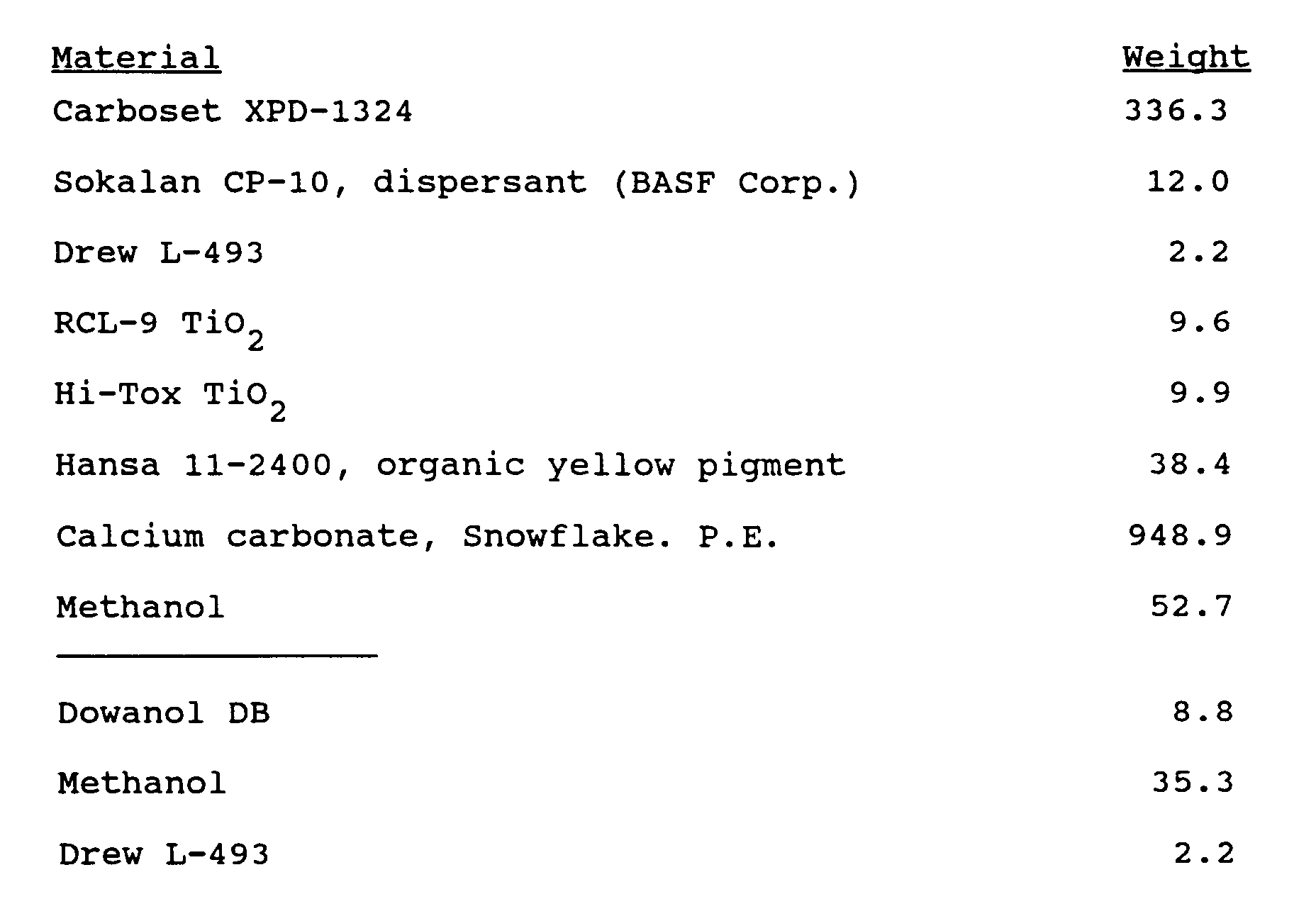
*Monomer content analyzed: 2-ethylhexyl acrylate 50 molar percent, methyl methacrylate 30 molar percent, styrene 10 molar percent, alpha-methyl styrene 10 molar percent. - Again, all ingredients above the line were mixed until the pigment was fully incorporated. Then the last three ingredients were added to thin the paint.
- The paint of Example 1 and a waterborne paint of Rohm and Haas (E-2706) were each applied to glass. Properties of the dried paints are given below.
Test R & H Ex. 1 Falling Sand Taber (mg/cycle 0.58 0.49 Water Immersion (minutes to tape-off) 10 40 Pendulum Hardness 38 93 Freeze Cycle Tape X-Hatch 0% Pass 50% Pass Freeze/Thaw No. of cycles 5 5 - In the tests, a paint formulated in accordance with the present invention performed substantially better than than the Rohm & Haas formulation. Most notable is the substantially greater hardness of the paint of the present invention.
- Binder emulsions produced in accordance with the present invention were produced as follows. In preparations A, B and C the starting materials were each commercial solutions of styrene/alpha-methyl styrene/acrylic copolymer in about a 1:1:1 molar ratio and a molecular weight of approximately 6000 to 9000. In preparation A, the solution was Morcryl®, a 32% solution of Morez®-101 sold by Morton International, Inc. In preparations B and C, the solution was B.F. Goodrich's XPD-1166. Each preparation was formulated to provide approximately a 50 wt. % final solids composition. The components for preparations A, B, and C expressed as weight percent were as follows with methyl methacrylate (MMA) and 2-ethyl-1-hexyl acrylate (EHA) comprising the emulsion polymer.
A B C Support resin 12.2 12.2 11.5 Ammonium persulfate 0.54 0.47 0.47 MMA 18.6 19.42 22.4 EHA 18.6 17.0 14.05 Ammonia 0.4 0.4 0.4 Water Balance Balance Balance
The solution was heated to between 75 and 85°C and the monomer mixture was added over a 2-2 1/2 hr. period, after which heating was continued for an additional 30 min. No additional surfactant of any kind was used to prepare the polymers. - Paint formulations were prepared using the synthesized polymers of Example 4 (A, B and C), and emulsion polymer sold by ICI as ICI A-1052 (formulation 2). Properties of the paint of Example 1 (formulation A) and similar formulations but with the different binders (formulations 2, A, B, and C) are given in the table below.

- Traffic marking paints in accordance with the present invention were compared with a solvent based traffic marking paint and other waterborne traffic marking paints on an asphalt roadway in Salem, Oregon. The marking paints were applied at 77°F, 20% relative humidity, 65 degree road temperature and with a slight breeze. The paints were as follows:
- 1. A solvent-based paint sold by Morton International under Idaho specifications and called "Instant Dry"; the binders are ethylene vinyl acetate and chlorinated polyolefin in a hydrocarbon solvent.
- 2. The formulation of Example 1.
- 3 and 4. The formulation of Example 1, but using varying amounts of Duramite (a calcium carbonate) to replace some of the Snow Flake calcium carbonate.
- 5. A modification of Example 1 formulation using Duramite plus extendospheres SL-150 (hollow glass spheres) as filler.
- 6. A modification of Example 1 formulation using Duramite and Omyacarb U.F., another calcium carbonate.
- 7. A modification of Example 1 formulation using Duramite and Omyacarb U.F. fillers and replacing part of the Goodrich XPD-1324 resin with Resin B as per Example 4.
- 8. Pervo acrylic fast dry, a waterborne traffic marking paint.
- 9. Rohm & Haas E2708 JG1040-1 formula, a waterborne traffic marking paint.
- 10. Waterborne Tech, Night Cool (yellow) a waterborne traffic marking paint.
- Paint formulations 2-7 had "no pick-up" times of 30 to 60 sec. Formulations 8-10 had "no pick-up" times of 90-120 sec.
- Rapid degradation of films produced from formulations 8-10 was observed within several days, with no evidence of any wear in the films produced by formulations 2-7. By 12 days after application, massive erosion of the films to total failure of formulations 8 and 10 and 50% failure of formulation 9 was observed, while formulations 2-7 continued to show no wear. Water resistance was believed to be the discerning factor for the wearing properties of formulations 2-7. During the initial 12 day observation period, temperatures varied from 65 to 80°F; rainfall was 2+ inches; average traffic was about 20,000 cars per day.
- At the end of about 7 1/2 weeks, all of formulations 2-7 exhibited equal or better wear compared to formulation 1, with formulation 4 exhibiting the best wear characteristics in this test.
- Set forth below are resin supported emulsion polymers considered useful, if not necessarily preferred, for forming paints in accordance with the present inveniton. Components are expressed as percent by weight. MOREZ® is as defined previously, MMA = methyl methacrylate; MAA = methacrylic acid; EA = ethyl acrylate; BA = butyl acrylate; and EHA = 2-ethyl-1-hexyl acrylate. MOREZ® is the support polymer and the emulsion polymer is comprised of the monomers listed. In each case, the polymer is neutralized with ammonia. Binders D-H are commercial products which are currently prepared in DOWANOL® (ethylene glycol monomethyl ether), a manner of preparation not preferred in accordance with this invention. Binders I-L are theoretical binders; the properties listed for these properties are likewise theoretical.

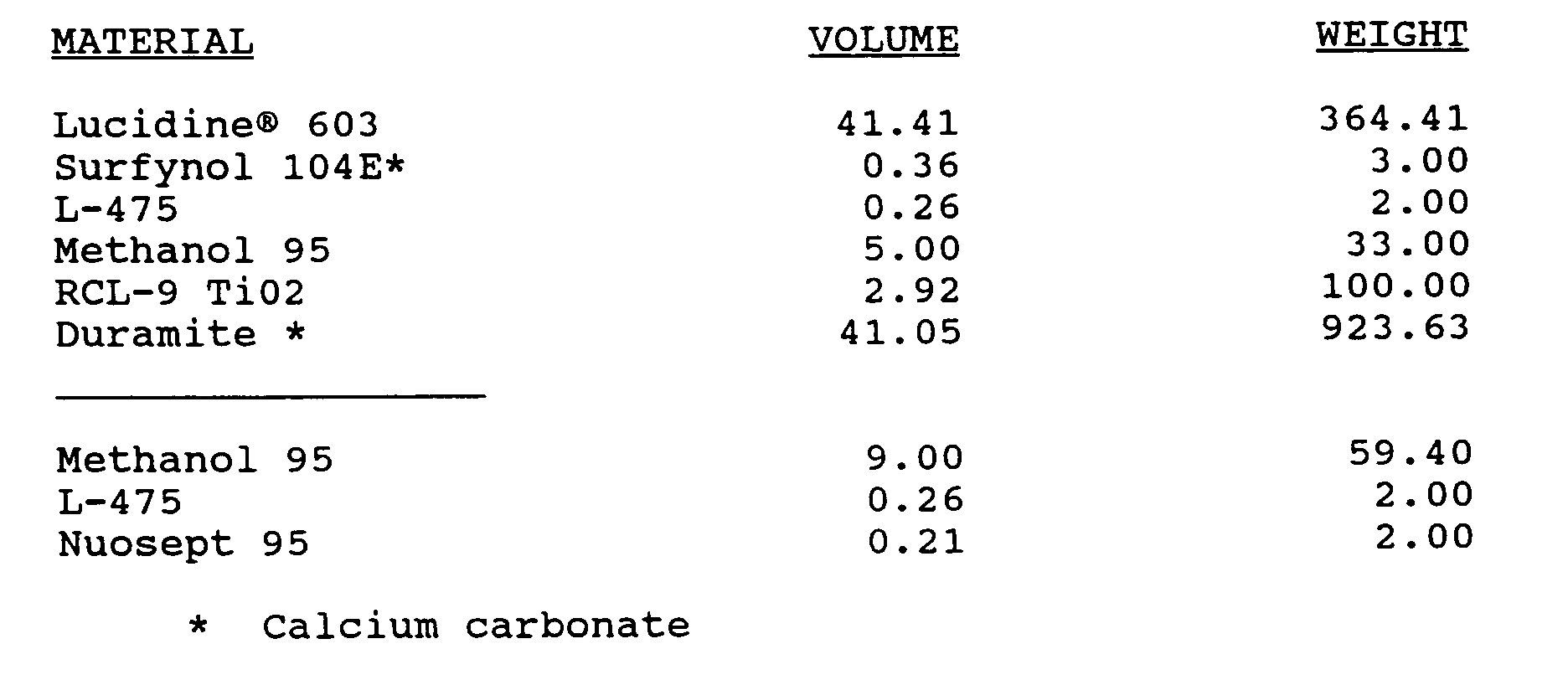
RESIN PROPERTIES D E F G H I J K L NVM 50 47 45 53 50 50 50 50 50 VISCOSITY 1500 1000 1000 1500 1500 1000 1200 1000 1500 pH 8.0 8.3 8.5 8.8 8.3 8.6 8.3 8.5 8.5 AV/NVM 50 55 45 105 50 50 50 50 50 Tg, °C -8 103 -40 45 -20 25 9 16 4 Wt/gal 8.70 8.70 8.60 8.80 8.60 8.60 8.70 8.70 8.60 - Compositions and properties of additional paint formulations in accordance with the invention and prepared as in accordance with Example 1 are set forth in Examples 8 through 13.
-


-


-


-

-


-


- A yellow paint formulation was prepared containing the following components:
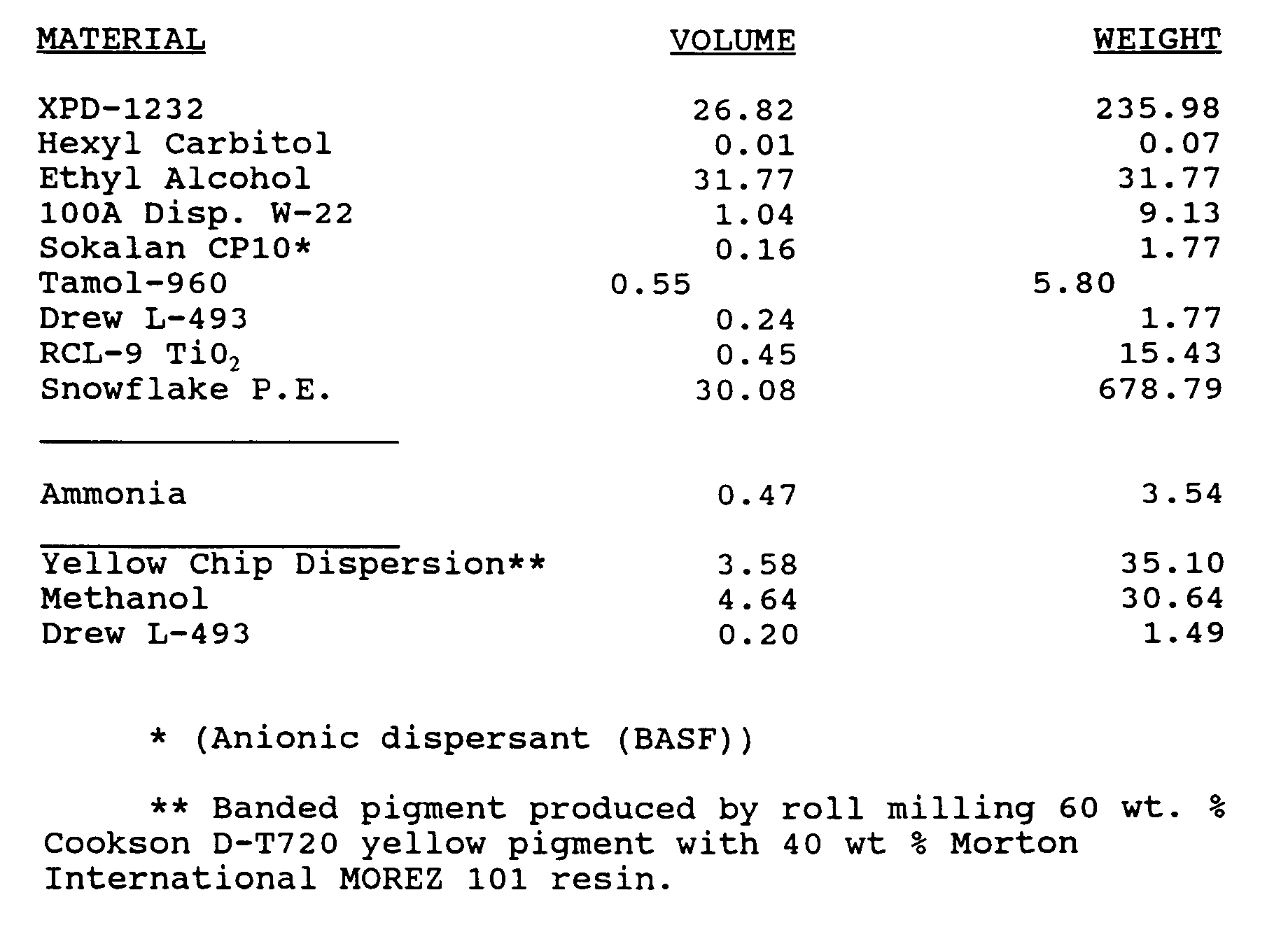
- All components above the first line were thoroughly blended at high speed. Next, the ammonia was added and blended. In the final step, the yellow chip dispersant, the methanol and final amount of Drew defoamer were blended at low speed.
- While the invention has been described in terms of certain preferred embodiments, modifications obvious to one with ordinary skill in the art may be made without departing from the scope of the present invention.
- Various features of the invention are set forth in the following claims.
Claims (9)
- A waterborne paint comprising(1) between 10 and 15 wt.% of an emulsion binder comprising between 20 and 40 wt.% of a support polymer formed of styrene or substituted styrene monomers and acrylic acid or substituted acrylic monomers, said support polymer having an acid number of between 50 and 250, and an emulsion polymer comprising esters of acrylic acid or substituted acrylic acid optionally monomers of styrene or substituted styrene and optionally an amount of acrylic acid or a substituted acrylic acid sufficiently low so that said emulsion polymer is insoluble in alkaline aqueous solution, said support polymer and said emulsion polymer being in the form of micelles with said support polymer acting as a surfactant to maintain said emulsion polymer within said micelles,(2) between 60 and 75 wt.% pigments and/or fillers, plus surfactant sufficient to maintain said pigment and/or filler dispersed, and(3) between 9 and 18 wt.% water, plus sufficient ammonia to maintain an emulsion of said binder.
- A waterborne paint comprising(1) between 10 and 15 wt.% of an emulsion binder comprising between 20 and 40 wt.% of a support polymer formed of styrene or substituted styrene monomers and acrylic acid or substituted acrylic monomers, said support polymer having an acid number of between 50 and 250, and an emulsion polymer comprising esters of acrylic acid or substituted acrylic acid, said emulsion polymer being formed of between 20 and 80 mole percent monomers which are acrylic esters of alcohols having 8 or more carbon atoms and between 20 and 80 mole percent of monomers which are acrylic esters of alcohols having 4 or fewer carbon atoms, said support polymer and said emulsion polymer being in the form of micelles with said support polymer acting as a surfactant to maintain said emulsion polymer within said micelles,(2) between 60 and 75 wt.% pigments and/or fillers plus surfactant sufficient to maintain said pigment and/or filler dispersed, and(3) between 9 and 18 wt.% water, plus sufficient ammonia to maintain an emulsion of said binder.
- A waterborne paint comprising(1) between 10 and 15 wt.% of an emulsion binder comprising between 20 and 40 wt.% of a support polymer formed of styrene or substituted styrene monomers and acrylic acid or substituted acrylic acid monomers, said support polymer having an acid number of between 50 and 250, and between 60 and 80 wt.% of an emulsion polymer comprising esters of acrylic acid or substituted acrylic acid, optionally monomers of styrene or substituted styrene and optionally an amount of acrylic acid or a substituted acrylic acid sufficiently low so that said emulsion polymer is insoluble in alkaline aqueous solution, said support polymer and said emulsion polymer being in the form of micelles with said support polymer acting as a surfactant to maintain said emulsion polymer within said micelles,(2) between 53 and 73 wt.% colourless or white inorganic pigments and/or fillers, plus surfactant sufficient to maintain said colourless or white pigment and/or filler dispersed,(3) between 1½ and 15 wt.% of a dispersing polymer formed of styrene or substituted styrene monomers and acrylic acid or substituted acrylic acid monomers, said support polymer having an acid number of between 50 and 250,(4) between 2 and 7 wt.% of coloured pigment particles encapsulated by and suspended in said dispersing polymer, and(5) between 9 and 10 wt.% water, plus sufficient ammonia to maintain an emulsion of said binder and maintain said dispersing polymer encapsulated pigment particles in suspension.
- A waterborne paint comprising(1) between 10 and 15 wt.% of an emulsion binder comprising between 20 and 40 wt.% of a support polymer formed of styrene or substituted styrene monomers and acrylic acid or substituted acrylic acid monomers, said support polymer having an acid number of between 50 and 250, and between 60 and 80 wt.% of an emulsion polymer comprising esters of acrylic acid or substituted acrylic acid, said emulsion polymer being formed of between 20 and 80 mole percent monomers which are acrylic esters of alcohols having 8 or more carbon atoms and between 20 and 80 mole percent of monomers which are acrylic esters of alcohols having 4 or fewer carbon atoms, said support polymer and said emulsion polymer being in the form of micelles with said support polymer acting as a surfactant to maintain said emulsion polymer within said micelles,(2) between 53 and 73 wt.% colourless or white inorganic pigments and/or fillers, plus surfactant sufficient to maintain said colourless or white pigment and/or filler dispersed,(3) between 1½ and 15 wt.% of a dispersing polymer formed of styrene or substituted styrene monomers and acrylic acid or substituted acrylic acid monomers, said support polymer having an acid number of between 50 and 250,(4) between 2 and 7 wt.% of coloured pigment particles encapsulated by and suspended in said dispersing polymer, and(5) between 9 and 18 wt.% water, plus sufficient ammonia to maintain an emulsion of said binder.
- A paint according to any preceding claim wherein said pigments and/or fillers are present in an amount of 68 wt.%.
- A method of preparing a waterborne paint comprising mixing(1) an emulsion of a binder in ammonia/aqueous medium, said binder comprising between 20 and 40 wt.% of a support polymer formed of styrene or substituted styrene monomers and acrylic acid or substituted acrylic acid monomers, said support polymer having an acid number of between 50 and 250, and between 60 and 80 wt.% of an emulsion polymer comprising esters of acrylic acid or substituted acrylic acid, optionally monomers of styrene or substituted styrene and optionally an amount of acrylic acid or a substituted acrylic acid sufficiently low so that said emulsion polymer is insoluble in alkaline aqueous solution, said support polymer and said emulsion polymer being in the form of micelles with said support polymer acting as a surfactant to maintain said emulsion polymer within said micelles,(2) between 53 and 75 wt.% colourless or white pigments and/or fillers, plus surfactant sufficient to maintain said colourless or white pigment and/or fillers dispersed,(3) between 0.5 and 22 wt.% of banded pigment, between 20 and 60 wt.% of said banded pigment being coloured pigment particles and between 40 and 80 wt.% of said banded pigment being a suspension polymer formed of styrene or substituted styrene monomers and acrylic acid or substituted acrylic acid monomers, said support polymer having an acid number of between 50 and 250,(4) optional additional water as required to achieve a desired solids level, and(5) additional ammonia as required to maintain an emulsion of said emulsion binder and a suspension of said pigment particles encapsulated in said suspension polymer.
- A method of preparing a waterborne paint comprising mixing(1) an emulsion of a binder in ammonia/aqueous medium, said binder comprising between 20 and 40 wt.% of a support polymer formed of styrene or substituted styrene monomers and acrylic acid or substituted acrylic acid monomers, said support polymer having an acid number of between 50 and 250, and between 60 and 80 wt.% of an emulsion polymer comprising esters of acrylic acid or substituted acrylic acid, said emulsion polymer being formed of between 20 and 80 mole percent monomers which are acrylic esters of alcohols having 8 or more carbon atoms and between 20 and 80 mole percent of monomers which are acrylic esters of alcohols having 4 or fewer carbon atoms, said support polymer and said emulsion polymer being in the form of micelles with said support polymer acting as a surfactant to maintain said emulsion polymer within said micelles,(2) between 53 and 75 wt.% colourless or white pigments and/or fillers, plus surfactant sufficient to maintain said colourless or white pigment and/or fillers dispersed,(3) between 0.5 and 22 wt.% of banded pigment, between 20 and 60 wt.% of said banded pigment being coloured pigment particles and between 40 and 80 wt.% of said banded pigment being a suspension polymer formed of styrene or substituted styrene monomers and acrylic acid or substituted acrylic acid monomers, said support polymer having an acid number of between 50 and 250,(4) optional additional water as required to achieve a desired solids level, and(5) additional ammonia as required to maintain an emulsion of said emulsion binder and a suspension of said pigment particles encapsulated in said suspension polymer.
- A waterborne paint comprising(1) between 10 and 15 wt.% of an emulsion binder comprising between 20 and 40 wt.% of a support polymer formed of styrene or substituted styrene monomers and acrylic acid or substituted acrylic monomers, said support polymer having an acid number of between 50 and 250, and an emulsion polymer comprising esters of acrylic acid or substituted acrylic acid, said support polymer and said emulsion polymer being in the form of micelles with said support polymer acting as a surfactant to maintain said emulsion polymer within said micelles,(2) between 53 and 75 wt.% pigments and/or fillers, plus surfactant sufficient to maintain said pigment and/or filler dispersed, and(3) between 9 and 18 wt.% water, plus sufficient ammonia to maintain an emulsion of said binder.
- A paint according to Claim 1 wherein the pigments and/or fillers are present in an amount of 60 to 73 wt.%
Applications Claiming Priority (4)
| Application Number | Priority Date | Filing Date | Title |
|---|---|---|---|
| US899191 | 1986-08-22 | ||
| US72515391A | 1991-06-28 | 1991-06-28 | |
| US725153 | 1991-06-28 | ||
| US89919192A | 1992-06-16 | 1992-06-16 |
Publications (1)
| Publication Number | Publication Date |
|---|---|
| EP0525977A1 true EP0525977A1 (en) | 1993-02-03 |
Family
ID=27111101
Family Applications (1)
| Application Number | Title | Priority Date | Filing Date |
|---|---|---|---|
| EP92305844A Withdrawn EP0525977A1 (en) | 1991-06-28 | 1992-06-25 | Fast dry waterborne traffic marking paint |
Country Status (6)
| Country | Link |
|---|---|
| US (1) | US5340870A (en) |
| EP (1) | EP0525977A1 (en) |
| JP (1) | JPH0748535A (en) |
| AU (1) | AU644529B2 (en) |
| FI (1) | FI922991A7 (en) |
| NO (1) | NO922508L (en) |
Cited By (16)
| Publication number | Priority date | Publication date | Assignee | Title |
|---|---|---|---|---|
| US5672379A (en) * | 1995-09-22 | 1997-09-30 | Rohm And Haas Company | Method of producing wear resistant traffic markings |
| WO1998010026A1 (en) * | 1996-09-06 | 1998-03-12 | Orica Australia Pty Ltd | Stain resistant water-borne coating composition |
| EP0889100A1 (en) * | 1997-07-03 | 1999-01-07 | Rohm And Haas Company | Coating method and coating composition used therein |
| FR2781494A1 (en) * | 1998-07-22 | 2000-01-28 | Colas Sa | Drying accelerator for water-based paint for use e.g. in road marking, having mineral or organic character, has polymeric structure, is water-soluble, and contains cationic charges |
| US6048915A (en) * | 1993-06-17 | 2000-04-11 | Rohm And Haas Company | Fast drying traffic paints |
| US6075079A (en) * | 1995-01-18 | 2000-06-13 | The Dow Chemical Company | Fast hardening aqueous coating composition and paint |
| FR2811663A1 (en) | 2000-07-13 | 2002-01-18 | Commenplus | Surface finishing luminescent material for ground, wall or glazed surfaces, contains a heat curable resin and a luminescent pigment |
| EP1298174A1 (en) * | 2001-09-28 | 2003-04-02 | J.W. Ostendorf GmbH & Co. KG. | Waterborne coating composition |
| WO2007056820A1 (en) * | 2005-11-21 | 2007-05-24 | Nightsafe Enterprises Pty Ltd | Luminescent paint composition |
| EP2848655A1 (en) * | 2013-09-11 | 2015-03-18 | Potters Industries, LLC | Porous silicon oxide drying agents for waterborne latex paint compositions |
| US9096753B2 (en) | 2008-12-01 | 2015-08-04 | Basf Se | Aqueous binder composition comprising oligomers |
| US9145651B2 (en) | 2012-09-14 | 2015-09-29 | Potters Industries, Llc | Durable, thick waterborne latex paint compositions for highway markings |
| CN105038427A (en) * | 2015-07-15 | 2015-11-11 | 湖州湖杰漆业有限公司 | Waterborne antirust paint for steel structure |
| US9222230B2 (en) | 2012-09-14 | 2015-12-29 | Potters Industries, Llc | Porous silicon oxide drying agents for waterborne latex paint compositions |
| WO2019030556A1 (en) * | 2017-08-09 | 2019-02-14 | Pidilite Industries Limited | Organic-inorganic hybrid polymer latex for high durable traffic marking paint |
| EP3670552A1 (en) | 2018-12-19 | 2020-06-24 | Organik Kimya Sanayi Ve Tic. A.S. | Polymodal and alkali soluble resin supported emulsion polymers |
Families Citing this family (29)
| Publication number | Priority date | Publication date | Assignee | Title |
|---|---|---|---|---|
| ES2121589T3 (en) * | 1993-02-18 | 1998-12-01 | Glidden Co | LATEX PAINTS WITH MICROEMULSION MODIFIER AND PROCESS FOR ITS PREPARATION. |
| US5506282A (en) * | 1994-12-06 | 1996-04-09 | Rohm And Haas Company | Method for providing maximum coating film gloss |
| KR19980701768A (en) * | 1995-02-08 | 1998-06-25 | 볼라크 모제스 | Aqueous labeling substance and preparation method thereof |
| TW364002B (en) | 1995-11-15 | 1999-07-11 | Bee Chemical Co | A one-coat, waterborne coating system for untreated polypropylene-based substrates |
| US5777022A (en) * | 1996-05-16 | 1998-07-07 | Bee Chemical Company | One-coat, waterborne coating system for untreated polypropylene-based substrates |
| FR2745293A1 (en) * | 1996-02-26 | 1997-08-29 | Rohm & Haas France | ROAD SIGN PAINT, METHOD FOR ACCELERATING THE DRYING OF SAID PAINT, AND USE OF PARTICLES OF A SOLID POLYMER OR MINERAL COMPOUND |
| US5637356A (en) * | 1996-03-05 | 1997-06-10 | Morton International, Inc. | Polyesters, polyester/acrylic dispersions, and application thereof |
| US5650458A (en) * | 1996-03-11 | 1997-07-22 | Morton International, Inc. | Waterborne coating composition for paperboard |
| US5824734A (en) * | 1996-07-10 | 1998-10-20 | Air Products And Chemicals, Inc. | Waterborne coating compositions |
| US5939514A (en) * | 1996-09-26 | 1999-08-17 | Rohm And Haas Company | Coating composition having extended storage stability and method for producing wear resistant coatings therefrom |
| US5744239A (en) * | 1996-09-27 | 1998-04-28 | Minnesota Mining And Manufacturing Company | Addition of antimicrobial agents to pavement marking materials |
| US6132132A (en) * | 1997-02-26 | 2000-10-17 | Rohm And Haas Company | Water-based road marking paint |
| US6194486B1 (en) * | 1997-05-28 | 2001-02-27 | Trw Inc. | Enhanced paint for microwave/millimeter wave radiometric detection applications and method of road marker detection |
| US6107367A (en) * | 1999-06-16 | 2000-08-22 | Jackson Products, Inc. | Traffic stripe composition |
| JP2002294176A (en) * | 2001-03-29 | 2002-10-09 | Nippon Paint Co Ltd | Water-base coating material composition and method for forming multilayered coating film using the same |
| KR100642608B1 (en) | 2005-11-02 | 2006-11-10 | (주)디피아이 홀딩스 | Asphalt paints and coating methods using the same |
| US20090191407A1 (en) * | 2008-01-18 | 2009-07-30 | Lewarchik Ronald J | Coatings providing low surface emissivity |
| EP2333022B1 (en) * | 2009-12-09 | 2012-06-27 | Rohm and Haas Company | High PVC fast-drying aqueous binder compositions with small particle binders and traffic markings made therewith |
| BR112012023990A2 (en) | 2010-03-23 | 2016-08-02 | Basf Se | paper coating or binder formulation, paper, and method for producing a paper coating or binder formulation |
| PL2386610T3 (en) * | 2010-04-27 | 2013-10-31 | Akzo Nobel Coatings Int Bv | Improved low titanium dioxide coatings |
| PL2386609T3 (en) | 2010-04-27 | 2013-11-29 | Akzo Nobel Coatings Int Bv | Improved low titanium dioxide coatings |
| US9102848B2 (en) * | 2011-02-28 | 2015-08-11 | Basf Se | Environmentally friendly, polymer dispersion-based coating formulations and methods of preparing and using same |
| UY34399A (en) | 2011-10-26 | 2013-05-31 | Akzo Nobel Coatings Int Bv | Enhanced Solvent-Free Low Cost Energy Coatings |
| US8895658B2 (en) | 2012-12-18 | 2014-11-25 | Columbia Insurance Company | Grafted pigment dispersing polymeric additive and paint employing the same with improved hiding |
| BR112016008941B1 (en) | 2013-10-21 | 2021-09-08 | Potters Industries, Llc | PAINT FOR ROAD MARKING, ROAD MARKING AND METHOD FOR APPLYING ROAD MARKING |
| KR20160008418A (en) * | 2014-07-14 | 2016-01-22 | 한화케미칼 주식회사 | Polymer emulsion having heat sealability for blister package and preparation method thereof |
| AU2017245005B2 (en) | 2016-03-31 | 2019-08-01 | Rohm And Haas Company | Durable aqueous compositions for use in making traffic markings having good dirt pickup resistance and traffic markings made therewith |
| US20180258292A1 (en) | 2017-03-10 | 2018-09-13 | Potters Industries, Llc | Porous Silicon Oxide Beads for Use As Drying Agents for Waterborne Latex Paint Compositions |
| KR20210065955A (en) * | 2018-09-26 | 2021-06-04 | 루브리졸 어드밴스드 머티어리얼스, 인코포레이티드 | Quick-drying water-based coating |
Citations (6)
| Publication number | Priority date | Publication date | Assignee | Title |
|---|---|---|---|---|
| EP0018447A1 (en) * | 1979-04-24 | 1980-11-12 | The Dow Chemical Company | An aqueous paper coating composition, and coated paper |
| US4277385A (en) * | 1979-02-09 | 1981-07-07 | Scm Corporation | High PVC latex paint |
| EP0257567A2 (en) * | 1986-08-22 | 1988-03-02 | S.C. Johnson & Son, Inc. | Resin-fortified emulsion polymers and methods of preparing the same |
| EP0338486A2 (en) * | 1988-04-21 | 1989-10-25 | S.C. Johnson & Son, Inc. | Stable emulsion polymers and methods of preparing same |
| EP0348565A1 (en) * | 1984-07-25 | 1990-01-03 | Rohm And Haas Company | Polymers comprising alkali-insoluble core/alkali-soluble shell and compositions thereof |
| WO1992001758A1 (en) * | 1990-07-20 | 1992-02-06 | Henkel Kommanditgesellschaft Auf Aktien | Water-based correction fluid |
Family Cites Families (5)
| Publication number | Priority date | Publication date | Assignee | Title |
|---|---|---|---|---|
| ATE38064T1 (en) * | 1985-04-17 | 1988-11-15 | Akzo Nv | PROCEDURE FOR INSTALLING A WAYMARKER COMPOSITION. |
| US4973621A (en) * | 1987-04-07 | 1990-11-27 | Akzo N.V. | Aqueous coating composition based on a dispersion of an addition polymer, especially suited to be used in an aqueous base coat |
| DE3727112A1 (en) * | 1987-08-14 | 1989-02-23 | Basf Ag | AQUEOUS COATING SUBSTANCES BASED ON SECONDARY DISPERSIONS OF CARBOXYL GROUPS CONTAINING COPOLYMERISATES OF ACRYLIC OR METHACRYL ACID ESTERS |
| DE3841541A1 (en) * | 1988-12-09 | 1990-06-13 | Basf Lacke & Farben | METHOD FOR PRODUCING A MULTILAYER LACQUERING, WATER-DUMBABILIZABLE VARNISH, METHOD FOR PRODUCING CROSSLINKED POLYMER MICROPARTICLES AND CROSSLINKED POLYMER MICROPARTICLES |
| CA2054373A1 (en) * | 1990-11-16 | 1992-05-17 | Albert B. Brown | Radiation curable composition |
-
1992
- 1992-06-25 NO NO92922508A patent/NO922508L/en unknown
- 1992-06-25 EP EP92305844A patent/EP0525977A1/en not_active Withdrawn
- 1992-06-26 FI FI922991A patent/FI922991A7/en not_active Application Discontinuation
- 1992-06-26 AU AU18620/92A patent/AU644529B2/en not_active Ceased
- 1992-06-29 JP JP4171011A patent/JPH0748535A/en active Pending
-
1993
- 1993-02-18 US US08/018,986 patent/US5340870A/en not_active Expired - Fee Related
Patent Citations (6)
| Publication number | Priority date | Publication date | Assignee | Title |
|---|---|---|---|---|
| US4277385A (en) * | 1979-02-09 | 1981-07-07 | Scm Corporation | High PVC latex paint |
| EP0018447A1 (en) * | 1979-04-24 | 1980-11-12 | The Dow Chemical Company | An aqueous paper coating composition, and coated paper |
| EP0348565A1 (en) * | 1984-07-25 | 1990-01-03 | Rohm And Haas Company | Polymers comprising alkali-insoluble core/alkali-soluble shell and compositions thereof |
| EP0257567A2 (en) * | 1986-08-22 | 1988-03-02 | S.C. Johnson & Son, Inc. | Resin-fortified emulsion polymers and methods of preparing the same |
| EP0338486A2 (en) * | 1988-04-21 | 1989-10-25 | S.C. Johnson & Son, Inc. | Stable emulsion polymers and methods of preparing same |
| WO1992001758A1 (en) * | 1990-07-20 | 1992-02-06 | Henkel Kommanditgesellschaft Auf Aktien | Water-based correction fluid |
Cited By (27)
| Publication number | Priority date | Publication date | Assignee | Title |
|---|---|---|---|---|
| US6048915A (en) * | 1993-06-17 | 2000-04-11 | Rohm And Haas Company | Fast drying traffic paints |
| US6376574B1 (en) | 1995-01-18 | 2002-04-23 | The Dow Chemical Company | Fast hardening aqueous coating composition and paint |
| US6277437B1 (en) | 1995-01-18 | 2001-08-21 | The Dow Chemical Company | Fast hardening aqueous coating composition and paint |
| US6075079A (en) * | 1995-01-18 | 2000-06-13 | The Dow Chemical Company | Fast hardening aqueous coating composition and paint |
| US5672379A (en) * | 1995-09-22 | 1997-09-30 | Rohm And Haas Company | Method of producing wear resistant traffic markings |
| US5820993A (en) * | 1995-09-22 | 1998-10-13 | Schall; Donald Craig | Method of producing wear resistant traffic markings |
| US6420474B1 (en) | 1996-09-06 | 2002-07-16 | Orica Australia Pty Ltd | Stain resistant water-borne coating composition |
| US7544733B2 (en) | 1996-09-06 | 2009-06-09 | Orica Australia Pty Ltd. | Stain resistant water-borne coating composition |
| WO1998010026A1 (en) * | 1996-09-06 | 1998-03-12 | Orica Australia Pty Ltd | Stain resistant water-borne coating composition |
| EP0889100A1 (en) * | 1997-07-03 | 1999-01-07 | Rohm And Haas Company | Coating method and coating composition used therein |
| WO2000005318A1 (en) * | 1998-07-22 | 2000-02-03 | Colas | Accelerator for an aqueous paint drying time and corresponding paint and method |
| FR2781494A1 (en) * | 1998-07-22 | 2000-01-28 | Colas Sa | Drying accelerator for water-based paint for use e.g. in road marking, having mineral or organic character, has polymeric structure, is water-soluble, and contains cationic charges |
| US6333068B1 (en) | 1998-07-22 | 2001-12-25 | Colas | Drying time accelerator for a water-based paint, corresponding paint, and method of application |
| CZ301588B6 (en) * | 1998-07-22 | 2010-04-28 | Colas | Drying time accelerator for a water-based paint, corresponding paint, and method of application |
| FR2811663A1 (en) | 2000-07-13 | 2002-01-18 | Commenplus | Surface finishing luminescent material for ground, wall or glazed surfaces, contains a heat curable resin and a luminescent pigment |
| EP1298174A1 (en) * | 2001-09-28 | 2003-04-02 | J.W. Ostendorf GmbH & Co. KG. | Waterborne coating composition |
| WO2003029367A1 (en) * | 2001-09-28 | 2003-04-10 | J.W. Ostendorf Gmbh & Co. Kg | Water-based metal protective lacquer composition |
| AU2006202681A1 (en) * | 2005-11-21 | 2007-06-07 | Nightsafe Enterprises Pty Ltd | A Paint Composition |
| WO2007056820A1 (en) * | 2005-11-21 | 2007-05-24 | Nightsafe Enterprises Pty Ltd | Luminescent paint composition |
| US9096753B2 (en) | 2008-12-01 | 2015-08-04 | Basf Se | Aqueous binder composition comprising oligomers |
| US9145651B2 (en) | 2012-09-14 | 2015-09-29 | Potters Industries, Llc | Durable, thick waterborne latex paint compositions for highway markings |
| US9222230B2 (en) | 2012-09-14 | 2015-12-29 | Potters Industries, Llc | Porous silicon oxide drying agents for waterborne latex paint compositions |
| EP2848655A1 (en) * | 2013-09-11 | 2015-03-18 | Potters Industries, LLC | Porous silicon oxide drying agents for waterborne latex paint compositions |
| CN105038427A (en) * | 2015-07-15 | 2015-11-11 | 湖州湖杰漆业有限公司 | Waterborne antirust paint for steel structure |
| WO2019030556A1 (en) * | 2017-08-09 | 2019-02-14 | Pidilite Industries Limited | Organic-inorganic hybrid polymer latex for high durable traffic marking paint |
| EP3670552A1 (en) | 2018-12-19 | 2020-06-24 | Organik Kimya Sanayi Ve Tic. A.S. | Polymodal and alkali soluble resin supported emulsion polymers |
| WO2020127857A1 (en) | 2018-12-19 | 2020-06-25 | Organik Kimya San. Ve Tic. A.Ş. | Polymodal and alkali soluble resin supported emulsion polymers |
Also Published As
| Publication number | Publication date |
|---|---|
| FI922991L (en) | 1992-12-29 |
| AU644529B2 (en) | 1993-12-09 |
| JPH0748535A (en) | 1995-02-21 |
| AU1862092A (en) | 1993-01-07 |
| FI922991A7 (en) | 1992-12-29 |
| NO922508L (en) | 1992-12-29 |
| US5340870A (en) | 1994-08-23 |
| NO922508D0 (en) | 1992-06-25 |
| FI922991A0 (en) | 1992-06-26 |
Similar Documents
| Publication | Publication Date | Title |
|---|---|---|
| US5340870A (en) | Fast dry waterborne traffic marking paint | |
| DE69625146T2 (en) | Manufacturing process of wear-resistant road marking paint | |
| US11535762B2 (en) | Fast drying aqueous amine free coating composition(s) | |
| DE602004000177T2 (en) | Aqueous paint for road use and method of use | |
| DE69729614T2 (en) | Coating composition with improved storage stability | |
| US6420474B1 (en) | Stain resistant water-borne coating composition | |
| KR101558876B1 (en) | Water soluble paint composition for a road marking with improved wear resistance | |
| CN1168400A (en) | Waterborne traffic paints having improved fast dry characteristic and method of producing traffic markings therefrom | |
| US6815010B2 (en) | Method of inhibiting the loss of solar reflectance over time of an exterior elastomeric | |
| JPS5874757A (en) | Traffic paint | |
| US4385138A (en) | Thermosetting powder resin based water-slurry coating composition | |
| WO1995009209A1 (en) | Cross-linkable aqueous coating compositions | |
| US4124555A (en) | Water reducible coating compositions containing copolymers of vinyl pyrrolidone and unsaturated carboxylic acid and containing a solvent and a volatile amine | |
| KR102304315B1 (en) | Water soluble paint composition for a road marking with improved water-repellent | |
| KR0150625B1 (en) | Water-soluble acrylic resin and method for production thereof | |
| KR100429552B1 (en) | Method of Preparing Acryl Emulsion Resin | |
| EP0091021B1 (en) | Process for the preparation of a water-dilutable, physically drying binder containing a solvent, and use thereof | |
| CA2072222A1 (en) | Fast dry waterborne traffic marking paint | |
| US20240247151A1 (en) | Aqueous dispersion of film-forming and non-film-forming polymer particles | |
| AU604978B2 (en) | Thickeners for physically drying paints and coating materials and preparation of the thickeners | |
| HU209399B (en) | Binding materials for water-dilutable coating materials, mainly for mineral and bituminous bases and process for producing such binding materials | |
| AU678297B2 (en) | Cross-linkable aqueous coating compositions | |
| JPS6031210B2 (en) | Water dilutable resin composition | |
| AU715069B2 (en) | Stain resistant water-borne coating composition | |
| KR20250012566A (en) | Method of applying a coating composition to a substrate |
Legal Events
| Date | Code | Title | Description |
|---|---|---|---|
| PUAI | Public reference made under article 153(3) epc to a published international application that has entered the european phase |
Free format text: ORIGINAL CODE: 0009012 |
|
| AK | Designated contracting states |
Kind code of ref document: A1 Designated state(s): AT BE CH DE DK ES FR GB GR IT LI LU NL SE |
|
| 17P | Request for examination filed |
Effective date: 19930316 |
|
| 17Q | First examination report despatched |
Effective date: 19930708 |
|
| GRAH | Despatch of communication of intention to grant a patent |
Free format text: ORIGINAL CODE: EPIDOS IGRA |
|
| STAA | Information on the status of an ep patent application or granted ep patent |
Free format text: STATUS: THE APPLICATION IS DEEMED TO BE WITHDRAWN |
|
| 18D | Application deemed to be withdrawn |
Effective date: 19960709 |