EP0524931B1 - Tumor cell sensitization method - Google Patents
Tumor cell sensitization method Download PDFInfo
- Publication number
- EP0524931B1 EP0524931B1 EP91902395A EP91902395A EP0524931B1 EP 0524931 B1 EP0524931 B1 EP 0524931B1 EP 91902395 A EP91902395 A EP 91902395A EP 91902395 A EP91902395 A EP 91902395A EP 0524931 B1 EP0524931 B1 EP 0524931B1
- Authority
- EP
- European Patent Office
- Prior art keywords
- hydrogen
- carbon atoms
- straight
- branched
- patient
- Prior art date
- Legal status (The legal status is an assumption and is not a legal conclusion. Google has not performed a legal analysis and makes no representation as to the accuracy of the status listed.)
- Expired - Lifetime
Links
- 238000000034 method Methods 0.000 title abstract description 4
- 210000004881 tumor cell Anatomy 0.000 title description 2
- 206010070834 Sensitisation Diseases 0.000 title 1
- 230000008313 sensitization Effects 0.000 title 1
- 206010028980 Neoplasm Diseases 0.000 claims abstract description 24
- 239000002246 antineoplastic agent Substances 0.000 claims abstract description 22
- 201000011510 cancer Diseases 0.000 claims abstract description 19
- 238000011282 treatment Methods 0.000 claims abstract description 9
- 150000001875 compounds Chemical class 0.000 claims description 34
- 125000004432 carbon atom Chemical group C* 0.000 claims description 23
- 229940079593 drug Drugs 0.000 claims description 22
- 239000003814 drug Substances 0.000 claims description 22
- 229910052739 hydrogen Inorganic materials 0.000 claims description 22
- 239000001257 hydrogen Substances 0.000 claims description 22
- 150000002431 hydrogen Chemical group 0.000 claims description 11
- WKBOTKDWSSQWDR-UHFFFAOYSA-N Bromine atom Chemical group [Br] WKBOTKDWSSQWDR-UHFFFAOYSA-N 0.000 claims description 10
- ZAMOUSCENKQFHK-UHFFFAOYSA-N Chlorine atom Chemical group [Cl] ZAMOUSCENKQFHK-UHFFFAOYSA-N 0.000 claims description 10
- PXGOKWXKJXAPGV-UHFFFAOYSA-N Fluorine Chemical group FF PXGOKWXKJXAPGV-UHFFFAOYSA-N 0.000 claims description 10
- GDTBXPJZTBHREO-UHFFFAOYSA-N bromine Chemical group BrBr GDTBXPJZTBHREO-UHFFFAOYSA-N 0.000 claims description 10
- 229910052794 bromium Inorganic materials 0.000 claims description 10
- 239000000460 chlorine Chemical group 0.000 claims description 10
- 229910052801 chlorine Inorganic materials 0.000 claims description 10
- 239000011737 fluorine Chemical group 0.000 claims description 10
- 229910052731 fluorine Inorganic materials 0.000 claims description 10
- 239000008194 pharmaceutical composition Substances 0.000 claims description 10
- 125000000217 alkyl group Chemical group 0.000 claims description 9
- 125000003545 alkoxy group Chemical group 0.000 claims description 6
- 125000004414 alkyl thio group Chemical group 0.000 claims description 6
- 125000002947 alkylene group Chemical group 0.000 claims description 6
- 229940041181 antineoplastic drug Drugs 0.000 claims description 6
- 125000004435 hydrogen atom Chemical group [H]* 0.000 claims description 6
- 150000003839 salts Chemical class 0.000 claims description 6
- UFHFLCQGNIYNRP-UHFFFAOYSA-N Hydrogen Chemical compound [H][H] UFHFLCQGNIYNRP-UHFFFAOYSA-N 0.000 claims description 5
- 208000016691 refractory malignant neoplasm Diseases 0.000 claims description 5
- 206010048723 Multiple-drug resistance Diseases 0.000 claims description 3
- 238000009877 rendering Methods 0.000 claims description 3
- 238000004519 manufacturing process Methods 0.000 claims 8
- VEXZGXHMUGYJMC-UHFFFAOYSA-N Hydrochloric acid Chemical compound Cl VEXZGXHMUGYJMC-UHFFFAOYSA-N 0.000 claims 4
- 125000001997 phenyl group Chemical group [H]C1=C([H])C([H])=C(*)C([H])=C1[H] 0.000 claims 4
- 238000009825 accumulation Methods 0.000 claims 2
- 230000003013 cytotoxicity Effects 0.000 claims 2
- 231100000135 cytotoxicity Toxicity 0.000 claims 2
- -1 quinazolinedione compound Chemical class 0.000 abstract description 7
- 230000001235 sensitizing effect Effects 0.000 abstract description 6
- 210000004027 cell Anatomy 0.000 description 26
- AOJJSUZBOXZQNB-TZSSRYMLSA-N Doxorubicin Chemical compound O([C@H]1C[C@@](O)(CC=2C(O)=C3C(=O)C=4C=CC=C(C=4C(=O)C3=C(O)C=21)OC)C(=O)CO)[C@H]1C[C@H](N)[C@H](O)[C@H](C)O1 AOJJSUZBOXZQNB-TZSSRYMLSA-N 0.000 description 18
- 239000003795 chemical substances by application Substances 0.000 description 8
- 230000000694 effects Effects 0.000 description 8
- CDNFCUXEJDEBEX-UHFFFAOYSA-N 3-[4-[4-(2-propylsulfanylphenyl)piperazin-1-yl]butyl]-1h-quinazoline-2,4-dione Chemical compound CCCSC1=CC=CC=C1N1CCN(CCCCN2C(C3=CC=CC=C3NC2=O)=O)CC1 CDNFCUXEJDEBEX-UHFFFAOYSA-N 0.000 description 7
- 239000003826 tablet Substances 0.000 description 7
- 229940009456 adriamycin Drugs 0.000 description 6
- 238000002360 preparation method Methods 0.000 description 6
- 229950002793 tioperidone Drugs 0.000 description 6
- 230000036765 blood level Effects 0.000 description 5
- 239000002775 capsule Substances 0.000 description 5
- 230000003034 chemosensitisation Effects 0.000 description 5
- 239000000843 powder Substances 0.000 description 5
- SGTNSNPWRIOYBX-UHFFFAOYSA-N 2-(3,4-dimethoxyphenyl)-5-{[2-(3,4-dimethoxyphenyl)ethyl](methyl)amino}-2-(propan-2-yl)pentanenitrile Chemical compound C1=C(OC)C(OC)=CC=C1CCN(C)CCCC(C#N)(C(C)C)C1=CC=C(OC)C(OC)=C1 SGTNSNPWRIOYBX-UHFFFAOYSA-N 0.000 description 4
- 102100033350 ATP-dependent translocase ABCB1 Human genes 0.000 description 4
- 229930105110 Cyclosporin A Natural products 0.000 description 4
- PMATZTZNYRCHOR-CGLBZJNRSA-N Cyclosporin A Chemical compound CC[C@@H]1NC(=O)[C@H]([C@H](O)[C@H](C)C\C=C\C)N(C)C(=O)[C@H](C(C)C)N(C)C(=O)[C@H](CC(C)C)N(C)C(=O)[C@H](CC(C)C)N(C)C(=O)[C@@H](C)NC(=O)[C@H](C)NC(=O)[C@H](CC(C)C)N(C)C(=O)[C@H](C(C)C)NC(=O)[C@H](CC(C)C)N(C)C(=O)CN(C)C1=O PMATZTZNYRCHOR-CGLBZJNRSA-N 0.000 description 4
- 108010036949 Cyclosporine Proteins 0.000 description 4
- 229960001265 ciclosporin Drugs 0.000 description 4
- 208000032839 leukemia Diseases 0.000 description 4
- 239000007787 solid Substances 0.000 description 4
- 229960001722 verapamil Drugs 0.000 description 4
- ITPDYQOUSLNIHG-UHFFFAOYSA-N Amiodarone hydrochloride Chemical compound [Cl-].CCCCC=1OC2=CC=CC=C2C=1C(=O)C1=CC(I)=C(OCC[NH+](CC)CC)C(I)=C1 ITPDYQOUSLNIHG-UHFFFAOYSA-N 0.000 description 3
- 229960005260 amiodarone Drugs 0.000 description 3
- 229940127089 cytotoxic agent Drugs 0.000 description 3
- 239000002552 dosage form Substances 0.000 description 3
- 229960004679 doxorubicin Drugs 0.000 description 3
- BTQAFTBKHVLPEV-UHFFFAOYSA-N 3h-naphtho[2,3-e]indazole Chemical class C1=CC=CC2=CC3=C4C=NNC4=CC=C3C=C21 BTQAFTBKHVLPEV-UHFFFAOYSA-N 0.000 description 2
- 102000004506 Blood Proteins Human genes 0.000 description 2
- 108010017384 Blood Proteins Proteins 0.000 description 2
- 0 CC=C(C=CI=C)N1CCN(*N(C(c(cccc2)c2N2*)=O)C2=O)CC1 Chemical compound CC=C(C=CI=C)N1CCN(*N(C(c(cccc2)c2N2*)=O)C2=O)CC1 0.000 description 2
- SZTBQTTVEIEAQV-UHFFFAOYSA-N Cl.Cl.OC1=C2C(C3=C(C=CC=4N(N=C(C43)C2=C(C=C1)O)CCNCCO)NCCNC)=O Chemical compound Cl.Cl.OC1=C2C(C3=C(C=CC=4N(N=C(C43)C2=C(C=C1)O)CCNCCO)NCCNC)=O SZTBQTTVEIEAQV-UHFFFAOYSA-N 0.000 description 2
- 241001529936 Murinae Species 0.000 description 2
- RJKFOVLPORLFTN-LEKSSAKUSA-N Progesterone Chemical compound C1CC2=CC(=O)CC[C@]2(C)[C@@H]2[C@@H]1[C@@H]1CC[C@H](C(=O)C)[C@@]1(C)CC2 RJKFOVLPORLFTN-LEKSSAKUSA-N 0.000 description 2
- NKANXQFJJICGDU-QPLCGJKRSA-N Tamoxifen Chemical compound C=1C=CC=CC=1C(/CC)=C(C=1C=CC(OCCN(C)C)=CC=1)/C1=CC=CC=C1 NKANXQFJJICGDU-QPLCGJKRSA-N 0.000 description 2
- DPXJVFZANSGRMM-UHFFFAOYSA-N acetic acid;2,3,4,5,6-pentahydroxyhexanal;sodium Chemical compound [Na].CC(O)=O.OCC(O)C(O)C(O)C(O)C=O DPXJVFZANSGRMM-UHFFFAOYSA-N 0.000 description 2
- 239000005557 antagonist Substances 0.000 description 2
- 238000011319 anticancer therapy Methods 0.000 description 2
- 239000001768 carboxy methyl cellulose Substances 0.000 description 2
- 239000000969 carrier Substances 0.000 description 2
- 239000006114 chemosensitizer Substances 0.000 description 2
- 239000000796 flavoring agent Substances 0.000 description 2
- 239000007788 liquid Substances 0.000 description 2
- HQKMJHAJHXVSDF-UHFFFAOYSA-L magnesium stearate Chemical compound [Mg+2].CCCCCCCCCCCCCCCCCC([O-])=O.CCCCCCCCCCCCCCCCCC([O-])=O HQKMJHAJHXVSDF-UHFFFAOYSA-L 0.000 description 2
- 238000012423 maintenance Methods 0.000 description 2
- 239000000463 material Substances 0.000 description 2
- 230000007246 mechanism Effects 0.000 description 2
- 229920000609 methyl cellulose Polymers 0.000 description 2
- 239000001923 methylcellulose Substances 0.000 description 2
- 235000010981 methylcellulose Nutrition 0.000 description 2
- 239000000203 mixture Substances 0.000 description 2
- 239000003607 modifier Substances 0.000 description 2
- 230000003389 potentiating effect Effects 0.000 description 2
- 150000008515 quinazolinediones Chemical class 0.000 description 2
- LOUPRKONTZGTKE-LHHVKLHASA-N quinidine Chemical compound C([C@H]([C@H](C1)C=C)C2)C[N@@]1[C@H]2[C@@H](O)C1=CC=NC2=CC=C(OC)C=C21 LOUPRKONTZGTKE-LHHVKLHASA-N 0.000 description 2
- 235000019812 sodium carboxymethyl cellulose Nutrition 0.000 description 2
- 229920001027 sodium carboxymethylcellulose Polymers 0.000 description 2
- 150000003431 steroids Chemical class 0.000 description 2
- 238000005556 structure-activity relationship Methods 0.000 description 2
- 239000000375 suspending agent Substances 0.000 description 2
- NOYPYLRCIDNJJB-UHFFFAOYSA-N trimetrexate Chemical compound COC1=C(OC)C(OC)=CC(NCC=2C(=C3C(N)=NC(N)=NC3=CC=2)C)=C1 NOYPYLRCIDNJJB-UHFFFAOYSA-N 0.000 description 2
- 229960001099 trimetrexate Drugs 0.000 description 2
- 229960004528 vincristine Drugs 0.000 description 2
- OGWKCGZFUXNPDA-XQKSVPLYSA-N vincristine Chemical compound C([N@]1C[C@@H](C[C@]2(C(=O)OC)C=3C(=CC4=C([C@]56[C@H]([C@@]([C@H](OC(C)=O)[C@]7(CC)C=CCN([C@H]67)CC5)(O)C(=O)OC)N4C=O)C=3)OC)C[C@@](C1)(O)CC)CC1=C2NC2=CC=CC=C12 OGWKCGZFUXNPDA-XQKSVPLYSA-N 0.000 description 2
- OGWKCGZFUXNPDA-UHFFFAOYSA-N vincristine Natural products C1C(CC)(O)CC(CC2(C(=O)OC)C=3C(=CC4=C(C56C(C(C(OC(C)=O)C7(CC)C=CCN(C67)CC5)(O)C(=O)OC)N4C=O)C=3)OC)CN1CCC1=C2NC2=CC=CC=C12 OGWKCGZFUXNPDA-UHFFFAOYSA-N 0.000 description 2
- XLYOFNOQVPJJNP-UHFFFAOYSA-N water Substances O XLYOFNOQVPJJNP-UHFFFAOYSA-N 0.000 description 2
- DGVVWUTYPXICAM-UHFFFAOYSA-N β‐Mercaptoethanol Chemical compound OCCS DGVVWUTYPXICAM-UHFFFAOYSA-N 0.000 description 2
- VJXSSYDSOJBUAV-UHFFFAOYSA-N 6-(2,5-dimethoxy-benzyl)-5-methyl-pyrido[2,3-d]pyrimidine-2,4-diamine Chemical compound COC1=CC=C(OC)C(CC=2C(=C3C(N)=NC(N)=NC3=NC=2)C)=C1 VJXSSYDSOJBUAV-UHFFFAOYSA-N 0.000 description 1
- STQGQHZAVUOBTE-UHFFFAOYSA-N 7-Cyan-hept-2t-en-4,6-diinsaeure Natural products C1=2C(O)=C3C(=O)C=4C(OC)=CC=CC=4C(=O)C3=C(O)C=2CC(O)(C(C)=O)CC1OC1CC(N)C(O)C(C)O1 STQGQHZAVUOBTE-UHFFFAOYSA-N 0.000 description 1
- 206010003445 Ascites Diseases 0.000 description 1
- 241000416162 Astragalus gummifer Species 0.000 description 1
- 229940127291 Calcium channel antagonist Drugs 0.000 description 1
- 102000000584 Calmodulin Human genes 0.000 description 1
- 108010041952 Calmodulin Proteins 0.000 description 1
- RNZAEKUSZHXFMR-UHFFFAOYSA-N Cl.Cl.Cl.S1C2=CC(O)=CC=C2C2=NN(CCN(CC)CC)C3=C2C1=C(NCCN)C=C3 Chemical compound Cl.Cl.Cl.S1C2=CC(O)=CC=C2C2=NN(CCN(CC)CC)C3=C2C1=C(NCCN)C=C3 RNZAEKUSZHXFMR-UHFFFAOYSA-N 0.000 description 1
- 238000011765 DBA/2 mouse Methods 0.000 description 1
- 239000004375 Dextrin Substances 0.000 description 1
- 229920001353 Dextrin Polymers 0.000 description 1
- 206010059866 Drug resistance Diseases 0.000 description 1
- CEAZRRDELHUEMR-URQXQFDESA-N Gentamicin Chemical compound O1[C@H](C(C)NC)CC[C@@H](N)[C@H]1O[C@H]1[C@H](O)[C@@H](O[C@@H]2[C@@H]([C@@H](NC)[C@@](C)(O)CO2)O)[C@H](N)C[C@@H]1N CEAZRRDELHUEMR-URQXQFDESA-N 0.000 description 1
- 229930182566 Gentamicin Natural products 0.000 description 1
- GUBGYTABKSRVRQ-QKKXKWKRSA-N Lactose Natural products OC[C@H]1O[C@@H](O[C@H]2[C@H](O)[C@@H](O)C(O)O[C@@H]2CO)[C@H](O)[C@@H](O)[C@H]1O GUBGYTABKSRVRQ-QKKXKWKRSA-N 0.000 description 1
- 108010047230 Member 1 Subfamily B ATP Binding Cassette Transporter Proteins 0.000 description 1
- 108010090054 Membrane Glycoproteins Proteins 0.000 description 1
- 102000012750 Membrane Glycoproteins Human genes 0.000 description 1
- 229930012538 Paclitaxel Natural products 0.000 description 1
- 229920002472 Starch Polymers 0.000 description 1
- 229920001615 Tragacanth Polymers 0.000 description 1
- GLNADSQYFUSGOU-GPTZEZBUSA-J Trypan blue Chemical compound [Na+].[Na+].[Na+].[Na+].C1=C(S([O-])(=O)=O)C=C2C=C(S([O-])(=O)=O)C(/N=N/C3=CC=C(C=C3C)C=3C=C(C(=CC=3)\N=N\C=3C(=CC4=CC(=CC(N)=C4C=3O)S([O-])(=O)=O)S([O-])(=O)=O)C)=C(O)C2=C1N GLNADSQYFUSGOU-GPTZEZBUSA-J 0.000 description 1
- JXLYSJRDGCGARV-WWYNWVTFSA-N Vinblastine Natural products O=C(O[C@H]1[C@](O)(C(=O)OC)[C@@H]2N(C)c3c(cc(c(OC)c3)[C@]3(C(=O)OC)c4[nH]c5c(c4CCN4C[C@](O)(CC)C[C@H](C3)C4)cccc5)[C@@]32[C@H]2[C@@]1(CC)C=CCN2CC3)C JXLYSJRDGCGARV-WWYNWVTFSA-N 0.000 description 1
- 229940122803 Vinca alkaloid Drugs 0.000 description 1
- 239000004480 active ingredient Substances 0.000 description 1
- 230000003432 anti-folate effect Effects 0.000 description 1
- 238000011394 anticancer treatment Methods 0.000 description 1
- 229940127074 antifolate Drugs 0.000 description 1
- 239000000164 antipsychotic agent Substances 0.000 description 1
- 239000007864 aqueous solution Substances 0.000 description 1
- 239000007900 aqueous suspension Substances 0.000 description 1
- 239000011230 binding agent Substances 0.000 description 1
- 210000001185 bone marrow Anatomy 0.000 description 1
- 239000000480 calcium channel blocker Substances 0.000 description 1
- 239000002371 cardiac agent Substances 0.000 description 1
- 230000010261 cell growth Effects 0.000 description 1
- 230000002490 cerebral effect Effects 0.000 description 1
- 230000035572 chemosensitivity Effects 0.000 description 1
- LOUPRKONTZGTKE-UHFFFAOYSA-N cinchonine Natural products C1C(C(C2)C=C)CCN2C1C(O)C1=CC=NC2=CC=C(OC)C=C21 LOUPRKONTZGTKE-UHFFFAOYSA-N 0.000 description 1
- 229940110456 cocoa butter Drugs 0.000 description 1
- 235000019868 cocoa butter Nutrition 0.000 description 1
- 239000003086 colorant Substances 0.000 description 1
- 230000000052 comparative effect Effects 0.000 description 1
- 230000001143 conditioned effect Effects 0.000 description 1
- 229960000975 daunorubicin Drugs 0.000 description 1
- STQGQHZAVUOBTE-VGBVRHCVSA-N daunorubicin Chemical compound O([C@H]1C[C@@](O)(CC=2C(O)=C3C(=O)C=4C=CC=C(C=4C(=O)C3=C(O)C=21)OC)C(C)=O)[C@H]1C[C@H](N)[C@H](O)[C@H](C)O1 STQGQHZAVUOBTE-VGBVRHCVSA-N 0.000 description 1
- 230000001419 dependent effect Effects 0.000 description 1
- 230000000994 depressogenic effect Effects 0.000 description 1
- 235000019425 dextrin Nutrition 0.000 description 1
- 239000003085 diluting agent Substances 0.000 description 1
- 230000003292 diminished effect Effects 0.000 description 1
- 239000003937 drug carrier Substances 0.000 description 1
- 239000000839 emulsion Substances 0.000 description 1
- 125000001495 ethyl group Chemical group [H]C([H])([H])C([H])([H])* 0.000 description 1
- VJJPUSNTGOMMGY-MRVIYFEKSA-N etoposide Chemical compound COC1=C(O)C(OC)=CC([C@@H]2C3=CC=4OCOC=4C=C3[C@@H](O[C@H]3[C@@H]([C@@H](O)[C@@H]4O[C@H](C)OC[C@H]4O3)O)[C@@H]3[C@@H]2C(OC3)=O)=C1 VJJPUSNTGOMMGY-MRVIYFEKSA-N 0.000 description 1
- 229960005420 etoposide Drugs 0.000 description 1
- 230000007717 exclusion Effects 0.000 description 1
- 229940014425 exodus Drugs 0.000 description 1
- 238000009093 first-line therapy Methods 0.000 description 1
- 235000019634 flavors Nutrition 0.000 description 1
- 239000012530 fluid Substances 0.000 description 1
- 239000004052 folic acid antagonist Substances 0.000 description 1
- 235000013355 food flavoring agent Nutrition 0.000 description 1
- 238000009472 formulation Methods 0.000 description 1
- 230000014509 gene expression Effects 0.000 description 1
- 239000008187 granular material Substances 0.000 description 1
- 229960003444 immunosuppressant agent Drugs 0.000 description 1
- 239000003018 immunosuppressive agent Substances 0.000 description 1
- 238000011221 initial treatment Methods 0.000 description 1
- 230000003834 intracellular effect Effects 0.000 description 1
- 230000037041 intracellular level Effects 0.000 description 1
- 125000002510 isobutoxy group Chemical group [H]C([H])([H])C([H])(C([H])([H])[H])C([H])([H])O* 0.000 description 1
- 125000001449 isopropyl group Chemical group [H]C([H])([H])C([H])(*)C([H])([H])[H] 0.000 description 1
- 239000008101 lactose Substances 0.000 description 1
- JKCXGHJOOIDPQF-UHFFFAOYSA-N ledoxantrone hcl Chemical compound Cl.Cl.Cl.S1C2=CC(=O)C=CC2=C2NN(CCN(CC)CC)C3=C2C1=C(NCCN)C=C3 JKCXGHJOOIDPQF-UHFFFAOYSA-N 0.000 description 1
- 239000000314 lubricant Substances 0.000 description 1
- ZLNQQNXFFQJAID-UHFFFAOYSA-L magnesium carbonate Chemical compound [Mg+2].[O-]C([O-])=O ZLNQQNXFFQJAID-UHFFFAOYSA-L 0.000 description 1
- 239000001095 magnesium carbonate Substances 0.000 description 1
- 229910000021 magnesium carbonate Inorganic materials 0.000 description 1
- 235000019359 magnesium stearate Nutrition 0.000 description 1
- 238000002844 melting Methods 0.000 description 1
- 125000002496 methyl group Chemical group [H]C([H])([H])* 0.000 description 1
- 230000036457 multidrug resistance Effects 0.000 description 1
- 125000004123 n-propyl group Chemical group [H]C([H])([H])C([H])([H])C([H])([H])* 0.000 description 1
- 230000002018 overexpression Effects 0.000 description 1
- 229960001592 paclitaxel Drugs 0.000 description 1
- 239000001814 pectin Substances 0.000 description 1
- 235000010987 pectin Nutrition 0.000 description 1
- 229920001277 pectin Polymers 0.000 description 1
- 239000000825 pharmaceutical preparation Substances 0.000 description 1
- 229950001030 piritrexim Drugs 0.000 description 1
- 230000036470 plasma concentration Effects 0.000 description 1
- 229960003387 progesterone Drugs 0.000 description 1
- 239000000186 progesterone Substances 0.000 description 1
- 108090000623 proteins and genes Proteins 0.000 description 1
- 229960001404 quinidine Drugs 0.000 description 1
- 239000011347 resin Substances 0.000 description 1
- 229920005989 resin Polymers 0.000 description 1
- 230000035945 sensitivity Effects 0.000 description 1
- 210000002966 serum Anatomy 0.000 description 1
- 239000007909 solid dosage form Substances 0.000 description 1
- 239000000243 solution Substances 0.000 description 1
- 239000002904 solvent Substances 0.000 description 1
- 239000003381 stabilizer Substances 0.000 description 1
- 239000008107 starch Substances 0.000 description 1
- 235000019698 starch Nutrition 0.000 description 1
- 239000000126 substance Substances 0.000 description 1
- 235000000346 sugar Nutrition 0.000 description 1
- 239000000725 suspension Substances 0.000 description 1
- 239000000454 talc Substances 0.000 description 1
- 229910052623 talc Inorganic materials 0.000 description 1
- 229960001603 tamoxifen Drugs 0.000 description 1
- RCINICONZNJXQF-MZXODVADSA-N taxol Chemical compound O([C@@H]1[C@@]2(C[C@@H](C(C)=C(C2(C)C)[C@H](C([C@]2(C)[C@@H](O)C[C@H]3OC[C@]3([C@H]21)OC(C)=O)=O)OC(=O)C)OC(=O)[C@H](O)[C@@H](NC(=O)C=1C=CC=CC=1)C=1C=CC=CC=1)O)C(=O)C1=CC=CC=C1 RCINICONZNJXQF-MZXODVADSA-N 0.000 description 1
- 125000000383 tetramethylene group Chemical group [H]C([H])([*:1])C([H])([H])C([H])([H])C([H])([H])[*:2] 0.000 description 1
- 230000001225 therapeutic effect Effects 0.000 description 1
- 238000002560 therapeutic procedure Methods 0.000 description 1
- 239000002562 thickening agent Substances 0.000 description 1
- 230000001988 toxicity Effects 0.000 description 1
- 231100000419 toxicity Toxicity 0.000 description 1
- 239000000196 tragacanth Substances 0.000 description 1
- 235000010487 tragacanth Nutrition 0.000 description 1
- 229940116362 tragacanth Drugs 0.000 description 1
- 238000001890 transfection Methods 0.000 description 1
- ZEWQUBUPAILYHI-UHFFFAOYSA-N trifluoperazine Chemical compound C1CN(C)CCN1CCCN1C2=CC(C(F)(F)F)=CC=C2SC2=CC=CC=C21 ZEWQUBUPAILYHI-UHFFFAOYSA-N 0.000 description 1
- 229960002324 trifluoperazine Drugs 0.000 description 1
- ILLOBGFGKYTZRO-UHFFFAOYSA-N tris(2-ethylhexyl) phosphite Chemical compound CCCCC(CC)COP(OCC(CC)CCCC)OCC(CC)CCCC ILLOBGFGKYTZRO-UHFFFAOYSA-N 0.000 description 1
- 230000035899 viability Effects 0.000 description 1
- 229960003048 vinblastine Drugs 0.000 description 1
- JXLYSJRDGCGARV-XQKSVPLYSA-N vincaleukoblastine Chemical compound C([C@@H](C[C@]1(C(=O)OC)C=2C(=CC3=C([C@]45[C@H]([C@@]([C@H](OC(C)=O)[C@]6(CC)C=CCN([C@H]56)CC4)(O)C(=O)OC)N3C)C=2)OC)C[C@@](C2)(O)CC)N2CCC2=C1NC1=CC=CC=C21 JXLYSJRDGCGARV-XQKSVPLYSA-N 0.000 description 1
- 239000011345 viscous material Substances 0.000 description 1
Classifications
-
- A—HUMAN NECESSITIES
- A61—MEDICAL OR VETERINARY SCIENCE; HYGIENE
- A61K—PREPARATIONS FOR MEDICAL, DENTAL OR TOILETRY PURPOSES
- A61K31/00—Medicinal preparations containing organic active ingredients
- A61K31/33—Heterocyclic compounds
- A61K31/395—Heterocyclic compounds having nitrogen as a ring hetero atom, e.g. guanethidine or rifamycins
- A61K31/495—Heterocyclic compounds having nitrogen as a ring hetero atom, e.g. guanethidine or rifamycins having six-membered rings with two or more nitrogen atoms as the only ring heteroatoms, e.g. piperazine or tetrazines
- A61K31/505—Pyrimidines; Hydrogenated pyrimidines, e.g. trimethoprim
-
- A—HUMAN NECESSITIES
- A61—MEDICAL OR VETERINARY SCIENCE; HYGIENE
- A61P—SPECIFIC THERAPEUTIC ACTIVITY OF CHEMICAL COMPOUNDS OR MEDICINAL PREPARATIONS
- A61P35/00—Antineoplastic agents
Definitions
- MDR multidrug resistance
- P-gp membrane glycoprotein
- a broad range of agents that have been shown to modulate drug activity in MDR tumor cells include calcium channel blockers such as verapamil, steroids, and steroid antagonists (progesterone and tamoxifen), calmodulin antagonists (trifluoperazine), immunosuppressants (cyclosporin A), and cardiac agents (quinidine and amiodarone).
- calcium channel blockers such as verapamil, steroids, and steroid antagonists (progesterone and tamoxifen), calmodulin antagonists (trifluoperazine), immunosuppressants (cyclosporin A), and cardiac agents (quinidine and amiodarone).
- MDR multiple drug resistant
- X is an alkylene chain having from three to seven carbon atoms
- each of R 1 and R 2 is hydrogen, chlorine, fluorine, bromine, or lower alkoxy having from one to four carbon atoms and which is straight or branched
- R 3 is hydrogen or a straight or branched lower alkyl of from one to three carbon atoms
- each of R 4 and R 5 is hydrogen, chlorine, fluorine, bromine, or lower alkylthio having from one to four carbon atoms and which is straight or branched with proviso that one of R 4 and R 5 is other than hydrogen; or a pharmaceutically acceptable acid-addition salt thereof.
- the compounds of general Formula I are useful in treating patients having cancer and who have developed a resistance to one or more chemotherapeutic agents.
- drug resistant cells of the patient are sensitized or modified rendering said cells sensitive to the chemotherapeutic agent(s) once again, thereby permitting treatment of the patient with said agent(s) to resume or continue.
- X represents an alkylene moiety having from three to seven carbon atoms and may also be represented by the group -(CH 2 ) n - wherein n is an integer of from three to seven.
- Illustrative lower alkoxy groups having from one to four carbon atoms and being straight or branched which R 1 and R 2 may represent are methoxy, ethoxy, n-propoxy, isopropoxy, n-butoxy, tert-butoxy, and isobutoxy.
- the group R 3 represents hydrogen or a lower alkyl group having from one to three carbon atoms being methyl, ethyl or n-propyl, or isopropyl.
- the alkylthio group which R 4 and R 5 may represent may be depicted as the group alkyl C1 -4-S-wherein the alkyl group is straight or branched, for example, methylthio, ethylthio, n-propylthio, isopropyl- thio, n-butylthio, isobutylthio and tertbutylthio.
- the compounds of Formula I including acid-addition salts thereof are useful in sensitizing or modifying cancer cells in a patient which have become resistant to one or more anticancer agents.
- the Formula I compounds are capable of sensitizing virtually any cancer cell which has become multidrug resistant (MDR).
- MDR multidrug resistant
- anticancer agents include the vinca alkaloids, such as, vinblastine and vincristine; anthyacyclines, such as, doxorubicin and daunorubicin; lipophilic antifolates, such as, trimetrexate and piritrexim; epipodophyllotoxins, such as, etoposide; synthetic analogs such as the anthrapyrazoles described in U.S. Patent No.
- 4,556,654 specifically for example 7,10-dihydroxy-2-[2-[(2-hydroxyethyl)amino]ethyl]-5-[[2-(methylamino)ethyl]amino]anthra-[1,9-cd]pyrazol-6(2H)-one dihydrochloride (CI-937) or the benzothiopyranoindazoles described in U.S. Patent No.
- the compounds of general Formula I will find use as soon as the drug resistant cancer patient is identified, i.e., the occurrence of the identification of a patient who is not responding to therapy due to the fact that the cancer cells of that patient have become resistant to the anticancer agent or agents with which the patient has been treated.
- a patient is treated initially with high doses of the Formula I compound to obtain sufficient blood levels to sensitize the cancer cells.
- the high dose will vary from compound to compound but typically would be 1000 mg to 2000 mg per day for 1 or 2 days, preferably 1 day. Once adequate blood levels of the sensitizing compound are achieved the dosage amount is reduced to a level adequate to maintain blood levels of compound and anticancer therapy is resumed.
- the "maintenance" dose of a compound of Formula I would be from 200 mg to 400 mg of compound given three times per day.
- Anticancer therapy would be continued in the same manner as prior to the patient having been diagnosed as drug resistant except that the anticancer agent(s) is co- administered with maintenance dose of sensitizing compound.
- the compounds of Formula I can be administered orally or parenterally, particularly intravenously or subcutaneously. Oral administration is preferred.
- inert, pharmaceutically acceptable carriers can be either solid or liquid.
- Solid form preparations include powders, tablets, dispersible granules, capsules, and cachets.
- a solid carrier can be one or more substances which may also act as diluents, flavoring agents, solubilizers, lubricants, suspending agents, binders, or tablet disintegrating agents; it can also be an encapsulating material.
- the carrier is a finely divided solid which is in a mixture with the finely divided active component.
- the active compound is mixed with the carrier having the necessary binding properties in suitable proportions and compacted in the shape and size desired.
- Powders and tablets preferably contain between about five to about 70% by weight of the active ingredient.
- Suitable carriers are magnesium carbonate, magnesium stearate, talc, lactose, sugar, pectin, dextrin, starch, tragacanth, methyl cellulose, sodium carboxymethyl cellulose, a low-melting wax, cocoa butter, and the like.
- preparation is intended to include the formulation of the active compound with encapsulating material as a carrier providing a capsule in which the active component (with or without other carriers) is surrounded by a carrier, which is thus in association with it.
- cachets are also included.
- Tablets, powders, cachets, and capsules can be used as solid dosage forms suitable for oral administration.
- Liquid form preparations include solutions suitable for oral administration, or suspensions and emulsions suitable for oral administration.
- Aqueous solutions for oral administration can be prepared by dissolving the active compound in water and adding suitable flavorants, coloring agents, stabilizers, and thickening agents as desired.
- Aqueous suspensions for oral use can be made by dispersing the finely divided active component in water together with a viscous material such as natural or synthetic gums, resins, methylcellulose, sodium carboxymethyl cellulose, and other suspending agents known to the pharmaceutical formulation art.
- the pharmaceutical preparation is in unit dosage form.
- the preparation is divided into unit doses containing appropriate quantities of the active component.
- the unit dosage form can be a packaged preparation, the package containing discrete quantities of the preparation, for example, packeted tablets, capsules, and powders in vials or ampoules.
- the unit dosage form can also be a capsule, cachet, or tablet itself, or it can be the appropriate number of any of these packaged forms.
- Preferred compounds of Formula I for use in practicing the present invention are those wherein X is butylene, i.e., -(CH 2 ) 4 -, R 4 is hydrogen, and R 5 is a propylthio group. Compounds wherein R 5 is propylthio in the 2-position are more preferred.
- tioperidone (Example 1) was superior to all of the other agents in potentiating the activity of adriamycin in P388R cells which are murine leukemia cells having resistance to a variety of drugs. As with cyclosporin A and verapamil, tioperiodone had little effect on adriamycin activity in the drug-sensitive parent P388S cells.
- Tioperidone fully sensitized P388R cells to vincristine, trimetrexate, and the anthrapyrazole, CI-937. Tioperidone chemosensitizes MDR P388 cells by increasing the intracellular drug levels. Unlike amiodarone, whose chemosensitizing activity is diminished by binding to serum proteins, the activity of tioperidone in MDR cells does not appear to be altered by serum proteins.
- P388 cells that were sensitive to adriamycin (P388S) and P388 cells that were resistant to adriamycin (P388/ADR) were exposed to various concentrations of anticancer drug either alone or together with 5 ⁇ g/mL of modifier or sensitizer for 72 hours.
- the results are set forth in the following Table I wherein the effect of the anticancer drug alone or in combination with the modifier is expressed as the ID 50 which is the concentration that inhibits 72-hour cell growth by 50%.
- TIOP means tioperidone
- VER verapamil
- CsA means cyclosporin A.
- the P388 murine leukemia cells used in obtaining the data set forth in Table I and Table II were obtained from Southern Research Institute (Birmingham, AL) and were cultured from ascites fluids of tumor- bearing DBA/2 mice and maintained in Fischer's medium supplemented with 10% horse serum, 10 ⁇ M 2-mercaptoethanol, and gentamycin (50 ⁇ g/mL). Cells were counted with a Model ZF Coulter Counter (Coulter Electronics, Inc., Hialeah, FL). Viability was determined by trypan blue exclusion. The general methodology is described by W.D. Klohs, et al, Cancer Research 46, 4352-4356 (September 1986) and W. D. Klohs, et al, J. Nat'l. Cancer Inst. 75, 353-359 (1985).
- a patient having MDR leukemia and identified as not responding to anticancer treatment with drugs that are known to be included in the MDR group is subjected to the following dosage regimen of tioperidone and adriamycin over a three-day period.
- results are measured by observing bone marrow and/or blood levels of leukemia cells.
Landscapes
- Health & Medical Sciences (AREA)
- Veterinary Medicine (AREA)
- Chemical & Material Sciences (AREA)
- Medicinal Chemistry (AREA)
- Pharmacology & Pharmacy (AREA)
- Life Sciences & Earth Sciences (AREA)
- Animal Behavior & Ethology (AREA)
- General Health & Medical Sciences (AREA)
- Public Health (AREA)
- Epidemiology (AREA)
- Chemical Kinetics & Catalysis (AREA)
- General Chemical & Material Sciences (AREA)
- Nuclear Medicine, Radiotherapy & Molecular Imaging (AREA)
- Organic Chemistry (AREA)
- Pharmaceuticals Containing Other Organic And Inorganic Compounds (AREA)
- Medicines Containing Material From Animals Or Micro-Organisms (AREA)
- Investigating Or Analysing Biological Materials (AREA)
Abstract
Description
- Resistance to multiple chemotherapeutic agents is a common clinical problem in the treatment of cancer. Such drug resistance may occur in primary therapy or be acquired during treatment. The problem is further exacerbated by the observation that these tumors are often cross-resistant to other drugs even though these drugs were not used in the initial treatment. Experimentally, this phenomenon is known as multidrug resistance (MDR) and appears to be due in part to an enhanced drug efflux mechanism which results in a reduced intracellular level of drug, although it is clear that multiple mechanisms can contribute to the MDR phenotype.
- The hallmark of MDR is the overexpression of a membrane glycoprotein, termed P-glycoprotein (P-gp), which is thought to be responsible for the energy-dependent nonspecific exodus of drugs from MDR cells. Recent evidence from the transfection of the gene encoding for P-gp into drug-sensitive cells and the subsequent expression of the MDR phenotype in these cells confirms the importance of P-gp in MDR.
- A broad range of agents that have been shown to modulate drug activity in MDR tumor cells. These include calcium channel blockers such as verapamil, steroids, and steroid antagonists (progesterone and tamoxifen), calmodulin antagonists (trifluoperazine), immunosuppressants (cyclosporin A), and cardiac agents (quinidine and amiodarone). These agents, however, have two major problems: (1) adequate blood levels for chemosensitization of MDR tumors cannot be achieved without considerable toxicity, and (2) most of these agents do not fully restore chemosensitivity of MDR tumors to anticancer drugs.
- We have discovered a class of agents that addresses both of these problems. We have found a class of quinazolinedione compounds that are able to fully sensitize MDR cells to anticancer agents, and in limited clinical trials as antipsychotic drugs adequate plasma levels of representative examples of these drugs for chemosensitization of MDR tumors were achieved.
- Quinazolinedione compounds of the type employed in this invention are disclosed in U.S. Patent 3,819,630 as having cerebral depressant activity and as suppressing conditioned avoidance behavior.
- A review of the structure activity relationship of a large number of compounds reported to circumvent multiple drug resistance of cells to doxorubicin is reported by Avner Ramu in Resistance to Antineoplastic Drugs ed., D. Kessel, CRC Press, Inc., Boca Raton, Florida, 1989, Chapter 5, pp. 63-80 entitled "Structure-Activity Relationship of Compounds That Restore Sensitivity Doxorubicin In Drug-Resistant P388 Cells."
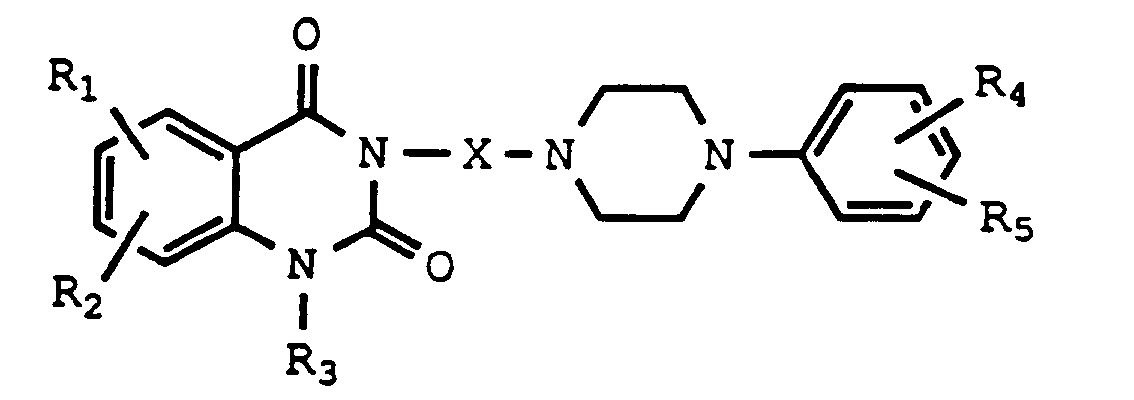
- Compounds of the following general formula are useful in sensitizing multiple drug resistant (MDR) cells to anticancer agents:

each of R1 and R2 is hydrogen, chlorine, fluorine, bromine, or lower alkoxy having from one to four carbon atoms and which is straight or branched; R3 is hydrogen or a straight or branched lower alkyl of from one to three carbon atoms; each of R4 and R5 is hydrogen, chlorine, fluorine, bromine, or lower alkylthio having from one to four carbon atoms and which is straight or branched with proviso that one of R4 and R5 is other than hydrogen; or a pharmaceutically acceptable acid-addition salt thereof. - The compounds of general Formula I are useful in treating patients having cancer and who have developed a resistance to one or more chemotherapeutic agents. By administering to such patients a compound of Formula I, drug resistant cells of the patient are sensitized or modified rendering said cells sensitive to the chemotherapeutic agent(s) once again, thereby permitting treatment of the patient with said agent(s) to resume or continue.
- In general Formula I, X represents an alkylene moiety having from three to seven carbon atoms and may also be represented by the group -(CH2)n- wherein n is an integer of from three to seven.
- Illustrative lower alkoxy groups having from one to four carbon atoms and being straight or branched which R1 and R2 may represent are methoxy, ethoxy, n-propoxy, isopropoxy, n-butoxy, tert-butoxy, and isobutoxy.
- The group R3 represents hydrogen or a lower alkyl group having from one to three carbon atoms being methyl, ethyl or n-propyl, or isopropyl.
- The alkylthio group which R4 and R5 may represent may be depicted as the group alkyl C1 -4-S-wherein the alkyl group is straight or branched, for example, methylthio, ethylthio, n-propylthio, isopropyl- thio, n-butylthio, isobutylthio and tertbutylthio.
- The compounds of general Formula I are prepared as described in U.S. Patent 3,819,630 the relevant portions of which are incorporated herein by reference thereto and in particular column 1, lines 53 to 72, and all of columns 2 through 6. The procedure for obtaining the compounds of Formula I are depicted in Charts I and II which generally is the same as the description found in U.S. 3,819,630. In Chart I n is three to seven, R6 is alkyl d-s, and all other symbolic representations are the same as in Formula I. In Chart II, all symbolic representations are the same as in Formula I and compound (5) can be treated as shown in Chart I to obtain compounds of Formula I.
- The compounds of Formula I including acid-addition salts thereof are useful in sensitizing or modifying cancer cells in a patient which have become resistant to one or more anticancer agents. The Formula I compounds are capable of sensitizing virtually any cancer cell which has become multidrug resistant (MDR). There is a large number of anticancer agents which are known to be involved in MDR or result under clinical therapeutic conditions in cancer cells becoming resistant to treatment. Such anticancer agents include the vinca alkaloids, such as, vinblastine and vincristine; anthyacyclines, such as, doxorubicin and daunorubicin; lipophilic antifolates, such as, trimetrexate and piritrexim; epipodophyllotoxins, such as, etoposide; synthetic analogs such as the anthrapyrazoles described in U.S. Patent No. 4,556,654 specifically for example 7,10-dihydroxy-2-[2-[(2-hydroxyethyl)amino]ethyl]-5-[[2-(methylamino)ethyl]amino]anthra-[1,9-cd]pyrazol-6(2H)-one dihydrochloride (CI-937) or the benzothiopyranoindazoles described in U.S. Patent No. 4,604,390 specifically 5-[(2-aminoethyl)amino]-2-[2-(diethylamino)ethyl]-2H-[1]benzothiopyrano-[4,3,2-cd]indazol-8-ol trihydrochloride (CI-958), and taxol.
- In practicing the present invention the compounds of general Formula I will find use as soon as the drug resistant cancer patient is identified, i.e., the occurrence of the identification of a patient who is not responding to therapy due to the fact that the cancer cells of that patient have become resistant to the anticancer agent or agents with which the patient has been treated. Typically, such patient is treated initially with high doses of the Formula I compound to obtain sufficient blood levels to sensitize the cancer cells. The high dose will vary from compound to compound but typically would be 1000 mg to 2000 mg per day for 1 or 2 days, preferably 1 day. Once adequate blood levels of the sensitizing compound are achieved the dosage amount is reduced to a level adequate to maintain blood levels of compound and anticancer therapy is resumed. Typically the "maintenance" dose of a compound of Formula I would be from 200 mg to 400 mg of compound given three times per day. Anticancer therapy would be continued in the same manner as prior to the patient having been diagnosed as drug resistant except that the anticancer agent(s) is co- administered with maintenance dose of sensitizing compound.
- In practicing the present invention the compounds of Formula I can be administered orally or parenterally, particularly intravenously or subcutaneously. Oral administration is preferred.
- For preparing pharmaceutical compositions from the compounds of this invention, inert, pharmaceutically acceptable carriers can be either solid or liquid. Solid form preparations include powders, tablets, dispersible granules, capsules, and cachets.
- A solid carrier can be one or more substances which may also act as diluents, flavoring agents, solubilizers, lubricants, suspending agents, binders, or tablet disintegrating agents; it can also be an encapsulating material.
- In powders, the carrier is a finely divided solid which is in a mixture with the finely divided active component. In tablets, the active compound is mixed with the carrier having the necessary binding properties in suitable proportions and compacted in the shape and size desired.
- Powders and tablets preferably contain between about five to about 70% by weight of the active ingredient. Suitable carriers are magnesium carbonate, magnesium stearate, talc, lactose, sugar, pectin, dextrin, starch, tragacanth, methyl cellulose, sodium carboxymethyl cellulose, a low-melting wax, cocoa butter, and the like.
- The term "preparation" is intended to include the formulation of the active compound with encapsulating material as a carrier providing a capsule in which the active component (with or without other carriers) is surrounded by a carrier, which is thus in association with it. In a similar manner, cachets are also included.
- Tablets, powders, cachets, and capsules can be used as solid dosage forms suitable for oral administration.
- Liquid form preparations include solutions suitable for oral administration, or suspensions and emulsions suitable for oral administration. Aqueous solutions for oral administration can be prepared by dissolving the active compound in water and adding suitable flavorants, coloring agents, stabilizers, and thickening agents as desired. Aqueous suspensions for oral use can be made by dispersing the finely divided active component in water together with a viscous material such as natural or synthetic gums, resins, methylcellulose, sodium carboxymethyl cellulose, and other suspending agents known to the pharmaceutical formulation art.
- Preferably, the pharmaceutical preparation is in unit dosage form. In such form, the preparation is divided into unit doses containing appropriate quantities of the active component. The unit dosage form can be a packaged preparation, the package containing discrete quantities of the preparation, for example, packeted tablets, capsules, and powders in vials or ampoules. The unit dosage form can also be a capsule, cachet, or tablet itself, or it can be the appropriate number of any of these packaged forms.
- Preferred compounds of Formula I for use in practicing the present invention are those wherein X is butylene, i.e., -(CH2)4-, R4 is hydrogen, and R5 is a propylthio group. Compounds wherein R5 is propylthio in the 2-position are more preferred.
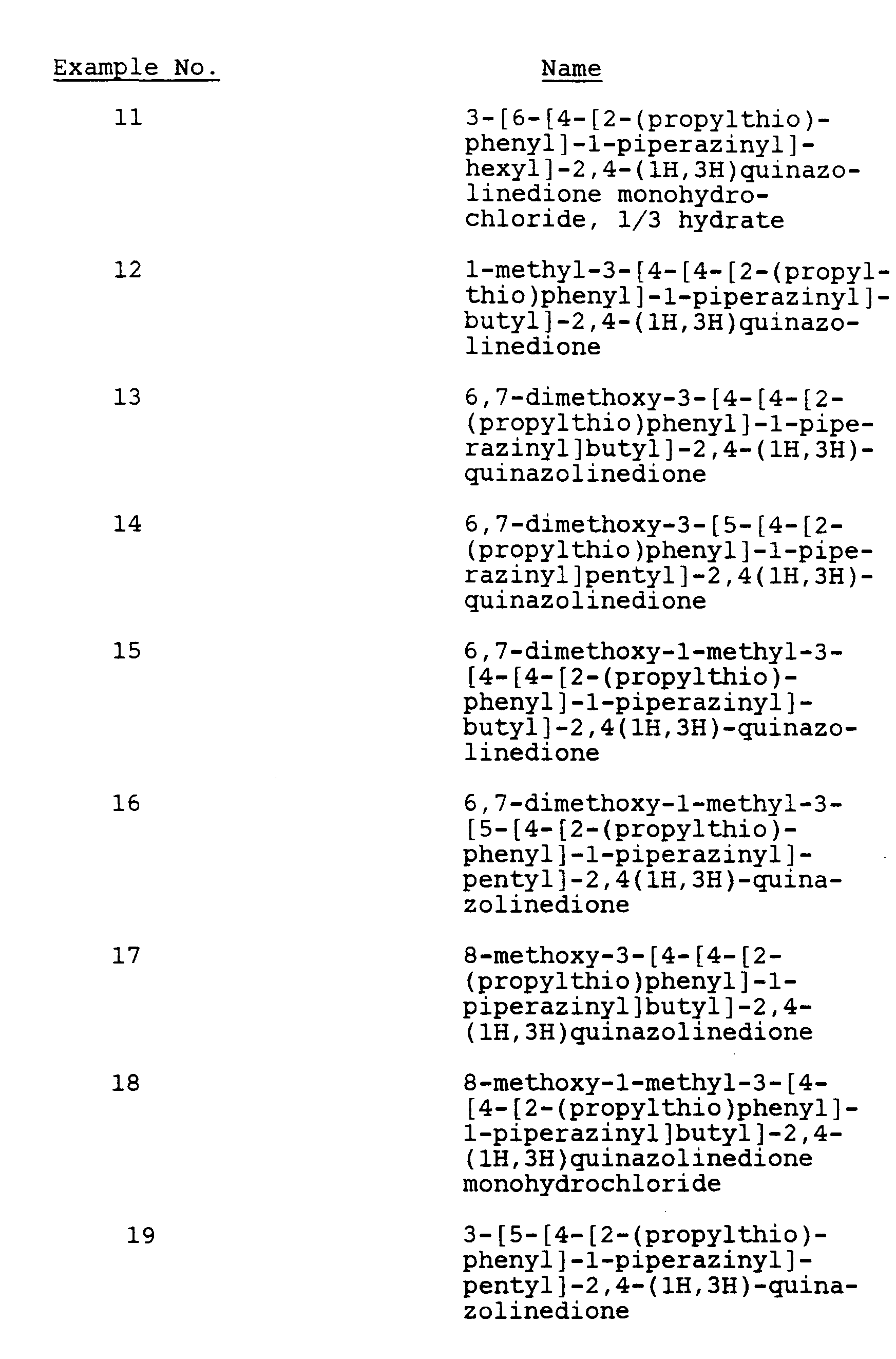
- Illustrative examples of compounds of Formula I include the following:

- In comparative studies of potential chemosensitizers for MDR, including verapamil, amiodarone, and cyclosporin A, which are three agents currently in clinical trials as chemosensitizers, we found that tioperidone (Example 1) was superior to all of the other agents in potentiating the activity of adriamycin in P388R cells which are murine leukemia cells having resistance to a variety of drugs. As with cyclosporin A and verapamil, tioperiodone had little effect on adriamycin activity in the drug-sensitive parent P388S cells. Tioperidone fully sensitized P388R cells to vincristine, trimetrexate, and the anthrapyrazole, CI-937. Tioperidone chemosensitizes MDR P388 cells by increasing the intracellular drug levels. Unlike amiodarone, whose chemosensitizing activity is diminished by binding to serum proteins, the activity of tioperidone in MDR cells does not appear to be altered by serum proteins. In performing the studies P388 cells that were sensitive to adriamycin (P388S) and P388 cells that were resistant to adriamycin (P388/ADR) were exposed to various concentrations of anticancer drug either alone or together with 5 µg/mL of modifier or sensitizer for 72 hours. The results are set forth in the following Table I wherein the effect of the anticancer drug alone or in combination with the modifier is expressed as the ID50 which is the concentration that inhibits 72-hour cell growth by 50%.
- In Table I, TIOP means tioperidone, VER means verapamil, and CsA means cyclosporin A.

- The results of additional studies demonstrating the ability of compounds of Formula I to potentiate the activity of adriamycin in P388 resistant cells are set forth in the following Table II.

- The P388 murine leukemia cells used in obtaining the data set forth in Table I and Table II were obtained from Southern Research Institute (Birmingham, AL) and were cultured from ascites fluids of tumor- bearing DBA/2 mice and maintained in Fischer's medium supplemented with 10% horse serum, 10 µM 2-mercaptoethanol, and gentamycin (50 µg/mL). Cells were counted with a Model ZF Coulter Counter (Coulter Electronics, Inc., Hialeah, FL). Viability was determined by trypan blue exclusion. The general methodology is described by W.D. Klohs, et al, Cancer Research 46, 4352-4356 (September 1986) and W. D. Klohs, et al, J. Nat'l. Cancer Inst. 75, 353-359 (1985).
- The use of the compounds of Formula I in practicing the present invention is further illustrated by the following example of treatment of a patient.
- A patient having MDR leukemia and identified as not responding to anticancer treatment with drugs that are known to be included in the MDR group is subjected to the following dosage regimen of tioperidone and adriamycin over a three-day period.

- Following treatment, results are measured by observing bone marrow and/or blood levels of leukemia cells.


Claims (8)


Applications Claiming Priority (5)
| Application Number | Priority Date | Filing Date | Title |
|---|---|---|---|
| US47932090A | 1990-02-13 | 1990-02-13 | |
| US479320 | 1990-02-13 | ||
| US07/497,049 US5160727A (en) | 1990-02-13 | 1990-03-21 | Tumor cell sensitization method using quinazolinedione derivatives |
| US497049 | 1990-03-21 | ||
| PCT/US1991/000205 WO1991012006A2 (en) | 1990-02-13 | 1991-01-10 | Tumor cell sensitization method |
Publications (2)
| Publication Number | Publication Date |
|---|---|
| EP0524931A1 EP0524931A1 (en) | 1993-02-03 |
| EP0524931B1 true EP0524931B1 (en) | 1995-04-26 |
Family
ID=27046201
Family Applications (1)
| Application Number | Title | Priority Date | Filing Date |
|---|---|---|---|
| EP91902395A Expired - Lifetime EP0524931B1 (en) | 1990-02-13 | 1991-01-10 | Tumor cell sensitization method |
Country Status (11)
| Country | Link |
|---|---|
| US (1) | US5160727A (en) |
| EP (1) | EP0524931B1 (en) |
| JP (1) | JPH05509290A (en) |
| KR (1) | KR927003058A (en) |
| AT (1) | ATE121622T1 (en) |
| AU (1) | AU646837B2 (en) |
| CA (1) | CA2076032A1 (en) |
| DE (1) | DE69109283T2 (en) |
| IE (1) | IE910476A1 (en) |
| IL (1) | IL97055A0 (en) |
| WO (1) | WO1991012006A2 (en) |
Families Citing this family (18)
| Publication number | Priority date | Publication date | Assignee | Title |
|---|---|---|---|---|
| US6150398A (en) * | 1991-05-08 | 2000-11-21 | The United States Of America As Represented By The Department Of Health And Human Services | Methods for the treatment of cancer |
| US5491234A (en) * | 1992-03-30 | 1996-02-13 | Pfizer Inc. | Pyrimidine derivatives for enhancing antitumor activity |
| US5684169A (en) * | 1992-11-27 | 1997-11-04 | Ensuiko Sugar Refining Co., Ltd. | Cyclodextrin inclusion complex of taxol, and method for its production and its use |
| US5436243A (en) * | 1993-11-17 | 1995-07-25 | Research Triangle Institute Duke University | Aminoanthraquinone derivatives to combat multidrug resistance |
| DE19512484A1 (en) * | 1995-04-04 | 1996-10-17 | Bayer Ag | Carbohydrate modified cytostatics |
| US5767113A (en) * | 1995-05-10 | 1998-06-16 | The Salk Institute For Biological Studies | Compounds useful for concurrently activating glucocorticoid-induced response and reducing multidrug resistance |
| US6376514B1 (en) | 2000-10-17 | 2002-04-23 | The Procter & Gamble Co. | Substituted six-membered heterocyclic compounds useful for treating multidrug resistance and compositions and methods thereof |
| US6693099B2 (en) | 2000-10-17 | 2004-02-17 | The Procter & Gamble Company | Substituted piperazine compounds optionally containing a quinolyl moiety for treating multidrug resistance |
| EA011211B1 (en) | 2003-11-20 | 2009-02-27 | Янссен Фармацевтика Н. В. | 7-phenylalkyl substituted 2-quinolinones and quinoxalinones as poly(adp-ribose) polymerase inhibitors |
| AU2004295058B9 (en) | 2003-11-20 | 2011-06-30 | Janssen Pharmaceutica N.V. | 6-alkenyl and 6-phenylalkyl substituted 2-quinolinones and 2-quinoxalinones as poly(ADP-ribose) polymerase inhibitors |
| WO2006003150A1 (en) | 2004-06-30 | 2006-01-12 | Janssen Pharmaceutica N.V. | Substituted 2-alkyl quinazolinone derivatives as parp inhibitors |
| KR101188688B1 (en) | 2004-06-30 | 2012-10-09 | 얀센 파마슈티카 엔.브이. | Quinazolinedione derivatives as parp inhibitors |
| JP4852540B2 (en) | 2004-06-30 | 2012-01-11 | ジヤンセン・フアーマシユーチカ・ナームローゼ・フエンノートシヤツプ | Phthalazine derivatives as PARP inhibitors |
| SG154432A1 (en) * | 2004-06-30 | 2009-08-28 | Janssen Pharmaceutica Nv | Quinazolinedione derivatives as parp inhibitors |
| HRP20120346T1 (en) | 2007-03-08 | 2012-05-31 | Janssen Pharmaceutica N.V. | Quinolinone derivatives as parp and tank inhibitors |
| PL2215075T3 (en) | 2007-10-26 | 2014-04-30 | Janssen Pharmaceutica Nv | Quinolinone derivatives as parp inhibitors |
| AU2009228945B2 (en) | 2008-03-27 | 2013-05-02 | Janssen Pharmaceutica Nv | Quinazolinone derivatives as tubulin polymerization inhibitors |
| JP5492183B2 (en) | 2008-03-27 | 2014-05-14 | ジヤンセン・フアーマシユーチカ・ナームローゼ・フエンノートシヤツプ | Tetrahydrophenanthridinone and tetrahydrocyclopentaquinolinone as PARP and tubulin polymerization inhibitors |
Family Cites Families (5)
| Publication number | Priority date | Publication date | Assignee | Title |
|---|---|---|---|---|
| US3819630A (en) * | 1972-08-21 | 1974-06-25 | R Parcell | 3-(1-piperazinylalkyl)-2,4-quinazolinedione compounds and methods for their production |
| EP0031237B1 (en) * | 1979-12-19 | 1984-10-17 | National Research Development Corporation | Quinazoline derivatives, processes for their preparation, compositions containing them and their use as anti-cancer agents |
| JPS58159480A (en) * | 1982-03-17 | 1983-09-21 | Chugai Pharmaceut Co Ltd | Novel phenylpiperazine derivative |
| JPS608274A (en) * | 1983-06-27 | 1985-01-17 | Fujisawa Pharmaceut Co Ltd | Novel quinazolinone derivative, its preparation and antiallergic agent |
| GB8707053D0 (en) * | 1987-03-25 | 1987-04-29 | Ici Plc | Anti-tumour agents |
-
1990
- 1990-03-21 US US07/497,049 patent/US5160727A/en not_active Expired - Fee Related
-
1991
- 1991-01-10 AU AU71544/91A patent/AU646837B2/en not_active Ceased
- 1991-01-10 KR KR1019920701933A patent/KR927003058A/en not_active Withdrawn
- 1991-01-10 JP JP3503001A patent/JPH05509290A/en active Pending
- 1991-01-10 AT AT91902395T patent/ATE121622T1/en not_active IP Right Cessation
- 1991-01-10 EP EP91902395A patent/EP0524931B1/en not_active Expired - Lifetime
- 1991-01-10 DE DE69109283T patent/DE69109283T2/en not_active Expired - Fee Related
- 1991-01-10 WO PCT/US1991/000205 patent/WO1991012006A2/en not_active Ceased
- 1991-01-10 CA CA002076032A patent/CA2076032A1/en not_active Abandoned
- 1991-01-25 IL IL97055A patent/IL97055A0/en unknown
- 1991-02-12 IE IE047691A patent/IE910476A1/en unknown
Also Published As
| Publication number | Publication date |
|---|---|
| JPH05509290A (en) | 1993-12-22 |
| DE69109283T2 (en) | 1995-08-24 |
| ATE121622T1 (en) | 1995-05-15 |
| US5160727A (en) | 1992-11-03 |
| KR927003058A (en) | 1992-12-17 |
| DE69109283D1 (en) | 1995-06-01 |
| AU646837B2 (en) | 1994-03-10 |
| CA2076032A1 (en) | 1991-08-14 |
| IL97055A0 (en) | 1992-03-29 |
| EP0524931A1 (en) | 1993-02-03 |
| AU7154491A (en) | 1991-09-03 |
| WO1991012006A2 (en) | 1991-08-22 |
| IE910476A1 (en) | 1991-08-14 |
Similar Documents
| Publication | Publication Date | Title |
|---|---|---|
| US5160727A (en) | Tumor cell sensitization method using quinazolinedione derivatives | |
| US20200368235A1 (en) | Ibrutinib combination therapy | |
| JP2023515817A (en) | A triple drug combination containing dabrafenib, an ERK inhibitor and a SHP2 inhibitor | |
| US9254299B2 (en) | Administration of hypoxia activated prodrugs in combination with Chk1 inhibitors for treating cancer | |
| US20090227608A1 (en) | Use of c-src inhibitors alone or in combination with sti571 for the treatment of leukaemia | |
| PL192544B1 (en) | Method of and compositions and sets of agents for enhancing oral biological availability of pharmaceutic agents | |
| US20110172251A1 (en) | Method of treating mental disorders using of D4 and 5-HT2A antagonists, inverse agonists or partial agonists | |
| US20020156023A1 (en) | Lometrexol combination therapy | |
| US8492383B2 (en) | Combination of a nitrogen mustard analogue and imatinib for treatment of chronic lymphocytic leukemia | |
| US7772207B2 (en) | Combination of a CDK inhibitor and CS-682 or a metabolite thereof | |
| US20250177420A1 (en) | Bcl-2 inhibitors and aurora kinase inhibitors for treating cancer | |
| US20130101680A1 (en) | Radiotherapy enhancer | |
| US5011841A (en) | Treatment of depression | |
| JP7113826B2 (en) | Combinations of protein kinase inhibitors and additional chemotherapeutic agents | |
| US20090221488A1 (en) | Certain Compositions and Methods of Treatment | |
| JP2010511041A (en) | Use of indolyl-3-glyoxylic acid derivatives containing indibulin alone or in combination with additional agents for treating cancer | |
| EP3782620B1 (en) | Pharmaceutical composition comprising 1,2-naphthoquinone derivative for use in preventing or treating acute myeloid or lymphoblastic leukemia | |
| US20050164976A1 (en) | Combination of a cdk inhibitor and 5-fu for the tratment of cancer | |
| JP7646243B2 (en) | Use of the pharmaceutical composition in treating lung cancer | |
| US20110136810A1 (en) | Antitumor agent, kit and method of treating cancer | |
| US20190160054A1 (en) | Pharmaceutical combination of nintedanib, trifluridine and tipiracil for treating colorectal cancer | |
| US20090176759A1 (en) | Leukemic stem cell ablation | |
| EP3246029A1 (en) | Pharmaceutical combination of nintedanib and capecitabine for the treatment of colorectal cancer | |
| JP2004359545A (en) | Anticancer drug resistance overcoming drug |
Legal Events
| Date | Code | Title | Description |
|---|---|---|---|
| PUAI | Public reference made under article 153(3) epc to a published international application that has entered the european phase |
Free format text: ORIGINAL CODE: 0009012 |
|
| 17P | Request for examination filed |
Effective date: 19920710 |
|
| AK | Designated contracting states |
Kind code of ref document: A1 Designated state(s): AT BE CH DE DK ES FR GB GR IT LI LU NL SE |
|
| 17Q | First examination report despatched |
Effective date: 19931216 |
|
| GRAA | (expected) grant |
Free format text: ORIGINAL CODE: 0009210 |
|
| AK | Designated contracting states |
Kind code of ref document: B1 Designated state(s): AT BE CH DE DK ES FR GB GR IT LI LU NL SE |
|
| PG25 | Lapsed in a contracting state [announced via postgrant information from national office to epo] |
Ref country code: IT Free format text: LAPSE BECAUSE OF FAILURE TO SUBMIT A TRANSLATION OF THE DESCRIPTION OR TO PAY THE FEE WITHIN THE PRE;WARNING: LAPSES OF ITALIAN PATENTS WITH EFFECTIVE DATE BEFORE 2007 MAY HAVE OCCURRED AT ANY TIME BEFORE 2007. THE CORRECT EFFECTIVE DATE MAY BE DIFFERENT FROM THE ONE RECORDED.SCRIBED TIME-LIMIT Effective date: 19950426 Ref country code: GR Free format text: LAPSE BECAUSE OF FAILURE TO SUBMIT A TRANSLATION OF THE DESCRIPTION OR TO PAY THE FEE WITHIN THE PRESCRIBED TIME-LIMIT Effective date: 19950426 Ref country code: ES Free format text: THE PATENT HAS BEEN ANNULLED BY A DECISION OF A NATIONAL AUTHORITY Effective date: 19950426 Ref country code: DK Effective date: 19950426 Ref country code: AT Effective date: 19950426 Ref country code: BE Effective date: 19950426 |
|
| REF | Corresponds to: |
Ref document number: 121622 Country of ref document: AT Date of ref document: 19950515 Kind code of ref document: T |
|
| ET | Fr: translation filed | ||
| REF | Corresponds to: |
Ref document number: 69109283 Country of ref document: DE Date of ref document: 19950601 |
|
| PG25 | Lapsed in a contracting state [announced via postgrant information from national office to epo] |
Ref country code: GB Effective date: 19960110 |
|
| PG25 | Lapsed in a contracting state [announced via postgrant information from national office to epo] |
Ref country code: SE Effective date: 19960111 |
|
| PG25 | Lapsed in a contracting state [announced via postgrant information from national office to epo] |
Ref country code: LU Free format text: LAPSE BECAUSE OF NON-PAYMENT OF DUE FEES Effective date: 19960131 Ref country code: LI Effective date: 19960131 Ref country code: CH Effective date: 19960131 |
|
| PLBE | No opposition filed within time limit |
Free format text: ORIGINAL CODE: 0009261 |
|
| STAA | Information on the status of an ep patent application or granted ep patent |
Free format text: STATUS: NO OPPOSITION FILED WITHIN TIME LIMIT |
|
| 26N | No opposition filed | ||
| PG25 | Lapsed in a contracting state [announced via postgrant information from national office to epo] |
Ref country code: NL Effective date: 19960801 |
|
| GBPC | Gb: european patent ceased through non-payment of renewal fee |
Effective date: 19960110 |
|
| REG | Reference to a national code |
Ref country code: CH Ref legal event code: PL |
|
| PG25 | Lapsed in a contracting state [announced via postgrant information from national office to epo] |
Ref country code: FR Effective date: 19960930 |
|
| NLV4 | Nl: lapsed or anulled due to non-payment of the annual fee |
Effective date: 19960801 |
|
| PG25 | Lapsed in a contracting state [announced via postgrant information from national office to epo] |
Ref country code: DE Effective date: 19961001 |
|
| EUG | Se: european patent has lapsed |
Ref document number: 91902395.2 |
|
| REG | Reference to a national code |
Ref country code: FR Ref legal event code: ST |