EP0524239B1 - Insoluble salts of lanthanides for the visual display, using nuclear magnetic resonance, of the gastro-intestinal tract - Google Patents
Insoluble salts of lanthanides for the visual display, using nuclear magnetic resonance, of the gastro-intestinal tract Download PDFInfo
- Publication number
- EP0524239B1 EP0524239B1 EP91907770A EP91907770A EP0524239B1 EP 0524239 B1 EP0524239 B1 EP 0524239B1 EP 91907770 A EP91907770 A EP 91907770A EP 91907770 A EP91907770 A EP 91907770A EP 0524239 B1 EP0524239 B1 EP 0524239B1
- Authority
- EP
- European Patent Office
- Prior art keywords
- insoluble
- composition according
- paramagnetic
- physiologically acceptable
- salt
- Prior art date
- Legal status (The legal status is an assumption and is not a legal conclusion. Google has not performed a legal analysis and makes no representation as to the accuracy of the status listed.)
- Expired - Lifetime
Links
- 150000003839 salts Chemical class 0.000 title claims abstract description 25
- 229910052747 lanthanoid Inorganic materials 0.000 title claims abstract description 16
- 150000002602 lanthanoids Chemical class 0.000 title claims abstract description 15
- 210000001035 gastrointestinal tract Anatomy 0.000 title claims abstract description 8
- 238000005481 NMR spectroscopy Methods 0.000 title claims description 12
- 230000000007 visual effect Effects 0.000 title description 3
- XLYOFNOQVPJJNP-UHFFFAOYSA-N water Substances O XLYOFNOQVPJJNP-UHFFFAOYSA-N 0.000 claims abstract description 19
- 239000000203 mixture Substances 0.000 claims abstract description 14
- 239000000654 additive Substances 0.000 claims abstract description 8
- 239000003795 chemical substances by application Substances 0.000 claims abstract description 6
- 239000002270 dispersing agent Substances 0.000 claims abstract description 3
- 239000007900 aqueous suspension Substances 0.000 claims abstract 2
- 239000000725 suspension Substances 0.000 claims description 27
- 239000002245 particle Substances 0.000 claims description 17
- 230000005298 paramagnetic effect Effects 0.000 claims description 13
- TZCXTZWJZNENPQ-UHFFFAOYSA-L barium sulfate Chemical group [Ba+2].[O-]S([O-])(=O)=O TZCXTZWJZNENPQ-UHFFFAOYSA-L 0.000 claims description 10
- 229920002134 Carboxymethyl cellulose Polymers 0.000 claims description 9
- 235000010948 carboxy methyl cellulose Nutrition 0.000 claims description 9
- 239000001768 carboxy methyl cellulose Substances 0.000 claims description 7
- 239000008112 carboxymethyl-cellulose Substances 0.000 claims description 7
- 229910004650 HoF3 Inorganic materials 0.000 claims description 6
- 150000001450 anions Chemical class 0.000 claims description 6
- FDIFPFNHNADKFC-UHFFFAOYSA-K trifluoroholmium Chemical compound F[Ho](F)F FDIFPFNHNADKFC-UHFFFAOYSA-K 0.000 claims description 6
- 229910004299 TbF3 Inorganic materials 0.000 claims description 5
- 229910021645 metal ion Inorganic materials 0.000 claims description 5
- LKNRQYTYDPPUOX-UHFFFAOYSA-K trifluoroterbium Chemical compound F[Tb](F)F LKNRQYTYDPPUOX-UHFFFAOYSA-K 0.000 claims description 5
- 229910016495 ErF3 Inorganic materials 0.000 claims description 4
- MUBZPKHOEPUJKR-UHFFFAOYSA-N Oxalic acid Chemical compound OC(=O)C(O)=O MUBZPKHOEPUJKR-UHFFFAOYSA-N 0.000 claims description 4
- QGJSAGBHFTXOTM-UHFFFAOYSA-K trifluoroerbium Chemical compound F[Er](F)F QGJSAGBHFTXOTM-UHFFFAOYSA-K 0.000 claims description 4
- 229910052692 Dysprosium Inorganic materials 0.000 claims description 2
- 229910052691 Erbium Inorganic materials 0.000 claims description 2
- 229910052689 Holmium Inorganic materials 0.000 claims description 2
- 229910052771 Terbium Inorganic materials 0.000 claims description 2
- 239000006172 buffering agent Substances 0.000 claims description 2
- 239000001913 cellulose Substances 0.000 claims description 2
- 229920002678 cellulose Polymers 0.000 claims description 2
- KBQHZAAAGSGFKK-UHFFFAOYSA-N dysprosium atom Chemical compound [Dy] KBQHZAAAGSGFKK-UHFFFAOYSA-N 0.000 claims description 2
- UYAHIZSMUZPPFV-UHFFFAOYSA-N erbium Chemical compound [Er] UYAHIZSMUZPPFV-UHFFFAOYSA-N 0.000 claims description 2
- KJZYNXUDTRRSPN-UHFFFAOYSA-N holmium atom Chemical compound [Ho] KJZYNXUDTRRSPN-UHFFFAOYSA-N 0.000 claims description 2
- 229920003063 hydroxymethyl cellulose Polymers 0.000 claims description 2
- 229940031574 hydroxymethyl cellulose Drugs 0.000 claims description 2
- GZCRRIHWUXGPOV-UHFFFAOYSA-N terbium atom Chemical compound [Tb] GZCRRIHWUXGPOV-UHFFFAOYSA-N 0.000 claims description 2
- 101100274801 Caenorhabditis elegans dyf-3 gene Proteins 0.000 claims 2
- 229910016468 DyF3 Inorganic materials 0.000 claims 2
- KRHYYFGTRYWZRS-UHFFFAOYSA-M Fluoride anion Chemical compound [F-] KRHYYFGTRYWZRS-UHFFFAOYSA-M 0.000 claims 1
- 230000000996 additive effect Effects 0.000 claims 1
- 239000006259 organic additive Substances 0.000 claims 1
- NBIIXXVUZAFLBC-UHFFFAOYSA-K phosphate Chemical compound [O-]P([O-])([O-])=O NBIIXXVUZAFLBC-UHFFFAOYSA-K 0.000 claims 1
- 238000003384 imaging method Methods 0.000 abstract description 3
- 239000000375 suspending agent Substances 0.000 abstract description 2
- 239000002872 contrast media Substances 0.000 description 21
- 238000013019 agitation Methods 0.000 description 11
- 238000002360 preparation method Methods 0.000 description 11
- 239000000126 substance Substances 0.000 description 11
- 238000000034 method Methods 0.000 description 7
- 230000005291 magnetic effect Effects 0.000 description 6
- 210000000056 organ Anatomy 0.000 description 6
- 239000012153 distilled water Substances 0.000 description 5
- 239000011236 particulate material Substances 0.000 description 4
- -1 perfluoro Chemical class 0.000 description 4
- 229920001296 polysiloxane Polymers 0.000 description 4
- 238000003756 stirring Methods 0.000 description 4
- 239000006185 dispersion Substances 0.000 description 3
- 150000002222 fluorine compounds Chemical class 0.000 description 3
- 238000000265 homogenisation Methods 0.000 description 3
- 238000002595 magnetic resonance imaging Methods 0.000 description 3
- 210000002784 stomach Anatomy 0.000 description 3
- 238000003325 tomography Methods 0.000 description 3
- 150000000921 Gadolinium Chemical class 0.000 description 2
- VYPSYNLAJGMNEJ-UHFFFAOYSA-N Silicium dioxide Chemical compound O=[Si]=O VYPSYNLAJGMNEJ-UHFFFAOYSA-N 0.000 description 2
- 230000035508 accumulation Effects 0.000 description 2
- 238000009825 accumulation Methods 0.000 description 2
- 150000001875 compounds Chemical class 0.000 description 2
- 229940079593 drug Drugs 0.000 description 2
- 239000003814 drug Substances 0.000 description 2
- 210000001198 duodenum Anatomy 0.000 description 2
- 230000005294 ferromagnetic effect Effects 0.000 description 2
- 230000002496 gastric effect Effects 0.000 description 2
- 210000004185 liver Anatomy 0.000 description 2
- 238000005259 measurement Methods 0.000 description 2
- 150000003891 oxalate salts Chemical class 0.000 description 2
- 230000001575 pathological effect Effects 0.000 description 2
- 239000002244 precipitate Substances 0.000 description 2
- 239000000047 product Substances 0.000 description 2
- 230000009467 reduction Effects 0.000 description 2
- 239000000230 xanthan gum Substances 0.000 description 2
- 229920001285 xanthan gum Polymers 0.000 description 2
- 229940082509 xanthan gum Drugs 0.000 description 2
- 235000010493 xanthan gum Nutrition 0.000 description 2
- 239000005995 Aluminium silicate Substances 0.000 description 1
- FBPFZTCFMRRESA-FSIIMWSLSA-N D-Glucitol Natural products OC[C@H](O)[C@H](O)[C@@H](O)[C@H](O)CO FBPFZTCFMRRESA-FSIIMWSLSA-N 0.000 description 1
- DGAQECJNVWCQMB-PUAWFVPOSA-M Ilexoside XXIX Chemical compound C[C@@H]1CC[C@@]2(CC[C@@]3(C(=CC[C@H]4[C@]3(CC[C@@H]5[C@@]4(CC[C@@H](C5(C)C)OS(=O)(=O)[O-])C)C)[C@@H]2[C@]1(C)O)C)C(=O)O[C@H]6[C@@H]([C@H]([C@@H]([C@H](O6)CO)O)O)O.[Na+] DGAQECJNVWCQMB-PUAWFVPOSA-M 0.000 description 1
- 206010028980 Neoplasm Diseases 0.000 description 1
- 229910019142 PO4 Inorganic materials 0.000 description 1
- 241000700159 Rattus Species 0.000 description 1
- 229910052775 Thulium Inorganic materials 0.000 description 1
- 210000001015 abdomen Anatomy 0.000 description 1
- 230000003187 abdominal effect Effects 0.000 description 1
- 238000010521 absorption reaction Methods 0.000 description 1
- 230000009471 action Effects 0.000 description 1
- 235000012211 aluminium silicate Nutrition 0.000 description 1
- 238000004458 analytical method Methods 0.000 description 1
- 230000002547 anomalous effect Effects 0.000 description 1
- 230000008901 benefit Effects 0.000 description 1
- 239000000440 bentonite Substances 0.000 description 1
- 229910000278 bentonite Inorganic materials 0.000 description 1
- SVPXDRXYRYOSEX-UHFFFAOYSA-N bentoquatam Chemical compound O.O=[Si]=O.O=[Al]O[Al]=O SVPXDRXYRYOSEX-UHFFFAOYSA-N 0.000 description 1
- 239000003153 chemical reaction reagent Substances 0.000 description 1
- 150000001844 chromium Chemical class 0.000 description 1
- 230000001419 dependent effect Effects 0.000 description 1
- 238000003745 diagnosis Methods 0.000 description 1
- 238000002059 diagnostic imaging Methods 0.000 description 1
- 238000012631 diagnostic technique Methods 0.000 description 1
- 230000005292 diamagnetic effect Effects 0.000 description 1
- 229940061607 dibasic sodium phosphate Drugs 0.000 description 1
- BNIILDVGGAEEIG-UHFFFAOYSA-L disodium hydrogen phosphate Chemical compound [Na+].[Na+].OP([O-])([O-])=O BNIILDVGGAEEIG-UHFFFAOYSA-L 0.000 description 1
- 230000000694 effects Effects 0.000 description 1
- 235000020937 fasting conditions Nutrition 0.000 description 1
- 230000002349 favourable effect Effects 0.000 description 1
- 239000000796 flavoring agent Substances 0.000 description 1
- SQORATIMOBOFKR-UHFFFAOYSA-H gadolinium(3+);oxalate Chemical compound [Gd+3].[Gd+3].[O-]C(=O)C([O-])=O.[O-]C(=O)C([O-])=O.[O-]C(=O)C([O-])=O SQORATIMOBOFKR-UHFFFAOYSA-H 0.000 description 1
- 210000004907 gland Anatomy 0.000 description 1
- 238000001727 in vivo Methods 0.000 description 1
- 230000000968 intestinal effect Effects 0.000 description 1
- 230000008991 intestinal motility Effects 0.000 description 1
- 210000000936 intestine Anatomy 0.000 description 1
- 238000002075 inversion recovery Methods 0.000 description 1
- UQSXHKLRYXJYBZ-UHFFFAOYSA-N iron oxide Inorganic materials [Fe]=O UQSXHKLRYXJYBZ-UHFFFAOYSA-N 0.000 description 1
- 235000013980 iron oxide Nutrition 0.000 description 1
- 159000000014 iron salts Chemical class 0.000 description 1
- VBMVTYDPPZVILR-UHFFFAOYSA-N iron(2+);oxygen(2-) Chemical class [O-2].[Fe+2] VBMVTYDPPZVILR-UHFFFAOYSA-N 0.000 description 1
- SZVJSHCCFOBDDC-UHFFFAOYSA-N iron(II,III) oxide Inorganic materials O=[Fe]O[Fe]O[Fe]=O SZVJSHCCFOBDDC-UHFFFAOYSA-N 0.000 description 1
- NLYAJNPCOHFWQQ-UHFFFAOYSA-N kaolin Chemical compound O.O.O=[Al]O[Si](=O)O[Si](=O)O[Al]=O NLYAJNPCOHFWQQ-UHFFFAOYSA-N 0.000 description 1
- 210000003734 kidney Anatomy 0.000 description 1
- 230000003902 lesion Effects 0.000 description 1
- 239000011159 matrix material Substances 0.000 description 1
- 238000002156 mixing Methods 0.000 description 1
- 229940111688 monobasic potassium phosphate Drugs 0.000 description 1
- 235000019796 monopotassium phosphate Nutrition 0.000 description 1
- 230000007935 neutral effect Effects 0.000 description 1
- 238000009828 non-uniform distribution Methods 0.000 description 1
- 239000002405 nuclear magnetic resonance imaging agent Substances 0.000 description 1
- 235000006408 oxalic acid Nutrition 0.000 description 1
- 210000000496 pancreas Anatomy 0.000 description 1
- 239000002907 paramagnetic material Substances 0.000 description 1
- 230000008855 peristalsis Effects 0.000 description 1
- 239000008194 pharmaceutical composition Substances 0.000 description 1
- 239000000546 pharmaceutical excipient Substances 0.000 description 1
- 235000021317 phosphate Nutrition 0.000 description 1
- 150000003013 phosphoric acid derivatives Chemical class 0.000 description 1
- GNSKLFRGEWLPPA-UHFFFAOYSA-M potassium dihydrogen phosphate Chemical compound [K+].OP(O)([O-])=O GNSKLFRGEWLPPA-UHFFFAOYSA-M 0.000 description 1
- 239000003755 preservative agent Substances 0.000 description 1
- 230000029058 respiratory gaseous exchange Effects 0.000 description 1
- 239000000377 silicon dioxide Substances 0.000 description 1
- 229910052708 sodium Inorganic materials 0.000 description 1
- 239000011734 sodium Substances 0.000 description 1
- 239000000600 sorbitol Substances 0.000 description 1
- 238000000264 spin echo pulse sequence Methods 0.000 description 1
- 210000000952 spleen Anatomy 0.000 description 1
- 238000012453 sprague-dawley rat model Methods 0.000 description 1
- 229910052723 transition metal Inorganic materials 0.000 description 1
- 150000003624 transition metals Chemical class 0.000 description 1
- TYIZUJNEZNBXRS-UHFFFAOYSA-K trifluorogadolinium Chemical compound F[Gd](F)F TYIZUJNEZNBXRS-UHFFFAOYSA-K 0.000 description 1
Images

Classifications
-
- A—HUMAN NECESSITIES
- A61—MEDICAL OR VETERINARY SCIENCE; HYGIENE
- A61K—PREPARATIONS FOR MEDICAL, DENTAL OR TOILETRY PURPOSES
- A61K49/00—Preparations for testing in vivo
- A61K49/06—Nuclear magnetic resonance [NMR] contrast preparations; Magnetic resonance imaging [MRI] contrast preparations
- A61K49/18—Nuclear magnetic resonance [NMR] contrast preparations; Magnetic resonance imaging [MRI] contrast preparations characterised by a special physical form, e.g. emulsions, microcapsules, liposomes
- A61K49/1806—Suspensions, emulsions, colloids, dispersions
-
- Y—GENERAL TAGGING OF NEW TECHNOLOGICAL DEVELOPMENTS; GENERAL TAGGING OF CROSS-SECTIONAL TECHNOLOGIES SPANNING OVER SEVERAL SECTIONS OF THE IPC; TECHNICAL SUBJECTS COVERED BY FORMER USPC CROSS-REFERENCE ART COLLECTIONS [XRACs] AND DIGESTS
- Y10—TECHNICAL SUBJECTS COVERED BY FORMER USPC
- Y10T—TECHNICAL SUBJECTS COVERED BY FORMER US CLASSIFICATION
- Y10T436/00—Chemistry: analytical and immunological testing
- Y10T436/24—Nuclear magnetic resonance, electron spin resonance or other spin effects or mass spectrometry
Definitions
- the invention relates to suspensions of insoluble complexes or salts of lanthanide elements which are useful as contrast agents to produce NMR images of the gastrointestinal tract.
- the techniques which are preferably employed for the diagnostic imaging of the abdomen include the use of X-rays, using suspensions of BaSO4 as contrast agents, computerised axial tomography and ecography.
- nuclear magnetic resonance although already capable of competing with axial tomography, especially as regards the assessment of focal lesions of liver, of tumors of suprarenal glands, of kidneys and of pelvic organs, has not yet reached an adequate level of application in the gastrointestinal field.
- the visual display of the gastroenteric tract presents numerous problems which are associated, inter alia, with intestinal motility, with anatomical variations in different patients, and with the fact that the irregularities of the intestinal loops may be confused with anomalous structures associated with pathological feature.
- the observation of the principal abdominal organs for example pancreas, is made difficult by the superposition of images from stomach and/or duodenum.
- contrast agent which permits the application of a safe diagnostic technique such as NMR for the examination of these organs as well.
- initial classification may subdivide them into positive contrast agents, i.e. those which are capable of simultaneously reducing both the longitudinal relaxation time T1 and the transverse relaxation time T2 of the protons of the surrounding water, and negative contrast agents which act selectively on T2.
- positive contrast agents permit improved observations of the organs in which they accumulate
- negative contrast agents have the function of eliminating the signal from the regions which contain them, thus permitting the delimitation of the contours of said regions and the visual display of the adjacent organs.
- contrast agents for gastrointestinal use which have been studied up to the present time have not yet obtained the desired goals either as regards tolerability or as regards the possibility of obtaining images which are clear and which do not include artifacts of metallic type are due to a non-uniform distribution of the contrast agent in the tract to be examined.
- paramagnetic metal ions in particular those belonging to the transition metals or to the lanthanide elements, and their salts and/or complexes have the capacity to influence simultaneously and to a similar extent the relaxation times T1 and T2 of the protons of the surrounding water, thus behaving as positive contrast agents.
- This property is well documented, inter alia, in the above cited US Patent 4,615,879, in which a description is given of insoluble derivatives of gadolinium (especially gadolinium oxalate) for use in NMR diagnosis of the gastrointestinal tract.
- suitable substances for the purpose of the invention are insoluble salts of lanthanides in which the metal ion is preferably selected from terbium, dysprosium, holmium, erbium and thulium and the anion is a suitable inorganic or organic insolubility-promoting anion which is physiologically compatible.
- suitable anions may be selected from fluorides, oxalates and phosphates.
- Substances which have proved to be particularly favourable according to the purpose of the present invention are the fluorides which combine a very low solubility, and thus a minimal absorption, with a marked selective reduction of the relaxation time T2 of the protons of the surrounding water, thus permitting the achievement of high values of the ratio r2/r1.
- the influence of the paramagnetic material on the r2/r1 ratio is also dependent upon the particle size of the particulate material: it has been found that generally a thinner particulate material is more effective in increasing the value of this ratio. To this aim, it is possible to make use of particles having a diameter in the range between 0.01 and 1,000 ⁇ m preferably between 0.05 and 500 ⁇ m.
- the concentration of the insoluble paramagnetic particulate material may range between 0.01 and 5% (weight/volume) and preferably between 0.1 and 3%.
- a further particularly significant aspect of the invention is also given by the completely unexpected finding that the addition of suitable insoluble particulate additives to the suspension of the salts of the lanthanides described above is capable of even further increasing the value of r2/r1, resulting in a further benefit for the purposes of NMR imaging.
- suitable insoluble particulate additives may be selected from organic or inorganic substances which are insoluble and physiologically compatible.
- organic or inorganic substances which are insoluble and physiologically compatible.
- cellulose derivatives such as hydroxymethylcellulose and carboxymethylcellulose among organic substances
- insoluble salts such as BaSO4 or silica among inorganic substances.
- the suspensions of the same may be buffered at a suitable pH value using buffering agents which are physiologically compatible.
- a suitable pH value is preferably neutral or slightly alkaline, i.e. in the range between 6.0 and 8.5.
- the contrast agent diffuse uniformly in the organ under examination and that the paramagnetic particulate material remain stable in suspension during the analysis, without giving rise to local accumulations.
- additives which are well known in the pharmacopoeia, like suspending agents, dispersing agents or viscosity-enhancing agents. If required, it is also possible to add excipients, edulcorating agents, flavourings, preservatives and additives in accordance with well known pharmaceutical formulation techniques.
- a few drops of dilute HCl (1:10) are added to a 250 ml beaker containing 100 ml of bidistilled water under magnetic agitation, to adjust the pH value between 3 and 4.
- the precipitate is then filtered under vacuum, washed with 5 portions of 20 ml of bidistilled water, and dried at 100°C for 4 hours.
- Stirring is continued for a further period of 10 minutes at such a speed as to prevent the inclusion of air.
- the volume is then made up to 100 ml with distilled water, and the agitation continues until complete homogenisation is achieved.
- the longitudinal relaxivity of the protons of the surrounding water (r1) was calculated using the "Inversion Recovery" sequences in accordance with the program supplied for the MINISPEC 120 BRUKER with which the measurements were made.
- the transverse relaxivity (r2) was calculated using the Carr, Purcell, Meiboom and Gill sequences in accordance with the program supplied for the MINISPEC 120 BRUKER with which the measurements were made.
- Table 1 attached hereto shows the efficacy (E) of certain lanthanide salts, characterising the invention, in increasing the r2/r1 ratio.
- the efficacy (E) was calculated by adopting as reference term gadolinium fluoride (GdF3) and was expressed as the ratio between the value of r2/r1 of the suspension of the lanthanide salt under examination and the corresponding value of r2/r1 found for the GdF3 suspensicn.
- GdF3 gadolinium fluoride
- Table 1 shows the selective action on the reduction of the relaxation time T2 of the protons of the surrounding water, with the consequent increase of the r2/r1 ratio, by the products object of the present invention with respect to the Gd salts adopted as reference terms.
- a DyF3 suspension is prepared in accordance with the procedure described in Example 3, using the following quantities:
- the volume of the suspension is then brought to 100 ml using bidistilled water, and the agitation continues until complete homogenisation is achieved.
- the mixture is poured into a 250 ml reactor and, under agitation, the volume is made up to 120 ml with distilled water.
- the dispersion obtained has a viscosity of 2000 mPas.
- Table 2 attached hereto shows the values of this ratio, from which it results that a thinner particle size is far more effective in increasing the value of r2/r1.
- the images were acquired on a 0.5 T "whole body imager" (Esaote-Genova), using a coil having an internal diameter of 8 cm.
- the rat was observed using NMR for 1 hour after the administration.
- the contrast agent causes signal loss in the stomach and in the intestine.
- the stomach is clearly defined, permitting good observation of liver and spleen.
- the loop formed by the duodenum can also be observed.
Landscapes
- Health & Medical Sciences (AREA)
- Life Sciences & Earth Sciences (AREA)
- Dispersion Chemistry (AREA)
- Nuclear Medicine, Radiotherapy & Molecular Imaging (AREA)
- Radiology & Medical Imaging (AREA)
- Epidemiology (AREA)
- Chemical & Material Sciences (AREA)
- Animal Behavior & Ethology (AREA)
- General Health & Medical Sciences (AREA)
- Public Health (AREA)
- Veterinary Medicine (AREA)
- Medicines Containing Antibodies Or Antigens For Use As Internal Diagnostic Agents (AREA)
- Magnetic Resonance Imaging Apparatus (AREA)
Abstract
Description
- The invention relates to suspensions of insoluble complexes or salts of lanthanide elements which are useful as contrast agents to produce NMR images of the gastrointestinal tract.
- Currently, the techniques which are preferably employed for the diagnostic imaging of the abdomen include the use of X-rays, using suspensions of BaSO₄ as contrast agents, computerised axial tomography and ecography. However, nuclear magnetic resonance, although already capable of competing with axial tomography, especially as regards the assessment of focal lesions of liver, of tumors of suprarenal glands, of kidneys and of pelvic organs, has not yet reached an adequate level of application in the gastrointestinal field. This is due to the fact that the visual display of the gastroenteric tract presents numerous problems which are associated, inter alia, with intestinal motility, with anatomical variations in different patients, and with the fact that the irregularities of the intestinal loops may be confused with anomalous structures associated with pathological feature. Further, the observation of the principal abdominal organs, for example pancreas, is made difficult by the superposition of images from stomach and/or duodenum.
- Accordingly, it is necessary to obtain a contrast agent which permits the application of a safe diagnostic technique such as NMR for the examination of these organs as well. Till now, studies have been carried out on various classes of substances: and initial classification may subdivide them into positive contrast agents, i.e. those which are capable of simultaneously reducing both the longitudinal relaxation time T₁ and the transverse relaxation time T₂ of the protons of the surrounding water, and negative contrast agents which act selectively on T₂. Actually, while the positive contrast agents permit improved observations of the organs in which they accumulate, the negative contrast agents have the function of eliminating the signal from the regions which contain them, thus permitting the delimitation of the contours of said regions and the visual display of the adjacent organs. In order to find positive ccntrast agents useful for the gastrointestinal tract, studies have been carried out on substances such as iron salts [Young et al., Computerized Tomography 5 (1981) 543-547; Wesbey et al., Magnetic Resonance Imaging 3 (1985) 57-64 and Radiology 149 (1983) 175-180; Clanton et al., Radiology 153 (1984) 159], gadolinium complexes [Weinmann et al., Radiology 153 (P) (1984) 292] and chromium complexes [Kamisky et al., Magnetic Resonance in Medicine and Biology 1, (1988) 271]. On the other hand, with regard to negative contrast agents, consideration has been given to dispersions of diamagnetic substances such as kaolin or bentonite [Listinsky et al., Magnetic Resonance in Medicine 8 (1989) 285-92], while as far as their strong selective effect on T₂ is concerned, suspensions of appropriately supported ferromagnetic or superparamagnetic substances have been tested [Edelman et al., Radiology 161 (P) (1986) 314; Hahn et al., Radiology 164 (1987) 37-41]. Moreover, it is then necessary to consider those substances which cancel the NMR signal due to lack of protons, such as perfluoro derivatives [Mattrey et al., American Journal Roentgenology 148 (1987) 1259-1263 and Radiology 161 (P) (1986) 314].
- Possible contrast agents for NMR imaging of the gastroenteric tract are described in Patent documents US 4,719,098 (Gries), EP-A-275,215 (Amersham), US 4,615,879 (Runge), EP-A-299,910 (Schering), WO 85/04330 (Nyegaard) , WO 88/00060 (Adv. Magnetics). Such agents may be classified as positive contrast agents, in the light of what has been described in US 4,719,098, EP-A-275,215, US 4,615,879 and EP-A-299,910. On the other hand WO 85/04330 WO 88/00060 and WO 85/05554 describe particles which act on the relaxation time T₂, and are therefore potential negative contrast agents. The contrast agents for gastrointestinal use which have been studied up to the present time have not yet obtained the desired goals either as regards tolerability or as regards the possibility of obtaining images which are clear and which do not include artifacts of metallic type are due to a non-uniform distribution of the contrast agent in the tract to be examined.
- It is known that paramagnetic metal ions, in particular those belonging to the transition metals or to the lanthanide elements, and their salts and/or complexes have the capacity to influence simultaneously and to a similar extent the relaxation times T₁ and T₂ of the protons of the surrounding water, thus behaving as positive contrast agents. This property is well documented, inter alia, in the above cited US Patent 4,615,879, in which a description is given of insoluble derivatives of gadolinium (especially gadolinium oxalate) for use in NMR diagnosis of the gastrointestinal tract.
- It has now unexpectedly been found that certain salts of paramagnetic metal ions of the lanthanides group have the unexpected ability to selectively influence the relaxation time T₂ of the protons of the surrounding water, altering almost negligibly the time T₁ of the same. In this way, such compounds make it possible to increase the r₂/r₁ ratio, which corresponds to the ratio of the transverse and longitudinal relaxivities (r₁ and r₂ are inversely proportional to the relaxation times T₁ and T₂, see "Contrast and Contrast Agents in Magnetic Resonance Imaging " (1989), P.A Rinck Ed.,
page 1, Recommendations for the Nomenclature of Magnetic Resonance Contrast Agent Terms). Therefore they are very promising negative contrast agents, particularly useful for the NMR examination of the gastrointestinal tract because they render it possible to obtain images clear and without those artefacts of metallic type which are caused, for example, by the selective T₂ contrast agents based on ferromagnetic or superparamagnetic substances such as magnetite and iron oxides. Such artefacts are generally caused by a local accumulation of the contrast agent, which generates a non-uniformity in the magnetic field, giving images which do not correspond to the actual pathological situation [see, in this connection, Lonnemark et al., Acta Radiologica 30 (1989) 193-196 and Bach-Gansmo et al., "Contrast and Contrast Agents in Magnetic Resonance Imaging" (1989), P.A. Rinck Ed., pages 94-104]. - It has been found that particularly suitable substances for the purpose of the invention are insoluble salts of lanthanides in which the metal ion is preferably selected from terbium, dysprosium, holmium, erbium and thulium and the anion is a suitable inorganic or organic insolubility-promoting anion which is physiologically compatible. Non-limiting examples of such anions may be selected from fluorides, oxalates and phosphates. Substances which have proved to be particularly favourable according to the purpose of the present invention are the fluorides which combine a very low solubility, and thus a minimal absorption, with a marked selective reduction of the relaxation time T₂ of the protons of the surrounding water, thus permitting the achievement of high values of the ratio r₂/r₁.
- The influence of the paramagnetic material on the r₂/r₁ ratio is also dependent upon the particle size of the particulate material: it has been found that generally a thinner particulate material is more effective in increasing the value of this ratio. To this aim, it is possible to make use of particles having a diameter in the range between 0.01 and 1,000 µm preferably between 0.05 and 500 µm.
- The concentration of the insoluble paramagnetic particulate material may range between 0.01 and 5% (weight/volume) and preferably between 0.1 and 3%.
- A further particularly significant aspect of the invention is also given by the completely unexpected finding that the addition of suitable insoluble particulate additives to the suspension of the salts of the lanthanides described above is capable of even further increasing the value of r₂/r₁, resulting in a further benefit for the purposes of NMR imaging. Such additives may be selected from organic or inorganic substances which are insoluble and physiologically compatible. As non-limiting examples from the point of view of a person skilled in the art, it is possible to mention cellulose derivatives such as hydroxymethylcellulose and carboxymethylcellulose among organic substances, and insoluble salts such as BaSO₄ or silica among inorganic substances.
- In order to mantain the insolubility of the paramagnetic compounds of the invention during the passage in the district under examination, the suspensions of the same may be buffered at a suitable pH value using buffering agents which are physiologically compatible. Such a value is preferably neutral or slightly alkaline, i.e. in the range between 6.0 and 8.5.
- In order to obtain satisfactory results from the diagnostic examination of the intestinal tract, it is also important that the contrast agent diffuse uniformly in the organ under examination and that the paramagnetic particulate material remain stable in suspension during the analysis, without giving rise to local accumulations. In order to achieve this objective, it is possible to use additives which are well known in the pharmacopoeia, like suspending agents, dispersing agents or viscosity-enhancing agents. If required, it is also possible to add excipients, edulcorating agents, flavourings, preservatives and additives in accordance with well known pharmaceutical formulation techniques.
- The following examples serve to further illustrate the invention.
- The products and reagents employed in the examples are commonly available commercially.
- Preparation of insoluble salts of lanthanides: fluorides
- A few drops of concentrated HCl are added to a 250 ml beaker containing 100 ml of bidistilled water under magnetic agitation, to adjust the pH value between 1 and 2. 1.7 g of HoCl₃.6H₂O (0.0045 mol) are then added. 0.74 g of NaF (0.0176 mol) is then added to the solution, and this is left under agitation for 30 minutes, maintaining the pH value between 1 and 2.
- The precipitate is then filtered under vacuum, washed with 5 portions of 20 ml of bidistilled water, and dried at 100°C for 4 hours. 0.98 g of HoF₃ is obtained (Yield: 98%).
- The following salts are obtained using the same procedure:
GdF₃ (Yield: 98%)
TbF₃ (Yield: 96%)
DyF₃ (Yield: 99%)
ErF₃ (Yield: 97%) - Preparation of insoluble salts of lanthanides: oxalates
- A few drops of dilute HCl (1:10) are added to a 250 ml beaker containing 100 ml of bidistilled water under magnetic agitation, to adjust the pH value between 3 and 4.
- 1.3 g of DyCl₃.6H₂O (0.0034 mol) is then added.
- 0.6 g of oxalic acid (0.0067 mol) is added to the solution, and this is left under agitation for 40 minutes, maintaining the pH value between 3 and 4.
- The precipitate is then filtered under vacuum, washed with 5 portions of 20 ml of bidistilled water, and dried at 100°C for 4 hours.
- 0.97 g of Dy₂ (C₂O₄)₃ is obtained (Yield: 97%).
- The following are obtained using the same procedure:
Gd₂(C₂O₄)₃ (Yield: 98%)
Tb₂(C₂O₄)₃ (Yield: 96%)
Ho₂(C₂O₄)₃ (Yield: 96%)
Er₂(C₂O₄)₃ (Yield: 97%) - Preparation of suspensions of insoluble salts of lanthanides for the determination of the ratio r₂/r₁
- 0.07 g of silicone SH and 0.3 g of DyF₃ are added, under agitation, to a 250 ml reactor equipped with a turbine-driven stirrer and containing 90 ml of distilled water.
- After 5 minutes of stirring at ambient temperature, the following are added in order: 0.91 g of dibasic sodium phosphate, 0.2 g of monobasic potassium phosphate, 0.33 g of Keltrol F (Xanthan gum).
- Stirring is continued for a further period of 10 minutes at such a speed as to prevent the inclusion of air. The volume is then made up to 100 ml with distilled water, and the agitation continues until complete homogenisation is achieved.
- The dispersion obtained exhibits the following characteristics:
pH = 7.3; viscosity = 250 mPas. - 0.3% (weight/volume) suspensions of the following salts are prepared following the same procedure:
HoF₃; Dy₂(C₂O₄)₃; DyPO₄
GdF₃; Ho₂(C₂O₄)₃; HoPO₄
TbF₃; Gd₂(C₂O₄)₃; GdPO₄
ErF₃; Tb₂(C₂O₄)₃; ErPO₄ - Determination of the ratio r₂/r₁ for the lanthanide salt suspensions of the present invention.
-
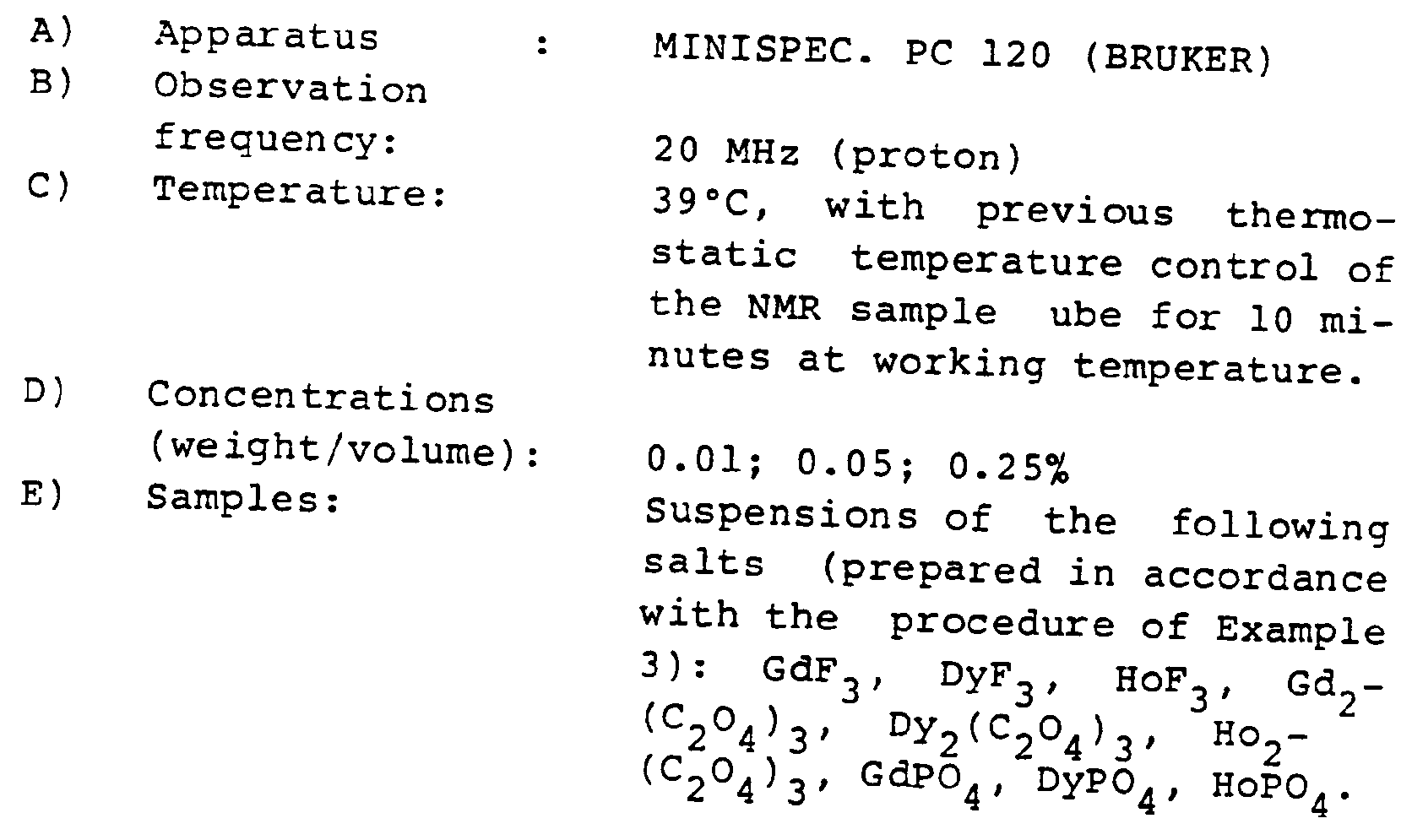
- The longitudinal relaxivity of the protons of the surrounding water (r₁) was calculated using the "Inversion Recovery" sequences in accordance with the program supplied for the MINISPEC 120 BRUKER with which the measurements were made.
- The transverse relaxivity (r₂) was calculated using the Carr, Purcell, Meiboom and Gill sequences in accordance with the program supplied for the MINISPEC 120 BRUKER with which the measurements were made.
- Table 1 attached hereto shows the efficacy (E) of certain lanthanide salts, characterising the invention, in increasing the r₂/r₁ ratio. The efficacy (E) was calculated by adopting as reference term gadolinium fluoride (GdF₃) and was expressed as the ratio between the value of r₂/r₁ of the suspension of the lanthanide salt under examination and the corresponding value of r₂/r₁ found for the GdF₃ suspensicn. Table 1 shows the selective action on the reduction of the relaxation time T₂ of the protons of the surrounding water, with the consequent increase of the r₂/r₁ ratio, by the products object of the present invention with respect to the Gd salts adopted as reference terms.
- Preparation of a DyF₃ suspension in the presence of carboxymethylcellulose.
- A DyF₃ suspension is prepared in accordance with the procedure described in Example 3, using the following quantities:
- Bidistilled water
- 90 ml
- Silicone SH
- 0.07 g
- DyF₃
- 0.3 g
- Na₂PO₄
- 0.91 g
- KHPO₄
- 0.2 g
- Keltrol F
- 0.33 g
- Before making up to volume, are added 5 g of insoluble carboxymethylcellulose having a mean particle diameter of 10 µm, and agitation is maintained for 10 minutes.
- The volume of the suspension is then brought to 100 ml using bidistilled water, and the agitation continues until complete homogenisation is achieved.
- Determination of the ratio r₂/r₁ for the suspension described in Example 5.
- In accordance with the experimental conditions described in the protocol of Example 4, the value of the ratio r₂/r₁ was measured for the DyF₃ suspension with the addition of carboxymethyl cellulose (DyF₃/CMC) and this was compared with that obtained for the suspensions of DyF₃ without carboxymethylcellulose (DyF₃) prepared as described in Example 3. The results, which are reproduced in Table 1 attached hereto, show a large increase, almost two-fold, in the value of this ratio for the suspension of DyF₃ with the addition of carboxymethylcellulose (DyF₃/CMC) with respect to that without such addition.
- Preparation of a suspension of DyF₃ with the addition of BaSO₄.
- 98.64 g of BaSO₄, 0.6 g of sorbitol and 0.1 g of silicone SH are added to a twin-cone mixer and mixed for 30 minutes. 0.3 g of sodium carragenate and 0.36 g of DyF₃ are then added in small portions.
- After further mixing for 15 minutes , the mixture is poured into a 250 ml reactor and, under agitation, the volume is made up to 120 ml with distilled water.
- Preparation of suspensions of insoluble salts of lanthanides of differing particle size.
- 0.7 g of silicone SH and 3 g of DyF₃ (mean particle size 325 mesh) are added, under agitation, to a 1500 ml reactor equipped with a turbine-driven stirrer and containing 900 ml of distilled water. After 5 minutes of stirring at ambient temperature, 8 g of Keltrol F (xanthan gum) are added in small portions.
- After this, stirring is continued for a further period of 15 minutes at such a speed as to prevent the inclusion of air. The volume is then brought to 1000 ml using distilled water, and the agitation continues until complete homogenisation is achieved.
- The dispersion obtained has a viscosity of 2000 mPas.
- 0.3% (weight/volume) suspensions of the following were prepared in accordance with the same procedure:
DyF₃ (particle size 60 mesh, mean diameter 250 µm)
TbF₃ (particle size 325 mesh, mean diameter 44 µm)
CdF₃ (particle size 325 mesh, mean diameter 44 µm)
HoF₃ (particle size 325 mesh, mean diameter 44 µm) - Determination of the r₂/r₁ ratio for the suspensions of insoluble salts of lanthanides of differing particle size.
- The value of the r₂/r₁ ratio was measured for the suspensions of lanthanides described in Example 8, in accordance with the experimental conditions described in the protocol of Example 4.
- Table 2 attached hereto shows the values of this ratio, from which it results that a thinner particle size is far more effective in increasing the value of r₂/r₁.
- Acquisition of "in vivo" NMR images using a DyF₃ suspension according to the invention.
- The images were acquired on a 0.5 T "whole body imager" (Esaote-Genova), using a coil having an internal diameter of 8 cm.
- In order to reduce the artefacts due to movement (respiration, peristalsis), use was made of a spin-echo sequence 350/50/2 (TR/TE/NEX) with a field of view of 20 cm, 4 mm slicers, 256 x 256 matrix, and with "gradient moment nulling".
- A 3% (weight/volume) DyF₃ suspension, prepared in accordance with the preparation described in Example 3, was administered "per os" to (male) Sprague Dawley rats, average weight 270 g, which were kept under fasting conditions for 18 hours, at a dosage of 30 ml/kg.
- The rat was observed using NMR for 1 hour after the administration. The contrast agent causes signal loss in the stomach and in the intestine. In the coronal sections observed at 30 minutes (Figure 1 attached hereto), the stomach is clearly defined, permitting good observation of liver and spleen. The loop formed by the duodenum can also be observed.

Claims (12)
- A composition for obtaining images of the gastro-intestinal tract using nuclear magnetic resonance, by increasing the value of the r₂/r₁ ratio of the relaxivities of the protons of the water of the region under examination and consisting in an aqueous suspension, which is physiologically acceptable and can be administered by the oral or rectal route, characterized by comprising particles of insoluble paramagnetic salts of the lanthanide group and, if necessary, a buffering agent to maintain the pH value between 6.0 and 8.5 and/or physiologically acceptable additives which are useful as dispersing agents and/or agents influencing the viscosity of the suspension.
- A composition according to Claim 1, characterised in that the insoluble particles of the paramagnetic salts have a mean dimension which ranges between 0.01 and 1,000 µm.
- A composition according to Claim 1, characterised in that the insoluble particles of the paramagnetic salts have a mean dimension which ranges between 0.05 and 500 µm.
- A composition according to Claim 1, characterised in that the paramagnetic salt is an insoluble salt of a metal ion belonging to the lanthanide elements and the anion is a physiologically acceptable inorganic or organic insolubility-promoting anion.
- A composition according to Claim 4, characterised in that the metal ion is selected from terbium, dysprosium, holmium and erbium, and the insolubility-promoting anion is selected from fluoride, oxalate and phosphate ions.
- A composition according to Claim 5 in which the paramagnetic insoluble salt is selected within the group consisting of DyF₃, TbF₃, HoF₃ and ErF₃.
- A diagnostic composition according to Claim 1 in which the particles of the insoluble paramagnetic salt are present in a concentration which is variable between 0.01% and 5% (weight/volume).
- A composition according to Claim 1, characterised in that it further comprises physiologically acceptable organic or inorganic insoluble additives.
- A composition according to Claim 8, characterised in that the insoluble paramagnetic salt is selected within the group consisting of DyF₃, TbF₃, HoF₃ and ErF₃.
- A composition according to Claim 9, characterised in that the physiologically acceptable insoluble organic additive is selected from cellulose derivatives such as hydroxymethylcellulose or carboxymethylcellulose.
- A composition according to Claim 9, characterised in that the physiologically acceptable insoluble inorganic additive is BaSO₄.
- A diagnostic composition according to Claim 9, characterised in that the particles of the insoluble paramagnetic salt are present in a concentration which ranges between 0.01% and 5% (weight/volume).
Applications Claiming Priority (2)
| Application Number | Priority Date | Filing Date | Title |
|---|---|---|---|
| IT2002690 | 1990-04-12 | ||
| IT02002690A IT1246380B (en) | 1990-04-12 | 1990-04-12 | INSOLUBLE SALTS OF LANTANIDES FOR THE VISUALIZATION IN NUCLEAR MAGNETIC RESONANCE OF THE GASTRO-INTESTINAL TRACT |
Publications (2)
| Publication Number | Publication Date |
|---|---|
| EP0524239A1 EP0524239A1 (en) | 1993-01-27 |
| EP0524239B1 true EP0524239B1 (en) | 1993-12-22 |
Family
ID=11163220
Family Applications (1)
| Application Number | Title | Priority Date | Filing Date |
|---|---|---|---|
| EP91907770A Expired - Lifetime EP0524239B1 (en) | 1990-04-12 | 1991-04-09 | Insoluble salts of lanthanides for the visual display, using nuclear magnetic resonance, of the gastro-intestinal tract |
Country Status (6)
| Country | Link |
|---|---|
| US (1) | US5368839A (en) |
| EP (1) | EP0524239B1 (en) |
| JP (1) | JPH05508831A (en) |
| DE (1) | DE69100842T2 (en) |
| IT (1) | IT1246380B (en) |
| WO (1) | WO1991016079A1 (en) |
Families Citing this family (10)
| Publication number | Priority date | Publication date | Assignee | Title |
|---|---|---|---|---|
| GB9314499D0 (en) * | 1993-07-12 | 1993-08-25 | Nycomed Imaging As | Method |
| US5834456A (en) * | 1996-02-23 | 1998-11-10 | The Dow Chemical Company | Polyazamacrocyclofluoromonoalkylphosphonic acids, and their complexes, for use as contrast agents |
| US6937455B2 (en) | 2002-07-03 | 2005-08-30 | Kronos Advanced Technologies, Inc. | Spark management method and device |
| US7122070B1 (en) | 2002-06-21 | 2006-10-17 | Kronos Advanced Technologies, Inc. | Method of and apparatus for electrostatic fluid acceleration control of a fluid flow |
| US6963479B2 (en) | 2002-06-21 | 2005-11-08 | Kronos Advanced Technologies, Inc. | Method of and apparatus for electrostatic fluid acceleration control of a fluid flow |
| US7150780B2 (en) | 2004-01-08 | 2006-12-19 | Kronos Advanced Technology, Inc. | Electrostatic air cleaning device |
| US7157704B2 (en) | 2003-12-02 | 2007-01-02 | Kronos Advanced Technologies, Inc. | Corona discharge electrode and method of operating the same |
| US7053565B2 (en) | 2002-07-03 | 2006-05-30 | Kronos Advanced Technologies, Inc. | Electrostatic fluid accelerator for and a method of controlling fluid flow |
| US7410532B2 (en) | 2005-04-04 | 2008-08-12 | Krichtafovitch Igor A | Method of controlling a fluid flow |
| DE102009054956A1 (en) * | 2009-12-18 | 2011-06-22 | Siemens Aktiengesellschaft, 80333 | Magnetic resonance imaging |
Family Cites Families (8)
| Publication number | Priority date | Publication date | Assignee | Title |
|---|---|---|---|---|
| US2065718A (en) * | 1934-07-16 | 1936-12-29 | Union Benevolent Ass | Product for use in roentgenography and process of preparing it |
| US3937800A (en) * | 1972-07-17 | 1976-02-10 | Dure Smith Peter | Bronchographic x-ray contrast method |
| US4079124A (en) * | 1976-04-21 | 1978-03-14 | Medi-Physics, Inc. | Method of preparing X-ray contrast media containing ores of hafnium, tantalum and tungsten |
| US4176173A (en) * | 1977-07-18 | 1979-11-27 | Medi-Physics, Inc. | Radiographic compositions |
| US4735796A (en) * | 1983-12-08 | 1988-04-05 | Gordon Robert T | Ferromagnetic, diamagnetic or paramagnetic particles useful in the diagnosis and treatment of disease |
| EP0330801A1 (en) * | 1983-02-08 | 1989-09-06 | Schering Aktiengesellschaft | Ferromagnetic, diamagnetic or paramagnetic particles useful in the diagnosis and treatment of disease |
| US4615879A (en) * | 1983-11-14 | 1986-10-07 | Vanderbilt University | Particulate NMR contrast agents for gastrointestinal application |
| GB8413849D0 (en) * | 1984-05-31 | 1984-07-04 | Amersham Int Plc | Nmr contrast agents |
-
1990
- 1990-04-12 IT IT02002690A patent/IT1246380B/en active IP Right Grant
-
1991
- 1991-04-09 DE DE91907770T patent/DE69100842T2/en not_active Expired - Fee Related
- 1991-04-09 US US07/941,069 patent/US5368839A/en not_active Expired - Fee Related
- 1991-04-09 EP EP91907770A patent/EP0524239B1/en not_active Expired - Lifetime
- 1991-04-09 WO PCT/EP1991/000679 patent/WO1991016079A1/en not_active Ceased
- 1991-04-09 JP JP91506869A patent/JPH05508831A/en active Pending
Also Published As
| Publication number | Publication date |
|---|---|
| IT9020026A1 (en) | 1991-10-12 |
| US5368839A (en) | 1994-11-29 |
| DE69100842D1 (en) | 1994-02-03 |
| WO1991016079A1 (en) | 1991-10-31 |
| DE69100842T2 (en) | 1994-04-07 |
| IT9020026A0 (en) | 1990-04-12 |
| IT1246380B (en) | 1994-11-18 |
| JPH05508831A (en) | 1993-12-09 |
| EP0524239A1 (en) | 1993-01-27 |
Similar Documents
| Publication | Publication Date | Title |
|---|---|---|
| EP0414700B1 (en) | Contrast agents for magnetic resonance imaging | |
| US5122363A (en) | Zeolite-enclosed transistion and rare earth metal ions as contrast agents for the gastrointestinal tract | |
| US4615879A (en) | Particulate NMR contrast agents for gastrointestinal application | |
| US5141740A (en) | Complexes and compositions for magnetic resonance imaging and usage methods | |
| Young et al. | Gadolinium zeolite as an oral contrast agent for magnetic resonance imaging | |
| FI98986C (en) | Particulate contrast agents | |
| US20020168321A1 (en) | Administrable mri compositions for enhancing the contrast between regions in organs | |
| US5368839A (en) | Insoluble salts of lanthanides for the visual display using nuclear magnetic resonance, of the gastro-intestinal tract | |
| EP0470188B1 (en) | Novel magnetic resonance imaging agents | |
| EP0735900B1 (en) | Paramagnetic diagnostic formulations and their method of use | |
| US5064636A (en) | Paramagnetic oil emulsions as enteric MRI contrast agents | |
| AU2025592A (en) | Novel compositions for magnetic resonance imaging | |
| US5217706A (en) | Complexes and compositions for magnetic resonance imaging | |
| Balkus Jr et al. | Molecular sieve based MRI contrast agents | |
| AU656355B2 (en) | Alkoxyamide derivatized chelates for MRI | |
| US5290537A (en) | Compositions for magnetic resonance imaging | |
| CA2271735C (en) | Magnetic resonance blood pool agents | |
| WO1998011922A2 (en) | Method | |
| JP3729514B2 (en) | Contrast composition for MRI diagnosis | |
| Davis et al. | Optimization of a negative oral contrast agent for magnetic resonance imaging |
Legal Events
| Date | Code | Title | Description |
|---|---|---|---|
| PUAI | Public reference made under article 153(3) epc to a published international application that has entered the european phase |
Free format text: ORIGINAL CODE: 0009012 |
|
| 17P | Request for examination filed |
Effective date: 19921008 |
|
| AK | Designated contracting states |
Kind code of ref document: A1 Designated state(s): DE FR GB IT |
|
| 17Q | First examination report despatched |
Effective date: 19930329 |
|
| GRAA | (expected) grant |
Free format text: ORIGINAL CODE: 0009210 |
|
| AK | Designated contracting states |
Kind code of ref document: B1 Designated state(s): DE FR GB IT |
|
| REF | Corresponds to: |
Ref document number: 69100842 Country of ref document: DE Date of ref document: 19940203 |
|
| ITF | It: translation for a ep patent filed | ||
| ET | Fr: translation filed | ||
| PLBE | No opposition filed within time limit |
Free format text: ORIGINAL CODE: 0009261 |
|
| STAA | Information on the status of an ep patent application or granted ep patent |
Free format text: STATUS: NO OPPOSITION FILED WITHIN TIME LIMIT |
|
| 26N | No opposition filed | ||
| PGFP | Annual fee paid to national office [announced via postgrant information from national office to epo] |
Ref country code: FR Payment date: 19970327 Year of fee payment: 7 |
|
| PGFP | Annual fee paid to national office [announced via postgrant information from national office to epo] |
Ref country code: GB Payment date: 19970407 Year of fee payment: 7 |
|
| PGFP | Annual fee paid to national office [announced via postgrant information from national office to epo] |
Ref country code: DE Payment date: 19970606 Year of fee payment: 7 |
|
| PG25 | Lapsed in a contracting state [announced via postgrant information from national office to epo] |
Ref country code: GB Free format text: LAPSE BECAUSE OF NON-PAYMENT OF DUE FEES Effective date: 19980409 |
|
| PG25 | Lapsed in a contracting state [announced via postgrant information from national office to epo] |
Ref country code: FR Free format text: THE PATENT HAS BEEN ANNULLED BY A DECISION OF A NATIONAL AUTHORITY Effective date: 19980430 |
|
| GBPC | Gb: european patent ceased through non-payment of renewal fee |
Effective date: 19980409 |
|
| PG25 | Lapsed in a contracting state [announced via postgrant information from national office to epo] |
Ref country code: DE Free format text: LAPSE BECAUSE OF NON-PAYMENT OF DUE FEES Effective date: 19990202 |
|
| REG | Reference to a national code |
Ref country code: FR Ref legal event code: ST |
|
| PG25 | Lapsed in a contracting state [announced via postgrant information from national office to epo] |
Ref country code: IT Free format text: LAPSE BECAUSE OF NON-PAYMENT OF DUE FEES;WARNING: LAPSES OF ITALIAN PATENTS WITH EFFECTIVE DATE BEFORE 2007 MAY HAVE OCCURRED AT ANY TIME BEFORE 2007. THE CORRECT EFFECTIVE DATE MAY BE DIFFERENT FROM THE ONE RECORDED. Effective date: 20050409 |