EP0524127A2 - Improvements in a process for delignifying lignocellulosic pulp by means of oxygen - Google Patents
Improvements in a process for delignifying lignocellulosic pulp by means of oxygen Download PDFInfo
- Publication number
- EP0524127A2 EP0524127A2 EP92500075A EP92500075A EP0524127A2 EP 0524127 A2 EP0524127 A2 EP 0524127A2 EP 92500075 A EP92500075 A EP 92500075A EP 92500075 A EP92500075 A EP 92500075A EP 0524127 A2 EP0524127 A2 EP 0524127A2
- Authority
- EP
- European Patent Office
- Prior art keywords
- pulp
- improvement
- accordance
- delignifying
- oxygen
- Prior art date
- Legal status (The legal status is an assumption and is not a legal conclusion. Google has not performed a legal analysis and makes no representation as to the accuracy of the status listed.)
- Granted
Links
Classifications
-
- D—TEXTILES; PAPER
- D21—PAPER-MAKING; PRODUCTION OF CELLULOSE
- D21C—PRODUCTION OF CELLULOSE BY REMOVING NON-CELLULOSE SUBSTANCES FROM CELLULOSE-CONTAINING MATERIALS; REGENERATION OF PULPING LIQUORS; APPARATUS THEREFOR
- D21C9/00—After-treatment of cellulose pulp, e.g. of wood pulp, or cotton linters ; Treatment of dilute or dewatered pulp or process improvement taking place after obtaining the raw cellulosic material and not provided for elsewhere
- D21C9/10—Bleaching ; Apparatus therefor
- D21C9/1005—Pretreatment of the pulp, e.g. degassing the pulp
-
- D—TEXTILES; PAPER
- D21—PAPER-MAKING; PRODUCTION OF CELLULOSE
- D21C—PRODUCTION OF CELLULOSE BY REMOVING NON-CELLULOSE SUBSTANCES FROM CELLULOSE-CONTAINING MATERIALS; REGENERATION OF PULPING LIQUORS; APPARATUS THEREFOR
- D21C9/00—After-treatment of cellulose pulp, e.g. of wood pulp, or cotton linters ; Treatment of dilute or dewatered pulp or process improvement taking place after obtaining the raw cellulosic material and not provided for elsewhere
- D21C9/10—Bleaching ; Apparatus therefor
- D21C9/1026—Other features in bleaching processes
- D21C9/1036—Use of compounds accelerating or improving the efficiency of the processes
-
- D—TEXTILES; PAPER
- D21—PAPER-MAKING; PRODUCTION OF CELLULOSE
- D21C—PRODUCTION OF CELLULOSE BY REMOVING NON-CELLULOSE SUBSTANCES FROM CELLULOSE-CONTAINING MATERIALS; REGENERATION OF PULPING LIQUORS; APPARATUS THEREFOR
- D21C9/00—After-treatment of cellulose pulp, e.g. of wood pulp, or cotton linters ; Treatment of dilute or dewatered pulp or process improvement taking place after obtaining the raw cellulosic material and not provided for elsewhere
- D21C9/10—Bleaching ; Apparatus therefor
- D21C9/147—Bleaching ; Apparatus therefor with oxygen or its allotropic modifications
Definitions
- the present invention refers to an improvement in a process for delignifying lignocellulosic pulp by means of oxygen, and more specifically, to an improvement in a process for delignifying lignocellulosic pulp by means of oxygen with the addition of ethanol.
- bleaching of chemical pulps is carried out mainly by employing chlorine-containing compounds such as molecular chlorine, chlorine dioxide and hypochlorites, thus resulting in a corrosive, chlorine-enriched and hardly recoverable effluent, which has a high degree of environmental deterioration.
- chlorine-containing compounds such as molecular chlorine, chlorine dioxide and hypochlorites
- a bleaching agent exhibiting such properties is oxygen and, in recent years, its use has substantially increased.
- the discharge of effluent from the bleaching plant can be reduced to half, due to the fact that effluent from the oxygen delignifying stage, which does not contain chlorides, is entirely recoverable.
- This delignifying limit is a function of the low selectivity of oxygen as a delignifying agent, which is caused by the presence of free radicals derived from oxygen during reaction, thus reducing the cellulose chain lengths.
- Such a reduction is usually characterized by increased reduction of the pulp viscosity after oxygen delignification. Formation of these free radicals is increased by the presence of certain transition metals found in the pulp, wherein their removal or inactivation enhances the process efficiency.
- magnesium salts have a very positive effect on preventing cellulose chain degradation during treatment with oxygen possibly due to inactivation of transition metals, as well as the combination of magnesium salts with chelating agents, e.g.triethanolamine plus magnesium, is also substantially effective in maintaining the pulp viscosity.
- Chelating agents for example, DTPA, EDTA, HEDTA and NTA, in the absence of magnesium, have shown to be inefficient in maintaining pulp viscosity. Removal of transition metals by treating the pulp with acids or chelating agents prior to delignifying the pulp with oxygen renders good results, but it requires additional installations for the bleaching process.
- the use of other additives, such as tin and manganese salts have relatively succeeded.
- a typical bleaching sequence for removing lignim from lignocellulosic material for example, kraft pulp of conifers or foliage, is (C+D) (E+O) DED, where (C+D) is a chlorine/dioxide stage, (E+O) is is oxygen-reinforced alkaline extraction stage, D is a chlorine dioxide stage and E is a single alkaline extraction stage.
- the main oxidizing components are chlorocompounds which produce dangerous organochloro-compounds in the effluent from the bleaching process, which are measured by calculating TOCl (total organic chlorine) or AOX (absorbable organic halogens).
- the need for chlorine-based compounds to bleach brown chemical pulps, for example, kraft, sulfide and organosolvent, and, consequently, the amount of TOCl and AOX discharged into the effluent from the bleaching is directly proportional to the lignin content of the pulp derived from the baking operation.
- the purpose of subjecting the brown pulp to various treatments prior to the bleaching operation is to reduce lignin content of the lignocellulosic material to the maximum so that, in the subsequent bleaching sequences, the smallest possible amount of chlorine-based compounds is consumed.
- a treatment which has been successfully used in the brown pulp is thus called oxygen delignification which due to the low oxygen selectivity, reduction of the Kappa Number of the pulp (indirect measurement of lignin content in the brown pulp) is generally limited to, e.g. in the case of kraft pulp of foliage, from 40-50% and of kraft pulp of conifers, from 45-50%.
- Increasing environmental pressure against the use of chlorine-based compounds has, however, led to several changes in the convention oxygen delignifying process aiming at obtaining a more significant reduction of the Kappa Number.
- an additive which under certain process conditions, during oxygen delignification of the lignocellulosic material, oxygen is made to act more efficiently, as can be inferred from a higher reduction of lignin content in the lignocellulosic material, i.e. a higher reduction of the Kappa Number, as compared with conventional techniques, without, however, prejudicing the quality of the pulp whose cellulosic chains are preserved from the action of free radicals derived from intermediates of the reaction of oxygen with the pulp and with transition metals.
- the use of the invention renders a pulp which in the subsequent bleaching sequences will need a smaller amount of chloro compound to attain the desired whiteness and, as a function of that, a smaller discharge of TOCl or AOX in the effluent from the bleaching plant and will exhibit a high viscosity, since it will contain long chains of carbohydrates, thus resulting in a product having good resistance properties.
- the employed additives are compatible from the recovery point of view, the use of the invention allows a more closed system in the bleaching plant and the additive can be partially recovered for reuse, which makes the process more economical.
- the additive used is ethanol and its dosage may vary from 1 to 130 weight percent, preferably from 10 to 20%, wherein preferably 20 weight percent is added to the pulp, whose consistency may vary in a range of from 5-30%, preferably in a range of from 8-15%, the characteristic range of a pulp of middle consistency prior to the first bleaching stage, possibly immediately after the brown pulp storage tank, preferably together with alkali, which can be sodium hydroxide, oxidized white liquor and/or non-oxidized white liquor, wherein the pH is adjusted to a range between 7 and 13, more preferably to a range between 11 and 12, the additive-containing pulp being fed to a mixing apparatus to which oxygen is added at a pressure varying from 2-6 kgf/cm2, preferably at a pressure of 4 kgf/cm2, and then the pulp is passed to a pressure reactor where the delignification in the presence of oxygen takes place, at a temperature of from 80-140°C, preferably from 100-120°C, wherein the high temperature range of 120°
- This example illustrates the temperature effect on the efficiency of an industrial process for delignifying, with oxygen, a kraft pulp wherein the experiments were carried out without the use of an additive, with the use of ethanol as an additive and with the use of magnesium as an additive.
- the sample consisted of a kraft pulp of conventional eucalyptus having a consistency of 12%, which, prior to treatment, had a Kappa Number of 16.7, viscosity of 30.8 cP and whiteness of 33.8°Iso.
- the reaction time was 60 minutes, using 15 kg 02/ton of kraft pulp, partial pressure of oxygen equal to 4 kgf/cm2, 20 weight percent of ethanol and 0.5 weight percent of MgSO4.7H20.
- Experimental results are shown in Table 1 as follows:
- This example illustrates the ethanol feedstock effect on the efficiency of industrial oxygen delignification of a kraft pulp in accordance with the present invention.
- the reaction time was 60 minutes, using 15 kg 02/ton of pulp, 02 partial pressure of 4 kgf/cm2 at a temperature of 120°C.
- Experimental results are shown in Table 2 as follows:
- This example illustrates the oxygen partial pressure effect on the industrial oxygen delignification of a kraft pulp in accordance with the present invention.
- the reaction time was 60 minutes, using 15 kg 02/ton of pulp, 2 weight percent of sodium hydroxide, 20 weight percent of MgSO4.7H20 at a temperature of 120°C.
- Table 3 Table 3 as follows:
- This example illustrates the alkali feedstock effect on the efficiency of the oxygen delignification of an industrial kraft pulp in accordance with the present invention in comparison with conventional processes wherein treatment does not involve the use of magnesium as additive.
- the reaction time was 60 minutes, using 15 kg 02/ton of pulp, an 02 partial pressure of 4 kgf/cm2, 20 weight percent of ethanol and 0.5 weight percent of MgSo4.7H20 at a temperature of 120°C.
- Table 4 Experiment results are shown in Table 4 as follows:
- Example 1 the use of ethanol as additive in the lignocellulosic pulp oxygen delignifying process of the present invention, provides an increase in the delignifying efficiency, by means of a higher reduction of the Kappa Number and an increase of the process selectivity allowing the process to be carried out at higher temperatures.
- an increase in the process temperature of from 80-140°C confers a significant increase on the delignifying efficiency to the same alkali feedstock, without, however, causing a significant decrease in the process selectivity.
Landscapes
- Life Sciences & Earth Sciences (AREA)
- Engineering & Computer Science (AREA)
- Wood Science & Technology (AREA)
- Paper (AREA)
Abstract
Description
- The present invention refers to an improvement in a process for delignifying lignocellulosic pulp by means of oxygen, and more specifically, to an improvement in a process for delignifying lignocellulosic pulp by means of oxygen with the addition of ethanol.
- In conventional processes, bleaching of chemical pulps is carried out mainly by employing chlorine-containing compounds such as molecular chlorine, chlorine dioxide and hypochlorites, thus resulting in a corrosive, chlorine-enriched and hardly recoverable effluent, which has a high degree of environmental deterioration.
- In view of that and due to more rigorous environmental controls, there is nowadays a great interest in employing bleaching agents, which reduce the amount of chloro-compounds used in bleaching to the minimum so as to recover the major portion of the effluent. A bleaching agent exhibiting such properties is oxygen and, in recent years, its use has substantially increased. Through an initial delignifying stage with oxygen in an alkaline medium in a multistage bleaching sequence of, for example, a kraft pulp, the discharge of effluent from the bleaching plant can be reduced to half, due to the fact that effluent from the oxygen delignifying stage, which does not contain chlorides, is entirely recoverable. Reduction of effluent discharge during treatment with oxygen would be higher when the amount of lignin removed during oxygen delignification is higher than the usual 40-50%. This delignifying limit is a function of the low selectivity of oxygen as a delignifying agent, which is caused by the presence of free radicals derived from oxygen during reaction, thus reducing the cellulose chain lengths. Such a reduction is usually characterized by increased reduction of the pulp viscosity after oxygen delignification. Formation of these free radicals is increased by the presence of certain transition metals found in the pulp, wherein their removal or inactivation enhances the process efficiency.
- It is verified from the state of the art that magnesium salts have a very positive effect on preventing cellulose chain degradation during treatment with oxygen possibly due to inactivation of transition metals, as well as the combination of magnesium salts with chelating agents, e.g.triethanolamine plus magnesium, is also substantially effective in maintaining the pulp viscosity. Chelating agents, for example, DTPA, EDTA, HEDTA and NTA, in the absence of magnesium, have shown to be inefficient in maintaining pulp viscosity. Removal of transition metals by treating the pulp with acids or chelating agents prior to delignifying the pulp with oxygen renders good results, but it requires additional installations for the bleaching process. The use of other additives, such as tin and manganese salts have relatively succeeded.
- A typical bleaching sequence for removing lignim from lignocellulosic material, for example, kraft pulp of conifers or foliage, is (C+D) (E+O) DED, where (C+D) is a chlorine/dioxide stage, (E+O) is is oxygen-reinforced alkaline extraction stage, D is a chlorine dioxide stage and E is a single alkaline extraction stage. In this sequence, the main oxidizing components are chlorocompounds which produce dangerous organochloro-compounds in the effluent from the bleaching process, which are measured by calculating TOCl (total organic chlorine) or AOX (absorbable organic halogens).
- The need for chlorine-based compounds to bleach brown chemical pulps, for example, kraft, sulfide and organosolvent, and, consequently, the amount of TOCl and AOX discharged into the effluent from the bleaching is directly proportional to the lignin content of the pulp derived from the baking operation. Thus, the purpose of subjecting the brown pulp to various treatments prior to the bleaching operation is to reduce lignin content of the lignocellulosic material to the maximum so that, in the subsequent bleaching sequences, the smallest possible amount of chlorine-based compounds is consumed.
- A treatment which has been successfully used in the brown pulp is thus called oxygen delignification which due to the low oxygen selectivity, reduction of the Kappa Number of the pulp (indirect measurement of lignin content in the brown pulp) is generally limited to, e.g. in the case of kraft pulp of foliage, from 40-50% and of kraft pulp of conifers, from 45-50%. Increasing environmental pressure against the use of chlorine-based compounds has, however, led to several changes in the convention oxygen delignifying process aiming at obtaining a more significant reduction of the Kappa Number. Thus, when, during the oxygen delignifying process, the reaction temperature is increased from the usual 95-105°C to 120°C, reductions of the Kappa Number higher than 50% can be achieved for foliage and conifer kraft pulps. However, this gain in the delignifying rate of lignocellulosic material occurs in parallel with an accentuated reduction of the pulp viscosity, i.e., in a decrease of the process selectivity if carbohydrate protective additives are not used. Some additives which are commonly employed for maintaining the viscosity during oxygen delignifying processes, for example, magnesium salts, have been verified to be inefficient when the process is carried out at temperatures higher than 100°C. On the other hand, some other additives are not compatible with recovery of the effluent from the oxygen delignifying process, which is one of the great advantages of the process.
- Therefore, it is an object of the present invention to provide an improvement in oxygen delignification which, without prejudice to the pulp amounts, leads to reductions of the lignin content in the lignocellulosic materials, which are higher than those attainable with conventional oxygen delignifying processes.
- It is another object of the present invention to provide an improvement in an oxygen delignifying process so that pulp viscosity is maintained even when the oxygen delignifying process is performed at elevated temperatures.
- These and other objects are achieved by the present invention through the use of an additive, which under certain process conditions, during oxygen delignification of the lignocellulosic material, oxygen is made to act more efficiently, as can be inferred from a higher reduction of lignin content in the lignocellulosic material, i.e. a higher reduction of the Kappa Number, as compared with conventional techniques, without, however, prejudicing the quality of the pulp whose cellulosic chains are preserved from the action of free radicals derived from intermediates of the reaction of oxygen with the pulp and with transition metals. Consequently, the use of the invention renders a pulp which in the subsequent bleaching sequences will need a smaller amount of chloro compound to attain the desired whiteness and, as a function of that, a smaller discharge of TOCl or AOX in the effluent from the bleaching plant and will exhibit a high viscosity, since it will contain long chains of carbohydrates, thus resulting in a product having good resistance properties. Furthermore, as the employed additives are compatible from the recovery point of view, the use of the invention allows a more closed system in the bleaching plant and the additive can be partially recovered for reuse, which makes the process more economical.
- According to the present invention, the additive used is ethanol and its dosage may vary from 1 to 130 weight percent, preferably from 10 to 20%, wherein preferably 20 weight percent is added to the pulp, whose consistency may vary in a range of from 5-30%, preferably in a range of from 8-15%, the characteristic range of a pulp of middle consistency prior to the first bleaching stage, possibly immediately after the brown pulp storage tank, preferably together with alkali, which can be sodium hydroxide, oxidized white liquor and/or non-oxidized white liquor, wherein the pH is adjusted to a range between 7 and 13, more preferably to a range between 11 and 12, the additive-containing pulp being fed to a mixing apparatus to which oxygen is added at a pressure varying from 2-6 kgf/cm2, preferably at a pressure of 4 kgf/cm2, and then the pulp is passed to a pressure reactor where the delignification in the presence of oxygen takes place, at a temperature of from 80-140°C, preferably from 100-120°C, wherein the high temperature range of 120°C is preferable, for a period of time that can vary from 10 to 120 minutes, preferably 60 minutes.
- To evaluate the effects of adding ethanol to the process for delignifying with oxygen a lignocellulosic material in comparison with the conventional processes, examples and respective tables with experiment results will be shown hereinbelow, which are intended to illustrate the application of the invention and not to limit same. hereinbelow, which are intended to illustrate the application of the invention and not to limit same. Kappa Numbers, viscosity and whiteness of the pulp were calculated in accordance with the standard procedures of the "Technical Association of Pulp and Paper Industry (TAPPI)" and delignifying efficiency values and selectivity coefficient were determined in accordance with equations 1 and 2, respectively:

- This example illustrates the temperature effect on the efficiency of an industrial process for delignifying, with oxygen, a kraft pulp wherein the experiments were carried out without the use of an additive, with the use of ethanol as an additive and with the use of magnesium as an additive. The sample consisted of a kraft pulp of conventional eucalyptus having a consistency of 12%, which, prior to treatment, had a Kappa Number of 16.7, viscosity of 30.8 cP and whiteness of 33.8°Iso. The reaction time was 60 minutes, using 15 kg 02/ton of kraft pulp, partial pressure of oxygen equal to 4 kgf/cm2, 20 weight percent of ethanol and 0.5 weight percent of MgSO4.7H20. Experimental results are shown in Table 1 as follows:

- This example illustrates the ethanol feedstock effect on the efficiency of industrial oxygen delignification of a kraft pulp in accordance with the present invention. A sample of kraft pulp of conventional eucalyptus having a consistency of 12%, which prior to treatment had a Kappa Number of 16.7, a viscosity of 30.8 cP and a whiteness of 33.8°Iso was used. The reaction time was 60 minutes, using 15 kg 02/ton of pulp, 02 partial pressure of 4 kgf/cm2 at a temperature of 120°C. Experimental results are shown in Table 2 as follows:
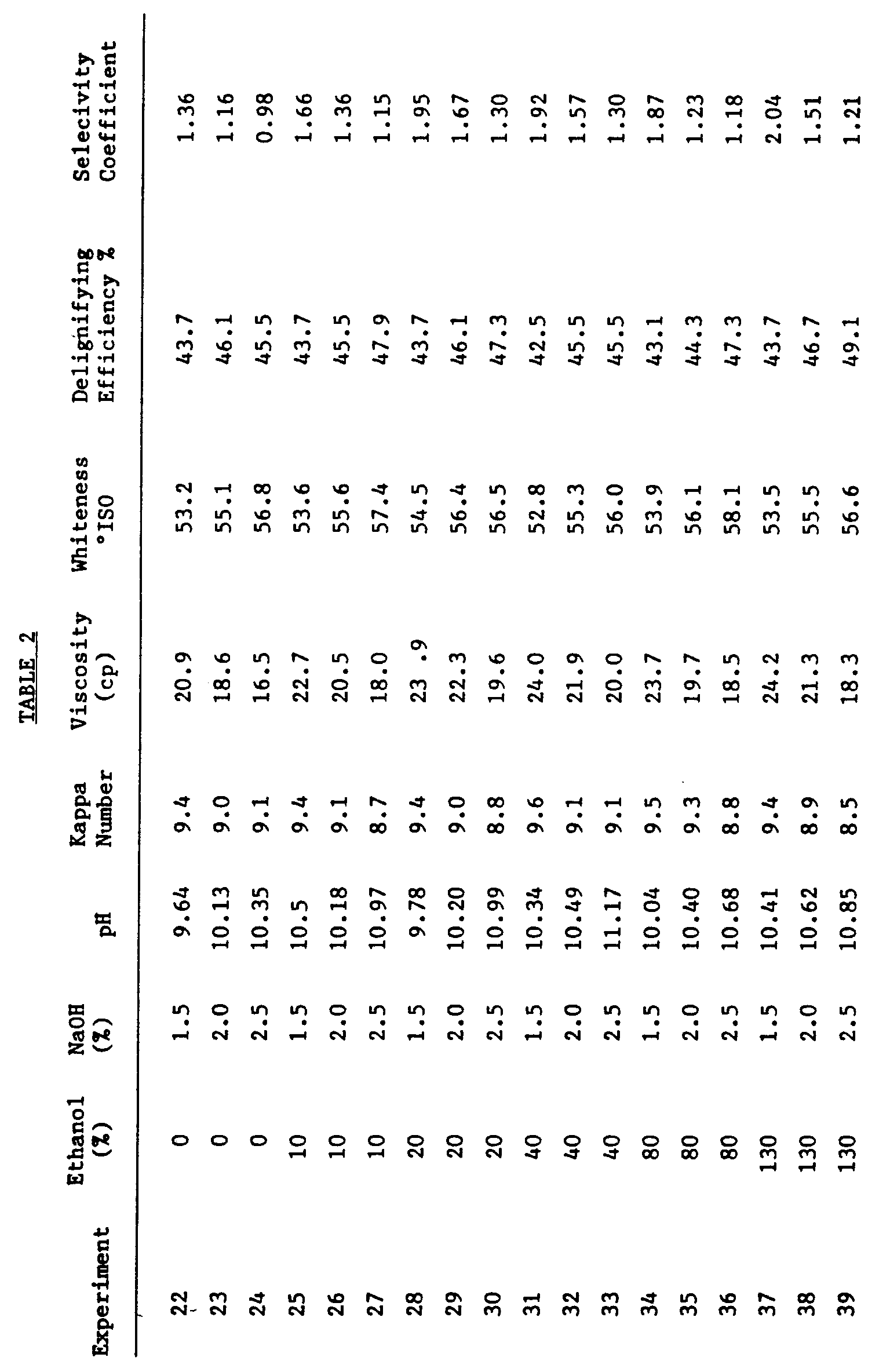
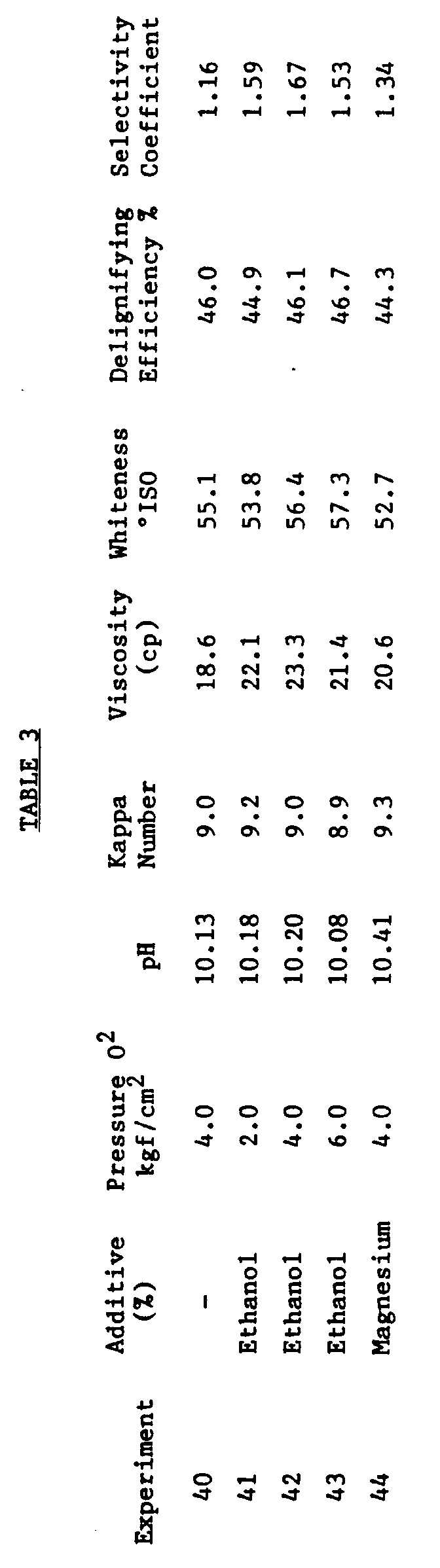
- This example illustrates the oxygen partial pressure effect on the industrial oxygen delignification of a kraft pulp in accordance with the present invention. A sample of conventional eucalyptus kraft pulp having a consistency of 12%, which prior to treatment had a Kappa Number of 16.7, a viscosity of 30.8 cP and a whiteness of 33.8°Iso was used. The reaction time was 60 minutes, using 15 kg 02/ton of pulp, 2 weight percent of sodium hydroxide, 20 weight percent of MgSO4.7H20 at a temperature of 120°C. Experiment results are shown in Table 3 as follows:
- This example illustrates the alkali feedstock effect on the efficiency of the oxygen delignification of an industrial kraft pulp in accordance with the present invention in comparison with conventional processes wherein treatment does not involve the use of magnesium as additive. A sample of conventional eucalyptus kraft pulp having a consistency of 12% which prior to treatment exhibited a Kappa Number of 16.7, a viscosity of 30.8 cP and a whiteness of 33.8°Iso was used. The reaction time was 60 minutes, using 15 kg 02/ton of pulp, an 02 partial pressure of 4 kgf/cm2, 20 weight percent of ethanol and 0.5 weight percent of MgSo4.7H20 at a temperature of 120°C. Experiment results are shown in Table 4 as follows:

- As can be seen from the experimental results of Example 1 (Table 1), the use of ethanol as additive in the lignocellulosic pulp oxygen delignifying process of the present invention, provides an increase in the delignifying efficiency, by means of a higher reduction of the Kappa Number and an increase of the process selectivity allowing the process to be carried out at higher temperatures. In experiments in which ethanol was used as an additive, an increase in the process temperature of from 80-140°C confers a significant increase on the delignifying efficiency to the same alkali feedstock, without, however, causing a significant decrease in the process selectivity. For an alkali dosage of 2% sodium hydroxide, while the delignifying efficiency at 100°C in the absence of additives did not reach 38%, in the presence of ethanol at 120°C this efficiency exceeded 46%, wherein the process selectivity coefficients, at 100°C and at 120°C, were similar. Thus, it is demonstrated that the use of ethanol in the lignocellulosic pulp oxygen delignifying process, in accordance with the present invention, allows the oxygen delignifying process to be performed at higher temperatures resulting in a higher reduction of the Kappa Number without, however, prejudicing the pulp quality. It should be pointed out the low values of selectivity obtained when oxygen delignifying takes place at 120°C in the absence of additives. In the experiments without additives, an increase in the temperature confers an increase on the delignifying efficiency for the same amount of alkali but on the other hand causes an accentuated decrease of the process selectivity, and these results are in conformity with the industrial results where the use of temperatures above 100°C for foliage pulp has been verified to be impracticable due to the low selectivities. Therefore, delignifying efficiency is always limited to a maximum of 40% with said pulps. The use of the present invention enables one to reach delignifying levels above 46%, with good selectivity and working at 120°C.
- Upon evaluating the ethanol dosage effect on the delignifying efficiency and on the selectivity, it can be inferred, from the results referring to experiments of Example 2 (Table 2), that a variation of the ethanol amount of from 10-130 weight percent causes small increases in the delignifying process efficiency and for a dosage of 20 weight percent the best selectivity coefficient for an alkali dosage of 2% sodium hydroxide was obtained.
- Evaluating the oxygen partial pressure effect on the delignifying and process selectivity, it can be verified, from the results of experiments of Example 3 (Table 3), that in the pressure range of 2-4 kgf/cm2 good selectivity values are obtained, wherein the best value is achieved at 4 kgf/cm2. A comparison between the selectivity values obtained from the use of the process in accordance with the present invention at 4 kgf/cm2 and processes in the absence of additives or only using magnesium as additive illustrates the great superiority of the process of the present invention.
- As can be seen from the results of experiments of Example 4 (Table 4), the use of ethanol as an additive in the ligocellulosic pulp oxygen delignifying process, in the present invention, gives better selectivity results when compared with conventional techniques, i.e., oxygen delignification in the absence of additives or in the presence of magnesium. The process of the present invention rendered delignifying efficiencies above 47%, with selectivity values higher than those obtained with conventional processes. Choice of the most favorable alkali dosage for the oxygen delignifying process of the present invention will depend on the minimal viscosity values which are acceptable by the pulp manufacturing industry. Results shown in Table 4 certainly point out that an increase in the alkali amount enhances the delignifying efficiency with concomitant decrease of the selectvity process, irrespective of the presence or absence of additives.
Claims (16)
- Improvement in a process for delignifying with oxygen lignocellulosic pulp wherein a pulp from a baking step is treated with alkali and in the presence of oxygen is subjected to a delignifying process to reduce its lignin content, followed by a bleaching stage, the process being characterized in that ethanol is added to the lignocellulosic pulp prior to the bleaching stage, the lignocellulosic delignification being performed at elevated temperatures.
- Improvement, in accordance with Claim 1, characterized in that the dosage of ethanol is, within the range of from 1 to 130 weight percent.
- Improvement, in accordance with Claim 3, characterized in that the dosage of ethanol is about 20%.
- Improvement, in accordance with Claim 1, characterized in that the pulp delignifying process temperature is within the range of from 80-140°C.
- Improvement, in accordance with Claim 4, characterized in that the pulp delignifying temperature is, preferably, within the range of from about 100 to 120°C.
- Improvement, in accordance with Claim 5, characterized in that the pulp delignifying temperature is about 120°C.
- Improvement, in accordance with Claim 1, characterized in that the lignocellulosic pulp is a kraft pulp.
- Improvement, in accordance with Claim 7, characterized in that the kraft pulp has an average consistency within the range of from 8-15%.
- Improvement, in accordance with Claim 1, characterized in that the alkali is selected from the group consisting of sodium hydroxide, oxidized white liquor and/or non-oxidized white liquor.
- Improvement, in accordance with Claim 9, characterized in that the alkali is sodium hydroxide.
- Improvement, in accordance with Claim 10, characterized in that the amount of alkali is within the range of from 1.5 to 2.5 weight percent of sodium hydroxide.
- Improvement, in accordance with Claim 11, characterized in that the amount of alkali is about 2.0 weight percent of sodium hydroxide.
- Improvement, in accordance with Claim 1, characterized in that the oxygen pressure is within the range of from 2-6 kgf/cm2.
- Improvement, in accordance with Claim 13, characterized in that the oxygen pressure is about 4 kgf/cm2.
- Improvement, in accordance with Claim 1, characterized in that the pulp delignifying reaction time is within the range of from 10-120 minutes.
- Improvement, in accordance with Claim 15, characterized in that the pulp delignifying reaction time is about 60 minutes.
Applications Claiming Priority (2)
| Application Number | Priority Date | Filing Date | Title |
|---|---|---|---|
| BR9102464A BR9102464A (en) | 1991-06-14 | 1991-06-14 | IMPROVEMENT IN THE DESIGNIFICATION PROCESS WITH LIGNOCELLULOSIC PULP OXYGEN |
| BR9102464 | 1991-06-14 |
Publications (3)
| Publication Number | Publication Date |
|---|---|
| EP0524127A2 true EP0524127A2 (en) | 1993-01-20 |
| EP0524127A3 EP0524127A3 (en) | 1993-02-03 |
| EP0524127B1 EP0524127B1 (en) | 1996-08-14 |
Family
ID=4052110
Family Applications (1)
| Application Number | Title | Priority Date | Filing Date |
|---|---|---|---|
| EP19920500075 Expired - Lifetime EP0524127B1 (en) | 1991-06-14 | 1992-06-12 | Improvements in a process for delignifying lignocellulosic pulp by means of oxygen |
Country Status (3)
| Country | Link |
|---|---|
| EP (1) | EP0524127B1 (en) |
| BR (1) | BR9102464A (en) |
| MX (1) | MX9202832A (en) |
Cited By (2)
| Publication number | Priority date | Publication date | Assignee | Title |
|---|---|---|---|---|
| WO1995030047A1 (en) * | 1994-04-28 | 1995-11-09 | Macmillan Bloedel Limited | Oxygen bleaching of cellulosic pulps |
| WO2013164234A1 (en) | 2012-05-03 | 2013-11-07 | Annikki Gmbh | Method for producing pulp having low lignin content from lignocellulosic material |
Families Citing this family (1)
| Publication number | Priority date | Publication date | Assignee | Title |
|---|---|---|---|---|
| CN114908598B (en) * | 2022-02-26 | 2022-12-09 | 北京林业大学 | Oxygen bleaching method for paper pulp |
Family Cites Families (1)
| Publication number | Priority date | Publication date | Assignee | Title |
|---|---|---|---|---|
| SE364323C (en) * | 1972-06-22 | 1976-04-12 | Billeruds Ab | WAY TO TREAT CELLULOSA MASS IN AN ALKALINE ENVIRONMENT |
-
1991
- 1991-06-14 BR BR9102464A patent/BR9102464A/en not_active IP Right Cessation
-
1992
- 1992-06-12 EP EP19920500075 patent/EP0524127B1/en not_active Expired - Lifetime
- 1992-06-12 MX MX9202832A patent/MX9202832A/en unknown
Cited By (2)
| Publication number | Priority date | Publication date | Assignee | Title |
|---|---|---|---|---|
| WO1995030047A1 (en) * | 1994-04-28 | 1995-11-09 | Macmillan Bloedel Limited | Oxygen bleaching of cellulosic pulps |
| WO2013164234A1 (en) | 2012-05-03 | 2013-11-07 | Annikki Gmbh | Method for producing pulp having low lignin content from lignocellulosic material |
Also Published As
| Publication number | Publication date |
|---|---|
| EP0524127A3 (en) | 1993-02-03 |
| BR9102464A (en) | 1993-01-12 |
| EP0524127B1 (en) | 1996-08-14 |
| MX9202832A (en) | 1993-02-01 |
Similar Documents
| Publication | Publication Date | Title |
|---|---|---|
| US4568420A (en) | Multi-stage bleaching process including an enhanced oxidative extraction stage | |
| EP0402335A2 (en) | Process for bleaching lignocellulose-containing pulps | |
| US4626319A (en) | Process for the delignification and acid bleaching of cellulose with oxygen and hydrogen peroxide | |
| US5143580A (en) | Process for reducing the amount of halogenated organic compounds in spent liquor from a peroxide-halogen bleaching sequence | |
| EP0511695A1 (en) | Process for bleaching of lignocellulose-containing pulp | |
| US5431781A (en) | Process for the delignification of a chemical paper pulp with organic peroxy acid | |
| US5656130A (en) | Ambient temperature pulp bleaching with peroxyacid salts | |
| US5876561A (en) | Post digestion treatment of cellulosic pulp to minimize formation of dioxin | |
| US6123809A (en) | Method for bleaching paper pulp | |
| CA2071185C (en) | Process for delignifying lignocellulosic pulp by means of oxygen | |
| EP0524127B1 (en) | Improvements in a process for delignifying lignocellulosic pulp by means of oxygen | |
| US8268120B2 (en) | Method for bleaching chemical paper pulps by final ozone treatment at high temperature | |
| Van Lierop et al. | Using oxygen and peroxide to bleach kraft pulps | |
| US6042690A (en) | Method for the bleaching of pulp in a D2D sequence wherein the effluent contains reduced colored matter | |
| US4002526A (en) | Oxygen-alkali delignification of low consistency wood pulp | |
| AU660326B2 (en) | Process for improving the selectivity of the delignification of a chemical paper pulp | |
| US10006168B2 (en) | Method for treating chemical pulps by treatment with ozone in the presence of magnesium ions | |
| NZ227748A (en) | Process for producing semibleached kraft pulp | |
| US5073301A (en) | Process for stabilization of the viscosity of wood pulps | |
| AU715023B2 (en) | Neutral monoperoxysulfate bleaching | |
| US4402788A (en) | Process for bleaching wood pulp with hydrogen peroxide | |
| JPS6214678B2 (en) | ||
| US6231718B1 (en) | Two phase ozone and oxygen pulp treatment | |
| US6153051A (en) | Method of bleaching kraft pulp employing chlorine dioxide/chlorine-ozone bleach sequence | |
| US3716448A (en) | Single stage delignification and bleaching of chemical pulp with oxygen in the presence of a protector |
Legal Events
| Date | Code | Title | Description |
|---|---|---|---|
| PUAI | Public reference made under article 153(3) epc to a published international application that has entered the european phase |
Free format text: ORIGINAL CODE: 0009012 |
|
| PUAL | Search report despatched |
Free format text: ORIGINAL CODE: 0009013 |
|
| AK | Designated contracting states |
Kind code of ref document: A2 Designated state(s): ES PT |
|
| AK | Designated contracting states |
Kind code of ref document: A3 Designated state(s): ES PT |
|
| 17P | Request for examination filed |
Effective date: 19930403 |
|
| 17Q | First examination report despatched |
Effective date: 19941213 |
|
| GRAH | Despatch of communication of intention to grant a patent |
Free format text: ORIGINAL CODE: EPIDOS IGRA |
|
| GRAA | (expected) grant |
Free format text: ORIGINAL CODE: 0009210 |
|
| AK | Designated contracting states |
Kind code of ref document: B1 Designated state(s): ES PT |
|
| PG25 | Lapsed in a contracting state [announced via postgrant information from national office to epo] |
Ref country code: ES Free format text: THE PATENT HAS BEEN ANNULLED BY A DECISION OF A NATIONAL AUTHORITY Effective date: 19960814 |
|
| PG25 | Lapsed in a contracting state [announced via postgrant information from national office to epo] |
Ref country code: PT Effective date: 19961114 |
|
| PLBE | No opposition filed within time limit |
Free format text: ORIGINAL CODE: 0009261 |
|
| 26N | No opposition filed |