EP0523406A1 - Use of tri(n-butyl) phosphate at low pH in solutions of biologically active proteins for enhanced virucidal activity - Google Patents
Use of tri(n-butyl) phosphate at low pH in solutions of biologically active proteins for enhanced virucidal activity Download PDFInfo
- Publication number
- EP0523406A1 EP0523406A1 EP92110522A EP92110522A EP0523406A1 EP 0523406 A1 EP0523406 A1 EP 0523406A1 EP 92110522 A EP92110522 A EP 92110522A EP 92110522 A EP92110522 A EP 92110522A EP 0523406 A1 EP0523406 A1 EP 0523406A1
- Authority
- EP
- European Patent Office
- Prior art keywords
- proteins
- tnbp
- biologically active
- viruses
- solutions
- Prior art date
- Legal status (The legal status is an assumption and is not a legal conclusion. Google has not performed a legal analysis and makes no representation as to the accuracy of the status listed.)
- Granted
Links
Images
Classifications
-
- C—CHEMISTRY; METALLURGY
- C12—BIOCHEMISTRY; BEER; SPIRITS; WINE; VINEGAR; MICROBIOLOGY; ENZYMOLOGY; MUTATION OR GENETIC ENGINEERING
- C12N—MICROORGANISMS OR ENZYMES; COMPOSITIONS THEREOF; PROPAGATING, PRESERVING, OR MAINTAINING MICROORGANISMS; MUTATION OR GENETIC ENGINEERING; CULTURE MEDIA
- C12N7/00—Viruses; Bacteriophages; Compositions thereof; Preparation or purification thereof
-
- A—HUMAN NECESSITIES
- A61—MEDICAL OR VETERINARY SCIENCE; HYGIENE
- A61L—METHODS OR APPARATUS FOR STERILISING MATERIALS OR OBJECTS IN GENERAL; DISINFECTION, STERILISATION OR DEODORISATION OF AIR; CHEMICAL ASPECTS OF BANDAGES, DRESSINGS, ABSORBENT PADS OR SURGICAL ARTICLES; MATERIALS FOR BANDAGES, DRESSINGS, ABSORBENT PADS OR SURGICAL ARTICLES
- A61L2/00—Disinfection or sterilisation of materials or objects, in general; Accessories therefor
- A61L2/16—Disinfection or sterilisation of materials or objects, in general; Accessories therefor using chemical substances
- A61L2/18—Liquid substances
-
- A—HUMAN NECESSITIES
- A61—MEDICAL OR VETERINARY SCIENCE; HYGIENE
- A61L—METHODS OR APPARATUS FOR STERILISING MATERIALS OR OBJECTS IN GENERAL; DISINFECTION, STERILISATION OR DEODORISATION OF AIR; CHEMICAL ASPECTS OF BANDAGES, DRESSINGS, ABSORBENT PADS OR SURGICAL ARTICLES; MATERIALS FOR BANDAGES, DRESSINGS, ABSORBENT PADS OR SURGICAL ARTICLES
- A61L2103/00—Materials or objects being the target of disinfection or sterilisation
- A61L2103/05—Living organisms or biological materials
-
- C—CHEMISTRY; METALLURGY
- C12—BIOCHEMISTRY; BEER; SPIRITS; WINE; VINEGAR; MICROBIOLOGY; ENZYMOLOGY; MUTATION OR GENETIC ENGINEERING
- C12N—MICROORGANISMS OR ENZYMES; COMPOSITIONS THEREOF; PROPAGATING, PRESERVING, OR MAINTAINING MICROORGANISMS; MUTATION OR GENETIC ENGINEERING; CULTURE MEDIA
- C12N2760/00—MICROORGANISMS OR ENZYMES; COMPOSITIONS THEREOF; PROPAGATING, PRESERVING, OR MAINTAINING MICROORGANISMS; MUTATION OR GENETIC ENGINEERING; CULTURE MEDIA ssRNA viruses negative-sense
- C12N2760/00011—Details
- C12N2760/20011—Rhabdoviridae
- C12N2760/20211—Vesiculovirus, e.g. vesicular stomatitis Indiana virus
- C12N2760/20261—Methods of inactivation or attenuation
- C12N2760/20263—Methods of inactivation or attenuation by chemical treatment
Definitions
- This disclosure is concerned generally with methods of inactivating viruses in solutions of therapeutic biologically active proteins and, specifically, with the use of tri(n-butyl) phosphate (TNBP), under unusual conditions, sufficient to assure virucidal action without adverse effect on the proteins.
- TNBP tri(n-butyl) phosphate
- Prior Art The utility of nonexplosive organic solvent mixtures for the preparation of viral vaccines, and, more recently, for inactivation of endogenous viruses in preparations of biological products derived from human plasma, have been limited by the pH sensitivity of the proteins of interest.
- TNBP TNBP
- a non-ionic detergent such as polysorbate 80 (Tween 80), or an anionic detergent, cholate. Treatment is carried out at neutral pH. See, for example, Horowitz et al, Transfusion 1985; 25:516-522.
- biologically active proteins e.g., obtained from blood
- a neutral pH i.e., 6.8 to 7.2
- biological products mainly antibodies of IgG and IgM types
- Our method of assuring the substantial reduction (viral inactivation) of lipid-coated viruses in an aqueous solution of biologically active, therapeutic proteins comprises contacting the solution with TNBP, at a pH ranging from 3.0 to 5.0, preferably at a pH from 4.0 to 4.85 under conditions sufficient to assure the substantial reduction of viruses (at least 2 logs virus titer reduction) without adversely affecting the biological activity of the proteins (i.e., less than 30% loss of activity).
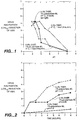
- Figure 1 is a graph showing the relationship of pH to virus inactivation using the method of this invention.
- Figure 2 is a graph showing the effect of pH, as a function of time, on virus inactivation using the method of this invention.
- Tri(n-butyl) phosphate and the detergent polysorbate 80 were reagent grade and obtained from Sigma Chemicals, St. Louis, Mo. Protein solutions were buffered at the indicated pH with sodium acetate (J.T. Baker Chemical Co., Phillipsburg, NJ.) and TRIS(hydroxymethyl)aminomethane (Trizma base, Sigma).
- VSV Vesicular stomatitis virus
- Indiana strain obtained from the Finnish Red Cross
- Vaccinia virus Vaccinia virus
- Lederle strain ATCC VR-118
- Sindbis Togavirus
- Visna lipid-enveloped viruses. Derivation of viruses was reported previously (see, Lembach et al, Current Studies in Hematology and Blood Transfusion . Basel, Karger, 1989; 56:97-108).
- VSV was titrated under standard conditions on monolayers of VERO cells grown in 24 well plates using 4 wells per dilution. Titers are expressed in terms of tissue culture infectious doses as a 50% end-point per mL (TCID50/mL).
- viruses were titrated in similar fashion on monolayers of their respective host cells under standard conditions assessing cytopathic effects.
- pd-IgM plasma-derived IgM
- Fraction III Cohn-Oncley process
- Human serum albumin was purified from human plasma by the Cohn-Oncley process (Fraction V).
- Monoclonal antibody (human) of class G (m-IgG, anti-tumor necrosis factor, cell line ATCC Accession No. HB9736, was derived from Epstein-Barr virus-transformed human B lymphocytes grown in suspension culture. IgG was purified to greater than 98% by ion exchange and size exclusion chromatography.
- Protein recovery was evaluated by A280, radial immunodiffusion, and FPLC-Superose 6 (Pharmacia fast protein liquid chromatography by size exclusion).
- Protein solutions were seeded with a 1/100 dilution of stock virus to minimize the effects of virus-containing medium.
- a volume of TNBP or TNBP/Tween 80 concentrate was added to give a final concentration of 0.3% TNBP or 0.3% TNBP and 1.0% Tween 80.
- Treated and control samples were incubated with continuous gentle mixing at 4°C or 24°C under the specified conditions. Samples were removed at appropriate intervals and titrated immediately for residual infectious virus.
- VSV was reduced below minimum detection at pH 4.25 and pH 4.4 in less than 1 hour, and at pH 4.8 after 3 hours of treatment.
- pH 5.1 virus remained detectable after 3 hours at 24°C, having been reduced in titer only 1.5 logs.
- 0.3% TNBP and 1.0% Tween 80 remained highly virucidal, provided treatment was carried out below pH 5.1.
- the last column shows that the presence of the polysorbate 80 (Tween 80) is not required; inactivation at lower pH was greater without the Tween 80.
Landscapes
- Health & Medical Sciences (AREA)
- Chemical & Material Sciences (AREA)
- Life Sciences & Earth Sciences (AREA)
- Bioinformatics & Cheminformatics (AREA)
- Engineering & Computer Science (AREA)
- Organic Chemistry (AREA)
- Zoology (AREA)
- General Health & Medical Sciences (AREA)
- Wood Science & Technology (AREA)
- Genetics & Genomics (AREA)
- Biotechnology (AREA)
- Public Health (AREA)
- Virology (AREA)
- Immunology (AREA)
- Chemical Kinetics & Catalysis (AREA)
- Biomedical Technology (AREA)
- Epidemiology (AREA)
- Veterinary Medicine (AREA)
- Microbiology (AREA)
- Medicinal Chemistry (AREA)
- Animal Behavior & Ethology (AREA)
- Biochemistry (AREA)
- General Engineering & Computer Science (AREA)
- General Chemical & Material Sciences (AREA)
- Medicinal Preparation (AREA)
- Medicines Containing Antibodies Or Antigens For Use As Internal Diagnostic Agents (AREA)
- Micro-Organisms Or Cultivation Processes Thereof (AREA)
- Agricultural Chemicals And Associated Chemicals (AREA)
- Medicines That Contain Protein Lipid Enzymes And Other Medicines (AREA)
- Pharmaceuticals Containing Other Organic And Inorganic Compounds (AREA)
Abstract
Description
- Field: This disclosure is concerned generally with methods of inactivating viruses in solutions of therapeutic biologically active proteins and, specifically, with the use of tri(n-butyl) phosphate (TNBP), under unusual conditions, sufficient to assure virucidal action without adverse effect on the proteins.
- Prior Art: The utility of nonexplosive organic solvent mixtures for the preparation of viral vaccines, and, more recently, for inactivation of endogenous viruses in preparations of biological products derived from human plasma, have been limited by the pH sensitivity of the proteins of interest.
- One common virucidal compound used with biologically active proteins is TNBP, often combined with a non-ionic detergent such as polysorbate 80 (Tween 80), or an anionic detergent, cholate. Treatment is carried out at neutral pH. See, for example, Horowitz et al, Transfusion 1985; 25:516-522.
- In the past, biologically active proteins (e.g., obtained from blood) were processed at a neutral pH (i.e., 6.8 to 7.2) and it has been in this pH range that virucidal compounds have been used. The development of biological products (mainly antibodies of IgG and IgM types), from both human plasma origin and hybridoma technology, as well as recombinant DNA products, has recently permitted purification processes at much lower pH without deleterious effects.
- We have found that there is a novel pH-dependency of TNBP for inactivating lipid-enveloped viruses while preserving the biological activity of proteins such as immunoglobulins. This pH dependency has been found to be fortuitously consistent with the finding that certain biologically active proteins (e.g., antibodies) can be advantageously processed at lower pH ranges. Details of our discovery are described below.
- Our method of assuring the substantial reduction (viral inactivation) of lipid-coated viruses in an aqueous solution of biologically active, therapeutic proteins comprises contacting the solution with TNBP, at a pH ranging from 3.0 to 5.0, preferably at a pH from 4.0 to 4.85 under conditions sufficient to assure the substantial reduction of viruses (at least 2 logs virus titer reduction) without adversely affecting the biological activity of the proteins (i.e., less than 30% loss of activity).
- Figure 1 is a graph showing the relationship of pH to virus inactivation using the method of this invention.
- Figure 2 is a graph showing the effect of pH, as a function of time, on virus inactivation using the method of this invention.
- Evidence to support the enhanced virucidal efficacy of TNBP at low pH followed the demonstration of similar pH-dependency of saturated intermediate chain-length alcohols and acids for inactivating lipid-enveloped viruses (see, for example, Dobkin et al, Biologicals 1991; (19(in press)). There is no published literature using TNBP for inactivating viruses at pH below 6.0 (see, for example, Edwards et al, Vox Sanquinis 1987; 52:53-59).
- Tri(n-butyl) phosphate and the detergent polysorbate 80 (Tween 80) were reagent grade and obtained from Sigma Chemicals, St. Louis, Mo. Protein solutions were buffered at the indicated pH with sodium acetate (J.T. Baker Chemical Co., Phillipsburg, NJ.) and TRIS(hydroxymethyl)aminomethane (Trizma base, Sigma).
- Vesicular stomatitis virus (VSV), Indiana strain, obtained from the Finnish Red Cross, is a lipid-enveloped Rhabdovirus. Vaccinia virus, Lederle strain, ATCC VR-118, is a lipid-enveloped Poxvirus. Sindbis (Togavirus) and Visna (Lentivirus) are lipid-enveloped viruses. Derivation of viruses was reported previously (see, Lembach et al, Current Studies in Hematology and Blood Transfusion. Basel, Karger, 1989; 56:97-108).
- VSV was titrated under standard conditions on monolayers of VERO cells grown in 24 well plates using 4 wells per dilution. Titers are expressed in terms of tissue culture infectious doses as a 50% end-point per mL (TCID₅₀/mL).
- Other viruses were titrated in similar fashion on monolayers of their respective host cells under standard conditions assessing cytopathic effects.
- plasma-derived IgM (pd-IgM) was purified from human plasma by the Cohn-Oncley process (Fraction III), modified by Steinbuch. Human serum albumin was purified from human plasma by the Cohn-Oncley process (Fraction V).
- Monoclonal antibody (human) of class G (m-IgG, anti-tumor necrosis factor, cell line ATCC Accession No. HB9736, was derived from Epstein-Barr virus-transformed human B lymphocytes grown in suspension culture. IgG was purified to greater than 98% by ion exchange and size exclusion chromatography.
- Protein recovery was evaluated by A280, radial immunodiffusion, and FPLC-Superose 6 (Pharmacia fast protein liquid chromatography by size exclusion).
- Protein solutions were seeded with a 1/100 dilution of stock virus to minimize the effects of virus-containing medium. A volume of TNBP or TNBP/
Tween 80 concentrate was added to give a final concentration of 0.3% TNBP or 0.3% TNBP and 1.0%Tween 80. Treated and control samples were incubated with continuous gentle mixing at 4°C or 24°C under the specified conditions. Samples were removed at appropriate intervals and titrated immediately for residual infectious virus. - To determine the influence of pH on the ability of TNBP to inactivate viruses in a model protein solution, an experiment was carried out with VSV in a 0.5 mg/mL solution of human albumin at 4°C for 60 minutes. Additionally, in order to assess the virucidal efficiency of the separate components as well as the combination, treatment was carried out with 0.3% TNBP, 1.0% Tween 80, or a mixture of 0.3% TNBP and 1.0% Tween 80. The results of this comparison are shown in Table 1. Virus reduction (log₁₀) is plotted as a function of pH, as shown in Figure 1.

- In the absence of any inactivating effect of pH, per se, on the virus, the maximum virus kill with TNBP, with or without Tween 80, was obtained at pH 4.0 - 4.8. An inverse relationship was demonstrated between increasing pH and virucidal efficiency. Under the conditions of this experiment, it is clear that TNBP was the essential virucidal component, and Tween 80 provided no enhancement at pH less than 6.0.
- In another experiment, the effect of pH on the inactivation kinetics of VSV in a solution of pd-IgM containing 0.3% TNBP and 1.0% Tween 80 was evaluated. Except for the proteins and the virucidal reagents, no salts or other ions were present in this solution. The pH range was 4.25 - 5.1, and the incubation conditions were 24°C for 3 hours.
- The effect of pH on viral infectivity is seen in Table 2. Virus reduction (log₁₀) in pd-IgM is plotted as a function of pH, as shown in Figure 1.
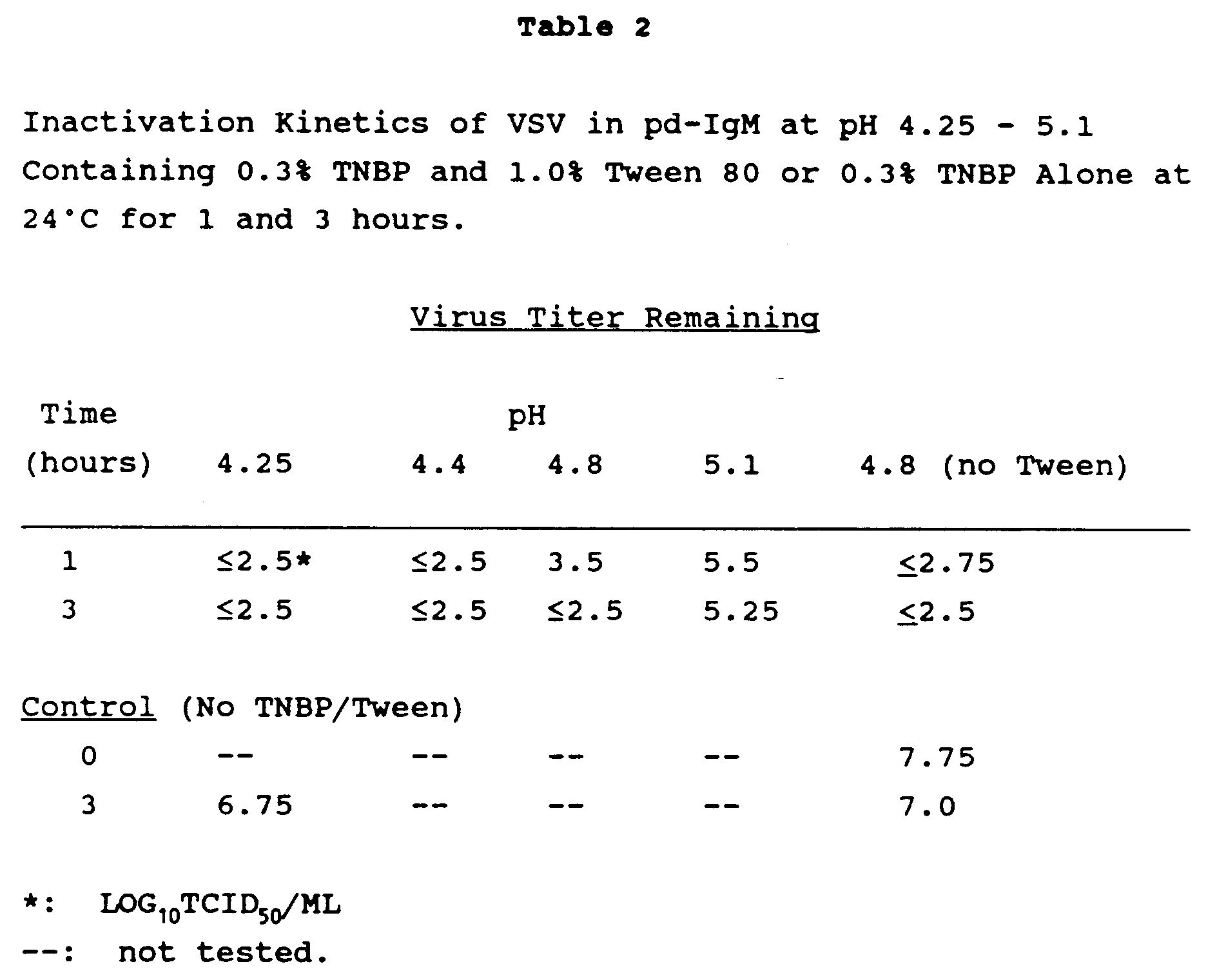
- Consistent with the previous data (Table 1), VSV was reduced below minimum detection at pH 4.25 and pH 4.4 in less than 1 hour, and at pH 4.8 after 3 hours of treatment. At pH 5.1, virus remained detectable after 3 hours at 24°C, having been reduced in titer only 1.5 logs. Thus, even in an environment of low ionic strength, 0.3% TNBP and 1.0% Tween 80 remained highly virucidal, provided treatment was carried out below pH 5.1. The last column shows that the presence of the polysorbate 80 (Tween 80) is not required; inactivation at lower pH was greater without the
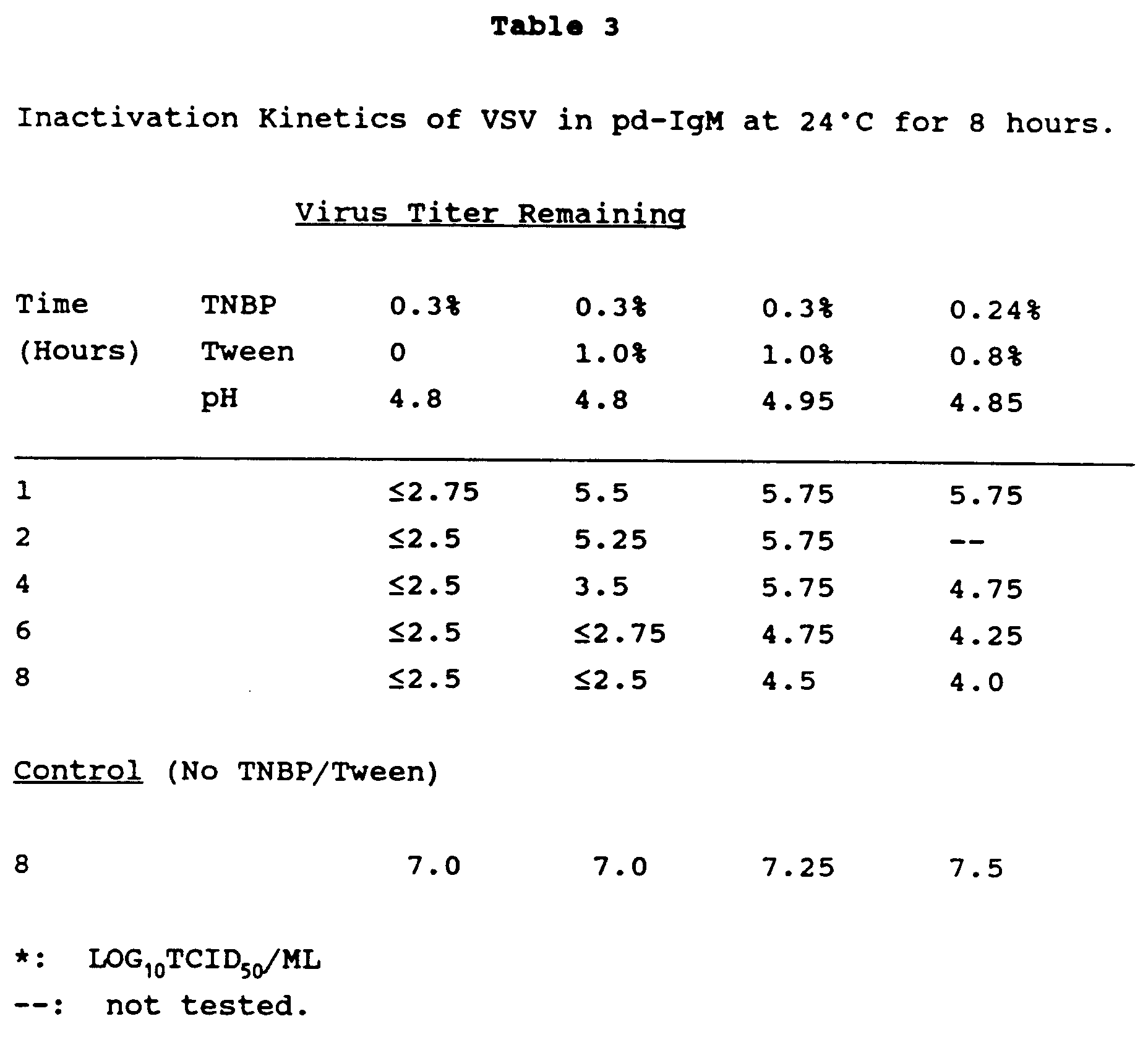
Tween 80. - A detailed kinetics study between pH 4.8 and pH 4.95 is given in Table 3. Virus reduction is plotted as a function of time in Figure 2. Virucidal efficiency was much greater at pH 4.8, compared to pH 4.95 or 7.0.
- Studies were conducted to determine whether other viruses were similarly inactivated by TNBP at low pH. The effect of 0.3% TNBP, 1.0
% Tween 80 at pH 4.85 is seen in Table 4, demonstrating that a variety of viruses are inactivated.
- Protein recovery under a variety of conditions is reported in Table 5. Recovery was not substantially affected under these conditions. It is noted that the effects of low pH alone may be detrimental to specific proteins. However, in the case of the antibodies and other cited proteins, no significant loss of activity was found after using the low pH methods of this disclosure.
Table 5 Effect of Conditions on Protein Recovery in Buffered Solutions Containing 0.3% TNBP and 1.0 % Tween 80 at 24°C for 8 hours.pH Recovery (% of initial) pd-IgM Albumin IgG 4.0 85 100 95 4.8 95 100 100 5.5 100 100 100 - Given the above disclosure it is thought variations will occur to those skilled in the art. Thus, the above examples should be construed as illustrative and the invention disclosed here should be limited only by the following claims.
Claims (8)
- A method of inactivating viruses in an aqueous solution of therapeutic, biologically active proteins comprising the steps of contacting the solution with TNBP at a pH ranging from about 3.0 to about 5.0 under conditions sufficient to assure substantial reduction of the viruses without adverse effect on the proteins.
- The method of claim 1 comprising the additional steps of including a detergent.
- The method of claim 2 wherein the detergent is polysorbate 80.
- The method of claim 1 wherein the pH ranges from about 4.0 to about 4.85.
- The method of claim 1 wherein the proteins are antibodies.
- The method of claim 5 wherein the antibodies are of type IgM or IgG.
- The method of claim 1 wherein reduction of viruses is greater than 2 logs.
- The method of claim 1 wherein adverse effects on the biological activity of the proteins are less than 30%.
Applications Claiming Priority (2)
| Application Number | Priority Date | Filing Date | Title |
|---|---|---|---|
| US72608691A | 1991-07-05 | 1991-07-05 | |
| US726086 | 1991-07-05 |
Publications (2)
| Publication Number | Publication Date |
|---|---|
| EP0523406A1 true EP0523406A1 (en) | 1993-01-20 |
| EP0523406B1 EP0523406B1 (en) | 1998-12-09 |
Family
ID=24917171
Family Applications (1)
| Application Number | Title | Priority Date | Filing Date |
|---|---|---|---|
| EP92110522A Revoked EP0523406B1 (en) | 1991-07-05 | 1992-06-23 | Use of tri(n-butyl) phosphate at low pH in solutions of biologically active proteins for enhanced virucidal activity |
Country Status (8)
| Country | Link |
|---|---|
| EP (1) | EP0523406B1 (en) |
| JP (1) | JPH05184361A (en) |
| AT (1) | ATE174383T1 (en) |
| CA (1) | CA2072797C (en) |
| DE (1) | DE69227805T2 (en) |
| DK (1) | DK0523406T3 (en) |
| ES (1) | ES2124235T3 (en) |
| GR (1) | GR3029319T3 (en) |
Cited By (7)
| Publication number | Priority date | Publication date | Assignee | Title |
|---|---|---|---|---|
| EP0638314A4 (en) * | 1992-12-01 | 1996-01-31 | Green Cross Corp | PROCESS FOR PRODUCING A COMPOSITION CONTAINING PLASMINOGEN. |
| EP0764447A3 (en) * | 1995-09-22 | 1997-07-30 | Bayer Ag | Preparation of Immunizing Serum Globulin Injectable Intravenously with Inactivated Virus |
| EP0822819A4 (en) * | 1995-04-24 | 1999-08-25 | Novavax Inc | SOLVENT-CONTAINING DETERGENT EMULSIONS WITH ANTIVIRAL ACTIVITY |
| WO2000034444A3 (en) * | 1998-12-10 | 2000-10-26 | Genvec Inc | Method and composition for preserving viruses |
| EP1958626A1 (en) | 2007-02-13 | 2008-08-20 | Ajinomoto Co., Inc. | Method for inactivating viruses by addition of slightly acidic arginine |
| CN108342368A (en) * | 2018-01-25 | 2018-07-31 | 武汉珈创生物技术股份有限公司 | A kind of low pH is incubated the verification method of inactivation of virus |
| CN108535491A (en) * | 2018-03-22 | 2018-09-14 | 北京九强生物技术股份有限公司 | A kind of latex enhancing immune of Troponin I is than turbid detection kit |
Families Citing this family (2)
| Publication number | Priority date | Publication date | Assignee | Title |
|---|---|---|---|---|
| CN1302009C (en) * | 2005-09-05 | 2007-02-28 | 武汉海特生物制药股份有限公司 | Technology of preparing rat nerve growth factor using organic solvent virus deactivation method |
| KR100791502B1 (en) * | 2006-09-29 | 2008-01-03 | 한스바이오메드 주식회사 | Virus-Inactivated Cell-Free Implants |
Citations (6)
| Publication number | Priority date | Publication date | Assignee | Title |
|---|---|---|---|---|
| US3962421A (en) * | 1973-06-18 | 1976-06-08 | American Home Products Corporation | Method for the disruption of lipid-containing viruses |
| EP0306778A2 (en) * | 1987-09-11 | 1989-03-15 | Biotest Pharma Gmbh | Process for sterilizing plasma or plasma fractions |
| EP0378208A2 (en) * | 1989-01-13 | 1990-07-18 | The Green Cross Corporation | Production method for protein-containing composition |
| EP0131740B1 (en) * | 1983-07-14 | 1990-10-31 | New York Blood Center, Inc. | Undenatured virus-free biologically active protein derivatives |
| US5071650A (en) * | 1990-06-04 | 1991-12-10 | Miles Inc. | Use of intermediate length alcohols as virucidal agents in solutions of biologically active proteins |
| US5110910A (en) * | 1991-03-25 | 1992-05-05 | Miles Inc. | Virucidal euglobulin precipitation |
-
1992
- 1992-06-23 ES ES92110522T patent/ES2124235T3/en not_active Expired - Lifetime
- 1992-06-23 EP EP92110522A patent/EP0523406B1/en not_active Revoked
- 1992-06-23 AT AT92110522T patent/ATE174383T1/en active
- 1992-06-23 DE DE69227805T patent/DE69227805T2/en not_active Revoked
- 1992-06-23 DK DK92110522T patent/DK0523406T3/en active
- 1992-06-30 CA CA002072797A patent/CA2072797C/en not_active Expired - Fee Related
- 1992-06-30 JP JP4194611A patent/JPH05184361A/en active Pending
-
1999
- 1999-02-10 GR GR990400405T patent/GR3029319T3/en unknown
Patent Citations (6)
| Publication number | Priority date | Publication date | Assignee | Title |
|---|---|---|---|---|
| US3962421A (en) * | 1973-06-18 | 1976-06-08 | American Home Products Corporation | Method for the disruption of lipid-containing viruses |
| EP0131740B1 (en) * | 1983-07-14 | 1990-10-31 | New York Blood Center, Inc. | Undenatured virus-free biologically active protein derivatives |
| EP0306778A2 (en) * | 1987-09-11 | 1989-03-15 | Biotest Pharma Gmbh | Process for sterilizing plasma or plasma fractions |
| EP0378208A2 (en) * | 1989-01-13 | 1990-07-18 | The Green Cross Corporation | Production method for protein-containing composition |
| US5071650A (en) * | 1990-06-04 | 1991-12-10 | Miles Inc. | Use of intermediate length alcohols as virucidal agents in solutions of biologically active proteins |
| US5110910A (en) * | 1991-03-25 | 1992-05-05 | Miles Inc. | Virucidal euglobulin precipitation |
Non-Patent Citations (1)
| Title |
|---|
| DATABASE WPIL Week 9034, Derwent Publications Ltd., London, GB; AN 90-257580 & JP-A-2 180 833 (GREEN CROSS CORP) 13 July 1990 * |
Cited By (11)
| Publication number | Priority date | Publication date | Assignee | Title |
|---|---|---|---|---|
| EP0638314A4 (en) * | 1992-12-01 | 1996-01-31 | Green Cross Corp | PROCESS FOR PRODUCING A COMPOSITION CONTAINING PLASMINOGEN. |
| EP0822819A4 (en) * | 1995-04-24 | 1999-08-25 | Novavax Inc | SOLVENT-CONTAINING DETERGENT EMULSIONS WITH ANTIVIRAL ACTIVITY |
| EP0764447A3 (en) * | 1995-09-22 | 1997-07-30 | Bayer Ag | Preparation of Immunizing Serum Globulin Injectable Intravenously with Inactivated Virus |
| EP1356829A3 (en) * | 1995-09-22 | 2003-12-17 | Bayer Corporation | Preparation of virally inactivated intravenously injectable immune serum globulin |
| WO2000034444A3 (en) * | 1998-12-10 | 2000-10-26 | Genvec Inc | Method and composition for preserving viruses |
| US6225289B1 (en) | 1998-12-10 | 2001-05-01 | Genvec, Inc. | Methods and compositions for preserving adenoviral vectors |
| US6514943B2 (en) | 1998-12-10 | 2003-02-04 | Genvec, Inc. | Method and composition for preserving viruses |
| EP1958626A1 (en) | 2007-02-13 | 2008-08-20 | Ajinomoto Co., Inc. | Method for inactivating viruses by addition of slightly acidic arginine |
| CN108342368A (en) * | 2018-01-25 | 2018-07-31 | 武汉珈创生物技术股份有限公司 | A kind of low pH is incubated the verification method of inactivation of virus |
| CN108535491A (en) * | 2018-03-22 | 2018-09-14 | 北京九强生物技术股份有限公司 | A kind of latex enhancing immune of Troponin I is than turbid detection kit |
| CN108535491B (en) * | 2018-03-22 | 2019-11-08 | 北京九强生物技术股份有限公司 | A kind of latex enhancing immune of Troponin I is than turbid detection kit |
Also Published As
| Publication number | Publication date |
|---|---|
| CA2072797C (en) | 1998-10-06 |
| DE69227805D1 (en) | 1999-01-21 |
| GR3029319T3 (en) | 1999-05-28 |
| DK0523406T3 (en) | 1999-08-16 |
| DE69227805T2 (en) | 1999-04-29 |
| ATE174383T1 (en) | 1998-12-15 |
| ES2124235T3 (en) | 1999-02-01 |
| CA2072797A1 (en) | 1993-01-06 |
| JPH05184361A (en) | 1993-07-27 |
| EP0523406B1 (en) | 1998-12-09 |
Similar Documents
| Publication | Publication Date | Title |
|---|---|---|
| CA1223203A (en) | Protein compositions substantially free from infectious agents | |
| CA2034489C (en) | Methods for the inactivation of viruses in viral-contaminated pharmaceutical compositions | |
| US4613501A (en) | Inactivation of viruses in labile blood derivatives | |
| EP0131740B2 (en) | Undenatured virus-free biologically active protein derivatives | |
| US4841023A (en) | Inactivation of viruses in labile protein-containing compositions using fatty acids | |
| US5011695A (en) | Sterilization of blood and its derivatives with vitamins | |
| US4939176A (en) | Viral inactivation process | |
| EP0196515A1 (en) | Photodynamic inactivation of virus in therapeutic protein compositions | |
| JPH0660105B2 (en) | Method for inactivating hepatitis virus in plasma | |
| JPH0578532B2 (en) | ||
| US4720385A (en) | Protein compositions substantially free from infectious agents | |
| JPH01100129A (en) | Method of sterilizing blood plasma and blood plasma fraction | |
| Kempf et al. | Pathogen inactivation and removal procedures used in the production of intravenous immunoglobulins | |
| EP0523406B1 (en) | Use of tri(n-butyl) phosphate at low pH in solutions of biologically active proteins for enhanced virucidal activity | |
| US6465170B2 (en) | Method for depleting viral and molecular pathogens in a biological material | |
| JP3735137B2 (en) | Use of azoles as virucidal agents in solutions of biologically active proteins | |
| Van Holten et al. | Incorporation of an additional viral‐clearance step into a human immunoglobulin manufacturing process | |
| RU2411959C2 (en) | Method of obtaining safe in virus respect biological flowing media | |
| AU726808B2 (en) | Process for reducing the concentration of viral and molecular pathogens in a biological material | |
| JPS59110627A (en) | Biological product free of b and non-a non-b hepatitis | |
| AU726999B2 (en) | Process for reducing the concentration of viral and molecular pathogens in a biological material | |
| Roberts | Virus Safety of Cell‐derived Biological Products | |
| Fernández et al. | Viral Clearance in Purification of Monoclonal Antibody CB. Hep-1 | |
| Willkommen | 1d Virus transmission by virus-inactivated plasma products | |
| Sofer | Part 3a, Plasma and Plasma Products |
Legal Events
| Date | Code | Title | Description |
|---|---|---|---|
| PUAI | Public reference made under article 153(3) epc to a published international application that has entered the european phase |
Free format text: ORIGINAL CODE: 0009012 |
|
| AK | Designated contracting states |
Kind code of ref document: A1 Designated state(s): AT BE CH DE DK ES FR GB GR IT LI LU MC NL PT SE |
|
| 17P | Request for examination filed |
Effective date: 19930217 |
|
| RAP1 | Party data changed (applicant data changed or rights of an application transferred) |
Owner name: BAYER CORPORATION |
|
| RAP1 | Party data changed (applicant data changed or rights of an application transferred) |
Owner name: BAYER CORPORATION |
|
| 17Q | First examination report despatched |
Effective date: 19960115 |
|
| GRAG | Despatch of communication of intention to grant |
Free format text: ORIGINAL CODE: EPIDOS AGRA |
|
| TPAD | Observations filed by third parties |
Free format text: ORIGINAL CODE: EPIDOS TIPA |
|
| TPAD | Observations filed by third parties |
Free format text: ORIGINAL CODE: EPIDOS TIPA |
|
| GRAG | Despatch of communication of intention to grant |
Free format text: ORIGINAL CODE: EPIDOS AGRA |
|
| RAP1 | Party data changed (applicant data changed or rights of an application transferred) |
Owner name: BAYER CORPORATION |
|
| GRAG | Despatch of communication of intention to grant |
Free format text: ORIGINAL CODE: EPIDOS AGRA |
|
| GRAG | Despatch of communication of intention to grant |
Free format text: ORIGINAL CODE: EPIDOS AGRA |
|
| GRAH | Despatch of communication of intention to grant a patent |
Free format text: ORIGINAL CODE: EPIDOS IGRA |
|
| GRAH | Despatch of communication of intention to grant a patent |
Free format text: ORIGINAL CODE: EPIDOS IGRA |
|
| GRAA | (expected) grant |
Free format text: ORIGINAL CODE: 0009210 |
|
| AK | Designated contracting states |
Kind code of ref document: B1 Designated state(s): AT BE CH DE DK ES FR GB GR IT LI LU MC NL PT SE |
|
| PG25 | Lapsed in a contracting state [announced via postgrant information from national office to epo] |
Ref country code: LI Free format text: LAPSE BECAUSE OF NON-PAYMENT OF DUE FEES Effective date: 19981209 Ref country code: CH Free format text: LAPSE BECAUSE OF NON-PAYMENT OF DUE FEES Effective date: 19981209 |
|
| REF | Corresponds to: |
Ref document number: 174383 Country of ref document: AT Date of ref document: 19981215 Kind code of ref document: T |
|
| REG | Reference to a national code |
Ref country code: CH Ref legal event code: NV Representative=s name: E. BLUM & CO. PATENTANWAELTE Ref country code: CH Ref legal event code: EP |
|
| REF | Corresponds to: |
Ref document number: 69227805 Country of ref document: DE Date of ref document: 19990121 |
|
| REG | Reference to a national code |
Ref country code: ES Ref legal event code: FG2A Ref document number: 2124235 Country of ref document: ES Kind code of ref document: T3 |
|
| ET | Fr: translation filed | ||
| ITF | It: translation for a ep patent filed | ||
| PGFP | Annual fee paid to national office [announced via postgrant information from national office to epo] |
Ref country code: PT Payment date: 19990315 Year of fee payment: 8 |
|
| REG | Reference to a national code |
Ref country code: PT Ref legal event code: SC4A Free format text: AVAILABILITY OF NATIONAL TRANSLATION Effective date: 19990217 |
|
| PGFP | Annual fee paid to national office [announced via postgrant information from national office to epo] |
Ref country code: SE Payment date: 19990621 Year of fee payment: 8 |
|
| PG25 | Lapsed in a contracting state [announced via postgrant information from national office to epo] |
Ref country code: LU Free format text: LAPSE BECAUSE OF NON-PAYMENT OF DUE FEES Effective date: 19990623 Ref country code: GB Free format text: LAPSE BECAUSE OF NON-PAYMENT OF DUE FEES Effective date: 19990623 Ref country code: DK Free format text: LAPSE BECAUSE OF NON-PAYMENT OF DUE FEES Effective date: 19990623 |
|
| PG25 | Lapsed in a contracting state [announced via postgrant information from national office to epo] |
Ref country code: ES Free format text: LAPSE BECAUSE OF NON-PAYMENT OF DUE FEES Effective date: 19990624 |
|
| REG | Reference to a national code |
Ref country code: DK Ref legal event code: T3 |
|
| PLBQ | Unpublished change to opponent data |
Free format text: ORIGINAL CODE: EPIDOS OPPO |
|
| PLBI | Opposition filed |
Free format text: ORIGINAL CODE: 0009260 |
|
| PLBF | Reply of patent proprietor to notice(s) of opposition |
Free format text: ORIGINAL CODE: EPIDOS OBSO |
|
| 26 | Opposition filed |
Opponent name: BAXTER AKTIENGESELLSCHAFT Effective date: 19990830 |
|
| RDAH | Patent revoked |
Free format text: ORIGINAL CODE: EPIDOS REVO |
|
| NLR1 | Nl: opposition has been filed with the epo |
Opponent name: BAXTER AKTIENGESELLSCHAFT |
|
| GBPC | Gb: european patent ceased through non-payment of renewal fee |
Effective date: 19990623 |
|
| REG | Reference to a national code |
Ref country code: CH Ref legal event code: PL |
|
| NLV4 | Nl: lapsed or anulled due to non-payment of the annual fee |
Effective date: 20000101 |
|
| RDAG | Patent revoked |
Free format text: ORIGINAL CODE: 0009271 |
|
| STAA | Information on the status of an ep patent application or granted ep patent |
Free format text: STATUS: PATENT REVOKED |
|
| REG | Reference to a national code |
Ref country code: DK Ref legal event code: EBP |
|
| 27W | Patent revoked |
Effective date: 19991218 |
|
| REG | Reference to a national code |
Ref country code: FR Ref legal event code: ST |
|
| REG | Reference to a national code |
Ref country code: PT Ref legal event code: MF4A Effective date: 20000414 |