EP0521954B1 - Technecium complexes of thioethers - Google Patents
Technecium complexes of thioethers Download PDFInfo
- Publication number
- EP0521954B1 EP0521954B1 EP91906540A EP91906540A EP0521954B1 EP 0521954 B1 EP0521954 B1 EP 0521954B1 EP 91906540 A EP91906540 A EP 91906540A EP 91906540 A EP91906540 A EP 91906540A EP 0521954 B1 EP0521954 B1 EP 0521954B1
- Authority
- EP
- European Patent Office
- Prior art keywords
- thioether
- complex
- complexes
- crown
- thioethers
- Prior art date
- Legal status (The legal status is an assumption and is not a legal conclusion. Google has not performed a legal analysis and makes no representation as to the accuracy of the status listed.)
- Expired - Lifetime
Links
- SZSARMMCUAZSJO-FCQUAONHSA-N CCCOC1CC2C(CCCC3CC4)(CC3/C4=C3\C(C)C(C)CCC3)C2CC1 Chemical compound CCCOC1CC2C(CCCC3CC4)(CC3/C4=C3\C(C)C(C)CCC3)C2CC1 SZSARMMCUAZSJO-FCQUAONHSA-N 0.000 description 1
Images

Classifications
-
- C—CHEMISTRY; METALLURGY
- C07—ORGANIC CHEMISTRY
- C07F—ACYCLIC, CARBOCYCLIC OR HETEROCYCLIC COMPOUNDS CONTAINING ELEMENTS OTHER THAN CARBON, HYDROGEN, HALOGEN, OXYGEN, NITROGEN, SULFUR, SELENIUM OR TELLURIUM
- C07F13/00—Compounds containing elements of Groups 7 or 17 of the Periodic Table
- C07F13/005—Compounds without a metal-carbon linkage
-
- A—HUMAN NECESSITIES
- A61—MEDICAL OR VETERINARY SCIENCE; HYGIENE
- A61K—PREPARATIONS FOR MEDICAL, DENTAL OR TOILETRY PURPOSES
- A61K51/00—Preparations containing radioactive substances for use in therapy or testing in vivo
- A61K51/02—Preparations containing radioactive substances for use in therapy or testing in vivo characterised by the carrier, i.e. characterised by the agent or material covalently linked or complexing the radioactive nucleus
- A61K51/04—Organic compounds
- A61K51/0474—Organic compounds complexes or complex-forming compounds, i.e. wherein a radioactive metal (e.g. 111In3+) is complexed or chelated by, e.g. a N2S2, N3S, NS3, N4 chelating group
- A61K51/0478—Organic compounds complexes or complex-forming compounds, i.e. wherein a radioactive metal (e.g. 111In3+) is complexed or chelated by, e.g. a N2S2, N3S, NS3, N4 chelating group complexes from non-cyclic ligands, e.g. EDTA, MAG3
-
- A—HUMAN NECESSITIES
- A61—MEDICAL OR VETERINARY SCIENCE; HYGIENE
- A61K—PREPARATIONS FOR MEDICAL, DENTAL OR TOILETRY PURPOSES
- A61K51/00—Preparations containing radioactive substances for use in therapy or testing in vivo
- A61K51/02—Preparations containing radioactive substances for use in therapy or testing in vivo characterised by the carrier, i.e. characterised by the agent or material covalently linked or complexing the radioactive nucleus
- A61K51/04—Organic compounds
- A61K51/0474—Organic compounds complexes or complex-forming compounds, i.e. wherein a radioactive metal (e.g. 111In3+) is complexed or chelated by, e.g. a N2S2, N3S, NS3, N4 chelating group
- A61K51/0482—Organic compounds complexes or complex-forming compounds, i.e. wherein a radioactive metal (e.g. 111In3+) is complexed or chelated by, e.g. a N2S2, N3S, NS3, N4 chelating group chelates from cyclic ligands, e.g. DOTA
-
- C—CHEMISTRY; METALLURGY
- C07—ORGANIC CHEMISTRY
- C07C—ACYCLIC OR CARBOCYCLIC COMPOUNDS
- C07C321/00—Thiols, sulfides, hydropolysulfides or polysulfides
- C07C321/12—Sulfides, hydropolysulfides, or polysulfides having thio groups bound to acyclic carbon atoms
- C07C321/14—Sulfides, hydropolysulfides, or polysulfides having thio groups bound to acyclic carbon atoms of an acyclic saturated carbon skeleton
-
- C—CHEMISTRY; METALLURGY
- C07—ORGANIC CHEMISTRY
- C07D—HETEROCYCLIC COMPOUNDS
- C07D341/00—Heterocyclic compounds containing rings having three or more sulfur atoms as the only ring hetero atoms
-
- A—HUMAN NECESSITIES
- A61—MEDICAL OR VETERINARY SCIENCE; HYGIENE
- A61K—PREPARATIONS FOR MEDICAL, DENTAL OR TOILETRY PURPOSES
- A61K2123/00—Preparations for testing in vivo
Definitions
- This invention concerns technetium complexes of thioethers.
- the thioether is either a crown thioether having three to six donor sulphur atoms joined into a macrocyclic ring by C2 or C3 groups or a tripodal ligand having more than three donor Sulphur atoms joined by C2 or C3 groups.
- Technetium-99m is a ⁇ -emitter having a half life of 6 hours, which is very widely used for body imaging.
- Complexes according to the invention in whicn technetium is Tc 99m are expected to have interesting biodistribution properties and to constitute useful body imaging agents.
- Tripodal ligands are typically 1,1,1-substituted ethanes, in which each of the three substituents contains at least one sulphur atom.
- the three substituent groups may be different but are generally the same, and contain between them more than three sulphur atoms.
- the complex may comprise, associated with each Tc atom: one or two thioether ligands ; 0, 1, 2, or 3 oxo groups; and 0, 1, 2 or 3 halide or pseudohalide groups (e.g. F, Cl, Br, I or NCS).
- thioether ligands e.g. 1, 2, or 3 oxo groups
- halide or pseudohalide groups e.g. F, Cl, Br, I or NCS.
- Ligand L was synthesised for the first time in the Inorganic Chemistry Laboratory at Oxford University in 1986.1 This and subsequent work2 revealed the efficacy of L as a ligand for Co(II) and Ni(II). Subsequent work has shown that it also strongly binds Ru(II) to produce the hexacoordinated [Ru(L)]2+ cation.3
- Crown thioethers ligands were prepared by routes that have now appeared in the literature. 4,5 In general these involve reaction of thioether dithiols with oligo(thioether) dichlorides in dimethylformamide containing Cs2CO3 as base. Syntheses of 9S3 (Equation 1), 18S6 (Equations 2a - 2c), and supertripodal ligand L (Equations 3a - b) are shown below.
- the ligand 9S3 was prepared in 1977 and its coordination dates back only to 1982. In that time crown thioether complexes of a number of transition metals, including particularly Ru (with 14S4 7,8 and 9S3 9,10 ) have been prepared.
- Variation in redox potential provides an important means of tuning the charge on the cation, and thereby influencing its biodistribution.
- a chelate for which Tc(III/II) potential falls within the physiological range would not localise cleanly in one tissue. Suitable choice of a different ligand could be used to shift the potential out of the physiological range and thereby obviate this problem.
- Tc chelates e.g., those used for bone imaging. This interaction (with proteins thiolate groups, for example) can strongly influence biodistribution.
- the crown thioethers have been chosen either to saturate the Tc coordination sphere (9S3, 12S3, 18S6) or to not to do so (14S4, 15S5) in order to examine both types of behaviour.
- Electrochemical characterisation of [Tc(9S3)2]2+ by cyclic voltammetry shows a quasi-reversible wave (probably corresponding to the Tc (II/I) couple) at +0.05V vs the saturated calomel electrode (SCE; -0.38V vs ferrocenium/ferrocene (Fc+/Fc , +0.02 vs standard hydrogen electrode, (SHE). It also shows an irreversible one-electron oxidation at +1.3 V vs SCE (+0.87 V vs Fc+/Fc, +1.27 V vs SHE).
Landscapes
- Chemical & Material Sciences (AREA)
- Organic Chemistry (AREA)
- Health & Medical Sciences (AREA)
- Life Sciences & Earth Sciences (AREA)
- Pharmacology & Pharmacy (AREA)
- General Health & Medical Sciences (AREA)
- Medicinal Chemistry (AREA)
- Optics & Photonics (AREA)
- Proteomics, Peptides & Aminoacids (AREA)
- Epidemiology (AREA)
- Animal Behavior & Ethology (AREA)
- Physics & Mathematics (AREA)
- Public Health (AREA)
- Veterinary Medicine (AREA)
- Medicines Containing Antibodies Or Antigens For Use As Internal Diagnostic Agents (AREA)
- Organic Low-Molecular-Weight Compounds And Preparation Thereof (AREA)
- Agricultural Chemicals And Associated Chemicals (AREA)
- Pharmaceuticals Containing Other Organic And Inorganic Compounds (AREA)
- Acyclic And Carbocyclic Compounds In Medicinal Compositions (AREA)
Abstract
Description
- This invention concerns technetium complexes of thioethers.
- The thioether is either a crown thioether having three to six donor sulphur atoms joined into a macrocyclic ring by C2 or C3 groups or a tripodal ligand having more than three donor Sulphur atoms joined by C2 or C3 groups.
- Technetium-99m is a γ-emitter having a half life of 6 hours, which is very widely used for body imaging. Complexes according to the invention in whicn technetium is Tc99m are expected to have interesting biodistribution properties and to constitute useful body imaging agents.
- Tripodal ligands are typically 1,1,1-substituted ethanes, in which each of the three substituents contains at least one sulphur atom. The three substituent groups may be different but are generally the same, and contain between them more than three sulphur atoms.
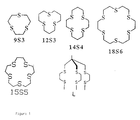
- Examples of crown thioethers and tripodal ligands are shown in Figure 1.
- In the crown thioether designations, the first figure represents the number of atoms, and the last figure the number of sulphur atoms, in the macrocyclic ring. Thus:-
9S3 = 1,4,7,-trithiacyclononane;
12S3 = 1,5,9-trithiacyclocdodecane;
14S4 = 1,4,8,11-tetrathiacyclotetradecane;
15S5 = 1,4,7,10,13-pentathiacyclopentadecane;
18S6 = 1,4,7,10,13,16-hexathiacyclooctadecane;
L = 1,1,1-tris(((2-methylthio)ethyl)thio)methyl)ethane. - The complex may comprise, associated with each Tc atom: one or two thioether ligands ; 0, 1, 2, or 3 oxo groups; and 0, 1, 2 or 3 halide or pseudohalide groups (e.g. F, Cl, Br, I or NCS). The following diagram shows the Tc thioether complexes that are chemically plausible. Parentheses enclose the charges of species less likely to exist. X denotes halide or pseudohalide.
Oxidation State: Tc(I) Tc(II) Tc(III) Tc(IV) Tc(V) Tc(VI) Tc(VII) TcS₆ [Tc(9S3)₂]n+ n = 1+ 2+ 3+ [Tc(12S3)₂]n+ 1+ 2+ 3+ [Tc(18S6)]n+ 1+ 2+ 3+ [Tc(L)]n+ 1+ 2+ 3+ [Tc(14S4)]n+ (2+) (3+) TcOX₂S₃ [TcOX₂(9S3)]n+ (1-) 0 1+ 2+ 3+ [TcOX₂(12S3)]n+ (1-) 0 1+ 2+ 3+ TcOSn [TcO(14S4)]n+ 1+ 2+ 3+ 4+ 5+ [TcO(15S5)]n+ (1+) 2+ 3+ 4+ 5+ TcO₂XS₃ [TcO₂X(9S3)]n+ (-2) 1- 0 1+ 2+ [TcO₂X(12S3)]n+ (-2) 1- 0 1+ 2+ TcO₂(14S4)]n+ (-2) 1- 0 1+ 2+ TcO₃S₃ [TcO₃(9S3)]n+ (1-) (0) 1+ [TcO₃(12S3)]n+ (1-) (0) 1+ - Ligand L was synthesised for the first time in the Inorganic Chemistry Laboratory at Oxford University in 1986.¹ This and subsequent work² revealed the efficacy of L as a ligand for Co(II) and Ni(II). Subsequent work has shown that it also strongly binds Ru(II) to produce the hexacoordinated [Ru(L)]²⁺ cation.³
- Crown thioethers ligands were prepared by routes that have now appeared in the literature.4,5 In general these involve reaction of thioether dithiols with oligo(thioether) dichlorides in dimethylformamide containing Cs₂CO₃ as base. Syntheses of 9S3 (Equation 1), 18S6 (Equations 2a - 2c), and supertripodal ligand L (Equations 3a - b) are shown below.
HS(CH₂)₂S(CH₂)₂SH + Cl(CH₂)₂Cl + Cs₂CO₃ → 9S3 (1)
HS(CH₂)₂S(CH₂)₂SH + 2NaOEt + 2Cl(CH₂)₂OH → HOCH₂(CH₂SCH₂)₃CH₂OH (2a)
HOCH₂(CH₂SCH₂)₃CH₂OH + 2SOCl₂ → ClCH₂(CH₂SCH₂)₃CH₂Cl (2b)
Cl(CH₂)₂S(CH₂)₂Cl + HS(CH₂)₂S(CH₂)₂SH + Cs₂CO₃ → 18S6 (2c)
CH₃C(CH₂OH)₃ + 3TsCl → CH₃C(CH₂OTs)₃ (3a)
CH₃C(CH₂OTs)₃ + 3CH₃S(CH₂)₂SH + 3NaOEt → L (3b)
Crown thioethers were first prepared over fifty years ago,⁶ but their coordination chemistry was not examined until the early 1960s , and most of their coordination chemistry has been investigated in the last ten years. For example, the ligand 9S3 was prepared in 1977 and its coordination dates back only to 1982. In that time crown thioether complexes of a number of transition metals, including particularly Ru (with 14S47,8 and 9S39,10) have been prepared. - In the light of this earlier work, it was unclear what oxidation state of Tc would result in any complexes that might be formed when the ligand was reacted with pertechnetate, and the biodistribution properties of any resulting complexes were also unclear.
- By analogy with earlier work, the crown thioethers should form Tc chelates that differ in redox potential (for the hexakis(thioether) series [Tc(L)₂]²⁺, L = 9S3, 12S3, 18S6) and in coordination number (for [Tc(14S4)Xm]n+, where m can be 1 or 2, and [Tc(15S5)X]n+). Variation in redox potential provides an important means of tuning the charge on the cation, and thereby influencing its biodistribution. For example, a chelate for which Tc(III/II) potential falls within the physiological range would not localise cleanly in one tissue. Suitable choice of a different ligand could be used to shift the potential out of the physiological range and thereby obviate this problem.
- The availability of coordination sites on the Tc ion also influences biodistribution. Easily displaced X ligands (as opposed to the crown thioether, which is more difficult to displace) allows the biological milieu to interact with Tc chelates (e.g., those used for bone imaging). This interaction (with proteins thiolate groups, for example) can strongly influence biodistribution. The crown thioethers have been chosen either to saturate the Tc coordination sphere (9S3, 12S3, 18S6) or to not to do so (14S4, 15S5) in order to examine both types of behaviour.
- Reaction of n-Bu₄NTcO₄ (85 mg, 0.21 mmol) with the crown thioether 9S3 (160 mg, 0.9 mmol) in MeCN (5 mL) and HBF₄ (0.4 mL of a 54% solution in Et₂O) added to give a dark brown solution. After stirring for 1 h a brown microcrystalline precipitate formed, which was washed with Et₂O to give the product (115 mg, 79%). Elemental analysis indicates the formula [Tc(9S3)₂](BF₄)₂.2H₂O.1/2MeCN, a previously unreported compound. (Anal. calc. (found) for C₁₃H29.5N0.5O₂S₆B₂F₈Tc: C 22.76 (22.63), H 5.16 (4.34), N 0.99 (1.01).
- Addition of saturated aqueous solution of NH₄PF₆ to the BF₄⁻ salt dissolved in 5mL H₂O precipitated a golden brown solid that was filtered, washed with H₂O and Et₂O and dried in air. Elemental analysis indicates the formula [Tc(9S3)₂](PF₆)₂.H₂O, also a previously unreported compound. (Anal. calc. (found) for C₁₂H₂₆OS₆P₂F₁₂Tc: C 18.75 (18.78); H 3.12 (3.41).
- Crystals formed upon slow diffusion of Et₂O into solutions of the BF₄⁻ or PF₆⁻ salts in CH₃CN or CH₃NO₂. During the crystallisation sometimes became pale red, which may correspond to a product resulting from either solvolysis (particularly hydrolysis by adventitious water) or slow oxidation by air.
- Electrochemical characterisation of [Tc(9S3)₂]²⁺ by cyclic voltammetry (MeCN, Pt electrode, 0.1 M Bu₄NPF₆ electrolyte) shows a quasi-reversible wave (probably corresponding to the Tc (II/I) couple) at +0.05V vs the saturated calomel electrode (SCE; -0.38V vs ferrocenium/ferrocene (Fc⁺/Fc , +0.02 vs standard hydrogen electrode, (SHE). It also shows an irreversible one-electron oxidation at +1.3 V vs SCE (+0.87 V vs Fc⁺/Fc, +1.27 V vs SHE).
- Another redox couple yields an irreversible reduction at -1.6 V vs SCE (-2.03 V vs Fc⁺.Fc, -1.63 V vs. SHE). Owing to its much smaller peak current than that of the waves described above, this redox process probably results from either an impurity or from a reaction product of [Tc(9S3)₂]²⁺ under the experimental conditions.
- In addition, a quasi-reversible process appears at -0.66V vs SCE (-1.09 V vs Fc⁺/Fc, -0.69 V vs SHE). On the first scan (100 mV/s) this wave has a current one-fourth that of the wave at +0.05V vs SCE. During subsequent scans the current associated with this wave at -0.66 V vs SCE grew at the expense of that at +0.05 V vs SCE; by the tenth scan the system reaches either an equilibrium or a steady state. These results suggest that upon reduction of [Tc(9S3)₂]²⁺ to [Tc(9S3)₂]⁺ (the process at +0.05 V) the electrogenerated [Tc(9S3)₂]⁺ reacts (perhaps) with CH₃CN to give a product that is redox-active in its own right (and which gives rise to the wave at -0.66 V).
- Cyclic voltammetry in aqueous solution employed 0.1 M NaCl as supporting electrolyte; other conditions were as described above. Two quasi - reversible redox processes occur, one at -0.20 V vs SCE (+0.02 V vs. NHE) and another at -0.60 V vs. SCE (-0.37 V vs. NHE). The peak current of the second wave depends on the number of scans. On successive scans it grew to an equilibrium or steady state value about half that of the wave at -0.20 V.
- Parallel synthetic procedures with the supertripodal compound L yielded evidence for the analogous Tc(II) complex. Under the conditions described above L reacts with TcO₄⁻ to yield a solution identical in appearance with that of the 9S3 homologue. Consequently it is formulated as [Tc(L)]²⁺, which also has not been previously reported.
- Analogy with the known coordination chemistry of these ligands suggests for them the structures shown in Figure 2, namely [Tc(9S3)₂]²⁺ and [TcL]²⁺ respectively.
- [99mTc(9S3)₂]⁺ was made by SnCl₂ reduction of [99mTc(9S3)₂]²⁺. Biodistribution was determined in female CD mice at 1 h post injection given as mean %ID/g (S.D.) (N = 2 except as indicated).
[99mTc(9S3)₂]²⁺ [99mTc(9S3)₂]⁺ blood 1.53 (0.23) 1.33 (0.43) urine feces 1.38 (0.54) heart 0.6 (0.12) 0.76 (0.09) lungs 2.17 (0.24) 2.46 (0.19) thyroid 1.11 (N = 1) 1.43 (N = 1) liver/gall bladder 14.45 (1.68) 12.28 (1.59) stomach 0.52 (0.07) 0.80 (0.21) spleen 1.59 (1.11) 1.51 (0.01) gut/pancreas 6.11 (0.31) 10.28 (0.60) kidney 17.2 (0.28) 15.78 (1.92) bladder 2.4 (N = 1) 1.40 (0.04) brain 0.13 (0.09) 0.06 (0.01) muscle (thigh) 0.35 (0.14) 0.25 (0.06) bone (femur) 0.56 (0.18) 0.32 (0.06) adrenal 0.58 (N = 1) 1.46 (0.21) % retained >57, >53 >60, >76 -
- ¹ "Synthesis and Structure of the Nickel (II Complex of 1,1,1-tris(((2-(methylthio)ethyl)thio)-methyl)ethane, An All-Sulfur Ligand that Promotes Hexakis(Thioether) Coordination"; Thorne, C. M. ; Rawle, S. C. ; Admans, G. ; Cooper, S. R. ; Inorg. Chem. 1986 25 3848.
- ² "A New Approach to Hexakis(Thioether) Coordination: The Cobalt (II) Complex of 1,1,1-tris(((2-(methylthio)ethyl)thio)-methyl)ethane"; Thorne, C. M.; Rawle, S. C.; Admans, G. A.; Cooper, S. R.; J. Chem. Soc., Chem. Commun. 1987 306.
- ³ Rawle, S. C.; Cooper, S. R.; unpublished work.
- ⁴ "A High-Yield, One-Step Synthesis of 1,4,7-trithiacyclononane (9S3)"; Blower, P. J.; Cooper, S. R.; Inorg. Chem. 1987 26 2009.
- ⁵ "Hexathia-18-crown-6 and Related Crown Thioethers"; Wolf, R. E., Jr.; Hartman, J. R.; Ochrymowycz, L. A.; Cooper, S. R.; Inorg. Syn. 1988 25 122.
- ⁶ For an introductory review see "Crown Thioether Chemistry"; Cooper, S. R.; Acc. Chem. Res. 1988 21 141; see also "Macrocyclic complexes of the platinum metals"; Schroder, M.; Pure Appl. Chem. 1988 60 517. A comprehensive review is now available on request.
- ⁷ "Structural and Mechanistic Studies of coordination compounds. Part 26. Synthesis and Characterisation of some Octahedral Complexes of Ruthenium (II) and (III) with Macrocyclic Tetradentate Thioethers"; Poon, C.-K.; Che, C.-M.; J. Chem. Soc., Dalton Trans. 1981 495.
- ⁸ "Structural and Mechanistic Studies of coordination compounds, Part 34, Electrochemical Behaviour of some Octahedral Ruthenium (III )/(II) Couples containing Tetraamine or Thioether Ligands"; Poon, C.-K.; Kwong, S.-S; Che, C.-M.; Kan, Y.-P.; J. Chem. Soc., Dalton Trans. 1982 1457.
- ⁹ "Crown Thioether Chemistry. Synthesis and Structure of Ru(1,4,7-trithiacyclononane)₂ (triflate)₂, the first Homoleptic Thioether Complex of Ruthenium"; Rawle, S. C.; Cooper, S. R.; J. Chem. Soc., Chem. Commun. 1987 308.
- ¹⁰ "Crown Thioether Chemistry. The Ru(II) Complexes of 1,4,7-trithiacyclononane and 1,5,9-trithiacyclododecane"; Rawle, S. C.; Sewell, T. J.; Cooper, S. R.; Inorg. Chem. 1987 26 3769.
Claims (7)
- A Technetium complex of a crown thioether having 3 to 6 donor sulphur atoms joined into a macrocyclic ring by C2 or C3 groups.
- A complex as claimed in Claim 1 wherein the crown thioether is 1,4,7-trithiacyclononane (9S3).
- A complex as claimed in Claim 2 having the formula [TcL₂]⁺ or [TcL₂]²⁺ or [TcL₂]³⁺ where L is the crown thioether.
- A Technetium complex of a tripodal ligand having more than three donor sulphur atoms joined by C2 or C3 groups.
- A complex as claimed in Claim 4, wherein the ligand is 1,1,1-tris(((2-methylthio)ethylthio)-methyl) ethane.
- A complex as claimed in Claim 5 having the formula [TcL]⁺ or [TcL]²⁺ or [TcL]³⁺ where L is the ligand.
- A complex as claimed in any one of Claims 1 to 6, wherein the Technetium is Technetium-99m.
Applications Claiming Priority (3)
| Application Number | Priority Date | Filing Date | Title |
|---|---|---|---|
| GB9007039 | 1990-03-29 | ||
| GB909007039A GB9007039D0 (en) | 1990-03-29 | 1990-03-29 | Complexes of thioethers |
| PCT/GB1991/000482 WO1991014685A1 (en) | 1990-03-29 | 1991-03-28 | Complexes of thioethers |
Publications (2)
| Publication Number | Publication Date |
|---|---|
| EP0521954A1 EP0521954A1 (en) | 1993-01-13 |
| EP0521954B1 true EP0521954B1 (en) | 1995-07-05 |
Family
ID=10673479
Family Applications (1)
| Application Number | Title | Priority Date | Filing Date |
|---|---|---|---|
| EP91906540A Expired - Lifetime EP0521954B1 (en) | 1990-03-29 | 1991-03-28 | Technecium complexes of thioethers |
Country Status (9)
| Country | Link |
|---|---|
| US (1) | US5296593A (en) |
| EP (1) | EP0521954B1 (en) |
| JP (1) | JPH05507906A (en) |
| AT (1) | ATE124693T1 (en) |
| AU (1) | AU645305B2 (en) |
| CA (1) | CA2079221A1 (en) |
| DE (1) | DE69111056T2 (en) |
| GB (1) | GB9007039D0 (en) |
| WO (1) | WO1991014685A1 (en) |
Families Citing this family (1)
| Publication number | Priority date | Publication date | Assignee | Title |
|---|---|---|---|---|
| WO1995029925A1 (en) * | 1994-04-29 | 1995-11-09 | The Curators Of The University Of Missouri | Thioether compounds for use in preparing bifunctional chelating agents for therapeutic radiopharmaceuticals |
Family Cites Families (1)
| Publication number | Priority date | Publication date | Assignee | Title |
|---|---|---|---|---|
| US4925925A (en) * | 1988-06-15 | 1990-05-15 | University Of Cincinnati | Radioactive rhenium ligated to 2-hydroxy isobutyric acid and method of use |
-
1990
- 1990-03-29 GB GB909007039A patent/GB9007039D0/en active Pending
-
1991
- 1991-03-28 WO PCT/GB1991/000482 patent/WO1991014685A1/en not_active Ceased
- 1991-03-28 CA CA002079221A patent/CA2079221A1/en not_active Abandoned
- 1991-03-28 JP JP91506345A patent/JPH05507906A/en active Pending
- 1991-03-28 AU AU75463/91A patent/AU645305B2/en not_active Ceased
- 1991-03-28 EP EP91906540A patent/EP0521954B1/en not_active Expired - Lifetime
- 1991-03-28 AT AT91906540T patent/ATE124693T1/en active
- 1991-03-28 DE DE69111056T patent/DE69111056T2/en not_active Expired - Fee Related
-
1992
- 1992-11-30 US US07/982,698 patent/US5296593A/en not_active Expired - Fee Related
Non-Patent Citations (4)
Also Published As
| Publication number | Publication date |
|---|---|
| JPH05507906A (en) | 1993-11-11 |
| DE69111056T2 (en) | 1995-11-02 |
| CA2079221A1 (en) | 1991-09-30 |
| GB9007039D0 (en) | 1990-05-30 |
| AU7546391A (en) | 1991-10-21 |
| DE69111056D1 (en) | 1995-08-10 |
| ATE124693T1 (en) | 1995-07-15 |
| AU645305B2 (en) | 1994-01-13 |
| US5296593A (en) | 1994-03-22 |
| EP0521954A1 (en) | 1993-01-13 |
| WO1991014685A1 (en) | 1991-10-03 |
Similar Documents
| Publication | Publication Date | Title |
|---|---|---|
| Djuran et al. | Reactivity of chloro-and aqua (diethylenetriamine) platinum (II) ions with glutathione, S-methylglutathione, and guanosine 5'-monophosphate in relation to the antitumor activity and toxicity of platinum complexes | |
| Addison et al. | Pentacoordinate copper complexes of nitrogen-sulfur donors: structural chemistry of two complexes of bis (2-(2-benzimidazolyl) ethyl) sulfide with the sulfur alternatively in equatorial and axial coordination modes | |
| Chaudhuri et al. | Mono-and dinuclear zinc (II) complexes of biological relevance. Crystal structures of [L2Zn](PF6) 2,[L'Zn (O2CPh) 2 (H2O)],[L'2Zn2 (. mu.-OH) 2](ClO4) 2, and [L'2Zn2 (. mu.-OH)(. mu.-CH3CO2) 2](ClO4). cntdot. H2O (L= 1, 4, 7-triazacyclononane, L'= 1, 4, 7-trimethyl-1, 4, 7-triazacyclononane) | |
| Coucouvanis et al. | Metal dithiosquarates. II. Synthesis and characterization of bis (dithiosquarato) tetrahedral and planar complexes. Crystal and molecular structure of potassium bis (dithiosquarato) nickelate (II) dihydrate | |
| Kirchner et al. | Pentacoordinate zinc complexes of imidazole nitrogen donors as structural models for the active site in enzymes: preparation and crystal structures of (. mu.-2, 2'-biimidazole) tetrakis (2, 2'-biimidazole) dizinc (II) tetraperchlorate trihydrate and bis (2, 2'-biimidazole)(formato) zinc (II) perchlorate | |
| US5399339A (en) | Process for the preparation of nitride complexes of transition metals | |
| Zhang et al. | Organometallic complexes of osmium with sulfur-containing ligands. Synthesis of cis-[Os (N)(CH2SiMe3) 2 (SCH2CH2S)]-and cis-[Os (N)(CH2SiMe3) 2 (SCN) 2]-and the synthesis and x-ray crystal structure of cis-[Os (N)(CH2SiMe3) 2 (2-S-NC5H4)] 2 | |
| Nadasdi et al. | Redox-active macrocycles as metalloligands: synthesis, electrochemistry, and structure of silver (I) and copper (I) complexes of Cp2Ti (. mu.-S (CH2) nS) 2TiCp2 (n= 2, 3) | |
| Baidya et al. | Synthesis, structure, and properties of potassium bis (L-cysteinato-N, S) nickelate (II) sesquihydrate | |
| Ware et al. | Synthesis and reduction of osmium (VI) nitrido complexes and x-ray crystal structure of tetra-n-butylammonium octachlorodinitrido (. mu.-pyrazine) diosmate (VI) | |
| Pérez-Lourido et al. | Synthesis and characterization of zinc and cadmium compounds with arenephosphinothiol ligands. Crystal and molecular structures of [Cd2 {2-(Ph2PO) C6H4S} 4],[Zn {2-(Ph2P)-6-(Me3Si) C6H3S} 2],[Cd {2-(Ph2PO)-6-(Me3Si) C6H3S} 2 (CH3OH)], and [Zn {PhPO (C6H4S-2) 2}(bipy)] | |
| Camus et al. | Insertion reactions of carbon disulfide into carbon-copper bonds of aromatic organocopper (I) compounds and of their complexes with triphenylphosphine and bis (diphenylphosphino) ethane | |
| US5296593A (en) | Complexes of thioethers | |
| Leeaphon et al. | Reactions of the polyhydride complex ReH7 (PPh3) 2 with hydroxypyridine and mercaptopyridine ligands. Formation of hydrido complexes of rhenium (III), rhenium (IV), and rhenium (V) and the characterization of eight-coordinate isomers in the solid state and in solution | |
| Lu et al. | Synthesis and characterization of technetium (III) complexes with nitrogen heterocycles by oxygen atom transfer from oxotechnetium (V) cores. Crystal structures of mer-[Cl3 (pic) 3Tc] and mer-[Cl3 (pic)(PMe2Ph) 2Tc](pic= 4-picoline). Electrochemical parameters for the reduction of TcII, TcIII, and TcIV | |
| US5002754A (en) | Technetium (III/II) imaging agents | |
| Hadjiliadis et al. | A study of the reactions of cysteinatomethylester platinum (II)-μ-dichloro cysteinatomethylester platinum (II) with nucleosides | |
| Breikss et al. | Synthesis and characterization of technetium (III) and technetium (II) complexes with mixed phosphine, chloride, and nitrogen-donor ligands. X-ray crystal structure of (2, 2'-bipyridine) trichloro (triphenylphosphine) technetium | |
| Pérez et al. | A mixed-ligand homodinuclear copper (II) complex with weak disulfide-metal interactions: synthesis, properties and molecular and crystal structure of μ-(N, N, N′, N′-Tetrakis (carboxymethyl) cystaminato (4−))-bis (imidazole) diaquodicopper (II) dihydrate,[Cu2 (TTC)(ImH) 2 (H2O) 2]· 2H2O | |
| Mukiza | Rhenium Complexes with Pontentially Multidentate Ligands Containing the Amino, Imino, Hydroxy and Thiol Groups | |
| Costa et al. | Influence of cation size on the self-assembly of gold bis (dithiolate) complexes: From discrete cations to 1D coordination polymers | |
| Radanović et al. | Reaction products distribution between square-planar gold (III) complexes and N, N, N′, N′-tetramethylthiuram disulfide. Crystal structure of bis (N, N-dimethyldithiocarbamato) gold (III) bromide dihydrate,[Au (Me2NCS2) 2] Br· 2H2O | |
| Chang et al. | Synthesis and Characterization of (o-Phenylenebis (dimethylarsine)) rhenium (III) and-(V) Complexes with Thiolato Ligands | |
| Lepareur et al. | Syntheses and reactivity of ‘sulfur rich’Re (III) and Tc (III) complexes containing trithioperoxybenzoate, dithiobenzoate and dithiocarbamate ligands | |
| EP3704082A1 (en) | Multinuclear complexes and their preparation |
Legal Events
| Date | Code | Title | Description |
|---|---|---|---|
| PUAI | Public reference made under article 153(3) epc to a published international application that has entered the european phase |
Free format text: ORIGINAL CODE: 0009012 |
|
| 17P | Request for examination filed |
Effective date: 19920924 |
|
| AK | Designated contracting states |
Kind code of ref document: A1 Designated state(s): AT BE CH DE DK ES FR GB GR IT LI LU NL SE |
|
| 17Q | First examination report despatched |
Effective date: 19940713 |
|
| GRAA | (expected) grant |
Free format text: ORIGINAL CODE: 0009210 |
|
| ITF | It: translation for a ep patent filed | ||
| AK | Designated contracting states |
Kind code of ref document: B1 Designated state(s): AT BE CH DE DK ES FR GB GR IT LI LU NL SE |
|
| PG25 | Lapsed in a contracting state [announced via postgrant information from national office to epo] |
Ref country code: GR Free format text: LAPSE BECAUSE OF FAILURE TO SUBMIT A TRANSLATION OF THE DESCRIPTION OR TO PAY THE FEE WITHIN THE PRESCRIBED TIME-LIMIT Effective date: 19950705 Ref country code: ES Free format text: THE PATENT HAS BEEN ANNULLED BY A DECISION OF A NATIONAL AUTHORITY Effective date: 19950705 Ref country code: DK Effective date: 19950705 Ref country code: BE Effective date: 19950705 Ref country code: AT Effective date: 19950705 |
|
| REF | Corresponds to: |
Ref document number: 124693 Country of ref document: AT Date of ref document: 19950715 Kind code of ref document: T |
|
| REF | Corresponds to: |
Ref document number: 69111056 Country of ref document: DE Date of ref document: 19950810 |
|
| ET | Fr: translation filed | ||
| PG25 | Lapsed in a contracting state [announced via postgrant information from national office to epo] |
Ref country code: SE Effective date: 19951005 |
|
| PGFP | Annual fee paid to national office [announced via postgrant information from national office to epo] |
Ref country code: FR Payment date: 19960229 Year of fee payment: 6 |
|
| PGFP | Annual fee paid to national office [announced via postgrant information from national office to epo] |
Ref country code: CH Payment date: 19960304 Year of fee payment: 6 |
|
| PGFP | Annual fee paid to national office [announced via postgrant information from national office to epo] |
Ref country code: GB Payment date: 19960319 Year of fee payment: 6 |
|
| PGFP | Annual fee paid to national office [announced via postgrant information from national office to epo] |
Ref country code: DE Payment date: 19960329 Year of fee payment: 6 |
|
| PG25 | Lapsed in a contracting state [announced via postgrant information from national office to epo] |
Ref country code: LU Free format text: LAPSE BECAUSE OF NON-PAYMENT OF DUE FEES Effective date: 19960331 |
|
| PGFP | Annual fee paid to national office [announced via postgrant information from national office to epo] |
Ref country code: NL Payment date: 19960331 Year of fee payment: 6 |
|
| PLBE | No opposition filed within time limit |
Free format text: ORIGINAL CODE: 0009261 |
|
| STAA | Information on the status of an ep patent application or granted ep patent |
Free format text: STATUS: NO OPPOSITION FILED WITHIN TIME LIMIT |
|
| 26N | No opposition filed | ||
| PG25 | Lapsed in a contracting state [announced via postgrant information from national office to epo] |
Ref country code: GB Effective date: 19970328 |
|
| PG25 | Lapsed in a contracting state [announced via postgrant information from national office to epo] |
Ref country code: LI Effective date: 19970331 Ref country code: CH Effective date: 19970331 |
|
| PG25 | Lapsed in a contracting state [announced via postgrant information from national office to epo] |
Ref country code: NL Effective date: 19971001 |
|
| REG | Reference to a national code |
Ref country code: CH Ref legal event code: PL |
|
| GBPC | Gb: european patent ceased through non-payment of renewal fee |
Effective date: 19970328 |
|
| PG25 | Lapsed in a contracting state [announced via postgrant information from national office to epo] |
Ref country code: FR Free format text: LAPSE BECAUSE OF NON-PAYMENT OF DUE FEES Effective date: 19971128 |
|
| NLV4 | Nl: lapsed or anulled due to non-payment of the annual fee |
Effective date: 19971001 |
|
| PG25 | Lapsed in a contracting state [announced via postgrant information from national office to epo] |
Ref country code: DE Effective date: 19971202 |
|
| REG | Reference to a national code |
Ref country code: FR Ref legal event code: ST |
|
| PG25 | Lapsed in a contracting state [announced via postgrant information from national office to epo] |
Ref country code: IT Free format text: LAPSE BECAUSE OF NON-PAYMENT OF DUE FEES;WARNING: LAPSES OF ITALIAN PATENTS WITH EFFECTIVE DATE BEFORE 2007 MAY HAVE OCCURRED AT ANY TIME BEFORE 2007. THE CORRECT EFFECTIVE DATE MAY BE DIFFERENT FROM THE ONE RECORDED. Effective date: 20050328 |