EP0521612B1 - Ultrafine gold and/or silver chalcogenide and production thereof - Google Patents
Ultrafine gold and/or silver chalcogenide and production thereof Download PDFInfo
- Publication number
- EP0521612B1 EP0521612B1 EP92304798A EP92304798A EP0521612B1 EP 0521612 B1 EP0521612 B1 EP 0521612B1 EP 92304798 A EP92304798 A EP 92304798A EP 92304798 A EP92304798 A EP 92304798A EP 0521612 B1 EP0521612 B1 EP 0521612B1
- Authority
- EP
- European Patent Office
- Prior art keywords
- solution
- silver
- grains
- gold
- solutions
- Prior art date
- Legal status (The legal status is an assumption and is not a legal conclusion. Google has not performed a legal analysis and makes no representation as to the accuracy of the status listed.)
- Expired - Lifetime
Links
- 229910052709 silver Inorganic materials 0.000 title claims description 57
- 239000004332 silver Substances 0.000 title claims description 57
- PCHJSUWPFVWCPO-UHFFFAOYSA-N gold Chemical compound [Au] PCHJSUWPFVWCPO-UHFFFAOYSA-N 0.000 title claims description 19
- 229910052737 gold Inorganic materials 0.000 title claims description 19
- 239000010931 gold Substances 0.000 title claims description 19
- 238000004519 manufacturing process Methods 0.000 title claims description 19
- -1 silver chalcogenide Chemical class 0.000 title description 46
- 238000000034 method Methods 0.000 claims description 42
- 239000000084 colloidal system Substances 0.000 claims description 28
- 230000001681 protective effect Effects 0.000 claims description 26
- 150000004770 chalcogenides Chemical class 0.000 claims description 20
- 238000002156 mixing Methods 0.000 claims description 17
- XLYOFNOQVPJJNP-UHFFFAOYSA-N water Substances O XLYOFNOQVPJJNP-UHFFFAOYSA-N 0.000 claims description 12
- 150000001875 compounds Chemical class 0.000 claims description 9
- 239000000243 solution Substances 0.000 description 115
- 238000006243 chemical reaction Methods 0.000 description 46
- 206010070834 Sensitisation Diseases 0.000 description 37
- 230000035945 sensitivity Effects 0.000 description 37
- 230000008313 sensitization Effects 0.000 description 37
- 239000000839 emulsion Substances 0.000 description 33
- SQGYOTSLMSWVJD-UHFFFAOYSA-N silver(1+) nitrate Chemical compound [Ag+].[O-]N(=O)=O SQGYOTSLMSWVJD-UHFFFAOYSA-N 0.000 description 29
- 230000000052 comparative effect Effects 0.000 description 27
- 229910052946 acanthite Inorganic materials 0.000 description 21
- 229940056910 silver sulfide Drugs 0.000 description 21
- XUARKZBEFFVFRG-UHFFFAOYSA-N silver sulfide Chemical compound [S-2].[Ag+].[Ag+] XUARKZBEFFVFRG-UHFFFAOYSA-N 0.000 description 21
- 239000000126 substance Substances 0.000 description 21
- 239000000203 mixture Substances 0.000 description 18
- 238000003756 stirring Methods 0.000 description 17
- 101100117236 Drosophila melanogaster speck gene Proteins 0.000 description 15
- 230000001235 sensitizing effect Effects 0.000 description 15
- 108010010803 Gelatin Proteins 0.000 description 14
- 239000013078 crystal Substances 0.000 description 14
- 239000008273 gelatin Substances 0.000 description 14
- 229920000159 gelatin Polymers 0.000 description 14
- 235000019322 gelatine Nutrition 0.000 description 14
- 235000011852 gelatine desserts Nutrition 0.000 description 14
- 230000015572 biosynthetic process Effects 0.000 description 13
- 229910001961 silver nitrate Inorganic materials 0.000 description 13
- BQCADISMDOOEFD-UHFFFAOYSA-N Silver Chemical compound [Ag] BQCADISMDOOEFD-UHFFFAOYSA-N 0.000 description 11
- 238000009826 distribution Methods 0.000 description 11
- UCKMPCXJQFINFW-UHFFFAOYSA-N Sulphide Chemical compound [S-2] UCKMPCXJQFINFW-UHFFFAOYSA-N 0.000 description 10
- XEIPQVVAVOUIOP-UHFFFAOYSA-N [Au]=S Chemical compound [Au]=S XEIPQVVAVOUIOP-UHFFFAOYSA-N 0.000 description 10
- 239000007864 aqueous solution Substances 0.000 description 10
- 230000001276 controlling effect Effects 0.000 description 10
- 238000010899 nucleation Methods 0.000 description 10
- OKKJLVBELUTLKV-UHFFFAOYSA-N Methanol Chemical compound OC OKKJLVBELUTLKV-UHFFFAOYSA-N 0.000 description 9
- 239000002253 acid Substances 0.000 description 9
- PQTCMBYFWMFIGM-UHFFFAOYSA-N gold silver Chemical compound [Ag].[Au] PQTCMBYFWMFIGM-UHFFFAOYSA-N 0.000 description 8
- 150000002344 gold compounds Chemical class 0.000 description 7
- 239000000523 sample Substances 0.000 description 7
- 229940100890 silver compound Drugs 0.000 description 7
- 150000003379 silver compounds Chemical class 0.000 description 7
- QTBSBXVTEAMEQO-UHFFFAOYSA-N Acetic acid Chemical compound CC(O)=O QTBSBXVTEAMEQO-UHFFFAOYSA-N 0.000 description 6
- 238000010586 diagram Methods 0.000 description 6
- 239000006194 liquid suspension Substances 0.000 description 6
- 230000008569 process Effects 0.000 description 6
- AKHNMLFCWUSKQB-UHFFFAOYSA-L sodium thiosulfate Chemical compound [Na+].[Na+].[O-]S([O-])(=O)=S AKHNMLFCWUSKQB-UHFFFAOYSA-L 0.000 description 6
- 235000019345 sodium thiosulphate Nutrition 0.000 description 6
- NINIDFKCEFEMDL-UHFFFAOYSA-N Sulfur Chemical compound [S] NINIDFKCEFEMDL-UHFFFAOYSA-N 0.000 description 5
- 239000006185 dispersion Substances 0.000 description 5
- 239000000975 dye Substances 0.000 description 5
- 238000002347 injection Methods 0.000 description 5
- 239000007924 injection Substances 0.000 description 5
- 229910052717 sulfur Inorganic materials 0.000 description 5
- 239000011593 sulfur Substances 0.000 description 5
- RWSOTUBLDIXVET-UHFFFAOYSA-N Dihydrogen sulfide Chemical compound S RWSOTUBLDIXVET-UHFFFAOYSA-N 0.000 description 4
- 230000009471 action Effects 0.000 description 4
- 238000002474 experimental method Methods 0.000 description 4
- 238000005189 flocculation Methods 0.000 description 4
- 230000016615 flocculation Effects 0.000 description 4
- 229910000037 hydrogen sulfide Inorganic materials 0.000 description 4
- 230000005070 ripening Effects 0.000 description 4
- UMGDCJDMYOKAJW-UHFFFAOYSA-N thiourea Chemical compound NC(N)=S UMGDCJDMYOKAJW-UHFFFAOYSA-N 0.000 description 4
- 238000004627 transmission electron microscopy Methods 0.000 description 4
- 229910004042 HAuCl4 Inorganic materials 0.000 description 3
- 239000002585 base Substances 0.000 description 3
- ZUIVNYGZFPOXFW-UHFFFAOYSA-N chembl1717603 Chemical compound N1=C(C)C=C(O)N2N=CN=C21 ZUIVNYGZFPOXFW-UHFFFAOYSA-N 0.000 description 3
- 238000007796 conventional method Methods 0.000 description 3
- 150000002500 ions Chemical class 0.000 description 3
- 239000000463 material Substances 0.000 description 3
- 230000001105 regulatory effect Effects 0.000 description 3
- 150000003839 salts Chemical class 0.000 description 3
- 239000002904 solvent Substances 0.000 description 3
- 230000003595 spectral effect Effects 0.000 description 3
- LOCOYCNSPKQNRY-UHFFFAOYSA-N 1,3-thiazol-2-ylthiourea Chemical compound NC(=S)NC1=NC=CS1 LOCOYCNSPKQNRY-UHFFFAOYSA-N 0.000 description 2
- JKFYKCYQEWQPTM-UHFFFAOYSA-N 2-azaniumyl-2-(4-fluorophenyl)acetate Chemical compound OC(=O)C(N)C1=CC=C(F)C=C1 JKFYKCYQEWQPTM-UHFFFAOYSA-N 0.000 description 2
- VHUUQVKOLVNVRT-UHFFFAOYSA-N Ammonium hydroxide Chemical compound [NH4+].[OH-] VHUUQVKOLVNVRT-UHFFFAOYSA-N 0.000 description 2
- 229910021612 Silver iodide Inorganic materials 0.000 description 2
- FOIXSVOLVBLSDH-UHFFFAOYSA-N Silver ion Chemical compound [Ag+] FOIXSVOLVBLSDH-UHFFFAOYSA-N 0.000 description 2
- XSQUKJJJFZCRTK-UHFFFAOYSA-N Urea Natural products NC(N)=O XSQUKJJJFZCRTK-UHFFFAOYSA-N 0.000 description 2
- 239000003463 adsorbent Substances 0.000 description 2
- QGZKDVFQNNGYKY-UHFFFAOYSA-N ammonia Natural products N QGZKDVFQNNGYKY-UHFFFAOYSA-N 0.000 description 2
- SOIFLUNRINLCBN-UHFFFAOYSA-N ammonium thiocyanate Chemical compound [NH4+].[S-]C#N SOIFLUNRINLCBN-UHFFFAOYSA-N 0.000 description 2
- 230000006399 behavior Effects 0.000 description 2
- 239000012153 distilled water Substances 0.000 description 2
- 238000001035 drying Methods 0.000 description 2
- 230000000694 effects Effects 0.000 description 2
- 238000010893 electron trap Methods 0.000 description 2
- 239000007788 liquid Substances 0.000 description 2
- 238000012986 modification Methods 0.000 description 2
- 230000004048 modification Effects 0.000 description 2
- 239000012071 phase Substances 0.000 description 2
- 229940045105 silver iodide Drugs 0.000 description 2
- LPXPTNMVRIOKMN-UHFFFAOYSA-M sodium nitrite Chemical compound [Na+].[O-]N=O LPXPTNMVRIOKMN-UHFFFAOYSA-M 0.000 description 2
- 229940079101 sodium sulfide Drugs 0.000 description 2
- 229910052979 sodium sulfide Inorganic materials 0.000 description 2
- ZGHLCBJZQLNUAZ-UHFFFAOYSA-N sodium sulfide nonahydrate Chemical compound O.O.O.O.O.O.O.O.O.[Na+].[Na+].[S-2] ZGHLCBJZQLNUAZ-UHFFFAOYSA-N 0.000 description 2
- BZZRNKMOVSDPIG-UHFFFAOYSA-M sodium;nitrite;pentahydrate Chemical compound O.O.O.O.O.[Na+].[O-]N=O BZZRNKMOVSDPIG-UHFFFAOYSA-M 0.000 description 2
- 238000001179 sorption measurement Methods 0.000 description 2
- 150000004763 sulfides Chemical class 0.000 description 2
- 150000003464 sulfur compounds Chemical class 0.000 description 2
- ZMZDMBWJUHKJPS-UHFFFAOYSA-N thiocyanic acid Chemical class SC#N ZMZDMBWJUHKJPS-UHFFFAOYSA-N 0.000 description 2
- NJYFRQQXXXRJHK-UHFFFAOYSA-N (4-aminophenyl) thiocyanate Chemical compound NC1=CC=C(SC#N)C=C1 NJYFRQQXXXRJHK-UHFFFAOYSA-N 0.000 description 1
- AWFYPPSBLUWMFQ-UHFFFAOYSA-N 2-[5-[2-(2,3-dihydro-1H-inden-2-ylamino)pyrimidin-5-yl]-1,3,4-oxadiazol-2-yl]-1-(1,4,6,7-tetrahydropyrazolo[4,3-c]pyridin-5-yl)ethanone Chemical compound C1C(CC2=CC=CC=C12)NC1=NC=C(C=N1)C1=NN=C(O1)CC(=O)N1CC2=C(CC1)NN=C2 AWFYPPSBLUWMFQ-UHFFFAOYSA-N 0.000 description 1
- YLZOPXRUQYQQID-UHFFFAOYSA-N 3-(2,4,6,7-tetrahydrotriazolo[4,5-c]pyridin-5-yl)-1-[4-[2-[[3-(trifluoromethoxy)phenyl]methylamino]pyrimidin-5-yl]piperazin-1-yl]propan-1-one Chemical compound N1N=NC=2CN(CCC=21)CCC(=O)N1CCN(CC1)C=1C=NC(=NC=1)NCC1=CC(=CC=C1)OC(F)(F)F YLZOPXRUQYQQID-UHFFFAOYSA-N 0.000 description 1
- IUAKHJPCOAQSAL-UHFFFAOYSA-N 4,6-dichloro-2-hydroxy-1h-triazine;sodium Chemical compound [Na].ON1NC(Cl)=CC(Cl)=N1 IUAKHJPCOAQSAL-UHFFFAOYSA-N 0.000 description 1
- YHOVJPMUPBRNPE-UHFFFAOYSA-N 5,5-dimethyl-2-sulfanylidene-1,3-thiazolidin-4-one;gold Chemical compound [Au].CC1(C)SC(=S)NC1=O YHOVJPMUPBRNPE-UHFFFAOYSA-N 0.000 description 1
- DEXFNLNNUZKHNO-UHFFFAOYSA-N 6-[3-[4-[2-(2,3-dihydro-1H-inden-2-ylamino)pyrimidin-5-yl]piperidin-1-yl]-3-oxopropyl]-3H-1,3-benzoxazol-2-one Chemical compound C1C(CC2=CC=CC=C12)NC1=NC=C(C=N1)C1CCN(CC1)C(CCC1=CC2=C(NC(O2)=O)C=C1)=O DEXFNLNNUZKHNO-UHFFFAOYSA-N 0.000 description 1
- MKYBYDHXWVHEJW-UHFFFAOYSA-N N-[1-oxo-1-(2,4,6,7-tetrahydrotriazolo[4,5-c]pyridin-5-yl)propan-2-yl]-2-[[3-(trifluoromethoxy)phenyl]methylamino]pyrimidine-5-carboxamide Chemical compound O=C(C(C)NC(=O)C=1C=NC(=NC=1)NCC1=CC(=CC=C1)OC(F)(F)F)N1CC2=C(CC1)NN=N2 MKYBYDHXWVHEJW-UHFFFAOYSA-N 0.000 description 1
- BUGBHKTXTAQXES-UHFFFAOYSA-N Selenium Chemical compound [Se] BUGBHKTXTAQXES-UHFFFAOYSA-N 0.000 description 1
- 230000002378 acidificating effect Effects 0.000 description 1
- 150000007513 acids Chemical class 0.000 description 1
- 239000000654 additive Substances 0.000 description 1
- 239000003513 alkali Substances 0.000 description 1
- 238000004458 analytical method Methods 0.000 description 1
- 125000000129 anionic group Chemical group 0.000 description 1
- 238000013459 approach Methods 0.000 description 1
- 238000000429 assembly Methods 0.000 description 1
- 230000000712 assembly Effects 0.000 description 1
- 125000002091 cationic group Chemical group 0.000 description 1
- 238000003889 chemical engineering Methods 0.000 description 1
- 239000003153 chemical reaction reagent Substances 0.000 description 1
- 239000013626 chemical specie Substances 0.000 description 1
- 238000004040 coloring Methods 0.000 description 1
- 230000002860 competitive effect Effects 0.000 description 1
- 238000000354 decomposition reaction Methods 0.000 description 1
- 230000007547 defect Effects 0.000 description 1
- 239000012470 diluted sample Substances 0.000 description 1
- 238000010790 dilution Methods 0.000 description 1
- 239000012895 dilution Substances 0.000 description 1
- 239000002270 dispersing agent Substances 0.000 description 1
- 238000010494 dissociation reaction Methods 0.000 description 1
- 230000005593 dissociations Effects 0.000 description 1
- 238000004090 dissolution Methods 0.000 description 1
- 230000002708 enhancing effect Effects 0.000 description 1
- 238000001704 evaporation Methods 0.000 description 1
- 238000011049 filling Methods 0.000 description 1
- 239000007789 gas Substances 0.000 description 1
- 150000002391 heterocyclic compounds Chemical class 0.000 description 1
- 239000005457 ice water Substances 0.000 description 1
- 239000003112 inhibitor Substances 0.000 description 1
- 238000007689 inspection Methods 0.000 description 1
- 230000003993 interaction Effects 0.000 description 1
- 238000011835 investigation Methods 0.000 description 1
- 239000007791 liquid phase Substances 0.000 description 1
- 238000001748 luminescence spectrum Methods 0.000 description 1
- 239000011259 mixed solution Substances 0.000 description 1
- 230000007935 neutral effect Effects 0.000 description 1
- 230000003287 optical effect Effects 0.000 description 1
- 150000002917 oxazolidines Chemical class 0.000 description 1
- 239000004848 polyfunctional curative Substances 0.000 description 1
- 239000005077 polysulfide Substances 0.000 description 1
- 229920001021 polysulfide Polymers 0.000 description 1
- 150000008117 polysulfides Polymers 0.000 description 1
- 238000000634 powder X-ray diffraction Methods 0.000 description 1
- 238000002360 preparation method Methods 0.000 description 1
- 230000035484 reaction time Effects 0.000 description 1
- 238000011160 research Methods 0.000 description 1
- 229910052711 selenium Inorganic materials 0.000 description 1
- 239000011669 selenium Substances 0.000 description 1
- 238000010008 shearing Methods 0.000 description 1
- 238000007086 side reaction Methods 0.000 description 1
- ZUNKMNLKJXRCDM-UHFFFAOYSA-N silver bromoiodide Chemical compound [Ag].IBr ZUNKMNLKJXRCDM-UHFFFAOYSA-N 0.000 description 1
- YPNVIBVEFVRZPJ-UHFFFAOYSA-L silver sulfate Chemical compound [Ag+].[Ag+].[O-]S([O-])(=O)=O YPNVIBVEFVRZPJ-UHFFFAOYSA-L 0.000 description 1
- 229910000367 silver sulfate Inorganic materials 0.000 description 1
- 235000010288 sodium nitrite Nutrition 0.000 description 1
- 229940048181 sodium sulfide nonahydrate Drugs 0.000 description 1
- WMDLZMCDBSJMTM-UHFFFAOYSA-M sodium;sulfanide;nonahydrate Chemical compound O.O.O.O.O.O.O.O.O.[Na+].[SH-] WMDLZMCDBSJMTM-UHFFFAOYSA-M 0.000 description 1
- 239000007787 solid Substances 0.000 description 1
- 238000001228 spectrum Methods 0.000 description 1
- 239000011550 stock solution Substances 0.000 description 1
- PGWMQVQLSMAHHO-UHFFFAOYSA-N sulfanylidenesilver Chemical class [Ag]=S PGWMQVQLSMAHHO-UHFFFAOYSA-N 0.000 description 1
- 239000000725 suspension Substances 0.000 description 1
- 229920001059 synthetic polymer Polymers 0.000 description 1
- 229910052714 tellurium Inorganic materials 0.000 description 1
- PORWMNRCUJJQNO-UHFFFAOYSA-N tellurium atom Chemical compound [Te] PORWMNRCUJJQNO-UHFFFAOYSA-N 0.000 description 1
- 150000003568 thioethers Chemical class 0.000 description 1
- 125000003396 thiol group Chemical group [H]S* 0.000 description 1
- 150000003585 thioureas Chemical class 0.000 description 1
- 230000007704 transition Effects 0.000 description 1
- 238000011282 treatment Methods 0.000 description 1
- ILJSQTXMGCGYMG-UHFFFAOYSA-N triacetic acid Chemical compound CC(=O)CC(=O)CC(O)=O ILJSQTXMGCGYMG-UHFFFAOYSA-N 0.000 description 1
Images



Classifications
-
- G—PHYSICS
- G03—PHOTOGRAPHY; CINEMATOGRAPHY; ANALOGOUS TECHNIQUES USING WAVES OTHER THAN OPTICAL WAVES; ELECTROGRAPHY; HOLOGRAPHY
- G03C—PHOTOSENSITIVE MATERIALS FOR PHOTOGRAPHIC PURPOSES; PHOTOGRAPHIC PROCESSES, e.g. CINE, X-RAY, COLOUR, STEREO-PHOTOGRAPHIC PROCESSES; AUXILIARY PROCESSES IN PHOTOGRAPHY
- G03C1/00—Photosensitive materials
- G03C1/005—Silver halide emulsions; Preparation thereof; Physical treatment thereof; Incorporation of additives therein
- G03C1/06—Silver halide emulsions; Preparation thereof; Physical treatment thereof; Incorporation of additives therein with non-macromolecular additives
- G03C1/08—Sensitivity-increasing substances
- G03C1/09—Noble metals or mercury; Salts or compounds thereof; Sulfur, selenium or tellurium, or compounds thereof, e.g. for chemical sensitising
-
- C—CHEMISTRY; METALLURGY
- C01—INORGANIC CHEMISTRY
- C01G—COMPOUNDS CONTAINING METALS NOT COVERED BY SUBCLASSES C01D OR C01F
- C01G5/00—Compounds of silver
-
- C—CHEMISTRY; METALLURGY
- C01—INORGANIC CHEMISTRY
- C01G—COMPOUNDS CONTAINING METALS NOT COVERED BY SUBCLASSES C01D OR C01F
- C01G7/00—Compounds of gold
-
- C—CHEMISTRY; METALLURGY
- C01—INORGANIC CHEMISTRY
- C01G—COMPOUNDS CONTAINING METALS NOT COVERED BY SUBCLASSES C01D OR C01F
- C01G7/00—Compounds of gold
- C01G7/006—Compounds containing gold, with or without oxygen or hydrogen, and containing two or more other elements
Definitions
- the present invention relates to a method of production, in liquid suspension, of an ultrafine gold and/or silver chalcogenide involved in sensitization of silver halide used in photographic light-sensitive materials, specifically gold sulfide, silver sulfide and a gold-silver complex sulfide.
- the basic requirements of the performance of photographic silver halide grains are high sensitivity, low fogging and fine graininess.
- a basic approach to the obtainment of high sensitivity emulsion comprising fine grains is to increase the photon efficiency in the light sensitizing process. Possible factors hampering the increase in photon efficiency include the presence of competitive electron traps originating from re-bonding, latent image dispersion, structural failure, lattice defects,etc. Sulfur sensitization and gold-sulfur sensitization are thought to act to provide the electron capturing center in the light sensitizing process. It is therefore important in sensitizing treatments to adjust the size, position and number of sensitivity specks serving as such light sensitization centers. Methods of controlling this position and number are reported or proposed in Japanese Patent Publication Open to Public Inspection (hereinafter referred to as Japanese Patent O.P.I. Publication) Nos. 9344/1986, 40938/1989, 62631/1989, 62632/1989, 74540/1989, 158425/1989, 34/1990 and 298935/1990.
- Japanese Patent O.P.I. Publication No. 93447/1986 describes a sensitizing method in which not more than 10 -3 mol/mol AgX fine grains of silver sulfide or gold sulfide are formed at specific points in silver halide crystals, but it gives no specific description about the size or number thereof.
- Japanese Patent O.P.I. Publication No. 198443/1990 describes sensitization of silver halide grains by the addition of fine grains of silver sulfide zol thereto.
- this publication gives no description of the grain size of the silver sulfide zol obtained, describing nothing other than the luminescence spectrum of the silver sulfide zol.
- the grain size distribution As recognized commonly, coloring with colloid grains varies widely depending on the size, chemical species and surface condition thereof; it is impossible to specify the size and distribution of colloid grains solely by their spectrum. Therefore, when this method is used, it remains unknown how many specks have been arranged on the silver halide crystal because the grain size is unknown.
- microclusters assemblies of 2 to a few hundred atoms, called microclusters, whose substance phase is a transition phase not categorized under any of solid, liquid and gas, in which almost all atoms are located on the surface of the basket-like assembly. For this reason, some electrons are not involved in bonding but generally active in a non-localized state, making the assembly highly reactive at points of particular numbers of atoms (called the magic numbers.of microclusters). In short, the size of cluster plays a key role in the activity thereof.
- the object of the present invention is to provide an ultrafine gold aid/or silver chalcogenide which can be used for the sensitivity speck seeding sensitization method, in which separately prepared liquid suspensions of sensitivity speck substances with known size and composition are distributed on the silver halide crystal plane at a given density, a method of production thereof and an apparatus for production thereof.
- the object described above is accomplished by a method for producing a chalcogenide of at least one of gold and silver by preparing a first solution of a water soluble compound of at least one of gold and silver, and a second solution of a water soluble chalcogenide, and mixing the first and second solutions with a protective colloid solution, in which the first and second solutions are simultaneously injected into the protective colloid solution and the mixing of the first, second and protective colloid solutions is effected whereby to produce a chalcogenide product having a coefficient of variation of less than 0.16; the coefficient of variation being defined as the value obtained by dividing the standard deviation of grain size of the chalcogenide product by its average gain size.
- the chalcogenide described above is a sulfur family compound.
- the production method described above is of course preferably applicable to sulfides.
- Figures 1 and 2 are schematic diagrams of an axial flow batch type reaction apparatus.
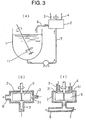
- Figure 3 is a schematic diagram of a circulatory batch type reaction apparatus.
- Figure 4 is a schematic diagram of a continuous inflow type reaction apparatus.
- the numerical symbols respectively denote a reactor (1), a mechanical stirrer (11), a mixer (2), a draft tube (20), an opening (21 and 22), a flow regulating plate (23), a reaction solution supply tube (3 and 4), a sunken nozzle or slit opening (31 and 41), and a mixer stirrer (5).
- a production apparatus suiting the production method described above is selected. Three types of apparatus for production of ultrafine gold and/or silver chalcogenide are available.
- Type 1 is configured with a sunken nozzle, which is immersed in a protective colloid solution filling the reactor and performs separate injection of a solution of a water-soluble gold compound and/or a silver compound and a solution of a water-soluble chalcogenide, and a mixer, which is equipped with a high speed axial flow mechanical stirrer housed therein and in which the compound solution and chalcogenide solution are injected and thinned with the protective colloid solution and simultaneously mixed rapidly, the resulting mixture is discharged into the protective colloid solution in the reactor and subjected to axial flow stirring.
- Type 2 is configured with a reactor, which is filled with a protective colloid solution and equipped with a mechanical stirrer, and an outside mixer, which is connected to the reactor via a solution circulating tube and equipped with a mixing chamber having injection slit openings respectively for a solution of a water-soluble gold compound and/or a silver compound, a solution of a water-soluble chalcogenide and, where necessary, a protective colloid solution and with a mechanical stirrer, in which the compound solution, chalcogenide solution and, where necessary, protective colloid solution are simultaneously into the mixing chamber and rapidly mixed therein, and the resulting mixture is circulated and stirred between the reactor and the mixer.
- Type 3 is configured with a reactor, which is filled with a protective colloid solution and equipped with a mechanical stirrer, an outside discharge injection tube connected to the reactor, and a mixer, which is equipped with a mixing chamber having injection slit openings respectively for a solution of a water-soluble gold compound and/or a silver compound, a solution of a water-soluble chalcogenide and, where necessary, a protective colloid solution, and with a mechanical stirrer, in which the compound solution, chalcogenide solution and, where necessary, protective colloid solution are simultaneously injected into the mixing chamber and rapidly mixed, and the resulting mixture is continuously discharged into the reactor and stirred therein.
- the solution of a water-soluble gold compound or silver compound or the mixed solution of the two compounds in a selected ratio be prepared in the presence of a sufficient amount of protective colloid to prevent the formation of aggregates whose composition and structure are unknown or changeable at too high compound concentrations.
- the optimum levels of pH, pAg, pAu, temperature, protective colloid concentration, reaction time and other factors are selected according to the composition and size of the chalcogenide to be formed in view of the actual sensitizing effect.
- the size of the gold and silver chalcogenides formed appears to be significantly affected by adsorption of low molecular substances, interaction with solvents ; too complex and severe substance concentration circumstances, such as those of dispersing agents for stable dispersion, are undesirable.
- the technique of the present invention described above makes it possible to optionally prepare a gold and/or silver chalcogenides, particularly gold sulfide, silver sulfide or a gold-silver complex sulfide, of not more than 10nm (100 ⁇ ) in grain size, in separate liquid suspension systems, seed it as a sensitivity speck substance with a varying or constant electron trapping capability to silver halide crystals at a given density and obtain the desired sensitivity in a short time with high reliability instead of chemical sensitization.
- This technique also makes it possible to avoid side reactions such as harmful fogging inevitable in chemical sensitization.
- sensitization speck substance is previously formed singly in a liquid suspension system and seeded onto the silver halide crystals as sensitization specks rather than forming sensitization specks from the chemical sensitization centers on silver halide crystals.
- the essential requirements are to integrate or divide the resulting chalcogenide grains to a size of sensitivity speck unit aggregates, to provide solution conditions ensuring a regular sensitivity speck atom arrangement (e.g., basket structure for microclusters) without causing excess dissolution or decomposition of the unit aggregates, and to prevent excess flocculation of the unit aggregates to ensure stable dispersion, i.e., to use a protective colloid, to control ion concentration during grain formation, and to employ a reaction apparatus capable of controlling temperature, controlling the amount of addition and performing instantaneous mixing.
- the inventors made investigations as to these items and succeeded in controlling the grain size of the ultrafine grains and achieving monodispersion.
- Commonly known methods of forming silver sulfide include reaction of hydrogen sulfide and silver nitrate, reaction of sodium sulfide and silver nitrate and reaction of sodium thiosulfate and silver sulfate.
- Selenium and tellurium known to have a sensitizing effect, and mixtures thereof, can be used in place of sulfur; all these substances make it possible to obtain useful sensitivity speck unit aggregates (hereinafter referred to as fine grains) by the use of the method of the present invention.
- any substance can be used as a cationic component of the reaction reagent used for the present invention, as long as it is a water-soluble silver compound, it is the common practice to use an aqueous solution of silver nitrate.
- a water-soluble gold compound chloroauric acid, gold dimethylrhodanine or, where necessary, a mixture of chloroauric acid and rhodan ammon may be used.
- aqueous solutions of sulfide as an anionic component include hydrogen sulfide, alkali sulfide, thiourea, thiourea derivatives, rhodanines, oxazolidines, polysulfides, selenoureas and dithiacarbaminic acids.
- a protective colloid is used as in the production of photographic emulsion grains.
- Protective colloid concentration is normally not less than 1% by weight, preferably not less than 2% by weight. When the fine grain density is high, protective colloid concentration is preferably not less than 5% by weight.
- protective colloid gelatin and other synthetic polymers can be used; examples are described in Term IX of Research Disclosure,176,No. 17643 (December 1978).
- Temperature at which the above fine grains are formed is a factor determining the speed of their growth and the number of nuclei formed; usually, the growth speed increases as temperature rises. Therefore, for obtaining finer grains, temperature is preferably under 80°C, more preferably under 60°C, and still more preferably under 40°C. At temperatures below 35°C, it is preferable to use low molecular gelatin with a molecular weight of not more than 30000 because ordinary gelatin is likely to set at these temperatures; for example, the method described in Japanese Patent Application No. 314893/1990, which uses a mixture of high molecular gelatin and low molecular gelatin, is also preferred. For the purpose of reducing the settability, salt and acid may be used.
- pH and ion concentration are important in regulating the solubility of said fine grains. These parameters determine the speed of grain growth and the number of nuclei formed so that they are important in obtaining uniform grain size.
- a uniform grain size can be obtained by a modification of a production method for monodispersed grains of silver halide crystal.
- it is preferable to rapidly grow grains within the range not exceeding the critical supersaturation level by the method described in US Patent No. 1,535,016 and Japanese Patent Examined Publication Nos. 36890/1973 and 16364/1977, in which the rate of addition of the reaction solution is changed according to the speed of grain growth, or the method described in US Patent No. 4,242,445 and Japanese Patent O.P.I. Publication No. 15814/1980, in which reaction solution concentration is changed.
- pH may be changed to control hydrogen sulfide dissociation, and silver ion concentration to control the silver ion content in the solution.
- the size of fine grains is optionally controlled according to the present invention, it is generally known that fogging occurs when the sensitivity speck has too great a grain size; it is preferable to regulate the size of sensitivity speck unit aggregates to not more than 10 nm (100 ⁇ ), more preferably not more than 6 nm (60 ⁇ ).
- the fine grains of silver halide are chemically sensitized by the seeding method relating to the present invention.
- this chemical sensitization it can be carried out at ordinary temperatures, though the conditions cannot be determined absolutely, depending on the adsorption conditions for the sensitizing dyes used in combination in the color light-sensitive material and on whether or not it is necessary to limit the sites where the fine grains are adsorbed.
- a sensitizing dye it may be added at any time, whether before, after or simultaneously with addition of the fine grains.
- Limitation of sites may be performed after the silver halide has been coated with an adsorbent; a sensitizing dye is suitable for this purpose, but other adsorbents, such as azaindenes and heterocyclic compounds having a mercapto group, are also effective.
- This site limitation can also be achieved by the use of a solvent for silver halide.
- solvents include thiocyanic acids, thioether and telluroether, with preference given to HSCN, NH 4 SCN, etc.
- these additives may be added before, after or simultaneously with addition of the fine grains, it is preferable to add them before the fine grains are added. As for how to supply the fine grains to silver halide, they may be added instantaneously or gradually over a long period.
- reaction apparatus used for the present invention is described below.
- axial flow batch type in which axial flow stirring is conducted
- circulatory batch type in which circulatory stirring is conducted
- continuous inflow type in which a mixture is fed.
- Figure 1 is a schematic diagram of an axial flow batch type reaction apparatus.
- the mechanical stirrer used may be simple in that the draft tube illustrated in Figure 1 is not used, it is preferable to use the draft tube to regulate the circulatory flow in the reactor to ensure higher efficiency of stirring.
- the impeller blade used may be of any type, such as the paddle type, turbine type and propeller type, and two or more impeller blades may be used. The use of two or more impeller blades is seen in the case where the stirring action is enhanced or the mixing of reaction solutions and the circulation of the bulk flow in the reactor are separately performed. An example of this case is illustrated in Figure 2.
- a baffle in the reactor which is effective in enhancing the stirring action.
- detailed information is seen in literature in chemical engineering, including "Kagaku Kogaku Binran" (Maruzen, 5th ed., pp. 891-910).
- reaction solutions may be added via the surface unlike the method of Figure 1, it is preferable from the viewpoint of stable uniform mixing to add them in liquid system; it is more preferable to use the method disclosed in Japanese Patent O.P.I. Publication Nos. 67535/1984 and 160127/1987; it is still more preferable to add a single reaction solution in a plurality of separate injection systems as disclosed in Japanese Patent O.P.I. Publication No. 160128/1987.
- the position where the reaction solution is added is closely associated with the mechanical stirrer used.
- Figure 3 is a schematic diagram of a reaction apparatus of the circulatory batch type.
- This type is based on the method in which an aqueous solution of protective colloid is circulated in the reactor from the bottom of the reactor by a pump, each reaction solution is supplied to a mixer provided in this circulatory system, and the reaction solutions are rapidly mixed in the mixer to prepare fine grains.
- the method of addition and the shape of the mixer various options are possible as with the axial flow batch type. As a preferred mode of embodiment, it is preferable to supply a single reaction solution at a number of sites; and the addition apparatus described in Japanese Patent O.P.I. Publication No. 160127/1987 is recommended. With respect to the position of addition, the same applies as with the axial flow batch type.
- the mechanical stirrer in the mixer circulation is achieved by a pump unlike the axial flow batch type; therefore, it can be selected from a wider range; it is preferable to use a paddle or turbine blade, which is based on shearing action, rather than propellers and inclined paddles, which are based on discharge action.
- the means of stirring in the reactor it can be selected from a still wider range, since the reaction itself is not carried out thereby, but it is preferable to provide a baffle in the reactor or attach an inclined propeller blade to the reactor in consideration of bubble swirling etc.
- Another preferred method is to use a mixer as illustrated in Figure 3 (c), a modification of the reactor of the circulatory batch type. This type is categorized under the following continuous inflow type.
- Figure 4 is a schematic diagram of a continuous inflow type reaction apparatus.
- mixer and reactor for reaction solutions With respect to the supplying means, mixer and reactor for reaction solutions, the same can be selected as with the reaction apparatus of the circulatory batch type.
- the axial flow batch type and the circulatory batch type are both based on the double jet method, but they are accompanied by growth of fine grains because the grains are circulated during reaction.
- the continuous inflow type is the best choice to form very fine grains because it does not involve grain circulation.
- very uniform fine grains can be formed by releasing the mixture into the reactor.
- the fine grains of gold and/or silver chalcogenide of known composition, size and content ratio obtained by the present invention, as a liquid phase suspension system, are added to silver halide emulsion and seeded to silver halide crystals to allow free control of the distribution density of sensitivity specks, thus offering very great practical and technical advantages.
- the silver halide emulsion subjected to seeding sensitization with said fine grains is applicable to any light-sensitive material, whether it is a negative or positive film, a black-and-white or color film, a printing process film, a printing paper, or an X-ray photographic film, and whether it is prepared by the acidic method, the neutral method or the ammoniacal method.
- the fine grains of the present invention are suitable to seeding due to affinity of sensitivity speck unit aggregates and silver halide ion crystals, and can be used universally, irrespective of the composition, crystalline system, crystal habit, grain size, dispersibility (mono- or poly-dispersion), grain structure (core/shell structure or uniform structure) of the silver halide.
- Distilled water was added to make a total quantity of 200 cc.
- reaction apparatus A reaction chamber having an inside capacity of about 600 cc and a semi-spherical base was used in combination with a 45° inclined paddle equipped with four impeller blades of 35 mm in diameter of the upper discharge type. To prevent vortex flow and bubble swirling, two baffles were attached.
- Solution C was added to the reactor equipped with the impeller blades and stirred at constantly 35°C at a stirring rotation rate of 650 rpm. Then, solutions B and A were simultaneously supplied to the mixer in the reactor over a period of 40 minutes, while keeping the pH and silver potential at 7.5 and -100 mV, respectively.
- Solutions A, B and C were prepared in the same manner as in Example 1.
- Reaction apparatus A reactor having an inside capacity of about 600 cc and a semi-spherical base was used in combination with a 45° inclined paddle equipped with four impeller blades of over 35 mm in diameter of the upper discharge type and a draft tube ( Figure 1).
- Solution C was added to the reactor equipped with the impeller blades and stirred at constantly 35°C at a stirring rotation rate of 650 rpm. Then, solutions A and B were simultaneously supplied to the mixer in the reactor over a period of 40 minutes, while keeping the pH and silver potential'at 7.5 and -100 mV, respectively.
- Solutions A and B were prepared in the same manner as in Example 1. 10 g of low molecular gelatin with an average molecular weight of 10000 was diluted with distilled water to yield 200 cc of solution C. The reaction apparatus used was the same as in Example 2.
- Solution C was added to the reactor equipped with the impeller blades and stirred at constantly 10°C at a stirring rotation rate of 650 rpm. Then, solutions A and B were simultaneously supplied to the mixer over a period of 40 minutes, while keeping the pH and silver potential at 8.0 and -100 mV, respectively.
- Solution C was added to the reactor and stirred at constantly 35°C at a stirring rotation rate of 650 rpm. Then, solution A was added, followed by several minutes of mixing, after which solution B was rapidly added.
- Solution C was added to the reactor and stirred at constantly 35°C at a stirring rotation rate of 650 rpm. Then, solution B was added, followed by several minutes of mixing, after which solution A was rapidly added.
- Solutions A, B and C were cooled to 4°C in ice water, after which solution A was added to the same reaction apparatus as in Example 1 and stirred. Then, composition B was rapidly added while keeping the temperature at 4°C, and solution C was added with stirring.
- Comparative Examples 1 and 2 have a very broad distribution, comprising larger grains and smaller grains. It is therefore impossible to obtain their accurate average grain size because of a wide difference among view fields.
- the sulfides thiourea and 1-thiazolylthiourea were used in solution, when grains were formed under conditions permitting their reaction, the grains formed had almost the same grain size and grain size distribution.
- fine grains with clearly uniform grain size distribution can be formed by controlling grain formation conditions, as stated above. Also, for controlling average grain size, it can be reduced by forming grains at low temperature as in Example 3. In that case, low molecular gelatin is used, since high molecular gelatin (molecular weight over 100000), in common use, sets at about 30°C, though the setting temperature varied depending on the molecular weight and kind thereof. This can also be achieved by regulating the concentration of various ions, as well as the feed rates and pH levels of the reaction solutions.
- Solutions B and C were prepared in the same manner as in Example 1. Separately, the following solutions A-1 and A-2 were prepared.
- the reaction apparatus used was the same as in Example 2.
- Solution C was added to the reactor equipped with the impeller blades and stirred at constantly 35°C at a stirring rotation rate of 650 rpm.
- solutions B, A-1 and A-2 were simultaneously supplied to the mixer in the reactor over a period of 40 minutes, while keeping the pH and silver potential at 7.5 and -100 mV, respectively.
- Solutions B and C were prepared in the same manner as in Example 1. Separately, the following solutions A-1 and A-2 were prepared.
- Solution A-1 Silver nitrate 0.2 mol/l solution 50 cc
- Solution A-2 Chloroauric acid (HAuCl 4 ) 0.2 mol/l solution 50 cc
- the reaction apparatus used was the same as in Example 2.
- Solution C was added to the reactor equipped with the impeller blades and stirred at constantly 35°C at a stirring rotation rate of 650 rpm.
- solutions B, A-1 and A-2 were simultaneously supplied to the reactor over a period of 40 minutes, while keeping the pH and silver potential at 7.5 and -100 mV, respectively.
- Solutions B and C were prepared in the same manner as in Example 1. Separately, the following solutions A-1 and A-2 were prepared.
- Solution A-1 Silver nitrate 0.35 mol/l solution 50 cc
- Solution A-2 Chloroauric acid (HAuCl 4 ) 0.05 mol/l solution 50 cc
- the reaction apparatus used was the same as in Example 2.
- Solution C was added to the reactor equipped with the impeller blades and stirred at constantly 35°C at a stirring rotation rate of 650 rpm.
- solutions B, A-1 and A-2 were simultaneously supplied to the reactor over a period of 40 minutes, while keeping the pH and silver potential at 7.5 and -100 mV, respectively.
- Average grain size and grain size distribution were determined for 1000 grains.
- Emulsion Em-A used in the example, was prepared as follows.
- Emulsion solution a-4 containing fine grains of AgI (average grain size 0.06 ⁇ m)
- Stock solution of fine grains of AgI (containing 45.6 g gelatin/mol AgI) (1467 ml/mol AgI) 1239 ml 4-hydroxy-6-methyl-1,3,3a,7-tetrazaindene 5.22 g
- aqueous solution a-1 While vigorously stirring the aqueous solution a-1 with the above composition at a temperature of 60°C, a monodispersed silver iodobromide emulsion of 0.27 ⁇ m in average grain size containing 2 mol% silver iodide, in an amount equivalent to 0.407 mol, as seed grains, was added, and the mixture was adjusted to appropriate pH and pAg levels with acetic acid and an aqueous solution of KBr.
- aqueous solutions a-2, a-3 and a-4 were simultaneously added; the resulting emulsions were desalinized and washed.
- a monodispersed emulsion Em-A having an average grain size of 0.8 ⁇ m and an average silver iodide content of 8.0 mol%, was thus obtained.
- Powder X-ray diffraction analysis identified this emulsion as having a core having an AgI content of 35 mol%.
- Emulsion A-0 2.0 x 10 -6 mol/mol AgX sodium thiosulfate was added to emulsion Em-A, adjusted to a pAg of 8.0 and kept at 60°C, followed by ripening at 60°C for 120 minutes.
- the resulting emulsion obtained by this conventional method is referred to as emulsion A-0.
- Emulsions A-0 through A-7 were spectrally sensitized with a combination of three sensitizing dyes.
- Emulsions B-1 through B-7 and emulsions C-1 through C-7 were prepared in the same manner as above except that the amount of UF-1 through UF-7 were increased to respectively 5 times and 10 times those for A-1 through A-7.
- emulsions B-0 and C-0 were prepared in the same manner as above except that the amount of sodium thiosulfate was increased to respectively 5 times and 10 times that for A-0.
- the amounts of spectral sensitizers used in these emulsions were the same as with A-0 through A-7 without exception.
- Each sample was subjected to exposure with green light through an optical wedge by an ordinary method and subjected to an ordinary color developing process, after which their photographic performance was evaluated.
- Sensitivity was defined as the reciprocal of the exposure amount which provides a density equivalent to fogging density + 0.1.
- the fine grains of silver sulfide of the present invention have a clear sensitizing effect. Specifically, they were found photographically sensitive even at any dilution rate of 1, 5 and 10 times, while the comparative samples, except for A-6, B-6 and C-4 through C-7, had no sensitivity.
- the sensitivity obtained in the 10-times diluted sample is probably thanks to some contribution of a few fine grains among the grains with very broad distribution.
- a noticeable feature of the series of A-6, B-6 and C-6, all of which had sensitivity, is abnormally high fogging. This is probably because of the presence of excess silver nitrate, i.e., formation of silver nuclei, in forming the silver sulfide.
- Emulsion Em-A adjusted to a pAg of 8.0, was first subjected to the following sensitization for comparison.
- Sensitivity was defined as the reciprocal of the exposure amount which provides a density equivalent to fogging density + 0.1.
- the use of the fine grains of gold and/or silver compound of the present invention offers higher photographic sensitivity and reduced fogging in comparison with the comparative emulsion samples.
- sensitivity control and sensitization can be achieved with no fogging by seeding sensitization of silver halide crystals with the ultrafine grains of sensitivity speck substance of the present invention formed in separate liquid suspension systems.
- the present invention is directed to provide an ultrafine gold and/or silver chalcogenide which can be used for the sensitivity speck seeding sensitization method, in which sensitivity speck substances with known size and composition prepared in separate liquid suspensions, are distributed at a given density on the silver halide crystal plane, and a method and apparatus for production thereof, wherein said chalcogenide, which is a sulfur compound, is produced by simultaneously adding a solution of a water-soluble gold compound and/or a silver compound and a solution of a water-soluble chalcogenide to a flowing protective colloid solution under reaction conditions selected according to the combination of the two seed solutions in a mixing ratio based on the reaction equivalence of the two seed solutions to yield a gold and/or silver chalcogenide with ultrafine grain size.
- said chalcogenide which is a sulfur compound
Landscapes
- Chemical & Material Sciences (AREA)
- Organic Chemistry (AREA)
- Inorganic Chemistry (AREA)
- Physics & Mathematics (AREA)
- Spectroscopy & Molecular Physics (AREA)
- Chemical Kinetics & Catalysis (AREA)
- Engineering & Computer Science (AREA)
- Materials Engineering (AREA)
- General Physics & Mathematics (AREA)
- Non-Silver Salt Photosensitive Materials And Non-Silver Salt Photography (AREA)
- Manufacture Of Metal Powder And Suspensions Thereof (AREA)
- Luminescent Compositions (AREA)
Description
- The present invention relates to a method of production, in liquid suspension, of an ultrafine gold and/or silver chalcogenide involved in sensitization of silver halide used in photographic light-sensitive materials, specifically gold sulfide, silver sulfide and a gold-silver complex sulfide.
- In photographic chemistry, sulfur sensitization with a sulfur compound, gold-sulfur sensitization with a gold-sulfur compound and gold sensitization with a gold compound are widely known as sensitizing methods for silver halide grains.
- It is a well-known practice to chemically sensitize silver halide emulsion; electron microscopic observation of silver sulfide resulting from chemical sensitization has been reported, for example, by G. C. Furnell, P. B. Flint and D. C. Berch [Journal of Photographic Science, 25, 203 (1977)]. As reported in these reports, the size of fine grains of silver sulfide is very small of the order of several Å to a few dozen Å, and they are abundantly present on silver halide grains.
- The basic requirements of the performance of photographic silver halide grains are high sensitivity, low fogging and fine graininess.
- A basic approach to the obtainment of high sensitivity emulsion comprising fine grains is to increase the photon efficiency in the light sensitizing process. Possible factors hampering the increase in photon efficiency include the presence of competitive electron traps originating from re-bonding, latent image dispersion, structural failure, lattice defects,etc. Sulfur sensitization and gold-sulfur sensitization are thought to act to provide the electron capturing center in the light sensitizing process. It is therefore important in sensitizing treatments to adjust the size, position and number of sensitivity specks serving as such light sensitization centers. Methods of controlling this position and number are reported or proposed in Japanese Patent Publication Open to Public Inspection (hereinafter referred to as Japanese Patent O.P.I. Publication) Nos. 9344/1986, 40938/1989, 62631/1989, 62632/1989, 74540/1989, 158425/1989, 34/1990 and 298935/1990.
- However, all these methods aim at controlling the position of formation of the silver sulfide or gold-silver complex sulfide described above, and their size and number depend on the limited position (area), with no direct control of the size or number of silver sulfide, gold sulfide or complex nuclei thereof.
- This is because the grains are very fine at the order of several Å to a few dozen Å as stated above, and because the size and number are significantly affected by the site and area of formation of silver sulfide on the silver halide crystal plane.
- On the other hand, some methods have been proposed which are based on techniques different from those of ordinary chemical sensitization.
- For example, Japanese Patent O.P.I. Publication No. 93447/1986 describes a sensitizing method in which not more than 10-3 mol/mol AgX fine grains of silver sulfide or gold sulfide are formed at specific points in silver halide crystals, but it gives no specific description about the size or number thereof.
- Japanese Patent O.P.I. Publication No. 198443/1990 describes sensitization of silver halide grains by the addition of fine grains of silver sulfide zol thereto. However, this publication gives no description of the grain size of the silver sulfide zol obtained, describing nothing other than the luminescence spectrum of the silver sulfide zol. Nor is specified the grain size distribution. As recognized commonly, coloring with colloid grains varies widely depending on the size, chemical species and surface condition thereof; it is impossible to specify the size and distribution of colloid grains solely by their spectrum. Therefore, when this method is used, it remains unknown how many specks have been arranged on the silver halide crystal because the grain size is unknown.
- As stated above, despite the fact that the size and number of fine grains of silver sulfide, gold sulfide, etc. on silver halide crystals are critical factors in the light sensitizing process, they remain out of control. This is because their size is too small; to date, no one has ever succeeded in controlling the size and number of these grains.
- On the other hand, assemblies of 2 to a few hundred atoms, called microclusters, are known, whose substance phase is a transition phase not categorized under any of solid, liquid and gas, in which almost all atoms are located on the surface of the basket-like assembly. For this reason, some electrons are not involved in bonding but generally active in a non-localized state, making the assembly highly reactive at points of particular numbers of atoms (called the magic numbers.of microclusters). In short, the size of cluster plays a key role in the activity thereof.
- In the 1980's, Richard E. Smalley, Vlandimir E. Bondybey et al. succeeded in forming a cluster by the laser evaporation method.
- Another microcluster, stable as a Synthol compound ion, is also known.
- Although much remains unknown as to these microclusters and behavior thereof, they draw attention as providing an important hint for silver halide sensitization, sensitivity speck formation in the light sensitizing process, sensitivity speck behavior or growth to developing specks, etc.
- In view of the technical background described above, the object of the present invention is to provide an ultrafine gold aid/or silver chalcogenide which can be used for the sensitivity speck seeding sensitization method, in which separately prepared liquid suspensions of sensitivity speck substances with known size and composition are distributed on the silver halide crystal plane at a given density, a method of production thereof and an apparatus for production thereof.
- The object described above is accomplished by a method for producing a chalcogenide of at least one of gold and silver by preparing a first solution of a water soluble compound of at least one of gold and silver, and a second solution of a water soluble chalcogenide, and mixing the first and second solutions with a protective colloid solution, in which the first and second solutions are simultaneously injected into the protective colloid solution and the mixing of the first, second and protective colloid solutions is effected whereby to produce a chalcogenide product having a coefficient of variation of less than 0.16; the coefficient of variation being defined as the value obtained by dividing the standard deviation of grain size of the chalcogenide product by its average gain size.
- The chalcogenide described above is a sulfur family compound.
- The gold and/or silver chalcogenide, particularly gold sulfide, silver sulfide or a gold-silver complex sulfide, obtained by the production method described above, which has an ultrafine grain size of not more than 10 nm (100 A) on average and is monodispersed to such extent that the coefficient of variance of grain size is not more than 0.16, offer high practical applicability, suiting the object of the present invention. The production method described above is of course preferably applicable to sulfides.
- Figures 1 and 2 are schematic diagrams of an axial flow batch type reaction apparatus. Figure 3 is a schematic diagram of a circulatory batch type reaction apparatus. Figure 4 is a schematic diagram of a continuous inflow type reaction apparatus.
- In these figures, the numerical symbols respectively denote a reactor (1), a mechanical stirrer (11), a mixer (2), a draft tube (20), an opening (21 and 22), a flow regulating plate (23), a reaction solution supply tube (3 and 4), a sunken nozzle or slit opening (31 and 41), and a mixer stirrer (5).
- A production apparatus suiting the production method described above is selected. Three types of apparatus for production of ultrafine gold and/or silver chalcogenide are available.
-
Type 1 is configured with a sunken nozzle, which is immersed in a protective colloid solution filling the reactor and performs separate injection of a solution of a water-soluble gold compound and/or a silver compound and a solution of a water-soluble chalcogenide, and a mixer, which is equipped with a high speed axial flow mechanical stirrer housed therein and in which the compound solution and chalcogenide solution are injected and thinned with the protective colloid solution and simultaneously mixed rapidly, the resulting mixture is discharged into the protective colloid solution in the reactor and subjected to axial flow stirring. -
Type 2 is configured with a reactor, which is filled with a protective colloid solution and equipped with a mechanical stirrer, and an outside mixer, which is connected to the reactor via a solution circulating tube and equipped with a mixing chamber having injection slit openings respectively for a solution of a water-soluble gold compound and/or a silver compound, a solution of a water-soluble chalcogenide and, where necessary, a protective colloid solution and with a mechanical stirrer, in which the compound solution, chalcogenide solution and, where necessary, protective colloid solution are simultaneously into the mixing chamber and rapidly mixed therein, and the resulting mixture is circulated and stirred between the reactor and the mixer. -
Type 3 is configured with a reactor, which is filled with a protective colloid solution and equipped with a mechanical stirrer, an outside discharge injection tube connected to the reactor, and a mixer, which is equipped with a mixing chamber having injection slit openings respectively for a solution of a water-soluble gold compound and/or a silver compound, a solution of a water-soluble chalcogenide and, where necessary, a protective colloid solution, and with a mechanical stirrer, in which the compound solution, chalcogenide solution and, where necessary, protective colloid solution are simultaneously injected into the mixing chamber and rapidly mixed, and the resulting mixture is continuously discharged into the reactor and stirred therein. - In the production method of the present invention, it is necessary that the solution of a water-soluble gold compound or silver compound or the mixed solution of the two compounds in a selected ratio be prepared in the presence of a sufficient amount of protective colloid to prevent the formation of aggregates whose composition and structure are unknown or changeable at too high compound concentrations.
- As for mixing reaction conditions, the optimum levels of pH, pAg, pAu, temperature, protective colloid concentration, reaction time and other factors are selected according to the composition and size of the chalcogenide to be formed in view of the actual sensitizing effect.
- It is also preferable to suppress the excess of either component within the range of ± 10%, based on reaction equivalence as a reference mixing ratio, in view of the microcluster structure having non-localized electrons and the fact that the presence of a too large amount of the reaction compound not involved in bonding can degrade the activity of the gold and/or silver chalcogenide formed.
- The size of the gold and silver chalcogenides formed appears to be significantly affected by adsorption of low molecular substances, interaction with solvents ; too complex and severe substance concentration circumstances, such as those of dispersing agents for stable dispersion, are undesirable.
- The technique of the present invention described above makes it possible to optionally prepare a gold and/or silver chalcogenides, particularly gold sulfide, silver sulfide or a gold-silver complex sulfide, of not more than 10nm (100 Å) in grain size, in separate liquid suspension systems, seed it as a sensitivity speck substance with a varying or constant electron trapping capability to silver halide crystals at a given density and obtain the desired sensitivity in a short time with high reliability instead of chemical sensitization. This technique also makes it possible to avoid side reactions such as harmful fogging inevitable in chemical sensitization.
- Concerning the constitutional requirements of the present invention, there was a problem to be solved, i.e., it remained impossible to control the size and distribution of ultrafine grains of gold and/or silver chalcogenide because their chemical sensitization requires strictness associated with their fineness. Specifically, the prior art methods are often affected by the base of silver halide grains because the chemical sensitization centers serving as sensitization specks are formed on the surface of the silver halide grains, which hampers efficient control of chemical sensitization due to complication of too many factors. Thus, the present inventors attempted to use a new method in which these complicating factors are first separated, a sensitization speck substance is previously formed singly in a liquid suspension system and seeded onto the silver halide crystals as sensitization specks rather than forming sensitization specks from the chemical sensitization centers on silver halide crystals.
- However, with respect to ultrafine grains of gold and/or silver chalcogenide, no records are available even on their size, as stated above, nor has anyone attempted to produce monodispersed grains with narrow distribution. Although the above-mentioned Japanese Patent O.P.I. Publication No. 198443/1990 may be mentioned as a rare case associated with such grains, even this publication does not specify the grain size. Moreover, it described nothing more than very unclear grain formation conditions, e.g., instantaneous addition of silver nitrate to an aqueous solution of sodium sulfide, followed by addition of an inhibitor. In view of these circumstances, the inventors analyzed various methods which had long been employed for production of silver halide grains, and found a useful combination of essential requirements with new consideration. Specifically, the essential requirements are to integrate or divide the resulting chalcogenide grains to a size of sensitivity speck unit aggregates, to provide solution conditions ensuring a regular sensitivity speck atom arrangement (e.g., basket structure for microclusters) without causing excess dissolution or decomposition of the unit aggregates, and to prevent excess flocculation of the unit aggregates to ensure stable dispersion, i.e., to use a protective colloid, to control ion concentration during grain formation, and to employ a reaction apparatus capable of controlling temperature, controlling the amount of addition and performing instantaneous mixing. The inventors made investigations as to these items and succeeded in controlling the grain size of the ultrafine grains and achieving monodispersion.
- To achieve monodispersibility in the present invention, it is necessary to keep the coefficient of variance below 0.16, as defined as the value obtained by dividing the standard deviation S of grain size by the average grain size r.
- Commonly known methods of forming silver sulfide include reaction of hydrogen sulfide and silver nitrate, reaction of sodium sulfide and silver nitrate and reaction of sodium thiosulfate and silver sulfate.
- Selenium and tellurium, known to have a sensitizing effect, and mixtures thereof, can be used in place of sulfur; all these substances make it possible to obtain useful sensitivity speck unit aggregates (hereinafter referred to as fine grains) by the use of the method of the present invention. Although any substance can be used as a cationic component of the reaction reagent used for the present invention, as long as it is a water-soluble silver compound, it is the common practice to use an aqueous solution of silver nitrate. As a water-soluble gold compound, chloroauric acid, gold dimethylrhodanine or, where necessary, a mixture of chloroauric acid and rhodan ammon may be used. Examples of aqueous solutions of sulfide as an anionic component include hydrogen sulfide, alkali sulfide, thiourea, thiourea derivatives, rhodanines, oxazolidines, polysulfides, selenoureas and dithiacarbaminic acids.
- Some of them are insoluble in water and should be solubilized as far as possible, using acid or another means. This is important in controlling the flocculation of fine grains described below. However, although thiazolylthiourea, for instance, is sparingly soluble in water and easily soluble in methanol, even its solution in methanol permits production of fine grains by the method of the present invention. In this case, such production can be achieved, as long as the amount of methanol does not exceed 10% by weight during and after grain formation. In other words, fine grains can be formed, as long as conditions are set to avoid grain flocculation.
- To suppress the flocculation and growth of fine grains of silver sulfide, i.e., to achieve stable dispersion, a protective colloid is used as in the production of photographic emulsion grains. Protective colloid concentration is normally not less than 1% by weight, preferably not less than 2% by weight. When the fine grain density is high, protective colloid concentration is preferably not less than 5% by weight. As protective colloid, gelatin and other synthetic polymers can be used; examples are described in Term IX of Research Disclosure,176,No. 17643 (December 1978).
- Temperature at which the above fine grains are formed is a factor determining the speed of their growth and the number of nuclei formed; usually, the growth speed increases as temperature rises. Therefore, for obtaining finer grains, temperature is preferably under 80°C, more preferably under 60°C, and still more preferably under 40°C. At temperatures below 35°C, it is preferable to use low molecular gelatin with a molecular weight of not more than 30000 because ordinary gelatin is likely to set at these temperatures; for example, the method described in Japanese Patent Application No. 314893/1990, which uses a mixture of high molecular gelatin and low molecular gelatin, is also preferred. For the purpose of reducing the settability, salt and acid may be used.
- Among the other parameters of fine grain formation, pH and ion concentration are important in regulating the solubility of said fine grains. These parameters determine the speed of grain growth and the number of nuclei formed so that they are important in obtaining uniform grain size.
- A uniform grain size can be obtained by a modification of a production method for monodispersed grains of silver halide crystal. In other words, it is preferable to rapidly grow grains within the range not exceeding the critical supersaturation level by the method described in US Patent No. 1,535,016 and Japanese Patent Examined Publication Nos. 36890/1973 and 16364/1977, in which the rate of addition of the reaction solution is changed according to the speed of grain growth, or the method described in US Patent No. 4,242,445 and Japanese Patent O.P.I. Publication No. 15814/1980, in which reaction solution concentration is changed.
- For example, when using hydrogen sulfide and silver nitrate, pH may be changed to control hydrogen sulfide dissociation, and silver ion concentration to control the silver ion content in the solution.
- Although the size of fine grains is optionally controlled according to the present invention, it is generally known that fogging occurs when the sensitivity speck has too great a grain size; it is preferable to regulate the size of sensitivity speck unit aggregates to not more than 10 nm (100 Å), more preferably not more than 6 nm (60 Å).
- By mixing the fine grains of gold sulfide, silver sulfide or gold-silver complex sulfide obtained in the manner described above with fine grains of silver halide, the fine grains of silver halide are chemically sensitized by the seeding method relating to the present invention. As for conditions of this chemical sensitization, it can be carried out at ordinary temperatures, though the conditions cannot be determined absolutely, depending on the adsorption conditions for the sensitizing dyes used in combination in the color light-sensitive material and on whether or not it is necessary to limit the sites where the fine grains are adsorbed. When using a sensitizing dye, it may be added at any time, whether before, after or simultaneously with addition of the fine grains. Limitation of sites may be performed after the silver halide has been coated with an adsorbent; a sensitizing dye is suitable for this purpose, but other adsorbents, such as azaindenes and heterocyclic compounds having a mercapto group, are also effective. This site limitation can also be achieved by the use of a solvent for silver halide. Examples of such solvents include thiocyanic acids, thioether and telluroether, with preference given to HSCN, NH4SCN, etc. Although these additives may be added before, after or simultaneously with addition of the fine grains, it is preferable to add them before the fine grains are added. As for how to supply the fine grains to silver halide, they may be added instantaneously or gradually over a long period.
- The reaction apparatus used for the present invention is described below.
- Three types are available: the axial flow batch type, in which axial flow stirring is conducted, the circulatory batch type, in which circulatory stirring is conducted, and the continuous inflow type, in which a mixture is fed. Axial flow batch type
- Figure 1 is a schematic diagram of an axial flow batch type reaction apparatus.
- Although the mechanical stirrer used may be simple in that the draft tube illustrated in Figure 1 is not used, it is preferable to use the draft tube to regulate the circulatory flow in the reactor to ensure higher efficiency of stirring. The impeller blade used may be of any type, such as the paddle type, turbine type and propeller type, and two or more impeller blades may be used. The use of two or more impeller blades is seen in the case where the stirring action is enhanced or the mixing of reaction solutions and the circulation of the bulk flow in the reactor are separately performed. An example of this case is illustrated in Figure 2. When using no draft tube, it is more common to use a baffle in the reactor, which is effective in enhancing the stirring action. In this regard, detailed information is seen in literature in chemical engineering, including "Kagaku Kogaku Binran" (Maruzen, 5th ed., pp. 891-910).
- Although the reaction solutions may be added via the surface unlike the method of Figure 1, it is preferable from the viewpoint of stable uniform mixing to add them in liquid system; it is more preferable to use the method disclosed in Japanese Patent O.P.I. Publication Nos. 67535/1984 and 160127/1987; it is still more preferable to add a single reaction solution in a plurality of separate injection systems as disclosed in Japanese Patent O.P.I. Publication No. 160128/1987. The position where the reaction solution is added is closely associated with the mechanical stirrer used. Accordingly, it is preferable to supply it via the lower part of draft tube when using an upper discharge type mechanical stirrer equipped with a draft tube and a 45° inclined turbine blade; its position should be located at the position of maximum flow rate, specifically in the vicinity of the outermost periphery of the impeller blade. For the lower discharge type, the position should be in the upper portion of the draft tube.
- Figure 3 is a schematic diagram of a reaction apparatus of the circulatory batch type.
- This type is based on the method in which an aqueous solution of protective colloid is circulated in the reactor from the bottom of the reactor by a pump, each reaction solution is supplied to a mixer provided in this circulatory system, and the reaction solutions are rapidly mixed in the mixer to prepare fine grains. With respect to the method of addition and the shape of the mixer, various options are possible as with the axial flow batch type. As a preferred mode of embodiment, it is preferable to supply a single reaction solution at a number of sites; and the addition apparatus described in Japanese Patent O.P.I. Publication No. 160127/1987 is recommended. With respect to the position of addition, the same applies as with the axial flow batch type. As for the mechanical stirrer in the mixer, circulation is achieved by a pump unlike the axial flow batch type; therefore, it can be selected from a wider range; it is preferable to use a paddle or turbine blade, which is based on shearing action, rather than propellers and inclined paddles, which are based on discharge action. As for the means of stirring in the reactor, it can be selected from a still wider range, since the reaction itself is not carried out thereby, but it is preferable to provide a baffle in the reactor or attach an inclined propeller blade to the reactor in consideration of bubble swirling etc. Another preferred method is to use a mixer as illustrated in Figure 3 (c), a modification of the reactor of the circulatory batch type. This type is categorized under the following continuous inflow type.
- Figure 4 is a schematic diagram of a continuous inflow type reaction apparatus.
- With respect to the supplying means, mixer and reactor for reaction solutions, the same can be selected as with the reaction apparatus of the circulatory batch type.
- The axial flow batch type and the circulatory batch type are both based on the double jet method, but they are accompanied by growth of fine grains because the grains are circulated during reaction. On the other hand, the continuous inflow type is the best choice to form very fine grains because it does not involve grain circulation. As illustrated in Figure 4 (b), very uniform fine grains can be formed by releasing the mixture into the reactor. Although the object of the present invention can be accomplished by any of the above-mentioned apparatus types, it is very important to form grains under controlled reaction conditions suitable to.the fine grains formed; inversely, various factors of each fine grain are determined according to production cost and capital cost, depending on which type of apparatus falling in the scope of the present invention is used. In any case, irrespective of the level of chemical sensitization, the present invention makes it possible to control the number and size of sensitivity specks, which cannot be achieved by conventional methods of chemical sensitization.
- Accordingly, the fine grains of gold and/or silver chalcogenide of known composition, size and content ratio obtained by the present invention, as a liquid phase suspension system, are added to silver halide emulsion and seeded to silver halide crystals to allow free control of the distribution density of sensitivity specks, thus offering very great practical and technical advantages.
- The silver halide emulsion subjected to seeding sensitization with said fine grains is applicable to any light-sensitive material, whether it is a negative or positive film, a black-and-white or color film, a printing process film, a printing paper, or an X-ray photographic film, and whether it is prepared by the acidic method, the neutral method or the ammoniacal method.
- The fine grains of the present invention are suitable to seeding due to affinity of sensitivity speck unit aggregates and silver halide ion crystals, and can be used universally, irrespective of the composition, crystalline system, crystal habit, grain size, dispersibility (mono- or poly-dispersion), grain structure (core/shell structure or uniform structure) of the silver halide.
- The present invention is hereinafter described in more detail by means of the following examples, which are not to be construed as limitative on the present invention.
-
- Solution A:
- Sodium sulfide nonahydrate 0.2 mol/l solution 100 cc
- Solution B:
- Silver nitrate 0.4 mol/l solution 100 cc
- Solution C:
- Ossein gelatin 10 g
- Distilled water was added to make a total quantity of 200 cc.
- The gelatin used was ossein gelatin.
Reaction apparatus: A reaction chamber having an inside capacity of about 600 cc and a semi-spherical base was used in combination with a 45° inclined paddle equipped with four impeller blades of 35 mm in diameter of the upper discharge type. To prevent vortex flow and bubble swirling, two baffles were attached. - Solution C was added to the reactor equipped with the impeller blades and stirred at constantly 35°C at a stirring rotation rate of 650 rpm. Then, solutions B and A were simultaneously supplied to the mixer in the reactor over a period of 40 minutes, while keeping the pH and silver potential at 7.5 and -100 mV, respectively.
- Solutions A, B and C were prepared in the same manner as in Example 1.
Reaction apparatus: A reactor having an inside capacity of about 600 cc and a semi-spherical base was used in combination with a 45° inclined paddle equipped with four impeller blades of over 35 mm in diameter of the upper discharge type and a draft tube (Figure 1). - Solution C was added to the reactor equipped with the impeller blades and stirred at constantly 35°C at a stirring rotation rate of 650 rpm. Then, solutions A and B were simultaneously supplied to the mixer in the reactor over a period of 40 minutes, while keeping the pH and silver potential'at 7.5 and -100 mV, respectively.
- Solutions A and B were prepared in the same manner as in Example 1. 10 g of low molecular gelatin with an average molecular weight of 10000 was diluted with distilled water to yield 200 cc of solution C. The reaction apparatus used was the same as in Example 2.
- Solution C was added to the reactor equipped with the impeller blades and stirred at constantly 10°C at a stirring rotation rate of 650 rpm. Then, solutions A and B were simultaneously supplied to the mixer over a period of 40 minutes, while keeping the pH and silver potential at 8.0 and -100 mV, respectively.
- Solutions A, B and C were prepared in the same manner as in Example 1. The reaction apparatus used was the same as in Example 1.
- Solution C was added to the reactor and stirred at constantly 35°C at a stirring rotation rate of 650 rpm. Then, solution A was added, followed by several minutes of mixing, after which solution B was rapidly added.
- Solutions A, B and C were prepared in the same manner as in Example 1. The reaction apparatus used was the same as in Example 1.
- Solution C was added to the reactor and stirred at constantly 35°C at a stirring rotation rate of 650 rpm. Then, solution B was added, followed by several minutes of mixing, after which solution A was rapidly added.
- An experiment was made on the basis of Examples given in Japanese Patent O.P.I. Publication No. 198443/1990.
Solution A: Sodium nitrite pentahydrate 0.01 mol/l solution 100 cc Solution B: Silver nitrate 0.01 mol/l solution 200 cc Solution C: 4-hydroxy-6-methyl-1,3,3a, 7-tetrazaindene 0.073 mol/ l solution 20 cc - Solutions A, B and C were cooled to 4°C in ice water, after which solution A was added to the same reaction apparatus as in Example 1 and stirred. Then, composition B was rapidly added while keeping the temperature at 4°C, and solution C was added with stirring.
- An experiment was made with the same densities as in Examples 1 through 3 and Comparative Examples 1 and 2, since the grain density was low. Considering the expectation that sodium nitrite and silver nitrate react mutually in a ratio of 1 molecule of the former to 2 molecules of the latter, the total amount of reaction solutions was set at 2 times that used in Comparative Example 3.
Solution A: Sodium nitrite pentahydrate 0.4 mol/l solution 100 cc Solution B: Silver nitrate 0.4 mol/l solution 100 cc Solution C: 4-hydroxy-6-methyl-1,3,3a, 7-tetrazaindene 0.292 mol/l solution 200 cc - The grains prepared as above were evaluated by transmission electron microscopy. After grain formation, silver sulfide grains were sampled from the reactor and treated to remove the excess salts, after which the sample was dripped over a meshed plate for transmission electron microscopy. After drying, the sample was observed. The results are shown in Table 1.
Table 1 Experiment No. Grain No Average grain size (Å) Coefficient of variance (%) Example 1 UF-1 80 25 Example 2 -2 80 15 Example 3 -3 20 13 Comparative Example 1 -4 310 broad Comparative Example 2 -5 497 broad Comparative Example 3 -6 70 broad Comparative Example 4 -7 145 broad - The samples of Comparative Examples 1 and 2 have a very broad distribution, comprising larger grains and smaller grains. It is therefore impossible to obtain their accurate average grain size because of a wide difference among view fields.
- The sulfides thiourea and 1-thiazolylthiourea were used in solution, when grains were formed under conditions permitting their reaction, the grains formed had almost the same grain size and grain size distribution.
- It is evident that fine grains with clearly uniform grain size distribution can be formed by controlling grain formation conditions, as stated above. Also, for controlling average grain size, it can be reduced by forming grains at low temperature as in Example 3. In that case, low molecular gelatin is used, since high molecular gelatin (molecular weight over 100000), in common use, sets at about 30°C, though the setting temperature varied depending on the molecular weight and kind thereof. This can also be achieved by regulating the concentration of various ions, as well as the feed rates and pH levels of the reaction solutions.
- Some examples of formation of gold-silver complex sulfide are given below.
- Solutions B and C were prepared in the same manner as in Example 1. Separately, the following solutions A-1 and A-2 were prepared.
- Solution A-1: Silver nitrate 0.3 mol/l solution 50 cc
- Solution A-2: Chloroauric acid (HAuCl4) 0.1 mol/l solution 50 cc
- The reaction apparatus used was the same as in Example 2.
- Solution C was added to the reactor equipped with the impeller blades and stirred at constantly 35°C at a stirring rotation rate of 650 rpm. Next, solutions B, A-1 and A-2 were simultaneously supplied to the mixer in the reactor over a period of 40 minutes, while keeping the pH and silver potential at 7.5 and -100 mV, respectively.
- Solutions B and C were prepared in the same manner as in Example 1. Separately, the following solutions A-1 and A-2 were prepared.
Solution A-1: Silver nitrate 0.2 mol/l solution 50 cc Solution A-2: Chloroauric acid (HAuCl4) 0.2 mol/l solution 50 cc - The reaction apparatus used was the same as in Example 2.
- Solution C was added to the reactor equipped with the impeller blades and stirred at constantly 35°C at a stirring rotation rate of 650 rpm. Next, solutions B, A-1 and A-2 were simultaneously supplied to the reactor over a period of 40 minutes, while keeping the pH and silver potential at 7.5 and -100 mV, respectively.
- Solutions B and C were prepared in the same manner as in Example 1. Separately, the following solutions A-1 and A-2 were prepared.
Solution A-1: Silver nitrate 0.35 mol/l solution 50 cc Solution A-2: Chloroauric acid (HAuCl4) 0.05 mol/l solution 50 cc - The reaction apparatus used was the same as in Example 2.
- Solution C was added to the reactor equipped with the impeller blades and stirred at constantly 35°C at a stirring rotation rate of 650 rpm. Next, solutions B, A-1 and A-2 were simultaneously supplied to the reactor over a period of 40 minutes, while keeping the pH and silver potential at 7.5 and -100 mV, respectively.
- The grains prepared as above were evaluated by transmission electron microscopy. After grain formation, silver sulfide grains were sampled from the reactor and treated to remove the excess salts, after which the sample was dripped over a meshed plate for transmission electron microscopy. After drying, the sample was observed. The results are shown in Table 2.
Table 2 Experiment No. Grain No. Average grain size (Å) Coefficient of variance (%) Example 4 UF-8 40 15 Example 5 -9 50 15 Example 6 -10 60 15 - Average grain size and grain size distribution were determined for 1000 grains.
- Results of seeding sensitization using fine grains obtained according to the present invention are described below.
- Emulsion Em-A, used in the example, was prepared as follows.
-
Gelatin 51.93 g 28% aqueous ammonia 1056 ml 56% acetic acid 1590 ml - Water was added to make a total quantity of 11827 ml.
-
AgNO3 1587 g 28% aqueous ammonia 1294 ml - Water was added to make a total quantity of 2669 ml.
-
Gelatin 34.93 g KBr 1454.7 g - Water was added to make a total quantity of 3493 ml.
Emulsion solution a-4 containing fine grains of AgI (average grain size 0.06 µm)
Stock solution of fine grains of AgI (containing 45.6 g gelatin/mol AgI) (1467 ml/mol AgI) 1239 ml
4-hydroxy-6-methyl-1,3,3a,7-tetrazaindene 5.22 g - Water was added to make a total quantity of 2294 ml.
- While vigorously stirring the aqueous solution a-1 with the above composition at a temperature of 60°C, a monodispersed silver iodobromide emulsion of 0.27 µm in average grain size containing 2 mol% silver iodide, in an amount equivalent to 0.407 mol, as seed grains, was added, and the mixture was adjusted to appropriate pH and pAg levels with acetic acid and an aqueous solution of KBr.
- Then, while controlling the pH and pAg, aqueous solutions a-2, a-3 and a-4 were simultaneously added; the resulting emulsions were desalinized and washed.
- A monodispersed emulsion Em-A, having an average grain size of 0.8 µm and an average silver iodide content of 8.0 mol%, was thus obtained.
- Powder X-ray diffraction analysis identified this emulsion as having a core having an AgI content of 35 mol%.
- To the emulsion Em-A thus obtained, the above-mentioned fine grains of silver sulfides UF-1 through UF-10 were added at 2.0 x 10⁻⁶ mol/mol AgX to yield emulsions A-1 through A-7. For comparison, sulfur sensitization with sodium thiosulfate was conducted.
- Specifically, 2.0 x 10⁻⁶ mol/mol AgX sodium thiosulfate was added to emulsion Em-A, adjusted to a pAg of 8.0 and kept at 60°C, followed by ripening at 60°C for 120 minutes. The resulting emulsion obtained by this conventional method is referred to as emulsion A-0. Emulsions A-0 through A-7 were spectrally sensitized with a combination of three sensitizing dyes.
- Emulsions B-1 through B-7 and emulsions C-1 through C-7 were prepared in the same manner as above except that the amount of UF-1 through UF-7 were increased to respectively 5 times and 10 times those for A-1 through A-7. For comparison, emulsions B-0 and C-0 were prepared in the same manner as above except that the amount of sodium thiosulfate was increased to respectively 5 times and 10 times that for A-0. The amounts of spectral sensitizers used in these emulsions were the same as with A-0 through A-7 without exception.
- Next, a magenta coupler was added to these emulsions. After uniformly adding an appropriate amount of 2-hydroxy-4,6-dichlorotriazine sodium as a hardener, each emulsion was coated and dried on a subbed triacetate support to a final amount of silver coated to 2.0 g/m2 to yield respective coated samples.
- Each sample was subjected to exposure with green light through an optical wedge by an ordinary method and subjected to an ordinary color developing process, after which their photographic performance was evaluated.
- The results are shown in Table 3. Figures for sensitivity are expressed in percent ratio based on the maximum sensitivity of comparative sample A-0.
Table 3 Emulsion No. Sensitivity Foggin Remark A-0 100 0.10 Conventional A-1 65 0.09 Inventive A-2 70 0.07 Inventive A-3 120 0.06 Inventive A-4 No sensitivity 0.07 Comparative A-5 No sensitivity 0.07 Comparative A-6 30 0.3 Comparative A-7 No sensitivity 0.07 Comparative B-0 80 0.35 Conventional B-1 150 0.09 Inventive B-2 170 0.07 Inventive B-3 260 0.06 Inventive B-4 No sensitivity 0.09 Comparative B-5 No Sensitivity 0.09 Comparative B-6 30 0.50 Comparative B-7 No Sensitivity 0.09 Comparative C-0 60 0.50 Conventional C-1 100 0.09 Inventive C-2 140 0.07 Inventive C-3 185 0.06 Inventive C-4 30 0.09 Comparative C-5 40 0.09 Comparative C-6 20 0.6 Comparative C-7 50 0.09 Comparative - Sensitivity was defined as the reciprocal of the exposure amount which provides a density equivalent to fogging density + 0.1.
- As shown in Table 3, the fine grains of silver sulfide of the present invention have a clear sensitizing effect. Specifically, they were found photographically sensitive even at any dilution rate of 1, 5 and 10 times, while the comparative samples, except for A-6, B-6 and C-4 through C-7, had no sensitivity. The sensitivity obtained in the 10-times diluted sample is probably thanks to some contribution of a few fine grains among the grains with very broad distribution. A noticeable feature of the series of A-6, B-6 and C-6, all of which had sensitivity, is abnormally high fogging. This is probably because of the presence of excess silver nitrate, i.e., formation of silver nuclei, in forming the silver sulfide. Among the series of 1-, 5- and 10-times Samples, the most sensitive, relative to blanks, were A-3, B-3 and C-3, all of which are based on UF-3. It should be noted that the present invention undergoes no increase in fogging with the amount of reaction solutions added as found in conventional methods. This is one of the marked features of the present invention as to seeding sensitization with controlled number and size of grains.
- An application of gold-silver complex sulfide is described below.
- Emulsion Em-A, adjusted to a pAg of 8.0, was first subjected to the following sensitization for comparison.
- While keeping the emulsion at 60°C, 2.0 x 10⁻⁶ mol/mol AgX sodium thiosulfate was instantaneously added, followed by ripening for 60 minutes. Then, a mixture of 4.4 x 10⁻⁷ mol/mol AgX chloroauric acid and ammonium thiocyanate was added, followed by additional ripening for 1 hour. Spectral sensitization was conducted using the same sensitizing dyes as with the above-mentioned emulsion A-0. The resulting emulsion, referred to as D-0, was treated in the same manner as above to yield a coated sample.
- With respect to UF-8, 9 and 10, each was instantaneously added in the same manner as above, as dispensed so that the amount of silver was the same as with sodium thiosulfate in comparative emulsion D-0, followed by ripening for 120 minutes. Spectral sensitization was conducted in the same manner as above. The resulting emulsions, referred to as D-8, D-9 and D-10, respectively, were treated in the same manner as with emulsion A-0 to yield respective coated samples.
Table 4 Emulsin No. Sensitivity Fogging Remark D-0 100 0.16 Conventional D-8 180 0.14 Inventive D-9 160 0.12 Inventive D-10 120 0.13 Inventive - Sensitivity was defined as the reciprocal of the exposure amount which provides a density equivalent to fogging density + 0.1.
- As seen from the results in Table 4, the use of the fine grains of gold and/or silver compound of the present invention offers higher photographic sensitivity and reduced fogging in comparison with the comparative emulsion samples.
- Therefore, sensitivity control and sensitization can be achieved with no fogging by seeding sensitization of silver halide crystals with the ultrafine grains of sensitivity speck substance of the present invention formed in separate liquid suspension systems.
- To summarize, the present invention is directed to provide an ultrafine gold and/or silver chalcogenide which can be used for the sensitivity speck seeding sensitization method, in which sensitivity speck substances with known size and composition prepared in separate liquid suspensions, are distributed at a given density on the silver halide crystal plane, and a method and apparatus for production thereof, wherein said chalcogenide, which is a sulfur compound, is produced by simultaneously adding a solution of a water-soluble gold compound and/or a silver compound and a solution of a water-soluble chalcogenide to a flowing protective colloid solution under reaction conditions selected according to the combination of the two seed solutions in a mixing ratio based on the reaction equivalence of the two seed solutions to yield a gold and/or silver chalcogenide with ultrafine grain size.
Claims (3)
- A method for producing a chalcogenide of at least one of gold and silver by preparing a first solution of a water soluble compound of at least one of gold and silver, and a second solution of a water soluble chalcogenide, and mixing the first and second solutions with a protective colloid solution, characterised in that the first and second solutions are simultaneously injected into the protective colloid solution and the mixing of the first, second and protective colloid solutions is effected whereby to produce a chalcogenide product having a coefficient of variation of less than 0.16; the coefficient of variation being defined as the value obtained by dividing the standard deviation of grain size of the chalcogenide product by its average grain size.
- A method according to Claim 1, characterised in that the first and second solutions are added to the protective colloid solution and the first, second and protective colloid solutions are rapidly mixed.
- A method according to Claim 1, characterised in that the average grain size of the chalcogenide product is not more than 6 nm (60A).
Applications Claiming Priority (2)
| Application Number | Priority Date | Filing Date | Title |
|---|---|---|---|
| JP12751691A JP3160766B2 (en) | 1991-05-30 | 1991-05-30 | Ultrafine-grained gold and / or silver chalcogenides and their production |
| JP127516/91 | 1991-05-30 |
Publications (2)
| Publication Number | Publication Date |
|---|---|
| EP0521612A1 EP0521612A1 (en) | 1993-01-07 |
| EP0521612B1 true EP0521612B1 (en) | 1996-09-18 |
Family
ID=14961948
Family Applications (1)
| Application Number | Title | Priority Date | Filing Date |
|---|---|---|---|
| EP92304798A Expired - Lifetime EP0521612B1 (en) | 1991-05-30 | 1992-05-27 | Ultrafine gold and/or silver chalcogenide and production thereof |
Country Status (4)
| Country | Link |
|---|---|
| US (1) | US5362470A (en) |
| EP (1) | EP0521612B1 (en) |
| JP (1) | JP3160766B2 (en) |
| DE (1) | DE69213846T2 (en) |
Families Citing this family (9)
| Publication number | Priority date | Publication date | Assignee | Title |
|---|---|---|---|---|
| FR2722009A1 (en) | 1994-07-04 | 1996-01-05 | Kodak Pathe | PHOTOGRAFIC EMULSION WITH IMPROVED SENSITIVITY |
| US5858637A (en) * | 1997-06-27 | 1999-01-12 | Eastman Kodak Company | Process of preparing a photothermographic composition of enhanced photosensitivity |
| US6344068B1 (en) * | 2000-04-04 | 2002-02-05 | Barrick Gold Corporation | Process for recovering gold from thiosulfate leach solutions and slurries with ion exchange resin |
| US6423481B1 (en) | 2001-01-23 | 2002-07-23 | Eastman Kodak Company | High speed photothermographic materials with combined chemical sensitizers and methods of using same |
| US6673531B2 (en) * | 2001-03-01 | 2004-01-06 | Fuji Photo Film Co., Ltd. | Silver halide photographic light-sensitive material |
| US6632264B2 (en) | 2001-04-17 | 2003-10-14 | The University Of British Columbia | Gold recovery from thiosulfate leaching |
| EP1976608A1 (en) * | 2006-01-26 | 2008-10-08 | FUJIFILM Manufacturing Europe B.V. | Method for the precipitation of organic compounds |
| US8931642B2 (en) | 2013-01-14 | 2015-01-13 | William D. Simmons | Activated flotation circuit for processing combined oxide and sulfide ores |
| CN106512798A (en) * | 2016-12-09 | 2017-03-22 | 重庆有为塑胶有限公司 | Plastic raw material mixing and stirring equipment |
Citations (1)
| Publication number | Priority date | Publication date | Assignee | Title |
|---|---|---|---|---|
| DE2556885A1 (en) * | 1974-12-17 | 1976-06-24 | Fuji Photo Film Co Ltd | METHOD AND DEVICE FOR PRODUCING SILVER HALOGENIDE CORES |
Family Cites Families (8)
| Publication number | Priority date | Publication date | Assignee | Title |
|---|---|---|---|---|
| FR544990A (en) * | 1921-12-23 | 1922-10-03 | Process for the manufacture of selenides or tellurides of metals in colloidal state or in colloidal solution | |
| GB595582A (en) * | 1945-07-10 | 1947-12-09 | Cecil Waller | Improvements in or relating to coloured colloid layers |
| US3023081A (en) * | 1958-09-12 | 1962-02-27 | Monsanto Chemicals | Method for the preparation of selenides and tellurides |
| US3288561A (en) * | 1964-05-05 | 1966-11-29 | American Metal Climax Inc | Chlorination of electrolytic copper refinery slimes in a molten salt bath |
| JPS5171297A (en) * | 1974-12-17 | 1976-06-19 | Fuji Photo Film Co Ltd | Harogenkaginketsushono seizohoho |
| DE2944092A1 (en) * | 1979-10-31 | 1981-05-14 | Agfa-Gevaert Ag, 5090 Leverkusen | Acrylic! ester! or acrylamide! polymer contg. sulphur - prepd. from unsatd. ester or amide and thiol, used as protective colloid, e.g. for silver halide emulsion |
| EP0366181A3 (en) * | 1988-10-26 | 1990-05-16 | Agfa-Gevaert N.V. | Silver sulphide sol with ultrafine particle size |
| US5162106A (en) * | 1989-10-12 | 1992-11-10 | The Governors Of The University Of Alberta | Photographic fixer regeneration |
-
1991
- 1991-05-30 JP JP12751691A patent/JP3160766B2/en not_active Expired - Fee Related
-
1992
- 1992-05-27 US US07/888,636 patent/US5362470A/en not_active Expired - Fee Related
- 1992-05-27 DE DE69213846T patent/DE69213846T2/en not_active Expired - Fee Related
- 1992-05-27 EP EP92304798A patent/EP0521612B1/en not_active Expired - Lifetime
Patent Citations (1)
| Publication number | Priority date | Publication date | Assignee | Title |
|---|---|---|---|---|
| DE2556885A1 (en) * | 1974-12-17 | 1976-06-24 | Fuji Photo Film Co Ltd | METHOD AND DEVICE FOR PRODUCING SILVER HALOGENIDE CORES |
Also Published As
| Publication number | Publication date |
|---|---|
| DE69213846D1 (en) | 1996-10-24 |
| JPH04357113A (en) | 1992-12-10 |
| US5362470A (en) | 1994-11-08 |
| JP3160766B2 (en) | 2001-04-25 |
| DE69213846T2 (en) | 1997-02-20 |
| EP0521612A1 (en) | 1993-01-07 |
Similar Documents
| Publication | Publication Date | Title |
|---|---|---|
| US4184877A (en) | Process for the manufacture of photographic silver halide emulsions containing silver halide crystals of the twinned type | |
| US4184878A (en) | Process for the manufacture of photographic silver halide emulsions containing silver halide crystals of the twinned type | |
| DE69534783T2 (en) | Cubic silver iodochloride emulsions, process for their preparation and photographic print elements | |
| GB1570581A (en) | Preparation of silver halide emulsions | |
| JPH01183417A (en) | Production of silver halide particle | |
| US5362470A (en) | Ultrafine gold and/or silver chalcogenide and production thereof | |
| EP0523842B1 (en) | Apparatus for production of sparingly water-soluble salt crystal grains | |
| US5254454A (en) | Method of preparing silver halide grains for photographic emulsion and light sensitive material containing the same | |
| US5035991A (en) | Control process and apparatus for the formation of silver halide grains | |
| GB1596602A (en) | Preparation of silver halide emulsions | |
| GB1592667A (en) | Crystallisation process | |
| US5004679A (en) | Silver halide photographic material and process for the preparation thereof | |
| US5213772A (en) | Apparatus for forming silver halide grains | |
| US5145768A (en) | Process of forming silver halide grains | |
| EP0391560A1 (en) | Process for the preparation of photographic silver halide emulsions having tabular grains | |
| US5270159A (en) | Process of producing silver halide grains and apparatus therefor | |
| US4533627A (en) | Process for the preparation of a silver halide emulsion | |
| US5104785A (en) | Process of forming silver halide grains | |
| EP0374853A1 (en) | Process of producing silver halide grains | |
| US5262294A (en) | Silver halide photographic light sensitive material | |
| EP0408752A1 (en) | Process for producing silver halide grains | |
| EP0443475A2 (en) | Silver-halide photographic light-sensitive material | |
| EP0359507A2 (en) | Silver halide emulsions | |
| US5155017A (en) | Silver halide photographic material | |
| EP0462579A1 (en) | Method of manufacturing a silver halide emulsion |
Legal Events
| Date | Code | Title | Description |
|---|---|---|---|
| PUAI | Public reference made under article 153(3) epc to a published international application that has entered the european phase |
Free format text: ORIGINAL CODE: 0009012 |
|
| AK | Designated contracting states |
Kind code of ref document: A1 Designated state(s): DE NL |
|
| 17P | Request for examination filed |
Effective date: 19930605 |
|
| 17Q | First examination report despatched |
Effective date: 19941220 |
|
| GRAA | (expected) grant |
Free format text: ORIGINAL CODE: 0009210 |
|
| AK | Designated contracting states |
Kind code of ref document: B1 Designated state(s): DE NL |
|
| PG25 | Lapsed in a contracting state [announced via postgrant information from national office to epo] |
Ref country code: NL Free format text: LAPSE BECAUSE OF FAILURE TO SUBMIT A TRANSLATION OF THE DESCRIPTION OR TO PAY THE FEE WITHIN THE PRESCRIBED TIME-LIMIT Effective date: 19960918 |
|
| REF | Corresponds to: |
Ref document number: 69213846 Country of ref document: DE Date of ref document: 19961024 |
|
| NLV1 | Nl: lapsed or annulled due to failure to fulfill the requirements of art. 29p and 29m of the patents act | ||
| PLBE | No opposition filed within time limit |
Free format text: ORIGINAL CODE: 0009261 |
|
| STAA | Information on the status of an ep patent application or granted ep patent |
Free format text: STATUS: NO OPPOSITION FILED WITHIN TIME LIMIT |
|
| 26N | No opposition filed | ||
| PGFP | Annual fee paid to national office [announced via postgrant information from national office to epo] |
Ref country code: DE Payment date: 19990528 Year of fee payment: 8 |
|
| PG25 | Lapsed in a contracting state [announced via postgrant information from national office to epo] |
Ref country code: DE Free format text: LAPSE BECAUSE OF NON-PAYMENT OF DUE FEES Effective date: 20010301 |