EP0521373B1 - Method for preparing dodecahydro-3a,6,6,9a-tetramethylnaphtho[2,1-b]furan - Google Patents
Method for preparing dodecahydro-3a,6,6,9a-tetramethylnaphtho[2,1-b]furan Download PDFInfo
- Publication number
- EP0521373B1 EP0521373B1 EP92110558A EP92110558A EP0521373B1 EP 0521373 B1 EP0521373 B1 EP 0521373B1 EP 92110558 A EP92110558 A EP 92110558A EP 92110558 A EP92110558 A EP 92110558A EP 0521373 B1 EP0521373 B1 EP 0521373B1
- Authority
- EP
- European Patent Office
- Prior art keywords
- sclareol
- derivative
- mol
- mixture
- formula
- Prior art date
- Legal status (The legal status is an assumption and is not a legal conclusion. Google has not performed a legal analysis and makes no representation as to the accuracy of the status listed.)
- Expired - Lifetime
Links
- 238000000034 method Methods 0.000 title claims abstract description 24
- YPZUZOLGGMJZJO-UHFFFAOYSA-N Ambronide Chemical compound C1CC2C(C)(C)CCCC2(C)C2C1(C)OCC2 YPZUZOLGGMJZJO-UHFFFAOYSA-N 0.000 title claims abstract description 6
- XVULBTBTFGYVRC-HHUCQEJWSA-N sclareol Chemical compound CC1(C)CCC[C@]2(C)[C@@H](CC[C@](O)(C)C=C)[C@](C)(O)CC[C@H]21 XVULBTBTFGYVRC-HHUCQEJWSA-N 0.000 claims abstract description 33
- XVULBTBTFGYVRC-UHFFFAOYSA-N Episclareol Natural products CC1(C)CCCC2(C)C(CCC(O)(C)C=C)C(C)(O)CCC21 XVULBTBTFGYVRC-UHFFFAOYSA-N 0.000 claims abstract description 19
- LAEIZWJAQRGPDA-UHFFFAOYSA-N Manoyloxid Natural products CC1(C)CCCC2(C)C3CC=C(C)OC3(C)CCC21 LAEIZWJAQRGPDA-UHFFFAOYSA-N 0.000 claims abstract description 19
- NNBZCPXTIHJBJL-UHFFFAOYSA-N decalin Chemical class C1CCCC2CCCCC21 NNBZCPXTIHJBJL-UHFFFAOYSA-N 0.000 claims description 13
- 239000002904 solvent Substances 0.000 claims description 11
- 239000007800 oxidant agent Substances 0.000 claims description 10
- -1 sclareol acetate derivative Chemical class 0.000 claims description 9
- ZCYVEMRRCGMTRW-UHFFFAOYSA-N 7553-56-2 Chemical compound [I] ZCYVEMRRCGMTRW-UHFFFAOYSA-N 0.000 claims description 8
- 229910052740 iodine Inorganic materials 0.000 claims description 8
- 239000011630 iodine Substances 0.000 claims description 8
- JEHCHYAKAXDFKV-UHFFFAOYSA-J lead tetraacetate Chemical compound CC(=O)O[Pb](OC(C)=O)(OC(C)=O)OC(C)=O JEHCHYAKAXDFKV-UHFFFAOYSA-J 0.000 claims description 6
- 230000001590 oxidative effect Effects 0.000 claims description 6
- ZBIKORITPGTTGI-UHFFFAOYSA-N [acetyloxy(phenyl)-$l^{3}-iodanyl] acetate Chemical compound CC(=O)OI(OC(C)=O)C1=CC=CC=C1 ZBIKORITPGTTGI-UHFFFAOYSA-N 0.000 claims description 5
- 238000004519 manufacturing process Methods 0.000 claims description 5
- 125000002252 acyl group Chemical group 0.000 claims description 4
- UKWHYYKOEPRTIC-UHFFFAOYSA-N mercury(ii) oxide Chemical group [Hg]=O UKWHYYKOEPRTIC-UHFFFAOYSA-N 0.000 claims description 4
- JYJVVHFRSFVEJM-UHFFFAOYSA-N iodosobenzene Chemical compound O=IC1=CC=CC=C1 JYJVVHFRSFVEJM-UHFFFAOYSA-N 0.000 claims description 3
- 150000001338 aliphatic hydrocarbons Chemical class 0.000 claims description 2
- 150000004945 aromatic hydrocarbons Chemical group 0.000 claims description 2
- 125000001495 ethyl group Chemical group [H]C([H])([H])C([H])([H])* 0.000 claims description 2
- 150000008282 halocarbons Chemical class 0.000 claims description 2
- BDOLQESNFGCNSC-UHFFFAOYSA-N iodylbenzene Chemical compound O=I(=O)C1=CC=CC=C1 BDOLQESNFGCNSC-UHFFFAOYSA-N 0.000 claims description 2
- 229940101209 mercuric oxide Drugs 0.000 claims description 2
- 125000000391 vinyl group Chemical group [H]C([*])=C([H])[H] 0.000 claims description 2
- 229920002554 vinyl polymer Polymers 0.000 claims description 2
- 230000003301 hydrolyzing effect Effects 0.000 claims 1
- 238000006062 fragmentation reaction Methods 0.000 abstract description 4
- UHOVQNZJYSORNB-UHFFFAOYSA-N Benzene Chemical compound C1=CC=CC=C1 UHOVQNZJYSORNB-UHFFFAOYSA-N 0.000 description 48
- VLKZOEOYAKHREP-UHFFFAOYSA-N n-Hexane Chemical compound CCCCCC VLKZOEOYAKHREP-UHFFFAOYSA-N 0.000 description 33
- 239000000203 mixture Substances 0.000 description 26
- MFMVRILBADIIJO-UHFFFAOYSA-N benzo[e][1]benzofuran Chemical compound C1=CC=C2C(C=CO3)=C3C=CC2=C1 MFMVRILBADIIJO-UHFFFAOYSA-N 0.000 description 20
- 239000000243 solution Substances 0.000 description 15
- HEDRZPFGACZZDS-MICDWDOJSA-N Trichloro(2H)methane Chemical compound [2H]C(Cl)(Cl)Cl HEDRZPFGACZZDS-MICDWDOJSA-N 0.000 description 14
- 238000010992 reflux Methods 0.000 description 14
- VTYYLEPIZMXCLO-UHFFFAOYSA-L Calcium carbonate Chemical compound [Ca+2].[O-]C([O-])=O VTYYLEPIZMXCLO-UHFFFAOYSA-L 0.000 description 12
- YMWUJEATGCHHMB-UHFFFAOYSA-N Dichloromethane Chemical compound ClCCl YMWUJEATGCHHMB-UHFFFAOYSA-N 0.000 description 12
- XEKOWRVHYACXOJ-UHFFFAOYSA-N Ethyl acetate Chemical compound CCOC(C)=O XEKOWRVHYACXOJ-UHFFFAOYSA-N 0.000 description 12
- 238000006243 chemical reaction Methods 0.000 description 8
- QTBSBXVTEAMEQO-UHFFFAOYSA-M Acetate Chemical compound CC([O-])=O QTBSBXVTEAMEQO-UHFFFAOYSA-M 0.000 description 7
- HEDRZPFGACZZDS-UHFFFAOYSA-N Chloroform Chemical compound ClC(Cl)Cl HEDRZPFGACZZDS-UHFFFAOYSA-N 0.000 description 6
- LFQSCWFLJHTTHZ-UHFFFAOYSA-N Ethanol Chemical compound CCO LFQSCWFLJHTTHZ-UHFFFAOYSA-N 0.000 description 6
- KFZMGEQAYNKOFK-UHFFFAOYSA-N Isopropanol Chemical compound CC(C)O KFZMGEQAYNKOFK-UHFFFAOYSA-N 0.000 description 6
- KWYUFKZDYYNOTN-UHFFFAOYSA-M Potassium hydroxide Chemical compound [OH-].[K+] KWYUFKZDYYNOTN-UHFFFAOYSA-M 0.000 description 6
- 229910000019 calcium carbonate Inorganic materials 0.000 description 6
- XLYOFNOQVPJJNP-UHFFFAOYSA-N water Substances O XLYOFNOQVPJJNP-UHFFFAOYSA-N 0.000 description 6
- 238000004587 chromatography analysis Methods 0.000 description 5
- 238000005160 1H NMR spectroscopy Methods 0.000 description 4
- 238000005481 NMR spectroscopy Methods 0.000 description 4
- 239000007832 Na2SO4 Substances 0.000 description 4
- VYPSYNLAJGMNEJ-UHFFFAOYSA-N Silicium dioxide Chemical compound O=[Si]=O VYPSYNLAJGMNEJ-UHFFFAOYSA-N 0.000 description 4
- PMZURENOXWZQFD-UHFFFAOYSA-L Sodium Sulfate Chemical compound [Na+].[Na+].[O-]S([O-])(=O)=O PMZURENOXWZQFD-UHFFFAOYSA-L 0.000 description 4
- MVPPADPHJFYWMZ-UHFFFAOYSA-N chlorobenzene Chemical compound ClC1=CC=CC=C1 MVPPADPHJFYWMZ-UHFFFAOYSA-N 0.000 description 4
- 150000001875 compounds Chemical class 0.000 description 4
- 229910052938 sodium sulfate Inorganic materials 0.000 description 4
- GEHJYWRUCIMESM-UHFFFAOYSA-L sodium sulfite Chemical compound [Na+].[Na+].[O-]S([O-])=O GEHJYWRUCIMESM-UHFFFAOYSA-L 0.000 description 4
- 235000011152 sodium sulphate Nutrition 0.000 description 4
- VZGDMQKNWNREIO-UHFFFAOYSA-N tetrachloromethane Chemical compound ClC(Cl)(Cl)Cl VZGDMQKNWNREIO-UHFFFAOYSA-N 0.000 description 4
- 238000001644 13C nuclear magnetic resonance spectroscopy Methods 0.000 description 3
- WEVYAHXRMPXWCK-UHFFFAOYSA-N Acetonitrile Chemical compound CC#N WEVYAHXRMPXWCK-UHFFFAOYSA-N 0.000 description 3
- LYCAIKOWRPUZTN-UHFFFAOYSA-N Ethylene glycol Chemical compound OCCO LYCAIKOWRPUZTN-UHFFFAOYSA-N 0.000 description 3
- OKKJLVBELUTLKV-UHFFFAOYSA-N Methanol Chemical compound OC OKKJLVBELUTLKV-UHFFFAOYSA-N 0.000 description 3
- UIIMBOGNXHQVGW-UHFFFAOYSA-M Sodium bicarbonate Chemical class [Na+].OC([O-])=O UIIMBOGNXHQVGW-UHFFFAOYSA-M 0.000 description 3
- YXFVVABEGXRONW-UHFFFAOYSA-N Toluene Chemical compound CC1=CC=CC=C1 YXFVVABEGXRONW-UHFFFAOYSA-N 0.000 description 3
- ZMANZCXQSJIPKH-UHFFFAOYSA-N Triethylamine Chemical compound CCN(CC)CC ZMANZCXQSJIPKH-UHFFFAOYSA-N 0.000 description 3
- 230000007062 hydrolysis Effects 0.000 description 3
- 238000006460 hydrolysis reaction Methods 0.000 description 3
- 150000004330 sclareol derivatives Chemical class 0.000 description 3
- 239000007787 solid Substances 0.000 description 3
- 238000010626 work up procedure Methods 0.000 description 3
- SAFCVUUJRXNLHG-UHFFFAOYSA-N (1-methylnaphthalen-2-yl) acetate Chemical compound C1=CC=CC2=C(C)C(OC(=O)C)=CC=C21 SAFCVUUJRXNLHG-UHFFFAOYSA-N 0.000 description 2
- QPFMBZIOSGYJDE-UHFFFAOYSA-N 1,1,2,2-tetrachloroethane Chemical compound ClC(Cl)C(Cl)Cl QPFMBZIOSGYJDE-UHFFFAOYSA-N 0.000 description 2
- RTZKZFJDLAIYFH-UHFFFAOYSA-N Diethyl ether Chemical compound CCOCC RTZKZFJDLAIYFH-UHFFFAOYSA-N 0.000 description 2
- IAZDPXIOMUYVGZ-UHFFFAOYSA-N Dimethylsulphoxide Chemical compound CS(C)=O IAZDPXIOMUYVGZ-UHFFFAOYSA-N 0.000 description 2
- 239000005909 Kieselgur Substances 0.000 description 2
- LRHPLDYGYMQRHN-UHFFFAOYSA-N N-Butanol Chemical compound CCCCO LRHPLDYGYMQRHN-UHFFFAOYSA-N 0.000 description 2
- JUJWROOIHBZHMG-UHFFFAOYSA-N Pyridine Chemical compound C1=CC=NC=C1 JUJWROOIHBZHMG-UHFFFAOYSA-N 0.000 description 2
- CDBYLPFSWZWCQE-UHFFFAOYSA-L Sodium Carbonate Chemical compound [Na+].[Na+].[O-]C([O-])=O CDBYLPFSWZWCQE-UHFFFAOYSA-L 0.000 description 2
- DKGAVHZHDRPRBM-UHFFFAOYSA-N Tert-Butanol Chemical compound CC(C)(C)O DKGAVHZHDRPRBM-UHFFFAOYSA-N 0.000 description 2
- WYURNTSHIVDZCO-UHFFFAOYSA-N Tetrahydrofuran Chemical compound C1CCOC1 WYURNTSHIVDZCO-UHFFFAOYSA-N 0.000 description 2
- 239000002253 acid Substances 0.000 description 2
- 239000003513 alkali Substances 0.000 description 2
- 229910052784 alkaline earth metal Inorganic materials 0.000 description 2
- 229910001860 alkaline earth metal hydroxide Inorganic materials 0.000 description 2
- 238000004458 analytical method Methods 0.000 description 2
- 239000003153 chemical reaction reagent Substances 0.000 description 2
- 238000002425 crystallisation Methods 0.000 description 2
- 230000008025 crystallization Effects 0.000 description 2
- 150000002118 epoxides Chemical class 0.000 description 2
- 238000009472 formulation Methods 0.000 description 2
- 239000003205 fragrance Substances 0.000 description 2
- 239000011521 glass Substances 0.000 description 2
- XMBWDFGMSWQBCA-UHFFFAOYSA-N hydrogen iodide Chemical group I XMBWDFGMSWQBCA-UHFFFAOYSA-N 0.000 description 2
- 239000012442 inert solvent Substances 0.000 description 2
- 125000002346 iodo group Chemical group I* 0.000 description 2
- 230000003647 oxidation Effects 0.000 description 2
- 238000007254 oxidation reaction Methods 0.000 description 2
- 238000007086 side reaction Methods 0.000 description 2
- LPXPTNMVRIOKMN-UHFFFAOYSA-M sodium nitrite Chemical compound [Na+].[O-]N=O LPXPTNMVRIOKMN-UHFFFAOYSA-M 0.000 description 2
- 235000010265 sodium sulphite Nutrition 0.000 description 2
- AKHNMLFCWUSKQB-UHFFFAOYSA-L sodium thiosulfate Chemical compound [Na+].[Na+].[O-]S([O-])(=O)=S AKHNMLFCWUSKQB-UHFFFAOYSA-L 0.000 description 2
- 235000019345 sodium thiosulphate Nutrition 0.000 description 2
- 230000003595 spectral effect Effects 0.000 description 2
- CIHOLLKRGTVIJN-UHFFFAOYSA-N tert‐butyl hydroperoxide Chemical compound CC(C)(C)OO CIHOLLKRGTVIJN-UHFFFAOYSA-N 0.000 description 2
- JYOVNNXXPXAUHB-UHFFFAOYSA-N (13R)-8,14-Labdadiene-13,19-diol Natural products CC1=C(CCC(C)(O)C=C)C2(C)CCCC(C)(CO)C2CC1 JYOVNNXXPXAUHB-UHFFFAOYSA-N 0.000 description 1
- CLGDBTZPPRVUII-USQYZIDUSA-N (1s)-4-[(3s)-3-hydroxy-3-methylpent-4-enyl]-4a,8,8-trimethyl-3-methylidene-2,4,5,6,7,8a-hexahydro-1h-naphthalen-1-ol Chemical compound CC1(C)CCCC2(C)C(CC[C@@](O)(C)C=C)C(=C)C[C@H](O)C21 CLGDBTZPPRVUII-USQYZIDUSA-N 0.000 description 1
- LMODNMXJBXUOQF-ZRSLWSEBSA-N (1s,4ar,5s,8ar)-5-[(3r)-3-hydroxy-3-methylpent-4-enyl]-1,4a-dimethyl-6-methylidene-3,4,5,7,8,8a-hexahydro-2h-naphthalene-1-carboxylic acid Chemical compound [C@H]1([C@@](CCC2)(C)C(O)=O)[C@@]2(C)[C@@H](CC[C@](O)(C)C=C)C(=C)CC1 LMODNMXJBXUOQF-ZRSLWSEBSA-N 0.000 description 1
- LAEIZWJAQRGPDA-CIRFHOKZSA-N (4ar,6as,10as,10br)-3,4a,7,7,10a-pentamethyl-1,5,6,6a,8,9,10,10b-octahydrobenzo[f]chromene Chemical compound CC1(C)CCC[C@]2(C)[C@H]3CC=C(C)O[C@]3(C)CC[C@H]21 LAEIZWJAQRGPDA-CIRFHOKZSA-N 0.000 description 1
- WSLDOOZREJYCGB-UHFFFAOYSA-N 1,2-Dichloroethane Chemical group ClCCCl WSLDOOZREJYCGB-UHFFFAOYSA-N 0.000 description 1
- RYHBNJHYFVUHQT-UHFFFAOYSA-N 1,4-Dioxane Chemical compound C1COCCO1 RYHBNJHYFVUHQT-UHFFFAOYSA-N 0.000 description 1
- LMODNMXJBXUOQF-UFHDJZAFSA-N 13-epi cupressic acid Natural products O=C(O)[C@]1(C)[C@@H]2[C@@](C)([C@@H](CC[C@](O)(C=C)C)C(=C)CC2)CCC1 LMODNMXJBXUOQF-UFHDJZAFSA-N 0.000 description 1
- DSCFFEYYQKSRSV-UHFFFAOYSA-N 1L-O1-methyl-muco-inositol Natural products COC1C(O)C(O)C(O)C(O)C1O DSCFFEYYQKSRSV-UHFFFAOYSA-N 0.000 description 1
- ANTWOQSCTZFYJO-UHFFFAOYSA-N 7alpha-Hydroxymanool Natural products CC1(C)CCCC2(C)C(CCC(O)(C)C=C)C(=C)C(O)CC21 ANTWOQSCTZFYJO-UHFFFAOYSA-N 0.000 description 1
- OMPJBNCRMGITSC-UHFFFAOYSA-N Benzoylperoxide Chemical compound C=1C=CC=CC=1C(=O)OOC(=O)C1=CC=CC=C1 OMPJBNCRMGITSC-UHFFFAOYSA-N 0.000 description 1
- DRSHXJFUUPIBHX-UHFFFAOYSA-N COc1ccc(cc1)N1N=CC2C=NC(Nc3cc(OC)c(OC)c(OCCCN4CCN(C)CC4)c3)=NC12 Chemical compound COc1ccc(cc1)N1N=CC2C=NC(Nc3cc(OC)c(OC)c(OCCCN4CCN(C)CC4)c3)=NC12 DRSHXJFUUPIBHX-UHFFFAOYSA-N 0.000 description 1
- XDTMQSROBMDMFD-UHFFFAOYSA-N Cyclohexane Chemical compound C1CCCCC1 XDTMQSROBMDMFD-UHFFFAOYSA-N 0.000 description 1
- XTHFKEDIFFGKHM-UHFFFAOYSA-N Dimethoxyethane Chemical compound COCCOC XTHFKEDIFFGKHM-UHFFFAOYSA-N 0.000 description 1
- UFHFLCQGNIYNRP-UHFFFAOYSA-N Hydrogen Chemical compound [H][H] UFHFLCQGNIYNRP-UHFFFAOYSA-N 0.000 description 1
- 238000000023 Kugelrohr distillation Methods 0.000 description 1
- SECXISVLQFMRJM-UHFFFAOYSA-N N-Methylpyrrolidone Chemical compound CN1CCCC1=O SECXISVLQFMRJM-UHFFFAOYSA-N 0.000 description 1
- CTQNGGLPUBDAKN-UHFFFAOYSA-N O-Xylene Chemical compound CC1=CC=CC=C1C CTQNGGLPUBDAKN-UHFFFAOYSA-N 0.000 description 1
- 239000002202 Polyethylene glycol Substances 0.000 description 1
- 229920002472 Starch Polymers 0.000 description 1
- HYCNDLMZKXPIBN-UHFFFAOYSA-N Torulosol Natural products CC(O)(CCC1C(=C)CCC2C(CO)CCCC12C)C=C HYCNDLMZKXPIBN-UHFFFAOYSA-N 0.000 description 1
- 125000004423 acyloxy group Chemical group 0.000 description 1
- 150000001298 alcohols Chemical class 0.000 description 1
- 125000005233 alkylalcohol group Chemical group 0.000 description 1
- 150000001412 amines Chemical class 0.000 description 1
- 239000000010 aprotic solvent Substances 0.000 description 1
- 239000008346 aqueous phase Substances 0.000 description 1
- YCOXTKKNXUZSKD-UHFFFAOYSA-N as-o-xylenol Natural products CC1=CC=C(O)C=C1C YCOXTKKNXUZSKD-UHFFFAOYSA-N 0.000 description 1
- 229950011260 betanaphthol Drugs 0.000 description 1
- 239000012267 brine Substances 0.000 description 1
- 239000006227 byproduct Substances 0.000 description 1
- 238000001460 carbon-13 nuclear magnetic resonance spectrum Methods 0.000 description 1
- 238000004140 cleaning Methods 0.000 description 1
- 238000004440 column chromatography Methods 0.000 description 1
- 235000009508 confectionery Nutrition 0.000 description 1
- 239000000039 congener Substances 0.000 description 1
- 238000000354 decomposition reaction Methods 0.000 description 1
- 150000002009 diols Chemical class 0.000 description 1
- 230000000694 effects Effects 0.000 description 1
- CECREIRZLPLYDM-UHFFFAOYSA-N ent-epimanool Natural products CC1(C)CCCC2(C)C(CCC(O)(C)C=C)C(=C)CCC21 CECREIRZLPLYDM-UHFFFAOYSA-N 0.000 description 1
- IERFAZQCIAZODG-UHFFFAOYSA-N epitorulosol Natural products OCC1(C)CCCC2(C)C(CCC(O)(C)C=C)C(=C)CCC21 IERFAZQCIAZODG-UHFFFAOYSA-N 0.000 description 1
- 230000008020 evaporation Effects 0.000 description 1
- 238000001704 evaporation Methods 0.000 description 1
- 239000000284 extract Substances 0.000 description 1
- 239000000706 filtrate Substances 0.000 description 1
- 238000013467 fragmentation Methods 0.000 description 1
- 239000007789 gas Substances 0.000 description 1
- 229910052736 halogen Inorganic materials 0.000 description 1
- 150000002367 halogens Chemical group 0.000 description 1
- 150000004678 hydrides Chemical class 0.000 description 1
- 229910052739 hydrogen Inorganic materials 0.000 description 1
- 239000001257 hydrogen Substances 0.000 description 1
- 238000002329 infrared spectrum Methods 0.000 description 1
- JDNTWHVOXJZDSN-UHFFFAOYSA-N iodoacetic acid Chemical compound OC(=O)CI JDNTWHVOXJZDSN-UHFFFAOYSA-N 0.000 description 1
- SNHMUERNLJLMHN-UHFFFAOYSA-N iodobenzene Chemical compound IC1=CC=CC=C1 SNHMUERNLJLMHN-UHFFFAOYSA-N 0.000 description 1
- 150000001761 labdane diterpenoid derivatives Chemical class 0.000 description 1
- OFUDNTAMPZZAGY-UHFFFAOYSA-N larixol Natural products CC1(C)CCCC2(C)C(CCC(O)CC=C)C(=C)CC(O)C12 OFUDNTAMPZZAGY-UHFFFAOYSA-N 0.000 description 1
- CECREIRZLPLYDM-QGZVKYPTSA-N manool Chemical compound CC1(C)CCC[C@]2(C)[C@@H](CC[C@](O)(C)C=C)C(=C)CC[C@H]21 CECREIRZLPLYDM-QGZVKYPTSA-N 0.000 description 1
- JKMAMXHNJFUAFT-UHFFFAOYSA-N manool Natural products CC1(C)CCCC2(C)C(CCC(O)C=C)C(=C)CCC12 JKMAMXHNJFUAFT-UHFFFAOYSA-N 0.000 description 1
- 238000001819 mass spectrum Methods 0.000 description 1
- 230000008018 melting Effects 0.000 description 1
- 238000002844 melting Methods 0.000 description 1
- 229910000000 metal hydroxide Inorganic materials 0.000 description 1
- 150000004692 metal hydroxides Chemical class 0.000 description 1
- 239000002808 molecular sieve Substances 0.000 description 1
- 238000007040 multi-step synthesis reaction Methods 0.000 description 1
- IFSIGZHEDOYNJM-UHFFFAOYSA-N n,n-dimethylformamide;ethane-1,2-diol Chemical compound OCCO.CN(C)C=O IFSIGZHEDOYNJM-UHFFFAOYSA-N 0.000 description 1
- SYSQUGFVNFXIIT-UHFFFAOYSA-N n-[4-(1,3-benzoxazol-2-yl)phenyl]-4-nitrobenzenesulfonamide Chemical class C1=CC([N+](=O)[O-])=CC=C1S(=O)(=O)NC1=CC=C(C=2OC3=CC=CC=C3N=2)C=C1 SYSQUGFVNFXIIT-UHFFFAOYSA-N 0.000 description 1
- 230000003287 optical effect Effects 0.000 description 1
- 239000012044 organic layer Substances 0.000 description 1
- MUMZUERVLWJKNR-UHFFFAOYSA-N oxoplatinum Chemical compound [Pt]=O MUMZUERVLWJKNR-UHFFFAOYSA-N 0.000 description 1
- 239000002304 perfume Substances 0.000 description 1
- 230000002085 persistent effect Effects 0.000 description 1
- 239000012071 phase Substances 0.000 description 1
- 229910003446 platinum oxide Inorganic materials 0.000 description 1
- 229920001223 polyethylene glycol Polymers 0.000 description 1
- 229920001296 polysiloxane Polymers 0.000 description 1
- 239000000047 product Substances 0.000 description 1
- BDERNNFJNOPAEC-UHFFFAOYSA-N propan-1-ol Chemical compound CCCO BDERNNFJNOPAEC-UHFFFAOYSA-N 0.000 description 1
- 239000003586 protic polar solvent Substances 0.000 description 1
- 238000000425 proton nuclear magnetic resonance spectrum Methods 0.000 description 1
- UMJSCPRVCHMLSP-UHFFFAOYSA-N pyridine Natural products COC1=CC=CN=C1 UMJSCPRVCHMLSP-UHFFFAOYSA-N 0.000 description 1
- 238000007348 radical reaction Methods 0.000 description 1
- 239000002516 radical scavenger Substances 0.000 description 1
- 238000007363 ring formation reaction Methods 0.000 description 1
- 239000000741 silica gel Substances 0.000 description 1
- 229910002027 silica gel Inorganic materials 0.000 description 1
- URGAHOPLAPQHLN-UHFFFAOYSA-N sodium aluminosilicate Chemical compound [Na+].[Al+3].[O-][Si]([O-])=O.[O-][Si]([O-])=O URGAHOPLAPQHLN-UHFFFAOYSA-N 0.000 description 1
- 229910000029 sodium carbonate Inorganic materials 0.000 description 1
- 235000010288 sodium nitrite Nutrition 0.000 description 1
- HPALAKNZSZLMCH-UHFFFAOYSA-M sodium;chloride;hydrate Chemical compound O.[Na+].[Cl-] HPALAKNZSZLMCH-UHFFFAOYSA-M 0.000 description 1
- 239000008107 starch Substances 0.000 description 1
- 235000019698 starch Nutrition 0.000 description 1
- 150000003505 terpenes Chemical class 0.000 description 1
- YLQBMQCUIZJEEH-UHFFFAOYSA-N tetrahydrofuran Natural products C=1C=COC=1 YLQBMQCUIZJEEH-UHFFFAOYSA-N 0.000 description 1
- 229940098465 tincture Drugs 0.000 description 1
- 229940086542 triethylamine Drugs 0.000 description 1
- PSDQQCXQSWHCRN-UHFFFAOYSA-N vanadium(4+) Chemical compound [V+4] PSDQQCXQSWHCRN-UHFFFAOYSA-N 0.000 description 1
- 239000008096 xylene Substances 0.000 description 1
Classifications
-
- C—CHEMISTRY; METALLURGY
- C07—ORGANIC CHEMISTRY
- C07D—HETEROCYCLIC COMPOUNDS
- C07D307/00—Heterocyclic compounds containing five-membered rings having one oxygen atom as the only ring hetero atom
- C07D307/77—Heterocyclic compounds containing five-membered rings having one oxygen atom as the only ring hetero atom ortho- or peri-condensed with carbocyclic rings or ring systems
- C07D307/92—Naphthofurans; Hydrogenated naphthofurans
-
- C—CHEMISTRY; METALLURGY
- C07—ORGANIC CHEMISTRY
- C07C—ACYCLIC OR CARBOCYCLIC COMPOUNDS
- C07C69/00—Esters of carboxylic acids; Esters of carbonic or haloformic acids
- C07C69/62—Halogen-containing esters
- C07C69/63—Halogen-containing esters of saturated acids
-
- C—CHEMISTRY; METALLURGY
- C07—ORGANIC CHEMISTRY
- C07D—HETEROCYCLIC COMPOUNDS
- C07D303/00—Compounds containing three-membered rings having one oxygen atom as the only ring hetero atom
- C07D303/02—Compounds containing oxirane rings
- C07D303/12—Compounds containing oxirane rings with hydrocarbon radicals, substituted by singly or doubly bound oxygen atoms
- C07D303/16—Compounds containing oxirane rings with hydrocarbon radicals, substituted by singly or doubly bound oxygen atoms by esterified hydroxyl radicals
-
- C—CHEMISTRY; METALLURGY
- C07—ORGANIC CHEMISTRY
- C07D—HETEROCYCLIC COMPOUNDS
- C07D311/00—Heterocyclic compounds containing six-membered rings having one oxygen atom as the only hetero atom, condensed with other rings
- C07D311/02—Heterocyclic compounds containing six-membered rings having one oxygen atom as the only hetero atom, condensed with other rings ortho- or peri-condensed with carbocyclic rings or ring systems
- C07D311/78—Ring systems having three or more relevant rings
- C07D311/92—Naphthopyrans; Hydrogenated naphthopyrans
Definitions
- the compound dodecahydro-3a,6,6,9a-tetramethylnaphtho[2,1-b]furan (hereinhafter Naphthofuran II ) is a synthetic congener of Ambergris, a rare perfumery composition of natural origin having a sweet, woody, amber bouquet. Naphthofuran II has been used in perfume compositions and in cleaning formulations, such as fragrances for toiletries and household products, where a persistent amber effect is desired. Naphthofuran II is also a component of tincture of Ambergris and synthetic Naphthofuran II has been used in artificial Ambergris formulations.
- Naphthofuran II may be produced synthetically from 3-ethylenyldecahydro-2-hydroxy- ⁇ -2,5,5,8a-pentamethyl-1-naphthalenepropanol, commonly known as sclareol.
- One method for this conversion is a two stage oxidation followed by a hydride reduction and cyclization. See, for example, U.S. Patent No. 3,050,532; U.S. Patent No. 3,029,255; and Aust. J. Chem. , 1971, 24 , 591.
- Another method involves oxidation of sclareol to sclareol oxide followed by a multi-step synthesis to produce Naphthofuran II as a mixture of stereoisomers.
- the invention is directed to a method for the production of Naphthofuran ( II ) from sclareol.
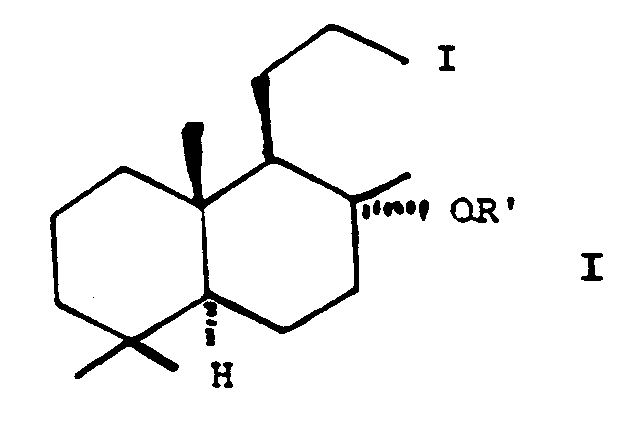
- an alkoxy-radical fragmentation reaction is used to convert sclareol derivatives to a 9-haloethyl decalin derivative of the formula I wherein X is iodo and R' is an alkanoyl group of 2 to 5 carbons.
- the invention is directed as well to a method for preparing the novel 9-haloethyl decalin derivatives of formula I and an epoxy-sclareol acetate ( III b).
- the process of the present invention produces a high yield of dodecahydro-3a,6,6,9a-tetramethylnaphtho[2,1-b]furan (Naphthofuran II ) from sclareol derivatives through a sequence of steps which employ an alkoxy-radical fragmentation reaction and a hydrolysis. It avoids production of side products that could alter the fragrance qualities of Napthofuran II .
- the alkoxy-radical reaction employed in the process of the invention can be converted to the decalin derivative of formula I (see foregoing Summary) wherein X is iodide by treatment with iodine and an oxidant in an inert solvent.
- the oxidant can be mercuric oxide, lead tetraacetate, iodosobenzene diacetate, periodinane iodosobenzene or iodoxybenzene.
- Preferred oxidants include iodosobenzene, lead tetraacetate and iodosobenzene diacetate, the latter two being especially preferred.
- the amount of oxidant used may be from about 50 to about 250 mole percent, about 50 to about 200 mole percent being preferred and about 100 to about 200 mole percent being especially preferred, the mole percentage being measured relative to the molar amount of the sclareol alkanoate derivative present.
- the reaction may be performed in an inert solvent, such as an aromatic hydrocarbon, an aliphatic hydrocarbon or a halocarbon.
- Preferred solvents are benzene, toluene, chlorobenzene, xylene, hexane, cyclohexane, dichloroethylene, tetrachloroethane, and carbon tetrachloride.
- the especially preferred solvents include benzene, carbon tetrachloride and chlorobenzene, with benzene being particularly preferred.
- the reaction is usually performed in the presence of an acid scavenger such as an amine or an alkali or alkaline earth metal carbonate. Calcium carbonate, pyridine, sodium carbonate and triethyl amine are preferred acid scavengers.
- the reaction may be conducted at a temperature range of about 60°C to about 130°C with about 70°C to about 120°C being preferred and about 75°C to about 85°C being most preferred.
- the iodoethyl decal in derivatives of formula 1 produced in the foregoing fashion are converted to Naphthofuran II in high yield according to the process of the present invention by hydrolysis with a metal hydroxide in a solvent therefor.
- a metal hydroxide in a solvent therefor.
- Alkali or alkaline earth metal hydroxides are preferred.
- Potassium hydroxide is the most preferred.
- a variety of protic or aprotic solvents mixed with water may be used, such as lower alkyl alcohols, ethyl ether, tetrahydrofuran, dioxane, dimethoxyethane, dimethylsulfoxide, ethylene glycol dimethylformamide, N-methylpyrrolidone or acetonitrile.
- the preferred solvents are a mixture of water and alcohols or diols, such as, methanol, ethanol, propanol, isopropanol, n-butanol, t-butanol, ethylene glycol.
- the most preferred solvent is a mixture of water and isopropanol.
- the reaction may be carried out in the temperature range of about 25° to about 150°C.
- the preferred temperature range is about 50° to about 100°C.
- the most preferred temperature range is about 70° to about 85°C.
- the process of the present invention may be applied to other labdane derivatives such as manool( VI) , larixol ( VII ), torulosol ( VIII ) and cupressic acid ( IX ) to provide compounds of general formula X , wherein R and R' are as described in VI - VIII and X is halogen.
- Compounds X may be converted into useful terpenoid derivatives.
- Benzene was dried over 4A molecular sieves prior to use.
- Sclareol purchased from R.J. Reynolds Tobacco Co., was recrystallized from hexane prior to use. All other reagents and solvents were of reagent grade and were used as received.
- IR spectra were obtained with a Perkin-Elmer 710B spectrophotometer. Routine 1H-NMR spectra were recorded with a Varian Associates T-60A NMR instrument. The 1H-NMR spectral data reported at 250 MHz were recorded on a Bruker WM250 NMR instrument and the 13C-NMR spectra were obtained on the same instrument at 62.5 MHz. Mass spectra were obtained with a Hewlett-Packard 5985 mass spectrophotometer. Column chromatography was performed with Merck 60 brand of silica gel.
- GLC analyses were obtained with a Hewlett-Packard Model 5840 or a Perkin-Elmer model 920 gas chromatograph, using either a 6 ft., 2-mm i.d. glass column packed with 3% nonpolar silicone on diatomaceous earth, 100-120 mesh or a 10 ft., 2 mm i.d. glass column packed with 2% polyethylene glycol on diatomaceous earth, 100-120 mesh. Where indicated, percentages refer to computer calculated peak areas without correction for response. GLC and mass spectral data were provided courtesy of the Fritzsche, Dodge and Olcott. Inc., Instrumental Laboratory.
Landscapes
- Chemical & Material Sciences (AREA)
- Organic Chemistry (AREA)
- Furan Compounds (AREA)
- Organic Low-Molecular-Weight Compounds And Preparation Thereof (AREA)
- Heterocyclic Carbon Compounds Containing A Hetero Ring Having Oxygen Or Sulfur (AREA)
- Polyesters Or Polycarbonates (AREA)
- Pharmaceuticals Containing Other Organic And Inorganic Compounds (AREA)
Abstract
Description
- The compound dodecahydro-3a,6,6,9a-tetramethylnaphtho[2,1-b]furan (hereinhafter Naphthofuran II) is a synthetic congener of Ambergris, a rare perfumery composition of natural origin having a sweet, woody, amber bouquet. Naphthofuran II has been used in perfume compositions and in cleaning formulations, such as fragrances for toiletries and household products, where a persistent amber effect is desired. Naphthofuran II is also a component of tincture of Ambergris and synthetic Naphthofuran II has been used in artificial Ambergris formulations.
- Naphthofuran II may be produced synthetically from 3-ethylenyldecahydro-2-hydroxy-α-2,5,5,8a-pentamethyl-1-naphthalenepropanol, commonly known as sclareol. One method for this conversion is a two stage oxidation followed by a hydride reduction and cyclization. See, for example, U.S. Patent No. 3,050,532; U.S. Patent No. 3,029,255; and Aust. J. Chem., 1971, 24, 591. Another method involves oxidation of sclareol to sclareol oxide followed by a multi-step synthesis to produce Naphthofuran II as a mixture of stereoisomers. See, for example, Helv. Chim. Acta, 1942, 25, 621; J. Chem. Soc., 1960, 4613; Helv. Chim. Acta, 1950, 33, 1251; U.S. Patent 3,029,255, 1962; Helv. Chim. Acta, 1950, 33 1308; J. Am. Chem. Soc., 1963, 85, 3979); and Helv. Chim. Acta, 1951, 34, 1664.
- These methods, however, lack simplicity and are based upon multiple synthetic reactions. Moreover, they produce undesirable side reactions and do not generate high yields of Naphthofuran II. Accordingly, it is an object of the invention to develop a simple method for the production of Naphthofuran II from sclareol. Another object is the production of a high yield of Naphthofuran II without the complications caused by side reactions.
- These and other objects are achieved by the invention which is directed to a method for the production of Naphthofuran (II) from sclareol. In this method, an alkoxy-radical fragmentation reaction is used to convert sclareol derivatives to a 9-haloethyl decalin derivative of the formula I

wherein X is iodo and R' is an alkanoyl group of 2 to 5 carbons. Basic hydrolysis of this 9-iodoethyl decalin derivative produces Naphthofuran of the formula II
According of the method of the invention, a sclareol alkanoate derivative of the formula III
wherein R is vinyl, epoxyethyl or ethyl, R' is an alkanoyl group of 2 to 5 carbons and R' is alkanoyloxy of 2 to 5 carbons is treated with iodine and an oxidizing agent to produce the decalin derivative of formula I wherein X is iodo. - The invention is directed as well to a method for preparing the novel 9-haloethyl decalin derivatives of formula I and an epoxy-sclareol acetate (IIIb).
- The process of the present invention produces a high yield of dodecahydro-3a,6,6,9a-tetramethylnaphtho[2,1-b]furan (Naphthofuran II) from sclareol derivatives through a sequence of steps which employ an alkoxy-radical fragmentation reaction and a hydrolysis. It avoids production of side products that could alter the fragrance qualities of Napthofuran II.
- The alkoxy-radical reaction employed in the process of the invention, the sclareol alkanoate derivative of formula III (see foregoing Summary) can be converted to the decalin derivative of formula I (see foregoing Summary) wherein X is iodide by treatment with iodine and an oxidant in an inert solvent. The oxidant can be mercuric oxide, lead tetraacetate, iodosobenzene diacetate, periodinane iodosobenzene or iodoxybenzene. Preferred oxidants include iodosobenzene, lead tetraacetate and iodosobenzene diacetate, the latter two being especially preferred. The amount of oxidant used may be from about 50 to about 250 mole percent, about 50 to about 200 mole percent being preferred and about 100 to about 200 mole percent being especially preferred, the mole percentage being measured relative to the molar amount of the sclareol alkanoate derivative present. The reaction may be performed in an inert solvent, such as an aromatic hydrocarbon, an aliphatic hydrocarbon or a halocarbon. Preferred solvents are benzene, toluene, chlorobenzene, xylene, hexane, cyclohexane, dichloroethylene, tetrachloroethane, and carbon tetrachloride. The especially preferred solvents include benzene, carbon tetrachloride and chlorobenzene, with benzene being particularly preferred. The reaction is usually performed in the presence of an acid scavenger such as an amine or an alkali or alkaline earth metal carbonate. Calcium carbonate, pyridine, sodium carbonate and triethyl amine are preferred acid scavengers. The reaction may be conducted at a temperature range of about 60°C to about 130°C with about 70°C to about 120°C being preferred and about 75°C to about 85°C being most preferred.
- The iodoethyl decal in derivatives of formula 1 produced in the foregoing fashion are converted to Naphthofuran II in high yield according to the process of the present invention by hydrolysis with a metal hydroxide in a solvent therefor. Alkali or alkaline earth metal hydroxides are preferred. Potassium hydroxide is the most preferred. A variety of protic or aprotic solvents mixed with water may be used, such as lower alkyl alcohols, ethyl ether, tetrahydrofuran, dioxane, dimethoxyethane, dimethylsulfoxide, ethylene glycol dimethylformamide, N-methylpyrrolidone or acetonitrile. The preferred solvents are a mixture of water and alcohols or diols, such as, methanol, ethanol, propanol, isopropanol, n-butanol, t-butanol, ethylene glycol. The most preferred solvent is a mixture of water and isopropanol. The reaction may be carried out in the temperature range of about 25° to about 150°C. The preferred temperature range is about 50° to about 100°C. The most preferred temperature range is about 70° to about 85°C.
- The process of the present invention may be applied to other labdane derivatives such as manool(VI), larixol (VII), torulosol (VIII) and cupressic acid (IX) to provide compounds of general formula X, wherein R and R' are as described in VI-VIII and X is halogen.

Compounds X may be converted into useful terpenoid derivatives. - Practice of other embodiments of the invention will be apparent from the foregoing discussion. The alkoxy-radical fragmentation can be applied pursuant to reaction procedures disclosed by Waegell et al., J. Chem. Res. S., 1981, 236. The following examples illustrate some further embodiments of the invention.
- General. Benzene was dried over 4A molecular sieves prior to use. Sclareol, purchased from R.J. Reynolds Tobacco Co., was recrystallized from hexane prior to use. All other reagents and solvents were of reagent grade and were used as received.
- IR spectra were obtained with a Perkin-Elmer 710B spectrophotometer. Routine ¹H-NMR spectra were recorded with a Varian Associates T-60A NMR instrument. The ¹H-NMR spectral data reported at 250 MHz were recorded on a Bruker WM250 NMR instrument and the ¹³C-NMR spectra were obtained on the same instrument at 62.5 MHz. Mass spectra were obtained with a Hewlett-Packard 5985 mass spectrophotometer. Column chromatography was performed with Merck 60 brand of silica gel. GLC analyses were obtained with a Hewlett-Packard Model 5840 or a Perkin-Elmer model 920 gas chromatograph, using either a 6 ft., 2-mm i.d. glass column packed with 3% nonpolar silicone on diatomaceous earth, 100-120 mesh or a 10 ft., 2 mm i.d. glass column packed with 2% polyethylene glycol on diatomaceous earth, 100-120 mesh. Where indicated, percentages refer to computer calculated peak areas without correction for response. GLC and mass spectral data were provided courtesy of the Fritzsche, Dodge and Olcott. Inc., Instrumental Laboratory.
- Elemental microanalyses were performed by Childers Laboratories, Milford, N.J. or Schwarzkopf Microanalytical Laboratory, Woodside, N.Y. Melting points were determined with a Thomas Model 40 micro hot-stage apparatus and are uncorrected. Optical rotations were obtained in chloroform solution at ambient temperature unless otherwise noted using a Perkin-Elmer 241 polarimeter.
- To a mixture of sclareol monoacetate which may be prepared as described by G. Buchi and K. Bieman in Croat. Chem. Acta 1957, 29 163-171 (7.00g, 0.02 mol) vanadium (IV) bis(2,4-pentanedionate) oxide (0.100g, 0.38 mmol) and methylene chloride (60 mL) heated at reflux was added a solution of t-butyl hydroperoxide (3 mL, 0.027 mol, Lucidol 90) in methylene chloride (30 mL) over a 1h period. The mixture was heated at reflux for 2h and then a solution of t-butyl hydroperoxide (1 mL, 0.009 mol) in methylene chloride (15 mL) was added over a 0.5h period. The mixture was heated at reflux for an additional 2h and then stirred at 25°C. A 10% sodium sulfite solution (75 mL) was added and the mixture was stirred for 1.5h at 25°C. The phases were separated and the aqueous phase was extracted with methylene chloride (2 X 25 mL). The combined organic layers were washed with 10% sodium sulfite solution (2 X 30 mL) (negative starch iodide test), saturated sodium bicarbonate solution and dried (Na₂SO₄). Evaporation of solvents provided 7.038 g of a nearly colorless solid. Crystallization from hexane/ethyl acetate gave 6.399g (87% yield) of [1R-(1α-(R*),2β,4aβ,8aα)]-2-acetyloxy-α-oxiranyldecahydro-α,2,5,5, 8a-pentamethyl-1-naphthalenepropanol (IIIb), mp 129.5-131°C; [α]D -35.75 ° (c, 3.43).¹H-NMR (250 MHz, CDCl₃) δ 0.74 (3H, s), 0.79 (3H, s), 0.82 (3H, s), 1.25 (3H, s), 1.41 (3H, s), 1.88 (3H, s). 0.9-1.8 (16H, m), 2.51-2.93 (4H, m); ¹³C-NMR δ 15.68 (q), 18.34 (t), 19.07 (t), 20.01 (t), 20.64 (q), 21.40 (q), 22.79 (q), 25.84 (q), 33.07 (s), 33.28 (q), 38.82 (t), 39.55 (s), 39.66 (t), 41.90 (t), 41.95 (t), 44.03 (t), 55.70 (d), 57.72 (d), 69.41 (s), 88.08 (s), 169.85 (s); IR (CHCl₃) v max 3530, 2940, 1720, 1460, 1385, 1360, 1260 cm⁻¹; MS, m/e 306, 291, 273, 109, 95, 81, 43. Anal. Calcd for C₂₂H₃₈0₄: C, 72.09, H, 10.45. Found: C, 72.17; H, 10.45.
- A mixture of sclareol monoacetate (3.50g, 0.01 mol), platinum oxide (0.225g), sodium nitrite (0.01g) and ethanol (40 mL) was shaken under a hydrogen atmosphere (40 psi) for 2.5h. The mixture was filtered through celite and the solids were washed with ethanol. The solvent was evaporated and the residue crystallized from hexane to give 2.69g (76% yield) of [1R-[1α,(S*),2β,4aβ,8aα]]-2-acetyloxy-α-ethyldecahydro-α, 2,5,5,8a-pentamethyl-1-naphthalenepropanol (IIIc), mp 92-94°C, [α]D -27.35° (c, 1.547); (literature references mp 93-94.5°C, see D.B. Bigley, N.A.J. Rogers. J.A. Barltrop in J. Chem. Soc., 1960, 4613-4627 and R.K. Grant, C. Huntrakal, and R.T. Weavers, Aust. J. Chem., 1972, 25 365-74.) ¹H-NMR (250 MHz, CDCl₃)δ0.78 (3H, s), 0.84 (3H, s), 0.87 (3H, s), 0.90 (3H, t, J = 7.5 Hz), 1.16 (3H, s), 1.47 (3H, s), 1.93 (3H, s), 0.8-1.9 (18H, m), 2.60-2.68 (1H, m). IR (CDCl₃) v max 3580, 3450, 2950, 1720, 1455, 1485, 1460, 1260 cm⁻¹. MS, m/e 352, 292, 274, 259, 245, 204, 137, 109, 95, 43.
- To a mixture of sclareol monoacetate (1.050g, 0.003 mol), iodosobenzene diacetate (0.966g, 0.003 mol), calcium carbonate (1.2g, 0.012 mol) and benzene (60 mL) heated at reflux was added dropwise over a 45 min period a solution of iodine (0.762g, 0.003 mol) in benzene (25 mL). The mixture was heated at reflux for 1.5h, cooled, decanted from solids, washed with 5% sodium thiosulfate solution (2 X 50 mL), saturated sodium bicarbonate solution (2 X 30 mL) and dried (Na₂SO₄). The solvent was evaporated and the residue Kugelrohr distilled (bath 60°C, 0.5 mm) to remove most of the iodobenzene. Chromatography (eluant:hexane:ethyl acetate: 20:1) of the residue gave 0.429g (35% yield) of [1R-(1α,2β,4aβ,8aα)]-decahydro-1-(2-iodoethyl)-2,5,5,8a-tetramethyl-2-naphthalenol acetate, the decalin derivative of formula I wherein X is I and R' is COCH₃. Crystallization from hexane provides a pure sample: mp 94-99°C with decomposition; [α]D - 4.28 (c, 1.33).¹H-NMR (250 MHz, CDCl₃) δ 0.77 (3H, s), 0.81 (3H, s), 0.85 (3H, s), 1.46 (3H, s), 1.93 (3H, s), 0.85-2.1 (13H, m), 2.62-2.73 (1H, m), 3.09-3.35 (2H, m); ¹³C-NMR δ 7.59 (t), 15.78 (q), 18.32 (t), 19.92 (t), 20.48 (q), 21.43 (q), 22.91 (q), 31.84 (t), 33.16 (s), 33.31 (q), 38.95 (t), 39.26 (t), 39.73 (t), 41.83 (t), 55.66 (d), 61.17 (d), 87.26 (s), 169.73 (s); IR (CHCl₃) v max 2940, 1720, 1450, 1385, 1360, 1250 cm⁻¹; MS, m/e 346, 331, 279, 219, 137, 109, 95, 43. Anal. Calcd for C₁₈H₃₁IO₂: C, 53.20; H, 7.69; I, 31.23. Found: C, 53.76; H, 7.99; I, 30.91. The reaction also provides 0.639g (48% yield) of [1R-[1R-(1α,2β,4aβ,8aα)]] -1-(5-iodo-3,4-epoxy-3-methylpentyl)-decahydro-2,5,5,8a-tetra methyl-2-naphthalenol acetate (Xl) as a mixture of isomers. ¹H- NMR (250 MHz, CDCl₃) δ 0.78 (3H, s), 0.81 (3H, s), 0.86 (3H, s), 1.28 and 1.34 (3H, 2s), 1.46 and 1.47 (3H, 2s), 1.930 and 1.932 (3H, 2s), 0.8-2.0 (15H, m), 2.6-2.75 (1H, m), 2.9-3.4 (3H, m); IR (CDCl₃) v max 2930, 1720, 1455, 1385, 1360, 1255 cm⁻¹. MS, m/e 416, 401, 384, 289, 245, 204, 137, 109, 95, 43.
- To a mixture of lead tetraacetate [5.32g, 0.012 mol, washed with hexane (2 X 50 mL)], calcium carbonate (240g, 0.024 mol) sclareol monoacetate (2.10g, 0.006 mol) and benzene (150 mL) heated at reflux was added a solution of iodine (1.524g, 0.006 mol) in benzene (90 ml) over a 1.5h period. The mixture was heated at reflux for 1h, cooled and filtered. The filtrate was washed with 5% sodium thiosulfate solution (2 X 50 mL), saturated sodium bicarbonate solution, dried (Na₂SO₄) and evaporated. Chromatography (eluant:hexane:ethyl acetate; 20:1) gave 1.209g (50% yield) of iodo-acetate (I; X = I,R'= COCH₃) and 0.906g (32% yield) of iodo-epoxide (XI). The compounds were characterized as described in Example 3.
- To a mixture of epoxide (IIIb) (0.732g, 0.002 mol, from Example 1) iodosobenzenediacetate (1.288g, 0.004 mol), calcium carbonate (0.8g, 0.008 mol) and benzene (40 mL) heated at reflux was added dropwise over a 45 min period a solution of iodine (0.508g, 0.002 mol) in benzene (25 mL). The mixture was heated at reflux for 1.5h and cooled. Work-up and chromatography as described in Example 3 provided 0.433g (53% yield) of the decalin derivative of formula I wherein X is I and R' is COCH₃.
- To a mixture of lead tetraacetate [2.66g, 0.006 mol, washed with hexane (2 X 30 mL)], calcium carbonate (1.20g, 0.012 mol) benzene (75 mL) and sclareol epoxide derivative of Example I heated at reflux was added a solution of iodine (0.726g, 0.003 mol) in benzene (35 mL) over a 1h period. The mixture was heated at reflux for 1h, cooled and filtered. Work-up and chromatography as described in Example 4 gave 0.665g (55% yield) of the decalin derivative formula I wherein X is I and R' is COCH₃.
- To a mixture of lead tetraacetate (3.547g, 0.008 mol), calcium carbonate (1.60g, 0.016 mol), the dihydrosclareol derivative of Example 2 (1.418g, 0.004 mol) and benzene (200 mL) heated at reflux was added a solution of iodine (1.016g, 0.004 mol) in benzene (50 mL) over a 1.5h period. The mixture was heated a reflux for 1h, cooled and filtered. Work-up and chromatography as described in Example 4 gave 0.794 (49% yield) of the decalin derivative of formula I wherein X is I and R is COCH₃ and 0.388g (29% yield) of 13-nor-vinyl-13-ketosclareol acetate which was identical to an authentic sample as reported by D.B. Bigley, N.A.J. Rogers, J.A. Barltrop in J. Chem. Soc., 1960 4613-4627.
- A mixture of the decalin derivative of formula I wherein X is I and R' is COCH₃ (0.610g, 0.0015 mol from any of Examples 3 through 7), potassium hydroxide (0.593g, 0.009 mol), isopropanol:water (6:1, 50 mL) was heated at reflux for 18h. The mixture was cooled and concentrated under reduced pressure. The residue was added to water and extracted with hexane (4 x 20 mL). The extracts were washed with water (15 mL), brine (15 mL) and dried (Na₂SO₄). The solvents were evaporated and the residue chromatographed (eluant:hexane:ethyl acetate; 20:1). Kugelrohr distillation (bath 120°C, 1 mm) gave 0.286g (81% yield, 99.5% pure according to GLC analysis) of compound II, mp 74.5-76°C, [α]D -29.90° (c, 3.01, benzene); literature reference: mp 75-76°C, [α]D -28.0° (benzene) see M. Stoll and M. Hinder in Helv. Chim. Acta, 1953, 36, 1995-2008; NMR (250 MHz, CDCl₃) δ 0.83 (6H, s), 0.88 (3H, s), 1.08 (3H, s), 0.8-2.0 (14H, m), 3.75-3.96 (2H, m); ¹³C-NMR δ 15.06 (q), 18.47 (t), 20.72 (t), 22.69 (2q), 33.10 (s), 36.27 (s), 39.36 (t), 40.06 (t), 42.54 (t), 57.36 (d), 60.22, (d), 64.94 (t), 79.84 (s); IR (melt) v max 2930, 1480, 1460, 1390, 1375 cm⁻¹; MS, m/e 236, 221, 204, 137, 97.
Claims (9)
- A method for the preparation of a decalin derivative of the formula
treating a sclareol alkanoate derivative of the formula
- A method for the production of dodecahydro-3a,6,6,9a-tetramethyl-naphtho[2,1-b]furan which comprises basically hydrolyzing the decalin derivative of claim 1.
- A method according to claim 1 wherein the oxidizing agent is mercuric oxide, lead tetraacetate, iodosobenzene diacetate, iodosobenzene, periodinane or iodoxybenzene.
- A method according to claim 1 wherein the solvent is an aromatic hydrocarbon, aliphatic hydrocarbon or a halocarbon.
- A method according to claim 1 wherein the temperature used is from about 0°C to about 50°C.
- A method according to claim 1 wherein the amount of oxidant is from about 50 to about 250 mole percent relative to the number of moles of sclareol acetate derivative present.
- A method according to claim 6 wherein the amount of oxidant is from about 50 to about 200 mole percent.
- A method according to claim 6 wherein the amount of oxidant is from about 100 to 200 mole percent.
Applications Claiming Priority (3)
| Application Number | Priority Date | Filing Date | Title |
|---|---|---|---|
| US6542687A | 1987-06-23 | 1987-06-23 | |
| US65426 | 1987-06-23 | ||
| EP88109936A EP0296564B1 (en) | 1987-06-23 | 1988-06-22 | Method for preparing dodecahydro-3a,6,6,9a-tetramethylnaphtho[2,1-b] furan and novel haloethyl decalin derivatives |
Related Parent Applications (1)
| Application Number | Title | Priority Date | Filing Date |
|---|---|---|---|
| EP88109936.0 Division | 1988-06-22 |
Publications (2)
| Publication Number | Publication Date |
|---|---|
| EP0521373A1 EP0521373A1 (en) | 1993-01-07 |
| EP0521373B1 true EP0521373B1 (en) | 1996-02-07 |
Family
ID=22062642
Family Applications (2)
| Application Number | Title | Priority Date | Filing Date |
|---|---|---|---|
| EP88109936A Expired - Lifetime EP0296564B1 (en) | 1987-06-23 | 1988-06-22 | Method for preparing dodecahydro-3a,6,6,9a-tetramethylnaphtho[2,1-b] furan and novel haloethyl decalin derivatives |
| EP92110558A Expired - Lifetime EP0521373B1 (en) | 1987-06-23 | 1988-06-22 | Method for preparing dodecahydro-3a,6,6,9a-tetramethylnaphtho[2,1-b]furan |
Family Applications Before (1)
| Application Number | Title | Priority Date | Filing Date |
|---|---|---|---|
| EP88109936A Expired - Lifetime EP0296564B1 (en) | 1987-06-23 | 1988-06-22 | Method for preparing dodecahydro-3a,6,6,9a-tetramethylnaphtho[2,1-b] furan and novel haloethyl decalin derivatives |
Country Status (4)
| Country | Link |
|---|---|
| EP (2) | EP0296564B1 (en) |
| AT (1) | ATE116309T1 (en) |
| DE (2) | DE3855002T2 (en) |
| ES (2) | ES2065898T3 (en) |
Families Citing this family (9)
| Publication number | Priority date | Publication date | Assignee | Title |
|---|---|---|---|---|
| ES2044780B1 (en) * | 1992-04-10 | 1994-08-01 | Univ Granada | PROCEDURES FOR OBTAINING AMBROX FROM NATURAL LABDANIC DITERPENES. |
| EP0822191B1 (en) * | 1996-08-02 | 2001-09-19 | Quest International B.V. | Preparation of intermediates for norlabdane oxide |
| DE69706786T2 (en) * | 1996-08-02 | 2002-05-23 | Quest International B.V., Naarden | Manufacture of norlabdan oxide intermediates |
| EP1743622A4 (en) * | 2004-04-30 | 2015-07-15 | Kao Corp | Winkle reduction agent and cosmetic skin preparation |
| CN100355742C (en) * | 2005-02-24 | 2007-12-19 | 陕西师范大学 | Clary sage lactone synthetic method |
| CN100357285C (en) * | 2005-02-24 | 2007-12-26 | 陕西师范大学 | Synthetic method for epoxy sclareol |
| CN105418566B (en) * | 2015-11-27 | 2018-02-09 | 北京工商大学 | A kind of synthetic method of ambrox |
| CN107353267B (en) * | 2017-07-19 | 2019-11-01 | 四川大学 | A method of synthesis substituted furan |
| WO2020084633A1 (en) * | 2018-10-22 | 2020-04-30 | Council Of Scientific And Industrial Research | Decalin derivatives, a process for the preparation and pharmaceutical composition thereof |
Family Cites Families (3)
| Publication number | Priority date | Publication date | Assignee | Title |
|---|---|---|---|---|
| US4613710A (en) * | 1984-08-08 | 1986-09-23 | Firmenich Sa | Process for the preparation of (±)-3a-6,6,9a-tetramethylperhydronaphto[2,]furan |
| DE3429412A1 (en) * | 1984-08-09 | 1986-02-20 | Kraftwerk Union AG, 4330 Mülheim | MIXING DEVICE |
| CH661724A5 (en) * | 1985-03-26 | 1987-08-14 | Firmenich & Cie | HYDROPEROXIDES USEFUL AS INTERMEDIATES FOR OBTAINING 3A, 6,6,9A-TETRAMETHYLPERHYDRONAPHTO (2,1-B) FURANNE AND PROCESS FOR OBTAINING THEM. |
-
1988
- 1988-06-22 ES ES88109936T patent/ES2065898T3/en not_active Expired - Lifetime
- 1988-06-22 AT AT88109936T patent/ATE116309T1/en not_active IP Right Cessation
- 1988-06-22 ES ES92110558T patent/ES2083624T3/en not_active Expired - Lifetime
- 1988-06-22 DE DE3855002T patent/DE3855002T2/en not_active Expired - Fee Related
- 1988-06-22 EP EP88109936A patent/EP0296564B1/en not_active Expired - Lifetime
- 1988-06-22 EP EP92110558A patent/EP0521373B1/en not_active Expired - Lifetime
- 1988-06-22 DE DE3852577T patent/DE3852577T2/en not_active Expired - Fee Related
Also Published As
| Publication number | Publication date |
|---|---|
| DE3855002T2 (en) | 1996-10-02 |
| DE3855002D1 (en) | 1996-03-21 |
| DE3852577D1 (en) | 1995-02-09 |
| ATE116309T1 (en) | 1995-01-15 |
| EP0296564A2 (en) | 1988-12-28 |
| EP0296564B1 (en) | 1994-12-28 |
| ES2065898T3 (en) | 1995-03-01 |
| DE3852577T2 (en) | 1995-05-04 |
| ES2083624T3 (en) | 1996-04-16 |
| EP0296564A3 (en) | 1989-10-04 |
| EP0521373A1 (en) | 1993-01-07 |
Similar Documents
| Publication | Publication Date | Title |
|---|---|---|
| Posner et al. | Highly stereocontrolled synthesis of some trioxygenated cyclohexenes: an asymmetric total synthesis of (-)-methyl triacetyl-4-epishikimate | |
| Hudlicky et al. | Biocatalysis as a rational approach to enantiodivergent synthesis of highly oxygenated compounds:(+)‐and (—)‐pinitol and other cyclitols | |
| DK147912B (en) | PROCEDURE FOR PREPARING 1ALFA HYDROXYLERED VITAMIN D COMPOUNDS | |
| Aoyama et al. | Photochemical reactions of N, N-disubstituted. alpha.-oxoamides | |
| Servi | 2, 2, 5-Trimethyl-1, 3-dioxolane-4-carboxaldehyde as a chiral synthon: synthesis of the two enantiomers of methyl 2, 3, 6-trideoxy-. alpha.-L-threo-hex-2-enopyranoside, key intermediate in the synthesis of daunosamine, and of (+)-and (-)-rhodinose | |
| Yasuda et al. | Photochemical reactions of aromatic compounds. XXXIII. Photoreactions of 1-cyanonaphthalene with indene in various solvents. | |
| Rozen et al. | HOF· CH3CN, made directly from F2 and water, as an ecologically friendly oxidizing reagent | |
| Suginome et al. | New general synthesis of medium ring-lactones via a regioselective β-scission of alkoxyl radicals generated from catacondensed lactols | |
| EP0521373A1 (en) | Method for preparing dodecahydro-3a,6,6,9a-tetramethylnaphtho[2,1-b]furan | |
| Škorić et al. | Observation of the primary intermediates in the photochemistry of o-vinylstyrylfurans | |
| Kulinkovich et al. | Synthesis of α, β-Epoxy Ketones from Alkyl-and Arylsubstituted Cyclopropanols | |
| US5571939A (en) | Method for preparing dodecahydro-3a,6,6,9a-tetramethylnaphtho[2,1-b]furan and novel haloethyl decalin derivatives | |
| Bargues et al. | Regio-and stereoselective oxyfunctionalization at C-1 and C-5 in sesquiterpene guaianolides | |
| Christenson | Synthesis of dodecahydro-3a, 6, 6, 9a-tetramethyl naphtho [2, 1-b] furan via alkoxy radical fragmentation. | |
| Hiyama et al. | The Photochemistry of 4, 5-Disubstituted 1, 3-Dioxolen-2-ones | |
| EP1773799B1 (en) | Process for the preparation of optically-active compounds | |
| EP0585104B1 (en) | A method of preparing a saturated monocyclic hydrocarbon compound and an intermediate therefor | |
| TANAKA et al. | Synthetic Studies on a Picrotoxane Sesquiterpene, Coriamyrtin. I. The Grignard Reaction of 5-(2-Methyl-1, 3-dioxo-2-cyclopentyl) methyl-2, 5H-furanone with Isopropenylmagnesium Bromide and Stereochemistries of the Products | |
| Ebel et al. | Total synthesis of the mushroom metabolite (+)-calopin | |
| US4444982A (en) | (+)- Or (-)-7-hydroxymethyl-2,6,6-trimethyltricyclo[6,2,1,01,5 ]undecane | |
| RU2837733C1 (en) | Method of producing 4-methoxycarbonyl-2,7-octanediol | |
| JP4175553B2 (en) | Preparation of norlabdane oxide intermediates | |
| Raubo et al. | Enantioselective Silicon-Mediated Synthesis of Glyceraldehyde Derivatives from Propargyl Alcohol | |
| US4085274A (en) | Process for preparing 4-oxopentadecanedioic acid | |
| Adam et al. | Dimethyldioxirane epoxidation of chalcone and isoflavone glycoside acetates |
Legal Events
| Date | Code | Title | Description |
|---|---|---|---|
| PUAI | Public reference made under article 153(3) epc to a published international application that has entered the european phase |
Free format text: ORIGINAL CODE: 0009012 |
|
| AC | Divisional application: reference to earlier application |
Ref document number: 296564 Country of ref document: EP |
|
| AK | Designated contracting states |
Kind code of ref document: A1 Designated state(s): AT BE CH DE ES FR GB GR IT LI LU NL SE |
|
| 17P | Request for examination filed |
Effective date: 19930706 |
|
| RAP1 | Party data changed (applicant data changed or rights of an application transferred) |
Owner name: GIVAUDAN-ROURE (INTERNATIONAL) S.A. |
|
| 17Q | First examination report despatched |
Effective date: 19950412 |
|
| RTI1 | Title (correction) | ||
| RBV | Designated contracting states (corrected) |
Designated state(s): CH DE ES FR GB IT LI NL |
|
| GRAH | Despatch of communication of intention to grant a patent |
Free format text: ORIGINAL CODE: EPIDOS IGRA |
|
| GRAA | (expected) grant |
Free format text: ORIGINAL CODE: 0009210 |
|
| AC | Divisional application: reference to earlier application |
Ref document number: 296564 Country of ref document: EP |
|
| AK | Designated contracting states |
Kind code of ref document: B1 Designated state(s): CH DE ES FR GB IT LI NL |
|
| REF | Corresponds to: |
Ref document number: 3855002 Country of ref document: DE Date of ref document: 19960321 |
|
| REG | Reference to a national code |
Ref country code: ES Ref legal event code: FG2A Ref document number: 2083624 Country of ref document: ES Kind code of ref document: T3 |
|
| ET | Fr: translation filed | ||
| ITF | It: translation for a ep patent filed | ||
| PLBE | No opposition filed within time limit |
Free format text: ORIGINAL CODE: 0009261 |
|
| STAA | Information on the status of an ep patent application or granted ep patent |
Free format text: STATUS: NO OPPOSITION FILED WITHIN TIME LIMIT |
|
| 26N | No opposition filed | ||
| PGFP | Annual fee paid to national office [announced via postgrant information from national office to epo] |
Ref country code: FR Payment date: 20000612 Year of fee payment: 13 |
|
| PGFP | Annual fee paid to national office [announced via postgrant information from national office to epo] |
Ref country code: DE Payment date: 20000619 Year of fee payment: 13 |
|
| PGFP | Annual fee paid to national office [announced via postgrant information from national office to epo] |
Ref country code: GB Payment date: 20000621 Year of fee payment: 13 |
|
| PGFP | Annual fee paid to national office [announced via postgrant information from national office to epo] |
Ref country code: ES Payment date: 20000623 Year of fee payment: 13 |
|
| PGFP | Annual fee paid to national office [announced via postgrant information from national office to epo] |
Ref country code: CH Payment date: 20000628 Year of fee payment: 13 |
|
| PGFP | Annual fee paid to national office [announced via postgrant information from national office to epo] |
Ref country code: NL Payment date: 20000629 Year of fee payment: 13 |
|
| PG25 | Lapsed in a contracting state [announced via postgrant information from national office to epo] |
Ref country code: GB Free format text: LAPSE BECAUSE OF NON-PAYMENT OF DUE FEES Effective date: 20010622 |
|
| PG25 | Lapsed in a contracting state [announced via postgrant information from national office to epo] |
Ref country code: ES Free format text: LAPSE BECAUSE OF NON-PAYMENT OF DUE FEES Effective date: 20010623 |
|
| PG25 | Lapsed in a contracting state [announced via postgrant information from national office to epo] |
Ref country code: LI Free format text: LAPSE BECAUSE OF NON-PAYMENT OF DUE FEES Effective date: 20010630 Ref country code: CH Free format text: LAPSE BECAUSE OF NON-PAYMENT OF DUE FEES Effective date: 20010630 |
|
| PG25 | Lapsed in a contracting state [announced via postgrant information from national office to epo] |
Ref country code: NL Free format text: LAPSE BECAUSE OF NON-PAYMENT OF DUE FEES Effective date: 20020101 |
|
| GBPC | Gb: european patent ceased through non-payment of renewal fee |
Effective date: 20010622 |
|
| REG | Reference to a national code |
Ref country code: CH Ref legal event code: PL |
|
| PG25 | Lapsed in a contracting state [announced via postgrant information from national office to epo] |
Ref country code: FR Free format text: LAPSE BECAUSE OF NON-PAYMENT OF DUE FEES Effective date: 20020228 |
|
| NLV4 | Nl: lapsed or anulled due to non-payment of the annual fee |
Effective date: 20020101 |
|
| PG25 | Lapsed in a contracting state [announced via postgrant information from national office to epo] |
Ref country code: DE Free format text: LAPSE BECAUSE OF NON-PAYMENT OF DUE FEES Effective date: 20020403 |
|
| REG | Reference to a national code |
Ref country code: ES Ref legal event code: FD2A Effective date: 20030303 |
|
| PG25 | Lapsed in a contracting state [announced via postgrant information from national office to epo] |
Ref country code: IT Free format text: LAPSE BECAUSE OF NON-PAYMENT OF DUE FEES Effective date: 20050622 |