EP0520608B1 - Silicones which contain lateral peripheral vinyl ether groups crosslinkable by cationic photoinitiators and their application for coatings and antiadhesive products for paper - Google Patents
Silicones which contain lateral peripheral vinyl ether groups crosslinkable by cationic photoinitiators and their application for coatings and antiadhesive products for paper Download PDFInfo
- Publication number
- EP0520608B1 EP0520608B1 EP92303415A EP92303415A EP0520608B1 EP 0520608 B1 EP0520608 B1 EP 0520608B1 EP 92303415 A EP92303415 A EP 92303415A EP 92303415 A EP92303415 A EP 92303415A EP 0520608 B1 EP0520608 B1 EP 0520608B1
- Authority
- EP
- European Patent Office
- Prior art keywords
- groups
- vinyl ether
- radical
- group
- product
- Prior art date
- Legal status (The legal status is an assumption and is not a legal conclusion. Google has not performed a legal analysis and makes no representation as to the accuracy of the status listed.)
- Expired - Lifetime
Links
- 229920001296 polysiloxane Polymers 0.000 title claims description 27
- 230000000181 anti-adherent effect Effects 0.000 title claims description 14
- 238000000576 coating method Methods 0.000 title claims description 5
- QYKIQEUNHZKYBP-UHFFFAOYSA-N Vinyl ether Chemical group C=COC=C QYKIQEUNHZKYBP-UHFFFAOYSA-N 0.000 title description 23
- 230000002093 peripheral effect Effects 0.000 title description 6
- 239000012952 cationic photoinitiator Substances 0.000 title description 2
- -1 n-C4H10 radicals Chemical class 0.000 claims description 63
- 150000003254 radicals Chemical class 0.000 claims description 25
- XUIMIQQOPSSXEZ-UHFFFAOYSA-N Silicon Chemical group [Si] XUIMIQQOPSSXEZ-UHFFFAOYSA-N 0.000 claims description 19
- 125000004432 carbon atom Chemical group C* 0.000 claims description 16
- BFKJFAAPBSQJPD-UHFFFAOYSA-N tetrafluoroethene Chemical group FC(F)=C(F)F BFKJFAAPBSQJPD-UHFFFAOYSA-N 0.000 claims description 16
- 229910052710 silicon Inorganic materials 0.000 claims description 15
- 238000002360 preparation method Methods 0.000 claims description 12
- 229920000642 polymer Polymers 0.000 claims description 9
- 229920001577 copolymer Polymers 0.000 claims description 8
- 125000001997 phenyl group Chemical group [H]C1=C([H])C([H])=C(*)C([H])=C1[H] 0.000 claims description 7
- 150000002921 oxetanes Chemical class 0.000 claims description 6
- 150000002924 oxiranes Chemical class 0.000 claims description 6
- 125000003709 fluoroalkyl group Chemical group 0.000 claims description 4
- 125000005010 perfluoroalkyl group Chemical group 0.000 claims description 4
- 125000002496 methyl group Chemical group [H]C([H])([H])* 0.000 claims description 3
- 229910052721 tungsten Inorganic materials 0.000 claims description 3
- 229910052720 vanadium Inorganic materials 0.000 claims description 3
- 229910052727 yttrium Inorganic materials 0.000 claims description 3
- OCBFFGCSTGGPSQ-UHFFFAOYSA-N [CH2]CC Chemical compound [CH2]CC OCBFFGCSTGGPSQ-UHFFFAOYSA-N 0.000 claims description 2
- CIUQDSCDWFSTQR-UHFFFAOYSA-N [C]1=CC=CC=C1 Chemical compound [C]1=CC=CC=C1 CIUQDSCDWFSTQR-UHFFFAOYSA-N 0.000 claims description 2
- QUPDWYMUPZLYJZ-UHFFFAOYSA-N ethyl Chemical compound C[CH2] QUPDWYMUPZLYJZ-UHFFFAOYSA-N 0.000 claims description 2
- 238000009413 insulation Methods 0.000 claims description 2
- 125000000956 methoxy group Chemical group [H]C([H])([H])O* 0.000 claims description 2
- 125000006551 perfluoro alkylene group Chemical group 0.000 claims description 2
- 239000000047 product Substances 0.000 description 47
- YXFVVABEGXRONW-UHFFFAOYSA-N Toluene Chemical compound CC1=CC=CC=C1 YXFVVABEGXRONW-UHFFFAOYSA-N 0.000 description 36
- 238000006243 chemical reaction Methods 0.000 description 17
- HEDRZPFGACZZDS-UHFFFAOYSA-N Chloroform Chemical compound ClC(Cl)Cl HEDRZPFGACZZDS-UHFFFAOYSA-N 0.000 description 16
- 238000000034 method Methods 0.000 description 16
- 150000001875 compounds Chemical class 0.000 description 15
- 239000000203 mixture Substances 0.000 description 15
- RTZKZFJDLAIYFH-UHFFFAOYSA-N Diethyl ether Chemical compound CCOCC RTZKZFJDLAIYFH-UHFFFAOYSA-N 0.000 description 14
- 125000000391 vinyl group Chemical group [H]C([*])=C([H])[H] 0.000 description 14
- 125000002887 hydroxy group Chemical group [H]O* 0.000 description 12
- OKKJLVBELUTLKV-UHFFFAOYSA-N methanol Natural products OC OKKJLVBELUTLKV-UHFFFAOYSA-N 0.000 description 11
- IJGRMHOSHXDMSA-UHFFFAOYSA-N Atomic nitrogen Chemical compound N#N IJGRMHOSHXDMSA-UHFFFAOYSA-N 0.000 description 10
- QIGBRXMKCJKVMJ-UHFFFAOYSA-N Hydroquinone Chemical compound OC1=CC=C(O)C=C1 QIGBRXMKCJKVMJ-UHFFFAOYSA-N 0.000 description 10
- 238000004458 analytical method Methods 0.000 description 10
- 238000001816 cooling Methods 0.000 description 10
- 230000007062 hydrolysis Effects 0.000 description 10
- 238000006460 hydrolysis reaction Methods 0.000 description 10
- 230000015572 biosynthetic process Effects 0.000 description 9
- 239000002904 solvent Substances 0.000 description 9
- 230000008034 disappearance Effects 0.000 description 8
- 150000004756 silanes Chemical class 0.000 description 8
- 238000001644 13C nuclear magnetic resonance spectroscopy Methods 0.000 description 7
- ZWEHNKRNPOVVGH-UHFFFAOYSA-N 2-Butanone Chemical compound CCC(C)=O ZWEHNKRNPOVVGH-UHFFFAOYSA-N 0.000 description 7
- 239000000123 paper Substances 0.000 description 7
- NNFCIKHAZHQZJG-UHFFFAOYSA-N potassium cyanide Chemical compound [K+].N#[C-] NNFCIKHAZHQZJG-UHFFFAOYSA-N 0.000 description 7
- 238000003786 synthesis reaction Methods 0.000 description 7
- 238000005160 1H NMR spectroscopy Methods 0.000 description 6
- LCGLNKUTAGEVQW-UHFFFAOYSA-N Dimethyl ether Chemical compound COC LCGLNKUTAGEVQW-UHFFFAOYSA-N 0.000 description 6
- HEDRZPFGACZZDS-MICDWDOJSA-N Trichloro(2H)methane Chemical compound [2H]C(Cl)(Cl)Cl HEDRZPFGACZZDS-MICDWDOJSA-N 0.000 description 6
- 238000009833 condensation Methods 0.000 description 6
- 230000005494 condensation Effects 0.000 description 6
- 239000000543 intermediate Substances 0.000 description 6
- 239000010703 silicon Substances 0.000 description 6
- GDTBXPJZTBHREO-UHFFFAOYSA-N bromine Substances BrBr GDTBXPJZTBHREO-UHFFFAOYSA-N 0.000 description 5
- 229910052794 bromium Inorganic materials 0.000 description 5
- 239000003054 catalyst Substances 0.000 description 5
- 239000000460 chlorine Substances 0.000 description 5
- 229910052736 halogen Inorganic materials 0.000 description 5
- 150000002367 halogens Chemical class 0.000 description 5
- 239000012948 isocyanate Substances 0.000 description 5
- 229910052757 nitrogen Inorganic materials 0.000 description 5
- 230000037361 pathway Effects 0.000 description 5
- 230000003797 telogen phase Effects 0.000 description 5
- 229920002554 vinyl polymer Polymers 0.000 description 5
- BSPIQXWIFRLKSO-UHFFFAOYSA-N 1-ethenoxyethanol Chemical compound CC(O)OC=C BSPIQXWIFRLKSO-UHFFFAOYSA-N 0.000 description 4
- VUIWJRYTWUGOOF-UHFFFAOYSA-N 2-ethenoxyethanol Chemical compound OCCOC=C VUIWJRYTWUGOOF-UHFFFAOYSA-N 0.000 description 4
- DLSVRCPGWYUZEB-UHFFFAOYSA-N CCOC(N)=O.CCO[SiH](OCC)OCC Chemical compound CCOC(N)=O.CCO[SiH](OCC)OCC DLSVRCPGWYUZEB-UHFFFAOYSA-N 0.000 description 4
- ZAMOUSCENKQFHK-UHFFFAOYSA-N Chlorine atom Chemical compound [Cl] ZAMOUSCENKQFHK-UHFFFAOYSA-N 0.000 description 4
- PXGOKWXKJXAPGV-UHFFFAOYSA-N Fluorine Chemical compound FF PXGOKWXKJXAPGV-UHFFFAOYSA-N 0.000 description 4
- 239000007832 Na2SO4 Substances 0.000 description 4
- PMZURENOXWZQFD-UHFFFAOYSA-L Sodium Sulfate Chemical compound [Na+].[Na+].[O-]S([O-])(=O)=O PMZURENOXWZQFD-UHFFFAOYSA-L 0.000 description 4
- 125000004429 atom Chemical group 0.000 description 4
- 229910052801 chlorine Inorganic materials 0.000 description 4
- 238000004132 cross linking Methods 0.000 description 4
- 238000001704 evaporation Methods 0.000 description 4
- 230000008020 evaporation Effects 0.000 description 4
- 239000011737 fluorine Substances 0.000 description 4
- 229910052731 fluorine Inorganic materials 0.000 description 4
- 238000006068 polycondensation reaction Methods 0.000 description 4
- 230000008569 process Effects 0.000 description 4
- 150000003839 salts Chemical class 0.000 description 4
- 229910052938 sodium sulfate Inorganic materials 0.000 description 4
- 235000011152 sodium sulphate Nutrition 0.000 description 4
- 125000003258 trimethylene group Chemical group [H]C([H])([*:2])C([H])([H])C([H])([H])[*:1] 0.000 description 4
- BYEBEAWNEFKPRN-UHFFFAOYSA-N 1-ethenoxyethyl acetate Chemical compound C=COC(C)OC(C)=O BYEBEAWNEFKPRN-UHFFFAOYSA-N 0.000 description 3
- OZAIFHULBGXAKX-UHFFFAOYSA-N 2-(2-cyanopropan-2-yldiazenyl)-2-methylpropanenitrile Chemical compound N#CC(C)(C)N=NC(C)(C)C#N OZAIFHULBGXAKX-UHFFFAOYSA-N 0.000 description 3
- ZCYVEMRRCGMTRW-UHFFFAOYSA-N 7553-56-2 Chemical group [I] ZCYVEMRRCGMTRW-UHFFFAOYSA-N 0.000 description 3
- WEVYAHXRMPXWCK-UHFFFAOYSA-N Acetonitrile Chemical compound CC#N WEVYAHXRMPXWCK-UHFFFAOYSA-N 0.000 description 3
- OKTJSMMVPCPJKN-UHFFFAOYSA-N Carbon Chemical compound [C] OKTJSMMVPCPJKN-UHFFFAOYSA-N 0.000 description 3
- KZBUYRJDOAKODT-UHFFFAOYSA-N Chlorine Chemical compound ClCl KZBUYRJDOAKODT-UHFFFAOYSA-N 0.000 description 3
- BLRPTPMANUNPDV-UHFFFAOYSA-N Silane Chemical compound [SiH4] BLRPTPMANUNPDV-UHFFFAOYSA-N 0.000 description 3
- 239000000853 adhesive Substances 0.000 description 3
- 230000001070 adhesive effect Effects 0.000 description 3
- 125000003545 alkoxy group Chemical group 0.000 description 3
- 125000000217 alkyl group Chemical group 0.000 description 3
- 125000003118 aryl group Chemical class 0.000 description 3
- 125000001246 bromo group Chemical group Br* 0.000 description 3
- 239000003795 chemical substances by application Substances 0.000 description 3
- KWYZNESIGBQHJK-UHFFFAOYSA-N chloro-dimethyl-phenylsilane Chemical compound C[Si](C)(Cl)C1=CC=CC=C1 KWYZNESIGBQHJK-UHFFFAOYSA-N 0.000 description 3
- 238000004821 distillation Methods 0.000 description 3
- 229910052740 iodine Chemical group 0.000 description 3
- 239000011630 iodine Chemical group 0.000 description 3
- VLKZOEOYAKHREP-UHFFFAOYSA-N n-Hexane Chemical compound CCCCCC VLKZOEOYAKHREP-UHFFFAOYSA-N 0.000 description 3
- 150000003961 organosilicon compounds Chemical class 0.000 description 3
- 229910000077 silane Inorganic materials 0.000 description 3
- KCIKCCHXZMLVDE-UHFFFAOYSA-N silanediol Chemical compound O[SiH2]O KCIKCCHXZMLVDE-UHFFFAOYSA-N 0.000 description 3
- RWSOTUBLDIXVET-UHFFFAOYSA-O sulfonium Chemical class [SH3+] RWSOTUBLDIXVET-UHFFFAOYSA-O 0.000 description 3
- VDZOOKBUILJEDG-UHFFFAOYSA-M tetrabutylammonium hydroxide Chemical compound [OH-].CCCC[N+](CCCC)(CCCC)CCCC VDZOOKBUILJEDG-UHFFFAOYSA-M 0.000 description 3
- 125000005409 triarylsulfonium group Chemical group 0.000 description 3
- KYVBNYUBXIEUFW-UHFFFAOYSA-N 1,1,3,3-tetramethylguanidine Chemical compound CN(C)C(=N)N(C)C KYVBNYUBXIEUFW-UHFFFAOYSA-N 0.000 description 2
- HZAXFHJVJLSVMW-UHFFFAOYSA-N 2-Aminoethan-1-ol Chemical compound NCCO HZAXFHJVJLSVMW-UHFFFAOYSA-N 0.000 description 2
- QTBSBXVTEAMEQO-UHFFFAOYSA-N Acetic acid Chemical group CC(O)=O QTBSBXVTEAMEQO-UHFFFAOYSA-N 0.000 description 2
- CSCPPACGZOOCGX-UHFFFAOYSA-N Acetone Chemical compound CC(C)=O CSCPPACGZOOCGX-UHFFFAOYSA-N 0.000 description 2
- WKBOTKDWSSQWDR-UHFFFAOYSA-N Bromine atom Chemical compound [Br] WKBOTKDWSSQWDR-UHFFFAOYSA-N 0.000 description 2
- VGGSQFUCUMXWEO-UHFFFAOYSA-N Ethene Chemical class C=C VGGSQFUCUMXWEO-UHFFFAOYSA-N 0.000 description 2
- 239000007818 Grignard reagent Substances 0.000 description 2
- KFZMGEQAYNKOFK-UHFFFAOYSA-N Isopropanol Chemical compound CC(C)O KFZMGEQAYNKOFK-UHFFFAOYSA-N 0.000 description 2
- JUJWROOIHBZHMG-UHFFFAOYSA-N Pyridine Chemical compound C1=CC=NC=C1 JUJWROOIHBZHMG-UHFFFAOYSA-N 0.000 description 2
- VYPSYNLAJGMNEJ-UHFFFAOYSA-N Silicium dioxide Chemical compound O=[Si]=O VYPSYNLAJGMNEJ-UHFFFAOYSA-N 0.000 description 2
- VMHLLURERBWHNL-UHFFFAOYSA-M Sodium acetate Chemical compound [Na+].CC([O-])=O VMHLLURERBWHNL-UHFFFAOYSA-M 0.000 description 2
- FAPWRFPIFSIZLT-UHFFFAOYSA-M Sodium chloride Chemical compound [Na+].[Cl-] FAPWRFPIFSIZLT-UHFFFAOYSA-M 0.000 description 2
- DKGAVHZHDRPRBM-UHFFFAOYSA-N Tert-Butanol Chemical compound CC(C)(C)O DKGAVHZHDRPRBM-UHFFFAOYSA-N 0.000 description 2
- UKLDJPRMSDWDSL-UHFFFAOYSA-L [dibutyl(dodecanoyloxy)stannyl] dodecanoate Chemical compound CCCCCCCCCCCC(=O)O[Sn](CCCC)(CCCC)OC(=O)CCCCCCCCCCC UKLDJPRMSDWDSL-UHFFFAOYSA-L 0.000 description 2
- 125000003282 alkyl amino group Chemical group 0.000 description 2
- BHELZAPQIKSEDF-UHFFFAOYSA-N allyl bromide Chemical group BrCC=C BHELZAPQIKSEDF-UHFFFAOYSA-N 0.000 description 2
- XJHCXCQVJFPJIK-UHFFFAOYSA-M caesium fluoride Chemical compound [F-].[Cs+] XJHCXCQVJFPJIK-UHFFFAOYSA-M 0.000 description 2
- 239000011248 coating agent Substances 0.000 description 2
- 125000004663 dialkyl amino group Chemical group 0.000 description 2
- 239000012975 dibutyltin dilaurate Substances 0.000 description 2
- SHFJWMWCIHQNCP-UHFFFAOYSA-M hydron;tetrabutylazanium;sulfate Chemical compound OS([O-])(=O)=O.CCCC[N+](CCCC)(CCCC)CCCC SHFJWMWCIHQNCP-UHFFFAOYSA-M 0.000 description 2
- 238000006459 hydrosilylation reaction Methods 0.000 description 2
- 239000003999 initiator Substances 0.000 description 2
- MGFYSGNNHQQTJW-UHFFFAOYSA-N iodonium Chemical class [IH2+] MGFYSGNNHQQTJW-UHFFFAOYSA-N 0.000 description 2
- 238000006384 oligomerization reaction Methods 0.000 description 2
- 150000001451 organic peroxides Chemical class 0.000 description 2
- 239000003960 organic solvent Substances 0.000 description 2
- UXPOJVLZTPGWFX-UHFFFAOYSA-N pentafluoroethyl iodide Chemical compound FC(F)(F)C(F)(F)I UXPOJVLZTPGWFX-UHFFFAOYSA-N 0.000 description 2
- BASFCYQUMIYNBI-UHFFFAOYSA-N platinum Chemical compound [Pt] BASFCYQUMIYNBI-UHFFFAOYSA-N 0.000 description 2
- NROKBHXJSPEDAR-UHFFFAOYSA-M potassium fluoride Chemical compound [F-].[K+] NROKBHXJSPEDAR-UHFFFAOYSA-M 0.000 description 2
- 239000000376 reactant Substances 0.000 description 2
- 230000000306 recurrent effect Effects 0.000 description 2
- 235000017281 sodium acetate Nutrition 0.000 description 2
- 239000001632 sodium acetate Substances 0.000 description 2
- VZGDMQKNWNREIO-UHFFFAOYSA-N tetrachloromethane Chemical compound ClC(Cl)(Cl)Cl VZGDMQKNWNREIO-UHFFFAOYSA-N 0.000 description 2
- DVKJHBMWWAPEIU-UHFFFAOYSA-N toluene 2,4-diisocyanate Chemical compound CC1=CC=C(N=C=O)C=C1N=C=O DVKJHBMWWAPEIU-UHFFFAOYSA-N 0.000 description 2
- FRGPKMWIYVTFIQ-UHFFFAOYSA-N triethoxy(3-isocyanatopropyl)silane Chemical compound CCO[Si](OCC)(OCC)CCCN=C=O FRGPKMWIYVTFIQ-UHFFFAOYSA-N 0.000 description 2
- 238000005406 washing Methods 0.000 description 2
- DGVVWUTYPXICAM-UHFFFAOYSA-N β‐Mercaptoethanol Chemical compound OCCS DGVVWUTYPXICAM-UHFFFAOYSA-N 0.000 description 2
- AJDIZQLSFPQPEY-UHFFFAOYSA-N 1,1,2-Trichlorotrifluoroethane Chemical compound FC(F)(Cl)C(F)(Cl)Cl AJDIZQLSFPQPEY-UHFFFAOYSA-N 0.000 description 1
- MCHFODQOWYDZEB-UHFFFAOYSA-N 1-chloro-1-ethenoxyethane Chemical compound CC(Cl)OC=C MCHFODQOWYDZEB-UHFFFAOYSA-N 0.000 description 1
- DCEPGADSNJKOJK-UHFFFAOYSA-N 2,2,2-trifluoroacetyl fluoride Chemical compound FC(=O)C(F)(F)F DCEPGADSNJKOJK-UHFFFAOYSA-N 0.000 description 1
- YLCLKCNTDGWDMD-UHFFFAOYSA-N 2,2,3,3,3-pentafluoropropanoyl fluoride Chemical compound FC(=O)C(F)(F)C(F)(F)F YLCLKCNTDGWDMD-UHFFFAOYSA-N 0.000 description 1
- OFWDLJKVZZRPOX-UHFFFAOYSA-N 2,2,3,3-tetrafluorooxetane Chemical compound FC1(F)COC1(F)F OFWDLJKVZZRPOX-UHFFFAOYSA-N 0.000 description 1
- LOUICXNAWQPGSU-UHFFFAOYSA-N 2,2,3,3-tetrafluorooxirane Chemical class FC1(F)OC1(F)F LOUICXNAWQPGSU-UHFFFAOYSA-N 0.000 description 1
- SYNPRNNJJLRHTI-UHFFFAOYSA-N 2-(hydroxymethyl)butane-1,4-diol Chemical compound OCCC(CO)CO SYNPRNNJJLRHTI-UHFFFAOYSA-N 0.000 description 1
- AQZRARFZZMGLHL-UHFFFAOYSA-N 2-(trifluoromethyl)oxirane Chemical compound FC(F)(F)C1CO1 AQZRARFZZMGLHL-UHFFFAOYSA-N 0.000 description 1
- ZKNHDJMXIUOHLX-UHFFFAOYSA-N 2-ethoxy-1,1,1-trifluoroethane Chemical compound CCOCC(F)(F)F ZKNHDJMXIUOHLX-UHFFFAOYSA-N 0.000 description 1
- 125000003903 2-propenyl group Chemical group [H]C([*])([H])C([H])=C([H])[H] 0.000 description 1
- REEBWSYYNPPSKV-UHFFFAOYSA-N 3-[(4-formylphenoxy)methyl]thiophene-2-carbonitrile Chemical compound C1=CC(C=O)=CC=C1OCC1=C(C#N)SC=C1 REEBWSYYNPPSKV-UHFFFAOYSA-N 0.000 description 1
- OZAIFHULBGXAKX-VAWYXSNFSA-N AIBN Substances N#CC(C)(C)\N=N\C(C)(C)C#N OZAIFHULBGXAKX-VAWYXSNFSA-N 0.000 description 1
- OSDWBNJEKMUWAV-UHFFFAOYSA-N Allyl chloride Chemical compound ClCC=C OSDWBNJEKMUWAV-UHFFFAOYSA-N 0.000 description 1
- 239000004342 Benzoyl peroxide Substances 0.000 description 1
- OMPJBNCRMGITSC-UHFFFAOYSA-N Benzoylperoxide Chemical compound C=1C=CC=CC=1C(=O)OOC(=O)C1=CC=CC=C1 OMPJBNCRMGITSC-UHFFFAOYSA-N 0.000 description 1
- 229910014033 C-OH Inorganic materials 0.000 description 1
- GXGJIOMUZAGVEH-UHFFFAOYSA-N Chamazulene Chemical group CCC1=CC=C(C)C2=CC=C(C)C2=C1 GXGJIOMUZAGVEH-UHFFFAOYSA-N 0.000 description 1
- 229910021591 Copper(I) chloride Inorganic materials 0.000 description 1
- 229910014570 C—OH Inorganic materials 0.000 description 1
- RWSOTUBLDIXVET-UHFFFAOYSA-N Dihydrogen sulfide Chemical class S RWSOTUBLDIXVET-UHFFFAOYSA-N 0.000 description 1
- JOYRKODLDBILNP-UHFFFAOYSA-N Ethyl urethane Chemical compound CCOC(N)=O JOYRKODLDBILNP-UHFFFAOYSA-N 0.000 description 1
- 239000005977 Ethylene Substances 0.000 description 1
- KRHYYFGTRYWZRS-UHFFFAOYSA-N Fluorane Chemical group F KRHYYFGTRYWZRS-UHFFFAOYSA-N 0.000 description 1
- KRHYYFGTRYWZRS-UHFFFAOYSA-M Fluoride anion Chemical compound [F-] KRHYYFGTRYWZRS-UHFFFAOYSA-M 0.000 description 1
- 229910002621 H2PtCl6 Inorganic materials 0.000 description 1
- UFHFLCQGNIYNRP-UHFFFAOYSA-N Hydrogen Chemical compound [H][H] UFHFLCQGNIYNRP-UHFFFAOYSA-N 0.000 description 1
- WHXSMMKQMYFTQS-UHFFFAOYSA-N Lithium Chemical compound [Li] WHXSMMKQMYFTQS-UHFFFAOYSA-N 0.000 description 1
- 238000005481 NMR spectroscopy Methods 0.000 description 1
- ZLMJMSJWJFRBEC-UHFFFAOYSA-N Potassium Chemical compound [K] ZLMJMSJWJFRBEC-UHFFFAOYSA-N 0.000 description 1
- 229910018540 Si C Inorganic materials 0.000 description 1
- 229910008051 Si-OH Inorganic materials 0.000 description 1
- 229910006358 Si—OH Inorganic materials 0.000 description 1
- CDBYLPFSWZWCQE-UHFFFAOYSA-L Sodium Carbonate Chemical compound [Na+].[Na+].[O-]C([O-])=O CDBYLPFSWZWCQE-UHFFFAOYSA-L 0.000 description 1
- 238000006959 Williamson synthesis reaction Methods 0.000 description 1
- HCHKCACWOHOZIP-UHFFFAOYSA-N Zinc Chemical compound [Zn] HCHKCACWOHOZIP-UHFFFAOYSA-N 0.000 description 1
- ZPAFIJVTGFYZJU-UHFFFAOYSA-N [dichloro(propyl)silyl]methyl acetate Chemical compound C(C)(=O)OC[Si](Cl)(Cl)CCC ZPAFIJVTGFYZJU-UHFFFAOYSA-N 0.000 description 1
- 125000003668 acetyloxy group Chemical group [H]C([H])([H])C(=O)O[*] 0.000 description 1
- 239000002253 acid Substances 0.000 description 1
- 230000009471 action Effects 0.000 description 1
- 230000004913 activation Effects 0.000 description 1
- 125000001931 aliphatic group Chemical class 0.000 description 1
- 125000003342 alkenyl group Chemical group 0.000 description 1
- 229910052782 aluminium Inorganic materials 0.000 description 1
- 150000005840 aryl radicals Chemical group 0.000 description 1
- QVGXLLKOCUKJST-UHFFFAOYSA-N atomic oxygen Chemical compound [O] QVGXLLKOCUKJST-UHFFFAOYSA-N 0.000 description 1
- 235000019400 benzoyl peroxide Nutrition 0.000 description 1
- 230000001588 bifunctional effect Effects 0.000 description 1
- 238000009835 boiling Methods 0.000 description 1
- 229910052799 carbon Inorganic materials 0.000 description 1
- 150000001728 carbonyl compounds Chemical class 0.000 description 1
- 125000002915 carbonyl group Chemical group [*:2]C([*:1])=O 0.000 description 1
- 239000011951 cationic catalyst Substances 0.000 description 1
- JFTHRUMWJGTYLX-UHFFFAOYSA-N chloro-methyl-(3,3,3-trifluoropropyl)silane Chemical compound C[SiH](Cl)CCC(F)(F)F JFTHRUMWJGTYLX-UHFFFAOYSA-N 0.000 description 1
- 239000008199 coating composition Substances 0.000 description 1
- 239000013065 commercial product Substances 0.000 description 1
- 229910052802 copper Inorganic materials 0.000 description 1
- 239000010949 copper Substances 0.000 description 1
- OXBLHERUFWYNTN-UHFFFAOYSA-M copper(I) chloride Chemical compound [Cu]Cl OXBLHERUFWYNTN-UHFFFAOYSA-M 0.000 description 1
- 229920006037 cross link polymer Polymers 0.000 description 1
- LSXWFXONGKSEMY-UHFFFAOYSA-N di-tert-butyl peroxide Chemical compound CC(C)(C)OOC(C)(C)C LSXWFXONGKSEMY-UHFFFAOYSA-N 0.000 description 1
- AZSZCFSOHXEJQE-UHFFFAOYSA-N dibromodifluoromethane Chemical compound FC(F)(Br)Br AZSZCFSOHXEJQE-UHFFFAOYSA-N 0.000 description 1
- 125000005442 diisocyanate group Chemical group 0.000 description 1
- 238000010790 dilution Methods 0.000 description 1
- 239000012895 dilution Substances 0.000 description 1
- 239000004205 dimethyl polysiloxane Substances 0.000 description 1
- OIKHZBFJHONJJB-UHFFFAOYSA-N dimethyl(phenyl)silicon Chemical compound C[Si](C)C1=CC=CC=C1 OIKHZBFJHONJJB-UHFFFAOYSA-N 0.000 description 1
- GKOZKEKDBJADSV-UHFFFAOYSA-N disilanol Chemical compound O[SiH2][SiH3] GKOZKEKDBJADSV-UHFFFAOYSA-N 0.000 description 1
- KPUWHANPEXNPJT-UHFFFAOYSA-N disiloxane Chemical class [SiH3]O[SiH3] KPUWHANPEXNPJT-UHFFFAOYSA-N 0.000 description 1
- 239000006185 dispersion Substances 0.000 description 1
- 230000008030 elimination Effects 0.000 description 1
- 238000003379 elimination reaction Methods 0.000 description 1
- DNJIEGIFACGWOD-UHFFFAOYSA-N ethanethiol Chemical compound CCS DNJIEGIFACGWOD-UHFFFAOYSA-N 0.000 description 1
- XVSBWQYHSLNOCU-UHFFFAOYSA-N ethenyl(dimethyl)silicon Chemical compound C[Si](C)C=C XVSBWQYHSLNOCU-UHFFFAOYSA-N 0.000 description 1
- 125000001033 ether group Chemical group 0.000 description 1
- DQYBDCGIPTYXML-UHFFFAOYSA-N ethoxyethane;hydrate Chemical compound O.CCOCC DQYBDCGIPTYXML-UHFFFAOYSA-N 0.000 description 1
- ROEBHPYGKGTXKM-UHFFFAOYSA-N ethyl n-isocyanatocarbamate Chemical compound CCOC(=O)NN=C=O ROEBHPYGKGTXKM-UHFFFAOYSA-N 0.000 description 1
- 239000012467 final product Substances 0.000 description 1
- 150000002222 fluorine compounds Chemical class 0.000 description 1
- 239000012634 fragment Substances 0.000 description 1
- 150000004795 grignard reagents Chemical class 0.000 description 1
- 125000005843 halogen group Chemical group 0.000 description 1
- VBZWSGALLODQNC-UHFFFAOYSA-N hexafluoroacetone Chemical compound FC(F)(F)C(=O)C(F)(F)F VBZWSGALLODQNC-UHFFFAOYSA-N 0.000 description 1
- PGFXOWRDDHCDTE-UHFFFAOYSA-N hexafluoropropylene oxide Chemical compound FC(F)(F)C1(F)OC1(F)F PGFXOWRDDHCDTE-UHFFFAOYSA-N 0.000 description 1
- 239000001257 hydrogen Substances 0.000 description 1
- 229910052739 hydrogen Inorganic materials 0.000 description 1
- 125000004435 hydrogen atom Chemical group [H]* 0.000 description 1
- 238000002329 infrared spectrum Methods 0.000 description 1
- 239000004615 ingredient Substances 0.000 description 1
- PNDPGZBMCMUPRI-UHFFFAOYSA-N iodine Chemical group II PNDPGZBMCMUPRI-UHFFFAOYSA-N 0.000 description 1
- 150000002513 isocyanates Chemical class 0.000 description 1
- 239000002655 kraft paper Substances 0.000 description 1
- 239000007788 liquid Substances 0.000 description 1
- 229910052744 lithium Inorganic materials 0.000 description 1
- 238000003760 magnetic stirring Methods 0.000 description 1
- 238000004519 manufacturing process Methods 0.000 description 1
- 238000010907 mechanical stirring Methods 0.000 description 1
- QSHDDOUJBYECFT-UHFFFAOYSA-N mercury Chemical compound [Hg] QSHDDOUJBYECFT-UHFFFAOYSA-N 0.000 description 1
- 238000005649 metathesis reaction Methods 0.000 description 1
- WCYWZMWISLQXQU-UHFFFAOYSA-N methyl Chemical group [CH3] WCYWZMWISLQXQU-UHFFFAOYSA-N 0.000 description 1
- 150000004702 methyl esters Chemical class 0.000 description 1
- 230000005012 migration Effects 0.000 description 1
- 238000013508 migration Methods 0.000 description 1
- 239000012299 nitrogen atmosphere Substances 0.000 description 1
- 150000002902 organometallic compounds Chemical class 0.000 description 1
- 125000002524 organometallic group Chemical group 0.000 description 1
- 125000005702 oxyalkylene group Chemical group 0.000 description 1
- 239000001301 oxygen Substances 0.000 description 1
- 229910052760 oxygen Inorganic materials 0.000 description 1
- JRKICGRDRMAZLK-UHFFFAOYSA-L peroxydisulfate Chemical compound [O-]S(=O)(=O)OOS([O-])(=O)=O JRKICGRDRMAZLK-UHFFFAOYSA-L 0.000 description 1
- XYFCBTPGUUZFHI-UHFFFAOYSA-O phosphonium Chemical compound [PH4+] XYFCBTPGUUZFHI-UHFFFAOYSA-O 0.000 description 1
- 229910052697 platinum Inorganic materials 0.000 description 1
- 229920000435 poly(dimethylsiloxane) Polymers 0.000 description 1
- 238000006116 polymerization reaction Methods 0.000 description 1
- 229910052700 potassium Inorganic materials 0.000 description 1
- 239000011591 potassium Substances 0.000 description 1
- 235000003270 potassium fluoride Nutrition 0.000 description 1
- 239000011698 potassium fluoride Substances 0.000 description 1
- 239000002244 precipitate Substances 0.000 description 1
- 239000002243 precursor Substances 0.000 description 1
- 125000002924 primary amino group Chemical group [H]N([H])* 0.000 description 1
- UMJSCPRVCHMLSP-UHFFFAOYSA-N pyridine Natural products COC1=CC=CN=C1 UMJSCPRVCHMLSP-UHFFFAOYSA-N 0.000 description 1
- 150000003222 pyridines Chemical class 0.000 description 1
- 239000011541 reaction mixture Substances 0.000 description 1
- 230000009467 reduction Effects 0.000 description 1
- 125000000467 secondary amino group Chemical group [H]N([*:1])[*:2] 0.000 description 1
- 229910010271 silicon carbide Inorganic materials 0.000 description 1
- 239000000377 silicon dioxide Substances 0.000 description 1
- 239000011780 sodium chloride Substances 0.000 description 1
- 239000007787 solid Substances 0.000 description 1
- 238000004611 spectroscopical analysis Methods 0.000 description 1
- 238000003860 storage Methods 0.000 description 1
- 239000000126 substance Substances 0.000 description 1
- 125000001424 substituent group Chemical group 0.000 description 1
- 238000006467 substitution reaction Methods 0.000 description 1
- 230000002194 synthesizing effect Effects 0.000 description 1
- OPQYOFWUFGEMRZ-UHFFFAOYSA-N tert-butyl 2,2-dimethylpropaneperoxoate Chemical compound CC(C)(C)OOC(=O)C(C)(C)C OPQYOFWUFGEMRZ-UHFFFAOYSA-N 0.000 description 1
- 238000006276 transfer reaction Methods 0.000 description 1
- VPAYJEUHKVESSD-UHFFFAOYSA-N trifluoroiodomethane Chemical compound FC(F)(F)I VPAYJEUHKVESSD-UHFFFAOYSA-N 0.000 description 1
- WLOQLWBIJZDHET-UHFFFAOYSA-N triphenylsulfonium Chemical compound C1=CC=CC=C1[S+](C=1C=CC=CC=1)C1=CC=CC=C1 WLOQLWBIJZDHET-UHFFFAOYSA-N 0.000 description 1
- 239000012953 triphenylsulfonium Substances 0.000 description 1
- 229910052725 zinc Inorganic materials 0.000 description 1
- 239000011701 zinc Substances 0.000 description 1
Classifications
-
- D—TEXTILES; PAPER
- D21—PAPER-MAKING; PRODUCTION OF CELLULOSE
- D21H—PULP COMPOSITIONS; PREPARATION THEREOF NOT COVERED BY SUBCLASSES D21C OR D21D; IMPREGNATING OR COATING OF PAPER; TREATMENT OF FINISHED PAPER NOT COVERED BY CLASS B31 OR SUBCLASS D21G; PAPER NOT OTHERWISE PROVIDED FOR
- D21H19/00—Coated paper; Coating material
- D21H19/10—Coatings without pigments
- D21H19/14—Coatings without pigments applied in a form other than the aqueous solution defined in group D21H19/12
- D21H19/24—Coatings without pigments applied in a form other than the aqueous solution defined in group D21H19/12 comprising macromolecular compounds obtained otherwise than by reactions only involving carbon-to-carbon unsaturated bonds
- D21H19/32—Coatings without pigments applied in a form other than the aqueous solution defined in group D21H19/12 comprising macromolecular compounds obtained otherwise than by reactions only involving carbon-to-carbon unsaturated bonds obtained by reactions forming a linkage containing silicon in the main chain of the macromolecule
-
- C—CHEMISTRY; METALLURGY
- C08—ORGANIC MACROMOLECULAR COMPOUNDS; THEIR PREPARATION OR CHEMICAL WORKING-UP; COMPOSITIONS BASED THEREON
- C08G—MACROMOLECULAR COMPOUNDS OBTAINED OTHERWISE THAN BY REACTIONS ONLY INVOLVING UNSATURATED CARBON-TO-CARBON BONDS
- C08G77/00—Macromolecular compounds obtained by reactions forming a linkage containing silicon with or without sulfur, nitrogen, oxygen or carbon in the main chain of the macromolecule
- C08G77/04—Polysiloxanes
- C08G77/22—Polysiloxanes containing silicon bound to organic groups containing atoms other than carbon, hydrogen and oxygen
-
- C—CHEMISTRY; METALLURGY
- C08—ORGANIC MACROMOLECULAR COMPOUNDS; THEIR PREPARATION OR CHEMICAL WORKING-UP; COMPOSITIONS BASED THEREON
- C08G—MACROMOLECULAR COMPOUNDS OBTAINED OTHERWISE THAN BY REACTIONS ONLY INVOLVING UNSATURATED CARBON-TO-CARBON BONDS
- C08G77/00—Macromolecular compounds obtained by reactions forming a linkage containing silicon with or without sulfur, nitrogen, oxygen or carbon in the main chain of the macromolecule
- C08G77/04—Polysiloxanes
- C08G77/22—Polysiloxanes containing silicon bound to organic groups containing atoms other than carbon, hydrogen and oxygen
- C08G77/26—Polysiloxanes containing silicon bound to organic groups containing atoms other than carbon, hydrogen and oxygen nitrogen-containing groups
-
- C—CHEMISTRY; METALLURGY
- C08—ORGANIC MACROMOLECULAR COMPOUNDS; THEIR PREPARATION OR CHEMICAL WORKING-UP; COMPOSITIONS BASED THEREON
- C08G—MACROMOLECULAR COMPOUNDS OBTAINED OTHERWISE THAN BY REACTIONS ONLY INVOLVING UNSATURATED CARBON-TO-CARBON BONDS
- C08G77/00—Macromolecular compounds obtained by reactions forming a linkage containing silicon with or without sulfur, nitrogen, oxygen or carbon in the main chain of the macromolecule
- C08G77/04—Polysiloxanes
- C08G77/38—Polysiloxanes modified by chemical after-treatment
- C08G77/382—Polysiloxanes modified by chemical after-treatment containing atoms other than carbon, hydrogen, oxygen or silicon
-
- C—CHEMISTRY; METALLURGY
- C08—ORGANIC MACROMOLECULAR COMPOUNDS; THEIR PREPARATION OR CHEMICAL WORKING-UP; COMPOSITIONS BASED THEREON
- C08G—MACROMOLECULAR COMPOUNDS OBTAINED OTHERWISE THAN BY REACTIONS ONLY INVOLVING UNSATURATED CARBON-TO-CARBON BONDS
- C08G77/00—Macromolecular compounds obtained by reactions forming a linkage containing silicon with or without sulfur, nitrogen, oxygen or carbon in the main chain of the macromolecule
- C08G77/04—Polysiloxanes
- C08G77/38—Polysiloxanes modified by chemical after-treatment
- C08G77/382—Polysiloxanes modified by chemical after-treatment containing atoms other than carbon, hydrogen, oxygen or silicon
- C08G77/388—Polysiloxanes modified by chemical after-treatment containing atoms other than carbon, hydrogen, oxygen or silicon containing nitrogen
-
- C—CHEMISTRY; METALLURGY
- C08—ORGANIC MACROMOLECULAR COMPOUNDS; THEIR PREPARATION OR CHEMICAL WORKING-UP; COMPOSITIONS BASED THEREON
- C08G—MACROMOLECULAR COMPOUNDS OBTAINED OTHERWISE THAN BY REACTIONS ONLY INVOLVING UNSATURATED CARBON-TO-CARBON BONDS
- C08G77/00—Macromolecular compounds obtained by reactions forming a linkage containing silicon with or without sulfur, nitrogen, oxygen or carbon in the main chain of the macromolecule
- C08G77/48—Macromolecular compounds obtained by reactions forming a linkage containing silicon with or without sulfur, nitrogen, oxygen or carbon in the main chain of the macromolecule in which at least two but not all the silicon atoms are connected by linkages other than oxygen atoms
- C08G77/50—Macromolecular compounds obtained by reactions forming a linkage containing silicon with or without sulfur, nitrogen, oxygen or carbon in the main chain of the macromolecule in which at least two but not all the silicon atoms are connected by linkages other than oxygen atoms by carbon linkages
-
- C—CHEMISTRY; METALLURGY
- C09—DYES; PAINTS; POLISHES; NATURAL RESINS; ADHESIVES; COMPOSITIONS NOT OTHERWISE PROVIDED FOR; APPLICATIONS OF MATERIALS NOT OTHERWISE PROVIDED FOR
- C09D—COATING COMPOSITIONS, e.g. PAINTS, VARNISHES OR LACQUERS; FILLING PASTES; CHEMICAL PAINT OR INK REMOVERS; INKS; CORRECTING FLUIDS; WOODSTAINS; PASTES OR SOLIDS FOR COLOURING OR PRINTING; USE OF MATERIALS THEREFOR
- C09D183/00—Coating compositions based on macromolecular compounds obtained by reactions forming in the main chain of the macromolecule a linkage containing silicon, with or without sulfur, nitrogen, oxygen, or carbon only; Coating compositions based on derivatives of such polymers
- C09D183/04—Polysiloxanes
- C09D183/08—Polysiloxanes containing silicon bound to organic groups containing atoms other than carbon, hydrogen, and oxygen
-
- C—CHEMISTRY; METALLURGY
- C09—DYES; PAINTS; POLISHES; NATURAL RESINS; ADHESIVES; COMPOSITIONS NOT OTHERWISE PROVIDED FOR; APPLICATIONS OF MATERIALS NOT OTHERWISE PROVIDED FOR
- C09D—COATING COMPOSITIONS, e.g. PAINTS, VARNISHES OR LACQUERS; FILLING PASTES; CHEMICAL PAINT OR INK REMOVERS; INKS; CORRECTING FLUIDS; WOODSTAINS; PASTES OR SOLIDS FOR COLOURING OR PRINTING; USE OF MATERIALS THEREFOR
- C09D183/00—Coating compositions based on macromolecular compounds obtained by reactions forming in the main chain of the macromolecule a linkage containing silicon, with or without sulfur, nitrogen, oxygen, or carbon only; Coating compositions based on derivatives of such polymers
- C09D183/10—Block or graft copolymers containing polysiloxane sequences
-
- D—TEXTILES; PAPER
- D21—PAPER-MAKING; PRODUCTION OF CELLULOSE
- D21H—PULP COMPOSITIONS; PREPARATION THEREOF NOT COVERED BY SUBCLASSES D21C OR D21D; IMPREGNATING OR COATING OF PAPER; TREATMENT OF FINISHED PAPER NOT COVERED BY CLASS B31 OR SUBCLASS D21G; PAPER NOT OTHERWISE PROVIDED FOR
- D21H27/00—Special paper not otherwise provided for, e.g. made by multi-step processes
- D21H27/001—Release paper
Definitions
- the invention relates to copolymers which contain siloxane units which are crosslinkable as a result of the action of a photosensitive cationic catalyst such as salts of sulfonium or iodonium.
- siloxane units contain a lateral peripheral vinyl ether group connected by a bridge group to a silicon atom, this bridge group having the structure of an aliphatic or aromatic urethane.
- the substituent groups on the siloxane, which carries peripheral vinyl ether have the structure of trimethylene urethane-2-ethyl vinyl ether, trimethylene-m-toluenediurethane vinyl ether or 3-thia-1,5-pentanediyl-m-toluenediurethane vinyl ether, as nonlimiting examples.
- the vinyl ether group unit alternates along the polysiloxane chain with dimethylsiloxane or methylphenylsiloxane or alkylfluoralkylsiloxane units or tetraalkylalpha,omega-fluoroalkylenedisilaoxane units or polymer sequences thereof.
- Said fluoroalkyl or alpha,omegafluoralkylene group can be obtained by telomerization of tetrafluoroethylene.
- the proposed silicones can be, for example, crosslinked in the presence or absence of air by conventional irradiation using a mercury vapor lamp or in the presence of salts of sulfonium or iodonium, such as hexafluoroantimonate of triphenylsulfonium.
- the films of crosslinked polymers are characterized by hydrophobicoleophobic properties and by antiadhesive properties as well as by good heat resistance and they are useful as protecting insulation layers or as antiadhesive products for paper.
- the antiadhesive property with respect to strong adhesive ribbons is particularly effective at high temperature.
- the copolymers of the invention have an average molecular weight ( M ⁇ n of from 5000 to 100,000, preferably from 5000 to 50,000 and they have formula (I): (R a )3SiO(V) v -(W) w -(Y) y -(Z) z -Si(R a )3 (I) where
- v, y, z are identical or different numbers, which can not, however, be zero simultaneously; w is always different from zero; and the ratio v+y+z/w is between 1 and 100;
- the R a groups represent, independently of each other, a radical selected from the group consisting of CH3, C2H5, n-C3H7, n-C4H10 radicals and phenyl, with not more than one phenyl radical being attached to a given silicon atom;
- R f is a perfluoroalkyl group with 1 to 12 carbon atoms such as -CF3, -C2F5, -C3F7, -C3F9, -C6F13 or -C8F17, where the higher perfluoralkyl groups can be formed by telomerization of tetrafluoroethylene (TFE) or a monovalent radical of an oligomer of fluorated oxetanes or oxiranes;
- R' f is a perfluoroalkylene group containing from 4 to 10 carbon atoms such as -C4F8-, -C6F12- or C8F16- or an alpha,omegafluoralkenyl group formed by the telomerization of tetrafluoroethylene or a divalent telochelating radical of an oligomer derived from fluorinated oxetanes or oxiranes or a m-phenylenedi(he
- DE-4009889 describes curable organopolysiloxanes having Si-C linked oxyalkylene chains bearing vinyl ether groups in which the vinyl groups may be substituted by alkyl residues and the use of such polysiloxanes as anti-adhesive coating media.
- the copolymers of the present invention differ essentially from those of DE 4009889 in the nature of the groups linking vinyl ether groups to the siloxane chains.
- isocyanates to bond cross-linking groups such as vinyl ether groups to siloxane chains with appendant polyoxyalkylene moieties is broadly described in EP-A-0176481, particularly in the context of synthesizing polymers for use in various kinds of contact lenses.
- the siloxane units V are obtained by methods which are well known to an expert in the field of commercial silanes.
- the siloxane units W are obtained, as nonlimiting examples, either by condensation of 3-acetoxypropyl-methyldicholorosilane with units of the disilanol type and/or hydrolysis of the acetoxy group and condensation of the hydroxyl group released with alpha,omega-monoisocyanato-m-tolylurethane-ethylene-2-vinyl ether (pathways a, b).
- the fluorinated organosilicon reactive compounds having the formulas X2R1 2Si II or XR 2Si(R3SiR 2) z X III are intermediate compounds for the siloxane units of the invention corresponding to Y and Z, where X represents a reactive group selected from the group consisting of halogens, preferably chlorine, the hydroxyl, alkoxy, acetoxy, amino, alkylamino and dialkylamino groups, z has values from 1 to 5 inclusively, at least one radical R1 with formula II and at least one of the radicals R connected to each one of the silicon atoms of formula III is selected from the group:
- the oligomer radicals represented by R1 and R have the formulas: R f " O(C3F6O) m CF(CF3)CA2OC3H6-, C3F7O(C3H2F4O) m -CH2CF2CA2OC3H6-, or R f " O(CF3C2H3O) m C3H6-.
- R f is -CF3, -C2F5 or -C3F7; all the possible radicals R1 and R which do not represent a fluoroalkyl radical or a TFE telomer or an oligomer radical as defined above each represent preferably a methyl radical, 3,3,3-trifluoropropyl, phenyl or phenyl substituted by a perfluoralkyl group, where said perfluoralkyl group contains from 1 to 3 carbon atoms.
- R3 is selected preferably from the group consisting of -C k H 2k -(C2F4) n -C k H 2k - -C3H6O(CF3)2C-C6H4-C(CF3)2OC3H6-, -C3H6OCA2CF2CH2O(C3H2F4O) g T'O(C3H2F4O) g - CH2CF2CA2OC3H6-, -C3H6OCH2CF2O(C2F4O) h (CF2O) i CF2CH2OC3H6- or -C3H6OCA2-CF(CF3)O(C3F6O) g T'O(C3F6O) g - CF(CF3)CA2OC3H6-.
- the different recurrent fluorinated organosilicon units are arranged randomly or in sequence in the molecules and the silicon atoms of these units are connected by a nonhalogenated linear alkylene radical which contains 2, 3 or 4 carbon atoms with fluoralkyl groups R f or by a bivalent group which contains a nonhalogenated dimethylene radicals or halogenated trimethylene with the divalent group R3 defined above.
- One of the radicals R1 present in formula II and one of the terminal radicals R located on each of the silicon atoms in formula III can represent alkyl, alkenyl, aryl radicals, phenyl substituted with a perfluoralkyl group and/or monovalent fluorinated alkyl groups corresponding to the formula -C k H 2k R4, where k is 2, 3, 4 and R4 is a perfluoralkyl radical containing from 1 to 4 carbon atoms.
- R3 can be a telomer or a divalent oligomer as defined above or it can be -[(CH2)3OC(CF3)2]2Ph, where Ph stands for the m-phenylene radical.
- the polyorganosiloxanes prepared using the present organosilicon compounds as at least a part of the organosilicon reactants have a high thermochemical resistance and low surface energy values, which are particularly improved when their structure contains fluorinated groups.
- One class of the radicals attached to silicon according to the invention is prepared from fluorinated telomers of tetrafluoroethylene.
- a preferred method for the preparation of telomers of TFE consists of a radical telomerization of TFE.
- telogens substituted with bromine or iodine represented by the formula R f X or XR' f X, where R f and R' f are as defined above in the present description and X is bromine or iodine.
- telomers prepared from monobrominated or monoiodated telogens above are attached to a silicon atom by nonhalogenated alkylene radicals containing 2, 3, 4 carbon atoms and using the methods described in the following paragraphs, to prepare the siloxanes represented by formula I.
- telogens which contain two reactive halogen atoms, iodine or bromine, produce alpha,omega-telochelating telomers which can be attached to two different silicon atoms by means of nonhalogenated linear alkylene radicals with 2, 3, 4 carbon atoms to produce fluorinated polysiloxane.
- the synthesis must be organized appropriately with regard to the subsequent series of reactions of appropriate silanes with telochelating dihalotelomers and with monoiodo- and/or monobromotelomers or with the other compounds described here.
- telomerization of TFE initiated by said telogens can be activated by heat or gamma irradiation or ultraviolet irradiation, of initiators of the organic peroxide type or of redox systems.
- Preferred catalysts for these reactions are benzoyl peroxide, di-t-butyl peroxide, t-butyl peroxypivalate and percarbonates.
- the reaction can be conducted in the presence of organic solvents including, without being limited to, 1,1,2-trichlorotrifluorethane, t-butyl alcohol, acetonitrile and mixtures thereof.
- organic solvents including, without being limited to, 1,1,2-trichlorotrifluorethane, t-butyl alcohol, acetonitrile and mixtures thereof.
- Catalysts such as redox systems with persulfate can also be included and the telomerization can be carried out in an aqueous dispersion.
- the telomerization temperature is between room temperature and 150°C., if the process is activated by irradiation or by catalysts or between 150°C. and 220°C. if the process is activated thermally.
- the pressure at which the reaction is conducted can range from atmospheric pressure to approximately 100 atmospheres and one should take care to exclude oxygen from the telomerization reaction.
- the fluorinated telomers are then attached to the silicon atoms of the present compounds through the intermediary of an alkylene radical without halogen consisting of 2, 3 or 4 carbon atoms, such as the dimethylene or trimethylene or tetramethylene radicals, according to a chain termination process which is carried out appropriately.
- Ethylene is a reactant which can be used easily in the chain termination reaction.
- the telomer chain When they are correctly attached to the silicon as described above, the telomer chain imparts to the final fluorinated organosilicon compound high levels of chemical and thermal resistance and of antiadhesive properties.
- Intermediate oligomer fluorinated polyoxaalkylenes can be prepared using well known methods for the oligomerization of polyfluorooxiranes or fluorooxetanes such as perfluoropropene oxide, 2,2,3,3-tetrafluorooxetane and 3,3,3-trifluoropropene oxide. Some of these oligomers are available commercially.
- the preferred oligomer polyoxaalkylenes are prepared by reacting cesium fluoride or potassium fluoride with perfluorinated carbonyl compounds such as hexafluoroacetone, trifluoroacetyl fluoride, perfluoropropionyl fluoride, carbonyl fluoride, perfluorosuccinyl or 1,5-oxaperfluoroglutaryl fluorides which can initiate the oligomerization of perfluorooxiranes and fluorooxitanes according to a known method.
- perfluorinated carbonyl compounds such as hexafluoroacetone, trifluoroacetyl fluoride, perfluoropropionyl fluoride, carbonyl fluoride, perfluorosuccinyl or 1,5-oxaperfluoroglutaryl fluorides which can initiate the oligomerization of perfluorooxiranes and fluorooxitanes according to a known method.
- perfluorinated polyoxaalkylenecarbonyl fluoride must be reacted to form appropriate intermediate compounds which can be attached to the silicon.
- a preferred method consists of stoichiometric addition of potassium and subsequent substitution with allyl bromide to produce oligomer fluorinated polyoxaalkylenes terminated by allyl groups, which are then made to react with a reactive organohydrosilane.
- Another pathway to attach the present oligomer fluorinated polyoxaalkylenes to the silicon atom is the metathesis of the fluoride groups of carbonyl acid terminals of these oligomers to methyl esters followed by a reduction to methanol radicals, followed by terminal capping with allyl bromide using the known Williamson synthesis.
- Fluorinated telomers which are terminated by one or two (XC k H 2k )- where X is bromine or iodine can be converted to an organometallic derivative such as a Grignard reagent, a copper Grignard reagent, an organic lithium, zinc or aluminum compound and they can then be reacted with the silane which contains at least one halogen such as fluorine, chlorine or bromine and at least one alcoholate group.
- the organometallic compound can be prepared beforehand or it can be formed in the presence of the silane.
- the alpha-iodo or alpha-bromo terminal group of the telomer fluoroalkane terminated by a polymethylene group or the analog of the telechelic alpha,omega-diiodo- or dibromo- or bromoiodopolymethylene-polyfluoroalkane which may be dehydrohalogenated to present, respectively, one or two terminal vinyl groups which can be reacted in a hydrosilylation reaction with silanes which contain at least one hydrogen atom connected to the silicon atom.
- the reaction is catalyzed by organic peroxides and platinum catalysts.
- silanes with formula II in addition to two atoms or groups required to react with the above-mentioned derivatives of fluorinated telomers and oligomers or other groups, the silanes, after the reaction with the telomers and monofunctional oligomers or with other groups, contain two reactive entities "X" as in formula II which can then be made to react with other silanes to form the sequence of polysiloxane.
- These two reactive entities include, without being limited to, halogens such as chlorine, alkoxy groups containing 1 to 4 or more than 4 carbon atoms, the hydroxyl group and primary or secondary amino groups.
- the silanes which are reacted with bifunctional derivatives of telomers or oligomers or with other groups and with monofunctional derivatives of telomers or oligomers or with other groups require one of the above-mentioned reactive entities on each of the two telochelating silicon atoms present at the end of the molecule represented by formula III.
- These reactive entities X can then be reacted with other silanes to form an elongated chain structure as mentioned above and represented by formula I.
- the units V, W, Y, Z which have the structures represented in formula I can be homopolycondensed appropriately separately to form a homogenous or copolycondensed sequence with statistical sequences according to the usual techniques in silicon chemistry which are well known to the expert in the field.
- crosslinking of said copolymer silicones of formula I which contain a lateral peripheral vinyl ether group is carried out by activation with UV light in the presence of cationic photoinitiators selected from the group of salts of halonium or sulfonium or phosphonium, with the preferred photoinitiators being of the triarylsulfonium hexaflouroantimonate type.
- the intermediate 2-hydroxyethyl vinyl ether is prepared from 2-chloroethyl vinyl ether (Aldrich) using a phase-transfer reaction with sodium acetate and hydrolysis under mild conditions with KCN.
- the monoisocyanato-m-tolylurethaneethylene-2-vinyl ether intermediate (1) is prepared by condensation of tolyl diisocyanate and 2-hydroxyethyl vinyl ether as described in European Patent Application No. 0 398 775, filed November 22, 1990.
- Product (3) is then applied in the form of a film onto paper and crosslinked in the presence of triarylsulfonium hexafluoroantimonate to obtain an antiadhesive coating on the paper.
- triethoxysilane-3-propylurethane-2-ethyl vinyl ether (prepared by condensation catalyzed by dibutyl tin dilaurate of 2-hydroxyethyl vinyl ether with 3-isocyanatopropyltriethoxysilane) was subjected to polycondensation with a polydimethylsiloxanediol in the presence of dimethylphenylchlorosilane as chain termination agent.
- a polymethylvinylsiloxane was reacted with thioethyleneglycol to produce a sil-2-thio-4-hydroxy unit which was reacted with isocyanatotolylurethane-2-ethyl vinyl ether to obtain a silanoxy group with the structure (5).
- the modified polysiloxane which contains peripheral vinyl ether was activated for crosslinking by UV light in the presence of sulfonium salt.
- Example 1 Preparation of a polysiloxane containing lateral urethanevinyl ether groups.
- the mixture was stirred for 12 hours at 25°C.; it was then treated with ether and filtered over Na2SO4. The solvent was then eliminated at reduced pressure. The product was prepared with a yield of 90%.
- Presence of -C C band at 1620 cm ⁇ 1 and NH band at 3320 cm ⁇ 1.
- the mixture was heated to 80°C. for 24 hours, then filtered to eliminate the white precipitate and evaporated at reduced pressure to eliminate the solvent (toluene) and unreacted product.
- a dilution was then carried out with ethyl ether followed by repeated washing to completely eliminate the pyridine salt.
- the ether phase was dried over Na2SO4, filtered and evaporated at reduced pressure. The product was obtained with a yield of 95%.
- Step 1 Synthesis of triethoxysilane-propylurethane vinyl ether (12).
- Step 2 Polycondensation of triethoxysilane-urethane vinyl ether with polydimethylsiloxanediol in the presence of a chain terminating agent (formation of polysiloxane) (11)
- Step 1 Preparation of a polydimethylsiloxane (15) which contains primary hydroxy groups.
- the content of OH groups of the product was 1.2%.
- Example 5 Preparation of a polysiloxane which contains fluorinated lateral groups in the chain (product (17)).
- reaction is conducted and treated in the same manner as for product (13).
- Example 7 Preparation of a polysiloxane which contains fluorinated lateral groups and lateral and terminal urethane-vinyl ether groups (19)
- the product obtained in the first step is reacted in the presence of 0.4 g KCN in 100 mL CH3OH (RP) for 24 hours at room temperature.
- Step 3 Grafting of ⁇ -isocyanate vinyl ethers
- Example 8 Preparation of the polysiloxane which contains fluorinated lateral groups and urethane-vinyl ether and which has dimethylphenylsilane ends (22)
- Example 9 Preparation of a polysiloxane which contains fluorinated groups in the chain, lateral fluorinated and urethane-vinyl ether groups and which has dimethylvinylsilane ends (24)
- Example 10 Preparation of the polysiloxane which contains lateral fluorinated groups and lateral and terminal urethane-vinyl ether groups
- Product (26) was prepared as follows: from C2F5I, by telomerization of TFEE at 200°C., one obtains the telomer C2F5(C2F4)3I (27) which one separates by distillation from the other telomers.
- Product (27) was reacted with the C2H4 at 120°C. in the presence of CuCl/ethanolamine producing C8F17C2H4I which was hydrolyzed with 30% oleum to be converted to C8F17C2H4OH (28).
- Product (28) was reacted with allyl chloride in the presence of tetrabutylammonium hydroxide and soda (20N).
- the polycondensation reaction between and the precursors mentioned above was conducted at 70°C. for 18 hours while keeping the reaction in a 20 torr vacuum.
- the product was diluted with ether and filtered and after evaporation of the solvent in a vacuum, one obtains 34.75 g of very viscous product which contains 31.5 wt% fluorine.
- the product (30) was hydrolyzed in the presence of KCN in methanol to prepare a product (31) which presented a total conversion of acetate groups to free hydroxyl groups.
- Example 11 Use of polymers according to the invention for the production of crosslinked coatings with antiadhesive properties
- Coating compositions were prepared by dissolving a polymer according to the invention and a photosensitive catalyst in a solvent in the proportions indicated in the table below and these compositions were applied to kraft paper using a manual applicator consisting of a threaded rod, in quantities indicated in said table (in g/m).
- the applied coat was crosslinked by exposure to a UV lamp (80 W/cm) for the time indicated in the table.
- a paper with antiadhesive properties was obtained from which adhesive ribbons could be removed easily.
Landscapes
- Chemical & Material Sciences (AREA)
- Chemical Kinetics & Catalysis (AREA)
- Organic Chemistry (AREA)
- Health & Medical Sciences (AREA)
- Medicinal Chemistry (AREA)
- Polymers & Plastics (AREA)
- Life Sciences & Earth Sciences (AREA)
- Engineering & Computer Science (AREA)
- Materials Engineering (AREA)
- Wood Science & Technology (AREA)
- General Chemical & Material Sciences (AREA)
- Silicon Polymers (AREA)
- Paper (AREA)
- Paints Or Removers (AREA)
Description
- The invention relates to copolymers which contain siloxane units which are crosslinkable as a result of the action of a photosensitive cationic catalyst such as salts of sulfonium or iodonium. These siloxane units contain a lateral peripheral vinyl ether group connected by a bridge group to a silicon atom, this bridge group having the structure of an aliphatic or aromatic urethane. The substituent groups on the siloxane, which carries peripheral vinyl ether, have the structure of trimethylene urethane-2-ethyl vinyl ether, trimethylene-m-toluenediurethane vinyl ether or 3-thia-1,5-pentanediyl-m-toluenediurethane vinyl ether, as nonlimiting examples.
- The vinyl ether group unit alternates along the polysiloxane chain with dimethylsiloxane or methylphenylsiloxane or alkylfluoralkylsiloxane units or tetraalkylalpha,omega-fluoroalkylenedisilaoxane units or polymer sequences thereof. Said fluoroalkyl or alpha,omegafluoralkylene group can be obtained by telomerization of tetrafluoroethylene. The proposed silicones can be, for example, crosslinked in the presence or absence of air by conventional irradiation using a mercury vapor lamp or in the presence of salts of sulfonium or iodonium, such as hexafluoroantimonate of triphenylsulfonium. The films of crosslinked polymers are characterized by hydrophobicoleophobic properties and by antiadhesive properties as well as by good heat resistance and they are useful as protecting insulation layers or as antiadhesive products for paper.
- These properties are particularly pronounced when the structure contains fluoroalkyl or fluoroalkylene groups. The antiadhesive property with respect to strong adhesive ribbons is particularly effective at high temperature. The copolymers of the invention have an average molecular weight (

(Ra)₃SiO(V)v-(W)w-(Y)y-(Z)z-Si(Ra)₃ (I)
where - V =
- -SiRaRbO-;
- W =
- -SiR'a(Rc-Rd-OCH=CH₂)O-;
- Y =
- -SiRaRgO-;
- Z =
- -RaRgSiCnH2nR'fCnH2nSiRaRgO- with n = 2, 3 or 4;
- v, y, z are identical or different numbers, which can not, however, be zero simultaneously; w is always different from zero; and the ratio v+y+z/w is between 1 and 100; the Ra groups represent, independently of each other, a radical selected from the group consisting of CH₃, C₂H₅, n-C₃H₇, n-C₄H₁₀ radicals and phenyl, with not more than one phenyl radical being attached to a given silicon atom;
- Rb =
- Ra;
- R' a =
- Ra'-OCH₃ or OC₂H₅;
- Rc =
- -C₂H4-, -C₃H₆-, -C₂H₄- or -C₃H₆-S-C₂H₄-;
- Rd =
- -OCONHReNHCO-, -NH-COOC₂H₄ or -NHCOOC₃H₆-;
- Re =
- -C₆H₃(CH₃)-, -C₆H₄CH₂C₆H₄-, -(CH₂)₆-,
-C₆H₁₀-CH₂-C₆H₁₀- or -CH₂-[(CH₃)₃C₆H₇]-; - Rg =
- -CkH2k-Rf where k = 2, 3 or 4;
- Rf is a perfluoroalkyl group with 1 to 12 carbon atoms such as -CF₃, -C₂F₅, -C₃F₇, -C₃F₉, -C₆F₁₃ or -C₈F₁₇, where the higher perfluoralkyl groups can be formed by telomerization of tetrafluoroethylene (TFE) or a monovalent radical of an oligomer of fluorated oxetanes or oxiranes; R'f is a perfluoroalkylene group containing from 4 to 10 carbon atoms such as -C₄F₈-, -C₆F₁₂- or C₈F₁₆- or an alpha,omegafluoralkenyl group formed by the telomerization of tetrafluoroethylene or a divalent telochelating radical of an oligomer derived from fluorinated oxetanes or oxiranes or a m-phenylenedi(hexafluoroisopropoxy) radical; the units V, W, Y and Z can be arranged randomly, in order or alternated along the polymer chain.
- DE-4009889 describes curable organopolysiloxanes having Si-C linked oxyalkylene chains bearing vinyl ether groups in which the vinyl groups may be substituted by alkyl residues and the use of such polysiloxanes as anti-adhesive coating media. The copolymers of the present invention differ essentially from those of DE 4009889 in the nature of the groups linking vinyl ether groups to the siloxane chains.
- The use of isocyanates to bond cross-linking groups such as vinyl ether groups to siloxane chains with appendant polyoxyalkylene moieties is broadly described in EP-A-0176481, particularly in the context of synthesizing polymers for use in various kinds of contact lenses.
- Of the claimed structures, the siloxane units V are obtained by methods which are well known to an expert in the field of commercial silanes. The siloxane units W are obtained, as nonlimiting examples, either by condensation of 3-acetoxypropyl-methyldicholorosilane with units of the disilanol type and/or hydrolysis of the acetoxy group and condensation of the hydroxyl group released with alpha,omega-monoisocyanato-m-tolylurethane-ethylene-2-vinyl ether (pathways a, b).


- The sequences (c1) are then reacted with alpha,omega-monoisocyanatourethane-ethyl vinyl ether (a1)


- The fluorinated organosilicon reactive compounds having the formulas
X₂R¹ ₂Si II
or
XR ₂Si(R³SiR ₂)zX III
are intermediate compounds for the siloxane units of the invention corresponding to Y and Z, where X represents a reactive group selected from the group consisting of halogens, preferably chlorine, the hydroxyl, alkoxy, acetoxy, amino, alkylamino and dialkylamino groups, z has values from 1 to 5 inclusively, at least one radical R¹ with formula II and at least one of the radicals R connected to each one of the silicon atoms of formula III is selected from the group: - 1) The fluoroalkyl groups with formula -CKH2kRf where Rf is a perfluoroalkyl group with from 1 to 12 carbon atoms, such as -CF₃, -C₂F₅, -C₃F₇ or -C₄F₉, where the higher perfluoroalkyl groups can be obtained by telomerization of tetrafluoroethylene and k = 2, 3 or 4.
- 2) The radicals of monovalent oligomers of fluorinated oxetanes and oxiranes, said radicals being attached to the silicon by a group which contains a nonhalogenated ethylene radical or a nonhalogenated trimethylene radical; all the possible other radicals R¹ and R are selected from the group consisting of alkyl radicals with 1 to 4 carbon atoms, alkenyl radicals, perfluoroalkyldimethylene, -trimethylene or -tetramethylene, phenyl or phenyl substituted by a perfluoralkyl group, with the perfluoralkyl fragment of said radicals being substituted by a perfluoralkyl group which contains from 1 to 4 carbon atoms; and R³ is a divalent radical with the formula -CkH2k-R'f-Ck-H2k- where R' f contains a radical -(C₂F₄)-n- obtained by telomerization of tetrafluoroethylene or a divalent radical derived from oligomers of fluorinated oxetanes or fluorinated oxiranes or it is a metaphenylenedi(hexafluoroisopropoxy) radical.
- The oligomer radicals represented by R¹ and R have the formulas:
Rf "O(C₃F₆O)mCF(CF₃)CA₂OC₃H₆-,
C₃F₇O(C₃H₂F₄O)m-CH₂CF₂CA₂OC₃H₆-, or
Rf "O(CF₃C₂H₃O)mC₃H₆-.
- In the preceding formulas, "A" represents hydrogen or fluorine and Rf" is -CF₃, -C₂F₅ or -C₃F₇; all the possible radicals R¹ and R which do not represent a fluoroalkyl radical or a TFE telomer or an oligomer radical as defined above each represent preferably a methyl radical, 3,3,3-trifluoropropyl, phenyl or phenyl substituted by a perfluoralkyl group, where said perfluoralkyl group contains from 1 to 3 carbon atoms.
- R³ is selected preferably from the group consisting of
-CkH2k-(C₂F₄)n-CkH2k-
-C₃H₆O(CF₃)₂C-C₆H₄-C(CF₃)₂OC₃H₆-,
-C₃H₆OCA₂CF₂CH₂O(C₃H₂F₄O)gT'O(C₃H₂F₄O)g -
CH₂CF₂CA₂OC₃H₆-,
-C₃H₆OCH₂CF₂O(C₂F₄O)h(CF₂O)iCF₂CH₂OC₃H₆- or
-C₃H₆OCA₂-CF(CF₃)O(C₃F₆O)gT'O(C₃F₆O)g- CF(CF₃)CA₂OC₃H₆-.
- T' is selected from the group consisting of -C₂F₄-, -C₄F₈-, -C₅F₁₀- and -(C₂F₄)₂O-;
- the recurrent units are arranged randomly or in succession along the chain;
- the value of k is 2, 3, 4;
- the value of n is from 2 to 20 inclusively, preferably from 2 to 10;
- the value of m is from 1 to 20 inclusively, preferably from 1 to 10;
- the value of g is from 1 to 20 inclusively, preferably from 2 to 10; and the value of h/i is from 0.5 to 20 inclusively and the value of h+i is from 8 to 100 inclusively, preferably from 8 to 20.
- The different recurrent fluorinated organosilicon units are arranged randomly or in sequence in the molecules and the silicon atoms of these units are connected by a nonhalogenated linear alkylene radical which contains 2, 3 or 4 carbon atoms with fluoralkyl groups Rf or by a bivalent group which contains a nonhalogenated dimethylene radicals or halogenated trimethylene with the divalent group R³ defined above. One of the radicals R¹ present in formula II and one of the terminal radicals R located on each of the silicon atoms in formula III can represent alkyl, alkenyl, aryl radicals, phenyl substituted with a perfluoralkyl group and/or monovalent fluorinated alkyl groups corresponding to the formula -CkH2kR⁴, where k is 2, 3, 4 and R⁴ is a perfluoralkyl radical containing from 1 to 4 carbon atoms. R³ can be a telomer or a divalent oligomer as defined above or it can be -[(CH₂)₃OC(CF₃)₂]₂Ph, where Ph stands for the m-phenylene radical.
- The polysiloxane chain (I) is obtained by hydrolysis or cohydrolysis or polymerization by condensation of silane intermediates of the types:
X₂SiRaRb
X₂SiR'a(Rc-Rd-OCH=CH₂)
X₂SiRaRg
X[RaRgSiCkH2kR'fCkH2kSiRaRg]X
X-Si(Ra)₃
where X represents a reactive group selected from halogens, preferably chlorine, the hydroxyl, alkoxy, acetoxy, amino, alkylamino and dialkylamino groups and k = 2, 3 or 4. - The polyorganosiloxanes prepared using the present organosilicon compounds as at least a part of the organosilicon reactants have a high thermochemical resistance and low surface energy values, which are particularly improved when their structure contains fluorinated groups.
- One class of the radicals attached to silicon according to the invention is prepared from fluorinated telomers of tetrafluoroethylene.
- A preferred method for the preparation of telomers of TFE consists of a radical telomerization of TFE.
- The telomerization of TFE can be initiated by telogens substituted with bromine or iodine, represented by the formula RfX or XR'fX, where Rf and R'f are as defined above in the present description and X is bromine or iodine. These telogens belong to a class which includes, without being limited to, CF₃I, C₂F₅I, n- or iso-C₃F₇I, n-C₄F₉I, C₂F₅Br, CF₃CFBrCF₂Br, CF₂Br₂, CF₂ICF₂I, I(C₂F₄)nI (n = 2 to 10).
- The telomers prepared from monobrominated or monoiodated telogens above are attached to a silicon atom by nonhalogenated alkylene radicals containing 2, 3, 4 carbon atoms and using the methods described in the following paragraphs, to prepare the siloxanes represented by formula I.
- The telogens which contain two reactive halogen atoms, iodine or bromine, produce alpha,omega-telochelating telomers which can be attached to two different silicon atoms by means of nonhalogenated linear alkylene radicals with 2, 3, 4 carbon atoms to produce fluorinated polysiloxane. To obtain the linear structure and the absence of extensive crosslinking which characterize the present organosilicon compounds, the synthesis must be organized appropriately with regard to the subsequent series of reactions of appropriate silanes with telochelating dihalotelomers and with monoiodo- and/or monobromotelomers or with the other compounds described here.
- The process of telomerization of TFE initiated by said telogens according to the present invention can be activated by heat or gamma irradiation or ultraviolet irradiation, of initiators of the organic peroxide type or of redox systems. Preferred catalysts for these reactions are benzoyl peroxide, di-t-butyl peroxide, t-butyl peroxypivalate and percarbonates.
- The reaction can be conducted in the presence of organic solvents including, without being limited to, 1,1,2-trichlorotrifluorethane, t-butyl alcohol, acetonitrile and mixtures thereof. Catalysts such as redox systems with persulfate can also be included and the telomerization can be carried out in an aqueous dispersion.
- The telomerization temperature is between room temperature and 150°C., if the process is activated by irradiation or by catalysts or between 150°C. and 220°C. if the process is activated thermally.
- The pressure at which the reaction is conducted can range from atmospheric pressure to approximately 100 atmospheres and one should take care to exclude oxygen from the telomerization reaction.
- The fluorinated telomers are then attached to the silicon atoms of the present compounds through the intermediary of an alkylene radical without halogen consisting of 2, 3 or 4 carbon atoms, such as the dimethylene or trimethylene or tetramethylene radicals, according to a chain termination process which is carried out appropriately. Ethylene is a reactant which can be used easily in the chain termination reaction.
- When they are correctly attached to the silicon as described above, the telomer chain imparts to the final fluorinated organosilicon compound high levels of chemical and thermal resistance and of antiadhesive properties.
- Intermediate oligomer fluorinated polyoxaalkylenes according to the present invention can be prepared using well known methods for the oligomerization of polyfluorooxiranes or fluorooxetanes such as perfluoropropene oxide, 2,2,3,3-tetrafluorooxetane and 3,3,3-trifluoropropene oxide. Some of these oligomers are available commercially.
- According to a preferred method, the preferred oligomer polyoxaalkylenes are prepared by reacting cesium fluoride or potassium fluoride with perfluorinated carbonyl compounds such as hexafluoroacetone, trifluoroacetyl fluoride, perfluoropropionyl fluoride, carbonyl fluoride, perfluorosuccinyl or 1,5-oxaperfluoroglutaryl fluorides which can initiate the oligomerization of perfluorooxiranes and fluorooxitanes according to a known method.
- The perfluorinated polyoxaalkylenecarbonyl fluoride must be reacted to form appropriate intermediate compounds which can be attached to the silicon. A preferred method consists of stoichiometric addition of potassium and subsequent substitution with allyl bromide to produce oligomer fluorinated polyoxaalkylenes terminated by allyl groups, which are then made to react with a reactive organohydrosilane.
- Another pathway to attach the present oligomer fluorinated polyoxaalkylenes to the silicon atom is the metathesis of the fluoride groups of carbonyl acid terminals of these oligomers to methyl esters followed by a reduction to methanol radicals, followed by terminal capping with allyl bromide using the known Williamson synthesis.
- Fluorinated telomers which are terminated by one or two (XCkH2k)- where X is bromine or iodine can be converted to an organometallic derivative such as a Grignard reagent, a copper Grignard reagent, an organic lithium, zinc or aluminum compound and they can then be reacted with the silane which contains at least one halogen such as fluorine, chlorine or bromine and at least one alcoholate group. The organometallic compound can be prepared beforehand or it can be formed in the presence of the silane.
- As a variant, the alpha-iodo or alpha-bromo terminal group of the telomer fluoroalkane terminated by a polymethylene group or the analog of the telechelic alpha,omega-diiodo- or dibromo- or bromoiodopolymethylene-polyfluoroalkane which may be dehydrohalogenated to present, respectively, one or two terminal vinyl groups which can be reacted in a hydrosilylation reaction with silanes which contain at least one hydrogen atom connected to the silicon atom. The reaction is catalyzed by organic peroxides and platinum catalysts.
- In the case of silanes with formula II, in addition to two atoms or groups required to react with the above-mentioned derivatives of fluorinated telomers and oligomers or other groups, the silanes, after the reaction with the telomers and monofunctional oligomers or with other groups, contain two reactive entities "X" as in formula II which can then be made to react with other silanes to form the sequence of polysiloxane. These two reactive entities include, without being limited to, halogens such as chlorine, alkoxy groups containing 1 to 4 or more than 4 carbon atoms, the hydroxyl group and primary or secondary amino groups.
- In the case of formula III, the silanes which are reacted with bifunctional derivatives of telomers or oligomers or with other groups and with monofunctional derivatives of telomers or oligomers or with other groups, require one of the above-mentioned reactive entities on each of the two telochelating silicon atoms present at the end of the molecule represented by formula III. These reactive entities X can then be reacted with other silanes to form an elongated chain structure as mentioned above and represented by formula I.
- The units V, W, Y, Z which have the structures represented in formula I can be homopolycondensed appropriately separately to form a homogenous or copolycondensed sequence with statistical sequences according to the usual techniques in silicon chemistry which are well known to the expert in the field.
- The crosslinking of said copolymer silicones of formula I which contain a lateral peripheral vinyl ether group is carried out by activation with UV light in the presence of cationic photoinitiators selected from the group of salts of halonium or sulfonium or phosphonium, with the preferred photoinitiators being of the triarylsulfonium hexaflouroantimonate type.
- One of the techniques proposed in the invention follows pathways (a) and (b). The intermediate 2-hydroxyethyl vinyl ether is prepared from 2-chloroethyl vinyl ether (Aldrich) using a phase-transfer reaction with sodium acetate and hydrolysis under mild conditions with KCN. The monoisocyanato-m-tolylurethaneethylene-2-vinyl ether intermediate (1) is prepared by condensation of tolyl diisocyanate and 2-hydroxyethyl vinyl ether as described in European Patent Application No. 0 398 775, filed November 22, 1990. Next, (1) is reacted with a polysiloxane having the structure (2):
C₆H₅-Si(CH₃)₂O[Si(CH₃)₂O]v[CH₃Si(C₃H₆OH)O]v,Si(CH₃)₂C₆H₅ (2)
to yield the product (3) which contains the peripheral vinyl ether group with the following formula:
C₆H₅Si(CH₃)₂O-[Si(CH₃)₂O]v
[CH₃Si[C₃H₆OCONHC₆H₃(CH₃)NHCOOC₂H₄OCH=CH₂]O]v'-Si(CH₃)₂C₆H₅. - Product (3) is then applied in the form of a film onto paper and crosslinked in the presence of triarylsulfonium hexafluoroantimonate to obtain an antiadhesive coating on the paper.
- According to a variant of the same general technique, triethoxysilane-3-propylurethane-2-ethyl vinyl ether (prepared by condensation catalyzed by dibutyl tin dilaurate of 2-hydroxyethyl vinyl ether with 3-isocyanatopropyltriethoxysilane) was subjected to polycondensation with a polydimethylsiloxanediol in the presence of dimethylphenylchlorosilane as chain termination agent. A product (4) with the following structure was obtained:
C₆H₅Si(CH₃)₂O[Si(CH₃)₂O]v-RSi(OC₂H₅)O]v' (Si(CH₃)₂O)v-Si(CH₃)₂C₆H₅
where R = C₃H₆NCCOC₂H₄OCH=CH₂. After application to paper, this product (4), in the presence of triarylsulfonium salt, was crosslinked by a short exposure to UV light yielding a paper with antiadhesive properties. - According to a different technique, a polymethylvinylsiloxane was reacted with thioethyleneglycol to produce a sil-2-thio-4-hydroxy unit which was reacted with isocyanatotolylurethane-2-ethyl vinyl ether to obtain a silanoxy group with the structure (5).

- In a 250-mL flask equipped with cooling coil and mechanical stirring system one introduces 50 g of chloro-2-ethyl vinyl ether (Aldrich) (0.47 mol), 39 g sodium acetate (0.47 mol) and 2.2 g TBAH (tetrabutylammonium hydrogen sulfate). The mixture was stirred at 450 rpm for 12 hours at 109°C. It was then filtered and the solid part (primarily NaCl), was washed several times with ether which was then eliminated by evaporation at reduced pressure; the product was finally distilled (bp20 mm Hg = 72°C.). The yield obtained was 92%.
- With IR (PERKIN ELMER 398): the presence of vibration bands at 1750 (CO) and 1620 cm⁻¹ (-HC=CH₂) was observed. ¹H-NMR (250 MHz, CHCl₃): the peaks were assigned as follows:
-

- In a 250-mL flask equipped with cooling coil and magnetic stirring system one introduces: 13 g acetoxy-2-ethyl vinyl ether (0.1 mol), 1.2 g potassium cyanide (0.018 mol), 150 mL methanol RP and 0.1 g hydroquinone.
- The mixture was stirred for 12 hours at 25°C.; it was then treated with ether and filtered over Na₂SO₄. The solvent was then eliminated at reduced pressure. The product was prepared with a yield of 90%.
- The present invention is illustrated by the following examples, in which Examples 1, 2, 4, 6, 8, 9 and 11 are in accordance with the invention and Examples 3, 5, 7 and 10 are outside the scope of the invention and are included for reference only.
- ¹H-NMR (250 MHz, CHCl₃): the complete disappearance of the peak at 2.07 ppm


- From this one can conclude that the product obtained had the structure:
HO-CH₂-CH₂-O-CH=CH₂
-

- In a 250-mL flask fitted with nitrogen inlet, tap funnel and a cooling coil, one introduces: 9.88 g TDI (toluene diisocyanate), 100 mL anhydrous toluene, 0.1 DBDLT (dibutyltin dilaurate and 0.1 g hydroquinone. Using a tap funnels one introduces 5 g hydroxy-2-ethyl vinyl ether (7) and 10 mL toluene drop by drop for 30 minutes. The mixture is then heated to 50°C. for 5 hours. At the end of the reaction, toluene and unreacted products are eliminated by evaporation at reduced pressure (yield 98%). The NCO index was 14.2% (by weight).
- IR analysis revealed: NCO band to 2260 cm⁻¹
- Disappearance of OH band at 3350 cm⁻¹
- Presence of -C=C band at 1620 cm⁻¹ and NH band at 3320 cm⁻¹.
- ¹³C-NMR analysis (BRUKER 80 MHz, CHCl₃) permitted the following assignment of peaks:

- In a flask with 2 outlets, fitted with cooling coil and a nitrogen inlet, one introduces: 8.2 g of compound (9) prepared as described below, 12 g anhydrous toluene, 2.72 g of compound (8) and 0.1 g hydroquinone. The mixture was maintained at 60°C. for 6 hours and then the solvent was eliminated at reduced pressure.
- The following product was obtained quantitatively:

- R =
- -C₃H₆-O-CONH-C₆H₄(CH₃)NH COOC₂H₄OCH=CH₂ and
- φ=
- -C₆H₅
- IR (Perkin-Elmer 398) results were:
- absence of OH vibration bands (3350 cm⁻¹) and NCO vibration band (2260 cm⁻¹).
- presence of bands for NH (3320 cm⁻¹) and for vinyl groups (1620 cm⁻¹).
- In a 500-mL flask fitted with cooling coil one introduces: 100 g α,ω-dihydroxypolydimethylsiloxane (product manufactured by the RHONE-POULENC Company: % OH = 5%,


- The mixture was heated to 80°C. for 24 hours, then filtered to eliminate the white precipitate and evaporated at reduced pressure to eliminate the solvent (toluene) and unreacted product. A dilution was then carried out with ethyl ether followed by repeated washing to completely eliminate the pyridine salt. The ether phase was dried over Na₂SO₄, filtered and evaporated at reduced pressure. The product was obtained with a yield of 95%.
- This compound was analyzed by IR [spectroscopy] (Perkin-Elmer 398): the complete disappearance of the Si-OH band at 3360 cm⁻¹ was observed and the appearance of the 〉C=O band at 1760 cm⁻¹.
- The intrinsic viscosity was measured in butanone at 30°C. (K = 0.048 mL/g and α = 0.55)

- ⁹Si-NMR (80 MHz, CHCl₃) revealed: presence of central silicon atoms at -21.9 ppm and of terminal Si atoms at -2.5 ppm and absence of (OSi-OH) peaks at -11.8 ppm and of

- ¹³C-NMR (80 MHz, CHCl₃) resulted in the following assignment of the peaks:

- The hydrolysis of this compound was carried out in the presence of KCN (1 wt%) in methanol at room temperature for 24 hours. The compound was purified by washing with water-ether, then it was dried over Na₂SO₄ and the solvent was evaporated at low pressure. The product was obtained with a yield of 90%.
- The IR results (Perkin Elmer 398) were:
disappearance of the vibration band for the 〉C=O groups (1730 cm⁻¹) and appearance of the vibration band for the OH groups at 3350 cm⁻¹.
1H-NMR (250 MHz, CHCl₃) result: hydrolysis rate: 95%. - The structure of compound (9) is as follows:

- Step 1 - Synthesis of triethoxysilane-propylurethane vinyl ether (12).
- In a 50-mL flask fitted with a cooling coil one introduces:

- 0.1 g DBDLT
- 0.05 g hydroquinone.
- The mixture was stirred for 10 min at room temperature. The formation of this product was accompanied by a high release of heat.
- Unreacted products were eliminated at reduced pressure. The product yield was more than 95%.
- IR analysis of the product (Perkin Elmer 398) revealed the disappearance of the NCO vibration band at 2260 cm⁻¹ and the appearance of the NH band at 3320 cm⁻¹. ¹H-NMR (250 MHz, CHCl₃) result; one quadruplet at 6.4 ppm (O-CH=CH₂). ¹³C-NMR (Brucker 80 MHz) results: the peaks were assigned as follows to the structural formula (12):

- Step 2 - Polycondensation of triethoxysilane-urethane vinyl ether with polydimethylsiloxanediol in the presence of a chain terminating agent (formation of polysiloxane) (11)
- In a 250-mL flask fitted with cooling coil one introduces:
- 13.6 g triethoxysilane-urethane vinyl ether (12) (0.0406 mol)
- 32 g dihydroxypolydimethylsiloxane (M = 680; % OH = 5%; n = 8.9 or 0.048 mol), the structure of this commercial product was as follows:

- 50 mL toluene.
- The mixture was stirred for 20 minutes at room temperature. Then 2.3 g of phenyldimethylchlorosilane were added; the mixture was then heated to 90°C. overnight.
- Unreacted products were evaporated at reduced pressure (0.005 mm Hg at 140°C.).
- 44 g of (11) were obtained:

- The results of IR analysis (Perkin Elmer 398) were: presence of NH bands (3320 cm⁻¹) and the band for the double bond at 1620 cm⁻¹.
- ¹³C-NMR (80 MHz, CDCl₃) revealed: peaks at 151.5 and 86.9 ppm (-CH=CH₂), peaks at 11.3; 23.7 and 43.77 for the carbon atoms at α, β and γ of Si and the peak at 1.0 ppm for the different carbon atoms attached to the Si atom. Example 3: Polycondensation of triethoxysilane-urethane vinyl ether with l'α,ω-dihydroxypolydimethylsiloxane without chain terminating agent (polysiloxane (13))
- In the same apparatus as above, one introduces 8.04 g triethoxysilane-urethane vinyl ether (12) and 127 g α,ω-dihydroxypolydimethylsilane (


- The same IR and ¹³C-NMR characteristics were observed as for the product of Example 2, Step 2.
- Step 1 Preparation of a polydimethylsiloxane (15) which contains primary hydroxy groups.
- In the 500-mL flask fitted with the cooling coil and a nitrogen inlet one introduces:
100 g of a copolymer of dimethylsiloxane and methylvinylsiloxane
(η = 1 Pa·s; %(OSi(CH₃)CH=CH₂] = 7.5%, supplied by Petrarch System)
21.7 g thioethanol (MERCK) and 0.6 g AIBN and 200 mL toluene. - The mixture was heated to 70°C. for 6 hours. Then solvent and unreacted products were eliminated by evaporation at reduced pressure. 118 g of product e₁ were obtained.

- R =
- CH₂CH₂-S-CH₂CH₂OH and
- n₁ =
- 348
- n₂ =
- 25.
- ¹H-NMR analysis (250 MHz, CDCl₃) revealed the complete disappearance of vinyl protons at 6.0 ppm and the appearance of multiplets at 0.9 and 2.6 ppm in α and β positions of the Si atom and at 2.7 and 3.6 ppm in the α and βpositions of the hydroxyl group.
- ¹³C-NMR (80 MHz, CDCl₃) permitted the assignment of the peaks corresponding to group (16) as follows:

- The content of OH groups of the product was 1.2%.
- Step 2 - Polysiloxane (14)
- In a 100-mL flask fitted with cooling coil and a nitrogen inlet, the following quantities of the following ingredients are introduced:
- 10 g of product (15) prepared in Step 1, 1.9 g of product (8), 50 mL of anhydrous toluene and 0.1 g hydroquinone.
- The mixture was stirred and heated at 60°C. for 6 hours. The reaction mixture was treated as in Example 1, Step (a₄). The yield was quantitative.
- IR analysis (Perkin-Elmer 398) results:
Disappearance of NCO band at 2260 cm⁻¹
Appearance of NH band at 3380 cm⁻¹
Appearance of vinyl band at 1620 cm⁻¹ - The structure of compound (14) was as follows:

R=CH₂CH₂-S-CH₂CH₂-OCONHC₆H₃(CH₃)-NHCOO-C₂H₄-O-CH=CH₂.
- One introduces into a flask:
37 g of
n = 48 and % OH = 0.95
2.07 g CH₂=CH-O-C₂H₄-OCONHC₃H₆Si(OEt)₃ (product (11) of Example 2) (0.0062 mol).
1.17 g C₆F₁₃C₂H₄OC₃H₆Si(OEt)₃ (0.0021 mol). - The reaction is conducted and treated in the same manner as for product (13).
- ¹H-NMR and ¹³C-NMR confirmed the following structure of the polymer (17) obtained:

- Rv=
- C₃H₆ -NHCOOC₂H₄OCH=CH₂
- RF =
- C₃H₆OC₂H₄C₆F₁₃
- n =
- 48.
- This product is soluble in most organic solvents such as CHCl₃, methyl ethyl ketone, CCl₄ and acetone. IR analysis revealed the presence of vibration bands for vinyl at 1620 cm⁻¹ and for NH at 3300 cm⁻¹.
- In a 250-mL flask fitted with cooling coil, one introduces:
- 30 g of

- 11.82 g RV Si(OEt)₃ (12) or 0.035 mol
- 7.51 g RF Si(OEt)₃ or 0.013 mol and
- 0.5 g tetramethylguanidine.
- The reaction is conducted and treated in the same manner as for Example 6.
- 40 g of a viscous product are obtained, which, as shown by the IR spectrum, agrees with the following formula (18):

- RF =
- C₆F₁₃C₂H₄OC₃H₆
- Rv =
- -C₃H₆NHCOOC₂H₄OCH=CH₂
- n =
- 8.9.
- The theoretical

- In the same apparatus as above one introduces:
- 50 g of

Mn = 680) (0.073 mol), - 11.44 g C₆F₁₃C₂H₄OC₃H₆SiCH₃Cl₂ (0.022 mol),
- 9.48 g AcOC₃H₆SiCl₂CH₃ (0.0441 mol),
- 2.86 g AcOC₃H₆SiCl(CH₃)₂ (0,0147 mol) and
- 1 g tetramethylguanadine. The reaction was conducted and treated as above.
- The structure of the product obtained was as follows:


- RF =
- C₃H₆-O-C₂H₄-C₆F₁₃ and
- R =
- C₃H₆-OCOCH₃
- The product obtained in the first step is reacted in the presence of 0.4 g KCN in 100 mL CH₃OH (RP) for 24 hours at room temperature.
- 10 g of product (21) are added to 1.96 g of vinyl ether-ω-isocyanate (8) and 60 mL of toluene in a nitrogen atmosphere. The reaction lasted 5 hours at 40°C. A waxy yellowish product (19), which was soluble in butanone, was obtained.
- The analysis showed that product (19) agreed with the following formula:


- One reacts: 50 g

12.5 g C₆F₁₃C₂H₄OC₃H₆SiCl₂CH₃ (0.024 mol),
9.3 g AcOC₃H₆SiCl₂CH₃ (0.043 mol) and
2.1 g φSiCl(CH₃)₂ (0.012 mol).
- After condensation in the presence of a salt of tetramethylguanadine and hydrolysis in the presence of KCN (CH₃OH) one obtains a fluorinated polysiloxane which contains lateral OH groups (23).
- One reacts 10 g of this polymer (23) in 20 mL toluene and 1.5 g vinyl ether-ω-isocyanate (8) at 50°C. for 4 hours in nitrogen to obtain a yellowish viscous liquid (22), whose analysis showed that it agreed with the following formula:


- The silanediol
CF₃C₂H₄(CH₃)(HO)SiC₂H₄C₆F₁₂C₂H₄Si(CH₃)C₂H₄CF₃(OH) (25)
was prepared according to a method described by Y. Kim in Rubber Chem. Technol. (1971), 1350, by hydrosilylation of CH₂=CHC₆F₁₂CH=CH₂ with 3,3,3-trifluoropropylmethylchlorosilane, followed by hydrolysis. - One reacts 12 mol parts of silanediol (25) with 4 mol parts C₆F₁₃C₂H₄OC₃H₆SiCl₂CH₃, 7 mol parts AcOC₃H₆SiCl₂CH₃ and 2 mol parts C₆H₅SiCl(CH₃)₂ as described in Example 8. After hydrolysis of the silicone in the presence of KCN/CH₃OH and reaction with compound (8), as described in Example 8, one obtains a product (24) which had the following structure:


- Step 1: One introduces in a 250-mL flask:
15 g of
1.53 g Cl₂(CH₃)SiC₃H₆OCOCH₃ (0.0071 mol),
1.384 g Cl(CH₃)₂SiC₃H₆OCOCH₃ (0.0071 mol),
0.1 g tetramethylguanidine. - Product (26) was prepared as follows:
from C₂F₅I, by telomerization of TFEE at 200°C., one obtains the telomer C₂F₅(C₂F₄)₃I (27) which one separates by distillation from the other telomers. Product (27) was reacted with the C₂H₄ at 120°C. in the presence of CuCl/ethanolamine producing C₈F₁₇C₂H₄I which was hydrolyzed with 30% oleum to be converted to C₈F₁₇C₂H₄OH (28). Product (28) was reacted with allyl chloride in the presence of tetrabutylammonium hydroxide and soda (20N). After distillation, the product obtained is C₈F₁₇C₂H₄OCH₂-CH=CH₂ (29). One reacts product (29) with HSi(CH₃)Cl₂ in the presence of H₂PtCl₆ (at 50% in isopropanol) in hexane at 70°C. for 24 hours and, after distillation of the solvent, one distills the final product in a vacuum (26). - The polycondensation reaction between

- IR analysis has shown the presence of acetate groups (1740 cm⁻¹ region) and also of other units present in the structure (30).

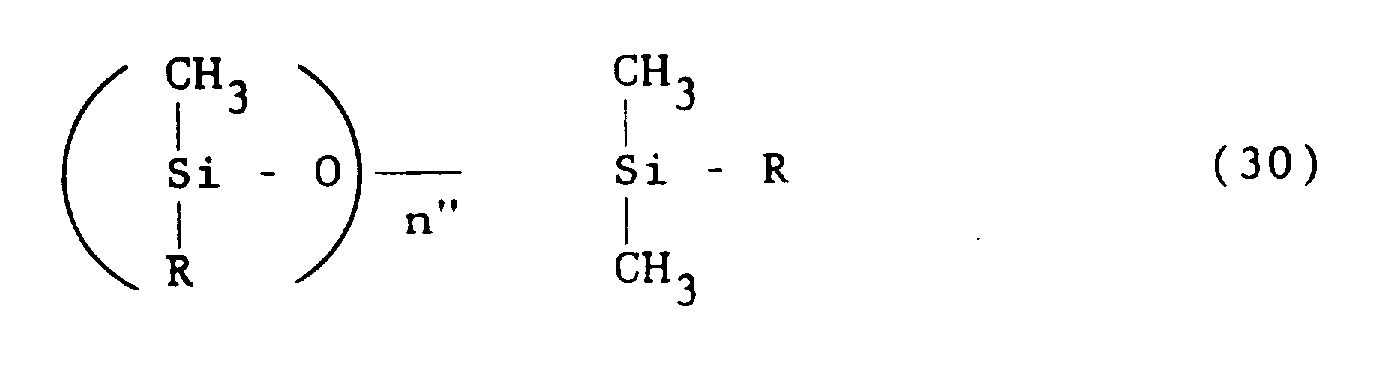
- n =
- 54; n' = 9, n" = 2
- R =
- C₃H₆OCOCH₃.
- This structure corresponds to the theoretical percentage by weight of fluorine of 29.9% and to a MW = 9720.
- The product (30) was hydrolyzed in the presence of KCN in methanol to prepare a product (31) which presented a total conversion of acetate groups to free hydroxyl groups.
- Polysiloxane (31) with free, lateral and terminal hydroxyl groups was reacted with vinyl ether-ω-isocyanate (8) to obtain product (32):


- Coating compositions were prepared by dissolving a polymer according to the invention and a photosensitive catalyst in a solvent in the proportions indicated in the table below and these compositions were applied to kraft paper using a manual applicator consisting of a threaded rod, in quantities indicated in said table (in g/m). The applied coat was crosslinked by exposure to a UV lamp (80 W/cm) for the time indicated in the table. In all cases, a paper with antiadhesive properties was obtained from which adhesive ribbons could be removed easily. In addition, there was no trace of migration, from the antiadhesive film of the silicon polymer of the invention to the adhesive ribbon, because the latter remained capable of adhering to itself. These antiadhesive properties were preserved even after storage for 24 hours of the treated papers in an oven at 60°C.

Claims (5)
- A siloxane copolymer having an average molecular weight (

(Ra)₃SiO(V)v-(W)w-(Y)y-(Z)z-Si(Ra)₃ (I)
whereV = -SiRaRbO-;W = -SiR'a(Rc-Rd-OCH = CH₂)O-;Y = -SiRaRgO-;Z = -RaRgSiCnH2nR' fCnH2nSiRaRgO- with n = 2, 3 or 4;v, y, z are identical or different numbers, but cannot be simultaneously zero; w is always different from zero; and the ratio v+y+z/w is between 1 and 100; the groups Ra represent, independently of each other, a radical selected from the group consisting of CH₃, C₂H₅, n-C₃H₇, n-C₄H₁₀ radicals and phenyl, with not more than one phenyl radical being attached to a given silicon atom;Rb = Ra;R'a = Ra, -OCH₃ or OC₂H₅;Rc = -C₂H₄-, -C₃H₆-, -C₂H₄-S-C₂H₄- or
-C₃H₆-S-C₂H₄-;Rd = -OCONHReNHCO-, -NH-COOC₂H₄- or -NHCOOC₃H₆-;Re = -C₆H₃(CH₃)-, -C₆H₄CH₂C₆H₄- ;-(CH₂)₆-,
-C₆H₁₀-CH₂-C₆H₁₀- or -CH₂-[(CH₃)₃C₆H₇]-;Rg = -CkH2k-Rf where k = 2, 3 or 4;
Rf is a perfluoroalkyl group with 1 to 12 carbon atoms or a monovalent radical of an oligomer of oxetanes or fluorinated oxiranes; R'f is a perfluoroalkylene group with 4 to 10 carbon atoms or an alpha,omega-fluoroalkenyl group formed by telomerization of tetrafluoroethylene or a telechelic divalent radical of an oligomer derived from fluorinated oxetanes or oxiranes or an m-phenylenedi(hexafluoroisopropoxy) radical; and the units V, W, Y and Z can be arranged randomly, in order or alternated along the polymer chain. - A siloxane copolymer according to claim 1, wherein said copolymer contains fluoroalkyl or fluoroalkylene groups.
- A protecting insulation layer comprising a silicone copolymer according to claim 1 or 2.
- An antiadhesive product for paper comprising a silicone copolymer according to claim 1 or 2.
- The use of a silicone copolymer according to claim 1 or 2 for the preparation of antiadhesive coatings.
Applications Claiming Priority (2)
| Application Number | Priority Date | Filing Date | Title |
|---|---|---|---|
| FR9107954 | 1991-06-27 | ||
| FR9107954A FR2678277B1 (en) | 1991-06-27 | 1991-06-27 | SILICONES CONTAINING VINYL ETHER GROUPS SIDE PERIPHERALS CROSSLINKABLE BY CATIONIC PHOTOINITIATORS AND THEIR APPLICATION TO COATINGS AND NON-STICKERS FOR PAPER. |
Publications (2)
| Publication Number | Publication Date |
|---|---|
| EP0520608A1 EP0520608A1 (en) | 1992-12-30 |
| EP0520608B1 true EP0520608B1 (en) | 1996-03-06 |
Family
ID=9414370
Family Applications (1)
| Application Number | Title | Priority Date | Filing Date |
|---|---|---|---|
| EP92303415A Expired - Lifetime EP0520608B1 (en) | 1991-06-27 | 1992-04-15 | Silicones which contain lateral peripheral vinyl ether groups crosslinkable by cationic photoinitiators and their application for coatings and antiadhesive products for paper |
Country Status (8)
| Country | Link |
|---|---|
| US (1) | US5208312A (en) |
| EP (1) | EP0520608B1 (en) |
| JP (1) | JPH05140318A (en) |
| CA (1) | CA2067276A1 (en) |
| DE (1) | DE69208748T2 (en) |
| FI (1) | FI103799B (en) |
| FR (1) | FR2678277B1 (en) |
| NO (1) | NO921228L (en) |
Families Citing this family (13)
| Publication number | Priority date | Publication date | Assignee | Title |
|---|---|---|---|---|
| US5300613A (en) * | 1992-06-02 | 1994-04-05 | Shin-Etsu Chemical Co., Ltd. | Fluorine-containing organosilicon compounds |
| JP2782406B2 (en) * | 1993-02-09 | 1998-07-30 | 信越化学工業株式会社 | Room temperature curable composition |
| FR2704228B1 (en) * | 1993-04-19 | 1995-07-07 | Dow Corning | Copolymers of crosslinkable oxaalkylenestyrene siloxanes and non-stick coating for paper formed from these copolymers. |
| US5436309A (en) * | 1993-04-19 | 1995-07-25 | Dow Corning Corporation | Photo-crosslinkable silicones comprising oxyalkylene styrene groups and their use |
| US5352816A (en) * | 1993-12-28 | 1994-10-04 | Three Bond Co., Ltd. | Organosilicon compound |
| US5486422A (en) * | 1994-04-19 | 1996-01-23 | Dow Corning Corporation | Photo-crosslinkable silicones and their use |
| EP0851003B1 (en) * | 1994-06-23 | 2002-12-04 | Shin-Etsu Chemical Co., Ltd. | Curable compositions containing organic fluorine compounds |
| EP0725113B1 (en) * | 1995-01-23 | 2000-09-27 | Shin-Etsu Chemical Co., Ltd. | Fluorinated amide silicone compounds and curable siloxane compositions |
| EP0745604A3 (en) * | 1995-05-29 | 1998-07-29 | Shin-Etsu Chemical Co., Ltd. | Room temperature curable fluoropolymer composition; and fluorine-containing organosilicon compounds, a method of producing the same, and room temperature curable silicone composition containing the same |
| JP3239717B2 (en) * | 1995-09-29 | 2001-12-17 | 信越化学工業株式会社 | Curable composition |
| FR2796862A1 (en) * | 1999-07-26 | 2001-02-02 | Centre Nat Rech Scient | COMPOSITION OF POLYMER AND ITS USE FOR THE PREPARATION OF A PERMSELECTIVE MEMBRANE |
| CA2447132C (en) * | 2001-05-14 | 2008-10-07 | Omnova Solutions Inc. | Polymeric surfactants derived from cyclic monomers having pendant fluorinated carbon groups |
| JP4344177B2 (en) * | 2002-07-12 | 2009-10-14 | 大日本印刷株式会社 | Photosensitive composition for volume hologram recording, photosensitive medium for volume hologram recording, and volume hologram |
Family Cites Families (14)
| Publication number | Priority date | Publication date | Assignee | Title |
|---|---|---|---|---|
| US4064027A (en) * | 1973-09-28 | 1977-12-20 | Dow Corning Corporation | UV curable composition |
| US3873499A (en) * | 1973-11-29 | 1975-03-25 | Dow Corning | Fast curing mercaptoalkyl vinyl siloxane resins |
| JPS5355362A (en) * | 1976-10-29 | 1978-05-19 | Shin Etsu Chem Co Ltd | Organopolysiloxane composition |
| DE3005024A1 (en) * | 1980-02-11 | 1981-08-20 | Prof. Dr. Ernst 7400 Tübingen Bayer | CHIRAL POLYSILOXANES, METHOD FOR THE PRODUCTION AND USE THEREOF |
| US4617238A (en) * | 1982-04-01 | 1986-10-14 | General Electric Company | Vinyloxy-functional organopolysiloxane compositions |
| JPS60258260A (en) * | 1984-06-01 | 1985-12-20 | Shin Etsu Chem Co Ltd | Room temperature curing silicone rubber composition |
| US4605712A (en) * | 1984-09-24 | 1986-08-12 | Ciba-Geigy Corporation | Unsaturated polysiloxanes and polymers thereof |
| US4640940A (en) * | 1985-08-13 | 1987-02-03 | Loctite Corporation | Polyol terminated silicones and derivatives thereof |
| DE3671028D1 (en) * | 1985-11-07 | 1990-06-13 | Uvexs Inc | UV-curable polymer compounds based on epoxies and siloxanes. |
| US4849461A (en) * | 1986-01-06 | 1989-07-18 | Dow Corning Corporation | Acryl functional silicone compounds |
| JPH0674330B2 (en) * | 1986-12-24 | 1994-09-21 | チッソ株式会社 | Isocyanate group-containing modified polyorganosiloxane and method for producing the same |
| US4909935A (en) * | 1988-06-03 | 1990-03-20 | Brigham Young University | Chromatographic arylcarboxamide polysiloxanes |
| US5057550A (en) * | 1989-12-04 | 1991-10-15 | Dow Corning Corporation | Epoxy-silanol functional uv curable polymers |
| DE4009889C1 (en) * | 1990-03-28 | 1991-06-13 | Th. Goldschmidt Ag, 4300 Essen, De |
-
1991
- 1991-06-27 FR FR9107954A patent/FR2678277B1/en not_active Expired - Fee Related
-
1992
- 1992-02-21 US US07/839,163 patent/US5208312A/en not_active Expired - Fee Related
- 1992-03-30 NO NO92921228A patent/NO921228L/en unknown
- 1992-04-15 DE DE69208748T patent/DE69208748T2/en not_active Expired - Fee Related
- 1992-04-15 EP EP92303415A patent/EP0520608B1/en not_active Expired - Lifetime
- 1992-04-27 CA CA002067276A patent/CA2067276A1/en not_active Abandoned
- 1992-05-21 JP JP4129087A patent/JPH05140318A/en active Pending
- 1992-06-26 FI FI922975A patent/FI103799B/en active
Also Published As
| Publication number | Publication date |
|---|---|
| DE69208748T2 (en) | 1996-10-02 |
| FI103799B1 (en) | 1999-09-30 |
| FR2678277A1 (en) | 1992-12-31 |
| JPH05140318A (en) | 1993-06-08 |
| EP0520608A1 (en) | 1992-12-30 |
| NO921228L (en) | 1992-12-28 |
| CA2067276A1 (en) | 1992-12-28 |
| US5208312A (en) | 1993-05-04 |
| FI922975A0 (en) | 1992-06-26 |
| FI922975L (en) | 1992-12-28 |
| NO921228D0 (en) | 1992-03-30 |
| FI103799B (en) | 1999-09-30 |
| FR2678277B1 (en) | 1993-10-22 |
| DE69208748D1 (en) | 1996-04-11 |
Similar Documents
| Publication | Publication Date | Title |
|---|---|---|
| JP3086258B2 (en) | Functionalized polyorganosiloxanes and one method of making them | |
| EP1801144B1 (en) | Fluorine-containing organopolysiloxane, a surface treatment composition comprising the same and an article treated with the composition | |
| EP1897899B1 (en) | Perfluoroployether-organopolysiloxane copolymer and a surface treatment composition comprising the same | |
| JP3086259B2 (en) | Functionalized polyorganosiloxanes and one method of making them | |
| EP0520608A1 (en) | Silicones which contain lateral peripheral vinyl ether groups crosslinkable by cationic photoinitiators and their application for coatings and antiadhesive products for paper | |
| KR19980032327A (en) | Method for preparing self-curing alkenyl hydride siloxane copolymer and coating composition | |
| JP2843620B2 (en) | One-terminal branched aminoalkyl group-blocked organopolysiloxane and method for producing the same | |
| JP2739211B2 (en) | Organosiloxane compounds | |
| US5041588A (en) | Chemically reactive fluorinated organosilicon compounds and their polymers | |
| US6121342A (en) | Photocationically curable compositions and process for producing the same | |
| JP2624060B2 (en) | One-end diol siloxane compound and method for producing the same | |
| US3334123A (en) | Haloethersilanes | |
| EP4658708A1 (en) | New functionalized organopolysiloxane compounds, manufacturing method, and uses thereof | |
| CN117535030A (en) | Single-component solvent-free organic silicon three-proofing adhesive and preparation method thereof | |
| KR102749400B1 (en) | Non-solvent silicone release agent composition, release sheet and method for producing the same | |
| JP6930354B2 (en) | Curable composition and its use | |
| CN104812807A (en) | Organopolysiloxane containing photodimerization functional group, activation energy radiation curable organopolysiloxane composition and cured product thereof | |
| JP3796906B2 (en) | Photocationically polymerizable organosilicon compound and method for producing the same, photocationically polymerizable coating composition, and film coating agent for peeling | |
| US5416183A (en) | Room temperature curable composition | |
| US6420485B1 (en) | Siloxane-grafted hydrocarbon copolymers | |
| JPH0822922B2 (en) | Siloxane copolymer having vinyloxy group, production and use thereof | |
| GB2140018A (en) | Organosiloxane-oxyalkylene copolymers | |
| US5436309A (en) | Photo-crosslinkable silicones comprising oxyalkylene styrene groups and their use | |
| JP3661807B2 (en) | Method for producing hydroxyl group-containing siloxane compound | |
| US5486422A (en) | Photo-crosslinkable silicones and their use |
Legal Events
| Date | Code | Title | Description |
|---|---|---|---|
| PUAI | Public reference made under article 153(3) epc to a published international application that has entered the european phase |
Free format text: ORIGINAL CODE: 0009012 |
|
| AK | Designated contracting states |
Kind code of ref document: A1 Designated state(s): BE DE FR GB IT SE |
|
| 17P | Request for examination filed |
Effective date: 19930222 |
|
| 17Q | First examination report despatched |
Effective date: 19941102 |
|
| GRAA | (expected) grant |
Free format text: ORIGINAL CODE: 0009210 |
|
| AK | Designated contracting states |
Kind code of ref document: B1 Designated state(s): BE DE FR GB IT SE |
|
| REF | Corresponds to: |
Ref document number: 69208748 Country of ref document: DE Date of ref document: 19960411 |
|
| ITF | It: translation for a ep patent filed | ||
| ET | Fr: translation filed | ||
| PLBE | No opposition filed within time limit |
Free format text: ORIGINAL CODE: 0009261 |
|
| STAA | Information on the status of an ep patent application or granted ep patent |
Free format text: STATUS: NO OPPOSITION FILED WITHIN TIME LIMIT |
|
| 26N | No opposition filed | ||
| PGFP | Annual fee paid to national office [announced via postgrant information from national office to epo] |
Ref country code: FR Payment date: 20000306 Year of fee payment: 9 Ref country code: DE Payment date: 20000306 Year of fee payment: 9 |
|
| PGFP | Annual fee paid to national office [announced via postgrant information from national office to epo] |
Ref country code: GB Payment date: 20000307 Year of fee payment: 9 |
|
| PGFP | Annual fee paid to national office [announced via postgrant information from national office to epo] |
Ref country code: SE Payment date: 20000320 Year of fee payment: 9 |
|
| PGFP | Annual fee paid to national office [announced via postgrant information from national office to epo] |
Ref country code: BE Payment date: 20000329 Year of fee payment: 9 |
|
| PG25 | Lapsed in a contracting state [announced via postgrant information from national office to epo] |
Ref country code: GB Free format text: LAPSE BECAUSE OF NON-PAYMENT OF DUE FEES Effective date: 20010415 |
|
| PG25 | Lapsed in a contracting state [announced via postgrant information from national office to epo] |
Ref country code: SE Free format text: LAPSE BECAUSE OF NON-PAYMENT OF DUE FEES Effective date: 20010416 |
|
| PG25 | Lapsed in a contracting state [announced via postgrant information from national office to epo] |
Ref country code: FR Free format text: THE PATENT HAS BEEN ANNULLED BY A DECISION OF A NATIONAL AUTHORITY Effective date: 20010430 Ref country code: BE Free format text: LAPSE BECAUSE OF NON-PAYMENT OF DUE FEES Effective date: 20010430 |
|
| BERE | Be: lapsed |
Owner name: DOW CORNING CORP. Effective date: 20010430 |
|
| EUG | Se: european patent has lapsed |
Ref document number: 92303415.1 |
|
| GBPC | Gb: european patent ceased through non-payment of renewal fee |
Effective date: 20010415 |
|
| PG25 | Lapsed in a contracting state [announced via postgrant information from national office to epo] |
Ref country code: DE Free format text: LAPSE BECAUSE OF NON-PAYMENT OF DUE FEES Effective date: 20020201 |
|
| REG | Reference to a national code |
Ref country code: FR Ref legal event code: ST |
|
| PG25 | Lapsed in a contracting state [announced via postgrant information from national office to epo] |
Ref country code: IT Free format text: LAPSE BECAUSE OF NON-PAYMENT OF DUE FEES Effective date: 20050415 |