EP0519032B1 - Mixtures of hals compounds - Google Patents
Mixtures of hals compounds Download PDFInfo
- Publication number
- EP0519032B1 EP0519032B1 EP92901642A EP92901642A EP0519032B1 EP 0519032 B1 EP0519032 B1 EP 0519032B1 EP 92901642 A EP92901642 A EP 92901642A EP 92901642 A EP92901642 A EP 92901642A EP 0519032 B1 EP0519032 B1 EP 0519032B1
- Authority
- EP
- European Patent Office
- Prior art keywords
- group
- alkyl
- formula
- hydrogen
- component
- Prior art date
- Legal status (The legal status is an assumption and is not a legal conclusion. Google has not performed a legal analysis and makes no representation as to the accuracy of the status listed.)
- Expired - Lifetime
Links
- 239000000203 mixture Substances 0.000 title claims abstract description 80
- 150000001875 compounds Chemical class 0.000 title claims description 84
- -1 piperidine compound Chemical class 0.000 claims abstract description 27
- 239000000463 material Substances 0.000 claims abstract description 22
- QVGXLLKOCUKJST-UHFFFAOYSA-N atomic oxygen Chemical compound [O] QVGXLLKOCUKJST-UHFFFAOYSA-N 0.000 claims abstract description 12
- 229910052760 oxygen Inorganic materials 0.000 claims abstract description 12
- 239000001301 oxygen Substances 0.000 claims abstract description 12
- 238000000034 method Methods 0.000 claims abstract description 7
- 229910052739 hydrogen Inorganic materials 0.000 claims description 63
- 239000001257 hydrogen Substances 0.000 claims description 63
- 125000004435 hydrogen atom Chemical group [H]* 0.000 claims description 49
- 125000001997 phenyl group Chemical group [H]C1=C([H])C([H])=C(*)C([H])=C1[H] 0.000 claims description 32
- 125000004178 (C1-C4) alkyl group Chemical group 0.000 claims description 30
- 239000004922 lacquer Substances 0.000 claims description 27
- 125000003118 aryl group Chemical group 0.000 claims description 25
- 125000001931 aliphatic group Chemical group 0.000 claims description 24
- 125000004432 carbon atom Chemical group C* 0.000 claims description 24
- 125000004400 (C1-C12) alkyl group Chemical group 0.000 claims description 22
- 125000002496 methyl group Chemical group [H]C([H])([H])* 0.000 claims description 22
- 239000002253 acid Substances 0.000 claims description 21
- UFHFLCQGNIYNRP-UHFFFAOYSA-N Hydrogen Chemical compound [H][H] UFHFLCQGNIYNRP-UHFFFAOYSA-N 0.000 claims description 14
- XSQUKJJJFZCRTK-UHFFFAOYSA-N Urea Chemical compound NC(N)=O XSQUKJJJFZCRTK-UHFFFAOYSA-N 0.000 claims description 14
- 150000002148 esters Chemical class 0.000 claims description 14
- 125000001797 benzyl group Chemical group [H]C1=C([H])C([H])=C(C([H])=C1[H])C([H])([H])* 0.000 claims description 12
- 229920005989 resin Polymers 0.000 claims description 12
- 239000011347 resin Substances 0.000 claims description 12
- 125000000217 alkyl group Chemical group 0.000 claims description 11
- OFOBLEOULBTSOW-UHFFFAOYSA-N Malonic acid Chemical compound OC(=O)CC(O)=O OFOBLEOULBTSOW-UHFFFAOYSA-N 0.000 claims description 10
- 125000003003 spiro group Chemical group 0.000 claims description 10
- 150000001408 amides Chemical class 0.000 claims description 9
- 125000006705 (C5-C7) cycloalkyl group Chemical group 0.000 claims description 8
- OAICVXFJPJFONN-UHFFFAOYSA-N Phosphorus Chemical compound [P] OAICVXFJPJFONN-UHFFFAOYSA-N 0.000 claims description 8
- 239000003377 acid catalyst Substances 0.000 claims description 8
- 125000003055 glycidyl group Chemical group C(C1CO1)* 0.000 claims description 8
- 229910052698 phosphorus Inorganic materials 0.000 claims description 8
- 239000011574 phosphorus Substances 0.000 claims description 8
- 150000001412 amines Chemical class 0.000 claims description 7
- 229920006395 saturated elastomer Polymers 0.000 claims description 7
- SCEVBRBKKQZTKM-UHFFFAOYSA-N 5-[[6-chloro-5-(1-methylindol-5-yl)-1H-benzimidazol-2-yl]oxy]-N-hydroxy-2-methylbenzamide Chemical compound ClC=1C(=CC2=C(NC(=N2)OC=2C=CC(=C(C(=O)NO)C=2)C)C=1)C=1C=C2C=CN(C2=CC=1)C SCEVBRBKKQZTKM-UHFFFAOYSA-N 0.000 claims description 6
- 229920000178 Acrylic resin Polymers 0.000 claims description 6
- JOYRKODLDBILNP-UHFFFAOYSA-N Ethyl urethane Chemical compound CCOC(N)=O JOYRKODLDBILNP-UHFFFAOYSA-N 0.000 claims description 6
- 125000003236 benzoyl group Chemical group [H]C1=C([H])C([H])=C(C([H])=C1[H])C(*)=O 0.000 claims description 6
- 239000004202 carbamide Substances 0.000 claims description 6
- 235000013877 carbamide Nutrition 0.000 claims description 6
- 230000000694 effects Effects 0.000 claims description 6
- 125000002887 hydroxy group Chemical group [H]O* 0.000 claims description 6
- OLRJXMHANKMLTD-UHFFFAOYSA-N silyl Chemical compound [SiH3] OLRJXMHANKMLTD-UHFFFAOYSA-N 0.000 claims description 6
- 230000003019 stabilising effect Effects 0.000 claims description 6
- 125000000229 (C1-C4)alkoxy group Chemical group 0.000 claims description 5
- 125000003178 carboxy group Chemical group [H]OC(*)=O 0.000 claims description 5
- 229920000647 polyepoxide Polymers 0.000 claims description 5
- 229920001225 polyester resin Polymers 0.000 claims description 5
- 239000004645 polyester resin Substances 0.000 claims description 5
- 229920001228 polyisocyanate Polymers 0.000 claims description 5
- 239000005056 polyisocyanate Substances 0.000 claims description 5
- 125000006681 (C2-C10) alkylene group Chemical group 0.000 claims description 4
- 125000001731 2-cyanoethyl group Chemical group [H]C([H])(*)C([H])([H])C#N 0.000 claims description 4
- 125000003903 2-propenyl group Chemical group [H]C([*])([H])C([H])=C([H])[H] 0.000 claims description 4
- 125000002853 C1-C4 hydroxyalkyl group Chemical group 0.000 claims description 4
- NINIDFKCEFEMDL-UHFFFAOYSA-N Sulfur Chemical group [S] NINIDFKCEFEMDL-UHFFFAOYSA-N 0.000 claims description 4
- NIXOWILDQLNWCW-UHFFFAOYSA-N acrylic acid group Chemical group C(C=C)(=O)O NIXOWILDQLNWCW-UHFFFAOYSA-N 0.000 claims description 4
- 229920000180 alkyd Polymers 0.000 claims description 4
- WPYMKLBDIGXBTP-UHFFFAOYSA-N benzoic acid Chemical compound OC(=O)C1=CC=CC=C1 WPYMKLBDIGXBTP-UHFFFAOYSA-N 0.000 claims description 4
- 125000000113 cyclohexyl group Chemical group [H]C1([H])C([H])([H])C([H])([H])C([H])(*)C([H])([H])C1([H])[H] 0.000 claims description 4
- 125000001033 ether group Chemical group 0.000 claims description 4
- IVJISJACKSSFGE-UHFFFAOYSA-N formaldehyde;1,3,5-triazine-2,4,6-triamine Chemical compound O=C.NC1=NC(N)=NC(N)=N1 IVJISJACKSSFGE-UHFFFAOYSA-N 0.000 claims description 4
- 125000001624 naphthyl group Chemical group 0.000 claims description 4
- 125000006839 xylylene group Chemical group 0.000 claims description 4
- 125000006704 (C5-C6) cycloalkyl group Chemical group 0.000 claims description 3
- 125000003342 alkenyl group Chemical group 0.000 claims description 3
- 125000002947 alkylene group Chemical group 0.000 claims description 3
- 125000003837 (C1-C20) alkyl group Chemical group 0.000 claims description 2
- 125000000923 (C1-C30) alkyl group Chemical group 0.000 claims description 2
- 125000003358 C2-C20 alkenyl group Chemical group 0.000 claims description 2
- ZOUTYVWHWSUKPL-NOZJJQNGSA-N C[C@H](CS)C(=O)N[C@H](Cc1c[nH]c2ccccc12)C(O)=O Chemical compound C[C@H](CS)C(=O)N[C@H](Cc1c[nH]c2ccccc12)C(O)=O ZOUTYVWHWSUKPL-NOZJJQNGSA-N 0.000 claims description 2
- 150000007933 aliphatic carboxylic acids Chemical class 0.000 claims description 2
- 125000001589 carboacyl group Chemical group 0.000 claims description 2
- KXDHJXZQYSOELW-UHFFFAOYSA-N carbonic acid monoamide Natural products NC(O)=O KXDHJXZQYSOELW-UHFFFAOYSA-N 0.000 claims description 2
- 125000000068 chlorophenyl group Chemical group 0.000 claims description 2
- 125000002993 cycloalkylene group Chemical group 0.000 claims description 2
- 125000004430 oxygen atom Chemical group O* 0.000 claims description 2
- KJAMZCVTJDTESW-UHFFFAOYSA-N tiracizine Chemical compound C1CC2=CC=CC=C2N(C(=O)CN(C)C)C2=CC(NC(=O)OCC)=CC=C21 KJAMZCVTJDTESW-UHFFFAOYSA-N 0.000 claims description 2
- 150000001735 carboxylic acids Chemical class 0.000 claims 1
- 238000000576 coating method Methods 0.000 abstract description 16
- 239000011248 coating agent Substances 0.000 abstract description 15
- 239000004611 light stabiliser Substances 0.000 abstract description 4
- 239000006096 absorbing agent Substances 0.000 abstract description 3
- NQRYJNQNLNOLGT-UHFFFAOYSA-N tetrahydropyridine hydrochloride Natural products C1CCNCC1 NQRYJNQNLNOLGT-UHFFFAOYSA-N 0.000 abstract description 3
- 230000015556 catabolic process Effects 0.000 abstract 1
- 238000006731 degradation reaction Methods 0.000 abstract 1
- 239000002861 polymer material Substances 0.000 abstract 1
- 230000000087 stabilizing effect Effects 0.000 abstract 1
- 0 *C(*)(*)OC(CC(*)(*)N1*)CC1(*)I Chemical compound *C(*)(*)OC(CC(*)(*)N1*)CC1(*)I 0.000 description 19
- 229910052782 aluminium Inorganic materials 0.000 description 10
- XAGFODPZIPBFFR-UHFFFAOYSA-N aluminium Chemical compound [Al] XAGFODPZIPBFFR-UHFFFAOYSA-N 0.000 description 10
- 239000000243 solution Substances 0.000 description 10
- 239000004411 aluminium Substances 0.000 description 9
- 150000003254 radicals Chemical class 0.000 description 9
- 239000007787 solid Substances 0.000 description 9
- RMSGQZDGSZOJMU-UHFFFAOYSA-N 1-butyl-2-phenylbenzene Chemical group CCCCC1=CC=CC=C1C1=CC=CC=C1 RMSGQZDGSZOJMU-UHFFFAOYSA-N 0.000 description 7
- HXDLWJWIAHWIKI-UHFFFAOYSA-N 2-hydroxyethyl acetate Chemical compound CC(=O)OCCO HXDLWJWIAHWIKI-UHFFFAOYSA-N 0.000 description 6
- LRHPLDYGYMQRHN-UHFFFAOYSA-N N-Butanol Chemical compound CCCCO LRHPLDYGYMQRHN-UHFFFAOYSA-N 0.000 description 6
- CTQNGGLPUBDAKN-UHFFFAOYSA-N O-Xylene Chemical compound CC1=CC=CC=C1C CTQNGGLPUBDAKN-UHFFFAOYSA-N 0.000 description 6
- PPBRXRYQALVLMV-UHFFFAOYSA-N Styrene Chemical compound C=CC1=CC=CC=C1 PPBRXRYQALVLMV-UHFFFAOYSA-N 0.000 description 6
- 229920000058 polyacrylate Polymers 0.000 description 6
- 239000003381 stabilizer Substances 0.000 description 6
- 239000008096 xylene Substances 0.000 description 6
- 125000004209 (C1-C8) alkyl group Chemical group 0.000 description 5
- UHOVQNZJYSORNB-UHFFFAOYSA-N Benzene Chemical compound C1=CC=CC=C1 UHOVQNZJYSORNB-UHFFFAOYSA-N 0.000 description 5
- 229910052751 metal Inorganic materials 0.000 description 5
- 239000002184 metal Substances 0.000 description 5
- 239000000049 pigment Substances 0.000 description 5
- 239000004814 polyurethane Substances 0.000 description 5
- 229920000877 Melamine resin Polymers 0.000 description 4
- 239000011230 binding agent Substances 0.000 description 4
- DKPFZGUDAPQIHT-UHFFFAOYSA-N butyl acetate Chemical compound CCCCOC(C)=O DKPFZGUDAPQIHT-UHFFFAOYSA-N 0.000 description 4
- XCJYREBRNVKWGJ-UHFFFAOYSA-N copper(II) phthalocyanine Chemical compound [Cu+2].C12=CC=CC=C2C(N=C2[N-]C(C3=CC=CC=C32)=N2)=NC1=NC([C]1C=CC=CC1=1)=NC=1N=C1[C]3C=CC=CC3=C2[N-]1 XCJYREBRNVKWGJ-UHFFFAOYSA-N 0.000 description 4
- 239000007788 liquid Substances 0.000 description 4
- 238000002156 mixing Methods 0.000 description 4
- 239000002904 solvent Substances 0.000 description 4
- ZWEHNKRNPOVVGH-UHFFFAOYSA-N 2-Butanone Chemical compound CCC(C)=O ZWEHNKRNPOVVGH-UHFFFAOYSA-N 0.000 description 3
- 239000004925 Acrylic resin Substances 0.000 description 3
- WSFSSNUMVMOOMR-UHFFFAOYSA-N Formaldehyde Chemical compound O=C WSFSSNUMVMOOMR-UHFFFAOYSA-N 0.000 description 3
- 239000003960 organic solvent Substances 0.000 description 3
- 229920003023 plastic Polymers 0.000 description 3
- 239000004033 plastic Substances 0.000 description 3
- 229920000728 polyester Polymers 0.000 description 3
- 229920000642 polymer Polymers 0.000 description 3
- 229920001169 thermoplastic Polymers 0.000 description 3
- 125000000391 vinyl group Chemical group [H]C([*])=C([H])[H] 0.000 description 3
- 229910002016 Aerosil® 200 Inorganic materials 0.000 description 2
- 239000004971 Cross linker Substances 0.000 description 2
- CEAWIMABVSITMV-YEJXKQKISA-N Desmodin Chemical compound CC1(C=CC2=C(C3=C(C=C2O1)OC[C@@H]4[C@H]3OC5=CC(=C(C=C45)OC)O)OC)C CEAWIMABVSITMV-YEJXKQKISA-N 0.000 description 2
- 239000004721 Polyphenylene oxide Substances 0.000 description 2
- VYPSYNLAJGMNEJ-UHFFFAOYSA-N Silicium dioxide Chemical compound O=[Si]=O VYPSYNLAJGMNEJ-UHFFFAOYSA-N 0.000 description 2
- 239000005864 Sulphur Substances 0.000 description 2
- 239000007983 Tris buffer Substances 0.000 description 2
- 229920000122 acrylonitrile butadiene styrene Polymers 0.000 description 2
- 125000003545 alkoxy group Chemical group 0.000 description 2
- 125000004414 alkyl thio group Chemical group 0.000 description 2
- 125000005001 aminoaryl group Chemical group 0.000 description 2
- 239000003963 antioxidant agent Substances 0.000 description 2
- 150000001558 benzoic acid derivatives Chemical class 0.000 description 2
- 239000001273 butane Substances 0.000 description 2
- 239000003795 chemical substances by application Substances 0.000 description 2
- 235000008504 concentrate Nutrition 0.000 description 2
- 239000012141 concentrate Substances 0.000 description 2
- 229920001577 copolymer Polymers 0.000 description 2
- 238000005336 cracking Methods 0.000 description 2
- 239000003085 diluting agent Substances 0.000 description 2
- XBDQKXXYIPTUBI-UHFFFAOYSA-N dimethylselenoniopropionate Natural products CCC(O)=O XBDQKXXYIPTUBI-UHFFFAOYSA-N 0.000 description 2
- 239000006185 dispersion Substances 0.000 description 2
- HQQADJVZYDDRJT-UHFFFAOYSA-N ethene;prop-1-ene Chemical group C=C.CC=C HQQADJVZYDDRJT-UHFFFAOYSA-N 0.000 description 2
- 235000014666 liquid concentrate Nutrition 0.000 description 2
- JDSHMPZPIAZGSV-UHFFFAOYSA-N melamine Chemical compound NC1=NC(N)=NC(N)=N1 JDSHMPZPIAZGSV-UHFFFAOYSA-N 0.000 description 2
- 239000000155 melt Substances 0.000 description 2
- VNWKTOKETHGBQD-UHFFFAOYSA-N methane Chemical compound C VNWKTOKETHGBQD-UHFFFAOYSA-N 0.000 description 2
- 229910052757 nitrogen Inorganic materials 0.000 description 2
- 229920000620 organic polymer Polymers 0.000 description 2
- 150000002989 phenols Chemical class 0.000 description 2
- 125000000951 phenoxy group Chemical group [H]C1=C([H])C([H])=C(O*)C([H])=C1[H] 0.000 description 2
- 125000003356 phenylsulfanyl group Chemical group [*]SC1=C([H])C([H])=C([H])C([H])=C1[H] 0.000 description 2
- 238000006116 polymerization reaction Methods 0.000 description 2
- 229920002635 polyurethane Polymers 0.000 description 2
- 239000000843 powder Substances 0.000 description 2
- 239000002243 precursor Substances 0.000 description 2
- 239000002987 primer (paints) Substances 0.000 description 2
- 239000000126 substance Substances 0.000 description 2
- 230000002195 synergetic effect Effects 0.000 description 2
- 229920001187 thermosetting polymer Polymers 0.000 description 2
- HJIAMFHSAAEUKR-UHFFFAOYSA-N (2-hydroxyphenyl)-phenylmethanone Chemical class OC1=CC=CC=C1C(=O)C1=CC=CC=C1 HJIAMFHSAAEUKR-UHFFFAOYSA-N 0.000 description 1
- 125000004642 (C1-C12) alkoxy group Chemical group 0.000 description 1
- 125000004169 (C1-C6) alkyl group Chemical group 0.000 description 1
- MQQKTNDBASEZSD-UHFFFAOYSA-N 1-(octadecyldisulfanyl)octadecane Chemical compound CCCCCCCCCCCCCCCCCCSSCCCCCCCCCCCCCCCCCC MQQKTNDBASEZSD-UHFFFAOYSA-N 0.000 description 1
- FJGQBLRYBUAASW-UHFFFAOYSA-N 2-(benzotriazol-2-yl)phenol Chemical class OC1=CC=CC=C1N1N=C2C=CC=CC2=N1 FJGQBLRYBUAASW-UHFFFAOYSA-N 0.000 description 1
- YZBOVSFWWNVKRJ-UHFFFAOYSA-M 2-butoxycarbonylbenzoate Chemical compound CCCCOC(=O)C1=CC=CC=C1C([O-])=O YZBOVSFWWNVKRJ-UHFFFAOYSA-M 0.000 description 1
- PZRWFKGUFWPFID-UHFFFAOYSA-N 3,9-dioctadecoxy-2,4,8,10-tetraoxa-3,9-diphosphaspiro[5.5]undecane Chemical compound C1OP(OCCCCCCCCCCCCCCCCCC)OCC21COP(OCCCCCCCCCCCCCCCCCC)OC2 PZRWFKGUFWPFID-UHFFFAOYSA-N 0.000 description 1
- NLHHRLWOUZZQLW-UHFFFAOYSA-N Acrylonitrile Chemical compound C=CC#N NLHHRLWOUZZQLW-UHFFFAOYSA-N 0.000 description 1
- 239000004215 Carbon black (E152) Substances 0.000 description 1
- 239000004709 Chlorinated polyethylene Substances 0.000 description 1
- XZMCDFZZKTWFGF-UHFFFAOYSA-N Cyanamide Chemical compound NC#N XZMCDFZZKTWFGF-UHFFFAOYSA-N 0.000 description 1
- 229920003270 Cymel® Polymers 0.000 description 1
- 244000043261 Hevea brasiliensis Species 0.000 description 1
- 239000004609 Impact Modifier Substances 0.000 description 1
- 239000004594 Masterbatch (MB) Substances 0.000 description 1
- 239000004640 Melamine resin Substances 0.000 description 1
- YIKSCQDJHCMVMK-UHFFFAOYSA-N Oxamide Chemical class NC(=O)C(N)=O YIKSCQDJHCMVMK-UHFFFAOYSA-N 0.000 description 1
- ISWSIDIOOBJBQZ-UHFFFAOYSA-N Phenol Chemical compound OC1=CC=CC=C1 ISWSIDIOOBJBQZ-UHFFFAOYSA-N 0.000 description 1
- 239000004952 Polyamide Substances 0.000 description 1
- 239000004698 Polyethylene Substances 0.000 description 1
- 239000004743 Polypropylene Substances 0.000 description 1
- 239000004793 Polystyrene Substances 0.000 description 1
- 150000001252 acrylic acid derivatives Chemical class 0.000 description 1
- 229920005822 acrylic binder Polymers 0.000 description 1
- 125000004423 acyloxy group Chemical group 0.000 description 1
- 239000000654 additive Substances 0.000 description 1
- 125000002723 alicyclic group Chemical group 0.000 description 1
- 150000001338 aliphatic hydrocarbons Chemical group 0.000 description 1
- 230000003078 antioxidant effect Effects 0.000 description 1
- 239000002216 antistatic agent Substances 0.000 description 1
- 125000002619 bicyclic group Chemical group 0.000 description 1
- 239000003139 biocide Substances 0.000 description 1
- 230000015572 biosynthetic process Effects 0.000 description 1
- 238000000071 blow moulding Methods 0.000 description 1
- MTAZNLWOLGHBHU-UHFFFAOYSA-N butadiene-styrene rubber Chemical compound C=CC=C.C=CC1=CC=CC=C1 MTAZNLWOLGHBHU-UHFFFAOYSA-N 0.000 description 1
- 125000000484 butyl group Chemical group [H]C([*])([H])C([H])([H])C([H])([H])C([H])([H])[H] 0.000 description 1
- 150000001732 carboxylic acid derivatives Chemical class 0.000 description 1
- 239000001913 cellulose Substances 0.000 description 1
- 229920002678 cellulose Polymers 0.000 description 1
- 238000006243 chemical reaction Methods 0.000 description 1
- WBYWAXJHAXSJNI-UHFFFAOYSA-N cinnamic acid Chemical class OC(=O)C=CC1=CC=CC=C1 WBYWAXJHAXSJNI-UHFFFAOYSA-N 0.000 description 1
- 238000006482 condensation reaction Methods 0.000 description 1
- 150000004985 diamines Chemical class 0.000 description 1
- 239000000839 emulsion Substances 0.000 description 1
- 239000003822 epoxy resin Substances 0.000 description 1
- 125000001301 ethoxy group Chemical group [H]C([H])([H])C([H])([H])O* 0.000 description 1
- 125000001495 ethyl group Chemical group [H]C([H])([H])C([H])([H])* 0.000 description 1
- LYCAIKOWRPUZTN-UHFFFAOYSA-N ethylene glycol Natural products OCCO LYCAIKOWRPUZTN-UHFFFAOYSA-N 0.000 description 1
- 238000001125 extrusion Methods 0.000 description 1
- 239000000945 filler Substances 0.000 description 1
- 239000006260 foam Substances 0.000 description 1
- 239000011888 foil Substances 0.000 description 1
- 239000000417 fungicide Substances 0.000 description 1
- 230000004927 fusion Effects 0.000 description 1
- LNEPOXFFQSENCJ-UHFFFAOYSA-N haloperidol Chemical compound C1CC(O)(C=2C=CC(Cl)=CC=2)CCN1CCCC(=O)C1=CC=C(F)C=C1 LNEPOXFFQSENCJ-UHFFFAOYSA-N 0.000 description 1
- 238000010438 heat treatment Methods 0.000 description 1
- 125000000623 heterocyclic group Chemical group 0.000 description 1
- 229930195733 hydrocarbon Natural products 0.000 description 1
- 150000002430 hydrocarbons Chemical class 0.000 description 1
- 125000004356 hydroxy functional group Chemical group O* 0.000 description 1
- WGCNASOHLSPBMP-UHFFFAOYSA-N hydroxyacetaldehyde Natural products OCC=O WGCNASOHLSPBMP-UHFFFAOYSA-N 0.000 description 1
- 238000010348 incorporation Methods 0.000 description 1
- 238000001746 injection moulding Methods 0.000 description 1
- 239000012948 isocyanate Substances 0.000 description 1
- ZFSLODLOARCGLH-UHFFFAOYSA-N isocyanuric acid Chemical compound OC1=NC(O)=NC(O)=N1 ZFSLODLOARCGLH-UHFFFAOYSA-N 0.000 description 1
- 230000007774 longterm Effects 0.000 description 1
- 239000010687 lubricating oil Substances 0.000 description 1
- 230000014759 maintenance of location Effects 0.000 description 1
- FPYJFEHAWHCUMM-UHFFFAOYSA-N maleic anhydride Chemical compound O=C1OC(=O)C=C1 FPYJFEHAWHCUMM-UHFFFAOYSA-N 0.000 description 1
- 238000004519 manufacturing process Methods 0.000 description 1
- 239000006078 metal deactivator Substances 0.000 description 1
- KXZXLEYRSHQNCR-UHFFFAOYSA-N methane 2-methylidenenonanethioic S-acid Chemical compound C.CCCCCCCC(=C)C(O)=S.CCCCCCCC(=C)C(O)=S.CCCCCCCC(=C)C(O)=S.CCCCCCCC(=C)C(O)=S KXZXLEYRSHQNCR-UHFFFAOYSA-N 0.000 description 1
- AOGLBNCAHFLQDZ-UHFFFAOYSA-N methane 2-methylidenepentadecanethioic S-acid Chemical compound C.CCCCCCCCCCCCCC(=C)C(O)=S.CCCCCCCCCCCCCC(=C)C(O)=S.CCCCCCCCCCCCCC(=C)C(O)=S.CCCCCCCCCCCCCC(=C)C(O)=S AOGLBNCAHFLQDZ-UHFFFAOYSA-N 0.000 description 1
- 125000000956 methoxy group Chemical group [H]C([H])([H])O* 0.000 description 1
- 239000000178 monomer Substances 0.000 description 1
- IJDNQMDRQITEOD-UHFFFAOYSA-N n-butane Chemical compound CCCC IJDNQMDRQITEOD-UHFFFAOYSA-N 0.000 description 1
- OFBQJSOFQDEBGM-UHFFFAOYSA-N n-pentane Natural products CCCCC OFBQJSOFQDEBGM-UHFFFAOYSA-N 0.000 description 1
- 229920003052 natural elastomer Polymers 0.000 description 1
- 229920005615 natural polymer Polymers 0.000 description 1
- 229920001194 natural rubber Polymers 0.000 description 1
- 239000002667 nucleating agent Substances 0.000 description 1
- 230000003287 optical effect Effects 0.000 description 1
- 239000012860 organic pigment Substances 0.000 description 1
- 150000005623 oxindoles Chemical class 0.000 description 1
- NFHFRUOZVGFOOS-UHFFFAOYSA-N palladium;triphenylphosphane Chemical compound [Pd].C1=CC=CC=C1P(C=1C=CC=CC=1)C1=CC=CC=C1.C1=CC=CC=C1P(C=1C=CC=CC=1)C1=CC=CC=C1.C1=CC=CC=C1P(C=1C=CC=CC=1)C1=CC=CC=C1.C1=CC=CC=C1P(C=1C=CC=CC=1)C1=CC=CC=C1 NFHFRUOZVGFOOS-UHFFFAOYSA-N 0.000 description 1
- 239000002245 particle Substances 0.000 description 1
- OJMIONKXNSYLSR-UHFFFAOYSA-N phosphorous acid Chemical compound OP(O)O OJMIONKXNSYLSR-UHFFFAOYSA-N 0.000 description 1
- 229920003229 poly(methyl methacrylate) Polymers 0.000 description 1
- 229920002239 polyacrylonitrile Polymers 0.000 description 1
- 229920002647 polyamide Polymers 0.000 description 1
- 229920001748 polybutylene Polymers 0.000 description 1
- 239000004417 polycarbonate Substances 0.000 description 1
- 229920000515 polycarbonate Polymers 0.000 description 1
- 229920000570 polyether Polymers 0.000 description 1
- 229920000573 polyethylene Polymers 0.000 description 1
- 239000004926 polymethyl methacrylate Substances 0.000 description 1
- 229920006324 polyoxymethylene Polymers 0.000 description 1
- 229920006380 polyphenylene oxide Polymers 0.000 description 1
- 229920001155 polypropylene Polymers 0.000 description 1
- 229920001451 polypropylene glycol Polymers 0.000 description 1
- 229920001296 polysiloxane Polymers 0.000 description 1
- 229920002223 polystyrene Polymers 0.000 description 1
- 239000004800 polyvinyl chloride Substances 0.000 description 1
- 229920000915 polyvinyl chloride Polymers 0.000 description 1
- 229940080818 propionamide Drugs 0.000 description 1
- 235000019260 propionic acid Nutrition 0.000 description 1
- IUVKMZGDUIUOCP-BTNSXGMBSA-N quinbolone Chemical compound O([C@H]1CC[C@H]2[C@H]3[C@@H]([C@]4(C=CC(=O)C=C4CC3)C)CC[C@@]21C)C1=CCCC1 IUVKMZGDUIUOCP-BTNSXGMBSA-N 0.000 description 1
- 230000005855 radiation Effects 0.000 description 1
- 238000009987 spinning Methods 0.000 description 1
- 125000001424 substituent group Chemical group 0.000 description 1
- 238000006467 substitution reaction Methods 0.000 description 1
- 239000000758 substrate Substances 0.000 description 1
- 239000000725 suspension Substances 0.000 description 1
- KKEYFWRCBNTPAC-UHFFFAOYSA-L terephthalate(2-) Chemical compound [O-]C(=O)C1=CC=C(C([O-])=O)C=C1 KKEYFWRCBNTPAC-UHFFFAOYSA-L 0.000 description 1
- 229920001897 terpolymer Polymers 0.000 description 1
- 239000004634 thermosetting polymer Substances 0.000 description 1
- 239000004416 thermosoftening plastic Substances 0.000 description 1
- IVIIAEVMQHEPAY-UHFFFAOYSA-N tridodecyl phosphite Chemical compound CCCCCCCCCCCCOP(OCCCCCCCCCCCC)OCCCCCCCCCCCC IVIIAEVMQHEPAY-UHFFFAOYSA-N 0.000 description 1
- 150000005691 triesters Chemical class 0.000 description 1
- MGMXGCZJYUCMGY-UHFFFAOYSA-N tris(4-nonylphenyl) phosphite Chemical compound C1=CC(CCCCCCCCC)=CC=C1OP(OC=1C=CC(CCCCCCCCC)=CC=1)OC1=CC=C(CCCCCCCCC)C=C1 MGMXGCZJYUCMGY-UHFFFAOYSA-N 0.000 description 1
- XLYOFNOQVPJJNP-UHFFFAOYSA-N water Substances O XLYOFNOQVPJJNP-UHFFFAOYSA-N 0.000 description 1
Classifications
-
- C—CHEMISTRY; METALLURGY
- C08—ORGANIC MACROMOLECULAR COMPOUNDS; THEIR PREPARATION OR CHEMICAL WORKING-UP; COMPOSITIONS BASED THEREON
- C08K—Use of inorganic or non-macromolecular organic substances as compounding ingredients
- C08K5/00—Use of organic ingredients
- C08K5/16—Nitrogen-containing compounds
- C08K5/34—Heterocyclic compounds having nitrogen in the ring
- C08K5/3412—Heterocyclic compounds having nitrogen in the ring having one nitrogen atom in the ring
- C08K5/3432—Six-membered rings
- C08K5/3435—Piperidines
-
- C—CHEMISTRY; METALLURGY
- C09—DYES; PAINTS; POLISHES; NATURAL RESINS; ADHESIVES; COMPOSITIONS NOT OTHERWISE PROVIDED FOR; APPLICATIONS OF MATERIALS NOT OTHERWISE PROVIDED FOR
- C09D—COATING COMPOSITIONS, e.g. PAINTS, VARNISHES OR LACQUERS; FILLING PASTES; CHEMICAL PAINT OR INK REMOVERS; INKS; CORRECTING FLUIDS; WOODSTAINS; PASTES OR SOLIDS FOR COLOURING OR PRINTING; USE OF MATERIALS THEREFOR
- C09D7/00—Features of coating compositions, not provided for in group C09D5/00; Processes for incorporating ingredients in coating compositions
- C09D7/40—Additives
- C09D7/48—Stabilisers against degradation by oxygen, light or heat
Definitions
- the invention relates to novel mixtures of tetraalkylpiperidine compounds (HALS compounds), suitable as light stabilisers in polymeric systems especially in acid catalysed polymeric systems.
- HALS compounds tetraalkylpiperidine compounds
- composition suitable for stabilising a polymeric composition against the effects of light, comprising
- R 3 is hydrogen
- component a) is a compound of formula III in which
- component b) is a compound of formula IV in which
- composition suitable for stabilising a polymeric composition against the effects of light, comprising
- the above composition provides significant improvements in gloss retention and reduced cracking which occurs in polymeric material containing only the individual components.
- Preferred compounds of component i) are of formula V in which
- Preferred compounds of component ii) are of formula VI where each R 41 independently is selected from hydrogen, an amine and amide forming group, an ester and ester forming group and a urea and urethane forming group; and R 1 , R 2 and R a are as defined above.
- the amount of component a) (or component i) is 20-80%, more preferably 30-70%, most preferably 40-60%.
- the amount of component b) (or component ii) respectively) is 20-80%, more preferably 30-70%, most preferably 40-60%.
- Preferred compounds of formula III are those of formula IIIa to IIIn in which R is a saturated or unsaturated optionally alkyl or alkenyl substituted alkylene or cycloalkylene radical having 2-20 carbon atoms; and the other symbols are as defined above;
- R 50 is an amide forming group of the formula -N(R 3 )-R 51 , where R 51 is an aliphatic, cycloaliphatic, aromatic or heterocyclic (non-aromatic or aromatic) group, all of which may bear substituents (preferably 1 to 3) selected from C 1-4 alkoxy, C 1-12 alkyl, C 1-12 alkyl -mercapto, C 1-12 alkylamino, phenoxy, phenyl mercapto, phenylamino, acryloyloxy, methacryloyloxy and 2,2,6,6-tetraalkylpiperidine groups or oxalamido or acyloxy groups which may be further substituted by 2,2,6,6-tetraalkylpiperidine group; where the symbols are as defined above.
- Preferred compound of formula IV are those of formula IVa to IVo
- Preferred compounds of formula V are cf formulae IIId, IIIe, and IIIh.
- Preferred compounds of formula VI are compounds of formula IIIa to IIIc, IIIf to IIIh and IIIj to IIIn defined above.
- R is R' where R' is -CH(R 10 )-CH 2 - or where R 10 is selected from C 12-18 alkyl or C 12-18 alkenyl; cyclo C 5-6 alkylene, 1,2-cyclohexanediyl and a bicyclic divalent radical;
- R 11 is an alicyclic or bicyclic ring system and each R 12 independently is C 1-4 alkyl or hydrogen.
- R is R" where R'' is -CH(R 10 ')-CH 2 - where R 10 ' is C 12-18 alkyl.
- R b is R b ' where R b ' is -O-CO-R 5 ' where R 5 ' is defined above.
- each R 1 and each R 2 is -CH 3 .
- any C 1-8 alkyl or C 1-6 alkyl group is preferably a C 1-4 alkyl group and any C 1-4 alkyl group is preferably methyl or ethyl; preferably any alkoxy group is methoxy or ethoxy.
- any group capable of being linear or branched is linear or branched.
- a polymeric composition comprising a polymeric material and a mixture of component a) and of component b) or a mixture of component i) and component ii).
- a method for stabilising a lacquer composition based on acrylic, alkyd and/or polyester resins which if desired, can be crosslinked with melamine/formaldehyde resins, epoxide resins or polyisocyanates
- a lacquer composition based on acrylic, alkyd and/or polyester resins (which if desired, can be crosslinked with melamine/formaldehyde resins, epoxide resins or polyisocyanates) which comprises incorporating into the resin a mixture of component a) and component b) or a mixture of component i) and component ii), optionally together with an acid catalyst or compound capable of releasing an acid catalyst.
- a lacquer composition based on acrylic, alkyd and/or polyester resins (which if desired, can be crosslinked with melamine/formaldehyde resins, epoxide resins or polyisocyanates) containing a mixture of component a) and component b) or a mixture of component i) and component ii) optionally together with an acid catalyst or compound capable of releasing an acid catalyst.
- the concentration of a mixture of component a) and component b) or a mixture of component i) and component ii) employed in the polymeric material is suitably 0.01 to 8 % by weight, preferably 0.02% to 1 % by weight and gives a clear improvement in the light- and weather-stability of organic pigments in stoving finishes as well as reducing the tendency to hairline cracking and loss of gloss as the result of weathering. This is also found for metallic finishes and excellent long-term stability of the clear top coat of two layer metallic finishes is obtained.
- the mixture of component a) and component b) or amixture of component i) and component ii) may be added to the metallic undercoat, the clear top coat or both, preferably only to the clear top coat.
- the metal surface to be finished may be under-coated with primer coatings as is customary in the art of coating metal surfaces.
- the mixture of component a) and component b) or a mixture of component i) and component ii) may be added before, during or after the polymerization step, and may be added in solid form; in solution, preferably as a liquid concentrate containing from 20 to 80 % by weight of a mixture of component a) and component b) or a mixture of component i) and component ii) and 80-20% solvent; or as a solid masterbatch composition containing 10 to 80 % by weight of a mixture of component a) and component b) or a mixture of component i) and component ii) and 90 to 20 % by weight of a solid polymeric material which is identical with or compatible with the polymeric material to be stabilized.
- Suitable polymeric materials include plastic materials for example polyethylene, polypropylene, ethylene/propylene copolymers, polyvinyl chloride, polyester, polyamide, polyurethane, polyacrylonitrile, ABS, terpolymers of acrylates, styrene and acrylonitrile, styrene/acrylonitrileand styrene/butadiene.
- plastics materials such as polybutylene, polystyrene, chlorinated polyethylene, polycarbonate, polymethylmethacrylate, polyphenylene oxide, polypropylene oxide; polyacetals, phenol/formaldehyde resins and epoxy resins may also be used.
- Preferred plastic materials are polypropylene, polyethylene, ethylene/propylene copolymers and ABS.
- Natural polymers for example natural rubber may also be stabilized, as may lubricating oils containing polymeric material.
- the mixture of a compound containing a group of formula I defined above and of a compound containing a group of formula II defined above may be incorporated by known methods into the polymeric material to be stabilized.
- blending of the compounds with thermoplastic polymers in the melt for example in a melt blender or during the formation of shaped articles, including foils, films, tubes, containers, bottles, fibres and foams by extrusion, injection moulding, blow moulding, spinning or wire coating.
- the polymeric material it is not essential for the polymeric material to be fully polymerised before mixing with the compounds according to the invention.
- the compounds may be mixed with monomer, prepolymer or precondensate, and the polymerisation or condensation reaction is carried out subsequently. This will of course be the preferred method of incorporation of the compounds into thermosetting polymers, which cannot be melt blended.
- antioxidants can be added to polymeric material either before, at the same time as or after (but before polymerisation occurs) the addition of a compound according to the invention.
- antioxidants include benzofuran-2-ones,indolin-2-ones and sterically hindered phenols, sulphur and phosphorus containing compounds and mixtures thereof.
- Preferred sterically hindered phenols include ⁇ -(4-hydroxy-3,5 -ditert.butylphenyl)-propionyl stearate, methane tetrakis-(methyiene -3 (3',5'-ditert.butyl-4-hydroxy-phenyl)-propionate), 1,3,3-tris-(2-methyl-4-hydroxy-5-tert.butyl phenyl)butane, 1,3,5-tris (4-tert.butyl -3-hydroxy-2,6-di-methylbenzyl)-1,3,5-triazinyl-2,4,6 (1H, 3H,5H) -trione, bis-(4-tert.butyl-3-hydroxy-2,6-di-methylbenzyl)dithiol terephthalate, tris (3,5-ditert.butyl-4-hydroxybenzyl) isocyanurate, the triester of beta-(4-hydroxy-3,5-
- Preferred sulphur containing antioxidative co-stabilizers which may be used include di-tridecyl-3,3-thiodipropionate, distearyl -3,3-thiodipropionate, di-lauryl-3,3-thiodipropionate, methane tetrakis (methylene-3-hexylthiopropionate), methane tetrakis (methylene-3-dodecylthiopropionate) and dioctadecyl disulphide.
- Preferred phosphorus-containing co-stabilizers which may be used include trinonylphenyl phosphite, 4,9-distearyl-3,5,8,10-tetraoxadiphosphaspiroundecane, tris- (2,4-ditert.butylphenyl) phosphite, trilauryl phosphite, bis (2,6-di-t.butyl-4-methylphenyl)pentaerythrityl -diphosphite, bis (2,4-di-t.butylphenyl) pentaerythrityl-diphosphite, distearylpentaerythrityl diphosphite and tetrakis (2,4-ditert.butyl phenyl)-4,4'-biphenylene diphospnonite.
- additives that can be added to polymeric compositions according to the invention include aminoaryl compounds, U.V. stabilisers and antistatic agents, flameproofing agents, softeners, nucleating agents, metal deactivators, biocides, impact modifiers, fillers, pigments and fungicides.
- Preferred aminoaryl compounds include N,N'-dinaphthyl-p-phenyiene diamine and N,N'-hexamethylene-bis-3-(3,5- ditert.butyl-4-hydroxy phenyl)-propionamide.
- U.V. stabilisers include U.V. absorbers (e.g. 2-(2'-hydroxyphenyl)-benztriazoles, 2-hydroxybenzophenones, 1, 3-bis-(2'-hydroxybenzoyl-)benzene salicylates, cinnamates and oxalic acid diamides; U.V. quenchers such as benzoates and substituted benzoates; and hindered amine light stabilisers (for example N-unsubstituted, N-alkyl or N-acyl substituted 2,2,6,6-tetra-alkyl piperidine compounds) other than those of the invention.
- U.V. absorbers e.g. 2-(2'-hydroxyphenyl)-benztriazoles, 2-hydroxybenzophenones, 1, 3-bis-(2'-hydroxybenzoyl-)benzene salicylates, cinnamates and oxalic acid diamides
- U.V. quenchers such as benzoates and substituted be
- the mixture of component a) and component b) or mixture of component i) and component ii) are especially suitable for use in organic polymer-containing coatings, particularly automotive finishes.
- Automotives finishes are generally solutions or dispersion of organic polymers or polymer precursors in organic solvents.
- the majority are stoving finishes, which require the application of heat, generally above 80°C, on order to harden the finish in an acceptable time once it has been applied to the primer-coated metal surface.
- the hardening step may be accelerated by the use of an acid catalyst. The effect of this heating may be to accelerate the chemical reaction between polymer precursors in a thermosetting system, or to bring about fusion of particles of a thermoplastic polymer.
- Such finishes are metallic finishes, which contain flakes of metal, usually aluminium, in order to provide optical effects due to reflection.
- Such finishes are often two-coat finishes, in which a clear top coat finish is applied over a base coat finish containing a single pigment and/or metal flakes.
- the compounds of formula I can be in the top coat finish or the ground coat finish, preferably the former.
- Such two-coat metallic finishes have particular need to U.V.-stabilizers in the top coat, since the polymer in this coat is not protected by light-absorbing pigments, and it is subjected to almost double the normal amount of radiation because of reflection of light from the lower metallic layer.
- the mixture of component a) and component b) or mixture of component i) and component ii) are suitable for use as U.V.-stabilizers in a wide range of liquid finishes, for example those based on combinations of melamine-formaldehyde resins with oil-modified polyester resins, polyacrylate resins with added crosslinkers, or saturated polyesters; or on self-crosslinked polyacrylate or polyacrylate resin co-polymerised with styrene.
- polyurethane 2-component finishes are preferably hardened at 60 to 120°C.
- Thermoplastic polyacrylate resins may also be used, the latter being particularly useful in metallic finishes, as are also polyacrylate resins with added crosslinkers in combination with melamine-formaldehyde resins etherified with butanol and, further, hydroxy-group-containing polyacrylate resins are described in USP 3,062,753.
- the mixture of component a) and component b) or mixture of component i) and component ii) are particularly useful in acid catalysed stoving finishes particularly in the top coat of two metallic finishes.
- the mixture of component a) and component b) or mixture of component i) and component ii) may be added to the finish at any stage in its manufacture, and may be added in solid form or in solution, preferably in the form of a liquid concentrate in a suitable solvent or in the form of a dispersion in water or organic solvent.
- the mixture of component a) and component b) or mixture of component i) and component ii) are added to a finish as a solution in organic solvent (as a liquid finish) in which the binder material is between 35 % (low solid finishes) and 70 % by weight (high solid finishes).
- the binder material of the finish can be in aqueous emulsion or suspension form (as an aqueous finish) in which the binder material part makes up 20 to 30 % by weight.
- the mixture of component a) and component b) or of component i) and of component ii) can be added to known powder finishes.
- the mixture of component a) and component b) or mixture of component i) and component ii) are to be added to the liquid or powder finishes before stoving or hardening.
- the mixture of component a) and component b) or mixture of component i) and component ii) are used in liquid finishes since it is easy to add exact dosages.
- the compounds of the invention can also be used in photopolymeric substrates containing photoinitiators for the photopolymerisation.
- a 2 layer metallic coating comprising a base coat and a clear top coat can be prepared from the follow lacquers.
- Clear coat lacquer 1 is formulated as follows: 80.00% of an acrylic resin, commercially available as Viacryl SC344 - a 50% in a solution of xylene and n-butanol (4:1 ratio) 13.90% of melamine resin 4.10% of n-butanol and 2.00% of a diluent commercially available as Byketol OK.
- a 10 x 30 cm primed aluminium piece is coated wet on wet with the base coat lacquer and then the clear coat lacquer, to which 1% of a 50:50 mix of the compound of formula 1a and 1b has been applied to give a 15 ⁇ base coating and a 35 ⁇ clear coating.
- the so treated aluminium piece is then stoved at 140°C for 35 minutes.
- a two layer metallic coating comprising a base coat and a clear top coat can be prepared from the following lacquers.
- a 10 x 30 cm primed aluminium piece is coated wet on wet with the base coat lacquer and then the clear coat lacquer to which 2% of a 50:50% mixture of compounds of formula 1a and 1b has been applied to give a 15 ⁇ base coating and a 35 ⁇ clear coating.
- the so-treated aluminum piece is then stoved at 140°C for 35 minutes.
- Examples 1 to 3 are repeated using additionally 1% of a U.V. absorber of the formula 5a with the mixture of compounds of formula 1a and 1b, defined in Example 1.
- Examples 1 to 4 can be repeated in which 2.2% (actives) of the monobutylester of maleic anhydride are added to the clear lacquer; and instead of stoving at 140°C for 35 minutes the lacquer is acid cured at 90°C for 30 minutes.
- Examples 1 and 2 are repeated using instead of the mixture of compounds of 1a and 1b, 1% of a 50.50 mixture of compounds 1a and 3a (without any of the compound of formula 1b present).
- Examples 1 and 2 are repeated using instead of the mixture of compounds of formula 1a and 1b, 1% of a 50:50 mixture of the compound of formula 1a and the compound of formula 3a; (Example 6) and 1% of a 50:50 mixture of the compound of formula 1a and the compound of formula 4a
- a two layer coating in which the top coat is 2C-PUR can be prepared as follows:
- a base coat lacquer is formulated as in Example 1.
- a clear lacquer is prepared as follows:
- the first component of the 2C-PUR comprises 44.1% of a hydroxy-group-containing acrylic resin (OH number about 150) commercially available as Macrynal SM 510 N, a 60% solution in xylene and ethylene glycol acetate (ratio 4:1) 35.2% of a diluent mixture of methylethyl ketone and xylene (1:1) 3.0% of Byketol spezial: commercially available (silicone containing) levelling agent.
- a hydroxy-group-containing acrylic resin OH number about 150
- Macrynal SM 510 N a 60% solution in xylene and ethylene glycol acetate (ratio 4:1) 35.2% of a diluent mixture of methylethyl ketone and xylene (1:1) 3.0% of Byketol spezial: commercially available (silicone containing) levelling agent.
- the second component comprises 17.7% of an aliphatic polyisocyanate commercially available as Desmodin N (which is a 75% solution in xylene / ethylene glycol acetate 4:1).
- the second component is then added to the first component and (defined above) mixed wet.
- 1% of a 50:50 mixture of a compound of formula la and 1b (defined in Example 1) is applied.
- the base and clear lacquers (at the same thicknesses as in Example 1) are applied to an aluminium piece wet on wet as described in Example 1. The lacquers are then stoved at 80°C for 35 minutes.
- Example 10 can be repeated using 1% of any one of the compounds of formula 1a or 1 b with compounds 3a or 4a (defined above).
Landscapes
- Chemical & Material Sciences (AREA)
- Organic Chemistry (AREA)
- Life Sciences & Earth Sciences (AREA)
- Medicinal Chemistry (AREA)
- Polymers & Plastics (AREA)
- Chemical Kinetics & Catalysis (AREA)
- Engineering & Computer Science (AREA)
- Materials Engineering (AREA)
- Wood Science & Technology (AREA)
- Health & Medical Sciences (AREA)
- Paints Or Removers (AREA)
- Compositions Of Macromolecular Compounds (AREA)
- Hydrogenated Pyridines (AREA)
- Golf Clubs (AREA)
- Polishing Bodies And Polishing Tools (AREA)
- Nitrogen Condensed Heterocyclic Rings (AREA)
- Valve Device For Special Equipments (AREA)
- Transplanting Machines (AREA)
- Inorganic Insulating Materials (AREA)
- Application Of Or Painting With Fluid Materials (AREA)
Abstract
Description
- The invention relates to novel mixtures of tetraalkylpiperidine compounds (HALS compounds), suitable as light stabilisers in polymeric systems especially in acid catalysed polymeric systems.
- According to the invention there is provided a composition, suitable for stabilising a polymeric composition against the effects of light, comprising
- a) an N-acylated 2,2,6,6-tetraalkylpiperidinyl group (hereinafter N-acylated HALS) containing compound; and
- b) an N-oxy-substituted 2,2,6,6-tetraalkylpiperidinyl group (hereinafter N-oxy-substituted HALS) containing compound. The term "oxy-substituted" includes substitution with any of the significances of Rb below including preferably oxyalkylation. Surprisingly it has been found that by mixing an N-acylated HALS with an N-oxyalkylated HALS that a synergistic effect occurs in that the stability to light of lacquers containing a mixture of N-acylated HALS and N-oxyalkylated HALS is significantly improved over lacquers with either the N-acylated HALS or the N-oxyalkylated HALS alone.
-
- Further according to the invention there is provided a mixture comprising
- a) 5-95% by weight of a compound containing a group of formula I
(hereinafter defined as component a)

- b) 5-95% by weight of a compound containing a group of formula II
(hereinafter defined as component b))

in which - Ra is -CO-R5,
- where R5 is C2-8alkenyl, -C(R3)=CH2, C1-22alkyl, phenyl, -CO-phenyl, -NR7R8, -CH2-C6H5, -CO-OC1-12alkyl or -COOH; R7 is hydrogen, C1-12alkyl, C5-6cycloalkyl, phenyl, phenyl-C1-4 alkyl or C1-12alkylphenyl and R8 is C1-12alkyl or hydrogen, and
- Rb is oxygen; OH; -O-CO-R5; -O-C1-8alkyl; -O-CO-phenyl; -O-C2-8alkenyl; -O-C3-18alkynyl; -O-C5-12cyclo alkyl; -O-C6-10bicycloalkyl; -O-C5-8cyclo alkenyl, -O-C6-10aryl, -O-R30 where R30 is C7-9alkaryl unsubstituted or monosubstituted by C1-4alkyl or aryl; where R5 is C2-8alkenyl, -C(R3)=CH2 (preferably), C1-22alkyl, phenyl, -CO-phenyl, -NR7R8, -CH2-C6H5, -CO-OC1-12alkyl or -COOH;
- R3 is hydrogen or C1-4alkyl;
- each R1, independently, is -CH3 or -CH2(C1-4alkyl) or both groups R1 form a group -(CH2)5-; and
- each R2, independently, is -CH3 or -CH2(C1-4alkyl) or both groups R2 from a group -(CH2)5-; the percentages being based on the amount of component a) and b) in the mixture.
-
- Preferably R3 is hydrogen.
- Preferably R5 is R5' where R5' is -CH=CH2, C1-8alkyl, -COOC1-8alkyl, C2-8alkenyl or phenyl.
- Preferably component a) is a compound of formula IIIin which

- Ra is -CO-R5; and
- each R4 independently is selected from hydrogen, a hydroxy group, an ether group, an amine and amide forming group, an ester and ester forming group and a urea and urethane forming group; or both groups R4 together with the C atom to which they are attached form a spiro group; and the other symbols are as described above.
-
- Preferably component b) is a compound of formula IVin which

- Rb is oxygen; OH; -O-CO-R5; -O-C1-8alkyl; -O-CO-phenyl; -O-C2-8alkenyl; -O-C3-18alkynyl; -O-C5-12cyclo alkyl; -O-C6-10bicycloalkyl; -O-C5-8cyclo alkenyl, -O-C6-10aryl, -O-R30 where R30 is C7-9alkaryl unsubstituted or monosubstituted by C1-4alkyl or aryl; and
- each R4 independently is selected from hydrogen, a hydroxy and ether group, an amine and amide forming group, an ester and ester forming group and a urea and urethane forming group; or both groups R4 together with the C atom to which they are attached form a spiro group; and the other symbols are as described above.
-
- Further according to the invention there is provided a composition, suitable for stabilising a polymeric composition against the effects of light, comprising
- a) an N-acylated 2,2,6,6-tetraalkylpiperidinyl-group-containing compound in which a spiro group is attached in the 4-position (hereinafter defined as component i); and
- b) an N-acylated 2,2,6,6-tetraalkylpiperidinyl-group-containing compound in which in the 4- position no spiro group is present (hereinafter defined as component ii).
-
- The above composition provides significant improvements in gloss retention and reduced cracking which occurs in polymeric material containing only the individual components.
- It has been surprisingly found that by mixing two N-acylated HALS compounds, components i) and ii), that a synergistic improvement in light fastness also occurs in acid catalysed systems.
- Preferred compounds of component i) are of formula Vin which

- Ra is -CO-R5; and
- R42 together with the C atom to which it is attached forms a spiro group; and the other symbols are as defined above.
-
- Preferred compounds of component ii) are of formula VIwhere each R41 independently is selected from hydrogen, an amine and amide forming group, an ester and ester forming group and a urea and urethane forming group; and R1, R2 and Ra are as defined above.

- Preferably the amount of component a) (or component i) is 20-80%, more preferably 30-70%, most preferably 40-60%. Preferably the amount of component b) (or component ii) respectively) is 20-80%, more preferably 30-70%, most preferably 40-60%.
- Preferred compounds of formula III are those of formula IIIa to IIInin which R is a saturated or unsaturated optionally alkyl or alkenyl substituted alkylene or cycloalkylene radical having 2-20 carbon atoms; and the other symbols are as defined above;

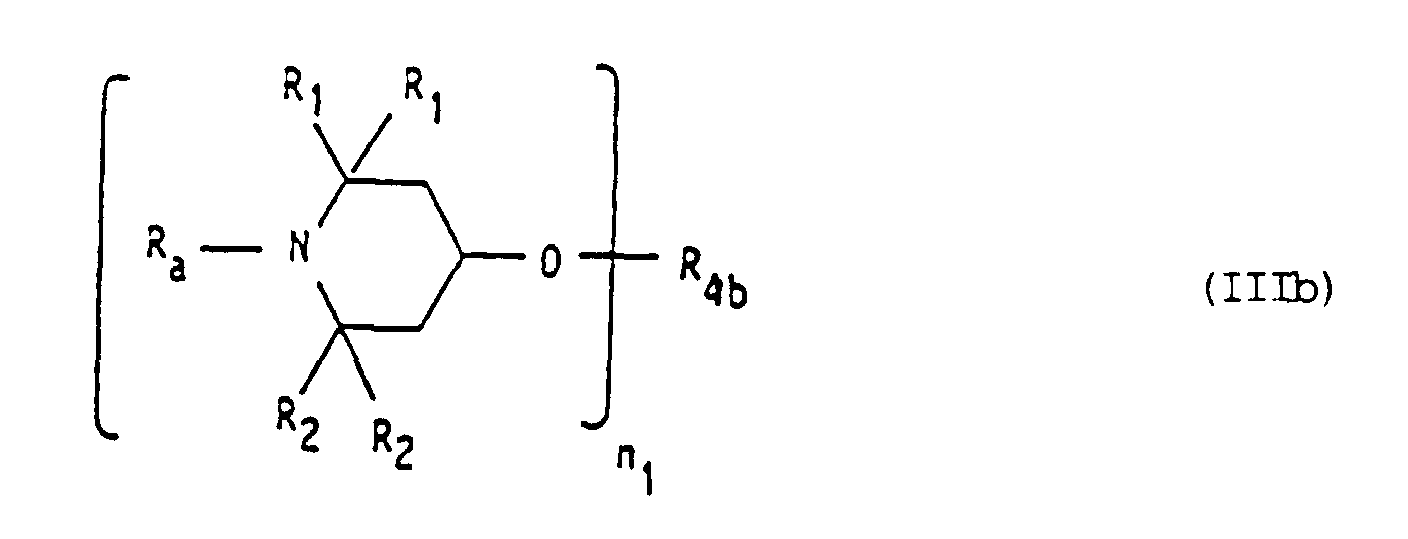
- where n1 is a number from 1-4 inclusive, preferably 1 or 2;
- Ra , R1 and R2 are as defined above;
- R4b, when n1=1, is hydrogen; C1-18 alkyl, optionally interrupted by one or more oxygen atoms; cyanoethyl; benzyl, glycidyl; a monovalent radical of an aliphatic, cycloaliphatic, araliphatic or aromatic carboxylic acid or of a carbamic acid; or of a phosphorus-containing acid or a monovalent silyl radical, preferably a radical of an aliphatic carboxylic acid having 2-18 carbon atoms, of a cyloaliphatic carboxylic acid having 5-12 carbon atoms or of an aromatic carboxylic acid having 7-15 carbon atoms;
- R4b, when n1 is 2, is C1-12alkylene, C4-12alkenylene, xylylene, a bivalent radical of an aliphatic, cycloaliphatic, araliphatic or aromatic dicarboxylic acid or of a dicarbamic acid or of a phosphorus-containing acid, or a bivalent silyl radical, preferably a radical of an aliphatic dicarboxylic acid having 2-36 C atoms, of a cycloaliphatic or aromatic dicarboxylic acid having 8-14 C atoms, or of an aliphatic, cycloaliphatic or aromatic dicarbamic acid having 8-14 C atoms;
- R4b , when n1 is 3, is a trivalent radical of an aliphatic, cycloaliphatic or aromatic tricarboxylic acid, of an aromatic tricarbamic acid or of a phosphorus-containing acid, or a trivalent silyl radical; and
- R4b, when n1 is 4, is a tetravalent radical of an aliphatic,
cycloaliphatic or aromatic tetracarboxylic acid;
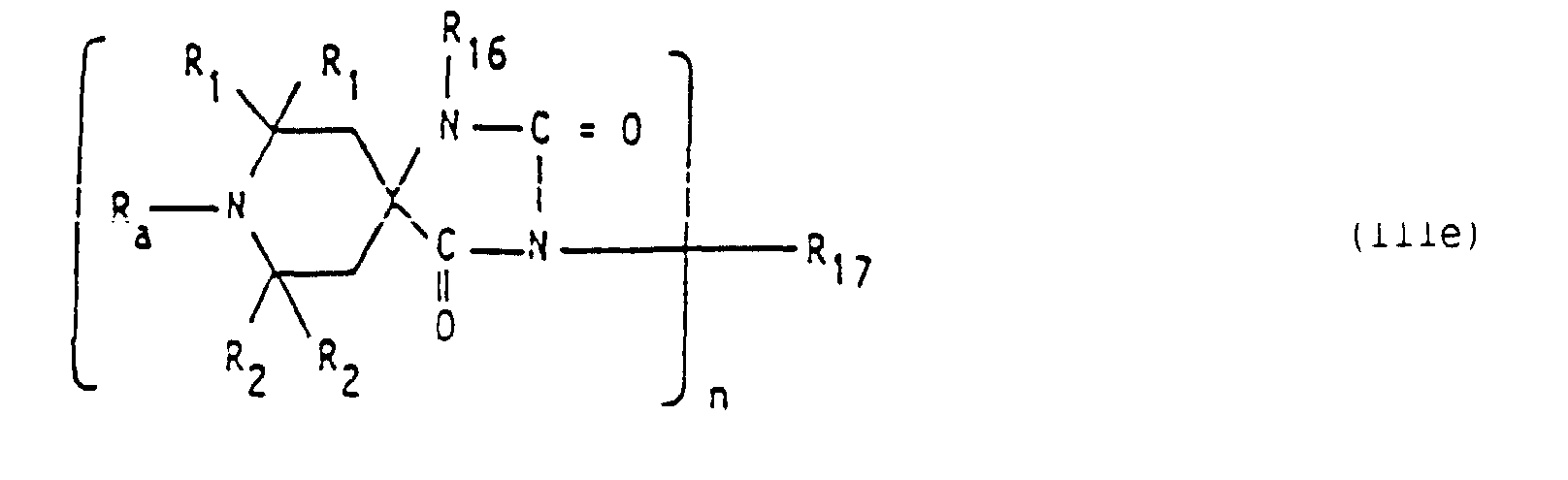
where n is the number 1 or 2;

- Ra, R1 and R2 are as defined above;
- R3a is hydrogen, C1-12alkyl, C5-7cycloalkyl, C7-8aralkyl, C2-18alkanoyl, C3-5alkenoyl, benzoyl or a group of the formula CH2-CH(OH)-Z or of the formula -CONH-Z wherein Z is hydrogen, methyl or phenyl;
- R4a, when n is 1, is hydrogen, C1-18alkyl, C5-7cycloalkyl, C2-8alkenyl unsubstituted or substituted by a cyano, carbonyl or carbamide group, or it is glycidyl, a group of the formula -CH2-CH(OH)-Z or of the formula -CONH-Z wherein Z is hydrogen, methyl or phenyl:
- R4a, when n is 2, is C2-12alkylene, C6-12arylene, xylylene, a
-CH2-CH(OH)-CH2- group or a -CH2-CH(OH)-CH2-O-X-O-CH2-CH(OH)-CH2-group
wherein X is C2-10alkylene, C6-15arylene or C6-12 cycloalkylene;
or, provided that R3a is not alkanoyl, alkenoyl or benzoyl, R4a can
also be a bivalent radical of an aliphatic, cycloaliphatic or aromatic
dicarboxylic acid or of a dicarbamic acid, or can be the group -CO- or
R3a and R4a together, when n is 1, can be the cyclic radical of an
aliphatic or aromatic 1,2- or 1,3-dicarboxylic acid;
where n is the number 1 or 2;

- Ra, R1 and R2 are as defined above;
- R5a , when n is 1, is C2-8alkylene or hydroxyalkylene or C4-22acyloxyalkylene;
- R5a, when n is 2, is the group (-CH2)2C(CH2-)2;
- R6 is hydrogen or both groups R6 form a group = 0;
- R6a is hydrogen or both groups R6a form a group = 0;
where n is the number 1 or 2;
- Ra, R1 and R2 are as defined above;
- R16 is hydrogen, C1-12alkyl, allyl, benzyl, glycidyl or C2-6alkoxyalkyl;
- R17, when n is 1, is hydrogen, C1-12alkyl, C3-5alkenyl, C7-9aralkyl, C5-7cycloalkyl, C2-4hydroxyalkyl, C2-6alkoxyalkyl, C6-10aryl, glycidyl, a group of the formula -(CH2)m-COO-Q or of the formula -(CH2)m-Q-CO-Q wherein m is 1 or 2, and Q iS C1-22alkyl, C2-22alkenyl or phenyl; or a group of the formula -CH2-CH(CH3)-COO-Q or of the formula -CH2-CH(CH3)-O-CO-Q and Q is as defined above;
- R17, when n is 2, is C2-12alkylene, C6-12arylene, a group -CH2-CH(OH)-CH2-0-X-CH2-CH(OH)-CH2-
wherein X iS C2-10alkylene, C6-15arylene or
C6-12cycloalkylene, or a group -CH2CH-(OZ')CH2-(OCH2-CH(OZ')-CH2)2 wherein Z'
is hydrogen, C1-18alkyl, allyl, benzyl, C2-12alkanoyl or benzoyl; or a
divalent radical of an aliphatic, cycloaliphatic, araliphatic or aromatic
dicarboxylic acid;
where n is the number 1 or 2;

- R18 is a group of the formula
where Ra, R1 and R2 are as defined above;
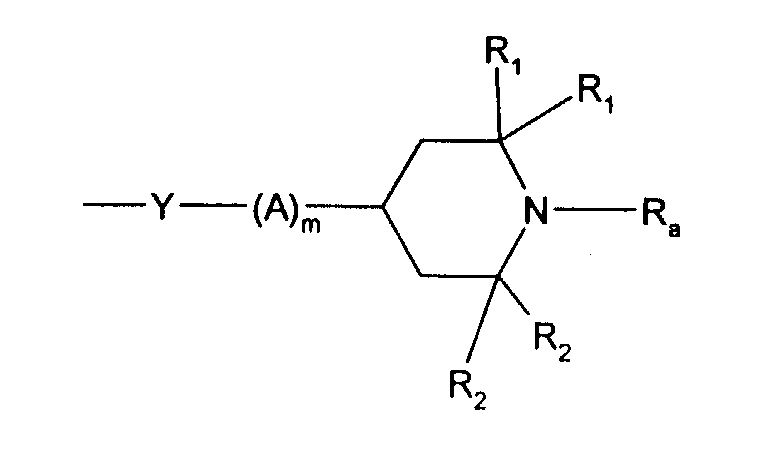
- Y is -O-; -NR21-; or -NR21-CO-CO-NR21-;
- A is C2-6alkylene;
- m is the number 0 or 1;
- R19 is selected from one of the groups -R18,
-R22, -OR23, -NHCH2OR23 and -N(CH2OR23)2;

- R20, when n is 1, is a group selected from R18 and R19;
- R20, when n is 2, is the group-Y-Q1-Y-,
- where Q1 is C2-6alkylene optionally interrupted by -N(R24)-;
- R21 is hydrogen, C1-12alkyl, cyclohexyl, benzyl or C1-4hydroxyalkyl,
or a group of the formula
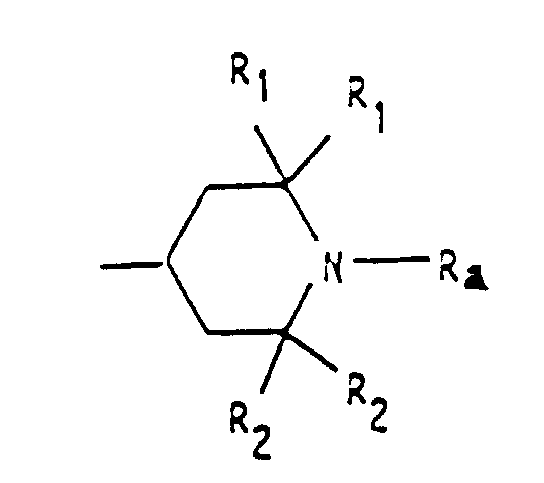
- R22 is C1-12alkyl, cyclohexyl, benzyl or C1-4hydroxyalkyl;
- R23 is hydrogen, C1-12alkyl or phenyl;
- R24 is hydrogen or the group -CH2OR23;
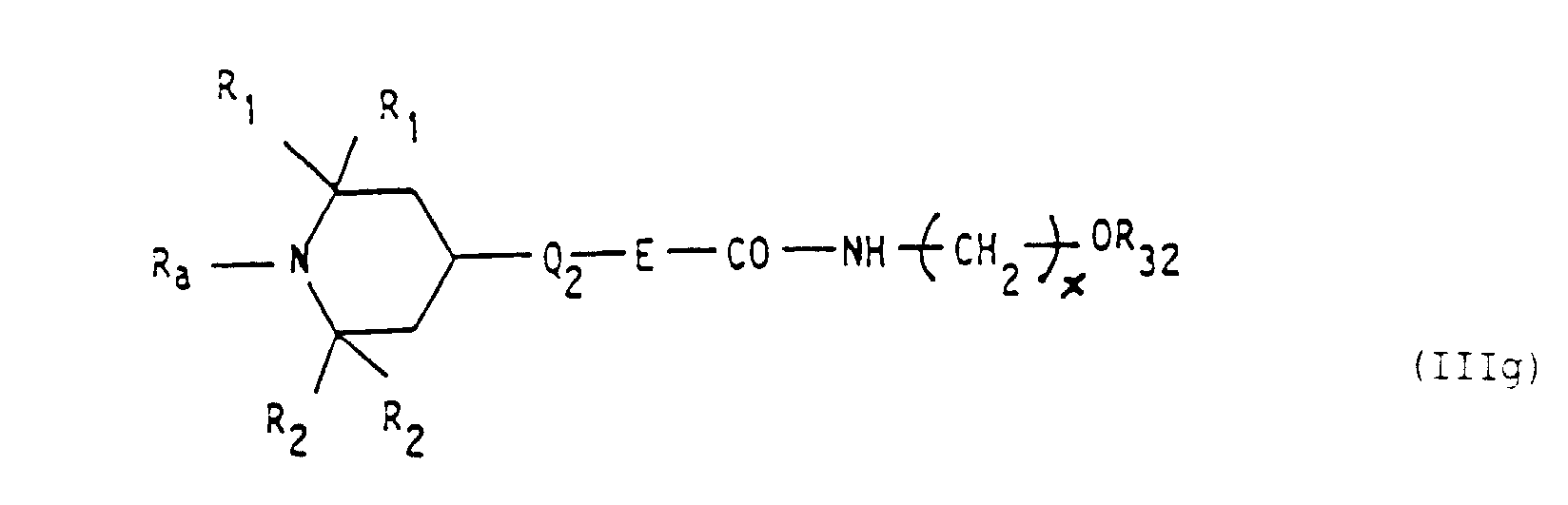
- x is an integer from 1 to 6 inclusive;
- Ra, R1 and R2 are as defined above;
- where Q2 is -N(R31)- or -O-;
- E is C1-3 alkylene, the group -CH2-CH(R34)-O- where R34 is hydrogen, methyl or phenyl, the group -(CH2)3-NH- or a single bond or -CO-;
- Ra is as defined above;
- R32 is hydrogen or C1-18alkyl;
- R31 is hydrogen, C1-18alkyl, C5-7cycloalkyl, C7-12aralkyl, cyanoethyl,
C6-10aryl, the group -CH2-CH(R4a)-OH where R4a has the meaning defined
above (when n=1), a group of the formula
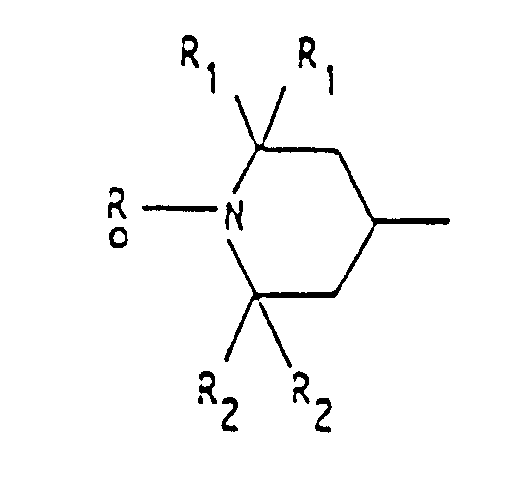
- Ro has the significance of Ra, or R31 is
a group of the formula
where G can be C2-6alkylene or C6-12arylene and E, Ra, R1, R2, R0 and R32 are as defined above;
 where Ra, R1 and R2 are as defined above;
- R33 and R34 independently are hydrogen, C1-30alkyl or benzyl or R33 is
hydrogen or C1-4alkyl and R34 is phenyl, (C1-4alkyl) phenyl,
chlorophenyl, 4-hydroxy-3,5-t-butylphenyl or naphthyl; or R33 and R34
together with the carbon atoms to which they are attached form a
C5-15cycloalkylidene ring which may be unsubstituted or substituted by
one C1-4alkyl group or form a group of formula

- R35 is hydrogen, C1-20alkyl, C2-20alkenyl or -CH(R36)-CH(R37)-COOR38 where R36 is hydrogen, methyl, phenyl or -COOC1-21alkyl;
- Ro is as defined above;
- R37 is hydrogen or methyl and R38 is hydrogen, a C1-21alkyl or
C2-22alkenyl group which may be unsubstituted or monosubstituted by
phenyl or naphthyl and which may be interrupted by oxygen or by a
C1-4alkylimine group; phenyl; (C1-12alkyl) phenyl; C5-12cycloalkyl or
a saturated aliphatic hydrocarbon residue having 2-20 carbon atoms
which may be interrupted by oxygen or by a C1-4alkylimine group and
which is substituted by 1 to 3 groups selected from (C1-21alkyl)COO-and
groups of the formula
 in which Ra, R1, R2 and R3 are as defined above;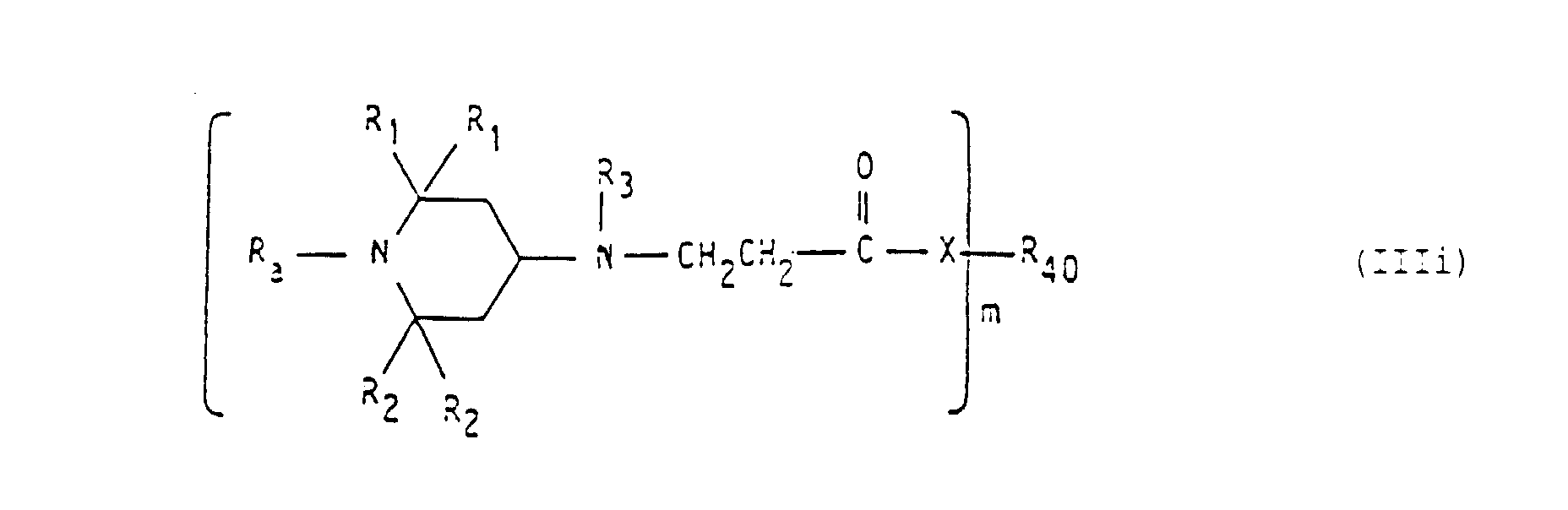
- X is -O-, -NH- or -N(C1-4alkyl)- and
- R40 is a saturated or unsaturated aliphatic group unsubstituted or substituted by one or two groups selected from-OH and C1-4alkoxy and which can be interrupted by an oxygen or sulphur atom; or an aromatic group, unsubstituted or substituted by one or two groups selected from -OH, C1-4alkyl and C1-4alkoxy;
- m is an integer of from 1 to 4 inclusive;
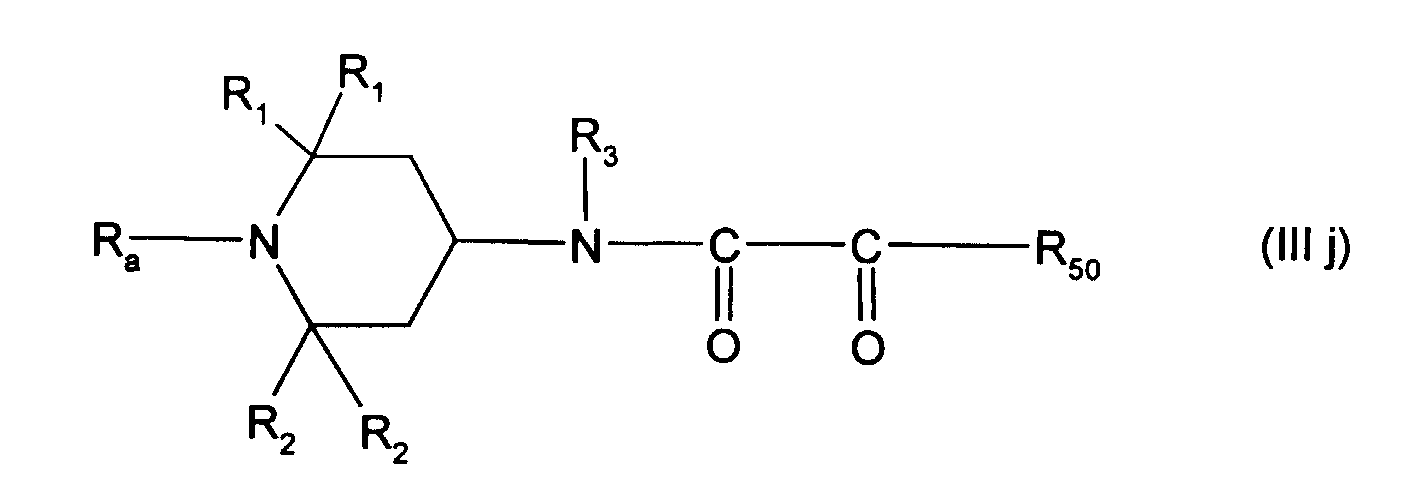
where Ra, R1, R2 and R3 are as defined above and R50 is an amide or ester forming group.
-
- Preferably R50 is an amide forming group of the formula -N(R3)-R51, where R51 is an aliphatic, cycloaliphatic, aromatic or heterocyclic (non-aromatic or aromatic) group, all of which may bear substituents (preferably 1 to 3) selected from C1-4alkoxy, C1-12alkyl, C1-12alkyl -mercapto, C1-12alkylamino, phenoxy, phenyl mercapto, phenylamino, acryloyloxy, methacryloyloxy and 2,2,6,6-tetraalkylpiperidine groups or oxalamido or acyloxy groups which may be further substituted by 2,2,6,6-tetraalkylpiperidine group;


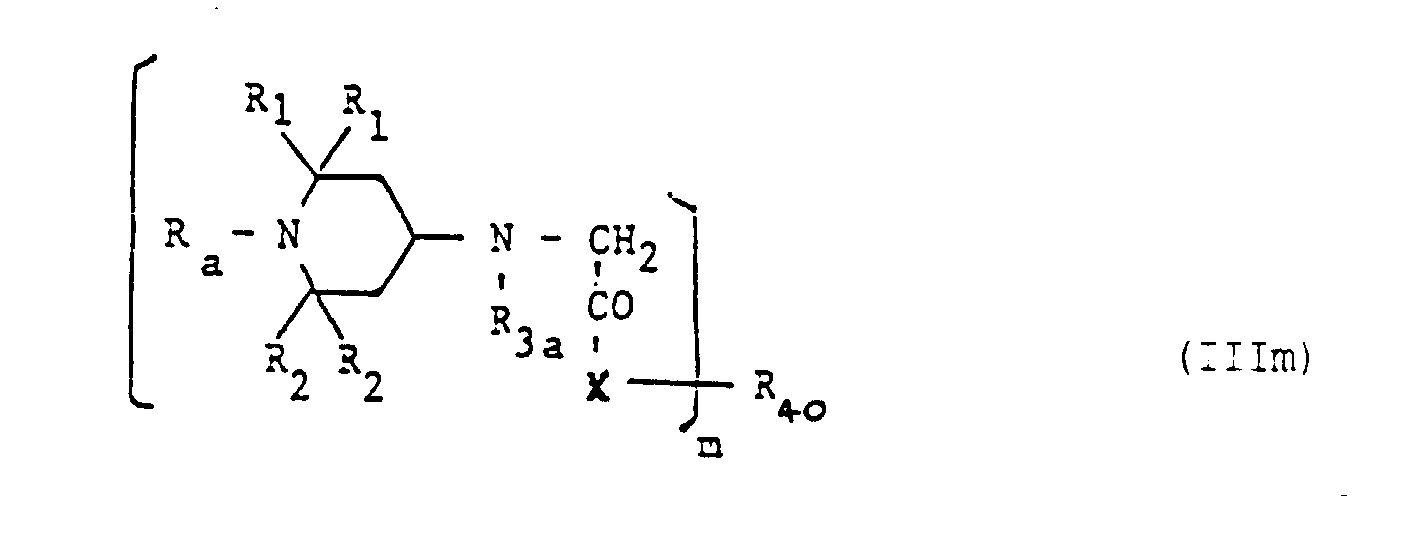 where the symbols are as defined above.
- Compounds containing groups of formula II are described in EP 309,402.
- Compounds of formula III and IV are known or may be made from known compounds by known methods.
- (Compounds of formula IIIa and IVa in which R is R' or R" are described in detail in US patent 4,356,307 and USP 4,778,837).
- (Compounds of formula IIII are described in USP 4,408,051 wherein R in the compounds of the said US Patent is Ra of this application).
- (Compounds of formula IIIj are described in US Patent 4,716,187, wherein R in the compound of the patent is Ra of this application).
- (Compounds of formula IIIk are describe in US Patent 4,730,017, wherein R of the compounds of this Patent is Ra of the present application).
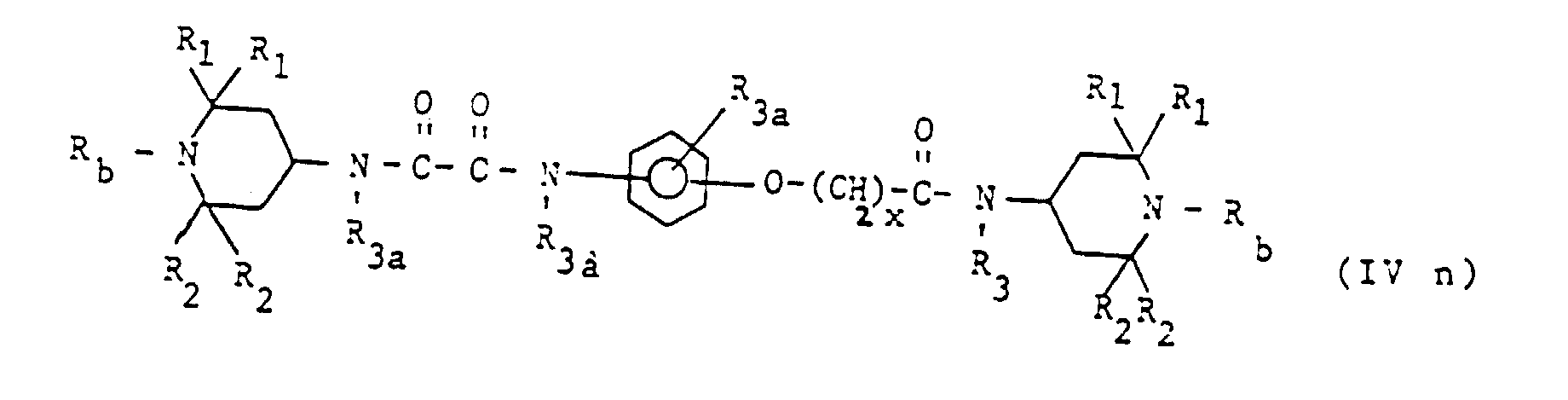
- Preferred compound of formula IV are those of formula IVa to IVo

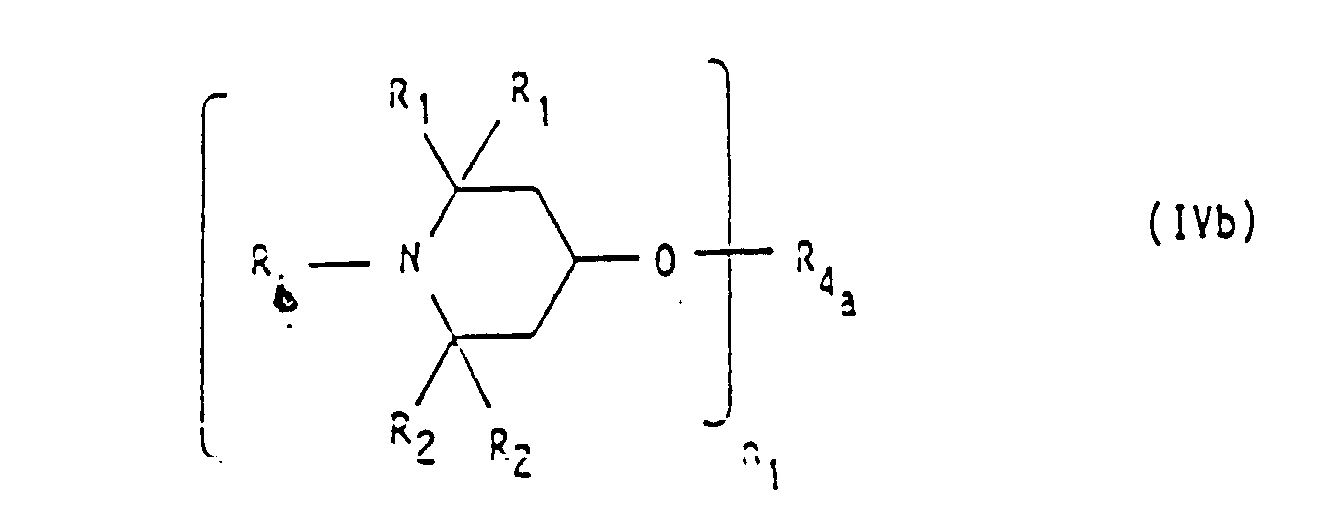
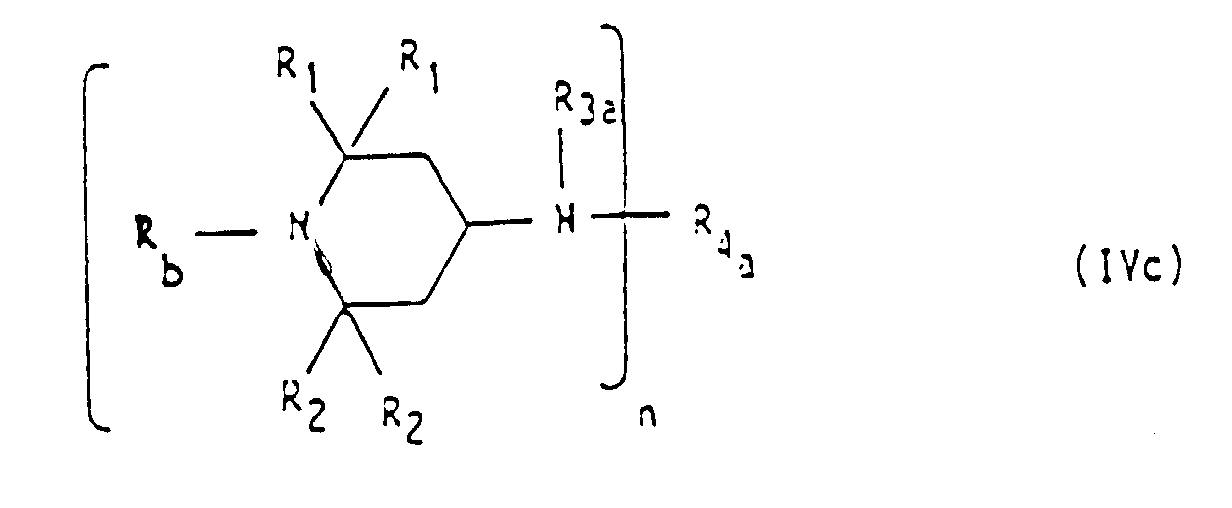
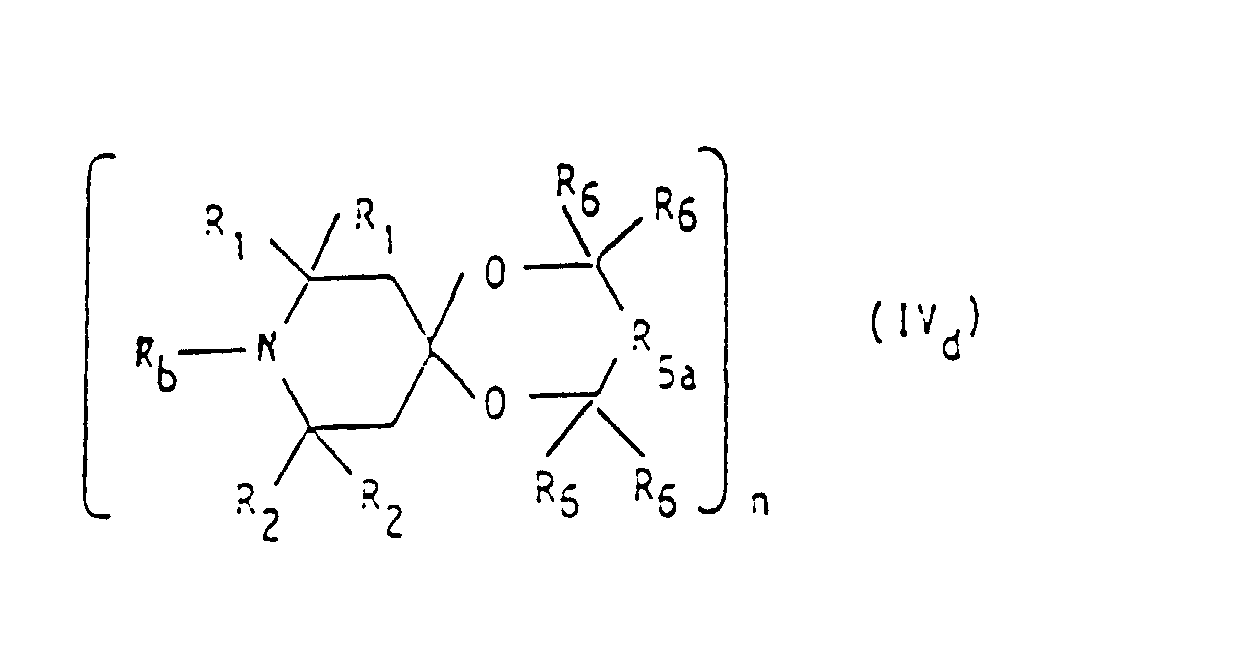
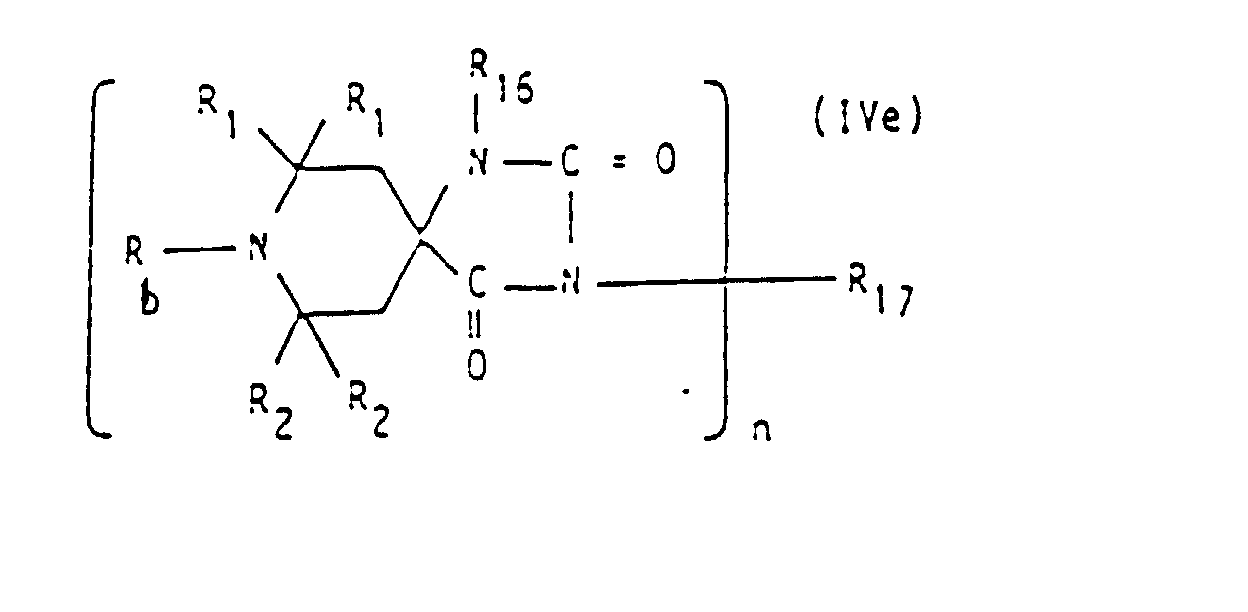

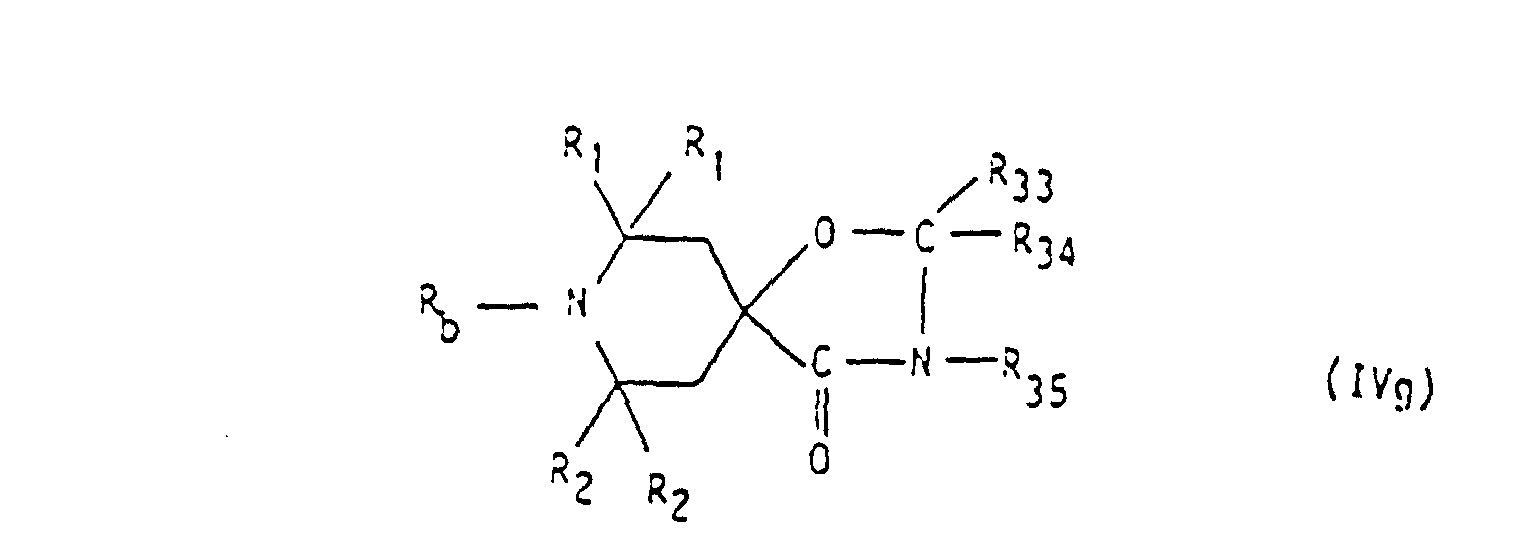


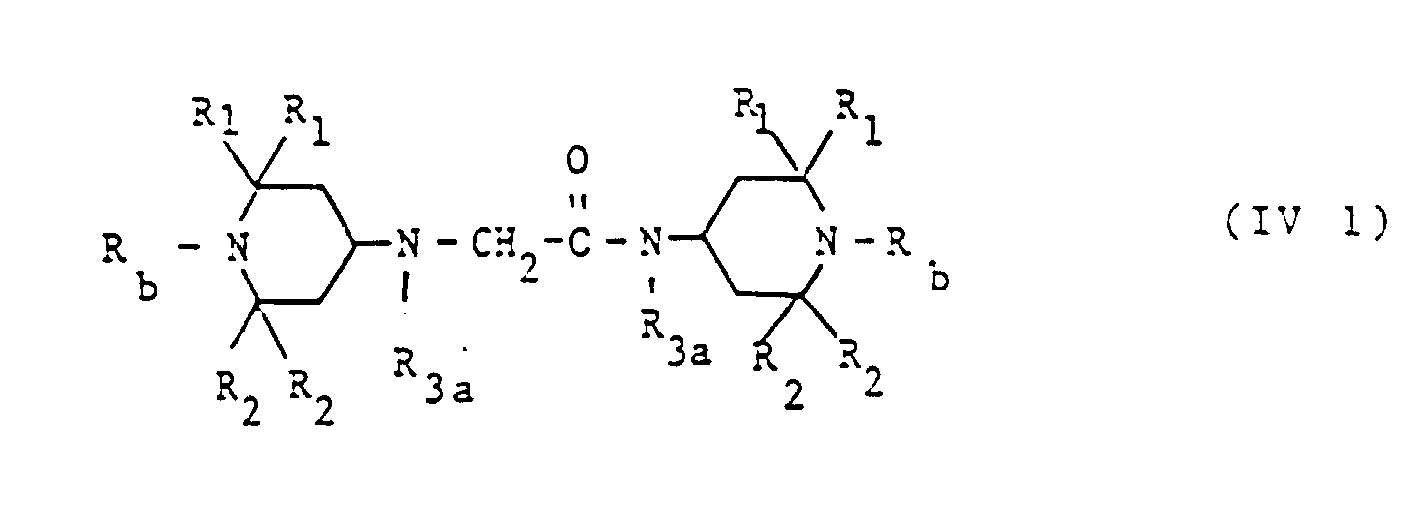
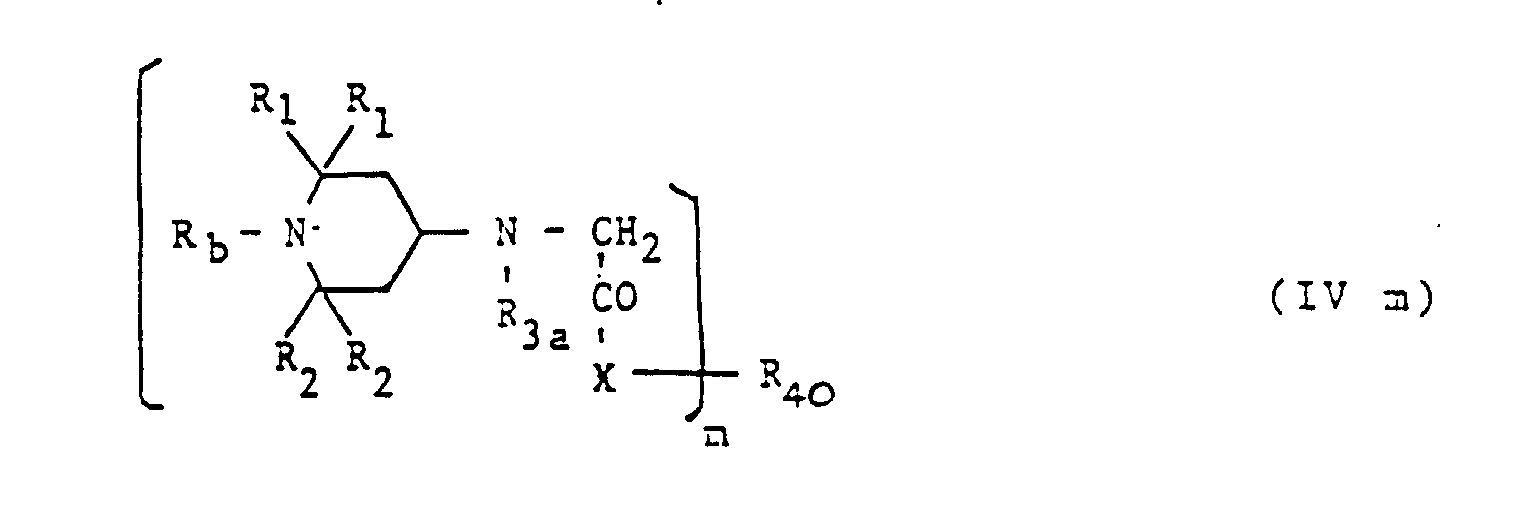
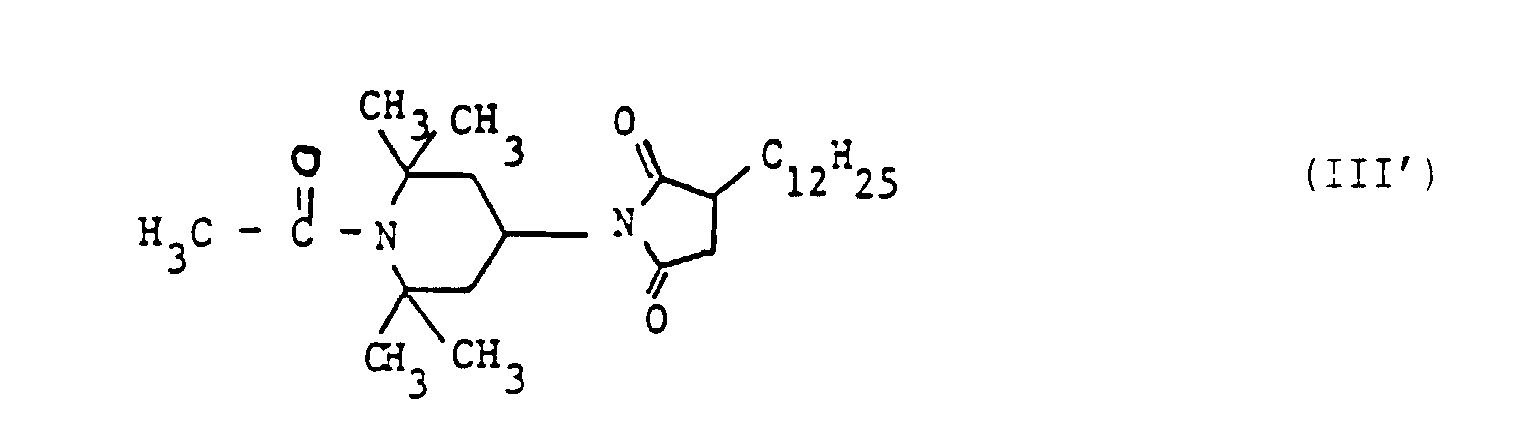
- Most preferred compounds of formula III are those of formulae III'-III"'


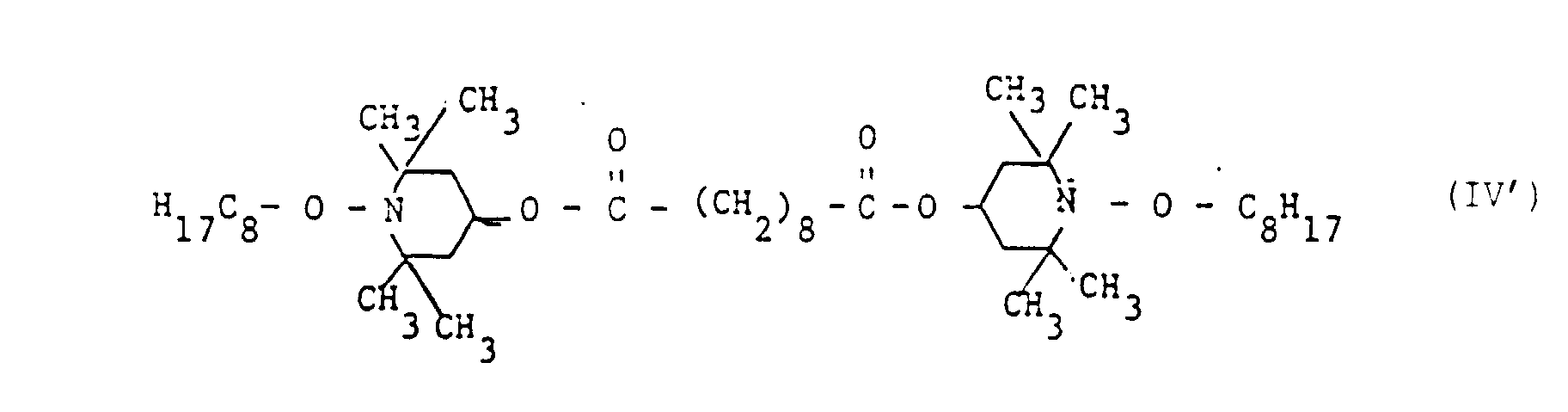
- The most preferred compound of formula IV is that of formula IV'
- Preferred compounds of formula V are cf formulae IIId, IIIe, and IIIh.
- Most preferred compounds of formula V are of formula III".
- Preferred compounds of formula VI are compounds of formula IIIa to IIIc, IIIf to IIIh and IIIj to IIIn defined above.
- Most preferred compounds of formula VI are of formulae III' and III"' defined above.
- Preferably R is R' where R' is -CH(R10)-CH2- orwhere R10 is selected from C12-18 alkyl or C12-18 alkenyl; cyclo C5-6alkylene, 1,2-cyclohexanediyl and a bicyclic divalent radical;
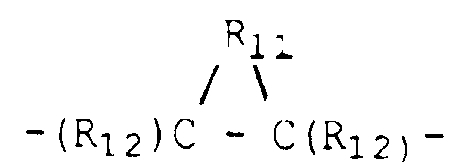
- R11 is an alicyclic or bicyclic ring system and each R12 independently is C1-4alkyl or hydrogen.
- More preferably R is R" where R'' is -CH(R10')-CH2- where R10' is C12-18alkyl.
- Preferably Ra is Ra' where Ra' is -COR5' where R5' is -CH=CH2, C1-8alkyl, -CO-O-C1-8alkyl, C2-8alkyenyl or phenyl.
- Preferably R5' is R5'' where R5'' is -CH=CH2, C1-4 alkyl or -CO-O-C1-4 alkyl.
- Preferably Rb is Rb' where Rb' is -O-CO-R5' where R5' is defined above.
- Preferably each R1 and each R2 is -CH3.
- In this Specification any C1-8 alkyl or C1-6 alkyl group is preferably a C1-4 alkyl group and any C1-4 alkyl group is preferably methyl or ethyl; preferably any alkoxy group is methoxy or ethoxy.
- In this Specification, any group capable of being linear or branched is linear or branched.
- Where a symbol appears more than once in a formula, its significances are independent of one another unless indicated to the contrary.
- Further, according to the invention there is provided a polymeric composition comprising a polymeric material and a mixture of component a) and of component b) or a mixture of component i) and component ii).
- Further according to the invention there is provided a method for stabilising a lacquer composition based on acrylic, alkyd and/or polyester resins (which if desired, can be crosslinked with melamine/formaldehyde resins, epoxide resins or polyisocyanates) which comprises incorporating into the resin a mixture of component a) and component b) or a mixture of component i) and component ii), optionally together with an acid catalyst or compound capable of releasing an acid catalyst.
- Further, according to the invention there is provided a lacquer composition based on acrylic, alkyd and/or polyester resins (which if desired, can be crosslinked with melamine/formaldehyde resins, epoxide resins or polyisocyanates) containing a mixture of component a) and component b) or a mixture of component i) and component ii) optionally together with an acid catalyst or compound capable of releasing an acid catalyst.
- The concentration of a mixture of component a) and component b) or a mixture of component i) and component ii) employed in the polymeric material is suitably 0.01 to 8 % by weight, preferably 0.02% to 1 % by weight and gives a clear improvement in the light- and weather-stability of organic pigments in stoving finishes as well as reducing the tendency to hairline cracking and loss of gloss as the result of weathering. This is also found for metallic finishes and excellent long-term stability of the clear top coat of two layer metallic finishes is obtained. In such finishes, the mixture of component a) and component b) or amixture of component i) and component ii) may be added to the metallic undercoat, the clear top coat or both, preferably only to the clear top coat. The metal surface to be finished may be under-coated with primer coatings as is customary in the art of coating metal surfaces.
- The mixture of component a) and component b) or a mixture of component i) and component ii) may be added before, during or after the polymerization step, and may be added in solid form; in solution, preferably as a liquid concentrate containing from 20 to 80 % by weight of a mixture of component a) and component b) or a mixture of component i) and component ii) and 80-20% solvent; or as a solid masterbatch composition containing 10 to 80 % by weight of a mixture of component a) and component b) or a mixture of component i) and component ii) and 90 to 20 % by weight of a solid polymeric material which is identical with or compatible with the polymeric material to be stabilized.
- Suitable polymeric materials include plastic materials for example polyethylene, polypropylene, ethylene/propylene copolymers, polyvinyl chloride, polyester, polyamide, polyurethane, polyacrylonitrile, ABS, terpolymers of acrylates, styrene and acrylonitrile, styrene/acrylonitrileand styrene/butadiene. Other plastics materials such as polybutylene, polystyrene, chlorinated polyethylene, polycarbonate, polymethylmethacrylate, polyphenylene oxide, polypropylene oxide; polyacetals, phenol/formaldehyde resins and epoxy resins may also be used. Preferred plastic materials are polypropylene, polyethylene, ethylene/propylene copolymers and ABS.
- Natural polymers for example natural rubber may also be stabilized, as may lubricating oils containing polymeric material.
- The mixture of a compound containing a group of formula I defined above and of a compound containing a group of formula II defined above may be incorporated by known methods into the polymeric material to be stabilized. Of particular importance is blending of the compounds with thermoplastic polymers in the melt, for example in a melt blender or during the formation of shaped articles, including foils, films, tubes, containers, bottles, fibres and foams by extrusion, injection moulding, blow moulding, spinning or wire coating.
- it is not essential for the polymeric material to be fully polymerised before mixing with the compounds according to the invention. The compounds may be mixed with monomer, prepolymer or precondensate, and the polymerisation or condensation reaction is carried out subsequently. This will of course be the preferred method of incorporation of the compounds into thermosetting polymers, which cannot be melt blended.
- Further antioxidants can be added to polymeric material either before, at the same time as or after (but before polymerisation occurs) the addition of a compound according to the invention.
- Examples of antioxidants include benzofuran-2-ones,indolin-2-ones and sterically hindered phenols, sulphur and phosphorus containing compounds and mixtures thereof.
- Preferred sterically hindered phenols include β-(4-hydroxy-3,5 -ditert.butylphenyl)-propionyl stearate, methane tetrakis-(methyiene -3 (3',5'-ditert.butyl-4-hydroxy-phenyl)-propionate), 1,3,3-tris-(2-methyl-4-hydroxy-5-tert.butyl phenyl)butane, 1,3,5-tris (4-tert.butyl -3-hydroxy-2,6-di-methylbenzyl)-1,3,5-triazinyl-2,4,6 (1H, 3H,5H) -trione, bis-(4-tert.butyl-3-hydroxy-2,6-di-methylbenzyl)dithiol terephthalate, tris (3,5-ditert.butyl-4-hydroxybenzyl) isocyanurate, the triester of beta-(4-hydroxy-3,5-ditert.butylphenyl) propionic acid with 1,3,4-tris-(2-hydroxyethyl)-5-triazinyl-2,4,6 (1H,3H,5H) -trione, bis (3,3-bis- (4'-hydroxy-3-tert.butylphenyl)-butyric acid) glycol ester, 1,3,5-trimethyl-2,4,6-tris-(3,5-ditert.butyl-4-hydroxy -benzyl) benzene, 2,2'-methylene-bis-(4-methyl-6-tert.butylphenyl) terephthalate, 4,4-methylene-bis-(2,6-ditert.-butylphenol), 4,4'-butylidine-bis-(tert.butylmetacresol), 2,2'-methylene-bis-(4-methyl-6-tert.-butyl)-phenol, 1,3,5-tris-(3,5-di-t-butyl -4-hydroxyphenyl)-isocyanurate and 1,1,3,tris-(5-tert.butyl-4-hydroxy -2-methylphenyl)-butane.
- Preferred sulphur containing antioxidative co-stabilizers which may be used include di-tridecyl-3,3-thiodipropionate, distearyl -3,3-thiodipropionate, di-lauryl-3,3-thiodipropionate, methane tetrakis (methylene-3-hexylthiopropionate), methane tetrakis (methylene-3-dodecylthiopropionate) and dioctadecyl disulphide.
- Preferred phosphorus-containing co-stabilizers which may be used include trinonylphenyl phosphite, 4,9-distearyl-3,5,8,10-tetraoxadiphosphaspiroundecane, tris- (2,4-ditert.butylphenyl) phosphite, trilauryl phosphite, bis (2,6-di-t.butyl-4-methylphenyl)pentaerythrityl -diphosphite, bis (2,4-di-t.butylphenyl) pentaerythrityl-diphosphite, distearylpentaerythrityl diphosphite and tetrakis (2,4-ditert.butyl phenyl)-4,4'-biphenylene diphospnonite.
- Further additives that can be added to polymeric compositions according to the invention include aminoaryl compounds, U.V. stabilisers and antistatic agents, flameproofing agents, softeners, nucleating agents, metal deactivators, biocides, impact modifiers, fillers, pigments and fungicides.
- Preferred aminoaryl compounds include N,N'-dinaphthyl-p-phenyiene diamine and N,N'-hexamethylene-bis-3-(3,5- ditert.butyl-4-hydroxy phenyl)-propionamide.
- Preferred U.V. stabilisers include U.V. absorbers (e.g. 2-(2'-hydroxyphenyl)-benztriazoles, 2-hydroxybenzophenones, 1, 3-bis-(2'-hydroxybenzoyl-)benzene salicylates, cinnamates and oxalic acid diamides; U.V. quenchers such as benzoates and substituted benzoates; and hindered amine light stabilisers (for example N-unsubstituted, N-alkyl or N-acyl substituted 2,2,6,6-tetra-alkyl piperidine compounds) other than those of the invention.
- Preferably a compound of formula XX
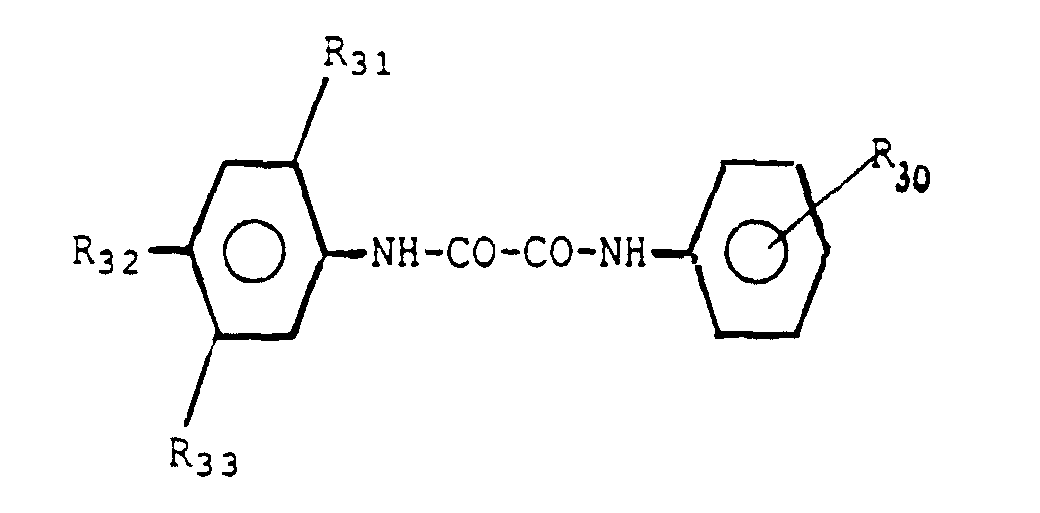
- in which R30 is C6-22 alkyl or C6-22 alkoxy;
- R31 and R32 independently, are selected from hydrogen, C1-8 alkyl, C1-12 alkoxy, C1-12 alkylthio, phenoxy and phenylthio provided that only one of R31 and R32 is alkylthio, phenoxy or phenylthio; and
- R33 is hydrogen or C1-8 alkyl; is added to a compound of formula I.
-
- The mixture of component a) and component b) or mixture of component i) and component ii) are especially suitable for use in organic polymer-containing coatings, particularly automotive finishes.
- Automotives finishes are generally solutions or dispersion of organic polymers or polymer precursors in organic solvents. The majority are stoving finishes, which require the application of heat, generally above 80°C, on order to harden the finish in an acceptable time once it has been applied to the primer-coated metal surface. The hardening step may be accelerated by the use of an acid catalyst. The effect of this heating may be to accelerate the chemical reaction between polymer precursors in a thermosetting system, or to bring about fusion of particles of a thermoplastic polymer.
- Many automotive finishes are metallic finishes, which contain flakes of metal, usually aluminium, in order to provide optical effects due to reflection. Such finishes are often two-coat finishes, in which a clear top coat finish is applied over a base coat finish containing a single pigment and/or metal flakes. The compounds of formula I can be in the top coat finish or the ground coat finish, preferably the former. Such two-coat metallic finishes have particular need to U.V.-stabilizers in the top coat, since the polymer in this coat is not protected by light-absorbing pigments, and it is subjected to almost double the normal amount of radiation because of reflection of light from the lower metallic layer.
- The mixture of component a) and component b) or mixture of component i) and component ii) are suitable for use as U.V.-stabilizers in a wide range of liquid finishes, for example those based on combinations of melamine-formaldehyde resins with oil-modified polyester resins, polyacrylate resins with added crosslinkers, or saturated polyesters; or on self-crosslinked polyacrylate or polyacrylate resin co-polymerised with styrene.
- Further examples are two-component finishes based on an aliphatic or aromatic di-isocyanate and a hydroxy-group-containing polyacrylate, polyester or polyether resin. These polyurethane 2-component finishes are preferably hardened at 60 to 120°C. Thermoplastic polyacrylate resins may also be used, the latter being particularly useful in metallic finishes, as are also polyacrylate resins with added crosslinkers in combination with melamine-formaldehyde resins etherified with butanol and, further, hydroxy-group-containing polyacrylate resins are described in USP 3,062,753.
- The mixture of component a) and component b) or mixture of component i) and component ii) are particularly useful in acid catalysed stoving finishes particularly in the top coat of two metallic finishes.
- The mixture of component a) and component b) or mixture of component i) and component ii) may be added to the finish at any stage in its manufacture, and may be added in solid form or in solution, preferably in the form of a liquid concentrate in a suitable solvent or in the form of a dispersion in water or organic solvent.
- In practice the mixture of component a) and component b) or mixture of component i) and component ii) are added to a finish as a solution in organic solvent (as a liquid finish) in which the binder material is between 35 % (low solid finishes) and 70 % by weight (high solid finishes). The binder material of the finish can be in aqueous emulsion or suspension form (as an aqueous finish) in which the binder material part makes up 20 to 30 % by weight. However, the mixture of component a) and component b) or of component i) and of component ii) can be added to known powder finishes.
- The mixture of component a) and component b) or mixture of component i) and component ii) are to be added to the liquid or powder finishes before stoving or hardening. Preferably the mixture of component a) and component b) or mixture of component i) and component ii) are used in liquid finishes since it is easy to add exact dosages. It is particularly preferred to use a concentrate (preferably in a hydrocarbon solvent) containing at least 40 % preferably 60 to 80 % by weight of the total weight of the concentrate of the mixture of component a) and component b) or mixture of component i) and component ii) to finishes for stoving.
- The compounds of the invention can also be used in photopolymeric substrates containing photoinitiators for the photopolymerisation.
- The invention will now be illustrated by the following Examples in which all parts and percentages are by weight and all temperatures are in °C. The amount of light stabilizer is based on the solids weight in the lacquers
- A 2 layer metallic coating comprising a base coat and a clear top coat can be prepared from the follow lacquers.
Base coat lacquer 18.75% of clear cloat lacquer 1 defined below (50% solids) 51.75% of a cellulose - acetobutyrate solution (20%) commerically available as Cellit BP 500 13.54% of n-butyl acetate 6.45% of xylene 5.15% of ethylene glycol acetate 0.26% of anti-sedimenting medium: Aerosil 200 3.85% of a 65% aluminium parte in ethylene glycol acetate commerically available as Alcoci 7530 0.25% of Phthalocyanine Blue (C.I. Pigment Blue 15:1) 100.00% (the ratio of the pigment ot aluminium being about 1:10) - Clear coat lacquer 1 is formulated as follows:
80.00% of an acrylic resin, commercially available as Viacryl SC344 - a 50% in a solution of xylene and n-butanol (4:1 ratio) 13.90% of melamine resin 4.10% of n-butanol and 2.00% of a diluent commercially available as Byketol OK. - A 10 x 30 cm primed aluminium piece is coated wet on wet with the base coat lacquer and then the clear coat lacquer, to which 1% of a 50:50 mix of the compound of formula 1a and 1b
 has been applied to give a 15µ base coating and a 35 µ clear coating.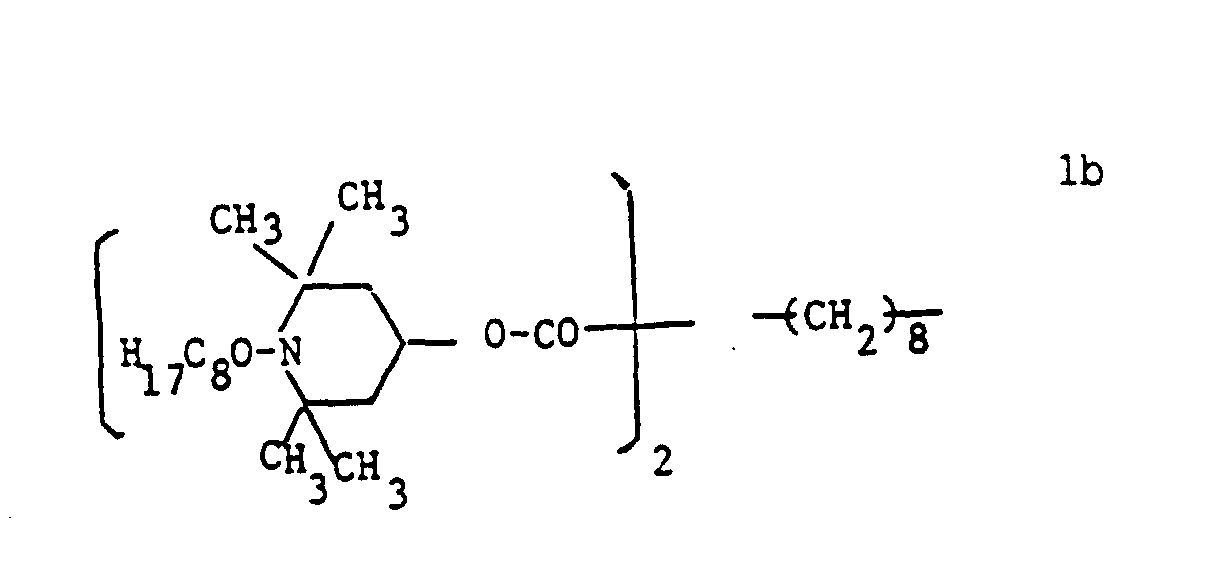
- The so treated aluminium piece is then stoved at 140°C for 35 minutes.
- A two layer metallic coating comprising a base coat and a clear top coat can be prepared from the following lacquers.
- a) Base coat lacquer:
18.75% of the clear lacquer 1 defined below (50% solids); 51.75% of a cellulose-acetobutyrate solution (20%) commercially available as CELLIT BP 500; 13.54% of n-butyl acetate; 6.45% of xylene; 5.15% of ethylene glycol acetate; 0.26% of anti-sedimenting medium: Aerosil 200; 3.85% of a 65% aluminium paste in ethylene glycol acetate commerically available as ALCOCI 7530; and 0.25% of Phthalocyanine Blue (C.I. Pigment Blue 15:1) 100.00% the ratio of the pigment to aluminium being about 1:10. - b) Clear coat lacquer 1 is formulated as below:
57.50% of PARALOID AT 400 70% (Acrylic binder from Rohm and Haas); 18.20% of CYMEL 1130 (Melamine binder from Dyno Lyamann); 1.50% of BXK 306 (10% solution in Exxaffe 600 BYK Chemicals); 21.60% Exxate 600 (Solvent from Eno Chemicals); 1.20% CYCAT 4045 (Blocked acid catalyst from Dyno Cyanamid). -
- A 10 x 30 cm primed aluminium piece is coated wet on wet with the base coat lacquer and then the clear coat lacquer to which 2% of a 50:50% mixture of compounds of formula 1a and 1b has been applied to give a 15µ base coating and a 35µ clear coating.
- The so-treated aluminum piece is then stoved at 140°C for 35 minutes.
- Examples 1 and 2 are repeated using, instead of the compound of formula 1a,
- 2% of a 50:50 mix of the compound of formula 1b defined in Example 1
and the compound of formula 3a (Example 3)
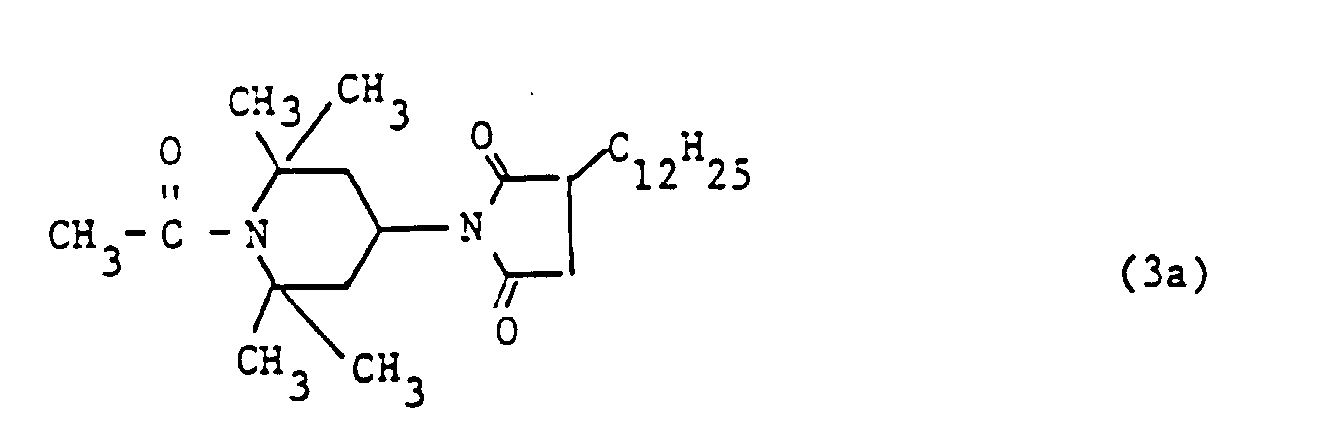
- or 2% of a 50:50 mix of the compound of formula 1b defined in Exampie
1 and the compound of formula 4a (Example 4)
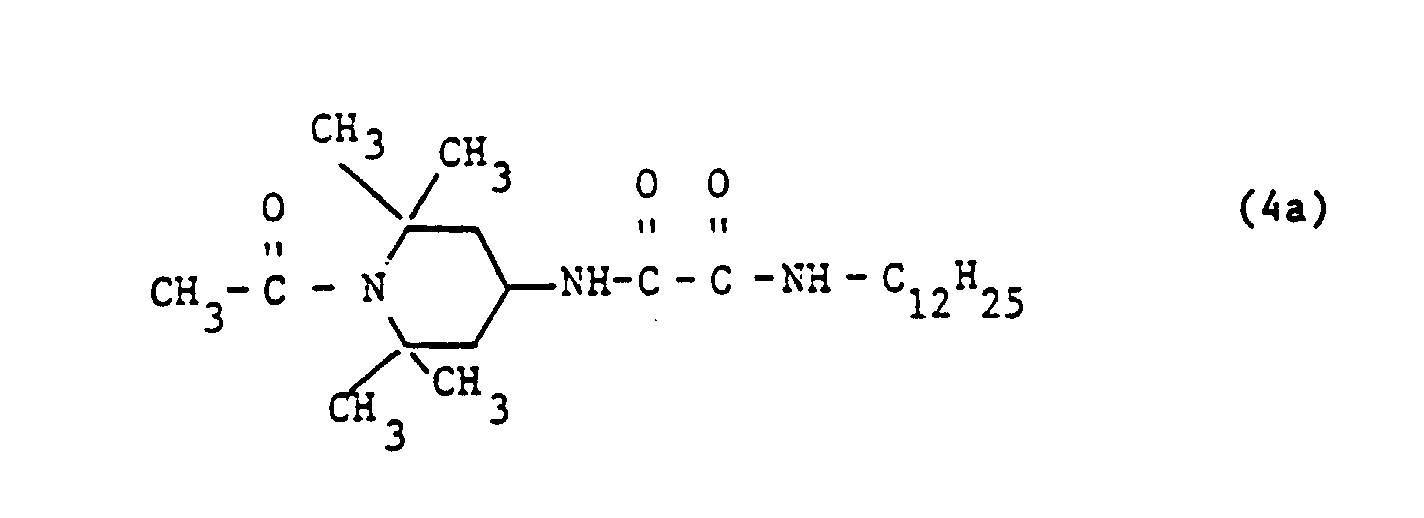
-
- Examples 1 to 3 are repeated using additionally 1% of a U.V. absorber of the formula 5awith the mixture of compounds of formula 1a and 1b, defined in Example 1.
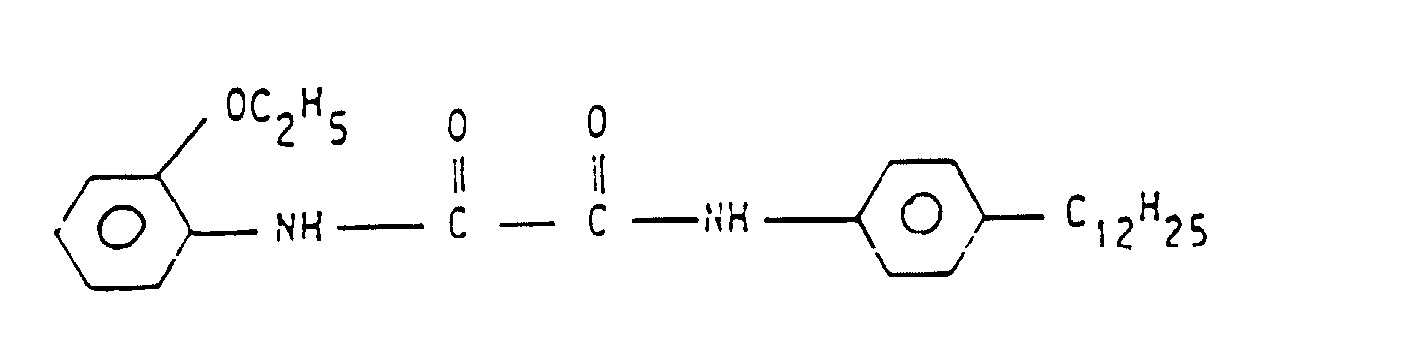
- Examples 1 to 4 can be repeated in which 2.2% (actives) of the monobutylester of maleic anhydride are added to the clear lacquer; and instead of stoving at 140°C for 35 minutes the lacquer is acid cured at 90°C for 30 minutes.
- Examples 1 and 2 are repeated using instead of the mixture of compounds of 1a and 1b, 1% of a 50.50 mixture of compounds 1a and 3a (without any of the compound of formula 1b present).
- Examples 1 and 2 are repeated using instead of the mixture of compounds of formula 1a and 1b, 1% of a 50:50 mixture of the compound of formula 1a and the compound of formula 3a; (Example 6) and 1% of a 50:50 mixture of the compound of formula 1a and the compound of formula 4a
- A two layer coating in which the top coat is 2C-PUR can be prepared as follows:
- A base coat lacquer is formulated as in Example 1.
- A clear lacquer is prepared as follows:
- The first component of the 2C-PUR comprises
44.1% of a hydroxy-group-containing acrylic resin (OH number about 150) commercially available as Macrynal SM 510 N, a 60% solution in xylene and ethylene glycol acetate (ratio 4:1) 35.2% of a diluent mixture of methylethyl ketone and xylene (1:1) 3.0% of Byketol spezial: commercially available (silicone containing) levelling agent. - The second component comprises
17.7% of an aliphatic polyisocyanate commercially available as Desmodin N (which is a 75% solution in xylene / ethylene glycol acetate 4:1). - The second component is then added to the first component and (defined above) mixed wet. To the 2C PUR so formed, 1% of a 50:50 mixture of a compound of formula la and 1b (defined in Example 1) is applied.
- The base and clear lacquers (at the same thicknesses as in Example 1) are applied to an aluminium piece wet on wet as described in Example 1. The lacquers are then stoved at 80°C for 35 minutes.
- Example 10 can be repeated using 1% of any one of the compounds of formula 1a or 1 b with compounds 3a or 4a (defined above).
Claims (12)
- A composition, suitable for stabilising a polymeric composition against the effects of light, comprisinga) an N-acylated 2,2,6,6-tetraalkylpiperidinyl group (hereinafter N- acylated HALS) containing compound; andb) an N-oxy-substituted 2,2,6,6-tetraalkylpiperidinyl group (hereinafter N-oxy-substituted HALS) containing compound.
- A composition comprisinga) 5-95% by weight of a compound containing a group of formula I(hereinafter defined as component a)
 b) 5-95% by weight of a compound containing a group of formula II(hereinafter defined as component b))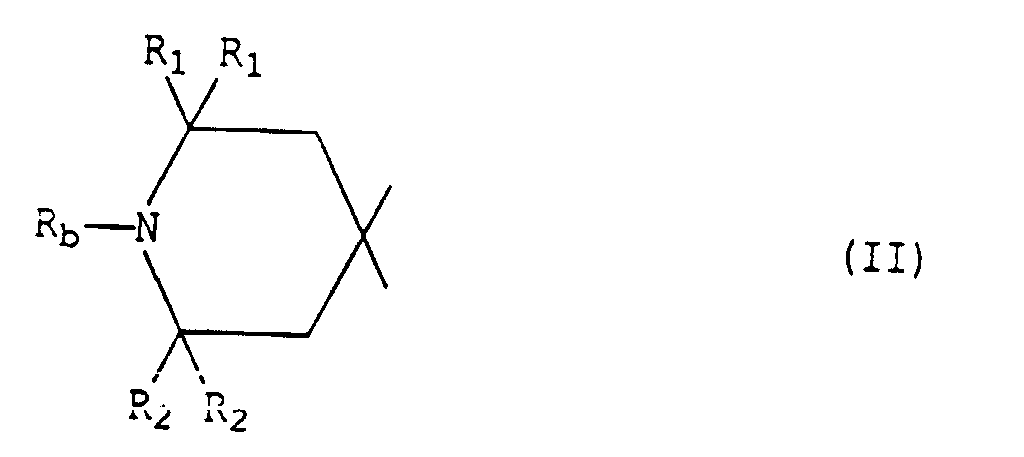
in whichthe percentages being based on the amount of component a) and b) in the mixture.Ra is -CO-R5,where R5 is where R5 is C2-8alkenyl, -C(R3)=CH2 , C1-22alkyl, phenyl, -CO-phenyl, -NR7R8, -CH2-C6H5, -CO-OC1-12alkyl or -COOH; R7 is hydrogen, C1-12alkyl, C5-6cycloalkyl, phenyl, phenyl-C1-4-alkyl or C1-12alkylphenyl and R8 is C1-12alkyl or hydrogen, andRb is oxygen; OH; -O-CO-R5; -O-C1-8alkyl; -O-CO-phenyl; -O-C2-8alkenyl; -O-C3-18alkynyl; -O-C5-12cyclo alkyl; -O-C6-10bicycloalkyl; -O-C5-8cyclo alkenyl, -O-C6-10aryl, -O-R30 where R30 is C7-9alkaryl unsubstituted or monosubstituted by C1-4alkyl or aryl; where R5 is C2-8alkenyl, -C(R3)=CH2 (preferably), C1-22alkyl, phenyl, -CO-phenyl, -NR7R8, -CH2-C6H5, -CO-OC1-12alkyl or -COOH;R3 is hydrogen or C1-4alkyl;each R1, independently, is -CH3 or -CH2(C1-4alkyl) or both groups R1 form a group -(CH2)5-; andeach R2, independently, is -CH3 or -CH2(C1-4alkyl) or both groups R2 from a group -(CH2)5-; - A composition according to any one of the preceding claims in whicha) component a) is a compound of formula IIIin which
 Ra is -CO-R5; andeach R4 independently is selected from hydrogen, a hydroxy group an ether group, an amine and amide forming group, an ester and ester forming group and a urea and urethane forming group; or both groups R4 together with the C atom to which they are attached form a spiro group; andb) component b is a compound of formula IVin which
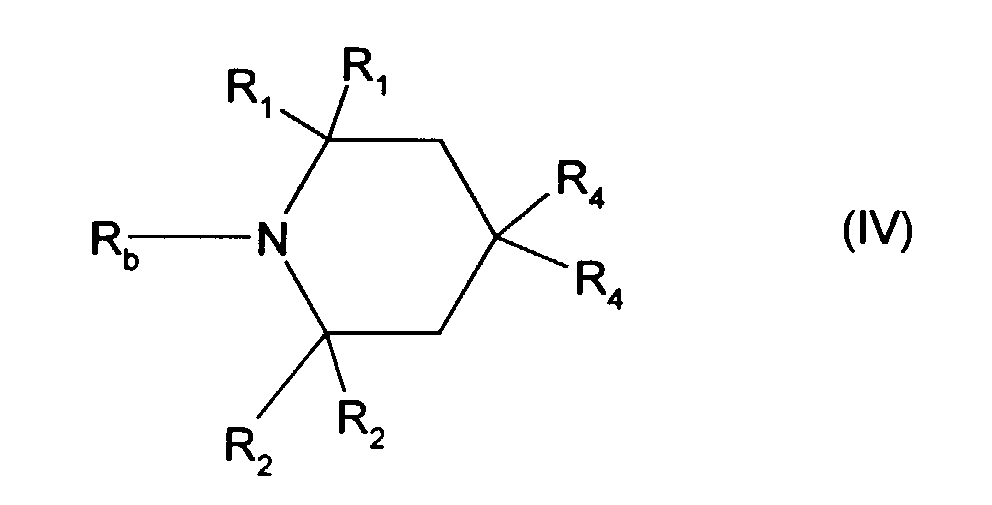 Rb is oxygen; OH; -O-CO-R5; -O-C1-8alkyl; -O-CO-phenyl; -O-C2-8alkenyl; -O-C3-18alkynyl; -O-C5-12cyclo alkyl; -O-C6-10bicycloalkyl; -O-C5-8cyclo alkenyl, -O-C6-10aryl, -O-R30 where R30 is C7-9alkaryl unsubstituted or monosubstituted by C1-4alkyl or aryl; andeach R4 independently is selected from hydrogen, a hydroxy group, an ether group, an amine and amide forming group, an ester and ester forming group and a urea and urethane forming group; or both groups R4 together with the C atom to which they are attached form a spiro group; and the other symbols are as described in Claim 2.
 - A composition according to Claim 3 in which the compound of formula III is of formula IIIa to IIIn and the compound of formula IV is of formula IVa to IVnin which R is a saturated or unsaturated optionally alkyl or alkenyl substituted alkylene or cycloalkylene radical having 2-20 carbon atoms; and the other symbols are as defined above;
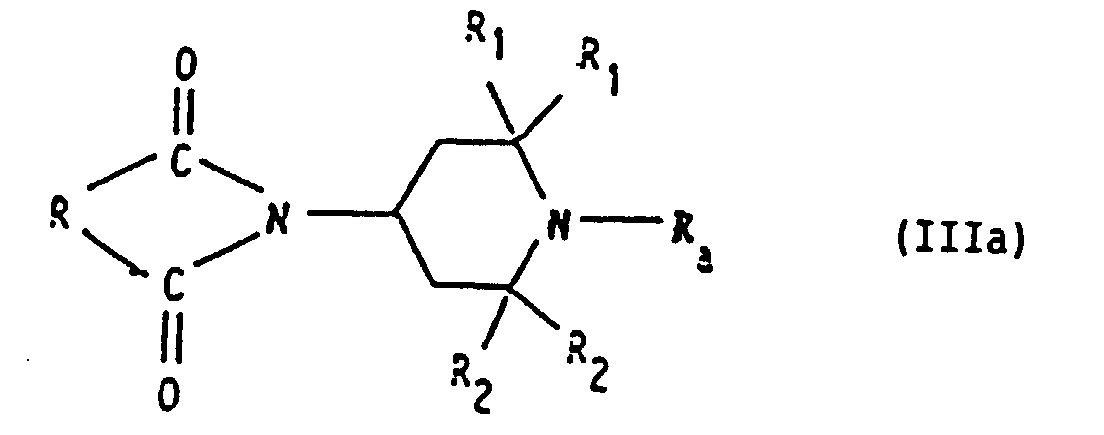
 where n1 is a number from 1-4 inclusive, preferably 1 or 2;Ra, R1 and R2 are as defined in Claim 2,R4b, when n1=1, is hydrogen; C1-18 alkyl, optionally interrupted by one or more oxygen atoms; cyanoethyl; benzyl, glycidyl; a monovalent radical of an aliphatic, cycloaliphatic, araliphatic or aromatic carboxylic acid or of a carbamic acid; or of a phosphorus-containing acid or a monovalent silyl radical, preferably a radical of an aliphatic carboxylic acid having 2-18 carbon atoms, of a cyloaliphatic carboxylic acid having 5-12 carbon atoms or of an aromatic carboxylic acid having 7-15 carbon atoms;R4b, when n1 is 2, is C1-12alkylene, C4-12alkenylene, xylylene, a bivalent radical of an aliphatic, cycloaliphatic, araliphatic or aromatic dicarboxylic acid or of a dicarbamic acid or of a phosphorus-containing acid, or a bivalent silyl radical, preferably a radical of an aliphatic dicarboxylic acid having 2-36 C atoms, of a cycloaliphatic or aromatic dicarboxylic acid having 8-14 C atoms, or of an aliphatic, cycloaliphatic or aromatic dicarbamic acid having 8-14 C atoms;R4b, when n1 is 3, is a trivalent radical of an aliphatic, cycloaliphatic or aromatic tricarboxylic acid, of an aromatic tricarbamic acid or of a phosphorus-containing acid, or a trivalent silyl radical; andR4b, when n1 is 4, is a tetravalent radical of an aliphatic, cycloaliphatic or aromatic tetracarboxylic acid;
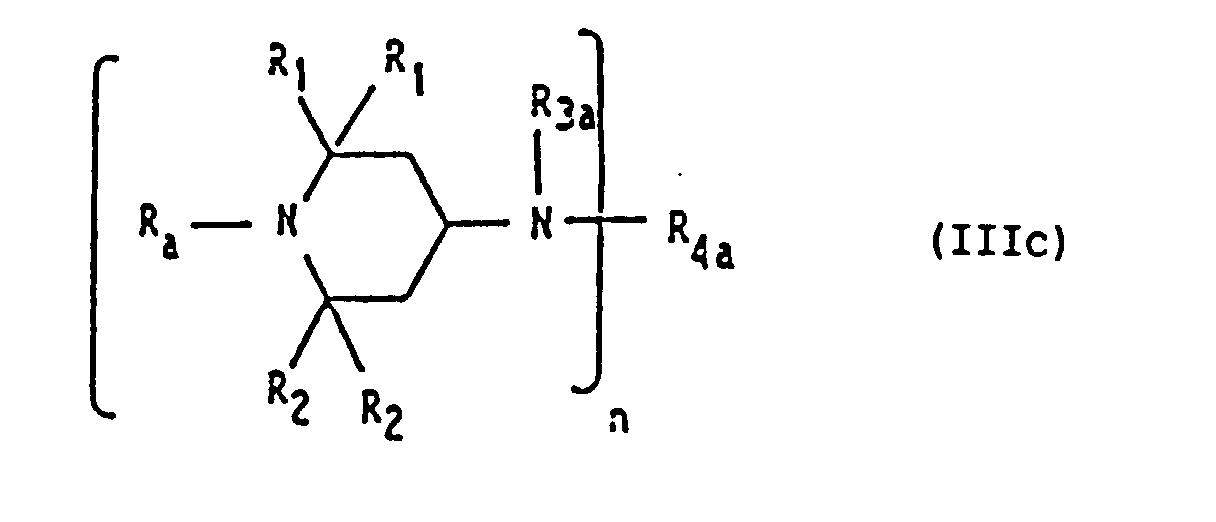 where n is the number 1 or 2;Ra, R1 and R2 are as defined above;R3a is hydrogen, C1-12alkyl, C5-7cycloalkyl, C7-8aralkyl, C2-18alkanoyl, C3-5alkenoyl, benzoyl or a group of the formula -CH2-CH(OH)-Z or of the formula -CONH-Z wherein Z is hydrogen, methyl or phenyl;R4a, when n is 1, is hydrogen, C1-18alkyl, C5-7cycloalkyl, C2-8alkenyl unsubstituted or substituted by a cyano, carbonyl or carbamide group, or it is glycidyl, a group of the formula -CH2-CH(OH)-Z or of the formula -CONH-Z wherein Z is hydrogen, methyl or phenyl:R4a, when n is 2, is C2-12alkylene, C6-12arylene, xylylene, a -CH2-CH(OH)-CH2- group or a -CH2-CH(OH)-CH2-O-X-O-CH2-CH(OH)-CH2-group wherein X is C2-10alkylene, C6-15arylene or C6-12 cycloalkylene; or, provided that R3a is not alkanoyl, alkenoyl cr benzoyl, R4a can also be a bivalent radical of an aliphatic, cycloaliphatic or aromatic dicarboxylic acid or of a dicarbamic acid, or can be the group -CO- or R3a and R4a together, when n is 1, can be the cyclic radical of an aliphatic or aromatic 1,2- or 1,3-dicarboxylic acid;
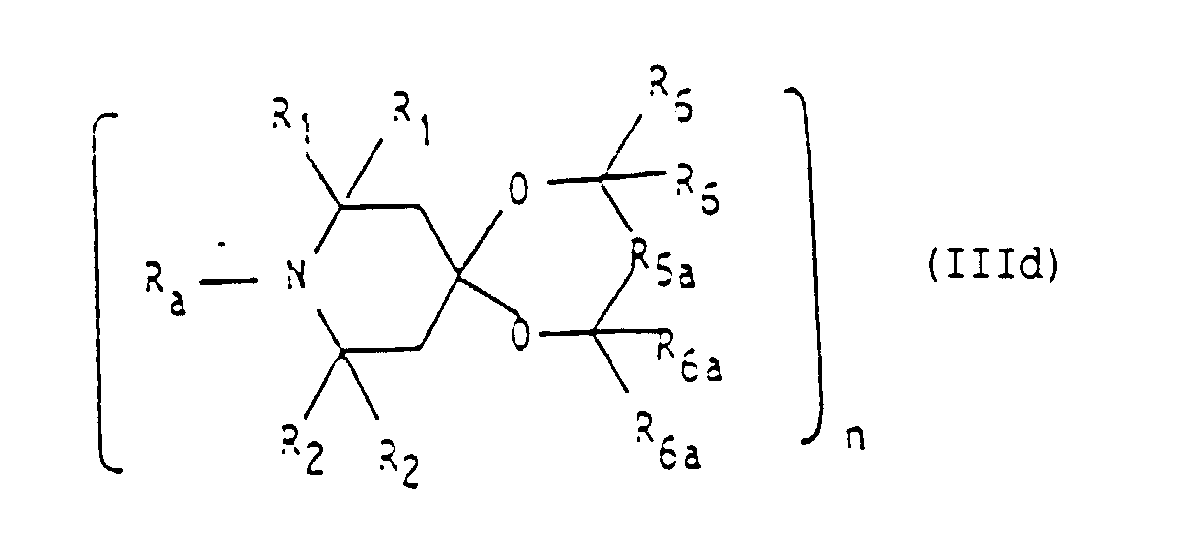 where n is the number 1 or 2;Ra, R1 and R2 are as defined above;R5a, when n is 1, is C2-8alkylene or hydroxyalkylene or C4-22 acyloxyalkylene;R5a, when n is 2, is the group (-CH2)2C(CH2-)2;R6 is hydrogen or both groups R6 form a group = 0;R6a is hydrogen or both groups R6a form a group = 0;
 where n is the number 1 or 2:Ra, R1 and R2 are as defined above;R16 is hydrogen, C1-12alkyl, allyl, benzyl, glycidyl or C2-6alkoxyalkyl;R17, when n is 1, is hydrogen, C1-12alkyl, C3-5alkenyl, C7-9aralkyl, C5-7cycloalkyl, C2-4hydroxyalkyl, C2-6alkoxyalkyl, C6-10aryl, glycidyl, a group of the formula -(CH2)m-COO-Q or of the formula -(CH2)m-O-C0-Q wherein m is 1 or 2, and Q is C1-22alkyl, C2-22alkenyl or phenyl; or a group of the formula -CH2-CH(CH3)-COO-Q or of the formula -CH2-CH(CH3)-O-C0-Q and Q is as defined above;R17, when n is 2 is C2-12alkylene, C6-12arylene, a group -CH2-CH(OH)-CH2-0-X-CH2-CH(OH)-CH2- wherein X is C2-10alkylene, C6-15arylene or C6-12cycloalkylene, or a group -CH2CH-(OZ')CH2-(OCH2-CH(OZ')-CH2)2- wherein Z' is hydrogen, C1-18alkyl, allyl, benzyl, C2-12alkanoyl or benzoyl; or a divalent radical of an aliphatic, cycloaliphatic, araliphatic or aromatic dicarboxylic acid;
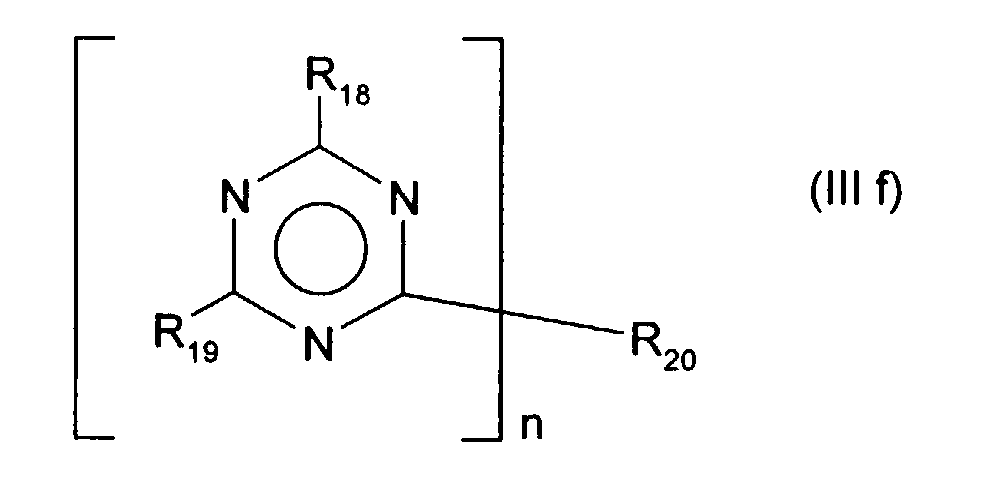 where n is the number 1 or 2;R18 is a group of the formula
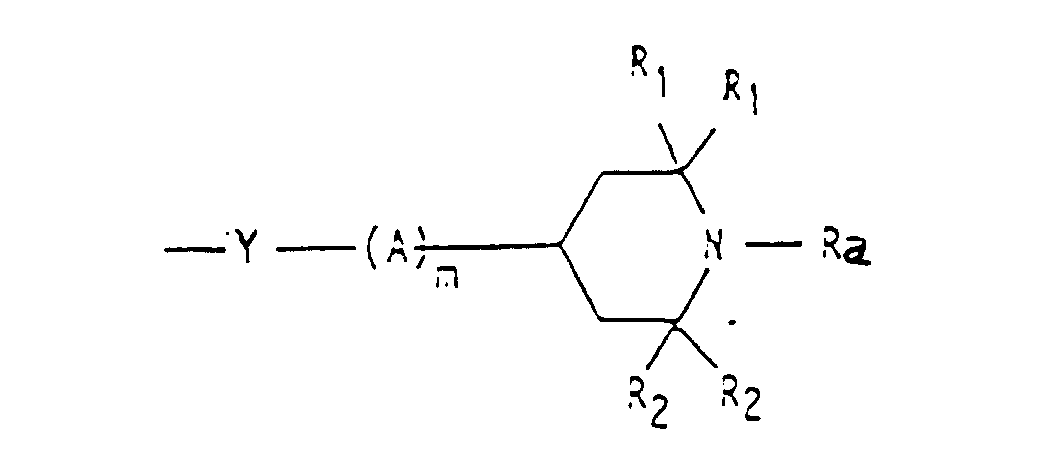 where Ra, R1 and R2 are as defined above;Y is -O-; -NR21-; or-NR21-CO-CO-NR21-;A is C2-6alkylene;m is the number 0 or 1;R19 is selected from one of the groups -R18,-R22, -OR23, -NHCH2OR23 and -N(CH2OR23)2;
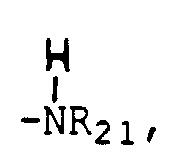 R20, when n is 1, is a group selected from R18 and R19;R20, when n is 2, is the group-Y-Q1-Y-,where Q1 is C2-6alkylene optionally interrupted by -N(R24)-;R21 is hydrogen, C1-12alkyl, cyclohexyl, benzyl or C1-4hydroxyalkyl, or a group of the formula
 R22 is C1-12alkyl, cyclohexyl, benzyl or C1-4hydroxyalkyl;R23 is hydrogen, C1-12alkyl or phenyl;R24 is hydrogen or the group -CH20R23;
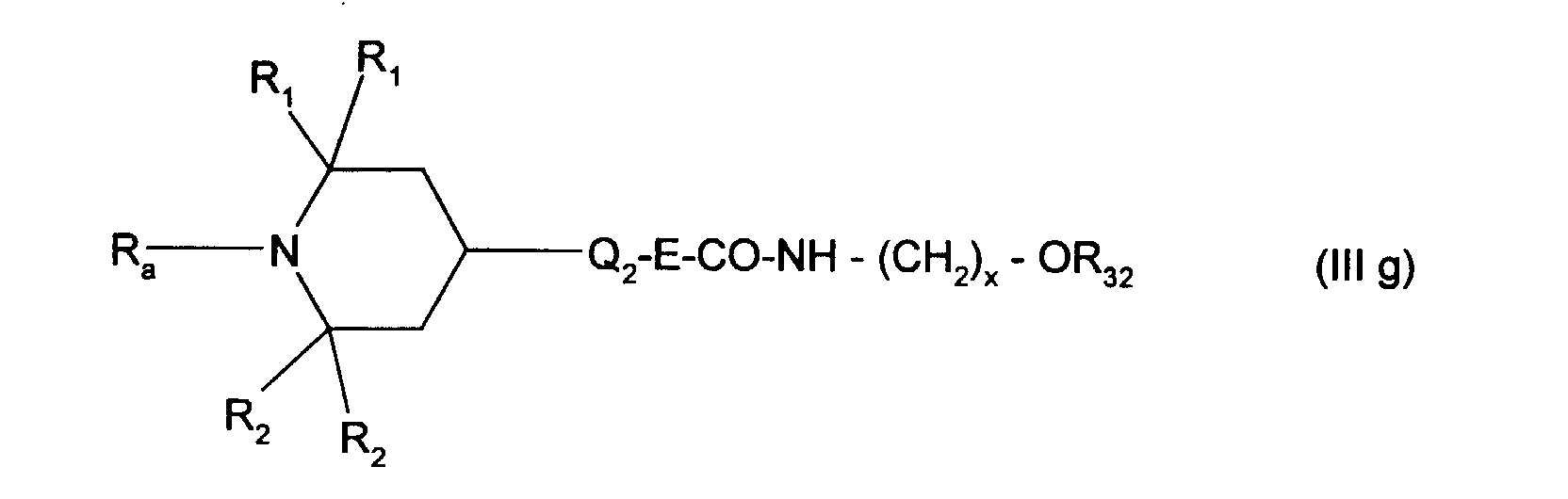 where x is an integer from 1 to 6 inclusive;Ra, R1 and R2 are as defined above;Q2 is -N(R31)- or -0-;E is C1-3alkylene, the group -CH2-CH(R34)-0- where R34 is hydrogen, methyl or phenyl, the group -(CH2)3-NH- or a single bond or -CO-;Ra, is as defined above;R32 is hydrogen or C1-18alkyl;R31 is hydrogen, C1-18alkyl, C5-7cycloalkyl, C7-12aralkyl, cyanoethyl, C6-10aryl, the group -CH2-CH(R4a)-OH where R4a has the meaning defined above (when n=1), a group of the formula
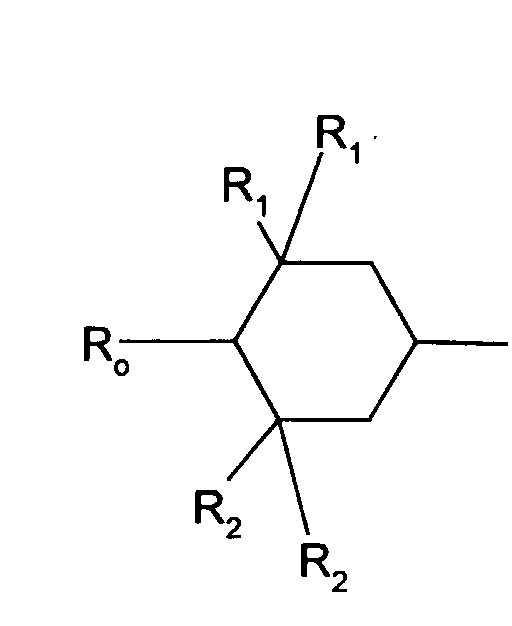 where Ro has a significance of Ra;or a group of the formulawhere G can be C2-6alkylene or C6-12arylene and E, Ra, R1, R2, R0 and R32 are as defined above;
 where Ra, R1 and R2 are as defined above;
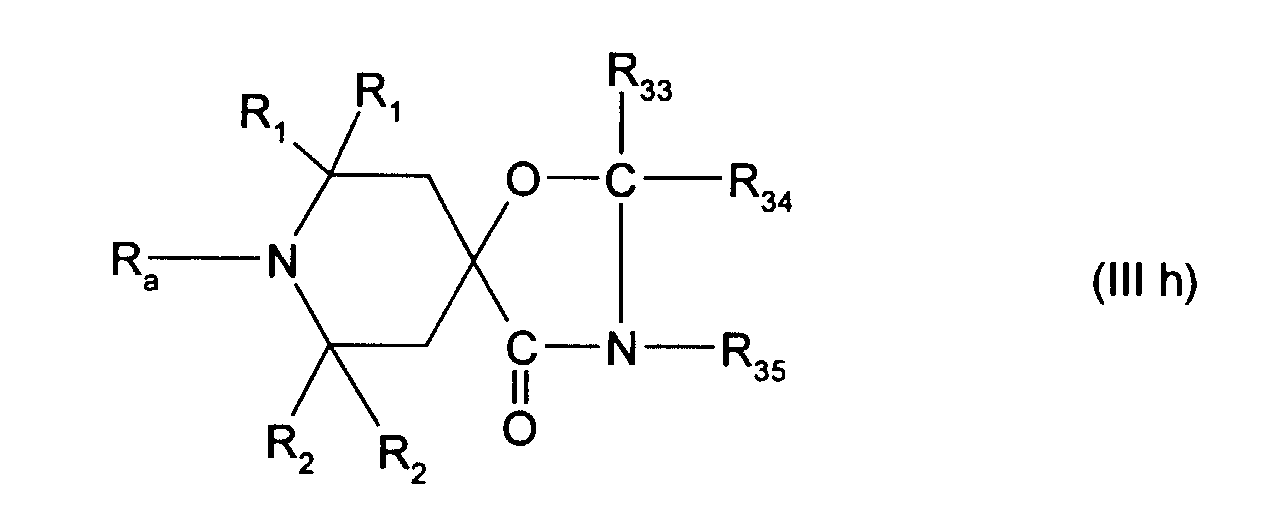 R33 and R34 independently are hydrogen, C1-30alkyl or benzyl or R33 is hydrogen or C1-4alkyl and R34 is phenyl, (C1-4alkyl) phenyl, chlorophenyl, 4-hydroxy-3,5-t-butylphenyl or naphthyl; or R33 and R34 together with the carbon atoms to which they are attached forma C5-15cycloalkylidene ring which may be unsubstituted or substituted by one C1-4alkyl group or form a group of formula
 R35 is hydrogen, C1-20alkyl, C2-20alkenyl or -CH(R36)-CH(R37)-COOR38 where R36 is hydrogen, methyl, phenyl or -COOC1-21alkyl;Ro is as defined above;R37 is hydrogen or methyl and R38 is hydrogen, a C1-21alkyl or C2-22alkenyl group which may be unsubstituted or monosubstituted by phenyl or naphthyl and which may be interrupted by oxygen or by a C1-4alkylimine group; phenyl; (C1-12alkyl) phenyl;
C5-12cycloalkyl or a saturated aliphatic hydrocarbon residue having 2-20 carbon atoms which may be interrupted by oxygen or by a C1-4alkylimine group and which is substituted by 1 to 3 groups selected from (C1-21alkyl)COO- and groups of the formula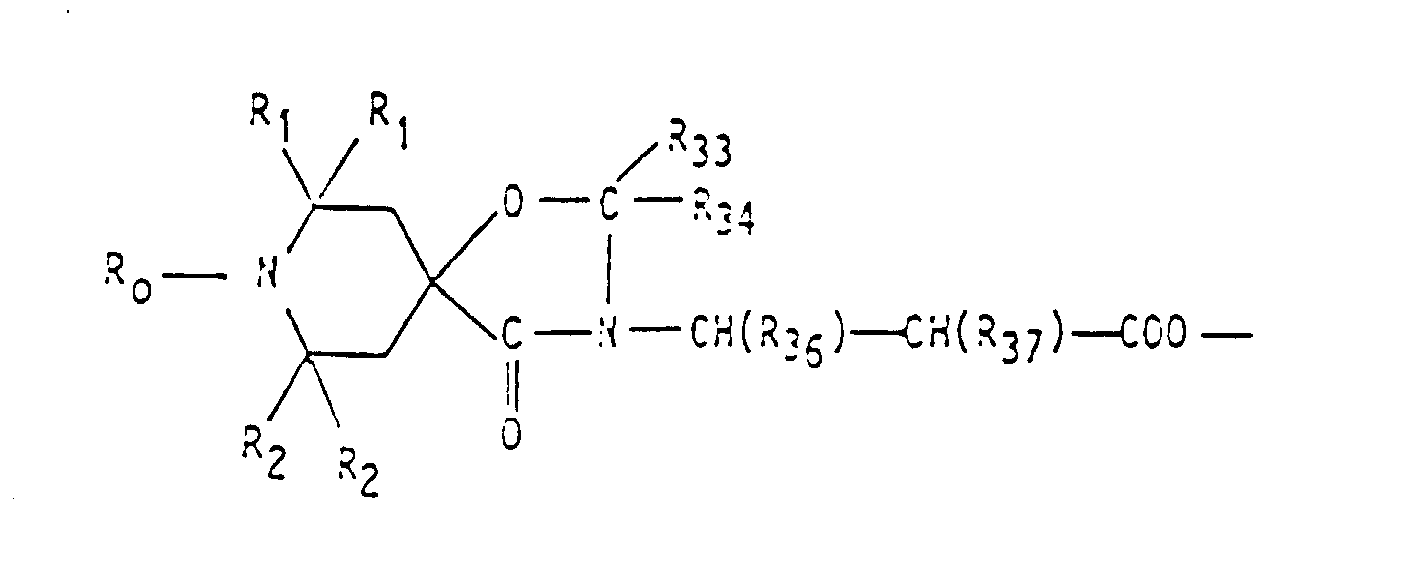
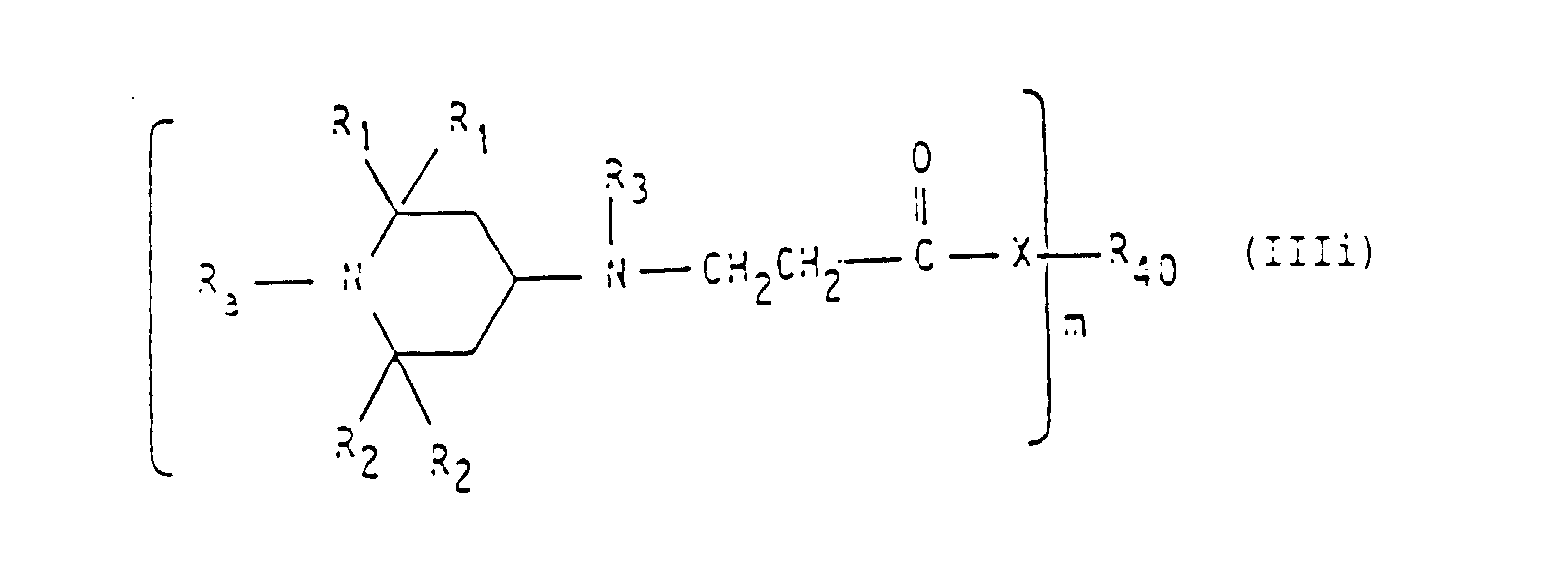 in which Ra, R1, R2 and R3 are as defined above;X is -O-, -NH- or -N(C1-4alkyl)- andR40 is a saturated or unsaturated aliphatic group unsubstituted or substituted by one or two groups selected from-OH and C1-4alkoxy and which can be interrupted by an oxygen or sulphur atom; or an aromatic group, unsubstituted or substituted by one or two groups selected from -OH, C1-4alkyl and C1-4alkoxy;m is an integer of from 1 to 4 inclusive;where Ra, R1, R2 and R3 are as defined above and R50 is an amide or ester forming group;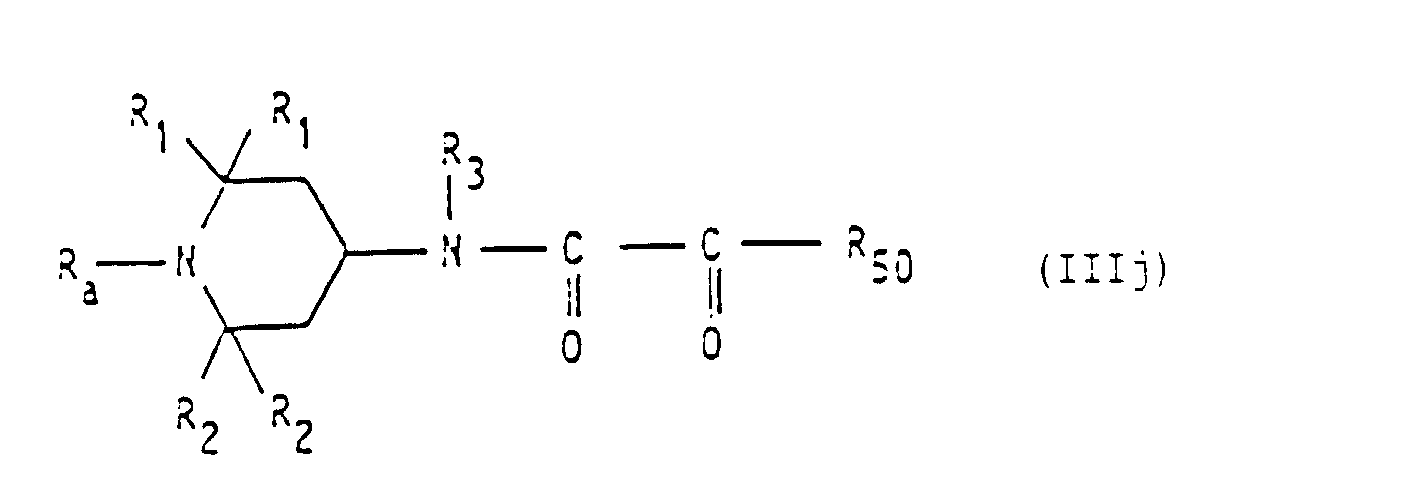
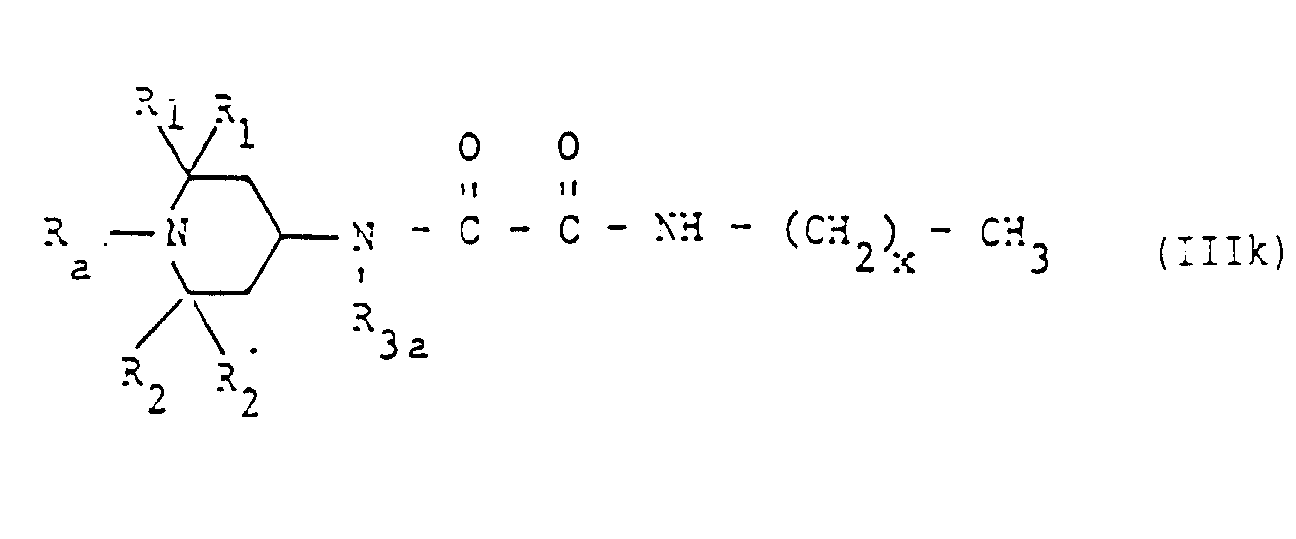

 where the symbols are as defined above;


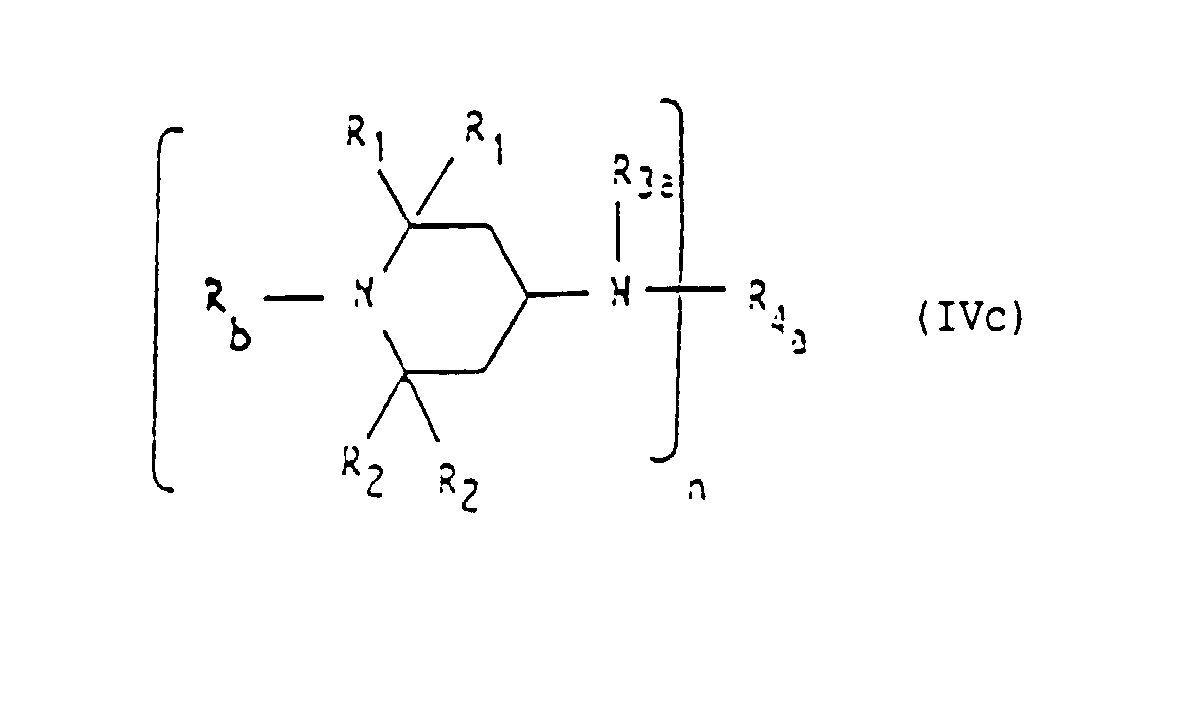

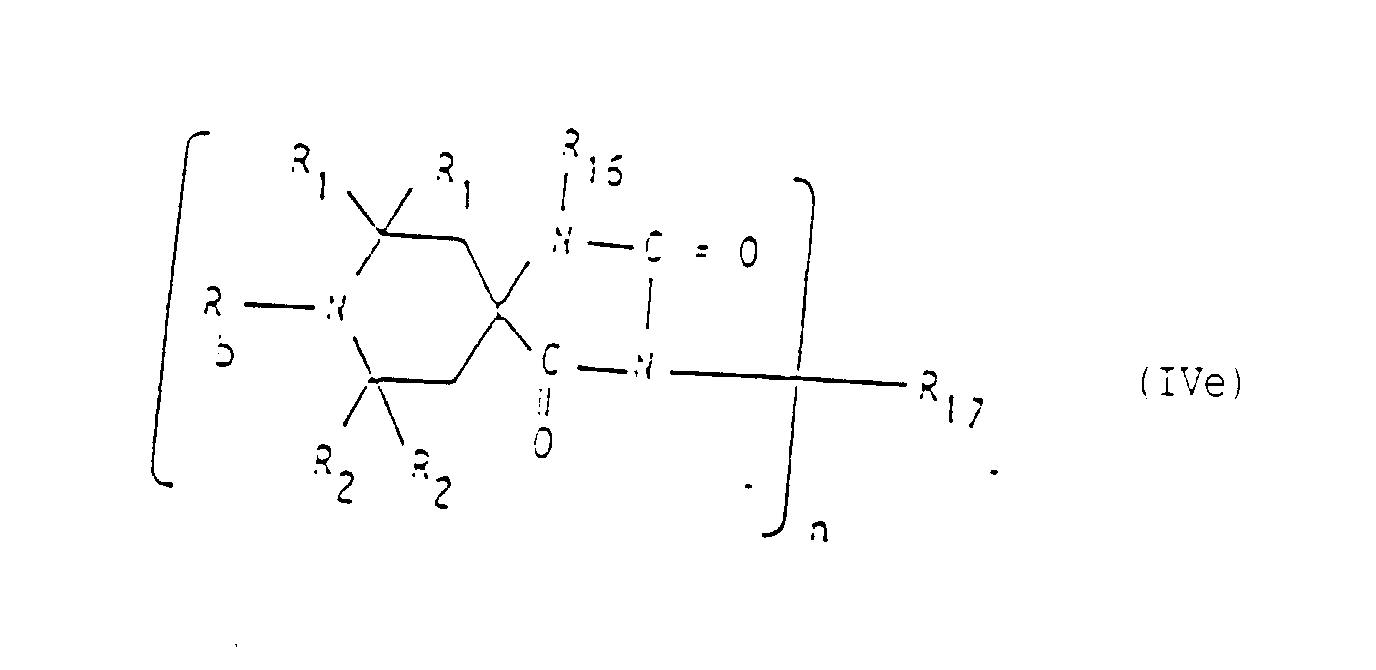


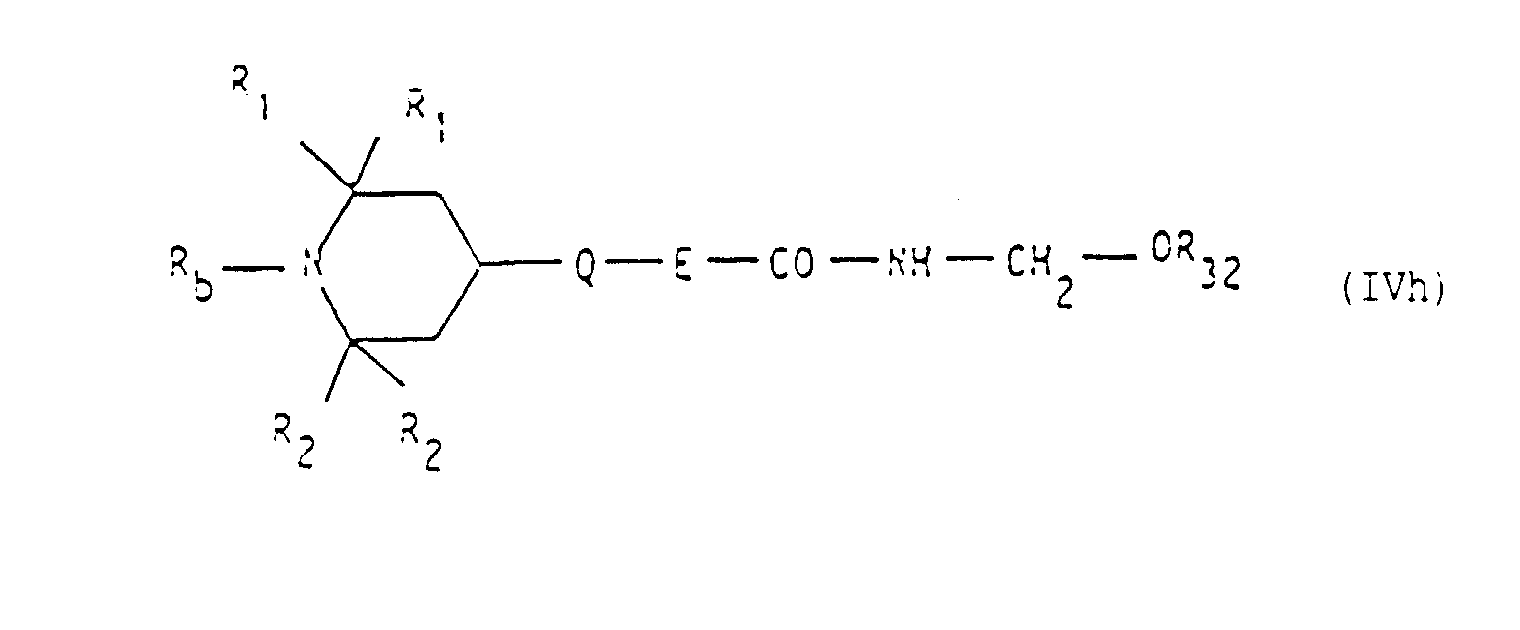

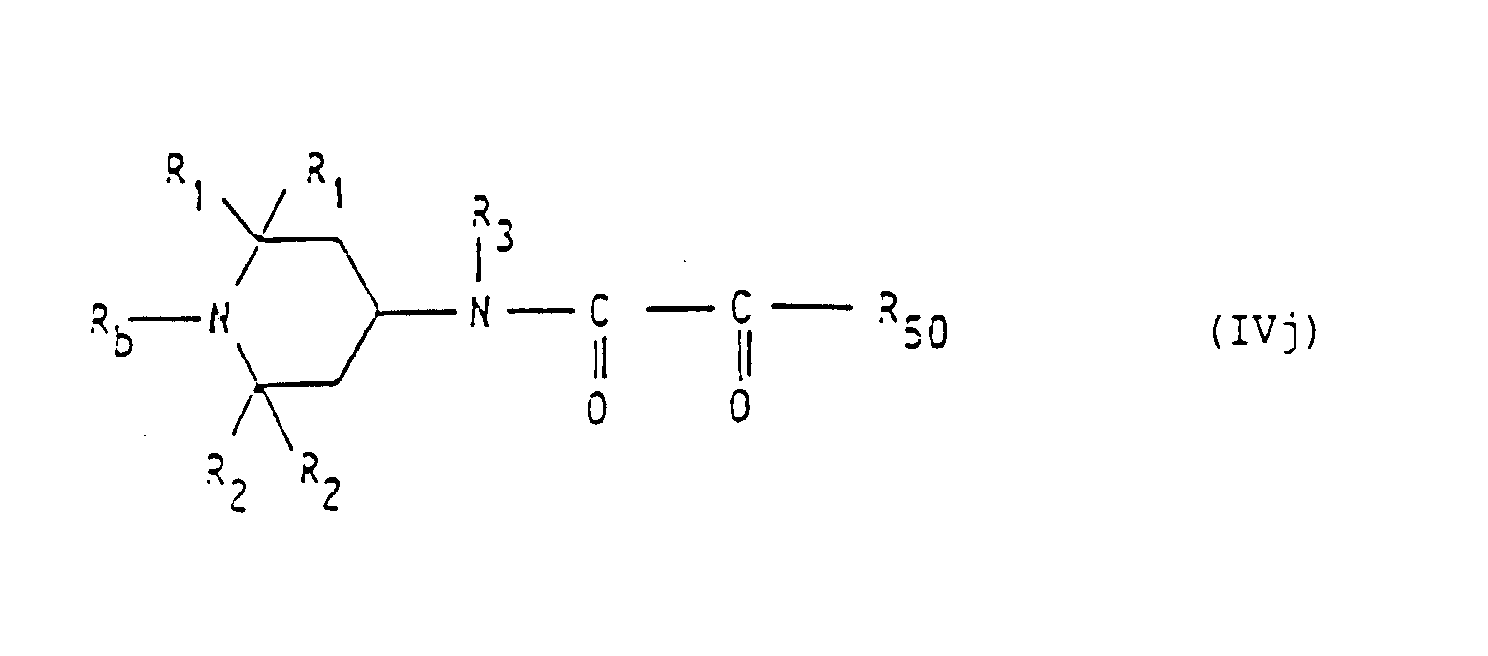
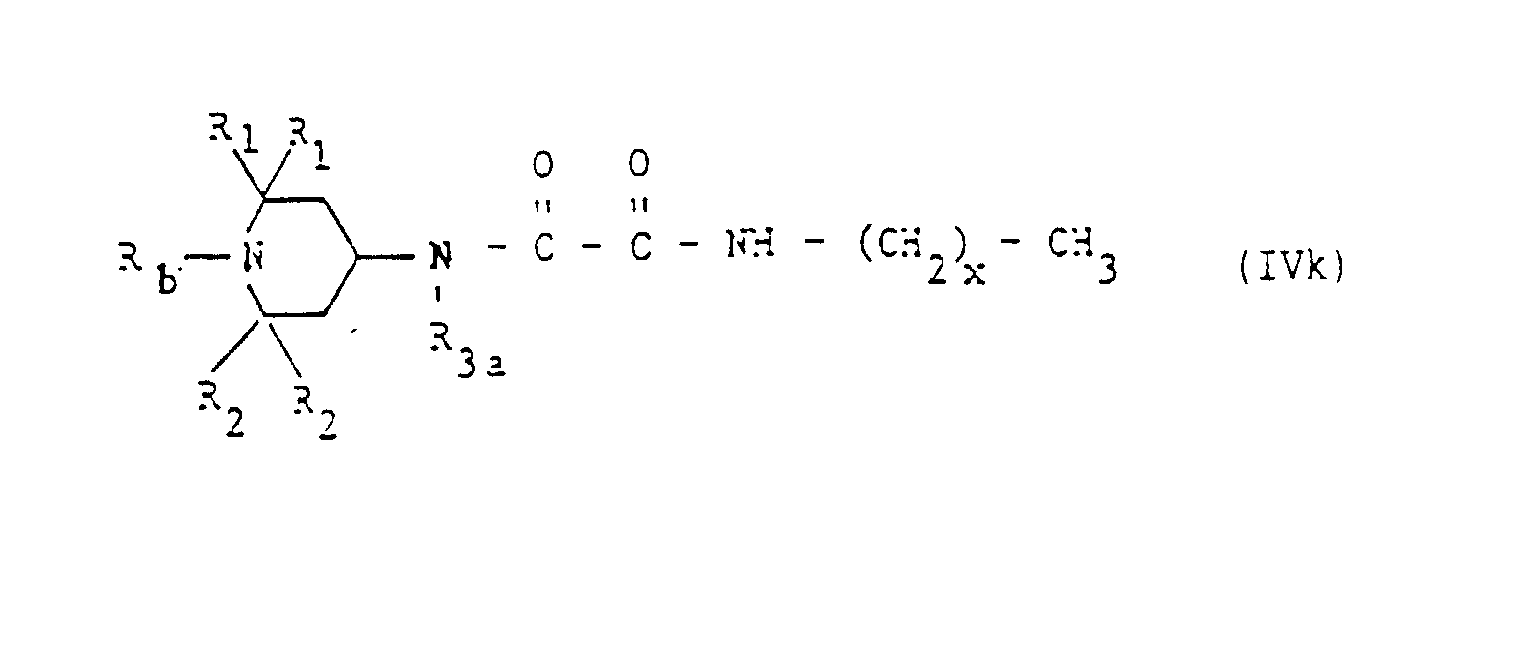

 where the symbols are as defined above or are defined in Claim 2.
- A composition according to Claim 3 or 4 in which the compound of formula III is of formula III' to III"'
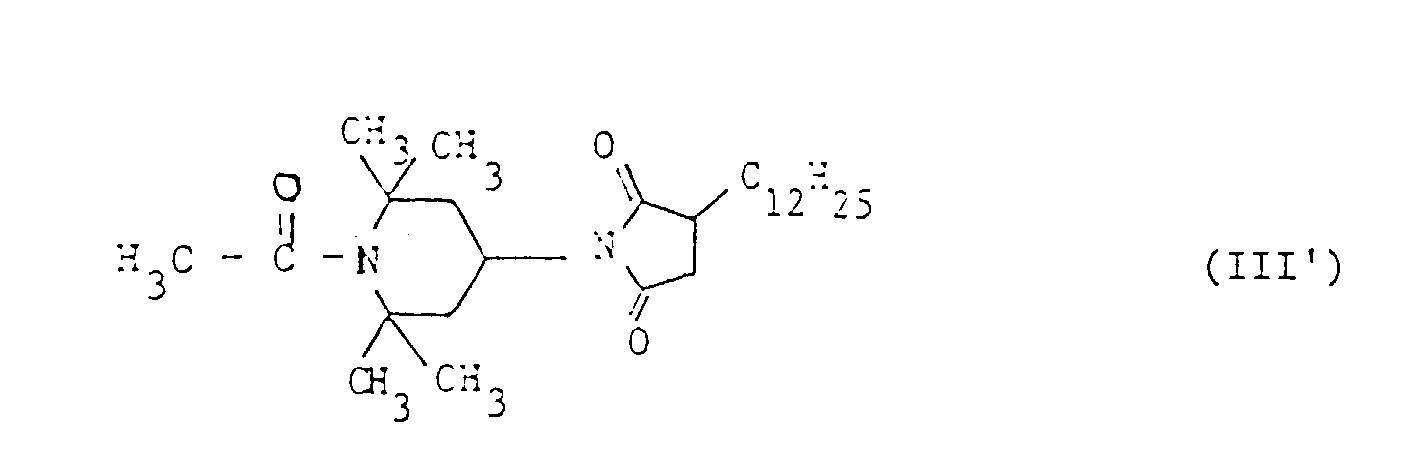
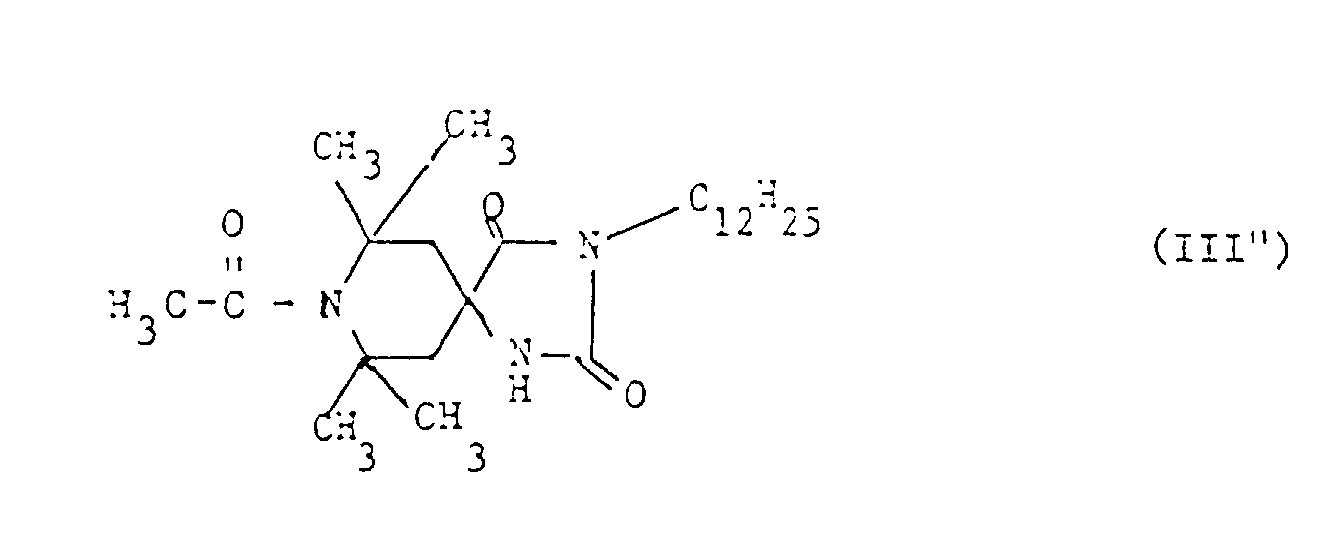 and the compound of formula IV is of formula IV'

- A composition, suitable for stabilising a polymeric composition against the effects of light, comprisinga) an N-acylated 2,2,6,6-tetraalkylpiperidinyl-group-containing compound in which a spiro group is attached in the 4-position (hereinafter defined as component i); andb) an N-acylated 2,2,6,6-tetraalkylpiperidinyl-group-containing compound in which in the 4- position no spiro group is present (hereinafter defined as component ii).
- A composition according to Claim 6 in whichi) component i) is a compound of formula V
 Ra is -CO-R5;R42 together with the C atom to which it is attached form a spiro group; andii) component ii) is a compound of formula VIwhere each R41 independently is selected from hydrogen, an amine and amide forming group, an ester and ester forming group and a urea and urethane forming group; and the other symbols are as defined in Claim 2.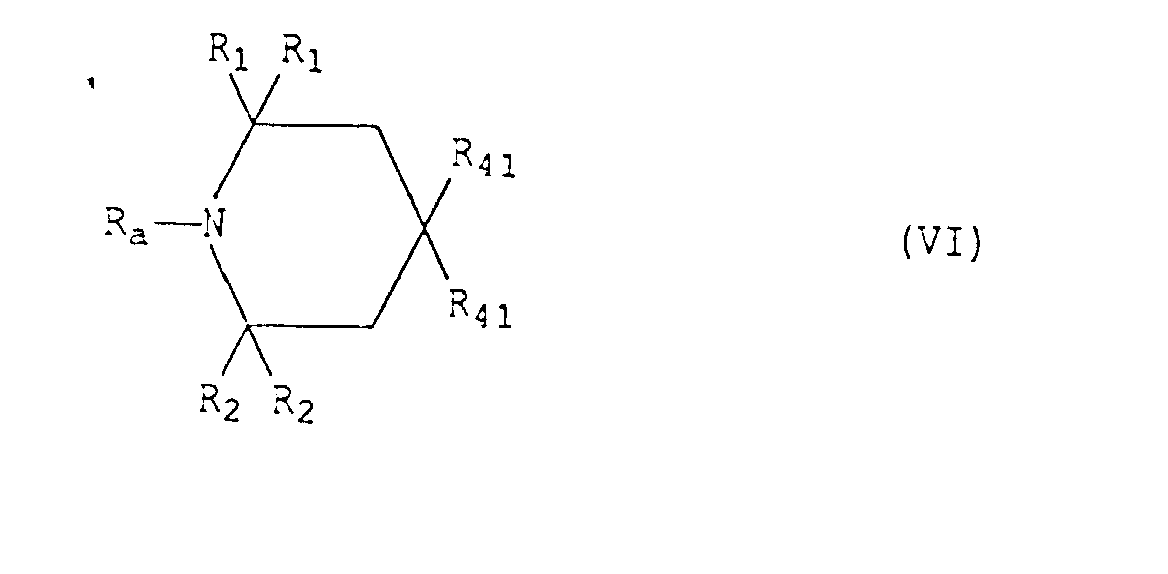
- A polymeric composition comprising a polymeric material and a mixture of component a) and of component b) defined in Claims 1 to 5 or of component i) and of component ii) defined in Claims 6 or 7.
- A method for stabilising a lacquer composition based on based on acrylic, alkyd and/or polyester resins (which if desired, can be crosslinked with melamine/formaldehyde resins, epoxide resins or polyisocyanates) which comprises incorporating into the resin a a mixture of component a) and of,component b) defined in Claims 1 to 5 or of component i) and of component ii) defined in Claims 6 or 7, optionally together with an acid catayst or compound capable of releasing an acid catalyst.
- A lacquer composition based on acrylic, alkyd and/or polyester resins (which if desired, can be crosslinked with melamine/formaldehyde resins, epoxide resins or polyisocyanates) containing a mixture of component a). and of component b) defined in Claims 1 to 5 or of component i) and of component ii) defined in Claims 6 or 7, optionally together with an acid catayst or compound capable of releasing an acid catalyst.
- A mixture comprisinga) 10-90% by weight of a compound containing a group of formula I(hereinafter described as component a)
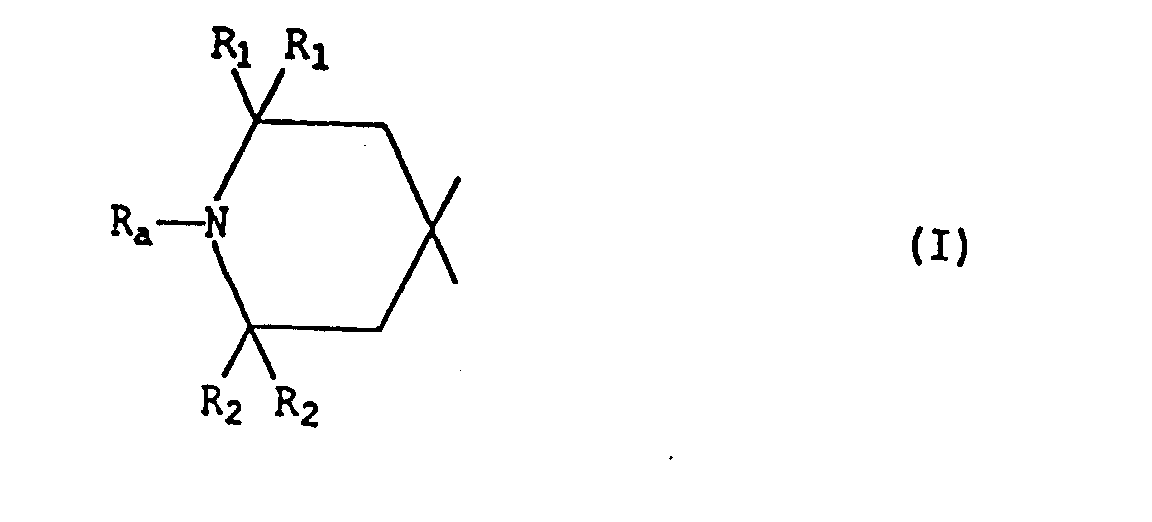 b) 10-90% by weight of a compound containing a group of formula II(hereinafter described as component b))
 in which Ra is -CO-R5, where R5 is defined belowRb is oxygen; OH; -O-CO-R5; -O-C1-8alkyl; -O-CO-phenyl; -O-C2-8alkenyl or -COR5; -O-C3-18alkynyl; -O-C5-12cyclo alkyl; -O-C6-10bicycloalkyl; -O-C5-8cyclo alkenyl, -O-C6-10aryl, -O-R30 where R30 is C7-9alkaryl unsubstituted or monosubstituted by C1-4alkyl or aryl; where R5 is C2-8alkenyl, -C(R3)=CH2 (preferably), C1-22alkyl, phenyl, -CO-phenyl, -NR7R8, -CH2-C6H5, -CO-OC1-12alkyl or -COOH; R7 is hydrogen, C1-12alkyl, C5-6cycloalkyl, phenyl, phenyl-C1-4 alkyl or C1-12alkylphenyl and R8 is C1-12alkyl or hydrogen, andR3 is hydrogen or C1-4alkyl;each R1, independently, is -CH3 or -CH2(C1-4alkyl) or both groups R1 form a group -(CH2)5-; andeach R2, independently, is -CH3 or -CH2(C1-4alkyl) or both groups R2 form a group -(CH2)5-.
 - The use of a mixture according to Claim 11 to stabilize an acid catalysed polymeric lacquer against the effects of light whilst at the same time providing good hardening properties.
Applications Claiming Priority (4)
| Application Number | Priority Date | Filing Date | Title |
|---|---|---|---|
| GB9100257 | 1991-01-07 | ||
| GB919100257A GB9100257D0 (en) | 1991-01-07 | 1991-01-07 | Improvements in or relating to organic compounds |
| PCT/EP1992/000023 WO1992012201A1 (en) | 1991-01-07 | 1992-01-07 | Mixtures of hals compounds |
| DE19614520A DE19614520A1 (en) | 1991-01-07 | 1996-04-12 | Stabilization of paints |
Publications (2)
| Publication Number | Publication Date |
|---|---|
| EP0519032A1 EP0519032A1 (en) | 1992-12-23 |
| EP0519032B1 true EP0519032B1 (en) | 1999-09-08 |
Family
ID=39563531
Family Applications (2)
| Application Number | Title | Priority Date | Filing Date |
|---|---|---|---|
| EP92901642A Expired - Lifetime EP0519032B1 (en) | 1991-01-07 | 1992-01-07 | Mixtures of hals compounds |
| EP97914515A Expired - Lifetime EP0892833B1 (en) | 1991-01-07 | 1997-04-10 | Paint stabiliser |
Family Applications After (1)
| Application Number | Title | Priority Date | Filing Date |
|---|---|---|---|
| EP97914515A Expired - Lifetime EP0892833B1 (en) | 1991-01-07 | 1997-04-10 | Paint stabiliser |
Country Status (17)
| Country | Link |
|---|---|
| US (1) | US6218451B1 (en) |
| EP (2) | EP0519032B1 (en) |
| JP (2) | JP3107226B2 (en) |
| KR (1) | KR100232329B1 (en) |
| CN (1) | CN1110525C (en) |
| AT (1) | ATE206153T1 (en) |
| AU (1) | AU728028B2 (en) |
| BR (1) | BR9708651A (en) |
| CA (2) | CA2077545C (en) |
| CZ (1) | CZ295188B6 (en) |
| DE (2) | DE69229935T2 (en) |
| ES (1) | ES2165037T3 (en) |
| GB (1) | GB9100257D0 (en) |
| HU (1) | HUP0000175A3 (en) |
| ID (1) | ID16586A (en) |
| TR (1) | TR199802045T2 (en) |
| WO (2) | WO1992012201A1 (en) |
Families Citing this family (27)
| Publication number | Priority date | Publication date | Assignee | Title |
|---|---|---|---|---|
| ES2111887T3 (en) * | 1993-02-23 | 1998-03-16 | Ciba Geigy Ag | DICETOPYROLOPYROLS CONTAINING NITROXYL GROUPS. |
| EP0709426B2 (en) | 1994-10-28 | 2005-01-05 | Ciba SC Holding AG | Synergistic stabiliser mixture |
| ES2148464T5 (en) * | 1994-10-28 | 2005-06-16 | Ciba Specialty Chemicals Holding Inc. | MIXING OF SYNERGIC STABILIZERS. |
| TW357174B (en) * | 1995-01-23 | 1999-05-01 | Ciba Sc Holding Ag | Synergistic stabilizer mixture |
| TW401437B (en) | 1995-02-10 | 2000-08-11 | Ciba Sc Holding Ag | Synergistic stabilizer mixture |
| TW358820B (en) * | 1995-04-11 | 1999-05-21 | Ciba Sc Holding Ag | Synergistic stabilizer mixture |
| TW360678B (en) * | 1995-05-03 | 1999-06-11 | Ciba Sc Holding Ag | Synergistic stabilizer mixture for polyolefins |
| TW390897B (en) * | 1995-07-21 | 2000-05-21 | Ciba Sc Holding Ag | Synergistic stabilizer mixture |
| US5618909A (en) * | 1995-07-27 | 1997-04-08 | Alliedsignal Inc. | Light stabilized polyamide substrate and process for making |
| TW464670B (en) | 1996-08-07 | 2001-11-21 | Ciba Sc Holding Ag | Stabilizer mixtures containing a hindered amine |
| US5786411A (en) * | 1996-12-20 | 1998-07-28 | General Electric Company | Light resistant compositions of polycarbonate and graft copolymer resins |
| US5990209A (en) * | 1997-04-25 | 1999-11-23 | Aristech Chemical Corporation | Copolymers of propylene with polymerizable hindered amine light stabilizers |
| DE19735255B4 (en) | 1997-08-14 | 2007-08-23 | Clariant Produkte (Deutschland) Gmbh | Synergistic stabilizer mixture based on polyalkyl-1-oxa-diazaspirodecane compounds and its use |
| KR20010050085A (en) * | 1999-08-18 | 2001-06-15 | 잔디해머,한스루돌프하우스 | Novel sterically hindered amines |
| GB0009965D0 (en) * | 2000-04-25 | 2000-06-14 | Clariant Int Ltd | Synergistic stabilizer compositions comprising copolymers of ethylene with hin dered amine moieties containing acrylate or methacrylate comonomers |
| DE10204690A1 (en) | 2002-02-06 | 2003-08-07 | Clariant Gmbh | Process for the preparation of synergistic stabilizer mixtures |
| JP5308039B2 (en) | 2007-02-20 | 2013-10-09 | 富士フイルム株式会社 | Polymer materials containing UV absorbers |
| US20100130638A1 (en) | 2007-03-30 | 2010-05-27 | Fujifilm Corporation | Ultraviolet absorbent composition |
| TWI432498B (en) | 2007-05-25 | 2014-04-01 | Clariant Finance Bvi Ltd | Stabilization of polycarbonates and polycarbonate blends |
| WO2009022736A1 (en) | 2007-08-16 | 2009-02-19 | Fujifilm Corporation | Heterocyclic compound, ultraviolet ray absorbent, and composition comprising the ultraviolet ray absorbent |
| JP5250289B2 (en) | 2008-03-31 | 2013-07-31 | 富士フイルム株式会社 | UV absorber composition |
| JP5244437B2 (en) | 2008-03-31 | 2013-07-24 | 富士フイルム株式会社 | UV absorber composition |
| JP2009270062A (en) | 2008-05-09 | 2009-11-19 | Fujifilm Corp | Ultraviolet absorbent composition |
| JP5915528B2 (en) | 2011-05-31 | 2016-05-11 | 三菱レイヨン株式会社 | Curing composition and polymer |
| JP5966408B2 (en) * | 2012-02-15 | 2016-08-10 | 新日鐵住金株式会社 | Manufacturing method of surface-treated steel with excellent corrosion resistance |
| EP3145911B1 (en) * | 2014-05-21 | 2020-07-08 | Solvay Specialty Polymers USA, L.L.C. | Stabilizer compounds |
| FR3093335A1 (en) * | 2019-02-28 | 2020-09-04 | Valeo Systemes D'essuyage | Coating composition for wiper blade for wiper blade and associated wiper blade |
Family Cites Families (14)
| Publication number | Priority date | Publication date | Assignee | Title |
|---|---|---|---|---|
| US3423225A (en) * | 1965-07-15 | 1969-01-21 | Eastman Kodak Co | Temporary protective films from polyolefin dispersions |
| US4618638A (en) * | 1981-11-05 | 1986-10-21 | Ciba-Geigy Corporation | Compositions containing alpha-cyanocinnamate ultraviolet-absorbing stabilizers substituted by an aliphatic hydroxyl group |
| DE3412227A1 (en) * | 1983-04-11 | 1984-10-11 | Sandoz-Patent-GmbH, 7850 Lörrach | Novel piperidine compounds |
| DE3511924A1 (en) * | 1984-04-13 | 1985-10-24 | Sandoz-Patent-GmbH, 7850 Lörrach | 2,2,6,6-TETRAALKYLPIPERIDINE STABILIZERS |
| FR2587340B1 (en) * | 1985-09-13 | 1990-04-20 | Sandoz Sa | NOVEL TETRAALKYLPIPERIDINES, THEIR PREPARATION AND THEIR USE AS STABILIZERS OF POLYMERIC MATERIALS |
| US4843116A (en) | 1986-03-17 | 1989-06-27 | General Electric Company | UV light stabilizer composition comprising cyclic aliphatic epoxy, UV screener, and polyalkyldipiperidine (HALS) compounds |
| US5026751A (en) | 1986-03-17 | 1991-06-25 | General Electric Company | UV light stabilizer composition comprising cyclic aliphatic epoxy UV screener, and polyalkyldipiperidine (HALS) compounds |
| DE3852742T3 (en) * | 1987-09-21 | 2005-02-10 | Ciba Speciality Chemicals Holding Inc. | N-substituted hindered amine stabilizers. |
| ES2081458T3 (en) | 1990-03-30 | 1996-03-16 | Ciba Geigy Ag | PAINTING COMPOSITION. |
| JP3124071B2 (en) * | 1991-06-20 | 2001-01-15 | 関西ペイント株式会社 | Top coating composition and coating film forming method |
| FR2694761B1 (en) * | 1992-08-17 | 1996-06-14 | Sandoz Sa | STERICALLY HINDERED AMINES, THEIR PREPARATION AND THEIR USE AS STABILIZERS OF POLYMERIC MATERIALS. |
| DE4327297B4 (en) * | 1992-08-17 | 2007-05-24 | Clariant Finance (Bvi) Ltd. | Use of piperidine compounds |
| JPH0881643A (en) * | 1994-09-12 | 1996-03-26 | Kansai Paint Co Ltd | Clear coating and coating method therewith |
| EP0892828B1 (en) * | 1996-04-12 | 2001-05-30 | Clariant Finance (BVI) Limited | Stabilization of polyolefins |
-
1991
- 1991-01-07 GB GB919100257A patent/GB9100257D0/en active Pending
-
1992
- 1992-01-07 DE DE69229935T patent/DE69229935T2/en not_active Expired - Lifetime
- 1992-01-07 CA CA002077545A patent/CA2077545C/en not_active Expired - Lifetime
- 1992-01-07 WO PCT/EP1992/000023 patent/WO1992012201A1/en not_active Ceased
- 1992-01-07 KR KR1019920702146A patent/KR100232329B1/en not_active Expired - Lifetime
- 1992-01-07 EP EP92901642A patent/EP0519032B1/en not_active Expired - Lifetime
- 1992-01-07 JP JP04502083A patent/JP3107226B2/en not_active Expired - Lifetime
-
1996
- 1996-04-12 DE DE19614520A patent/DE19614520A1/en not_active Withdrawn
-
1997
- 1997-04-10 TR TR1998/02045T patent/TR199802045T2/en unknown
- 1997-04-10 ES ES97914515T patent/ES2165037T3/en not_active Expired - Lifetime
- 1997-04-10 CN CN97195355A patent/CN1110525C/en not_active Expired - Fee Related
- 1997-04-10 AT AT97914515T patent/ATE206153T1/en not_active IP Right Cessation
- 1997-04-10 CA CA002251318A patent/CA2251318C/en not_active Expired - Fee Related
- 1997-04-10 HU HU0000175A patent/HUP0000175A3/en unknown
- 1997-04-10 AU AU21745/97A patent/AU728028B2/en not_active Ceased
- 1997-04-10 CZ CZ19983278A patent/CZ295188B6/en not_active IP Right Cessation
- 1997-04-10 EP EP97914515A patent/EP0892833B1/en not_active Expired - Lifetime
- 1997-04-10 WO PCT/IB1997/000387 patent/WO1997039069A1/en not_active Ceased
- 1997-04-10 US US09/171,032 patent/US6218451B1/en not_active Expired - Lifetime
- 1997-04-10 BR BR9708651A patent/BR9708651A/en not_active IP Right Cessation
- 1997-04-10 JP JP9536905A patent/JP2000509082A/en active Pending
- 1997-04-14 ID IDP971237A patent/ID16586A/en unknown
Also Published As
| Publication number | Publication date |
|---|---|
| CN1221442A (en) | 1999-06-30 |
| JP3107226B2 (en) | 2000-11-06 |
| JP2000509082A (en) | 2000-07-18 |
| BR9708651A (en) | 1999-08-03 |
| US6218451B1 (en) | 2001-04-17 |
| WO1992012201A1 (en) | 1992-07-23 |
| CA2077545A1 (en) | 1992-07-08 |
| JPH05505419A (en) | 1993-08-12 |
| DE69229935D1 (en) | 1999-10-14 |
| HK1019890A1 (en) | 2000-03-03 |
| CA2251318C (en) | 2007-09-04 |
| TR199802045T2 (en) | 1998-12-21 |
| EP0892833A1 (en) | 1999-01-27 |
| EP0519032A1 (en) | 1992-12-23 |
| ATE206153T1 (en) | 2001-10-15 |
| KR100232329B1 (en) | 1999-12-01 |
| DE69229935T2 (en) | 2000-03-16 |
| GB9100257D0 (en) | 1991-02-20 |
| AU2174597A (en) | 1997-11-07 |
| WO1997039069A1 (en) | 1997-10-23 |
| HUP0000175A2 (en) | 2000-06-28 |
| CA2077545C (en) | 2003-12-09 |
| DE19614520A1 (en) | 1997-10-16 |
| AU728028B2 (en) | 2001-01-04 |
| ES2165037T3 (en) | 2002-03-01 |
| CZ327898A3 (en) | 1999-01-13 |
| HUP0000175A3 (en) | 2001-06-28 |
| KR927003712A (en) | 1992-12-18 |
| CZ295188B6 (en) | 2005-06-15 |
| CN1110525C (en) | 2003-06-04 |
| EP0892833B1 (en) | 2001-09-26 |
| CA2251318A1 (en) | 1997-10-23 |
| ID16586A (en) | 1997-10-16 |
Similar Documents
| Publication | Publication Date | Title |
|---|---|---|
| WO1992012201A1 (en) | Mixtures of hals compounds | |
| KR940010222B1 (en) | Methods and synergistic combinations to stabilize polymer films, coatings or molded articles | |
| EP0893483B1 (en) | Wet-on-wet primer with low film build U.V. light protection | |
| DE4317672B4 (en) | Homogeneous melt in the form of a solid solution of compounds with sterically hindered amino groups, a process for their preparation and their use for stabilizing polymeric natural and plastics | |
| EP0309401B2 (en) | Stabilization of coatings with N-hydroxy hindered amines | |
| EP0792316B1 (en) | Waterborne compositions containing 1,3,5-triazine carbamates | |
| US4891396A (en) | New benztriazolyl compounds | |
| HK59086A (en) | Light stabilisation of two-layer composite lacquers | |
| GB2180537A (en) | 4-oxalamido-2,2,6,6-tetraalkylpiperidine compounds and compositions | |
| US4716187A (en) | Stabilizing polymers | |
| US4876299A (en) | Oxalanilides useful as U.V. absorbers | |
| US5976417A (en) | Mixtures of HALS compounds | |
| US4916175A (en) | N-(2,2,6,6,-tetraalkylpiperidinyl-4)-N'-phenyl oxalic acid diamides | |
| US4859725A (en) | Oxalamide compounds useful as UV absorbers | |
| US4774332A (en) | Piperidine containing stabilizer compounds | |
| US5489632A (en) | Imino ethers | |
| US4695600A (en) | Tetraalkylpiperidines | |
| JPH08337682A (en) | Organic compound | |
| WO2001040368A1 (en) | Formaldehyde free 1,3,5-triazine carbamate crosslinkers and curable compositions containing same | |
| DE4426222A1 (en) | Improvements of, or relating to, organic compounds | |
| JPH0222265A (en) | Tetraalkylpiperidine compound |
Legal Events
| Date | Code | Title | Description |
|---|---|---|---|
| PUAI | Public reference made under article 153(3) epc to a published international application that has entered the european phase |
Free format text: ORIGINAL CODE: 0009012 |
|
| 17P | Request for examination filed |
Effective date: 19920805 |
|
| AK | Designated contracting states |
Kind code of ref document: A1 Designated state(s): CH DE FR GB IT LI |
|
| 17Q | First examination report despatched |
Effective date: 19950929 |
|
| RAP1 | Party data changed (applicant data changed or rights of an application transferred) |
Owner name: CLARIANT FINANCE (BVI) LIMITED |
|
| GRAG | Despatch of communication of intention to grant |
Free format text: ORIGINAL CODE: EPIDOS AGRA |
|
| GRAG | Despatch of communication of intention to grant |
Free format text: ORIGINAL CODE: EPIDOS AGRA |
|
| GRAH | Despatch of communication of intention to grant a patent |
Free format text: ORIGINAL CODE: EPIDOS IGRA |
|
| GRAH | Despatch of communication of intention to grant a patent |
Free format text: ORIGINAL CODE: EPIDOS IGRA |
|
| GRAA | (expected) grant |
Free format text: ORIGINAL CODE: 0009210 |
|
| AK | Designated contracting states |
Kind code of ref document: B1 Designated state(s): CH DE FR GB IT LI |
|
| REG | Reference to a national code |
Ref country code: CH Ref legal event code: EP |
|
| REF | Corresponds to: |
Ref document number: 69229935 Country of ref document: DE Date of ref document: 19991014 |
|
| ITF | It: translation for a ep patent filed | ||
| REG | Reference to a national code |
Ref country code: CH Ref legal event code: NV Representative=s name: CLARIANT INTERNATIONAL LTD. |
|
| ET | Fr: translation filed | ||
| PLBE | No opposition filed within time limit |
Free format text: ORIGINAL CODE: 0009261 |
|
| STAA | Information on the status of an ep patent application or granted ep patent |
Free format text: STATUS: NO OPPOSITION FILED WITHIN TIME LIMIT |
|
| 26N | No opposition filed | ||
| REG | Reference to a national code |
Ref country code: GB Ref legal event code: IF02 |
|
| PG25 | Lapsed in a contracting state [announced via postgrant information from national office to epo] |
Ref country code: IT Free format text: LAPSE BECAUSE OF NON-PAYMENT OF DUE FEES;WARNING: LAPSES OF ITALIAN PATENTS WITH EFFECTIVE DATE BEFORE 2007 MAY HAVE OCCURRED AT ANY TIME BEFORE 2007. THE CORRECT EFFECTIVE DATE MAY BE DIFFERENT FROM THE ONE RECORDED. Effective date: 20050107 |
|
| PGRI | Patent reinstated in contracting state [announced from national office to epo] |
Ref country code: IT Effective date: 20080301 |
|
| REG | Reference to a national code |
Ref country code: CH Ref legal event code: PCAR Free format text: CLARIANT INTERNATIONAL LTD.;ROTHAUSSTRASSE 61;4132 MUTTENZ (CH) |
|
| PGFP | Annual fee paid to national office [announced via postgrant information from national office to epo] |
Ref country code: CH Payment date: 20101130 Year of fee payment: 20 |
|
| PGFP | Annual fee paid to national office [announced via postgrant information from national office to epo] |
Ref country code: GB Payment date: 20101124 Year of fee payment: 20 |
|
| PGFP | Annual fee paid to national office [announced via postgrant information from national office to epo] |
Ref country code: DE Payment date: 20101213 Year of fee payment: 20 Ref country code: IT Payment date: 20110111 Year of fee payment: 20 Ref country code: FR Payment date: 20110119 Year of fee payment: 20 |
|
| REG | Reference to a national code |
Ref country code: DE Ref legal event code: R071 Ref document number: 69229935 Country of ref document: DE |
|
| REG | Reference to a national code |
Ref country code: DE Ref legal event code: R071 Ref document number: 69229935 Country of ref document: DE |
|
| REG | Reference to a national code |
Ref country code: CH Ref legal event code: PL |
|
| REG | Reference to a national code |
Ref country code: GB Ref legal event code: PE20 Expiry date: 20120106 |
|
| PG25 | Lapsed in a contracting state [announced via postgrant information from national office to epo] |
Ref country code: DE Free format text: LAPSE BECAUSE OF EXPIRATION OF PROTECTION Effective date: 20120108 |
|
| PG25 | Lapsed in a contracting state [announced via postgrant information from national office to epo] |
Ref country code: GB Free format text: LAPSE BECAUSE OF EXPIRATION OF PROTECTION Effective date: 20120106 |