EP0516863B1 - Antibody against human plasmin-alpha 2-plasmin inhibitor complex, hybridoma and immunoassay - Google Patents
Antibody against human plasmin-alpha 2-plasmin inhibitor complex, hybridoma and immunoassay Download PDFInfo
- Publication number
- EP0516863B1 EP0516863B1 EP92901440A EP92901440A EP0516863B1 EP 0516863 B1 EP0516863 B1 EP 0516863B1 EP 92901440 A EP92901440 A EP 92901440A EP 92901440 A EP92901440 A EP 92901440A EP 0516863 B1 EP0516863 B1 EP 0516863B1
- Authority
- EP
- European Patent Office
- Prior art keywords
- pic
- plasmin
- human
- monoclonal antibody
- plasmin inhibitor
- Prior art date
- Legal status (The legal status is an assumption and is not a legal conclusion. Google has not performed a legal analysis and makes no representation as to the accuracy of the status listed.)
- Expired - Lifetime
Links
Images

Classifications
-
- C—CHEMISTRY; METALLURGY
- C07—ORGANIC CHEMISTRY
- C07K—PEPTIDES
- C07K16/00—Immunoglobulins [IG], e.g. monoclonal or polyclonal antibodies
- C07K16/38—Immunoglobulins [IG], e.g. monoclonal or polyclonal antibodies against protease inhibitors of peptide structure
-
- C—CHEMISTRY; METALLURGY
- C07—ORGANIC CHEMISTRY
- C07K—PEPTIDES
- C07K16/00—Immunoglobulins [IG], e.g. monoclonal or polyclonal antibodies
- C07K16/40—Immunoglobulins [IG], e.g. monoclonal or polyclonal antibodies against enzymes
Definitions
- the present invention relates to a group of various types of monoclonal antibodies having reactivity with a human plasmin- ⁇ 2 -plasmin inhibitor complex (hereinafter optionally referred to as "PIC"), various types of hybridomas secreting the above monoclonal antibodies, and a method for immunologically determining a human plasmin- ⁇ 2 -plasmin inhibitor complex using the above monoclonal antibodies.
- PIC human plasmin- ⁇ 2 -plasmin inhibitor complex
- a plasminogen is activated to produce a plasmin.
- the resulting plasmin immediately forms a complex with an ⁇ 2 -plasmin inhibitor ( ⁇ 2 PI: Aoki et al., J. Biol. Chem., 251, 5956-5965, 1976) at a ratio of 1:1 in circulating blood.
- the complex is the above PIC. Therefore, by measuring the PIC, it is possible to seize the occurrence of the plasmin, namely, the state of the fibrinolysis system. Recently, the PIC in the plasma is considered important in the diagnosis of DIC, as a molecular marker for monitoring the thrombolytic therapy, and so on. Accordingly, it is necessary to accurately and simply measure the amount of PIC in the blood or plasma.
- the first method uses two-dimensional crossed immunoelectrophoresis.
- the second method is a latex agglutination using polyclonal antibodies which recognize the neoantigen of PIC.
- the third method is an enzyme immunoassay wherein a polyclonal antibody against the plasminogen and a polyclonal antibody against the ⁇ 2 -plasmin inhibitor, and one of them is immobilized and the other is labelled by an enzyme.
- the fourth method is an enzyme immunoassay wherein a monoclonal antibody which specifically recognizes the sites inhibiting the fibrinolysis action of the plasmin and existing in the ⁇ 2 -plasmin inhibitor, and a polyclonal antibody against a plasmin are used; one of them is immobilized and the other is labelled by an enzyme; and the plasma specimen is diluted 1200-fold for measurement.
- the fifth method is the latex agglutination wherein two or three types of monoclonal antibodies which recognize the neoantigen of PIC are used.
- the first method had the defects of a low sensitivity and lack of quantitativeness.
- the second method had the defects that the PIC cannot be specifically measured.
- the third method had the defects that, while the sensitivity is good, it is difficult to stably obtain anti-serum; and the immunoreaction is a two-step process, and and so the procedure is complicated to require a long time for the measurement.
- the defects of the third method were remedied by using a monoclonal antibody against the ⁇ 2 -plasmin inhibitor and carrying out the immunoreaction in a single step.
- the fourth method did not solve the defects inherent to the enzyme immunoreaction, that is, the complicated procedure and the long time required for the measurement.
- the fourth method had the defects that it required the step of diluting the specimen 1200-fold so as to enable the single-step immunoreaction.
- the fifth method did not exhibit different specificity and measuring sensitivity in comparison with those of the second method wherein a polyclonal antibody is used, and did not solve the problem of the inability of specifically measuring PIC.
- the present inventors engaged in research to develop a method for simply and accurately measuring PIC with good reproducibility, and as a result discovered three types of monoclonal antibodies; a first monoclonal antibody (PIC-1) exhibiting reactivity with both PIC and a plasminogen, a second monoclonal antibody (PIC-2) exhibiting reactivity with both PIC and an ⁇ 2 -plasmin inhibitor, and a third monoclonal antibody (PIC-3) exhibiting specific reactivity with PIC, but not exhibiting reactivity with a plasminogen and an ⁇ 2 -plasmin inhibitor which are the component proteins of the PIC, and further discovered that when a combination of two or more of these monoclonal antibodies are used, it is possible to specifically determine rapidly and accurately the PIC in the plasma without a step of dilution of the plasma specimen and without suffering from the interference of a free plasminogen and a free ⁇ 2 -plasmin inhibitor present in the specimen.
- PIC-1 a first monoclonal antibody
- the object of the present invention is to provide the above-mentioned novel monoclonal antibodies, hybridomas producing the above monoclonal antibodies, and an immunological determination method using the monoclonal antibodies.
- EP-A-169 549 and EP-A-159 025 disclose a monoclonal antibody which has the function of specifically blocking the reactive site of human ⁇ 2 -plasmin inhibitor. Both documents are silent with view to the reactivity of said monoclonal antibody with the PIC.
- the present invention relates to
- the present invention relates to a hybridoma, which secretes a monoclonal antibody which specifically reacts with the human plasmin- ⁇ 2 -plasmin inhibitor complex and a human plasminogen, or a cell line thereof, and
- the present invention relates to a method for determining a human plasmin- ⁇ 2 -plasmin inhibitor complex characterized by bringing at least two of the above first to third monoclonal antibodies immobilized on an insoluble carrier, into contact with a sample; and observing an agglutination reaction in the sample.
- Figure 1 shows the results of measurement of the amounts of PIC in the plasma of healthy persons (12 specimens) and the plasma of DIC patients (15 specimens), using the monoclonal antibody-latex complex according to the present invention.
- the PIC used as the immunogen may be prepared in accordance with, for example, the method of Plow et al. (J. Lab. Clin. Med. 93, 199-209, 1979). Namely, the plasminogen is removed from the plasma of a healthy person. To the resulting plasma without the plasminogen, a plasmin is gradually added to produce PIC therein, and then the produced PIC is absorbed in a suitable affinity gel. The absorbed PIC is eluted with a suitable buffer solution and is treated by a purification procedure using ion exchange chromatography, molecular sieve chromatography, or the like to obtain the purified human PIC. The resulting human PIC exhibits a single band under SDS-PAGE (SDS-Polyacrylamidegel electrophoresis).
- SDS-PAGE SDS-Polyacrylamidegel electrophoresis
- the immunogen solution of the purified PIC is used to immunize mammals (for example, mice, rats, rabbits, goats, and horses) by the in-vivo immunization method.
- mammals for example, mice, rats, rabbits, goats, and horses.
- the purified human PIC immunogen solution is mixed with an equal amount of complete Freund's adjuvant or incomplete adjuvant until emulsified.
- the mixture is administered, for example, subcutaneously to mice (a first immunization). Then, the same procedure is repeated at intervals of two to four weeks for several immunizations.
- the spleens are removed aseptically several days after the final immunization, and crushed by a stainless steel mesh or the like to prepare the spleen cells which are used for the cell fusion.
- the myeloma cells there may be used various types of known cell lines, such as, p3 (p3/x63-Ag8) [Nature, 256, 495-497 (1975), p3-U1 [Current Topics in Microbiology and Immunology, 81; 1-7 (1978)], NS-1 [Eur. J. Immunol., 6; 511-519 (1976)], MPC-11 [Cell, 8; 405-415 (1976)], SP2/0 [Nature, 276; 269-270 (1978)], FO [J. Immunol. Meth., 35; 1-21 (1980)], x63.6.55.3 [J. Immunol., 123; 1548-1550 (1979)], S194 [J. Exp. Med., 148; 313-323 (1978)], R210 from rats [Nature, 277; 131-133 (1979)], or the like.
- the cell fusion between the immune spleen cells and myeloma cells may be carried out by ordinary methods.
- a known fusion promotor polyethylene glycol, Sendai virus, or the like
- an auxiliary agent dimethyl sulfoxide or the like
- the ratio of the immuned spleen cells and myeloma cells may be the same as in ordinary methods.
- spleen cells may be used in amounts about one to 10 times the amount of the myeloma cells.
- the fusion medium for example, the Dulbecco modified Eagle's medium (DMEM) containing 40 percent (w/v) polyethyleneglycol may be used.
- DMEM Dulbecco modified Eagle's medium
- the fusion is carried out by thoroughly mixing the immunized spleen cells and myeloma cells in the above medium. Then, a selecting medium (for example, HAT medium) is used to remove the cells other than the hybridoma.
- a selecting medium for example, HAT medium
- the target hybridomas are separated by detecting the presence of the antibodies produced in the supernatant of the hybridoma cultivation by, for example, the ELISA method.
- the obtained hybridoma PIC-1, PIC-2 and PIC-3 secreting the monoclonal antibodies PIC-1, PIC-2 and PIC-3 of the present invention can be successively cultured in ordinary media, and can be easily stored for long periods in liquid nitrogen or the like.
- any medium suitable for cultivation of a hybridoma may be used.
- a medium comprising the DMEM including fetal calf serum, L-glutamin, L-pyruvic acid and antibiotics (penicillin G and streptomycin) is used.
- the cultivation of the hybridoma is preferably carried out for example in a medium at a 5 percent CO 2 concentration and 37 o C for about three days in the case of in vitro cultivation, or for about 14 days in the case of in vivo cultivation, for example, in the abdominal cavities of mice.
- the target monoclonal antibodies may be separated and purified from the cultivation liquid obtained by cultivating the hybridoma PIC-1, PIC-2 or PIC-3 by an ordinary method, or from the ascites of suitable mammals (for example, mice or rats) administered with one of the three hybridomas.
- the resulting anti-PIC monoclonal antibodies of the present invention can be classified into the following three types by their reactivities:
- the first monoclonal antibody (PIC-1) preferably recognizes the region including the Kringle 2 and Kringle 3 of the human plasminogen.
- the first to third anti-PIC monoclonal antibodies according to the present invention are immobilized on insoluble carriers and at least two of the same are brought into contact with a specimen, it is possible to cause an agglutination reaction only with the PIC, while no agglutination reaction is caused with the free plasminogen and ⁇ 2 -plasmin inhibitor in the specimen. Therefore, the antibodies may be used for a method for immunologically determining PIC, and are useful also as a reagent for immunoassay.
- the specimen used for the immunoassay method of the present invention is not particularly limited, so long as it has a possibility to include PIC.
- Examples thereof are physiological samples, in particular blood, serum, and plasma, or urine, in particular plasma.
- the insoluble carrier which may be used in the present invention is any insoluble carrier which is generally used in the immunological determination methods using the agglutination reaction between antigens and antibodies, for example, latex particles (in particular, polystyrene latex particles).
- the insoluble carrier To immobilize the monoclonal antibodies of the present invention on the insoluble carrier, known methods, such as the chemical bonding method (using carbodiimide, glutaraldehyde, or the like as the cross-linking agent) or physical absorption method may be used.
- the chemical bonding method using carbodiimide, glutaraldehyde, or the like as the cross-linking agent
- physical absorption method may be used.
- a complex of the monoclonal antibody and the insoluble carrier may be produced and used for the immunoassay method of the present invention.
- the monoclonal antibodies immobilized on the above insoluble carrier are used. It is possible to use two or three types of complexes prepared by immobilizing each of the monoclonal antibodies on an insoluble carrier, respectively, or to use a complex prepared by immobilizing two or three types of monoclonal antibodies on an insoluble carrier. Further, it is possible to use a combination of one type of complex prepared by immobilizing one type of monoclonal antibody on an insoluble carrier and one type of complex prepared by immobilizing two types of monoclonal antibodies on an insoluble carrier. Any combination of two types of monoclonal antibodies of the present invention may be used, but it is preferable to use a combination of the first monoclonal antibody (PIC-1) and the second monoclonal antibody (PIC-2).
- a known predetermined amount of the above monoclonal antibody immobilizing insoluble carrier complex and a predetermined amount of an aqueous sample containing an unknown amount of PIC are brought into contact in a suitable reaction vessel (for example, on a slide plate or reaction cell).
- a suitable reaction vessel for example, on a slide plate or reaction cell.
- a plasma specimen one part by volume or more than one part by volume of the above-mentioned complex suspension having a concentration of at least 1% was added to and brought into contact with one part by volume of a plasma specimen (undiluted liquid).
- a buffer solution for example, a tris hydrochloride buffer solution
- the concentration of the PIC can be determined from the extent of the agglutination formed in the above manner.
- the agglutination reaction is not suffered from the free plasminogen and ⁇ 2 -plasmin inhibitor present in the plasma specimens.
- the agglutination reaction can be measured visually in the case of a slide plate, or spectroscopically using a specific wavelength in the case of a reaction cell, to determine the concentration of PIC in the specimen.
- the immunoglobulin class and specificity of the anti-PIC specific monoclonal antibodies PIC-1, PIC-2 and PIC-3 were examined by the Ouchterlony immunodiffusion method, the enzyme immunoassay method, and the immunoblotting method, respectively. The results are shown in Table 1.
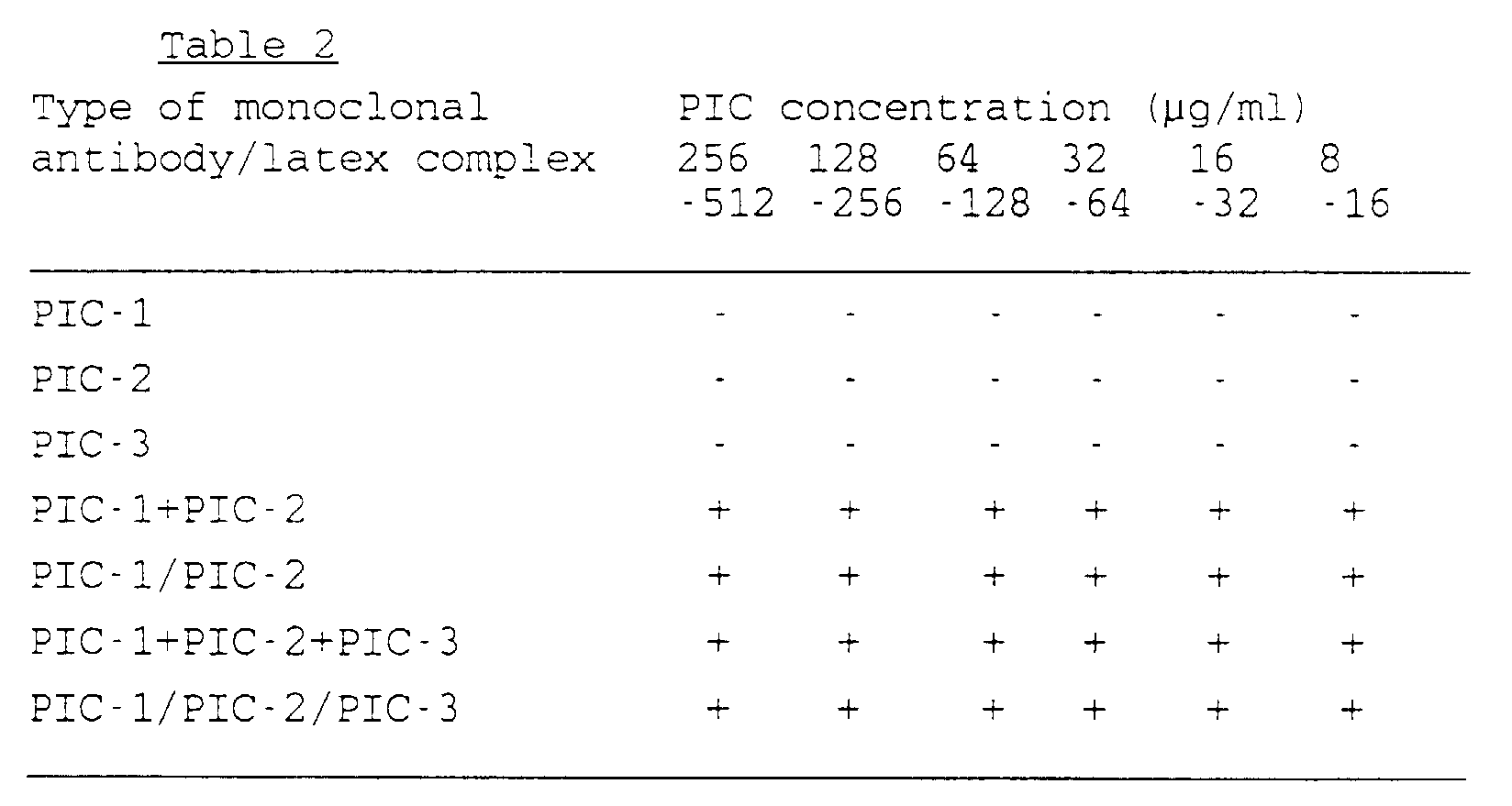
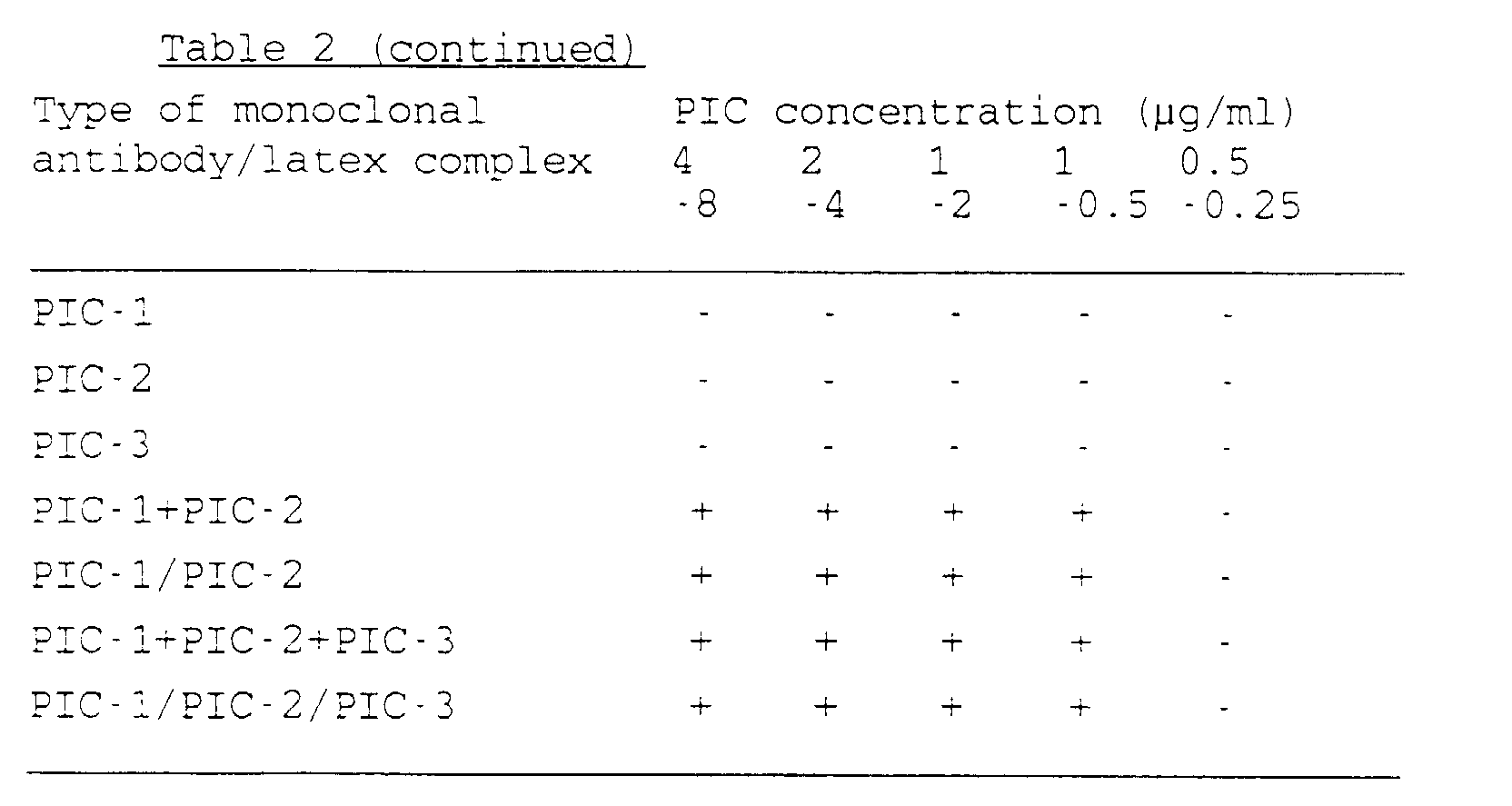
- PIC-1 means a monoclonal antibody PIC-1/latex complex
- PIC-1+PIC-2 means a mixture of an equal amounts of a monoclonal antibody PIC-1/latex complex and a monoclonal antibody PIC-2/latex complex
- PIC-1/PIC-2 means a monoclonal antibody PIC-1/monoclonal antibody PIC-2/latex complex.
- the concentrations of PIC in five specimens were measured using the monoclonal antibody PIC-1/monoclonal antibody PIC-2/latex complex solution of Example 5. Then, 2 ⁇ g/ml, 4 ⁇ g/ml, and 8 ⁇ g/ml of purified PIC were added to the specimens and recovery tests were carried out. The measurement values were obtained semiquantitatively from the number of dilutions of the specimen eliminating the agglutination.
- Example 7 PIC Values of Healthy Persons and DIC Patients
- the monoclonal antibody PIC-1/monoclonal antibody PIC-2/latex complex solution used in Example 6 was used to measure the amounts of PIC of 12 specimens of the plasma from healthy persons and 15 specimens of the plasma from DIC patients. The results are shown in Fig. 1.
- the amount of PIC of the healthy persons was less than 1 ⁇ g/ml in all cases. To the contrary, the value for the DIC patients was over 2 ⁇ g/ml in all cases.
- the present invention provides a means useful for the diagnosis of DIC or the like and pathological research.
Landscapes
- Chemical & Material Sciences (AREA)
- Organic Chemistry (AREA)
- Health & Medical Sciences (AREA)
- General Health & Medical Sciences (AREA)
- Biochemistry (AREA)
- Biophysics (AREA)
- Life Sciences & Earth Sciences (AREA)
- Genetics & Genomics (AREA)
- Medicinal Chemistry (AREA)
- Molecular Biology (AREA)
- Proteomics, Peptides & Aminoacids (AREA)
- Immunology (AREA)
- Preparation Of Compounds By Using Micro-Organisms (AREA)
- Micro-Organisms Or Cultivation Processes Thereof (AREA)
- Peptides Or Proteins (AREA)
Description
EP-A-169 549 and EP-A-159 025 disclose a monoclonal antibody which has the function of specifically blocking the reactive site of human α2-plasmin inhibitor. Both documents are silent with view to the reactivity of said monoclonal antibody with the PIC.


| Specimen | Am't of PIC measured (µg/ml) | Am't of PIC added (µg/ml) | Measurement value after addition |
| A | <1 | 2 | 2-4 |
| 4 | 4-8 | ||
| 8 | 8-16 | ||
| B | <1 | 2 | 2-4 |
| 4 | 4-8 | ||
| 8 | 8-16 | ||
| C | 1-2 | 2 | 2-4 |
| 4 | 4-8 | ||
| 8 | 8-16 | ||
| D | 4-8 | 2 | 4-8 |
| 4 | 8-16 | ||
| 8 | 8-16 | ||
| E | 8-16 | 2 | 8-16 |
| 4 | 8-16 | ||
| 8 | 16-32 |
Claims (9)
- A monoclonal antibody which specifically reacts with a human plasmin-α2-plasmin inhibitor complex and a human plasminogen.
- A monoclonal antibody according to claim 1, which recognizes a region containing the Kringle 2 and Kringle 3 of said human plasminogen.
- A hybridoma which secretes a monoclonal antibody which specifically reacts with a human plasmin-α2-plasmin inhibitor complex and a human plasminogen, or a cell line thereof.
- A hybridoma or a cell line thereof according to claim 3, wherein said monoclonal antibody recognizes a region containing the Kringle 2 and Kringle 3 of said human plasminogen.
- A monoclonal antibody obtained from a hybridoma FERM BP-3682 which specifically reacts with a human plasmin-α2-plasmin inhibitor complex and a human α2-plasmin inhibitor, but does not react with a human plasminogen in a latex agglutination reaction.
- A hybridoma FERM BP-3682 which secretes a monoclonal antibody which specifically reacts with a human plasmin-α2-plasmin inhibitor complex and a human α2-plasmin inhibitor, or a cell line thereof, but does not react with a human plasminogen in a latex agglutination reaction.
- A monoclonal antibody which specifically reacts with a human plasmin-α2-plasmin inhibitor complex, but does not react with a human plasminogen and a human α2-plasmin inhibitor.
- A hybridoma which secretes a monoclonal antibody which specifically reacts with a human plasmin-α2-plasmin inhibitor complex, but does not react with a human plasminogen and a human α2-plasmin inhibitor, or a cell line thereof.
- A method for determining a human plasmin-α2-plasmin inhibitor complex characterized by bringing at least two of said monoclonal antibodies set forth in claims 1, 5 and 7, and immobilized on an insoluble carrier, into contact with a sample; and observing an agglutination reaction in said sample.
Applications Claiming Priority (3)
| Application Number | Priority Date | Filing Date | Title |
|---|---|---|---|
| JP41180590 | 1990-12-20 | ||
| JP411805/90 | 1990-12-20 | ||
| PCT/JP1991/001736 WO1992011384A1 (en) | 1990-12-20 | 1991-12-19 | ANTIBODY AGAINST HUMAN PLASMIN-α2-PLASMIN INHIBITOR COMPLEX, HYBRIDOMA AND IMMUNOASSAY |
Publications (3)
| Publication Number | Publication Date |
|---|---|
| EP0516863A1 EP0516863A1 (en) | 1992-12-09 |
| EP0516863A4 EP0516863A4 (en) | 1993-06-09 |
| EP0516863B1 true EP0516863B1 (en) | 1998-06-10 |
Family
ID=18520741
Family Applications (1)
| Application Number | Title | Priority Date | Filing Date |
|---|---|---|---|
| EP92901440A Expired - Lifetime EP0516863B1 (en) | 1990-12-20 | 1991-12-19 | Antibody against human plasmin-alpha 2-plasmin inhibitor complex, hybridoma and immunoassay |
Country Status (9)
| Country | Link |
|---|---|
| US (1) | US5888749A (en) |
| EP (1) | EP0516863B1 (en) |
| JP (1) | JP3291525B2 (en) |
| KR (1) | KR100207351B1 (en) |
| AU (1) | AU657504B2 (en) |
| CA (1) | CA2075937C (en) |
| DE (1) | DE69129582T2 (en) |
| ES (1) | ES2118807T3 (en) |
| WO (1) | WO1992011384A1 (en) |
Families Citing this family (8)
| Publication number | Priority date | Publication date | Assignee | Title |
|---|---|---|---|---|
| US8133421B2 (en) * | 1999-02-23 | 2012-03-13 | Warsaw Orthopedic, Inc. | Methods of making shaped load-bearing osteoimplant |
| EP2042870A1 (en) * | 2007-09-28 | 2009-04-01 | Fujifilm Corporation | Method of high sensitive immunoassay |
| EP2745115B1 (en) * | 2011-08-19 | 2016-05-18 | Protagen AG | Novel method for diagnosis of high-affinity binders and marker sequences |
| EP4519325A1 (en) * | 2022-05-04 | 2025-03-12 | Rheinische Friedrich-Wilhelms-Universität Bonn | Plasmin-binding vhhs |
| CN117126283B (en) * | 2022-05-19 | 2025-05-27 | 深圳市新产业生物医学工程股份有限公司 | Anti-PIC antibody, kit and method for detecting PIC |
| CN115873120B (en) * | 2022-09-08 | 2025-10-21 | 厦门英博迈生物科技有限公司 | Plasmin α2 plasmin inhibitor complex antibody and its application |
| CN116284415B (en) * | 2022-12-29 | 2023-11-14 | 山东大学 | Plasmin-alpha 2 anti-plasmin complex monoclonal antibody, preparation and application thereof |
| CN117568445B (en) * | 2024-01-18 | 2024-04-09 | 西南交通大学 | Preparation method and application of TAT (TAT) and PIC (PIC) composite quality control product |
Citations (1)
| Publication number | Priority date | Publication date | Assignee | Title |
|---|---|---|---|---|
| EP0159025A2 (en) * | 1984-04-17 | 1985-10-23 | Teijin Limited | Monoclonal antibody specific to human alpha2-plasmin |
Family Cites Families (11)
| Publication number | Priority date | Publication date | Assignee | Title |
|---|---|---|---|---|
| NL7511055A (en) * | 1975-09-19 | 1977-03-22 | Leuven Res & Dev Vzw | THROMBOSIS TEST. |
| WO1982000364A1 (en) * | 1980-07-16 | 1982-02-04 | Jefferis R | Methods of immuno-analysis using monoclonal antibodies |
| US4849353A (en) * | 1980-09-30 | 1989-07-18 | Cornell Research Foundation, Inc. | Immunocapture of enzyme inhibitor, enzyme complexes and uses thereof |
| US4629694A (en) * | 1983-07-12 | 1986-12-16 | Cornell Research Foundation, Inc. | Detecting and distinguishing between plasminogen activators |
| GB8408193D0 (en) * | 1984-03-30 | 1984-05-10 | Cambridge Patent Dev | Antibodies |
| JPS60222426A (en) * | 1984-04-17 | 1985-11-07 | Teijin Ltd | Monoclonal antibody, hybridoma cell, and preparation of monoclonal antibody |
| DE3586577T2 (en) * | 1984-07-26 | 1993-03-25 | Teijin Ltd | IMMUNOLOGICAL DETERMINATION OF HUMAN PLASMIN / ALPHA-2-PLASMIN INHIBITOR. |
| JPS61213671A (en) * | 1985-03-20 | 1986-09-22 | Teijin Ltd | Method for measuring human plasmin-alpha2-plasmin inhibitor compound body |
| US4820635A (en) * | 1985-08-27 | 1989-04-11 | The United States Of America As Represented By The Department Of Health And Human Services | Kit for assaying activation of terminal complement cascade |
| JPH074270B2 (en) * | 1986-06-24 | 1995-01-25 | 帝人株式会社 | Monoclonal antibody |
| AT398004B (en) * | 1992-04-14 | 1994-08-25 | Berbi Gmbh | METHOD FOR DETERMINING PLASMINE-ALPHA2-ANTIPLASMINE COMPLEXES USING A COMPLEX-SPECIFIC MONOCLONAL ANTIBODY |
-
1991
- 1991-12-19 US US07/920,544 patent/US5888749A/en not_active Expired - Lifetime
- 1991-12-19 EP EP92901440A patent/EP0516863B1/en not_active Expired - Lifetime
- 1991-12-19 ES ES92901440T patent/ES2118807T3/en not_active Expired - Lifetime
- 1991-12-19 JP JP50147592A patent/JP3291525B2/en not_active Expired - Lifetime
- 1991-12-19 WO PCT/JP1991/001736 patent/WO1992011384A1/en not_active Ceased
- 1991-12-19 DE DE69129582T patent/DE69129582T2/en not_active Expired - Lifetime
- 1991-12-19 AU AU91001/91A patent/AU657504B2/en not_active Expired
- 1991-12-19 CA CA002075937A patent/CA2075937C/en not_active Expired - Lifetime
- 1991-12-19 KR KR1019920701986A patent/KR100207351B1/en not_active Expired - Lifetime
Patent Citations (1)
| Publication number | Priority date | Publication date | Assignee | Title |
|---|---|---|---|---|
| EP0159025A2 (en) * | 1984-04-17 | 1985-10-23 | Teijin Limited | Monoclonal antibody specific to human alpha2-plasmin |
Also Published As
| Publication number | Publication date |
|---|---|
| AU657504B2 (en) | 1995-03-16 |
| KR927003838A (en) | 1992-12-18 |
| KR100207351B1 (en) | 1999-07-15 |
| JP3291525B2 (en) | 2002-06-10 |
| CA2075937A1 (en) | 1992-06-21 |
| US5888749A (en) | 1999-03-30 |
| EP0516863A1 (en) | 1992-12-09 |
| DE69129582D1 (en) | 1998-07-16 |
| CA2075937C (en) | 2002-01-29 |
| DE69129582T2 (en) | 1999-02-18 |
| ES2118807T3 (en) | 1998-10-01 |
| AU9100191A (en) | 1992-07-22 |
| EP0516863A4 (en) | 1993-06-09 |
| WO1992011384A1 (en) | 1992-07-09 |
Similar Documents
| Publication | Publication Date | Title |
|---|---|---|
| US5500345A (en) | Hybridomas producing monoclonal antibodies specific for C-reactive protein and methods for detection of C-reactive protein | |
| EP0528525B1 (en) | Assay methods and compositions for detecting serum proteases,particularly activated protein C. | |
| EP0678524B1 (en) | Anti-human soluble fibrin antibodies, hybridoma producing them, and immunoassaying method | |
| JPWO1995012617A1 (en) | Anti-human soluble fibrin antibodies, hybridomas and immunoassays | |
| US5888749A (en) | Anti-human plasmin-α2 -plasmin inhibitor complex antibodies, hybridomas, and immunological determination method | |
| JPH0753758B2 (en) | Monoclonal antibody against human colon fibroblast-derived tissue plasmin-ogen activator and use thereof | |
| CA2226968C (en) | Novel monoclonal antibody, and immunological assay of e-d-dimer and e-dd/e complex | |
| JP3307422B2 (en) | Immunological measurement method of human PIVKA-II | |
| JP3681206B2 (en) | Anti-factor Xa / tissue factor pathway inhibitor complex monoclonal antibody and use thereof | |
| JPWO1992011384A1 (en) | Anti-human plasmin-α↓2-plasmin inhibitor complex antibody, hybridoma, and immunological assay method | |
| US5358850A (en) | Sandwich immunoassay of β-n-acetylglucosaminidase and monoclonal antibody used therein | |
| JPH0746104B2 (en) | FDP measurement method | |
| US6333162B1 (en) | Method for measuring cholinesterase and method for distinguishing between liver cirrhosis and hepatitis | |
| JP3841364B2 (en) | Anti-human vitronectin / thrombin / antithrombin III complex monoclonal antibody, hybridoma, and immunological assay | |
| EP0431171B1 (en) | Monoclonal antibody against c-reactive protein | |
| JP4612922B2 (en) | Novel monoclonal antibody and method for immunological analysis of e-D monomer, e-D dimer, and e-DD / E complex | |
| JP2878317B2 (en) | Laminin measurement reagent | |
| JP2837030B2 (en) | Anti-human plasmin-α 2 -plasmin inhibitor complex-specific antibody and immunoassay | |
| AU748841B2 (en) | Ancrod specific monoclonal antibodies, antibody fragments, mixtures or derivatives thereof and use of the same |
Legal Events
| Date | Code | Title | Description |
|---|---|---|---|
| PUAI | Public reference made under article 153(3) epc to a published international application that has entered the european phase |
Free format text: ORIGINAL CODE: 0009012 |
|
| 17P | Request for examination filed |
Effective date: 19920820 |
|
| AK | Designated contracting states |
Kind code of ref document: A1 Designated state(s): CH DE ES FR GB IT LI |
|
| A4 | Supplementary search report drawn up and despatched |
Effective date: 19930420 |
|
| AK | Designated contracting states |
Kind code of ref document: A4 Designated state(s): CH DE ES FR GB IT LI |
|
| 17Q | First examination report despatched |
Effective date: 19950508 |
|
| GRAG | Despatch of communication of intention to grant |
Free format text: ORIGINAL CODE: EPIDOS AGRA |
|
| GRAG | Despatch of communication of intention to grant |
Free format text: ORIGINAL CODE: EPIDOS AGRA |
|
| GRAH | Despatch of communication of intention to grant a patent |
Free format text: ORIGINAL CODE: EPIDOS IGRA |
|
| GRAH | Despatch of communication of intention to grant a patent |
Free format text: ORIGINAL CODE: EPIDOS IGRA |
|
| GRAA | (expected) grant |
Free format text: ORIGINAL CODE: 0009210 |
|
| AK | Designated contracting states |
Kind code of ref document: B1 Designated state(s): CH DE ES FR GB IT LI |
|
| REG | Reference to a national code |
Ref country code: CH Ref legal event code: EP |
|
| REF | Corresponds to: |
Ref document number: 69129582 Country of ref document: DE Date of ref document: 19980716 |
|
| ET | Fr: translation filed | ||
| ITF | It: translation for a ep patent filed | ||
| REG | Reference to a national code |
Ref country code: CH Ref legal event code: NV Representative=s name: E. BLUM & CO. PATENTANWAELTE |
|
| REG | Reference to a national code |
Ref country code: ES Ref legal event code: FG2A Ref document number: 2118807 Country of ref document: ES Kind code of ref document: T3 |
|
| PLBE | No opposition filed within time limit |
Free format text: ORIGINAL CODE: 0009261 |
|
| STAA | Information on the status of an ep patent application or granted ep patent |
Free format text: STATUS: NO OPPOSITION FILED WITHIN TIME LIMIT |
|
| 26N | No opposition filed | ||
| REG | Reference to a national code |
Ref country code: GB Ref legal event code: IF02 |
|
| REG | Reference to a national code |
Ref country code: CH Ref legal event code: PFA Owner name: MITSUBISHI KAGAKU IATRON, INC. Free format text: IATRON LABORATORIES, INC.#11-4 HIGASHI-KANDA 1-CHOME#CHIYODA-KU TOKYO 101 (JP) -TRANSFER TO- MITSUBISHI KAGAKU IATRON, INC.#11-4 HIGASHI-KANDA 1-CHOME CHIYODA-KU#TOKYO 101 (JP) |
|
| REG | Reference to a national code |
Ref country code: FR Ref legal event code: CD |
|
| REG | Reference to a national code |
Ref country code: CH Ref legal event code: PFA Owner name: MITSUBISHI KAGAKU IATRON, INC. Free format text: MITSUBISHI KAGAKU IATRON, INC.#11-4 HIGASHI-KANDA 1-CHOME CHIYODA-KU#TOKYO 101 (JP) -TRANSFER TO- MITSUBISHI KAGAKU IATRON, INC.#13-1, NISHI-GOKEN-CHO, SHINJUKU-KU#TOKYO, 162-0812 (JP) |
|
| REG | Reference to a national code |
Ref country code: FR Ref legal event code: CA |
|
| REG | Reference to a national code |
Ref country code: CH Ref legal event code: PFA Owner name: MITSUBISHI KAGAKU IATRON, INC. Free format text: MITSUBISHI KAGAKU IATRON, INC.#13-1, NISHI-GOKEN-CHO, SHINJUKU-KU#TOKYO, 162-0812 (JP) -TRANSFER TO- MITSUBISHI KAGAKU IATRON, INC.#13-1, NISHI-GOKEN-CHO, SHINJUKU-KU#TOKYO, 162-0812 (JP) |
|
| REG | Reference to a national code |
Ref country code: CH Ref legal event code: PUE Owner name: MITSUBISHI CHEMICAL MEDIENCE CORPORATION Free format text: MITSUBISHI KAGAKU IATRON, INC.#13-1, NISHI-GOKEN-CHO, SHINJUKU-KU#TOKYO, 162-0812 (JP) -TRANSFER TO- MITSUBISHI CHEMICAL MEDIENCE CORPORATION#2-8, SHIBAURA 4-CHOME MINATO-KU#TOKYO 108-8559 (JP) |
|
| REG | Reference to a national code |
Ref country code: ES Ref legal event code: PC2A |
|
| REG | Reference to a national code |
Ref country code: GB Ref legal event code: 732E Free format text: REGISTERED BETWEEN 20100923 AND 20100929 |
|
| REG | Reference to a national code |
Ref country code: FR Ref legal event code: TP |
|
| PGFP | Annual fee paid to national office [announced via postgrant information from national office to epo] |
Ref country code: FR Payment date: 20110104 Year of fee payment: 20 |
|
| PGFP | Annual fee paid to national office [announced via postgrant information from national office to epo] |
Ref country code: CH Payment date: 20101224 Year of fee payment: 20 |
|
| PGFP | Annual fee paid to national office [announced via postgrant information from national office to epo] |
Ref country code: GB Payment date: 20101221 Year of fee payment: 20 |
|
| PGFP | Annual fee paid to national office [announced via postgrant information from national office to epo] |
Ref country code: IT Payment date: 20101229 Year of fee payment: 20 Ref country code: DE Payment date: 20101222 Year of fee payment: 20 |
|
| PGFP | Annual fee paid to national office [announced via postgrant information from national office to epo] |
Ref country code: ES Payment date: 20101223 Year of fee payment: 20 |
|
| REG | Reference to a national code |
Ref country code: DE Ref legal event code: R071 Ref document number: 69129582 Country of ref document: DE |
|
| REG | Reference to a national code |
Ref country code: DE Ref legal event code: R071 Ref document number: 69129582 Country of ref document: DE |
|
| REG | Reference to a national code |
Ref country code: CH Ref legal event code: PL |
|
| REG | Reference to a national code |
Ref country code: GB Ref legal event code: PE20 Expiry date: 20111218 |
|
| PG25 | Lapsed in a contracting state [announced via postgrant information from national office to epo] |
Ref country code: GB Free format text: LAPSE BECAUSE OF EXPIRATION OF PROTECTION Effective date: 20111218 |
|
| REG | Reference to a national code |
Ref country code: ES Ref legal event code: FD2A Effective date: 20120510 |
|
| PG25 | Lapsed in a contracting state [announced via postgrant information from national office to epo] |
Ref country code: ES Free format text: LAPSE BECAUSE OF EXPIRATION OF PROTECTION Effective date: 20111220 |
|
| PG25 | Lapsed in a contracting state [announced via postgrant information from national office to epo] |
Ref country code: DE Free format text: LAPSE BECAUSE OF EXPIRATION OF PROTECTION Effective date: 20111220 |