EP0515156B1 - Processes for the diastereo-selective synthesis of nucleosides - Google Patents
Processes for the diastereo-selective synthesis of nucleosides Download PDFInfo
- Publication number
- EP0515156B1 EP0515156B1 EP92304551A EP92304551A EP0515156B1 EP 0515156 B1 EP0515156 B1 EP 0515156B1 EP 92304551 A EP92304551 A EP 92304551A EP 92304551 A EP92304551 A EP 92304551A EP 0515156 B1 EP0515156 B1 EP 0515156B1
- Authority
- EP
- European Patent Office
- Prior art keywords
- alkyl
- substituted
- alkoxy
- hydrogen
- aryl
- Prior art date
- Legal status (The legal status is an assumption and is not a legal conclusion. Google has not performed a legal analysis and makes no representation as to the accuracy of the status listed.)
- Expired - Lifetime
Links
- 238000000034 method Methods 0.000 title claims abstract description 54
- 239000002777 nucleoside Substances 0.000 title claims abstract description 50
- 230000008569 process Effects 0.000 title claims abstract description 38
- 238000003786 synthesis reaction Methods 0.000 title description 18
- 230000015572 biosynthetic process Effects 0.000 title description 15
- 125000003835 nucleoside group Chemical group 0.000 title description 14
- 229940127073 nucleoside analogue Drugs 0.000 claims abstract description 9
- 150000001875 compounds Chemical class 0.000 claims description 37
- 125000003118 aryl group Chemical group 0.000 claims description 34
- CZPWVGJYEJSRLH-UHFFFAOYSA-N Pyrimidine Chemical group C1=CN=CN=C1 CZPWVGJYEJSRLH-UHFFFAOYSA-N 0.000 claims description 33
- 229910052760 oxygen Inorganic materials 0.000 claims description 31
- 229910052717 sulfur Inorganic materials 0.000 claims description 31
- 239000001257 hydrogen Substances 0.000 claims description 30
- 229910052739 hydrogen Inorganic materials 0.000 claims description 30
- 125000002915 carbonyl group Chemical group [*:2]C([*:1])=O 0.000 claims description 25
- 125000002887 hydroxy group Chemical group [H]O* 0.000 claims description 25
- KDCGOANMDULRCW-UHFFFAOYSA-N Purine Natural products N1=CNC2=NC=NC2=C1 KDCGOANMDULRCW-UHFFFAOYSA-N 0.000 claims description 22
- 125000003837 (C1-C20) alkyl group Chemical group 0.000 claims description 20
- CSRZQMIRAZTJOY-UHFFFAOYSA-N trimethylsilyl iodide Chemical compound C[Si](C)(C)I CSRZQMIRAZTJOY-UHFFFAOYSA-N 0.000 claims description 20
- 239000002841 Lewis acid Substances 0.000 claims description 17
- 150000007517 lewis acids Chemical class 0.000 claims description 17
- 125000003860 C1-C20 alkoxy group Chemical group 0.000 claims description 16
- 125000004169 (C1-C6) alkyl group Chemical group 0.000 claims description 15
- 229910052736 halogen Inorganic materials 0.000 claims description 15
- IGFXRKMLLMBKSA-UHFFFAOYSA-N purine Chemical compound N1=C[N]C2=NC=NC2=C1 IGFXRKMLLMBKSA-UHFFFAOYSA-N 0.000 claims description 15
- 125000000217 alkyl group Chemical group 0.000 claims description 14
- -1 bromo, chloro, iodo Chemical group 0.000 claims description 14
- 150000003573 thiols Chemical class 0.000 claims description 13
- IJGRMHOSHXDMSA-UHFFFAOYSA-N Atomic nitrogen Chemical compound N#N IJGRMHOSHXDMSA-UHFFFAOYSA-N 0.000 claims description 12
- 125000002252 acyl group Chemical group 0.000 claims description 12
- 125000002813 thiocarbonyl group Chemical group *C(*)=S 0.000 claims description 12
- 125000003545 alkoxy group Chemical group 0.000 claims description 11
- 125000003710 aryl alkyl group Chemical group 0.000 claims description 11
- 125000003342 alkenyl group Chemical group 0.000 claims description 10
- 125000000304 alkynyl group Chemical group 0.000 claims description 9
- FTVLMFQEYACZNP-UHFFFAOYSA-N trimethylsilyl trifluoromethanesulfonate Chemical compound C[Si](C)(C)OS(=O)(=O)C(F)(F)F FTVLMFQEYACZNP-UHFFFAOYSA-N 0.000 claims description 9
- 208000035195 congenital hypomyelinating 3 neuropathy Diseases 0.000 claims description 8
- 229910052757 nitrogen Inorganic materials 0.000 claims description 8
- 125000005389 trialkylsiloxy group Chemical group 0.000 claims description 8
- 125000004665 trialkylsilyl group Chemical group 0.000 claims description 8
- 150000001412 amines Chemical class 0.000 claims description 7
- 125000004435 hydrogen atom Chemical group [H]* 0.000 claims description 7
- 229920006395 saturated elastomer Polymers 0.000 claims description 7
- 125000000027 (C1-C10) alkoxy group Chemical group 0.000 claims description 6
- 125000000923 (C1-C30) alkyl group Chemical group 0.000 claims description 6
- OKTJSMMVPCPJKN-UHFFFAOYSA-N Carbon Chemical compound [C] OKTJSMMVPCPJKN-UHFFFAOYSA-N 0.000 claims description 6
- 229910052799 carbon Inorganic materials 0.000 claims description 6
- 125000004663 dialkyl amino group Chemical group 0.000 claims description 6
- XRECTZIEBJDKEO-UHFFFAOYSA-N flucytosine Chemical group NC1=NC(=O)NC=C1F XRECTZIEBJDKEO-UHFFFAOYSA-N 0.000 claims description 5
- 229960004413 flucytosine Drugs 0.000 claims description 5
- 125000000561 purinyl group Chemical group N1=C(N=C2N=CNC2=C1)* 0.000 claims description 5
- NOOLISFMXDJSKH-KXUCPTDWSA-N (-)-Menthol Chemical compound CC(C)[C@@H]1CC[C@@H](C)C[C@H]1O NOOLISFMXDJSKH-KXUCPTDWSA-N 0.000 claims description 4
- GFFGJBXGBJISGV-UHFFFAOYSA-N adenyl group Chemical group N1=CN=C2N=CNC2=C1N GFFGJBXGBJISGV-UHFFFAOYSA-N 0.000 claims description 4
- 125000004183 alkoxy alkyl group Chemical group 0.000 claims description 4
- 125000004453 alkoxycarbonyl group Chemical group 0.000 claims description 4
- 125000003178 carboxy group Chemical group [H]OC(*)=O 0.000 claims description 4
- UFHFLCQGNIYNRP-UHFFFAOYSA-N Hydrogen Chemical compound [H][H] UFHFLCQGNIYNRP-UHFFFAOYSA-N 0.000 claims description 3
- 125000004104 aryloxy group Chemical group 0.000 claims description 3
- 230000001279 glycosylating effect Effects 0.000 claims description 3
- 125000001273 sulfonato group Chemical class [O-]S(*)(=O)=O 0.000 claims description 3
- 125000004191 (C1-C6) alkoxy group Chemical group 0.000 claims description 2
- CSCPPACGZOOCGX-UHFFFAOYSA-N Acetone Chemical group CC(C)=O CSCPPACGZOOCGX-UHFFFAOYSA-N 0.000 claims description 2
- 229930024421 Adenine Natural products 0.000 claims description 2
- SUAKHGWARZSWIH-UHFFFAOYSA-N N,N‐diethylformamide Chemical group CCN(CC)C=O SUAKHGWARZSWIH-UHFFFAOYSA-N 0.000 claims description 2
- 229960000643 adenine Drugs 0.000 claims description 2
- RWCCWEUUXYIKHB-UHFFFAOYSA-N benzophenone Chemical group C=1C=CC=CC=1C(=O)C1=CC=CC=C1 RWCCWEUUXYIKHB-UHFFFAOYSA-N 0.000 claims description 2
- 150000004820 halides Chemical class 0.000 claims description 2
- 229940041616 menthol Drugs 0.000 claims description 2
- 150000003212 purines Chemical class 0.000 claims description 2
- LCDCPQHFCOBUEF-UHFFFAOYSA-N pyrrolidine-1-carboxamide Chemical group NC(=O)N1CCCC1 LCDCPQHFCOBUEF-UHFFFAOYSA-N 0.000 claims description 2
- 125000003808 silyl group Chemical group [H][Si]([H])([H])[*] 0.000 claims description 2
- 150000002431 hydrogen Chemical class 0.000 claims 20
- 125000001153 fluoro group Chemical group F* 0.000 claims 6
- 125000001246 bromo group Chemical group Br* 0.000 claims 4
- 125000001309 chloro group Chemical group Cl* 0.000 claims 4
- 125000002346 iodo group Chemical group I* 0.000 claims 4
- OPTASPLRGRRNAP-UHFFFAOYSA-N cytosine Chemical group NC=1C=CNC(=O)N=1 OPTASPLRGRRNAP-UHFFFAOYSA-N 0.000 claims 2
- 229940104302 cytosine Drugs 0.000 claims 1
- 125000005843 halogen group Chemical group 0.000 claims 1
- 239000000543 intermediate Substances 0.000 abstract description 10
- 230000003287 optical effect Effects 0.000 abstract description 7
- YMWUJEATGCHHMB-UHFFFAOYSA-N Dichloromethane Chemical compound ClCCl YMWUJEATGCHHMB-UHFFFAOYSA-N 0.000 description 48
- 239000000203 mixture Substances 0.000 description 41
- LFQSCWFLJHTTHZ-UHFFFAOYSA-N Ethanol Chemical compound CCO LFQSCWFLJHTTHZ-UHFFFAOYSA-N 0.000 description 29
- 230000002829 reductive effect Effects 0.000 description 19
- 150000003833 nucleoside derivatives Chemical class 0.000 description 18
- 238000005160 1H NMR spectroscopy Methods 0.000 description 16
- OKKJLVBELUTLKV-UHFFFAOYSA-N Methanol Chemical compound OC OKKJLVBELUTLKV-UHFFFAOYSA-N 0.000 description 15
- 239000002904 solvent Substances 0.000 description 15
- WYURNTSHIVDZCO-UHFFFAOYSA-N Tetrahydrofuran Chemical compound C1CCOC1 WYURNTSHIVDZCO-UHFFFAOYSA-N 0.000 description 14
- 150000002367 halogens Chemical class 0.000 description 14
- 239000007858 starting material Substances 0.000 description 14
- 239000000243 solution Substances 0.000 description 12
- 125000004432 carbon atom Chemical group C* 0.000 description 11
- 239000012043 crude product Substances 0.000 description 11
- DYLIWHYUXAJDOJ-OWOJBTEDSA-N (e)-4-(6-aminopurin-9-yl)but-2-en-1-ol Chemical compound NC1=NC=NC2=C1N=CN2C\C=C\CO DYLIWHYUXAJDOJ-OWOJBTEDSA-N 0.000 description 9
- OISVCGZHLKNMSJ-UHFFFAOYSA-N 2,6-dimethylpyridine Chemical compound CC1=CC=CC(C)=N1 OISVCGZHLKNMSJ-UHFFFAOYSA-N 0.000 description 9
- 239000003638 chemical reducing agent Substances 0.000 description 9
- JUJWROOIHBZHMG-UHFFFAOYSA-N Pyridine Chemical compound C1=CC=NC=C1 JUJWROOIHBZHMG-UHFFFAOYSA-N 0.000 description 8
- 238000004440 column chromatography Methods 0.000 description 8
- 238000003756 stirring Methods 0.000 description 8
- 238000006243 chemical reaction Methods 0.000 description 7
- 239000000047 product Substances 0.000 description 7
- 125000001424 substituent group Chemical group 0.000 description 7
- 239000000725 suspension Substances 0.000 description 7
- QVADRSWDTZDDGR-GSVOUGTGSA-N (2r)-5-oxooxolane-2-carboxylic acid Chemical compound OC(=O)[C@H]1CCC(=O)O1 QVADRSWDTZDDGR-GSVOUGTGSA-N 0.000 description 6
- WFDIJRYMOXRFFG-UHFFFAOYSA-N Acetic anhydride Chemical compound CC(=O)OC(C)=O WFDIJRYMOXRFFG-UHFFFAOYSA-N 0.000 description 6
- OKKJLVBELUTLKV-MZCSYVLQSA-N Deuterated methanol Chemical compound [2H]OC([2H])([2H])[2H] OKKJLVBELUTLKV-MZCSYVLQSA-N 0.000 description 6
- RTZKZFJDLAIYFH-UHFFFAOYSA-N Diethyl ether Chemical compound CCOCC RTZKZFJDLAIYFH-UHFFFAOYSA-N 0.000 description 6
- XEKOWRVHYACXOJ-UHFFFAOYSA-N Ethyl acetate Chemical compound CCOC(C)=O XEKOWRVHYACXOJ-UHFFFAOYSA-N 0.000 description 6
- 239000012267 brine Substances 0.000 description 6
- 229910052794 bromium Inorganic materials 0.000 description 6
- 239000000460 chlorine Substances 0.000 description 6
- 229910052801 chlorine Inorganic materials 0.000 description 6
- 229910052740 iodine Inorganic materials 0.000 description 6
- CTSLXHKWHWQRSH-UHFFFAOYSA-N oxalyl chloride Chemical compound ClC(=O)C(Cl)=O CTSLXHKWHWQRSH-UHFFFAOYSA-N 0.000 description 6
- 239000011369 resultant mixture Substances 0.000 description 6
- 239000012279 sodium borohydride Substances 0.000 description 6
- 229910000033 sodium borohydride Inorganic materials 0.000 description 6
- AKHNMLFCWUSKQB-UHFFFAOYSA-L sodium thiosulfate Chemical compound [Na+].[Na+].[O-]S([O-])(=O)=S AKHNMLFCWUSKQB-UHFFFAOYSA-L 0.000 description 6
- HPALAKNZSZLMCH-UHFFFAOYSA-M sodium;chloride;hydrate Chemical compound O.[Na+].[Cl-] HPALAKNZSZLMCH-UHFFFAOYSA-M 0.000 description 6
- 125000001931 aliphatic group Chemical group 0.000 description 5
- 239000012300 argon atmosphere Substances 0.000 description 5
- HXJFQNUWPUICNY-UHFFFAOYSA-N disiamylborane Chemical compound CC(C)C(C)BC(C)C(C)C HXJFQNUWPUICNY-UHFFFAOYSA-N 0.000 description 5
- 229910052731 fluorine Inorganic materials 0.000 description 5
- 238000001640 fractional crystallisation Methods 0.000 description 5
- 238000011065 in-situ storage Methods 0.000 description 5
- 239000012044 organic layer Substances 0.000 description 5
- 239000003960 organic solvent Substances 0.000 description 5
- XLYOFNOQVPJJNP-UHFFFAOYSA-N water Substances O XLYOFNOQVPJJNP-UHFFFAOYSA-N 0.000 description 5
- BWZVCCNYKMEVEX-UHFFFAOYSA-N 2,4,6-Trimethylpyridine Chemical compound CC1=CC(C)=NC(C)=C1 BWZVCCNYKMEVEX-UHFFFAOYSA-N 0.000 description 4
- VHYFNPMBLIVWCW-UHFFFAOYSA-N 4-Dimethylaminopyridine Chemical compound CN(C)C1=CC=NC=C1 VHYFNPMBLIVWCW-UHFFFAOYSA-N 0.000 description 4
- PEHVGBZKEYRQSX-UHFFFAOYSA-N 7-deaza-adenine Chemical compound NC1=NC=NC2=C1C=CN2 PEHVGBZKEYRQSX-UHFFFAOYSA-N 0.000 description 4
- HBAQYPYDRFILMT-UHFFFAOYSA-N 8-[3-(1-cyclopropylpyrazol-4-yl)-1H-pyrazolo[4,3-d]pyrimidin-5-yl]-3-methyl-3,8-diazabicyclo[3.2.1]octan-2-one Chemical class C1(CC1)N1N=CC(=C1)C1=NNC2=C1N=C(N=C2)N1C2C(N(CC1CC2)C)=O HBAQYPYDRFILMT-UHFFFAOYSA-N 0.000 description 4
- WHUUTDBJXJRKMK-GSVOUGTGSA-N D-glutamic acid Chemical compound OC(=O)[C@H](N)CCC(O)=O WHUUTDBJXJRKMK-GSVOUGTGSA-N 0.000 description 4
- RAHZWNYVWXNFOC-UHFFFAOYSA-N Sulphur dioxide Chemical compound O=S=O RAHZWNYVWXNFOC-UHFFFAOYSA-N 0.000 description 4
- DTQVDTLACAAQTR-UHFFFAOYSA-N Trifluoroacetic acid Chemical compound OC(=O)C(F)(F)F DTQVDTLACAAQTR-UHFFFAOYSA-N 0.000 description 4
- WREGKURFCTUGRC-POYBYMJQSA-N Zalcitabine Chemical class O=C1N=C(N)C=CN1[C@@H]1O[C@H](CO)CC1 WREGKURFCTUGRC-POYBYMJQSA-N 0.000 description 4
- WLLIXJBWWFGEHT-UHFFFAOYSA-N [tert-butyl(dimethyl)silyl] trifluoromethanesulfonate Chemical compound CC(C)(C)[Si](C)(C)OS(=O)(=O)C(F)(F)F WLLIXJBWWFGEHT-UHFFFAOYSA-N 0.000 description 4
- 239000008346 aqueous phase Substances 0.000 description 4
- 239000003054 catalyst Substances 0.000 description 4
- 239000003153 chemical reaction reagent Substances 0.000 description 4
- 238000001816 cooling Methods 0.000 description 4
- UREBWPXBXRYXRJ-UHFFFAOYSA-N ethyl acetate;methanol Chemical compound OC.CCOC(C)=O UREBWPXBXRYXRJ-UHFFFAOYSA-N 0.000 description 4
- 230000013595 glycosylation Effects 0.000 description 4
- 238000006206 glycosylation reaction Methods 0.000 description 4
- FFUAGWLWBBFQJT-UHFFFAOYSA-N hexamethyldisilazane Chemical compound C[Si](C)(C)N[Si](C)(C)C FFUAGWLWBBFQJT-UHFFFAOYSA-N 0.000 description 4
- 125000002496 methyl group Chemical group [H]C([H])([H])* 0.000 description 4
- VLKZOEOYAKHREP-UHFFFAOYSA-N n-Hexane Chemical class CCCCCC VLKZOEOYAKHREP-UHFFFAOYSA-N 0.000 description 4
- 238000002360 preparation method Methods 0.000 description 4
- UMJSCPRVCHMLSP-UHFFFAOYSA-N pyridine Natural products COC1=CC=CN=C1 UMJSCPRVCHMLSP-UHFFFAOYSA-N 0.000 description 4
- 239000011541 reaction mixture Substances 0.000 description 4
- 230000003595 spectral effect Effects 0.000 description 4
- 0 *[C@](CC1)O[C@@]1N(C=CC(N)=N1)C1=O Chemical compound *[C@](CC1)O[C@@]1N(C=CC(N)=N1)C1=O 0.000 description 3
- XWKFPIODWVPXLX-UHFFFAOYSA-N 2-methyl-5-methylpyridine Natural products CC1=CC=C(C)N=C1 XWKFPIODWVPXLX-UHFFFAOYSA-N 0.000 description 3
- VHUUQVKOLVNVRT-UHFFFAOYSA-N Ammonium hydroxide Chemical compound [NH4+].[OH-] VHUUQVKOLVNVRT-UHFFFAOYSA-N 0.000 description 3
- CUOKHACJLGPRHD-BXXZVTAOSA-N D-ribono-1,4-lactone Chemical compound OC[C@H]1OC(=O)[C@H](O)[C@@H]1O CUOKHACJLGPRHD-BXXZVTAOSA-N 0.000 description 3
- NOOLISFMXDJSKH-UHFFFAOYSA-N DL-menthol Natural products CC(C)C1CCC(C)CC1O NOOLISFMXDJSKH-UHFFFAOYSA-N 0.000 description 3
- WHUUTDBJXJRKMK-UHFFFAOYSA-N Glutamic acid Natural products OC(=O)C(N)CCC(O)=O WHUUTDBJXJRKMK-UHFFFAOYSA-N 0.000 description 3
- RWRDLPDLKQPQOW-UHFFFAOYSA-N Pyrrolidine Chemical compound C1CCNC1 RWRDLPDLKQPQOW-UHFFFAOYSA-N 0.000 description 3
- 230000004075 alteration Effects 0.000 description 3
- 239000000908 ammonium hydroxide Substances 0.000 description 3
- 230000000840 anti-viral effect Effects 0.000 description 3
- 125000004429 atom Chemical group 0.000 description 3
- UORVGPXVDQYIDP-UHFFFAOYSA-N borane Chemical compound B UORVGPXVDQYIDP-UHFFFAOYSA-N 0.000 description 3
- 239000003795 chemical substances by application Substances 0.000 description 3
- 235000013922 glutamic acid Nutrition 0.000 description 3
- 239000004220 glutamic acid Substances 0.000 description 3
- 239000012456 homogeneous solution Substances 0.000 description 3
- 230000004048 modification Effects 0.000 description 3
- 238000012986 modification Methods 0.000 description 3
- MSXIOWULDXZJLX-UHFFFAOYSA-N n,n-dimethylpyrimidin-4-amine Chemical compound CN(C)C1=CC=NC=N1 MSXIOWULDXZJLX-UHFFFAOYSA-N 0.000 description 3
- 239000012047 saturated solution Substances 0.000 description 3
- 235000019345 sodium thiosulphate Nutrition 0.000 description 3
- 125000000999 tert-butyl group Chemical group [H]C([H])([H])C(*)(C([H])([H])[H])C([H])([H])[H] 0.000 description 3
- YLQBMQCUIZJEEH-UHFFFAOYSA-N tetrahydrofuran Natural products C=1C=COC=1 YLQBMQCUIZJEEH-UHFFFAOYSA-N 0.000 description 3
- NOOLISFMXDJSKH-AEJSXWLSSA-N (+)-menthol Chemical compound CC(C)[C@H]1CC[C@H](C)C[C@@H]1O NOOLISFMXDJSKH-AEJSXWLSSA-N 0.000 description 2
- AUHZEENZYGFFBQ-UHFFFAOYSA-N 1,3,5-Me3C6H3 Natural products CC1=CC(C)=CC(C)=C1 AUHZEENZYGFFBQ-UHFFFAOYSA-N 0.000 description 2
- NGNBDVOYPDDBFK-UHFFFAOYSA-N 2-[2,4-di(pentan-2-yl)phenoxy]acetyl chloride Chemical compound CCCC(C)C1=CC=C(OCC(Cl)=O)C(C(C)CCC)=C1 NGNBDVOYPDDBFK-UHFFFAOYSA-N 0.000 description 2
- BKOOMYPCSUNDGP-UHFFFAOYSA-N 2-methylbut-2-ene Chemical compound CC=C(C)C BKOOMYPCSUNDGP-UHFFFAOYSA-N 0.000 description 2
- XVMSFILGAMDHEY-UHFFFAOYSA-N 6-(4-aminophenyl)sulfonylpyridin-3-amine Chemical compound C1=CC(N)=CC=C1S(=O)(=O)C1=CC=C(N)C=N1 XVMSFILGAMDHEY-UHFFFAOYSA-N 0.000 description 2
- ZCYVEMRRCGMTRW-UHFFFAOYSA-N 7553-56-2 Chemical compound [I] ZCYVEMRRCGMTRW-UHFFFAOYSA-N 0.000 description 2
- NLXLAEXVIDQMFP-UHFFFAOYSA-N Ammonia chloride Chemical class [NH4+].[Cl-] NLXLAEXVIDQMFP-UHFFFAOYSA-N 0.000 description 2
- WKBOTKDWSSQWDR-UHFFFAOYSA-N Bromine atom Chemical compound [Br] WKBOTKDWSSQWDR-UHFFFAOYSA-N 0.000 description 2
- ZAMOUSCENKQFHK-UHFFFAOYSA-N Chlorine atom Chemical compound [Cl] ZAMOUSCENKQFHK-UHFFFAOYSA-N 0.000 description 2
- HEDRZPFGACZZDS-UHFFFAOYSA-N Chloroform Chemical compound ClC(Cl)Cl HEDRZPFGACZZDS-UHFFFAOYSA-N 0.000 description 2
- 241000598436 Human T-cell lymphotropic virus Species 0.000 description 2
- 241000725303 Human immunodeficiency virus Species 0.000 description 2
- VEXZGXHMUGYJMC-UHFFFAOYSA-N Hydrochloric acid Chemical compound Cl VEXZGXHMUGYJMC-UHFFFAOYSA-N 0.000 description 2
- KFZMGEQAYNKOFK-UHFFFAOYSA-N Isopropanol Chemical compound CC(C)O KFZMGEQAYNKOFK-UHFFFAOYSA-N 0.000 description 2
- IJCKBIINTQEGLY-UHFFFAOYSA-N N(4)-acetylcytosine Chemical compound CC(=O)NC1=CC=NC(=O)N1 IJCKBIINTQEGLY-UHFFFAOYSA-N 0.000 description 2
- 238000005481 NMR spectroscopy Methods 0.000 description 2
- 125000000066 S-methyl group Chemical group [H]C([H])([H])S* 0.000 description 2
- UIIMBOGNXHQVGW-UHFFFAOYSA-M Sodium bicarbonate Chemical class [Na+].OC([O-])=O UIIMBOGNXHQVGW-UHFFFAOYSA-M 0.000 description 2
- 125000002777 acetyl group Chemical group [H]C([H])([H])C(*)=O 0.000 description 2
- 150000008065 acid anhydrides Chemical class 0.000 description 2
- 230000010933 acylation Effects 0.000 description 2
- 238000005917 acylation reaction Methods 0.000 description 2
- 230000008901 benefit Effects 0.000 description 2
- 125000001797 benzyl group Chemical group [H]C1=C([H])C([H])=C(C([H])=C1[H])C([H])([H])* 0.000 description 2
- 229910000085 borane Inorganic materials 0.000 description 2
- GDTBXPJZTBHREO-UHFFFAOYSA-N bromine Substances BrBr GDTBXPJZTBHREO-UHFFFAOYSA-N 0.000 description 2
- 238000002512 chemotherapy Methods 0.000 description 2
- 230000008878 coupling Effects 0.000 description 2
- 238000010168 coupling process Methods 0.000 description 2
- 238000005859 coupling reaction Methods 0.000 description 2
- 125000000753 cycloalkyl group Chemical group 0.000 description 2
- 238000010511 deprotection reaction Methods 0.000 description 2
- 230000032050 esterification Effects 0.000 description 2
- 238000005886 esterification reaction Methods 0.000 description 2
- 150000002148 esters Chemical class 0.000 description 2
- 235000019439 ethyl acetate Nutrition 0.000 description 2
- OAYLNYINCPYISS-UHFFFAOYSA-N ethyl acetate;hexane Chemical compound CCCCCC.CCOC(C)=O OAYLNYINCPYISS-UHFFFAOYSA-N 0.000 description 2
- 125000001495 ethyl group Chemical group [H]C([H])([H])C([H])([H])* 0.000 description 2
- 239000006260 foam Substances 0.000 description 2
- 125000005842 heteroatom Chemical group 0.000 description 2
- 125000004029 hydroxymethyl group Chemical group [H]OC([H])([H])* 0.000 description 2
- 239000011630 iodine Substances 0.000 description 2
- PNDPGZBMCMUPRI-UHFFFAOYSA-N iodine Chemical compound II PNDPGZBMCMUPRI-UHFFFAOYSA-N 0.000 description 2
- 239000000463 material Substances 0.000 description 2
- 238000005259 measurement Methods 0.000 description 2
- 125000000956 methoxy group Chemical group [H]C([H])([H])O* 0.000 description 2
- 238000002156 mixing Methods 0.000 description 2
- 125000004433 nitrogen atom Chemical group N* 0.000 description 2
- 125000004430 oxygen atom Chemical group O* 0.000 description 2
- 125000000951 phenoxy group Chemical group [H]C1=C([H])C([H])=C(O*)C([H])=C1[H] 0.000 description 2
- 125000001997 phenyl group Chemical group [H]C1=C([H])C([H])=C(*)C([H])=C1[H] 0.000 description 2
- 239000002244 precipitate Substances 0.000 description 2
- 238000000746 purification Methods 0.000 description 2
- 238000000926 separation method Methods 0.000 description 2
- GFYHSKONPJXCDE-UHFFFAOYSA-N sym-collidine Natural products CC1=CN=C(C)C(C)=C1 GFYHSKONPJXCDE-UHFFFAOYSA-N 0.000 description 2
- ITMCEJHCFYSIIV-UHFFFAOYSA-M triflate Chemical compound [O-]S(=O)(=O)C(F)(F)F ITMCEJHCFYSIIV-UHFFFAOYSA-M 0.000 description 2
- 238000005406 washing Methods 0.000 description 2
- HBOMLICNUCNMMY-XLPZGREQSA-N zidovudine Chemical compound O=C1NC(=O)C(C)=CN1[C@@H]1O[C@H](CO)[C@@H](N=[N+]=[N-])C1 HBOMLICNUCNMMY-XLPZGREQSA-N 0.000 description 2
- GWJLMEGYOKASCZ-HLJYALQUSA-N (2r,3s,4r,5r)-5-(6-aminopurin-9-yl)-3,4-dihydroxy-2-(hydroxymethyl)oxolane-2-carboxylic acid Chemical class C1=NC=2C(N)=NC=NC=2N1[C@@H]1O[C@@](CO)(C(O)=O)[C@@H](O)[C@H]1O GWJLMEGYOKASCZ-HLJYALQUSA-N 0.000 description 1
- QVADRSWDTZDDGR-VKHMYHEASA-N (S)-alpha-hydroxyglutaric acid-gamma-lactone Chemical compound OC(=O)[C@@H]1CCC(=O)O1 QVADRSWDTZDDGR-VKHMYHEASA-N 0.000 description 1
- JIHQDMXYYFUGFV-UHFFFAOYSA-N 1,3,5-triazine Chemical class C1=NC=NC=N1 JIHQDMXYYFUGFV-UHFFFAOYSA-N 0.000 description 1
- UPQQXPKAYZYUKO-UHFFFAOYSA-N 2,2,2-trichloroacetamide Chemical compound OC(=N)C(Cl)(Cl)Cl UPQQXPKAYZYUKO-UHFFFAOYSA-N 0.000 description 1
- YQTCQNIPQMJNTI-UHFFFAOYSA-N 2,2-dimethylpropan-1-one Chemical group CC(C)(C)[C]=O YQTCQNIPQMJNTI-UHFFFAOYSA-N 0.000 description 1
- SXAMGRAIZSSWIH-UHFFFAOYSA-N 2-[3-[2-(2,3-dihydro-1H-inden-2-ylamino)pyrimidin-5-yl]-1,2,4-oxadiazol-5-yl]-1-(2,4,6,7-tetrahydrotriazolo[4,5-c]pyridin-5-yl)ethanone Chemical compound C1C(CC2=CC=CC=C12)NC1=NC=C(C=N1)C1=NOC(=N1)CC(=O)N1CC2=C(CC1)NN=N2 SXAMGRAIZSSWIH-UHFFFAOYSA-N 0.000 description 1
- WZFUQSJFWNHZHM-UHFFFAOYSA-N 2-[4-[2-(2,3-dihydro-1H-inden-2-ylamino)pyrimidin-5-yl]piperazin-1-yl]-1-(2,4,6,7-tetrahydrotriazolo[4,5-c]pyridin-5-yl)ethanone Chemical compound C1C(CC2=CC=CC=C12)NC1=NC=C(C=N1)N1CCN(CC1)CC(=O)N1CC2=C(CC1)NN=N2 WZFUQSJFWNHZHM-UHFFFAOYSA-N 0.000 description 1
- YJLUBHOZZTYQIP-UHFFFAOYSA-N 2-[5-[2-(2,3-dihydro-1H-inden-2-ylamino)pyrimidin-5-yl]-1,3,4-oxadiazol-2-yl]-1-(2,4,6,7-tetrahydrotriazolo[4,5-c]pyridin-5-yl)ethanone Chemical compound C1C(CC2=CC=CC=C12)NC1=NC=C(C=N1)C1=NN=C(O1)CC(=O)N1CC2=C(CC1)NN=N2 YJLUBHOZZTYQIP-UHFFFAOYSA-N 0.000 description 1
- 125000003903 2-propenyl group Chemical group [H]C([*])([H])C([H])=C([H])[H] 0.000 description 1
- FNHOXBWIFBRJKI-UHFFFAOYSA-N 2-sulfonyl-1,3-dihydroimidazole Chemical class O=S(=O)=C1NC=CN1 FNHOXBWIFBRJKI-UHFFFAOYSA-N 0.000 description 1
- GIIGHSIIKVOWKZ-UHFFFAOYSA-N 2h-triazolo[4,5-d]pyrimidine Chemical class N1=CN=CC2=NNN=C21 GIIGHSIIKVOWKZ-UHFFFAOYSA-N 0.000 description 1
- QEDNABCLVCJRLV-UHFFFAOYSA-N 4-n,4-n-dimethylpyridine-2,4-diamine Chemical compound CN(C)C1=CC=NC(N)=C1 QEDNABCLVCJRLV-UHFFFAOYSA-N 0.000 description 1
- MFEFTTYGMZOIKO-UHFFFAOYSA-N 5-azacytosine Chemical compound NC1=NC=NC(=O)N1 MFEFTTYGMZOIKO-UHFFFAOYSA-N 0.000 description 1
- LOSIULRWFAEMFL-UHFFFAOYSA-N 7-deazaguanine Chemical compound O=C1NC(N)=NC2=C1CC=N2 LOSIULRWFAEMFL-UHFFFAOYSA-N 0.000 description 1
- WZAAXWLTFQEKAC-GVHYBUMESA-N CCOC([C@@H](CC1)OC1OC(C)=O)=O Chemical compound CCOC([C@@H](CC1)OC1OC(C)=O)=O WZAAXWLTFQEKAC-GVHYBUMESA-N 0.000 description 1
- DEKZJDOAIKRXAI-KOLCDFICSA-N CCOC([C@@H](CC1)O[C@@H]1N(C=CC(NC(C)=O)=N1)C1=O)=O Chemical compound CCOC([C@@H](CC1)O[C@@H]1N(C=CC(NC(C)=O)=N1)C1=O)=O DEKZJDOAIKRXAI-KOLCDFICSA-N 0.000 description 1
- 229930182847 D-glutamic acid Natural products 0.000 description 1
- PXGOKWXKJXAPGV-UHFFFAOYSA-N Fluorine Chemical compound FF PXGOKWXKJXAPGV-UHFFFAOYSA-N 0.000 description 1
- 241000700721 Hepatitis B virus Species 0.000 description 1
- 125000003047 N-acetyl group Chemical group 0.000 description 1
- ABLZXFCXXLZCGV-UHFFFAOYSA-N Phosphorous acid Chemical class OP(O)=O ABLZXFCXXLZCGV-UHFFFAOYSA-N 0.000 description 1
- DTQVDTLACAAQTR-UHFFFAOYSA-M Trifluoroacetate Chemical compound [O-]C(=O)C(F)(F)F DTQVDTLACAAQTR-UHFFFAOYSA-M 0.000 description 1
- FJKGKWDFDNULCJ-RNFRBKRXSA-N [(2r,4r)-4-(6-aminopurin-9-yl)oxolan-2-yl]methanol Chemical compound C1=NC=2C(N)=NC=NC=2N1[C@H]1CO[C@@H](CO)C1 FJKGKWDFDNULCJ-RNFRBKRXSA-N 0.000 description 1
- WETWJCDKMRHUPV-UHFFFAOYSA-N acetyl chloride Chemical compound CC(Cl)=O WETWJCDKMRHUPV-UHFFFAOYSA-N 0.000 description 1
- 239000012346 acetyl chloride Substances 0.000 description 1
- 239000002253 acid Substances 0.000 description 1
- 230000002378 acidificating effect Effects 0.000 description 1
- 125000004423 acyloxy group Chemical group 0.000 description 1
- 125000003368 amide group Chemical group 0.000 description 1
- 238000004458 analytical method Methods 0.000 description 1
- 239000002259 anti human immunodeficiency virus agent Substances 0.000 description 1
- 229940124411 anti-hiv antiviral agent Drugs 0.000 description 1
- 125000005161 aryl oxy carbonyl group Chemical group 0.000 description 1
- QVGXLLKOCUKJST-UHFFFAOYSA-N atomic oxygen Chemical compound [O] QVGXLLKOCUKJST-UHFFFAOYSA-N 0.000 description 1
- 125000000852 azido group Chemical group *N=[N+]=[N-] 0.000 description 1
- 125000003236 benzoyl group Chemical group [H]C1=C([H])C([H])=C(C([H])=C1[H])C(*)=O 0.000 description 1
- 230000004071 biological effect Effects 0.000 description 1
- IYYIVELXUANFED-UHFFFAOYSA-N bromo(trimethyl)silane Chemical compound C[Si](C)(C)Br IYYIVELXUANFED-UHFFFAOYSA-N 0.000 description 1
- 125000003917 carbamoyl group Chemical group [H]N([H])C(*)=O 0.000 description 1
- 125000002837 carbocyclic group Chemical group 0.000 description 1
- 150000001732 carboxylic acid derivatives Chemical class 0.000 description 1
- 239000007795 chemical reaction product Substances 0.000 description 1
- 238000004296 chiral HPLC Methods 0.000 description 1
- 125000002668 chloroacetyl group Chemical group ClCC(=O)* 0.000 description 1
- 238000004587 chromatography analysis Methods 0.000 description 1
- 238000006392 deoxygenation reaction Methods 0.000 description 1
- LXCYSACZTOKNNS-UHFFFAOYSA-N diethoxy(oxo)phosphanium Chemical compound CCO[P+](=O)OCC LXCYSACZTOKNNS-UHFFFAOYSA-N 0.000 description 1
- 238000010790 dilution Methods 0.000 description 1
- 239000012895 dilution Substances 0.000 description 1
- 239000003814 drug Substances 0.000 description 1
- 238000001035 drying Methods 0.000 description 1
- 230000000694 effects Effects 0.000 description 1
- 125000001301 ethoxy group Chemical group [H]C([H])([H])C([H])([H])O* 0.000 description 1
- 125000003754 ethoxycarbonyl group Chemical group C(=O)(OCC)* 0.000 description 1
- 239000000284 extract Substances 0.000 description 1
- 239000011737 fluorine Substances 0.000 description 1
- 125000000524 functional group Chemical group 0.000 description 1
- 229940083124 ganglion-blocking antiadrenergic secondary and tertiary amines Drugs 0.000 description 1
- 238000007429 general method Methods 0.000 description 1
- 125000003104 hexanoyl group Chemical group O=C([*])C([H])([H])C([H])([H])C([H])([H])C([H])([H])C([H])([H])[H] 0.000 description 1
- 239000005457 ice water Substances 0.000 description 1
- 230000003993 interaction Effects 0.000 description 1
- 125000001261 isocyanato group Chemical group *N=C=O 0.000 description 1
- 125000001449 isopropyl group Chemical group [H]C([H])([H])C([H])(*)C([H])([H])[H] 0.000 description 1
- 239000012280 lithium aluminium hydride Substances 0.000 description 1
- 125000004184 methoxymethyl group Chemical group [H]C([H])([H])OC([H])([H])* 0.000 description 1
- CXHHBNMLPJOKQD-UHFFFAOYSA-M methyl carbonate Chemical compound COC([O-])=O CXHHBNMLPJOKQD-UHFFFAOYSA-M 0.000 description 1
- RIWRFSMVIUAEBX-UHFFFAOYSA-N n-methyl-1-phenylmethanamine Chemical compound CNCC1=CC=CC=C1 RIWRFSMVIUAEBX-UHFFFAOYSA-N 0.000 description 1
- 125000001624 naphthyl group Chemical group 0.000 description 1
- 125000000449 nitro group Chemical group [O-][N+](*)=O 0.000 description 1
- 239000002773 nucleotide Substances 0.000 description 1
- 239000012074 organic phase Substances 0.000 description 1
- 239000001301 oxygen Substances 0.000 description 1
- BSCCSDNZEIHXOK-UHFFFAOYSA-N phenyl carbamate Chemical compound NC(=O)OC1=CC=CC=C1 BSCCSDNZEIHXOK-UHFFFAOYSA-N 0.000 description 1
- QIIPQYDSKRYMFG-UHFFFAOYSA-M phenyl carbonate Chemical compound [O-]C(=O)OC1=CC=CC=C1 QIIPQYDSKRYMFG-UHFFFAOYSA-M 0.000 description 1
- ORQWTLCYLDRDHK-UHFFFAOYSA-N phenylselanylbenzene Chemical compound C=1C=CC=CC=1[Se]C1=CC=CC=C1 ORQWTLCYLDRDHK-UHFFFAOYSA-N 0.000 description 1
- 150000003141 primary amines Chemical class 0.000 description 1
- 125000002924 primary amino group Chemical group [H]N([H])* 0.000 description 1
- 125000001501 propionyl group Chemical group O=C([*])C([H])([H])C([H])([H])[H] 0.000 description 1
- 125000006239 protecting group Chemical group 0.000 description 1
- 238000000425 proton nuclear magnetic resonance spectrum Methods 0.000 description 1
- 150000003242 quaternary ammonium salts Chemical class 0.000 description 1
- 239000000376 reactant Substances 0.000 description 1
- 230000009467 reduction Effects 0.000 description 1
- 238000010992 reflux Methods 0.000 description 1
- ZIJTYIRGFVHPHZ-UHFFFAOYSA-N selenium oxide(seo) Chemical group [Se]=O ZIJTYIRGFVHPHZ-UHFFFAOYSA-N 0.000 description 1
- 239000007787 solid Substances 0.000 description 1
- 230000000707 stereoselective effect Effects 0.000 description 1
- 239000000126 substance Substances 0.000 description 1
- 238000006467 substitution reaction Methods 0.000 description 1
- 238000000967 suction filtration Methods 0.000 description 1
- 125000004434 sulfur atom Chemical group 0.000 description 1
- 239000006188 syrup Substances 0.000 description 1
- 235000020357 syrup Nutrition 0.000 description 1
- 229940124597 therapeutic agent Drugs 0.000 description 1
- 125000001544 thienyl group Chemical group 0.000 description 1
- 150000007944 thiolates Chemical class 0.000 description 1
- JOXIMZWYDAKGHI-UHFFFAOYSA-N toluene-4-sulfonic acid Chemical compound CC1=CC=C(S(O)(=O)=O)C=C1 JOXIMZWYDAKGHI-UHFFFAOYSA-N 0.000 description 1
- 230000009466 transformation Effects 0.000 description 1
- 238000000844 transformation Methods 0.000 description 1
- 125000004044 trifluoroacetyl group Chemical group FC(C(=O)*)(F)F 0.000 description 1
- 125000002023 trifluoromethyl group Chemical group FC(F)(F)* 0.000 description 1
- WRTMQOHKMFDUKX-UHFFFAOYSA-N triiodide Chemical compound I[I-]I WRTMQOHKMFDUKX-UHFFFAOYSA-N 0.000 description 1
- 238000001665 trituration Methods 0.000 description 1
- 241001430294 unidentified retrovirus Species 0.000 description 1
- 125000004417 unsaturated alkyl group Chemical group 0.000 description 1
- 230000003313 weakening effect Effects 0.000 description 1
Classifications
-
- C—CHEMISTRY; METALLURGY
- C07—ORGANIC CHEMISTRY
- C07D—HETEROCYCLIC COMPOUNDS
- C07D405/00—Heterocyclic compounds containing both one or more hetero rings having oxygen atoms as the only ring hetero atoms, and one or more rings having nitrogen as the only ring hetero atom
- C07D405/02—Heterocyclic compounds containing both one or more hetero rings having oxygen atoms as the only ring hetero atoms, and one or more rings having nitrogen as the only ring hetero atom containing two hetero rings
- C07D405/04—Heterocyclic compounds containing both one or more hetero rings having oxygen atoms as the only ring hetero atoms, and one or more rings having nitrogen as the only ring hetero atom containing two hetero rings directly linked by a ring-member-to-ring-member bond
-
- C—CHEMISTRY; METALLURGY
- C07—ORGANIC CHEMISTRY
- C07H—SUGARS; DERIVATIVES THEREOF; NUCLEOSIDES; NUCLEOTIDES; NUCLEIC ACIDS
- C07H19/00—Compounds containing a hetero ring sharing one ring hetero atom with a saccharide radical; Nucleosides; Mononucleotides; Anhydro-derivatives thereof
-
- A—HUMAN NECESSITIES
- A61—MEDICAL OR VETERINARY SCIENCE; HYGIENE
- A61P—SPECIFIC THERAPEUTIC ACTIVITY OF CHEMICAL COMPOUNDS OR MEDICINAL PREPARATIONS
- A61P31/00—Antiinfectives, i.e. antibiotics, antiseptics, chemotherapeutics
- A61P31/12—Antivirals
-
- C—CHEMISTRY; METALLURGY
- C07—ORGANIC CHEMISTRY
- C07D—HETEROCYCLIC COMPOUNDS
- C07D307/00—Heterocyclic compounds containing five-membered rings having one oxygen atom as the only ring hetero atom
- C07D307/02—Heterocyclic compounds containing five-membered rings having one oxygen atom as the only ring hetero atom not condensed with other rings
- C07D307/04—Heterocyclic compounds containing five-membered rings having one oxygen atom as the only ring hetero atom not condensed with other rings having no double bonds between ring members or between ring members and non-ring members
- C07D307/18—Heterocyclic compounds containing five-membered rings having one oxygen atom as the only ring hetero atom not condensed with other rings having no double bonds between ring members or between ring members and non-ring members with hetero atoms or with carbon atoms having three bonds to hetero atoms with at the most one bond to halogen, e.g. ester or nitrile radicals, directly attached to ring carbon atoms
- C07D307/24—Carbon atoms having three bonds to hetero atoms with at the most one bond to halogen
-
- C—CHEMISTRY; METALLURGY
- C07—ORGANIC CHEMISTRY
- C07D—HETEROCYCLIC COMPOUNDS
- C07D317/00—Heterocyclic compounds containing five-membered rings having two oxygen atoms as the only ring hetero atoms
- C07D317/08—Heterocyclic compounds containing five-membered rings having two oxygen atoms as the only ring hetero atoms having the hetero atoms in positions 1 and 3
- C07D317/10—Heterocyclic compounds containing five-membered rings having two oxygen atoms as the only ring hetero atoms having the hetero atoms in positions 1 and 3 not condensed with other rings
- C07D317/32—Heterocyclic compounds containing five-membered rings having two oxygen atoms as the only ring hetero atoms having the hetero atoms in positions 1 and 3 not condensed with other rings with hetero atoms or with carbon atoms having three bonds to hetero atoms with at the most one bond to halogen, e.g. ester or nitrile radicals, directly attached to ring carbon atoms
-
- C—CHEMISTRY; METALLURGY
- C07—ORGANIC CHEMISTRY
- C07D—HETEROCYCLIC COMPOUNDS
- C07D317/00—Heterocyclic compounds containing five-membered rings having two oxygen atoms as the only ring hetero atoms
- C07D317/08—Heterocyclic compounds containing five-membered rings having two oxygen atoms as the only ring hetero atoms having the hetero atoms in positions 1 and 3
- C07D317/10—Heterocyclic compounds containing five-membered rings having two oxygen atoms as the only ring hetero atoms having the hetero atoms in positions 1 and 3 not condensed with other rings
- C07D317/32—Heterocyclic compounds containing five-membered rings having two oxygen atoms as the only ring hetero atoms having the hetero atoms in positions 1 and 3 not condensed with other rings with hetero atoms or with carbon atoms having three bonds to hetero atoms with at the most one bond to halogen, e.g. ester or nitrile radicals, directly attached to ring carbon atoms
- C07D317/34—Oxygen atoms
-
- C—CHEMISTRY; METALLURGY
- C07—ORGANIC CHEMISTRY
- C07D—HETEROCYCLIC COMPOUNDS
- C07D327/00—Heterocyclic compounds containing rings having oxygen and sulfur atoms as the only ring hetero atoms
- C07D327/02—Heterocyclic compounds containing rings having oxygen and sulfur atoms as the only ring hetero atoms one oxygen atom and one sulfur atom
- C07D327/04—Five-membered rings
-
- C—CHEMISTRY; METALLURGY
- C07—ORGANIC CHEMISTRY
- C07D—HETEROCYCLIC COMPOUNDS
- C07D339/00—Heterocyclic compounds containing rings having two sulfur atoms as the only ring hetero atoms
- C07D339/02—Five-membered rings
- C07D339/06—Five-membered rings having the hetero atoms in positions 1 and 3, e.g. cyclic dithiocarbonates
-
- C—CHEMISTRY; METALLURGY
- C07—ORGANIC CHEMISTRY
- C07D—HETEROCYCLIC COMPOUNDS
- C07D409/00—Heterocyclic compounds containing two or more hetero rings, at least one ring having sulfur atoms as the only ring hetero atoms
- C07D409/02—Heterocyclic compounds containing two or more hetero rings, at least one ring having sulfur atoms as the only ring hetero atoms containing two hetero rings
- C07D409/04—Heterocyclic compounds containing two or more hetero rings, at least one ring having sulfur atoms as the only ring hetero atoms containing two hetero rings directly linked by a ring-member-to-ring-member bond
-
- C—CHEMISTRY; METALLURGY
- C07—ORGANIC CHEMISTRY
- C07D—HETEROCYCLIC COMPOUNDS
- C07D411/00—Heterocyclic compounds containing two or more hetero rings, at least one ring having oxygen and sulfur atoms as the only ring hetero atoms
- C07D411/02—Heterocyclic compounds containing two or more hetero rings, at least one ring having oxygen and sulfur atoms as the only ring hetero atoms containing two hetero rings
- C07D411/04—Heterocyclic compounds containing two or more hetero rings, at least one ring having oxygen and sulfur atoms as the only ring hetero atoms containing two hetero rings directly linked by a ring-member-to-ring-member bond
-
- C—CHEMISTRY; METALLURGY
- C07—ORGANIC CHEMISTRY
- C07H—SUGARS; DERIVATIVES THEREOF; NUCLEOSIDES; NUCLEOTIDES; NUCLEIC ACIDS
- C07H19/00—Compounds containing a hetero ring sharing one ring hetero atom with a saccharide radical; Nucleosides; Mononucleotides; Anhydro-derivatives thereof
- C07H19/02—Compounds containing a hetero ring sharing one ring hetero atom with a saccharide radical; Nucleosides; Mononucleotides; Anhydro-derivatives thereof sharing nitrogen
- C07H19/04—Heterocyclic radicals containing only nitrogen atoms as ring hetero atom
-
- C—CHEMISTRY; METALLURGY
- C07—ORGANIC CHEMISTRY
- C07H—SUGARS; DERIVATIVES THEREOF; NUCLEOSIDES; NUCLEOTIDES; NUCLEIC ACIDS
- C07H19/00—Compounds containing a hetero ring sharing one ring hetero atom with a saccharide radical; Nucleosides; Mononucleotides; Anhydro-derivatives thereof
- C07H19/02—Compounds containing a hetero ring sharing one ring hetero atom with a saccharide radical; Nucleosides; Mononucleotides; Anhydro-derivatives thereof sharing nitrogen
- C07H19/04—Heterocyclic radicals containing only nitrogen atoms as ring hetero atom
- C07H19/06—Pyrimidine radicals
-
- C—CHEMISTRY; METALLURGY
- C07—ORGANIC CHEMISTRY
- C07H—SUGARS; DERIVATIVES THEREOF; NUCLEOSIDES; NUCLEOTIDES; NUCLEIC ACIDS
- C07H19/00—Compounds containing a hetero ring sharing one ring hetero atom with a saccharide radical; Nucleosides; Mononucleotides; Anhydro-derivatives thereof
- C07H19/02—Compounds containing a hetero ring sharing one ring hetero atom with a saccharide radical; Nucleosides; Mononucleotides; Anhydro-derivatives thereof sharing nitrogen
- C07H19/04—Heterocyclic radicals containing only nitrogen atoms as ring hetero atom
- C07H19/16—Purine radicals
Definitions
- the present invention relates to diastereoselective processes for preparing optically active cis -nucleosides and nucleoside analogues and derivatives.
- the novel processes of this invention allow the stereo-controlled synthesis of a given enantiomer of a desired cis -nucleoside or nucleoside analogue or derivative in high optical purity.
- This invention also relates to novel intermediates useful in the processes of this invention.
- Nucleosides and their analogues and derivatives are an important class of therapeutic agents.
- a number of nucleosides have shown antiviral activity against retroviruses such as human immunodeficiency virus (HIV), hepatitis B virus (HBV) and human T-lymphotropic virus (HTLV) (PCT publication WO 89/04662,and European Patent publication 0349242 A2).
- retroviruses such as human immunodeficiency virus (HIV), hepatitis B virus (HBV) and human T-lymphotropic virus (HTLV)
- nucleosides shown to have antiviral activity are 3′-azido-3′-deoxythymidine (AZT) and 2′3′-dideoxycytidine (DDC).
- nucleosides and nucleoside analogues and derivatives contain at least two chiral centers (shown as * in formula (A)), and exist in the form of two pairs of optical isomers (i.e., two in the cis -configuration and two in the trans - configuration).
- the cis -isomers exhibit useful biological activity.
- Different enantiomeric forms of the same cis -nucleoside may, however, have very different antiviral activities.
- M.M. Mansuri et al. "Preparation Of The Geometric Isomers Of DDC, DDA, D4C and D4T As Potential Anti-HIV Agents", Bioorg.Med.Chem. Lett. , 1 (1), pp. 65-68 (1991). Therefore, a general and economically attractive stereoselective synthesis of the enantiomers of the biologically active cis -nucleosides is an important goal.
- EP-A-226042 discloses the preparation a 4'-carboxyadenosine derivative in racemic form.
- the processes of this invention comprise the step of glycosylating a desired purine or pyrimidine base or analogue or derivative thereof with a single enantiomer of the compound of formula (II) wherein R3 is a substituted carbonyl or carbonyl derivative and L is a leaving group.
- Glycosylation is accomplished using a Lewis acid of the formula (III) wherein R5, R6, R7, and R8 are defined below and the resulting intermediate is reduced to give a nucleoside or nucleoside analogue or derivative of formula (I).
- the processes of this invention have the advantages of allowing preparation of a nucleoside of formula (I) (or analogues or derivatives thereof) without using expensive starting materials, cumbersome protection and deprotection steps or addition and removal of 2′- or 3′-substituents.
- the processes of this invention produce nucleosides in high yields, with high purity and high optical specificity.
- the processes of this invention have the further advantage of generating nucleosides whose stereoisomeric configuration can be easily controlled simply by the selection of the appropriate starting materials.
- R2 is a purine or pyrimidine base or an analogue or derivative thereof.
- a purine or pyrimidine base is a purine or pyrimidine base found in naturally occurring nucleosides.
- An analogue thereof is a base which mimics such naturally occurring bases in that their structures (the kinds of atoms and their arrangement) are similar to the naturally occurring bases but may either possess additional or lack certain of the functional properties of the naturally occurring bases.
- Such analogues include those derived by replacement of a CH moiety by a nitrogen atom, e.g., 5-azapyrimidines such as 5-azacytosine) or vice versa (e.g., 7-deazapurines, such as 7-deazaadenine or 7-deazaguanine) or both (e.g., 7-deaza, 8-azapurines).
- derivatives of such bases or analogues are meant those bases wherein ring substituents are either incorporated, removed, or modified by conventional substituents known in the art, e.g., halogen, hydroxyl, amino, C1 ⁇ 6 alkyl.
- ring substituents e.g., halogen, hydroxyl, amino, C1 ⁇ 6 alkyl.
- purine or pyrimidine bases, analogues and derivatives are well known to those skilled in the art.
- nucleoside analogue or derivative is a nucleoside which has been modified in any of the following or combinations of the following ways: base modifications, such as addition of a substituent (e.g., 5-fluorocytosine) or replacement of one group by an isosteric group (e.g., 7-deazaadenine); sugar modifications, such as substitution of the C-2 and C-3 hydroxyl groups by any substituent, including hydrogen (e.g., 2′,3′-dideoxynucleosides), replacement of any ring CH group or the ring oxygen with a heteroatom; alteration of the site of attachment of the sugar to the base (e.g., pyrimidine bases usually attached to the sugar at the N-1 site may be, for example, attached at the N-3 or C-6 site and purines usually attached at the N-9 site may be, for example, attached at N-7); alteration of the site of attachment of the base to the sugar (e.g., the base may be attached to the sugar at C-2, such as is
- the preferred substituted carbonyl/carbonyl derivatives are alkoxycarbonyls, such as methyl, ethyl, isopropyl, t-butyl and menthyl; carboxyls; diethyl-carboxamide; pyrrolidine amide; methyl ketone and phenyl ketone.
- the more preferred substituted carbonyl/carbonyl derivatives are esters and carboxyls and the most preferred are esters.
- R4 is a chiral auxiliary.
- chiral auxiliary describes asymmetric molecules that are used to effect the chemical resolution of a racemic mixture. Such chiral auxiliaries may possess one chiral center such as methylbenzylamine or several chiral centers such as menthol. The purpose of the chiral auxiliary, once built into the starting material, is to allow simple separation of the resulting diastereomeric mixture. See, for example, J. Jacques et al., Enantiomers, Racemates And Resolutions , pp. 251-369, John Wiley & Sons, New York (1981).
- R5, R6 and R7 are independently selected from the group consisting of hydrogen, C1 ⁇ 20 alkyl (e.g., methyl, ethyl, t-butyl), optionally substituted by halogens (F, Cl, Br, I), C1 ⁇ 6 alkoxy (e.g., methoxy) or C6 ⁇ 20 aryloxy (e.g., phenoxy); C7 ⁇ 20 aralkyl (e.g., benzyl), optionally substituted by halogen, C1 ⁇ 20 alkyl or C1 ⁇ 20 alkoxy (e.g., p-methoxybenzyl); c6 ⁇ 20 aryl (e.g., phenyl), optionally substituted by halogens, C1 ⁇ 20 alkyl or C1 ⁇ 20 alkoxy; trialkylsilyl; halogens (F, Cl, Br, I).
- C1 ⁇ 20 alkyl e.g., methyl, ethyl, t-but
- R8 is selected from the group consisting of halogen (F, Cl, Br, I); C1 ⁇ 20 sulphonate esters, optionally substituted by halogens (e.g., trifluoromethane sulphonate); C1 ⁇ 20 alkyl esters, optionally substituted by halogen (e.g., trifluoroacetate); polyvalent halides (e.g., triiodide); trisubstituted silyl groups of the general formula (R5)(R6)(R7)Si (wherein R5, R6, and R7 are as defined above); saturated or unsaturated selenenyl C6 ⁇ 20 aryl; substituted or unsubstituted C6 ⁇ 20 arylsulfenyl; substituted or unsubstituted C1 ⁇ 20 alkoxyalkyl; and trialkylsiloxy.
- halogen F, Cl, Br, I
- C1 ⁇ 20 sulphonate esters optionally substituted by halogens (e
- L is a "leaving group", i.e., an atom or a group which is displaceable upon reaction with an appropriate purine or pyrimidine base, with or without the presence of a Lewis acid.
- Suitable leaving groups include acyloxy groups, alkoxy groups, e.g., alkoxy carbonyl groups such as ethoxy carbonyl; halogens such as iodine, bromine, chlorine, or fluorine; amido; azido; isocyanato; substituted or unsubstituted, saturated or unsaturated thiolates, such as thiomethyl or thiophenyl; substituted or unsubstituted, saturated or unsaturated seleno, seleninyl, or selenonyl compounds, such as phenyl selenide or alkyl selenide.
- a suitable leaving group may also be -OR, where R is a substituted or unsubstituted, saturated or unsaturated alkyl group, e.g., C1 ⁇ 6 alkyl or alkenyl group; a substituted or unsubstituted aliphatic or aromatic acyl group, e.g., a C1 ⁇ 6 aliphatic acyl group such as acetyl and a substituted or unsubstituted aromatic acyl group such as benzoyl; a substituted or unsubstituted, saturated or unsaturated alkoxy or aryloxy carbonyl group, such as methyl carbonate and phenyl carbonate; substituted or unsubstituted sulphonyl imidazolide; substituted or unsubstituted aliphatic or aromatic amino carbonyl group, such as phenyl carbamate; substituted or unsubstituted alkyl imidiate group such as trichloroacetamidate;
- alkyl represents a substituted (by a halogen, hydroxyl or C6 ⁇ 20 aryl) or unsubstituted straight chain, branched chain, or cyclic hydrocarbon moiety having 1 to 30 carbon atoms and preferably, from 1 to 6 carbon atoms.
- alkenyl and alkynyl represent substituted (by a halogen, hydroxyl or C6 ⁇ 20 aryl) or unsubstituted straight, branched or cyclic hydrocarbon chains having 1 to 20 carbon atoms and preferably from 1 to 5 carbon atoms and containing at least one unsaturated group (e.g., allyl).
- alkoxy represents a substituted or unsubstituted alkyl group containing from 1 to 30 carbon atoms and preferably from 1 to 6 carbon atoms, wherein the alkyl group is covalently bonded to an adjacent element through an oxygen atom (e.g., methoxy and ethoxy).
- amine represents alkyl, aryl, alkenyl, alkynyl, or aralkyl groups containing from 1 to 30 carbon atoms and preferably 1 to 12 carbon atoms, covalently bonded to an adjacent element through a nitrogen atom (e.g., pyrrolidine). They include primary, secondary and tertiary amines and quaternary ammonium salts.
- thiol represents alkyl, aryl, aralkyl, alkenyl or alkynyl groups containing from 1 to 30 carbon atoms and preferably from 1 to 6 carbon atoms, covalently bonded to an adjacent element through a sulfur atom (e.g., thiomethyl).
- aryl represents a carbocyclic moiety which may be substituted by at least one heteroatom (e.g., N, O, or S) and containing at least one benzenoid-type ring and preferably containing from 6 to 15 carbon atoms (e.g., phenyl and naphthyl).
- heteroatom e.g., N, O, or S
- benzenoid-type ring e.g., phenyl and naphthyl
- aralkyl represents an aryl group attached to the adjacent atom by an alkyl (e.g., benzyl).
- alkoxyalkyl represents an alkoxy group attached to the adjacent group by an alkyl group (e.g., methoxymethyl).
- aryloxy represents a substituted (by a halogen, trifluoromethyl or C1 ⁇ 5 alkoxy) or unsubstituted aryl moiety covalently bonded through an oxygen atom (e.g., phenoxy).
- acyl refers to a radical derived from a carboxylic acid, substituted (by a halogen (F, Cl, Br, I), C6 ⁇ 20 aryl or C1 ⁇ 6 alkyl) or unsubstituted, by replacement of the -OH group.
- an acyl radical may be aliphatic or aromatic, substituted (by a halogen, C1 ⁇ 5 alkoxyalkyl, nitro or O2) or unsubstituted, and whatever the structure of the rest of the molecule may be, the properties of the functional group remain essentially the same (e.g., acetyl, propionyl, isobutanoyl, pivaloyl, hexanoyl, trifluoroacetyl, chloroacetyl, and cyclohexanoyl).
- a key feature of the processes of this invention is the use of a substituted carbonyl or carbonyl derivative as R3 instead of a protected hydroxymethyl group as previously described in the art.
- the substituted carbonyl or carbonyl derivative is not cleaved by exposure to a Lewis acid, as would have been expected by one of skill in the art when a Lewis acid of formula (III) is added to a mixture of silylated purine or pyrimidine base and the sugar compound of formula (II).
- the substituted carbonyl/carbonyl derivative in the intermediate of formula (VI) forces the purine or pyrimidine base (R2) to add in the cis -configuration relative to the substituted carbonyl/carbonyl derivative group.
- the coupling procedures described in Step 4 below will result in a mixture of cis - and trans -isomers.
- the Lewis acids used in the preparation of compounds of formula (I) have the general formula (III) wherein R5, R6, R7 and R8 are as defined previously. These Lewis acids may be generated in situ or prepared using any method known in the art (e.g., A.H. Schmidt, "Bromotrimethylsilane and Iodotrimethylsilane-Versatile Reagents for Organic Synthesis", Aldrichimica Acta , 14, pp. 31-38 (1981).
- the preferred Lewis acids of this invention are iodotrimethylsilane and trimethylsilyl triflate.
- the preferred R5, R6 and R7 groups are methyl or iodine.
- the most preferred R5, R6 and R7 group is methyl.
- the preferred R8 groups are iodine, chlorine, bromine or sulphonate esters.
- the most preferred R8 groups are iodine and trifluoromethane sulphonate.
- cis - and trans -isomers of a sugar of formula (II) are separated by fractional crystallization and the desired configurational isomer selected.
- the selected cis - or the trans -isomer may then be chemically resolved using a chiral auxiliary.
- the pure chiral auxiliary-sugar diastereomer is then coupled to a silylated purine or pyrimidine base in the presence of a Lewis acid to afford an optically active nucleoside of cis - configuration which is subsequently reduced to give a nucleoside of formula (I).
- Step 1 The starting carbonyl-sugar of formula (IV) can be prepared by any method known in the art. E.g., Farina and Benigni, "A New Synthesis Of 2,3′-Dideoxy-nucleosides For Aids Chemotherapy", Tetrahedron Letters , 29, pp. 1239-1242 (1988) and M. Okabe et al. "Synthesis Of The Dideoxynucleosides ddC and CNT From Glutamic Acid, Ribonolactone and Pyrimidine Bases", J. Org. Chem. , 53, pp. 4780-4786 (1988).
- the carbonyl group of this starting compound is reduced chemoselectively with a suitable reducing agent, such as disiamylborane to give the cis - and trans -isomers of formula (V). Ordinarily, less cis -isomer is produced than trans .
- a suitable reducing agent such as disiamylborane
- Step 2 The hydroxyl group in the intermediate of formula (V) is readily converted to a leaving group by any method known in the art (e.g., T.W. Greene Protective Groups In Organic Synthesis , pp. 50-72, John Wiley & Sons, New York (1981)) to give the novel intermediates of formula (II).
- T.W. Greene Protective Groups In Organic Synthesis pp. 50-72, John Wiley & Sons, New York (1981)
- This anomeric mixture is then separated by fractional crystallization into the two configurational isomers.
- the solvent may be adjusted to select for either the cis - or trans -isomer.
- Step 3 Either the cis - (Scheme 1A) or trans -isomer (Scheme 1B) of formula (II) is chemically resolved using a chiral auxiliary (R4).
- a suitable chiral auxiliary is one of high optical purity and where the mirror image is readily available, such as d-and l-menthol.
- the resulting diastereomers of formula (VI) are easily separated by fractional crystallization.
- either the cis - or the trans -isomer may be resolved enzymatically or by other methods known in the art. J. Jacques et al., Enantiomers, Racemates And Resolutions , pp. 251-369, John Wiley & Sons, New York (1981).
- the optical purity of the diastereomer (VI, VII or I) can be determined by chiral HPLC methods, specific rotation measurements and NMR techniques. If the opposite enantiomer is desired, it may be obtained by using the mirror image of the chiral auxiliary initially employed. For example, if the chiral auxiliary d-menthol produces a (+)-enantiomer nucleoside, its mirror image, l-menthol, will produce the (-)-enantiomer.
- Step 4 A previously silylated (or silylated in situ) purine or pyrimidine base or analogue or derivative thereof is then glycosylated with the resulting pure diastereomer in the presence of a Lewis acid of formula (III), such as iodotrimethylsilane (TMSI) or trimethylsilyl triflate (TMSOTf), to give a nucleoside of cis -configuration of formula (VII).
- This nucleoside is optically active and is substantially free of the corresponding trans -isomer (i.e., it contains no more than 25%, preferably no more than 10% and more preferably no more than 5% of the trans -isomer).
- Coupling of the intermediate of formula (VI) to the purine or pyrimidine base in this step proceeds in higher yields with the cis- isomer.
- the preferred silylating agent for pyrimidine bases is t-butyldimethylsilyl triflate. It is believed that the bulky t-butyl group increases yields by weakening the interaction between the Lewis acid and silylated pyrimidine base.
- the preferred method of mixing reagents in Step 4 is to first add the chiral auxiliary-sugar of formula (VI) to the silylated purine or pyrimidine base.
- the Lewis acid of formula (III) is then added to the mixture.
- Step 5 The cis -nucleoside obtained in Step 4 may then be reduced with an appropriate reducing agent to remove the chiral auxiliary and give a specific stereoisomer of formula (I).
- the absolute configuration of this stereoisomer corresponds to that of the nucleoside intermediate of formula (VII).
- Scheme 1 either the cis - (Scheme 1A) or the trans -isomers (Scheme 1B) obtained in Step 2 will yield a cis end product.
- Scheme 2 A second process for the diastereoselective synthesis of compounds of formula (I) is illustrated by Scheme 2.
- the process of Scheme 2 is useful when optically pure starting material may be readily obtained commercially or easily prepared by known methods.
- the optically active starting material is chemoselectively reduced and the resulting hydroxyl group converted to a leaving group.
- the diastereomeric mixture may be carried on further to compounds of formula (I) in a manner analogous to that described in Scheme 1.
- the diastereomeric mixture may be separated by fractional crystallization and each isolated optically active diastereomer may be carried on further to compounds of formula (I).
- Scheme 2 depicts the second process of this invention as applied to any nucleoside.
- the various steps involved in the synthesis of the nucleosides of formula (I) as depicted in Scheme 2 may be briefly described as follows: Step 1: The starting material of formula (IV) may be obtained commercially in optically pure form or prepared according to the procedures of Farina and Benigni, "A New Synthesis Of 2,3′-Dideoxy-nucleosides For Aids Chemotherapy", Tetrahedron Letters , 29, pp. 1239-1242 (1988) and M. Okabe et al. "Synthesis Of The Dideoxynucleosides ddC and CNT From Glutamic Acid, Ribonolactone and Pyrimidine Bases", J.
- Step 2 The hydroxyl groups of the two diastereomers of formula (V) are converted to leaving groups by any method known in the art to give a mixture of two diastereomers of formula (II).
- Step 3 The diastereomeric mixture of formula (II) is reacted with previously silylated (or silylated in situ) purine or pyrimidine base or analogue or derivative. Then, addition of a Lewis acid of formula (III), such as iodotrimethylsilane (TMSI) or trimethylsilyl triflate (TMSOTf) yields a nucleoside of cis -configuration of formula (VIII). This nucleoside is substantially free of the corresponding trans -isomer.
- a Lewis acid of formula (III) such as iodotrimethylsilane (TMSI) or trimethylsilyl triflate (TMSOTf)
- Step 4 The optically active cis -nucleoside of formula (VIII) is reduced stereospecifically with a reducing agent preferably lithium triethylborohydride or lithium aluminum hydride and more preferably sodium borohydride in an appropriate solvent such as tetrahydrofuran or diethyl ether to give the compound of formula (I).
- a reducing agent preferably lithium triethylborohydride or lithium aluminum hydride and more preferably sodium borohydride in an appropriate solvent such as tetrahydrofuran or diethyl ether
- either the cis -or the trans -isomer may be separated out of the diastereomeric mixture of formula (II) by fractional crystallization or chromatography.
- the solvent may be adjusted to select for either the cis - or the trans -isomer.
- the single diastereomer of formula (II) would then be carried forward as described in Steps 3 and 4 to a compound of formula (I).
- Schemes 3, 4 and 5 illustrate the application of the process of Scheme 2 to the synthesis of the enantiomers of cis -dideoxynucleoside analogues.
- Step 1 The starting material (2R)-5-oxo-2-tetrahydrofuran carboxylic acid (IX) is available from commercial sources or by synthesis from D-glutamic acid M. Okabe et al. "Synthesis Of The Dideoxynucleosides ddC and CNT From Glutamic Acid, Ribono-lactone and Pyrimidine Bases", J. Org. Chem. , 53, pp. 4780-4786 (1988).
- the starting material is esterified with an alcohol such as ethanol in the presence of an acylating agent such as oxalyl chloride and an esterification catalyst such as 4-dimethylamino-pyrimidine and a base such as pyridine in a compatible solvent such as dichloromethane.
- the esterified compound is reduced with an appropriate reducing agent such as disiamylborane in a compatible organic solvent, such as tetrahydrofuran (A. Pelter et al., "Borane Reagents", Academic Press , p. 426 (1988)), to give the compounds of formula (X).
- Step 2 The compounds of formula (X) is reacted with an acid chloride or acid anhydride, such as acetic anhydride, in the presence of pyridine and an acylation catalyst, such as 4-dimethylaminopyrimidine, to give the compounds of formula (XI).
- an acid chloride or acid anhydride such as acetic anhydride
- an acylation catalyst such as 4-dimethylaminopyrimidine
- Step 3 The mixture of cis - and trans -acetoxy compound of formula (XI) is reacted with 5-fluorocytosine or other pyrimidine base or analogue thereof.
- the purine or pyrimidine base or analogue is preferably silated with hexamethyldisilazane or more preferably silylated in situ with t-butyldimethylsilyl triflate in a compatible organic solvent, such as dichloromethane containing a hindered base, preferably 2,4,6-collidine.
- a Lewis acid preferably one derived from the compounds of formula (III), more preferably iodotrimethylsilane or trimethyl-silyl triflate, is then added to give the cis compound of formula (XII) in a highly diastereoselective manner.
- Step 5 The optically active cis -nucleoside (with some trans - isomer) of formula (XII) is reduced stereospecifically with a reducing agent, preferably sodium borohydride in an appropriate solvent, such as ethanol to give, after purification, the compound of formula (XIII).
- a reducing agent preferably sodium borohydride in an appropriate solvent, such as ethanol
- Step 1 The starting material (2R)-5-oxo-2-tetrahydrofuran carboxylic acid (IX) is esterified with an alcohol such as ethanol in the presence of an acylating agent such as oxalyl chloride and an esterification catalyst such as 4-dimethylamino-pyridimine and a base such as pyridine in a compatible solvent such as dichloromethane.
- the esterified compound is reduced with an appropriate reducing agent such as disiamylborane in a compatible organic solvent, such as tetrahydrofuran to give the compounds of formula (X).
- Step 2 The compounds of formula (X) is reacted with an acid chloride or acid anhydride, such as acetic anhydride, in the presence of pyridine and an acylation catalyst, such as 4-dimethylaminopyrimidine, to give the compounds of formula (XI).
- an acid chloride or acid anhydride such as acetic anhydride
- an acylation catalyst such as 4-dimethylaminopyrimidine
- Step 3 The mixture of cis - and trans -acetoxy compound of formula (XI) is reacted with N-acetyl cytosine or other pyrimidine base or analogue thereof.
- the purine or pyrimidine base or analogue is preferably silated with hexamethyldisilazane or more preferably silylated in situ with trimethylsilyl triflate in a compatible organic solvent, such as dichloromethane containing a hindered base, preferably 2,4,6-collidine.
- a Lewis acid preferably one derived from the compounds of formula (III), more preferably iodotrimethylsilane, is then added to give cis nucleoside in a highly diastereoselective manner.
- the pure cis - nucleoside is obtained by trituration with an appropriate sulvent such as ethyl acetate and hexanes.
- N-acetyl group is hydrolyzed preferably under acidic conditions and more preferably with trifluoroacetic acid in a compatible organic solvent such as isopropanol, preferably under reflux, to give the deacylated compounds of formula (XIV).
- Step 4 The optically active cis -nucleoside of formula (XIV) is reduced stereospecifically with a reducing agent, preferably sodium borohydride in an appropriate solvent, such as ethanol to give the compound of formula (XV).
- a reducing agent preferably sodium borohydride in an appropriate solvent, such as ethanol
- R3, R4 and L are as defined above and provided that in intermediates of formula (VIII), when X is CHN3, then R2 is not adenine or an analogue or derivative of adenine; cis and trans -2R-carboethoxy-5-hydroxytetrahydrofuran; cis and trans -2S-carboethoxy-5-hydroxytetrahydrofuran; cis and trans -2R-carboethoxy-5-acetoxytetrahydrofuran; cis and trans -2S-carboethoxy-5-acetoxytetrahydrofuran; 1'S-(N-4-acetylcytosin-1-yl)-4'R-carboethoxytetrahydrofuran; 1'S-(cytosin-1-yl)-4'R-carboethoxytetrahydrofuran; 1'S-(cytosin-1-yl)-4'R-carboethoxytetra
- a solution of disiamylborane was prepared by mixing 35 mL of BH3 THF (1 M in THF) and 35 mL of 2-methyl-2-butene (2 M in THF) at 0°C followed by stirring at 0°C for 75 minutes. To this solution was introduced 2R-carboethoxy-5-oxotetrahydrofuran dissolved in THF (6 mL). The resultant mixture was allowed to warm slowly to room temperature over a period of 2.5 hours and then was stirred for another 15 hours. Saturated ammonium chloride solution was added, followed by dilution with EtOAc. The above mixture was stirred for 10 minutes and then was transferred to a separatory funnel.
- the reaction mixture was diluted with dichloromethane and then was transferred to a separatory funnel.
- the organic layer was washed successively with water, 1 M HCl, saturated NaHCO3, brine and then was dried (Na2SO4).
- the solvent was removed on a rotary evaporator and the crude product obtained was purified by column chromatography (40% EtOAc-Hexane) to provide 1.757 g of the title compounds (a 5:4 mixture) as a thick oil.
Landscapes
- Chemical & Material Sciences (AREA)
- Organic Chemistry (AREA)
- Health & Medical Sciences (AREA)
- Life Sciences & Earth Sciences (AREA)
- General Health & Medical Sciences (AREA)
- Engineering & Computer Science (AREA)
- Biochemistry (AREA)
- Biotechnology (AREA)
- Genetics & Genomics (AREA)
- Molecular Biology (AREA)
- General Chemical & Material Sciences (AREA)
- Public Health (AREA)
- Oncology (AREA)
- Chemical Kinetics & Catalysis (AREA)
- Virology (AREA)
- Medicinal Chemistry (AREA)
- Nuclear Medicine, Radiotherapy & Molecular Imaging (AREA)
- Pharmacology & Pharmacy (AREA)
- Animal Behavior & Ethology (AREA)
- Communicable Diseases (AREA)
- Veterinary Medicine (AREA)
- Saccharide Compounds (AREA)
- Plural Heterocyclic Compounds (AREA)
- Pharmaceuticals Containing Other Organic And Inorganic Compounds (AREA)
- Organic Low-Molecular-Weight Compounds And Preparation Thereof (AREA)
- Heterocyclic Compounds Containing Sulfur Atoms (AREA)
- Catalysts (AREA)
- Furan Compounds (AREA)
- Low-Molecular Organic Synthesis Reactions Using Catalysts (AREA)
Abstract
Description
- The present invention relates to diastereoselective processes for preparing optically active cis-nucleosides and nucleoside analogues and derivatives. The novel processes of this invention allow the stereo-controlled synthesis of a given enantiomer of a desired cis-nucleoside or nucleoside analogue or derivative in high optical purity. This invention also relates to novel intermediates useful in the processes of this invention.
- Nucleosides and their analogues and derivatives are an important class of therapeutic agents. For example, a number of nucleosides have shown antiviral activity against retroviruses such as human immunodeficiency virus (HIV), hepatitis B virus (HBV) and human T-lymphotropic virus (HTLV) (PCT publication WO 89/04662,and European Patent publication 0349242 A2). Among the nucleosides shown to have antiviral activity are 3′-azido-3′-deoxythymidine (AZT) and 2′3′-dideoxycytidine (DDC).
- Most nucleosides and nucleoside analogues and derivatives contain at least two chiral centers (shown as * in formula (A)), and exist in the form of two pairs of optical isomers (i.e., two in the cis-configuration and two in the trans- configuration). However, generally only the cis-isomers exhibit useful biological activity.

Different enantiomeric forms of the same cis-nucleoside may, however, have very different antiviral activities. M.M. Mansuri et al., "Preparation Of The Geometric Isomers Of DDC, DDA, D4C and D4T As Potential Anti-HIV Agents", Bioorg.Med.Chem. Lett., 1 (1), pp. 65-68 (1991). Therefore, a general and economically attractive stereoselective synthesis of the enantiomers of the biologically active cis-nucleosides is an important goal. - It is known that racemic mixtures can be separated using chiral auxiliaries (see, e.g., EP-A-226042). EP-A-071926 discloses the preparation a 4'-carboxyadenosine derivative in racemic form.
- Many of the known processes for producing optically active nucleosides and their analogues and derivatives modify naturally occurring (i.e., optically active) nucleosides by altering the base or by altering the sugar via reductive procedures such as deoxygenation or radical initiated reductions. C.K. Chu et al., "General Synthesis Of 2',3'-Dideoxynucleosides And 2',3'-Didehydro-2',3'-Dideoxynucleosides," J.Org.Chem., 54, pp. 2217-2225 (1989). These transformations involve multiple steps, including protection and deprotection and usually result in low yields. Moreover, they begin with and maintain the optical activity of the starting nucleoside. Thus, the nucleosides produced by these processes are limited to specific analogues of the enantiomeric form of the naturally occurring nucleoside. In addition, these procedures require the availability of the naturally occurring nucleoside, often an expensive starting material.
- Other known processes for producing optically active nucleosides rely on conventional glycosylation procedures to add the sugar to the base. These procedures invariably give anomeric mixtures of cis-and trans-isomers which require tedious separation and result in lower yields of the desired biologically active cis-nucleoside. Improved glycosylation methods designed to yield only the cis-nucleoside require addition of a 2′- or 3′-substituent to the sugar. Because the 2′- or 3′-substituent is only useful in controlling cis-nucleoside synthesis in one configuration (when the 2′ or 3′ substituent is trans-to the 4′ substituent), multiple steps are required to introduce this substituent in the proper configuration. The 2′- or 3′-substituent must then be removed after glycosylation, requiring additional steps. L. Wilson and D. Liotta, "A General Method For Controlling Stereochemistry In The Synthesis Of 2′-Deoxyribose Nucleosides", Tetrahedron Lett., 31, pp. 1815-1818 (1990). Furthermore, to obtain an optically pure nucleoside product, the starting sugar must be optically pure. This also requires a series of time-consuming syntheses and purification steps.
- The present invention overcomes the difficulties and shortcomings of the prior art and provides processes for producing optically active cis-nucleotides and nucleoside analogues and derivatives of formula (I)
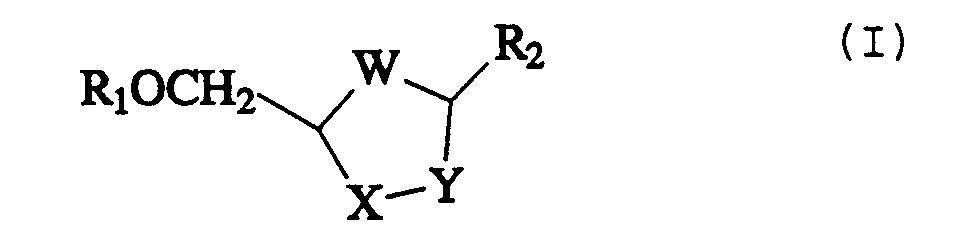
wherein
W is O, S, S=O, SO₂, NZ, or CH₂;
X is O, S, S=O, SO₂, NZ, CH₂, CHF, CH, CHN₃, or CHOH;
Y is O, S, CH₂, CH, CHF, or CHOH;
Z is hydrogen, hydroxyl, alkyl or acyl;
R₁ is hydrogen or acyl; and
R₂ is a purine or pyrimidine base or an analogue or derivative thereof;
provided that when Y is CH₂ and X is O, S, S=O or SO₂, W is not O, S, S=O or SO₂; and further provided that when X is CH then Y is also CH. - The processes of this invention comprise the step of glycosylating a desired purine or pyrimidine base or analogue or derivative thereof with a single enantiomer of the compound of formula (II)

wherein R₃ is a substituted carbonyl or carbonyl derivative and L is a leaving group. Glycosylation is accomplished using a Lewis acid of the formula (III)
wherein R₅, R₆, R₇, and R₈ are defined below and the resulting intermediate is reduced to give a nucleoside or nucleoside analogue or derivative of formula (I). - The processes of this invention have the advantages of allowing preparation of a nucleoside of formula (I) (or analogues or derivatives thereof) without using expensive starting materials, cumbersome protection and deprotection steps or addition and removal of 2′- or 3′-substituents. The processes of this invention produce nucleosides in high yields, with high purity and high optical specificity. The processes of this invention have the further advantage of generating nucleosides whose stereoisomeric configuration can be easily controlled simply by the selection of the appropriate starting materials.
- In the processes for preparing optically active compounds of this invention in a configurational- and diastereo-selective manner, the following definitions are used:
R₂ is a purine or pyrimidine base or an analogue or derivative thereof. - A purine or pyrimidine base is a purine or pyrimidine base found in naturally occurring nucleosides. An analogue thereof is a base which mimics such naturally occurring bases in that their structures (the kinds of atoms and their arrangement) are similar to the naturally occurring bases but may either possess additional or lack certain of the functional properties of the naturally occurring bases. Such analogues include those derived by replacement of a CH moiety by a nitrogen atom, e.g., 5-azapyrimidines such as 5-azacytosine) or vice versa (e.g., 7-deazapurines, such as 7-deazaadenine or 7-deazaguanine) or both (e.g., 7-deaza, 8-azapurines). By derivatives of such bases or analogues are meant those bases wherein ring substituents are either incorporated, removed, or modified by conventional substituents known in the art, e.g., halogen, hydroxyl, amino, C₁₋₆ alkyl. Such purine or pyrimidine bases, analogues and derivatives are well known to those skilled in the art.
- A "nucleoside analogue or derivative" is a nucleoside which has been modified in any of the following or combinations of the following ways: base modifications, such as addition of a substituent (e.g., 5-fluorocytosine) or replacement of one group by an isosteric group (e.g., 7-deazaadenine); sugar modifications, such as substitution of the C-2 and C-3 hydroxyl groups by any substituent, including hydrogen (e.g., 2′,3′-dideoxynucleosides), replacement of any ring CH group or the ring oxygen with a heteroatom; alteration of the site of attachment of the sugar to the base (e.g., pyrimidine bases usually attached to the sugar at the N-1 site may be, for example, attached at the N-3 or C-6 site and purines usually attached at the N-9 site may be, for example, attached at N-7); alteration of the site of attachment of the base to the sugar (e.g., the base may be attached to the sugar at C-2, such as iso-DDA); or alteration of configuration of the sugar-base linkage (e.g., cis or trans configurations).
- R₃ is a carbonyl substituted with hydrogen, hydroxyl, trialkylsilyl, trialkylsiloxy, C₁₋₃₀ alkyl, C₇₋₃₀ aralkyl, C₁₋₃₀ alkoxy, C₁₋₃₀ amine (primary, secondary or tertiary), C₁₋₃₀ thiol; C₆₋₂₀ aryl; C₁₋₂₀ alkenyl; C₁₋₂₀ alkynyl; 1,2-dicarbonyl, such as

substituted with C₁₋₆ alkyl or C₆₋₂₀ aryl; anyhdrides such as
substituted with C₁₋₆ alkyl or C₆₋₂₀ aryl; azomethine substituted at nitrogen with hydrogen, C₁₋₂₀ alkyl or C₁₋₁₀ alkoxy or C₁₋₁₀ dialkylamino or at carbon with hydrogen, C₁₋₂₀ alkyl, or C₁₋₂₀ alkoxy; thiocarbonyl (C=S) substituted with hydroxyl, C₁₋₂₀ alkoxy, or C₁₋₂₀ thiol; a homologue of carbonyl, e.g.,
a homologue of thiocarbonyl, e.g.,
or a homologue of azomethine, such as
- The preferred substituted carbonyl/carbonyl derivatives are alkoxycarbonyls, such as methyl, ethyl, isopropyl, t-butyl and menthyl; carboxyls; diethyl-carboxamide; pyrrolidine amide; methyl ketone and phenyl ketone. The more preferred substituted carbonyl/carbonyl derivatives are esters and carboxyls and the most preferred are esters.
- R₄ is a chiral auxiliary. The term "chiral auxiliary" describes asymmetric molecules that are used to effect the chemical resolution of a racemic mixture. Such chiral auxiliaries may possess one chiral center such as methylbenzylamine or several chiral centers such as menthol. The purpose of the chiral auxiliary, once built into the starting material, is to allow simple separation of the resulting diastereomeric mixture. See, for example, J. Jacques et al., Enantiomers, Racemates And Resolutions, pp. 251-369, John Wiley & Sons, New York (1981).
- R₅, R₆ and R₇ are independently selected from the group consisting of hydrogen, C₁₋₂₀ alkyl (e.g., methyl, ethyl, t-butyl), optionally substituted by halogens (F, Cl, Br, I), C₁₋₆ alkoxy (e.g., methoxy) or C₆₋₂₀ aryloxy (e.g., phenoxy); C₇₋₂₀ aralkyl (e.g., benzyl), optionally substituted by halogen, C₁₋₂₀ alkyl or C₁₋₂₀ alkoxy (e.g., p-methoxybenzyl); c₆₋₂₀ aryl (e.g., phenyl), optionally substituted by halogens, C₁₋₂₀ alkyl or C₁₋₂₀ alkoxy; trialkylsilyl; halogens (F, Cl, Br, I).
- R₈ is selected from the group consisting of halogen (F, Cl, Br, I); C₁₋₂₀ sulphonate esters, optionally substituted by halogens (e.g., trifluoromethane sulphonate); C₁₋₂₀ alkyl esters, optionally substituted by halogen (e.g., trifluoroacetate); polyvalent halides (e.g., triiodide); trisubstituted silyl groups of the general formula (R₅)(R₆)(R₇)Si (wherein R₅, R₆, and R₇ are as defined above); saturated or unsaturated selenenyl C₆₋₂₀ aryl; substituted or unsubstituted C₆₋₂₀ arylsulfenyl; substituted or unsubstituted C₁₋₂₀ alkoxyalkyl; and trialkylsiloxy.
- L is a "leaving group", i.e., an atom or a group which is displaceable upon reaction with an appropriate purine or pyrimidine base, with or without the presence of a Lewis acid. Suitable leaving groups include acyloxy groups, alkoxy groups, e.g., alkoxy carbonyl groups such as ethoxy carbonyl; halogens such as iodine, bromine, chlorine, or fluorine; amido; azido; isocyanato; substituted or unsubstituted, saturated or unsaturated thiolates, such as thiomethyl or thiophenyl; substituted or unsubstituted, saturated or unsaturated seleno, seleninyl, or selenonyl compounds, such as phenyl selenide or alkyl selenide.
- A suitable leaving group may also be -OR, where R is a substituted or unsubstituted, saturated or unsaturated alkyl group, e.g., C₁₋₆ alkyl or alkenyl group; a substituted or unsubstituted aliphatic or aromatic acyl group, e.g., a C₁₋₆ aliphatic acyl group such as acetyl and a substituted or unsubstituted aromatic acyl group such as benzoyl; a substituted or unsubstituted, saturated or unsaturated alkoxy or aryloxy carbonyl group, such as methyl carbonate and phenyl carbonate; substituted or unsubstituted sulphonyl imidazolide; substituted or unsubstituted aliphatic or aromatic amino carbonyl group, such as phenyl carbamate; substituted or unsubstituted alkyl imidiate group such as trichloroacetamidate; substituted or unsubstituted, saturated or unsaturated phosphonate, such as diethylphosphonate; substituted or unsubstituted aliphatic or aromatic sulphinyl or sulphonyl group, such as tosylate; or hydrogen.
- As used in this application, the term "alkyl" represents a substituted (by a halogen, hydroxyl or C₆₋₂₀ aryl) or unsubstituted straight chain, branched chain, or cyclic hydrocarbon moiety having 1 to 30 carbon atoms and preferably, from 1 to 6 carbon atoms.
- The terms "alkenyl" and "alkynyl" represent substituted (by a halogen, hydroxyl or C₆₋₂₀ aryl) or unsubstituted straight, branched or cyclic hydrocarbon chains having 1 to 20 carbon atoms and preferably from 1 to 5 carbon atoms and containing at least one unsaturated group (e.g., allyl).
- The term "alkoxy" represents a substituted or unsubstituted alkyl group containing from 1 to 30 carbon atoms and preferably from 1 to 6 carbon atoms, wherein the alkyl group is covalently bonded to an adjacent element through an oxygen atom (e.g., methoxy and ethoxy).
- The term "amine" represents alkyl, aryl, alkenyl, alkynyl, or aralkyl groups containing from 1 to 30 carbon atoms and preferably 1 to 12 carbon atoms, covalently bonded to an adjacent element through a nitrogen atom (e.g., pyrrolidine). They include primary, secondary and tertiary amines and quaternary ammonium salts.
- The term "thiol" represents alkyl, aryl, aralkyl, alkenyl or alkynyl groups containing from 1 to 30 carbon atoms and preferably from 1 to 6 carbon atoms, covalently bonded to an adjacent element through a sulfur atom (e.g., thiomethyl).
- The term "aryl" represents a carbocyclic moiety which may be substituted by at least one heteroatom (e.g., N, O, or S) and containing at least one benzenoid-type ring and preferably containing from 6 to 15 carbon atoms (e.g., phenyl and naphthyl).
- The term "aralkyl" represents an aryl group attached to the adjacent atom by an alkyl (e.g., benzyl).
- The term "alkoxyalkyl" represents an alkoxy group attached to the adjacent group by an alkyl group (e.g., methoxymethyl).
- The term "aryloxy" represents a substituted (by a halogen, trifluoromethyl or C₁₋₅ alkoxy) or unsubstituted aryl moiety covalently bonded through an oxygen atom (e.g., phenoxy).
- The term "acyl" refers to a radical derived from a carboxylic acid, substituted (by a halogen (F, Cl, Br, I), C₆₋₂₀ aryl or C₁₋₆ alkyl) or unsubstituted, by replacement of the -OH group. Like the acid to which it is related, an acyl radical may be aliphatic or aromatic, substituted (by a halogen, C₁₋₅ alkoxyalkyl, nitro or O₂) or unsubstituted, and whatever the structure of the rest of the molecule may be, the properties of the functional group remain essentially the same (e.g., acetyl, propionyl, isobutanoyl, pivaloyl, hexanoyl, trifluoroacetyl, chloroacetyl, and cyclohexanoyl).
- A key feature of the processes of this invention is the use of a substituted carbonyl or carbonyl derivative as R₃ instead of a protected hydroxymethyl group as previously described in the art. Surprisingly, the substituted carbonyl or carbonyl derivative is not cleaved by exposure to a Lewis acid, as would have been expected by one of skill in the art when a Lewis acid of formula (III) is added to a mixture of silylated purine or pyrimidine base and the sugar compound of formula (II). Instead, the substituted carbonyl/carbonyl derivative in the intermediate of formula (VI) forces the purine or pyrimidine base (R₂) to add in the cis-configuration relative to the substituted carbonyl/carbonyl derivative group. Without a substituted carbonyl or carbonyl derivative attached to C4′ (for example, when a hydroxymethyl group is instead used), the coupling procedures described in Step 4 below will result in a mixture of cis- and trans-isomers.
- Another key feature of the processes of this invention is the choice of Lewis acid. The Lewis acids used in the preparation of compounds of formula (I) have the general formula (III)

wherein R₅, R₆, R₇ and R₈ are as defined previously. These Lewis acids may be generated in situ or prepared using any method known in the art (e.g., A.H. Schmidt, "Bromotrimethylsilane and Iodotrimethylsilane-Versatile Reagents for Organic Synthesis", Aldrichimica Acta, 14, pp. 31-38 (1981). The preferred Lewis acids of this invention are iodotrimethylsilane and trimethylsilyl triflate. The preferred R₅, R₆ and R₇ groups are methyl or iodine. The most preferred R₅, R₆ and R₇ group is methyl. The preferred R₈ groups are iodine, chlorine, bromine or sulphonate esters. The most preferred R₈ groups are iodine and trifluoromethane sulphonate. - In the preferred process of this invention, cis- and trans-isomers of a sugar of formula (II)

are separated by fractional crystallization and the desired configurational isomer selected. The selected cis- or the trans-isomer may then be chemically resolved using a chiral auxiliary. The pure chiral auxiliary-sugar diastereomer is then coupled to a silylated purine or pyrimidine base in the presence of a Lewis acid to afford an optically active nucleoside of cis- configuration which is subsequently reduced to give a nucleoside of formula (I). - Schemes 1A and 1B depict this preferred process as applied to any nucleoside of formula (I).


- The various steps as illustrated in Schemes 1A and 1B may be briefly described as follows:
Step 1: The starting carbonyl-sugar of formula (IV) can be prepared by any method known in the art. E.g., Farina and Benigni, "A New Synthesis Of 2,3′-Dideoxy-nucleosides For Aids Chemotherapy", Tetrahedron Letters, 29, pp. 1239-1242 (1988) and M. Okabe et al. "Synthesis Of The Dideoxynucleosides ddC and CNT From Glutamic Acid, Ribonolactone and Pyrimidine Bases", J. Org. Chem., 53, pp. 4780-4786 (1988). The carbonyl group of this starting compound is reduced chemoselectively with a suitable reducing agent, such as disiamylborane to give the cis- and trans-isomers of formula (V). Ordinarily, less cis-isomer is produced than trans. - Step 2: The hydroxyl group in the intermediate of formula (V) is readily converted to a leaving group by any method known in the art (e.g., T.W. Greene Protective Groups In Organic Synthesis, pp. 50-72, John Wiley & Sons, New York (1981)) to give the novel intermediates of formula (II).
- This anomeric mixture is then separated by fractional crystallization into the two configurational isomers. The solvent may be adjusted to select for either the cis- or trans-isomer. D.J. Pasto and C.R. Johnson, Organic Structure Determination, pp. 7-10, Prentice-Hall, Inc., New Jersey (1969).
- Step 3: Either the cis- (Scheme 1A) or trans-isomer (Scheme 1B) of formula (II) is chemically resolved using a chiral auxiliary (R₄). A suitable chiral auxiliary is one of high optical purity and where the mirror image is readily available, such as d-and l-menthol. The resulting diastereomers of formula (VI) are easily separated by fractional crystallization. Alternatively, either the cis- or the trans-isomer may be resolved enzymatically or by other methods known in the art. J. Jacques et al., Enantiomers, Racemates And Resolutions, pp. 251-369, John Wiley & Sons, New York (1981).
- The optical purity of the diastereomer (VI, VII or I) can be determined by chiral HPLC methods, specific rotation measurements and NMR techniques. If the opposite enantiomer is desired, it may be obtained by using the mirror image of the chiral auxiliary initially employed. For example, if the chiral auxiliary d-menthol produces a (+)-enantiomer nucleoside, its mirror image, l-menthol, will produce the (-)-enantiomer.
- Step 4: A previously silylated (or silylated in situ) purine or pyrimidine base or analogue or derivative thereof is then glycosylated with the resulting pure diastereomer in the presence of a Lewis acid of formula (III), such as iodotrimethylsilane (TMSI) or trimethylsilyl triflate (TMSOTf), to give a nucleoside of cis-configuration of formula (VII). This nucleoside is optically active and is substantially free of the corresponding trans-isomer (i.e., it contains no more than 25%, preferably no more than 10% and more preferably no more than 5% of the trans-isomer). Coupling of the intermediate of formula (VI) to the purine or pyrimidine base in this step proceeds in higher yields with the cis-isomer.
- The preferred silylating agent for pyrimidine bases is t-butyldimethylsilyl triflate. It is believed that the bulky t-butyl group increases yields by weakening the interaction between the Lewis acid and silylated pyrimidine base.
- The preferred method of mixing reagents in Step 4 is to first add the chiral auxiliary-sugar of formula (VI) to the silylated purine or pyrimidine base. The Lewis acid of formula (III) is then added to the mixture.
- Step 5: The cis-nucleoside obtained in Step 4 may then be reduced with an appropriate reducing agent to remove the chiral auxiliary and give a specific stereoisomer of formula (I). The absolute configuration of this stereoisomer corresponds to that of the nucleoside intermediate of formula (VII). As shown in Scheme 1, either the cis- (Scheme 1A) or the trans-isomers (Scheme 1B) obtained in Step 2 will yield a cis end product.
- A second process for the diastereoselective synthesis of compounds of formula (I) is illustrated by Scheme 2. The process of Scheme 2 is useful when optically pure starting material may be readily obtained commercially or easily prepared by known methods.
- The optically active starting material is chemoselectively reduced and the resulting hydroxyl group converted to a leaving group. The diastereomeric mixture may be carried on further to compounds of formula (I) in a manner analogous to that described in Scheme 1. Optionally, the diastereomeric mixture may be separated by fractional crystallization and each isolated optically active diastereomer may be carried on further to compounds of formula (I).
- Scheme 2 depicts the second process of this invention as applied to any nucleoside.

The various steps involved in the synthesis of the nucleosides of formula (I) as depicted in Scheme 2 may be briefly described as follows:
Step 1: The starting material of formula (IV) may be obtained commercially in optically pure form or prepared according to the procedures of Farina and Benigni, "A New Synthesis Of 2,3′-Dideoxy-nucleosides For Aids Chemotherapy", Tetrahedron Letters, 29, pp. 1239-1242 (1988) and M. Okabe et al. "Synthesis Of The Dideoxynucleosides ddC and CNT From Glutamic Acid, Ribonolactone and Pyrimidine Bases", J. Org. Chem., 53, pp. 4780-4786 (1988). The single isomer of formula (IV) is chemoselectively reduced by a suitable reducing agent, such as disiamylborane to give a mixture of two diastereomers of formula (V). - Step 2: The hydroxyl groups of the two diastereomers of formula (V) are converted to leaving groups by any method known in the art to give a mixture of two diastereomers of formula (II).
- Step 3: The diastereomeric mixture of formula (II) is reacted with previously silylated (or silylated in situ) purine or pyrimidine base or analogue or derivative. Then, addition of a Lewis acid of formula (III), such as iodotrimethylsilane (TMSI) or trimethylsilyl triflate (TMSOTf) yields a nucleoside of cis-configuration of formula (VIII). This nucleoside is substantially free of the corresponding trans-isomer.
- Step 4: The optically active cis-nucleoside of formula (VIII) is reduced stereospecifically with a reducing agent preferably lithium triethylborohydride or lithium aluminum hydride and more preferably sodium borohydride in an appropriate solvent such as tetrahydrofuran or diethyl ether to give the compound of formula (I).
- Alternatively, at the end of Step 2, either the cis-or the trans-isomer may be separated out of the diastereomeric mixture of formula (II) by fractional crystallization or chromatography. The solvent may be adjusted to select for either the cis- or the trans-isomer. The single diastereomer of formula (II) would then be carried forward as described in Steps 3 and 4 to a compound of formula (I).
- Schemes 3, 4 and 5 illustrate the application of the process of Scheme 2 to the synthesis of the enantiomers of cis -dideoxynucleoside analogues.
- Although the process is illustrated using specific reagents and starting materials, it will be appreciated by one of skill in the art that suitable analogous reactants and starting materials may be used to prepare analogous compounds.

The various steps illustrated in Scheme 3 may be briefly described as follows:
Step 1: The starting material (2R)-5-oxo-2-tetrahydrofuran carboxylic acid (IX) is available from commercial sources or by synthesis from D-glutamic acid M. Okabe et al. "Synthesis Of The Dideoxynucleosides ddC and CNT From Glutamic Acid, Ribono-lactone and Pyrimidine Bases", J. Org. Chem., 53, pp. 4780-4786 (1988). The starting material is esterified with an alcohol such as ethanol in the presence of an acylating agent such as oxalyl chloride and an esterification catalyst such as 4-dimethylamino-pyrimidine and a base such as pyridine in a compatible solvent such as dichloromethane. The esterified compound is reduced with an appropriate reducing agent such as disiamylborane in a compatible organic solvent, such as tetrahydrofuran (A. Pelter et al., "Borane Reagents", Academic Press, p. 426 (1988)), to give the compounds of formula (X). - Step 2: The compounds of formula (X) is reacted with an acid chloride or acid anhydride, such as acetic anhydride, in the presence of pyridine and an acylation catalyst, such as 4-dimethylaminopyrimidine, to give the compounds of formula (XI).
- Step 3: The mixture of cis- and trans-acetoxy compound of formula (XI) is reacted with 5-fluorocytosine or other pyrimidine base or analogue thereof. The purine or pyrimidine base or analogue is preferably silated with hexamethyldisilazane or more preferably silylated in situ with t-butyldimethylsilyl triflate in a compatible organic solvent, such as dichloromethane containing a hindered base, preferably 2,4,6-collidine.
- A Lewis acid, preferably one derived from the compounds of formula (III), more preferably iodotrimethylsilane or trimethyl-silyl triflate, is then added to give the cis compound of formula (XII) in a highly diastereoselective manner.
- Step 5: The optically active cis-nucleoside (with some trans- isomer) of formula (XII) is reduced stereospecifically with a reducing agent, preferably sodium borohydride in an appropriate solvent, such as ethanol to give, after purification, the compound of formula (XIII).
- It will be appreciated by one of skill in the art that if the enantiomer of formula (XIII) is desired, the starting material of formula (IX) would be (2S)-5-oxo-2-tetrahydrofuran carboxylic acid (Scheme 4) and the process would proceed just as described for Scheme 3.


The various steps illustrated in Scheme 5 may be briefly described as follows:
Step 1: The starting material (2R)-5-oxo-2-tetrahydrofuran carboxylic acid (IX) is esterified with an alcohol such as ethanol in the presence of an acylating agent such as oxalyl chloride and an esterification catalyst such as 4-dimethylamino-pyridimine and a base such as pyridine in a compatible solvent such as dichloromethane. The esterified compound is reduced with an appropriate reducing agent such as disiamylborane in a compatible organic solvent, such as tetrahydrofuran to give the compounds of formula (X). - Step 2: The compounds of formula (X) is reacted with an acid chloride or acid anhydride, such as acetic anhydride, in the presence of pyridine and an acylation catalyst, such as 4-dimethylaminopyrimidine, to give the compounds of formula (XI).
- Step 3: The mixture of cis- and trans-acetoxy compound of formula (XI) is reacted with N-acetyl cytosine or other pyrimidine base or analogue thereof. The purine or pyrimidine base or analogue is preferably silated with hexamethyldisilazane or more preferably silylated in situ with trimethylsilyl triflate in a compatible organic solvent, such as dichloromethane containing a hindered base, preferably 2,4,6-collidine.
- A Lewis acid, preferably one derived from the compounds of formula (III), more preferably iodotrimethylsilane, is then added to give cis nucleoside in a highly diastereoselective manner. The pure cis- nucleoside is obtained by trituration with an appropriate sulvent such as ethyl acetate and hexanes.
- The N-acetyl group is hydrolyzed preferably under acidic conditions and more preferably with trifluoroacetic acid in a compatible organic solvent such as isopropanol, preferably under reflux, to give the deacylated compounds of formula (XIV).
- Step 4: The optically active cis-nucleoside of formula (XIV) is reduced stereospecifically with a reducing agent, preferably sodium borohydride in an appropriate solvent, such as ethanol to give the compound of formula (XV).
- In the diastereoselective processes of this invention, the following intermediates are of particular importance:


wherein R₃, R₄ and L are as defined above and provided that in intermediates of formula (VIII), when X is CHN₃, then R₂ is not adenine or an analogue or derivative of adenine;
cis and trans-2R-carboethoxy-5-hydroxytetrahydrofuran;
cis and trans-2S-carboethoxy-5-hydroxytetrahydrofuran;
cis and trans-2R-carboethoxy-5-acetoxytetrahydrofuran;
cis and trans-2S-carboethoxy-5-acetoxytetrahydrofuran;
1'S-(N-4-acetylcytosin-1-yl)-4'R-carboethoxytetrahydrofuran;
1'S-(cytosin-1-yl)-4'R-carboethoxytetrahydrofuran;
1'R-(5-fluorocytosin-1-yl)-4'S-carboethoxytetrahydrofuran and 1'S-(5-fluorocytosin-1-yl)-4'S-carboethoxytetrahydrofuran; and
1'S-(5-fluorocytosin-1-yl)-4'R-carboethoxytetrahydrofuran and 1'R-(5-fluorocytosin-1-yl)-4'R-carboethoxytetrahydrofuran. - The following examples illustrate the present invention in a manner of which it can be practiced but, as such, should not be construed as limitations upon the overall scope of the processes of this invention. Except where specifically noted, all [α]D measurements were recorded at ambient temperature.
-

To a cold (O°C) stirred solution of 5-oxo-2R-tetrahydrofurancarboxylic acid (3 g, 23 mmol), 4-dimethylaminopyridine (141 mg, 0.05 equivalents), and pyridine (3.92 mL, 2.1 equivalents) in dichloromethane (15 mL) under an argon atmosphere was added oxalyl chloride (2.11 mL, 1.05 equivalents) over a period of 30 minutes. The cooling bath was removed and the reaction mixture was stirred at room temperature for 10 minutes. Ethanol (2.0 mL, 1.5 equivalents) was introduced and stirring was continued for another 1 hour 40 minutes. The reaction mixture was diluted with water and dichloromethane, followed by stirring for 10 minutes. The resultant mixture was transferred to a separatory funnel. The aqueous phase was removed and the organic layer was washed with 1 M HCl, saturated NaHCO₃, brine, and then was dried (Na₂SO₄). The solvent was evaporated under reduced pressure and the crude product thus obtained was subjected to column chromatography (1:1 EtOAc-Hexane) to afford 3.23 g of the desired product as a syrup. ¹H NMR (CDCl₃):δ 1.28 (t, 3H, J=7.1 Hz). 2.20-2.40 (m, 1H), 4.23 (d of q 2H, J=0.9, 7.1 Hz), 4.86-4.96 (m 1H). -

A solution of disiamylborane was prepared by mixing 35 mL of BH₃ THF (1 M in THF) and 35 mL of 2-methyl-2-butene (2 M in THF) at 0°C followed by stirring at 0°C for 75 minutes. To this solution was introduced 2R-carboethoxy-5-oxotetrahydrofuran dissolved in THF (6 mL). The resultant mixture was allowed to warm slowly to room temperature over a period of 2.5 hours and then was stirred for another 15 hours. Saturated ammonium chloride solution was added, followed by dilution with EtOAc. The above mixture was stirred for 10 minutes and then was transferred to a separatory funnel. The organic phase was washed successively with saturated NH₄Cl, brine, and then was dried (Na₂SO₄). The solvent was removed on a rotary evaporator and the crude product obtained was purified by column chromatography (40% EtOAc-Hexanes). The desired products were isolated in 70% yield (2.05 g) as a 2:3 mixture of isomer epimeric at C5. Trace amount of the open form isomer was also detected (¹H NMR). The title compounds displayed the following spectral characteristics: ¹H NMR (CDCl₃): δ 1.28 (t, 2H, J=7.1 Hz), 1.30 (t, 1H, J=7.1 Hz), 1.85-2.70 (m, 4H), 2.59 (d, 0.33H, J=5.5 Hz), 2.88 (d, 0.67H, J=3.1 Hz), 4.15-4.65 (m, 2H), 4.57 (d of d, 0.33H, J=6.4, 8.3 Hz), 4.70 (d of d, 0.67H, J=4.1, 8.7 Hz), 5.59 (m, 0.33H), 5.74 (m, 0.67H). -

To a cold (-78°C) stirred solution of a 2:3 mixture of cis and trans-2R-carboethoxy-5-hydroxytetrahydrofuran (2.04 g, 12.75 mmol), pyridine (1.24 mL, 1.2 equivalents), and 4-dimethylaminopyridine (16 mg, 0.01 equivalent) in dichloromethane (20 mL) was added acetyl chloride (1.09 mL, 1.2 equivalents) over a period of 5 minutes. The resultant mixture was stirred for 10 minutes. The -78°C cooling bath was then replaced with an ice-water bath. Stirring was continued for 4.5 hours while the bath temperature was allowed to warm slowly to room temperature. The reaction mixture was diluted with dichloromethane and then was transferred to a separatory funnel. The organic layer was washed successively with water, 1 M HCl, saturated NaHCO₃, brine and then was dried (Na₂SO₄). The solvent was removed on a rotary evaporator and the crude product obtained was purified by column chromatography (40% EtOAc-Hexane) to provide 1.757 g of the title compounds (a 5:4 mixture) as a thick oil. ¹H NMR (CDCl₃); δ 1.28 (t, 1.68H, J=7.1 Hz), 1.29 (t, 1.32H, J=7.1 Hz), 1.90-2.30 (m, 3H), 2.30-2.50 (m, 1H), 4.10-4.30 (m, 2H), 4.59 (t, 0.44H, J=8.0 Hz), 4.70 (d of d, 0.56H, J=3.2, 8.9 Hz), 6.33 (d of d, 0.44H, J=1.1, 3.9 Hz), 6.46 (d, 0.56H, J=4.5 Hz). -

To a stirred suspension of N-4-acetylcytosine (50 mg, 0.298 mmol) in dichloromethane (0.75 mL) containing 2,6-lutidine (35 µL, 0.298 mmol) under an argon atmosphere was added trimethylsilyl trifluoromethanesulphonate (58 µL, 0.298 mmol). The resulting mixture was stirred for 15 minutes to give a light suspension. A solution of a 5:4 mixture of cis-and trans-2R-carboethoxy-5-acetoxytetrahydrofuran (50 mg, 0.248 mmol) in dichloromethane (1 mL) and iodotrimethylsilane (35 µL, 0.248 mmol) was sequentially introduced into the above suspension to generate a homogeneous solution. The reaction was allowed to proceed at room temperature for 1 hour and 40 minutes and then was quenched with a half-saturated solution of Na₂S₂O₃. The resulting mixture was stirred for 5 minutes and then was transferred to a separatory funnel with the aid of more dichloromethane. The aqueous phase was removed and the organic layer was washed with saturated Na₂S₂O₃, water, brine and then was dried (Na₂SO₄). The combined aqueous washings were reextracted with dichloromethane. The organic extracts were combined and concentrated under reduced pressure to provide 83 mg of the crude product. ¹H NMR analysis of the crude product indicated that a cis and trans (4:1) mixture of the expected nucleosides was generated. The crude product was dissolved in a minimum amount of chloroform. Addition of a 3:7 mixture of EtOAc-hexanes into this solution produced a white precipitate which was collected by suction filtration. Drying of this solid under vacuum afforded 25 mg (32%) of the title compound. ¹H NMR (CDCl₃): δ 1.33 (t, 3H, J=7.1 Hz), 1.90-2.08 (m, 1H), 2.08-2.30 (m, 1H), 2.23 (s, 3H), 4.20-4.40 (m, 2H), 4.64 (t, 1H, J=7.2 Hz), 6.15 (d of d, 1H, J=4.0, 5.9 Hz), 7.46 (d, 1H, J=7.5 Hz), 8.34 (br s, 1H), 8.82 (d, 1H, J=7.5 Hz). - The washing was concentrated to give 58 mg of a cis and trans mixture (5:2) of the title compound and its 1′ isomer.
-

A mixture of 1′S-(N-4-acetylcytosin-1-yl)-4′R-carboethoxytetrahydrofuran (49 mg, 0.158 mmol, contains ca. 4% of the corresponding 1′R isomer) and trifluoroacetic acid (24 µL, 2 equivalents) in ethanol (1 mL) was refluxed under an argon atmosphere for 2 hours and 40 minutes. The resultant mixture consisting of 1′S-(cytosine-1-yl)-4′R-carboethoxytetrahydrofuran and its 1′ epimer was cooled to room temperature and then was diluted with ethanol (0.5 mL). Sodium borohydride (18 mg, 3 equivalents) was introduced and the reaction mixture was stirred for 1.5 hours. More reducing agent (6 mg) was added and stirring was continued for another 1 hour 20 minutes. The reaction was quenched by the addition of 2 drops of concentrated ammonium hydroxide followed by rigorous stirring for 15 minutes. The solvent was evaporated under reduced pressure and the crude product obtained was subjected to column chromatography (30% MeOH-EtOAc) to provide 28 mg (84%) of the title compound. The ¹H NMR spectrum of this material indicated the presence of ca. 3% of the corresponding 1′R isomer. This material was dissolved in a minimum amount of methanol. Addition of diethyl ether to this solution generated 20 mg (60%) of the title compound as a crystalline white precipitate free of the 1′R isomer (¹H NMR). The title compound displayed the following spectral characteristics: ¹H NMR (CD₃OD):δ 1.60-2.00 (m, 3H), 2.25-2.43 (m, 1H), 3.59 (d of d, 1H, J=4.1, 12.2 Hz), 3.78 (d of d, 1H, J=3.1, 12.2 Hz), 4.00-4.12 (m, 1H), 5.78 (d, 1H, J=7.4 Hz), 5.92 (d of d, 1H, J=3.1, 6.7 Hz), 8.02 (d, 1H, J=7.5 Hz). -

To a stirred suspension of 5-fluorocytosine (192 mg, 1.49 mmol) in dichloromethane (2 mL) containing 2,6-lutidine (346 µL, 2.98 mmol) under an argon atmosphere was added t-butyldimethylsilyl trifluoromethanesulphonate 678 µL, 2.98 mmol). The resulting mixture was stirred for 15 minutes to give a homogeneous solution. A solution of a 2:1 mixture of 2S-carboethoxy-5R-acetoxytetrahydrofuran and 2S-carboethoxy-5S-acetoxytetrahydrofuran (250 mg, 1.24 mmol) in dichloromethane (2 mL) and iodotrimethylsilane (176 µL, 1.24 mmol) was sequentially introduced into the above solution. The reaction was allowed to proceed at room temperature for 1 hour and 30 minutes and then was quenched with a half-saturated solution of Na₂S₂O₃. The resulting mixture was stirred for 5 minutes and then was transferred to a separatory funnel. The aqueous phase was removed and the organic layer was washed with saturated Na₂S₂O₃, water, brine and then was dried (Na₂SO₄). The solvent was removed under reduced pressure to provide the crude product which was subjected to column chromatography (15% MeOH-EtOAc) to afford 199 mg (59%) of the title compounds as a mixture [7:1 (1′R,4′S):(1′S, 4′S) by ¹H NMR). The product displayed the following spectral characteristics: ¹H NMR (CDCl₃): δ 1.15-1.40 (2 overlapping t, 3H), 1.90-2.15 (m, 2H), 2.25-2.55 (m, 2H), 4.15-4.35 (m, 2H), 4.54 (m, 0.87 Hz), 4.82 (d of d, 0.13H, J=4.4, 8.0 Hz), 5.70-6.80 (unresolved m, 1H), 6.09 (m, 1H), 7.40 (d, 0.13H, J=6.7 Hz), 7.90-8.60 (unresolved m, 1H), 8.48 (d, 0.87H, J=6.7 Hz). -

To a stirred suspension of 5-fluorocytosine (38 mg, 0.297 mmol) in dichloromethane (1 mL) containing 2,6-lutidine (69 µL, 0.594 mmol) under an argon atmosphere was added t-butyldimethylsilyl trifluoromethanesulphonate (137 µL, 0.594 mmol). The resulting mixture was stirred for 15 minutes to give a homogeneous solution. A solution of a 5:4 mixture of 2R-carboethoxy-5S-acetoxytetrahydrofuran and 2R-carboethoxy-5R-acetoxytetrahydrofuran (50 mg, 0.248 mmol) in dichloromethane (1 mL) and iodotrimethylsilane (35 µL, 0.248 mmol) was sequentially introduced into the above solution. The reaction was allowed to proceed at room temperature for 1 hour and 45 minutes and then was quenched with a half-saturated solution of Na₂S₂O₃. The resulting mixture was stirred for 5 minutes and then was transferred to a separatory funnel. The aqueous phase was removed and the organic layer was washed with saturated Na₂S₂O₃, water, brine and then was dried (Na₂SO₄). The solvent was removed under reduced pressure to provide the crude product which was subjected to column chromatography (15% MeOH-EtOAc) to afford 52 mg (77%) of the title compounds as a 11:2 [(1′R,4′R):(1′S,4′R)] mixture (¹H NMR). The product displayed the following spectral characteristics: ¹H NMR (CDCl₃):δ 1.15-1.40 (2 overlapping t, 3H), 1.90-2.10 (m, 2H), 2.25-2.60 (m, 2H), 4.15-4.35 (m, 2H), 4.57 (m, 0.85 Hz), 4.84 (d of d, 0.15H, J=4.2, 7.8 Hz), 5.50-6.30 (unresolved m, 1H), 6.09 (m, 1H), 7.43 (d, 0.15H, J=6.7 Hz), 7.50-9.00 (unresolved m, 1H), 8.56 (d, 0.85H, J=6.7 Hz). -

To a cold (0°C) stirred suspension of 1′R-(5-fluorocytosin-1-yl)-4′R-carboethoxytetrahydrofuran and 1′S-(5-fluorocytosin-1-yl)-4′R-carboethoxytetrahydrofuran [307 mg, 1.133 mmol, a 4:1 (1′R,4′R):(1′S, 4′R) mixture of the isomers] in 4 mL of ethanol was added sodium borohydride (86 mg, 2 equivalents). The resultant mixture was stirred for 5 minutes and the cooling bath was removed. Stirring was continued for 75 minutes at room temperature. The reaction was quenched by the addition of 4 drops of concentrated ammonium hydroxide. After the mixture had been stirred for 15 minutes, the solvent was removed under reduced pressure and the crude product was subjected to column chromatography (25% MeOH-EtOAc) to provide 197 mg (76%) of the expected 4′-hydroxymethyl products as a 4:1 mixture. One of the fractions collected was found to contain the title compound in 97% purity (¹H NMR). This fraction was concentrated to give 14 mg of a light beige coloured foam. UV (λmax): 282.7, 236.4, 206.7 nm (MeOH); [α]D-81° (c, 0.7 MeOH); ¹H NMR (CD₃OD): δ 1.77-1.90 (m, 2H), 1.90-2.03 (m, 1H), 2.25-2.42 (m, 1H), 3.61 (d of d, 1H, J=3.3, 12.3 Hz), 3.82 (d of d, 1H, J=2.8, 12.3 Hz), 4.06 (m, 1H), 5.87 (m, 1H), 8.32 (d, 1H, J=7.0 Hz). -

To a cold (0°C) stirred suspension of 1′R-(5-fluorocytosin-1-yl)-4′S-carboethoxytetrahydrofuran and 1′S-(5-fluorocytosin-1-yl)-4′S-carboethoxytetrahydrofuran [199 mg, 0.734 mmol, a 7:1 (1′R,4′S):(1′S, 4′S) mixture of the isomers] in 3 mL of ethanol was added sodium borohydride (56 mg, 2 equivalents). The resultant mixture was stirred for 5 minutes and the cooling bath was removed. Stirring was continued overnight (ca. 16 hours) at room temperature. The reaction was quenched by the addition of 4 drops of concentrated ammonium hydroxide. After the mixture has been stirred for 15 minutes, the solvent was removed under reduced pressure and the crude product was subjected to column chromatography (20% MEOH-EtOAc) to provide 112 mg (67%) of the expected 4′-hydroxymethyl products as a 7:1 (1′R,4′S):(1′S,4′S) mixture (¹H NMR). One of the fractions collected was found to contain the title compound only (H NMR). This fraction was concentrated in vacuo to give 27 mg of a white foam; UV (λmax): 283.6, 238.2, 202.4 nm (MeOH); [α]D+96° (c, 0.7 MeOH); ¹H NMR (CD₃OD): δ 1.77-1.90 (m, 2H), 1.90-2.03 (m, 1H), 2.25-2.42 (m, 1H), 3.61 (d of d, 1H, J=3.3, 12.3 Hz), 3.82 (d of d, 1H, J=2.8, 12.3 Hz), 4.06 (m, 1H), 5.87 (m, 1H), 8.32 (d, 1H, J=7.0 Hz). - While we have presented a number of embodiments of our invention, many alternatives, modifications and variations of these embodiments will be apparent to those of ordinary skill in the art. Therefore, it will be appreciated that the scope of this invention is to be defined by the following claims, rather than the specific examples presented above.
Claims (15)
- A diastereoselective process for producing optically active cis-nucleosides and nucleoside analogues and derivatives of formula (I)

R₁ is hydrogen or acyl;
R₂ is a purine or pyrimidine base or an analogue or derivative thereof;
W is S, S=O, or SO₂, O, NZ, or CH₂;
X is O, S, S=O, or SO₂, NZ, CH₂, CHF, CH, CHN₃, or CHOH;
Y is O, S, CH₂, CH, CHF, or CHOH; and
Z is hydrogen, hydroxyl, alkyl or acyl;
provided that W is not O, S, S=O or SO₂ when Y is CH₂ and X is O, S, S=O or SO₂; and further provided that when X is CH then Y is also CH;
the process comprising the step of glycosylating the purine or pyrimidine base or analogue or derivative thereof with a single enantiomer of the compound of formula (II)
R₃ is selected from the group consisting of carbonyl substituted with hydrogen, hydroxyl, trialkylsilyl, trialkylsiloxy, C₁₋₃₀ alkyl, C₇₋₃₀ aralkyl, C₁₋₃₀ alkoxy, C₁₋₃₀ amine (primary, secondary or tertiary), C₁₋₃₀ thiol, C₆₋₂₀ aryl, C₁₋₂₀ alkenyl, C₁₋₂₀ alkynyl; 1,2-dicarbonyl, substituted with C₁₋₆ alkyl or C₆-₂₀ aryl; anyhdride substituted with C₁₋₆ alkyl or C₆₋₂₀ aryl; azomethine substituted at nitrogen with hydrogen, C₁₋₂₀ alkyl or C₁₋₁₀ alkoxy or C₁₋₁₀ dialkylamino or at carbon with hydrogen, C₁₋₂₀ alkyl, or C₁₋₂₀ alkoxy; thiocarbonyl (C=S) substituted with hydroxyl, C₁₋₂₀ alkoxy, or C₁₋₂₀ thiol; homologues of carbonyl; homologues of thiocarbonyl and homologues of azomethine; and
L is a leaving group,
using a Lewis acid of the formula (III)
R₅, R₆ and R₇ are independently selected from the group consisting of hydrogen; C₁₋₂₀ alkyl optionally substituted by fluoro, bromo, chloro, iodo, C₁₋₆ alkoxy or C₆₋₂₀ aryloxy; C₇₋₂₀ aralkyl optionally substituted by halogen, C₁₋₂₀ alkyl or C₁₋₂₀ alkoxy; C₆₋₂₀ aryl optionally substituted by fluoro, bromo, chloro, iodo, C₁₋₂₀ alkyl or C₁₋₂₀ alkoxy; trialkylsilyl; fluoro; bromo; chloro and iodo; and
R₈ is selected from the group consisting of fluoro; bromo; chloro; iodo; C₁₋₂₀ sulphonate esters, optionally substituted by fluoro, bromo, chloro or iodo; C₁₋₂₀ alkyl esters optionally substituted by fluoro, bromo, chloro or iodo; polyvalent halides; trisubstituted silyl groups of the general formula (R₅)(R₆)(R₇)Si (wherein R₅, R₆, and R₇ are as defined above); saturated or unsaturated selenenyl C₆₋₂₀ aryl; substituted or unsubstituted C₆₋₂₀ arylsulfenyl; substituted or unsubstituted C₆₋₂₀ alkoxyalkyl; and trialkylsiloxy. - The process according to claim 1, further comprising the step of reducing R₃ of the glycosylated purine or pyrimidine base or analogue or derivative thereof to produce the optically active cis-nucleoside or nucleoside analogue or derivative of formula (I).
- The process according to claim 1, further comprising the step of resolving the compound of formula (II) into a single enantiomer using a chiral auxiliary before glycosylating the purine or pyrimidine base.
- The process according to any one of claims 1 to 3, wherein R₂ is a pyrimidine base.
- The process according to claim 4, wherein the pyrimidine base is cytosine.
- The process according to claim 4, wherein the pyrimidine base is 5-fluorocytosine.
- The process according to any one of claims 1 to 3, wherein the Lewis acid is selected from the group consisting of trimethylsilyl triflate and iodotrimethylsilane.
- The process according to claim 3, wherein the chiral auxiliary is selected from the group consisting of (d)-menthol and (l)-menthol.
- The process according to any one of claims 1 to 3, wherein R₃ is selected from the group consisting of alkoxycarbonyl, carboxyls, diethylcarboxamide, pyrrolidine amide, methyl ketone and phenyl ketone.
- The process according to claim 9, wherein the R₃ is selected from the group consisting of alkoxycarbonyl and carboxy.
- An intermediate of formula (II)

W is O, S, S=O, SO₂, NZ, or CH₂;
X is O, S, S=O, SO₂, NZ, CH₂, CHF, CH, CHN₃, or CHOH;
Y is O, S, CH₂, CH, CHF, or CHOH;
Z is hydrogen, hydroxyl, alkyl or acyl; provided that when Y is CH₂ and X is O, S, S=O or SO₂, W is not O, S, S=O or SO₂; and further provided that when X is CH then Y is also CH;
R₃ is selected from the group consisting of carbonyl substituted with hydrogen, hydroxyl, trialkylsilyl, trialkylsiloxy, C₁₋₃₀ alkyl, C₇₋ ₃₀ aralkyl, C₁₋₃₀ alkoxy, C₁₋₃₀ amine (primary, secondary or tertiary), C₁₋₃₀ thiol, C₆₋₂₀ aryl, C₁₋₂₀ alkenyl, C₁₋₂₀ alkynyl; 1,2-dicarbonyl, substituted with C₁₋₆ alkyl or C₆₋₂₀ aryl; anyhdride substituted with C₁₋₆ alkyl or C₆₋₂₀ aryl; azomethine substituted at nitrogen with hydrogen, C₁₋₂₀ alkyl or C₁₋₁₀ alkoxy or C₁₋₁₀ dialkylamino or at carbon with hydrogen, C₁₋₂₀ alkyl, or C₁₋₂₀ alkoxy; thiocarbonyl (C=S) substituted with hydroxyl, C₁₋₂₀ alkoxy, or C₁₋₂₀ thiol; homologues of carbonyl; homologues of thiocarbonyl and homologues of azomethine; and
L is a leaving group. - An intermediate of formula (VI)
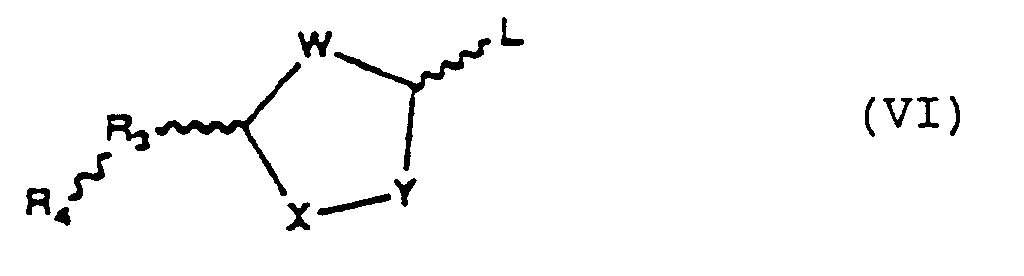
W is O, S, S=O, SO₂, NZ, or CH₂;
X is O, S, S=O, SO₂, NZ, CH₂ CHF, CH, CHN₃, or CHOH;
Y is O, S, CH₂, CH, CHF, or CHOH;
Z is hydrogen, hydroxyl, alkyl or acyl;
provided that when Y is CH₂ and X is O, S, S=O or SO₂, W is not O, S, S=O or SO₂; and further provided that when X is CH then Y is also CH;
R₃ is selected from the group consisting of carbonyl substituted with hydrogen, hydroxyl, trialkylsilyl, trialkylsiloxy, C₁₋₃₀ alkyl, C₇₋₃₀ aralkyl, C₁₋₃₀ alkoxy, C₁₋₃₀ amine (primary, secondary or tertiary), C₁₋₃₀ thiol, C₆₋₂₀ aryl, C₁₋ ₂₀ alkenyl, C₁₋₂₀ alkynyl; 1,2-dicarbonyl,
substituted with C₁₋₆ alkyl or C₆₋₂₀ aryl; anyhdride substituted with C₁₋₆ alkyl or C₆₋₂₀ aryl; azomethine substituted at nitrogen with hydrogen, C₁₋₂₀ alkyl or C₁₋₁₀ alkoxy or C₁₋₁₀ dialkylamino or at carbon with hydrogen, C₁₋₂₀ alkyl, or C₁₋₂₀ alkoxy; thiocarbonyl (C=S) substituted with hydroxyl, C₁₋₂₀ alkoxy, or C₁₋₂₀ thiol; homologues of carbonyl; homologues of thiocarbonyl and homologues of azomethine;
R₄ is a chiral auxiliary; and
L is a leaving group. - An intermediate of formula (VII)

W is O, S, S=O, SO₂, NZ, or CH₂;
X is O, S, S=O, SO₂, NZ, CH₂ CHF, CH, CHN₃, or CHOH;
Y is O, S, CH₂, CH, CHF, or CHOH;
Z is hydrogen, hydroxyl, alkyl or acyl; provided that when Y is CH₂ and X is O, S, S=O or SO₂, W is not O, S, S=O or SO₂; and further provided that when X is CH then Y is also CH;
R₂ is a purine or pyrimidine base or an analogue or derivative thereof;
R₃ is selected from the group consisting of carbonyl substituted with hydrogen, hydroxyl, trialkylsilyl, trialkylsiloxy, C₁₋₃₀ alkyl, C₇₋₃₀ aralkyl, C₁₋₃₀ alkoxy, C₁₋₃₀ amine (primary, secondary or tertiary), C₁₋₃₀ thiol, C₆₋₂₀ aryl, C₁₋₂₀ alkenyl, C₁₋₂₀ alkynyl; 1,2-dicarbonyl, substituted with C₁₋₆ alkyl or C₆₋₂₀ aryl; anyhdride substituted with C₁₋₆ alkyl or C₆₋₂₀ aryl; azomethine substituted at nitrogen with hydrogen, C₁₋₂₀ alkyl or C₁₋₁₀ alkoxy or C₁₋₁₀ dialkylamino or at carbon with hydrogen, C₁₋₂₀ alkyl, or C₁₋₂₀ alkoxy; thiocarbonyl (C=S) substituted with hydroxyl, C₁₋₂₀ alkoxy, or C₁₋₂₀ thiol; homologues of carbonyl; homologues of thiocarbonyl and homologues of azomethine; and
R₄ is a chiral auxiliary. - An intermediate of formula (VIII)

W is O, S, S=O, SO₂, NZ, or CH₂;
X is O, S, S=O, SO₂, NZ, CH₂ CHF, CH, CHN₃, or CHOH;
Y is O, S, CH₂, CH, CHF, or CHOH;
Z is hydrogen, hydroxyl, alkyl or acyl;
provided that when Y is CH₂ and X is O, S, S=O or SO₂, W is not O, S, S=O or SO₂;
R₂ is a purine or pyrimidine base or an analogue or derivative thereof;
provided that when X is CH then Y is also CH, and when X is CHN₃, then R₂ is not adenine or an analogue or derivative of adenine; and
R₃ is selected from the group consisting of carbonyl substituted with hydrogen, hydroxyl, trialkylsilyl, trialkylsiloxy, C₁₋₃₀ alkyl, C₇₋₃₀ aralkyl, C₁₋₃₀ alkoxy, C₁₋₃₀ amine (primary, secondary or tertiary), C₁₋₃₀ thiol, C₆₋₂₀ aryl, C₁₋₂₀ alkenyl, C₁₋₂₀ alkynyl; 1,2-dicarbonyl, substituted with C₁₋₆ alkyl or C₆₋₂₀ aryl; anyhdride substituted with C₁₋₆ alkyl or C₆₋₂₀ aryl; azomethine substituted at nitrogen with hydrogen, C₁₋₂₀ alkyl or C₁₋₁₀ alkoxy or C₁₋₁₀ dialkylamino or at carbon with hydrogen, C₁₋₂₀ alkyl, or C₁₋₂₀ alkoxy; thiocarbonyl (C=S) substituted with hydroxyl, C₁₋₂₀ alkoxy, or C₁₋₂₀ thiol; homologues of carbonyl; homologues of thiocarbonyl and homologues of azomethine. - An intermediate selected from the group consisting of:
cis and trans-2R-carboethoxy-5-hydroxytetrahydrofuran;
cis and trans-2S-carboethoxy-5-hydroxytetrahydrofuran;
cis and trans-2R-carboethoxy-5-acetoxytetrahydrofuran;
cis and trans-2S-carboethoxy-5-acetoxytetrahydrofuran;
1'S-(N-4-acetylcytosin-1-yl)-4'R-carboethoxytetrahydrofuran;
1'S-(cytosin-1-yl)-4'R-carboethoxytetrahydrofuran;
1'R-(5-fluorocytosin-1-yl)-4'S-carboethoxytetrahydrofuran and 1'S-(5-fluorocytosin-1-yl)-4'S-carboethoxytetrahydrofuran; and
1'S-(5-fluorocytosin-1-yl)-4'R-carboethoxytetrahydrofuran and 1'R-(5-fluorocytosin-1-yl)-4'R-carboethoxytetrahydrofuran.
Applications Claiming Priority (2)
| Application Number | Priority Date | Filing Date | Title |
|---|---|---|---|
| US70337991A | 1991-05-21 | 1991-05-21 | |
| US703379 | 1991-05-21 |
Publications (2)
| Publication Number | Publication Date |
|---|---|
| EP0515156A1 EP0515156A1 (en) | 1992-11-25 |
| EP0515156B1 true EP0515156B1 (en) | 1996-02-07 |
Family
ID=24825144
Family Applications (2)
| Application Number | Title | Priority Date | Filing Date |
|---|---|---|---|
| EP92304551A Expired - Lifetime EP0515156B1 (en) | 1991-05-21 | 1992-05-20 | Processes for the diastereo-selective synthesis of nucleosides |
| EP92304552A Expired - Lifetime EP0515157B1 (en) | 1991-05-21 | 1992-05-20 | Processes for the diastereoselective synthesis of nucleosides |
Family Applications After (1)
| Application Number | Title | Priority Date | Filing Date |
|---|---|---|---|
| EP92304552A Expired - Lifetime EP0515157B1 (en) | 1991-05-21 | 1992-05-20 | Processes for the diastereoselective synthesis of nucleosides |
Country Status (34)
| Country | Link |
|---|---|
| US (5) | US5756706A (en) |
| EP (2) | EP0515156B1 (en) |
| JP (3) | JP3330972B2 (en) |
| KR (3) | KR100232012B1 (en) |
| CN (6) | CN1038591C (en) |
| AT (2) | ATE133958T1 (en) |
| AU (4) | AU1690892A (en) |
| BG (2) | BG61695B1 (en) |
| CA (2) | CA2069063C (en) |
| CZ (3) | CZ280857B6 (en) |
| DE (2) | DE69221936T2 (en) |
| DK (2) | DK0515156T3 (en) |
| EE (1) | EE03044B1 (en) |
| ES (2) | ES2084937T3 (en) |
| FI (3) | FI106377B (en) |
| GR (2) | GR3018941T3 (en) |
| GT (1) | GT199800047A (en) |
| HK (2) | HK132196A (en) |
| HU (2) | HU221850B1 (en) |
| IE (2) | IE921618A1 (en) |
| IL (6) | IL101932A (en) |
| MD (1) | MD1155C2 (en) |
| MX (2) | MX9202404A (en) |
| NO (2) | NO300593B1 (en) |
| NZ (2) | NZ242817A (en) |
| OA (1) | OA10212A (en) |
| PL (3) | PL168910B1 (en) |
| RO (1) | RO116812B1 (en) |
| RU (4) | RU2223960C2 (en) |
| SG (1) | SG43863A1 (en) |
| SK (2) | SK281954B6 (en) |
| TW (4) | TW366349B (en) |
| WO (2) | WO1992020669A1 (en) |
| ZA (2) | ZA923641B (en) |
Cited By (9)
| Publication number | Priority date | Publication date | Assignee | Title |
|---|---|---|---|---|
| US7115584B2 (en) | 1999-01-22 | 2006-10-03 | Emory University | HIV-1 mutations selected for by β-2′,3′-didehydro-2′,3′-dideoxy-5-fluorocytidine |
| US7250416B2 (en) | 2005-03-11 | 2007-07-31 | Supergen, Inc. | Azacytosine analogs and derivatives |
| US7419966B2 (en) | 1995-01-27 | 2008-09-02 | Emory University | [5-carboxamido or 5-fluoro]-[2′,3′-unsaturated or 3′-modified]-pyrimidine nucleosides |
| US7635690B2 (en) | 1999-01-22 | 2009-12-22 | Emory University | HIV-1 mutations selected for by β-2′,3′-didehydro-2′,3′-dideoxy-5-fluorocytidine |
| US7700567B2 (en) | 2005-09-29 | 2010-04-20 | Supergen, Inc. | Oligonucleotide analogues incorporating 5-aza-cytosine therein |
| US8158605B2 (en) | 2007-09-26 | 2012-04-17 | Mount Sinai School Of Medicine | Azacytidine analogues and uses thereof |
| US9381207B2 (en) | 2011-08-30 | 2016-07-05 | Astex Pharmaceuticals, Inc. | Drug formulations |
| US10485764B2 (en) | 2015-07-02 | 2019-11-26 | Otsuka Pharmaceutical Co., Ltd. | Lyophilized pharmaceutical compositions |
| US10519190B2 (en) | 2017-08-03 | 2019-12-31 | Otsuka Pharmaceutical Co., Ltd. | Drug compound and purification methods thereof |
Families Citing this family (102)
| Publication number | Priority date | Publication date | Assignee | Title |
|---|---|---|---|---|
| US6350753B1 (en) | 1988-04-11 | 2002-02-26 | Biochem Pharma Inc. | 2-Substituted-4-substituted-1,3-dioxolanes and use thereof |
| US6903224B2 (en) | 1988-04-11 | 2005-06-07 | Biochem Pharma Inc. | Substituted 1,3-oxathiolanes |
| US5466806A (en) * | 1989-02-08 | 1995-11-14 | Biochem Pharma Inc. | Processes for preparing substituted 1,3-oxathiolanes with antiviral properties |
| US6175008B1 (en) | 1988-04-11 | 2001-01-16 | Biochem Pharma Inc. | Processes for preparing substituted 1,3-oxathiolanes with antiviral properties |
| ES2196004T3 (en) * | 1989-02-08 | 2003-12-16 | Iaf Biochem Int | PROCEDURE TO PREPARE 1,3-OXATIOLANS SUBSTITUTED WITH ANTIVIRAL PROPERTIES. |
| US5914331A (en) | 1990-02-01 | 1999-06-22 | Emory University | Antiviral activity and resolution of 2-hydroxymethyl-5-(5-fluorocytosin-1-yl)-1,3-oxathiolane |
| US5204466A (en) * | 1990-02-01 | 1993-04-20 | Emory University | Method and compositions for the synthesis of bch-189 and related compounds |
| US6703396B1 (en) | 1990-02-01 | 2004-03-09 | Emory University | Method of resolution and antiviral activity of 1,3-oxathiolane nuclesoside enantiomers |
| US5276151A (en) * | 1990-02-01 | 1994-01-04 | Emory University | Method of synthesis of 1,3-dioxolane nucleosides |
| US5827727A (en) | 1990-02-01 | 1998-10-27 | Emory University | Method of resolution of 1,3-oxathiolane nucleoside enantiomers |
| US5587480A (en) * | 1990-11-13 | 1996-12-24 | Biochem Pharma, Inc. | Substituted 1,3-oxathiolanes and substituted 1,3-dithiolanes with antiviral properties |
| US5444063A (en) * | 1990-12-05 | 1995-08-22 | Emory University | Enantiomerically pure β-D-dioxolane nucleosides with selective anti-Hepatitis B virus activity |
| US5925643A (en) * | 1990-12-05 | 1999-07-20 | Emory University | Enantiomerically pure β-D-dioxolane-nucleosides |
| US6812233B1 (en) | 1991-03-06 | 2004-11-02 | Emory University | Therapeutic nucleosides |
| US5817667A (en) * | 1991-04-17 | 1998-10-06 | University Of Georgia Research Foudation | Compounds and methods for the treatment of cancer |
| ZA923641B (en) * | 1991-05-21 | 1993-02-24 | Iaf Biochem Int | Processes for the diastereoselective synthesis of nucleosides |
| US6444656B1 (en) | 1992-12-23 | 2002-09-03 | Biochem Pharma, Inc. | Antiviral phosphonate nucleotides |
| GB9226879D0 (en) * | 1992-12-23 | 1993-02-17 | Iaf Biochem Int | Anti-viral compounds |
| US6005107A (en) * | 1992-12-23 | 1999-12-21 | Biochem Pharma, Inc. | Antiviral compounds |
| GB9226927D0 (en) * | 1992-12-24 | 1993-02-17 | Iaf Biochem Int | Dideoxy nucleoside analogues |
| US5627160A (en) * | 1993-05-25 | 1997-05-06 | Yale University | L-2',3'-dideoxy nucleoside analogs as anti-hepatitis B (HBV) and anti-HIV agents |
| TW374087B (en) * | 1993-05-25 | 1999-11-11 | Univ Yale | L-2',3'-dideoxy nucleotide analogs as anti-hepatitis B(HBV) and anti-HIV agents |
| GB9311709D0 (en) * | 1993-06-07 | 1993-07-21 | Iaf Biochem Int | Stereoselective synthesis of nucleoside analogues using bicycle intermediate |
| CA2637774C (en) | 1993-09-10 | 2011-07-19 | Emory University | Nucleosides with anti-hepatitis b virus activity |
| US20020120130A1 (en) | 1993-09-10 | 2002-08-29 | Gilles Gosselin | 2' or 3' -deoxy and 2', 3' -dideoxy-beta-L-pentofuranonucleo-side compounds, method of preparation and application in therapy, especially as anti- viral agents |
| US5587362A (en) * | 1994-01-28 | 1996-12-24 | Univ. Of Ga Research Foundation | L-nucleosides |
| IL113432A (en) * | 1994-04-23 | 2000-11-21 | Glaxo Group Ltd | Process for the diastereoselective synthesis of nucleoside analogues |
| GB9413724D0 (en) * | 1994-07-07 | 1994-08-24 | Wellcome Found | Therapeutic nucleosides |
| US6514949B1 (en) | 1994-07-11 | 2003-02-04 | University Of Virginia Patent Foundation | Method compositions for treating the inflammatory response |
| US6448235B1 (en) | 1994-07-11 | 2002-09-10 | University Of Virginia Patent Foundation | Method for treating restenosis with A2A adenosine receptor agonists |
| IL115156A (en) | 1994-09-06 | 2000-07-16 | Univ Georgia | Pharmaceutical compositions for the treatment of cancer comprising 1-(2-hydroxymethyl-1,3-dioxolan-4-yl) cytosines |
| US6391859B1 (en) | 1995-01-27 | 2002-05-21 | Emory University | [5-Carboxamido or 5-fluoro]-[2′,3′-unsaturated or 3′-modified]-pyrimidine nucleosides |
| US5808040A (en) * | 1995-01-30 | 1998-09-15 | Yale University | L-nucleosides incorporated into polymeric structure for stabilization of oligonucleotides |
| US5869461A (en) * | 1995-03-16 | 1999-02-09 | Yale University | Reducing toxicity of L-nucleosides with D-nucleosides |
| GB9506644D0 (en) * | 1995-03-31 | 1995-05-24 | Wellcome Found | Preparation of nucleoside analogues |
| ATE346651T1 (en) | 1995-06-07 | 2006-12-15 | Univ Emory | NUCLEOSIDES WITH ANTI-HEPATITIS B VIRUS EFFECTIVENESS |
| KR100213932B1 (en) * | 1995-11-02 | 1999-08-02 | 김충환 | Novel oligonucleoside derivatives and process for preparing the same |
| GB9600143D0 (en) | 1996-01-05 | 1996-03-06 | Wellcome Found | Therapeutic compounds |
| EP0799834A1 (en) * | 1996-04-04 | 1997-10-08 | Novartis AG | Modified nucleotides |
| US6005097A (en) * | 1996-06-14 | 1999-12-21 | Vion Pharmaceuticals, Inc. | Processes for high-yield diastereoselective synthesis of dideoxynucleosides |
| US5753789A (en) * | 1996-07-26 | 1998-05-19 | Yale University | Oligonucleotides containing L-nucleosides |
| US6022876A (en) | 1996-11-15 | 2000-02-08 | Yale University | L-β-dioxolane uridine analogs and methods for treating and preventing Epstein-Barr virus infections |
| WO1998035977A1 (en) | 1997-02-13 | 1998-08-20 | Glaxo Group Limited | Benzimidazole derivatives |
| WO1998044913A2 (en) | 1997-04-07 | 1998-10-15 | Triangle Pharmaceuticals, Inc. | Compositions containing mkc-442 in combination with other antiviral agents |
| PT994890E (en) | 1997-06-10 | 2003-11-28 | Glaxo Group Ltd | BENZIMIDAZOLE DERIVATIVES |
| EP1000080A1 (en) | 1997-07-30 | 2000-05-17 | The Regents of The University of Michigan | Lyxofuranosyl benzimidazoles as antiviral agents |
| US20030220234A1 (en) * | 1998-11-02 | 2003-11-27 | Selvaraj Naicker | Deuterated cyclosporine analogs and their use as immunodulating agents |
| YU44900A (en) | 1998-01-31 | 2003-01-31 | Glaxo Group Limited | 2-(purin-9-yl)-tetrahydrofuran-3,4-diol derivatives |
| JP4249393B2 (en) | 1998-08-12 | 2009-04-02 | トライアングル・ファーマシューティカルズ,インコーポレイテッド | Method for producing 1,3-oxathiolane nucleotide |
| US6979561B1 (en) | 1998-10-09 | 2005-12-27 | Gilead Sciences, Inc. | Non-homogeneous systems for the resolution of enantiomeric mixtures |
| DK1140937T3 (en) | 1998-12-23 | 2004-03-22 | Shire Biochem Inc | Antiviral nucleoside analogues |
| US7427606B2 (en) * | 1999-02-01 | 2008-09-23 | University Of Virginia Patent Foundation | Method to reduce inflammatory response in transplanted tissue |
| US6232297B1 (en) * | 1999-02-01 | 2001-05-15 | University Of Virginia Patent Foundation | Methods and compositions for treating inflammatory response |
| US7378400B2 (en) * | 1999-02-01 | 2008-05-27 | University Of Virginia Patent Foundation | Method to reduce an inflammatory response from arthritis |
| YU25500A (en) | 1999-05-11 | 2003-08-29 | Pfizer Products Inc. | Process for the synthesis of nucleosite analogues |
| US6322771B1 (en) | 1999-06-18 | 2001-11-27 | University Of Virginia Patent Foundation | Induction of pharmacological stress with adenosine receptor agonists |
| DE60011637T2 (en) | 1999-09-24 | 2004-11-11 | Shire Biochem Inc., Laval | DIOXOLAN NUCLEOSIDE ANALOGS FOR THE TREATMENT AND PREVENTION OF VIRAL INFECTIONS |
| AU1262001A (en) | 1999-11-04 | 2001-05-14 | Biochem Pharma Inc. | Method for the treatment or prevention of flaviviridae viral infection using nucleoside analogues |
| US6436948B1 (en) | 2000-03-03 | 2002-08-20 | University Of Georgia Research Foundation Inc. | Method for the treatment of psoriasis and genital warts |
| CA2308559C (en) * | 2000-05-16 | 2005-07-26 | Brantford Chemicals Inc. | 1,3-oxathiolan-5-ones useful in the production of antiviral nucleoside analogues |
| PT1574512E (en) | 2001-03-01 | 2008-03-05 | Abbott Lab | Polymorphic and other crystalline forms of cis-ftc |
| US6600044B2 (en) | 2001-06-18 | 2003-07-29 | Brantford Chemicals Inc. | Process for recovery of the desired cis-1,3-oxathiolane nucleosides from their undesired trans-isomers |
| SG176313A1 (en) * | 2001-10-01 | 2011-12-29 | Univ Virginia Patent Found | 2-propynyl adenosine analogs having a2a agonist activity and compositions thereof |
| WO2003033526A2 (en) | 2001-10-19 | 2003-04-24 | Isotechnika Inc. | Synthesis of cyclosporin analogs |
| ITMI20012317A1 (en) * | 2001-11-06 | 2003-05-06 | Recordati Ind Chimica E Farma | DIASTEREOSELECTIVE PROCESS FOR THE PREPARATION OF THE ANTIVIRAL AGENT4-AMINO-1- (2R-IDROSSIMETIL- / 1,3 / OSSATIOLAN-5S-I1) -1H-PIRIMIDIN-2-ONE |
| WO2003051298A2 (en) * | 2001-12-14 | 2003-06-26 | Pharmasset Ltd. | Preparation of intermediates useful in the synthesis of antiviral nucleosides |
| ATE548366T1 (en) | 2002-01-25 | 2012-03-15 | Shire Biochem Inc | METHOD FOR PRODUCING DIOXOLANE NUCLEOSIDE ANALOGO PRECURSORS |
| US7365173B2 (en) * | 2002-02-04 | 2008-04-29 | American National Red Cross | Method for the production of pure virally inactivated butyrylcholinesterase |
| US6855821B2 (en) | 2002-08-06 | 2005-02-15 | Pharmasset, Ltd. | Processes for preparing 1,3-dioxolane nucleosides |
| EA015145B1 (en) | 2003-01-14 | 2011-06-30 | Джилид Сайэнс, Инк. | Pharmaceutical compositions and oral pharmaceutical dosage form (variants), exhibiting activity relative to a hiv infection, a patient pack and a tablet |
| ITMI20030578A1 (en) * | 2003-03-24 | 2004-09-25 | Clariant Lsm Italia Spa | PROCESS AND INTERMEDIATES FOR THE PREPARATION OF EMTRICITABINE |
| CN101044122A (en) * | 2004-02-03 | 2007-09-26 | 埃莫里大学 | Method for preparing 1,3-dioxolane nucleoside |
| WO2006023272A1 (en) * | 2004-08-02 | 2006-03-02 | University Of Virginia Patent Foundation | 2-polycyclic propynyl adenosine analogs having a2a agonist activity |
| US7576069B2 (en) * | 2004-08-02 | 2009-08-18 | University Of Virginia Patent Foundation | 2-polycyclic propynyl adenosine analogs having A2A agonist activity |
| CA2576826C (en) * | 2004-08-02 | 2014-09-30 | University Of Virginia Patent Foundation | 2-propynyl adenosine analogs with modified 5'-ribose groups having a2a agonist activity |
| US20060042631A1 (en) * | 2004-08-31 | 2006-03-02 | Martin James F | Apparatus to deliver oxygen to a patient |
| RU2430919C2 (en) * | 2005-03-14 | 2011-10-10 | Шайр Канада Инк. | Methods of producing optically active cis-2-hydroxymethyl-4-(cytosin-1'-yl)-1,3-oxathiolane or pharmaceutically acceptable salts thereof |
| TWI375560B (en) | 2005-06-13 | 2012-11-01 | Gilead Sciences Inc | Composition comprising dry granulated emtricitabine and tenofovir df and method for making the same |
| TWI471145B (en) | 2005-06-13 | 2015-02-01 | Bristol Myers Squibb & Gilead Sciences Llc | Unitary pharmaceutical dosage form |
| WO2007077505A2 (en) * | 2005-12-30 | 2007-07-12 | Ranbaxy Laboratories Limited | Crystalline l-menthyl (2r, 5s)-5-(4-amino-5-fluoro-2-oxo-2h-pyrimidin-1-yl)[1, 3]oxathiolan-2-carboxylate and process for preparation thereof |
| US8178509B2 (en) * | 2006-02-10 | 2012-05-15 | University Of Virginia Patent Foundation | Method to treat sickle cell disease |
| US8188063B2 (en) * | 2006-06-19 | 2012-05-29 | University Of Virginia Patent Foundation | Use of adenosine A2A modulators to treat spinal cord injury |
| EP2086955A2 (en) * | 2006-10-30 | 2009-08-12 | Lupin Ltd. | An improved process for the manufacture of cis(-)-lamivudine |
| EP2227478A1 (en) * | 2007-11-29 | 2010-09-15 | Ranbaxy Laboratories Limited | Process and intermediates for the preparation of substituted 1, 3-oxathiolanes, especially lamivudine |
| WO2009069011A1 (en) * | 2007-11-29 | 2009-06-04 | Ranbaxy Laboratories Limited | Process for the preparation of substituted 1,3-oxathiolanes |
| US8350030B2 (en) | 2007-12-07 | 2013-01-08 | Matrix Laboratories Limited | Process for producing 5-fluoro-1-(2R, 5S)-[2-(hydroxymethyl)-1,3-oxathiolan-5-yl]cytosine |
| US8058259B2 (en) * | 2007-12-20 | 2011-11-15 | University Of Virginia Patent Foundation | Substituted 4-{3-[6-amino-9-(3,4-dihydroxy-tetrahydro-furan-2-yl)-9H-purin-2-yl]-prop-2-ynyl}-piperidine-1-carboxylic acid esters as A2AR agonists |
| CN103479584A (en) | 2008-05-02 | 2014-01-01 | 吉里德科学公司 | Use of solid carrier particles to improve the processability of pharmaceutical agent |
| US20110282046A1 (en) | 2009-01-19 | 2011-11-17 | Rama Shankar | Process for preparation of cis-nucleoside derivative |
| CN102307573B (en) | 2009-02-06 | 2013-09-11 | 吉里德科学公司 | Tablets for combination therapy |
| CA2786227A1 (en) * | 2010-01-08 | 2011-07-14 | Hetero Research Foundation | Improved process for nucleosides |
| UA105556C2 (en) | 2010-01-27 | 2014-05-26 | Віів Гелскер Компані | Combination of compounds comprising hiv integrase inhibitors with other therapeutical agents |
| WO2011095987A1 (en) * | 2010-02-03 | 2011-08-11 | Matrix Laboratories Ltd. | Novel process for the preparation of cis-nucleoside derivative |
| CA2792044A1 (en) | 2010-03-04 | 2011-09-09 | Ranbaxy Laboratories Limited | A process for stereoselective synthesis of 5-fluoro-1-(2r,5s)-[2-(hydroxymethyl)-1,3-oxathiolan-5-yl]cytosine |
| EP2377862A1 (en) | 2010-03-29 | 2011-10-19 | Esteve Química, S.A. | Process for obtaining emtricitabine |
| WO2011141805A2 (en) | 2010-05-14 | 2011-11-17 | Lupin Limited | An improved process for the manufacture of lamivudine |
| CN103221037A (en) | 2010-11-12 | 2013-07-24 | 葛兰素惠尔康制造业私人有限公司 | Novel pharmaceutical compositions |
| WO2013021290A1 (en) | 2011-08-05 | 2013-02-14 | Lupin Limited | A stereoselective process for preparation of 1,3-oxathiolane nucleosides |
| CN103242243B (en) * | 2013-01-08 | 2015-08-19 | 北京大学 | A kind of base triacetin ether-ether molecule, its chemical synthesis process and the application in field of gene thereof |
| CN103288806A (en) * | 2013-07-02 | 2013-09-11 | 山东大学 | Synthesis method of troxacitabine |
| CN105037340B (en) * | 2015-07-14 | 2018-08-10 | 福建广生堂药业股份有限公司 | A kind of preparation method of lamivudine key intermediate chiral isomer impurity |
| CN116375550B (en) * | 2023-04-21 | 2025-06-27 | 中南大学 | Method for resolving racemate compound by enantioselective reverse micelle extraction |
Citations (1)
| Publication number | Priority date | Publication date | Assignee | Title |
|---|---|---|---|---|
| EP0322384A1 (en) * | 1987-11-03 | 1989-06-28 | Medivir Aktiebolag | Nucleosides for use in therapy |
Family Cites Families (34)
| Publication number | Priority date | Publication date | Assignee | Title |
|---|---|---|---|---|
| US2895965A (en) | 1959-07-21 | Process for the production of | ||
| FR1445013A (en) * | 1964-07-09 | 1966-07-08 | Thomae Gmbh Dr K | Process for making new dioxolano-2-carboxylic acids |
| DE2508312A1 (en) * | 1975-02-24 | 1976-09-02 | Schering Ag | NEW PROCESS FOR THE PRODUCTION OF NUCLEOSIDES |
| US4383114A (en) * | 1977-02-09 | 1983-05-10 | Regents Of The University Of Minnesota | Adenosine deaminase resistant antiviral purine arabinonucleosides |
| US4182718A (en) | 1977-10-25 | 1980-01-08 | Monsanto Company | 1,3-Dioxolane and 1,3-dioxane polycarboxylates, and precursors thereof |
| US4231945A (en) * | 1978-11-08 | 1980-11-04 | Schering Corporation | S-5-(Azidomethyl or aminomethyl)-2-lower-alkoxytetrahydrofurans |
| US4212860A (en) | 1978-11-08 | 1980-07-15 | Schering Corporation | 4-O-(2,3,5-Trideoxy-5-amino-α-D-pentofuranosyl)-6-O-aminoglycosyl-1,3-diaminocyclitois, methods for their preparation, pharmaceutical formulations thereof and their use as antibacterial agents |
| US4479942A (en) * | 1981-08-10 | 1984-10-30 | Fujisawa Pharmaceutical Co., Ltd. | Tetrahydrofurnancarboxylic acid derivatives, processes for preparation thereof and pharmaceutical compositions thereof |
| US4855304A (en) * | 1985-01-10 | 1989-08-08 | Repligen Corporation | Dinucleoside pyrophosphates and pyrophosphate homologs as plant antivirals |
| DK363987A (en) * | 1986-08-08 | 1988-02-09 | Hoffmann La Roche | pyrimidine |
| GB8621268D0 (en) * | 1986-09-03 | 1986-10-08 | Univ Strathclyde | Separation of substances |
| US4997818A (en) * | 1987-09-21 | 1991-03-05 | The University Hospital | Therapeutic method for selectively treating terminal deoxynucleotidyl transferase-positive neoplastic leukemias and lymphomas |
| US4908440A (en) * | 1987-11-12 | 1990-03-13 | Bristol Myers Company | 2',3'-dideoxy-2'-fluoroarabinopyrimidine nucleosides |
| US4997926A (en) * | 1987-11-18 | 1991-03-05 | Scripps Clinic And Research Foundation | Deaminase-stable anti-retroviral 2-halo-2',3'-dideoxy |
| JPH022349A (en) * | 1988-02-17 | 1990-01-08 | Takeda Chem Ind Ltd | Pyrimidine analogue-tolerated gene dna and use thereof |
| US4904770A (en) * | 1988-03-24 | 1990-02-27 | Bristol-Myers Company | Production of 2',3'-dideoxy-2',3'-didehydronucleosides |
| US5047407A (en) * | 1989-02-08 | 1991-09-10 | Iaf Biochem International, Inc. | 2-substituted-5-substituted-1,3-oxathiolanes with antiviral properties |
| NZ228645A (en) * | 1988-04-11 | 1991-09-25 | Iaf Biochem Int | 1,3-dioxolane derivatives substituted in the 5th position by a purine or pyrimidine radical; treatment of viral infections |
| GB8815265D0 (en) * | 1988-06-27 | 1988-08-03 | Wellcome Found | Therapeutic nucleosides |
| DE3823127A1 (en) * | 1988-07-08 | 1990-01-11 | Rheinische Braunkohlenw Ag | DEVICE AND METHOD FOR PURIFYING WASTE WATER |
| US4987224A (en) * | 1988-08-02 | 1991-01-22 | University Of Georgia Research Foundation, Inc. | Method of preparation of 2',3'-dideoxynucleosides |
| DE3827134A1 (en) * | 1988-08-10 | 1990-03-15 | Bayer Ag | SUBSTITUTED TRIAZOLYL OR IMIDAZOLYL-HYDROXYALKYLDIOXOLANE, METHOD FOR THE PRODUCTION THEREOF AND THE USE THEREOF AS MICROBICIDES, OXIRANYLDIOXOLANES, DIOXOLANYLKETONE, OXIRANYLKETONE AND (ALPHA) -HALOGENICENETHENO ZERO DETECTED |
| US5075225A (en) * | 1989-04-06 | 1991-12-24 | The Texas A&M University System | Process for the enzymatic synthesis of nucleosides |
| NZ233197A (en) * | 1989-04-13 | 1991-11-26 | Richard Thomas Walker | Aromatically substituted nucleotide derivatives, intermediates therefor and pharmaceutical compositions |
| IE902574A1 (en) * | 1989-07-17 | 1991-02-27 | Univ Birmingham | Antiviral pyrimidine nucleosides |
| IE904378A1 (en) * | 1989-12-20 | 1991-07-03 | Abbott Lab | Analogs of oxetanyl purines and pyrimidines |
| US5204466A (en) * | 1990-02-01 | 1993-04-20 | Emory University | Method and compositions for the synthesis of bch-189 and related compounds |
| GB9009861D0 (en) * | 1990-05-02 | 1990-06-27 | Glaxo Group Ltd | Chemical compounds |
| GB9014090D0 (en) * | 1990-06-25 | 1990-08-15 | Zaadunie Bv | Improvements in or relating to organic compounds |
| AU9125991A (en) * | 1990-12-05 | 1992-07-08 | University Of Georgia Research Foundation, Inc., The | Enantiomerically pure beta -l-(-)-1,3-oxathiolane nucleosides |
| IL100965A (en) * | 1991-02-22 | 1999-12-31 | Univ Emory | 2-Hydroxymethyl-5-(5-fluorocytosin-l-yl)-1,3-oxathiolane its resolution and pharmaceutical compositions containing it |
| WO1992018517A1 (en) * | 1991-04-17 | 1992-10-29 | Yale University | Method of treating or preventing hepatitis b virus |
| GB9109506D0 (en) * | 1991-05-02 | 1991-06-26 | Wellcome Found | Therapeutic nucleosides |
| ZA923641B (en) * | 1991-05-21 | 1993-02-24 | Iaf Biochem Int | Processes for the diastereoselective synthesis of nucleosides |
-
1992
- 1992-05-19 ZA ZA923641A patent/ZA923641B/en unknown
- 1992-05-19 ZA ZA923640A patent/ZA923640B/en unknown
- 1992-05-20 IL IL101932A patent/IL101932A/en not_active IP Right Cessation
- 1992-05-20 DK DK92304551.2T patent/DK0515156T3/en active
- 1992-05-20 DK DK92304552.0T patent/DK0515157T3/en active
- 1992-05-20 US US08/142,389 patent/US5756706A/en not_active Expired - Fee Related
- 1992-05-20 RU RU99115480/04A patent/RU2223960C2/en active
- 1992-05-20 NO NO921989A patent/NO300593B1/en unknown
- 1992-05-20 AU AU16908/92A patent/AU1690892A/en not_active Abandoned
- 1992-05-20 WO PCT/CA1992/000211 patent/WO1992020669A1/en not_active Ceased
- 1992-05-20 AU AU16913/92A patent/AU1691392A/en not_active Abandoned
- 1992-05-20 AT AT92304551T patent/ATE133958T1/en not_active IP Right Cessation
- 1992-05-20 PL PL92301339A patent/PL168910B1/en not_active IP Right Cessation
- 1992-05-20 NO NO921988A patent/NO301010B1/en not_active IP Right Cessation
- 1992-05-20 IL IL10193192A patent/IL101931A/en not_active IP Right Cessation
- 1992-05-20 ES ES92304551T patent/ES2084937T3/en not_active Expired - Lifetime
- 1992-05-20 WO PCT/CA1992/000209 patent/WO1992020696A1/en not_active Ceased
- 1992-05-20 HU HU9303297A patent/HU221850B1/en active IP Right Grant
- 1992-05-20 SK SK1294-93A patent/SK281954B6/en not_active IP Right Cessation
- 1992-05-20 EP EP92304551A patent/EP0515156B1/en not_active Expired - Lifetime
- 1992-05-20 MD MD95-0172A patent/MD1155C2/en unknown
- 1992-05-20 SK SK1293-93A patent/SK279438B6/en not_active IP Right Cessation
- 1992-05-20 RO RO93-01554A patent/RO116812B1/en unknown
- 1992-05-20 CZ CZ932493A patent/CZ280857B6/en not_active IP Right Cessation
- 1992-05-20 EP EP92304552A patent/EP0515157B1/en not_active Expired - Lifetime
- 1992-05-20 ES ES92304552T patent/ES2104832T3/en not_active Expired - Lifetime
- 1992-05-20 NZ NZ242817A patent/NZ242817A/en not_active IP Right Cessation
- 1992-05-20 CZ CZ962224A patent/CZ222496A3/en not_active IP Right Cessation
- 1992-05-20 AU AU16394/92A patent/AU655973B2/en not_active Expired
- 1992-05-20 PL PL92309052A patent/PL176026B1/en unknown
- 1992-05-20 CA CA002069063A patent/CA2069063C/en not_active Expired - Lifetime
- 1992-05-20 KR KR1019920008694A patent/KR100232012B1/en not_active Expired - Lifetime
- 1992-05-20 CA CA002069024A patent/CA2069024C/en not_active Expired - Fee Related
- 1992-05-20 IL IL11610992A patent/IL116109A/en not_active IP Right Cessation
- 1992-05-20 DE DE69221936T patent/DE69221936T2/en not_active Expired - Lifetime
- 1992-05-20 PL PL92301340A patent/PL170869B1/en unknown
- 1992-05-20 HU HU9303296A patent/HU223838B1/en not_active IP Right Cessation
- 1992-05-20 IL IL116176A patent/IL116176A/en not_active IP Right Cessation
- 1992-05-20 SG SG1996003228A patent/SG43863A1/en unknown
- 1992-05-20 DE DE69208144T patent/DE69208144T2/en not_active Expired - Fee Related
- 1992-05-20 AU AU16395/92A patent/AU668086B2/en not_active Ceased
- 1992-05-20 KR KR1019920008507A patent/KR0160144B1/en not_active Expired - Fee Related
- 1992-05-20 AT AT92304552T patent/ATE157662T1/en active
- 1992-05-20 CZ CZ932492A patent/CZ285220B6/en not_active IP Right Cessation
- 1992-05-20 RU RU96119766/04A patent/RU2163909C2/en not_active IP Right Cessation
- 1992-05-20 RU RU93058554A patent/RU2105009C1/en not_active IP Right Cessation
- 1992-05-20 NZ NZ242818A patent/NZ242818A/en not_active IP Right Cessation
- 1992-05-20 RU RU93058362A patent/RU2140925C1/en active
- 1992-05-21 JP JP12916392A patent/JP3330972B2/en not_active Expired - Fee Related
- 1992-05-21 US US08/142,387 patent/US5696254A/en not_active Expired - Lifetime
- 1992-05-21 MX MX9202404A patent/MX9202404A/en unknown
- 1992-05-21 CN CN92103921A patent/CN1038591C/en not_active Expired - Lifetime
- 1992-05-21 MX MX9202395A patent/MX9202395A/en unknown
- 1992-05-21 CN CN92103924A patent/CN1035555C/en not_active Expired - Fee Related
- 1992-05-21 JP JP12915592A patent/JP3229013B2/en not_active Expired - Lifetime
- 1992-06-02 TW TW081104321A patent/TW366349B/en not_active IP Right Cessation
- 1992-06-02 TW TW081104323A patent/TW366350B/en not_active IP Right Cessation
- 1992-06-02 TW TW088109374A patent/TW467907B/en not_active IP Right Cessation
- 1992-06-02 TW TW088109433A patent/TWI245046B/en not_active IP Right Cessation
- 1992-07-01 IE IE161892A patent/IE921618A1/en not_active IP Right Cessation
- 1992-07-01 IE IE921619A patent/IE76741B1/en not_active IP Right Cessation
-
1993
- 1993-11-19 OA OA60440A patent/OA10212A/en unknown
- 1993-11-19 FI FI935151A patent/FI106377B/en not_active IP Right Cessation
- 1993-11-19 FI FI935150A patent/FI109025B/en active
- 1993-12-20 BG BG98310A patent/BG61695B1/en unknown
- 1993-12-20 BG BG98311A patent/BG61696B1/en unknown
-
1994
- 1994-10-20 EE EE9400283A patent/EE03044B1/en unknown
-
1995
- 1995-03-10 CN CN95102412A patent/CN1050603C/en not_active Expired - Lifetime
- 1995-06-05 US US08/464,960 patent/US5744596A/en not_active Expired - Fee Related
- 1995-06-05 US US08/464,317 patent/US5693787A/en not_active Expired - Lifetime
- 1995-06-05 US US08/460,856 patent/US5663320A/en not_active Expired - Lifetime
- 1995-11-23 IL IL11610995A patent/IL116109A0/en unknown
- 1995-11-28 IL IL11617695A patent/IL116176A0/en unknown
-
1996
- 1996-02-08 GR GR960400299T patent/GR3018941T3/en unknown
- 1996-07-18 HK HK132196A patent/HK132196A/en not_active IP Right Cessation
-
1997
- 1997-09-04 GR GR970400204T patent/GR3024617T3/en unknown
-
1998
- 1998-02-24 HK HK98101405A patent/HK1002431A1/en not_active IP Right Cessation
- 1998-03-04 GT GT199800047A patent/GT199800047A/en unknown
- 1998-12-03 CN CN98122383A patent/CN1109030C/en not_active Expired - Lifetime
- 1998-12-03 CN CN98122385A patent/CN1083450C/en not_active Expired - Lifetime
- 1998-12-03 CN CN98122384A patent/CN1097049C/en not_active Expired - Lifetime
-
1999
- 1999-07-12 KR KR1019990027976A patent/KR100242921B1/en not_active Expired - Lifetime
-
2000
- 2000-08-29 FI FI20001900A patent/FI20001900A7/en unknown
-
2001
- 2001-05-07 JP JP2001136217A patent/JP3704055B2/en not_active Expired - Lifetime
Patent Citations (1)
| Publication number | Priority date | Publication date | Assignee | Title |
|---|---|---|---|---|
| EP0322384A1 (en) * | 1987-11-03 | 1989-06-28 | Medivir Aktiebolag | Nucleosides for use in therapy |
Cited By (15)
| Publication number | Priority date | Publication date | Assignee | Title |
|---|---|---|---|---|
| US7419966B2 (en) | 1995-01-27 | 2008-09-02 | Emory University | [5-carboxamido or 5-fluoro]-[2′,3′-unsaturated or 3′-modified]-pyrimidine nucleosides |
| US7115584B2 (en) | 1999-01-22 | 2006-10-03 | Emory University | HIV-1 mutations selected for by β-2′,3′-didehydro-2′,3′-dideoxy-5-fluorocytidine |
| US7635690B2 (en) | 1999-01-22 | 2009-12-22 | Emory University | HIV-1 mutations selected for by β-2′,3′-didehydro-2′,3′-dideoxy-5-fluorocytidine |
| US7250416B2 (en) | 2005-03-11 | 2007-07-31 | Supergen, Inc. | Azacytosine analogs and derivatives |
| US9358248B2 (en) | 2005-09-29 | 2016-06-07 | Astex Pharmaceuticals, Inc. | Oligonucleotide analogues incorporating 5-aza-cytosine therein |
| US7700567B2 (en) | 2005-09-29 | 2010-04-20 | Supergen, Inc. | Oligonucleotide analogues incorporating 5-aza-cytosine therein |
| US9480698B2 (en) | 2005-09-29 | 2016-11-01 | Astex Pharmaceuticals, Inc. | Oligonucleotide analogues incorporating 5-aza-cytosine therein |
| US10456415B2 (en) | 2005-09-29 | 2019-10-29 | Astex Pharmaceuticals, Inc. | Oligonucleotide analogues incorporating 5-aza-cytosine therein |
| US10933079B2 (en) | 2005-09-29 | 2021-03-02 | Astex Pharmaceuticals, Inc. | Oligonucleotide analogues incorporating 5-aza-cytosine therein |
| US8158605B2 (en) | 2007-09-26 | 2012-04-17 | Mount Sinai School Of Medicine | Azacytidine analogues and uses thereof |
| US9381207B2 (en) | 2011-08-30 | 2016-07-05 | Astex Pharmaceuticals, Inc. | Drug formulations |
| US9913856B2 (en) | 2011-08-30 | 2018-03-13 | Astex Pharmaceuticals, Inc. | Drug formulations |
| US10517886B2 (en) | 2011-08-30 | 2019-12-31 | Astex Pharmaceuticals, Inc. | Drug formulations |
| US10485764B2 (en) | 2015-07-02 | 2019-11-26 | Otsuka Pharmaceutical Co., Ltd. | Lyophilized pharmaceutical compositions |
| US10519190B2 (en) | 2017-08-03 | 2019-12-31 | Otsuka Pharmaceutical Co., Ltd. | Drug compound and purification methods thereof |
Also Published As
Similar Documents
| Publication | Publication Date | Title |
|---|---|---|
| US5756706A (en) | Processes for the diastereoselective synthesis of nucleoside analogues | |
| US6051709A (en) | Process for the diastereoselective synthesis of nucleoside analogues | |
| HK1002431B (en) | Processes for the diastereoselective synthesis of nucleosides | |
| MXPA96004880A (en) | Procedure for the diasteros synthesiselectives of nucleus analogs |
Legal Events
| Date | Code | Title | Description |
|---|---|---|---|
| PUAI | Public reference made under article 153(3) epc to a published international application that has entered the european phase |
Free format text: ORIGINAL CODE: 0009012 |
|
| AK | Designated contracting states |
Kind code of ref document: A1 Designated state(s): AT BE CH DE DK ES FR GB GR IT LI LU MC NL PT SE |
|
| RIN1 | Information on inventor provided before grant (corrected) |
Inventor name: MANSOUR, TAREK Inventor name: TSE, ALLAN H.L. |
|
| 17P | Request for examination filed |
Effective date: 19930512 |
|
| 17Q | First examination report despatched |
Effective date: 19931202 |
|
| RAP1 | Party data changed (applicant data changed or rights of an application transferred) |
Owner name: BIOCHEM PHARMA INC. |
|
| GRAA | (expected) grant |
Free format text: ORIGINAL CODE: 0009210 |
|
| AK | Designated contracting states |
Kind code of ref document: B1 Designated state(s): AT BE CH DE DK ES FR GB GR IT LI LU MC NL PT SE |
|
| REF | Corresponds to: |
Ref document number: 133958 Country of ref document: AT Date of ref document: 19960215 Kind code of ref document: T |
|
| ITF | It: translation for a ep patent filed | ||
| REF | Corresponds to: |
Ref document number: 69208144 Country of ref document: DE Date of ref document: 19960321 |
|
| REG | Reference to a national code |
Ref country code: CH Ref legal event code: NV Representative=s name: ISLER & PEDRAZZINI AG PATENTANWAELTE |
|
| ET | Fr: translation filed | ||
| REG | Reference to a national code |
Ref country code: GR Ref legal event code: FG4A Free format text: 3018941 |
|
| REG | Reference to a national code |
Ref country code: ES Ref legal event code: FG2A Ref document number: 2084937 Country of ref document: ES Kind code of ref document: T3 |
|
| REG | Reference to a national code |
Ref country code: DK Ref legal event code: T3 |
|
| SC4A | Pt: translation is available |
Free format text: 960207 AVAILABILITY OF NATIONAL TRANSLATION |
|
| PLBE | No opposition filed within time limit |
Free format text: ORIGINAL CODE: 0009261 |
|
| STAA | Information on the status of an ep patent application or granted ep patent |
Free format text: STATUS: NO OPPOSITION FILED WITHIN TIME LIMIT |
|
| 26N | No opposition filed | ||
| REG | Reference to a national code |
Ref country code: GB Ref legal event code: IF02 |
|
| REG | Reference to a national code |
Ref country code: CH Ref legal event code: PFA Owner name: SHIRE BIOCHEM INC. Free format text: BIOCHEM PHARMA INC.#275 ARMAND-FRAPPIER BOULEVARD#LAVAL, QUEBEC H7V 4A7 (CA) -TRANSFER TO- SHIRE BIOCHEM INC.#2250 ALFRED NOBEL BLVD SUITE 500#ST-LAURENT, QUEBEC H4S 2C9 (CA) |
|
| REG | Reference to a national code |
Ref country code: PT Ref legal event code: PD4A Owner name: SHIRE BIOCHEM INC., CA Effective date: 20060719 Ref country code: PT Ref legal event code: TE4A Owner name: SHIRE BIOCHEM INC., CA Effective date: 20060719 |
|
| NLT1 | Nl: modifications of names registered in virtue of documents presented to the patent office pursuant to art. 16 a, paragraph 1 |
Owner name: SHIRE BIOCHEM INC. |
|
| REG | Reference to a national code |
Ref country code: FR Ref legal event code: CA Ref country code: FR Ref legal event code: CD |
|
| REG | Reference to a national code |
Ref country code: CH Ref legal event code: PCAR Free format text: ISLER & PEDRAZZINI AG;POSTFACH 1772;8027 ZUERICH (CH) |
|
| BECN | Be: change of holder's name |
Owner name: SHIRE CANADA INC. Effective date: 20061019 |
|
| REG | Reference to a national code |
Ref country code: PT Ref legal event code: PD4A Owner name: SHIRE CANADA INC., CA Effective date: 20080110 |
|
| REG | Reference to a national code |
Ref country code: CH Ref legal event code: PFA Owner name: SHIRE CANADA INC. Free format text: SHIRE BIOCHEM INC.#2250 ALFRED NOBEL BLVD SUITE 500#ST-LAURENT, QUEBEC H4S 2C9 (CA) -TRANSFER TO- SHIRE CANADA INC.#2250 ALFRED NOBEL BLVD. SUITE 500#ST-LAURENT, QUEBEC H4S 2C9 (CA) |
|
| NLT1 | Nl: modifications of names registered in virtue of documents presented to the patent office pursuant to art. 16 a, paragraph 1 |
Owner name: SHIRE CANADA INC. |
|
| PGFP | Annual fee paid to national office [announced via postgrant information from national office to epo] |
Ref country code: IT Payment date: 20080326 Year of fee payment: 17 Ref country code: PT Payment date: 20080305 Year of fee payment: 17 |
|
| PGFP | Annual fee paid to national office [announced via postgrant information from national office to epo] |
Ref country code: DK Payment date: 20080508 Year of fee payment: 17 Ref country code: CH Payment date: 20080530 Year of fee payment: 17 Ref country code: DE Payment date: 20080523 Year of fee payment: 17 Ref country code: ES Payment date: 20080505 Year of fee payment: 17 Ref country code: LU Payment date: 20080425 Year of fee payment: 17 |
|
| PGFP | Annual fee paid to national office [announced via postgrant information from national office to epo] |
Ref country code: AT Payment date: 20080515 Year of fee payment: 17 |
|
| PGFP | Annual fee paid to national office [announced via postgrant information from national office to epo] |
Ref country code: MC Payment date: 20080407 Year of fee payment: 17 Ref country code: BE Payment date: 20080411 Year of fee payment: 17 |
|
| REG | Reference to a national code |
Ref country code: FR Ref legal event code: CD |
|
| PGFP | Annual fee paid to national office [announced via postgrant information from national office to epo] |
Ref country code: NL Payment date: 20080516 Year of fee payment: 17 Ref country code: SE Payment date: 20080512 Year of fee payment: 17 |
|
| PGFP | Annual fee paid to national office [announced via postgrant information from national office to epo] |
Ref country code: FR Payment date: 20080328 Year of fee payment: 17 |
|
| PGFP | Annual fee paid to national office [announced via postgrant information from national office to epo] |
Ref country code: GB Payment date: 20080430 Year of fee payment: 17 |
|
| PGFP | Annual fee paid to national office [announced via postgrant information from national office to epo] |
Ref country code: GR Payment date: 20080321 Year of fee payment: 17 |
|
| BERE | Be: lapsed |
Owner name: SHIRE CANADA INC. Effective date: 20090531 |
|
| REG | Reference to a national code |
Ref country code: PT Ref legal event code: MM4A Free format text: LAPSE DUE TO NON-PAYMENT OF FEES Effective date: 20091120 |
|
| PG25 | Lapsed in a contracting state [announced via postgrant information from national office to epo] |
Ref country code: MC Free format text: LAPSE BECAUSE OF NON-PAYMENT OF DUE FEES Effective date: 20090531 |
|
| REG | Reference to a national code |
Ref country code: CH Ref legal event code: PL |
|
| REG | Reference to a national code |
Ref country code: DK Ref legal event code: EBP |
|
| GBPC | Gb: european patent ceased through non-payment of renewal fee |
Effective date: 20090520 |
|
| PG25 | Lapsed in a contracting state [announced via postgrant information from national office to epo] |
Ref country code: CH Free format text: LAPSE BECAUSE OF NON-PAYMENT OF DUE FEES Effective date: 20090531 Ref country code: LI Free format text: LAPSE BECAUSE OF NON-PAYMENT OF DUE FEES Effective date: 20090531 Ref country code: AT Free format text: LAPSE BECAUSE OF NON-PAYMENT OF DUE FEES Effective date: 20090520 |
|
| NLV4 | Nl: lapsed or anulled due to non-payment of the annual fee |
Effective date: 20091201 |
|
| PG25 | Lapsed in a contracting state [announced via postgrant information from national office to epo] |
Ref country code: NL Free format text: LAPSE BECAUSE OF NON-PAYMENT OF DUE FEES Effective date: 20091201 |
|
| REG | Reference to a national code |
Ref country code: FR Ref legal event code: ST Effective date: 20100129 |
|
| PG25 | Lapsed in a contracting state [announced via postgrant information from national office to epo] |
Ref country code: PT Free format text: LAPSE BECAUSE OF NON-PAYMENT OF DUE FEES Effective date: 20091120 |
|
| PG25 | Lapsed in a contracting state [announced via postgrant information from national office to epo] |
Ref country code: FR Free format text: LAPSE BECAUSE OF NON-PAYMENT OF DUE FEES Effective date: 20090602 Ref country code: DK Free format text: LAPSE BECAUSE OF NON-PAYMENT OF DUE FEES Effective date: 20090531 |
|
| PG25 | Lapsed in a contracting state [announced via postgrant information from national office to epo] |
Ref country code: GB Free format text: LAPSE BECAUSE OF NON-PAYMENT OF DUE FEES Effective date: 20090520 |
|
| PG25 | Lapsed in a contracting state [announced via postgrant information from national office to epo] |
Ref country code: GR Free format text: LAPSE BECAUSE OF NON-PAYMENT OF DUE FEES Effective date: 20091202 Ref country code: DE Free format text: LAPSE BECAUSE OF NON-PAYMENT OF DUE FEES Effective date: 20091201 Ref country code: BE Free format text: LAPSE BECAUSE OF NON-PAYMENT OF DUE FEES Effective date: 20090531 |
|
| REG | Reference to a national code |
Ref country code: ES Ref legal event code: FD2A Effective date: 20090521 |
|
| PG25 | Lapsed in a contracting state [announced via postgrant information from national office to epo] |
Ref country code: ES Free format text: LAPSE BECAUSE OF NON-PAYMENT OF DUE FEES Effective date: 20090521 |
|
| PG25 | Lapsed in a contracting state [announced via postgrant information from national office to epo] |
Ref country code: IT Free format text: LAPSE BECAUSE OF NON-PAYMENT OF DUE FEES Effective date: 20090520 |
|
| PG25 | Lapsed in a contracting state [announced via postgrant information from national office to epo] |
Ref country code: LU Free format text: LAPSE BECAUSE OF NON-PAYMENT OF DUE FEES Effective date: 20090520 |
|
| PG25 | Lapsed in a contracting state [announced via postgrant information from national office to epo] |
Ref country code: SE Free format text: LAPSE BECAUSE OF NON-PAYMENT OF DUE FEES Effective date: 20090521 |