EP0514935B1 - Novel benzopyran derivatives and processes for the preparation thereof - Google Patents
Novel benzopyran derivatives and processes for the preparation thereof Download PDFInfo
- Publication number
- EP0514935B1 EP0514935B1 EP92108703A EP92108703A EP0514935B1 EP 0514935 B1 EP0514935 B1 EP 0514935B1 EP 92108703 A EP92108703 A EP 92108703A EP 92108703 A EP92108703 A EP 92108703A EP 0514935 B1 EP0514935 B1 EP 0514935B1
- Authority
- EP
- European Patent Office
- Prior art keywords
- benzopyran
- formula
- methyl
- oxo
- derivative
- Prior art date
- Legal status (The legal status is an assumption and is not a legal conclusion. Google has not performed a legal analysis and makes no representation as to the accuracy of the status listed.)
- Expired - Lifetime
Links
- 150000001562 benzopyrans Chemical class 0.000 title claims abstract description 22
- 238000000034 method Methods 0.000 title abstract description 27
- 238000002360 preparation method Methods 0.000 title description 13
- 150000001875 compounds Chemical class 0.000 claims abstract description 154
- 125000004435 hydrogen atom Chemical group [H]* 0.000 claims abstract description 16
- 125000004169 (C1-C6) alkyl group Chemical group 0.000 claims abstract description 15
- 125000000217 alkyl group Chemical group 0.000 claims abstract description 12
- 125000001997 phenyl group Chemical group [H]C1=C([H])C([H])=C(*)C([H])=C1[H] 0.000 claims abstract description 12
- 125000000449 nitro group Chemical group [O-][N+](*)=O 0.000 claims abstract description 10
- 229910052760 oxygen Inorganic materials 0.000 claims abstract description 8
- 229910052717 sulfur Inorganic materials 0.000 claims abstract description 8
- 239000008194 pharmaceutical composition Substances 0.000 claims abstract description 7
- 125000006273 (C1-C3) alkyl group Chemical group 0.000 claims abstract description 6
- 239000000460 chlorine Substances 0.000 claims abstract description 6
- 229910052801 chlorine Inorganic materials 0.000 claims abstract description 6
- 229910052731 fluorine Inorganic materials 0.000 claims abstract description 6
- 125000005843 halogen group Chemical group 0.000 claims abstract description 6
- 239000004480 active ingredient Substances 0.000 claims abstract description 5
- 125000004191 (C1-C6) alkoxy group Chemical group 0.000 claims abstract description 3
- KZBUYRJDOAKODT-UHFFFAOYSA-N Chlorine Chemical compound ClCl KZBUYRJDOAKODT-UHFFFAOYSA-N 0.000 claims abstract description 3
- PXGOKWXKJXAPGV-UHFFFAOYSA-N Fluorine Chemical compound FF PXGOKWXKJXAPGV-UHFFFAOYSA-N 0.000 claims abstract description 3
- 125000001797 benzyl group Chemical group [H]C1=C([H])C([H])=C(C([H])=C1[H])C([H])([H])* 0.000 claims abstract description 3
- 125000001559 cyclopropyl group Chemical group [H]C1([H])C([H])([H])C1([H])* 0.000 claims abstract description 3
- 125000004186 cyclopropylmethyl group Chemical group [H]C([H])(*)C1([H])C([H])([H])C1([H])[H] 0.000 claims abstract description 3
- 239000011737 fluorine Substances 0.000 claims abstract description 3
- 125000002924 primary amino group Chemical group [H]N([H])* 0.000 claims abstract description 3
- 230000001476 alcoholic effect Effects 0.000 claims description 13
- 239000003054 catalyst Substances 0.000 claims description 9
- 239000004593 Epoxy Substances 0.000 claims description 7
- 239000003795 chemical substances by application Substances 0.000 claims description 6
- LFQSCWFLJHTTHZ-UHFFFAOYSA-N Ethanol Chemical compound CCO LFQSCWFLJHTTHZ-UHFFFAOYSA-N 0.000 claims description 4
- 238000004519 manufacturing process Methods 0.000 claims description 4
- 125000000876 trifluoromethoxy group Chemical group FC(F)(F)O* 0.000 claims description 4
- 229910052799 carbon Inorganic materials 0.000 claims description 3
- 238000009833 condensation Methods 0.000 claims description 3
- 230000005494 condensation Effects 0.000 claims description 3
- 150000002148 esters Chemical class 0.000 claims description 3
- 230000001737 promoting effect Effects 0.000 claims description 3
- OKTJSMMVPCPJKN-UHFFFAOYSA-N Carbon Chemical compound [C] OKTJSMMVPCPJKN-UHFFFAOYSA-N 0.000 claims description 2
- 150000002009 diols Chemical class 0.000 claims description 2
- 230000003301 hydrolyzing effect Effects 0.000 claims description 2
- 230000000269 nucleophilic effect Effects 0.000 claims description 2
- 150000007524 organic acids Chemical class 0.000 claims description 2
- RVEZZJVBDQCTEF-UHFFFAOYSA-N sulfenic acid Chemical compound SO RVEZZJVBDQCTEF-UHFFFAOYSA-N 0.000 claims description 2
- 230000000694 effects Effects 0.000 abstract description 12
- 206010020772 Hypertension Diseases 0.000 abstract description 6
- 210000002464 muscle smooth vascular Anatomy 0.000 abstract description 4
- 230000036772 blood pressure Effects 0.000 abstract description 3
- XEKOWRVHYACXOJ-UHFFFAOYSA-N Ethyl acetate Chemical compound CCOC(C)=O XEKOWRVHYACXOJ-UHFFFAOYSA-N 0.000 description 188
- VLKZOEOYAKHREP-UHFFFAOYSA-N n-Hexane Chemical compound CCCCCC VLKZOEOYAKHREP-UHFFFAOYSA-N 0.000 description 90
- 239000000243 solution Substances 0.000 description 89
- 230000015572 biosynthetic process Effects 0.000 description 59
- 238000003786 synthesis reaction Methods 0.000 description 59
- 239000000203 mixture Substances 0.000 description 55
- YXFVVABEGXRONW-UHFFFAOYSA-N Toluene Chemical compound CC1=CC=CC=C1 YXFVVABEGXRONW-UHFFFAOYSA-N 0.000 description 45
- XLYOFNOQVPJJNP-UHFFFAOYSA-N water Substances O XLYOFNOQVPJJNP-UHFFFAOYSA-N 0.000 description 45
- HEDRZPFGACZZDS-MICDWDOJSA-N Trichloro(2H)methane Chemical compound [2H]C(Cl)(Cl)Cl HEDRZPFGACZZDS-MICDWDOJSA-N 0.000 description 42
- YMWUJEATGCHHMB-UHFFFAOYSA-N Dichloromethane Chemical compound ClCCl YMWUJEATGCHHMB-UHFFFAOYSA-N 0.000 description 37
- CSNNHWWHGAXBCP-UHFFFAOYSA-L Magnesium sulfate Chemical compound [Mg+2].[O-][S+2]([O-])([O-])[O-] CSNNHWWHGAXBCP-UHFFFAOYSA-L 0.000 description 36
- OKKJLVBELUTLKV-UHFFFAOYSA-N Methanol Chemical compound OC OKKJLVBELUTLKV-UHFFFAOYSA-N 0.000 description 36
- 238000006243 chemical reaction Methods 0.000 description 35
- FAPWRFPIFSIZLT-UHFFFAOYSA-M Sodium chloride Chemical class [Na+].[Cl-] FAPWRFPIFSIZLT-UHFFFAOYSA-M 0.000 description 33
- HEMHJVSKTPXQMS-UHFFFAOYSA-M Sodium hydroxide Chemical compound [OH-].[Na+] HEMHJVSKTPXQMS-UHFFFAOYSA-M 0.000 description 33
- 239000002904 solvent Substances 0.000 description 33
- 238000010898 silica gel chromatography Methods 0.000 description 31
- 239000003480 eluent Substances 0.000 description 25
- 239000011541 reaction mixture Substances 0.000 description 24
- 238000005160 1H NMR spectroscopy Methods 0.000 description 23
- HEDRZPFGACZZDS-UHFFFAOYSA-N Chloroform Chemical compound ClC(Cl)Cl HEDRZPFGACZZDS-UHFFFAOYSA-N 0.000 description 20
- 238000010992 reflux Methods 0.000 description 18
- 239000002585 base Substances 0.000 description 16
- RYHBNJHYFVUHQT-UHFFFAOYSA-N 1,4-Dioxane Chemical compound C1COCCO1 RYHBNJHYFVUHQT-UHFFFAOYSA-N 0.000 description 15
- ZMXDDKWLCZADIW-UHFFFAOYSA-N N,N-Dimethylformamide Chemical compound CN(C)C=O ZMXDDKWLCZADIW-UHFFFAOYSA-N 0.000 description 15
- 239000007787 solid Substances 0.000 description 14
- IAZDPXIOMUYVGZ-UHFFFAOYSA-N Dimethylsulphoxide Chemical compound CS(C)=O IAZDPXIOMUYVGZ-UHFFFAOYSA-N 0.000 description 13
- RWRDLPDLKQPQOW-UHFFFAOYSA-N Pyrrolidine Chemical compound C1CCNC1 RWRDLPDLKQPQOW-UHFFFAOYSA-N 0.000 description 11
- UIIMBOGNXHQVGW-UHFFFAOYSA-M Sodium bicarbonate Chemical compound [Na+].OC([O-])=O UIIMBOGNXHQVGW-UHFFFAOYSA-M 0.000 description 11
- JOXIMZWYDAKGHI-UHFFFAOYSA-N toluene-4-sulfonic acid Chemical compound CC1=CC=C(S(O)(=O)=O)C=C1 JOXIMZWYDAKGHI-UHFFFAOYSA-N 0.000 description 11
- CSCPPACGZOOCGX-UHFFFAOYSA-N Acetone Chemical compound CC(C)=O CSCPPACGZOOCGX-UHFFFAOYSA-N 0.000 description 10
- 238000004440 column chromatography Methods 0.000 description 10
- 125000000956 methoxy group Chemical group [H]C([H])([H])O* 0.000 description 10
- 239000011369 resultant mixture Substances 0.000 description 10
- LYCAIKOWRPUZTN-UHFFFAOYSA-N Ethylene glycol Chemical compound OCCO LYCAIKOWRPUZTN-UHFFFAOYSA-N 0.000 description 9
- 239000007864 aqueous solution Substances 0.000 description 9
- 239000012044 organic layer Substances 0.000 description 9
- SPEUIVXLLWOEMJ-UHFFFAOYSA-N 1,1-dimethoxyethane Chemical compound COC(C)OC SPEUIVXLLWOEMJ-UHFFFAOYSA-N 0.000 description 8
- AIJULSRZWUXGPQ-UHFFFAOYSA-N Methylglyoxal Chemical compound CC(=O)C=O AIJULSRZWUXGPQ-UHFFFAOYSA-N 0.000 description 8
- JGFZNNIVVJXRND-UHFFFAOYSA-N N,N-Diisopropylethylamine (DIPEA) Chemical compound CCN(C(C)C)C(C)C JGFZNNIVVJXRND-UHFFFAOYSA-N 0.000 description 8
- DKGAVHZHDRPRBM-UHFFFAOYSA-N Tert-Butanol Chemical compound CC(C)(C)O DKGAVHZHDRPRBM-UHFFFAOYSA-N 0.000 description 8
- 229910052943 magnesium sulfate Inorganic materials 0.000 description 8
- 235000019341 magnesium sulphate Nutrition 0.000 description 8
- 238000003756 stirring Methods 0.000 description 8
- VHYFNPMBLIVWCW-UHFFFAOYSA-N 4-Dimethylaminopyridine Chemical compound CN(C)C1=CC=NC=C1 VHYFNPMBLIVWCW-UHFFFAOYSA-N 0.000 description 7
- WMFOQBRAJBCJND-UHFFFAOYSA-M Lithium hydroxide Chemical compound [Li+].[OH-] WMFOQBRAJBCJND-UHFFFAOYSA-M 0.000 description 7
- UHOVQNZJYSORNB-UHFFFAOYSA-N Benzene Chemical compound C1=CC=CC=C1 UHOVQNZJYSORNB-UHFFFAOYSA-N 0.000 description 6
- RTZKZFJDLAIYFH-UHFFFAOYSA-N Diethyl ether Chemical compound CCOCC RTZKZFJDLAIYFH-UHFFFAOYSA-N 0.000 description 6
- VEXZGXHMUGYJMC-UHFFFAOYSA-N Hydrochloric acid Chemical compound Cl VEXZGXHMUGYJMC-UHFFFAOYSA-N 0.000 description 6
- PCLIMKBDDGJMGD-UHFFFAOYSA-N N-bromosuccinimide Chemical compound BrN1C(=O)CCC1=O PCLIMKBDDGJMGD-UHFFFAOYSA-N 0.000 description 6
- 239000007832 Na2SO4 Substances 0.000 description 6
- JUJWROOIHBZHMG-UHFFFAOYSA-N Pyridine Chemical compound C1=CC=NC=C1 JUJWROOIHBZHMG-UHFFFAOYSA-N 0.000 description 6
- KEAYESYHFKHZAL-UHFFFAOYSA-N Sodium Chemical compound [Na] KEAYESYHFKHZAL-UHFFFAOYSA-N 0.000 description 6
- PMZURENOXWZQFD-UHFFFAOYSA-L Sodium Sulfate Chemical compound [Na+].[Na+].[O-]S([O-])(=O)=O PMZURENOXWZQFD-UHFFFAOYSA-L 0.000 description 6
- WYURNTSHIVDZCO-UHFFFAOYSA-N Tetrahydrofuran Chemical compound C1CCOC1 WYURNTSHIVDZCO-UHFFFAOYSA-N 0.000 description 6
- 125000003118 aryl group Chemical group 0.000 description 6
- 125000004093 cyano group Chemical group *C#N 0.000 description 6
- LPNYRYFBWFDTMA-UHFFFAOYSA-N potassium tert-butoxide Chemical compound [K+].CC(C)(C)[O-] LPNYRYFBWFDTMA-UHFFFAOYSA-N 0.000 description 6
- 239000012279 sodium borohydride Substances 0.000 description 6
- 229910000033 sodium borohydride Inorganic materials 0.000 description 6
- 239000012312 sodium hydride Substances 0.000 description 6
- 229910000104 sodium hydride Inorganic materials 0.000 description 6
- 229910052938 sodium sulfate Inorganic materials 0.000 description 6
- 235000011152 sodium sulphate Nutrition 0.000 description 6
- RNHDAKUGFHSZEV-UHFFFAOYSA-N 1,4-dioxane;hydrate Chemical compound O.C1COCCO1 RNHDAKUGFHSZEV-UHFFFAOYSA-N 0.000 description 5
- 239000012359 Methanesulfonyl chloride Substances 0.000 description 5
- QARBMVPHQWIHKH-UHFFFAOYSA-N methanesulfonyl chloride Chemical compound CS(Cl)(=O)=O QARBMVPHQWIHKH-UHFFFAOYSA-N 0.000 description 5
- -1 polymethylene Polymers 0.000 description 5
- VSCWAEJMTAWNJL-UHFFFAOYSA-K aluminium trichloride Chemical compound Cl[Al](Cl)Cl VSCWAEJMTAWNJL-UHFFFAOYSA-K 0.000 description 4
- 239000008280 blood Substances 0.000 description 4
- 210000004369 blood Anatomy 0.000 description 4
- 229910052794 bromium Inorganic materials 0.000 description 4
- 230000003197 catalytic effect Effects 0.000 description 4
- 239000000376 reactant Substances 0.000 description 4
- 235000017557 sodium bicarbonate Nutrition 0.000 description 4
- 229910000030 sodium bicarbonate Inorganic materials 0.000 description 4
- QTBSBXVTEAMEQO-UHFFFAOYSA-N Acetic acid Chemical compound CC(O)=O QTBSBXVTEAMEQO-UHFFFAOYSA-N 0.000 description 3
- 0 C1C2C1CC*2 Chemical compound C1C2C1CC*2 0.000 description 3
- VEXZGXHMUGYJMC-UHFFFAOYSA-M Chloride anion Chemical compound [Cl-] VEXZGXHMUGYJMC-UHFFFAOYSA-M 0.000 description 3
- KWYUFKZDYYNOTN-UHFFFAOYSA-M Potassium hydroxide Chemical compound [OH-].[K+] KWYUFKZDYYNOTN-UHFFFAOYSA-M 0.000 description 3
- 241000700159 Rattus Species 0.000 description 3
- 150000001298 alcohols Chemical class 0.000 description 3
- 125000003917 carbamoyl group Chemical group [H]N([H])C(*)=O 0.000 description 3
- 239000012153 distilled water Substances 0.000 description 3
- 150000002170 ethers Chemical class 0.000 description 3
- 229910052740 iodine Inorganic materials 0.000 description 3
- 239000007800 oxidant agent Substances 0.000 description 3
- UMJSCPRVCHMLSP-UHFFFAOYSA-N pyridine Natural products COC1=CC=CN=C1 UMJSCPRVCHMLSP-UHFFFAOYSA-N 0.000 description 3
- FVAUCKIRQBBSSJ-UHFFFAOYSA-M sodium iodide Chemical compound [Na+].[I-] FVAUCKIRQBBSSJ-UHFFFAOYSA-M 0.000 description 3
- 239000007858 starting material Substances 0.000 description 3
- 125000002023 trifluoromethyl group Chemical group FC(F)(F)* 0.000 description 3
- 125000004178 (C1-C4) alkyl group Chemical group 0.000 description 2
- 125000004916 (C1-C6) alkylcarbonyl group Chemical group 0.000 description 2
- PQXKWPLDPFFDJP-UHFFFAOYSA-N 2,3-dimethyloxirane Chemical compound CC1OC1C PQXKWPLDPFFDJP-UHFFFAOYSA-N 0.000 description 2
- ITMHPCUIFIBMNM-UHFFFAOYSA-N 2-(dimethoxymethyl)-2-methyl-1a,7b-dihydrooxireno[2,3-c]chromene-6-carbonitrile Chemical compound COC(OC)C1(C)OC2=CC=C(C#N)C=C2C2C1O2 ITMHPCUIFIBMNM-UHFFFAOYSA-N 0.000 description 2
- IUCVZCYPEDRIRJ-UHFFFAOYSA-N 2-(dimethoxymethyl)-2-methyl-6-nitro-1a,7b-dihydrooxireno[2,3-c]chromene Chemical compound COC(OC)C1(C)OC2=CC=C([N+]([O-])=O)C=C2C2C1O2 IUCVZCYPEDRIRJ-UHFFFAOYSA-N 0.000 description 2
- YYROPELSRYBVMQ-UHFFFAOYSA-N 4-toluenesulfonyl chloride Chemical compound CC1=CC=C(S(Cl)(=O)=O)C=C1 YYROPELSRYBVMQ-UHFFFAOYSA-N 0.000 description 2
- TVZCRIROJQEVOT-CABCVRRESA-N Cromakalim Chemical compound N1([C@@H]2C3=CC(=CC=C3OC([C@H]2O)(C)C)C#N)CCCC1=O TVZCRIROJQEVOT-CABCVRRESA-N 0.000 description 2
- DIWVBIXQCNRCFE-UHFFFAOYSA-N DL-alpha-Methoxyphenylacetic acid Chemical compound COC(C(O)=O)C1=CC=CC=C1 DIWVBIXQCNRCFE-UHFFFAOYSA-N 0.000 description 2
- NTYJJOPFIAHURM-UHFFFAOYSA-N Histamine Chemical compound NCCC1=CN=CN1 NTYJJOPFIAHURM-UHFFFAOYSA-N 0.000 description 2
- MHAJPDPJQMAIIY-UHFFFAOYSA-N Hydrogen peroxide Chemical compound OO MHAJPDPJQMAIIY-UHFFFAOYSA-N 0.000 description 2
- 239000002841 Lewis acid Substances 0.000 description 2
- JRNVZBWKYDBUCA-UHFFFAOYSA-N N-chlorosuccinimide Chemical compound ClN1C(=O)CCC1=O JRNVZBWKYDBUCA-UHFFFAOYSA-N 0.000 description 2
- JCXJVPUVTGWSNB-UHFFFAOYSA-N Nitrogen dioxide Chemical compound O=[N]=O JCXJVPUVTGWSNB-UHFFFAOYSA-N 0.000 description 2
- DTQVDTLACAAQTR-UHFFFAOYSA-N Trifluoroacetic acid Chemical compound OC(=O)C(F)(F)F DTQVDTLACAAQTR-UHFFFAOYSA-N 0.000 description 2
- 239000003377 acid catalyst Substances 0.000 description 2
- 125000004453 alkoxycarbonyl group Chemical group 0.000 description 2
- MDFFNEOEWAXZRQ-UHFFFAOYSA-N aminyl Chemical compound [NH2] MDFFNEOEWAXZRQ-UHFFFAOYSA-N 0.000 description 2
- 238000009835 boiling Methods 0.000 description 2
- WTEOIRVLGSZEPR-UHFFFAOYSA-N boron trifluoride Chemical compound FB(F)F WTEOIRVLGSZEPR-UHFFFAOYSA-N 0.000 description 2
- 125000001589 carboacyl group Chemical group 0.000 description 2
- 210000004027 cell Anatomy 0.000 description 2
- 229950004210 cromakalim Drugs 0.000 description 2
- 239000003814 drug Substances 0.000 description 2
- 229940079593 drug Drugs 0.000 description 2
- 125000002485 formyl group Chemical group [H]C(*)=O 0.000 description 2
- 229910052736 halogen Inorganic materials 0.000 description 2
- 150000002367 halogens Chemical group 0.000 description 2
- 150000003944 halohydrins Chemical class 0.000 description 2
- 238000010438 heat treatment Methods 0.000 description 2
- 125000002887 hydroxy group Chemical group [H]O* 0.000 description 2
- 239000003112 inhibitor Substances 0.000 description 2
- 231100000518 lethal Toxicity 0.000 description 2
- 230000001665 lethal effect Effects 0.000 description 2
- 150000007517 lewis acids Chemical class 0.000 description 2
- 239000004036 potassium channel stimulating agent Substances 0.000 description 2
- 238000000746 purification Methods 0.000 description 2
- 150000003839 salts Chemical class 0.000 description 2
- 210000002460 smooth muscle Anatomy 0.000 description 2
- YLQBMQCUIZJEEH-UHFFFAOYSA-N tetrahydrofuran Natural products C=1C=COC=1 YLQBMQCUIZJEEH-UHFFFAOYSA-N 0.000 description 2
- 231100000820 toxicity test Toxicity 0.000 description 2
- 210000003437 trachea Anatomy 0.000 description 2
- DNIAPMSPPWPWGF-VKHMYHEASA-N (+)-propylene glycol Chemical compound C[C@H](O)CO DNIAPMSPPWPWGF-VKHMYHEASA-N 0.000 description 1
- 125000004890 (C1-C6) alkylamino group Chemical group 0.000 description 1
- 125000003161 (C1-C6) alkylene group Chemical group 0.000 description 1
- 125000004739 (C1-C6) alkylsulfonyl group Chemical group 0.000 description 1
- ADFXKUOMJKEIND-UHFFFAOYSA-N 1,3-dicyclohexylurea Chemical compound C1CCCCC1NC(=O)NC1CCCCC1 ADFXKUOMJKEIND-UHFFFAOYSA-N 0.000 description 1
- YPFDHNVEDLHUCE-UHFFFAOYSA-N 1,3-propanediol Substances OCCCO YPFDHNVEDLHUCE-UHFFFAOYSA-N 0.000 description 1
- KXUNNMWAIMNUPH-UHFFFAOYSA-N 1-(benzenesulfonyl)-4-methoxybenzene Chemical compound C1=CC(OC)=CC=C1S(=O)(=O)C1=CC=CC=C1 KXUNNMWAIMNUPH-UHFFFAOYSA-N 0.000 description 1
- FYWYHQOZXGAPSF-UHFFFAOYSA-N 1-[2-hydroxy-5-(trifluoromethoxy)phenyl]ethanone Chemical compound CC(=O)C1=CC(OC(F)(F)F)=CC=C1O FYWYHQOZXGAPSF-UHFFFAOYSA-N 0.000 description 1
- AUWSQNHFLDLOSH-UHFFFAOYSA-N 1-[5-(benzenesulfonyl)-2-hydroxyphenyl]ethanone Chemical compound C1=C(O)C(C(=O)C)=CC(S(=O)(=O)C=2C=CC=CC=2)=C1 AUWSQNHFLDLOSH-UHFFFAOYSA-N 0.000 description 1
- IVVNZDGDKPTYHK-JTQLQIEISA-N 1-cyano-2-[(2s)-3,3-dimethylbutan-2-yl]-3-pyridin-4-ylguanidine Chemical compound CC(C)(C)[C@H](C)N=C(NC#N)NC1=CC=NC=C1 IVVNZDGDKPTYHK-JTQLQIEISA-N 0.000 description 1
- RAXXELZNTBOGNW-UHFFFAOYSA-N 1H-imidazole Chemical class C1=CNC=N1 RAXXELZNTBOGNW-UHFFFAOYSA-N 0.000 description 1
- DYRSVLUCVVFQEP-UHFFFAOYSA-N 2-(1-hydroxyethyl)-4-(trifluoromethoxy)phenol Chemical compound CC(O)C1=CC(OC(F)(F)F)=CC=C1O DYRSVLUCVVFQEP-UHFFFAOYSA-N 0.000 description 1
- PAWQVTBBRAZDMG-UHFFFAOYSA-N 2-(3-bromo-2-fluorophenyl)acetic acid Chemical compound OC(=O)CC1=CC=CC(Br)=C1F PAWQVTBBRAZDMG-UHFFFAOYSA-N 0.000 description 1
- ACKIZJHRBQFYQG-UHFFFAOYSA-N 2-(dimethoxymethyl)-2-methyl-3h-chromen-4-one Chemical compound C1=CC=C2OC(C(OC)OC)(C)CC(=O)C2=C1 ACKIZJHRBQFYQG-UHFFFAOYSA-N 0.000 description 1
- GYVNLGPDRJKCAW-UHFFFAOYSA-N 2-(dimethoxymethyl)-2-methyl-4-oxo-3h-chromene-6-carbonitrile Chemical compound N#CC1=CC=C2OC(C(OC)OC)(C)CC(=O)C2=C1 GYVNLGPDRJKCAW-UHFFFAOYSA-N 0.000 description 1
- LPQKQDWLENTMER-UHFFFAOYSA-N 2-(dimethoxymethyl)-2-methyl-6-(trifluoromethoxy)-1a,7b-dihydrooxireno[2,3-c]chromene Chemical compound COC(OC)C1(C)OC2=CC=C(OC(F)(F)F)C=C2C2C1O2 LPQKQDWLENTMER-UHFFFAOYSA-N 0.000 description 1
- KUZWHOZHARTQEI-UHFFFAOYSA-N 2-(dimethoxymethyl)-2-methyl-6-(trifluoromethoxy)-3,4-dihydrochromen-4-ol Chemical compound FC(F)(F)OC1=CC=C2OC(C(OC)OC)(C)CC(O)C2=C1 KUZWHOZHARTQEI-UHFFFAOYSA-N 0.000 description 1
- MPSYWPVMVXDFRY-UHFFFAOYSA-N 2-(dimethoxymethyl)-2-methyl-6-(trifluoromethoxy)-3h-chromen-4-one Chemical compound FC(F)(F)OC1=CC=C2OC(C(OC)OC)(C)CC(=O)C2=C1 MPSYWPVMVXDFRY-UHFFFAOYSA-N 0.000 description 1
- YCQYTBOUPPNUHH-UHFFFAOYSA-N 2-(dimethoxymethyl)-2-methyl-6-(trifluoromethoxy)chromene Chemical compound C1=C(OC(F)(F)F)C=C2C=CC(C(OC)OC)(C)OC2=C1 YCQYTBOUPPNUHH-UHFFFAOYSA-N 0.000 description 1
- WVZFGKYALSCJSD-UHFFFAOYSA-N 2-(dimethoxymethyl)-2-methyl-6-(trifluoromethoxy)oxireno[2,3-c]chromene Chemical compound C1=C(OC(F)(F)F)C=C2C(O3)=C3C(C(OC)OC)(C)OC2=C1 WVZFGKYALSCJSD-UHFFFAOYSA-N 0.000 description 1
- ROJXUMCKSCWJTH-UHFFFAOYSA-N 2-(dimethoxymethyl)-2-methyl-6-nitro-3,4-dihydrochromen-4-ol Chemical compound [O-][N+](=O)C1=CC=C2OC(C(OC)OC)(C)CC(O)C2=C1 ROJXUMCKSCWJTH-UHFFFAOYSA-N 0.000 description 1
- JFGUOVPUFVUDFX-UHFFFAOYSA-N 2-(dimethoxymethyl)-2-methyl-6-nitro-3h-chromen-4-one Chemical compound [O-][N+](=O)C1=CC=C2OC(C(OC)OC)(C)CC(=O)C2=C1 JFGUOVPUFVUDFX-UHFFFAOYSA-N 0.000 description 1
- FQQAVRSUTPXFRX-UHFFFAOYSA-N 2-(dimethoxymethyl)-2-methyl-6-nitrochromene Chemical compound C1=C([N+]([O-])=O)C=C2C=CC(C(OC)OC)(C)OC2=C1 FQQAVRSUTPXFRX-UHFFFAOYSA-N 0.000 description 1
- NMSWJFAQCWEQLW-UHFFFAOYSA-N 2-(dimethoxymethyl)-2-methylchromene-6-carbonitrile Chemical compound C1=C(C#N)C=C2C=CC(C(OC)OC)(C)OC2=C1 NMSWJFAQCWEQLW-UHFFFAOYSA-N 0.000 description 1
- JUSKZKLREWKNNP-UHFFFAOYSA-N 2-(dimethoxymethyl)-4-hydroxy-2-methyl-3,4-dihydrochromene-6-carbonitrile Chemical compound N#CC1=CC=C2OC(C(OC)OC)(C)CC(O)C2=C1 JUSKZKLREWKNNP-UHFFFAOYSA-N 0.000 description 1
- WQUZBERVMUEJTD-UHFFFAOYSA-N 2-hydroxy-5-(trifluoromethoxy)benzaldehyde Chemical compound OC1=CC=C(OC(F)(F)F)C=C1C=O WQUZBERVMUEJTD-UHFFFAOYSA-N 0.000 description 1
- ZWVHTXAYIKBMEE-UHFFFAOYSA-N 2-hydroxyacetophenone Chemical compound OCC(=O)C1=CC=CC=C1 ZWVHTXAYIKBMEE-UHFFFAOYSA-N 0.000 description 1
- HSZUUVJFZOGAMB-UHFFFAOYSA-N 3-acetyl-4-hydroxybenzonitrile Chemical compound CC(=O)C1=CC(C#N)=CC=C1O HSZUUVJFZOGAMB-UHFFFAOYSA-N 0.000 description 1
- MTWWLYCROBUNCR-UHFFFAOYSA-N 3-bromo-2-(dimethoxymethyl)-2-methyl-6-nitro-3,4-dihydrochromen-4-ol Chemical compound C1=C([N+]([O-])=O)C=C2C(O)C(Br)C(C(OC)OC)(C)OC2=C1 MTWWLYCROBUNCR-UHFFFAOYSA-N 0.000 description 1
- MJRWPWNNECFYIX-UHFFFAOYSA-N 3-bromo-2-(dimethoxymethyl)-4-hydroxy-2-methyl-3,4-dihydrochromene-6-carbonitrile Chemical compound C1=C(C#N)C=C2C(O)C(Br)C(C(OC)OC)(C)OC2=C1 MJRWPWNNECFYIX-UHFFFAOYSA-N 0.000 description 1
- NHQDETIJWKXCTC-UHFFFAOYSA-N 3-chloroperbenzoic acid Chemical compound OOC(=O)C1=CC=CC(Cl)=C1 NHQDETIJWKXCTC-UHFFFAOYSA-N 0.000 description 1
- JSUKRBMPOXGCPR-UHFFFAOYSA-N 4-(benzenesulfonyl)phenol Chemical compound C1=CC(O)=CC=C1S(=O)(=O)C1=CC=CC=C1 JSUKRBMPOXGCPR-UHFFFAOYSA-N 0.000 description 1
- 229960000549 4-dimethylaminophenol Drugs 0.000 description 1
- LNCAEDHTPPDLLI-UHFFFAOYSA-N 6-(benzenesulfonyl)-2-(dimethoxymethyl)-2-methyl-1a,7b-dihydrooxireno[2,3-c]chromene Chemical compound C1=C2C3OC3C(C(OC)OC)(C)OC2=CC=C1S(=O)(=O)C1=CC=CC=C1 LNCAEDHTPPDLLI-UHFFFAOYSA-N 0.000 description 1
- YLNYHFSGXZJRHJ-UHFFFAOYSA-N 6-(benzenesulfonyl)-2-(dimethoxymethyl)-2-methyl-3,4-dihydrochromen-4-ol Chemical compound C=1C=C2OC(C(OC)OC)(C)CC(O)C2=CC=1S(=O)(=O)C1=CC=CC=C1 YLNYHFSGXZJRHJ-UHFFFAOYSA-N 0.000 description 1
- NMWKFXJGYNYALO-UHFFFAOYSA-N 6-(benzenesulfonyl)-2-(dimethoxymethyl)-2-methyl-3h-chromen-4-one Chemical compound C=1C=C2OC(C(OC)OC)(C)CC(=O)C2=CC=1S(=O)(=O)C1=CC=CC=C1 NMWKFXJGYNYALO-UHFFFAOYSA-N 0.000 description 1
- PVAVNJDHTNKLEI-UHFFFAOYSA-N 6-(benzenesulfonyl)-2-(dimethoxymethyl)-2-methylchromene Chemical compound C1=C2C=CC(C(OC)OC)(C)OC2=CC=C1S(=O)(=O)C1=CC=CC=C1 PVAVNJDHTNKLEI-UHFFFAOYSA-N 0.000 description 1
- ZWWWFJBXSBQPQP-UHFFFAOYSA-N 6-(benzenesulfonyl)-2-(dimethoxymethyl)-2-methyloxireno[2,3-c]chromene Chemical compound C1=C2C(O3)=C3C(C(OC)OC)(C)OC2=CC=C1S(=O)(=O)C1=CC=CC=C1 ZWWWFJBXSBQPQP-UHFFFAOYSA-N 0.000 description 1
- JQDFGZKKXBEANU-IMJSIDKUSA-N Ala-Cys Chemical compound C[C@H](N)C(=O)N[C@@H](CS)C(O)=O JQDFGZKKXBEANU-IMJSIDKUSA-N 0.000 description 1
- 206010002383 Angina Pectoris Diseases 0.000 description 1
- 229910015900 BF3 Inorganic materials 0.000 description 1
- WKBOTKDWSSQWDR-UHFFFAOYSA-N Bromine atom Chemical compound [Br] WKBOTKDWSSQWDR-UHFFFAOYSA-N 0.000 description 1
- 108090000312 Calcium Channels Proteins 0.000 description 1
- 102000003922 Calcium Channels Human genes 0.000 description 1
- BHPQYMZQTOCNFJ-UHFFFAOYSA-N Calcium cation Chemical compound [Ca+2] BHPQYMZQTOCNFJ-UHFFFAOYSA-N 0.000 description 1
- 241000700199 Cavia porcellus Species 0.000 description 1
- 229910021591 Copper(I) chloride Inorganic materials 0.000 description 1
- TVZCRIROJQEVOT-UHFFFAOYSA-N Cromakalim Chemical compound OC1C(C)(C)OC2=CC=C(C#N)C=C2C1N1CCCC1=O TVZCRIROJQEVOT-UHFFFAOYSA-N 0.000 description 1
- QOSSAOTZNIDXMA-UHFFFAOYSA-N Dicylcohexylcarbodiimide Chemical compound C1CCCCC1N=C=NC1CCCCC1 QOSSAOTZNIDXMA-UHFFFAOYSA-N 0.000 description 1
- UFHFLCQGNIYNRP-UHFFFAOYSA-N Hydrogen Chemical compound [H][H] UFHFLCQGNIYNRP-UHFFFAOYSA-N 0.000 description 1
- AFVFQIVMOAPDHO-UHFFFAOYSA-N Methanesulfonic acid Chemical compound CS(O)(=O)=O AFVFQIVMOAPDHO-UHFFFAOYSA-N 0.000 description 1
- 125000000815 N-oxide group Chemical group 0.000 description 1
- VYPSYNLAJGMNEJ-UHFFFAOYSA-N Silicium dioxide Chemical compound O=[Si]=O VYPSYNLAJGMNEJ-UHFFFAOYSA-N 0.000 description 1
- 108010052164 Sodium Channels Proteins 0.000 description 1
- 102000018674 Sodium Channels Human genes 0.000 description 1
- WSTNWZUICCKFHS-UHFFFAOYSA-N [4-(benzenesulfonyl)phenyl] acetate Chemical compound C1=CC(OC(=O)C)=CC=C1S(=O)(=O)C1=CC=CC=C1 WSTNWZUICCKFHS-UHFFFAOYSA-N 0.000 description 1
- 125000000738 acetamido group Chemical group [H]C([H])([H])C(=O)N([H])[*] 0.000 description 1
- WETWJCDKMRHUPV-UHFFFAOYSA-N acetyl chloride Chemical compound CC(Cl)=O WETWJCDKMRHUPV-UHFFFAOYSA-N 0.000 description 1
- 239000012346 acetyl chloride Substances 0.000 description 1
- 239000000654 additive Substances 0.000 description 1
- 125000004466 alkoxycarbonylamino group Chemical group 0.000 description 1
- 125000005138 alkoxysulfonyl group Chemical group 0.000 description 1
- 125000005196 alkyl carbonyloxy group Chemical group 0.000 description 1
- 125000004390 alkyl sulfonyl group Chemical group 0.000 description 1
- 125000004414 alkyl thio group Chemical group 0.000 description 1
- 125000003277 amino group Chemical group 0.000 description 1
- 125000001091 aminosulfinyl group Chemical group [H]N([H])S(*)=O 0.000 description 1
- 125000004397 aminosulfonyl group Chemical group NS(=O)(=O)* 0.000 description 1
- RDOXTESZEPMUJZ-UHFFFAOYSA-N anisole Chemical compound COC1=CC=CC=C1 RDOXTESZEPMUJZ-UHFFFAOYSA-N 0.000 description 1
- 239000002220 antihypertensive agent Substances 0.000 description 1
- 125000003435 aroyl group Chemical group 0.000 description 1
- CSKNSYBAZOQPLR-UHFFFAOYSA-N benzenesulfonyl chloride Chemical compound ClS(=O)(=O)C1=CC=CC=C1 CSKNSYBAZOQPLR-UHFFFAOYSA-N 0.000 description 1
- FFBHFFJDDLITSX-UHFFFAOYSA-N benzyl N-[2-hydroxy-4-(3-oxomorpholin-4-yl)phenyl]carbamate Chemical compound OC1=C(NC(=O)OCC2=CC=CC=C2)C=CC(=C1)N1CCOCC1=O FFBHFFJDDLITSX-UHFFFAOYSA-N 0.000 description 1
- 239000011230 binding agent Substances 0.000 description 1
- 230000037396 body weight Effects 0.000 description 1
- GDTBXPJZTBHREO-UHFFFAOYSA-N bromine Substances BrBr GDTBXPJZTBHREO-UHFFFAOYSA-N 0.000 description 1
- 229940124630 bronchodilator Drugs 0.000 description 1
- 239000006227 byproduct Substances 0.000 description 1
- 229910001424 calcium ion Inorganic materials 0.000 description 1
- 239000002775 capsule Substances 0.000 description 1
- 150000001718 carbodiimides Chemical class 0.000 description 1
- PFKFTWBEEFSNDU-UHFFFAOYSA-N carbonyldiimidazole Chemical compound C1=CN=CN1C(=O)N1C=CN=C1 PFKFTWBEEFSNDU-UHFFFAOYSA-N 0.000 description 1
- 125000003178 carboxy group Chemical group [H]OC(*)=O 0.000 description 1
- 230000000747 cardiac effect Effects 0.000 description 1
- 210000000170 cell membrane Anatomy 0.000 description 1
- 239000007795 chemical reaction product Substances 0.000 description 1
- 239000003638 chemical reducing agent Substances 0.000 description 1
- 125000001309 chloro group Chemical group Cl* 0.000 description 1
- 150000001843 chromanes Chemical class 0.000 description 1
- 238000004587 chromatography analysis Methods 0.000 description 1
- 230000008602 contraction Effects 0.000 description 1
- 239000012050 conventional carrier Substances 0.000 description 1
- 238000007796 conventional method Methods 0.000 description 1
- OXBLHERUFWYNTN-UHFFFAOYSA-M copper(I) chloride Chemical compound [Cu]Cl OXBLHERUFWYNTN-UHFFFAOYSA-M 0.000 description 1
- WIVXEZIMDUGYRW-UHFFFAOYSA-L copper(i) sulfate Chemical compound [Cu+].[Cu+].[O-]S([O-])(=O)=O WIVXEZIMDUGYRW-UHFFFAOYSA-L 0.000 description 1
- 238000002425 crystallisation Methods 0.000 description 1
- 229940045803 cuprous chloride Drugs 0.000 description 1
- 125000004966 cyanoalkyl group Chemical group 0.000 description 1
- 230000018044 dehydration Effects 0.000 description 1
- 238000006297 dehydration reaction Methods 0.000 description 1
- FDSGHYHRLSWSLQ-UHFFFAOYSA-N dichloromethane;propan-2-one Chemical compound ClCCl.CC(C)=O FDSGHYHRLSWSLQ-UHFFFAOYSA-N 0.000 description 1
- 125000004925 dihydropyridyl group Chemical group N1(CC=CC=C1)* 0.000 description 1
- 201000010099 disease Diseases 0.000 description 1
- 208000037265 diseases, disorders, signs and symptoms Diseases 0.000 description 1
- 239000002270 dispersing agent Substances 0.000 description 1
- 239000003937 drug carrier Substances 0.000 description 1
- 230000002708 enhancing effect Effects 0.000 description 1
- 150000002118 epoxides Chemical class 0.000 description 1
- OAYLNYINCPYISS-UHFFFAOYSA-N ethyl acetate;hexane Chemical compound CCCCCC.CCOC(C)=O OAYLNYINCPYISS-UHFFFAOYSA-N 0.000 description 1
- 125000005469 ethylenyl group Chemical group 0.000 description 1
- 239000000945 filler Substances 0.000 description 1
- 239000000706 filtrate Substances 0.000 description 1
- 238000001914 filtration Methods 0.000 description 1
- 238000009472 formulation Methods 0.000 description 1
- 229960001340 histamine Drugs 0.000 description 1
- 229910052739 hydrogen Inorganic materials 0.000 description 1
- 239000001257 hydrogen Substances 0.000 description 1
- 230000007062 hydrolysis Effects 0.000 description 1
- 238000006460 hydrolysis reaction Methods 0.000 description 1
- RCBVKBFIWMOMHF-UHFFFAOYSA-L hydroxy-(hydroxy(dioxo)chromio)oxy-dioxochromium;pyridine Chemical compound C1=CC=NC=C1.C1=CC=NC=C1.O[Cr](=O)(=O)O[Cr](O)(=O)=O RCBVKBFIWMOMHF-UHFFFAOYSA-L 0.000 description 1
- 125000002768 hydroxyalkyl group Chemical group 0.000 description 1
- 230000002102 hyperpolarization Effects 0.000 description 1
- 239000005457 ice water Substances 0.000 description 1
- 238000011065 in-situ storage Methods 0.000 description 1
- 230000004941 influx Effects 0.000 description 1
- 230000002401 inhibitory effect Effects 0.000 description 1
- 150000002576 ketones Chemical class 0.000 description 1
- 239000010410 layer Substances 0.000 description 1
- 231100000636 lethal dose Toxicity 0.000 description 1
- 239000012280 lithium aluminium hydride Substances 0.000 description 1
- IHLVCKWPAMTVTG-UHFFFAOYSA-N lithium;carbanide Chemical compound [Li+].[CH3-] IHLVCKWPAMTVTG-UHFFFAOYSA-N 0.000 description 1
- 239000000314 lubricant Substances 0.000 description 1
- USSBDBZGEDUBHE-UHFFFAOYSA-L magnesium;2-oxidooxycarbonylbenzoate Chemical compound [Mg+2].[O-]OC(=O)C1=CC=CC=C1C([O-])=O USSBDBZGEDUBHE-UHFFFAOYSA-L 0.000 description 1
- 125000005358 mercaptoalkyl group Chemical group 0.000 description 1
- PGXWDLGWMQIXDT-UHFFFAOYSA-N methylsulfinylmethane;hydrate Chemical compound O.CS(C)=O PGXWDLGWMQIXDT-UHFFFAOYSA-N 0.000 description 1
- 210000003205 muscle Anatomy 0.000 description 1
- 229960002497 nicorandil Drugs 0.000 description 1
- LBHIOVVIQHSOQN-UHFFFAOYSA-N nicorandil Chemical compound [O-][N+](=O)OCCNC(=O)C1=CC=CN=C1 LBHIOVVIQHSOQN-UHFFFAOYSA-N 0.000 description 1
- 125000004971 nitroalkyl group Chemical group 0.000 description 1
- 229910052757 nitrogen Inorganic materials 0.000 description 1
- 230000003287 optical effect Effects 0.000 description 1
- 125000005479 oxodihydropyridyl group Chemical group 0.000 description 1
- BSCHIACBONPEOB-UHFFFAOYSA-N oxolane;hydrate Chemical compound O.C1CCOC1 BSCHIACBONPEOB-UHFFFAOYSA-N 0.000 description 1
- 239000001301 oxygen Substances 0.000 description 1
- 125000004430 oxygen atom Chemical group O* 0.000 description 1
- 229960002310 pinacidil Drugs 0.000 description 1
- 229920000166 polytrimethylene carbonate Polymers 0.000 description 1
- NTTOTNSKUYCDAV-UHFFFAOYSA-N potassium hydride Chemical compound [KH] NTTOTNSKUYCDAV-UHFFFAOYSA-N 0.000 description 1
- 229910000105 potassium hydride Inorganic materials 0.000 description 1
- 239000000843 powder Substances 0.000 description 1
- 239000002244 precipitate Substances 0.000 description 1
- 125000003373 pyrazinyl group Chemical group 0.000 description 1
- 125000002098 pyridazinyl group Chemical group 0.000 description 1
- UBQKCCHYAOITMY-UHFFFAOYSA-N pyridin-2-ol Chemical compound OC1=CC=CC=N1 UBQKCCHYAOITMY-UHFFFAOYSA-N 0.000 description 1
- 125000000714 pyrimidinyl group Chemical group 0.000 description 1
- HNJBEVLQSNELDL-UHFFFAOYSA-N pyrrolidin-2-one Chemical compound O=C1CCCN1 HNJBEVLQSNELDL-UHFFFAOYSA-N 0.000 description 1
- 230000002040 relaxant effect Effects 0.000 description 1
- 230000000241 respiratory effect Effects 0.000 description 1
- 239000000741 silica gel Substances 0.000 description 1
- 229910002027 silica gel Inorganic materials 0.000 description 1
- 239000011780 sodium chloride Substances 0.000 description 1
- QDRKDTQENPPHOJ-UHFFFAOYSA-N sodium ethoxide Chemical compound [Na+].CC[O-] QDRKDTQENPPHOJ-UHFFFAOYSA-N 0.000 description 1
- 235000009518 sodium iodide Nutrition 0.000 description 1
- NASFKTWZWDYFER-UHFFFAOYSA-N sodium;hydrate Chemical compound O.[Na] NASFKTWZWDYFER-UHFFFAOYSA-N 0.000 description 1
- 238000011699 spontaneously hypertensive rat Methods 0.000 description 1
- 125000004434 sulfur atom Chemical group 0.000 description 1
- 230000035488 systolic blood pressure Effects 0.000 description 1
- 239000003826 tablet Substances 0.000 description 1
- 150000003512 tertiary amines Chemical class 0.000 description 1
- 239000003071 vasodilator agent Substances 0.000 description 1
Classifications
-
- C—CHEMISTRY; METALLURGY
- C07—ORGANIC CHEMISTRY
- C07D—HETEROCYCLIC COMPOUNDS
- C07D405/00—Heterocyclic compounds containing both one or more hetero rings having oxygen atoms as the only ring hetero atoms, and one or more rings having nitrogen as the only ring hetero atom
- C07D405/02—Heterocyclic compounds containing both one or more hetero rings having oxygen atoms as the only ring hetero atoms, and one or more rings having nitrogen as the only ring hetero atom containing two hetero rings
- C07D405/04—Heterocyclic compounds containing both one or more hetero rings having oxygen atoms as the only ring hetero atoms, and one or more rings having nitrogen as the only ring hetero atom containing two hetero rings directly linked by a ring-member-to-ring-member bond
-
- A—HUMAN NECESSITIES
- A61—MEDICAL OR VETERINARY SCIENCE; HYGIENE
- A61P—SPECIFIC THERAPEUTIC ACTIVITY OF CHEMICAL COMPOUNDS OR MEDICINAL PREPARATIONS
- A61P35/00—Antineoplastic agents
-
- C—CHEMISTRY; METALLURGY
- C07—ORGANIC CHEMISTRY
- C07D—HETEROCYCLIC COMPOUNDS
- C07D405/00—Heterocyclic compounds containing both one or more hetero rings having oxygen atoms as the only ring hetero atoms, and one or more rings having nitrogen as the only ring hetero atom
- C07D405/14—Heterocyclic compounds containing both one or more hetero rings having oxygen atoms as the only ring hetero atoms, and one or more rings having nitrogen as the only ring hetero atom containing three or more hetero rings
Definitions
- the present invention relates to novel benzopyran derivatives which have a superior selectivity in the treatment of hypertension by lowering blood pressure with a relaxation activity on vascular smooth muscle.
- the present invention also relates to processes for preparing such compounds and to pharmaceutical compositions containing such compounds as an active ingredient.
- the EP-A-0 093 535 discloses benzopyran derivatives of formula(A) and salts thereof: wherein: one of R a and R b is a hydrogen atom and the other is selected from the group consisting of a C1 ⁇ 6 alkyl- and alkoxycarbonyl, C1 ⁇ 6 alkyl-carbonyloxy, C1 ⁇ 6 alkylhydroxymethyl, nitro, cyano, chloro, trifluoromethyl, C1 ⁇ 6 alkyl- and alkoxysulfinyl, C1 ⁇ 6 alkyl- and alkoxysulfonyl, C1 ⁇ 6 alkyl- and alkoxycarbonylamino, C1 ⁇ 6 alkyl- and alkoxysulfinylamino, C1 ⁇ 6 alkyl- and alkoxysulfonylamino, C1 ⁇ 6 alkyl- and alkoxythicarbonyl, C1 ⁇ 6 alkyl- and alkoxythiocarbonyloxy, C1 ⁇ 6 alky
- EP-A 0 298 452 discloses benzopyran derivatives of formula(B) and pharmaceutical compositions containing same: wherein:
- the EP-A-0 415 065 discloses a chromane derivative of formula (C) and a salt thereof: wherein
- the above compounds have been reported to be useful in the treatment of hypertension. However, another use of the compounds was reported in references such as Br. J. Pharmacol. 89 , 395-405(1986), Br. J. Pharmacol. 165 , 231-239(1989), and Br. J. Pharmacol. 95 , 765-770(1988): i.e., the compounds may be used as a bronchodilator in addition to a blood pressure-lowering agent, since they can relax smooth muscle by enhancing the hyperpolarization of the plasma membrane of a cell. Accordingly, the above compounds have the disadvantage of a lower selectivity with respect to the anti-hypertension activity.
- the present invention primarily pertains to novel benzopyran derivatives having superior selectivity in the treatment of hypertension. Further, the present invention relates to processes for preparing such compounds; and to pharmaceutical compositions containing such compounds as an active ingredient.
- the present invention provides novel benzopyran derivatives of formula(I) wherein:
- Preferred benzopyran derivatives of the present invention are the compounds of formula(I) wherein R1 is -CN, -NO2, -OCF3 or -SO2NR C R D (wherein R C and R D are, each independently, a C1 ⁇ 6 alkyl group), R2 is (wherein n is an integer from 0 to 2), and R4 is wherein R G and R H are, each independently, a C1 ⁇ 3 alkyl group and Z is as defined above.
- More preferred benzopyran derivatives of the present invention are the compounds of formula(I) wherein R1 is -CN, -NO2 or -OCF3, R2 is and R4 is
- novel benzopyran compounds of formula(I) may be present in the form of a racemic mixture of optically active isomers of formulae(I' ) and (I'' ). Each of the pure isomers may be obtained separately, which are also within the scope of the invention. Accordingly, the compounds of formula(I), include both isomers of formulae(I' ) and (I'' ) as well as the racemic mixture thereof: wherein R1, R2, R3 and R4 have the same meanings as defined above.
- the present invention also provides novel processes for preparing the compounds of formula(I).
- the benzopyran derivative having the formula(I) according to the present invention can be prepared by the following:
- the compounds of the present invention can be prepared by using the following Reaction Scheme(1): wherein R1, R2, R3 and R4 have the same meanings as defined above.
- Step(a) may be conducted by reacting an epoxy compound of formula(II) with a nucleophilic compound (containing a R2 group) in the presence of a base and a solvent to provide an alcoholic derivative of formula(III).
- a base include sodium hydride, potassium t -butoxide, etc.
- a solvent that may be used in this step include dimethylformamide (DMF), tetrahydrofuran(THF), dimethylsulfoxide(DMSO) and alcohols.
- the reaction may be carried out at a room temperature.
- Step(b) may be conducted by dehydrating the alcoholic compound of formula(III) in the presence of a base to provide the final compound of formula(I).
- the dehydration in Step(b) can be achieved at a room temperature or by heating the reactants to 60°C in a solvent such as DMSO or DMF using sodium hydride as the base, or in a solvent such as water, dioxane or a mixture of water and dioxane using sodium hydroxide as the base.
- An epoxy compound that may be employed as the starting material of the above process may be prepared by, for example, a process shown in the following Reaction Scheme(2): wherein R1, R3 and R4 have the same meanings as defined above; (OZ) represents a leaving group; and Hal represents a halogen atom.
- Step(c) may be carried out by reducing a ketone derivative of formula(IV) to obtain an alcoholic derivative of formula(V).
- sodium borohydride, lithium aluminium hydride, sodium-water, etc. may be used as a reducing agent.
- alcohols, tetrahydrofuran or ether may be used as a solvent. This reaction may be conducted at a temperature ranging from 0°C to a room temperature.
- Step(d) of the above scheme may be carried out by dehydrating the alcoholic derivative of formula(V) to provide a benzopyran derivative of formula(VI).
- a cuprous compound such as cuprous sulfate and cuprous chloride can be used as a catalyst in this step and the reaction temperature may be greater than 100°C.
- the alcoholic derivative of formula(V) may be reacted with an appropriate mesyl chloride or tosyl chloride to give a mesylate or tosylate of formula(V-1) having a suitable leaving group(OZ) as shown in Step(e). Then, the leaving group(OZ) can be removed therefrom in the presence of a base to obtain the benzopyran derivative of formula(VI) as shown in Step(f).
- the reaction of Step(e) may be conducted at a temperature ranging from 0°C to a room temperature either in pyridine solvent or in a solvent such as dichloromethane and chloroform in the presence of a base, e.g., a tertiary amine; and, a catalyst such as 4-dimethylaminopyridine(DMAP) may be used in a catalytic amount.
- a base e.g., a tertiary amine
- a catalyst such as 4-dimethylaminopyridine(DMAP) may be used in a catalytic amount.
- a base such as 1,8-diazabicyclo[5,4,0] unde-7-cene(DBU), potassium t -butoxide or sodium ethoxide may be used; and, as the corresponding solvent to the above bases, benzene, toluene, t -butanol or ethanol can be used.
- the reaction temperature may range from a room temperature to the boiling point of the solvent.
- Step(g) of the scheme may be conducted by halohydrinating the benzopyran derivative of formula(VI) to a halohydrin derivative of formula(VII).
- halogen atom-donating agent used for the halohydrination include N-bromosuccinimide, N-chloro-succinimide and bromine.
- the reaction is carried out in a solvent such as water and water-dimethylsulfoxide at a temperature ranging from 0°C to a room temperature.
- Step(h) of the process may be conducted by reacting the halohydrin derivative of formula(VII) with a base to provide an epoxy compound of formula(II).
- a base incude sodium hydroxide, sodium hydride, potassium hydride, potassium t -butoxide, etc.
- the reaction may be carried out in a solvent such as dioxane and dioxane-water mixture at a temperature ranging from 0°C to a room temperature.
- sodium iodide may be used as a catalyst in a catalytic amount.
- the benzopyran derivative of formula(VI) obtained in step(f) may be directly oxidized to the epoxy derivative of formula(II) using an oxidizing agent, as shown in step(i).
- m-chloroperbenzoic acid, hydrogen peroxide or magnesium monoperoxyphthalate may be used as the oxidizing agent; and dichloromethane or chloroform may be used as a solvent; or, dimethyloxiran may be used as the oxidizing agent and dichloromethane or acetone-dichloromethane may be used as a solvent.
- oxon and acetone may be mixed in an aqueous sodium hydrogen carbonate solution to produce dimethyloxiran in situ at a reaction temperature ranging from 0°C to a room temperature.
- step(g) of the above scheme a mixture of diastereomers of formulae(VII' ) and (VII'' ) is commonly obtained at a ratio of 1:1 Accordingly, the epoxy compound of formula(II), the end product of the above scheme, is also commonly obtained as a mixture of the compounds of formulae(II' ) and (II'' ), which can be separated by employing a conventional method such as chromatography. Since the stereoisomerism of the compounds of formulae (II' ) and (II'' ) is disapperared in the compound of formula(I), the reaction after Step(h) may be conducted using any of the compounds of formula(II' ) and (II'' ), and a mixture thereof.
- the starting epoxy compounds of formula(II) may be also prepared from a propagyl ether derivative[ see J. Med. Chem. 26 , 1582 (1983)].
- Step(j) can be conducted by transacetallization of a compound of formula(III-a) with an excess amount of an alcohol of formula(VIII), or a diol or mercaptoalcohol of formula(IX) to provide a compound of formula(III-b) or (III-c), respectively.
- An acid catalyst can be usd in a catalytic amount; and examples of the acid catalyst include a conventional Lewis acid such as boron trifluoride and p-toluene sulfonic acid.
- a Lewis acid When a Lewis acid is employed as the catalyst, a halogen substituted solvent such as dichloromethane and chloroform can be used; and when p-toluene sulfonic acid is employed as the catalyst, a solvent such as benzene and toluene can be used.
- the reaction temperature may range from a room temperature to the boiling point of the solvent employed.
- Step(k-a) or (k-b) is then conducted by dehydrating the compound of formula(III-b) or (III-c) in the presence of a base to obtain the preferred compound of formula(I-a) or (I-b), respectively.
- a solvent such as DMSO and DMF may be used together, or when sodium hydroxide is employed as the base, a solvent such as water, dioxane and water-dioxane may be used together.
- the reaction temperature may range from a room temperature to 60°C.
- Prcess 2 is more useful since the compounds containing -OCH3 group in R3 position are commercially available; and the desired compounds can be easily prepared therefrom by employing the transacetallization method.
- the present invention also provides a process for preparing each of the compounds of formulae(I' ) and (I'' ), separately.
- optically active compounds of formulae(I' ) and (I'' ) may be obtained effectively, for example, by a process shown in the following Reaction Scheme(4): wherein R1, R2, R3 and R4 have the same meanings as defined above.
- Step(1) may be conducted by reacting an alcoholic derivative of formula(III) with an organic acid containing a chiral carbon such as (-)- ⁇ -methoxyphenylacetic acid in the presence of a condensation promoting agent and a catalyst to give an ester derivative of formula(X).
- a condensation promoting agent include N, N-disubstituted carbodiimides such as N,N-dicyclohexylcarboimide, and imidazols such as N,N-carbonyl-diimidazole.
- the useful catalyst include 4-dimethyl-aminopyridin, etc.
- a solvent such as ethyl acetate and dichloromethane may be used.
- Step(m) may be conducted by resolving diasteromeric mixtures of formula(X) into each of diasteromers of formulae(X' ) and (X'' ) by employing a conventional silica gel column chromatography or a crystallization method.
- Step(n-a) or (n-b) may be conducted by hydrolyzing each of the resolved diastereomers to obtain the compounds of formulae(III' ) and (III'' ) which are optically active, respectively.
- a base such as sodium hydroxide, potassium hydroxide and lithium hydroxide, etc. and a solvent such as alcohols(for example, methanol, etc.), alcohol-water mixture, THF-water, dioxane-water, etc. may be used in the hydrolysis procedure.
- Step(o-a) or (o-b) may be conducted by dehydrating each of the alcoholic derivative isomers of formulae(III' ) and (III'' ) in the presence of a base to obtain each of the optical isomers of formulae(I' ) and (I'' ).
- the reaction conditions of this step are the same as those of step(b) in Reaction Scheme(1).
- Preferred compounds of formula(I) of the present invention prepared by the above-mentioned processes are as follows: 2-(2'' -(1'' , 3'' -dioxolane))-2-methyl-4-(2' -oxo-1' -pyrrolidinyl)-6-nitro-2H-1-benzopyran; 2-(2'' -(1'' , 3'' -dioxolane))-2-methyl-4-(2' -oxo-1' -pyrrolidinyl)-6-cyano-2H-1-benzopyran; 2-(2'' -(1'' , 3'' -dioxolane))-2-methyl-4-(2' -oxo-1' -pyrrolidinyl)-6-trifluoromethoxy-2H-1-benzopyran; 2-(2'' -(1'' , 3'' -dioxolane))-2-methyl-4-(2' -
- the compounds of formula(I) of the present invention have superior selectivity in the treatment of hypertension by lowering blood pressure with a relaxation activity on vascular smooth muscle.
- the present invention also provides pharmaceutical compositions containing the compounds of formula(I) of the present invention as an active ingredient.
- the present invention provides a pharmaceutical composition containing an effective amount of the compound of formula(I) and a conventional and pharmaceutically acceptable carrier.
- composition of the present invention can be formulated for oral or other forms of dministration, preferably oral administration.
- the formulated compositions are preferably in the form of a unit dose.
- suitable unit-dose forms are tablet, capsule and powder.
- the effective unit dose may comprise 0.01 to 50mg, preferably 0.01 to 10mg of the compound of the present invention.
- composition of the present invention may be formulated with conventional additives, for example, a filler, dispersant, binder, lubricant, favoring agent, etc.
- a filler for example, a filler, dispersant, binder, lubricant, favoring agent, etc.
- the formulation of the composition can be conducted by using a known method in the art.
- the resultant solution was stirred for 1 hour at room temperature, extracted with ethyl acetate(200ml x 2), and washed with 100ml of water and with 50ml of saturated sodium chloride aqueous solution; and purified by silica gel column chromatography using a mixture of hexane and ethyl acetate (4:1) as an eluent to obtain 39g(0.16mmole, yield 75%) of the title compound in the form of a white solid.
- 0.48g(1.3mmole) of one of the compounds obtained in step 5 having higher R f value was dissolved in 5ml of dioxane-water (5:1); and, 100mg(2.6mmole) of sodium hydroxide was added thereto at room temperature. After the resultant mixture was stirred for 2 hours, the solvent was distilled off under reduced pressure. The residue so obtained was extracted with ethyl aceate(20ml x 2), washed with 10ml of water and with 10ml of saturated sodium chloride solution, dried over anhydrous magnesium sulfate, filtered and concentrated to obtain 0.35g(yield 94%) of the desired compound.
- reaction mixture was extracted with ethyl acetate(10ml x 2), washed with 10ml of saturated sodium chloride solution, dried over anhydrous magnesium sulfate and concentrated to obtain residue, which was purified by silica gel column chromatography using a mixture of hexane and ethyl acetate (1:1) as an eluent to obtain 30mg(yield 92%) of the desired compound.
- Step 1) Synthesis of 2-(2'' -(1'' ,3'' -dioxolane))-2-methyl-3-hydroxy-4-(2' -oxo-1' -pyrrolidinyl)-6-cyano-3,4-dihydro-2H-1-benzopyran
- Step 2) Synthesis of 2-(2'' -(1'' ,3'' -dioxolane))-2-methyl-4-(2' -oxo-1' -pyrrolidinyl)-6-cyano-2H-1-benzopyran
- Step 1) Synthesis of 2-(2'' -(1'' ,3'' -dioxolane))-2-methyl-3-hydroxy-4-(2' -oxo-1' -pyrrolidinyl)-6-nitro-3,4-dihydro-2H-1-benzopyran
- Step 2) Synthesis of 2-(2'' -(1'' ,3'' -dioxolane))-2-methyl-4-(2' -oxo-1' pyrrolidinyl)-6-nitro-2H-1-benzopyran
- Step 2) Synthesis of 2-(2'' -(1'' ,3'' -dioxolane))-2-methyl-3-hydroxy-4-(2' -oxo-1' -pyrrolidinyl)-6-trifluoromethoxy-3,4-dihydro-2H-1-benzopyran
- Example 7 the title compound was prepared using 2-dimethoxymethyl-2-methyl-3-hydroxy-4-(2' -oxo-1' -pyrrolidinyl)-6-cyano-3,4-dihydro-2H-1-benzopyran obtained in step 1 of Example 1 above and 1,3-propanediol as starting materials and then purified by column chromatography.
- Example 10 the title compound was prepared using the compound obtained in step 1 of Example 2 above and then purified by column chromatography.
- Example 7 the title compound was prepared using 2-dimethoxy-methyl-2-methyl-3-hydroxy-4-(1' -(2' -oxo-1' ,2' -dihydropyridyl))-6-cyano-3,4-dihydro-2H-1-benzopyran obtained in the course of Example 5 above and then purified by column chromatography.
- Example 10 the title compound was prepared using 2-dimethoxy-methyl-2-methyl-3-hydroxy-4-(1' -(2' -oxo-1' ,2' -dihydropyridyl))-6-cyano-3,4-dihydro-2H-1-benzopyran obtained in the course of Example 5 above and then purified by column chromatography.
- Example 12 the title compound was prepared using 2-dimethoxy-methyl-2-methyl-3-hydroxy-4-(1' -(2' -oxo-1' ,2' -dihydropyridyl))-6-nitro-3,4-dihydro-2H-1-benzopyran obtained in the course of Example 6 above and then purified by column chromatography.
- Example 13 the title compound was prepared using 2-dimethoxy-methyl-2-methyl-3-hydroxy-4-(1' -(2' -oxo-1' ,2' -dihydropyridyl))-6-nitro-3,4-dihydro-2H-1-benzopyran obtained in step 1 of Example 6 above and then purified by column chromatography.
- the relaxation activity on respiratory smooth muscle was determined as follows: Guinea pig trachea muscle was made to be contracted with histamine; and then the test compound of the present invention was administered thereto; and the concentration of the test compound which was required in relaxing 50% level of the contraction was determined and designated as EC50. These EC50 values for the test compounds are shown in Table 1. Table 1 Example No.
- the compounds of the present invention have a superior selectivity in the blood pressure-lowering activity over the reference compound, Cromakalim, which is one of the most commercially popular drugs in the market.
- the toxicity test of the Formula(1) compounds was conducted as follows: The compounds prepared in Examples 1 and 11 were orally administered to sets of rats, which had a body weight of 100-120g and were about four week-old. Six pairs(each pair consisting of a male and a female) of the rats were used in the test. The number of the rats which died over a period of 48 hours was reported. The results of the test are shown in Table 2. Table 2 Example No. of the Compound Employed Dose(mg/kg) Lethal Rate(%) LD50* 1 10 0 >50mg/kg 20 8 50 25 11 10 0 >50mg/kg 20 35 50 35 * LD50(lethal dose) represents the amount of a test compound which causes a 50% lethal rate
- the compounds of the present invention are judged to be safe for use, especially at the amount to be administered.
Landscapes
- Organic Chemistry (AREA)
- Chemical & Material Sciences (AREA)
- Health & Medical Sciences (AREA)
- Life Sciences & Earth Sciences (AREA)
- General Health & Medical Sciences (AREA)
- Nuclear Medicine, Radiotherapy & Molecular Imaging (AREA)
- General Chemical & Material Sciences (AREA)
- Pharmacology & Pharmacy (AREA)
- Chemical Kinetics & Catalysis (AREA)
- Animal Behavior & Ethology (AREA)
- Medicinal Chemistry (AREA)
- Public Health (AREA)
- Veterinary Medicine (AREA)
- Pharmaceuticals Containing Other Organic And Inorganic Compounds (AREA)
- Plural Heterocyclic Compounds (AREA)
- Nitrogen Condensed Heterocyclic Rings (AREA)
- Pyrane Compounds (AREA)
Abstract
Description
- The present invention relates to novel benzopyran derivatives which have a superior selectivity in the treatment of hypertension by lowering blood pressure with a relaxation activity on vascular smooth muscle. The present invention also relates to processes for preparing such compounds and to pharmaceutical compositions containing such compounds as an active ingredient.
- Hithereto, it has been known that a number of compounds which induce vascular smooth muscle to relax by inhibiting influx of calcium ions into cells are useful in the treatment of diseases in cardiac circulatory. As such compounds, for example, calcium channel inhibitors and sodium channel inhibitors have been already developed, and, further, many studies on potassium channel activators have been made. Examples of such potassium channel activators include Pinacidil used frequently as a capillary vasodilator drug; Nicorandil used as an anti-stenocardia drug; and Cromakalim used as an anti-hypertension agent.
- The EP-A-0 093 535 discloses benzopyran derivatives of formula(A) and salts thereof:

wherein:
one of Ra and Rb is a hydrogen atom and the other is selected from the group consisting of a C₁₋₆ alkyl- and alkoxycarbonyl, C₁₋₆ alkyl-carbonyloxy, C₁₋₆ alkylhydroxymethyl, nitro, cyano, chloro, trifluoromethyl, C₁₋₆ alkyl- and alkoxysulfinyl, C₁₋₆ alkyl- and alkoxysulfonyl, C₁₋₆ alkyl- and alkoxycarbonylamino, C₁₋₆ alkyl- and alkoxysulfinylamino, C₁₋₆ alkyl- and alkoxysulfonylamino, C₁₋₆ alkyl- and alkoxythicarbonyl, C₁₋₆ alkyl- and alkoxythiocarbonyloxy, C₁₋₆ alkylthiomethyl, formyl, an optionally substituted aminosulfinyl, aminosulfonyl or aminocarbonyl, or a terminal substituted ethylenyl, -C(C₁₋₆ alkyl) NOH, and -C(C₁₋₆ alkyl)NNH₂ group, or
one of Ra and Rb is nitro, cyano or a C₁₋₆ alkylcarbonyl group and the other is methoxy or an optionally substituted amino group;
one of Rc and Rd is a hydrogen atom or a C₁₋₄ alkyl group, and the other is a C₁₋₄ alkyl group, or
Rc and Rd together form a C₂₋₅ polymethylene;
X' is an oxygen or sulfur atom;
Y' and Z' are hydrogen atoms or together form a single bond; and n is 1 or 2. - Further, EP-A 0 298 452 discloses benzopyran derivatives of formula(B) and pharmaceutical compositions containing same:

wherein: - Re
- is a hydrogen or halogen atom, or a trifluoromethyl, nitro, cyano, a lower alkyl, lower alkoxycarbonyl, lower alkylthio, lower alkylsulfonyl, lower alkanoyl, carbamoyl or mono- or di(lower alkyl) carbamoyl group;
- Rf
- is a hydrogen atom, or a lower alkyl or phenyl group;
- Rg
- is a hydrogen atom or a lower alkyl group;
- Rh
- is a hydrogen atom or a hydroxy group; and,
- Ri
- is a hydrogen atom; or Rh and Ri together form a single bond; and
- Rj
- is an aryl- or N-heteroaryl group whose 2-position is a hydroxy group, or an N-oxide group in the case of N-heteroaryl group.
- The EP-A-0 415 065 discloses a chromane derivative of formula (C) and a salt thereof:

wherein - Rk
- is H or A;
- Rl
- is F, Cl, Br, I, OH, OA, OAc, SA, NO₂, NH₂, NHA, NA₂, CH or COOA;
- Rm
- is H, OH, OA or OAc and Rn is H; or Rm and Rn together form a single bond;
- Ro
- is an optionally mono- or di-substituted pyridyl, pyridazinyl, pyrimidinyl, pyrazinyl, oxohydropyridyl, oxodihydropyridyl, oxodihydropyridazinyl, oxodihydropyrimidinyl, oxodihydropyrazinyl, 2-pyrrolidinon-1-yl or 3-oxocyclopenten-1-yl with A, F, Cl, Br, I, OH, OA, OAc, SH, NO₂, NH₂, NHAc, COOH and/or COOA;
- Rp and Rq
- are each independently H, A, HO, AO, CHO, ACO, ACS, HOOC, AOOC, AO-CS, ACOO, A-CS-O, hydroxyalkyl, mercaptoalkyl, NO₂, NH₂, NHA, NA₂, CN, F, Cl, Br, I, CF₃, ASO, ASO₂, AO-SO, AO-SO₂, AcNH, AO-CO-NH, N₂HSO, HANSO, A₂NSO, H₂NSO₂, HANSO₂, A₂NSO₂, H₂NCO, HANCO, A₂NCO, A₂NCS, HANCS, A₂NCS, ASONH, ASO₂NH, ASO-ONH, AOSO₂NH, ACO-alkyl, nitroalkyl, cyanoalkyl, A-C(=NOH) or A-C=(NNH₂); and
- Rr
- is H or A
- The above compounds have been reported to be useful in the treatment of hypertension. However, another use of the compounds was reported in references such as Br. J. Pharmacol. 89, 395-405(1986), Br. J. Pharmacol. 165, 231-239(1989), and Br. J. Pharmacol. 95, 765-770(1988): i.e., the compounds may be used as a bronchodilator in addition to a blood pressure-lowering agent, since they can relax smooth muscle by enhancing the hyperpolarization of the plasma membrane of a cell. Accordingly, the above compounds have the disadvantage of a lower selectivity with respect to the anti-hypertension activity.
- Accordingly, the present invention primarily pertains to novel benzopyran derivatives having superior selectivity in the treatment of hypertension. Further, the present invention relates to processes for preparing such compounds; and to pharmaceutical compositions containing such compounds as an active ingredient.
- The present invention provides novel benzopyran derivatives of formula(I)

wherein: - R₁
- is -CN, -NO₂, -OCX₁X₂X₃, -NH₂, -NHSO₂RA,

- R₂
- is

- R₃
- is a C₁₋₄ straight or branched alkyl group; and
- R₄
- is

- Preferred benzopyran derivatives of the present invention are the compounds of formula(I) wherein R₁ is -CN, -NO₂, -OCF₃ or -SO₂NRCRD(wherein RC and RD are, each independently, a C₁₋₆ alkyl group), R₂ is

(wherein n is an integer from 0 to 2),
and R₄ is
wherein RG and RH are, each independently, a C₁₋₃ alkyl group and Z is as defined above. - More preferred benzopyran derivatives of the present invention are the compounds of formula(I) wherein R₁ is -CN, -NO₂ or -OCF₃, R₂ is

and R₄ is
- The novel benzopyran compounds of formula(I) may be present in the form of a racemic mixture of optically active isomers of formulae(I' ) and (I'' ). Each of the pure isomers may be obtained separately, which are also within the scope of the invention. Accordingly, the compounds of formula(I), include both isomers of formulae(I' ) and (I'' ) as well as the racemic mixture thereof:

wherein R₁, R₂, R₃ and R₄ have the same meanings as defined above. - The present invention also provides novel processes for preparing the compounds of formula(I).
- The benzopyran derivative having the formula(I) according to the present invention can be prepared by the following:
- The compounds of the present invention can be prepared by using the following Reaction Scheme(1):

wherein R₁, R₂, R₃ and R₄ have the same meanings as defined above. - In the above process, Step(a) may be conducted by reacting an epoxy compound of formula(II) with a nucleophilic compound (containing a R₂ group) in the presence of a base and a solvent to provide an alcoholic derivative of formula(III). Examples of the base include sodium hydride, potassium t-butoxide, etc. Examples of a solvent that may be used in this step include dimethylformamide (DMF), tetrahydrofuran(THF), dimethylsulfoxide(DMSO) and alcohols. The reaction may be carried out at a room temperature.
- Thereafter, Step(b) may be conducted by dehydrating the alcoholic compound of formula(III) in the presence of a base to provide the final compound of formula(I). The dehydration in Step(b) can be achieved at a room temperature or by heating the reactants to 60°C in a solvent such as DMSO or DMF using sodium hydride as the base, or in a solvent such as water, dioxane or a mixture of water and dioxane using sodium hydroxide as the base.
- An epoxy compound that may be employed as the starting material of the above process may be prepared by, for example, a process shown in the following Reaction Scheme(2):

wherein R₁, R₃ and R₄ have the same meanings as defined above; (OZ) represents a leaving group; and Hal represents a halogen atom. - In above process, Step(c) may be carried out by reducing a ketone derivative of formula(IV) to obtain an alcoholic derivative of formula(V). At this time, sodium borohydride, lithium aluminium hydride, sodium-water, etc. may be used as a reducing agent. Further, alcohols, tetrahydrofuran or ether may be used as a solvent. This reaction may be conducted at a temperature ranging from 0°C to a room temperature.
- Subsequently, Step(d) of the above scheme may be carried out by dehydrating the alcoholic derivative of formula(V) to provide a benzopyran derivative of formula(VI). A cuprous compound such as cuprous sulfate and cuprous chloride can be used as a catalyst in this step and the reaction temperature may be greater than 100°C.
- Alternatively, the alcoholic derivative of formula(V) may be reacted with an appropriate mesyl chloride or tosyl chloride to give a mesylate or tosylate of formula(V-1) having a suitable leaving group(OZ) as shown in Step(e). Then, the leaving group(OZ) can be removed therefrom in the presence of a base to obtain the benzopyran derivative of formula(VI) as shown in Step(f).
- The reaction of Step(e) may be conducted at a temperature ranging from 0°C to a room temperature either in pyridine solvent or in a solvent such as dichloromethane and chloroform in the presence of a base, e.g., a tertiary amine; and, a catalyst such as 4-dimethylaminopyridine(DMAP) may be used in a catalytic amount.
- In Step(f), a base such as 1,8-diazabicyclo[5,4,0] unde-7-cene(DBU), potassium t-butoxide or sodium ethoxide may be used; and, as the corresponding solvent to the above bases, benzene, toluene, t-butanol or ethanol can be used. The reaction temperature may range from a room temperature to the boiling point of the solvent.
- Step(g) of the scheme may be conducted by halohydrinating the benzopyran derivative of formula(VI) to a halohydrin derivative of formula(VII). Examples of halogen atom-donating agent used for the halohydrination include N-bromosuccinimide, N-chloro-succinimide and bromine. The reaction is carried out in a solvent such as water and water-dimethylsulfoxide at a temperature ranging from 0°C to a room temperature.
- Step(h) of the process may be conducted by reacting the halohydrin derivative of formula(VII) with a base to provide an epoxy compound of formula(II). Examples of the base incude sodium hydroxide, sodium hydride, potassium hydride, potassium t-butoxide, etc. The reaction may be carried out in a solvent such as dioxane and dioxane-water mixture at a temperature ranging from 0°C to a room temperature. If necessary, sodium iodide may be used as a catalyst in a catalytic amount.
- Alternatively, the benzopyran derivative of formula(VI) obtained in step(f) may be directly oxidized to the epoxy derivative of formula(II) using an oxidizing agent, as shown in step(i). In this step, m-chloroperbenzoic acid, hydrogen peroxide or magnesium monoperoxyphthalate may be used as the oxidizing agent; and dichloromethane or chloroform may be used as a solvent; or, dimethyloxiran may be used as the oxidizing agent and dichloromethane or acetone-dichloromethane may be used as a solvent. If necessary, oxon and acetone may be mixed in an aqueous sodium hydrogen carbonate solution to produce dimethyloxiran in situ at a reaction temperature ranging from 0°C to a room temperature.
- In step(g) of the above scheme, a mixture of diastereomers of formulae(VII' ) and (VII'' ) is commonly obtained at a ratio of 1:1

Accordingly, the epoxy compound of formula(II), the end product of the above scheme, is also commonly obtained as a mixture of the compounds of formulae(II' ) and (II'' ), which can be separated by employing a conventional method such as chromatography.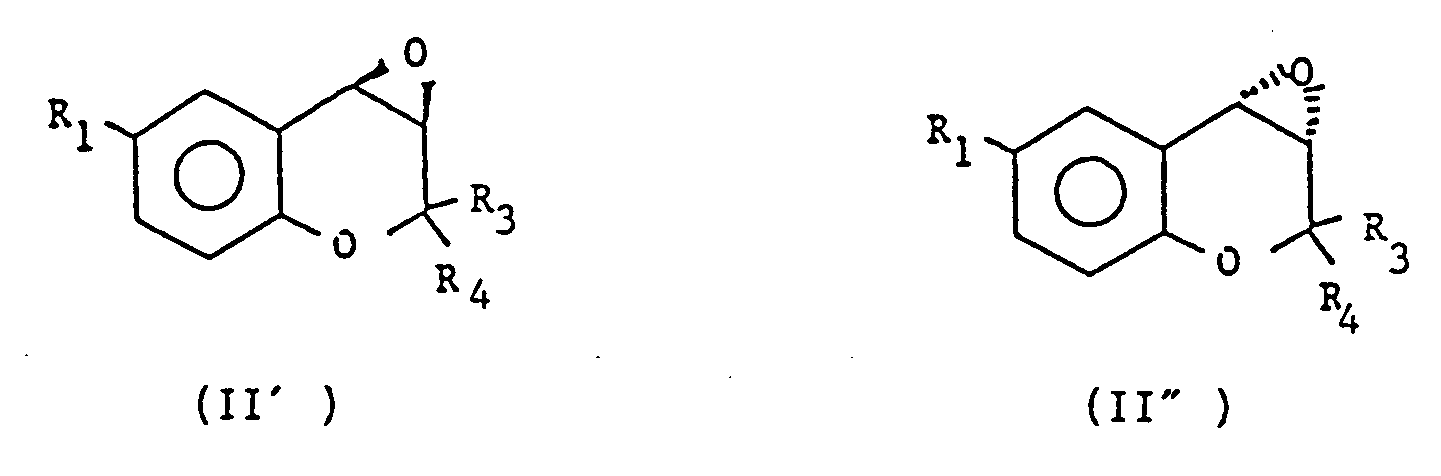
Since the stereoisomerism of the compounds of formulae (II' ) and (II'' ) is disapperared in the compound of formula(I), the reaction after Step(h) may be conducted using any of the compounds of formula(II' ) and (II'' ), and a mixture thereof. - The starting epoxy compounds of formula(II) may be also prepared from a propagyl ether derivative[see J. Med. Chem. 26, 1582 (1983)].
- Among the compounds represented by the formula(I), more preferred compounds of formula(I-a) and (I-b) can be prepared by a process shown in the following Reaction Scheme(3):

wherein R₁, R₂, R₃, A, B and Z have the same meanings as defined above; and R' is a C₂₋₆ alkyl group or an optionally substituted phenyl group. - In the above process, Step(j) can be conducted by transacetallization of a compound of formula(III-a) with an excess amount of an alcohol of formula(VIII), or a diol or mercaptoalcohol of formula(IX) to provide a compound of formula(III-b) or (III-c), respectively. An acid catalyst can be usd in a catalytic amount; and examples of the acid catalyst include a conventional Lewis acid such as boron trifluoride and p-toluene sulfonic acid. When a Lewis acid is employed as the catalyst, a halogen substituted solvent such as dichloromethane and chloroform can be used; and when p-toluene sulfonic acid is employed as the catalyst, a solvent such as benzene and toluene can be used. The reaction temperature may range from a room temperature to the boiling point of the solvent employed.
- Step(k-a) or (k-b) is then conducted by dehydrating the compound of formula(III-b) or (III-c) in the presence of a base to obtain the preferred compound of formula(I-a) or (I-b), respectively. In this step, when sodium hydride is employed as the base, a solvent such as DMSO and DMF may be used together, or when sodium hydroxide is employed as the base, a solvent such as water, dioxane and water-dioxane may be used together. The reaction temperature may range from a room temperature to 60°C.
- Among the above processes, Prcess 2 is more useful since the compounds containing -OCH₃ group in R₃ position are commercially available; and the desired compounds can be easily prepared therefrom by employing the transacetallization method.
- The present invention also provides a process for preparing each of the compounds of formulae(I' ) and (I'' ), separately.
- Each of the optically active compounds of formulae(I' ) and (I'' ) may be obtained effectively, for example, by a process shown in the following Reaction Scheme(4):


wherein R₁, R₂, R₃ and R₄ have the same meanings as defined above. - In above process, Step(1) may be conducted by reacting an alcoholic derivative of formula(III) with an organic acid containing a chiral carbon such as (-)-α-methoxyphenylacetic acid in the presence of a condensation promoting agent and a catalyst to give an ester derivative of formula(X). Examples of the condensation promoting agent include N, N-disubstituted carbodiimides such as N,N-dicyclohexylcarboimide, and imidazols such as N,N-carbonyl-diimidazole. Examples of the useful catalyst include 4-dimethyl-aminopyridin, etc. Further, a solvent such as ethyl acetate and dichloromethane may be used.
- Step(m) may be conducted by resolving diasteromeric mixtures of formula(X) into each of diasteromers of formulae(X' ) and (X'' ) by employing a conventional silica gel column chromatography or a crystallization method.
- Step(n-a) or (n-b) may be conducted by hydrolyzing each of the resolved diastereomers to obtain the compounds of formulae(III' ) and (III'' ) which are optically active, respectively. A base such as sodium hydroxide, potassium hydroxide and lithium hydroxide, etc. and a solvent such as alcohols(for example, methanol, etc.), alcohol-water mixture, THF-water, dioxane-water, etc. may be used in the hydrolysis procedure.
- Finally, Step(o-a) or (o-b) may be conducted by dehydrating each of the alcoholic derivative isomers of formulae(III' ) and (III'' ) in the presence of a base to obtain each of the optical isomers of formulae(I' ) and (I'' ). The reaction conditions of this step are the same as those of step(b) in Reaction Scheme(1).
- Preferred compounds of formula(I) of the present invention prepared by the above-mentioned processes are as follows:
2-(2'' -(1'' , 3'' -dioxolane))-2-methyl-4-(2' -oxo-1' -pyrrolidinyl)-6-nitro-2H-1-benzopyran;
2-(2'' -(1'' , 3'' -dioxolane))-2-methyl-4-(2' -oxo-1' -pyrrolidinyl)-6-cyano-2H-1-benzopyran;
2-(2'' -(1'' , 3'' -dioxolane))-2-methyl-4-(2' -oxo-1' -pyrrolidinyl)-6-trifluoromethoxy-2H-1-benzopyran;
2-(2'' -(1'' , 3'' -dioxolane))-2-methyl-4-(2' -oxo-1' -pyrrolidinyl)-6-phenylsulfonylamido-2H-1-benzopyran;
2-(2'' -(1'' , 3'' -dioxolane))-2-methyl-4-(2' -oxo-1' -pyrrolidinyl)-6-phenylsulfonyl-2H-1-benzopyran;
2-(2'' -(1'' , 3'' -dioxane))-2-methyl-4-(2' -oxo-1' -pyrrolidinyl)-6-nitro-2H-1-benzopyran;
2-(2'' -(1'' , 3'' -dioxane))-2-methyl-4-(2' -oxo-1' -pyrrolidinyl)-6-cyano-2H-1-benzopyran;
2-(2'' -(1'' , 3'' -dioxane))-2-methyl-4-(2' -oxo-1' -pyrrolidinyl)-6-trifluoromethoxy-2H-1-benzopyran;
2-(2'' -(1'' , 3'' -dioxane))-2-methyl-4-(2' -oxo-1' -pyrrolidinyl)-6-phenylsulfonylamido-2H-1-benzopyran;
2-(2'' -(1'' , 3'' -dioxane))-2-methyl-4-(2' -oxo-1' -pyrrolidinyl)-6-phenylsulfonyl-2H-1-benzopyran;
2-dimethoxymethyl-2-methyl-4-(2' -oxo-1' -pyrrolidinyl)-6-nitro-2H-1-benzopyran;
2-dimethoxymethyl-2-methyl-4-(2' -oxo-1' -pyrrolidinyl)-6-cyano-2H-1-benzopyran;
2-dimethoxymethyl-2-methyl-4-(2' -oxo-1' -pyrrolidinyl)-6-trifluoromethoxy-2H-1-benzopyran;
2-dimethoxymethyl-2-methyl-4-(2' -oxo-1' -pyrrolidinyl)-6-phenylsulfonylamido-2H-1-benzopyran;
2-dimethoxymethyl-2-methyl-4-(2' -oxo-1' -pyrrolidinyl)-6-phenylsulfonyl-2H-1-benzopyran;
2-diethoxymethyl-2-methyl-4-(2' -oxo-1' -pyrrolidinyl)-6-nitro-2H-1-benzopyran;
2-diethoxymethyl-2-methyl-4-(2' -oxo-1' -pyrrolidinyl)-6-cyano-2H-1-benzopyran;
2-diethoxymethyl-2-methyl-4-(2' -oxo-1' -pyrrolidinyl)-6-trifluoromethoxy-2H-1-benzopyran;
2-diethoxymethyl-2-methyl-4-(2' -oxo-1' -pyrrolidinyl)-6-phenylsulfonylamido-2H-1-benzopyran;
2-diethoxymethyl-2-methyl-4-(2' -oxo-1' -pyrrolidinyl)-6-phenylsulfonyl-2H-1-benzopyran;
2-(2'' -(1'' , 3'' -dioxolane))-2-methyl-4-(1' -(2' -oxo-1' ,2' -dihydropyridazinyl))-6-nitro-2H-1-benzopyran;
2-(2'' -(1'' , 3'' -dioxolane))-2-methyl-4-(1' -(2' -oxo-1' ,2' -dihydropyridazinyl))-6-cyano-2H-1-benzopyran;
2-(2'' -(1'' , 3'' -dioxolane))-2-methyl-4-(1' -(2' -oxo-1' ,2' -dihydropyridazinyl))-6-trifluoromethoxy-2H-1-benzopyran;
2-(2'' -(1'' , 3'' -dioxolane))-2-methyl-4-(1' -(2' -oxo-1' ,2' -dihydropyridazinyl))-6-phenylsulfonylamido-2H-1-benzopyran;
2-(2'' -(1'' , 3'' -dioxolane))-2-methyl-4-(1' -(2' -oxo-1' ,2' -dihydropyridazinyl))-6-phenylsulfonyl-2H-1-benzopyran;
2-(2'' -(1'' , 3'' -dioxane))-2-methyl-4-(1' -(2' -oxo-1' ,2' -dihydropyridazinyl))-6-nitro-2H-1-benzopyran;
2-(2'' -(1'' , 3'' -dioxane))-2-methyl-4-(1' -(2' -oxo-1' ,2' -dihydropyridazinyl))-6-cyano-2H-1-benzopyran;
2-(2'' -(1'' , 3'' -dioxane))-2-methyl-4-(1' -(2' -oxo-1' ,2' -dihydropyridazinyl))-6-trifluoromethoxy-2H-1-benzopyran;
2-(2'' -(1'' , 3'' -dioxane))-2-methyl-4-(1' -(2' -oxo-1' ,2' -dihydropyridazinyl))-6-phenylsulfonylamido-2H-1-benzopyran;
2-(2'' -(1'' , 3'' -dioxane))-2-methyl-4-(1' -(2' -oxo-1' ,2' -dihydropyridazinyl))-6-phenylsulfonyl-2H-1-benzopyran;
2-dimethoxymethyl-2-methyl-4-(1' -(2' -oxo-1' ,2' -dihydropyridazinyl))-6-nitro-2H-1-benzopyran;
2-dimethoxymethyl-2-methyl-4-(1' -(2' -oxo-1' ,2' -dihydropyridazinyl))-6-cyano-2H-1-benzopyran;
2-dimethoxymethyl-2-methyl-4-(1' -(2' -oxo-1' ,2' -dihydropyridazinyl))-6-trifluoromethoxy-2H-1-benzopyran;
2-dimethoxymethyl-2-methyl-4-(1' -(2' -oxo-1' ,2' -dihydropyridazinyl))-6-phenylsulfonylamido-2H-1-benzopyran;
2-dimethoxymethyl-2-methyl-4-(1' -(2' -oxo-1' ,2' -dihydropyridazinyl))-6-phenylsulfonyl-2H-1-benzopyran;
2-diethoxymethyl-2-methyl-4-(1' -(2' -oxo-1' ,2' -dihydropyridazinyl))-6-nitro-2H-1-benzopyran;
2-diethoxymethyl-2-methyl-4-(1' -(2' -oxo-1' ,2' -dihydropyridazinyl))-6-cyano-2H-1-benzopyran;
2-diethoxymethyl-2-methyl-4-(1' -(2' -oxo-1' ,2' -dihydropyridazinyl))-6-trifluoromethoxy-2H-1-benzopyran;
2-diethoxymethyl-2-methyl-4-(1' -(2' -oxo-1' ,2' -dihydropyridazinyl))-6-phenylsulfonylamido-2H-1-benzopyran;
2-diethoxymethyl-2-methyl-4-(1' -(2' -oxo-1' ,2' -dihydropyridazinyl))-6-phenylsulfonyl-2H-1-benzopyran;
2-(2'' -(1'' , 3'' -dioxolane))-2-methyl-4-(1' -(2' -oxo-1' ,2' -dihydropyridyl))-6-nitro-2H-1-benzopyran;
2-(2'' -(1'' , 3'' -dioxolane))-2-methyl-4-(1' -(2' -oxo-1' ,2' -dihydropyridyl))-6-cyano-2H-1-benzopyran;
2-(2'' -(1'' , 3'' -dioxolane))-2-methyl-4-(1' -(2' -oxo-1' ,2' -dihydropyridyl))-6-trifluoromethoxy-2H-1-benzopyran;
2-(2'' -(1'' , 3'' -dioxolane))-2-methyl-4-(1' -(2' -oxo-1' ,2' -dihydropyridyl))-6-phenylsulfonylamido-2H-1-benzopyran;
2-(2'' -(1'' , 3'' -dioxolane))-2-methyl-4-(1' -(2' -oxo-1' ,2' -dihydropyridyl))-6-phenylsulfonyl-2H-1-benzopyran;
2-(2'' -(1'' , 3'' -dioxane))-2-methyl-4-(1' -(2' -oxo-1' ,2' -dihydropyridyl))-6-nitro-2H-1-benzopyran;
2-(2'' -(1'' , 3'' -dioxane))-2-methyl-4-(1' -(2' -oxo-1' ,2' -dihydropyridyl))-6-cyano-2H-1-benzopyran;
2-(2'' -(1'' , 3'' -dioxane))-2-methyl-4-(1' -(2' -oxo-1' ,2' -dihydropyridyl))-6-trifluoromethoxy-2H-1-benzopyran;
2-(2'' -(1'' , 3'' -dioxane))-2-methyl-4-(1' -(2' -oxo-1' ,2' -dihydropyridyl))-6-phenylsulfonylamido-2H-1-benzopyran;
2-(2'' -(1'' , 3'' -dioxane))-2-methyl-4-(1' -(2' -oxo-1' ,2' -dihydropyridyl))-6-phenylsulfonyl-2H-1-benzopyran;
2-dimethoxymethyl-2-methyl-4-(1' -(2' -oxo-1' ,2' -dihydropyridyl))-6-nitro-2H-1-benzopyran;
2-dimethoxymethyl-2-methyl-4-(1' -(2' -oxo-1' ,2' -dihydropyridyl))-6-cyano-2H-1-benzopyran;
2-dimethoxymethyl-2-methyl-4-(1' -(2' -oxo-1' ,2' -dihydropyridyl))-6-trifluoromethoxy-2H-1-benzopyran;
2-dimethoxymethyl-2-methyl-4-(1' -(2' -oxo-1' ,2' -dihydropyridyl))-6-phenylsulfonylamido-2H-1-benzopyran;
2-dimethoxymethyl-2-methyl-4-(1' -(2' -oxo-1' ,2' -dihydropyridyl))-6-phenylsulfonyl-2H-1-benzopyran;
2-diethoxymethyl-2-methyl-4-(1' -(2' -oxo-1' ,2' -dihydropyridyl))-6-nitro-2H-1-benzopyran;
2-diethoxymethyl-2-methyl-4-(1' -(2' -oxo-1' ,2' -dihydropyridyl))-6-cyano-2H-1-benzopyran;
2-diethoxymethyl-2-methyl-4-(1' -(2' -oxo-1' ,2' -dihydropyridyl))-6-trifluoromethoxy-2H-1-benzopyran;
2-diethoxymethyl-2-methyl-4-(1' -(2' -oxo-1' ,2' -dihydropyridyl))-6-phenylsulfonylamido-2H-1-benzopyran; and
2-diethoxymethyl-2-methyl-4-(1' -(2' -oxo-1' ,2' -dihydropyridyl))-6-phenylsulfonyl-2H-1-benzopyran. - As mentioned above, the compounds of formula(I) of the present invention have superior selectivity in the treatment of hypertension by lowering blood pressure with a relaxation activity on vascular smooth muscle.
- The present invention also provides pharmaceutical compositions containing the compounds of formula(I) of the present invention as an active ingredient. Particularly, the present invention provides a pharmaceutical composition containing an effective amount of the compound of formula(I) and a conventional and pharmaceutically acceptable carrier.
- The composition of the present invention can be formulated for oral or other forms of dministration, preferably oral administration. The formulated compositions are preferably in the form of a unit dose. Examples of suitable unit-dose forms are tablet, capsule and powder. The effective unit dose may comprise 0.01 to 50mg, preferably 0.01 to 10mg of the compound of the present invention.
- The composition of the present invention may be formulated with conventional additives, for example, a filler, dispersant, binder, lubricant, favoring agent, etc. The formulation of the composition can be conducted by using a known method in the art.
- The following Preparation Examples and Examples are intended to illustrate how some of the compounds of the present invention can be prepared, without limiting its scope. ¹H NMR data are given in ppm.
- In 100mℓ of toluene were dissolved 8.06g(50mmole) of 3-acetyl-4-hydroxybenzonitrile and 7.68g(65mmole) of pyruvic aldehyde dimethyl acetal; and, then 1.67mℓ(20mmole) of pyrrolidine was added thereto at room temperature. 30 minutes thereafter, the reactants were heated to reflux for 8 hours using Dean-Stark apparatus; the solvent was removed under reduced pressure; and, 50mℓ of 2N HCl solution was added thereto. The resultant solution was stirred for 30 minutes at room temperature, extracted with ethyl acetate (100mℓ x 2), washed with 50mℓ of water and with 50mℓ of saturated sodium chloride aqueous solution, and purified by silica gel column chromatography using a mixture of hexane and ethyl acetate (4:1) as an eluent to obtain 11.19g(yield 86%) of the title compound in the form of a white solid.
- In 200mℓ of methanol was dissolved 11.19g(43mmole) of the compound obtained in step 1 and 1.62g(43mmole) of sodium borohydride was slowly added thereto. After the reaction mixture was stirred at 0°C for 1 hour, methanol was removed therefrom under reduced pressure; and 100mℓ of water was added to the residue so obtained. The resultant solution was extracted with ethyl acetate(200mℓ x 2), washed with 50mℓ of saturated sodium chloride aqueous solution, dried over anhydrous magnesium sulfate, and evaporated under reduced pressure to obtain 11g(yield 97%) of the title compound.
- In 100mℓ of chloroform was dissolved 10.0g(38mmole) of the compound obtained in step 2; and, 13mℓ(76mmole) of N,N-diisopropylethylamine and 5.9mℓ(76mmole) of methanesulfonyl chloride were added thereto. The resultant solution was stirred for 15 hours at room temperature, diluted with 200mℓ of chloroform and washed with 200mℓ of water and with 200mℓ of saturated sodium chloride solution. The organic layer was dried over anhydrous magnesium sulfate, filtered and evaporated to obtain a mixture of the desired compound and a chloride. The mixture was dissolved in 50mℓ of toluene again; and 11mℓ(76mmole) of DBU(1,8-diazabicyclo[5,4,0] unde-7-cene) was added thereto. The resultant solution was heated to reflux for 6 hours and evaporated under reduced pressure to remove toluene solvent. The residue so obtained was extracted with ethyl acetate(200mℓ x 2), washed with 100mℓ of water and with 50mℓ of a saturated sodium chloride solution, dried over anhydrous magnesium sulfate, filtered and concentrated under reduced pressure to obtain residues, which were purified by silica gel column chromatography using a mixture of hexane and ethyl acetate (4:1) as an eluent to obtain 7.2g(yield 77%) of the title compound.
- In 400mℓ of DMSO was dissolved 7.2g(29.4mmole) of the compound obtained in step 3; and, 1.3mℓ(73.3mmole) of water and 11.1g (62.3mmole) of N-bromosuccinimide were added at 0°C thereto. The resultant solution was stirred at 0°C for 30 minutes, diluted with 200mℓ of water, washed with ethyl acetate(200mℓ x 2), dried over anhydrous magnesium sulfate, filtered and concentrated to obtain residues, which were purified by silica gel column chromatography using a mixture of hexane and ethyl acetate (3:1) as an eluent to obtain 4.02g(yield 40%) and 3.82g(yield 38%) of each of diastereomers the title compound.
- 4.0g(11.7mmole) of one of the compounds obtained in step 4, having higher Rf value was dissolved in 50mℓ of dioxane-water (5:1); and, 0.94g(23.4mmole) of sodium hydroxide was added thereto at room temperature. After the resultant mixture was stirred for 30 minutes, the solvent was distilled under reduced pressure. The residue so obtained was extracted with ethyl acetate(100mℓ x 2), washed with 50mℓ of water and with 50mℓ of a sodium chloride solution, dried over anhydrous magnesium sulfate and concentrated to obtain 2.69g(yield 88%) of the desired compound in the form of a white solid.
¹H NMR(CDCl₃, 300MHz)δ 1.25(s, 3H, CH₃), 3.58(s, 3H, OCH₃), 3.65(s, 3H, OCH₃), 3.75(d, 1H, H-3), 3.88(d, 1H, H-4), 4.2 (s, 1H), 6.9(d, 1H, H-8), 7.52(dd, 1H, H-5), 7.68(d, 1H, H-7) - In 250mℓ of toluene were dissolved 30g(0.22mmole) of 2-hydroxy acetophenone and 33.8g(0.29mmole) of pyruvic aldehyde dimethyl acetal; and 6.3g(0.09mmole) of pyridine was added thereto. After stirring at room temperature 30 minutes, the reactants were heated to reflux for 5 hours, using Dean-Stark apparatus. The solvent was removed under reduced pressure; and 100mℓ of 2N HCl aqueous solution was added thereto. The resultant solution was stirred for 1 hour at room temperature, extracted with ethyl acetate(200mℓ x 2), and washed with 100mℓ of water and with 50mℓ of saturated sodium chloride aqueous solution; and purified by silica gel column chromatography using a mixture of hexane and ethyl acetate (4:1) as an eluent to obtain 39g(0.16mmole, yield 75%) of the title compound in the form of a white solid.
- In 15mℓ of chloroform were dissolved 1.9g(8.1mmole) of the compound obtained in step 1 and 0.64g(8.1mmole) of ammonium nitrate; and, 4.5mℓ(32mmole) of anhydrous trifluoroacetic acid was added thereto at room temperature. The resultant mixture was stirred at room temperature for 3 hours; and the reaction was terminated by addition of 10mℓ of saturated NaHCO₃ aqueous solution. The resultant solution was extracted with dichloromethane(50mℓ x 2), washed with 50mℓ of water and with 20mℓ of saturated sodium chloride solution, dried over anhydrous magnesium sulfate, and filtered and concentrated. The residue so obtained was purified by silica gel column chromatography using a mixture of hexane and ethyl acetate(4:1) as an eluent to obtain 1.24g(yield 55%) of the title compound.
- In 8mℓ of methanol was dissolved 726mg(2.6mmole) of the compound obtained in the step 2; and, 98mg(2.6mmole) of sodium borohydride was slowly added thereto. After the reaction mixture was stirred at 0°C for 1 hour, methanol was removed therefrom under reduced pressure; and 20mℓ of water was added to the residue so obtained. The resultant solution was extracted with 50mℓ of ethyl acetate, washed with 10mℓ of saturated sodium chloride solution, dried over anhydrous magnesium sulfate, filtered and evaporated under reduced pressure to obtain 620mg(yield 85%) of the title compound.
- In 100mℓ of chloroform was dissolved 6.13g(22mmole) of the compound obtained in step 3; and, 7.5mℓ(43mmole) of N,N-diisopropylethylamine and 2.5mℓ(32mmole) of methanesulfonyl chloride were added thereto. The resultant solution was stirred for 15 hours at room temperature, diluted with 100mℓ of chloroform, and washed with 100mℓ of water and 100mℓ of saturated sodium chloride solution. The organic layer was dried over anhydrous magnesium sulfate, filtered and evaporated to obtain a mixture of the desired compound and a chloride. The mixture was dissolved in 30mℓ of toluene again; and 4.95g(32mmole) of DBU was added thereto. The resultant solution was heated to reflux for 5 hours and evaporated under reduced pressure to remove toluene solvent. The residue so obtained was extracted with ethyl acetate(100mℓ x 2), and washed with 80mℓ of water and with 50mℓ of saturated sodium chloride solution. The organic layer was dried over anhydrous magnesium sulfate, filtered and concentrated under reduced pressure to obtain residue, which was purified by silica gel column chromatography using a mixture of hexane and ethyl acetate (4:1) as an eluent to obtain 4.03g (yield 70%) of the title compound.
- In 10mℓ of DMSO was dissolved 1.79g(6.8mmole) of the compound obtained in step 4; and, 0.24mℓ(13.5mmole) of water and 2.41g (13.5mmole) of N-bromosuccinimide were added at room temperature. The resultant solution was stirred at room temperature for 2 hours, diluted with 20mℓ of water, washed with ethyl acetate(30mℓ x 2), dried over anhydrous magnesium sulfate, filtered and concentrated under reduced pressure to obtain residue, which was purified by silica gel column chromatography using a mixture of hexane and ethyl acetate (4:1) as an eluent to obtain 0.42g(yield 17%) and 0.59g (yield 24%) of each of diastereomers of the title compound.
- 0.48g(1.3mmole) of one of the compounds obtained in step 5 having higher Rf value was dissolved in 5mℓ of dioxane-water (5:1); and, 100mg(2.6mmole) of sodium hydroxide was added thereto at room temperature. After the resultant mixture was stirred for 2 hours, the solvent was distilled off under reduced pressure. The residue so obtained was extracted with ethyl aceate(20mℓ x 2), washed with 10mℓ of water and with 10mℓ of saturated sodium chloride solution, dried over anhydrous magnesium sulfate, filtered and concentrated to obtain 0.35g(yield 94%) of the desired compound.
¹H NMR(CDCl₃, 300MHz)δ 1.30(s, 3H, CH₃), 3.6(s, 3H, OCH₃), 3.7(s, 3H, OCH₃), 3.82(d, 1H, H-3), 4.0(d, 1H, H-4), 4.20 (s, 1H), 7.0(d, 1H, H-8), 8.2(dd, 1H, H-5), 8.35(d, 1H, H-7) - To a solution of 16g of AlCl₃ dissolved in 21.6g of anisol was added dropwise 17.6g of benzenesulfonyl chloride. The reaction mixture was heated to reflux for 8 hours and poured into 1N HCl solution containing ice. The resultant solution was extracted with ethyl acetate(100mℓ x 3), washed with 100mℓ of saturated NaHCO₃ aqueous solution, dried over Na₂SO₄ and concentrated to obtain residue, which was recrystallized from hexane-ethyl acetate to obtain 25g of the title compound.
- To a solution of 24.8g(100mmole) of the compound obtained in step 1 dissolved in 50mℓ of acetic acid was added 40% HBr, which was heated to reflux for 8 hours. The reaction solution was poured into ice-water. The resultant solution was extracted with ethyl acetate(100mℓ x 3), dried over Na₂SO₄ and concentrated to obtain residue, which was purified by silica gel column chromatography using a mixture of hexane and ethyl acetate (1:1) as an eluent to obtain 23.0g(yield 100%) of the title compound containing a portion of ortho-isomer(approximately one-eighth).
- In 150mℓ of CH₂Cl₂ were dissolved 23g of the compound obtained in step 2; and, 12.9mℓ of pyridine and 7.8mℓ of acetyl chloride was slowly added thereto at room temperature. The reaction solution was washed with 0.2N HCl and with saturated NaHCO₃ aqueous solution, dried over Na₂SO₄ and concentrated under reduced pressure to obtain residue, which was used for subsequent reaction without further purification.
- To a solution of 0.67g of the compound obtained in step 3 dissolved in 5mℓ of CS₂ was added 0.97g of AlCl₃. The reaction mixture was heated to the temperature of 190°C(at this temperature, CS₂ would be distilled) and maintained at that temperature for 30 minutes. The reaction mixture was poured into 1N HCl solution containing ice. The resultant solution was extracted with ethyl aceate (20mℓ x 3), dried over Na₂SO₄ and concentrated under reduced pressure to obtain residue, which was purified by silica gel column chromatography using a mixture of hexane and ethyl acetate (2:1) as an eluent to obtain 0.35g(yield 52%) of the title compound.
- In 100mℓ of toluene were dissolved 10g of the compound obtained in step 4, 6.5mℓ of pyruvic aldehyde dimethyl acetal and 1.5mℓ of pyrrolidine. The resultant solution was heated to reflux for 16 hours and concentrated under reduced pressure to obtain residue, which was purified by silica gel column chormatography using a mixture of hexane and ethyl acetate(2:1) to obtain 11g of the title compound.
- To a solution of 6g of the compound obtained in the step 5 dissolved in 50mℓ of methanol was added 1.74g(1.2 eq.) of sodium borohydride(NaBH₄). After stirring, methanol was removed from the reaction mixture under reduced pressure to give residue, which was dissolved in 100mℓ of CH₂Cl₂. The resultant solution was washed with 50mℓ of distilled water and with 30mℓ of saturated sodium chloride aqueous solution, dried over Na₂SO₄ and concentrated to obtain residue, which was used for subsequent reaction without further purification.
- To the mixture of the compound obtained in step 6 and 1.1mℓ of diisopropylethylamine was added 1.1mℓ of methanesulfonyl chloride. The resultant solution was stirred for 16 hours at room temperature, washed with saturated sodium chloride solution and concentrated to give residue. To this was added a solution of 1.6g of DBU dissolved in 20mℓ of toluene. The resultant solution was heated to reflux for 6 hours and concentrated under reduced pressure to obtain residue, which was purified by silica gel column chromatography using a mixture of hexane and ethyl acetate (1:1) to obtain 3g of the title compound.
- To a solution of 3g(8.72mmole) of the compound obtained in step 7 dissolved in a mixture of 10mℓ of acetone and 10mℓ of distilled water was added 2.2g(26.16mmole) of NaHCO₃. 5.45g (8.72mmole) of oxon was added at once thereto. After stirring for 10 minutes, NaHCO₃ and oxon were further added in same manner as described above. The resultant mixture was stirred for about 20 minutes. The mixture was distilled under reduced pressure to remove acetone solvent, extracted with ethyl acetate(30mℓ x 3) and concentrated. The residue obtained was purified silica gel column chromatography using a mixture of hexane and ethyl acetate (1:1) as an eluent to obtain 2.5g(yield 80%) of the desired compound.
¹H NMR(CDCl₃, 200MHz)δ 1.28(s, 3H), 3.60(s, 3H), 3.70(s, 3H), 3.82(d, 1H), 4.0(d, 1H), 4.25(s, 1H), 6.80(d, 1H), 7.20 (d, 1H), 7.40(dd, 1H), 7.45(m, 5H) - To a solution of 1.0g(4.85mmole) of 5-(trifluoromethoxy) salicyl aldehyde dissolved in 500mℓ of dry ether was slowly added 10.34mℓ(14.55mmole) of 1.4M CH₃Li at room temperature. The resultant solution was stirred for 30 minutes at room temperature; and, 1N HCl was added thereto to acidify the solution. The acidified solution was extracted with ethyl acetate(20mℓ x 3), dried and concentrated to obtain residue, which was purified by silica gel column chromatography using a mixture of hexane and ethyl acetate (2:1) obtain the 0.88g(yield 82%) of title compound.
¹H NMR(CDCl₃,200MHz)δ 1.6(d, 3H), 2.6(d, 1H), 5.1(m, 1H), 6.85 (m, 2H), 7.1(m, 1H), 8.1(s, 1H) - In 20mℓ of dichloromethane was dissolved 0.85g(3.83mmole) of the compound obtained in step 1; and, a suitable amount of Cellite and 1.73g(4.6mmole) of pyridinium dichromate were added thereto. The resultant mixture was stirred for 30 minutes at room temperature and filtered by a Cellite layer to obtain precipitates, which were purified by silica gel column chromatography using a mixture of hexane and ethyl acetate (6:1); and, then concentrated under reduced pressure at 0°C to obtain 0.72g(yield 85%) of the title compound.
- To a solution of 0.5g(2.27mmole) of the compound obtained in step 2 dissolved in 10mℓ of toluene were added 0.55mℓ(4.54mmole) of pyruvic aldehyde dimethyl acetal and 80mg(1.14mmole) of pyrrolidine. The reactants were heated to reflux for about 12 hours using Dean-Stark apparatus. After completion of the reaction, toluene solvent was removed therefrom under reduced pressure. The residue so obtained was extracted with ethyl acetate and concentrated to give residue, which was purified by silica gel column chromatography using a mixture of hexane and ethyl acetate(10:1) as an eluent to provide 0.470g(yield 65%) of the title compound.
¹H NMR(CDCl₃, 200MHz)δ 1.4(s, 3H), 2.6∼2.7(d, 1H), 3.0∼3.1 (d, 1H), 3.5(d, 6H), 4.3(s, 1H), 7.0(d, 1H), 7.3(q, 1H), 7.7 (q, 1H) - In 3mℓ of methanol was dissolved 0.22g(0.69mmole) of the compound obtained in the step 3; and, 31mg(0.83mmole) of sodium borohydride was added thereto. After stirring at room temperature for 1 hour, the resultant solution was extracted with ethyl acetate (20mℓ x 3), and washed with saturated sodium chloride aqueous solution(10mℓ x 2). The organic layer was dried over anhydrous Na₂SO₄, and concentrated; and, purified by silica gel column chromatography using a mixture of hexane and ethyl acetate (3:1) to obtain 0.18g(0.56mmole)(yield 81%) of the title compound.
- In 1mℓ of dichloromethane was dissolved 69mg(0.214mmole) of the compound obtained in step 4; and, 75µℓ(0.742mmole) of N,N-diisopropylethylamine and 25µℓ(0.321mmole) of methanesulfonyl chloride were added thereto. The resultant solution was stirred for 15 hours at room temperature, diluted with 10mℓ of dichloromethane and washed with 10mℓ of water and then with 10mℓ of saturated sodium chloride solution. The organic layer was dried over anhydrous magnesium sulfate, filtered and evaporated under reduced pressure to obtain a mixture of the desired compound and a chloride. The mixture was dissolved in 2mℓ of toluene again; and, 48µℓ(0.321mmole) of DBU was added. The resultant solution was heated to reflux for 6 hours and evaporated under reduced pressure to remove toluene. The residue obtained was extracted with ethyl acetate(10mℓ x 2), washed with 5mℓ of water and with 5mℓ of saturated sodium chloride solution, dried over anhydrous magnesium sulfate, filtered and concentrated under reduced pressure to obtain residue, which was purified by silica gel column chromatography using a mixture of hexane and ethyl acetate (4:1) to obtain 40mg(yield 61%) of the title compound.
- To a solution of 32mg(0.105mmole) of the compound obtained in step 5 dissolved in a mixture of 1mℓ of acetone and 1mℓ of distilled water were added by three steps 31mg(0.368mmole) of NaHCO₃ and 65mg(0.105mmole) of oxon. After stirring at room temperature for 1 hour, the reaction was completed. Acetone solvent was removed under reduced pressure to give residue, which was extracted with ethyl acetate(5mℓ x 3) and washed with 5mℓ of water and with 5mℓ of saturated sodium chloride solution. The organic layer was dried over MgSO₄, filtered and concentrated under reduced pressure. The residue obtained was purified by silica gel column chromatography using a mixture of hexane and ethyl acetate (4:1) as an eluent to obtain 16mg(yield 48%) of the desired compound.
¹H NMR(CDCl₃, 300MHz)δ 1.5(s, 3H, CH₃), 3.6(d, 6H, (OCH₃)₂), 3.9(d, 1H, H-3), 4.1(d, 1H, H-4), 4.3(s, 1H, CH(OCH₃)₂), 6.8 (d, 1H, aromatic),6.92(d, 1H,aromatic),7.1(dd, 1H,aromatic) - To a solution of 0.59g(6.9mmole) of 2-pyrrolidine dissolved in 15mℓ of t-butanol was added 10.77g(6.9mmole) of potassium t-butoxide. The reaction mixture was stirred at room temperature for 20 minutes; and 1.2g(4.6mmole) of the compound obtained in Preparation Example 1 was added thereto. The resultant mixture was stirred at room temperature for 24 hours; and the reaction was terminated with 5mℓ of water. The resultant mixture was extracted with ethyl acetate (30mℓ x 2), washed with 30mℓ of water and then with 30mℓ of saturated sodium chloride solution, dried over anhydrous magnesium sulfate, filtered and concentrated to obtain 1.39g(yield 87%) of the title compound in the form of a white solid.
¹H NMR(CDCl₃, 300MHz)δ 1.4(s, 3H, CH₃), 2.1(m, 2H, NCH₂CH₂), 2.6(t, 2H, NCOCH₂), 3.08(m, 1H, NCH₂), 3.45(m, 1H, NCH₂), 3.62 (d, 6H, (OCH₃)₂), 3.85(m, 1H, OH), 4.24(d, 1H, H-3), 4.45(S, 1H, CH(OCH₃)₂), 5.3(d, 1H, H-4), 6.95(d, 1H, H-8), 7.3(d, 1H, H-5), 7.47(dd, 1H, H-7) -
- To a solution of 80mg(0.24mmole) of the compound obtained in step 1 dissolved in 1mℓ of DMF was added 10mg(0.24mmole) of sodium hydride(60%) at room temperature. After stirring at room temperature for 24 hours, the reaction was terminated by addition of 10mℓ of water. The reaction mixture was extracted with 10mℓ of ethyl acetate, washed with 5mℓ of saturated sodium chloride solution, dried over anhydrous magnesium sulfate and concentrated to obtain residue; and the residue was purified by silica gel column chromatography using a mixture of hexane and ethyl acetate (1:1) as an eluent to obtain 39mg(yield 51%) of the desired compound.
¹H NMR(CDCl₃, 300MHz)δ 1.41(s, 3H, CH₃), 2.2(m, 2H, NCH₂CH₂), 2.52(t, 2H, NCOCH₂), 3.45(d, 6H, (OCH₃)₂), 3.6(+, 2H, NCH₂), 4.23(s, 1H, CH(OCH₃)₂), 5.7(s, 1H, H-3), 6.85(d, 1H, H-8), 7.18(d, 1H, H-5), 7.39(dd, 1H, H-7) - To a solution of 63µℓ(0.83mmole) of 2-pyrrolidine dissolved in 2mℓ of t-butanol was added 93mg(0.83mmole) of potassium t-butoxide. The reaction mixture was stirred at room temperature for 20 minutes; and 155mg(0.55mmole) of the compound obtained in Preparation Example 2 was added thereto. The resultant mixture was stirred at room temperature for 24 hours; and, the reaction was terminated by addition of 10mℓ of water. The resultant mixture was extracted with ethyl acetate(20mℓ x 2), washed with 10mℓ of water and with 10mℓ of saturated sodium chloride solution, dried over anhydrous magnesium sulfate, filtered, concentrated and recrystallized from ethers/hexane to obtain 96mg(yield 47%) of the title compound in the form of a white solid.
- To a solution of 44mg(0.12mmole) of the compound obtained in step 1 dissolved in 1mℓ of dioxane was added 10mg(0.24mmole) of sodium hydride(60%) at room temperature. After stirring at room temperature for 24 hours, the reaction was terminated by addition of 10mℓ of water. The reaction mixture was extracted with ethyl acetate(10mℓ x 2), washed with 10mℓ of saturated sodium chloride solution, dried over anhydrous magnesium sulfate and concentrated to obtain residue, which was purified by silica gel column chromatography using a mixture of hexane and ethyl acetate (1:1) as an eluent to obtain 30mg(yield 92%) of the desired compound.
¹HNMR(CDCl₃, 300MHz)δ 1.55(s, 3H, CH₃), 2.3(m, 1H, NCOCH₂CH₂), 2.62(t, 1H, NCOCH₂), 3.65(m, 1H, NCH₂), 4.0(d, 6H, (OCH₃)₂), 5.0(s, 1H, CHC(OCH₃)₂), 5.7(s, 1H, H-3), 6.9(d, 1H, H-8), 7.8 (d, 1H, H-5), 8.1(dd, 1H, H-7) - In accordance with the procedures described in Example 1 above, the title compound was prepared using the compound obtained in Preparation Example 3 and purified by column chromatography.
¹H NMR(CDCl₃, 300MHz)δ 1.41(s, 3H), 2.2(m, 2H), 2.6(t, 2H), 3.30(s, 3H), 3.32(s, 3H), 3.6(t, 2H), 4.25(s, 1H), 5.7(s, 1H), 6.80(d, 1H), 7.18(d, 1H), 7.39(dd, 1H), 7.45(m, 5H) - In accordance with the procedures described in Example 1 above, the title compound was prepared using the compound obtained in Preparation Example 4 and purified by column chromatography.
¹H NMR(CDCl₃, 200MHz)δ 1.50(s, 3H), 3.30(s, 3H), 3.32(s, 3H), 4.30(s, 1H), 5.70(s, 1H), 6.75(t, 1H), 6.85(d, 1H), 7.0(dd, 1H) - In accordance with the procedures described in Example 1 above, the title compound was prepared using the compound obtained in Preparation Example 1 and 2-oxo-1,2-dihydropyridine as starting materials and purified by column chromatography.
¹H NMR(CDCl₃, 300MHz)δ 1.41(s, 3H), 3.43(s, 3H), 3.45(s, 3H), 4.39(s, 1H), 5.80(s, 1H), 6.23(td, 1H), 6.63(d, 1H), 6.80 (dd, 1H), 6.95(d, 1H), 7.10(s, 1H), 7.38(td, 1H), 7.45(dd, 1H) -
- In accordance with the procedures described in Example 5 above, the title compound was prepared using the compound obtained in Preparation Example 2 and purified by column chromatography.
¹H NMR(CDCl₃, 300MHz)δ 1.40(s, 3H), 3.42(s, 3H), 3.40(s, 3H), 4.30(s, 1H), 5.90(s, 1H), 6.20(td, 1H), 6.65(d, 1H), 6.85 (dd, 1H), 7.0(d, 1H), 7.40(dt, 1H), 7.80(d, 1H), 8.1(dd, 1H) - To a solution of 0.05g(0.1445mmole) of the compound obtained in step 1 of Example 1 above dissolved in 5mℓ of toluene were added 17.9mg(0.2890mmole) of ethylene glycol and 5.7mg (0.03mmole) of p-toluene sulfonic acid. The reaction mixture was heated to reflux for 1 hour with Dean-Stark apparatus. The reaction mixture was cooled to room temperature after completion of the reaction, extracted with ethyl acetate(5mℓ x 3), washed with 5mℓ of water and with 5mℓ of saturated sodium chloride solution, dried over MgSO₄, filtered and concentrated. The residue obtained was purified by silica gel column chromatography using a mixture of hexane and ethyl acetate (1:4) as an eluent to obtain 0.049g (0.142mmole)(yield 99%) of the title compound in the form of a white solid.
- To a solution of 0.05g(0.15mmole) of the compound obtained in step 1 dissolved in 5mℓ of dioxane was added 12mg(0.29mmole) of NaOH. The reaction mixture was heated to reflux for 30 minutes and cooled to room temperature after completion of the reaction. The dioxane solvent was removed therefrom under reduced pressure. The residue obtained was extracted with 20mℓ of CH₂Cl₂, washed with 10mℓ of water and with 5mℓ of saturated sodium chloride solution, dried over MgSO₄, filtered and concentrated to obtain residue, which was purified by silica gel column chromatography using a mixture of hexane and ethyl acetate of (1:4) as an eluent and recrystallized several times from ethers to obtain 42mg(0.13mmole, yield 89%) of the desired compound in the form of a white solid.
¹H NMR(CDCl₃, 300MHz)δ 1.55(s, 3H, CH₃), 2.25(m, 2H, NCH₂CH₂), 2.61(t, 2H, NCOCH₂), 3.65(m, 2H, NCH₂), 4.0(m, 4H, -OCH₂CH₂O-), 4.98(s, 1H, CHCOCH₂), 5.67(s, 1H, H-3), 6.88(d, 1H, H-8), 7.16(d, 1H, H-5), 7.42(dd, 1H, H-7) - To a solution of 0.051g(0.14mmole) of the compound obtained in step 1 of Example 2 above dissolved in 5mℓ of toluene were added 17.3mg(0.28mmole) of ethylene glycol and 5.7mg(0.03mmole) of p-toluene sulfonic acid. The reaction mixture was heated to reflux for 1 hour with Dean-Stark apparatus. The reaction mixture was cooled to room temperature after completion of the reaction, extracted with ethyl acetate(5mℓ x 3), washed with 5mℓ of water and with 5mℓ of saturated sodium chloride solution, dried over MgSO₄, filtered and concentrated. The residue obtained was purified by silica gel column chromatography using a mixture of hexane and ethyl acetate (1:4) as an eluent to obtain 48mg(0.13mmole)(yield 95%) of the title compound in the form of a white solid.
- To a solution of 0.048g(0.13mmole) of the compound obtained in step 1 dissolved in 5mℓ of dioxane was added 10.6mg(0.26mmole) of NaOH. The reaction mixture was heated to reflux for 30 minutes and cooled to room temperature after completion of the reaction. The dioxane solvent was removed therefrom under reduced pressure. The residue obtained was extracted with 20mℓ of CH₂Cl₂, washed with 10mℓ of water and with 5mℓ of saturated sodium chloride solution, dried over MgSO₄, filtered and concentrated to obtain residue, which was purified by silica gel chromatography using a mixture of hexane and ethyl acetate (1:4) as an eluent and recrystallized several times from ethers to obtain 42mg(0.13mmole, yield 89%) of the desired compound in the form of a white solid.
¹H NMR(CDCl₃, 300MHz)δ 1.55(s, 3H, CH₃), 2.3(m, 2H, NCH₂CH₂), 2.61(t, 2H, NCOCH₂), 3.67(m, 2H, NCH₂), 4.0(m, 4H, -OCH₂CH₂O-), 5.0(s, 1H, CHOCH₂), 5.7(s, 1H, H-3), 6.9(d, 1H, H-8), 7.85 (d, 1H, H-5), 8.1(dd, 1H, H-7) - To a solution of 5.3µℓ(0.07mmole) of 2-pyrrolidone dissolved in 1mℓ of t-butanol was added 7.9mg(0.07mmole) of potassium t-butoxide. After stirring at room temperature for 20 minutes, 15mg (0.0047mmole) of the epoxide obtained in Preparation Example 4 above was added. The reaction mixture was stirred at room temperature for 24 hours; and, the reaction was terminated by addition of water. The resultant solution was extracted with ethyl acetate(5mℓ x 3), washed with 5mℓ of water and with 5mℓ of saturated sodium chloride solution, dried over MgSO₄, filtered and concentrated to obtain 10mg(yield 53%) of the title compound.
-
- To a solution of 10mg(0.025mmole) of the compound obtained in step 1 dissolved in 1mℓ of toluene were added 2.5µℓ (0.05mmole) of ethylene glycol and a catalytic amount of p-toluene sulfonic acid. The reaction mixture was heated to reflux. 1 Hour thereafter, the reaction mixture was extracted with ethyl acetate (5mℓ x 3), washed with 5mℓ of saturated sodium chloride solution, dried over MgSO₄, and concentrated under reduced pressure. The residue so obtained was purified by silica gel column chromatography using a mixture of hexane and ethyl acetate (1:4) as an eluent to obtain 9mg(yield 89%) of the title compound.
- To a solution of 9mg(0.022mmole) of the compound obtained in step 2 dissolved in 1mℓ of dioxane was added 2mg(0.044mmole) of NaOH. The reaction mixture was heated to reflux for 1 hour. After completion of the reaction, the dioxane solvent was removed therefrom under reduced pressure. The residue so obtained was extracted with CH₂Cl₂(5mℓ x 2), washed with 5mℓ of water and with 5mℓ of saturated sodium chloride solution, dried over MgSO₄, filtered and concentrated under reduced pressure. The residue so obtained was purified by silica gel column chromatography using a mixture of hexane and ethyl acetate (1:4) as an eluent to obtain 52mg (yield 60%) of the desired compound.
¹H NMR(CDCl₃, 300MHz)δ 1.5(s, 3H, CH₃), 2.2(m, 2H, NCOCH₂), 3.65(t, 2H, NCOCH₂CH₂CH₂), 3.95(m, 2H, OCH₂), 4.05(m, 2H, OCH₂), 5.05(s, 1H, C(OCH₂)₂), 5.7(s, 1H, H-3), 6.75(d, 1H, aromatic),6.85(d, 1H, aromatic), 7.0(dd, 1H,aromatic) - In accordance with the procedures described in Example 7 above, the title compound was prepared using 2-dimethoxymethyl-2-methyl-3-hydroxy-4-(2' -oxo-1' -pyrrolidinyl)-6-cyano-3,4-dihydro-2H-1-benzopyran obtained in step 1 of Example 1 above and 1,3-propanediol as starting materials and then purified by column chromatography.
¹H NMR(CDCl₃, 300MHz)δ 1.35(m, 2H, OCH₂CH₂), 1.5(s, 3H, CH₃), 2.3(m, 1H, NCH₂CH₂), 2.6(m, 1H, NCOCH₂), 3.75(m, 1H, OCH₂, 1H, NCH₂), 4.2(m, 1H, OCH₂), 4.7(s, 1H, CH(OCH₂)₂CH₂), 5.85 (s, 1H, H-3), 6.98(d, 1H, H-8), 7.25(d, 1H, H-5), 7.48 (dd, 1H, H-7) - Similarly to Example 10 above, the title compound was prepared using the compound obtained in step 1 of Example 2 above and then purified by column chromatography.
¹H NMR(CDCl₃, 300MHz)δ 1.4(m, 2H, OCH₂CH₂), 1.5(s, 3H, CH₃), 2.3(m, 1H, NCH₂CH₂), 2.85(m, 1H, NCOCH₂), 3.75(m, 1H, OCH₂, 1H, NCH₂), 4.2(m, 1H, OCH₂), 4.7(s, 1H, CH(OCH₂)₂CH₂), 5.9(s, 1H, H-3), 6.9(d, 1H, H-8), 7.89(d, 1H, H-5), 8.1(dd, 1H, H-7) - In accordance with the procedures described in Example 7 above, the title compound was prepared using 2-dimethoxy-methyl-2-methyl-3-hydroxy-4-(1' -(2' -oxo-1' ,2' -dihydropyridyl))-6-cyano-3,4-dihydro-2H-1-benzopyran obtained in the course of Example 5 above and then purified by column chromatography.
¹H NMR(CDCl₃, 300MHz)δ 1.54(s, 3H), 3.80(m, 2H), 3.90(m, 2H), 4.23(s, 1H), 5.80(s, 1H), 6.25(td, 1H), 6.63(d, 1H), 6.87(dd, 1H), 7.00(d, 1H), 7.15(d, 1H), 7.38(td, 1H), 7.50(dd, 1H) - Similarly to Example 10 above, the title compound was prepared using 2-dimethoxy-methyl-2-methyl-3-hydroxy-4-(1' -(2' -oxo-1' ,2' -dihydropyridyl))-6-cyano-3,4-dihydro-2H-1-benzopyran obtained in the course of Example 5 above and then purified by column chromatography.
¹H NMR(CDCl₃, 300MHz)δ 1.32(m, 2H), 1.50(s, 3H), 3.80(m, 2H), 4.20(m, 2H), 4.33(s, 1H), 5.85(s, 1H), 6.20(td, 1H), 6.60 (d, 1H), 6.78(dd, 1H), 6.95(d, 1H), 7.10(d, 1H), 7.40(td, 1H), 7.50(dd, 1H) - Similarly to Example 12 above, the title compound was prepared using 2-dimethoxy-methyl-2-methyl-3-hydroxy-4-(1' -(2' -oxo-1' ,2' -dihydropyridyl))-6-nitro-3,4-dihydro-2H-1-benzopyran obtained in the course of Example 6 above and then purified by column chromatography.
¹H NMR(CDCl₃, 300MHz)δ 1.50(s, 3H), 3.85(m, 2H), 4.00(m, 2H), 4.38(s, 1H), 5.90(s, 1H), 6.20(td, 1H), 6.70(d, 1H), 6.90(dd, 1H), 7.05(d, 1H), 7.35(dt, 1H), 7.80(d, 1H), 8.05(dd, 1H) - Similarly to Example 13 above, the title compound was prepared using 2-dimethoxy-methyl-2-methyl-3-hydroxy-4-(1' -(2' -oxo-1' ,2' -dihydropyridyl))-6-nitro-3,4-dihydro-2H-1-benzopyran obtained in step 1 of Example 6 above and then purified by column chromatography.
¹H NMR(CDCl₃, 300MHz)δ 1.30(m, 2H), 1.52(s, 3H), 3.80(m, 2H), 4.20(m, 2H), 4.35(s, 1H), 5.90(s, 1H), 6.30(td, 1H), 6.70(d, 1H), 6.92(dd, 1H), 7.10(d, 1H), 7.40(dt, 1H), 7.85(d, 1H), 8.10(dd, 1H) - In 50mℓ of ethyl acetate was dissolved with heating 1.0g (2.73mmole) of the compound obtained in step 1 of Exemple 1 above. To the resultant solution were added 0.68g(4.10mmole) of (-)-α-methoxyphenylacetic acid and then 0.67g(3.28mmole) of 1,3-dicyclohexyl carbodiimide at room temperature. Subsequently, 0.040g(0.33 mmole) of 4-dimethylaminopyridine as a catalyst was added. The resultant mixture was stirred for 24 hours. Dicyclohexyl urea in the form of a white solid produced during the reaction as a side-product was removed by filtration, and the remaining filtrate was concentrated and purified by silica gel column chromatography using a mixture of hexane and ethyl acetate (1:1) an as eluent to obtain 0.70g(1.36mmole, yield 50%) of (+) dimethoxymethyl-3-(O-α-methoxy-α-phenylacethoxy)-4-(2' -oxo-1' pyrrolidinyl)-6-cyano-3,4-dihydro-2H-1-benzopyran having Rf value of 0.23 and 0.54g(1.05mmole, yield 38%) of (-) dimethoxymethyl-3-(O-α-methoxy-α-phenylacethoxy)-4-(2' -oxo-1' pyrrolidinyl)-6-cyano-3,4-dihydro-2H-1-benzopyran having Rf value of 0.30.
-
- To a solution of 0.70g(1.36mmole) of (+) isomer obtained in step 1 dissolved in 10mℓ of a mixture of methanol and water(5:1) was slowly added 86mg(2.04mmole) of LiOH·H₂O at 0°C. The reaction mixture was stirred for 2 hours. From the reaction mixture methanol solvent was removed under reduced pressure. The remaining solution was diluted with 50mℓ of ethyl acetate, washed with saturated sodium chloride solution(50mℓ x 2) and purified by silica gel column chromatography using ethyl acetate as an eluent to obtain 0.43g (1.17mmole, yield 86%) of (+) isomer of the title compound as a white solid. Similarly, to a solution of 0.54g(1.05mmole) of (-) isomer obtained in step 1 dissolved in 10mℓ of a mixture of methanol and water(5:1) was slowly added 66mg(1.58mmole) of LiOH·H₂O at 0°C. The reaction mixture was stirred for 2 hours. From the reaction mixture methanol solvent was removed under reduced pressure. The remaining solution was diluted with 50mℓ of ethyl acetate and washed with saturated sodium chloride solution(50mℓ x 2). The organic layer was dried over anhydrous magnesium sulfate, concentrated under reduced pressure and purified by silica gel column chromatography using ethyl acetate as an eluent to obtain 0.31g(0.85mmole, yield 81%) of (-) isomer of the title compound as a white solid.
- To a solution of 0.43g(1.17mmole) of (+) isomer obtained in step 2 dissolved in 5mℓ of dioxane was added 94mg(2.34mmole) of NaOH. The resultant solution was heated to reflux for 1 hour and distilled to remove dioxane solvent therefrom. The remaining solution was diluted with 50mℓ of ethyl acetate and washed with saturated sodium chloride solution(50mℓ x 2). The organic layer was dried over anhydrous magnesium sulfate, concentrated under reduced pressure and purified by silica gel column chromatography using a mixture of hexane and ethyl acetate (1:4) as an eluent to obtain 0.35g(1.01mmole, yield 85%) of (+) isomer of the title compound having Rf value of 0.4 as a white solid. Similarly, to a solution of 0.31g(0.85mmole) of (-) isomer obtained in step 2 dissolved in 5mℓ of dioxane was added 68mg(1.7mmole) of NaOH. The resultant solution was heated to reflux for 1 hour and distilled to remove dioxane solvent therefrom. The remaining solution was diluted with 50mℓ of ethyl acetate and washed with saturated sodium chloride solution(50mℓ x 2). The organic layer was dried over anhydrous magnesium sulfate, concentrated under reduced pressure and purified by silica gel column chromatography using a mixture of hexane and ethyl acetate (1:4) as an eluent to obtain 0.32g (0.92mmole, yield 87%) of (-) isomer of the title compound as a white solid.
[ α ] D²⁰ = +80.7 (c=0.30, CHCl₃)
[ α ] D²⁰ = -80.9 (c=0.33, CHCl₃)
The concentration c is given in g/100mℓ. - The activity of the formula(I) compounds of the present invention was tested by employing the tail-cuff method described in references [see, e.g., I. M. Claxton, M. G. Palfreyman, R. H. Poyster and R. L. Whiting, European Journal of Pharmacology 37, 179(1976)] . After administration of the test compound of formula(I) to sets of spontaneously hypertensive rats, maximum blood pressure-lowering activity was determined by measuring the lowering effect on systolic blood pressure. The results of the test are shown in Table 1.
- Further, the relaxation activity on respiratory smooth muscle was determined as follows: Guinea pig trachea muscle was made to be contracted with histamine; and then the test compound of the present invention was administered thereto; and the concentration of the test compound which was required in relaxing 50% level of the contraction was determined and designated as EC₅₀. These EC₅₀ values for the test compounds are shown in Table 1.
Table 1 Example No. of Compound Employed Blood Pressure-Lowering Activity Trachea Relaxation Activity, EC₅₀ Dose(mg/kg) % 1 0.3 24 1.5 x 10⁻⁴M 1.0 43 3 0.1 6.9 1.09 x 10⁻⁵M 7 1.0 41 5.0 x 10⁻⁵M 9 0.1 20.6 1.71 x 10⁻⁵M 11 0.1 48 5 x 10⁻⁵M 16(-)* 0.3 28 1.4 x 10⁻⁴M 1.0 55 Cromakalim(-)* 0.3 39 2.7 x 10⁻⁶M * represents isomeric form. - As shown by Table 1, the compounds of the present invention have a superior selectivity in the blood pressure-lowering activity over the reference compound, Cromakalim, which is one of the most commercially popular drugs in the market.
- The toxicity test of the Formula(1) compounds was conducted as follows:
The compounds prepared in Examples 1 and 11 were orally administered to sets of rats, which had a body weight of 100-120g and were about four week-old. Six pairs(each pair consisting of a male and a female) of the rats were used in the test. The number of the rats which died over a period of 48 hours was reported. The results of the test are shown in Table 2.Table 2 Example No. of the Compound Employed Dose(mg/kg) Lethal Rate(%) LD₅₀* 1 10 0 >50mg/kg 20 8 50 25 11 10 0 >50mg/kg 20 35 50 35 * LD₅₀(lethal dose) represents the amount of a test compound which causes a 50% lethal rate - As shown above, the compounds of the present invention are judged to be safe for use, especially at the amount to be administered.
Z is O, S, NH or a single bond;
A represents a C₁₋₆ alkyl group;
-alkyl represents a C₁₋₆ alkylene; and
Ac represents a C₁₋₈ alkanoyl or C₇₋₁₁ aroyl group.
Claims (8)
- A benzopyran derivative of formula(I)
 R₁ is -CN, -NO₂, -OCX₁X₂X₃, -NH₂, -NHSO₂RA,
 R₂ is
R₂ is R₃ is a C₁₋₄ straight or branched alkyl group; andR₄ is
- The benzopyran derivative of claim 1 wherein R₁ is -CN, -NO₂, -OCF₃ or -SO₂NRCRD wherein RC and RD are, each independently , a C₁₋₆ alkyl group;R₂ is

 R₄ is
R₄ is
- The benzopyran derivative of claim 1 wherein R₁ is -CN, -NO₂ or -OCF₃, R² is


- The bezopyran derivative of claim 1 which is selected from the group consisting of:
2-dimethoxymethyl-2-methyl-4-(2' -oxo-1' -pyrrolidinyl)-6-nitro-2H-1-bezopyran;
2-dimethoxymethyl-2-methyl-4-(2' -oxo-1' -pyrrolidinyl)-6-cyano-2H-1-benzopyran;
2-dimethoxymethyl-2-methyl-4-(2' -oxo-1' -pyrrolidinyl)-6-trifluoromethoxy-2H-1-benzopyran;
2-(2'' -(1'' ,3'' -dioxolane))-2-methyl-4-(2' -oxo-1' -pyrrolidinyl)-6-nitro-2H-1-benzopyran;
2-(2'' -(1'' ,3'' -dioxolane))-2-methyl-4-(2' -oxo-1' -pyrrolidinyl)-6-cyano-2H-1-benzopyran; and
2-(2'' -(1'' ,3'' -dioxolane))-2-methyl-4-(2' -oxo-1' -pyrrolidinyl)-6-trifluoromethoxy-2H-1-benzopyran. - A process for preparing a benzopyran derivative of formula(I) comprising the steps of:(a) reacting an epoxy compound of formula(II) with a nucleophilic compound in the presence of a first base compound to provide an alcoholic derivative of formula(III); and(b) dehydrating the alcoholic derivative of formula(III) in the presence of a second base compound to provide the final benzopyran derivative of formula(I):wherein R₁, R₂, R₃ and R₄ have the same meanings as defined in claim 1.

- A process for preparing a benzopyran derivative of formula(I-a) or (I-b) comprising the steps of:(a) transacetalizing an alcoholic derivative of formula(III-a) by reacting with an alcohol of formula(VIII) or a diol or mercaptoalcohol of formula(IX); and(b) dehydrating the compound obtained in step(a) above in the presence of a base:wherein R₁, R₂, R₃, A, B and Z have the same meanings as defined in claim 1; and R' is a C₂₋₆ alkyl or an optionally substituted phenyl.

- A process for preparing a benzopyran derivative of formula(I' ) or (I'' ) comprising the steps of :(a) reacting an alcoholic derivative of formula(III) with a chiral carbon-containing organic acid in the presence of a condensation promoting agent and a catalyst to provide an ester derivative of formula(X);(b) resolving the ester derivative of formula(X) into each of its diastereomers;(c) hydrolyzing each of the diastereomers so resolved to provide an alcoholic derivative of formulae(III' ) and (III'' ), respectively; and(d) dehydrating the respective alcoholic derivative of formula(III' ) and (III'' ) in the presence of a base:wherein R₁, R₂, R₃ and R₄ have the same meanings as defined in claim 1.

- A pharmaceutical composition comprising the compound of formula(I) as an active ingredient.
Applications Claiming Priority (4)
| Application Number | Priority Date | Filing Date | Title |
|---|---|---|---|
| KR910008244 | 1991-05-22 | ||
| KR824491 | 1991-05-22 | ||
| KR1019910024352A KR950009862B1 (en) | 1991-05-22 | 1991-12-26 | Benzopyran derivatives and process for preparing the same |
| KR2435291 | 1991-12-26 |
Publications (2)
| Publication Number | Publication Date |
|---|---|
| EP0514935A1 EP0514935A1 (en) | 1992-11-25 |
| EP0514935B1 true EP0514935B1 (en) | 1995-11-08 |
Family
ID=26628610
Family Applications (1)
| Application Number | Title | Priority Date | Filing Date |
|---|---|---|---|
| EP92108703A Expired - Lifetime EP0514935B1 (en) | 1991-05-22 | 1992-05-22 | Novel benzopyran derivatives and processes for the preparation thereof |
Country Status (8)
| Country | Link |
|---|---|
| EP (1) | EP0514935B1 (en) |
| JP (1) | JP2989712B2 (en) |
| KR (1) | KR950009862B1 (en) |
| AT (1) | ATE130003T1 (en) |
| DE (1) | DE69205886T2 (en) |
| DK (1) | DK0514935T3 (en) |
| ES (1) | ES2082273T3 (en) |
| GR (1) | GR3018329T3 (en) |
Cited By (1)
| Publication number | Priority date | Publication date | Assignee | Title |
|---|---|---|---|---|
| US6455554B1 (en) | 1999-06-07 | 2002-09-24 | Targacept, Inc. | Oxopyridinyl pharmaceutical compositions and methods for use |
Families Citing this family (3)
| Publication number | Priority date | Publication date | Assignee | Title |
|---|---|---|---|---|
| US5719155A (en) | 1993-11-10 | 1998-02-17 | Japan Tobacco Inc. | Chroman derivative and pharmaceutical use thereof |
| KR100389127B1 (en) * | 2000-10-09 | 2003-06-25 | 동부한농화학 주식회사 | Benzopyranyl heterocycle derivatives, process for preparation thereof and pharmaceutical compositions containing those derivatives |
| KR100907475B1 (en) * | 2007-08-29 | 2009-07-13 | 한국화학연구원 | 2-Methyl-2'-hydroxymethyl-6-amido benzopyran derivative or a pharmaceutically acceptable salt thereof and pharmaceutical composition for the treatment of dementia and stroke containing the same as an active ingredient |
Family Cites Families (1)
| Publication number | Priority date | Publication date | Assignee | Title |
|---|---|---|---|---|
| DE3926001A1 (en) * | 1989-08-05 | 1991-02-07 | Merck Patent Gmbh | chroman |
-
1991
- 1991-12-26 KR KR1019910024352A patent/KR950009862B1/en not_active Expired - Fee Related
-
1992
- 1992-05-22 EP EP92108703A patent/EP0514935B1/en not_active Expired - Lifetime
- 1992-05-22 DE DE69205886T patent/DE69205886T2/en not_active Expired - Fee Related
- 1992-05-22 JP JP4154259A patent/JP2989712B2/en not_active Expired - Fee Related
- 1992-05-22 DK DK92108703.7T patent/DK0514935T3/en active
- 1992-05-22 AT AT92108703T patent/ATE130003T1/en not_active IP Right Cessation
- 1992-05-22 ES ES92108703T patent/ES2082273T3/en not_active Expired - Lifetime
-
1995
- 1995-12-07 GR GR950403438T patent/GR3018329T3/en unknown
Non-Patent Citations (1)
| Title |
|---|
| Decision making in doug research, New York 1983, pages 173-188 * |
Cited By (1)
| Publication number | Priority date | Publication date | Assignee | Title |
|---|---|---|---|---|
| US6455554B1 (en) | 1999-06-07 | 2002-09-24 | Targacept, Inc. | Oxopyridinyl pharmaceutical compositions and methods for use |
Also Published As
| Publication number | Publication date |
|---|---|
| DK0514935T3 (en) | 1996-01-22 |
| DE69205886T2 (en) | 1996-06-13 |
| KR950009862B1 (en) | 1995-08-29 |
| JP2989712B2 (en) | 1999-12-13 |
| JPH05178850A (en) | 1993-07-20 |
| DE69205886D1 (en) | 1995-12-14 |
| ES2082273T3 (en) | 1996-03-16 |
| EP0514935A1 (en) | 1992-11-25 |
| ATE130003T1 (en) | 1995-11-15 |
| GR3018329T3 (en) | 1996-03-31 |
Similar Documents
| Publication | Publication Date | Title |
|---|---|---|
| WO1993022298A1 (en) | Oxazolidine derivative and pharmaceutically acceptable salt thereof | |
| CN115772159A (en) | KIF18A inhibitors | |
| TW202300146A (en) | Triazolyl-methyl substituted alpha-d-galactopyranoside derivatives | |
| US4683234A (en) | 2,6-Dimethyl-3N,5-disubstituted-4-(substituted phenyl)3,4-dihydropyrimidine compounds and a method for treating disorders of cardiocircular system | |
| KR20250086780A (en) | 2,4,6-Trisubstituted 1,3,5-triazines as CX3CR1 modulators | |
| EP2444393A1 (en) | Methods for producing cyclic benzamidine derivatives | |
| IE68313B1 (en) | Chroman derivatives | |
| EP0514942B1 (en) | Novel benzopyran derivatives and processes for the preparation thereof | |
| CN111148742B (en) | Aromatic compound and pharmaceutical composition and application thereof | |
| EP0514935A1 (en) | Novel benzopyran derivatives and processes for the preparation thereof | |
| CN115109072A (en) | GPR84 antagonist and preparation method and application thereof | |
| US5236935A (en) | Benzopyran derivatives and processes for the preparation thereof | |
| CN115894425A (en) | Fused tricyclic compound, preparation method and application thereof in medicine | |
| WO2010004198A2 (en) | Antineoplastic derivatives, preparation thereof, and therapeutic use thereof | |
| US5254578A (en) | Benzopyran derivatives having anti-hypertensive and vasodilatory activity and their therapeutic use | |
| RU2038354C1 (en) | Benzopyran derivatives or their pharmaceutically acceptable salts, and a method of their synthesis | |
| EP0163238B1 (en) | Substituted and bridged pyridines useful as pharmaceutical agents | |
| CN114057769A (en) | Macrocyclic pyridazine compound and application thereof | |
| CN87100286A (en) | Process for preparing dihydropyridine-5-phosphonic acid cyclic propylene ester | |
| CN118108728B (en) | A method for preparing a fluorinated polycyclic coumarin derivative and its application | |
| KR101682356B1 (en) | Imidazo oxazine derivatives, pharmaceutically acceptable salts thereof or optical isomer thereof and pharmaceutical composition containing the same as an active ingredient | |
| TW202525289A (en) | Methods and intermediates for preparing therapeutic compounds | |
| JP4328874B2 (en) | 7-Substituted-8-nitroxanthine derivatives | |
| CN116217458A (en) | 2-carbonyl-5-phenylpyrrole compound and its preparation method, application and derivative, pharmaceutical composition | |
| CN1615307A (en) | Process and intermediates for pyridazinone antidiabetic agents |
Legal Events
| Date | Code | Title | Description |
|---|---|---|---|
| PUAI | Public reference made under article 153(3) epc to a published international application that has entered the european phase |
Free format text: ORIGINAL CODE: 0009012 |
|
| AK | Designated contracting states |
Kind code of ref document: A1 Designated state(s): AT BE CH DE DK ES FR GB GR IT LI LU NL SE |
|
| 17P | Request for examination filed |
Effective date: 19930517 |
|
| 17Q | First examination report despatched |
Effective date: 19930818 |
|
| GRAA | (expected) grant |
Free format text: ORIGINAL CODE: 0009210 |
|
| AK | Designated contracting states |
Kind code of ref document: B1 Designated state(s): AT BE CH DE DK ES FR GB GR IT LI LU NL SE |
|
| REF | Corresponds to: |
Ref document number: 130003 Country of ref document: AT Date of ref document: 19951115 Kind code of ref document: T |
|
| REF | Corresponds to: |
Ref document number: 69205886 Country of ref document: DE Date of ref document: 19951214 |
|
| REG | Reference to a national code |
Ref country code: DK Ref legal event code: T3 |
|
| ET | Fr: translation filed | ||
| ITF | It: translation for a ep patent filed | ||
| REG | Reference to a national code |
Ref country code: CH Ref legal event code: NV Representative=s name: R. A. EGLI & CO. PATENTANWAELTE |
|
| REG | Reference to a national code |
Ref country code: GR Ref legal event code: FG4A Free format text: 3018329 |
|
| REG | Reference to a national code |
Ref country code: ES Ref legal event code: FG2A Ref document number: 2082273 Country of ref document: ES Kind code of ref document: T3 |
|
| PLBE | No opposition filed within time limit |
Free format text: ORIGINAL CODE: 0009261 |
|
| STAA | Information on the status of an ep patent application or granted ep patent |
Free format text: STATUS: NO OPPOSITION FILED WITHIN TIME LIMIT |
|
| 26N | No opposition filed | ||
| REG | Reference to a national code |
Ref country code: GB Ref legal event code: IF02 |
|
| PGFP | Annual fee paid to national office [announced via postgrant information from national office to epo] |
Ref country code: SE Payment date: 20020508 Year of fee payment: 11 |
|
| PGFP | Annual fee paid to national office [announced via postgrant information from national office to epo] |
Ref country code: AT Payment date: 20020513 Year of fee payment: 11 |
|
| PGFP | Annual fee paid to national office [announced via postgrant information from national office to epo] |
Ref country code: DK Payment date: 20020514 Year of fee payment: 11 |
|
| PGFP | Annual fee paid to national office [announced via postgrant information from national office to epo] |
Ref country code: ES Payment date: 20020522 Year of fee payment: 11 |
|
| PGFP | Annual fee paid to national office [announced via postgrant information from national office to epo] |
Ref country code: GR Payment date: 20020524 Year of fee payment: 11 |
|
| PGFP | Annual fee paid to national office [announced via postgrant information from national office to epo] |
Ref country code: NL Payment date: 20020529 Year of fee payment: 11 |
|
| PGFP | Annual fee paid to national office [announced via postgrant information from national office to epo] |
Ref country code: CH Payment date: 20020531 Year of fee payment: 11 |
|
| PGFP | Annual fee paid to national office [announced via postgrant information from national office to epo] |
Ref country code: LU Payment date: 20020605 Year of fee payment: 11 |
|
| PGFP | Annual fee paid to national office [announced via postgrant information from national office to epo] |
Ref country code: BE Payment date: 20020717 Year of fee payment: 11 |
|
| PG25 | Lapsed in a contracting state [announced via postgrant information from national office to epo] |
Ref country code: LU Free format text: LAPSE BECAUSE OF NON-PAYMENT OF DUE FEES Effective date: 20030522 Ref country code: AT Free format text: LAPSE BECAUSE OF NON-PAYMENT OF DUE FEES Effective date: 20030522 |
|
| PG25 | Lapsed in a contracting state [announced via postgrant information from national office to epo] |
Ref country code: SE Free format text: LAPSE BECAUSE OF NON-PAYMENT OF DUE FEES Effective date: 20030523 Ref country code: ES Free format text: LAPSE BECAUSE OF NON-PAYMENT OF DUE FEES Effective date: 20030523 |
|
| PG25 | Lapsed in a contracting state [announced via postgrant information from national office to epo] |
Ref country code: LI Free format text: LAPSE BECAUSE OF NON-PAYMENT OF DUE FEES Effective date: 20030531 Ref country code: CH Free format text: LAPSE BECAUSE OF NON-PAYMENT OF DUE FEES Effective date: 20030531 Ref country code: BE Free format text: LAPSE BECAUSE OF NON-PAYMENT OF DUE FEES Effective date: 20030531 |
|
| BERE | Be: lapsed |
Owner name: *KOREA RESEARCH INSTITUTE OF CHEMICAL TECHNOLOGY Effective date: 20030531 |
|
| PG25 | Lapsed in a contracting state [announced via postgrant information from national office to epo] |
Ref country code: NL Free format text: LAPSE BECAUSE OF NON-PAYMENT OF DUE FEES Effective date: 20031201 Ref country code: DK Free format text: LAPSE BECAUSE OF NON-PAYMENT OF DUE FEES Effective date: 20031201 |
|
| PG25 | Lapsed in a contracting state [announced via postgrant information from national office to epo] |
Ref country code: GR Free format text: LAPSE BECAUSE OF NON-PAYMENT OF DUE FEES Effective date: 20031203 |
|
| EUG | Se: european patent has lapsed | ||
| REG | Reference to a national code |
Ref country code: CH Ref legal event code: PL |
|
| NLV4 | Nl: lapsed or anulled due to non-payment of the annual fee |
Effective date: 20031201 |
|
| REG | Reference to a national code |
Ref country code: DK Ref legal event code: EBP |
|
| REG | Reference to a national code |
Ref country code: ES Ref legal event code: FD2A Effective date: 20030523 |
|
| PGFP | Annual fee paid to national office [announced via postgrant information from national office to epo] |
Ref country code: FR Payment date: 20050511 Year of fee payment: 14 |
|
| PGFP | Annual fee paid to national office [announced via postgrant information from national office to epo] |
Ref country code: GB Payment date: 20050518 Year of fee payment: 14 |
|
| PGFP | Annual fee paid to national office [announced via postgrant information from national office to epo] |
Ref country code: DE Payment date: 20050519 Year of fee payment: 14 |
|
| PG25 | Lapsed in a contracting state [announced via postgrant information from national office to epo] |
Ref country code: IT Free format text: LAPSE BECAUSE OF NON-PAYMENT OF DUE FEES;WARNING: LAPSES OF ITALIAN PATENTS WITH EFFECTIVE DATE BEFORE 2007 MAY HAVE OCCURRED AT ANY TIME BEFORE 2007. THE CORRECT EFFECTIVE DATE MAY BE DIFFERENT FROM THE ONE RECORDED. Effective date: 20050522 |
|
| PG25 | Lapsed in a contracting state [announced via postgrant information from national office to epo] |
Ref country code: GB Free format text: LAPSE BECAUSE OF NON-PAYMENT OF DUE FEES Effective date: 20060522 |
|
| PG25 | Lapsed in a contracting state [announced via postgrant information from national office to epo] |
Ref country code: DE Free format text: LAPSE BECAUSE OF NON-PAYMENT OF DUE FEES Effective date: 20061201 |
|
| GBPC | Gb: european patent ceased through non-payment of renewal fee |
Effective date: 20060522 |
|
| REG | Reference to a national code |
Ref country code: FR Ref legal event code: ST Effective date: 20070131 |
|
| PG25 | Lapsed in a contracting state [announced via postgrant information from national office to epo] |
Ref country code: FR Free format text: LAPSE BECAUSE OF NON-PAYMENT OF DUE FEES Effective date: 20060531 |