EP0514917B1 - Process for and 2-(cyanoimino)-quinazoline derivatives useful as intermediates in the preparation of 6,7-di-(chloro)-1,5-di(hydro)-imidazo-[2,1-b]quinazolin-2[3H]-one and process for preparing the 2-(cyanoimino)-quinazoline derivatives - Google Patents
Process for and 2-(cyanoimino)-quinazoline derivatives useful as intermediates in the preparation of 6,7-di-(chloro)-1,5-di(hydro)-imidazo-[2,1-b]quinazolin-2[3H]-one and process for preparing the 2-(cyanoimino)-quinazoline derivatives Download PDFInfo
- Publication number
- EP0514917B1 EP0514917B1 EP92108656A EP92108656A EP0514917B1 EP 0514917 B1 EP0514917 B1 EP 0514917B1 EP 92108656 A EP92108656 A EP 92108656A EP 92108656 A EP92108656 A EP 92108656A EP 0514917 B1 EP0514917 B1 EP 0514917B1
- Authority
- EP
- European Patent Office
- Prior art keywords
- quinazolin
- chloro
- cyanoimino
- hydro
- group
- Prior art date
- Legal status (The legal status is an assumption and is not a legal conclusion. Google has not performed a legal analysis and makes no representation as to the accuracy of the status listed.)
- Expired - Lifetime
Links
- 238000000034 method Methods 0.000 title claims abstract description 36
- 230000008569 process Effects 0.000 title claims abstract description 29
- 238000002360 preparation method Methods 0.000 title claims abstract description 15
- 239000000543 intermediate Substances 0.000 title abstract description 6
- 238000004519 manufacturing process Methods 0.000 title abstract description 5
- ZXOHVTAEDNYKSP-UHFFFAOYSA-N quinazolin-2-ylcyanamide Chemical class C1=CC=C2NC(=NC#N)N=CC2=C1 ZXOHVTAEDNYKSP-UHFFFAOYSA-N 0.000 title description 4
- ZZUFCTLCJUWOSV-UHFFFAOYSA-N furosemide Chemical compound C1=C(Cl)C(S(=O)(=O)N)=CC(C(O)=O)=C1NCC1=CC=CO1 ZZUFCTLCJUWOSV-UHFFFAOYSA-N 0.000 title 1
- WEVYAHXRMPXWCK-UHFFFAOYSA-N acetonitrile Substances CC#N WEVYAHXRMPXWCK-UHFFFAOYSA-N 0.000 claims abstract description 60
- QTBSBXVTEAMEQO-UHFFFAOYSA-N acetic acid Substances CC(O)=O QTBSBXVTEAMEQO-UHFFFAOYSA-N 0.000 claims abstract description 21
- 229910052799 carbon Inorganic materials 0.000 claims abstract description 16
- 238000007363 ring formation reaction Methods 0.000 claims abstract description 10
- 125000000217 alkyl group Chemical group 0.000 claims abstract description 9
- 125000001997 phenyl group Chemical group [H]C1=C([H])C([H])=C(*)C([H])=C1[H] 0.000 claims abstract description 9
- 125000004093 cyano group Chemical group *C#N 0.000 claims abstract description 6
- 150000004677 hydrates Chemical class 0.000 claims abstract description 4
- 150000003839 salts Chemical class 0.000 claims abstract description 4
- 230000002378 acidificating effect Effects 0.000 claims abstract description 3
- 125000004432 carbon atom Chemical group C* 0.000 claims abstract 7
- VEXZGXHMUGYJMC-UHFFFAOYSA-N Hydrochloric acid Chemical compound Cl VEXZGXHMUGYJMC-UHFFFAOYSA-N 0.000 claims description 27
- LFQSCWFLJHTTHZ-UHFFFAOYSA-N Ethanol Chemical compound CCO LFQSCWFLJHTTHZ-UHFFFAOYSA-N 0.000 claims description 26
- ZMXDDKWLCZADIW-UHFFFAOYSA-N N,N-Dimethylformamide Chemical compound CN(C)C=O ZMXDDKWLCZADIW-UHFFFAOYSA-N 0.000 claims description 24
- 238000006243 chemical reaction Methods 0.000 claims description 19
- UHOVQNZJYSORNB-UHFFFAOYSA-N Benzene Chemical compound C1=CC=CC=C1 UHOVQNZJYSORNB-UHFFFAOYSA-N 0.000 claims description 18
- LYCAIKOWRPUZTN-UHFFFAOYSA-N Ethylene glycol Chemical compound OCCO LYCAIKOWRPUZTN-UHFFFAOYSA-N 0.000 claims description 15
- -1 aliphatic organic acid Chemical class 0.000 claims description 15
- 239000002904 solvent Substances 0.000 claims description 14
- KFZMGEQAYNKOFK-UHFFFAOYSA-N Isopropanol Chemical compound CC(C)O KFZMGEQAYNKOFK-UHFFFAOYSA-N 0.000 claims description 12
- 239000000203 mixture Substances 0.000 claims description 11
- 239000002253 acid Substances 0.000 claims description 8
- IXCSERBJSXMMFS-UHFFFAOYSA-N hydrogen chloride Substances Cl.Cl IXCSERBJSXMMFS-UHFFFAOYSA-N 0.000 claims description 8
- 229910000041 hydrogen chloride Inorganic materials 0.000 claims description 8
- XTHFKEDIFFGKHM-UHFFFAOYSA-N Dimethoxyethane Chemical compound COCCOC XTHFKEDIFFGKHM-UHFFFAOYSA-N 0.000 claims description 6
- 239000000376 reactant Substances 0.000 claims description 6
- SBZXBUIDTXKZTM-UHFFFAOYSA-N diglyme Chemical compound COCCOCCOC SBZXBUIDTXKZTM-UHFFFAOYSA-N 0.000 claims description 5
- 229910052500 inorganic mineral Inorganic materials 0.000 claims description 5
- 239000011707 mineral Substances 0.000 claims description 5
- HEVPPWZRRPMYHS-UHFFFAOYSA-N 2-[(6-amino-2,3-dichlorophenyl)methylamino]acetonitrile Chemical compound NC1=CC=C(Cl)C(Cl)=C1CNCC#N HEVPPWZRRPMYHS-UHFFFAOYSA-N 0.000 claims description 4
- RRQYJINTUHWNHW-UHFFFAOYSA-N 1-ethoxy-2-(2-ethoxyethoxy)ethane Chemical compound CCOCCOCCOCC RRQYJINTUHWNHW-UHFFFAOYSA-N 0.000 claims description 3
- XNWFRZJHXBZDAG-UHFFFAOYSA-N 2-METHOXYETHANOL Chemical compound COCCO XNWFRZJHXBZDAG-UHFFFAOYSA-N 0.000 claims description 3
- 229940019778 diethylene glycol diethyl ether Drugs 0.000 claims description 3
- LZDKZFUFMNSQCJ-UHFFFAOYSA-N 1,2-diethoxyethane Chemical compound CCOCCOCC LZDKZFUFMNSQCJ-UHFFFAOYSA-N 0.000 claims description 2
- RYHBNJHYFVUHQT-UHFFFAOYSA-N 1,4-Dioxane Chemical compound C1COCCO1 RYHBNJHYFVUHQT-UHFFFAOYSA-N 0.000 claims description 2
- ZNQVEEAIQZEUHB-UHFFFAOYSA-N 2-ethoxyethanol Chemical compound CCOCCO ZNQVEEAIQZEUHB-UHFFFAOYSA-N 0.000 claims description 2
- SECXISVLQFMRJM-UHFFFAOYSA-N N-Methylpyrrolidone Chemical compound CN1CCCC1=O SECXISVLQFMRJM-UHFFFAOYSA-N 0.000 claims description 2
- NINIDFKCEFEMDL-UHFFFAOYSA-N Sulfur Chemical compound [S] NINIDFKCEFEMDL-UHFFFAOYSA-N 0.000 claims description 2
- QVGXLLKOCUKJST-UHFFFAOYSA-N atomic oxygen Chemical compound [O] QVGXLLKOCUKJST-UHFFFAOYSA-N 0.000 claims description 2
- 229910052760 oxygen Inorganic materials 0.000 claims description 2
- 239000001301 oxygen Substances 0.000 claims description 2
- 239000003880 polar aprotic solvent Substances 0.000 claims description 2
- 229910052717 sulfur Inorganic materials 0.000 claims description 2
- 239000011593 sulfur Substances 0.000 claims description 2
- 238000004128 high performance liquid chromatography Methods 0.000 description 43
- OTBXOEAOVRKTNQ-UHFFFAOYSA-N anagrelide Chemical compound N1=C2NC(=O)CN2CC2=C(Cl)C(Cl)=CC=C21 OTBXOEAOVRKTNQ-UHFFFAOYSA-N 0.000 description 25
- 229960001694 anagrelide Drugs 0.000 description 16
- 239000000047 product Substances 0.000 description 16
- 239000011541 reaction mixture Substances 0.000 description 16
- TVWRQCIPWUCNMI-UHFFFAOYSA-N anagrelide hydrochloride Chemical compound Cl.N1=C2NC(=O)CN2CC2=C(Cl)C(Cl)=CC=C21 TVWRQCIPWUCNMI-UHFFFAOYSA-N 0.000 description 14
- 150000001875 compounds Chemical class 0.000 description 11
- 239000013078 crystal Substances 0.000 description 11
- 239000012452 mother liquor Substances 0.000 description 11
- 239000012458 free base Substances 0.000 description 10
- OKKJLVBELUTLKV-UHFFFAOYSA-N Methanol Chemical compound OC OKKJLVBELUTLKV-UHFFFAOYSA-N 0.000 description 9
- ZMANZCXQSJIPKH-UHFFFAOYSA-N Triethylamine Chemical compound CCN(CC)CC ZMANZCXQSJIPKH-UHFFFAOYSA-N 0.000 description 9
- 150000001721 carbon Chemical group 0.000 description 9
- ZTQFDKVKDGLGQS-UHFFFAOYSA-N ethyl 2-[5,6-dichloro-2-(cyanoamino)-4h-quinazolin-3-yl]acetate Chemical compound ClC1=CC=C2NC(=NC#N)N(CC(=O)OCC)CC2=C1Cl ZTQFDKVKDGLGQS-UHFFFAOYSA-N 0.000 description 9
- 238000003756 stirring Methods 0.000 description 9
- QGZKDVFQNNGYKY-UHFFFAOYSA-N Ammonia Chemical compound N QGZKDVFQNNGYKY-UHFFFAOYSA-N 0.000 description 8
- 125000004185 ester group Chemical group 0.000 description 8
- SWOHMLJYNLAUFM-UHFFFAOYSA-N [5,6-dichloro-3-(cyanomethyl)-4h-quinazolin-2-yl]cyanamide Chemical compound N1C(=NC#N)N(CC#N)CC2=C(Cl)C(Cl)=CC=C21 SWOHMLJYNLAUFM-UHFFFAOYSA-N 0.000 description 6
- 150000004985 diamines Chemical class 0.000 description 5
- TYJJADVDDVDEDZ-UHFFFAOYSA-M potassium hydrogencarbonate Chemical compound [K+].OC([O-])=O TYJJADVDDVDEDZ-UHFFFAOYSA-M 0.000 description 5
- 230000035484 reaction time Effects 0.000 description 5
- 239000000725 suspension Substances 0.000 description 5
- XLYOFNOQVPJJNP-UHFFFAOYSA-N water Substances O XLYOFNOQVPJJNP-UHFFFAOYSA-N 0.000 description 5
- 229910021529 ammonia Inorganic materials 0.000 description 4
- 239000002585 base Substances 0.000 description 4
- SLIKWVTWIGHFJE-UHFFFAOYSA-N diphenoxymethylidenecyanamide Chemical compound C=1C=CC=CC=1OC(=NC#N)OC1=CC=CC=C1 SLIKWVTWIGHFJE-UHFFFAOYSA-N 0.000 description 4
- GXKCDDOGWWCMAO-UHFFFAOYSA-N ethyl 2-[(6-amino-2,3-dichlorophenyl)methylamino]acetate Chemical compound CCOC(=O)CNCC1=C(N)C=CC(Cl)=C1Cl GXKCDDOGWWCMAO-UHFFFAOYSA-N 0.000 description 4
- XHXFXVLFKHQFAL-UHFFFAOYSA-N phosphoryl trichloride Chemical compound ClP(Cl)(Cl)=O XHXFXVLFKHQFAL-UHFFFAOYSA-N 0.000 description 4
- 239000000126 substance Substances 0.000 description 4
- CSCPPACGZOOCGX-UHFFFAOYSA-N Acetone Chemical compound CC(C)=O CSCPPACGZOOCGX-UHFFFAOYSA-N 0.000 description 3
- XEKOWRVHYACXOJ-UHFFFAOYSA-N Ethyl acetate Chemical compound CCOC(C)=O XEKOWRVHYACXOJ-UHFFFAOYSA-N 0.000 description 3
- 125000002252 acyl group Chemical group 0.000 description 3
- 230000015572 biosynthetic process Effects 0.000 description 3
- 125000005019 carboxyalkenyl group Chemical group 0.000 description 3
- 239000000706 filtrate Substances 0.000 description 3
- 230000007935 neutral effect Effects 0.000 description 3
- 229940086542 triethylamine Drugs 0.000 description 3
- QETKSMGXVSLCMP-UHFFFAOYSA-N 2-ethoxyethanol;2-methoxyethanol Chemical compound COCCO.CCOCCO QETKSMGXVSLCMP-UHFFFAOYSA-N 0.000 description 2
- CPELXLSAUQHCOX-UHFFFAOYSA-N Hydrogen bromide Chemical compound Br CPELXLSAUQHCOX-UHFFFAOYSA-N 0.000 description 2
- LRHPLDYGYMQRHN-UHFFFAOYSA-N N-Butanol Chemical compound CCCCO LRHPLDYGYMQRHN-UHFFFAOYSA-N 0.000 description 2
- IULFXBLVJIPESI-UHFFFAOYSA-N bis(methylsulfanyl)methylidenecyanamide Chemical compound CSC(SC)=NC#N IULFXBLVJIPESI-UHFFFAOYSA-N 0.000 description 2
- 238000009835 boiling Methods 0.000 description 2
- 239000006227 byproduct Substances 0.000 description 2
- PFKFTWBEEFSNDU-UHFFFAOYSA-N carbonyldiimidazole Chemical compound C1=CN=CN1C(=O)N1C=CN=C1 PFKFTWBEEFSNDU-UHFFFAOYSA-N 0.000 description 2
- 239000012043 crude product Substances 0.000 description 2
- ATDGTVJJHBUTRL-UHFFFAOYSA-N cyanogen bromide Chemical compound BrC#N ATDGTVJJHBUTRL-UHFFFAOYSA-N 0.000 description 2
- JMANVNJQNLATNU-UHFFFAOYSA-N glycolonitrile Natural products N#CC#N JMANVNJQNLATNU-UHFFFAOYSA-N 0.000 description 2
- 229910052736 halogen Inorganic materials 0.000 description 2
- 150000002367 halogens Chemical class 0.000 description 2
- 125000000623 heterocyclic group Chemical group 0.000 description 2
- DHAFIDRKDGCXLV-UHFFFAOYSA-N n,n-dimethylformamide;1-methylpyrrolidin-2-one Chemical compound CN(C)C=O.CN1CCCC1=O DHAFIDRKDGCXLV-UHFFFAOYSA-N 0.000 description 2
- 238000000746 purification Methods 0.000 description 2
- 238000000926 separation method Methods 0.000 description 2
- 231100000331 toxic Toxicity 0.000 description 2
- 230000002588 toxic effect Effects 0.000 description 2
- GONVIAOLMNYXLB-UHFFFAOYSA-N (3-benzyl-4h-quinazolin-2-yl)cyanamide Chemical compound N#CNC1=NC2=CC=CC=C2CN1CC1=CC=CC=C1 GONVIAOLMNYXLB-UHFFFAOYSA-N 0.000 description 1
- OLYMKHFFLBFZGU-UHFFFAOYSA-N 1,2-dimethoxyethane;1-methoxy-2-(2-methoxyethoxy)ethane Chemical compound COCCOC.COCCOCCOC OLYMKHFFLBFZGU-UHFFFAOYSA-N 0.000 description 1
- SYVJUAZBRVPJJO-UHFFFAOYSA-N 1,2-dimethoxyethane;2-methoxyethanol Chemical compound COCCO.COCCOC SYVJUAZBRVPJJO-UHFFFAOYSA-N 0.000 description 1
- PVBZJFDBTVHZAI-UHFFFAOYSA-N 1-ethoxy-2-(2-ethoxyethoxy)ethane;2-methoxyethanol Chemical compound COCCO.CCOCCOCCOCC PVBZJFDBTVHZAI-UHFFFAOYSA-N 0.000 description 1
- AVRPFRMDMNDIDH-UHFFFAOYSA-N 1h-quinazolin-2-one Chemical compound C1=CC=CC2=NC(O)=NC=C21 AVRPFRMDMNDIDH-UHFFFAOYSA-N 0.000 description 1
- RDFDRMZYAXQLRT-UHFFFAOYSA-N 2,3-dichloro-6-nitrobenzonitrile Chemical compound [O-][N+](=O)C1=CC=C(Cl)C(Cl)=C1C#N RDFDRMZYAXQLRT-UHFFFAOYSA-N 0.000 description 1
- QBQKBEQFTIBGMM-UHFFFAOYSA-N 2-[(2-benzylhydrazinyl)methyl]aniline Chemical compound NC1=CC=CC=C1CNNCC1=CC=CC=C1 QBQKBEQFTIBGMM-UHFFFAOYSA-N 0.000 description 1
- VNHGEHJZNPQTFU-UHFFFAOYSA-N 2-[(6-amino-2,3-dichlorophenyl)methylamino]-3-phenylpropanoic acid Chemical compound NC1=CC=C(Cl)C(Cl)=C1CNC(C(O)=O)CC1=CC=CC=C1 VNHGEHJZNPQTFU-UHFFFAOYSA-N 0.000 description 1
- OYGWNZHLHSKCFR-UHFFFAOYSA-N 2-[5,6-dichloro-2-(cyanoamino)-4H-quinazolin-3-yl]-3-phenylpropanoic acid Chemical compound C1C2=C(Cl)C(Cl)=CC=C2N=C(NC#N)N1C(C(=O)O)CC1=CC=CC=C1 OYGWNZHLHSKCFR-UHFFFAOYSA-N 0.000 description 1
- FHUJACKQXPSLIB-UHFFFAOYSA-N 2-methoxyethanol;1-methoxy-2-(2-methoxyethoxy)ethane Chemical compound COCCO.COCCOCCOC FHUJACKQXPSLIB-UHFFFAOYSA-N 0.000 description 1
- NLXLAEXVIDQMFP-UHFFFAOYSA-N Ammonium chloride Substances [NH4+].[Cl-] NLXLAEXVIDQMFP-UHFFFAOYSA-N 0.000 description 1
- VHUUQVKOLVNVRT-UHFFFAOYSA-N Ammonium hydroxide Chemical compound [NH4+].[OH-] VHUUQVKOLVNVRT-UHFFFAOYSA-N 0.000 description 1
- KQWFFYBIFBJQCA-SREVYHEPSA-N CC/C(/N(C)C)=N/C Chemical compound CC/C(/N(C)C)=N/C KQWFFYBIFBJQCA-SREVYHEPSA-N 0.000 description 1
- HNQLMBJUMVLFCF-UHFFFAOYSA-N Cc(c(C)c1)ccc1Cl Chemical compound Cc(c(C)c1)ccc1Cl HNQLMBJUMVLFCF-UHFFFAOYSA-N 0.000 description 1
- 0 Cc(ccc(*1N)c2CN(C*)C1=NC)c2Cl Chemical compound Cc(ccc(*1N)c2CN(C*)C1=NC)c2Cl 0.000 description 1
- IVOMOUWHDPKRLL-KQYNXXCUSA-N Cyclic adenosine monophosphate Chemical compound C([C@H]1O2)OP(O)(=O)O[C@H]1[C@@H](O)[C@@H]2N1C(N=CN=C2N)=C2N=C1 IVOMOUWHDPKRLL-KQYNXXCUSA-N 0.000 description 1
- 229910002651 NO3 Inorganic materials 0.000 description 1
- NHNBFGGVMKEFGY-UHFFFAOYSA-N Nitrate Chemical compound [O-][N+]([O-])=O NHNBFGGVMKEFGY-UHFFFAOYSA-N 0.000 description 1
- CRJTYEBOTUNYAZ-UHFFFAOYSA-N O=C(CN1C2)NC1=[I]c(cc1)c2c(Cl)c1Cl Chemical compound O=C(CN1C2)NC1=[I]c(cc1)c2c(Cl)c1Cl CRJTYEBOTUNYAZ-UHFFFAOYSA-N 0.000 description 1
- 102000004861 Phosphoric Diester Hydrolases Human genes 0.000 description 1
- 108090001050 Phosphoric Diester Hydrolases Proteins 0.000 description 1
- CXADQLLYLMBGTG-UHFFFAOYSA-N acetonitrile;1,4-dioxane Chemical compound CC#N.C1COCCO1 CXADQLLYLMBGTG-UHFFFAOYSA-N 0.000 description 1
- DSRXQXXHDIAVJT-UHFFFAOYSA-N acetonitrile;n,n-dimethylformamide Chemical compound CC#N.CN(C)C=O DSRXQXXHDIAVJT-UHFFFAOYSA-N 0.000 description 1
- 150000007513 acids Chemical class 0.000 description 1
- 125000004414 alkyl thio group Chemical group 0.000 description 1
- 235000011114 ammonium hydroxide Nutrition 0.000 description 1
- 230000002744 anti-aggregatory effect Effects 0.000 description 1
- 125000003118 aryl group Chemical group 0.000 description 1
- 125000005110 aryl thio group Chemical group 0.000 description 1
- 210000001772 blood platelet Anatomy 0.000 description 1
- 125000000484 butyl group Chemical group [H]C([*])([H])C([H])([H])C([H])([H])C([H])([H])[H] 0.000 description 1
- 239000003610 charcoal Substances 0.000 description 1
- 238000005660 chlorination reaction Methods 0.000 description 1
- 125000001309 chloro group Chemical group Cl* 0.000 description 1
- QPJDMGCKMHUXFD-UHFFFAOYSA-N cyanogen chloride Chemical compound ClC#N QPJDMGCKMHUXFD-UHFFFAOYSA-N 0.000 description 1
- WPBXOELOQKLBDF-UHFFFAOYSA-N cyanogen iodide Chemical compound IC#N WPBXOELOQKLBDF-UHFFFAOYSA-N 0.000 description 1
- 125000003963 dichloro group Chemical group Cl* 0.000 description 1
- 230000008030 elimination Effects 0.000 description 1
- 238000003379 elimination reaction Methods 0.000 description 1
- 150000002148 esters Chemical class 0.000 description 1
- 125000003754 ethoxycarbonyl group Chemical group C(=O)(OCC)* 0.000 description 1
- 125000001495 ethyl group Chemical group [H]C([H])([H])C([H])([H])* 0.000 description 1
- 230000002349 favourable effect Effects 0.000 description 1
- 238000001914 filtration Methods 0.000 description 1
- 125000004051 hexyl group Chemical group [H]C([H])([H])C([H])([H])C([H])([H])C([H])([H])C([H])([H])C([H])([H])* 0.000 description 1
- FVGAJEWYPIQRJX-UHFFFAOYSA-N imidazo[4,5-h]quinazolin-2-one Chemical class N1=CN=C2C3=NC(=O)N=C3C=CC2=C1 FVGAJEWYPIQRJX-UHFFFAOYSA-N 0.000 description 1
- 239000003112 inhibitor Substances 0.000 description 1
- FBAFATDZDUQKNH-UHFFFAOYSA-M iron chloride Chemical compound [Cl-].[Fe] FBAFATDZDUQKNH-UHFFFAOYSA-M 0.000 description 1
- 238000002955 isolation Methods 0.000 description 1
- 125000001449 isopropyl group Chemical group [H]C([H])([H])C([H])(*)C([H])([H])[H] 0.000 description 1
- 239000000155 melt Substances 0.000 description 1
- 238000002844 melting Methods 0.000 description 1
- 230000008018 melting Effects 0.000 description 1
- 125000002496 methyl group Chemical group [H]C([H])([H])* 0.000 description 1
- 150000004682 monohydrates Chemical class 0.000 description 1
- 238000006386 neutralization reaction Methods 0.000 description 1
- 150000002825 nitriles Chemical class 0.000 description 1
- 125000000449 nitro group Chemical group [O-][N+](*)=O 0.000 description 1
- QJGQUHMNIGDVPM-UHFFFAOYSA-N nitrogen group Chemical group [N] QJGQUHMNIGDVPM-UHFFFAOYSA-N 0.000 description 1
- 125000001147 pentyl group Chemical group C(CCCC)* 0.000 description 1
- 230000003389 potentiating effect Effects 0.000 description 1
- 125000002924 primary amino group Chemical group [H]N([H])* 0.000 description 1
- BDERNNFJNOPAEC-UHFFFAOYSA-N propan-1-ol Chemical compound CCCO BDERNNFJNOPAEC-UHFFFAOYSA-N 0.000 description 1
- 125000001436 propyl group Chemical group [H]C([*])([H])C([H])([H])C([H])([H])[H] 0.000 description 1
- CZAAKPFIWJXPQT-UHFFFAOYSA-N quinazolin-2-amine Chemical class C1=CC=CC2=NC(N)=NC=C21 CZAAKPFIWJXPQT-UHFFFAOYSA-N 0.000 description 1
- 238000001953 recrystallisation Methods 0.000 description 1
- 238000003786 synthesis reaction Methods 0.000 description 1
Classifications
-
- C—CHEMISTRY; METALLURGY
- C07—ORGANIC CHEMISTRY
- C07D—HETEROCYCLIC COMPOUNDS
- C07D487/00—Heterocyclic compounds containing nitrogen atoms as the only ring hetero atoms in the condensed system, not provided for by groups C07D451/00 - C07D477/00
- C07D487/02—Heterocyclic compounds containing nitrogen atoms as the only ring hetero atoms in the condensed system, not provided for by groups C07D451/00 - C07D477/00 in which the condensed system contains two hetero rings
- C07D487/04—Ortho-condensed systems
-
- A—HUMAN NECESSITIES
- A61—MEDICAL OR VETERINARY SCIENCE; HYGIENE
- A61P—SPECIFIC THERAPEUTIC ACTIVITY OF CHEMICAL COMPOUNDS OR MEDICINAL PREPARATIONS
- A61P7/00—Drugs for disorders of the blood or the extracellular fluid
- A61P7/02—Antithrombotic agents; Anticoagulants; Platelet aggregation inhibitors
-
- C—CHEMISTRY; METALLURGY
- C07—ORGANIC CHEMISTRY
- C07D—HETEROCYCLIC COMPOUNDS
- C07D239/00—Heterocyclic compounds containing 1,3-diazine or hydrogenated 1,3-diazine rings
- C07D239/70—Heterocyclic compounds containing 1,3-diazine or hydrogenated 1,3-diazine rings condensed with carbocyclic rings or ring systems
- C07D239/72—Quinazolines; Hydrogenated quinazolines
- C07D239/78—Quinazolines; Hydrogenated quinazolines with hetero atoms directly attached in position 2
- C07D239/84—Nitrogen atoms
Definitions
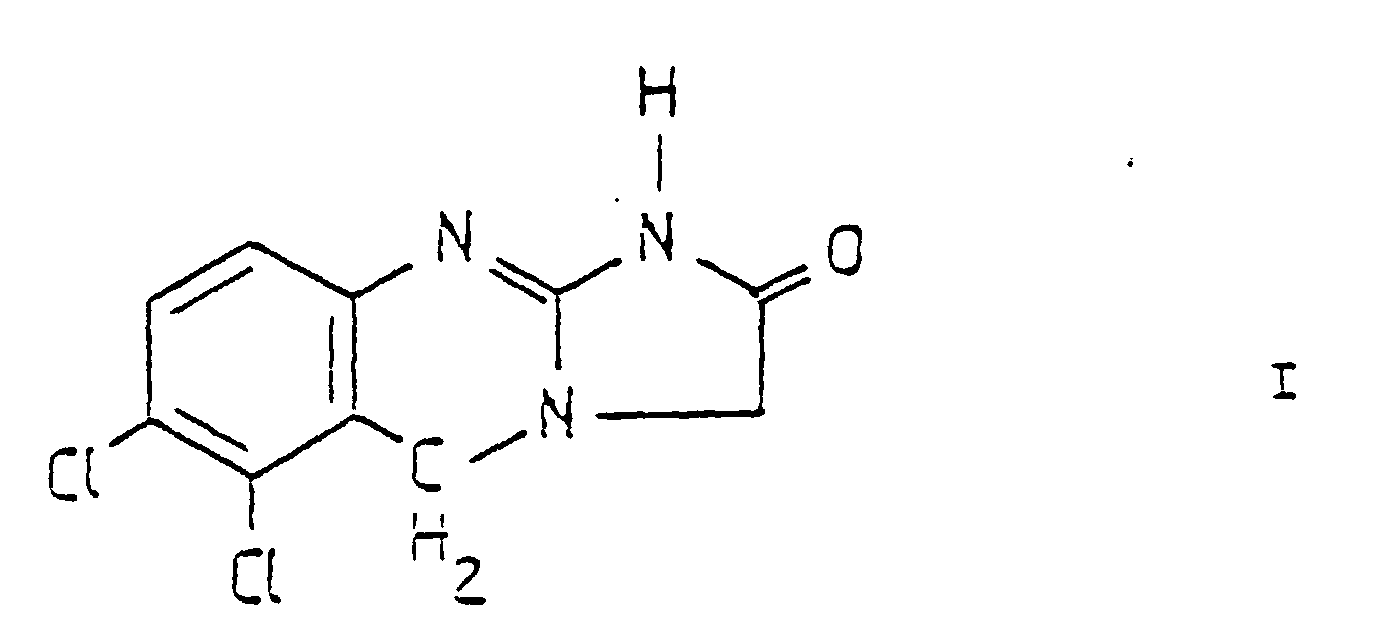
- This invention is concerned with a new and improved process for the preparation of 6,7-di-(chloro)-1,5-di-(hydro)-imidazo[2,1-b]-quinazolin-2[3 H ]-one of the formula [anagrelide], with 2-(cyanoimino)-quinazoline derivatives as new intermediates useful in the preparation of this compound and with a process for the preparation of the said new intermediates.
- the U.S. patent specification No. 3,932,407 discloses a process for the preparation of 6,7-di-(chloro)-1,5-di-(hydro)--imidazo[2,1-b]-quinazolin-[3 H ]-one hydrobromide [anagrelide hydrobromide] which comprises boiling a diamine of the general formula wherein R is an ester group, with cyanogen bromide in ethanol. The reaction time is rather long, it lasts for 22 hours. An improved method is disclosed in the U.S. patent specification No. 4,146,718.
- the diamine of the general formula IIa is boiled with cyanogen chloride, cyanogen bromide or cyanogen iodide for a long time, i.e. for 12 to 18 hours, to yield as intermediate a 2-iminoquinazoline salt of the general formula wherein
- a diamine of the general formula wherein R is an ester group is reacted with a cyanogen halide to form a quinazolinone of the general formula wherein R is an ester group, which is then cyclized into an imidazoquinazolinone derivative of the general formula
- the latter compound is chlorinated at an elevated pressure, in the presence of anhydrous iron chloride to obtain 6,7-di-(chloro)-1,5-di-(hydro)-imidazo[2,1-b]-quinazolin-2[3 H ]-one [anagrelide].
- EP-A-O 406 958 it has been described the reaction of [2-(amino)-benzylamino]-carbonic acid alkylesters, substituted in the 6-position by an acyl group, an oxyme group or a carboxyalkenyl group, optionally substituted, with N-cyanoimido-S,S-dimethyldithiocarbonate or with an O-alkylisourea or S-alkylisothiourea to form [2-(cyanoimino)-1,2,3,4-tetra-(hydro)-quinazolin-3-yl]-carbonic acid alkylesters, substituted in the 6-position by an acyl group, an oxyme group or a carboxyalkenyl group, optionally substituted. No particulars of this reaction have been indicated.
- the problem underlying to the present invention is to create a simple process which enables the favourable preparation of the 6,7-di-(chloro)-1,5-di-(hydro)-imidazo[2,1-b]-quinazolin-2[3H]-one [anagrelide] of the formula I.
- a subject-matter of the present invention is a process for the preparation of 6,7-di-(chloro)-1,5-di-(hydro)-imidazo[2,1-b]quinazolin-2[3H]-one of formula or a salt thereof including their hydrates, which is charactarized by subjecting [2-(cyanoimino)-5-,6-di-(chloro)-1,2,3,4-tetra-(hydro)-quinazolin-3-yl]-acetonitrile or a [2-(cyanoimino)-5,6-di-(chloro)-1,2,3,4-tetra-(hydro)-quinazolin-3-yl]-acetic acid alkylester of the general formula wherein R' stands for a cyano group or a group of the fomula in which latter R 1 represents a straight or branched alkyl group having from 1 to 6 carbon atom(s), optionally carrying a phen
- the hydrates of the 6,7-di-(chloro)-1,5-di-(hydro)-imidazo[2,1-b]-quinazolin-2[3H]-one [anagrelide] may be e.g. semihydrates and monohydrates.
- Examples for the alkyl group represented by R 1 are methyl, ethyl, propyl, isopropyl, butyl, tert.-butyl, pentyl and hexyl groups.
- the alkyl group represented by R 1 is such having from 1 to 4 carbon atom(s). These groups may be substituted by one phenyl group at any carbon atom.
- the cyclization is carried out in a mixture of 1 or more solvent(s) inert towards the reactants and a mineral acid.
- Preferably it is boiled for 20 to 180 minutes.
- the above solvents are such having a boiling point exceeding 80°C.
- the thermic cyclization is preferably carried out at a temperature from 80°C to 130°C.
- reaction mixture can be cooled and the product filtered off either in form of a salt or, after neutralization, in form of the free base.
- a still further subject matter of the invention is a process for the preparation of the [2-(cyanoimino)-5,6-di-(chloro)-1,2,3,4-tetra-(hydro)-quinazolin-3-yl]-acetonitriles or -acetic acid alkylesters according to the invention which is characterized by reacting a [2-(amino)-5,6-di-(chloro)-benzylamino]-acetonitrile or a [2-(amino)-5,6-di-(chloro)-benzylamino]-acetic acid alkylester of the general formula wherein R' is as defined above, with a cyanoimino derivative of the general formula wherein L is a leaving group.
- cyanoimino derivative of the general formula XI such one is used in which L stands for a group of formula X - R 2 XV, in which latter
- reaction of the compounds of the general formulae II and XI is carried out in [a] solvent(s) inert towards the reactants, particularly in an alcohol having from 1 to 8 carbon atom(s), most particularly in such having from 1 to 4 carbon atom(s), and/or [an] apolar and/or polar aprotic solvent(s).
- solvent(s) inert towards the reactants, particularly in an alcohol having from 1 to 8 carbon atom(s), most particularly in such having from 1 to 4 carbon atom(s), and/or [an] apolar and/or polar aprotic solvent(s).
- solvent(s) inert towards the reactants, particularly in an alcohol having from 1 to 8 carbon atom(s), most particularly in such having from 1 to 4 carbon atom(s), and/or [an] apolar and/or polar aprotic solvent(s).
- isopropanol, benzene, acetonitrile and/or dimethylformamide are used as solvent(s).
- the reaction is carried out at a temperature from 0°C to 100°C, preferably from 20°C to 80°C, particularly preferably at room temperature.
- the [2-(amino)-5,6-di-(chloro)-benzylamino]-acetonitrile and [2-(amino)-5,6-di-(chloro)-benzylamino]-acetic acid alkylesters of the general formula II used as starting substances can be prepared e.g. by subjecting the nitro and cyano groups of 2,3-di-(chloro)-6-(nitro)-benzonitrile to reduction and reacting the compound 2,3-di-(chloro)-6-(amino)-methylamine of formula thus obtained with a haloacetic acid ester or haloacetic nitrile of the general formula wherein X stands for halogen and R' is as stated above.
- the invention provides a process for the preparation of 6,7-di-(chloro)-1,5-di-(hydro)-imidazo[2,1-b]-quinazolin-2[3H]-one [anagrelide] of formula I which is more advantageous than the hitherto known processes due to the elimination of toxic reactants, the simple reaction steps, the short reaction time and the high yield and purity of the product.
- 0.163 g (0.0005 moles) of ethyl (2-cyanoimino-5,6-dichloro-1,2,3, 4-tetrahydroquinazolin-3-yl)-acetate are added to 2 ml of acetic acid at room temperature, the suspension thus obtained is heated to 100°C under stirring and kept at the same temperature for 30 minutes. Then it is cooled, the separated crystals are filtered off and washed with acetonitrile.
- 0.2 ml of cc. hydrochloric acid and 0.163 g (0.0005 moles) of ethyl-(2-cyanoimino-5,6-dichloro-1,2,3,4-tetrahydroquinazolin-3-yl)-acetate are added to 2 ml of diethylene glycol dimethyl ether at room temperature.
- the reaction mixture is warmed to 110°C and kept at the same temperature for 60 minutes.
- the solution is then cooled, the separated crystals are filtered off and washed with ethanol.
- Example 5 One proceeds according to Example 5 except that diethylene glycol diethyl ether is used instead of diethylene glycol dimethyl ether.
- Example 5 One proceeds according to Example 5 except that instead of diethylene glycol dimethyl ether ethylene glycol dimethyl ether is used, and the reaction is carried out at 90°C for 100 minutes.
- Example 5 One proceeds according to Example 5 except that instead of diethylene glycol dimethyl ether 2-methoxyethanol is used, and the reaction mixture is allowed to crystallize at 0°C instead of room temperature.
- Example 10 One proceeds according to Example 10 except that instead of dimethylformamide N-methylpyrrolidone is used, and the reaction is carried out at 130°C for 120 minutes.
- Example 12 One proceeds according to Example 12 except that instead of acetonitrile dioxane is used, and the reaction mixture is stirred at 100°C for 30 minutes.
- Example 16 One proceeds according to Example 16 except that instead of 2-methoxyethanol ethylene glycol dimethyl ether is used, and the reaction mixture is kept at 90°C for 70 minutes.
- Example 18 One proceeds as specified in Example 18 except that diethyleneglycol dimethyl ether is used instead of ethylene glycol dimethyl ether.
- Example 18 One proceeds as specified in Example 18 except that instead of 2-methoxyethanol diethylene glycol diethyl ether is used.
- the mother liquor is treated while hot with charcoal and evaporated to dryness in vacuo .
- the residue is dissolved in 10 ml of ethyl acetate, the solution is extracted first three times with 50 ml portions of 10% by weight potassium carbonate solution each, then twice with 5 ml of water each, dried, evaporated in vacuo and allowed to crystallize.
- the separated product is filtered off to yield further 0.66 g (20.2%) of the title compound.
- Example 23 One proceeds as described in Example 23 except that instead of benzene 2 ml of dimethylformamide are used as solvent.
- Example 23 One proceeds as described in Example 23 except that instead of benzene 2 ml of isopropanol are used as solvent.
- the filtrate is evaporated to about a third of its original volume to yield further 2.0 g (17.3%) of product.
Landscapes
- Organic Chemistry (AREA)
- Chemical & Material Sciences (AREA)
- Health & Medical Sciences (AREA)
- Pharmacology & Pharmacy (AREA)
- Nuclear Medicine, Radiotherapy & Molecular Imaging (AREA)
- Diabetes (AREA)
- Chemical Kinetics & Catalysis (AREA)
- General Chemical & Material Sciences (AREA)
- Medicinal Chemistry (AREA)
- Life Sciences & Earth Sciences (AREA)
- Engineering & Computer Science (AREA)
- Bioinformatics & Cheminformatics (AREA)
- Hematology (AREA)
- Animal Behavior & Ethology (AREA)
- General Health & Medical Sciences (AREA)
- Public Health (AREA)
- Veterinary Medicine (AREA)
- Pharmaceuticals Containing Other Organic And Inorganic Compounds (AREA)
- Nitrogen Condensed Heterocyclic Rings (AREA)
- Nitrogen And Oxygen Or Sulfur-Condensed Heterocyclic Ring Systems (AREA)
- Preventing Corrosion Or Incrustation Of Metals (AREA)
- Plural Heterocyclic Compounds (AREA)
Abstract
Description
- This invention is concerned with a new and improved process for the preparation of 6,7-di-(chloro)-1,5-di-(hydro)-imidazo[2,1-b]-quinazolin-2[3H]-one of the formula

- It is known that 6,7-di-(chloro)-1,5-di-(hydro)-imidazo-[2,1-b]-quinazolin-2[3H]-one [anagrelide] is a valuable blood platelet antiaggregative compound which has been recently reported to be a potent inhibitor of cyclic adenosine monophosphate phosphodiesterase.
- Several methods are known for the preparation of 6,7-di--(chloro)-1,5-di-(hydro)-imidazo[2,1-b]-quinazolin-2[3H]-one [anagrelide].
- The U.S. patent specification No. 3,932,407 discloses a process for the preparation of 6,7-di-(chloro)-1,5-di-(hydro)--imidazo[2,1-b]-quinazolin-[3H]-one hydrobromide [anagrelide hydrobromide] which comprises boiling a diamine of the general formula
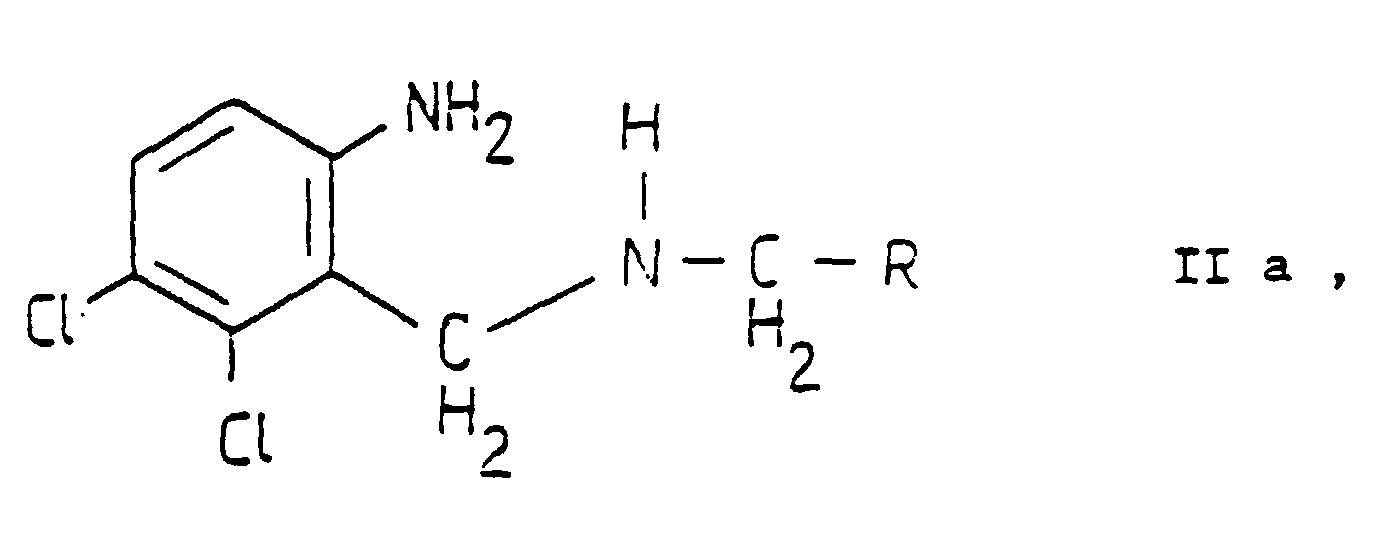
R is an ester group,
with cyanogen bromide in ethanol. The reaction time is rather long, it lasts for 22 hours. An improved method is disclosed in the U.S. patent specification No. 4,146,718. According to this method the diamine of the general formula IIa is boiled with cyanogen chloride, cyanogen bromide or cyanogen iodide for a long time, i.e. for 12 to 18 hours, to yield as intermediate a 2-iminoquinazoline salt of the general formula
- R stands for an ester group and
- HAL represents halogen,
- A serious drawback of both methods resides in the application of extremely toxic cyanogen halides, requiring special technology and special equipments on an industrial scale production.
- According to the process described in the U.S. patent specification No. 3,932,407 a diamine of the general formula II is subjected to cyclization with 1,1-carbonyldiimidazole, the corresponding quinazolin-2-one ester of the general formula

R is an ester group,
thus obtained is reacted with phosphorus oxychloride to yield the corresponding quinazoline ester of the general formula
R is an ester group,
and this latter compound is boiled with ethanolic ammonia to obtain 6,7-di-(chloro)-1,5-di-(hydro)-imidazo[2,1-b]--quinazolin-2[3H]-one [anagrelide]. The disadvantages of this process reside in the facts that 1,1-carbonyldiimidazole is a difficultly available substance, and when reacting a quinazolin-2-one ester of the general formula V with phosphorus oxychloride, the acid-sensitive ester group decomposes, causing the formation of a considerable amount of by-products. This is the reason why the patent specification discloses only the yield of the crude product and is silent about the losses of purification. The closing step of this synthesis is also disadvantageous since the reaction with ethanolic ammonia is to be carried out at an elevated pressure and the reaction time is rather long, i.e. 16 hours. - The cyclization of a compound of the general formula VI,
in which
R is ethoxycarbonyl,
with ethanolic ammonia, is described by Japanese authors in J. Heterocyclic chem., 18, 67 (1981), too, but this reaction is also carried out at an elevated pressure in a closed bomb tube, at a temperature of 120°C for 16 hours, and hence this process is also disadvantageous for an industrial scale production. - The U.S. patent specification No. 3,932,407 describes a further process for the preparation of the 6,7-di-(chloro)-1,5-di-(hydro)-imidazo[2,1-b]-quinazolin-2[3H]-one [anagrelide] of formula I. According to this process a diamine of the general formula

R is an ester group,
is reacted with a cyanogen halide to form a quinazolinone of the general formula
R is an ester group,
which is then cyclized into an imidazoquinazolinone derivative of the general formula
- According to the method described in the U.S. patent specification No. 4,208,521 a diamine of the general formula IIa,
wherein
R stands for an ester group,
is reacted with a guanile derivative of the general formula
X represents a leaving group,
to obtain directly 6,7-di-(chloro)-1,5-di-(hydro)-imidazo-[2,1-b]-quinazolin-2[3H]-one [anagrelide]. As leaving group amino, alkylthio, arylthio and optionally substituted nitrogen-containing heterocyclic groups are mentioned, but as regards the preparation of 6,7-di-(chloro)-1,5-di-(hydro)-imidazo-[2,1-b]-quinazolin-2[3H]-one only the more reactive 1-(guanile)-3,5-di-(methyl)-pyrazole nitrate is specified, which is boiled for as long as 24 hours to obtain 6,7-di-(chloro)-1,5-di-(hydro)-imidazo[2,1-b]-quinazolin-2[3H]-one [anagrelide] with a yield of 40%. The very long reaction time and the low yield and particularly the low purity of the desired product because of formation of a side-product difficultly separable from the desired product render this process uneconomical for industrial scale production. In case of other carboxamidine derivative reactants the reaction times and yields are still more unfavorable even with starting substances not containing chlorine atoms in the benzene ring. - From EP-A-O 406 958, particularly page 4, line 36 to page 5, line 26 it has been known to prepare 1,5-di-(hydro)-imidazo[2,1-b]-quinazolin-2[3H]-ones substituted in the 6-position by an acyl group, an oxyme group or a carboxy alkenyl group, optionally substituted, by thermic cyclization of [2-(cyanoimino-1,3,4-tetra-(hydro)-quinazolin-3-yl]-carbonic acid alkylesters in the presence of acids. As solvents alkanols, e.g. ethanol, propanol or butanol, have been indicated. No example has been described for this reaction.
- Further in EP-A-O 406 958 it has been described the reaction of [2-(amino)-benzylamino]-carbonic acid alkylesters, substituted in the 6-position by an acyl group, an oxyme group or a carboxyalkenyl group, optionally substituted, with N-cyanoimido-S,S-dimethyldithiocarbonate or with an O-alkylisourea or S-alkylisothiourea to form [2-(cyanoimino)-1,2,3,4-tetra-(hydro)-quinazolin-3-yl]-carbonic acid alkylesters, substituted in the 6-position by an acyl group, an oxyme group or a carboxyalkenyl group, optionally substituted. No particulars of this reaction have been indicated.
- Particulars of such reaction can be taken from Chemical and Pharmaceutical Bulletin, Vol. 28, No. 5, 1980, pages 1357 to 1364, particularly page 1363, second paragraph. There it has been described the reaction of N-[2-(amino)-benzylamino]-N-[benzyl]-amine with dimethyl cyanoimidodithiocarbonate at 180 to 200°C (in the melt) for 30 minutes to form 3-benzyl-2-cyanoimino-1,2,3,4-tetrahydroquinazoline in a yield of 57%.
- The problem underlying to the present invention is to create a simple process which enables the favourable preparation of the 6,7-di-(chloro)-1,5-di-(hydro)-imidazo[2,1-b]-quinazolin-2[3H]-one [anagrelide] of the formula I.
- A subject-matter of the present invention is a process for the preparation of 6,7-di-(chloro)-1,5-di-(hydro)-imidazo[2,1-b]quinazolin-2[3H]-one of formula

R' stands for a cyano group or a group of the fomula
R1 represents a straight or branched alkyl group having from 1 to 6 carbon atom(s), optionally carrying a phenyl subsequent,
to thermic cyclization in an acidic medium with ethylene glycol, ethylene glycol dimethyl ether, ethylene glycol diethyl ether, diethylene glycol dimethyl ether, diethylene glycol diethyl ether, 2-(methoxy)-ethanol, 2-(ethoxy)-ethanol, N-(methyl)-pyrrolidone, dimethylformamide, acetonitrile and/ /or dioxane and/or in an aliphatic organic acid having from 1 to 4 carbon atom(s) as [a] solvent(s). - The hydrates of the 6,7-di-(chloro)-1,5-di-(hydro)-imidazo[2,1-b]-quinazolin-2[3H]-one [anagrelide] may be e.g. semihydrates and monohydrates.
- Examples for the alkyl group represented by R1 are methyl, ethyl, propyl, isopropyl, butyl, tert.-butyl, pentyl and hexyl groups.
- Preferably the alkyl group represented by R1 is such having from 1 to 4 carbon atom(s). These groups may be substituted by one phenyl group at any carbon atom.
- According to an advantageous embodiment of the invention the cyclization is carried out in a mixture of 1 or more solvent(s) inert towards the reactants and a mineral acid.
- Preferably it is boiled for 20 to 180 minutes.
- The above solvents are such having a boiling point exceeding 80°C.
- As a mineral acid preferably hydrogen chloride is used.
- Particularly as an aliphatic organic acid having from 1 to 4 carbon atom(s) acetic acid is used.
- In cases in which the cyclization is performed by using as a solvent an aliphatic organic acid there is no need for using a mineral acid but additionally also the latter can be used.
- The thermic cyclization is preferably carried out at a temperature from 80°C to 130°C.
- When the reaction is accomplished, the reaction mixture can be cooled and the product filtered off either in form of a salt or, after neutralization, in form of the free base.
- The starting [2-(cyanoimino)-5,6-di-(chloro)-1,2,3,4-tetra-(hydro)-quinazolin-3-yl]-acetonitriles and -acetic acid alkylesters of the general formula III are new compounds
- Hence as a further subject matter of the present invention there are provided for new 2-(cyanoimino)-quinazoline derivatives of the general formula

R' stands for a cyano group or a group of the formula
R1 represents a straight or branched alkyl group having from 1 to 6 carbon atom(s), optionally carrying a phenyl substituent. - Surprisingly further reacting them by the process according to the invention having peculiarity yields 6,7-di-(chloro)-1,5-di-(hydro)-imidazo[2,1-b]-quinazolin-2[3H]-one [anagrelide] with superior results.
- A still further subject matter of the invention is a process for the preparation of the [2-(cyanoimino)-5,6-di-(chloro)-1,2,3,4-tetra-(hydro)-quinazolin-3-yl]-acetonitriles or -acetic acid alkylesters according to the invention which is characterized by reacting a [2-(amino)-5,6-di-(chloro)-benzylamino]-acetonitrile or a [2-(amino)-5,6-di-(chloro)-benzylamino]-acetic acid alkylester of the general formula

R' is as defined above,
with a cyanoimino derivative of the general formula
L is a leaving group. - Preferably as cyanoimino derivative of the general formula XI such one is used
in which
L stands for a group of formula
X - R2 XV,
in which latter - X
- represents oxygen or sulfur and
- R2
- means an alkyl group having from 1 to 6, particularly 1 to 4, carbon atom(s), optionally carrying a phenyl substituent.
- Suitably the reaction of the compounds of the general formulae II and XI is carried out in [a] solvent(s) inert towards the reactants, particularly in an alcohol having from 1 to 8 carbon atom(s), most particularly in such having from 1 to 4 carbon atom(s), and/or [an] apolar and/or polar aprotic solvent(s). Above all isopropanol, benzene, acetonitrile and/or dimethylformamide are used as solvent(s).
- Suitably the reaction is carried out at a temperature from 0°C to 100°C, preferably from 20°C to 80°C, particularly preferably at room temperature.
- The [2-(cyanoimino)-5,6-di-(chloro)-1,2,3,4-(hydro)-quinazolin-3-yl]-acetonitriles or -acetic acid alkylesters of the general formula III can be isolated from the reaction mixture by methods known per se, generally by conventional filtration followed by recrystallization from an appropriate solvent.
- The [2-(amino)-5,6-di-(chloro)-benzylamino]-acetonitrile and [2-(amino)-5,6-di-(chloro)-benzylamino]-acetic acid alkylesters of the general formula II used as starting substances can be prepared e.g. by subjecting the nitro and cyano groups of 2,3-di-(chloro)-6-(nitro)-benzonitrile to reduction and reacting the compound 2,3-di-(chloro)-6-(amino)-methylamine of formula


X stands for halogen and R' is as stated above. - The invention provides a process for the preparation of 6,7-di-(chloro)-1,5-di-(hydro)-imidazo[2,1-b]-quinazolin-2[3H]-one [anagrelide] of formula I which is more advantageous than the hitherto known processes due to the elimination of toxic reactants, the simple reaction steps, the short reaction time and the high yield and purity of the product.
- The invention is further illustrated by the following Examples.
- To a solution of 150 ml of ethylene glycol and 15 ml (0.15 moles) of cc. hydrochloric acid 24.5 g (0.075 moles) of ethyl-(2-cyanoimino-5,6-dichloro-1,2,3,4-tetrahydroquinazolin-3-yl)-acetate are added in small portions, within about 10 minutes, at 115°C, and the mixture is kept at the same temperature for further 20 minutes. Then it is cooled to room temperature and made neutral by the dropwise addition of 10% by weight potassium carbonate solution. The separated crystals are filtered off. Thus 17.75 g (93.0%) of 6,7-di-chloro-1,5-dihydroimidazo[2,1-b]quinazolin-2[3H]-one base are obtained (m.p. > 300°C, HPLC content: 99.5%), which is dissolved in a hot mixture of 150 ml of methanol and 150 ml of cc. ethanolic hydrogen chloride (hydrogen chloride content: 0.75 moles/1000 ml). The mixture is then cooled, the separated product is filtered off and washed with a slight amount of ethanol.
- Yield: 17.4 (82.8%).
- M.p.: > 300°C, HPLC content: 99.9%.
- To a solution of 10 ml of ethylene glycol in 0.5 ml (0.005 moles) of cc. hydrochloric acid, warmed to 120°C, 0.28 g (0.001 mole) of (2-cyanoimino-5,6-dichloro-1,2,3,4-tetrahydroquinazolin-3-yl)-acetonitrile are added, and the solution is stirred at the same temperature for 20 minutes. Then it is cooled to room temperature and made neutral with 10% potassium carbonate solution. The separated crystals are filtered off. Thus 0.27 g (96.4%) of crude 6,7-dichloro-1,5-dihydroimidazo[2,1-b]quinazolin-2[3H]-one base are obtained (m.p. > 300°C, HPLC content: 96.3%), which is dissolved in a hot mixture of 7 ml of methanol and 6 ml of cc. ethanolic hydrogen chloride (hydrogen chloride content: 0.76 moles/1000 ml) and allowed to crystallize. Then it is cooled, the separated product is filtered off and washed with a slight amount of ethanol.
- Yield: 0.23 g (78.2%).
- M.p.: > 300°C, HPLC content: 99.9%.
- To a mixture of 15 ml of ethylene glycol and 2 ml (0.02 moles) of cc. hydrochloric acid, warmed to 120°C, 2.50 g (0.01 mole) of (2-cyanoimino-5,6-dichloro-1,2,3,4-tetrahydroquinazolin-3-yl)-acetonitrile are added, and the solution is stirred at the same temperature for 20 minutes. Then it is cooled to room temperature and made neutral with 10% potassium carbonate solution. The separated crystals are filtered off. Thus 2.72 g (97.1%) of crude 6,7-dichloro-1,5dihydroimidazo[2,1-b]quinazolin-2[3H]-one base are obtained (m.p. > 300°C, HPLC content: 97.2%), which is dissolved in a hot mixture of 15 ml of methanol and 16 ml of cc. ethanolic hydrogen chloride (hydrogen chloride content: 0.76 moles/1000 ml) and allowed to crystallize. Then it is cooled, the separated product is filtered off and washed with a slight amount of ethanol.
- Yield: 2.56 (84.5%).
- M.p.: > 300°C, HPLC content: 99.2%.
- 0.163 g (0.0005 moles) of ethyl (2-cyanoimino-5,6-dichloro-1,2,3, 4-tetrahydroquinazolin-3-yl)-acetate are added to 2 ml of acetic acid at room temperature, the suspension thus obtained is heated to 100°C under stirring and kept at the same temperature for 30 minutes. Then it is cooled, the separated crystals are filtered off and washed with acetonitrile.
- Yield: 0.116 g (91%).
- M.p.: > 300°C, HPLC content: 99.15%.
- 0.2 ml of cc. hydrochloric acid and 0.163 g (0.0005 moles) of ethyl-(2-cyanoimino-5,6-dichloro-1,2,3,4-tetrahydroquinazolin-3-yl)-acetate are added to 2 ml of diethylene glycol dimethyl ether at room temperature. The reaction mixture is warmed to 110°C and kept at the same temperature for 60 minutes. The solution is then cooled, the separated crystals are filtered off and washed with ethanol.
- Yield: 0.121 g (80%),
- HPLC content: 86%.
- The mother liquor is made alkaline (pH=8) with triethylamine, the free base thus obtained is filtered off and washed with ethanol.
- Yield: 0.010 g (7.8%).
- HPLC content: 90% .
- Total yield: 87.8%.
- One proceeds according to Example 5 except that diethylene glycol diethyl ether is used instead of diethylene glycol dimethyl ether.
- Yield: 0.123 g (81%).
- HPLC content: 87.5%.
- The yield of the free base obtained from the mother liquor: 0.011 g (8.2%), HPLC content: 91.3%. Total yield: 89.2%.
- One proceeds according to Example 5 except that instead of diethylene glycol dimethyl ether ethylene glycol dimethyl ether is used, and the reaction is carried out at 90°C for 100 minutes.
- Yield: 0.124 g (81.8%).
- HPLC content: 88.2%.
- The yield of the free base obtained from the mother liquor: 0.014 g (11%), HPLC content: 93%. Total yield: 92.8%.
- One proceeds according to Example 5 except that instead of diethylene glycol dimethyl ether 2-methoxyethanol is used, and the reaction mixture is allowed to crystallize at 0°C instead of room temperature.
- Yield: 0.100 9 (66%)
- HPLC content: 79%.
- The yield of the free base obtained from the mother liquor: 0.01 g (7.8%). Total yield: 73.8%.
- One proceeds according to Example 8 except that instead of 2-methoxyethanol 2-ethoxyethanol is used, and the reaction mixture is allowed to react for 75 minutes instead of 60 minutes.
- Yield: 0.106 g (70%),
- The mother liquor is made alkaline with cc. ammonia to obtain 0.013 g (10.3%) of free base. HPLC content: 87.3%. Total yield: 80.3%.
- 0.163 g (0.0005 moles) of ethyl-(2-cyanoimino-5,6-dichloro-1,2,3,4-tetrahydroquinazolin-3-yl)-acetate and 0.2 ml of cc. hydrochloric acid are added to 0.2 ml of dimethylformamide, the suspension thus obtained is heated to 120°C under stirring and kept at the same temperature for 180 minutes. During the reaction further portions of hydrochloric acid are added to the mixture every 60 minutes, in a total amount of 0.2 ml. The solution thus obtained is cooled, rendered alkaline (pH=8) with triethyl amine and allowed to stand overnight in a refrigerator. The separated crystals are filtered off and washed with acetonitrile.
- Yield: 0.070 g (54.7%), HPLC content: 87.3%.
- One proceeds according to Example 10 except that instead of dimethylformamide N-methylpyrrolidone is used, and the reaction is carried out at 130°C for 120 minutes.
- Yield: 0.076 g (59.4%), HPLC content: 87.8%.
- 0.140 g (0.0005 moles) of (2-cyanoimino-5,6-dichloro-1,2,3,4-tetrahydroquinazolin-3-yl)-acetonitrile and 0.2 ml of cc. hydrochloric acid are added to 2 ml of acetonitrile. The reaction mixture is heated to 80°C under stirring and kept at the same temperature for 50 minutes. Then it is cooled, the separated crystals are filtered off and washed with acetonitrile.
- Yield: 0.138 g (91.1%), HPLC content: 99.0%.
- One proceeds according to Example 12 except that instead of acetonitrile dioxane is used, and the reaction mixture is stirred at 100°C for 30 minutes.
- Yield: 0.139 g (91.7%), HPLC content: 99.2%.
- One proceeds according to Example 12 except that instead of acetonitrile dimethylformamide is used, and the reaction mixture is stirred at 100°C for 100 minutes. During the reaction further portions of cc. hydrochloric acid (2x0.2 ml) are added after 30 and 60 minutes, respectively. The mixture is then cooled, rendered alkaline with 10% by weight potassium carbonate solution (pH=8), the separated crystals are filtered off and washed with a slight amount of water and acetonitrile.
- Yield: 0.080 g (62.5%), HPLC content: 88.%.
- One proceeds according to Example 14 except that instead of dimethylformamide N-methylpyrrolidone is used.
- Yield: 0.078 g (61.0%), HPLC content: 87.3%.
- 0.140 g (0.0005 moles) of (2-cyanoimino-5,6-dichloro-1,2,3,4-tetrahydroquinazolin-3-yl)-acetonitrile and 0.2 ml of cc. hydrochloric acid are added to 2 ml of 2-methoxyethanol, and the mixture is reacted at 100°C for 50 minutes. Then it is cooled and allowed to stand overnight in a refrigerator. Then the separated crystals are filtered off and washed with acetonitrile.
- Yield: 0.110 g (72.6%), HPLC content: 82%.
- The filtrate is made alkaline (pH=8) with cc. ammonia solution, the separated crystals are filtered and washed with water and acetonitrile.
- Yield of the free base obtained from the mother liquor: 0.011 g (8.6%), HPLC content: 87.2%.
- Total yield: 81.2%.
- One proceeds according to Example 16 except that instead of 2-methoxyethanol 2-ethoxyethanol is used.
- Yield: 0.115 g (76.0%), HPLC content: 84.5%.
- Yield of the free base obtained from the mother liquor: 0.011 g (8.6%), HPLC content: 88.3%.
- Total yield: 84.6%.
- One proceeds according to Example 16 except that instead of 2-methoxyethanol ethylene glycol dimethyl ether is used, and the reaction mixture is kept at 90°C for 70 minutes.
- Yield: 0.128 g (84.5%), HPLC content: 92.5%.
- Upon adding triethylamine to the mother liquor 0.011 g (8.6%) of 6,7-dichloro-1,5-dihydroimidazo[2,1-b]quinazolin-2[3H]-one base is obtained. HPLC content: 95.7%, total yield: 93.1%.
- One proceeds as specified in Example 18 except that diethyleneglycol dimethyl ether is used instead of ethylene glycol dimethyl ether.
- Yield: 0.127 g (83.8%), HPLC content: 92.3%.
- Yield of the free base obtained from the mother liquor: 0.011 g (8.6%), HPLC content: 95.8%.
- Total yield: 92.4%.
- One proceeds as specified in Example 18 except that instead of 2-methoxyethanol diethylene glycol diethyl ether is used.
- Yield: 0.125 g (82.5%), HPLC content: 92.0%.
- Yield of the free base obtained from the mother liquor: 0.011 g (8.6%), HPLC content: 94.9%.
- Total yield: 91.1%.
- 0.140 g (0.0005 moles) of (2-cyanoimino-5,6-dichloro-1,2,3,4-tetrahydroquinazolin-3-yl)-acetonitrile and 0.2 ml of water are added to 2 ml of acetic acid. The reaction mixture is heated to 80°C under stirring and kept at the same temperature for 30 minutes. Then it is cooled, the separated crystals are filtered off and washed with acetonitrile.
- Yield: 0.118 g (92.2%),
- HPLC content: 99.3%.
- To a suspension of 2.38 g (0.01 mole) of diphenyl-N-cyanoimidocarbonate in 20 ml of acetonitrile a solution of 2.76 g (0.01 mole) of ethyl-(2-amino-5,6-dichlorobenzylamino)-acetate in 20 ml of acetonitrile are added dropwise at 20 to 30°C, within about 30 minutes under stirring. The reaction mixture is stirred further for 1 hour at room temperature, the separated product is filtered off and washed with a slight amount of acetonitrile.
- Yield: 1.87 g (57.4%).
- M.p.: 274-278°C (HPLC content: 99.2%).
- The mother liquor is treated while hot with charcoal and evaporated to dryness in vacuo. The residue is dissolved in 10 ml of ethyl acetate, the solution is extracted first three times with 50 ml portions of 10% by weight potassium carbonate solution each, then twice with 5 ml of water each, dried, evaporated in vacuo and allowed to crystallize. The separated product is filtered off to yield further 0.66 g (20.2%) of the title compound.
- M.p.: 275-278°C (HPLC content: 99.5%)
- Total yield: 77.6%.
- To a solution of 0.28 g (0.001 mole) of ethyl-(2-amino-5,6-dichlorobenzylamino)-acetate (GC content: 82%) in 2 ml of benzene 0.24 g (0.001 mole) of diphenyl-N-cyanoimidocarbonate is added at room temperature under stirring, and the reaction mixture is stirred at room temperature for 20 minutes. The separated product is filtered off and washed with a slight amount of benzene.
- Yield: 0.21 g (64.4%).
- M.p.: 263-270°C (HPLC content: 98.2%).
- The product is recrystallized from 4 ml of dimethylformamide to yield 0.17 g (52%) of pure title compound.
- M.p.: 268-275°C (HPLC content: 99.9%)
- One proceeds as described in Example 23 except that instead of benzene 2 ml of dimethylformamide are used as solvent.
- Yield: 0.19 g (58.3%).
- M.p.: 271-278°C (HPLC content: 99.7%).
- One proceeds as described in Example 23 except that instead of benzene 2 ml of isopropanol are used as solvent.
- Yield: 0.23 g (70.6%).
- M.p.: 268-274°C (HPLC content: 99.5%).
- To a solution of 7.68 g (0.023 moles) of ethyl-(2-amino-5,6-dichlorobenzylamino)-acetate (GC content: 82%) in 50 ml of isopropanol 3.8 g (0.0026 moles) of dimethyl-N-cyanoimidocarbonate are added, and the reaction mixture is boiled for 3 hours under stirring. Then it is cooled, the separated product is filtered off and washed with a slight amount of cold isopropanol.
- Yield: 2.8 g (37.3%).
- M.p.: 272-278°C (HPLC content: 99.5%).
- To a suspension of 5.0 g (0.0208 moles) of diphenyl-N-cyanoimidocarbonate in 100 ml of acetonitrile 4.61 g (0.02 moles) of (2-amino-5,6-dichlorobenzylamino)-acetonitrile are added, the reaction mixture is heated to 60°C within 20 minutes under stirring and allowed to react at the same temperature for further 1 hour. Then it is cooled, the separated product is filtered off and washed with a slight amount of acetonitrile.
- Yield: 3.53 g (60.9%).
- M.p.: >280°C (HPLC content: 99.5%).
- The filtrate is evaporated to about a third of its original volume to yield 1.2 g (20.7%) of the title compound.
- M.p.: >280°C (HPLC content: 98.7%).
- Total yield: 81.6%.
- To a suspension of 7.2 g (0.030 moles) of diphenyl-N--cyanoimidocarbonate in 120 ml of acetonitrile 10.20 g (0.030 moles) of benzyl-(2-amino-5,6-dichlorobenzylamino)-acetate are added, the reaction mixture is heated to 60°C within 20 minutes under stirring and allowed to react at the same temperature for further 1 hour. Then it is cooled, the separated product is filtered off and washed with a slight amount of acetonitrile and acetone.
- Yield: 6.94 g (60.0%).
- M.p.: 278-285°C (HPLC content: 98.9%).
- The filtrate is evaporated to about a third of its original volume to yield further 2.0 g (17.3%) of product.
- M.p.: 279-284°C (HPLC content: 98.4%).
- Total yield: 77.3%.
- To a solution of 19.8 g (0.1 M) of dibenzyl-(N-cyanoimidodithiocarbonate) in 100 ml of dimethylformamide 27.7 g (0.1 M) of 6-amino-2,3-dichlorobenzylglycine ethyl ester are added, and the reaction mixture is stirred at 100°C for 5 hours. Then it is cooled, 100 ml of water are added thereto, and it is allowed to crystallize. The separated product is filtered off and washed with a slight amount of isopropanol.
- Yield: 10.1 g (31%).
- M.p.: 274-277°C.
Claims (11)
- A process for the preparation of 6,7-di-(chloro)-1,5-di-(hydro)-imidazo[2,1-b]quinazolin-2[3H]-one of formula


R' stands for a cyano group or a group of the formula
R1 represents a straight or branched alkyl group having from 1 to 6 carbon atom(s), optionally carrying a phenyl substituent,
to thermic cyclization in an acidic medium with ethylene glycol, ethylene glycol dimethyl ether, ethylene glycol diethyl ether, diethylene glycol dimethyl ether, diethylene glycol diethyl ether, 2-(methoxy)-ethanol, 2-(ethoxy)-ethanol, N-(methyl)-pyrrolidone, dimethylformamide, acetonitrile and/or dioxane and/or in an aliphatic organic acid having from 1 to 4 carbon atom(s) as [a] solvent(s). - A process as claimed in claim 1, characterized by carrying out the cyclization in a mixture of 1 or more solvent(s) inert towards the reactants and a mineral acid.
- A process as claimed in any of claim 1 or 2, characterized by using as a mineral acid hydrogen chloride.
- A process as claimed in any of claims 1 to 3, characterized by carrying out the reaction in an aliphatic organic acid having from 1 to 4 carbon atom(s) in acetic acid.
- A process as claimed in any of claims 1 to 4, characterized by carrying out the reaction at a temperature from 80°C to 130°C.
- [2-(Cyanoimino)-5,6-di-(chloro)-1,2,3,4-tetra-(hydro)-quinazolin-3-yl]-acetonitriles or -acetic acid alkylesters of the general formula

R' stands for a cyano group or a group of the formula
R1 represents a straight or branched alkyl group having from 1 to 6 carbon atom(s), optionally carrying a phenyl substituent. - A process for the preparation of the [2-(cyanoimino)-5,6-di-(chloro)-1,2,3,4-tetra-(hydro)-quinazolin-3-yl]-acetonitriles or -acetic acid alkylesters according to claim 6, characterized by reacting a [2-(amino)-5,6-di-(chloro)-benzylamino]-acetonitrile or a [2-(amino)-5,6-di-(chloro)-benzylamino]-acetic acid alkylester of the general formula

R' is as defined in claim 6,
with a cyanoimino derivative of the general formula
L is a leaving group. - A process as claimed in claim 7, characterized by using as cyanoimino derivative of the general formula XI such one,
in which
L stands for a group of formula
X - R2 XV,
in which latterX represents oxygen or sulfur andR2 means an alkyl group having from 1 to 6 carbon atom(s), optionally carrying a phenyl substituent. - A process as claimed in claim 7 or 8, characterized by carrying out the reaction in [a] solvent(s) inert towards the reactants, particularly in an alcohol having from 1 to 8 carbon atom(s), and/or [an] apolar and/or polar aprotic solvent(s).
- A process as claimed in any of claims 7 to 9, characterized by using as solvent(s) isopropanol, benzene, acetonitrile and/or dimethylformamide.
- A process as claimed in any of claims 7 to 10, characterized by carrying out the reaction at a temperature from 0°C to 100°C.
Applications Claiming Priority (4)
| Application Number | Priority Date | Filing Date | Title |
|---|---|---|---|
| HU170891 | 1991-05-22 | ||
| HU170791 | 1991-05-22 | ||
| HU170891A HU209633B (en) | 1991-05-22 | 1991-05-22 | New process for producing 6,7-dichloro-1,5-dihydroimidazo/2,1-b/-quinazoline-2/3h/-one |
| HU170791A HU208681B (en) | 1991-05-22 | 1991-05-22 | Process for producing quinazoline derivatives |
Publications (2)
| Publication Number | Publication Date |
|---|---|
| EP0514917A1 EP0514917A1 (en) | 1992-11-25 |
| EP0514917B1 true EP0514917B1 (en) | 1996-12-27 |
Family
ID=26317400
Family Applications (1)
| Application Number | Title | Priority Date | Filing Date |
|---|---|---|---|
| EP92108656A Expired - Lifetime EP0514917B1 (en) | 1991-05-22 | 1992-05-22 | Process for and 2-(cyanoimino)-quinazoline derivatives useful as intermediates in the preparation of 6,7-di-(chloro)-1,5-di(hydro)-imidazo-[2,1-b]quinazolin-2[3H]-one and process for preparing the 2-(cyanoimino)-quinazoline derivatives |
Country Status (8)
| Country | Link |
|---|---|
| EP (1) | EP0514917B1 (en) |
| JP (1) | JPH05271200A (en) |
| AT (1) | ATE146789T1 (en) |
| CZ (1) | CZ281671B6 (en) |
| DE (1) | DE69216143T2 (en) |
| ES (1) | ES2095349T3 (en) |
| GB (1) | GB2256195B (en) |
| RU (1) | RU2042678C1 (en) |
Cited By (2)
| Publication number | Priority date | Publication date | Assignee | Title |
|---|---|---|---|---|
| AT412873B (en) * | 2004-02-20 | 2005-08-25 | Aop Orphan Pharmaceuticals Ag | Preparation of anagrelide hydrochloride, useful for thrombocyte suppression, using 2,3-dichlorobenzaldehyde as starting material, avoids use of toxic reagents |
| US8304420B2 (en) | 2006-11-28 | 2012-11-06 | Shire Llc | Substituted quinazolines for reducing platelet count |
Families Citing this family (7)
| Publication number | Priority date | Publication date | Assignee | Title |
|---|---|---|---|---|
| AU688515B2 (en) * | 1994-05-24 | 1998-03-12 | F. Hoffmann-La Roche Ag | Tricyclic dicarbonyl derivatives |
| CA2171073A1 (en) * | 1995-12-04 | 1997-06-05 | Philip C. Lang | Process for the preparation of ethyl-n-(2,3 dichloro-6- nitrobenzyl) glycine |
| EP1216037A2 (en) * | 1999-09-21 | 2002-06-26 | Emory University | Methods and compositions for treating platelet-related disorders using mpl pathway inhibitory agents |
| US7700608B2 (en) | 2004-08-04 | 2010-04-20 | Shire Holdings Ag | Quinazoline derivatives and their use in the treatment of thrombocythemia |
| US7910597B2 (en) | 2006-11-28 | 2011-03-22 | Shire Llc | Substituted quinazolines |
| AU2008212668B2 (en) | 2007-02-06 | 2013-02-07 | Cipla Limited | Process for the preparation of ethyl-N-(2, 3-dichloro-6-nitrobenzyl) glycine hydrochloride |
| EP2981537B1 (en) * | 2013-03-14 | 2017-05-10 | Synthon B.V. | Process for making anagrelide |
Family Cites Families (3)
| Publication number | Priority date | Publication date | Assignee | Title |
|---|---|---|---|---|
| US4146718A (en) * | 1978-04-10 | 1979-03-27 | Bristol-Myers Company | Alkyl 5,6-dichloro-3,4-dihydro-2(1h)-iminoquinazoline-3-acetate hydrohalides |
| US4208521A (en) * | 1978-07-31 | 1980-06-17 | Bristol-Myers Company | Process for the preparation of imidazo[2,1-b]quinazolinones |
| NZ234186A (en) * | 1989-07-07 | 1991-10-25 | Janssen Pharmaceutica Nv | Imidazo quinazolin-one derivatives and pharmaceutical compositions |
-
1992
- 1992-05-20 JP JP4151259A patent/JPH05271200A/en active Pending
- 1992-05-21 RU SU925011723A patent/RU2042678C1/en active
- 1992-05-21 GB GB9210908A patent/GB2256195B/en not_active Expired - Fee Related
- 1992-05-22 CZ CS921538A patent/CZ281671B6/en unknown
- 1992-05-22 DE DE69216143T patent/DE69216143T2/en not_active Expired - Fee Related
- 1992-05-22 AT AT92108656T patent/ATE146789T1/en active
- 1992-05-22 EP EP92108656A patent/EP0514917B1/en not_active Expired - Lifetime
- 1992-05-22 ES ES92108656T patent/ES2095349T3/en not_active Expired - Lifetime
Cited By (2)
| Publication number | Priority date | Publication date | Assignee | Title |
|---|---|---|---|---|
| AT412873B (en) * | 2004-02-20 | 2005-08-25 | Aop Orphan Pharmaceuticals Ag | Preparation of anagrelide hydrochloride, useful for thrombocyte suppression, using 2,3-dichlorobenzaldehyde as starting material, avoids use of toxic reagents |
| US8304420B2 (en) | 2006-11-28 | 2012-11-06 | Shire Llc | Substituted quinazolines for reducing platelet count |
Also Published As
| Publication number | Publication date |
|---|---|
| JPH05271200A (en) | 1993-10-19 |
| GB2256195B (en) | 1994-12-21 |
| ATE146789T1 (en) | 1997-01-15 |
| DE69216143T2 (en) | 1997-06-12 |
| GB9210908D0 (en) | 1992-07-08 |
| CZ281671B6 (en) | 1996-12-11 |
| CS153892A3 (en) | 1992-12-16 |
| ES2095349T3 (en) | 1997-02-16 |
| GB2256195A (en) | 1992-12-02 |
| RU2042678C1 (en) | 1995-08-27 |
| EP0514917A1 (en) | 1992-11-25 |
| DE69216143D1 (en) | 1997-02-06 |
Similar Documents
| Publication | Publication Date | Title |
|---|---|---|
| US4208521A (en) | Process for the preparation of imidazo[2,1-b]quinazolinones | |
| JP3713724B2 (en) | Method for producing imidazopyridine derivative | |
| US7550479B2 (en) | Modified Pictet-Spengler reaction and products prepared therefrom | |
| CA2961984C (en) | Novel chiral synthesis of n-acyl-(3-substituted)-(8-substituted)-5,6-dihydro-[1,2,4]triazolo[4,3-a]pyrazines | |
| US5391737A (en) | Process for the preparation of 6,7-dichloro-1,5-dihydroimidazo[2,1-b]quinazolin-2[3H]-one | |
| Garratt et al. | One-carbon compounds as synthetic intermediates. The synthesis of hydropyrimidines and hydroquinazolines by sequential nucleophilic addition to diphenyl cyanocarbonimidate with concomitant cyclization | |
| US5182389A (en) | Process for the preparation of 2-(2',4'-dihydroxyphenyl)-4,6-diaryl-s-triazines | |
| RU2042678C1 (en) | Method of synthesis of 6,7-dichloro-1,5-dihydroimidazo-[2,1-b]-quinazoline-2-(3h)-one, intermediates for their synthesis and a method of their synthesis | |
| HU178593B (en) | Process for producing 3-hydroxy-6-phenyl-1,2,3,4-tetrahydro-1,5-benzodiazocine derivatives | |
| JPH0249313B2 (en) | ||
| JPH0479349B2 (en) | ||
| EP0581107A1 (en) | Method of preparation of physostigmine carbamate derivatives from eseretholes | |
| US4639518A (en) | Substituted quinazolinediones | |
| HU182636B (en) | Process for producing pyrazolo-imidazol derivatives | |
| Daidone et al. | Synthesis of pyrazole-4-carbohydrazide derivatives of pharmaceutical interest | |
| EP0142718B1 (en) | Preparation of substituted and unsubstituted 2-((1-carbamoyl-1,2-dimethylpropyl)-carbamoyl)-3-quinolinecarboxylic, nicotinic and benzoic acids | |
| US4677219A (en) | Substituted benzonitriles | |
| Madroñero et al. | Synthesis of triazolo [4, 3‐d], tetrazolo [1, 5‐a]‐and quinazolino [3, 2‐d][1, 4] benzodiazepines | |
| EP0008446B1 (en) | Process for the preparation of carbazoles and novel carbazole derivatives utilized therein | |
| CA1063106A (en) | Pharmacologically active pyrrolodiazepines | |
| US4423219A (en) | Production of purine derivatives and intermediates therefor | |
| US3320272A (en) | Process for preparing z-alkoxycyclo- heptimidazole derivatives | |
| FR2485534A1 (en) | 6-HYDRAZONO-PYRIDO (2,1-B) QUINAZOLINE-11-ONES AND PROCESS FOR THEIR PREPARATION | |
| US3472847A (en) | Conversion of pyrazinoylcyanamides to pyrazinoylguanidines | |
| US3838117A (en) | 1,4,5-benzotriazocine derivatives |
Legal Events
| Date | Code | Title | Description |
|---|---|---|---|
| PUAI | Public reference made under article 153(3) epc to a published international application that has entered the european phase |
Free format text: ORIGINAL CODE: 0009012 |
|
| AK | Designated contracting states |
Kind code of ref document: A1 Designated state(s): AT BE CH DE DK ES FR GR IT LI NL SE |
|
| 17P | Request for examination filed |
Effective date: 19930510 |
|
| GRAG | Despatch of communication of intention to grant |
Free format text: ORIGINAL CODE: EPIDOS AGRA |
|
| 17Q | First examination report despatched |
Effective date: 19960222 |
|
| GRAH | Despatch of communication of intention to grant a patent |
Free format text: ORIGINAL CODE: EPIDOS IGRA |
|
| GRAH | Despatch of communication of intention to grant a patent |
Free format text: ORIGINAL CODE: EPIDOS IGRA |
|
| GRAA | (expected) grant |
Free format text: ORIGINAL CODE: 0009210 |
|
| AK | Designated contracting states |
Kind code of ref document: B1 Designated state(s): AT BE CH DE DK ES FR GR IT LI NL SE |
|
| PG25 | Lapsed in a contracting state [announced via postgrant information from national office to epo] |
Ref country code: NL Free format text: LAPSE BECAUSE OF FAILURE TO SUBMIT A TRANSLATION OF THE DESCRIPTION OR TO PAY THE FEE WITHIN THE PRESCRIBED TIME-LIMIT Effective date: 19961227 Ref country code: LI Effective date: 19961227 Ref country code: GR Free format text: LAPSE BECAUSE OF FAILURE TO SUBMIT A TRANSLATION OF THE DESCRIPTION OR TO PAY THE FEE WITHIN THE PRESCRIBED TIME-LIMIT Effective date: 19961227 Ref country code: DK Effective date: 19961227 Ref country code: CH Effective date: 19961227 Ref country code: BE Effective date: 19961227 |
|
| REF | Corresponds to: |
Ref document number: 146789 Country of ref document: AT Date of ref document: 19970115 Kind code of ref document: T |
|
| ET | Fr: translation filed | ||
| REF | Corresponds to: |
Ref document number: 69216143 Country of ref document: DE Date of ref document: 19970206 |
|
| REG | Reference to a national code |
Ref country code: ES Ref legal event code: FG2A Ref document number: 2095349 Country of ref document: ES Kind code of ref document: T3 |
|
| ITF | It: translation for a ep patent filed | ||
| PG25 | Lapsed in a contracting state [announced via postgrant information from national office to epo] |
Ref country code: SE Effective date: 19970327 |
|
| PGFP | Annual fee paid to national office [announced via postgrant information from national office to epo] |
Ref country code: AT Payment date: 19970526 Year of fee payment: 6 |
|
| NLV1 | Nl: lapsed or annulled due to failure to fulfill the requirements of art. 29p and 29m of the patents act | ||
| REG | Reference to a national code |
Ref country code: CH Ref legal event code: PL |
|
| PLBE | No opposition filed within time limit |
Free format text: ORIGINAL CODE: 0009261 |
|
| STAA | Information on the status of an ep patent application or granted ep patent |
Free format text: STATUS: NO OPPOSITION FILED WITHIN TIME LIMIT |
|
| 26N | No opposition filed | ||
| PGFP | Annual fee paid to national office [announced via postgrant information from national office to epo] |
Ref country code: ES Payment date: 19980511 Year of fee payment: 7 |
|
| PG25 | Lapsed in a contracting state [announced via postgrant information from national office to epo] |
Ref country code: AT Free format text: LAPSE BECAUSE OF NON-PAYMENT OF DUE FEES Effective date: 19980522 |
|
| PGFP | Annual fee paid to national office [announced via postgrant information from national office to epo] |
Ref country code: FR Payment date: 19990330 Year of fee payment: 8 |
|
| PGFP | Annual fee paid to national office [announced via postgrant information from national office to epo] |
Ref country code: DE Payment date: 19990512 Year of fee payment: 8 |
|
| PG25 | Lapsed in a contracting state [announced via postgrant information from national office to epo] |
Ref country code: ES Free format text: LAPSE BECAUSE OF EXPIRATION OF PROTECTION Effective date: 19990524 |
|
| PG25 | Lapsed in a contracting state [announced via postgrant information from national office to epo] |
Ref country code: FR Free format text: LAPSE BECAUSE OF NON-PAYMENT OF DUE FEES Effective date: 20010131 |
|
| PG25 | Lapsed in a contracting state [announced via postgrant information from national office to epo] |
Ref country code: DE Free format text: LAPSE BECAUSE OF NON-PAYMENT OF DUE FEES Effective date: 20010301 |
|
| REG | Reference to a national code |
Ref country code: FR Ref legal event code: ST |
|
| REG | Reference to a national code |
Ref country code: ES Ref legal event code: FD2A Effective date: 20010601 |
|
| PG25 | Lapsed in a contracting state [announced via postgrant information from national office to epo] |
Ref country code: IT Free format text: LAPSE BECAUSE OF NON-PAYMENT OF DUE FEES Effective date: 20050522 |