EP0514515B1 - Anthracycline-conjugates - Google Patents
Anthracycline-conjugates Download PDFInfo
- Publication number
- EP0514515B1 EP0514515B1 EP91920862A EP91920862A EP0514515B1 EP 0514515 B1 EP0514515 B1 EP 0514515B1 EP 91920862 A EP91920862 A EP 91920862A EP 91920862 A EP91920862 A EP 91920862A EP 0514515 B1 EP0514515 B1 EP 0514515B1
- Authority
- EP
- European Patent Office
- Prior art keywords
- formula
- derivative
- anthracycline
- group
- conjugate
- Prior art date
- Legal status (The legal status is an assumption and is not a legal conclusion. Google has not performed a legal analysis and makes no representation as to the accuracy of the status listed.)
- Expired - Lifetime
Links
- 0 CC(C)(*1)C(*)*CC1O[C@@](C[C@@](C1)(C(C)=*)O)C(C(C)(*)C(C(c2c(*)cccc22)=O)=C3C2O)C1=C3O Chemical compound CC(C)(*1)C(*)*CC1O[C@@](C[C@@](C1)(C(C)=*)O)C(C(C)(*)C(C(c2c(*)cccc22)=O)=C3C2O)C1=C3O 0.000 description 7
Images


Classifications
-
- A—HUMAN NECESSITIES
- A61—MEDICAL OR VETERINARY SCIENCE; HYGIENE
- A61K—PREPARATIONS FOR MEDICAL, DENTAL OR TOILETRY PURPOSES
- A61K47/00—Medicinal preparations characterised by the non-active ingredients used, e.g. carriers or inert additives; Targeting or modifying agents chemically bound to the active ingredient
- A61K47/50—Medicinal preparations characterised by the non-active ingredients used, e.g. carriers or inert additives; Targeting or modifying agents chemically bound to the active ingredient the non-active ingredient being chemically bound to the active ingredient, e.g. polymer-drug conjugates
-
- C—CHEMISTRY; METALLURGY
- C07—ORGANIC CHEMISTRY
- C07H—SUGARS; DERIVATIVES THEREOF; NUCLEOSIDES; NUCLEOTIDES; NUCLEIC ACIDS
- C07H15/00—Compounds containing hydrocarbon or substituted hydrocarbon radicals directly attached to hetero atoms of saccharide radicals
- C07H15/20—Carbocyclic rings
- C07H15/24—Condensed ring systems having three or more rings
- C07H15/252—Naphthacene radicals, e.g. daunomycins, adriamycins
-
- A—HUMAN NECESSITIES
- A61—MEDICAL OR VETERINARY SCIENCE; HYGIENE
- A61K—PREPARATIONS FOR MEDICAL, DENTAL OR TOILETRY PURPOSES
- A61K47/00—Medicinal preparations characterised by the non-active ingredients used, e.g. carriers or inert additives; Targeting or modifying agents chemically bound to the active ingredient
- A61K47/50—Medicinal preparations characterised by the non-active ingredients used, e.g. carriers or inert additives; Targeting or modifying agents chemically bound to the active ingredient the non-active ingredient being chemically bound to the active ingredient, e.g. polymer-drug conjugates
- A61K47/51—Medicinal preparations characterised by the non-active ingredients used, e.g. carriers or inert additives; Targeting or modifying agents chemically bound to the active ingredient the non-active ingredient being chemically bound to the active ingredient, e.g. polymer-drug conjugates the non-active ingredient being a modifying agent
- A61K47/62—Medicinal preparations characterised by the non-active ingredients used, e.g. carriers or inert additives; Targeting or modifying agents chemically bound to the active ingredient the non-active ingredient being chemically bound to the active ingredient, e.g. polymer-drug conjugates the non-active ingredient being a modifying agent the modifying agent being a protein, peptide or polyamino acid
-
- A—HUMAN NECESSITIES
- A61—MEDICAL OR VETERINARY SCIENCE; HYGIENE
- A61K—PREPARATIONS FOR MEDICAL, DENTAL OR TOILETRY PURPOSES
- A61K47/00—Medicinal preparations characterised by the non-active ingredients used, e.g. carriers or inert additives; Targeting or modifying agents chemically bound to the active ingredient
- A61K47/50—Medicinal preparations characterised by the non-active ingredients used, e.g. carriers or inert additives; Targeting or modifying agents chemically bound to the active ingredient the non-active ingredient being chemically bound to the active ingredient, e.g. polymer-drug conjugates
- A61K47/51—Medicinal preparations characterised by the non-active ingredients used, e.g. carriers or inert additives; Targeting or modifying agents chemically bound to the active ingredient the non-active ingredient being chemically bound to the active ingredient, e.g. polymer-drug conjugates the non-active ingredient being a modifying agent
- A61K47/68—Medicinal preparations characterised by the non-active ingredients used, e.g. carriers or inert additives; Targeting or modifying agents chemically bound to the active ingredient the non-active ingredient being chemically bound to the active ingredient, e.g. polymer-drug conjugates the non-active ingredient being a modifying agent the modifying agent being an antibody, an immunoglobulin or a fragment thereof, e.g. an Fc-fragment
- A61K47/6801—Drug-antibody or immunoglobulin conjugates defined by the pharmacologically or therapeutically active agent
- A61K47/6803—Drugs conjugated to an antibody or immunoglobulin, e.g. cisplatin-antibody conjugates
- A61K47/6807—Drugs conjugated to an antibody or immunoglobulin, e.g. cisplatin-antibody conjugates the drug or compound being a sugar, nucleoside, nucleotide, nucleic acid, e.g. RNA antisense
- A61K47/6809—Antibiotics, e.g. antitumor antibiotics anthracyclins, adriamycin, doxorubicin or daunomycin
-
- A—HUMAN NECESSITIES
- A61—MEDICAL OR VETERINARY SCIENCE; HYGIENE
- A61K—PREPARATIONS FOR MEDICAL, DENTAL OR TOILETRY PURPOSES
- A61K47/00—Medicinal preparations characterised by the non-active ingredients used, e.g. carriers or inert additives; Targeting or modifying agents chemically bound to the active ingredient
- A61K47/50—Medicinal preparations characterised by the non-active ingredients used, e.g. carriers or inert additives; Targeting or modifying agents chemically bound to the active ingredient the non-active ingredient being chemically bound to the active ingredient, e.g. polymer-drug conjugates
- A61K47/51—Medicinal preparations characterised by the non-active ingredients used, e.g. carriers or inert additives; Targeting or modifying agents chemically bound to the active ingredient the non-active ingredient being chemically bound to the active ingredient, e.g. polymer-drug conjugates the non-active ingredient being a modifying agent
- A61K47/68—Medicinal preparations characterised by the non-active ingredients used, e.g. carriers or inert additives; Targeting or modifying agents chemically bound to the active ingredient the non-active ingredient being chemically bound to the active ingredient, e.g. polymer-drug conjugates the non-active ingredient being a modifying agent the modifying agent being an antibody, an immunoglobulin or a fragment thereof, e.g. an Fc-fragment
- A61K47/6889—Conjugates wherein the antibody being the modifying agent and wherein the linker, binder or spacer confers particular properties to the conjugates, e.g. peptidic enzyme-labile linkers or acid-labile linkers, providing for an acid-labile immuno conjugate wherein the drug may be released from its antibody conjugated part in an acidic, e.g. tumoural or environment
-
- A—HUMAN NECESSITIES
- A61—MEDICAL OR VETERINARY SCIENCE; HYGIENE
- A61P—SPECIFIC THERAPEUTIC ACTIVITY OF CHEMICAL COMPOUNDS OR MEDICINAL PREPARATIONS
- A61P35/00—Antineoplastic agents
Definitions
- the present invention relates to conjugates of therapeutically useful anthracyclines with carriers such as polyclonal and monoclonal antibodies or proteins or peptides of natural or synthetic origin; methods for their preparation, pharmaceutical composition containing them and use thereof in treating certain mammalian tumors.
- the invention also relates to new anthracycline derivatives and their preparation.
- the scope of the present invention is to provide anthracycline conjugates with carriers such as monolonal or polyclonal antibodies or proteins or peptides or other carriers of synthetic origin in order to take advantage of the high potency of the anthracyclines, for example the morpholino derivatives, to improve their therapeutic efficacy and to reduce their toxic effects.
- carriers such as monolonal or polyclonal antibodies or proteins or peptides or other carriers of synthetic origin in order to take advantage of the high potency of the anthracyclines, for example the morpholino derivatives, to improve their therapeutic efficacy and to reduce their toxic effects.
- EP-A-0318949 describes immunoconjugates of anti-tumour agents comprising acid-cleavable linkers.
- WO 90/03188 describes acid-cleavable immunoconjugates in which an anthracycline is linked to a protein carrier.
- the conjugates of the present invention characterized by the presence of an acid sensitive acetalic bond, have general formula 1 wherein the moiety A-O- is the residue of any anthracycline of formula A-O-H bearing at least one primary or secondary hydroxyl group; a is an integer of from 1 to 30; W is a residue of formula 2 wherein B represents a -CH 2 -O-CH 2 - group; Z is a spacer group and T is a carrier moiety.
- Preferred Z groups are:
- the anthracycline glycoside preferably has the formula 3 : in which: R 1 is a hydrogen atom, a hydroxy or a methoxy group;
- the anthracycline may be linker to the carrier via the hydroxyl group at the C-14 or C-4'-position of the anthracycline compound.
- carrier linked to the anthracycline at position C-14, formula 3 ' represents the moiety A-O-: in which R 1 and R 2 are as defined above and R 4 or R 5 is a hydrogen atom and the other of R 4 and R 5 is a hydroxy group or R 4 is a hydrogen or iodine atom and R 5 is a hydrogen atom.
- carrier linked to the anthracycline via the hydroxy group at C-4' represents the moiety A-O-: in which R 1 and R 3 are as defined above.
- the carrier is typically selected from a polyclonal antibody, or fragment thereof comprising an antigen binding site, capable of binding to a tumor associated antigen; a monoclonal antibody, or fragment thereof comprising an antigen binding site, capable of binding to an antigen preferentially or selectively expressed on tumor cell populations; a peptide or protein capable of preferentially or selectively binding to a tumor cell; and a polymeric carrier.
- the carrier portion T-NH 2 or T-[COOH] a of the conjugates is therefore preferably derived from from polyclonal antibodies raised against tumor associated antigens; or from monoclonal antibodies binding to antigens preferentially or selectively espressed on tumor cell populations; or from natural or recombinant peptides or proteins or growth factors preferentially or selectively binding to tumor cells; or from natural or synthetic polymeric carriers such as polylysine, polyglutamic acid, polyaspartic acid and their analogues and derivatives, or such as dextran or other polymeric carbohydrate analogues and their derivatives; or from synthetic copolymers such as those derived from N-(2-hydroxypropyl)methacrylamide (HPMA) [see: J.Kopecek, Macromolecules.
- HPMA N-(2-hydroxypropyl)methacrylamide
- the carrier portion may be also derived from portions of the above mentioned carriers, such as the Fab or the F(ab') 2 fragments of the antibodies, or such as portions of the above mentioned peptides or proteins obtained through recombinant DNA techniques.
- the invention further provides a method for preparing a compound of formula 1 which comprises:
- L may be, for example, N-oxysuccinimido, N-oxysulfosuccinimido, 2,4-dinitrophenoxy, 2,3,4,5,6-pentafluorophenoxy or t-butoxy carbonyloxy.
- an activation method for the conversion of derivatives of formula 4 into N-oxysuccinimidyl derivatives of formula 5 in step (a) of the present process is the reaction of a derivative of formula 4 with N-hydroxysuccinimide or its water soluble 3-substituted sodium sulfonate salt in the presence of N,N'-dicyclohexylcarbodiimide in a solvent such as ethyl acetate or N,N-dimethylformamide.
- formula 5 -L represents the residue: wherein R a represents hydrogen atom or sodium sulphate group.
- the condensation methods for preparing conjugates of formula 1 starting from the above mentioned derivatives of formula 5 and a carrier of formula T-NH 2 are carried out in conditions capable of creating covalent linkages of amidic type and compatible with the structure of the carrier.
- Preferred conditions encompass use of buffered aqueous solutions at pH 7-9.5, temperatures of 4-37°C, for times from some hours to several days.
- conditions for the condensation (b) (i) between the compounds of formula 5 and antibodies T-NH 2 are: aqueous 0.1M sodium phosphate and aqueous 0.1M sodium chloride at pH 8 containing a monoclonal antibody at 1 mg/ml, treated with a 30 fold molar excess of a 10% w/v solution of 6 in N,N-dimethylformamide, for 24 hours at 20°C.
- the conjugate is purified by gel filtration on a Sephadex G-25 column [Pharmacia Fine Chemical, Piscataway, N.J.), eluting with PBS (phosphate-buffered saline).
- Methods for preparing conjugates of formula 1 condensing the above mentioned derivatives 6 with a carrier of formula T-CHO, are carried out in conditions capable of creating covalent linkages of hydrazone type and compatible with the structure of the carrier.
- Preferred conditions encompass use of buffered aqueous solutions at pH 4-7.5, temperature of 4-37°C, for times from some hours to several days.
- Conditions for the coupling (b) (ii) between the compounds of formula 6 and antibodies T-CHO are: aqueous 0.1M sodium acetate and aqueous 0.1M sodium chloride at pH 6 containing a monoclonal antibody at 1 mg/ml, treated with a 30 fold molar excess of a 5% w/v solution of 8 in the same buffer, for 24 hours at 20°C.
- the conjugate is purified by gel filtration as above described.
- Method for preparing conjugate of formula 1 by condensing the above mentioned derivatives 6 or 7 and a carrier of formula T[COOH] a are carried out in conditions capable of creating covalent linkages of amidic type and compatible with the structure of the carrier.
- Preferred conditions encompass use of buffered aqueous solutions at pH 7-9.5, temperature of 4-37°C, for times from some hours to several days. Other conditions encompass use of dry dimethylformamide or dimethylsulfoxide at room temperature for 1 to 3 hours.
- Preferred conditions for the condensation between compounds of formula 6 or 7 and an activated carrier of formula T[CO-E] a , in which E represents a suitable activating carbonyl group such as p-nitrophenil are dry polar solvent such as dimethylformamide containing 5 to 50 mg/ml of compound 6 or 7 treated with an equivalent amount of compound T[CO-E] a for 1 to 24 hours at room temperature.
- the period "from some hours to several days" may be 4 hours to 5 days.
- the derivatives of general formula 4 , 5 , 6 , and 7 and their preparation are novel and are within the scope of the present invention.
- the compounds 4 , 5 , 6 , and 7 are both useful intermediates and/or therapeutically active antitumor agents.
- the derivatives of formula 4 are prepared by a process which comprises:
- the intermediate derivative of formula 4 ' and its preparation are also novel and form part of the present invention.
- the derivatives are both useful intermediates and/or therapeutically active antitumor agents.
- the conversion of anthracyclines of general formula A-O-H, suitably protected, into derivatives of general formula 4 as above defined, may be carried out by treatment with a compound of the formula 8 above defined.
- the invention further provides a process for the preparation of a derivative of formula 4 ', which process comprises:
- Preferred conditions for carrying out the reaction of typically protected anthracyclines A-O-H, with compound 8 encompass the use of a sulfonic acid such as p-toluensulfonicacid as catalyst, in anhydrous apolar solvent such as methylene chloride, at room temperature for times from some hours to one day followed by mild alkaline treatment for deblocking the protecting groups.
- a sulfonic acid such as p-toluensulfonicacid
- anhydrous apolar solvent such as methylene chloride
- Derivatives 8 are an enantiomeric mixture. However the etherification reaction with the hydroxyl group of anthracyclines, carried out with acid catalyst, gives only two diastereoisomers, indicated as x and y, having the ring undefined configuration (R or S) both at the acetalic C-2'' position and at another position bearing the -(B) m -C(O)ORx group.
- Compounds of general formula 8 can be prepared in several ways. For example, they may prepared readily starting from the available 3,4-dihydro-2H-pyran-2-carboxylic acid, sodium salt [CAS 16698-52-5] of formula H or from the corresponding methanol derivative [CAS 3749-36-8] of formula M :
- compound 8 A is prepared by reacting compound H with ethyl iodide in an anhydrous polar solvent, such as dimethylformamide, as described in "Macromolecules" Vol 12, No 1, p 5-9, Jan-Feb 1979.
- the methyloxyacetate 8 B can be prepared by reacting the alcohol M with chloroacetic acid in dry dimethylformamide at 100°C in the presence od two equivalents of sodium or potassium hydroxide, then cooling the mixture and treating it with ethyl iodide.
- Compounds of formula 8 C-E can be prepared by Wurz condensation of the iodo derivative of M , prepared by displacement of a sulfonic ester of M with sodium iodide, and ethyl 3-iodopropionate, ethyl 4-iodobutanoate or ethyl 7-iodoheptanoate.
- the methylaminoacetate 8 F is prepared by refluxing a sulfonic ester of alcohol M with ethyl glycine in dry toluene for six hours.
- antracyclines originally bearing a hydroxyl group for instances those represented by compounds 3 a-e, are converted into their N-trifluoroacetyl analogues then reacted with a dihydropyrancarboxylic ester derivatives of general formula 8 , as previously described, to afford compounds 4(a-e)(A-Z) in which (a-e) indicate the residue of anthracyclines of formula 3''(a-e) and 3'(d), (A-Z) indicates the residue of general formula 2 derived by condensing a compound of formula 8 to the hydroxyl group at C-4' or at C-14 of the anthracycline.
- Anthracyclines bearing both hydroxyl groups at C-4' and C-14 positions may be selectively condensed at C-14 hydroxyl group with compounds of formula 8 , after temporary protection of the other hydroxyl group at C-4', to give derivatives of general formula 4 and 4 ', indicated as 4(f,g)(A-Z) and 4'(f,g)(A-Z) , in which (f,g) indicates the residue of anthracycline of formula 3 '(f,g) (pyranylation at C-14) or 3 ''(f,g) (pyranylation at C-4') and (A-Z) have the same meaning as above reported.
- Derivatives 4 and 4 ', as above reported, in which residue -O-W is linked at C-14 hydroxy position are prepared by reacting a compound of formula 8 , in the same conditions as previously desribed, with anthracycline derivative bearing protected C-4' hydroxyl group of general formula 9 wherein R 1 has the same meaning above reported, R 4 or R 5 is acethoxy group and the other of R 4 and R 5 is hydrogen atom.
- the conjugates of formula 1 of the present invention are useful therapeutic agents since they contain an acetalic bond which releases the parent drug A-O-H upon hydronium-ion-catalyzed hydrolysis or "in vivo" enzymatic cleaveage.
- the invention affords a two level specificity of action of the compounds, the first one consisting in a preferential localization of the conjugate in the tumor tissue by means of antigenic recognition, and the second one consisting in a preferential release of the drug in its active form in the tumor tissue by means of preferential acidic cleavage.
- the overall charge distribution of the compounds obtained is assessed by chromatographic ion excange methods.
- the anthracycline concentration is assessed by spectrophotometric titration against a standard calibration curve obtained from the parent anthracycline.
- the protein concentration is assessed by colorimetric assays such as the bicinconic acid assay (Smith,P.K. et al., Anal.Biochem. 150 , 76, 1985) or the Bradford dye assay (Bradford,M.M., Anal.Biochem. 72 , 248, 1976).
- colorimetric assays such as the bicinconic acid assay (Smith,P.K. et al., Anal.Biochem. 150 , 76, 1985) or the Bradford dye assay (Bradford,M.M., Anal.Biochem. 72 , 248, 1976).
- the antigen binding activity retention of the antibodies, after the conjugation procedures, is assessed by an ELISA method (Yu,D.S. et al., J.Urol. 140 , 415, 1988) and by cytofluorimetric methods (Gallego,J. et al., Int.J.Cancer 33 , 737, 1984).
- the evalutation of the retention of cytotoxicity of conjugates in comparison with the parent drug is assessed by a test of inhibition of uptake of 3 H-Thymidine by the target cells, after an incubation time long enough to explicate the maximum cytotoxic effect (Dillmann,R.O. et al., Cancer Res. 48 , 6097, 1988).
- the evalutation of selective cytotoxicity of the conjugates toward an antigen positive in comparison with an antigen negative cell line is assessed by a test of inhibition of uptake of 3 H-Thymidine by antigen positive vs. antigen negative cell lines, after a short incubation time (Dillmann,R.O. et al., Cancer Res. 48 , 6096, 1988).
- the acid sensitivity of the conjugate is evaluated by the above mentioned chromatographic methods after incubation of the compounds in suitable buffered solutions.
- radiolabelling of the conjugates in the antibody moiety ( 125 I) and/or in the anthracycline moiety ( 14 C) and HPLC analytical methods are employed for the evalutation of stability in plasma.
- the therapeutic effect of the compounds and the improvement of their therapeutic efficacy in comparison with the parent drug are assessed in animal models of human trasplanted tumors.
- Nude mice bearing xenografts of human tumors are treated with suitable doses of conjugates, of free drug, of antibody, and of a physical mixture of drug and antibody, at equivalent doses, and the tumor growth is recorded and compared in the different treatment groups.
- the immunoglobulin conjugates are formulated as pharmaceutical compositions with a pharmaceutically acceptable carrier or diluent. Any appropriate carrier or diluent may be used. Suitable carriers and diluents include physiological saline solution and Ringers dextrose solutions.
- conjugates of the invention are useful as antitumor agents.
- a mammal e.g. a human or animal, may therefore be treated by a method comprising administering thereto a pharmaceutically effective amount of a conjugate of formula 1 as hereinbefore defined.
- the condition of the human or animal may be ameliorated or improved in this way.
- reaction mixture was washed with aqueous solution of 5% sodium hydrogen carbonate and water, then the organic phase was separated off, dried over anhydrous sodium sulphate, concentrated to small volume under reduced pressure and chromatographed on silicic acid column to afford 4'-epi-4'-O-(2-carboethoxytetrahydropyran-6-yl)-N-trifluoroacetyl daunorubicin derivatives of the title compounds having respectively R f value of 0.53 (1.5 g, yield 40%) and 0.36 (1.28 g, yield 32%) in system A.
- N-trifluoroacetyl-doxorubicin ( 3f : R 3 NHCOCF 3 ) (6.4 g, 10 mmole) was suspended in anhydrous methylene chloride (750 ml) and added with triethylorthoformate (150 ml) and p-toluensulfonic acid (3 g), under stirring at room temperature. After three hours a chromatographic control showed disappearance of the starting material. After standard work up with water, the organic phase was separated off, dryied over anhydrous sodium sulphate and filtered off.
- the precipitate was dissolved in methanol (500 ml), added with morpholine (8 ml) and was kept at room temperature for two hours. After that, the reaction mixture was added with acetic acid (10 ml) and extracted with methylene chloride. The organic phase was concentrated to small volume and cromatographed on a silicic acid column using , as eluting system, a mixture of methylene chloride: acetone (95:5 by volume) to obtain the N-trifluoroacetyl 14-O-(2-carbonyltrahydropyran-6-yl)doxorubicin ( 10 f) (4.2 g, yield 82%).
- 14-O-(2-carboxytetrahydropyran-6-yl)doxorubicin (4'f(A) , 1.3 g, 2 mmole), prepared as described in Example 6, was dissolved in water (300 ml) and added with 1-methoxy-2,2'-oxydiacetaldehyde ( 12 ) (3.4 g) dissolved in a mixture of acetonitrile (20 ml) and water (20 ml). The mixture was brought to pH 7.5-8.0 with triethylamine and left under stirring, at room temperature, for one hour. Then sodium cyanoborohydride (0.126 g), dissolved in water (10 ml), was added and the reaction mixture was kept at room temperature for 15 minutes.
- 6,11,4'-tri-O-acetyl-N-trifluoroacetyl-doxorubicin ( 9 f, 0.65g, 0.85 mmol), prepared as described in Example 5, was dissolved in anhydrous methylene chloride (50 ml) and treated with compound 8 B (0.7 g, 3.5 mmol) and anhydrous p-toluensulfonic acid (0.045 g) under nitrogen at room temperature. After 10 minutes, aqueous satured solution of sodium hydrogen carbonate (20 ml) was added. The organic phase was separated off and washed twice with water, dried over anhydrous sodium sulphate and the solvent was removed under reduced pressure.
- Product 4'f(B) (0.3 g) was dissolved in dry dimethylformamide (40 ml) and treated with triethylamine (0.3 ml) and bis(2-jodoethylether) ( 11 , 2 ml) at 4-5°C. After 24 hours, the solution was acidified with acetic acid and the solvent was removed under reduced pressure. The residue was treated with aqueos 0.1N sodium hydroxide at 0°C under nitrogen. After 20 minutes, the solution was acidified with acetic acid and extracted with n-butanol, washed with water.
- the excluded peak was collected (2 ml) and assayed for anthracycline content spectrophotometrically at 480 nm.
- the protein content was assayed with a colorimetric protein analysis (BCA, Pierce).
- the conjugate 1 1 contained 0.98 mg/ml of antibody with an anthracycline:protein ratio of 8.7:1.
- the chemicophysical profile of the product was determined by HPLC gel filtration analysis with dual wavelenght detection (280 and 480 nm) and by SDS-PAGE.
- HPLC the molecular weight of the product was around 160 kD and the 480 nm anthracycline absorption was in correspondance with the same molecular weight.
- Proof of the covalent bond formation was obtained by SDS-PAGE, were both the 480 nm anthracycline absorption and the Coomassie-dye protein reaction are located at 160 kD molecular weight.
- the reaction mixture was centrifuged and purified by gel filtration chromatography over a Sephadex G-25 column (PD-10, Pharmacia) eluting with 0.1 M phosphate buffer, pH 7.3.
- the protein-containing peak was collected (2 ml) and characterized as for Example 16.
- the conjugate 1 2 contained 0.45 mg/ml of antibody with an anthracycline/protein ratio of 1.3/1 and displayed an analytical profile analogous to the conjugate obtained in Example 16.
- the title conjugate 1 3 was isolated by gel filtration chromatography over a Sephadex G-25 column (PD-10, Pharmacia, Cat. No. 17-0851-01) eluting with PBS pH 7.3 (Gibco, 10X, Cat. N. 042-04200M). The excluded peak was collected and analyzed for anthracycline content (spectrophotometrically at 480 nm) and for protein content (BCA Protein Assay Reagent, Pierce, Cat. 23225). The conjugate contained 1.94 mg/ml of antibody and 80.9 mcg/ml of anthracycline, with an anthracycline : protein molar ratio of 9.5. The analytical profile of the product was evaluated as in Example 16, with similar results.
- a conjugate of formula 1 4 containing 0.74 mg/ml of protein and 27.5 mcg/ml of anthacycline, with an anthracycline/protein ratio of 9.1, was obtained with operating as in Example 18 and using in place of OKT9, a solution of B72.3 antibody (2.3 mg/ml) [Schlom, J. et al., US Pat. 4 522 918 (1985)] and 43 mcl of the solution of 5f(A)(MM) ,
- Conjugate 1 5 containing 0.49 mg/ml of protein and 14.3 mcg/ml of anthracycline, with an anthracycline/protein ratio of 6.9, was obtained with operating as in Example 18 and using in place of OKT9, a solution of an anti-epidermal growth factor receptor antibody (1.15 mg/ml) (BioMacor Cat. No. 6080, Clone 29.2) and 13 mcl of the solution of compound 5f(A)(MM) .
- the title compound 1 6 containing 0.34 mg/ml of protein and 5.3 mcg/ml of anthracycline, with an anthracycline/protein ratio of 3.9, was obtained with operating as in Example 18 and using in place of OKT9 a solution of the anti-transferrin receptor antibody B3/25 (0.5 mg/ml) (Boehringer Cat. No. 1118 048) and 9.4 mcl of the solution of 5f(A)(MM) .
- Conjugate 1 8 containing 0.46 mg/ml of protein and 13 mcg/ml of anthracycline, with an anthracycline/protein ratio of 4.9O was botained with operating as in Example 18 and using 37 mcl of a 10E -2 M solution of 5f(B)(MO) (Example 11).
- the anti-colon carcinoma antibody B72.3 and 43 mcl of a 10E -2 M solution of compound 5f(B)(MO) was prepared the title compound 1 11 containing 0.55 mg/ml of protein and 7.4 mcg/ml of anthracycline, with an anthracycline/protein ratio of 3.2.
- EEDQ N-ethoxy-carbonyl-2-ethoxy-1,2-dihydro-quinoline
- the conjugate contains 16%% (w/w %) of 3'-deamino-3'[2(S)-methoxy-4-morpholinyl]doxorubicin hydrochloride.
- the conjugate contains 12% (w/w %) of 3'-deamino-3'[2(S)-methoxy-4-morpholinyl]doxorubicin hydrochloride.
- M10 human melanoma cells (ATCC CRL 8021) in RPMI 1640 medium (PBI 12/167B), 10% FCS (Flow Laboratories 29101-54), 1% glutamine were plated in 96 well microtiter plates (Costar 3596) (10000 cells/well). After 16 h at 37°C, cells were washed with PBS, 3% FCS and incubated with different concentrations of the conjugate 1 3 (Example 18), or of the OKT9 antibody, in PBS, 3% FCS, 100 mcl, 5-1000 ng/ml for 1 h at 37°C.
- M10 human melanoma cells (ATCC CRL 8021) were plated in 96 well plates (Costar 3596) in 200 mcl RPMI 1640 (PBI 12/167B) containing 10% FCS (Flow Laboratories 29101-54), 1% glutamine, (10000 cells/well) at 37°C. After 18 h, the culture medium was removed and 100 mcl of fresh medium were added. Fifty microliters of different concentrations of the conjugate 1 3 and of the relative controls in PBS, 3% FCS, were added to triplicate wells.
- M10 human melanoma cells (ATCC CRL 8021) were plated in 96 well plates (Costar 3596) in 200 mcl RPMI 1640 (PBI 12/167B) containing 10% FCS (Flow Laboratories 29101-54), 1% glutamine (10000 cells/well) at 37°C. After 18 h, the culture medium was removed and 50 mcl of fresh medium were added. Then, 50 mcl of a solution of OKT 9 antibody in complete culture medium were added to triplicate wells (final concentration in wells from 7000 to 56 mcg/ml). Control wells were treated with 50 mcl of complete culture medium.
- M10 cells were plated and incubated for 18h as described in Example 32. After that, the culture medium was removed and 50 mcl of fresh medium were added. Then, 50 mcl of a solution of OKT9 antibody in complete culture medium were added to triplicate wells (final concentration in wells from 2120 to 21.2 mcg/ml). Control wells were treated with 50 mcl of complete culture medium. Plates were incubated for 1h at 4°C. Then, 50 mcl of the conjugate 1 3 in complete culture medium, were added (final concentration of antibody in wells 2.12 mcg/ml). Cells were incubated, harvested and radioactivity incorporation evaluated as in Example 31.
- Target cells references M10: human melanoma, ATCC CRL 8021 M14: human melanoma, Natali, P. G. et al., J. Immunol. Meth. 62 (1983), 337 OVCAR-3: human ovaric carcinoma, ATCC HTB 161 A431: human epidermoid carinoma, ATCC CRL 1555
- Compound 1 14 was evaluated "in vivo" against P388 murine Leukemias resistant to Doxorubicin in comparison with 3'-deamino-3'[2(S)-methoxy-4-morpholino]doxorubicin (DMM) and doxorubicin. Data are reported in Table 2.
- the conjugate showed similar antitumor activity, but at higher doses, of the free drug.
- Table 2 Antitumor activity against P388/DX (Johnson) Leukemia. compound P388/DX (1) dose (2) (mg/kg) T/C (3) % TOX 1 14 5.2 (4) 200 0/10 Doxorubicin 16.9 100 0/10 DMM (5) 0.09 192 0/39 (1) 10 5 cells/mouse (P388/DX, Johnson) transplanted i.v. in CDF1 mice. Treatment on day 1 after inoculation of tumor.
Landscapes
- Health & Medical Sciences (AREA)
- Chemical & Material Sciences (AREA)
- Engineering & Computer Science (AREA)
- Life Sciences & Earth Sciences (AREA)
- Bioinformatics & Cheminformatics (AREA)
- General Health & Medical Sciences (AREA)
- Medicinal Chemistry (AREA)
- Pharmacology & Pharmacy (AREA)
- Animal Behavior & Ethology (AREA)
- Public Health (AREA)
- Veterinary Medicine (AREA)
- Epidemiology (AREA)
- Organic Chemistry (AREA)
- Immunology (AREA)
- Biochemistry (AREA)
- Molecular Biology (AREA)
- General Chemical & Material Sciences (AREA)
- Chemical Kinetics & Catalysis (AREA)
- Proteomics, Peptides & Aminoacids (AREA)
- Biotechnology (AREA)
- Genetics & Genomics (AREA)
- Nuclear Medicine, Radiotherapy & Molecular Imaging (AREA)
- Pharmaceuticals Containing Other Organic And Inorganic Compounds (AREA)
- Saccharide Compounds (AREA)
- Preparation Of Compounds By Using Micro-Organisms (AREA)
- Organic Low-Molecular-Weight Compounds And Preparation Thereof (AREA)
- Medicinal Preparation (AREA)
- Measuring Temperature Or Quantity Of Heat (AREA)
- Catching Or Destruction (AREA)
- Medicines Containing Plant Substances (AREA)
- Medicines That Contain Protein Lipid Enzymes And Other Medicines (AREA)
- Steroid Compounds (AREA)
- Agricultural Chemicals And Associated Chemicals (AREA)
Abstract
Description
- The present invention relates to conjugates of therapeutically useful anthracyclines with carriers such as polyclonal and monoclonal antibodies or proteins or peptides of natural or synthetic origin; methods for their preparation, pharmaceutical composition containing them and use thereof in treating certain mammalian tumors. the invention also relates to new anthracycline derivatives and their preparation.
- In the last years, many highly cytotoxic anthracyclines have been synthesized. For example, those bearing a morpholino or morpholino substituted ring linked at C-3' position of the sugar moiety have shown promising antitumour activity on experimental murine tumors [see: Bioactive molecules, 55-101, vol 6, Edited by J. William Lown, Elveiser 1988].
- The scope of the present invention is to provide anthracycline conjugates with carriers such as monolonal or polyclonal antibodies or proteins or peptides or other carriers of synthetic origin in order to take advantage of the high potency of the anthracyclines, for example the morpholino derivatives, to improve their therapeutic efficacy and to reduce their toxic effects.
- EP-A-0318949 describes immunoconjugates of anti-tumour agents comprising acid-cleavable linkers. WO 90/03188 describes acid-cleavable immunoconjugates in which an anthracycline is linked to a protein carrier.
- The conjugates of the present invention, characterized by the presence of an acid sensitive acetalic bond, have
general formula 1

Z is a spacer group and T is a carrier moiety. - Preferred Z groups are:
- i) -NH-, and T-Z is derived from a carrier of formula T-NH2 bearing at least one free amino group, or
- ii) -NH-[D]d-N=CH- wherein d is an integer of from 0 to 2, [D] represents -NH-CO(CH2)nCO-NH- (n is 2 or 4) and T-Z is derived from a carrier of formula T-CHO bearing at least one formyl group.
- iii) the piperazinylcarbonyl moiety or a group of formula
-NH-[D]d-NH-CO
- In the
above formula 1 the anthracycline glycoside preferably has the formula 3:
R1 is a hydrogen atom, a hydroxy or a methoxy group; - a) R2 is a hydroxy group and R4 or R5 is a hydrogen atom and the other of R4 and R5 is a hydroxy group, R4 is a iodine atom and R5 is a hydrogen atom or both R4 and R5 are hydrogen atoms or
- b) R2 is a hydrogen atom and R4 or R5 represents a hydroxy group and the other of R4 and R5 is a hydrogen atom; and R3 is an amino group or represents a nitrogen atom enclosed in a morpholino (MO) or 3-cyano-4-morpholino (CM) or 2-methoxy-4-morpholino (MM) ring in which the nitrogen atom is linked at C-3'
- The anthracycline may be linker to the carrier via the hydroxyl group at the C-14 or C-4'-position of the anthracycline compound. In one embodiment, carrier linked to the anthracycline at position C-14, formula 3' represents the moiety A-O-:

- In another embodiment, carrier linked to the anthracycline via the hydroxy group at C-4', formula 3'' represents the moiety A-O-:

- The carrier is typically selected from a polyclonal antibody, or fragment thereof comprising an antigen binding site, capable of binding to a tumor associated antigen; a monoclonal antibody, or fragment thereof comprising an antigen binding site, capable of binding to an antigen preferentially or selectively expressed on tumor cell populations; a peptide or protein capable of preferentially or selectively binding to a tumor cell; and a polymeric carrier.
- The carrier portion T-NH2 or T-[COOH]a of the conjugates is therefore preferably derived from from polyclonal antibodies raised against tumor associated antigens; or from monoclonal antibodies binding to antigens preferentially or selectively espressed on tumor cell populations; or from natural or recombinant peptides or proteins or growth factors preferentially or selectively binding to tumor cells; or from natural or synthetic polymeric carriers such as polylysine, polyglutamic acid, polyaspartic acid and their analogues and derivatives, or such as dextran or other polymeric carbohydrate analogues and their derivatives; or from synthetic copolymers such as those derived from N-(2-hydroxypropyl)methacrylamide (HPMA) [see: J.Kopecek, Macromolecules. H.Benoit & P.Rempp, Ed.: 505-520 (1982) Pergamon Press. Oxford, England); or from poly(aminoacid) copolymers such as poly(GluNa,Ala,Tyr) which are useful as targetable drug-carriers for lung tissue [R.Duncan et al., Journal of Bioactive and Compatible Polymers, Vol 4, July 1989]. The carrier portion may be also derived from portions of the above mentioned carriers, such as the Fab or the F(ab')2 fragments of the antibodies, or such as portions of the above mentioned peptides or proteins obtained through recombinant DNA techniques.
- Representative examples of the above mentioned antibodies and of respective possible therapeutic applications are:
- -anti
- T-cell antibody T101 [Royston,I. et al., J.Immunol. 1980, 125, 725]
- -anti
- CD5 antibody OKT1 (Ortho) ATCC CRL 8000 (cronic lymphocitic leukemias)
- -anti
- trasferrin receptor antibody OKT9 (Ortho) ATCC CRL 8021 (ovaric and other tumors)
- -anti
- melanoma antibody MAb 9.2.27 (Bumol,T.F. et al., Proc.Natl.Acad.Sci.USA 1982, 79, 1245) (melanomas)
- -anti
- carcinoma markers antibody such as:
-anti-CEA 1116 NS-3d ARCC CRL 8019
-anti alpha-fetoprotein OM 3-1.1 ATCC HB 134 (also hepatomas)
-791T/36 [Embleton, M. J. et al., Br. J. Cancer 1981, 43, 582] (also osteogenic sarcoma)
-B 72.3 [U.S. Pat. No. 4,522,918 (1985)] (colorectal carcinomas and other tumors) - -anti
- ovarian carcinoma antibody OVB 3 ATCC HB 9147
- -anti
- breast carcinoma antibody (HMGF antigen) [Aboud-Pirak, E. et al., Cancer Res. 1988, 48, 3188]
- -anti
- bladder carcinoma 1G3.10 [Yu,D.S. et al., Eur.J.Urol. 1987, 13, 198]
- The invention further provides a method for preparing a compound of
formula 1 which comprises: - a) converting a derivative of formula 4:


- b)
- (i) condensing the resultant compounds of formula 5, as above defined, with a compound of formula T-NH2 as previously defined; or
- (ii) reacting the activated compound of formula 5 with a derivative of formula NH2-[D]d-NH2, optionally deprotecting the resultant derivative of formula 6:

- (iii) reacting the compound of formula 5 with 1,4-piperazine and condensing the resultant compound of formula 7:

formula 1, in which the unreacted optionally present activated carboxyl groups may be quenched with a pharmaceutically acceptable amine.
- In formula 5 L may be, for example, N-oxysuccinimido, N-oxysulfosuccinimido, 2,4-dinitrophenoxy, 2,3,4,5,6-pentafluorophenoxy or t-butoxy carbonyloxy. The derivative of formula NH2-[D]d-NH2 may be, for example, hydrazine (d=0), succinic dihydrazide (d=1 and n=2) or adipic dihydrazide (d=1 and n=4).
- For example, an activation method for the conversion of derivatives of formula 4 into N-oxysuccinimidyl derivatives of formula 5 in step (a) of the present process is the reaction of a derivative of formula 4 with N-hydroxysuccinimide or its water soluble 3-substituted sodium sulfonate salt in the presence of N,N'-dicyclohexylcarbodiimide in a solvent such as ethyl acetate or N,N-dimethylformamide. In such a case in formula 5 -L represents the residue:

- The condensation methods for preparing conjugates of
formula 1, starting from the above mentioned derivatives of formula 5 and a carrier of formula T-NH2 are carried out in conditions capable of creating covalent linkages of amidic type and compatible with the structure of the carrier. Preferred conditions encompass use of buffered aqueous solutions at pH 7-9.5, temperatures of 4-37°C, for times from some hours to several days. - For example, conditions for the condensation (b) (i) between the compounds of formula 5 and antibodies T-NH2 are: aqueous 0.1M sodium phosphate and aqueous 0.1M sodium chloride at pH 8 containing a monoclonal antibody at 1 mg/ml, treated with a 30 fold molar excess of a 10% w/v solution of 6 in N,N-dimethylformamide, for 24 hours at 20°C. The conjugate is purified by gel filtration on a Sephadex G-25 column [Pharmacia Fine Chemical, Piscataway, N.J.), eluting with PBS (phosphate-buffered saline).
- Methods for preparing conjugates of
formula 1, condensing the above mentioned derivatives 6 with a carrier of formula T-CHO, are carried out in conditions capable of creating covalent linkages of hydrazone type and compatible with the structure of the carrier. Preferred conditions encompass use of buffered aqueous solutions at pH 4-7.5, temperature of 4-37°C, for times from some hours to several days. - Conditions for the coupling (b) (ii) between the compounds of formula 6 and antibodies T-CHO are: aqueous 0.1M sodium acetate and aqueous 0.1M sodium chloride at pH 6 containing a monoclonal antibody at 1 mg/ml, treated with a 30 fold molar excess of a 5% w/v solution of 8 in the same buffer, for 24 hours at 20°C. The conjugate is purified by gel filtration as above described.
- Method for preparing conjugate of
formula 1, by condensing the above mentioned derivatives 6 or 7 and a carrier of formula T[COOH]a are carried out in conditions capable of creating covalent linkages of amidic type and compatible with the structure of the carrier. - Preferred conditions encompass use of buffered aqueous solutions at pH 7-9.5, temperature of 4-37°C, for times from some hours to several days. Other conditions encompass use of dry dimethylformamide or dimethylsulfoxide at room temperature for 1 to 3 hours. Preferred conditions for the condensation between compounds of formula 6 or 7 and an activated carrier of formula T[CO-E]a, in which E represents a suitable activating carbonyl group such as p-nitrophenil, are dry polar solvent such as dimethylformamide containing 5 to 50 mg/ml of compound 6 or 7 treated with an equivalent amount of compound T[CO-E]a for 1 to 24 hours at room temperature.
Herein, the period "from some hours to several days" may be 4 hours to 5 days. - The derivatives of general formula 4, 5, 6, and 7 and their preparation are novel and are within the scope of the present invention. The compounds 4, 5, 6, and 7 are both useful intermediates and/or therapeutically active antitumor agents. The derivatives of formula 4 are prepared by a process which comprises:
- (a) condensing an optionally protected anthracycline of the formula A-O-H as defined above, with the proviso that the amino group of the sugar moiety of the anthracycline A-O-H is in the form of a protected amino group, with a dihydropyran carboxylic derivative of formula 8:

- (b) removing the or each protecting groups from the resultant intermediates, thereby to form a derivative of formula 4':

- (c)
- (i) converting the free amino group of the sugar moiety of the anthracycline of formula 4' into a morpholino derivative or
- (ii) protecting the said free amino group of the said anthracycline of formula 4'.
- The intermediate derivative of formula 4' and its preparation are also novel and form part of the present invention. The derivatives are both useful intermediates and/or therapeutically active antitumor agents. The conversion of anthracyclines of general formula A-O-H, suitably protected, into derivatives of general formula 4 as above defined, may be carried out by treatment with a compound of the formula 8 above defined.
- The invention further provides a process for the preparation of a derivative of formula 4', which process comprises:
- (a) condensing an optionally protected anthracycline of the formula A-O-H as defined above, with the proviso that the amino group of the sugar moiety of the anthracycline A-O-H is in the form of protected amino group, with a dihydropyran carboxylic derivative of formula 8 as defined above; and
- (b) removing the or each protecting group from the resultant intermediate.
- Preferred conditions for carrying out the reaction of typically protected anthracyclines A-O-H, with compound 8 encompass the use of a sulfonic acid such as p-toluensulfonicacid as catalyst, in anhydrous apolar solvent such as methylene chloride, at room temperature for times from some hours to one day followed by mild alkaline treatment for deblocking the protecting groups.
- Derivatives 8 are an enantiomeric mixture. However the etherification reaction with the hydroxyl group of anthracyclines, carried out with acid catalyst, gives only two diastereoisomers, indicated as x and y, having the ring undefined configuration (R or S) both at the acetalic C-2'' position and at another position bearing the -(B)m-C(O)ORx group.
- The resulting compound of the formula A-O-W-ORx is converted into compound of the formula 4 as defined above by hydrolysis and deprotection. Some of the starting compound of the formula 8 are new and are within the scope of the present invention.
Preferred derivatives of formula 8 comprise: - 8A) 2-ethoxycarbonyl-3,4-dihydro-2H-pyran [m=0, Rx=C2H5]
- 8B) ethyl 2-(3,4-dihydro-2H-pyran-2-yl)methyloxyacetate [B=CH2-O-CH2, m=1, Rx=C2H5]
- 8C) methyl 2-(3,4-dihydro-2H-pyran-2-yl)methyloxyacetate [B=CH2-O-CH2, m=1, Rx=CH3]
- 8D) ethyl 2-(3,4-dihydro-2H-pyran-2-yl)methylthioacetate [B=CH2-S-CH2, m=1, Rx=C2H5]
- 8E) ethyl 2-(3,4-dihydro-2H-pyran-2-yl)methylaminoacetate [B=CH2-NH-CH2, m=1, Rx=C2H5]
- Compounds of general formula 8 can be prepared in several ways. For example, they may prepared readily starting from the available 3,4-dihydro-2H-pyran-2-carboxylic acid, sodium salt [CAS 16698-52-5] of formula H or from the corresponding methanol derivative [CAS 3749-36-8] of formula M:

- More particularly, compound 8A is prepared by reacting compound H with ethyl iodide in an anhydrous polar solvent, such as dimethylformamide, as described in "Macromolecules" Vol 12,
No 1, p 5-9, Jan-Feb 1979. The methyloxyacetate 8B can be prepared by reacting the alcohol M with chloroacetic acid in dry dimethylformamide at 100°C in the presence od two equivalents of sodium or potassium hydroxide, then cooling the mixture and treating it with ethyl iodide. - Compounds of formula 8C-E can be prepared by Wurz condensation of the iodo derivative of M, prepared by displacement of a sulfonic ester of M with sodium iodide, and ethyl 3-iodopropionate, ethyl 4-iodobutanoate or ethyl 7-iodoheptanoate. The methylaminoacetate 8F is prepared by refluxing a sulfonic ester of alcohol M with ethyl glycine in dry toluene for six hours.
- Starting anthracyclines of
formula 3 for use in the present invention include those bearing a free hydroxyl group, at position C-4' or C-14, such as:
daunorubicin (3a: R1=OCH3, R2=R5=H,R3=NH2, R4=OH)
4-demethoxydaunorubicin (3b: R1=R2=R5=H, R3=NH2, R4=OH)
4'-epidaunorubicin (3c: R1=OCH3, R2=R4=H, R3=NH2, R5=OH)
4'-deoxydoxorubicin (3d: R1=OCH3, R2=OH, R4=R5=H, R3=NH2)
4'-deoxy-4'-jododoxorubicin (3e: R1=OCH3, R2=OH, R5=H, R4=J, R3=NH2)
and those bearing both secondary and primary hydroxy groups such as:
doxorubicin (3f: R1=OCH3, R2=R4=OH, R5=H, R3=NH2)
4'-epidoxorubicin (3g: R1=OCH3, R2=R5=OH, R4=H, R3=NH2), all disclosed in previous patents see: F.Arcamone "DOXORUBICIN" Medicinal Chemistry vol 17, New York, N.Y. 1981. - For example, antracyclines originally bearing a hydroxyl group, for instances those represented by compounds 3a-e, are converted into their N-trifluoroacetyl analogues then reacted with a dihydropyrancarboxylic ester derivatives of general formula 8, as previously described, to afford compounds 4(a-e)(A-Z) in which (a-e) indicate the residue of anthracyclines of formula 3''(a-e) and 3'(d), (A-Z) indicates the residue of general formula 2 derived by condensing a compound of formula 8 to the hydroxyl group at C-4' or at C-14 of the anthracycline.
- Anthracyclines bearing both hydroxyl groups at C-4' and C-14 positions, for instances those represented by compounds 3(f,g), may be selectively condensed at C-14 hydroxyl group with compounds of formula 8, after temporary protection of the other hydroxyl group at C-4', to give derivatives of general formula 4 and 4', indicated as 4(f,g)(A-Z) and 4'(f,g)(A-Z), in which (f,g) indicates the residue of anthracycline of formula 3'(f,g) (pyranylation at C-14) or 3''(f,g) (pyranylation at C-4') and (A-Z) have the same meaning as above reported.
- Derivatives 4 and 4', as above reported, in which residue -O-W is linked at C-14 hydroxy position are prepared by reacting a compound of formula 8, in the same conditions as previously desribed, with anthracycline derivative bearing protected C-4' hydroxyl group of general formula 9

- For example, N-trifluoroacetyl derivatives of general formula 3 (R3=NHCOCF3), such as 3(f,g) are first protected at C-9 and C-14 as 9,14-ethylorthoformate upon reaction with triethyl orthoformate following the procedure described by H.Umezawa et al., J.Antib, vol XXXIII No.12, 1581 (1980), then acylated at phenolic and C-4' hydroxyl groups by using acetic anhydride and pyridine and subsequently deblocked at C-14 hydroxyl position by means of aqueous hydrochloric acid to afford 6,11,4'-tri-O-acetyl-N-trifluoroacetyl doxorubicin derivatives of formula 9 which are condensed with a compound of formula 8 in the same conditions as above reported, to obtain, after deblocking of the phenolic groups by means of morpholine in methanol and deblocking of the hydoxyl group at C-4' with sodium methylate in methanol,
compound 10. Finally, treatment ofcompound 10 with aqueous 0.1N sodium hydroxide affords derivative 4'. The process is illustrated in Scheme I.
R4=H and R5=OH or R4=OH and R5=H
Reagents & Conditions: - i: CH(C2H5O)3, pTSA, CH2Cl2; ii: (CH3CO)2O, pyridine;
- iii: 0.1N HCl-THF; iv: 8. pTSA. CH2Cl2, v: morpholine, CH3OH: vi: NaOCH3, CH3OH; vii: 0.1N NaOH.
- Another aspect of the present invention provides the preparation of morpholino (MO) and morpholino derivative (CM) and (MM) of general formula 4(MO), 4(CM) and 4(MM) from the derivatives of general formula 4' (R3=NH2), substituted at C-4' or C-14 prepared as above reported, following standard procedures described in previous patents.
- More particularly, preparation of 4-morpholino 4(a-g)(A-Z)(MO) and 3-cyano-4-morpholino 4(a-g)(A-Z)(CM) compounds follows the procedure described by E.M.Acton et al., in J.Med.Chem. 1984, 27 638; 2-methoxy-4-morpholino derivatives 4(a-g)(A-Z)(MM) are prepared following the procedure described in US.Pat. N.4,672,057 Jun.9,1987. It should be stressed that the residue -W, in compounds of formula 4'(a-g)(A-Z) does not interfere with the preparation of the above mentioned morpholino derivatives.
- According to the process for preparing morpholino derivatives (MO), compounds 4'(a-g)(A-Z), dissolved in water, are first reacted with 2-oxyethyl-dihaldehyde (11),

- By changing the reaction conditions of the cyanoborohydride reduction, for instance by adding sodium cyanide, cyanomorpholino derivative (CN) are recovered.
- Preparation of 2-methoxy-4-morpholino derivatives (MM) are performed by treating compounds 4'(a-g)(A-Z), dissolved in water, with 1-methoxy-2,2'-oxydiacetaldehyde (12)

- The conjugates of
formula 1 of the present invention are useful therapeutic agents since they contain an acetalic bond which releases the parent drug A-O-H upon hydronium-ion-catalyzed hydrolysis or "in vivo" enzymatic cleaveage. - It is well known that in malignant tumors there is a high rate of glycolysis compared to normal tissue. This causes an increase in the production of lactate and thus a decrease of the pH in the tumor [see: H.M.Rauen et al., Z.Naturforsch, Teil B, 23 (1968) 1461]. Also compounds of formula 4, 4', 6 and 7 may release the cytotoxic anthracycline within tumor tissues.
- The invention affords a two level specificity of action of the compounds, the first one consisting in a preferential localization of the conjugate in the tumor tissue by means of antigenic recognition, and the second one consisting in a preferential release of the drug in its active form in the tumor tissue by means of preferential acidic cleavage.
- The conjugates produced according to the methods described are characterized following different chemico-physical methods.
- The retention of the original molecular weight and the lack of aggregate formation is assessed by chromatographic gel filtration procedures (Yu,D.S. et al., J.Urol. 140, 415, 1988) with simultaneous and independent detection of anthracycline and antibody at different wavelenghts, and by gel electrophoretic methods.
- The overall charge distribution of the compounds obtained is assessed by chromatographic ion excange methods.
- The anthracycline concentration is assessed by spectrophotometric titration against a standard calibration curve obtained from the parent anthracycline.
- The protein concentration is assessed by colorimetric assays such as the bicinconic acid assay (Smith,P.K. et al., Anal.Biochem. 150, 76, 1985) or the Bradford dye assay (Bradford,M.M., Anal.Biochem. 72, 248, 1976).
- The antigen binding activity retention of the antibodies, after the conjugation procedures, is assessed by an ELISA method (Yu,D.S. et al., J.Urol. 140, 415, 1988) and by cytofluorimetric methods (Gallego,J. et al., Int.J.Cancer 33, 737, 1984).
- The evalutation of the retention of cytotoxicity of conjugates in comparison with the parent drug is assessed by a test of inhibition of uptake of 3H-Thymidine by the target cells, after an incubation time long enough to explicate the maximum cytotoxic effect (Dillmann,R.O. et al., Cancer Res. 48, 6097, 1988).
- The evalutation of selective cytotoxicity of the conjugates toward an antigen positive in comparison with an antigen negative cell line is assessed by a test of inhibition of uptake of 3H-Thymidine by antigen positive vs. antigen negative cell lines, after a short incubation time (Dillmann,R.O. et al., Cancer Res. 48, 6096, 1988).
- The acid sensitivity of the conjugate is evaluated by the above mentioned chromatographic methods after incubation of the compounds in suitable buffered solutions.
- Alternatively, radiolabelling of the conjugates in the antibody moiety (125I) and/or in the anthracycline moiety (14C) and HPLC analytical methods are employed for the evalutation of stability in plasma.
- The therapeutic effect of the compounds and the improvement of their therapeutic efficacy in comparison with the parent drug, are assessed in animal models of human trasplanted tumors. Nude mice bearing xenografts of human tumors are treated with suitable doses of conjugates, of free drug, of antibody, and of a physical mixture of drug and antibody, at equivalent doses, and the tumor growth is recorded and compared in the different treatment groups.
- The immunoglobulin conjugates are formulated as pharmaceutical compositions with a pharmaceutically acceptable carrier or diluent. Any appropriate carrier or diluent may be used. Suitable carriers and diluents include physiological saline solution and Ringers dextrose solutions.
- The conjugates of the invention are useful as antitumor agents. A mammal, e.g. a human or animal, may therefore be treated by a method comprising administering thereto a pharmaceutically effective amount of a conjugate of
formula 1 as hereinbefore defined. The condition of the human or animal may be ameliorated or improved in this way. - TLC chromatography are performed with kieselgel plates Merck F254 using the following eluting systems (v/v):
- system A:
- methylene chloride:methanol (98:2)
- system B:
- methylene chloride:methanol:acetic acid:water (80:20:7:3)
- system C:
- methylene chloride:methanol (95:5)
- system D:
- methylene chloride:acetone (4:1)
- system E:
- methylene chloride:methanol:acetic acid (80:20:1)
- system F:
- methylene chloride:acetone (9:1)
- system G:
- methylene chloride:acetone (95:5)
- system H:
- methylene chloride:methanol (90:10)
- The invention is further illustrated by the accompanying drawings, in which:
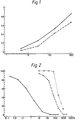
- Figure 1 is a graph showing the results of an ELISA, reported in Example 30 which follows, to evaluate the binding to a human melanoma cell line of an anti-transferrin receptor immunoconjugate of the invention 1 3 (line X---X---X), and of the parent anti-human transferrin receptor antibody OKT9 (line ◇---◇---◇). In the graph optical absorbance at 495 nm (y axis) is plotted against antibody concentration in ng/ml.
- Figure 2 is a graph showing the results of an evaluation, reported in Example 31 which follows, of the selective cytotoxicity of an
anti-transferrin receptor immunoconjugate 1 3 of the invention (line X---X---X), of an irrelevant control conjugate (line □---□---□) and of the parent free anthracycline drug (line ◇---◇---◇). In the graph (3H) Thymidine incorporation, as a percentage of control (y axis), is plotted against anthracycline concentration in nM (x axis). - Figure 3 is a graph showing the results of an evaluation, reported in Example 32 which follows, of the inhibition of cytotoxicity of the
antitransferrin receptor conjugate 1 3 by unconjugated antibody. Line X---X---X =immunoconjugate 1 3 + OKT9 antibody and line ◇---◇---◇ =immunoconjugate 1 3 . The (3H) Thymidine incorporation, as a percentage of control (y axis) is plotted against anthracycline concentration in nM. - Figure 4 depicts the dose-response inhibition of cytotoxicity of the
anti-transferrin receptor immunoconjugate 1 3 by different excess amounts of unconjugated antibody OKT9, as described in Example 33 which follows. In the graph, (3H) Thymidine incorporation as a percentage of control (y axis) is plotted against free antibody excess (x axis). - Figure 5 shows the results of an evaluation, reported in Example 34 which follows, of the selective cytotoxicity of the FGF conjugate 1 7 (line X---X---), of an irrelevant immunoconjugate control 1 4 (line □---□----□) and of free anthracycline (line ◇---◇---◇). In the graph (3H)Thymidine incorporation, as a percentage of control (y axis), is plotted against anthracycline concentration in nM (x axis).
- The following Examples illustrate the invention
-

- 2-methanol-3,4-dihydro-2H-pyran (formula M, 4.2 g, 35 mmol), dissolved in anhydrous methanol (100 ml), was added with sodium hydroxyde (1.6 g, 40 mmol) and gently warmed. Then the solvent was removed in vacuo and the residue was dissolved with dimethylsulfoxide (100 ml). To this solution, warmed at 110°C, was added 2-chloro-sodium acetate (6 g, 1.5 mmol) in dimethylsulfoxide (100 ml) within 2 hours under vigorous stirring. After standing for half an hour, the reaction mixture was cooled, added with triethylamine (5 ml) and ethyl jodide (5 ml) and kept at room temperature overnight. Then the reaction mixture was diluted with water and extracted with ethyl ether. After standard work up, the title compound was purified by chromatography on silicic acid eluting with a mixture of petroleum ether-ether (80:10 v/v). 1.68 g of compound 5 was recoverde as an oil, yield 26%. TLC on Kieselgel plate F254 (Merck) using as eluting system the mixture petroleum ether:ether 1:1 by volume) Rf=0.7.
1HNMR (200 MHz, CDCl3) δ:
1.26 (t, J=7.1 Hz, 3H, CH2 CH 3); 1.6-2.2 (m, 4H, CH2-3, CH 2-4); 3.64 (d, J=5.2 Hz, 2H, CH 2O); 4.00 (m, 1H, H-2); 4.13 (m, 2H, OCH 2C=O); 4.19 (q, J=7.1 Hz, 2H, CH 2CH3); 4.65 (m, 1H, H-5); 6.35 (ddd, J=6.2, 2.0, 2.0 Hz, 1H, H-6). - 4'c(A): A1-O=3''c (R3=NH2);

- 4'-epi-N-trifluoroacetyldaunorubicin (3c: R3=NHCOCF3) (3.1g, 5 mmole) was dissolved in anhydrous methylene chloride (500 ml) and treated with 3,4-dihydro-2H-pyran-2-ethoxycarbonyl (8A, 3.4 g, 25 mmole), prepared as described in "Macromulecules" Vol 12,
No 1, p 5-9, Jan-Feb 1979, and p-toluensulfonic acid (100 mg) at room temperature under nitrogen. After one hour a chromatographic control showed the formation of two products having, respectively, Rf value of 0.53 and 0.36 in system A.
The reaction mixture was washed with aqueous solution of 5% sodium hydrogen carbonate and water, then the organic phase was separated off, dried over anhydrous sodium sulphate, concentrated to small volume under reduced pressure and chromatographed on silicic acid column to afford 4'-epi-4'-O-(2-carboethoxytetrahydropyran-6-yl)-N-trifluoroacetyl daunorubicin derivatives of the title compounds having respectively Rf value of 0.53 (1.5 g, yield 40%) and 0.36 (1.28 g, yield 32%) in system A.
Compound Rf=0.53; FD-MS: m/e 663 (M+)
1HNMR (200 MHz, CDCl3) inter alia δ:
1.31 (COOCH2 CH 3, J=7.1Hz), 1.33 (5'-CH 3, J=6.4Hz), 2.41 (COCH 3), 3.40 (4'-H, J=9.7Hz), 4.07 (4-CH 3O), 4.55 (6''-H), 4.96 (2''-H), 5.30 (7-H), 5.48 (1'-H), 7.92 (NHCOCF3)
Compound Rf=0.36
FD-MS: m/e 663 (M+)
1HNMR (200 MHz, CDCl3) inter alia δ:
1.28 (COOCH2 CH 3, J=7.1Hz), 1.38 (5'-CH 3, J=6.4Hz), 2.42 (COCH 3), 3.54 (4'-H, J=8.7Hz), 4.07 (4-CH 3O), 4.42 (6''-H), 5.10 (2''-H), 5.29 (7-H), 5.48 (1'-H), 6.62 (NHCOCF3). - Compound Rf=0.53 (1.4 g, 1.79 mmole) was dissolved with aqueous 0.2N sodium hydroxide under nitrogen and kept at 0°C for eight hours. Then the aqueous solution was adjusted to
pH 3 with aqueous 1N hydrogen chloride and extracted repedetly with methylene chloride. The organic phase was washed with water, separated off, dried over anhydrous sodium sulphate and evaporated under reduced pressure to give x, one of the two isomers (x and y)) of the title compound 4'c(A), (0.9 g, yield 79%).
Rf=0.60 (system B). FD-MS: m/e 639 (m+) - Compound Rf=0.36 (1.1 g, 1.4 mmole) was hydrolized as above described to give, after standard work up, the other isomer y of the title compound 4'c(A), (0.72g, yield 80%). Rf=0.45 (system B). FD-MS: m/e 639 (M+).
- 4c(A)(MO): A-O=3''c (R3=MO);

- Compound 4'c(A) (x isomer) (1.2 g, 1.8 mmole) prepared as described in Example 2, was dissolved in water (200 ml), adjusted to pH 7.5 with hydrogen sodium carbonate and added with 2-oxyethyl-dihaldehyde (11, 3 g) dissolved in water (20 ml). After one hour a solution of sodium cyanoborohydride (100 mg) in water (6 ml) was added, under stirring at room temperature. After thirty minutes the reaction mixture was brought to pH 6 with an aqueous solution of 5% acetic acid and extracted with n-butylic alchool. The organic phase was washed with water, and the solvent removed under reduced pressure. The residue was purified by chromatography on a column of silic acid using the system methylene chloride: methanol:acetic acid (90:8:2 by volume) to give, after standard work up, the title compound 4c(A)(MO) (0.6 g, yield 45%).
Rf=0.70 (system B). FD-MS: m/e 724 (M+).
1HNMR (200 MHz, CDCl3) inter alia δ:
1.29 (5'-CH 3, J=6.3Hz), 2.42 (COCH 3), 2.4-2.8 (CH 2-N-CH 2), 2.98 (3'-H), 3.65 (CH 2O-CH 2), 3.40 (4'-H, J=9.0Hz), 4.08 (4-CH 3O), 4.30 (6''-H), 5.00 (2''-H), 5.27 (7-H), 5.51 (1'-H) - 5c(A)(MO): A-O=3''c (R3=MO);

- Compound 4c(A)(MO) (0.55 g, 0.7 mmole) prepared as described in Example 3, was dissolved in anhydrous dimethylformamide (25 ml) and treated with N-hydroxysuccinimide (95 mg) and N,N-dicyclohexylcarbodiimide (0.15 g). The mixture was kept at 4°C for two days, then the solvent was removed under reduced pressure. The residue was picked up with little ethyl acetate, filtered off and the solvent removed under reduced pressure. This procedure was performed four times in order to remove the dicyclohexylurea. Finally, the residue was treated with ether from which crystallised 0.45 g, yield 72%, of pure title derivative 5c(A)(MO).
Rf=0.45 (system B)
FD-MS m/e 821 (M+)
1HNMR (200MHz, CDCl3) inter alia δ:
2.42 (COCH 3), 2.4-2.6 (CH 2-N-CH 2), 2.82 (CO-CH 2-CH 2-CO), 3.5-3.7 (CH 2-O-CH 2), 4.08 (4-CH 3O), 5.13 (2''-H), 5.28 (7-H, 6''-H), 5.52 (1'-H). - N-trifluoroacetyl-doxorubicin (3f: R3=NHCOCF3) (6.4 g, 10 mmole) was suspended in anhydrous methylene chloride (750 ml) and added with triethylorthoformate (150 ml) and p-toluensulfonic acid (3 g), under stirring at room temperature. After three hours a chromatographic control showed disappearance of the starting material. After standard work up with water, the organic phase was separated off, dryied over anhydrous sodium sulphate and filtered off. The solvent removed in vacuo to afford a crude product which was dissolved in a mixture of pyridine (50 ml) and acetic anhydryde (50 ml) and added with little dimethylaminopyridine (0.5 g). After two hours, the reaction mixture was poured in water and ice (2000 ml). The precipitate was collected on a sintered glass, washed with water, dissolved with tetrahydrofurane (400 ml) and treated with 0.1N aqueous hydrogen chloride (50 ml) overnight at room temperature. Then methylene chloride was added and the organic phase was washed with water, 5% aqueous sodium hydrogen carbonate, and twice with water. After usual work up, the residue was purified by chromatography on a column of silicic acid using the solvent system methylene chloride:acetone (90:10 by volume) to give 5 g, yield 65%, of the title compound 9f.
Rf=0.18 (system D)
FD-MS m/e 765 (M+)
1HNMR (200 MHz, CDCl3) δ:
1.20 (d, J=6.4Hz, 3H, 5'-CH 3), 1.9-2.0 (m, 2H, 2'-CH 2 ), 2.1-2.4 (m, 2H, 8-CH 2), 2.19, 2.49, 2.53 (s, 9H, COCH 3 x 3), 2.95 (bt, J=4.2, 1H, CH2-OH), 3.13 (bm, 2H, 10-CH 2), 3.99 (s, 3H, 4-CH 3O), 4.20 (q, J=6.6Hz, 1H, 5'-H), 4.35 (m, 1H, 3'-H), 4.44 (bs, 1H, 9-OH), 4.74 (m, 2H, CH 2-OH), 5.1-5.3 (m, 3H, 7-H, 1'-H, 4'-H), 6.40 (bd, J=6.4Hz, 1H, NH), 7.3-7.8 (m, 3H, 1-H, 2-H, 3-H). - 4'f(A): A1-O=3'f (R3=NH2);

- 6,11,4'-tri-O-acetyl-N-trifluoroacetyldoxorubicin (10f) (5g, 6.5 mmole), prepared as described in Example 5, was dissolved in anhydrous methylene chloride (600 ml) and treated with 2-ethoxycarbonyl-3,4-dihydro-2H-pyran (8A) (5g, 36 mmole) and p-toluensulfonic acid (500 mg) at room temperature under nitrogen. After two hours the reaction mixture was washed with aqueous solution of 5% sodium hydrogen carbonate and water, then the organic phase was separated off, dried over anhydrous sodium sulphate, concentrated to small volume under reduced pressure and added with petroleum ether. The precipitate was dissolved in methanol (500 ml), added with morpholine (8 ml) and was kept at room temperature for two hours. After that, the reaction mixture was added with acetic acid (10 ml) and extracted with methylene chloride. The organic phase was concentrated to small volume and cromatographed on a silicic acid column using , as eluting system, a mixture of methylene chloride: acetone (95:5 by volume) to obtain the N-trifluoroacetyl 14-O-(2-carbonyltrahydropyran-6-yl)doxorubicin (10f) (4.2 g, yield 82%). Rf=0.41 (system D); FD-MS m/e 795 (M+)
1HNMR (200M, CDCl3) inter alia δ:
1.3 (5'-CH 3, COOCH2 CH 3), 3.65 (4'-H, J=2.1Hz), 4.08 (4-OCH 3), 4.21 (COOCH 2CH3, J=7.0Hz), 4.48 (6''-H), 4.88 (9-COCH 2-O), 5.04 (2''-H), 5.27 (7-H), 5.50 (1'-H), 6.69 (NH) - Compound 10f was dissolved at 0°C with 0.1N sodium hydroxyde (500 ml) under nitrogen. After one hour the reaction mixture was brought to pH 6 with acetic acid, extracted with n-butanol and washed with water. The organic phase was separated off and the solvent was removed in vacuo. The residue was picked up with little methylene chloride and added with ether to give the title product 4'f(A) (x,y isomers), 2.9g (yield 66%).
Rf=0.5 (system B); FD-MS m/e 671 (M+). - 4f(A)(MM): A-O=3'f (R3=MM);

- 14-O-(2-carboxytetrahydropyran-6-yl)doxorubicin (4'f(A), 1.3 g, 2 mmole), prepared as described in Example 6, was dissolved in water (300 ml) and added with 1-methoxy-2,2'-oxydiacetaldehyde (12) (3.4 g) dissolved in a mixture of acetonitrile (20 ml) and water (20 ml). The mixture was brought to pH 7.5-8.0 with triethylamine and left under stirring, at room temperature, for one hour. Then sodium cyanoborohydride (0.126 g), dissolved in water (10 ml), was added and the reaction mixture was kept at room temperature for 15 minutes. After that, acetone (10 ml) was added and the reaction mixture was added with little acedic acid and extracted with n-butanol. The organic phase was washed with water and the solvent was removed in vacuo. The residue was chromatographed on silicic acid column using as eluting solvent a mixture of methylene chloride:acetic acid:methanol (100:1:7 by volume). The title compound 4f(A)(MM) (0.30 g, yield 26%) was recovered after usual work up.
Rf=0.8 (system E), FD-MS m/e 771 (M+)
1HNMR (200 MHz, CDCl3) inter alia δ:
1.34 (5'-CH 3), 3.39 (CH 3-O "morpholino"), 4.07 (4-OCH 3), 4.47 (6''-H), 4.58 (CH-OCH3 "morpholino"), 4.85 (9-COCH 2-O-), 5.04 (2''-H), 5.27 (7-H), 5.59 (1'-H). - 5f(A)(MM): A-O=3'f (R3=MM);

- Compound 4f(A)(MM) (0.150 mg), prepared as described in Example 7, was dissolved in anhydrous dimethylformamide (25 ml) and treated with N-hydroxysuccinimide (95 mg) and N,N'-dicyclohexylcarbodiimide (0.15 g) following the procedure described in Example 4. The title compound 5f(A)(MM) was obtained with a yield of 85% (0,15 g).
Rf=0.20 (system A); FD-MS m/e 868 (M+). - 4'f(B): A1-O=3'f (R3=NH2);

- 6,11,4'-tri-O-acetyl-N-trifluoroacetyl-doxorubicin (9f, 0.65g, 0.85 mmol), prepared as described in Example 5, was dissolved in anhydrous methylene chloride (50 ml) and treated with compound 8B (0.7 g, 3.5 mmol) and anhydrous p-toluensulfonic acid (0.045 g) under nitrogen at room temperature. After 10 minutes, aqueous satured solution of sodium hydrogen carbonate (20 ml) was added. The organic phase was separated off and washed twice with water, dried over anhydrous sodium sulphate and the solvent was removed under reduced pressure. The oily residue was dissolved in methanol (50 ml) and treated first with morpholine (1.2 ml) for two hours, then with sodium methoxide (0.1 g) for half an hour.
After that, the reaction mixture was brought to pH 7.5 with aqueous 0.1N hydrogen chloride and extracted with methylene chloride. After standard work up, the residue was chromatographed on silicic acid, using methylene chloride as aluting agent, to give 0.4 g (yield 56%) of a protected N-trifluoroacetyl and (2-ethyloxycarbonyl) derivative of the title product. Rf=0.31 (system D).
FD-MS: m/e 839 (76, M+); 639 (84); 201 (100) - 0.4 g (0.47 mmol) of N-trifluoroacetyl 2-ethyloxycarbonyl derivative above described, was treated with aqueous 0.1N sodium hydroxide (100 ml) at 0°C under nitrogen for 90 minutes. After that, the solution was brought to pH 5 with acetic acid, extracted with water satured of n-butanol and washed with n-butanol satured of water. The solvent was removed under reduced pressure; the residue was piked up with a mixture of methylene chloride-methanol and the title product 4'f(B), 0.32 g (yield 94%), was precipitated by adding ethylic ether and collected on a sintered glass funnel. Rf=0.31 (system B).
FD-MS: m/e 716 (23, MH+); 321 (100). - 4f(B)(MO): A-O=3'f (R3=MO);

- Product 4'f(B) (0.3 g) was dissolved in dry dimethylformamide (40 ml) and treated with triethylamine (0.3 ml) and bis(2-jodoethylether) (11, 2 ml) at 4-5°C.
After 24 hours, the solution was acidified with acetic acid and the solvent was removed under reduced pressure. The residue was treated with aqueos 0.1N sodium hydroxide at 0°C under nitrogen. After 20 minutes, the solution was acidified with acetic acid and extracted with n-butanol, washed with water. The solvent was removed under reduced pressure and the crude material was purified on a silicic acid column eluting with a mixture of methylene chloride/methanol (90:5 by volume) to give the title compound 4f(B)(MO) (0.05 g, yield 23%).
Rf=0.48 (system B)
FAB-MS: 757 (M+) - 5f(B)(MO): A-O=3'f (R3=MO);

- Product 4f(B)(MO) (0.03 g, 0.037 mmole) was dissolved in dry dimethylformamide (3 ml) and added with N-hydroxysuccinimide (0.01 g) and dicyclohexylcarbodiimide (0.02 g). The mixture was kept at room temperature for eight hours, after that, the solvent was removed in vacuo and the residue was chromatographed on silicic acid column using methylene chloride:methanol (95:5) as eluent, to give the title compound 5f(B)(MO) (0.028 g, yield 85%).
Rf=0.52 (system H).
FAB-MS: 852 (13, MH+); 200 (100) - 4f(B)(MM): A-O=3'f (R3=MM);

- 14-O-(2-carboxymethyloxyethyl-tetrahydropyran-6-yl) doxorubicin (4'f(B), 0.3 g), prepared as described in Example 9, was converted into the title compound 4f(B)(MM) by treatment with 1-methoxy-2,2'-oxydiacetaldehyde and reduction with sodiumcyanoborohydride following the same procedure described in Example 7.
Rf=0.50 (system B)
FAB-MS: 787 - 5f(B)(MM): A-O=3'f (R3=MM);

- Product 4f(B)(MM), prepared in Example 12, (0.03 g, 0.037 mmole), dissolved in dimethylformamide (3 ml) and added with N-hydroxysuccinimide was transformed into the title compound 5f(B)(MM) (Example 8); Rf=0.55 (system H). FAB-MS: 882
- 7f(A)(MM): A-O=3'f (R3=MM),

- N-oxysuccinimidyl derivative of 14-O-(2-carboxytetrahydropyran-6-yl)-3'-deamino-3'[2(S)-methoxy-4-morpholinyl]doxorubicin 5f(A)(MM), 100 mg], prepared as described in Example 8, was dissolved in anhydrous tetrahydrofurane (20 ml), cooled at 0°C and added with a solution of 1,4-piperazine (50 mg) in anhydrous tetrahydrofurane (2 ml). The reaction mixture was stirred at 0°C for 15 minutes, then was diluted with methylene chloride (100 ml), washed with water (3x50 ml). The organic phase was separated, dryied over anhydrous sodium sulphate and the solvent was removed under reduced pressure. The crude product was chromatographed on silicic acid column using as eluting system a mixture of ethylene chloride/methanol (80/20 by volume). The title compound 7f(A)(MM) (80 mg) was precipitated with ethyl ether.
TLC on Kieselgel Plate (Merck) F254, eluting system methylene chloride/methanol (70/30 by volume) Rf=0.55
FD-MS: m/z 839 - 6f(A)(MM): A-O=3'f,

- N-oxysuccinimidyl derivative of 14-O-(2-carboxytetrahydropyran-6-yl)-3'-deamino-3'[2(S)-methoxy-4-morpholinyl]doxorubicin 4f(A)(MM), 100 mg], prepared as described in Example 8, was dissolved in anhydrous tetrahydrofurane (20 ml) and added with 1M solution of hydrazine hydrate in isopropanol (5 ml). The mixture was kept at 0°C for 1 hour. After that, methylene chloride was added and the mixture was washed three times mith cold water. The organic layer was separated, dryied over anhydrous sodium sulphate, filtered and the solvent removed under vacuum. The residue was purified on silicic acid column using a mixture of methylene chloride/methanol (99/1 by volume). The title compound 6f(A)(MM) (95 mg) was precipitated with ethyl ether.
TLC on Kieselgel Plate (Merck) F254, eluting system methylene chloride/methanol (95/5 by volume) Rf=0.23
FD-MS: m/z 785
1HNMR (200 MHz, CDCl3): δ:
1.36 (d, J=6.6Hz, 3H, 5'-CH 3); 1.2-2.2 (m, 9H, 3''-CH 2, 4''-CH 2, 5''-CH 2, 2'-CH 2, 8ax-H); 2.3-2.7 (m, 6H, 3'-H, 8e-H, NCH 2CH2O, NCH 2-CH(OCH3)O); 2.9-3.4 (m, 2H, 10-CH 2); 3.38 (s, 3H, NCH2CH(OCH 3)O); 3.55, 3.90 (two m, 2H, NCH2 CH 2O); 3.68 (m, 1H, 4'-H); 3.95 (m, 1H, 5'-H) ; 4.08 (s, 3H, 4-OCH 3); 4.38 (m, 1H, 6''-H); 4.49 (m, 1H, NCH2 CH(OCH3)O); 4.6-4.9 (m, 2H, 14-C 2); 4.97 (m, 1H, 2''-H); 5.29 (m, 1H, 7-H); 5.54 (m, 1H, 1'-H); 7.39 (d, J=7.6Hz, 1H, 3-H); 7.59 (bd, J=6.8Hz, 1H, CON); 7.78 (t, J=7.6Hz, 1H, 2-H); 8.03 (d, J=7.6Hz, 1H. 1-H); 13.29 (s, 1H, 11-OH); 13.98 (s, 1H, 6-OH). - A-O=3'f (R3=MM);

- A 10-2M solution of compound 5f(A)(MM) (Example 8), in dimethylformamide (38 mcl) was added to 1 ml of a 2 mg/ml solution of purified mouse monoclonal anti-human melanoma antibody Ep1 (P.Giacomini, O.Segatto, P.G.Natali, Int.J.Cancer 39, 1987, 729) in PBS pH 7.5 buffer. The reaction mixture was stirred overnight at room temperature and clarified by centrifugation. The product was isolated by gel filtration chromatography over a Sephadex G-25 column (PD-10, Pharmacia) eluting with PBS pH 7.5. The excluded peak was collected (2 ml) and assayed for anthracycline content spectrophotometrically at 480 nm. The protein content was assayed with a colorimetric protein analysis (BCA, Pierce). The
conjugate 1 1 contained 0.98 mg/ml of antibody with an anthracycline:protein ratio of 8.7:1. The chemicophysical profile of the product was determined by HPLC gel filtration analysis with dual wavelenght detection (280 and 480 nm) and by SDS-PAGE. By HPLC, the molecular weight of the product was around 160 kD and the 480 nm anthracycline absorption was in correspondance with the same molecular weight. Proof of the covalent bond formation was obtained by SDS-PAGE, were both the 480 nm anthracycline absorption and the Coomassie-dye protein reaction are located at 160 kD molecular weight. - A-O=3'f (R3=MM);

- A solution of B72.3 antibody (US Pat.4,522,918, 1985) at 2.6 mg/ml in 0.1M phosphate buffer, pH 6, (1 ml) was treated with 0.1 ml of a 0.1 M solution of NaIO4 in water, at 4°C in the dark. After 1 hour the product was purified by gel filtration chromatography over a Sephadex G-25 column (PD-10, Pharmacia) eluting with 0.1 M phosphate buffer, pH 6. The protein-containing fraction (1.7 mg, 2 ml) was treated with 30 molar equivalents of a 10-2M solution of compound 6f(A)(MM) (Example 15) in dimethylformamide. After 24 hours at 37°C in the dark, the reaction mixture was centrifuged and purified by gel filtration chromatography over a Sephadex G-25 column (PD-10, Pharmacia) eluting with 0.1 M phosphate buffer, pH 7.3. The protein-containing peak was collected (2 ml) and characterized as for Example 16.
Theconjugate 1 2 contained 0.45 mg/ml of antibody with an anthracycline/protein ratio of 1.3/1 and displayed an analytical profile analogous to the conjugate obtained in Example 16. - A-O=3'f (R3=MM);

- A 10E-2 M solution of compound 5f(A)(MM) (described in Example 8) in N,N-dimethylformamide (37 mcl) was added to 1 ml of a 2 mg/ml solution of a purified mouse monoclonal anti-human transferrin receptor antibody OKT9 (Sutherland, R., Delia, D., Schneider, C., Newman, R., Kemshead, J.,Greaves, M., Proc. Nat. Acad. Sci. USA, 78 (1981), 4515; ATCC CRL 8021) in 0.1 M NaH2PO4, 0.1 M NaCl, pH 8 buffer. The reaction mixture was stirred overnight at room temperature in the dark and clarified by centrifugation. The
title conjugate 1 3 was isolated by gel filtration chromatography over a Sephadex G-25 column (PD-10, Pharmacia, Cat. No. 17-0851-01) eluting with PBS pH 7.3 (Gibco, 10X, Cat. N. 042-04200M). The excluded peak was collected and analyzed for anthracycline content (spectrophotometrically at 480 nm) and for protein content (BCA Protein Assay Reagent, Pierce, Cat. 23225). The conjugate contained 1.94 mg/ml of antibody and 80.9 mcg/ml of anthracycline, with an anthracycline : protein molar ratio of 9.5. The analytical profile of the product was evaluated as in Example 16, with similar results. - A-O=3'f (R3=MM);

- A conjugate of
formula 1 4 , containing 0.74 mg/ml of protein and 27.5 mcg/ml of anthacycline, with an anthracycline/protein ratio of 9.1, was obtained with operating as in Example 18 and using in place of OKT9, a solution of B72.3 antibody (2.3 mg/ml) [Schlom, J. et al., US Pat. 4 522 918 (1985)] and 43 mcl of the solution of 5f(A)(MM), - A-O=3'f (R3=MM);

-
Conjugate 1 5 , containing 0.49 mg/ml of protein and 14.3 mcg/ml of anthracycline, with an anthracycline/protein ratio of 6.9, was obtained with operating as in Example 18 and using in place of OKT9, a solution of an anti-epidermal growth factor receptor antibody (1.15 mg/ml) (BioMacor Cat. No. 6080, Clone 29.2) and 13 mcl of the solution of compound 5f(A)(MM). - A-O=3'f (R3=MM);

- The
title compound 1 6 , containing 0.34 mg/ml of protein and 5.3 mcg/ml of anthracycline, with an anthracycline/protein ratio of 3.9, was obtained with operating as in Example 18 and using in place of OKT9 a solution of the anti-transferrin receptor antibody B3/25 (0.5 mg/ml) (Boehringer Cat. No. 1118 048) and 9.4 mcl of the solution of 5f(A)(MM). - A-O=3'f (R3=MM);

-
Compound 1 7 containing 0.77 mg/ml of protein and 117 mcg/ml of anthracycline, with an anthracycline/protein ratio of 3.4, was prepared with operating as in Example 18 and using in place of OKT9, a solution of human recombinant FGF (1.35 mg/ml)(Barr et al, J. Biol. Chem. 263 (1988), 16471) and 48 mcl of the solution of 5f(A)(MM). - A-O=3'f (R3=MO);

-
Conjugate 1 8 , containing 0.46 mg/ml of protein and 13 mcg/ml of anthracycline, with an anthracycline/protein ratio of 4.9O was botained with operating as in Example 18 and using 37 mcl of a 10E-2 M solution of 5f(B)(MO) (Example 11). - A-O=3'f (R3=MO);

- Conjugate of
formula 1 9 containing 0.46 mg/ml of protein and 8.38 mcg/ml of anthracycline, with an anthracycline : protein ratio of 4.5 was obtained with operating as in Example 18 and using in place of OKT9, the anti-colon carcinoma antibody B72.3 and 43 mcl of a 10E-2 M solution of 5f(B)(MO) (Example 11). - A-O=3'f (R3=MO);

-
Compound 1 10 containing 0.67 mg/ml of protein and 20.3 mcg/ml of anthacycline, with an anthracycline/protein ratio of 7.6 was obtained with operating as in Example 18 and using 37 mcl of a 10E-2 M solution of 5f(B)(MM) (Example 13). - A-O=3'f (R3=MO);

- Operating as in Example 18 and using in place of OKT9, the anti-colon carcinoma antibody B72.3 and 43 mcl of a 10E-2M solution of compound 5f(B)(MO), was prepared the
title compound 1 11 containing 0.55 mg/ml of protein and 7.4 mcg/ml of anthracycline, with an anthracycline/protein ratio of 3.2. - A-O=3'f (R3=MM);

- Poly(Glu.Na,Ala,Tyr) (1:1:1) Mw 25000-40000 (Sigma), (0.2 g) was dissolved in water (5 ml) under stirring at room temperature. The corresponding free acid was precipitated from the aqueous solution at
pH 3 by means of 0.1N HCl. Poly(Glu-OH,Ala,Tyr) (0.17 g), recovered and dryied under vacuum, was dissolved in dry dimethylformamide (10 ml) and added with 14-O-(6-piperazinecarbonyltetrahydropyran-2-yl)-3'-deamino-3'[2(S)-methoxy-4-morpholiny]doxorubicin
[7f(A)(MM), 0.035 g] (described in Example 14) and N-ethoxycarbonyl-2-ethoxy-1,2-dihydroquinoline (EEDQ) (0.08 g). Another aliquot of EEDQ (0.08 g) was added after three hours. The reaction mixture was stirred overnight at room temperature, than was poured in ethyl ether (300 ml). The precipitated was suspended in water (10 ml) and treated with 0.1N NaOH (14 ml); the solution was brought to pH 8.5 with 0.1N HCl and passed on a column of Sephadex G10. The aqueous solution was liophilized to give 0.16 g of thetitle compound 1 12
Content of anthracycline (w/w %) calculated as 3'-deamino-3'[2(S)-methoxy-4-morpholinyl]doxorubicin hydrochloride: 10% - A-O=3'f (R3=MM);

- Poly-L-Glutamic acid, Mw 2000-15000 (Sigma) (0.1 g) and 14-O-(6-piperazinecarbonyltetrahydropyran-2-yl)-3'-deamino-3'[2(S)-methoxy-4-morpholiny]doxorubicin [7f(A)(MM), 0.03 g], (described in Example 14), were dissolved in anhydrous dimethylformamide (2 ml) and stirred for three hours. After that, N-ethoxy-carbonyl-2-ethoxy-1,2-dihydro-quinoline (EEDQ) (0.03 g) was added. The mixture was kept under stirring overnight, then was poured into a mixture of ethyl ether and petroleum ether. The precipitate was collected on a sintered glass filter, washed with ethyl ether and dissolved with a 2.5% aqueous solution of sodium hydrogen carbonate (8 ml). The solution was passed through a reverse phase column RP-8, 40-63µm (Merck) (30x1.8 cm) and eluted with a mixture of water and acetonitrile. The eluate containing the conjugate was liophilized then collected on a sintered glass filter, washed with methanol and ethyl ether to give the title compound 1 13 (65 mg). By spectroscopic evaluation, the conjugate contains 16%% (w/w %) of 3'-deamino-3'[2(S)-methoxy-4-morpholinyl]doxorubicin hydrochloride.
- A-O=3'f (R3=MM);

- Following the same procedure described in Example 28, Poly-L-Glutamic acid, Mw 2000-15000 (Sigma) (0.1 g) and 14-O-(6-hydrazinocarbonyltetrahydropyran-2-yl)-3'-deamino-3'[2(S)-methoxy-4-morpholiny]doxorubicin [6f(A)(MM), 0.05 g], (described in Example 15) were reacted in dimethylformamide in presence of EEDQ. After work up and purification on RP-8, 40-63 µm (Merck) column, 50 mg of the
title compound 1 14 was collected. - By spectroscopic evaluation, the conjugate contains 12% (w/w %) of 3'-deamino-3'[2(S)-methoxy-4-morpholinyl]doxorubicin hydrochloride.
-
- Ref.:
- Matsui, M. et al., J. Immunology, 141 (1988) 1410 Bumol, T. F. et al., Antibody-Mediated Delivery Systems, Rodwell, J. D. Ed., (1988) 55 Harper, J. R. et al., Anal. Biochem., 113 (1980) 51
- M10 human melanoma cells (ATCC CRL 8021) in RPMI 1640 medium (PBI 12/167B), 10% FCS (Flow Laboratories 29101-54), 1% glutamine were plated in 96 well microtiter plates (Costar 3596) (10000 cells/well). After 16 h at 37°C, cells were washed with PBS, 3% FCS and incubated with different concentrations of the conjugate 1 3 (Example 18), or of the OKT9 antibody, in PBS, 3% FCS, 100 mcl, 5-1000 ng/ml for 1 h at 37°C. After three washings with PBS, 3% FCS, 100 mcl of a 1:1500 diluition of horseradish peroxidase conjugated goat anti-mouse IgG (BioRad 172-1011) were added to each well. Plates were then incubated for one hour at 37°C and washed three times with PBS, 3% FCS. Then, 100 mcl of a freshly prepared substrate solution of o-phenylendiamine dihydrochloride (Sigma P6912) (0.5 mg/ml) and H2O2 (0.015%), in H2O, were added to each well. After a 30′ incubation at 37°C the reaction was stopped by the addition of 25 mcl of 4.5 N H2SO4 to each well, and absorbance was read at 495 nm with a BioRad EIA Reader Model 2550. The conjugate displayed a good retention of cell binding activity in comparison with the parent antibody, as shown in Fig. 1.
-
- Ref.:
- Dillman, R. O. et al., Cancer Res., 48 (1988) 6097 Ahmad, A. et al., Anticancer Res., 10 (1990) 837
- M10 human melanoma cells (ATCC CRL 8021) were plated in 96 well plates (Costar 3596) in 200 mcl RPMI 1640 (PBI 12/167B) containing 10% FCS (Flow Laboratories 29101-54), 1% glutamine, (10000 cells/well) at 37°C. After 18 h, the culture medium was removed and 100 mcl of fresh medium were added. Fifty microliters of different concentrations of the
conjugate 1 3 and of the relative controls in PBS, 3% FCS, were added to triplicate wells. Plates were incubated for 24h at 37°C, then 0.8 microCurie/well of (3H)thymidine (NEN DuPont NET 355) were added in 20 mcl of medium and incubation was continued at 37°C for 7 h. Cells were harvested with a Dynatech MultiMash 2000 cell harvester onto filter paper (Whatman 1827842), filters were air dried, placed in vials with scintillation fluid (Kontron Analytical Supertron 56920-04010) and counted in a scintillation counter (Kontron Instrument Betamatic). - All the conjugates were substantially less cytotoxic than the parent drug, but the specific anti-transferrin receptor conjugate displayed an effect fivefold superior to an irrelevant control conjugate, is the comparison between the IC50 of the two compounds shows.
- Results from a typical experiment are shown in Fig. 2.
-
- Ref.:
- Chaundhary, V. K. et al., Nature 339 (1989) 394
Batra, J. K. et al.: Mol. and Cell. Biol. 11 (1991) 2200
Siegal, C. B. et al., J. Biol. Chem. 265 (1990) 16318 - M10 human melanoma cells (ATCC CRL 8021) were plated in 96 well plates (Costar 3596) in 200 mcl RPMI 1640 (PBI 12/167B) containing 10% FCS (Flow Laboratories 29101-54), 1% glutamine (10000 cells/well) at 37°C. After 18 h, the culture medium was removed and 50 mcl of fresh medium were added. Then, 50 mcl of a solution of OKT 9 antibody in complete culture medium were added to triplicate wells (final concentration in wells from 7000 to 56 mcg/ml). Control wells were treated with 50 mcl of complete culture medium. Plates were incubated for 1 h at 4°C, then 50 mcl of different concentrations of the
conjugate 1 3 , in complete culture medium, were added (final concentration of antibody in wells from 70 to 0.56 mcg/ml, corresponding to a 1:100 molar excess of free antibody added in the previous step). After 24h at 37°C, 0.8 microCurie/well of (3H)thimidine (NEN DuPont NET 355) in 20 mcl of medium were added, and incubation was continued at 37°C for 7h. Cells were harvested and radioactivity incorporation was evaluated as in Example 31. - As shown in Figure 3, free antibody addition inhibits the cytotoxicity of the immunoconjugate over a range of doses of anthracycline content, thus confirming the receptor mediated effect of the compounds herein described.
- Results from a typical experiment are shown in Figure 3.
-
- Ref.:
- Chaundhary, V. K. et al., Nature 339 (1989) 394
Batra, J. K. et al.: Mol. and Cell. Biol. 11 (1991) 2200
Siegal, C. B. et al., J. Biol. Chem. 265 (1990) 16318 - M10 cells were plated and incubated for 18h as described in Example 32. After that, the culture medium was removed and 50 mcl of fresh medium were added. Then, 50 mcl of a solution of OKT9 antibody in complete culture medium were added to triplicate wells (final concentration in wells from 2120 to 21.2 mcg/ml). Control wells were treated with 50 mcl of complete culture medium. Plates were incubated for 1h at 4°C. Then, 50 mcl of the
conjugate 1 3 in complete culture medium, were added (final concentration of antibody in wells 2.12 mcg/ml). Cells were incubated, harvested and radioactivity incorporation evaluated as in Example 31. - As Figure 4 shows, a dose-response related inhibition of conjugate cytotoxicity is effected by the pre-treatement of cells with different excesses of unconjugated antibody, confirming the receptor-mediated cytotoxicity of the compounds.
- Operating as in Example 31 and utilizing the conjugate of
formula 1 7 , the selective cytotoxicity of the FGF conjugate was demonstrated (Figure 5). - Utilizing the protocol described in Example 31 and different combinations of anthracyclines, linkers, and targeting carriers, different conjugates were prepared, and their cytotoxicity was tested on different cell lines, utilizing non binding conjugates as controls. As Table 1 indicates, specific conjugates are consistently more efficient in inhibiting the growth of tumor cells in comparison with control, non binding, conjugates. The ratio between the IC50 may be taken as an index of the selectivity of the compounds. Thus, from 7% to 38% of a specific conjugate is as cytotoxic as a 100% dose of a control conjugate. The selectivities observed were confirmed from experiments performed with different anthracyclines, linkers, target cells, and for various times of incubation.
Table 1 SELECTIVE CYTOTOXICITY OF ANTHRACYCLINE CONJUGATES Specific...Control...Target..Incubation...IC50X10E7...IC50.. Conjugate.Conjugate...Cells....Time (h)..Spec./Contr..Ratio. 1 3 1 4 M10 24 5.0/21.0 0.23 1 3 1 4 M10 48 1.2/ 6.8 0.17 1 3 1 4 M10 72 1.7/ 5.6 0.30 1 3 1 4 M14 48 3.9/16.0 0.24 1 3 1 4 M14 72 5.0/17.0 0.29 1 3 1 4 OVCAR3 72 4.1/18.0 0.23 1 3 1 4 A431 24 9.1/40.0 0.23 1 5 1 4 A431 24 18.0/40.0 0.45 1 7 1 4 M10 24 1.5/21.0 0.07 1 6 1 4 M10 48 5.1/10.0 0.51 1 5 1 4 M14 48 11.0/20.0 0.55 1 8 1 9 M10 24 1.0/ 9.0 0.11 1 8 1 9 M10 72 0.4/ 2.3 0.17 1 8 1 9 M14 24 1.2/11.0 0.10 1 8 1 9 M14 72 1.6/12.0 0.13 1 10 1 11 M10 24 2.2/ 9.0 0.24 1 10 1 11 M10 72 3.0/ 8.0 0.38 1 10 1 11 M14 24 5.1/>10.0 n.d. 1 10 1 11 M14 72 6.0/>10.0 n.d. Target cells references:
M10: human melanoma, ATCC CRL 8021
M14: human melanoma, Natali, P. G. et al., J. Immunol. Meth. 62 (1983), 337
OVCAR-3: human ovaric carcinoma, ATCC HTB 161
A431: human epidermoid carinoma, ATCC CRL 1555 -
Compound 1 14 was evaluated "in vivo" against P388 murine Leukemias resistant to Doxorubicin in comparison with 3'-deamino-3'[2(S)-methoxy-4-morpholino]doxorubicin (DMM) and doxorubicin. Data are reported in Table 2. - The conjugate showed similar antitumor activity, but at higher doses, of the free drug.
Table 2 Antitumor activity against P388/DX (Johnson) Leukemia. compound P388/DX(1) dose(2) (mg/kg) T/C(3) % TOX 1 14 5.2(4) 200 0/10 Doxorubicin 16.9 100 0/10 DMM(5) 0.09 192 0/39 (1) 105 cells/mouse (P388/DX, Johnson) transplanted i.v. in CDF1 mice. Treatment on day 1 after inoculation of tumor.(2) Optimal Dose (3) Median survival time % over untreated controls (4) Dose of active drug: 3'-deamino-3'[2(S)-methoxy-4-morpholino]doxorubicin (DMM) (5) 3'-deamino-3'[2(S)-methoxy-4-morpholino]doxorubicin
and T-Z is derived from a carrier of formula T-[COOH]a in which a is as above defined.

The carrier T-CHO is preferably derived from polyclonal or monoclonal antibodies having the carbohydrate moiety, preferentially located in the Fc region, selectively oxidized to aldehyde groups by means of chemical or enzymatic methods, as described in U.S.Pat. No.4,671,958 (Jun. 9, 1987). The carrier T-CHO may be also derived from the formylation or from the oxidation of suitable polymeric carriers, or from the oxidation to aldehyde groups of the carbohydrate residues of suitable glycoproteins.
Claims (24)
- A conjugate of the formula 1


Z is a spacer group and T is a carrier moiety. - A conjugate according to claim 1 wherein:(i) Z represents -NH- and T-Z is derived from a carrier of formula T-NH2 bearing at least one free amino group, or(ii) Z is NH-[D]d-N=CH wherein d is an integer of from 0 to 2, [D] represents -NH-CO(CH2)nCO-NH- (n is 2 or 4) and T-Z is derived from a carrier of formula T-CHO bearing at least one formyl group or T[COOH]a wherein a is as defined above or(iii) Z is a piperazinylcarbonyl moiety or a group of formula -NH-[D]d-NH-CO- wherein [D] and d are as defined above and T-Z is derived from a carrier of formula T-[COOH]a as defined above.
- A conjugate according to claim 1, wherein the anthracycline bearing at least one primary or secondary hydroxyl group has the formula 3:
 R1 is a hydrogen atom, a hydroxy or a methoxy group;(i) R2 is a hydroxy group and R4 or R5 is a hydrogen atom and the other of R4 and R5 is a hydroxy group, R4 is an iodine atom and R5 is a hydrogen atom or both R4 and R5 are hydrogen atoms or(ii) R2 is a hydrogen atom and R4 or R5 represents a hydroxy group and the other of R4 and R5 is a hydrogen atom;R3 is an amino group or represents a nitrogen atom enclosed in a morpholino ring.
 - A conjugate according to claim 3, wherein the moiety A-O- represents:
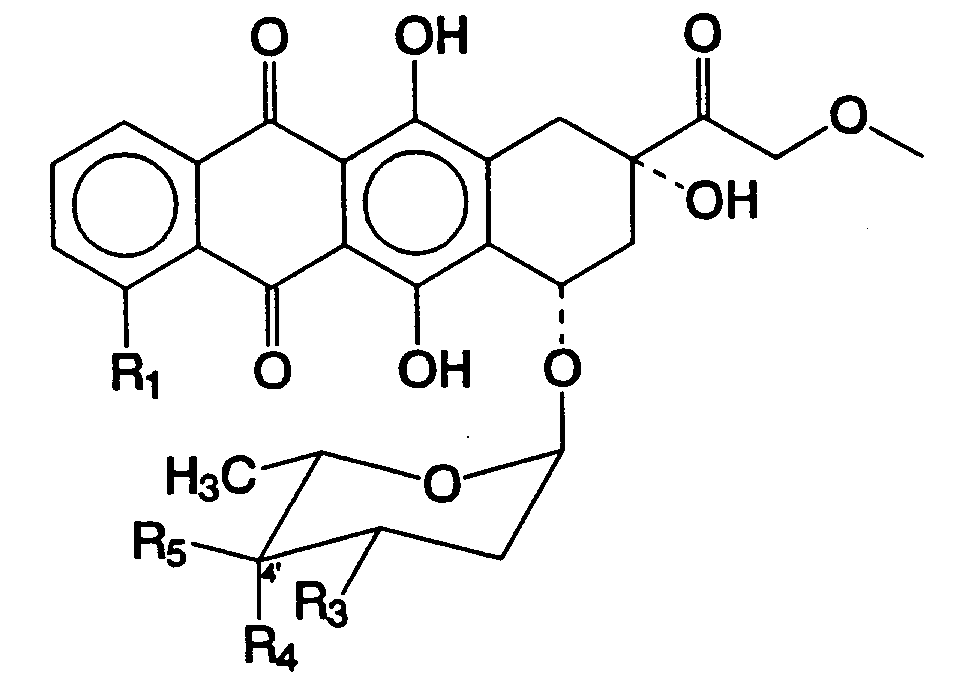
- A conjugate according to claim 3, wherein the moiety A-O- represents:

- A conjugate according to any one of the preceding claims, wherein the carrier is selected from a polyclonal antibody, or fragment thereof comprising an antigen binding site, capable of binding to a tumor associated antigen; a monoclonal antibody, or fragment thereof comprising an antigen binding site, capable of binding to an antigen preferentially or selectively expressed on tumor cell populations; a peptide or protein capable of preferentially or selectively binding to a tumor cell; and a polymeric carrier.
- A conjugate according to claim 6, wherein the carrier is selected from an anti-T-cell antibody, an anti-CD5 antibody, an anti-transferrin receptor antibody, an anti-melanoma antibody, an anti-carcinoma marker antibody, an anti-ovarian carcinoma antibody, an anti-breast carcinoma antibody and an anti-bladder carcinoma antibody.
- A conjugate according to claim 6, wherein the carrier is a growth factor.
- A process for the preparation of a conjugate of formula 1 as defined in claim 1, which process comprises:a) converting a derivative of formula 4:

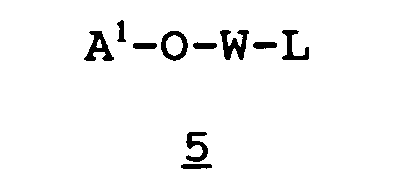 (b)(i) condensing the resultant compounds of formula 5, as above defined, with a compound of formula T-NH2 as defined in claim 2 or(ii) reacting the activated compound of formula 5, with a derivative of formula NH2-[D]dNH2, wherein D and d are as defined in claim 2, optionally deprotecting the resultant derivative of formula 6:
 (iii) reacting the compound of formula 5 with a 1,4-piperazine and condensing the resultant compound of formula 7:
- A pharmaceutical composition comprising a pharmaceutically acceptable carrier or diluent and, as active ingredient, a conjugate as claimed in any one of claims 1 to 8 or which has been prepared by a process as claimed in claim 9.
- A derivative of formula 4 as defined in claim 9.
- A derivative according to claim 11, selected from:
4'-epi-4'-O-(2-carboxytetrahydropyran-6-yl)-3'-deamino-3'-(4-morpholino)-daunorubicin;
14-O-(2-carboxytetrahydropyran-6-yl)-3'-deamino-3'-(2-methoxy-4-morpholino)-doxorubicin; and
14-O-(2-carboxymethyloxymethyl-tetrahydropyran-6-yl)-3'-deamino-3'-(4-morpholino)-doxorubicin. - A process for the preparation of a derivative of formula 4 as claimed in claim 11, which process comprises(a) condensing an optionally protected anthracycline of the formula A-O-H as defined in claim 1, with the proviso that the amino group of the sugar moiety of the anthracycline A-O-H is in the form of a free or protected amino group, with a dihydropyran carboxylic derivative of formula 8:
 (b) removing the or each protecting group from the resultant intermediate, thereby to form a derivative of formula 4':
 (c)(i) converting the free amino group of the sugar moiety of the anthracycline of formula 4' into a morpholino derivative, or,(ii) protecting the said free amino group of the said anthracycline of formula 4'.
 - A derivative of formula 4' as defined in claim 13, with the proviso that when the anthracycline is of formula 3 as defined in claim 3 the anthracycline is not linked to the group -O-W-OH through a hydroxy group at R4.
- A derivative according to claim 14, selected from:
4'-epi-4'-O-(2-carboxytetrahydropyran-6-yl)-daunorubicin;
14-O-(2-carboxytetrahydropyran-6-yl)-doxorubicin; and
14-O-(2-carboxymethyloxymethyl-tetrahydropyran-6-yl)-doxorubicin. - A process for the preparation of a derivative of formula 4' as claimed in claim 14, which process comprises:(a) condensing an optionally protected anthracycline of the formula A-O-H as defined in claim 1, with the proviso that the amino group of the sugar moiety of the anthracycline A-O-H is in the form of a free or protected amino group, with a dihydropyran carboxylic derivative of formula 8 as defined in claim 13; and(b) removing the or each protecting group from the resultant intermediate.
- A derivative of formula 5 as defined in claim 9.
- A derivative according to claim 17, selected from:
4'-epi-4'-O-(2-succinimidocarbonyl-tetrahydropyran-6-yl)-3'-deamino-3'-(4-morpholino)-daunorubicin;
14-O-(2-succinimidocarbonyl-tetrahydropyran-6-yl)-3'-deamino-3'-(2-methoxy-4-morpholino)-doxorubicin; and
14-O-(2-succinimidocarbonylmethyloxymethyl-tetrahydropyran-6-yl)-3'-deamino-3'-(4-morpholino)-doxorubicin. - A process for the preparation of a derivative of formula 5 as claimed in claim 17, which process comprises converting a derivative of formula 4 as defined in claim 9 into a corresponding said derivative of formula 5.
- A derivative of formula 6 or 7 as defined in claim 9.
- A process for the preparation of a derivative of formula 6 or 7 as claimed in claim 20, which process comprises:(i) reacting a derivative of formula 5 as defined in claim 9 with a derivative of formula NH2[D]dNH2 or 1,4-piperazine and, if desired, deprotecting the resultant derivative of formula 6 or 7 thus obtained.
- A compound of formula:

- A derivative according to claim 22, selected from:
2-ethoxycarbonylmethyloxymethyl-3,4-dihydro-2H-pyrane; and
2-methoxycarbonylmethyloxymethyl-3,4-dihydro-2H-pyrane. - A conjugate of formula 1 as defined in claim 1 for use as an antitumor agent.
Applications Claiming Priority (3)
| Application Number | Priority Date | Filing Date | Title |
|---|---|---|---|
| GB9026491 | 1990-12-05 | ||
| GB909026491A GB9026491D0 (en) | 1990-12-05 | 1990-12-05 | Anthracycline-conjugates |
| PCT/EP1991/002284 WO1992010212A1 (en) | 1990-12-05 | 1991-12-03 | Anthracycline-conjugates |
Publications (2)
| Publication Number | Publication Date |
|---|---|
| EP0514515A1 EP0514515A1 (en) | 1992-11-25 |
| EP0514515B1 true EP0514515B1 (en) | 1997-04-16 |
Family
ID=10686550
Family Applications (1)
| Application Number | Title | Priority Date | Filing Date |
|---|---|---|---|
| EP91920862A Expired - Lifetime EP0514515B1 (en) | 1990-12-05 | 1991-12-03 | Anthracycline-conjugates |
Country Status (22)
| Country | Link |
|---|---|
| EP (1) | EP0514515B1 (en) |
| JP (1) | JP3169223B2 (en) |
| KR (1) | KR100249067B1 (en) |
| AT (1) | ATE151644T1 (en) |
| AU (1) | AU649506B2 (en) |
| CA (1) | CA2075288C (en) |
| DE (1) | DE69125707T2 (en) |
| DK (1) | DK0514515T3 (en) |
| ES (1) | ES2103317T3 (en) |
| FI (1) | FI103765B (en) |
| GB (1) | GB9026491D0 (en) |
| GR (1) | GR3024050T3 (en) |
| HU (2) | HU221857B1 (en) |
| IE (1) | IE914211A1 (en) |
| IL (2) | IL114303A (en) |
| MX (1) | MX9102357A (en) |
| MY (1) | MY107821A (en) |
| NZ (1) | NZ240827A (en) |
| PT (1) | PT99675B (en) |
| RU (1) | RU2107690C1 (en) |
| WO (1) | WO1992010212A1 (en) |
| ZA (1) | ZA919562B (en) |
Families Citing this family (10)
| Publication number | Priority date | Publication date | Assignee | Title |
|---|---|---|---|---|
| GB9309663D0 (en) * | 1993-05-11 | 1993-06-23 | Erba Carlo Spa | Biologically active compounds |
| GB9416007D0 (en) * | 1994-08-08 | 1994-09-28 | Erba Carlo Spa | Anthracyclinone derivatives |
| AU708475B2 (en) * | 1995-10-18 | 1999-08-05 | Merck & Co., Inc. | Conjugates useful in the treatment of benign prostatic hyperplasia |
| US6030941A (en) * | 1996-05-01 | 2000-02-29 | Avi Biopharma, Inc. | Polymer composition for delivering substances in living organisms |
| WO1997040854A2 (en) * | 1996-05-01 | 1997-11-06 | Antivirals Inc. | Polypeptide conjugates for transporting substances across cell membranes |
| WO1998047496A2 (en) * | 1997-04-18 | 1998-10-29 | Access Pharmaceuticals, Inc. | Polymer-platinum compounds |
| US5965118A (en) * | 1997-04-18 | 1999-10-12 | Access Pharmaceuticals, Inc. | Polymer-platinum compounds |
| RU2196604C1 (en) * | 2001-12-21 | 2003-01-20 | Северин Евгений Сергеевич | Polypeptide displaying analog of receptor-binding epidermal growth factor fragment from 21 to 31 amino acids, its conjugate with doxorubicin and pharmaceutical composition based on thereof |
| US7691962B2 (en) * | 2004-05-19 | 2010-04-06 | Medarex, Inc. | Chemical linkers and conjugates thereof |
| WO2010009124A2 (en) * | 2008-07-15 | 2010-01-21 | Genentech, Inc. | Anthracycline derivative conjugates, process for their preparation and their use as antitumor compounds |
Family Cites Families (7)
| Publication number | Priority date | Publication date | Assignee | Title |
|---|---|---|---|---|
| DK160616C (en) * | 1979-02-03 | 1991-09-02 | Zaidan Hojin Biseibutsu | PROCEDURE FOR PREPARING ANTHRACYCLINE DERIVATIVES OR ACID ADDITIONAL SALTS THEREOF |
| JPS56156300A (en) * | 1980-04-26 | 1981-12-02 | Microbial Chem Res Found | Novel preparative method of anthracyclin derivative |
| GB2172594B (en) * | 1985-03-22 | 1988-06-08 | Erba Farmitalia | New morpholino derivatives of daunorubicin and doxorubicin |
| EP0318948B1 (en) * | 1987-12-02 | 1992-08-19 | Neorx Corporation | Cleavable immunoconjugates for the delivery and release of agents in native form |
| FI102355B1 (en) * | 1988-02-11 | 1998-11-30 | Bristol Myers Squibb Co | Process for Preparation of Anthracycline Immunoconjugates with a Linking Link |
| DE68919366T2 (en) * | 1988-09-30 | 1995-05-18 | Neorx Corp | FISSILE LINKERS TO REDUCE THE ACCUMULATION OF IMMUNOCONJUGATES IN NON-TARGET ORGANS. |
| DE4002888A1 (en) * | 1990-02-01 | 1991-08-08 | Behringwerke Ag | ANTHRACYCLIN-GLYCOSYL PRODRUGS, METHOD FOR THE PRODUCTION THEREOF AND THEIR USE IN COMBINATION WITH FUNCTIONALIZED TUMOR-SPECIFIC ENZYME CONJUGATES |
-
1990
- 1990-12-05 GB GB909026491A patent/GB9026491D0/en active Pending
-
1991
- 1991-12-02 IL IL114303A patent/IL114303A/en not_active IP Right Cessation
- 1991-12-02 IL IL10021891A patent/IL100218A/en not_active IP Right Cessation
- 1991-12-02 NZ NZ240827A patent/NZ240827A/en not_active IP Right Cessation
- 1991-12-03 MY MYPI91002231A patent/MY107821A/en unknown
- 1991-12-03 HU HU9202544A patent/HU221857B1/en not_active IP Right Cessation
- 1991-12-03 WO PCT/EP1991/002284 patent/WO1992010212A1/en not_active Ceased
- 1991-12-03 PT PT99675A patent/PT99675B/en not_active IP Right Cessation
- 1991-12-03 ES ES91920862T patent/ES2103317T3/en not_active Expired - Lifetime
- 1991-12-03 DK DK91920862.9T patent/DK0514515T3/en active
- 1991-12-03 EP EP91920862A patent/EP0514515B1/en not_active Expired - Lifetime
- 1991-12-03 HU HU9602873A patent/HU222114B1/en not_active IP Right Cessation
- 1991-12-03 KR KR1019920701869A patent/KR100249067B1/en not_active Expired - Fee Related
- 1991-12-03 RU SU5053085/14A patent/RU2107690C1/en not_active IP Right Cessation
- 1991-12-03 AU AU90231/91A patent/AU649506B2/en not_active Ceased
- 1991-12-03 JP JP50033692A patent/JP3169223B2/en not_active Expired - Fee Related
- 1991-12-03 AT AT91920862T patent/ATE151644T1/en not_active IP Right Cessation
- 1991-12-03 CA CA002075288A patent/CA2075288C/en not_active Expired - Fee Related
- 1991-12-03 DE DE69125707T patent/DE69125707T2/en not_active Expired - Fee Related
- 1991-12-04 IE IE421191A patent/IE914211A1/en not_active Application Discontinuation
- 1991-12-04 MX MX9102357A patent/MX9102357A/en unknown
- 1991-12-04 ZA ZA919562A patent/ZA919562B/en unknown
-
1992
- 1992-08-03 FI FI923499A patent/FI103765B/en active
-
1997
- 1997-07-09 GR GR970401705T patent/GR3024050T3/en unknown
Also Published As
Similar Documents
| Publication | Publication Date | Title |
|---|---|---|
| RU2116087C1 (en) | Binding agent for bioactive preparations, method of its synthesis and pharmaceutical compositions | |
| AU646121B2 (en) | Acid-labile linker molecules | |
| AU617380B2 (en) | Drug-monoclonal antibody conjugates | |
| AU687795B2 (en) | Lysosomal enzyme-cleavable antitumor drug conjugates | |
| US5776458A (en) | Anthracycline-conjugates | |
| EP0871490A1 (en) | Branched hydrazone linkers | |
| JPH0656697A (en) | Cell-Binding Agent Complex of CC-1065 Analogs and Derivatives | |
| JPH06506687A (en) | Glycosylated prodrugs, their preparation and uses | |
| AU649506B2 (en) | Anthracycline-conjugates | |
| Hermentin et al. | Attachment of rhodosaminylanthracyclinone-type anthracyclines to the hinge-region of monoclonal antibodies | |
| KR100341166B1 (en) | Anthracycline disaccharide, its preparation method and pharmaceutical composition containing the same |
Legal Events
| Date | Code | Title | Description |
|---|---|---|---|
| PUAI | Public reference made under article 153(3) epc to a published international application that has entered the european phase |
Free format text: ORIGINAL CODE: 0009012 |
|
| 17P | Request for examination filed |
Effective date: 19920720 |
|
| AK | Designated contracting states |
Kind code of ref document: A1 Designated state(s): AT BE CH DE DK ES FR GB GR IT LI NL SE |
|
| 17Q | First examination report despatched |
Effective date: 19940707 |
|
| RAP1 | Party data changed (applicant data changed or rights of an application transferred) |
Owner name: PHARMACIA S.P.A. |
|
| GRAG | Despatch of communication of intention to grant |
Free format text: ORIGINAL CODE: EPIDOS AGRA |
|
| GRAH | Despatch of communication of intention to grant a patent |
Free format text: ORIGINAL CODE: EPIDOS IGRA |
|
| GRAH | Despatch of communication of intention to grant a patent |
Free format text: ORIGINAL CODE: EPIDOS IGRA |
|
| GRAH | Despatch of communication of intention to grant a patent |
Free format text: ORIGINAL CODE: EPIDOS IGRA |
|
| RAP1 | Party data changed (applicant data changed or rights of an application transferred) |
Owner name: PHARMACIA & UPJOHN S.P.A. |
|
| GRAH | Despatch of communication of intention to grant a patent |
Free format text: ORIGINAL CODE: EPIDOS IGRA |
|
| GRAA | (expected) grant |
Free format text: ORIGINAL CODE: 0009210 |
|
| AK | Designated contracting states |
Kind code of ref document: B1 Designated state(s): AT BE CH DE DK ES FR GB GR IT LI NL SE |
|
| REF | Corresponds to: |
Ref document number: 151644 Country of ref document: AT Date of ref document: 19970515 Kind code of ref document: T |
|
| REG | Reference to a national code |
Ref country code: CH Ref legal event code: NV Representative=s name: BOVARD AG PATENTANWAELTE Ref country code: CH Ref legal event code: EP |
|
| REG | Reference to a national code |
Ref country code: DK Ref legal event code: T3 |
|
| ITF | It: translation for a ep patent filed | ||
| REF | Corresponds to: |
Ref document number: 69125707 Country of ref document: DE Date of ref document: 19970522 |
|
| ET | Fr: translation filed | ||
| REG | Reference to a national code |
Ref country code: ES Ref legal event code: FG2A Ref document number: 2103317 Country of ref document: ES Kind code of ref document: T3 |
|
| REG | Reference to a national code |
Ref country code: GR Ref legal event code: FG4A Free format text: 3024050 |
|
| PLBE | No opposition filed within time limit |
Free format text: ORIGINAL CODE: 0009261 |
|
| STAA | Information on the status of an ep patent application or granted ep patent |
Free format text: STATUS: NO OPPOSITION FILED WITHIN TIME LIMIT |
|
| 26N | No opposition filed | ||
| REG | Reference to a national code |
Ref country code: GB Ref legal event code: IF02 |
|
| PG25 | Lapsed in a contracting state [announced via postgrant information from national office to epo] |
Ref country code: DK Free format text: LAPSE BECAUSE OF NON-PAYMENT OF DUE FEES Effective date: 20020228 |
|
| PGFP | Annual fee paid to national office [announced via postgrant information from national office to epo] |
Ref country code: DK Payment date: 20020916 Year of fee payment: 12 |
|
| PGFP | Annual fee paid to national office [announced via postgrant information from national office to epo] |
Ref country code: GR Payment date: 20020927 Year of fee payment: 12 |
|
| PGFP | Annual fee paid to national office [announced via postgrant information from national office to epo] |
Ref country code: AT Payment date: 20021104 Year of fee payment: 12 |
|
| PGFP | Annual fee paid to national office [announced via postgrant information from national office to epo] |
Ref country code: NL Payment date: 20021112 Year of fee payment: 12 |
|
| PGFP | Annual fee paid to national office [announced via postgrant information from national office to epo] |
Ref country code: CH Payment date: 20021223 Year of fee payment: 12 |
|
| PGFP | Annual fee paid to national office [announced via postgrant information from national office to epo] |
Ref country code: BE Payment date: 20030116 Year of fee payment: 12 |
|
| PG25 | Lapsed in a contracting state [announced via postgrant information from national office to epo] |
Ref country code: AT Free format text: LAPSE BECAUSE OF NON-PAYMENT OF DUE FEES Effective date: 20031203 |
|
| PG25 | Lapsed in a contracting state [announced via postgrant information from national office to epo] |
Ref country code: LI Free format text: LAPSE BECAUSE OF NON-PAYMENT OF DUE FEES Effective date: 20031231 Ref country code: CH Free format text: LAPSE BECAUSE OF NON-PAYMENT OF DUE FEES Effective date: 20031231 Ref country code: BE Free format text: LAPSE BECAUSE OF NON-PAYMENT OF DUE FEES Effective date: 20031231 |
|
| BERE | Be: lapsed |
Owner name: *PHARMACIA & UPJOHN S.P.A. Effective date: 20031231 |
|
| PG25 | Lapsed in a contracting state [announced via postgrant information from national office to epo] |
Ref country code: NL Free format text: LAPSE BECAUSE OF NON-PAYMENT OF DUE FEES Effective date: 20040701 |
|
| PG25 | Lapsed in a contracting state [announced via postgrant information from national office to epo] |
Ref country code: GR Free format text: LAPSE BECAUSE OF NON-PAYMENT OF DUE FEES Effective date: 20040705 |
|
| REG | Reference to a national code |
Ref country code: CH Ref legal event code: PL |
|
| REG | Reference to a national code |
Ref country code: DK Ref legal event code: EBP |
|
| NLV4 | Nl: lapsed or anulled due to non-payment of the annual fee |
Effective date: 20040701 |
|
| PGFP | Annual fee paid to national office [announced via postgrant information from national office to epo] |
Ref country code: GB Payment date: 20041104 Year of fee payment: 14 |
|
| PGFP | Annual fee paid to national office [announced via postgrant information from national office to epo] |
Ref country code: FR Payment date: 20041201 Year of fee payment: 14 |
|
| PGFP | Annual fee paid to national office [announced via postgrant information from national office to epo] |
Ref country code: SE Payment date: 20041202 Year of fee payment: 14 |
|
| PGFP | Annual fee paid to national office [announced via postgrant information from national office to epo] |
Ref country code: ES Payment date: 20041216 Year of fee payment: 14 |
|
| PGFP | Annual fee paid to national office [announced via postgrant information from national office to epo] |
Ref country code: DE Payment date: 20041230 Year of fee payment: 14 |
|
| PG25 | Lapsed in a contracting state [announced via postgrant information from national office to epo] |
Ref country code: IT Free format text: LAPSE BECAUSE OF NON-PAYMENT OF DUE FEES Effective date: 20051203 Ref country code: GB Free format text: LAPSE BECAUSE OF NON-PAYMENT OF DUE FEES Effective date: 20051203 |
|
| PG25 | Lapsed in a contracting state [announced via postgrant information from national office to epo] |
Ref country code: SE Free format text: LAPSE BECAUSE OF NON-PAYMENT OF DUE FEES Effective date: 20051204 |
|
| PG25 | Lapsed in a contracting state [announced via postgrant information from national office to epo] |
Ref country code: ES Free format text: LAPSE BECAUSE OF NON-PAYMENT OF DUE FEES Effective date: 20051205 |
|
| PG25 | Lapsed in a contracting state [announced via postgrant information from national office to epo] |
Ref country code: DE Free format text: LAPSE BECAUSE OF NON-PAYMENT OF DUE FEES Effective date: 20060701 |
|
| EUG | Se: european patent has lapsed | ||
| GBPC | Gb: european patent ceased through non-payment of renewal fee |
Effective date: 20051203 |
|
| PG25 | Lapsed in a contracting state [announced via postgrant information from national office to epo] |
Ref country code: FR Free format text: LAPSE BECAUSE OF NON-PAYMENT OF DUE FEES Effective date: 20060831 |
|
| REG | Reference to a national code |
Ref country code: FR Ref legal event code: ST Effective date: 20060831 |
|
| REG | Reference to a national code |
Ref country code: ES Ref legal event code: FD2A Effective date: 20051205 |