EP0513630B1 - Slipping layer containing a phosphonic acid derivative for dye-donor element used in thermal dye transfer - Google Patents
Slipping layer containing a phosphonic acid derivative for dye-donor element used in thermal dye transfer Download PDFInfo
- Publication number
- EP0513630B1 EP0513630B1 EP92107556A EP92107556A EP0513630B1 EP 0513630 B1 EP0513630 B1 EP 0513630B1 EP 92107556 A EP92107556 A EP 92107556A EP 92107556 A EP92107556 A EP 92107556A EP 0513630 B1 EP0513630 B1 EP 0513630B1
- Authority
- EP
- European Patent Office
- Prior art keywords
- dye
- group
- carbon atoms
- layer
- phosphonic acid
- Prior art date
- Legal status (The legal status is an assumption and is not a legal conclusion. Google has not performed a legal analysis and makes no representation as to the accuracy of the status listed.)
- Expired - Lifetime
Links
- 150000003007 phosphonic acid derivatives Chemical class 0.000 title claims description 9
- 125000004432 carbon atom Chemical group C* 0.000 claims description 23
- 239000000463 material Substances 0.000 claims description 19
- 238000000034 method Methods 0.000 claims description 11
- 125000000217 alkyl group Chemical group 0.000 claims description 10
- 239000011230 binding agent Substances 0.000 claims description 10
- 229920008347 Cellulose acetate propionate Polymers 0.000 claims description 5
- 125000003118 aryl group Chemical group 0.000 claims description 5
- 230000001050 lubricating effect Effects 0.000 claims description 5
- 125000002947 alkylene group Chemical group 0.000 claims description 4
- 150000003839 salts Chemical class 0.000 claims description 4
- 238000010438 heat treatment Methods 0.000 claims description 3
- 125000006551 perfluoro alkylene group Chemical group 0.000 claims description 3
- 125000005010 perfluoroalkyl group Chemical group 0.000 claims description 3
- 239000002253 acid Substances 0.000 claims description 2
- 125000002091 cationic group Chemical group 0.000 claims description 2
- 150000001768 cations Chemical class 0.000 claims description 2
- 125000005647 linker group Chemical group 0.000 claims description 2
- JUJWROOIHBZHMG-UHFFFAOYSA-O pyridinium Chemical compound C1=CC=[NH+]C=C1 JUJWROOIHBZHMG-UHFFFAOYSA-O 0.000 claims description 2
- DZLFLBLQUQXARW-UHFFFAOYSA-N tetrabutylammonium Chemical compound CCCC[N+](CCCC)(CCCC)CCCC DZLFLBLQUQXARW-UHFFFAOYSA-N 0.000 claims description 2
- USFPINLPPFWTJW-UHFFFAOYSA-N tetraphenylphosphonium Chemical compound C1=CC=CC=C1[P+](C=1C=CC=CC=1)(C=1C=CC=CC=1)C1=CC=CC=C1 USFPINLPPFWTJW-UHFFFAOYSA-N 0.000 claims description 2
- NRZWQKGABZFFKE-UHFFFAOYSA-N trimethylsulfonium Chemical compound C[S+](C)C NRZWQKGABZFFKE-UHFFFAOYSA-N 0.000 claims description 2
- ZLMJMSJWJFRBEC-UHFFFAOYSA-N Potassium Chemical class [K] ZLMJMSJWJFRBEC-UHFFFAOYSA-N 0.000 claims 1
- GETQZCLCWQTVFV-UHFFFAOYSA-N trimethylamine Chemical compound CN(C)C GETQZCLCWQTVFV-UHFFFAOYSA-N 0.000 claims 1
- 239000000975 dye Substances 0.000 description 41
- -1 alkali metal salts Chemical class 0.000 description 26
- 238000007639 printing Methods 0.000 description 10
- 229910019142 PO4 Inorganic materials 0.000 description 8
- 235000021317 phosphate Nutrition 0.000 description 8
- ABLZXFCXXLZCGV-UHFFFAOYSA-N Phosphorous acid Chemical compound OP(O)=O ABLZXFCXXLZCGV-UHFFFAOYSA-N 0.000 description 7
- YXFVVABEGXRONW-UHFFFAOYSA-N Toluene Chemical compound CC1=CC=CC=C1 YXFVVABEGXRONW-UHFFFAOYSA-N 0.000 description 7
- 239000000123 paper Substances 0.000 description 7
- 239000010452 phosphate Substances 0.000 description 7
- 238000007651 thermal printing Methods 0.000 description 7
- YMWUJEATGCHHMB-UHFFFAOYSA-N Dichloromethane Chemical compound ClCCl YMWUJEATGCHHMB-UHFFFAOYSA-N 0.000 description 6
- OKKJLVBELUTLKV-UHFFFAOYSA-N Methanol Chemical compound OC OKKJLVBELUTLKV-UHFFFAOYSA-N 0.000 description 6
- 239000000203 mixture Substances 0.000 description 5
- 229920000728 polyester Polymers 0.000 description 5
- BGTOWKSIORTVQH-UHFFFAOYSA-N cyclopentanone Chemical compound O=C1CCCC1 BGTOWKSIORTVQH-UHFFFAOYSA-N 0.000 description 4
- 230000007547 defect Effects 0.000 description 4
- NBIIXXVUZAFLBC-UHFFFAOYSA-K phosphate Chemical compound [O-]P([O-])([O-])=O NBIIXXVUZAFLBC-UHFFFAOYSA-K 0.000 description 4
- 229920001223 polyethylene glycol Polymers 0.000 description 4
- 229920000139 polyethylene terephthalate Polymers 0.000 description 4
- 239000005020 polyethylene terephthalate Substances 0.000 description 4
- 239000011877 solvent mixture Substances 0.000 description 4
- 125000000391 vinyl group Chemical group [H]C([*])=C([H])[H] 0.000 description 4
- 229920002554 vinyl polymer Polymers 0.000 description 4
- ZWEHNKRNPOVVGH-UHFFFAOYSA-N 2-Butanone Chemical compound CCC(C)=O ZWEHNKRNPOVVGH-UHFFFAOYSA-N 0.000 description 3
- LRHPLDYGYMQRHN-UHFFFAOYSA-N N-Butanol Chemical compound CCCCO LRHPLDYGYMQRHN-UHFFFAOYSA-N 0.000 description 3
- 229920002678 cellulose Polymers 0.000 description 3
- 229940042400 direct acting antivirals phosphonic acid derivative Drugs 0.000 description 3
- 125000002496 methyl group Chemical group [H]C([H])([H])* 0.000 description 3
- GLDOVTGHNKAZLK-UHFFFAOYSA-N octadecan-1-ol Chemical compound CCCCCCCCCCCCCCCCCCO GLDOVTGHNKAZLK-UHFFFAOYSA-N 0.000 description 3
- 125000001997 phenyl group Chemical group [H]C1=C([H])C([H])=C(*)C([H])=C1[H] 0.000 description 3
- 229920001610 polycaprolactone Polymers 0.000 description 3
- 229920000515 polycarbonate Polymers 0.000 description 3
- 125000001622 2-naphthyl group Chemical group [H]C1=C([H])C([H])=C2C([H])=C(*)C([H])=C([H])C2=C1[H] 0.000 description 2
- 125000006539 C12 alkyl group Chemical group [H]C([H])([H])C([H])([H])C([H])([H])C([H])([H])C([H])([H])C([H])([H])C([H])([H])C([H])([H])C([H])([H])C([H])([H])C([H])([H])C([H])([H])* 0.000 description 2
- YCKRFDGAMUMZLT-UHFFFAOYSA-N Fluorine atom Chemical compound [F] YCKRFDGAMUMZLT-UHFFFAOYSA-N 0.000 description 2
- 239000004698 Polyethylene Substances 0.000 description 2
- 239000004642 Polyimide Substances 0.000 description 2
- GWEVSGVZZGPLCZ-UHFFFAOYSA-N Titan oxide Chemical compound O=[Ti]=O GWEVSGVZZGPLCZ-UHFFFAOYSA-N 0.000 description 2
- 125000002777 acetyl group Chemical group [H]C([H])([H])C(*)=O 0.000 description 2
- 229920002301 cellulose acetate Polymers 0.000 description 2
- SVMUEEINWGBIPD-UHFFFAOYSA-N dodecylphosphonic acid Chemical compound CCCCCCCCCCCCP(O)(O)=O SVMUEEINWGBIPD-UHFFFAOYSA-N 0.000 description 2
- 229920001971 elastomer Polymers 0.000 description 2
- QUPDWYMUPZLYJZ-UHFFFAOYSA-N ethyl Chemical compound C[CH2] QUPDWYMUPZLYJZ-UHFFFAOYSA-N 0.000 description 2
- 229910052731 fluorine Inorganic materials 0.000 description 2
- 239000011737 fluorine Substances 0.000 description 2
- 239000000314 lubricant Substances 0.000 description 2
- 125000002347 octyl group Chemical group [H]C([*])([H])C([H])([H])C([H])([H])C([H])([H])C([H])([H])C([H])([H])C([H])([H])C([H])([H])[H] 0.000 description 2
- 229920002285 poly(styrene-co-acrylonitrile) Polymers 0.000 description 2
- 239000004632 polycaprolactone Substances 0.000 description 2
- 239000004417 polycarbonate Substances 0.000 description 2
- 229920000573 polyethylene Polymers 0.000 description 2
- 229920001721 polyimide Polymers 0.000 description 2
- 125000001501 propionyl group Chemical group O=C([*])C([H])([H])C([H])([H])[H] 0.000 description 2
- YKYONYBAUNKHLG-UHFFFAOYSA-N propyl acetate Chemical compound CCCOC(C)=O YKYONYBAUNKHLG-UHFFFAOYSA-N 0.000 description 2
- 125000000999 tert-butyl group Chemical group [H]C([H])([H])C(*)(C([H])([H])[H])C([H])([H])[H] 0.000 description 2
- ILWQMDXZYHMCBJ-UHFFFAOYSA-N (3-dodecoxy-3-oxopropyl)phosphonic acid Chemical compound CCCCCCCCCCCCOC(=O)CCP(O)(O)=O ILWQMDXZYHMCBJ-UHFFFAOYSA-N 0.000 description 1
- NRTVNAIWBHDCKC-UHFFFAOYSA-N 1,4-didecoxy-2,6-dimethoxycyclohexa-2,4-dien-1-ol Chemical compound CCCCCCCCCCOC1=CC(OC)C(O)(OCCCCCCCCCC)C(OC)=C1 NRTVNAIWBHDCKC-UHFFFAOYSA-N 0.000 description 1
- VOQMPZXAFLPTMM-UHFFFAOYSA-N 4-(4-chlorophenoxy)piperidine Chemical compound C1=CC(Cl)=CC=C1OC1CCNCC1 VOQMPZXAFLPTMM-UHFFFAOYSA-N 0.000 description 1
- 239000004215 Carbon black (E152) Substances 0.000 description 1
- 229920013683 Celanese Polymers 0.000 description 1
- 229920002284 Cellulose triacetate Polymers 0.000 description 1
- 239000001856 Ethyl cellulose Substances 0.000 description 1
- ZZSNKZQZMQGXPY-UHFFFAOYSA-N Ethyl cellulose Chemical compound CCOCC1OC(OC)C(OCC)C(OCC)C1OC1C(O)C(O)C(OC)C(CO)O1 ZZSNKZQZMQGXPY-UHFFFAOYSA-N 0.000 description 1
- 239000004425 Makrolon Substances 0.000 description 1
- VVQNEPGJFQJSBK-UHFFFAOYSA-N Methyl methacrylate Chemical compound COC(=O)C(C)=C VVQNEPGJFQJSBK-UHFFFAOYSA-N 0.000 description 1
- 240000007930 Oxalis acetosella Species 0.000 description 1
- 235000008098 Oxalis acetosella Nutrition 0.000 description 1
- 229920003171 Poly (ethylene oxide) Polymers 0.000 description 1
- 239000004952 Polyamide Substances 0.000 description 1
- 239000004793 Polystyrene Substances 0.000 description 1
- 235000021355 Stearic acid Nutrition 0.000 description 1
- 239000004775 Tyvek Substances 0.000 description 1
- 229920000690 Tyvek Polymers 0.000 description 1
- NNLVGZFZQQXQNW-ADJNRHBOSA-N [(2r,3r,4s,5r,6s)-4,5-diacetyloxy-3-[(2s,3r,4s,5r,6r)-3,4,5-triacetyloxy-6-(acetyloxymethyl)oxan-2-yl]oxy-6-[(2r,3r,4s,5r,6s)-4,5,6-triacetyloxy-2-(acetyloxymethyl)oxan-3-yl]oxyoxan-2-yl]methyl acetate Chemical compound O([C@@H]1O[C@@H]([C@H]([C@H](OC(C)=O)[C@H]1OC(C)=O)O[C@H]1[C@@H]([C@@H](OC(C)=O)[C@H](OC(C)=O)[C@@H](COC(C)=O)O1)OC(C)=O)COC(=O)C)[C@@H]1[C@@H](COC(C)=O)O[C@@H](OC(C)=O)[C@H](OC(C)=O)[C@H]1OC(C)=O NNLVGZFZQQXQNW-ADJNRHBOSA-N 0.000 description 1
- 125000004423 acyloxy group Chemical group 0.000 description 1
- 239000000853 adhesive Substances 0.000 description 1
- 230000001070 adhesive effect Effects 0.000 description 1
- 229910052783 alkali metal Inorganic materials 0.000 description 1
- 125000003545 alkoxy group Chemical group 0.000 description 1
- 125000004453 alkoxycarbonyl group Chemical group 0.000 description 1
- 125000005907 alkyl ester group Chemical group 0.000 description 1
- QVQLCTNNEUAWMS-UHFFFAOYSA-N barium oxide Chemical compound [Ba]=O QVQLCTNNEUAWMS-UHFFFAOYSA-N 0.000 description 1
- 229910001864 baryta Inorganic materials 0.000 description 1
- 229920000402 bisphenol A polycarbonate polymer Polymers 0.000 description 1
- YHWCPXVTRSHPNY-UHFFFAOYSA-N butan-1-olate;titanium(4+) Chemical compound [Ti+4].CCCC[O-].CCCC[O-].CCCC[O-].CCCC[O-] YHWCPXVTRSHPNY-UHFFFAOYSA-N 0.000 description 1
- UOKRBSXOBUKDGE-UHFFFAOYSA-N butylphosphonic acid Chemical compound CCCCP(O)(O)=O UOKRBSXOBUKDGE-UHFFFAOYSA-N 0.000 description 1
- 150000001732 carboxylic acid derivatives Chemical class 0.000 description 1
- 150000001734 carboxylic acid salts Chemical class 0.000 description 1
- 229920006217 cellulose acetate butyrate Polymers 0.000 description 1
- 239000003795 chemical substances by application Substances 0.000 description 1
- 239000011248 coating agent Substances 0.000 description 1
- 238000000576 coating method Methods 0.000 description 1
- 239000003086 colorant Substances 0.000 description 1
- 230000000052 comparative effect Effects 0.000 description 1
- 150000001875 compounds Chemical class 0.000 description 1
- 230000003750 conditioning effect Effects 0.000 description 1
- 229920001577 copolymer Polymers 0.000 description 1
- JTXUVYOABGUBMX-UHFFFAOYSA-N didodecyl hydrogen phosphate Chemical class CCCCCCCCCCCCOP(O)(=O)OCCCCCCCCCCCC JTXUVYOABGUBMX-UHFFFAOYSA-N 0.000 description 1
- IIRVGTWONXBBAW-UHFFFAOYSA-M disodium;dioxido(oxo)phosphanium Chemical compound [Na+].[Na+].[O-][P+]([O-])=O IIRVGTWONXBBAW-UHFFFAOYSA-M 0.000 description 1
- 230000000694 effects Effects 0.000 description 1
- 238000005516 engineering process Methods 0.000 description 1
- 229920001249 ethyl cellulose Polymers 0.000 description 1
- 235000019325 ethyl cellulose Nutrition 0.000 description 1
- 125000001495 ethyl group Chemical group [H]C([H])([H])C([H])([H])* 0.000 description 1
- 238000011156 evaluation Methods 0.000 description 1
- 239000012530 fluid Substances 0.000 description 1
- NBVXSUQYWXRMNV-UHFFFAOYSA-N fluoromethane Chemical compound FC NBVXSUQYWXRMNV-UHFFFAOYSA-N 0.000 description 1
- 239000011086 glassine Substances 0.000 description 1
- 125000003707 hexyloxy group Chemical group [H]C([H])([H])C([H])([H])C([H])([H])C([H])([H])C([H])([H])C([H])([H])O* 0.000 description 1
- GJWAEWLHSDGBGG-UHFFFAOYSA-N hexylphosphonic acid Chemical compound CCCCCCP(O)(O)=O GJWAEWLHSDGBGG-UHFFFAOYSA-N 0.000 description 1
- 229930195733 hydrocarbon Natural products 0.000 description 1
- 150000002430 hydrocarbons Chemical class 0.000 description 1
- 230000002209 hydrophobic effect Effects 0.000 description 1
- WGEFMGVYLIFJQL-UHFFFAOYSA-N icosylphosphonic acid Chemical compound CCCCCCCCCCCCCCCCCCCCP(O)(O)=O WGEFMGVYLIFJQL-UHFFFAOYSA-N 0.000 description 1
- 238000003384 imaging method Methods 0.000 description 1
- 125000001449 isopropyl group Chemical group [H]C([H])([H])C([H])(*)C([H])([H])[H] 0.000 description 1
- 125000001280 n-hexyl group Chemical group C(CCCCC)* 0.000 description 1
- 125000001624 naphthyl group Chemical group 0.000 description 1
- QIQXTHQIDYTFRH-UHFFFAOYSA-N octadecanoic acid Chemical compound CCCCCCCCCCCCCCCCCC(O)=O QIQXTHQIDYTFRH-UHFFFAOYSA-N 0.000 description 1
- OQCDKBAXFALNLD-UHFFFAOYSA-N octadecanoic acid Natural products CCCCCCCC(C)CCCCCCCCC(O)=O OQCDKBAXFALNLD-UHFFFAOYSA-N 0.000 description 1
- NJGCRMAPOWGWMW-UHFFFAOYSA-N octylphosphonic acid Chemical compound CCCCCCCCP(O)(O)=O NJGCRMAPOWGWMW-UHFFFAOYSA-N 0.000 description 1
- 239000002245 particle Substances 0.000 description 1
- 150000003009 phosphonic acids Chemical class 0.000 description 1
- 150000003013 phosphoric acid derivatives Chemical class 0.000 description 1
- 150000003014 phosphoric acid esters Chemical class 0.000 description 1
- 229920003229 poly(methyl methacrylate) Polymers 0.000 description 1
- 229920002037 poly(vinyl butyral) polymer Polymers 0.000 description 1
- 229920002647 polyamide Polymers 0.000 description 1
- 239000004431 polycarbonate resin Substances 0.000 description 1
- 229920006267 polyester film Polymers 0.000 description 1
- 229920000570 polyether Polymers 0.000 description 1
- 229920006393 polyether sulfone Polymers 0.000 description 1
- 229920000642 polymer Polymers 0.000 description 1
- 239000004926 polymethyl methacrylate Substances 0.000 description 1
- 229920000098 polyolefin Polymers 0.000 description 1
- 229920006324 polyoxymethylene Polymers 0.000 description 1
- 229920001296 polysiloxane Polymers 0.000 description 1
- 229920002223 polystyrene Polymers 0.000 description 1
- 229920002635 polyurethane Polymers 0.000 description 1
- 239000004814 polyurethane Substances 0.000 description 1
- 229920002689 polyvinyl acetate Polymers 0.000 description 1
- 239000011118 polyvinyl acetate Substances 0.000 description 1
- 229920000915 polyvinyl chloride Polymers 0.000 description 1
- 239000004800 polyvinyl chloride Substances 0.000 description 1
- XAEFZNCEHLXOMS-UHFFFAOYSA-M potassium benzoate Chemical compound [K+].[O-]C(=O)C1=CC=CC=C1 XAEFZNCEHLXOMS-UHFFFAOYSA-M 0.000 description 1
- 159000000001 potassium salts Chemical class 0.000 description 1
- 125000001436 propyl group Chemical group [H]C([*])([H])C([H])([H])C([H])([H])[H] 0.000 description 1
- 238000000926 separation method Methods 0.000 description 1
- RYYKJJJTJZKILX-UHFFFAOYSA-M sodium octadecanoate Chemical compound [Na+].CCCCCCCCCCCCCCCCCC([O-])=O RYYKJJJTJZKILX-UHFFFAOYSA-M 0.000 description 1
- 159000000000 sodium salts Chemical group 0.000 description 1
- 239000008117 stearic acid Substances 0.000 description 1
- 239000004094 surface-active agent Substances 0.000 description 1
- QEMXHQIAXOOASZ-UHFFFAOYSA-N tetramethylammonium Chemical compound C[N+](C)(C)C QEMXHQIAXOOASZ-UHFFFAOYSA-N 0.000 description 1
- 239000010936 titanium Substances 0.000 description 1
- 229910052719 titanium Inorganic materials 0.000 description 1
- 239000004408 titanium dioxide Substances 0.000 description 1
- 238000010023 transfer printing Methods 0.000 description 1
- 239000012463 white pigment Substances 0.000 description 1
Classifications
-
- B—PERFORMING OPERATIONS; TRANSPORTING
- B41—PRINTING; LINING MACHINES; TYPEWRITERS; STAMPS
- B41M—PRINTING, DUPLICATING, MARKING, OR COPYING PROCESSES; COLOUR PRINTING
- B41M5/00—Duplicating or marking methods; Sheet materials for use therein
- B41M5/26—Thermography ; Marking by high energetic means, e.g. laser otherwise than by burning, and characterised by the material used
- B41M5/40—Thermography ; Marking by high energetic means, e.g. laser otherwise than by burning, and characterised by the material used characterised by the base backcoat, intermediate, or covering layers, e.g. for thermal transfer dye-donor or dye-receiver sheets; Heat, radiation filtering or absorbing means or layers; combined with other image registration layers or compositions; Special originals for reproduction by thermography
- B41M5/42—Intermediate, backcoat, or covering layers
- B41M5/423—Intermediate, backcoat, or covering layers characterised by non-macromolecular compounds, e.g. waxes
-
- Y—GENERAL TAGGING OF NEW TECHNOLOGICAL DEVELOPMENTS; GENERAL TAGGING OF CROSS-SECTIONAL TECHNOLOGIES SPANNING OVER SEVERAL SECTIONS OF THE IPC; TECHNICAL SUBJECTS COVERED BY FORMER USPC CROSS-REFERENCE ART COLLECTIONS [XRACs] AND DIGESTS
- Y10—TECHNICAL SUBJECTS COVERED BY FORMER USPC
- Y10S—TECHNICAL SUBJECTS COVERED BY FORMER USPC CROSS-REFERENCE ART COLLECTIONS [XRACs] AND DIGESTS
- Y10S428/00—Stock material or miscellaneous articles
- Y10S428/913—Material designed to be responsive to temperature, light, moisture
-
- Y—GENERAL TAGGING OF NEW TECHNOLOGICAL DEVELOPMENTS; GENERAL TAGGING OF CROSS-SECTIONAL TECHNOLOGIES SPANNING OVER SEVERAL SECTIONS OF THE IPC; TECHNICAL SUBJECTS COVERED BY FORMER USPC CROSS-REFERENCE ART COLLECTIONS [XRACs] AND DIGESTS
- Y10—TECHNICAL SUBJECTS COVERED BY FORMER USPC
- Y10S—TECHNICAL SUBJECTS COVERED BY FORMER USPC CROSS-REFERENCE ART COLLECTIONS [XRACs] AND DIGESTS
- Y10S428/00—Stock material or miscellaneous articles
- Y10S428/914—Transfer or decalcomania
Definitions
- This invention relates to dye donor elements used in thermal dye transfer, and more particularly to the use of certain phosphonic acid derivatives on the back side thereof to prevent various printing defects and tearing of the donor element during the printing operation.
- thermal transfer systems have been developed to obtain prints from pictures which have been generated electronically from a color video camera.
- an electronic picture is first subjected to color separation by color filters.
- the respective color-separated images are then converted into electrical signals.
- These signals are then operated on to produce cyan, magenta and yellow electrical signals.
- These signals are then transmitted to a thermal printer.
- a cyan, magenta or yellow dye-donor element is placed face-to-face with a dye-receiving element.
- the two are then inserted between a thermal printing head and a platen roller.
- a line-type thermal printing head is used to apply heat from the back of the dye-donor sheet.
- the thermal printing head has many heating elements and is heated up sequentially in response to the cyan, magenta and yellow signals. The process is then repeated for the other two colors. A color hard copy is thus obtained which corresponds to the original picture viewed on a screen. Further details of this process and an apparatus for carrying it out are contained in U.S. Patent No. 4,621,271.
- this invention relates to a dye-donor element for thermal dye transfer comprising a support having on one side thereof a dye layer and on the other side a slipping layer comprising a lubricating material and wherein the lubricating material comprises an organic phosphonic acid derivative or a salt thereof having the formula: wherein
- the phosphonic acid derivative may be present as the free acid, or partially or entirely neutralized as a salt with one or more mono-, di-, or polyvalent cations such as Li + , Na + , K + , Ca 2+ , Zn 2+ , Al 3+ or Cu 2+ , or a cationic monomeric or polymeric organic moiety such as tetramethylammonium, tetra-n-butyl ammonium, pyridinium, tetraphenyl phosphonium, trimethylsulfonium, or polyvinylpyridinium.
- mono-, di-, or polyvalent cations such as Li + , Na + , K + , Ca 2+ , Zn 2+ , Al 3+ or Cu 2+
- a cationic monomeric or polymeric organic moiety such as tetramethylammonium, tetra-n-butyl ammonium, pyridinium, tetraphenyl phosphonium, tri
- the phosphonic acid derivative defined above can be employed in the invention herein at any concentration useful for the intended purpose. In general, good results have been obtained at a concentration of 0.005 to 0.2 g/m 2 , preferably about 0.01 to 0.05 g/m 2 , with or without a binder.
- any binder can be used, if desired, in the slipping layer of this invention provided it will be useful for the intended effect.
- cellulose esters such as cellulose acetate butyrate, cellulose acetate propionate, cellulose acetate, cellulose triacetate, etc.
- binders that can be employed include poly(styrene-co-acrylonitrile) (70/30 wt.
- poly(vinyl alcohol-co-butyral) available commercially as Butvar 76® by Monsanto Corp.
- poly(vinyl alcohol-co-acetal) poly(vinyl alcohol-co-benzal)
- polystyrene poly(vinyl acetate); ethyl cellulose, poly(methyl methacrylate); and copolymers of methyl methacrylate.
- the amount of binder, when used, in the slipping layer of the invention is not critical.
- the binder can be employed in an amount of from 0.05 to about 1 g/m 2 , preferably from 0.1 to 0.5 g/m 2 .
- any dye can be used in the dye layer of the dye-donor element of the invention provided it is transferable to the dye-receiving layer by the action of heat.
- sublimable dyes such as or any of the dyes disclosed in U.S. Patent 4,541,830.
- the above dyes may be employed singly or in combination to obtain a monochrome.
- the dyes may be used at a coverage of from 0.05 to 1 g/m 2 and are preferably hydrophobic.
- a dye-barrier layer may be employed in the dye-donor elements of the invention to improve the density of the transferred dye.
- Such dye-barrier layer materials include hydrophilic materials such as those described and claimed in U.S. Patent No. 4,716,144.
- the dye layer of the dye-donor element may be coated on the support or printed thereon by a printing technique such as a gravure process.
- any material can be used as the support for the dye-donor element of the invention provided it is dimensionally stable and can withstand the heat of the thermal printing heads.
- Such materials include polyesters such as poly(ethylene terephthalate); polyamides; polycarbonates; glassine paper; condenser paper; cellulose esters; fluorine polymers; polyethers polyacetals; polyolefins; and polyimides.
- the support generally has a thickness of from 2 to 30 ⁇ m. It may also be coated with a subbing layer, if desired, such as those materials described in U.S. Patent No. 4,695,288 or U.S. Patent No. 4,737,486.
- the dye-receiving element that is used with the dye-donor element of the invention usually comprises a support having thereon a dye image receiving layer.
- the support may be a transparent film such as a poly(ether sulfone), a polyimide, a cellulose ester such as cellulose acetate, a poly(vinyl alcohol-co-acetal) or a poly(ethylene terephthalate).
- the support for the dye-receiving element may also be reflective such as baryta-coated paper, polyethylene-coated paper, white polyester (polyester with white pigment incorporated therein), an ivory paper, a condenser paper or a synthetic paper such as duPont Tyvek®.
- the dye image-receiving layer may comprise, for example, a polycarbonate, a polyurethane, a polyester, polyvinyl chloride, poly(styrene-co-acrylonitrile), poly(caprolactone) or mixtures thereof.
- the dye image-receiving layer may be present in any amount which is effective for the intended purpose. In general, good results have been obtained at a concentration of from 1 to 5 g/m 2 .
- the dye donor elements of the invention are used to form a dye transfer image.
- Such a process comprises imagewise heating a dye-donor element as described above and transferring a dye image to a dye receiving element to form the dye transfer image.
- the dye donor element of the invention may be used in sheet form or in a continuous roll or ribbon. If a continuous roll or ribbon is employed, it may have only one dye or may have alternating areas of other different dyes, such as sublimable cyan and/or magenta and/or yellow and/or black or other dyes. Such dyes are disclosed in U.S. Patent Nos. 4,541,830; 4,698,651; 4,695,287; 4,701,439; 4,757,046; 4,743,582; 4,769,360 and 4,753,922. Thus, one-, two-, three- or four-color elements (or higher numbers also) are included within the scope of the invention.
- the dye-donor element comprises a poly(ethylene terephthalate) support coated with sequential repeating areas of yellow, cyan and magenta dye, and the above process steps are sequentially performed for each color to obtain a three-color dye transfer image.
- a monochrome dye transfer image is obtained.
- a thermal dye transfer assemblage of the invention comprises
- the above assemblage comprising these two elements may be preassembled as an integral unit when a monochrome image is to be obtained. This may be done by temporarily adhering the two elements together at their margins. After transfer, the dye-receiving element is then peeled apart to reveal the dye transfer image.
- the above assemblage is formed on three occasions during the time when heat is applied by the thermal printing head. After the first dye is transferred, the elements are peeled apart. A second dye-donor element (or another area of the donor element with a different dye area) is then brought in register with the dye-receiving element and the process is repeated. The third color is obtained in the same manner.
- Cyan dye-donors were prepared as follows. On one side of a 6 ⁇ m poly(ethylene terephthalate) support a subbing layer of Tyzor TBT® (titanium alkoxide) (du Pont Corp.) (0.12 g/m 2 ) was coated from a n-propyl acetate and 1-butanol solvent mixture.
- Tyzor TBT® titanium alkoxide
- a layer of the cyan dye illustrated above (0.42 g/m 2 ), S-363® wax blend (a mixture of hydrocarbon wax particles) (Shamrock Technologies) (0.02 g/m 2 ) was coated in a cellulose acetate propionate binder (2.5% acetyl, 45% propionyl) (0.66 g/m 2 ) from a toluene, methanol, and cyclopentanone solvent mixture.
- each dye-donor On the reverse side of each dye-donor the indicated slipping layer of an organic phosphonic acid of the invention or control lubricant (each at 0.02 g/m 2 ) in a cellulose acetate propionate binder (2.5% acetyl, 45-46% propionyl) (0.5 g/m 2 ) was coated from a toluene, methanol, and cyclopentanone solvent mixture. All slipping layers had a subbing layer of Bostik 7650® (a linear mixed - polyester adhesive) (Emhart Corp.) (0.09 g/m 2 ) coated from a butanone and toluene solvent mixture.
- Bostik 7650® a linear mixed - polyester adhesive
- organic phosphonates of the invention were evaluated and their performance was compared to materials of the prior art or organic phosphonates with short alkyl chains.
- the compounds employed in the invention may be prepared by the methods described in J. Org. Chem., 67 , 1180 (1945); J. Org. Chem., 80 , 714 (1958) and U.S. 3,965,147.
- Materials E-1 and E-3 were obtained from Specialty Organics, Inc.
- Dye-receivers were prepared coating the following layers in order: a white-reflective support of titanium dioxide pigmented-polyethylene overcoated paper stock with a subbing layer of poly(acrylonitrile-co-vinylidene chloride-co-acrylic acid) (14:79:7 wt. dye ratio) (0.08 g/m 2 ) coated from 2-butanone.
- a dye receiving layer Makrolon 5705® (a bisphenol A polycarbonate resin) (Bayer AG) (2.9 g/m 2 ), Tone PCL-300® (polycaprolactone), (Union Carbide) (0.38 g/m 2 ), and 1,4-didecoxy-2,6-dimethoxyphenol (0.38 g/m 2 ) was coated from methylene chloride.
- FC-431 (a fluorocarbon surfactant) (0.016 g/m 2 ), DC-510 (silicone fluid) Dow Corning (0.016 g/m 2 ) was coated from methylene chloride.
- the evaluation procedure using the donor and receiver was as follows.
- the dye-side of a dye-donor element strip approximately 10 cm x 13 cm in area was placed in contact with the polymeric image-receiver layer side of a dye-receiver element of the same area.
- This assemblage was clamped to a stepper-motor driven 60 mm diameter rubber roller.
- a TDK Thermal Head L-231 (thermostatted at 26°C) was pressed with a force of 36 Newtons against the dye-donor element side of the contacted pair pushing it against the rubber roller.
- the imaging electronics were activated causing the donor-receiver assemblage to be drawn through the printing head/roller nip at 6.9 mm/sec.
- the resistive elements in the thermal print head were pulsed for 29 ⁇ sec/pulse at 128 ⁇ sec intervals during the 33 msec/dot printing time.
- a maximum density test pattern was generated with 255 pulse/dot.
- the voltage supplied to the printing head was approximately 24.5 volts, resulting in an instantaneous peak power of 1.4 watts/dot and a maximum total energy of 9.6 mJoules/dot.
Landscapes
- Physics & Mathematics (AREA)
- Optics & Photonics (AREA)
- Thermal Transfer Or Thermal Recording In General (AREA)
Description
- This invention relates to dye donor elements used in thermal dye transfer, and more particularly to the use of certain phosphonic acid derivatives on the back side thereof to prevent various printing defects and tearing of the donor element during the printing operation.
- In recent years, thermal transfer systems have been developed to obtain prints from pictures which have been generated electronically from a color video camera. According to one way of obtaining such prints, an electronic picture is first subjected to color separation by color filters. The respective color-separated images are then converted into electrical signals. These signals are then operated on to produce cyan, magenta and yellow electrical signals. These signals are then transmitted to a thermal printer. To obtain the print, a cyan, magenta or yellow dye-donor element is placed face-to-face with a dye-receiving element. The two are then inserted between a thermal printing head and a platen roller. A line-type thermal printing head is used to apply heat from the back of the dye-donor sheet. The thermal printing head has many heating elements and is heated up sequentially in response to the cyan, magenta and yellow signals. The process is then repeated for the other two colors. A color hard copy is thus obtained which corresponds to the original picture viewed on a screen. Further details of this process and an apparatus for carrying it out are contained in U.S. Patent No. 4,621,271.
- A problem has existed with the use of dye-donor elements for thermal dye-transfer printing because a thin support is required in order to provide effective heat transfer. For example, when a thin polyester film is employed, it softens when heated during the printing operation and then sticks to the thermal printing head, preventing donor transport. A slipping layer is typically provided to facilitate passage of the dye-donor under the thermal printing head. A defect in the performance of that layer causes intermittent rather than continuous transport across the thermal head. The dye transferred thus does not appear as a uniform area, but rather as a series of alternating light and dark bands (chatter marks).
- In U.S. Patent 4,567,113, various materials are disclosed for slipping layers for thermal dye transfer dye-donors. Included within such materials are phosphoric acid esters (i.e. phosphates) and alkali metal salts thereof. There is a problem with those materials in that their slipping characteristics are not as good as one might desire.
- It is an object of this invention to provide slipping layer materials which have better slipping characteristics than those of the prior art, as will be shown by comparative tests hereafter.
- Accordingly, this invention relates to a dye-donor element for thermal dye transfer comprising a support having on one side thereof a dye layer and on the other side a slipping layer comprising a lubricating material and wherein the lubricating material comprises an organic phosphonic acid derivative or a salt thereof having the formula:
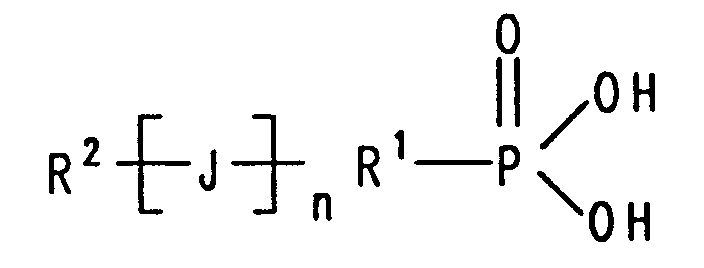
- R1 represents
- (1) an alkylene group having from 1 to 20 carbon atoms, said alkylene group optionally being substituted with one or more groups selected from:
- (a) an alkyl group having from 1 to 6 carbon atoms, such as methyl, ethyl, propyl, isopropyl, t-butyl or n-hexyl;
- (b) an aryl group having from 6 to 10 carbon atoms, such as phenyl or naphthyl;
- (c) fluorine;
- (d) an alkoxy group having from 1 to 6 carbon atoms, such as methoxy, ethoxy, propoxy, butoxy or hexyloxy;
- (e) an alkoxycarbonyl group having from 2 to 8 carbon atoms, such as CO2CH3, CO2C2H5 or CO2C5H11; or
- (f) an acyloxy group having from 2 to 8 carbon atoms, such as O2CCH3, O2CC2H5, O2CH(CH3)2 or O2CC5H11; or
- (2) a perfluoroalkylene group having from 1 to about 12 carbon atoms, such as CF2, C2F4, C3F6, C6F12, C8F16 or C12F24;
- (1) an alkylene group having from 1 to 20 carbon atoms, said alkylene group optionally being substituted with one or more groups selected from:
- R2 represents
- (a) an alkyl group having from 1 to 20 carbon atoms, such as CH3, C2H5, C4H9, C6H5CH2, C8H17 or C20H41;
- (b) a perfluoroalkyl group having from 1 to 20 carbon atoms, such as CF3, C2F5, C3F7, C6F13, C8F17, C10F21 or C16F33;
- (c) a polyoxyalkylene group having a total of from 1 to 20 carbon atoms and consisting of repeating units such as -(OCH2)-1-20, -(OCH2CH2)-1-20 or -(OCH(CH3)CH2)-1-20 and being terminated with an alkyl group having from 1 to 10 carbon atoms, such as CH3, C2H5, C6H3 or C10H21 or an aryl group having from 6 to 10 carbon atoms, such as C6H5 or C10H7; or
- (d) an aryl group having from 6 to 10 carbon atoms, such as C6H5 or C10H7;
- J represents an optional linking group selected from the group consisting of
―S―, ―O―,

- The phosphonic acid derivative may be present as the free acid, or partially or entirely neutralized as a salt with one or more mono-, di-, or polyvalent cations such as Li+, Na+, K+, Ca2+, Zn2+, Al3+ or Cu2+, or a cationic monomeric or polymeric organic moiety such as tetramethylammonium, tetra-n-butyl ammonium, pyridinium, tetraphenyl phosphonium, trimethylsulfonium, or polyvinylpyridinium.
- Representative specific phosphonic acid derivatives included within the scope of this invention are as follows:


- The phosphonic acid derivative defined above can be employed in the invention herein at any concentration useful for the intended purpose. In general, good results have been obtained at a concentration of 0.005 to 0.2 g/m2, preferably about 0.01 to 0.05 g/m2, with or without a binder.
- Any binder can be used, if desired, in the slipping layer of this invention provided it will be useful for the intended effect. In a preferred embodiment, cellulose esters, such as cellulose acetate butyrate, cellulose acetate propionate, cellulose acetate, cellulose triacetate, etc., are employed. Of these, we especially prefer cellulose acetate propionate. Other binders that can be employed include poly(styrene-co-acrylonitrile) (70/30 wt. ratio), poly(vinyl alcohol-co-butyral) (available commercially as Butvar 76® by Monsanto Corp.); poly(vinyl alcohol-co-acetal); poly(vinyl alcohol-co-benzal); polystyrene; poly(vinyl acetate); ethyl cellulose, poly(methyl methacrylate); and copolymers of methyl methacrylate.
- The amount of binder, when used, in the slipping layer of the invention is not critical. In general, the binder can be employed in an amount of from 0.05 to about 1 g/m2, preferably from 0.1 to 0.5 g/m2.
- Any dye can be used in the dye layer of the dye-donor element of the invention provided it is transferable to the dye-receiving layer by the action of heat. Especially good results have been obtained with sublimable dyes such as

- A dye-barrier layer may be employed in the dye-donor elements of the invention to improve the density of the transferred dye. Such dye-barrier layer materials include hydrophilic materials such as those described and claimed in U.S. Patent No. 4,716,144.
- The dye layer of the dye-donor element may be coated on the support or printed thereon by a printing technique such as a gravure process.
- Any material can be used as the support for the dye-donor element of the invention provided it is dimensionally stable and can withstand the heat of the thermal printing heads. Such materials include polyesters such as poly(ethylene terephthalate); polyamides; polycarbonates; glassine paper; condenser paper; cellulose esters; fluorine polymers; polyethers polyacetals; polyolefins; and polyimides. The support generally has a thickness of from 2 to 30 µm. It may also be coated with a subbing layer, if desired, such as those materials described in U.S. Patent No. 4,695,288 or U.S. Patent No. 4,737,486.
- The dye-receiving element that is used with the dye-donor element of the invention usually comprises a support having thereon a dye image receiving layer. The support may be a transparent film such as a poly(ether sulfone), a polyimide, a cellulose ester such as cellulose acetate, a poly(vinyl alcohol-co-acetal) or a poly(ethylene terephthalate). The support for the dye-receiving element may also be reflective such as baryta-coated paper, polyethylene-coated paper, white polyester (polyester with white pigment incorporated therein), an ivory paper, a condenser paper or a synthetic paper such as duPont Tyvek®.
- The dye image-receiving layer may comprise, for example, a polycarbonate, a polyurethane, a polyester, polyvinyl chloride, poly(styrene-co-acrylonitrile), poly(caprolactone) or mixtures thereof. The dye image-receiving layer may be present in any amount which is effective for the intended purpose. In general, good results have been obtained at a concentration of from 1 to 5 g/m2.
- As noted above, the dye donor elements of the invention are used to form a dye transfer image. Such a process comprises imagewise heating a dye-donor element as described above and transferring a dye image to a dye receiving element to form the dye transfer image.
- The dye donor element of the invention may be used in sheet form or in a continuous roll or ribbon. If a continuous roll or ribbon is employed, it may have only one dye or may have alternating areas of other different dyes, such as sublimable cyan and/or magenta and/or yellow and/or black or other dyes. Such dyes are disclosed in U.S. Patent Nos. 4,541,830; 4,698,651; 4,695,287; 4,701,439; 4,757,046; 4,743,582; 4,769,360 and 4,753,922. Thus, one-, two-, three- or four-color elements (or higher numbers also) are included within the scope of the invention.
- In a preferred embodiment of the invention, the dye-donor element comprises a poly(ethylene terephthalate) support coated with sequential repeating areas of yellow, cyan and magenta dye, and the above process steps are sequentially performed for each color to obtain a three-color dye transfer image. Of course, when the process is only performed for a single color, then a monochrome dye transfer image is obtained.
- A thermal dye transfer assemblage of the invention comprises
- (a) a dye-donor element as described above, and
- (b) a dye-receiving element as described above, the dye receiving element being in a superposed relationship with the dye donor element so that the dye layer of the donor element is in contact with the dye image-receiving layer of the receiving element.
- The above assemblage comprising these two elements may be preassembled as an integral unit when a monochrome image is to be obtained. This may be done by temporarily adhering the two elements together at their margins. After transfer, the dye-receiving element is then peeled apart to reveal the dye transfer image.
- When a three-color image is to be obtained, the above assemblage is formed on three occasions during the time when heat is applied by the thermal printing head. After the first dye is transferred, the elements are peeled apart. A second dye-donor element (or another area of the donor element with a different dye area) is then brought in register with the dye-receiving element and the process is repeated. The third color is obtained in the same manner.
- The following examples are provided to illustrate the invention.
- Cyan dye-donors were prepared as follows. On one side of a 6 µm poly(ethylene terephthalate) support a subbing layer of Tyzor TBT® (titanium alkoxide) (du Pont Corp.) (0.12 g/m2) was coated from a n-propyl acetate and 1-butanol solvent mixture. On top of this layer, a layer of the cyan dye illustrated above (0.42 g/m2), S-363® wax blend (a mixture of hydrocarbon wax particles) (Shamrock Technologies) (0.02 g/m2) was coated in a cellulose acetate propionate binder (2.5% acetyl, 45% propionyl) (0.66 g/m2) from a toluene, methanol, and cyclopentanone solvent mixture.
- On the reverse side of each dye-donor the indicated slipping layer of an organic phosphonic acid of the invention or control lubricant (each at 0.02 g/m2) in a cellulose acetate propionate binder (2.5% acetyl, 45-46% propionyl) (0.5 g/m2) was coated from a toluene, methanol, and cyclopentanone solvent mixture. All slipping layers had a subbing layer of Bostik 7650® (a linear mixed - polyester adhesive) (Emhart Corp.) (0.09 g/m2) coated from a butanone and toluene solvent mixture.
- The following organic phosphonates of the invention were evaluated and their performance was compared to materials of the prior art or organic phosphonates with short alkyl chains.
- E-1
- n-dodecyl phosphonic acid C12H25-P(O)(OH)2
- E-2
- n-dodecyl phosphonic acid, potassium salt C12H25-P(O)(OH)(O-)K+
- E-3
- n-octadecyl phosphonic acid C18H37P(O)(OH)2
- E-4
- n-eicosyl phosphonic acid C20H41-P(O)(OH)2
- E-5
- a fluorinated phosphonic acid mixture CF3(CF2)5,7,9-CH2-P(O)(OH)2
- E-6
- 2-(n-dodecyloxycarbonyl)ethyl phosphonic acid C12H25O2CCH2CH2-P(O)(OH)2
- The compounds employed in the invention may be prepared by the methods described in J. Org. Chem., 67, 1180 (1945); J. Org. Chem., 80, 714 (1958) and U.S. 3,965,147. Materials E-1 and E-3 were obtained from Specialty Organics, Inc.
- The following controls and comparisons were also evaluated:
- C-2
- Stearic acid C18H37CO2H
- C-3
- Sodium stearate C18H37CO2-Na+
- C-4
- 1-Octadecanol C18H37OH
- C-5
- Gafac RA600® (an alkyl polyethyleneoxide mono and diester phosphate from GAF Corp.)
- C-6
- Gafac MC470® (partial sodium salt form of an alkylpolyethyleneoxide mono and diester phosphate from GAF Corp.)
- C-7
- Gafac RK500® (an alkylpolyethyleneoxide mono and diester phosphate from GAF Corp.)
- C-8
- Leomin PN® (a mixture of mono and didodecyl phosphates as potassium salts from Hoechst Celanese Co.)
- C-9
- n-Butyl phosphonic acid, C4H9P(O)(OH)2
- C-10
- n-Hexyl phosphonic acid, C6H13P(O)(OH)2
- C-11
- n-Octyl phosphonic acid, C8H17P(O)(OH)2
- Dye-receivers were prepared coating the following layers in order: a white-reflective support of titanium dioxide pigmented-polyethylene overcoated paper stock with a subbing layer of poly(acrylonitrile-co-vinylidene chloride-co-acrylic acid) (14:79:7 wt. dye ratio) (0.08 g/m2) coated from 2-butanone. A dye receiving layer Makrolon 5705® (a bisphenol A polycarbonate resin) (Bayer AG) (2.9 g/m2), Tone PCL-300® (polycaprolactone), (Union Carbide) (0.38 g/m2), and 1,4-didecoxy-2,6-dimethoxyphenol (0.38 g/m2) was coated from methylene chloride. An overcoat layer of Tone PCL-300® (polycaprolactone), (Union Carbide), (0.11 g/m2), 3M Corp. FC-431 (a fluorocarbon surfactant) (0.016 g/m2), DC-510 (silicone fluid) Dow Corning (0.016 g/m2) was coated from methylene chloride.
- The evaluation procedure using the donor and receiver was as follows. The dye-side of a dye-donor element strip approximately 10 cm x 13 cm in area was placed in contact with the polymeric image-receiver layer side of a dye-receiver element of the same area. This assemblage was clamped to a stepper-motor driven 60 mm diameter rubber roller. A TDK Thermal Head L-231 (thermostatted at 26°C) was pressed with a force of 36 Newtons against the dye-donor element side of the contacted pair pushing it against the rubber roller.
- The imaging electronics were activated causing the donor-receiver assemblage to be drawn through the printing head/roller nip at 6.9 mm/sec. Coincidentally, the resistive elements in the thermal print head were pulsed for 29 µsec/pulse at 128 µsec intervals during the 33 msec/dot printing time. A maximum density test pattern was generated with 255 pulse/dot. The voltage supplied to the printing head was approximately 24.5 volts, resulting in an instantaneous peak power of 1.4 watts/dot and a maximum total energy of 9.6 mJoules/dot.
- As each maximum test density pattern was being generated, the force required for the pulling-device to draw the contacted pair between the print head and roller was measured using a Himmelstein Corp. 308TL Torquemeter Gauge (10 inch-pound (25.4cm - 0.225N) range) and 6-205 Conditioning Module. A low force during printing as is shown by the table below is desirable to minimize image misregistration. Those dye-donors that had an organic phosphonic acid derivative with an alkyl chain having more than nine carbon atoms gave low force during printing and fewer image defects. In actual practice force values, 9.8N (2.2 lbs.) or below are considered desirable.
Table 2 Slip Layer Component Force* N (lbs.) C-1 (None - binder only) 22.7 (5.1) C-2 C18 carboxylic acid 13.4 (3.0) C-3 C18 carboxylic acid salt 16.9 (3.8) C-4 C18 alcohol 19.1 (4.3) C-5 alkyl-PEG phosphate 11.1 (2.5) C-6 alkyl-PEG phosphate - salt 11.6 (2.6) C-7 alkyl-PEG phosphate 17.4 (3.9) C-8 C12alkyl-PEG phosphate 20.9 (4.7) C-9 C4 alkyl phosphonic acid 14.7 (3.3) C-10 C6 alkyl phosphonic acid 21.8 (4.9) C-11 C8 alkyl phosphonic acid 16.9 (3.8) E-1 C12 alkyl phosphonic acid 7.1 (1.6) E-2 C12 alkyl phosphonic acid salt 6.7 (1.5) E-3 C18 alkyl phosphonic acid 5.8 (1.3) E-4 C20 alkyl phosphonic acid 5.8 (1.3) E-5 C10 fluoroalkyl phosphonic acid 6.7 (1.5) E-6 C12 alkylester phosphonic acid 9.3 (2.1) * l lbf corresponds to 4.45 N. - The above data clearly show that the phosphonic acid derivatives of this invention are effective lubricants to minimize the force required for passage through the thermal head when used in the slipping layer of a dye-donor. Low force for printing is always desirable and can minimize image defects.
Claims (10)
- A dye-donor element for thermal dye transfer comprising a support having on one side thereof a dye layer and on the other side a slipping layer comprising a lubricating material, characterized in that said lubricating material comprises an organic phosphonic acid derivative or a salt thereof having the following formula:
 R1 represents a substituted or unsubstituted alkylene group or perfluoroalkylene group;R2 represents an alkyl group, a perfluoroalkyl group, an alkyl- or aryl-terminated polyoxyalkylene group or an aryl group;
with the proviso that the total number of carbon atoms in R1 and R2 are at least nine;J represents an optional linking group selected from the group consisting of
―S―, ―O―,

- The element of Claim 1 characterized in that said lubricating material is in a binder.
- The element of Claim 2 characterized in that said binder is cellulose acetate propionate.
- The element of Claim 1 characterized in thatR1 represents an alkylene group having from 1 to 20 carbon atoms or a perfluoroalkylene group having from 1 to 12 carbon atoms;R2 represents an alkyl group having from 1 to 20 carbon atoms, a perfluoroalkyl group having from 1 to 20 carbon atoms, a polyoxyalkylene group having a total of from 1 to 20 carbon atoms terminated with an alkyl group having from 1 to 10 carbon atoms or an aryl group having from 6 to 10 carbon atoms;
and the material is present as the acid. - The element of Claim 4 characterized in that the material is present as a partially or completely neutralized salt with one or more mono-, di-, or polyvalent cations of Li+, Na+, K+, Ca2+, Zn2+, Al3+ or Cu2+, or a cationic monomeric or polymeric organic moiety of trimethylammonium, tetra-n-butyl ammonium, pyridinium, tetraphenyl phosphonium, trimethylsulfonium, or polyvinylpyridinium.
- The element of Claim 5 characterized in that the material is present as the monopotassium salt.
- The element of Claim 1 characterized in that R2 is CH3(CH2)17- or CH3(CH2)19-.
- The element of Claim 1 characterized in that R1 is -CH2- and R2 is CF3(CF2)m, wherein m ranges from 7 to 9.
- A process of forming a dye transfer image comprising:(a) imagewise-heating a dye-donor element as defined in any one of the preceding claims, and(b) transferring a dye image to a dye receiving element to form said dye transfer image.
- A thermal dye transfer assemblage comprising:(a) a dye-donor element as defined in any one of claims 1 to 8, and(b) a dye receiving element comprising a support having thereon a dye image-receiving layer,said dye-receiving element being in a superposed relationship with said dye-donor element so that said dye layer is in contact with said dye image-receiving layer.
Applications Claiming Priority (2)
| Application Number | Priority Date | Filing Date | Title |
|---|---|---|---|
| US695664 | 1991-05-06 | ||
| US07/695,664 US5162292A (en) | 1991-05-06 | 1991-05-06 | Slipping layer containing a phosphonic acid derivative for dye-donor element used in thermal dye transfer |
Publications (2)
| Publication Number | Publication Date |
|---|---|
| EP0513630A1 EP0513630A1 (en) | 1992-11-19 |
| EP0513630B1 true EP0513630B1 (en) | 1997-07-30 |
Family
ID=24793972
Family Applications (1)
| Application Number | Title | Priority Date | Filing Date |
|---|---|---|---|
| EP92107556A Expired - Lifetime EP0513630B1 (en) | 1991-05-06 | 1992-05-05 | Slipping layer containing a phosphonic acid derivative for dye-donor element used in thermal dye transfer |
Country Status (4)
| Country | Link |
|---|---|
| US (1) | US5162292A (en) |
| EP (1) | EP0513630B1 (en) |
| JP (1) | JPH074991B2 (en) |
| DE (1) | DE69221203T2 (en) |
Families Citing this family (3)
| Publication number | Priority date | Publication date | Assignee | Title |
|---|---|---|---|---|
| EP0820875A1 (en) * | 1996-07-24 | 1998-01-28 | Dai Nippon Printing Co., Ltd. | Thermal transfer sheet having a specific lubricant slipping layer |
| US6824882B2 (en) * | 2002-05-31 | 2004-11-30 | 3M Innovative Properties Company | Fluorinated phosphonic acids |
| CN103349006A (en) * | 2013-07-16 | 2013-10-16 | 东北林业大学 | Black pepper essential oil microcapsule and preparation method thereof |
Citations (1)
| Publication number | Priority date | Publication date | Assignee | Title |
|---|---|---|---|---|
| US4567113A (en) * | 1983-09-12 | 1986-01-28 | General Company Limited | Heat-sensitive transferring recording medium |
Family Cites Families (5)
| Publication number | Priority date | Publication date | Assignee | Title |
|---|---|---|---|---|
| CA1228728A (en) * | 1983-09-28 | 1987-11-03 | Akihiro Imai | Color sheets for thermal transfer printing |
| JPS6114991A (en) * | 1984-07-02 | 1986-01-23 | Dainippon Printing Co Ltd | thermal transfer sheet |
| US4737485A (en) * | 1986-10-27 | 1988-04-12 | Eastman Kodak Company | Silicone and phosphate ester slipping layer for dye-donor element used in thermal dye transfer |
| GB8725452D0 (en) * | 1987-10-30 | 1987-12-02 | Ici Plc | Dyesheet |
| US5260127A (en) * | 1989-07-07 | 1993-11-09 | Dia Nippon Insatsu Kabushiki Kaisha | Thermal transfer sheet |
-
1991
- 1991-05-06 US US07/695,664 patent/US5162292A/en not_active Expired - Fee Related
-
1992
- 1992-05-01 JP JP4112594A patent/JPH074991B2/en not_active Expired - Lifetime
- 1992-05-05 DE DE69221203T patent/DE69221203T2/en not_active Expired - Fee Related
- 1992-05-05 EP EP92107556A patent/EP0513630B1/en not_active Expired - Lifetime
Patent Citations (1)
| Publication number | Priority date | Publication date | Assignee | Title |
|---|---|---|---|---|
| US4567113A (en) * | 1983-09-12 | 1986-01-28 | General Company Limited | Heat-sensitive transferring recording medium |
Also Published As
| Publication number | Publication date |
|---|---|
| DE69221203T2 (en) | 1998-02-26 |
| US5162292A (en) | 1992-11-10 |
| JPH074991B2 (en) | 1995-01-25 |
| DE69221203D1 (en) | 1997-09-04 |
| JPH05131771A (en) | 1993-05-28 |
| EP0513630A1 (en) | 1992-11-19 |
Similar Documents
| Publication | Publication Date | Title |
|---|---|---|
| US4740496A (en) | Release agent for thermal dye transfer | |
| EP0295484B1 (en) | Amino-modified silicone slipping layer for dye-donor element used in thermal dye transfer | |
| EP0228065B1 (en) | Dye-barrier and subbing layer for dye-donor element used in thermal dye transfer | |
| EP0657302A1 (en) | Thermal dye transfer dye-donor element containing transferable protection overcoat | |
| EP0374835B1 (en) | Thermally-transferable fluorescent 7-aminocarbostyrils | |
| EP0356981B1 (en) | Thermally-transferable fluorescent 7-aminocoumarins | |
| EP0373572B1 (en) | Thermally-transferable fluorescent compounds | |
| EP0257579B1 (en) | Alkoxy derivative stabilizers for dye-receiving element used in thermal dye transfer | |
| EP0356980B1 (en) | Thermally-transferable fluorescent diphenyl ethylenes | |
| EP0234043B1 (en) | Slipping layer for dye-donor element used in thermal dye transfer | |
| EP0366923A2 (en) | Thermally-transferable fluorescent diphenylpyrazolines | |
| US4737485A (en) | Silicone and phosphate ester slipping layer for dye-donor element used in thermal dye transfer | |
| EP0318945B1 (en) | Material for increasing dye transfer efficiency in dye-donor elements used in thermal dye transfer | |
| EP0348990A2 (en) | Slipping layer containing functionalized siloxane and wax for dye-donor element used in thermal dye transfer | |
| EP0227090B1 (en) | Lubricant slipping layer for dye-donor element used in thermal dye transfer | |
| EP0334322B1 (en) | Slipping layer containing amino-modified siloxane and organic lubricating particles for dye-donor element used in thermal dye transfer | |
| EP0334321B1 (en) | Slipping layer containing amino-modified siloxane and another polysiloxane for dye-donor element used in thermal dye transfer | |
| US5162292A (en) | Slipping layer containing a phosphonic acid derivative for dye-donor element used in thermal dye transfer | |
| EP0644061B1 (en) | Antistatic subbing layer for slipping layer in dye-donor element used in thermal dye transfer | |
| EP0649758B1 (en) | Interlayer for slipping layer in dye-donor element used in thermal dye transfer | |
| EP0518355B1 (en) | Benzomorpholinepyrroline dye-donor element for thermal dye transfer | |
| EP0318944B1 (en) | Increasing dye transfer efficiency in dye-donor elements used in thermal dye transfer | |
| EP0885747B1 (en) | Release agent for dye-donor element used in thermal dye transfer | |
| EP0348988B1 (en) | Slipping layer containing acyloxy-terminated siloxane for dye-donor element used in thermal dye transfer |
Legal Events
| Date | Code | Title | Description |
|---|---|---|---|
| PUAI | Public reference made under article 153(3) epc to a published international application that has entered the european phase |
Free format text: ORIGINAL CODE: 0009012 |
|
| 17P | Request for examination filed |
Effective date: 19920821 |
|
| AK | Designated contracting states |
Kind code of ref document: A1 Designated state(s): AT BE CH DE DK ES FR GB GR IT LI LU MC NL PT SE |
|
| 17Q | First examination report despatched |
Effective date: 19951018 |
|
| GRAG | Despatch of communication of intention to grant |
Free format text: ORIGINAL CODE: EPIDOS AGRA |
|
| GRAH | Despatch of communication of intention to grant a patent |
Free format text: ORIGINAL CODE: EPIDOS IGRA |
|
| GRAH | Despatch of communication of intention to grant a patent |
Free format text: ORIGINAL CODE: EPIDOS IGRA |
|
| GRAA | (expected) grant |
Free format text: ORIGINAL CODE: 0009210 |
|
| AK | Designated contracting states |
Kind code of ref document: B1 Designated state(s): DE FR GB |
|
| REF | Corresponds to: |
Ref document number: 69221203 Country of ref document: DE Date of ref document: 19970904 |
|
| ET | Fr: translation filed | ||
| PGFP | Annual fee paid to national office [announced via postgrant information from national office to epo] |
Ref country code: GB Payment date: 19980403 Year of fee payment: 7 |
|
| PGFP | Annual fee paid to national office [announced via postgrant information from national office to epo] |
Ref country code: FR Payment date: 19980508 Year of fee payment: 7 |
|
| PGFP | Annual fee paid to national office [announced via postgrant information from national office to epo] |
Ref country code: DE Payment date: 19980529 Year of fee payment: 7 |
|
| PLBE | No opposition filed within time limit |
Free format text: ORIGINAL CODE: 0009261 |
|
| STAA | Information on the status of an ep patent application or granted ep patent |
Free format text: STATUS: NO OPPOSITION FILED WITHIN TIME LIMIT |
|
| 26N | No opposition filed | ||
| PG25 | Lapsed in a contracting state [announced via postgrant information from national office to epo] |
Ref country code: GB Free format text: LAPSE BECAUSE OF NON-PAYMENT OF DUE FEES Effective date: 19990505 |
|
| GBPC | Gb: european patent ceased through non-payment of renewal fee |
Effective date: 19990505 |
|
| PG25 | Lapsed in a contracting state [announced via postgrant information from national office to epo] |
Ref country code: FR Free format text: LAPSE BECAUSE OF NON-PAYMENT OF DUE FEES Effective date: 20000131 |
|
| PG25 | Lapsed in a contracting state [announced via postgrant information from national office to epo] |
Ref country code: DE Free format text: LAPSE BECAUSE OF NON-PAYMENT OF DUE FEES Effective date: 20000301 |
|
| REG | Reference to a national code |
Ref country code: FR Ref legal event code: ST |