EP0511025B1 - Improvements in and relating to the manufacture of non-woven fabrics - Google Patents
Improvements in and relating to the manufacture of non-woven fabrics Download PDFInfo
- Publication number
- EP0511025B1 EP0511025B1 EP92303777A EP92303777A EP0511025B1 EP 0511025 B1 EP0511025 B1 EP 0511025B1 EP 92303777 A EP92303777 A EP 92303777A EP 92303777 A EP92303777 A EP 92303777A EP 0511025 B1 EP0511025 B1 EP 0511025B1
- Authority
- EP
- European Patent Office
- Prior art keywords
- belt
- projections
- woven fabric
- patterns
- forming
- Prior art date
- Legal status (The legal status is an assumption and is not a legal conclusion. Google has not performed a legal analysis and makes no representation as to the accuracy of the status listed.)
- Expired - Lifetime
Links
Images


Classifications
-
- D—TEXTILES; PAPER
- D04—BRAIDING; LACE-MAKING; KNITTING; TRIMMINGS; NON-WOVEN FABRICS
- D04H—MAKING TEXTILE FABRICS, e.g. FROM FIBRES OR FILAMENTARY MATERIAL; FABRICS MADE BY SUCH PROCESSES OR APPARATUS, e.g. FELTS, NON-WOVEN FABRICS; COTTON-WOOL; WADDING ; NON-WOVEN FABRICS FROM STAPLE FIBRES, FILAMENTS OR YARNS, BONDED WITH AT LEAST ONE WEB-LIKE MATERIAL DURING THEIR CONSOLIDATION
- D04H1/00—Non-woven fabrics formed wholly or mainly of staple fibres or like relatively short fibres
- D04H1/40—Non-woven fabrics formed wholly or mainly of staple fibres or like relatively short fibres from fleeces or layers composed of fibres without existing or potential cohesive properties
- D04H1/44—Non-woven fabrics formed wholly or mainly of staple fibres or like relatively short fibres from fleeces or layers composed of fibres without existing or potential cohesive properties the fleeces or layers being consolidated by mechanical means, e.g. by rolling
- D04H1/46—Non-woven fabrics formed wholly or mainly of staple fibres or like relatively short fibres from fleeces or layers composed of fibres without existing or potential cohesive properties the fleeces or layers being consolidated by mechanical means, e.g. by rolling by needling or like operations to cause entanglement of fibres
- D04H1/492—Non-woven fabrics formed wholly or mainly of staple fibres or like relatively short fibres from fleeces or layers composed of fibres without existing or potential cohesive properties the fleeces or layers being consolidated by mechanical means, e.g. by rolling by needling or like operations to cause entanglement of fibres by fluid jet
- D04H1/495—Non-woven fabrics formed wholly or mainly of staple fibres or like relatively short fibres from fleeces or layers composed of fibres without existing or potential cohesive properties the fleeces or layers being consolidated by mechanical means, e.g. by rolling by needling or like operations to cause entanglement of fibres by fluid jet for formation of patterns, e.g. drilling or rearrangement
-
- B—PERFORMING OPERATIONS; TRANSPORTING
- B29—WORKING OF PLASTICS; WORKING OF SUBSTANCES IN A PLASTIC STATE IN GENERAL
- B29C—SHAPING OR JOINING OF PLASTICS; SHAPING OF MATERIAL IN A PLASTIC STATE, NOT OTHERWISE PROVIDED FOR; AFTER-TREATMENT OF THE SHAPED PRODUCTS, e.g. REPAIRING
- B29C43/00—Compression moulding, i.e. applying external pressure to flow the moulding material; Apparatus therefor
- B29C43/32—Component parts, details or accessories; Auxiliary operations
- B29C43/44—Compression means for making articles of indefinite length
- B29C43/48—Endless belts
-
- B—PERFORMING OPERATIONS; TRANSPORTING
- B29—WORKING OF PLASTICS; WORKING OF SUBSTANCES IN A PLASTIC STATE IN GENERAL
- B29C—SHAPING OR JOINING OF PLASTICS; SHAPING OF MATERIAL IN A PLASTIC STATE, NOT OTHERWISE PROVIDED FOR; AFTER-TREATMENT OF THE SHAPED PRODUCTS, e.g. REPAIRING
- B29C70/00—Shaping composites, i.e. plastics material comprising reinforcements, fillers or preformed parts, e.g. inserts
- B29C70/04—Shaping composites, i.e. plastics material comprising reinforcements, fillers or preformed parts, e.g. inserts comprising reinforcements only, e.g. self-reinforcing plastics
- B29C70/28—Shaping operations therefor
- B29C70/40—Shaping or impregnating by compression not applied
- B29C70/50—Shaping or impregnating by compression not applied for producing articles of indefinite length, e.g. prepregs, sheet moulding compounds [SMC] or cross moulding compounds [XMC]
- B29C70/502—Shaping or impregnating by compression not applied for producing articles of indefinite length, e.g. prepregs, sheet moulding compounds [SMC] or cross moulding compounds [XMC] by first forming a mat composed of short fibres
-
- B—PERFORMING OPERATIONS; TRANSPORTING
- B65—CONVEYING; PACKING; STORING; HANDLING THIN OR FILAMENTARY MATERIAL
- B65G—TRANSPORT OR STORAGE DEVICES, e.g. CONVEYORS FOR LOADING OR TIPPING, SHOP CONVEYOR SYSTEMS OR PNEUMATIC TUBE CONVEYORS
- B65G15/00—Conveyors having endless load-conveying surfaces, i.e. belts and like continuous members, to which tractive effort is transmitted by means other than endless driving elements of similar configuration
- B65G15/30—Belts or like endless load-carriers
- B65G15/32—Belts or like endless load-carriers made of rubber or plastics
- B65G15/42—Belts or like endless load-carriers made of rubber or plastics having ribs, ridges, or other surface projections
-
- D—TEXTILES; PAPER
- D04—BRAIDING; LACE-MAKING; KNITTING; TRIMMINGS; NON-WOVEN FABRICS
- D04H—MAKING TEXTILE FABRICS, e.g. FROM FIBRES OR FILAMENTARY MATERIAL; FABRICS MADE BY SUCH PROCESSES OR APPARATUS, e.g. FELTS, NON-WOVEN FABRICS; COTTON-WOOL; WADDING ; NON-WOVEN FABRICS FROM STAPLE FIBRES, FILAMENTS OR YARNS, BONDED WITH AT LEAST ONE WEB-LIKE MATERIAL DURING THEIR CONSOLIDATION
- D04H18/00—Needling machines
- D04H18/04—Needling machines with water jets
-
- B—PERFORMING OPERATIONS; TRANSPORTING
- B65—CONVEYING; PACKING; STORING; HANDLING THIN OR FILAMENTARY MATERIAL
- B65G—TRANSPORT OR STORAGE DEVICES, e.g. CONVEYORS FOR LOADING OR TIPPING, SHOP CONVEYOR SYSTEMS OR PNEUMATIC TUBE CONVEYORS
- B65G2201/00—Indexing codes relating to handling devices, e.g. conveyors, characterised by the type of product or load being conveyed or handled
- B65G2201/02—Articles
-
- B—PERFORMING OPERATIONS; TRANSPORTING
- B65—CONVEYING; PACKING; STORING; HANDLING THIN OR FILAMENTARY MATERIAL
- B65G—TRANSPORT OR STORAGE DEVICES, e.g. CONVEYORS FOR LOADING OR TIPPING, SHOP CONVEYOR SYSTEMS OR PNEUMATIC TUBE CONVEYORS
- B65G2207/00—Indexing codes relating to constructional details, configuration and additional features of a handling device, e.g. Conveyors
- B65G2207/04—Advertising elements
Definitions
- the present invention relates to improvements in and relating to the manufacture of non-woven fabrics.
- non-woven fabrics have been formed by depositing a fibre assembly onto a mesh carrier belt, such as a plain woven fabric, and then applying highly pressurized water or hot air to the fibre assembly deposited on the belt to entangle or weld the fibres together to thereby form the non-woven fabric.
- a mesh carrier belt such as a plain woven fabric
- FR-A-2276914 discloses a method of fabricating non-woven material by use of a belt having regular projections thereon and use of a pressure roll to press this non-woven fabric onto the belt.
- the present invention relates to a belt with the following features and a method of fabricating a non-woven fabric as described.
- a belt for fabricating a non-woven fabric used in a machine for manufacturing non-woven fabrics from a fibre assembly wherein said belt is provided with a plurality of projections on the forming-side-surface of a belt body to imprint a pattern on said non-woven fabric, characterised in that the projections imprint irregular patterns and are of a larger size and a smaller size, and that the projections are made of a thermoplastic resin and are welded to said forming-side-surface of said belt body.
- the height of said projections having a larger size is greater than the projections having a smaller size.
- the or each of the projections mounted on the forming-side-surface of the belt forms, as a whole, the pattern to be given to the non-woven fabric.
- the belt of the invention for fabricating the non-woven fabric has the or each projection, which is mounted on the forming-side-surface of the belt body, made of thermoplastic resin and welded onto the forming-side-surface of the belt body.
- the welding can be accomplished by conventional methods known in the art.
- the present invention also provides a method for fabricating a non-woven fabric formed with irregular patterns, in which a carrier belt having mounted thereon a plurality of projections made of thermoplastic resin on the forming-side-surface of said carrier belt is utilised, said projections having been welded to said forming-side-surfaces of said belt, a fibre assembly is deposited onto said belt which is provided with irregular patterns formed of said projections and highly pressurised water or hot air is applied to said fibre assembly in order to press said fibre assembly and entangle the fibres and in which said fibre assembly is pressed onto said projections to form patterns having larger size and smaller size, to thereby form a non-woven fabric having irregular patterns formed therein.
- the depth of the patterns having a larger size being deeper than that of the patterns having smaller size.
- the method for fabricating a non-woven fabric formed with irregular patterns can be carried out according to the invention, wherein the height of the patterned projections provided on the forming-side-surface of a belt body is set to be larger than the thickness of the non-woven fabric to be fabricated, and highly pressurized water or hot air is applied onto said fibre assembly on the belt body to press it onto the or each projection in order to provide holes in the resulting fabric formed by the or each projection according to a desired pattern in the fabric.
- the method for fabricating a non-woven fabric formed with irregular patterns therein comprises depositing a previously made non-woven fabric onto a carrier belt provided with patterned projections on a forming-side-surface of said belt, and applying highly pressurized water or hot air onto said non-woven fabric in order to press it onto said belt and thereby form irregular patterns formed in said fabric by virtue of said projections.
- the belt body of the present invention is preferably made of weft and warp made of polyethylene terephthalate monofilament, and may be made of monofilament such as polyamide and polypropylene, and metallic wires such as stainless steel and bronze.
- a single layer fabric, a double layer fabric, a weft double layer fabric, or a warp double layer fabric may be used.
- a spiral belt which is made by connecting spiral wires, not fabric, spirally rotated with each other or connecting core wires twisted, may be used. Any other belt for making non-woven fabric on which the projections with patterns can be mounted on the forming-side-surface of the belt body can be used.
- Polyurethane and polyvinylchloride resins are suitable as the materials to form the projections which establish the desired patterns, and the projections may be connected to or mounted on the belt by using a high frequency welding method or adhesive, or by welding metallic projections to a metallic fabric belt.
- the present invention provides a solution for the problem in the prior art in which it was impossible to produce non-woven fabrics having a highly soft touch and additional desirable properties for the reason that the conventional irregular patterns, established by the difference in height of knuckle between the weft and the warp of the conventional mesh belt, was limited to the small knuckle difference.
- the projections with patterns are mounted on the forming-side-surface of the carrier belt body, and therefore the fibres become entangled with each other or oriented by applying highly pressurized water or hot air onto the fibre assembly on the belt body and further by movement of the fibre assembly due to the travelling movement of the belt.
- a suitable height difference between the forming-side-surface of the belt body and the projections forming the patterns thereby enabling the formation of clearly-defined irregular patterns according to the desired design in the final non-woven fabric product.
- the present invention it is also possible to form patterns into previously produced non-woven fabrics, by depositing the non-woven fabric onto the belt of the present invention and then applying highly pressurized water to the fabric to provide the patterns, though the soft feeling is thereby somewhat deteriorated. Furthermore, in the same way, it is also possible to produce the non-woven fabric with many holes forming patterns by using the belt provided with projections, each of which has a height greater than the thickness of the non-woven fabric applied to the belt, at least when consolidated.
- Fig.1 is a side view showing the method of fabricating a conventional non-woven fabric.
- Carrier belt 1 is mounted on inner rolls 4.
- Fibre assembly 2, which forms the non-woven fabric, is deposited onto belt 1 and is carried to zone 3 for forming the non-woven fabric thereon.
- zone 3 where the non-woven fabric is formed, the arrows show highly pressurized water or hot air pressing down on the fabric assembly 2.
- the highly pressurized water or the hot air to the fibre assembly, the fibres of the fibre assembly entangle with each other and weld together to form the non-woven fabric. Further, the fibres are oriented by the movement of the fluid due to the movement of the belt.
- Fig.2 is an enlarged side view for explaining the manufacturing process where the non-woven fabric is fabricated by using the belt and method of the present invention.
- Belt body 5 is provided with projections 6 forming any desired pattern mounted on the belt body 5.
- irregular patterns are formed in accordance with the design configuration of projections 6.
- Fig.3 is a plan view showing a portion of a belt according to the present invention.
- Belt body 5 is provided with smaller projections 6 which provide for irregular patterns imparting a soft feeling and good touch properties.
- the belt is also provided with larger projections 6' with patterns or shapes forming desired patterns and designs in the resulting fabric.
- Fig.4 is a sectional view taken along the line I-I' of Fig.3, in which the difference in height between the surface of the belt body 5 and the projections, 6 and 6', forming patterns is shown. It will be understood that the differences in height may be varied freely in accordance with the desired formation of the projections.
- Figs. 5, 6 and 7 are plan views showing a portion of a belt according to the present invention.
- two kinds of circular projections 6, i.e. smaller circles and larger circles forming irregular patterns, are mounted on the forming-side-surface of the belt body 5 for providing highly soft touch and good feel characteristics.
- Fig.6 and Fig.7 show the belt 5 mounted with projections 6 forming patterns for providing selected designs such as letters, numbers, characters or the like, on the forming-side-surface of the belt body 5.
- Fig.6 there is shown the design pattern composed of a plurality of small discrete projections, whilst in Fig.7 a unitary projection 6 per se forms a complete design pattern.
- Fig.8 and Fig.9 are each sectional views showing a portion of the belt cut along the weft.
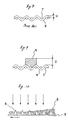
- Fig.8 there is shown a conventional belt having the irregular or undulating surface exhibiting a difference H in height produced between the weft 8 and the warp 7.
- Fig.9 shows a belt of the present invention, in which there is shown a similar irregular or undulatory surface but with the difference H in height existing between the top of the projection 6 and the patterns on the forming-side-surface of the belt body.
- the belt of the present invention having a large height difference, it is possible to form a sufficiently large irregularity in the fabric produced by the manufacturing process, and therefore obtain non-woven fabrics having soft feel and good touch properties. Furthermore, it is possible to freely select the formation of the projections with any desired patterns and the positions at which the projections are mounted, and therefore to provide all types of design patterns on the non-woven fabric.
- Fig.10 there is shown a cross-section of a belt of the present invention having provided thereon projections 6 with patterns having a height larger than the thickness of the non-woven fabric to be manufactured.
- the fibre assembly 2 is compressed in the direction of travel of the belt.
- a desired pattern composed of a plurality of holes produced by the projections 6.
- Any suitable fibre assembly such as, for example, paper pulp, can be used in practising the present invention.
Landscapes
- Engineering & Computer Science (AREA)
- Mechanical Engineering (AREA)
- Textile Engineering (AREA)
- Chemical & Material Sciences (AREA)
- Composite Materials (AREA)
- Nonwoven Fabrics (AREA)
- Treatment Of Fiber Materials (AREA)
- Paper (AREA)
Abstract
Description
Claims (7)
- A belt (5) for fabricating a non-woven fabric used in a machine for manufacturing non-woven fabrics from a fibre assembly (2), wherein said belt (5) is provided with a plurality of projections (6,6') on the forming-side-surface of a belt body to imprint a pattern on said non-woven fabric, characterised in that the projections (6,6') imprint irregular patterns and are of a larger size and a smaller size, and that the projections (6,6') are made of a thermoplastic resin and are welded to said forming-side-surface of said belt body.
- A belt as claimed in claim 1 in which said projections (6,6') mounted on said forming-side-surface of said belt body form, as a whole, the pattern to be imparted to said non-woven fabric.
- A belt as claimed in claim 1 or 2 in which the height of said projections (6') having a larger size is greater than the projections (6) having a smaller size.
- A method for fabricating a non-woven fabric in which a carrier belt (5) having mounted thereon a plurality of projections (6,6') on its forming-side-surface is utilised, characterised in that said projections (6,6') are of a larger size and a smaller size and are made of thermoplastic resin and have been welded to said forming-side-surfaces of said belt, a fibre assembly (2) is deposited onto said belt (5) which is provided with irregular patterns formed of said projections (6,6') and highly pressurised water or hot air is applied to said fibre assembly in order to press said fibre assembly and entangle the fibres and in which said fibre assembly (2) is pressed onto said projections to form patterns having larger size and smaller size, to thereby form a non-woven fabric having irregular patterns formed therein.
- A method for fabricating a non-woven fabric formed in which a carrier belt (5) having mounted thereon a plurality of projections (6,6') on its forming-side-surface is utilised, characterised in that said projections (6,6') are of a larger size and a smaller size and are made of a thermoplastic resin and have been welded on said forming-side-surfaces of said belt body, a previously made non-woven fabric is deposited onto said belt (5), and highly pressurised water or hot air is applied to said non-woven fabric in order to press said non-woven fabric onto said belt (5) and to thereby form irregular patterns in said fabric.
- A method as claimed in claim 3 or 4, wherein said projections (6,6') mounted on the belt are pressed onto the fibre assembly (2) to form, as a whole, the pattern to be imparted to said non-woven fabric.
- A method as claimed in any one of claims 4 to 6, in which the depth of the patterns having a larger size being deeper than that of the patterns having smaller size.
Applications Claiming Priority (2)
| Application Number | Priority Date | Filing Date | Title |
|---|---|---|---|
| JP18837191A JP3171457B2 (en) | 1991-04-26 | 1991-04-26 | Belt for producing nonwoven fabric provided with projections and method for producing nonwoven fabric having pattern formed |
| JP188371/91 | 1991-04-26 |
Publications (2)
| Publication Number | Publication Date |
|---|---|
| EP0511025A1 EP0511025A1 (en) | 1992-10-28 |
| EP0511025B1 true EP0511025B1 (en) | 1998-03-18 |
Family
ID=16222449
Family Applications (1)
| Application Number | Title | Priority Date | Filing Date |
|---|---|---|---|
| EP92303777A Expired - Lifetime EP0511025B1 (en) | 1991-04-26 | 1992-04-27 | Improvements in and relating to the manufacture of non-woven fabrics |
Country Status (6)
| Country | Link |
|---|---|
| US (1) | US5274893A (en) |
| EP (1) | EP0511025B1 (en) |
| JP (1) | JP3171457B2 (en) |
| AT (1) | ATE164192T1 (en) |
| CA (1) | CA2067045C (en) |
| DE (1) | DE69224769T2 (en) |
Families Citing this family (65)
| Publication number | Priority date | Publication date | Assignee | Title |
|---|---|---|---|---|
| GB2276363B (en) * | 1993-03-13 | 1996-06-26 | Apex Belting Company Limited | Conveyor belt |
| JP2986689B2 (en) * | 1994-08-29 | 1999-12-06 | ユニ・チャーム株式会社 | Manufacturing method of nonwoven wiper |
| US5695376A (en) * | 1994-09-09 | 1997-12-09 | Kimberly-Clark Worldwide, Inc. | Thermoformable barrier nonwoven laminate |
| US5674587A (en) * | 1994-09-16 | 1997-10-07 | James; William A. | Apparatus for making nonwoven fabrics having raised portions |
| DE59707399D1 (en) * | 1996-11-11 | 2002-07-11 | Fleissner Maschf Gmbh Co | Device for hydrodynamic needling of nonwovens, tissue or the like |
| US6442809B1 (en) | 1997-12-05 | 2002-09-03 | Polymer Group, Inc. | Fabric hydroenhancement method and equipment for improved efficiency |
| US6554963B1 (en) | 1998-11-02 | 2003-04-29 | Albany International Corp. | Embossed fabrics and method of making the same |
| DE19852717A1 (en) * | 1998-11-16 | 2000-05-18 | Fleissner Maschf Gmbh Co | Device for the production of perforated nonwovens by means of hydrodynamic needling |
| DE50007891D1 (en) * | 1999-01-21 | 2004-10-28 | Masek Miroslav | ENDLESS CONVEYOR BELT WITH ADVERTISING MEDIA |
| DE19912279A1 (en) * | 1999-03-18 | 2000-09-21 | Fleissner Maschf Gmbh Co | Process and device for producing nonwovens with embossed or perforated patterns by means of hydrodynamic needling |
| GB9911010D0 (en) * | 1999-05-13 | 1999-07-14 | Payne John M | Improvements in ans relating to conveyor belts |
| DE19929105A1 (en) * | 1999-06-24 | 2000-12-28 | Fleissner Maschf Gmbh Co | Process and device for the production of structured nonwovens by means of hydrodynamic needling |
| US6319455B1 (en) * | 1999-08-13 | 2001-11-20 | First Quality Nonwovens, Inc. | Nonwoven fabric with high CD elongation and method of making same |
| FR2799214B1 (en) | 1999-10-05 | 2001-11-16 | Icbt Perfojet Sa | PROCESS FOR THE PRODUCTION OF NONWOVEN TABLECLOTHS WHICH COHESION IS OBTAINED BY THE ACTION OF FLUID JETS |
| DE19956571A1 (en) * | 1999-11-24 | 2001-05-31 | Fleissner Maschf Gmbh Co | Method and device for color patterning a web by means of hydrodynamic treatment |
| EP1268906A4 (en) * | 2000-02-11 | 2008-05-28 | Polymer Group Inc | IMPRESSIVE NONWOVENS |
| EP1190134B1 (en) | 2000-03-24 | 2013-07-31 | Kao Corporation | Bulky sheet and process for producing the same |
| SE516427C2 (en) * | 2000-05-08 | 2002-01-15 | Sca Hygiene Prod Ab | Method and apparatus for producing nonwoven materials and using a net in the process |
| EP1305463A4 (en) * | 2000-07-31 | 2007-02-14 | Polymer Group Inc | METHOD FOR IMAGING A WOVEN TEXTILE MATERIAL |
| DE10132563A1 (en) * | 2001-07-10 | 2003-01-30 | Fleissner Maschf Gmbh Co | Process for colorless patterning of a material web and device for carrying out the process |
| US6790796B2 (en) | 2001-10-05 | 2004-09-14 | Albany International Corp. | Nonwovens forming or conveying fabrics with enhanced surface roughness and texture |
| US20030203162A1 (en) * | 2002-04-30 | 2003-10-30 | Kimberly-Clark Worldwide, Inc. | Methods for making nonwoven materials on a surface having surface features and nonwoven materials having surface features |
| US6878238B2 (en) * | 2002-12-19 | 2005-04-12 | Kimberly-Clark Worldwide, Inc. | Non-woven through air dryer and transfer fabrics for tissue making |
| FR2877679B1 (en) * | 2004-11-10 | 2007-04-27 | Rieter Perfojet Sa | DRUM NATURALLY FOR A MACHINE FOR ENCHEVETREMENT OF A NONTISSE BY JETS OF WATER. |
| DE102005045224B3 (en) * | 2005-09-22 | 2006-12-07 | Fleissner Gmbh | Device for reinforcing and/or structuring a web of nonwoven or knitted material by water jet treatment comprises a perforated drum, a coarse lower screen and a finer upper screen in the form of a shrink-fitted tube |
| US20070116928A1 (en) * | 2005-11-22 | 2007-05-24 | Jean-Louis Monnerie | Sheet slitting forming belt for nonwoven products |
| AU2005338968B2 (en) * | 2005-12-07 | 2012-06-07 | Essity Hygiene And Health Aktiebolag | Nonwoven material and method for producing nonwoven material |
| US20070256286A1 (en) * | 2006-05-05 | 2007-11-08 | Pgi Polymer, Inc. | Method and apparatus for perforating a fibrous web |
| JP5123497B2 (en) * | 2006-06-23 | 2013-01-23 | ユニ・チャーム株式会社 | Nonwoven fabric, nonwoven fabric manufacturing method and nonwoven fabric manufacturing apparatus |
| JP4828330B2 (en) * | 2006-07-07 | 2011-11-30 | 日本フイルコン株式会社 | Press fabric for pulp machine |
| DE102006033071A1 (en) * | 2006-07-14 | 2008-01-17 | Fleissner Gmbh | Apparatus for producing textiles, nonwovens, spunbonded nonwovens, paper materials |
| EP1884582B1 (en) * | 2006-08-04 | 2009-09-30 | Stork Prints Austria GmbH | Sieves, in particular for consolidating nonwoven fabric by gas- or hydro-entanglement |
| DE102007043523A1 (en) * | 2007-09-12 | 2009-03-19 | Fleissner Gmbh | Mass production of three-dimensionally-textured fabric, places fleece against moving, textured support, pre-compacts and applies steam heating on outer surface |
| US9315929B2 (en) | 2007-09-28 | 2016-04-19 | The Procter & Gamble Company | Non-wovens with high interfacial pore size and method of making same |
| JP5506520B2 (en) * | 2010-04-16 | 2014-05-28 | ユニ・チャーム株式会社 | A nonwoven fabric having irregularities, including an extensible fiber and a stretchable fiber, and a method for producing the nonwoven fabric |
| JP5506519B2 (en) * | 2010-04-16 | 2014-05-28 | ユニ・チャーム株式会社 | A method for easily manufacturing a nonwoven fabric having irregularities, and a method for easily processing a nonwoven fabric |
| JP5704877B2 (en) | 2010-09-30 | 2015-04-22 | ユニ・チャーム株式会社 | Non-woven fabric, absorbent article containing the non-woven fabric, and method for forming the non-woven fabric |
| JP5764323B2 (en) * | 2010-12-24 | 2015-08-19 | 花王株式会社 | Non-woven fabric and absorbent article using the same |
| JP5921866B2 (en) * | 2010-12-24 | 2016-05-24 | 花王株式会社 | Non-woven |
| JP5985185B2 (en) * | 2010-12-28 | 2016-09-06 | 花王株式会社 | Nonwoven fabric production support and method for producing shaped nonwoven fabric |
| DE102011002484B4 (en) * | 2011-01-05 | 2013-10-02 | Hauni Maschinenbau Ag | Promotion of tobacco |
| DE202011004335U1 (en) * | 2011-03-23 | 2012-03-26 | Trützschler Nonwovens Gmbh | Device for solidifying a textile product by means of hot gases |
| JP5827526B2 (en) * | 2011-09-09 | 2015-12-02 | 花王株式会社 | Non-woven |
| JP5875157B2 (en) * | 2012-09-28 | 2016-03-02 | 花王株式会社 | Fiber sheet |
| JP5596769B2 (en) * | 2012-11-06 | 2014-09-24 | 株式会社太陽機械製作所 | Nonwoven fabric molding production equipment |
| ES2699889T3 (en) * | 2014-04-08 | 2019-02-13 | Essity Hygiene & Health Ab | Method for producing a wet wipe or a removable hydroentangled hygienic fabric |
| JP6038196B2 (en) * | 2015-01-09 | 2016-12-07 | ユニ・チャーム株式会社 | Non-woven fabric, absorbent article containing the non-woven fabric, and method for forming the non-woven fabric |
| JP2017031518A (en) * | 2015-07-30 | 2017-02-09 | ユニチカ株式会社 | Method for producing hydroentangled nonwoven fabric |
| CA2992031C (en) | 2015-07-31 | 2021-02-16 | The Procter & Gamble Company | Package of absorbent articles utilizing a shaped nonwoven |
| CN109348722B (en) | 2015-07-31 | 2022-04-08 | 宝洁公司 | Forming belt for forming non-woven fabric |
| DE202015104671U1 (en) * | 2015-09-03 | 2016-12-06 | Autefa Solutions Germany Gmbh | embosser |
| PL3239378T3 (en) | 2016-04-29 | 2019-07-31 | Reifenhäuser GmbH & Co. KG Maschinenfabrik | Device and method for the manufacture of material from continuous filaments |
| JP6956629B2 (en) * | 2017-12-28 | 2021-11-02 | ユニ・チャーム株式会社 | Fiber non-woven sheet |
| JP7065603B2 (en) * | 2017-12-28 | 2022-05-12 | ユニ・チャーム株式会社 | Fiber non-woven sheet |
| JP7138434B2 (en) * | 2017-12-28 | 2022-09-16 | ユニ・チャーム株式会社 | fiber nonwoven sheet |
| JP7065607B2 (en) * | 2017-12-28 | 2022-05-12 | ユニ・チャーム株式会社 | Fiber non-woven sheet |
| KR102481089B1 (en) * | 2017-12-28 | 2022-12-26 | 유니 참 코포레이션 | fiber nonwoven sheet |
| JP7065604B2 (en) * | 2017-12-28 | 2022-05-12 | ユニ・チャーム株式会社 | Fiber non-woven sheet |
| JP7065605B2 (en) * | 2017-12-28 | 2022-05-12 | ユニ・チャーム株式会社 | Fiber non-woven sheet |
| JP7065606B2 (en) * | 2017-12-28 | 2022-05-12 | ユニ・チャーム株式会社 | Fiber non-woven sheet |
| WO2019131550A1 (en) * | 2017-12-28 | 2019-07-04 | ユニ・チャーム株式会社 | Fiber nonwoven sheet |
| TWI699196B (en) * | 2018-05-23 | 2020-07-21 | 黃振正 | Die and finished product for manufacturing thin layer with diversion |
| JP7180526B2 (en) * | 2019-05-10 | 2022-11-30 | トヨタ紡織株式会社 | Base material manufacturing method and base material manufacturing apparatus |
| EP4725467A2 (en) | 2019-12-10 | 2026-04-15 | The Procter & Gamble Company | Nonwoven webs with visually discernible patterns and improved texture perception |
| CN114318674A (en) * | 2021-04-21 | 2022-04-12 | 武汉纺织大学 | Preparation method of melt-blown fabric with three-dimensional array taro structure and melt-blown fabric |
Family Cites Families (13)
| Publication number | Priority date | Publication date | Assignee | Title |
|---|---|---|---|---|
| US3034180A (en) * | 1959-09-04 | 1962-05-15 | Kimberly Clark Co | Manufacture of cellulosic products |
| US3274018A (en) * | 1965-02-18 | 1966-09-20 | Johnson & Johnson | Method for producing a decorative nonwoven fabric |
| US3327369A (en) * | 1965-10-11 | 1967-06-27 | Tuttle Press | Embossing roll |
| US3750236A (en) * | 1970-03-24 | 1973-08-07 | Johnson & Johnson | Method and apparatus (discontinuous imperforate portions on backing means of open sandwich) |
| US3773452A (en) * | 1970-05-12 | 1973-11-20 | J Taga | Apparatus for molding thermoplastic materials |
| FR2276914A1 (en) * | 1974-07-04 | 1976-01-30 | Kroyer St Annes Ltd Karl | MOLDING APPARATUS |
| US4396448A (en) * | 1980-04-23 | 1983-08-02 | Toppan Printing Co. | Decorative laminate and a manufacturing method therefor |
| JPS58132155A (en) * | 1982-01-31 | 1983-08-06 | ユニ・チヤ−ム株式会社 | Production of nonwoven fabric with pattern |
| US4960630A (en) * | 1988-04-14 | 1990-10-02 | International Paper Company | Apparatus for producing symmetrical fluid entangled non-woven fabrics and related method |
| US4869855A (en) * | 1986-05-02 | 1989-09-26 | Allied Signal Inc. | Method of manufacturing molded articles |
| JPH0737702B2 (en) * | 1986-12-31 | 1995-04-26 | ユニ・チヤ−ム株式会社 | Non-woven fabric with perforated pattern |
| DE3818252A1 (en) * | 1988-05-28 | 1989-11-30 | Borgers Johann Gmbh Co Kg | UPHOLSTERY PART FOR SEAT, LOUNGE FURNITURE OD. DGL. |
| US5115544A (en) * | 1990-04-03 | 1992-05-26 | Albany International Corp. | Non-wovens manufacturing process |
-
1991
- 1991-04-26 JP JP18837191A patent/JP3171457B2/en not_active Expired - Fee Related
-
1992
- 1992-04-24 US US07/872,995 patent/US5274893A/en not_active Expired - Lifetime
- 1992-04-24 CA CA002067045A patent/CA2067045C/en not_active Expired - Fee Related
- 1992-04-27 AT AT92303777T patent/ATE164192T1/en not_active IP Right Cessation
- 1992-04-27 DE DE69224769T patent/DE69224769T2/en not_active Expired - Fee Related
- 1992-04-27 EP EP92303777A patent/EP0511025B1/en not_active Expired - Lifetime
Also Published As
| Publication number | Publication date |
|---|---|
| DE69224769D1 (en) | 1998-04-23 |
| CA2067045C (en) | 1994-10-25 |
| US5274893A (en) | 1994-01-04 |
| JP3171457B2 (en) | 2001-05-28 |
| EP0511025A1 (en) | 1992-10-28 |
| ATE164192T1 (en) | 1998-04-15 |
| JPH04327255A (en) | 1992-11-16 |
| CA2067045A1 (en) | 1992-10-27 |
| DE69224769T2 (en) | 1998-08-06 |
Similar Documents
| Publication | Publication Date | Title |
|---|---|---|
| US5274893A (en) | Belt for fabricating a non-woven fabric with projections and method for fabricating a non-woven fabric with patterns | |
| US4446189A (en) | Textured nonwoven textile fabric laminate and process of making said | |
| CN105484088B (en) | multi-axial fabric and forming method thereof | |
| US3917785A (en) | Method for producing nonwoven fabric | |
| US5025839A (en) | Two-ply papermakers forming fabric with zig-zagging MD yarns | |
| US8388812B2 (en) | Industrial fabric including spirally wound material strips | |
| US5115544A (en) | Non-wovens manufacturing process | |
| US6823568B1 (en) | Nonwoven fabric and method for making same | |
| US20160053436A1 (en) | Clothing for a machine for manufacturing a web material | |
| US6289940B1 (en) | Papermaking fabric seam with additional threads in the seam area | |
| EP0171891B1 (en) | Laminated soft faced-spiral woven papermakers fabric | |
| US8728280B2 (en) | Industrial fabric including spirally wound material strips with reinforcement | |
| EP0972876B1 (en) | Improvements in papermaking fabrics | |
| ES2085884T3 (en) | METHOD TO MANUFACTURE AN ARTICLE FROM A MATERIAL IN THE FORM OF A THERMOPLASTIC SANDWICH. | |
| EP0712957A2 (en) | Endless multilayer fabric for densifying paper materials and production process thereof | |
| JPH03227806A (en) | Belt for forming non-woven cloth | |
| JP2000027049A (en) | Fabric covering tennis ball and method of manufacturing the same | |
| DE69719205T2 (en) | papermaker | |
| JPH04343748A (en) | Belt for producing nonwoven fabric and production of nonwoven fabric having pattern | |
| JPH02229253A (en) | Nonwoven fabric and production thereof | |
| EP2847379B2 (en) | Industrial fabric including spirally wound material strips with reinforcement | |
| JP7510745B2 (en) | Embossing mold, embossing device and embossing method | |
| JPS5859043A (en) | Manufacture of profile frame laminate sheet | |
| MX2007007037A (en) | Multi-pin pin seam for an industrial fabric. | |
| JPH0435169Y2 (en) |
Legal Events
| Date | Code | Title | Description |
|---|---|---|---|
| PUAI | Public reference made under article 153(3) epc to a published international application that has entered the european phase |
Free format text: ORIGINAL CODE: 0009012 |
|
| AK | Designated contracting states |
Kind code of ref document: A1 Designated state(s): AT CH DE FR GB IT LI SE |
|
| 17P | Request for examination filed |
Effective date: 19930423 |
|
| 17Q | First examination report despatched |
Effective date: 19941028 |
|
| GRAG | Despatch of communication of intention to grant |
Free format text: ORIGINAL CODE: EPIDOS AGRA |
|
| GRAG | Despatch of communication of intention to grant |
Free format text: ORIGINAL CODE: EPIDOS AGRA |
|
| GRAG | Despatch of communication of intention to grant |
Free format text: ORIGINAL CODE: EPIDOS AGRA |
|
| GRAH | Despatch of communication of intention to grant a patent |
Free format text: ORIGINAL CODE: EPIDOS IGRA |
|
| GRAH | Despatch of communication of intention to grant a patent |
Free format text: ORIGINAL CODE: EPIDOS IGRA |
|
| GRAA | (expected) grant |
Free format text: ORIGINAL CODE: 0009210 |
|
| AK | Designated contracting states |
Kind code of ref document: B1 Designated state(s): AT CH DE FR GB IT LI SE |
|
| REF | Corresponds to: |
Ref document number: 164192 Country of ref document: AT Date of ref document: 19980415 Kind code of ref document: T |
|
| REG | Reference to a national code |
Ref country code: CH Ref legal event code: NV Representative=s name: ISLER & PEDRAZZINI AG Ref country code: CH Ref legal event code: EP |
|
| REF | Corresponds to: |
Ref document number: 69224769 Country of ref document: DE Date of ref document: 19980423 |
|
| ITF | It: translation for a ep patent filed | ||
| ET | Fr: translation filed | ||
| PLBE | No opposition filed within time limit |
Free format text: ORIGINAL CODE: 0009261 |
|
| STAA | Information on the status of an ep patent application or granted ep patent |
Free format text: STATUS: NO OPPOSITION FILED WITHIN TIME LIMIT |
|
| 26N | No opposition filed | ||
| REG | Reference to a national code |
Ref country code: GB Ref legal event code: IF02 |
|
| REG | Reference to a national code |
Ref country code: CH Ref legal event code: PCAR Free format text: ISLER & PEDRAZZINI AG;POSTFACH 1772;8027 ZUERICH (CH) |
|
| PGFP | Annual fee paid to national office [announced via postgrant information from national office to epo] |
Ref country code: CH Payment date: 20080430 Year of fee payment: 17 Ref country code: DE Payment date: 20080602 Year of fee payment: 17 |
|
| PGFP | Annual fee paid to national office [announced via postgrant information from national office to epo] |
Ref country code: AT Payment date: 20080402 Year of fee payment: 17 |
|
| PGFP | Annual fee paid to national office [announced via postgrant information from national office to epo] |
Ref country code: IT Payment date: 20080429 Year of fee payment: 17 |
|
| PGFP | Annual fee paid to national office [announced via postgrant information from national office to epo] |
Ref country code: SE Payment date: 20080429 Year of fee payment: 17 |
|
| PGFP | Annual fee paid to national office [announced via postgrant information from national office to epo] |
Ref country code: FR Payment date: 20080417 Year of fee payment: 17 |
|
| PGFP | Annual fee paid to national office [announced via postgrant information from national office to epo] |
Ref country code: GB Payment date: 20080429 Year of fee payment: 17 |
|
| REG | Reference to a national code |
Ref country code: CH Ref legal event code: PL |
|
| EUG | Se: european patent has lapsed | ||
| GBPC | Gb: european patent ceased through non-payment of renewal fee |
Effective date: 20090427 |
|
| REG | Reference to a national code |
Ref country code: FR Ref legal event code: ST Effective date: 20091231 |
|
| PG25 | Lapsed in a contracting state [announced via postgrant information from national office to epo] |
Ref country code: DE Free format text: LAPSE BECAUSE OF NON-PAYMENT OF DUE FEES Effective date: 20091103 Ref country code: LI Free format text: LAPSE BECAUSE OF NON-PAYMENT OF DUE FEES Effective date: 20090430 Ref country code: CH Free format text: LAPSE BECAUSE OF NON-PAYMENT OF DUE FEES Effective date: 20090430 Ref country code: AT Free format text: LAPSE BECAUSE OF NON-PAYMENT OF DUE FEES Effective date: 20090427 |
|
| PG25 | Lapsed in a contracting state [announced via postgrant information from national office to epo] |
Ref country code: FR Free format text: LAPSE BECAUSE OF NON-PAYMENT OF DUE FEES Effective date: 20091222 Ref country code: GB Free format text: LAPSE BECAUSE OF NON-PAYMENT OF DUE FEES Effective date: 20090427 |
|
| PG25 | Lapsed in a contracting state [announced via postgrant information from national office to epo] |
Ref country code: IT Free format text: LAPSE BECAUSE OF NON-PAYMENT OF DUE FEES Effective date: 20090427 |
|
| PG25 | Lapsed in a contracting state [announced via postgrant information from national office to epo] |
Ref country code: SE Free format text: LAPSE BECAUSE OF NON-PAYMENT OF DUE FEES Effective date: 20090428 |