EP0509202B1 - Rheological agents and thickeners - Google Patents
Rheological agents and thickeners Download PDFInfo
- Publication number
- EP0509202B1 EP0509202B1 EP92102216A EP92102216A EP0509202B1 EP 0509202 B1 EP0509202 B1 EP 0509202B1 EP 92102216 A EP92102216 A EP 92102216A EP 92102216 A EP92102216 A EP 92102216A EP 0509202 B1 EP0509202 B1 EP 0509202B1
- Authority
- EP
- European Patent Office
- Prior art keywords
- starch
- weight
- rheological additive
- rheological
- hectorite
- Prior art date
- Legal status (The legal status is an assumption and is not a legal conclusion. Google has not performed a legal analysis and makes no representation as to the accuracy of the status listed.)
- Expired - Lifetime
Links
- 239000002562 thickening agent Substances 0.000 title description 50
- 239000003795 chemical substances by application Substances 0.000 title description 9
- 239000000203 mixture Substances 0.000 claims description 55
- 229920002472 Starch Polymers 0.000 claims description 40
- 235000019698 starch Nutrition 0.000 claims description 38
- 239000008107 starch Substances 0.000 claims description 37
- 239000004927 clay Substances 0.000 claims description 33
- XLYOFNOQVPJJNP-UHFFFAOYSA-N water Substances O XLYOFNOQVPJJNP-UHFFFAOYSA-N 0.000 claims description 27
- 239000006254 rheological additive Substances 0.000 claims description 25
- KWLMIXQRALPRBC-UHFFFAOYSA-L hectorite Chemical compound [Li+].[OH-].[OH-].[Na+].[Mg+2].O1[Si]2([O-])O[Si]1([O-])O[Si]([O-])(O1)O[Si]1([O-])O2 KWLMIXQRALPRBC-UHFFFAOYSA-L 0.000 claims description 22
- 229910000271 hectorite Inorganic materials 0.000 claims description 22
- 239000000654 additive Substances 0.000 claims description 17
- 229920000642 polymer Polymers 0.000 claims description 17
- 239000000178 monomer Substances 0.000 claims description 15
- 239000000463 material Substances 0.000 claims description 12
- 239000000047 product Substances 0.000 claims description 12
- 150000001732 carboxylic acid derivatives Chemical class 0.000 claims description 11
- 229920001577 copolymer Polymers 0.000 claims description 11
- 125000000391 vinyl group Chemical group [H]C([*])=C([H])[H] 0.000 claims description 11
- 230000000996 additive effect Effects 0.000 claims description 9
- 229910021647 smectite Inorganic materials 0.000 claims description 9
- XTXRWKRVRITETP-UHFFFAOYSA-N Vinyl acetate Chemical compound CC(=O)OC=C XTXRWKRVRITETP-UHFFFAOYSA-N 0.000 claims description 6
- 239000000440 bentonite Substances 0.000 claims description 6
- 229910000278 bentonite Inorganic materials 0.000 claims description 6
- SVPXDRXYRYOSEX-UHFFFAOYSA-N bentoquatam Chemical compound O.O=[Si]=O.O=[Al]O[Al]=O SVPXDRXYRYOSEX-UHFFFAOYSA-N 0.000 claims description 6
- GUJOJGAPFQRJSV-UHFFFAOYSA-N dialuminum;dioxosilane;oxygen(2-);hydrate Chemical group O.[O-2].[O-2].[O-2].[Al+3].[Al+3].O=[Si]=O.O=[Si]=O.O=[Si]=O.O=[Si]=O GUJOJGAPFQRJSV-UHFFFAOYSA-N 0.000 claims description 6
- 230000032050 esterification Effects 0.000 claims description 6
- 238000005886 esterification reaction Methods 0.000 claims description 6
- 229920002554 vinyl polymer Polymers 0.000 claims description 6
- 230000021523 carboxylation Effects 0.000 claims description 5
- 238000006473 carboxylation reaction Methods 0.000 claims description 5
- 238000007046 ethoxylation reaction Methods 0.000 claims description 5
- 238000000034 method Methods 0.000 claims description 5
- 229910052901 montmorillonite Inorganic materials 0.000 claims description 5
- 238000006116 polymerization reaction Methods 0.000 claims description 5
- 229910000275 saponite Inorganic materials 0.000 claims description 5
- 239000005995 Aluminium silicate Substances 0.000 claims description 4
- 229920002261 Corn starch Polymers 0.000 claims description 4
- 239000001653 FEMA 3120 Substances 0.000 claims description 4
- 240000005979 Hordeum vulgare Species 0.000 claims description 4
- 235000007340 Hordeum vulgare Nutrition 0.000 claims description 4
- 229920000881 Modified starch Polymers 0.000 claims description 4
- 239000004113 Sepiolite Substances 0.000 claims description 4
- 244000295923 Yucca aloifolia Species 0.000 claims description 4
- 235000004552 Yucca aloifolia Nutrition 0.000 claims description 4
- 235000012044 Yucca brevifolia Nutrition 0.000 claims description 4
- 235000017049 Yucca glauca Nutrition 0.000 claims description 4
- 235000012211 aluminium silicate Nutrition 0.000 claims description 4
- 229960000892 attapulgite Drugs 0.000 claims description 4
- 239000008120 corn starch Substances 0.000 claims description 4
- 229910052900 illite Inorganic materials 0.000 claims description 4
- NLYAJNPCOHFWQQ-UHFFFAOYSA-N kaolin Chemical compound O.O.O=[Al]O[Si](=O)O[Si](=O)O[Al]=O NLYAJNPCOHFWQQ-UHFFFAOYSA-N 0.000 claims description 4
- VGIBGUSAECPPNB-UHFFFAOYSA-L nonaaluminum;magnesium;tripotassium;1,3-dioxido-2,4,5-trioxa-1,3-disilabicyclo[1.1.1]pentane;iron(2+);oxygen(2-);fluoride;hydroxide Chemical compound [OH-].[O-2].[O-2].[O-2].[O-2].[O-2].[F-].[Mg+2].[Al+3].[Al+3].[Al+3].[Al+3].[Al+3].[Al+3].[Al+3].[Al+3].[Al+3].[K+].[K+].[K+].[Fe+2].O1[Si]2([O-])O[Si]1([O-])O2.O1[Si]2([O-])O[Si]1([O-])O2.O1[Si]2([O-])O[Si]1([O-])O2.O1[Si]2([O-])O[Si]1([O-])O2.O1[Si]2([O-])O[Si]1([O-])O2.O1[Si]2([O-])O[Si]1([O-])O2.O1[Si]2([O-])O[Si]1([O-])O2 VGIBGUSAECPPNB-UHFFFAOYSA-L 0.000 claims description 4
- 229910052625 palygorskite Inorganic materials 0.000 claims description 4
- 229920001592 potato starch Polymers 0.000 claims description 4
- 229910052624 sepiolite Inorganic materials 0.000 claims description 4
- 235000019355 sepiolite Nutrition 0.000 claims description 4
- CERQOIWHTDAKMF-UHFFFAOYSA-N Methacrylic acid Chemical compound CC(=C)C(O)=O CERQOIWHTDAKMF-UHFFFAOYSA-N 0.000 claims description 3
- VVQNEPGJFQJSBK-UHFFFAOYSA-N Methyl methacrylate Chemical compound COC(=O)C(C)=C VVQNEPGJFQJSBK-UHFFFAOYSA-N 0.000 claims description 3
- 239000007795 chemical reaction product Substances 0.000 claims description 3
- 238000004519 manufacturing process Methods 0.000 claims description 3
- 230000004048 modification Effects 0.000 claims description 3
- 238000012986 modification Methods 0.000 claims description 3
- 230000008569 process Effects 0.000 claims description 3
- 239000008199 coating composition Substances 0.000 claims description 2
- 239000003973 paint Substances 0.000 description 31
- 238000000576 coating method Methods 0.000 description 28
- 239000004816 latex Substances 0.000 description 23
- 229920000126 latex Polymers 0.000 description 23
- 239000011248 coating agent Substances 0.000 description 19
- 229920000663 Hydroxyethyl cellulose Polymers 0.000 description 12
- 235000019447 hydroxyethyl cellulose Nutrition 0.000 description 9
- 239000004354 Hydroxyethyl cellulose Substances 0.000 description 8
- 238000009472 formulation Methods 0.000 description 8
- 229940071826 hydroxyethyl cellulose Drugs 0.000 description 8
- 239000000049 pigment Substances 0.000 description 8
- 230000008719 thickening Effects 0.000 description 8
- 239000002245 particle Substances 0.000 description 6
- VTYYLEPIZMXCLO-UHFFFAOYSA-L Calcium carbonate Chemical compound [Ca+2].[O-]C([O-])=O VTYYLEPIZMXCLO-UHFFFAOYSA-L 0.000 description 5
- 239000004606 Fillers/Extenders Substances 0.000 description 5
- GWEVSGVZZGPLCZ-UHFFFAOYSA-N Titan oxide Chemical compound O=[Ti]=O GWEVSGVZZGPLCZ-UHFFFAOYSA-N 0.000 description 5
- -1 viscosifiers Substances 0.000 description 5
- 239000000945 filler Substances 0.000 description 4
- 238000002156 mixing Methods 0.000 description 4
- 239000000123 paper Substances 0.000 description 4
- 239000000243 solution Substances 0.000 description 4
- 229920001059 synthetic polymer Polymers 0.000 description 4
- 239000004753 textile Substances 0.000 description 4
- LYCAIKOWRPUZTN-UHFFFAOYSA-N Ethylene glycol Chemical compound OCCO LYCAIKOWRPUZTN-UHFFFAOYSA-N 0.000 description 3
- 240000003183 Manihot esculenta Species 0.000 description 3
- 235000016735 Manihot esculenta subsp esculenta Nutrition 0.000 description 3
- VYPSYNLAJGMNEJ-UHFFFAOYSA-N Silicium dioxide Chemical compound O=[Si]=O VYPSYNLAJGMNEJ-UHFFFAOYSA-N 0.000 description 3
- 239000000853 adhesive Substances 0.000 description 3
- 230000001070 adhesive effect Effects 0.000 description 3
- 239000002734 clay mineral Substances 0.000 description 3
- 238000005553 drilling Methods 0.000 description 3
- 239000000839 emulsion Substances 0.000 description 3
- 239000012530 fluid Substances 0.000 description 3
- 238000000227 grinding Methods 0.000 description 3
- 239000000976 ink Substances 0.000 description 3
- 239000003755 preservative agent Substances 0.000 description 3
- 239000007921 spray Substances 0.000 description 3
- 239000004094 surface-active agent Substances 0.000 description 3
- QGZKDVFQNNGYKY-UHFFFAOYSA-N Ammonia Chemical compound N QGZKDVFQNNGYKY-UHFFFAOYSA-N 0.000 description 2
- 102000004190 Enzymes Human genes 0.000 description 2
- 108090000790 Enzymes Proteins 0.000 description 2
- 239000004721 Polyphenylene oxide Substances 0.000 description 2
- 240000008042 Zea mays Species 0.000 description 2
- 235000005824 Zea mays ssp. parviglumis Nutrition 0.000 description 2
- 235000002017 Zea mays subsp mays Nutrition 0.000 description 2
- YKTSYUJCYHOUJP-UHFFFAOYSA-N [O--].[Al+3].[Al+3].[O-][Si]([O-])([O-])[O-] Chemical compound [O--].[Al+3].[Al+3].[O-][Si]([O-])([O-])[O-] YKTSYUJCYHOUJP-UHFFFAOYSA-N 0.000 description 2
- 230000008901 benefit Effects 0.000 description 2
- 229910000019 calcium carbonate Inorganic materials 0.000 description 2
- OSGAYBCDTDRGGQ-UHFFFAOYSA-L calcium sulfate Chemical compound [Ca+2].[O-]S([O-])(=O)=O OSGAYBCDTDRGGQ-UHFFFAOYSA-L 0.000 description 2
- VNSBYDPZHCQWNB-UHFFFAOYSA-N calcium;aluminum;dioxido(oxo)silane;sodium;hydrate Chemical compound O.[Na].[Al].[Ca+2].[O-][Si]([O-])=O VNSBYDPZHCQWNB-UHFFFAOYSA-N 0.000 description 2
- 150000001735 carboxylic acids Chemical class 0.000 description 2
- 230000008859 change Effects 0.000 description 2
- 235000005822 corn Nutrition 0.000 description 2
- 229940099112 cornstarch Drugs 0.000 description 2
- 239000002537 cosmetic Substances 0.000 description 2
- 210000003298 dental enamel Anatomy 0.000 description 2
- 239000003599 detergent Substances 0.000 description 2
- 238000002036 drum drying Methods 0.000 description 2
- 238000001035 drying Methods 0.000 description 2
- 239000003349 gelling agent Substances 0.000 description 2
- 229910052500 inorganic mineral Inorganic materials 0.000 description 2
- 239000011499 joint compound Substances 0.000 description 2
- 239000011707 mineral Substances 0.000 description 2
- 235000019426 modified starch Nutrition 0.000 description 2
- 238000000643 oven drying Methods 0.000 description 2
- 229920000570 polyether Polymers 0.000 description 2
- 229920001282 polysaccharide Polymers 0.000 description 2
- 238000002360 preparation method Methods 0.000 description 2
- 238000012545 processing Methods 0.000 description 2
- 229940100486 rice starch Drugs 0.000 description 2
- 238000007665 sagging Methods 0.000 description 2
- 239000000565 sealant Substances 0.000 description 2
- 239000002002 slurry Substances 0.000 description 2
- 238000001694 spray drying Methods 0.000 description 2
- 239000000758 substrate Substances 0.000 description 2
- 239000004408 titanium dioxide Substances 0.000 description 2
- 239000002966 varnish Substances 0.000 description 2
- 239000001993 wax Substances 0.000 description 2
- 229940100445 wheat starch Drugs 0.000 description 2
- FLROJJGKUKLCAE-UHFFFAOYSA-N 3-amino-2-methylphenol Chemical compound CC1=C(N)C=CC=C1O FLROJJGKUKLCAE-UHFFFAOYSA-N 0.000 description 1
- FHVDTGUDJYJELY-UHFFFAOYSA-N 6-{[2-carboxy-4,5-dihydroxy-6-(phosphanyloxy)oxan-3-yl]oxy}-4,5-dihydroxy-3-phosphanyloxane-2-carboxylic acid Chemical compound O1C(C(O)=O)C(P)C(O)C(O)C1OC1C(C(O)=O)OC(OP)C(O)C1O FHVDTGUDJYJELY-UHFFFAOYSA-N 0.000 description 1
- GJCOSYZMQJWQCA-UHFFFAOYSA-N 9H-xanthene Chemical compound C1=CC=C2CC3=CC=CC=C3OC2=C1 GJCOSYZMQJWQCA-UHFFFAOYSA-N 0.000 description 1
- 229920000945 Amylopectin Polymers 0.000 description 1
- 229920000856 Amylose Polymers 0.000 description 1
- 229910021532 Calcite Inorganic materials 0.000 description 1
- 229920002907 Guar gum Polymers 0.000 description 1
- 239000004368 Modified starch Substances 0.000 description 1
- 240000007594 Oryza sativa Species 0.000 description 1
- 235000007164 Oryza sativa Nutrition 0.000 description 1
- 229920002125 Sokalan® Polymers 0.000 description 1
- 244000061456 Solanum tuberosum Species 0.000 description 1
- 235000002595 Solanum tuberosum Nutrition 0.000 description 1
- 229920001615 Tragacanth Polymers 0.000 description 1
- 241000209140 Triticum Species 0.000 description 1
- 235000021307 Triticum Nutrition 0.000 description 1
- 230000009471 action Effects 0.000 description 1
- 150000001299 aldehydes Chemical class 0.000 description 1
- 229940072056 alginate Drugs 0.000 description 1
- 235000010443 alginic acid Nutrition 0.000 description 1
- 229920000615 alginic acid Polymers 0.000 description 1
- 229910052782 aluminium Inorganic materials 0.000 description 1
- CBTVGIZVANVGBH-UHFFFAOYSA-N aminomethyl propanol Chemical compound CC(C)(N)CO CBTVGIZVANVGBH-UHFFFAOYSA-N 0.000 description 1
- 229910021529 ammonia Inorganic materials 0.000 description 1
- 239000002518 antifoaming agent Substances 0.000 description 1
- 239000007798 antifreeze agent Substances 0.000 description 1
- 239000000305 astragalus gummifer gum Substances 0.000 description 1
- 230000001580 bacterial effect Effects 0.000 description 1
- 239000011230 binding agent Substances 0.000 description 1
- 238000006065 biodegradation reaction Methods 0.000 description 1
- 230000015556 catabolic process Effects 0.000 description 1
- 238000005119 centrifugation Methods 0.000 description 1
- 238000007385 chemical modification Methods 0.000 description 1
- 239000000084 colloidal system Substances 0.000 description 1
- 238000010276 construction Methods 0.000 description 1
- 238000007796 conventional method Methods 0.000 description 1
- 238000005034 decoration Methods 0.000 description 1
- 239000013530 defoamer Substances 0.000 description 1
- 238000006731 degradation reaction Methods 0.000 description 1
- 238000011161 development Methods 0.000 description 1
- 238000010790 dilution Methods 0.000 description 1
- 239000012895 dilution Substances 0.000 description 1
- 239000006185 dispersion Substances 0.000 description 1
- 239000010459 dolomite Substances 0.000 description 1
- 229910000514 dolomite Inorganic materials 0.000 description 1
- 239000003995 emulsifying agent Substances 0.000 description 1
- 150000002148 esters Chemical class 0.000 description 1
- 238000006266 etherification reaction Methods 0.000 description 1
- 150000002170 ethers Chemical class 0.000 description 1
- 239000010433 feldspar Substances 0.000 description 1
- 239000010419 fine particle Substances 0.000 description 1
- 235000013305 food Nutrition 0.000 description 1
- 229910021485 fumed silica Inorganic materials 0.000 description 1
- 150000004676 glycans Chemical class 0.000 description 1
- 238000010559 graft polymerization reaction Methods 0.000 description 1
- 230000005484 gravity Effects 0.000 description 1
- 239000000665 guar gum Substances 0.000 description 1
- 235000010417 guar gum Nutrition 0.000 description 1
- 229960002154 guar gum Drugs 0.000 description 1
- 125000001183 hydrocarbyl group Chemical group 0.000 description 1
- 230000002209 hydrophobic effect Effects 0.000 description 1
- 125000002887 hydroxy group Chemical group [H]O* 0.000 description 1
- 125000002768 hydroxyalkyl group Chemical group 0.000 description 1
- 239000012535 impurity Substances 0.000 description 1
- 239000004615 ingredient Substances 0.000 description 1
- 150000002576 ketones Chemical class 0.000 description 1
- 235000015250 liver sausages Nutrition 0.000 description 1
- 238000011068 loading method Methods 0.000 description 1
- 229920000609 methyl cellulose Polymers 0.000 description 1
- 239000001923 methylcellulose Substances 0.000 description 1
- 235000010981 methylcellulose Nutrition 0.000 description 1
- 239000004570 mortar (masonry) Substances 0.000 description 1
- KPRZOPQOBJRYSW-UHFFFAOYSA-N o-hydroxybenzylamine Natural products NCC1=CC=CC=C1O KPRZOPQOBJRYSW-UHFFFAOYSA-N 0.000 description 1
- 230000003647 oxidation Effects 0.000 description 1
- 238000007254 oxidation reaction Methods 0.000 description 1
- 239000003002 pH adjusting agent Substances 0.000 description 1
- 238000012856 packing Methods 0.000 description 1
- 239000001814 pectin Substances 0.000 description 1
- 235000010987 pectin Nutrition 0.000 description 1
- 229920001277 pectin Polymers 0.000 description 1
- 239000004014 plasticizer Substances 0.000 description 1
- 229920002401 polyacrylamide Polymers 0.000 description 1
- 229920000058 polyacrylate Polymers 0.000 description 1
- 239000005017 polysaccharide Substances 0.000 description 1
- 229920002635 polyurethane Polymers 0.000 description 1
- 239000004814 polyurethane Substances 0.000 description 1
- 229920002689 polyvinyl acetate Polymers 0.000 description 1
- 239000011118 polyvinyl acetate Substances 0.000 description 1
- 230000002335 preservative effect Effects 0.000 description 1
- 230000002265 prevention Effects 0.000 description 1
- 239000002994 raw material Substances 0.000 description 1
- 238000007670 refining Methods 0.000 description 1
- 238000000518 rheometry Methods 0.000 description 1
- 235000009566 rice Nutrition 0.000 description 1
- 235000014438 salad dressings Nutrition 0.000 description 1
- 238000000926 separation method Methods 0.000 description 1
- 239000000377 silicon dioxide Substances 0.000 description 1
- 239000007787 solid Substances 0.000 description 1
- 239000002195 soluble material Substances 0.000 description 1
- 239000002904 solvent Substances 0.000 description 1
- 238000005507 spraying Methods 0.000 description 1
- 238000003860 storage Methods 0.000 description 1
- 239000000126 substance Substances 0.000 description 1
- 239000000375 suspending agent Substances 0.000 description 1
- 239000000725 suspension Substances 0.000 description 1
- 230000002195 synergetic effect Effects 0.000 description 1
- 239000000454 talc Substances 0.000 description 1
- 229910052623 talc Inorganic materials 0.000 description 1
- 238000012360 testing method Methods 0.000 description 1
- GPRLSGONYQIRFK-MNYXATJNSA-N triton Chemical compound [3H+] GPRLSGONYQIRFK-MNYXATJNSA-N 0.000 description 1
- 239000004034 viscosity adjusting agent Substances 0.000 description 1
- 229920003169 water-soluble polymer Polymers 0.000 description 1
- 229920001285 xanthan gum Polymers 0.000 description 1
Classifications
-
- C—CHEMISTRY; METALLURGY
- C08—ORGANIC MACROMOLECULAR COMPOUNDS; THEIR PREPARATION OR CHEMICAL WORKING-UP; COMPOSITIONS BASED THEREON
- C08L—COMPOSITIONS OF MACROMOLECULAR COMPOUNDS
- C08L3/00—Compositions of starch, amylose or amylopectin or of their derivatives or degradation products
-
- C—CHEMISTRY; METALLURGY
- C09—DYES; PAINTS; POLISHES; NATURAL RESINS; ADHESIVES; COMPOSITIONS NOT OTHERWISE PROVIDED FOR; APPLICATIONS OF MATERIALS NOT OTHERWISE PROVIDED FOR
- C09D—COATING COMPOSITIONS, e.g. PAINTS, VARNISHES OR LACQUERS; FILLING PASTES; CHEMICAL PAINT OR INK REMOVERS; INKS; CORRECTING FLUIDS; WOODSTAINS; PASTES OR SOLIDS FOR COLOURING OR PRINTING; USE OF MATERIALS THEREFOR
- C09D7/00—Features of coating compositions, not provided for in group C09D5/00; Processes for incorporating ingredients in coating compositions
- C09D7/40—Additives
- C09D7/43—Thickening agents
- C09D7/44—Combinations of two or more thickening agents
-
- C—CHEMISTRY; METALLURGY
- C08—ORGANIC MACROMOLECULAR COMPOUNDS; THEIR PREPARATION OR CHEMICAL WORKING-UP; COMPOSITIONS BASED THEREON
- C08K—Use of inorganic or non-macromolecular organic substances as compounding ingredients
- C08K3/00—Use of inorganic substances as compounding ingredients
- C08K3/34—Silicon-containing compounds
- C08K3/346—Clay
-
- C—CHEMISTRY; METALLURGY
- C08—ORGANIC MACROMOLECULAR COMPOUNDS; THEIR PREPARATION OR CHEMICAL WORKING-UP; COMPOSITIONS BASED THEREON
- C08L—COMPOSITIONS OF MACROMOLECULAR COMPOUNDS
- C08L3/00—Compositions of starch, amylose or amylopectin or of their derivatives or degradation products
- C08L3/04—Starch derivatives, e.g. crosslinked derivatives
-
- C—CHEMISTRY; METALLURGY
- C08—ORGANIC MACROMOLECULAR COMPOUNDS; THEIR PREPARATION OR CHEMICAL WORKING-UP; COMPOSITIONS BASED THEREON
- C08L—COMPOSITIONS OF MACROMOLECULAR COMPOUNDS
- C08L31/00—Compositions of homopolymers or copolymers of compounds having one or more unsaturated aliphatic radicals, each having only one carbon-to-carbon double bond, and at least one being terminated by an acyloxy radical of a saturated carboxylic acid, of carbonic acid or of a haloformic acid; Compositions of derivatives of such polymers
- C08L31/02—Homopolymers or copolymers of esters of monocarboxylic acids
- C08L31/04—Homopolymers or copolymers of vinyl acetate
-
- C—CHEMISTRY; METALLURGY
- C08—ORGANIC MACROMOLECULAR COMPOUNDS; THEIR PREPARATION OR CHEMICAL WORKING-UP; COMPOSITIONS BASED THEREON
- C08L—COMPOSITIONS OF MACROMOLECULAR COMPOUNDS
- C08L33/00—Compositions of homopolymers or copolymers of compounds having one or more unsaturated aliphatic radicals, each having only one carbon-to-carbon double bond, and only one being terminated by only one carboxyl radical, or of salts, anhydrides, esters, amides, imides or nitriles thereof; Compositions of derivatives of such polymers
- C08L33/02—Homopolymers or copolymers of acids; Metal or ammonium salts thereof
-
- C—CHEMISTRY; METALLURGY
- C08—ORGANIC MACROMOLECULAR COMPOUNDS; THEIR PREPARATION OR CHEMICAL WORKING-UP; COMPOSITIONS BASED THEREON
- C08L—COMPOSITIONS OF MACROMOLECULAR COMPOUNDS
- C08L33/00—Compositions of homopolymers or copolymers of compounds having one or more unsaturated aliphatic radicals, each having only one carbon-to-carbon double bond, and only one being terminated by only one carboxyl radical, or of salts, anhydrides, esters, amides, imides or nitriles thereof; Compositions of derivatives of such polymers
- C08L33/04—Homopolymers or copolymers of esters
- C08L33/06—Homopolymers or copolymers of esters of esters containing only carbon, hydrogen and oxygen, which oxygen atoms are present only as part of the carboxyl radical
- C08L33/10—Homopolymers or copolymers of methacrylic acid esters
- C08L33/12—Homopolymers or copolymers of methyl methacrylate
Definitions
- the present invention relates to a rheological additive useful for thickening aqueous systems such as latex paints, and, more particularly, to rheological additives for aqueous systems in the form of a mixture of clay, polymeric particles and starch-type materials which provides superior thickening efficiency, roller spatter resistance characteristics, and improved flow properties at substantially lower costs than with currently available thickeners.
- Rheological additives are substances which, when added to a system, change the system's rheological properties such as flow, viscosity, leveling, sag resistance and settling. These additives include rheology modifiers, viscosity modifiers, viscosifiers, thickeners, gellants, thixotropes, anti-sag agents, anti-setting agents, suspending agents, emulsifiers, thinners and surfactants.
- thickeners for latex paints available today are mostly cellulosics which thicken the water carrier of the paints. Such thickeners are relatively expensive and, at the same time, do not provide the necessary rheology to achieve better roller spatter resistance and flow properties.
- Aqueous compositions which generally employ thickeners include paints and other coating compositions such as coatings for paper and inks. Most of these aqueous compositions require the use of a thickening material to improve rheological properties such as to obtain a proper viscosity in order to maintain pigments, binders and other solids dispersed, suspended or emulsified therein, to obtain suitable flow properties, and to obtain good compatibility.
- rheological additives are clays, organoclays, fumed silica, organic and polymeric thickeners. These rheological additives are described in Van der Watt and Godman in Clay and Clay Materials , Volume 9, pate 568 (1960) and McCormick, Gok and Schulz, in Encyclopedia or Polymer Science and Engineering , Volume 17, page 730 (1989).
- Clay minerals are a group of minerals essentially composed of hydrated aluminum silicates. Among these are montmorillonite, kaolin, illite, saponite, bentonite, hectorite, beidellite, stevensite, attapulgite and sepiolite. These minerals are described in Applied Clay Mineralogy , R.E. Grim, McGraw Hill, NY (1962).
- One important type of clay mineral is hectorite, which is obtained from various deposits. Hectorite deposits typically contain about 50% hectorite by weight, the other components being mainly calcite and dolomite and sometimes feldspar.
- the hectorite deposit is usually beneficiated by removing the impurities, for example, by preparing a water slurry, centrifugation, separation of the purified clay and drying the clay by various drying methods such as drum drying, oven drying or spray drying.
- polymeric rheological additives are guar gum, tragacanth gum, pectin, xanthan and alginate, which are natural thickeners, hydroxyethylcellulose and methyl cellulose, which are modified cellulosics and synthetic polymers or copolymers of ethylenically unsaturated carboxylic acids and their ester derivatives, such as poly (acrylic acid), poly acrylamide and maleic anhydride-styrene copolymers.
- thickeners are described, for example, in U.S. Patent No. 4,507,426.
- U.S. Patent No. 3,769,257 describes the use of cellulosic ethers in latex based paints.
- 4,558,079 describes the use of hydrophobically modified cellulosic materials as a thickener for joint compounds which are used in the construction of walls and ceilings.
- U.S. Patent No. 4,226,754 describes a synthetic copolymer which is the reaction product of methacrylic acid, methyl methacrylate and vinyl acetate and its use as a thickener for water based coatings.
- Another type of synthetic thickeners is based on hydrophobically capping a water soluble polymer.
- U.S. Patent No. 3,770,684 describes a thickener based on a water soluble polyether capped with insoluble hydrocarbon residues and their use in latex paint compositions.
- U.S. Patent No, 4,079,028 describes polyurethane-based copolymers which have hydrophobic end groups connected by hydrophilic polyether groups.
- U.S. Patent No. 4,657,943 describes a thickening agent useful in textile padding and oil drilling muds containing an acrylate polymer and an aluminum silicate, montmorillonite clay or bentonite which shows a synergistic effect in increasing the viscosity of the system under alkaline conditions.
- Thickeners are used in a host of products such as paints, varnishes, enamels, waxes, oil drilling fluids, inks, adhesives, sealants, cosmetics, paper coatings, textile backings, bath emulsion systems, cleaners and polishers and detergents.
- thickeners An important use of thickeners is in latex paint compositions which are used extensively for coatings and decorations. It is desired that such coating systems will be flowing during their application, but that they do not sag after they have been applied. It is further desired that, while being applied, these coatings remain on the substrate and not spatter around the application area. It is still further desired that such coating systems will be stable at elevated temperatures and for a sufficient period of time, so that their properties do not change upon storage.
- the thickener may be added to the coating system either during the grinding stage or after the pigment has been dispersed, i.e. as a post-additive. Polysaccarides such as hydroxyethyl cellulose, have dominated the latex paint thickener market almost since the inception of latex paint.
- Hydroxyethyl cellulose is a nonionic water soluble material that thickens and stabilizes many water-based paint systems. Hydroxyethyl cellulose, however, suffers from some disadvantages. For example, hydroxyethyl cellulose is costly, is subject to enzyme degradation and produces poor spatter resistance. Hydroxyethyl cellulose thickeners are subject to bacterial and enzyme attack which results in loss of viscosity and other flow properties, and therefore require use of anti-biodegradation preservatives in paint. Furthermore, the thickeners swell rapidly in water to form lumps which are not readily dispersed. The proper addition of hydroxyethyl cellulose thickeners requires, therefore, careful and slow addition, resulting in long mixing and dilution times, thereby adding steps to the coatings preparation process, which in turn increase the coatings processing cost.
- a thickener which (1) can be employed as a post-additive, directly to aqueous compositions, particularly latex paint compositions, (2) is less biodegradable, and (3) yields a lower cost/performance ratio with respect to the overall manufacturing and rheological properties of a latex paint composition into which it is incorporated, such as in addition to thickening action, spattering resistance, leveling and when compared to cellulosic materials.
- the synthetic polymers also require high concentrations to provide the required rheological properties.
- the aqueous system containing the thickener is exposed to temperature in the range of 20°C to 100°C. The increase in temperature causes generally a decrease in viscosity and stability of the aqueous composition.
- Smectite-type clays such as montmorillonite, bentonite, beidellite, hectorite, saponite and stevensite and a process for producing organopilic clay gellants using these smectite-type clays are described more specifically in U.S. Patent No. 4,742,098.
- Such clays, particularly hectorite have been found useful in paints as thickeners as well as in polymeric thickeners, but to date these products have exhibited poor roller-splatter, poor efficiency characteristics or poor stability.
- a third component in the claypolymer mixture will lower the ratio of polymeric particles to clay and thereby achieve a cost effective, yet stable rheological agent which is also superior to the two component product.
- an additional component must be a starch or a starch derivative, including chemical modifications to the starch through esterification, ethoxylation and carboxylation.
- Starch is the principal component of most seeds, tubers and roots and is produced commercially from corn, wheat, rice, tapioca, potato, sago and other sources. Starch is a mixture of linear (amylose) and branched (amylopectin) polysaccharides. It is used extensively in the paper, textile and adhesive industries. Starch may be modified by oxidation of the hydroxyl groups to give aldehydes, ketones or carboxylic acids. Other derivatives are produced by etherification, esterification and graft polymerization. Hydroxy propyl and other hydroxyalkyl starches are used as additives in salad dressing and other food thickening applications.
- a clay/polymeric particle/starch mixture comprising at least 0.1 % by weight of a smectite type clay, at least 0.1 % by weight of a rheologically active polymeric material which is a polymer or copolymer that is the polymerization product of ethylenically unsaturated carboxylic acid monomer, modified ethylenically unsaturated carboxylic acid monomer and/or vinyl or modified vinyl monomer and 20 to 50% by weight of the total additive of starch as rheological agents and thickeners for aqueous systems such as latex paints and other latex systems.
- the present invention is directed to a composition of matter in which the clay is smectite, including hectorite or spray-dried hectorite, which composition interacts with latex and pigments to yield higher viscosity.
- the present invention relates to a thickener composition for water based systems comprising:
- composition of the present invention further utilizes polymeric particles and commercially-available LORAMA 3030 starch or another suitable starch such as corn, yucca, barley and potato starches and derivatives thereof, including modifications through esterification, ethoxylation and carboxylation.
- LORAMA 3030 starch or another suitable starch such as corn, yucca, barley and potato starches and derivatives thereof, including modifications through esterification, ethoxylation and carboxylation.
- the invention further relates to a process for preparing a water-based coating system comprising latex, pigments, extenders and fillers and from 0.05% to 15% by weight, preferably 0.1 to 15 % by weight, of the total weight of the system of the rheological additive.
- the rheological additive and the coating system can be made by mixing the clay, the starch and the polymer to obtain a blend, and adding the blend either during the grinding step of the coating preparation or as a post-additive composition to the coating system.
- a combination comprising at least 0.1 % by weight of a smectite type clay, at least 0.1 % by weight of a rheologically active polymeric material which is a polymer or copolymer that is the polymerization product of ethylenically unsaturated carboxylic acid monomer, modified ethylenically unsaturated carboxylic acid monomer and/or vinyl or modified vinyl monomer and 20 to 50% by weight of the total additive of starch provide thickening in water based systems and, particularly in water based latex paints.
- This combination also provides better heat stability and spatter resistance to such water based systems.
- a further advantage of this combination is its better atomizing upon spraying and its faster water release properties. This combination is also low in cost, both in raw materials and in processing cost.
- the smectite type clay to be used in the present invention may be hectorite, bentonite, montmorillonite, kaolin, illite, saponite, attapulgite, and sepiolite and mixtures thereof.
- the clay may be a clay deposit or a beneficiated clay and it may be dried in a variety of methods including oven drying, drum drying or spray drying. In a typical clay refining or beneficiating process, the clay deposit is first put into solution, then centrifuged, separated and dried. A grinding step may also be used to obtain particles of a particular size.
- Hectorite clay, in particular spray dried hectorite is used in a presently preferred embodiment of the invention.
- the clay is present in the rheological additive in an amount sufficient to provide the desired rheological properties when combined with the starch and the polymer. This amount is at least 0.1 % by weight preferably at least 10% by weight and more preferably 20-50% by weight.
- the amount of the clay used will depend largely on the end use of the thickener. Considerations which will determine the amount of clay to be used involve the desired viscosity of the water based composition, its flow and leveling, and its sag resistance and spatter resistance, as well as its heat stability in any specific formulation.
- the starch may be corn starch, wheat starch, rice starch, tapioca starch, potato starch, sago starch, yucca starch and barley starch, derivatives thereof or modified starch, for example, through esterification, ethoxylation, carboxylation or grafting of various groups onto the starch.
- a corn starch such as the commercially available LORAMA 3030 R starch is used in a preferred embodiment of the present invention.
- the starch is present in the rheological additive in an amount sufficient to provide the desired rheological properties when combined with the clay and the polymer. This amount ranges from 20 to 50% by weight of the total additive. The amount of the starch used will depend largely on the end use of the thickener.
- the rheologically active polymeric material is a polymer or copolymer which is the polymerization product of ethylenically unsaturated carboxylic acid monomer, modified ethylenically unsaturated carboxylic acid monomer and/or vinyl or modified vinyl monomer such as vinyl acetate.
- the polymer is present in the rheological additive in an amount sufficient to provide the desired rheological properties when combined with the clay and the starch. This amount is at least 0.1% by weight, preferably at least 10% by weight and more preferably 20 to 50% by weight. The amount of the polymer used will depend largely on the end use of the thickener.
- the rheological additive of the present invention may be used as a thickener composition especially as a rheological additive in water based systems including paints, varnishes, enamels, waxes, oil drilling fluids, inks, adhesives, sealants, cosmetics, paper coatings, textile backing, bath emulsion systems, cleaners and polishers, detergent, joint compounds and mortars as well as other compositions which desirably contain a thickener composition.
- the thickener is employed in such an amount sufficient to obtain the desired rheological properties, such as high viscosity at low shear rates, high modulus of elasticity, control of sagging of the fluid system and prevention of settling and hard packing of pigments, extenders and fillers present in the total composition containing the thickener.
- the thickener composition generally will be used in a water based system.
- the amount to be used typically will be 0.05 to 14% of the total weight of the system.
- the thickener composition will be present in an amount of 0.1 to 5% of the total weight of the system (including water).
- aqueous dispersions, emulsions, suspensions, solutions and slurries may be thickened by the thickener composition.
- the thickener composition is used in a latex based paint.
- a latex based paint formulation typically contains pigments, latex, extenders, fillers, water and other additives. These additives may include plasticizers, surfactants, preservatives, antifreeze agents, antifoam agents, coalescing agents, solvents and pH modifiers and combinations thereof.
- the additives may be present in the coating system in an amount of 0.1 to 50% of the weight of the coating system.
- a typical pigment is, for example, titanium dioxide.
- Typical latex materials may be vinyl type polymers such as polyvinylacetate.
- Typical extenders and fillers are calcium carbonate, talc, calcium sulfate and silica. Formulations of these paints are well known in the art.
- a typical latex based paint formulation is shown in Table 1.
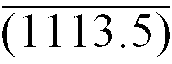
- Latex Paint Formulation Ingredient Commercial Name Description kg (Pounds) Water 150.60 (332.0) Pigment KRONOS 2101 Titanium dioxide 22.68 (50.0) Extenders Optiwhite Aluminum silicate 90.72 (200.0) Atomite Calcium carbonate 90.72 (200.0) Preservative Nuosept C Proprietary 0.227 (0.5) Surfactants Triton N-57 Proprietary 1.81 (4.0) AMP-95 Amino methyl phenol 1.36 (3.0) Defoamer Nopco NXZ 1.36 (3.0) Ethylene glycol 5.44 (12.0) Latex 76 RES 661 Vinyl acetate latex 45.36 (100.0) Ammonia 0.454 (1.0) Water 90.72 (200.0) Thickener 3.63 (8.0) 505.08 ⁇ (1113.5) ⁇
- the thickener composition is prepared by mixing the clay, the starch and the polymer and agitating the mixture. The mixture may be further ground to obtain fine particle size as required for each system. The thickener composition can then be used as a rheological agent in any number of water based systems. The individual components of the thickener can be added separately to a water based system or after pre-mixing of the components. The thickener may be added in the grind of the coating system or after the coating system has been prepared.
- the water based systems may be prepared by any conventional method including colloid mills, roller mills, ball mills, high and low speed dispersers and various types of mixers or blenders, at room temperature, or lower or higher temperatures.
- composition according to the present invention comprising equal portions of spray dried hectorite, LORAMA 3030 starch and the copolymer was incorporated in the paint formulation shown in Table 1.
- the paint exhibits the required rheological properties as known in the art. In addition to thickening, it also provides spatter resistance, heat stability, good atomizing and water release properties. These properties are summarized in Table 2. The rheological properties were measured according to the following tests:
- Stormer viscosity is measured in Krebs Units (KU) with a Stormer Viscosimeter in accordance with ASTM D562. All systems were prepared so that they have a Stormer viscosity of about 90 KU.
- An ICI Cone and Plate Viscometer is used to determine the viscosity in mPas (Poise) at a shear rate of 10,000 sec-1 in accordance with ASTM D-4287-83.
- Sagging is the downward flow of the coating which results from gravity.
- Sag resistance was measured in ⁇ m (mils) with a Leneta multinotch applicator in accordance with ASTM D-4400-84, method A.
- Leveling is the ability of the coating to flow into a continuous smooth surface. It is measured in accordance with ASTM D-4062-81.
- Spatter resistance is the ability of the coating to remain on the substrate and not spatter around the application area. It was measured by applying the coating to a vertical surface using a standard paint roller. The speed of application was kept the same for all coating systems. The spatter falling off the roller is deposited on a black horizontal chart. Spatter resistance is compared visually and labeled as non spattering, slight, medium or poor.
Landscapes
- Chemical & Material Sciences (AREA)
- Organic Chemistry (AREA)
- Life Sciences & Earth Sciences (AREA)
- Engineering & Computer Science (AREA)
- Materials Engineering (AREA)
- Wood Science & Technology (AREA)
- Health & Medical Sciences (AREA)
- Chemical Kinetics & Catalysis (AREA)
- Medicinal Chemistry (AREA)
- Polymers & Plastics (AREA)
- Paints Or Removers (AREA)
Description
- The present invention relates to a rheological additive useful for thickening aqueous systems such as latex paints, and, more particularly, to rheological additives for aqueous systems in the form of a mixture of clay, polymeric particles and starch-type materials which provides superior thickening efficiency, roller spatter resistance characteristics, and improved flow properties at substantially lower costs than with currently available thickeners.
- Rheological additives are substances which, when added to a system, change the system's rheological properties such as flow, viscosity, leveling, sag resistance and settling. These additives include rheology modifiers, viscosity modifiers, viscosifiers, thickeners, gellants, thixotropes, anti-sag agents, anti-setting agents, suspending agents, emulsifiers, thinners and surfactants.
- Commercial thickeners for latex paints available today are mostly cellulosics which thicken the water carrier of the paints. Such thickeners are relatively expensive and, at the same time, do not provide the necessary rheology to achieve better roller spatter resistance and flow properties.
- Aqueous compositions which generally employ thickeners include paints and other coating compositions such as coatings for paper and inks. Most of these aqueous compositions require the use of a thickening material to improve rheological properties such as to obtain a proper viscosity in order to maintain pigments, binders and other solids dispersed, suspended or emulsified therein, to obtain suitable flow properties, and to obtain good compatibility.
- Among the well known rheological additives are clays, organoclays, fumed silica, organic and polymeric thickeners. These rheological additives are described in Van der Watt and Godman in Clay and Clay Materials, Volume 9, pate 568 (1960) and McCormick, Gok and Schulz, in Encyclopedia or Polymer Science and Engineering, Volume 17, page 730 (1989).
- Clay minerals are a group of minerals essentially composed of hydrated aluminum silicates. Among these are montmorillonite, kaolin, illite, saponite, bentonite, hectorite, beidellite, stevensite, attapulgite and sepiolite. These minerals are described in Applied Clay Mineralogy, R.E. Grim, McGraw Hill, NY (1962). One important type of clay mineral is hectorite, which is obtained from various deposits. Hectorite deposits typically contain about 50% hectorite by weight, the other components being mainly calcite and dolomite and sometimes feldspar. The hectorite deposit is usually beneficiated by removing the impurities, for example, by preparing a water slurry, centrifugation, separation of the purified clay and drying the clay by various drying methods such as drum drying, oven drying or spray drying.
- Among the polymeric rheological additives are guar gum, tragacanth gum, pectin, xanthan and alginate, which are natural thickeners, hydroxyethylcellulose and methyl cellulose, which are modified cellulosics and synthetic polymers or copolymers of ethylenically unsaturated carboxylic acids and their ester derivatives, such as poly (acrylic acid), poly acrylamide and maleic anhydride-styrene copolymers. Such thickeners are described, for example, in U.S. Patent No. 4,507,426. U.S. Patent No. 3,769,257 describes the use of cellulosic ethers in latex based paints. U.S. Patent No. 4,558,079 describes the use of hydrophobically modified cellulosic materials as a thickener for joint compounds which are used in the construction of walls and ceilings. U.S. Patent No. 4,226,754 describes a synthetic copolymer which is the reaction product of methacrylic acid, methyl methacrylate and vinyl acetate and its use as a thickener for water based coatings. Another type of synthetic thickeners is based on hydrophobically capping a water soluble polymer. For example, U.S. Patent No. 3,770,684 describes a thickener based on a water soluble polyether capped with insoluble hydrocarbon residues and their use in latex paint compositions. U.S. Patent No, 4,079,028 describes polyurethane-based copolymers which have hydrophobic end groups connected by hydrophilic polyether groups.
- Polymeric thickeners and clay minerals have been used in formulations for various products. For example, U.S. Patent No. 4,657,943 describes a thickening agent useful in textile padding and oil drilling muds containing an acrylate polymer and an aluminum silicate, montmorillonite clay or bentonite which shows a synergistic effect in increasing the viscosity of the system under alkaline conditions. Thickeners are used in a host of products such as paints, varnishes, enamels, waxes, oil drilling fluids, inks, adhesives, sealants, cosmetics, paper coatings, textile backings, bath emulsion systems, cleaners and polishers and detergents.
- An important use of thickeners is in latex paint compositions which are used extensively for coatings and decorations. It is desired that such coating systems will be flowing during their application, but that they do not sag after they have been applied. It is further desired that, while being applied, these coatings remain on the substrate and not spatter around the application area. It is still further desired that such coating systems will be stable at elevated temperatures and for a sufficient period of time, so that their properties do not change upon storage. The thickener may be added to the coating system either during the grinding stage or after the pigment has been dispersed, i.e. as a post-additive. Polysaccarides such as hydroxyethyl cellulose, have dominated the latex paint thickener market almost since the inception of latex paint. Hydroxyethyl cellulose is a nonionic water soluble material that thickens and stabilizes many water-based paint systems. Hydroxyethyl cellulose, however, suffers from some disadvantages. For example, hydroxyethyl cellulose is costly, is subject to enzyme degradation and produces poor spatter resistance. Hydroxyethyl cellulose thickeners are subject to bacterial and enzyme attack which results in loss of viscosity and other flow properties, and therefore require use of anti-biodegradation preservatives in paint. Furthermore, the thickeners swell rapidly in water to form lumps which are not readily dispersed. The proper addition of hydroxyethyl cellulose thickeners requires, therefore, careful and slow addition, resulting in long mixing and dilution times, thereby adding steps to the coatings preparation process, which in turn increase the coatings processing cost.
- The search has therefore continued for a thickener which (1) can be employed as a post-additive, directly to aqueous compositions, particularly latex paint compositions, (2) is less biodegradable, and (3) yields a lower cost/performance ratio with respect to the overall manufacturing and rheological properties of a latex paint composition into which it is incorporated, such as in addition to thickening action, spattering resistance, leveling and when compared to cellulosic materials.
- One solution to this problem has been the development of synthetic polymers in the form of a reaction product of methacrylic acid, methyl methacrylate and vinyl acetate in the proportions specified in U.S. Patent No. 4,226,754. We have found, however, that thickener blends having higher concentrations of such synthetic polymers are both costly to use and often produce poor paint stability.
- The synthetic polymers also require high concentrations to provide the required rheological properties. In many applications, the aqueous system containing the thickener is exposed to temperature in the range of 20°C to 100°C. The increase in temperature causes generally a decrease in viscosity and stability of the aqueous composition.
- Smectite-type clays such as montmorillonite, bentonite, beidellite, hectorite, saponite and stevensite and a process for producing organopilic clay gellants using these smectite-type clays are described more specifically in U.S. Patent No. 4,742,098. Such clays, particularly hectorite, have been found useful in paints as thickeners as well as in polymeric thickeners, but to date these products have exhibited poor roller-splatter, poor efficiency characteristics or poor stability.
- Attempts to improve the known rheological agents and thickeners by using blends of hectorite clay and polymeric particles have thus been unsuccessful in increasing stability, product efficiency, roller spatter resistance, easy dispersal and cost. For example, too much hectorite has been found to result in poor roller spatter resistance and low product efficiency, while too much polymeric material has been found costly and results in poor paint stability.
- Thus, there has been and still is a need for a thickening composition which imparts increased viscosity, sag resistance, spatter resistance and heat stability to water based coatings systems. There is also a need for a low cost thickener which will be easy to utilize in various types of formulations, especially as a post additive, added directly to aqueous systems to impart these properties.
- We have recognized that a third component in the claypolymer mixture will lower the ratio of polymeric particles to clay and thereby achieve a cost effective, yet stable rheological agent which is also superior to the two component product. We further recognized that such an additional component must be a starch or a starch derivative, including chemical modifications to the starch through esterification, ethoxylation and carboxylation.
- Starch is the principal component of most seeds, tubers and roots and is produced commercially from corn, wheat, rice, tapioca, potato, sago and other sources. Starch is a mixture of linear (amylose) and branched (amylopectin) polysaccharides. It is used extensively in the paper, textile and adhesive industries. Starch may be modified by oxidation of the hydroxyl groups to give aldehydes, ketones or carboxylic acids. Other derivatives are produced by etherification, esterification and graft polymerization. Hydroxy propyl and other hydroxyalkyl starches are used as additives in salad dressing and other food thickening applications.
- It is an object of the present invention, therefore, to provide a composition containing an aqueous starch thickener for latex paints which provides increased viscosity and improves roller spatter resistance while maintaining good paint stability.
- It is still another object of the present invention to provide an aqueous starch thickener composition which is less expensive than cellulosic thickeners and yet achieves increased product efficiency, while being easily dispersed in the grind and/or as water gel solutions.
- The foregoing objects have been achieved in accordance with the present invention by the use of a clay/polymeric particle/starch mixture comprising at least 0.1 % by weight of a smectite type clay, at least 0.1 % by weight of a rheologically active polymeric material which is a polymer or copolymer that is the polymerization product of ethylenically unsaturated carboxylic acid monomer, modified ethylenically unsaturated carboxylic acid monomer and/or vinyl or modified vinyl monomer and 20 to 50% by weight of the total additive of starch as rheological agents and thickeners for aqueous systems such as latex paints and other latex systems.
- The present invention is directed to a composition of matter in which the clay is smectite, including hectorite or spray-dried hectorite, which composition interacts with latex and pigments to yield higher viscosity.
- More specifically, the present invention relates to a thickener composition for water based systems comprising:
- (i) a smectite type clay including smectite, montmorillonite, bentonite, hectorite, kaolin, illite, saponite, attapulgite and sepiolite and mixtures thereof;
- (ii) a starch which includes corn starch, wheat starch, rice starch, tapioca starch, potato starch, sago starch, yucca starch and barley starch, derivatives thereof including modifications through esterification, ethoxylation, carboxylation, grafting and mixtures thereof;
- (iii) a polymer or copolymer which is the polymerization product of ethylenically unsaturated carboxylic acid monomer, modified ethylenically unsaturated carboxylic acid monomer and/or vinyl or modified vinyl monomer such as vinyl acetate.
- The composition of the present invention further utilizes polymeric particles and commercially-available LORAMA 3030 starch or another suitable starch such as corn, yucca, barley and potato starches and derivatives thereof, including modifications through esterification, ethoxylation and carboxylation.
- The invention further relates to a process for preparing a water-based coating system comprising latex, pigments, extenders and fillers and from 0.05% to 15% by weight, preferably 0.1 to 15 % by weight, of the total weight of the system of the rheological additive.
- The rheological additive and the coating system, can be made by mixing the clay, the starch and the polymer to obtain a blend, and adding the blend either during the grinding step of the coating preparation or as a post-additive composition to the coating system.
- These and other objects, advantages and characteristics of the present invention will become more apparent from the following detailed description of presently preferred compositions.
- We have discovered that a combination comprising at least 0.1 % by weight of a smectite type clay, at least 0.1 % by weight of a rheologically active polymeric material which is a polymer or copolymer that is the polymerization product of ethylenically unsaturated carboxylic acid monomer, modified ethylenically unsaturated carboxylic acid monomer and/or vinyl or modified vinyl monomer and 20 to 50% by weight of the total additive of starch provide thickening in water based systems and, particularly in water based latex paints. This combination also provides better heat stability and spatter resistance to such water based systems. A further advantage of this combination is its better atomizing upon spraying and its faster water release properties. This combination is also low in cost, both in raw materials and in processing cost.
- The smectite type clay to be used in the present invention may be hectorite, bentonite, montmorillonite, kaolin, illite, saponite, attapulgite, and sepiolite and mixtures thereof. The clay may be a clay deposit or a beneficiated clay and it may be dried in a variety of methods including oven drying, drum drying or spray drying. In a typical clay refining or beneficiating process, the clay deposit is first put into solution, then centrifuged, separated and dried. A grinding step may also be used to obtain particles of a particular size. Hectorite clay, in particular spray dried hectorite is used in a presently preferred embodiment of the invention.
- The clay is present in the rheological additive in an amount sufficient to provide the desired rheological properties when combined with the starch and the polymer. This amount is at least 0.1 % by weight preferably at least 10% by weight and more preferably 20-50% by weight. The amount of the clay used will depend largely on the end use of the thickener. Considerations which will determine the amount of clay to be used involve the desired viscosity of the water based composition, its flow and leveling, and its sag resistance and spatter resistance, as well as its heat stability in any specific formulation.
- The starch may be corn starch, wheat starch, rice starch, tapioca starch, potato starch, sago starch, yucca starch and barley starch, derivatives thereof or modified starch, for example, through esterification, ethoxylation, carboxylation or grafting of various groups onto the starch. A corn starch such as the commercially available LORAMA 3030R starch is used in a preferred embodiment of the present invention. The starch is present in the rheological additive in an amount sufficient to provide the desired rheological properties when combined with the clay and the polymer. This amount ranges from 20 to 50% by weight of the total additive. The amount of the starch used will depend largely on the end use of the thickener.
- The rheologically active polymeric material is a polymer or copolymer which is the polymerization product of ethylenically unsaturated carboxylic acid monomer, modified ethylenically unsaturated carboxylic acid monomer and/or vinyl or modified vinyl monomer such as vinyl acetate. The polymer is present in the rheological additive in an amount sufficient to provide the desired rheological properties when combined with the clay and the starch. This amount is at least 0.1% by weight, preferably at least 10% by weight and more preferably 20 to 50% by weight. The amount of the polymer used will depend largely on the end use of the thickener.
- The rheological additive of the present invention may be used as a thickener composition especially as a rheological additive in water based systems including paints, varnishes, enamels, waxes, oil drilling fluids, inks, adhesives, sealants, cosmetics, paper coatings, textile backing, bath emulsion systems, cleaners and polishers, detergent, joint compounds and mortars as well as other compositions which desirably contain a thickener composition. The thickener is employed in such an amount sufficient to obtain the desired rheological properties, such as high viscosity at low shear rates, high modulus of elasticity, control of sagging of the fluid system and prevention of settling and hard packing of pigments, extenders and fillers present in the total composition containing the thickener.
- The thickener composition generally will be used in a water based system. The amount to be used typically will be 0.05 to 14% of the total weight of the system. Preferably the thickener composition will be present in an amount of 0.1 to 5% of the total weight of the system (including water). For example, aqueous dispersions, emulsions, suspensions, solutions and slurries may be thickened by the thickener composition.
- In one presently preferred embodiment, the thickener composition is used in a latex based paint. A latex based paint formulation typically contains pigments, latex, extenders, fillers, water and other additives. These additives may include plasticizers, surfactants, preservatives, antifreeze agents, antifoam agents, coalescing agents, solvents and pH modifiers and combinations thereof. The additives may be present in the coating system in an amount of 0.1 to 50% of the weight of the coating system.
- A typical pigment is, for example, titanium dioxide. Typical latex materials may be vinyl type polymers such as polyvinylacetate. Typical extenders and fillers are calcium carbonate, talc, calcium sulfate and silica. Formulations of these paints are well known in the art. A typical latex based paint formulation is shown in Table 1.
Table 1: Latex Paint Formulation Ingredient Commercial Name Description kg (Pounds) Water 150.60 (332.0) Pigment KRONOS 2101 Titanium dioxide 22.68 (50.0) Extenders Optiwhite Aluminum silicate 90.72 (200.0) Atomite Calcium carbonate 90.72 (200.0) Preservative Nuosept C Proprietary 0.227 (0.5) Surfactants Triton N-57 Proprietary 1.81 (4.0) AMP-95 Amino methyl phenol 1.36 (3.0) Defoamer Nopco NXZ 1.36 (3.0) Ethylene glycol 5.44 (12.0) Latex 76 RES 661 Vinyl acetate latex 45.36 (100.0) Ammonia 0.454 (1.0) Water 90.72 (200.0) Thickener 3.63 (8.0) 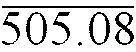
- The thickener composition is prepared by mixing the clay, the starch and the polymer and agitating the mixture. The mixture may be further ground to obtain fine particle size as required for each system. The thickener composition can then be used as a rheological agent in any number of water based systems. The individual components of the thickener can be added separately to a water based system or after pre-mixing of the components. The thickener may be added in the grind of the coating system or after the coating system has been prepared.
- The water based systems may be prepared by any conventional method including colloid mills, roller mills, ball mills, high and low speed dispersers and various types of mixers or blenders, at room temperature, or lower or higher temperatures.
- The following examples are provided to further illustrate the invention, but are not meant to limit the scope of the invention in any way.
- The composition according to the present invention, comprising equal portions of spray dried hectorite, LORAMA 3030 starch and the copolymer was incorporated in the paint formulation shown in Table 1. The paint exhibits the required rheological properties as known in the art. In addition to thickening, it also provides spatter resistance, heat stability, good atomizing and water release properties. These properties are summarized in Table 2. The rheological properties were measured according to the following tests:
- Stormer viscosity is measured in Krebs Units (KU) with a Stormer Viscosimeter in accordance with ASTM D562. All systems were prepared so that they have a Stormer viscosity of about 90 KU.
- An ICI Cone and Plate Viscometer is used to determine the viscosity in mPas (Poise) at a shear rate of 10,000 sec-1 in accordance with ASTM D-4287-83.
- Sagging is the downward flow of the coating which results from gravity. Sag resistance was measured in µm (mils) with a Leneta multinotch applicator in accordance with ASTM D-4400-84, method A.
- Leveling is the ability of the coating to flow into a continuous smooth surface. It is measured in accordance with ASTM D-4062-81.
- Spatter resistance is the ability of the coating to remain on the substrate and not spatter around the application area. It was measured by applying the coating to a vertical surface using a standard paint roller. The speed of application was kept the same for all coating systems. The spatter falling off the roller is deposited on a black horizontal chart. Spatter resistance is compared visually and labeled as non spattering, slight, medium or poor.
- Heat stability is tested by leaving the sample in an oven at 60°C (140°F) for 14 days and recording the changes in the properties of the coating systems.
Table 2 : Paint properties Composition No. Loading/kg (pounds) Stormer KU ICI pas (Poise) Sag µm (mils) Leveling Spatter Resistance Heat Stability Stormer ICI Pas (Poise) 1. SDH/STA/POL (33.33:33.3:33.3) 4.08 (9) 90 14 (1.4) 457 (18) 5 Slight 93 11 (1.1) 2. SDH/STA/POL (40:35:25) 4.08 (9) 90 14 (1.4) 355 (14) 4 Slight 95 10 (1.0) 3. SDH/POL (50:50) 3.63 (8) 90 13 (1.3) 762 (30) 4 Moderate Gelled 4. SDH/POL (75:25) 4.99 (11) 98 14 (1.4) 406 (16) 3 Moderate 66 8 (0.8) 5. SDH/STA (75:25) 4.54 (10) 78 10 (1.0) 101 (4) 9 Moderate NOT TESTED 6. SDH 6.81 (15) 74 9 (0.9) 76 (3) 9 Note a NOT TESTED 7. STA 9.99 (22) 72 10 (1.0) 305 (12) 5 Poor NOT TESTED 8. POL 5.45 (10) 86 13 (1.3) 762 (30) 9 Slight-Moderate NOT TESTED 9. HEC 3.18 (7) 95 23 (2.3) 355 (14) 7 Poor 90 13 (1.3) SDH = Spray dried hectorite
STA = Starch (LORAMA 3030, a modified corn starch)
POL = Polymer (Rheolate 1)
HEC = hydroxylethyl cellulose (Natrosol 250 HR)Note a: Coating would not adhere to chart. - While each component does not impart the required coating properties, the specific combination of the three components together result in improved sag resistance, spatter resistance and heat stability. A combination of the clay with the polymer (Example 4) resulted in excellent sag resistance, but moderate spatter resistance and gelled in the oven, indicating poor heat stability. The system containing hydroxy ethyl cellulose (Example 9) exhibited good viscosity, sag resistance and heat stability, but had poor spatter resistance.
- Although the invention has been described and illustrated in detail, it is to be clearly understood that the same is by way of illustration and example, and is not to be taken by way of limitation. The spirit and scope of the present invention are to be limited only by the terms of the appended claims.
Claims (13)
- A rheological additive comprising at least 0.1 % by weight of a smectite type clay, at least 0.1 % by weight of a rheologically active polymeric material which is a polymer or copolymer that is the polymerization product of ethylenically unsaturated carboxylic acid monomer, modified ethylenically unsaturated carboxylic acid monomer and/or vinyl or modified vinyl monomer and 20 to 50% by weight of the total additive of starch.
- The rheological additive according to Claim 1, wherein the smectite type clay is selected from montmorillonite, bentonite, hectorite, kaolin, illite, saponite, attapulgite, sepiolite and mixtures thereof.
- The rheological additive according to one of the preceding Claims, wherein the starch is selected from corn starch, yucca starch, barley starch and potato starch, and derivatives thereof including modifications through esterification, ethoxylation, carboxylation and grafting and mixtures thereof.
- The rheological additive according to one of the preceding Claims, wherein the smectite type clay is hectorite deposit or beneficiated hectorite.
- The rheological additive according to one of the preceding Claims, wherein the hectorite is spray-dried hectorite.
- The rheological additive according to one of the preceding Claims, wherein the starch is a modified corn starch.
- The rheological additive according to one of the preceding Claims, wherein the polymer is an ethylenically unsaturated carboxylic acid/vinyl acetate copolymer.
- The rheological additive according to one of the preceding Claims, wherein the polymeric material is a reaction product of methacrylic acid, methyl methacrylate and vinyl acetate.
- The rheological additive according to one of the preceding Claims, wherein the clay is present in an amount of at least 10 % of the total additive composition by weight.
- The rheological additive according to one of the preceding Claims, wherein the polymer is present in an amount of at least 10% of the total additive composition by weight.
- A process for preparing a water-based coating composition, comprising the addition of 0.05 - 15 % by weight of the total weight of the system of the additive of claims 1 - 10.
- The process of Claim 11, wherein the additive is added in an amount of 0.1 to 15% of the total weight of the system.
- Use of a rheological additive of Claims 1-10 to thicken aqueous systems.
Applications Claiming Priority (2)
| Application Number | Priority Date | Filing Date | Title |
|---|---|---|---|
| US686473 | 1991-04-17 | ||
| US07/686,473 US5164433A (en) | 1991-04-17 | 1991-04-17 | Rheological agents and thickeners |
Publications (2)
| Publication Number | Publication Date |
|---|---|
| EP0509202A1 EP0509202A1 (en) | 1992-10-21 |
| EP0509202B1 true EP0509202B1 (en) | 1997-04-23 |
Family
ID=24756435
Family Applications (1)
| Application Number | Title | Priority Date | Filing Date |
|---|---|---|---|
| EP92102216A Expired - Lifetime EP0509202B1 (en) | 1991-04-17 | 1992-02-10 | Rheological agents and thickeners |
Country Status (5)
| Country | Link |
|---|---|
| US (1) | US5164433A (en) |
| EP (1) | EP0509202B1 (en) |
| CA (1) | CA2065223C (en) |
| DE (1) | DE69219196T2 (en) |
| ZA (1) | ZA92646B (en) |
Families Citing this family (40)
| Publication number | Priority date | Publication date | Assignee | Title |
|---|---|---|---|---|
| DK0604676T3 (en) * | 1992-12-28 | 1997-07-28 | Sika Ag | Water-soluble copolymers of vinyl acetate and maleamic acids, their use as fluidizing agents or "high range" water reducing agents for aqueous suspensions |
| US5872162A (en) * | 1993-06-04 | 1999-02-16 | The Gillette Company | Correction fluid for water-fast inks |
| US6063856A (en) * | 1993-11-16 | 2000-05-16 | Mass; Warren John | Plaster material for making fresco-like finish |
| US6046269A (en) * | 1993-11-16 | 2000-04-04 | Warren J. Nass | Method for making a fresco-like finish from cement and a coating composition and the fresco-like finish made from the method |
| US5897698A (en) * | 1996-10-18 | 1999-04-27 | Huls America Inc. | Non-settling , universal machine dispensable pearlescent pigment dispersions |
| AR011260A1 (en) * | 1996-10-18 | 2000-08-16 | Huls America Inc | A DIVERSION COMPOSITION OF UNIVERSAL PEARL PIGMENT SUPPLIED THROUGH DISPERSING MACHINES, TO BE USED IN A SURFACE COATING AND A METHOD FOR PREPARING IT |
| US5851959A (en) * | 1997-01-03 | 1998-12-22 | Chemstar Products Company | High temperature stable modified starch polymers and well drilling fluids employing same |
| US5922400A (en) * | 1997-01-09 | 1999-07-13 | The Gillette Company | Correction fluid |
| DE19754182C2 (en) * | 1997-12-06 | 2001-09-06 | Herberts Gmbh | Aqueous sheet silicate dispersions and their use in the production of rheology-optimized aqueous coating media |
| US6133203A (en) * | 1998-04-02 | 2000-10-17 | Halliburton Energy Services, Inc. | Drilling fluids and additives therefor |
| GB9807426D0 (en) | 1998-04-08 | 1998-06-03 | Ici Plc | Environmentally friendly aqueous architectural coating compositions |
| ES2138933B1 (en) * | 1998-05-20 | 2000-09-16 | Tolsa Sa | ADDITIVE FOR BINDING CONSTRUCTION MATERIALS, COMPOSITIONS CONTAINING THE ADDITIVE AND USE OF THE ADDITIVE IN BINDING CONSTRUCTION MATERIALS. |
| US6271298B1 (en) | 1999-04-28 | 2001-08-07 | Southern Clay Products, Inc. | Process for treating smectite clays to facilitate exfoliation |
| US6162268A (en) * | 1999-05-03 | 2000-12-19 | Praxair S. T. Technology, Inc. | Polishing slurry |
| US6787592B1 (en) | 1999-10-21 | 2004-09-07 | Southern Clay Products, Inc. | Organoclay compositions prepared from ester quats and composites based on the compositions |
| US8053394B2 (en) * | 2000-06-13 | 2011-11-08 | Baker Hughes Incorporated | Drilling fluids with redispersible polymer powders |
| US6703351B2 (en) * | 2000-06-13 | 2004-03-09 | Baker Hughes Incorporated | Water-based drilling fluids using latex additives |
| US7271131B2 (en) * | 2001-02-16 | 2007-09-18 | Baker Hughes Incorporated | Fluid loss control and sealing agent for drilling depleted sand formations |
| US20060270562A1 (en) * | 2003-08-04 | 2006-11-30 | Baker Hughes Incorporated | Drilling fluids with redispersible polymer powders |
| ATE325155T1 (en) | 2001-03-02 | 2006-06-15 | Southern Clay Prod Inc | PRODUCTION OF POLYMER NANOVER COMPOSITE MATERIALS BY DISPERSION DESTABILIZATION |
| US6890502B2 (en) * | 2001-08-24 | 2005-05-10 | Southern Clay Products, Inc. | Synthetic clay compositions and methods for making and using |
| CN100376641C (en) * | 2002-10-11 | 2008-03-26 | 董智才 | Efficient thickening agent of latex paint coating |
| DE10312203A1 (en) * | 2003-03-19 | 2004-10-07 | Ashland-Südchemie-Kernfest GmbH | Rheological additive |
| US20100098734A1 (en) * | 2003-07-07 | 2010-04-22 | Wille Jr John Jacob | Methods for preparation of a thixotropic microemulsion for skin care formulations |
| EP1529820A1 (en) * | 2003-10-31 | 2005-05-11 | Nederlandse Organisatie voor toegepast-natuurwetenschappelijk Onderzoek TNO | Biopolymer-based binders |
| US20050104048A1 (en) * | 2003-11-13 | 2005-05-19 | Thomas Terence M. | Compositions and methods for polishing copper |
| WO2005087877A1 (en) * | 2004-03-17 | 2005-09-22 | Metin Erozlu | Sepiolite based floating calcite powder |
| WO2005100489A1 (en) * | 2004-04-13 | 2005-10-27 | Kita-Boshi Pencil Co., Ltd. | Liquid clay |
| DE102004044662A1 (en) * | 2004-09-15 | 2006-03-30 | Ashland-Südchemie-Kernfest GmbH | Thixotropic coating compositions |
| US7749943B2 (en) * | 2004-12-01 | 2010-07-06 | Baker Hughes Incorporated | Method and drilling fluid systems and lost circulation pills adapted to maintain the particle size distribution of component latex particles before and after freezing of the latex particles in the presence of water |
| DE102005015966A1 (en) | 2005-04-07 | 2006-10-19 | Byk-Chemie Gmbh | Biuret compounds, their preparation and use, and intermediates for their preparation |
| WO2007035099A1 (en) * | 2005-09-23 | 2007-03-29 | Nederlandse Organisatie Voor Toegepast-Natuurwetenschappelijk Onderzoek Tno | Modified starch, aqueous solution of a modified starch and process for pretreating steel surfaces |
| US20070088112A1 (en) * | 2005-10-05 | 2007-04-19 | Hooks Henry E | Fire retardant compositions |
| BRPI0604286A2 (en) * | 2006-10-11 | 2008-12-23 | Bentonit Uniao Nordeste Sa | granules for use in formulations of personal care products and / or cleaning products and products containing the granules |
| US8652447B2 (en) * | 2008-12-18 | 2014-02-18 | Chevron U.S.A. Inc. | Cosmetic and personal care products containing synthetic magnesium alumino-silicate clays |
| MY160310A (en) * | 2011-03-08 | 2017-02-28 | Valspar Sourcing Inc | Water-based coating compositions and systems with improved sag resistance, and related methods |
| BR112019004569A8 (en) * | 2016-09-09 | 2023-02-07 | Rhodia Operations | SELF-THICKENING LATEX FOR AQUATIC SYSTEMS AND RELATED METHODS |
| DE102018004234A1 (en) | 2018-05-25 | 2019-11-28 | Ask Chemicals Gmbh | Sizing composition, method of coating a mold and use of the sizing composition to coat a mold |
| US11952511B2 (en) | 2019-03-15 | 2024-04-09 | Swimc Llc | Aqueous coating compositions including xanthan gum-based rheology package |
| CN115403293B (en) * | 2022-05-30 | 2023-05-30 | 湖北工业大学 | Method for preparing concrete thickener from wet-milled potassium feldspar tailings and applying concrete thickener |
Family Cites Families (7)
| Publication number | Priority date | Publication date | Assignee | Title |
|---|---|---|---|---|
| US4226754A (en) * | 1978-06-08 | 1980-10-07 | Nl Industries, Inc. | Synthetic polymer |
| US4287103A (en) * | 1980-02-11 | 1981-09-01 | Georgia-Pacific Corporation | Joint composition including starch |
| DE3343670A1 (en) * | 1983-12-02 | 1985-06-13 | Basf Ag, 6700 Ludwigshafen | Curing agent for glue resin liquors for the surface gluing of wood materials, the glue resin liquors containing the curing agent, and a process for the production of surface-glued wood materials |
| NL8402756A (en) * | 1984-09-10 | 1986-04-01 | Polysar Financial Services Sa | THICKENER. |
| US4808442A (en) * | 1986-01-23 | 1989-02-28 | Akzo Nv | Composition suitable for use in polymer cross-linking processes |
| CH669129A5 (en) * | 1986-04-04 | 1989-02-28 | Lonza Ag | LUBRICANT SYSTEM FOR SHEET AND PROFILE ROLLING MILLS. |
| US4716186A (en) * | 1986-04-09 | 1987-12-29 | A. E. Staley Manufacturing Company | Starch derivatives and methods of making using same |
-
1991
- 1991-04-17 US US07/686,473 patent/US5164433A/en not_active Expired - Lifetime
-
1992
- 1992-01-30 ZA ZA92646A patent/ZA92646B/en unknown
- 1992-02-10 EP EP92102216A patent/EP0509202B1/en not_active Expired - Lifetime
- 1992-02-10 DE DE69219196T patent/DE69219196T2/en not_active Expired - Fee Related
- 1992-04-06 CA CA002065223A patent/CA2065223C/en not_active Expired - Fee Related
Also Published As
| Publication number | Publication date |
|---|---|
| ZA92646B (en) | 1992-10-28 |
| CA2065223A1 (en) | 1992-10-18 |
| CA2065223C (en) | 2001-06-12 |
| DE69219196D1 (en) | 1997-05-28 |
| EP0509202A1 (en) | 1992-10-21 |
| US5164433A (en) | 1992-11-17 |
| DE69219196T2 (en) | 1997-08-07 |
Similar Documents
| Publication | Publication Date | Title |
|---|---|---|
| US5164433A (en) | Rheological agents and thickeners | |
| US5112400A (en) | Clay thickener for use in water-based systems and joint compounds containing such compositions | |
| CA1307258C (en) | Carboxymethyl hydrophobically modified hydroxyethylcellulose (cmhmhec) and use of cmhmhec in protective coating compositions | |
| KR100379588B1 (en) | High Performance Alkali-Swellable Rheological Additives for Aqueous Systems | |
| EP0728157B1 (en) | Alumina thickened latex formulations | |
| US4677158A (en) | Paint thickener | |
| JP3545802B2 (en) | Method for improving thickeners for aqueous systems | |
| EP1461392B2 (en) | Polyunsaturated fatty acids as part of reactive structures for latex paints: thickeners, surfactants and dispersants | |
| CA2043342C (en) | Method for improving thickeners for aqueous systems | |
| EP0562341B1 (en) | Fluidized polymer suspension (FPS) for continuous coating composition manufacture | |
| US6306933B1 (en) | Cellulose ether slurries | |
| CN101679784A (en) | Improved paint formulations including cellulose ether/network polymer fluid gel thickeners | |
| KR100405928B1 (en) | Water-soluble clay-containing emulsion paint with improved coating performance | |
| JPH0655902B2 (en) | Water soluble polymer suspension | |
| US20090071369A1 (en) | Non-Aqueous Slurries Used as Thickeners and Defoamers | |
| EP0773263A2 (en) | A super dispersable thickening composition for aqueous systems and a method of thickening said aqueous systems | |
| JP2002020614A (en) | Method for reducing syneresis in aqueous compositions | |
| EP0973821A1 (en) | Cellulose ether slurries | |
| JP4975326B2 (en) | Water-based paint composition | |
| CA3209301A1 (en) | Acrylamide polymer rheology modifier compositions and architectural coating compositions derived therefrom | |
| JP2003530441A (en) | High ICI viscosity associative thickener based on cellulose | |
| EP4678702A1 (en) | Architectural coating compositions |
Legal Events
| Date | Code | Title | Description |
|---|---|---|---|
| PUAI | Public reference made under article 153(3) epc to a published international application that has entered the european phase |
Free format text: ORIGINAL CODE: 0009012 |
|
| AK | Designated contracting states |
Kind code of ref document: A1 Designated state(s): BE DE ES FR GB IT NL |
|
| 17P | Request for examination filed |
Effective date: 19930317 |
|
| 17Q | First examination report despatched |
Effective date: 19940511 |
|
| GRAG | Despatch of communication of intention to grant |
Free format text: ORIGINAL CODE: EPIDOS AGRA |
|
| GRAH | Despatch of communication of intention to grant a patent |
Free format text: ORIGINAL CODE: EPIDOS IGRA |
|
| GRAH | Despatch of communication of intention to grant a patent |
Free format text: ORIGINAL CODE: EPIDOS IGRA |
|
| ITF | It: translation for a ep patent filed | ||
| GRAA | (expected) grant |
Free format text: ORIGINAL CODE: 0009210 |
|
| AK | Designated contracting states |
Kind code of ref document: B1 Designated state(s): BE DE ES FR GB IT NL |
|
| PG25 | Lapsed in a contracting state [announced via postgrant information from national office to epo] |
Ref country code: ES Free format text: THE PATENT HAS BEEN ANNULLED BY A DECISION OF A NATIONAL AUTHORITY Effective date: 19970423 |
|
| REF | Corresponds to: |
Ref document number: 69219196 Country of ref document: DE Date of ref document: 19970528 |
|
| ET | Fr: translation filed | ||
| PLBE | No opposition filed within time limit |
Free format text: ORIGINAL CODE: 0009261 |
|
| STAA | Information on the status of an ep patent application or granted ep patent |
Free format text: STATUS: NO OPPOSITION FILED WITHIN TIME LIMIT |
|
| 26N | No opposition filed | ||
| REG | Reference to a national code |
Ref country code: GB Ref legal event code: IF02 |
|
| PGFP | Annual fee paid to national office [announced via postgrant information from national office to epo] |
Ref country code: NL Payment date: 20080224 Year of fee payment: 17 |
|
| PGFP | Annual fee paid to national office [announced via postgrant information from national office to epo] |
Ref country code: FR Payment date: 20080218 Year of fee payment: 17 |
|
| PGFP | Annual fee paid to national office [announced via postgrant information from national office to epo] |
Ref country code: BE Payment date: 20080306 Year of fee payment: 17 |
|
| PGFP | Annual fee paid to national office [announced via postgrant information from national office to epo] |
Ref country code: GB Payment date: 20090227 Year of fee payment: 18 |
|
| BERE | Be: lapsed |
Owner name: *RHEOX INTERNATIONAL INC. Effective date: 20090228 |
|
| PGFP | Annual fee paid to national office [announced via postgrant information from national office to epo] |
Ref country code: DE Payment date: 20090331 Year of fee payment: 18 Ref country code: IT Payment date: 20090226 Year of fee payment: 18 |
|
| NLV4 | Nl: lapsed or anulled due to non-payment of the annual fee |
Effective date: 20090901 |
|
| REG | Reference to a national code |
Ref country code: FR Ref legal event code: ST Effective date: 20091030 |
|
| PG25 | Lapsed in a contracting state [announced via postgrant information from national office to epo] |
Ref country code: NL Free format text: LAPSE BECAUSE OF NON-PAYMENT OF DUE FEES Effective date: 20090901 |
|
| PG25 | Lapsed in a contracting state [announced via postgrant information from national office to epo] |
Ref country code: BE Free format text: LAPSE BECAUSE OF NON-PAYMENT OF DUE FEES Effective date: 20090228 |
|
| PG25 | Lapsed in a contracting state [announced via postgrant information from national office to epo] |
Ref country code: FR Free format text: LAPSE BECAUSE OF NON-PAYMENT OF DUE FEES Effective date: 20090302 |
|
| GBPC | Gb: european patent ceased through non-payment of renewal fee |
Effective date: 20100210 |
|
| PG25 | Lapsed in a contracting state [announced via postgrant information from national office to epo] |
Ref country code: DE Free format text: LAPSE BECAUSE OF NON-PAYMENT OF DUE FEES Effective date: 20100901 |
|
| PG25 | Lapsed in a contracting state [announced via postgrant information from national office to epo] |
Ref country code: GB Free format text: LAPSE BECAUSE OF NON-PAYMENT OF DUE FEES Effective date: 20100210 Ref country code: IT Free format text: LAPSE BECAUSE OF NON-PAYMENT OF DUE FEES Effective date: 20100210 |