EP0509171A1 - Method and apparatus for improving the specificity of an ion mobility spectrometer utilizing sulfur dioxide dopant chemistry - Google Patents
Method and apparatus for improving the specificity of an ion mobility spectrometer utilizing sulfur dioxide dopant chemistry Download PDFInfo
- Publication number
- EP0509171A1 EP0509171A1 EP91307042A EP91307042A EP0509171A1 EP 0509171 A1 EP0509171 A1 EP 0509171A1 EP 91307042 A EP91307042 A EP 91307042A EP 91307042 A EP91307042 A EP 91307042A EP 0509171 A1 EP0509171 A1 EP 0509171A1
- Authority
- EP
- European Patent Office
- Prior art keywords
- drift
- region
- cell
- carrier gas
- test sample
- Prior art date
- Legal status (The legal status is an assumption and is not a legal conclusion. Google has not performed a legal analysis and makes no representation as to the accuracy of the status listed.)
- Granted
Links
Images


Classifications
-
- G—PHYSICS
- G01—MEASURING; TESTING
- G01N—INVESTIGATING OR ANALYSING MATERIALS BY DETERMINING THEIR CHEMICAL OR PHYSICAL PROPERTIES
- G01N27/00—Investigating or analysing materials by the use of electric, electrochemical, or magnetic means
- G01N27/62—Investigating or analysing materials by the use of electric, electrochemical, or magnetic means by investigating the ionisation of gases, e.g. aerosols; by investigating electric discharges, e.g. emission of cathode
- G01N27/622—Ion mobility spectrometry
-
- H—ELECTRICITY
- H01—ELECTRIC ELEMENTS
- H01J—ELECTRIC DISCHARGE TUBES OR DISCHARGE LAMPS
- H01J47/00—Tubes for determining the presence, intensity, density or energy of radiation or particles
- H01J47/008—Drift detectors
Definitions
- the present invention relates to the use of ion mobility spectrometry for detecting certain acid gasses in air, and more particularly, to the use of sulfur dioxide dopant for improving the specificity of detection of certain acid gasses such as chlorine, hydrogen chloride and other gasses which have high charge affinities.
- monitoring system capable of identifying and quantifying trace quantities of hazardous gasses escaping into the air.
- the monitors located in the vicinity of processing plants and storage facilities, provide early warning of impending danger to plant personnel and to the public, and they enable corrective action to be taken in time to avoid disaster.
- An ideal monitoring system is capable of operating unattended continuously for extended periods of time without the need for frequent maintenance or calibration.
- Monitoring systems in present use use electrochemical cells and other devices as the sensing element. Such systems are inadequate in some applications because they lack specificity, require frequent maintenance for calibration and replenishment of electrolyte, and many are limited to operation at ambient temperatures above 00 C (due to freezing of the electrolyte).
- IMS The Ion Mobility Spectrometer
- an IMS comprises an analyser cell, means for ionizing samples of an analyte admitted to the cell and means for determining the times required for the ions of the various substances present in the cell to traverse a specific length of the cell under the influence of an electric field and against the force of a stream of drift gas flowing through the cell in a direction opposite to that of the electric field.
- a representative analyzer cell is disclosed in U.S. Patent No. 4,390,784 issued to Browning et al.
- a stream of purified air or other gas may be used as a carrier gas to introduce the analyte sample into the cell, and a stream of purified air or other gas may also be used as the drift gas.
- Both the carrier gas and the drift gas are therefore readily available at an installation site in unlimited quantities and no maintenance is required of the sensor other than the occasional replacement of filters and membranes for purifying the carrier and drift gasses, radiation wipe tests and calibration.
- An IMS therefore appears to be the ideal sensor for use in a monitoring system.
- an IMS operated in a conventional manner, using air as the carrier and drift gasses may lack the specificity necessary to detect many of the acid gasses of interest, such as hydrogen fluoride, hydrogen chloride, nitrogen dioxide, and others.
- the reason for such lack of specificity is that the ion peak characteristic of pure air alone and the ion peak characteristic of the analyte gas in air both arrive at the ion detector of the IMS at virtually the same times.
- the pure air ion peak disrupts the analyte peak, especially when the analyte is an acid gas. Hence, it becomes very difficult to distinguish the amplitude of the ion current due to the acid gas from the ion current due to pure air at a given arrival time.
- the disclosed acid gas monitor makes use of a dopant selected from the group of substituted phenols.
- the dopant improves the ability of the gas monitor to detect the general presence of acid gasses such as hydrogen flouride, hydrogen chloride, chlorine, nitrogen dioxide, sulfur dioxide, carbonyl sulfide, and numerous others. This ability to detect the presence of acid gas proves advantageous in many situations. However, it is often desireable to identify the presence of a specific type of acid gas, and to quantify the amount of the specific acid gas.
- the acid gas monitor in application serial number 534,701 provides the requisite specificity to detect certain types of acid gas (such as HF), but it lacks the specificity for others. If more than one acid gas is present, the specificity is inadequate to distinguish between the gases. For example, if chlorine is being monitored and another acid gas is present, the device may give a false indication of the presence of chlorine or its concentration.
- an object of the present invention to provide a method of ion mobility spectrometry with improved specificity for detecting certain gasses, whereby interference and false indications resulting from coexisting gasses is eliminated.
- the spectrometer includes an analyzer cell having an inlet region, a reaction region, an ionization source in said reaction region, a shutter grid, a drift region, an ion current detector for detecting ions transiting said cell drift region, and means for measuring the transit times through the cell drift region of ions generated in the cell reaction region and released into the drift region through the shutter grid.
- the method of operation includes the steps of applying a drift gas stream of air to the cell drift region, mixing sulfur dioxide with a carrier gas stream of air to create a doped carrier gas stream, introducing a test sample of gas into the analyzer cell inlet region, applying the carrier gas stream to the cell inlet region to carry the test sample into the cell reaction region, measuring an ion current at the ion current detector at a time corresponding to the transit time through the cell drift region of ions generated by the test sample in the cell reaction region.
- the sulfur dioxide dopant used in this method causes ions generated by said carrier gas stream in the cell reaction region to have transit times through said cell drift region which are different from the transit times through the cell drift region of ions generated by the test sample.
- the sulfur dioxide dopant suppresses ion current attributable to acid gasses with low charge affinities, thereby improving the specificity for acid gasses having high charge affinities.
- the apparatus used in the practice of the method of the invention comprises a conventional IMS analyzer cell 10 such as disclosed in U.S. Patent No. 4,390,784 issued to Browning et al.
- Cell 10 is divided into an inlet region 11, a reaction region 12 and a drift region 13.
- Inlet region 11 is partitioned by a permeable membrane 14 into a sample chamber 15 and an inlet chamber 16.
- Air from a regulated pressure air supply 17 is passed through a scrubber 18, flow regulator 19 and venturi 20 and through sample chamber 15 to an exhaust 21.
- the air flow through venturi 20 and sample chamber 14 inducts a sample gas into sample chamber 14.
- Membrane 14 allows passage of the constituents of interest into inlet chamber 15 while excluding interferant substances from chamber 15. Those constituent substances passing through membrane 14 into chamber 15 are swept from chamber 15 by a carrier gas into the reaction region 12 of analyzer cell 10.
- the carrier gas comprises air from air supply 17 that is passed through a scrubber 24 primarily to remove water vapor therefrom, and through flow regulator 25, and a permeation tube 26, where a controlled concentration of sulfur dioxide (SO2) dopant is added to the air.
- Reaction region 12 contains a source 27 of ⁇ -particle ionizing radiation which generates product ions from the constituents swept into region 12 by the carrier gas.
- Source 27 is usually formed of a ring of Ni63.
- the product ions formed in region 12 are driven in the direction of an ion detector 28, located at the end of drift region 13 opposite reaction region 12, by an electrostatic field applied along regions 12 and 13 by a high voltage supply 31.
- Reaction region 12 is partitioned from drift region 13 by a shutter grid 32, and ion detector 28 is separated from drift region 13 by an aperture grid 33.
- Shutter grid 32 and aperture grid 33 are separately biased by voltages from a control circuit 34.
- the drift gas comprises air from air suplly 17 passed through scrubber 18 and flow regulator 36 into port 35.
- shutter grid 32 is biased negatively for the major part of a scan cycle to block the product ions in reaction region 12 from entering drift region 13.
- the bias is changed briefly to allow a cloud of ions to enter drift region 13.
- the ions drift along the length of drift region 13 under the influence of the electric field and against the force of the counter-flowing drift gas, represented by the arrows 35 toward the detector 28.
- aperture grid 33 may be neutrally biased so that the arrival times of each of the various ion groups at detector 33 may be measured. If the IMS is intended to be responsive to only a single specific substance, the aperture grid may be biased so as to repel all ions except for those arriving at a time corresponding to the predetermined characteristic arrival time of ions for the substance of interest.
- the IMS may be operated in the enhancement mode, as disclosed and claimed in United States Patent Application Serial No. 344,128; filed April 27, 1989 by J. A. Reategui et al. for "Method and Apparatus for Enhanced Ion Spectrum Generation and Detection in Ion Mobility Spectrometry", assigned to the assignee of the present application.
- the shutter grid 32 of the IMS is biased open for the major portion of a scan cycle allowing ions to enter drift region 13 continuously upon their generation in the cell reaction region 12.
- the shutter grid 32 is momentarily biased closed, thereby creating a void in the otherwise continuous stream of ions transiting from reaction region 12 into drift region 13.
- the void traverses drift region 13 and becomes separated into secondary voids which arrive at ion detector 33 at different transit times, in much the same manner as the ion groups which traverse and become separated in the conventional mode.
- the substantially steady stream of ions that enters drift region 13 during the open period of the shutter grid establishes a baseline ion current at detector 33.
- the arrival of a secondary void at detector 33 creates a negative peak in the base line current.
- the arrival time at detector 33 of a negative peak characterizes the identity of one constituent substance of the test sample, and the amplitude of the negative peak characterizes the concentration of the constituent substance in the test sample.
- Operation of an IMS in the enhancement mode has the advantages of producing better resolution of the separated ion current peaks and of providing a means permitting continuous calibration of the IMS. Operation of the IMS in the enhancement mode is preferred in the practice of the present invention, although the invention is equally applicable to the operation of an IMS in the conventional mode.
- Data acquisition and processing unit 37 collects and averages the peak ion current amplitudes occurring at the arrival times that are characteristic of the analyte for a number of successive scans in order to determine whether the analyte concentration has reached the alarm level.
- the monitoring system described above requires about 10 minutes for the average peak ion current to stabilize at an equilibrium level.
- a more rapid measurement can be obtained by processing the data using an algorithm which includes a derivative term in order to predict the equilibrium value of the average peak ion current.
- a look-up table is first prepared containing values of the ratio of the ion current peaks obtained at the arrival times of the analyte ions and of the doped carrier gas reactant ions for a number of successive scans using known concentrations of analyte.
- the respective ion current peaks are collected at one second intervals, suitably, and are processed to show the change in ion current over time.
- the following algorithm may be employed for this purpose: where:
- the look-up table will yield the concentration of the specific analyte of interest when entered at the value obtained for T t using the above algorithm.
- Fig. 2 is a comparative spectrograph showing, in line A, the ion current peak produced when purified air alone is used the carrier gas in an IMS operated in the enhancement mode and no acid gas analyte is present in the test sample.
- the ion current peak appears at an arrival time of approximately 9.8 milliseconds (ms).
- Line B of Fig. 2 shows the ion current peak produced when purified air alone is used as the carrier gas in the IMS and an acid gas analyte, specifically hydrogen fluoride, is present in the test sample.
- the peak in line B occurs at substantially the same arrival time as that in line A, demonstrating the impracticality of using an IMS for the purpose of identifying an acid gas analyte when purified air alone is used as the carrier gas.
- application serial number 534,701 sets forth a partial solution to this problem in a monitor having improved specificity for acid gasses.
- the disclosed monitor makes use of a dopant selected from the group of substituted phenols.
- the dopant improves the ability of the gas monitor to detect the general presence of acid gasses such as hydrogen flouride.
- acid gasses such as hydrogen flouride.
- the hydrogen fluoride of line B can be distinguished from the purified air carrier gas.
- the monitor shown in application serial number 534,701 is incapable of this due to the interference caused by the other acid gases.
- Line C of Fig. 2 shows the ion current peak produced when purified air alone is used as the carrier gas in the IMS and a mixture of acid gas analytes, specifically hydrogen fluoride and chlorine, are present in the test sample.
- the peak in line C occurs at substantially the same arrival time as that in lines A and B, demonstrating the impracticality of using an IMS for the purpose of identifying or quantifying the chlorine when another acid gas analyte (hydrogen flouride) is present.
- sulfur dioxide, carbonyl sulfide and other acid gasses are present, they will steal charge from the ion current peak produced by the chlorine, thereby decreasing specificity. The resulting specificity is decreased to the point where the method disclosed in application serial number 534,701 cannot distinguish between these acid gasses. Instead, the method may give a false indication of the presence of chlorine or its concentration.
- the present invention uses a sulfur dioxide dopant to eliminate or reduce the interference from ion peaks attributable to acid gasses having a low charge affinity (e.g. hydrogen fluoride, sulfur dioxide and carbonyl sulfide), thereby improving the IMS specificity for acid gasses having a high charge affinity (e.g. chlorine and hydrogen chloride).
- a low charge affinity e.g. hydrogen fluoride, sulfur dioxide and carbonyl sulfide
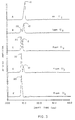
- Fig. 3 is a comparative spectrograph produced by an IMS operated in the enhancement mode in accordance with the method of the present invention.
- a small concentration of sulfur dioxide dopant has been added to the purified air carrier gas prior to its admission to the IMS.
- the arrival time of the principal ion current peak 10 resulting from the air carrier gas with sulfur dioxide dopant added and no analyte is approximately 10.4 ms.
- Lines B-E of Fig. 3 show the results of introducing increasingly greater concentrations of analyte, specifically chlorine, using air with sulfur dioxide added as the carrier gas.
- the ion current peak 20 resulting from the presence of the analyte remains centered at approximately 9.5 ms for the increasing concentrations.
- the ion current peak 10 resulting from the air carrier gas with sulfur dioxide added remains centered at approximately 10.4 ms.
- the decreasing amplitude of the 10.4 ms peak 10 which occurs as the amplitude of the 9.5 ms peak 20 increases is a manifestation of the principle of conservation of charge, as will be understood by those skilled in the art.
- Fig. 3 demonstrates that an IMS operated in accordance with the method of the invention can serve effectively as the sensor in a monitoring system to detect trace amounts of chlorine in the atmosphere using air as the drift gas and air with sulfur dioxide dopant as the carrier gas.
- the method of the invention has also been shown to be effective for the detection of hydrogen chloride and other acid gasses.
- the method of the invention has also been shown to be equally effective for detecting chlorine, hydrogen chloride and other gasses (having a high charge affinity) with a very high degree of specificity from among a test sample which also contains sulfur dioxide, carbonyl sulfide or certain other gasses.
- Sulfur dioxide doping renders the ion mobility spectrometer non-responsive to gasses having low charge affinities.
- the comparative spectrograph of Fig. 3 would appear the same even if HF, COS or SO2 were present in the sample gas in addition to the CL2. The HF, COS or SO2 would not interfere with the ion current peaks 20 attributable to the CL2.
Landscapes
- Chemical & Material Sciences (AREA)
- Physics & Mathematics (AREA)
- Life Sciences & Earth Sciences (AREA)
- Chemical Kinetics & Catalysis (AREA)
- Electrochemistry (AREA)
- Health & Medical Sciences (AREA)
- Spectroscopy & Molecular Physics (AREA)
- Analytical Chemistry (AREA)
- Biochemistry (AREA)
- General Health & Medical Sciences (AREA)
- General Physics & Mathematics (AREA)
- Immunology (AREA)
- Pathology (AREA)
- Other Investigation Or Analysis Of Materials By Electrical Means (AREA)
Abstract
Description
- The present invention relates to the use of ion mobility spectrometry for detecting certain acid gasses in air, and more particularly, to the use of sulfur dioxide dopant for improving the specificity of detection of certain acid gasses such as chlorine, hydrogen chloride and other gasses which have high charge affinities.
- There is a pressing need in industry for a monitoring system capable of identifying and quantifying trace quantities of hazardous gasses escaping into the air. The monitors, located in the vicinity of processing plants and storage facilities, provide early warning of impending danger to plant personnel and to the public, and they enable corrective action to be taken in time to avoid disaster. An ideal monitoring system is capable of operating unattended continuously for extended periods of time without the need for frequent maintenance or calibration. Monitoring systems in present use use electrochemical cells and other devices as the sensing element. Such systems are inadequate in some applications because they lack specificity, require frequent maintenance for calibration and replenishment of electrolyte, and many are limited to operation at ambient temperatures above 0⁰ C (due to freezing of the electrolyte).
- The Ion Mobility Spectrometer (IMS) is an accepted analytical tool capable of identifying and quantifying trace amounts of a substance in a sample. Basically, an IMS comprises an analyser cell, means for ionizing samples of an analyte admitted to the cell and means for determining the times required for the ions of the various substances present in the cell to traverse a specific length of the cell under the influence of an electric field and against the force of a stream of drift gas flowing through the cell in a direction opposite to that of the electric field. A representative analyzer cell is disclosed in U.S. Patent No. 4,390,784 issued to Browning et al. A stream of purified air or other gas may be used as a carrier gas to introduce the analyte sample into the cell, and a stream of purified air or other gas may also be used as the drift gas. Both the carrier gas and the drift gas are therefore readily available at an installation site in unlimited quantities and no maintenance is required of the sensor other than the occasional replacement of filters and membranes for purifying the carrier and drift gasses, radiation wipe tests and calibration. An IMS therefore appears to be the ideal sensor for use in a monitoring system.
- However, it has been found that an IMS operated in a conventional manner, using air as the carrier and drift gasses, may lack the specificity necessary to detect many of the acid gasses of interest, such as hydrogen fluoride, hydrogen chloride, nitrogen dioxide, and others. The reason for such lack of specificity is that the ion peak characteristic of pure air alone and the ion peak characteristic of the analyte gas in air both arrive at the ion detector of the IMS at virtually the same times. The pure air ion peak disrupts the analyte peak, especially when the analyte is an acid gas. Hence, it becomes very difficult to distinguish the amplitude of the ion current due to the acid gas from the ion current due to pure air at a given arrival time.
- In application serial number 534,701, a monitor having improved specificity for acid gasses was described. The disclosed acid gas monitor makes use of a dopant selected from the group of substituted phenols. The dopant improves the ability of the gas monitor to detect the general presence of acid gasses such as hydrogen flouride, hydrogen chloride, chlorine, nitrogen dioxide, sulfur dioxide, carbonyl sulfide, and numerous others. This ability to detect the presence of acid gas proves advantageous in many situations. However, it is often desireable to identify the presence of a specific type of acid gas, and to quantify the amount of the specific acid gas. The acid gas monitor in application serial number 534,701 provides the requisite specificity to detect certain types of acid gas (such as HF), but it lacks the specificity for others. If more than one acid gas is present, the specificity is inadequate to distinguish between the gases. For example, if chlorine is being monitored and another acid gas is present, the device may give a false indication of the presence of chlorine or its concentration.
- It is, therefore, an object of the present invention to provide a method of ion mobility spectrometry with improved specificity for detecting certain gasses, whereby interference and false indications resulting from coexisting gasses is eliminated.
- It is another object of the present invention to provide a method and apparatus based on ion mobility spectrometry which detects chlorine, hydrogen chloride and other gasses having a high charge affinity with a very high degree of specificity.
- It is a further object of the invention to provide a system for monitoring acid gasses which is not responsive to other gasses such as sulfur dioxide, carbonyl sulfide and like gasses having a low charge affinity.
- It is still another object of the invention to provide an acid gas monitor capable of indicating the presence and quantity of specific types of hazardous gasses in a mixture of gasses.
- According to the present invention, the above-described and other objects are accomplished by providing an ion mobility spectrometer with improved specificity for detecting certain gases, and a method for operating the same. The spectrometer includes an analyzer cell having an inlet region, a reaction region, an ionization source in said reaction region, a shutter grid, a drift region, an ion current detector for detecting ions transiting said cell drift region, and means for measuring the transit times through the cell drift region of ions generated in the cell reaction region and released into the drift region through the shutter grid. The method of operation includes the steps of applying a drift gas stream of air to the cell drift region, mixing sulfur dioxide with a carrier gas stream of air to create a doped carrier gas stream, introducing a test sample of gas into the analyzer cell inlet region, applying the carrier gas stream to the cell inlet region to carry the test sample into the cell reaction region, measuring an ion current at the ion current detector at a time corresponding to the transit time through the cell drift region of ions generated by the test sample in the cell reaction region. The sulfur dioxide dopant used in this method causes ions generated by said carrier gas stream in the cell reaction region to have transit times through said cell drift region which are different from the transit times through the cell drift region of ions generated by the test sample. At the same time, the sulfur dioxide dopant suppresses ion current attributable to acid gasses with low charge affinities, thereby improving the specificity for acid gasses having high charge affinities.
- The specificity is improved for certain acid gases such as Cl₂ and HCl, but detection is not achieved for other gases such as HF, COS and SO₂. For these, the substituted phenol dopant chemistry of application serial number 534,701 provides detection capability. Hence, the present invention would be advantageous in certain situations, and the invention of application serial number 534,701 is advantageous in others.
- Other objects, features and advantages of the present invention will become more apparent from the following detailed description of preferred embodiments and certain modifications thereof when taken together with the accompanying drawings, in which:
- Fig. 1 is a functional block diagram, partially in schematic form, of an Ion Mobility Spectrometer used in the practice of the method of the invention;
- Fig. 2 is a comparative spectrograph showing of a conventional IMS showing the ion current peaks produced when purified air alone is used the carrier gas and varying types of acid gas analytes are present in the test sample.
- Fig. 3 is a comparative spectrograph produced by an IMS operated in the enhancement mode in accordance with the method of the present invention.
- Referring to Fig. 1, the apparatus used in the practice of the method of the invention comprises a conventional
IMS analyzer cell 10 such as disclosed in U.S. Patent No. 4,390,784 issued to Browning et al.Cell 10 is divided into an inlet region 11, areaction region 12 and adrift region 13. Inlet region 11 is partitioned by apermeable membrane 14 into asample chamber 15 and aninlet chamber 16. Air from a regulatedpressure air supply 17 is passed through ascrubber 18,flow regulator 19 andventuri 20 and throughsample chamber 15 to anexhaust 21. The air flow throughventuri 20 andsample chamber 14 inducts a sample gas intosample chamber 14.Membrane 14 allows passage of the constituents of interest intoinlet chamber 15 while excluding interferant substances fromchamber 15. Those constituent substances passing throughmembrane 14 intochamber 15 are swept fromchamber 15 by a carrier gas into thereaction region 12 ofanalyzer cell 10. - In accordance with the invention, the carrier gas comprises air from
air supply 17 that is passed through ascrubber 24 primarily to remove water vapor therefrom, and throughflow regulator 25, and apermeation tube 26, where a controlled concentration of sulfur dioxide (SO₂) dopant is added to the air.Reaction region 12 contains asource 27 of β-particle ionizing radiation which generates product ions from the constituents swept intoregion 12 by the carrier gas.Source 27 is usually formed of a ring of Ni63. The product ions formed inregion 12 are driven in the direction of anion detector 28, located at the end ofdrift region 13opposite reaction region 12, by an electrostatic field applied alongregions high voltage supply 31.Reaction region 12 is partitioned fromdrift region 13 by ashutter grid 32, andion detector 28 is separated fromdrift region 13 by anaperture grid 33.Shutter grid 32 andaperture grid 33 are separately biased by voltages from acontrol circuit 34. A drift gas, admitted to driftregion 13 throughport 35, flows continuously throughdrift region 13 andreaction region 12, exhausting therefrom throughexhaust vent 36. The drift gas comprises air from air suplly 17 passed throughscrubber 18 andflow regulator 36 intoport 35. - In the conventional mode of operating an IMS for the detection of negative ions,
shutter grid 32 is biased negatively for the major part of a scan cycle to block the product ions inreaction region 12 from enteringdrift region 13. At the beginning of a scan period, the bias is changed briefly to allow a cloud of ions to enterdrift region 13. The ions drift along the length ofdrift region 13 under the influence of the electric field and against the force of the counter-flowing drift gas, represented by thearrows 35 toward thedetector 28. - The product ions created by the various constituents traverse the drift region in different time periods, depending upon the charge/molecular size characteristics of each constituent. If a complete spectrum is to be taken,
aperture grid 33 may be neutrally biased so that the arrival times of each of the various ion groups atdetector 33 may be measured. If the IMS is intended to be responsive to only a single specific substance, the aperture grid may be biased so as to repel all ions except for those arriving at a time corresponding to the predetermined characteristic arrival time of ions for the substance of interest. - Alternatively, the IMS may be operated in the enhancement mode, as disclosed and claimed in United States Patent Application Serial No. 344,128; filed April 27, 1989 by J. A. Reategui et al. for "Method and Apparatus for Enhanced Ion Spectrum Generation and Detection in Ion Mobility Spectrometry", assigned to the assignee of the present application. Briefly, in the enhancement mode, the
shutter grid 32 of the IMS is biased open for the major portion of a scan cycle allowing ions to enterdrift region 13 continuously upon their generation in thecell reaction region 12. At the beginning of a scan cycle, theshutter grid 32 is momentarily biased closed, thereby creating a void in the otherwise continuous stream of ions transiting fromreaction region 12 intodrift region 13. The void traverses driftregion 13 and becomes separated into secondary voids which arrive ation detector 33 at different transit times, in much the same manner as the ion groups which traverse and become separated in the conventional mode. The substantially steady stream of ions that enters driftregion 13 during the open period of the shutter grid establishes a baseline ion current atdetector 33. The arrival of a secondary void atdetector 33 creates a negative peak in the base line current. The arrival time atdetector 33 of a negative peak characterizes the identity of one constituent substance of the test sample, and the amplitude of the negative peak characterizes the concentration of the constituent substance in the test sample. Operation of an IMS in the enhancement mode has the advantages of producing better resolution of the separated ion current peaks and of providing a means permitting continuous calibration of the IMS. Operation of the IMS in the enhancement mode is preferred in the practice of the present invention, although the invention is equally applicable to the operation of an IMS in the conventional mode. - Data acquisition and
processing unit 37 collects and averages the peak ion current amplitudes occurring at the arrival times that are characteristic of the analyte for a number of successive scans in order to determine whether the analyte concentration has reached the alarm level.
When the analyte is chlorine in air, the monitoring system described above requires about 10 minutes for the average peak ion current to stabilize at an equilibrium level. - A more rapid measurement can be obtained by processing the data using an algorithm which includes a derivative term in order to predict the equilibrium value of the average peak ion current. A look-up table is first prepared containing values of the ratio of the ion current peaks obtained at the arrival times of the analyte ions and of the doped carrier gas reactant ions for a number of successive scans using known concentrations of analyte.
- When a sample having an unknown mixture and concentration of analytes is tested, the respective ion current peaks are collected at one second intervals, suitably, and are processed to show the change in ion current over time. For example, the following algorithm may be employed for this purpose:

where: - Tt
- is the table look-up value at time t;
- As
- is the peak ion current amplitude at the arrival time of a specific analyte ion; and
- Ar
- is ion current amplitude at the arrival time of the doped carrier gas ion.
- The look-up table will yield the concentration of the specific analyte of interest when entered at the value obtained for Tt using the above algorithm.
- Obviously, variations in the method of the invention are possible in the light of the above teachings. It is therefore to be understood that the invention may be practiced otherwise than as specifically disclosed without departing from the spirit and scope of the appended claims.
- Fig. 2 is a comparative spectrograph showing, in line A, the ion current peak produced when purified air alone is used the carrier gas in an IMS operated in the enhancement mode and no acid gas analyte is present in the test sample. The ion current peak appears at an arrival time of approximately 9.8 milliseconds (ms). Line B of Fig. 2 shows the ion current peak produced when purified air alone is used as the carrier gas in the IMS and an acid gas analyte, specifically hydrogen fluoride, is present in the test sample. The peak in line B occurs at substantially the same arrival time as that in line A, demonstrating the impracticality of using an IMS for the purpose of identifying an acid gas analyte when purified air alone is used as the carrier gas. As discussed, application serial number 534,701, sets forth a partial solution to this problem in a monitor having improved specificity for acid gasses. The disclosed monitor makes use of a dopant selected from the group of substituted phenols. The dopant improves the ability of the gas monitor to detect the general presence of acid gasses such as hydrogen flouride. Hence, the hydrogen fluoride of line B can be distinguished from the purified air carrier gas. However, it is also desireable to identify the presence of a specific type of acid gas, and to quantify that type, in a test sample which includes a mixture of different acid gasses. The monitor shown in application serial number 534,701 is incapable of this due to the interference caused by the other acid gases.
- Line C of Fig. 2 shows the ion current peak produced when purified air alone is used as the carrier gas in the IMS and a mixture of acid gas analytes, specifically hydrogen fluoride and chlorine, are present in the test sample. The peak in line C occurs at substantially the same arrival time as that in lines A and B, demonstrating the impracticality of using an IMS for the purpose of identifying or quantifying the chlorine when another acid gas analyte (hydrogen flouride) is present. Similarly, when sulfur dioxide, carbonyl sulfide and other acid gasses are present, they will steal charge from the ion current peak produced by the chlorine, thereby decreasing specificity. The resulting specificity is decreased to the point where the method disclosed in application serial number 534,701 cannot distinguish between these acid gasses. Instead, the method may give a false indication of the presence of chlorine or its concentration.
- The present invention uses a sulfur dioxide dopant to eliminate or reduce the interference from ion peaks attributable to acid gasses having a low charge affinity (e.g. hydrogen fluoride, sulfur dioxide and carbonyl sulfide), thereby improving the IMS specificity for acid gasses having a high charge affinity (e.g. chlorine and hydrogen chloride).
- Fig. 3 is a comparative spectrograph produced by an IMS operated in the enhancement mode in accordance with the method of the present invention. A small concentration of sulfur dioxide dopant has been added to the purified air carrier gas prior to its admission to the IMS. In line A, the arrival time of the principal ion
current peak 10 resulting from the air carrier gas with sulfur dioxide dopant added and no analyte is approximately 10.4 ms. Lines B-E of Fig. 3 show the results of introducing increasingly greater concentrations of analyte, specifically chlorine, using air with sulfur dioxide added as the carrier gas. The ioncurrent peak 20 resulting from the presence of the analyte remains centered at approximately 9.5 ms for the increasing concentrations. Similarly, the ioncurrent peak 10 resulting from the air carrier gas with sulfur dioxide added remains centered at approximately 10.4 ms. The decreasing amplitude of the 10.4 ms peak 10 which occurs as the amplitude of the 9.5 ms peak 20 increases is a manifestation of the principle of conservation of charge, as will be understood by those skilled in the art. - Fig. 3 demonstrates that an IMS operated in accordance with the method of the invention can serve effectively as the sensor in a monitoring system to detect trace amounts of chlorine in the atmosphere using air as the drift gas and air with sulfur dioxide dopant as the carrier gas. The method of the invention has also been shown to be effective for the detection of hydrogen chloride and other acid gasses.
- The conditions under which the results of Fig. 3 were obtained were as follows:
carrier gas flow - 140 cc/min; drift gas flow - 250 cc/min; sulfur dioxide concentration - 1 ppm (in carrier); drift region length - 3.7 cm.; sampling rate - 500 cc/min; reaction region electric field - 125 V/cm.; drift region electric field - 125 V/cm. inlet membrane - microporous teflon coated with one of 0V210 or 0V101, both available from Altech Associates, Deerfield, Ill. (as will be appreciated to one skilled in the art, different types of coatings are used to obtain different degrees of specificity and sensitivity, depending on the application); negative ion mode; enhanced shutter mode; shutter grid pulse width - 200 us. - It should be noted that none of the above parameters are limiting, and that the invention can be practiced with wide deviations therefrom.
- The method of the invention has also been shown to be equally effective for detecting chlorine, hydrogen chloride and other gasses (having a high charge affinity) with a very high degree of specificity from among a test sample which also contains sulfur dioxide, carbonyl sulfide or certain other gasses. Sulfur dioxide doping renders the ion mobility spectrometer non-responsive to gasses having low charge affinities. For example, the comparative spectrograph of Fig. 3 would appear the same even if HF, COS or SO₂ were present in the sample gas in addition to the CL₂. The HF, COS or SO₂ would not interfere with the ion
current peaks 20 attributable to the CL₂.
Claims (16)
- An improved method for operating an ion mobility spectrometer using air as a carrier gas and as a drift gas, said spectrometer comprising an analyzer cell having an inlet region, a reaction region, an ionization source in said reaction region, a shutter grid, a drift region, an ion current detector for detecting ions transiting said coil drift region, and means for measuring the transit times through said cell drift region of lone generated in said cell reaction region and released into said cell drift region through said shutter grid, the method comprising the steps of:
applying a drift gas stream of air to said cell drift region;
applying a carrier gas stream to said cell inlet region to carry said test sample into said cell reaction region;
mixing sulfur dioxide with said carrier gas stream or said drift gas stream to create a doped carrier gas or drift gas stream;
introducing a test sample of gas into said analyzer cell inlet region; and
measuring an ion current at said ion current detector at a time corresponding to the transit time through said cell drift region of ions generated by said test sample in said cell reaction region;
whereby said sulfur dioxide dopant causes ions generated by said carrier gas stream in said cell reaction region to have transit times through said cell drift region which are different from the transit times through said cell drift region of ions generated by the test sample. - The improved method according to claim 1, whereby said step of mixing sulfur dioxide suppresses a componant of said measured ion current attributable to ions generated by test sample acid gasses with low charge affinities, said measured ion current being attributable mainly to ions generated by test sample acid gasses with high charge affinities.
- The improved method of claim 1, wherein:
said test sample comprises one from among the group of hydrogen fluoride, sulfur dioxide, and carbonyl sulfide. - The improved method of claim 1, wherein:
said step of mixing sulfur dioxide comprises mixing sulfur dioxide dopant in said drift gas or carrier gas stream of air at a concentration of approximately 1 part per million. - The improved method of claim 1 wherein:
said step of mixing sulfur dioxide with said drift gas or carrier gas stream of air is accomplished by flowing said sulfur dioxide into a permeation tube immersed in said carrier gas stream, whereby said drift gas or carrier gas mixes with sulfur dioxide permeating through said tube. - The improved method of claim 1, further comprising mixing sulfur dioxide with both of said drift gas and carrier gas stream of air to create a doped drift gas or carrier gas stream.
- An ion mobility spectrometer for analyzing an acid gas in a test sample, comprising:
an inlet region for inputting a test sample of gas;
a reaction region in fluid communication with said inlet region;
means for applying a carrier gas stream of air to said inlet region for carrying said test sample therefrom into said cell reaction region;
means for applying a drift gas stream of air for carrying test sample in said drift region;
doping means for introducing sulfur dioxide into said carrier gas or drift gas stream of air;
an ionization source in said reaction region for generating product ions from the test sample carried into the reaction region by said carrier gas;
a drift region through which said product ions travel in accordance with a charge and molecular size characteristic;
a shutter grid for selectively releasing said product ions from said reaction region into said drift region;
an ion current detector for detecting product ions transiting said cell drift region;
means for measuring a transit time through said cell drift region of product ions generated in said cell reaction region and released into said cell drift region through said shutter grid; and
means for measuring an ion current detected by said call ion current detector at a time corresponding to the drift time of ions generated from said analyte gas in said cell reaction region;
whereby sulfur dioxide dopant introduced by said doping means causes ions generated by said carrier gas stream in said cell reaction region to have transit times through said cell drift region which are different from the transit times through said cell drift region of ions generated by the test sample. - The ion mobility spectrometer according to claim 7, whereby said sulfur dioxide dopant suppresses a componant of said measured ion current attributable to ions generated by test sample acid gasses with low charge affinities, said measured ion current being attributable mainly to ions generated by test sample acid gasses with high charge affinities.
- The apparatus according to claim 7, wherein said sulfur dioxide doping means comprises a gas permeable tube immersed in said carrier gas stream or drift gas stream for allowing dopant contained therein to permeate into said carrier gas stream or drift gas stream of air.
- The apparatus according to claim 9, wherein said gas permeable tube introduces said dopant to said carrier gas or drift gas stream of air at a rate of about 365 nanograms per minute.
- The apparatus according to claim 7, wherein said inlet region is partitioned by means for preventing passage of select constituents of said test sample.
- The apparatus according to claim 11, wherein said partition means is a gas-permeable membrane.
- The apparatus according to claim 7, further comprising processing means for computing a quantity of an acid gas constituent in said test sample based on said ion current measured by said ion current measurement means.
- The apparatus according to claim 13, wherein said processing means further comprises a memory for storing expected peak ion current data characteristic of said constituent acid gas in said test sample, said processing means comparing actual measured ion currents detected by said cell ion current detector to said expected peak ion current data and quantifying said constituent based on said comparison.
- The apparatus according to claim 14, wherein said expected peak ion current data comprises a calibration curve relating said actual measured ion currents to said constituent concentration.
- The apparatus according to claim 7, wherein said doping means introduces sulfur dioxide into said carrier gas and into said drift gas stream of air.
Applications Claiming Priority (2)
| Application Number | Priority Date | Filing Date | Title |
|---|---|---|---|
| US687594 | 1984-12-31 | ||
| US07/687,594 US5095206A (en) | 1990-06-01 | 1991-04-17 | Method and apparatus for improving the specificity of an ion mobility spectrometer utillizing sulfur dioxide dopant chemistry |
Publications (2)
| Publication Number | Publication Date |
|---|---|
| EP0509171A1 true EP0509171A1 (en) | 1992-10-21 |
| EP0509171B1 EP0509171B1 (en) | 1996-02-07 |
Family
ID=24761045
Family Applications (1)
| Application Number | Title | Priority Date | Filing Date |
|---|---|---|---|
| EP91307042A Expired - Lifetime EP0509171B1 (en) | 1991-04-17 | 1991-07-31 | Method and apparatus for improving the specificity of an ion mobility spectrometer utilizing sulfur dioxide dopant chemistry |
Country Status (4)
| Country | Link |
|---|---|
| US (1) | US5095206A (en) |
| EP (1) | EP0509171B1 (en) |
| AT (1) | ATE134069T1 (en) |
| DE (1) | DE69117045T2 (en) |
Cited By (6)
| Publication number | Priority date | Publication date | Assignee | Title |
|---|---|---|---|---|
| EP0692712A1 (en) * | 1994-07-15 | 1996-01-17 | Ion Track Instruments, Inc. | Ion mobility spectrometer and method of operation for enhanced detection of narcotics |
| US7015462B2 (en) | 2001-05-28 | 2006-03-21 | Michael Karas | Separation of components of an analysis sample in an ion mobility spectrometer using a supply of selectively interactive gaseous particles |
| WO2008107640A1 (en) * | 2007-03-03 | 2008-09-12 | Smiths Detection-Watford Limited | Ion mobility spectrometer comprising two drift chambers |
| WO2011035633A1 (en) | 2009-09-25 | 2011-03-31 | 同方威视技术股份有限公司 | Ion mobility spectrometer detection method and apparatus using dopant |
| WO2011060607A1 (en) | 2009-11-20 | 2011-05-26 | 同方威视技术股份有限公司 | Ion mobility spectrometer and method for improving the detection sensitivity thereof |
| CN104713944A (en) * | 2013-12-13 | 2015-06-17 | 中国科学院大连化学物理研究所 | New method for determining total sulfide amount in natural gas |
Families Citing this family (27)
| Publication number | Priority date | Publication date | Assignee | Title |
|---|---|---|---|---|
| US5234838A (en) * | 1990-04-17 | 1993-08-10 | Environmental Technologies Group, Inc. | Ammonia monitor based on ion mobility spectrometry with selective dopant chemistry |
| US5283199A (en) * | 1990-06-01 | 1994-02-01 | Environmental Technologies Group, Inc. | Chlorine dioxide monitor based on ion mobility spectrometry with selective dopant chemistry |
| US5304796A (en) * | 1992-03-25 | 1994-04-19 | The Boc Group, Inc. | Atmospheric pressure ionization mass spectroscopy method including a silica gel drying step |
| US5338931A (en) * | 1992-04-23 | 1994-08-16 | Environmental Technologies Group, Inc. | Photoionization ion mobility spectrometer |
| GB9602158D0 (en) | 1996-02-02 | 1996-04-03 | Graseby Dynamics Ltd | Corona discharge ion sources for analytical instruments |
| GB2324875B (en) * | 1996-02-02 | 2000-06-21 | Graseby Dynamics Ltd | Corona discharge ion source for analytical instruments |
| US6495824B1 (en) * | 2000-03-13 | 2002-12-17 | Bechtel Bwxt Idaho, Llc | Ion mobility spectrometer, spectrometer analyte detection and identification verification system, and method |
| US6639214B1 (en) | 2000-05-09 | 2003-10-28 | Air Products And Chemicals, Inc. | Method of improving the performance of an ion mobility spectrometer used to detect trace atmospheric impurities in gases |
| US6627878B1 (en) * | 2000-07-11 | 2003-09-30 | The United States Of America As Represented By The Secretary Of The Navy | (Chemical agent) point detection system (IPDS) employing dual ion mobility spectrometers |
| IT1319667B1 (en) | 2000-11-17 | 2003-10-23 | Getters Spa | METHOD FOR MEASURING THE CONCENTRATION OF NITROGEN IN ARGON BY MEANS OF IONIC MOBILITY SPECTROSCOPY. |
| ITMI20011193A1 (en) * | 2001-06-06 | 2002-12-06 | Getters Spa | METHOD FOR MEASUREMENT USING IONIC MOBILITY SPECTROSCOPY OF THE CONCENTRATION OF WATER IN ARGON, HYDROGEN, NITROGEN AND HELIUM |
| US20070114382A1 (en) * | 2005-11-23 | 2007-05-24 | Clemmer David E | Ion mobility spectrometer |
| US20090283674A1 (en) * | 2006-11-07 | 2009-11-19 | Reinhold Pesch | Efficient Atmospheric Pressure Interface for Mass Spectrometers and Method |
| US20090078862A1 (en) * | 2007-07-30 | 2009-03-26 | Dan Rodier | Ion mobility spectrometry analyzer for detecting peroxides |
| CN103163207A (en) * | 2011-12-19 | 2013-06-19 | 中国科学院大连化学物理研究所 | Method for detecting sulfur dioxide (SO2) in air in qualitative mode |
| CN104380098B (en) * | 2012-05-18 | 2018-03-27 | Dh科技发展私人贸易有限公司 | Method for the selective detection of biologically relevant acids |
| CN103868980A (en) * | 2012-12-12 | 2014-06-18 | 中国科学院大连化学物理研究所 | Application of doping agent in test of phthalic acid ester compounds by use of ion mobility spectrometry |
| ITRM20130128U1 (en) | 2013-07-23 | 2015-01-24 | Particle Measuring Systems S R L | DEVICE FOR MICROBIAL AIR SAMPLING |
| WO2015148148A1 (en) | 2014-03-14 | 2015-10-01 | Particle Measuring Systems, Inc. | Pressure-based airflow sensing in particle impactor systems |
| US9631222B2 (en) | 2014-03-14 | 2017-04-25 | Particle Measuring Systems, Inc. | Filter and blower geometry for particle sampler |
| US9766218B2 (en) * | 2014-10-31 | 2017-09-19 | Morpho Detection, Llc | Gas curtain at inlet for trace detectors |
| WO2016092156A1 (en) * | 2014-12-12 | 2016-06-16 | University Of Helsinki | Method and device for detecting ambient clusters |
| US9147565B1 (en) * | 2014-12-30 | 2015-09-29 | Morpho Detection, Llc | Ion mobility spectrometer and method of using the same |
| FI20185249A1 (en) * | 2018-03-15 | 2019-09-16 | Karsa Oy | Hydrogen halide detection |
| KR102880992B1 (en) | 2018-11-16 | 2025-11-03 | 파티클 머슈어링 시스템즈, 인크. | Particle sampling system and method for robot-controlled manufacturing barrier systems |
| CN114270165B (en) | 2019-08-26 | 2024-08-27 | 粒子监测系统有限公司 | Triggered sampling system and method |
| TWI801797B (en) | 2020-01-21 | 2023-05-11 | 美商粒子監測系統有限公司 | Impactor and method for sampling biological particles from a fluid flow |
Citations (2)
| Publication number | Priority date | Publication date | Assignee | Title |
|---|---|---|---|---|
| EP0135747A2 (en) * | 1983-09-23 | 1985-04-03 | Environmental Technologies Group, Inc. | Ion mobility spectrometer system with improved specificity |
| US4950893A (en) * | 1989-04-27 | 1990-08-21 | Environmental Technologies Group, Inc. | Method and apparatus for enhanced ion spectra generation and detection in ion mobility spectrometry |
Family Cites Families (5)
| Publication number | Priority date | Publication date | Assignee | Title |
|---|---|---|---|---|
| US3717028A (en) * | 1969-06-02 | 1973-02-20 | Foxboro Co | Chromatographic peak selector |
| US4390784A (en) * | 1979-10-01 | 1983-06-28 | The Bendix Corporation | One piece ion accelerator for ion mobility detector cells |
| US4445038A (en) * | 1979-10-01 | 1984-04-24 | The Bendix Corporation | Apparatus for simultaneous detection of positive and negative ions in ion mobility spectrometry |
| US4839143A (en) * | 1985-02-15 | 1989-06-13 | Allied-Signal Inc. | Selective ionization of gas constituents using electrolytic reactions |
| US4797554A (en) * | 1987-12-24 | 1989-01-10 | Allied-Signal Inc. | Ion mobility spectrometer |
-
1991
- 1991-04-17 US US07/687,594 patent/US5095206A/en not_active Expired - Lifetime
- 1991-07-31 DE DE69117045T patent/DE69117045T2/en not_active Expired - Fee Related
- 1991-07-31 AT AT91307042T patent/ATE134069T1/en not_active IP Right Cessation
- 1991-07-31 EP EP91307042A patent/EP0509171B1/en not_active Expired - Lifetime
Patent Citations (2)
| Publication number | Priority date | Publication date | Assignee | Title |
|---|---|---|---|---|
| EP0135747A2 (en) * | 1983-09-23 | 1985-04-03 | Environmental Technologies Group, Inc. | Ion mobility spectrometer system with improved specificity |
| US4950893A (en) * | 1989-04-27 | 1990-08-21 | Environmental Technologies Group, Inc. | Method and apparatus for enhanced ion spectra generation and detection in ion mobility spectrometry |
Non-Patent Citations (1)
| Title |
|---|
| ADVANCES IN INSTRUMENTATION. vol. 45, no. 2, 1990, PITTSBURGH US pages 679 - 690; A. BACON ET AL.: 'Development of a gas and vapor monitor based on ion mobility spectrometry.' * |
Cited By (15)
| Publication number | Priority date | Publication date | Assignee | Title |
|---|---|---|---|---|
| EP0692712A1 (en) * | 1994-07-15 | 1996-01-17 | Ion Track Instruments, Inc. | Ion mobility spectrometer and method of operation for enhanced detection of narcotics |
| US7015462B2 (en) | 2001-05-28 | 2006-03-21 | Michael Karas | Separation of components of an analysis sample in an ion mobility spectrometer using a supply of selectively interactive gaseous particles |
| DE10292304B4 (en) * | 2001-05-28 | 2015-09-10 | Excellims Corp. | Separation of components of an analytical sample in an ion mobility spectrometer by supplying selectively interacting gaseous particles |
| US8415614B2 (en) | 2007-03-03 | 2013-04-09 | Smiths Detection—Watford Limited | Ion mobility spectrometer comprising two drift chambers |
| WO2008107640A1 (en) * | 2007-03-03 | 2008-09-12 | Smiths Detection-Watford Limited | Ion mobility spectrometer comprising two drift chambers |
| KR101489682B1 (en) * | 2007-03-03 | 2015-02-04 | 스미스 디텍션-워트포드 리미티드 | An ion mobility spectrometer with two drift chambers |
| US7994475B2 (en) | 2007-03-03 | 2011-08-09 | Smiths Detection-Watford Limited | Ion mobility spectrometer comprising two drift chambers |
| WO2011035633A1 (en) | 2009-09-25 | 2011-03-31 | 同方威视技术股份有限公司 | Ion mobility spectrometer detection method and apparatus using dopant |
| DE112010000007B4 (en) * | 2009-09-25 | 2012-12-13 | Nuctech Co. Ltd. | Ion mobility spectrometer detection method and ion mobility spectrometer detection system using dopants |
| US8237110B2 (en) | 2009-09-25 | 2012-08-07 | Nuctech Company Limited | Ion mobility spectrometer detection method using dopants |
| DE112010000007T5 (en) | 2009-09-25 | 2011-06-22 | Nuctech Co. Ltd. | Ion mobility spectrometer detection method using dopants |
| DE112010004489T5 (en) | 2009-11-20 | 2012-10-04 | Nuctech Company Limited | Ion mobility spectrometer and method for improving its detection sensitivity |
| US8716656B2 (en) | 2009-11-20 | 2014-05-06 | Nuctech Company Limited | Ion mobility spectrometer and method for improving the detection sensitivity thereof |
| WO2011060607A1 (en) | 2009-11-20 | 2011-05-26 | 同方威视技术股份有限公司 | Ion mobility spectrometer and method for improving the detection sensitivity thereof |
| CN104713944A (en) * | 2013-12-13 | 2015-06-17 | 中国科学院大连化学物理研究所 | New method for determining total sulfide amount in natural gas |
Also Published As
| Publication number | Publication date |
|---|---|
| DE69117045D1 (en) | 1996-03-21 |
| US5095206A (en) | 1992-03-10 |
| DE69117045T2 (en) | 1996-09-19 |
| EP0509171B1 (en) | 1996-02-07 |
| ATE134069T1 (en) | 1996-02-15 |
Similar Documents
| Publication | Publication Date | Title |
|---|---|---|
| US5095206A (en) | Method and apparatus for improving the specificity of an ion mobility spectrometer utillizing sulfur dioxide dopant chemistry | |
| US5032721A (en) | Acid gas monitor based on ion mobility spectrometry | |
| US5283199A (en) | Chlorine dioxide monitor based on ion mobility spectrometry with selective dopant chemistry | |
| US5234838A (en) | Ammonia monitor based on ion mobility spectrometry with selective dopant chemistry | |
| CA1237771A (en) | Sensor array for toxic gas detection | |
| US4888295A (en) | Portable system and method combining chromatography and array of electrochemical sensors | |
| CA1304836C (en) | Method for detection of alien matter contents in gases | |
| CN112526070A (en) | LEL and VOC combination formula waste gas analysis system | |
| EP0988543A1 (en) | Method and apparatus for monitoring gas(es) in a dielectric fluid | |
| RU2273847C2 (en) | Mode of measuring of a common concentration of carbon and hydrocarbon oxides in oxygen with the aid of spectrometry of mobility of ions | |
| Przybylko et al. | The determination of aqueous ammonia by ion mobility spectrometry | |
| US3650696A (en) | Sampling and analysis of sulfur compounds | |
| US5454258A (en) | Broad range moisture analyzer and method | |
| CN111443125A (en) | Correction method for detecting hazardous substance residues by using ion mobility spectrometry | |
| CA2043708C (en) | Method and apparatus for improving the specificity of an ion mobility spectrometer utilizing sulfur dioxide dopant chemistry | |
| KR100809149B1 (en) | Determination of Impurity Concentrations in Nitrogen, Hydrogen and Oxygen by Ion Flow Spectrometry | |
| Karpas et al. | Determination of bromine in air by ion mobility spectrometry | |
| US3997416A (en) | Method and apparatus for analyzing gaseous mixtures | |
| US4077773A (en) | Method and apparatus for detection of monoalkylhalides | |
| US20040111222A1 (en) | Method for measuring the concentration of water in Argon, Hydrogen, Nitrogen and Helium by ionization mobility spectrometry | |
| CA2153657A1 (en) | Method and equipment for definition of foreign matter contents in gases | |
| KR100809131B1 (en) | Method for measuring the concentration of methane and hydrogen in nitrogen by ion transfer spectroscopy | |
| US5641686A (en) | Flow injection trace gas analysis method for on-site determination of organoarsenicals | |
| US4740474A (en) | Method for determining the presence of diborane in air | |
| JP2003302376A (en) | Apparatus and method for continuous measurement of volatile organic compounds |
Legal Events
| Date | Code | Title | Description |
|---|---|---|---|
| PUAI | Public reference made under article 153(3) epc to a published international application that has entered the european phase |
Free format text: ORIGINAL CODE: 0009012 |
|
| AK | Designated contracting states |
Kind code of ref document: A1 Designated state(s): AT BE CH DE DK ES FR GB GR IT LI LU NL SE |
|
| 17P | Request for examination filed |
Effective date: 19930406 |
|
| 17Q | First examination report despatched |
Effective date: 19940719 |
|
| GRAA | (expected) grant |
Free format text: ORIGINAL CODE: 0009210 |
|
| AK | Designated contracting states |
Kind code of ref document: B1 Designated state(s): AT BE CH DE DK ES FR GB GR IT LI LU NL SE |
|
| PG25 | Lapsed in a contracting state [announced via postgrant information from national office to epo] |
Ref country code: CH Effective date: 19960207 Ref country code: GR Free format text: LAPSE BECAUSE OF FAILURE TO SUBMIT A TRANSLATION OF THE DESCRIPTION OR TO PAY THE FEE WITHIN THE PRESCRIBED TIME-LIMIT Effective date: 19960207 Ref country code: AT Effective date: 19960207 Ref country code: DK Effective date: 19960207 Ref country code: ES Free format text: THE PATENT HAS BEEN ANNULLED BY A DECISION OF A NATIONAL AUTHORITY Effective date: 19960207 Ref country code: LI Effective date: 19960207 Ref country code: NL Free format text: LAPSE BECAUSE OF FAILURE TO SUBMIT A TRANSLATION OF THE DESCRIPTION OR TO PAY THE FEE WITHIN THE PRESCRIBED TIME-LIMIT Effective date: 19960207 Ref country code: IT Free format text: LAPSE BECAUSE OF FAILURE TO SUBMIT A TRANSLATION OF THE DESCRIPTION OR TO PAY THE FEE WITHIN THE PRE;WARNING: LAPSES OF ITALIAN PATENTS WITH EFFECTIVE DATE BEFORE 2007 MAY HAVE OCCURRED AT ANY TIME BEFORE 2007. THE CORRECT EFFECTIVE DATE MAY BE DIFFERENT FROM THE ONE RECORDED.SCRIBED TIME-LIMIT Effective date: 19960207 |
|
| REF | Corresponds to: |
Ref document number: 134069 Country of ref document: AT Date of ref document: 19960215 Kind code of ref document: T |
|
| REF | Corresponds to: |
Ref document number: 69117045 Country of ref document: DE Date of ref document: 19960321 |
|
| ET | Fr: translation filed | ||
| PG25 | Lapsed in a contracting state [announced via postgrant information from national office to epo] |
Ref country code: SE Effective date: 19960507 |
|
| NLV1 | Nl: lapsed or annulled due to failure to fulfill the requirements of art. 29p and 29m of the patents act | ||
| PG25 | Lapsed in a contracting state [announced via postgrant information from national office to epo] |
Ref country code: LU Free format text: LAPSE BECAUSE OF NON-PAYMENT OF DUE FEES Effective date: 19960731 |
|
| REG | Reference to a national code |
Ref country code: CH Ref legal event code: PL |
|
| ITF | It: translation for a ep patent filed | ||
| PLBE | No opposition filed within time limit |
Free format text: ORIGINAL CODE: 0009261 |
|
| STAA | Information on the status of an ep patent application or granted ep patent |
Free format text: STATUS: NO OPPOSITION FILED WITHIN TIME LIMIT |
|
| 26N | No opposition filed | ||
| PGFP | Annual fee paid to national office [announced via postgrant information from national office to epo] |
Ref country code: DE Payment date: 19990705 Year of fee payment: 9 |
|
| PG25 | Lapsed in a contracting state [announced via postgrant information from national office to epo] |
Ref country code: DE Free format text: LAPSE BECAUSE OF NON-PAYMENT OF DUE FEES Effective date: 20010501 |
|
| REG | Reference to a national code |
Ref country code: GB Ref legal event code: IF02 |
|
| PGFP | Annual fee paid to national office [announced via postgrant information from national office to epo] |
Ref country code: BE Payment date: 20090126 Year of fee payment: 18 |
|
| BERE | Be: lapsed |
Owner name: *ENVIRONMENTAL TECHNOLOGIES GROUP INC. Effective date: 20090731 |
|
| PG25 | Lapsed in a contracting state [announced via postgrant information from national office to epo] |
Ref country code: BE Free format text: LAPSE BECAUSE OF NON-PAYMENT OF DUE FEES Effective date: 20090731 |
|
| PGFP | Annual fee paid to national office [announced via postgrant information from national office to epo] |
Ref country code: FR Payment date: 20100805 Year of fee payment: 20 |
|
| PGFP | Annual fee paid to national office [announced via postgrant information from national office to epo] |
Ref country code: GB Payment date: 20100728 Year of fee payment: 20 |
|
| REG | Reference to a national code |
Ref country code: GB Ref legal event code: PE20 Expiry date: 20110730 |
|
| PG25 | Lapsed in a contracting state [announced via postgrant information from national office to epo] |
Ref country code: GB Free format text: LAPSE BECAUSE OF EXPIRATION OF PROTECTION Effective date: 20110730 |